100 Red Mountain Drive, Suite 101 Bozeman, MT 59718 406-587-3153 | mfbf.org
Publisher Scott Kulbeck
Editor
Rebecca Colnar
Managing Editor Sue Ann Streufert
Advertising Sales
Rebecca Colnar 406-223-4106
Production Services Provided by: Bobbi Burow, CreativityTank LLC
Copyright
Montana Farm Bureau Federation Spokesman. All rights reserved. The contents of this publication man not be reproduced by any means, in whole or in part, without prior written consent of the publisher.
While every effort has been made to ensure the accuracy of the information contained herein and the reliability of the source, the publisher in no way guarantees nor warrants the information and is not responsible for errors, omissions or forward looking statements made by advertisers.
Articles and advertisements in this publication are not solicitations to buy, hold or sell specific securities; they are for information purposes only.
Opinions and recommendations made by contributors or advertisers are not necessarily those of the publisher, its directors, officers or employees. Investors should be aware that risk is associated with any security, strategy or investment and are advised to seek the counsel of a competent investment advisor before making any investment, or utilizing any information contained in this publication.
Subscription, advertising and circulation information can be obtained from the publisher.
For publishing and advertising information contact: Rebecca Colnar
Montana Farm Bureau Federation 406-223-4106 rebeccac@mfbf.org Printed 3/2026
the Cutting Fences
ON THE COVER:
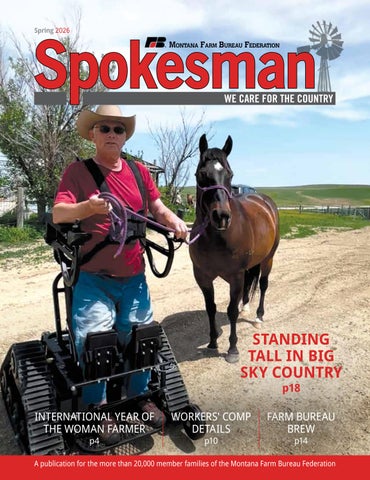
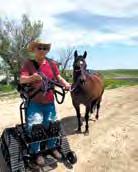
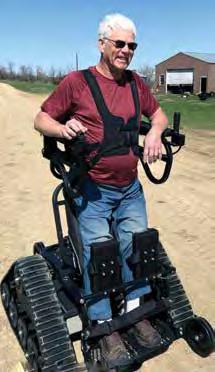
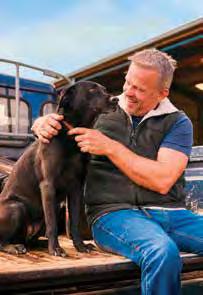
Rancher Jeff Willmore is reunited with Tahoe thanks to a Standing Trackchair from the Cutting Fences Foundation.
Photo by Sue Willmore.
Celebrating International Year of the Woman Farmer
The United Nations has officially declared 2026 the International Year of the Woman Farmer. While International Women’s Day has long been recognized on March 8, this year’s global focus on women in agriculture adds a deeper layer of significance as we look toward Mother’s Day on May 10.
The designation of 2026 has afforded me several opportunities to stand among those proud to be called farmers and ranchers. Representing women in agriculture, I’ve traveled
Here’s to every woman who chose to parent and deserves a tribute.
to the Montana Capitol, the Governor’s Mansion, and the White House throughout February and March. It has been a profound honor because I know so many incredible women who deserve this recognition—women who work tireless hours tending fields, overseeing livestock, managing businesses, and nurturing their homes. They operate heavy equipment, provide medical care to animals, volunteer in their communities, and endure the increasingly challenging years that define modern production agriculture.
People often ask me what it’s like to be a woman in this industry. Honestly, it rarely crosses my mind (except, perhaps, when I’m too short to reach the handle of the dust shield on the combine). I’ve always felt blessed to call myself a farmer. To me, it isn’t about gender; it’s about being a small part of an amazing industry that built this country. Too often, the grueling history of those in agriculture is forgotten. If celebrating the International Year of the Woman Farmer helps the world remember, I’m all in. I also find myself thinking of women in regions like sub-Saharan Africa and Central America—even though their work in agriculture may look different than mine, they remain the primary caretakers of both livestock and families every single day.
On a personal note, March 8 is a milestone in my own home; it’s the day I married my best friend and fellow farmer. But as we move into May, my thoughts turn to another vital celebration: Mother’s Day.
We all have women in our lives whom we admire. The most influential “moms” I’ve known weren't necessarily birth mothers, but women who taught me how to embrace possibilities, own my mistakes, grieve with gusto, and love without boundaries. I was lucky enough to be shaped by several such women. I am a better human because they were generous enough to accept me into their lives. Their love remains with me forever.
So, as we honor the International Year of the Woman Farmer, let’s also remember the 10th of May. Here’s to every woman who chose to parent and deserves a tribute. Don’t forget to celebrate them—and don’t forget to celebrate agriculture every day. ◾
CYNDI JOHNSON President, MFBF
Life insurance is cheaper than you think.
WHY WAIT?
For less than $1 a day, you can make sure your family will have money to pay for things like a mortgage, tuition and everyday expenses. Don’t wait until it’s too late. Contact your Farm Bureau agent today.
Rising Land Costs: Challenges and Strategies For Young Producers
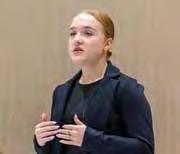
BY TESLA COWING, SOPHOMORE, DENTON FFA, 2025 MFB FOUNDATION YOUTH SPEECH CONTEST WINNER
Across rural America, one reality has become increasingly prominent: farmland costs continue to rise. For young producers, this can seem like a locked gate blocking their path to agricultural dreams. Competing with established operations, outside investors, and developers often raises barriers to market entry before new farmers have a chance to start. Yet, while the challenge is significant, it is not unreachable. With creativity, resilience, and openness to new approaches, the next generation can position themselves competitively for agricultural land and help keep farming strong for years to come.
sold through community supported agriculture can, in some cases, compete with more profitability than a producer managing hundreds of acres of grain. By focusing on value rather than scale, young producers can make smaller tracts of land financially viable. Government programs and financial tools also play a critical role. The USDA's Farm Service Agency, for example, offers beginning farmer loans with reduced down payments and favorable interest rates. State and local programs continue to push for policies that level the playing field for young producers. Utilizing these tools shows leaders that a young farmer is serious, prepared, and willing to leverage every resource available. That preparation can be the deciding factor when competing for land.
The first step is to recognize that land ownership is not always the immediate goal. Many young farmers can begin their journey through leasing or partnerships with retiring producers. Succession planning, in particular, offers a unique opportunity: older farmers want to see their life's work carried on, and young producers bring energy and innovation to the table. By building trust, demonstrating work ethic, and establishing relationships, young people can gain access to land while providing retiring farmers with the peace of mind that their land will remain in agriculture.
At the same time, competitiveness depends on innovation. Commodity markets often favor those with thousands of acres, but young producers can thrive by pursuing niches that add value to every acre. Direct-toconsumer sales, specialty crops, organic certification, or agritourism, create income streams that do not require large land bases. A farmer with 40 acres of vegetables
Finally, technology offers a tremendous advantage. Precision agriculture, conservation practices, and data-driven decision making allow young farmers to maximize productivity on fewer acres. Equally important, technology opens the source for marketing– connecting producers directly to consumers who value local food and are willing to support the next generation of agriculture. This not only strengthens farm income but also builds community relationships that support long-term success.
The rising cost of land is a major hurdle, but it does not have to be the end of the road. Young producers bring with them qualities that cannot be purchased: demonstration, adaptability, and vision. By embracing non-traditional past to land access, focusing on value-driven enterprises, leveraging programs and partnerships, and adopting technology, farmers can build operations that are competitive, sustainable, and resilient. The challenges are real, but so is the opportunity. The future of agriculture will belong to those who are willing to work for it, and young producers are ready to rise to that challenge. ◾
One of our Foundation's most important goals is to aid in the agricultural education and the leadership development of Montana's youth. The Foundation Youth Speech Contest is open to students in the 7th, 8th, and 9th grades who are also members of either 4-H or FFA.
Tesla Cowing, first-place winner of the 2026 Montana Farm Bureau Foundation Youth Speech Contest receives a check for $400 from Bronya Willmore, chair, MFBF Young Farmers & Ranchers Committee.
2026 Annual Agents’ Meeting
Mountain West Farm Bureau Mutual Insurance Company recently held its Annual Agents’ Meeting in Billings, Montana. The annual conference includes recognition of those agents who achieved superior production and overall service during 2025.
Jay Cochran of Billings, MT, was honored as Mountain West’s “Top Montana Agent” for his outstanding sales production.
An elite group of agents qualified for Mountain West’s Chairman’s Award. This award is presented to those agents who attain 100% of the annual goal for Life and P&C insurance. The Montana agents who earned this prestigious award were:
◾ Julie Bramlet of Dillon, MT
◾ Warren Krone of Great Falls, MT
Mountain West Farm Bureau agents have been serving customers across Montana and Wyoming for over 77 years and specialize in building personal relationships within their communities. The local, face-to-face communication and dedication to quality service are what set Mountain West agents apart from the rest. ◾
Montana Agent Of The Year: Jay Cochran
Julie Bramlet
Warren Krone
Mountain West’s Chairman’s Award
Private Property Rights: The Backbone of Rural Life
BY KARLI JOHNSON, MFBF STATE GOVERNMENTAL AFFAIRS COORDINATOR
Private property rights are more than a legal concept; they are the foundation to a free and prosperous society. They shape how land is used, how families build generational operations, and how communities stay strong and independent. The importance of property rights stretches far beyond fencelines and farmyards. They trace back to the founding principles of the United States and set our country apart from many places around the world where weak property protections make farming, business, and daily life far uncertain.
When the United States was founded, private property rights weren’t an afterthought, they were considered essential to liberty and economic opportunity.
The ability to own land, tools, livestock, or equipment without fear of sudden seizure was tied directly to personal independence. Early Americans wanted protection from the kinds of land confiscations and arbitrary control that were common under monarchies and colonial systems. They had seen firsthand how devastating governing powers could be when citizen’s property was not protected.
Private property rights incentivized hard work and investment. If people could benefit from the fruits of their labor, they were more likely to invest in maintaining land, improving it and using it productively. This mindset shaped the nation’s industrial and agricultural backbone and now drives long term investment and stewardship to ensure Americans have access to life’s essentials for generations to come.
Stable private property rights allow landowners to take risks, improve their operations, and leave something better for the next generation. That stability benefits entire communities including workers, businesses, renters, consumers, and families who rely on agriculture’s success.
Many countries around the world struggle with inconsistent or weak property rights. When land ownership or business assets can be taken, redefined, restricted or controlled without clear rules, everyday people feel the consequences first.
In parts of sub Saharan Africa, farmers lack formal ownership or long-term leases. Without secure rights, they hesitate to invest in soil improvements, irrigation
Securing property rights is the foundation that keeps rural Montana strong, prosperous and free.
or equipment. This uncertainty contributes to lower productivity and recurring food shortages resulting in great suffering for citizens.
Across regions of Central and South America, unclear property boundaries or unpredictable regulations deter local and foreign investment. The result is slower economic development, fewer jobs, and limited infrastructure development manifesting in diminished rural opportunities.
In places where property rights are weak, it’s not just land at risk; equipment, vehicles, tools, and savings are also subject to weak protections. This creates constant uncertainty for families and businesses.
These situations highlight something rural Montanans know instinctively: when people can’t confidently own or control their property, agriculture and society itself begin to weaken.
This is why Montana Farm Bureau works to protect private property rights on all fronts. Without private property rights our vision of thriving rural communities and prosperous rural economies will never be a reality. Local jobs depend on agricultural investment. Rural
schools and services rely on stable property values. Housing availability depends on clear land use rules. Food security depends on committed stewards. Longterm agricultural planning and community independence depends on limits to governmental power. All of these would suffer without private property rights.
Private property rights helped shape America from its earliest days, encouraging hard work, independence, and investment in the land. Those same principles continue to support Montana’s agricultural strength and rural character.
You don’t have to own acres to benefit from property rights. You simply have to live in a community where people are free to build, grow, invest, improve and plan for the future while knowing their work is protected. Even small erosions of private property rights affect everyone.
In many ways, secure property rights are the foundation that keeps rural Montana strong, prosperous and free. ◾
Look in the Summer Spokesman for an article explaining corner crossings and more on protecting our property rights.
The Price of Risk: Understanding Workers' Comp in Montana Agriculture
Part II in the Workers’
Compensation Series
BY DANA JANSEN, DIRECTOR, MONTANA AG SAFETY PROGRAM
By the turn of the 20th century, the Industrial Revolution had left its mark permanently on American society. More people were working for someone, rather than working for themselves, in undeniably dangerous occupations to meet the demands of a rapidly modernizing world. This also meant that more people found themselves injured due to the nature of the work they were doing. Until 1915, for workers in Montana, this meant that the only course of action to receive compensation or covered medical treatment for workplace injuries was through lawsuit or the pure benevolence of their employer – most of whom were quick to employ the “Unholy Trinity” of laws on record that absolved them of any responsibility for the workplace injury. The Worker’s Compensation Act was passed by Montana legislature in 1915 making it a legal requirement for all businesses to provide insurance coverage for the event of a workplace injury. While the Act has changed over the years, the fact remains that workers’ compensation serves as the exclusive remedy for those injured within the course and scope of their job duties.
Workers’ compensation pays regardless of fault, but it is important to note that employees forfeit their right to sue an employer for the workplace injury sustained, barring willful negligence on the part of the employer. Coverage includes medical benefits such as doctors, hospital, physical therapy, prescriptions, and indemnity benefits including wage loss, rehabilitation (job placement and/or training), and survivors’
compensation. Medical benefits are unlimited; this means the claim will cover whatever is deemed necessary to restore health of the whole employee. There are no co-pays or deductibles. Wage loss benefits begin after four working days or 32 hours of work, whichever comes first, and are distributed at a rate of two-thirds the average weekly wage.
Pricing of a workers’ compensation policy is done on a per policy basis and is influenced by several factors.
1. Payroll and class codes
2. Rate Tier
3. Loss History and Experience Modification Factor
4. Underwriting (Scheduled debits and credits, when applicable)
This means that policies are priced in a manner that is “fair” given the amount of risk associated with the policy itself. Unfortunately, agriculture class codes are associated with higher amounts of inherent risk and therefore pay a higher rate than most other class codes. The experience modification factor (eMOD) tailors the cost of insurance to the actual loss experience of a policy. This factor is calculated by the National Council on Compensation Insurance (NCCI) and considers the
actual losses associated with a policy over a rolling three-year period. 1.0 is the average value for an eMOD; a higher value indicates significant or recurrent losses. The Experience Modification Factor has a significant impact on overall policy pricing as it is the factor by which the base policy cost is multiplied by for the total premium calculation. Values over 1.0 increase premium and values below 1.0 decrease premium. It is important to note that medical only claims are discounted 70% when calculating the eMOD of a policy. For example, if a claim on a policy costs $10,000, only $3,000 of that would be applied toward the eMOD calculation. Indemnity claims are calculated at 100 percent and have a significant impact on a policy’s eMOD.
Don’t let the fear of a higher Experience Modification Factor prevent you from submitting claims. You pay for the policy to use it. For injuries, employees must notify employers of injury within 30 days, and the claim must be submitted within one year. However, it is recommended that all injuries be reported immediately on the same day, same shift and the first report of injury be submitted within 24 hours. After the injury is reported, the claims process can proceed, and compensability of that claim is determined within
30 days. During this time, it is critical that employers work willingly with the assigned claims examiner to share information and assure a timely and thorough resolution. Unlike injuries that occur in one work shift or less, occupational diseases develop over many work shifts – even spanning months or years. Occupational diseases must be reported one year from the date known. Keep in mind, if you pay for a work-related injury out-of-pocket rather than submitting a claim, your workers’ compensation policy can no longer protect you in the event of potential lawsuit or additional expenses related to the medical treatment of that injury.
For more information on ag safety visit www.mtagri-safety.com ◾
Workers’ Comp Fraud Addressed
While most workers’ compensation claims are legitimate, there are those that will use the system fraudulently. Montana law is clear; fraud is theft and theft is a felony crime. Some examples of fraudulent claims include:
◾ “Faking” the injury or extent of symptoms.
◾ Claiming an injury that happened on personal time was work-related.
◾ Malingering – drawing out the duration of the injury to receive additional benefits.
◾ Continuing to work or earn income while collecting wage loss benefits.
According to Montana State Fund, here are eight signs of a potentially fraudulent claim.
1. The alleged injury occurred early on a Monday morning, or late on a Friday afternoon but was not reported until the following Monday.
2. The accident occurred just prior to a strike, job termination, layoff, at the end of a project or at the end of seasonal work.
3. There were no witnesses to the accident.
4. The claimant has a history of previous claims.
5. The claimant delays reporting the accident.
6. The claimant recently purchased disability policies.
7. The time of the accident was outside normal working hours or on a Saturday or Sunday.
8. The claimant’s attorney notifies you of the injury.
Full CircleMontana, Togo and Back Meet District 3 Director Ashley Descheemaeker
County Farm Bureaus: Fergus, Judith Basin and Wheatland/ Golden Valley
BY REBECCA COLNAR , EDITOR, MFBF SPOKESMAN
MFBF: To start, tell us a little bit about your roots. Where did you grow up and what was your path back to Montana agriculture?
Descheemaeker: I grew up in the heart of agriculture in Big Sandy. My dad was a farmer, and I spent my childhood on our place southeast of town. As I got older and we got busier with school, we moved into town, but the lifestyle stayed with me.
I took a bit of a hiatus from ag. I remember seeing the immense stress my dad faced in the 1980s and ‘90s—the lack of rain, the fluctuating commodity prices—and I told myself back then that I wouldn’t let my income depend on whether or not it rained.
I got a degree in economics and German from Concordia College in Minnesota, moved to Minneapolis and worked in finance, but I hated it. I ended up joining the Peace Corps and served in Togo, a tiny country in West Africa, for a year and a half focusing on community health and education.
That experience changed my perspective. When I finished, I didn't go back to the city; I came straight home to Montana. I went to nursing school, met my husband, and now we’re back on the ranch east of Lewistown. It’s funny how life brings you back to exactly where you belong.
New MFBF District 3 Director Ashley Descheemaeker grew up in Montana agriculture and returned to Big Sky Country after spending time in Minnesota and West Africa.
District 3 Director Ashley Descheemaeker with husband Kyle, son, Jace, and daughter, Reece.
MFBF: You wear a lot of hats these days. What does life look like for you now, both professionally and on the ranch?
Descheemaeker: I’m a bit of a juggler. Professionally, I’m an immunization nurse at Central Montana Medical Center. I work at the clinic two days a week and I really enjoy the work. The rest of my time is spent keeping my children—who are 12 and 9—on track. They are at that busy age where they’re involved in everything, so I do a lot of “mom-taxi” shifts.
On the ranch, we have a great setup. We run cattle with my husband’s brother and his family. What’s special is that for the past six summers, we’ve been managing our own operation by running yearlings on
the very same land I grew up on in Big Sandy. It’s been a wonderful opportunity for me to be more hands-on and for the kids to get involved in the legacy of that land. Our son loves everything about ranching.
MFBF: What inspired you to run for the MFBF Board of Directors, and what do you hope to bring to the table?
Descheemaeker: A couple of years ago, I sat on the delegate floor during the annual convention, and I absolutely loved it. It was eye-opening to see the backand-forth discussion and the process of digging into policy. I knew then that I wanted to expand on that.
I’ve always been interested in politics, and I believe Farm Bureau is so respected in that arena. Whether it’s the work done with the Bureau of Land Management, American Prairie or the current involvement in the exempt well process, it is vital that agriculture has a seat at the table. I want to ensure our interests are represented so that decisions aren't made without us.
MFBF: Since it is the International Year of the Woman Farmer, how do you view the role of women in the industry today?
Descheemaeker: It’s wonderful to see women getting recognition for the roles they’ve always played, whether it’s packing lunches to take out to the combine or running that combine. To be more involved, I went to AI (Artificial Insemination) school about a year ago. I wanted to have that skill for our own herd. I was pleasantly surprised to find that about half the class were women.
My husband has been incredibly supportive; when he asked how I’d handle the AI work, I told him, “I think I’m doing just fine!”
It’s a sharp contrast to my time in Togo. There, the women farmers weren’t the decision-makers but they did much of the farm work, planting and harvesting, often with a baby strapped to their backs. It’s wonderful those ladies will also be recognized for their contributions to their communities during the International Year of the Woman Farmer.
MFBF: When you aren't at the clinic or on the ranch, what do you do for fun? Any hobbies or fun facts?
Descheemaeker: I’m a long-distance runner. My brother, brother-in-law, and I all run. I ran my first 100mile race last summer and I often come along to support my brother on his 200 or 300-mile runs. Sometimes I even try to train on foot out in the country, although you have to stay alert and be careful out there; sometimes the cows don’t appreciate what you are doing. ◾
From Plant to Pint: Introducing the beginning of the Montana Farm Bureau Beer
BY REBECCA COLNAR , EDITOR, MFBF SPOKESMAN
The idea for a Montana Farm Bureau beer was the brainchild of Montana Farm Bureau’s
Executive Vice President’s wife, Casey Kulbeck. While at the MSU Ag Appreciation game tailgate this November, she took note of all the Farm Bureau members gathered to celebrate agriculture and the Bobcats. She mentioned that a Montana Farm Bureau beer would be a fun tool for promoting the farmers who grow the grain that is used by Montana brewers to add value to the agricultural economy.
“On the way home we started putting a plan together and the next week I met with John Acheson who is a coowner of Madison River Brewing Company in Belgrade,”
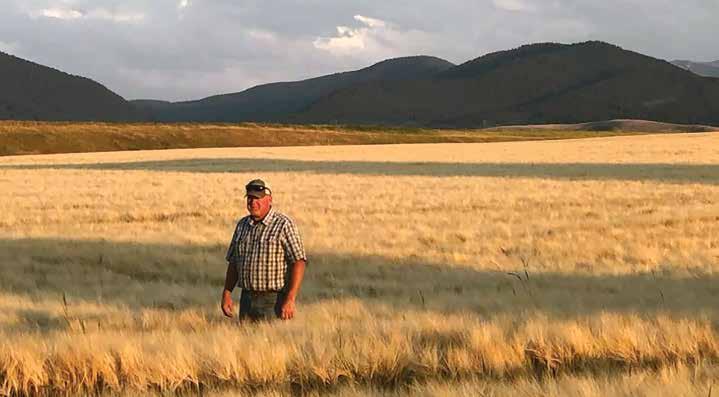
Farmer Karl DeJonge uses grain from his Manhattan farm for his Gallatin Valley Malt Company.
said Scott Kulbeck. “He loved the idea and put me in touch with Heather Sargent at the Gallatin Valley Malt Company who was also excited about the idea. She volunteered to give Madison River Brewing the grain necessary for our beer. After visiting with Heather, I realized they would be a great part of this field- to-tap agricultural story.”
The idea was bounced off the MFB Federation and Foundation Board members who were also excited and the communications team of Rebecca Colnar and Haley Droogsma went to work on a marketing plan that will benefit agriculture, Montana Farm Bureau Federation, Gallatin Valley Malt Co., and Madison River Brewing.
(Editor’s note: Farm Bureau members participated in a fun competition to name the wheat beer. At press time,
the name was still unknown but stay tuned for the MFBF Summer Spokesman for the name and more information. The beer will be officially introduced during the MFBF Summer Conference June 15-17, 2026, in Kalispell.)
Since its founding in 2017, Gallatin Valley Malt Co. has been on a mission to add value to one of Montana’s staple crops: barley. By malting their own grain and providing it to local craftsmen like Madison River Brewing, the company is proving that “local” isn't just a buzzword— it's a competitive advantage. By donating high-quality malt for a Montana Farm Bureau Federation (MFBF) beer, it highlights the vital connection between grassroots farming and the flourishing craft spirits industry in the Intermountain West.
Great beer starts with quality grain and a top-notch malting process.
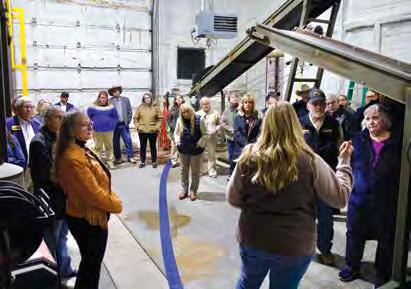
(Above) The Montana Farm Bureau Board of Director learns about the malting barley process during a tour of Gallatin Valley Malt Company.
(Below) District 8 Director Ed Bandel, a small grains producer, visits with GVMC Head Maltster Heather Sargent.
Photos Haley Droogsma
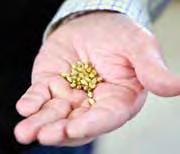
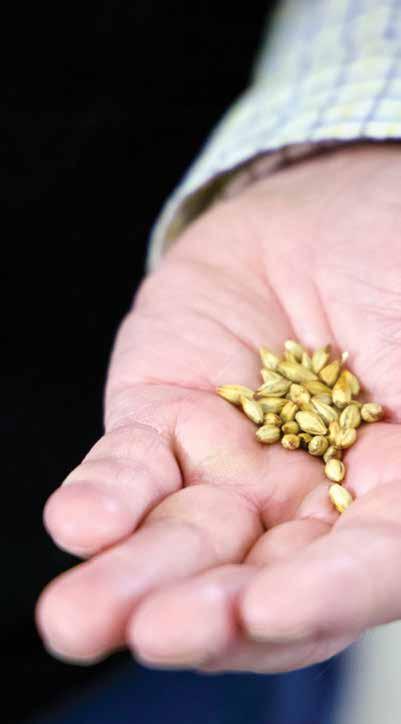
Malt Barley is generally planted in early April and harvested in August. The journey from a grain bin in Manhattan to a pint glass in a taproom is a meticulous, eight-day scientific process. Manager Heather Sargent explains that malting is essentially “tricking” the grain into thinking it is time to grow.
The process begins with roughly 21,000 pounds of cleaned grain—wheat or barley—loaded into a steep tank. For about 41 hours, the grain undergoes a series of water immersions and “air rests” where CO_2 is pushed out to allow the kernels to breathe.
“You’ve got to let the grain breathe,” Sargeant says. “We’re controlling the temperature and pushing air through it the whole time.”
Once the grain reaches the proper moisture level, it moves to the germination floor for four to five days. Here, massive augers turn the grain twice daily, pushing moisture and air through the bed to develop the enzymes necessary for the brewing process. Finally, the grain is dried in a kiln according to a specific recipe and
run through a final cleaner to remove “rootlets” and dust before being bagged for delivery.
THE “PLANT TO PINT” ADVANTAGE
What sets Gallatin Valley Malt Co. apart is their total control over the supply chain. Founded by farmer Karl DeJonge, the company operates on a “plant to pint” philosophy. They grow nearly every grain they malt, with the exception of corn, which they source from a neighbor “just down the road.”
This vertical integration is a boon for the local economy. By sourcing malt in Manhattan rather than ordering from overseas or large national warehouses, Montana brewers save significantly on shipping costs—sometimes upwards of 30 cents per pound. Many breweries around the state buy their malt barley from Gallatin Valley Malt Company.
“I think that’s how we lend to the economy,” Sargeant notes. “They can use their dollars here. When you’re talking about cents per pound, over the years, that adds up to thousands of dollars.”
A TOAST TO MONTANA AGRICULTURE
The upcoming Montana Farm Bureau beer serves as a perfect showcase for this local synergy. While there was initial discussion about sourcing grain from various corners of the state, the efficiency and quality of Gallatin Valley’s inventory made them the natural choice.
Working alongside John at Madison River Brewing, Gallatin Valley Malt Co. decided to donate the malt for this specific batch. It’s a move that strengthens the ties between growers, maltsters, and the brewing community. ◾
In the 2026 Summer Spokesman, read about Madison River Brewing’s production and launch of the Farm Bureau beer.
GVMC gets all of its barley and wheat from their farm. Courtesy photo
Gallatin Valley Farms/Malt Company owner Karl DeJonge. Courtesy Photo
Restoring Independence: Kendra Lewis and the Cutting Fences Foundation
BY REBECCA COLNAR , EDITOR, MFBF SPOKESMAN & GENAYE BRISCOE, CUTTING FENCES FOUNDATION
For many Montanans, the outdoors, hard work, and community are more than traditions, they are a way of life. When injury, illness, or disability makes those things feel out of reach, the impact goes far beyond physical limitations. Cutting Fences Foundation exists to bridge that gap by restoring access, independence, and quality of life across Montana.
Cutting Fences Foundation was founded in 2022 by occupational therapist Kendra Lewis. Cutting Fences serves farmers, ranchers, and Veterans in agriculture living with a disability or illness. Their mission is to increase physical and mental wellness through improved function, independence, and quality of life. The core program used to achieve this mission is an Adaptive Equipment Loan Closet that offers free access to adaptive equipment to Montanans living with a disability.
Kendra Lewis’ Cutting Fences Foundation journey began as an occupational therapist. While working toward her doctorate at Rocky Mountain College, she was asked to present on the experience of growing up in agriculture. At the time, identifying more as a student than a farmer, she reached out to the agricultural community for insight. Within minutes, she connected with three individuals farming and ranching from power wheelchairs.
Montana lacked the resources to help.”
That realization became the catalyst for her doctoral capstone and the eventual creation of the Cutting Fences Foundation. What began as a podcast to assess community needs quickly revealed a glaring gap: the need for increased access to large-scale adaptive equipment.
THE LOAN CLOSET
The Loan Closet currently houses three Action Trackstanders, two TerrainHoppers, a Freedom Trax, a Coach Lift, Coyote Outrider, and a Firefly attachment. The equipment that Cutting Fences Foundation offers is consistently out on loan and has been used to achieve many things including fencing, tending livestock, family adventures, hunting, fishing, and so much more. The loan closet continues to expand as new equipment is added to meet evolving needs statewide. Because Montana lacks local manufacturers for adaptive equipment, products often must be sourced from across
“It was eye-opening,” Kendra says. “There is a significant population of farmers and ranchers and Montanans in general who, due to accident or illness, need adaptive equipment to keep working and doing the things that bring them purpose. I discovered that
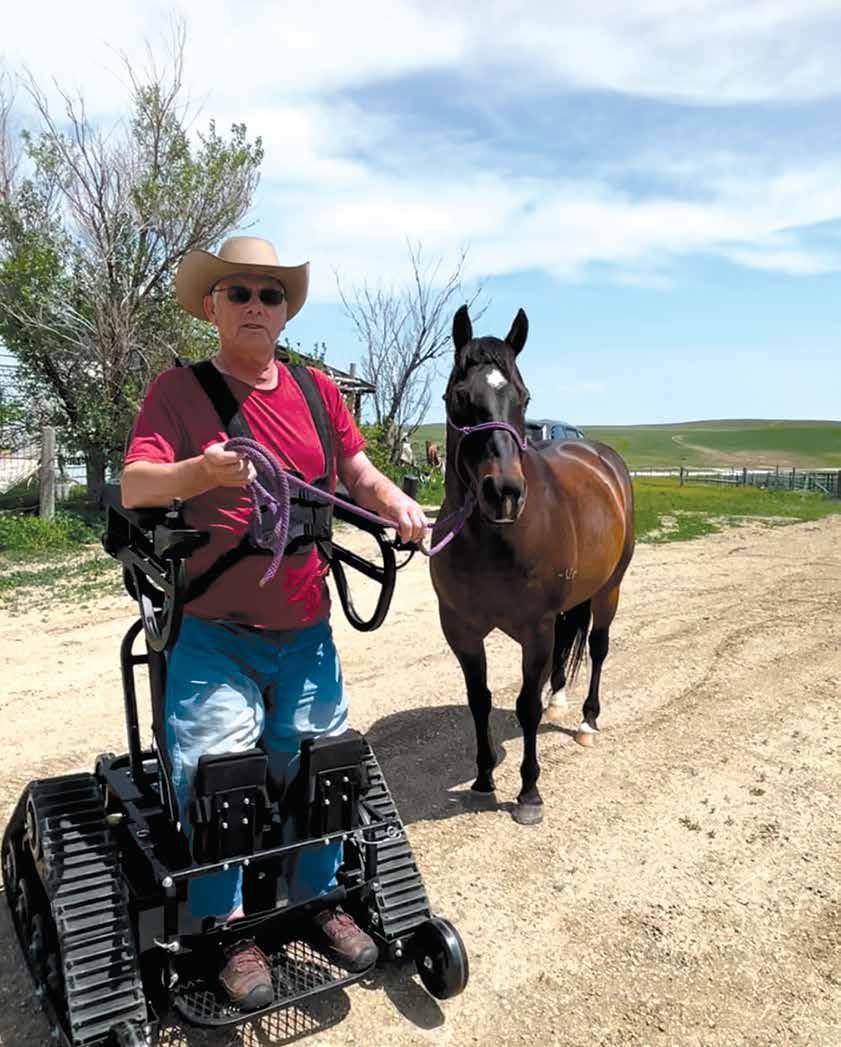
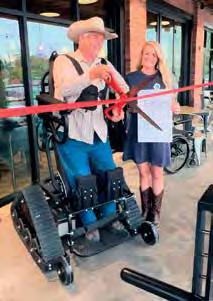
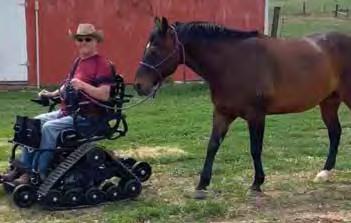
(Left) Jeff Willmore, with Cutting Fences founder Kendra Lewis, cuts the ribbon during a fundraiser for the equipment Loan Closet. (Below) Using adaptive equipment allowed Jeff Willmore to work with his horse.
LOOKING TOWARD 2026
As Cutting Fences continues to grow, its 2026 goals are ambitious. The foundation is currently establishing a permanent home base and plans to build a Rural Resource Barn. This facility will serve as a central hub to store inventory and house equipment for MonTECH, the state’s assistive technology program, making resources more accessible to Central Montana.
Beyond equipment, the foundation is focused on advocacy—pushing for policies that allow the use of adaptive gear in all areas that the public can enjoy, ensuring that a physical limitation never means the end of a life outdoors.
the U.S., creating a significant barrier for local producers to try and obtain what they need. Kendra’s solution was the “loan closet”— a central inventory of adaptive tools that members can use for free to return to the land they love.
Many people simply do not know what adaptive equipment exists or what may be possible with the right tools. Cutting Fences Foundation aims to provide both education and access through hands-on experiences, conversations, and loaning equipment for extended periods of time.
The impact on mental health is profound. In agriculture, work isn't just a job; it’s an identity.
“When that is taken away, it is physically and mentally devastating,” Kendra explains. “Restoring that capability restores quality of life. It eases the financial burden of being 'short-handed' and allows people to contribute to the family unit again. Just being able to do a little of what everyone else does has a massive impact.”
The power of this equipment is best seen in the stories of those using it. Jeff Willmore, a rancher standing in the Cutting Fences Trackchair for the first time, looked at Kendra with tears in his eyes and joked, “You know, you’re not as tall as I thought you were.”
After months of others looking down at his wheelchair, the ability to stand eye-to-eye was a restorative human moment.
Through their Quality of Life Fund, Cutting Fences Foundation helps people achieve not just access but also ownership by partnering with other organizations to support and help fund equipment for individuals to own. The Quality of Life Fund has also been used to support families to overcome unexpected medical costs and other acts of service to Montana’s rural and agricultural communities. Future plans are to expand on the impacts that the Quality of Life Fund can offer.
Visit cuttingfencesfoundation.net or call Kendra Lewis, 406-217-1166. ◾
May is Mental Health Month
The stresses of farming and ranching are many with income dependent on weather, volatile markets, international politics, family dynamics and much more. Adding in a debilitating injury adds to the feeling of hopelessness. Ag communities understand and help is available. Visit fb.org/ farmstateofmind , beyondtheweather. com and the https://www.montana.edu/ extension/wellness/.
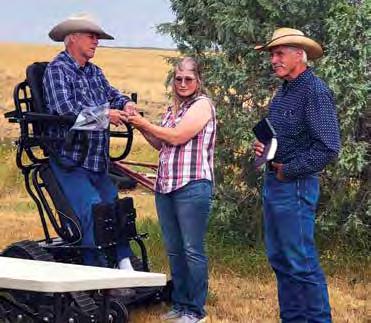
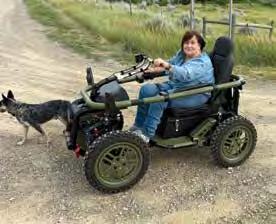
(Above) By using the Cutting Fences Loan Closet, Jeff Wilmore was able to stand and renew vows with his wife, Sue. (Right) Another client uses the TerrainHopper to get around her ranch with her trusty cow dog.
Standing Tall: The 117-Day Miracle on a 1914 Homestead
BY REBECCA COLNAR , EDITOR, MFBF SPOKESMAN
On June 6, 2021, Jeff Willmore was shoeing a colt. It was a standard day on the homestead his grandmother settled in 1914—the same dirt where his father was born, and where Willmore has spent his entire life tending to cattle and horses.
Then, the world went dark.
Willmore lost his memory for seven months. He said he wasn’t sick, but he doesn’t remember anything after he shod the horse in June. He contracted Covid-19 in October then went into the hospital in December. His son left a career as an electrician to keep the ranch running. When Willmore woke up in the hospital, he was alive, but only barely. His eyes were open, but he couldn’t close them. Of his entire body, only one finger moved.
“My immune system attacked my nerves,” Willmore recalls. “It didn't shut down after I had Covid in October. It almost killed me.”
What followed was 117 days in intensive care, battling MRSA, pneumonia, and a heart that stopped beating for eight minutes. It was in that time Willmore shared his experience.
But for a man whose roots go back a century into the soil, waiting five years to get back to work wasn't an option.
The turning point didn't come from a pill or a traditional therapy session. It came on tracks.
With the help of neighborly connections like Doreen McClure, Willmore was introduced to Kendra Lewis at the Cutting Fences Foundation. Lewis delivered the allterrain Trackchair to Willmore’s ranch in Roy, Montana. For a rancher, the chair was more than a piece of adaptive equipment; it was a mechanical resurrection.
“It was like giving your life back to you,” Willmore says. “Just knowing there are people who really care makes me want to work more and harder to get better. Being able to stand again was one of the feelings I have never had. Standing next to my horse and being able to brush him was such a feeling like I’d never had before. I never cried much, but that made me cry.”
“My sister got killed 47 years before, and when I woke up, I saw in my mind she came to me and my dad was with her and there was a guy behind him in a white robe and my sister told me I had to go back. I thought I made that up, but I found out that my granddaughter, who was 13 at the time, described the same thing, only my sister told her ‘Don’t worry, your Papa’s going to be fine.’”
Doctors told him that if his nerves ever “re-hooked,” the healing process would be painful and could take five years.
The Trackchair proved to be a personal off-road vehicle for Willmore. While a standard wheelchair relies on four wheels—which easily sink into mud, high grass, or soft arena dirt—a Trackchair uses a dual-track system like a tank or a skid steer.
While a traditional wheelchair is built for the getting around in town, on pavement or on sidewalks, Trackchairs have higher ground clearance for heading out across the field and are built to handle mud, snow and dirt. The standing feature on the Trackchair offers a lift and provides functional independence.
Currently, he can’t stand on his own, but the standing chair offers welcomed mobility. For someone like Willmore, the chair acts as a bridge. It provides the physical stability his nerves can't yet manage but allows the “rancher” identity to take over where the “patient” identity left off.
Willmore used a chair not just to catch and lead his horse around or walk with his granddaughter, but to spray weeds. He nearly ran out of battery because he was enjoying the work so much. Most poignantly, the technology allowed Willmore and his wife, Sue, to stand together as they renewed their wedding vows on their place in front of their closest friends. ◾
Jeff Willmore on his Standing Trackchair.
or Ford Blue Advantage™
1 Available on the purchase or lease of an eligible new 2025/2026/2027MY Ford Maverick®, Ranger®, F-150®, Super Duty or F-150 Lightning®. Not available on any other Ford or Lincoln vehicles, or F-150 Raptor®, F-150 Raptor R™, Ranger Raptor or F-650® and F-750® Super Duty. Vehicle eligibility may change at any time. Available to U.S. residents only. Place a new retail order or take new retail delivery from an authorized Ford Dealer’s stock by 1/04/27. Limit of five purchases/ leases per household during the program offer (PGM# 32900). Offer subject to dealer participation. May not be used/combined with most other Ford private offers. See an authorized Ford Dealer or go to https://www.fordrecognizesu.com, for complete details and eligibility (PGM# 32900). Due to high demand and global supply chain constraints, some models, trims, and features may not be available or may be subject to change. Check with your local dealer for current information. Offer subject to confirmation of eligibility.
2 Available on the purchase of an eligible certified used 2021-2027MY Ford Blue Advantage Gold, EV (F-150 Lightning only), or Blue Certified, Ford Maverick, Ranger, F-150, Super Duty or F-150 Lightning with under 80,000 miles. Not available on any other Ford or Lincoln vehicles, or F-150 Raptor, F-150 Raptor R, Ranger Raptor or F-650 and F-750 Super Duty. Vehicle eligibility may change at any time. Available to U.S. residents only. This offer is not eligible for customers purchasing a vehicle in the state of Texas. Take delivery from an authorized Ford Dealer’s stock by 1/4/2027. Limit of five purchases per household during the program offer (PGM# 32902). Offer subject to dealer participation. May not be used/combined with most other Ford private offers. See an authorized Ford Dealer or go to https://www.fordrecognizesu.com, for complete details and eligibility (PGM# 32902). Due to high demand and global supply chain constraints, some models, trims, and features may not be available or may be subject to change. Check with your local Ford Dealer for current information. Offer subject to confirmation of eligibility.
Ford Super Duty®
YF&R Conference Season Highlights Growth, Advocacy, and Education
BY BRONYA WILLMORE, YF&R COMMITTEE CHAIR
MONTANA YF&R LEADERSHIP CONFERENCE
The 2026 Montana Farm Bureau Young Farmer and Rancher (YF&R) Conference kicked off Friday, Jan. 23, with a Beef Quality Assurance (BQA) certification class. Later that evening, attendees enjoyed a pizza party and agricultural trivia emceed by Jim Sargent, who even wrote and recorded custom songs for the event.
Saturday morning was packed with information, starting with a Washington, D.C., update from American Farm Bureau Federation (AFBF) economist Danny Munch, followed by breakout workshops. Lunch speaker, Flint Rasmussen, reminded us that no matter where we go in life, it is important to take with us the values instilled by our agricultural lifestyle. Saturday afternoon featured a necropsy demonstration by Dr. Katie Rein, alongside tours of Central Avenue Meats, Montana Valley Irrigation, and the Montana State Grain Lab. We wrapped up Saturday evening with dinner, karaoke, and dancing at The Station.
On Sunday morning, the conference concluded with a keynote address from Rep. Eric Tilleman, who spoke on the importance of perseverance when facing difficult challenges. A trade show ran throughout the weekend, allowing attendees to network with various agricultural businesses during breaks.
provides through this conference goes beyond the presentations—it truly helps us foster lifelong relationships with other young agriculturalists.
THE 2026 AMERICAN FARM BUREAU YF&R LEADERSHIP CONFERENCE
It was exciting to lead 28 Collegiate and Y&FR members from Montana to the 2026 AFBF YF&R Leadership Conference in Portland, Oregon, March 13–16.
The event featured a wide variety of workshops. I attended a session on effective communication where a group challenge served as an eye-opening reminder of how much we can improve. I was partnered with an attendee from Puerto Rico, which added a fun, unique perspective to the challenge. Another session focused on Collegiate YF&R groups, where we shared ideas on boosting meeting attendance and retaining members.
For me, the highlight of the national trip is always networking. I love making friends from across the country and learning about their regional agricultural priorities, especially in these complex political times. To be effective advocates for the industry, we must step outside our own operations. There is more to agriculture than dryland farming or commercial cattle ranching, and hearing from different sectors from across the country helps us stay rooted and resilient.
Attendees could also choose from a variety of tours, including dairies, creameries, wineries, and historical sites. I chose a tour of an ostrich farm that focused on agritourism. It was a great example of how diversification can help bolster an operation's bottom line.
Every year, I am blown away by this conference. We are a relatively small group, but the quality of the speakers and presentations is truly amazing. The value the Montana Farm Bureau Federation
LOOKING AHEAD
The next Montana YF&R Committee meeting will be held Monday, June 15, 2026, in Kalispell during the MFBF Summer Conference. Local tours are also being planned. ◾
(Above) MFBF Collegiate Discussion Meet winner Helen Darlington competed in the AFBF Collegiate Discussion Meet. (Right) MFBF Collegiate Farm Bureau and YF&R Committee members showed up in force at the YF&R Leadership Conference in Portland, Oregon.
DUAL Purpose: Montana Farm Bureau Women Strengthen Leadership and Community Ties
BY HEIDI BREWER, CHAIR, MFBF WOMEN’S LEADERSHIP COMMITTEE
The state Women’s Leadership Committee (WLC) convened February 15-16, 2026, at the Courtyard by Marriott in Billings for the DUAL (Developing Unity Through Agricultural Leadership) training which brought together both the WLC and the Promotion and Engagement (P&E) Committees to provide a powerful, handson learning and engagement opportunity to strengthen each committee’s impact as leaders.
Ronald McDonald houses including “rounding up” at your local McDonald’s. The next time you visit McDonald’s ask to round up your order to the nearest dollar. The extra change goes directly to your local Ronald McDonald House Charities. Other ways to donate at the Eastern Montana Ronald McDonald Charities including food items, supplies for the house, donating a used appliance, gift cards, aluminum tabs from
The agenda was packed with training on leadership, estate planning, digital communications, and active listening.
Each committee then met separately to discuss their programs of work. The state WLC is made up of two representatives from each of the ten Montana Farm Bureau districts. A highlight of the event was meeting with Sarah Brockel, executive director of the Billings Ronald McDonald house. The Ronald McDonald House is a “home-away-from-home” program for families with critically ill or injured children receiving treatment at nearby hospitals. Providing financial support and family needs for Ronald McDonald Houses is a special effort of the state and national WLC. Montana has two Ronald McDonald House locations; the Ronald McDonald House Charities, Eastern Montana, is located in Billings with the Ronald McDonald House Charities, Western Montana, located in Missoula.
There are many ways to support both of the Montana
beverage cans, direct financial support, Amazon wish list, and preparing a meal.
MFBF has been fortunate to have members allocate meat from a culled animal donated to the Producer Partnership Program to freezers of these important homes. This is a great way to help this essential charity as well as provide the meat donor with a tax deduction.
To learn more about the needs of the Eastern Montana Ronald McDonald houses, visit websites for Ronald McDonald House Charities, Eastern Montana. To learn about the needs of Western Montana Ronald McDonald houses, visit: Ronald McDonald House Charities, Western Montana.
For more information about the WLC, please contact Heidi Brewer at Hbrewer4026@icloud.com ◾
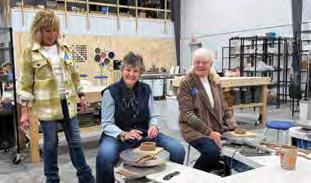
Women’s Leadership Committee Chair Heidi Brewer, left, watches former WLC Chair Carla Lawrence with Cathy McDowell practice pottery-making skills at the Ohana Ceramic Studio in Billings.
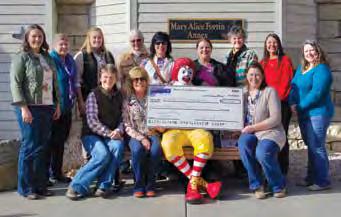
During the DUAL meeting, the WLC provided the Ronald McDonald House, Eastern Montana, with a $500 cash donation during a visit.
MFBF LEADERS ADVOCATE FOR MONTANA AGRICULTURE IN WASHINGTON
Montana Farm Bureau Federation (MFBF) leaders traveled to Washington, D.C., in February and March to engage with federal agencies, meet with Montana’s Congressional delegation, and receive honors at the White House.
ADVISORY COMMITTEE MEETINGS AND CONGRESSIONAL VISITS
In February, three MFBF members participated in the American Farm Bureau Federation (AFBF) Issues Advisory Committee meetings. Representing Montana were Greg Gabel (Technology), Jess Bandel (Market Structures), and Rich Franko (Federal Lands). Led by MFBF Senior Director of Governmental Affairs Nicole Rolf, the group participated in policy sessions and met with Montana’s Congressional offices to discuss key legislative priorities.
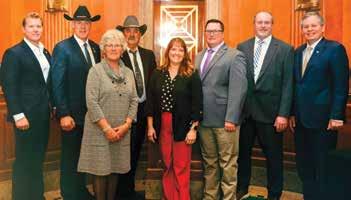
During the American Farm Bureau Issues Advisory Committee Meetings, Montana Farm Bureau leaders met with Montana’s Congressional delegation. (Left to right): Senator Tim Sheehy, Representative Ryan Zinke, Ellen and Rich Franko, MFBF Senior Director of Governmental Relations Nicole Rolf, Greg Gabel, Jess Bandel and Senator Steve Daines.
WHITE HOUSE RECOGNITION
On March 8—coinciding with International Women’s Day and National Working Mother’s Day—MFBF
President Cyndi Johnson was invited to the White House to meet with President Donald Trump and First Lady Melania Trump. Johnson joined 100 prominent women, including four other Farm Bureau leaders, for a reception in the East Room.
During the event, the President and First Lady emphasized the vital role of women in community engagement, industry, and politics.
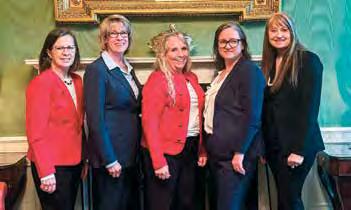
Farm Bureau women leaders in the White House for International Women’s Day. (Left to right): Sharon Arnold - Missouri FB Board Member, Isabella Chism, American Farm Bureau Women’s Leadership Committee Chair, Cyndi Johnson - Montana Farm Bureau President, Shannon Douglass - California Farm Bureau President and Angie Bailey - Oregon Farm Bureau President
“The President noted that our nation is built on communities, making it essential for women to step into leadership roles,” Johnson said. “He congratulated us on our contributions and expressed his gratitude for our work.”
STRENGTHENING AGENCY PARTNERSHIPS
While in D.C., Johnson also met with USDA Administrator Pam Swanson. The two had previously established a professional rapport during an industry tour two years prior.
“It is a unique experience to visit a federal agency and receive a hug instead of a formal handshake,” noted Johnson. “We presented a Montana Farm Bureau policy regarding new insurance options for specialty crops, and the Administrator’s team was very receptive to the proposal.”
POLICY PRIORITIES AND THE FARM BILL
Johnson also joined her husband, Ken Johnson, who was in Washington representing the Montana Grain Growers Wheat Improvement Program Committee. Together, they met with the Agricultural Appropriations Committee to discuss the urgent needs of producers.
“Our primary message in Washington is the immediate need for progress on the Farm Bill,” Johnson emphasized. “While we appreciate the work done thus far, we must remind leadership that rising input costs and geopolitical volatility are directly jeopardizing our agricultural economy.” ◾
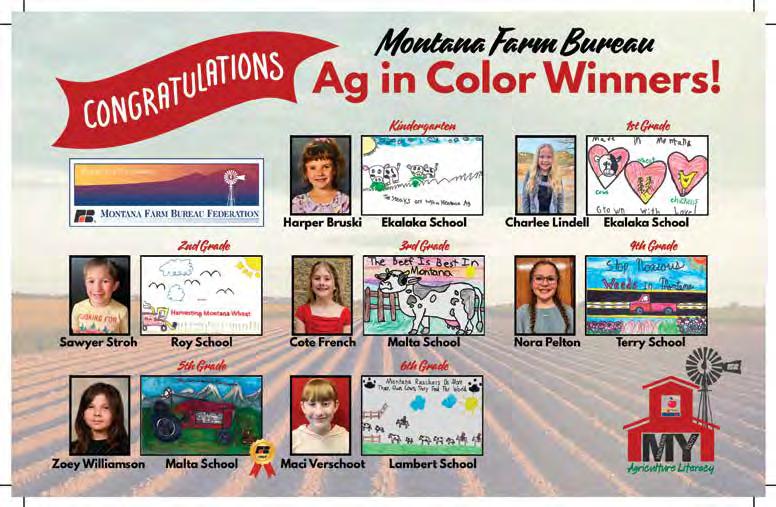
Ag in Color Winners Announced
The Montana Farm Bureau Federation has announced the winners of the Montana Youth Agriculture Literacy program drawing contest. “Ag in Color” was developed in recognition of National Ag Week, March 15-21, 2026, as a creative competition for elementary school children. Each grade was given a different agricultural theme. One winner was selected from each grade with judges selecting one drawing from the winners to receive the “Farm Bureau Proud” designation. The “Ag in Color” drawing contest was open to any Montana student enrolled in kindergarten through 6th grade. Entries were judged on agricultural content, originality, neatness and reproducibility. Members of the Women's Leadership Committee and Promotion and Engagement Committee judged the contest. ◾
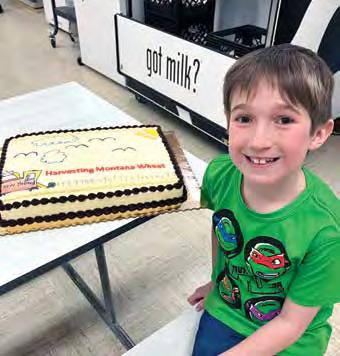
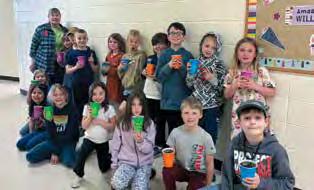
Second grade winner Sawyer Stroh and his class celebrated his success at Roy Public Schools.
County News
Richland County shared a booth with Farm Bureau Financial Services March 6-7 in Sidney at the MonDak Ag Days.
On March 23 and 26, DawsonWibaux County read I Love Blueberries to first and secondgrade students at Jefferson School in Glendive.
Park County held a fun-filled Ag Trivia Night March 16 at the Elks Lodge in Livingston. Members had a great time with the answers and won great prizes.
Yellowstone County Board Member Kathy Teter read to students at Huntley Project School on Ag Day, March 24, and President Jodie Drange and Board Member Teddi Vogel were on KGHL for Ag Day. The students in Mrs. Melber’s class were introduced to how things grow, return to the Earth and grow again. They participated in an activity about composting, planted their own watermelon seeds and even got to enjoy a sample of their delicious future fruit.
Yellowstone County Board Member Kathy Teter read “The Soil in Jackie's Garden” to second-grade students at Huntley Project Elementary.
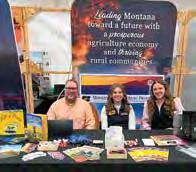
On March 19-20, MFBF had a booth at the KATQ Northeast MT Farm Expo and partnered with other organizations to host a well-attended social at the Blue Moon on March 19. Pictured from MFBF are EVP Scott Kulbeck, Regional Manager Jasmine Evans and Digital Lead Haley Droogsma.
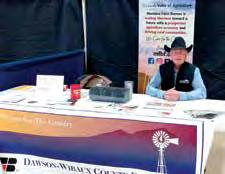
Dawson-Wibaux County President Bernard Evans at the booth at GATE in March 13-14 in Glendive.
Southwest Counties and past District 2 Director Rhonda Boyd and 4-H members read Accu-rate Ag books and played My American Farm games at Alder School for National Ag Week.
From May 1-18, Powder River-Carter County hosted their “Livestock Selfie” contest on their Facebook page. To enter, folks posted a selfie with their favorite farm animal on Facebook with the hashtag: #prclivestockselfie26. Photos can be seen on the Powder River-Carter Facebook page.
Ravalli County is hosting their “Brandings and Bad Decisions” Dance with the Tanner Laws Band from 7 p.m.10 p.m., Tuesday, April 7, at the Missoula County Fairgrounds. Pizza and soft drinks available.
FRONT RANGE COUNTIES FOURTH-GRADE BEEF TOUR
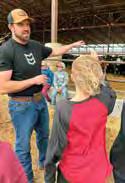
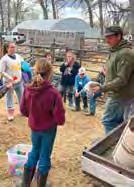
Front Range Counties organized an immersive Pasture-to-Plate field trip that gave 30 fourth-grade students from Choteau Elementary a hands-on look at Montana’s livestock and food systems.
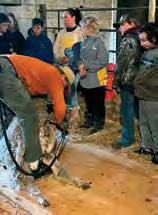
Their first stop was at Sevens Livestock, a local cow/calf and seedstock operation. There students watched a live sheep shearing demonstration, observed the ultrasounding of a heifer, and—much to their excitement—each of the 30 students had the chance to milk a cow. They rotated through educational stations focused on animal feed, livestock identification, and beekeeping.
The group then visited Mountain View Livestock, where they learned about cattle supplementation and the logistics of livestock trucking. They even got an inside look at how cattle travel. From there, they traveled to Brosten’s Feedlot between Fairfield and Choteau to see firsthand how cattle are fed and managed in a feedlot setting.
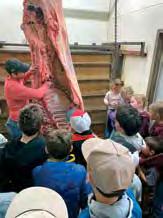
Next, they toured Morrell’s Chop Shop to understand the basics of animal processing and how livestock becomes consumer-ready products.
The day wrapped up in the school cafeteria, where students explored the Beef to School Program and saw how local beef makes its way onto their lunch trays.
Montana Farm Bureau Foundation
Your investment in the future of agriculture!
◾ Community Grants to support our rural communities
◾ Continuing Education Scholarships
◾ Support for Youth Agriculture and Leadership Organizations like 4-H & FFA
◾ Leadership Development opportunities for MFBF members
◾ Agriculture education opportunities for farmers and ranchers
◾ Disaster Relief Fund to help our neighbors in need
Grow with us! Support the Montana Farm Bureau Foundation at mfbf.org/foundation ◾
Montana Farm Bureau is proud to endorse the following candidates for their commitment to agriculture and rural Montana.
SD 1 - Neil Duram
SD 9 - Llew Jones
SD 11 - Ed Buttrey
SD 23 - Emma Kerr-Carpenter
SD 34 - Shelley Vance
SD 43 - David Bedey
HD 13 - Linda Reksten
HD 18 - Butch Gillespie
HD 20 - Melissa Nikolakakos
HD 28 - Chisholm Christensen
HD 30 - Morgan Theil
HD 33 - Ric Holden
HD 34 - Jerry Schillinger
HD 36 - Ty Linger
HD 55 - Brad Barker
HD 67 - Russ Nelson
HD 68 - Jennifer Carlson
HD 69 - Ken Walsh
HD 76 - John Fitzpatrick
HD 77 - Jane Gillette
HD 84 - Roy Caldwell
HD 86 - Wayne Rusk
Paid for by Montana Farm Bureau PAC; Karli Johnson, Treasurer, 100 Red Mountain Drive, Bozeman, MT 59718
FARM 250
The history of the United States is written in every row of crops, pasture and dairy barn from sea to sea. The American Farm Bureau Federation is marking the nation’s 250th anniversary through FARM 250, a celebration of the contributions of America’s farmers in helping to grow America into the nation it is today.
◾ Feeding Families
◾ Advancing Innovation
◾ Rural resilience
◾ Mindful Stewardship
From the original colonists, who traveled to the new world and discovered fertile lands, to the modern farmer who uses satellite technology and automated tools to feed families nationwide, America’s success starts at the farm gate. ◾
JUNE 15-17, 2026
The conference will feature top-notch speakers, advisory committee meetings and an entertaining MFBF Foundation Fundraiser along with the traditional Wednesday tours and golf tournament.
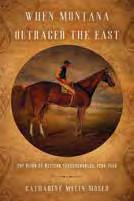
When Montana Outraced the East The Reign of Western Thoroughbreds, 1886-1900
Written by Catharine Melin-Moser
REVIEW BY REBECCA COLNAR , EDITOR, MFBF SPOKESMAN
The subtitle of this well-researched book should intrigue anyone interested in Montana history, horse racing, or both. Until Catherine Melin-Moser tackled this subject, details regarding the golden era of horse racing in Montana remained scant. The fact that highcaliber racetracks once dotted the state in areas like Deer Lodge—and that Kentucky Derby winners once grazed on Montana bunchgrass—comes as a genuine surprise.
In this non-fiction work, Moser (a Fergus County Farm Bureau member) follows the lives and racing stables of three influential, wealthy men: “Silver Mining Lion” Noah Armstrong, “Old-time Banker” Samuel Larabie, and “Copper King” Marcus Daly. These men came to Montana to build empires in the mining and banking industries; once they secured their fortunes, they invested extensively in Thoroughbred breeding and palatial horse farms. During the Gilded Age, their stables were the envy of the racing world.
It is particularly interesting to learn about Daly’s
AG BANKING THAT RIDES WITH YOU
Bitterroot Stock Farm near Hamilton. It seems almost local legend that “delicate” racehorses thrived so well on the bunchgrass and crisp air of western Montana. Moser details how owners would ship these horses by train from the East; upon arrival, managers would collect the animals and trail them 28 miles overland to the stables.
Not only does Moser track the success of the owners, but she also provides extensive coverage of the trainers, jockeys, and the horses themselves. The history of Montana equine powerhouses who won on tracks in Kentucky, New York, Maryland, and Illinois is meticulously researched.
Readers who prefer to breeze through a book may initially be intimidated by this 300-plus page tome. However, once you dive in, the vivid details of personalities and the highstakes world of 19th-century racing keep the pages turning. Like all good things, this era of Montana’s spectacular racehorses ended when the three men who invested their money, energy, and passion into the sport passed into history.
Moser’s extensive footnotes reflect years of dedicated research, and she shares this incredible, primarily untold story with impressive clarity.
Visit Catharine Melin-Moser’s Facebook page for the list of where the book may be purchased or contact your local bookstore to order. ◾
Stockman is committed to help keep Montana growing and our rural communities strong. Local people, local decisions. Stop by and discover the difference.
Montana’s Brand of Banking
You’re an owner. And ownership pays.
Put earnings back in your pocket with competitive borrowing rates and an annual cash dividend through our Patronage Program.
In 2025, AgWest paid the equivalent of 1.25% of eligible average daily loan balances back to our customer-owners.