


Eighth Grade students spend their final year at Far Brook considering: What is justice and what is a leader’s role in bringing about justice? These questions relate to the year’s study of American history The class takes a multicultural perspective on our nation’s past, considering it from the perspective of a variety of groups, studying the challenges various communities have faced and the contributions they have made. Topics range from the struggles of the Civil Rights Movement to the 2008 Financial Crisis. The class explores the ideas of protest, propaganda, and boycott in the nation’s history and also undertakes an in-depth study of the Constitution. Considerable time is devoted to a study of the Bill of Rights and its relevance to contemporary issues in American society Throughout the year, the Eighth Grade discusses the idea of what it means to participate in a democracy and have civic responsibilities. They also examine the question of how a society lives up to the ideals it professes to believe in. Students examine many of the institutions of the United States government. Students also explore how racism is a primary “institution.” Students explore and analyze both historical and current forms of individual and systemic racism.
Whenever possible, primary sources are used in their study of United States history, and national and international current events are discussed. Both of these, along with secondary source material, serve as rich materials for the class as they learn to make connections between earlier episodes in our nation’s history and contemporary events, and view all these studies through questions of justice and leadership. In the second half of the year, the students select a topic from any period of American history on which to write a research paper to gain expertise in a specific area of our nation’s history. In studying justice and leadership throughout pivotal moments in U.S. history, students consider how the lessons learned help shape how they contribute to their school community. They experience what it means to be a leader as they take on various leadership roles within school Traditions as they experience each of these for the last time. Students are often asked to be tour guides or greeters or to speak on panels during campus events such as Open Houses, dinners, and other special events, like helping to lead Morning Meeting, speaking about their school experiences to prospective and new families, and modeling for all students what it means to be role models for the community
Eighth Grade English continues to build on the skills of analyzing and interpreting texts and writing across several genres that students focused on in Seventh Grade. Emphasis is placed on using discussion and writing to develop the higher order skills of critical, logical, reflective, metacognitive, and creative thinking. Over the course of the year, students practice their narrative, argument, and information writing skills through the following units: a literary essay, reading and writing poetry, a student podcast storytelling challenge, and a review of common grammar pitfalls.
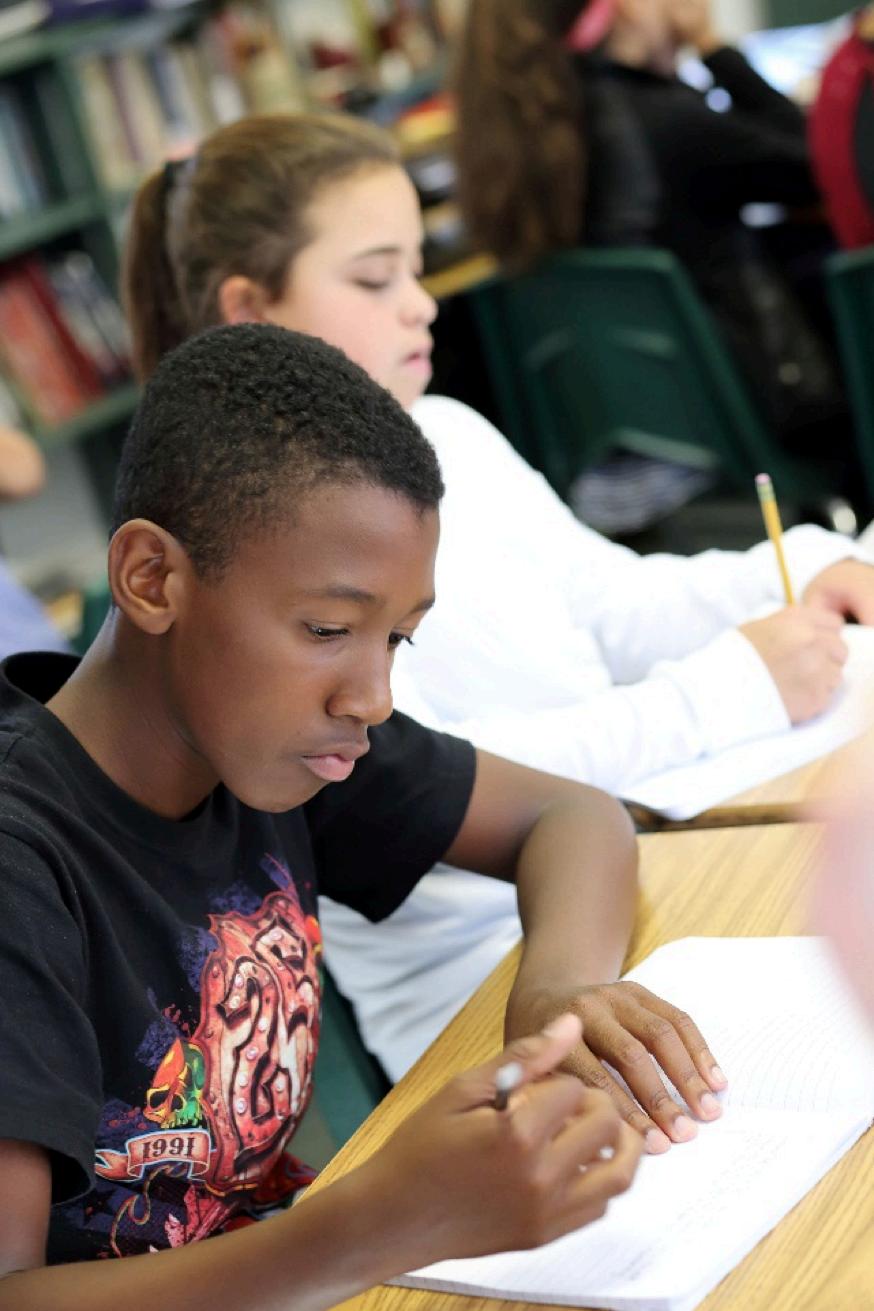
Throughout the year, the students also read and discuss novels, plays, essays, short stories, and poetry with partners, in small groups, and as a whole class. Literature also helps illuminate their thinking about justice and leadership. The study of sentence structure and grammatical conventions focuses on the errors that come up most frequently in students’ writing; students learn strategies and
resources to help them become more independent in their ability to recognize and correct their own mistakes. The Eighth Grade class play is integrated into the curriculum. The year ends with a production of The Tempest or A Midsummer Night’s Dream. As students near the end of the year they prepare a graduation speech to share with their families and the entire school community before the last performance of their Shakespeare play.
The Eighth Grade science curriculum, “Humans and the Ocean: Science for Climate Justice,” is an exploration of physical science. As the course name suggests, students will learn about how they influence the ocean and how the ocean influences them. They will explore physics and chemistry concepts that will help them understand the world around them, specifically why the ocean is essential to life on Earth and how we can help protect this resource. Over the course of the year, students will study topics such as: volume and mass, atoms and molecules, molecular motion, bonding, ionic and covalent compounds, solubility and mixtures, polarity, chemical reactions, heat and temperature, bathymetry, ecosystem dynamics, weather, climate, and climate change. Students will learn about problems facing our ocean today, such as coral reef bleaching, ocean acidification, overfishing, by-catch, large dead zones, pollution, and rising sea surface temperatures. This course includes an in-depth look at the impacts of climate change, including how some communities are more likely than others to be severely impacted by climate change. At the end of the unit on climate change and its impacts, students will complete a climate justice action project.
Throughout the year, students gain a solid foundation of scientific knowledge, laboratory and field experience, and a deeper understanding of scientific investigations. Students regularly practice their science skills, including generating testable hypotheses, designing and carrying out experiments, displaying data in an organized manner, analyzing and drawing conclusions, and creating scientific arguments. In one project, students will use scientific tracking data available
online to study a specific marine animal and apply what they learned about the ocean in class to explain the animal's movements. In this manner, students apply their knowledge of chemical and physical processes to help them understand biological phenomena.
Children reach cognitive landmarks at different times throughout their adolescent years. Allowing for their individual differences, ongoing consideration is given to ensure that each student is in the correct math course.
Skills developed throughout the earlier grades are combined with more advanced creative analysis and sequential thinking in the Junior High math courses. Math classes include investigations and presentations to the class for discussion. This continuum of rich experiences and carefully selected resources provides students with the deep understanding, the knowledge, and the skills of math to meet the challenges of high school math programs. The two sections of Eighth Grade math prepare students for either Geometry or Algebra II during their Ninth Grade year
Algebra 1B: This course covers the second half of a standard Algebra 1 course. The course begins with a review of all content in Algebra 1A such as solving equations, factoring, exponent laws, linear functions, and word problems. The new content includes solving rational equations, negative exponents, solving systems of equations, solving inequalities and absolute value inequalities, graphing linear inequalities and systems of linear inequalities, simplifying radicals and radical operations, and solving radical equations. As time permits, students also learn how to solve quadratic equations using completing the square and the quadratic formula.
Text: Algebra: Structure and Method (Book 1)McDougal Littell.
Advanced Algebra: This course builds on the topics in the Algebra 1 curriculum, and also includes the application of Algebra to real world problems such as modeling with scatter plots and linear equations,
linear programming, direct and inverse variation, and growth and decay with exponential functions. Students complete an in-depth study of the topics with more complex problems and applications that also include Algebra 2 material. The Algebra 2 concepts include factoring with substitution, factoring sum and differences of cubes, complex fractions, fractional exponents, synthetic division, solving systems with 3-variables, piecewise function with domain and range, transformations of functions, and exponential functions.
Texts: Algebra Structure and Method (Book 1)McDougal Littell; Intermediate AlgebraZuckerman; Discovering Algebra (An Investigative Approach) - Key Curriculum Press.
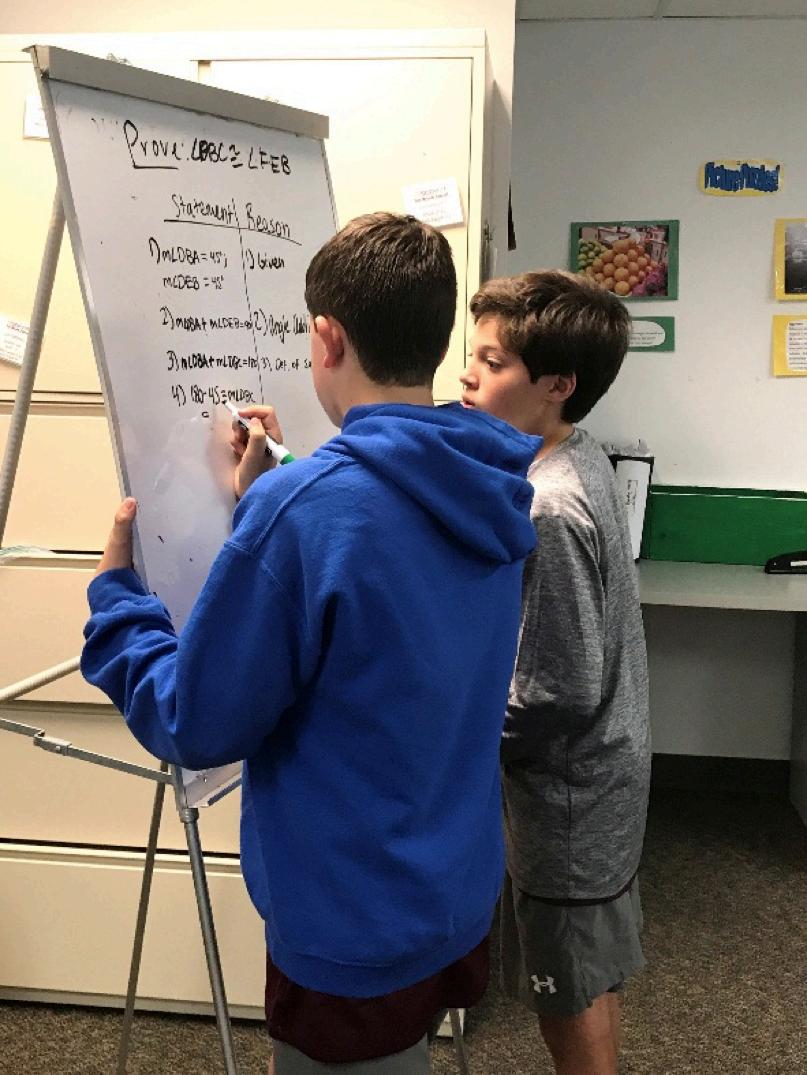
Geome standar including parallel lines, quadrilaterals, direct and indirect proofs, congruent triangles, circles, areas of polygons, similar figures, inequalities, right triangle trigonometry, areas and volumes of prisms and pyramids, and coordinate geometry proofs. Students learn through a variety of methods, including class discussion, group work, hands-on investigations, and GeoGebra explorations. Students complete real-life applications throughout the year, including an end-of-year culminating project.
Text: Geometry - McDougal Littell
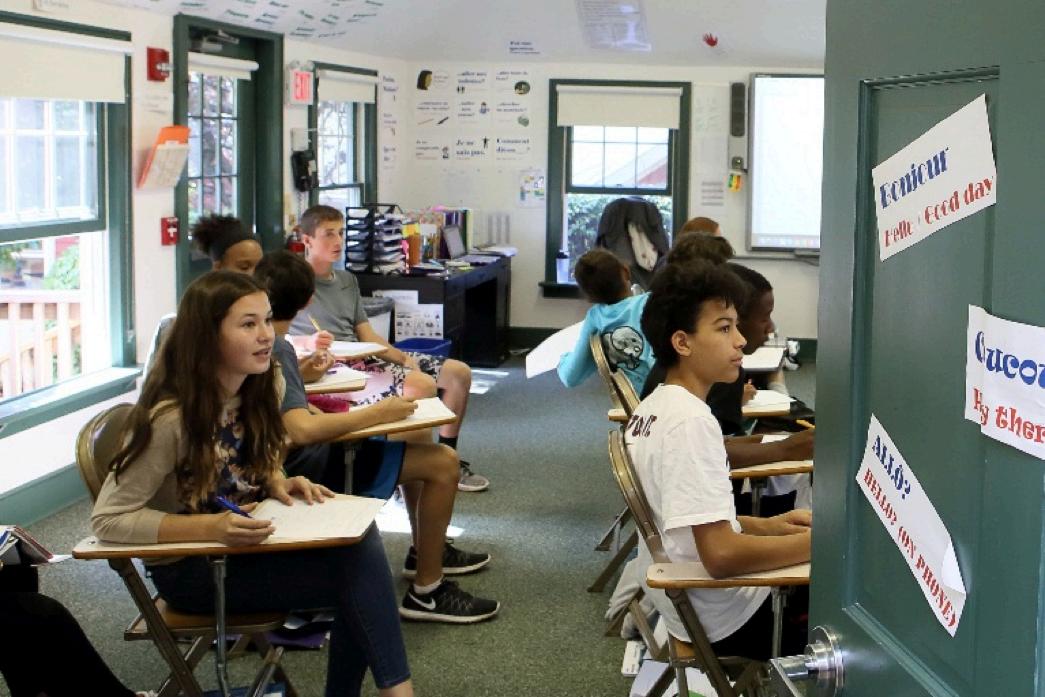
French and Spanish: In the Eighth Grade French and Spanish classes, students will complete the three year French 1 or Spanish 1 curriculum. In French class, we’ll be doing an in-depth study of Haiti’s geography, history and culture. In Spanish class, we’ll be learning about Cuba’s geography, history and culture. We’ll also read a novel in each class. The topics lend themselves well to classroom discussions on current social justice issues about immigration from the Caribbean. The grammar points are learned in context. Grammar concepts include forming questions and adjective/noun agreement. We’ll review the present tense and learn the past tense forms.
Art: In Eighth Grade Art, students create an introspective ‘vessel’ inspired by the work of artist Joseph Cornell. In this project students are encouraged to bring together meaningful works of original art and found objects in a mixed media assemblage. This ‘vessel’ is meant to artistically and symbolically encapsulate their experience as a Far Brook student. As inspiration, students explore historical movements in art such as Surrealism, Abstract Expressionism, Modernism and artists like Salvador Dali and Marcel Duchamp. As a compliment to their introspective art installation, students also include a written reflection describing their motivation and inspiration behind their masterpiece, and what the overall experience has been like for them.
Calligraphy: Eighth Graders study the techniques of calligraphy using authentic calligraphy tools. During their calligraphy mini, they select a Far Brook song or a quote from their graduation Shakespeare play, and over a series of weeks, they create their Far Brook graduation diplomas.
Woodshop and Design Thinking: In Eighth Grade woodshop, students are taught simple framing and make custom frames which they design, cut, assemble, and stain to complement their handmade diplomas. They learn how to use a framing jig and how to cut mitered angles. The students design details to be etched into their wooden frames.
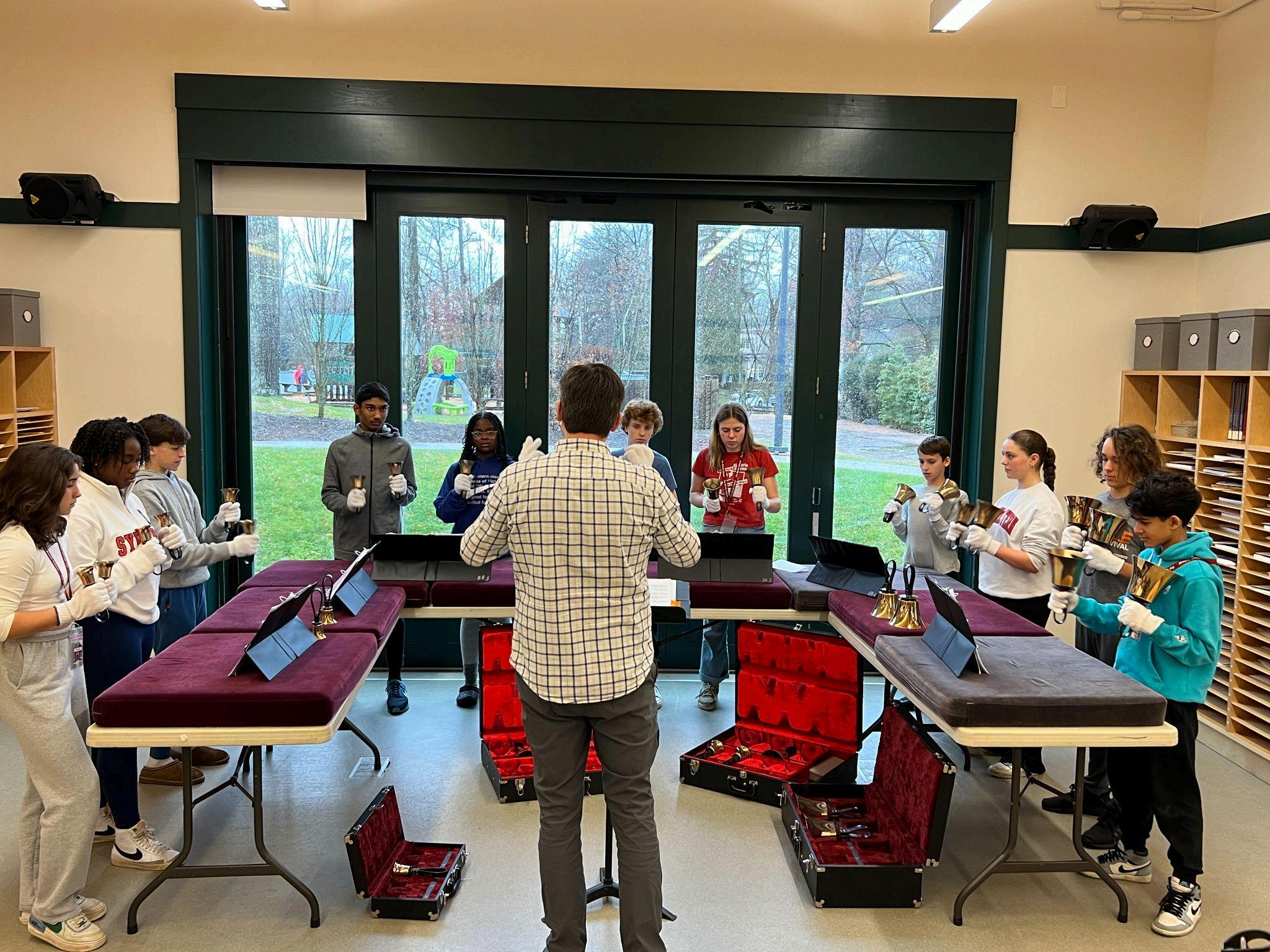
Handbells and Music Theory: In Eighth Grade Handbells each student plays two or three bells with one bell sounding one note. Students learn to set up the equipment and to care for the bells. Students use their cumulative knowledge to decode the music to create melodies together. This is the culmination of many years of music note-reading study where all aspects of rhythm, melody, harmony, expression, and form come into play. Students share performances in Morning Meeting.
Group: In Group, students rehearse for the music that they sing during many musical events at Far Brook, including Thanksgiving Processional, Stabat Mater and Other Voices, and the Spring Concert. Group is the school’s most advanced Upper School choral ensemble, and it includes students in Grades 6 to 8. The class provides the opportunity for students to apply the theoretical and literacy
concepts they have learned thus far, through the instrument they all possess, the voice. Students learn a diverse selection of repertoire, from classical to folk to contemporary, which allows them to build community, understanding and empathy with each other and the world. The students also study vocal pedagogy and learn healthy singing habits that will sustain them in their singing life beyond Far Brook. Cambiata and Trebles
Cambiata (formerly known as Boys Choir) is a changing voice choir for students in Grades 6-8. While most students in this ensemble are male identifying, AFAB (Assigned Female at Birth) students who identify as male or non-binary are also welcome to participate. Students learn about the vocal anatomy, and the skills and techniques they will need to navigate their vocal changes, while delving into appropriate and stimulating choral literature.
The Trebles is a new group that will be rehearsing at the same time as Cambiata. The Trebles will delve deeper into treble works, exploring songs with more complex voicings, richer harmonies, and diverse textures. Students will strengthen their singing and advance their aural and sight-reading skills. While most students in this ensemble are female identifying, AMAB (Assigned Male at Birth) students who identify as female or non-binary, and desire to continue exploring their treble range are also welcome.
Orchestra: Students in Grades Fourth through Eighth join the Far Brook Orchestra once they reach a certain level of proficiency in their musical skills. The Orchestra plays in Morning Meeting and at the Spring Concert. Many students who participate in Orchestra also perform in the annual Recital Night in the spring.
Drama: Eighth Grade students perform in two distinct productions in their final year The Eighth Grade play, which reflects the students’ study of
American history and literature, draws from the work of classic American writers such as Maya Angelou, Toni Morrison, Mark Twain, Langston Hughes, Thornton Wilder, Eudora Welty, F. Scott Fitzgerald, O. Henry, Damon Runyon, James Thurber, Amanda Gorman, and Edgar Allan Poe.
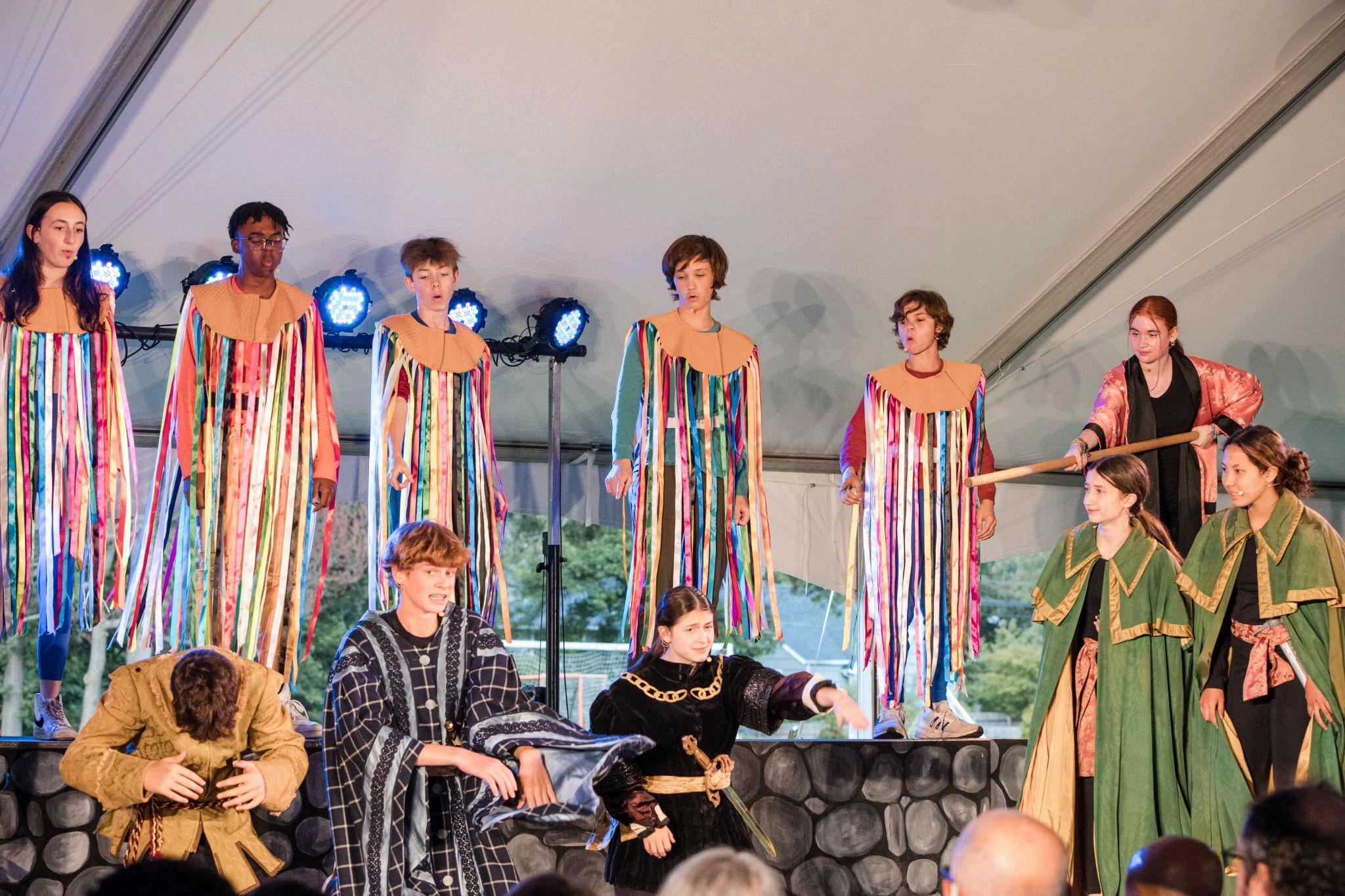
Eighth Graders return to the stage in June with their traditional graduation gift to the School: alternating productions of either A Midsummer Night’s Dream or The Tempest. Each is a full-length Shakespeare play that is supported by an incidental score by composer, arranger, and musical scholar, Far Brook’s Music Director Emeritus Edwin A. Finckel, and performed live by an ensemble of professional musicians. This final major production of each year, which is shared with the entire Far Brook community, is a performance whose integration, complexity, and grace is the pinnacle of our students’ growth through five years in Far Brook’s drama program, and from more than a decade of watching and participating in a full season of theater each year.
The Eighth Grade Technology mini begins with discussions and activities on the effect that digital media has on the human brain and on human social interactions. Following these digital citizenship considerations, students design their yearbook pages, using the online graphic design
platform Canva. Eighth Graders carefully consider how they want to represent their time at Far Brook, how they want to be remembered, by selecting, editing, and adding meaningful photographs, quotes, and artwork to their pages. Through a series of tutorials, students learn a variety of digital design skills on the Canva website, such as page elements and balance, evocative font selection, asset management, and effective visual communication.
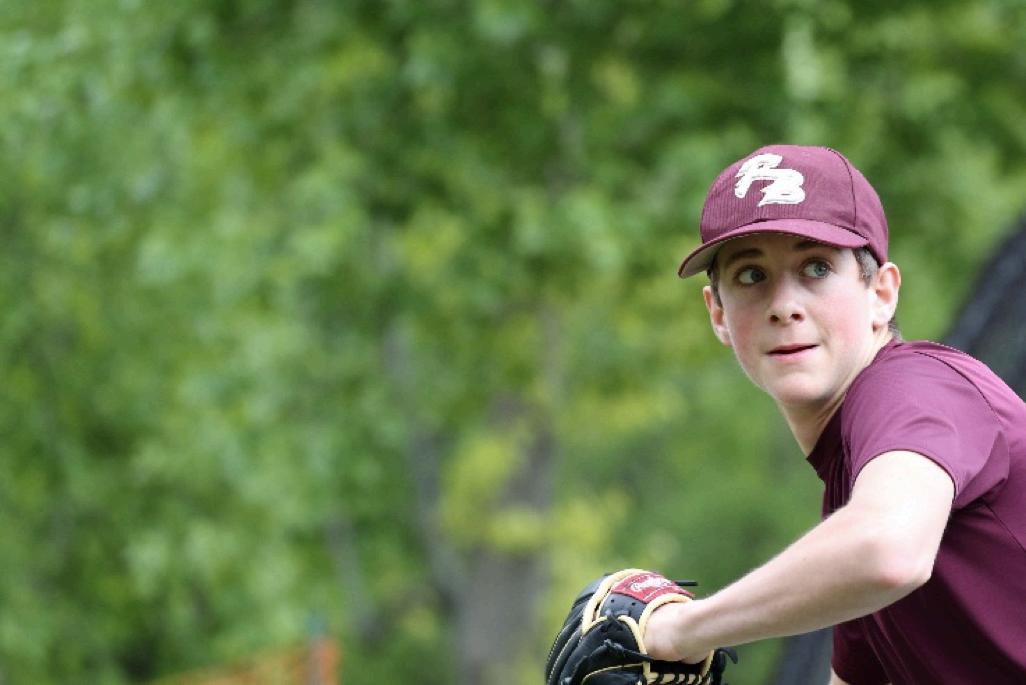
Sports: The Eighth Grade Sports program includes participation on an interscholastic team in the fall and spring, cooperative team-building activities, and fitness & strength development. Our fall team sports offerings are soccer, field hockey, and cross country. In the spring, baseball, lacrosse, and track & field are offered. Students continue to learn the rules and strategies of these sports, and practice more advanced skills, leading to active participation in interscholastic competition. The development of leadership abilities and learning to be a supportive teammate are reinforced during every practice and game. The cornerstone of the sports curriculum is character development through sportsmanship. It is essential that our students learn what it means to be a positive and reliable member of a team, and how to handle the adversity of competition. During the fall and spring sports seasons, students share Sports Reports in Morning Meeting, reporting on the team's accomplishments to the entire school community. When not in season, students participate in
activities such as pickleball, ultimate frisbee, team handball, basketball and various fitness activities.
Health & Wellness: The goal of the winter sports season is to foster an appreciation of fitness, sports, and living a healthy lifestyle. For approximately 10 weeks, students have one health and wellness lesson in place of a physical education class each week. This comprehensive curriculum has been developed to closely follow national health and sexuality curriculum standards. Each topic has been carefully selected to serve the developmental level of the students.
Advisory facilitates students' development of caring, creative, and competent approaches toward academics and relationships. Mixed-grade groupings provide an opportunity for mentorship, leadership, and collaboration across the two Junior High grades. Advisors facilitate group conversations dealing with specific topics such as team building, character and integrity, healthy habits, diversity, organization, and transitions. Advisors also meet with students one-on-one and conference about academic and social areas.
Opportunity Period allows students to self-select into an activity of choice during the school day. Recent options include Far Brook’s Upper School Orchestra, book club, School newspaper, art, chess, and knitting.
Progress Reports: Eighth graders work with their advisors to set academic and social goals for themselves. At the end of the first and second trimesters students lead their own academic conference for their parents, sharing a portfolio of their academic work that they have prepared with their advisor
Adirondacks Trip: The Adirondacks Trip occurs early in the school year and plays an important role in the community-building aspect of the Junior High. The natural setting at Pok-O-MacCready Outdoor Education Center in the Adirondacks is ideal for 4 days of living and learning together The
Pok-O-MacCready staff provide an extensive outdoor program including hiking, canoeing, a ropes course, a sensory-awareness challenge course, forest and pond ecology, and wildlife studies. Additionally, students enjoy an evening of square dancing.
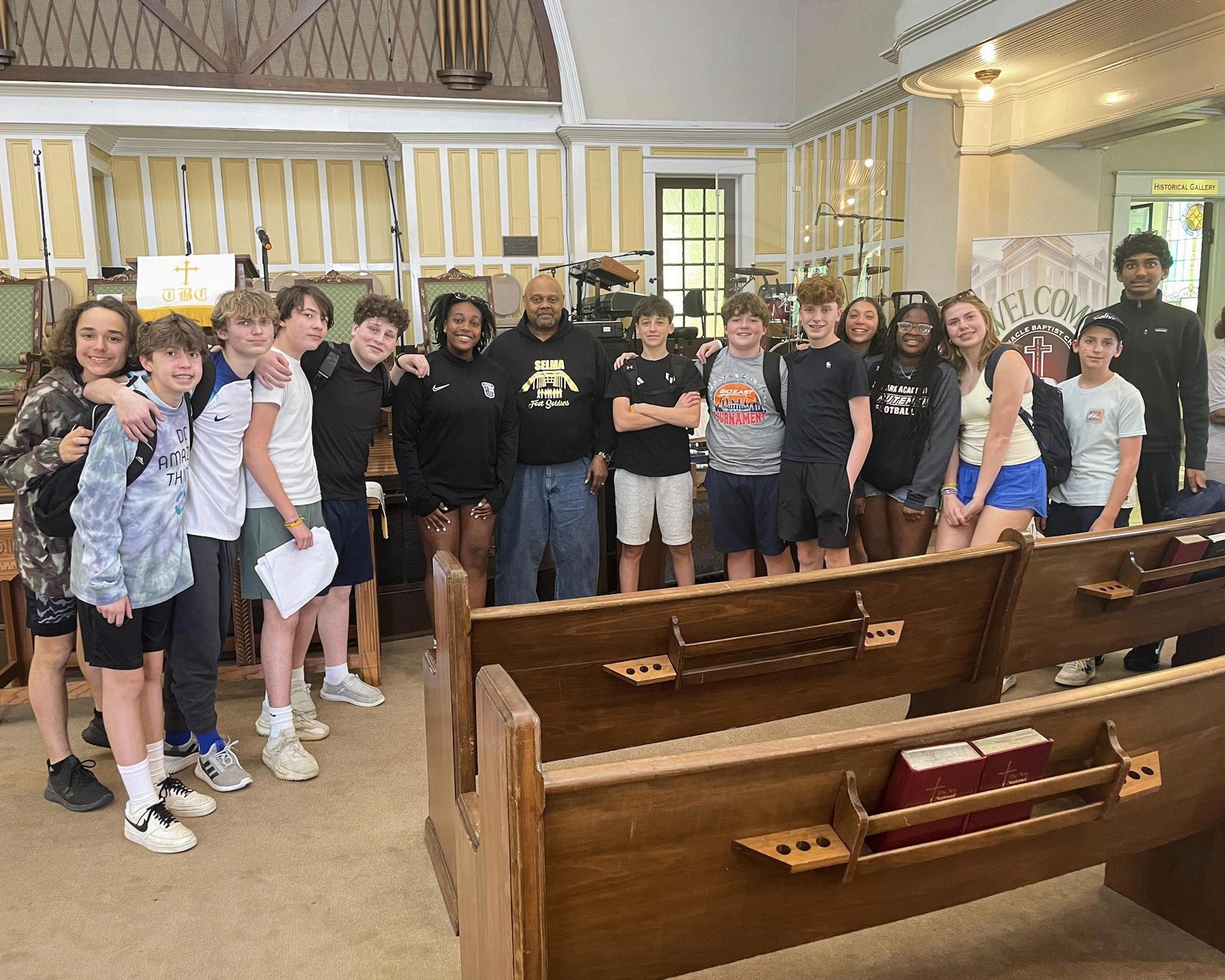
Social Justice Trip: In alternating years, the Far Brook Junior High students travel to Atlanta, GA and Montgomery and Selma, AL to visit important landmarks and museums which illuminate a critical movement in our nation’s history. Our newest trip offers our students an opportunity to deepen their learning of American history with a focus on the Civil Rights Movement. Itinerary highlights: Center for Civil and Human Rights, the Edmund Pettus Bridge, CNN Studio Tour, The Legacy Museum and National Memorial for Peace and Justice, The National Voting Rights Museum and Institute, Rosa Parks Museum, Freedom Rides Museum, an HBCU college campus visit, and the Civil Rights Memorial Center.
Cultural Immersion Trip: In alternating years, the entire Junior High and faculty go on a cultural immersion trip during late winter, traveling to the province of Québec in Canada, visiting Montréal and Québec City In preparation for this event, students study the history and culture of the area and have an opportunity to put their French knowledge to use.
The cost of all trips is included in the Junior High activities fee.
Sixth, Seventh, and Eighth Grade families have opportunities to enroll their students in After-School Programs.
● Mentoring - Mentoring in the After-School Program is an opportunity for Junior High students to volunteer as helpers in the Lower School After-School Program classes (culinary arts, music, art, sports, etc.). This gives our older students a chance to interact with and guide the younger students. The Junior High students can choose their own after school activity, such as Homework Club, and also spend time as a mentor for the younger students.
● Debate Club - An opportunity for Junior High and Middle School students to collaborate in building public speaking skills, building confidence in argumentation, and showing off their subject speciality knowledge in a team building environment.
● On Friday evenings in January and February, Ski Club offers all levels of skiers an opportunity to ski and snowboard on Shawnee Mountain.
Rigorous academics and a serious commitment to the Arts challenge Far Brook students and prepare them to excel in the wide variety of high schools they attend. Seventh Grade families are invited to “Choosing a School after Far Brook." This evening includes both a panel of Far Brook alums as well as a Secondary School Fair with up to 25 public and private day and boarding schools. During the fall, Eighth Grade students participate in interview workshops, participate in mock interviews, and learn about the format of secondary school admissions testing. During the month of November the SSAT and ISEE, two Ninth Grade admissions tests, are administered at Far Brook for our Eighth Graders exclusively. Test preparation classes are offered through Far Brook’s after school program. The High School Placement Advisor meets with families throughout the secondary school process.
Secondary Schools
Secondary schools attended by Far Brook graduates in the past five years.
Independent Schools Public High Schools Boarding Schools
Delbarton School
Dwight-Englewood School
Gill St. Bernard's
The Hudson School
Immaculate Conception HS
Kent Place School
Columbia High School
Millburn High School
Science Park High School
Summit High School
Union County Magnet HS
West Essex High School
Little Red/Elisabeth Irwin HS (NYC) Westfield High School
Montclair Kimberley Academy
Morristown-Beard School
Newark Academy
The Pingry School
St. Benedict’s Prep School
St Peter's Prep School
Shorecrest Prep (FL)
Colleges & Universities
Colleges and universities attended by Far Brook graduates in the past five years.
Alfred University Elon College
American University Emerson College (2)
American University of Paris Emory University
Amherst College Essex County College
Babson College George Washington University
Bard College Georgetown University
Barnard College Hamilton College
Boston College Harvey Mudd College
Boston Conservatory at Berklee Haverford College
Brown University (2) Hobart & William Smith Colleges (3)
Bucknell University (4) Howard University
Claremont McKenna College Indiana University
Colgate College Kenyon College
Colorado College Lafayette College
Columbia University (2) Lehigh University
Connecticut College Macalester College
Cornell University Miami University (OH)
Drexel University
Middlebury College (2)
Buxton School (MA)
Church Farm School (PA)
Deerfield Academy (MA)
The George School (PA) Peddie (NJ)
Phillips Academy – Andover (MA)
Phillips Academy – Exeter (NH)
The New School Tulane University (2)
New York University
Union College
Northeastern University (2) University of Chicago
Northwestern University (2) University of Colorado – Boulder (2)
Parsons School of Design University of Maryland
Pennsylvania State University University of Miami
Princeton University University of Michigan
Providence College University of Notre Dame
Rensselaer Polytechnic Institute University of Richmond
Rutgers University (3)
Santa Clara University
Smith College
University of St Andrews, Scotland (3)
University of Vermont (2)
University of Virginia (2)
Southern Methodist University University of Wisconsin
Spelman College
Vassar College
Syracuse University (3) Wake Forest University (2)
Temple University
Trinity College
Tufts University
Washington University in St Louis (2)
Wesleyan University (3)
William Paterson University