
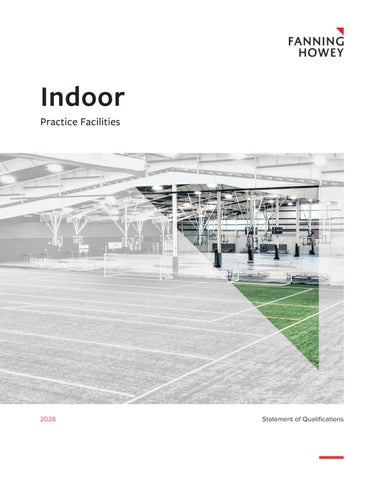
Indoor Practice Facilities

![]()


School districts across the country are facing a variety of external pressuresā from expanding extracurricular participation to increased expectations for collegiate-level amenitiesāthat are calling for a new type of space. Once reserved primarily for collegiate and professional athletics, indoor practice and training facilities are quickly becoming an essential part of how Kā12 schools serve students, student-athletes and the broader community.
By providing ļ¬exible, weatherindependent space, districts can help students balance school life with family life and achieve better academic and athletic outcomes.

Academic research continues to highlight the connection between proper sleep and student performance in the classroom. As participation in extracurricular activities continues to rise, many student-athletes ļ¬nd themselves practicing before school or until 9 or 10 p.m., particularly during inclement weather seasons when outdoor ļ¬elds are unavailable. An indoor practice facility can be a cost-effective way to maximize utilization by extending practice capacity without extending practice hours.
Space types, quantities and deļ¬nitions for these types of facilities can vary widely. Most facility conversations initially default to a full-sized, turfed football ļ¬eld or soccer ļ¬eld. In either case, the ļ¬eld can be segmented with strategically-placed dividers and hanging amenities to easily transform to accommodate day-today and hour-by-hour needs.
With thoughtful design interventions, these large-span spaces can also support:
⢠Baseball and softball practice (with retractable netting systems)
⢠Marching band rehearsals
⢠Lacrosse and rugby
⢠Golf simulators and skill development areas
⢠Dance and cheerleading
⢠Standardized testing or large school events
However, modern indoor facilities are evolving beyond simple open turf ļ¬elds. This requires an extended conversation to maximize their impact. School districts and their architects must answer two questions:
1. WHY is this facility needed? What is the real purpose of the facility and whom it will serve?
2. WHAT are the desired outcomes? What added value is an indoor practice and training facility going to add to our students, parents, teachers, athletes and community members?
When the Why and What is clear, the design decisions that follow become far more strategic, impactful and ļ¬scally-responsible.
Trends at the higher education level often inļ¬uence expectations at the Kā12 level. Student-athletes, coaches and communities increasingly look for training environments that mirror collegiate standards.
Examples include the ability to incorporate:
⢠Rehabilitation and sports medicine areas
⢠Plyometric and speed training zones
⢠Strength and conditioning spaces
⢠Sports performance technology integration
⢠Recovery lounges and wellness-focused rooms
⢠Nutritional science and commodities
⢠Tutoring and other academic support services
⢠Downtime destinations
⢠Sports business and management support and resources
These enhancements support injury prevention, year-round conditioning, safe environments, academic support and basic life skills speciļ¬c to a student-athlete. Having conversations early in the planning and design process creates operational efficiency while elevating the overall performance ecosystem necessary for development of a successful, well-rounded student-athlete.
When indoor practice facilities are intended to host competitions or community events, the design approach expands. Fixed or retractable seating, enhanced acoustics, upgraded sound systems, and digital scoreboards may all become necessary components.
Incorporating concessions, upgraded restroom amenities, viewing mezzanines, and gathering areas allows the facility to support tailgating, tournaments, and special eventsā transforming it from a practice venue into a community destination.
Key design strategies include:
⢠Integrated branding and school identity
⢠Feature walls, graphics and broadcasting to create social media moments
⢠Sponsorship and donor recognition areas
Community access can signiļ¬cantly increase public support for funding capital projects while providing long-term return on investment. Designing for shared use ensures the building serves more than just after-school athletics.
Potential additions may include:
⢠An elevated indoor walking track
⢠Multi-purpose community rooms
⢠Convertible ball courts
⢠Meeting or event rental spaces
⢠Café or small restaurant areas
⢠Integrated exterior gathering spaces, plazas and gateways
These amenities build equitable access to training, amenities and programs within the community and can also generate revenue beyond the school day and throughout the year.
Indoor practice facilities represent a highly ļ¬exible opportunity to elevate student experience, athletic performance, and community engagement. But the most successful projects donāt begin with square footageāthey begin with clarity.
By deļ¬ning the whyāacademic support, athletic development, spectator engagement, or community activationādistricts can align design decisions with long-term goals.


Carmel, IN

The new Greyhound Activities Center includes a fullsized football ļ¬eld with artiļ¬cial turf to serve a wide range of athletics, performing arts and student groups.
The centerpiece of the new center is a full-size indoor football ļ¬eld with artiļ¬cial turf, offering year-round training and practice opportunities for student-athletes. The facility also includes modern locker rooms, a dedicated band tower, and a large storage room to accommodate the needs of Carmel's award-winning band program. This innovative space is designed to enhance the student experience, bringing together various activities under one roof and providing the resources needed to support Carmel High School's tradition of excellence.
CLIENT Carmel Clay Schools
SCOPE
90,000 New SF
COST $14.3 M
COMPLETION DATE 2024


A partnership between Carmel Dads' Club and Clay Township brought new athletic opportunities to Carmel, Indiana.
Clay Township and Carmel Dads Club collaborated with Fanning Howey to design a new ļ¬eldhouse. The new building has four basketball courts and one full-sized synthetic turf ļ¬eld lined for football and soccer. There are also three batting cages for baseball and softball.
The ļ¬eldhouse is funded by Clay Township and is operated by Carmel Dads Club. The partnership supports the 12 athletic programs offered by Carmel Dads' Club, as well as after-hours use by the public.
CLIENT Carmel Dads' Club
SCOPE 152,229 New SF
COST
$12.0 M
COMPLETION DATE 2021


The new Center Grove athletics facility is a state-ofthe-art training space designed to support studentathletes, with a focus on advancing opportunities for female athletes.
At the heart of the facility is a dedicated softball inļ¬eld with an instructional hitting space, providing players with year-round training opportunities. The space also features indoor golf simulators for the boys' and girls' golf teams, as well as a dedicated indoor practice area for cheerleading teams. Designed to enhance athletic development and performance, this facility ensures Center Grove's student-athletes have the resources needed to succeed. Additionally, the facility was completed without increasing the tax rate for White River Township taxpayers.
CLIENT
Center Grove Community School Corporation
SCOPE
9,300 New SF
COST
$3.9 M
COMPLETION DATE 2024


The 80,000 SF Penn Field House is designed as a ļ¬exible facility to serve a wide variety of athletic groups, educational opportunities and community needs.
The design creates a free-standing building with four multipurpose courts, a 200-meter track and runways for long jump and pole vault. Support spaces include concessions, locker rooms, dressing rooms, family restrooms and an athletic training facility. A wrestling room and dance room were designed as alternates and be constructed in the future. The second ļ¬oor of the ļ¬eld house features a commons, a large observation area, additional locker rooms and dressing rooms, and community meeting rooms. The ļ¬exible design of the ļ¬eld house will allow it to support events ranging from basketball, volleyball and baseball to track, tennis and robotics competitions.
CLIENT Penn-Harris-Madison School Corporation
SCOPE
80,000 New SF
COST
$15.9 M
COMPLETION DATE 2025


The new Student Activity Center at Warsaw High School is a catalyst for health and wellness for students and the entire Warsaw community.
The multi-sport venue supports a wide range of ļ¬tness and recreational activities, from basketball and volleyball to tennis and ļ¬eld events.
A 200-meter indoor track with four full cross courts brings ļ¬tness amenities to a new level for students, staff and local residents. The design also incorporates ļ¬exible classrooms, childcare facilities for students and teachers and an on-site community health clinic.
ABOVE | A 200-meter indoor track with four full cross courts brings ļ¬tness amenities to the community.
CLIENT Warsaw Community Schools
SCOPE
65,000 New SF
COST
$9.2 M
COMPLETION DATE 2019


Designed to beneļ¬t as many students and community members as possible, the new Center Grove Student Activity Center (SAC) has something for everyone.
Flexible design concepts allow the SAC to support a limitless range of activitiesāfrom track, weight training and ļ¬tness programs to band practice, robotics competitions and community recreation. The facility features four basketball/volleyball courts, a weight room and the ļ¬rst 200-meter indoor track in an Indiana K-12 school
CLIENT
Center Grove Community School Corporation
SCOPE
61,003 New SF
7,233 Renovated SF
COST
$8.7 M
COMPLETION DATE 2017
ABOVE | The SAC addition features a 200-meter indoor track, four basketball/ volleyball courts and spaces for wrestling.


When Zionsville Community Schools wanted to expand its high school to include a new ļ¬eld house, Fanning Howey designed an addition that is more than a place for recreation.
The expansion space includes a large commons area and a learning center to support the new ļ¬eld house, weight and ļ¬tness facilities. The commons is ideal for group meetings, athletic team gatherings and surge space for athletic events. A new entrance provides students with direct access to the Activity Center.
The use of a very economical load bearing insulated concrete wall panel system yielded additional budget ļ¬exibility. Fanning Howey designers used these savings to develop targeted renovations to convert underutilized interior space within the high school into a lecture hall, vocal and instrumental studios and additional classroom space within the overall project budget.
CLIENT
Zionsville Community Schools
SCOPE
56,159 New SF 15,937 Renovated SF
COST
$7.4 M
COMPLETION DATE 2015


A detailed resurfacing project took one of the nation's elite indoor tracks to new heights of performance.
The Mondo-surfaced banked track in Gladstein Fieldhouse was originally constructed for Indianapolis's RCA Dome and was used for the PanAm Games. In 2006, the track was removed from the RCA Dome and reassembled on the campus of Indiana University.
Fanning Howey served as Architect of Record for the resurfacing of the track. The effort involved consultation with contractors who specialized in the track's poured polyurethane surface. The project was completed on budget and in time for the University's ļ¬rst indoor track meet in December 2013. That meet saw eight top times for different events, nationally.
CLIENT Indiana University Bloomington
COST $ 300 K
COMPLETION DATE 2013


Fanning Howey is an integrated architecture, interiors, and engineering ļ¬rm specializing in learning environments. We use the power of design to create smarter, happier learners, more successful educators and stronger communities. From our oļ¬ces in Indiana, Ohio and Michigan we have designed learning environments throughout the Midwest and across the country. Our team is devoted to ļ¬nding ways to conceive and build inspirational places for teaching and learning.
WE ARE LEADERS IN:
⢠Architecture
⢠MEP Engineering
⢠Interior Design
⢠Landscape Architecture
⢠Technology Design
⢠Construction Administration
⢠Master Planning
⢠Educational Visioning
⢠Bond Issue/Referendum Assistance
15M square feet of space planning for educational communities
3,850+
projects in 36 states and Washington, DC since 1961
35+
new or renovated ļ¬eldhouses and indoor athletic facilities
130+
professionals focused on improving learning environments
50+
artiļ¬cial turf ļ¬elds
65
years of expertise creating impactful spaces

317.848.0966 fhai.com