December 2025

December 2025
As a complement to the online flood vulnerability viewer developed for the twelve main street districts as part of Ready, Set, Rhody, a vulnerability assessment was conducted to evaluate the infrastructure, social-cultural, and economic vulnerabilities of each main street district to selected scenarios for current and future inland and coastal flooding.
In collaboration with the Rhode Island Commerce Corporation (RI Commerce) and the Rhode Island Division of Statewide Planning (RIDSP), the project team developed quantitative frameworks for scoring each vulnerability type to generate both composite vulnerability scores for each main street district. These frameworks allow community stakeholders, especially municipal leaders and business owners, to make relative comparisons between the individual scores of infrastructure (i.e., public utilities, buildings, and transportation assets), social-cultural, and economic vulnerabilities within a given main street district to highlight drivers and “hot spots” of vulnerability.
The following sections summarize the overall approach to developing and applying these vulnerability assessment frameworks. Summaries of the quantitative results for each main street district are also provided. These include the following districts:
Block Island/New Shoreham (Downtown)
Bristol (Thames Street)
Newport (Thames Street)
North Kingstown (Wickford)
Portsmouth (Island Park)
Providence (Olneyville & Valley)
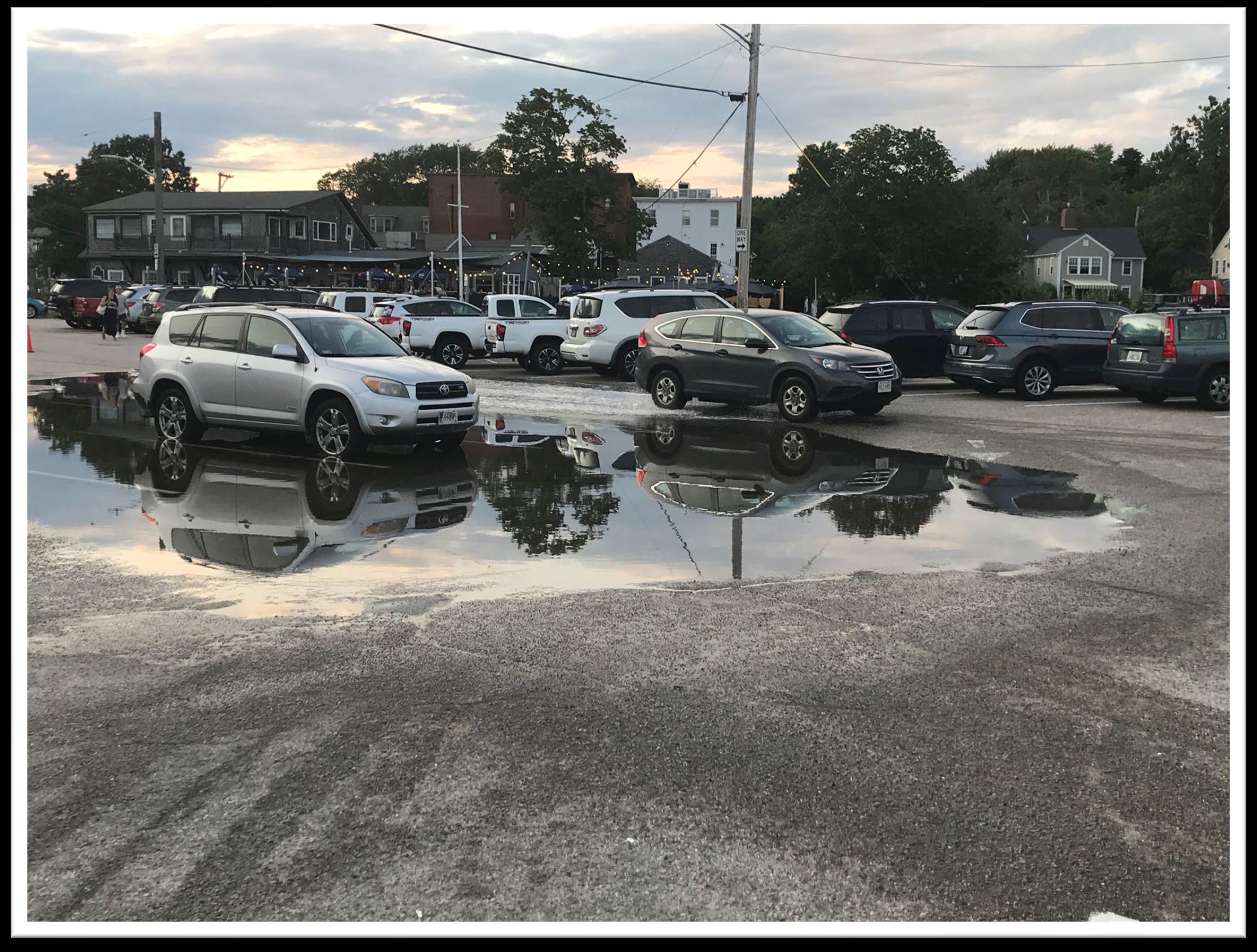
Flooding observed at Quonset Point (North Kingstown) on July 31st, 2023 (Credit: Paula Morrissey via MyCoast)
Smithfield (Esmond/Smith)
South Kingstown (Peacedale)
Warren (Water Street)
Warwick (Apponaug)
West Warwick (Arctic)
Westerly (Downtown)
The main street districts included in Ready, Set, Rhody are subject to two main types of flooding: coastal and inland.
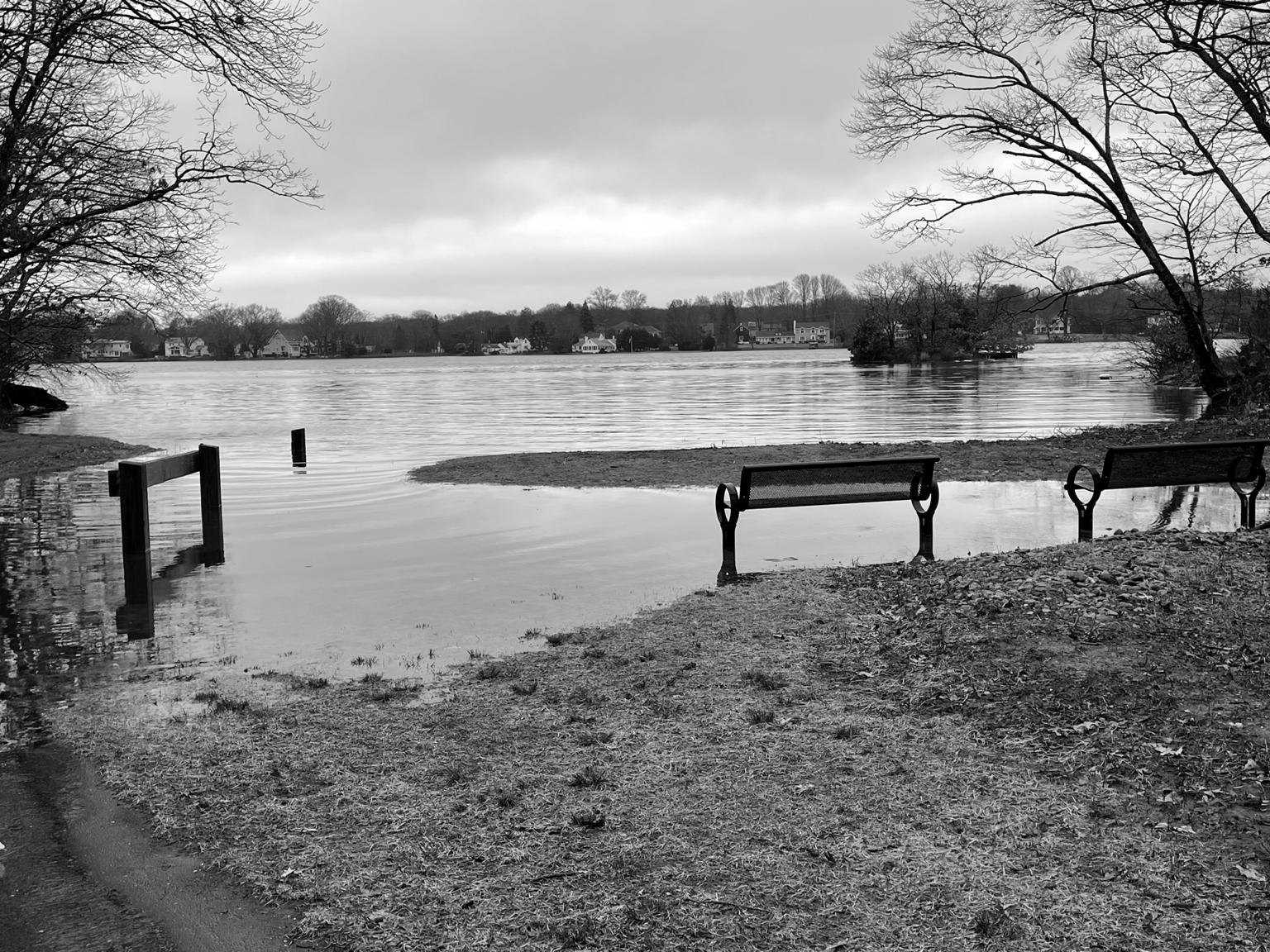
Coastal flooding impacts are caused by episodic (temporary) storm surge as well as chronic (long-term) sea level rise (SLR) and tidal flooding.
• Tidal flooding – is flooding caused by the surge of tidal water during high tide. It is also known as high tide flooding (HTF), and is often referred to as "nuisance," "king tides," or "sunny day" flooding. Large tidal flooding events can bring water surface elevations several feet above the daily average high tide marks, causing water to spill onto streets or bubble up from storm drains.
• Sea level rise – is the upward trend in average sea level elevation. It is a gradual, longterm increase in the ocean's water surface elevation resulting from changing climatic conditions.
• Storm surge – results in abnormal rises in water surface elevations generated by coastal storms. Water surface elevations can increase substantially during a storm surge event and can be especially damaging when the surge coincides with a high tide.
Inland flooding impacts can be caused by fluvial (river) flooding and/or pluvial flooding (flash floods).
• Pluvial flooding – is driven by freshwater overflowing from rivers, as well as precipitation, which can inundate areas lacking adequate drainage and stormwater management systems.
• Stormwater flooding – is the overflow of water from heavy rainfall or snowmelt that exceeds the capacity of stormwater management systems, such as drains, sewers, and natural waterways.


In consultation with members of the core project team and colleagues at the University of Rhode Island (URI), coastal and inland flood data from STORMTOOLS, the Federal Emergency Management Agency (FEMA), and the Rhode Island Department of Environmental Management (RIDEM) were assessed to: (1) determine the availability of reliable flood data across all twelve main street districts and (2) the s election of the flood risk scenarios to be used in the vulnerability assessment. The following coastal and inland flood risk scenarios were s elected for use in quantifying measures of flood risk exposure as part of the vulnerability assessment frameworks described in the subsequent pages .

The 10% annual exceedance chance flood (or “10-year flood”) and the 10% annual exceedance chance flood with 3 feet of sea level rise (SLR) from STORMTOOLS were selected to assess current and future projected coastal flood risk exposure. The 10% flood layer provides a baseline for existing coastal risk exposure to current-day nuisance flooding, while the 10% flood with 3 feet SLR layer models the anticipated increased extent and depth of this event under projected future conditions. Using these two risk scenarios, the current risk to infrastructure and properties from common coastal storms could be compared to the future projected risk in each of the coastal main street districts included in Ready, Set, Rhody.

The FEMA 1% annual exceedance chance flood (or “100-year flood) flood, which establishes the current Base Flood Elevation (BFE) for federal flood insurance and basic floodplain management standards, was used to assess the vulnerability of current inland flood conditions. Additionally, the RIDEM 1% annual exceedance chance flood with 3 feet of freeboard (i.e., feet above BFE) was used to assess the extent and depth of a future, expanded 100-year flood, based on a modeled condition that adds 3 feet of elevation to the current BFE. This layer is helpful in long-term planning and designing strategies aimed at enhancing flood risk reduction, particularly for critical infrastructure.
Note: While other flood scenarios (e.g., 50%, 20%, 1%, etc. chance floods) are available in some of the districts across RI, the scenarios selected for use in this vulnerability assessment had broad and consistent coverage across the districts and provided a reasonable range of flood probability events for long-term planning.
Ready, Set, Rhody |
Assessing infrastructure vulnerability often involves not just assessing its exposure to flooding conditions, but also its likelihood of being damaged by those conditions (i.e., its sensitivity) and its ability to bounce back in the wake of an impactful event (i.e., its adaptive capacity). The framework developed to assess the vulnerability of infrastructure across the 12 main street districts was based on similar frameworks applied by the Rhode Island Division of Statewide Planning in recent resilience planning projects. This is a framework modeled off the Vulnerability Assessment Scoring Tool (VAST) that was original developed by the Federal Highway Administration (FHWA). This tool assigns a score (e.g., 1, 2, 3, 4) for each indicator (e.g., modeled flood inundation depth, pavement condition, age of structure, etc.) specific to the climate stressor scenarios (e.g., flood scenarios) and related to three infrastructure vulnerability variables (i.e., exposure, sensitivity, and adaptive capacity). The vulnerability of assets (categorized into public utilities, buildings, and transportation infrastructure) within each main street district can then be calculated based on these variables using the formula shown in Figure 1.
The following pages provide tabular summaries of the quantitative assessment frameworks for infrastructure exposure, sensitivity, and adaptive capacity that were developed in consultation with the project team from RI Commerce and RIDSP.
The degree to which an asset is exposed to a flood scenario +
Likelihood of asset being damaged by a flood scenario
An asset's ability to respond to a flood scenario
Figure 1: Calculation for infrastructure vulnerability scores based on scores of exposure, sensitivity, and adaptive capacity
Exposure: the degree to which an asset is exposed to a flood scenario
Table 01: Indicators and values for each asset included in the exposure assessment framework
of commercial structures intersecting climate stressor scenarios within the district
Number of pump stations, catch basins, and outfalls exposed to flooding during selected flood scenarios
Number of commercial structures exposed to flooding during selected flood scenarios out of the total number of commercial structures within a main street district
maximum depth of water on bridges from selected flood scenarios
Number of RI Public Transit Authority (RIPTA) bus stops exposed to flooding, and therefore not functional, during selected flood scenarios RIPTA Bus Stops
the likelihood of being damaged by a flood scenario
Table 02: Indicators and values for each asset included in the sensitivity assessment framework
to which the asset’s functionality will be affected by flooding under selected flood scenarios (It was assumed that catch basins and outfalls were located at or slightly below ground level, exterior equipment was raised 0.5 ft above the ground level, and that flooding >0.5 ft would lead to critical equipment failure.)
The risk category (RC) reflects the relative seriousness of potential failure. Categories vary from the lowest hazard to human life (RC I) to the highest hazard (RC IV) and serve as a threshold for a variety of code provisions related to flooding and other climate hazards.
International Building Code (IBC) & Field Observations
and
The bridge rating is the overall condition of the bridge based on the lowest component rating.
Number of total transit locations within the main street district. The more transit locations present within a district, the less sensitive public transit will be to climate events.
Table 03: Indicators and values for each asset included in the adaptive capacity assessment framework
Utilities Roadway Access
Public utilities (substations, pump stations, catch basins, and outfalls) are essential for emergency response and recovery. Ensuring access to these locations during flood events is critical for town staff to maintain operations. This assessment accounts for whether the utility is located on a flood-prone road (Yes/No) and if severe flooding (+6”) limits vehicle access. Utilities with multiple access options are considered to have higher adaptive capacity. ESRI Road Networks
The adaptive capacity of a commercial building depends on the building age, framing material, cladding, roof angle, number of stories, presence of a basement, and occupancy. For a full explanation of building adaptive capacity, see Appendix A.
The shortest added detour distance to travel by car to get from a flooded portion of the main street and reconnect to a non-flooded portion of the street within a main street district.
International Building Code (IBC) & Field Observations
to ≤5,000 2
to ≤2,500 3
The shortest added detour distance to travel by car to get from a flooded bridge to another functional bridge or cross the body of water.
This metric looks at distance to the nearest non-flooded transit location.
Once the scores were summed for the exposure, sensitivity, and adaptive variables for each flood scenario for all infrastruct ure assets (e.g., roads, commercial buildings, and RIPTA transit locations) within the 12 main street districts, these scores were then weighted based on the following weights established in consultation with the project team (see Table 04).
Table 04: Flood scenario weights for current and future coastal and inland flood scenarios
From there, weighted indicator scores for each asset were combined to establish a composite infrastructure vulnerability score for each main street district according to the example shown below:
See the following page for a tabular summary (Table 05) of all composite infrastructure vulnerability scores across all main street districts included in the assessment.
Social vulnerability is often assessed by measuring the social and demographic characteristics of unique areas within a community. This can include an evaluation of potential impacts to key social institutions within communities (e.g., healthcare or education facil ities) – in addition to analyzing population statistics that may indicate how well members of the community might be able to prepare for, respond to, and recover from a flood event. Similarly, the vulnerability of historic and cultural resources within a community can be assessed by determining the degree of exposure that culturally significant properties, structures, natural objects, or archaeological sites have to current and future, projected flood conditions.
To assess the social-cultural vulnerability, data from the following sources were incorporated into an overall social-cultural assessment framework (see Table 06) that could be applied to each main street district :
• Centers for Disease Control and Prevention (CDC) Social Vulnerability Index (SVI) – uses social factors from the U.S. census (e.g., poverty, lack of vehicle access, housing conditions) to help identify census tracts within communities that may need s upport before, during, or after disasters.
• RIDEM Environmental Justice (EJ) Areas – are mapped areas within communities that meet one or more of the following criteria:
o Annual median household income is not more than sixty-five percent (65%) of the statewide annual median household income;
o Minority population is equal to or greater than forty percent (40%) of the population;
o Twenty-five percent (25%) or more of the households lack English language proficiency; or
o Minorities comprise twenty-five percent (25%) or more of the population, and the annual median household income of the municipality in the proposed area does not exceed one hundred fifty percent (150%) of the statewide annual median household income.
• Rhode Island Historic Preservation and Heritage Commission – provided sites listed on the State and National Register of Historic Places
• RI Commerce – provided a compilation of cultural facilities (e.g., theaters, art museums, and performing arts venues)
• URI Environmental Data Center and Rhode Island GIS – provided mapped sites with social and/or cultural value, including parks and open space, E-911 sites, and landmarks
• Rhode Island Tourism Boards and site-specific websites – identified places of value to the community, such as social and cultural clubs
Table 06: Indicators and values for each asset included in the Social-Cultural assessment framework
# of historic buildings and sites (or buildings within a historic district) inundated within the district
# of cultural resources inundated within the district
# of archeological sites inundated within the district
National Register of Historic Places and RIGIS
E911 sites (cultural sites and museums), mapped cultural institutions from RI Department of State and Visit Rhode Island website; URI mapped landmarks
Rhode Island Historical Preservation & Heritage Commission
E911 sites (Houses of worship, schools, hospitals/healthcare), RIGIS (parks)
Table 07: Social-cultural vulnerability framework results Scores
Assessing the economic vulnerability of unique areas within communities can be challenging – especially when more granular economic survey information is not available, and the availability of mapped economic data is limited.
After consulting with project team members from RI Commerce and submitting data requests to each municipality included in the study, assessors’ data were collected and integrated into a framework aimed at giving a snapshot of the potential value of impacts to commercial and non-commercial structures likely to be affected by current and future flood scenarios (see Table 08). Weights were then applied to the scores from these assessments to more heavily weight the impacts to commercial properties in the overall economic vulnerability score for each main street district.
While relying primarily on assessor's data provides a snapshot of potential structural and property value impacts, it cannot capture the broader, more granular economic vulnerability of each main street district that may result from the loss of business revenue, reduced wages, or indirect economic disruption caused by flooding events. Future studies may be able to supplement this analysis with more detailed survey information on business operations (e.g., revenue, inventory value, jobs/employment numbers) to more fully assess economic disruption and recovery capacity needed in the wake of a given flood event.

Table 08: Indicators and values for each asset included in the economic assessment framework
Assessed value of non-commercial buildings intersecting climate stressor scenarios within the
Assessed value of commercial buildings intersecting climate stressor scenarios within the district
>$10 million to ≤$30 million 2
>$30 million to ≤$70 million 3
>$70 million to ≤$120 million 4
million 1
>$10 million to ≤$50 million 2
>$50 million to ≤$100 million 3
>$100 million to ≤$150 million 4
This measure of exposure sums the total assessed value of non-commercial structures in each district exposed to flooding during selected flood scenarios. This measure provides a sense of the direct economic impact of flooding to non-commercial real estate within the district. E911 & Assessed Building Value
This measure of exposure sums the total assessed value of commercial structures in each district exposed to flooding during selected flood scenarios. This measure provides a sense of the direct economic impact of flooding to commercial real estate within the district.
E911 & Assessed Building Value
09: Economic vulnerability assessment results
After developing composite vulnerability scores for each vulnerability type (i.e., infrastructure, social-cultural, and economic vulnerability), the values were normalized on a 10-point scale, and the overall vulnerability scores were calculated for each main street distri ct and summarized in the following table. These scores are not intended to be interpreted in a way to suggest that one main street dist rict is more vulnerable than another; each main street district is vulnerable in its own way. Nor should this table be used to prioritize one district over another. Rather, these scores highlight where infrastructure, social-cultural, or economic vulnerability may be more of a driver of overall vulnerability across the districts.
primary building structure is made of steel.
DesignationTypeDescription
1 1 StoryThe building is limited to one story. 1
This type of construction was common in the pre-20th century due to high-quality material availability, low cost, design flexibility, and aesthetic appeal. It is, however, vulnerable to natural disasters like fire, flooding, and high winds, as well as pest infestation. 1
This type of construction became prominent in mill buildings in the early 1900s due to their durability. Brick is often aesthetically a preferred choice in exterior materials in modern day, but installation is more expensive. Masonry framed buildings are typically highly durable and resistant to natural disasters due to their strength and resistance to water. 3
This type of construction is popular in modern-day construction due to its strength, durability, flexibility in design, and ability to span long distances. It has a high strength-to-weight ratio and ductility, which gives it the ability to bend without breaking under intense pressure during natural disasters. Steel buildings are typically designed with reinforced connections, bracing, and anchoring systems to prevent uplift and displacement. It is a non-combustible material meaning it can withstand intense, direct heat and will not fuel sustained fires. It's prefered for roof structures with its ability to carry high snow loads. Unlike wood, steel does not absorb water, warpp, rot, or swell, which helps maintain structural integrity and prevent mold growth.
Wood framing is not very adaptable to protect against severe weather. In most cases, wood framing would be replaced if affected by a natural disaster. Building Owners should hire a structural engineer to determine weak points in existing framing that could be replaced or reinforced. The addition of sheer walls and strapping should be reviewed to aid in increased stability during high wind events. Building Owners should consider utilizing these more stringent codes, no matter their building location, due to increasing storm events. The cost for a structural evaluation is minimal ($1-5k), but the resulting work may vary greatly depending on their findings.
Masonry structures are highly adaptable. Typical brick installation allows for water to exit the wall cavity and dry out naturally, while cement and block walls resist water infiltration altogether. Building Owners should perform routine maintenance on masonry structures, including patching of deteriorating materials and repointing to avoid water infiltration and structural degradation. Masonry foundations should have a moisture barrier on the exterior to prevent water infiltration. If this is not practical, interior installation is acceptable. Building Owners should plan for repointing/ maintenance long-term to keep costs manageable. If a building has not received proper maintenance, costs could be significant.
Construction codes require buildings in high wind zones to be installed with additional strapping, reinforcement, and anchoring systems. Utilizing these more stringent codes, no matter the building location, due to increasing storm events, should be considered. Steel requires long-term maintenance through the application of protective coatings to prevent corrosion and rust. Building Owners should hire a structural engineer to assess their buildings and determine reinforcement opportunities.
One-story buildings limit where building systems and other critical elements are located. Employees and patrons can become more easily trapped in flash flooding events, limiting their ability to get above the flood line. Building contents and finishes would more likely be a total loss. The upside is that they provide less surface area for wind to put pressure on building structures.
While adding additional floors to a one-story building may be feasible for some, this is a significant undertaking for most Building Owners. ADA access also becomes extremely costly and often unrealistic. If feasible, mechanical units should be located to the roof, and access hatches installed to provide emergency egress out of flooding. Water-tight storage boxes could be used to store products and valuables quickly.
2 or More StoriesThe building has 2 or more
DesignationTypeDescription
X Pre-20th Century (1900Later) Buildings that were constructed in 1900 or earlier.
Y Early to Mid-20th Century (1900-1960s)
Buildings that were constructed between 1900 and 1969.
Z Late 20th to 21st Century (1970s-Now)
Buildings that were constructed between 1970 and today.
DesignationTypeDescription
I Buildings that do not have occupants.
Buildings and structures that represent a low hazard to human life in case of failure. Examples include agricultural facilities, storage sheds, and temporary structures.
II Commercial and residential buildings that do not meet the occupancy load thresholds of risk category III or IV.
New England construction often includes basements, optimizing space when provide footings below the frost line. These spaces are typically where building systems are primarily located, making them susceptible to flooding and compromising the building foundation.
Buildings without below-grade spaces are not subject to water infiltration in these high-risk areas.
Building built pre 1900s are typically well constructed using quality materials, not available or financially feasible in modern-day construction. The craftsmanship of these buildings typically provides durability. However, these buildings would not typically meet current building construction standards and codes, unless renovated.
During this period, construction shifted away from traditional handhewn timber framing to factory machined lumber. This was a faster and more affordable means of construction. During this time, balloon framing became popular for the same reasons, however, the industry shifted away from this construction quickly, due to its high fire hazard, and back to platform construction. While manufacturing of construction materials rose during this time, code requirements were very limited. These buildings would not typically meet current building construction standards and codes, unless renovated. 2
International building codes were developed in the 1970s to regulate the boom in construction and advancements in technologies, to prioritize safety. Buildings built in this time period would largely be built to today's standards or easily modified to bring them up to code. 3
Infilling basements is costly and typically not feasible. Building Owners should periodically inspect their foundations for cracks, leaks, and deterioration to prevent water infiltration and foundation issues. Concrete slabs, sump pumps, and dehumidifiers should be installed where possible to prevent rising groundwater. French drains and underslab drainage planes can be considered around the building perimeter to divert water. Building systems should be relocated out of the basement to less-flood-prone areas. Flood vents should be installed where possible to reduce water pressure on foundation walls and direct water back out when flooded.
Building systems and other key elements are likely already above the flood plane. Building Owner's should review the projected flood lines in 100 year events to determine what should be elevated.
4 These buildings likely have no loss of life in the event of building collapse during a natural disaster. They are the most likely to fail and become a projectile in the event of a major storm event.
4
Older buildings are often difficult to retrofit while maintaining their historic character. Building codes often require complete upgrades to non-compliant aspects once any work is planned, though buildings with historic designations are often granted leniency in these requirements through the Historic restoration section of the building code. Upgrades often require full electrical upgrades to accommodate current codes and modern-day building system component requirements. Structural upgrades would often be needed to meet current codes, including the installation of additional roof structure. replacement of aging building components is an excellent way to increase resiliency in older buildings including roofs, doors, windows, and siding. Hurricane-rated materials should be used. A weatherproof building is significantly more likely to withstand a natural disaster. Where possible, external flood barriers should be installed such as retaining walls and berms. Sandless flood bags are inexpensive and easily stored in case of an emergency. When considering the cost of building upgrades, insurance premiums should be factored in.
The same considerations for adaptive capacity and recommendations apply as described for pre-20th century structures, which are less likely to be contributing buildings to historic districts and therefore may not need to keep historic detailing. It should be noted that as time goes on, these buildings will start to be considered more historically significant.
Areas where buildings don't meet building codes are typically minor and easily adaptable. See other sections for recommendations on specific adaptability measures.
Unoccupied buildings are adaptable because they are easily replaceable at low cost. Building Owners are not encouraged to store valuable materials in these types of buildings. Elimination of these buildings is preferable to eliminate them as possible projectiles, causing harm to other buildings, property, people, and power systems.
3 Occupants of this time of building can easily be evacuated and housed temporarily. TIME PERIOD
This is the standard category for most buildings and structures, including residential, commercial, and most industrial buildings. It represents a standard level of risk to human life.
3 The collapse of this building type during a natural disaster would likely result in some loss of life.
III
Buildings with over 300 occupants.
Buildings and structures that represent a substantial hazard to human life in case of failure. This includes places of public assembly with high occupancy, schools, and certain public utility facilities. 2
IV Emergency buildings
Buildings and structures designated as essential facilities, including hospitals, fire stations, emergency shelters, and power supply stations. These must remain operational during and after disasters.
DesignationTypeDescription
P PitchedA roof that has at least a 2:12 pitch. 2
Collapse of this building type during a natural disaster would likely result in a major catastrophic event due to the number of occupants.
These buildings are essential to servicing the town in emergency situations and are critical to keep operational before, during, and after a natural disaster to help prevent loss of life.
Gatherings in these spaces should be limited during a natural disaster to emergency needs only, including being used as temporary shelters, only if the building meets high resiliency standards noted in other sections of this evaluation.
These types of buildings should not be located in highly susceptible areas to natural disasters. Most significantly, they should be located out of the flood plane to prevent loss of needed emergency response systems that would result in loss of life throughout the community they serve.
F FlatA roof that has less than a 2:12 pitch. 1
DesignationTypeDescription
Pitched roofs are common in Rhode Island due to aesthetics, structural requirements, and the ability to more easily shed water and snow loads. They are, however, most susceptible to wind damage and require more stringent fastening of roof materials to prevent them from becoming airborne in a high-wind event. Lost shingles can also result in roof damage and leaks.
Flat roofs have more stringent structural requirements to carry stagnant snow loads. The design of flat roofs also requires thought around water shed capabilities and blockage of venting. Flat rooms typically have lower upfront costs and are easier to access for maintenance. Materials used on flat roofs typically do not become air-borne due to their makeup, angle, and installation. Flat roofs have a shorter lifespan and higher maintenance costs overall due to their susceptibility to waterrelated issues. 2
The only way to make a pitched roof more adaptable and resilient to natural disasters would be to replace wood/asphalt shingles with metal, slate, or clay tiles, which are significantly more durable, resilient against high winds, and provide longer life spans. Metal roofs are especially resilient against high winds, heavy rains, and hail. Metal roofs have significantly higher initial costs, upwards of 2x-4x the price of asphalt shingles. Slate and clay tiles are even more expensive; however, given their longer life span, their lifetime costs are often equal to shingles.
Flat roofs provide space to install mechanical units above potential flood lines and allow for areas of refuge in the event of a significant flood. Building Owners should consider providing easy access to rooftops and relocating mechanical units to these spaces. Structural load requirements should be reviewed by a structural engineer before any unit is relocated to the roof to prevent a potential failure. It's important to maintain a flat roof, inspecting for pooling water and leaks regularly, to avoid significant damage.
S Shingle/Clapboard
Buildings that have exterior cladding made up primarily of wood shingles, vinyl, or composite materials like clapboard or paneling. They often have trim materials made up of wood or composite.
These are the most common materials used to enclose wood-framed buildings. They are the most vulnerable to detaching from the building structure during a natural disaster. Wood materials are more susceptible to fire, water infiltration, high damage, and pest infestation. They also require the most maintenance. 2
The industry continues to provide building owners with siding products that are more durable, weather-resistant, and aesthetically pleasing. Building owners should consider replacing wood shingles and trim with fiber-cement products. These materials are considered environmentally friendly due to their durability, longevity, and low-maintenance needs. These materials are also fire-resistant and withstand wind better than shingles. Water leakage with fiber cement siding is significantly reduced, protecting the building's structural elements and interior contents. Installation cost differences vary between fiber cement and wood shingle/trim installation, depending on the specific products selected; however, they are often only slightly more expensive, last significantly longer, and require less maintenance. Replacing siding material is considered routine building maintenance and is relatively easy to change out, though the right professionals must be hired to ensure flashing and installation details are properly thought out when changing building siding materials or leaks may occur.
are often part of the main building structural system.
These building materials are the least likely to detach from the building structure during a natural disaster and are considered highly durable, fire and pest resistant, and have low maintenance over their significantly long life span. Masonry-sided buildings, especially brick, can come with high installation costs. Brick facades are susceptible to moisture damage if not properly installed.
Building owners should have their masonry facades inspected periodically for general maintenance and repairs. If there are moisture concerns, a professional should review the installation methods to determine if proper drainage planes and weep holes are provided. A
Metal siding is durable, low maintenance, and fire, water, and pest resistant. It does come with higher installation costs, is more prone to damage, especially in natural disasters. Damage of this material can lead to rusting if not repaired/replaced. It also has the potential for acoustical issues in heavy rain and hailstorms.
P PlasticRemovable temporary building panels.
This material has no resistance to natural disasters and would increase force against the structure if left in place during a high wind event. Tents offer no protection from lightning and wind speeds over 30 mph, which could result in collapse.
Metal siding is relatively easy to replace if damaged. Building owners should inspect their buildings routinely, especially after storm events, and patch or replace damaged areas.
Building owners should take down these temporary buildings during any storm event to prevent damage to them and the surrounding buildings. The collapse of these buildings is much more likely and could result in loss of life.
TypeDescription
Gas
Newer building construction or retrofits often utilize natural gas to power mechanical systems and appliances. Propane is also often found as a backup source for buildings utilizing other means of fueling.
3
Natural gas requires significantly less space and is more resistant to natural disaster because it is piped in from a main source, underground to each building. Propane is a common backup system for all heat sources because it can be stored on-site and does not require the building be connected to any outside systems. In the event of a loss of fuel supply, building owners can easily (and often automatically) switch to propane for temporary use of their necessities. Natural gas is reliable and efficient. It has significant pros and cons in terms of sustainability. The US has an abundant supply of natural gas making it a dependable source. Infrastructure is more expensive to install and it comes with significant health risks in the event of a leak. Natural gas can be easily disconnected during a disaster to prevent explosion/leakage into a building.
Oil is a well-established fuel source, common in residential buildings and those built pre-1950 due to its accessibility and lower cost. It's onsite storage does not require street connections or pipelines. Oil comes with significant price volatility. Furnaces have a 30+ year life span. They are often installed in basements, which come with significant flood risks. Oil leaks pose significantly less of an immediate heal risk than natural gas and are typically easily containable. Oil must be stored properly to reduce the risk of potential fire, or exasperating a building fire.
Electric heating is considered renewable and sustainable. It's also considered safer than other heat sources. It can often be generated on site through solar panels and other renewable energy sources if enough space is present. It is readily available and considered economical due to its lower infrastructure and maintenance costs. Current volatility in the regulation of electric companies and pricing standards is a deterrent. It makes buildings dependent on the electric grid. Overhead electrical lines make buildings highly susceptible to power outages due to downed trees, poles, and other line damage. Electric companies need to pinpoint and repair numerous damaged areas during the course of a natural disaster often leading to prolonged periods without power. It limits building owners in their ability to use gas appliances, often found in businesses like restaurants, requiring a backup propane fuel source.
2
3
Many building owners are changing to natural gas as it becomes more readily available and electricity costs continue to rise. It's much more reliable, especially during natural disasters. Energy providers continue to expand main natural gas lines throughout the State, making it easier for building owners to connect to without unrealistic installation costs. Business owners should consider all costs associated with this installation, including appliance replacement.
Though oil heating is the most common, it's also the least adaptable to protect from flooding and other natural disasters. Relocating an oil tank above the flood line is often not realistic due to high costs, required space, and providing a safe area for containing combustible materials. Refueling may become impossible if trucks can not access flooded areas. Building owners should schedule fuel deliveries in advance of pending storm events and consider installing backup or portable generators above the flood line when possible.
Building owners and municipalities should both consider relocating power lines underground and installing solar panels with the ability to store and tap into energy off the grid during and after a natural disaster. Numerous grant programs are often available for these activities to mitigate costs.
Bristol (Thames Street)23.51.5007
New Shoreham (Downtown)01.523.507
Newport (Thames Street)3.533.50010
North Kingstown (Wickford)1.541.5007
Portsmouth (Island Park)111003
Providence (Olneyville)12.53.522.511.5
Smithfield (Esmond)1.542.51.51.511
South Kingstown (Peacedale)1.5321310.5
Warren (Water Street)121015
Warwick (Apponaug)123.512.510
West Warwick (Arctic)011.5114.5 Westerly12.51.52.518.5
Bristol (Thames Street)2410.007.0
New Shoreham (Downtown)0311.005.0
Newport (Thames Street)341008.0
North Kingstown (Wickford)1.531005.5
Portsmouth (Island Park)031004.0
Providence (Olneyville)2423212.5
Smithfield (Esmond)3.5432.5316.0
South Kingstown (Peacedale)1.5413413.5
Warren (Water Street)3420413.0
Warwick (Apponaug)3.5411312.5 West Warwick (Arctic)0323210.0 Westerly4414416.5
Bristol (Thames Street)1.53.01.00.00.05.5
New Shoreham (Downtown)0.03.02.53.00.08.5
Newport (Thames Street)1.04.03.50.00.08.5
North Kingstown (Wickford)1.03.01.00.00.05.0
Portsmouth (Island Park)1.03.01.00.00.05.0
Providence (Olneyville)1.04.02.03.52.513.0
Smithfield (Esmond)2.54.01.51.03.012.0
South Kingstown (Peacedale)2.03.04.04.01.514.5
Warren (Water Street)1.03.04.00.04.012.0
Warwick (Apponaug)3.54.01.02.52.513.5
West Warwick (Arctic)0.04.01.01.04.010.0 Westerly4.04.03.53.04.018.5
Bristol (Thames Street)13.5343.5000444333N00.53
New Shoreham (Downtown)7.0111000000444N00.52
Newport (Thames Street)15.5232.5444444333N00.42
North
(Wickford)10.0444000042243N00.11
Portsmouth (Island Park)8.0111000444111N00.52
Providence (Olneyville)11.5111000000142.5Y41.04
Smithfield (Esmond)4.0111000000222N00.21
South Kingstown (Peacedale)9.0111000444111N00.53
Warren (Water Street)18.5232.5000444111Y40.63
Warwick (Apponaug)5.0111042000111N00.21
West
(Arctic)12.0111000042111Y40.84
Infrastructure Sensitivity5.5121.5000000111N00.73
Notes:
Infrastructure Exposure
Bristol (Thames Street)18.66.35.66.8
New Shoreham (Downtown)13.74.32.96.5
Newport (Thames Street)22.87.66.58.8
North Kingstown (Wickford)15.85.64.26.1
Portsmouth (Island Park)8.72.53.32.9
Providence (Olneyville & Valley)16.55.84.85.9
Smithfield (Esmond)11.97.01.73.3
South Kingstown (Peacedale)14.35.63.85.0
Warren (Water Street)19.1
Warwick (Apponaug)11.15.32.13.8
West Warwick (Arctic)11.54.05.02.5
Westerly (Downtown)12.55.32.35.0