Falling Through th e Cracks
How Enforcement Gaps Leave Syracuse Kids Still Exposed to Lead Paint Hazards Despite Implementation of the City Lead Ordinance
Introduction
When Syracuse, New York is mentioned, you will surely hear about our historic contributions to the industrial revolution (like salt mining and factory production) or our leading college sports teams. You may even hear about the prestigious research institutes, famous actors, and human rights leaders with roots in our modernizing city.
Dig a little deeper, however, and you are likely to hear about how Syracuse leads the nation in statistics for trauma: concentrated childhood poverty, declines in reading and math proficiency, and a lead-poisoning risk per capita that is now worse than Flint, Michigan.
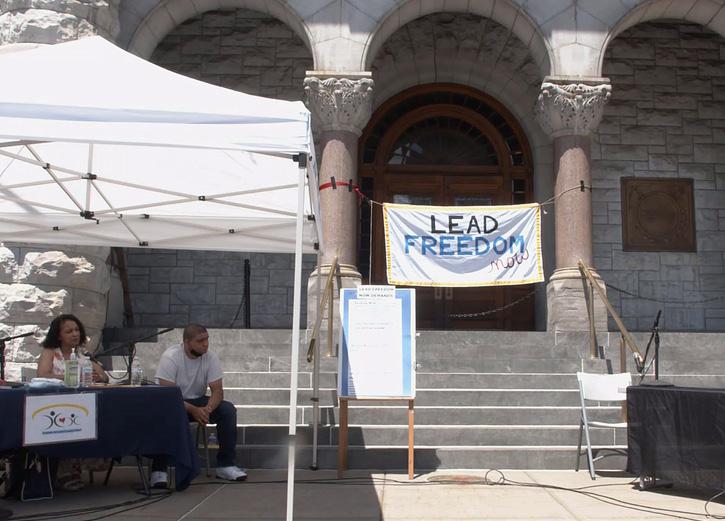
Photo Credit: Paul Ciavarri
Even so, if you stay in the conversation long enough you will likely discover just how local activists and courageous families are working hard to engage stakeholders and local government on these issues. Collectively, their voices are now demanding accountability for recent findings of lead contamination in the City’s drinking water. And they continue to demand better results than have ever been achieved in five decades of a “war on lead” that was declared by the health department in the 1970s.
Lead poisoning in Syracuse is for too many decades a longstanding public health issue in the community, with our city's families enduring health and social consequences of untold suffering for generations.
Syracuse residents affected by the lead crisis are frustrated by the inaction of local legislative and public health officials, the lack of accountability for property owners, and the mishandling of information and testing within the community. This frustration has recently led to the involvement of national organizations, such as Earthjustice, to provide education, support, and research in their quest for truth, justice, and a better world for all our children.
We are grateful to Earthjustice’s dedicated team of advocates (especially Marissa Lieberman-Klein, Esq. and Rachel Spector, Esq.) for their hard work and dedication to make this in-depth report a reality.
In the relentless struggle to secure accountability and transparency from elected officials and public agencies, our community could not have a stronger ally than Earthjustice. In spite of all the obstacles thrown in the path of Earthjustice’s investigators, the reader will soon learn this report is filled with important insights, clear observations, and powerful analysis that affirms the central place of the community’s voice in their own struggle. The need for a report like this has never been greater.
We encourage you to take your time to explore this report. And return to it again and again. As the Brazilian teacher Paolo Freire used to say, “we make the road by walking.” Today, we are making the road toward justice. And it unfolds whenever we learn something new, whenever we apply pressure where it’s needed, whenever we offer community support to affected families as they struggle to overcome.
Thank you for your interest.
Kiara van Brackle and Kadashea Smith
Families for Lead Freedom Now, Inc.
Syracuse Resident’s Words on Lead Poisoning: Mrs. Oceanna Fair
I can tell you lead poisoning affects a family member’s ability to learn, to grow, to earn a living, even how they move into adulthood. It limits their ability to earn a living wage. And in some cases limits their ability to get out of poverty or to complete their education. Lead poisoning in my family is causing some members to be dependent upon other family members just to get by. Just so they’re not taken advantage of by society or end up homeless.
Lead poisoning has now worked its way into the fabric of our family. It is generational. We now have several family members who knew they were lead poisoned and others who are now pulling their childhood records only to find out they were lead poisoned.
The significance of this report is that outsiders are now noticing what we families have been saying all along. We’re suffering. And we’re not getting the needed relief from that suffering. The Powers-That-Be are not listening as closely as they should. Now, you have an outside organization, an ally, coming and saying: “Syracuse, but you really have a problem.”
Like other parents in this struggle, I’m speaking for those who can’t. I have some small ability to open doors that others have not been able to open. And I bring awareness and attention to something that has, for decades, been pushed into the closet, swept under the carpet. Just not dealt with in a proper light. Leaving generations of families suffering. Generations of families not even knowing that this plague, this illness, this poisoning is affecting their life in the way it has. I’m saying the quiet part out loud.
Photo Credit: Paul Ciavarri
We need to stop robbing our children of a future before their little lives have just begun. We need to stop blaming parents for this happening when they didn’t even know it was present. We need to shine a light on this as a community! It’s going to take a community to solve the problem: it’s going to take our educators, our health care system, our housing system, landlords, code enforcement – all of these folks to fix this problem.
All of us as parents have these endless hopes of possibilities for our children and this silent predator just comes in an robs them of all that potential, all that ability. And no one can see that. And because they can’t see that nobody pays attention. And we need to shine a light on it. This is the one time when someone can poison your child and no one’s going to be held accountable.
I hope people read this report with an open mind and open heart. And just think about what small changes you can make to protect children from this neurotoxin. Whether paying closer attention at the housing inspection, or as an educator taking a step back asking if maybe this isn’t a troubled child, asking what’s going on here. Or health care workers listening to parents when they say my child is experiencing X, Y, and Z. And taking those further steps. Having the conversation. Refusing to make people a number. Stop passing judgement.
I hope every time people see the data on lead poisoning they know there’s a child, there’s a person, there’s a family behind those numbers. They’re not counting beans. Those are actual people behind those numbers. There are actual lives affected and these folks are going to have lifelong injuries that may not show up right away or may continue to show up throughout their lifetime.
Julia’s Story
I was born and raised in Syracuse. Growing up, I wanted to be an EMT. You know, working in the back of an ambulance. I started taking classes but never finished. I was always wanting to help others in need. My energies today all go to my daughter and my son. Both have lead poisoning.
My daughter is very smart. My son is different. I’m sure it’s because of the lead. He’s really slow when talking. He has speech problems and he’s not walking like my daughter did at that age. In that way, he’s different. Between the two, my daughter understands more than he does.
This all happened because we had moved into a rental house in Syracuse. One day my son got sick, couldn’t breathe. We rushed him to the hospital and while there they did a lead test. They said he had a very high level, 16-point something. They also tested my daughter. She had it in her system, too.
We started going through the process from there. You have a health inspector going in and out of the house. Contacting the landlord to repaint the walls, do what he’s supposed to do. But it never happened. The landlord would not co-operate. Wouldn’t do anything he was supposed to. So I was encouraged to move out, and I moved into the house I’m in now. The landlord told me it was safe. “No lead in here!” A month later the health department tested.
Come to find out this house is full of lead hazards. Lead on the front porch. All the baseboards. The window sills. Everything leading up to the stairs. At the doctor’s office now they give me wipes to clean the window sills and I keep the kids away from the walls as much as I can, but it’s hard. This is our house. They always want to be walking around in bare feet. But with all the lead in the house they are directly exposed to the hazards.
Photo Credit: Paul Ciavarri
The situation is very overwhelming. After all, you move in to a house and they tell you “Oh, there shouldn’t be any lead in here!” and when you move in a month later we discover there’s lead hazards throughout and their levels are rising. They get tested every three months. At one point, the results improved, below a five. Then, we turn around, and it has jumped up to a 12.3. My daughter doesn’t like being tested.
I’ve been trying to find a new apartment. They want me out of this house just like they wanted me out of the last one because the landlord’s not following instructions with the process. They’re not taking the lead seriously like they should. Landlords tell you: “Oh, it’s fine. Don’t worry about it. We’ll take care of it. It’s just lead.” But “just lead” can really harm my kid. That’s why my son has the problem he has now. And the landlords don’t follow through. Definitely frustrating.
My hope is to find a house without lead so my son’s lead level can go down and he can process stuff. He gets frustrated. Throws things. Bites. The doctor says these are all signs of lead. I just want to get him out of the exposure and into a better environment.
What keeps me going is my son. When it comes to my kids, they’re the only thing I’ve got. So when I see there’s something wrong I’m going to do everything to deal with it.
It’s great to hear that someone is trying to help us get the word out, that Earthjustice is helping us, that’s amazing. I hope everyone pays attention and reads the report. Because lead poisoning is not a joke.
If your kids have lead and you don’t know what to do, keep contacting the health department and landlord, don’t stop. Keep getting the lead test, reaching out to whoever you need to, and get all the documentation you need to have.
And I hope you get justice for your baby.
*Some details changed to protect the family’s privacy.
FALLING THROUGH THE CRACKS
How Enforcement Gaps Leave Syracuse Kids Still Exposed to Lead Paint Hazards Despite Implementation of the City Lead Ordinance
Executive Summary
After years of advocacy calling on the city of Syracuse to do more to address the persistently high number of children with elevated blood lead levels in the city, in 2020 Syracuse enacted a preventative lead ordinance requiring regular inspection of homes for lead paint hazards as a condition of obtaining or renewing a license to rent the property. Previously, landlords were only required to remedy lead paint hazards either if a tenant called the city to complain and city inspectors issued a violation, or after a child was found to have elevated blood lead levels. The city’s preventive lead ordinance has now been in effect for five years and enforced for four. And while initial data show the city is now issuing more violations for lead paint hazards – particularly in the most at-risk areas of the city – they also show that children in Syracuse continue to be exposed to lead paint and suffer from elevated blood lead levels at high rates.
The preventative design of the ordinance is crucial to reducing childhood lead poisoning in Syracuse. But the design only works if it is being followed and enforced. Our review of data on lead-related violations from Onondaga County and the city of Syracuse identified several key enforcement gaps, demonstrating a lack of resources and/or political will to ensure that all rental properties are regularly inspected and all lead hazards are timely and fully remediated.
First, many rental properties in Syracuse are simply not complying with requirements to obtain a rental registry certificate or certificate of compliance. Only those properties that seek to obtain certificates as required and act to renew them will be inspected under the new ordinance, but as confirmed by a recent report by the city auditor, there is a larger pattern of rental properties across the city not registering. Data show that many properties where the County issued a violation based on a child’s exposure to dangerous levels of lead do not show up on the rental registry at all. The city must take proactive measures to find unregistered properties, conduct inspections, and ensure renewals of certificates – especially at properties that are known to have lead paint and where landlords have previously failed to maintain a safe environment. The city must ensure all rental properties register so they will have proactive, regular inspections.
Second, even if the city is issuing more lead violations, these violations won’t reduce exposure if the lead hazards are not properly remediated or if interim control measures are not effective. A subset of properties in Syracuse are receiving multiple, repeated violations over a short period of time, raising questions about the effectiveness of corrective measures. Data show that over twenty percent of properties that had County violations stemming from a child with elevated blood lead levels over the past six years have had multiple violations during that time period, most of them within just a two-year period – and many of them had previous city violations that should have identified and required remediation of the hazards before a child was exposed enough to have elevated blood lead levels.
Syracuse and the Onondaga Department of Health can and must do more to reduce childhood lead poisoning. For the lead ordinance to have any chance of being effective, the city must ensure that all landlords register their properties with the city so that preemptive inspections can occur. The city must also do more to ensure that remediation measures and interim controls are being completed properly so that lead hazards do not imminently recur. Using existing data, the city can also prioritize and target inspections and enforcement to those landlords who have repeatedly failed to maintain their properties in a healthy and safe
manner and who have had multiple lead violations. The city must also ensure that preemptive inspections include both the outside and inside of the house, even if that means obtaining an administrative warrant to inspect. And finally, to make enforcement fully effective, the city must ensure tenants are fully protected from any kind of retaliation related to lead violations, and that they know and can assert their rights. The city must comprehensively inspect all homes, inside and outside, including inspecting soil water service lines for lead. The city must also better protect tenants from retaliation.
About this Report
This report arose from an inquiry by Families for Lead Freedom Now, Legal Services of Central New York, and Earthjustice into the effectiveness of Syracuse’s 2020 lead ordinance thus far. The Syracuse lead ordinance is meant to be preventative, finding and reducing lead hazards in housing before children are exposed to dangerous levels of lead. Has it been effective in doing so yet?
To seek to answer this question, the report authors requested information on lead paint-related violations from both the Onondaga County Health Department and the City of Syracuse via Freedom of Information Law requests. Initially, we requested all records related to lead violations from 2017-2023. We sought to obtain information from before the lead ordinance as well as after, to compare pre- and post-ordinance data. We also made clear that any identifying information of tenants or children should not be included in the response. Due to the volume of responsive records, we narrowed requests to both parties.1 Response times were still extremely slow, and for this reason the report does not include the most recent data from 2024 or even the latter half of 2023. However, both the Health Department and the City shared detailed spreadsheets that allowed us to analyze patterns of lead enforcement in Syracuse.
Because of difficulties obtaining complete data, this report illustrates some patterns but does not purport to draw a complete conclusion about the effectiveness of Syracuse’s lead ordinance to date, or lead enforcement generally. Some notations from the City and DOH are difficult to interpret, and without inspection notes and other records from the city, we also lacked detailed information about each violation to draw full conclusions about issues like reasons for delays in correcting violations, effectiveness of remediation measures, and other nuances of lead hazard enforcement. In addition, we are aware that the Covid-19 pandemic delayed the implementation of the lead ordinance and likely made enforcement – including interior home inspections – more difficult, certainly in 2020 but likely lasting well into 2021.
Ultimately, the city and county have the best access to data and we recommend that they coordinate to conduct a full review and analysis of lead enforcement on a regular basis to ensure that the city’s preventive enforcement is effective. Even at this early stage, it is critical to examine what is working and not working so that the city can make any necessary changes in enforcement practices, community outreach, or other measures – and they should do so at regular intervals. It is also critical to gain insight into the ordinance’s effectiveness in Syracuse, because New York is planning on implementing a similar initiative and lessons can be applied statewide.
Background
Lead and its Disproportionate Effects on Children
Lead is a poisonous heavy metal and its buildup in the body can cause serious health problems for any person. Young children and pregnant people are especially vulnerable to lead. Early exposure to lead can cause developmental delays, such as speech impediments and learning disabilities. It also affects a child’s ability to focus and may result in behavioral changes like irritability or hyperactivity.2 Any of these symptoms can cause a lifetime of issues that hinder a child’s healthy transition into adulthood. Preventing lead poisoning in children is a major public health issue.
Although any level of lead is deemed harmful, under New York Public Health law, a child with a blood lead concentration equal to or greater than five micrograms per deciliter (μg/dL) is considered to have “Elevated Blood Lead Levels” (EBLL).3 New York’s threshold is higher than the reference value of 3.5 μg/dL that the Centers for Disease and Control and Prevention uses “to identify children with blood lead levels that are higher than most children’s levels in the United States.”4
“Lead poisoning is completely preventable.”
New York State requires doctors to test all one- and two-year-olds for lead poisoning through blood tests and to assess children for lead exposure every year until they reach the age of 6.5 When a test indicates that a child has an EBLL, the results are registered with the New York State Department of Health, which enters the test results into a statewide registry. Local health departments are responsible for proactively checking the registry for EBLL results within the county and for following up on those cases.6 Such follow-up includes sampling for lead in the dwelling where the child lives.7 If “a condition conducive to lead poisoning” is found in the dwelling, the health department must issue a written notice and a demand requiring the landlord to abate the condition.8 If the landlord fails to comply with the notice and demand, enforcement measures may include a formal hearing, and, upon proof of the violation of the notice and demand, a penalty of up to $2,500.9
This existing statewide system is designed to identify and remediate lead hazards only after a child already has elevated blood lead levels. It’s likely that the system is not even catching all children with EBLL, since blood tests are only mandatory at age one and two, and barriers to accessing health care may prevent some children from even getting tests at those ages.
Housing Stock, Lead Paint and Lead in Pipes
Lead poisoning is a social, economic, and environmental justice issue, as well as a public health crisis. Syracuse has historically had one of the highest rates of childhood lead poisoning in the country, due to its aging and often poorly maintained housing stock. Over 9% of Syracuse children tested in 2023 had elevated blood lead levels (above 5 mcg/dL).10 Those rates significantly increase in neighborhoods with high levels of poverty and poor housing conditions. Children of color are among the highest to test positive for lead poisoning in Onondaga County, and most of those children reside in Syracuse.11 In 2021, over 11.6% of Black children in Onondaga County had EBLLs compared to 2.0% of white children.12

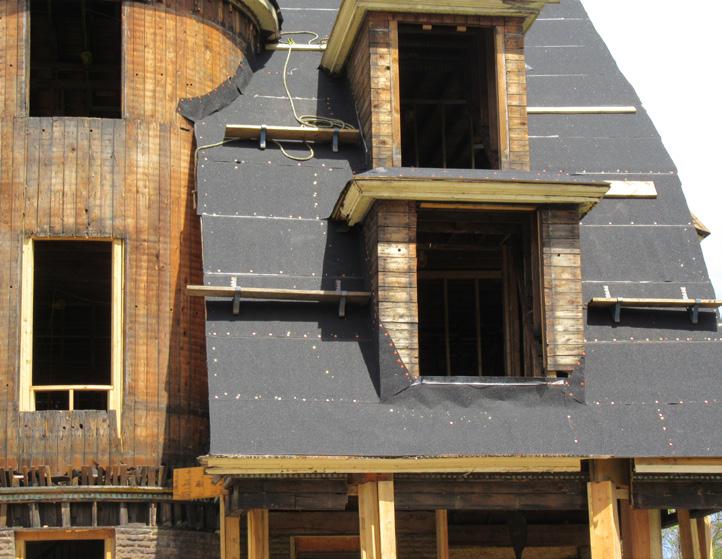
Lead-based paint in residential buildings is the most common exposure pathway for childhood lead poisoning, as children under six years old tend to ingest lead paint that has chipped away from walls and breathe or swallow residual dust from floors and windows. Syracuse is no exception. In 1970, New York banned the residential use of lead-based paints, almost a decade before they were nationally banned in 1978. Yet, 81% of New York’s residential housing stock was built before 1970. The average home in Syracuse was built in 1969, and in many neighborhoods, the average home age is closer to 80 years old.13
Drinking water can also be a source of exposure to lead. Even though lead pipes were federally banned in 1986, no effort was seriously taken to replace legacy lead pipes left in the ground. Through a chemical reaction known as corrosion, lead can leach into drinking water when it passes though lead service lines. These are underground lead pipes that connect city water mains to residences. What makes lead exposure through drinking water especially dangerous is its difficulty to detect given its colorless, tasteless, and odorless nature.14 In July 2024, Syracuse found in its routine lead sampling that 27 homes out of the 104 homes tested had lead levels above 15 parts per billion (ppb) in their samples.15 While 15 ppb is the federal lead action level, it is not a health-based standard and there is no safe level of lead in drinking water. Syracuse officials claim that the high lead levels were the result of improper sampling by a small number of employees, but investigation into sampling data from 2022-2024 indicates that if Syracuse complied with federal law in its sampling, it would have exceeded the federal action level every sampling period in that time frame.16
Photo Credit: Jessica Ruiz
2020 Ordinance Overview
In 2020, after years of local advocacy, Syracuse passed an ordinance requiring proactive identification and correction of deteriorating lead-based paint on the exterior and interior of residential buildings built prior to 1978.17 Recognizing that state law had no mechanism to identify lead paint hazards before a child had been found to have elevated blood lead levels, this new ordinance requires lead inspections to be conducted regularly, as a condition of receiving and renewing certificates required for rental property owners (Certificate of Compliance or a Rental Registry Certificate).18 If an inspection reveals peeling paint or other lead hazards, the City must issue a violation, and landlords must correct the violation before a Certificate of Compliance and Rental Registry Certificates can be approved.
The State of New York is currently in the process of developing regulations to enact a similar system statewide. The New York State Lead Rental Registry Program has identified 25 communities of concern with the highest number of childhood lead poisoning in the state, some of which are in Syracuse. The final regulations are expected to go into effect in November of 2025.19
AG Cases Against Landlords with the Most Lead Violations20
Syracuse’s lead poisoning crisis is exacerbated by some landlords’ repeated failure to address lead hazards in their rental properties. The New York State Office of the Attorney General has taken measures to combat this issue by suing Syracuse landlords with the most lead violations. In July of 2023, a lawsuit was filed against Syracuse landlord Todd L. Hobbs for persistent lead violations. Between 2016 and the filing of the lawsuit, 413 violations were reported at 19 different properties owned by Hobbs, resulting in at least 11 children suffering from lead poisoning.
In June of 2022, Attorney General James’ office successfully shut down Syracuse landlord, John Kiggins, and his company, Endzone Properties, Inc., for repeatedly violating lead safety laws. 18 children were exposed to lead poisoning due to Kiggins and Endzone Properties’ failure to address lead hazards. As part of the settlement, Mr. Kiggins was forced to sell all his properties and is banned from owning rental properties in New York State ever again.
Photo Credit: Paul Ciavarri
How Syracuse's Lead Law Should Work
After a proactive inspection, city inspectors placed a violation for lead paint.
What Often Happens Instead
The city never inspected the property because the owner didn’t apply for the rental registry.
The property owner took action to remediate the violation.
Property was re-inspected and passed.
The owner has taken no action and the deteriorating lead paint gets worse.
Children continue to be exposed to lead from the deteriorating lead paint.
Ways Lack of Enforcement Is Failing Tenants
Not on rental registry.
Violation never remediated. Property never inspected. Tenant complaint triggered inspection.
Inspection only occurred post lead poisoning.
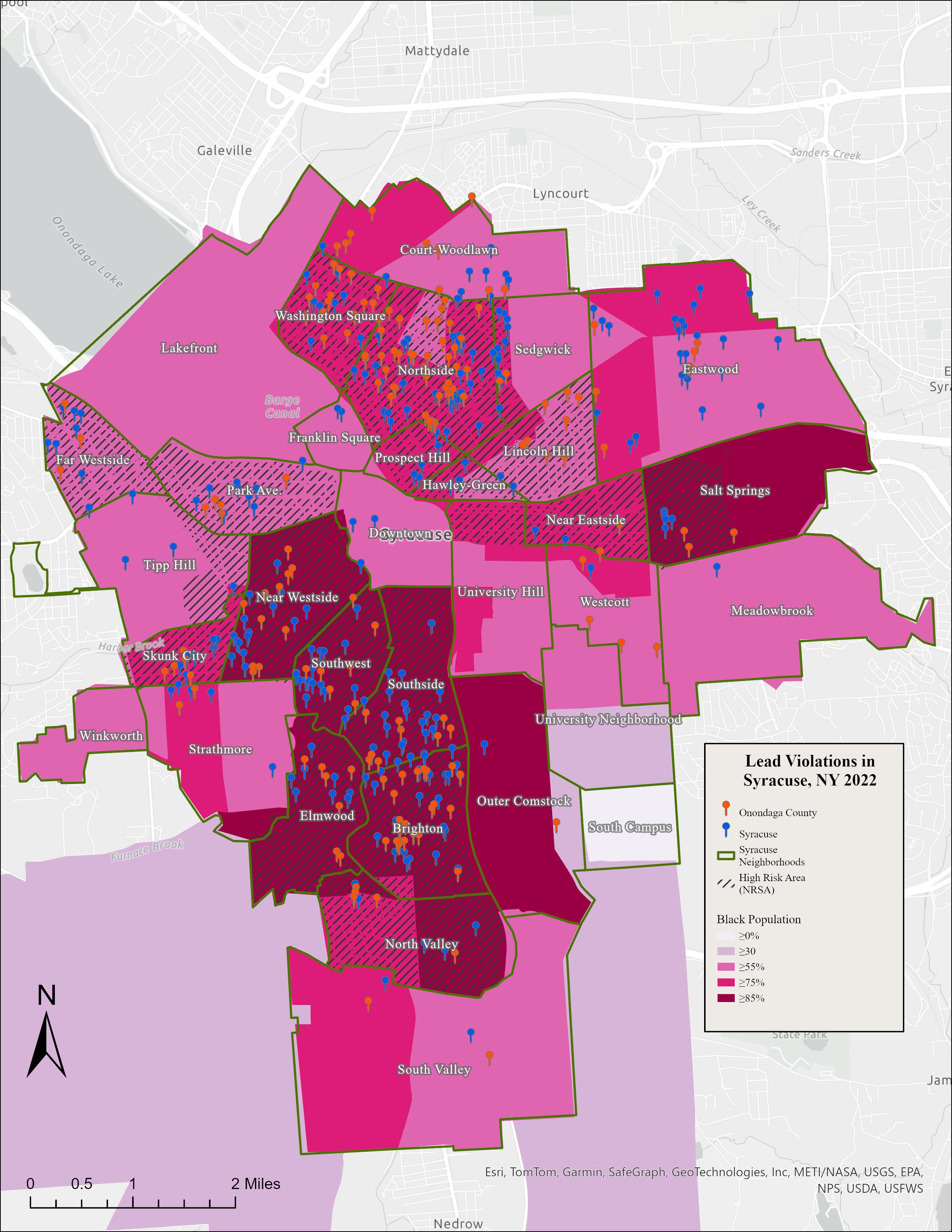
Syracuse 2022 City and County Lead Violations by Percentage of Black Population
Findings
Both City and County Violations Have Increased Sharply Beginning in 2021
Lead paint-related violations in Syracuse increased annually beginning in 2021. This was true for both the city and the county compared to 2017-2020. While the increase in city violations can be attributed in part to more preemptive inspections under the city ordinance, it has not yet resulted in a drop in the incidence of children with elevated blood lead levels.
More City Lead Violations from Rental Registry and Certificate of Compliance Inspections
As expected, lead paint violations from rental registry and certificate of compliance inspections increased once the ordinance went into effect. Yet violations resulting from these required inspections still only account for a small portion of the city’s lead paint-related violations.
Beginning in 2021, when the lead ordinance went into effect, there was a significant spike in the number of city lead-related violations21 placed in the context of rental registry or certificate of compliance inspections – as well as a jump in other types of lead-related violations. From 2018 through 2020, Syracuse data show about 98 lead-related violations labeled “rental registry” or “certificate of compliance” cases, with an average of 33 violations in this category in each of those years – a tiny proportion of overall lead-related violations.
City of Syracuse Lead-Related Violations
Photo Credit: Paul Ciavarri
In 2021 alone, that number jumped to about 442 lead-related violations in rental registry or certificate of compliance cases. In 2022 the city placed nearly 800 separate lead-related violations in the context of rental registry or certificate of compliance inspections, according to our interpretation of data provided by the city.
Overall numbers of lead-related violations also rose during 2021 and 2022, driven in part by the increase in violations placed in the context of rental registry or certificate of compliance inspections. However, violations in rental registry or certificate of compliance cases still account for a minority of lead-related violations. The number of city violations for peeling paint on vacant homes, for example, was nearly as high as the number of rental registry or certificate of compliance lead violations in 2021. While it’s important to keep vacant housing from becoming a blight, if the property is vacant and the violations are not part of an effort to rehabilitate the property into livability, the city should prioritize inspections and violations in active rental properties.
Increased County DOH Violations Mean No Preventative Effect
Yet from City Ordinance
The parallel increase in lead paint violations from the county Department of Health makes it clear that the Syracuse lead ordinance is not yet having the desired preventative effect of driving down the numbers of children exposed to lead paint and experiencing elevated blood lead levels. Lead violations from the Onondaga County Health Department (OCDOH) also rose sharply in 2021 and 2022. According to data provided by the OCDOH, in 2017 the County issued 86 violations, while in 2018 it issued 47 and in 2019 it issued only 41 violations. In 2020, the number of County violations rose to 61, but it increased sharply in 2021 to 153 violations and again in 2022 to 199 violations. Each violation represents a child with an elevated blood lead level where lead paint hazards were found in the child’s home.
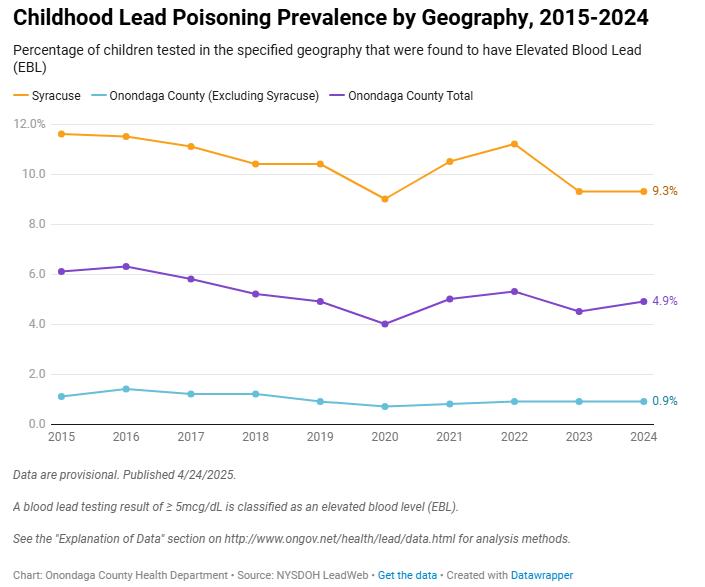
There are two likely explanations for the marked increase in County DOH violations in 2021 and 2022. First, New York lowered the reference level for lead effective October 2019 from 15 micrograms per deciliter to 5 micrograms per deciliter. This means that, beginning October 2019, children testing between 5 and 14 ug/dL would require notification to the state and an OCDOH investigation when previously that blood lead level would not have triggered an investigation. In addition, just a few months after the new reference level took effect, the Covid pandemic and 2020 lockdowns delayed lead testing for many children as well as likely reduced investigations and enforcement. This may have led to more children testing with elevated blood lead levels in the following years. While it is impossible to know the full impact of these factors, they make it even more difficult to discern any impact of the Syracuse Lead Ordinance on the number of children with elevated blood lead levels in the few years after it went into effect.
This report’s preliminary data indicates that the Syracuse ordinance is not having the desired effect of reducing the number of children with EBLLs. However, there were a number of limiting factors in our data. Syracuse should evaluate the effects of the ordinance on a regular, ongoing basis, using all available data and sound methodology. It will likely take several more years to see an effect on overall number of children with EBLLs, but regular, ongoing evaluations of whether the ordinance is having a measurable preventative effect are crucial to evaluating the ordinance’s efficacy. The next sections highlight some evident gaps in enforcement that are likely preventing the ordinance from having the full preventative impact it should.
Encouraging Early Signs
While our analysis found serious problems with Syracuse’s enforcement of its lead paint ordinance, the picture was not entirely bleak. One of the potential issues we were most concerned about was whether the City was issuing rental registry certificates and certificates of compliance to properties with open lead paint violations from the County Department of Health. Happily, we did not find any properties with open county lead paint violations and a valid rental registry certificate, which is encouraging. We also didn’t find any evidence of blatant negligence in issuing certificates; it does appear that where owners apply for certificates, the city doesn’t issue the certificate without doing an inspection.
Many Rental Properties Are Missing from the Rental Registry
It is clear from both the data we collected and a recent Syracuse city auditor report that there are a large number of rental properties with lead paint violations that are not on the rental registry at all. Some of these properties had lead paint violations issued by the City, in response to a complaint or in other circumstances, yet there is no evidence of the City making any attempt to register these properties and get them on a proactive inspection schedule. If landlords make no effort to obtain or renew a rental registry certificate or certificate of compliance, and the City fails to pursue them or enforce this requirement, the lead ordinance cannot protect residents of those properties.
The City has been enforcing the lead ordinance for four years. Because certificates must be renewed every three years, all properties on the registry should have received at least one inspection. However, approximately 196 properties with County lead paint violations from 2021-2023—meaning that that there is a child with an EBLL in the home and that there are conditions conducive to lead poisoning—that also had violations from the City do not appear on the rental registry at all. This represents nearly half of all properties that had lead violations from both the City and the County violations from 2021-23. The County violations make it clear that they are rental properties, as the notice to the property owner does not go to the address of the property with the violation. Since these properties also were cited for violations by the City, it’s clear that the City had the opportunity to ensure that they were properly registered – but failed to do so.
Other properties with both City and County violations from 2021-23 have invalid rental registry certificates, but it’s not clear if the City is following up to get the owner in compliance with the rental registry and/ or if lead violations are the reason for the invalid certificate. Given that there was a child with an EBLL living in the property recently, it is vital that the City ensure that proactive inspections, as required by the ordinance, are done at these properties.
The absence of many rental properties from the registry is consistent with the findings of a recent report issued by the Syracuse City Auditor. The Auditor found that, according to the City’s own records, approximately 8,350 properties are required to be registered with the rental registry, and thousands more properties may meet the requirements to be on the registry but aren’t in City records.22 City records indicate that a little over 3,500 properties have active rental registry certificates, which is 42% of the 8,350 properties the City conservatively estimates are required to be registered.23
If over half of Syracuse’s rental properties are simply ignoring the requirement to obtain a rental registry certificate, then these properties will never get a proactive lead inspection under the city lead ordinance. This failure leaves a gaping hole in the ordinance’s ability to protect Syracuse residents from lead exposure. Moreover, data we received make it evident that the City is or should be aware that many of the properties not on the registry have lead paint. The City has issued lead paint-related violations to many of these properties, and the County has found lead paint and a child with elevated blood lead levels at many of them as well. At the very least, when inspecting and issuing violations in response to a complaint, the City should make sure that the property is on the registry. Even after a lead violation is remediated, it is still important to proactively inspect the property to check on interim controls and ensure that there are no other lead paint hazards.
The City needs a better process to ensure that all rental properties are on the rental registry list, or the ordinance can never be effective at reducing childhood lead poisoning rates. Registration of all rental properties will become even more important when the state rental registry law comes into effect later this year. The state law, which covers some areas in Syracuse designated as “communities of concern,” requires the creation of a rental registry database for multi-family properties in those communities. Syracuse must ensure that its own rental registry list contains all the properties in the state database.
Obtaining Warrants
The City was recently sued by a small group of landlords over the requirement for a preemptive interior inspection of properties before issuing them a rental registry certificate. These landlords refused to allow interior inspections as they claimed the inspections violated their Fourth Amendment rights. In response, the City filed for administrative warrants to inspect nearly 100 properties and nearly all the warrants were granted.24 An administrative warrant is issued by a judge and allows the city to inspect a home over an owner’s objection on the basis of a presumption that it contains lead paint due to the age of the home. While the landlords’ recalcitrance is unfortunate, the ordinance provides for an administrative warrant process and the City should continue to go through that process any and every time a landlord refuses an inspection. Interior inspections are crucial to ensure that all lead hazards are found and remediated, and without them, the ordinance cannot achieve its goal of reducing childhood lead poisoning. Further, it is important for the City to demonstrate that interior inspections will be conducted in homes presumed to have lead paint based on age regardless of any objection from the owners. While in the short term the City may have to go through the warrant process more often than it prefers—spending time and money on doing so—it may pay off in the long term as landlords are likely to stop objecting over time.
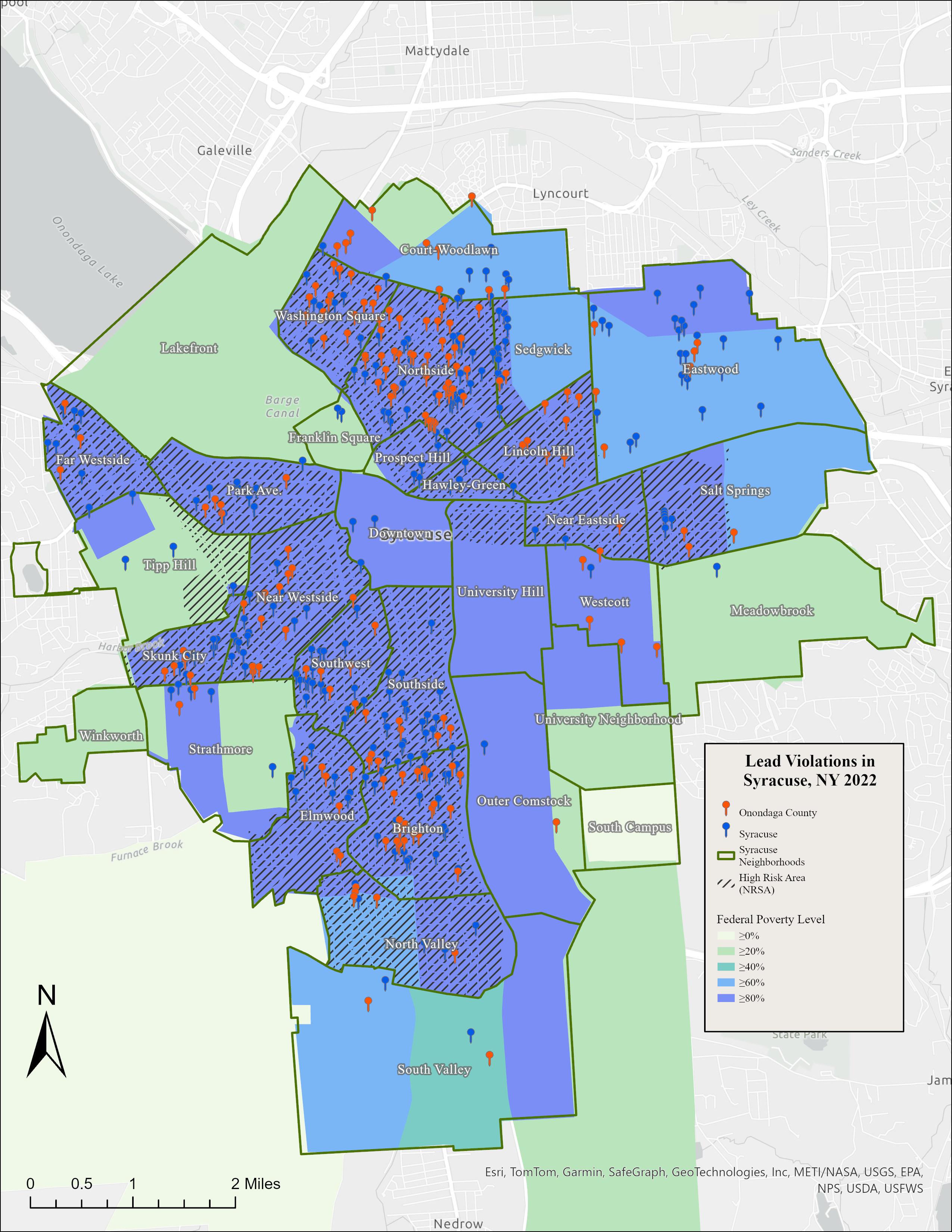
Syracuse 2022 City and County Lead Violations by Percentage of Population Below Federal Poverty Level
A Significant Subset of Properties Repeatedly Violate Lead Laws
There are a subset of properties and landlords that are repeatedly putting families at risk of lead poisoning. Some properties show up repeatedly between 2017 and 2023 with multiple violations – either multiple DOH violations, or violations from both DOH and the City in different years. These repeat violations at the same property over time raise questions about how comprehensive inspections may be, as well as about the effectiveness of interim control measures at preventing lead exposure.
First, about 151 properties – 20% of all DOH violations during the relevant time period – have both a DOH and a City violation – and the large majority of these, about 100, were issued multiple violations within a two-year period. From the data shared by the County and City, it is not possible to determine whether some of these violations involved the same incident of lead paint hazards, although many of the violations are far enough apart in time that they are likely to involve separate incidents.
Second, a significant number of properties have multiple City violations in different years, and several even have multiple County DOH violations at the same property. If DOH receives notice of a child with an EBLL, inspects the home and finds lead paint hazards, orders remediation and certifies compliance, there simply should not be another incident of a child with an EBLL at the same property within just a few years. Similarly, a thorough City inspection should identify and require landlords to mitigate all lead hazards in a way that ensures the safety of the home for the next few years. At least 68 of the DOH violations from 2017 to mid-2023 were at properties that had City lead-related violations placed in years prior to the child becoming lead poisoned. If those city violations had been properly remediated or had proper interim controls, it’s likely that those 68 children could have avoided lead exposure.
For example, 809 First North Street appears to have had a Certificate of Compliance inspection in December 2020, and a violation issued in February 2021 under Section 305.3 of the state property maintenance code for failure to maintain interior surfaces/peeling, chipping, flaking or abraded paint. That violation was marked closed, apparently in March 2021, and a Certificate of Compliance issued. But in 2022, a DOH violation was placed due to lead hazards that had caused a child to have an EBLL.
Another property at 605 Bellevue Avenue had a City violation placed in 2019 as a vacant house case, citing interior flaking or degraded paint or other interior surfaces. Data indicates the city inspected the property in 2020, and inspected nearly every month in 2021 as well. A violation appears to have been placed on the property again in 2022, and the property was referred to the Board of Administrative Adjudication in 2023. Meanwhile, DOH issued a violation to the property in 2022 – meaning despite the City’s multiple inspections, violations for peeling paint, and referral for enforcement, a family moved into this formerly vacant home without the violations having been corrected and a child was lead poisoned. A similar pattern occurred at 335 West Kennedy Street, which failed vacant property inspections by the city in 2017, 2020 and 2021. In 2019, the city cited the property for failure to apply for a rental registry certificate. Yet in 2022, there was a child at the property with an EBLL, and DOH issued a violation. These children should not have been lead poisoned if the city’s enforcement was effective.
Allowing children to be lead poisoned at properties that the city knows contain dangerous lead hazards suggests negligence. In two of the above examples, while the properties may have been vacant when the city first inspected and issued violations, the continued pattern of inspections indicates that the City should have been aware when tenants moved into the property. While it may not be urgent that a vacant property be timely remediated, once tenants were living there, the City should have acted quickly to ensure that the open violations were remediated and the property was safe and habitable. This needed to be done by the
no action and the deteriorating lead paint gets worse.
City before a child was lead poisoned. The repeat violations raise questions about the thoroughness of investigations, lack of meaningful enforcement measures, and the standards for agencies to be certifying that a landlord has sufficiently remediated or mitigated the hazard with interim controls.
Property was re-inspected and passed.
The significant number of properties with multiple violations also suggests that there is a subset of landlords and properties that are not taking their obligations seriously under the lead laws and are repeatedly placing residents at risk. Syracuse can use existing data to ensure these properties are prioritized for follow-up inspections and should consider escalating penalties for repeat offenders.
The City is Not Being Transparent About or Analyzing Lead Violation Data
Given the persistent and widespread nature of lead poisoning in Syracuse and the investment of the local community in fixing it, transparency about enforcement efforts and their effectiveness is critically important. Obtaining data for this report, which is not complete enforcement data for the city or county, was challenging and took longer than it should have. Data transparency can help residents understand what the city is doing to enforce the lead ordinance, and the city can also review this data, as Rochester did, to evaluate and improve the effectiveness of its enforcement efforts. Yet there is no indication Syracuse is looking at data or making it available to the public.
Ways Lack of Enforcement Is Failing Tenants
registry.
Children continue to be exposed to lead from the deteriorating lead paint. Inspection only occurred post lead poisoning.
Rochester’s Evaluation of Its Lead Ordinance Data
The true difference in lead poisoning prevention between Syracuse and Rochester appears to be political will. Rochester implemented its Lead-Based Paint Poisoning Prevention Ordinance in 2006. The text of the cities’ ordinances are nearly identical, and the county health departments are both governed by the same state law. However, Rochester has taken multiple opportunities to publicly audit its lead paint ordinance enforcement and meet with its public housing authority, school district, and county to work on lead poisoning prevention. Rochester also established a citizen advisory group to inform implementation.26 As a result of Rochester’s political will to reduce lead poisoning, the number of children with EBLLs in Monroe County has significantly decreased since Rochester passed its ordinance.27
Rochester’s voluntary actions provide a useful road map for Syracuse if the city wants to replicate Rochester’s success and even improve upon it. Despite not being required to do so in the ordinance, in 2008, two years after Rochester implemented its ordinance, Rochester worked with a third-party consultant to evaluate the effectiveness of the first two years of the ordinance. While the comprehensive study was prepared for the Greater Rochester Health Foundation, the city’s code enforcement division provided the consultants with inspection data and answered the consultants’ questions.28 Rochester implemented some of the consultants’ recommendations in later amendments to its ordinance. Additionally, the Coalition to Prevent Lead Poisoning, a group of experts and community members that pushed for the lead paint ordinance, continued to meet monthly with city representatives, the city public housing authority, Monroe County public health officials, and the city school district through at least 2018.29 Finally, in 2022, Rochester did its own sixteen-year review of its ordinance, looking at the number of units inspected and compliance rates.30 Rochester also employs data analysis to make its ordinance more effective and publicly transparent. It keeps track of the number of properties inspected, the number and types of tests conducted, the number of citations, and the number of cleared citations. Having this data publicly accessible allowed researchers who weren’t affiliated with the city to do independent reporting on the effectiveness of the ordinance.
Although Syracuse’s ordinance was effective in 2020 and began being enforced in 2021, the city has yet to do a comprehensive evaluation of enforcement, compliance, and health data or hire anyone to do so.
Monroe County's Incidence of confirmed high blood lead level (10 micrograms or higher per deciliter) per 1,000 tested children aged <72 Months
Figure 1. NY Community Health Indicator data for EBLLs (measured at 10 micrograms or higher per deciliter) in children aged <72 months from 2012-2021.
Delay in FOIL Responses
Both Syracuse and Onondaga County Department of Health significantly delayed their responses to requests for information on lead violations under New York’s Freedom of Information Law (FOIL). Despite FOIL stating that agencies must respond to records requests within twenty days of receipt, the law also allows agencies to extend that time by providing, within that twenty-day period, a further “reasonable date certain” by which the agency will respond. In this case, while there were very large volumes of records responsive to original requests, the report authors significantly narrowed the scope of those requests but it still took nearly two years to receive responsive documents from both the City and the County. Earthjustice first requested lead violation records from the City of Syracuse and records from the County’s lead poisoning prevention program in March 2023. Onondaga County provided records on a rolling basis starting in July 2023, but didn’t complete the response until March 2024—a full year after the original request. Additionally, Onondaga County didn’t include inspection notes in its response, so Earthjustice had to FOIL them separately in May 2024. We received the notes in January 2025—eight months after submitting the request—although the County did respond on a rolling basis, so some records were received earlier than January 2025.
The city of Syracuse took even longer to respond. After Earthjustice submitted its request in March 2023, Syracuse gave itself a response date in November 2023. The city does not release records on a rolling basis. Less than a week before the November 2023 response date, Syracuse contacted Earthjustice to discuss narrowing the FOIL request and extending the response date again given the massive number of responsive records. It then took until the end of February 2024—nearly four months—for the city to give Earthjustice a sample set of records and a spreadsheet summarizing the responsive records so that we could narrow the FOIL request. After submitting the narrowed request, Syracuse still gave itself seven months to respond to the request. We finally received the requested records in early February 2025.
For members of the public to have better information about overall enforcement, requesting information via FOIL and waiting for months is not realistic. Earthjustice is a non-profit legal organization with paid staff members who are knowledgeable about FOIL and can devote work time to following up with government. For community members who want to know about the history of lead violations in their home or a home they are looking to move into, months-long waits for records could mean months more exposure to dangerous lead hazards.
Recommendations
Based on the findings of this research, as well as the lived experiences of Syracuse community members affected by exposure to lead paint, the City and County should take the measures recommended here to strengthen the effectiveness of the city’s recent lead ordinance and better ensure families are protected from lead poisoning.
The City must do a periodic review of rental properties in the city, identify those that are not on the registry at all, and actively reach out to properties that are not on the registry to ensure all properties receive a proactive lead inspection.
Compliance with Syracuse’s rental registry is integral to the city ordinance’s scheme to prevent childhood lead poisoning - if properties do not apply for rental registry certificates, they will not get proactive inspections every three years. But the city auditor estimates that as few as 30% of rental properties are registered, and our research found many properties where the County issued a violation based on a child with EBLL were not registered. To increase compliance, the city auditor recommends that the city educate and proactively notify property owners that they are required to register and create a citywide compliant landlord list. We echo both of these recommendations and recommend that the city do more.
Syracuse has all the tools it needs to identify properties that are not registered and should do so immediately. The city must then use any and all options it has available to get those properties registered. If warrants are needed to inspect them, the city must obtain them. If the property owner refuses to apply or pay the registration fee, the city must issue violations, quickly fine offenders, and increase the fines as much as legally allowed as needed. It is unacceptable that well over half of one- and two-family rental housing is not registered. Because application for the registry triggers proactive lead inspections, these violations are not simply a paperwork problem. Lead hazards in unregistered properties are likely not being identified or remediated until after a child is poisoned. The city must treat the abysmal rate of compliance with the rental registry as a public health crisis—because it is.
The city of Syracuse should coordinate closely with the County Health Department to identify repeat offenders for enforcement prioritization and affirmative follow-up.
Keeping track of repeat offenders is important for getting a handle on Syracuse’s lead crisis. Temporary lead remediation measures require upkeep, and repeat violations indicate that landlords aren’t doing that upkeep – so the city or county needs to step in to prevent further lead exposure. Our research found a significant subset of properties that have been cited by both the County and City for lead violations after a prior violation had supposedly been corrected.
While the County is required to do inspections any time a child with an EBLL is reported, both the City and County can and should proactively inspect repeat offenders who remediate with paint film stabilization. State regulations require property owners to utilize approved abatement methods in response to a notice
Though the City allows paint film stabilization, interim controls must be assessed and renewed to ensure continued protection from lead, and multiple lead paint violations—especially within a relatively short period of time—show that the interim controls are not working as expected. When the County issues a lead paint violation at a rental property and for whatever reason paint film stabilization is the remedy, the City should be notified so it can prioritize that property for future proactive inspection to check on interim controls. However, the burden should not be on the tenant to call city inspectors, as some tenants have reported being instructed to do. Instead, the County should coordinate directly with the City, and the City and County should generally keep each other apprised of inspections and violations so that both have the complete violation history of the property.
The City should more aggressively pursue penalties against landlords who fail to timely remediate lead paint, fail to register their property, or are repeat offenders.

While the primary goal of enforcement is to remediate lead hazards, the City and County should use fines more aggressively to move the needle on compliance, particularly for landlords that repeatedly expose tenants to lead. Data show that both the City and County pursue fines in only a small minority of cases. For the City, even when it does refer a violation for penalties, it does not aggressively pursue imposition or payment of fines. Both the City and the County should use the complete violation history of a property and a landlord in referring violations for adjudication and/or issuing fines. Landlords who repeatedly violate lead laws should be given fewer extensions for remediation and should have higher penalties for repeated failure to comply. At all stages of enforcement, including fines, the city should notify the tenant when it takes action against their landlord for violations at the tenant’s unit.
The threat of fines – and increased fines with time and more past violations – should serve as a deterrent to landlords and incentivize better compliance. The City should start pursuing fines more aggressively and should also evaluate after a few years whether increased use of fines changes landlord compliance. Fines should never be an end goal or replace actual inspections and remediation of lead hazards. For example, as alleged in a lawsuit by landlords and not disputed by the city, sometimes when a landlord does not consent to an inspection, the city merely fines the landlord for being delinquent on their rental registration rather than getting a warrant and doing the inspection. While the city may believe that the fines will eventually entice the landlord into allowing the inspection, this game of chicken is played at the tenant’s expense. As the city is levying fines the landlord refuses to pay, the tenant is potentially living in dangerous housing with unaddressed lead paint hazards. and demand issued after a child tests with an EBLL, and paint film stabilization is not on the list.31 Although abatement is expensive, the County is required to comply with the law and require landlords to utilize an approved abatement method. Doing so will also reduce the number of repeat offenders, since abatement prevents the lead hazard from recurring.
The City must do full interior and exterior inspections for rental registry certificates and renewal, to comply with the city lead ordinance and preemptively identify lead hazards before kids are harmed. If access to the interior is blocked, the City must continue to seek administrative warrants for interior inspections.
When doing a rental registry inspection, the City must do both an interior and exterior inspection of the unit, including taking a dust wipe sample from friction surfaces if the unit is in an area of concern. When only a visual inspection is done, dust from friction surfaces, which is a pervasive and common source of lead exposure, is missed. It is therefore crucial that the City take dust wipe samples. The upcoming state regulations will also require inspections to include a soil assessment, so the City should also incorporate soil assessments into their inspections in anticipation of these new rules. And given Syracuse’s recent lead action level exceedance in its drinking water, inspectors should also test water pipes if the city’s inventory does not state definitively whether the service line is made of lead.
To the extent landlords refuse access for interior inspections, the City must continue to apply for administrative warrants, as it has done since the fall of 2024 in response to a lawsuit by a group of landlords over fines for not having a valid rental registry certificate. Court records show that these warrants have generally been granted quickly, allowing inspections to continue without much delay. These warrants should be in a public database so that tenant can find out if their landlords are recalcitrant and property owners can see that the City is serious about doing these inspections. The city should also send a copy of the warrant to the tenant of the property.
The City should pay special attention to vacant properties.
The city and county must ensure that if properties with lead hazards become vacant, the hazards are remediated before the property is re-occupied. Our research found that there are numerous instances of properties with vacant property violations from the city that subsequently have a DOH violation for a child with an EBLL, meaning lead paint hazards were not remediated before tenants moved in; data also show that it’s common for property to become vacant during a DOH investigation. If a property remains vacant, then the city must ensure it is on the Vacant Property Registry and the owner registers annually. If the County is notified or otherwise finds out that a property is vacant, for example if tenants vacate after the County has placed a violation but before it is corrected, it must notify the city so the city can ensure the property is registered and that the violation is corrected before the property is re-occupied.
Temporarily vacant properties present a perfect opportunity for lead inspection and remediation, as inspectors don’t have to work around tenants’ schedules and landlords can do remediation without having to protect the tenants from lead dust. The City should set up a notification system for landlords to utilize when a property becomes vacant, so the City can inspect the property for lead before new tenants move in. Any violations must be corrected before anyone occupies the property. Syracuse has a Vacant Property Registry intended to motivate owners to rehabilitate their properties for reoccupation, stabilize and maintain the vacant property, or demolish the property. Much like the city’s rental registry, it appears that property owners are not registering their vacant properties and that the city is not enforcing the annual fee provision of the registry.
The City should regularly do a full data review to identify successes and barriers under the 2020 lead ordinance.
It is important for the City to publicize data on lead violations and registration so that residents and researchers can evaluate whether the ordinance is working. As mentioned in the transparency section, our FOIL request gave us only partial data about lead enforcement, and the delays in response meant that the data we did receive was not up to date. The City has access to the full data in real time. The City also needs to do a full review of its enforcement efforts and make the review publicly available. While the intent of the 2020 ordinance is good, a full analysis of the data to date can reveal gaps in enforcement so that the city can refine its implementation of the ordinance. If the City is not willing or able to do its own review, then there must be outside oversight of inspections and the rental registry, perhaps by the state or the city auditor.
After passing its ordinance, Rochester did a data review that helped the city understand some barriers to the law’s effectiveness and led it to make some changes in enforcement. Rochester is now held up as the gold standard of lead poisoning prevention in upstate New York, and Syracuse should emulate Rochester’s approach. In addition to reviewing its lead ordinance enforcement periodically, Rochester also has a public database with scores for landlords and property managers that uses an algorithm to find related properties— so the scores are based on the entire portfolio. The scores are not just based on lead, although lead violations are a large component of the scores. A database like this allows tenants to evaluate potential landlords and make informed decisions about their housing. It also provides important data for City inspectors, as landlords with bad scores on housing conditions should clearly be inspected more often. Syracuse should consider creating a database modeled on Rochester’s.
The City should strengthen and better inform the public of tenant protections, and stop reporting parents to Child Protective Services for their landlords’ neglect.
Tenant-landlord relationships are often fraught and landlords hold outsized power, especially in the current environment of housing scarcity. To ensure Syracuse’s lead ordinance can be fully implemented, the City must strengthen and inform tenants of legal protections so that tenants can be reassured they can remain in housing that is safe for their families.
Lead exposure at home is already scary for families with young children, and tenants should never have to face the added fear of losing their children due to landlords’ negligence. Community members report that sometimes after inspecting and finding lead hazards in a home, the city or county reports to Child Protective Services (CPS) that the child is living in a dangerous environment and needs to be removed from their parents’ care. Although lead hazards are a danger to children, reporting the tenant/parent as though they are responsible for the lead hazards unjustly punishes the tenant/parent for conditions outside of their control. No parent intends to expose their child to lead hazards, and every parent wants their child to live in a lead-safe home. But tenants are not able to remediate lead hazards at their property. Even repainting—the least intensive method of remediation—must be done by a certified contractor and is the landlord’s responsibility. Both the City and County recognize that the burden of remediation falls on the landlord, as both send the landlord the lead paint violation and can fine the landlord for not completing remediation. It is therefore completely baffling and unjust that either the city or the county would seek to have CPS remove a child from their parent’s care due to lead hazards created by and only fixable by a landlord. The City and County must immediately stop reporting parents to CPS only because there are open lead violations in their home. Fear of a report to CPS will deter families from reporting or seeking to fix lead hazards, or even allowing inspectors inside their home.
The unequal landlord-tenant dynamic is also why tenant education around the dangers of lead and the City’s preventative measures is crucial. The Division of Code Enforcement should have a glossary of terms on their website so that when tenants look up violations at their address, they understand what each violation is and its status. The City should also distribute Know Your Rights pamphlets so tenants understand their rights around their landlords’ lead paint violations. For example, tenants need to know that they can ask to see workers’ EPA certification if there is remediation at their home. The City should also involve community groups in these education efforts. Tenants will trust information more if it comes to them from members of their community rather than city officials. Creating a paid task force of community members who are already knowledgeable advocates for tenants rights and protection from lead would be more valuable to tenants and require less work from the City than having city officials educate tenants.
The County should also increase its public education on lead. Many parents are unclear on what happens when their child has an elevated blood lead level and don’t know what their responsibilities are as opposed to their landlord’s responsibility. They are also not always sure how and when their child’s EBLL leads to investigations from their Section 8 provider or Child Protective Services. Having a community liaison available whose job it is to walk parents through the process and advise them of their rights and responsibilities would illuminate the process for parents. It could also lead to better outcomes, as parents would know what is supposed to be happening to protect their child and may advocate to ensure those things happen.
The City must also amend the ordinance to require landlords to pay for relocation during hazardous remediation work. While not all lead paint remediation work requires that tenants relocate for the duration of the remediation, any remediation that creates dust or disturbs paint requires relocation. Additionally, children and pregnant people are particularly endangered by lead hazards and should be given the option to relocate during any remediation work. The landlord must give the tenant a definitive timeline of the remediation work in writing so that the tenant can make an educated decision about relocation, weighing the harms of staying against the disruption of relocating. The City must require landlords to pay to relocate tenants in these scenarios, and the amount of money paid needs to be tied to family size. If the landlord provides the relocation location, it must also be appropriate for the size of the tenant’s family and should prioritize preserving school districts for children. All items the tenants leave at the original property during the remediation must be protected from dust, paint, and other construction hazards.
Finally, the City needs to guarantee more protections for tenants against retaliation from their landlords when they report lead hazards or when they exercise their rights to live in lead-safe housing, including ability to affirmatively sue landlords. Right now, tenants can challenge an eviction as retaliatory, but this is a defense in housing court once the landlord brings an eviction proceeding against them. By the time a tenant makes it to housing court, they have likely endured months of retaliatory behavior from their landlord. And once they are in housing court, landlords are repeat players with the money to hire attorneys; tenants are not and may not know how to assert retaliation as an affirmative defense. A right of action for tenants to affirmatively bring suit against their landlords would fix this problem. If a landlord is retaliating against their tenant because the tenant complained about a lead hazard or allowed the City or County into the unit for a lead inspection, then the tenant should be allowed to go to housing court and get a ruling that the tenant may withhold rent until the retaliatory behavior ceases. If lead violations are still outstanding, the ruling should also allow the tenant to withhold rent until all lead violations are corrected, and the landlord is ordered to correct them.
The Syracuse Common Council should convene annual public hearings to collect testimony from tenants and other stakeholders about where enforcement of the Lead Ordinance has had successes and failures, and to understand better how to address enforcement gaps.
Syracuse Common Council, which unanimously approved the Syracuse Lead Abatement and Control Ordinance, has an important role in promoting and securing the effectiveness of the Ordinance. Part of Common Council’s ongoing role should be to hold annual public forums to hear community testimony about the lead ordinance’s effectiveness, as well as gaps in enforcement. Such hearings should privilege input from those most harmed, or most likely to be harmed, by gaps in the enforcement of the lead ordinance.
The Common Council should coordinate with Syracuse-area community groups to solicit testimony from individuals, organizations, coalitions, city code enforcement, and the county health department. Annual public hearings would provide Common Councilors with important data and guidance for enacting legislative fixes or other solutions to improve the effectiveness of the lead ordinance. Additionally, Common Council should make sure the ordinance stays current with the latest health science and federal regulatory improvements in lead poisoning prevention. As mentioned, Rochester has updated its lead ordinance in accordance with this need.
DOH should test for lead in water in addition to paint, and the City should prioritize lead paint hazard inspections where there are confirmed lead service lines.
Although our research focused on lead paint, older rental housing that contains lead paint is also likely to be served by lead service lines, which are the primary source of lead in drinking water. Proactively preventing childhood lead poisoning means addressing lead from all sources, including water. Syracuse recently had a lead action level exceedance in its drinking water, with a 90th percentile average of 70 parts per billion. Although Syracuse claims that this was due to faulty sampling and the problem is fixed, it’s not clear that is the case.
Water sampling required by federal law only takes place in approximately 100 homes, leaving the vast majority of drinking water untested. When the County inspects the homes of children with EBLLs, inspectors should also take samples from the water according to EPA sampling requirements. They should also check the City’s required service line inventory and inform the parent and the landlord if the home has a lead service line along with the results of the water sampling. The City should also test the water in properties on the rental registry with lead service lines and notify the tenants of the sampling results and the presence of a lead service line.
While we applaud the city’s stated commitment to replacing lead service lines, replacement should be prioritized in neighborhoods with higher incidences of childhood lead poisoning and lead paint violations. Additionally, the city must commit to complete replacement of all lead service lines in under ten years regardless of the availability of federal or state funding.
Footnotes
1 See Appendix A.
2 2 Michelle Breidenbach and Douglass Dowty, Syracuse.com, Syracuse’s children suffer from trail of lead paint ignored by landlords; ‘It’s like they don’t care’ (Sept. 4, 2023), https://www.syracuse.com/news/2023/09/syracuses-children-suffer-from-trail-of-lead-paint-ignored-by-landlords-its-like-they-dont-care.html
3 10 NYCRR 67-1.1 (e) (note that the level was previously 15 ug/dL until 2019).
4 CDC, Testing for Lead Poisoning in Children, https://www.cdc.gov/lead-prevention/testing/?CDC_AAref_Val=https://www.cdc.gov/ nceh/lead/prevention/testing-children-for-lead-poisoning.htm (last updated Mar. 13, 2025).
5 NYC Health, Lead Poisoning, https://www.nyc.gov/site/doh/health/health-topics/lead-poisoning-prevention.page#:~:text=Children%3A%20New%20York%20State%20requires,during%20their%20first%20prenatal%20visit (last visited May 5, 2025).
6 Complaint at 11, ECF No. 1, New York State v. Kiggins, No. 008397/2021 (Sup. Ct. Onondaga Cnty. 2021).
7 10 NYCRR 67-1.1 (f); see also id. at 67-2.3 (“Environmental Investigation”).
8 Id. at 67-2.6.
9 Id. at 67-2.8; Pub. Health Law § 1373(3).
10 Lead Safe CNY, Lead in CNY, https://www.leadsafecny.org/lead-in-cny.html (last visited May 5, 2025).
11 Press Release, New York State Attorney General, Attorney General James Sues Syracuse Landlord for Violating Lead Safety Laws and Endangering Children (July 17, 2023), https://ag.ny.gov/press-release/2023/attorney-general-james-sues-syracuse-landlord-violating-lead-safety-laws-and
12 Supra n. 10.
13 Best Neighborhood, Syracuse, NY Housing Data, https://bestneighborhood.org/housing-data-in-syracuse-ny/ (last updated 2023 using most recent data available from 2021).
14 NYCCELP, No Excuses, NYC: Replace Lead Drinking Water Pipes Now, https://nylcv.org/wp-content/uploads/NoExcusesNYCReplaceLead.pdf
15 City of Syracuse Water Department, Update on Sampling Lead Levels, https://www.syr.gov/files/sharedassets/public/v/1/2-departments/water/documents/lead-public-notice_-city-of-syracuse-final.pdf (Aug. 2024).
16 Elin Betanzo, Safe Water Engineering, Syracuse Lead and Copper Rule Compliance Data Analysis (Jan. 21, 2025), https://www. nrdc.org/sites/default/files/2025-02/swe-final-syracuse-analysis-technical-memo-jan21.pdf
17 Revised General Ordinances of the City of Syracuse, Ch. 54 Lead Abatement and Control, https://library.municode.com/ny/syracuse/ codes/code_of_ordinances?nodeId=REGEOR_CH54LEABCO (last visited May 8, 2024).
18 Syracuse’s Rental Registry applies only to one-and-two-family non-owner-occupied rental housing. Three-to-five-unit dwellings are required to obtain a Certificate of Compliance. The 2020 Ordinance applies to both programs.
19 NYS Dep’t of Health, Lead Rental Registry, https://www.health.ny.gov/environmental/lead/lead_rental_registry.htm (last updated Mar. 2025).
20 Supra n. 11.
21 “Lead-related violations” includes both violations of lead inspection requirements specifically as well as violations for deteriorated, peeling, chipping, or flaking paint.
22 The Commissioner of Neighborhood and Business Development estimates that up to 11,000 properties may be required to be on the registry, and an analysis by the City Auditor using tax rebate program data indicates that more than 15,000 properties may be required to be on the registry. Alexandra Marion, Syracuse City Auditor, Runaway Rentals: Analysis of the Enforcement and Effectiveness of Syracuse’s Rental Registry at 19 (Jan. 22, 2025), https://www.syr.gov/files/sharedassets/public/v/1/2-departments/audit/documents/202501-22-runaway-rentals-analysis-of-the-city-rental-registry.pdf
23 Id. If a newer formula is used, nearly 11,000 properties are required to be registered and the compliance rate drops to 33.4%.
24 None of the warrants were denied; some were contested by the property owner and hearings were scheduled but have not yet been held or a decision has not yet been made.
25 Elizabeth Mcdade, Shelterforce, The Mission: End Childhood Lead Poisoning in Rochester (Nov. 13, 2018), https://shelterforce. org/2018/11/13/the-mission-end-childhood-lead-poisoning-in-rochester/
26 City of Rochester Clerk’s Office, Resolution No. 2005-24, https://www.cityofrochester.gov/sites/default/files/migrated/WorkArea-linkit. aspx-LinkIdentifier-id-ItemID-8589967374-libID-8589967356.pdf
27 Greater Rochester Health Foundation, An Evaluation of the City of Rochester's Lead Law: 2006-2008 (Nov. 2008), https://www. cityofrochester.gov/sites/default/files/migrated/WorkArea-linkit.aspx-LinkIdentifier-id-ItemID-8589935937.pdf
28 Id. at ix.
29 Supra n. 27.
30 City of Rochester, Lead-Based Paint Poisoning Prevention Ordinance Sixteenth Year Review (Sept. 28, 2022), https://www.cityofrochester.gov/sites/default/files/migrated/WorkArea-DownloadAsset.aspx-id-21474850701.pdf
31 10 NYCRR 67-2.7 (f)-(i) (allowing for encapsulation, enclosure, replacement with lead-free materials, and removal of lead-containing surface coating materials).