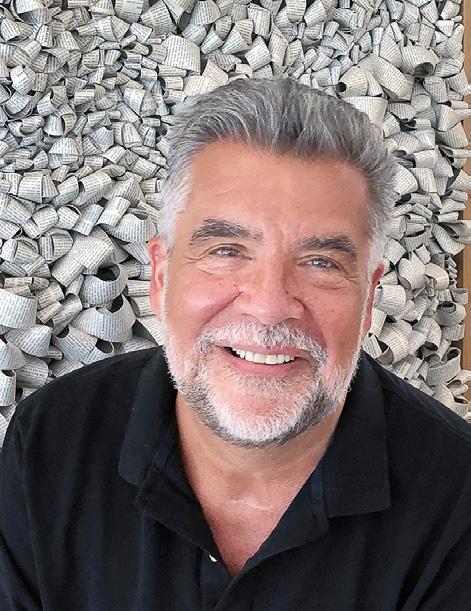
editing, writing and design: Filipe Chagas editorial group: Dr. Alcemar Maia Souto and Marcos Rossetton.
website: Pedro Muraki
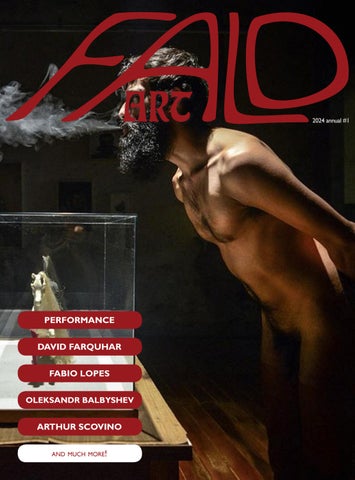
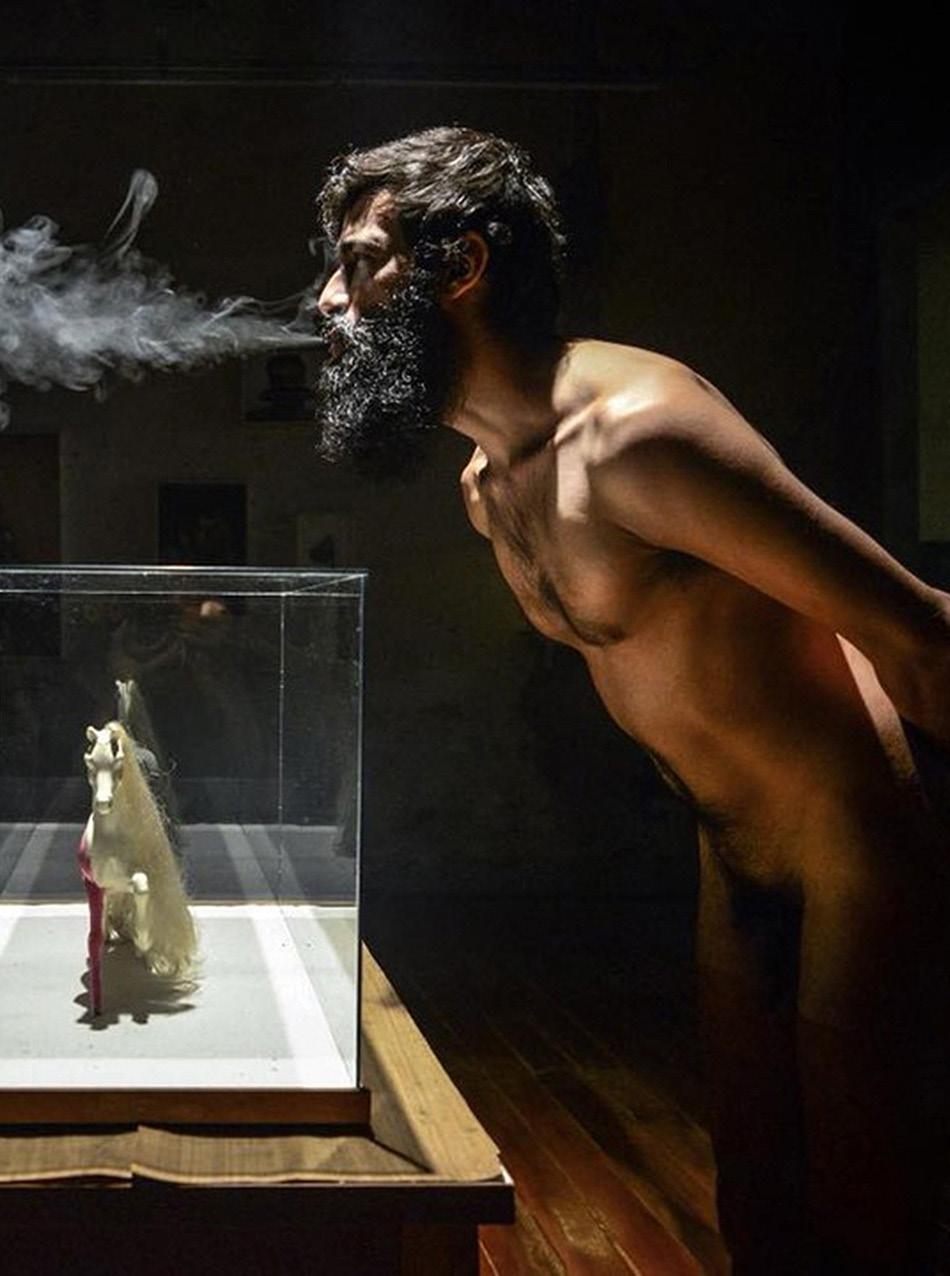
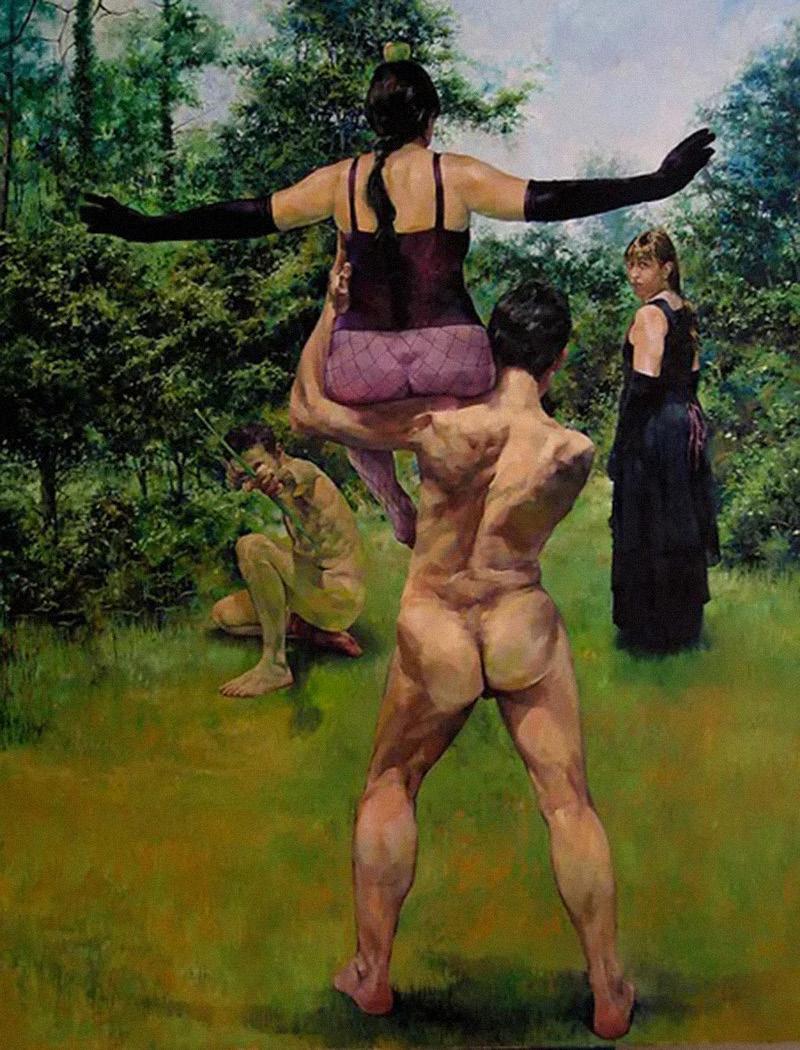
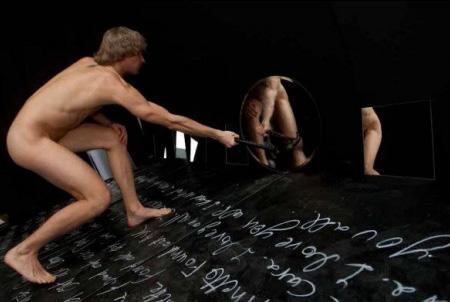
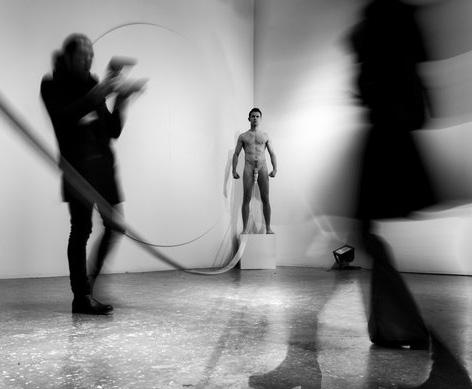
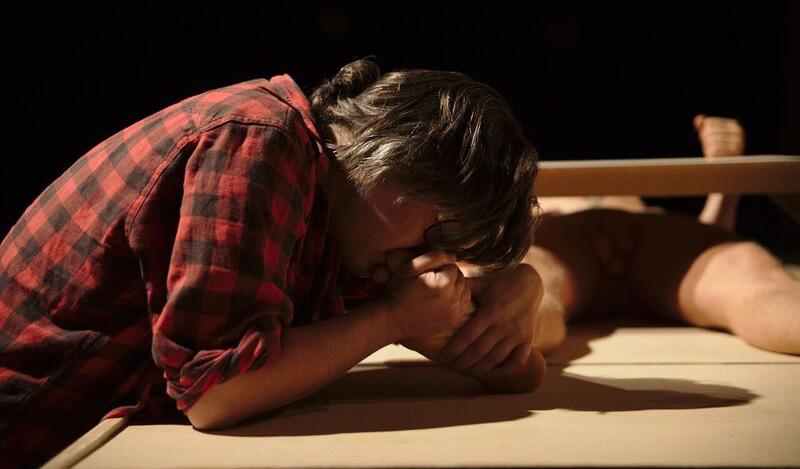
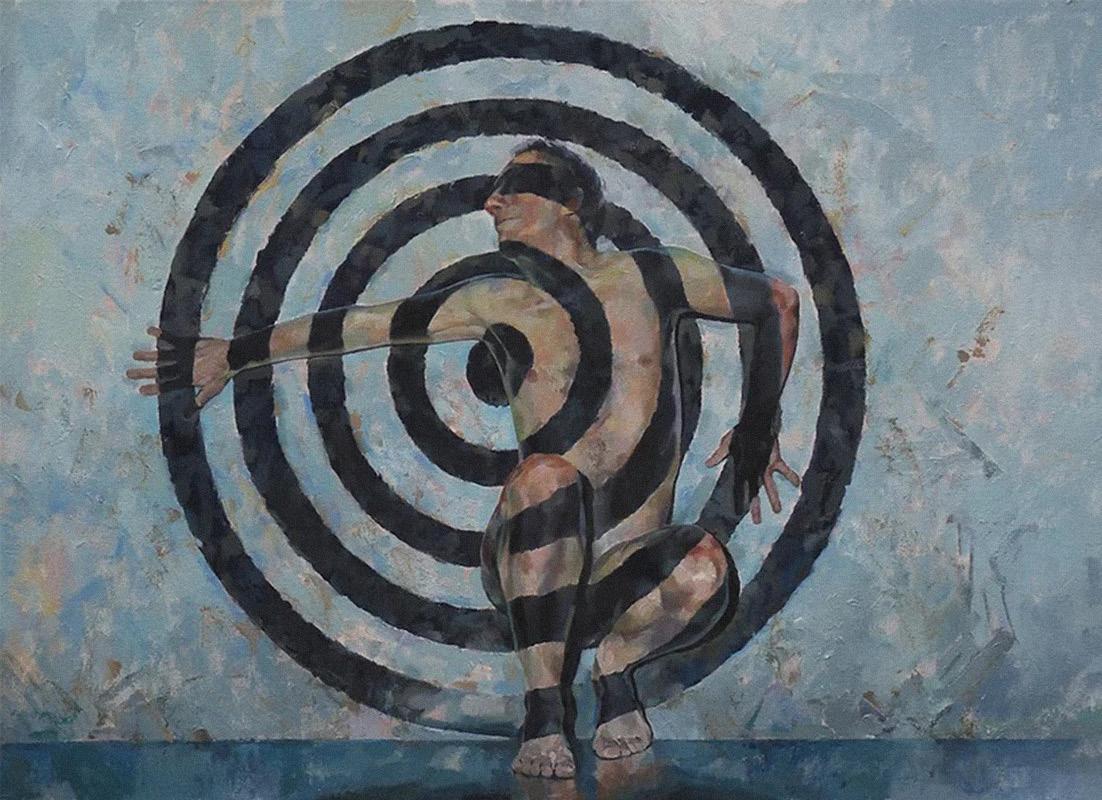
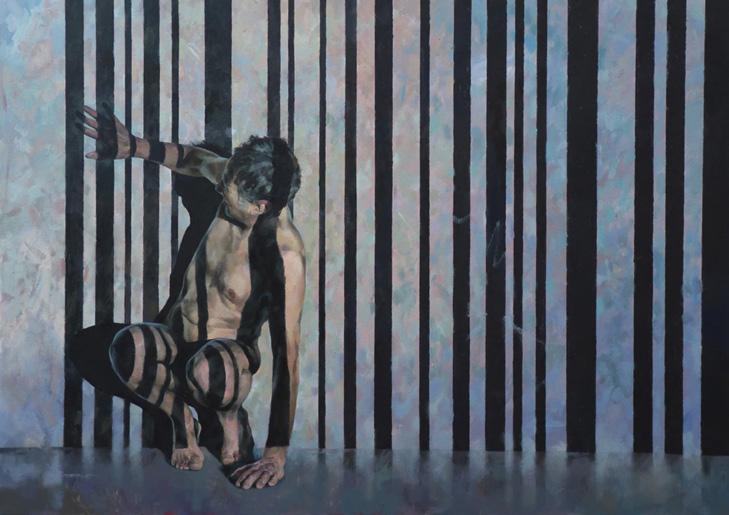
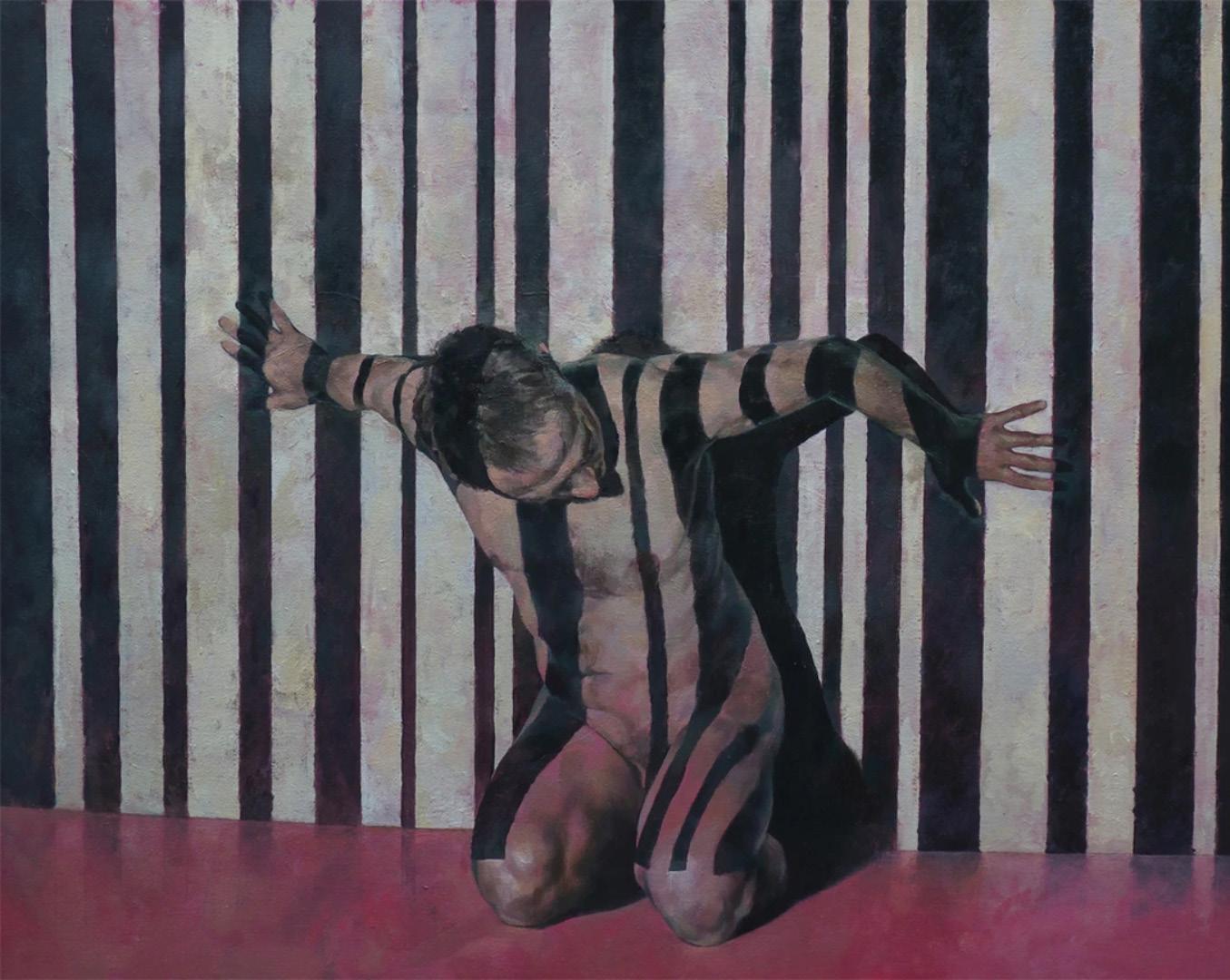
cover: Performance Tears of Our
Care and technique were used in the edition of this magazine. Even so, typographical errors or conceptual doubt may occur. In any case, we request the communication (falonart@gmail.com) so that we can verify, clarify or forward the question.
Editor’s note on nudity:
Please note that this publication is about the representation of masculinity in Art. There are therefore images of male nudes, including images of male genitalia. Please approach with caution if you feel you may be offended.
Rights and Commitment:
This magazine is committed to artists retaining copyright of their own work. All rights are reserved and therefore no part of this magazine may be reproduced mechanically or digitally without the prior written permission of the artist.
We have been careful to ensure that the images used in this publication have been provided to us by the creators with copyright permission, or are copyright free or are being used under the “fair usage” protocol shared over the internet (images are low resolution, attributed to their creator, not for profit and used only to illustrate a relevant article or story).
If, however, you feel your image has been used by us unfairly and your copyright breached, please contact us at falonart@gmail.com and we will proceed in the best way possible.
Submissions:
If you are interested in participating in the magazine either as an artist, model or journalist, please contact us via e-mail falonart@gmail.com
Editorial
Extremist governments are spreading across the globe with the support of billionaires who want to maintain their fortunes while the majority of the population faces prejudice, censorship and slavery. The narco-Pentecostal neoliberal system subjugates the ignorant to its ranks, creating an army of mindless zombies. Culture is the first target, because without it, identities are lost and remodeled. The control of bodies, desires, wishes and sexualities is an ancient tool transformed into dogma.
For this reason (among others), Falo Magazine has become an even greater beacon of resistance, both for marginal arts and for reflections on bodies and so-called divergent sexualities. And the issue you are holding in your hands is historic with a unique and incredible dossier on Performance Art.
Find in Art a possibility of sustaining yourself in the face of obscurantism. Go ahead and fight it.
FC Design
R. Mario Portela 161/1603 C, Laranjeiras Rio de Janeiro – RJ 22241-000 Brazil
Filipe Chagas, editor
Lady by Arthur Scovino at Casa da Luz, 2018.
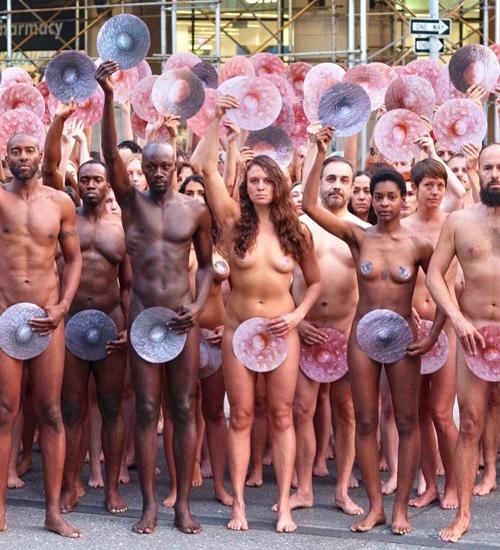
Free the nipple movement created by photographer Spencer Tunick. (Source: DesignBoom. Photo: Fay Fox)
Performance
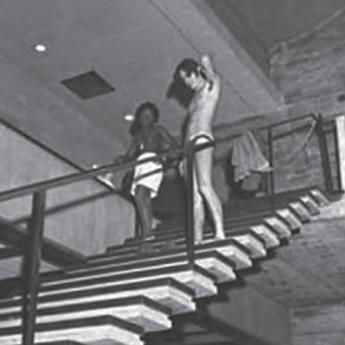
Antonio Manuel at MAM. (Source: internet)
por Filipe Chagas
Performance
Instead of getting bogged down in the text to explain one of the most difficult contemporary artistic languages to understand and accept, I think it’s better to start with a definition given by a renowned artist in the field:
Performance is a mental and physical construction that the artist executes in a specific time in space, in front of an audience, and then an energetic dialogue takes place. The audience and the artist construct the work together. Thinking about immateriality, performance is an art based on time. It’s not like painting.You have a painting on the wall and the next day it’s there. Performance, if you lose it, you only have the memory or the story that someone else told you, but you’ve lost everything. You have to be there.
Marina
Abramović at TED 2015.
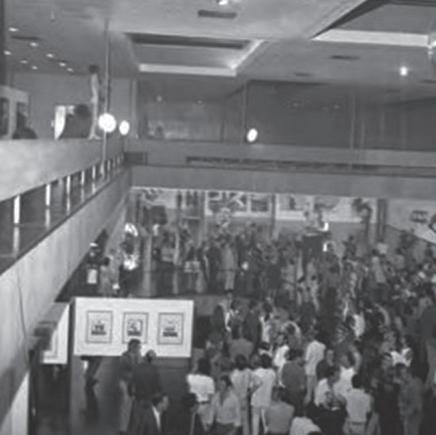
The only addition I would make to this construction of meaning is about the artist’s presence: the artist’s body in action becomes the work itself. In fact, I tell the story of Antonio Manuel (1947-) – a Portuguese artist living in Brazil –who entered the work “O corpo é a obra” (The Body is the Work) in the 19th National Salon of Modern Art in 1970. Initially, it was not a performance: it was a conceptual work consisting of the artist’s personal data and body measurements presented in the event’s registration form. The work was rejected by the jury and, in response, Antonio Manuel performed naked, descending the stairs of the Museum of Modern Art in Rio de Janeiro, during the opening of the event*. With this attitude, the artist questioned the entire structure of selection, assembly and exhibition of works of
* It is worth mentioning that the museum was immediately closed by the police and the artist had to flee. The following day, the exhibition was closed and the National Commission of Fine Arts recommended to the Minister of Education (who was a military man) that Manuel be prohibited from participating in any Official Salon for two years.
art in the institutional space, challenged the concepts of morality and modesty and exalted the exercise of artistic freedom above all else. Years later, he gave the following statement:
I began to understand the theme of the body. After all, it was the body that was on the street, subject to being shot, stoned, or hit in the head with a club. So, I imagined using my own body as a work of art. I decided to enter it in the 1970 National Salon of Modern Art. On the entry form, I wrote my name as the title of the work, the dimensions were those of my body, etc. I was cut off. [...] I went to the Museum of Modern Art and arrived there an hour before the opening. Then, the idea of getting naked came to me. Nothing was planned. The idea came to me there as the result of a feeling of disgust and repulsion. The people at the opening were astonished, but in that half hour, I felt very strong. — Antonio Manuel, 1986.
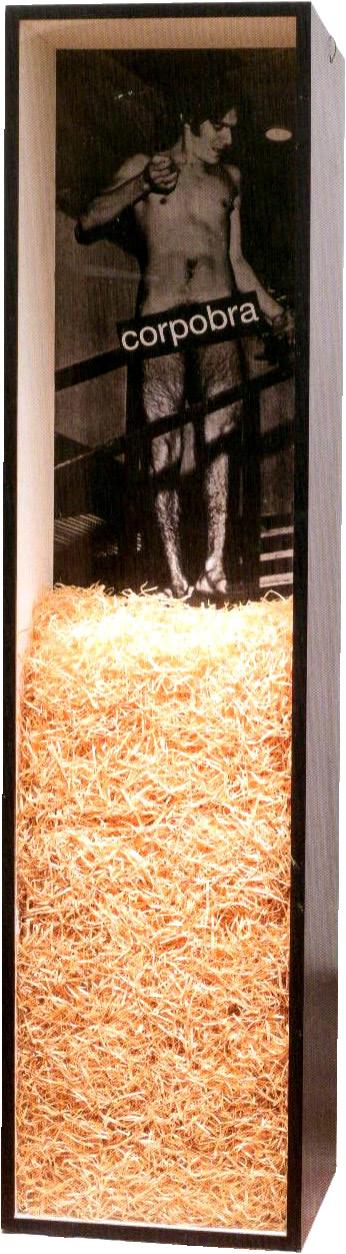
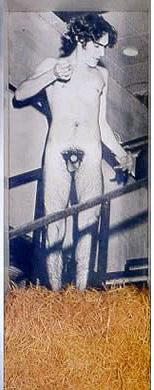
It is interesting to note that performance can incorporate other artistic languages, creating dialogues with dance, music, painting, drawing, embroidery, sculpture, poetry, and so on. For example, after Antonio Manuel’s performance, the artwork “Corpobra” appears – a two-meter-high wooden box, half filled with sawdust and, on the other half,
Antonio Manuel at MAM. (Source: internet)
with an enlarged photo of the artist posing at the MAM-RJ, with a black stripe that says “corpobra” over his penis. A lever on the back activates a mechanism that lowers a second photo of the artist, completely nude.
Regarding spectator participation, it is customary to divide it into two categories: the performance itself, where the audience is merely a spectator and may occasionally have a passive participation in the act and, therefore, may have a structure capable of being repeated*; and the happening, where the active participation of the audience makes the act happen and, because it is “there and then”, cannot be repeated. The strong conceptual and subjective charge of a performance or happening transforms itself into a unique experience lived at a specific time and place. However, the action can exist independently of the presence of the audience, thus requiring photographic (photoperformance) and/ or audiovisual (videoperformance) means of recording.
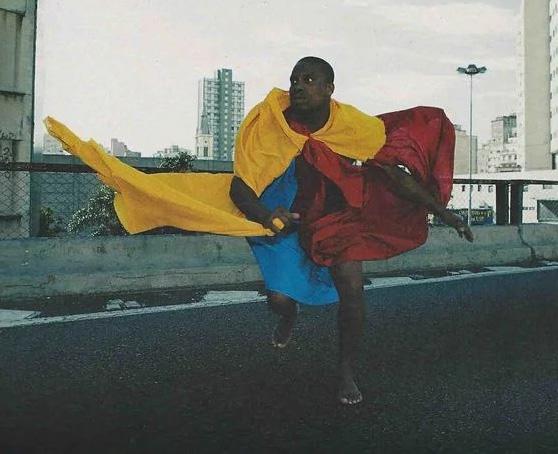
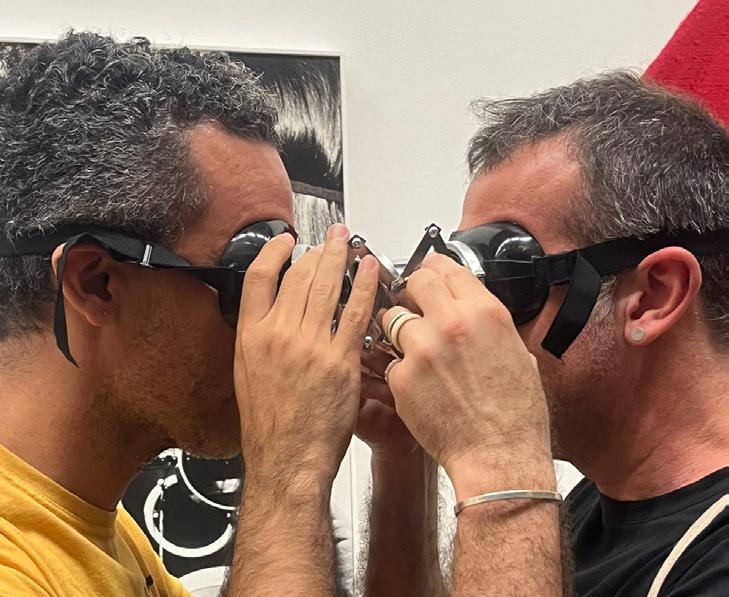
The term happening as an artistic category was first used by artist Allan Kaprow (1927-2006) in 1958, in his article “The Legacy of Jackson Pollock”, where he approached Pollock’s act of painting as an event that “took art off the canvas and brought it to life”. Kaprow eventually shifted his practice to what he called “Activities”, intimatescale pieces dedicated to the study of normal human activity in a way that was congruent with everyday life. Within this poetics, we can present the relational art created by Hélio Oiticica, Lygia Clark and Lygia Pape in the 1960s and 1970s. Their works sought interaction between the public and art, and it was only through this interaction that the work existed. Examples of this are Oiticica’s “Parangolés”, Clark’s “Objetos Relacionais” and Pape’s “Divisor”.
* No matter how much the performance is repeated, it will never be the same, as the spatial, temporal, individual and collective contexts will never be the same.
A parangolé by Oiticica being used (Source: Internet), Glasses dialog, created in 1966 by Lygia Clark (private photo taken at an exhibition at the Pinacoteca de São Paulo) and the Divisor by Lygia Pape (Source: Projeto Lygia Pape)
ORIGINS
It is easy to find data that states that performance is ancient, with origins in antiquity. However, this is wrong when comparing theater to performance. To clarify this difference, I call upon Marina Abramović again:
The difference between performance and theater is huge. In the theater, the knife is not a knife and the blood is just ketchup. In performance, the blood is the material and the knife is the tool. It’s about being there, live.You can’t rehearse the performance, because you can’t do these things twice. Ever. — Marina Abramović at TED 2015.
So, let’s go back to the early 20th century, when several artists opposed to their countries’ involvement in the First World War founded a literary movement to express their disappointment with the inability of science,
religion and philosophy to prevent the destruction of Europe. To reinforce their antirational character, they published the Dada Manifesto, which rejected the conservatism of art, valuing the absurd, irrationality and intuition. It was common for the group to meet to read Dadaist texts and poetry associated with a complete artistic action, whether with music, movement or collective conceptual intention. For many scholars, these meetings were the precursors of contemporary performances and happenings.
From a Dada revival in the 1950s — participating in Allan Kaprow — the Fluxus group flourished, an international, interdisciplinary community of artists, composers, designers, and poets who engaged in experimental performance art. Radical, Fluxus was anti-commercial and, to many, anti-art (by traditional standards), since it emphasized process rather than end result.
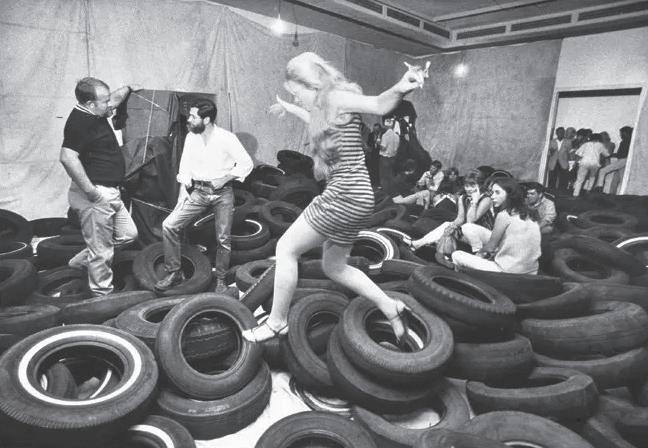
Allan Kaprow’s “Garden” (1967) at the Pasadena Art Museum. (Source: Julian Wasser/Getty Research Institute)
In Brazil, Flávio de Carvalho* (1899-1973) is the Brazilian artist considered the pioneer of performance art in the country. In 1931, he created “Experiment No. 2”, a work characterized by the artist walking in the opposite direction to a Catholic procession, wearing a green cap throughout the entire journey. With this action, the artist sought to research the reaction of the faithful to that unusual situation. A brief description of the episode was presented by social scientist Antonio Carlos Robert Moraes (1954-2015):
The great Corpus Christi procession slowly moves along Rua Direita towards Praça do Patriarca. [...] A figure stands up against it, walking in the opposite direction. [...] He advances threateningly, without taking off his hat. The atmosphere begins to become increasingly hostile. The black group looks on submissively, the old women comment indignantly. Someone shouts: “Take off your hat!” [...] Lynch, lynch! Is the cry that
echoes unanimously among the crowd. Flávio flees, “running over nuns”.
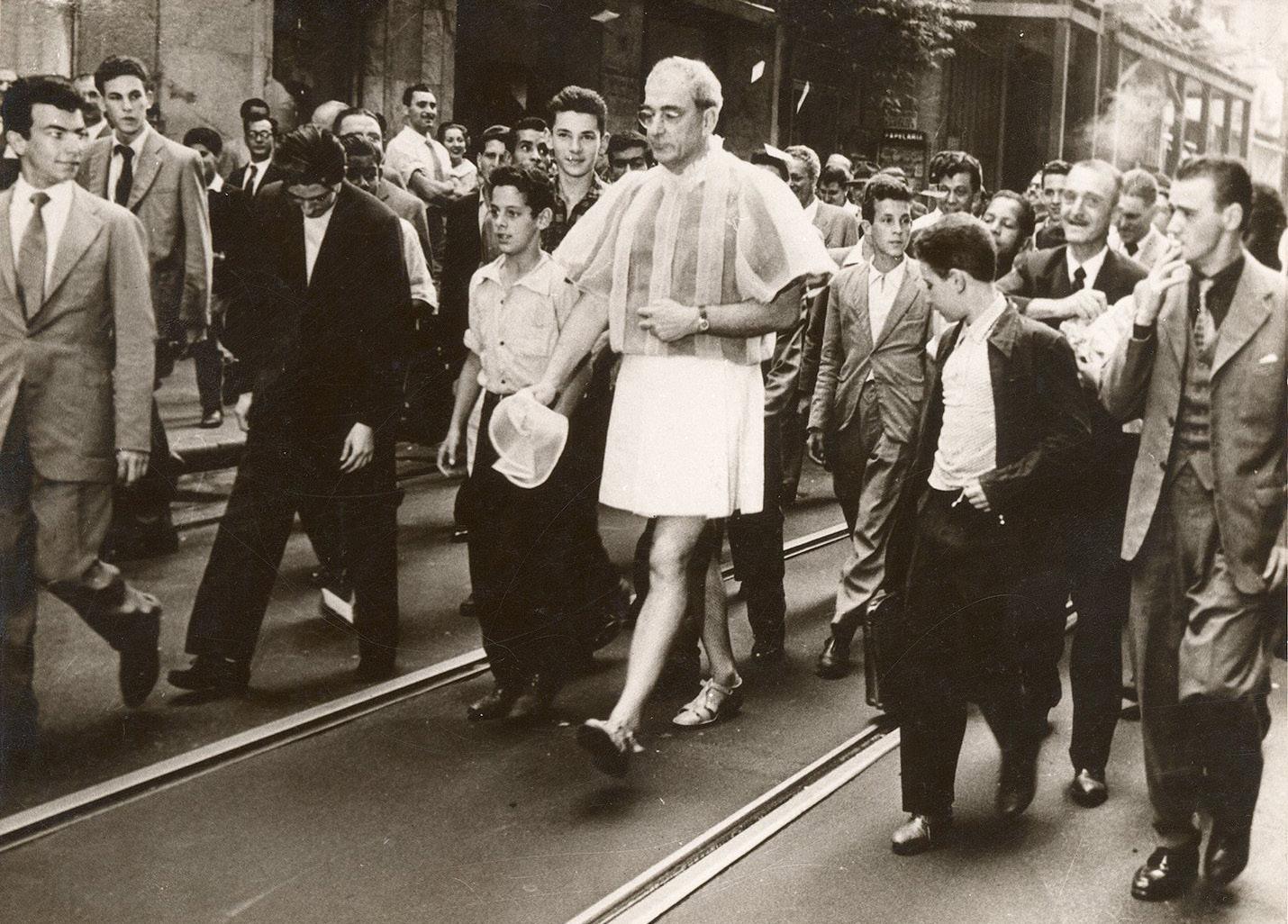
Later, in 1956, also in São Paulo, the artist created “Experiment No. 3”, a work developed as a parade on the Viaduto do Chá, where the artist paraded in the “Tropical Costume” – consisting of a wide-brimmed hat, a loose short-sleeved blouse and a skirt, all made of light fabrics, accompanied by fishnet stockings and sandals –, a critique of the European-style clothing adopted in tropical countries like ours. With this attitude of “cultural cannibalism”, the artist pointed to issues related to the foreigner’s view of so-called “exotic” cultures and anticipated both current discussions on decolonialism and those on gender identity and social conventions.
Decades after the experiments carried out with the body by artists of the historical avant-garde, performance became one of the most expressive languages in the artistic scene of the late 20th and early 21st centuries.
The tropical costume of Flávio de Carvalho (1956). (Source: Flávio de Carvalho Fund/Cedae - IEL Unicamp)
THE NAKED BODY IN PERFORMANCE
If the body is both the tool and the medium of performance, it is clear that nudity appears frequently and loads the artistic act with its symbolisms and taboos. Therefore, to present nudity as a mere artifice to shock or attract attention is to reduce its power in Art as a whole. For example, issues such as identification, racialization, sexuality, vulnerability or violence can be addressed in the presence of a naked body or in the exhibition of a nude. The language of nudity challenges the elitism of Art by sublimating the primitive in its fluids, sensations, gestures and openings.
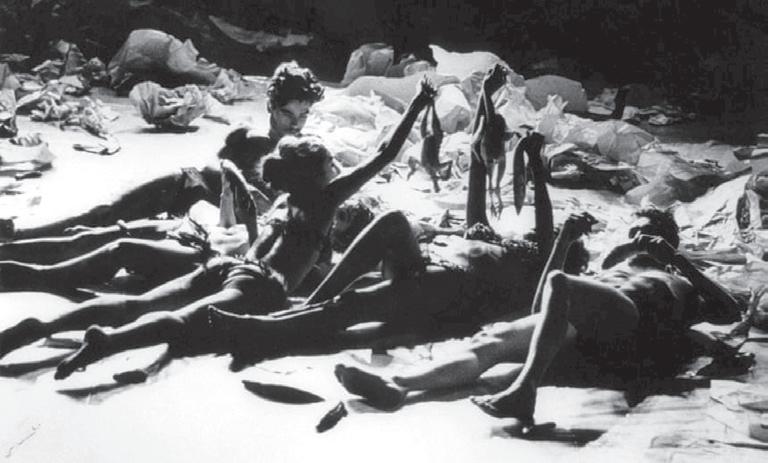
Carolee Schneemann’s 1964 “Meat Joy” is considered the first nude performance. In it, eight participants (including the artist) covered in paint crawled and writhed together on paper, playing with raw meat, while wearing no clothes. The performance challenged the social and artistic conventions of the time, exploring themes of sensuality, bodily freedom and sensory pleasure, and was received with mixed reception between shock and revulsion and enthusiasm for its daring.
In today’s society, where the notions of public and private space, subject and object, self and other, are more evident, the body becomes political, critical, ethical and aesthetic, expressing all its complexity, fragmentation and potential for transformation in the midst of a confrontation with censorship. In an interview about his work, the Portuguese-Brazilian artist Artur Barrio (1945-) stated:
I think that Christianity has annulled the body to such an extent that what exists as an internal expression of the body is now seen as something atrocious, without much meaning. Our reading of the body is very restrictive. The exterior exists, but our interior does not.
In this poetics between body and religion, I highlight the performance “Desenhando com terços” (Drawing with rosaries) by Márcia X (1959-2005), where she used rosaries to form the image of several penises. Unfortunately, this production was censored by the Centro Cultural Banco do Brasil, an institution that supported the traveling exhibition “Erotica, os sentidos na arte” (Erotica, the senses in art, 2006).
It is worth remembering that this magazine was created from two events generated by male nudity in performance acts: when Maikon K was arrested during the performance DNA by DAN and, in the same year of 2017, Wagner Schwarz suffered persecution and virtual lynching after the performance La Bête – this story was told in detail in the third edition. This shows us how much gender issues still permeate Art when nudity is present.
Photographic record of the performance Meat Joy (1964), by Carolee Schneemann. (Source: P.P.O.W. Gallery)
Read here about the performances of Maikon K and Wagner Schwarz that led to the creation of this magazine.
Read here about Márcia X’s work.
Next I present some performances that have nudity as a relevant factor in the construction of meaning in the History of Art:
Vito Acconci
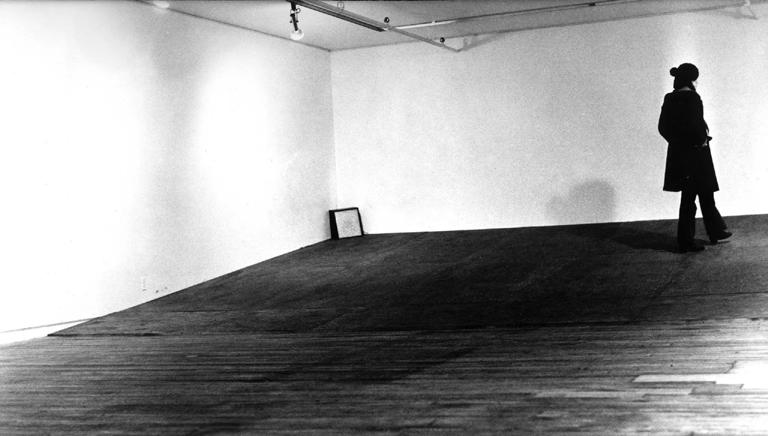
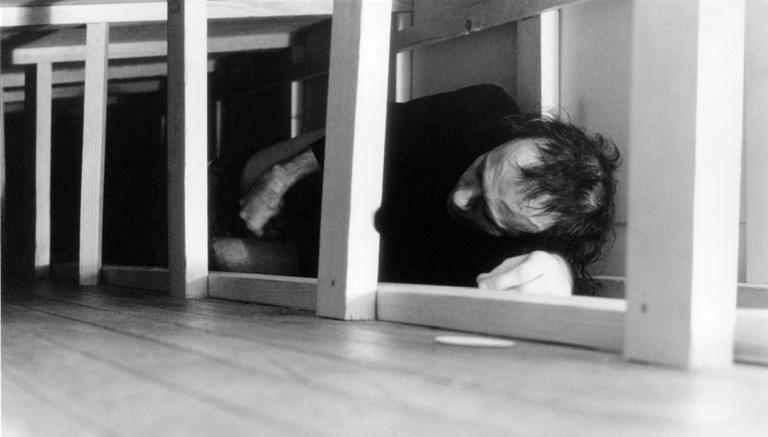
American artist Vito Acconci (1940-2017) had a diverse and subversive artistic practice that was based on the relationship between body, society and city, seeking to critique art. He became well-known in 1972 when he performed the performance “Seedbed”, where, for two weeks, he hid under a ramp installed in a gallery and masturbated while telling his fantasies about visitors walking above him on the ramp over a loudspeaker. In this “experiment”, Acconci sought to reveal the relationship between man and his desire and sexual pleasure.
In fact, the body uses coarse, violent and vulgar language. It is spontaneous and unelaborate. It proposes the affirmation of slang in opposition to the sanitized language of the university.
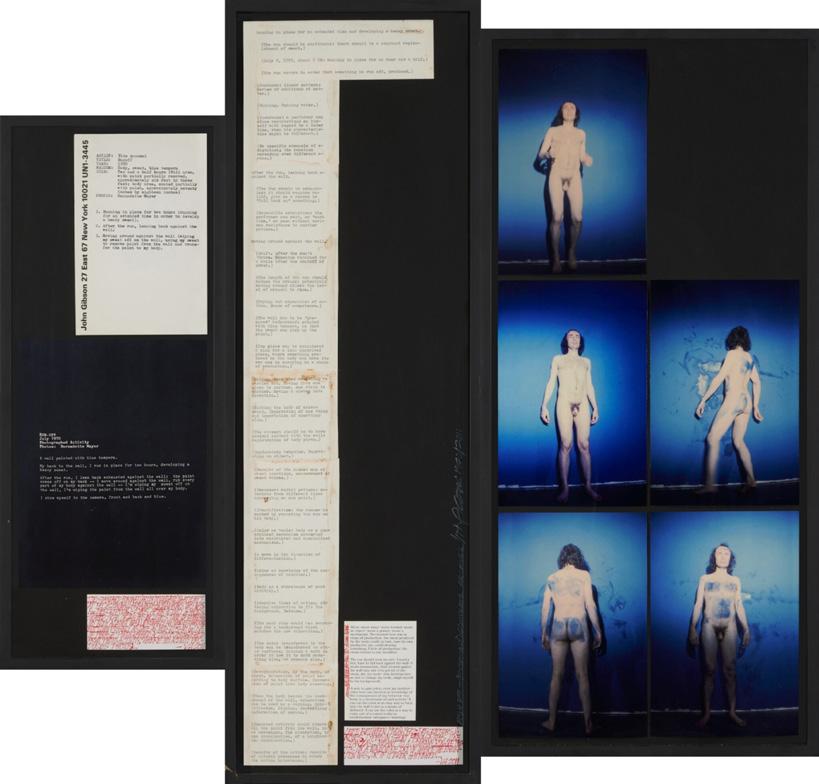
In “Runoff” (1970), Acconci ran for several hours in a space with freshly painted walls so that his sweat would mix with the paint. His idea was to create a physical and concrete encounter between two surfaces (man and wall) in a violent and immediate exchange of energies (sweat and color), to create a non-verbal dialogue.
Above, images of the ramp for Seedbed and the artist beneath it. Next to it, the work Runoff, from the performance, with photos, instructions and invitation. (sources: MOMA & Ealan Wingate and Bernadette Mayer)
Marina Abramović
Serbian Marina Abramović (1946-) – who brilliantly opened this article and prefers to say that she is a “former Yugoslav” – has been placing herself as an object of interaction and relationship with the public for over 40 years, even in risky situations. It is impossible to mention just one action by the so-called “grandmother of performance”, so here are a few:
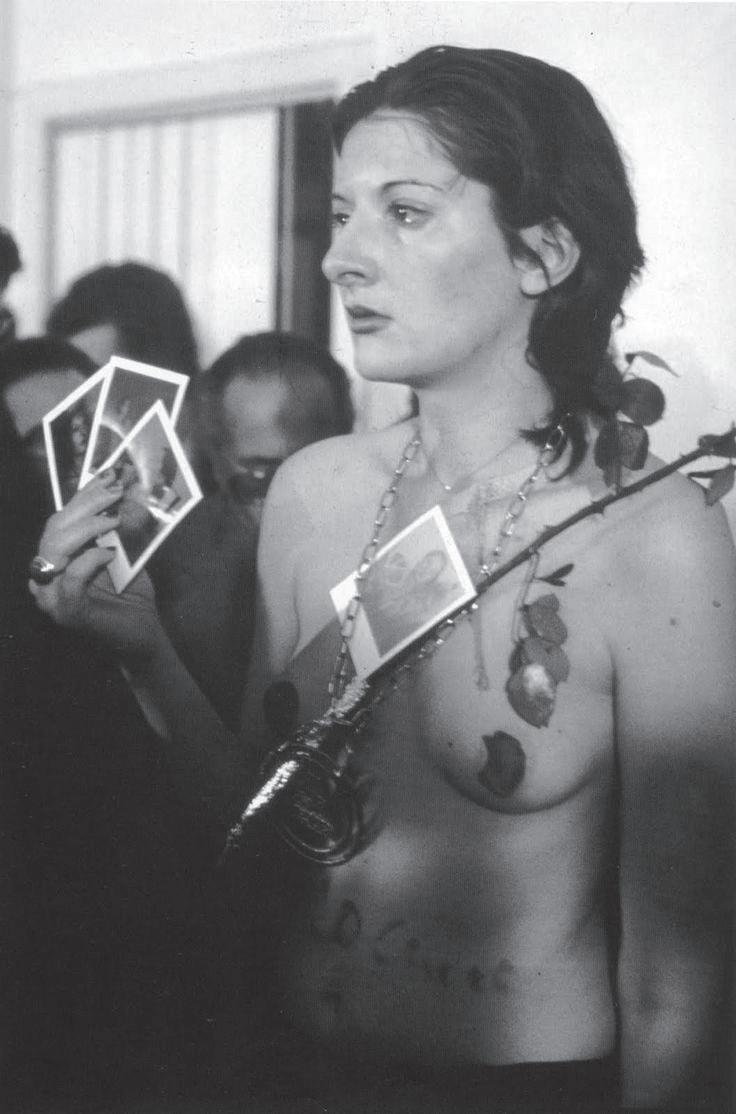
8=D Rhythm 0 (1974): To test the limits of the relationship between performer and audience, Abramović developed one of her most challenging and well-known performances. She assigned herself a passive role, with the audience acting as the force acting on her. Abramović placed 72 objects on a table that the audience could use in any way they wanted, and a sign informed them that they were not responsible for any of their actions. Some of the objects could give pleasure, while others could be wielded to inflict pain or harm. Among them were a rose, a feather, honey, a whip, olive oil, scissors, a scalpel, a gun and a single bullet. For six hours the artist allowed the audience to manipulate her body and her actions without consequences. At first the audience did not do much and were extremely passive. However, as they began to realize that there was no limit to their actions, the piece became brutal. This tested how vulnerable and aggressive human subjects could be when actions have no social consequences. Abramović later commented:
I learned that if you leave it to the public, they can kill you. I felt very violated: they cut my clothes, stuck rose thorns in my stomach, one person pointed a gun at my head and another put a knife between my legs. After exactly 6 hours, as planned, I got up and started walking towards the public, who moved away, aware that I was no longer an object, but a person.
Source: Internet.
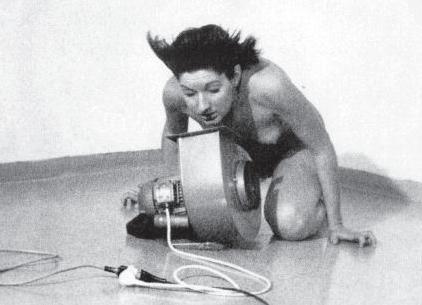
8=D Rhythm 4 (1974): Naked and kneeling in front of a high-powered industrial fan, Abramović slowly approached the machine, trying to breathe as much air as possible to overcome the limits of her lungs. She lost consciousness and declared: I was very angry because I understood that there is a physical limit. When you lose consciousness you cannot be present, you cannot perform.”
8=D Seven Easy Pieces (2005): Over seven consecutive nights, for seven hours, Abramović recreated works by five artists first presented in the 1960s and 1970s, as well as re-presenting one of her own performances (“Lips of Thomas,” in which she performs a nude ritual) and presenting a new performance on the final night. Among the recreated performances was Vito Acconci’s “Seedbed.”
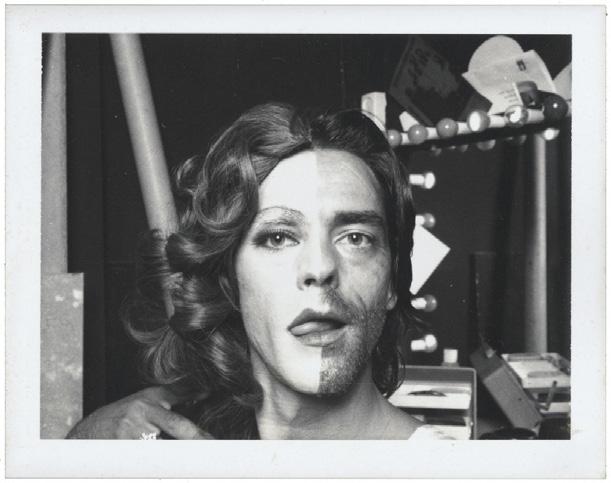
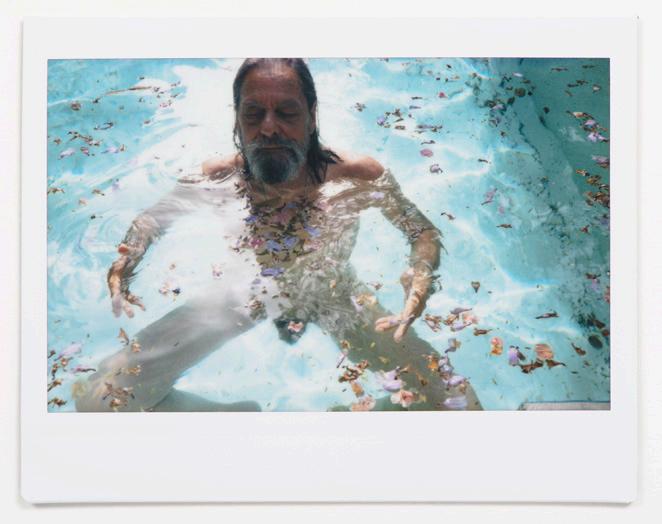
Between 1976 and 1988, Marina performed with her art and life partner, Ulay – a nickname she gave to the German artist Frank Uwe Laysiepen (1943-2020). Before this relationship with the artist, Ulay was already known for his performance art using Polaroid (he even worked as a consultant for the company), where he developed personal projects on gender identity and recorded marginalized populations. The duo created actions that became references in the world of performance – such as the bow and arrow in “Rest Energy” (1980) – and some of them contained nudity, such as:
8=D Relation in Space (1976): Abramović and Ulay walked naked through a space at the Venice Biennale for an hour, where they bumped into each other to mix masculine and feminine energy into a third component called “that self”.
Above, polaroid from the series S’He (1973-1974) and from his last series Joy (2015). (Source: Ulay Foundation).
8=D Expansion in space (1977): Naked and with their backs to each other, the couple walked into pillars they had created and displaced them with the force of the impact.
My entire artistic practice is rooted in the belief that art has the ability to contribute to life.
–Ulay
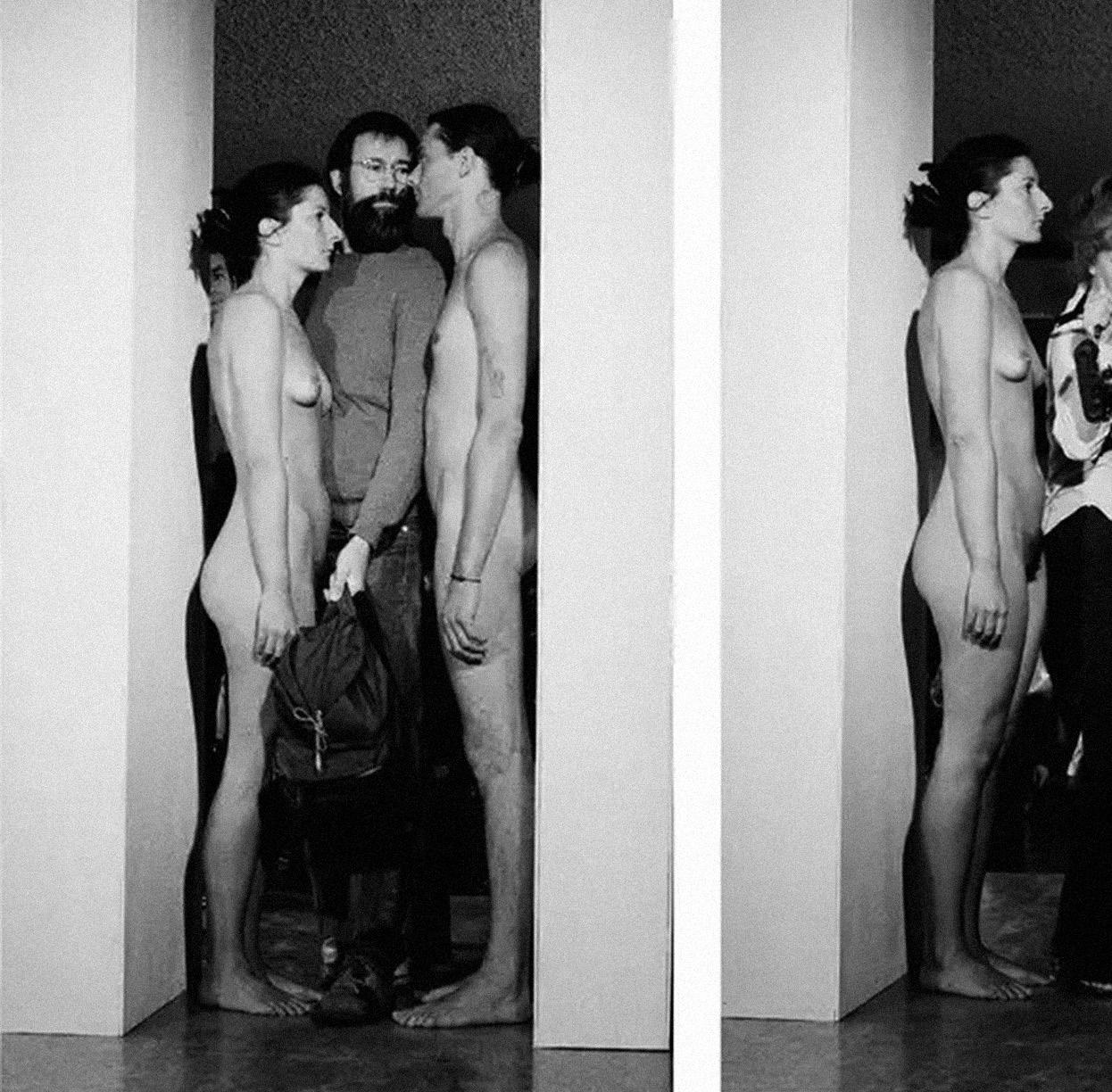
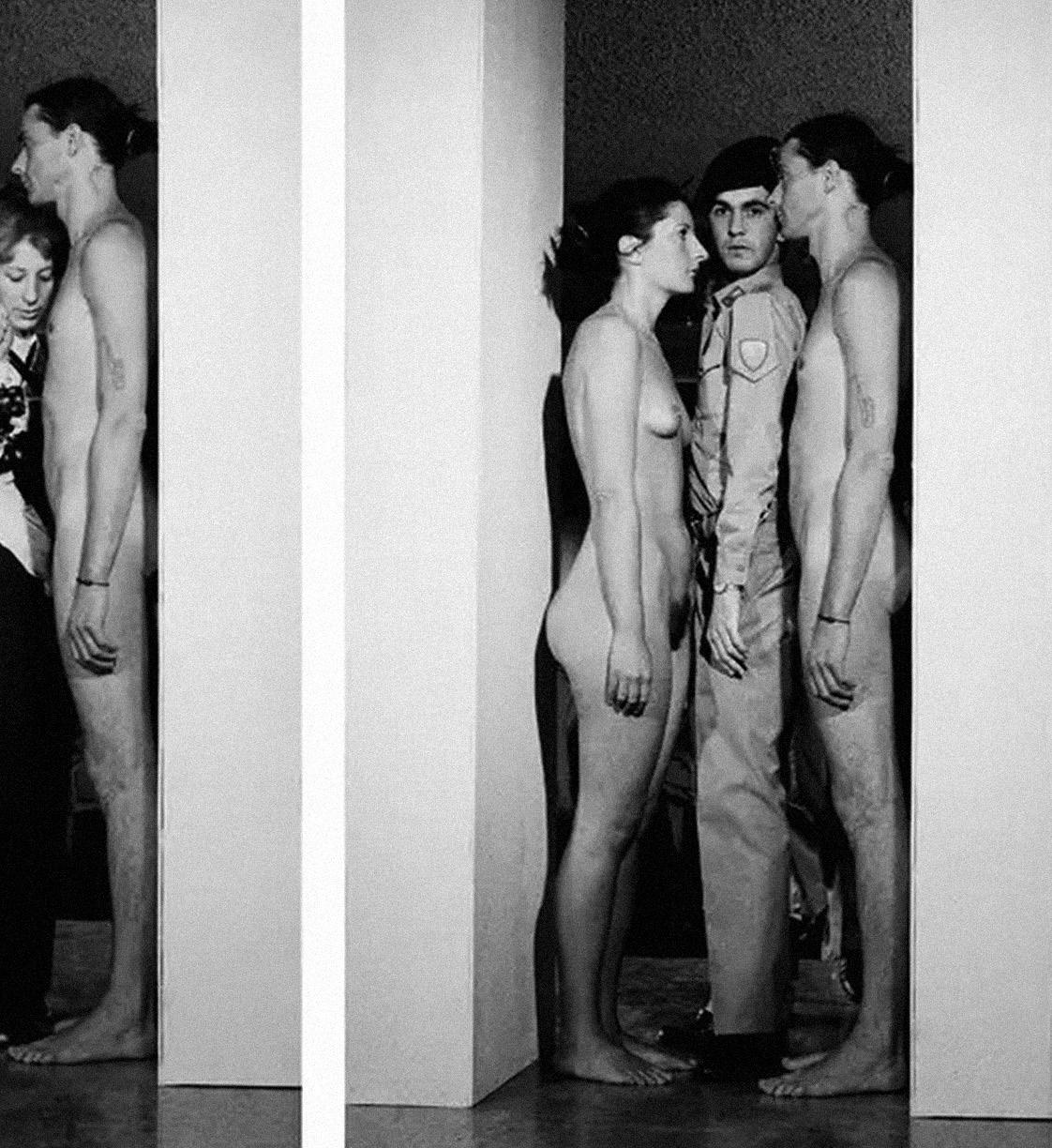
8=D Imponderabilia (1977): The two completely naked performers stood facing each other in a narrow doorway. To pass through the door, the audience had to choose which of them would turn their backs and which would face each other face to face. In addition to the relationship with nudity, the performance also provoked reflection on contact and social distancing, and was recreated in 2010 with other artists.
Aimberê César
Aimberê César (1958-2016) from Sergipe, Brazil, participated in several important visual arts movements from the 1980s onwards and, in the following decade, created Zen Nudism. In an interview for Performatus magazine in 2009, it is possible to better understand how the artist dealt with performance and nudity:
Performance came to me from the need to create a counterpoint to what is considered normal, to discuss what it is that people consider normal. What motivated me, from the beginning in 1982, was the desire to create situations in which people would be forced to live with difference, whether by ignoring it, acting alongside it, whatever it may be – there is no way to pretend that it does not exist, you are face to face with the situation. Performance in this aspect is very interesting, because you are alive and there in the moment, you are not playing a character. That is what attracted me to performance. I began to have an artistic notion of this with Márcia X. She allowed me to give it a more interesting direction, which becomes evident in the work. What I knew was that I wanted to interfere in those environments, especially artistic and intellectual ones, where thought still exists, where, at first, someone is willing to question and think about it. My initial idea was to criticize the fact that, within these movements, within the intellectual sphere of Rio de Janeiro and Brazil, we lacked the capacity and dynamism to think differently. Breaking with the structure is a way of breaking with the business. And performance is instantaneous, it happens on the day and at the time. There is no point in taking photos and filming because you don’t capture it.You don’t capture moments, emotions, a lot of things – you capture a little square image, everything flat.
Zen nudism did not emerge, it crystallized in 1990. I was raised according to Piaget, Lacan,
with free principles… I used to bathe naked with my parents… this was natural in my life. I never understood, and I still don’t understand, why people have problems with nudity: for me, it is a natural state of being human. Breathing, eating, sleeping, being naked is natural, there is nothing wrong with it. I can wear clothes or not, it will not change my way of being. Being naked is the simple part, the deepening part is to realize the hypocrisy of society, to realize that we are what we are, and not what society wants us to be. Clothing, the obligation to wear clothes, is the hypocrisy dressed in our bodies, engraved in our laws. I decided to say “I disagree”, nudity exists, my body exists, my mind exists, my individuality exists. I don’t want to grab anyone, I just want to be naked, take my bath at the beach naked, do whatever I want – respect me. I’m not disrespecting anyone, I want them to respect me. Nudity is my right, that of every human being.
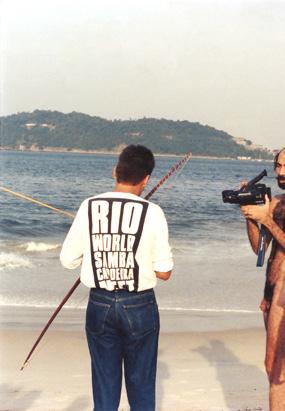
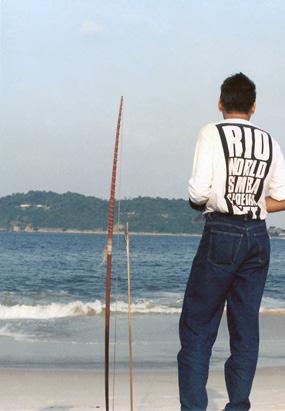
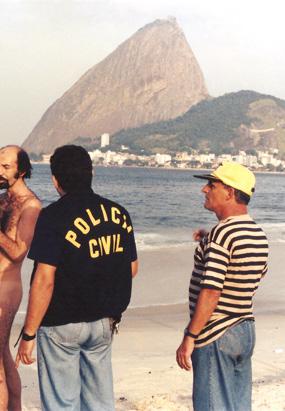
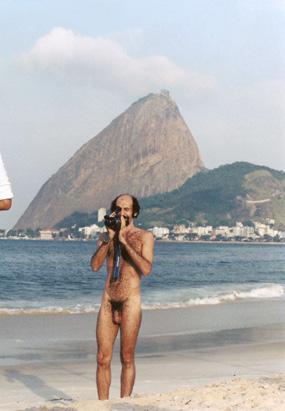
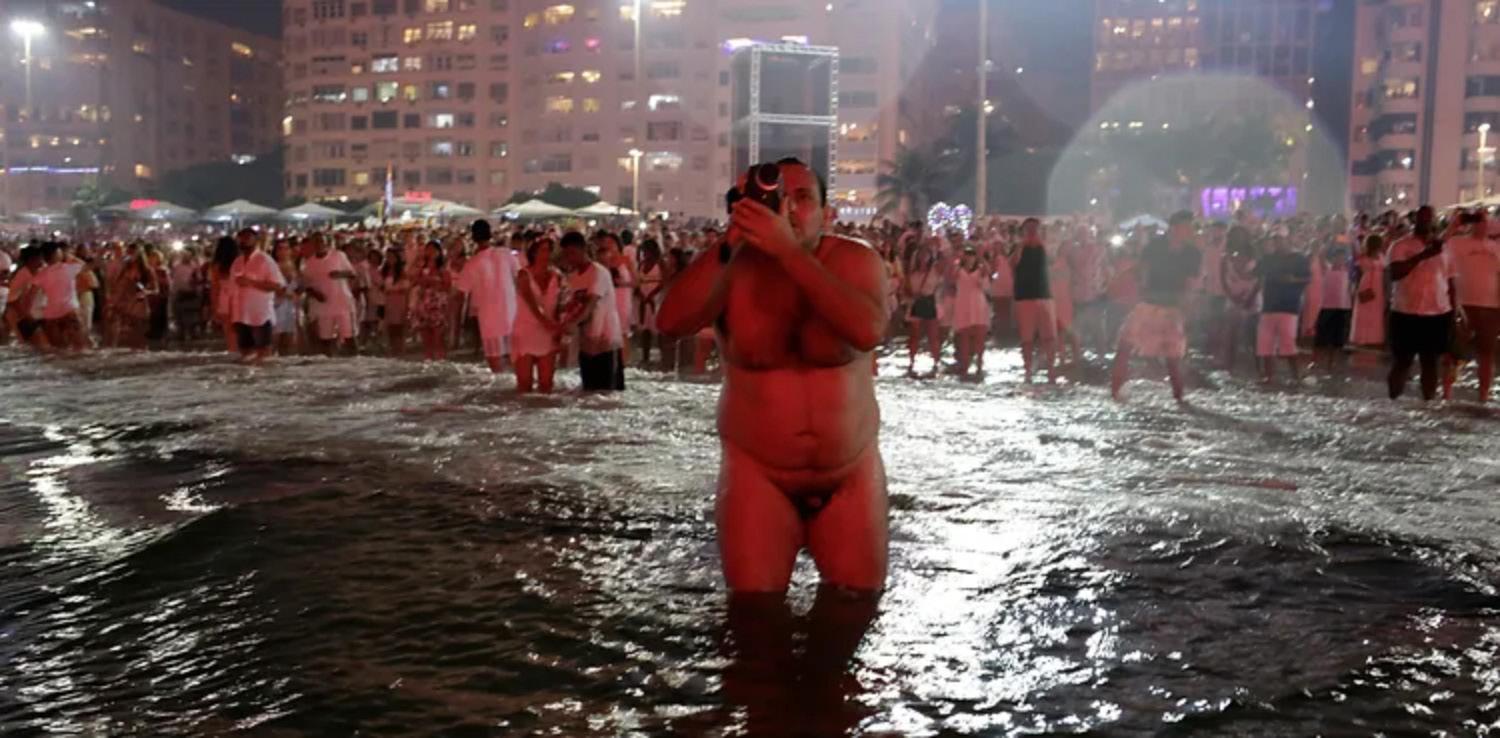
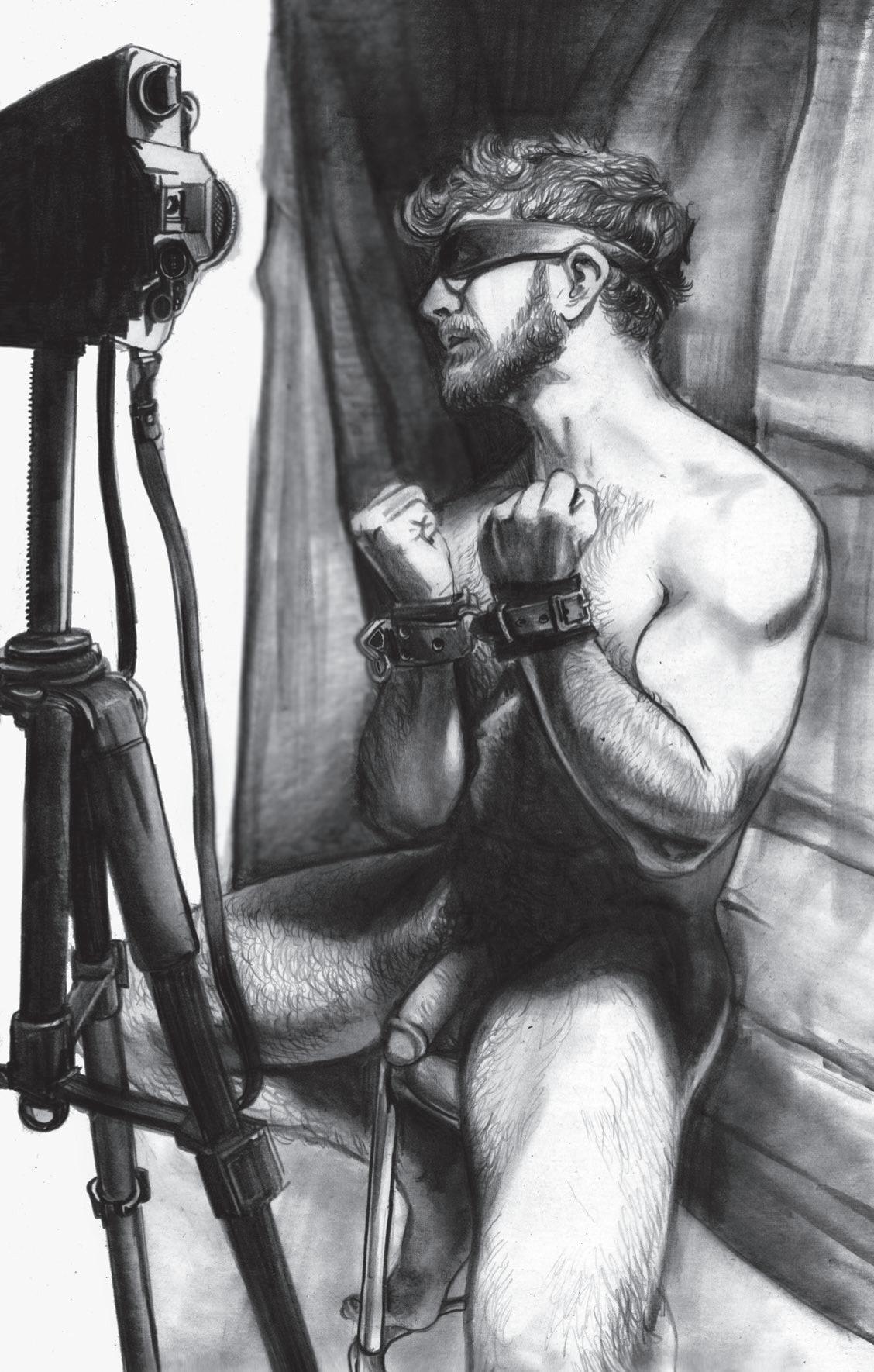
His best-known performance took place during Eco ‘92, “Preserving the Ecology of Man”, which received a lot of media attention with Aimberê naked on Flamengo Beach holding a camera in his hand that kept away journalists and police officers who did not know how to deal with the fact that they were being filmed. The artist was discussing the invisibility of those who film in contrast to the extreme visibility of nudity. This performance was performed again at the Centro de Experimentação Poética 20.000 (CEP) in Rio de Janeiro, in the same year, with the title “O Câmera Nu”; in 1994, at the Museu de Arte Moderna do Rio de Janeiro, with the title “O Câmera Nu na Fábrica Fallus”, where he filmed Márcia X’s sex toys; and in 1999, at Fundição Progresso (RJ), with the title “O Câmera Nu pelo Progresso”. Other well-known performances by Aimberê were: O Nu Pelado (1987), with Márcia X and Alex Hamburger, O Nu Gratuito (1990/2008) at the inauguration of CEP 20,000 and at the institution’s 18th anniversary.
Source: Internet. Photos by Maurício Ruiz.
Luiz de Abreu
Dancer and performer Luiz de Abreu (Minas Gerais, 1963-) has been developing dance work that deals with issues of color, race and gender since the mid-1990s:
The prominence of the presence of the black body in Brazilian society, an issue that has been at the center of my work since I began working until today, can be divided into three significant periods: from the 1970s to the 1990s, the country still had a colonial mentality, where themes such as racial democracy, structural racism, and the very invisibility of the black body in dance were the main themes. It was very common to hear things like “My nanny is black, but it’s like she’s part of the family.” This scenario changed between 2003 and 2016, when a “decolonial” mentality took hold, seeking to unravel structural racism and the myth of racial democracy. Policies such as quotas and the increased enrollment of black people in universities played a central role in this. However, since 2016, it seems, we have returned to colonialism, with several cases of kidnapping of black symbolic capital and the genocide of the black population on the rise. It seems that Brazil wants to return to the colony, but it needs to know that it no longer exists.
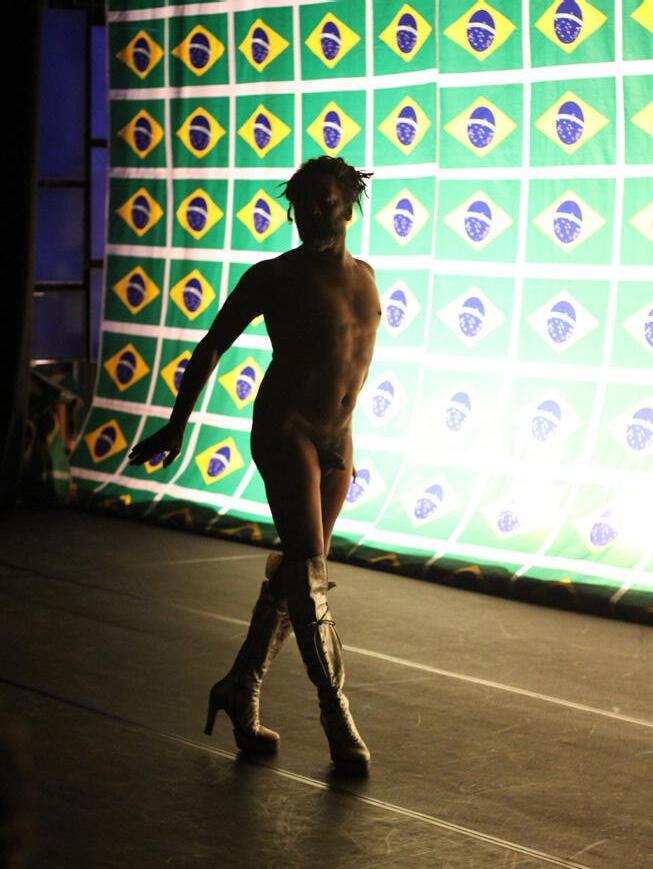
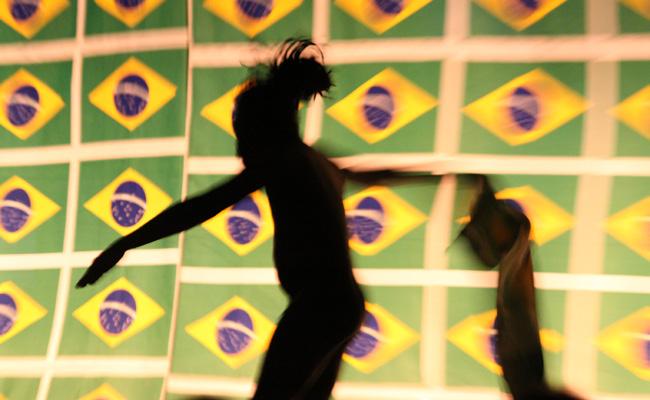
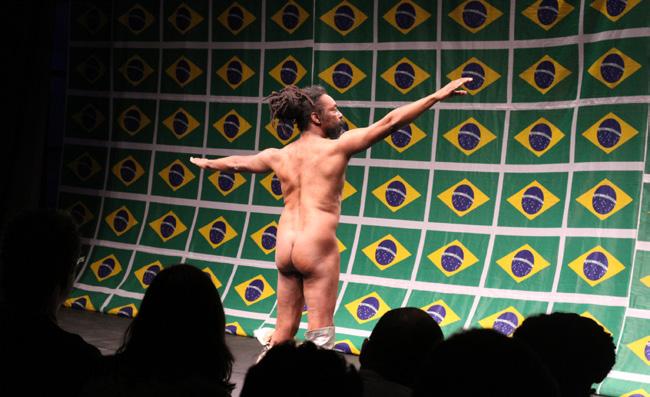
His best-known work is “Samba do crioulo doido” (Crazy Negro Samba, 2004) – which is currently part of the permanent collection of the Centre Pompidou (Paris, France). In this performance/dance, the dancer performs samba steps common to female dancers on a stage with a backdrop made of Brazilian flags. At a certain point, he starts wearing a tunic also made of flags. Always naked.
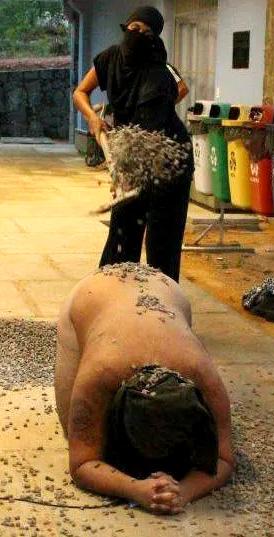
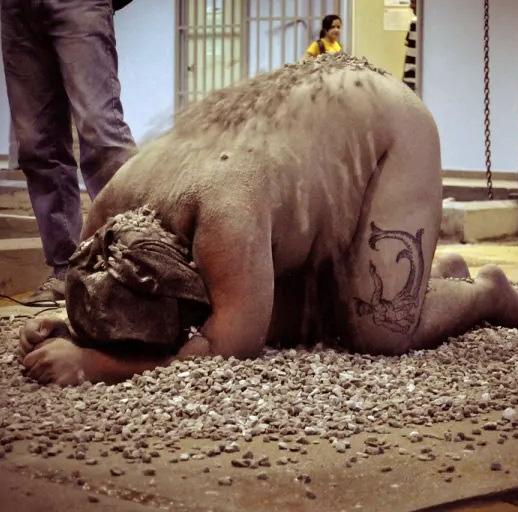
Alternating between writing and performance, Jota Mombaça (Natal, 1991-) is an artist who uses artistic languages to confront oppressive historical forces. In “Corpo-Colônia” (2013), a woman dressed in black and with her face covered (Patrícia Tobias) used a shovel to throw gravel over Mombaça, who was on all fours and naked, in a hallway of a federal university. Some people passed by quickly and others stopped to watch the (re)lationship of power between the two bodies without identity, but loaded with colonial structures. In an interview with Contemporary And, the artist reveals:
Performance is always a movement towards my own body. It is an attempt to fight against the violent occupation of the country by various colonial, heteronormative, racist and cis-supremacist forces. I started working with performance because I wanted to become a body and I wanted to be able to say that “my body is mine”. But what I discovered through performance was that, in the end, to become a body I would have to enter into a battle against the body, or to be more precise: against the embodied grammars of power that (re)produce the body as a disembodied object of political regulation. In the performance called Corpo-Colônia, it was the first time I saw images of my naked body and felt proud of it. Somehow I felt that day that, no matter what, I decided to fight against the coloniality that I carried inside my body. And even if this fight cannot be overcome, since it is mostly frustrating, contradictory, complicated and self-destructive, it is nevertheless a fight worth fighting.
19 Body, territory occupied by the sex-Empire. Object to be molded by heterocapitalist technoculture. Male body. Male body castrated asshole. Colony-body. Marked body. Body usurped by classification systems. Sealed body, vacuum-packed or crushed and encapsulated to facilitate trafficking. Body trafficking. Product body. Canned, dumbed-down male body. Colony-body. Disembodied body. Body submissive to the Self, to the transcendent identity. Submissive, dominating male body. Male body cloistered in its privileges. Male body under surveillance. Male body addicted and under surveillance. Male body cowardly, drug addicted and under surveillance. Devastated body. Devastated, photoshopped body. Healthy, devastated, empty photoshopped body. Uninhabited body. Body ruin. Body bombed in Gaza. Body that throws itself off a bridge. Suicidal body. Lifeless body. Unthinkable body. Body, territory isolated by the sex-Empire. Prozac body. Scotch body. Cocaine body. Dehydrated body. Junkie body. Amputated dehydrated junkie body. Economy of bodies. Body, object to be molded and discarded by heterocapitalist technoculture. Gramacho body. Trash body. Lumpenbody. So… How to bend this body? How to fold it?
Source: Internet. Photos by Yanna Medeiros.
Maurício Ianês
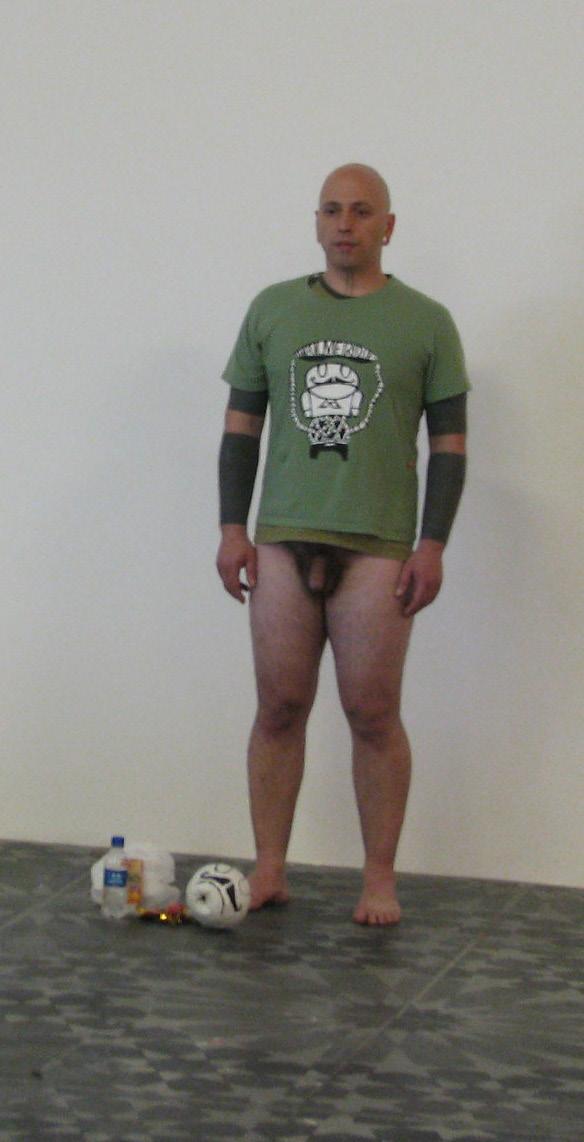
Visual artist Maurício Ianês (Santos, 1973-) questions verbal and artistic languages, testing possibilities, limits and political and social functions. In her performances, she often proposes audience participation to create situations of exchange and remove the passivity of the observer, making him or her part of the work. During the 28th São Paulo International Biennial, in 2008, Ianês performed the performance “Untitled – The Kindness of Strangers”, which became a media sensation because the artist began the performance completely naked. Ianês revealed that he almost canceled the performance after the first two days because the media exploited his nudity so much that he felt like he was in a “butcher shop”.
Being naked was part of the process of the work, but it was never its central idea. The idea was to arrive at the Biennale completely devoid of any possessions and in absolute silence, leaving my survival to the public through donations. I would transform myself into a mirror of the public’s anxieties, desires and needs. The work also intended to weave a network of social relationships maintained without the use of language, and that also happened. In the end, people appropriated the space created, turning it into a place for meetings and conversations, where I would simply act as a silent mediator.
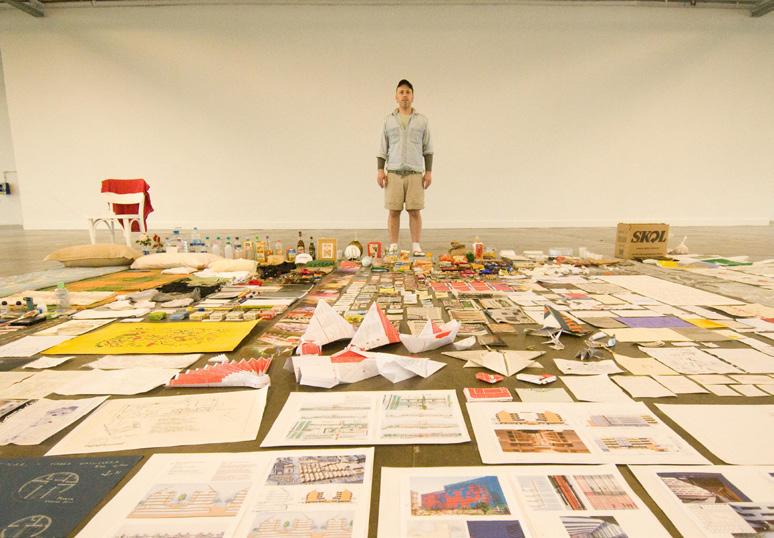
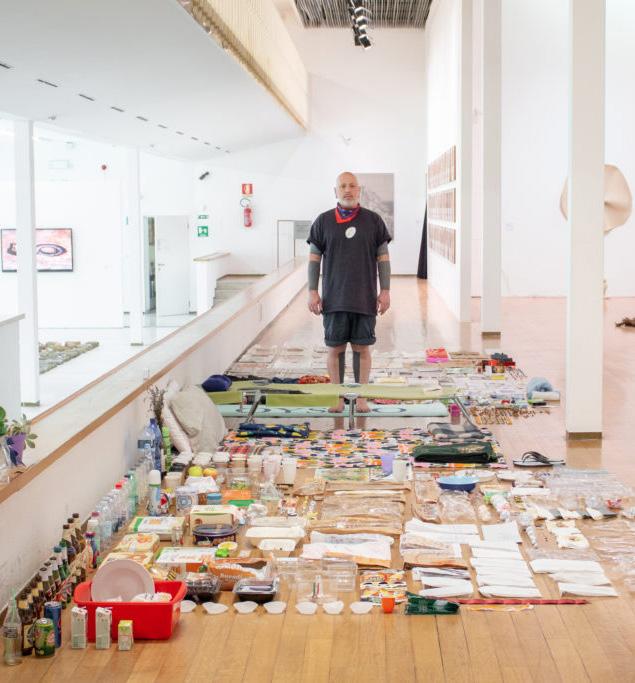
For 24 hours, for 12 days, the artist relied solely on what the public offered her (the first items were a T-shirt and a bottle of water). In the first week, she toured the three floors of the space, but in the second week, she settled on the second floor due to the amount of donations. The emptiness of the pavilion ended up amplifying the power of the work and allowing other artistic actions previously prohibited by the event, such as people who played live music or performed other performances, always with the intention of donating something to the artist.
The initial image of the “naked man at the Biennale” was gradually replaced by another, almost religious one, of a figure who received charity and offerings of all kinds: clothes, pillows, food, books, texts, etc. In the end, Ianês, who was ill, sang “I’ll be your mirror,” a song by the Velvet Underground. For the artist, the performance was about creating new forms of relationships with the public that were less dependent on language and making the
Source: Internet.
Photos by Amílcar Packer.
RULES
8=D Never use speech to communicate with anyone, even outside the Biennale’s opening hours.
8=D Never leave the pavilion.
8=D When receiving something from someone, look that person in the eye and hold it until they look away.
8=D Whenever I glance at someone who is looking at me, stop and look that person in the eye until they look away.
8=D Do not respond to looks “mediated” by cameras, etc
8=D Do not write down my memories or thoughts about the work during the process.
8=D Do not use writing to communicate.
8=D Do not refuse anything that has been donated to me and consume, as much as possible, all donations, without exception or judgment.
8=D Do not communicate any of my needs, feelings, judgments or desires to the public.
8=D The performance lasts 24 hours, that is, even when the Biennale is closed, the rules still apply.
8=D Always be available to the public and their wishes whenever possible.
8=D The donations are not mine: the public can intervene, take, use whatever they want from the collection, without my being able to intervene.
8=D I do not accept donations from acquaintances, family, friends, Bienal and Galeria Vermelho staff.
And for those who have doubts: yes, she could go to the bathroom, including take a shower, but she slept on the floor of the pavilion.
entire work a construction of the public, placing her as a potentializer of the public’s desires, a means for the public to express itself. Most of the donations were redirected to homeless people and some pieces were archived. In 2018, Ianês recreated the performance in Italy under the name “Untitled – Dispossession.”
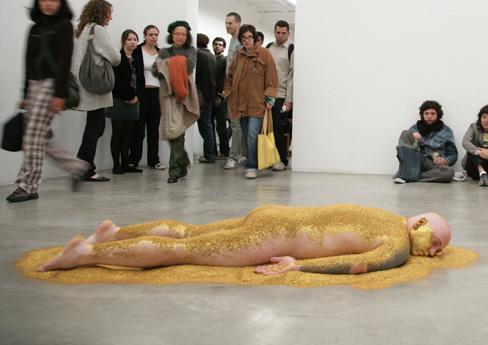
It is worth mentioning that this was not Ianês’ first performance containing nudity: in 2007, she remained lying on the floor of Galeria Vermelho, in São Paulo, for three hours, covered in 16 kg of gold glitter. “Dead Zone” (Zona Morta) tensioned the Brazilian baroque through the static, melancholic, almost dead body, but with an allegorical golden glow.
Source: Padiglione d’Arte Contemporanea. Photos by Claudia Capelli.
Source: Galeria Vermelho. Photo by Ding Musa.
Carlos Martiel
Cuban-born Carlos Martiel (Havana, 1989-) has been a prominent figure in the New York art scene for the past decade. However, his practice transcends strict geographic boundaries, responding to different political and cultural contexts to explore the impact of systems of oppression on Latino and BIPOC (Black, Indigenous, and People Of Color) communities. Aware of the power of a naked, black, gay, and HIV-positive body standing in an elitist space, most of Martiel’s performances are based on this resistance to delve into the complex legacies of colonialism on race, labor, prejudice, and migration. There are so many actions that it is best to visit the artist’s website and see for yourself the power of his work. Here are some:
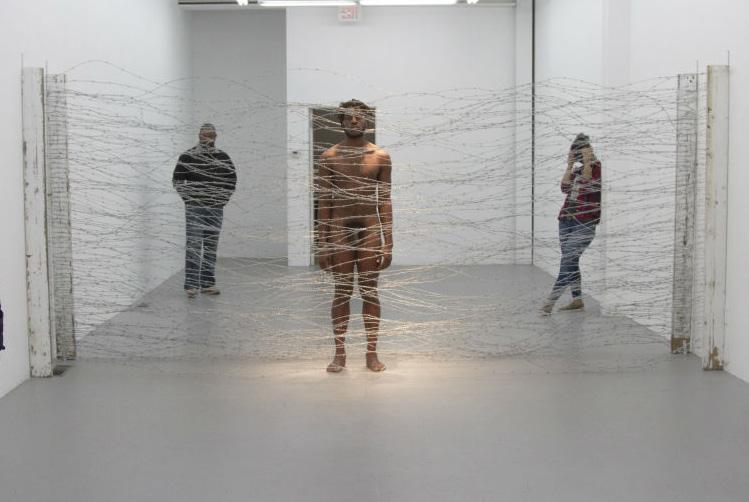
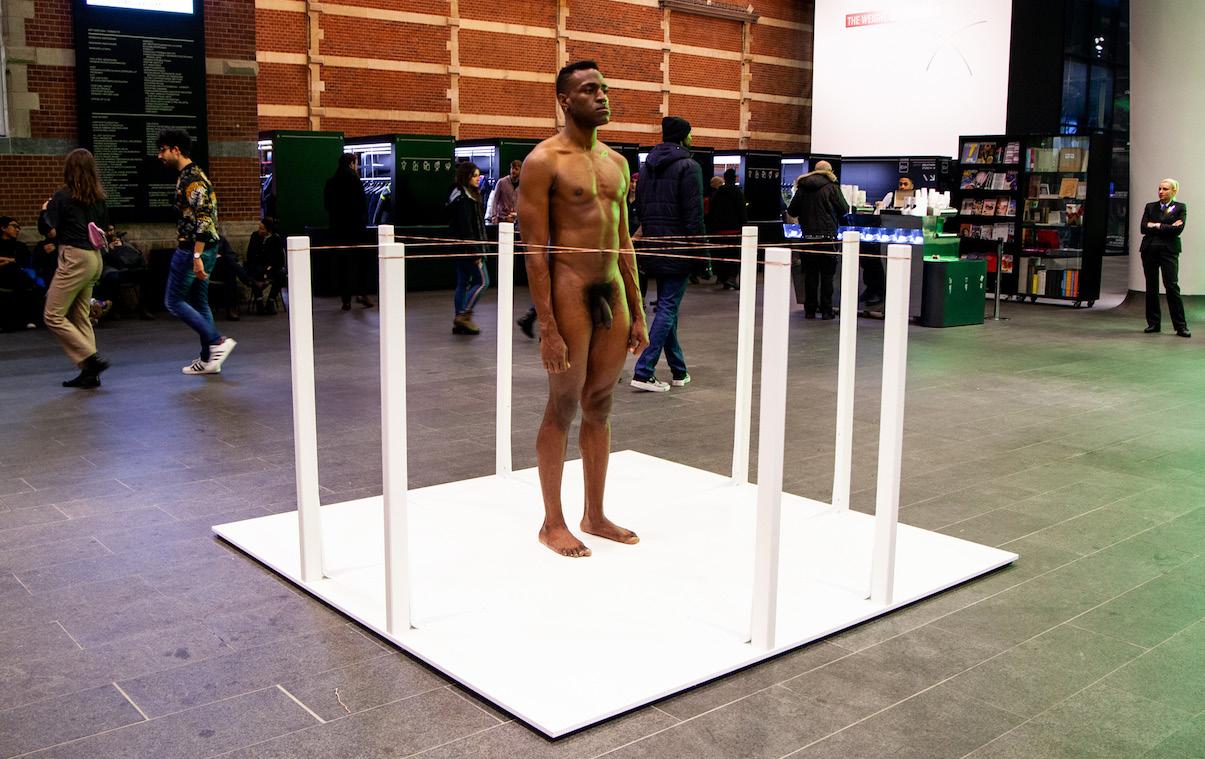
Segregation (2015): In the center of the gallery, two barbed wire barricades were created to separate Martiel from the audience and divide the space into two areas. Each area had a separate entrance: the first allowed entry to whites and Europeans born in the United States, while the second allowed entry to blacks, Latinos, Asians, and Middle Easterners, as well as anyone who was not European or born in the United States. People were not allowed to mix throughout the performance. (Photo:
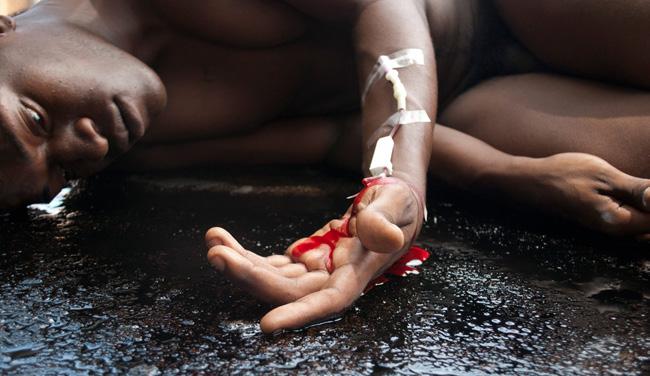
Spills (2011): Lying in a pool of oil, Martiel had a catheter in his arm that allowed his blood to drip and mix with the black stain on the floor. (Photo: Eduardo Yaque)
Nabeela Vega)
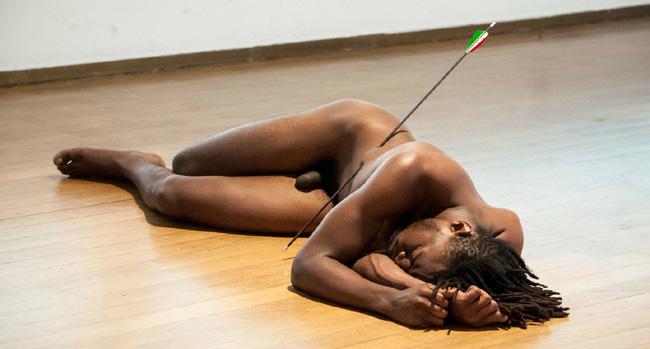
Trophy (2016): Martiel lay on the gallery floor with a hunting arrow piercing his waist. (Photo: Annamaria La Mastra)
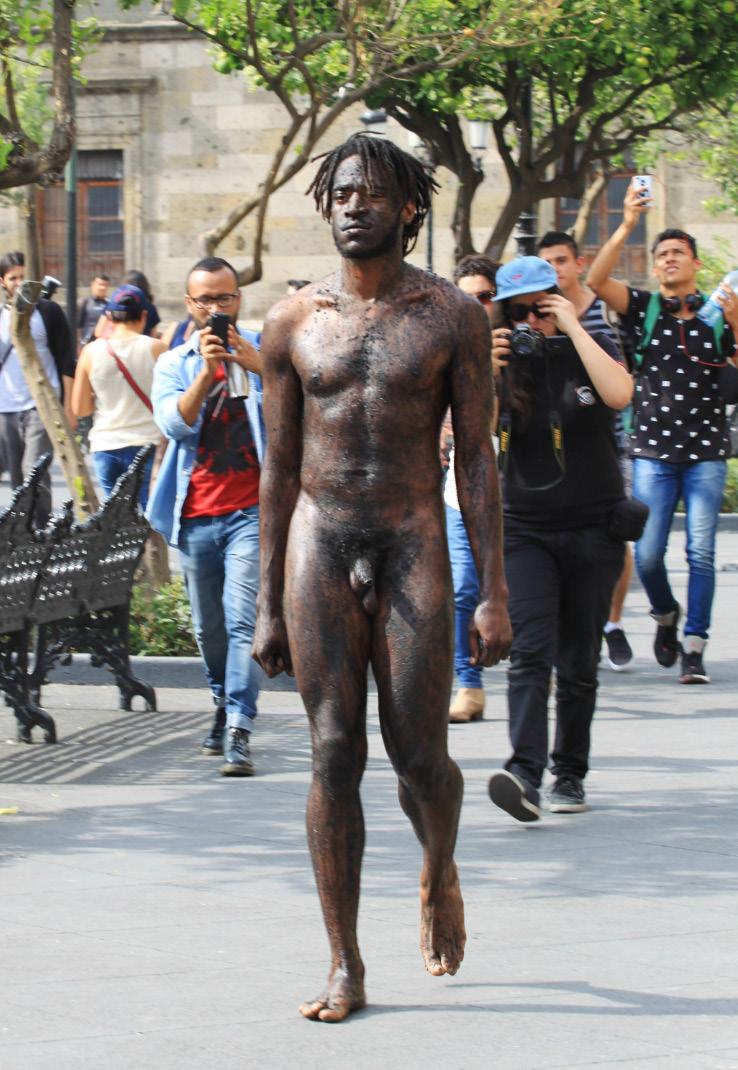
Appeared (2016): Martiel walked from the Cathedral to the Government Palace of Guadalajara with his naked body covered in the ashes of the clothes of missing people, donated by their families. (Photo: Javier Cardenas Tavizon)
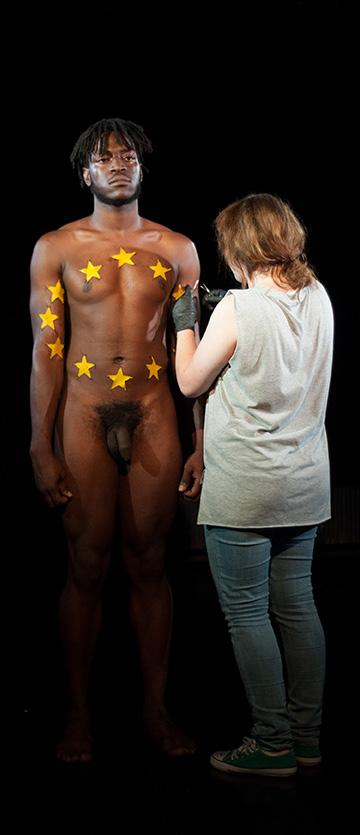
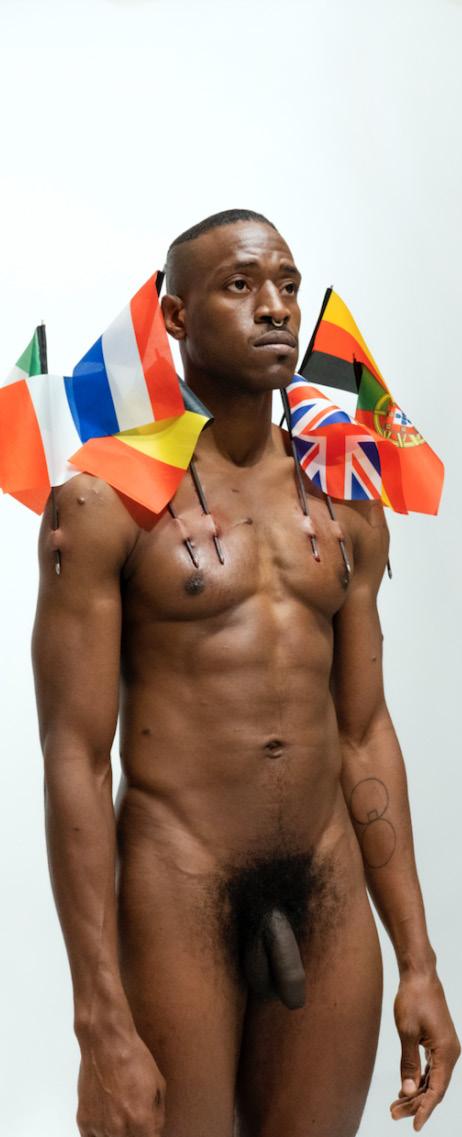
Expulsion (2015): Martiel began the performance with the twelve stars of the European Union flag sewn onto his body. After a while, someone cut and removed the stars from his body so the artist could leave the space.
(Photo: Dimitris Mermigas)
Kayapó Lament (2017): A Kayapó painted Martiel’s body with human blood to remember the indigenous peoples’ struggle against agribusiness.
to his
body eight flags of the European countries that invaded, colonized and imposed a territorial division of Africa between the 1880s and the beginning of the First World War.
(Photo: Denise Adams)
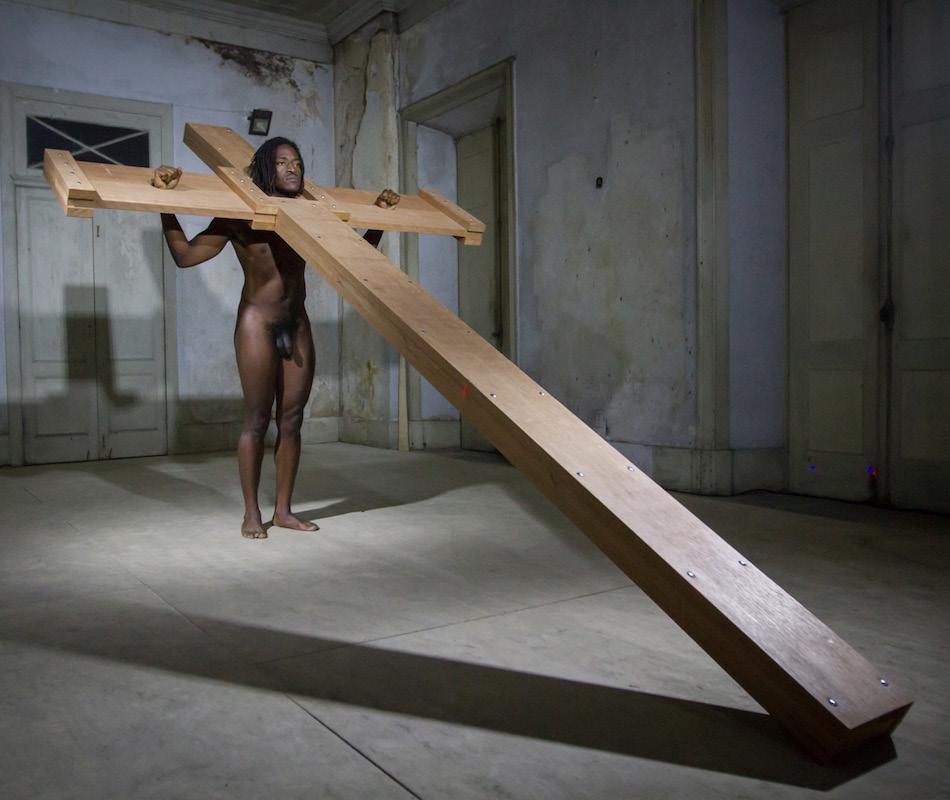
Dead weight (2017): Martiel remained imprisoned under the weight of a wooden cross that also resembled a pillory.
(Photo: Renato Mangolin)
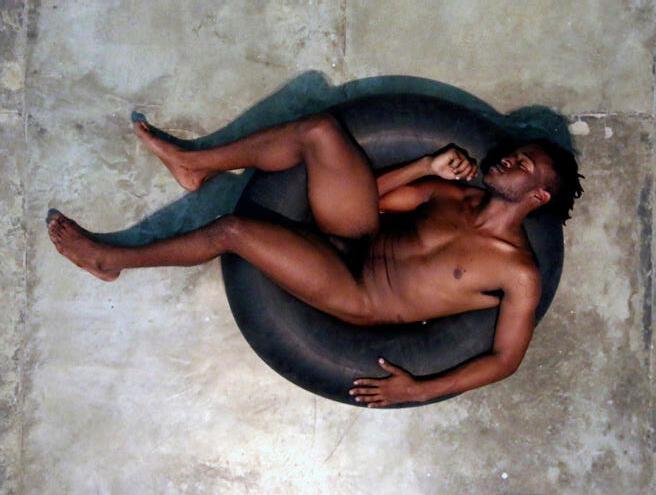
Being forgotten (2017): On the inner tube of a tire, Martiel remained sedated during the opening of the exhibition in Cuba, to remember those who died during the crossing between the island and the United States.
(Photo: Rafael Villares)
No Man’s Land (2022): Martiel pinned
naked
(Photo: Eliot Leblanc)
High-risk (2019): In the center of a cross-shaped installation surrounded by 8 threads stained with the blood of an HIV-negative person on PrEP, Martiel reflects on the pharmaceutical industry’s control over people living with HIV. (Photo: Prins de Vos)
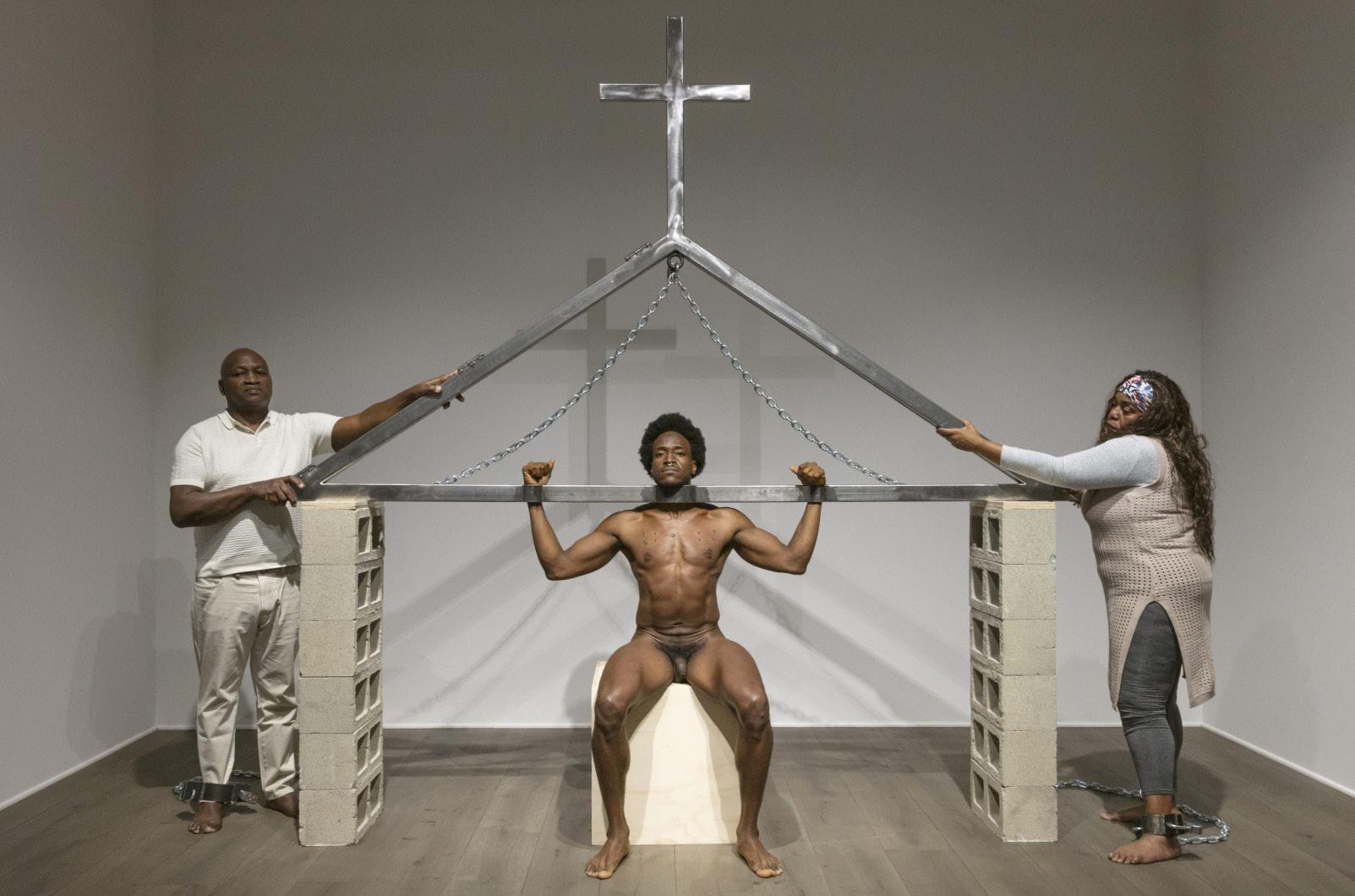
Emptying (2024): In this performance, Martiel invited his father and mother to handcuff the weight of a steel structure that reproduced the pediment of a Christian church, which also held the artist handcuffed, seated and naked.
(Photo: Don Lewis)
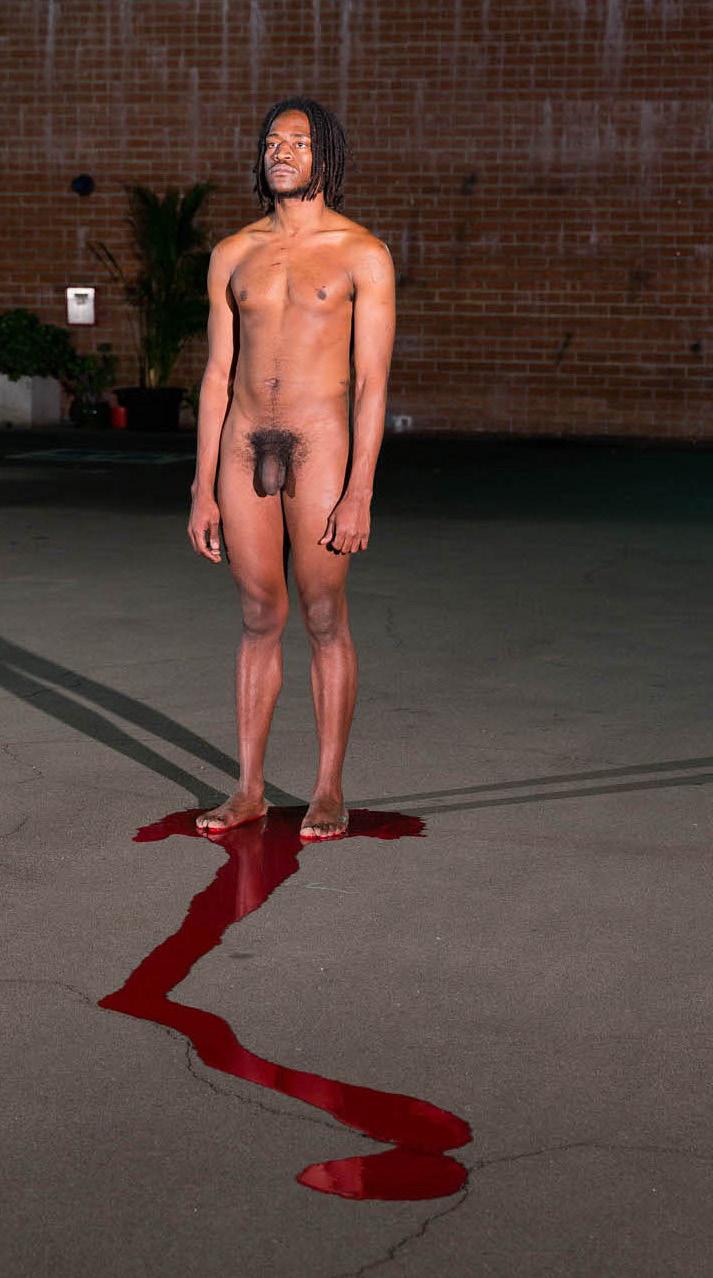
Black Lament (2018):
All images were taken from the
Martiel stood naked in a pool of his own blood.
(Photo: Hiroshi Clark)
artist’s website.
Fyodor Pavlov-Andreevich
His art is capable of surprising us with ever new ways of seeing the world we live in. – Marina Abramović, on Fyodor’s work.
Russian and Jewish artist Fyodor Pavlov-Andreevich (1976-) constantly uses his naked body in his performances/installations, knowing how much nudity in itself can impact, provoke controversy and attract attention. He even calls himself a “guerrilla body”. His artistic practice focuses on three themes: the distance between the spectator and the work of art in performance, the temporality and vulnerability of the human body, and the connection between the sacred and the obscene. Some of Fyodor’s performances:
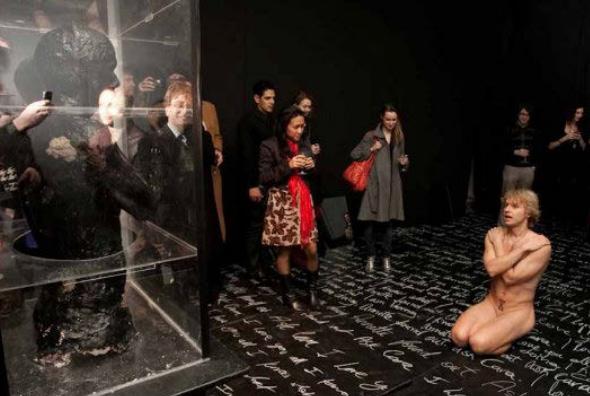
I eat me (2009): For five days, the artist sat naked on the floor of a London gallery, talking non-stop with his hands folded (an Eastern Orthodox Christian funeral custom), in front of a display case containing five rats and a sculptural replica of his torso that was being consumed by the animals. Whenever, for any reason, he interrupted his monologue or told a lie, he would begin a ritual: he would recite a Russian Orthodox prayer, pick up a hammer from the floor in front of him, choose one of the 225 mirrors placed on the gallery walls, kiss his image, and then destroy the mirror with the hammer. He would then walk barefoot over the broken mirror to calm his thoughts, return to a sitting position, and resume the conversation. The performance addressed suicide, self-harm, and mental health.
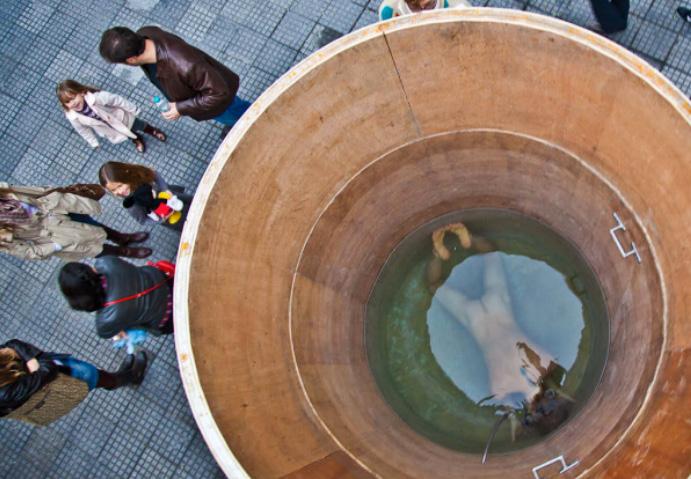
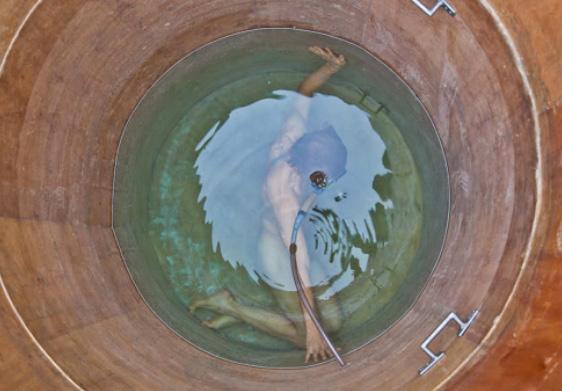
My water is your water (2010): A Russian proverb says: “Don’t spit in the well.” Fyodor then created an artificial plywood well where visitors are instructed to climb a ladder to reach the top of the well and spit. Inside the well, the artist is naked, performing subtle movements, illuminated by a small light, and a recording of his low, thin and shrill voice, singing an unidentified melody, accompanies the experience. This performance took place as a parallel activity of the São Paulo Biennial.
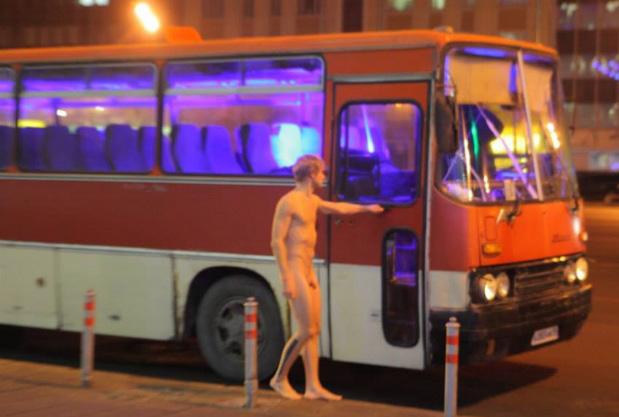
Empty bus (2013): Fyodor boarded an empty Moscow bus naked, driven by a hooded figure emulating a grim reaper. The artist rode the circular route of the bus for almost four hours in an outside temperature of -23°C.
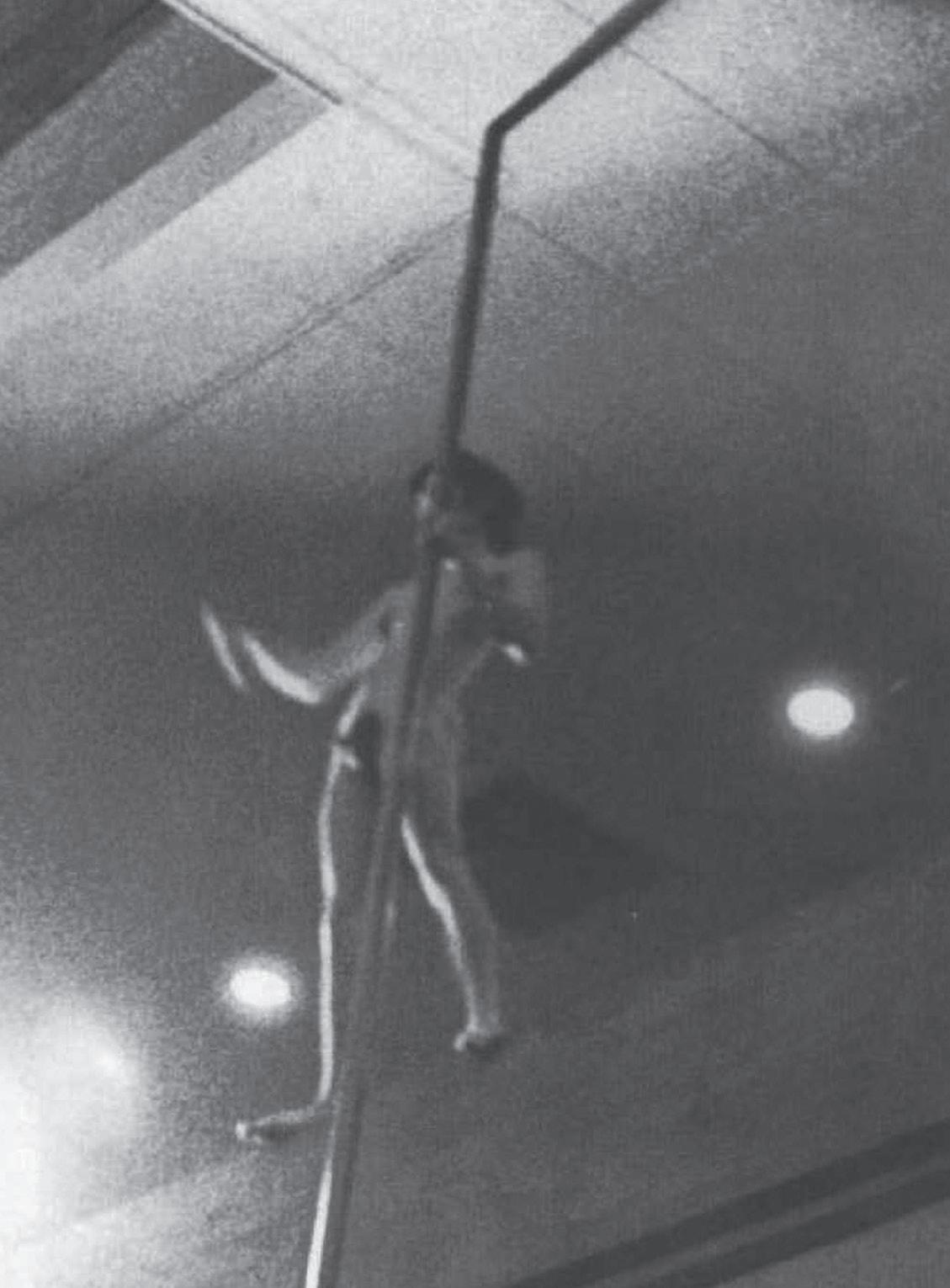
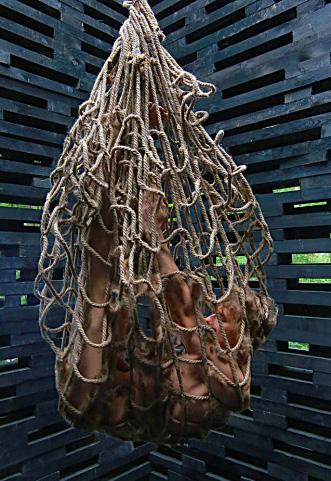
Little house suspended (2013): For seven hours, Fyodor remained hanging naked in a rope bag, like an animal trap. His aim was to discuss not only the objectification of the body, but also the restriction of movement, deprivation of freedom and powerlessness. (Photo: Igor Afrikyan)
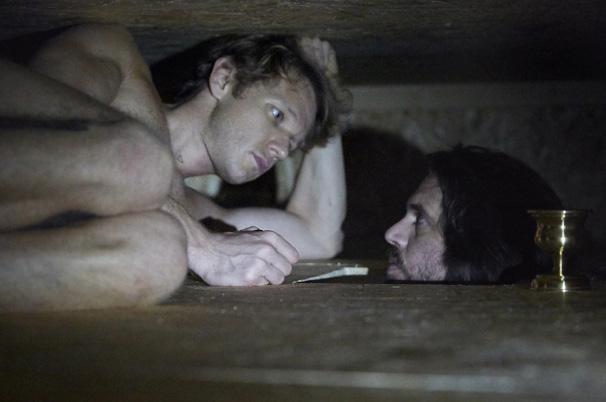
How can I get to the sky (2015): Referencing Vito Acconci’s “Seedbed” – where only the artist could be heard –, Fyodor hides in an improvised attic with a hole, where visitors could see him naked to talk. (Photo: Manuel Vason)
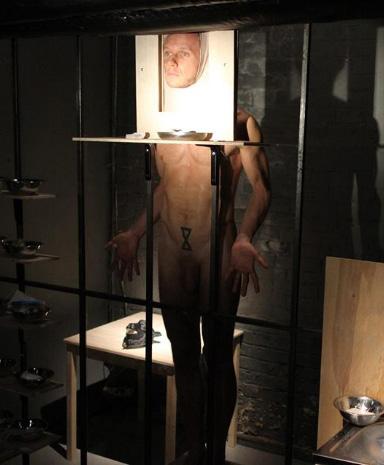
My face is on vacation (2013): This performance is part of a series of investigations that Fyodor carries out by making his body available to the public. In “My Face is on Vacation” – which was part of the “Artists’ Zoo” event in Moscow –, the artist is naked behind a glass panel and only his face is accessible to visitors, who receive instructions on what to do to his face. This occurred during the event’s opening hours (4 hours on each of the 7 days), but outside of these hours, the artist wore a black sheep mask even when sleeping and taking a shower. (Photo: Igor Afrikyan)
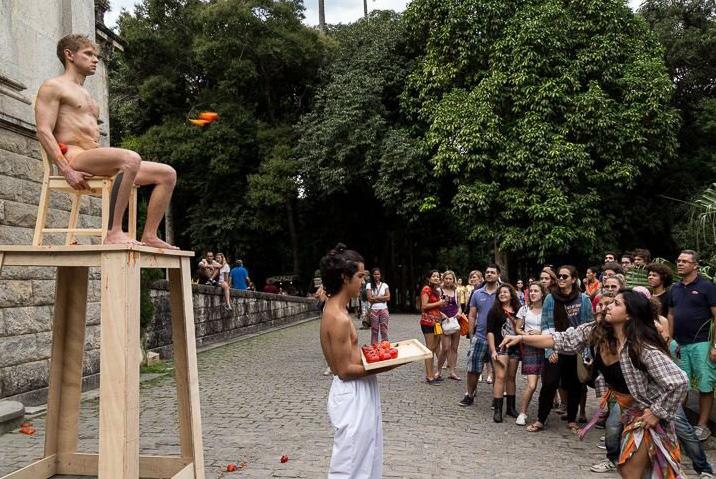
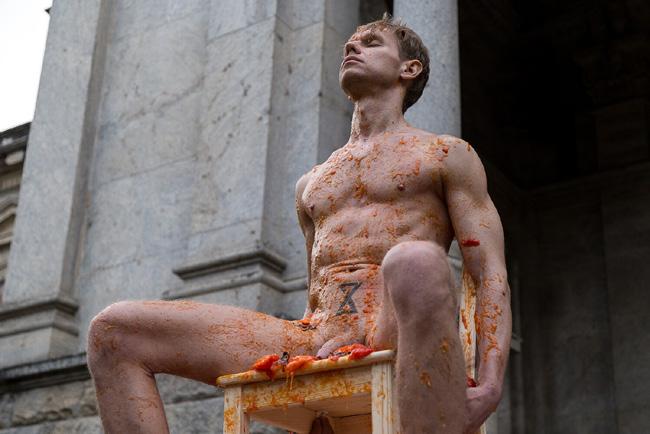
The persimmons (2015): The audience was invited to throw soft persimmons at the artist as he sat motionless on a plywood pedestal in front of the grand entrance to the castle in Parque Lage, Rio de Janeiro. By the end of the threehour performance, over a thousand persimmons had been thrown at the artist in a reflection on contemporary art, spectacularization, hatred and nudity. (Assistant: Lyzandro Coelho; photos: Claudio Senra and Pedro Agilson)
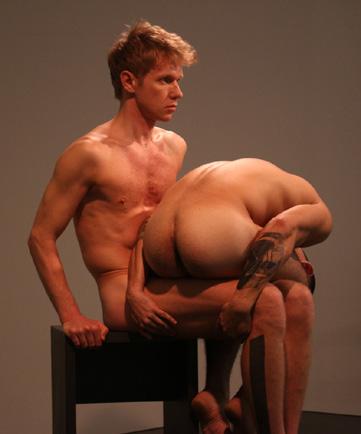
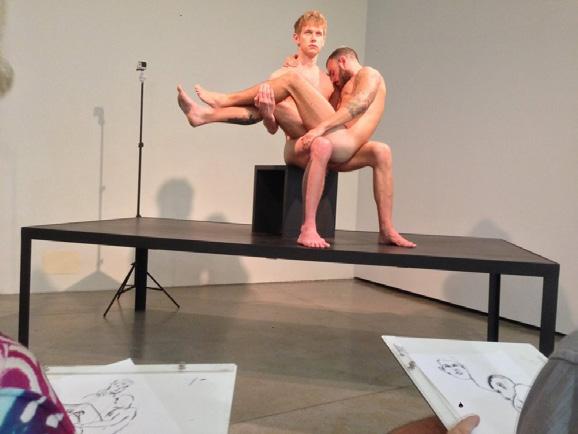
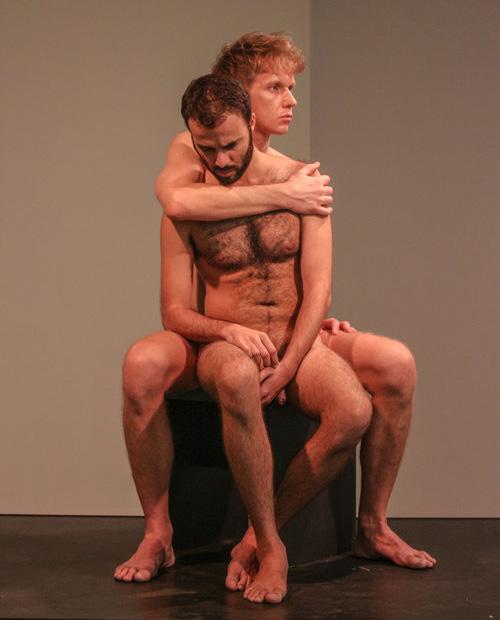
A portrait with the artist and void (2016): Fyodor sat on a wooden podium for 5 hours at the Museum of Modern Art in São Paulo as a nude live model for a drawing. Anyone could draw him for 15 minutes, while museum staff encouraged visitors to pose nude on the artist’s lap. The results were displayed as a community drawing.
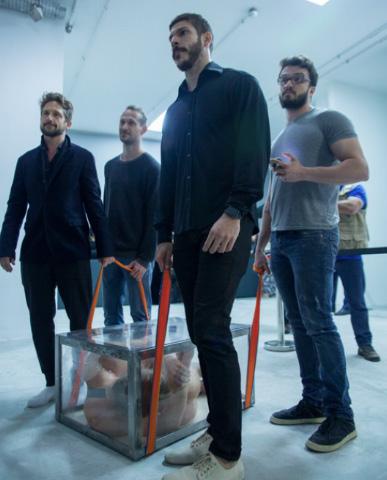
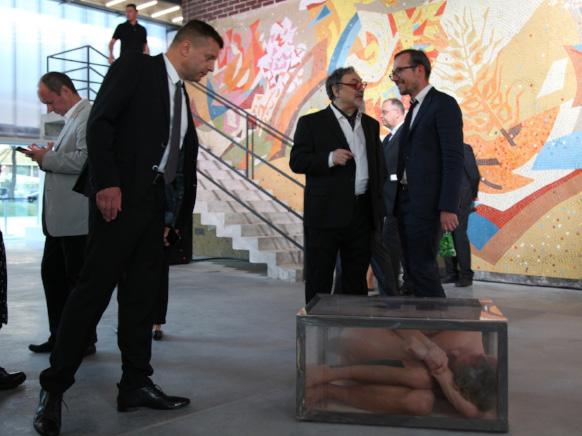
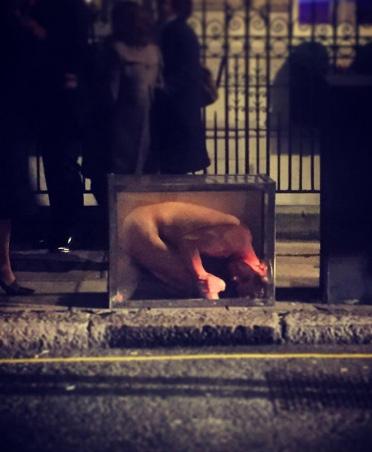
The foundling (2015-2017): Fyodor gained international recognition thanks to this guerrilla performance, in which he was naked inside a glass box and literally dropped off at social events without the permission of their organizers, like a foundling baby left on the doorstep of charities or orphanages. In May 2017, during his performance at the Met Gala, the artist was arrested by the New York police for trespassing and public nudity, and then sent to jail for 24 hours.
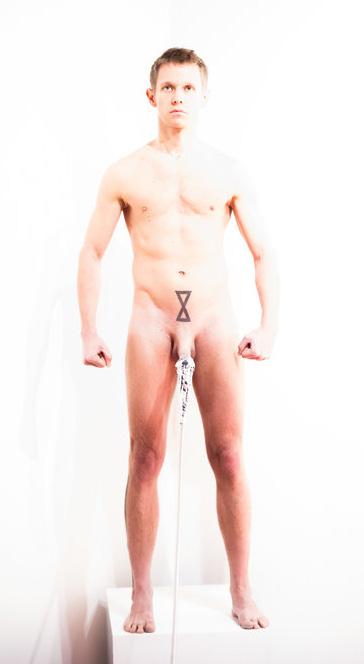
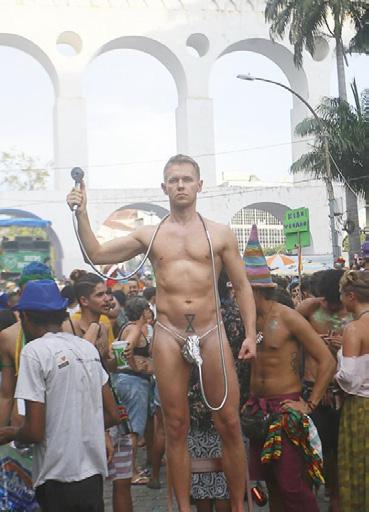
Dickorders (2016): To discuss the phallocentrism of patriarchy, Fyodor stood naked on a plywood podium and attached to his penis was a huge shower handle that ran across the hall and hung from a hook on another wooden podium. Visitors who decided to participate were asked to step onto the empty podium, grab the shower head, and, after the music playing in the shower ended, immediately follow the instructions given. Some of the voice-recorded instructions were:
1. Look into my eyes. Put the shower head on your heart. Count 25 heartbeats. Put the shower head back on the receiver and go down.
2. Look into my eyes. Cross your arms over your chest. Hold the shower head between your thighs and jump 25 times. Put the shower head back on the receiver and go down.
3. Look into my eyes. Sing this Russian song with me. Put the shower head back on the receiver and go down.
4. Look into my eyes. If you are a woman, count slowly to 25 while massaging your breast with the shower head. If you are a man, count slowly to 25 while massaging your groin or buttocks with the shower head, your choice. Put the shower head back on the receiver and go down.
In 2019, the artist performed versions of this performance (Dickorders: Carnival Edition) as a statue with a shower head attached to its penis in response to the former Brazilian president’s video about a “golden shower”. (Photos: Alexander Harbaugh and Luis Felipe Romano)
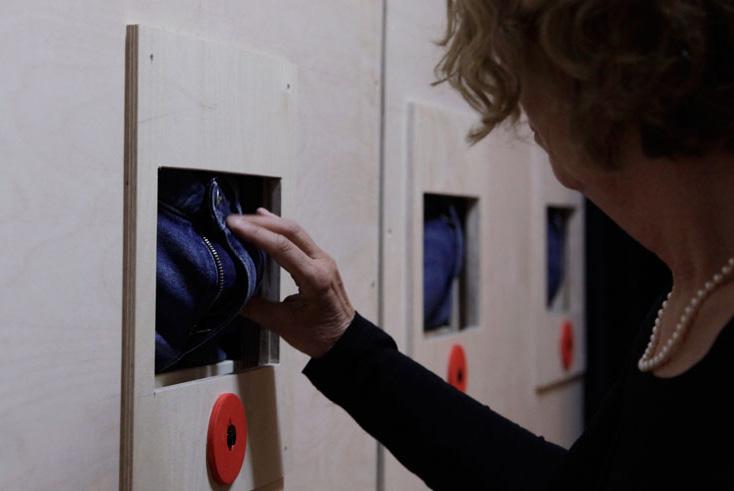
The blue jeans (2016): Although there is no nudity, this performance becomes relevant here because it uses the penis volume in the jeans as a means of interactivity. In yet another performance/installation where he makes his body available to the public, Fyodor prepared a wall with five windows at the height of his penis. Behind these windows were four men and the artist, wearing jeans, who could be groped by visitors so that they could discover which of the volumes belonged to Fyodor. The artist says that this performance aims to compare pregnancy, which lasts nine months and the woman cannot hide in nine seconds that the man “wins” in a grope.
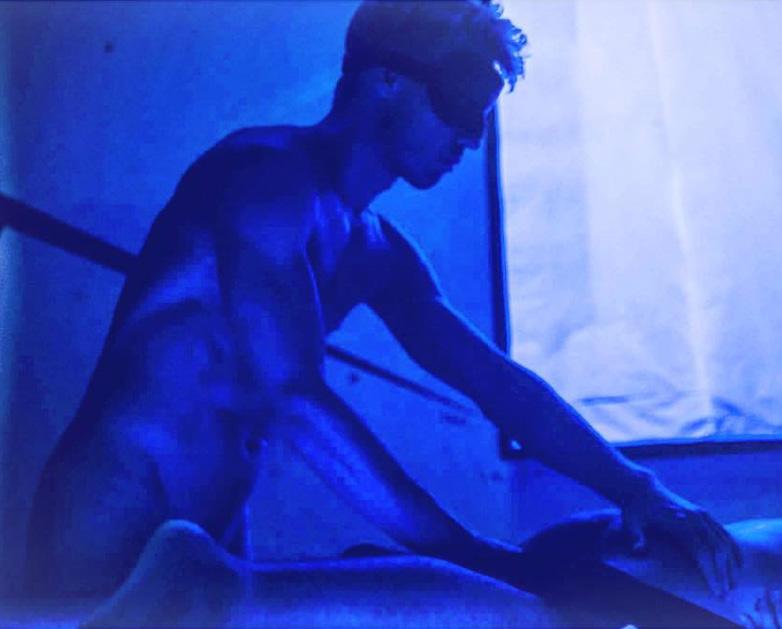
The alarm clock (2016): Performance held at Casa da Luz, in São Paulo, where Fyodor, naked and blindfolded, massaged the also naked participants, thus making the audience the object of the performance. The setting was similar to old erotic videos and the result was between the artist and the participant after 15 minutes, when an old alarm clock rang. (Photo: Marcelo Elidio)
Temporary monuments: Fyodor established seven temporary monuments (seven-hour performances) that correspond to seven episodes of suffering of Brazilian slaves, both those linked to the historical past and those recorded in more recent times. These performances received a lot of media coverage in Brazil. Of the seven, five contained nudity:
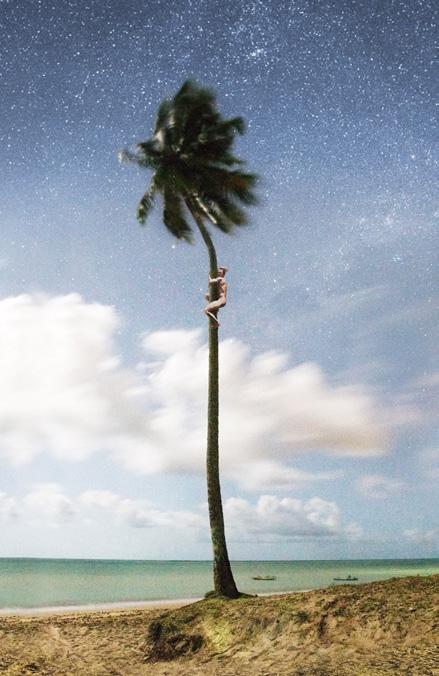
The coconut tree (2015): Fyodor climbed naked onto a lone coconut tree on a beach in Alagoas. The story goes that coconut seeds were imported and valuable. Some slaves swallowed seeds to earn money to buy their freedom. (Photo: Igor Afrikyan)
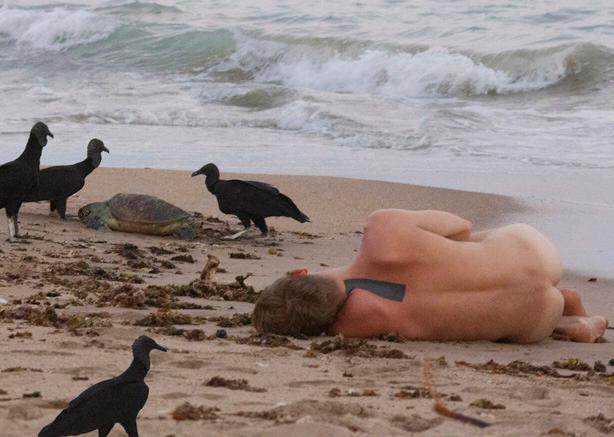
Vulture (2015): Fyodor lay naked on a beach next to a dead turtle being eaten by vultures, creating an image of a white body being threatened by black birds, a reverse image of the story that reveals that slaves who died due to torture or hard labor would have been publicly thrown to the vultures –so that the rest would witness and fear the same fate. The performance was interrupted when a vulture actually approached to peck the artist. (Photo: Igor Afrikyan)
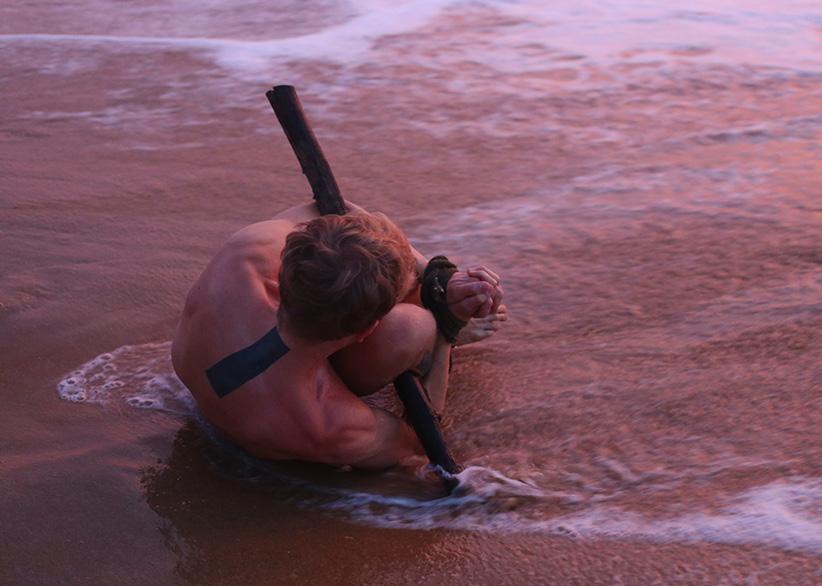
Pau de Arara (2015): Tied to a pole as torture was carried out on slaves (and later by the Brazilian dictatorship), Fyodor found himself stranded on a beach while the tide rose. The performance ended when his head was completely submerged. (Photo: Igor Afrikyan)
The pau de arara is an instrument that suppresses the will. The only thing that continues to function in the human body is the head, while the rest is not allowed to move or express its desires. This pose has a special meaning for my work, because in several of my performances I have transformed myself into a disembodied head. The autonomous head, in the case of the pau de arara, is the powerless one, the one that watches its imminent death and gasps for air.
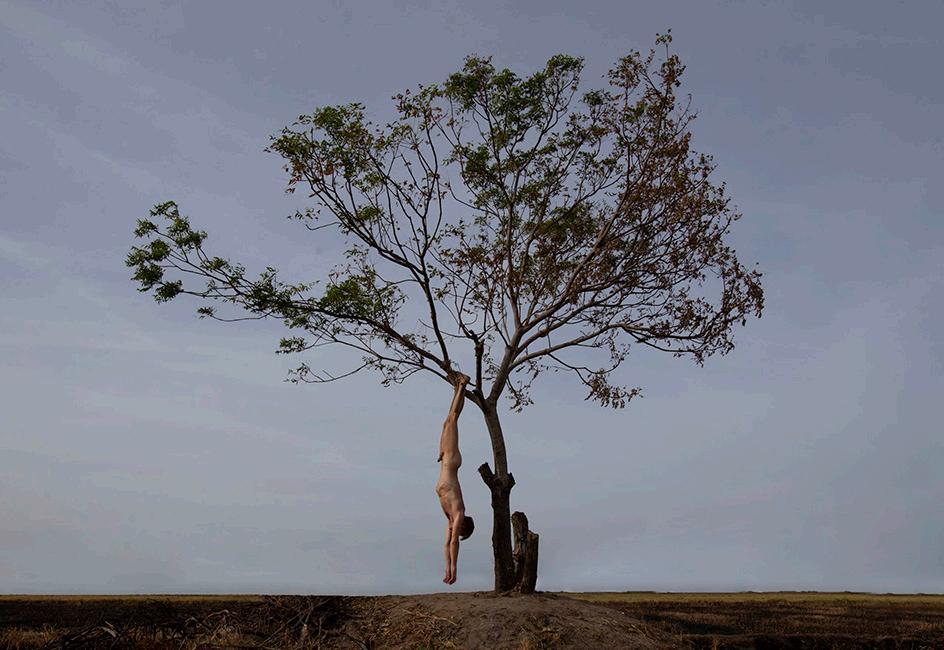
The hanged man (2015): Fyodor remained hanging upside down, emulating one of the most common tortures performed on slaves. He revealed that he could only stay in the position for a few minutes and that he had to change it constantly, unlike slaves who could stay hanging for 24 hours. The performance ended with the artist’s feet turning blue. (Photo: Igor Afrikyan)
Locker (2016): Chained to a post with a bicycle lock, at night, in the Flamengo neighborhood, Fyodor alluded to an episode that occurred in exactly the same place, when security guards arrested, stripped and beat a street thief. The artist revealed that because he was a “gringo”, people did not know how to act and the performance only ended when the media started to make headlines and the military police took him away. (Photo: Pedro Agilson)
Try me on I’m very you (2018): This is a five-hour interactive performance where the audience is invited to play music on the artist’s naked body, as different sounds come out depending on the pressure, intensity, duration and individual energy. As Fyodor says, “the very moment of this sensation overwhelms you – your visitors care about you! Playing music on your body is a definite sign of love and attachment.” (Photos: Nikolai Gulakov)
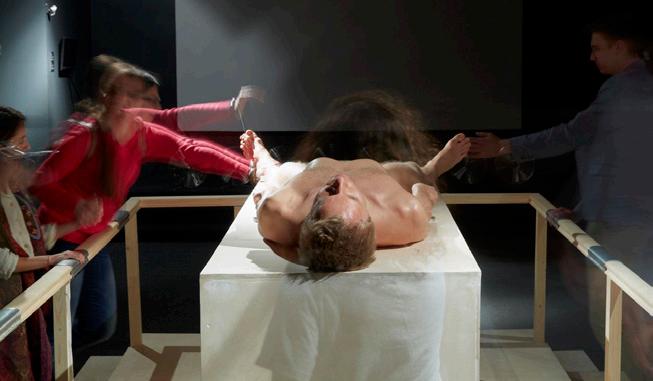
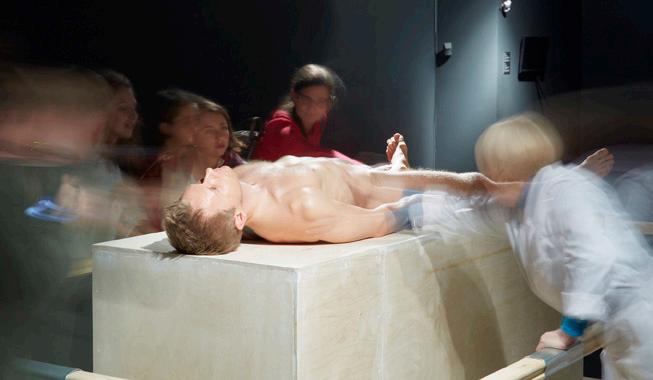
42 cards (2018): In this performance – which directly references Abramović’s “Rhythm 0” – Fyodor places his body at the disposal of the audience, who are given a card with instructions on what to do with the artist’s naked body, which is laid out on a plywood table on a stage. From a simple “Slap my cheek” to “Do something nice for me”, the audience has to line up with their arms crossed over their chests while waiting and watching the interactions. Just before going on stage, each visitor is invited to wash their hands using an authentic Soviet washbasin with a bar of old Soviet soap and a towel called a “waffle”. Once finished, the visitor must choose between remaining seated on stage, returning to the auditorium or leaving the space. The number 42 refers to the artist’s age at the time of the performance and thus increases with each year he reproduces it. (Photos: Filipe Conde)
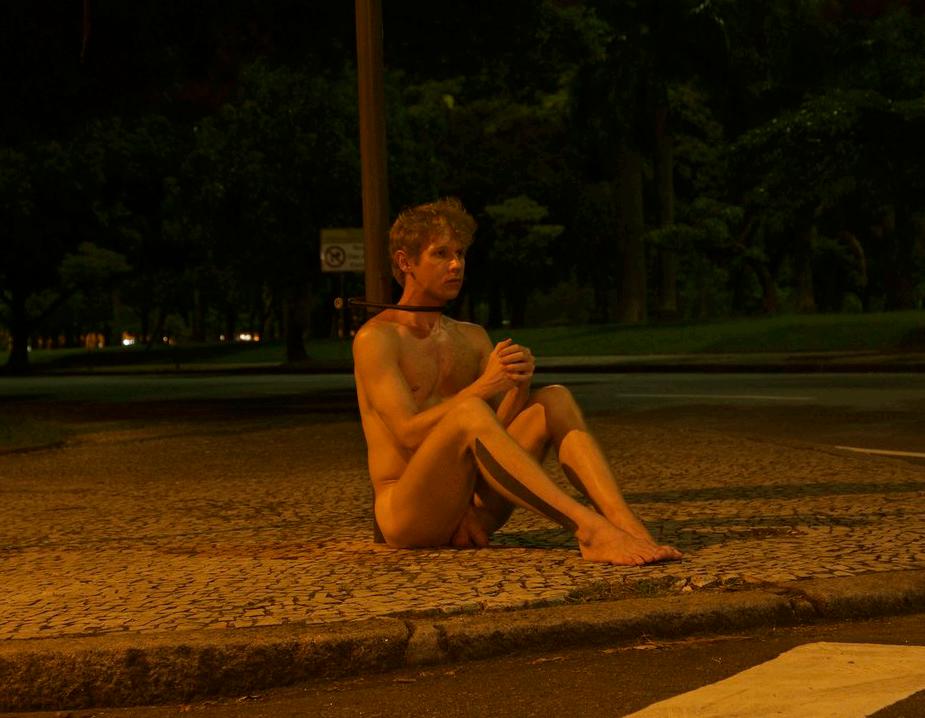
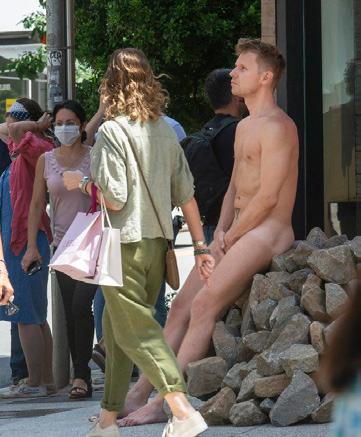
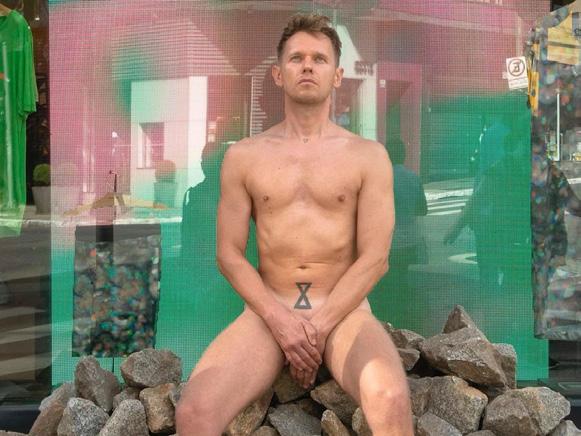
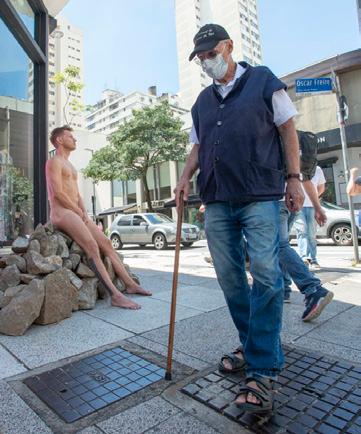
The sharp rocks (2021): In 2021, the performer performed “Sharp Rocks” where he remained naked, quiet and motionless on Oscar Freire Street – a famous street with elite shops in São Paulo – sitting on rocks to question the city government’s action at the time of placing sharp rocks under the overpasses to prevent homeless people from settling there. He was interrupted three times by the military police and had to put on shorts. (Photos: Ivan Padovani e Isabella Prata)
Source: Internet.
Antônio Obá
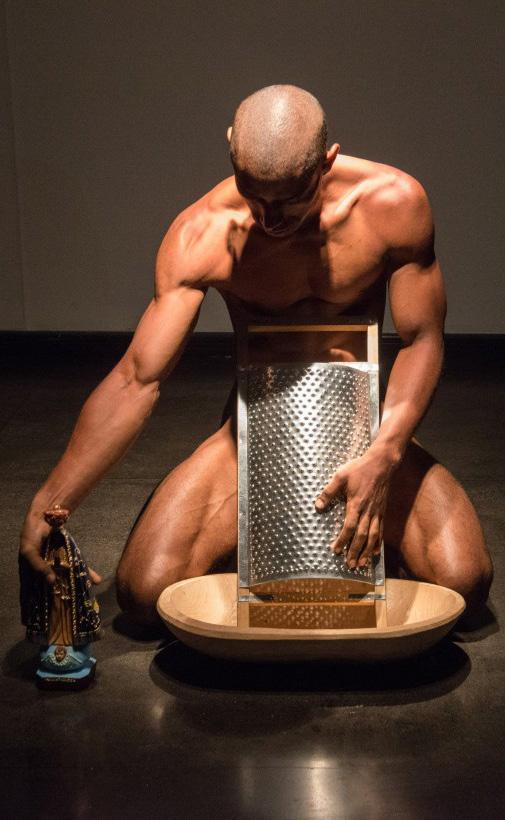
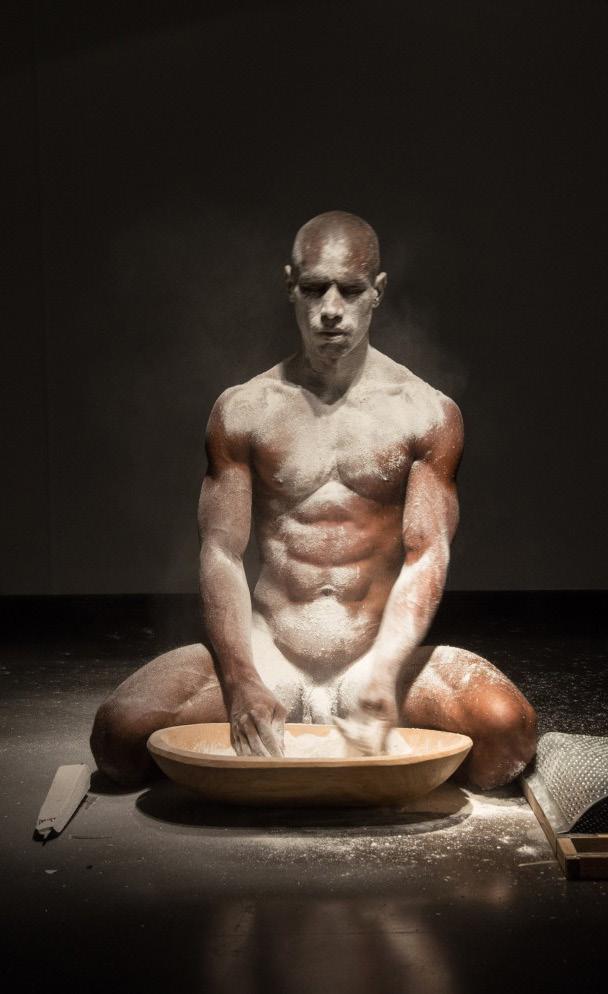
The research work of Antônio Obá (Brasília, 1983-) draws a parallel between the relationships of influence and contradictions in the construction of Brazilian culture. Using his black body, the artist explores the idea of syncretism present in Brazil and reflects on ethnic prejudice. His work, which encompasses sculpture, painting, installations and performance, also recovers an affective memory in the search for a debate on racial and political identity. In the performance “Acts of transfiguration: disappearance or recipe for how to make a saint” (2015, 30’), Obá appeared naked, on his knees, grating a plaster statue of Our Lady, the patron saint of Brazil, with a large corn grater formerly used by slaves to make pamonha. The tool was resting on a bowl, where offerings to the orixás in Candomblé are usually made. As the artist grated the plaster saint, he created a cloud of white dust that covered his naked black body. The performance, which discusses whitewashing and religious intolerance, was attacked by evangelical political leaders and the artist had to go into exile after receiving death threats.
My family is very Catholic… And the idea of ritual has always been interesting to me. Miscegenation and the idea of syncretism are deeply rooted in these customs. Reflecting on my black, mixed-race body and all the situations that this body inherited and continues to inherit without asking became themes of research and experience in my upbringing. I remember that once, I went into a Candomblé store and saw the image of Aparecida. Seeing this Christian icon in that context defined the entire character of the performance “Acts of Transfiguration”. The very concept of syncretism became very fragile. Where does this phrase come from? It is comfortable to defend the idea of so-called equality when, historically, an entire culture has already been marginalized, such as the population whitening projects that marked Brazil in the 19th century. Grinding a black image until it is reduced to white powder, throwing this powder over oneself after exhausting manual “work,” covering oneself, making one’s skin and identity disappear, are aspects that the performance touches on. However, the work has other meanings: covering the body with white powder, in some African civilizations, means deifying that body. The name of the performance itself refers to the rite of making the head, making the saint, in Candomblé. In other words, at the same time that there is criticism, there is also exaltation. It is an antagonistic celebration, a ritual.
Photos by Francisco Moreira da Costa.
Élle de Bernardini
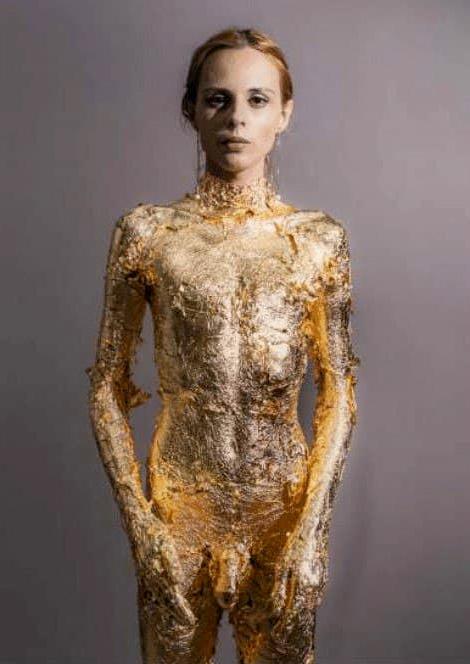
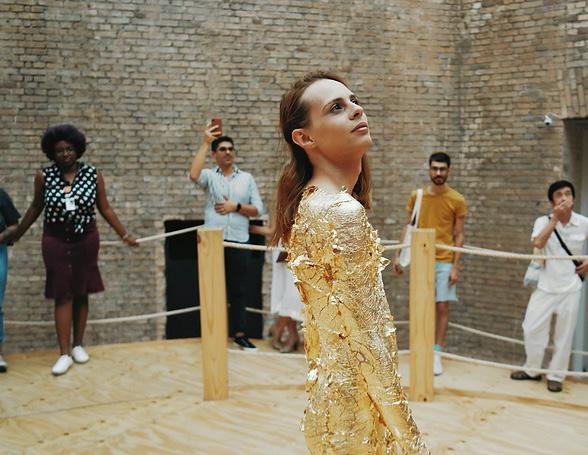
Visual artist, dancer and performer Élle de Bernardini (Rio Grande do Sul, 1991) performed her best-known performance, “Dance with me,” at the Pinacoteca do Estado de São Paulo in 2018. Naked, with her body covered in honey and gold leaf, Bernardini invited the audience to dance to the sound of bossa nova, in a gesture of closeness and defetishization. The only part of her body on display was her delicate face, which clashed with her penis, to make it clear that she was a trans woman. She explains:
I play with the jargon “I wouldn’t accept you even if you were covered in gold” to question the mechanisms of acceptance and rejection of trans and non-binary bodies by normative society. In my work, these mechanisms are the use of beauty and wealth that adorn my body, considered abject, and reach it to the level of acceptance, or approximation of the other, who at the end of the dance takes the gold in their hands or in parts of their body that touched mine.
Gold leaf plays a role in enhancing (“illuminating”) works in the history of art. By using this element within an institution that considers painting as the ultimate art, Bernardini gives value and elevates the status of her trans body. In 2019, the performance became part of the Pinacoteca collection, as the first work by a trans artist in the institution’s entire collection.
All images were taken from the artist’s website.
Chico Fernandes
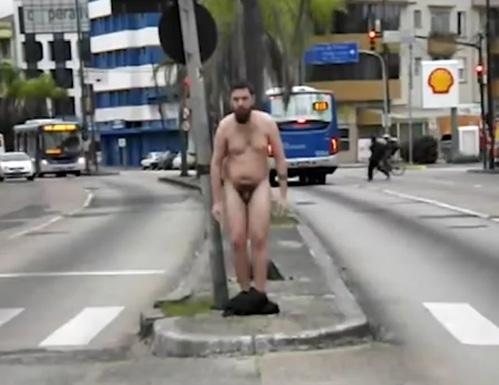
Artist Chico Fernandes (Rio de Janeiro, 1984) develops projects using different media, mainly performance, photography and video. Whether in the construction of a static image or in an immersive experience, the artist usually creates an atmosphere of direct connection with the public. Since 2017, he has been performing a series of nude performances in public spaces to generate critical reflections in a larger audience (“if I were in a museum, I would only reach an elite audience”) and to investigate the freedom of the body in these spaces, based on the principle that his performances are emptied of obscenity and sexual connotations. Even aware of his privileges as a white, heterosexual, cisgender man, Chico does not have a body considered an aesthetic standard and, therefore, uses it as part of the provocations he wants to cause, be it “laughter, anger or discomfort”, as he says.
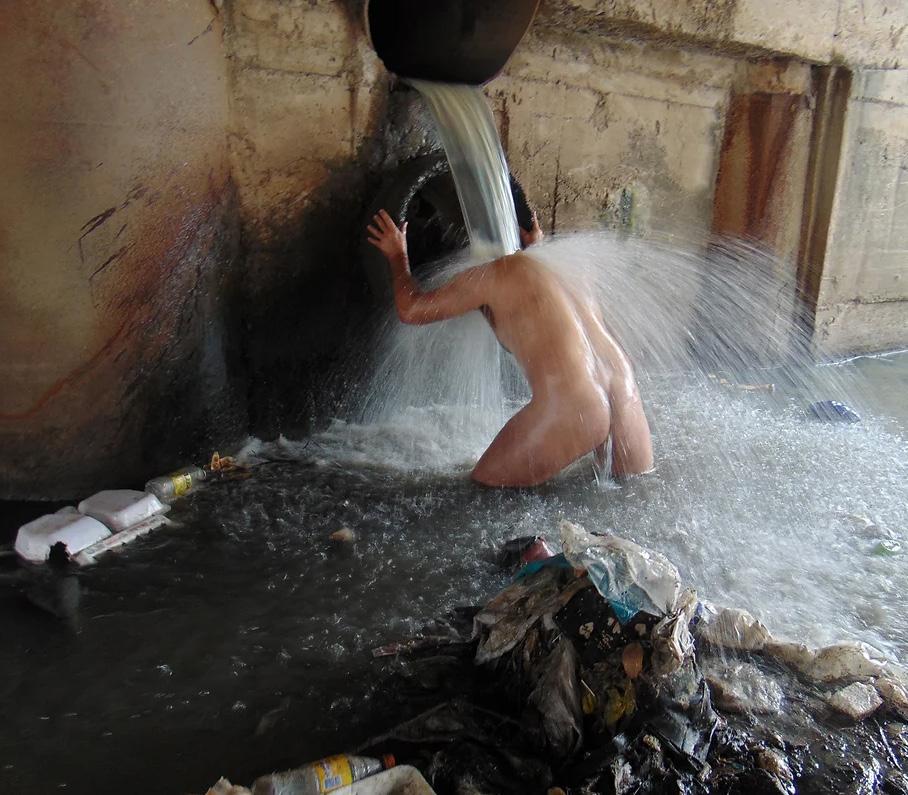
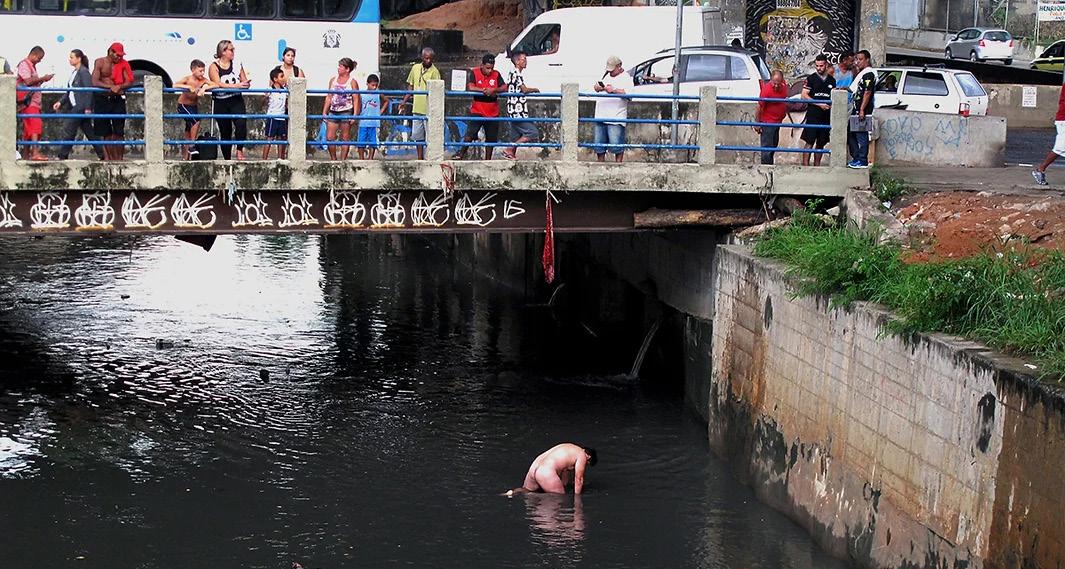
His first work with this premise was “Come into the (w)hole – after Marcos Chaves”*, in 2017, where he bathed in the outlet of a sewer to discuss both the vulnerability and the abjection of nudity. At first he was in a place with little visibility to the public and then moved to a place where people could see the action.
Fotos de Silvio Aguiar.
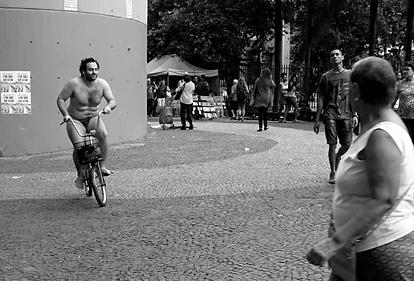
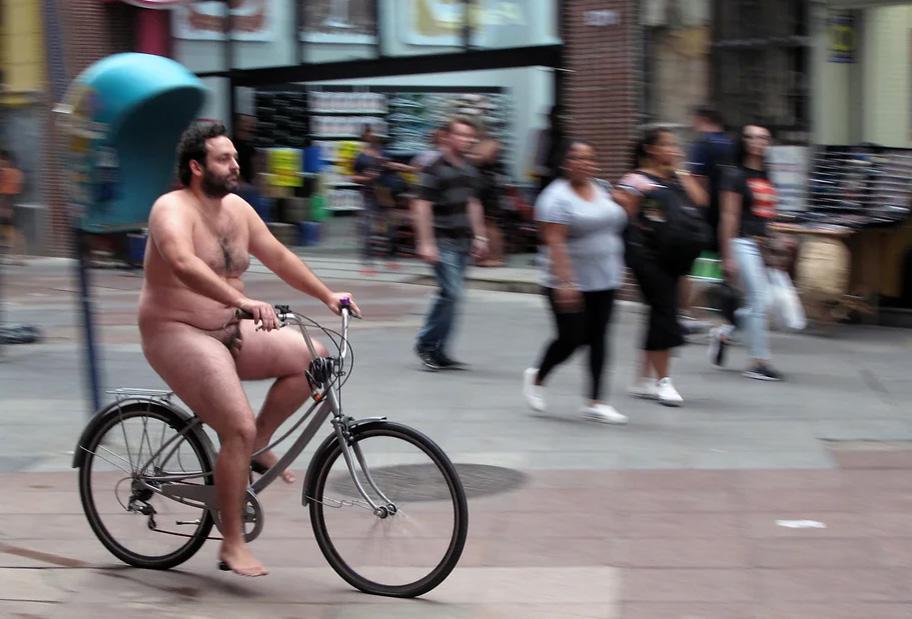
In 2018, Chico performed “Naked Cyclist –Homage to Aimberê César”* in Rio de Janeiro. The following year, when performing the same performance in Porto Alegre, he had to stop the performance earlier than planned due to public rejection. Already dressed, he was approached by the police based on a complaint from passersby and taken to the police station, where he ended up being prosecuted and banned from performing in the city again. In the artist’s words:
This is a misperception on the part of the police, since nudity is permitted in artistic performances, even in public spaces, regardless of any prior authorization, as long as there is no lewdness. Furthermore, according to criminal law, nudity is not punishable, not just artistic nudity. The police can, at most, ask the person to put on clothes; however, without sexual connotations, nudity is not a crime, regardless of the reasons for it.
At the time, there was a great repercussion in the local media, giving greater prominence to the “naked cyclist” than the arrest of a performing artist.
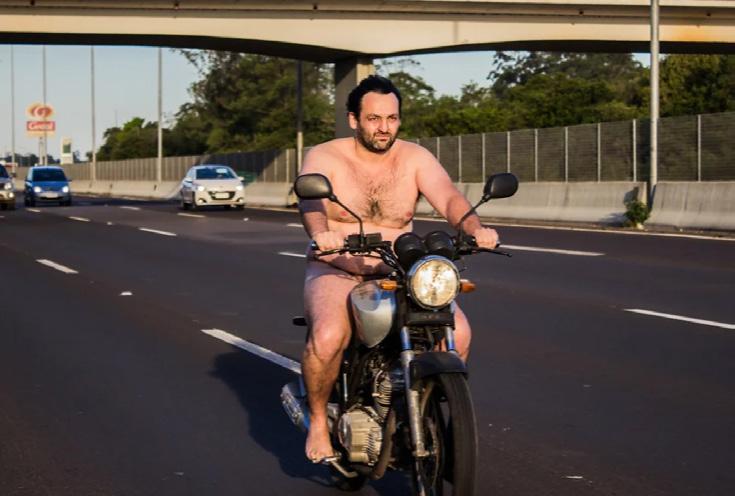
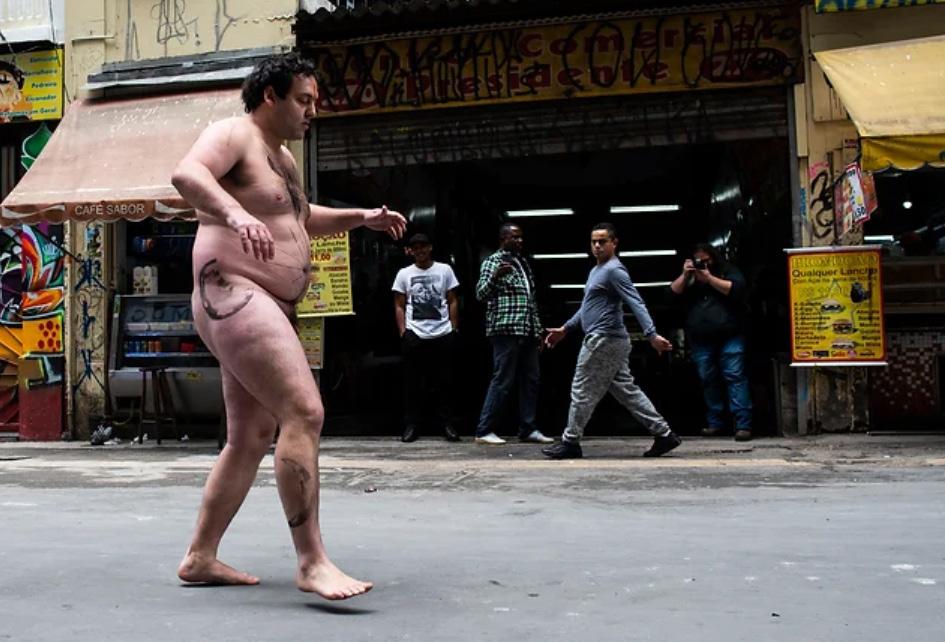
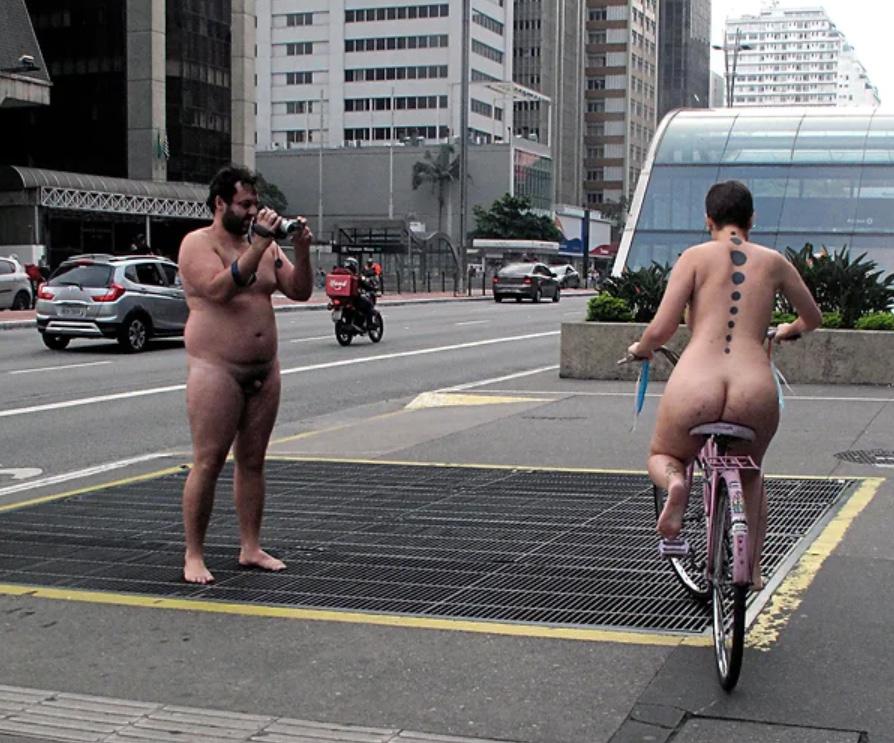
Also in 2018, Chico rode a motorcycle naked for “Four Kilometers in Four Minutes (Freeway)” and, in 2019, to celebrate the 50th anniversary of man stepping on the moon, the artist simulated walking in lunar gravity in downtown São Paulo without a set time. In “Caminhada Lunar”, the police arrived and asked Chico to get dressed. At the turn of the year 2019 to 2020, Chico paid tribute to Aimberê Cesar again with the performance “Naked Camera” in the middle of a packed Copacabana.
Photos by Clarisse Tarran, Eduardo Monteli, Dani Amorim and Pedro Amorim.
* Aimberê had entered an exhibition naked on a bicycle in 2003.
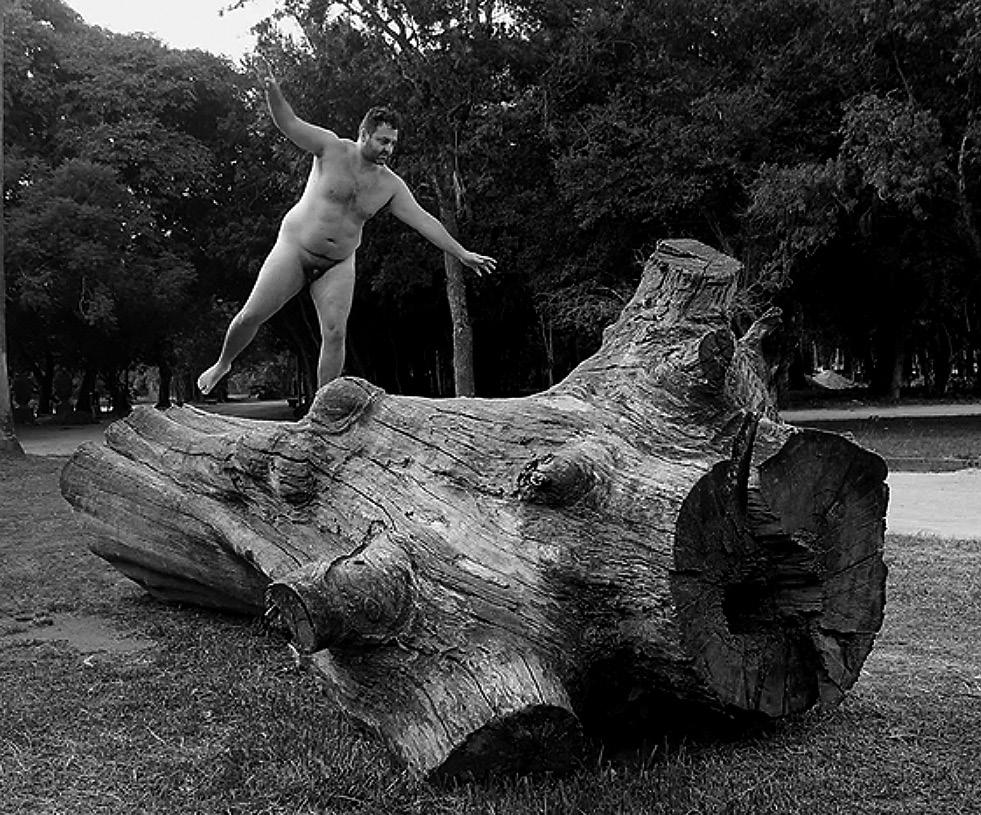
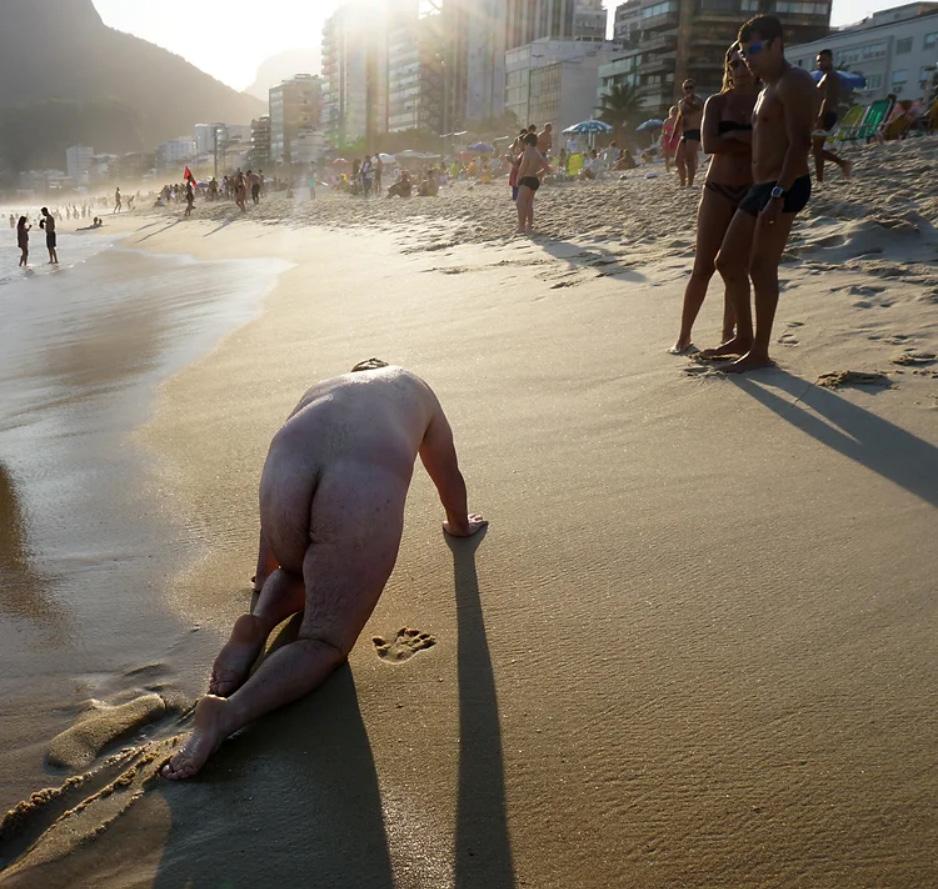
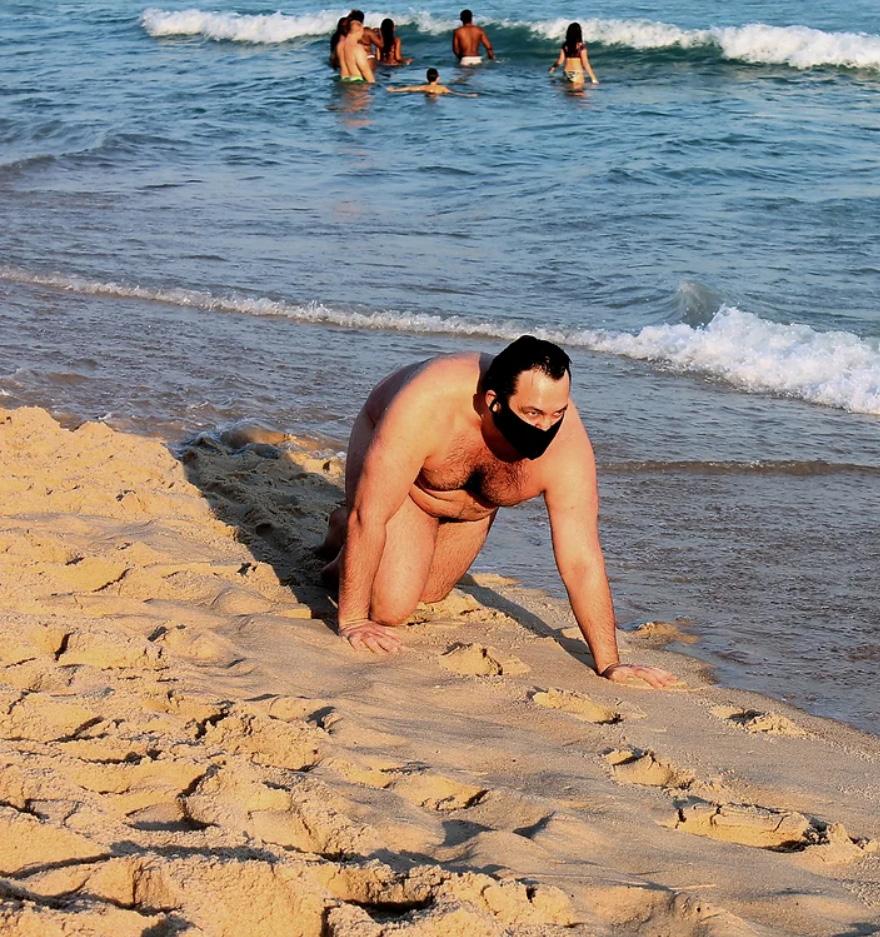
In partnership with Helena Marc, Chico combined two of his performances that pay homage to Aimberê: while she pedaled naked, he filmed her. The action “Domingo na Fiesp” (2020) was held on Paulista Avenue, in front of the place marked by Brazilian capital and politics. The police remained tolerant, understanding the artistic action of the duo. Also in 2020, however, during the isolation of the pandemic, Chico held two performances that dealt precisely with the absence of an audience: “O equilibrista”, a nude photo shoot in a park in Porto Alegre, a city where he could no longer perform, and “Ação de Páscoa”, a video removing all the hair from his body. But the performance that drew the most attention was “Domingos pandêmicos
de sol”, when he crawled naked wearing only a protective mask against Covid-19 on the beach crowded with people who ignored health instructions. This performance was held in Leblon and Ipanema.
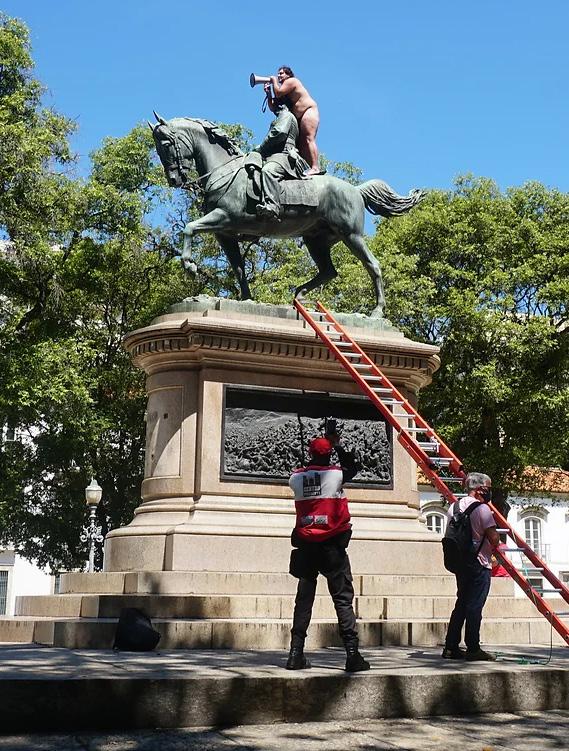
In 2021, Chico performed “Eu sou eu e o cavalo não é meu” (I am me and the horse is not mine), in which he climbed naked onto the monument to General Osório in downtown Rio de Janeiro. Amplifying his voice through a megaphone, he spoke about freedom of artistic expression, remembered the artist Aimberê Cesar, criticized the government at the time, and compared the number of deaths in the Paraguayan War, in which General Osório commanded the Brazilian
Ph oto by Rafaela Celano.
Ph oto de Marla Pritsch.
cavalry, with the number of deaths from Covid-19 due to misinformation about vaccination. The performance lasted as long as the artist wanted because no one dared to climb onto the monument to remove him. However, as soon as he got down, he was taken to the police station, where a report of indecent exposure was filed against him. The artist was fined by the Special Criminal Court of Rio de Janeiro and banned from performing nude in the city for five years. This action quickly went viral on virtual and television media.
There’s nothing crazy about it. Everything is thought out. From the posture that doesn’t show my penis and doesn’t shock people, to the words spoken and the avoidance of direct eye contact with the other person so as not to generate any kind of lust.
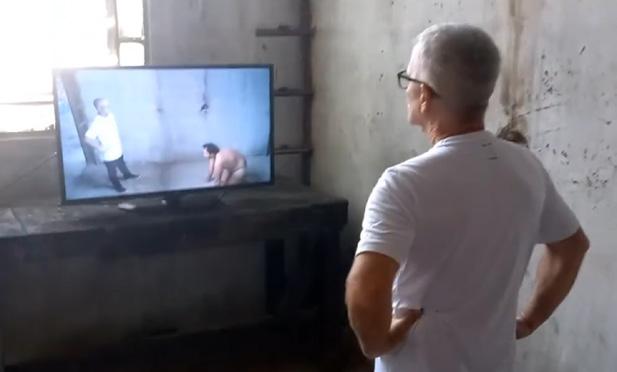
The following year, as part of his experiments with live broadcasting, he produced the video installation “The Invention of Morel”, in which the audience finds themselves immersed in the work by interacting with the performance recorded in the exhibition space itself during the assembly. There is a fusion between past and present.
Ph oto by
Clarisse Tarran.
Still from the video installation.
All images were taken from the artist’s website.
Nacho Hernández
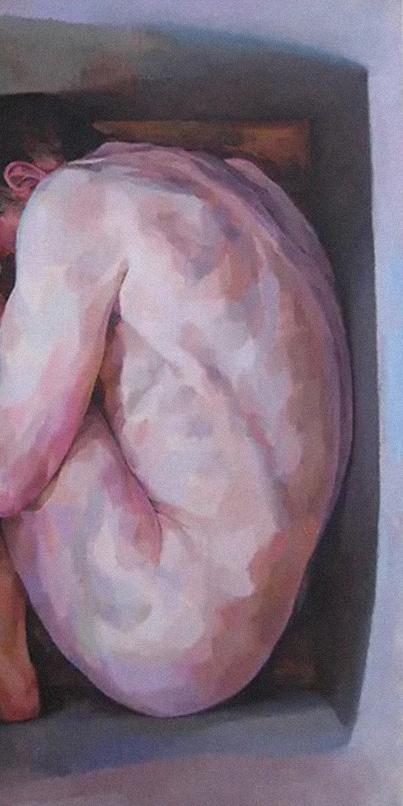
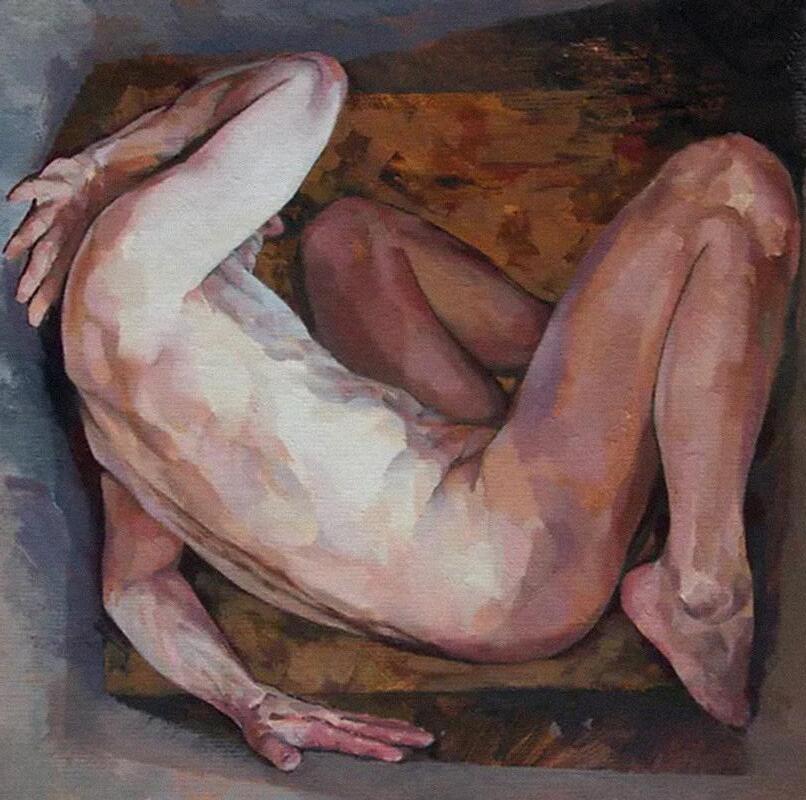
The pictorial work of the Spaniard Nacho Hernández (Leon, 1975-) has as its starting point the drawings he makes from photographs he takes of models, family members or even people he meets or knows on the street and establishes a narrative connection. From these images, he organizes compositions that both demonstrate his knowledge of classical painting and are at the service of his contemporary subjectivity.
I’m not a typical photographer, I’m a photographer/ painter, I use photography to build what will later become my paintings.
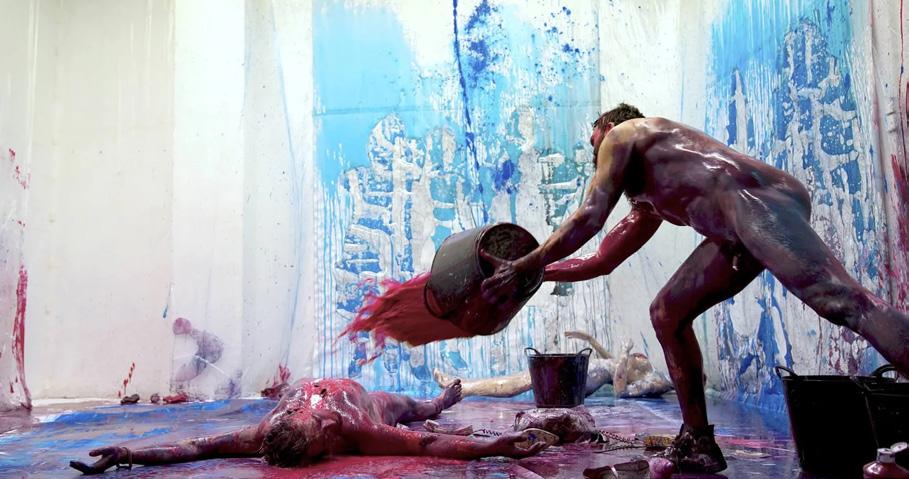
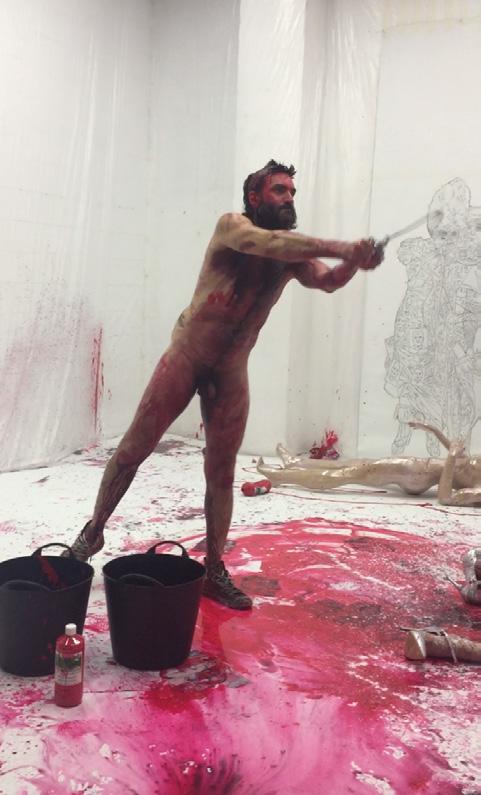
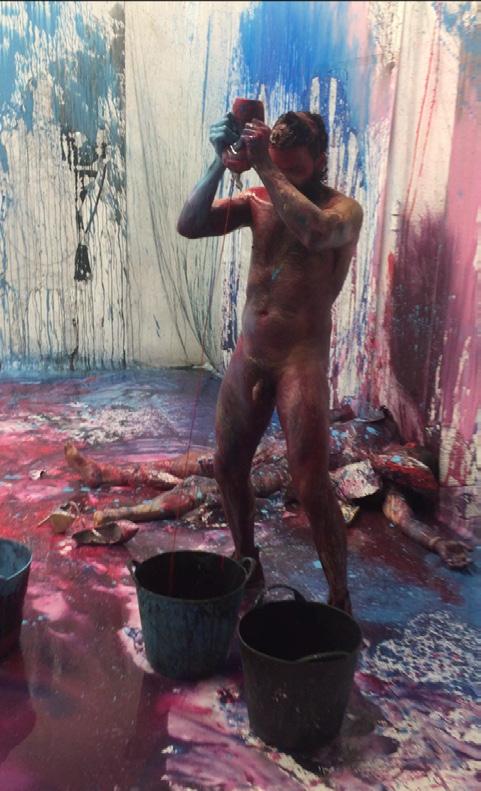
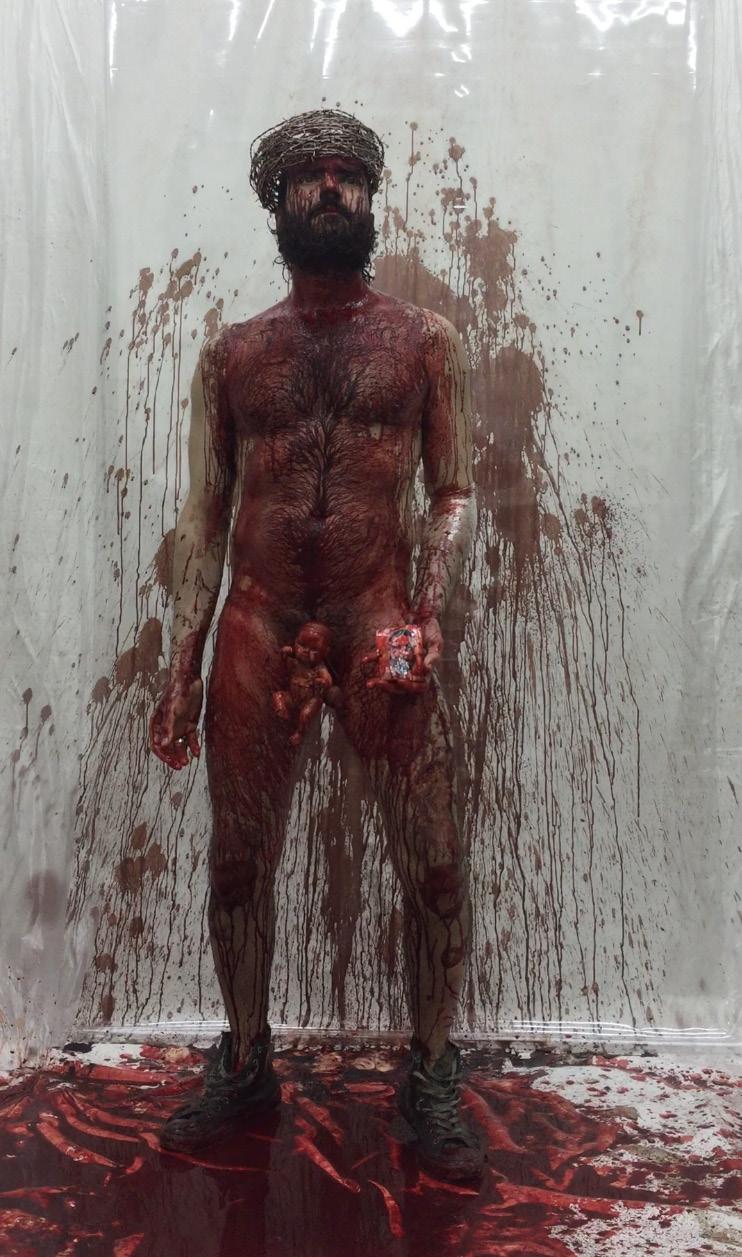
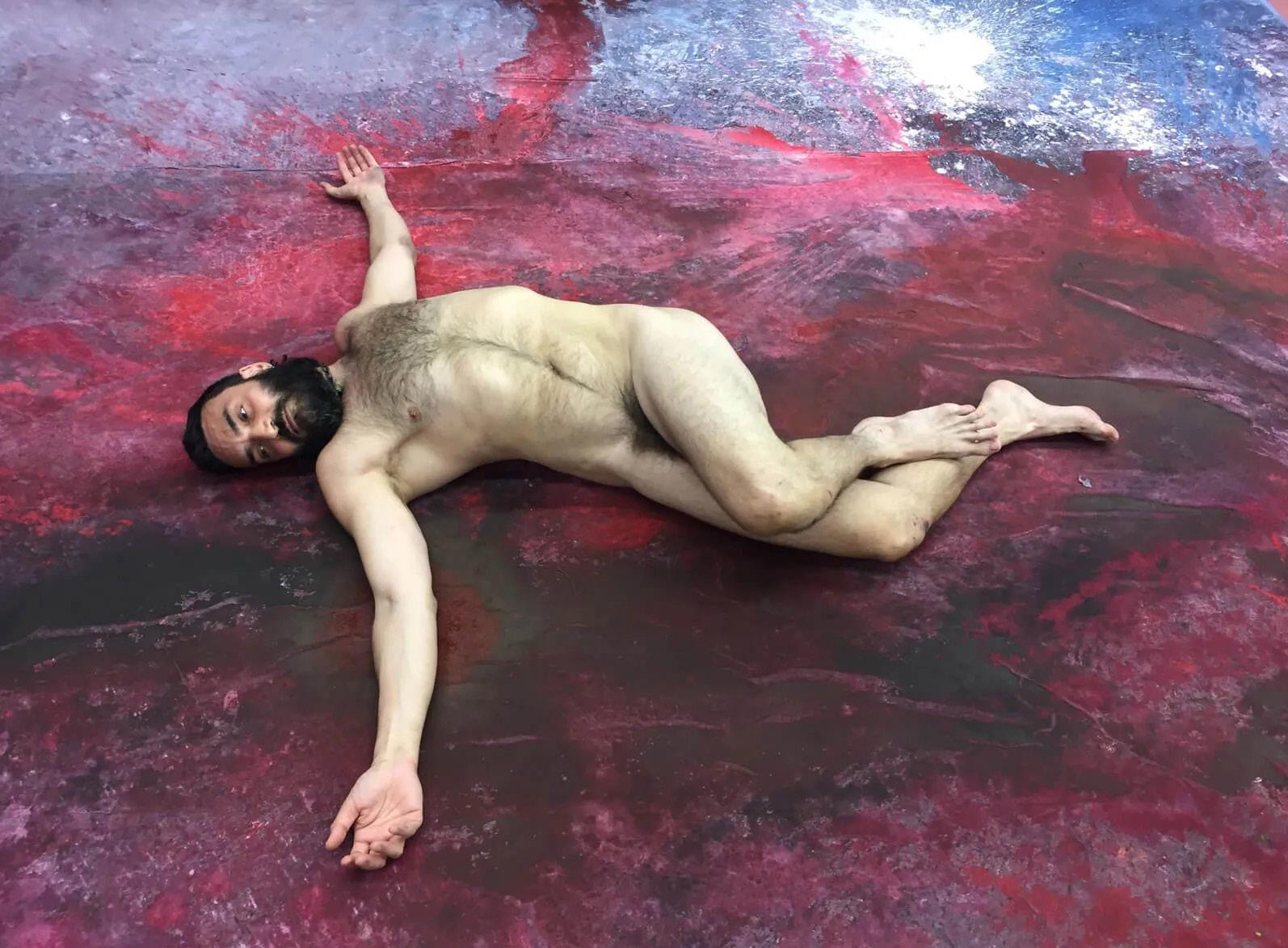
In an attempt to communicate aspects of his own biography through confrontation and identification with the viewer, the artist has been recording his creative process in performative actions for the past two years, echoing the expressiveness of Jackson Pollock’s (1912-1956) action paintings and the viscerality of Viennese Actionism*. To do so, Hernández needs to be naked, understanding that every gesture of his body is his painting tool and also the story he wishes to reveal. Aware that this nudity is loaded with social taboos, the artist has been reflecting on different ways to enhance his discourse on sexuality, avoid the narcissistic voyeuristic bias of the internet and even use censorship to his advantage.
Nudity is the truest way to present ourselves as human beings. There are no masks, no falsehood, no attempt to create an aesthetic character through gym, chemical substances or surgeries. It is this free, natural and real body that produces my artistic narrative.
* Viennese Actionism was a radical form of performance art that developed in the Austrian capital between 1960 and 1971. Composed of four members (Günter Brus, Otto Muehl, Rudolf Schwarzkogler and Hermann Nitsch), they aimed to break taboos through violent and destructive actions – often illegal – that included nudity and expressed dissatisfaction with the government and post-World War II bourgeois society. They started from painting and decided to return the figure to art through the inclusion of the artist’s body and its materialities.
In “The Human Voice” (2023), Hernández reenacts Jean Cocteau’s play of the same name, which tells the story of a young woman suffering from depression who tries to win back her lover over the phone, who is with another woman. Without intending to reproduce reality or mimic the original text, Hernández positions himself as the articulator who exposes the characters’ desires, defects, secrets and symbolism in a visceral way, thus transcending the final aesthetic result. In the actions “Reclining Christ” (2023) and “Ecce Homo” (2024), the artist moves between the carnal and the spiritual, between eros and thanatos, to remind us of the humanity of the religious figure.
On the previous page, the performance The Human Voice. On the side, Ecce Homo and, below, Reclining Christ. All images were sent by the artist or came from his website.
Bruno Novadvorski
Bruno Novadvorski’s (Porto Alegre, 1989-) work uses the body as a support for the development of research that has affinities with his artistic and academic practice. Using performance, photography and video, the artist addresses issues that start from contrasexuality, nudity, the asshole and public space as artistic devices that enable reflections and social policies.
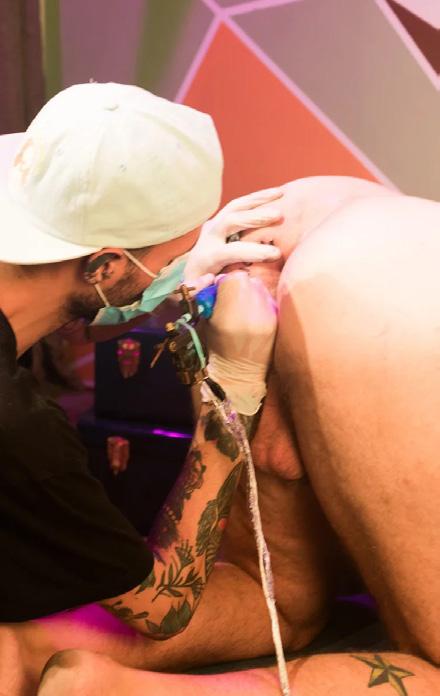
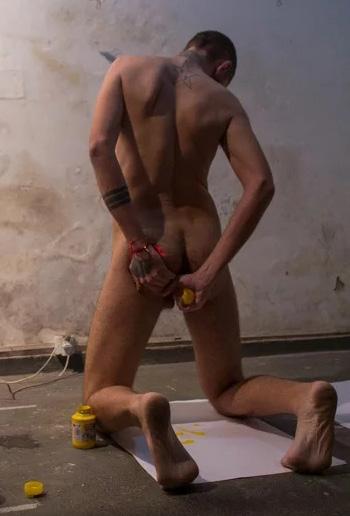
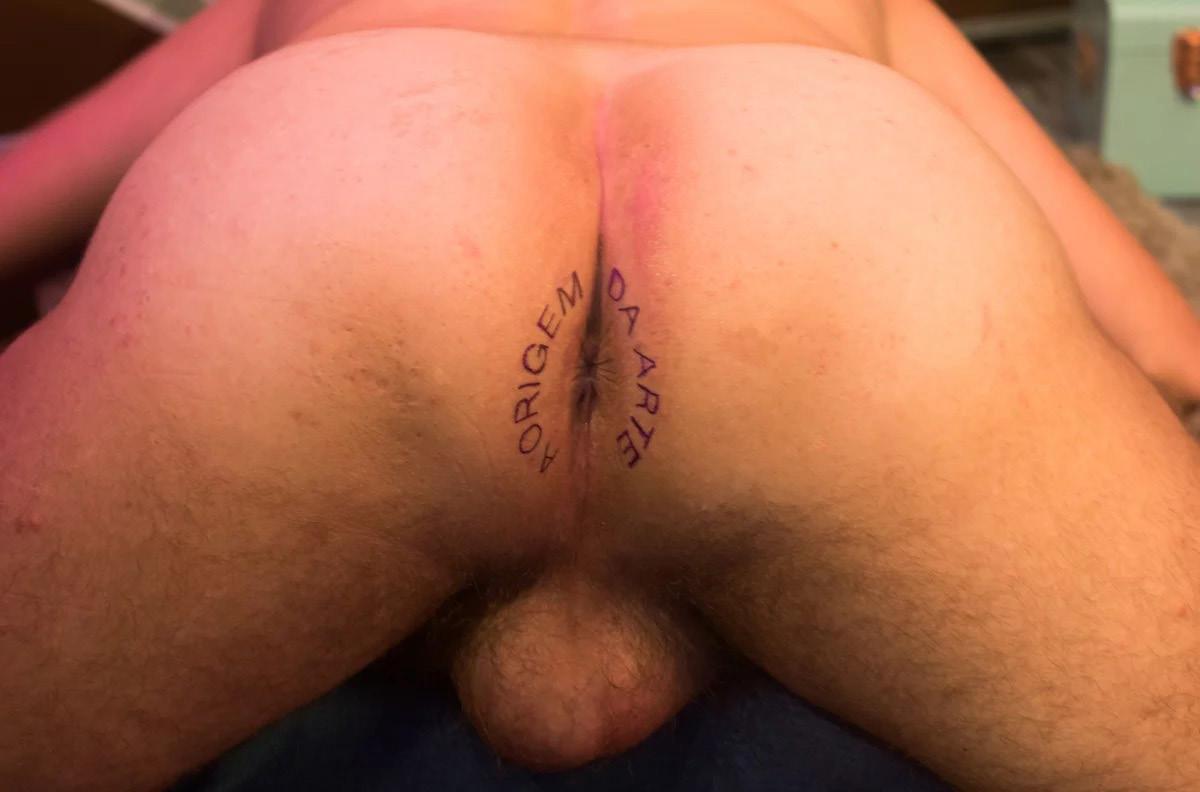
In the video performance “Rags,” Bruno undressed on the central flowerbed of the busy Avenida Farrapos in Porto Alegre, a place known for the presence of sex workers. The following year, the artist performed “Where do the colors of my existence come from?”, where he created abstract paintings from jets of liquid pigment that he had injected into his rectum; and “Have sex with me?”, when he invited people to pour hot candle wax on his naked body to feed the fetish. In 2021, he had the phrase “The origin of Art” tattooed around his ass, which was shown live on the Cam4 platform. This performance was inspired by the act of the Spanish artist Abel Azcona who, in 2017, tattooed “Make America great again” on his anus as a criticism of Trump’s campaign in the US. It is possible to see how much the artist seeks to provoke reflections both on the art system and on the taboos of sexuality.
Above, a still from “Rags”; next to it, a photo of the performance “Where do the colors of my existence come from?”; and below, the tattoo “The origin of art”. All images were taken from the artist’s website.
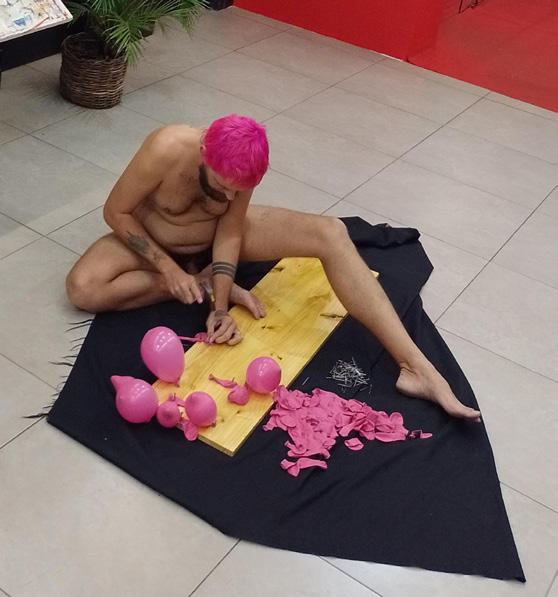
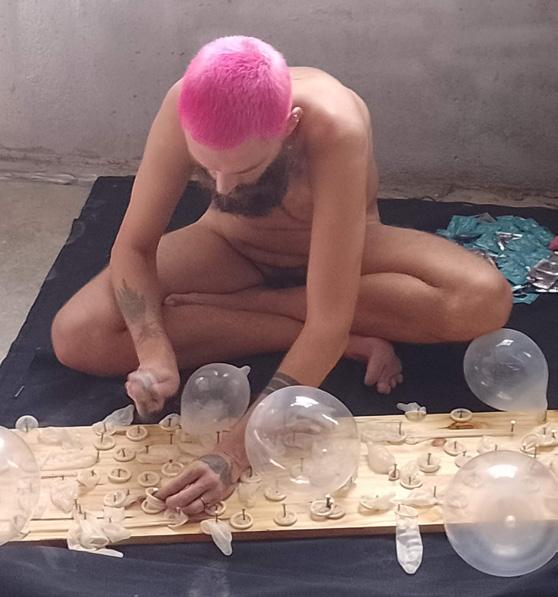
Bruno is currently developing a series of performances called “The Sound of Language,” in which the artist nails objects (balloons, condoms, etc.) to a wooden board while he is naked. The noise he creates with the sound of hammering, along with his naked presence, leads to reflections on sex, STIs, and other issues that affect the queer community.
Performance “The Sound of Language” nº1 (pink balloons) and nº2 (condoms). Both images are from the publisher’s collection.
It is worth mentioning that this article does not intend to exhaust the subject – because that would be impossible. There are countless performance artists who have been putting their naked bodies on display in the name of Art to discuss seminal issues of the contemporary world. The idea here is that you, who are reading this enormous article, will start to look at performance art in a different way, seeking reasons, finding connections and valuing the artist’s work.
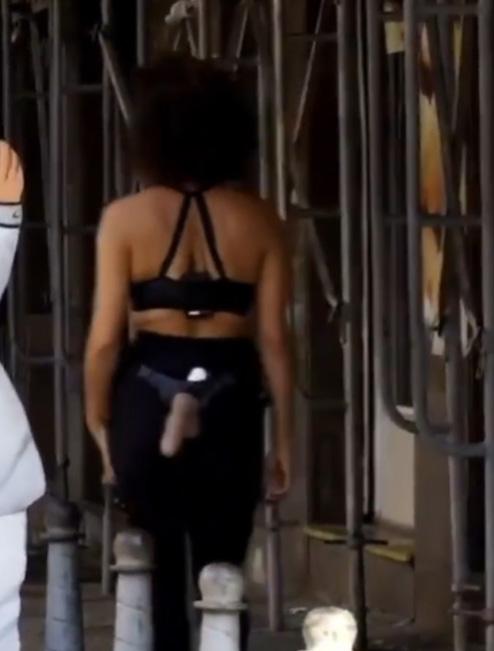
And before I finish, I’ll leave you with one more performance. In May 2021, actress Ana Flávia Cavalcanti (1982-) put on a very sexy outfit with a dildo attached to her butt as if it were a “tail” and went out on the streets of Rio de Janeiro, knowing that men would turn to look at her butt and get a “surprise”. The performance “Pau no Rabo” was repeated in 2022, but had to be interrupted after the police arrived, after all... it directly addresses the issues of harassment, sexism and patriarchy that affect women’s bodies and corrode our society. 8=D
Living with Scovino
Arthur Scovino (Rio de Janeiro, 1980-) is a multifaceted visual artist – a “tireless provocateur of audiences”. With the internet, he expanded his poetics to complicity with others. In this interview, it is possible to understand how the artist’s creative mind works, which unfolds far beyond performance as it overflows into his own – and our – lives.
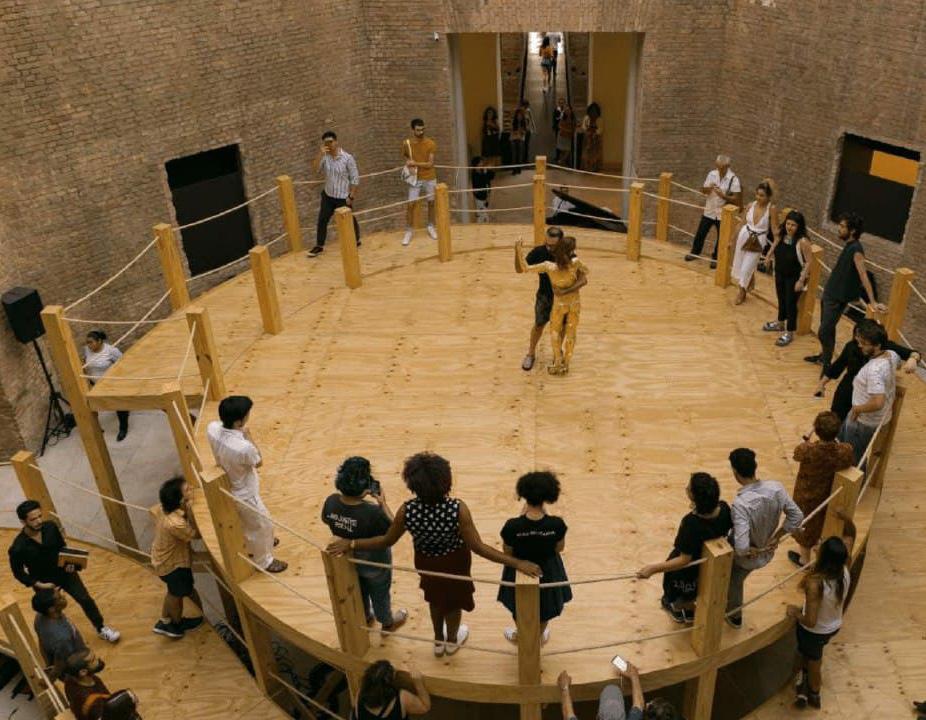
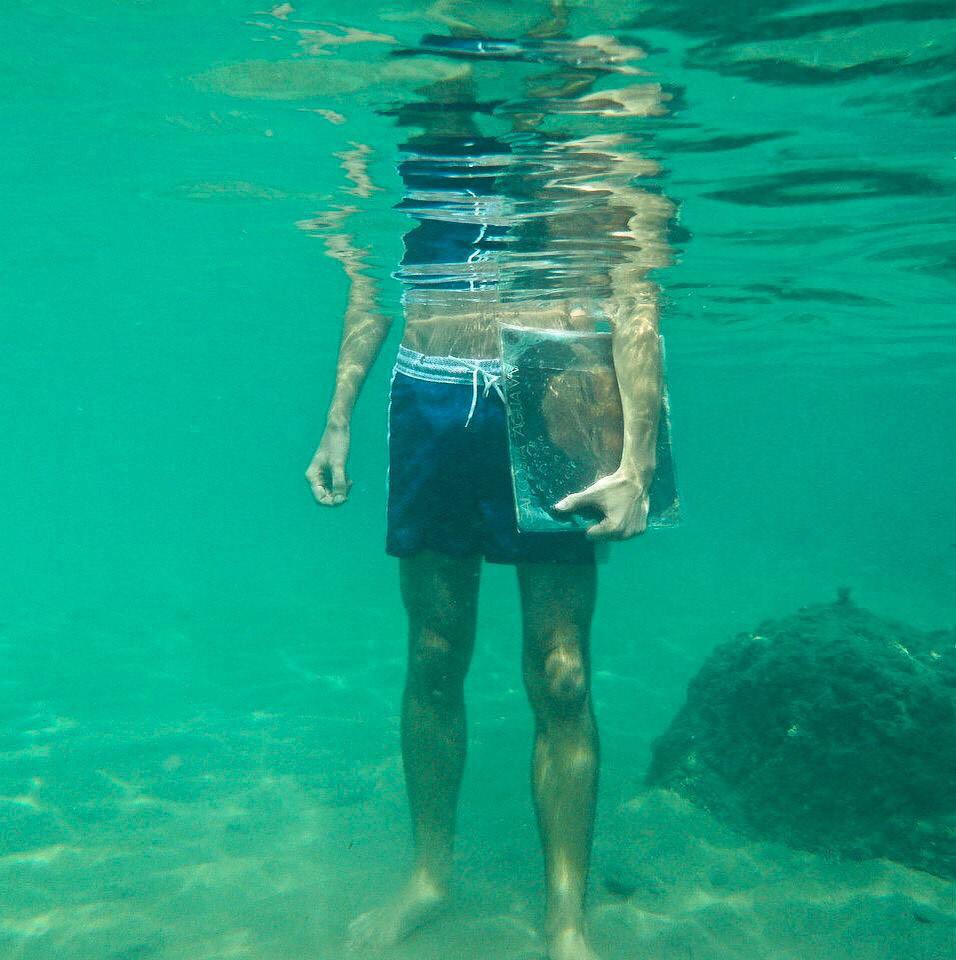
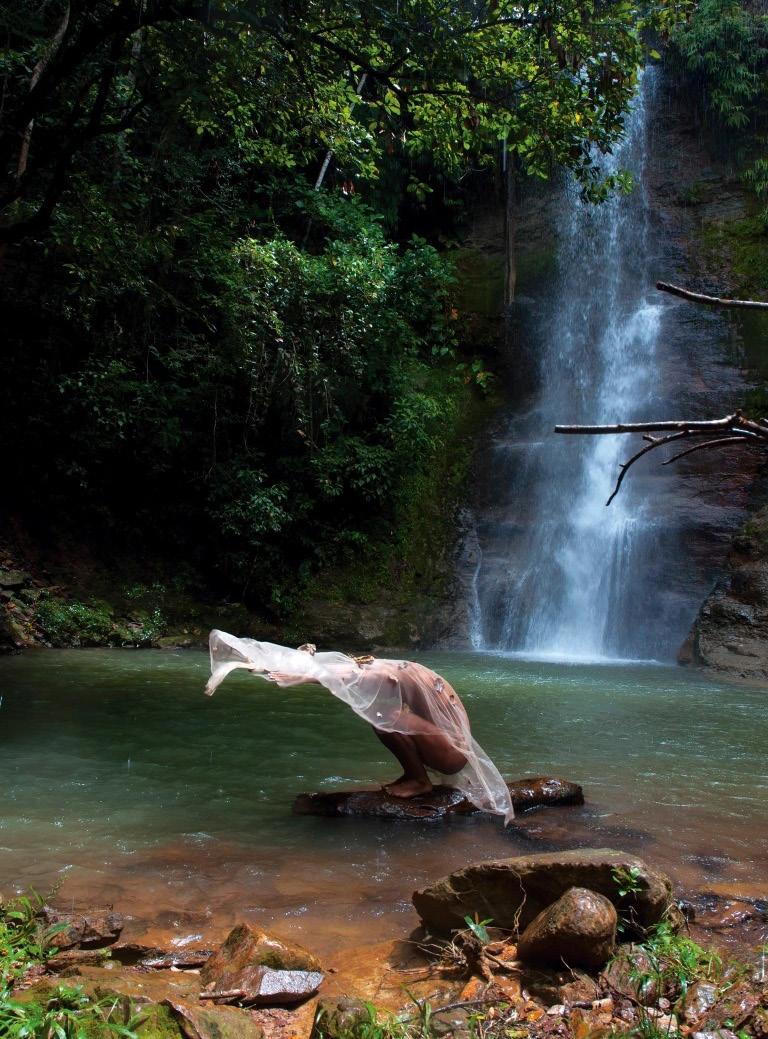
Performance Tears of Our Lady, at Casa da Luz, 2018. (Source: Artist’s collection)
[FALO] You are a multimedia artist. I can’t say that you are a painter or a photographer… You navigate through the techniques that are most exciting at that specific moment. What is performance for you? It’s you there, your body, your presence in art.
[Scovino] Performance is the beginning of everything. It’s an experience. In performance, no one pretends. Those who have been following my work for a while will have understood that it’s slow because I work with what I’m experiencing at the moment without worrying about an artistic technique. When I was in college studying art history, conceptual art and performance, I did the work with Gal’s LPs using video, photography and performance because it was the most direct way out. I could have even drawn, but that wasn’t
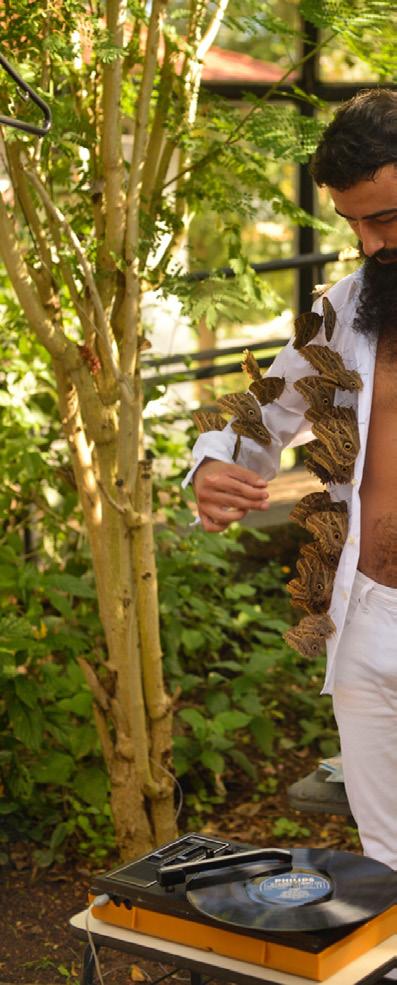
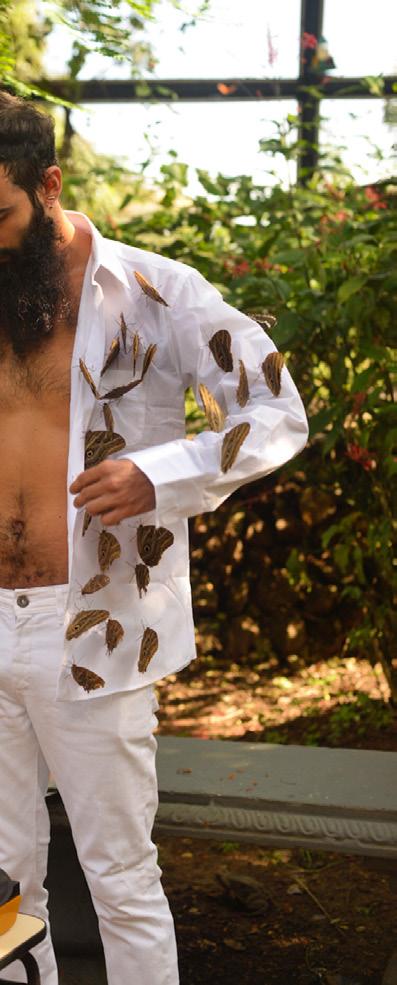
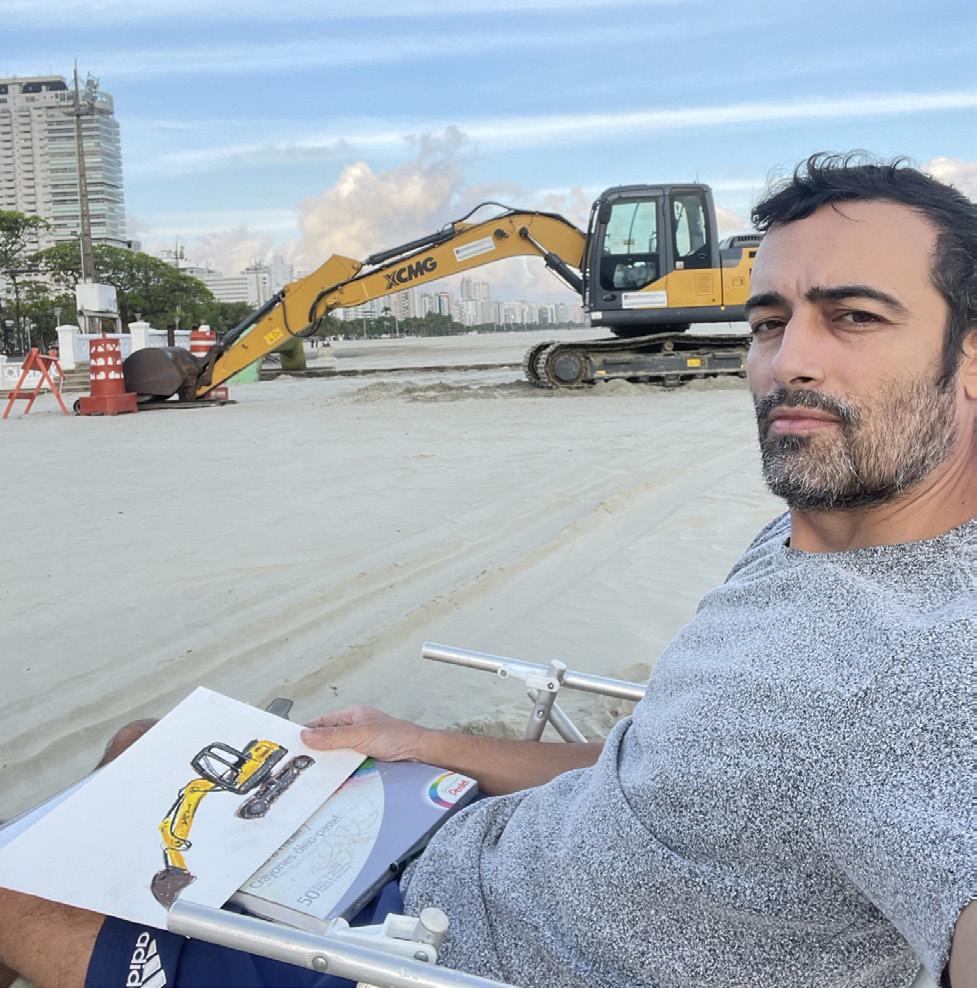
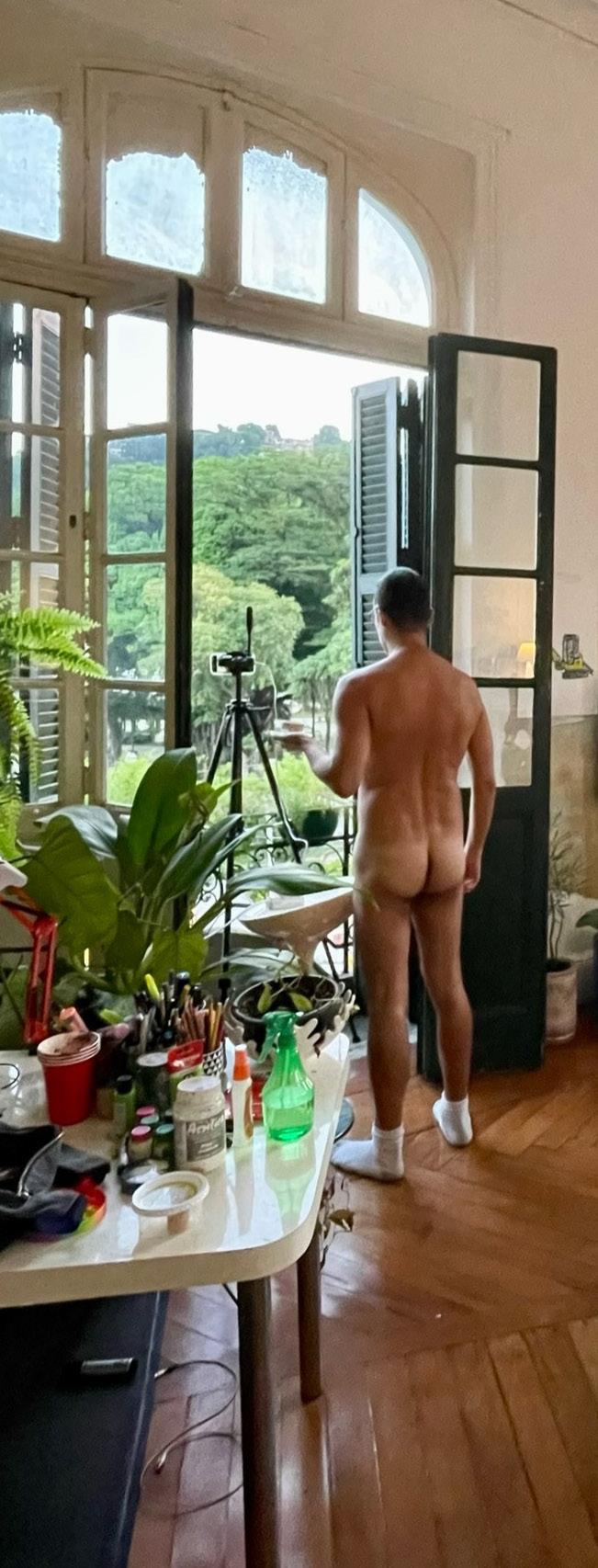
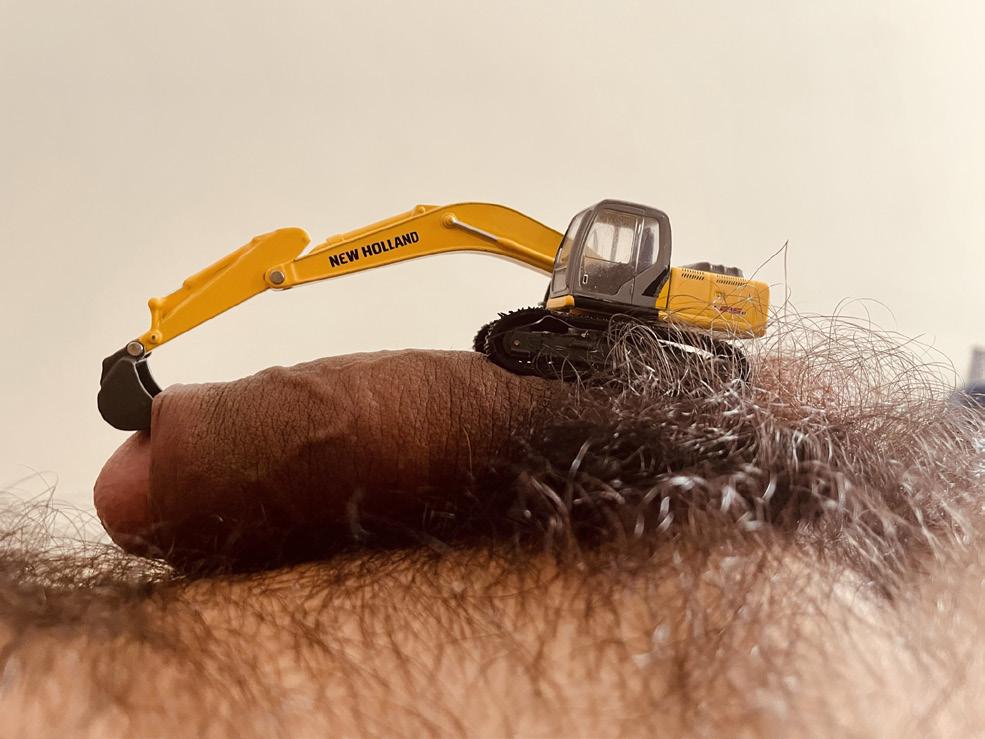
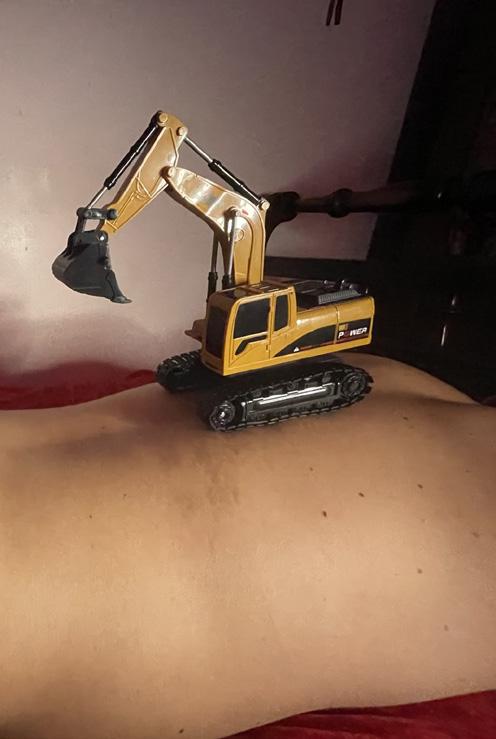
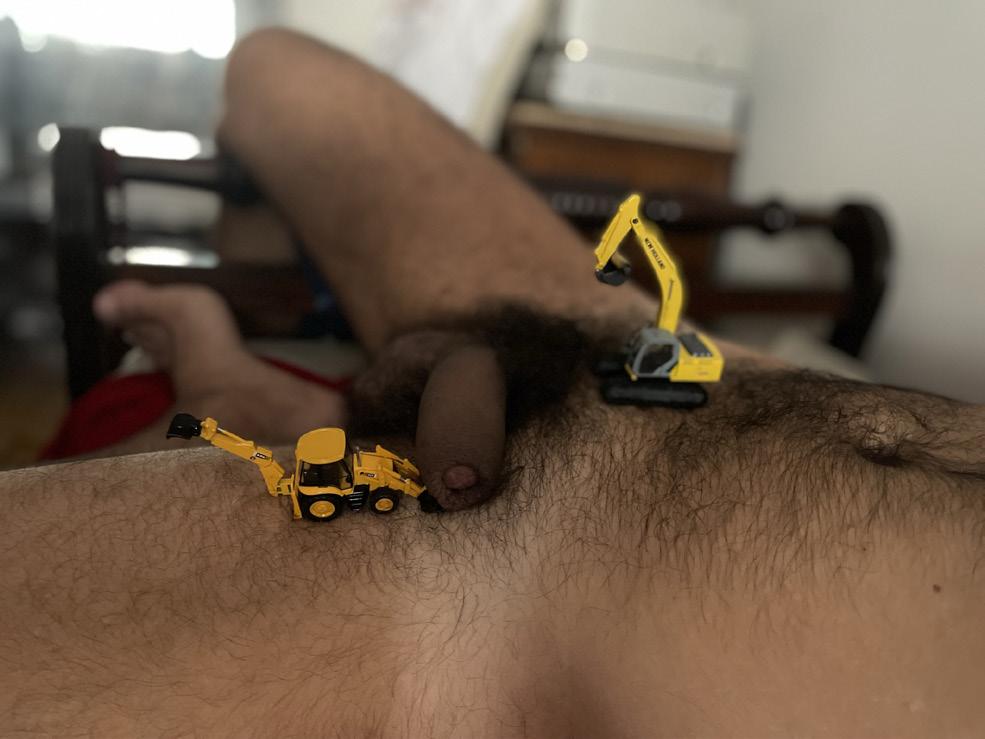
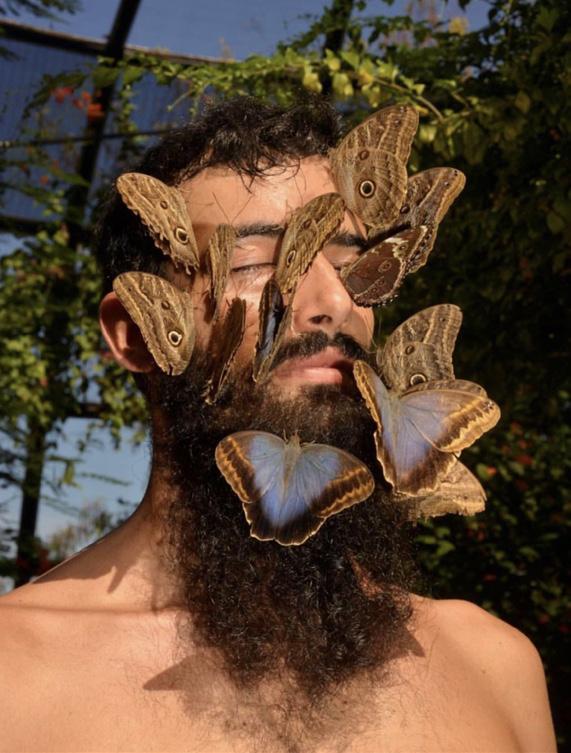
what I was experiencing. I went out to play with the records for seven months and people would see me and take pictures of me. It was the same with the butterfly project, where I spent six years creating butterflies. It wasn’t a fictional character creating butterflies: I was really living with them! I release what I produce from that. They can be drawings, stamps, videos… Now I’m having a fetish experience with an excavator and I’ve started drawing again. And even though there is a drawing with market value, making observational drawings is part of the performance.
Your art is the act of drawing and not the drawing itself.
It’s the process. I don’t usually finish projects. They’re always open. I’ve already made videos and photos
about the excavator and now I’m making drawings. I’m releasing them bit by bit. I don’t have a deadline to finish. What I want now is to experience this story. Performance is not an act to be presented at a set time for people to see. It’s part of everyday life.
Usually what we have of performances are records of them in photographs or videos. Do you think that the record is separate from the performance as an art in itself (photo performance, video performance, video art) or is it part of the project?
I’ll give you an example: a wedding is a performance; only those who were there on that day saw the event happen. But you can have a wedding album, a wedding video. A performance is possible when there is one or more people participating. And at
Below: Taking Gal’s LPs for a walk (2011), Caboclo Borboleta (2015) and Aperreável n°09 (2023/2024). (Source: Artist’s collection)
a wedding, the guests are participating. I have a degree in Fine Arts, so I sell my paintings for a living. My best-known work, which goes to institutions, is my more conceptual work. But you can find drawings, photographs, and even videos in the homes of people who collect my visual work. So, it depends on what the artist wants. I prefer to leave that question to the critics.
You mean you don’t do your performances thinking about the photographic or audiovisual record. You just do it, right?
Exactly. It’s much more common and many people think it’s more elegant to see a performance artist dedicating themselves to the physical act and using photography and video as a documentary that can be sold. In my case, I can
even invite a friend to photograph or film my performance and use that. For example, I have works that are photographic installations that were conceived based on a performance of mine. In college, I was more radical and thought of actions without any record, which depended exclusively on the experience and my written report that came later.
This corroborates what I said at the beginning, that you are a multifaceted artist who thinks in several ways. I would like to take this opportunity to ask you how it was to choose nudity in your performances.
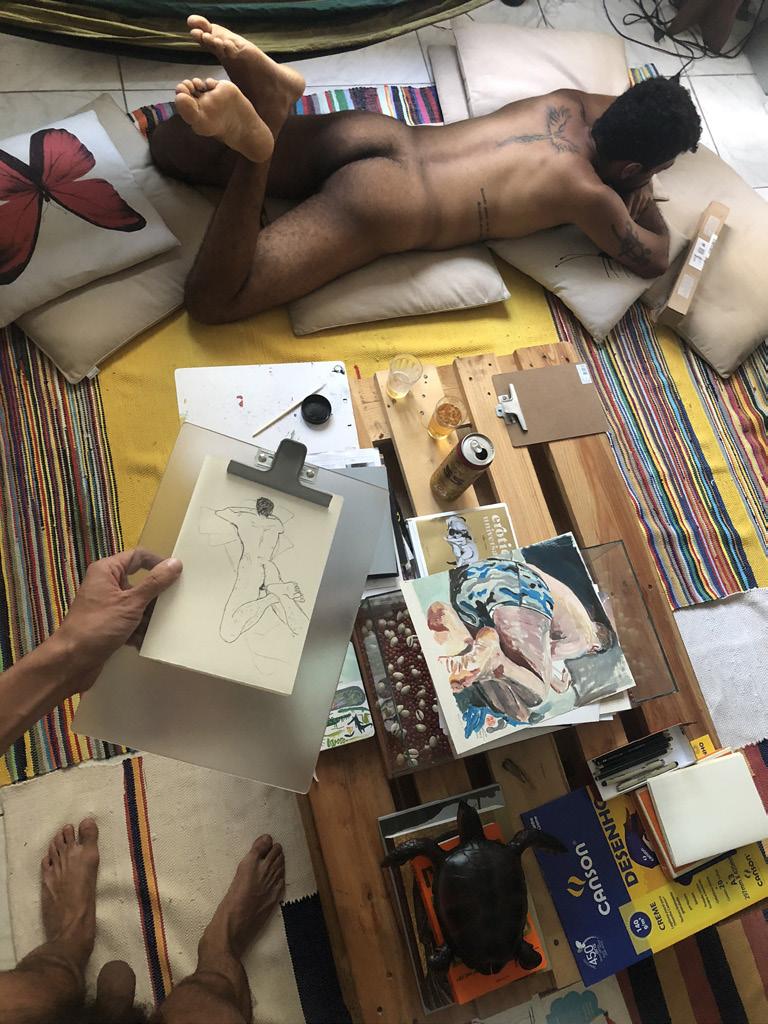
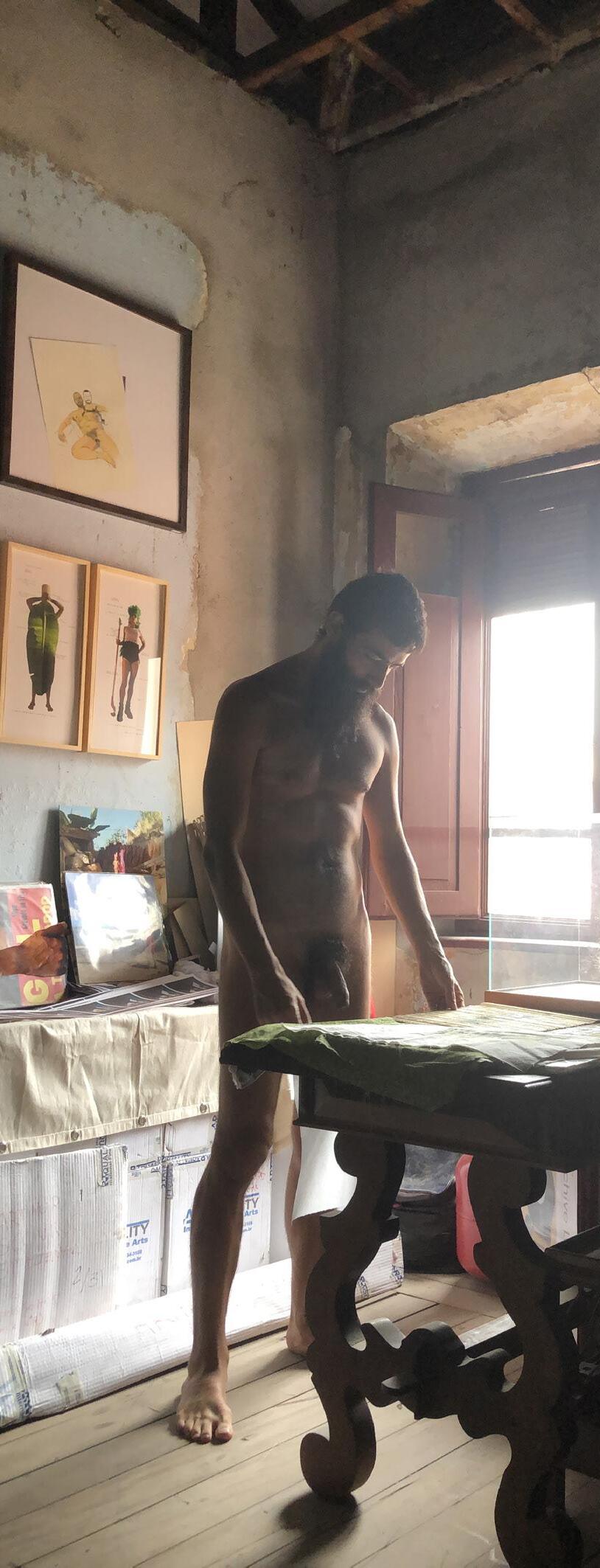
I’ve always enjoyed nudity, whether in painting, film, theater or in life, since I’m a naturist. But before I became a naturist, nudity was already a natural part of my productions. What’s really interesting is that: in fact I don’t have many performances with nudity. Despite wanting to include nudity in them, I needed the symbolism of clothing, like the white suit, the raglan blanket... I have the experimental part of nudity in my process, I get naked in the studio. In my live model project (Nudesafios), I get naked too, there’s a nudity shared with the model.
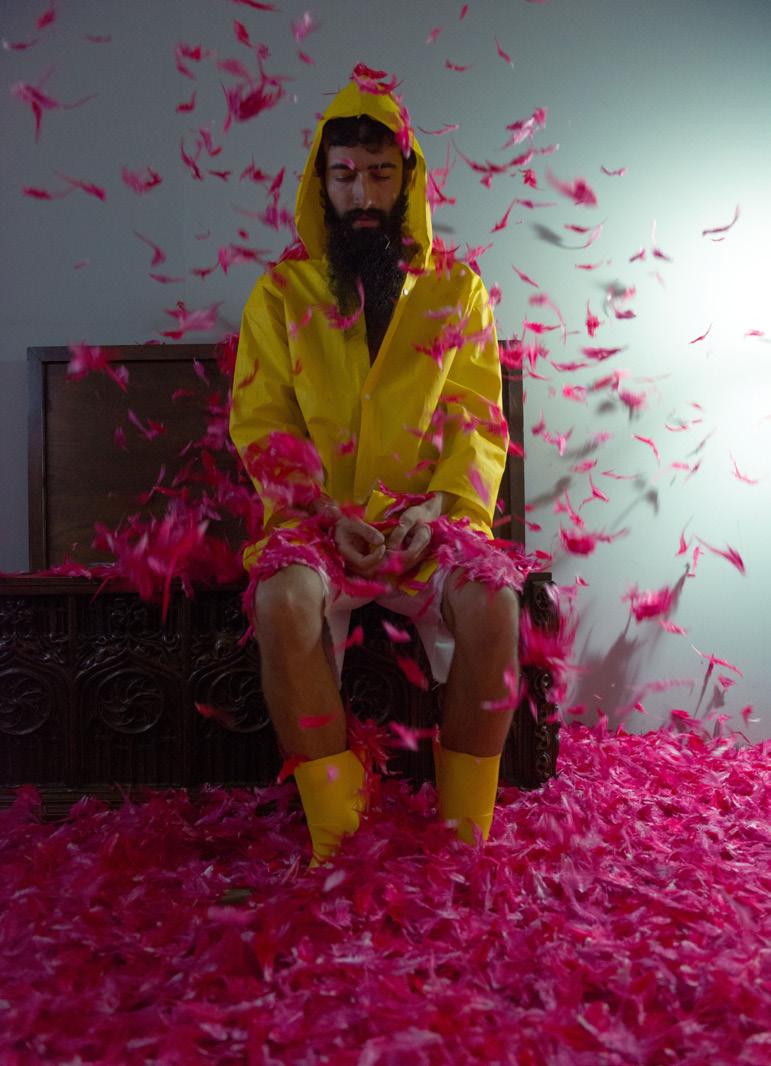
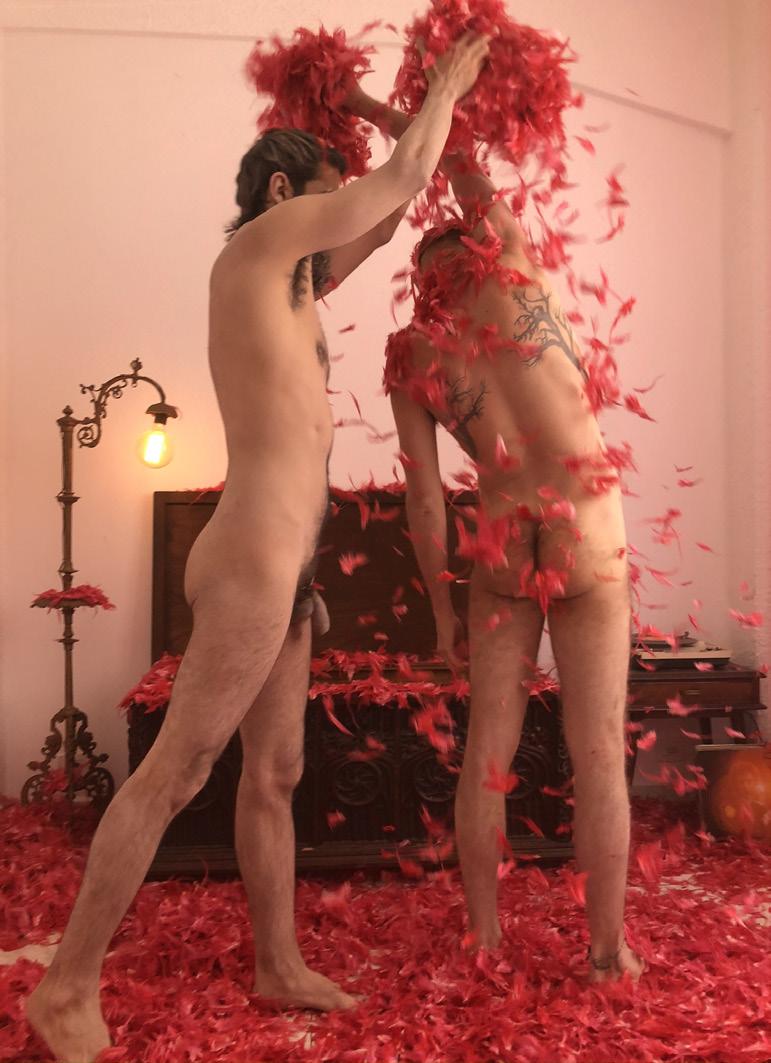
I started in 2010 and only in 2018 I did my first nude performance, at Casa da Luz, a completely alternative space with no charges. I even proposed the performance Caboclo Pena Rosa with nudity for the São Paulo Biennial 10 years ago: I would bathe a naked guest with pink feathers. After everything was ready to happen, I was told that I would need to schedule an appointment and also put up an 18+ sign at the entrance to my entire installation. Nudity is so natural to me that, when I suggested the performance, I didn’t think that children wouldn’t be able to see it. I preferred to cut out the nudity so as not to impede the visibility
Nudesafios Project. (Source: Artist’s collection)
, with raincoat and nude. (Source: Artist’s collection) of the whole thing. I did the performance with the guests wearing a raincoat. Casa da Luz was my home, a residence without the institutional weight. There I was finally able to do this nude performance. So, I don’t think of nudity as the main thing, but as an important symbol. In my new creation with this heavy machine that can kill a fragile body, nudity expands this concept of vulnerability, it becomes very strong, very beautiful, which would lose its strength if I were dressed. And the interesting thing is that, for me, being dressed is even more erotic because of the undressing.
Since you have this naturist perspective, you really see a naturalness in nudity. But the public doesn’t. And you have to deal with this way of public understanding of the symbolism of nudity. No matter how much you naturalize nudity, you can’t escape what society has constructed around it.
Because it is an art of the body, performance is a language where nudity is common and is itself loaded with symbols. Anything you put on a naked body will bring new meanings. As a teacher, I am guiding some adult content creators for paid platforms and, for the most part, they already say that they are not artists. I understand that any act of being naked in public in the society we live in today is in itself art, it is performance art. Stripping naked in a world that is not nudist is body art. I try to guide these artists to look for moments of nudity that go beyond bathing and sex.
Caboclo Pena Rosa
It is important to remember that a naked man’s body weighs more than a woman’s, especially in art due to a long patriarchal history of objectifying the female body. Male nudity is often viewed only from a sexual perspective, when, for example, a nude man is rated 18+ and an age rating of 14 or even free for art with female nudity. As a naturist, you can separate the two. But how do you deal with eroticization?
I am a naturist artist. So, I think it is necessary to be careful with this obvious association of nudity with eroticism. Proponents usually call artists who work with nudity only for erotic exhibitions. So, how are we going to change the public’s mindset, if even our field perpetuates this error? For example, I have a work in which I dance dressed on a wooden chair and it is extremely erotic, solitary, in the middle of the pandemic. I could be naked, but the game of seduction was different. No one is to blame for this confusion of meanings, but it is a clear reflection of society. Look: there are a lot of exhibitions being censored because they have naked men. What will people start to think? What will artists start to think? That male nudity causes controversy. The good thing about performance is that, when it is created by the woman herself, there is no objectification in the creation.
In the society we live in, placing a man’s naked body in art is a political act, an act of direct confrontation. The concept created by the presence of a penis is ignored, which makes everything sexualized. There is a shift in focus. And if this happens in painting and photography, in performance it is even stronger with the presence of the live body. How do you see this?
Scovino in his studio at Casa da Luz, 2018. (Source: Artist’s collection)
The artist in his artistic residency, in Santos, 2024. (Source: Artist’s collection)
From my experiences, when I was naked in performances, it was in an almost ritualistic context, connected to an ancestral background, a spirituality… I’ve already whistled Ave Maria while naked, man! I’ve never received a comment about sexualization, so I’ve never stopped to think about it. We have to ask ourselves why, we have to understand the symbolism of the aggressiveness of the penis in a sexist society. It’s necessary to have a general education, to frequent spaces where nudity is not in this context. And not just a nude beach where you see everyone naked without prejudice, but, for example, going to the Teatro Oficina, where the actors get naked in artistic actions. We need to remember that gays are also raised in a sexist and patriarchal heteronormative society, so we reproduce discourses.
You mentioned eroticism in a chair dance, but you also produce adult content for a paid platform. So, how do you see pornography in your artistic production?
I was fed up with not being able to show my work on social media anymore. And I used to do it before it became fashionable, I used to do it on Flickr. Today, not even a tiny ass is allowed. So, OnlyFans is a wonderful channel to show my work without censorship and also receive support from those who like it! And now, as an independent artist without gallery representation, I have the support of the public to have my own studio. It’s what I’ve always dreamed of. In the beginning my OnlyFans was really to promote my work that had nudity, but, over time, I began to understand that it was a space for intimacy. For example,
for me, an erection is something natural, every man gets a hard-on several times a day without having much control. But picking up a camera and purposefully doing something to provoke an erection is erotic, it’s a game of intimacy with the person who subscribes to the platform. Seeing me with a hard-on when I wake up drinking coffee is an exchange of intimacy... social media is a space for exchanging intimacy and should be used for that, not as a mere portfolio. And this intimacy, this experience, is part of my artistic process.
Is there a way to see pornography as art?
Post-porn brings this conceptual aspect. I could put a man with a hard-on next to the arm of the excavator and have a totally conceptual work. Or I could perform a blowjob on top of the excavator, but there has been no reason for that yet.
It would be a conceptual development of your current work.
It’s my fetish. And performativity is a real fetish. I’ve been living this for two years and I want to tell this story. I don’t see any difference between this and a guy who works in a bank talking about his day-to-day life on the internet, you know? And that’s
why the Big Brother show is so successful: it’s contemporary times bringing the fetish for reality. Even my cat is my invention, it’s my work. Everything you know about her is my invention. My whole life has this. Performance is so infiltrated into real life that I choose what I want to trigger or not.
So do you think that current networks and technology have influenced or inspired you as a tool for what you are building now?
I have never done a piece of work without virtual dialogue. Ever since the days of Flickr, I have interacted through comments and private messages. People from all over the world wanted to know if I lived with butterflies or if I had sex with the model I photographed. This thing of mixing intimacy led me to be curious about performance when I studied art. I learned early on to use social media to gain popularity, to have this game of complicity. With Gal’s LPs it was like this from the beginning: “take your LPs for a walk too, take a picture and send them to me”. Everyone who saw a butterfly would send me a picture. Now it’s the same with the excavator... I get more than 50 a day! Joining OnlyFans made me lose a lot of followers. And that’s okay. It’s a relief! I’m not going to explain myself. There are a lot of opinions all
Images from the performance Aperreável, 2024. (Source: Artist’s collection)
the time. Infer whatever you want. I leave suggestions based on my subjectivities. I’m not a book author who writes the beginning, middle and end of a story. Performance is the means and that’s it. It is action without explanation.
Art is free, right? You can’t lock in a concept and prevent others from thinking what they want. How do you see this art system that tries to box you in so that you are a product of this system?
I like it. It’s a work that the person does for me and I just need to confirm it or not. From the moment I put my work out there for sale... then they can do whatever they want.You can put a spiritual work of butterflies next to a work of erotic art and the problem is yours, you who made the association. I agree with you about art being free. And no artist has the obligation to be conceptual. Nowadays it seems that to be a contemporary artist you have to have a concept. No! If you want to paint still lifes, go ahead and paint! Depending on who comes to ask me about my work, I decide what kind of information I’m going to pass on. Being an artist allows me to do that.
There are many moments in art history that talk about Art and Life, that everyday life is art. And you do that.
Art and Life was the theme of all the written work, all the dissertations that were being written when I was in college… shortly after Relational Art. But I didn’t do it because I was inclined. I did it because I had an intuition. I only realized years later that things were repeating themselves, when I realized that, in fact, I had been like this for a long time, you know? And, at the moment, I have an erotic fetish for an excavator and I chose to tell everyone about it in a fragmented way through art, because, by chance, I am an artist. So there I consider that art and life make sense. Not in the search for life, but in the search for art, because life already exists. And this life today is overloaded with activism… whether it’s sexual orientation, racial… Does this activism affect you? The fact that you are white – or whatever you declare yourself to be –, gay, tall, handsome… Does this interfere with your production?
I feel free to say that I am having a relationship with an excavator. I am campaigning for the possibility of my fetish existing. For your fetish exists. It is a political presence.
When a performance artist works, he or she brings his or her autobiographical baggage. And this also brings a universal point of view. The fact that they talk about gay love does not prevent women from feeling affected by the message of affection. But, for example, when they started opening calls for proposals with themes focusing on diversity, I couldn’t submit anything. I couldn’t understand my work, for example, as queer. Then a friend told me, “The sweaty you with butterflies in your beard is super queer!”, but I didn’t see it that way. I wasn’t thinking about that when I created it. It wasn’t my research. It’s much more up to you to put a label on it and say what I am.
Again: art is alive.
That’s what I was talking about when it comes to concept. That’s the job of the curator, of the researcher. It’s like the issue of nudity: I’ll only answer that kind of question when someone like you asks me, because it’s so natural to me that I would only look at my work from that perspective if you asked me to. Artists who are addicted to academic references, master’s degrees and doctorates end up getting lost in excessive justifications and many end up emptying themselves. I’m not saying it’s wrong to have a structured concept, but I don’t do that. I do the work and answer the questions informally, based on experience. It’s my choice.
Your generosity with those who look at your work is interesting. Both with the story of the butterfly being queer, and with this interview that looks at your artistic production from the perspective of nudity when you yourself say that it is not the main thing.
Of course there is a lot of phallus in my art. But it is not much compared to a lot of other things. Each person can make their own choices. The interesting thing is that only now, in this conversation, am I becoming aware of the more public issues. Of course I don’t want to be censored, but when my work leaves me and goes out into the public eye, I have to understand that my penis is frowned upon. I am aware of how aggressive it is for society. I once had a work with nudity approved by the curatorship of Caixa Cultural that, shortly before the opening, had to be given an age rating. The photo went so far beyond nudity that no one involved in the exhibition saw it, only those who had a different perspective. When I see trans people, women and men, attacked by machismo and the power of the penis in the history of humanity, I prefer to keep my penis tucked away and only show it where I feel most comfortable. I am not going to fight for an equal age rating. This
Record of the performance Nhanderudson –at a point equidistant between the Atlantic and the Pacific, which required an indicative classification in the exhibition, in 2015. (Source: Artist’s collection)
Images from the performance Living Water, 2015. (Source: Artist’s collection)
is my political thinking, out of respect for activism. Maybe we will think differently about this.
I don’t think our thoughts are that different. I think that in order to really change things, we need to discuss them, and there’s not much talk about them. The live model Juliano Hollivier says something important: we can’t impose nudity. To impose is to harass. We need consent. Falo doesn’t claim to put dicks everywhere, but it wants to provoke reflections on this topic, it wants to discuss the dynamics of body representations, it wants to make the phallus visible to naturalize male nudity. For example, in this conversation, you yourself stopped to reflect.
It’s really something that’s present in my work that I had never thought about. And I remember an episode now... I participated in an erotic art exhibition in Rio de Janeiro that caused a big fuss when a female artist felt offended by the excess of dicks. Until someone decided to count and saw that there were more pussies than dicks in the exhibition. But it’s really the dicks that oppress. And when I try to understand her claim or the
reasons for the difference in age rating, I start to know where I can show my dick.
Even though there was less in the exhibition you mentioned, the penis is so taboo, so mysterious, that it ends up attracting more attention. And it’s even crazier on social media... When you censor or make it 18 years old, the desire increases. The demand increases. Those who know how to use censorship to their advantage benefit.
Because you’re touching the desires of a lot of people. People who read your magazine just like the people who subscribe to my OnlyFans. A lot of penises and, suddenly, they’ll see a drawing and think “art is cool too, right?” So, you might end up converting some minds to get more poetic about the fascination with penis.
It’s about seeking quality over quantity. Exactly.
Thank you, Arthur. I will continue following your experiences!
Soon, more of them on Falo!
David Farquhar
by Filipe Chagas
Changing room, 2022.
Drawing is one of the fundamental bases of human communication and artistic expression. Between professional comings and goings, Scotsman David Farquhar has never abandoned his small set of drawing tools that he feels comfortable with (“I use my trusted Palomino Blacking and Faber-Castell pencils, a Mono Zero eraser for its super tip and rice paper blending sticks to soften edges and blend”).
Once he finished secondary school, he took an art portfolio building course which prepared him for entry to Duncan of Jordanstone College of Art & Design, where he studied illustration and printmaking for four years. His plans to pursue a master’s degree did not materialize and he had to change career: for more than a decade, he worked as a makeup artist for TV, cinema and theater (“it allowed me to be creative in a different medium, using the face and body as a canvas”) and then continued as a teacher and manager in the area. While the administrative work was stifling, the classroom allowed him to watch students honing their technical skills.
I draw when I feel the need, when I feel inspired. I spend a lot of my time teaching in the classroom and walking students through intricate processes, so when I do have my drawing time, it’s just for me. It helps me unwind and relax and therefore I don’t want this to turn into a stressful process.
His artistic exploration has converged on monochromatic pencil drawings, where his mastery of light and shadow takes center stage, with strong inspiration from Egon Schiele, J.C. Leyendecker, Chris Bachalo and Bill Sienkiewicz. Farquhar also employs inks, markers and other techniques to further enrich his creations.
He understands that his perspective as a gay man makes his work dedicated to delving into the intricate layers of LGBTQIA+ relationships and issues, reflecting his commitment to fostering understanding and representation. Thus, the male figure is the protagonist – with a preference for drawing body hair and muscles. This means that, no matter how much he enjoys a live model session, he ends up choosing to use photographs to spend time on the smallest details and shading (“I would not put a model through the torture of a ten hour posed session”).
Bound, 2022.
Dancing barefoot, 2023.
Held, 2020.
Believing that the phallus is demonized in most media today, the artist draws it when it makes sense in the composition and, usually, as a provocation.
I
prefer to show excitement or sexuality without the erect phallus.
Slouch
Although it took him a while to feel comfortable sharing his work on social media, the feedback from the public was extremely positive. However, the algorithm’s censorship and constant restrictions led Farquhar to reflect on the medium.
They are killing creativity and selfexpression. I think it’s time to make online social media platforms only available to those 18 and over.
The advancement of AI in artistic productions is another point where the artist imposes himself:
I feel that working traditionally is a big difference nowadays. I even use software to refine and clean up backgrounds and have experimented with digital drawing, but using AI to reduce creation time is a sacrifice of quality in favor of quantity.
Wear your scars, 2021.
Even seeing this setback, the artist plans to “keep drawing as long as I am inspired” and advises artists to seek out their audiences without being affected by censorship (“create your own space away from the networks”). 8=D
Flopes
by Filipe Chagas
Bather 2 (Self-portrait), from the Lifeguard series, graphite, ink and watercolor on paper, 2024.
Flopes’* earliest memories are of him drawing. From a young age until shortly after graduating in Visual Arts, he nurtured the desire to be an artist and discovered himself as one, drawing influences from the world of comics, such as the erotic aesthetics of Carlos Zéfiro (1921-1992), the anatomy and impeccable finishing of Paolo Eleuteri Serpieri (1944-) in the Druuna series, the way of approaching homoeroticism of Tom of Finland (1920-1991), the hatching and finishing of Takehiko Inoue (1967-) in the manga Vagabond and the improvisation and creative process of Lourenço Mutarelli (1964-), of whom he had the privilege of being a student.
* Artistic name of Fabio Lopes.
Despite having studied life drawing since he was 18, the artist from São Paulo reveals that his time at university was responsible for the turnaround in his production, because, in addition to starting to paint, he discovered performance art. At that time, he began to understand the practice of life models not only as a means of observational study.
I like drawing life models so much that it may be my hobby (laughs). Most of my work is done with reference to life models and photos that I have created or co-authored. Egon Schiele and Modigliani are two very important artists, because I recognize in their work an erotic and melancholic rawness when composing and painting the models. Another artist who awakens these feelings in me is Eduardo Berliner, who adds sarcasm and a dark absurdity. Then I get Magritte and Erwin Wurm with works that present surrealist compositions, based on the combination of bodies with objects. Wurm is the artist I have revisited the most. The performativity present in my process is very much in line with Wurm’s compositions of bodies and objects (body-object).
All these references serve as “food” for the artist’s creative flow, who, even when working with themes (“to feel less random”), prefers intuition to the hermeticity of the concept. Also an actor and drag artist, he usually tests his new ideas based on self-portraits and then creates them with models (“usually friends”) in meetings he calls Improvisation Sessions (“where it is important not to get stuck in preconceived ideas”). In these meetings, Flopes sets aside some objects for the model to interact with and create compositions with the body. The entire process is photographed and archived in an image bank for later consultation.
Live model studies: above, Nando, felt-tip pen on paper; and below, Thiago, Indian ink on paper.
Live model study (Chris), felt-tip pen on paper.
Study for a Bather (Gabriel) , marker pen and acrylic on canvas, 2023.
Bather 1 (Self-portrait) , marker pen and acrylic on canvas, 2023.
Of course, nudity is intrinsic to his production and the entire body is of interest to the artist. He recalls that for a long time, he portrayed “faceless bodies” due to the time limit for poses in live model sessions (“I like to draw the complete pose and I would end up skipping the face stage”), but today he is excited about studying physiognomy.
The choice of male forms goes beyond mere sexual desire:
I feel more comfortable and know how to eroticize when this is the objective of the creation. But I believe it has to do mainly with the desire for exchange, the desire to portray my friends or interesting people that I want to get to know a little better and observe their natural beauty. I really enjoy experiencing a private nude session. From the initial shyness to the moment when nudity becomes banal, but conscious.
Movement II (Ubiratan) , from the Blue Improvisation series, graphite, ink and watercolor, 2024.
Untitled 4, from the Lifeguard series, graphite, ink and watercolor on paper, 2024.
Watercolors from the series With a busy head, 2018-2021.
Constriction , acrylic on canvas, 2024.
Untitled , from the series Sleepwalkers , acrylic on canvas, 2024.
Leandro, acrylic on cotton, 2024.
The artist also points out that nudity in art “is a way of confronting the castrating idea of conservative origins of fear of the body”. With this, portraying genitals, whether male or female, becomes an extremely important manifesto.
It is beautiful to observe the constant changes in the shape of the penis and scrotum, whether soft or erect. I like to portray the feeling of something being imminent.
Although he has never been afraid to show his work, Flopes realizes that taboos outside the artistic world interfere with the presence of the male figure as an object of art, but not with the representation of the feminine. He sees a greater erotic appeal in male bodies in convergence with the toxicity and aggressiveness of macho masculinities. This does not prevent Flopes from continuing to produce, to seek greater visibility, to have good encounters and to fulfill his artistic desires. 8=D
Gyulliano (acrylic on canvas) and John (acrylic on paper), 2021.
Oleksandr Balbyshev
by Filipe Chagas
The French painter Nicolas Poussin (1594-1665) used colors to create contrasts and focal points in his Baroque compositions. The following quote is believed to be his:
The colors in painting are like lures that seduce the eyes, as the beauty of verses in poetry.
Oleksandr Balbyshev seems to follow Poussin in making colors so bright and vivid that they become the protagonists of the gaze in a lysergic aesthetic. He says that, by echoing kitsch and Surrealism, his colors “bring a sense of energy and boldness that transforms what might be seen as vulnerable into something powerful and unapologetic.” And there’s a reason for that: Balbyshev is Ukrainian, born into a working-class family just six years before the collapse of the Soviet Union. In Ukraine, LGBTQIA+ people live in constant fear, without many of the rights that other citizens take for granted, hiding their sexual orientation or gender identity to avoid discrimination or violent harassment.
Resting Minotaur, oil on canvas, 2024.
This reality has profoundly shaped who I am and the art I create. Accepting myself as I am has been incredibly difficult within a society dominated by hostile moral standards. I have struggled (and still struggle) with toxic masculinity and internalized shame, which have left lasting marks on my soul. And this sometimes seeps into my paintings, reflecting this emotional burden.
However, the painter reveals that there is also a positive aspect to this struggle, as it made him find the strength to survive and succeed in a toxic environment. Shortly after graduating in Civil Engineering and Architecture and working in the field, the first Russian invasion of Ukraine took place (2014), leading the country to a serious financial crisis that led him to lose his job
and finally bet on his creative potential. His art then became a form of protest, a challenge to the moral standards of Ukrainian society.
The male form becomes central to your work because there is not only a desire to explore the nature of male identity – both personal and collective – but also to understand its complexity and the ways in which it has been defined, restricted and stigmatized.
Double annunciation, oil on canvas, 2022.
Nude with a flower face, oil on canvas, 2023.
Above, Puppy play (2024), and, below, Nude with irises (2023), both in oil on canvas.
Growing up in environments where traditional masculinity was mandatory, I often felt alienated. With my art, I want to challenge these narrow and outdated definitions. I want to reclaim the male form on my own terms: showing that it can be soft, powerful, erotic or fragile. I want to explore this fluidity to redefine what it means to be a man in a new space for queer expression.
Balbyshev’s creative process is a mix of reflection and experimentation on all these issues without shying away from the homoerotic nature of his paintings, as he claims he wants to make visible and normalize what is still considered taboo. This makes oil paint the ideal technique for him, as he recognized the depth it offers, when he asked his parents for the material at eight years old:
Pride Angel, oil on canvas, 2023.
It feels like you are capturing a piece of the soul in the artwork. It’s like the painting comes to life.
He uses a lot of references from art history as if he were seeking a non-traditional and less heteronormative reinterpretation to counter the limits (“both mine and those imposed by society”). As a Ukrainian, he also seeks to overcome his country’s traumatic history by transforming iconic Soviet images and symbols (such as portraits of Soviet leaders) into something humorous and no longer intimidating.
Blue Leopard, oil on canvas, 2024.
Male nudity, in particular, had already appeared in student works. One of them, which had a Caravaggesque tone, was completely ignored by the public, which made the artist realize how difficult the subject was even in the creative academic environment.
I use the male nude in the same way that female nudity has been used for centuries. Showing male frontal nudity is about embracing the full spectrum of masculinity and the beauty of the human form without shame or censorship. It is an act of celebration, a way of reclaiming and honoring the body in its most honest state. For me, it’s not just about anatomy; it’s about capturing the essence of being, free from social constraints.
Balbyshev understands that every part of the male body, every curve, muscle and line tells its own story and contributes to the overall beauty of the form:
I find joy in capturing the subtleties of expression, the strength of hands, the softness of a curve or the tension of a muscle. I am particularly drawn to portraying the torso, as it is a powerful mix of strength and vulnerability, where the lines of masculinity are often most pronounced and expressive. But really, it is the harmony of all the parts together that fascinates me: every detail, no matter how small, plays an essential role in the portrait of a man.
And this applies to the genital region. For the artist, the choice between depicting a flaccid or erect phallus is not just a question of aesthetics: it is about context, intention and cultural sensitivity. The flaccid phallus is often seen as more natural and less loaded with explicit connotations, allowing the viewer to appreciate the male form in a more classical and serene way, while the erection is seen as provocative, confrontational and pornographic.
Recycled Lenin nº1 and nº2, oils on canvas, 2023.
Saint Sebastian, oil on canvas, 2022.
I swear it wasn’t me, oil on canvas, 2020.
Amor, oil on canvas, 2023.
Hands of God Nebula, oil on canvas, 2024.
Although he sees significant changes in the acceptance of the male figure as an object of art (“there is a growing recognition and appreciation of the male form that goes beyond traditional notions of masculinity, with social media playing a very important role”), the artist knows that it depends on the cultural context (“there is also a lot of tension in society, especially around masculinity and how it is being redefined). In Ukraine, social norms and legal restrictions are quite conservative, and the Ministry of Culture strictly regulates what is considered art or pornography, even interfering with international shipments (“any representation of an erect phallus makes it almost impossible to obtain permission, as it would automatically be classified as explicit content”). The consequence is selfcensorship, where Balbyshev chooses to focus on what he can share openly, respecting the limits set by the environment in which he works. It is in this delicate balance that “the conversation about male nudity is kept subtle and accessible”.
Bablyshev’s contestant attitude is also dreamy, which has led to collectors from all over the world seeking out his work. He still hopes for the opportunity to free himself from “these chains of retrograde morality” and gain more freedom of artistic expression:
I want to see a world where the male nude is as prevalent and accepted as the female nude, removing its shock value and normalizing it as a form of expression.
We want it too. 8=D
Balbyshev at his studio.
After all does size matter?
NO! And I can prove it!
Phallus Focus in
Richard Poulin is an award-winning designer, highly respected educator, author of several books and visual artist, dividing his time between professional practice and academia. For several years he has been working with mixed media collage constructions that celebrate his passions and pains, joys and losses, his soul and his experiences as a gay man.
He sees his creative process as a natural, organic, and integral part of his life. Thus, the male form has always been an important, if not primary, source of inspiration. However, frontal nudity is not a driving force but rather part of a narrative.
The naked male form represents beauty, strength, sexuality and the human spirit. Therefore, it is an essential visual element in my work.
On his 12 x 12 inch birch plywood panels, Poulin clusters photographs, printed ephemera and correspondence he has collected over the past forty years, with inspiration from the works of modernist and avant-garde artists such as Kurt Schwitters (1887-1948), Hannah Höch (1889-1979) and Joseph Cornell (1903-1972).
Intimacy and Doubt , from Monochromatic Dialogs series.
Above, Longing, Coming out and Pain and Pleasures, all from the Visual Essays: Elemental Singularities I series.
Below, Fundamental needs, Love, lust and desire e Hidden facts, all from the Visual Essays: Elemental Singularities II series.
Above, Light and Shadows, from série Monochromatic Dialogs series.
On the side, The rituals of men, from Visual Essays: Elemental Singularities I series.
Below, the artist.
Phallus Focus in
Drawn to issues around our surveillance culture, human rights and state controls on individual freedoms, Glenn Ibbitson turns to the human form and its interpretative power to express ideas of isolation, oppression and resistance. He seeks to highlight the plight of those who do not have space in society, those who are persecuted for their beliefs, their politics and their lifestyles, or who simply don’t fit into any of societies templates.
Ibbitson understands the male body as a muscular structure most useful to his aesthetic concerns – arising from his interest in superhero comics. If necessary, nudity becomes a narrative strategy and the penis is treated as a mere part of the body and composition. The paintings in the “Consignment” series, for example, were designed to be hung any way up on the wall; the visibility of the penis would have indicated gravitational pull and forced the work to be displayed in one fixed position.
The artist believes that, if used correctly, the virtual stage can defuse social tensions surrounding nudity to create an environment of equality across the sexual spectrum.
Art might just be able to reform the image of the phallus as a ballistic weapon into one of a pleasure giving instrument.
Above, Levitator
On the side, The Emerald Archer
Below, Clawman
All oils on canvas from Smoke and Mirrors series.
Oils on canvas from Consignment series.
116
Oils on canvas from Target series.
117
Oils on canvas from Barcode series.
Phallus Focus in
Humans is the result of Rosângela Gayu’s intimate and pioneering study of bodies. The contemporaneity of social anatomy leads the artist to break the barriers of the standardized and binary representation of our structure. Faced with a universe of possibilities, Gayu comes across the genuine plurality of bodily identities and, as her research crosses the edges of the standard, her brushstrokes take on a tone of deconstruction.
Determined to abandon modesty and rumors, the artist embarks on the search for understanding and empathy with bodies that transfigure any and all conservative archetypes. As canvases gain new aesthetics, outdated ideas about femininity, masculinity and transgression go down the drain, giving way to the fresh paints of deviant thought.
Humans features works produced between 2017 and 2019. An entirely realistic work, with kitsch tendencies and pictorial brushstrokes. With an intense and often uncomfortable color palette, Rosângela Gayu provokes questioning and reflection by representing cis and trans bodies given over to the freedom of contemplative framing. [...]
The creative flow of possibilities, identities and representations captured by the artist’s sensitive production is translated in her words:
I realized that I was in a selfeducation process. I needed to end my modesty, provoke myself, provoke others. I want to show that we can always have a new perspective, I want to relearn the history of the body and I want to share it in its complexity, diversity and fragility.
8=D
Part of the text by Nathália Calvet for the exhibition Humans, 2019.
I invite you to join us in celebrating bodies of all shapes and sizes wearing swim briefs! Join us at The Speed-Oh Movement!
Cody Owner/Creator of TSM
Model: Paul. Photo: self-portrait.
BE MORE.
Falo Magazine has as its main principle the knowledge for free. It was always thought that way through online platforms, where the reach could be maximum and timeless.
The work is hard. A single person is the editor, the reporter, the researcher, the writer, the translator, the proofreader, the designer, the marketing advisor, the social media manager, the janitor etc etc ... without any financial gain. The advantage is that the cultural, social and personal gains are immeasurable. However, it is necessary that the magazine become self-sustainable and can invest in itself.
You are already our collaborator just because you access the magazine, the social networks and have made it this far. If you want to collaborate a little more to leave quality material as a cultural and social legacy, click the logo to donate!
Thanks to you who believe in the magazine and the transformative power of Art!
Alcemar Maia, Orlando Amorim, Marcos Rossetton, Maria da Graça, Silvano Albertoni, Christopher Norbury, Daniel Tamayo, Eduardo Filiciano, Giovanni Ravasi, Murilo Assis, Paulo Cibella and anonymous benefactors.