
Social Justice Requirements Relaxed for Class of 2024
but also emphasized the importance of expansion for social justice teaching at Fair eld University.
Stags Hospitality Reveals Behind-TheScenes Efforts to Reduce Food Waste


At 6:30 p.m. on any given night at the Daniel and Grace Tully Dining Commons, it is a guarantee that the silver, metal racks heading to the dishwashing station are lled with used plates—and even more so, piled with le over, uneaten food.

Sophomore Jenn Fajardo exclaimed, “Based on what I see, I feel like food is being thrown out. But honestly, how would students know when we’re not informed what goes on in the kitchen?” she asked.
Each year, 119 billion pounds of food are wasted in the United States, according to Feeding America—and around 5 percent of that waste is derived from college campuses. Is Fair eld University contributing to these horrifying statistics?

According to Matt Dinnan, the Vice President of Auxiliary Services, the dining facilities on Fair eld University’s campus are actually working tirelessly to separate themselves from the majority of American schools.
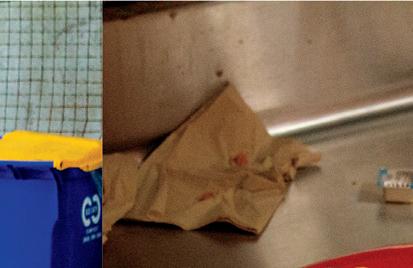
When explaining all of the countless “behind-the-scenes” routines that dining hall employees have in place to combat overconsumption and leftover pollution in their name, Dinnan noted the first and most e ective: the university’s fouryear-old partnership with Blue Earth. Our Compost Partners “ ere are containers about four feet high, in the dish room,” Dinnan shared. “ e attendees are separating paper, plastic and solid waste in separate containers which get brought down to the loading dock. You can see 20 little blue containers with yellow tops that hold solid waste which Blue Earth, a third-party company, will come in and pick up.”
According to Blue Earth’s website, the family-owned business
started in 2013, and was created based on one premise: “food scraps do not belong in a land ll or incinerator.” e company goes on to state that leftover waste should be recycled back into soil for an increase in healthy, nutrient and resilient soils. In addition to being accessible for homes and

save as much water as we can, and washing the trays takes up water. But also, with trays came more waste,” Dinnan continued, “O entimes with the trays, students would take two plates—I’m guilty of it too, some people’s eyes are just bigger than their stomach. People take more than they eat unintentionally.”
In previous years, the dining hall would also have stacks of 11-inch plates to ll up for each meal. Now, they are only nine-inch in diameter.

“ e plates are a little smaller in diameter than they used to be and with that in mind, you can’t put as much food on it as you did in the past.” Because the dining hall is styled as a buffet, if students are still hungry a er their rst plate, they are still able to go up and ll another. However, this intentional move has led to a noticeable decline in the amount of waste.
Just minutes before noon on Wednesday, April 26, Fairfield University’s Class of 2024 received communication from the “Student Announcements” email address, which shared the news that a change to the Magis Core’s Social Justice requirements will come.


Director of the Magis Core Curriculum Committee (MCCC), Elizabeth Petrino, Ph.D., authored the email to students, which described the nature of the changes being made for the Class of 2024 exclusively.
In the email, she shared with rising seniors that as just the second class to graduate with the Magis Core—the Class of 2023 being the rst to ever go through the program—there are some students who have not had the chance to ful ll all of their requirements before graduation, and “deserve some consideration.”
Although she emphasized the importance of completing the Magis Core in order and to its fullest extent, she stated that “Any three SJ courses at any level will ful ll the [Social Justice] requirement for these students.”
This means that current juniors who have been unable to secure certain Social Justice courses will now have the exibility to take any three Social Justice levels they would prefer in order to graduate.
“We did note in particular that we see that the SJ element needs for the Class of 2024, there was a lack there in terms of which courses students were able to ful ll,” Petrino mentioned in an interview with e Mirror.
Although certain students in the Class of 2024 have arranged to complete the MSJ2-R requirement, Petrino mentioned that 50% of juniors had yet to take a course with this attribute, with only two semesters remaining before graduation.
“I feel strongly that the SJ requirement is one of the most meaningful elements of our Magis Core and I am proud to be o ering two courses that engage it. Eventually I see myself designing and submitting for approval just about every course I teach as my pedagogy inherently takes up matters of social justice. It’s one of the reasons I love teaching at a Jesuit university,” Professor Emily Orlando, Ph.D. commented.
Professor Kris Sealey, Ph.D., shared similar sentiments.
“As someone who has worked closely with the SJ signature element, this [change] is not surprising. My colleagues and I have known for quite some time that there needs to be faculty hiring explicitly for the SJ signature element,” Sealey stated in a written statement to e Mirror.
events, Blue Earth works in collaboration with a multitude of businesses including Fair eld University with the hopes of improving the environment. According to Dinnan, Faireld University has composted “446,740 pounds of waste” since the partnership with Blue Earth. This amount not only mitigates CO2 emissions that are equivalent to 250,000 pounds of carbon dioxide and 12,800 gallons of burned gasoline, but it has led to 1,876 seedlings being planted and has created around 15,500 kWh of energy.
Tully Routines
In addition to Fairfield’s weekly compost contribution, Dinnan noted other small changes that have aided the university in reducing waste such as eliminating trays in the dining hall and shrinking the size of our meal plates.
“We used to have trays and we eliminated trays for two reasons. One is, environmentally, we’re trying to







“We’ve also got a hybrid of self-serve or sometimes served to you, because of two reasons. From the customer-facing perspective, it’s better to have someone serving you and asking you what you may need, and also when you’re not self-serving yourself you’re not as apt to take as much,” he shared.
Lastly, Dinnan mentioned the hope to decrease plastic waste in addition to food.

“Any time we have a ‘downtime’ with our dishwasher mechanically, like if something breaks, then we unfortunately have to roll out paper and plastic until it’s xed—we try to minimize that as much as possible. In the catering house, we have a green platform as well so I can select to have meals on ‘greenware’ which is recyclable plates. ose are conscious decisions that our community has to make.”
“Sometimes there may be events where they want china plates, but we have and o er [green ware] as a platform,” Dinnan shared.


Keeping this in mind, Petrino and the MCCC thought it would be best to ease the “log jam” that the attributes may have created for current juniors, acknowledging that some students have had di culty meeting all the required elements.
She continued that junior students should see the change made in their Degree Evaluation page soon, reflecting the new changes.
CAS Professors Respond Professors in the College of Arts and Sciences noticed the change for the Class of 2024,
“Teaching for social justice is an area of expertise (just like any other disciplinary area/focus). Like many faculty, it is my hope that the university commits to hiring faculty with this area of expertise so that enough SJ courses can be o ered for students to take. It would be a shame for students to have graduated from a Jesuit university without a robust education in social justice. If a Jesuit education isn’t that, I don’t know what it is,” she continued.
Professor Shannon King, Ph.D., spoke about what such courses mean to students.
“We live in a complicated, ever-changing world and Fair eld University students, like all citizens, should have the tools to understand it, especially social justice issues,” he claimed.

Week of May 3, 2023 Independent student newspaper Vol. 49 Iss. 20
News INSIDE Sports A Glimpse Inside Fairfield’s Jesuit Community Page 4 Should Fairfield offer a class on Satanism? Page 6 State of the Stags: A Review of the 2022-2024 Season Pages 14-15 Opinion Vine Hear about what Stags Are Doing Over the Summer Page 9
“
Based on what I see, I feel like food is being thrown out. But honestly, how would students know when we’re not informed what goes on in the kitchen?”
-Jenn Fajardo ‘25Stags Hospitality composts uneaten food through the third-party organization Blue Earth. The partnership began in 2019 and works to combat the overwhelming food waste contributed by universities.
“
It would be a shame for students to have graduated from a Jesuit university without a robust education in social justice. If a Jesuit education isn’t that, I don’t know what it is.”
CONTINUED ON WWW.FAIRFIELDMIRROR.COM CONTINUED ON PAGE 4
- Kris Sealey, Ph.D.
FROM THE MIRROR STAFF, It's Finals Season...
Kyler Erezuma/The Mirror





THE MIRROR | Week of May 3, 2023 News Page 2
4/27
10 a.m.
A student reported that their vehicle was damaged by foul so balls in the Jogues parking lot. e Department of Human Resources is investigating the incident.
4/27
2 p.m.
A laptop was stolen from a third- oor lounge in the DiMenna-Nyselius Library. e suspects were identi ed via video footage. e Fair eld Police Department is investigating the incident.
4/28
11:50 p.m.
ere was a st ght on the fourth oor of Campion Hall. e incident is under investigation by the Fair eld Police Department.
4/29
12 p.m.
e Bellarmine Museum reported the the of two cell phone power cords. e incident is under investigation by the Department of Public Safety.
Chick-fil-A to Open Restaurant in Downtown Fairfield “Within Next Year”
Two years a er the town of Faireld’s Plan and Zoning Commission declined to approve the construction of a Chick- l-A on the former site of Joe’s American Bar & Grill due to tra c concerns, First Selectwoman Brenda Kupchick announced on April 24 that the chicken sandwich chain would proceed with plans of opening a restaurant in 750 Post Road. e applicant recently reached out to let us know they were redesigning their plan to bring Chick-Fil-A to this site within the current footprint without a drive-through,” said Kupchick, in a written statement shared on Facebook with her constituents. “ is would essentially be using the building and site as it was formally permitted and used by Joe’s.”
Chick-fil-A’s redesigned plans come a er the Fair eld independent commission voted unanimously in 2021 to deny the petition for a “special permit” to 750 Post Road Associates, LLC, the owners of the lot. In the Nov. 9, 2021 meeting minutes, the commission expressed that “the proposal will result in undue tra c congestion and will not harmonize with the neighborhood.”
It continued by stating its concerns “regarding vehicle queuing capacity on site that is likely to result in internal congestion blocking of parking spaces and preventing [the] flow of vehicles into and throughout the site as well as the potential for queuing onto adjacent streets as has been experienced at other CT locations.”
According to the board, the plan that 750 Post Road Associates presented at the time represented an “unacceptable degradation of levels of service at impacted intersections.”
Even with the prospect of increased tra c in the area, the First Selectwoman implied in her statement that it was time for the town to embrace the idea of development in the abandoned building.
“Over the last several months the town has elded questions about what the plan was for the former Joe’s site which is not owned by the town. During that time, the former Joe’s American Bar & Grill has sat vacant and was put on the blight agenda for numerous complaints from residents about the state of the property.”
THE
MIRROR
Incorporated 1977
Tommy Coppola, Editor-in-Chief
Brooke Lathe, Executive Editor
Max Limric, Managing Editor

Julian Nazario, Copy Editor
Editors
Julian Nazario, Head News
Samantha Russell, Assistant News
Kathleen Morris, Assistant News
Liz Morin, Opinion
Abigail White, Head Vine
Jacqui Rigazio, Assistant Vine
Ryan Marquardt, Head Sports
William McGuire, Assistant Sports
Elizabeth McLaughlin, Coffee Break
Staff Photographer Kyler Erezuma
Business Department
Email: info@fairfieldmirror.com
William McGuire, Chief Financial Officer
Advisor
Tommy Xie
Contact Information
Fairfield University
1073 North Benson Road, BCC 104 Box AA, Fairfield, CT 06824
General email: info@fairfieldmirror.com
The Mirror is the recognized student newspaper of Fairfield University. Opinions and ideas expressed herein are those of the individual student authors, and not those of Fairfield University or its Board
In a statement to The Fairfield
Mirror, Chick- l-A con rmed the news of their new location in Fairfield, announc-
Construction on Chick-fil-A Post Road & Elliot Street has begun and includes renovations to the existing structure.”
- Chick-fil-A Spokesperson
ing that construction is now underway.
“It’s our pleasure to con rm we will be opening our rst Chick- l-A restaurant in Fair eld, located at 750 Post Road. Construction on Chick- l-A Post Road & Elliot Street has begun and includes renovations to the existing structure,” said a spokesperson for Chick- l-A Inc. e opening of the Faireld location will occur “within the next year”. e chicken sandwich chain, which
is widely known for being closed on Sundays, expressed that expanding to the Faireld community represents a “tremendous opportunity to serve our customers and fans.”
Chick-fil-A’s spokesperson concluded its statement by highlighting the company’s excitement in “joining the community and serving all of our guest’s delicious food in an environment of genuine hospitality.”
While they have a presence in 47 states, Washington D.C. and Puerto Rico, the opening of the Fair eld location will mark the company’s 13th location in the Constitution State and the second operating in close proximity to Connecticut’s I-95 corridor.
As America’s best fast-food for the past eight years, the popularity of Chick- l-A is quite outstanding with college students, most notably when, in 2012, then-Auburn recruit Cassanova McKinzy decided to pass the chance to play for Clemson Tigers because “they had no Chick-Fil-A on campus.”

According to the company, they have nearly 300 locations on college campuses across the United States, with most of the restaurants operating in public universities in the Southeast.
At Fair eld University, the idea of an on-campus Chick- l-A has been making noise since at least 2021, when Fair eld University Student Association presidential candidate Noah Richardson ‘23 proposed constructing a chain restaurant in the North Benson campus, with Chick- l-A as one of the possible options. Richardson was not successful in his bid to become FUSA president and the idea of having a new on-campus restaurant has not resurfaced. e Mirror will continue to update on the opening of Chick- l-A in Post Road.
Fairfield’s New Mock Trial to Hone Student Skills and Interest in Law
Addition to Fairfield University’s Bellarmine Pre-Law Society: Mock Trial is past January, students Annabelle Worrell ‘25 and Zachary Vargas ‘24 turned a long-awaited vision into reality.
As pre-law students and members of Fairfield University’s Bellarmine Pre-Law Society, their desire was to develop a Mock trial segment that could be integrated into the broader sphere of the PreLaw Professional Development Program.
As the head of the Bellarmine PreLaw Society, Aaron Weinstein Ph.D. of Fair eld University’s Politics Department was enthralled at the idea of the addition of the Mock Trial.
“I have wanted to bring Mock Trial to Fair eld for several years, but there was never a perfect model,” Weinstein re ected.
It was Worrell and Vargas’ work that presented “a thoughtful and clear plan of action,” and it was the collaboration of students and faculty that led to this extension of the society.
Given that Mock Trial is a subsection of Pre-Law, a prerequisite for participation is membership in the society. Weinstein emphasizes that there are no GPA or major/ minor requirements that merit eligibility, merely an interest in law. is enables a wide breadth of students to further explore their passion for the legal eld while simultaneously exploring o erings including LSAT prep, job shadows and faculty and alumni mentorship.
A er conducting a preliminary survey of Pre-Law students in February, Weinstein
was able to quantify how extensive the interest in Mock Trial was among society members. e majority of students noted how a Mock Trial segment would improve their educational experience at Fair eld, while also providing a forum to form friendships and engage in meaningful teamwork with oth-
development work within the Pre-Law Society. Mock Trial will allow students to further their litigation skills and hone in on which segments of the law pique their interest.
As Worrell says, “We want students to be engaged, passionate leaders and participation in Mock Trial is an excellent way to improve those leadership and communication skills.”
She envisions Mock Trial as an avenue for students to “channel their passions into educational development as they prepare for future careers in law.”
As a precursor to Mock Trial’s launch in the fall of 2023, Worrell and Vargas conducted an introductory meeting to give students further insight into what participation would entail.
ers sharing the same academic inclinations.
“Professional development is such an important aspect that the university provides for students,” says Vargas. Bolstering the PreLaw Society will grant students further guidance in their applications to law school while also providing real-world exposure to what is entailed in working in the legal profession.
Mock Trial is an avenue for Pre-Law students to further their understanding of the legal process through competition and teamwork. It is an additive to both coursework and professional
Given that the upcoming academic year will be the commencement of Mock Trial, the student co-founders deemed it bene cial to cra distinct itineraries for each semester. e fall semester will be dedicated to furthering students’ knowledge of the law and equipping them with the tools necessary to e ectively litigate and debate. Building upon this foundation, the spring semester will see students compete using knowledge acquired during the introductory semester.
Professor Weinstein, and co-founders Annabelle Worrell and Zachary Vargas are enthralled at the prospect of furthering student involvement in Pre-Law offerings through the addition of Mock Trial. Participation is always welcomed and encouraged.
Students who are interested in the Pre-Law Society should contact Professor Weinstein at aweinstein@fairfield.edu.
THE MIRROR | Week of May 3, 2023 News Page 3
of Trustees
Compiled by Kathleen Morris Information contributed by the Department of Public Safety.
While construction is underway, Fairfield officials will work in developing traffic contingency plans to address concerns about the new Chcick-fil-A location
“
It’s our pleasure to confirm we will be opening our first Chick-fil-A restaurant in Fairfield...Photo Courtesy of Fairfield Citizen
“ I have wanted to bring Mock Trial to Fairfield for several years, but there was never a perfect model.”
- Aaron Weinstein, Ph.D.
The Jesuits: Six Stories of Ignatian Spirituality

e Jesuit Community Center (JCC) is perched between Bellarmine Hall and the Dolan School of Business, adding to the aesthetic of the architecture that ampli es the idyllicism of Fair eld’s campus.
The black siding and wood paneling of the JCC render an image of a Nordic ski lodge. But, the small statue placed by the entrance indicates the building’s true purpose.


The statue of St. Ignatius of Loyola, the founder of the Society of Jesus, symbolizes the tradition of Ignatian spirituality that guides Fairfield’s Jesuit community.
e 20,000 square foot residence contains administrative offices, a chapel, dining room and a library. The JCC houses 12 Jesuits and is an extension of their overarching mission.
According to Gray Organschi Architecture,“the Jesuits sought a building that would not only provide for their own immediate needs, but might serve as an exemplar of ecological architecture.”

e Jesuits’ website emphasizes the prioritization of environmental justice, as their “advocacy promotes sustainable environmental policies that protect nature and care for the most vulnerable.”
Gray Organschi states that the JCC is topped by a garden roof that “controls and lters stormwater, reduces heat loss and increases the durability of the roof membrane beneath it.”





Moreover, the JCC is equipped with “a closed-loop geothermal heating and cooling system, fed by 15 wells beneath the parking area, that provides energy to the building without fossil fuels.”
Since its completion in 2009, the JCC has been awarded two local and one regional American Institute of Architects (AIA) Awards, as well as Top Ten House of the Year by AIA National. Additionally, it was highlighted in a 2011 New York Times article entitled “Teach, Pray, Live”. e article, written by Fred A. Bernstein, closed with a quote from Rev. Dr. Paul J. Fitzgerald, then Senior Vice President for Academic A airs at Fair eld.
Father Fitzgerald predicted that “there should be enough Jesuits at Fairfield to operate the building for about 25 years.”
After 12 years, the Jesuit community continues to play a formative role in animating the ideals of the institution.
e following interviews with six current Fair eld Jesuits underscore the in uence of their community, which extends far beyond the walls of the JCC. Rev. John Mulreany, S.J.
The Fairfield Jesuit Community is overseen by Superior Rev. John Mulreany, S.J..
“There are two main components of my role,” Mulreany articulated. “The first component would be caring for the men in the community so that they can be apostolically e ective. e other part would be caring for the institution, which involves being in conversation with President [Mark] Nemec at Fair eld University and President [Christian] Cashman at Fair eld Prep.”
Mulreany facilitates the Jesuits’ engagement with the wider community.
However, he considers the teaching of the “Finding God in All Things” course to be his most meaningful mode of outreach.
“It is the anchor of my week,” Mulreany declared. “ e papers that the students write


are very rich. I feel very privileged that they can share about themselves in writing those papers, which are about their personal and spiritual lives. It gives me an opportunity to o er some encouragement and point out a few things about Ignatian spirituality that relate to their experience.”



Mulreany’s leadership is informed by an abundance of service, which has allowed him to explore his own spirituality in a global context.
“My rst major assignment as a priest was to work in Western Micronesia on the island of Yap where Jesuits from this province have served since a er World War II,” Mulreany illuminated. “We went at the request of the local community to help start a Catholic high school. e idea was always to make sure this was a locally run and led school. So, that’s the way it is now.”
A er spending seven years in Micronesia, Mulreany went on to work in Manhattan, Southern Sudan and China. Regardless of the setting, Mulreany strives “to be very humble and open to growth, and to really walk with the local church community.”
At Fairfield, he recognizes the difficulties students may face as they navigate their spiritual and academic lives.

In closing, Mulreany offered a thoughtful reminder.
“Remember to be grounded in the spiritual practices and the other practices that you have to care for yourself,” Mulreany urged. “You need those things more during times of stress, and it’s in those times when we’re tempted to do less of those things. When we’re feeling under tremendous stress, remember to ignore the voices of discouragement. Trust in the good work you’ve done so far and that you’ll see it through to success.”
Rev. Michael J. Doody, S.J., ’70


As a Special Assistant in the Office of the Dean of Students, Rev. Michael J. Doody, S.J., ’70 has left a lasting impression on the institution throughout his 17 years of service.
As a student in the late 1960s, Doody recalled that there were 85 Jesuits who “lived in Bellarmine Hall [and] on each corridor of the four dorms on campus.”

Doody was “active in his faith and found it easy to converse with lots of Jesuits, [who] all seemed happy, dedicated and committed.”
As a result of these interactions, Doody decided to give the Jesuit
lifestyle “a try” and he “never looked back.”
He mentioned his experience in the Regency program, where Jesuits are given “an opportunity to work in a Jesuit apostolate to demonstrate [their] commitment and ability to live the Jesuit life.”
Doody taught English and Religion at St. George’s College in Kingston, Jamaica.
He disclosed that he “almost got murdered in downtown Kingston,” an intriguing fact that he classi ed as “a story for another day.”


Ultimately, Doody returned to Faireld as the Director of Campus Ministry in 2006.
In 2012, he was named the Director of Restorative Mentoring and “worked with students, mostly men, whose behavior put them at risk for expulsion.”
In this capacity, Doody provided the support required to enable students to unlock their true potential at Fair eld.
Additionally, Doody is the Chaplain to the Glee Club and an active member of the Fairfield community at large.
“I interact with students by attending numerous athletic events, plays and concerts,” Doody communicated. “I also take lunch each day in the Tully and sit with students. I think this is one of the most e ective aspects of my ministry as a priest here at Fair eld.”
is semester marks the end of Doody’s time at Fair eld. He is “sad to be leaving” and looks fondly at the countless memories he has acquired over the years.
His favorite memories “which can cause [him] to tear up, are watching students with whom [he has] worked closely receive their diplomas, officiating at the weddings of young alumni and then baptizing their children.”

Rev. Kevin O’Brien, S.J.
Rev. Kevin O’Brien, S.J. serves as the Dean and Executive Director of the Bellarmine Campus of Fairfield University and teaches in the Department of Religious Studies. O’Brien was introduced to the Jesuits as an undergrad student at Georgetown University, where he was “attracted to their teaching, their down-toearth spirituality, and their commitment to justice.”
At the time, O’Brien considered joining the Jesuits. But, instead, he decided to go to law school.

After a few years of practicing law, he felt called to serve as a Jesuit priest and began his ten-year ordination process.
“I loved this time, because I was able to study di erent subjects and serve in di erent ministries in various states and countries,” O’Brien re ected. His vocation has been focused in higher education, both as a teacher and an administrator.
Outside of academia, O’Brien has “really enjoyed [his] service to migrants and refugees through the Jesuit Refugee Service.”
Notably, O’Brien is the author of the award-winning book “The Ignatian Adventure” and the recently published “Seeing with the Heart”. O’Brien emphasized that, “there are many wonderful things about being a Jesuit, but among the best are the people I have met along the way, who have shown me God’s love in remarkable ways.”
At the JCC, O’Brien explained that he lives “with other Jesuits with diverse personalities, backgrounds and interests, and [they] have a lot of fun together.”
He expressed gratitude for the JCC’s caring sta and proximity to nature, but shared a lighthearted complaint about his feathered neighbors. “My favorite spot is out back on the porch, overlooking our various gardens,” O’Brien remarked. “The only downside are the turkeys who live out back. They are very noisy!”

Rev. Keith Maczkiewicz, S.J., ‘04

As a eatre major at Emerson College, Rev. Keith Maczkiewicz, S.J., ‘04 would sneak out of his dorm to attend mass on Sunday mornings. Maczkiewicz felt disconnected at his non-religious institution, and realized that the Church was the “only place that felt like home.”
By the fall of his sophomore year, Maczkiewicz had decided to transfer to Fairfield University.

Within his first weeks at Fairfield, United States history was forever altered by the tragedy of Sept. 11 attacks in New York City.
As the country grappled with this devastation, Maczkiewicz remembered the service presented at the Egan Chapel.
“It was packed,” Maczkiewicz described. “ ey put an altar out on the plaza and all the Jesuits were there. I remember that this was the moment where I truly felt at home because I thought, ‘ is is a community where, when something big happens, this is how they gather.’ And that became very important for me.”
Two decades later, Maczkiewicz was appointed as Fair eld’s Director of Campus Ministry and serves as the University Chaplain.
In these positions, Maczkiewicz is committed to “changing the narrative and changing the benchmarks” associated with a college education.
“At every school I’ve worked at, they are constantly talking about return on investment,” Maczkiewicz acknowledged. “Every fall, they publish an infographic and a story about how much money their first-year graduates make. I don’t think that is a valuable judgment of a Jesuit education. Frankly, I’m much more interested in how many hours a week graduates are volunteering.”
According to Maczkiewicz, the success of Jesuit education is derived from the “interplay between faith and reason.”
“If we’re doing this right, meaning Catholic education, we should be taking both scholarship and faith seriously, and those things have to be mutually informing,” Maczkiewicz asserted.
Students, Faculty Highlight Value of Social Justice Component
“In 2023, we are still fighting for the Equal Rights Amendment and for African American Studies to be taught. Our students should know the history and political context of these issues and why equal and fair pay for women and an inclusive, equitable education for all remains fraught issues today.”
King also highlighted the importance of faculty coming together in order to create a cohesive list of course offerings that emphasize social justice teachings.
“We need an all-hands-on-deck approach. We need more faculty to submit SJ courses to the SJ subcommittee. It takes time to complete the application, but I deeply appreciate that the requirements are rigorous. I learned a lot from the application process, and it helped me rethink how I teach all of my courses,” King shared.
“We also need more support for workshops and the university should prioritize the hiring of more faculty who teach SJ courses, especially as we witness how student enrollment has exploded over the last couple of years.”
Petrino shared that in the spirit of growing the social justice attribute o erings at Fair eld, summer clinics, like King alluded to, will be held for professors who are looking to designate their course as an SJ course. Two clinics will be held, one for the MSJ2 attribute specifically and one for the MSJR attribute.
According to Petrino, the courses will be submitted for approval over the summer, and if approved, the attributes will be linked to the class that is being o ered in the Fall of 2023.
Petrino clari ed that it is important to note that attributes follow a professor, not a course. is means that one section of a course could o er an SJ attribute, whereas the other section taught by a di erent professor may not.
For students who believe that a course they are taking should o er a Social Justice attribute but does not currently carry it, Petrino urges students to talk to their professor to look into attribution to an SJ element.
Students Respond
Students understood the change made by the MCCC but also realized the importance
of the SJ requirements in their own learning.
make it easier for students to accomplish these requirements, but I hope that they still put students in courses that push them out of their comfort zone,” she continued.
Nicholas DiStefano ‘24 also understood the MCCC’s response to high numbers of students unable to get into classes with certain attributes.

“I think it’s beneficial for juniors who are stressing about graduation requirements and getting those social justice requirements done,” he commented.
He continued, stating that “I’ve been lucky, but I know others have not when getting all those done. There’s no way to really put yourself ahead unless you have the proper credits,” he clarified.
“I think that it’s important [that] students use their time at university to expose themselves to conversations they wouldn’t have in a professional or personal setting, which the original social justice requirements sought to achieve,” Jackie Campbell ‘24 stated.
“I do understand the need to

With only two semesters left, rising seniors like DiStefano realize that the pressure is high on students looking to delve deeper into their major-related coursework and stay on a good pace to graduate.

THE MIRROR | Week of May 3, 2023 News Page 4
“ I do understand the need to make it easier for students to accomplish these requirements, but I hope that they still put students in courses that push them out of their comfort zone.”
-Jackie Campbell ‘24
CONTINUED FROM PAGE 1
The Jesuits regularly host guests in their “Great Room,” a bright space overlooking the Long Island Sound.
CONTINUED ON WWW.FAIRFIELDMIRROR.COM CONTINUED ON WWW.FAIRFIELDMIRROR.COM
Kyler Erezuma/The Mirror
An Update from the College of Arts and Sciences DEI Committee

Fairfield University is opening a new office of Diversity, Belonging and Inclusion as part of the final recommendations of the President’s Working Group on Diversity and Inclusive Excellence.
In the meantime, many offices and programs across the university have been working on implementing Diversity, Equity and Inclusion (DEI) initiatives addressing Fairfield's systemic challenges to underrepresented students.
One of the places that has been working with DEI programs is the College of Arts and Sciences, which since 2020 has been working on finding ways to create a more diverse and inclusive community of students and faculty.
As part of these initiatives, the College implemented a DEI Standing Committee composed of CAS professors, staff and students.
As one of the two student representatives, it is important for me to share with the student community a brief report of the progress that we have made over the past two semesters in the CAS DEI Committee.
During last semester, the Committee took its time to understand and reflect on the mission and the objectives that were granted to us by the Academic Faculty of the College of Arts and Sciences while also adding some of our own objectives into the discussion.
For us, it was important that all the actions, initiatives and proposals were realistic and permanent; not just a crisis reaction.
As part of the assessment we did, the Committee examined previous statistics and the lack of them to recognize
the scope of the work needed to do.
We also examined how our Committee could be of help in the expansion of the Social Justice classes in the College of Arts and Sciences and serve as a support to both faculty members and the SJ Committee.
As a student member, I made sure to highlight the need to clarify what made a class qualify as a Social Justice credit.
Social Justice as part of the Magis Core Curriculum is something that will stay in our curriculum.
It is ill-conceived to think that the SJ element of the Core will be removed just because of the numerous roadblocks it has experienced.
Professors and the SJ Committee are working on expanding the number of SJ2 and SJ2-R classes available to students.
It’s up to the administration to allocate more funds and resources to incentivize and facilitate the promotion of these attributes.
During the spring semester, the Committee met with members of the SJ Committee to understand the current situation and explore alternatives to achieve the attribute’s fullest potential at Fairfield.
While my term as a student representative is over, the work of the committee continues once the fall semester starts.
As students of Fairfield University, we should recognize the work that needs to be done to achieve an environment that actually foments student belonging and racial diversity.
As we move to welcome Don C. Sawyer III, Ph.D. over the summer to work as Vice President of Diversity, Belong-
ing and Inclusion, I’m sure that the CAS DEI Committee will continue to work behind the scenes to ensure the College of Arts and Sciences becomes a more diverse and inclusive body.
The
Social Media and Political Tensions are Wiping out the News Industry
Why don’t people read the news anymore? According to a study done by Pew Research, the amount of Americans who get their news from television has dropped nearly 10%, from 57% to 50%.
This study was done in 2018 and the numbers have dropped even lower since. And according to The Guardian, 42% of Americans avoid the news entirely because they don’t want to believe it.
In my opinion, we have social media to blame for a lack of attention to news media as well as the spread of misinformation.
With platforms like TikTok, in which video clips can be a mere seven seconds long, our attention spans are decreasing, making the average person less likely to sit and read an entire news article or sit through an entire news broadcast.
A study conducted by the Pew Research Center from 2019 to 2020 found that those who rely heavily on social media as their main news source in the U.S. tend to be less likely than other news consumers to look closely at major world events, leaving them less knowledgeable on these events.
Yes, social media provides a platform in which communication is promoted and easily had.
But just how much of this online discussion, especially when it comes to politics and national news, is actually productive conversation? And how much can be deemed arguing for the sake of arguing, not to come to a conclusion that will bring about change or productivity?
I believe that contemporary politics in the United States are extremely polarized.
Jesse Shapiro, Ph.D., a professor of Political Economyat Brown University, conducted a study alongside Stanford University as a National Bureau of Economic Research working paper in 2020 to address the reasons why the U.S. is polarizing faster than other democracies across the globe.
The study details the phenomenon known as “affective polarization” which explains that citizens who affiliate with a certain political party will express negative feelings toward other political parties that are not their own.
Compared to other democracies such as Canada, New Zealand, Switzerland and more, the polarization in American politics is exceptional.
In some of his findings in the study, Shapiro said, “There’s evidence that within the U.S., the two major political parties have become more homogeneous in certain ways, including ideologically and socially.
So when you identify with a certain party and you’re looking across the aisle, the people you’re looking at are more different from you than they were a few decades ago.”
People in certain political parties are homogenous in the sense that they are increasingly aligned in race, religion, ideology, etc.
The example Shapiro gives is that Republicans today are more likely to be religiously affiliated, while Democrats are more likely to be secular.
I think that the media has solidified this notion that each political party in the U.S. is homogenous. The narrative that Republicans think, act and represent themselves in certain ways while Democrats think, act and represent themselves in the opposite ways and that the two cannot overlap is strong in today’s society.

And it is this polarization of the two big political parties that translates into news media, as different news outlets all have different biases, either leaning left or right in the content they produce.
This may cause readers to avoid certain news platforms, or simply avoid the news altogether, as it often feels more opinionated than fact-presenting.
I find that with the increase in social media, it becomes a game of “I’m right” and “You’re wrong” simply because one affiliates with a certain political party.
In today’s society, we pre-determine citizens' personalities, religious beliefs and more simply based on which political party they affiliate with.
We write them off if we do not affiliate with the same political party rather than hearing them out and engaging in productive conversation.
It is a known fact that people who consume their daily news via social media are the least informed.
Though it is quick and easy, and I myself am guilty of reading quick headlines on Instagram, Twitter etc., I believe that if we are to have informed political discussion, we need to take a step away from these platforms.
That is not to say that there is no bias in the news either.
As I mentioned before, every news outlet leans one way, so it is important to read a variety of sources and be aware of the bias of each source you consume.
I believe that taking the extra time out of our day to read the news rather than scroll through social media, will lead to a more informed society and maybe lead to more productive political conversation, rather than the arguing we see today.
I do not see this day coming anytime soon, as our attention spans only continue to drop and social media platforms only continue to grow in popularity, but if you find yourself with spare time, use that time to read the news and inform yourself on what is going on in the world around you. It is so important.
Page 5 THE MIRROR | Week of May 3, 2023
Editor: Liz Morin Email: elizabeth.morin1@student.fairfield.edu Opinion
College of Arts and Sciences founded a DEI Standing Committee in 2020 that has been working to create a more diverse community.
Liz Morin/The Mirror
The Lack of School Spirit at Fairfield Isn't Changing Anytime Soon
home openers, students, as well as members of the local community, packed the arena in a way that was previously a rare sight.
soon. I have been a student at this institution for four years and witnessed the ups and downs.
as an institution unless there is a massive culture shift.
For all that Fairfield has to offer, one area in which we severely lack is traditional school spirit.
At many athletic events throughout the year, you’ll often find empty stands—with the few fans present usually consisting of family and friends of the players—despite Fairfield’s often strong Metro Atlantic Athletic Conference standings across many of our sports.


This was clear to me when I first arrived as a first-year in 2019.
What I expected after visits to other schools throughout my life was a stark contrast to what I encountered, and when the pandemic hit in 2020, later that academic year, school spirit became the least of our concerns.
Since the newly built Leo D. Mahoney Arena opened this year, there have been moments where the student body has come together in ways that completely contradict what is expected of us as a school community.
During the women’s and men’s basketball



In a men’s basketball game against Iona University, many students wore t-shirts with a quote from then-Iona head coach Rick Pitino that read, “The MAAC just doesn’t draw a crowd.”
However, once the excitement for our new arena began to wear off, the familiar sight of empty bleachers returned shortly after.


There have been clear efforts from the University to increase attendance at games across the board. The “Super Stags” app has incentivized students to attend games for years.
Such incentives include prizes for acquiring specific points, like t-shirts and water bottles.
Since the opening of the new arena, there have been additional incentives, including free meals and alcohol vouchers for students who arrive before tip-off.

While this has been somewhat effective in attracting students, for the most part, it has been unsuccessful.
I do not see this culture changing anytime
Fairfield does not have a culture of school spirit, and it is apparent that the University wants this to change.
The lack of school spirit is not limited to athletics. Across the institution, you’ll often find a similar situation at many club and university events.
While not wholly empty, attendance is usually limited—save for the significant events throughout the school year, such as the Presidential Ball and the Spring Concert.
Despite this, I do believe that Fairfield students care about the institution and its athletics.
The fact that students do come together for the big games and events during the year proves this.
If anything, the consistent sight of empty bleachers and quiet stands makes the moments with a packed arena feel unique and memorable.


However, I believe that this is the best school spirit you’ll see from Fairfield University
Perhaps with new incoming classes over the next few years, we will start to see a change— but for now, the familiar sight of empty bleachers is here to stay.
Satanism Deserves a Class in Fairfield's Religion Department
fact, not at all evil.
Last semester, for our RLST 1601 “Honors Religion in the US” course, we were tasked with creating our own class about religion in the US.
We found ourselves intrigued by the Satanic religions and figured that Satanism was probably underrepresented in college-level religion courses, so why not make our own course about it?
Since we were both raised Catholic, we grew up with certain ideas surrounding the devil and Satan.
However, when we came across the Church of Satan and the Satanic Temple’s websites and read through their beliefs, we found that they were actually quite reasonable, and in
Because of the misconceptions surrounding it, we wanted to use Satanism as a lens to analyze religious freedom in the United States.
And so our course, “Satanism and American Society,” was born. This course would aim to tackle issues of religious freedom in America by analyzing the different ways in which the “Satanist” label is used and by examining the two major groups that self-identify as Satanists: The Church of Satan and The Satanic Temple.
Throughout this course, students would reconsider the meaning of ‘religion’ and explore how religious freedom is experienced by groups that deviate from Western religious norms.
Historically, Christianity has been the dominant religion in the US and has exerted its

influence over both the political and personal aspects of American society.
Because Christianity is the religion with the most power in the US, the legitimacy of religions that deviate from these Christian norms is often questioned.
Due to this power-imbalance, the dominant religious group, in this case Christianity, tends to be the one who gets to decide what does and what does not count as a religion. Our course on Satanism would address questions of religious freedom through the lens of Satanic religions.
These religions are often misunderstood, but developing an accurate understanding of these groups would teach students to rethink the definition of religion and religious freedom in
the US, as well as the use of religious symbols. Satanists represent the struggle for religious freedom and acceptance in a predominantly Christian country, and the experience of Satanists reflects the experience of other marginalized religious groups as well.

The goal of this course would be for students to gain the knowledge needed to understand and analyze the role that religion plays in the United States, and how it continues to shape our country.
By looking at the two main Satanic groups in America and learning about the backlash they face as well as what they stand for, students would be able to recognize how new religious movements function in, and influence, our society.
The Term "StagMates" Includes Close Friends Made at Fairfield
At the beginning of your academic career at Fairfield, you are usually introduced to a specific term, a “StagMate”. But what actually is a “StagMate”? I remember the first time I was introduced to the term, I was at work and a customer had asked me where I got to school. After replying, he said, “I met my wife at Fairfield, we are StagMates!”
When browsing through Fairfield’s website, an entire page is dedicated to “StagMates”.The website reads, “Did you know that 10% of Fairfield’s alumni are married to fellow Stags? We love celebrating and hearing from these alumni couples, affectionately known as StagMates. Scroll to read some of their love stories, and if you're a StagMate, be sure to submit your own story!”

From showcasing many StagMate love stories, Fairfield even offers to send a free “Once a Stag, Always a Stag” banner for all soon-to-be StagMates currently planning their wedding.

However, in my opinion, for another peer at Fairfield to be considered your “StagMate,” it does not necessarily have to be a romantic relationship. The term “StagMate” can refer to any close relationships between two members of the Fairfield community, not just romantic ones.
A StagMate is a celebration of the strong community and bond that members of Fairfield share, regardless of the specific type of relationship they have with one another.
Overall, Fairfield values the connections and relationships that fellow “Stags” form with each other, whether they are romantic or platonic.
A StagMate can range from a professor to a staff member, a roommate or anyone else who had a significant influence on your personal and academic growth at Fairfield.
I think a StagMate consists of any individual who bettered you while spending time at Fairfield can be considered your StagMate.
My StagMate is my present roommate today, whom I met during my first year at Fairfield. My roommate, Gina Fiacco ‘25, has bettered me overall as a person during my time so far at Fairfield.
Gina's influence has played a significant role in my academic and personal success, and with her, I achieved more.
I believe a Stagmate can be anyone who shows genuine care for someone as a friend. I felt incredibly fortunate to have a Stagmate like my roommate, who’s always ready to go the extra mile, no matter the challenge.
The lessons you can learn from their Stagmate should continue to inspire you today. My Stagmate has shown me the true essence of friendship and has motivated me to keep pursuing my goals, knowing that I can count on her whenever I stumble or need support.
My Stagmate’s constant encouragement has boosted my confidence and encouraged me to preserve and strive toward success.
I cannot express my gratitude enough. Overall, a “StagMate” can be any individual who helps you to become the best version of yourself during my time at Fairfield!
Page 6 THE MIRROR | Week of May 3, 2023 Opinion
celebrate their wedding. The term "StagMates" usually references individuals who got married to former Fairfield classmates, though some believe the term includes close friends.
Fairfield alum, known as "StagMates"
Photo Courtesy of @fairfieldu Instagram
A "sold out" basketball game in mid-December. However, after the initial excitment for the new basketball arena, the seats became familiarly empty again.
Julian Nazario/The Mirror
 By Brooke Lathe Executive Editor
On Thursday, April 27 at 7 p.m. in the Regina A. Quick Center For The Arts, the annual Cinefest film competition took place. Submissions to enter the festival were open for all class years and even non-majors, however, it must be a film made within a Fairfield University FTMA class in the current academic year.


The night opened up with student presenters Jacen Janueski ‘25, Alexa Sewell ‘26 and Paolo Valencia ‘24.
While providing comedy and background of what consisted of creating student-made films, they also played a trailer to set the tone of the event. It showed bits of clips from each of the eleven chosen shorts, including their titles.
Furthermore, a “Director’s Cut” video was put up on the big screen in which the
student-filmmakers were asked questions about the process and their ideas behind their projects. Finally, the night began.
The screening portions were split up into three separate blocks, which allowed the presenters to not only give explanation behind each section but highlight a smaller group of all of the producers and directors at a time.
Screening Block One
The first film of the night was “Sinners and Saints” by Annika Johnson ‘23. Within a religious boarding school, a roommate, boyfriend and nun are questioned in a murder investigation following the death of a girl.
As the roommate tries to understand who could’ve killed her and what exactly happened, she gets hurt in the process.
After the credits appeared and the applause subsided, “La Misere” by Michael Bottega ‘23 and Diego Brijaldo ‘23 started to play—and the audience erupted with laugh
Santora ‘23 was the next short. This film was inspired by Billy Currington’s popular tune and showed a young man giving a eulogy about his recently departed, older fatherfigure. Within his monologue, flashbacks of their talks at the bar appear on the screen.
Brijaldo’s second film of the night, “Separados,” was inspired by a true story of immigration, custody battles and poor health. While a mom of two fights for her other son left in another country, she feels held back by the hospital and court system.
Screening Block Two
“The Book Club” by Jared Smith ‘23 was another comedic success and seemed to be the perfect film to start the second block. The short video took place in, you guessed it, a book club. In the small group of readers, the variety of characters put in the same room allows for a perfect mix of conflict and resolution.
Senior Katharine Creamer’s film, “A Weekend at Sam’s,” showed the story of two half sisters spending strained time together.
Sam, the older sister, is clearly uninterested in talking to her younger sibling and uses work as an excuse to hide in her room. By the end of the second day, however, the two girls bond and plan their next weekend together.
“After Hours Elf” by Michael Boudrot ‘26 was inspired by his roommate’s fear of Elves on the Shelves, as explained in the “Director’s Cut” video.
The short throws watchers by surprise as the main character leaves his office building late on the night of Christmas Eve, finding an evil Elf on the Shelf sitting on the floor waiting for him.
“Exodus” by Emily Merola ‘24 was the perfect film to end the middle portion of the event. A nun who is very heavily involved in the church seeks to find “leeches,” a group that the pastor continually talks poorly about in his sermons.
After her interaction with the leader of
the group, however, she can’t help but second-guess her alliance with the church or her interest in the members.
Screening Block Three
“Capt. Calvin” by Morgan Doll ‘23 was posed as a narrative documentary, similar to the popular film “The Martian”. As an astronaut in space, Calvin knows his ship is going down and decides to record his final moments.
Senior Mary Bevans’s dystopian short, “Solace” poses a post-society life in which a young girl lives on a ship alone, surviving through trading rarities. Once finding pictures of someone’s old life, she finds peace in imagining herself with them.
“Betrayed Apprentice: A Star Wars Story” by Janueski is a proposed short that follows the popular story of “Star Wars.” While the recognizable introduction and soundtrack are the same as its inspiration, the plot creates a different plotline than the scene before but includes similar themes such as betrayal and action.
The night ended with a video from film majors currently studying abroad and the voting component for the “Audience Choice Award”.
This was done via QR code and concluded with a total of 215 votes.
Overall, it was an extraordinary experience and an outstanding showcase of what Fairfield film students are capable of.
Cinefest Category Winners:
Best Sound Design - “Separados”
Best Production Design - “Exodus”
Best Screenplay - “Sinners and Saints”
Best Cinematography - “Exodus”
Best Editing - “The Betrayed Apprentice: A Star Wars Story”
Best Director - “Exodus”
Audience Choice Award - “Separados” (27% of total voters)
Best Picture - “Exodus”
By Mary Bevans Contributing WriterThere’s nothing that sneaks up on you quite as bad as finals season.
One day you’re vibing, there’s not a lot of homework.
It's sunny, there’s nicer weather and you have time for everything fun you want to do.
Then the next thing you know it feels like you’re on a constant edge of impending doom.
Finals is by far the worst time of year, particularly in the spring as it is coupled with the stress of moving out for the summer.

There is not much you can do to get through it without any worry or stress, but there are steps you can take to ensure that you come out the other side with your sanity intact.
The easiest thing you can do is to take a
couple of minutes to sit down and make a plan.
I personally like to write a checklist of all my assignments and exams with their due dates.
Sometimes when you’re think ing about everything you have to do your mind can overestimate which leads to more stress and anxiety.
By physically break ing it down into more manageable pieces, you’ll
have a tangible thing in front of you to remind you that all the work you have to do is manageable.
Sometimes the most important thing you can do is just remind yourself that you’re capable of accomplishing everything you have to do.
When it comes time to study for your exams or write your papers, find a nice
study spot somewhere that allows you to focus.
If you like a little white noise try a cafe in town or the Mezzanine in the Barone Campus Center.
If you need absolute silence and zero distractions, then the library will be your friend.
All that matters is that you find somewhere that works for you.
Finally, the most important thing you can do is make sure to look after yourself.
Take breaks, make sure you eat and stretch every once in a while.
Burnout is a very real thing and the best way to combat that is to practice self-care.
No matter what, just remember that summer is around the corner and all the struggle and strife will pay off!

THE MIRROR | Week of May 3, 2023 Page 8 The Vine
By Max Limric Managing Editor
Summertime. I am so relieved. Personally, I will be working my you-know-what off this summer, but I love my job, so it’s a good time. But my main goal this summer is to make time to be with my family and friends as we relax on the beach. So, those
some other Stags will get up to.
From what I’ve gathered, travel is big this summer. I’m jealous. Sophomore Angellus Mendoza is “going away with family to Italy.” She has family who live in Europe and “can’t wait to see them.”
Sophomore Aimee Sardilli also has family out of the United States and will visit them in Ireland while she studies abroad
for “a little over a week.” Once she returns, she will work at a school as an aid for a camp for students with different abilities.
Studying abroad seems like a popular way to travel this summer as Frances Harmon ‘25 is studying abroad in Aix-enProvence, France.
She wants to paint there. I feel like you can do that here … but okay. She claims, “She paints here, but she wants to paint in Provence.” Okay girl, whatever floats your
More people are traveling … Sophomore Luke Hassiak will visit Costa Rica in May and is staying at an all inclusive resort. The highlight of his trip will be when he zip-line’s and drinks at swim-up bars. Even though he isn’t 21, he comments, with intensity in his voice, “it’s legal there don’t worry.” Okaaaay. Oh, and he has a hot tub in his hotel room.
Sophomore Aubrey Silverman is going on vacation to the Bahamas with her family and is “excited to go swimming with sharks.” She had to fight her dad to let her go this time as she pouts, “he didn’t let me swim with sharks last time.”
Hawaii is a hot destination too. Sophomore Bianca Piñero will head to Hawaii with her best friend Nohea Breeden ‘25. Piñero looks forward to interacting with little kids as they explore the islands of Hawaii. Even though she’s not a resident of Hawaii, she is going to see Breeden there who claims that she will “soon live there.”
Stag’s still need to get their money up over the summer. Junior Thomas Drillien can’t wait to do math over the summer as he will intern with Ernst & Young as an auditor. When asked if he's
excited, he says “Very much so.” He can’t wait to crunch some numbers and go out to happy hour with the team. I mean the happy hour sounds fun, but I could go without the crunching of numbers.
Besides working all summer as a student nurse intern at the Flynn Oncology Fellowship at Smilow Hospital (what a mouthful), Charlotte Delmonico ‘24 looks forward to visiting her cousin in Jackson Hole, Wyo. In Wyoming, she can’t wait to hike and visit the national parks!
Fellow nursing student Ben McKeon ‘26 is going to embark on EMT training and will go to Virginia Beach with some friends from home.
Incoming first-year Tiara Campbell looks forward to vacationing this summer. She’s going to work at Red Lobster “and will run that bag up.”
During the month of August, she’s going to take part in Academic Immersion, a program that runs for incoming underrepresented students at Fairfield.
Crystal Arbello ‘27 will also join Campbell this summer on campus for AI. But before her month-long stay at Fairfield, she’s going to Puerto Rico! While there, she’s going to hit “the best beaches in the world” and eat “the best food ever.”

Shelly Nguyen is another incoming first-year who will attend AI. She’s a little “scared” because she can’t leave campus for a month. She’s excited to “meet new people” though and “make connections with them” as she begins her college journey.
Sophomore Jennifer Peña claims she is “excited for the summer,” but doesn’t have an answer as to why. I feel that.
Don’t stress about the summer, relax, take it slow and do whatever your heart desires. See you next semester Stags!
By Max Limric Managing EditorSummer bucket lists can very easily get out of control … So, I’m going to keep mine lighthearted, with activities that will get checked off your list. But please, do not worry about needing to hop on a plane or drop bank on a hotel. We keep it simple over here, but in a fun, fulfilling way. Read below for some stress-free ideas that are easy to check off that summer bucket list!


Beach Dayyyyy!!!!
I’m literally heading straight to the beach when this semester is over, and if y’all can, you should too, respectfully. I know it’ll still be spring when we’re out for the summer, but I couldn’t imagine a better way to relax and just take in the feeling of a completed semester with my back on the sand and the crash of the waves putting me to sleep. Honestly, in my opinion, hit the beach before the rest of the schools are out for the summer and it gets crowded! But the beach for sure is number one on my summer bucket list. So, whenever you go, and wherever you go for your beaches, enjoy it.
Try New Restaurants
I’m assuming most of you have summer jobs, and if not, I don’t know what you’re doing. But with that influx of cash, there’s
nowhere better to spend it than eating good this summer. No hate to The Tully, everyone there does a great job and I couldn’t be more thankful to them for feeding me throughout the school year. But by the end of the semester, I need to force The Tully food down my throat—in the nicest way possible. So, back to the bucket list. Basically, eat all the food you can this summer and explore those restaurants that you’ve always seen and been curious about.
Trip with Friends
If you and your friends are close enough in distance, you need to see each other at least once. We’re out of school for about four months. That’s crazy!! It’s a long time to go without seeing the people you see daily. So, plan that trip you talked about the whole school year. Or, just go to their house and chill for a day. Anything you feel like doing with your friends is worth it.
Get a Tattoo…
One of my friends has been itching to get a tattoo. She wants something that represents Colombia: her culture and background. So, this summer we’re going to head off to a tattoo parlor and get that done. And I encourage everyone else to take advantage of the time off to try something new and daring as well. Of course, it doesn’t have to
be a tattoo. It can be as simple as trying out a new style of clothing. But there’s no better time to do it, than during the summer. You have the freedom and in turn, you should feel free. Free to explore your identity and more!
Read a Book
Just read a book. Simple, but both pleasurable and important. I really feel that books can keep your brain from turning into mush. Sure, take those few first weeks off of school to veg-out with new shows and movies, but then incorporate a book into your schedule. It’s an easy way to passively learn, and it's also just fun.
Meet New People
Lastly, when I asked one of the students I tutor what she wants to do the most over the summer, she said “Get a boyfriend.” Girl … But she’s not wrong. Try to meet new people who bring happiness into your life. Talk to everyone, make new friends and then make new experiences with those peo ple. Just do it carefully. I feel like half the time, boyfriends are not worth the trouble.
Please do not feel the need to do every -
thing on the bucket list presented here—as I sense it could make some family members unhappy. However, do try to enjoy your summer in any way you see fit, whether you lay out at the beach or get that tattoo you were on the fence about. Just make sure to have fun this summer, school will literally be here before you know it and I know you’ll be moving on to the next issue of The Mirror. See you then!

THE MIRROR | Week of May 3, 2023 Page 9 The Vine
By Abigail White Head Vine Editor
Fairfield University has amazing study abroad programs.
Global Fairfield provides students with a wide variety of personalized opportunities to study abroad, whether it is a three-week summer program, a winter break program, a semester or a full year abroad.
Florence, Sydney, Galway, Aix-En Provence, Madrid, Salamanca and more.
These are all cities where you and your friends could study abroad through Fairfield.
But have you ever wondered what exactly the experiences of Fairfield study abroad students are like?
Well, Global Fairfield's new Global Stagbook is “hot off the press”!
An initiative started by interns at Global Fairfield, Kirsten Horlbeck ‘24, Emily Miller ‘23 and Justin Sabogal ‘25, Global Stagbook is a new virtual newsletter for students written by students.
It was created with the intent of providing students with an inside look into the experiences of all the international student life that Fairfield has to offer.
It highlights a variety of experiences
from different students who are currently studying abroad or who have studied abroad in the past as well as the experiences of international students currently studying at Fairfield.
The Global Stagbook website is easy to navigate and contains a diverse range of content from students’ personal testi monials as well as information about the different programs offered, international students, “Day In the Life” experiences, and the arts, leisure and culture of different international cities.


Each student that writes about their experience in this virtual magazine includes details such as their experience and ad justment, their classes, their favorite things to do in their city abroad and their traveling experiences with pictures included.
Some of the students currently featured are Callie Hunnewell ‘24, an International Studies major who studied in Madrid, Cece lia Hall ‘24, a Psychology Behavioral Neuro science major who studied in London, Molly Thompson ‘24, a Nursing major who stud ied in Galway, Autumn Goldy ‘24, Fashion Marketing major in Florence, Alex Plaza ‘24,
a Psychology major in London, Megan Lux ‘24, International Studies major in Madrid and more!
Students can also read up on the experiences of international students who have studied or who are currently studying at FairGlobal Stagbook is a wonderful initiative started by Global Fairfield to connect students currently abroad with students on campus who may be curious about what life
Global Stagbook is currently welcoming new submissions.
If you have studied abroad and are interested in sharing your own experiences, email globalfairfield@ fairfield.edu to find out how you can
By Amy Magagnoli Contributing WriterAs the semester comes to a close and your courses and final exams are completed, it's crucial to reflect on your personal growth over the past few months. Taking time for reflection is an essential aspect of human development, as it allows us to recognize our progress and identify obstacles that may be impeding our growth.
This semester has been transformative for me, and I would like to share the valuable lessons I’ve learned, which have helped me maintain my balance and feel confident that I am right where I am supposed to be.
Remember, YOU are the Prize.
As college students, we often seek approval or validation from others, whether it be in our academics or relationships. However, it is important to recognize that we should not give this too much thought. Ultimately, we are left with ourselves, and regardless of whether we like it or not, we are the only constant in our lives.
Therefore, it is not necessary to worry about what others think. We often spend too much time trying to improve ourselves for the sake of others, when in reality, the only person we need to impress is ourselves. Recently, I came to this realization, and it has helped me become the person I desire to be, independently.
I’ve learned to pursue my passions, such as writing and photography, and use them to enhance myself. Additionally, I’ve learned that there is no one in your life that is worth giving yourself up for. You are the
prize, and at the end of the day, you need to keep bettering yourself. At the end of the day, “a better you” is the prize you want to win. I have come to a realization that no one in your life is worth sacrificing your own well-being for. Ultimately, striving to become a better version of yourself is the most significant accomplishment you can achieve.
Quality over Quantity
During college, we often hold onto the belief that having more of some thing is always better. However, as we mature and gain life experi ence, we come to realize that we truly seek not just more, but rather that which is most valuable. For me, this re alization has manifested in my relationships with others.
I no longer desire a large number of acquaintances, but rather those who dem onstrate an abundance of honesty, trustworthiness and loyalty.
It has become clear to me that maintaining inconsistent and negative friendships is not worth my time or en ergy. By prioritizing quality over quantity this semester, I have noticed a positive shift in my overall mental well-being, as I have found peace in know


ing that I am only surrounding myself with people that genuinely care about me.
Change is Essential
The past is the past and we cannot fix that. The only thing we can do is move forward, grow and become a better version of ourselves. In order to do so, we need change. We need to open ourselves to new people and opportunities. We cannot stay in the same place, with the same routines. And in order to do this we may need to feel discomfort, but that is okay. This semester I have made tons of changes in my life. I pushed myself to work harder and work and meet as many new people as possible. As a result of my changing work ethic, I have formed meaningful connections that I wouldn't have formed if I had stuck to my old habits from the fall. These relationships have proven to be incredibly valuable to me. Moreover, it is important to recognize that sometimes a loss is actually a win. The discom-
fort that comes with growing out of specific relationships in our lives can be challenging, but it is extremely powerful for self-reflection and growth.
As we grow as people, we outgrow people in our lives as well. And we have to understand that this is completely normal and part of life.
Overall, letting go of old relationships can be a powerful step toward creating the life we want for ourselves. Do not be afraid of the discomfort that follows change, trust the process, as everything will work out for the better in the end.
As human beings, we have one job, which is self-care. With the end of the semester approaching, I know this time period can be filled with extra stress and a lack of time.
But please make sure to prioritize yourself, and take all the concepts in this piece into consideration. We are young college students and deserve to be happy and follow our dreams and goals with no extra stress added on. Please do not allow any outside sources to discourage you from the main goal, which is creating the best version of yourself, followed by success and happiness.
In general, I encourage you to reflect on the lessons learned from your experiences this semester, whether they were positive or negative.
Engaging in thoughtful reflection can offer valuable insights that promote personal and professional growth, as it allows us to learn more about ourselves and the world around us.
THE MIRROR | Week of May 3, 2023 Page 10 The Vine
By Jacqui Rigazio Assistant Vine Editor

Alright, it’s time to address the looming presence that has been lurking at the top of our Snapchats.

Recently, Snapchat released a new update that included an artificial intelligence bot–and users are not having it.
This AI bot acts like any other user on Snapchat, however, it is not a real person and is entirely generated by OpenAI’s GPT technology. When I opened my Snapchat app and saw the AI’s purple bitmoji dominating my screen, I was fully freaked out.
While texting with the AI bot can be entertaining at times, it honestly creeps me out more than amuses me.
This AI answers immediately, and the responses are so human-like it is truly astonishing. One of my friends sent the AI a simple
Snapchat of his face, to which the AI responded: “Looking great with that beautiful smile and long, wavy hair!” The AI’s recognition of facial features is way too accurate for something that is not human for me to feel comfortable with it.
Another one of my friends told her AI that she had plans to see a Broadway show in New York, and the AI said “I can’t wait to see pictures!” Something about an artificial intelligence bot requesting photos from real people across the world just doesn’t sit right with me.
My fellow Stags seem to share the same sentiments surrounding Snapchat’s newest addition.
When asked about the AI feature, John Rainis ‘23 simply said “It’s stupid, we don’t need it.” Junior Luiza Sperling was in agreement, asking “Why is Chat GPT everywhere?” A great question, Luiza.
In today’s technological era, artificial intelligence seems to pop up in every sphere of our lives. From Chat GPT writing academic papers to realistic-looking AIgenerated photos, and even the ability to be a potential partner, I can’t help but wonder how far AI will advance into our world.
Some Stags have a genuine fear of the Snapchat AI, and I completely agree with them.
Sophomore Claire DeMarco expresses “I’m afraid of it. I have not interacted with it because I saw tweets that it knows your location even when it says it doesn’t.” I definitely don’t want some internet-generated
bot knowing my every move. Super creepy.
First-year Emme Haddad says “I don’t use the AI bot because I’m literally scared of it. I’ve seen so many people online talk about how AI develops its own personality and stuff like that, and now I’m paranoid about it.”
I totally feel you, Emme; the thought of something artificial acting so human-like gives me the creeps.
When asked to sum up his feelings about the Snapchat AI, Sam Healey ‘25 said “In one word? Perturbed.” Honestly, the perfect word to use.
While the Snapchat AI bot is definitely my least favorite Snapchat update thus far, I can see why some people are entertained by it.
One of my friends chatted with her AI bot about her favorite show, “The Office,” and the AI was quick with referencing specific scenes and episodes that it claimed were its favorite.
The AI also offers very helpful advice and resources when needed. To put the AI to the test, I texted it and asked if it had any tips to relieve anxiety.
Immediately, the AI responded with “When I’m feeling anxious, I try to take deep breaths and remind myself that everything will be okay. Sometimes I’ll also listen to calming music or go for a walk to clear my head.” It followed this message with a link to Snapchat’s Resources and Support page where a variety of crisis hotlines and mental health resources were available.
In this way, I think that AI could be helpful to people who are going through a difficult time and don’t feel comfortable opening up to those around them. While I still think AI is freaky, I definitely appreciate its ability to be supportive and encouraging.
In contrast to this, AI could also make people more antisocial. Why wait around for a text back from a friend when you can get instant gratification from texting with Snapchat AI?
Sophomore Jenna Codey shares “When my friends and I have played around with it, we’ve gotten sucked in and wasted so much time. I think someone who depends on it for interaction could become more antisocial.”
I fear that the AI bot will start fulfilling people’s desire for social interaction since it provides immediate, human-like responses. I can only hope that using AI is a current fad that will fade away. Personally, I’m just waiting for the option to remove it from the top of my Snapchat list.
By Samantha Russell Assistant News EditorSummer vacation has finally arrived: less school work and more free time! One of my favorite ways to unwind after a long semester is getting tangled into a new television series, binge-watching an old one or rewatching some of my favorite movies.
In our current age, the decline of cable television is quite noticeable. And the rise of streaming services does not seem to be slowing down either.
Luckily for the warmth of summer, streaming services allow us to watch our favorite shows and movies on the back deck, by the pool or even at the beach. It is important, however, to decipher which streaming services deserve that monthly fee.

As a guide for all readers, I have generated a ranked list of what I believe to be the best streaming platforms available, as well as my personal favorites from their selections.
HBO Max
Back in high school, my sister and I had our mother sign up for the HBO seven day free trial for one, sole reason: to watch the current season of “Euphoria”. Of course, that free trial ended up surpassing those seven days, resulting in a full subscription, but it was definitely worth it in the end—and we have certainly gotten our use out of it.
If you are looking for a strong and enticing variety of shows and movies, HBO is the place for you. “Euphoria” still remains one of its best choices—if it ever comes out with a new season—however, the platform also holds classics, like “Game of Thrones,” dramas like “The White Lotus” and realities like “Impractical Jokers”.
As for movies, HBO Max seems to come out with every new film to hit the scene. “The Menu” and “Elvis” are two infatuat-
ing films showcased on the platform that I became, only somewhat, obsessed with. For the longest time, I did not understand the hype around HBO Max. Now, I would consider it immoral not to recommend it to someone else.
Netflix
Netflix is a classic. It was the first streaming platform I ever had, and I assume the first for most other people, too. I think it has become clear, however, that the platform does not hold the same steam and excitement that it used to.
Still, I rank it highly because of its shows, especially its original shows. There is something so addictive about Netflix originals, whether they came out six years ago or one year ago. Foremost, “Stranger Things” is an absolute masterpiece of a television show. Each season seems to get better and better, the character relations more dynamic, and my anticipation further through the roof. Moreover, shows like “Squid Game,” “Big Mouth” and “You” either have me at the edge of my seat, dying of laughter or replay ing its episodes in my head for days: with the occasion al search of: “final episode explained”.
Netflix has a strong skill set when it comes to crafting un predictable, engaging plots, and I will forever
send them their due credit. Netflix also offers more of an abundance of shows that have grabbed my attention and not let go.
“Grey’s Anatomy” and “Breaking Bad,” for example, are also masterpieces of television dramas, and most likely two of my favorite shows ever.
When it comes to movies, Netflix begins to lack. It seems like every time I search for a movie in the Netflix search bar, they do not have it. It has become disappointing, yet I doubt it will change any time soon.
Disney+
Disney+ already holds a disadvantage because it is restricted to merely Disneyowned media. That being said, I have found some great and nostalgic shows and movies that keep bringing me back to it. A nobrainer, the platform’s plethora of old Disney content, such as “Good Luck Charlie” or “The Fox and the Hound,” make me feel like a kid again. There is something so refreshing about watching the content that made me laugh and cry ten years ago; I thank Disney+ for gifting me that experience. Its content not specifically from Disney or Disney Channel is still just as good. “Star Wars” and “Marvel” films capture a wide audience, many of them my own friends, that greatly appreciate their in-
clusion. Moreover, “Dance Moms” has been a favorite of mine for a long time, and “Glee” is so bizarre that it actually creates a funny and addictive series.
Paramount + and Peacock
Although I do not have subscriptions to either of these streaming services, I did my research on the content they have to offer. Conclusion? I was not impressed. Paramount + has a solid selection of movies, ranging from horror movies like “Smile,” to dramas like “If I Stay” to Oscar winners, like “The Godfather.” Other than that, their selection of television shows demonstrated nothing I found interesting, and barely anything that I recognized.
Similarly, Peacock showed a lack of good movies, but some solid reality television shows, such as “Keeping Up With the Kardashians,” “Love Island” and “Top Chef.” While I love exciting and drama-filled reality shows, a successful streaming platform cannot rely on them.
Despite Hulu being one of today’s major streaming platforms, I could not place it on this list; I was disappointed not to, however, I expected more from it. I also do not have a Hulu subscription, so I conducted my own research on its content. To my dismay, I did not find many shows or movies that demanded my respect or attention. Perhaps, Hulu is not as great as society makes it out to be.
Use this information how you will, but do not waste your money on a useless streaming service. This summer, that money could be better spent on the beach, with a smoothie in hand, or towards a much-needed vacation.
With the right streaming service, your summer could be spent watching “Outer Banks” at the Outer Banks. The choice is yours.
THE MIRROR | Week of May 3, 2023 Page 11 The Vine
Down:
Coffee Break
Satire, games, Puzzles and More
 Editor: Elizabeth McLaughlin elizabeth.mclaughlin@student.fairfield.edu
Fairfield Crossword Puzzle

THE MIRROR | Week of May 3, 2023 Page 12 Coffee Break
Fairfield Area
(Written out)
Business school
Best Pizza in town
Fairfield’s best deli
Active on campus
Home for seniors
Birds on campus
Lyric in the song
Pie”
1.
Code
2.
4.
5.
6.
8.
10.
13.
“American
Across: 3. Dorm and Drive 7. Newest Campus 9. Name
mascot 11. First
Freshman
12.
of
night
year
Where Sophomores live
Head Sports Editor: Ryan Marquardt >> ryan.marquardt@student.fairfield.edu
Softball Enters Homestretch of Season

On Wednesday, April 26 the Fairfield University softball team hosted cross-town rival Sacred Heart University and won in a closely contested 6-4 game. The Pioneers opened up, scoring at the top of the first, putting up one run. The game remained 1-0 until the top of the third, when Sacred Heart extended their lead to two. However, in the bottom of the third, the Stags rallied back, putting up three runs and taking the lead, extending the lead in the bottom of the fourth to 4-2. Finally, in the top of the sixth, Sacred Heart tied the game at four runs apiece until the Stags put up two in the bottom of the sixth. Sacred Heart couldn’t muster any runs in the top of the seventh ending the game with the Stags on top. Bailey Taylor ‘24 pitched for the Stags in a four inning performance which was her longest of the season.
The Stags were led by Charli Warren ‘25 with two hits in three at bats while also scoring two runs herself. Also with two hits was Megan Forbes ‘23 with one run batted in as well.
Head coach Julie Brzeezinski stated in the game’s official recap that “this was one of the better
offensive days that we had just because we hit the ball hard. We’ve been hitting pop ups and dribblers but even our outs were hit hard today. I am hoping today’s performance will help us turn the tide offensively a bit more.”
The Stags then followed up play on Friday, April 28 with a doubleheader against Metro Atlantic Athletic Conference foe Saint Peter’s University in which the Stags dropped both games by a combined two runs dropping their record to 16-23 overall and 7-9 in MAAC play.
The first of the two games saw the Stags take a 3-2 lead after the top of the fourth inning. However in the bottom of the fourth the Stags let up two more runs going down by one. The score would hold until the end of the game with Fairfield losing 4-3. Fairfield outhit the Peacocks eight to six in the first of the two games.
The second of the two games started slowly with just one run scored in the first five innings with the Stags leading 1-0. The top of the sixth saw the Stags put up another run, taking a 2-0 lead into the bottom of the sixth. The Peacocks roared back with four runs in the bottom of the sixth, taking the lead 4-2 going into the final inning. Fairfield managed to put up four in the top of the seventh with a leadoff double from Forbes and graduate student Kaitlin Hoffman hitting a
In this week's issue...
single, leaving runners on the corners. Then Anna Paravati ‘26 hit a double bringing both runners in and tying the game at four runs apiece. The Stags would put up two more runs to get through the top of the inning up two. The Peacocks reached first on a leadoff error followed by consecutive strikeouts. Saint Peter’s then hit a single, bringing
- State of the Stags: A Review of the 2022-2023 Season (Pages 14-15)

- Baseball Beats Sacred Heart After Multiple Rain Cancellations (Page 16)

- Volleyball Prospers with New Head Coach (Page 16)
the tying run to the plate followed by a walk-off home run from freshman Tai Turner leading the Stags to an 8-7 loss.
The Stags will play against the United States Military Academy on May 3. For more information visit fairfieldstags.com.
Page 13 Sports THE MIRROR | Week of May 3, 2023
SPORTS
Assistant Sports Editor: Billy McGuire >>william.mcguire@student.fairfield.edu
Fairfield University's softball team has a record of 16-23 overall, and a 7-9 record for in-conference play.
Photo Contributed by The Sports Information Desk
State of the Stags: A Review of the 2022-2023 Season
Although most Fairfield teams are beginning to condition and train for the upcoming academic year, a look back at the record-breaking and notable Stag accomplishments for the 20222023 season is in store. Within the two back-to-back semesters of tough play and dedicated student-athletes, some of which are still in session, each and every one of our Division I sports has proved themselves to be a force to be reckoned with—and there is no doubt they will continue to reveal that in the 23-24 year as well.
Women’s Basketball
After two years of construction and increasing anticipation, the women’s basketball team kicked off the opening night of the newly-christened Leo D. Mahoney Arena on Friday, Nov. 18, clinching a 77-53 win against Stonehill College.
During the season, graduate student Callie Cavanaugh earned herself a spot in the 1,000-point club and ended her collegiate career with 1,095 points. Cavenaugh was also chosen as the D1AAA ADA Scholar-Athlete, selected to be on the All-MAAC First Team and the “All-Met” Third Team.
Janelle Brown ‘24 was named to the All-MAAC Third Team.
The 22-23 team was led by Carly Thibault-DuDonis, who debuted in her first year as the head women’s coach with a record of 15-15.
On a more national scale, alumna Lou Lopez-Sénéchal ‘22 is the first-ever Fairfield graduate to be drafted into the WNBA. She was the fifth overall pick and was selected to play for the Dallas Wings.
Men’s Basketball
The first Leo D. Mahoney appearance for the male Stags took place on Dec. 3, with a 67-55 win versus Saint Peter’s University. The season ended with a record of 13-18.

Red-shirt senior Jake Wojcik ‘23 added his name to the 1,000-point banner, marking himself only one of five transfer students to make it on the list.
Supreme Cook ‘24 made quite the name for himself this year, as he not only made the All-MAAC Third Team, but averaged 8.5 boards per game (most by a Stag since Amadou Sidibe ‘17) and ended the season with a .544 field goal percentage (highest by a Stag with 250+ attempts since Darren Philip ‘99) according to the @fairfieldmbb Instagram.
Players Jack Brown ‘24, Zach

Crisler ‘23, Mark Henry ‘23 and Jack Mullally ‘23 were named MAAC AllAcademic Team for the 22-23 season. The qualification for this achievement is to earn a grade point average of 3.2 or higher.
Women’s Volleyball
The women’s volleyball team ended their season with a record of 25-7, 17-1 of which were conference wins. The girls secured the 2022 MAAC Regular Season Championship, making this the team’s 21st championship win in program history.
The successful run gave Head Coach Todd Kress, who won MAAC Coach of the Year and is the winningest coach in MAAC Volleyball history, a good send-off as he left Fairfield after 13 years to accept the same position at San Jose State University. During his time as a Stag, he secured the program 283
wins, totaling his career victory count to 517. Taking his previous role, Nancy Somera succeeded Kress in early March after her time coaching at both Oregon State University and Johnson & Wales University.

As for the student-athletes, Allie Elliot ‘26 and Maya Walker ‘26 made the MAAC All-Rookie Team whereas Ella Gardiner ‘24 was selected as the All-MAAC First Team. Other stand-out players include Blakely Montgomery ‘25, who dished out 795 assists in just one season, totaling her career sets to 1,045, and Kyla Berg ‘24 who dived for a team-high of 380 digs.
KJ Johnson ‘23 rose as the team’s star, however, as she was chosen as the MAAC Player of the Year and named American Volleyball Coaches Association All-East Coast Region and All-America AVCA Honorable Mention, both of which are her second consecutive titles. She leaves the 22-23 season behind with 385 kills, practically doubling the second-highest attacker on the team, solidifying her career points to
911 (which includes her time at Baylor University).
Women’s Soccer
The women’s soccer team finished highly decorated, but not surprisingly so as they earned the title of the 2022 MAAC Regular Season Champions for the eighth time in program history and the first time since 2012.
Graduate student Maddie Mills was named MAAC Defensive Player of the Year and All-MAAC First Team. Other First Team members include Caroline Kelly ‘24 and Maddy Theriault ‘26. Theriault was also named MAAC Rookie of the Year and earned a time high of eight goals this season. Mills and Elle Scott ‘24 followed close behind with six goals each.

The All-MAAC Second Team consisted of players Scott, Olivia Homan ‘23, Reagan Klarmann ‘25 and Allie Kirby ‘24. First-year Katie Wright made All-MAAC Third Team as the team goalie, blocking 70 shots from entering the Stag’s goal this season.
What are your summer plans?
What is your favorite chip?
Favorite memory from this past year?
What do you look forward to next semester?
Tommy Coppola Editor-in-ChiefAll I know is, it is going to involve a lot of pickleball.
Blue Heat Takis.
Your 2023-24 5x4 Columnists: Tommy Coppola, Brooke Lathe, Max Limric, Julian Nazario, Billy McGuire
Brooke Lathe Executive Editor
I will be living in Italy for all of June and, of course, waiting tables in the other months.
Cape Cod Sweet & Spicy Jalapeño.
Max Limric Managing Editor
Teaching tennis all day every day. And sneaking off to Newport when I can.
There’s just something about those Purple Doritos.
Julian Nazario Copy Editor, Head News Editor
Taking an actual break, traveling to NYC for the Puerto Rican Day parade and going to the beach!
Tostitos … better with meat and cheese
I’m starting work next month and once that’s done I will be going to Florida for a couple of weeks.
Doritos and it’s not even close.
The Metro Boomin concert is definitely a highlight.
As a stunned Rangers fan, I think I’m just ready for hockey to be back in September.
The opening night of Leo D. Mahoney Arena!
More basketball games and senior year events … I’m a senior now?!?!
Every Wednesday on "The Mirror Show to The Max".
My own room. Thank you, Lord!!!!
Basketball game against SHU and lighting of the lounge.
Second year of The Mirror … and Jets games (I know its not related, but yeah).
Opening night of Mahoney and the storming of the court afterwards.
The start of football season with warm weather, there’s nothing like it.
Page 14 Sports THE MIRROR | Week of May 3, 2023
Because we have witty things to say ...
Weekly
5x4
Billy McGuire Assistant Sports Editor
Senior forward Chris Maidoh had a 53.4% shooting percentage this year.
Photo Contributed by The Sports Information Desk
The women's soccer team finished with a record of14-4 and 9-1 in-conference.
Photo Contributed by The Sports Information Desk
Men’s Soccer
Junior Raz Amir spent his first year at Fairfield after transferring from Seton Hall University and made sure to make his name known. In just the 2022-2023 he played 1,629 minutes and scored 16 goals—the highest on the team. This season he was named All-MAAC First Team.
Senior Alex Oliveira and Rasmus Rejnhold ‘25 followed close behind with a total of 10 and seven total goals respectively. Goalie James Anderson ‘24 finished the season having blocked 73 shots, totaling his average save percentage to .702.
According to the @fairfieldstagsmensoccer Instagram, the team earned an average GPA of 3.37 for the fall semester, with four players achieving a 4.0 and ten with a 3.5 or above.

On the national scale, former Stag men’s soccer athlete Matt Turner ‘17, who now plays for the United States national soccer team, made his way to the World Cup this year. While the national team took a 3-1 loss in the round of 16 against the Netherlands,
Players Konni Hofmann ‘26, Madison Milhous ‘25, Van Dijk and graduate student Frances Mirabile all earned a spot on the All-NEC Second Team.
Women’s Cross Country
Senior Courtney Kitchen was the top finisher in the MAAC Championship with 22:47.8.
Men’s Cross Country
Sophomore Jacob Bornstein was the top finisher for the MAAC Championships with 26.31.1.
Women’s Swim
The women’s swimming and diving earned the 2023 MAAC Champions, which marks only the fourth time in program history the Stags have clinched this prestigious title. It’s no surprise, however, as two Fairfield athletes marked their names into program history.
First-year Callie Gray earned fifth all-time swimmer for the 200 IM with a time of 2:07.54. Erin Hoyland ‘25 not only beat her personal best in the 500 freestyle event with a 4:58.54,
program history. He also achieved the sixth all-time swimmer in the 10-fly event with 50.74.
First-year Nicholas Besgen made his way as the fourth all-time as well but for the 100m-freestyle event with his time of 45.91. Graduate student Evan Fair was third all-time in program history in the 100 breaststroke event, finishing with a record of 56.27.
Sophomore Jeff Vlass made his way up to third all-time for the 200-breaststroke event with 2:03.87 whereas Oliver McLaughlin ‘26 achieved second in all-time program history for the 100-backstroke event. He finished with an impressive time of 50.41.
Both Fair and Alexey Belfer ‘24 were named CSC Academic All-District for the 2022-2023 swimming and dive season.
Women’s Rowing
Men’s rowing participated in the Jesuit Invitational, UConn & Marist meet, National Collegiate Lightweight Invitational, Knecht Cup and Kerr Cup this semester. The varsity eight unit finished first in the Jesuit Invitational and National Collegiate Lightweight Invitational and were led by Florencia Caces ‘23, Arianna Welton ‘25, Christina Caruso ‘23, Emily Regan ‘24, Catherine Morrissey ‘25, Kathryn Bergstrom ‘24, Chloe Lennon ‘24, Arden Costello ‘25 and coxswain graduate student Erin Dobbs.
Men’s Rowing
Men’s rowing also participated in the Jesuit Invitational, UConn & Marist meet, National Collegiate Lightweight Invitational, Knecht Cup, Kerr Cup and Dad Vail Regatta this semester. Leading the varsity eight corps for the men’s side was Michael Hamilton ‘24, Alex McLaughlin ‘26, Spencer Chidley ‘24, Ryan Wrynn ‘25, graduate student John Godwin, Brady Stergion ‘26, Michael Greene ‘23, Jerry Malloy ‘24 and coxswain Tom Flynn ‘24, who finished second at the Jesuit Invitational.
Women’s Tennis
Multiple players swung their way into earning noteworthy titles for the 22-23 women’s tennis team. The All-MAAC First Team student-athletes include graduate students Lize-Alet Morkel, Aina March and Paulina Bakaite as well as Francesca Karman ‘23 and Sarah Liu ‘26. The All-MAAC Second Team consists of Katarina Plumtree ‘24, Liu and Morkel.
Liu and Bakaite shine as double partners, as they hold a 9-2 record. The overall team currently has a conference record of 5-1, but the season is still in session.
Men’s Tennis
The Men’s Tennis team recently earned the title of MAAC 2023 Regular Season Champions. The small program is composed of big players as six athletes earned themselves a spot on either one of two All-MAAC teams.
won two back-to-back victories in the Hartford Hawks Invitational Round from April 7 to April 8, but they also performed a record-breaking opening round at the MAAC Championships, earning a squad card team total of 298. This is the lowest 18-hole score in program history.
And while graduate student Julia Towne marked new program records with the lowest round and score versus par in Fairfield history with 5-under, 67, both Head Coach Doug Holub
Tournament Champions.
Men’s Lacrosse
In terms of pre-season, Braden Lynch ‘24 was named 2023 Preason All-CAA and Jack McKenna ‘25 was the 2023 Colonial Athletic Association Preseason Honorable Mention.
Now that they are on the field, redshirt-junior Bryce Ford has drawn attention to himself as he joined the 100 career points list this season and has scored a team-high goal count of 51. McKenna comes in close second with 45.
and Assistant Coach Sara Laterza were named the Women’s Coaching Staff of the Year for the third season in a row.
Men’s Golf
The men’s golf team secured a T-1st win at the Sacred Heart Fall Classic Round 2 in early October this past year and has earned six separate second-place outcomes throughout the 2022-2023 season.
One athlete in the program clearly stands out on the green, and that is none other than Killian McGinley ‘23. This season, he was named Abarta Coca-Cola Invitational Champion and was given the 2023 MAAC Individual Champion title. In the Abarta Collegiate Invitational tournament, McGinley “matched the best 36-hole performance by any Stag in the last 30 years,” as posted by @fairfieldstagsgolf Instagram on April 18.
Women’s Lacrosse
Three players earned 100 career points this season: Libby Rowe ‘23, Elizabeth Talluto ‘23 and graduate student Elle Grefenstette.
Some additional notable accomplishments for the women’s 20222023 season include Olivia Doody ‘23 scoring a team-high goal count of 57. Rowe trails close behind with 55, and Talluto just on her heels with 54. Graduate student Nicolletee LaVista and Rylee Harrell ‘24 also possess an incredible draw control total of 71 and 58 respectively. Senior goalie Casey Collins secured 103 saves for the Stags this season, totaling her career total to 189.
First-year Will Snyder has also proven himself to be a strong team asset as he has saved 127 shots in 11 games this season so far.
Women’s Softball
Haley Updegraff ‘23 earned All-MAAC Second Team honors as she leads the team with 43 runs and also holds the season’s current team-high of two home runs.
Graduate student Kaitlin Hoffman, Delaney Whieldon ‘26, Morgan Sylvestre ‘25 and Allie Bridgman ‘24 all follow behind with one homerun each. Hoffman also leads the team in RBI with 22 and holds an impressive hitting percentage of .458.
Men’s Baseball
With the team’s record of 24-14, 9-3 of which are conference matches, Head Coach Bill Currier earned his 800th career win after 11 years leading the charge.
Both graduate student Mike Handal and Matt Venuto ‘23 earned 100 career hits this season. Handal also beat the program record for scoring six runs in just one game in the match against Mount.
Senior Charlie Pagliarini has hit 16 home runs just this season, breaking the program record. Throughout his athletic career at Fairfield, he has slammed 32 baseballs out of the park. Mike Becchetti ‘23 follows Pagliarini with his 12 home runs this spring. Lastly, pitcher Colin McVeigh ‘24 has thrown a team-high 57 strikeouts.
Cheer
Turner was widely celebrated on campus and all over the country.
Women’s Field Hockey
The women’s field hockey team earned a collective average grade point average of 3.74, which is the fifthhighest GPA in Division I according to @stags_fh Instagram.

In addition to excelling in the classroom, multiple Stags shined on the turf as well. Graduate student Nora Amme was named both Northeast Conference Player of the Year and All-NEC First Team, as she scored a team-high of 25 points and 11 assists in the 2022-2023 season. Carmel Van Dijk ‘24 followed behind Amme, scoring 16 goals this season.
but she also earned herself the title of fourth all-time in the women’s program and third all-time in the 200 fly event with 2:06.28.
Sophomore Sydney Scalise was also named College Sports Communicators Academic All-District.
Men’s Swim
It seemed like every meet would lead to a new program record for the men’s swimming and dive team as five players not only continued to beat their personal best times but earned their way onto multiple top ten lists.
First-year Tim Regan not only beat his personal best in the 500 freestyle event with a 4:34.38 time, but he earns himself the number four spot in
All-MAAC First Team players include graduate student Kaya Gore and Alex Aguiar ‘26, whereas the AllMAAC Second Time consists of Kostas Kollias ‘26, Jonathan Olive-Blanco ‘23, Griffin Schlesinger ‘23 and graduate student Tolunay Sumer.
In the singles tournament, Gore and Schlesinger hold high records of 14-5 and 12-6 respectively. Gore and Aguiar dominated on top together in the doubles tournament as they hold a 5-2 record. The men’s team overall remains undefeated for all five of their home games, but the season still continues for the male Stags.
Women’s Golf
The women’s golf team not only
As of early April, the women’s team was named the 2023 MAAC Regular Season Champions, which gives them the opportunity to earn their fifth consecutive title as MAAC

During early April, the cheer team traveled to Daytona, Fla. for the second time in program history to compete in the NCA College Nationals.

Page 15 Sports THE MIRROR | Week of May 3, 2023
Women's lacrosse has a record of 12-4 with an in conference record of 7-1.
Field Hockey ended their season with a loss in the NEC championship game.
Photo Contributed by The Sports Information Desk
Photo Contributed by the Sports Information Desk
The men's soccer team finished at 8-10-1 and 4-5-1 in conference
Photo Contributed by the Sports Information Desk
Men's lacrosse set a new record scoring 22 goals at Rafferty Stadium.
Photo Contributed by The Sports Information Desk
Baseball Beats Sacred Heart After Multiple Rain Cancellations
Mother nature has not treated the Fairfield University baseball team too kindly this past week, as the team was set to play five games, a home series against Sacred Heart University and then a three-game series against Rider University in Lawrenceville, N.J. The large amounts of rainfall in both Connecticut and New Jersey resulted in the Rider series being scrapped and the final game of the home-and-home series against crosstown rival Sacred Heart being postponed as well.
The Stags did, however, manage to play a game of baseball this past week, as they were able to sneak a game in on Tuesday, April 25 against the Pioneers at Alumni Baseball Diamond. After a rough go-out-of-the-gate with two Sacred Heart home runs, one at the top of the first and the other at the top of the third, the Stags found a way to get going. The bottom of the fourth inning brought new life to the Stags, as graduate student left fielder Griffin Watson singled down the left field line to give the herd their first hit of the outing. He later succeeded in running the bases after he crossed home thanks to two groundouts from first baseman Charlie Pagliarni ‘23 and second baseman Mike Becchetti ‘23 to cut the Sacred Heart lead in half.
The bottom of the fifth inning saw Fairfield turn the tables, as the Stags staged a three-run rally. Designated hitter Matt Bucciero ‘26 started things off with a walk, followed by catcher AJ Donofrio ‘23 taking a hit by pitch, advancing the freshman to second. Third

baseman Dean Ferrara ‘25 proceeded to belt a three-run blast to left center to put the herd in the driver’s seat for the first time in the afternoon with a tworun lead, his first of his career.
Fairfield did not add anything else to the scoreboard for the rest of the afternoon, but it did manage to shut down the Sacred Heart offense thanks to their bullpen. After relieving
starter lefty Blake Helmstetter ‘24, who pitched three innings to go along with five strikeouts, the trio of Kevin Kell ‘26, Jake Memoli ‘26 and Baker Bowen ‘24 finished the job by limiting the Pioneers to five hits and only one run across six innings. Kell, who collected his first win of the season, pitched two frames while only surrendering two hits. Memoli took control of the following two in-
nings, retiring one batter and giving up one hit. Bowen collected the save by putting away two batters and one earned run.
The Stags went on to win thanks to Watson playing the role of hero by making a terrific defensive play. With a runner on second, Sacred Heart outfielder Justin Jorda hit a single to left, which enabled Pioneers outfielder Zach
Kovalchik to advance home. Watson made a deep throw from left to home, which got the runner out to secure the victory. Fairfield took the win, 4-3, and improved their overall record to 24-14.
“Our pitchers did a nice job of keeping them down besides the three solo home runs,” Head Coach Bill Currier said, according to the game’s official press release. “It wasn't a good offensive day other than certainly Dean's threerun homer so it was good that we hung tough and kept the game close. We haven't been in a lot of close games either way, especially low-scoring. I'm happy the guys battled and got ahead and then stayed ahead.”
The two Fairfield-based institutions were scheduled to duel once again on Wednesday, April 26, this time across town at Sacred Heart. As mentioned earlier, the game did not occur due to the inclement weather in the Fairfield area. As a result, the matchup will now be held on Wednesday, May 3 at 2 p.m. The three-game series that the Stags were scheduled to partake in against Rider University also did not occur due to a poor forecast in Lawrenceville, as that series will not be made up.
The Stags will return to gameplay on Tuesday, May 2 with a trek to Stony Brook, N.Y., to take on Stony Brook University. After the Sacred Heart contest, Fairfield will play host to Canisius College from May 5 to 7 at Alumni Baseball Diamond. For more information on Fairfield baseball and athletics as a whole, please visit www.fairfieldstags.com for updated news.
Volleyball Prospers With New Head Coach


With any program undergoing a big change, it is expected that any team will need time to adjust, making this year’s downtime between spring and fall that much more crucial. Over the summer, our Fairfield University Women’s Volleyball team will be following a training regimen set by Fairfield Athletics trainer Mike Harris.

“It will be a lot of plyometrics along with some lifts to keep the strength in our legs,” Libero Noelle Carey ‘24 explains. “He wants to make sure that all of our hard work this past spring doesn’t go down the sewer.”
If there is anything that this past season teaches us, it's that our talented Stags are full of grit and determination and will face every challenge head-on.
The Fairfield University women’s volleyball team is undoubtedly one of the strongest teams in the Metro Atlantic Athletic Conference. In their most recent 2022 season, they finished with a stellar overall record of 25-7 and a conference record of 17-1, which resulted in clinching the regular season title for the fourth straight year in a row.


At the MAAC Championship tournament in Lake Buena Vista Fla.,
the Stags put up a strong showing, winning two of the three matchups against Niagara University and Siena College three sets to one, just missing out on the 2022 title and a ticket to the first round of the NCAA Tournament with a 1-3 set loss against Quinnipiac University.

Carey thought back on the end of last season.
“I think we definitely could have and should have won the MAAC. We worked extremely hard throughout the season and it was very disappointing not making it to the first round of the NCAA tournament,” Carey elaborates.
The end of the season also saw a change in the coaching staff, as it was announced that Todd Kress
would be stepping down from his position as head coach to take up the same role at San Jose State University in San Jose, Calif. On March 20, it was announced that Nancy Somera, who most recently was the head coach for Johnson and Wales University, will be taking over the program. Paul Schlickmann, Vice
President for Athletics, said in a statement that “I am confident that Coach Somera will continue to build upon the great tradition and success synonymous with Fairfield Volleyball.”
Noelle Carey shared her thoughts on the new coach. “I love our new coach, I think she has a ton of volleyball and life knowledge,” Carey said. “She and our assistant coach [Brendan McGourn] really show how much they care for us as people and bettering the program.”
So far, the adjustment has been successful, as the team has made strong impressions at various invitational tournaments in and around Connecticut, playing and winning against teams such as the University of Connecticut, Yale University and Fordham University, with the Stags prevailing against UConn 2-1.

Both tournaments have shown to be opportunities for learning and growth for the Stags, as Carey stated that “Our first was definitely better than our second, but in our second we saw what we needed to fix in order to be better.”
As the academic year comes to an end and continuing players prepare to go and keep working hard over the summer, we wish them the best of luck with whatever challenges next season will bring.
SPORTS 16 fairfieldmirror.com @Fairfield Mirror
The volleyball team will look to continue their past success with their new Head coach Nancy Somera.
The baseball team won a closely contested game against Sacred Heart University off a late game play at the plate.
Photo Contributed by The Sports Information Desk
Photos Courtesy of @stagsvb Instagram