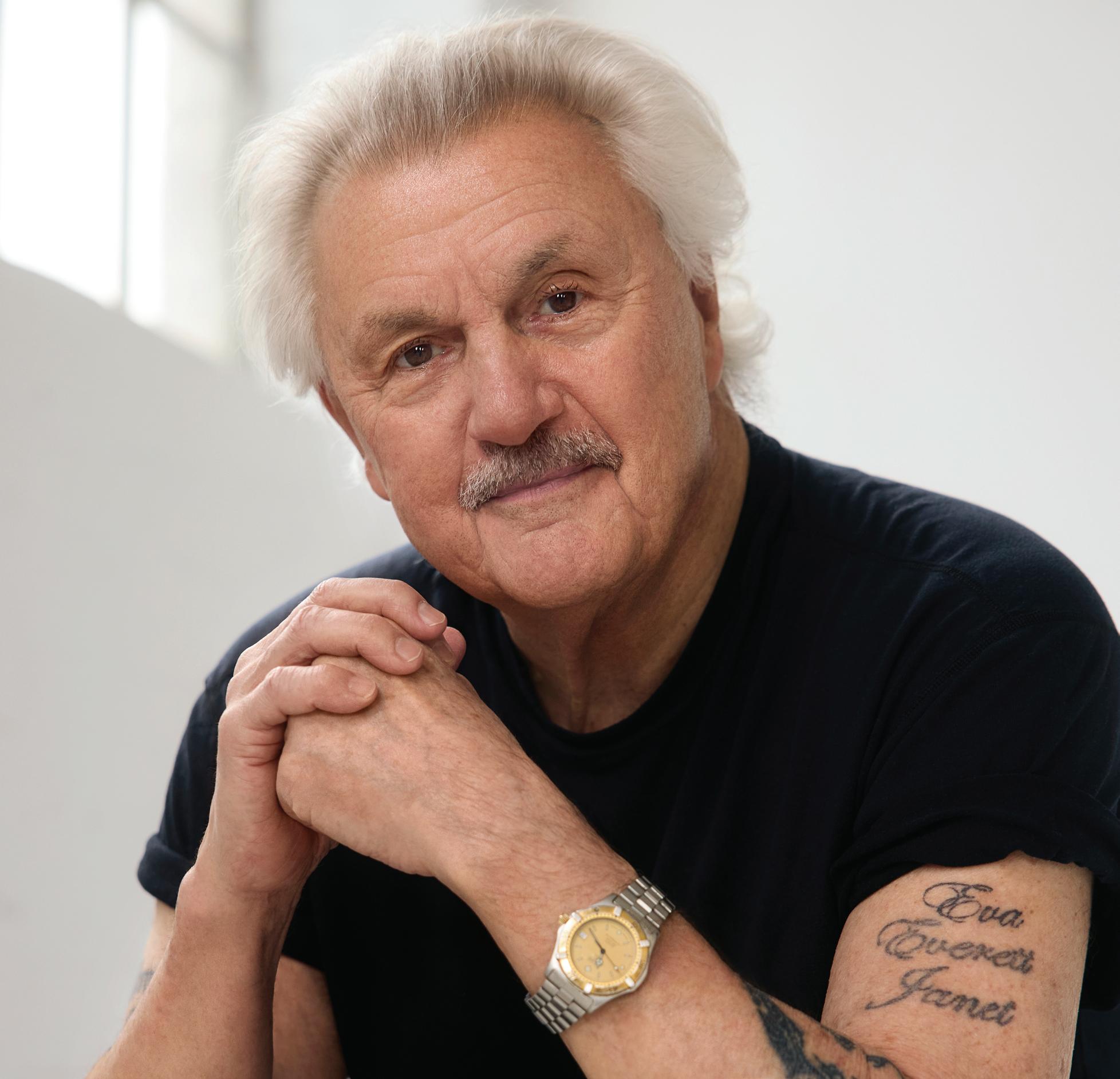
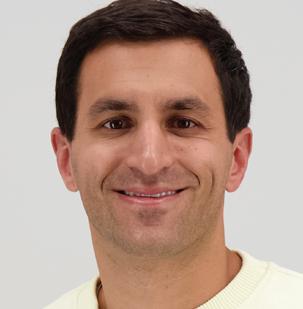
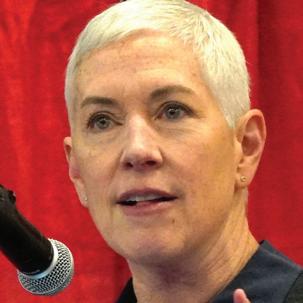
∙ A conversation with author John Irving ’61 ∙ Heard in Assembly Hall ∙ David Lim ’88 on the Exeter Alumni Association ∙ Health and Human Development Department Chair Courtney Shaw meditates on grief and grace ∙ Ellen Jin ’26 on the endowment ∙ Exonians in review ∙ Exoniana
17
The Academy
Wick Sloane ’71 receives alumni award ∙ 17th principal announced ∙ Army 1st. Lt. Layne Erickson ’18 on non sibi ∙ Academy news ∙ Theater, dance and music ∙ Rhodes Scholar Emma Finn ’22 ∙ Meet the new squash director ∙ Hockey standout Thomas Larkin ’09 heads to the Olympics ∙ Fall sports highlights
45
Connections
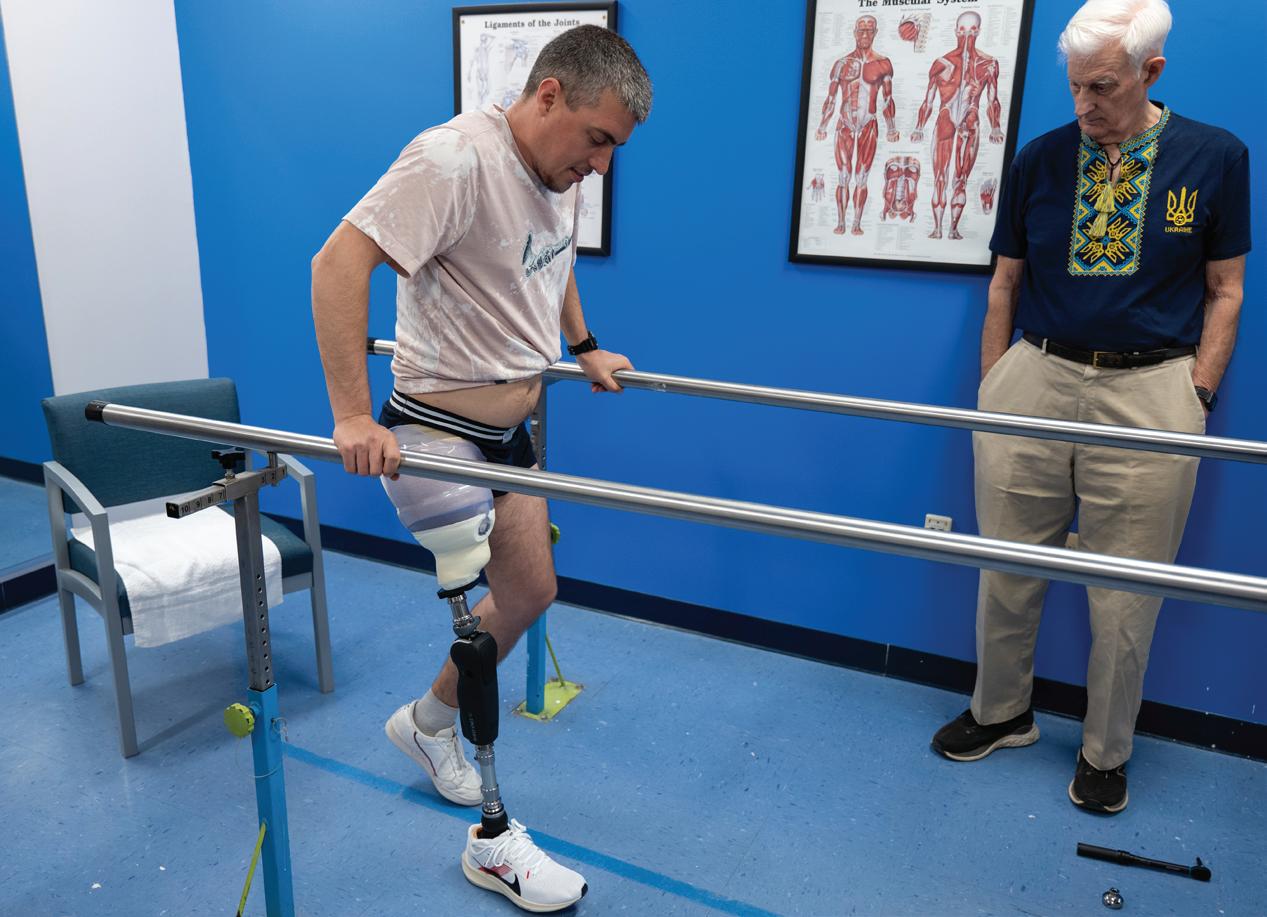
Bill Endicott ’64 supports Ukrainian solider amputees ∙ Astrophysicist Ana Glidden ’12 ∙ Events around the world
53
Class News and Notes
94
Memorial Minute
Jacquelyn Harvey Thomas
96
Finis Origine Pendet
The Exeter Bulletin
Volume CXXX, Issue no. 2
Principal
William K. Rawson ’71; ’65, ’70 (Hon.); P’08
Director of Communications
Robin Giampa
Editor in Chief
Jennifer Wagner P’24
Class Notes Editor
Cathy Webber
Contributing Editor
Patrick Garrity
Staff Writers
Adam Loyd, Sarah Pruitt ’95
Production Coordinator
Ben Harriton
Designers
Red Ink Design, Jacqueline Trimmer
Photography Editor
Christian Harrison
Communications
Advisory Committee
Daniel G. Brown ’82, Robert C. Burtman ’74, Dorinda Elliott ’76, Alison Freeland ’72, Yvonne M. Lopez ’93
TRUSTEES
President Kristyn A. McLeod Van Ostern ’96
Vice President Suzi Kwon Cohen ’88
Bradford “Brad” Briner ’95, Samuel “Sam” Brown ’92, Elizabeth A. “Betsy” Fleming ’86, Ira D. Helfand, M.D. ’67, Paulina L. Jerez ’91, Giles “Gil” Kemp ’68, Eric A. Logan ’92, Eugene “Gene” Lynch ’79, Cornelia “Cia” Buckley Marakovits ’83, William K. Rawson ’71, Christine M. Robson Weaver ’99, Genisha Saverimuthu ’02, Michael J. Schmidtberger ’78, Peter M. Scocimara ’82, Leroy Sims, M.D. ’97, Rhoda K. Tamakloe ’01, Belinda A. Tate ’90, Janney Wilson ’83
THE EXETER BULLETIN (ISSN No. 0195-0207) is published four times each year: fall, winter, spring and summer, by Phillips Exeter Academy, 20 Main Street, Exeter, NH 03833-2460
Tel: 603-772-4311
Periodicals postage paid at Exeter, NH, and at additional mailing offices. Printed in the USA by Cummings Printing.
The Exeter Bulletin is sent free of charge to alumni, parents, grandparents, friends and educational institutions by Phillips Exeter Academy, Exeter, NH.
Communications may be emailed to the editor at bulletin@exeter.edu.
Copyright 2026 by the Trustees of Phillips Exeter Academy. ISSN-0195-0207
Postmasters: Send address changes to: Phillips Exeter Academy, Records Office 20 Main Street, Exeter, NH 03833-2460
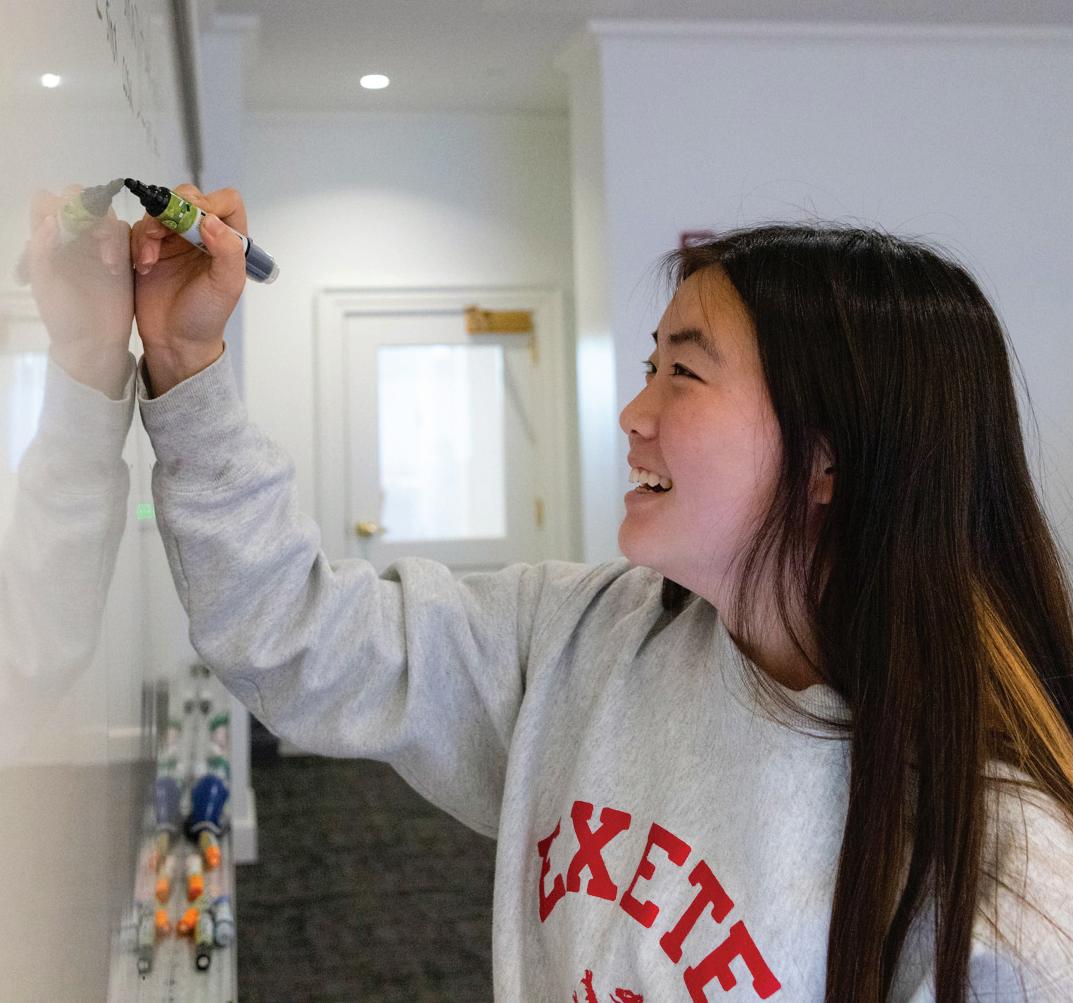
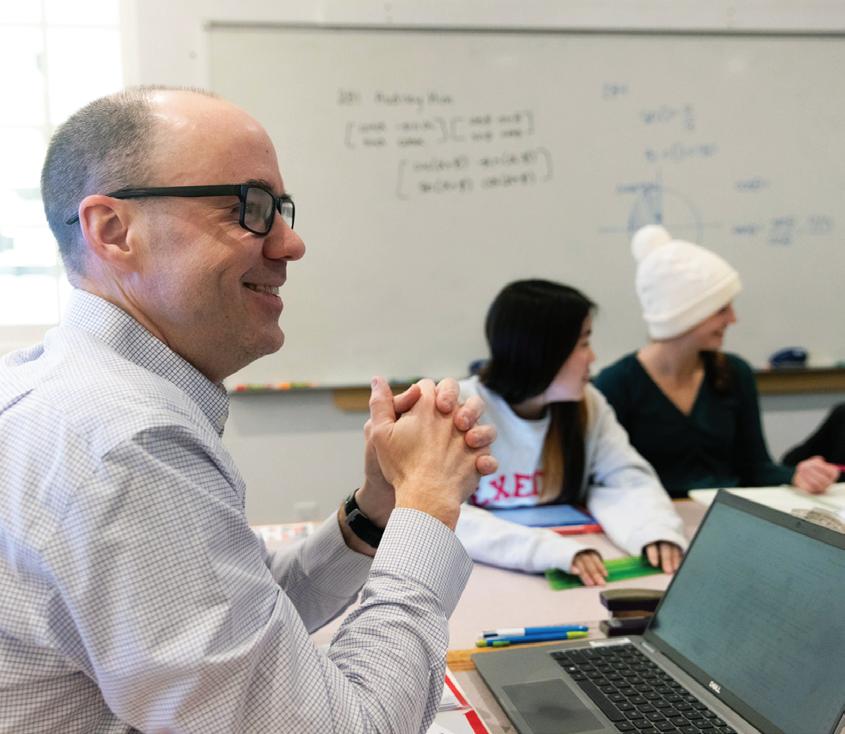
The Hahn Center serves up more than meals: Audrey Kim ’28 enjoys math class in one of the facility’s upstairs meeting rooms. p. 30
Ana Glidden ’12 searches for life beyond Earth. p. 47
Rivalry Weekend
When the clock ticked down on the 144th rivalry football game against Andover in November, fans ran onto the Phelps Stadium turf and released red powder signaling Exeter’s decisive victory. Academy quarterback Jake Attaway ’26 led the team to a 48-16 win, rushing for two touchdowns and throwing two touchdown passes. Van Hellman ’26 made the defensive play of the game when he blocked a punt and returned it for a touchdown. This was Big Red’s fifth straight win over Andover.●
Around the Table
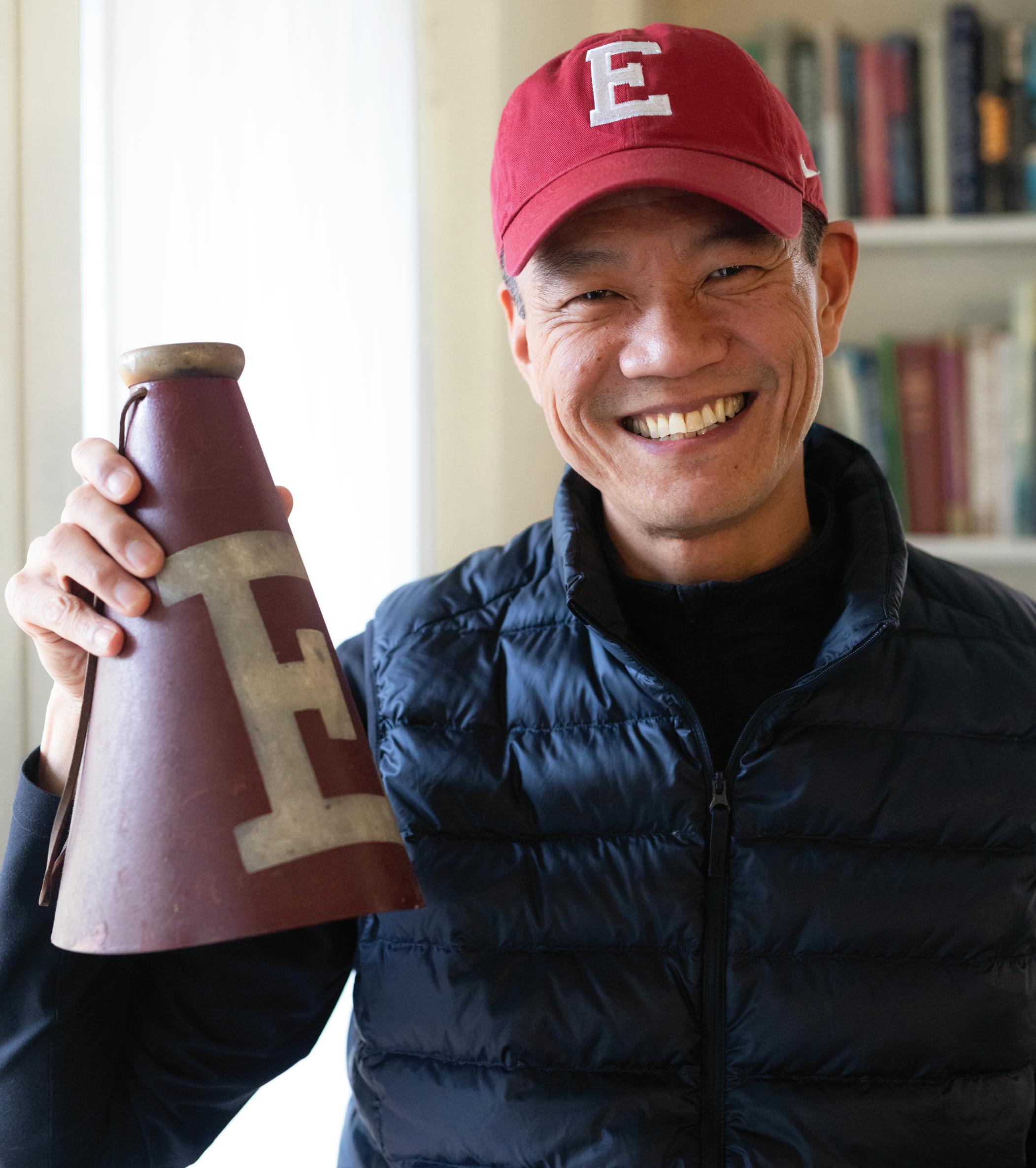
Alumni Voice Hear why David Lim ’88 would like to invite Abraham Lincoln, Donald Trump and his mom to the Harkness table. P. 11
David Lim ’88 is an Exeter Alumni Association director and chief clinical officer at Evolent Health.
WINTER 2026 / CONTENTS FEATURES Inside the Hahn Center
The Academy’s newest hub for dining, community and connection.
Sarah Pruitt ’95
30
The Shot Scientist
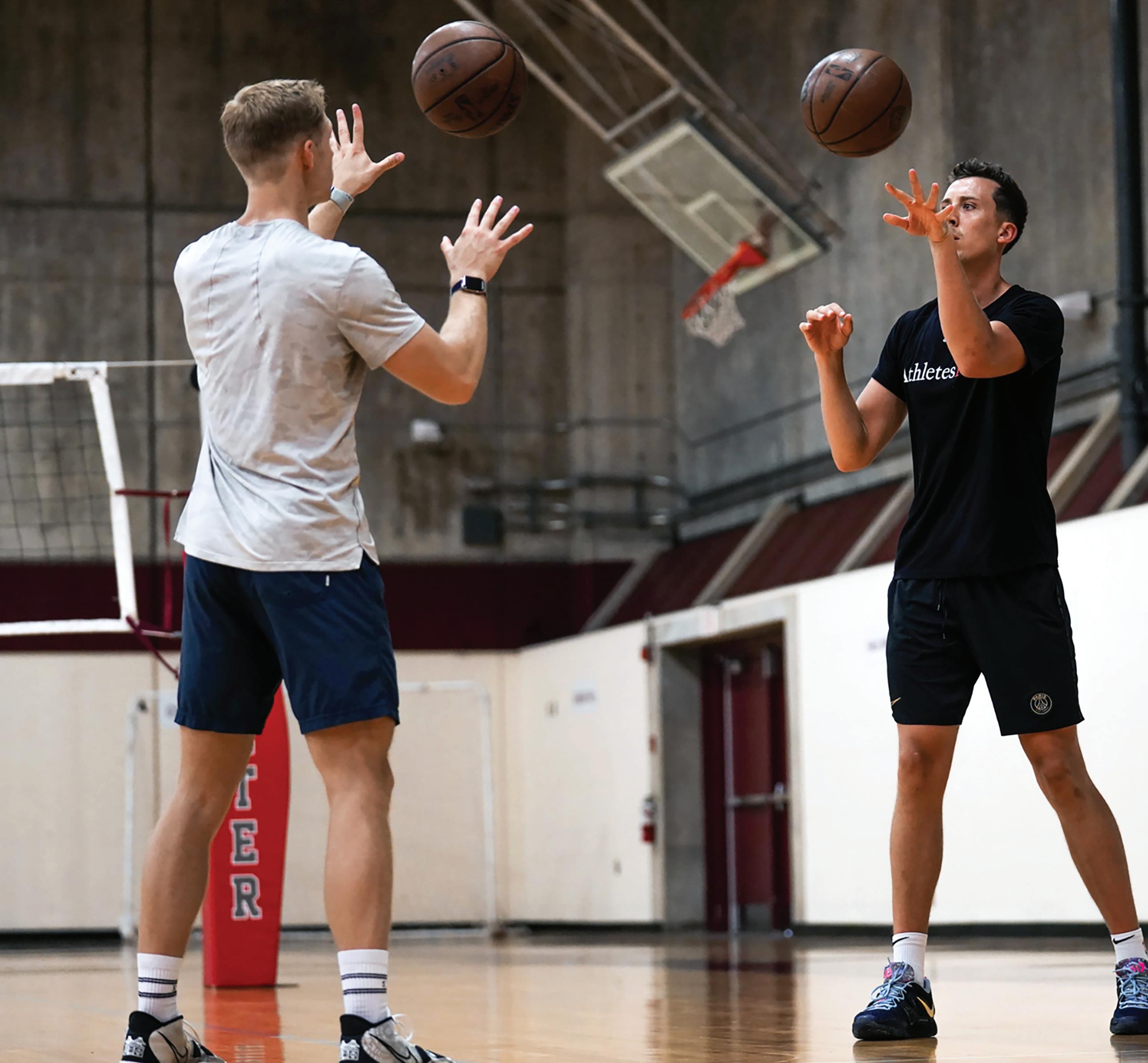
Mitchell Kirsch ’17 takes an academic’s approach to training NBA players and Exeter ballers. Benjamin Cassidy 34 All Rise
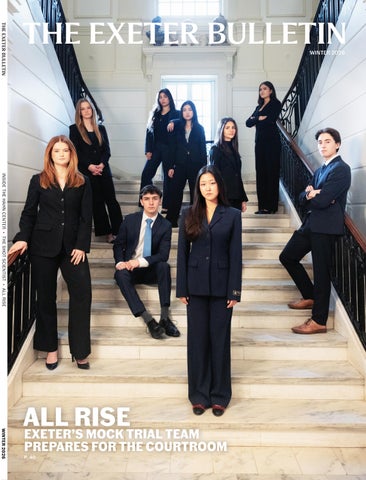
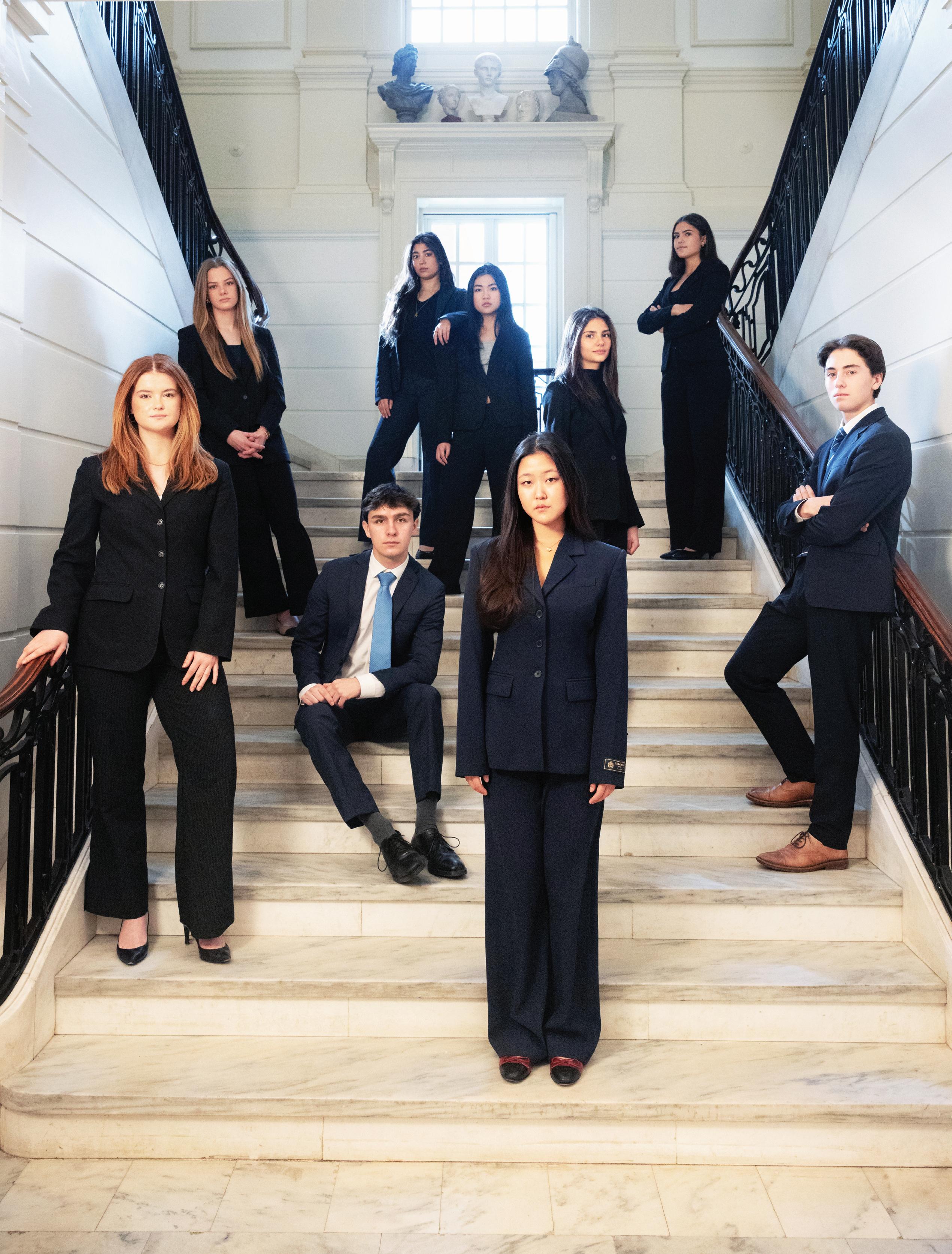
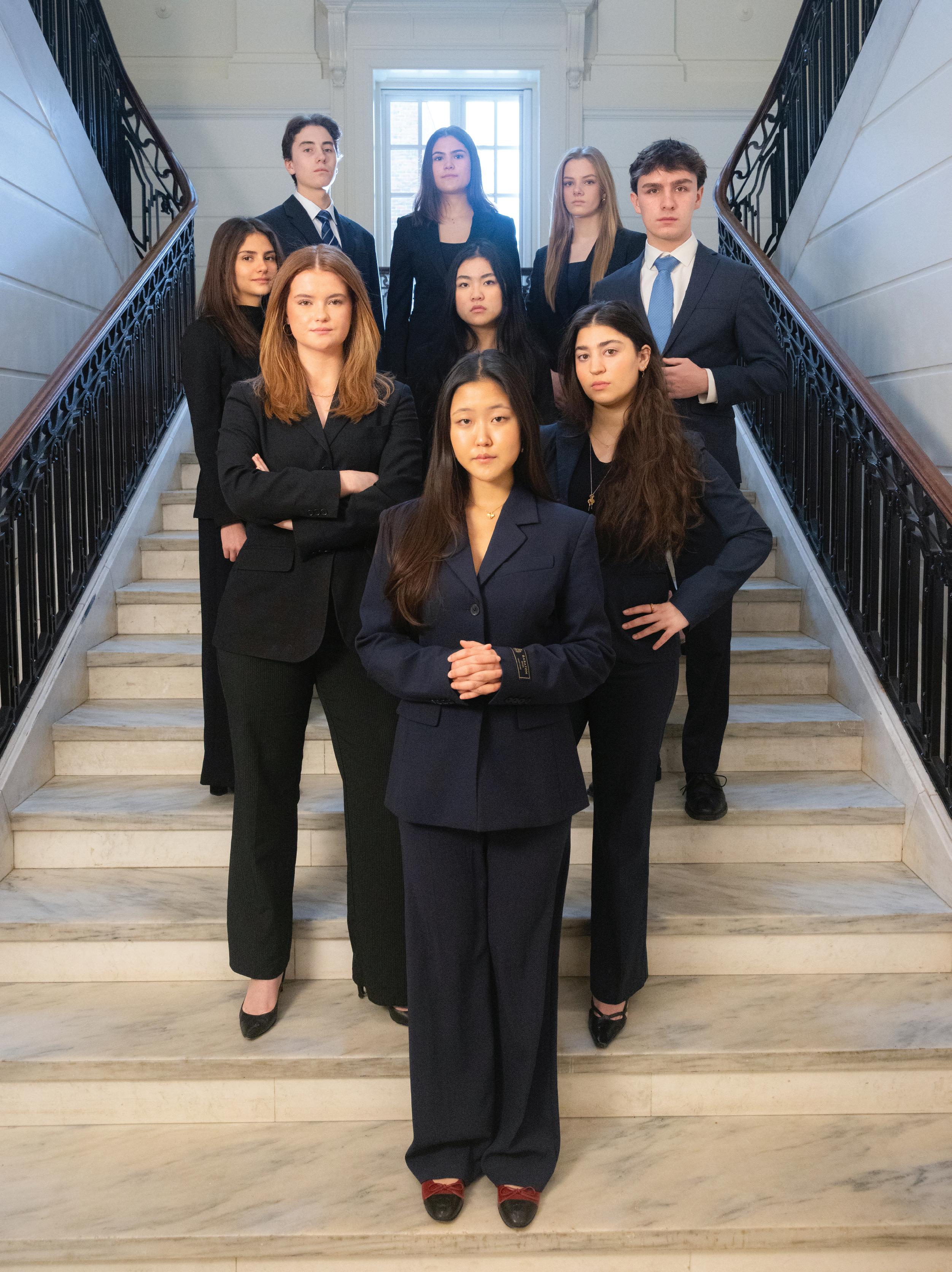
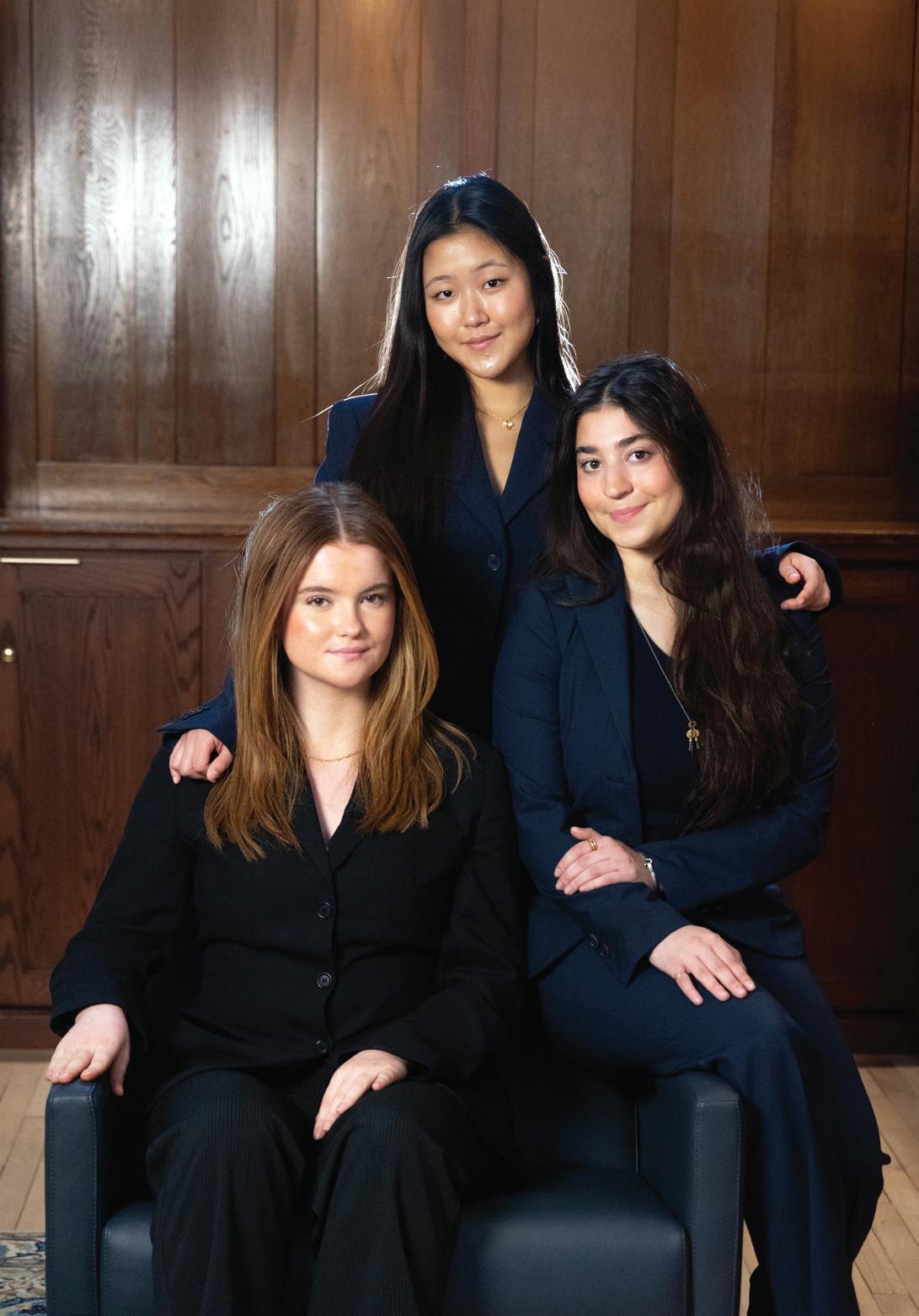
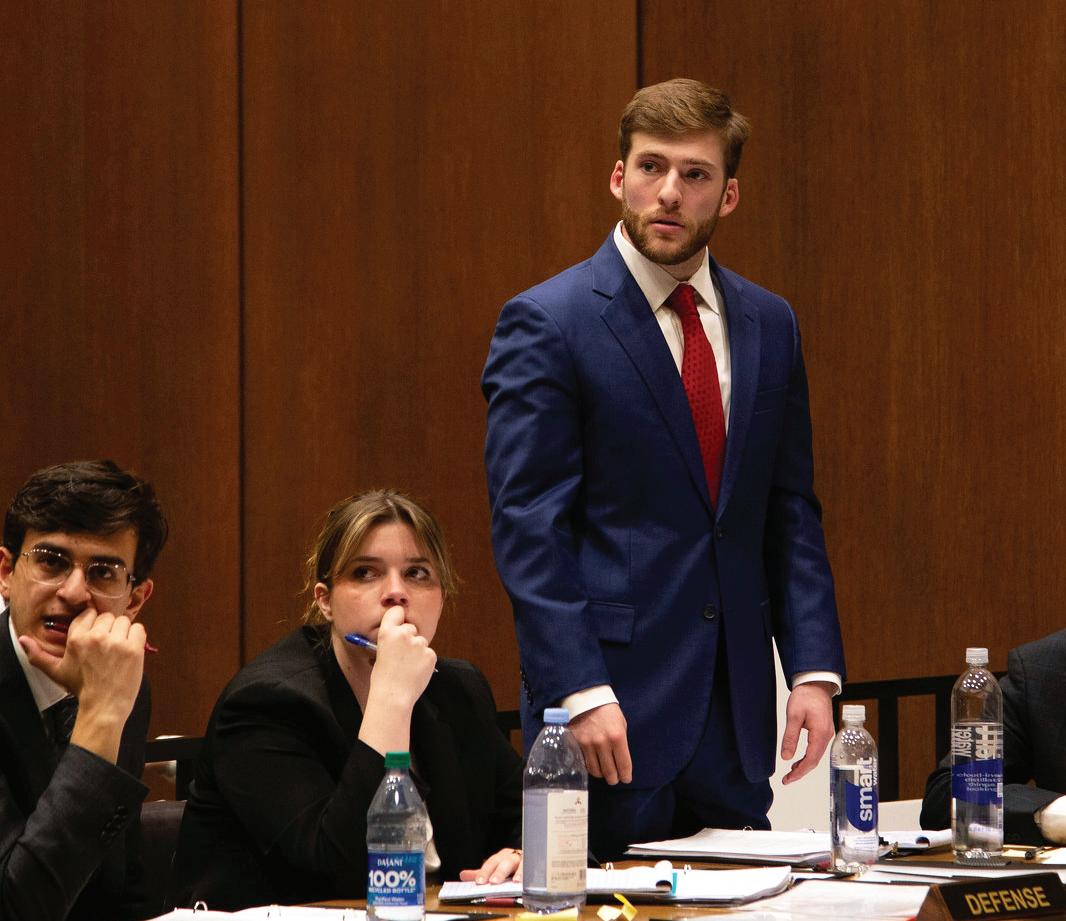
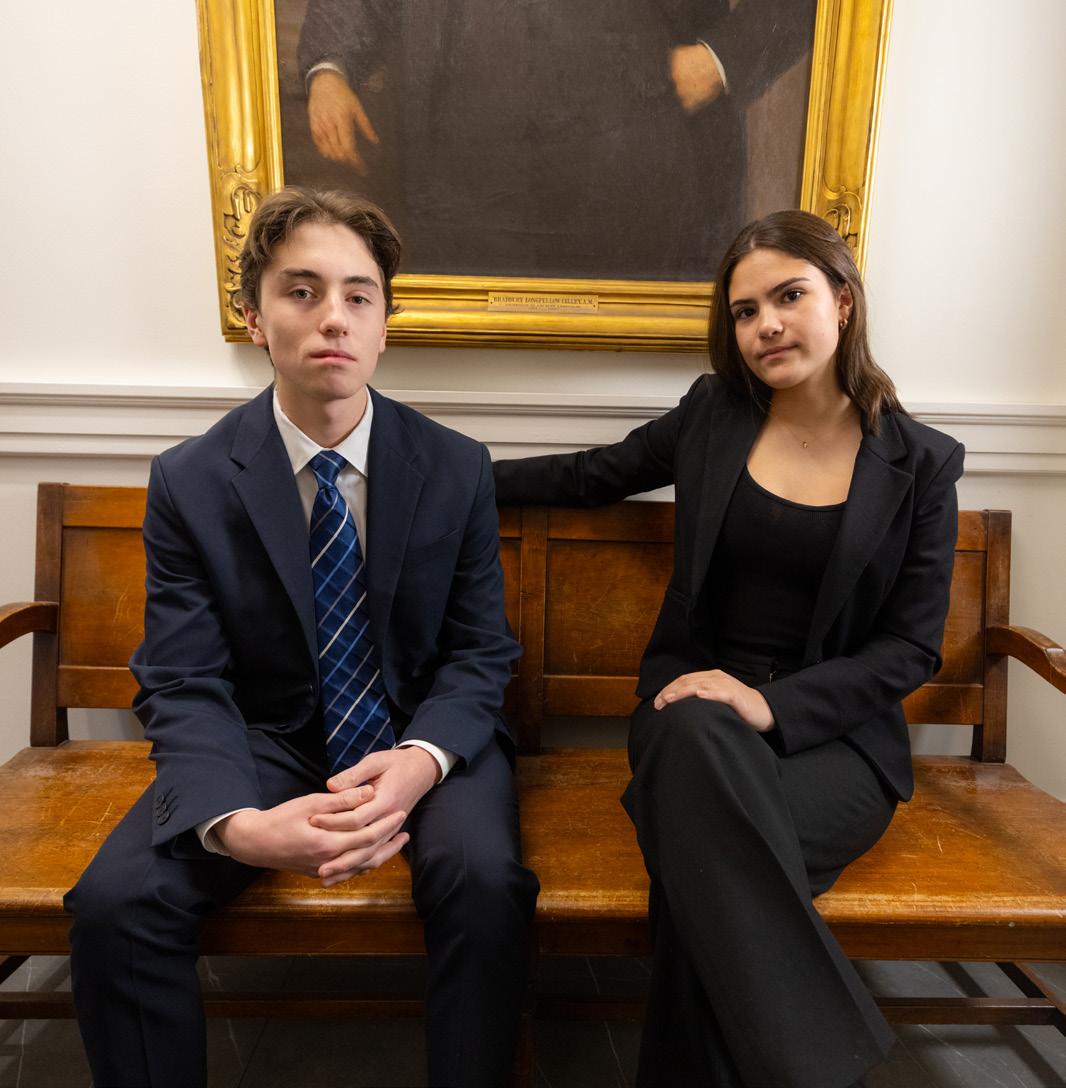
How Exeter’s mock trial teams prepare for the courtroom — and find camaraderie and confidence along the way.
Sarah Pruitt ’95
40
Mock trial “really changed the way I’ve been able to look at problems, see two sides to a story and craft an argument that is persuasive, but embraces aspects of the other side.”
Anderson Lynch ’23, P. 40
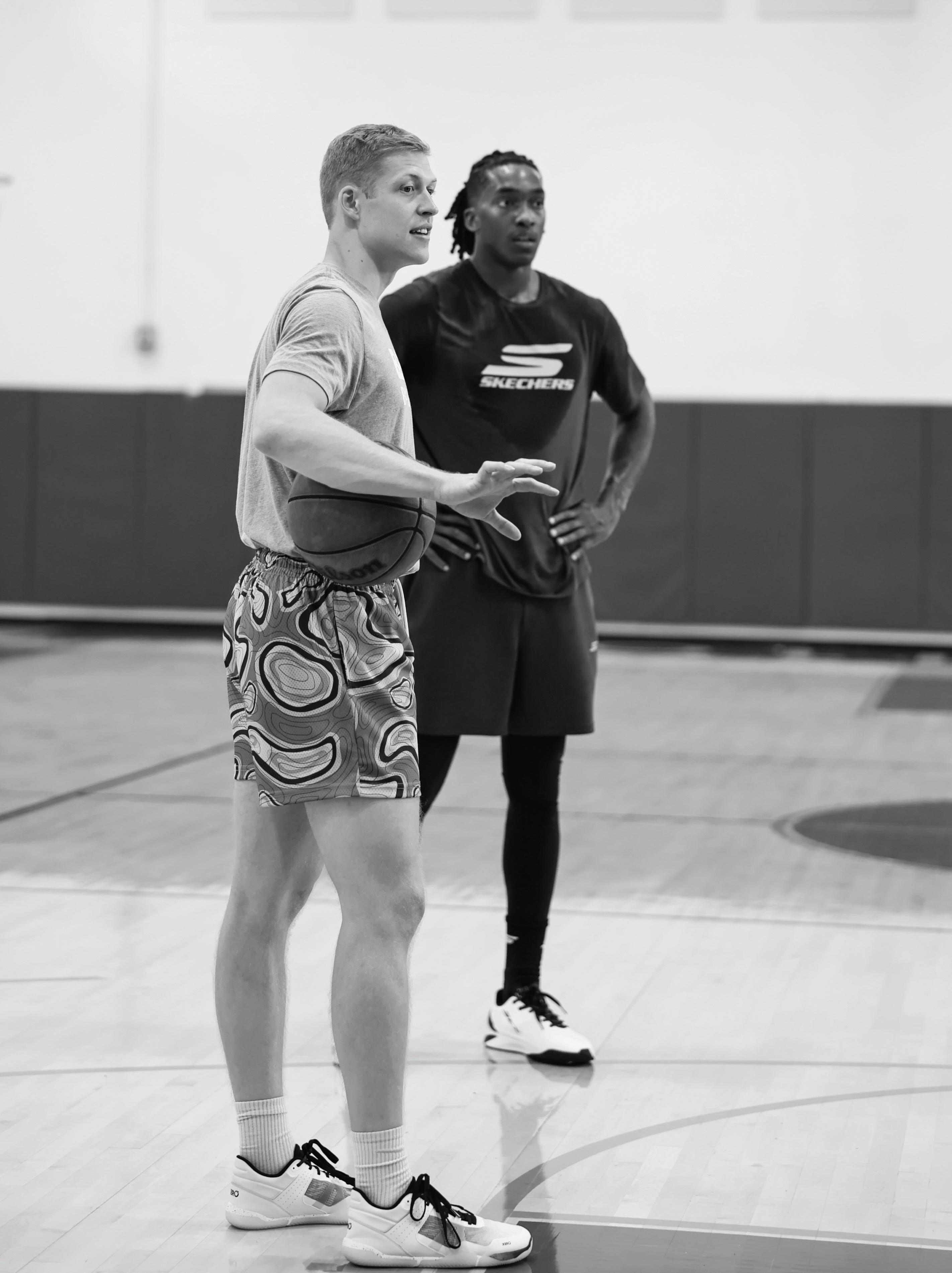
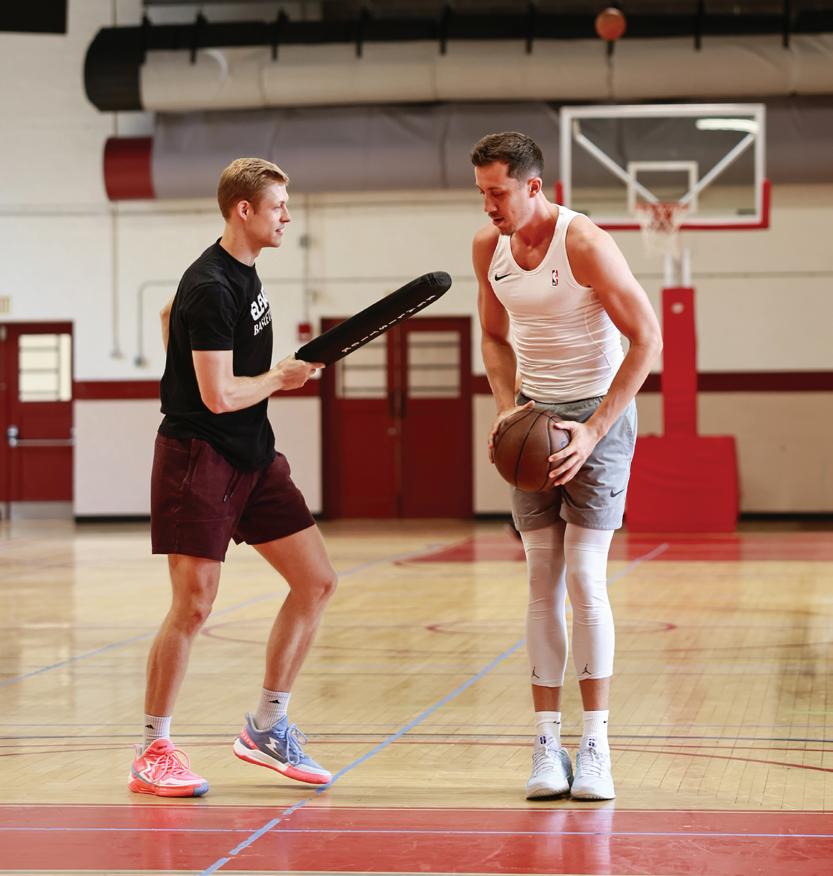
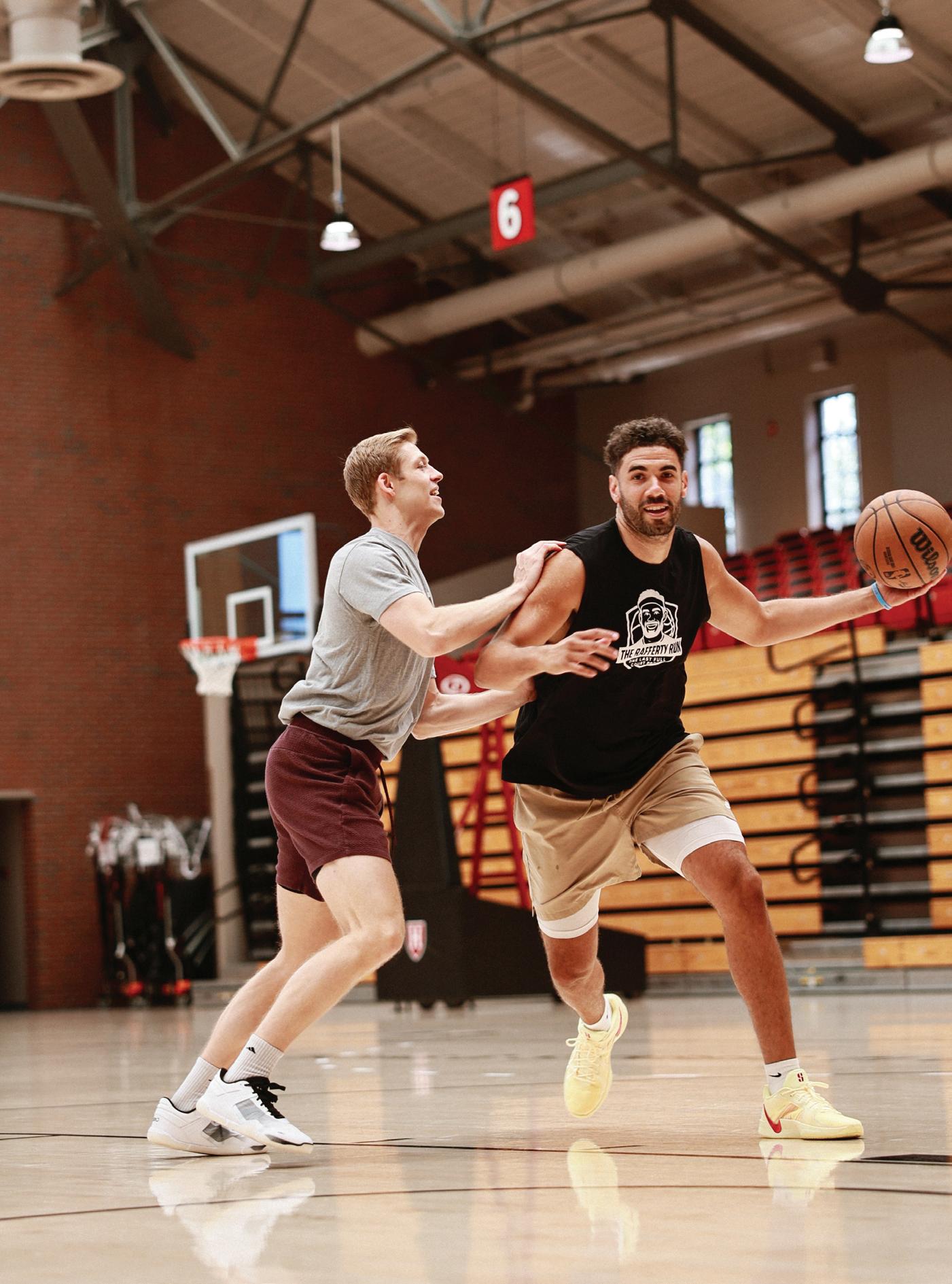
Trainer Mitchell Kirsch ’17 (left) challenges athletes to improve by adapting on the fly. P.34
Cover: Photography by Christian Harrison
The Community Exchange
Letter to the Editor
I love the new look of The Exeter Bulletin. Particularly all the nice, crisp color photos in the class notes section. The articles are also wonderful. Keep up the good work. This is my first-ever comment to the editor of any magazine! I really enjoy the work you’re doing. Rob Pepper ’66
E/A Weekend Reflection “Exeter-Andover is my favorite part of the year. You can’t replicate the feeling of our volleyball team acing Andover, or the gleeful dizziness that comes from cheering just a touch too loud at the football game. You ignore the sticky feeling of face paint on your cheeks and the soreness in your legs from a game a few hours earlier, because in that moment, the only thing that matters is the energy surrounding you, and your voice in the sea of cheers that will propel game after game.”
Morgan Signore ’26, varsity girls soccer co-captain and co-head of the Big Red Zone
QWhat’s your biggest achievement of the term?
We set up a standing microphone on the quad for students to respond to that simple question. Here are some of their answers:
• Getting 100 on my chem quiz
• Passing my bio test
• Being more independent
• Joining a lot of clubs and seeing what I like to do and trying new things
• Surviving my first history paper
• I did 25 pushups this morning
• Beating Choate Rosemary Hall
• Being in Chamber Orchestra
• Getting my Eagle Scout for Boy Scouts
• Managing my time well
• Working on my meditation
• I’ve made great connections with my teachers
• Making a lot of friends
Quotable I love the collaboration that Exeter is built on. But I also wanted the chance to take full ownership of a project. Independent work gave me the freedom to design and build a working prototype exactly how I imagined it. At a busy place like Exeter, having dedicated time to focus on a project I was passionate about was rare. I could experiment, iterate and actually bring my AI model to life. I loved the process of testing it, refining it and making it functional, all on my own schedule. Seeing an idea transform from concept to something real and usable was incredibly satisfying.
Maya Shah ’26
Shah is one of seven Exonians who worked on independent study projects over the fall term. With support from Computer Science Instructor El Kaplan, Shah developed an AI-powered triage system to help emergency departments reduce overcrowding and long wait times. The system predicts patient urgency using symptoms, vital signs and medical history, assigning a 1–5 urgency score. Shah’s prototype includes a web-based interface for staff and an AI model trained on over 200,000 emergency department admissions from a dataset from Beth Israel Deaconess Medical Center in Boston.
We want to hear from you! The Exeter Bulletin welcomes story ideas and letters related to articles published in recent issues. Please send your remarks for consideration to bulletin@exeter.edu or Phillips Exeter Academy, The Exeter Bulletin, 20 Main Street, Exeter, NH 03833.
Big Red Zone co-head Morgan Signore ’26 (left) during E/A weekend.
Scan this QR code to watch the video.
Cheerfully Assisting
Our Deed of Gift contains a wonderful passage in which John and Elizabeth Phillips recognize that the free school they were founding would grow and in time require more teachers. They stated plainly their expectation that graduates “who reap some advantage by this institution, will cheerfully assist in supporting the additional, so that poor children of promising genius may be introduced, and members who may need some special aid may have it afforded them.”
Academy histories show that Exeter graduates from the beginning have consistently met the Phillipses’ expectations, as have parents and friends of the Academy, and the experiences of all students over time have been lifted as a result. Every aspect of the student experience today has been made possible through the assistance of alumni, parents and friends who have given generously according to their means and thereby kept the Academy at the forefront of secondary education.
I was keenly aware of this tradition while I was a student. I understood fully that the generosity of prior generations of Exonians had made my matriculation and experiences at Exeter possible. I was deeply grateful for the opportunity to attend a school like Exeter, where teachers demanded my best, integrity and hard work were expected, and family wealth was of no consequence.
That is what I had in mind when I sent a check in the amount of $5 my first year after graduation, and when I sent checks in slightly larger amounts in the years that followed. Like many other graduates, I wanted to begin repaying the debt that I felt I owed to Exeter, and I felt it important to express my gratitude. I had specific teachers, coaches and experiences in mind when I put those checks in the mail.
I think about it differently now and take a wider view. I give to Exeter for the same reasons that John and Elizabeth Phillips used their wealth to create
our school, and for the same reasons that Edward Harkness gave millions to a school that he never attended. They believed in the power of our school to change students’ lives, and in the power of Exonians, imbued with knowledge and goodness, to be a force for good in their communities and the larger world.
“Every aspect of the student experience today has been made possible through the assistance of alumni, parents and friends who have given generously according to their means and thereby kept the Academy at the forefront of secondary education.”
Over the years, I have been deeply impressed by the generosity of alumni, parents and friends of the Academy who have similarly found purpose and meaning in supporting our great school. Some give to support financial aid. Some give to support faculty and staff compensation and benefits. Others give to support specific programs or initiatives that were important to their experiences as students, or that they believe are important to the development and growth of our students today. In every case, their gifts are impactful.
When we give to Exeter, we support current students and their individual growth and development, but we also are part of something even bigger. Like generations of Exonians before us, we are investing in the mission of our school and the power of an Exeter education. We are helping to lay the “surest foundation” for all the good work that our graduates will do, now and in the future, in the spirit of non sibi, to create a better world for all. I feel cheerful about it. I hope you do too.
Thank you.
—Bill Rawson ’71; ’65, ’70 (Hon.); P’08
Identity, Belonging, History
A conversation with novelist John Irving ’61
For fans of author John Irving ’61, his most recent novel provides a host of familiar comforts: tattoo parlors, Viennese romps, unconventional family dynamics and, of course, a thinly veiled version of Phillips Exeter Academy. But that novel, Queen Esther, also ventures into uncharted territory, especially when tracing the enigmatic exploits of its titular character, a Jewish orphan named Esther Nacht.
Irving — a standout wrestler at Exeter and a lifelong devotee of the sport — discussed his new book with current varsity wrestling coach Justin Muchnick. Here’s some of their conversation.
Let’s start with your main character, Esther. How does she drive this novel?
Esther is born in Vienna in 1905. By the time she’s a 3-year-old, her life has already been shaped by antisemitism. She returns to her birth city in the 1930s, when many Viennese Jews are leaving (or have already left). I wanted my Esther to be the embodiment of the Esther in the Hebrew Bible and the Christian Old Testament. She is the epitome of hiddenness — a secretive, behind-the-scenes operator. But when she reveals herself, watch out! Esther is making up for the Jewish childhood she was denied; she’s going to be the best Jew she can be. I wanted her to be part of the founding of the State of Israel. Her birth child, Jimmy, is my POV character, but Esther is the novel’s main character; she’s the one who makes everything happen. The objective of this ending-driven novel — which concludes
in Jerusalem in 1981 — was to create, in Esther, an empathetic Zionist.
On that ending: Why Jerusalem, and why 1981? April 1981 is when — in my life — I was invited to Israel by the Jerusalem International Book Fair and my Israeli publisher. I accepted the invitation at the urging of my favorite European publishers. They were Jewish with longstanding ties to Israel. They were leftist, nonobservant Jews who’d criticized the right-wing Likud government of Menachem Begin for accelerating the settlements in the West Bank. They said the Israeli presence there, and in the Gaza Strip, might make Palestinian self-determination harder to achieve — they believed then that a twostate solution to the Israeli-Palestinian conflict could slip away. Queen Esther is a historical novel, and a historical novel foreshadows the future. In April 1981, the seeds were sown for an eternal conflict.
It’s a conflict that’s taken on a renewed relevance in recent years — perhaps more than you were expecting during the writing process. The novel has certainly predicted that these troubles were likely to be ongoing. Of course, I wish for a peaceful resolution. I’m hoping for a lasting peace, for the Israelis and the Palestinians.
When researching this book, did you visit Israel? Have you been back since 1981?
It was important to me that I not go back to check my facts — not until I had a finished draft. The dialogue mirrors what I remember being said to me, or what I overheard. But in a historical novel, the dialogue must also be what was commonly said in that time and place. My early readers — several Israeli contacts and friends — assured me it is.
Once the novel was drafted, in July 2024, I visited Jerusalem, to talk to these early readers and to refresh my memory of the visual details — to go where I’d gone 43 years ago. When I was there in 2024, the war in Gaza was ongoing. In the Muslim Quarter, there were no tourists on the Via Dolorosa — the Way of Sorrows, where Christ carried the cross to be crucified. No tourists in the Christian Quarter — not even at Christ’s tomb, in the Church of the Holy Sepulchre. I was alone in the evenings, reading over my day’s notes, mapping out where I would go the next day. Most evenings, my Israeli friends were at anti-Netanyahu protests.
Backtracking from your novel’s ending to its beginning: You included a cameo from Dr. Wilbur Larch, the saintly abortionist-cum-orphanage director from The Cider House Rules. The beginnings of my novels are often the most autobiographical. I’m conscious of grounding my novels in recognizable locations, and with some familiar character types, but this is the first time that I have re-created or revisited an old character. The reasons for doing so had everything to do with my trajectory for Esther. I needed an orphanage for an abandoned Jewish child. I knew of an orphanage where she would be treated well.
“The objective of this ending-driven novel — which concludes in Jerusalem in 1981 — was to create, in Esther, an empathetic Zionist.”
Dr. Larch is much younger than readers or moviegoers who know The Cider House Rules will remember, and there’s an entirely different cast of characters among the unadopted orphans, but I knew Dr. Larch would find out all he could about Esther, and that he’d find the best possible family for her, although they wouldn’t be a Jewish family.
I love Dr. Larch but, for obvious reasons, I’ve got a soft spot for the novel’s wrestling scenes. You’ve set these in Vienna, in a grimy but cosmopolitan gym called the Turnhalle Leopold I tried to be truthful to the wrestling gyms I visited when I was in Vienna in 1963-64. At that time, there were more Greco-Roman wrestlers than freestyle wrestlers — freestyle being closer to folkstyle in the U.S. Because Queen Esther is a political novel, I chose to focus on two Soviet and two Israeli wrestlers as characters. Some of the Soviets in Vienna in ’63-’64 were KGB operatives, and some of the Israelis were Mossad operatives — or “working for Wiesenthal” as Nazi hunters. In the novel, I wanted the Soviets and the Israelis to be the only wrestlers that my character Jimmy was close to.
You’ve seen a lot in the sport, both as an athlete and as a coach. So, from one coach to another, what’s your go-to piece of coaching advice? I was lucky to be associated with excellent wrestling coaches, all in first-rate programs. This began with Coach Seabrooke at Exeter (a Big Ten champion at Illinois, and a two-time NCAA finalist), and it continued when I was at Pittsburgh and Iowa. Great clubs, great coaches. Many of my teammates and workout partners were champions — and so were my sons, both of whom I coached. My son Colin won a New England Championship for Northfield Mount Hermon; my son Brendan won the same title for Vermont Academy. But I, as a wrestler, never got past the semifinals at any tournament — in my Exeter years, in my university years or postcollege.
My foremost advice to a coach, at any level, is you have to know who the superior athletes are, and you have to recognize the hard workers who aren’t as gifted athletically. You coach to the individual. A good athlete will end up on top in a scramble; you coach that guy differently than you would a wrestler who’s not as talented. Some guys thrive in scrambles; other guys get killed in them. Know the difference!
—Justin Muchnick is the varsity wrestling coach at the Academy and a Ph.D. candidate in classics at the Institute of Classical Studies.
family and survival, exploring themes of identity and antisemitism. Irving has written 16 novels including The World According to Garp, The Hotel New Hampshire, The Cider House Rules and A Prayer for Owen Meany.
The historical novel Queen Esther, by John Irving ’61, centers on
Heard in Assembly Hall
Sound bites from this fall’s speaker series
“The death of all great brands in sports, retail and fashion lies in the notion of stagnation. If you’re standing still, you’re moving backwards. And if you don’t have the courage and ability to disrupt yourselves, then you ultimately will become disrupted by the competition.”
Chris Davis ’04 Brand president and chief marketing officer at New Balance
“Our purpose really is to understand where we come from and to share that understanding with others. Sharing helps us connect, and it leads to a life of joy and purpose. So think about what story you can tell, and tell it.”
Anna Richardson White ’98 Founder/CEO of Kentcali and documentary producer
“You are the architect of your life, not your instructors, not even your parents. Whatever you want to build, you can build, but you have to take into consideration what you’re aiming for … and let that be the thing you work toward every day.”
Dwight Davis Businessman, civic leader and former NBA player
“The world of the future will very much depend on how this war [in Ukraine] ends. … What is happening today … in that far away part of the world will influence all of us for at least a generation to come. It matters who wins and who loses in this war, and it’s very important to be on the side of good and on the side of light.”
Serhii Plokhii Professor and director of the Ukrainian Research Institute at Harvard University
“Imagine if we were to define success as people’s ability to successfully regulate their own emotions and to help others to regulate theirs. Imagine if success was showing compassion, being nonjudgmental, being a good listener. What might be different?”
Marc Brackett Professor at Yale and founding director of the Yale Center for Emotional Intelligence
“Art is a hard way to make a living in the world, they say. But if you meet the criteria for getting a job done on time and you give it your best and enjoy it — it’s been a very fulfilling ride for me.”
Noelle
Giddings Painter, illustrator and comic book artist
To watch videos of some of these assemblies, go to exeter.edu/live
Community Engagement
David Lim ’88; P’27 on his role as an Exeter Alumni Association director and his experience as an Exonian
About the Board
Members of the EAA’s board are nominated. What inspired you to accept the call? Exeter was instrumental in shaping my personality, my outlook on life and a curiosity to understand our world and relate to others in a meaningful, caring way. Having the ability to be a contributor to the Academy motivated me to accept the role.
What do you do as an EAA director?
We listen to understand today’s near-term and longterm goals of the Academy’s mission, explore how to effectively message these goals and communicate this to the alumni community. We also hear from alumni about their experiences and discuss what they think would benefit the Academy. It’s this twoway channel or bridge that is super important.
What have the directors focused on this year?
We openly discussed the hard issues the Academy has encountered over the years, the alumni sentiments and how the school is addressing them. In addition, when Principal Rawson announced that this would be his last year, we actively sought the feedback, opinions and guidance of alumni on what attributes and qualities the new principal should have. This was all synthesized and shared with the Principal Search Committee.
Have there been any unexpected benefits to this role?
There’s the privilege of meeting a lot of different alumni. Normally, I would not pick up the phone and talk to somebody who graduated in the ’70s just to say, “Hey, how was your Exeter experience?” or “What things have really stuck in your mind that could be changed for the better?”
You have a student at the Academy presently. What do you hope that they understand about the alumni community?
I tell my daughter that graduating from Exeter is just the beginning of your Exeter experience. There are many, many more years after Exeter than there are at Exeter. The friendships and the connections are very deep and meaningful. Your Exonian friends will just show up in the best of times and the worst times for you. I remember when I was a student here, Principal Steven Kurtz always said: “Make sure you say hello to everybody on the path. Acknowledge that they’re there. It’s an important gesture of kindness.” That really carried me forth beyond Exeter. I tell my daughter, “Don’t forget that you will always belong, but you should also make sure you put the effort in to make others feel they belong.”
As an Exonian
What is Exeter to you?
Exeter was the pinnacle of knowledge and opportunity in a community to cultivate excellence purposely in youth from every quarter.
What’s your favorite place on campus?
The boathouse and rowing on the Squamscott with my crew.
Where was your favorite place to study?
The Lamont room at the top of the library with the rare books collection.
Weth or Elm?
Weth all the way.
If you could invite three people to join you at the Harkness table, who would they be?
Abraham Lincoln, Donald Trump and my mom. All of them have or are currently living through tumultuous times. Harkness, for me, was and continues to be a rare place and time for open, respectful, nonreactionary dialogue. It is designed never to stop exploring facts, assumptions, ideologies, justice and empathy. Students at the Harkness table hear perspectives and experiences from one another, allow space for opinions to be reshaped, and learn how to change and grow in the most informed and effective ways. I included my mom as she is one of the most fearless, strongest individuals I know. She witnessed the destruction of Seoul, rescued her brother from North Korean soldiers and fought for her education amidst extreme gender bias — all as a teenager. We are a country divided with lives literally in the balance. In these challenging times, we need more Harkness and I would love to enter a dialogue with these individuals at the table.
David Lim ’88; P’27 attended Harvard and earned his M.D. and Ph.D. at Columbia. A health care technology entrepreneur, Lim is currently chief clinical officer at Evolent Health.
What is the Exeter Alumni Association?
The purpose of the Exeter Alumni Association (EAA), formerly the General Alumni Association, is to foster communication and engagement between the Academy and its alumni and within the alumni community to support the Academy's mission. Its board acts as the guiding body of the EAA and “shall engage, to the extent possible, with a broad array of alumni, through on-campus, regional and virtual activities.”
AROUND THE TABLE / MEDITATION
Grief and Grace
Courtney Shaw, chair of the Department of Health and Human Development, on changing your perspective
Each fall, faculty members take to the podium in Phillips Church, in front of peers, students and friends, to deliver meditations. There is no template or paradigm for a meditation. Most are personal and evolve from thinking about life and one’s place in it.
One of the earliest published collections of meditations states, “The meditations may well signify the best of what Phillips Exeter Academy seeks to nurture within its community: clear cogent expression, observation and contemplation, respect for others, and a sense of the complex interrelatedness of humankind.”
Here is an excerpt from the meditation Courtney Shaw shared with the community this fall.
Ihave lived long enough to know grief and grace on a first-name basis.
“Mrs. Shaw, your daughter is what we consider gifted and talented.” That was code for I would spend first through fourth grade in the C.L.U.E program, Creative Learning in Unique Environments. I loveeeeed CLUE. I met several politicians, the old Sammy Sosa was my pen pal, and Beowulf was my favorite read!
I didn’t realize this opportunity would come at the cost of being an outcast among my peers. It was also in this program that I learned some
people shouldn’t teach young minds. Ms. Flatt was the fourth-grade CLUE instructor and, having had enough of my many questions, told me there was no purpose in answering MY hypotheticals because I wasn’t leaving Memphis.
Turn to your neighbor and say, “Don’t let someone with no vision tell you how to see.”
I remember being so embarrassed because the class was all of, like, six kids. I nervously laughed to keep from crying and was on mute for the rest of the day. I rode the bus home. I remember that at every stop, I would question every word she said to me, analyzing her choice of vocabulary. My brain processes information like a web. You say one thing and I immediately see visuals. When my mom walked through the door and hung her lab coat on the coat hanger and my dad unpacked his uneaten lunch items, I rattled off what Mrs. Flatt said. As I talked, I watched my 6-foot-6¾-inch dad smirk and then exit the kitchen to sit at the dining table for my mother’s response. My mother is one of the wisest people I know. A preacher ordained in ’95. She turned to me: “Well, Courtney, what did you think of what she said? Is it true?”
“Uh, no.”
“Who is she to you?”
“She’s my new CLUE teacher.”
I don’t remember much else other than my parents meeting with the principal and Mrs. Flatt. I finished the year out and didn’t return to public school until college.
Middle school was riddled with its own fun challenges. Mrs. Hiller was cool until she couldn’t find my homework in the homework tray. I asked her to re-check the tray, but she wouldn’t even look, so I was forced to stay behind to complete it. The consequence? Missing break — a time when I could eat and play an intense game of foosball. The break was also a time for the teacher to get a break and for the teacher’s aide to come in. In walks Ms. Newsome. “Courtney, are you OK?”
“No, Mrs. Hiller won’t check the tray and I know my work is there. It’s unfair. I asked and she wouldn’t even look. This feels wrong.”
Man, don’t you know Ms. Newsome gets up, walks out of the class to find the principal. The intercom comes on: “Courtney Shaw, you are needed in the principal’s office.” I take the walk of shame and enter her office where she hands me the phone. It’s my mother: “We’ll handle this at home.” Gyaaaaaaaaat dang mane, I knew exactly what that meant.
When I returned to class, my peers and Mrs. Hiller were walking in from break and a student knocked over the homework tray. Whose homework was at the bottom of the tray? Courtney Shaw’s. My teacher’s response, “Oh here it is.” No apology, no call back home. Grief.
High school was even better! I carved “Life is what you make it” on every notebook I had because I learned then the choice was mine to make the life I wanted. But what you do with the things you DIDN’T MAKE will show you HOW to live.
I was one of five Black students in my school of 500. I, like some teenagers, was angry at my parents for sending me to that school. A bunch of smart kids. Most of them wealthy. Then there was me, full financial aid.
The first time I got called n----- was outside my locker during third period. Followed by a kid in my grade asking if I could bring the fried chicken and watermelon to our Christmas class party.
Grief was when my only outlet, the choir, decided we would sing a Negro spiritual for our road performances … when three of the choir members, including me, are only a few generations removed from slavery.
Grief was being mad at all of this and directing it to my parents. You know, the ones who grew up during Jim Crow and were literally bused to integration.
And grace was them listening to a 14-year-old rant for four years about a high school that was heaven compared with what they endured.
Eighteen years ago, I sat where many of you sit now, Class of 2026. I wasn’t sure where I was going to college. My grind for college was a tad different than my peers’. My parents told me and my sisters, when I was 10, that they weren’t paying for us to go to school. “We got scholarships and worked, so can you.”
“I carved ‘Life is what you make it’ on every school notebook I had because I learned then the choice was mine to make the life I wanted.”
I had my heart set on Vandy until I saw the package Vandy had for me. Yeah, no.
That’s when I pivoted. I fell in love with not only a school that was a good distance away, but a school that wanted to pay me to be there. I took my talents to Middle Tennessee State University, where I excelled and by April of 2012 was set to graduate in May. My plan was to return in the fall to pursue my master’s through an assistantship that would cover the admissions costs.
I was sitting at my internship and decided to call and check the receipt of my grad application. “I’m sorry, Courtney. I don’t see it anywhere.” I was crushed. My face flushed. Tears welled. Plans completely thwarted. I got up from my desk and told my boss that I needed a moment to gather myself. I had to have been in that bathroom for about 15 minutes. I let it out, gathered myself and returned to the office. I sat down at my desk. As I opened my email, my boss stood in the doorway. “I forwarded you a position for a one-year paid internship. Take a look at the description, if you are interested, reach out.”
I sent the email. The hiring personnel responded. Boom, we had a 30-minute call scheduled for that Wednesday. That Wednesday, 30 minutes turned into an hour and a half. That hour and a half turned into my becoming the health education intern at the Academy.
The funny thing is, the day I moved into Webster, my acceptance letter to the grad school arrived at my home.
My intern experience at Exeter could be described by my current students as interesting. I spent many nights leaving Lamont heading back to Webster, questioning if I made a mistake coming here. Whether you are a student/kid or staffulty/ adult, this place can be hard. Through the many challenges I faced, it was my perspective, supplied by grace, that I look back and credit, through all of those hard situations, places, times and people, for molding me into the educator I am today.
I guess you could say, 18 years later, I am thankful to still be in a space to learn, and hope you always remember that if you can change your perspective, you can change your life.
Courtney Shaw served an internship in the Health and Human Development Department during the 2012-13 school year. She joined the Academy as an instructor in 2021 and is currently the chair of the Department of Health and Human Development.
The Endowment Explained
What Ellen Jin ’26 learned from the Academy’s CFO
T“his school has a huge endowment; why can’t we have nicer showers?” a teammate joked after swim practice last winter when we huddled up waiting for the water to turn warm. This is a common question among students on campus, including me.
The pursuit of this answer led me to apply for the Student Alumni Representatives (STARs) Council in the spring of lower year. As a member of STARs, I work closely with the Office of Institutional Advancement and serve as a student touchpoint for fundraising and alumni network events. I’ve helped mail thankyou cards to alumni donors; stood behind tables in the dining halls, encouraging students to contribute to The Exeter Fund; and led alumni on campus tours during their reunions.
During one of our bimonthly meetings in late September, I also had the privilege of learning
“As students at the Academy, it’s empowering to be aware of how Exeter’s money is handled and know the ways it affects us.”
the intricacies of the school’s finances from the Academy’s CFO, Marijka Beauchesne. While explaining the Academy’s annual revenue and expenses, she put into perspective that every small thing we use has a cost. From big-ticket items like building maintenance and faculty compensation to the chairs, the carpet and even the Otto’s pizza we had been served — everything must be factored into the Academy’s budget.
Importantly, she touched on the annual endowment draw — the amount the Academy is permitted to use each year. Of the approximately $1.65 billion total endowment, the annual draw is limited to $75 million, a spending rate of about 4.5%. She explained that when alumni contribute to the endowment, they often designate the money to specific departments such as science or athletics, and the funds must be contained within those sectors. This suddenly resolved the glaring question. Endowment funds are not open for use at all times and are rather intricately structured.
Having the chance to hear these numbers and breakdown directly from the CFO was a special opportunity. Much of this information was new to me, and I believe that this knowledge and transparency should be more widespread in our community. As students at the Academy, it’s empowering to be aware of how Exeter’s money is handled and know the ways it affects us.
But more than just developing my financial literacy, STARs has opened me up to the endless possibilities of our Exeter network. I’ve been connected with young alumni currently pursuing careers in my fields of interest and have heard from older alumni about the way their Exeter journeys have impacted the rest of their lives. It’s given me a platform to learn and better appreciate the gift of an Exeter experience.
Ellen Jin ’26 is a member of the STARs Council, a news editor at The Exonian, co-head of ESSO Swim and a Student Listener.
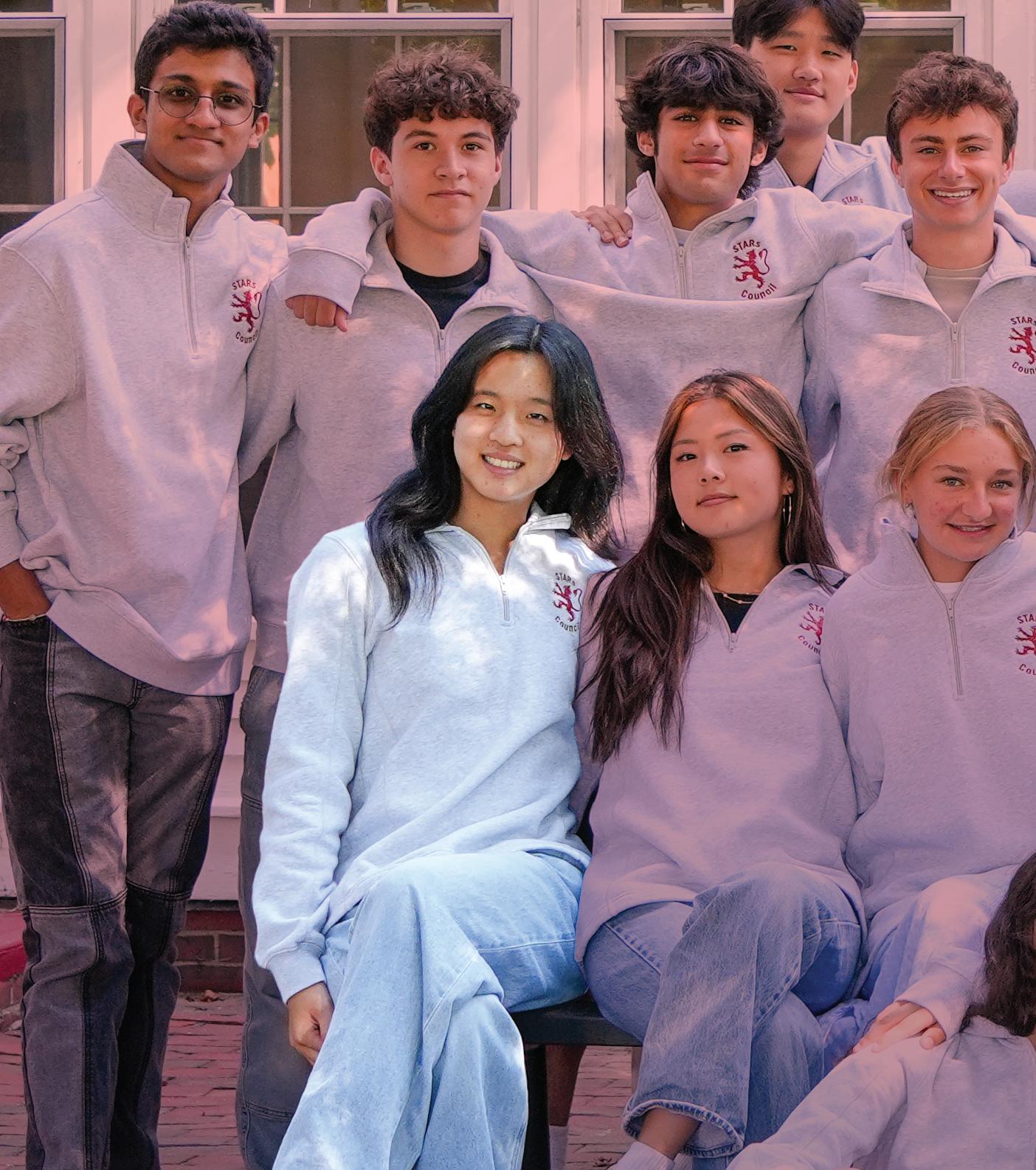
Ellen Jin ’26 (first row, left) and STARs Council members
AROUND THE TABLE / WORKS
Exonians in Review
The latest publications, recordings and films by Exeter alumni and faculty
Surgeons and Something More: The History of Surgery at the University of Pennsylvania
Clyde Barker ’50 with Elizabeth D. Barker
The American Philosophical Society Press, 2024
Murder at Seascape
Tom Ehrlich ’52
Pegasus Publishers, 2025
One: One Earth, One Humanity, One Future
Winslow Myers ’58 with Libby Traubman
Creative Initiative Publications, 2025
Thomas More and Liberal
Education: Christian Humanism in Practice by Elizabeth Brooke
Blackburn Carpenter
George S. Blackburn '60, editor
Self-published, 2024
A Vet’s Story
Mark Helfat ’69
Self-published, 2025
Surfing the Interstates: 1973 Hitchhiking Memoir
André J de Saint Phalle ’69
Self-published, 2025
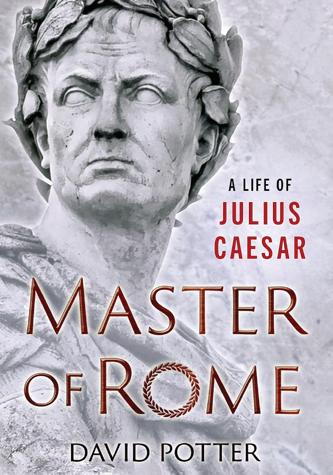
Master of Rome: A Life of Julius Caesar
David Potter ’75
Oxford University Press, 2025
The Last of the Giants: An Ultra Running Graphic Novel
Doug Mayer ’83 with William Windrestin Helvetiq, 2025
“Half-Heard in the Stillness,” essay
Jeremy Faro ’92
The Threepenny Review, fall 2025
Rainbow Gold: Building a Business That’s Both the Journey and the Destination
David B. Hampson ’96
MindStir Media, 2025
The Catholic Church and Transnational Moral Norms in the Philippines: Contraception, Human Trafficking, and Religion
Jonathan T. Chow ’99 Routledge, 2025
The 7-Minute Citizen: Your Power, Your Rights, Your Democracy
Wes Chaput ’06 Wheatmark, 2025
Protected: Birth Control’s Remarkable Story and Uncertain Future
“On Heartbreak: The Beautiful Half of a Golden Hurt,” essay
Willie Perdomo, instructor in English Poetry Foundation, November 3, 2025
Submit your work Alumni are encouraged to advise the Bulletin editor (bulletin@exeter.edu) of their own publications, recordings, films, etc., in any field, and those of their classmates, for inclusion in future Exonians in Review columns. Please send a review copy of your published work to the editor to be considered for an extended profile in future issues. Works can be sent to: Phillips Exeter Academy, The Exeter Bulletin, 20 Main Street, Exeter, NH 03833.
Below the Surface
Have you heard of the tunnels beneath Exeter’s campus that were once used to ferry food to dorm dining rooms?
In my upper year, a group of determined Dunbar residents set out to access the tunnels and visit other dorms. (I hope our advisers aren’t reading this!) Armed with tools, we eventually found a way through our basement into the tunnel system — I remember a big room full of old furnishings in the dim light of our flashlights — and a way into Bancroft. With a little planning, we could sneak over after check-in. Although we feared being caught, the thrill was part of the fun. Eventually, the broken lock was discovered, and we did our best to look innocent.
Jess Isaacs ’02
I was a scholarship boy at Exeter from 1955 till
Do You Remember?
graduation in 1959. One of my duties was washing dishes in the dining halls, especially Dunbar. I ate in Webster, so I used to use the tunnel from Webster to Dunbar. (I believe the tunnel started in Bancroft.) Along the way, underground, was a bakery, and I became friends with the baker, named Armand LePage. After graduation I kept him on my Christmas card list and we kept in touch for many years.
Warren Harkness ’59; P’85
I’m pretty sure I still have stuff in storage in the tunnel under Lamont.
Leah Kotok ’97
Been there as a fac brat. They were our playground.
Scott Estey ’83
I once had the opportunity to visit them with someone who had *ahem * access. But it was too creepy for me (long tunnels with minimal lighting, it just felt like a horror movie setup) and I backed out.
Julie Z. Stickler ’84
Your mention of the tunnels and dining halls reminded me of a cherished memory. In 1968, several of us were waiters (and dishwashers) at the Dunbar Hall dining hall. We frequently brought out large trays of breakfast food to the faculty, typically with multiple plates full of food. One morning, I watched as the boy in front of me caught his foot on the sill and lurched off balance, losing hold of his tray. His sharp, panicked cry attracted every eye in the room. As all the faculty and students stared in horror, the dishes flew upward and forward. ... Suddenly, in one impossible movement, the student waiter lunged forward and caught every single item again on this tray before any of the dozens of items hit the ground. There followed five seconds of absolute, stunned silence. Then, in unison every single person in the room stood up as one
From 1970 until 1986, when the current trimester system was introduced, seniors who had completed their requirements could graduate early. Did you take early graduation? If so, what did you do with your time?
and the room erupted into applause. The thunderous ovation lasted for almost a minute before anyone sat down to breakfast.
Michael
Fossel ’69
Responses originally shared via email or on social media
From the
Editor
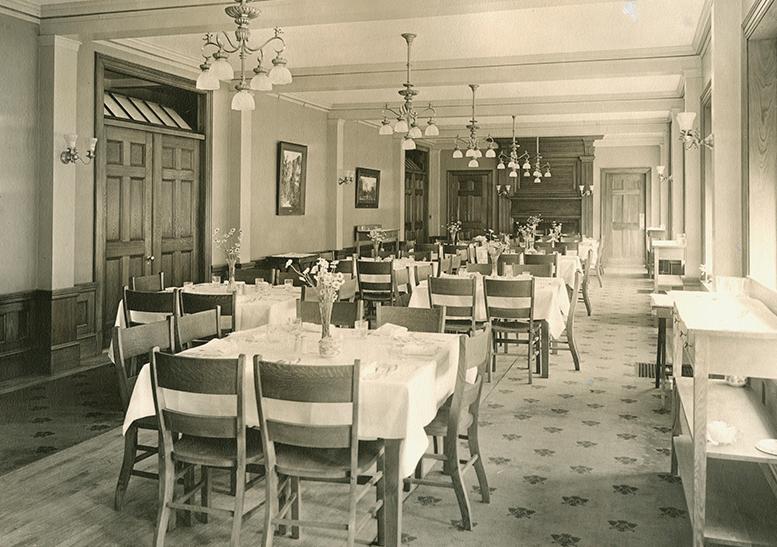
In the first half of the 20th century, meals at Exeter were served in individual dormitory dining rooms. To feed hungry students, food was ferried from basement kitchens beneath one dorm and delivered to others through a network of underground tunnels, then hoisted to servers via dumbwaiters.
Once Elm and Wetherell community dining halls were built, Exeter dined en masse, and the subterranean passageways were no longer needed. Some tunnels are boarded up; others are used for storage. But that hasn’t stopped curious students from seeking them out from time to time.
A 1977 story in The Exonian reported that “two enterprising students copied the keys to a tunnel [door] and they sold the keys at considerable profit to other students who intended to use them for illicit activities.” ●
Email your reminiscences to bulletin@exeter.edu. Select responses will be published in the next issue of the Bulletin
Dining tables set in the Dunbar Hall dining room in 1909
The Academy
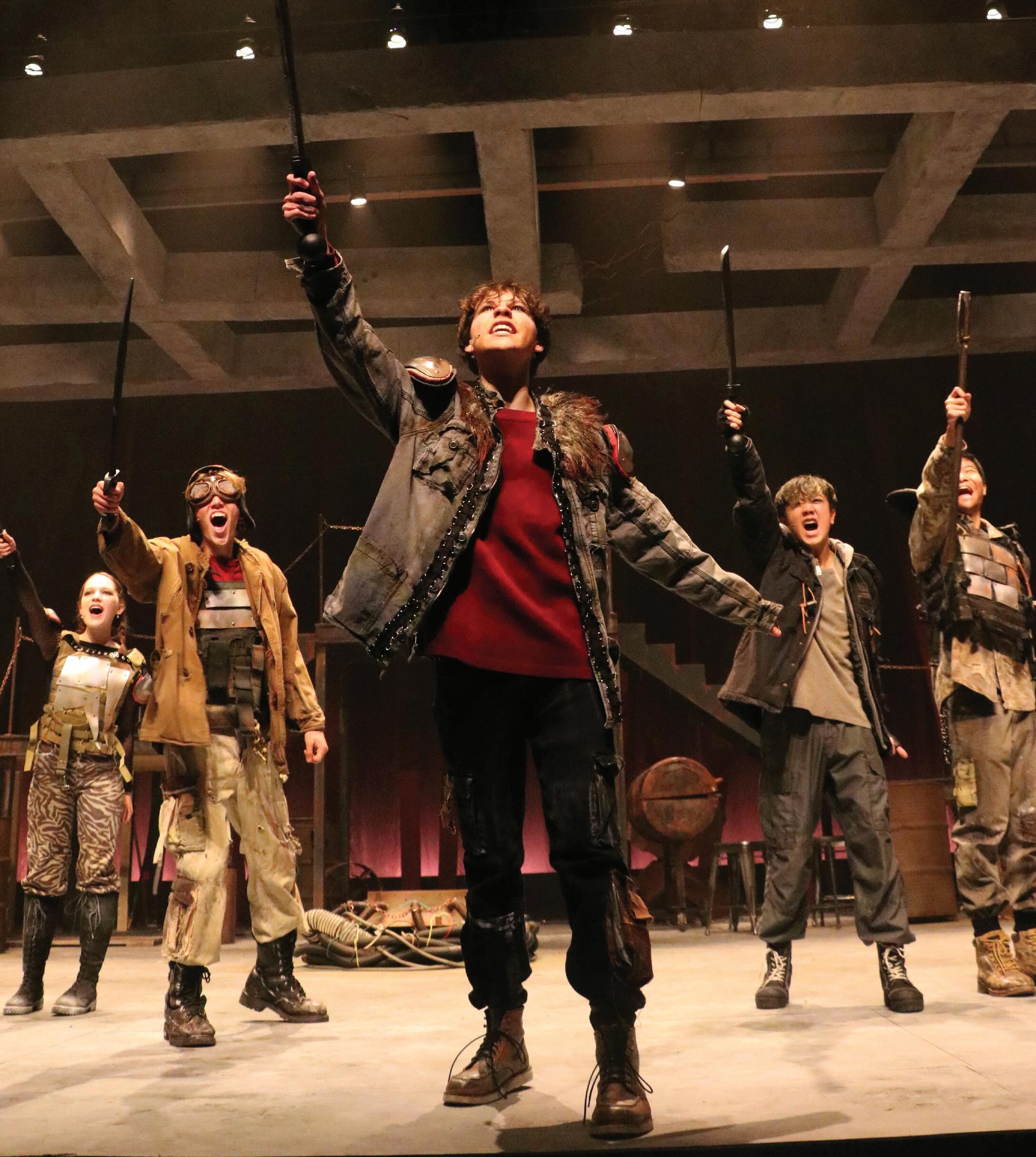
A cast and crew of 20 students participated in the fall mainstage production of William Shakespeare's tragedy.
Educator and Activist
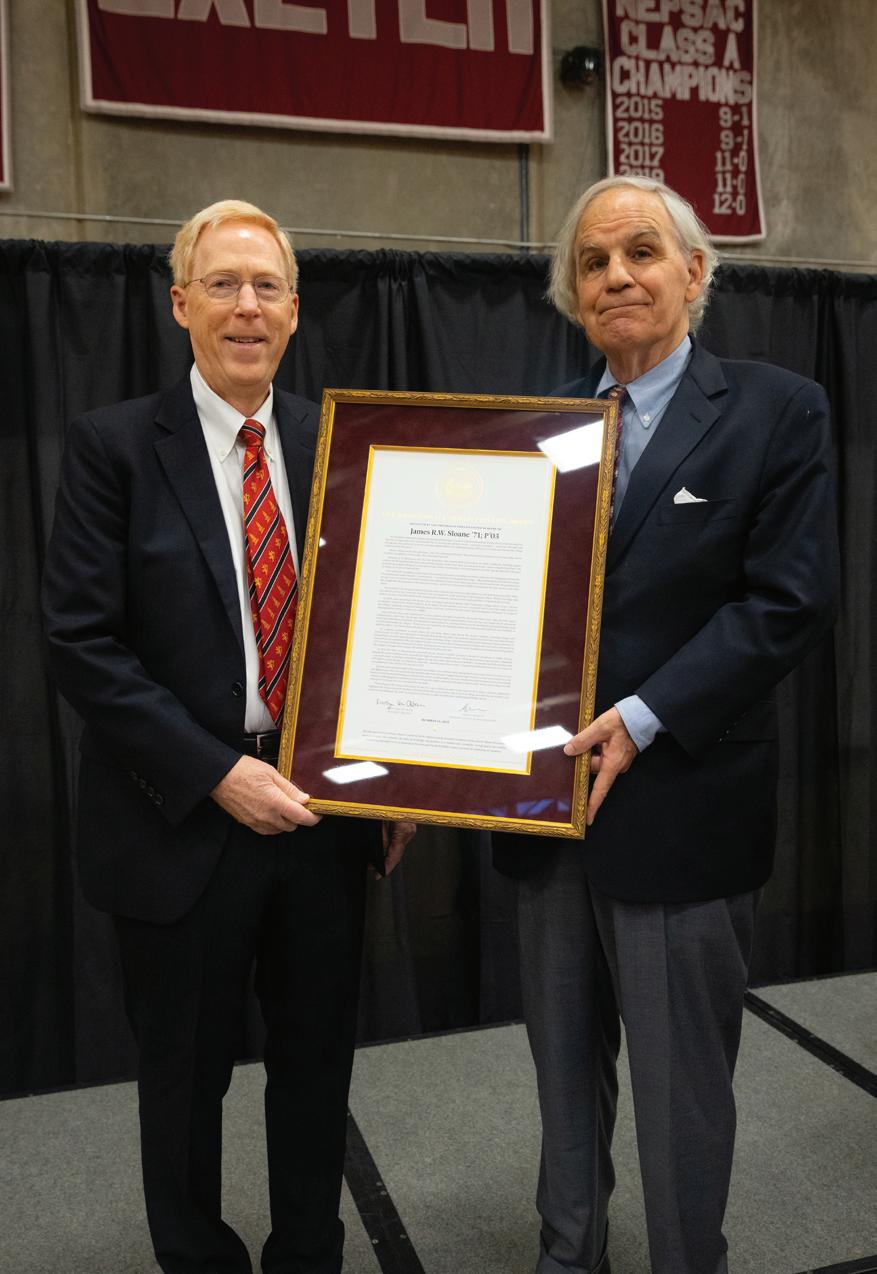
Wick Sloane ’71 receives the 2025 John and Elizabeth Phillips Award
Through journalism, teaching and grassroots activism, James R. W. “Wick”
Sloane ’71 has helped address the challenges — including food insecurity, homelessness and employment — facing millions of veterans and low-income college students across the nation.
He returned to campus in October to accept this year’s John and Elizabeth Phillips Award, which recognizes an Exonian who has contributed significantly to the welfare of community, country and humanity.
Sloane enjoyed a diverse career that included reporting for newspapers and more than a decade of executive roles in the insurance industry before he started teaching at Bunker Hill Community College in 2006. His tenure began with a night shift in the school’s tutoring center. He later became an adjunct faculty member in the college’s nationally recognized late-night classes. Eventually, Sloane worked as senior special programs coordinator in charge of helping students transfer to four-year colleges.
wrote extensively about low-income students, like the ones at Bunker Hill in Boston, grappling with adversity outside the classroom. In 2013, his open letter to President Barack Obama asked why the federal free and reduced lunch program for students didn’t continue through college. Sloane’s work spurred lawmakers to persuade the U.S. Government Accountability Office to conduct the first study of food insecurity at U.S. colleges and universities in 2019 and led to new or proposed legislation addressing the problem at the local, state and federal levels.
“When you discovered that a student hadn’t eaten that day, you bought bread and peanut butter and made them a sandwich,” Sam Brown ’92, trustee and president of the Exeter Alumni Association, said while delivering the award citation. “You expanded on those efforts by soliciting donations from local businesses and helping to open a mobile food market on campus.”
In his acceptance remarks, Sloane spoke about teaching the whole student, saying, “We weren’t trained as social workers, but that’s what we became because students were hungry.” Thanks to local business support and the Greater Boston Food Bank, Sloane and his colleagues began distributing food on campus; more than 700,000 pounds of food have been dispensed since 2012. When they failed to get attention from the state government, they went to federal legislators like Sen. Elizabeth Warren of Massachusetts, leading to a nationwide program and legislative changes aimed at combating food insecurity.
Sloane told the Exeter students seated in Love Gym that hunger “has been the injustice I’ve sought to solve. You’ll find your own,” he added. “You will come across an issue that you simply can’t turn away from — so don’t. Instead, get to work.”
Sloane and Brown were joined onstage by Principal Bill Rawson ’71. In addition to speaking in assembly, Sloane joined students in class discussions, visiting a session of the integrated studies course Social Innovation and the religion, ethics and philosophy course The Ethics of the Marketplace. He also attended a luncheon with students at the Class of 1945 Library. ● To watch the award assembly, visit exeter.edu/ assemblies
A regular contributor to Inside Higher Ed, Sloane
About the Award
The John and Elizabeth Phillips Award was inaugurated in 1965 at the behest of the Academy Trustees and the Executive Committee of the General Alumni Association. The award honors Exonians whose lives and contributions to the welfare of the community, country and humanity exemplify the nobility of character and usefulness to society that John and Elizabeth Phillips sought to promote in establishing the Academy.
Principal Bill Rawson ’71 and classmate James R. W. “Wick”
Sloane ’71
LEADERSHIP
Teacher at Heart
Jennifer Karlen Elliott named 17th principal
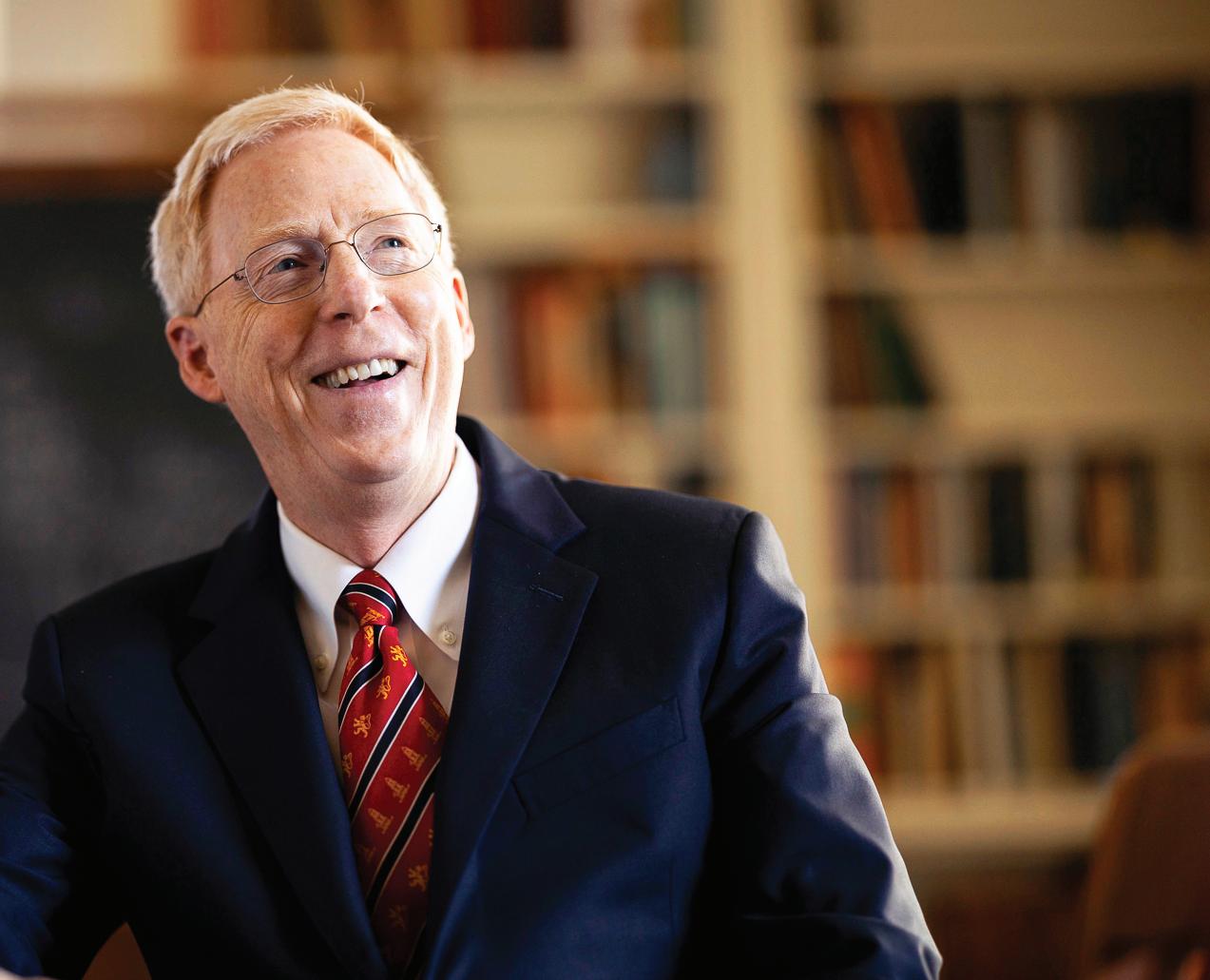
Academy Trustee President Kristyn Van Ostern ’96 announced in November that Jennifer Karlen Elliott, the head of student and academic life at Choate Rosemary Hall, would become Exeter’s 17th principal.
Bill Rawson ’71 will retire at the end of this academic year after eight years as principal. Elliott will formally succeed him on July 1.
At Choate, she is responsible for nearly all aspects of the student experience across academics, residential life, wellness and community culture.
“When I learned of the opportunity to lead Exeter, I was immediately drawn to the mission, the core values and the community,” she said. “I have long admired and respected Exeter’s commitment to academic excellence, Harkness and non sibi.”
Elliott was chosen after the Principal Search Committee connected with over 400 educational leaders around the world.
“Jenny is a teacher at heart who, from the earliest stages of her career, has been called to leadership roles of increasing responsibility,” Van Ostern said in her announcement. “In Jenny we have found someone who understands the demands of leadership in residential education, finds joy and purpose in working with adolescents and has indicated a strong commitment to upholding the Academy’s mission while leading us into the future. We are excited to welcome her to our community.”
Elliott’s contributions at Choate include leading efforts that examine how technology influences teaching and learning, making progress toward sustainability goals and attending to student well-being through a new advisory system and a redesigned cellphone and social media policy. Each initiative reflects her commitment to student growth, academic excellence, belonging and meaningful change.
“When I learned of the opportunity to lead Exeter, I was immediately drawn to the mission, the core values and the community. I have long admired and respected Exeter’s commitment to academic excellence, Harkness and non sibi.”
“I gravitate to team contexts where our collective impact is deeper for our shared efforts,” Elliott said of her leadership style. “I love partnering with colleagues who push my thinking, inspire me to ask better questions, and find joy in our work. I am a student-centered leader who has deep respect and admiration for the educators who commit themselves to the growth and care of young people.”
Van Ostern said Elliott has a deep “understanding of the rhythms and responsibilities of boarding school life,” adding that she “listens deeply, collaborates naturally, and brings clarity and focus to complex challenges” and “models the curiosity and adaptability that define great educators and leaders.”
Elliott, a 1994 graduate of Phillips Academy in Andover, earned a bachelor’s degree in history from Dartmouth College and a master’s degree in elementary education from Lesley College. She expects to complete a doctorate in education from Vanderbilt University in 2027.
Before joining Choate, Elliott worked for 12 years at Andover, where she held several leadership positions, including seven years as dean of students and five years as assistant head of school for residential life. She also taught U.S. history and coached varsity girls squash.
“I love that Principal Rawson’s leadership has invited and celebrated progress,” Elliott said. “Schools are living communities dedicated to the changing needs of our students.
“The dynamism of this present moment will require us to sharpen what is core and lead with courage, integrity and creativity. Optimistic and energetic, I see the challenges of this moment as opportunities for exciting progress.” ●
Jennifer Karlen Elliott gets to know some Exonians during a campus visit this fall.
Reflections on Non Sibi
From Exeter to West Point, Layne Erickson ’18 shares lessons in empathy
In the decade since Army 1st Lt. Layne Erickson ’18 arrived at Exeter from Wisconsin, her relationship with non sibi has evolved.
Speaking to the student body at assembly as part of the Academy’s Exeter Salutes program in November, Erickson described her altruistic growth: “When I came to Exeter … I felt this intense pressure to be this perfect little Exonian. Non sibi was rather competitive and for oneself.”
Now, she said: “My non sibi is not serving and defending the United States of America. My non sibi is more direct. It’s rooted in personal strengths: organization, empathy, preparedness — skills that I first learned here at Exeter.”
Erickson, an Army helicopter pilot, shared an especially formative experience: studying and writing about the U.S. service academy classes of 1980 — which included the academies’ first female graduates — for her History 333 paper. “It was clear to me that these women did not succeed in a vacuum,” she said. “They lifted each other up. Their grand act of non sibi, in spite of the odds and in spite of the emotional turmoil that they went through, laid the groundwork for those who would come after.”
Erickson carried on a familial legacy of service when she matriculated at the United States Military Academy and became Exeter’s first alumna to graduate from West Point. While there, Erickson’s lessons in non sibi continued. She recounted the growing pains she endured in her early days as a cadet. “It poured on THE ACADEMY / SERVICE
my first night sleeping outdoors, soaked me and all of my gear,” she said. “I didn’t have any dry socks left.” Instead of accepting dry socks from other members of her platoon, Erickson said she stubbornly trudged on with aching feet.
“Not only did I reject their direct acts of non sibi towards me, but I slowed down the entire platoon and in doing so, brought down morale among this collective, hindering our ability to accomplish our mission of the day.”
Ready to leave West Point, Erickson was encouraged by her platoon sergeant to stick it out. “Without Sergeant Adams’ support and empathy, my life would have been completely different,” she said. “I wouldn’t have been able to move forward and pass on my own little acts of non sibi to other cadets.”
Erickson encouraged Exonians to find ways — large or small — to practice non sibi. “I doubt my day job will be inspiring any 333 essays, but … your actions don’t need to be impressive to have impact,” she said. “Maybe your non sibi is studying with friends after class. Maybe you’re a proctor or a club head or a team captain and your non sibi is looking out for someone who needs a little extra support today. … Non sibi is far greater than the sum of its parts.”
Exeter in the armed forces
More than 700 current Exeter alumni, faculty and staff have served or are serving in the U.S. armed forces. Scores more have died in combat or in active service to the country.
The day’s events continued with the opportunity for students to eat lunch with Erickson and panel discussions featuring Erickson, Alex Najemy ’97, Holden Hammontree ’15, Instructor in English Nova Seals, Nat Butler ’64 and Bob DeVore ’58. ● Add your military status to Exeter’s official record at exeter. edu/alumni/ exeter-salutes
Army 1st Lt. Layne Erickson ’18, Exeter's first alumna to graduate from West Point; alumni, students and staff enjoying the Exeter Salutes program
Student Research
TCube Day
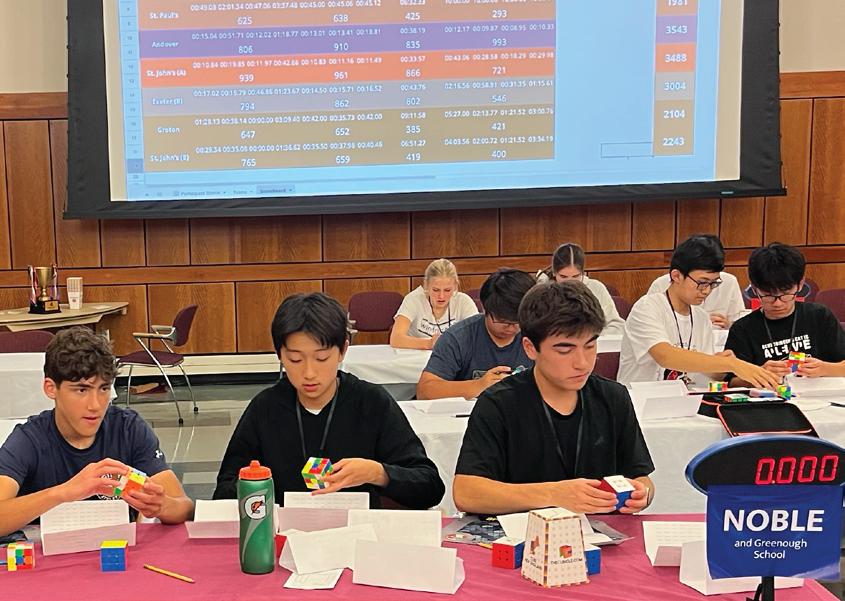
Sixty-eight cubers — ranging in age from 7 to 40 — gathered in Grainger Auditorium in October to test their skills in an official World Cube Association competition. Daniel Chen ’26, Max Webster ’26 and Owen Cosgrove ’26 organized the day of fierce competition, which also pitted teams from Exeter, Andover, Groton, Noble and Greenough, St. John’s Prep and St. Paul’s against one another in a New England Interscholastic Speed Cubing League event. “When Max, Owen and I revived our cubing club last year, we consistently had only four to five regular members,” Chen says. “Having a place where we can meet cubers from other schools is very uplifting.”
wo important papers chronicling Academy students’ malaria research were published in the Journal of Genomics. Guided by Science Instructors Shimaa Ghazal and Anne Rankin ’92, students in the 2022 Bio650: Exploring Bioinformatics and Next-Generation Sequencing course mapped a full genome sequence for a strain of the African mosquito species Anopheles gambiae, a leading host for the parasite that causes malaria. In spring 2024, another Bio650 cohort sequenced Anopheles stephensi, an Asian malaria mosquito. Both projects were published in 2025 and deposited in GenBank, the National Institutes of Health’s annotated database of publicly available DNA sequences. This research on different strains, funded by the Aileen and John Hessel, Class of 1952, Innovation Fund, might help scientists determine what genetic material makes some mosquitos more or less successful carriers of the disease. “The students did a great job,” Ghazal, who has a doctorate in microbial genetics, says. “We are so proud of them.”
Read the papers: jgenomics.com/v13p0055.htm and jgenomics.com/v13p0046.htm
Campus Development
The Academy recently purchased the historic First Baptist Church of Exeter on Front Street and has retrofitted it to house seven temporary classrooms. A few sections of winter term math classes are being taught there, allowing construction on Academy Building classrooms to move expeditiously. Eventually, the 150-year-old landmark may be converted into a dorm.
Big Red Digit
18:28.887
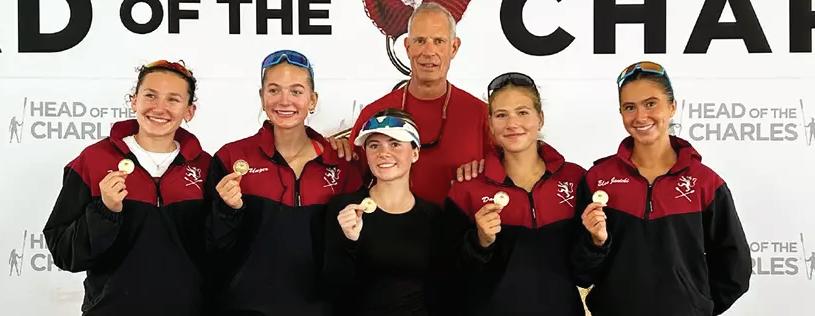
Exeter’s girls 4+ boat finished fifth in a field of 86 crews from around the world with a time of 18 minutes, 28.887 seconds at the 2025 Head of the Charles. The crew of Georgia Menge ’28, Iris Fisher ’27, Eleanor Unger ’26, Charlotte Dassori ’26 and Chloe Bosma ’26 was the top high school finisher.
Music
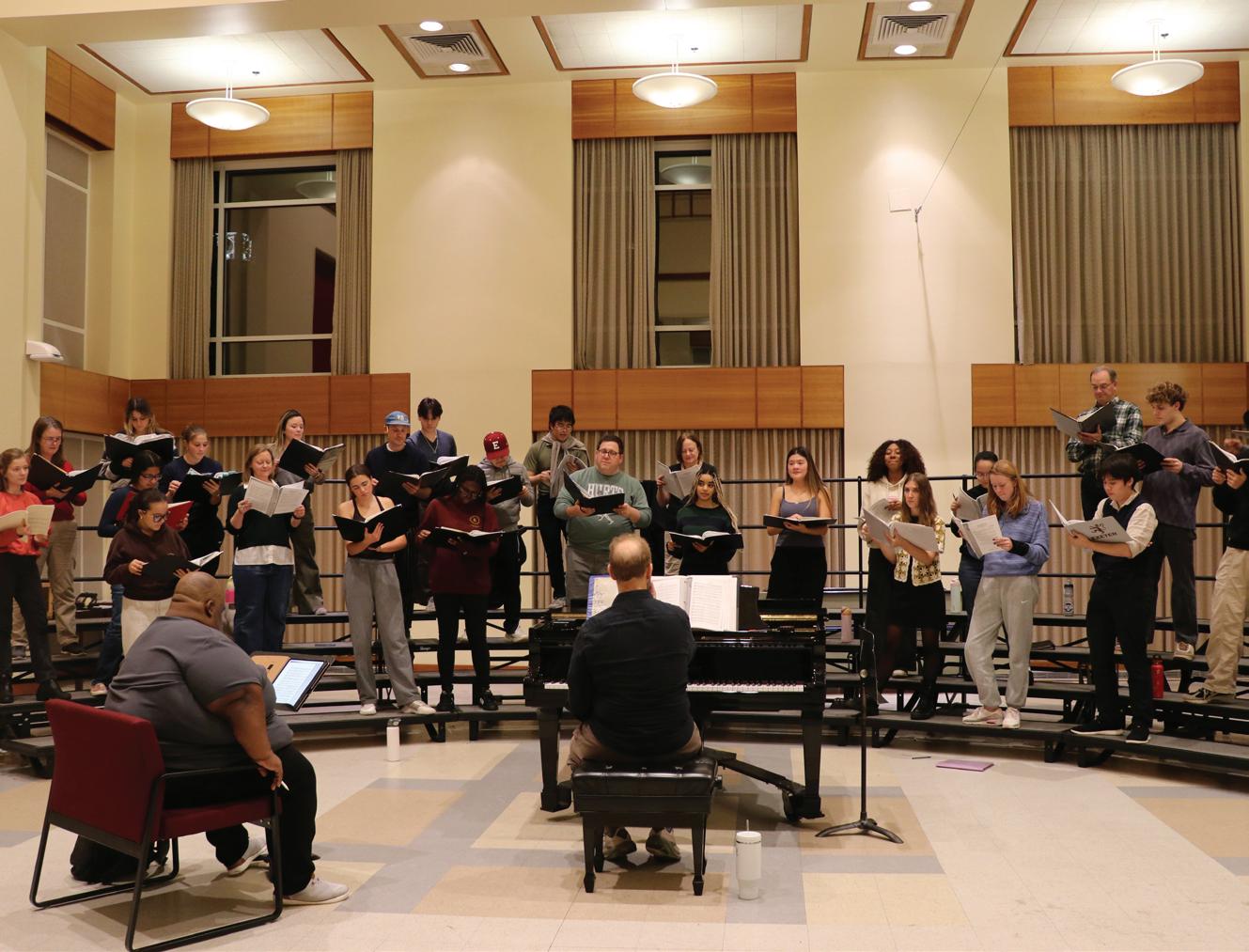
On Tuesday evenings, Powell Hall fills with the voices of Exeter’s new faculty-student choir. Founded by Music Instructor Kris Johnson, the Tuesday Society for Singing brings together 13 adults and faculty members from across departments — including history, theater, English and art — and 15 students chosen by audition from the 51 members of the concert choir. Such a balanced mix of adults and students is unusual, Johnson says. While a good deal of mentorship happens, he says, the adults and students are basically working shoulder-toshoulder on the music. After 13 years of teaching at Exeter, Johnson calls it his “most interesting and fun” project yet.
Theater
The fall term’s production of William Shakespeare’s Macbeth transformed the main stage of The David E. and Stacey L. Goel Center for Theater and Dance into a striking tableau of light and shadow. Guided by technical director Jake Josef and lighting designer Anthony Reed, the evocative set design and atmospheric effects created a haunting environment that underscored the play’s central themes of ambition, betrayal and guilt.
Dance
The fall dance concert, Masterful Movers, embraced the theme of the creative process, celebrating artistry as a journey rather than a destination. The program featured guest choreographers, including alumnus Curtis Thomas ’09, who returned to campus for an intensive residency. Students collaborated with Thomas to bring his work, Yesterday and Then Tomorrow, to life on stage. In the production playbill, the directors, Dance Instructors Amberlee Darling and Allison Sarage, wrote, “As a program, we are deeply interested in returning to and exploring process over product — valuing the discoveries, growth and creativity that emerge along the way as much as the final performance itself.”
From Script to Spotlight
Behind the curtain of winter play practice
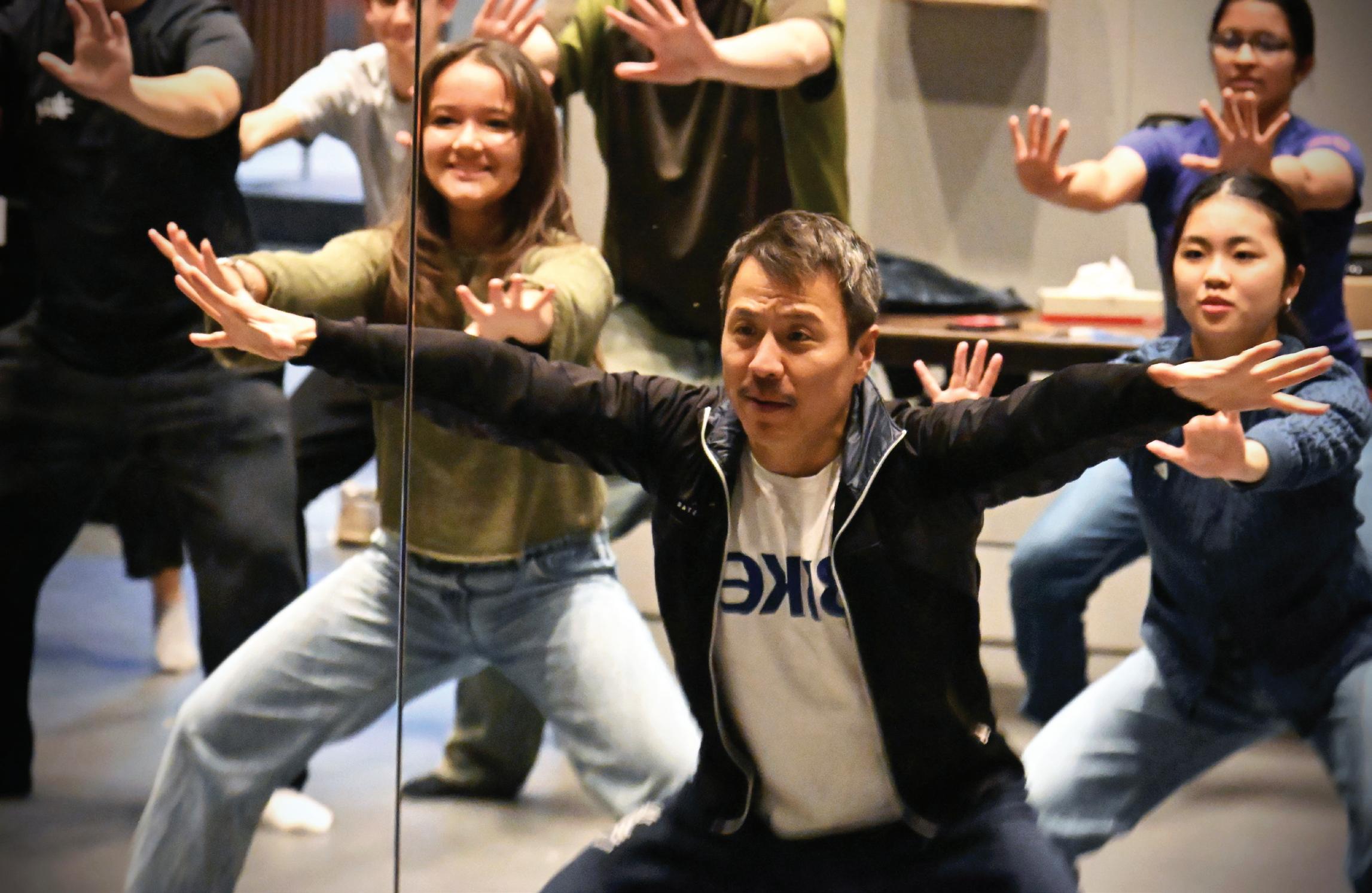
Abiting winter wind blows students across campus and into the refuge of The David E. and Stacey L. Goel Center for Theater and Dance. Inside, Theater and Dance Department Chair David Rhee wastes no time in leading a kinetic warmup to start class.
Stocking feet patter on the floor as bodies wave across the mirrored rehearsal space in rhythm to Rhee’s direction: “Left, one, two, three. Right, one, two, three!” Part aerobics, part yoga, the 15-minute workout is a routine he created during his years as a dancer and actor. He uses it to get the students’ blood pumping and ground them in this portion of their school day. Rhee, and the two dozen Exonians in motion, will spend the next three months preparing for the winter main stage performance of The Far Country
Theater and Dance Department Chair David Rhee starts class with a kinetic warmup he created during his years as a dancer and actor.
“Ahem!” Rhee demonstrates clearing his throat. “We need to establish the mannerisms of your character,” he says.
Rhee slows to a stop and instructs students to do the same. “Now we’re going to breathe in the day and breathe out the day,” he says. Exaggerated inhalations and exhalations echo across the room. With brows damp and heart rates elevated, Rhee explains the plan for the remainder of the class block, sending actors and tech crew scattering throughout the building.
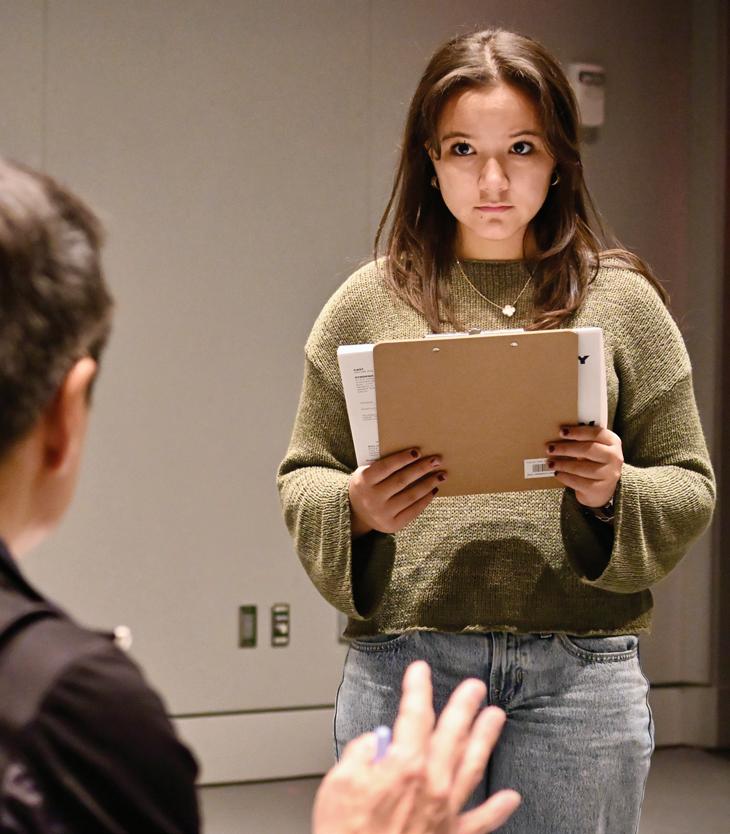
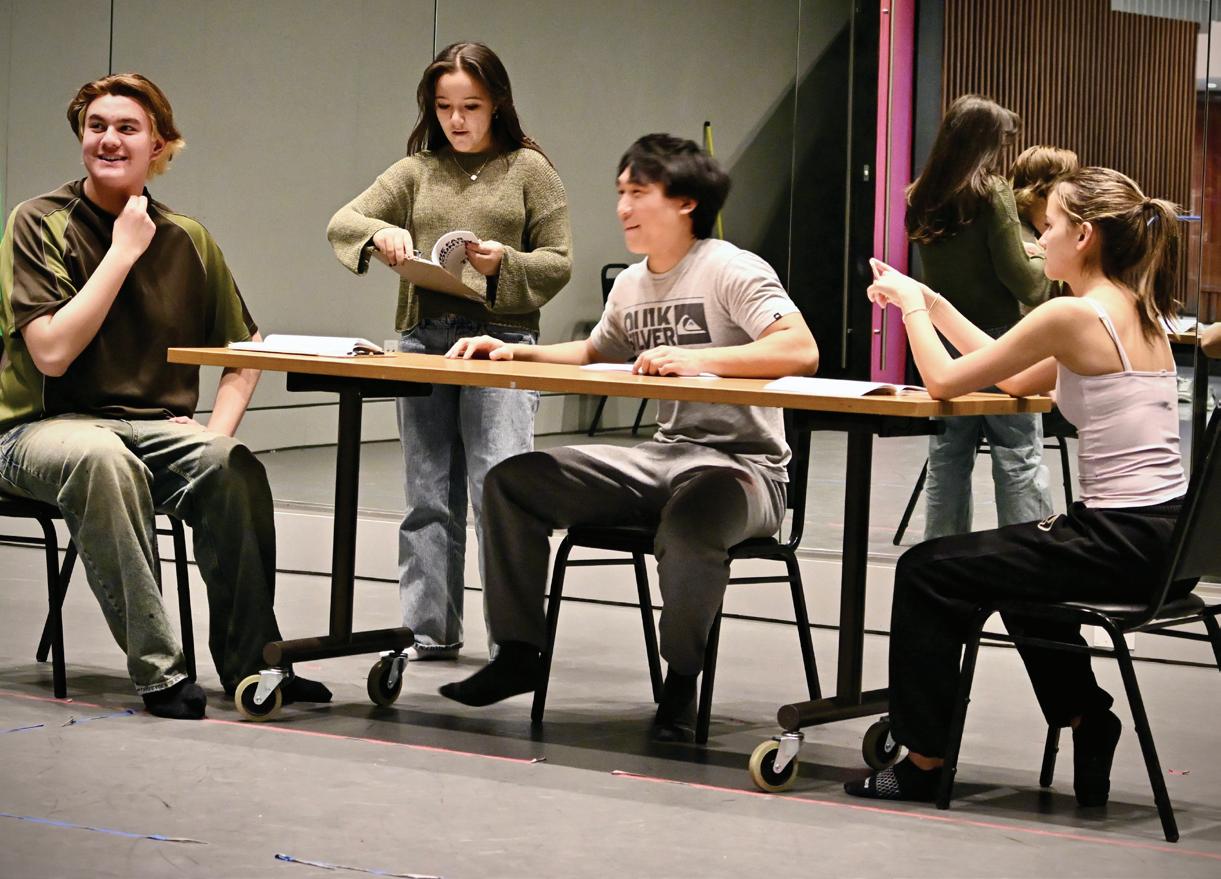
Robyn Davies ’26, Axel Pena ’27, Juliana Tavarez ’28 and Amerson Liang ’28 stay behind with Rhee and quickly rearrange the room using tables and chairs to mimic the sets that will eventually be built for the main stage. Scripts in hand, the four students read through Act 1, Scene 1, incorporating stage direction for the first time.
The Far Country, a 2022 play written by Lloyd Suh, is set in San Francisco in the early 1900s. At the time, Chinese immigrants and American citizens born to Chinese parents were scrutinized, persecuted and interned by the United States government.
“Shall we try this, from the top of Page 1?” Rhee says. The play’s opening scene is set in an increasingly tense interrogation room. Liang plays an American-born laundry business owner being grilled by an immigration inspector played by Pena. Rhee looks on, jotting notes in his script margins, interjecting direction to Tavarez, who is playing the inspector’s assistant.
“Ahem!” Rhee demonstrates clearing his throat. “We need to establish the mannerisms of your character,” he says. “This is your way of stealing focus, so you can hand him another piece of paper.”
As the scene continues, the students alternate lines as Rhee quietly gestures his desired stage movements and adds an occasional “Good!” when the actors hit their marks.
Elsewhere in the building, the tech crew works through the initial design of the show’s stagecraft. Actors with parts in Act 2 rehearse lines in the lobby. Rhee has set aside class time for the show’s actors to work with Modern Language Instructors Ning Zhou and Ting Yuan to perfect the nuance of their accents.
As the students end rehearsal for the day, they work through how they will strike and exit the stage. Then they receive Rhee’s parting praise:
“For a first time through, that was great, really nice work!” ●
Meet the Instructor
David Rhee is the chair of the Department of Theater and Dance. He earned his M.F.A. at the Tisch School of the Arts and has worked at numerous theaters across the U.S. including Chicago's Steppenwolf Theatre and The Goodman Theatre. He appeared on Broadway in the Tony Awardwinning Thoroughly Modern Millie and on television’s Law & Order
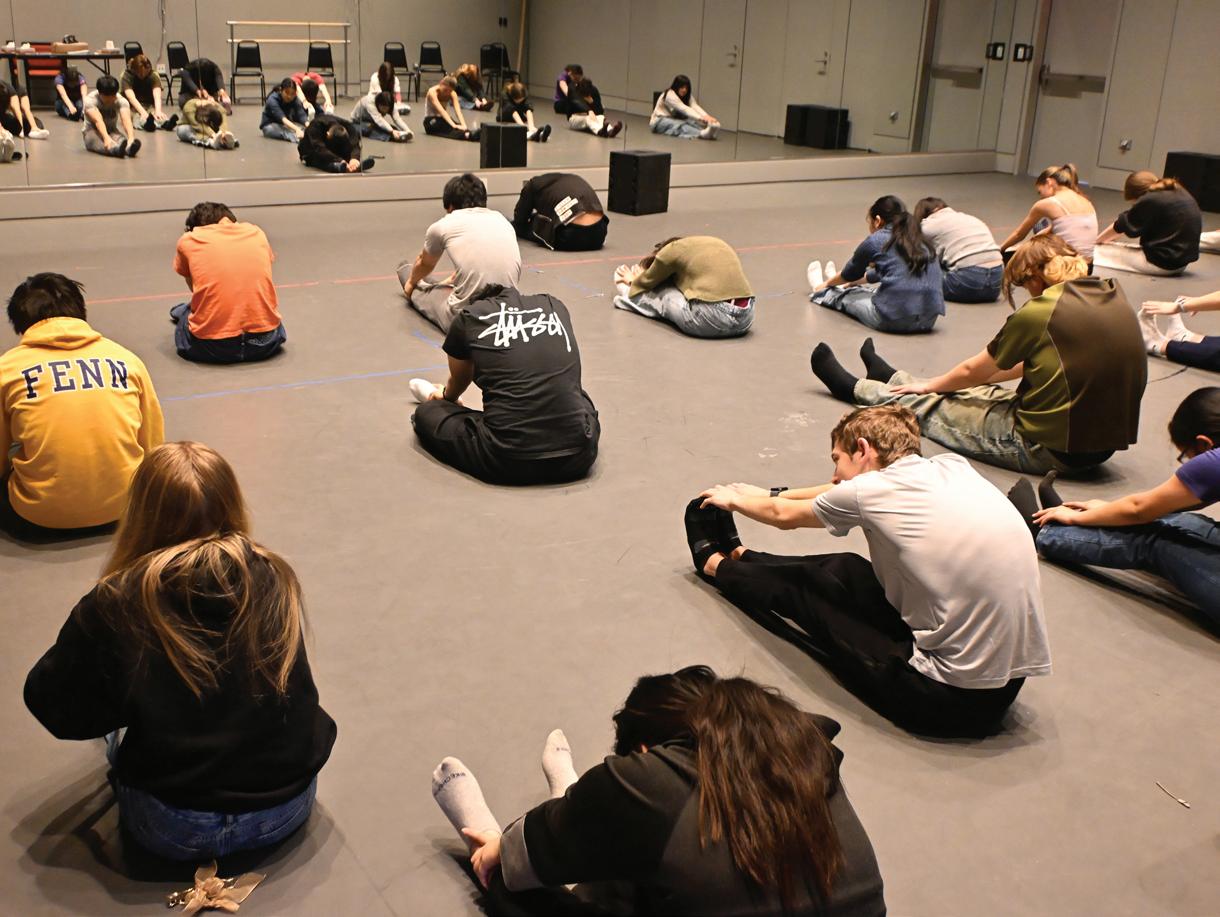
Students quickly transition from mat stretching to rehearsing in the Goel Center.
Emma Finn ’22 Awarded Rhodes Scholarship
Emma Finn ’22 was named one of 32 U.S. Rhodes Scholars in November. The scholarship provides full financial support for two to three years of postgraduate work at the University of Oxford for students focused on exemplary academic study and public service.
A senior at Harvard University, Finn is completing a double major in mathematics and classics as well as a concurrent master’s degree in statistics. At Oxford, she plans to pursue a Doctor of Philosophy in statistics or statistical machine learning, focusing on
FACULTY
NEWS
understanding “creativity” in generative models like image-based diffusion models.
Finn also hopes to work with ethicists and policymakers to design tools to help regulate artificial intelligence fairly. “I’m especially excited to be a part of the community of Rhodes Scholars and to be surrounded by people who are driven to make the world a better place,” she says. “I hope to learn from them about the challenges they think are most pressing and work in partnership with them to identify technologies that might address those issues.” ●
Emma Finn ’22
“There are so many researchers at Oxford I admire. The opportunity to collaborate with them on work that excites me is a dream come true!”
Meet the New Director of Squash
Sharon Bradey, Exeter’s new director of squash, says her career has been defined as much by lasting relationships as by points won.
Her parents helped run a squash club in Adelaide, Australia, while she was growing up. The club was close enough to home that Bradey ran or biked there
Sharon Bradey,
director of squash
nearly every day. “As long as I got home before the sun went down, I could go back the next day,” she says. “Only once did I learn that lesson.”
During the 1980s, squash was booming in Australia. Saturday morning junior clinics regularly drew a large crowd of children competing for court time. By the time Bradey turned 12, she was playing on a team with women who were decades older. Surrounded by “extra mums,” The Kid, as she was called on the court, quickly learned what it meant to compete and to belong. “You played your heart out because you didn’t want to be sitting off the court waiting,” she says.
Bradey spent her teenage years traveling across Australia for junior tournaments and balancing schoolwork with an increasingly demanding squash schedule. At 18, with savings from working part time, she joined the professional tour as a six-month experiment. “There wasn’t much money in it,” Bradey says. “I knew
I had to perform well to make enough to travel to the next tournament.”
That experiment turned into a decade-long career that took her around the globe. She was ranked as high as 12th in the world.
After Bradey stepped away from professional competition, she spent the next 30 years coaching at colleges and clubs, including The Harvard Club for 25 years. She also coached national teams in Spain, Denmark and Israel. Her global experiences have helped shape her philosophy as a coach. “Excellence matters,” she says. “But people matter more.”
In 2025, Bradey was inducted into the South Australian Squash Hall of Fame, an emotional homecoming that reunited her with family, mentors and teammates. “Squash has given me a lifetime of relationships,” she says. “I love seeing former players come back as adults, as parents, as coaches themselves. When you realize you have been part of someone’s journey, that’s the sweet spot.”
Now an American citizen and one of the longest-serving female professionals in club squash in North America, Bradey sees Exeter as the place where everything aligns. “To be able to do what I love, in another country, and feel so connected to a school and its students — I’m meant to be here. I believe that.” —Brian Muldoon
ATHLETICS
The Long Game
For hockey standout Thomas Larkin ’09, the Olympics are a full-circle moment
Thomas Larkin ’09 arrived at the Academy as a 14-year-old who had tasted some success. As one of the better hockey players growing up in a small town north of Milan, Italy, he was scoring goals and coasting along at school.
Exeter proved to be a bit of an adjustment. “The competition was different right away,” Larkin says. “The pace, the academics, everything felt bigger. I realized quickly that this was an opportunity to grow not just as a hockey player, but as a student and as a person.”
He dug in and worked hard. “Thomas Larkin is one of the most special students to come through the hockey program,” says former Big Red hockey coach Dana Barbin, who called the 6-foot-4-inch Larkin Big T. “For as talented as he was, he was that much more of a hard worker.”
He played junior varsity as a prep and set a goal to make varsity his lower year. He made the team
and felt on top of the world, only to realize that the varsity required much faster play and attention to detail. He played sparingly as a forward, still searching for his role.
He found it after a conversation with his coach. “I told him, ‘I think you are a defenseman,’” Barbin recalls. “‘Let’s try to move you back to the blue line.’ He just looked at me and said, ‘Let’s roll, Coach.’”
The move required humility and trust. And Larkin had to adapt to skating backward, defending under pressure and embracing a role built on discipline. He accepted the challenge.
“He was big and tough, and his compete level was off the charts,” Barbin says. “I think the young man trained 364 days a year and took Christmas Day off.”
Larkin acknowledges: “I’m not the most skilled guy — far from it. But I learned how to compete, how to work and how to want it more. That started at Exeter. I’m still so passionate about the place. It really came at a pivotal time in my life and helped shape who I am.”
Two years after switching positions, Larkin caught the attention of college coaches and professional scouts. He was drafted by the NHL’s Columbus Blue Jackets after graduating from Exeter but went on to play at Colgate University, where he was a captain for two years.
“I thought I was ready,” he says of the NHL. “Then you get to the next level and realize, this is bigger than I thought. You have to prove yourself again and again.”
Eventually his career carried him overseas. He spent two seasons in the Russian Kontinental Hockey League before settling in the top professional league in Germany, where he has played for nearly a decade.
For more than 15 years, Larkin has pursued a parallel career with Italy’s national team. It began on the junior national circuit while he was a student at Exeter. International play, Larkin says, strips the game down to its essence.
“With the national team, it’s pure,” he says. “It gives me a chance to play with guys that I have known for 20 years. We play for the love of our country and Italian hockey.”
In 2019, when Italy was selected to host the 2026 Winter Olympics, Larkin faced a decision. His injuries were mounting, and stepping away from the game was a possibility. “I remember thinking, Well, I guess I have to keep playing,” he says. “There was just no way I was missing this opportunity to represent my country in my hometown. In a sense, it gave me a new lease on my career.”
Larkin, now 35 and Italy’s captain for the past four years, will make his Olympic debut and lead his team onto the ice when the Milano Cortina Games begin in February.
“I don’t just play hockey for me, or to put food on my kids’ plates,” he says. “It’s purely for love and passion, and for my family, for my mom, my dad, my brothers and sisters. Playing in the Olympics will be something for everyone that’s helped me get to this point. I couldn’t be more excited or more proud to be a part of it.”
—Brian Muldoon
Thomas Larkin ’09, captain of the Italian men’s hockey team
Fall Highlights
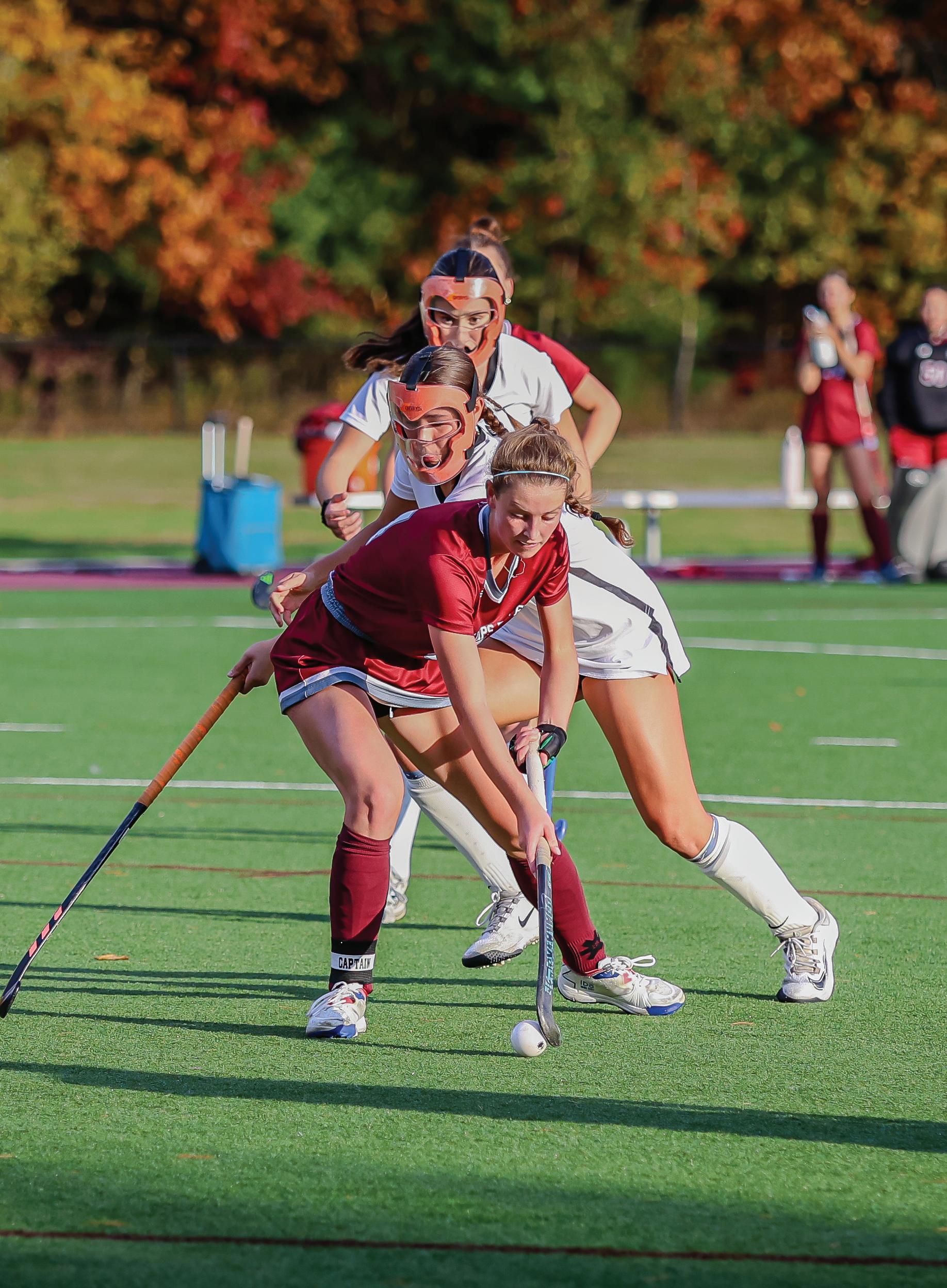
→ FIELD HOCKEY Record: 4-13
Head Coach: Samantha Fahey Assistant Coaches: Mercy Carbonell, Sarah Nelson
Head Coach: Brandon Newbould Assistant Coaches: Diana Davis ’03, Emily Quirk, Nick Unger
Captains: Ethan Benenson ’26, Owen Welch ’26
MVP: Bocelli Howland-Vlahakis ’28
←
GIRLS CROSS COUNTRY 2nd in New England
Head Coach: Brandon Newbould Assistant Coaches: Diana Davis ’03, Emily Quirk, Nick Unger
Captains: Lucia Rosen ’26, Emerson Seymour ’26
MVPs: Ava Bullock ’26, Harper Peters ’29
↓ FOOTBALL
Leon Modeste Bowl Finalists Record: 6-3
Head Coach: Panos Voulgaris Assistant Coaches: Tom Evans, Bill Glennon, Ryan Griffin, Dave Hudson, Max Lane, Stephan Lewis, John Mosley Captains: Luke Rogers ’26, Marek Jin ’26
MVPs: Jake Attaway ’26, Luke Rogers ’26
↑
BOYS WATER POLO Record: 15-4
Head Coach: Don Mills
Assistant Coaches: Meg
Blitzshaw, Steve Altieri
Captains: Jack Cassidy ’26, Andrew Gao ’26
MVP: Mateo Sandhu ’26
←
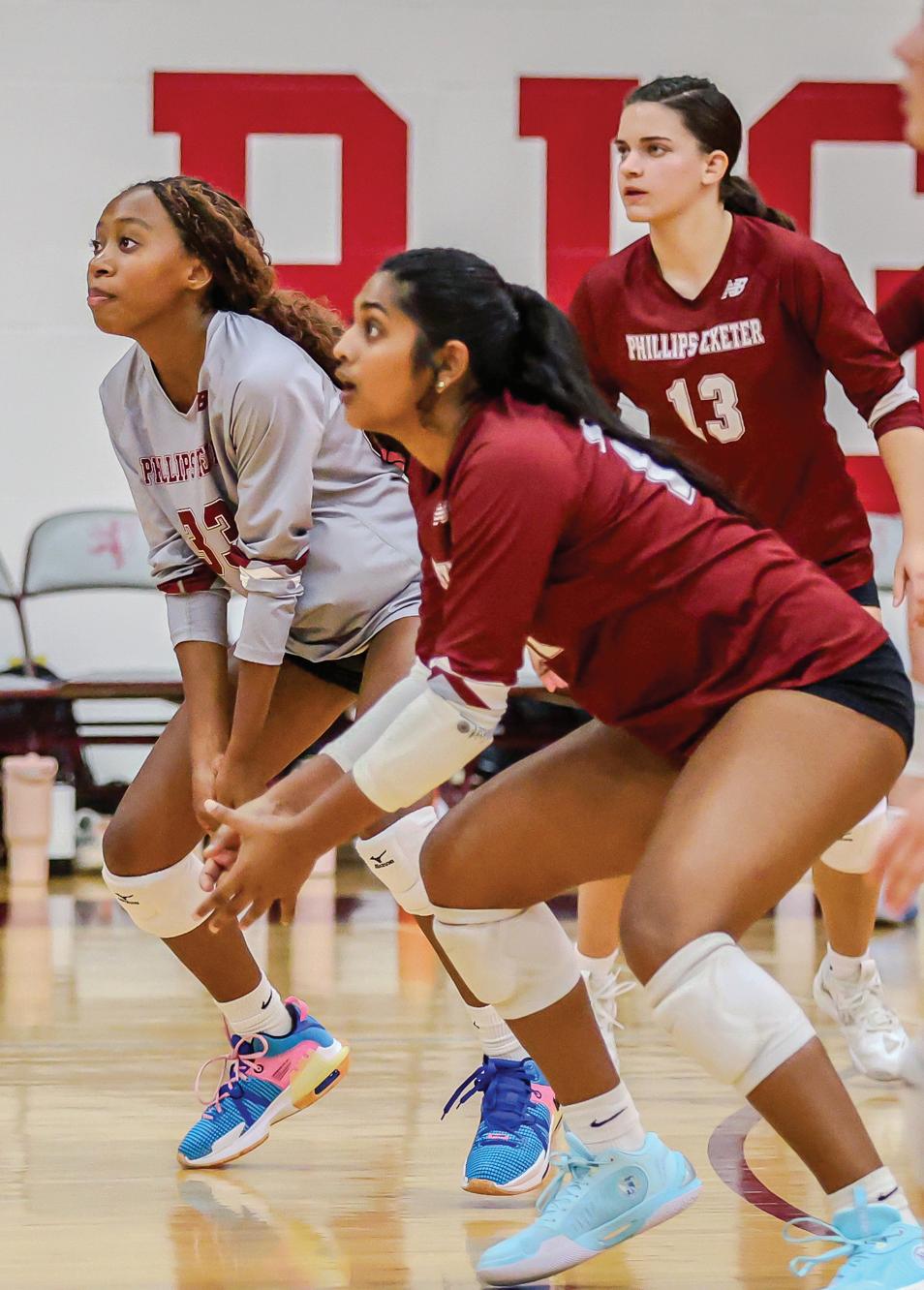
GIRLS VOLLEYBALL Record: 8-6
Head Coach: Sue Rowe
Assistant Coach: Sophia Scola
Captains: Olivia Lang ’26, Clare McCann ’26
MVP: Clare McCann ’26
↑
BOYS SOCCER Record: 7-7-3
Head Coach: Nolan Lincoln
Assistant Coach: A.J. Cosgrove
Captains: Finlay Fitch ’26, Alex Sahinoglu ’26, Aiden Xia ’26
Captains: Lily Pate ’27, Riley Jernigan ’26, Ella Shea ’26, Morgan Signore ’26
MVP: Lily Pate ’27
Inside the Hahn Center
Exeter’s newest hub for community and connection
BY SARAH PRUITT ’95
T EXETER, the Harkness philosophy extends beyond the classroom to all aspects of life on campus — including the essential act of eating. Sitting together at meals each day not only provides nourishment for students, faculty, staff and visitors; it also fosters engagement and builds a stronger sense of community for the school as a whole.
To support this core principle, the Academy devoted more than a year to the construction of a multifunctional dining hall on the north side of campus. Opened in December 2024 and officially named at a gala event this November, the Hahn Center creates myriad opportunities for connection, collaboration and learning.
Flanked by the newly refurbished Merrill and Langdell Halls, the Hahn Center replaced the well-loved but outdated Wetherell Dining Hall, which had served the Academy for 90 years. With its state-of-the-art kitchen, in-house bakery and expansive servery, the new building showcases the efforts of Exeter’s dining services team to meet the school’s diverse needs.
“Food is about community,” says Melinda Leonard, Exeter’s director of dining services. “The Hahn Center prioritizes that sense of community, while allowing us to operate more efficiently today, and evolve in the future.”
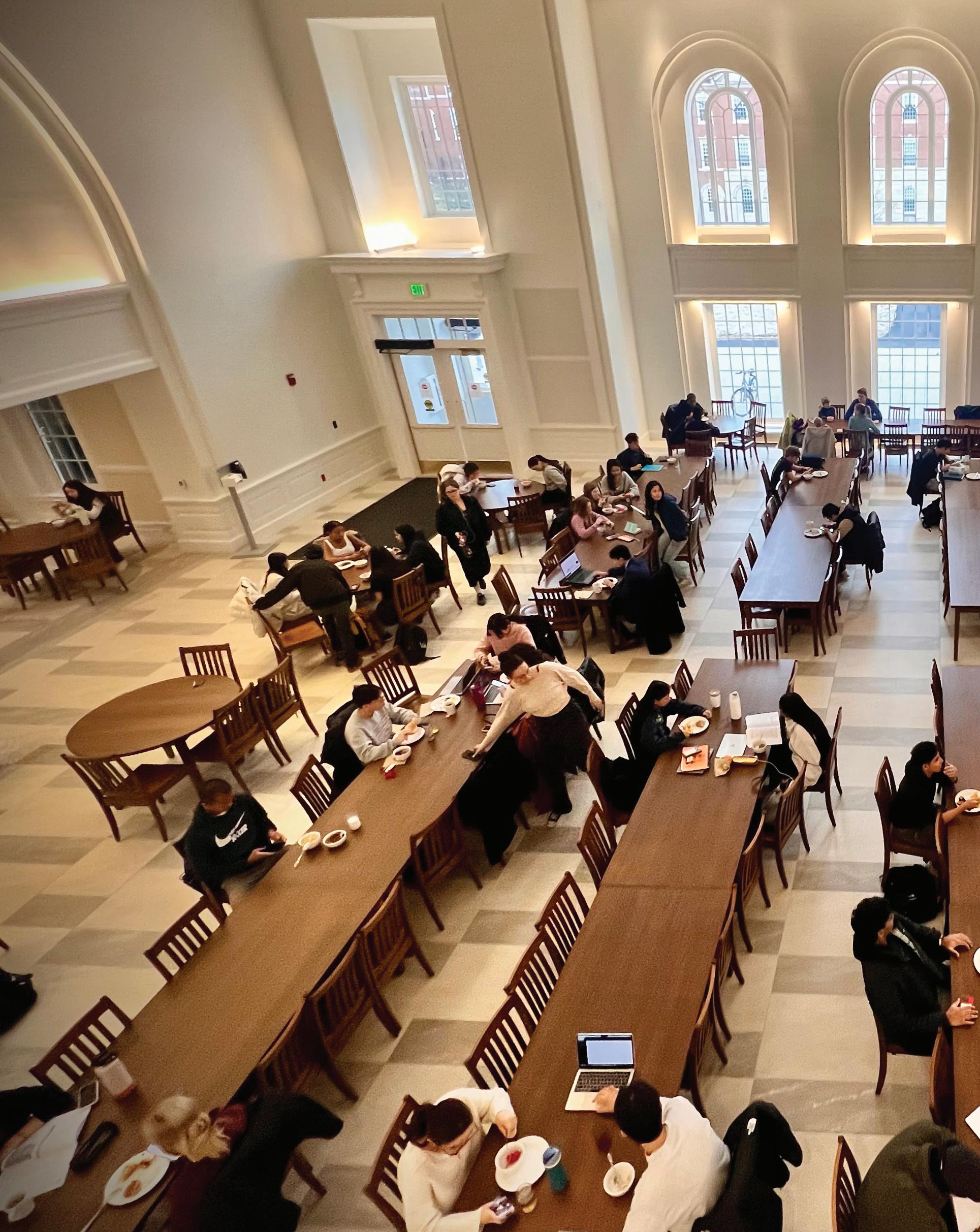
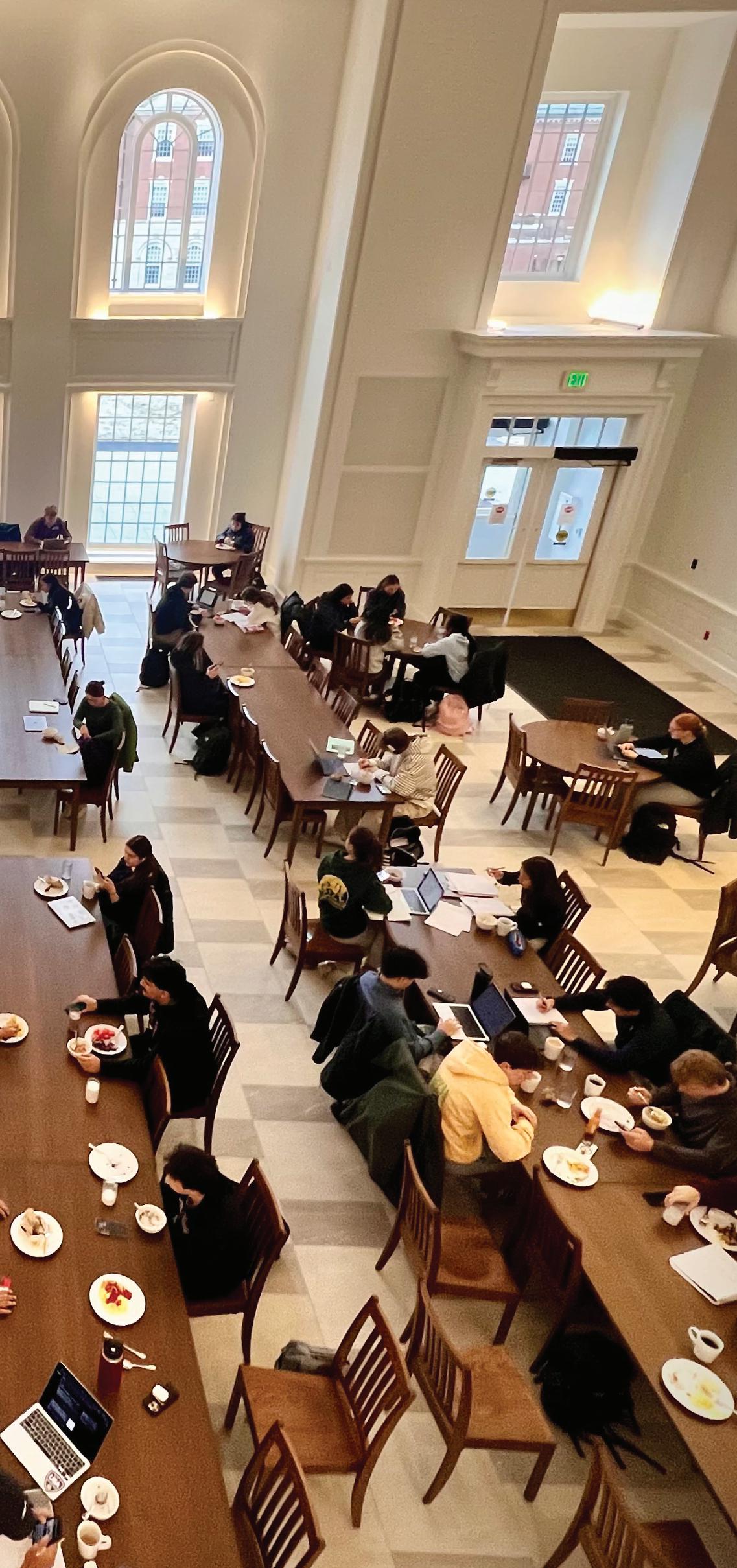
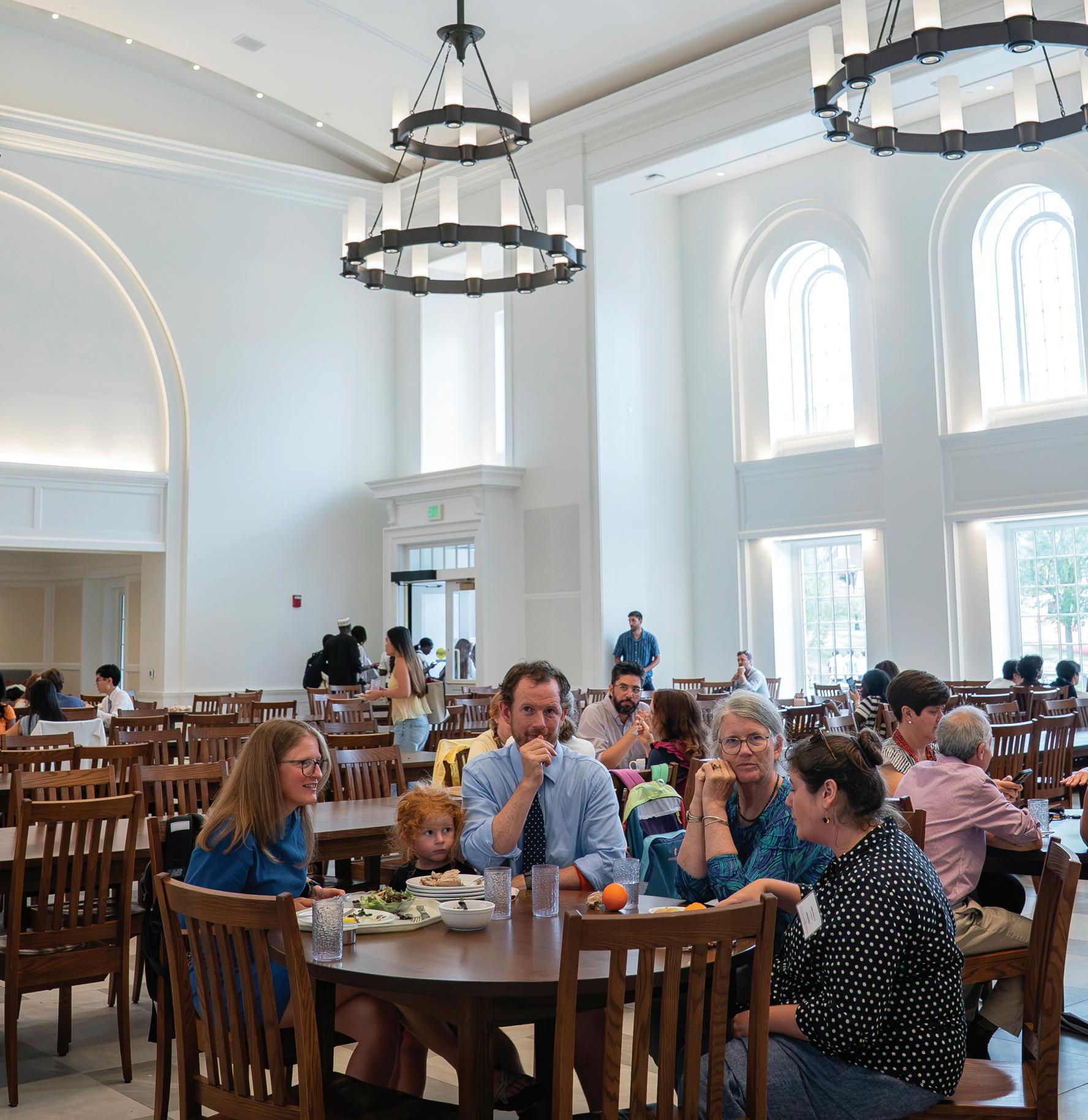
The Bonnie McElveen Dining Hall on the Hahn Center's first floor comfortably seats 266 people.
In addition to meeting daily dining needs, the Hahn Center has quickly become a vital space for programming and events on campus. Students have used the center for special occasions including the Hindu Society’s Diwali Celebration, a dumplingmaking session to celebrate Lunar New Year and the Senior Class Dinner. While the second-floor meeting rooms have seamlessly transitioned to classrooms during the Academy Building renovation, Harkness discussions often take place along the long tables in the main dining room.
Main Dining Room
The centerpiece of the Hahn Center is a light-filled, two-level dining room with soaring ceilings and chandeliers. Outfitted with wooden tables in different sizes and shapes, the ground and mezzanine levels buzz with activity and conversation during peak meal hours.
With Gratitude
The Hahn Center was made possible by the generosity of Scott Sang-Won Hahn ’90; P’22, P’25, a former trustee who was the lead donor. The Bonnie McElveen Dining Hall was gifted by trustee Gil Kemp ’68 and named in honor of Bonnie McElveen, a former U.S. ambassador to Finland. The secondfloor dining rooms were given to the Academy by Suphachai and Busadee Chearavanont P’22, in honor of Zander Chearavanont ’22; and Monica L. and Alexander C. Robinson ’92; P’27, in honor of Edward Robinson ’63; P’92; GP’27.
Hahn Center by the Numbers
31,370
Total square feet of the building and terrace
408
Indoor seats
2
Second-floor meeting rooms
10
Computerized walk-in coolers/freezers
200
Average pounds of desserts, breads, rolls and granola made from scratch each week
“It’s a beautiful place to eat, and I love the light. The way the tables are set up you’re really close with your friends. I feel comfortable here.” —Hazel Jacobs ’26
Dining Al Fresco
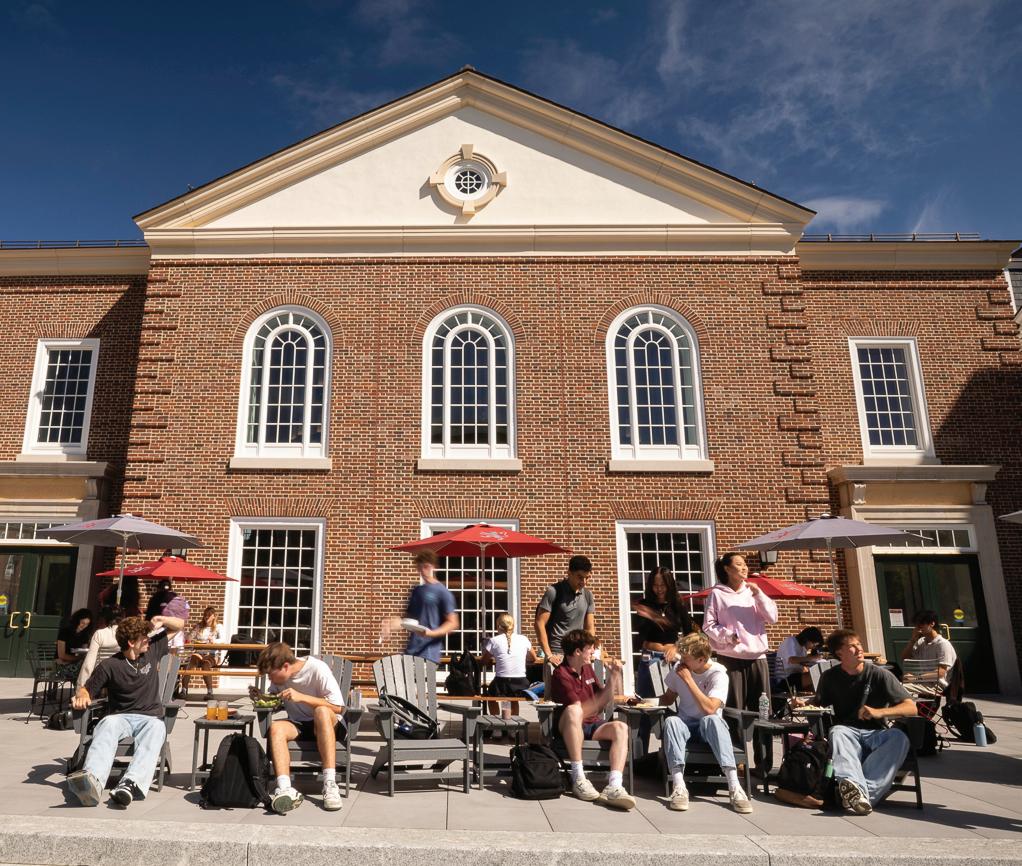
When the sun is out, students are too. The welcoming front terrace comfortably seats up to 80 diners. It’s also a great spot for impromptu performances, outdoor study sessions and casual meetups with friends.
Special Events
With a flexible layout and furnishings to seat more than 400, the Hahn Center provides the perfect backdrop for larger events such as class dinners, Exeter Leadership Weekend or Family Weekend gatherings and graduation celebrations.
Making Memories
In May, when members of the class of 2020 returned for their fifth reunion, they gathered in the Hahn Center for one of the most anticipated events of the weekend: the opening of their prep-year time capsules, which they missed (along with the rest of their on-campus graduation activities) because of the pandemic.
Flexible Learning
Two private dining rooms on the second floor double as classrooms and meeting rooms. During the ongoing renovation of the Academy Building, several instructors are holding regular classes in these rooms. “We needed every room possible, and the dining team stepped up,’” Math Instructor Jarad Schofer says. “Students love going right to lunch. If class ends at 12:40, they can beat the lines — they really like that.”
Diverse Menu
The kitchen’s ample preparation and cooking areas allow the dining staff to effectively and efficiently respond to culinary needs, including dietary choices and allergies, and to celebrate the many cultures, ethnicities and religions of the Academy community. Grill and saute stations serve a wide variety of dishes, including palak paneer, coconut sticky rice, hamburgers and fries. Other options are the pasta and salad bars, freshly baked desserts and made-toorder items like grilled chicken breast and tofu.
Self-service
The large multifunctional table in the center of the servery was custom-built for the space. “Students love their panini grills; they love making their waffles in the morning,” Leonard says. “Our students are very appreciative, and enjoy preparing and customizing their food options.”
Commitment to Sustainability
Geothermal wells buried beneath the Academy Building lawn power the Hahn Center, which is outfitted with high-efficiency features including lowflow plumbing, LED lighting and stateof-the-art kitchen technology aimed at minimizing the use of fossil fuels.
Sarah Pruitt '95 is a staff writer for The Exeter Bulletin and longtime contributor to History.com.
The Shot Scıentıst
Mitchell Kirsch ’17 (left) and Brooklyn Nets guard Terance Mann
Mitchell Kirsch ’17 takes an academic’s approach to training NBA players and future Exeter stars
By Benjamin Cassidy
The Shot Scıentıst
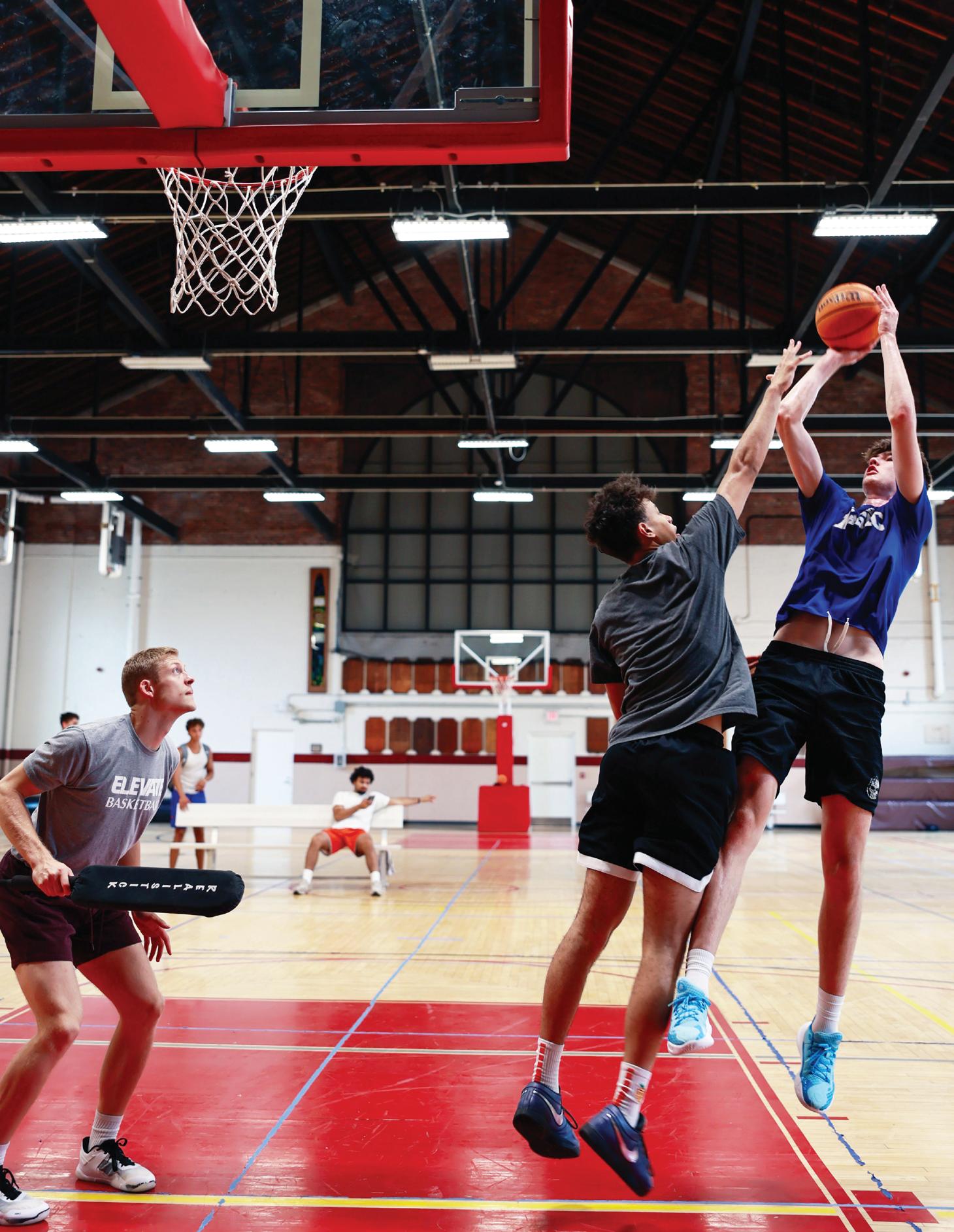
uring the tranquility of summer on Exeter’s campus, Mitchell Kirsch ’17 summoned a group of basketball players to Love Gym to simulate the swarming defenses Duncan Robinson ’13 would face in the NBA this season. To compensate for their lack of height relative to long-limbed pros, these defenders flailed long black padded sticks in front of the 6-foot-7inch Robinson, attempting to obstruct his vision and movements as he dribbled the ball and shot it.
As strange as this exercise looked, Robinson invites this kind of organized chaos on the court. It’s why the Detroit Pistons forward hired Kirsch to refine his game.
Kirsch, who played on two NEPSAC championship teams at Exeter as well as in college and overseas, has embraced a nontraditional approach to skill development. His methods have captured the attention of numerous college and NBA players, as well as coaches at the highest level of the sport. Some of them are among his nearly 100,000 Instagram followers.
Historically, sports training has focused on muscle memory: Athletes improve through the
Mitchell Kirsch ’17 (left) trains with Detroit Pistons forward Duncan Robinson ’13 in Love Gym.
repetition of proper techniques. But, Kirsch says, “there’s a major shift happening.” Static drills in practice don’t always translate to success in the unpredictable environments of competition. Shooting a basketball alone on a court, for example, will rarely happen during a full-court game.
Over the past two decades, a growing body of interdisciplinary research has shown that manipulating variables to mimic the challenges an athlete might experience during competition can lead to better results. This constraints-led approach, or CLA, draws from scientists’ understanding of ecological dynamics, or the nature of how individuals move through different environments. By providing players with various limitations or constraints — everything from dimmer lighting to extra defenders — coaches force athletes to learn to adapt to game conditions.
As Robert Gray, an associate professor of human systems engineering at Arizona State University, says, “Instead of the coach telling the athlete what to do, how to move, it’s letting the athlete figure it out on their own.”
Although some coaches contend that they have always operated this way, Kirsch belongs to a new generation of trainers who are steeped in the scientific underpinnings of the CLA methodology.
Exeter is Kirsch’s laboratory. For the past three summers, he has refined drills at the school while working with scores of local teenagers in his Elevate Basketball skills academy. Between those sessions, he holds private workouts on the grounds. Among his clients are Notre Dame forward Ryder Frost ’25, NBA veterans like Robinson and Georges Niang, and current Exeter players.
Robinson knew Kirsch as the brother of Max Kirsch ’16, his teammate on the Academy’s first NEPSAC Class A title team in 2013. Over the years, they crossed paths. Kirsch’s unconventional, studious approach appealed to Robinson, who blazed a trail from Williams College to the University of Michigan to the NBA. Eventually, Robinson enlisted Kirsch to design and oversee his offseason regimen.
“When I’m training, I want to think throughout my workout, and I want to learn,” Robinson says. “And he helps me do both.”
Last summer, Robinson holed up with Kirsch at Exeter for the better part of eight weeks. As usual, Kirsch posted clips from the sessions on his Instagram account, @hoopin_mitch; they collected tens of thousands of views.
These videos offer snapshots into the idiosyncrasies of a constraints-led approach. In one, Robinson warms up by shooting with basketballs of different weights and sizes. In another, he must immediately hoist a 3-pointer upon receiving the ball, never letting it fall below his shoulders and never holding it for more than half a second before releasing it, as if an NBA defender were bearing down on him. Time and time again, Robinson still makes the shot, though his footing and form don’t always look the same.
A player’s goal is to shoot the ball through the hoop during games. “What we’ve found is you don’t do that by repeating the same movement every single time,” Kirsch says. “You do that by having adaptability within your movement. That’s why we’re applying so many game-realistic challenges to encourage him to find consistency in the chaos.”
In about 20 studies comparing the effects of constraints-led training and more traditionally prescriptive coaching, Gray says, a majority have found that a constraints-led approach delivers superior results. “We’re making more adaptable, problem-solving athletes,” Gray says.
For Robinson, “that ultimately is what translates.” Whether it’s facing defenders with bats for arms or trying to beat a shot clock in his head, he finds these drills prepare him for a grueling NBA season that leaves little time for skill development.
Growing up in the small town of Atkinson, New Hampshire, Kirsch didn’t have many peers nearby to play basketball. So he became his own trainer, often running through muscle-memory drills alone. Yet, for all his practicing, Kirsch wasn’t improving to his liking. “I felt like there was no one working harder than me, but a lot of other people were getting better faster than I was,” he recalls.
Attending Exeter altered the trajectory of his development. When he arrived at the Academy as a day student in 2013, he was a slight 6-foot-2. “He, physically, was overmatched,” says Jay Tilton, his former Exeter coach. “But he always had the mindset, the confidence, the drive to be able to hang with the older athletes.”
Playing with them, including his brother, Max, taught Kirsch to work out more efficiently on and off the court. Over his four years, Kirsch honed his skills and gained about 50 pounds of muscle. He started every game at point guard his final two seasons and, as a senior, helped lead Big Red to his second NEPSAC Class A title, in large part because of his intelligence. “He’s always had a very high basketball IQ,” Tilton says. “A very inquisitive player. Asked a lot of questions — good questions.”
By that time, Kirsch had begun answering some of his own questions and had started training younger students. “I saw so many kids that reminded me of where I was,” he says. He wanted to expedite their development, just as others had done for him. And Tilton may have unwittingly planted the seeds for his constraints-led approach to basketball.
“You can have every excuse in the world, but we’re not looking for problems,” Kirsch recalls of Tilton’s philosophy. “We’re looking for solutions. Having that shift in mindset really helped both academically and on court. And funny enough, now that’s a large part of my training style. I’m giving players problems, and I’m encouraging them to find solutions.”
A prescribed path awaited Kirsch at Claremont McKenna College in California, where he continued
“I’m giving players problems, and I’m encouraging them to find solutions.”
Mitchell Kirsch ’17 (left) defends Utah Jazz forward Georges Niang
his playing career. Many student-athletes there opted to pursue careers in consulting or investment banking. Landing a job at a big company was considered “the gold standard,” Kirsch says. Yet, when these alumni returned to the school, “largely, they were just unhappy,” Kirsch recalls, “and, to me, that didn’t make much sense.” His internships at a Wall Street firm and Nike confirmed his suspicion that he would be miserable in the corporate world. When he jokingly told people he was visiting “career services,” he really went to the gym.
With the onset of COVID, the college’s athletic facilities closed and Kirsch started working out at the gym of Jordan Lawley, an NBA skills trainer, in Irvine, California. In exchange for using Lawley’s courts, Kirsch oversaw the development of Lawley’s middle-school clients.
With 30 youngsters and just six hoops, Kirsch lacked the space to run drills as he normally would. Yet the offensive and defensive games he devised on the fly were working better than he could have imagined. The players were improving — fast. And they were having more fun, he says. A limitation was working to their advantage. “I was like, there’s something to this,” Kirsch says.
He honed the idea for a training business grounded in science while earning his master’s degree in business at Babson College in Massachusetts. He also continued to play basketball and harbored dreams of playing professionally. He performed well enough at Babson to sign with a professional team in Colombia and later in Norway.
When he returned to the U.S. between seasons, he resumed training other athletes. “I was training people that were probably making what I make in a season in two minutes,” he says. “So I had to shift a little bit and understand where the value creation was.”
He ended his playing career and devoted all of his attention to training. But basketball wasn’t done taking him around the world.
Kirsch recently offered instruction in Kazakhstan, Sweden and Luxembourg. He also spends time in London, where his fiancée, Eloise Shields ’17, is pursuing a master’s degree.
When Kirsch is in the States, he’s regularly in the NBA orbit. Beyond keeping tabs on players he has trained, he stays in touch with coaches and front office types around the league, many of whom have adopted his methods. The Boston Celtics, for example, recently invited Kirsch to a practice.
Still, his most receptive audience may well be in his old locker room. Kirsch has trained several current Exeter players, and the Academy’s new basketball coach, Harry Rafferty ’13, advocates a constraints-led approach.
“I love that a Phillips Exeter grad is introducing our younger guys to different ways to improve that make them think,” Rafferty says. “It’s not, hey, we’re going to do these sets of drills, and that it’s this way or the highway, or this is the only way to get better.
… I think the biggest power in Mitch’s approach is that it creates an environment where our players are actively thinking of ways that they can improve that are outside the box.”
As much as he enjoys the challenge of fine-tuning the basketball brains of NBA players, Kirsch especially appreciates instilling this mindset in younger players, like those who attend his academy each summer at Exeter. “It’s the most rewarding thing,” he says. “Seeing all these kids from New Hampshire and Massachusetts really improve and embrace this different way of training.”
And this approach can be useful well beyond the basketball court. As Noah LaRoche, a consultant with the Miami Heat who grew up in Exeter and coached Kirsch, says: “It’s not a basketball thing. We’re dealing with constraints all the time.”
Benjamin Cassidy is a first-time contributor to the Bulletin. His writing has appeared in Boston, The Boston Globe Magazine, GQ, National Geographic and Scientific American, among other publications.
Kirsch (right) pressures Quinn Costello, a high school student who has signed with the University of Michigan, as he goes up to dunk the basketball.
Exeter Mock Trial Association A Team members hold court in Davis Hall.
RISE ALL
How Exeter’s mock trial teams prepare for the courtroom — and find camaraderie and confidence along the way
It’s 7:30 on a Monday night in October and Lauren Lee ’26 is examining a witness in a small classroom on the third floor of the Elizabeth Phillips Academy Center.
“When approached by the defendant, Ms. Grant wasn’t holding a weapon, was she?” Lee asks Jillian Cheng ’27. Except Cheng is not exactly Cheng at the moment — she’s playing the role of Cameron Rodriguez, a military veteran and retired police officer with more than 30 years of experience.
“No, she wasn’t,” Cheng says. “However, her appearance matched that of the dispatch report. … He had a reasonable suspicion, and so he approached her.”
Lee continues, her tone sharpening. “And did she cooperate when Officer Smith asked for consent to search her person?”
“Initially she cooperated, but she quickly became violent,” Cheng says without hesitation.
Sensing an opening, Lee presses further: “That’s a yes to my question, She cooperated when he asked for consent to search?”
“Initially, yes,” Cheng concedes. Lee and Cheng — acting as lead attorney and expert witness — are working through Addison Grant v. Sam Smith, a realistic (but fictional) civil case in which a police officer stands accused of using excessive force when
arresting a homeless woman with a seizure condition.
Along with two other A Team members of Exeter’s Mock Trial Association, they are practicing direct and cross-examinations for a mock trial invitational competition in early December. Over the next several weeks —encompassing fall term finals, Thanksgiving break and the start of winter term — club members will devote significant practice time, individually and together, to prepare. The invitational is an opportunity for all three Mock Trial teams to hone their material before the 2026 state competition.
When Lee wraps up her cross-examination, it’s time for feedback. Zoe Miller ’26, a witness leader for A Team, says Lee should consider splitting many of her long questions into two parts, to make them clearer and more straightforward.
“Jillian, for your cross responses, one habit you have is saying ‘Yes, and,’” Miller continues. “I think rather than saying that, you should say, ‘Well, not entirely’ or ‘Not quite.’ Saying ‘yes’ gives them too much.”
Lee chimes in from the lawyer’s perspective, as Cheng takes the note. “Yeah, when I hear a ‘Yes, and,’ then I’m like, hmm, I’m just going to ask, ‘Was that a yes?’ and move on,” she says breezily. “But if I hear ‘Not quite,’ I kind of have to listen.”
BY SARAH PRUITT ’95 | PHOTOGRAPHS BY CHRISTIAN HARRISON
On a campus with students hailing from 45 states and 39 countries, many living several time zones from home, clubs are one of the important ways Exonians find community and connection. The Academy has 190 student clubs, says Kelly McGahie, Exeter’s assistant director of student activities.
Joining a club is “a way for students to explore their passions, develop new passions and new curiosities,” McGahie says. “It’s also a way for them to maintain and develop friendships and meet new people that they might not have met before.”
Among student clubs, the Mock Trial Association stands out as one of the strongest and most active. Mock trialers at Exeter range from experienced debaters and aspiring lawyers to self-described “theater kids,” all seeking to sharpen their public speaking skills and legal acumen in a competitive, intellectually stimulating and enjoyable team environment. Each year, nearly 100 students audition for the club. About 30 are selected, then separated into A, B and C teams and assigned attorney or witness roles.
Other perennially popular clubs like the Daniel Webster Debate Society and Model United Nations emphasize similar skills — public speaking, logical reasoning and persuasion — and tend to attract some of the same students. But the clubs have important differences.
In parliamentary debate, the style practiced by debaters at Exeter, students face off against each other in teams of two to argue opposing sides of a given proposition (affirmative and negative). Mock trial simulates a legal proceeding, with students performing as attorneys and witnesses in front of a panel of judges. To succeed, lawyers and witnesses alike must combine superior preparation, confident public speaking and legal acumen with flexibility and improvisational skills, not to mention a considerable flair for the dramatic.
“Debate’s a very solitary activity — you’re speaking, and then you’re done,” says Lee, who is a co-head of the Mock Trial Association as well as a co-president of the debate team. “Whereas mock trial is a very collective activity. It calls upon everyone to be capable of contributing through independent work, but also be open to suggestions.”
In Model UN, a simulation of the United Nations, students act as delegates from different countries, placing even more emphasis on collaboration. “You have to interact with your competitors; you have to build relationships,” says Ethan Benenson ’26, a co-head of
both Exeter’s Model UN and Mock Trial Association. “The best person at Model UN is the one who can work with everyone and put themselves out there and talk a lot without making other people hate them. In mock trial, you’re performing for the judge, and it’s all about total domination of the other team. But what’s common in both is that you need a lot of charisma and you need a lot of swagger.”
Mock trial has a strong presence on Exeter’s campus but a relatively short history — especially when compared with debate, which traces its roots to the founding of the Golden Branch Society in 1818. Before the renovation of Phillips Hall in 2012, generations of Exeter debaters met in a dedicated room on the building’s fifth floor, which was outfitted with a wooden stage, a large throne-like judge’s chair and wall-to-wall bookshelves. The renovation replaced that room with three classrooms.
Although mock trials most likely took place on campus earlier, as part of the Golden Branch Society’s activities, the first official interscholastic competition was held in 2008. According to an article published in The Exonian that spring, Exeter’s team defeated a more experienced Andover squad by one point. That
initial success led to the growth of a dedicated mock trial club and a consistent record of achievement. Exeter teams have won six of the last eight state titles and have finished as high as ninth in the national championship.
This year, Exeter achieved another milestone, capturing first place at the Yale Mock Trial Bulldog Invitational, which brings together some of the nation’s best high school teams each year.
“Exeter mock trial is just so storied,” says Lee, citing the inspiration of older Exonians who inspired her to try out for the club when she was a prep. “It’s amazing to see just how quickly the club has grown and come together.”
All of Exeter’s clubs are student-led, but faculty advisers play an important role. Lori Novell, a disbursement manager in the Finance Department, has been the adviser to the Mock Trial Association since 2016.
Before coming to Exeter, Novell developed an interest in the legal system while working as an advocate for A Safe Place, a nonprofit organization serving victims of domestic and sexual violence. Over the years, she has appreciated watching
(clockwise from top) Mock Trial club co-heads and A Team captains Lauren Lee ’26, Tamar Moskovich ’26 and Zoe Miller ’26
Exeter students grow in confidence and public speaking ability through their participation in mock trials.
“It’s great discipline because they spend so many hours doing this,” Novell says. “I’d like to see it become a credited class because of the amount of time they have to take to prepare for competition.”
She says Exeter Mock Trial teams are experienced at competing against each other — and supporting each other even when the result doesn’t go their way. “It’s a very cohesive team,” she says. “Even though we have three teams, one of the things I really stress to these kids is: We are one team.”
Novell’s office is lined with trophies from past mock trial competitions, and she enjoys keeping in touch with some of the many graduates who have gone on to compete in college. Anderson Lynch ’23, a member of the Exeter squad that finished ninth at nationals his senior year, now competes for the University of Chicago, where his mock trial team is coached by another Exeter alumnus, Sam Farnsworth ’20.
Lynch says that mock trial “really changed the way I’ve been able to look at problems, see two sides to a story, and craft an argument that is persuasive but embraces aspects of the other side.” He adds: “I think it really went hand in hand with Harkness, in the sense that it taught you … how to listen to others and understand what they’re saying. That’s a very crucial aspect that separates great mock trialers from good mock trialers.”
Being part of the club at Exeter also had a more practical effect on Lynch. “I
“Mock trial is a very collective activity. It calls upon everyone to be capable of contributing through independent work, but also be open to suggestions.”
went into Exeter not knowing exactly what I wanted to do, and I came out of Exeter really wanting to be a lawyer,” he says. “That was almost entirely because of mock trial.”
It’s Sunday afternoon, the day before finals begin. The entire A Team — nine students, including five attorneys and four witnesses — is practicing for the last time before Thanksgiving break. The students gather in the small classroom adjoining the Library Commons area in the Class of 1945 Library. The day is chilly, and everyone is wearing sweatpants and sweatshirts, a far cry from the pantsuits, blazers and ties in which they will compete.
Despite the cozy vibe, the mood is high as they toss ideas back and forth, mulling over the exact wording of the opening statement one of the lawyers will deliver. It’s like a turbocharged Harkness discussion, with far more interruptions and bursts of laughter.
Tamar Moskovich ’26, a club co-head and witness leader for the team, stands at the whiteboard. “A badge is not a pass to __,” she writes, drawing a line
representing the unfinished sentence.
“A badge is not a pass to ignore the facts!” someone cries out.
“I think there’s too many rhymes in there,” Cheng says. On a similar note, they decide the words “regret” and “threat” don’t work together.
“He wore the badge, and ignored the facts,” someone suggests.
The raucous back-and-forth continues until they decide that “he betrayed the badge” is the right wording and move on. Over the next hour, Theo Stien ’28 cross-examines an eyewitness, Bailey Wilson (played by Miller), and conducts a direct and cross-examination of a seasoned police officer and expert witness, played by Alex Eggers ’28.
The lawyers and witnesses have prepared their own questions and responses, and the group follows along in a shared document, giving both oral and written feedback. Moskovich watches each witness closely, sometimes gesturing to make sure they look up at the other team members rather than down at their material. “Louder, more spark,” she advises.
As practice wraps up, a few team members promise to send drafts of their material so others can review it over the
(left) Anderson Lynch ’23 competing for the University of Chicago mock trial team; (right) Exeter Mock Trial Association adviser Lori Novell
break. Most of them are heading to Elm Street Dining Hall to eat dinner and continue discussing their case.
Before leaving, Moskovich adds a last piece of advice for Eggers, the expert witness. “When you’re picking and choosing what to really respond to, those are the moments that we’re going to remember,” she says. “You can’t fight everything. What’s really the important fact?”
At each mock trial competition, a team must prepare to argue both sides of the case, prosecution and defense. In addition to a presiding judge, who will sustain or overrule lawyers’ objections, a panel of judges sits in the jury box and scores each trial. Lawyers and witnesses are scored individually on aspects of their performance, adding up to total team scores that determine the trial’s outcome.
“Being a witness is very fun, and I enjoy the improv aspects of it, and putting on a character,” says mock trial co-head Benenson. “It allows more creativity and freedom than being a lawyer, where you kind of have to stick to a very serious, more rigid personality.”
Lee, who has taken on both roles in competition, views them a bit differently. “As a witness, you’re constrained by time, you’re constrained by your crossing attorney,” she says. “As an attorney, though, I have a lot of freedom to move about the well. I can ask whatever questions I want. Witnesses have their affidavits, but lawyers don’t really have a
A Team attorneys Theo Stien’28 and
Kalina
Marinov ’27
foundational text that grounds us, so it requires a lot of imagination.”
In both roles, they agree, preparation is key. “When you get in a courtroom, it’s very nerve-racking,” Benenson says. “At every moment, someone’s watching you and giving you a score for everything you do. But when I feel extremely prepared, I have the confidence to know that I can perform at my highest level, no matter the scrutiny or the pressure of the spotlight that’s on me.”
Although other high school mock trial teams typically are guided by experienced attorneys, Novell emphasizes that Exeter’s teams are largely self-taught. “They like it that way,” she says.
In recent years, the club has begun a tradition of choosing seniors to captain the C Team, so they can guide and mentor newer club members. “It’s helped to strengthen the program going forward,” Novell says.
Benenson was on the A and B teams during his first three years at Exeter and went to nationals twice. In the spring of his upper year, he applied to be a co-captain of C Team.
“I thought about how I could make the biggest impact on the club and do work that feels most important to me,” he says. Leading C Team has helped Benenson improve his mock trial performance. It also has been rewarding, he says, watching his teammates “connect with each other and grow as people and into more confident lawyers and witnesses.”
With their material (presumably) memorized, the members of A Team return from Thanksgiving break for winter term classes and an intense week of practice. Before competitions, they meet every night, including a planned three-hour session the night before they depart for the invitational.
“We’re very committed to practicing, especially in the week leading up to a tournament,” Moskovich says. “It’s also important that we’re very comfortable with each other, so we know that when we’re in trial we trust each other and our abilities.”
Eggers, for one, plans to run through her witness material one last time in front of a mirror on the morning of the competition. “Just so I really get it in my brain, and I’m fully into my character before I go on the stand,” she says.
On a bright Saturday morning in December, Novell joins the members of the Mock Trial Association on the bus for the 50-minute drive to Bishop Guertin High School in Nashua, New Hampshire. Over the next two days, they emerge with a clean sweep of the Peter Champagne Memorial Tournament, with A Team taking first place, C Team second and B Team third. In the individual categories, Moskovich is honored with an Outstanding Witness Award, while Forrest Zeng ’26, Benenson’s C Team co-captain, is named an Outstanding Attorney.
The club can now look ahead to the state competition in February and, perhaps, the 2026 national championship in May in Des Moines, Iowa.
“It’s a confidence booster to win our first trial together as a team,” says Rhys Cunningham ’27, an attorney on A Team. “Now that we have that under our belt, we can go into states confident in ourselves.”
For Benenson, the most memorable moments in mock trial happen on the eve of big competitions.
“You’ll pretty much be with your team from dinner to check-in, getting final work in,” he says. “You’re under pressure, but that’s when everyone really comes together, and it feels like you’re truly part of a group, and you’re really building something together.
“Thirty years from now, when I look back on the feeling of doing mock trial at Exeter, I think those are the nights I’m going to remember the most.”
Sarah Pruitt ’95 is a staff writer for The Exeter Bulletin and a longtime contributor to History.com.
Connections
Rehabilitation Tactics Bill Endicott ’64 supports wounded Ukrainian soliders. P. 46
Bill Endicott ’64 (far right), a former U.S. Olympic team kayak coach, readies to take a group of Ukrainian amputees out in kayaks.
Fighting the Good Fight
Bill Endicott ’64 supports recovery of Ukrainian soldier amputees
O n April 19, 2022 , eight weeks after Russia initiated a full-scale invasion of Ukraine, Bill Endicott ’64 sent an email to his friend, the owner of a prosthetics company, with a simple but vital request: Would you be willing to help Ukrainian soldiers? Forty-five minutes later, he had the green light to start an initiative that would provide prosthetics, rehabilitation and support to Ukrainian soldier amputees. He named it Operation Renew Prosthetics (ORP).
At that early stage of the war, Endicott could not have foreseen how desperately Ukrainians would need the help. Reports estimate that there are 115,000 Ukrainian amputees because of the war. With limited access to advanced prosthetics and inpatient rehabilitation, many wounded soldiers endured recovery alone.
had expertise in caring for blast injuries. Future for Ukraine became ORP’s partner and primary connection to soldiers, who are affectionately called defenders by their compatriots.
The first Ukrainian soldier, Oleksandr “Sasha” Chaika, arrived in the U.S. for treatment in the fall of 2022. In April, a month after he joined the fight, a Russian tank shell exploded near the trench he was in in Popasna. Chaika was hit by shrapnel and lost a leg; doctors gave him a 20% chance of survival. Future for Ukraine covered all his travel expenses and ORP provided a free prosthesis and six weeks of rehabilitation.
single prosthesis ranging from $8,000 to $50,000 or more, the operation was unsustainable. Instead, the organizers decided to establish a clinic in Kyiv, Ukraine’s capital, and train Ukrainians to run it independently.
Endicott reached out to the Future for Ukraine Foundation, a Ukrainianrun charitable group based in Poland, and expressed ORP’s desire to treat amputees at Medical Center Orthotics & Prosthetics in Maryland. That company, owned by his friend Michael Corcoran,
Before the war, he was a dancer and choreographer. Today, Chaika is married with a young son and has realized his dream of opening a dance school in Ukraine. “Sasha recovered about as well as you can with a major amputation,” Endicott says. “He told me that one reason he was so motivated to recover was to prove the doctors were right to take a chance on saving him.”
Five more soldiers arrived in the U.S. after Chaika. But with the cost of a
Endicott has always been driven by a strong moral obligation to help others. He was born in Boston in 1945, in the shadow of World War II, into a family that traces its origins in America to 1628, when John Endecott (the family changed the spelling to Endicott in the 18th century) landed in Salem and became the first governor of Massachusetts. “My family’s been involved in public service for 400 years,” he says, “so I’ve always felt that a good life is one in which you do some things for yourself, but you do some other things for other people. It’s a balance.”
Growing up in the Cold War era, Russia was a constant presence in Endicott’s life. In elementary school, he dived under his desk during air raid drills. As a student at Exeter in the early 1960s, he studied Russian history. He internalized the turmoil churning across America during the Vietnam War, watching his friends die while he was temporarily deemed ineligible to serve. In 1967, the principal at the time, Ernie Gillespie, gave a speech to the graduating class that became a rallying cry for Endicott, even to this day.
“The part I’ve always remembered goes like this,” Endicott says. “‘I hope, and I expect, that when you find yourselves involved in skirmishes on the frontiers of barbarism … you’ll strike some shrewd blows in favor of civilization. Someday you’ll come back to show us your trophies and your scars, and we’ll be glad to see you.’”
Determined to lead the non sibi life, Endicott embarked on a remarkable career of public service. He studied Russian language at Harvard College and received an M.P.A. from the Harvard Kennedy School. He worked for three U.S. congressmen and the Democratic National Committee, then served as director of research and analysis in the White House Office of Political Affairs during the Clinton administration. He enlisted in the Marine Corps Reserve,
Bill Endicott ’64 looks on as a Ukrainian soldier walks for the first time with his prosthetic leg.
Bill Endicott ’64
rising to the rank of captain, and worked at the Pentagon.
Endicott devoted the little free time he had to his passion: whitewater canoeing and kayaking. Following a collegiate rowing career at Harvard, he became a leading figure in the world of whitewater slalom, as an athlete, author and U.S. Olympic team coach. This is how Endicott and Corcoran first joined forces. In 1988, Corcoran traveled from Dublin to the U.S. to train with Endicott in the hopes of making the Irish Olympic team. Corcoran later relocated to America and co-founded MCOP in 2002. He and Endicott remained close.
In 2022, unified in their belief that Ukraine needed and deserved their help, they founded ORP. Three and a half years later, ORP has successfully cared for 112 soldiers and laid the groundwork for Ukraine to become a world leader in amputee care. They even shared their love of whitewater sports with the Ukrainian soldiers, hoping to establish a kayaking rehabilitation program in Kyiv like the one that exists for soldier amputees in the U.S.
On November 6, 2025, following a sleepless night of air raid alerts, Endicott was in Kyiv for the grand opening of a new clinic, Medical Center Orthotics & Prosthetics Ukraine. It is staffed entirely by Ukrainians, with 19 full-time and six part-time employees, and plans to hire more. They have been trained to operate independently to continue providing prosthetics to their country’s soldiers. Endicott hopes the clinic may someday help civilians as well.
The work of Operation Renew Prosthetics is now complete, but Endicott stands ready to help wherever he can, including possibly raising funds to assist former U.S. soldiers who lost limbs fighting for Ukraine.
“The Ukrainian people are astonishingly resolute and united in the face of all this adversity,” Endicott says. “When I start to worry about my own problems, I think about what Ukraine is facing, and particularly what these soldier amputees are facing. My problems are nothing compared to theirs.”
Endicott, an 80-year-old retiree, says he will always feel compelled to do what he can when duty calls.
“I’d like to think that Ernie would feel that these were ‘shrewd blows,’” he says. “And he was right: There have been some trophies and some scars!” —Danielle Cantor
ASTRONOMY
The Next Frontier
Ana
Glidden ’12 explores the atmospheres of distant worlds
Ana Glidden ’12 is looking for signs of life well outside our solar system — 40 light-years away, to be exact, on the exoplanet TRAPPIST-1 e. A postdoctoral researcher in MIT’s Department of Earth, Atmospheric & Planetary Sciences and the Kavli Institute for Astrophysics and Space Research, Glidden was the first author of “JWST-TST DREAMS: Secondary Atmosphere Constraints for the Habitable Zone Planet TRAPPIST-1 e,” published in The Astrophysical Journal Letters in September.
The researchers used a method called transit spectroscopy, by which astronomers look at light from the host star as it passes through the planet’s atmosphere to determine the atmosphere’s composition. The team compared data from the James Webb Space Telescope (JWST) with models Glidden helped develop to assess whether TRAPPIST-1 e might be habitable. As yet, the answer is not clear, but the research is far from complete.
“Our initial observations are one of the most detailed looks at a rocky, habitable-zone exoplanet to date, a steppingstone along the path in the search for life outside the solar system,” Glidden says.
Glidden’s earlier analysis had shown that if the planet had an atmosphere, carbon dioxide would be the most observable gas. Though none was detected on TRAPPIST-1 e, she says, it doesn’t mean there isn’t any at all. The team continues to use transit spectroscopy to explore the characteristics of the planet.
Glidden has an impressive portfolio of astrophysics research. After earning a bachelor of science degree in physics from MIT, she worked as a software engineer, assisting with camera testing for the Transiting Exoplanet Survey Satellite (TESS), an MIT-led NASA mission that uses the transit method to find exoplanets. That work led Glidden to shift her focus from active galactic nuclei and high energy astronomy to characterizing distant planets. She earned a doctorate in planetary science at MIT.
At Exeter, Glidden’s general interest in science led her to astronomy. On the recommendation of Physics Instructor Tatiana Waterman, Glidden enrolled in John Blackwell’s introductory course, where she studied data from the Kepler planet-finding mission and learned about the classification of light curves and finding planets using the transit method. She was invited to participate with Blackwell in the NASA Infrared Processing and Analysis Center Teacher Archive Research Program (NITARP) at Caltech, using ultraviolet satellite images and ground-based optical images to make correlations between the color and luminosity of the hot gas around supermassive black holes at galaxy centers.
Glidden, who is studying the TRAPPIST-1 system of seven Earth-size planets that span the habitable zone, says nothing like that system has ever been found. The team is currently observing the innermost planet, TRAPPIST-1 b, and TRAPPIST-1 e in succession. The studies will allow Glidden and her colleagues to better characterize the exoplanets, as they continue to seek an answer to the age-old question: Are we alone?
“The different ingredients that are necessary for life to form and evolve are mind-boggling,” Glidden says. “We’ve found over 6,000 exoplanets and there have been none like Earth, which makes you realize just how special Earth is.” —Sarah Zobel
Ana Glidden ’12
Memorial Minute
Jacquelyn Harvey Thomas
James H. Ottaway Jr. ’55 Professor and Academy Librarian, Emerita (1932-2023)
Jacquelyn Thomas. Just to say the name evokes an age — a bygone age in the life of the Academy — but also an inheritance that we, its present denizens, enjoy in ways that perhaps we don’t realize or that we take for granted. Nothing that Jacquelyn Thomas did was not thorough, executed to her exacting standards; this Memorial Minute will seek to do service — and tribute — to her accomplishments and to her abiding spirit and legacy. Settle in: It will last longer than a minute. Jackie (as she was known to us) was born in Mechanicsville, Pennsylvania, and spent her early life in nearby Camp Hill. She graduated Phi Beta Kappa from Gettysburg College, earning her bachelor’s degree, and married David Thomas in 1954. In 1957, the couple moved to
Exeter, where David had been hired to teach classics at The Phillips Exeter Academy (as it was called then). Their three daughters were raised on campus and all graduated from PEA — those details will acquire greater significance as we proceed. While raising those daughters — in the fourth-floor apartment of Wheelwright with a hot plate (no kitchen), where dishes were done in the bathtub — and later in Ewald and in haunted Gilman House* — Jackie pursued, and achieved, her M.Ed. in library science from the University of New Hampshire.
She began her long and illustrious career at the Academy in 1971, first working as a staff person in the Davis Library before being appointed the first female Academy Librarian in 1975. During her tenure, Jackie transformed the newly constructed Class of 1945 Library (which many referred to as her library) into the intellectual and cultural center of the
Exeter campus and indeed of the surrounding town. Early on, Jackie began computerization of the library’s collection and accelerated the presence of technology. She welcomed thousands of visitors from all over the world, who had made the pilgrimage to view Louis Kahn’s iconic building. Upon Jackie’s appointment as James H. Ottaway Jr. ’55 Professor in 1990, Principal Tom Hassan remarked, “Under her leadership, the library has been not only a haven for scholars [conducting independent research, panel discussions, lectures, symposia], but also a venue for an array of events that broadened and deepened our [cultural] awareness.”
These events included musical concerts, theatrical productions, authors’ readings and scholarly lectures, as well as the Lamont Poetry Series (which Jackie co-founded with Corliss Lamont, and which continues to bring to campus a pantheon of poets, whose first was Jorge
Jacquelyn Harvey Thomas and her daughter Lesley J. Langelaar-Thomas ’78
Luis Borges). Under Jackie’s supervision, events even extended to the construction of a sand mandala in the center of Rockefeller Hall by a group of visiting Tibetan monks. Each and every event, every detail — down to the fall faculty party’s enormous shrimp bowl — bore the singular “Jackie stamp” of excellence, meticulous organization, class and style. Her response to those with ideas about enhancing the Academy’s cultural life with the use of the library’s space or funds was ever and always her signature gruff “Just ask!”
Jackie joined the faculty in the initial days of coeducation, and one of her most influential roles in the 1970s through the 1990s was as a member of the Committee to Enhance the Status of Women. That committee advocated the inclusion of women on the faculty and staff and, beyond that, worked to support women faculty members in the early years. It hosted mentoring programs, professional development opportunities and even a national conference for women educators in boarding schools.
Co-committee member and former Dean of Students Susan Herney recollects: “[Jackie] was instrumental in designing the various workshops we thought vital to having our voices heard and becoming a visible presence. One workshop was teaching listening skills, and another, ‘In a Different Voice,’ [addressed] how women make decisions differently than men. [It was] led by Carol Gilligan, a psychologist at Harvard. Afterward Jackie said, ‘Did you notice how uncomfortable the men were in both settings? . . . Did you notice they were dropping pencils, shifting in their seats?’ … These workshops were working. Men were learning, perhaps in some cases for the first time, what listening could be and how women came at decision-making differently than they did. [Jackie’s] persistence, dedication to her values, intellectual honesty and courage were key to much of what the committee accomplished in its early years.”
Jackie was also a founding member and chair of the Child Care Governing Board, which supported young families at the school, helping them to balance home life and professional responsibilities. This was a time before Academy
“Under her leadership, the library has been not only a haven for scholars, ... but also a venue for an array of events that broadened and deepened our [cultural] awareness.”
child care. Herney recalls that Jackie’s “doggedness in pushing forward child care for faculty was crucial to the recruitment and retention not only of women faculty, but men as well. From the very beginning, she shepherded the founding of the Harris Family Children’s Center. Unlike many women faculty at the time, Jackie had been a faculty wife, raising three daughters, living in a dorm and supporting Dave in those early years in the ’50s when they arrived at Exeter. This gave her a much broader and keener perspective on the needs of both women faculty and staff.”
Jackie served on a host of other faculty committees that touched virtually every aspect of Academy life. Among them: the Funds Committee; the Lamont Poets Committee; Admissions; Alumni Affairs and Development; Appointments and Leaves; the Calendar Committee; the Lowenstein Committee; the PEA History Project; and the Technology Steering Committee. Add to this her roles as adviser to library proctors, day student adviser and coach of club tennis. To say that Jackie was contiguous to the school’s beating heart would not be an overstatement. On the occasion of her having to travel off campus for a school evaluation, she wrote to Dean of Faculty Andy Hertig, “Don’t make any far-reaching decisions without me.”
Later in her career, Jackie oversaw the production of a number of publications including pieces on the Bennett Fellowship, a volume of Memorial Minutes and Collected Letters: Friends of the Academy Library. She produced an informational pamphlet on the library, as well as a booklet on its architecture and
history. Upon her retirement in 2010, the Academy established the Jacquelyn H. Thomas Fund for the Class of 1945 Library, which continues to benefit Academy life through the acquisition of books and other materials and support of library programs. In 2021, she received one of the Academy’s highest honors, the Founders’ Day Award, for “exceptional service to the Academy.” It was a fitting conclusion to and culmination of her 64-year association with the school.
Jackie died peacefully on January 21, 2023, at RiverWoods in Exeter. She was predeceased by her husband, David, and is survived by her daughters and their families. She survives in the legacy she left us. We feel her presence when we enjoy what’s good about this place; when we aspire to make what’s good better; in those moments when we achieve (or hope to achieve) that rare quality she embodied: excellence.
The Memorial Minute excerpted here was written by Todd Hearon (Woodbridge Odlin Professor in English, Bennett Fellowship coordinator and instructor in English.) The full remarks were presented to the faculty at its meeting on April 14, 2025, and are available at exeter.edu/ memorialminute.
*Jackie enjoyed telling about the ghost of Gilman House, where she and Dave lived when it was a boarder residence. The inexplicable sound of a ball bouncing in the basement would stop when they opened the door. An invisible force grabbed an electrician’s hand as he reached into a wall — and sent him fleeing across campus, vowing never to return.
Tracks She Left
Play.
The static hums first before the song, before the memory. A needle on vinyl, a tape reel spinning, a moment slipping between frames of film.
Rewind.
When silence wasn’t an answer, when her voice wasn’t an echo trapped in old voicemails, when we danced in her kitchen with flour on our fingertips while she whistled a song she swore I knew.
Fast-forward.
The past flickers fast; her hands tugging their way down my knotted hair, the radio buzzing between stations, her laughter burning through my ears.
Pause.
A breath. The lyric crackle, but the song continues. I press record on what’s left, hold the melody in my throat. It wavers, distorts, just out of reach, but never gone.
Laavanya Rasiah ’27 was recognized with a 2025 Lamont Younger Poets Prize for this poem. The prize honors poems of exceptional promise written by preps and lowers, and commemorates the dedication of English Instructor Rex McGuinn to student poetry at Exeter.
Exeter for Educators
Hone your craft and expand your skills on our beautiful New Hampshire campus. Exeter’s intensive 5-day workshops for educators and leaders span a variety of subjects and o er engagement with Harkness teaching and learning.
Conferences o ered in 2026:
NEW! Teaching in the Age of AI
NEW! Exeter Science Institute
Anja S. Greer Conference on Mathematics & Technology