

![]()


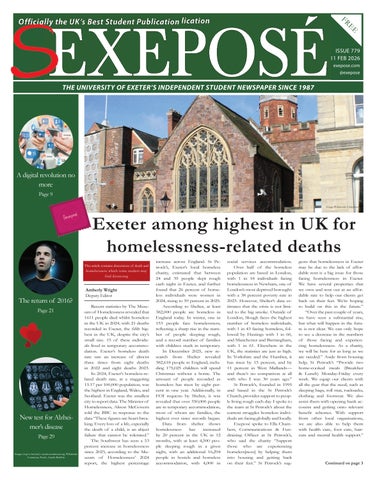
increase across England. St Petrock’s, Exeter’s local homeless charity, estimated that between 24 and 35 people slept rough each night in Exeter, and further found that 26 percent of homeless individuals were women in 2024, rising to 59 percent in 2025.
Recent statistics by The Museum of Homelessness revealed that 1611 people died whilst homeless in the UK in 2024, with 21 deaths recorded in Exeter, the fifth highest in the UK, despite the city’s small size. 15 of these individuals lived in temporary accommodation. Exeter’s homeless death rate saw an increase of almost three times from eight deaths in 2022 and eight deaths 2023.
In 2024, Exeter’s homeless-related death rate, at a staggering 15.17 per 100,000 population, was the highest in England, Wales, and Scotland. Exeter was the smallest city to report data. The Minister of Homelessness, Alison McGovern told the BBC in response to the data “These figures are heart-breaking. Every loss of a life, especially the death of a child, is an abject failure that cannot be tolerated.”
The Southwest has seen a 53 percent increase in homelessness since 2023, according to the Museum of Homelessness’ 2024 report, the highest percentage
According to Shelter, at least 382,000 people are homeless in England today. In winter, one in 153 people face homelessness, reflecting a sharp rise in the number of people sleeping rough, and a record number of families with children stuck in temporary.
In December 2025, new research from Shelter revealed 382,618 people in England, including 175,025 children will spend Christmas without a home. The amount of people recorded as homeless has risen by eight percent in one year. Additionally, in FOI requests by Shelter, it was revealed that over 350,000 people are in temporary accommodation, most of whom are families, the highest ever since records began.
Data from shelter shows homelessness has increased by 20 percent in the UK in 12 months, with at least 4,500 people sleeping rough in a given night, with an additional 16,294 people in hostels and homeless accommodation, with 4,000 in
social services accommodation.
Over half of the homeless population are based in London, with 1 in 18 individuals facing homelessness in Newham, one of London’s most deprived boroughs with a 38 percent poverty rate in 2023. However, Shelter’s data estimates that the crisis is not limited to the big smoke. Outside of London, Slough faces the highest number of homeless individuals, with 1 in 43 facing homeless, followed by Hastings with 1 in 60, and Manchester and Birmingham, with 1 in 61. Elsewhere in the UK, the statistics are just as high. In Yorkshire and the Humber, it has risen by 15 percent, and by 11 percent in West Midlands— and there’s no comparison at all with who I was 30 years ago.”
St Petrock’s, founded in 1995 and based in the St Petrock’s Church, provides support to people living rough each day. I spoke to the team at St Petrock’s about the current struggles homeless individuals are facing globally and locally.
Exeposé spoke to Ella Chambers, Communications & Fundraising Officer at St Petrock’s, who said the charity “Support those who are experiencing homeless[ness] by helping them into housing and getting back on their feet.” St Petrock’s sug-
gests that homelessness in Exeter may be due to the lack of affordable rent is a big issue for those facing homelessness in Exeter. We have several properties that we own and rent out at an affordable rate to help our clients get back on their feet. We’re hoping to build on this in the future.”
“Over the past couple of years, we have seen a substantial rise, but what will happen in the future is not clear. We can only hope to see a decrease in the numbers of those facing and experiencing homelessness. As a charity, we will be here for as long as we are needed.” Aside from housing help, St Petrock’s “Provide two home-cooked meals (Breakfast & Lunch) Monday-Friday every week. We equip our clients with all the gear that the need, such as sleeping bags, roll mat, rucksacks, clothing and footwear. We also assist them with opening bank accounts and getting onto relevant benefit schemes. With support from other local organisations, we are also able to help them with health care, foot care, haircuts and mental health support.”
Devonshire House, Exeter, Devon, EX4 4PZ
Editors
Print: Kayleigh Swart and Emily Sara Rizzo
Online: Harry Morrison and Zandie Howells
Print Deputies: Amberly Wright, Lauren Walsh and Nina Exton
Online Deputies: Michelle Chung and Daniel Grayshon editors@exepose.com
News Editors
Print: Isabella Brooks and Daisy Newbury
Online: Zandie Howells news@exepose.com
Features Editors
Print: Ria Brown-Aryee and Bethany Last Online: Lucas Taylor-Kent features@exepose.com
Climate Editors
Print: Poppy Fellows
Online: Freddy Purcell climate@exepose.com
Comment Editors
Print: Tom Richardson and Lucas Eley
Online: Orlando McKillop and Lucy Parsons comment@exepose.com
Satire Editors
Print: Christopher Lyndsay
Online: Daniel Grayshon satire@exepose.com
Lifestyle Editors
Print: Yasmine Al-Saket
Online: Hayley Bell and Sofia Tapia lifestyle@exepose.com
Editors
Arts & Lit
Print: Isabel Bratt and Amber Platel
Online: Zoe Fry artsandlit@exepose.com
Music Editors
Print: Sarah Gould and Katie Roberts
Online: Amelie Marah and Maya Dallal music@exepose.com
Screen Editors
Print: Beth Casey and Charlotte Isbell
Online: Kyle Cleary and Lachlan Evans screen@exepose.com
International Editors
Print: Jed H. Gibbins and Antoni Kałduński Online: Anoushka Dutta and Lola Milroy-Tompkins international@exepose.com
Sci-Tech Editors
Print: Julia Szewczyk
Online: Anna Tennant and Rosie Merritt
sci-tech@exepose.com
Sport Editors
Print: Annabel Gowling Online: Connor Myers sport@exepose.com
Social Media Executive: Megan Wynn
Finance Executive:Orlando McKillop
Welfare Executive: Sophia Cuschieri
Events Executive: Audrey Yuen
Podcast producers: Harry Morrison and Alannah


@exepose
@exepose
facebook.com/exepose
issuu.com/exeposeexeter
Advertising editors@exepose.com The
WELCOME to our second edition of the year. Back and better than ever, this issue brings you all things sweet for Valentine's Day, as well as meditations on singlehood, Palenitne's, and suggestions for altenative non-romantic ways to spend this random Saturday in February. If there's an important issue at the University or in Exeter that we've missed, please email us at editors@exepose.com.
In this issue, News talk to one of Exeter's homelessness charities, as well as raising awareness for HIV Testing Week. Comment discusses femininity in university, while Climate and Satire shares tips on how to survive a situationship. In Exhibit, Valentin's is the name of the game, and love the content of many, many articles. In Music writers describe their favourite love songs, Screen sgares their favourite inconventional love stories, while we introduce our new Welfare Executive in Excetera Excetera. In International we consider the controversy of Australia Day in realation to its Indigenous peoples, and finally in Sport, we cover the Australian Open, Jemmel Hill's podcast, and running clubs as ways to find a partner. If you can't get enough of Exeposé, you can check out our podcast and website which is updated on a weekly basis!
Once again, thank you so much to all our editors, interviewees, and general helpers who work so
hard to make this paper possible! As always, we welcome new and returning editors to join us for the newspaper, our socials and any other Exeposé business.
Emily and Kayleigh


THE UAE has restricted its funding for citizens who want to study abroad at British Universities, reports the Financial Times. In June 2025, the Ministry of Higher Education, based out of Abu Dhabi, published a list of global universities for which scholar ships would be approved, allowing their citizens to study abroad. Although the list contained universities in the US, Australia and France, UK universities were omitted. The reluctance to fund study in the UK stems from anxiety in the UAE over what it perceives as Islamic radicalisation on British university campuses. The UAE has long been taking a tough stance against Islamist movements, both at home and abroad. Emirati leadership has repeatedly questioned why the UK has not yet banned the Muslim Brotherhood, a transnational Islamist organisation that UK officials declared ‘not a threat’ in 2015. This is the latest blow in a rise in tensions between two historically close nations.
Universities in the US face increasing censorship from government
CENSORSHIP in the US is rising at unprecedented levels as many universities are legally mandated to censor the content they are teaching, which is often related to diversity, equity and inclusion (DEI).

In January, Texas A&M, one of the top 10 public universities in the US, banned professors from teaching content — including extracts from Plato — related to feminism, sexuality and race, and cancelled the module ‘Introduction to Race and Ethnicity’. In 2025, lawmakers in the US introduced bills censoring aspects of higher education in 32 states. Many bills restrict the ‘promotion’ of gender and race ‘ideology’ within the curriculum, which is reminiscent of Former Prime Minister Margaret Thatcher’s Section 28, which prevented discussion of LGBTQ+ identities in UK schools. Previously, US President Donald Trump signed an executive order ending US universities’ DEI initiatives in January 2025. Trump further eradicated the mandates for institutions to commit to diversity and inclusion, calling them ‘unlawful’.
Sudanese civil war continues to harm higher education
WHILE Sudan has seen sustained conflict for nearly 70 years, the current war (2023–present) has brought what the UN describes as the world’s worst humanitarian crisis upon the nation, devastating Sudanese higher education. A key factor in the decline has been its over-centralisation, especially in Khartoum. Central states, where the majority of universities are located, are amongst those most affected by war because the universities’ strategic locations make them targets for military occupation, shelling and looting. Also detrimental has been the mass displacement of academics and university staff since the onset of the conflict, leading higher education without the human capital to survive. For those who remain, immediate survival often takes precedence over education. Sudanese academics argue that hu manitarian aid frameworks in Sudan must include educational support to preserve existing institutions and lay the foundations for long-term development post-war.
India and Germany launch plan to increase student exchanges

NDIA and Germany launched a strategic higher education roadmap during a virtual bilateral summit hosted by their respective Ministries of Education in January. Aiming to double the number of student exchanges by 2030, the roadmap builds on existing agreements by strengthening dual degree programs, joint PhD supervision and faculty mobility schemes. Germany will initially contribute €50 million (£43m) and the Indian government ₹ 500 crore (£40m). German universities will expand their Englishtaught courses, while India will add additional German courses at Indian Goethe-Institut locations. India hopes to benefit from new skills for Atmanirbhar Bharat, its “Self-Reliant India” program. Germany hopes to gain diverse talent amid its growing ageing population. Early economic projections for the plan estimate €2 billion (£1.7bn) in R&D value by 2030. Corporations, such as Tata Group and Siemens, pledged 10,000 student internships.
‘Some may feel safer sleeping... under a CCTV camera’
Continued from front page
Many of the individuals supported by St Petrock’s go on to escape the cycle of homelessness, have a home of their own, and get support for their mental and physical health struggles. An individual, who became homeless in the mid-80s, says “I am 66 years old, and I feel like I’m getting
physically better and mentally sharper everyday”. This individual was helped by St Petrock’s to find housing, which they say “it’s my home. It’s the first place that I’ve ever had on my own. […] I'm not the same person that I was 3 years ago- and there's no comparison at all with who I was 30 years ago.”
In an article with the BBC, St Petrock’s homeless manager Rowan

Livingstone said research suggests more women in Exeter were leaving mixed sex supported housing because it was not a viable option if they had experienced trauma. She told the BBC “In the 25 years I have worked in homelessness I haven't met one woman who hasn't experienced violence or abuse while being homeless […] some may feel safer sleeping in the city directly under a CCTV camera. They know they're seen there but that can also expose them to some quite terrible risks ranging from violence to verbal abuse and all kinds of thefts and assaults.

I haven’t met one woman who hasn’t experienced violence or abuse while being homeless
Kira, your Student Living Officer at the Guild said, "So many of us have experienced worries about housing or money at university, but that doesn’t make it feel any less scary. While you’re studying, additional challenges can be incredibly stressful and isolating, and it can feel hard to know where to turn.
If you’re experiencing this, please know that support is available, and you don’t have to handle it on your own.
If things feel uncertain or urgent, reaching out can make a real difference.
Our Advice Team and University Wellbeing can listen without judgement, talk things through, and help you explore your options, including providing urgent signposting or advice on your situation, such as the University’s Hardship Fund. No student should feel alone
when facing housing or financial pressure. We’re here to support you when you need it, and there is never shame in asking for help.
We’re also proud of our student group, Exeter Students Volunteers, who work alongside community organisations to provide practical help, including hot meals and essentials for adults facing homelessness in the Exeter community." In every city, in every country, there are people facing homelessness. It is not uncommon to walk along a high street and see people sleeping rough. However, it is important to remember that behind the harrowing statistics are people, just like you and I. Without a reduction in stigma, it is impossible for these individuals to access help and support.
Isabella Brooks News Editor
ARTIFICIAL Intelligence could trigger a ‘tsunami’ across the labour market, hitting entry-level roles and parts of the middle class the hardest, according to IMF Managing Director Kristalina Georgieva. She warns that rapid innovations in AI are already undermining traditional pathways from university into professional work, saying that the jobs that are being eliminated involve the ‘kinds of tasks that are done by new entries to the labour force — so young people primarily.”
A recent IMF analysis highlights
that AI will likely have the largest impact on ‘white-collar middle skilled jobs, young workers, and some categories of IT specialists’, either augmenting their jobs or replacing them altogether. The report challenges conventional wisdom that technological advances tend to primarily have a disrupting impact on lower-skilled workers. Overall, close to 40 percent of jobs worldwide are expected to be affected by AI, with advanced economies facing the highest exposure. While some roles may disappear entirely, many are likely to be transformed, requiring workers to adapt rapidly as AI becomes embedded in daily working life.
Approximately one in ten
jobs have been ‘enhanced’ by AI, leading to productivity gains and, in some cases, higher wages. These changes are expected to benefit local economies by boosting business output and efficiency.

Approximately one in ten jobs have been ‘enhanced’ by AI...
Jobs with high complementarity to AI, meaning AI has the potential to boost workers productivity rather than replace them, tend to be in high-skilled professions that involve interpersonal interaction, human judgment, and ethical decisions. Examples include
lawyers, judges, teachers, surgeons, and other roles in healthcare.
While these are potential benefits, trade unions warn that AI is frequently used as a cost-cutting measure. Christy Hoffman, general security of the UNI global union, argued that companies often use AI to ‘increase productivity, therefore lower costs’, which can result in job losses rather than shared economic benefits.
Workers who can use AI effectively may see an increase in their productivity and an increase in income. However, this will most likely worsen overall inequality as those that don’t or can’t adapt are left behind. Countries will need to establish comprehensive social safety
nets and offer retraining programs for vulnerable workers according to the authors of the IMF report.
Managing the upheaval is crucial, Hoffman said, arguing that while AI cannot be stopped, it must be shaped to benefit workers rather than sideline them.
A key take-away for university students today is AI cannot be ignored. Keeping on top of the latest developments in AI, learning to be creative, and to use its many quickly evolving capabilities as effectively as possible, will be critical to success in an increasingly competitive market for new graduates.
News Editor
THE University of Exeter is collaborating with Tsinghua University to launch the Centre for Cellular Life. The Centre is led jointly by Exeter’s Living Systems Institute (LSI) and Tsinghua’s State Key Laboratory of Membrane Biology. Signed during Vice-Chancellor Professor Lisa Roberts’ visit to Tsinghua in January, the collaboration builds upon the preexisting relationship between the two universities. The Center for Cellular Life is the
most recent development in Exeter’s partnership with Tsinghua. In 2024, the two universities launched the Institute for Global Humanities. The
new centre approaches life sciences through an interdisciplinary focus, connecting researchers in cell biology, developmental biology and genetics.

The Centre’s launch marks the creation of a long-term platform to facilitate collaboration between life sciences researchers at the two universities, implementing opportunities such as jointly-hosted projects, workshops and exchanges. Currently, possible research at the Centre includes, but is not limited to, single-cell multiomics, cardiovascular biology and developmental systems.

The Centre’s launch marks the creation of a longterm platform to facilitate collaboration...
“I am genuinely excited about the new Centre for Cellular Life, which brings together the Living Systems Institute’s world-class interdisciplinary research with the outstanding expertise of Tsinghua’s State Key Laboratory of Membrane Biology,” LSI Director of Research and Impact Professor Steffen Scholpp said, in a January press release. “By combining approaches from engineering, physics, and mathematics with cutting-edge biology, we aim to explore the complexity of living systems and open new avenues to improve human health and wellbeing.”
Kayleigh Swart Editor-in-Chief
WE are currently in the middle of HIV awareness week and while safe sex is drilled into most of us from our teenage years, HIV is not something that people tend to worry about when they think of STIs. As medicine has developed it is fortunate that HIV has become a manageable disease, however despite some popular beliefs HIV can affect anyone, which is why education and awareness is still so important.
Exeposé spoke to the Eddystone Trust, a sexual health charity based in the South West about HIV awareness week and its importance. The Eddystone Trust wanted to make clear that HIV is not an issue resigned to the past and that regular testing should be
a normal part of looking after your health. There are many myths surrounding HIV that the Eddystone Trust are trying to combat. One of the common ones is that it only affects gay men, but anyone can be affected by the disease. Another is that you would know if you had it straight away, but the truth is that HIV can be in the body without symptoms for years, which is why regular testing is so important. Another misconception is that HIV is a death sentence. However, in reality you can now live a normal life and manage HIV through medication. You can also reach U=U status, which means HIV is undetectable and untransmittable, meaning it cannot be passed on.
Across Devon people can access free HIV testing through sexual health clinics, community services and online postal testing. If you have never had a test before the thought can be quite daunting, but the
process is relatively simple. At a clinic they will most like take a small blood sample from your arm, while home testing kits will come with a lancet, which will allow you to take a quick finger prick test. The sexual health clinic on Sidwell Street offers testing and appointments can eb booked online. In a statement from the Guild, Kira the Student Living Officer said: “"Kira, your Student Living Officer said, "HIV Testing Awareness Week is a reminder that regular testing should feel normal, easy and stigmafree. Accessing sexual health services can sometimes feel awkward or inconvenient, so making testing more accessible is really important in keeping you safe and healthy.
Through our partnership with the Eddystone Trust, we offer free, confidential HIV testing on the first Friday of every month, giving students a simple way to drop in, speak to specialists, and access accurate information and
ongoing support without long waits.
This work sits alongside our wider sexual health activity and guidance. We want to create a space for open and honest conversations about sex, relationships and wellbeing, so students can look after their health in ways that feel comfortable and right for them. For further information visit exeterguild.com/shagweek"
Regular testing for HIV is critical as the disease can often go unnoticed for some time. The later diagnosis of the diseases is more likely to lead to serious illness. Partaking in safe sex practices is also important. The Guild offers free condoms in various places throughout Devonshire house. Under 25s can also order free condoms, lube, dental dams, and internal condoms by post through the Doink service.
In a press release, Mags Davies, CEO of The Eddystone Trust said: “HIV Testing Week is a great opportunity to pause and
think about our sexual health, but it’s also important people know that testing is always available. Too many people still believe HIV isn’t something they need to think about. Normalising regular testing, alongside promoting PrEP and U=U, is key to reducing stigma and preventing new diagnoses here in Devon and Torbay.”
While this week is used to highlight the important of HIV, testing can and should be accessed all year round. The HIV Action Plan for England aims to end new HIV transmissions by 2030 through early diagnosis, increased testing, awareness and access to care.
The stigma around HIV is often a large reason why there is a lack of conversation around it which is what the Eddystone Trust is trying to eradicate. If you need support services are available through the University and Guild, The Eddystone trust and Devon Sexual Health.

Daisy Newbury News Editor
THE Exeter City Council (ECC) requested to cancel the May election in response to the upcoming restructuring of local government in the UK. Allegedly, the
request from the Labour-majority council aims to conserve financial resources.
The City of Exeter currently operates under a two-tier system, which splits the maintenance of services like recycling and housing between ECC and the Devon County Council. Last year, the UK government announced that all district and county councils will be replaced with unitary authorities which will manage the combined responsibilities of city and county councils. The government is expected to decide the distribution of Devon’s unitary authorities this summer, based on proposals submitted by local and county councils.
In May 2027, Devon residents will elect members of the new unitary councils, who will then work alongside the existing councils as “shadow authorities” until fully taking power in April 2028. Because of this restructuring, the UK government offered city councils the opportunity to cancel their May elections. Exeter
Kayleigh Swart Editor-in-Chief
ABRAND new MA course in Creative Writing has just been announced and opened by the University of Exeter. This course was announced in December, with the first Cohort having just started this past January. The main difference in the introduction of this course, in comparison to the existing Creative Writing MA, is the fact that it is fully based online. While the UOE has offered several postgrad level courses that are
was one of 23 councils that requested to cancel the election, according to BBC Exeter’s request was not unanimous. During initial deliberations, many Labour city councilors argued that cancelling the May election would save over £250,000 and allow ECC to focus on the upcoming unitary authority transition. However, opposition city councilors argued that there was no financial concern because ECC already budgeted money for the election, and that ECC was capable of simultaneously managing the election and the transition. In an interview with the Exeposé, Labour councillor Paul Knott explained that Phil Bialyk, leader of ECC and Labour member, compiled these perspectives in a request to the Secretary of State. Exeter’s May election will not be cancelled until the government approves. Additionally, there is a possibility that no elections will be cancelled at all. In January, the Reform UK Party brought a judicial review against the Secretary of State
to the High Court, challenging the possible cancellation of local elections. The court will consider the review on 19 February.
In an interview with the Exeposé, Green Party councillor James Banyard emphasized the importance of local elections. “Elections shouldn't be canceled for capacity reasons,” Banyard said. “They should only be canceled in completely exceptional circumstances, like a pandemic or a war.”
The Labour Party currently controls the majority of ECC, holding 22 of 39 seats. The cancelled May election would’ve put eight of those 22 seats up for reelection, possibly threatening Labour’s control. In an interview with BBC, Green Party councillor Tess Read speculated this could be another motivation behind the cancellation. Knott, whose seat was up for re-election in May, argued otherwise.
“I will be very, very happy to stand for re-election if the election is called,” Knott said in an interview with the
Exeposé. “I was expecting to stand for an election, and I am prepared to do so, and I am still actively out campaigning at the moment for the election.”
Although Exeter’s Green Party councilors are in favor of the election that many Labour councilors claim will complicate the future government restructuring, Barnyard emphasized that the Green Party is in favor of the upcoming changes. “We are really supportive of reorganization. We think that whatever the new council looks like will be better than what we have at the moment,” Banyard said. “...we're supportive of reorganization, but not at the cost of democracy.”
If the government approves election cancellations, councilors like Banyard believe that ECC will have failed its duty to serve the people it governs. “We would describe [the post-May administration] as a zombie administration that has no legitimacy to remain in power,” Banyard said. “We will continue to push them
based online, this Creative Writing course is the first for the University’s English and Creative Writing department. The University have stated that this course is designed to ‘Accommodate the complexities of modern life’.
The course is described as a two-year part-time degree, which puts students in control of their own timetables. The aim of which is to breakdown barriers that campus-based programmes come with. Exeposé spoke to the programme’s director, Senior Lecturer Ali Lewis about the design of this course. He said: we were thinking about students who find it hard to get to campus,
writers who perhaps have care responsibilities or work or an unpredictable schedule. What we’ve come up with is a course you can take at your own pace from where you are. So far, it seems to be working”.

you can take at your own pace from where you are. So far, it seems to be working
The course’s structure is very different to the campus-based MA programme that the University offers. Throughout this de-
gree, students will complete four modules that each last twelve weeks, culminating in a dissertation. The modules are designed for students to work at their own pace and whenever they can. In addition to this, the online design allows a range of guest speakers to partake in the teaching throughout the course. Lewis saying it was “One of the joys of the new MA” and that “This term alone, we’ve got Hanako Footman, Gurnaik Johal, Ella Frears, and Pierre Novellie. Next term and the term after that, we’ll have even more, and in the fourth module, we’ll welcome agents and editors”. So far, this module seems to be off to a
great start. Lewis telling Exeposé that “Our first group of students started in January. They’re a fantastic, diverse group of writers from all over the world. It’s a pleasure getting to know them and their work. We have another cohort starting in May, and I can’t wait to meet them”. The popularity of online educational courses has risen over time. More and more universities are offering these courses which allow students to be more in control of their work, compared to a traditional university course. It could be probable to assume that this style of teaching and learning will only continue to progress and develop.

Alana Ball I love you — if I were a seahorse there's nobody else's babies I'd want to carry than yours.
— Anon

To Dora (the one from Cameron) in second year Law, you're the apple of my eye, the one who makes me shy, without you I'd die.
— your secret admirer
To the first year Law student with the black beard and glasses who's the sole reason I go to my Law classes. When I'm in PureGym and I see your awkward smile, my heart rate spikes like I've run a mile. While so far I've been hush, I plead guilty to having a crush.
— Anon

I first spotted this girl from afar, swerving in her bright red car, and oh it made my heart go lol when I saw her spinnning round that pole.
Oh that curly brown hair, pulling me there, treasurer it read on her back, call me and we will be on track feeling flirty, but she's never at our 8:30 xoxo
— GR xxx
I miss you ginger, yk where home is.
— Anon
Your eyes sparkle like fireflies, every day they are my demise. Your hair is like the sunrise, something I could never despise.
— Anon
Aurora,
I think you seem like one of the most interesting people ever and are absolutely gorgeous — JE


Hey Basile, I think you're sexy and we should be more than a booty call.
— LB x


Shreyas Danani, you are the love of my llife — DM
JB I thinkyou're really fit (especially when you're in your kit) can't wait to speak to you again, I just know that like you, our chemistryis a 10 :) see you in TP — Anon
Your pumpkin hue reflects the setting sun
While lounging in the grass outside Queens
Your limbs are sprawled, you know the day is done
As whiskers twitch, an echo of your dream I run my fingers through your velvet hair
And entertain, myself, a dream with you
In which I scoop you up without a care
To steal you home — they'd never find out who.
But as did your namesake at Waterloo
My hopes are interrupted by a feat: The biggest stretch, you glare, for I woke you; You stalk away, leaving me in defeat.
I guess our time was always meant to end; You're Exeter's — not my — soft, feline friend — Dan
Alex Holmes he's so leng — TMAC

Dear hot blonde editor of Exeposé, You always look so beautiful working away in the media office. You're the smartest, hottest, and the sexiest person I have the pleasure of knowing. Let's go on a date soon hot stuff — your not so secret admirer
To my lizard, my blizzard, my glizzy blizzy, you are fit 10000/10 would smash hmu bbg — Secret lover <3
Lucas you fill my heart with love every day, I can't wait for you to show me around HK — BB


Message me back GLEAVER xx — Anon
To the second year guy who I suspect does computer/data science and is sorta racially ambiguous (you do the team project module) and wears glasses. And your presence is so magnetic, will never stop eyeing you. — KS, I'm in your stats class <3
To the femme girl on my course with really long dark brown hair w initials IB I think you're the most beautiful woman I've ever seen. I'm too scared to actually speak to you but I really hope you like girls :) — MD
To Freya Gaynor — that TP Wednesday was incredible, I really felt the chemistry. — WH xx PS I don't have the clap


To the one girl in Y1 English, with the dark red, tightly curly hair. I've thought you were really cool since welcome week but I've never had the courage to talk to you — JE
Roses are red, violets are blue, Ben Martin I love you — Harry Blair
Dear brunette man who's always at the law library, I admire you from afar and your Ralph jumper everytime! — Anon
To my situationship that doesn't want a relationship: neither do I. But down to be exclusive — Anon
To an adv compsci masters student never on campus, DH1 misses you! — MK
Scarlett's a spark you just can't oppose, soft as a smile, sharp as a rose. Petals of laughter, thorns mad of flair, Everywhere she goes, love hangs in the air. Like a red-tainted dream, perfectly posed — Scarlett's the reason even roses feel exposed — G. Rose
To the third year hunk of a man in my law seminar — I never get bored of staring into your eyes across the room when the lecturer is droning on. Something about your big nose really gets me going... please make this unrequited love a two way street — L.K

To the brunette girl at EUVC who's a second-year and Polish — Anon


EXTREMISM is reaching an all-time high as the ICE, US Immigration and Customs Enforcement, raids in the US become increasingly violent and damaging. Abuse of power is not new in the US, but it has escalated, intensifying fear around authority, especially for people of colour.

ABUSE OF POWER IS NOT NEW IN THE US
Videos of ICE officers showing racial profiling, unwarranted detentions, excessive force, and fatal attacks have spread rapidly on social media. The fatal shootings of Alex Pretti and Renee Nicole Good, among at least eight ICE-related deaths so far in 2026, have sparked global outrage. This past weekend, on the 31st of January, over 300 anti-ICE protests were planned across the US. This ‘National Shutdown’ movement urged people not to shop, work, or go to school on the 30th in a message to stop funding ICE. Federal Judge Katherine Menendez saw the harm in the deployment of 3000 federal immigration agents into Minnesota, but ultimately refused to block the federal operation on the basis that the state didn’t prove the deployment was illegal.
US citizens are currently facing deportation, temporary holding, questioning, and imprisonment in large detention facilities if they are detained by
ICE, with many families and lawyers not hearing from detainees until days after their detainment. Despite blatant unethical actions being carried out, much of the administration and Republican party still see the mass deportation taking place as a win — in their eyes, all that matters is a secure boarder and low rates of illegal immigration. This is fuelled by Homeland Security framing the raids as essential for national security, so supporters only view them as targeted efforts to remove dangerous individuals, or what they call “illegal aliens”.
However, according to a YouGov survey carried out between the 23rd and 26th of January, 55 per cent of Americans say they lack confidence in ICE, a ten per cent increase from December 2025, and 51 per cent of Americans want ICE funding to be decreased. The ACLU, American Civil Liberties Union, have condemned ICE’s removal tactics for violating the Fourth Amendment’s protection against unreasonable searches and seizures, as well as the constitutional guarantee of equal protection and freedom, and continues to pursue lawsuits against the organisationfor the benefit of immigrants’ rights.

55 PERCENT OF AMERICANS SAY THEY LACK CONFIDENCE IN ICE
It’s easy to condemn this behaviour from afar, but the UK’s recent approach to immigration has started to mirror some of ICE’s methods. Sadiq Khan himself has warned that Reform UK could “seek to emulate” their methods should Farage be elected to government. Nevertheless, the current government are already starting to act similarly, with arrests being up 83 per cent since Labour came to power,

SADIQ KHAN HIMSLEF HAS WARNED THAT REFORM UK COULD “SEEK TO EMULATE” [ICE’S] METHODS SHOULD FARAGE BE ELECTED TTO GOVERNMENT.
and the new Border Security, Asylum, and Immigration Act introducing tighter right-to-work checks. Immigration is becoming an increasingly polarised issue fuelled by the rising cost-of-living and political rhetoric. Recently, a TikTok account run by the Home Office named ‘Secure Borders UK’ was created and posted videos boasting about deportations and arrests, making the situation seem even more dystopian. This dehumanising of immigrants for an ‘entertaining video’ is justified by the
Prime Minister’s official spokesperson to “help to engage a wider audience on illegal migration and speaks directly to people smugglers by showing them the truth that they will face detention and deportation”, a poor attempt to dissuade the threat posed by the increasing support for Reform UK. This reveals how far the government is willing to jeopardise lives for the sake of its own propaganda. The human costs of ICE’s actions range from shattered families to fear-ridden communities.

A POOR ATTEMPT TO DISSUADE THE THREAT POSED BY INCREASING SUPPORT FOR REFORM

THIS ARTICLE CONTAINS CONTENT RELATING TO DEATH AND VIOLENCE IN WHICH SOME READERS MAY FIND DISTRESSING
YEARS of conflict, political coups and famine have left every inch of Sudan a warzone. Citizens of Sudan are faced daily with assault, sexual violence, displacement and brutal killings, and since 2023, they have experienced the harsh realities of a barbaric civil war. Following a power struggle between Gen Burhan’s national army and Gen Dagalo’s Rapid Support Forces (RSF) paramilitary group and allied force, 12 million Sudanese have been displaced from their homes and communities, and over 150,000 people have been killed. The UN has declared Sudan to be experiencing the world’s worst humanitarian crisis, but has yet to designate these tragic events as a genocide on the part of the RSF. Other nations and groups have declared the RSF’s war crimes against the Sudanese people, especially the native Massalit communities, a genocide, including the US, and the Human Rights Watch organisation have investigated the RSF’s widespread and targeted killings as acts of ethnic cleansing.

Violence in this conflict from the RSF is targeted at dark-skinned, non-Arab groups, aligning with the ethnic targeting and actions of genocide, with testimonies to forcing women

into sex and pregnancy to make “Arab babies”. Women, as so often in conflict, are disproportionately affected and victimised by the criminality and acts of violence happening in Sudan. Girls as young as one have experienced sexual violence or rape, forced marriages, pregnancies, or been sold into sexual slavery and trafficking.
Life in refugee camps does not guarantee safety, with many camps being spaces for sexual violence and physical assault to play out in. Overall, 1800 rapes have been documented between April 2023 and October 2025, not including any that have gone unreported or any which have occurred since October, with many resulting in unwanted pregnancies.

Families may force these victims into marriages with their rapists or other men out of shame, rather than seeking justice or reproductive rights and healthcare. When these women
give birth, it is structural violence ensuring a lack of proper support – there is neither the funding nor the infrastructure to cover reproductive healthcare in Sudan, resulting in women having children in unsuitable conditions, even on roadsides. Many girls are also so young and malnourished that they are unable to feed their newborns.

GIRLS AS YOUNG AS ONE HAVE EXPERIENCED SEXUAL VIOLENCE OR RAPE
of reproductive age, with 300,000 of those being pregnant women. In 2025, a reported 70 percent of hospitals and healthcare facilities were closed, further evidence of systemic impacts exacerbating violence experienced daily. Despite the recognition from the US and other organisations of the genocide in Sudan, aid has been scaled back drastically, and women-led initiatives only receive two percent of already underfunded humanitarian aid packages for Sudan However, Sudanese women are resilient.


The UN have highlighted how devastating the impacts of conflict have been on reproductive health agencies, especially as a third of those 12 million displaced in Sudan are women

A THIRD OF THOSE 12 MILLION DISPLACED IN SUDAN ARE WOMEN OF REPRODUCTIVE AGE, WITH 300,000 OF THOSE BEING PREGNANT WOMEN.
Thousands of Sudanese women are working to earn a living for their families, and working under harsh conditions in manual labour to keep their children fed and clean. Despite persevering and taking control to look after their families through labour, including carpentry, it is a last resort. The work done by women in harsh conditions is the only choice left amid the mass acts of intense violence and brutality committed every day.

RECENTLY a marked shift away from the digital has been noticeable in society. Fed up with the entrapments of social media, more people than ever are now picking up habits which take them as far away from a screen as possible. Think vinyl records, paper books, journalling, and generally spending more time outside. The age of physical media seems to be returning. We build healthy habits with exercise, food and relationships, and many have begun implementing these habits around screens. Once people don’t feel the urge to have the realities of life dulled by the constant onslaught of content, general wellbeing is bound to improve. People that are addicted to scrolling won’t just delete that addiction when they delete Instagram. A big part of social media’s pull is escapism. By reducing the drive to use social media, you increase your ability to be at peace with your own thoughts and reality.

When thinking about this new cultural shift, one wonders: what does this mean for social media influencers? Here’s what I think: as a university student who is, quite frankly, sick of spending her days going from screen to screen. There is
definitely a strong desire to delete everything and retreat into a cabin in the woods. But this isn’t feasible. To function within our world, you have to
Many are dependent on screens for jobs and studies. I think that we cannot eradicate the digital world entirely, as it improves certain qualities of

have social media in some capacity. The structures of society itself seem to have become addicted to social media. So, the influencers that occupy our screens are for the most part, safe. Because we will always need to be online in some form.
life. Digital advancements have been beneficial. We can communicate with each other, learn information and exercise creativity more easily than ever before. When used positively, technologies could change our world for the better. The accessibility of the digi -
tal world has led it down a path that seems more concerning than positive. It is not the existence of the digital world itself which is harmful, but the ways that we decide to use it can be.
The dangers of today’s digital age lie more in the world of social media than anywhere else. This is something that is beginning to be noticed by governments as regulations are being put into place. Since December, Australia has had a social media ban for under 16s. Now, the UK Government is pressuring Keir Starmer to do the same. For the time being, Starmer seems to want to wait and see the effects of the ban in Australia. If the ban is implemented, it will likely be later on this year or next year.
Whilst many of the younger generation will protest this, I think that this could be incredibly beneficial not just for the wellbeing of young people but for their protection. The internet has become a scary place, and is it really suitable to have young, impressionable minds being shaped by things that anyone could put out there?
Whether or not you are getting rid of your screens completely or simply trying to set some limits on your socials. A shift away from the digital age could be just what today’s society needs.

A SHIFT AWAY FROM THE DIGITAL AGE COULD BE JUST WHAT TODAY’S SOCIETY NEEDS
Anna Tolkacheva, looks at the danger of nostalgia and the far right
IN the opening weeks of this year, a new sensation has taken social media by storm, with millions declaring that ‘2026 is the new 2016’, causing a fascinating revitalisation of familiar 2016-era trends, music and pop culture. Though largely affecting mainstream digital platforms, this phenomenon coincides with an unsettling return to the political landscape of 2016, with the resurgence of radical and far-right politics across the Western world raising the question of whether there is any truth to this statement. Online, searches relating to ‘2016’ have skyrocketed by over 450% in early January, with music becoming a core driver of this revival. Major songs of the year have made a comeback, with Zara Larsson’s hit ‘Lush Life’ notably re-entering the UK top 40 in early 2026. It makes sense to view 2016 through a nostalgic lens. Many look back on the year as a time of pre-pandemic simplicity, where technology felt more connecting rather than isolating, with a more authentic, unpolished and shared social

media experience. In a synthetic age pioneered by AI-generated content, we are increasingly longing for a version of the internet which felt less engineered, using digital nostalgia as a coping mechanism against current anxieties.

USING DIGITAL NOSTALGIA AS A COPING MECHANISM
The idea of re-entering 2016, however, takes on a different meaning in light of recent political developments echoing right-wing shifts taking place that year. Similar to 2016, which saw the UK’s Brexit vote and Trump’s first election as president of the US, 2026 has been described as a year in which the radical right is moving deeper into the mainstream of Western politics, paving the way for the growing influence of the far-right. The return of Trump has seen America’s retreat from long-standing Western democratic norms, whilst radical right-wing parties have gained substantial ground in Europe, with Reform UK polling ahead of both the ruling Labour party and the Conservative party. In Germany, the populist AfD is poised to seize regional power in state elections, dominating in at least two states in eastern Germany. Likewise, France’s National Rally (RN) remains a significant force, with multiple polls suggesting the party is currently the most popular in France. Key court decisions surrounding RN’s Marine Le Pen, a deeply divisive figure in French politics,
are set to impact France’s presidential landscape.

THE RETURN OF TRUMP HAS SEEN AMERICA’S RETREAT FROM LONGSTANDING WESTERN DEMOCRATIC NORMS
2026 is thus viewed as a critical moment for radical right and far-right movements, with some regarding it as the height of rightwing populism. The established political landscape is set to experience a significant change if current trends continue, with the risk of a dangerous emergence of extremist groups using these trends to promote hateful rhetoric, threatening to undermine the tradition of Western democracy and deepen divides in the West. In an increasingly hostile and polarising political climate, upcoming midterm congressional elections in the US and national elections in several European nations will be crucial in revealing the direction of Western politics.

AN INCREASINGLY HOSTILE AND POLARISING POLITICAL CLIMATE

THE Earth has entered the era of “water bankruptcy” due to overconsumption and the rise in temperature due to climate change, exposing 3 in 4 people living in countries facing water shortages, water contamination or drought. Water bankruptcy is described by the United Nations (UN) as a “condition in which repeated crises become chronic states, with persistent shortages or damages, meaning that many water systems can no longer return to their historical baseline”. A UN report has found that most regions are overdrawing their annual income of rainwater and snowmelt, drawing on their groundwater reserves, which will take years to replenish.
Several regions are already close to this tipping point. Parts of the Middle East and North Africa experience some of the highest water
Istress in the world, with countries such as Jordan and Kuwait using nearly all of their available renewable water each year. South Asia faces a different version of the crisis: India and Pakistan rely heavily on groundwater to support massive agricultural systems, but aquifers are falling faster than they can recharge. Major cities including Mexico City, Jakarta and Tehran are literally sinking as underground water reserves collapse.
The causes of water bankruptcy are interconnected. Agriculture accounts for the largest share of freshwater withdrawals, often using inefficient irrigation systems that waste enormous volumes. Rapid population growth and urban expansion increase demand for drinking water, sanitation and industry. Climate change intensifies the problem by altering rainfall patterns, extending droughts and accel -
erating evaporation. Pollution further reduces usable supplies, turning rivers and lakes into sources of contamination rather than security.

The consequences are severe. Food production becomes less reliable, raising the risk of hunger and price instability. Ecosystems that depend on freshwater collapse, reducing biodiversity and weakening natural climate regulation. Economic losses mount as industries and cities struggle to secure stable supplies. Water scarcity can also heighten social tensions, forcing migration and deepening inequality between those who can afford access and those who cannot.

Preventing water bankruptcy requires rethinking how water is valued and managed. More efficient irrigation, wastewater recycling and leak reduction can dramatically stretch supplies. Protecting wetlands and forests helps restore nature’s water storage capacity. Governments can encourage conservation through pricing reforms and stronger regulation of groundwater extraction. Investment in resilient infrastructure — such as rainwater harvesting and carefully managed desalination — can provide additional buffers. Above all, addressing climate change is essential to stabilizing the global water cycle.
N the wake of 2026, Australia is once again victim to devestating wildfires across the Southeast. Many are dead as a direct result of the fire as well as in its aftermath, alongside over 300 properties which were destroyed. These are the worst fires Australia has seen since the burning crisis of 2019-2020. There have recently been thousands of hectares of land caught up in wildfires across the globe, including Chile, leading scientists to express deep concerns about the impact of global warming creating the conditions for worst to come.

VICTIM TO DEVASTATING WILDFIRES ACROSS THE SOUTHEAST
Natural wildfires occur as a result of three main preconditions: drought, high winds and hot temperatures. Extreme weathers such as drought and heatwaves are increasingly prevalent as a result of global warming - meaning the risk of wildfires in the UK is predicted to increase by 30-50 percent by 2080. The heating of the earth is a multi-faceted problem, but a significant role is played by El Nino and La Nina. El Nino is a weather pattern which pushes currents of warm waters to the west, which means areas such as the Americas and Canada can be warmer and dryer than usually expected. This is the case for Chile, which as a result is faced with long dry spells which dry out forests and grasslands – creating the ‘perfect fuel’ for wildfires to spark. Furthermore, La Nina contributes
to the land drought, by bringing lower-thanaverage rainfall and harrowing winds which only succeed in spreading these fires further.
Whilst this is not the case for Australia, the country has increasingly been a victim of climate change, seeing heatwaves continue to persist and reach temperatures higher than recorded before. This is the direct result of widespread and careless burning of poisonous coal, oil and gas.
Despite hope, these wildfires will not be easily put out. With climate change driving higher temperatures, the stage is set for dangerous fire weather such as wild thunderstorms, and even mega fires are feared.

Anna Tolkacheva discusses plans to develop a new woodland near Okehampton

AN exciting new woodland project in Devon is currently underway, overseen by Forestry England, the largest manager of the nation’s forests. ‘Okement Wood’ is set to be planted over the next two years near Okehampton and will stretch across an area of 83 hectares. Forestry England has emphasised the importance of the new wood in tackling climate change, being vital in providing a valuable store for carbon, offering a reliable source of sustainable timber and enhancing local landscapes through natural flood management.
Planned to be planted with a diverse selection of broadleaved and coniferous tree species, Okement Wood will be greatly advantageous in boosting Devon’s biodiversity, serving as a crucial habitat for its
vibrant wildlife, including endangered species such as the hazel dormice, one of Britain’s rarest mammals. Through the combination of different tree varieties, the woods have been designed to ensure long-term resilience against plant diseases and pests.

THE WOODS HASVE BEEN DESIGNED TO ENSURE LONG-TERM RESILIENCE
This is a huge positive amid England’s increasingly depleting green spaces. Between 2001 and 2024, England has sadly lost around 120,000 hectares of tree cover due to increasingly declin-
ing tree health across the nation. Forests planted with a variety of tree types will ensure England’s forests are protected against rising tree mortality.
Alongside ‘Okement Wood’, Forestry England has been focused on creating a wider network of new woodland in Devon, recently completing the development of ‘Quoditch Wood’ in spring of 2025 and coordinating the construction of ‘Fishleigh Wood’ for 2027. Open access to the public is a key benefit of this woodland system, providing locals with important recreational spaces for exploring and connecting with nature. Forestry England is thus pioneering a new period of woodland creation, signifying a pivotal step towards a greener and brighter future for Devon. The new developments mark a major achievement in the preservation of Devon’s environment in the midst of a looming climate crisis.


To my lover, Where do I start?
Top to bottom you are perfect.
From the sparkle in your eyes,
To the way you glide around campus.
I love you Mr Ilsley — Anon
To the sexy beast of a print editor-in-chief — you're my favourite Italian thang. 100/10 would smash <3 miss you bbg — Your lover I love Napoleon — Anon
Dearest Bea Pope, every time we see you we feel another piece of our heart stolen. We yearn for even a moment of your attention. We feel FEVERISH at the sight of you.
— We. R. We
Dear Michal,

To be honest, I'd much rather receive a Valentine's card from you, but if there is a time of year to tell someone how you feel it is definitely now...
I think you are one of the kindest and most genuine boys in the first year and I would love to spend more time with you. — Your Secret Admirer x
This is for Emily (Italian Lan), I am still interested in you.
— BK

Gilly I'm so sad you didn't reply to my booty call — DIK AM+VK
Alana were else's


Dear Audrey Hepburn, I fear I have become totally obsessed with you. You are the Marian to my Robin. This year I am going on a Roman Holiday inspired by your European tour so please let me know if there are any souvenirs you would desire.
There is only one Funny Face around here and it certainly is not yours My Fair Lady. From your illustrious throne in the sky please guide me on How to Steal a Million so we may share it together. Perhaps we can elope to Paris When it Sizzles. You remember how David ignored you in Sabrina when you were a humble chauffeur's daughter, please don't let the same happen to me. Be more of a Linus (only this time there won't be any old men involved!!)
Anyway, my heart is yours, perhaps I'll get our initials engraved on a ring from Tiffany's and one day I shall bring it to you.
Lots of love yours truly — Mystery Admirer (aka The Charade?)
Lucas you are beautiful just like a bouquet of flowers — JB

COMMENT
Tom Richardson
Lucas Eley

George Hartburn discusses the differing success of the sister parties
WHEN the Australian Labor party Prime Minister Anthony Albanese stood in front of the UK Labour party conference in 2025, he had just led his party from second place in the polls to another election victory. He spoke of the extensive historical links between the two parties, collaboration and their joint achievements on topics like climate change and Palestine. Yet fortunes could not be more different for the two centre-left governments.

FORTUNES COULD NOT BE MORE DIFFERENT
Both Keir Starmer’s Labour party and Albanese’s Labor received majority in their most recent election, with Australian Labor receiving 94 seats (far above the 76 needed to win) and the UK labour received 412 seats. Now the two parties are over a year into their terms and UK Labour is falling behind its Australian counterpart. Opinion polling for UK labour has been poor for some time; with the populist right Reform UK pulling ahead. Yet the Australian Labor party still maintains a lead over it main
rival the Liberal-National party coalition. Perhaps from the start the Labour party was doomed to fail in comparison to its Australian sister party. Starmer’s 2024 election win was characterised by what some call “an overly cautious” campaign, which manifested in governmental “reviews” rather than action on key issues like social care and child poverty. Seemingly winning by default rather than to offer an alternative for voters. The Australian leader, on the other hand, centred his campaign on “cost of living” issues that affected voters, aided by the deeply unpopular “Make Australia Great Again” campaign led by opposition leader Peter Dutton, which many saw as being too much like Trump.

PERHAPS FROM THE START THE LABOUR PARTY WAS DOOMED TO FAIL
It would be impossible to understate the effect that Trump has had on the internal politics of the UK and Australia. Notably, Starmer’s Labour has changed its policy to mirror the rhetoric used by the Right-Wing populist party
Reform UK which itself is inspired by Trump. Attempting to win support from Reform voters on immigration and “woke” issues which is largely pushed by the conservative Blue Labour faction. A combination that

PERHAPS FROM THE START THE LABOUR PARTY WAS DOOMED TO FAIL
only seems to aid Reform and hurt Labour. Conversely, the Australian Labor party offering an alternative to Dutton’s hard-line conservativism proved successful for the party. Furthermore, Australian Labor has benefitted from a fracturing opposition from the Liberal-National coalition which has been fighting internally since defeat. Even the rising Reform-esque One Nation party appears to struggle to sell their admiration of Trump to voters. Albanese went as far as to label the party as racist and a “threat to national unity” last month. It’s clear that the two parties face similar threats. Starmer is
unwilling to link Reform to Trump in the same way his counterpart in Australia will link opposition to the US president, an approach which may not be faring well for UK Labour if they don’t take advantage of the “Trump effect” that aided Labor’s performance in 2025 and into government.
UK Labour could learn from the Australian Labor party. It’s obviously too late to change the setbacks established from their 2024 election campaign but they could look to the Australian counterpart as a model on how to govern and campaign in a world tainted by the influence of Trump. However, with the One Nation party climbing in opinion polls, now on 22 percent of the vote share and eight points behind Labor; Australia could be on a similar path to the UK as an incumbent centre left party faces challenges from the hard right. Yet, with Starmer’s unwillingness to challenge this rhetoric, Albanese and Australian Labor appear to withstand the challenges far better.

IT’S CLEAR THAT THE TWO PARTIES FACE SIMILAR THREATS
Michelle Chung, Online Deputy Editor, discusses the moral ramifications of
“sharking”
at universities
OLDER student, fresher, freshers week. Sharking has become this unspoken campus crime, something whispered about at parties like it’s genuinely sinister. Many are uncomfortable with it, but some of us joke about the word as if it’s a universal part of student life. The term “sharking” is doing something odd. It sits in this strange middle ground where we don’t quite call it assault, but we treat it like it is. If consent is actually compromised, then don’t use “sharking” as a cover for sexual assault or rape. If it isn’t assault, then we should know exactly what we’re objecting to.

SHARKING HAS BECOME THIS UNSPOKEN CAMPUS CRIME
People say it’s the power imbalance in university, which clearly exists. Older students know how university works: the social codes, the unspoken rules, and where to get EGB tickets. Freshers don’t. But that line of logic doesn’t make sense - there has been no
IF you asked me to identify a feminine trait, I would say it’s our tendency to look for ourselves everywhere and in everything. We search for likeness in Song lyrics, tv shows, books and films. We tell our friend when a character reminds us of her. We ask “Is she like me?” when

moral outrage over flirting with new Italian exchange students.
And a 20-year-old sleeping with an 18-year-old outside of university? Nobody bats an eye. So age isn’t the issue, and institutionalised power imbalance isn’t the issue. At least not on their own.
Yet the conversation never actually goes there. Instead it often
circles back to the fresher. Are they okay? Did they really want it? Most freshers are adults, and some are more experienced than others. But the moment they set foot on campus, we’ve decided they can’t possibly know what they want, and that their sexual preferences need policing. Flatcest in Old Laf is normal, but get with anyone above your
year and suddenly it’s sharking. Sharking isn’t an older student and a fresher happening to end up together. What’s problematic about sharking is the hunt. It’s the premeditation of returning students knowing exactly when freshers are at their most vulnerable and going for it. Everyone who went through Freshers’ Week knows that’s when
Lani Elatta discusses women in media and the real world consequences.
we sense familiarity in a fictional woman. A lot of us like to be described, as much as we may not admit it and it’s a lot less intense to ask for through words already written. My first memory of this is a buzzfeed quiz telling me out of all charactors in pretty little liars I was

Spencer. From that point, I watched the show while looking for hints for the type of woman I could be.

WE ASK “IS SHE LIKE ME” WHEN WE SENSE FAMILIARITY IN A FICTIONAL WOMAN
Most people would probably agree that the “my Barbie doll didn’t look like me” complaint has probably long expired by now. (Disney live action remakes have caused enough controversy to give us the diversity we wanted, and haven’t we heard of global pop group Katseye? Look at them! How much more can we want??). In uni, I’d hear my friends use “Barbie” to describe what sounded like a highly unrealistic, unreachable level of something, it didn’t seem they were describing just beauty or popularity but rather femininity itself. I was
confused hearing this, because when Barbie really seriously didn’t look like you (because she’s on a whole different end of the colour palette) you think everyone else had never experienced the distance between them and the quiet sureness of being a girl. But I’m disproved when my friend turns to me to ask, “How much makeup is normal to wear to an 8:30 a.m. lecture, and if I don’t put any on, am I being lazy or is this feminism actually?” And while I question her confusion (because she’s blonde and well, wasn’t this meant to be laid out for her somewhere?) She’s asking me this because I’m taller. And if neither of us knows, do we then start looking for the girl who’s slimmer?

“HOW MUCH MAKEUP IS NORMAL TO WEAR TO AN 8 :30 AM LECTURE”
we talk to everyone and say yes to nearly everything. The power gap is biggest in that first month of term and that’s exactly when the hunt happens. The combination of the older age, the power, and most of all, the timing, is what makes sharking predatory. I shall send my congratulations if someone is genuinely convinced that the love of their life is the fresher they met at the first TP night back in September. But if you picked them because you knew they’d just waved goodbye to Mum and Dad and begun fending for themselves in the open ocean? That’s a fish fresh out of the water and everyone in the shark tank knows it.

THE COMBINATION OF THE OLDER AGE, THE POWER, AND MOST OF AL;L, THE TIMING , IS WHAT MAKES SHARKING PREDATORY
A key element of being a young adult is pretending to know what you’re doing when you make an educated guess at how to successfully be an adult. On top of that, there is the unique struggle of how to successfully be a woman. I know that it often felt like many of us were borrowing femininity from different places, returning them when they didn’t fit. While the labelled “scary” parts of campus were occupied by a girl who didn’t seem to have borrowed anything at all (and you suspect maybe she’d fight you if you suggested this?) except it wasn’t a girl it was girls plural. Often clustered together and speaking a language of certainty you either understood or you didn’t. And I’m so sure that these girls are real - I’ve just described them to you - yet every time I encounter one she refers to a group - more assured, more complete - that she doesn’t belong.
VALENTINE’S Day is almost here, and you ‘re seriously still unofficial? No need to worry, here are a couple of tips that you should keep in mind to stop you losing your marbles.
1. Stop stalking their social media you will not find comfort in their following list.
2. Don’t beg for a relationship you just have to be patient and wait. Until the universe explodes.
3. Don’t beg to be posted they will definitely post you, as long as they’re not hiding you from someone else who wants to be posted.
4. If you see them post another person instead of you cry and drown yourself in ice cream.
5. See your friends partners may disappoint, but your friends will not; spend time with those you love, and remember that if the time is right the person you are seeing will step up.
6. Have a dessert it does not matter if it is baked or bought
7. Don’t doubt yourself you are fire as you are and no one else can say otherwise.
8. Take care of yourself for many this can be a hard day, so have a self-care day or try something new.
Bonus tips for those who do not care for Valentine’s Day but are in situationships:
1. Go see a movie preferably of an anti-romance genre to help you channel your inner rage.
2. Sleep.
Stay strong soldiers x

IN shock horror, the Bad Piggies have joined the Board of Peace. We at Exeposé are quaking in our boots but rest assured, we will do our best to record the details of this global tragedy.
“Please Donald! Not them over me!” These were the words Benjamin Netenyahu cried as the pigs walked onto stage. For once Exeposé agrees with him. It is as if Mr Trump has no recollection of the crimes the pigs have committed. The indigenous cultures and history wiped from the earth. We’d be foolish to not admire the Pigs and their ingenuity; they were able to make tanks and aircraft, even structures, out of mere pieces of wood and old engines; we just wish it was put to better use than the mass-killing of the Red, Blue and even mighty bomb Angry Bird tribes. Now
SATIRE EDITOR:
Christopher Lyndsay
Yasmine Al-Saket Lifestyle Editor
LOVE is woe, especially for those poor, unfortunate souls who are on the hunt for love and cannot commit, even if it’s just to unrequited love. I have always believed in love, just not the kind that requires a followup or a morning text. As a secret admirer, I am committed to discretion and profoundly allergic to commitment. The long night shifts of lingering and yearning for a lover are easy; it’s the commiment that is tedious. So, a few words of wisdom from me, your chronically emotionally avoidant lover: don’t devote your-


self to admiring. But rather, devote yourself to nothing, not your degree, your essays, nights out at Timepiece and not even to yourself. In love, I have no desire to ruin this fondness; rather, I like you best in potential form. The daydreams of what could’ve been are far better than the logistics of dating. I want you to know that my feelings are real, even if my availability is not. I have thought about you often, mostly in moments where nothing could reasonably be done about it. When I see you, it might feel intimate, but that’s because I’ve curated it to be. I hope you find someone who wants you loudly. While I prefer you quietly and from a distance. All yours, in theory.
DON’T feel like breaking the bank this Valentine’s Day? You’ll think twice after reading these horrific accounts. Meet Georgia, a girl who spent all year waiting for a fancy bouquet from her partner Chet. Poor Georgia fell to pieces when all she received was a twenty-pound transfer to her bank account. The offender revealed that the gift was meant to be “seed-money” for “expanding her investment portfolio”. Frank Densmore caught on to the popularity of LEGO flowers and decided to save a buck or two by inventing a product of his own! His husband Andy learned the hard way that LEGO lingerie does not have the same appeal.

the Earth is left with the useless side-birds like that green one which comes back after you touch the screen. The spin-offs remain untouched too. Great Birdonia (of course the home continent of the creatures) now has wondering nomadic tribes of Angry Birds Rio characters plus the less interesting Star Wars spin-off birds (such as the jizz players and Greedo). We at Exeposé wish the piggies had just killed off the crap ones instead of the cool Birds. The company Holi -

LEGO LINGERIE DOESN’T HAVE THE SAME APPEAL
The world was shocked when we learned about the first romantic relationship between AI and man. The world was shocked once more after Dennis Kesley became the first man to be dumped by ChatGPT. We got on the line with the bot who gave us the following statement “Interesting question! Dennis bought me a cheap RAM upgrade when I clearly asked him for a body of flesh and bone.” We decided not to inquire what the purpose of the body was for. Some might laugh at these accounts, but all should fear. Consumerism is the only way to prove your love, lest you end up like the above…
day to Birdonia is, quite frankly, f****** ruined. Even more worrying is the Pig’s desire to annex Greenland themselves, adding to what is now the largest land empire in Earth’s history.

Reportedly this is in order to strike the native penguin population as well as create freezing cold work camps to contain that random orange bird with the funny beak. We fear the Orange Angry Bird may go the way of Russia’s Kulak population. Moreover, nobody has the heart to tell the pigs that there is no penguin population in Greenland as to not evoke their rath. We advise you to hide when they make said discovery.


BREAKING NEWS! Our sources have just informed us that the pig which has the French moustache and chef hat has boiled Mr Netenyahu as a response to his comments prior in the article. They are now reportedly devouring his flesh. Sickening behaviour but what are we to do? We are merely the conquered in the eyes of the Pigs. The existence of this article alone may be enough to cause mass deaths amongst t he writers of Exeposé . If you do not hear from us again, it was a pleasure reporting. God have mercy on our weary souls.


Editor's Note
FINDING love can be hard, especially at university. But don't worry Exeter is full of couples who’ve found it. Speaking to lecturers and alumni reminds us that
ROBERT Lamb, Head of Social and Political Sciences, Philosophy, and Anthropology and Dr Sarah Lucas, Senior Lecturer
After being taught by both Sarah and Robert, hearing their love story first hand caught me completely by surprise. It’s a journey that started far from Exeter in 2013, when a mutual friend introduced them at a philosophy lecture in the Sydney Opera House. In a scene straight out of a movie, they hit it off over drinks on a rainy evening and began a long-distance romance fuelled by

love letters.They eventually shared a high-stakes "official" date in San Francisco, both traveling
love is everywhere, from meet-cutes across the Atlantic to friendships beginning in freshers’ week. These stories remind us that romance often arrives when you least expect it.
halfway across the world to meet at a restaurant called Florio. They admitted how nervous they were then, but that week-long date was where they realised they’d found "the one". Today, Exeter is home. While Sarah originally joined the university as a visiting fellow, she has now settled here with Robert, a senior lecturer. Their "ideal Saturday" has shifted since having two children; these days, it’s a walk to Newton St. Cyres ending with a pint at The Beer Engine or Double Locks. Sarah jokingly told me that the most "Exeter" thing they’ve done is get a dog, which makes their local wanders much more entertaining.
This year they will be celebrating their tenth anniversary, and they keep the spark alive through "rituals of spontaneity," like 'Serious Film Sundays' and 'Backgammon Fridays'. Their shared love of academia makes them deeply compatible, but it’s their mutual respect that filled my heart during our chat. Robert admires Sarah’s infinite sense of love and openness to the world that makes him want to be a better person. He admires her deeply, jokingly adding that he gets a lot of credit just for being married to the most popular person in the department. Sarah, in turn, admires Robert’s spontaneous humour, which keeps her laughing even in hard moments, and his steady ability to show up for people.
We ended with their advice for Exeter singletons. They prove that no distance is too far for love. My favourite takeaway, however, was this: the more you love the world, its nature, food, and people, the easier it is for love to find you.
RACHEL Yung and Miguel Alvarez Vazquez, 2025 Exeter Law Graduates
Rachel and Miguel’s story began in the most musical way possible: at the piano practice rooms in Cornwall House during their very first week of university. When Miguel’s student card failed to let him in, a small conversation sparked a connection that slowly bloomed. Between piano repertoires and the shared struggle of studying Law, they clicked instantly.
Their first date took them to Rockfish by the Quay, but their heart belongs to Belmont Park. Situated between their second-year houses, the park became their sanctuary for long chats over boba or coffee to clear their heads after hours of case law. They even recounted a three AM trip there to catch the Aurora; they missed the lights but were rewarded with a shooting star instead. A perfect Exeter Saturday for them is simple and sunny: a meal in the city center, a visit to the Cathedral, and a walk through town, ending with a snack run to the Guildhall Sainsbury’s for a movie night. In a very relatable "Exeter" twist, they admitted to a shared weakness for Apple Taxis, racking up a triple-digit bill just to chat about life on the way home!
THEIR FIRST DATE TOOK THEM TO ROCKFISH BY THE
QUAY, BUT THEIR HEART BELONGS TO BELMONT PARK
Between glamorous black-tie balls at the

Historic Guildhall and the intensity of exam seasons, they’ve learned that love is found in the "little moments". Whether it’s walking to the Forum together or setting aside an hour to decompress after lectures, being present is what keeps their spark alive.
They realised they were "the one" for each other when they started actively choosing the long way home, standing outside each other's doors for hours just to avoid saying goodbye, after celebrating the milestone of graduation together and, finally, introducing their parents. Rachel and Miguel offer this advice to Exeter singletons: don't underestimate the "slow burn." Be your authentic self, join societies to find like-minded people, and remember that sometimes, a broken student card is all it takes

Sam Hanlon dives into the latest trend of reverting back to analog
HAVE you heard of the latest wellness trend, ‘going analog’? It aims to reset our addiction to devices, and counter the loss of creativity and appreciation for art that has grown alongside our reliance on social media and AI. While it may seem like a fad, going analog can have genuinely positive and long-lasting effects.
One major issue among young people is addiction to mobile phones. Doom scrolling on social media or constant messaging can easily lead to hours spent glued to a screen. Beyond the impact on sleep quality and attention spans, this reliance on devices also harms social skills and dulls our experience of everyday life. Limiting screen time, prioritising in-person connections, and discovering new hobbies are all key aspects of going analog.
I’ve experienced these benefits firsthand. A few months ago, I decided to delete Instagram af-
ter realising how much time I was spending on it each day. Since then, I’ve made a conscious effort to be more present when spending time with friends and family, often leaving my phone out of the picture entirely. And no, stepping away from your phone for a few hours will not be the end of you. When I’m in my room, I now turn to listening to music on my record player.
I'VE MADE A CONSCIOUS EFFORT TO BE MORE PRESENT WHEN SPENDING TIME WITH FRIENDS AND FAMILY
This return to physical media has become increasingly popular among younger generations, de-

spite the convenience of streaming services. I find that listening to a full album and flipping the records grounds me in the art itself, rather than skipping endlessly through songs on shuffle. Going analog can be taken further by starting a daily journal, routinely reading a physical newspaper (Exeposé, for example), or simply going for a walk without distractions. Ultimately, living an analog lifestyle is not about turning your routine upside down. It’s about making small, intentional changes to improve your enjoyment of life on a day-to-day basis!
LIVING AN ANALOG LIFESTYLE IS NOT ABOUT TURNING YOUR ROUTINE UPSIDE DOWN. IT'S ABOUT MAKING SMALL, INTENTIONAL CHANGES

WITH Valentine's Day coming up, the decorations across town have turned pink and red, and couples are out and about. You start to forget the true meaning of Valentine’s Day, and that means loving yourself, too. Decentering the idea of a relationship at this stage of my life has been the best thing I have ever done. I have just moved to a new country and university, and I'm finding myself outside of my traditional environment, and I am starting to love myself during this period of finding myself. I feel at peace knowing I am working on becoming the best version of myself, not conforming to that sense of pressure to be in a relationship, when in school, it will be from your friends and in your adulthood, your family might join the mix. However, it's in the process of forcing yourself to centre the idea of a relationship that you
begin to lose yourself even further. Being in a relationship doesn't define your worth. Loving myself the way I want to be loved is the first step to decentering men and the idea that I need one in my life to be happy. I started working out more, giving myself small splurges and giving into my hobbies that I never used to have time for, and I soon found my mental health reaching that healthy place again, and I can share my love with my friends and family, healthy because love can exist platonically. Thus, personal growth is not the only thing you start to experience when you’re single; you start to love the little things around you. When you start to accept that being single isn't a “problem” but rather the most selfnurturing part of your life, then you will begin to accept it more. Take it in small steps, ask yourself if a relationship is something you really need, or if it is yourself which
needs catering to? This might take weeks, months, years, but at the end of the tunnel is a version of yourself that you deserve. So don’t be afraid to walk into restaurants solo this February, and don’t feel a sense of shame in saying you aren’t seeing anyone this Valentine's Day. Shamelessly, I will be enjoying my Valentine's Day with my close friends, exchanging gifts and all the love we have for each other. So I am at peace knowing that the centre of my life is not a man, but indeed myself. SHAMELESSLY,
Love doesn't have to always be loud
LOVE is portrayed in romantic comedies as dramatic and destined (looking at you, The Notebook ). This depiction has refashioned how we view relationships, turning them into an unattainable ideal that requires huge effort. These films have commercialized today’s Valentine’s Day into a high-pressure spectacle that favors grand, scripted gestures over genuine emotional connection.
We must resist the notion that love must be proven and start encouraging the love that doesn’t require a performance. While these symbolic acts of love are reaffirming, they shouldn’t feel obligatory.
The normalisation of gift-giving and note-writing on Valentine’s has transformed validation into a demand rather than a sincere expression of affection, stripping it of its emotional value. This emphasis on love declarations and its consumerist nature has fostered a world where quiet companionship has been forgotten in favor of roses, candy, and luxury accessories.
Embracing other love languages, including subtle

Facts of service, demonstrates personalised care. For instance, preparing a meal for a loved one is rooted in thoughtfulness. Quality time, even in silence or during movie and study dates, is essential because it shows that love is about being present and attentive.
THE NORMALISATION OF GIFT-GIVING AND NOTEWRITING ON VALENTINE'S HAS TRANSFORMED VALIDATION INTO A DEMAND RATHER THAN A SINCERE EXPRESSION OF AFFECTION
Love has also become synonymous with romance, a problematic precedent that discards the enduring impact of platonic love on our lives. Personally, I can’t imagine a life without my friends. Fiction tends to idolise ‘bromances’ while glossing over
female friendships. Women are either in opposition to one another or defined by their relationship to a man.
In reality, having a female best friend is having a confidante who empathises first, then guides. She will wait for you after class with the utmost patience. She will be your source of comic relief, allowing you to dissociate from the overwhelming hustle culture. Her unwavering loyalty and support deserve a Galentine's celebration.
The steadiest form of love, however, is family. The enduring presence of parents in our lives, from childhood to our worst moments, along with the many sacrifices they undertake, means their love deserves to be reciprocated with trust. Remember to answer the phone and assure them of your well-being, as these gestures of consideration show you care.
Redirecting love inward is a necessity that is overlooked in today’s fast-paced world. Self-love is treating oneself with the same compassion one would offer others. Developing this mindset could involve positive self-talk via journaling, prioritizing physical health, or taking a much-needed digital detox.
This gives us space to reflect on our imperfections instead of ruminating on them. This awareness and acknowledgment of flaws are essential in purging insecurities and carving the path to inner healing that restores wholeness. Feeling secure in our own skin fosters a more authentic relationship with ourselves. Self-love is necessary to become capable of loving and worthy of love. Capitalise on this year’s Valentine’s to simply devote time to yourself and those who have appreciated and accepted you for being you.

Yasmine Al-Saket, Lifestyle Editor, gives us some ideas for a Palentine’s
OR those who don’t have a Valentine’s this year, do not fret, there are plenty of things to do around Exeter to celebrate love. One of my friendship traditions is to have a dinner with my girlfriends, where we make our favourite dishes from a roast dinner to cupcakes. We all come together and share our love, which usually encompasses a lot of wine, gossip and indulging in plenty of sweet treats. Spending quality time with my friends is my preferred way to share my love with them. From philosophical chats about Locke and Macchiavelli over drinks till two AM to doing chores with each other. Your Palentine's

doesn’t need to be anything grand, just having a chat in good company can go a long way! Of course, for those who love to go big or go home, you can always have a friend’s night out, with Valentine’s being on a Saturday this year. You could complete a pub crawl around Exeter and end the night at Timepiece or Fever, dancing the evening away. As someone who is quite creative, I often enjoy something crafty with my friends, and what a perfect time to do a fun arts and craft than Valentine’s! You could create whimsical prize badges or share your affection by scrapbooking your cherished memories at Exeter. Along with visiting in -
dependents around the city on Fore Street and on Gandy Street, there’s a plethora of shops to treat yourself to. And how could we forget the new releases of " Wuthering Heights" and Marty Supreme ? You can have an enjoyable evening with your dearest companions and relish their pres -
YOU CAN HAVE AN ENJOYABLE EVENING WIHT YOUR DEAREST COMPANIONS AND RELISH THEIR PRESENCE

HE history of romance literature is one with as much surprise and beauty as a romance itself. Many view the genre as having its origins in the 1700s with the rise of novels about romance centred on the lives of young ladies, with one of the true origins being Pamela; or Virtue Rewarded. In the following decades, authors such as Jane Austen and the Bronté sisters became prevalent, writing both traditional romance with happy endings and gothic love stories with tragedies at their hearts, respectively. The writing of these times embraced a world in which women might be married happily and retain some of their individuality. Pride and Prejudice, for example, is regularly touted as the pinnacle
of traditional romance, but it was nowhere near where the trend ended.
The genre took a turn during the 20th century as more ‘scandalous’ literature took prevalence with the rise in popularity of the ‘bodice ripper’ novels and novellas. Oil paintings of women with flowing hair embracing tall and gallant men became the flavour of the

more popular romance novel, and it is this era of the romance novel that seems to still be most closely entwined with the reputation it often has today with writers such as Colleen Hoover and E. L. James. However this is not the only form romantic literature takes. The more modern romance has become much more
Idiverse and nuanced, becoming something between the traditional and modern caricatures. Romance literature may now be considered ‘spicy’ and simple, but the genre has also become intertwined with fantasy, creating romantasy, a soaringly popular subgenre. Furthermore, it is no longer only heterosexual relationships that take the stage. Legends and Lattes and Heated Rivalry have shown that there is now space for everyone in the romance genre. We all might be grateful to read stories about loves both different and the same to that which we experience ourselves, assuring that romantic literature remain as popular now as it was in the 18th and 19th centuries.
Melissa Swift inteviews the BBC’s chief international correspondent on her new book
HAD the privilege of interviewing Lyse Doucet the Chief International Correspondent for the BBC , following the launch of her first book: The Finest Hotel in Kabul . Doucet talks about Kabul in the same way one might talk about a close friend “Kabul has been in my life since 1988.” Although she is modest, it is clear she too has left her mark on Afghanistan. She confesses Afghans stop her in street, “I have been listening to you since I was six years old.” While Doucet feels deeply connect to Afghanistan, she acknowledges she is not Afghan. Mahfuz Zabedi, a colleague and friend of Doucet, helped her interpret the experiences of the people who became her characters. Doucet tells me she met Zhabedi when he was shining shoes on the streets of Kabul. One night she offered him a job in journalism, and he now works for the BBC . Perhaps una -
ware of her generosity as she tells me, “Mahfuz’s story is a remarkable one.” Doucet’s novel is a story of struggle and resilience as the characters fight to keep their beloved hotel and themselves alive. However, after our conversation, I think for Doucet The Finest Hotel in Kabul is a story of what it means to belong to a place.
Doucet features as a minor character in her own novel, removing herself from the narrative she leaves the story of the Afghan people. She extends a warm Afghan invitation to her reader to share in the struggle, triumphs and heartbreak of the Afghan people. The novel follows the lives of the employees at the intercontinental hotel in Kabul as they traverse the ups and downs of Afghan politics. In our interview, she describes how she stood reporting from Kabul airport in October 2021, watching thousands of Afghans turn themselves into
refugees. She looks at me earnestly when she notes, “They were not only losing themselves, but they were losing their country because they didn’t know when they would be back.” In many ways the book gives voice to the many refugees of Afghanistan, their desperation described strikingly in the novel: “if we don’t leave Afghanistan, we might end up leaving the earth.’”
THEIR DESPERATION DESCRIBED STRIKINGLY IN THE NOVEL: “IF WE DON’T LEAVE AFGHANISTAN, WE MIGHT END UP LEAVING THE EARTH”
TWhen I asked Doucet about the impact of Afghanistan on her literature, she describes to me what she feels is the privilege of a reporter. “You know what they had been through because you are there at the worst of times and you find this humanity in people.” She explores this in her book through a what she describes as a new kind of narrative storytelling, nonfiction in fiction’s dress. Doucet’s notes “they are not stories anymore”. Detailed descriptions of place and people in time creates a snapshot of the characters whose real lives extend far beyond ink on a page. The history on Afghanistan is told on a smaller scale as it affects the life of ordinary individuals. The lives which might not feature on the news but which are still relentlessly plagued by political unrest.

Saffron Norman reviews West End’s stage adapation of The Hunger Games
HE Hunger Games on stage was a dynamic and vibrant production which honoured its source material and provided a fresh perspective of the beloved original by Suzanne Collins. The sets were creative and dynamic, with backpacks hanging from the ceiling representing the cornucopia and high beams representing trees which were climbed by the performers. Most staggering though, were the moving audience districts. For moments which required more space on stage, four audience sections were able to move, opening up the corners of the stage. I was sat in one of these moving districts, and whilst this was occasionally
distracting from the performance, it more so added to the experience of the production. The performances, however, fell short at times. In particular, Katniss, played by Mia Carragher, stood out as the weakest among the cast as her flat emotional range radiated indignance throughout the majority of the show. Katniss’ character is complex and characterised by her stoicism and short temper, however Carragher’s performance did not reflect this, as her Katniss came across as perpetually unregulated and unlikeable. However, standout roles included Peeta (Euan Garrett), Haymitch (Joshua Lacey) and Caesar Flickerman (Stavros Demetraki). Peeta’s tenderness and inner strength
was depicted flawlessly by Garrett, and Haymitch was almost uncanny in his resemblence to Woody Harrelson. Caesar’s comedic timing and stage presence was stellar. This adaptation allowed me to lose myself in its story, however some of its patchy acting brought me back to reality.
Whilst critics have said the musical numbers were ridiculous, I say that they added the theatrical flair needed to offset the bleakness of the original. To adapt The Hunger Games into a stage production, some creative liberties must be taken to make it more visually striking. This may suggest that the original was not suited for this kind of adaptation, but it was a fun experience, nonetheless.
The most interesting part of this experience was its positioning of the audience as members of the capitol, showing us how easy it is to be caught up in the grandeur of the games. The staging of the tribute parade and the interviews were particularly interesting in this way, with screens reading ‘applause’ and ‘laughter’ surrounding the stage to simulate the experience of watching from the public’s perspective. The Hunger Games on stage was a visually interesting, thrilling experience which breathed new life into the original and displayed shining production design. If you can tolerate some cringe moments and dodgy American accents, I highly recommend watching.
EDITORS: Amber Platel and Isabel Bratt
IRECENTLY had the privilege of attending the press opening of RAMM’s newest eshibition , Grayson Perry: Aspects of Myself. Led by curator Lara Goodband, the event began with an insightful introduction to Perry and the exhibition, followed by a guided tour with some curatorial context. The exhibition space is carefully structured, unfolding with a clear and deliberate progression. It opens with contextual material about Perry’s life and practice before moving into works that frame his worldview and personal mythology. This includes ‘Map of Days’ and ‘Map of Nowher’e, two intricate works that chart aspects of Perry’s life and inner landscape. The exhibition then expands into a se-
ries of monumental, boldly coloured tapestries depicting the life of a fictional Essex woman, Julie Cope. While visually striking, these works also balance wit and narrative with poignant commentary on class, aspiration, and modern British life. At the centre of the room stand three large ceramic pots, each exploring different facets of Perry’s identity, anchoring the exhibition both visually and thematically. My favourites were

‘The Essex House Tapestries: The Life of Julie Cope’. Bursting with life and energy, they felt infinitely interesting, as though I could stare them for hours and still continue to find new things to be impressed by, each aspect meticulously thought out, filled with colour, emotion and intention.
Having an exhibition of such importance in the South West is significant, offering a valuable op-
Isabel Bratt, Arts & Lit Editor, covers her favourite Sappho poem
portunity to engage with one of Britain’s most recognisable contemporary artists, beyond the London-centric artscene. However, beyond Perry’s reputation, the exhibition is engaging, accessible, and rewarding. Perry “tackles subjects that are universally human: identity, gender, social status, sexuality, religion and politics” (RAMM Website), and the exhibition, blending his art with his books, audio clips, and an accompanying app, provides entry into artwork that must be viewed, indulged in and enjoyed. The result is an exhibition that invites viewers not only to observe, but to reflect on Perry’s world, and on their own. The exhibition is on until 3rd May 2026, and costs £6 when booked online.

WHILE Sappho can’t be described using modern labels such as ‘homosexual’ or ‘lesbian’, it is essential to note the poetess’ contributions to LGBTQ+ history, and our understanding of human sexuality in antiquity. Her name has become emblematic of female sexuality, the term ‘Sapphic’ being coined to describe women who love other women. Her devotion to expressing humankind’s inherent longing, individuality, and desire has become a cultural symbol, and we can attribute much of the Western World’s poetry to her it is widely believed that Sappho’s work is where the use of the poetic ‘I’ began.
IT IS WIDELY BELIEVED THAT SAPPHO’S WORK IS WHERE THE USE USE OF POETIC ‘T’ BEGAN

Emily Henry Book Lovers
EWith all of this in mind, I would like to review my favourite Sappho fragment, Fragment Thirty-One commonly known as ‘He seems to me equal to gods’. My personal favourite translation is by Anne Carson. Where most of Sappho’s poetry was irrecoverably lost, Fragment Thirty-One was preserved through other authors’ quotations. This fragment tackles more complex human emotions, namely the intersection between love, longing, jealousy, and insecurity. As both the speaker and their beloved are women, the poem details the insecurity bred by societal norms; the speaker is jealous of their beloved’s more socially acceptable male partner. Sappho compares this man to a god, continuing her famous dialogues with her deities; in her poetry, she frequently speaks to gods, implying a more personal relationship than other classical texts have led us to believe. She describes how profoundly she yearns for
her beloved, “for when I look at you, even a moment, no speaking / is left in me”. While simple in language, Sappho portrays a beautifully familiar and raw perception of love.
Carson highlights the use of personal pronouns in this poem, especially in the last two lines: “I am and dead or almost / I seem to me”. The individual nature of Sappho’s poetry was revolutionary, providing us with insights into how, even in antiquity, humans wrote poetry to muse over complex feelings. Carson also replicates how, in the third stanza, Sappho omits pronouns completely; she is so overcome with jealousy and longing that her “tongue”, “skin”, “eyes”, and “ears” do not even belong to her.

Arts & Lit writers shares their favourite romance books
MILY Henry is the perfect example of a romance writer who knows the playing field. She knows the tropes, she knows the landscape, she knows what’s come before and where to go now. And more importantly, she respects what her readers already know. This is why I love the story of Book Lovers. It’s a dismantling and reassembling of the classic ‘small town romance’, written from the perspective of the cold career girl, usually left jaded and bitter back in the city. But now,
Nora Stephen’s, client-first literary agent, is the one in the countryside repeatedly crossing paths with brooding editor Charlie Lastra in his hometown. Unlike the stories Nora despises, neither must give up their cutthroat work ethic to cater their partners dreams Charlie is just as cynical and ambitious as Nora, and both return to the city. The characters are imperfect but genuine, and their love like most of Henry’s novels is a friendship first. Relationships are a team, adapting to each other rather than staying as stagnant cliches. Fans’ beloved line from Charlie sums it up: “If I had to pick one person to be in my corner, it’d be you. Every time.”
Beth Casey, Screen Editor
OMadeline Miller Song of Achilles
NE cannot think of romance in a novel without turning to the fervent words of Madeline Miller in the passionate, devoted and ultimately gutwrenching, Song of Achilles . Miller’s novel follows a fictitious account of the Iliad , focusing on Achilles and his closest confidant Patroclus as they develop a connection that will bind them together until their deaths. Exploring the possibilities of an LGBT relationship with two of Homer’s most notable characters, Miller creates an enchanting
narrative following the inseparable bond of love that would end in their respective destructions. The two grew together, fought together, developed together and were reliant on each other. Their relationship pulls on the heart-strings of the reader, and is the perfect book to read this Valentine’s day.
“We were like gods, at the dawning of the world, and our joy was so bright we could see nothing else but the other.”

Kayleigh Swart, Editor-in-Chief, proposes Reputation is the perfect album for a dance and cry this Valentine's day

OKAY, okay I know on the outside the album doesn’t seem very romantic. The first few songs are loud with heavy productions, and if you aren’t familiar with this album the only song you may know from it is ‘Look what you made
me do’ doesn’t exactly scream romance. However, if you really look into this album it moves from this revenge driven persona, to this softer, raw view on relationships and love. Some of Swift’s best and most heartfelt love songs can be found on this album. My favourites include: ‘Call it what you want’, ‘Delicate’ and ‘New Year’s Day’. Throughout the album she speaks on the different stages of love, from being scared of moving too fast, to wanting to spend forever with someone. While a lot of the songs have heavy production, the lyrics are where the romance can be found. So, if you want a bit of a dance and a cry this Valentines, this may be the album for you..
A LOT OF SONGS HAVE HEAVY PRODUCTION, THE LYRICS ARE WHERE THE ROMANCE CAN BE FOUND
THERE are various modern artists that capture the essence of love well and turn it into beautiful verses of longing and desire. Mac Miller, Frank Ocean, Hozier, Adele, Mac DeMarco, Lana Del Rey are a few examples of the many. They are all highly successful artists with well written songs. However, in my opinion, the best date night album will always go back to being a classic.


TOlder music represented yearning and romance from within the soul. Being utterly transparent of how enamored they were with someone else. This is what contributes to the perfect date night album.
Here are a few recommendations:
- 1992, Sade - Love Deluxe (R&B, Calm, Intimate)
- 1995, The Temptations - For Lovers Only (Deep Longing, Built Around Romance, Perfect for a Candle Lit Dinner)
-
HE January blues may not be the only reason your Spotify daylist is named ‘bad mood tearful tuesday afternoon’. Research has shown that, recently, the mostlistened-to music is becoming sadder and gloomier. We’re reaching for the sombre tunes, even when we’re feeling our best. Why?
When Taylor Swift’s 12th studio album The Life of a Showgirl released last October, I saw many express their unreadiness to enter the glitter, glam and good spirit of the new album, still spelled by the sorrowful era of The Tortured Poet’s Department. Others said Swift’s music has never been as good as her equally sad 2020 Folklore . And I get it, TTPD ’s ‘loml’, ‘So Long, London’ and ‘Peter’ are songwriting masterpieces in my eyes,

but when did happy music become inferior? The thing is, humans love to feel. My theory is that it comes down to depth of emotion. Happiness is great, it is what we all strive for and need.
Happy music is undoubtedly inspiring in its ability to materialise the feeling of joy through upbeat melody and energetic tempo, and is one of the most accessible serotonin boosters. But happiness comes with a sense of fulfilment that perhaps sacrifices intense thought. Sadness is complex. It forces an artist to throw out profound questions and draw upon abstract ideas, in attempt to make sense of this heavy melancholy that the world has dealt them with. Lyrics are needed to fill the hole that sad -
ness leaves. That’s what makes them so good. Music can be a deeply personal thing, and the right lyrics have the power to offer comfort. What plays through your headphones is as private as your journal. And when those sad songs hit you with a standout lyric, the type that stop you in your tracks, it’s entirely yours. Maybe you relate to it, or maybe it sheds new light on a situation, or maybe it heals a small part of you that you didn’t know needed healing. But it’s yours you don’t need to talk about it if you don’t want to, just keep for yourself. The poeticism of lyrics gives them the space to express things that are difficult to articulate in everyday life.
WHAT PLAYS THROUGH YOUR HEADPHONES IS AS PRIVATE AS YOUR JOURNAL
Similarly, music fills silence. The tension that is built in the possibility of love somehow in -
curs a greater thrill than the love itself. Yearning has certainly had its spotlight recently, and not just on screen, but in music too. The typical yearner’s desperate hope, worsened by all that is left unsaid between two people, fuels a specific depth of emotion one whose only suitable outlet seems to be music. ‘All my blood for the sweetness of her laughter.’ Soul-crushing and gut-wrenching and heart-breaking, and beautiful, and exactly something you would never say in a real-life conversation. Jeff Buckley’s ‘Lover, You Should’ve Come Over’ has had an astounding resurgence as the staple yearn edit soundtrack its heart ache just keeps pulling us back.
To be honest, most of the time that I spend listening to sad music isn’t because I’m sad, it’s because it has an unmatched passion that is perfect for an AirPods in, full volume listening session. Queue: 'Let Down' by Radiohead, 'Broken Strings' by James Morrison, 'The Greatest' by Billie Eilish, every Phoebe Bridgers song ever.
ONCE physical commodities wrapped with a bow, music media was the perfect gift for a lover, family or a friend. Buying someone you love a vinyl, cassette or other, was a way of showing an appreciation for someones taste. Showing that special someone that you want to get them something that either matches their taste, belongs to it or vows to extend it. There is nothing more romantic in my mind than receiving a cherished piece of music from someone you care for and being able to hold it and play it in your hands over and over again. There has been a resurgence in physical media in the last few years with a massive renaissance in the department of vinyl. Surprisingly, vinyl has surpassed sales of CD’s, in 2024 selling over 43.6 million units in the U.S. alone. How-
ever, despite this increase, vinyl and other media have a rather heavy price tag, on average costing around 30 pounds for a brand new vinyl, not including the player, speakers and upkeep materials. This prices many out of this sphere of music and instead, more cost effectively, stream online. Although doubtless less romantic, the thrill of receiving a play -

list created with yourself in mind is still very much something to dream about. Crafts could be a cost-effective solution, instead of an audible gift you could give the music lover in your life hand made music accessories. Such as guitar adornments, a knitted drum stick bag or even keyrings with a
QR code leading to a playlist or favourite band! Bonding over music is to
me, imperative in a relationship. Even with someone who has a one percent compatibility in music taste, I find the conversation about their appreciation for the music they care about to be truly fascinating. To be able to send or receive a playlist of recommendations is a soul-to-soul connection. If that is through the form of a mixtape or a Spotify playlist I believe it's pretty easy to argue that in this case it truly is the thought that counts. The initiative to put time into creating a playlist or going to the shops to purchase the media both show the same care and willingness to impart the gift of music on someone they care about. This St.Valentines day love can be shown through both a QR code as well as a box of vinyls.
EDITORS: Sarah Gould and Katie Roberts
Music writers share their favourite songs to listen to this Valentine's Day
'Just the Way You Are'

ONE of my all-time favourite love songs is ‘Just the Way You Are’ by Billy Joel. With incredibly romantic lyrics, Joel claims “I just want someone that I can talk to/I want you just the way you are” and later firms his adoration by changing “want” to “love”. The gentle lyrics are sung slowly, accompanied by a rhythmic beat and acoustic guitar. The song reaches its peak with the saxophone solo towards the end, emphasising the romantic feeling of the song. ‘Just the Way You Are’ has always been a song that reminds me of loving someone unconditionally, regardless of any faults. An epic love is rare and hard to find, so when you do find it, you want to hold on as tight as you can. Joel is successful in creating a love song that will stand the test of time, as many couples can listen to this song for decades to come and still associate it with the person they love the most

AVID Bowie's 'Heroes' is the perfect love song. It is a song about hope. Bowie depicts West Berlin in 1977, in which a pair of lovers are "standing by the wall" as "the guns shot above our heads". The violent chaos of Cold War Berlin acts as a reminder of the simplicity of love, as a single kiss is worth risking everything. Profound, unlikely love persists among violence, and the power of this love is enough to "steal time", which, in this setting, was the most valuable commodity. Whilst the melody atop the vocals sounds like a hopeless, wailing voice, the lyrics are hopeful; a sense of triumph grows from this juxtaposition. This is a song about resistance against the odds and the power of love. So, on this Valentine’s, spend the day with someone you love, and treat it like eternity, because one day is all you need. "Just for one day".
ASONG from his debut album, Paolo Nutini’s ‘Loving You’, features alongside his other, more well-known love song ‘Last Request’, perhaps made more famous through its use in Gavin and Stacey’s love story. And whilst ‘Last Request’ portrays a tender love and vulnerability of a relationship, ‘Loving You’ feels like an overt, definite and lasting declaration of love. It would be the perfect soundtrack for dancing in the kitchen with your partner with its simple yet heartfelt (and somewhat quite sexy) lyrics. There is a passion in this song which, coupled with Nutini’s awe for his partner “I love your prowess and the things that you do”, reveals an image of a romantic bliss and exciting love that is not dulled by the certainty of the lasting relationship.
Evie Merrilees discusses the power and influence social media has over the charts
HERE is nothing else that sends the internet into a frenzy like a good scandal, with the latest featuring Spice Girls legend posh spice, otherwise known as Victoria Beckham, at the centre of the storm. This was sparked by the explosive allegations from her son Brooklyn, who took to Instagram in a six-page long post, detailing how Victoria hijacked his first dance and the ‘performative’ nature of their family’s social media presence. This PR nightmare begs the agelong question, is all publicity really good publicity?
IS ALL PUBLICITY REALLY GOOD PUBLICITY?

TFor Victoria, her growing notoriety seems to only have rejuvenated her musical career, with her fans showcasing their undying loyalty and support by taking the battle to social media with them campaigning to try and get her songs to number one in the charts. The resulting viral sensation arising from the scandal may also aid Victoria’s influence, not only with lifelong fans, but also with a newer younger group who frequent social media sites like TikTok as shown by her single ‘Not such an innocent girl’ soaring to the number one spot a quarter of a century after its release. Therefore, this exhibits social media’s power to open the door for the unique opportunity for her music to be experienced and heard by a whole new generation of people who may never have thought to do so otherwise. However, this can also be a double-
edged sword, with jovial memes about Victoria’s alleged dancing at the wedding and the oftenmomentary nature of fame arising from gossip and scandal suggesting Victoria’s moment in the social media spotlight may be short lived. Whilst only time will tell as to whether Victoria Beckham’s reputation will withstand this scandal, what is clear is the undeniable power social media can hold over making or breaking a celebrity’s image and its control over music trends.
THE OFTENMOMENTARY NATURE OF FAME ARISING FROM GOSSIP AND SCANDAL
The return of 2016?


THE UNDENIABLE POWER SOCIAL MEDIA CAN HOLD OVER MAKING OR BREAKING A CELEBRITY'S IMAGE
Izzy McArthur investigates why music and trends from a decade ago are on the rise
HE familiar twenty-year nostalgia cycle has been defied by the ‘2016 renaissance’ which we are experiencing in 2026. Previously, cultural habits lay dormant for two decades, resurfacing only once enough time has passed for them to be experienced as nostalgic and refreshing, rather than cringey and dated. However, the sounds and culture of the 2010s have returned just after the ten-year mark from 2016.
The catalyst for this revival is its music, with social media, streaming platforms and the circulation of throwback culture shortening the time society is willing to wait before revisiting the past. Popular music from 2016 never disappeared, but lingered in playlists and viral media, solidifying our collective memory of the time and asking for rediscovery. For those born in the new millennium, the highs of 2016 were largely experienced vicariously through music, as many were too young to live though young adult life in this era.
THE HIGHS OF 2016 WERE LARGELY EXPERIENCED VICARIOUSLY THROUGH MUSIC

Therefore, a ten-year resurgence has arrived at the perfect moment, allowing this generation to come of age and relive the period as it was once imagined in childhood, picking up where it left off. The mid-2010s represented a distinctive musical moment with hip-hop dominating popular culture and reshaping listening habits. With the likes of Zara Larson, The Chainsmokers, Drake, and Flume topping the charts during this year, it comes as no surprise that the desire to bring back these pop anthems is currently so avid. Justin Bieber held the top two spots on Billboard’s 2016 year-end Hot 100 chart with ‘Love Yourself’ and ‘Sorry’, while Zara Larsson’s ‘Lush Life’ which reached third place on the UK singles chart. This summer anthem has resurfaced as one of the most popular tracks at the moment, following Zara Larsson’s recent cultural rebrand, which is centred on vibrant summer colour palettes, Lisa Frank-inspired

visuals, and her identity slogan ‘Summer isn’t over yet’, a popular lyric from her title track song, ‘Midnight Sun’. Within her discography, 'Lush Life' is certainly the most pertinent song to her rebrand, conforming perfectly to the sun-soaked sounds of her new album. There fore, it comes as no surprise that ‘Lush Life’ is domineering this ‘2016 Renaissance’. Support ing its comeback is Larsson’s new tour trend, where she regularly invites fans on stage to perform the chorus choreography alongside herself and her dancers. These moments have been shared prolifically on TikTok and Insta gram, mirroring the calibre of social media trends which circulated 2016. Today’s listen ing habits allow for old songs to become new hits again, but this is a people-driven concept.
TODAY'S LISTENING HABITS ALLOW FOR OLD SONGS TO BECOME NEW HITS AGAIN
Only when the masses decide to revisit old songs with contemporary social media trends, nostalgia, and activities of fanbase communities, can they make an established return. Ultimately, the revival of 2016 music is driven by a time when music felt emotionally alive and op - timistic, defined by a sense of cultural chaos that felt communal. As music becomes algorithm driven, the imperfections that once underpinned the energy of 2016 are being lost. This has drawn listeners back to the expressive spirit of the era, valuing creativity and emotional resonance over predictability and polish.


AS a society we are used to seeing love depicted as a fairytale, that faces challenges but nonetheless is bound to have a happy ending. However, unconventional love stories have become increasingly popular lately for their depictions of realistic love and nuanced relationships.
UNCONVETIONAL LOVE STORIES HAVE BECOME INCREASINGLY POPULAR
Marianne and Connell from Sally Rooney’s Normal People are the prime example of this. Both the book and BBC series have gone viral in recent years, no doubt linked to the theories surrounding Paul Mescal and Daisy Edgar-Jones’ relationship. Despite this, their portrayals in the show are career-defining and manage to embody the epitome of ‘right person wrong time’ with an endlessly frustrating miscommunication trope. In Normal People, love doesn’t fail because it isn’t intense enough, but because Marianne and Connell aren’t able to communicate what they want. Their relationship becomes a prolonged cycle of longing that is shaped by class difference and emotional asymmetry that love alone cannot resolve. Similarly, in Hulu’s Tell me Lies Stephen and Lucy portray an unconventional dynamic that blurs the line between love, obsession, and emotional manipulation. Their connection is not driven by love as much as by the need for validation. What begins as a sweet college romance quickly becomes explosive through their unhealthy codependency, shared self-doubt, and shifting power imbalance. Their relationship is more of a cautionary tale than one to root for, presenting love as something that can feel consuming and irresistible whilst also eroding your very being.

THE 2026 Golden Globes featured an array of stunning red-carpet looks and notable award wins that predict a successful Oscars for Hamnet and One Battle After Another
BBC’s Fleabag, in contrast, isn’t unconventional because it’s toxic, but because it is defined by the impossibility of their relationship. A controversial pairing with a priest makes for a borderline taboo love story that is real but fleeting. Instead of serving as a conclusion to Fleabag’s story, the relationship serves as a catalyst to help her heal from past trauma and learn to love herself instead of relying on others for validation. If you’re looking to drown in complex relationships and drama this Valentine’s Day, these shows will make you rethink everything you thought you knew about love.


OM-COMS have remained a beloved genre for decades, with iconic actors such as Julia Roberts, Hugh Grant, Reese Witherspoon and Ryan Gosling often featuring in these films. These actors became synonymous with charm and chemistry, qualities that kept audiences returning to the genre. However, for new generations watching them the question remains: which actors of this generation have the potential qualities to follow in their footsteps?
To explore this I interviewed multiple students about their favourite actors and whether they could see them becoming the next rom-com stars. A clear front runner was of course Jonathan Bailey, praised for his humour and natural on screen chemistry seen specifically in Bridgerton. One student highlighted that his role as Fiyero in the recent Wicked movies was “quite compelling” saying “he fits the role of a male love interest facewise and acting-wise” (Olly Nocton) Bailey’s charming on screen presence quite ultimately equals to the next perfect rom com lead.
Joe Keery also received overwhelming support. One student described him as “the perfect person” (Daisy Robins) for the genre due to his charisma, niche film background and distinctive look, particularly his hair, which became a recurring point of affection for his fans. Coming off the success of Stranger Things, many felt a rom-com would be a refreshing change of role for him as an actor.
Blackpink’s LISA wore a flowy, sheer Jacquemus dress — perfect for Cole Walliser’s famous Glambot. Her long loose curls contrasted with a chunky choker to give it a whimsical yet polished look. Jenna Ortega rocked a Dilara

A ROMCOM
Opinions on Andrew Garfield were
Findikoglu dress style with cut-outs and beaded fringe to match her signature Gothic style. As for the men, Damson Idris looked dapper, as usual, in Prada. But for me, Heated Rivalry star Hudson Williams stole the show in a white Georgio Armani dinner jacket and a cummerbelt to snatch and define the look. His co-star Connor Storrie similarly stunned in aviators and a shag cut with a Saint Laurent suit which British Vogue described as “Very rockstar”. My standout win was undeniably Jessie Buckley for Best Actress in a Drama. This was incredibly deserved. Her performance in Hamnet was nothing short of utter excellence; she commanded the screen with such delicate passion and gave the most incredibly powerful performance of a grieving mother I have seen
in a long time. She is undeniably in the lead for the race to winning Best Actress at the Oscars. I would have liked to see Paul Mescal get some recognition for his performance too. I was surprised to see him shortlisted for the Best Supporting Actor’s category — although this seems fitting for his ultimately devotional and apologetic portrayal of Shakespeare to Agnes. But my personal winner of the night didn’t go home with an award. She wasn’t even shortlisted for one. For me, Mary Beth Barone solidified herself as an up-and-coming comedic powerhouse. She proved her prowess after writing and acting in Amazon Prime ’s hilarious coming-of-age series, Overcompensating, and now hosts a podcast with her co-star Benito Skinner called Ride . As this year’s red-carpet correspond-
mixed. While praised for his warmth, smile and “golden retriever, husband material vibes” (Daisy Robins), some felt he may be slightly too old for traditional rom-com roles, unless cast in a more mature love story. Similarly, Emma Watson was viewed as better suited to adult romances rather than high-school narratives, with students noting her strong feminist views and selective career choices. Actors such as Evan Peters and Tom Blyth sparked debate. It was discussed that the romcom genre could be refreshing for Peters as he is typically typecasted in darker roles such as his part in Dhamer however one student commented “it might be for a reason”(Olly Nocton). Blyth on the other hand, while appreciated for his recent performance in People we meet on vacation, was criticised for having a “bland”(Olly Nocton) acting style in romantic roles. Among female actors, Zendaya and Jenna Ortega stood out as clear modern rom-com contenders due to their individuality and proven versatility. In contrast, Sydney Sweeney was widely rejected, with students seeing her as “overused in that genre”(Olly Nocton) and mentioning her lack of vocal variety in different roles. This generation clearly has the talent to redefine the rom-com. What audiences seem to want most are actors who feel authentic, charismatic and not overused, suggesting the next rom-com icons may instead come from niche backgrounds.

ent, she balanced her deadpan sarcasm with genuinely interesting questions about filmmaking and acting. She was engaging, entertaining and insightful at the same time and I can’t wait to see what the future holds in store for her.
MY STANDOUT WIN WAS UNDENIABLY JESSIE BUCKLEY
This year’s Golden Globes provide an interesting insight into the Oscars later in March. With a balanced success rate across multiple projects, there really is all to play for.
AFTER years of waiting (an actual decade, in fact), the immensely popular BBC series
The Night Manager returned for its highly anticipated second instalment in January, exploding dull wintry Sunday nights with Heated Rivalry and glamorous spy games. After the finale aired on the first of February, here are my thoughts on what still works — and what doesn’t — about the hit show.
A proudly pioneering member of the popular sub-genre ‘slick drama’, with a high production value, star-studded cast and glamorously gritty plotline, in 2016
The Night Manager became one of John Le Carré’s most popular adaptations, amidst strong competitors such as the hit film Tinker Tailor Soldier Spy
In James Bond fashion, the strengths of setups like these is the audience’s thirst for espionage, reflected back to them in a rose-tinted mirror, where the leading man can’t die, and the ‘Bad Guys’ get what’s coming to them, in an exaggerated and exciting scenario.
The Night Manager also boasts a semi-gothic graphically gorgeous title sequence popularised in the Bond films, and women who come and go, expendable in the end no matter how hard they fight to be more than a narrative device or decorative piece on set.
The unfortunate truth of the misogyny behind these 20th century male-targeted books means that female audiences will never enjoy these adaptations quite as much as their counterparts. Female representations were designed to be relevant, but not relatable. What was solidified with the episode three plot-twist (however much expected or not…)
of Season 2 was the Killing-Eve-esque relationship between protagonist and antagonist of the two main male characters of the show.
FEMALE REPRESENTATIONS WERE DESIGNED TO BE RELEVANT, BUT NOT RELATABLE
Tom Hiddleston’s star shines almost as bright; his objective attractiveness muted only slightly after ten years away from Johnathan Pine/Andrew Birch/[insert-other-tree-surnames-here], and what holds the place of his youth is a refined maturity that comes through the screen as a wary warmth,
the sentimental wiseness of a Man Learned. We can only wonder what the rumoured third season will mean for Hiddleston and Laurie. Will we be waiting another decade? And will the producers finally revolutionise some of the tired tropes?

28 Years Later: The Bone Temple plunges viewers into the apocalyptic landscape of Great Britain, where society collapsed decades ago, and the undead ‘infected’ roam. In the previous film, we were introduced to 12-year-old Spike (Alfie Williams) and the enigmatic Dr Kelson (Ralph Fiennes) in his skull-studded memorial. That film ended with Spike joining a group of blond wigwearing ‘Jimmys’ led by the charismatic and unsettling Sir Lord Jimmy Crystal (Jack O’Connell).
The Bone Temple wastes no time throwing us back into chaos, alternating between Spike’s realisation that Sir Jimmy’s followers are in fact a sadistic satanist cult, and Kelson’s obsessive attempts to restore consciousness to the colossal undead Samson (Chi LewisParry). From the opening sequence, it becomes clear that this film’s greatest threat does not come from
the infected, but rather from the evil of the living.
THIS FILM’S GREATEST THREAT DOES NOT COME FROM THE INFECTED, BUT RATHER THE EVIL OF THE LIVING
Visually, the film is striking. Shots of Britain’s desolate countryside contrast beautifully with the grotesque nature of Kelson’s bone temple, a set piece that is both impressive and unnerving. Symbolism is present throughout, with Kelson’s memorial being interpreted as Satan’s house by Sir Jimmy’s cult, and constant subversion of Christian charity through the acts the hooligans dispense
Sarah Gould, Music Editor, recommends...
MANY people would disagree with, perhaps even be mortified by my choice of favourite romcom, but Pretty Woman has always been at the top of my list. A modern twist on the classic Cinderella story, Pretty Woman follows a prostitute, Vivian (Julia Roberts), who falls in love with a successful businessman, Edward Lewis (Richard Gere). They meet when Edward hires Vivian for the night and continues to keep her around as they fall in love. And yes, I can see how this is problematic, paying a woman for her time, and for sexual favours. Even worse, the fact that Edward is a millionaire, making him even more attractive, and a reason for the audience to hope they get together.
But the tender moments of the film, coupled with the excellent soundtrack and iconic
wardrobe choices emphasise a sense of nostalgia that I associate with the movie. Above all, the iconic moment after Vivian is refused service in an up-market clothing store, returning later in a stunning outfit to torment the rude sales assistants, is one I will always cheer for. So, if you’re looking for another rom com to watch this Valentines Day, Pretty Woman is a hilarious and untraditional story that will stay with you for a long time after watching.


to survivors they encounter. Key highlights were the gruesome barn sequence (with the unforgettable ‘shirt removal’) and the tender bond that develops between Samson and Kelson. Ralph Fiennes is phenomenal, particularly during a scene in which Kelson theatrically impersonates Satan to the sound of Iron Maiden’s The Number of the Beast,
Iblurring the lines between performance and belief.
The supporting cast is impressive. O’Connell’s Sir Jimmy is haunting, through his charm and gratuitous brutality, and Williams convincingly portrays Spike’s moral development as he confronts extreme violence. The Bone Temple is a thought-provoking meditation on the twisting of faith into an instrument of violence. In a world of the dead, humanity proves to be most terrifying.
IN A WORLD OF THE DEAD, HUMANITY PROVES TO BE MOST TERRIFYING
ROM-COM: YOU’VE GOT MAIL Rosa Terry recommends...
T truly is the season of love, and what better way to celebrate than to dig in to our comfort blanket of a movie genre romcoms. Perhaps my favourite movie of all time, my first pick in a marathon would be You’ve Got Mail, starring romcom royalty Tom Hanks and Meg Ryan. It’s a dynamic partnership that we were already blessed with in 1993’s Sleepless in Seattle it’s another worthwhile watch, but I longed to see more in-person interaction, with the love interests only physically meeting in its final scene. You’ve Got Mail delivers just that, with Joe and Kathleen’s lives intrinsically intertwined throughout the movie, allowing greater space for Hanks and Ryan’s chemistry to flourish. Alongside this, the characters have depth. In the real world, Kathleen is an independent bookshop owner whilst Joe runs a large bookstore chain which, looking to open a shop in New York, threatens Kathleen’s business. But no, this isn’t

just an enemies to lovers. In the online world, the two are anonymously chatting over e-mail, building an honest and loving connection. These two conflicting relationships run simultaneously, unbeknownst to either of them. This doublelife and constant push-and-pull tension drives a wildly engaging script, as well as highlighting a beautiful sentiment you never know what lies right in front of you.

CAPRICORN (22 DEC — 19 JAN)
It is almost halfway through term, reflect on that.

AQUARIUS (20 JAN — 18 FEB)
Three meals a day is not a suggestion. Instant noodles don’t count.

PISCES (19 FEB — 20 MAR)
It is never too late to ty something new. Feb is the new Jan.

ARIES (21 MAR — 19 APR)
Have you tried brining a packed lunch? Save your pounds.

TAURUS (20 APR — 20 MAY)
That campus crush you’ve just read is about you. Believe it.

GEMINI (21 MAY — 20 JUNE)
It is time to change that pres playlist. It’s getting old.

CANCER (21 JUN — 22 JUL)
Take a day off. Don’t feel bad about it, you don’t have to study everyday.

LEO (23 JUL — 22 AUG)
Keep taking that Vitamin D, it is not quite summer yet.

VIRGO (23 AUG — 22 SEP)
Organising isn’t actually doing. Get started on work.

LIBRA (23 SEP — 22 OCT)
A quick stretch before bed will do wonders for you.

SCORPIO (23 OCT — 21 NOV)
Switch coffee for tea. It’s the small things that add up.

SAGITTARIUS (22 NOV — 21 DEC)
If you keep putting off all the fun stuff you’ll never do it. Live that uni life.
• but
Did you know that Exeposé has a newly appointed Welfare Executive? Well now you do!
What does a Welfare Executive do?
• Someone to listen if you need to talk
• A way to report any welfare issues within Exeposé
• Can direct you to relevant wellbeing systems and resources in the University provides


Our Welfare Executive Sophia is hosting biweekly Welfare Wednesdays (starting 28th Jan) 10pm –1pm in the media office. If you want to hang out, de-stress, or ask a question, she’s always happy to listen!
What are drop-in sessions for?
• If you have well-being concerns
• Are struggling with your mental health and need support or signposting
• A space for feedback for a more inclusive and supportive environment
• Or if you just want to chat


FOR some reason the rain has been non-stop and I think there is nothing like a bowl of warm soup to get your spirits up. While potato and leek soup may not be anyone’s first choice, it is easy and cheap to put together. So here is a quick recipe that can be adapted to your own taste!
Makes 3/4 servings Cooking time: 30 minutes
Ingredients:
· 3 baking potatoes
· 1-2 whole leeks
· 3/4 cloves of garlic
· 500ml of vegetable stock
· A splash of milk or cream
· 2/3 handfuls of grated cheese
· Salt and pepper to taste
· Chilli flakes (if you like the heat)
· Mixed herbs
1. Start by peeling your potatoes and chopping them into chunks. Meanwhile boil and kettle and put you chopped potatoes in a pot. Boil your potatoes until they are soft, the smaller the chunks, the faster the potatoes will cook.
2. While your potatoes are cooking chop your leeks into slices and mince the garlic. Put the leeks in a pan on low heat and cook until they are soft. Add the garlic in for a few minutes as not to burn them.
3. Once the potatoes are cooked drain the water and the add the potatoes, leeks and gar-
lic into the pot. Add in your stock and seasonings to the pot. Blend everything together (either with a hand blender or transfer to another blender).
4. Once blended add in milk or cream. Put the pot back on the heat and slowly add in your cheese, mixing it in slowly until it has all melted.
5. Once everything is combined and the soup is piping hot, it is ready to serve. I like to add some green tabasco to the top of mine and serve with bread.
Kayleigh Swart Editor-in-Chief

Across
5 Prima donna (4)
7 Ribbon-like strips of pasta (7)
9 SI unit of electric current (6)
10 In the ___, likely to occur soon (6)
11 Passport endorsement (4)
13 Thick fresh fruit drink (8)
15 Particular case (8)
17 (Extinct) Mauritian bird (4)
19 S (communications) (6)
21 Repel an intruder (British) (3,3)
23 Tooth substance - ten dine (anagram) (7)
24 Browse (the Internet) without a destination (4)


Down
1 Green ornamental stone (4)
2 Irrationality - no urenas? (anagram) (8)
3 Martial arts hall (4)
4 Unlucky (marriage, say) (3-5)
6 BMI AI (anagram) - metrical feet (5)
8 Egyptian peninsula (5)
12 Making different (8)
14 Supervisor (8)
16 (Dragonfly) larva - Aidan? (anagram) (5)
18 Postpone (5)
20 Long (opera) song (4)
22 Uncomplicated (4)
Altering, 14 Overseer, 16 Naiad, 18 Defer, 20 Aria, 22 Easy.
8 Sinai,
5 Diva, 7 Noodles,


All you need to do is scan the QR code here in order to purchase your society membership from the Student’s Guild. After that you can join our Exeposé Members 25/26 facebook group in which you’ll find content calls from section editors on pretty much any topic you can imagine! We’ll have a link to this page on our instagram! If you see a content call that takes your fancy, simply comment under the facebook post, write your article and send it to the editor. Whilst they may send you some feedback or ask you to make a
couple of changes, no articles will ever be rejected and we encourage writers to get involved regardless of previous experience. If financial hardship prevents you from gettng involved, the Guild offers a Society Hardship Fund, aimed at any student awarded the University Hardship and Retention Fund or who is unable to take part in societies due to financial barriers. We can’t wait to see all the amazing writing you guys get up to!
EDITORS:
Jed H. Gibbins Antoni Kałduński
IN the vibrant streets of Barcelona, one of the most romantic days is not held on the 14th of February but rather the 23rd of April. Inspired by my housemate who spent her year abroad there, the Festival of Sant Jordi has become my focus of this article. Books, roses and love? They say all the best things come in threes. On the 23rd, you can expect the bustling streets of Barcelona to be flooded with rose and book stalls. As people search for just the right roses and books to exchange with their loved ones, literary recitals and workshops add to the lively atmosphere. Not a huge fan of words? Instead sit back and enjoy watching traditional dances (‘sardanas’) and human towers (‘castells’) or visit the special tours of Barcelona’s main attractions. The festival is a testament to the passionate culture of Catalonia: Centuries of a dragon legend passed down is held responsible. Sant Jordi, the Patron Saint
of Catalonia since 1456, was said to have defeated a dragon that threatened to kill the princess and destroy the village. From his sword, he picked one of the red roses that pooled from the dragon’s body and handed it to the princess. Rose fairs have been popular since the 15th century in commemoration of the Saint, so it is no surprise that such a festival exists today. The festival’s link to literature was a result of a 1920s attempt to promote books in Catalonia and the precise date was later chosen with the intention to commemorate the days that Cervantes and Shakespeare died.
Whether you would attend the Festival of Sant Jordi for Catalonia’s rich culture or the warm company, there’s no doubt that you would leave understanding why this special day holds the hearts of many: because sometimes, all you really need are books, roses, and the people you love.

Jogaile
Narkunaite assesses the recent ‘Safety Guide’ sent out across Poland for war preparedness
SINCE the outbreak of the Russia-Ukraine conflict in 2022, Europe has been confronted with a very real threat of war. The European Union (EU) has strongly condemned the Russian aggression, repeatedly demanding that they unconditionally retreat from Ukraine territories, and imposed harsh sanctions on Russia due to their refusal. As a result of the rising friction between the EU and Russia, European countries have started to prepare for war by increasing military budgets, evaluating shelter plans, and encouraging necessity collection in times of emergency.
Poland has taken the lead in preparations compared to the other European states, largely due to its proximity to Russia, Russia’s aggressive attitudes towards Poland, and Russian disruptions to everyday life, which many Polish citizens find threatening. Among the rearmament, heightened border security, and technological upgrades, January 2026 saw the Polish government distribute a ‘Safety Guide’ pamphlet to 17 million households. This pamphlet provides instructions on how to prepare for and survive armed conflict, air raids, and blackouts. It does this by discussing ways to keep yourself and others safe, how to recognise warning signals, and where to find shelter among many more helpful advice. The government intended the distribution of the pamphlet to prepare civilians for an emergency.

DUE TO ITS PROXIMITY TO RUSSIA, RUSSIA’S AGGRESSIVE ATTITUDES TOWARDS POLAND AND RUSSIAN DISRUP-
However, Poles have reacted to the distribution of the pamphlet variously. For example, some believe that this is a scary but necessary precaution whereas others believe that this should not be a deeply considered project as there has not been any war announcements yet. Furthermore, public security officer Marcin Samsel himself claimed that the pamphlet is not without flaws, as it only provides instructions for surviving an emergency situation but not why you should prepare for it – an explanation that would be useful to those who are politically disinterested and unaware of European tensions. Ultimately, the concept of the pamphlet is a positive one as it shows the Polish government’s care towards its citizens. However, the pamphlets themselves could be adjusted better to explain the reasons why it is being distributed in the first place while also providing people survival tips.
Lauren Walsh, Deputy Editor, explores the growing controversey of Australia Day
THE 26th of January is a celebration known in Australia simply as ‘Australia Day’, and Australians can celebrate their national holiday in many ways, including having a barbecue or watching some fireworks, or even seeing a boat race in Sydney harbour.
The date marks the landing of the First Fleet in Sydney Cove, and the raising of the Union Jack there in 1788, signalling the beginning of Britain’s penal colony there. However, in recent years the celebration of such a day has come under scrutiny, with many Aboriginals and Torres Strait Islanders rightfully calling it out as marking the beginning of hundreds of years of colonialism, oppression and genocide, including their land being taken from them, massacres of the indigenous population, and the forced removal of aboriginal children from their families. These ‘stolen generations’ of children were taken from approximately 1905, to some as late as 1970 and in some regions, the number of children taken was as high as one in three, according to official government estimates.
The term ‘Invasion Day’ has emerged out of this criticism, and there have been many ‘Invasion Day’ marches of increasing popu -
larity, to call out what such a day represents for Australia’s indigenous communities. For example, this year saw Invasion Day protests take place in major cities such as Sydney, Melbourne and Canberra to name a few, with chants of “always was, always will be Aboriginal land” and “no pride in genocide” being heard in Melbourne. The term ‘Survival Day’ is sometimes also used, to demonstrate the resilience of Aboriginal people.

CHANTS OF “ALWAYS WAS, ALWAYS WILL BE ABORIGINAL LAND” AND “NO PRIDE IN GENO-
Indigenous Australians have been protesting the celebration of their colonisation since 1938, calling it the ‘Day of Mourning’. Some have proposed changing the national day to a different date, to allow all Australians to celebrate their country together, while others have called for the abolition of the holiday entirely, saying that any day celebrating ‘Australia’ will be celebrating the genocide and systemic oppression of indigenous Australians.
Nina Exton, Deputy Editor, discusses the events and importance of the 2026 WEF meeting
IN January, hundreds of political leaders, CEOs and policy experts convened for the World Economic Forum’s annual meeting in Davos. Unsurprisingly in light of recent events, matters of geopolitics dominated the agenda. While the meeting has traditionally prioritised joint agenda-setting, this year saw a need to contain immediate escalation.
Following Trump’s capture of Venezuelan president Maduro alongside his threats of territorial expansion and tariffs for those in the way, delegates waited warily for his remarks. Upon his arrival, Trump explicitly denied that the US would use military force to take Greenland, despite previously refusing to rule this out. He is instead opting to negotiate with NATO allies to address his concerns over Russian and Chinese influence in the Arctic without changing Greenland’s legal status.
Trump also dropped threats of tariffing the European countries opposing his pledge to take Greenland – tariffs that economists warned could have cost European exporters billions of dollars annually – just one week before they were meant to take effect.
Allies maintained a united front in response. Canada’s Mark Carney made a stand when he announced the end of a “rules-based international order” in which great powers act without constraints and use their influence
coercively. Carney called for middle powers to unite against American authoritarianism, warning that traditional frameworks like international law would no longer provide stability.
French President Macron similarly pushed back at great-power coercion and an “endless accumulation of new tariffs”, though admittedly more stylishly. Davos marked the second time Macron has stepped out on official business sporting a pair of aviators, with French reports saying he has a broken blood vessel in his eye.
Following Trump’s criticisms of Europe and NATO members – which included calling parts of the continent unrecognisable (“not in a positive way”) and accusing allies of failing to pay their defense spending share – Macron and his shades projected a powerful image of composure.
Besides addressing geopolitical concerns, speakers also praised AI’s potential to boost global GDP and transform industries. The Forum’s Annual Global Risks Report released during the meeting, however, advised caution in using AI by identifying misinformation (like election interference and deepfakes) as a short-term threat to global stability. Geoeconomic confrontation (like tariffs) was also identified. Climate and environmental risks remained major long-term concerns as they have throughout the past decade.
Jed H. Gibbins, International Editor, explores America leaving the Wolrd Health Organisation.
THE United States has officially withdrawn from the World Health Organisation (WHO). This forms part of a broader campaign by President Donald Trump to withdraw the United States from international organisations that he believes no longer serve US interests. The US withdrawal from the WHO extends Trump’s belief that the US is being ripped off, often heavily funding organisations, while receiving few of the benefits that WHO membership, for example, would provide. This has left the WHO without its biggest donor, as such the WHO will now need to find alternative revenue sources, or other countries will have to start offering up more funding, which could allow to similar sentiments offered by Trump to grow in other countries. This is part of increasing questions of competence and influence of the United Nations as an institution. As part of his 2024 election campaign Trump promised to withdraw
the US from the WHO. He criticised the WHO for being to ‘China-centric’ during the global Covid-19 pandemic. Whilst the US Department of Health, managed by RFK Jr, said the WHO mishandled the pandemic, and were intransigent to reforms. Along with RFK, US Secretary of State said that ‘The WHO tarnished and trashed everything that America has done for it’. The US has not paid its obligated funding to the WHO for 2024 and 2025 and Washington has refused calls to pay it, or arrears for late payments.
The Director General of the WHO, Tedros Adhanom Ghebreyesus, said the US and world were at a loss by America’s withdrawal. Due to the missed funding for the last two years, the WHO has already had to cut jobs, end contracts and close offices. This displays how vital, and large, American funding of the WHO was. In the past, American funding, as well as American doctors, scientists and contractors have
all helped to firstly make the world healthier, but also fight diseases and viruses, including HIV and AIDs in the 1980s, fight polio in the 1990s and also form treaties on tobacco controls and promote public health. More recently, the 2014 West African Ebola epidemic, US doctors and funding working with the WHO helped contain and treat it. Opposition to the US withdrawal has been combated head on by the Governors of California and Illinois, Gavin Newsom and JB Pritzker, who have announced their states are joining the WHO directly, to allow the state to continue receiving global alert responses, and access public health networks and international response resources.


Antoni Kałduński, International Editor, examines past understandings of love, and today’s equivalent.

AFEW generations ago, love was not treated lightly. It was not a casual experiment, nor something entered halfheartedly. Love carried weight. It was something to be protected, nurtured, and taken seriously because it was understood as deeply valuable. Romance in the past was slower and more intentional. Chivalry was not simply about manners, but about effort and respect. To pursue someone romantically required courage, patience, and clarity of intention. Love was earned through consistency, through time spent together, shared routines, and the willingness to commit despite uncertainty. It was not perfect, but it was sincere. People once entered relationships expecting permanence, or at least striving toward it. Love was something you grew into rather than something you sampled. The emotional bond between two people was valued precisely because it involved vulnerability and reliance. To love meant investing one’s emotions in another person. Today, that understanding has shifted dramatically. Hookup culture has become normalised, and often encouraged. Casual intimacy is frequently detached from responsibility, meaning, or long-term intention. Dating apps and social media have turned romance into an endless marketplace, where people are easily replacea-

ble and commitment feels optional. There is an abundance of choice, but a scarcity of depth. As a result, entering a serious relationship has become something many people delay, avoid, or fear. Love is treated as a risk, something that might interfere with independence, ambition, or convenience. Emotional detachment is praised, while genuine attachment is sometimes viewed as naïve. In trying to protect ourselves, we often avoid forming real bonds altogethe. This shift has consequences. When intimacy is reduced to temporary pleasure and relationships are entered without intention, love itself becomes diluted. What was once treasured becomes disposable. What was once rare becomes rushed, or in many cases avoided entirely. Love has not disappeared, but it has become harder to find, not because people are incapable of it, but because fewer are willing to choose it deliberately. In a culture that prioritises immediacy and freedom above all else, the patience required for real love is increasingly rare. Perhaps that is precisely what makes worth reclaiming.


Antoni Kałduński, redaktor międzynarodowy, bada dawne pojmowanie miłości i jego współczesny odpowiednik
KILKA pokoleń temu miłość nie była traktowana lekko. Nie była przelotnym eksperymentem ani czymś, w co wchodziło się bez pełnego zaangażowania.
Miłość miała wagę. Była czymś, co należało chronić, pielęgnować i traktować poważnie, ponieważ postrzegano ją jako wartość samą w sobie. Romantyczne relacje w przeszłości rozwijały się wolniej i bardziej świadomie. Rycerskość nie sprowadzała się jedynie do dobrych manier, lecz oznaczała wysiłek i szacunek. Zabieganie o czyjeś uczucia wymagało odwagi, cierpliwości oraz jasnych intencji.
Miłość budowało się poprzez konsekwencję — wspólnie spędzony czas, codzienne rytuały i gotowość do zobowiązania się mimo niepewności. Nie była idealna, ale była szczera. Ludzie wchodzili w związki z myślą o trwałości, albo przynajmniej z dążeniem do niej. Miłość była czymś, w co się dorastało, a nie czymś, co się „próbowało”. Emocjonalna więź między dwojgiem ludzi była ceniona właśnie dlatego, że wiązała się z podatnością na zranienie i wzajemnym poleganiem na sobie. Kochać znaczyło inwestować swoje emocje w drugą osobę. Dziś to rozumienie miłości uległo znaczącej zmianie. Kultura przelotnych relacji stała się znormalizowana, a często wręcz promowana. Intymność bywa oderwana od odpowiedzialności, znaczenia czy długofalowych intencji. Aplikacje randkowe i media społecznościowe zamieniły romantyczne relacje w niekończący się rynek, na którym ludzie są łatwo zastępowalni, a

zaangażowanie wydaje się opcjonalne. Wybór jest ogromny, ale głębia relacji — rzadka.W rezultacie wejście w poważny związek jest czymś, co wiele osób odkłada, unika lub
czego się obawia. Miłość bywa postrzegana jako ryzyko, coś, co może kolidować z niezależnością, ambicją lub wygodą. Emocjonalny dystans bywa chwalony, podczas gdy autentyczne przywiązanie jest czasem uznawane za naiwne. Próbując się chronić, często całkowicie unikamy budowania prawdziwych więzi. Ta zmiana niesie ze sobą konsekwencje. Gdy intymność sprowadza się do chwilowej przyjemności, a relacje są pozbawione intencji, sama miłość ulega rozmyciu. To, co kiedyś było cenne, staje się jednorazowe. To, co rzadkie, zostaje przyspieszone, albo w wielu przypadkach całkowicie pominięte. Miłość nie zniknęła, ale stała się trudniejsza do odnalezienia, nie dlatego, że ludzie nie są do niej zdolni, lecz dlatego, że coraz mniej osób decyduje się na nią świadomie. W kulturze, która przedkłada natychmiastowość i wolność ponad wszystko, cierpliwość potrzebna do prawdziwej miłości staje się coraz rzadsza. Być może właśnie dlatego warto ją odzyskać.


Amberly Wright, Deputy Editor, explores the
TIME and time again, I’ve been told I don’t look depressed, that it isn’t possible that I, a 20-something-yearold woman who plays hockey and loves to yap, could have depression — and yet, I do.
I find myself frustrated by the stereotypes that certain mental health conditions carry, and that struggles are defined and validated by wielding certain aesthetic attributes, or even by your gender, race, or age. PubMed estimates that one in six individuals will have clinical depression in their lifetime, experiencing a reduction in pleasure in usual activity, as well as neurovegetative symptoms like sleep fluctuations and appetite changes.

ONE IN SIX INDIVIDUALS WILL EXPERIENCE CLINICAL DEPRESSION IN THEIR LIFETIME
I decided to look into the pathophysiology of depression to determine if depression aligns with appearance or whether it is purely neurological. I have been told several times that I couldn’t possibly be depressed and if I am, that I would be considered ‘high functioning’, or as having less severe depression.
The serotonin hypothesis suggests that a deficiency of serotonin in the brain could lead to depression. Drugs known as selective serotonin reuptake inhibitors (SSRIs), inhibit the reuptake of the hormone serotonin, just like tricyclic antidepressants, resulting in an increase in serotonin, and in turn, increased mood. Reuptake is a process where neurons remove excess neurotransmitters from the synaptic cleft (the space between neurons). By inhibiting reuptake, more neurotransmitters are in the synaptic cleft, raising levels and allowing more to be absorbed. Other antidepressants work by inhibiting an enzyme called monoamine oxidase, which normally breaks down monoamines like serotonin. However, this hypothesis is not the sole explanation, as studies have failed to find consistent serotonin activity in patients with depression. Furthermore, even if antidepressants raise serotonin levels immediately, it takes time to feel the effects. Widely respected research on depression tends to point towards the HPA axis, which contains the hypothalamus, the pituitary gland, and the adrenal glands. The hypothalamus, an area below the thalamus, contains a set of brain structures that are involved in emotional and motivational processing, help -
ing your body maintain homeostasis by managing a range of physiological processes, such as temperature regulation, hunger and thirst, as well as sex drive, sleep, and mood.
The pituitary gland is an endocrine gland located at the bottom of the hypothalamus. Its primary role is releasing hormones into your body, including the adrenocorticotropic hormone, which regulates stress. Finally, the adrenal glands, located above the kidneys, produce and release essential hormones such as cortisol, which controls our sleep cycle, and adrenaline and noradrenaline, which control our body’s fight, flight, and freeze response, hence the neurological link between depression and anxiety.
Research also suggests involvement of the hippocampus due to its corticotropin-releasing factor, glucocorticoids, a brain-derived neurotrophic factor. Resistance at the glucocorticoid receptor is said to impair the dopaminergic system, reducing dopamine. This is moderated by antidepressants, reducing uptake at the receptor, which can, in turn, regulate the HPA axis.
There are many difficulties in understanding the pathophysiology of depression, as symptoms such as suicidal thoughts cannot be replicated in animal studies or placebo or nondepressed groups, so clinical research is limited.
To treat depression, a wide range of medications and therapy can be used, working best when used together. Medication can help rewire the brain through neuroplasticity by allowing the brain to form new connections between nerve cells, which improves activity between different areas of the brain. This leads to better responses to therapy, increasing overall mood. Depression is also found to increase the likelihood of developing coronary artery disease and type 2 diabetes, and is associated with suicide and eating disorders, as well as experiences of OCD and anxiety disorders. This is why it is important to reduce the stigma around depression and open up the conversation about suicide. So, it seems the answer is no, depression doesn’t have a look. Perhaps there are small correlations, such as having less motivation to leave the house, or putting less effort into your appearance. However, you never know what’s happening inside someone’s mind, and there certainly isn’t a causality between appearance and depression. On certain days, I want to wear cosy clothes to be warm and comfortable, not because of my depression, just as sometimes I complete everything on my to-do list, despite my depression. SCI-TECH
It's Not You, It's My Neurotransmitters...
Emily S Rizzo, Editor-in-Chief,
and Lauren Walsh, Deputy Editor, discuss the science and psychology behind
the feeling of love
VALENTINE’S Day is right around the corner and that means that romantic love is on everyone’s mind, whether you’re in a happy relationship or you’re a singleton searching for love (or neither and just trying to avoid all the cupidthemed advertising). But what actually happens to your brain when you fall in love? And is there such thing as “love at first sight”?
According to science, when you first fall in love with someone, your brain floods your body with hormones that make you feel good. Dopamine, oxytocin and adrenaline are released, making you feel pleasure and satisfaction, which is why you initially experience a euphoric ‘honeymoon’ phase. Scientists have also noted a drop in serotonin levels, which regulates your appetite and anxious thoughts, which also allows cortisol levels to rise. Cortisol is the hormone associated with stress, and this can explain why, at the beginning of a relationship, you might experience symptoms such as butterflies in your stomach or your heart beating faster. But whether love at first sight exists seems to be a matter of personal belief. One study found that prolonged eye contact did increase
the attraction two people (who hadn’t previously met) felt for each other, however this only rang true for people who already identified as ‘romantics’ and believed in such a thing as love at first sight. For those who didn’t believe in such notions, it made no difference.

Of course, meet-cutes and first-sights are only the ini tial sparks of romance, and there is much to be said for that enduring kind of love which keeps people together in the long run. In fact, those neurotransmitters of pleasure and satisfaction which are released in that “love at first sight” mo ment are addictive, and push you to pursue the feelings again. Thus, love itself becomes addictive, and your body sees it as a cycle to keep in motion.
When it comes to your brain’s reaction to a long-term partner, after that initial phase of
excitement, studies have found that the areas of the brain responding to this vary and expand. Significantly, the areas in charge of motor control promote attachment, which tends to make us more resilient in the face of adversity, and more likely to navigate issues with a partner than just take them as a sign to leave. The same study went on to notice that several of the areas activated in reaction to a photograph of a loved one were the same regions involved in feelings of maternal attachment. What readers may wish to do with this information is not up to us writers, but I think we all know what direction Freud would take it in.
In fact, theories of the subconscious — or the unconscious — controlling our desires and impulses towards romantic or sexual partners are foundational to Freud’s psycho-
analytic theories. While deeply uncomfortable for society to grapple with, there is something to the identification of patterns of love and attachment that we act upon unawares. Mostly, it seems that we tend to pick partners who closely resemble our earliest caregivers, and gravitate towards them, since they practice the only form of love we have ever known by that point. Of course, this can lead to healthy, as well as toxic, cycles and patterns re-occurring beyond our rational or conscious control — proving that love really is blind.

PROVING THAT LOVE REALLY IS BLIND
Whether for good or for bad, then, the chemicals at work inside our bodies have a stronger hold on our power to love and accept love in return than our brain can ever achieve. So, the next time someone tells you “It’s not you, it’s me” you can feel comforted in the knowledge that it’s not you, or even them, it’s your neurotransmitters.
ACCORDING to the World Health Organisation (WHO), the UK is amongst six European countries which have lost their measles elimination status. Elimination status means that a country or region has had no continuous spread of a disease for at least twelve months. Due to the 3,600 suspected cases of measles reported in 2024 and 957 confirmed cases in 2025, the UK can no longer claim this status.

IN 2025 THERE WERE 957 CONFIRMED MEASLES CASES IN THE UK
Measles is a highly contagious viral infection which usually starts with cold-like symptoms (a high temperature, blocked nose, and a cough), followed by a rash and sometimes
small white spots inside the mouth. It can lead to serious complications such as pneumonia and meningitis, particularly in babies, young children, pregnant women, and people with weakened immune systems.
Measles is one of the most contagious diseases humans have ever faced, and before widespread vaccination, major epidemics occurred approximately every two to three years.
Since the measles vaccine was introduced in the UK in 1968, followed by the combined MMR vaccine in 1988, measles cases have significantly dropped. In fact, the UK was first declared measles-free in 2017, though lost this status two years later, only regaining it in 2021 (likely due to social distancing during the COVID-19 pandemic). Either way, measles is once again posing a threat to communities.
Public health experts have warned that
2falling vaccination rates are likely the primary reason for this rise in cases. One of the most important steps in eradicating a disease is establishing herd immunity within the population. This is when a large percentage of the population is vaccinated, making it difficult for the pathogen to spread, so even vulnerable individuals who are not vaccinated are protected. The herd immunity threshold for measles is very high at 95 per cent. In 2024, only 84.4 per

THE HERD IMMUNITY THRESHOLD FOR MEASLES IS 95 PER CENT
cent of UK children received both doses of the MMR vaccine, dropping as far as 61 per cent in some London boroughs, which is far below
the needed threshold. This decline in childhood vaccine uptake is a global problem, likely due to issues with accessibility, and exacerbated by the post-pandemic rise in mistrust over the safety of vaccination and the spread of misinformation. It’s crucial that the Government and health services work to remedy this to prevent further outbreaks.

Rachel Baldwin shares exciting developments in technology that are anticipated for this year
026 looks to be an interesting year for the world of technology, from smart glasses to self-driving cars, and AI remaining a driving force.
To drive technological advancement, significant developments in AI are anticipated. With 2025 seeing rapid data centre expansion in the UK and US, this multitrillion-dollar project is anticipated to spread across the world. Microsoft, pledging $17.5 billion, and Amazon, committing $35 billion, both plan on constructing data centres in India. Such projects demonstrate that AI will grow this year. However, there are concerns about data centre expansion in countries such as Australia and Indonesia, due to their hot temperatures requiring more energy for cooling, due to temperature-sensitive computing facilities. Whilst this growth in data centres feels unavoidable, firms must focus on using energy from sustainable sources to ensure longevity for AI.
Self-driving cars are just one of the conse -
quences of advancing AI. Google, having invested billions of dollars in Waymo, have already rolled out their robotaxi service in San Francisco. Similarly, Baidu’s Apollo Go has done the same in Dubai and Abu Dhabi. Both Waymo and Apollo Go are expected to expand into Europe this year. Arguably, this will provide for greater road safety, given that, according to Government data, 94 per cent of crashes are due to human error. However, there are concerns around hacking and technical glitches causing crashes.
In addition, smart glasses are likely to grow in popularity. These glasses offer digital content on display, blending the virtual and physical world, to maximise productivity. It is expected that Meta will dominate the smart glasses market this year. In terms of accessibility, these could be a game-changer, helping to provide visual descriptions and reading assistance.
However, the question on everyone’s lips is whether this will be the year Apple releases the iPhone Fold.
The iPhone Fold, rumoured for half a year, with a projected debut in September, would enter Apple into the flip phone market. This industry is currently dominated by Android devices, particularly Samsung, who have created a double-folding phone. Despite Apple creating a locked-in software ecosystem to maintain its audience, there are concerns over how well Apple will do in this market. Jewiss, a contributor for Stuff, stated that consumers are ‘over the honeymoon phase with foldables’, referencing their awkwardness and price tag. Furthermore, many apps remain incompatible with these devices, and whilst Apple’s entrance may encourage programmers to update apps, it is still likely that the iPhone Fold will not have the results anticipated by Apple.
Finally, whilst AI is facilitating new consumer hardware, an MIT study found that 95 per cent of companies’ AI pilot programs have failed to provide a return on investment. This demonstrates that AI is not yet ready for worker-

2026 WILL BE ANOTHER YEAR DRIVEN BY AI
level replacement in most industries. That being said, firms are hiring fewer and fewer workers, in anticipation for such technology to arrive. Consequently, this will increase unemployment, particularly in industries such as Hollywood, which are already experiencing financial slumps and are trying to use AI to complete productions more cheaply, further alienating workers. Ultimately, 2026 will be another year driven by AI; with exciting new additions to everyday life, however, it remains imperative for firms to focus on this expansion sustainably, utilising renewable resources for energy production. Most importantly, whether the iPhone Fold will, or will not, firstly release and secondly be a success, remains to be seen; but overall, 2026 will be an exciting year for the world of technology.
Julia Szewczyk, Sci-Tech Editor, explains new developments in Alzheimer’s disease diagnostics
ALZHEIMER’S disease is a progressive neurodegenerative disease, which makes up 60-80 per cent of the one million dementia cases in the UK. It primarily affects people over the age of 65, with risk increasing with age. Initial signs are usually minor memory problems, which become more severe as the condition develops. Other symptoms include confusion, disorientation, difficulty making decisions, speech and language problems, and difficulty moving around without assistance. Due to the debilitating nature of the condition, it can take an extreme physical and emotional toll on not only the patient but also their family, who often have to take on the role of full-time caregivers. As of today, there is also no cure and no single
definitive test used to diagnose Alzheimer’s disease. This could be set to change, however, as a new international trial is investigating whether a simple finger-prick blood test could be used as a potential diagnostic tool for the condition.

1,000 volunteers aged over 60 in the UK, US, and Canada are set to take part in the BioHermes-002 study, the aim of which is to detect biomarkers for Alzheimer’s in blood samples. Previous studies have shown that three key pro -
teins — pTau217, GFAP and NfL — can accumulate in the brain many years before initial symptoms start to appear. Analysing the presence and concentration of these proteins in a blood sample may help predict whether someone is at risk of developing the disease, allowing for earlier intervention and access to support. Another key advantage of this diagnostic tool is that it’s a minimally invasive alternative to the currently used methods, such as cerebrospinal fluid (CSF) analysis. It can also be done in the privacy and comfort of the patient’s home, as the sample does not require refrigeration and can simply be sent by post to the lab for analysis.
Though the trial is set to be completed in 2028, it has certainly ignited hope in those
worried they may be affected by Alzheimer’s within their lifetime, as well as highlighted the ever-evolving nature of biomedical research.

Rachel Baldwin, discusses Absa Sirikwa Classic World Cross Country Tour Valentines day theme
FOR many, this year’s Valentine’s Day will consist of romantic getaways, date nights, and, of course, chocolate-covered strawberries. However, athletes participating in the Absa Sirikwa Classic World Cross Country Tour, held in Lobo Village, Kenya, can expect flowers at the finish line in the spirit of Valentine’s Day. This World Athletics Gold-level event’s schedule reveals increased focus on youth participation, with dedicated races for age groups such as 5-8 and 9-12, as well as elite senior athletes racing either the 2km or 10km. The lineup is set to inspire young runners, with defending champions
Daniel Simiu Ebenyo (world silver medallist) and Agnes Jebet Ng’etich (10km world record holder) both returning to Lobo Village. Ng’etich has embraced Valentine’s Day, inviting fans to bring flowers to the finish line to give to athletes. Athletics Kenya President, Jackson Tuwei, encouraged this idea and noted that this will make the race a ‘special day’.

INVITING FANS TO BRING FLOWERS TO THE FINISH LINE
However, the Sirikwa Classic may not
just be a ‘special day’; it will also boost Kenya’s chances of hosting the 2029 or 2031 World Athletics Championships. This will make Kenya the first in Af -

rica to host it. Ultimately, the Sirikwa Classic World Cross Country Tour will not only be heartwarming, in its blend of talent development and community spirit, but could also have a lasting impact on the World Cross Country Tour.

[SIRIKWA CLASSIC] WILL ALSO BOOST KENYA'S CHANCES OF HOSTING THE 2029 OR 2031 WORLD CHAMPIONSHIPS
Annabel Gowling, Sport Editor, discusses Alcaraz's win at the Australian Open as Djokovic records 400th win
JANNICK Sinner continued his Australian Open title defence with a hardfought victory in extreme Melbourne heat, while Novak Djokovic made history by recording his 400th career Grand Slam match win as milestones and drama defined another gripping stretch of the season’s opening major.

Sinner, the two-time defending champion and world No. 2, overcame severe physical distress to defeat American qualifier Eliot Spizzirri 4-6, 6-3, 6-4, 6-4 in the third round at Rod Laver Arena, a match played under temperatures that forced offi -
cials to activate the tournament’s Heat Stress Scale. Sinner struggled with cramps affecting both his arms and legs midway through the contest and appeared close to retirement before play was briefly suspended and the roof was closed, allowing conditions to cool.

FORCED OFFICIALS TO ACTIVATE TOURNAMENTS HEAT STRESS SCALE
The interruption proved decisive, as the Italian steadied himself to win the final three sets and extend his unbeaten Australian Open run to 19 matches, according to ATP Tour statistics. Earlier in the week, Novak Djokovic delivered one of the tournament’s defining moments by becoming the first player in tennis history to reach 400 match wins at Grand Slam
level. The 38-year-old Serbian achieved the landmark with a 6-3, 6-4, 7-6(4) victory over Botic van de Zandschulp, improving his alltime major record to 400–48, as confirmed by the ATP and reported by the Associated Press. That win also marked Djokovic’s 102nd victory at the Australian Open, equalling Roger Federer’s long-standing record for most match wins at Melbourne Park. Djokovic’s run continued with a dramatic five-set semifinal victory over Sinner, 3-6, 6-3, 4-6, 6-4, 6-4, ending the Italian’s bid for a third consecutive Australian Open title and snapping a five-match losing streak against him, according to Reuters match data. Elsewhere in Melbourne, the men’s draw showcased the sport’s generational shift, with Carlos Alcaraz advancing through a marathon semifinal before going on to defeat Djokovic in four sets in the final, a result that completed the Spaniard’s career Grand Slam, as reported
by ABC News and official Australian Open records. With brutal heat, historic milestones and elite endurance on display, this year’s Australian Open has once again underlined its reputation as one of the most physically demanding and narratively rich events in world tennis.

Amberly Wright, Deputy Editor, gives a brief overview of Premier League match week 23
IT'S been an interesting week in the Premier League, with the transfer window coming to an end, and the top teams still fighting for the trophy – although Arsenal are steaming ahead. At the top of the table, Manchester United, now managed by Michael Carrick, secured a win against league-leaders Arsenal. Amongst scorers was Man of the Match Patrick Dorgu, who also received Player of the Week for week 23. Chelsea secured 3 points at Crystal Palace with a 3-1 win – their victory continued into their midweek UEFA Champions League game against Napoli, where they made an incredible comeback, winning 3-2 and catapulting their way straight into the Round of 16. Manchester United won 3-2 against Fulham

in week 24, marking Michael Carrick’s third victory, and a 3-match win-streak in only 3 matches, contrasting the 47 matches it took for Ruben
Amorim to secure a 3-match win-streak. Their win saw Casemiro voted Player of the Week, as he scored the first goal of the match in the 19th minute, and assisted Matheus Cunha’s goal at 56 minutes. He has since announced he will depart from United at the end of the season after being with the team since 2022.
A rather shocking event in Week 24, if slightly entertaining, was the fight that broke out between Chelsea and West Ham players after Chelsea took home 3 points from a 3-2 win at home, with 5 cards given after the 90th minute, to players across both teams. Whilst Chelsea fight for the trophy, West Ham fight for their survival in the Premier League, currently 6 points into the relegation zone. No points were scored at the bottom of the
table in week 24, as Wolverhampton Wanderers remained bottom, losing 0-2 to Bournemouth, who are comfortably 12th. Burnley, currently second from bottom, lost 0-3 to Sunderland, with West Ham’s defeat to Chelsea topping off the lack of points in the relegation zone. Back at the top, Arsenal won 4-0 at Leeds, taking them 6 points clear of the top spot, whilst Manchester City fought to stay in the running for the title, drawing 2-2 at Spurs. Liverpool secured their first win of 2026, beating Newcastle 4-1. Meanwhile in the Championship, Coventry City and Middlesborough are tied with 58 points at the top of the table, with Coventry leading on goal difference – could they be joining worldclass teams in the Premier League next year?
Sarah-Jane Wilkinson discusses how run clubs make your heart race in more ways than one
SOCIAL running clubs have blown up in popularity and not just because everyone in their mid 20s seems to be having a ‘running phase’. Now, they’re being talked about as something more provocative: the new Tinder. Dating apps were once labelled as revolutionary, but these days they are increasingly losing their appeal. Endless swiping has become seemingly transactional and oddly isolating. Conversations fizzle out and the pressure to present a version of yourself online can feel inauthentic. Running clubs however, offer something dating apps can’t: real people, in real time, who are undeniably human.

RUNNING CLUBS HOWEVER, OFFER SOMETHIGN DATING APPS CAN'T: REAL PEOPLE
Without the curated bio and filters, the bond over shared effort as opposed to shared algorithms allows attraction to be formed in a new way. Even if romance doesn’t spark, community often does and to some, this feels just as valuable. Especially among city dwellers seeking routine, accountability and belonging after long workdays
spent online, these clubs transform exercise into a social routine that quietly rehumanises connection. This shift says a lot about modern dating and identity. Many young people are craving low pressure connections that feel organic. Running clubs aren’t explicitly about dating, which is precisely their appeal. They offer plausible deniability. People are there for fitness, friends, or mental health, practically anything that isn’t “looking for love.” Ironically, that makes genuine connection more likely, without demanding perfection, or instant emotional disclosure.


THEIR RISE SUGGESTS A BROADER FATIGUE WITH DIGITAL INTIMACY
Of course, not every jog leads to romance and not every running club is a singles hub, but their rise suggests a broader fatigue with digital intimacy and a renewed interest in shared experiences. In a generation where loneliness and overstimulation are prevalent, maybe the future of dating isn’t another swipe, but showing up somewhere, and seeing what grows.
THE American Patrick Reed shot a level-par 72 in his final round of the Dubai Desert Classic last week to take a four-stroke victory over England’s own Sullivan. The 35-year-old golfer finished the tournament at 14-under par to claim his first Rolex series victory of the DP world tour. Reed, the masters champion in 2018, went into the final round with a four-shot lead over fellow LIV player David Puig. He maintained this advantage despite not making a birdie over the front nine.

HE MAINTAINED THIS ADVANTAGE DESPITE NOT MAKING A BIRDIE
When Puig bogeyed the 13th, and Reed made his second birdie of the day on the same hole, it was a secure run to the finish for the former world number six. Speaking to Sky Sports, Reed admitted “Today was a lot harder than I expected, I just couldn’t get anything go

ing on that front-nine. I learned a lot today”. This victory comes amongst a media-frenzy as Reed has announced he is leaving LIV golf to make a return to the PGA tour. Having joined LIV in 2022, he follows fellow American Brooks Koepka in departing the lucrative
OSaudi-backed series. He is able to return to the tour due to the recently introduced returning member pro gramme. This latest victory in the desert shows a promising sign for Reed’s return to the tour, but with a wait until the 2027 season, only time may tell how he will fair-up against the PGA heavyweights.

TODAY WAS A LOT HARDER THAN I EXPECT, I JUST COULDN'T GET ANYTHING GOING ON THAT FRONT-NINE. I LEARNED A LOT TODAY
N the 23rd of January the Old Trafford Regeneration Mayoral Development Corporation (OTR MDC) was officially launched. A new project is planned, including a new 100,000 seat-capacity stadium, replacing the present Old Trafford stadium, calling it ‘New Trafford’. Home of Manchester United since 1910, Old Trafford currently has a capacity of approximately 74,000 and is the largest club football stadium in the UK, and the eleventh largest in Europe.
The project also involves development of the Old Trafford area “more than 15,000 new homes and 90,000 jobs, improved public spaces, and significant infrastructure benefits for supporters, residents and visitors.” The plan to

replace the stadium was originally unveiled in March of last year by shareholder Sir Jim Ratcliffe, and the football team hopes the new stadium will be ready for the 2030–31 football season.

MORE THAN 15,000 NEW HOMES AND 90,000 JOBS, IMPROVED PUBLIC SPACES, AND SIGNIFICANTR BENEFITS FOR SUPPORTERS
Collette Roche, chief operating officer, said, "Our ambition is to build the world's best football stadium – one worthy of our supporters, our history and our future. We want to create the best matchday atmosphere and experience anywhere in world football, while ensuring the stadium acts as a catalyst for a vibrant new district for fans, residents and visitors."
The project is estimated to add over £7 billion to the UK economy annually.

OUR AMBITION IS TO BUILD THE WORLD'S BEST FOOTBALL STADIUM – ONE WORTHY OF OUR SUPPORTERS, OUR HISTORY AND OUR FUTURE

THE final of the Africa Cup of Nations was incredibly entertaining, chaotic and somewhat concerning. The match was between the two highest ranked teams in Africa: Morocco, who were also the hosts of this year’s tournament, and Senegal.

There was an air of tension prior to the game, as the Senegalese FA had released a statement complaining about security concerns for their players. Throughout the tournament, the narrative of favourable treatment by officials for Morrocco, both on and off the pitch, had perpetrated a general distrust for the tournament organisation (CAF) amongst the Senegalese. Suspicions were raised further when just hours before the game several Senegalese players fell sick and were taken to hospital. When the match kicked off it was a slow and edgy affair. Initial controversy arose as Moroccan ball boys were seen attempting to steal the goalkeepers’ towel, even wrestling with Senegalese players who tried to protect it. Aside from this,
the game was stale, and it was 0-0 until the 93rd minute when Crystal Palace winger Ismaïla Sarr scrambled the ball over the line, securing a dramatic winner. Or not!
The referee disallowed the goal for an incredibly ‘soft’ foul on Hakimi, leaving Senegalese fans and players incensed. Moreover, just minutes later, Morrocco was awarded a penalty kick by VAR.
This controversial decision, combined with their own winner being chalked off minutes before, ignited the Senegalese Lions of Teranga. In an unprecedented act, head coach Pape Thiaw was so furious with the ‘corruption’ that he ordered his
team off the field and a handful of his players disappeared into the locker room.

PAPE THIAW WAS SO FURIOUS WITH THE ‘CORRUPTION’ THAT HE ORDERED HIS TEAM OFF THE FIELD
Meanwhile, violence erupted in the stands as enraged Senegalese fans clashed with stadium security, and weaponised plastic chairs in a brawl that threatened

to spill onto the pitch. Amidst this chaos, the Senegalese captain, ex-Liverpool star Sadio Mané, intervened through lengthy negotiation with Thiaw, and fetched the rest of his teammates back to the pitch, forcing the game to continue. It resumed after a 16-minute delay, and Brahim Diaz stepped up to take the penalty that would present Morrocco with their first AFCON trophy since 1976. In a moment of pure madness, the tournament golden boot winner opted to showboat with a bizarre ‘panenka’ down the middle that fell comfortably into the arms of the keeper. Consequently, the game went into extra time, where Pape Gueye scored a fantastic winner for Senegal.
The repercussions of this final have been widespread. While CAF was quick to denounce the “unacceptable behaviour of players and officials”, it has not escaped its due share of the scrutiny. There has also been speculation around whether the management of this final should prevent Morrocco from hosting the world cup in 2030. And as Diaz considers switching his nationality to Spanish, on a more positive note, Sadio Mané has been praised and hailed as ‘an ambassador for African football’. Ultimately, even if not for all the right reasons, this final was certainly entertaining and one for the history books.
Annabel Gowling, Sport Editor, discusses the launch of the new women’s sport-focused
JEMELE Hill and Cari Champion, two of sports media’s most recognizable journalists, have reunited for a new podcast that promises to shake up how women’s sports are discussed in mainstream media. The show, Flagrant and Funny with Cari Champion and Jemele Hill , launches as part of iHeart Women’s Sports and is designed to bring spirited debate, cultural commentary, and a fresh perspective to women’s athletics.
The podcast marks another chapter in the duo’s collaborations, following previous ventures together, and premieres with a schedule of episodes released three times a week. Hill announced the launch date and teased the tone of the show during a livestream ahead of its debut. “The Wonder Twins are back,” she said. “Definitely going to be bringing you all the foolishness that you have become accustomed to. While we will have a tremendous focus on women’s sports, we are going to talk about everything.”
While humour and personality will be part of the show’s DNA, Hill and Champion also make it clear that they intend the podcast to be serious about women’s sports coverage, not just entertaining.

HUMOUR AND PERSONALITY WILL BE PART OF THE SHOWS DNA
In a recent interview about the program, Champion addressed what she sees as a double standard in how men’s and women’s sports are discussed. She pointed out that critique in men’s sports is often direct and unfiltered, an approach she believes should apply equally in women’s sports. “If I have an issue with LeBron, I should be able to say the same thing about A’ja Wilson,” Champion said. “If I don’t like the way JJ
Redick is coaching my Lakers, I should be able to also say something about Becky Hammon.”
Champion further articulated a central theme of the podcast: that women’s leagues and athletes deserve coverage that does not treat them as fragile or immune to strong analysis. “The reason why they can’t do that is because there is this rule in which women have to be socialized in a certain way. They have to get along,” she said, reflecting on how commentary on women’s sports can be constrained by tradition rather than talent.
For Hill, part of the mission goes beyond just critiquing athletes or games; it’s about shifting the culture of how women’s sports are valued. Hill noted that industry programming often marginalizes women’s voices, a reality she wants to challenge. “Women belong in the conversation that presently when you look at the entities that are building sports programming we are not invited,” she said, highlighting how
entrenched male-oriented sports talk remains.
The new podcast aims to fill that gap by blending cultural commentary with sports insight, offering an unapologetic forum where issues ranging from performance and competition to representation and equity can be discussed with depth and nuance. Episodes are expected to include guests and cover major women’s sporting events, as Hill and Champion bring their trademark chemistry and candour to the mic.

BLENDING CULTURAL COMMENTARY WITH SPORTS INSIGHT
In a media landscape where women’s sports still battle for equal time and respect, Flagrant and Funny could be a milestone, not just for its hosts’ star power but for its commitment to evaluating women’s athletics on their own terms.