The UK’s SouthBest West’s Best Publication Student Publication The Student 2023
FR
EE
ISSUE 777 10 DEC 2025 exepose.com @exepose
THE UNIVERSITY OF EXETER’S INDEPENDENT STUDENT NEWSPAPER SINCE 1987
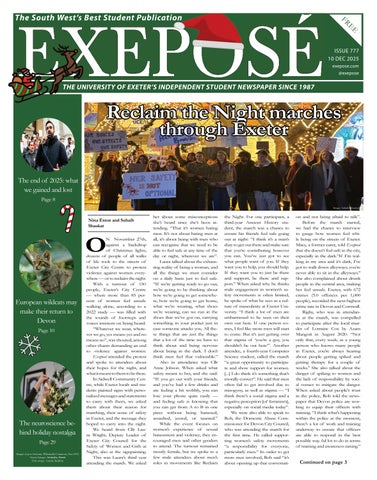
Reclaim the Night marches through Exeter The end of 2025: what we gained and lost Page 8 Image: Suhaib Shaukat
Nina Exton and Suhaib Shaukat
O European wildcats may make their return to Devon Page 10
The neuroscience behind holiday nostalgia Page 29 Images (top to bottom): Wikimedia Commons, Free SVG Vector Images. Animalia, Pexels Title image: Amelie Redfern
N November 27th, against a backdrop of Christmas lights, dozens of people of all walks of life took to the streets of Exeter City Centre to protest violence against women everywhere — or to reclaim the night. With a turnout of 150 people, Exeter’s City Centre — where more than 85 percent of women feel unsafe walking alone, according to a 2022 study — was filled with the sounds of footsteps and voices insistent on being heard. “Whatever we wear, wherever we go, yes means yes and no means no”, was shouted, among other chants demanding an end to violence against women. Exeposé attended the protest and spoke to attendees about their hopes for the night, and what it meant to them to be there. In Sidwell Community Centre, while Exeter locals and students painted signs with personalised messages and statements to carry with them, we asked them about their reason for marching, their sense of safety in Exeter, and the message they hoped to carry into the night. We heard from Cllr Laura Wright, Deputy Leader of Exeter City Council for the Safety of Women and Girls at Night, also at the signpainting. This was Laura’s third year attending the march. We asked
her about some misconceptions she’s heard since she’s been attending. “That it’s women hating men. It’s not about hating men at all, it’s about being with men who can recognise that we need to be able to feel safe at any time of the day or night, wherever we are”. Laura talked about the exhausting reality of being a woman, and all the things we must consider on a daily basis just to feel safe. “If we’re getting ready to go out, we’re going to be thinking about how we’re going to get somewhere, how we’re going to get home, what we’re wearing, what shoes we’re wearing, can we run in the shoes that we’ve got on, carrying something in your pocket just in case someone attacks you. All these things that are just the things that a lot of the time we have to think about and being nervous about being in the dark. I don’t think men feel that vulnerable.” Also in attendance was Cllr Anne Jobson. When asked what safety meant to her, and she said: “If you go out with your friends, and you’ve had a few drinks and are feeling a bit wobbly, you can lose your phone quite easily — and feeling safe is knowing that you can get from A to B in one piece without being harassed, assaulted, jeered, or taunted.” While the event focuses on women’s experience of sexual harassment and violence, they encouraged men and other genders to attend. The turnout remained mostly female, but we spoke to a few male attendees about men’s roles in movements like Reclaim
the Night. For one participant, a third-year Ancient History student, the march was a chance to ensure his friends feel safe going out at night: “I think it’s a man’s duty to get out there and make sure that you’re contributing however you can. You’ve just got to see what people want of you. If they want you to help, you should help. If they want you to just be there and support, be there and support.” When asked why he thinks male engagement in women’s safety movements is often limited, he spoke of what he sees as a culture of masculinity at Exeter University. “I think a lot of men are embarrassed to be seen on their own out here. If one person comes, I feel like more men will start to come. But it’s just getting over that stigma of ‘you’re a guy, you shouldn’t be out here’”. Another attendee, a fourth-year Computer Science student, called the march “a great opportunity to participate and show support for women. [...] I do think it’s something that’s morally correct”. He said that men often fail to get involved due to misogyny, as well as stigma — “I think there’s a social stigma and a negative perception [of feminism], especially on social media today”. We were also able to speak to Rob, the Domestic Abuse Commissioner for Devon City Council, who was attending the march for the first time. He called supporting women’s safety movements “a responsibility for everyone, particularly men.” In order to get more men involved, Rob said “it’s about opening up that conversati-
on and not being afraid to talk”. Before the march started, we had the chance to interview to gauge how women feel while being on the streets of Exeter. Macy, a former carer, told Exeposé that she doesn’t feel safe in the city, especially in the dark.”If I’m walking in my area and it’s dark, I’ve got to walk down alleyways; you’re never able to sit in the alleyways.’’ She also complained about drunk people in the central area, making her feel unsafe. Exeter, with 672 crimes (5.0 offences per 1,000 people), recorded the next-highest crime rate in Devon and Cornwall. Rigby, who was in attendance at the march, was compelled to participate after the local murder of Lorraine Cox by Azam Mangori in August 2020. “Not only that, every week, as a young person who knows many people in Exeter, you’re always hearing about people getting spiked and getting therapy for a couple of weeks.’’ She also talked about the danger of spiking to women and the lack of responsibility by social venues to mitigate the danger. When asked about people’s trust in the police, Rob told the newspaper that Devon police are working to equip their officers with training. “I think what’s happening within the police at the moment, there’s a lot of work and training underway to ensure that officers are able to respond in the best possible way. ful lot to do in terms of training and awareness raising.”
Continued on page 3