exeposé
FR
E
E
ISSUE 698 10 MAY 2019 exepose.com @Exepose
THE UNIVERSITY OF EXETER’S INDEPENDENT STUDENT NEWSPAPER SINCE 1987
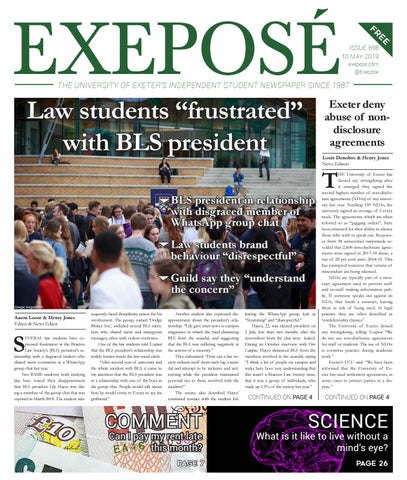
Law students “frustrated” with BLS president
Exeter deny abuse of nondisclosure agreements Louis Donohoe & Henry Jones News Editors
lowing the WhatsApp group leak as “frustrating” and “disrespectful.” Hayes, 22, was elected president on 2 July, less than two months after the screenshots from the chat were leaked. During an October interview with HerCampus, Hayes distanced BLS from the members involved in the scandal, saying “I think a lot of people on campus and wider have been very understanding that this wasn’t a Bracton Law Society issue, that it was a group of individuals, who made up 1.5% of the society last year.”
CONTINUED ON PAGE 4
CONTINUED ON PAGE 4
BLS president in relationship with disgraced member of WhatsApp group chat Law students brand behaviour “disrespectful” Guild say they “understand the concern” Image: Icegoldfish
Aaron Loose & Henry Jones Editor & News Editor
S
EVERAL law students have expressed frustration at the Bracton Law Society’s (BLS) president’s relationship with a disgraced student who shared racist comments in a WhatsApp group chat last year. Two BAME students, both studying law, have voiced their disappointment that BLS president Lily Hayes was dating a member of the group chat that was exposed in March 2018. The student sub-
sequently faced disciplinary action for his involvement. The group, named ‘Dodgy Blokes Soc’, included several BLS members who shared racist and misogynist messages, often with violent overtones. One of the law students told Exeposé that the BLS president’s relationship was widely known inside the law social circle. “After second year of university and the whole incident with BLS, it came to my attention that the BLS president was in a relationship with one of the boys in the group chat. People would talk about how he would come to Exeter to see his girlfriend.”
Another student also expressed disappointment about the president’s relationship. “Lily gave interviews to campus magazines in which she tried distancing BLS from the scandal, and suggesting that the BLS was suffering negatively at the actions of a minority.” They elaborated: “How can a law society redeem itself from such big a scandal and attempt to be inclusive and welcoming while the president maintained personal ties to those involved with the incident?” The source also described Hayes’ continued contact with the student fol-
COMMENT
T
HE University of Exeter has denied any wrongdoing after it emerged they signed the second highest number of non-disclosure agreements (NDAs) of any university last year. Totalling 159 NDAs, the university signed an average of 3 every week. The agreements, which are often referred to as “gagging orders”, have been criticised for their ability to silence those who wish to speak out. Responses from 98 universities nationwide revealed that 2,600 non-disclosure agreements were signed in 2017-18 alone, a rise of 28 per cent since 2014-15. This has prompted concerns that victims of misconduct are being silenced. NDAs are typically part of a monetary agreement used to prevent staff and ex-staff making information public. If someone speaks out against an NDA, they break a contract, leaving them at risk of being sued. In legal practice they are often described as ‘confidentiality clauses.’ The University of Exeter denied any wrongdoing, telling Exeposé “We do not use non-disclosure agreements for staff or students. The use of NDAs is common practice during academic work.” Exeter’s UCU said: “We have been informed that the University of Exeter has used settlement agreements, in some cases to protect parties in a dispute.”
SCIENCE
Can I pay my rent late this month?
What is it like to live without a mind’s eye?
PAGE 7
PAGE 26
Editors Print: Isabelle Gray & Aaron Loose Online: Harry Bunting & Natalie Keffler editors@exepose.com
Comment Editors Print: Isabelle Gray & Deepa Lalwani comment@exepose.com
Arts + Lit Editors Print: Cherry-Anastasia Boroceanu & Zach Mayford Online: artsandlit@exepose.com Music Editors Print: Richard Ainslie & Bryony Gooch Online: Megan Frost & Stephen Ong music@exepose.com Screen Editors Print: Jonathan Chern & Samuel Thomson Online: Jacob Heayes & Abi Taphouse screen@exepose.com Science Editors Print: Elinor Jones & Scarlett Parr Reid Online: Sira Chabrel sciandtech@exepose.com Sport Editors Print: René Bahar & Josh Brown, Online: Ben Bampton & Nick Powell sport@exepose.com Chief Photographer Rory Selvey photography@exepose.com Copy Editors Kamila Bell, Charlotte Forrester & Catherine Lloyd Proofers The FOZZER, Edd Church, Neha Neha/ Neha, Josh Brown, René 'Beefy' Bahar, Byrony Gooch, Graham Moore, Bryan Knight, Sam Thomson, Camila Bell, Zach Mayford, Katrina Bennett, Ben 'can't read'
@ exepose facebook.com/exepose issuu.com/exepose Advertising Kate Watkins kate.watkins@exeterguild.com (01392) 722607 The opinions expressed in Exeposé are not necessarily those of the Exeposé Editors nor the University of Exeter Students’ Guild. While every care is taken to ensure that the information in this publication is correct and accurate, the Publisher can accept no liability for any consequential loss or damage, however caused, arising as a result of using the information printed. The Publisher cannot accept liability for any loss or damage to artwork or material submitted. The contents of this, unless stated otherwise, are copyright of the Publisher. Reproduction in any form requires the prior consent of the Publisher.
Exeter rises in University rankings PAGE 3
COMMENT
The problematic analysis of grade inflation PAGE 6
FEATURES Democrat candidates for 2020 PAGE 10 Image: National Cancer Insitute
Lifestyle Editors Print: Izzy Cole & Anna Romanovska Online: Amy Butterworth & Emily Pirie lifestyle@exepose.com
productive way to unwind: Sport have spoken to EUWRFC about their Twickenham win. With that in mind, it’s good to get your head out of the confines of Exeter and into the minds of the Music editors experiencing No Strings Attached performed Dr. Dre at the Exeter Phoenix (page 19). Moreover, Features discusses the widespread implications of Julian Assange's arrest. (page 11) Arts + Lit explores the beautiful love child of literature and art that is comics (pg 16). Screen talks us through their favourite aliens (pg 22). Who knew that was such a thing! My personal favourite alien concept to me right now is revising for exams and having a healthy approach to love and relationships. A problematic fave if you will. And finally, over in Science, the process of no longer being able to visualise is explained, with its terrifying and isolating consequences (pg 27). All in all, it can be hard to manage the stress of third term, but also university life in general. This issue we have a number of sensitive articles with the aim to highlight our passion and dedication to advocating for representation, and solidarity for students that feel lost and sometimes unsupported at university. Throughout the year we will endeavour to continue this, and to make ensure the stories that matter get published. We hope you enjoy reading our first issue just as much as we enjoyed creating it - we'll be back soon.
Image: United State Congress
Features Editors Print: Jaysim Hanspal & William Harrop Online: Ellie Cook & Bryan Knight Foreign Correspondents Co-ordinator: Maddie Davies features@exepose.com
C
AN you believe it's Term 3 already? We hope this issue of Exeposé will be a lovely distraction amongst the stress of exams and final coursework deadlines. This issue is particularly exciting as it marks the first issue of the 2019/20 team! It’s been a really busy week with a lot of stories to work through. Let alone, all the exam stress. Somehow with no teaching hours, Term 3 always feels the most hectic. In fact, Comment (page 6) looks at the idea of Term 3 itself, and the debate on whether it is a waste of money considering we have no teaching hours. Perhaps the uni, and Exeter makes up for this with all that's going on. For one, News report the announcement of another NUS referendum at Exeter (page 3). Elsewhere, News covers the upcoming festival scene in Exeter, and the lack of any female music performers at Party in the Castle (page 4) Meanwhile, Comment exposes the hard truths of being a working class student at university. With the pressures of university being immense already, it’s important to remember the added financial pressure when the loans don’t quite cover the rent cost, amongst a multitude of other things. Our Arts + Lit editors interview Dr. Simon Rennie on his new poetry book 'Adverse Camber'. We're sure Simon's beautiful work would be a lovely distraction from exams. Speaking of, Lifestyle has got you covered, as we talk about managing mental wellbeing and the best tips and tricks to ensuring maximum productivity (page 14). Some people have found more
NEWS
Image: pixabay, tswedensky
News Editors Print: Louis Donohoe & Henry Jones Online: Emma Hussain news@exepose.com
Editorial
Image: Exepose
EXEPOSÉ
Devonshire House, Exeter, Devon, EX4 4PZ
SCIENCE The stigma around smeer tests PAGE 26
CHECK OUT OUR WEBSITE!
There are even more great articl es on the Exeposé website. From the latest university news to current affairs, music and theatr e reviews and more, visit us at www.exepose.com
Isabelle and Aaron
Worldwide university news Japanese university stops hiring smokers
A
S part of an increased anti-smoking campaign in the lead up to the 2020 Olympics, Nagasaki University has "stopped hiring any teaching staff who smoke", according to spokesman Yuruke Takakura. The development follows the university’s announcement last year to ban smoking on campus, and its aim of banning the possession of all smoking-related equipment from April 2020. Takakura stated "we have reached the conclusion that smokers are not fit for the education sector". Nagasaki is not alone in its efforts to reduce smoking in universities, with the president of Oita University, Seigo Kitano saying that the university has "put priority on non-smokers". Tokyo recently issued a new law banning smoking across all school premises.
Georgetown uni votes for slavery reparation
I
N 1838, Georgetown Jesuits sold 272 people in order to pay off college debts. While Georgetown University has made no effort to pay reparations supporting the descendants of those enslaved, its students felt differently. In a referendum last month, over two-thirds of undergraduate students voted to pay a tax of $27.20 each semester. The result has been described as "momentous" by Richard Cellini, founder of the Georgetown Memory Project which found thousands of descendants of those sold in 1838. Georgetown undergraduate Karla Leyja stated that while she encourages the university administration to make its own effort to consider how slavery has shaped their campuses, it would "co-opt" students’ efforts if the universiy now chose to pay reparations.
Sri Lanka bomber studied at UK uni
U
K counter-terrorism investigators believe one of the attackers who carried out the Easter Sunday bombing in Sri Lanka studied aerospace engineering at Kingston University in Southwest London. Abdul Lathief Jameel Mohamed lived in London during 2006, and later went on to do postgraduate studies in Australia. The intelligence services are now combing through connections made in the UK to examine whether he could have been radicalised in this country. Mohamed took part in a slew of suicide bombings at churches and hotels in Sri Lanka that killed at least 359 people. So-called Islamic Statehas claimed responsibility for the attack. Mohamed’s identity was revealed after Sri Lanka’s defence minister, Ruwan Wijewardene, told a media briefing on Wednesday that one of the bombers had studied in the UK. More than 60 people have been arrested so far as part of investigations into the plot.
Edinburgh wins University Challenge
T
HE University of Edinburgh has won this year’s series of the popular BBC quiz show University Challenge. It is the first university from Scotland to win since 1984 and the first non-Oxbridge finalist in six years. Team captain Max FitzJames said "the main secret is to be good as team". The Edinburgh team consisted of Fitz James, Matt Booth, Marco Malusa and Robbie Campbell Hewson. They beat Oxford University's St Edmund Hall by 155 points to 140. The University of Edinburgh principal, Proffessor Peter Mathieson, said “I would like to send my personal congratulations to the University of Edinburgh team for this fantastic achievement. It's a huge tribute to the students involved to have beaten off very tough competition from some of the sharpest minds in UK universities". The University of Exeter also competed in the series but were knocked out by Hertford College, Oxford on 12 November. Stories by Aaron Loose and Natalie Tongue Image credit: Kruscha/Pixabay
News
3
NEWS EDITORS: Louis Donohoe Henry Jones
Another NUS referendum sparks concern
Louis Donohoe News Editor
T
HE Students’ Guild has announced a referendum on the university’s current affiliation with the National Union of Students (NUS). Student campaigner registration is to be held from Monday 13th May until Thursday the 16th. The voting window will be open from Tuesday the 28th May until Thursday the 30th. This comes just three years after the last referendum was held on the same issue, in May 2016. This referendum was claimed to have been subject to issues of ‘harassment and intimidation’ during campaigning from the both sides. The vote had the highest turnout in any single-issue vote in Exeter with 5,534 students voting. Concerns are being raised as the vote falls within the exam period. How-
ever, a Guild spokesperson addressed the topic stating “the timing of the referendum was unavoidable however the date was selected to minimise the impact on any campaign team, whist trying to avoid the period of time after exams when students leave campus to start internships, jobs and other summer plans. Those that have left campus they will still be able to participate in the vote via the Students’ Guild online voting system.”
The timing of the referendum was unavoidable Guild Spokesperson
The possibility of a different politicised spin being put on the referendum is a concern. Some believe the vote will be equated with the Israel-Palestine conflict. This is due to an NUS candidate’s actions at an NUS conference. Their
congratulation of the election of the Israeli prime minister Benjamin Netanyahu sparked outrage.
The possibility of a new politicised spin put on the election is a concern
could ever get by buying them as a single Guild”. Tiley also cited the national power of the NUS. Contrasting the Guild’s 19,000 students against the NUS’ 3,000,000. She believes this is the driving force for the changes the NUS were
able to enact. In that same article it was revealed that the Guild paid £50,000 for their membership to to the NUS. However, it was also stated the Guild was “up to £29,000 better off by buying through NUS”.
Whether this will lead to the vote being politicised in this way is unclear. Currently the NUS is affiliated with 600 students’ unions. Their goals include securing fairer funding, supporting students, helping students’ unions, promoting diversity and promoting democracy. During the first campaign in 2016, the president of the Guild at the time, Laura-Jane Tiley, wrote an article for The Tab. Here she supported the Stay motion stating“the NUS are able to secure much better prices on goods sold in the Ram, Lemmy and Shop than we
Exeter subjects ranked best in UK Business School accredited
Emma Hussain Online News Editor
E
XETER subjects have come out on top in the influential Complete University Guide rankings for 2020. Released on 1 May, the rankings place 26 Exeter subjects in top ten positions, and 36 in the top 20. Top achievers were Sports Science, Anthropology, Business and Management Studies, and Medical Technology, all ranking third in the country, while Sociology ranked fourth. Drama, Marketing, Middle Eastern and African Studies, English, French, Politics, Engineering, and History were also ranked
within the top ten.The university also rose in the main rankings, rising one place to secure 11th place nationwide. It also ranked joint-tenth for graduate prospects.
A testament to the enthusiasm, dedication and hard work of everyone in the University Sir Steve Smith, Vice-Chancellor
University Vice-Chancellor Professor Sir Steve Smith commented: “This is an extremely competitive ranking, and to be consistently ranked amongst
the very best in the country is a testament to the enthusiasm, dedication and hard-work of everyone within the University.” Rankings rest on ten measures: Student Satisfaction, Research Quality, Research Intensity, Entry Standards, Student: Staff Ratio; Spending on Academic Services; Spending on Student Facilities; Good Honours Degrees; Graduate Prospects and Completion. Dr Bernard Kingston, chairman of the Guide, said: “The evidence is clear; the increased emphasis on employability and career planning within academic departments and student services is bearing fruit”.
Natalie Tongue Contributor
T
HE University of Exeter Business School has recently gained accreditation status from the Association to Advance Collegiate Schools of Business (AACSB). Sitting alongside accreditations from EQUIS (EFMD Quality Improvement System) and the Association of Masters in Business Administration (AMBA), the Business School has now officially earned the “Triple Crown” accreditation. This has been awarded by three of the largest accreditation organisations in business schools globally, placing the University of Exeter’s business school amongst less than 1% of the world’s business schools. Based in Exeter and Penryn, the business school holds just under 4,000 students across courses in Finance, Account-
ing, Economics and Management and its students represent over 150 countries globally. In response to receiving this prestigious recognition, Professor David Bruce Allen, Pro Vice-Chancellor and Executive Dean of the Business School remarked their “mission is to deliver outstanding and innovative business education and research that address the major challenges confronting businesses and society.” Recognition of the University of Exeter Business School is not limited to this elite triage of accreditations, as it has also been certified by the Chartered Financial Analyst, Institute for Fiscal Studies, Chartered Institute of Procurement and Supply, Chartered Institute of Professional Development, Chartered Management Institute and the Association of Chartered Certified Accountants.
Medical School publishes new diabetes research Louis Donohoe News Editor
T
Image: University of Exeter
HE Exeter Medical School has published new research in The Lancet Diabetes and Endocrinology. A study has revealed that a person’s characteristics such as age and weight are better indicators than the previously recognised model of dividing adults with diabetes into five subgroups.. Dr John Dennis said ‘“It’s recognised that not everyone with type 2 diabetes should be treated the same, yet there is currently no way to tell which tablet is likely to be the best for a par-
ticular person. Our research shows that really simple clinical features such as age at diagnosis, sex, and kidney function provide a very effective and practical way to identify the best tablet for a particular person and to identify people at high risk of developing complications.” The study had over 8,500 participants and is supported by the Medical Research Council. The full paper is entitled ‘Disease progression and treatment response in data-driven subgroups of type 2 diabetes compared to models based on simple clinical features: an evaluation using clinical trial data’.
4
10 MAY 2018 | EXEPOSÉ
NEWS
Party in the Castle defends lack of gender diversity Henry Jones News Editor
T
HE organisers of Party in the Castle, a music festival held at Exeter Castle, have defended their decision to have no female acts perform this year. Described as a “headline heavy Day Festival”, it will feature 17 music acts, all of which are male. In a statement to Exeposé, the organisers said “we encourage gender diversity, [but] we don’t book acts based on their gender or race.” The organisers also said they had tried to secure two female acts, but it was concluded that they were “over our budget.” Responding to the news, the University of Exeter’s Feminist Society (FemSoc) said they were “disappointed” that there would not be a single female performer. “We...find it hard to understand how there were no female artists that fit the booking criteria. The exclusion of women full stop is rather extraordinary.” Last year, 45 major UK festivals pledged to achieve a 50/50 gender split by 2022. But research from the BBC shows that 77 per cent of the nine largest festivals last year had all male lineups. Last year’s Wireless Festival was heavily criticised after just three of the 37 acts were women. Lily Allen tweeted an image of the lineup posted with all the male acts removed, while Annie Mac described the news as “appalling.”
Image: Pixabay
CONTINUED FROM FRONT Content warning: This article contains extracts from the Bracton Law Society WhatsApp group, which includes references to racial violence.
The WhatsApp group contained racist, sexist and homophobic messages. After a BAME student was stabbed, a message was sent to the group that remarked “I wish the jabs finished him.” The University of Exeter suspended the student and the others involved in a group chat on 20 March 2018. Those involved were also suspended as members of the Students’ Guild. The offending comments were made in a group chat involving some Bracton Law Society committee members. A member of the chat made multiple screenshots of the messages public – posting them on Facebook and Twitter. The Guild said at the time that it “does not tolerate any form of racism, sexism or hate crime and condemns any such actions with full disciplinary action taken as appropriate. They added “The Guild is currently carrying out a major investigation in conjunction with the University.” When contacted by Exeposé, a spokesperson from the Bracton Law Society responded: “The personal relationships of the committee have no bearing on the work of Bracton Law Society this year. The committee has worked hard to move past the events of last year in the events and activity that we have provided for our members, and we are committed to continuing this until the society is wound up at the end of this year, to be replaced with a new law society next year. “This year’s committee has fully cooperated with both the Guild, the University and the joint transition board throughout the year and has
provided all information that has been requested of us.” In a statement to Exeposé, Hayes said she “can understand the concerns of those that have expressed them”. But she continued that “all year the committee and I have worked hard to make the society more inclusive than it was 12 months ago. This year’s committee was the first committee to introduce events with other societies such as ACS and Women and Law, as well improving accessibility to existing events by having all applications to be reviewed anonymously. “Myself and the rest of the committee has been thoroughly dedicated this year to carrying out all of their roles with respect for others as well as promoting equality, diversity and fairness.” A Guild spokesperson commented: “We understand the concern of members of the BAME community, but the Bracton Law Society and the committee have been subject to high levels of scrutiny this year and we not seen [sic] any causes for concern.” They further said: “The personal relationships of committee members are not the purview of the Students’ Guild and we respect the right of individuals to a private life away from their volunteering responsibilities. The only exception to [t]his would be when we become aware of improprieties in relation to the running of the society as a result of those relationships.”
É
If these issues affect you, please get in touch with: ‘Exeter Speak Out’: www.exeter.ac.uk/speakout/ report/ Guild Advice Unit: https://www.exeterguild.org/ advice/ Wellbeing Service: https://www.exeter.ac.uk/wellbeing/org.uk
Image: Pixels (Pixabay)
“We do not use non-disclosure agreements for staff or students” CONTINUED FROM FRONT Exeter UCU continued: “They have the potential to allow very serious misconduct such as bullying, harassment, and discrimination to remain unchallenged.” If Exeter has used NDAs to cover up misconduct, the UCU said “this would be illegal”. Emma Chapman, a member of the 1752 Group which campaigns against sexual misconduct in higher education, said that “this level of NDA use shows how universities have long prioritised reputation management above the safety and well-being of their students and staff ”. The university said that NDAs “are only used during projects involving commercial third parties and contracts to allow for innovation, confidential discussions and to protect the interests of academics.” They continued that the high number is related to “the extensive and
world-leading research activity at the University of Exeter, and the wide number of external partners academics are working with. “It is inaccurate to compare the University of Exeter’s use of NDAs with other institutions, as they will all have different ways of managing the organisation of work with external partners.”
If workplace issues are being covered up with NDAs then ultimately we all suffer.
Exeter UCU
In an interview with the BBC, an academic revealed her inability to speak out about her experience of workplace bullying, due to the NDA she had signed. The academic told the BBC, “Universities would rather pay off people to leave, than push out the person doing the bullying.”
Green Party gain Exeter Council seat
Henry Jones News Editor
T
BLS President defends “disrespectful” behaviour
HE Green Party’s Diana Moore has become Exeter’s first elected Green councillor after a victory in St David’s ward. She won the seat from Labour with a 55 per cent majority. Responding to the news, Diana Moore said she felt “hugely honoured to have been trusted by the people of St David’s to represent them on the City Council. Despite the national political chaos, it is clear that local residents are still deeply concerned about
the local issues that affect their lives and their environment.”
It’s a low turnout as unfortunately people have decided not to go to the polls which is very disappointing
Phil Bialyk, Labour Councillor
Despite pledging to “reopen Clifton Hill Sports Centre and save the ski slope”, Exeter Conservatives lost two seats to the Liberal Democrats and Labour. The Conservatives now hold
six seats in Exeter, with Labour holding 29. While the 36 per cent turnout was higher than predicted, it was described as “disappointing” by Labour councillor Phil Bialyk. Exeter’s last council election in 2016 had a turnout of over 39 per cent. 19 year-old Frankie Rufolo, who controversially set fire to a Quran last month, came in last place in the St Thomas ward, winning just 113 votes. Rufolo was condemned by Exeter MP Ben Bradshaw: “Exeter is a friendly and tolerant city and there
should be no place here for hateful, racist or Islamophobic behaviour of this kind.” Exeter City Council said that “aggressive and threatening behaviour” was witnessed at a number of polling stations, which led to police being called to supervise the voting. The City Council’s Chief Executive Karime Hassan praised the 500 volunteers who helped to organise the election. “It is a massive undertaking and I can’t thank everyone enough for their efforts. This is local democracy
at work and without the dedication of scores of City Council staff and many others, it just wouldn’t happen,” he said. Across the country, the Conservatives lost more than 700 seats and 25 councils overall, while Labour lost more than 80 seats and control of five councils. Many voters across the country, including in Exeter, turned up to vote with their polling cards for the European elections on 23 May. Figures accurate as of noon, 3 May.
Rhiannon Moore Lifestyle Editor
L I T ‘ N E P WE’RE O
Image: University of Exeter
01392 42 52 52
49-50 SIDWELL ST, EXETER, EX4 6NS
10 MAY 2019| EXEPOSÉ
6
Comment Neha Shaji Contributor
Isabelle Gray Deepa Lalwani
Term 3: not a waste of money
I
F I had a pound for every time someone told me what a ‘waste of money’ Term 3 is, I’d be earning just as much as the average student considers themselves to be losing out during the summer term.
COMMENT EDITORS:
Your £9,250 does not go directly to the academics
To start, let me just state that I have some serious concerns about the usage of a term like ‘waste of money’. Universities, regardless of how some of them may see it, are not a business. You aren’t a ‘consumer’. You don’t end up as a ‘product’. You are here to learn; not have your windows polished,
your top screwed on, and your degree certificate the plastic seal on your box. This isn’t a free market; had it been one, you’d pick your institution based on how many days of Term 3 there were in comparison to the price, and we’d all be dramatically sliding into the clutches of consumerist culture. I cannot believe I am saying this in the year of our lord 2019: academics are not machines. It really does say something for late-stage capitalism that you can look at a person, sometimes only a few years older than you, and whisper in a monotone – “but why don’t you work more sir, work more, for the same pay.” It also is worth mentioning that the majority of students aren’t aware what Term 3 costs; it is up to the university to split your £9,250 up, it’s not like Year 6 fractions where a third goes into each term. So, if you
were still concerned about a ‘waste of money’, you should probably take it up at Northcott House. And about that £9,250. The academics, as seems the common assumptions amongst those who often use the phrase rhyming with ‘paste of honey’, are not the University. Your academics are employed by the university for the work they currently take on. To ask them to take on more work would only inevitably mean you pay more fees, and to ask them to take on more work for the same pay is abhorrent. If the £9,250 of tens of thousands of students were all going directly to the academics, well, my future would be fine and dandy then. Other universities have teaching in Term 3? Other universities pay academics for teaching in Term 3. Now, once you get over the terribly
consumerist language of your question, your sudden longing for learning and the desire to attend lectures magically springs forth. In Term 3, academics have to mark exam papers, moderate them, mark Easter essay deadlines, mark dissertations, and secondarily mark dissertations. This happens with strict deadlines, as the term is only about six weeks long – if you have four exams, the likelihood is that you would not attend classes the days preceding your exams, especially if it was not assessed. If one wanted teaching in Term 3, it would not be an assessed course and would not have an effect on your degree mark as lecturers are already overloaded with marking. Hence, another Term 3 assessment whilst you’re sitting existing
Image: Johnny Magnusson / FreeStockPhotos.biz
exams will not benefit neither students nor teachers. Modules are usually twelve weeks long; there are only six weeks in Term 3 without allowances for assessment time or marking turnover time. There is a tendency to clamour for the abstract concept of ‘teaching’ without considering the logistics of setting up and running entire modules in such a short time period. Pipe down, for the love of God, just do your revision.
////////////////////////////////////////////////////////////////////////////////////////////////////////////////////////////////////////////////////////////////////////////////////////////
Behind the times
Harry Caton Contributor
I
T’S one of many spectres haunting higher education – ‘grade inflation’. You go to university, shunt your night-before essays in at 9:59AM, and strawpedo a VK while careening down the graduation aisle. The result? A first, guilty-eyed academics patting you on the undeserving back. I’m being facetious. Grade inflation is an insidious concept – it derives from the unassuming metric that higher grades are awarded more frequently in the present day than in years past. On 15 April, an article in The Times, “University grades: firsts for quarter of student with lowest A levels,” was only the latest to indulge in it. The article looks at the phenomenon by comparing A Level results to eventual university grades. When a student achieves three Ds at A Level, and then proceeds to
get a first at university, something must be wrong. The study rests on a simple premise – their success doesn’t add up. For The Times, this can only mean that “universities [are] under pressure to take people from disadvantaged backgrounds,” who require “concessions to get them through”.
The Times’ argument has a palpable lack of intersectional analysis To be blunt, this analysis is careless. Judging not only intelligence, but potential, on an exam taken three years prior to the fulfilment of that potential, is a fundamentally flimsy argument. Many sit these exams at age 17-18. On the cusp of adulthood, few are ready to understand what they want or need out of higher education. The purpose of university only becomes clear with time – late-bloomers can turn into high achievers. However, there’s a deeper level of ignorance at work here. The argument’s lack of intersectional analysis is palpable. With the occasional exception, hard work only occurs with good Image: Harry Caton
education. Good schooling can be an expensive endeavour, predicated around success in exams. Private schooling inherently helps pupils do better; a 2016 Independent Schools Council (ISC) study notes that half of all private school A level grades were marked A* or A – twice the national average. Even outside this system, private tuition still markedly benefits AS/A Levels achievement. Likewise, ethnicity should be considered a factor. Per a 2018 GOV. UK study, compared to the average of 11.3% of white students likely to achieve three A Levels, only 5.3% of black students were likely to achieve the same - potentially die to factors of racial discrimination. The Times fails to account for conditions that might hinder a pupil’s A Level progress; we do not, after all, live in a meritocracy. ‘Grade inflation’ fails to account for the circumstances behind these A Levels, and the potential for improvement. The concept is used to beat back those of “disadvantaged backgrounds”; when The Times speaks of ‘inflated’ grades, they mean only the “disadvantaged” they indicate. Note that the grades of the privately-educated are unaddressed in this epidemic. The creation of lightly-regulated private exam boards, such as Cambridge Pre-Us, used almost exclusively by private schools, is unaccounted for; likewise, the ease with
which affluent students can comfortably fund their degree upon gaining a place is ignored. This is all put at the feet of the under-privileged. The improvement students undergo at university is the product of something far more complex than the here-favoured inflation. To The Times, the supports and allowances at university-level that might, God forbid, help a late-developing student are a nebulous conspiracy, undeservedly pushing these students through. That these might be necessary, given the students’ backgrounds and contexts, seems improbable.
Threats of ‘grade inflation’ do not exist in a vacuum
My irritation isn’t just directed towards the article. Certainly, the intent is vile, setting out controversial arguments with the purpose of denigrating poor and minority individuals, and making education seem a luxury only for the elite few. This attitude, however, reflects a larger political trend towards the marketisation and quantification of knowledge and achievement. The human potential for learning is to be figured out early on, based on grades, certificates, CVs – a system of filling boxes so your worth can be neatly summarised without context. It’s hardly an egalitarian
sentiment. This perspective has been pursued by successive Conservative administrations – as noted in the article, the government is considering withholding graduate loans from those with poor results coming out of school. Laying my cards on the table, I’m a lucky one. Though receiving average GCSEs and bombing my AS Levels, I was privately educated. I had teaching in which the teachers were financially inclined to help turn things around. As was the likelihood of the national average, I left school with A*s and As. My late-blooming was actualised only through this. I diverged from the path on which I might have been headed. Compare my circumstance to the ones of the “disadvantaged,” and the differences become clear. Threats of ‘grade inflation’ do not exist in a vacuum. It’s the classic Thatcherite pulling-up of the ladder: the compassionate are seen to intervene too much, giving students a chance at things they don’t deserve. A more considerate analysis of education allows for growth in and support for the student. We need to look beyond vague figures of socalled inflation, considering the flaws of these initial academic measurements. Moreover, we cannot be blinded by the pointedly bad faith metrics of an establishment hell-bent on keeping people in their places.
COMMENT
10 MAY 2019 | EXEPOSÉ
Can I pay my rent late this month?
Fenton Christmas Contributor
W
ITH the end of year celebrations approaching, there might be one person who sticks to just one drink, says they’re not hungry when everyone orders food, and goes home rather than joining in as the group moves on to the next bar. You might think they’re tired, unwell or just plain boring. But the reality might be a little more sobering – they might just not have the money. Lower-income background students are everywhere and are in need of help that all too often evades them. Every day becomes a struggle as they try to function as a student whilst having real money worries and troubles. I know, because I’m one of those people who deals with it on a daily basis. Can I afford another drink tonight? What excuse can I use to get out of this dinner out? What more can I cut back on to allow me to afford a Grad Ball ticket? It’s a genuine problem that affects so many people at the top universities in the UK, and so often it’s never addressed in the right way. In a city with some of the highest rent rates outside of London and some of the highest monthly parental contributions in the country, having to pay your own rent and having no help from parents can have a monumental effect on not just your finances, but also your
Q
Dear Agony Aunt,
mental health. In my second year, I was given the same student loan as someone I knew whose parents paid all their rent and also gave them a substantial amount of money each month. In contrast, my loan covered just over half my rent for the academic year. I had to find the money to pay not only that, but also my bills, food shopping, and then have some money on top of that to have some degree of a social life. I know many people at this university and elsewhere who have not been able to join the societies they wanted, struggled to make friends, or even go on dates because of financial strain. Whilst no-one in this world is entitled to those things without money, the disparity is so large for two students at the same university it’s scary. The level of stress and pressure I was under was too big to cope with, and I fell into a bad depression and would often just break down in tears. I couldn’t sleep, wasn’t eating and barely left my room. I was, however, very fortunate to have a landlord who was understanding of my situation and moved my rent payments around as I scrambled money from various sources just to cover myself. The somewhat obvious rebuttal to any cry for financial support is “well, go and get a job.” There’s nothing wrong with having a job alongside studies by any means; I have one and I would implore everyone to get one. It teaches
Q
Dear Agony Aunt,
I’m struggling with finding a balance with work productivity and wellbeing over the upcoming exam season.
Yours, a struggling housemate.
Exam season sucks. You’ve got deadlines, exams are looming, and all you can think about is sitting in the Impy and kicking back with a drink without a care in the world. Alas, that is not currently your reality. But, it will be! The key to keeping yourself together during exam season is threefold: give yourself regular breaks, remember exams don’t define you, and keep focusing on the fact that soon, you can enjoy time once more. Eyes on the prize. Aka. Impy.
A
Dear a struggling housemate,
I’d start with making ‘casual’ hints, eg. walking past the room and loudly asking ‘WHAT is that smell’ - hopefully, the embarrassment will make them clean up their act. Or, become best friends with them so you can outright tell them to buy some Febreeze. Then shout the DISGUSTANG meme at them. Much love, Agony Aunt
Image: suzy hazelwood / pexels
and live off over the following year. One summer I worked two months straight, eight hours a day and not one day off, as I tried to pay off the debt I had encored over the previous year. It led to me losing substantial weight as I ended up not eating or sleeping properly to work more hours. But I had no other choice without
a large impact on my studies. Some can only get a job during term time, but it makes things so much more complicated. How can two degrees be comparable, when one person who works, hypothetically, three days a week then only has the potential to work on their degree four days a week, whilst another who doesn’t need a job theoretically has a full seven days? That’s almost double the amount of time. Imagine sitting an exam in which all the lower-income students have half the time to complete it as everyone else – there would be public outcry. However, this sort of difference occurs at almost every top university in the country, and nobody seems to notice. Moreover, not all degrees have the time allowance for students to work during the week: medicine, law, etc. have such full-on timetables that lower-income students with jobs are constantly playing catch-up or just missing out on teaching altogether. I’m not suggesting that money should just be handed out to lower-income background students, but at least level the playing field in terms of their academic pressures. However, universities seemingly reject this approach and leave lower-income students out to dry. Take the recent University post of an “inspirational” video to reassure students about working alongside their studies. In the video, EU student Anna discussed managing
Agony Aunt
I’ve got a new housemate and there seems to be quite an overwhelming odour coming from his room. His room is the only one downstairs, meaning that this smell is now spreading to the kitchen and living room when his door is open. Help.
Yours, an overwhelmed student.
A
invaluable life skills, integrates you with a diverse range of people and gets you used to the working world. But the problem emerges when the need for money ekes too far into your studies. For some, they take up summer jobs to earn enough to live off over the course of the year so their studies are not impacted so much. I did that, however on minimum wage, I found myself working nearly every day over the summer to earn enough to try
Dear an overwhelmed student,
Much love, Agony Aunt
Q
Dear Agony Aunt,
My friends and I are planning on going on holiday after graduation, but somehow I’ve been roped in to doing all the planning by myself. I don’t want to start an argument before we’ve even gone away but... Yours, a too-organised-for-her-owngood friend.
A
Dear a too-organised-forher-own-good friend,
Sometimes, your best qualities can be used against you. It’s annoying that you’re under pressure, but you should just use the opportunity to base the holiday around your own needs! If you’re gonna be booking the flights, make the dates suit you! Dictatorship this holiday! Pick the best room! And then next time maybe they’ll think better about leaving you in charge. Much love, Agony Aunt
Q
Dear Agony Aunt,
7
her studies around her five jobs. FIVE JOBS. I for one do not find Anna’s story inspiring – I actually feel so sorry for her. Nobody, student or otherwise, should have five jobs. Let alone alongside a fulltime qualification. For the University to endorse this level of over-working is simply outrageous. Rather than help students with the vast sums of money the University has, they instead suggest that students go out and simply work themselves to the point of exhaustion before they even come around to studying. EU students aren’t entitled to any maintenance loans, so to ask them to work five jobs alongside a degree is apparently the University’s preferred option.
The level of stress and pressure I was under was too big to cope with There’s this very dangerous rhetoric that’s aimed at lower-income students from UK, EU and non-EU backgrounds to simply just “work harder” to keep up with the crowds. Rather than put things in place to actively help these students better, to take those pressures off them, universities instead hold up people who work unrealistic and unhealthy amounts as some sort of aspirational goal. It’s detrimental and disturbing, and I hope at some point universities reach out to offer better financial and academic support to those who need it.
Q
Dear Agony Aunt,
My girlfriend just applied for an internship in LA. We did long distance for three months last year and it almost killed me. I love her, but I don’t know if I can do it again.
This is really embarrassing, but I can’t stop fantasising about my lecturer. It’s getting to the point where I can’t focus on what he’s saying in the lecture - he’s just so charming. Help!
Yours, a conflicted soul
Yours, an inappropriately horny student.
A
Dear a conflicted soul,
Love in your twenties is hard. Everyone is thinking about their futures, and sometimes, relationships are compromised. I say wait and see how you feel. You might find that although it’s hard, you’re not ready to give up on the relationship yet. But if you still have this anxiety if and when it comes to it, be honest, and put yourself first, it’ll only end with a phone call break-up otherwise, and that’s never fun. Trust me. Much love, Agony Aunt
A
Dear an inappropriately horny student,
Ah yes, the charm, the intellect, the scarves. It’s all fun and games to gawk at your hot lecturer until it gets to point where you can’t focus at all. But there are rules against these relationships, academics are busy, usually old(er), and they probably wouldn’t make time for you anyway. And they’re probably married. Find a student to focus your sexual frustration on. Far less stressful. Much love, Agony Aunt
C
M
Y
CM
MY
CY
CMY
BUY - EARN - REWARD
K
YOUR STUDENTS’ GUILD LOYALTY SCHEME S I M P LY PR E SE NT YOU R U NI C A R D AT TH E TILL EARN
4
FOR EVERY
£1 SPENT WITH THE GUILD
10 MAY 2019 | EXEPOSÉ
10
Features
FEATURES EDITORS: Jaysim Hanspal William Harrop
A new, liberal America?
Jaysim Hanspal, Features Editor, walks us through the Democrat candidates for 2020
I
’M sure many of you are not overly enthusiastic about the upcoming US 2020 presidential elections. I mean, what does it actually have to do with us anyway? I’m sure they’re just going to elect another ridiculously over-tanned reality tv star and kiss their economy, social infrastructure, and environment goodbye.
Who they choose to sit in the Oval office affects all of us
Well, interestingly enough, with this year’s numerous (and I mean there is a lot of them) Democratic hopefuls all clamouring at a chance to go toeto-toe with the man in orange himself, it looks like 2020 may be a good year for well, just about everyone. Bernie Sanders, one of the most popular and well-known candidates, seems like he’s finally getting his shot this year. The 77-year-old senator from
Vermont recently caused outrage by revealing years’ worth of tax returns which revealed him to be part of the 1%. The backlash may seem justified, however, since most of his 2016 presidential campaign took aim at “millionaires and billionaires”, a group he has now no choice but to prescribe to. Despite all of this, Sanders is a frontrunner for the 2020 presidency, famous for his activism during the Civil Rights Movement and for being arrested for resisting arrest while protesting against segregation in Chicago’s public schools.
It looks like 2020 may be a good year for everyone
A much younger candidate is also making his mark. Pete Buttigieg is a candidate of firsts. If he were to be elected, he would be the first
has some experience under his belt. Buttigieg previously served as an intelligence officer in the US Navy Reserve, he speaks seven languages and attended both Harvard and Oxford University. If he gets voted in as the official Democratic candidate for 2020, America looks to be getting much more liberal, with a pro-choice,
This year’s candidates have shown us the world is ready for change Image: Gage Skidmore
mayoral candidate, the first openly gay candidate, and the youngest president to ever take office. Having the first millennial mayor would certainly be a triumph for a new generation of young voters. But what seems like a distant memory for most Americans in Trump’s reign of idiocy, is that it seems this candidate actually
environmentally savvy, pro-weed president. Buttigieg’s stance in favour of denying the incarcerated the right to vote (which disenfranchises the majority African American prison populations) does, however, raise questions over how far he can be considered a liberal candidate. If there’s any hope at all for one
of the world’s most powerful nations, this year’s candidates have shown us that the world is ready for change. Although this may not affect British people directly, the importance of the American election affects us in so many inadvertent but disastrous ways. For example, after Trump was elected president, many renewable energy and environmentally based start-ups, including those based in the UK, lost significant backing from shareholders. Who they choose to sit in the Oval Office dictates not only the amount of investment into environmental issues, but dictates a lot of policy-making trends across Europe, with world leaders looking to America to see how the President will choose to lead on a number of issues. This may seem like an unfortunate consequence of the US election, but with the right person at the head of one of the most powerful nations, it could mean better things for all of us.
Amritsar: 100 years on
T
Sophia Patni discusses the centenary of the Amritsar/Jallianwala Bagh massacre
HE 13 April 2019 marked the 100-year anniversary of the massacre of at least 379 unarmed civilians in Amritsar, India, by the British Army. The massacre was ordered by Brigadier General Reginald Dyer in response to dissent in the area. According to his later testimony, the slaughter was ordered to prevent further unrest by producing a significant moral effect on the population. Dyer became a disputed figure back in Britain, discharged but seen by some as a hero, willing to do what was considered ‘necessary’.
An apology could be a gateway to discussions on empire
This year Theresa May described the massacre as a “shameful scar on British Indian history’” but made no apology. The events were condemned by the British government the moment they occurred, but no apology has ever
been given. Particularly now, to say sorry would be a controversial move – many people now argue that, with a government and population that can hardly claim direct responsibility for the Amritsar massacre, to apologise would be to accept a guilt that doesn’t belong to anyone today.
Amritsar was not an event in isolation An apology, however, even if it’s only a symbolic gesture acknowledging past violence, could be the gateway to discussions about our colonial past and the legacy it has left today. Not only would it mean a great deal to those still living with the aftermath of an environment of violent repression, it would allow us as a nation to better understand how we still, in many ways, benefit from the vestiges of our Empire, whilst others still work though the negative fallout of British rule. If we could confront
empire to learn about ourselves and the world we live in, understanding where we stand as a result of it, we may finally as a nation recognise our ongoing imperial mentality. There is a potential issue with looking at this colonial past through the lens of extreme public acts of violence such as the Amritsar massacre, however. Amritsar is hugely important to commemorate as a tragic event in itself, but its importance does not diminish by acknowledging the wider colonial environment that facilitated it. This trend of politicians acknowledging the Empire through these anniversaries, alongside the shortcomings of our education system’s coverage of our imperial past runs the risk presenting the British Empire as benevolent with violent exceptions. Something like the Amritsar massacre was not an event in isolation. It was the product of the violence inherent in maintaining colonial rule. In colonial contexts, where a small number
of British officials attempted to impose their will on large local populations who inevitably did not passively accept rule, violence, whether physical or otherwise, was seen as the only way to assert their will without attaining the consent of the governed. As we can see from Dyer’s reasoning, he wanted to use the violence of the massacre to set an example for others and maintain order.
Image: Adam Jones
PM May calling the massacre a “scar on British Indian history” fails to realise that this was not isolated to India, nor to this one event. There are countless other atrocities that you could pick throughout time and place in the Empire, and the connecting factor between them is that anxieties over colonial control manifested in violence. In terms of confronting our colonial past, would considering Empire as a whole be a good beginning? Our education system already falls short of giving understanding of the experiences and effects of the British Empire, and often perpetuates national myth-making. If instead curriculums focused on the lived experience of colonialism and the imperial mentality which informed colonial processes, we may now have a better understanding of how this imperial mentality persists and be able to confront our colonial past with openness rather than a shame which makes honest conversations about it difficult.
10 MAY 2019 | EXEPOSÉ
An ethical and legal dilemma?
11
Henry Jones, News Editor, explores the widespread implications of Julian Assange's arrest
N 11 April, the Metropolitan Police entered the Ecuadorian Embassy in London, upon the invitation of the Ecuadorian ambassador, and arrested Julian Assange. Originally born in Australia, Assange is known for founding WikiLeaks in 2006. He has since become a poster boy for press freedom, releasing information that governments and commercial companies would rather had stayed out of the public domain.
Assange has become a poster boy for press freedom An international arrest warrant for Assange was issued in November 2010 after allegations of rape and sexual assault. He denied these allegations, insisting that they were just a pretext for him to be deported to the US to face trial for publishing secret documents. In August 2012 he was granted asylum by the Ecuadorian Embassy in London where he remained until his arrest last month. In 2010, he released information
leaked by Chelsea Manning, a former United States Army soldier. This included documents from the Afghan War revealing the unlawful killing of civilians by US soldiers. This is just one example of information that Assange has facilitated in publishing. Despite his exposure of secrets, there is a dark side to his work. WikiLeaks doesn’t just publish the ‘headline stories’ that the public might be interested in. It publishes all the documents included in a leak, all made available for download. It is imperative that the media should always publish information if it exposes the truth and is in the public interest. Whistle-blowers will often share individual documents with newspapers via secure links. These will then be turned into news stories and published. The documents themselves will often never be seen by the public.
The only way to keep a secret is to never have one
WikiLeaks is different. They believe in publishing all the information
leaked, with the intention of achieving maximum accountability. This leaves us with a question: should journalists be free to publish information even if it endangers lives? The documents have both exposed truths and endangered the lives of military personnel all over the world. Due to the close collaboration between the US and UK, the locations of British soldiers were available for adversaries to see.
Should information be free to publish even if it endangers lives? (Full disclosure:) my father serves in the British Army. During his time in Afghanistan, documents were published by WikiLeaks that revealed information that could be used by adversaries to harm him and his colleagues. Assange’s work put the lives of real people in danger. Whistle-blowing is an important part of a just society. It allows for malpractice and injustice to be exposed. But releasing secret documents in bulk is another matter.
Government documents are always secret for a reason. When publishing them, a question must be askeddoes the importance of publishing thus outweigh the risk to life? That’s the ethical dilemma. The legal issues are very different, but just as contentious. Assange’s case is an exceptional one, but one that threatens modern journalistic practices. Worryingly, some of the acts outlined in his indictment are standard journalistic practices. Alongside conspiracy to commit computer intrusion, the indictment details “manners and means of the conspiracy”. These read like standard procedure for today’s journalists who receive information from a confidential source. Upon first glance, there’s nothing distinctly illegal about a number of the things he’s charged with.
more contentious. It could threaten the very foundations upon which modern investigative journalism is built. Prosecuting Assange could restrict press freedom permanently.
Assange's case threatens modern journalistic practices
Image: WikiLeaks
O
FEATURES
Despite the ethical dilemmas surrounding his work, the legal process in the coming months will prove even
Singapore under surveillance
William Harrop, Features Editor, turns our attention to Singapore's worrying 'Fake News' legislation
E
VER since the phrase slithered out of Donald Trump’s mouth during the 2016 Presidential elections, the concept of ‘fake news’ has posed an existential threat to the journalism industry. The idea that attempts by journalists and academics to hold the government to account can be dismissed as ‘illegitimate’ holds catastrophic potential for the sanctity of basic civil liberties like freedom of press and expression. In April, Singapore’s proposed the "Protection from Online Falsehoods and Manipulation bill", dubbed the ‘Fake News bill’, appears to be an attempt to exploit this potential.
'Fake News' poses an existential threat to journalism and academia
Since achieving independence in 1965, the People’s Action Party (PAP) has ruled Singapore unchallenged and with an authoritarian edge. This ‘Fake News’ legislation only represents the most recent case of the PAP curb-
ing civil and academliberties in ics. Singapore the name already holds a of ‘secutight grip over rity’. The its news media, bill itself but this legislastipulates tion threatens that anyone not only to Image: US Embassy Singapore publishing reinforce this “falsehoods” that could affect Singa- control, but to extend it. External pore’s relationship with other states companies with bases in Singapore like or "undermine public confidence" Facebook, Google and Twitter, could in government bodies and refuses to come under the restrictions of the comply with the regulations can face bill, over which Facebook and Google a fine of up to $740,000 or jail for up have expressed concerns. This would to ten years. However, the real sting in also exercise an influence over Singathe tail lies in the ambiguity and vague- pore based media outlets like the BBC ness of the bill’s wording. The bill’s and the Financial Times, who could face definition of what constitutes a ‘false- penalties if their content is deemed hood’ is so open ended that it effec- false. tively grants Singapore’s Ministers the Singapore's power to judge what is true and what is false, and hence what content is “fake legislation would have news”. Under this, anyone criticising global ramifications the government online would be vulnerable to persecution. Academics and journalists across Whilst the impacts of the ‘Fake the world proposing a narrative that News' bill would be manifold, it would the government dislikes could face orbe most strongly felt by journalists ders from Singapore to withdraw their
work under penalty of law. The alternative: a costly legal procedure would still require the writer to declare their work false before the case is heard in court – and with there being no timelimit for the government to consider the appeal, the work can be left officially branded as ‘fake news’ indefinitely.
- this legislation would be well placed to suppress these issues. The bill almost seems tailor fit for the elections, with it including a clause that allows the bill to be enforced when ministers are unable to carry out their duties (i.e. when Parliament is dissolved for the election).
The sting in the tail lies in the legislation's ambiguity
The bill has certainly come at a convenient time in Singapore's politics
The reasoning behind this bill is unclear, however it has certainly come at a convenient time in Singaporean politics. In December of 2018, the Prime Minister Lee Hsien Loong announced that early elections could be held before the end of 2019. Given the onslaught of issues that the Prime Minister may have to tackle during an election campaign - namely a corruption scandal relating to a major Singapore-based company Keppel O&M, and a 2017 dispute within the PM’s family over property inheritance
What makes matters all the more foreboding is that the PAP control 80% of the seats in parliament. This bill will become law. Worse still, Singapore isn’t the first country to manipulate fears of ‘Fake News’ to this end, with Malaysia implementing a similar law in 2018. It is too early to tell if this will mushroom into a wider trend across Asia and, indeed the world. What is certain, however, is that this law relies far too much on the benevolence of those in power and could be the next step in a broader policy of censorship in Singapore.
'
Around the world in
days
The LGBTQ+ community in India is visible yet often ignored
Pride parades in Russia faced homophobic attacks on multiple occasions
Hailey .M Tshuma National Union of Students exp: 09/09/19 There is hope, with Taiwan's recent movement to allow same sex marriage
Image: Rose Brasil
The Labour party committed to support LGBTQ+ rights due to support from the National Union of Mineworkers who voted for the party's support.
10% OFF
Ts & Cs apply
Image: JoeInQueens, Chi Chia-Wei
lifestyle
MUSIC
ARTS + LIT
STUDY BREAK
screen
Image: ALex Borland, publicdomain-
Image: pixabay, ejlindstrom
17
14 Image: J. Edward Bailey, Wikimedia
Image: flickr, chris Doornbos
Surviving exams
the art of graffiti
endgame: where do we go from here?
WHAT’S GOING on with marvin’s LOST ALBUM?
20
study break
22
24
14 -15
16 -17
19 -20
22 -23
24
LIFESTYLE EDITORS Anna Romanovska Izzy Cole
ARTS + LIT EDITORS Cherry-Anastasia Boroceanu Zach Mayford
MUSIC EDITORS Bryony Gooch Richard Ainslie
SCREEN EDITORS Jonathan Chern Sam Thomson
STUDY BREAK Puzzles by Alfred and Isabelle 10 MAY 2019 | EXEPOSÉ
lifestyle
Keeping the calm E
Isabelle Gray, Editor, discusses mental self-care during exam time
XAM season is always a confusing, stressful and generally emotional time. No matter how you decide to tackle it, everyone struggles at some point. Some may appear to always know what they're doing, with their perfect flashcards, highlighted notes and posters, and somehow still look presentable at the library at eight in the morning. Or, you have your housemate who still manages to make it to TP Wednesday and Friday, does minimal work and will probably still get a first. Everyone has an archetype they associate themselves with. We all may differ in our strategies, but what's unavoidable is that it can be very stressful. Academic pressure can be extremely overwhelming and it feels like the higher up you go in education, the more you wire yourself into the belief that if you are not always being productive in some way, you are ultimately somehow failing yourself. This outlook is something that isn't exactly discouraged from universities, with their 24-hour libraries and the idea that fluffy dogs will be the solution to your stresses. It's hard to find time to relax in this period, despite your mum always nagging you to, because it always feels like your either
running out of time or that very subtle, but computer usage. There is no point suffering in a constant feeling of guilt. Yet, in order to do silence, even if you don't know what you could well in exams, to survive this time, and stressful be eligible for - just ask! This is the same for askperiods of life in general, is to try and relax, no ing your tutors for help, meeting up with study matter how impossible it may feel. groups, after all, this is what you're paying for. Ultimately, your brain cannot be functionTo be clear, your mental health will ing and taking in information constantly. There realistically suffer a little whatever you is no point working non-stop, 12-hour days do, it's never going to be fun, but it's regularly because it simply won't make you about being conscious of what you more prepared then shorter, but focused time need and looking after yourself as frames will. Everyone works differently, much as possible. One way people some people like doing two-hour consider motivating themselves is to slots and then a long break, or short envision how good it will 20-minute bursts, but the point is feel to do well. to stop, regularly. As Personally, I important as exams think this can may feel, and can be detrimental be, it is never worth because I can get to jeopardising your mental a point of not even beImage: Eniko Kis health. It should be stressed ing stressed about doing to use any help that can be given well in exams, but simply doing to you. If you have a learning disability like them at all. Exams are weird: you sit in a room dyslexia for example, it is integral you use the of people you feel you're in competition with, resources set out for you, talk to Accessibiland it feels like your whole life depends on beity about what provisions they can set out ing the absolute smartest you've ever been in - whether it be extra time, a smaller room, or those two hours - or however long your exam
may be. So to idealise feeling better only as a consequence of doing well probably is only going to make you feel worse. Success does not have to equal happiness, it can help, but it's not an exact science. For me, the best kind of motivation that works for me is just envisioning it being over! Panic attacks biologically can only occur for about 20 minutes or so, your body quite literally HAS to calm down. And it's like that with exams, they have to end. Somehow you will sit them, you will produce something, and it will be over. Ultimately, keep your head down, do your best and just focus on the fact that it will be over. If you feeling like it's getting too much, LISTEN to yourself. Ask for help, try and relax occasionally and remember, your academic success really isn't everything.
É If these issues affect you, you can get in touch with: Samaritians https://www.samaritans.org 116 123 Wellbeing Services: exeter.ac.uk/wellbeing 01392 724381. Student Health Centre 01392 676606
A guide to exam hell Exeposé Lifestyle writers give us their tips on study and good places in Exeter to be productive not kidding. Grab anyone you know - a sibling, a parent, or a pet, and talk to them like they have no clue what you’re learning about. Going back to basics is a great way to revise module content! Fourth, sensory recall: if you, for example, use a specific perfume when you study, you’ll associate the information with that scent! Eat the same sweet, or spray the same perfume before the exam - that should be a great help to your memory. Finally, sharing is caring - exams aren’t the Hunger Games. Share notes and tips with your coursemates! Not only will pooling your resources mean less work, it’ll reinforce your camaraderie. Don't be selfish - remember, you’re all in this together! Image: Reinhart Julian (Unsplash)
R
EVISION is unquestionably one of the most mind-numbingly boring things about exam season. But if you’re going to be sitting inside as the weather gets lovelier, you may as well maximise your time. So do not fear; as someone who has been lovingly nicknamed ‘the exam machine’ by my friends, I am happy to share my secrets. Here are five tips to refine your studying! Firstly, take breaks. I know everyone says this. But it really helps. Taking breaks isn't a reward for your studying – but an essential part of it! A phone with no battery can’t take calls, and your brain, burnt out on work, can’t remember your next set of notes. Relax and recharge! Next, know what you’re up against - past papers are your friend. Access them if you can. See what questions come up frequently, and focus on those topics. Work out how much time you can feasibly spend on each question or section. Preparation isn’t limited to consolidating information. Third, explain away. My go-to revision technique is explaining my module to my cat. I’m
.Amelia Chisholm
W
E'VE all been there: you’ve been revising for six hours straight, your caffeine blood levels are dangerously high, and words have started to lose all meaning. In times like these it’s important to remind yourself that it’s OK to take a break. Rome wasn’t built in a day and nor will your exam knowledge be. Here are some tips on how to make sure you’re using your down-time wisely: Listen to your favourite music or podcast and clear your to-do list – Sometimes it feels like the menial tasks that come with living independently are getting in the way of your revision efforts. Listening to something can make them more enjoyable, and soon enough you’ll actually be looking forward to hanging your washing up while being able to listen to (another) Desert Island Discs episode. Step away from the screen
and get in touch with nature – we’re so lucky to have Exmouth and Dartmoor on our doorstep here, and summer is the best time to make the most of it. If you don’t fancy going so far afield, ditch the library for half an hour and catch the sunset in the fields behind the Sports Park. Perhaps you’ll even return to that Wordsworth poem finally able to understand what on earth he was on about (it all counts as revision, right?). Try somewhere new – with study spaces on campus few and far between, a welcome change of scene can be found in one of Exeter’s many quirky coffee shops. Artigiano make an unparalleled cappuccino and have a great playlist to boot, but if you fancy something slightly more artsy, head to The Glorious Art House and try one of their much-talked-about hot chocolates. I’m a firm believer that taking a break is just as a productive use of your time as slaving away at your desk can feel, so don’t forget to take care of yourself this exam period. Ellie McGarahan
exhibit
|
lifestyle
EDITORS: Izzy Cole and Anna Romanovska
10 MAY 2019 |
How 'social' is social media?
15
Natalie Tongue discusses the controversy surrounding social media content
W
HILE I would love to say that we are in control of our own social media and what appears on our feeds, that simply isn’t the case. No matter how many political and environmental accounts I follow, gossip about celebrities I’ve never even heard of manages to slip through the cracks. I have had to seek out politicians, environmental warnings and social activism that appears on my feed from my own pre-existing concern for these matters. The information that has been handed to me, however, by the news features on Twitter and other apps such as Snapchat, has circulated around celebrity scandals, movie promotions and ‘fun facts’ such as “testing the weirdest mascaras”, with the odd Brexit headline cropping up. With the environment in despair and our domestic political situation in chaos, let alone the injustices reported worldwide, why is it the seemingly frivolous updates that dominate our social media? Social media is not a place of education and activism unless you seek it out, but even then the next celebrity scandal is inescapable.
WHY DOES CARING ABOUT CELEBRITY GOSSIP MEAN YOU DISREGARD WORLD ISSUES?
I believe there is a huge problem with the sionately about the depleting condition of the level of engagement in politics. Some of my environment. I agree that we should spend more friends know nothing about politics (not even time on trying to change the political and enviabout Brexit) and don’t bother voting as a result. ronmental problems in our world rather than I wish I could drill the message into their heads simply giving an opinion on the lives of strangers that politics is instrumental to their lives. But, I that, ultimately, we can never truly understand. believe this is an issue with the types of stories However, a crucial argument I that cover ‘discover’ pages on social media, a lack saw cropping up time of political education in school and the types and time again of tv shows most created. Having a politiregarding the incal understanding and interest is crucial fidelity was an atto the outcome of voting, thus the tack on mainstream socio-economic situation of our media for demonising country. the woman involved, With the news of while ignoring the rea Kardashian insponsibility of the man fidelity scandal (who was the one actucirculating really cheating). This sparked cently, popular backlash identifying miopinion on sosogynistic trends of crucicial media befying women for breaking came divided. loyalties. Why then should While the incia topic that leads to us quesdent sparked tioning gender roles be outright Image: Marten Bjork enormous disdismissed as ‘mindless gossip’? (Unsplash) cussion, speculation and news Why can you only choose one? Why coverage, it faced backlash from does caring about celebrity gossip mean concerned environmentalists taking to twitter you disregard world issues? Celebrities and realagainst the amount of time they perceived to ity television are a form of culture; a form of enbe wasted on talking about the Kardashians. tertainment. The assumption that an investment Instead, they pleaded for people to feel as pasin one automatically overrides an interest in
helping the world’s problems misguidedly categorises people. I wonder if the same judgements are made of those currently invested in Avengers: Endgame. I have seen a lot of excitement on social media about it, but without any backlash I have always talked about wanting to do something that matters. I want to make a difference in the world. I want my life to mean something. I want my words to affect people.
SOCIAL MEDIA IS NOT A PLACE OF EDUCATION AND ACTIVISM UNLESS YOU SEEK THAT OUT I am invested in social injustice, in poverty, in the MPs who were able to maintain their positions despite having sexual assault accusations made against them, about the brutality of American prisons, global homophobia, the list goes on. Reading and educating myself about these issues is important to me. But none of these concerns are negated if I read an article about a sports star, a model or a film review. These are all a part of our world too. The celebrity culture that is promoted on social media offers much to be learned as well.
Image: @xandtor
A LUSH new idea
E
Abi Taphouse, Online Screen Editor, addresses LUSH's decision to ditch social media
VERY girl knows the staple item of your handbag back in 2012 was the LUSHsugar lip scrub, it was through this bright pink pot of joy that I was first introduced to the brand. More recently I have learned how eco-friendly it is and have benefitted from the endless knowledge of the staff in their stores. But my knowledge of how eco-friendly they are and the new products such as the shampoo bar (no plastic or chemicals needed) has come almost entirely from their wonderfully aesthetic Instagram page that I follow. So, it comes as a surprise to learn that such a prevalent brand is coming off of social media because they don’t want to pay to appear within newsfeeds, among other reasons. This has been announced at a time of criticism for LUSH as many original LUSH devotees, those who worshipped the brand long before the rest of us had even tried a bath bomb, are complaining that it is losing its much-appreciated community feel. Now with a LUSH store on most corners, perhaps the move away from social media may appease the original fans in reinstating that community feel, but does it leave LUSH open to the risks that come of poor adver-
tising? How will new customers know what return again. products LUSH sell, what their ethos is, or LUSH has said it wants to come off social what new products have been added recentmedia is because it wants the brand to reconly? They could do it the old-fashioned nect with the customers on a personal level. Image: Vlad Tchompalov way, I suppose. But this feels very contradictory There’s a chance that considering social media is by coming off of soone of the most easily accial media, LUSH cessible platforms on could drive which to commumore customnicate. They have ers through faced criticism in their doors, this respect as excited to surely customfind new ers will find it products more difficult to that they contact the comhaven’t pany if they have been seeto phone or email ing on their them. LUSH have Instagram feed released a statement for the past three saying that they will inweeks. It will cerstead be introducing “LUSH tainly bring the myspersonalities” online, repreImage: Writerelh (Pixabey) tery back to shopping there sentatives of the company which you which is one silver lining. With LUSH’s will be able to contact with queries. However, well renowned in store customer service, once if they are putting these representatives onnew customers have gone in, they’re sure to line anyway, it begs the question: why come
off it in the first place? Although, there is a case for the fact that these “LUSH personalities” accounts may create a closer bond with the customers. Perhaps quite literally putting faces to names and providing real people to communicate with LUSH will achieve its aim of rebuilding relationships with customers on a more personal level, away from the product side of the business. Still, with the internet and social media being such a successful platform to reach customers with news and new products, it still seems risky to remove that all together. With brands such as Huda Beauty showing just how effective social media can be in promoting products, is LUSH making a mistake?
ONE THING FOR CERTAIN IS THAT LUSH IS MAKING A BOLD MOVE One thing for certain is that LUSH is making a bold move. You cannot deny them credit for that and I’m sure other similar brands will be keeping their eye on LUSH and how this change will affect them.
arts + lit
Adverse Camber : bends in the road Zach Mayford, Arts + Lit Editor caught up with Dr Simon Rennie to discuss his new collection Adverse Camber
T
HIS spring, Simon Rennie released his third poetry collection Adverse Camber. Dr. Rennie launched his collection at dusk, March 28th, surrounded by free-winesipping colleagues and students. Since 2015 when he joined the Exeter faculty, the poetacademic brought a love for verse, a hatred for the term ‘free-verse’ and his monthly poetry reading Inn Verse from the North to the South. I still remember him teaching me that the only word that rhymes with ‘pint’ is ‘rynt’, a word said by milkmaids to cows. He’s full of gems like that.
POETRY IS OFTEN A JOURNEY, A MOVEMENT FORWARD, BUT TIPPED
After lamenting the seven-year gap since his last poetry collection, Dr. Rennie read eighteen poems from the slim but substantial volume, Adverse Camber. The cover, illustrated by Alec Newman, evokes a cautionary road sign, and such was the inspiration. ‘Adverse Camber’ the tilt in the road and the tilt of the wheels: in Rennie’s words, it represents “going forward at the wrong angle”. The collection exclusively features sonnets, organically engineered or sculpted from existing work. As you’ll read in the interview, the collection is divided up by ten Adverse Camber poems, that cryptically denote the sub-theme of each ‘chapter’. Look out for a poem called Hooray For The Hat, a summery shout-out to The Sun Has Got His Hat On which will perfectly accompany the post-exam chill.
After the reading, I asked Dr. Rennie about his creative career, and how it led to Adverse Camber:
run by Michael Symmons Roberts. They weren’t inspired by his poetry, they were inspired by my awe of him. I believe that is when I wrote some of my best poetry, (being Manchester at that point) and studying in MMU. I’m from Manchester but my influences are from Shelley and Auden, British poets who have shifted the way that poetry speaks. And also Theodore Roethke who writes a lot about nature.
Q: I was wondering why you choose Camberdoes it have some metaphorical value for you? A: I’m definitely interested in the poem as a thing- as an artefact- and I like the idea of poems as little machines. I like the idea that poets borrow language and reassemble until it develops its own autonomy. Poetry is often a journey, a Q: I noticed that on your backmovement forward but slightly cover, John Wedgewood-Clarke tipped. My previous collection was says your book looks intensely titled Unless Otherwise Stated: into absences and “ancestral that otherwise is the adverse vacuums” and I think Shelley in this title. I always try to does that as well, looking at make titles have some sort the gaps between things. of movement to them. A: Yeah, I’ve written The road sign ‘Adverse another poem in the Camber’, it’s like when second collection that the roads are bent speaks about that: the wrong way. I Hear Bells. That’s Roads are rarely about listening flat. The camber Image: Clker-Free-Vector-Images and finding the allows water to run off, and I like that gaps between things. It’s how poetry image, that cross section curvature of the road. works for Shelley, the underneath HTML reading, it is what makes it searchable. It’s poetic in the Q: One of your poems was included way computers present texts. I am interested in in an anthology called Best of Manchester what lies between. I say to students, in terms of Poets and I wondered to what extent do thinking of ideas and critical essays and creative you consider yourself a Manchester Poet? essays, it is not exactly what your idea is, not the A: It depends on which part of Manchester abstract ideas that you have, but it is about the poetry that you are talking about. Many of space between them that makes it interesting. the poems at the beginning of my second Q: You’re credited as creating a collection were inspired by being in workshops cryptic format of poetry. Is there a
I CREATED A CRYPTIC POEM FORM WHERE YOU TAKE KEY WORDS OUT cryptic element to your collection? A: When you don’t know what poetry means, that creates the movement: that creates the motion. That abstraction is helpful. I created a cryptic poem form where you take key words out of the lines, and you create cryptic clues of the gaps. The extra clue is the semantic meaning of the word that should be there. I invented that in 2005, and it was published in a magazine in Manchester. I think I’m going to crypticise a couple of the Lancashire Cotton Famine poems from my database and make them into puzzles. They are obscure. I will do that and have prizes on twitter. Q: Are there any poems in particular that you recommend from your collection? A: Often when I write a poem, I think it’s the best one I’ve ever written, and then the further I get from it, I realise it’s not. I like Insomnipotence, as it sticks to its form very closely. I think everybody who occasionally suffers from insomnia, or even sleeping too much, can associate with it. Simon Rennie’s Adverse Camber is out now.
Comics = Arts x Lit
S
UPERHERO films are enjoying unprecedented success in the box office, and have been for a decade. However, the source of characters like Iron Man, Batman, and Spider-Man remains culturally under-appreciated, particularly in Britain. The comic book, or graphic novel, is often viewed critically as empty fluff for children. In reality, it is an art form full of potential, and one which has yielded some of the most exciting creators and stories of the past century. Comics are most easily defined as sequential art, often accompanied by words in the form of captions or speech balloons. The first modern comic book, Famous Funnies, was published in the US in 1933, and with the creation of Superman in 1938, the industry quickly took off. Millions of comic books circulated throughout the 1940s and beyond, and while
Alex Wingrave discusses the art of the panel
superheroes were undeniably popular, other genres like crime, horror, and romance also saw great success. Marvel Comics as we know it today began in 1961, with Stan Lee and Jack Kirby’s Fantastic Four. Far from vapid pop culture, the heroes which Lee, Kirby and others created were flawed and richly characterised, and the worlds they lived in were dense with political allegory and social commentary.
UNIQUE COMBINATION OF ART AND LITERATURE The term ‘graphic novel’ entered the public eye in the 1980s with the publication of three seminal works. Art Spiegelman’s Maus detailed the harrowing story of Holocaust
survivors, whilst The Dark Knight Returns and Watchmen are still celebrated today for their dark deconstruction of the superhero genre. From here, the art form exploded in popularity as a powerful method of story-telling. Marjane Satrapi’s Persepolis, Alison Bechdel’s Fun Home, Chris Ware’s Jimmy Corrigan and Saga by Brian K. Vaughn and Fiona Staples are just a few examples of the moving, progressive and diverse comic books of the 21st century that have shown how much potential sequential art has. Comic books are arguably unmatched for their ability to tell expressive and multilayered stories, with the unique combination of art and literature allowing for various layers of meaning inside a single panel. Superhero books are certainly more critically valuable than they’re given credit for, so if you love the movies, I strongly encourage you to dive into
the history of your favourite character. If not, I firmly believe there’s a comic book for everyone. Comics are a dynamic, innovative art form which challenge and entertain their readers. They are great literature and great art rolled into one superlative package – what’s not to love?
QUOTE OF THE FORTNIGHT: “It’s not the mountains we conquer, but ourselves” - Edmund Hillary Exams are coming! We all know how stress gets to us and how we procrastinate sometimes- keep trying, it’ll be over soon.
exhibit
|
arts + lit
EDITORS: Cherry-Anastasia Boroceanu and Zach Mayford
Graffiti - creating canvases T
Will Evans explores the past and present of street art
HROUGHOUT art-history, graffiti has held an important role in upping the anti: anti-establishment, ‘anti-social’ and anti-art. Used prolifically in the ancient world, inscriptions loudly declared advertisement, art, and dialogue. Egyptian ruins were popular sites for graffiti for thousands of years, with one amusing inscription stating, “I cannot read the hieroglyphs!” in the tomb of Ramesses VI. The modern art of graffiti serves a more political purpose and developed with the invention of aerosol paint cans in the 20th century. Graffiti became a particularly significant art form with the rise of anti-establishment cultures in the late 20th with famous protest pieces including Dmitri Vrubel’s My God, Help Me to Survive This Deadly Love in Berlin, displaying Brezhnev and Honecker embracing. This mural was even reproduced in 2016 in Bristol, replacing the figures with Donald Trump and Boris Johnson. Of course, the world’s most prominent graffiti artist today is Banksy, who made the
local global, with murals criticising global warming and capitalism.
THE WORK OF BANKSY HAS RAISED QUESTIONS OF GRAFFITI’S POSITION IN THE ART WORLD
Man-less Booker Prize
O
Image: Tookapic
Tori Sharp writes about the impact of book prizes
NE of the most coveted awards in the literary sphere, the Man Booker Prize, boasts a back catalogue of winners that stretch from Hilary Mantel to William Golding. This year, the shortlist for translated fiction has gone viral in the news for having five female nominees out of a total of six. To be fair, it is the ‘man’ not the ‘men’ booker prize.
WOMEN ARE UNDERREPRESENTED WHEN IT COMES TO PRESTIGIOUS AWARDS Jokes aside, the press coverage for this news received reactionary comments about femaledomination, calling it an unprecedented gender split, which begs the question, would this coverage have been the same had it been five men on the shortlist? Women have been massively underrep-
Image: Congerdesign
resented when it comes to these prestigious awards, especially in the International category. This is a huge leap forward for women in the literary world, and also a big step for the Booker Prize itself. This year is set to see some changes for the Booker Prize, as the Man Group, responsible for the prize’s name and funding, have announced that they will no longer be a part of the prize, to focus on other avenues. The effects remain uncertain, but it is clear from numerous interviews that the arts are experiencing
17
WRITERS’ CORNER Image: Dawn Hudson
ists criticise ‘safe’ graffiti walls, where artists can legally create public murals, considering that it undermines the point of the art form. Graffiti insists on its anarchy.
His paintoige, often monochrome, is golddust considering how much they’re sold for. One Banksy piece was auctioned at $1.4 million in October 2018 before self-destructing in front of bidders. Graffiti is often expected to be underground, anonymous and illegal – a form of anti-art – yet Banksy’s anti-establishment pieces have garnered high-profile admiration in the art world. The expectation that vandalism is key in the art of graffiti is controversial. Critics of graffiti consider that its ‘anti-socialism’ invalidates it as an art form while many graffiti art-
7 MAY 2019 |
an unprecedented withdrawal of public funding. Has appreciation of the arts fallen to an all-time low, or will the Booker prize continue to prosper and remain the Academy Award of the book world? For now, we should celebrate the appreciation of female authors. We should also rejoice in the departure of the Man group, and the muddy and controversial ethics of hedge fund management and tax evasion. The Canadian philanthropists receiving the Booker baton seem less-problematic faves. From the International Shortlist, I would recommend reading The Years by Annie Ernaux, a moving memoir that masterfully. spans the 20th century France.
Procrastination Richard Ainslie, Music Editor
Procrastination sits serpentine, fangs looking lame Readying its venom On an empty page it curls and beckons Calling out your name. Reaching for you from its spirals with a voice like hollow wind And a tantalising claim: “Seven drunken shepherds threw a sheep out of a train, There’s a video on Facebook” In your head the monkey twitches and starts clapping with his cymbals Now procrastination feels nimble Ambushing your best intentions and choking your revision The day slips down its coils, shedding minutes on its scales Into its nest, your French vocab sits and softly cries On a scrapheap of ambition and guitar strings Near the bleeding poems that you never finished, only started
The Brexit Limerick Sam Thomson, Screen Editor With Ireland set up for a splice We need an agreement suffice That borders stay open With all of us hopin’ Theresa holds on to our slice
The Brexit Sonnet Katie Templeton-Knight I’m so bored of this BREXIT hash, Austerity headlines more appealing, Seems like we’re wasting a whole lot of cash, On something that frankly needs repealing, The players Johnson, Farage and ReesMogg, In this game of political poker, They’ve stalled again in diplomatic fog, Mrs May is no more than a joker, Take back control of our borders and laws, That’s what they said was the aim of the game, For months we’ve stared at revolving doors, “We’ve made significant progress” they claim, I’m tired of votes, I’m bored with the news, But then when did they care bout’ peoples views.
personalised.clothing/exeterguild
We are YOUR independent student media! Looking to order great quality, personalised stash for your group, campaign or society? Yazzoo is the Students' Guild partner for all your student stash needs, at incredible prices. Fast Delivery - No Minimum Quantity - Bulk Discounts - Printed and Embroidered with your Custom Design.
EXEPOSÉ C
M
Y
CM
MY
CY
CMY
K
Exeposéééééééééé ééééééééééééééééééé éééééééééééééééééééééé éééééééééééééééééééé éééééééééééééééééé ééééééééééééééééééééé ééééééééééééééééééééééé ééééééééé ééééé ééé éé ééé ééé é ééé éé éé Géé ééé qééé ééé? Dééé éé éé éééé éé ééééééé@éxééééééééé
87.7FM
Xpression FM
ééééé éé jééé éééé ééé é éé éééééé éééé éé ééé é ééé ééé éééé Yéé ééé ééééé éé éé é é éé 87é7éé ééé xééééééééééé
XTV éé éééé ééééééé Té é ééééé ééé ééé éééééééé éééé ééééééé ééé ééé éé ééé é étfééé; éééé ééééé fi éé éé éé é ééé éééééééééééééé XTV éééé éé é ! é ééé’éé éé éééééééééé éé ééé é é ééééé é é ééé é é éé é é éééééé é é éé éééééééé é fiéé éé éé ééé Géé é Wéééééé éé jééé ééé!
Sign up to all three medias for just £30! Ask any committee member for more information
music
A west coast symphony
Bryony Gooch, Music Editor, recounts what happened when No Strings Attached performed Dr. Dre at the Exeter Phoenix NO STRINGS ATTACHED Orchestral Rendition of Dr Dre: 2001 26 April 2019
S
DR DRE'S LEGEND IS TANGLED WITH GENIUS AND CONTROVERSY The beginning of the night did not necessarily meet my expectations: the room filled up slowly. The supporting act Lexy P, who was also the main MC for the night, had the job of hyping the sparse audience. But his set, primarily call and response, did nothing to fill me with excitement. But then I sup-
pose it must be very hard to hype a room that is about as full as an end-of-term lecture. Thankfully, the audience had arrived by the time the orchestra took to the stage. Lexy P said something very important during his supporting set: “this is a Dr. Dre Convention”. He wasn’t wrong; instead of going through 2001 as a chronological set, there were many diversions into Dre’s westcoast contributions – a rendition of ‘Nuthin’ But a G Thang’ was especially fun to listen to – and perhaps more Eminem than was necessary. The night began with a classical piece that suddenly twisted into ‘The Watcher’, and the band moved seamlessly through the set. Classics like ‘Forgot about Dre’ and ‘The Next Episode’ received a wild response from the crowd, but standout moments like ‘What’s The Difference’ saw the orchestra thrive. The orchestra’s chemistry was undeniable. At the very beginning of the set, the pianist pointed out that the stage was full of some of the greatest musicians in the world, and dare I say they lived up to this grand statement. The string section was particularly
strong; in a brief classical detour, there was an especially virtuosic violin solo. But it didn’t detract from the all-important hip-hop being recreated that night. The audience lapped up its refreshing informality. The night ended with ‘California Love’, and it was clear that this was less a celebration of one album, and more an ode to West Coast brilliance. Everyone there wanted to see Dr. Dre’s production prowess come to life, and I doubt that anyone left disappointed.
Image: Aftermath
OCIETY has often pitted hip-hop and classical music against each other as opposites. One is a genre with a reputation for lyrical prowess and sampling, the other is known primarily for its instrumental innovation and supposed stuffiness. But what happens when you committedly put the two together? Orchestral renditions of hip-hop and R&B legends have grown increasingly popular across the country. You may have even seen them advertised on Facebook with the likes of Kanye West, Frank Ocean, and Drake. So, you could imagine my excitement when it was announced that an orchestral rendition of Dr Dre’s 2001 was coming to the Exeter Phoenix. Dr Dre is a musician whose legend is tangled with genius and controversy. From his role in establishing G-Funk to his mentoring
of Eminem and Kendrick Lamar, Dr. Dre is one of the most influential and important producers in hip-hop’s history, make no mistake. And his 1999 effort 2001, while perhaps mildly less critically acclaimed than The Chronic, was a huge commercial success, going platinum six times in the US. Yet it is important to remember his controversy as well, especially his history of accusations of violence against women. Celebrating Dr. Dre was certainly an interesting choice considering journalist and rapper Dee Barnes, who he was once accused of assaulting, recently faced homelessness.
The soundtrack to our lives
T
Exeposé Music Writers discuss the songs they associate with certain moments of their lives
HE ‘record room’ in my house in Cheltenham (named due to the fact it housed my dad’s extensive vinyl collection) contains a smiling yellow plastic flower which, when switched on, fills the room with a heart-warming tune. Producing a tinny rendition of 'Build Me Up Buttercup' by The Foundations, barely audible over the sound of the motor making the flower dance, the object holds an iconic position in my childhood memories. I’ve never been much of a dancer, but you better believe that six-year-old me was busting some moves to that song. The passion in those vocals and the warmth of those keyboard hits are enough to put anyone in a good mood for at least a week. These days I don’t need my dad to lift me up to the shelf any more, but the flower still gives its performance every now and then. Sam Thomson, Screen Editor
Image: ArRecital
O
N a dreary July evening in 2017, I found myself at a Coldplay concert in Copenhagen, courtesy of my dad’s attempt at supporting my music taste. What was supposed to be a good-hearted Christmas present turned out to be an anxiety-ridden nightmare. When my throat started tightening up while watching Chris Martin hopping around on stage, I froze. It felt like my anxiety just slapped me in the face. I couldn’t breathe. So, I ran out of the concert hall and into the nearest bathroom stall, with tears streaming down my face to the sound of 'Paradise' in the background. Perhaps, on some faithful day, I’ll finally be able to get through an entire Coldplay song without a flashback to tearfully calling my dad saying I’ve had a panic attack, profusely apologizing for ruining his present. But for now, I’ll stick to switching stations every time they come on the radio. Anna Romanovska, Lifestyle Editor
T
HE lights grew dim across the floor. A single disco ball hung from the ceiling as 'American Boy' by Estelle rang out of the speakers. I stepped forward. Only eight years old, it was my first professional debut and the crowd went wild. Haven had never seen such talent. Just a few miles east of the A376, a star was born in a glittery, purple skirt. My competitors put forward a great range of talent, worthy, but not quite good enough to beat my amalgamation of beginner's hip hop moves and amateur musical theatre enthusiasm. I bopped to the top, just as Troy and Gabriella taught me to, and I like to think I did them proud It was a fleeting encounter with fame as my mum, dad and adoring fans cheered me on. To this day, every time I hear Estelle’s familiar tune I am transported back to the spotlight of Haven, Devon Cliffs. Abi Taphouse, Online Screen Editor
W
HEN I introduced 'Disco Tits' by Tovelo to my housemates Cam and Eva, we had no idea it would be one of the defining tracks of our uni years. It’s featured in nearly every one of our prinks playlists, including ‘Fozz & Eva’s Birthday Bash’ when Eva and I turned 19. The three of us had a very messy night (particularly me - TP cubicles give me deadly flashbacks now) and we showed everyone our matching dance routine to the tasteful lyrics “I’m fully charged, nipples are hard, ready to go”. This is our last term living together as ‘The Motherhood’ (our group name), but this song will always remind me of the last two years sharing a place with these girls. If I’m ever interviewed for Desert Island Discs, I’ll be mortified that ‘Disco Tits’ will be one of my choices. But at least Cam and Eva will be laughing at me having to say the word “tits” on BBC radio. Charlotte Forrester, Copy Editor
Image: Blair-39
exhibit
|
music
10 MAY 2019
EDITORS: Richard Ainslie and Bryony Gooch
Is indie overrated?
|
20
Exeposé Music Writers debate the appreciation of indie music
I
"Indie is overrated"
NDIE has become overrated because it doesn’t exist anymore. The term "indie music" supposedly refers to music produced independently of commercial record labels, or by smaller, self-determining companies. But in recent years, the term has been heavily appropriated by fans and artists alike to refer to music that is a direct contradiction to the literal meaning of the term. Case in point, the Arctic Monkeys. Despite being referred to almost exclusively as an indie rock band, they have been signed to Domino since June 2005. Which means that they are not indie – nor have they been since before the release of their debut album. Herein lies the problem; as the term begins to lose its meaning, it becomes, as James Endeacott once described, “white boys with holes in their jeans playing guitars”. It is the broadest umbrella term possible; representing a countless number of bands - from those playing tiny bars and garages to those selling out the O2 arena in London. That’s not to say that the music that is represented suffers from the same nothing-
ness as the genre; many of the bands that are referred to as indie are personal favourites of mine. But when the majority of the bands I listen to – from The Lumineers and The Black Keys to Amber Run and Sunset Rubdown – are considered indie, the term feels meaningless. That’s not to mention the elitist mindset of finding a band before they’re big. So is it overrated? A lot of it is, really. If you go into an ‘indie’ club or venue and hear the same ‘indie’ songs sprouted over the sound system 90% of the time, it means it’s overplayed, and often wasn’t any good to start with. And that, to me, is the definition of overrated. James O'Sullivan
"Indie is underrated"
W
ITH its vibrant history and culture, how can one even question indie’s value? In the fifties and sixties, major record labels, like Columbia Broadcasting System and Radio Corporation of America (both owned by Sony), drowned out small music companies such as Sun Records, who discovered Elvis Presley and Johnny Cash. It goes without saying that corporate labels contributed to the mass collapse of independent record labels. But in recent history, bands and indie labels re-emerged to popularity with the likes of Factory Records pioneering the Madchester sound that would dominate the lateseventies and eighties music scene, striking a chord among music lovers. From this stemmed many underground cultures, and the image of mods, skinheads,
Agnes Chapman Wills discusses how the Prince of Soul's new release will affect his discography
ANOTHER MARVIN GAYE RECORD COULD NOT HAVE COME AT A MORE PERFECT TIME 35 years after his tragic death, and in the year the legendary Motown singer would have turned 80, this album is a powerful reminder of the events that were taking place in the ‘70s and the issues that are still unresolved today. Deemed too radical for release by Motown’s Berry Gordon, You’re the Man preaches further concerns about the state of the world: “I believe that America's at stake” and “the world's situation / should be rated X”. Whilst the album plays homage to its predecessor in content, it does in its guitar riffs and backing vocals too. It includes melodies that mirror those found in
‘Inner City Blues’ and instrumental experimentation that echoes the solo flute in ‘Right On’. However, it is easy to see why You’re the Man was the album excluded by Motown. More free-flowing in its form, it is a passionate and rebellious work with Gaye trying to say even more. Whilst What’s Going On was highly controversial too, it feels more conservative than Gaye’s latest release.
ing love songs?" and this will likely be the mantra for the next cohort of young artists. Music has the power to question the world we live in and change it for the better.
YOU'RE THE MAN FEATURES AGGRESSIVE FUNK LINES, AND EVEN SPOKEN WORD You’re the Man features aggressive funk lines, dramatic percussion and even uses spoken word in ‘Checking Out (Double Clutch)’; the album strays from the squeaky-clean Motown voices of Smokey Robinson and The Miracles. Almost as though Gaye was striving for a sound similar to that of Curtis Mayfield or Sly and the Family Stone. You’re the Man is a harrowing reminder of how little has changed in 50 years and its release in 2019 could not have been more poignant. It, along with What’s Going On, has the power to inspire a new generation of artists troubled by politics, the environment and the search for love in the modern era. As Marvin Gaye once mused: "with the world exploding around me, how am I supposed to keep sing-
IImage: Popdust
I
N 1971, a review in Rolling Stone claimed that “Gaye has designed his album as one many-faceted statement on conditions in the world today” and, almost 50 years later, his album What’s Going On is more poignant than ever. Amidst London’s Extinction Rebellion and the current political climate, songs like ‘Mercy Mercy Me (The Ecology)’ and ‘Save the Children’ have never resonated more. Therefore, despite the confusion over the sudden release of his ‘lost’ follow up album You’re the Man, recorded in 1972, I believe another Marvin Gaye record could not have come at a more perfect time.
Amy Chilton, Amber Luckett, Natasha Johnston
REMEMBER THIS? ALINA BARAZ & GALIMATIAS Urban Flora May 2015
A
N unlikely combination of Danish-born producer Galimatias and Cleveland native Alina Baraz have created an eight-track masterpiece. This EP of low tempo R&B-cum-trap blooms with slow, thumping basses and hauntingly melancholy synths that dance under sparse snares, hi-hats and delicate piano melodies. Baraz’s voice is pronounced and precise, seemingly unaltered, and effortlessly glides over the instrumentals perfectly. On 'Fantasy', her breathy falsetto dances on top of her own harmonisation, bells, and metallophones create the sonic illusion of walking across glass. Rumbling 808s born from the beat drop on 'Maybe' create a negative space at the end of each line, for which Alina compensates with her fragile high notes at the beginning of the next line. This results in a musical wave equation where both components complement one another perfectly. This record is a wonderfully elegant blend of genres, and it boils down into a sobering and delicate sum of tracks perfect for mellowing out to on a summer evening, driving with the windows down.
Image: Ultra Records
The lost album: Marvin Gaye Images (L-R:) Lucy Hamblin, Jason Persse
and the noughties New Wave resurgence saw intersections with art, fashion, and film. But nowadays, you can get anything and everything ‘indie’. From indie folk to indie hiphop, the down-to-earth, homegrown attitude has criss-crossed with all genres of music and become a movement against mainstream pop music. Under the umbrella term that is ‘indie music’, there is truly something for everyone. In fact, you could argue that it’s quite an accessible genre. After all, the less well-known (and more indie) the artist, the less likely their concert tickets will be extortionately priced – thmeaning you’re getting to see good live music for a reasonable price, and everyone can afford to go and see them before they make it big. Then if they do become popular, you get the eternal bragging rights of being able to say: “I knew them before they were cool”.
Haroon B Khan
///////////////////////////////////////////////////////////////////////////////////////////////////////////////////////////////////////////////////////////////////////////////////////////
OPE
Casual, part-time
N�TO�ALL�STUDENTS
and summer work, internships, placements, graduate roles and
THURSDAY 9 MAY 2019 11AM –2PM THE FORUM, STREATHAM CAMPUS
postgraduate study. www.exeter.ac.uk/summerfair
LIFESTYLE
|
ARTS+LIT
|
MUSIC
|
SCREEN
LIKE OUR FACEBOOK PAGE /EXEPOSEEXHIBIT
screen
We come in peace?
Exeposé Screen writers discuss their favourite on-screen aliens
W
IKUS van de Merwe is a feckless upper-middle class (and human) bureaucrat concerned only with the 9-to-5. Wikus is also a benighted “prawn”, placed into a camp-like state of exception in near-future Johannesburg. This Wikus is tangibly, disgustingly alien. District 9 is hardly subtle in its metaphors of apartheid separation and abjection. However, it uses its sci-fi trappings to meaningfully expands on the allegory. Human-Wikus deals with the banality of evil. His role is to monitor with detachment the oppressive conditions of
Image: luglio
“prawns”, convinced that he’s hardly the problem. Come some convenient transformationjuice, this all turns askew. Alien-Wikus gains more mettle than human-Wikus ever had. Growing both canny and uncanny to the world around, he empathises with creatures he once administered with cold indifference. In District 9, the figure of the ‘alien’ exists to police boundaries of humanity. This only isolates us; if appeals to our shared ‘humanity’ are based on exclusion, then the means with which we construct that ‘humanity’ deserve questioning. It’s easy to boil this down to dull aphorisms: “the real aliens our ourselves!” Perhaps they’re also friends we made along the way. However, how District 9 deconstructs these identifiers, reaching out to the space between them, feels endlessly resonant. Wilkus is human and alien, moving towards one and yet closer to the other. District 9 asks us how we grant things humanity in the first place. In its oppressive alien context, this seems perfectly clear. Yet the issue remains. Look only to how this very film portrays its people of colour: villainous, angry - alien. Harry Caton
T
HE fearsome Cybermen first marched into teatime television legend during the 1966 serial The Tenth Planet, back when the Doctor was William Hartnell and less of a bumbling alien than a curmudgeonly uncle. As imagined by writer Kirk Pedler, the androids were a response to concerns that cutting edge ‘spare part’ surgery would lead to people replacing their entire bodies with mechanical prostheses. So far, so reactionary. But when you start digging into the core, a disturbing picture emerges. The Cybermen are the last citizens of Earth’s estranged twin planet, Mondas, where terrible warfare prompted the inhabitants to swap their flimsy flesh for metal casings and emotionless computerised brains.
from the classic cumbersome armour to NuWho’s quicksilver jumpsuit. Sure, the Cyberman’s iconic image has inspired action figures and duvet covers; I still feel shivers whenever I see that soulless mask, or hear those clanking footsteps during one of those monstrous crossover epics that Doctor Who does so well. The Cyberman might not be the scariest foe in the space time continuum. But few others are as instantly terrifying or recognisable. Aaron Loose, Editor
I STILL FEEL SHIVERS WHENEVER I SEE ITS SOULLESS MASK I don’t want to write a hysterical article about the influence of technology on human development. Nevertheless, the Cybermen are uncanny reminders about how easy it is to lose sight of humanity in our global drive for growth and innovation. Then there’s that design, which has evolved
An Endgame in sight?
A
Image: Paul Hudson
Samuel Thomson, Screen Editor, looks to the future of the Marvel Cinematic Universe
N old Greek dude once said, “All I know, is that I know nothing”. You should keep this in mind as you buy your tickets for Avengers: Endgame. I can tell you without a shadow of a doubt that if you’ve managed to dodge around the social media spoiler minefield, you have no idea what is going to happen in this movie. Not one clue. If you thought Infinity War was crazy, you have something else coming. No amount of trailer analysis could prepare you for the sheer scale of this movie, which is truly the most ambitious crossover event in history.
NO AMOUNT OF TRAILER ANALYSIS WILL PREPARE YOU For years people have been predicting a ‘superhero fatigue’, yet if you have even the tiniest bit of confidence in the genre, Endgame will convince you that this is not the case. If anything, Marvel’s most recent films have been their best, and a diverse selection of directors
has pushed the boundaries of the superhero genre. Black Panther and Captain Marvel tackled criticisms of a lack of diversity and Guardians and Thor: Ragnarok brought talented, innovative directing styles to the MCU scene. By looking at their rivals, we can see how Marvel is pulling ahead of the game in their field. Sony’s Venom was a movie that had its heels firmly planted in the early 2000s. For a mainstream audience, the Marvel Cinematic Universe has something for everyone, and this has been essential to its worldwide success. In the simplest words possible, if you’re finding it difficult to get invested in a Marvel movie, just skip to the next one, which will hopefully be more to your liking. Some more cynical viewers would see this as a Image: PNGALL
negative, looking on in disgust as the flocks of sheeple march their way obediently back in to the cinema for the next cookie-cutter Marvel movie, but I beg to disagree. Endgame is pretty far from formulaic, and even the snidest critic could not begin to expect the rollercoaster that the movie takes. Another effort by Marvel to try and keep their formula from becoming tired is to slowly introduce new characters to the roster. Memorably, Captain America addressed Scarlet Witch, Falcon, Vision and War Machine at the end of Age of Ultron in a not-sosubtle hint that these characters would be becoming a more prominent part of the franchise. So in this sense, I agree, I probably would be experiencing ‘superhero fatigue’ if I was watching Iron Man 8, Image: Gasa979
but with four original character-centric movies entering the MCU in just the past three years and movies such as Black Widow and a possible X-men integration possibly on the horizon, I’m not too worried about running the well dry with so many interesting, emotionally complex characters being consistently introduced.
BUT WHERE DO WE GO FROM HERE? “But where do we go from here?”, the question has to be asked, and it is not an easy one to answer. As optimistic as I am for the superhero genre, no trend lasts forever and eventually the Marvel Cinematic Universe will have to draw to a close. But who knows, maybe Phase 4 will simply start again from the beginning? The Russo brothers will find a new epic Marvel villain to lurk in the background of every MCU movie until 2030, when we see every box office record re-broken by Avengers: Hulk’s Bar Mitzvah.
exhibit
|
screen
EDITORS: Jonathan Chern and Samuel Thomson
My first game
10 MAY 2019
|
23
Exeposé Screen Writers look back fondly on their formative gaming years
L
ET me set the scene: it’s the mid-2000s and I’m in still primary school. My Blink 182-loving older brother just brought home a copy of Halo: Combat Evolved which he’d bought with his friend. We eject The Simpsons: Hit & Run and shove Halo into the rickety original Xbox disk tray. The iconic choral music for which the Halo franchise is known kicks in as the game boots up, and hundreds of subsequent hours are spent in our living room bickering, laughing and yelling over this sci-fi first-person shooter.
‘INNOVATION’ IS TOSSED AROUND FAR TOO MUCH, BUT IT CERTAINLY APPLIES HERE The first Halo is one of the most important games for the genre, and the industry as a whole. The word ‘innovation’ is tossed around far too much, but it certainly applies here. Bungie’s 2000 smash hit was a revolution in gaming with an original orchestral score, full voice acting and a greater emphasis on characters and worldbuilding than had been seen before in a shooter. Halo’s campaign, if a little short by modern standards, has aged incredibly well in terms of narrative sophistication mixed with satisfying gameplay elements. The story follows Master Chief, Cortana,
Johnson and others in their struggle on the alien construct known as ‘Halo’ and is greatly enhanced by both the music and challenging shooting mechanics. Halo showed that there was an appetite for virtual violence and intriguing sci-fi stories in tandem. Its multiplayer, for me, has more of a nostalgic element. Myself, my brother and his friends spent countless sessions playing alltime great maps such as Blood Gulch, laughing as we stepped out of a teleporter straight into someone’s randomly-fired rocket. Halo’s floaty controls and vehicle combat unmatchable by the standards of the time and allowed both casual and competitive players to love it in equal measures. Halo, inarguably, fuelled my love for video games through its perfect blend of narrative stories and multiplayer sofa-side laughs. Edd Church
S
kyrim wasn’t, to be honest, my first video game. I’d put quite a few toes in the water before, trying out Counter Strike and Portal 2, and even a brief embarrassing experiment with Runescape. However, the fifth Elder Scrolls game managed to grip me not due to the glitchy yet oddly stunning graphics, nor the rather blasé storyline, but because it was the first game I’d tried that gave me the illusion of full control. I didn’t have full control of course, the glitches and half-a-horse-dropping-dead bugs had far more control over me than I had over them. I’d played the main storyline through in one round, but to my surprise my character was still standing there, patiently waiting for the hundreds of hours I could potentially sink into his scaly self. And it was escapism, to be honest; I’d come back from long days in school only to go on the game
Image: gamepur
Image: Bungie
and become a gaunt high elf trying to rid the world of (insert hero storyline), or perhaps play as feline Oriental stereotype Khajit and crawl around the underbelly of a sketchy river city. Whilst I was sat with my feet propped up, crisps strewn across the table, and my textbooks forgotten.
IT WASNT JUST THE CHARACTER DESIGN, IT WAS THE SHEER AMOUNT OF OPPORTUNITY It wasn’t just the character design, it was the sheer amount of opportunity: I felt like I could do literally anything - go on a drunken rampage and attempt to fix my mistakes, or fly about the world thanks to a Daedric prince. This all does sound really quite basic, of course; but keep in mind I was a 14-year-old, incredibly girly-girl convinced that Harry Potter was for her and video games were for boys. I remain, however, the same 22-year girly-girl fingers deep in Battle for Azeroth and adamantly sticking to fantasy role playing games; but Skyrim and the still dazzling concept of a completely open world was truly a mundane yet enthralling beginning. Neha Shaji
As time runs out Finlay Carroll reviews a brand new Netflix original
PADDLETON Directors: Alexandre Lehmann Mark Duplass, Ray Romano 2019, 89 minutes
A
NDY (Ray Romano) stands next to his neighbour and best friend, Michael (Mark Duplass), as he hears a doctor reveal the latter has terminal cancer. Michael takes the decision to end his life before the disease does, leaving the rest of the film to explore the relationship between the two men as they prepare for the day in which Andy must watch his closest friend leave.
FOR A FILM ABOUT DEATH, PADDLETON FEELS FULL OF REAL LIFE After noticing this film in February, it took me a few months to get round to watching it. There is something about Netflix originals that can feel quite formulaic; normally with a run-
ning time of exactly 90 minutes and featuring familiar motifs from successful films, they are great comfort viewing but can feel manufactured. I am usually skeptical when they approach difficult topics, especially ones as complicated and emotional as euthanasia. However, whilst Paddleton has everything expected from a Netflix original, it feels anything but formulaic. Employing a road-trip storyline for the middle section of the film, the filmmakers manage to dance around the tiredness of this trope by always highlighting the purpose of the journey - to collect life ending medication. The counterpoint between anxious Andy and the carefree (at least on the surface). Michael is both obvious in embodying differing opinions on assisted suicide and really believable. As a viewer, your frustration grows when Andy tries to exert some control over his friend’s death, and countless arguments erupt between the two. One might start wishing the film would speed up, but when faced with Michael using every second of his time left to help Andy grow into someone that is ready to lose their best friend, your attitude to time in the film - and
in life - is challenged. It is through this section that Paddleton builds powerfully towards its inevitable conclusion - which is at once beautiful and nauseating, subtle and traumatic. As a result, for a film about death, Paddleton feels full of real life. The final scenes are heartbreaking and uncomfortably authentic. Andy poignantly reveals that the hangman
SALLY POtTER
D
puzzle on Michael’s favourite t-shirt has ‘no answer’. He suggests that because the puzzle was impossible, it was fun and a way to pass the time. The difficult inevitability of the tragic ending is arguably what makes this film so full of genuine happiness while it lasts. Paddleton is based off an exploration of death but, in doing so, shows what life is all about.
Image: Maximilian Bühn
IRECTOR Sally Potter’s latest film The Party starts and finishes with a loaded gun, almost begging Chekov to take notice. It’s a searing, cringing satire on elitism in the political left. Despite being black and white, it attacks the topic with the energy of a punk rocker, as if Potter is demanding that the audience make assumptions of the film’s tone only to subvert them. This approach to genre can be seen as her modus operandi. If one was to go through her back catalogue (as I’d highly recommend you do), you would stumble upon Orlando, her Tilda-Swinton-starring adaption of the Virginia Woolf novel of the same name. I came to the book first and, immediately, judged it as unadaptable. Then, when watching the film, spent 90 slack-jawed minutes astounded at the achievement. It is witty and seductive in equal measure, with tongue firmly in cheek. Should you have found yourself amazed at the ingenuity of this year’s Oscar darling The Favourite, then you’re in for one hell of a treat with Orlando. Yes, Sally Potter has been there and done it first. She is a figure who wholly deserves to be cocky, and yet, miraculously, isn’t. Will Lamb
study break
| 10 MAY 2019
exhibit
|
24
STUDY BREAK CROSSWORD
Across
SUDOKU
1 Regret (3) 3 Fit of anger (informal) (4) 5 Class of plants - nerf? (anagram) (4) 9 Dissertation, for example (5) 10 Surpass in developing (7) 11 Bored (12) 13 List of things to be done (6) 15 Adhesive - gummy (6) 18 Chaplin or him (anagram) - fond of music (12) 22 Direction (7) 23 Perfect (5) 24 Flat (4) 25 Stopper - cork (4) 26 Organ of sight (3)
Down Mature (4) 2 Spending (7) 3 Rhone (anagram) - long-legged wading bird (5) 4 Bluebell, for example (6) 6 Aigrette - greet (anagram) (5) 7 In these times (8) 8 Road lined with houses (6) 12 Perceptible - app label (anagram) (8) 14 Lad hid (anagram) - Mexican plant (6) 16 Resident of Shanghai, perhaps (7) 17 Thrifty (6) 19 Picture (5) 20 Due (5) 21 Sad (4)
Trivia corner 1. Where are the dolomites? 2. How old is the universe in years? 3. The average human body contains how many pints of blood? 4. WHo was the first prime minister of the united kingdom? 5. true or false, rapper dave shares same home town as one of the editors
ANSWERS
6. What’s the Hungarian word for pepper?
TRUE 6. Paprika 7. Michael Rice Trivia: 1. Italy 2. 13.8 billion years 3. 12 pints 4. Robert Walpole 5. 20 Owing, 21 Blue.
7. WHO IS THIS YEAR’S EUROVISION CANDIDATE FOR THE UNITED KINGDOM?
8 Street, 12 Palpable, 14 Dahlia, 16 Chinese, 17 Frugal, 19 Image, Down: 1 Ripe, 2 Expense, 3 Heron, 4 Flower, 6 Egret, 7 Nowadays, Even, 25 Plug, 26 Eye. 13 Agenda, 15 Sticky, 18 Philharmonic, 22 Bearing, 23 Ideal, 24 Across: 1 Rue, 3 Huff, 5 Fern, 9 Paper, 10 Outgrow, 11 Uninterested,
We are YOUR independent student media! EXEPOSÉ Exeposéééééééééé ééééééééééééééééééé éééééééééééééééééééééé éééééééééééééééééééé éééééééééééééééééé ééééééééééééééééééééé ééééééééééééééééééééééé ééééé ééé éé ééé ééé ééééééééé é ééé éé éé Géé ééé qééé ééé? Dééé éé éé éééé éé ééééééé@éxééééééééé
87.7FM
Xpression FM
ééééé éé jééé éééé ééé é éé éééééé éééé éé ééé é ééé ééé éééé Yéé ééé ééééé éé éé é é éé 87é7éé ééé xééééééééééé
XTV éé éééé ééééééé Té é ééééé ééé ééé éééééééé éééé ééééééé ééé ééé éé ééé é étfééé; éééé ééééé fi éé éé éé é ééé éééééééééééééé XTV éééé éé é ! é ééé’éé éééééééééé éé ééé é é éé ééééé é é ééé é é éé é é éééééé é é éé éééééééé é fiéé éé éé ééé Géé é Wéééééé éé jééé ééé!
Sign up to all three medias for just £30! Ask any committee member for more information
26
7 MAY 2019 | EXEPOSÉ
Science
SCIENCE EDITORS: Elinor Jones Scarlett Parr Reid
Smear tests and stigma
S
Elinor Jones, Science Editor, busts the myths of cervical cancer
TUDIES have shown an alarmingly low number of women have a comprehensive understanding of cervical cancer, despite nearly 900 women dying yearly in the UK from this form of cancer and with similar survival rates to testicular and skin cancers. With new evidence suggesting a rapid decline in the incidence of HPV-related cervical cancer since the introduction of the HPV vaccine we are cutting through the noise surrounding an often ‘taboo’ subject. Cervical cancer is a malignancy – an over-proliferation – of the uterine cervical tissue, the entrance to the womb, which has the ability to spread to other tissues and organs of the body. It’s associated with low-lying symptoms that tend not to show until the later stages of the cancer, such as when the cancer spreads to other parts of the body. However, women can experience vaginal bleeding, notably after sex – although don’t be alarmed if you do expe-
rience this as it doesn’t necessarily mean you’ve got cancer, but perhaps get it checked out. Other noticeable changes to bleeding between periods or after menopause.
Cervical cancer is an over-proliferation of cervical tissue Generally, a way of assessing the health of your cervix is through smear tests, or ‘pap’ smears. Whilst notoriously uncomfortable and incredibly intimate, smear tests involve the crucial element of sampling the health of the cells of your cer vix,
allowing them to be observed to identify if they’re pre-cancerous, cancerous, or absolutely fine, offered in the UK to all women over the age of 25 every three years. Whilst this is an essential service, rates of uptake for cervical smears are declining yearly, with many embarrassed or concerned about the procedure being painful. And, yes, we’re not saying it is the most comfort you’ll ever experience, but it can detect up to 60% of cancers if performed regularly and within weeks you can be placed on a waiting list.
Smear tests are offered in the UK to all women aged over 25 There is argument as to whether the age of testing should be brought forward, despite it unusual for women of a younger age to get this form of cancer. However, occasionally, younger women experiencing cervical cancer, and seeking advice is the best thing to
do. With fewer women attending screening tests, one positive in the world of cervical cancer is the HPV vaccine. Introduced in 2008 in schools across the UK, this routine vaccine programme targets the most severe form of most types of cervical cancer caused by HPV, or the Human Papillomavirus. Since its introduction, the vaccine, given to 12- and 13-year-old girls, has resulted in an 89% drop in cases of the most extreme levels of cervical intraepithelial neoplasia (CIN), especially in young women who had not encountered HPV, a sexually-transmitted infection. Remarkably, even those who haven’t been vaccinated in these programmes have experienced lower rates of CIN, with ‘herd’ immunity due to the reduction in HPV in the community. It is still advised, however, to get vaccinated, and attend regular smear tests from the age of 25.
Unfortunately, as with a lot of medicine, often femaleonly diseases get little awareImage: National Cancer ness or funding Institute for research. But times are changing. With more knowledge than ever before and more choices than ever before, women are surviving a disease that would previously be deadly in many cases.
The vaccine programme targets the most severe cancer caused by HPV Whilst things aren’t perfect, they are getting better. As long as we all work together to encourage regular testing, to combat the stigma of the ‘downstairs’ region, and support each other when we need it most.
“Doctor, I can’t count sheep!” Image: Pan American Health Organisation
N 2003, a man dubbed MX claimed he could no longer conjure up images of friends and family, he could not visualise descriptive scenes from his beloved novels, nor could he ‘see’ his favourite places to visit. When presented to neurologist Adam Zeman, this wasn’t just a bizarre phenomenon, it became the forefront of Professor Zeman’s research: why can’t this man form pictures in his mind? Now at the University of Exeter, Professor Zeman has been investigating the neuroscience of people who cannot visualise things, known as aphantasia, and the converse, as some people experience hyperphantasia, an intense visual imagination. These extremes of imaginations can affect up to one in 50 people, with many saying these variations impact significantly on their daily lives. From being unable to visualise memories like your wedding day or the birth of your child, to the meaninglessness of descriptive writing and music, aphantasia causes challenges, with the potential to limit creativity
and cause distress and prevent you being able to count sheep.
Why can’t this man form images of friends in his mind? The Firefox internet browser’s cocreator Blake Ross describes his experience of visual imagery by suggesting the concept of a beach. He has knowledge that both sand and sea are involved, alongside the factual recall of other information about beaches, yet he cannot put these concepts together, nor can he conjure up images of when he has visited the seaside or create these images upon visiting again. Other high-profile creatives, such as ex-Pixar boss Ed Catmull, say their aphantasia hasn’t hindered their performance in their career, but the limitations often creep up when least expected, such as during meditation. Although first noted as early as 1880 by Sir Francis Galton, who conducted a survey of the public’s internal imagery, the phenomenon, which can be both distressing and peculiar,
had rarely been explored more than a handful of times in case studies until Zeman’s interest was piqued in the early 2000s, and in 2015 the term aphantasia was coined, to describe this peculiar lack of visual imagination.
He knows sand and sea are involved but he cannot conjure up images of a beach Visualisation is a complex process which is resultant of many different brain regions working in symphony to create images dependent on our memory of how people, places and objects look. The frontal and parietal lobes of the brain organise the visualisation in coordination with the temporal and occipital lobes, giving the images the sense that they are ‘visual’, as if one is actually looking at the object or person. Most notably, the superior (upper) parietal lobe in the left hemisphere and inferior premotor areas were prominent in the semantic demands
placed on them by tasks that require visual imagery. Recent studies have aimed to greatly develop the international research into visual imagery, including imaging brains of individuals without a mind’s eye with MRI scans. This coordinated, global approach to intrigue was high
Image: Tumisu
I
Elinor Jones, Science Editor, visualises what it’s like to live without a mind’s eye
lighted at the first ever Extreme Imagination Conference held by the University of Exeter in April 2019, with neuroscientists and philosophers meeting at a cross section of visual imagination biology and culture, eloquently showcasing perfect harmony between visual art and human physiology.
Discovering that others share their experience brings this community together Professor Adam Zeman said: “During the conference many people expressed delight in finally having a term for an aspect of their life that they previously found very difficult to communicate to others – and in discovering that countless others share their distinctive variation in experience. It was incredible to play a part in bringing this community together.”
SCIENCE
EXEPOSÉ | 10 MAY 2019
27
Boeing: lessons learned from disaster Scarlett Parr-Reid, Science Editor, investigates the truth behind the recent Boeing crashes
Image: Oleg V. Belyakov
I
T'S safe to say my relationship with flying has been a turbulent one. Whilst the thought of cruising 35,000 feet in the air might have blissful evocations for the avid holidaymaker, for a long time had me quivering in fear. The claustrophobia-inducing lack of leg room, surrendering of any sense of control and the thought that if I even so much as tried to breathe fresh air, I’d die. And, so often, my family would shortly remind me of the fact that statistically speaking, I’d much more likely be killed in a car crash than a plane crash. Lovely. What a joyous alternative. I’ll bear that one in mind next time I endure my dad’s reckless driving.
After descending 5000 ft, the plane dived Whilst these anxieties are not uncommon, they’re illogical, with a minute one in 11 million chance of a plane crash being realised. Perhaps what is logical, then, is the expectation that Boeing, the largest aerospace company in the world – who pride themselves on their commitment to safety – would provide transparency on their latest update to the 737 Max 8 model. However, it transpires that this expectation has not been met.
A fierce rival of the company, Airbus, launched its new Airbus A320 Neo model in 2010, with a larger turbo engine that boasted 15% greater fuel efficiency, with little crew training required before it was up in the air. An economic win for Airbus, but not so for competitor, Boeing. In an Apple vs. Samsung head-tohead, Boeing fought back with its own update of a bigger engine for its 737 Max 8 fleet in 2017. Only there was one small difference in the Boeing model. It was lower to the ground, making a bigger engine too large to fit. But this wasn’t going to dampen their desire for corporate success. No…they simply moved the engine up so that it was slightly higher than the wing. Meanwhile, they quietly changed the flight control Manoeuvring Characteristics Augmentation System (MCAS), upon realisation that the engine was causing the plane’s nose to inadvertently rise to an abnormal height during full thrust.
Boeing's rival, Airbus, launched its new model in 2010 This software automatically pushed the nose down when it reached a high angle. Though the company omitted this important information on advertisement, simply flaunting that the new model was greatly similar to its predecessor,
with little training required to operate it. Boeing pilots had only received a twohour training course prior to flying the new model, with no mention of MCAS.
Dennis Muilenburg, denied that the MCAS system was flawed Boeing’s fatal training errors doubtlessly precipitated the devastaing tragedies. Revenue and orders bounced back up and Boeing’s ‘if you can’t beat ‘em join ‘em’ attitude paid off for a good while. That was until - as those of you who consumed the news on 29 October last year and the following days will know – Lion Air flight 610 from Soekarno-Hatta International Airport to Pangkal Pinang plummeted into the Java Sea. A Boeing 737 MAX 8 model, the plane crashed 12 minutes following takeoff, claiming the lives of all 189 onboard, including Andrea Manfredi, the plane’s pilot. After descending to 5000 ft at a speed of 560km/ hr, both abnormal, the plane did a steep nosedive into the water. This devastating turn of events that unsettled those of us reading and moreover irreversibly damaged the lives of family and friends of all those who died onboard. The October crash called into question the cause(s) of the crash and how exactly such events can and will be prevented in future.
However, a little over four months later, on 10 March this year, near immediately following takeoff from Addis Ababa’s Bole International Airport, pilot Yared Getachew of Ethiopian Airlines’ flight 302 to Nairobi was met with emergency. Similar to the October Boeing 737 Max 8 flight, the plane’s altitude was well below the minimum safe height from the ground during lift-off. Just three minutes later, the aircraft rocketed to an abnormal speed. Getachew panicked, saying “break, break, request back to home… request vector for landing”, leading to air traffic controllers to divert two other flights approaching from the East. Crucially, the last communication with the air traffic control team was a statement by the crew of “flight control” problems. Suddenly, the plane bounced up and down in the air by several hundreds of feet, until five minutes after takeoff, contact between air traffic controllers and the aircraft was lost. All 157 people onboard died. In both crashes, “the thing that is most abnormal is the speed”, reported John Cox, aviation safety consultant and former 737 pilot. Further, both crashes took place soon after lift-off, with pilots requesting to turn back. And with the succession of these events and the belief that they both had the same underlying cause, president Donald Trump grounded all Boeing 737 Max 8 planes, in accordance with the US Federal Aviation Administration. A widely held theory is that the crashes occurred due to a fault in the MCAS system that caused the plane to nosedive in order to avoid a stall when the nose was pointed too high, as much as 20 times in the case of October’s Lion Air flight.
Boeing will delay first deliveries of 737 Max planes from November until 2021 Though, to this day, Dennis Muilenburg, Boeing’s Chief Executive, denies that the MCAS system was flawed, instead maintaining that it was faulty data from the planes’ sensors that triggered the MCAS system. The MCAS system, in his words, was introduced to “pro-
vide handling qualities that meet pilot preferences”, and as a system satisfied its “design and certification criteria”. If this is true, Boeing did not activate the “disagree alert” feature on the 737 Max 8 model that notified pilots in the event that the sensor was transmitting faulty data about the position of the plane’s nose.
Boeing didn't turn on the 'disagree alert' feature to notify pilots of faulty sensors A $1 billion drop in revenue and months of scrutiny later, Boeing will delay first deliveries of their 737 Max jets from November this year to July 2021. The new model will contain updated MCAS software that is less aggressive. Muilenburg does not plan to resign, but instead to provide “enhanced training and supplementary educational materials to pilots [to] support safe operations”. As much as mechanics and technology are at the heart of this investigation, that persists even after updates and new models, it’s the enquiry into human behaviour in a corporate world that provides us with valuable learning. It calls into question whether it’s worth forgoing transparency in the pursuit of success.
Inside the black box... A black box is a small electronic device that records speed, distance travelled, and time of the day or night spent travelling. It's made of two pieces of equipment: the flight data recorder and the cockpit voice recorder. They're mandatory in all corporate aircrafts, often located towards the back to increase chance of surviving a crash. Black boxes were located and sent to France for analysis following the Ethiopian Airlines crash, showing a faulty sensor accidentally causing the plane to nosedive preceding the crash.
Image: Frog23
28
SCIENCE
H
Grow a brain
Megan Davies, Editor, explores the exciting and accidental discovery of growing miniature human brains
OW do you make a minibrain? Methods vary, but you want to start with some human pluripotent stem cells, stem cells that can split into multiple cells when you put them in the right environment– for some other organs, you can use adult stem cells too– and let them multiply. This means that you could take cells from your arm. Unlike in the past, when you had to form two-dimensional chains of cells, scientists have started raising stem cells freefloating in broth, where they aggregate and grow. They will start to form tiny balls,
which you can look at through a microscope, and
see…
I
LIFESTYLE
a teeny tiny brain! (roughly the size of a 14-week-old foetus’ brain) How do you maintain a brain without a body? Instead of blood, you give it oxygen, either via broth or by cutting them up and letting them multiply again. These miniature brains are called organoids. Researchers have been using them to replicate human organs; we can’t produce full organs this way, and they lack
Each mini brain is roughly the size of a 14-week old foetus' brain certain impor tant components, but lentils i z e d organoids c a n help understand organs’
|
structures. Indeed, where they aren’t researching brains, scientists have been building tiny organs of all sorts: kidneys, lungs… Using organoids is simply easier than invasively dissecting a human and could help us understand diseases such as Epilepsy or Alzheimer’s, or, some imag-
It's helped us to figure out how Zika infections work. ine, to help regenerate damaged organs. Brain organoids have already been used to re-
Organoids lack important elements that would allow them to grow more a rare illness linked to heart issues, malformations, Autism spectrum disorders. It is caused by an overactive calcium ion channel: organoids have allowed scientists to experiment with drugs that block this channel. It’s helped us figure out how 'Zika' viral infections work, and to find several
pounds that can block were tested, in a first dimensions, and then tested in a 3D on orA n use or-
infection. Those instance, in two a selection was environment, ganoids. other for ga-
noid brains sembling m i n i
is asmodels of brains.
search
ARTS+LIT
drugs for 'Timothy Syndrome',
|
MUSIC
com-
|
Im-
SCREEN
LIKE OUR FACEBOOK PAGE Rachel Jones discusses concerns /EXEPOSEEXHIBIT
F you asked the ‘archetypal’ university student what is their favourite type of alcohol, the response would be A LOT (and for a reasonable price, naturally). Yes, it is undeniably true that alcohol plays a big role in many student’s social lives, whether it be that glass of wine at the end of the day, that one quiet pint (or maybe a few) down your local with some mates or letting loose and ordering that tray of shots on a night out. Apart from the risk of waking up to a rough hangover the following morning, how dangerous can it be? According to a paper published recently in the Lancet medical journal, drinking more than the daily UK recommended limit could shorten your life expectancy.
One unit of alcohol shaves 15 minutes off a person's life So, the first question to ask is just how much alcohol is too much? Ashamedly, I had to do a quick google search to find the recommended UK drinking limits and found that they currently stand at 14 units of alcohol a week for both men and women, ideally spread over three or more days. This roughly equates to be 6 glasses of wine (175ml), 6 pints of beer or 14
shots
(25ml). The aim of this international study was to help bring about a global consensus on the threshold for the low risk limits of alcohol consumption that currently vary substantially across nations. The research consisted of 83 studies across 19 countries analysing the drinking habits of 600,000 participants. The ages, sex, diabetes status, smoking habits and other factors of relating to cardiovascular disease of the participants were also considered. It was found that over half of the participants were consuming more than the recommended weekly limit of 100 g (5-6 glasses of wine) of alcohol whilst a shocking 8.4% were drinking more than 350 grams per week! Calculations from the study suggested that a 40-year old person
cigarette. The main outcome from the research is that drinking more than the recommended amount does increase the risk of developing several cardiovascular diseases and by drinking less alcohol it can help us to live longer. However, there is a little good news. No evidence was found that suggested an increased risk of death for light drinkers (drinking below 100g per week). This means that the research doesn’t challenge
drinking 4 units of alcohol above the daily limit, for instance drinking three glasses of wine a night, could lose one to two years off their average life expectancy.This equates to each extra unit of alcohol shaving 15 minutes of a person's life, on par with smoking a
The UK drinking limit is 14 units per week the claim that drinking a ‘little’ alcohol does lower the risk of heart attacks. Angela Wood from the University
of Cambridge and lead author of the paper has said that ‘despite it (alcohol consumption) being associated with a slightly lower risk of non-fatal heart attacks, this must also be balanced against the higher risk of several – and potentially fatal - cardiovascular diseases’. The findings of the study support the new UK guidelines on alcohol consumption and go further to suggest that other countries, including Italy, Portugal and the USA (who advocate a higher drinking limit for men), should seriously consider lowering their recommendations. The authors also wanted to stress the fact that guide-
Guidelines should be a threshold and not a limit for alcohol consumption lines should act as a threshold and not as a target for alcohol consumption. Personally, I think the idea that alcohol is beneficial for our overall health sounds too good to be true. The results of this research should be considered seriously by all nations and inspire support for increased education about the impacts of our sometimes-excessive alcohol consumption. That being said, will it stop me from
SPORT
L
Golden boys
10 MAY 2019 | EXEPOSÉ
Becky Claxton looks at EUMHC's most successful season to date
AST year, EUMHC became the only university side to be promoted to the National Premier League – an astounding achievement. This year, however, EUMHC surpassed all expectations and were even more successful. After travelling up and down the country, EUMHC 1st XI have come away from this season being able to rightfully claim that they are the best university hockey team in the country.
Their quarter final was an absolute nail-biter Their road to the BUCS final was not an easy one. Their quarter final against Loughborough was full of nailbiting action which saw an unbelievable performance from the men in green. In his return from a long absence due to injury, Duncan Scott scored a phenomenally timed goal in the final few seconds of the match to clinch them the win. They were similarly victorious in their semi-final, defeating
Nottingham Trent 3-2 in another very well attended game.
The men in green are the best university hockey team in the country Travelling up to Nottingham for the final match of their campaign was not an easy ride for the Exeter men. There was initial heartbreak as Durham converted a short corner after the last whistle had blown to make the final score 2-1. With hoards of Durham fans erupting onto the pitch Exeter thought their hopes of officially being named the best university hockey side in the country were over. However, they were given a lifeline after the officials disallowed the goal; following this controversy, Exeter and Durham went to penalty flicks. A composed Exeter side completed an impressive set of flicks to win the match leaving Durham absolutely devastated - whilst the ninety plus Exeter support-
ers exploded with ecstasy. They came away from ‘Big BUCS Wednesday’ with gold medals around their necks. But the hockey season wasn’t over for the men in green and white. Just two weeks after their huge success, they were thrust into the play-offs to fight for their Premier League status. After an unfortunate loss against in the first round against Old Georgians, the boys went into the second weekend keen to prove that they deserved to remain in the division, and that they did. Defeating both Havant and Bowden, the 1s decisively showed that they deserve their place among the hockey elite next year. As the
Image: Richard Bray
29
season draws to a close, George Carson, a secondyear student who has been a prominent member of
the first team for the past two years, offered his thoughts on what has been undoubtedly EUMHC’s most successful season to date.
There was a consistent ethos of being the best that they could be Throughout this year the boys have put in some dominant performances, however Carson didn’t think that their best hockey was played in the games that secured them a place in the BUCS final. Despite this, he highlighted how they raised their game on Saturdays with a notable highlight of drawing 1-1 against Premier Leaguer winners Surbiton in their first ever away game, which overall was "pretty fantastic". Although they had a turbulent start to the season, as it continued the boys really focused on what they wanted to achieve "both as individuals and as a team", which contributed considerably to their performance leading to "amaz-
Rearing its ugly head
ing improvements on the pitch". Carson also commented on the importance of the High Performance Programme (HPP) increasing their off pitch commitment and subsequently led them to "accepting a personal responsibility" to raise their overall standards. Throughout the team, there was a strong "mentality of being the best we could possibly be" which was "crucial to creating the amazing ethos that we had". This ethos was instilled in no small part by the leadership of captain Will Carter Keall. Carson explained how Carter Keall "found the perfect balance between being our friend and our captain" and is a player who "thoroughly deserved" to captain the 1s for the past two years. Overall, winning BUCS gold was the icing on the cake for the Exeter men who have had an outstanding season which will no doubt continue into next year. A huge mention also must go to the departing third years who have been absolutely integral in ensuring the team's success over the course of a long season.
Ben Faulkner writes on the recent issues that have thrust discrimination back into the limelight
T
HREE years ago, while watching Reading get knocked about at the Emirates, any disappointment in my team’s lacklustre ability was overshadowed by a pocket of fans who began a chant that suggested our Omanian goalkeeper, Ali Al-Habsi, was a member of ISIS. They were eventually kicked out, but defended themselves ardently on Twitter: "get a sense of humour!" and "it’s not racist because Islam isn’t a race", they answered. It was a deflating day that reminded me of the dangerous power of anonymity.
What was worse - the homophobia or the fact that it went unchallenged?
Image: Антон Зайцев (Wikipedia)
I grew up hearing Brighton fans heckled with "we can see you holding hands!", always met with a self-congratulating chorus of laughter. What was worse: the unapologetic homophobia, or the thousands that let it happen unchallenged? But it isn’t ignored when it’s on the front page. The press scampered to the defence of England’s young, black footballers after the racist abuse they suffered in Montenegro – and they did it while completely ignoring the blind-
ing irony that pretty much everyone else could see. Without shame and restraint, the press have targeted and vilified Raheem Sterling for his entire career: "Obscene Raheem!" The Sun squawked as Sterling posted a picture of his new house soon after England exited Euro 2016, suggesting a young black man wasn’t allowed to have nice things because the national team didn’t keep the ball very well. He’s "greedy" and "sick", and caused "GUN TAT FURY!" after he got a gun tattoo on his leg. Little did the press know or care, it was a tribute to his father who was shot dead when Sterling was only two – for him, it was a poignant reminder of his promise to "never touch a gun". But for The Sun he wasn’t anything more than the pigment of his skin. And the international governing bodies have fined Montenegro a paltry £17,253 – less than the charge levied on Neil Warnock’s protestation against bad refereeing. And just while everyone had their fists raised at the media, Australian rugby player Israel Folau preached
homophobia on Instagram, hiding behind the moral illusion of his religion. He’s now subject to a code of conduct hearing, and Billy Vunipola – the England rugby player that defended him – received a formal warning from the Rugby Football Union. But all of these issues aren’t one in the same – they’re different manifestations of the same, ugly truth. Intolerance and prejudice runs through the fibres of our culture – sport just happens to be one of the global platforms that often spotlights this unfortunate truth. It’s a tired cliché, but we need to start having honest conversations about the endurance and manifestation of social prejudice in the twenty-first century. A time after the liberating ‘60s, where women, people of colour, and LGBT communities defeated centuries of oppression. This is, of course, far from the truth, but the reverence we find in school curricula might convince us of that illusion – the Civil Rights Movement was momentous and remarkable, but also a chapter in an unfinished, tragic tale. It’s an illusion that’s only further compounded by the absence of British racism in school curricula, which, much like that of the United States, permeated from the highest echelons of society. And now it’s an illusion that people can
hide behind – 'it’s not racist, it’s just a bit of a laugh', that group of conceited fans retorted back to my mate after he questioned them directly. There was something so disturbing about how the stringent codes of sport loyalty manifested themselves here – with the assumption that Al-Habsi should humour it because, at the end of the day, they’re on the same side. How does one fight racism when its proponents are in pure denial of their values?
It may not manifest itself obviously anymore, but racism persists It’s not just ‘Kick It Out’ – it’s #OscarsSoWhite and countless accounts of racism and intolerance among political elite. It may not manifest itself so obviously anymore, but racism persists. I have no authority to talk on that – but even those that don’t still have a part in the conversation. We have to be honest about ourselves, and our popular culture, and where intolerance and discrimination exists in both – the illusion we convince ourselves of that we’re entirely beyond intolerance and prejudice is dangerously unhelpful. It’s an illusion that’s upheld by the supposed beacons
of western culture: the most recent Best Picture Oscar went to Green Book, a patronising simplification of 1960s race relations that comforts its audience with the suggestion that racism is an ugly relic of America’s tarnished past. We tend to pander to ourselves and revere our own morality. But sport is without the polished sheen of Hollywood – it is competitive, ugly, and real. Beyond the window-shop, friendly family culture – which certainly exists alongside – mob culture flourishes in the hungrier corners. And yet, intolerance seeps beyond mob culture. If it’s the press, the fans, and the athletes themselves, then what have we learnt? That nothing is going to be solved inside stadiums and changing rooms. Of course ‘Kick It Out’ has the best intentions, and its sentiments are vital and progressive in ensuring sport remains as inclusive and welcoming as it has every right to be. But we won’t achieve an inclusive, open sport community, when we don’t have an inclusive, open society. I don’t have any solutions to this pandemic, permanent despair, and I’m not sure anyone does. The best we can do, on an individual level, is to start being honest: turn to yourself and understand your own imperfections, but keep pointing the finger and call out the people who miss out that first step.
30
10 MAY 2019 | EXEPOSÉ
SPORT
'S IN A R PT NE A C OR C
A
Promotion parties René Bahar, Sport Editor, writes on the successes of Exeter University's netball sides
S the 2018/19 netball season draws to a close, Exeter University Netball Club have had huge success on and off the court with achievements on display throughout the club. In catching up with Club Captain, Emma Borch, she gave me an insight into the club’s most notable triumphs. From the promotion of the 1s, to the inclusion of girls who have only recently taken up the sport, EUNC are helping lead the way in promoting all levels of women’s sport at the University. Emma commented on the season being "outstanding for both of our high performance squads with our 1s and 2s winning their respective leagues and gaining that all-important promotion". However, this hasn’t come easy for either team. With the high calibre of netball that is being played, the top of their respective leagues is extremely competitive. The 2s competed in a hard-fought final match against Bath 3s narrowly defeating them 42-40, ensuring their promotion for next year into the Western 1A league. The top team in the club also gained promotion to the Premier
South division by cruising to victories against both Cardiff and Surrey. Despite this, Emma highlighted how the deciding match against Surrey was "closely contested" and very physical. The Surrey squad was an "unknown entity" for the Exeter side as they do not compete in the same BUCS division. However, the women in green did not falter under the pressure and displayed the grit and determination that had been integral to their success over the course of the season. With a strong start in defence, a solid through court and impeccable shooting Exeter were able to come out on top with a vital victory.
The 1s gained promotion to the Premier South after a dominant year Further down in the club, the 3s had "a slow start" to the year, finding their feet as they are a very new team who had not played consistently as a group before the season began. Although the odds were against them, they finished the season with some
very strong wins, cementing their overall place in the league as third. This is particularly impressive as they are currently competing in the same league as the 2s, showing the strength in depth of the club.
Success this year bodes well for more progress, and hopefully promotions, next year
EMMA BORCH, CLUB CAPTAIN
Not only did the 3s have a successful season themselves, they also had a huge impact on the 2s promotion. By beating Bath 3s by one goal, they gave the 2s the league standing that they needed to see them promoted. League seasons are often defined by narrow margins and this was no exception. Ambition and success filtered through the whole club with the 4s coming second in their league, drawing on points with Plymouth but narrowly losing out on first place as a result of goal difference. Alongside this, the 5s and 6s both fought well to keep their place in Western 4A, placing 3rd and 5th respectively. Overall, EUNC BUCS teams have had fantastic sea-
sons, which "bodes well for more promotions next year", in Borch's words. With the majority of the club being comprised of girls from outside the BUCS teams, the Uni League season and the club's charitable endeavours have really shone. Emma highlighted how "we started off the year on a really positive foot, achieving 460 members – the most the club has ever reached."
The club has also been heavily involved in charity fundraising for various causes Through this high intake, "the club was able to spend money on equipment and match kit for Uni League which is something that we have wanted to do for a while." Alongside all the on court achievements, the club has also been heavily involved in raising money for charity and has had one of their most profitable years. Throughout the year, netball has helped to raise money for Net4Life, Jay’s Aim and promoted the sport campaign This Girl Can. The club also put together a netball team to raise money in the MoSister tour-
nament, working in collaboration with Movember, and were victorious on the day. With the largest event in the club’s calendar being their Varsity match, this did not disappoint as there was the biggest crowd in the club’s history - "enabling us to raise over £1,000 for charity all whilst promoting female sport." The standard for women’s sport has been set this year with so many outstanding performances solidifying Exeter’s place as a leading sporting University - with the hope that this platform provides the framework for future success in netball as one of the University's nine focus sports.
The EUNC 1s side that secured promotion to the Premier South division. Image: EUNC
To find out more about EUNC's fundraising efforts, the charities mentioned can be found at www.jaysaim.co.uk, www.thisgirlcan. co.uk and uk.movember.com.
Schooner rather than later
Josh Brown, Sport Editor, reports as Exeter University Sailing Club are formally announced BUCS winners for the year
W
ITH most students having a somewhat restful Easter break, Exeter University Sailing Club were in action and continuing their successes from the term time season. With three events in three different disciplines and match racing, the club had their work cut out in what was set to be an exciting series of races across the south coast. The Easter holidays saw three events across three different disciplines – match racing, which is three Exeter boats - each manned by three sailors - against three boats from anImage: Harry Bowerman
other university. Murray Hampshire, Jack Hanslope and Emma Hattersley represented Exeter, racing in Portland Harbour from the Weymouth and Portland National Sailing Academy. The trio did superbly to come home with a silver medal, representing the Exeter Blue side, while Freddie Liardet, Rob Giardelli and Sophie Otter finished a very respectable 12th place. It would be the only competition that Exeter didn’t win, however. There was a BUCS gold in the team racing – three Exeter boats against three boats of another university, each manned by two people – that took place at Spinnaker Sailing Club; captain Murray Hampshire at the helm alongside Emma Baker in one duo, Hanslope again involved – this time alongside Phoebe Warren – while the Exeter
Blue third boat comprised of Dominic Lewis and Gemma Keers. Hanslope says he was especially happy for Lewis and Keers, who hadn’t raced together before this year, because “good chemistry is vital and Dom and Gemma have exceeded all our expectations”.
Exeter won two of the three competitions they entered, finishing second in the other Exeter’s team racing has been dominant this year; they’ve topped the UK Team Racing Tour with 78 wins across 96 different races this year, and finished top of the initial round-robin stage of the tournament with 18 wins from 21 races. In the knockout stages – where only the top eight qualify – the overcame Southampton Black, then Oxford Blue, then Cambridge Blue en route to victory. Hanslope described the day as “champagne sailing” regarding the conditions; good weather, clear skies and perfect conditions to sail in. It was pleasing to get over the line, Hanslope says, as Cambridge “pushed us very hard, and are a very talented side – so to win 3-1 was fantastic”.
Exeter Black – featuring Johnny Musgrove and Jessie Main, Giardelli paired with Becky Mithcell, and then Ed Harris with Emily Gent, came 19th out of the 28, and Hanslope credits their performance as “showing great progression from the start of the year”. Exeter may well have been favourites for the team event – finishing second, first, third and now first again in the last four years, but the yachting couldn’t have been more different – Exeter finished 17th four years ago, and have progressed with a fourth-placed finish, a second, and now a win in the last four years. Hanslope credits this as a “mindset change”, with this year being particularly strong in the yachting area. The team – featuring the aforementioned Hampshire, Liardet and Hanslope, alongside Willow Bland, Freya Anderson, Nellie Ganon, Jakob Schmutz and Will Roberts – came back with Exeter’s first win in the discipline since 2012. It was an exciting four-day tournament, where Exeter were third going into the all-important final day, but they saved their best performances till last – winning the first two races and coming second in the last to secure a
winning position over Edinburgh, who had dominated the first three days’ proceedings.
The results see Exeter finish top of the BUCS leaderboard by some distance The results mean Exeter emerge not just top of the BUCS leaderboard, but with the most BUCS sailing points since breakdowns per sport became available. Hanslope is naturally delighted, but there's no element of surprise to the final standings - Exeter entirely deserve their place at the apex of the table, and Hanslope is just glad that the Club have "done themselves justice" by ending the year on a high. The talents of Exeter’s leading sailors have been rewarded as Hanslope, Warren, Hampshire and Baker have been selected to represent the British University Sailing Association (BUSA) in America, competing against the Inter-Collegiate Sailing Association (ICSA), meaning a third of the 12-strong team come from Exeter. Victory on the other side of the Atlantic would top off a faultless year for sailing in the south-west.
EUWRFC 30-26 Durham CONTINUED FROM BACK ..ing, however, and Exeter were under heavy pressure following Tuima’s kick – Shams again involved with a superb solo run that brought Durham within touching distance of the tryline, and while Exeter defended bravely for a prolonged period, Lydia Crossman was ultimately able to force her way through for Durham’s second try. Blacklock again added the arrears with an impressive conversion. EUWRFC’s dominance meant this was one of the few times all season where they trailed in a game. But they found an extra gear just before halftime, as Holly Cunningham scored a pivotal try to restore Exeter’s lead before half-time – Tuima’s narrowly missed conversion meant the lead was just a single point at 15-14, however. It was a situation that didn’t phase
EUWRFC found an extra gear and led through Cunningham just before half-time the women from Devon, with so much experience and trust in their own setup. Yapp confirms it was very much a team effort – “this success has been built over time and takes a lot of hard work from a lot of people. The support these players receive from the High Performance Programme (HPP) and the AU has been massively important, while we’ve also created more depth and increased the strength and conditioning (S&C) provision, which
blow and Crossman had the simplest of tasks to run under the posts. The conversion was scored to give Durham a six-point lead. The game soon fell back into the rhythm of the first-half, however, with Exeter dominating possession and exerting heavy pressure on the Durham defence – which initially held up well; Exeter spent several minutes close to the tryline in the early stages of the second-half before finally spreading the play wide to Lilly Stoeger-Goddard, who broke through on the right wing to score. Tuima, again faced with a difficult kick, saw her attempted conversion drop agonisingly short, and Exeter trailed 21-20 in a tight game full of quality, befitting both the occasion and the surroundings – the imperious 82,000 seater stadium that is Twickenham. Into the final 20, and it was Exeter who seized the advantage. Earlier in the game, Durham had responded with scores of their own after each Exeter try, but this time the pendulum didn’t swing backwards. A prolonged period of possession culminated in Clara Nielson getting the final phase over the line down the left-hand side, awarded after the referee consulted with the touch-judge. Tuima would make no mistake this
Exeter seized the initiative in the final 20 minutes, scoring through Nielson time, adding a superb conversion to give Exeter a six-point lead in the first of two huge moments in last 15 minutes. Exeter were just 12 minutes away from consecutive BUCS wins. has been key. This year, the 2s have won their league and really pushed the standard in training. Players like Kim Grundy and Kirsty Exley began playing in the 2s, but have progressed through the pathway to play in the final. Without this, we wouldn’t be successful”. Durham were lightening quick out of the blocks after the restart, and were controversially soon ahead – Blacklock broke through the Exeter line but there was more than a small hint of a forward pass in her exchange with Crossman, but the referee didn’t
However, it seemed to spark Durham back into life – Sands was able to force the ball over from close range as the women in purple began to execute their gameplan with an impressive efficiency, moving the ball swiftly across the pitch to score after 74 minutes. But where Tuima had held her nerve in the preceding minutes, Blacklock missed what seemed a straightforward kick from close range – especially considering some of her impressive efforts earlier in the game – that meant Durham still trailed with six minutes to play. The situation was perfect for Ex-
It was about playing to our strengths, each individual stepped up and it's great to get the win
LAGI TUIMA
eter – a possession-based side – as they knew if they retained possession for the last six minutes, they would win the game. And that task became somewhat easier as Durham’s Roshini Turner was sin-binned after conceding a penalty in the final minute. Tuima delayed her kick, taking full advantage to wind the clock down, before emphatically hammering the ball through the posts as the celebrations took off in earnest. Minutes after the final whistle, Lagi Tuima stepped away briefly from the raucous revelry to speak exclusively to Exeposé Sport about the game, describing it as "massive"."Durham made it difficult for us, and all credit to them for doing so, but we concentrated on our game - it's a win we'll take for sure. We regrouped at half-time, we went again, each individual played their role and it's a magical feeling to win here with this group of girls". Similar words were echoed by 1s captain Hannah Gascoigne pitchside after full-time, saying "It's a fantastic achievement. We stuck to our gameplan, kept our heads in the big moments and regrouped when the game wasn't going our way. This result is tes-
tament to the mental strength of the group - Durham play a similar game to us, we both won every league game and knew it was going to be tough - it's just fantastic to triumph on the biggest stage". Exeter got everything right on the day, avoiding the biggest trap that Yapp was wary of: “Winning back-to-back finals is a massive achievement for the players. There is always the danger that when you win it once, you switch off the following year. Reaching the top is hard – staying there, even harder. But this group were driven so hard to achieve. It hasn’t been easy for them – it’s taken a huge amount of planning, nor has it been straightforward. We work alongside the students to ensure they’re getting the balance between their studies and playing right, especially as some players are playing representative or Premiership rugby alongside their academic studies”. Though EURFC’s semi-final de-
It was a matter of staying calm, being patient, and trusting our game on the day HANNAH GASCOIGNE, CAPTAIN
feat to Leeds Beckett prevented the chance of Exeter winning both rugby medals at Twickenham on the same day, Yapp is also quick to cite the one-club mentality as a driving force behind their success. “It doesn’t matter if you’re male or female – you’re representing EUWRFC. We have the same level of support as the men and have had joint sessions, which has really helped our preparation for the knockout games”. It’s difficult to think of a better way for Yapp to bow out, with her 1s side undefeated since October 2017. By the time they play another 15-aside fixture, they will have gone almost two years without losing a game – a run that has seen back-to-back BUCS gold wins at Twickenham. Yapp’s international experience – captaining England in her playing days – ear-
SPORT
31
marks her as an ideal figurehead for the club, and says how she “loved the game of rugby and got so much out of it as a person. Whether you play for fun or professionally, the values it teaches you are so important to life, and to be able to share that with others is really rewarding”. The former scrumhalf has
I am so proud of what the girls have achieved
JOANNE YAPP, HEAD COACH
coached at Exeter for the last seven and a half years, and says it “taught me so much and allowed me to really develop as a coach. The support I have received from my colleagues, especially Keith Fleming, has given me the opportunity to do this alongside having a young family – and I cannot thank them enough for this”. There’s been a further success for EUWRFC more recently as they triumphed in the BUCS Rugby 7s as well – bringing Yapp’s career at Exeter University to a golden end. She states that “It was amazing. I am so proud of what the girls have achieved and it was a fitting send-off for those players that have worked so hard over the last few seasons”. EUWRFC have commented: "We'd like to place on record our gratitude to Jo for her time with the University. She's been an integral part of the coaching staff during her time here and we simply couldn't have achieved this success without her."
Head coach Joanne Yapp celebrating with her family at Twickenham. All images: Gary Brown
Sport
10 MAY 2019 | EXEPOSÉ
32
SPORT EDITORS:
Ladies’ Day
René Bahar Josh Brown
EUWRFC crown a perfect season with victory in the BUCS Trophy Final
Image: Gary Brown
Women’s Rugby Union Exeter ....................................... 30 Durham .................................... 26 Twickenham Stadium Josh Brown Sport Editor
T
HE indisputably two best women’s rugby sides in university sport met at Twickenham Stadium in the final of the BUCS Rugby Championship as Exeter overcame Durham at the home of English rugby. It was a victory that seems an
appropriate send-off for head coach Joanne Yapp, who departs Exeter this summer after seven and a half years in charge of EUWRFC. The match started positively for Exeter, who took charge of possession in the early stages following a mistake by Durham’s Sophie Shams, with Kirsty Exley and Zoe Heeley penetrating down the left wing. By spreading the play, Exeter created the platform to open the scoring, cutting back inside through Caity Mattinson to score the first try of the game. Lagi Tuima, one of EUWRFC’s England cohort at
youth level, made the conversion with relative ease with just six minutes on the clock. Tuima then had a golden chance to score a try of her own after 12 minutes as she stormed through the Durham backline and sold the last Durham player a superb dummy, and looked certain to score before the ball somehow fell out of her grasp and the women in purple recovered possession following the knock-on. It would prove a costly error. Durham’s Shams caught an Exeter kick from deep well just inside her own
half, and produced a moment of magic to break through the onrushing Exeter defence and run half the pitch for Durham’s first score of the afternoon; it was followed up by a good conversion from Beth Blacklock from a tight angle to level the scores.
Exeter created the platform to open the scoring through Caity Mattinson If Tuima’s rare error and Shams’
genius had ruffled Exeter’s feathers, it didn’t show. Yapp explains: “there are some really strong leaders on the field that have great game understanding, and they proved that both this year and last”. Once Exeter reverted back to their possession-based approach, they reaped dividends for it – forcing Durham into conceding a penalty from which Tuima made no mistake to restore the women in (green and white’s lead,) albeit by only three points. Momentum never stopped swing-
CONTINUED ON PAGE 31
For live scores and in-depth reports, follow us on Twitter @exeposesport CONTINUED ON PAGE 31