exeposé
FR
E
E
ISSUE 712 28 SEP 2020 exepose.com @Exepose
THE UNIVERSITY OF EXETER’S INDEPENDENT STUDENT NEWSPAPER SINCE 1987
Reduced contact hours: “there is no student input”
Bryony Gooch Editor
Pete Syme Deputy Editor
A
fter a week of schedules shifting and changing during Freshers’ Week, many students were confused after timetables finalised on 21 September displayed less contact hours than the average year. Contact hours have been split between synchronous teaching that is timetabled, and asynchronous teaching which is based on online resources. Exeposé obtained teaching plans from all six University colleges, which reveal the ‘norms’ and contact hours for learning amidst the pandemic. The majority of courses in the College of Humanities, such as AHVC, Archaeology, Classics and Art History, English and Film, shortened seminars from the typical two hour session to “at least 45 minutes for a 15-credit module and 60 minutes for a 30-credit module.” The English Department norms report stated: “We propose to retain seminars as the heart of our interaction with students, but recognise that the existing 1.5 or 2-hour discussion will not work effectively online.” Many students were alarmed to find themselves with two contact hours because their seminars, usually two hours long, were shortened to an hour each. One third year English student called it: “another kick in the teeth, that not only do we have our contact hours reduced but the contact hours we do have are even shorter. “Even though I support our lecturers completely right now, and I under-
F
One third year maths student said their timetable displayed “roughly half of what I’d expect to have.” A Digital Learning Developer told us of their experience working with lecturers to develop ELE pages: “amongst the subscriptions that the University pays for, [they] have the capacity to
ROM her initial invitation, through to being uninvited and finally reinvited by a Students’ Guild director, Caroline Farrow’s platform at the Debating Society’s ‘This House Believes Sex Work is Real Work’ event on Friday 18 September was the centre of controversy. The Free Speech Union, led by Toby Young - an advocate of what he calls “progressive eugenics” - sent a letter to Vice Chancellor Lisa Roberts demanding that Farrow’s invitation be reinstated. Less than five hours later, the speaker received an email from Guild management, which explained “I can confirm that this was sent in error” and “we welcome your attendance.” DebSoc released a statement shortly before the event’s start, suggesting that the retraction was not an error, but because “her views have become a lot more extreme since she last attended an event with us.” They also explained how “the Students’ Guild reinvited this speaker” and “have told us we cannot run this event unless Farrow attends.” The initial retraction of the invitation explained “a number of articles have been brought to our attention concerning your widely-cited anti-LGBT activism” and noted that it is “in direct contradiction to the inclusive culture we wish to promote.” One student told PinkNews that the DebSoc committee was “fuming” about the re-invitation. They added: “while this
CONTINUED ON PAGE 3
CONTINUED ON PAGE 4
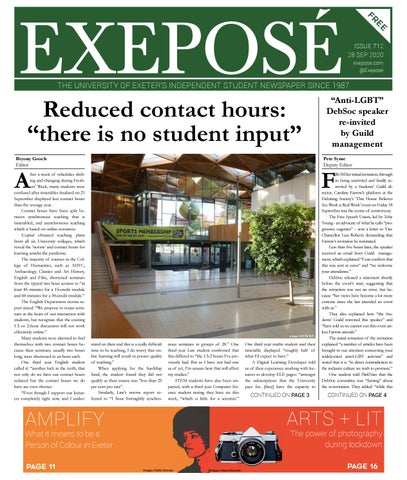
Image: Kamila Bell
stand on their end this is a really difficult time to be teaching, I do worry that online learning will result in poorer quality of teaching.” When applying for the hardship fund, the student found they did not qualify as their course was “less than 25 per cent pro rata”. Similarly, Law’s norms report referred to “1 hour fortnightly synchro-
nous seminars in groups of 20.” One third year Law student confirmed that this differed to “the 1.5-2 hours I’ve previously had. But as I have not had one as of yet, I’m unsure how that will affect my studies.” STEM students have also been impacted, with a third year Computer Science student noting they have six this week, “which is little for a scientist.”
AMPLIFY
What it means to be a Person of Colour in Exeter PAGe 11
“Anti-LGBT” DebSoc speaker re-invited by Guild management
Images: Public Domain
Images: freestockcenter
ARTS + LIT
The power of photography during lockdown PAGE 16
News Editors Print: Emily Im & Chloe Pumares Online: Elen Johnson & Ella Shadwell news@exepose.com
Beyond Exeter Editor Print: Sumiah Elbortoukaly
Lifestyle Editors Print: Ceri Jackson & Georgia Shepherd Online: Freya Insoll & Elinor Jones lifestyle@exepose.com Arts + Lit Editors Print: Will Evans & Amelia Gregory Online: Lucy Aylmer & Anna Wilmot artsandlit@exepose.com Music Editors Print: Bridie Adams & Ollie Leader de Saxe Online: Tom Bosher & Holly Lamb music@exepose.com Screen Editors Print: Olivia Garrett & Francesca Sylph Online: Olivia Gomez & Jim Norman screen@exepose.com Science Editors Online: Isabel Murray & Vincent Plant sciandtech@exepose.com Sport Editors Print: Joel Edwards & Nick Powell Online: Harry Scott-Munro sport@exepose.com Chief Photographer photography@exepose.com Copy Editors Danni Darrah, David Fallshaw, Emily Mason Proofers Kamila Bell, Bryony Gooch, Pee Syme, Richard Ainslie, Danni Darrah, Blood, Sweat & Tears
@exepose @exepose facebook.com/exepose issuu.com/exeposeexeter Advertising SalesandBusinessDepartment@exeterguild.com
(01392) 722607
The opinions expressed in Exeposé are not necessarily those of the Exeposé Editors nor the University of Exeter Students’ Guild. While every care is taken to ensure that the information in this publication is correct and accurate, the Publisher can accept no liability for any consequential loss or damage, however caused, arising as a result of using the information printed. The Publisher cannot accept liability for any loss or damage to artwork or material submitted. The contents of this, unless stated otherwise, are copyright of the Publisher. Reproduction in any form requires the prior consent of the Publisher.
University spends £150,000 on masks and thermometers PAGE 3
FEATURES Who poisoned Alexander Navalny? PAGE 10
SCREEN
Could the Oscars be diversifying? PAGE 24
Image: wikiimages, pixabay
Features Editors Print: Bethany Collins & Joe Newell Online: Simon Eidesvik & Becca Wells Foreign Correspondents Co-ordinator:s: Ross Chatwell & Catherine Lloyd features@exepose.com
into the music industry's treatment of mental health (page 21). We might not be able to rock out together just yet, but we can positively manifest great nights out for the future. Over in Features, check out how international students might be affected by COVID-19 (page 9). Missing live sport? Well, Sport are too. Lets explore the possibility of empty stadia together (page 32). If you're looking for new ways to be sociable in your groups of six, Lifestyle look into ways you can STILL have a social life under government guidelines (page 14). As always, there is plenty to read in this issue of Exeposé. And if you missed a chance to buy membership during Freshers' week, know that it is always on sale! News flash: memberships for all societies are available throughout the year. So don't worry if you missed out during Freshers' week. Exeposé always has and always will welcome new writers, proofers and general members. We are a student group that requires you to have absolutely no prior experience, just a passion for all things journalism or a love of creativity. We welcome everyone. All you need is curiosity and a drive for giving things a go. But for now, take it easy. Carry on reading. Good things come your way. Kamila & Bryony
Image: analogicus, pixabay
Comment Editors Print: Isaac Bettridge & Cassia Grace Online: Gaia Neiman & Jennifer Medlicott comment@exepose.com
W
E won't lie to you, reader, it's been one hell of a first week back. We hope you've been keeping well - socialising safely, attending your lectures, doing your reading, eating your greens, wearing those nice masks given to you by the University. Moving away from home and making friends is tough at the best of times let alone during a global pandemic with government guidelines cracking down on activity. Well, between moving in and navigating the newly implemented Rule of Six, we have only just managed to get you some prime content. And let us tell you, it has been tough. But the things we do for journalism, eh? In News, we break news on the University's plans to fund more antiracist initiatives following negotiations with the Unlearn Collective. Comment discusses the newly implemented Rule of Six and how it affects young people (page 6). Screen remembers the late Chadwick Boseman who most famously starred in Black Panther (page 25). Looking to read about the best of the best? Arts + Lit detail the Man Booker prize shortlist. You can also stop off for a short read on the importance of art in recovering from a global crisis (page 17). If you're looking to learn more about climate change, check out Science to find out how ocean earthquakes can help with our understanding (page 28). Join us in Music for a scathing look
NEWS
Image: dimitrosevastopol
Editors Print: Kamila Bell & Bryony Gooch Online: Madeleine Baker & Ria Kalsi Deputy: Richard Ainslie & Pete Syme editors@exepose.com
Editorial
Image: Anna shvets, pexels
EXEPOSÉ
Devonshire House, Exeter, Devon, EX4 4PZ
SPORT
How is US sport adapting to COVID? PAGE 30
CHECK OUT OUR WEBSITE!
There are even more great articl es on the Exeposé website. From the latest university news to current affairs, music and theatr e reviews and more, visit us at www.exepose.com
Worldwide university news Ghana university dedicated to climate change
Australian universitites accused of wage theft
HANA is set to see the opening of a university dedicated to science, agriculture, business and the built environment, promoting the teaching of climate science in a countrywide first. The University of Environment and Sustainable Development will not only offer training for professionals in these sectors but also aims to improve tertiary education access in the Yilo Krobo Municipality in the eastern region of the country. Through a commitment to provide high quality teaching and training facilities, courses will include topics such as energy sustainability, environmental economics and policy and water resource development, with the campus being built with these practices in mind. The President of the Republic, Nana Addo Dankwa AkufoAddo, hopes that the new university will develop rapidly into a centre of excellence in sustainability research and teaching.
T was revealed that almost one in four of Australia’s universities have failed to pay their staff full wages and are now going to face legal action. These top universities, including Melbourne, Queensland and Murdoch, have been underpaying their staff for over a decade or more, and are now facing an inquiry conducted by the Australian senate. The NTEU President Dr Alison Barnes said that millions have already been recovered, and the union is currently gathering information before they take legal action. This revelation has also led the union to accuse some Australian universities of being ‘cashed-up’ and employing their staff ‘insecurely’, with many laid off due to the pandemic.
G
I
Indian students fail to scrap final exams
T
German scholarship for doing nothing
H
HE Supreme Court has upheld the AMBURG'S University of Fine controversial ruling by India’s UniArts has offered three €1,600 versity Grants Commission (UGC) which scholarships for students to do nothing. states that final-year students must sit their Applicants must declare what their exams by 30 September in order to gradu- ‘active inactivity’ is and how long they ate. Due to the effects of the coronavirus will be doing it for. They must think pandemic, including the severe impact it about what they can refrain from to rehas had on teaching, students in India pe- duce their impact on others. The Univertitioned for changes to university exams, sity wants to push the notion of sustainasking for final assessments to be based ability by opposing the general societal on grades from previous semesbelief that worth is measured ters rather than in-person by the accomplishments exams. A three-judge of the individual. bench led by Ashok Friedrich von BorBhushan rejected ries claims the this proposal. extremity of States can apply this task is not to the UGC for a simple and says deadline extension the “scholarship however, the majorprogramme is ity of graduating stunot a joke but an dents are obligated to sit experiment with seritheir exams if they want to ous intentions.” Stories by, Elinor Rose, Chloe Pumares, Abireceive their degree. Images (LtoR): Spiske, Koloda gail Stevenson and Millie Betts
3
28 SEPT 2020 | EXEPOSÉ
NEWS
Exeter UCU calls for immediate end to face-to-face teaching Chloe Pumares News Editor
E
XETER’S UCU has called for an immediate halt to faceto-face teaching to prevent staff, students and the wider community from being put at serious risk during the pandemic. The UCU published a branch motion on 16 September which detailed their demands and reasons for them. It mentioned the increase in coronavirus cases amongst the student population, the risk factors concerning young people as they tend to be asymptomatic, and included evidence from America which reported 60 universities and colleges in 36 states have seen Covid outbreaks. A letter addressed to the university’s Vice Chancellor Lisa Roberts discussed the lack of adherence to guidelines amongst students due to reports of large social gatherings outside student accommodation on campus. It called upon senior management to show “leadership and moral courage” by transitioning to online teaching in line with the SAGE subcommittee report on higher education.
In response, Exeter University stated that face-to-face teaching was deliberately kept to a minimum at the beginning of term to allow time for changes to be made if needed. They plan to build up to approximately 30 per cent capacity on the Exeter campuses, while Penryn is already operating at 30 per cent. In an email sent by the Director of Human Resources to the UCU, the university said they “received fewer complaints at this stage than in recent years” and are “confident that the vast majority of the student community are behaving responsibly.”
We are confident the vast majority of the student community are behaving.
A spokesperson for the University said they plan to review their decisions on a weekly basis, ensuring that ‘staff and students are prioritised in specialist facilities such as labs and performance spaces.’ A blended delivery of teaching will be prioritised as long as current government guidance and the situation in Exeter allows it.
Postal worker found guilty after sexual assault near Streatham Campus Emily Im News Editor
G
EORGHE Bertlef, 32, of Pinhoe Road, has been found guilty of rape after he denied attacking an 18-year-old on Hoopern Lane on 13 November 2019. The former Royal Mail worker approached the victim at 2.45am as she walked home alone from Unit 1. He said hello and put his arm around her shoulder before committing the assault. Mr Jason Beal, prosecuting, said that “her way of coping was not to say anything and pretend it was not happening.” The victim called the police as soon as she got to her accommodation. She told them, “I shut down and just did what he said. I became like a robot.” Two hours earlier, Bertlef had followed four female University of Exeter students on Mount Pleasant Road. Alarmed
by his behaviour, they took a photo of him, jurors were told. The victim’s description of Bertlef matched this photo. He was arrested eight days later after plain-clothed police spotted him stalking two women. Bertlef had spent weeks searching for lone women at night, the court heard. He told police he felt intimidated talking to women during the day and had not had sex before. Judge Robert Linford told Bertlef he would face a “substantial sentence of imprisonment.” His sentencing will be at Exeter Crown Court on 23 October.
“What a terrible year you guys have had” CONTINUED FROM FRONT make for really interesting digital classes, assessments, and coursework projects. “But there is nobody enforcing that the lecturers make the most of these resources, so most pages consist of a lecturer recording and a bit of reading each, which is the bare minimum that’s required. They also noted: “In the pedagogical meetings there is no student input, and the DLAs only work six hours a week so they don’t have time to check every module.” A Digital Learning Assistant said they felt, at times, the University had “purposely avoided student feedback.” Exeposé spoke to Professor Henry Power from the English Department and Associate Dean in the College of Humanities. Professor Power noted of the online resources: “we’re able to use the campus at 30 per cent of its usual capacity. So if we wanted to get as many face to face seminars as possible, we were going to have to think quite creatively about how we did it. And of course we physically can’t get 16 people into most of our usual teaching rooms in Queens, Amory, Old Library or whatever. The decision we took is that we
planning to build up to approximately 30 per cent of all live teaching delivered faceto-face on our Exeter campuses over the first three weeks, as part of our blended model, whilst teaching on our Cornwall campus is currently at 30 per cent faceto-face. “On this basis, we are content that the teaching planned for this week is aligned to the new risk level and only modest changes are required. “As a result of the new guidance we will limit our levels of in-person teaching to a level below that initially planned for week three and beyond. We will review this on a weekly basis, and make sure that staff and students are prioritised in specialist facilities such as labs and performance spaces, and noting that it may be possible to maintain higher levels of face to face activity on some of our campuses. “We will be asking Directors of Education to undertake an exercise to identify which teaching sessions should be prioritised for face-to-face teaching as we progress through Term 1. This will enable us to ensure that we can sustain blended delivery for all our programmes and students for as long as the current guidance and situation pertains.”
Students break COVID rules at illegal parties and University events Ella Shadwell Online News Editor
S
tudents at the University of Exeter have broken government guidelines on social distancing at parties on campus, with reports of hundreds of people gathering outside halls of residences until the early hours of the morning. DevonLive reported that between 300 and 400 students had gathered outside of Holland Hall on a nightly basis, and images have emerged of similar parties at other on-campus halls. They show large groups of students congregating without face coverings and a lack of social distancing, despite the new Rule of Six coming in to force on 14 September – the first day of Freshers’ Week.
É If these issues affect you, you can get in touch with: Devon Rape Crisis: 01392 208756 Wellbeing Services: exeter.ac.uk/wellbeing
would halve the seminar groups and halve the times.” On the difficulties of creating digital content during these new circumstances, Power explained: “Academics have been working through the summer, under incredibly challenging conditions, to make sure that students are well-supported this year.” Power also revealed they had already received positive feedback for their online resources. “I really feel for students at the moment - what a terrible year you guys have had. But we have faced our own challenges as well.” A spokesperson for the University said: “As you will have seen from university communications this is now being reviewed given the new government guidance and alert level changes this week. The key point for students is to check their timetable each weekend as there will be updates and changes as we get the balance of on campus and online teaching right. The main information was in the Registrar’s message this week as below: “We have deliberately begun the academic year at a low level of face-to-face in person teaching on our Exeter campuses,
Image: University of Exeter
The University’s Estate Patrol have attempted to break up parties on campus but students have reported that gatherings are slow to disperse and reform once campus security leave. One first year told DevonLive “the campus patrol do not seem to have the authority to break up groups.”
Between 300 and 400 students had gathered outside Holland Hall on a nightly basis
The police have also been called to some of the parties, with reports of students in Lafrowda and Birks Grange receiving fines for hosting large gatherings. A University-run cinema event has received backlash after a large group of
students gathered outside the Forum on Saturday 19 September, with little social distancing observable. Organised for Fresher’s Week, it was planned to run for three nights. The University, however, opted to cancel Monday’s event due to a “lack of social distancing” on Saturday. In the same comment, the University said that Sunday night’s showing had “worked well” after some changes were made. The Sunday Telegraph reported that international students at Exeter had hosted parties during their 14-day quarantine period after arriving in the UK. An anonymous 18-year old student said that the police were called after Estate Patrol were unable to break up their party, but that they were given a warning rather than a fine. Another first-year student told Exeposé that “every time we go to a party, the police turn up.” A spokesperson for the university said: “Students are required and expected to adhere to Government laws and guidelines on COVID-19. The University is, and remains, in regular contact with all students and staff to relay the latest Government information, and remind them of the necessity to follow these rules fully. The University, police and local authorities are sharing information and coordinating their response based on any reports received.”
4
28 SEP 2020 | EXEPOSÉ
NEWS
Uni & Guild “have failed completely to support” DebSoc CONTINUED FROM FRONT
was [the society’s] mistake, the University and [Guild staff] have failed completely to support them when they tried to correct it.” Exeposé understands that the University reminded the Guild of their responsibilities to uphold freedom of speech laws. Farrow was first invited to speak at a DebSoc event in 2017, also against sex workers. She was investigated by the Guild for distributing unauthorised leaflets which described various sexual acts in violent detail. Farrow was then allowed to attend another DebSoc debate the following year.
She has previously called the Pride parade a “deceptive move to push the LGBT political agenda and expose children and families to lewd behaviour.” Farrow has also been denied entry to the USA. In a 2018 YouTube video, Farrow describes herselfa as “dangerous and revolutionary” as she recites the transphobic poem ‘Tran-I-am’. One line reads “I am woman you are man, we cannot change that, tran-I-am.” The University of Exeter signed the #TransRightsAreHumanRights campaign at the start of last week, saying they are “committed to ensuring that they safeguard trans rights at the
High levels of racial inequality in Devon and Cornwall police Chloe Pumares News Editor
R
ECENT figures released by Devon and Cornwall Police show that Black people are disproportionately more likely to be involved with the police, whether a victim or a suspect. The figures showed that Black people are three times more likely to be victims of a crime and six times more likely to be designated a suspect yet are half as likely to receive community resolution. Black people are also 12 times more likely to be stopped and searched, and 9.5 times more likely to be the subject of force. For the first time, these figures were published by the police proactively. Internal performance figures from April 2019 to March 2020 reveal that individuals from an ethnic minority background are dealt with disproportionately. Devon and Cornwall police are now launch a new drive to help improve the force’s figures and combat racial inequality. Disproportionate treatment of and
impact on BAME people background is not just related to crime and policing in England, but other issues as well such as COVID 19. Data shows that of 900 fixed penalty notices, related to Covid enforcement, Black, Asian and those from minority backgrounds are 1.9 times more likely to receive them, this goes up to nearly seven times more likely if they live outside of the force area. Assistant Chief Constable Jim Colwell said ‘the widespread coverage and public interest in the Black Lives Matter movement prompted a national re-examination’ as a wide-ranging audit of its working culture, systems and practices is being conducted. Since the figures have been released, Cllr Jermaine Atyia-Alla, Torbay’s first black councillor has said that he is not surprised by the figures but hopes to see more officers recruited from minority communities. Plymouth and Devon Race Equality Council have welcomed the force’s decision to publish its data in an attempt to find a solution to racial disparity.
University and in our wider communities.” In response to an Exeposé reporter’s post-debate question about female-dominant sex work, Farrow claimed that “women are not physically able to rape - they just can’t.” The Guild has previously faced criticism for sanctioning the appearance of Katie Hopkins to argue against refugees in 2018, and an ECU speaker who was accused of homophobia. LGBTQ+ Society told us “We, as a society, are not firmly for or against no-platforming and I’m sure our members have differing views on it. “What saddens me, though, is how quick some people have been to dis-
“I’ve commissioned a full review into this to work out what happened that led to the inviting, uninviting, and inviting again” A Guild spokesperson said: “Following issues around an event organised by Debating Society last Friday, we’re going to be conducting an internal investigation so we can fully understand what happened last week. “We appreciate that there has been confusion, frustration and disappointment on many sides, and we are committed to ensuring that we are transparent in what we find in the review so that answers are given to questions.” Additional reporting by: Elen Johnston, Online News Editor
Half of Exeter COVID cases are students Kamila Bell Editor
A
N email sent to University of Exeter students on 25 September detailed how the institution is dealing with positive coronavirus tests. Mike Shore-Nye, Registrar said: “we think that the best way to provide robust data is through the Public Health England validated numbers to ensure data consistency” The email highlights that the Public Health England website states there have been 58 recorded cases over the last seven days, with “a little over half ” being attributed to the University. Among other measures, masks have been made mandatory by the University of Exeter on all of their campuses unless individuals have an exemption. At the start of term one, all students were provided with three reusable face masks and a digital thermometer. The University spent
approximately £130,000 on this PPE for students. In early September, the University agreed a partnership with the UK’s first commercial provider of saliva based COVID-19 tests, Halo. They have since set up the Rapid Response Hub for staff and students to access these tests should they need to. Their website explains how the hub was established to “advise those with COVID-19 symptoms on how to get a test, and to support people who receive a positive test and need to selfisolate.” However, the website further notes “If you are a close contact, you must self-isolate by law, but you will not be given a test unless you develop symptoms.” A third year PPE student told us “my housemate was contacted by Track and Trace, but because we didn’t have any symptoms we weren’t eligible for a test through the Uni or the NHS.” Halo’s saliva based PCR tests
Image: Kamila Bell
provide same day or next day results. Devon Freewheelers EVS have been involved in the delivery and collection of tests to students, aiding in providing these rapid results. A University spokesperson stated “The Halo COVID-19 testing system is working and we have identified a small number of positive cases who are now isolating.”
The Unlearn Collective Secures £25,000 for anti-racism initiatives Emily Im News Editor
T
Image: Clay Banks, Unsplash Image: Louis Donohoe
miss the impact of Caroline Farrow speaking in their university has on our trans students. “With JK Rowling’s transphobic comments being in the centre of UK news recenrtly and the UK government scrapping their proposed self-identificaiton laws for trans and non-binary people, now is a more important time than ever to be standing up for the trans community.” In an interview with Exeposé (page five), Vice Chancellor Lisa Roberts said: “We don’t in any way condone her thoughts and her views on LGBT matters - they’re really fundamentally at odds with our values and commitment to inclusivity and diversity.
HE University of Exeter has agreed to invest £25,000 in anti-racism initiatives following negotiations between the Provost Commission and the Unlearn Collective. The terms of this fund will require projects to be student-led and bring about tangible change in order to drive the University forward with its antiracism agenda. The Education incuba-
tor will support them to ensure they have access to the infrastructure and networks needed for them to succeed. The Unlearn Collective has said, “we are encouraged that this step has been taken in the University’s journey toward a truly anti-racist culture. The next stage is to make sure this potentially invaluable fund is disbursed effectively and responsibly for the greatest effect going forward.” In an interview with Exeposé, Vice Chancellor Lisa Roberts said, “Every single individual in the university has the responsibility to demonstrate that we’re
anti-racist. I think for me it’s important to keep prioritising this as an issue [which] the whole uni needs to come together to tackle.” The Provost and Deputy Registrar will meet with the Unlearn Collective at the start of October to discuss how funds will be distributed. The funding process will be confirmed shortly. The Unlearn Collective penned an open letter to the University in June, demanding greater efforts to foster an antiracist culture within the institution. It was signed by more than 1000 individuals.
INTERVIEW
EXEPOSÉ | 28 SEPT 2020
Interview
5
The new woman in charge
Exeposé speaks to Professor Lisa Roberts, Vice Chancellor, about racism, the DebSoc incident and the transition to blended learning Bryony Gooch & Pete Syme Editor & Deputy Editor
S
TARTING a new role in charge of a university can never be easy, and that’s only been made harder for Professor Lisa Roberts with the pandemic causing a myriad of logistical problems. Beyond this, there has also been the reports of illegal student gatherings, as well as the freedom of speech debate coming back into the limelight thanks to last week’s Debating Society incident. Professor Roberts told us how she comes from a former mining village in Derbyshire, with parents who both had to leave school early to work and support their family. “I am acutely aware of the real transformative power of a university education” she tells us, having previously been Executive Dean of Health & Medical Science at Surrey, and Deputy Vice Chancellor, Research and Innovation at Leeds. Taking place over Microsoft Teams like so much of this academic year, we questioned the new woman in charge about her plans for Exeter University. This interview has been shortened and edited for clarity.
É
É: Has your background in Virology come in particular use during the pandemic? Have you been involved in the new plans for Exeter to deal with this? What can we expect to be different? The plans that have been developed at Exeter are really extensive and really well planned - the beauty of them is really that academic colleagues, professional services and students have all come together. I’m more a biochemistry virologist than an epidemiologist, but at least I understand a lot of the science behind this. What’s given me confidence about our plans is that it’s been developed with public health experts in the community and across the University with staff and students. Quite clearly I’ve looked through the plans we have and I think they’re really strong. É: When your predecessor retired, he said in an interview that his biggest regret was his failure to tackle racism. Over the last four years, eight incidents of racism and bigotry have taken place in relation to the University. What plans do you have to make Image: Edda Church Exeter more inclusive and safe envi-
ronment? I think first of all, Sir Steve was right - tackling racism is for all of us. I think the University’s messages throughout have encouraged everyone to listen to these issues and speak out and hold those conversations, which are quite tough conversations to have. But also come forward with the willingness to change, and every single individual in the University has the responsibility to demonstrate that we’re anti-racist.
I'm more a biochemistry virologist but at least I understand a lot of the science
Prof. Lisa Roberts
I think there are several things going on already which I think are fabulous. We have the Provost Commission which is leading lots of work to tackle racism. And I know they're working also with the Unlearn Collective (UC) who are coming forward with issues but also ideas for what we need to do as a university. I know that dialogue between staff and students is really key to this. I know UC as well are working with provost commission and the education incubator around some particular projects that we’re putting funding into, with really good ideas as to how to tackle this. You only have to look at the numbers -- the attainment gap and things like that; the number of reports of incidents; whether they’re unseen or very much in the public eye. I think for me it’s important to keep prioritising this as an issue that the whole university needs to come together to tackle. And the more ideas that can come from conversations with staff and students and particular initiatives that we can really see change, and make change quickly, the better. It will be absolutely at the heart of our new strategy. É: The decision to halt in-person Guild activities came from the University. Yet the University has been holding screenings on campus, it seems. Why was the University able to hold in-person events on campus when Guild societies were not? I’m not aware of the detail - I think what we’ve been trying to do is support the Guild with holding society events under the new rules and the new laws. What we’ve managed to do with the screenings, for instance, is make sure we have a COVID-safe environment which absolutely
ensures that people are socially distanced and in groups of no more than six. So we’re now working very closely with the Guild to try and work through with them innovative ways we can hold something for societies, but within the law of the constraints we have to work in. We’ve tried to make sure that the messages get out there. This is a community approach that we need to take, and to make sure that all our community members both staff and students are aware of the government laws and the guidelines. All I can really plead with students and staff and whoever it is, is that we try and stick to those guidelines. The more we can follow them, the more we can contain the virus and allow things like face-to-face teaching to continue on the campus. É: Project Enhance looked to offer students podcasts, documentaries & other online resources not provided by teachers as part of “blended learning.” Do you think this provides students with the same quality of teaching as before? I think that the plans for teaching and learning that everyone’s put together this year are really based on trying to get the very best quality, flexibility, and resilience
within our programs. So whatever the year throws at us we can respond to that. Quite clearly, face to face teaching has many benefits as I’m sure you’re aware. But, I think that the plans that have been put together by the academic staff working with the student community for this blended approach are really providing a high quality experience. The more we can use different materials to enhance that and enhance the learning experience the better. So, quite clearly, our teachers and our academics are fantastic and you want to learn from them, and they want to teach you and educate you. But if there are external materials that can enhance that, I think it’s better actually.
I've commissioned a full review into [the DebSoc incident] to work out what happened
Prof. Lisa Roberts
É: After last week’s Debating Society fiasco, Toby Young of the Free Speech Union said “this is exactly how university vice chancellors should respond” -- this is a man who says he is in favour of “progressive eugenics” -- is this the
sort of person the University should be taking their advice from? I don’t think we were taking advice from Toby Young, actually. The thing to point out is that the university, at the end of the day, is committed to the protection of freedom of speech and we also have a duty of care to our staff and students and those two things are both in play here. Obviously, we’re disappointed by what happened around the event last week - I wasn’t aware of their decision to invite Caroline Farrow and then to rescind that invitation. We don’t in any way condone her thoughts and her views on LGBT views -- they’re really fundamentally at odds with our values and commitment to inclusivity and diversity. But in terms of what happened I’ve commissioned a full review into this to work out what happened that led to the inviting, uninviting, and inviting again. I think until I’ve seen exactly what's in that I can’t comment any further. But one thing I’ve also asked to be part of that review is some recommendations about how to support the wellbeing and training of students that are involved in society activities as well. Image: The University of Exeter
28 SEP 2020| EXEPOSÉ
6
Comment
COMMENT EDITORS:
Isaac Bettridge Cassia Grace
Mulan: not so magical?
Oliver Leader De Saxe Music Editor
I
WAS on the Empire website the other day, reading their review of the new Mulan remake. The review by itself was harmless enough, an inoffensive piece providing glowing praise to the spectacle and performances in the film whilst lamenting its small screen release. So why was it that, almost directly after reading that article, I felt sick to my stomach?
To support this film is to become complicit in a corporation failing to support human rights
Controversy has cloaked the liveaction adaptation of the beloved nineties animation for over a year at this point, ever since the star Yifie Lui shared a Weibo post showing her support for the Hong Kong police, who have been criticised at length for the violent handling of peaceful pro-democracy protesters. It was this which sparked the original social media firestorm and #BoycottMulan movement, a movement that was
seemingly dampened due to an excellent corporate damage control strategy and up to now has been relatively subdued. But recently, new reports have emerged, which have become harder to ignore. Since 2017, 1.8 million Uighurs, Kazaks, and other Turkic minority groups have been targeted by a state-operated ethnoreligious campaign in the Xinjiang region, according to Foreign Policy. This is the same region where parts of Mulan were filmed. The personal, and obviously condemnable views of one star is one thing; Disney thanking local authorities responsible for abusing human rights in the credits
But the cat is out of the bag; there’s no putting it back. Some people will try to make this an argument about valuing the art over the artists. In most cases I’d agree with them, on the basis that not all the creatives involved should suffer because of the actions of a few individuals. This is not one of those situations. To support this film is to become complicit in a corporation failing to support human rights and basic decency in exchange
Some will argue this is about valuing the art over the artists
of their $200 million film is quite another. The boycott has naturally come back with full force. The controversy has grown so great in fact that, according to Reuters, the Chinese government have asked media outlets not to cover the film, which may explain why Forbes is labelling the film a “box office bomb” in the country.
for profit. This is unforgivable. Disney knows there’s money to be made in China. They put $5.5 billion into the Shanghai Disneyland resort after all, Bloomberg reports. But it’s becoming increasingly clear that Disney’s attempts to curry favour with the regime and the fastest growing film market in the world has gone from greedy to just plain unethical. That’s where my disgust at Empire lies. By ignoring the problematic production, they turn a blind eye to the treatment of the Uighurs which is now a part of its faux-oriental fabric, as interwoven into the film’s tapestry as anything else. You may want to watch Mulan. You may even be excited for it. But the truth is you cannot escape the dubious ethics that have gone into its production. The Disney magic may only last for as long as the film is on. But the guilt? Well, that Image: Flickr lasts forever.
////////////////////////////////////////////////////////////////////////////////////////////////////////////////////////////////////////////////////
Six steps backwards?
Katie Jones Contributor
W
ITH the implementation of the Rule of Six and the threat of a second nationwide lockdown looming, public trust in government is rapidly waning. The bringing in of the Rule of Six should have been relatively simple as realistically almost nothing changed. Unfortunately, the government failed to properly inform the public of the rules over the summer and so the Rule of Six seemed like a big restriction. Their choice to advertise it as a new policy did not help. Government guidance had in fact always limited groups of more than two households to meetings of six, but this was never made clear. All anyone knows now is that they are confused - confused
on what the law currently is and confused on what it was before. All this uncertainty is frustrating and makes it harder to stick to the rules.
The Government failed to properly inform the public of the rules
Young people especially are being handed reasons to ignore the law on a plate. The popular Eat Out To Help Out scheme during August provided a financial incentive for young people to go out and socialise. In a now deleted tweet from the Treasury, we were told to “grab a drink” when pubs re-opened on 4 July. Now we are seeing cases in people aged 20-29 up by 206 per cent. What a surprise! After a summer of shopping and eating out in an effort to rescue
the economy, young people are now being told to “not kill Granny”. After tens of thousands of care home deaths earlier this year, the shifting of responsibility to young people for any future outbreaks will not be accidental.
Until we have a robust Test and Trace system, we cannot reopen the economy without cases also increasing. We all have an individual role to play, but we also require quick action from the government to clean up their mess
The Guild REPORTS on Freshers’ WEEK
Image: Students Guild
Liv Harvey VP Activities
I
T was so great to welcome our new and returning students back last week, campus has been too quiet! A special shout out to our wonderful Welcome Team who have been volunteering their time to welcome our new students over the past week. Our virtual Freshers’ Fair was a huge hit with over 8,000 of you registering and getting involved. Despite our in-person activity being paused for now, our committee members have been going above and beyond to provide a great online offer for our students. From a virtual murder mystery evening to online HIIT classes, there is so much for you to get involved in!
Image: Elevate, Unsplash
28 SEPT 2020 | EXEPOSÉ
COMMENT
7
You’re Gavin a laugh: A-Level fallout Rhys Wallis Contributor
T
HE Government would ordinarily have already been well rid of the calamitous Secretary of State for Education after what’s happened this year, butas with everything in 2020 - normal seems to have gone out the window. When Gavin Williamson announced an end to school in March of this year, swiftly followed by the cancellation of GCSE and A Level exams, he must have known that the process of forming an entire year’s worth of exam grades based off of no exams
wouldn’t be an easy task- but it really didn’t have to be this hard. After nearly five months of organising, reorganising and assessing the algorithm and system to be used to award the grades for these types of exams, it was nothing short of calamitous when the system came crashing down in under five days.
It was nothing short of calamitous when the system came crashing down
This was not an easy task, but to see that algorithm so swiftly dismantled inspires little faith in the Government which so vehemently defended the system from the students on the receiving end of it. Under ordinary circumstances, such a poisonous scandal would obviously call for the head of the minister responsible, who would have been told to either move or be moved. And yet Gavin Williamson remains in office, with no signs that he, or any of the numerous cabinet ministers or senior government officials caught up in scandal over this long summer (Dominic
Cummings, Priti Patel, Robert Jenrick etc.), will be going anytime soon. So what does this say about the Government’s priorities, and their abilities to face up to them? It would seem that the priorities were placed in locations other than gathering accurate results, for a start. To me, this is shown through the fact that the results had to be changed. Fair or unfair, if the results are accurate, or at least perceived to be so, people can stomach them - but people could not stomach these results, and a change was forced. As regards the abilities to face up to them: well they can’t. If they could, then it wouldn’t have been
the director of Ofqual who resigned, nor would the Prime Minister have blamed a ‘mutant algorithm’ for the issues caused, rather than ministers and officials involved in the formation of the algorithm. So what are the conclusions we can draw from how the Government has acted? The same conclusions we can draw from the rest of the coronavirus pandemic: that the task facing the Government has been immense, but that at every possible opportunity, they have avoided responsibility and forced others to take the fall. In this case, senior education officials have lost their jobs where, in years gone by, ministers would have, but elsewhere we have seen scientists and medics hidden behind when things get tough, and used as media fodder when required. Furthermore, this whole sorry ordeal, along with the shielding from consequence of the likes of Cummings and Jenrick, points to a fundamental problem in the Johnson Government- the valuation of loyalty to Boris and Brexit above all other qualifications.
Williamson is a serial incompetent, but he can be trusted to follow orders, so he stays- Johnson’s purge of the likes of Ken Clarke and Philip Hammond last year from the Conservative ranks signalled clearly that fidelity would be valued over functionality in the new Tory Party. Would Labour act any differently? No one can say, probably, but we don’t know. What we do know is that this sort of incompetence, incoherence and irresponsibility has become all too familiar at a time when competent and trustworthy government is needed more than ever - and I think people will remember it when they’re next at the polls.
Images L to R: Chris McAndrew, Foreign and Commonwealth Offic, Richard Townshend
‘Shut up and dribble’: celebrities and politics Hannah Rae Contributor
C
ELEBRITIES have always had a wider reach than the average person, something that has only been exacerbate by the advent of social media. With this power comes an increased ability to influence people’s opinions and outlooks, particularly as pertains to
Image: Eva Renaldi
contentious political issues. Wih the recent explosion of the Black Lives Matter movement seeing many celebrities speak out in favour of the cause- most notably, the decision by many basketball players such as LeBron James to stop playing to protest the shooing of Jacob Blake. But is it appropriate for celebrities to speak out in this manner?
Celebrities have freedom of speech, like any other citizen Celebrities have freedom of speech, meaning that – like any other citizen – they have the right to “impart information and ideas of all kinds, by any means”. Any argument regarding whether celebrities should be ‘allowed’ to spread their political viewpoints thus becomes redundant, because it would be impossible to prevent them from doing so without infringing upon human rights. The risk involved when famous people do share their own political opinions will above all be
incurred by the famous people themselves. In choosing a side in a political debate, as for example Chrissy Teigen has done by endorsing the Biden-Harris ticket in the upcoming 2020 US presidential election, a celebrity hazards the possibility of alienating a substantial portion of their fan base. However, one could approach this from an entirely different angle. That, if anything, more successful celebrities are in a better position to depart from impartiality, because their careers and livelihoods are more secure and so they are better prepared to face the impact of being ‘cancelled’ by a portion of their prior supporters. The other real risk incurred is that young people choose a political stance based on one statement from their favourite actor. However, this should not be blamed on the celebrities for sharing their own stance; people hear different political viewpoints on a daily basis – from family members, friends, television presenters – and one more is therefore unlikely to have a huge impact on the viewpoint a person develops. Furthermore, many of
the arguments being presented about this are delivered in considerable bad faith, with condescending attitudes towads young people and contempt for celebrities who expressing leftleaning views (many of these same people love to crow about any celebrity who expresses views favourable to their political leanings).
Celebrities using their platforms may even encourage their followers to also begin to engage
ter equip people to be able to think critically, and to encourage them to engage with current affairs and politics. It could be argued that celebrities using their platforms to become involved with politics may even encourage their followers to also begin to engage with politics, allowing them eventually to develop their own stances using more unbiased sources.
If a person does base who they vote for or what they believe in on the ideology of a well-known personality, that represents issues in our society more than a mistake on the part of the celebrity. We should not be in a position where people are so uneducated politically that they adopt the first stance they hear from someone they respect. If we do find ourselves in such a place, then as a society we should consider developing systems to betImage: Erik Drost
Features
28 SEPT 2020 | EXEPOSÉ
9
FEATURES EDITORS: Bethany Collins Joe Newell
International student numbers in decline
F
Jacob Evans explores the impact this will have on the University of Exeter
OLLOWING COVID-19, we may see a huge loss in international students across Universities throughout the World, UK, and here in Exeter. Coronavirus has caused issues in every facet of life and in some instances, it has really helped gain a new perspective on issues we may not have necessarily considered. One such is the realisation of the importance of international students, not only from a diversity and cultural view, but also a financial. Universities could suffer from a £2.6 billion loss in the 2020/21 academic year. This is mainly due to an estimated 47 per cent decrease in international student numbers for the next academic year. Couple this with a suggested £612 million loss from British students not enrolling and an additional £350 million from EU students, the financial fortitude of British institutions will be tested. The contribution of international students cannot be underestimated; in the 2018/19 year, international students represented 20 per cent of total enrolments, with fee income
totaling almost £7 billion. If no international students arrived in September, the British higher education sector would lose ten per cent of its income. According to the Institute of Fiscal Studies, the Universities that will suffer the largest loss in fee income is the London School of Hygiene and Tropical Medicine (-60 per cent), The University of Glasgow (-51 per cent) and the Royal College of Art (-50 per cent); with the latter also losing -280 per cent of total income from the pandemic. The lower ranked institutions are particularly dependent on tuition fee income (some up to 25 per cent of average income), and the subsequent attempts of rectifying (notably by up taking more domestic students) may lead to long term and severe implications. This will create a massive dilemma for these institutions, as they see potential student body numbers decline, they may have to cap British student numbers at 2019/20 levels. This will still see significant losses; but is the safest way of ensuring
major losses are avoided long term. The higher ranked universities have a greater proportion of international students, but also greater income through other sources; but for lower ranked institutions, the income from international students is far less but still incredibly important. This isn’t the focus of this article but acts a stark reminder of the severity of the situation and the need for effective decision making both nationally and at an institution-based level.
Universities could suffer from a £2.6 billion loss Inextricably linked to this is the loss of jobs and the decline of local economies. 60,000 jobs may be lost directly in the Universities and the local communities. In a city of approximately 130,000 and a student population of approximately 23,000, Exeter is 18 per cent students so we can likely expect job losses and fewer opportunities in the local area. For
2019/20 year 5,451 of the 25,263 students across our three campuses were international (excluding EU). The number of international students has increased by 40 per cent over the last five years, with almost 1,000 more enrolled last year compared to the previous year. Exeter is actively promoting increased international student numbers, so COVID-19 could be of huge detriment to the long-term goals of the University. International students (still excluding EU) then make up 21.6 per cent of our student body. From data on the University website, we can see that in the year ending 31 July 2018; Exeter gained £232,065,000 from tuition fees, equating to 55.8 per cent of total income sources. A loss of revenue from these students, who we must remember pay greater tuition fees than domestic students, is therefore a significant issue for the University, both short term and long term. It also poses questions on subsequent years; will there be more places designated for international students? Will there be larger cohorts, and how do we
Image: Jan Vasek, pixabay
facilitate that? Moreover, staffing losses due to social distancing guidelines, online teaching and less use of resources could all facilitate a number of redundancies and a loss of job opportunities could strike the core of Exeter as a community and those who help with day-to-day life at the University. There are almost 5,000 employees at the University, and has been increasing parallel to student numbers; so the economic impacts will stretch far beyond the loss of tuition income. Ultimately the impacts of COVID-19 are unknown both in the immediate and distant future.
60,000 jobs may be lost directly in the universities and communities There may be a loss of student numbers, from domestic and international students alike, so the 2020/21 academic year will pose tests to higher education institutions like never before; all the gains Exeter has made in international student numbers may shortly be eradicated. There may be major financial losses, a loss of jobs, and administrative decisions needed for the future. These decisions may impact the employees at Exeter, but more pertinently, future students and their future careers. How to bounce back from such a financial loss would be the greatest question. Losing international students is more than a financial loss. Having an international community is at the core of University life and ethos. Meeting an array of people and experiencing different cultures is so important for domestic students and international students alike. The loss of jobs in the surrounding area is also a grave concern. Either way, the future seems difficult and complex. Therefore, it is paramount that we as students provide a welcoming community for our international students, and help frame Exeter as global University and an attractive place to study for anyone across the world.
28 SEPT 2020 | EXEPOSÉ
O
A "simple lack of breakfast"
FEATURES
10
Joe Newell, Features Editor, investigates the alleged poisoning of Alexei Navalny
N 22 August, Alexei Navalny enjoyed a cup of tea in Tomsk airport, Siberia. A few hours later on-board his flight to Moscow, the prolific opposition leader collapsed in a toilet cubicle. Doctors at a hospital in Omsk scrambled to stabilise his condition until he was transferred to Charité, a Berlin hospital, where he continues to make a promising recovery. While Mr Navalny remained in an induced coma last week, German toxicologists revealed that he is a victim of a deliberate poison attack. Traces of a chemical from the infamous Russiandeveloped Novichok group - the same found in Sergei Skripal's appartment in Salisbury in 2018 - were found in his blood and on a water bottle he was carrying.
The Novichok confirmed "what the world already assumed" The Wall Street Journal wrote that the presence of Novichok confirmed "what the world already assumed" that Kremlin officials orchestrated the
attack in an effort to silence a political opponent. Going to such extremes is demonstrably within the Russian government's repertoire; as many commentators have pointed out, Russia has acquired a reputation for using repressive measures against vociferous critics and former associates. During Mr Putin's former years as Prime Minister, those in Russia's league of business oligarchs who challenged state encroachment in their respective industries found themselves stripped of power. In 2003, former oil tycoon Mikhail Khodorkovsky - now exiled in the UK - accused Putin of corruption. Subsequently, Khodorkovsky was convicted of tax fraud and imprisoned until a second trial in 2010, which found him guilty of embezzlement and money laundering resulting in a further three years in prison. Navalny has also been convicted of embezzlement, which bars him from officially running aginst Mr Putin, though he maintains that the judgement was "farcical". Journalists, too, have reason to be wary of state reprisals. Ksenia Sobchak, once a popular presenter, has been relegated to the fringes of Russian television since she joined
protests about Mr Putin's contested reelection in 2011. In a more nefarious case, six journalists for the opposition publication Novaya Gazeta have died or been murdered since 2000 in allegedly suspicious circumstances. Mr Putin, meanwhile, makes no effort to hide his disdain for critics in the media.
Novichok
has become a Kremlim calling card
Crucially, access to Novichok is believed to be under strict control of the state, meaning that the government is directly implicated. In fact, Luke Harding, The Guardian's Russia correspondent, said Novichok has become a Kremlin calling card The attack therefore conveys a "sense of menace" for potential opponents, and a "contempt for the West." Indeed, as Russia decided to allow Navalny to receive treatment abroad, it is possible that the intention was for Novichok to be discovered. However, the chief toxicologist in Omsk, Alexander Sabayev, vehemently denied that any Novichok
was in Navalny's system, completely contradicting the results of tests at Charité hospital. Navalny's condition upon arrival was critical by all accounts; Sputnik News, the Russian statecontrolled news agency, triumphantly declared that "Omsk doctors fought for 44 hours" to save him. To explain the rapid deterioration of Navalny's heath, then, Sabayev offered a few alternative theories, including fatigue, stress, alcohol consumption and "a simple lack of breakfast". As of the 21 September, the diplomatic aftermath has reached a stalemate. In solidarity with Berlin, NATO and the EU have denounced the attack as a violation of international law and basic democratic rights. Western parties have so far fallen short of issuing official sanctions, instead
demanding clarity from Russia in the form of an "impartial investigation." Moscow demanded much the same in response, specifically relating to the proof of poisoning which Chancellor Merkel referred to as "unequivocal". A spokesperson promised a full investigation would take place when Germany shared credible evidence. Meanwhile, Mr Trump seems to be the only party worried that China may be involved. The incident may prove to be a watershed moment in the uneasy relationship between the West and Russia. While much remains uncertain, the discovery of the Novichok nerve agent amounts to no less than - in Angela M e r ke l ' s words - a "political bomb".
Who will come up Trumps in 2020?
I
Nick Powell, Sport Editor, evaluates where Biden and Trump stand in the election race
N less than a month, US voters head to the polls in what is surely going to be one of the most important and fiercely contested elections in history. The Western World has reached a defining crossroads on many issues, these crossroads perhaps being reached quicker because of the Coronavirus pandemic. This US election displays radical
Images: Top right - Pixabay; Bottom left - Wikicommons
differences of approaches by the two main candidates on a range of issues: whether to take action or continue to ignore the prospect of climate change, whether to recognise and attempt to address systemic racism or deny its existence and whether to work with the international community or against it. Of course, how to approach the Coronavirus pandemic itself may play a key role in defining who wins this election. Indeed, were it not for his inconsistent and unclear approach to the pandemic, and the negative economic effects that have led to huge job losses, Trump might be the overwhelming favourite now. As it stands, Biden is on top. Though bookmakers only have him just ahead, he is seen as the clear leader among election analysts across the country. This is reflected in national polling as well, as Biden currently holds a 6.2 per cent lead nationally according to an average of the three main poll tracking websites’ figures. But that lead is down from around nine per cent a month ago, as Trump continues to attract an increasing number of undecided voters to his side rather than that
of Biden. The Republican incumbent recently led in a national poll against Biden for the first time since the 3rd April, with 393 polls being conducted in the interim. While Biden continues to dominate the key battleground states, Trump has fought back to almost completely wipe out his previously clear lead in Florida. He is increasingly being ranked closer to him in the Rust Belt states around the Great Lakes and is neck-and-neck with Biden in North Carolina. Win all those states, as well as the three states classed as “Toss Ups” by The Economist’s electoral model, and Trump will be back in the White House for four more years. This election, like Trump’s incredible upset in 2016, is increasingly feeling like a struggle for the Democrats. A gap inexplicably closing, despite repeated gaffes and outrageous comments by their opposing candidate, with their own candidate punished for every one of their own gaffes. Biden, whilst a strong, unifying force in the Democratic Party, is gaffe prone. Just months into his campaign he was quoted as saying “poor kids are just as bright and just as talented as white kids,” in a disastrous faux pas that further
reinforced problems he was having defending his record on race at the time. He has managed to pull that round with the black community, but playing the song “Despacito” in an effort to win round Hispanic voters was akin to Hillary Clinton claiming “hot sauce” was the most important thing she carried in her bag which many saw as a shameless attempt to win over black voters. Donald Trump in 2020 ranks only alongside Herbert Hoover in 1929 – where the worst crash in history shattered his plans for the presidency – and James Buchanan in 1860 – where he effectively caused the Civil War with his inept approach to the issue of slavery – as one of the absolute worst presidential years of all time. His successful, but vulnerable, economic strategy was torn apart by the COVID-19 pandemic and states’ measures to try and slow the spread. His non-existent response to the death of George Floyd caused protests and riots on an unprecedented scale across the country and most recently he has failed to mitigate the huge fires across the West Coast of the United States. If Donald Trump is to win this election, it will go down as the most extraordinary comeback in the history of
US Elections, and rank alongside Jeremy Corbyn’s 2017 recovery in the polls in the UK as one of the all-time greatest campaign recoveries ever. Of course, radically different candidates, but both up against the perceived “moderate” who political commentators practically anointed as the winner at the start of the campaign. Some on the Democratic side believe that same Corbynite fire was needed in the candidate they selected. Bernie Sanders, they say, should be leading the charge, with Biden and his VicePresidential candidate, Kamala Harris, too bland to capture the imagination of the American Public and show a clear alternative to those in financial hardship. However true that is, Biden still holds all the cards and has all the lessons from 2016 to go forward with. His defensive approach at the start of the campaign, with occasional clever interjections and brilliant advertising, worked wonders in exposing the weaknesses of Trump, many of which Trump himself provided. But with weaknesses of his own, Biden’s team will need to show tactical nous and play the right hands at the right time if they are to stay in control as we enter a defining month, not just in the
Amplify
AMPLIFY 11
EXEPOSÉ | 28 SEPT 2020
EDITOR: Ria Kalsi
Introducing our new section
A racial identity crisis Zoë Wilkinson Contributor
W
HEN I moved to Exeter just under two years ago, I was blissfully unaware of the identity crisis that would soon engulf me. In the past two years that I have spent studying Philosophy here I have become used to being one of (if not the only) person of colour in the room. Despite this I usually enjoy most of my seminars. However, the one thing I hate discussing in seminars is race. This is not because I find the discussion unimportant but because of the othering nature of these discussions.
I am frequently confronted with confusing statements about my race There is an awkward silence when anything vaguely to do with race comes up in a seminar. All of the invariably white people in the room furtively glance in my direction. Despite not being Black, when discuss-
ing literature by Black academics like Angela Davis or Frantz Fanon, there is a certain expectation that I should offer something to the conversation because I ‘understand’ such things. I normally sit resolutely in silence, in contrast to my usual talkativeness in seminars. I hate the feeling of speaking in such moments. If I do speak, there is always a tense quiet which is punctuated by the condescending smirks from the white people who demand more evidence and statistics to make sure I am not lying. This overarching belief from white people that people of colour are a homogeneous group who experience racism in all the same ways is what often leads me to avoid these seminars all together. In my social life I am frequently confronted with confusing statements about my own race like ‘I always forget you’re brown’ and ‘I just see you as white’. In the aftermath of such comments, which usually come from my own friends, I am left wondering what I have done to forfeit my brownness and how to get it back. These frequent experiences affirm the notion that being anything other than white
operates as a deficiency in Exeter. I was lucky enough that when I came to Exeter, I was able to quickly make a group of close friends who I still regard as such to this day. Beyond this, however, I found making friends a tricky process in first year. This was not because I had any problems socialising but rather because many of the social circles I encountered were awash with racism. Some groups had a few loud members who would crack racist ‘jokes’ at dinnertime to some laughter and awkward silence, whilst others where almost entirely constructed of racists.
As a brown person I knew I had to avoid such people If they said those things in front of me, what did they say behind my back? My white friends, however, had no problem associating with them and even befriending them. It was then that I realised the privilege of white people to ignore racism in potential friends and partners. My white friends observed racism as a ‘char-
acter flaw’ or an attribute to be ‘condemned’ rather than something to inspire fear and unease as it did in me. I felt my identity slip away from me in first year. At school I had been vocal and assertive when I witnessed racism. At university it was so plentiful and ingrained that I had neither the time nor the energy to disperse every racist belief I was confronted with. My activist nature seemed subsumed by the constant unease I felt towards the racism and sexism I encountered. This was something that I was unable to combat in my first year. There seemed to be no one there to listen and no one who understood. However, in my second year I joined Feminist society. Things like discussion groups and committee meetings allowed me to meet people who were equally outraged and confused about the racism in Exeter. I finally felt my passion for activism return, along with my confidence to challenge the racism and sexism I was so frequently presented with. If anyone is feeling as I did, I wholeheartedly recommend getting involved with Femsoc or any other societies fighting for equality. Image: flickr
Ria Kalsi Online Editor It’s fair to say I was given plenty of warning of Exeter culture before I came to university in 2018. I was made aware of the stereotypes and from the off had the, ‘you’re there to fill a quota’ jokes. I’ve heard it all. It’s also fair to say, in that regard, Exeter has thoroughly lived up to expectations. The feeling of displacement in a sea of white faces was not new to me at all and I’m sure I am not the only one to have that feeling. Though, one thing that did take me aback was the culture shock of Exeter. The stares in the street, the news of a racist history and the shocking lack of acknowledgement and action to deal with this culture. It was overwhelming to say the least. As a fresher, I knew there was no changing this and feeling uncomfortable sometimes was just something I’d have to get used to. Luckily, however, studying English exposed me more to topics and discussions of race, gender, colonialism etc, not as much as it should have, but enough to give me some kind of context in this sea of whiteness. I felt like I could finally back myself. I’m now going into my third year and I also have this amazing position on the Exeposé committee. Upon going into this role, it didn’t go unnoticed that I was one of few BIPOC on a committee as big as this. Starting my role coincided with the beginning of the Civil Rights movement and I felt empowered. I had knowledge, a drive, a platform and a strong committee behind me. So, I proposed the idea of a new section of the student newspaper dedicated entirely to anti-racism, uplifting BIPOC voices and having students engage in the whiteness of our University. Today, we’re really happy to announce the launch of Amplify, a new section of Exeposé, providing a journalistic intersectional platform to focus on anti-racism, uplift the narratives and experiences of BIPOC students and highlight the role and engagement of white students at Exeter. This section is open to everyone and if you would like to write for the Amplify section, please email us with a pitch/piece to amplify@exepose.com and join our writers group on Facebook. JOIN AMPLIFY Facebook: @exeposeamplify Instagram: @exeposeamplify
lifestyle
STUDY BREAK
screen
Image: pixabay
MUSIC
ARTS + LIT
Zooming into class
15
Binning off bezos’ books
Image UnSplash
16 Image: Keir Hardie, flickr
Bennet vs bennet
25
Image: Wokandapix, pixabay
Unwind your mind
20
Image: Zoltan Tasi, Unsplash
study study break break
26
14 -15
16 -18
20 -21
24 -25
LIFESTYLE EDITORS Ceri Jackson Georgia Shepherd
ARTS + LIT EDITORS William Evans Amelia Gregory
MUSIC EDITORS Bridie Adams Ollie Leader de Saxe
SCREEN EDITORS Olivia Garrett Francesca Sylph
26 STUDY BREAK Puzzles by Matthew and Richard 28 SEPT 2020 | EXEPOSÉ
lifestyle
Image: Sharon McCuthceon
Socialising in your four walls Exeposé Lifestyle Writers explore the best ways to have a social life at university whilst remaining safe
F
ORTUNATELY for students of Exeter, it is difficult to say that the new ‘rule of six’ is a domineering hinderance on our social lives, as there is still so much to experience. With Exmouth being just a short half an hour train journey away from the city centre, it is one of the best settings in which you can get to know your new flatmates or celebrate the start of a new tenancy with old friends. Venturing down to the seaside with my three house mates, we picked up dinner at one of the numerous fish and chip stalls that line the beach and sat on the sand to
watch the sunset. Being from London, it’s rare that I am able to see such a picturesque view of the sun saying goodnight and it manages to take my breath away every time! We spent the evening skimming rocks, drinking (three pound Shy Pig anyone?) and boogying to the summer acoustics. Whether it’s to celebrate your first formative submission or a small society gathering, the beach is a perfect setting to relax and watch the waves lap peacefully at the shore. I highly recommend it! Danni Darrah
N
EEDLESS to say our social experience looks a little different this year, with house or flat activities, in line with government guidance, likely the best and safest way to enjoy social time. Get costume creative. Just because you’re not leaving your home for the club doesn’t mean your outfit effort has to suffer. We may have all been around the block with the Back to School, Toga, or 90s themed socials, but these are just the start. A personal favourite, “Come as your least favourite part of your new university house”. Here are a few examples from our inaugural social:
PLEASE FOLLOW ALL GOVERNMENT GUIDANCE ON SOCIAL DISTANCING
Images: Charlotte Kerr
Social activities. Why not give each housemate a 30 minute activity window? Houses don't have social secretaries, so this is your time to shine, each with your own rules and forced fun (the best kind). It could be anything from a fun quiz (recommended is a ‘Who said this’ deep social media stalk of Facebook statuses, circa 10 years ago), to pandemic-safe beer pong and other assorted drinking games with whatever supplies you can find. Top-tip, hoard as much high-quality Amazon cardboard as possible or support your local charity shops for the best outfits. Charlotte Kerr
Image: Nathan Hill Haimes (Unsplash)
Editor's note Ceri Jackson, Lifestyle Editor, reflects on Fresher's Week
O
BVIOUSLY this Fresher’s Week has been a very different experience to any that came before - with clubs closed and the rule of six in place, the chaos of Fresher’s Week seems to have been less inImage: Ceri Jackson tense. I’m sure my experience may have differed if I was a first year but being in my final year I oddly found this calmer Fresher’s an enjoyable experience. As my house and I knew we would be stuck in the confines of our home a little more than usual, we made sure to be super proactive with our time. One night we had a BBQ, another a cocktail evening - we even had a wholesome day making creations out of clay. It has been a delight not waking up hanging every morning and suffering from the dreaded Fresher’s Flu. I won’t lie I do miss clubbing, getting home at the early hours of the morning and eating obscene amounts of toast, but having this different approach to the week made a pleasant change. On reflection though, this may be due to the fact I have a mentality of a 40 year old woman despite
being in my twenties. In all seriousness though, my mental health has been the best it has been in years. Not having the pressure to be super social and outgoing has been a welcomed change, Fresher’s Week can be an incredibly stressful time. I remember when I started at Exeter back in 2018, I found myself feeling incredibly overwhelmed by all the society events, forcing myself to go out most nights and to be my most sociable self. Doing this had such a negative impact on my mental health, I became incredibly drained and not in the best place mentally to begin my degree. I am not knocking the culture of Fresher’s Week as I did have a really good time the past two years, however, being able to start university work sooner because I was well has put me in the best place to start my final year. This different format for Fresher’s Week has helped me learn that I do not need to push myself so much to enjoy my time at university. I have definitely found a better work and social life balance and feel far more productive. I cannot guarantee my habit of procrastinating will not rear its ugly head as the year progresses, but I feel so much more confident in my working ability at the start of this year.
We need your opinions
W
E are interested in starting an Agony Aunt style forum and featured pieces, specialising in topics like women's health, sexual health and any other questions you have that you feel uncomfortable asking. This pieces can be around topics such as female masturbation, eco-friendly period options, or experiences around certain contraceptives. We are thinking of setting up an anonymous submissions form for questions or anecdotes people wish to share, and also including themed pieces in our upcoming content calls. If this is something you would be interested in seeing, please do let us know your opinions or any suggestions. Feel free to email us: lifestyle@exepose.com or DM us on Facebook or Instagram @exeposelstyle.
exhibit
A
|
lifestyle
A new normal?
15
Bethany Collins, Features Editor, discusses how to adapt to online learning
MIDST growing uncertainty around lockdowns across the country, and the potential for teaching to be online indefinitely, the only certainty is that nothing on campus looks the same. I have swapped wandering aimlessly through the library in the hopes of a seat magically appearing for the comfort of my bedroom and company of my cats. Whether you’re a newbie fresh or a seasoned student, I’ve collated a few handy tips to make your academic year run as smoothly as possible. Set up your space Separating your work and relaxation space, if possible, is a good way to avoid jumping into bed for a nap when you need to study. However if that’s not possible, ensuring your work space is clean, organised and a welcoming space to study is essential. If inspirational prints, fairy lights and memorable snaps are your thing, go wild. Wall planner with your classes and assessments planned out in front of you? Knock yourself out. If your space entices you, and is a pleasant place to be, it will make sitting there for hours a lot easier. Strong natural lighting, or a lamp for those late night study sessions, are also things to consider.
need to dedicate time to specific tasks, will Eliminate distractions keep you from getting overwhelmed. I don’t know about you, but TikTok has On the other hand, as working from home certainly boosted my screen time lately. If blurs the lines between study and fun, it’s you’re not quite ready to let go and delete just as important to schedule time your socials just yet, you could put for yourself, your friends your phone in a different and other things you room, silence it or even want to do. Get out, turn it off. explore Exeter At the very and the least, turning sur roundyour phone ing areas. u p s i d e You might down so even wish you aren’t to walk distracted up Forum by every Hill out of F r e s h e r ’s nostalgia group chat or a desire notification for normalwill help. ity. Your call. Structure Your social life your day might look difWithout planning ferent this year, but myself a routine to Devon is a beautiful fill the seemingly endless county and a welcome distime ahead of me, I’d never Image: @jeshoots traction from studying. get anything done. Reaching out At the very least, writing a to-do list Your lecturers are there to help with any for each day will help you stay on top of your academic concerns. They want to help and readings, classes and assessments. Knowing understand the extra anxiety us students are when assignments are due, and when you
Zoom in? W
28 SEPT 2020 |
EDITORS: Ceri Jackson and Georgia Shepherd
feeling with the uncertainty we face. You can also reach out to the wellbeing team on campus or your GP if you need extra support. Looking after yourself is important, because you can’t perform your best if you aren’t feeling your best. You can also contact Exeter Nightline of an evening if you just want to chat (you can find the number on the back of your student card). Whatever this academic year looks like for you, take it at your own pace and look after yourself. You’ve got this!
É If these issues affect you, you can get in touch with: Reed Mews Student Health Centre: 01392 676606 Exeter Nightline: 01392 724000 Samaritans UK: 116 123 The Mix: 0808 808 4994 YoungMinds Crisis Messenger: text YM to 85258 Campaign Against Living Miserably: 0800 58 58 58
Or Zoom out?
Lifestyle Writers debate the pros and cons of socialising over Zoom
HILST hopes of a return to normality and stumbling into Timepiece dressed as a giraffe with cider black in hand may now be a distant memory, there is still plenty of fun to be had socially. Cast your despairs aside and get onboard for Zoom socials as there are plenty of perks: 1. It’s easy Gone are the days of “it’s dark in the club anyway” because for a Zoom social, preparation is minimal. Haven’t tidied your room? Throw on a fun background and problem solved. Your bottom half won’t even be visible and Zoom boasts a hidden handy ‘Touch up my appearance’ filter feature if you’re not feeling like putting any effort in at all. Dress up or dress down, anything goes. 2. Opportunity We’ve been around the block with lockdown Zoom quizzes, but there are still ways to spice up your virtual social life. Perhaps each participant comes up with a game or activity, a personal favourite is a house treasure hunt where participants must fetch random items and present them to the screen first for points (loo roll, a plant, something broken in your university house). With new
socialising comes scope for new ideas and games, all from the comfort of your room. 3. It’s accessible With our new rule of 6 distanced friends, Zoom socials are the only way to gather your gang all together. Famous for its accessibility across Android, Apple, IOS, Windows- everyone can join in on the fun. So while we are told to be socially distant, Zoom can be a great way to stay socially connected. Charlotte Kerr
Image: @charlesdeluvio
S
INCE returning to Exeter, the concept of Zoom "socials" has become more disheartening to me than it seemed at home. By the end of the summer, I began to dread Zoom calls with my friends because they often felt awkward and forced. No matter how close I was with the friend I was talking to, I would feel the need for a lie down or at the very least a cup of coffee after every call. I was relieved to find that I was not alone in ex-
periencing this. Articles by BBC News and The Guardian cite lag time, a lack of body language, and the fact that you can see yourself onscreen as reasons for Zoom calls being so stressful. In other words, Zoom eliminates all of the features of conversation which make you “click” with other people. If it is so exhausting to call even the people we know and love via Zoom, how can we be expected to meet new people and make genuine friendships from it? Like many students, I miss the excitement and bustle of parties and club nights. Being forced to distance myself from others has even made me miss rush hour on the London Underground! But I’ve come to realise over lockdown that it’s not the socializing at parties that I miss – it’s the atmosphere, and I just don’t think that Zoom socials can emulate that. I think that this year is going to be about appreciating what we do have rather than mimicking what isn’t there, so until the next lockdown I’m going to relish the chance to socialize with five friends at a time from a safe distance. Isabelle Younger
arts + lit
Photographs of lockdown Sylvie Lewis discusses the importance that photography played in her experience of Lockdown
T
HERE is much to be said for the therapeutic power of photography. Even while I found myself using social media less in lockdown, I took far more photographs on my phone than I typically would. Like many others, I’ve loved having a vibrant time capsule, documenting the past few months, right at my fingertips. On 14 September, the National Portrait Gallery proved just how widespread the search for creative expression in the UK has been.
I’VE LOVED HAVING A VIBRANT TIME CAPSULE RIGHT AT MY FINGERTIPS Hold Still, a National Portrait Gallery online exhibition, features 100 photographs submitted by the public. An idea suggested by the Duchess of Cambridge, patron to the gallery, Hold Still brings to light the diverse experiences of people during restrictive times. Certain images stand out immediately, such as Neil Palmer’s ‘At the End of a Shift’, of a recovery and anaesthetics nurse called Tendai in striking black-and-white. Alun Calender’s ‘In the Workroom of Suzanna and Florence Sweryda’ also celebrates
lockdown community efforts, with a mother and daughter making scrubs for the NHS. Capturing day-to-day isolation in “Lockdown Life - Paul & Simon”, Rebecca Douglas photographed two faces looking out from a large, grey block of flats. Ultimately, Hold Still asserts that everyone’s experiences in the summer of 2020 are both valid and valuable.
HOLD STILL BRINGS TO LIGHT THE DIVERSE EXPERIENCES OF PEOPLE DURING RESTRICTIVE TIMES These photographs reminded me of how important taking photos was for me during lockdown. After moving back in with my family, walking to Bosham harbour became a regular activity. Though I couldn’t finish the academic year in Exeter as I had hoped, the photographs I took in this time made me appreciate being where I was. Each picture, whether of my family, a timid wild animal, or the harbour, was a snapshot of beauty in a difficult time. Thankfully, while we may have been stuck indoors, we haven’t locked away our creativity in the process.
Image: Sylvie Lewis
Bookshop sales spike
Katie Edgar explores the benefits of shopping in independent bookshops and how to do so remotely
L
IKE everyone else, something I struggled most with at the start of lockdown was finding ways to occupy my time (and while I love my family, I did get sick of playing Scrabble pretty quickly). As an avid reader, I was desperate to get my hands on whatever books I could, and it’s clear that people across the country had the same idea; book sales increased dramatically during the pandemic – and have remained continuously high, in spite of the recent easing of lockdown restrictions.
THERE ARE OTHER WAYS TO SUPPORT LOCAL BOOKSHOPS
Image: @reinhartjulian unspalsh.com
However, being unable to physically visit shops, many people have turned to online sellers such as Amazon to pur-
chase books (amongst other things), resulting in Amazon’s April-June 2020 profits doubling to $5.2b from the same period last year according to a recent BBC article. And while I appreciate the ease of shopping at Amazon, due to its low prices and fast delivery, it’s important to recognise the value of supporting actual bookshops, especially independents.
RESULTING IN AMAZON’S APRIL-JUNE 2020 PROFITS DOUBLING TO $5.2B For me, going to a bookshop feels so much better than just clicking some buttons online; the atmosphere is warmer, it creates a community feeling, and I think the human interaction is something we all crave after so many months of lockdown.
Not to mention that bookshops provide additional services too, from cafés to study spaces to staff who will recommend books to you. But if facing the real world is still too daunting a prospect for you, there are other ways to support local bookshops without actually having to go and browse the stacks. Online booksellers like Hive donate a percentage of your purchase to a local independent bookshop of your choice, while others such as AbeBooks and Books etc. provide a forum for independent booksellers – you can even get cheap second-hand books there. They offer free (or cheap) delivery and are a great way to order online without contributing to Jeff Bezos’ ominously expanding empire of soulless warehouses. So, whether you choose to make the trip to the shops in person or go via the internet, try to support your local bookshops in some way!
exhibit
H
|
arts + lit
EDITORS: Amelia Gregory and William Evans
Man Booker prize shortlist her daughter’s life in a world disastrously altered by climate change. Douglas Stuart’s Shuggie Bain tackles poverty in 1980s Glasgow, Avni Doshi’s Burnt Sugar is a toxic love story between mother and daughter and Maaza Mengiste’s The Shadow King rediscovers the women soldiers so often erased from history. Many fans of literature, including myself, are more excited about the Booker Prize than ever before because of the ambition in its representation and diversity. This selection includes four debuts and novels from four independent publishers. It is exciting to see these new and relatively unknown artists comprising a shortlist and beating out bigger names like Mantel. This is not to say that The Mirror and the Light is a bad book by any means but that more is gained by featuring
less recognised authors than if Hilary Mantel wins the Booker Prize for a third time. Awards ceremonies can do so much more than be a hegemonic institution that awards the same creators for similar works every year. Not only does this elevate authors who already have it tough, but it’s readers that these books and narratives are out there to find. Following Bong Joon-ho’s Parasite becoming the first foreign language film to win Best Picture at the Oscars earlier this year, the Booker Prize 2020 shortlist could indicate the start of a shift towards award ceremonies ceasing to be institutions of hegemony and becoming much more useful to creators and consumers alike. The winner of the Booker Prize 2020 will be announced on the 17 November.
Art after crisis
This Mournable Body by Tsitsi Dangarembga tracks the course a young girl’s struggle to survive capitalism and colonialism in Harare, Zimbabwe.
The Shadow King by Maaza Mengiste rediscovers Ethiopian women at war who are so often cast out of both European and African histories. Image credits: goodreads
Max Shepherd considers the importance of the arts in the process of national and international recovery
T times of national crisis, it is very easy to dismiss the arts as an unnecessary luxury that can be set aside until more pressing needs have been addressed. It must be recognised, however, that art is a vital part of the human experience and we all benefit from art directly or indirectly - every day. Escapism is the most obvious and probably most widespread benefit of art in times of crisis. People often enjoy slipping away from their everyday lives and in crisis this is a more crucial activity than ever. During the current pandemic I am sure many of us have appreciated the momentary respite we have been afforded by various streaming services at our disposal. The creation and enjoyment of art is also key for
A
17
William Evans discusses the recently revealed shortlist for the 2020 Man Booker Prize
ILLARY Mantel may be out of the running for the first Booker Prize winning trilogy as The Mirror and the Light misses out on the 2020 shortlist, but the novels that did make it are no less exciting and much more refreshing. This year’s shortlist of six authors is the most diverse ever featuring four women and four authors of colour. The shortlisted novels include a range of narratives and include a surprising of debuts. This Mournable Body, Tsitsi Dangarembga’s sequel to Nervous Condition, is about a young Zimbabwean woman brought to personal crisis. Real Life by Brandon Taylor is a campus novel about the overcoming of past trauma and facing the approaching future. Diane Cook’s The New Wilderness is an ecological dystopia following one woman’s fight to save
A
28 SEPT 2020 |
mental well-being as we use it to process our own experiences and understand the world around us. Humans have demonstrated an instinctive artistic desire going back 30,000 years. To disregard art in times of crisis is as short sighted as it is damaging
THE ACTIONS TAKEN IN LEBANON BY THE TRG SHOULD BE AN EXAMPLE TO US ALL Following the recent explosion that devastated Beirut, the capital city of Lebanon, theatre actors have pulled together and
demonstrated how the arts can be used to create communities that can support people in their hour of need. Many of Beirut’s theatres were damaged in the blast, and many actors have been injured or made homeless. In response to this, the Theatre Relief Group (TRG) was founded and has been fundraising to support theatre practitioners who are unable to work. This safeguarding of the arts is an essential part of
No more prose
Lebanon’s recovery. It is something that should have been taken up by the state but following the Lebanese government’s abandoning of its people it was clear only the people themselves could carry out the task. The actions taken in Lebanon by the TRG should be an example to all of us in these difficult times. Across the world the arts industries, especially theatre and music, are struggling to survive a pandemic that has forced people to physically isolate themselves from each other. In the face of COVID-19 it is therefore more important than ever that people come together to help these industries survive, because we need them just as much as they need us. Image credit: Rashid Khreiss / Unsplash
Leah Frape argues against the removal of prose from GCSE English
MONG changes posed by the Council for the Curriculum, Examinations and Assessments in relation to our current pandemic, it will no longer be mandatory for GCSE English Literature students to analyse novels as a part of their course. Recent grading methods have created controversy, including cancelling 2020 examinations in favour of assigning grades based on standardisation by the CCEA, which were then calculated by schools instead as they vastly differed from predictions. Whilst new proposals for 2020/2021 teaching have been released, stating that in person exams have been preemptively given the go ahead for next summer, the reduction of the English Literature syllabus means that the coming course will now focus on drama, poetry and Shakespeare with the omission of prose. For UK students, studying texts such as John Steinbeck’s Of Mice and Men and J.B. Priestley’s An
Inspector Calls are a rite of passage to agonize or enthral over, opinions are divided over whether this amendment is in the best interest of providing a well-rounded future, or is it merely cutting corners in the face of an unprecedented and unpredictable teaching environment? Whilst this reduces the number of exams, will this reduce overall enjoyment of the course itself and lead to a reduction in motivation to participate in reading, writing and pursuing a path in English Literature? Through the class reading sessions and character analysis work that comes from studying prose, students are stimulated to develop confidence from being vocal in-front of peers and exposed to plays, classic texts and other worthwhile resources. My GCSE prose educated me on worthwhile subjects such as sexism, racism and ableism in addition to crime, classism, harassment and assault. Tackling these topics in a safe, classroom environment could not be
more important, given how much we are pushing against societal repression. My education has largely impacted who I am; experiencing prose as a GCSE student lead me into the creative arts industry. Art is a luxury that we take for granted; being provided with free access to prose, books and poetry throughout a GCSE Literature qualification enables a child from a background of poverty to be placed on a more level playing field with a child who can afford these experiences outside of the classroom. It is unfair to deprive students of this at a time when reading texts like To Kill A Mockingbird reinforce the importance of justice and morality, which is more imperative than ever, if we want to move forward as a collective. Whilst I understand the reasoning behind government cut backs, humanities departments such as English and Drama have always been the most underfunded and unappreciated, yet have been the most
Image credits: Janson.K pexels.com
relied upon to provide entertainment and comfort during lockdown. It saddens me that the experience of prose at a GCSE level is yet another thing that is being stripped away from students who view reading as a solace rather than the drain on government resources that it is being made out to be.
LIFESTYLE
|
ARTS+LIT
|
MUSIC
|
SCREEN
LIKE OUR FACEBOOK PAGE /EXEPOSEEXHIBIT
music
Relax, don't do it Harry Edmundson recommends some chilled out tracks which are gracing his playlists Spanish Saharah Foals
Paris The 1975
First up is from Foals (one of the best songs ever created, might I add). Its build is unmatched with soaring guitar melodies paring with frontman Yannis’ smooth falsetto, climaxing in true Greek tragedy fashion like a cathartic stress-busting wave. Godspeed Frank Ocean
Next comes Frank Ocean and his gospeltinged ‘Godspeed’. Ocean’s vocals are unmatched in providing the relaxing vibe.
Purple Rain Prince
From The 1975’s second album, Paris is a relaxing bop. Its synth-filled instrumental and bittersweet storytelling create an anxiety-free listening experience.
No need for elaboration - put this song on and feel alive again. A masterpiece.
M
USIC is the great unwinder – as much as it antagonises and motivates us, it also calms and eases us throughout the day. A quality playlist of relaxing tracks can greet the day and wave it goodbye whilst keeping you free from stress. A track with contagious energy keeps spirits high during equally infectious, anxiety inducing pandemics. Music is there for us. So, to help you this socially distant, Covid-unsure term – here are some tracks to help you relax, and not do it (Stressing, that is).
Summer Girl HAIM
The Haim sisters’ jazzy summer relaxer is ideal for any chilled playlist. The track uses crisp percussion and soft vocals to create the sound of Exmouth seafront during golden hour, with the windows down and friends in the backseat. Angel Loyle Carner, Tom Misch
Carner’s flow is hypnotic and Misch’s production is flawless. The result is a song for when the sun rises and when it sets again.
Images left-right: Jana Beamer, Nicolas Volcker
Cranes in the Sky Solange
the lakes Taylor Swift
What could possibly be more relaxing than this soulful track from Solange? She’s a true queen of harmony and stripped-back elegance.
This bonus track from indie-era Taylor is one of her best songs but also a Romantic-inspired ballad. It evokes cosy cottagecore vibes that will keep you feeling relaxed and poetic.
God Only Knows The Beach Boys
This song is a warm hug, never failing to make anyone smile with its inviting chorus and emphasis on the power of people. It’s a comforting classic.
Loud Places Jamie xx, Romy
This track is a spectrum that includes chill and heady – it contains multitudes and will be sure to make you feel at ease.
Images left-right: Transgressive, Boys Don't Cry, Saint, Dirty Hit, Republic, Warner Bros., Capitol, Polydor, AMF, Young Turks
///////////////////////////////////////////////////////////////////////////////////////////////////////////////////////////////////////////////////////////////////////////////////////////
Off the record
Pete Syme, Deputy Editor, discusses the perks and perils of Record Store Day
S
INCE its launch in 2008, the annual Record Store Day has been a time set aside for all vinyl fans to pick up some exclusive new records and rereleases. Split over three days in August, September and October due to COVID-19 concerns, over 200 independent record shops from across the country partake in this celebration of all things analogue.
VINYL FANS ARGUE THAT IT ACTUALLY PROVIDES A BETTER MUSIC QUALITY The appeal of the vinyl record when compared to modern streaming services may escape many of us. After all, it’s more expensive and harder to access than Spotify, while also requiring a fairly good audio setup to really get the most bang for your buck. You may face accusations of being a hipster, preferring the analogue form only for its novelty, but vinyl fans argue that it actually provides
a better music quality, beyond the nostalgic aesthetic. Hearing every layer of the track, a needle on plastic can reveal more texture and ambience than the digital waveform. However, this is still reliant on your setup. Listening to a Crosley turntable you bought from Urban Outfitters and expecting good quality would be like trying to win a Grand Prix in a Vauxhall Corsa just because you’ve got flame decals on the side. Audio Technica is instead a much more reliable brand for the budding vinyl enthusiast – it’s pricier, but more in the range of a good pair of headphones than anything too extravagant. From here, you might also look into a range of speakers, which is what really sets analogue audio apart from digital; bringing out the finer details and an overall enhanced experience. The whole event of Record Store Day has both its attractors and detractors. To begin with, it sets aside a specific time for music fans to engage with the vinyl form, and in the times of the pandemic, this economic
benefit is needed even more. However, the idea of holding back certain records for a specific launch day is offputting to some collectors. Last Saturday’s releases included Ellie Goulding’s Lights – a decent album but hardly a classic, and The Alternate Rumours – 2000 copies of Fleetwood Mac’s 1977 album but with a couple early versions of some songs thrown in. Saving these underwhelming ideas for this celebration of vinyl seems almost disingenuous, but such ‘collectors’ items’ are what make the hobby for many collectors. It may seem overrated to me, but perhaps I’m just missing out on
what many crate diggers have found to be an exhilarating hobby. Love it or hate it, nothing seems to be able to stop RSD - not even the pandemic.
Image: Iconscout
exhibit
|
EDITORS: Bridie Adams and Oliver Leader de Saxe
music
Music vs the mind
28 SEPT 2020
| 21
Editor Bryony Gooch takes a deep dive into how the music industry pit musicians against their own mental health
I
F you want a small snapshot of how the music industry treats mental illness, you can look at Kanye West’s Twitter. For hours upon hours on end, West tweets. Over the past few days he has flitted between tweeting about the Yeezy Christian Academy; claiming to be able to get Taylor Swift her masters back because “SCOOTER IS A CLOSE FAMILY FRIEND” and giving his ideas for a new and improved music industry. The other day he tweeted a video of him urinating on a Grammy. The replies to these tweets vary. Some are amused – Anthony Fantano responds to his urination video: “You’re gonna pee forever???” Others are in awe of West’s ideas. And a few seem genuinely concerned. It was not that long ago, remember, that Kanye was tweeting about his marriage to Kim Kardashian West, suggesting a possible divorce. That was the end of July. Twitter moves fast – Kanye’s twitter moves faster.
then fight a daily battle against it. If you are lucky, you might have access to a doctor who might give you some treatment. But mental illness remains criminally underdiagnosed in our society. Hannah Gadsby perfectly captured this romanticisation in an analogy on Vincent Van Gogh. In response to someone claiming that if Vincent Van Gogh had taken medication, “we” wouldn’t have had the sun-
experience the colour yellow a little too intensely. So perhaps we have the sunflowers precisely because Van Gogh medicated.”
73 PER CENT OF INDEPENDENT MUSIC MAKERS EXPERIENCED EMOTIONS LIKE DEPRESSION Consider Britney Spears’ conservatorship,
MENTAL ILLNESS HAS ALWAYS BEEN ROMANTICISED West announced his bipolar disorder a couple years ago and released Ye in 2018, also known as I hate being Bi-Polar It’s Awesome. And while the topic of his mental health regularly pops up, his activity online never receives anything more than an audience. He is treated as nothing more than a spectacle. Someone drew an observation that West tweets more and more when he has an album due. And that explains a lot about how the music industry, and the arts more generally, treats mental health. When it comes to the arts, mental illness has always been romanticised. The idea that you must suffer for your art, that mental illness makes you think more creatively, views mental illness through rose-tinted glasses. It suggests mental illness makes you special. If the statistics from the World Health Organisation are anything to go by, and one in four people are affected by mental disorders, then the truth is very different. Living with a mental disorder is difficult in a world which is built for the neurotypical. You are taught that you must live with your brain as it is and
flowers, Gadsby officiated replied: “He didn’t in 2008 and only just paint sunflowers, he recently questioned. Left: hnkkk, Right: Rodgrigo Ferarri. Wikicommons did quite a few portraits of psychiaHer breakdown in 2007 became a trists… And there’s one particular porspectacle and we looked on, eyes trait of one particular psychiatrist, and he’s glazed, as she saw her rights taken from her. holding a flower, and it isn’t a sunflower. It’s The terms of her conservatorship were set on a foxglove. And that foxglove forms part of a the basis that she had early onset dementia, medication that Van Gogh took for epilepsy. yet for years since then she has been energetAnd that derivative of the foxglove plant ically performing across the globe under the medication… If you overdose it a bit you can management of her father. The #FreeBritney
has grown in popularity over the past couple years. In 2017, Morgan Jenkins wrote an Op-Ed for Pitchfork comparing the treatment of Kanye West’s mental illness – supposedly met with empathy – when compared with that of Azealia Banks, who has undeniably been shunned from the music industry. Jenkins noted similarities between West and Banks, and suggested that West had a “privilege afforded to male artists throughout history, from Van Gogh to Dostoevsky to Poe, to name just a few dead white guys. Their male status in the world not only allowed them to be accepted as successful artists, but it afforded them fluidity in this genius-madness dichotomy.” Jenkins noted this “mad genius” identity was not offered to many women, perhaps besides Nina Simone and Lauryn Hill, and it certainly was never even suggested for Banks who never truly had the chance to prove herself. Of course, when speaking of Banks it is important to refer to her inexcusable racist and homophobic past – Jenkins also nods to this, commenting on the wide ranging consequences she has thus received. Last year, the Record Union released a report that found 73 per cent of independent music makers experienced negative emotions such as depression, anxiety and stress. The statistic itself speaks not of processes of creativity, but of an industry that does not look after its artists and of a society that does not look after the mentally ill. Independent musicians, less financially stable than label-affiliated artists, face their own economic hurdles that naturally link to mental distress. The more mental illness is normalised, the less we question what institutional problems might cause it. And celebrities and musicians – physical commodities – are just removed enough from the average person to make us feel like we are watching something completely unrelatable. But it couldn’t be further from the truth. And if society can’t face the music and realise that mental health must be understood in its unpleasant reality, then the multibillion dollar music industry has no chance.
Editors' Picks Left to right: Everything Everything, Dead Oceans, Dead Oceans, Republic
Re-animator by Everything Everything
Down in the Weeds, Where the World Once Was by Bright Eyes
Punisher by Phoebe Bridgers
Folklore by Taylor Swift
LIFESTYLE
|
ARTS+LIT
|
MUSIC
|
SCREEN
LIKE OUR FACEBOOK PAGE /EXEPOSEEXHIBIT
screen
The Oscars, are they a-changing? T
Jim Norman, Online Screen Editor, discusses the Academy’s new diversity programme
HE Academy of Motion Picture Arts and Sciences recently announced a new diversity programme for the Oscars, what they are referring to as ‘new representation and inclusion standards.’ This is of course something that is worthy of praise. The Academy is notorious for its selection of white male stories told by white male voices over a range of those by everyone else. Surely these new standards are a refreshingly progressive step forward for the industry and definitely not more problematic than they seem at surface level, right? Well, wrong. Let me attempt to unpack the Academy’s announcement of their new stance and explain how there is slightly more than meets the eye.
THE ACADEMY IS NOTORIOUS FOR WHITE MALE STORIES BY WHITE MALE VOICES To begin, these standards are not to be introduced until the 96th Oscars (an event planned for 2024). This means that we are going to see three further years of little to no change in the types of films nominated for best picture, and the types of men behind them. Yet the regulations themselves contain an Endgame number of loopholes, leaving space for the inclusion of
more Green Books over BlackkKlansmans (‘BlackkKlansmen?’ who knows. Either way, I’m not dropping that Best Picture grudge.) In order to be eligible for a Best Picture nomination as of 2024, a film will need to meet two of the following four standards: ‘A: On-Screen Representation, Themes, and Narratives’, ‘B: Creative Leadership and Project Team’, ‘C: Industry Access and Opportunities’, or ‘D: Audience Development.’ Standard A concerns actors and storylines. The films are required to have a ‘diverse’ cast (only 30 per cent of actors are to come from underrepresented groups in order to meet this criteria), or have a narrative centred on one of these groups. Standards B and D require a similarly superficial level of diversity in the films’ creative leadership, crew, or marketing and publicity departments. Perhaps the most forward-thinking development in my view comes from Standard C. This requires the film to provide substantive, ongoing paid apprenticeships to underrepresented groups, as well as provide training, opportunities and skills development programmes to members of the crew. Unlike the prior three standards which risk positioning these groups as a tick box condition, this development shows the potential to build up a diverse new wave of the industry which will outlive the
current trends of today’s standards, making real change feel filmmaking. like a pipe dream. It is at times The small print like this when we must to which I will remind ourselves that now refer only the people to blame for complicates the lack of inclusivity these standards in Oscar nominations further. Each isn’t the studios, term is broken but The Academy down into themselves. Every i n d i v i d u a l year there is a huge subcategories, collection of films made with a prospective by and about women, nominee merely underrepresented racial needing to clear a single or ethnic groups, the LGBTQ+ aspect of these in order to community and people with Image: IMDB successfully meet the terms of the cognitive or physical disabilities, and standard. For example, if we were to see a every year The Academy ignores them in resurrection of the Black Best Friend trope, order to polish the shoes of white saviour, the very inclusion of such a character would vanilla, mediocrity. stand to meet the criteria of Standard A Perhaps it’s me being pessimistic, but it and be halfway to meeting the conditions seems that by instating these standards The of a Best Picture nomination. This would Academy is doing no more than shouting stand despite its obviously problematic ‘look how diverse we are!’ as they continue depiction of black people and any other to turn their backs on the host of threegroup shoehorned-in in order to satisfy The dimensional, provocative, engaging pictures Academy’s demands. that are released each year. Change is certainly happening. And whilst Best Picture wins for Parasite and BEST PICTURE WINS Moonlight in the past decade are promising FOR PARASITE AND for a brighter future, it is also worth MOONLIGHT remembering that Portrait of a Lady on Fire went without a nomination and that ARE PROMISING Quentin Tarantino has received one for all of What I am suggesting here is not that his films in the same period. It is interesting these changes are a bad thing, but that filmmaking that should be encouraged, not they appear far more inclusive than they a list of quotas to be checked off in order actually are. Looking back at the Best to present a superficial diversity which The Picture nominees of the past five years, Academy has always been too blind to see. almost every film satisfies two of the four
Image: IMDB
Screen EDITORS’ PICKs Francesca sYLPH
OLIVIA GARRETT
Print Editor Matthias & Maxime (2019) Direceted by Xavier Dolan Streaming now on MUBI
Print Editor Hamilton (2020) Directed by Thomas Kail Streaming now on Disney +
OLIVIA GOMEZ
jim norman
Online Editor Ex machina (2014) Directed by Alex Garland Streaming now on Netflix
Online Editor Honey Boy (2019) Directed by Alma Har’el Streaming now on Prime Video
REMEMBERING CHADWICK BOSEMAN
T
HIS year has been one of heart-breaking losses, particularly the last couple of months: Naya Rivera, Ruth Bader Ginsburg and Chadwick Boseman to name only a few. While Boseman is most well-known for playing T’Challa (Black Panther) in the Marvel Cinematic Universe, his breakthrough performance came as baseball player Jackie Robinson in the biographical film 42. Other significant roles include singer James Brown in Get on Up and Thurgood Marshall (Justice of the Supreme Court) in Marshall. Boseman’s final film, Ma Rainey’s Black Bottom, is scheduled to be released posthumously. Chadwick Boseman was more than an actor. He inspired generations and monumentally changed the landscape of an industry. For the Black community, he was a symbol of hope and pride. He proved the immense power of representation. Despite his tragically cut short career, his life and legacy will live on. Chadwick Boseman was a hero and a fighter, both on and off screen. Rest in power, King.
Image: IMDB
Francesca Sylph, Screen Editor
exhibit
D
| screen
EDITORS: Olivia Garrett and Francesca Sylph
Paying for Mulan
28 SEPT 2020
|
25
Kamila Bell, Editor, discusses the merits of paying £20 to watch the new live-action Mulan
ISNEY+ is just one of the many new ways Disney have been raking in the money. If excessive merchandise and suing schools for showing their movies without permission wasn’t enough of a cash load, you can now sign up to their streaming platform. You could be paying £5.99 per month, matching that of Netflix’s subscription fee but with the choice of a smaller sub-section of movies and the privilege of paying an extra fee to watch new releases.
DISNEY ARE NOT KNOWN FOR SHYING AWAY FROM EXTRAVAGANT BUDGETS If Mulan was your favourite childhood princess, as she was mine, then the release of the live action remake would be equally as exciting to you as it is to me. However, being hit with the £20 price tag for a cinema trip to my living room, with simple microwave popcorn led to me weighing up my inner childhood desire calling to me to watch this movie the weekend it was released.
From a simple deduction it seems that Disney have tried to artificially stimulate through their streaming service, what would have been an extravagant opening box office weekend; one that I would like to have placed a bet on breaking records. When taking into account that individuals would have been paying up to £12 each for a cinema ticket on the opening weekend of such a hot release, the jump to £20 on top of a subscription fee, can at first seem highly unfair. However, being released during the height of lockdown, when people were stuck in with their families, paying £20 or £25.99 including subscription
so that four members of the family could all watch at the same time, appears to be a relative bargain in comparison to the usual cinema trips. The cost of popcorn and a Tango Iceblast hasn’t even been considered in the brief calculation above. Yet with this quick sum I cannot help but feel I am making excuses for Disney+. Comparing the Mulan live action price tag to that of another anticipated release earlier this year, Emma., at £4.49 or with the addition of an Amazon Prime membership bringing the
total to £12.48. Not only is this an obviously cheaper alternative but with Emma. scoring 3.6 on Letterboxd in comparison to Mulan’s measly score of 2.5, you are getting a better value for money evening-in. Ultimately, with the introduction of their streaming platform, Disney have arguably managed to create a monopoly on all of their movies and adding their price tags has likely been done with this knowledge in mind. For some diehard fans, unable to find access to their favourite films on other platforms, the hefty price tags are always worth paying.
DISNEY HAVE TRIED TO ARTIFICIALLY STIMULATE AN EXTRAVAGANT OPENING WEEKEND Disney are not known for shying away from extravagant budgets, in fact, they are probably known for being one of the biggest spenders in the film industry. So, when it comes to raking in money for their movies, they were definitely not aiming to break even.
Battle of the Bennets
Olivia Garrett and Olivia Gomez, Screen editors, debate the different adaptations of Pride and Prejudice
I
T’S been 25 years since the BBC adaptation of Pride and Prejudice, 25 years since Colin Firth walked out of the lake, and 25 years since the ‘shades of Pemberley were thus polluted’. For such a revered novel with such an eternal fanbase it is hard to capture the noisy yet pastoral essence of Austen’s most famous read. Yet the solution to this high bar comes in the form of the 1995 miniseries which meets the needs of intense Austen fans whilst also appeasing lovers of period drama. With its sharp dialogue, timeless wit and intense caricatures it’s as if the page is being transformed into action before your very eyes. Whilst this vers i o n might n o t have the s t o r m y beauty of the film and is visually more of
series (1995)
a tepid walk through the cream colours of Hertfordshire, the drama, suspense and soul of the novel is very much felt through the impeccable casting. Jennifer Ehle’s Elizabeth Bennet has all the bright and wicked vivacity that Keira Knightley’s softer version lacks. Her relationship with Mr Darcy is far more raw and open from the start as their palpable hatred turns to passion over a believable amount of time. Their key confrontation which culminates in Elizabeth’s severe rejection of Darcy has all the spectacle and tenseness of the film’s except it takes place in a plain quiet room, with only their acting causing the viewer to hold their breath. Their performances are matched, however, by almost every other character. How can you not physically cringe at Mr Collins’ leechlike tendencies or not want to shrivel away from Mr Wickham’s smarmy presence? And who can forget Alison Steadman’s unbearably shrill Mrs Bennet, who is basically the posh version of Pam Shipman? This adaptation has gained its classic status due to these character driven decisions and has easily become a source of love and nostalgia. Although longer and slower, this six-part series flies by in a swirl of piano playing, shrieking, and ‘taking turns about the room’, and I promise is well worth the watch.
A
C C O M PA NIED by the sweet melodies of Dario Marianelli, Joe Wright’s adaptation of Pride and Prejudice brings us a story of barrier-breaking love that does not care for rank or even personal opinions. As people often say, the heart wants what it wants, regardless of what the mind might protest. This is a lesson learnt the hard way for both Mr. Darcy and Elizabeth Bennet who suffer from prideful minds and prejudiced views. Nevertheless, in between sweeping shots of the earthy, slightly dishevelled, middle-class life in Hertfordshire and the glossy, pastel-coloured, statuesque living of the English high society, Darcy and Lizzie are forced to admit their mistaken first impressions of each other. In doing so, they are served with a punch of reality: pride and prejudice will only blind one to the truth of human nature. That imperfection is only normal, and perhaps it can even be beautiful. The film succeeds at filling one’s heart with the warmth of realized love. From Bingley’s love for Jane, that does not care about the impossibility of marrying below his rank, to Darcy’s and Lizzie’s eye-opening love that granted them with the blessing of changed perspectives. And if that isn’t enough reason to give it a chance, the beauty of its visuals is sure to change your mind. The
Film (2005)
romantic notions of the English green landscapes juxtaposed with the textures of civilized society are simply a joy to watch. With an observant lens, we, the viewers, get a glimpse into the window of 19th century life and accompanied by the maid’s delicious singing in the background we pass through every hallway, every room and every intimate moment of the Bennet sisters’ lives. Indeed, it is hard not to fall in love with Joe Wright’s version of Pride and Prejudice for it can move one to the deepest affection. All Images: IMDB
study break
| 28 SEPT 2020
exhibit
|
26
STUDY BREAK CROSSWORD
Across
1 3 5 9 10 11 12 14 16 19 21 24 25 26 27 28
SUDOKU
Down
Trivia corner - Animal Kingdom
Large body of water (3) 1 Fire - bag (4) Exposed (4) 2 Naval commander (7) Mark of a wound (4) 3 Alloy - nerve (informal) (5) Punctuation mark (5) 4 Quite (6) Small European plant - loftier (anagram) (7) 6 Angry (5) Half moon (8) 7 Removed (from) - glad (8) Witness (3) 8 (Crossword) compiler (6) Fish - type of (man’s) hairstyle (6) 13 Atmosphere - nice beam (anagram) (8) Citrus fruit (6) 15 Eavesdrop (slang) - insect (6) Frozen water (3) 17 Tell (a story, say) (7) Culinary herb - more rays (anagram) (8) 18 Respiratory disorder (6) Feed (7) 20 Avoid - evade (5) Keyboard instrument (5) 22 Tree with a sugary sap (5) Flat (4) 23 Burrowing, unlimbed invertebrate (4) Narrow strip of material (4) Tall tree (3)
1. Why DO seagulls hop up and down on the ground? 2. What is the collecive noun for starlings? 3. What is the only known predator of the great white shark? 4. Which bird has eyes larger than its brain?
ANSWERS
5. What shape is a wombat’s poo?
murmuration 3. Orca/Killer Whale 4.Ostrich 5. Square 6. Dogs Trivia: 1. To imitate rain so earthworms come to the surface 2. A
6. Cynophobia is the fear of which animal?
22 Maple, 23 Worm. Setter, 13 Ambience, 15 Earwig, 17 Narrate, 18 Asthma, 20 Elude, Down: 1 Sack, 2 Admiral, 3 Brass, 4 Rather, 6 Cross, 7 Relieved, 8 Piano, 26 Even, 27 Tape, 28 Elm. 12 See, 14 Mullet, 16 Orange, 19 Ice, 21 Rosemary, 24 Nourish, 25 Across: 1 Sea, 3 Bare, 5 Scar, 9 Comma, 10 Trefoil, 11 Crescent,
Science
28
28 SEPT 2020 | EXEPOSÉ
Seven footprints
Jacob Evans explores the new findings in the history of human evolution
T
HE history of human evolution is a temporally and spatially complex and contested process. There are also a multitude of theories seeking to explain the movement of early humans as we gradually populated the Earth. Many believe humans began in the African continent before leaving and populating Eurasia approximately 60,000 years ago. But the discovery of a set of seven footprints imprinted at a lake on the Arabian Peninsula have been dated to 112,000120,000 years, implying the eastward movement of Homo sapiens occurred far earlier than initially believed. Archaeological evidence disputing
the first arrival of humans out of the African continent have increased in recent years; but these footprints are the oldest evidence of Homo sapiens on the Arabian Peninsula. Interestingly, the sizing and spacings means there was at least two individuals. The location of these prints suggests early humans used the site as a watering hole and an area to forage for food. Camel and elephant footprints dating to the same time were also found. Compiling these findings, alongside the absence of stone tools and bones has led to the suggestion that the lake was just a stopping point as Homo sapiens followed the migrating elephant herds.
The site, known as Alathar, looked far different to the arid expanse it is today. Rather, a grassy savannah with lakes and rivers. Climate is an essential factor in human evolution, and it appears that early humans repeatedly entered Arabia during the humid periods where resources were available. The transient visitation at the lake inferred from these findings shows how the migratory patterns of Homo sapiens were inextricably linked to those of mammals. No matter how much we believe we understand our history, there is always new and exciting findings that are indicative of the immensely complex evolution of human life across the globe.
SCIENCE EDITORS: ISABEL MURRAY VINCENT PLANT
That isn’t very Nobel of you Maddie Baker, Online Editor, highlights the need for diversity in the Nobel Prizes for science
T
HE Nobel Prize is largely an award for the sciences – with three separate awards dedicated to Physics, Chemistry and Medicine. There is also of course the Nobel Peace Prize and prizes for other disciplines. Malala Yousafzai is the youngest Nobel Prize Winner and her award can be seen as one effort to make up for Mahatma Gandhi not receiving the Peace prize during his lifetime. But the lack of award winners in scientific areas including natural sciences or biomedicine (crucially during the COVID-19 pandemic) is a cause for concern. One reason for the concentration of awards in areas such as Molecular Chem-
istry and Atomic Physics is that these areas fit the scientific categories available. The other reason is that there are many individuals who are underappreciated – in particular there has been a traditional lack of BAME and female winners, one example being inventor Madame C. J. Walker. Heading into the future, it would be exciting to see more varied winners take to the podium. Gandhi was not awarded a Nobel Prize before his death, but if any natural scientist appeals to the masses, I think it is David Attenborough. His work on the natural world continues to inspire and challenge us today.
Do you hear that?
Kamila Bell, Editor, explains how ocean earthquakes are helping us to understand the effects of climate change
I
T is becoming more crucial than ever that we find all possible ways to keep track of our critical climate change situation. Sound waves
travelling through the ocean from underwater earthquakes might just be the way forward. Also known as ‘Seismic ocean thermometry’, the process has recently been understood to improve the monitoring of temperatures in the world’s seas and oceans. Despite being a theory from decades ago, research in this technique has been resurging. Previous research has been halted due to the
use of artificial signals having a possibly negative effect on marine life.
The science behind this technique is relatively simple However, seismologists at Caltech have been utilizing the speed sound from ocean earthquakes travels through
Is there life on Venus?
seawater as a way to more accurately estimate changes in ocean temperatures. The science behind this technique is relatively simple. Sound waves travel through water by the vibrations of water molecules, however at warmer ocean temperatures the water molecules vibrate more effortlessly, and sound travels quicker as a result. Although, it has been noted in the study that these changes are very small, thus,
Dosage is key
Image: Pixabay
Vincent Plant, Online Science Editor, discusses a new discovery on Venus
V
ENUS, Earth’s ‘sister planet’, has often inspired fascination. We once thought it might be a second haven for lifeuntil the discovery of its boiling temperatures and sulphuric acid rain, that is. However, the issue may once again become controversial, thanks to the presence of phosphine. Phosphine- or PH3- is a colourless, toxic compound used in numerous industries and also produced by some anaerobic bacteria. Crucially, it is difficult to make and sustain without life, meaning it should not be able to accumulate in the Venusian atmosphere. For example, the inhospitable cores of Jupiter and Saturn are able to create the gas abiotically, but not rocky planets such as our own. As such, it has been cited by a 2020 paper in the journal Astrobiology as a
biosignature gas- an indicator of life. Now, a team led by Clara SousaSilver from the Massachusetts Institute of Technology seems to have discovered that the gas present where it shouldn’t be- on the supposedly
Image: Akatsuki
dead Venus. The altitude at which it was found is also significant. Although the surface of Venus would be a death-
trap for life as we know it, the gas was found at an altitude of 50 kilometres where conditions are milder, at approximately 75 degrees Celsius and one atmosphere of pressure. In other words, the zone where we would expect to find life. Could it really be hiding among the Venusian clouds? Sadly, it’s far from settled, as the signal is not universally accepted and COVID-19 has prevented confirmation measurements. Moreover, levels of sulphuric acid in Venusian clouds would prevent life as we know it. This doesn’t rule out Venusian microbes existing, but there would be significant biochemical challenges involved. However, if it were true, it would radically alter our understanding of our place in the Universe. Rather than flying solo, we would, at last, have cosmic company
to be measurable, researchers must monitor the waves over long distances. According to Science News the data highlighted a trend of a slight warming in temperatures, equally around 0.044 degrees Celsius per decade. Overall, this new technique has been extremely effective in monitoring and predicting small changes in regional ocean temperatures with potential for greater regional studies in the future.
Lauryn Mitchell explores the links between Alzheimer’s and the X chromosome
S
CIENTISTS at the University of California have discovered that males with Alzheimer’s are less likely to live longer than females with the disease due to a concept called “gene dosage”. Possessing two X chromosomes is what determines someone to be female. This is larger than the male Y chromosome and henceforth the female chromosomes have the ability to carry more genes (which translate into proteins) than males. The University of California pinpointed a gene called KDM6A, found only on the X chromosome which produces a protein found to reduce symptoms of Alzheimer’s and, therefore, increase life expectancy. Due to the fact that females have double the amount of these genes (as they have two X chromosomes), they have a higher “gene dosage” and are therefore more prone to reduced symptom severity meaning they can live longer. A long-term study conducted by the University of California found that
females with one or, better yet, two of the KDM6A genes progressed towards Alzheimer’s at a decreased rate than in control studies. This study is yet to be tested on males who carry the KDM6A gene on their one X chromosome. The University also discovered a more active form of the KDM6A gene carried in around 13% of females and 7% of males worldwide. If they have this variant, they are likely to have even more reduced symptom severity and a longer lifespan. Since as previously mentioned, females have double the amount of X chromosomes than males, they have a higher likeliness to carry this variant, hence the higher percentage of females who carry this. This idea of gene vulnerability can also explain why males are also more vulnerable to other genetic diseases such as colour blindness as females have more genes on the other X chromosome to counteract the defective, disease causing genes.
SCIENCE
EXEPOSÉ | 28 SEPT 2020
Where politics meets science F
Issy Muray, Online Science Editor, examines the Scientific American's endorsement of Joe Biden
OR the first time in its 175year existence, the esteemed journal Scientific American has resolved to endorse a presidential candidate: Democratic nominee Joe Biden. Although this intersect between science and politics may seem out of the ordinary, it comes at a time when the connections between the two disciplines has perhaps never been more overt.
The intersect between science and politics may seem out of the ordinary
Scientific American has explained they feel “compelled” to support Biden in a stand against current President Donald Trump, who they state “rejects evidence and science” and hence, places the American people in jeopardy. This stance is unsurprising given Trump’s history of publicly renouncing scientific fact such as the severity of climate change, which includes declaring “I didn’t believe it” concerning a report detailing the havoc a rapidly changing climate would wreak on the US economy according to a 2018 BBC article. Trump has not stopped at merely debating the existence of climate change but has acted in ways which will only exacerbate climate change’s devastating effects, like by pulling out of the 2015 Paris Agreement. However, “the most devastating example” in the opinion of Scientific American is the current COVID-19 crisis. It’s fair to say that the coronavirus pandemic has made clear how essential correct science is in making political decisions that best serve the country. This is the area in which Scientific American heavily criticises Trump, whose failure to respond appropriately to coronavirus they cite as the cause of the death of over 190,000 Americans. Not only this, but the journal highlights Trump’s dishonesty surrounding this subject, stating “in the U.S., Trump claimed, falsely, that
‘anybody that wants a test can get a test.’ That was untrue in March and remained untrue through the summer. Trump opposed $25 billion for increased testing and tracing that was in a pandemic relief bill as late as July.”
Biden is praised by Scientific American for listening to real experts Another aspect of dishonesty Scientific American spotlights is Trump downplaying the virus. Given the recently released tapes of journalist Bob Woodward, we can now be sure that while Trump was publicly comparing the coronavirus to the flu, he really understood the gravity of the situation. Notably, Trump “[doesn’t take responsibility at all” for the poorly managed pandemic, instead blaming Barack Obama even though he has been out of office for three years. Despite not acting in favour of the tracking a tracing in the face of the success of this tactic elsewhere, Trump was keen on promoting cures that have little to no factual backing. During one particular briefing, he suggested further research into such measures as the possibility of flooding the body with UV light and even injecting bleach. Ad-
mittedly, Trump did clarify that he was “not a doctor” but instead “a person that has a good you-know-what.”
Trump opposed $25 billion for increased testing and tracing In comparison to Trump, Biden is praised by Scientific American for listening to real experts and responding to their knowledge with appropriate policies. The journal's message here is clear: the most effective leader listens to the science and respects the facts. Images (top to bottom): Unsplash, flickr
W
Erica Mannis discusses what the science is behind the most effective facemasks 44-99 per cent dependant on the mask and length of time exposed, generally the greater the length of time exposed, the greater the risk of infection. Unsurprisingly, N99 masks are most effective in reducing risk, 94-99 per cent effective in reducing risk in both 30 second- and 20 minute exposures. However, ethical concerns of ensuring medical professionals have access to the masks over the public limits’ availability. The N95, surgical masks and, most surprisingly, vacuum cleaner filters soon followed. Vacuum cleaner bags were able to reduce risk by 83 per cent after 30 seconds and 58 per cent after 20 minutes, and, they can be placed
into the filter pocket of cloth masks. Scarfs were the least effective material tested. Reducing transmission risk by only 44 per cent after 30 seconds and 24 per cent after 20 minutes. Cotton t-shirts performed similarly and are only marginally better than no mask. Generally, denser face coverings are better at reducing transmission via mechanical interception and inertial impaction. Hence higher thread counts meant more efficient. However, some mask materials (e.g. silk) have electrostatic properties that attract small particles and prevent them from passing through. However, a lot of other factors affect disease transmission. Including
Exploding stars Zara Tomkins explores the significance of Supernovae explosions during the Devonian period The Devonian mass extinction was a major one, it killed about 70 per cent of all species and lasted millions of years. It severely affected marine groups such as brachiopods, trilobites and ammonites whilst leaving land plants as well as freshwater species mainly unaffected. Researchers at the University of Illinois have theorised that the extinction at the end of the Devonian period, known as the Hangenberg event, was caused by series of Supernovae explosions. Such explosions would have caused X-rays, gamma and UV rays to bathe the earth for up to 100,000 years as well as causing a huge depletion in the ozone. We can even see evidence of this today, in mutated pollen and spore fossils that have been ‘sunburnt’ by these rays.
We can see evidence of this today in mutated pollen
What's behind your mask?
EARING a mask to help reduce the spread of COVID-19 is instinctive and scientifically proven. However, not all masks are equal. Research from the University of Arizona has strived to find the most effective mask. Amanda Wilson is the lead author of the paper; comparing traditional and non-traditional materials in preventing infection; published in the Journal of Hospital Infection. Infection risk was measured without a mask, as a baseline. The rate was measured after 30 seconds and 20 minutes of exposure to a contaminated environment. Wearing a face covering reduced infection risk to 24-94 per cent or by
29
peoples' distance from each other, hand to mask contact, and mask fit, especially over the nose. A key effector is air humidity. In dry air, aerosols become smaller faster, whereas, in humid conditions, the aerosols remain larger and drop out on to surfaces. This Increases risk of transmission after touching surfaces. So, to improve your masks efficiency consider placing a vacuum cleaner filter in it! But wearing a mask is not an excuse to disregard other precautions such as decreasing hand to mouth contact and social distancing. Most importantly, please don’t wear a mask under your nose or as a chin strap, no matter what the material, it’s not effective.
These supernova explosions have been placed at about 65 light years away from Earth. "To put this into perspective, one of the closest supernova threats today is from the star Betelgeuse, which is over 600 light-years away and well outside of the kill distance of 25 light-years," said study co-author Adrienne Ertel. However, the team are missing crucial evidence to back up their theory, which comes in submicron-sized particles, called isotopes. When these supernovae explosions occur, they produce debris that reaches Earth. This debris would have contained undecayed Plutonium-244 or Samarium-146 isotopes. These will decay over time and If we found these decayed isotopes and calculated the half-lives of them, then we can date when the undecayed isotope reached Earth. If calculated back 359 million years to the Hangenberg event, this would be overwhelming evidence that the end-Devonain extinction was caused by a supernova.
Image: pixabay
30
28 SEPT 2020 | EXEPOSÉ
SPORT
W
Breaking the mould Jack Walton analyses which Premier League teams are best poised to break into the top six this season
HETHER its a thousand disembodied topknots swarming like a plague of locust around Camden market or a provincial highstreet populated seemingly exclusively by pound-varients; poundlands and poundstretchers,punctuated only every 200 yards by the lonely presence of a Costa Coffee, a Frappuccino Wafer yardstick amidst a vat of dismal smog, homogeneity is all around us. The same everything, over and over, all of the time; waking, eating, working and sleeping, rinsing and repeating, same grey suit, same hagged faces; entombed within a GIF of eternal measure. Unfortunately, the axis of modernity is painstakingly tedious and predictable - but surely this doesn’t apply to football? Right? Since the influx of vast sums of advertising money into the Premier League in the 90's, English football has become easier to forecast. Whilst still a scandal-laden festival of narrative twists and drama, the once anythingcan-happen carnage of England’s elite tier is now less anything-can-happen and more six-teams-have-all-the-mon-
L
ey-and-seldom-will-anyone-else-getclose. Like greedy land-barons hoarding coveted tabletop real estate, the ‘BPL’ has taken on a distinctly feudal hierarchy; in the last 10 years the supposed ‘big six’ have taken 90% 1st to 6th place finishes in the table.
In the last ten years the "big six" have taken 90% 1st to 6th place finishes The only team outside of this avaricious sextuplet to win the league since 1995 was Leicester’s 2016 miracle-workers, who subsequently suffered a crippling bout of imposter syndrome - selling all of their star players
Image: Peter Woodentop
to rivals. It's perhaps unsurprising that few pundits are predicting this power structure to be disrupted in the 20/21 campaign. Whilst Leicester did break back into the top six last season, finishing fifth, it should’ve been so much better. Despite Brendan Rodgers' uncanny ability to wrestle the words “character” and “team-spirt” into literally any sentence, his side lacked the “character” and “team-spirit” to hold onto their 8 point pre-lockdown advantage over Manchester United, throwing away their Champions League slot.
Leicester's 2016 miracle workers suddenly had a crippling bout of imposter syndrome With talismanic golden boot winner Jamie Vardy turning 34 this year, and no other reliable goalscorers in the squad, it seems unlikely Leicester will maintain their superiority over a Tottenham side with a full season of Mourinho, or Mikel Arteta’s resurgent Arsenal, finally emerging from the
shadow of Arsene Wenger’s galaxyengulfing puffer jacket. Expect them to regress. Outside bets include Wolves and Sheffield United, the newest additions to the Premier League’s increasingly wealthy middle class. The former, employing an endless array of highlyskilled Portuguese expats who have strangely chosen to congregate in the West Midlands, finished 7th last year. Sheffield United came an impressive 8th, uniquely blending their ultrafuturistic ‘overlapping centre-backs’ tactic with their vaguely medieval ‘launch 6 foot 2 Oli McBurnie into the box like a cannonball sent over a Castle Wall’ tactic. Both however, have lost key players this summer; Dean Henderson (right) for Sheffield United and Diogo Jota and Matt Doherty for Wolves, all to rivals. Perhaps best poised Image: Jrppezz to break
the six team power axis, are Everton. Beneficiaries of the gradual trickling down of Sky’s annual £1.193 billion sponsorship investment, Everton have wasted a lot of money in the past five years, but things are now looking up, with ex-Real Madrid manager/player duo Carlo Ancellotti and James Rodriguez inspiring them to a deserved 1-0 over Tottenham in their opening game - clear evidence they will be able to compete with ‘top six regulars’.
Everton have wasted a lot of money in recent years but things are looking up Spurs’ response, signing two exMadristas of their own in Sergio Reguilon and Gareth Bale, will make them hard to dislodge, but Everton have a genuinely elite manager, two goalscoring forwards and a perfectly balanced midfield trio, giving them every chance of a first top six finish since 2014 - injecting an element of surprise into the uniformity of the usual ‘Big Six’.
Sport across the Pond-emic
Pete Syme, Deputy Editor, looks at the way sport has adapted in the United States
IFE, Liberty and the pursuit of happiness - the United States was once considered the zenith of all things freedom and a guarantee of a better life, but it has been visibly less so in recent years. With their COVID deaths now totalling over 200,000, stadiums are looking to remain empty for the foreseeable future. In states like California, amateur clubs are not allowed to train like they are in the UK so television is the only way for many Americans to get their sporting fix.
In California, amateur clubs are not allowed to train like they are in the UK Baseball, dubbed the national pastime, was one of the last sports to start up again with COVID restrictions. Usually a 162-game season, it has now been limited to 60 games across a third as many months as usual. However, with outbreaks among the Miami Marlins – 21 members, including 18 players tested positive – as well as several positive tests amongst other teams, protocols
have been tightened. The Toronto Blue Jays have been impacted most uniquely, though. Denied government permission due to the risk of repeatedly crossing the border, they are relocating 100 miles to Buffalo, New York, for the season. One contentious point in the NFL was the Denver Bronco's use of a disinfenctant spray for their pre-season training. While Donald Trump's government has faced criticism for its handling of the pandemic, professional atheletes are given more stringent systems of preventing transmission. However, while it certainly looked elaborate, the Broncos' spray would not prevent the more harmful spread of airborne particles. The NBA was nearing the end of the season when the pandemic exacerbated back in March, but managed to hold the playoffs by isolating over 340 players away from their families in a bubble at Florida’s Disney World. The league did go further than the usual cardboard cut-outs, Image: Frenchyinportland
with fans entering a lottery to be live on a courtside screen, and one even sharing a virtual high-five with Lil Wayne.
Players took to direct action after the shooting of Jacob Blake in Wisconsin With players entering the bubble back in late July, the final round will begin this Wednesday, and this lengthy quarantine has had a mixed reaction, as well as some funny stories. Food was the biggest complaint – but when Sacramento Kings centre Richaun Holmes (below) briefly stepped over the bubble’s limits to pick up a pizza delivery, he had to go into self-isolation for 10 days. There were also the entrepreneurial ventures of the Miami Heat’s Jimmy Butler, who was charging $20 for a cup of coffee – making overpriced beverages one thing not hindered by the lack of real fans. Above all, it was
Image: Keith Allison
only thanks to this close-knit bubble community that players were able to work together in platforming the Black Lives Matter campaign.
The Washington Redskins dropped the indigenous slur from their name With more players kneeling for the national anthem, and players wearing jerseys with such approved social messages as “Say Their Names” – the impact of summer’s nationwide protests was evident. However, beyond these symbols, players took to direct action by boycott-
ing after the shooting of Jacob Blake in Wisconsin. The state’s basketball team, the Milwaukee Bucks, were the first to announce their decision – while their opponents refused to take the automatic win and joined them in refusing to play. In the NFL, we also saw the Washington Redskins (above) drop the indigenous slur from their name to become the Washington Football Team – years of campaigning finally paying off after a summer of protest. Perhaps the time away from work and entertainment has led to more information and education about the pertinent social issues of our time.
EXEPOSÉ 28 SEPT 2020 |
Pogačar snatches Tour victory
P
RIMOŽ Roglič missed the opportunity to become the first Slovenian winner of the Tour after he was blown away in an extraordinary stage 20 Time Trial by Tadej Pogačar, who becomes the youngest rider to win the Tour de France in 116 years. Heading into the race, Roglič was the favourite, having given a strong showing at the Critérium du Dauphiné, the Tour’s traditional warm up race. Other favourites included Pogačar, and Team Ineos’ Egan Bernal, the defending champion, who was without Geraint Thomas or Chris Froome for support. Speculation was constant about whether the Tour would even reach its conclusion, with cases of COVID-19 rising in France. There was drama from the outset, with Alexander Kristoff taking the first Yellow Jersey in a wet opening stage in Nice, full of crashes, and a rider-enforced neutralisation. Julian
SPORT
31
Alexander Smith looks back on an all Slovene Battle
Alaphilippe secured the jersey on stage TWO, as the Tour moved towards hillier terrain much earlier than usual. Roglič gave his first sign of strength on stage FOUR, winning the summit finish to Orcières-Merlette, with Pogačar coming in second, and Adam Yates taking yellow. Stage SEVEN, a flat stage to Lavaur was to result in what many believed was the end of Pogačar’s chances to win the tour – a mechanical issue, combined with crosswinds splitting the peloton, resulted in him losing 1’21”. Pogačar closed the gap on stages 8 and 9, whilst showing that he had the best climbing legs in the race. He moved to SECOND after stage 13, but the gap stayed consistent until stage 17, when Roglič looked to secure the yellow jersey by extending the deficit to 57 seconds. The standings stayed the same, until the Time Trial up La Planche des Belles Filles on stage 20 arrived. Heading into Saturday’s Time
Trial, the consensus was that Roglič would retain the yellow jersey and secure the overall Tour victory, barring any disasters, before the processional stage into Paris on Sunday. A proficient time trialist in his own right, he had already lost to Pogačar this season at the Slovene national championships, in a similar race, but by a small gap of NINE seconds. However, the performance from Pogačar on the day was
Pogačar was nothing short of extraordinary nothing short of extraordinary. Not only did he overturn the 57 second deficit he had heading into the stage, but he absolutely demolished the field, taking the stage victory by 1’21” over Roglič’s teammate Tom Dumoulin, the former world time trial champion. Roglič ended up losing 1’56” to
Pogačar and surrendered the yellow jersey to him by 59 seconds heading into Paris. Richie Porte completed the
Team Sunweb brought the race to life overall podium, finishing 3’30” back. Outside of the battle for the overall victory, it was Team Sunweb who brought the race to life, taking three stages and riding aggressively throughout. Team Ineos lost defending champion Egan Bernal after he withdrew from the race before stage 17, which resulted in some exciting riding, with a 1-2 on stage 18. Irishman Sam Bennett of Deceuninck-Quickstep took the green sprinters jersey comfortably from Slovak superstar and seven time winner of that award Peter Sagan.
Pogačar also became the youngest rider to win the mountains classification, over Ineos’ Richard Carapaz. Overall, this year’s Tour was a triumph. Taking place in strange circumstances in September rather than July, the exciting racing and overall results gave us a Tour de France that will live long in the memory.
Image: Wikimedia Commons: Chabe01
US Open 2020
T
HEY say if you can make it there, you can make it anywhere. The 2020 US Open at an empty Flushing Meadows in New York saw the crowning of a new Grand Slam Men’s Singles Champion for the first time since 2014, as Dominic Thiem edged past Alexander Zverev, as well as the return to form of Naomi Osaka, securing her third Grand Slam title at the expense of a rejuvenated Victoria Azarenka. This wasn’t a tournament without its controversies however, Frenchmen Benoît Paire’s positive Covid-19 test, causing chaos in the organised ‘secure bubble’ players had been placed in. His positive test and subsequent with-
Online Sport Editor Harry Scott-Munro takes a look at Tennis's new start drawal from the tournament forced heightened testing and control of movement on players who had been in contact with him, as the number 1 seeded women’s doubles team were forced to withdraw due to contact with Paire. Meanwhile World Number 1 Novak Djokovic was disqualified against Pablo Carreno Busta in the fourth round, after accidently hitting a line judge with a ball. This incident ended Djokovic’s hopes of an 18th Grand Slam title and handed him his first competitive defeat of the season. It proved to be a disappointing tournament for the British contingent, as no player managed to adImage: Owain Evans vance beyond the third round.
Djokovic handed his first competitive loss of the season
Andy Murray recovered from two sets down in his first-round match, before being crushed in straight sets by rising star Félix Auger-Aliassime. British number 1 Dan Evans also suffered a second-round defeat and whilst Cameron Norrie put in a stunning performance to knock out 9th seed Diego Schwartzman in the first round, he was eventually knocked out in the
third round. Women’s draw hopeful Johanna Konta defeated compatriot Heather Watson in the first round, before crashing out to Sorana Cîrstea in the second-round.
The big stories among the women’s draw were Osaka, Victoria Azarenka and American Jennifer Brady. With a host of big names missing the event, Brady secured her best ever result in a Grand Slam, eventually succumbing to Naomi Osaka in the semifinals. On the other side of the draw, Azarenka ended Serena Williams’ hopes of equalling Margaret Court’s record of 24 Grand Slam titles, before losing out in three tough sets to Osaka in the final.
It was a brilliant tournament for Azarenka
Despite defeat, it was a brilliant tournament for Azarenka, who proved she is back at the level that saw her win two Grand Slam titles and become the World Number 1 in 2012, before a string of injuries, personal issues and the birth of her child. The men’s event saw a host of new faces reach the quarterfinals, Pablo Carreno Busta and Dominic Thiem the two oldest players at 29 and 27 respectively. Thiem was seen by many as the favourite for the tournament following Djokovic’s exit and he showcased why in his straight sets semi-final victory over 2019 runnerup Daniil Medvedev. In the other semi-final, Alexander Zverev recovered from two sets down to secure his maiden Grand Slam final appearance. As for the final itself, what the match may have lacked in initial quality, it made up for in every way in one of the most tense and dramatic finals in recent history. Despite some initial struggles in previous matches, Zverev secured the first two sets, playing some of the best
tennis seen at the tournament, before Thiem responded to level the match at two sets apiece. The final set was full of drama, as both players failed to serve out for the title, leading to the first ever fifth set tie-break in a US Open final. Despite struggles with cramp and injury, Thiem eventually managed to secure victory, winning his first Grand Slam at the fourth final attempt. Despite reservations from many, the tournament proved to be an unqualified success. Can Osaka and Thiem perform again at the famed Roland Garros? One can only hope that
Images: Wikimedia Commons: si.robi, Spyro92
Sport
28 SEPT 2020 | EXEPOSÉ
32
SPORT EDITORS: Nick Powell Joel Edwards
An empty feeling
Second wave fears could see no fans in stadia over winter
Image: Brian Kapeesh, pixabay
Nick Powell Sport Editor
T
HE latest developments in the COVID-19 Pandemic could see fans barred from stadiums until the end of March at the earliest following the increase in the UK’s coronavirus alert level from 3 to 4 last week. Though officials from the Department of Culture, Media and Sport (DCMS) have stated they will continue to keep the ban under review, they conceded to several major sports governing bodies that they must prepare themselves and the clubs that play under them for no fans during the winter months. Whilst Sport England has made £200 million available to mitigate the financial issues this would be bound to cause, the
four major English Football Leagues alone believe they would lose roughly £1 billion, with hundreds of millions more set to be lost in rugby league, rugby union and horse racing. Aside from criticism from several of British Sport’s top Chief Executives, the decision has been met with fierce debate, with some arguing this represents another poorly thought-out, blanket policy from the government. This is mainly down to the fact it fails to take into account the factors which make live sport venues less likely to cause transmission, such as their open air nature compared to pubs, and that there was no consultation about adjusting the 25-35 per cent capacity limit previously agreed down to a smaller percentage, targeting increased attendance overtime.
This can be backed up by evidence from France and Germany, with the former showing flexibility in their capacity limits and the latter allowing between 10 and 25 per cent of capacity. Allowing fans back into stadiums has had a negligible effect on the transmission of COVID.
The effect on both firms of rugby and football’s lower leagues will be devastating Nevertheless the consequences of the latest restrictive measures on public interaction, encouragement to make people work from home, combined with a growing sense of unease among the British public about a second wave of
coronavirus have made this politically essential for the government, who will also be wary about the way Liverpool’s fixture against Atletico Madrid and the Cheltenham festival – both held days before the national lockdown began – frustrated sections of the public. The effect on both forms of rugby and football’s lower leagues will be devastating, though DCMS Secretary Oliver Dowden tweeted that during the meeting: “We agreed to work together to help them through this difficult period.” Meanwhile, university clubs will be keeping a close eye on the government’s increasingly frequent coronavirus briefings, as they await whether there will be any further changes, with the latest restrictions limiting indoor team sports to groups no larger than six.
Whilst outdoor training sessions are still able to go ahead, with social distancing in place, and a number of clubs have been able to make use of the University facilities, several clubs have been significantly affected by the new restrictions. The University’s clubs for both volleyball and basketball are among several who have cancelled all training until further notice, and the prospect of these restrictions being in place for the long-term casts doubt on their seasons restarting in January, the current date set for the return of university sport. There is likely to be much continued uncertainty across professional and amateur sport, as the government and national governing bodies continue to fashion a response to the second wave in the ongoing pandemic.
For live scores and in-depth reports, follow us on Twitter @exeposesport CONTINUED ON PAGE 31