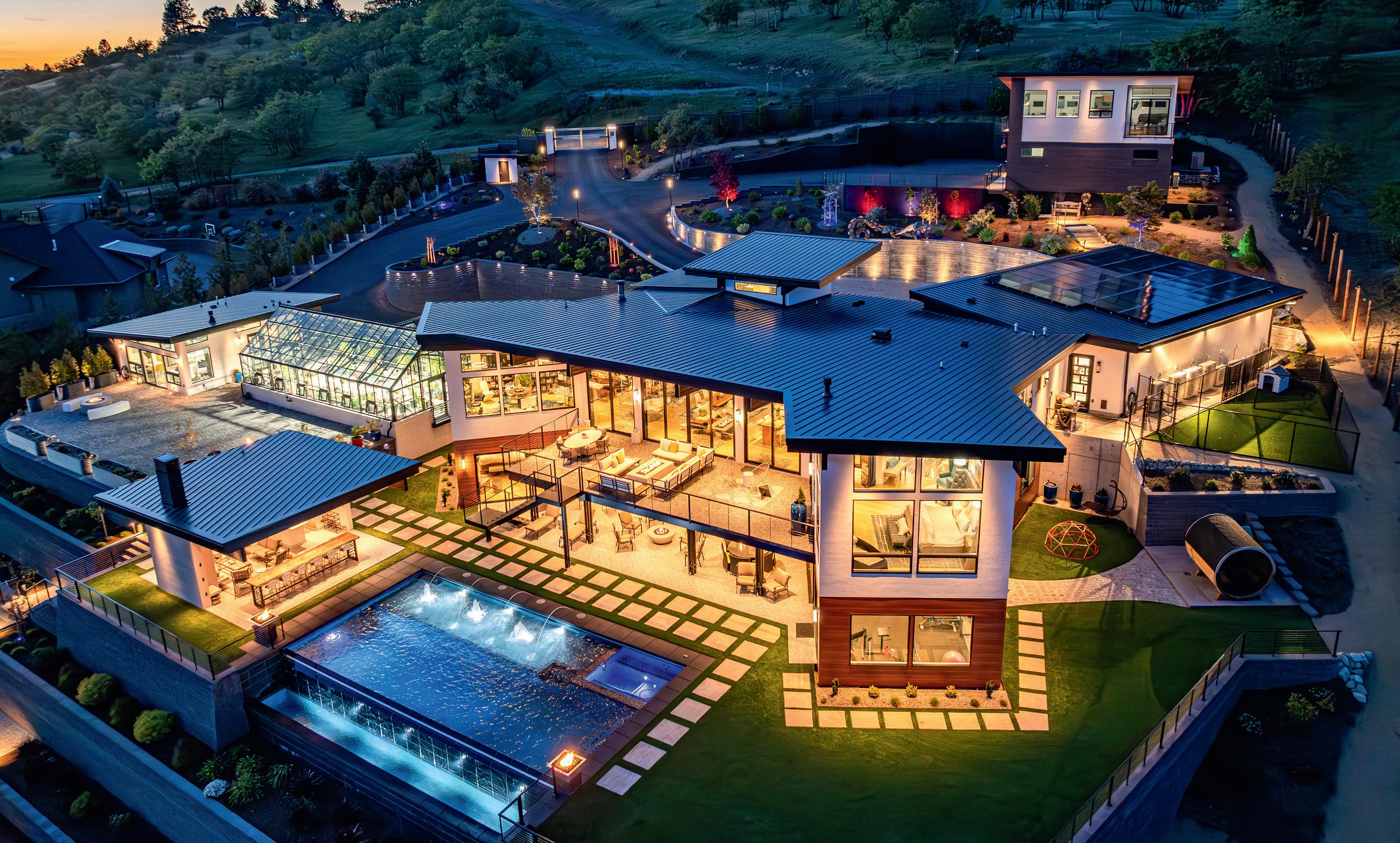
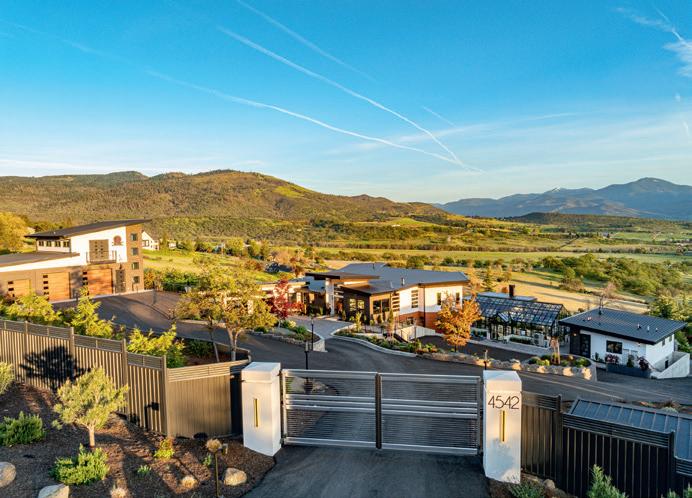
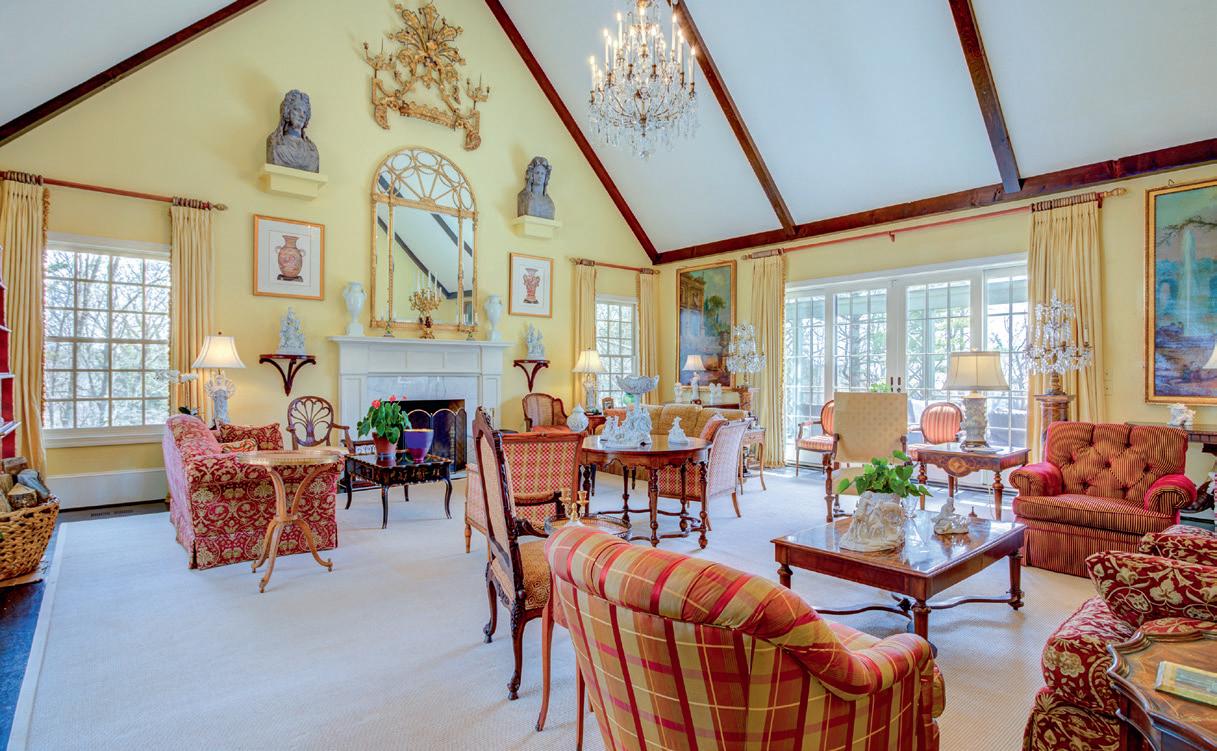
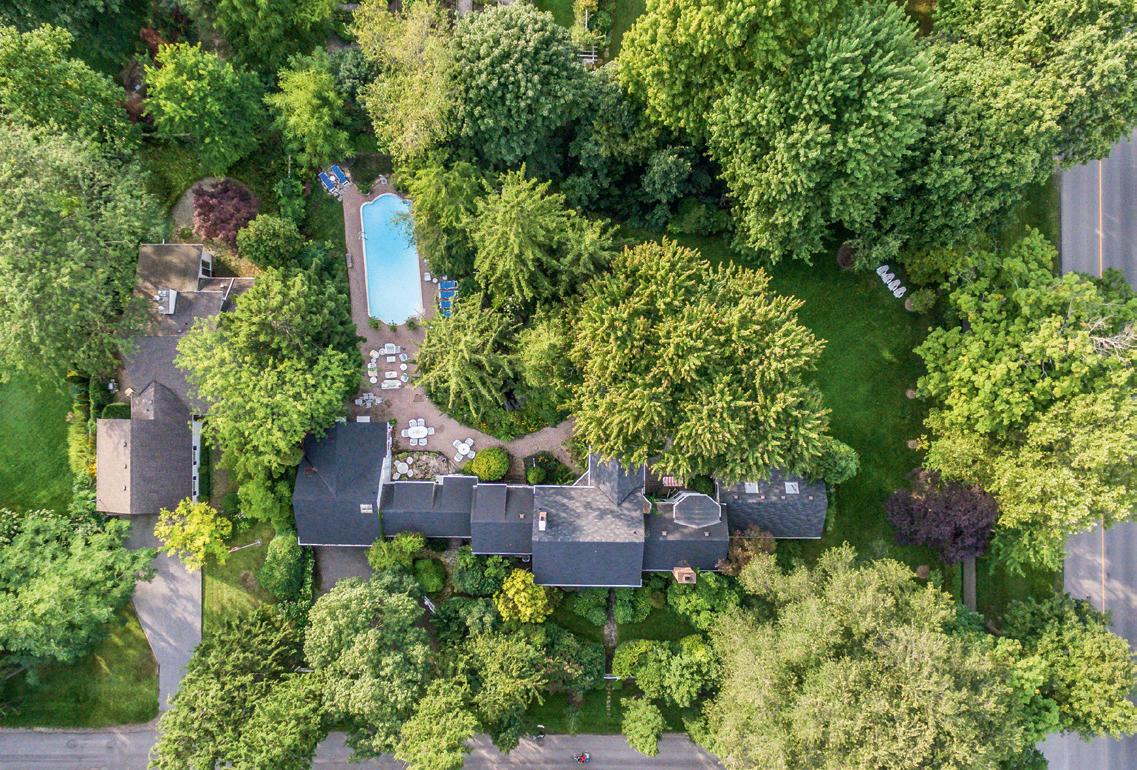
A one-of-kind California-style modern home on 2.14 acres with stunning views of the Siskiyou Mountains, Southern Oregon’s award winning vineyards/wineries, this spectacular House on a Hill features a guest house, climate-controlled arboretum\greenhouse, a twolevel climate-controlled artisan studio with 4-bays, bathroom, private parking and jaw-dropping views from two decks plus an outdoor entertainment area with pool and putting green. The main home centers on an open-plan living space with 15-foot windows that frame the view. An ample living room area focuses around a floor-toceiling, wood-burning fireplace, opposite a beautifully-appointed open kitchen with a granite island and walnut breakfast bar.
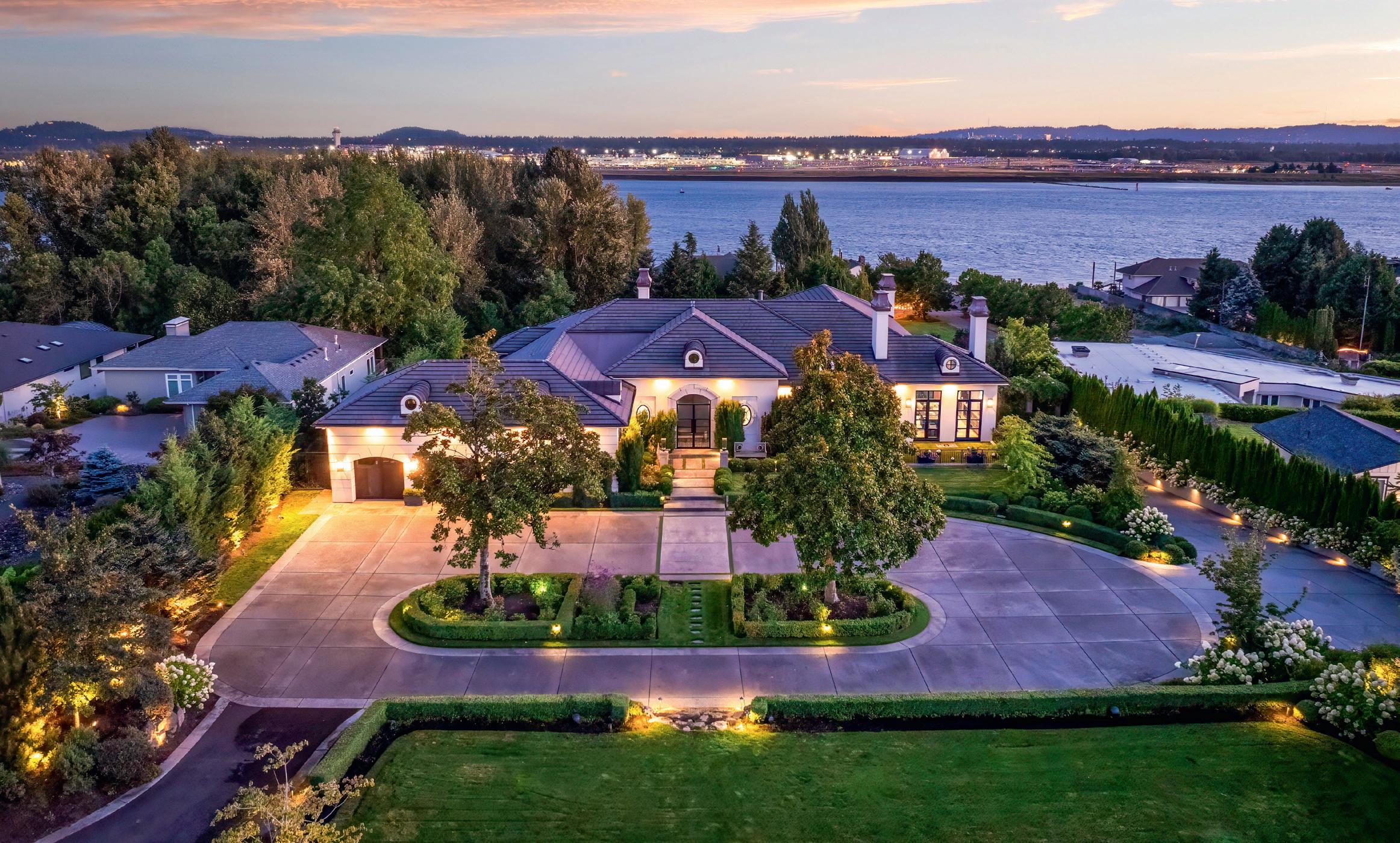
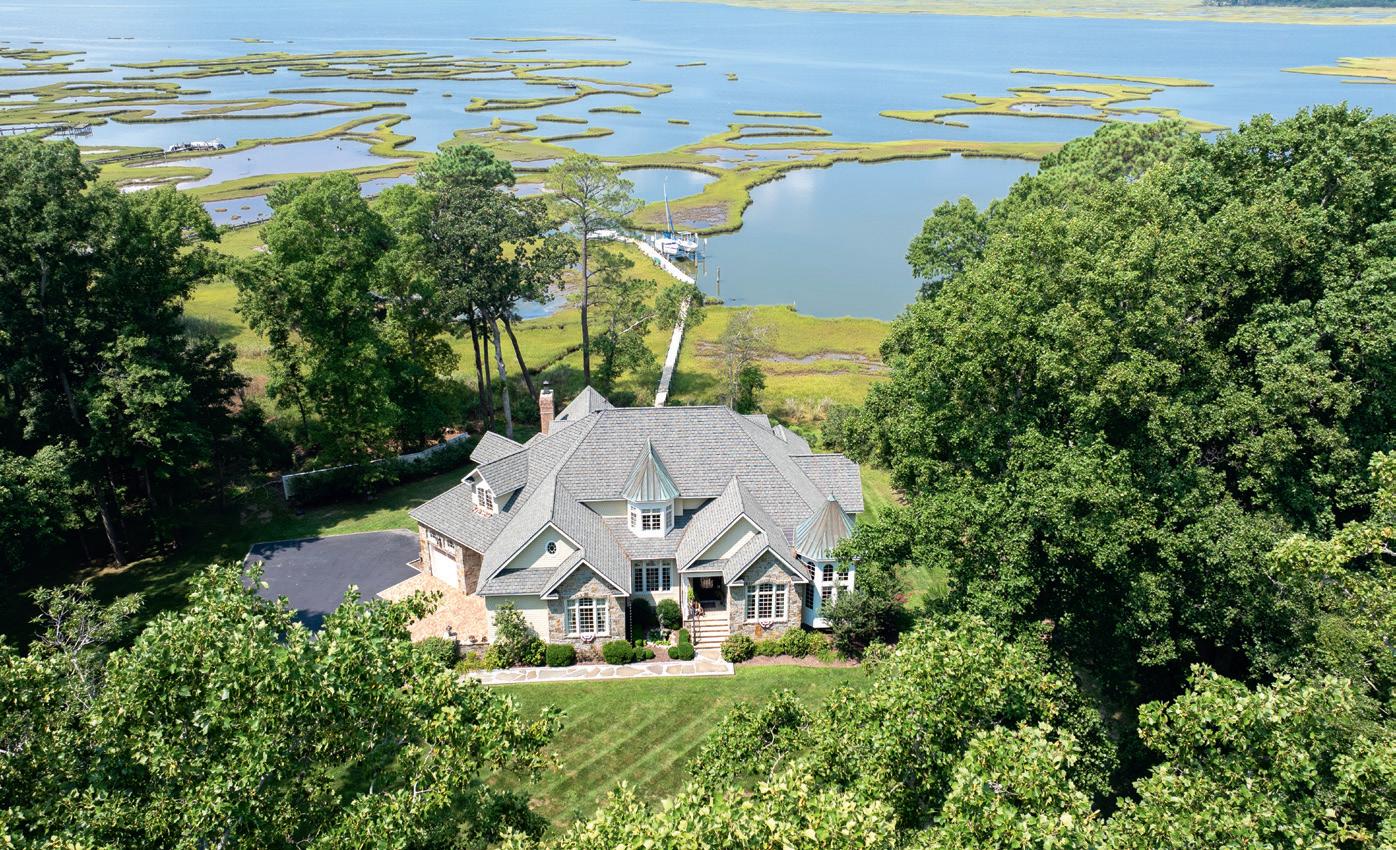
Welcome to your dream estate, a stunning 9,000+ sq ft Europeanstyle masterpiece perfectly positioned on a sprawling 1.75 acres with breathtaking views of the Columbia River along the historic Evergreen Highway in Washington State. This luxurious residence boasts five spacious bedrooms, all with ensuite opulent baths, designed to provide comfort and elegance. Only the best materials adorn the estate and the classic European design references can be noted throughout. As you enter through the private gate, you are greeted by meticulously landscaped grounds, garnished with mature olive trees and stunning white hydrangeas, setting the stage for an entertainer’s paradise.
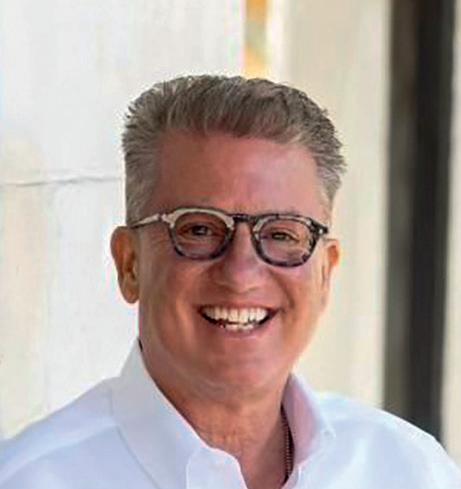
Curran Group | Compass
- AlyssaCurranHomes@gmail.com
- (801) 372 1844
EXECUTIVE BLACK HILLS RETREAT
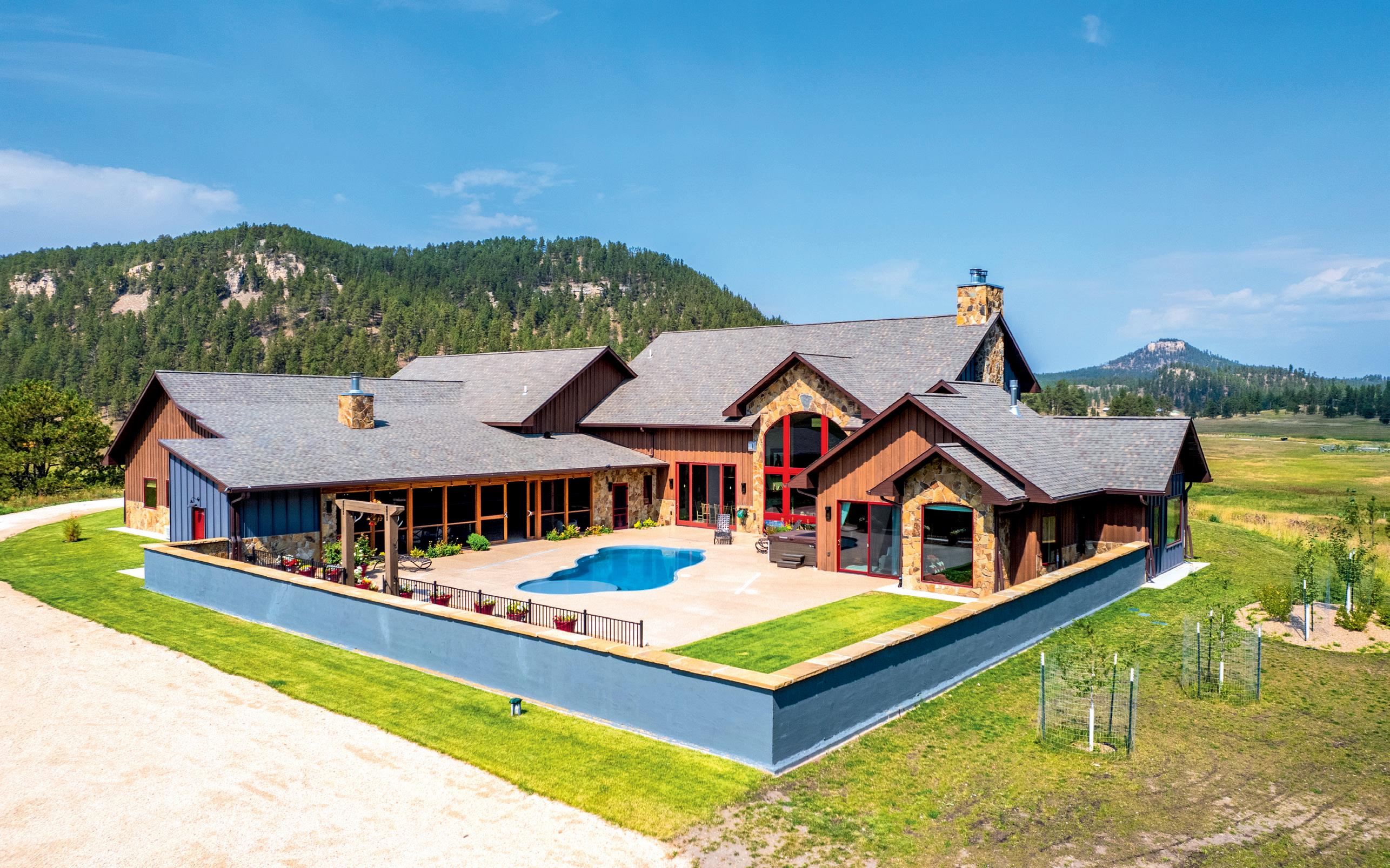
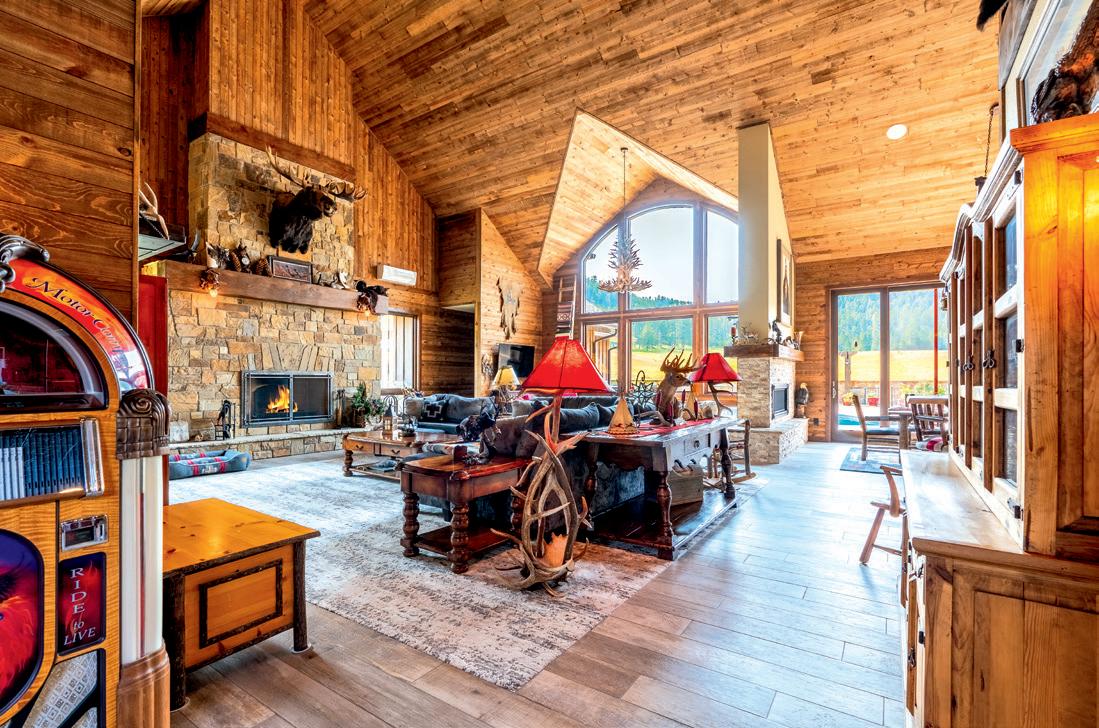
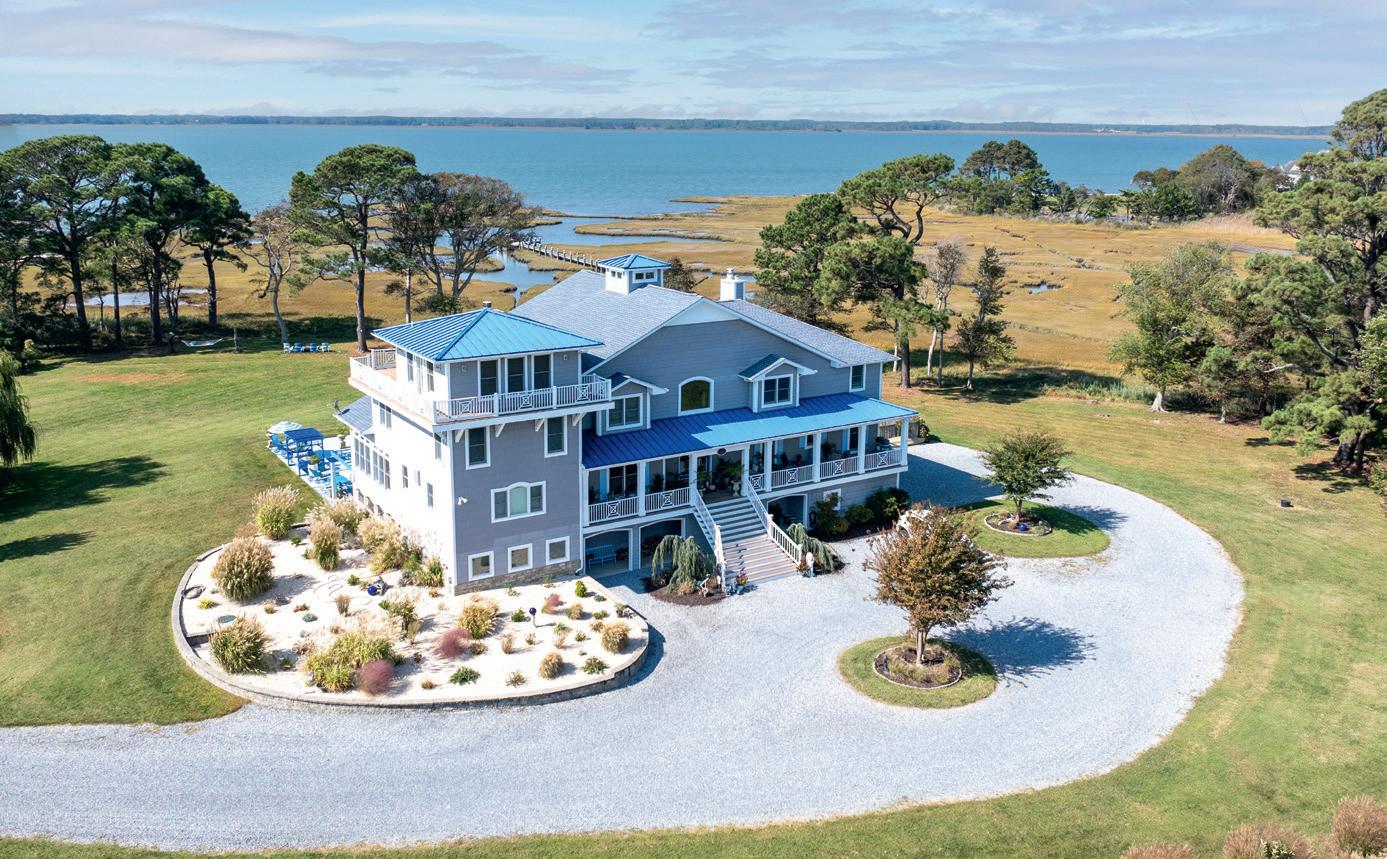
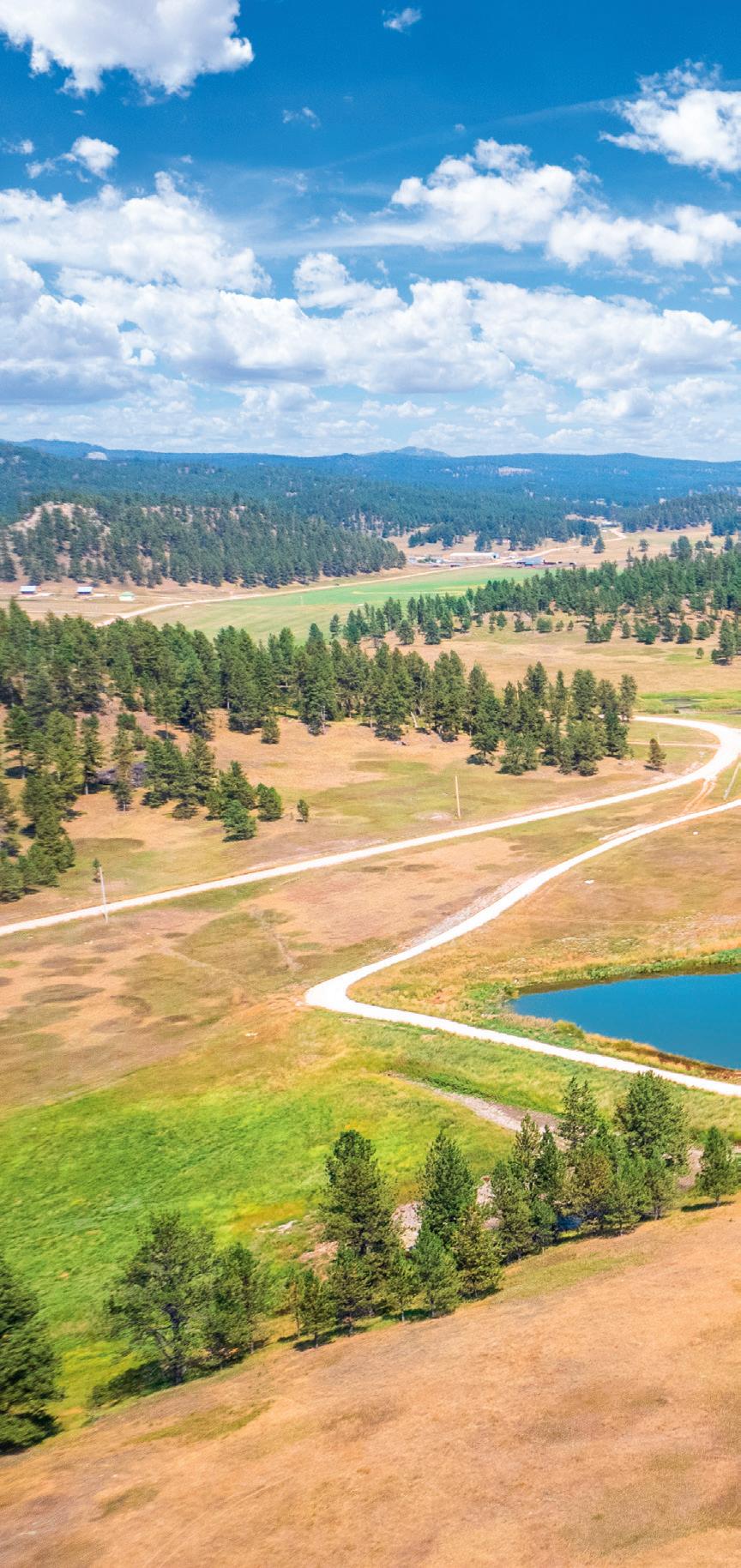
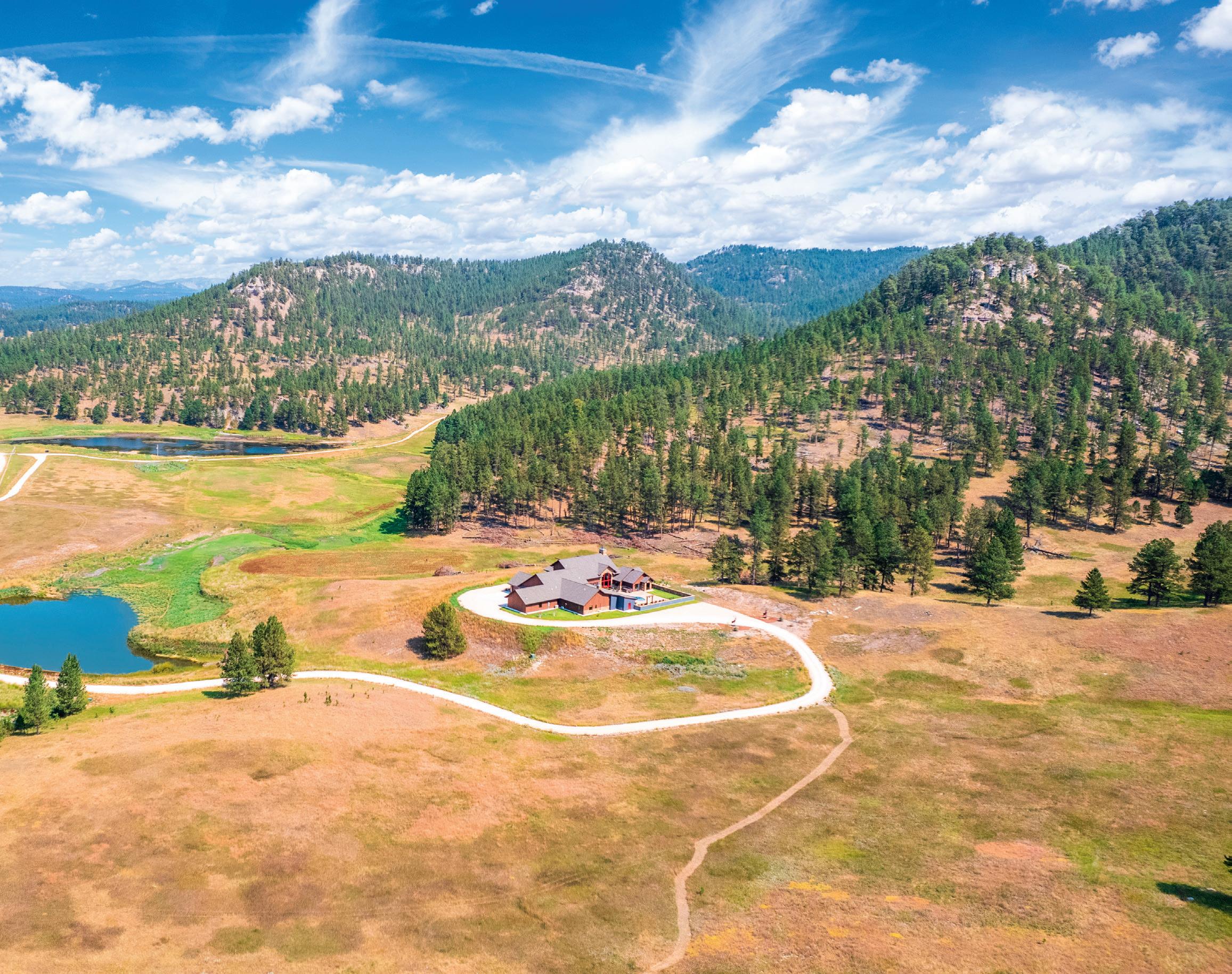
Introducing BIG SKY RANCH. A stunning 125+ acre executive retreat offered for the first time ever. This one-of-a-kind property boasts panoramic views and is bordered by miles of USFS lands for unparalleled privacy and endless recreation. At the heart of this breathtaking estate lies one of the largest seasonal spring/creek-fed private ponds in the region. This wildlife sanctuary is enhanced by frequent visits from a resident elk herd, as well as deer, coyote, turkey, pheasants, and more. The main living area features two bed, three baths, a gourmet chef’s kitchen, large pantry, and a master suite beyond compare. Explore further and you’ll find a theater room and exercise room leading to two more suites complete with their own kitchen, living area, and laundry, all connected by a shared courtyard.
EDITOR-IN-CHIEF
John Marshall
HEAD OF PRODUCTION
Peter Green
EDITORIAL
Thomas Hughes, Rachel Smith, Oliver Taylor, Shannon Berkley, Vincenzo Morello, Cheryl Jones
ART DIRECTION & DESIGN
Stormcues Limited
BUSINESS DEVELOPMENT
Steve Williams, David Warmann, Jack Moore, David Goldwin, Mike Walsh
COMMERCIAL DIRECTOR
Luke Francis
PHOTOGRAPHY
James Drake, Sarah Dean, Rick Thompson, Danielle H. LeFebvre
Executive Global Magazine is published by: Stormcues Limited
405 Kings Road Chelsea London SW10 0BB
Tel: +44(0)207 993 4782
www.executive-global.com
ADVERTISING
advertising@executive-global.com
EDITORIAL
editorial@executive-global.com
FRONT COVER FEATURE
Global Finance Leaders 26
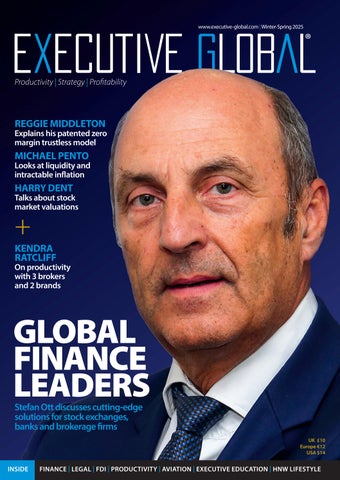
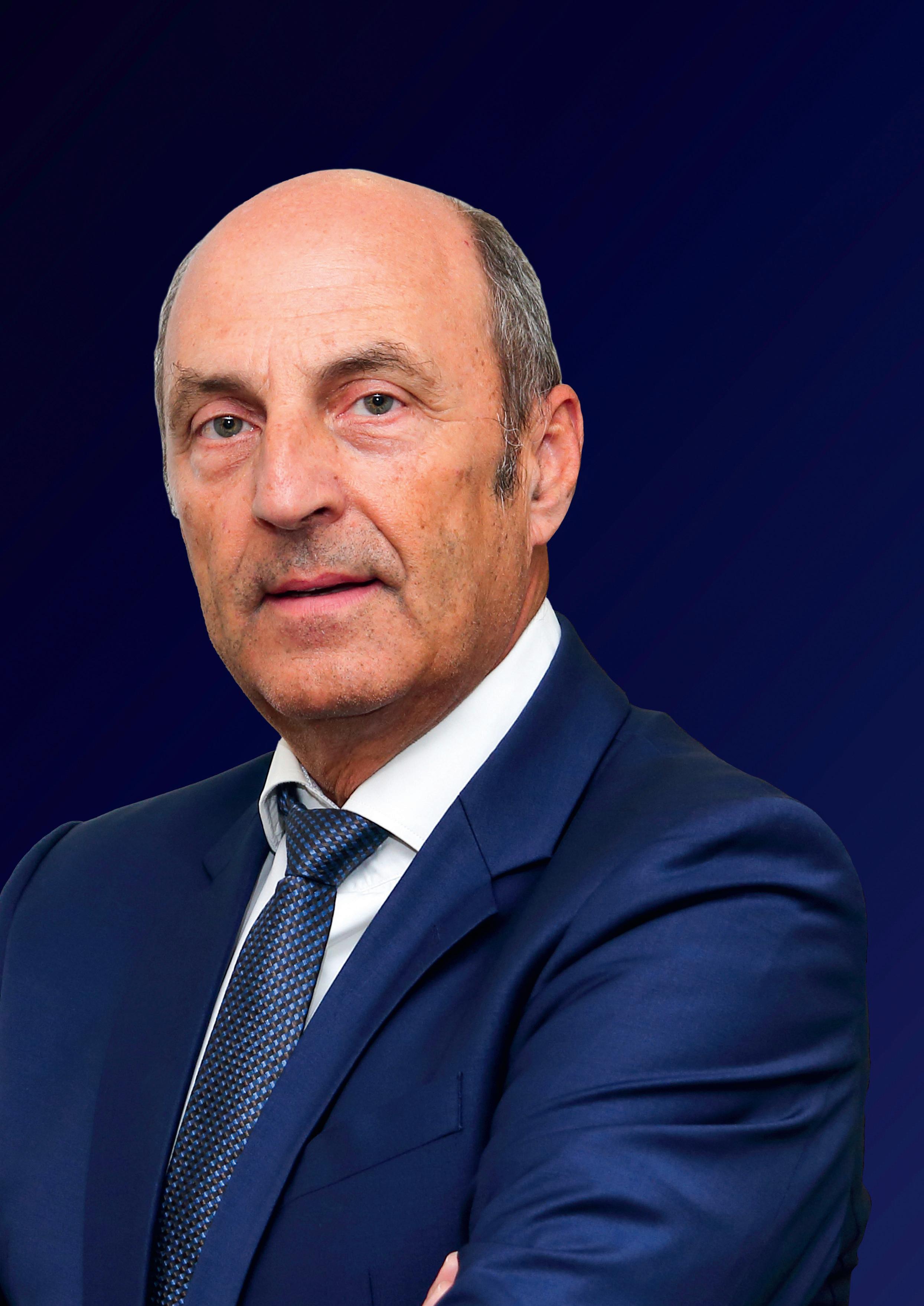
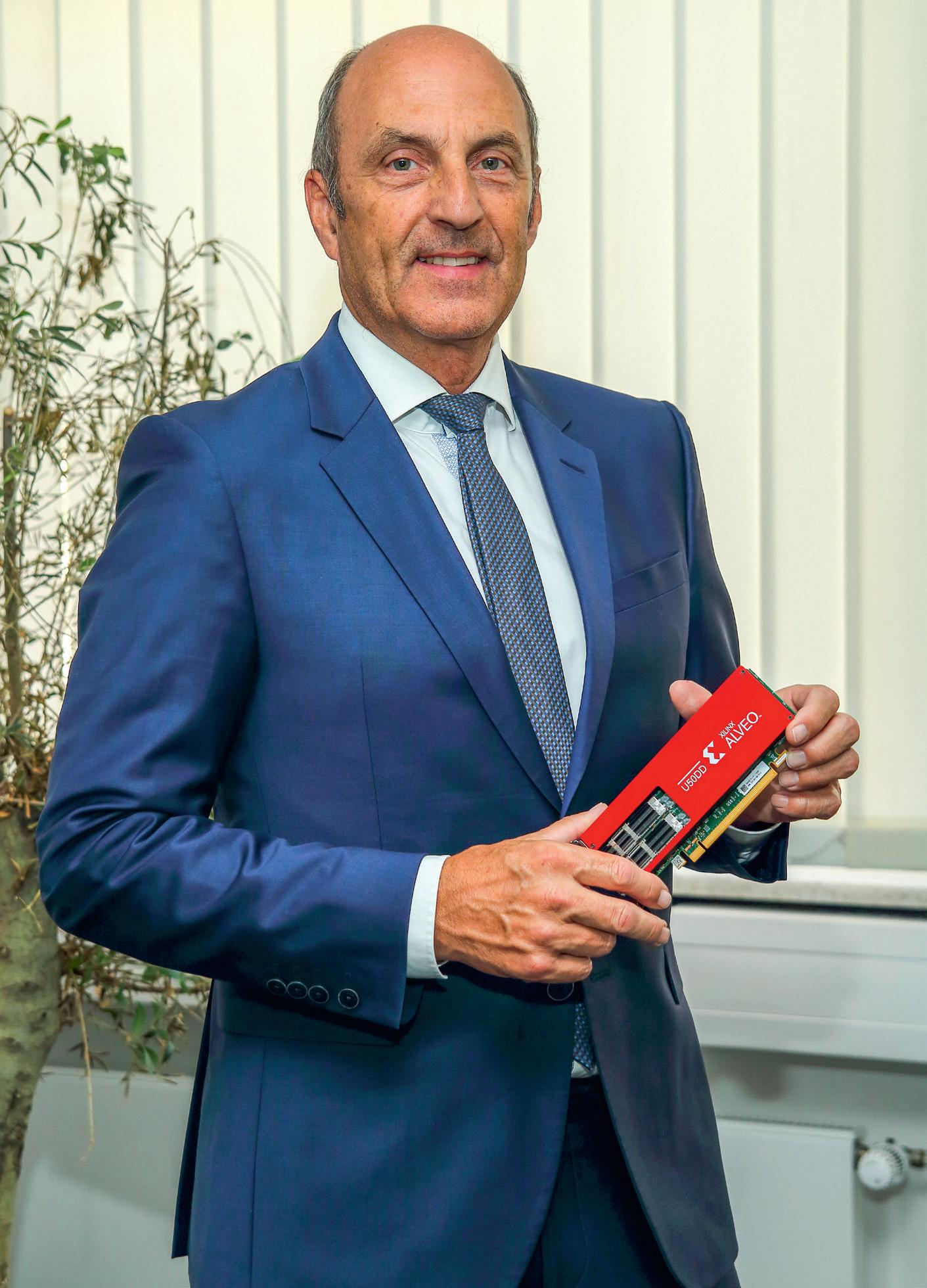
Our cover feature and CEO Profile on Global Finance Leaders features the pioneer enabling exchanges, brokerages and banks to thrive with Stefan Ott, Founder & CEO of Confinity Solutions GmbH
to $50 and beyond
David Morgan, CEO, The Morgan Report, looks at the shifting economic landscape in 2025.
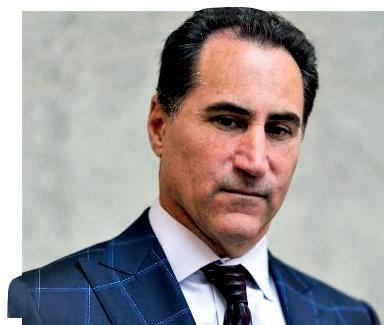
Michael Pento, CEO, Pento Portfolio Strategies, explains the current state of the U.S. economy. LEGAL & ADVOCACY Trust legislation in Mauritius
3 Brokers - 2 Brands - 1 Experience 20
Executive Global’s bespoke series of interviews on Productivity, Strategy, and Profitability. We discuss luxury real estate with Kendra Ratcliff, COO, LUXE Forbes Global Properties
FINANCE
Has the stock market peaked? 16
Harry Dent, editor, The HS Dent Forecast, returns to provide his expert macroeconomic analysis.
Gold’s rise: only the first chapters 18
Egon Von Greyerz and Matthew Piepenburg discuss macroeconomics, bonds and gold.
Cheryl Jones reports on the advantages that this jurisdiction offers to wealthy clients.
ultimate wealth destination
Abel Gomez, Gomez Tomiczek International, on what makes Panama the perfect jurisdiction.
Cheryl Jones provides a brief overview and comments on UK private equity legislation.
| 4 Bedrooms | 4.5 Bathrooms Located in Mayview, 362 Wonderland Trail is a rare find: a craftsman home on a double lot with long-range views. This 4-bed, 4.5-bath beauty boasts 5 fireplaces, a sunroom, wine cellar, 6-zone HVAC, and a 3+ car garage. There are two fenced areas for kids or pets, and entertaining options abound with English gardens and a carriage house. Bonus: a dining-to-primary bedroom conversion is ready to finish. Schedule your showing today!
FOREIGN DIRECT INVESTMENT
Business in the Brazilian economy 38
Brazil is a country rich in natural resources with a diverse industrial base. Rachel Smith reports.
Exploring Liechtenstein 40
Stefan Kremeth, co-founder, Incrementum AG reveals the hidden jewel in the heart of Europe.
The economy in Australia 42
Thomas Hughes looks at tourism and the economic environment down under.
TECHNOLOGY
The battle for financial freedom 44
Oliver Taylor looks at why Epic Cash outshines Bitcoin as a privacy solution to CBDCs.
The zero margin trustless model 46
Reggie Middleton, CEO, Veritaseum Capital, on his new world-changing patented system.
The dangers of artificial intelligence 50
Shannon Berkley presents her critique on the rapid development of AI technologies.
PRIVATE AVIATION
Air New Zealand 52
Rachel Smith reports on why the airline has become synonymous with warm hospitality.
Private jet maintenance 54
Thomas Hughes has a look at important maintenance protocols for your aircraft.
Becoming a pilot 56
Oliver Taylor reveals some of the steps you must take to acquire licenses as a pilot.
EXECUTIVE EDUCATION
EFMD programme accreditation 58
Robert Galliers, senior adviser, EFMD Quality Services, discusses excellence for institutions.
Sustainability in Copenhagen 60
What makes Copenhagen Business School’s leading Executive MBA programme thrive?
Employee wellbeing programmes 62
Mental and financial health have become considerations for companies today.
LUXURY LIFESTYLE
Luxury in high country real estate
64
Billie Rogers, Keller Williams High Country, provides insight into North Carolina’s market.
Destination Black Hills...or bust! 66
Faith Lewis, Lewis Realty, unveils the finest real estate opportunities South Dakota has to offer.
Villa Casablanca
68
Evelyne Mondou, CEO, Villa Casablanca, tells us what attracts so many VIP guests to Barbados.
Luxury living in Portugal 70
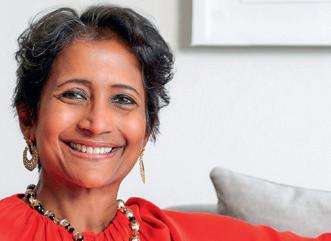
Chitra Stern, CEO, The Martinhal Family Luxury Hotels & Resorts, presents the best apartments.
Things to do in London 72
Rachel Smith gives a brief glimpse into tourism, attractions and fun events in the UK’s capital.
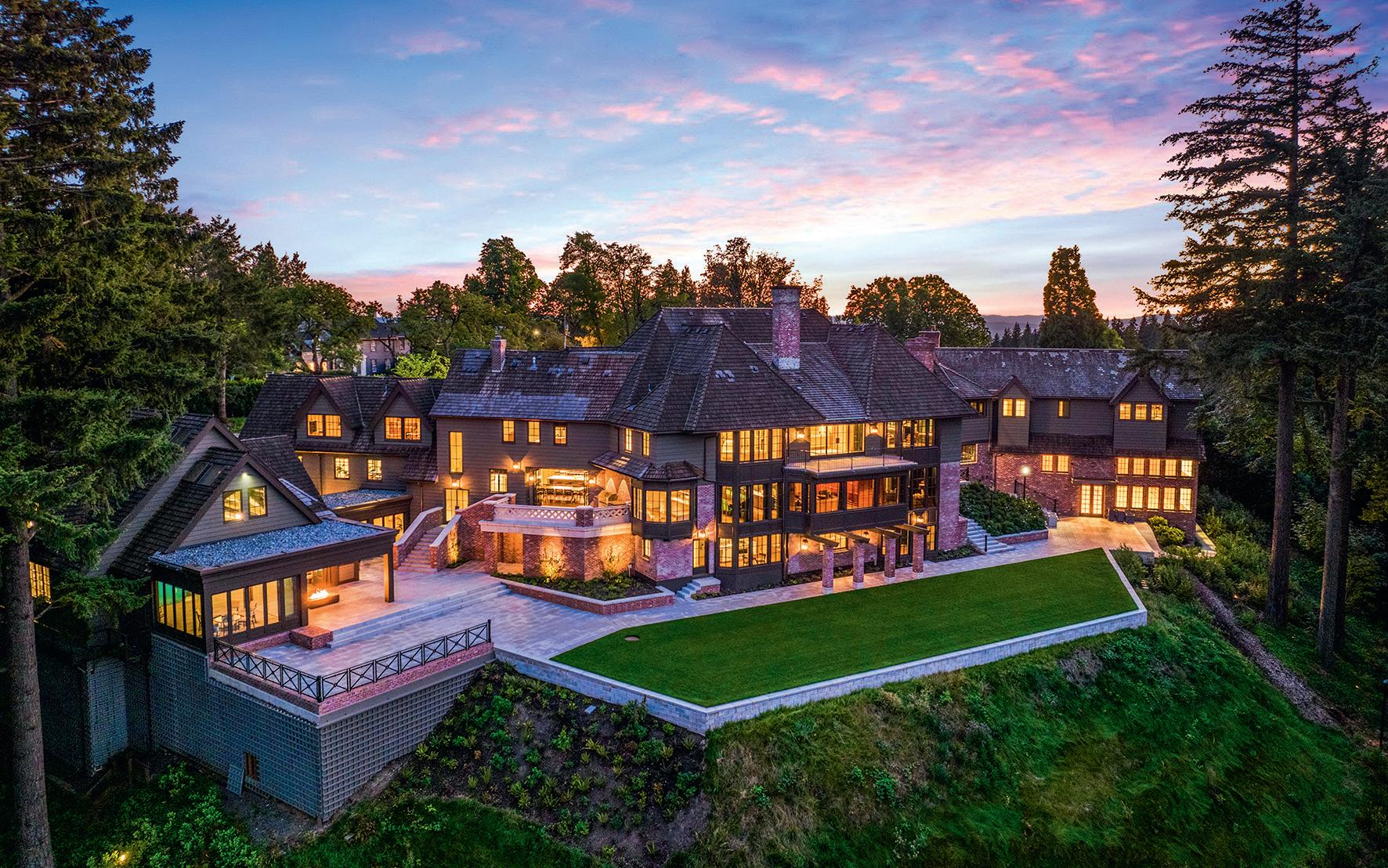
This iconic Tudor Revival estate in Portland’s West Hills has been reborn through a nearly $20 million renovation, blending historic charm with the ultimate in contemporary luxury. Originally crafted in 1930 by celebrated architect Roscoe D. Hemenway, the 25,568-squarefoot residence has been meticulously transformed by JHL Design and Green Gables Restoration with a reimagined interior seamlessly blending timeless elegance with top-of-the-line designer amenities, showcasing imported materials and handcrafted finishes. Views of the Portland Skyline and the Cascade Mountains.
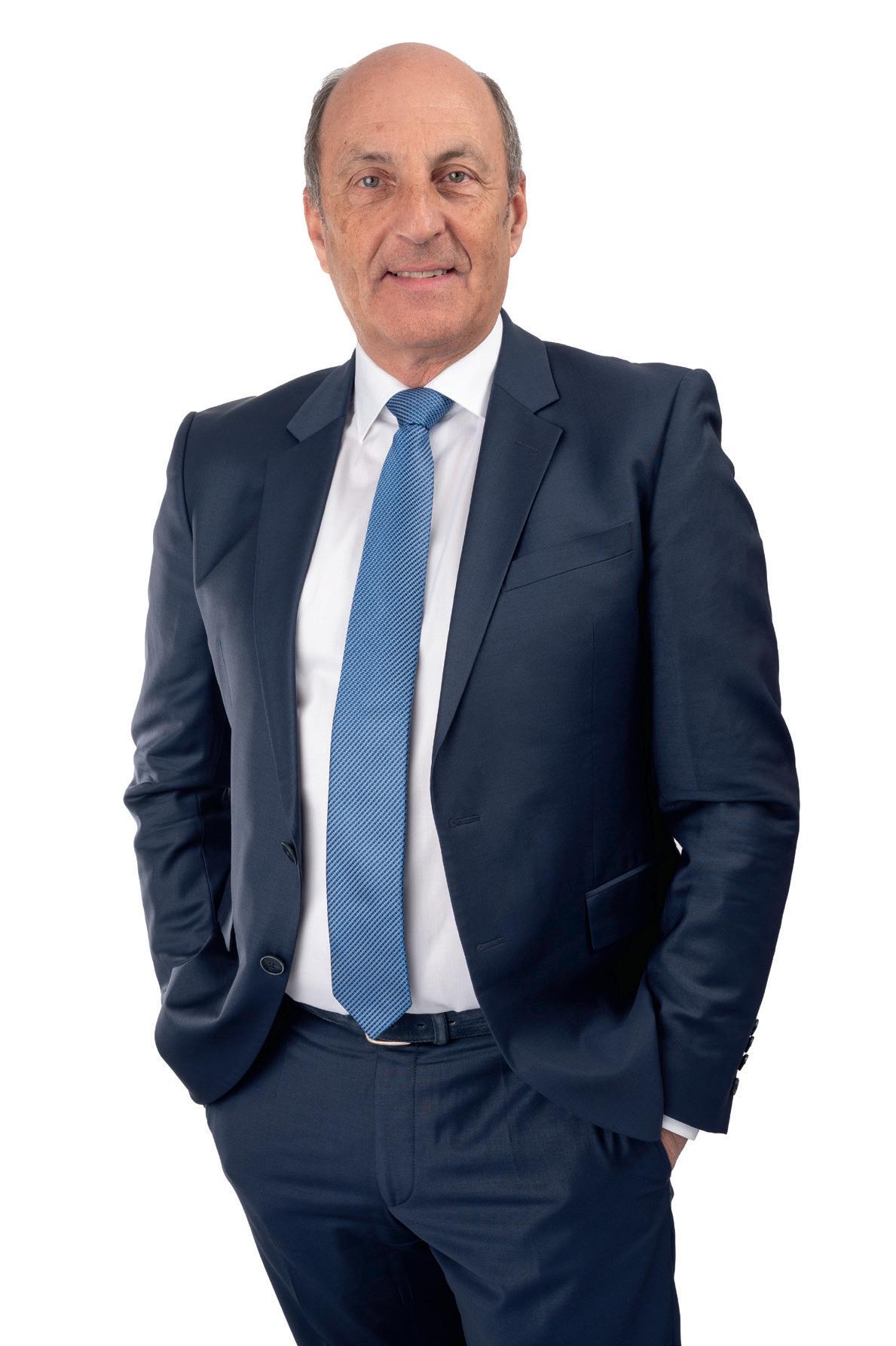
TERRY SPRAGUE CEO + Owner
LUXE | Forbes Global Properties
Web - www.TerrySprague.com
Email - Terry@luxeoregon.com
Contact - (503) 459 3987
27050 SW PETES MOUNTAIN RD, WEST LINN, OREGON 97068
Spanning 20ac in West Linn, Oregon, the Wilt Estate redefines opulence and serenity with a one-of-a-kind workshop. Bordering the scenic 15th & 16th fairways of the Oregon Golf Club, this custom-built estate seamlessly blends traditional elegance with modern amenities. Perfect for car enthusiasts, golfers, and entertainers. Highlights include a grand library, Mt. Hood views, indoor & outdoor pools, main level & upper level primary suites with dual bathrooms, plus three ensuite bedrooms. Workshop/garage/guest 16,143 sq ft.
KENDRA RATCLIFF COO
EDITOR NOTE
Foreword
E X ECUTIVE G LOB A L
Editor’s Note
Astute Bankers
Alan Greenspan is an American economist who served as 13th chairman of the Federal Reserve from 1987 to 2006. He wisely stated in his essay Gold and Economic Freedom (1966) that: “In the absence of the gold standard, there is no way to protect savings from confiscation through inflation. There is no safe store of value.” What many people may not know is that he also played saxophone with his friend- legendary jazz musician, Stan Getz, who was quoted saying to Joe Smith about his own personal struggles in 1987: “I’ve done some dastardly things, but what can I do except make amends and apologise?”
The U.S. 10 Year Treasury Note is the foundation of the world monetary system. Despite the narrative about inflation ‘cooling’, as global debt monetisation persists and interest rates are lowered, the purchasing power of currencies around the world continue in their inexorable decline. But this is merely history is repeating itself, as Ancient Rome, Greece, Weimar Germany, Hungary, China, Yugoslavia and countless other nations pursued the monetisation game, with the inevitable outcome being hyperinflation. However it is not just about numbers; hyperinflation is also about psychology. People in countries ravaged by hyperinflation begin to lose confidence in their currency and government, and this loss of confidence can spread throughout society, causing panic and social unrest. This is why the transition to an entirely digital system with no metals convertibility to instil confidence, would be a ludicrous doubling down on a failed regime. The world’s central banks are led by intelligent people who know that in the absence of a gold standard, there is no way to protect savings from inflation.
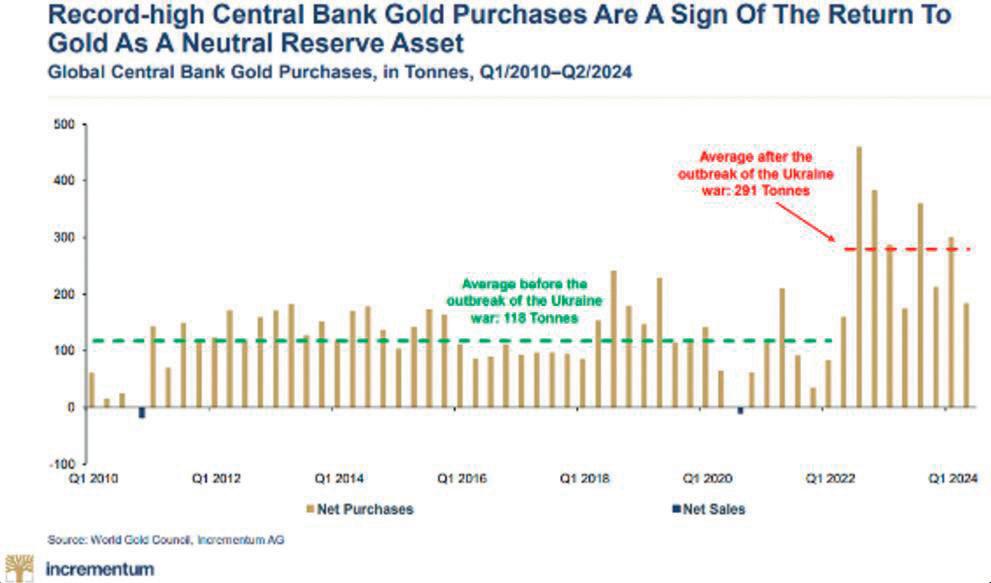
Ever since the Bank of International Settlements classification of gold as a Tier 1 asset under Basel III regulations, central banks seem to have been trying to make amends for the dastardly deeds of debt monetisation, quietly accumulating gold at the fastest rate in history, in preparation for the day of reckoning where the mathematically inevitable breakdown of the financial system, and subsequent apology becomes due on the world stage. That is- if the record $96 billion USD worth of purchases of the yellow metal by central banks in 2024, is anything to go by. This is because while Bitcoin cannot truly fix the problems that come with 54 years of the world being tethered to an unbacked fiat currency standard since President Nixon closed the gold window on 15th August, 1971…precious metals can- but only at the right valuations
To paraphrase the words of Lynette Zang,“you take all the debt that exists- use that as a proxy for all the money that exists, and divide it by all the gold that exists, and it’s somewhere north of $40,000 per ounce.” Why stop here? The figure must account for all currency in circulation since 2008. This is easier than inflating or an outright debt default, and this sentiment is also echoed by former Fed Chairman John Exeter, who commented at the Detroit Economic Club in 1966 that he had begun to accumulate gold in order to protect himself and his family.
Distinguished market trader Gregory Mannarino has constantly warned that a future implosion of the debt market hyper bubble will cause immense pressure to hit stock markets around the world, with money subsequently flooding into commodities. To draw upon the quote from the legendary Stan Getz, by central banks enabling a dramatic upwards revaluation of the gold price to $200,000+ per OZ and silver to $50,000+ per OZ as a solution aimed at settling the problems caused by unsustainable debt, they could make amends for doing some dastardly things to the economy in the past. At valuations like these, their apology may very well be accepted. From John Exeter to Alan Greenspan, productivity for executives in 2025, would entail examining the theses of these astute bankers- and taking action before mathematical inevitability occurs. EG
John Marshall
John Marshall Editor-in-Chief, Executive Global
Confinity Low Latency Messaging (CLLM) provides a distinctive solution for reliably transmitting high message volumes with sub-millisecond laatency. It is specifically designed to meet the demands of industries like financial services, where rapid, high-volume data delivery is essential for success.
& Founder
Five luxury apartments at the centre of the Belair district from 57 to 300 sq.m.
A PROJECT BY
Has The Stock Market Peaked For A Very Long Time?
My demographic cycles and research have been showing from the beginning in the early 1980s that the U.S. and North America, and Europe for that matter, would peak between late 2007 and late 2037. That is the top and plateau of the Baby Boom Spending Wave on a 46-year lag for peak consumer spending –the simplest and most powerful long-term indicator I have.
IArticle by Harry S. Dent Jr. BESTSELLING AUTHOR & EDITOR, THE HS DENT FORECAST
am continuing to assume that the top has finally occurred for the greatest, longest and only purely artificial stock boom and bubble in history. Why artificial? It has been fuelled by $27 trillion, and still growing, of fiscal and monetary stimulus since the 2008 Great Recession. That’s going on 16 years now!
Wouldn’t anyone wonder what’s wrong if it took that much stimulus for that long to grow at a moderate 2% to 3% rate? And it has been the first “everything” bubble, including real estate and the emerging hot crypto sector. Real estate did not bubble up nearly as much as stocks in the Roaring 20s, and hence, only crashed 26% - a more normal bust. Hence, we are also staring at the greatest real estate bubble and burst in modern history – past and future.
And I know some consider Bitcoin the safe haven this time…NOT! It is the lead in the crypto bubble along with AI stocks like Nvidia, Palantir and Reddit. I remind you that such early-stage bubbles are longer-term the very sign that these are indeed “The Next Big Thing.” They just have to shake-out the many marginal companies first.
So, see this as the opportunity of a lifetime, not a disaster in the making…But you do have to get out of the way! You simply cannot listen to your financial advisor with the good-old buy and hold strategy this one time!
LONG OVERDUE END TO BULL MARKET
And recall that this crytpo revolution has been financed through coins which are in essence “the cheapest IPOs” ever created in history. A brilliant new strategy! Bitcoin, and a small minority of surviving coins, will ultimately be the most attractive buy opportunity for the next boom which will not be as “everything,” nor as long in the U.S., as compared to the present super- and most extended boom of all times: late 1982 to late 2024…42 years. The up-and-coming AI sector led by stocks like Nvidia, will be the other hot sector to first crash the most and then boom strongly in the next boom from around 2028 into late 2037, when the Millennials reach their long plateau of spending from 2037 into 2054 or so.
The last, long generational boom was 1942 to 1965/72, 23 to 30 years- depending on the index. However, the broadest interpretation of that bull market from its July 1932 bottom, would have been very close to the same, 42.4 years into the end of 1972 vs. 42.2 for this one into mid-December with a double top in the broader S&P 500 into late January/mid-February, but a slightly lower high in the Nasdaq. Hence, if this is the top, it should go down as being in mid-December 2024. The Russell
2000 small cap stocks are nowhere near their highs of November 2021, which is the perfect divergence signalling such a long-term top!
Any way I look at it, this finally looks like a good time to die for this unprecedented bull market since early March 2009 in both length and height!
And good riddance from my view as I don’t consider recessions and crashes a bad thing like most. They’re as essential as day and night, waking and sleeping as I have said many times in the past! And this is clearly the most overdue time for a recess in history by far, ever. If this crash is severe, more like 1929-32, as I would most expect, then it should be a strong lesson for the future:
You don’t tell free markets what to do, otherwise they aren’t “free”, and they aren’t true markets. And having a recession when needed is part of that freedom.
We will have to see how much they try to manipulate the crash when it progresses, or better, if the economy crashes so hard and fast after being held back 16 years, that they don’t react fast enough… and it just melts down fast. Do you know any kids that are over-nurtured, and under-challenged and
Photo: Sipa US / Alamy Stock Photo
disciplined? We call them “spoiled brats.” This economy is the most spoiled it’s ever been, and the most overvalued, for the longest period… and now most of the time since the late 1990s, for about 26 years. Investors have come to assume that there won’t be major crashes or recessions in the future… a permanent plateau of prosperity, the ultimate dream economy. Irving Fisher, a leading economist in 1929, famously claimed that right near the greatest top in history back then.
CAPITALISM MUSTN’T BE CONSTRAINED
The growing paradox is: if this massive economic manipulation continues to happen, we won’t have free market capitalism anymore. And the real truth is: We haven’t had it since 2008. History will likely label this era: “when central banks tried to kill free market capitalism.” It’s not too late to turn back to the principle that has advanced our standard of living FAR more than any other period in history. It is precisely what Adam Smith in the late 1700s meant by his term “The Invisible Hand.” The central banks and governments have instead become very visible with their hand indeed! I stand nearly alone in
stating that this is NOT good policy! It violates the very essence of our success, and America’s leadership role in it.
I like Jerome Powell and think he’s one of the best Fed chairmen we have had. But his charter should NOT be to prevent recessions at all costs as they are a much-needed cleanser.
Things like busting monopolies that manage to encourage more competition, are the right type of
policies. Dictating and keeping interest rates below market rates is NOT! Bailing out major companies is not. Printing money to stimulate should not be allowed, except in short-term emergencies like a war, or even possibly in short crisis like COVID. But then it’s short term just to avoid an over-reaction and then the markets are free to wreak havoc if need be. Stimulus, especially as strong as this one with combined fiscal and monetary, should not become an ongoing policy like 2008 to 2024…17 years. The 1995-2000 bubble was a natural one, like 1925-1929, 1866-1873 and 1820-1835. 2009 to 2024 was not!
This time it’s not monopolies…it is governments propping up the economy through money printing and non-stop fiscal deficits to prevent slowdowns and recessions. And that prevents the very cleansing and “survival of the fittest” principle behind free market capitalism. Let anyone have a shot, but then quickly weed out the losers!
HOLDING
U.S. TREASURIES SHORT TERM
The freedom to take risk, and the freedom to fail and wash out the losing ventures are equally required for this powerful system to work. We can’t have one without the other, or we will just have an economy of more and more marginal or loser companies over time…A formula for Guaranteed Mediocrity! Not the unprecedented success since the late 1700s when free market capitalism met democracy led by the U.S. Democracy brings the “inclusion” and buy-into the system as it is perceived to be fair, and everyone has a vote. Capitalism is the opposite and brings innovation through fair competition. And these two opposites bring the dynamic play that men and women do. And yes, in capitalism, that means booms and busts, inflation and deflation, not “a stairway to heaven.”
Since I nor you can do anything to stop this bubble, nor its imminent burst…It’s time to get in the safest long-term securities in the world: 10-and 30-year U.S. Treasury bonds. The TLT ETF holds those bonds. They were the one investment that surged 40% in late 2008 when everything else was falling towards a bottom. They are the safe haven, not gold. Although gold will hold up much better than stocks and be amplified longer-term by the coming super boom in India for those that have that.
THE FREEDOM TO TAKE RISK, AND THE FREEDOM TO FAIL AND WASH OUT THE LOSING VENTURES ARE EQUALLY REQUIRED FOR THIS POWERFUL SYSTEM TO WORK.
People say, ‘but Harry, these are very long-term bonds’…No, we’re just holding them for the next 2–3 years in a financial crisis, not forever. And they are the largest and most liquid investment market in the world, and hence, easiest to sell in a crisis. Somewhere around mid-2028 or so, I should be advising to buy stocks again longerterm concentrating in the U.S. tech-sector (like the Nasdaq) and increasingly in India and Southeast Asia that will lead the next global boom into 2055+, like China led the last one from 1982–2024. Until then, be safe and not sorry! If we don’t see signs of a major stock crash by later this year, I may modify this very contrary forecast. EG
For further information, please visit: www.HarryDent.com
Gold’s Rise: Only The First Chapters
After four years of BIDEN somnambulism and legitimate, post-debate questions as to who was really in charge of DC post-2020, the 2025 Trump White House has certainly come in swinging.
AArticle by Egon Von Greyerz FOUNDER, VON GREYERZ GOLD
nd swinging can mean everything from homeruns to strike-outs. Executive orders have been flying off Trump’s desk from day-one, including recent tariffs on Mexico, China and Canada.Many, of course, are relieved to see decisive action and openly “America-first” policies out of DC, but we must be equally aware that when leadership comes out swinging, things can break.
For example, the IEEPA tariffs of late, all vestiges of the Carter era, are not just tariffs per se, but empower the US to weaponise (freeze, levy etc.) USTs held by foreign nations who don’t comply with US measures. Of course, we saw how this headline tactic backfired when weaponising the UST against a major power like Russia in 2022. Moscow simply got creative with China (oil, gold, trade) and other BRICS+ nations to find creative and effective ways to go around the “mighty” dollar.
TARIFF’S: TOO SOON TO TELL?
Early on, these threats and acts of tariff power from the US have nations scrambling, complying and/or complaining. Canada’s Chrystia Freeland is seeking to organise a similar “coalition of the abused” to get creative in counteracting Trump’s threats with some to-be-determined countermeasures of their own, but it seems that a Trumpterrified Trudeau is already doing his interim best to comply with Trump’s border security demands.
Article by Matthew Piepenburg PARTNER, VON GREYERZ GOLD
Meanwhile, Mexico’s leadership has been open with intentions to not bend to Trump. Others, however, can point to Columbia’s 12-hour aboutface and ultimate capitulation to Trump’s demands in January. Thus, the primary question is this: Does the Trump White House have the power to make, enforce and “win” when it comes to playing hard-ball with nations like China, Mexico, Canada et al?
RE-SHORING: NEEDED BUT EXPENSIVE
If, like me, you wish to see a re-shoring of manufacturing back to the US, then Trump’s actions make initial sense. His tariff’s may compel US-based CEO’s who have offshored labour to get their production lines back to the US and hire locally. And there’s no denying that the $200B trade deficit Canada has been enjoying, and the $300B trade deficit the BRICS have made to their advantage, is clearly upsetting a winning and “America-first” Trump.
When companies like Apple and John Deer make their American-based executives richer by firing US workers in favour of Mexican or Chinese labor, it sure feels good to stick it (tariff-wise) to the post WTO-American C-suite who have off-shored the American dream across its once tragically porous borders. But how does this play out near term?
Love or hate Trump, his America, at least for now, ain’t so great yet. Re-shoring jobs and paying
fair wages is expensive—and inflationary nearterm. This is good for gold.
LOTS OF STICKS, LOTS OF SWINGING, LOTS OF PAIN?
Does the US really have the power to speak loudly and carry a big stick against nations economically stronger than say, Columbia, Iran, Mexico, Canada or Venezuela? After all, whatever we may think of China’s fragile and debt-soaked economy, its market buys 430M smart phones vs the 140M bought per year in the US. China also produces 30M cars, whereas the US builds just 10M for the same period. China also prefers buying oil in yuan and gold-- not petrodollars.
In short, who carries the bigger stick in a protracted trade war? It’s further worth noting that tariffs, as tried in 1930 under Hoover (the Smoot Hawley Act) resulted in Hoover losing the
Photo: Queen Art / istockphoto.com
election, senators Hawley and Smoot losing their senate seats, and an already economically depressed USA losing 30% of its export levels. Will history rhyme again under Trump?
WILL AI MARKETS SAVE THE US?
For years, of course, the answer has been not to worry, as America enjoys massive AI and other tech superiority. But DeepSeek just reminded us that perhaps China, and not the US, can lead in AI as well? This is to be determined, but the question remains: If everyone is carrying a big stick, won’t everyone bleed? And then, of course, there’s the bond market…
THE BOND MARKET MATTERS
Tariffs, after all, are just another form of dollar weaponisation to many nations already tired of being the dog wagged by the dollar tail. The foreseen and unforeseen inflationary consequences of tariffs could make an already unloved UST even less internationally loved, which means less demand for the same, which means rising bond yields beyond the Fed’s immediate control. Rising yields (i.e., debt pricing), of course, are shark fins to a debt-vulnerable economy already on the verge of (and frankly in) recession, as the steepening of a previously inverted yield curve makes clear.
Recently, however, the yields on both the 2Y and the 10Y UST have been falling, which can indicate strong signs of stagnation within the US. As alarming, a narrowly led S&P has seen days of
$500B+ market cap losses on just Nvidia alone. We see how dangerously markets are flirting with a crisis on Wall Street overlapping with a mediaignored economic crisis on Main Street.
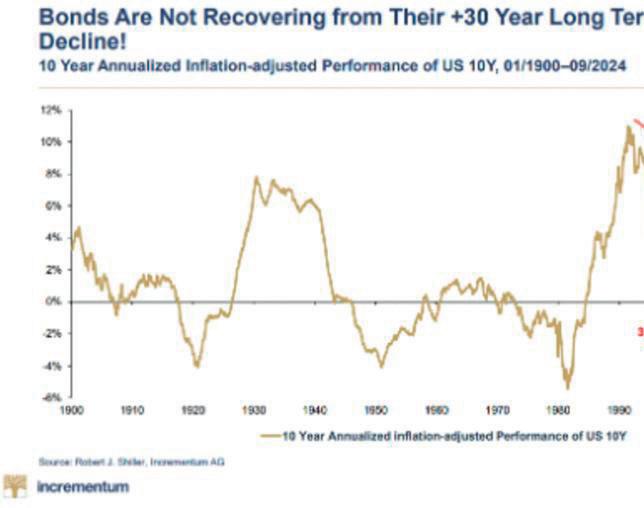
Rising yields further explain mortgage applications at lows not seen since 1995 as commercial real estate markets struggle and residential bubbles near an ‘uh-oh’ moment. As for sovereign US IOUs, on an annualised basis, they have not been able to beat inflation (which is creeping up not down) since 2020.
One has to ask: Is there true safety in the socalled 10Y UST “safe-haven.”
BANKING RISK—IGNORED BUT NOT FORGOTTEN
Meanwhile, US, European and Chinese banks flirt with clever accounting to mask horrific balance sheets as the world unknowingly drifts toward yet another media-ignored banking crisis. This is not gloom/doom data mining, but just blunt data analysis—as the recent accounting tricks at UBS make clear. As things crack and then blow up, this creates the perfect pretext for inevitable emergency liquidity from the Fed and other central banks, whose bazooka QE measures are and will be inherently inflationary and very good for gold whenever the next systemic crisis makes the headlines.
The Fed, like the Treasury Department, knows perfectly well that at some point the currency will have to be sacrificed to save the bond market. After all, the bond market is their real mandate.
NO GOOD OPTIONS LEFT
TARIFFS, AFTER ALL, ARE JUST ANOTHER FORM OF DOLLAR WEAPONISATION TO MANY NATIONS ALREADY TIRED OF BEING THE DOG WAGGED BY THE DOLLAR TAIL.
Ultimately, when faced with an unprecedented public debt crisis, Uncle Sam has three choices: 1) default on the debt; 2) discover a productivity miracle, or 3) inflate or die. Option 1 won’t happen with a money printer in the corner; option 2 can’t happen once debt to GDP crosses 100% (we are at 125%) and option 3 now just becomes a matter of time and the right headline event.
GOLD, ONCE AGAIN TO THE RESCUE
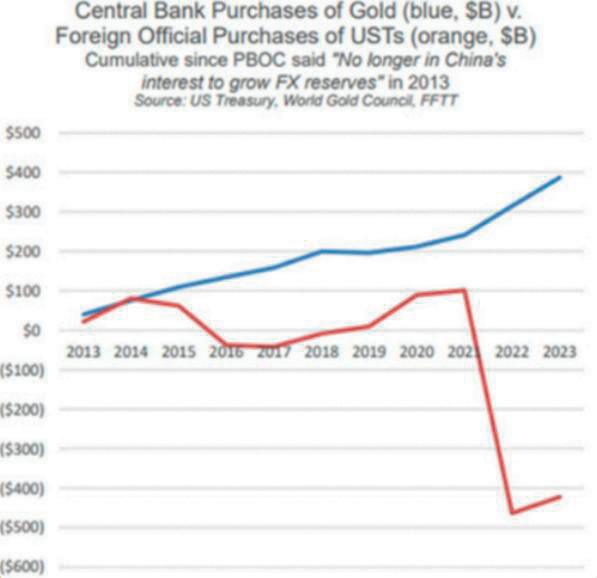
This, again, is very good for gold, which is not in a bull market—but simply reacting to a broken and debt-soaked fiat money system already in a bear market. Central banks, particularly in the East, have seen the writing on this fiat wall for years, which
explains why they have been stacking gold (blue line in Central Bank Purchases graph) at record levels while net-dumping UST’s (red line in Central Bank Purchases graph) since 2014.
The weaponisation of the USD/UST against Russia in 2022 only made this global distrust for Uncle Sam’s IOUs all the greater, which is clearly shown in the doubling of central bank gold buying since that same year.
At the same time that trust in the UST is falling, nations are simultaneously taking physical delivery of their gold off the COMEX futures exchange, as “stand for delivery” orders are dramatically replacing the once traditional roll-over process of levered paper gold. The media will say the recent gold moves from London to the COMEX are driven by tariff fears and arbitration plays between the future’s price in NY and the cash price in London. We disagree
The COMEX needs gold because the counterparties on the NY exchange are now openly exercising their “open interest” right to physical delivery of the only real money asset the world has ever known: Physical gold. This dramatic demand for real rather than paper gold is a compelling and leading indicator that gold is the most trusted strategic reserve asset for storing wealth.
SIMPLE SAFETY
Of course, we’ve known for years that this boring, analog “pet rock” was always a far safer, less centralised and more honest and historically-confirmed form of money than paper promises, centralised stable coins (CBDCs in sheep’s clothing) or vacant gold boxes at financially sick commercial banks. Nations and central banks out East, like sophisticated gold investors, understand that physical gold, held within one’s own name and outside of a centralised and crumbling banking system, is the only true protection from the debasement of fiat money, banking risk and geopolitical unrest.
Toward this end, the recent all-time-highs in gold in every major currency is neither a surprise nor a final peak. In fact, gold’s secular rise is still only in its first chapters as the last chapters of a debtdestroyed fiat money system nears its final act. EG
For further information, please visit: www.vongreyerz.gold
Von Greyerz
PRODUCTIVITY STRATEGY PROFITABILITY
LUXE | Forbes Global Properties
Oregon & Washington
3 Brokers – 2 Brands – 1 Experience
Welcome to today’s discussion, where we explore the innovative landscape of luxury real estate in the Pacific Northwest. Executive Global are delighted to be joined by three of the region’s leading brokers, whose collaborative efforts and extensive networks have transformed the experience for high-net-worth clients in this exclusive market. With distinguished backgrounds at elite firms such as Forbes Global Properties, a division of Forbes: the World’s Leading Business Media Brand and COMPASS with their World Class Technology Platform and Vision, they combine creativity and expertise to build enduring, almost familial relationships with their clients. Let’s delve into their unique collaborative approach and discover what distinguishes them in this dynamic industry.
Interview with Kendra Ratcliff
PRODUCTIVITY STRATEGY PROFITABILITY
LUXE | Forbes Global Properties
EG To begin, could you share how your collaboration within the REALM Global network enhances the services you provide to clients relocating to the Pacific Northwest?
KR Absolutely. REALM Global is an exclusive membership community that connects toptier luxury real estate professionals worldwide. By integrating advanced technology and comprehensive data, REALM enables us to offer our clients a seamless and personalised relocation experience. For instance, through REALM’s partnership with Wealth-X, we have access to detailed dossiers on high-net-worth individuals, allowing us to tailor our services to each client’s unique preferences and investment goals.
EG It sounds like REALM’s exclusivity plays a significant role in your success. How does being part of such a selective network impact your practice?
KR Being part of REALM means we’re among the top 1% of real estate professionals globally. This exclusivity fosters a high level of trust and collaboration among members, enabling us to share insights and opportunities that directly benefit our clients. It also means we adhere to the highest standards of practice, ensuring our clients receive exceptional service throughout their relocation journey.
EG In today’s luxury market, whether it’s real estate, watches, art, or automobiles, the client experience is paramount. Affluent buyers and sellers seek more than just transactions; they desire personalised, attentive service that makes them feel valued and understood. How do you ensure your clients receive this elevated level of care throughout their real estate journey?
KR In the luxury real estate market, we recognise that our clients expect more than just a transaction; they seek an experience that reflects their unique tastes and aspirations. To meet and exceed these expectations, we focus on the details and strive to stay one step ahead. While technology
BEING PART OF REALM MEANS WE’RE AMONG THE TOP 1% OF REAL ESTATE PROFESSIONALS GLOBALLY. THIS EXCLUSIVITY FOSTERS A HIGH LEVEL OF TRUST AND COLLABORATION...
PRODUCTIVITY STRATEGY PROFITABILITY
LUXE | Forbes Global Properties
BY TAKING THE TIME TO UNDERSTAND EACH CLIENT’S INDIVIDUAL PREFERENCES AND ANTICIPATING THEIR NEEDS, WE CREATE PERSONALISED EXPERIENCES ON A DEEPER LEVEL.
plays a crucial role in streamlining processes and providing data-driven insights, it’s the human touch that truly makes the difference. By taking the time to understand each client’s individual preferences and anticipating their needs, we create personalised experiences that resonate on a deeper level. This approach ensures our clients feel valued and understood throughout their real estate journey.
EG Oregon offers a diverse array of luxury real estate markets, each with unique attractions for affluent buyers. Could you highlight some of these sought-after regions and elaborate on what makes them particularly appealing?
KR Certainly. Oregon’s luxury real estate spans diverse regions, each offering unique benefits for affluent buyers. In the Willamette Valley, communities like Lake Oswego and Dunthorpe boast elegant lakefront estates amid mature
•
landscapes and upscale amenities. Portland blends urban sophistication with nature, supported by a booming high-tech sector, world-class healthcare from OHSU, and top universities. Central Oregon, centered around Bend, attracts buyers seeking modern, upscale homes with access to outdoor adventures, including skiing at Mt. Bachelor and hiking in the Cascades. Cannon Beach is best recognised for its iconic Haystack Rock and charming coastal atmosphere while Bandon takes the top spot for world-class golf courses and pristine beaches. In the Columbia Gorge, Hood River is known for its outdoor recreational opportunities, including windsurfing and hiking, while Mount Hood offers year-round mountain adventures. Eastern Oregon offers a serene, agriculture-rich setting for those desiring rustic, nature-connected living. Southern Oregon is a prime retirement haven, celebrated for its mild climate, scenic vistas, and acclaimed wine regions centrally located between San Francisco and Portland. Together, these markets empower us to offer a balanced portfolio that combines financial prudence.
EG How do the tax advantages of Vancouver, Washington, appeal to high-net-worth individuals considering relocation?
KR Vancouver, Washington, stands out as an attractive relocation destination largely because of its significant tax benefits. One of the region’s primary draws is the absence of a state income tax, which enables residents to retain a greater portion of their earnings. Additionally, Vancouver’s strategic proximity to Oregon—where there is no sales tax—creates a unique fiscal synergy. Residents can capitalise on this advantage by living in a tax-friendly environment while enjoying the benefits of nearby tax-free shopping. Moreover,
IN THE WILLAMETE VALLEY, COMMUNITIES LIKE LAKE OSWEGO AND DUNTHORPE BOAST ELEGANT LAKEFRONT ESTATES AMID MATURE LANDSCAPES AND UPSCALE AMENITIES.
Vancouver’s rapidly transforming waterfront is attracting transformative economic investments, with multi-billion-dollar redevelopment projects along the Columbia River injecting significant direct investment. This surge in waterfront development is revitalising the downtown core, creating new job opportunities and offering a vibrant mix of residential, retail, and office spaces. The combination of financial efficiency, scenic surroundings, high-quality regional amenities, and robust economic growth makes Vancouver an especially appealing choice for high-net-worth individuals aiming to optimise their financial planning without compromising on lifestyle or luxury.
EG How do top luxury real estate brokers in the Pacific Northwest collaborate across different brands to benefit high-net-worth (HNW) and ultra-high-net-worth (UHNW) clients?
KR In our ”3 Brokers, 2 Brands, 1 Experience” approach, Alyssa Curran, Terry Sprague, and Kendra Ratcliff have formed a strategic partnership across Oregon and Washington. By focusing on ‘People Process Surprise and Delight’, we seamlessly serve HNW and UHNW clients, ensuring exceptional service and access to exclusive properties across both states. This collaboration allows us to anticipate client needs, streamline processes, and consistently deliver personalised experiences that exceed expectations, fostering trust and long-term relationships. Our discussion today has underscored
how the seamless collaboration between elite global brands and distinguished brokers redefines the luxury real estate experience in the Pacific Northwest. This unique model not only amplifies market reach and enhances service quality for highnet-worth clients but also leverages the unparalleled connectivity of advanced platforms like REALM Global. In tandem, these innovations ensure that every client enjoys comprehensive exposure to exclusive properties and tailored relocation support—from navigating tax advantages in Vancouver, Washington, to exploring Oregon’s most coveted luxury markets.
They are available for confidential consultation. Their commitment is to deliver unparalleled service, ensuring that every aspect of your journey—from the initial conversation to the final handshake on a multimillion-dollar transaction—is executed with precision and care in the Pacific Northwest and beyond. EG
The Morgan Report
Silver to $50 and Beyond
2025 and the Shifting Global Economic Landscape.
AArticle by David Morgan PUBLISHER & CEO, THE MORGAN REPORT
s the new presidency begins in 2025, there is a renewed sense of optimism after a tumultuous four years that left the global economy rattled and financial systems under pressure. Amidst this backdrop, several seismic shifts in global finance are unfolding.
The implications of waning trust in the U.S. dollar, BRICS nations quietly accumulating precious metals, and a new era of silver dominance set the stage for what could be a transformative year. With silver poised to outperform gold, tech demand soaring, and mining companies on the verge of explosive growth, 2025 may well be the year the global economic landscape pivots.
Over the last decade, cracks in the global financial system have become increasingly evident, with the U.S. dollar (USD) facing mounting skepticism. This distrust has been accelerated by excessive money printing during the COVID-19 pandemic and subsequent periods of quantitative easing. While the USD remains the world’s reserve currency, its dominance is no longer assured.
BRICS nations—Brazil, Russia, India, China, and South Africa—have made it clear that they are looking to reduce their reliance on the greenback. The announcement of a potential BRICS-backed currency in 2024 was a shot across the bow for the USD. This shift has major implications for global trade and reserves, and it raises a critical question: if the world begins to de-dollarize, what comes next?
Gold and silver emerge as logical alternatives. Precious metals have historically been a hedge against currency devaluation, and with geopolitical uncertainty at an all-time high, their appeal is surging. Of course, the cryptocurrency market is another alternative to the dollar and it can play
a role as the new monetary landscape changes.
In recent years, BRICS nations have quietly ramped up their gold and silver reserves. Central banks around the globe purchased a record 1,136 tons of gold in 2022, with China and Russia leading the charge. What’s particularly striking is the emphasis on silver—a metal often overlooked compared to gold but with tremendous industrial and monetary potential
A PRECIOUS UNDERVALUED METAL
Silver is not just a hedge; it’s a critical component in the green energy revolution. BRICS nations understand this dual value and are leveraging it strategically. By amassing silver reserves, they are not only preparing for potential shifts in the global monetary system but also positioning themselves for dominance in industries like solar energy and electric vehicles. It is unlikely that the BRICS are buying silver for monetary purposes, but this does not matter because demand is demand, regardless of use.
The silver market in 2025 is strong outperforming gold year to date. At the time of writing, silver is trading at $33 per ounce, but market analysts are almost unanimously predicting a breakout to $50 and beyond. Why?
First, supply and demand dynamics have created
CONSIDER THIS: WHILE SILVER PRICES HAVE RISEN STEADILY OVER THE PAST TWO YEARS, MINING STOCK VALUATIONS HAVE LAGGED. THIS DISCREPANCY IS UNSUSTAINABLE.
a perfect storm. Global silver demand is outpacing supply, driven by a combination of industrial use and investor interest. Renewable energy projects, particularly solar panels, account for a significant portion of silver demand, with projections estimating a 20% increase in 2025 alone.
Second, the ongoing monetary instability and devaluation of fiat currencies have made silver an attractive safe haven. Unlike gold, silver offers a more accessible entry point for retail investors, further fuelling its rise.
Third, speculative activity around silver is intensifying. Hedge funds and institutional investors are taking long positions, betting on continued price increases as global economic uncertainty persists.
One of the most overlooked yet critical aspects of silver’s rise is the potential for mining companies to benefit exponentially. Junior mining companies, in particular, are positioned for explosive growth
Consider this: while silver prices have risen steadily over the past two years, mining stock valuations have lagged. This discrepancy is unsustainable. As silver approaches $50 per ounce, mining companies with substantial reserves will
Photo: AK2 / istockphoto.com
see their profit margins skyrocket. Additionally, the ongoing trend of mergers and acquisitions in the mining sector adds another layer of opportunity. Larger mining corporations are actively acquiring junior miners to secure access to untapped reserves, creating a win-win scenario for investors in the sector.
AN INDISPENSABLE ELEMENT
The Federal Reserve is caught between a rock and a hard place in 2025. Having raised interest rates aggressively in 2023 to combat inflation, the Fed now faces pressure to lower rates amidst a slowing economy. Lower interest rates, however, come with their own set of risks, particularly currency devaluation
This predicament has far-reaching implications for precious metals. Lower interest rates make nonyielding assets like silver and gold more attractive, as the opportunity cost of holding them decreases. Moreover, a weaker U.S. dollar further supports higher silver prices.
The political landscape in the United States adds another layer of complexity to the economic picture. With Donald Trump returning to the
White House in 2025, markets are bracing for a potentially dramatic shift in fiscal and trade policies.
Trump’s “America First” agenda is likely to focus on domestic manufacturing and energy independence, both of which could have significant implications for silver. Increased investment in infrastructure and renewable energy could further drive demand for silver, while potential trade tensions could create additional tailwinds for precious metals as safe-haven assets.
Silver’s industrial applications are nothing new, but the scale of demand from the tech sector is unprecedented. The rollout of 5G technology, coupled with advancements in electric vehicles, has created a surge in silver consumption.
In the retail space, silver jewellery remains highly sought after, particularly in markets like India and China. On the tech side, silver’s unmatched conductivity makes it indispensable in electronics, from smartphones to semiconductors.
This dual demand from industrial and retail sectors is a key reason why silver is expected to outperform gold in 2025. While gold serves primarily as a monetary asset, silver’s industrial utility gives it a unique edge in a world increasingly
driven by technology.
Gold has long been considered the king of precious metals, but 2025 might just be the year silver takes the crown. Here’s why:
1. Affordability: Silver is far more accessible than gold, making it an attractive option for retail investors.
2. Higher Upside Potential: Silver is historically more volatile than gold, which means its price movements—both up and down—are more dramatic. With the current bullish sentiment, silver’s potential for gains far exceeds that of gold.
3. Industrial Demand: As mentioned earlier, silver’s industrial applications give it a dual-purpose value that gold simply cannot match.
The U.S. Treasury’s reliance on issuing debt to finance government spending is another factor contributing to currency devaluation. As the debtto-GDP ratio climbs to unsustainable levels, the likelihood of further devaluation increases.
This scenario is bullish for silver. A weaker dollar makes silver more affordable for international buyers, boosting demand. Furthermore, as investors lose confidence in fiat currencies, silver’s role as a store of value becomes even more critical.
As the Federal Reserve moves toward lower interest rates, the implications for silver are profound. Historically, lower interest rates have been a catalyst for higher precious metal prices. This is because lower rates reduce the opportunity cost of holding non-yielding assets like silver.
SILVER EMERGING AS A CLEAR WINNER
Additionally, lower rates often coincide with higher inflation, creating a double benefit for silver. Not only does it act as an inflation hedge, but its price also tends to rise in environments where real interest rates are negative.
So, where does all of this leave silver by the end of 2025?
Most analysts agree that $50 per ounce is not just achievable. Some are even calling for prices as high as $70 per ounce, depending on how global economic conditions evolve.
The key drivers will be:
· Continued industrial demand from sectors like renewable energy and technology.
· Increased investment demand as geopolitical uncertainty and currency devaluation persist.
· Supply constraints , as silver production struggles to keep up with demand.
If you are thinking it would have been nice to have bought silver when is was $5.00 per ounce, there is a way to do so. Invest in the silver mining sector at the present time and you have essentially accomplished that goal
In summary, 2025 is shaping up to be a pivotal year for silver. As the world grapples with economic uncertainty, shifting monetary policies, and the rise of new global powers, silver is emerging as a clear winner. Whether you’re an investor, a consumer, or simply an observer of global markets, the message is clear: keep an eye on silver—it’s going places EG
For further information, please visit: www.TheMorganReport.com
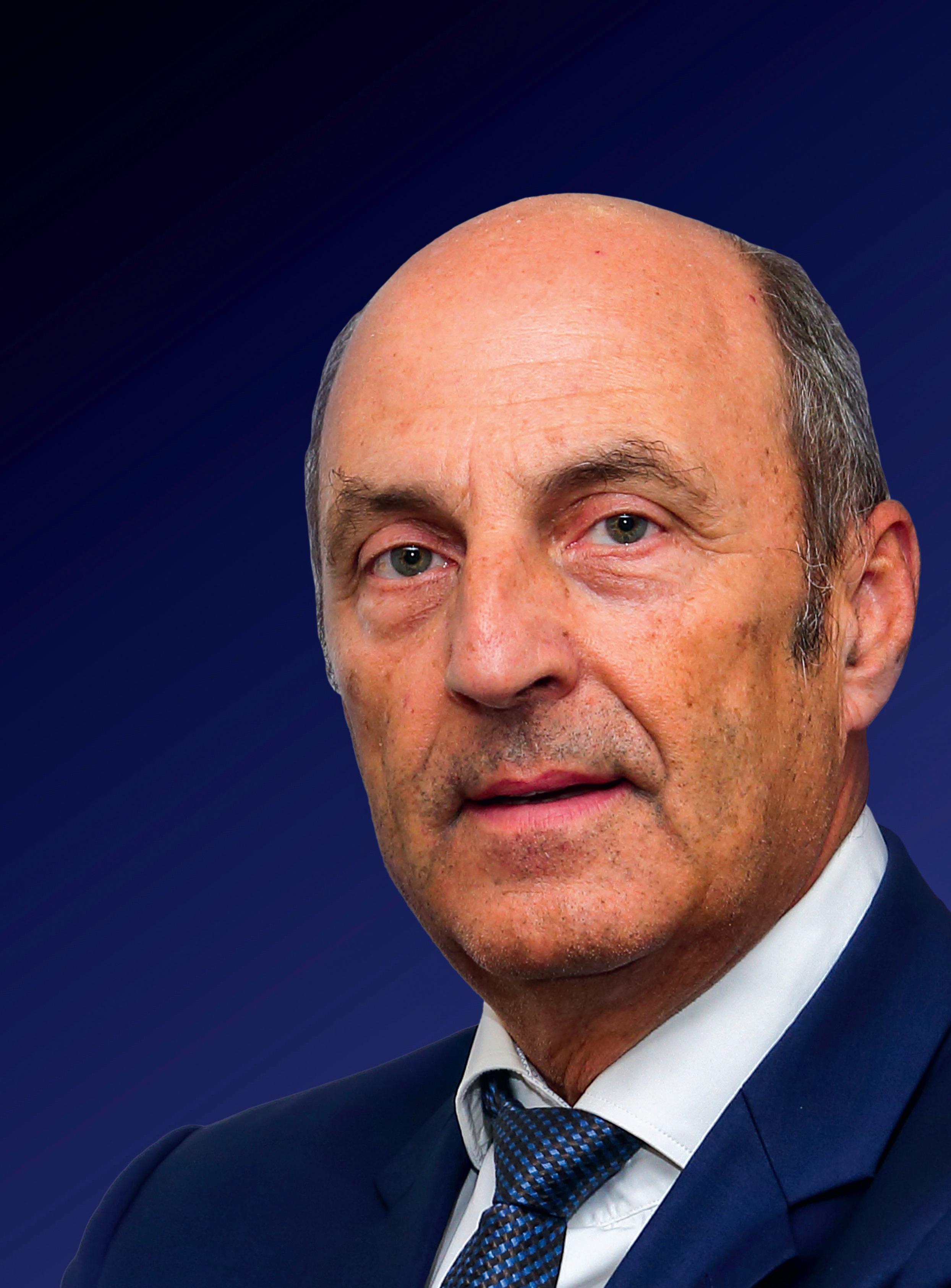
Stefan Ott
CEO,
GLOBAL FINANCE LEADERS
Our special interview on Global Finance Leaders with STEFAN OTT, Founder & CEO of Confinity Solutions GmbH, features the pioneer who is enabling exchanges, brokerages and banks to thrive in a competitive landscape with cutting-edge solutions. Executive Global discusses what it takes to lead technological innovation for affluent institutional and private clients.
EG Confinity Solutions counts highly reputable stock exchanges and brokerages like Deutsche Borse Group, Mumbai/ Bombay Stock Exchange (BSE), IG Group, Shanghai Stock Exchange, Taiwan Future Exchange (TAIFEX) and Bolsa Mexicana amongst its clients. What is it that they find with your cutting-edge technology that they cannot find with competitors?
SO I started my working life at a stock exchange myself. At the time there was still a traditional trading floor with so called open outcry system in most of the trading venues. Several “market makers”
with responsibilities for a specific set of instruments were shouting out bid and ask prices to people (traders) gathered around them, all in one and the same room. The only electronic support given to them were the huge display boards and monitor screens showing the latest quotes and trades. One example would be the white on black boards from the trading floor of the Frankfurt stock Exchange with the DAX chart showing the intraday price curve of the German Share Index (DAX). The DAX display board (built from bus number plates) was one of my first IT projects and it is still working and showing on public television today.
I started my working life at a
CEOPROFILE
Stefan Ott
Founder & CEO, Confinity Solutions GmbH
Electronic trading is at the forefront of leading edge technology and my customers are demanding better solutions every time.
CV STEFAN OTT
BORN
Wiesbaden, Germany
ALMA MATER
TU Darmstadt and Frankfurt University EXPERIENCE
2010-2015 IBM Deutschland GmbH, worldwide sales and business development for financial markets software including Websphere Front Office, MQ LLM (Low Latency Messaging) products and financial markets framework offerings.
1995-2009 ThomsonReuters, formerly Reuters Global Head of Common Platform for Content Management. London based with 25 staff onshore, 60 staff offshore, £12M budget per annum.
1988-1994 Deutsch Borse AG, Frankfurt, Head of Marketing Info Systems. Responsibility for TPF, pcKISS, BIFOS.
EXECUTIVE RECOMMENDATIONS
» PRODUCTIVITY
Focus on the most important aspects of your business (software design, product creation) and keep it in house.
» STRATEGY
Be global, act local.
» PROFITABILITY
The benefit of a small company is agility, which helps to react much more quickly.
And while the gesturing and shouting of the people on the trading floor was fascinating, one was wondering ‘how could this be transferred into the digital age?’ It took around 15 more years and some smart scientists in an IBM Research Center to come up with a solution. A “reliable multicast messaging solution” which was incredibly fast and able to transport high volumes of data. As the nature of communication on the trading floor was “one to many” the IBM solution also supported the “one to many” principle with the additional feature to retransmit if anyone of the recipients missed a message- and this with a latency of microseconds.
Subsequently, our purpose built “Low Latency Messaging” Solutions (LLM) enabled computerised, high frequency trading as well as tier 1 and tier 2 exchanges around the world.
In 2016, I took the decision to buy out the software from IBM and founded my own company, focusing on CONsulting around FINancial IT “CONFINITY”. Since then we have been supporting Confinity-LLM (CLLM) customers around the world, such as the aforementioned stock exchanges, brokers and other financial institutions.
EG What impact has your multinational team hailing from diverse corners of the world, had on your capacity to better serve clients, and what has this taught you about the importance of quality customer service?
SO My team is a key to the success of our company. Given that we are still a small (startup-like) company, each individual has an important role and makes a significant contribution on a daily basis. Our customers are from different geographies with different cultures, different mentalities and different languages. Therefore, we have to act globally, yet we want to be as local to our customers as possible. “ACT GLOBAL, BE LOCAL” is one of my mottos and being able to communicate with our customers in their local languages (eg. Mandarin, Hindi, Spanish, German etc.) makes a difference to them.
EG What are some of the measures companies can take to be more resilient to cyberattacks in 2025 and beyond?
SO In general, and this is particularly true for electronic trading – you always have to be one step ahead, a bit faster or quicker- and generally better than the other. And while regulations like DORA (digital operational resiliency act) are now being enforced in financial institutions and my customers
have to adopt and adhere to this, it can only help individuals to be better prepared and perhaps mitigate the damage resulting from a cyberattack. It cannot ultimately prevent them, but can reduce the likelihood and chances that they occur.
However, one has to think further and look at potential cyberthreats today. For example, with quantum computing being on the horizon and the first quantum (consumer) machines in the pipeline already, one has to anticipate what will happen when access encryption (eg. logins/passwords) or files encrypted with AES-256 or RSA-4096 for instance, can be hacked in a matter of seconds. There are examples, where organisations are buying large sets of encrypted data records today (eg. personal medical records), knowing that they will be able to make use of them in a few years’ time with quantum technology. So it is better to be prepared for the future and encrypt with postquantum cryptography now.
EG Being an award-winning entrepreneur, what would you say are the most commonly identifiable traits in fintech businesses that succeed, and why?
SO In December 2024, I had the honour to receive the prestigious Fortuna award as the “Entrepreneur of the year for Automotives sector, Germany” (https://forttuna.co/business-leadersedition/). Two years before this, we received recognition for outstanding support and service engagements from the HIPE Award. (https://hipeaward.com/). First, we listen to our customers- to what they have in mind, what their future requirements might be and which concerns and challenges they may have. (An old Chinese saying goes: ‘you have two ears but only one mouth, hence you should listen twice as much as you talk’). And then we can respond to their feedback and input, whatever it might be. Unlike large organisations with a lot of people, hierarchies and bureaucracy, we can act and react far more quickly to their needs and market trends, and so on. Whereas these large organisations can be compared to a big container ship, and it takes them a lot of time to change course, we are a nimble speedboat and can adapt to changing market needs and customer requirements much faster.
EG Confinity Solutions also has use cases for urban mobility. How is Confinity Low Latency Messaging (CLLM) enabling clients to navigate a safer, smarter and better-connected future?
CEOPROFILE
Stefan Ott Founder & CEO, Confinity Solutions GmbH
ABOUT CONFINITY SOLUTIONS
Confinity Solutions is a fintech startup with mature products and an established global customer base for its low-latency messaging and market data distribution products, which it bought out from IBM in 2016. Confinity Solutions bought the software offerings IBM WebSphere MQ Low Latency Messaging and IBM WebSphere Front Office for Financial Markets. Confinity Solutions’ successor product Low Latency Messaging (LLM), is designed for the high performance messaging market space that is characterised by exceptionally high message volumes combined with sub-millisecond latency requirements. The current version of LLM is designed primarily for the messaging requirements of the front-office of financial institutions. Confinity Solutions Market Data Solution for Financial Markets is a robust market data platform providing ultra-low latency connectivity to exchanges, consolidated data feeds, and electronic markets.
ACCOMPLISHMENTS
» Acquisition of Low Latency Software from IBM
» Vendor neutral market datasystem (IMDS), IBM
» Reuters Content Management platform
» Display board for German Share Index (DAX)
» Market data dissemination system (pcKISS)
SO Initially our messaging solution named CLLM was developed for the financial services industry, predominantly for use by stock exchanges, and it has been used in this industry for more than a decade now. However, I’m certain there are other industries with similar use cases (requiring ‘one-to-many communication’ in a highly reliable manner). The automotive industry has been one of these instances.
Take for example the autonomous driving of vehicles. Until today, the approach has been to
install cameras in the car, which all try to ‘mimic’ the human eye by reading traffic signals, or other traffic IoT components. Here our CLLM solution can revolutionise the way the Inter-Car and Carto-Traffic-IoT communication works today. Think of a traffic signal sending out a digital message via CLLM, informing the cars in front of it: ‘I’m red for 15 seconds, I’m red for 14 seconds, I’m red for 13 seconds….’ And the other vehicles would reliably acknowledge receipt of this information back to the sender, such as with a traffic signal.
Similarly, a vehicle which has to brake behind a hill or corner (and is invisible to other vehicles approaching from behind), could send our digital information that the car is ‘currently braking, or has come to a full stop’. Neither camera, nor human eye may catch a glimpse of the braking lights around the corner early enough. In instances such as these, our CLLM solution could significantly contribute to safety in urban mobility.
EG You also have a Masters Degree in Computer Science. What are some of the ways in which your rigorous academic training helped prepare you to emerge as a successful fintech leader at the forefront of the industry today?
SO When I started my studies in Computer Science in 1981 it was a very new subject altogether. A lot of students thought this was all only about programming and writing software code, but it was very different from this. Yes, I learned programming languages like Cobol, Fortran, C and Assembler, but most importantly gained analytical skills such as how to approach problem solving methodologies and with this, accumulating expertise in finding ways to create solutions to complex problems. Electronic trading is at the forefront of leading edge technology and my customers are demanding better solutions every time The ‘race to zero’ latency in electronic trading is still on. And remember, if I’m able to carve out a few nanoseconds here or there, I will hit the stock exchange’s matching engine first and get the trade. The winner takes it all! EG
For further information, please visit: www.confinity-solutions.com
ABOUT STEFAN OTT
Stefan Ott is the Founder and Managing Director of Confinity Solutions. After completing his master’s degree in computer science, his professional journey began at a stock exchange and later led him to Reuters, where he spent 15 years taking on various roles, eventually assuming global responsibilities, including the role of Global Head of Content Management Platforms. He has dedicated his entire career to serving clients in the global financial markets ever since.
Pento Portfolio Strategies
Don’t Let Your Retirement Nest Egg Go Down With The Ship
The Mag-7 stocks have soared to an unprecedented 35% of the S&P 500. The significant increase is attributed to the expectation that major technology companies must invest billions to maintain and operate the most advanced artificial intelligence (AI) models. However, this theory was tested recently, resulting in a significant selloff in AI stocks.
Article by Michael Pento CEO, PENTO PORTFOLIO STRATEGIES
Companies like NVIDIA, Alphabet’s AI division, Microsoft, and smaller firms like C3.ai dropped due to fears that a Chinese hedge fund created a more efficient model.
DeepSeek, created by a Chinese hedge fund, challenged the notion that AI needs massive investment, and tech Investors panicked, sending the NASDAQ plunging by 3%. DeepSeek was funded by a 6 million dollar investment by Chinese entrepreneur Liang Wenfeng. In contrast, the Mag 7 stocks benefit from hundreds of billions of dollars invested annually in the AI sector, which purportedly supports their combined market capitalization of $17 trillion.
The Chinese government specializes in fabrication. However, the Chinese people are highly educated and intelligent. We shall see where the truth lies soon. However, even if much of the DeepSeek lore is Chinese propaganda, the selloff confirms how overvalued the AI space is. This is an example of why when the TMC/GDP is over 200%, it pays to be a bit more cautious with your investment allocation, especially when it comes to overweighting tech, which is where every investor has piled into and believes they have become a stock market guru.
It should be noted that neither gold nor crypto escaped the brutal selloff. AU fell 1%, and BTC
went down 2.7% on the day. This is because crypto is part of the everything liquidity bubble, and gold sometimes gets used as a source of funds when liquidity dries up.
Putting the Bubble in AI aside, I want to expand a bit on market liquidity and why modeling it is so crucial. Liquidity is the progenitor of my Inflation Deflation and Economic Cycle (IDEC) model, and it is the primary force behind what drives the inflation/deflation dynamic and, ultimately, the direction of stocks, bonds, currencies, and commodities. We focus on the liquidity dynamic in the U.S., Europe, and China.
LIQUIDITY CRISIS, INFLATION, BUBBLES
The Factors affecting liquidity are bank lending practices, the level of real interest rates, debt and deficits, credit spreads, financial conditions, the direction of the Fed’s balance sheet, the RRP, and the TGA. The IDEC strategy specializes in mapping this dynamic. Liquidity is needed to properly function money markets, which involves trading short-term debt (commercial paper & the repo market, for example). Hence, it is the plumbing for the entire financial system, including shadow, commercial, savings, and investment banks. Thus, it runs the whole economy. When liquidity runs dry, the economy grinds to a halt, and of course, this causes capital markets to falter. Recessions/ depressions and deflations are the results. When liquidity is sufficient, the economy and markets function normally. But when liquidity is superfluous, inflation can run intractable.
There is much debate and confusion about the causes of inflation. Central banks do not
understand the real cause of inflation and cannot measure it accurately. Inflation is not caused by prosperity or high employment. It isn’t even about supply shocks—they are a symptom of inflation. Inflation is when a market loses confidence in a currency’s purchasing power through a profligate government’s actions.
Of course, the Fed gets this all wrong, and some high-profile money managers and market pundits even have a very sophomoric view of inflation. The Fed is wedded to the inane Philips Curve theory, which believes inflation comes from too many people working.
Many believe that quantitative easing (QE) and zero interest rate policy (ZIRP) do not necessarily result in inflation. But this is a fallacy. The Fed creates high-powered money, credit, and reserves through fiat. This money is used to buy banks’ assets such as Treasuries, MBS, and sometimes corporate bonds. The banks then take this credit to buy more of the same—sending the prices of assets much higher as these rates fall. Artificially low interest rates lead to capital misallocation, raising real estate and equity prices. Therefore, programs such as QE and ZIRP lead to asset price inflation and bubbles.
Photo: PercyAlban / istockphoto.com
Some may argue that asset price inflation is not real inflation, but it is.
The expansion of bank credit can lead to a broad-based increase in the money supply if the increase in bank reserves leads to an increase in bank lending. When governments run huge budget deficits, banks tend to use these reserves to monetize government spending, leading to an increase in the broad-based monetary aggregates.
MISMANAGEMENT AND RISING RATES
Since the government is a very inefficient distributor of capital, the new money creation goes towards consumption rather than capital investment. This exacerbates the supply/demand imbalance, and CPI runs rampant. This was the case in post-COVID era of helicopter money. Governments sent out checks, and they were monetized by private banks using the reserves printed by the central banks. Much of this money paid people not to work, resulting in the classic definition of inflation: too much money chasing too few goods. If you don’t understand these fundamental concepts, you should not be managing money or sitting at the head of a central bank.
MANY BELIEVE THAT QUANTITATIVE EASING (QE) AND ZERO INTEREST RATE POLICY (ZIRP) DO NOT NECESSARILY RESULT IN INFLATION. BUT THIS IS A FALLACY.
question. In fact, Powell still wants to cut rates, albeit more slowly this year than last year.
If the Fed isn’t concerned about the U.S.’s inflation and insolvency issues, then the bond vigilantes must care much more. Inflation remains an issue due to the $2.3 trillion excess reserves poured out of the Overnight Reverse Repurchase Agreement Facility (RRP facility) and into the economy over the past three years. But that process will exhaust itself imminently, which should be a significant change in store by the second half of this year.
But for now, inflation has destroyed the purchasing power of the middle class and the poor. Inflation is causing rates to rise, and rising interest rates are the predominant problem facing markets in early 2025.
A PERFECT FINANCIAL STORM
The major issue facing the U.S. is the same across most of the developed world: The highest real estate values and equity valuations in history exist while the level of global debt as a percentage of GDP is at a record level. The $36 trillion U.S. debt and the $1 trillion-plus per annum debt service payments on that debt are pouring a tsunami of issuance into the debt markets. These dangerous conditions exist just as interest rates are rising to levels not seen in decades globally. The Japanese 10-year bond yield has been the highest since 2011, and UK borrowing costs have been the highest since 1998. Not to be left out, U.S. benchmark Treasury rates have climbed to levels last witnessed in 2007, just before the GFC.
This is happening as central banks are trying to push rates down. But, as they reduce short-term interest rates, which are the rates they directly control, longer-duration rates are rising. This means that central banks could lose control of the yield curve
What will surprise Wall Street is that governments are rendered powerless to prevent the rise in yields when inflation and insolvency risks currently abound. After all, what governments have done in the past to ”fix” problems in the economy, stock, and bond markets is to borrow and print money to bring down borrowing costs. After all, that is what they do best.
But what happens when governments are already choking on debt and inflation has already destroyed the living standards of many Americans? Those inflation fears are fresh in the minds of the bond vigilantes, causing bond yields to rise. Therefore, any further increase in deficit spending that is monetized by central banks only validates the insolvency and intractable inflation concerns— sending higher borrowing costs. Thus, making the problem worse
And this leads us to Jerome Powell’s mismanagement of inflation. The U.S. 30-year bond yield recently spiked to 5% on the betterthan-expected labor data. Based on some of the recent labor numbers, one would think Jerome Powell is in the process of hiking rates. But it is becoming more apparent that he is more concerned about the interest expense on U.S. debt. Therefore, a more restrictive monetary policy is out of the
When bond and stock prices are both in a bubble, the buy-and-hold, 60/40 portfolio becomes a recipe for disaster. A robust model that capitalizes on these boom/bust cycles could help ensure your retirement nest egg doesn’t go down with the ship. EG
For further information, please visit: www.pentoport.com
Trust Legislation
In Mauritius
Mauritius is well-known as an international financial centre with a strong legislative structure that facilitates trust establishment and management, making it tempting to individuals looking to efficiently manage their assets, writes Cheryl Jones.
These trusts, known as Mauritius trusts, allow people and organisations to benefit from the country’s favourable tax policy while also protecting assets and managing their estates. The trusts are controlled by the Mauritius Trusts Act of 2001 and can be customised to meet the specific needs of settlors, beneficiaries, or specified objectives.
Mauritius has rapidly emerged as a prime destination for High Net Worth Individuals (HNWIs) looking for effective asset protection, wealth management, estate planning, and investment strategies. Trust legislation in Mauritius is comprehensive and advantageous. It makes the island uniquely attractive. Investors benefit significantly from its robust legal framework and competitive financial incentives. As global financial landscapes evolve, Mauritius continues to offer compelling reasons for wealth structuring.
Establishing a Mauritius trust entails hiring a licensed trustee, usually a professional firm, who is responsible for maintaining and protecting the trust’s assets. Mauritius trust law requires numerous stakeholders in trust administration, such as a guardian, to oversee the trustee’s acts. Trusts in Mauritius can be established for a variety of reasons, including estate planning, asset protection, and charitable or non-charitable purposes. Trusts provide secrecy for all parties involved, and a wellstructured Mauritius trust can result in significant benefits for asset control and financial management.
MAURITIUS: A PREMIER TRUST JURISDICTION
Mauritius enjoys strategic geographic positioning, political stability, economic resilience, and a transparent legal framework influenced by English Common Law and French Napoleonic Code. These factors collectively establish an ideal jurisdiction for trusts. Fiscal incentives are exceptionally appealing. Investors face no capital gains taxes, no inheritance taxes, and enjoy low property purchase taxes. Corporate and VAT
rates remain consistently competitive at 15%. Such favourable tax conditions are undeniably attractive to global investors. Mauritius’ regulating legislation for trusts is the Trusts Act of 2001. This Act governs trust creation and management, as well as trustee obligations. A trust in Mauritius must be articulated through a written agreement to ensure transparency and clarity in its operation. The Act does not require the registration of Mauritius trusts, allowing settlors and beneficiaries to maintain privacy. It also calls for the nomination of a ‘Protector,’ who has fiduciary responsibilities to the beneficiaries.
ASSET PROTECTION AND WEALTH MANAGEMENT
Mauritian trusts offer superior asset protection, shielding wealth from creditors, litigation, and other unforeseen risks. The flexible legal structure accommodates various trust types—discretionary, fixed-interest, charitable, and purpose-specific. Tailored solutions cater precisely to diverse investor needs. Confidentiality clauses further reinforce these protections. Settlors and beneficiaries benefit from privacy except under very limited legal circumstances. The jurisdiction ensures discretion and robust protection.
ESTATE PLANNING AND SUCCESSION
Effective estate planning is essential, and Mauritian trusts excel in managing wealth succession. Trusts ensure precise and orderly asset transfers, aligning exactly with settlors’ intentions. Complex probate procedures are efficiently bypassed. Family wealth remains secure, management continuity is ensured, and forced heirship rules, applicable in other jurisdictions, are effectively mitigated. Mauritian trusts simplify and secure inheritance processes.
ADVANTAGES FOR HIGH NET WORTH INDIVIDUALS
MAURITIUS’ REGULATING LEGISLATION FOR TRUSTS IS THE TRUSTS ACT OF 2001. THIS ACT GOVERNS TRUST CREATION AND MANAGEMENT, AS WELL AS TRUSTEE OBLIGATIONS.
The Mauritian government has developed a number of incentives to encourage multinational financial service providers to establish a significant presence in Mauritius. To protect investor interests, investment advisors and fund managers are closely regulated by current enabling laws and a stringent financial services licensing system administered by the Mauritian Financial Services Commission (FSC). There has been a considerable surge in the formation of various investment advising, fund management, asset management, venture capital, and other financial services firms. Certain incentives linked with listing on the Mauritius Stock Exchange have led to many South African fund management corporations opening operations in Mauritius, as well as individual experienced
financial advisors relocating to Mauritius. While South Africa has suffered from a ”brain drain” for years, Mauritius has experienced the opposite.
Mauritius’s advantageous fiscal regime, strong legal certainty, and sophisticated financial services infrastructure attract numerous HNWIs. These individuals appreciate benefits including:
Zero Capital Gains Tax: Asset appreciation remains completely tax-free.
Zero Estate and Inheritance Tax: Beneficiaries inherit wealth fully intact.
Low Corporate and VAT Rates: Fixed at a competitive 15%, significantly enhancing profitability.
Compared to popular offshore jurisdictions like the Cayman Islands, Jersey, or the British Virgin Islands (BVI), Mauritius presents distinct advantages. Trust establishment and administration are notably more affordable. Mauritius maintains rigorous international regulatory standards. Investors gain exceptional transparency and compliance reassurance. Geographically, Mauritius also provides strategic access to burgeoning African and Asian markets. Such unique positioning
attracts investors looking beyond traditional offshore jurisdictions.
Mauritius Trusts have special tax effects that should be carefully considered. Income tax is levied on a trust based on the settlor’s resident status at the time of creation or asset settlement. Trusts with non-resident settlors or Global Business License holders may be eligible for an income tax exemption.
Trusts having a settlor who is a resident of Mauritius at the time are liable to local income tax. Notably, the Finance (Miscellaneous Provisions) Act 2021 eliminated the declaration of nonresidence option for trust taxes, which would affect how trusts and foundations disclose their tax residency and, perhaps, their eligibility for tax exemption.
Mauritius does not impose inheritance tax or estate duty, making it an ideal location for wealth structuring and succession planning.
Mauritius does not levy capital gains tax, which can be very helpful for trusts dealing with investments that provide capital appreciation.
TRUSTS VERSUS PRIVATE COMPANIES AND FOUNDATIONS
Trusts provide specific advantages compared to private companies and foundations, particularly in asset protection, succession planning, and confidentiality. Trusts often deliver stronger
Mauritius Trust Legislation
creditor protection than private companies. Additionally, they effectively manage complex succession structures and preserve confidentiality. Unlike private companies or foundations, trusts are typically less subject to disclosure requirements and cumbersome governance structures. Trusts remain optimal in scenarios demanding discretion, flexibility, and strong legal protections.
However, private companies and foundations also play vital roles, complementing trust structures effectively, especially in multi-jurisdictional wealth management contexts requiring operational asset management.
RECENT LEGISLATIVE DEVELOPMENTS
Mauritius regularly updates its trust legislation, enhancing its jurisdictional appeal. Recent amendments clarify residency criteria explicitly for trusts. Such clarity ensures Mauritian trusts reliably retain residency status. Mauritius continually demonstrates its commitment to aligning closely with international compliance standards while maintaining competitive investor advantages. These legislative refinements strengthen Mauritius’s standing as a reliable, compliant trust jurisdiction.
BANKING TOURISM AND FAMILY OFFICES
Mauritius’s sophisticated banking infrastructure has also bolstered banking tourism, drawing investors seeking specialised banking alongside trust and corporate solutions. The rapid development of family offices further underscores the jurisdiction’s attractiveness. Family offices leverage trusts effectively to manage multi-generational wealth, providing comprehensive governance structures. Mauritius’s growing reputation in this area significantly complements its broader trust and financial offerings.
CONTINUED LEGISLATIVE EVOLUTION
Mauritian authorities consistently refine legislation to maintain global competitiveness and compliance. Recent regulatory enhancements streamline trust establishment, ensuring transparent administration. Aligning increasingly with international AML/CFT and OECD standards, Mauritius proactively evolves to meet global expectations. This ongoing legislative evolution underscores the jurisdiction’s commitment to maintaining an attractive, secure, and transparent environment for international investors.
CONCLUSION
Mauritius’s robust trust legislation offers unmatched asset protection, effective estate planning tools, and compelling financial incentives attractive to global investors. Its strategic position, legal certainty, and transparent regulatory environment continue attracting global HNWIs seeking reliable wealth management solutions. As global wealth management requirements evolve, Mauritius consistently meets investor expectations. It remains uniquely suited for secure, discreet, and effective wealth preservation. EG
Photo: tb-photography / Shutterstock.com
Gomez Tomiczek International
The Ultimate Wealth and Investment Destination
Imagine a place where your wealth is protected, your investments grow tax-free, and your lifestyle rivals the world’s top financial hubs—without the excessive costs or bureaucracy. Welcome to Panama.
Article by Abel Gomez FOUNDING PARTNER, GOMEZ TOMICZEK INTERNATIONAL
For decades, this Central American nation has been a discreet haven for entrepreneurs, retirees, and investors seeking stability, financial freedom, and long-term security. In 2025, Panama is no longer just a hidden gem—it’s a strategic move. With world-class banking, high-yield investments, and residency programs offering seamless integration into a thriving economy, Panama presents an unmatched opportunity for high-net-worth individuals to diversify, safeguard assets, and establish a solid global foothold.
PANAMA: THE FINANCIAL & BUSINESS HUB OF LATIN AMERICA
One of the primary reasons why Panama remains an attractive jurisdiction for private wealth management is its robust trust system. Trusts in Panama have existed since 1925, and the legal framework has been updated over time to enhance asset protection and confidentiality. Unlike many jurisdictions where trusts must be registered publicly, Panama trusts (fideicomiso) are private agreements that do not require public disclosure. This makes them particularly useful for estate planning, protecting assets from legal claims, and ensuring the seamless transfer of wealth to future generations. One common application of trusts in Panama is in real estate transactions, especially in cases where properties are purchased before construction is completed. This type of structure allows buyers to safeguard their investment while ensuring that funds are distributed according to predefined conditions. Additionally, trusts are protected from seizure, meaning that assets held within them cannot be claimed by creditors or third parties, providing an additional layer of security.
TRUSTS & FOUNDATIONS: THE SECRET TO LONG-TERM WEALTH PROTECTION
While trusts serve as a flexible and private way to manage wealth, Panama also offers an alternative structure: private interest foundations. A foundation (fundación de interés privado) is a separate legal entity, typically used for family wealth preservation and estate planning.
Unlike trusts, a foundation owns its assets independently and is registered with Panama’s Public Registry, providing long-term stability and legal personality. Trusts are ideal for holding and managing assets under specific terms, while foundations offer a more structured, perpetual solution for estate planning and multi-generational wealth management. The choice between the two depends on an investor’s goals, level of control, and privacy preferences. Unlike in other jurisdictions, Panamanian trusts and foundations offer unmatched flexibility
PANAMA’S BOOMING ECONOMY: WHY INVESTORS ARE PAYING ATTENTION
Panama’s economy continues to expand, driven by diverse industries including banking, logistics, tourism, and real estate. The Panama Canal contributes over $4 billion annually to the economy, while Panama’s regional banking hub status attracts multinational corporations and foreign investors.
Mining has emerged as a key sector, with one of Latin America’s largest copper mines fuelling economic activity. However, political and environmental debates persist, and how the new government navigates these challenges will be crucial for the industry’s future.
With low debt levels, strong GDP growth, and increasing foreign investment, Panama remains one of Latin America’s most stable economies, offering ample opportunities for investors and expats looking for financial security and long-term prosperity
REAL ESTATE & TOURISM: THE NEXT BIG GROWTH OPPORTUNITY
Tourism is a key driver of Panama’s economy, attracting visitors with pristine beaches,
cosmopolitan city life, and world-class amenities. Panama City is a modern metropolis, home to luxury high-rises, five-star hotels, and exclusive shopping districts. Just minutes away, Casco Viejo, a UNESCO-listed colonial quarter, offers historic charm, vibrant nightlife, and boutique hospitality. Beyond the capital, investors are capitalising on Panama’s eco-tourism boom. Coastal and island properties are seeing strong demand from international buyers, particularly in high-potential destinations like Pearl Island and the Pacific Riviera. The luxury real estate market is surging, driven by investors from the U.S., Europe, and Asia, seeking premium residences, boutique resorts, and highyield rental properties.
RESIDENCY & SECOND CITIZENSHIP: A SMART MOVE FOR GLOBAL INVESTORS
For those seeking a long-term base in a politically stable, business-friendly environment, Panama offers several attractive residency options. Its streamlined immigration policies make it one of the most accessible countries for investors, entrepreneurs, and retirees looking to establish a foothold in Latin America.
One of the most sought-after options is the Friendly Nations Visa, available to citizens from over 50 countries, including the U.S., Canada, and most of Europe. This visa provides a fast-track route to residency through an investment of at least $200,000 in real estate or a fixed-term deposit with a Panamanian bank. Unlike other jurisdictions with complex and lengthy immigration processes, Panama allows applicants to secure residency in just a few months,
Photo: Rafael de Gracia / Shutterstock.com
WITH OVER 70 LICENSED BANKS, INCLUDING INTERNATIONALLY RECOGNISED INSTITUTIONS, PANAMA’S FINANCIAL SECTOR OFFERS BOTH SECURITY AND FLEXIBILITY...
offering unparalleled flexibility and efficiency.
For high-net-worth individuals looking for a stronger investment-driven path to residency, the Golden Investor Visa is a preferred option. With a minimum investment of $300,000 in Panamanian real estate, this visa grants immediate permanent residency with a clear pathway to citizenship in just five years.
Another unique option is the Panama Travel Passport Program, often referred to as the Rentista Retirado Program. This program provides a second residency and an internationally recognised Panamanian travel document, appealing to those seeking enhanced global mobility and financial diversification. While it does not grant citizenship, it offers a secure alternative for individuals looking to internationalise their lifestyle and assets.
For Italian citizens, the Panama-Italy
Agreement Visa provides a fast-track residency process with a minimal financial requirement— just $5,000 deposited in a Panamanian bank and proof of economic activity. This special bilateral agreement offers a simplified and cost-effective path to permanent residency, making it one of the most accessible residency options in the world.
For retirees, Panama remains one of the most attractive destinations worldwide thanks to the Pensionado Visa, designed for individuals with a lifetime pension income of at least $1,000 per month. This visa grants permanent residency for life and includes exclusive discounts on essential expenses such as healthcare, transportation, travel, and utilities, significantly reducing the cost of living. With its high-quality medical services, tax advantages, and lower living costs compared to North America and Europe, Panama continues to rank as a top-tier retirement haven.
TAX ADVANTAGES
Panama’s tax advantages further add to its appeal as an investment and residency destination. Unlike many Western nations, Panama operates on a territorial tax system, meaning that only income earned within the country is subject to taxation. Any income generated outside of Panama, whether from foreign businesses, investments, or employment, is not taxed by the Panamanian government. This makes the country an excellent jurisdiction for digital nomads, international business owners, and those looking to optimise their tax obligations. Additionally, Panama has no inheritance tax, wealth tax, or capital gains
Gomez Tomiczek International
tax on foreign investments, which is why many high-net-worth individuals consider Panama a strategic location for long-term wealth planning. Digital Nomad Opportunities in Panama For digital nomads, Panama is emerging as a prime destination. The government has introduced a Digital Nomad Visa that allows remote workers to stay in the country for up to 18 months while maintaining their employment with foreign companies. With a well-developed internet infrastructure, co-working spaces, and a growing community of remote professionals, Panama provides an ideal work-life balance. The country’s vibrant culture, easy access to nature, and proximity to the U.S. make it an attractive alternative to more traditional digital nomad hubs in Europe or Southeast Asia.
THE INSIDER ADVANTAGE
Panama’s banking sector is a strategic tool for global investors, offering high-interest fixed-term deposits, multi-currency accounts, and cryptofriendly banking solutions. Unlike many financial hubs that impose heavy taxation on interest earnings, Panama allows foreign investors to benefit from taxfree returns, with interest rates exceeding 5% on secure deposits—a rare advantage in today’s global economy.
While strict compliance measures apply, those with the right guidance can access exclusive financial solutions, including remote account openings, private banking, and premium investment structures designed for asset protection and capital growth. With over 70 licensed banks, including internationally recognised institutions, Panama’s financial sector offers both security and flexibility, making it ideal for HNWI, entrepreneurs, and family offices seeking a stable, dollarised economy with strong investor protections.
Beyond traditional banking, Panama is also emerging as a crypto-friendly jurisdiction, with select banks facilitating crypto-to-fiat transactions, international remittances, and digital asset management. Combined with its strict financial privacy laws, Panama provides one of the most resilient, rewarding, and discreet banking environments globally, solidifying its position as a premier wealth management hub for sophisticated investors.
THE FUTURE OF WEALTH & MOBILITY
Panama isn’t just another investment hub—it’s the ultimate financial safe haven for those who think ahead. A dollarised economy, zero tax on foreign income, high-yield banking, and streamlined residency programs—all in one place. While other nations complicate investments with bureaucracy and rising taxation, Panama moves fast, offering security, growth, and flexibility for global investors.
This isn’t just about tax advantages or a tropical lifestyle—it’s about control, financial security, and global mobility.
The world is shifting. Smart investors adapt. Welcome to Panama. EG
For further information, please visit: www.gomitom.com
Strategy In Private Equity Law
Private equity firms raise finance from investors and invest that capital into a company with the objective of improving the business and generating a return to investors. After things pick up, the company (or their share of it) will usually be sold within three to seven years, says Cheryl Jones.
The UK has historically been the largest private equity market in Europe, with a well-established legal system and regulatory footprint that is capable of handling the various outcomes and challenges that the private equity industry may encounter. In the same manner that astute entrepreneurs like Peter Jones, Touker Suleyman, and Deborah Meaden, will seek and create value, investing and acquiring companies at the most critical moments in their development, private equity law is required whenever an investor uses their financial assets to purchase a controlling stake in a business.
PE INVESTMENT STRATEGIES
This investment of capital in private companies is normally in return for an equity stake, and lawyers in this field will usually be engaged in a wide variety of work in a very fast paced environment, ranging from deals for banking institutions, to high-tech growth companies. Private equity funds are normally structured as limited partnerships, with the private equity firm acting as the general partner (GP) and the investors as limited partners (LPs). A Limited Partnership Agreement will establish the relationship between general partners and limited partners. Private equity accounts for a significant amount of income for some of the top US law firms in London. The numerous investment strategies used by private equity firms to generate investor returns include:
Distressed Investments - Investing in businesses which are struggling financially or undervalued.
Leveraged Buyouts (LBOs) - Buying companies using a large amount of borrowed money.
Growth capital - Investing in growing businesses that need capital for expansion.
Private equity lawyers work closely with clients to guide them throughout the entire process, with lawyers from different practice areas handling various aspects of a transaction. Private equity lawyers play a significantly important role in deals because they negotiate the terms on how cash is to be contributed,
CONDUCTING DUE DILIGENCE MEANS AN OVERALL ASSESSMENT OF THE FINANCIAL PERFORMANCE, LEGAL STANDING AND OPERATIONAL RISKS...
as well as act on behalf of clients whenever they buy and sell investments. These are typically time-sensitive scenarios where confidentiality is especially important, and the amount of time it takes to structure a private equity transaction can either make or break a deal. Private equity firms make their money through either carried interest, which is a share of the fund’s net profits paid to the general partner, and a management fee (2% of committed capital) paid by the limited partners to cover daily overheads of the firm.
Conducting due diligence means an overall assessment of the financial performance, legal standing and operational risks of a company, and this is necessary not only to make informed investment decisions, but to appropriately structure deals. The regulation of private equity funds in the UK is overseen by the Financial Conduct Authority (FCA), which ensures compliance with financial and investment legislation. EG
Welcome to 11209 Woodside Drive, an unparalleled waterfront masterpiece nestled on 8.7 private acres in South Point Farms, just minutes from Ocean City, MD and downtown Berlin, MD. Offering stunning views of Newport Bay, this custom-built luxury home boasts 8,372 square feet of meticulously crafted living space. Designed for both comfort and elegance, this 4-bedroom, 4-full and 2-half-bathroom estate features dramatic second-floor living and entertaining spaces, making it perfect for hosting guests—whether an intimate gathering or a grand celebration.
Immerse yourself in beautiful nature and privacy yet be only 15 minutes away from charming Berlin and vibrant Ocean City in this South Point world class home. Just minutes from Assateague Island and three championship golf courses, this finely crafted home is built for the ages. Featuring both private and entertaining spaces, this four bedroom (6 1/2 bath) home has it all. The first floor boasts a chef’s kitchen with two pantries, one of which has a service bar and commercial dishwasher, main laundry, a cozy family room with wood stove and incredible views.
DAVID DYPSKY REALTOR
david@daviddypsky.com
Business In The Brazilian Economy
Brazil is a country that has a diverse industrial base and is rich in natural resources, with an economy that has historically been the largest in Latin America. As one of the main recipients of FDI, the nation was the fifth leading worldwide with inflows of $65.9 billion USD in 2024. The largest holders of FDI stock in Brazil are Europe and North America, according to Rachel Smith.
Officially known as the Federative Republic of Brazil, the nation is the largest and easternmost country in South America, and is a federation comprised of 26 states, with the federal capital, Brasília, situated in the Brazilian highlands of the Central-West region. The relocation of the country’s federal capital from the heavily populated coastal region of Rio de Janeiro to Brasília in the 1960s, aimed to promote the development of the less populated interior, and was a move spearheaded by President Juscelino Kubitschek to unite the nation by placing the capital in a more geographically central position. Distinctly notable
for its white-coloured modern architecture, Brasília is a planned city that was developed by Lucio Costa, Joaquim Cardozo and Oscar Niemeyer, hosting all three branches of Brazil’s federal government and 133 foreign embassies. Brazil is sparsely populated, with the majority of the population living along the coast around São Paulo and Rio de Janeiro. The highest standard of living can be found in southern areas of Brazil, and the poorest living conditions are characteristic of the north and northeast of the country.
The Brazilian government actively encourages foreign direct investment in sectors including renewable energy, oil and gas, mining, automobiles,
life sciences, and transportation infrastructure. Some of the incentives for investment include tax breaks and low-cost financing, with both foreign and domestic investors sharing equal treatment in most sectors. Public Private Partnerships in transportation, logistics and urban projects show considerable promise, with port modernisation and urban transit systems aligned with Brazil’s agenda for increased efficiency in international trade. Throughout the years of 2000-2012, Brazil rose to become one of the fastest growing major economies in the world, presenting an impressive average annual growth rate of 5%. The National Investment Bank (BNDES) is one of the world’s
largest development banks and a key player facilitating FDI in Brazil, with many barriers to foreign investors being eliminated, especially in the stock market. The BNDES promotes FDI by financing investments in infrastructure, helping Brazilian companies invest internationally, developing policies to foster economic growth, and by being a financier of small to medium-sized enterprises. Some specific initiatives formulated to attract investors include:
Ingvar-Auto Programa: This is focused on improving technological development and energy efficiency.
Renai: This initiative provides information to potential investors on business opportunities in Brazil.
Consulta Pública Ex-Tarifário: This initiative temporarily reduces taxes on imported capital goods.
Apex-Brasil: This initiative promotes investments abroad through it is internationalisation program.
Brazil has become an appealing destination for international investors for numerous reasons, including the availability of easily exploitable raw
minerals, its strategic geographic location that enables easy access to nearby South American countries, its domestic market of more than 210 million residents, as well as a resilient, diversified economy that is far less vulnerable to international crises. Brazil is an upper-middle income developing mixed economy, which had the 10th largest nominal gross domestic product in the world in 2024, according to the International Monetary Fund. The country is the world’s largest producer of coffee, sugar cane and oranges, as well as one of the world’s largest producers of soya and the fourth largest exporter of timber.
With agriculture representing 40% of national exports, Brazil’s 2024 harvest produced a whopping 292.7 million tons of cereals, legumes and oilseeds, and the country also possesses the world’s largest commercial livestock herd. Being a world agricultural powerhouse, Brazil plays a signifiant role in food production, biofuels and cosmetics, with an advancing bio inputs market reducing dependency on synthetic fertilisers. Moreover, Brazil is also a large industrial power, being the world’s second-largest exporter of iron and possesses oil reserves that could easily make it one of the top producers in the world. This is in addition to having the second largest manufacturing sector in the Americas, playing host to many of the world’s large automobile manufacturing production plants, and also being a major producer of aluminium. Thinking sustainably as one of the world’s main producers of hydroelectric power with more than $15 billion allocated for green hydrogen production and offshore wind projects, Brazil is preparing to emerge as a future leader in renewable energy exports
As the third largest economy in the Americas in nominal terms and second largest in purchasing power parity, Brazil’s variety of industries, economic size and positioning, offer great potential to businesses and investors- although some risks remain, including complex taxation, onerous labour legislation, as well as insufficiently developed infrastructure and bureaucratic delays. The different regions of the country provide various opportunities, with the southeast of the country dominating technology, automotive manufacturing, agribusiness and finance sectors, leaning on São Paulo as a tech hub, and the northeast with its rich natural resources, excelling in forestry, mining, renewable energy and tourism.
STARTING A BUSINESS IN BRAZIL
Brazil is not just a country known for its talented football players, beautiful beaches, samba and vibrant culture, but it is also a thriving country for entrepreneurs and businesspeople to seek business growth. The main types of business structures that ca be established in Brazil include:
Public Corporation (Sociedade Anônima (S.A.) - This type of company operates with shareholders who will hold company shares. It is a publicly traded corporation which is best for larger companies that want to issue shares in the stock market and raise capital. A board of
directors and a minimum number of shareholders are required.
Limited Liability Company (LLC) (Sociedade de Responsabilidade Limitada (Ltda. or L.L.C.) Owners have limited liability, which means their personal assets are protected from the liabilities and debts of the business. This is also one of the most common entities in Brazil.
Individual Microentrepreneur (Microempreendedor Individual (MEI) Similar to a sole proprietorship, this is a one-person business and is typically formed by freelancers and individual entrepreneurs.
Startup (Sociedade por Ações - SPA) - This entity is a specific type of stock corporation designed for innovative businesses and startups, offering government flexibility and tax benefits to owners.
Cooperative (Cooperativa) - For this structure members own and operate this business entity. It is typically utilised by credit unions, consumer cooperatives and in the agriculture sector.
General Partnership (Sociedade em Nome Coletivo (S.N.C.) This structure is similar to a general partnership where all partners have unlimited liability for the debts of the company.
THE COUNTRY IS THE WORLD’S LARGEST PRODUCER OF COFFEE, SUGAR CANE AND ORANGES, AS WELL AS ONE OF THE WORLD’S LARGEST PRODUCERS OF SOYA...
Individual Limited Liability Entrepreneurship (Empresário Individual de Responsabilidade Limitada (EIRELI) This is the entity for a single individual with limited liability.
Foreign Branch (Filial) - This entity enables, foreigners to operate as an extension of their parent company, following the taxes and regulations of Brazil.
Brazilian resident companies are subject to taxation on their worldwide income and nonresident companies are taxed in Brazil through a registered subsidiary, branch, or permanent establishment on their Brazilian-sourced income. It is important to note that the Brazilian Real (BRL) currency is vulnerable to frequent fluctuations against the U.S. Dollar and interest rats have consistently been among the highest in the world. However, despite its challenges, Brazil’s long term growth potential, vast natural resources and expanding consumer market, will continue to position it as one of the most attractive destinations in the world for FDI. EG
Photo: Zigres / Shutterstock.com
FDI
Liechtenstein FDI
Exploring Liechtenstein: A Hidden Jewel in The Heart of Europe
”What exactly is your ‘fair share’ of what ‘someone else’ has worked for?” Thomas Sowell - American economist, economic historian, social philosopher and political commentator
Article by Stefan Kremeth CO-FOUNDER & CEO, INCREMENTUM AG
Liechtenstein is a principality located in the heart of Europe, distinguished by its remarkable economic prosperity. This landlocked nation bordering Switzerland to the west and Austria to the east is a notable example of a successful microstate within the European landscape.
Its unique geopolitical positioning and robust financial sector contribute to its status as a thriving economic entity. In earlier Executive Global articles, I have thoroughly explored Liechtenstein’s history and highlighted the specific advantages that position it as a modern financial centre. I discussed how it effectively navigated the Great Financial Crisis of 2008 and the subsequent years in an antifragile manner.
However, Liechtenstein’s path to prosperity was not a one-way street, and the country and its citizens faced setbacks. On January 23, 1719, Emperor Charles VI officially granted the dominions of Vaduz and Schellenberg to Prince Anton Florian of Liechtenstein, signifying the establishment of the principality. In the 19th century, many residents of Liechtenstein emigrated in search of work as the country grappled with poverty and economic isolation. The first bank was inaugurated in 1861, and the 1862 constitution established the Landtag to ensure representation. The aftermath of World War I left the population in dire straits, and towards
the war’s conclusion, Liechtenstein severed its ties with Austria. In the 20th century, Wilhelm Beck advocated increased rights, leading to a new constitution in 1921. The customs treaty with Switzerland in 1923 and the adoption of the Swiss Franc significantly improved the economy.
In 1938, Prince Franz Josef II became the first ruler to reside at Vaduz Castle. Following World War II, Liechtenstein transformed from an agricultural state to a modern economy with competitive industries. It joined numerous international organisations, including the United Nations in 1990 and the European Economic Area in 1995. As the constitution outlines, its municipalities possess a conditional right to secede.
LOW ON TAX, HIGH ON FREEDOM
Today, Liechtenstein is distinguished by a substantial degree of individual freedom, guaranteeing strong personal asset protection for its citizens. It is also committed to fostering a robust sense of community, with a strong awareness of and respect for cultural norms and local customs. Like any healthy and liberated community, Liechtenstein intends to enhance all its members’ overall quality of life. While some individuals may receive slightly less support or financial assistance from the state, this thinking still contributes to the collective well-being of society overall. In such a framework, the government serves its citizens by fulfilling essential duties while respecting their autonomy in decision-making.
Due to prudent budget management and an unemployment rate of only 1.6%, the country enjoys the advantages of having no national debt
TODAY, LIECHTENSTEIN IS DISTINGUISHED BY A SUBSTANTIAL DEGREE OF INDIVIDUAL FREEDOM, GUARANTEEING STRONG PERSONAL PROTECTION FOR ITS CITIZENS.
and reasonably low tax rates for its citizens and businesses. Therefore, the introductory quote by Thomas Sowell, “What exactly is your ‘fair share’ of what ‘someone else’ has worked for?” could easily be attributed to a session in the Parliament of the Principality of Liechtenstein. A Parliament comprises 25 members within a single chamber, whose President and Vice-President are elected during the opening session of each new year.
The country enjoys low crime rates, which can be
attributed in part to a strong sense of community and, in part, to stringent immigration controls. This is particularly important for such a small state, the sixth smallest in the world with only 39,330 inhabitants, as significant demographic changes could quickly threaten the nation’s identity. The government ensures the provision of essential infrastructure and basic services, allowing citizens to thrive. However, it is crucial for individuals to take the initiative and strive for their own success. Short-term thinking is discouraged, and the Princely Family consistently focuses on generational well-being rather than quarterly results.
Individuals intending to reside in Liechtenstein for an extended period must apply for a residence permit. Depending on their intended duration of stay, applicants should seek either a short-term or long-term residence permit. There is a wide range of rental properties, but the prices are relatively high and reflect the high standard of living in the region. Expatriates in Liechtenstein may find that the local culture differs markedly from what they are accustomed to. The country’s small size and tightly-knit communities can present challenges for expats attempting to integrate and cultivate friendships. Liechtenstein is also not (yet) a well-
Photo: oksana.perkins / Shutterstock.com
known destination for digital nomads. The high cost of living and the reasonably high hurdles that may lead to a residence permit, albeit often only temporary, do not make it easy for digital nomads to settle in Liechtenstein in the short term. In addition, the language barrier, as German is the national language, can make it challenging to deal with authorities, landlords, and the local population.
However, the friendliness of the proud locals allows tourists to fully appreciate the country’s stunning natural beauty, characterised by its lush green valleys and majestic mountains. Additionally,
Liechtenstein’s low crime rate and convenient location for excursions to Switzerland and Austria, near Lake Constance and the Alps, make it an ideal destination for families. The banks of the Rhine are suitable for walking, jogging or cycling, and the excellent infrastructure and efficient public transport system facilitate easy navigation. The rich cultural heritage, highlighted by numerous festivals, museums, and galleries, ensures an engaging and entertaining stay and the wide range of culinary delights offers something for everyone.
THE BUSINESS LANDSCAPE
FC Balzers, a modest football club in Liechtenstein, has recently captivated social media audiences. This surge in popularity was sparked by Argentinian influencer Valen Scarsini, who aimed to elevate the club’s regional profile. His mission was remarkably successful: FC Balzers now boasts 268,000 Instagram followers, surpassing the social media presence of Switzerland’s FC Basel. This second-division club has transformed into an internet sensation almost overnight. Scarsini mobilised his significant following on TikTok, with 500,000 followers, and YouTube, with 340,000 subscribers, to rally support for FC Balzers, resulting in a profound impact.
The business landscape in Liechtenstein is characterised by a culture of respect, cordiality, and well-established institutions known for their dependability. This environment nurtures a competitive, yet fair setting for enterprises. Unlike some regions that actively encourage entrepreneurial endeavours with built-in expectations, Liechtenstein does not presume that new initiatives will arise spontaneously.
Our company, Incrementum AG, has been located in Liechtenstein for the past 12 years. My partners and I have never wavered in our decision to establish our asset management business in the Principality. The stable currency of the Swiss franc, access to a skilled talent pool from Switzerland, Austria, and Germany, the opportunity to engage with the European Union market, and the reliability of local authorities and institutions, have proven invaluable to us. Our collaboration with the University of Liechtenstein even resulted in a grant from Innosuisse, the Swiss agency dedicated to promoting innovation. EG
For further information, please visit: www.incrementum.li
About Stefan M. Kremeth Stefan’s career is built on a strong foundation in finance and management. He studied at a Commercial School and the Swiss Banking School in Zurich, adding Business Administration with a strong focus on organizational theory and leadership at Durham University, earning him a doctorate from Durham University Business School with a dissertation on the Swiss Pension Fund Industry and he is holding an Executive MBA in International Asset Management from the University of Liechtenstein. Stefan began his professional career with an apprenticeship at UBS in Zurich. He later completed internships in Toronto and Madrid before joining the CEO’s staff unit. In 1995, he transitioned to Investment Banking as an advisor to institutional clients. He then served as Executive Vice President at Lombard Odier & Cie in Zurich and in 2006 as Managing Director at Bank Sal. Oppenheim AG. In 2009 he joined Incrementum Advisors and, in 2013, co-founded Incrementum AG in Liechtenstein, where he is currently CEO, focusing on Private Clients. His diverse experiences highlight his impactful role in finance.
Tourism And The Economy In Australia
Australia is a stable, democratic and culturally diverse nation situated between the Pacific and Indian oceans in the Southern Hemisphere. A high income mixed-market economy rich in natural resources, the country is highly urbanised, with about 67% of the population living in metropolitan areas. The country is comprised of the mainland of the Australian continent, the island of Tasmania and a collection of smaller islands, reports Thomas Hughes.
Australia is the largest country in Oceania and home to some of the most remarkable coastlines in the world. It is the sixth largest country and largest island on Earth, with a population of 26 million. The country is made-up of six federated states which are New South Wales, Queensland, South Australia, Western Australia, Tasmania and Victoria. Australia has five cities that have populations larger than one million people, with a hot and tropical northern climate and a subtropical southern climate. Australia’s national currency is the Australian dollar, which has also been adopted by the Pacific nations of Nauru, Kiribati, and Tuvalu.
Despite its small population, Australia has more a far greater proportion of arable land when compared to several other countries, and more arable land than the nations of Indonesia, Malaysia, Singapore, Vietnam, Cambodia and Laos combined. As a result, there is far greater potential for population expansion and agriculture than in many Western European countries. Australia’s economy is strongly connected with the countries of East and Southeast Asia, with China being Australia’s main export and import partner by a wide margin. Australia is the world’s largest exporter of iron ore, accounting for more than half of world trade in this commodity, and possessing rich iron ore deposits in Western Australia’s Pilbara region. The country is a major contributor to steel production, as well as a major exporter of aluminium, copper, lithium, wool and wine.
Australia’s capital of Canberra is located in the southeast in between what are considered to be the country’s economic and cultural centres of Sydney and Melbourne. Boasting an array of more than 40 exceptional wineries, with international eateries, and destinations for fine cuisine, there will be something here to suit every taste.
AUSTRALIA’S NATIONAL CURRENCY IS THE AUSTRALIAN DOLLAR, WHICH HAS ALSO BEEN ADOPTED BY THE PACIFIC NATIONS OF NAURU, KIRIBATI, AND TUVALU.
Sydney is the capital of New South Wales and one of the largest cities in Australia, serving as the regional headquarters for several multinational companies. Built on low hills surrounding a huge harbour with many bays and inlets, the city is a centre for international tourists, offering plenty of opportunities for surfing, sailing, swimming and yachting. Tourism has a significant impact on Sydney’s economy, positively contributing to local businesses and communities. The world famous Sydney Opera House, beautifully designed by Danish architect Jørn Utzon, contains a reception hall, a large theatre for opera and ballet, three small theatres for plays, dance, lectures, music, and several restaurants within the complex. EG
Photo: Ksenija Toyechkina / Shutterstock.com
Article by Oliver Taylor FEATURES EDITOR, EXECUTIVE GLOBAL
don’t believe that we shall ever have good money again before we take the thing out of the hands of the government. We can’t take them violently out of the hands of the government, all we can do is by some sly, roundabout way introduce something they can’t stop.” - F.A. Hayek, 1984
IIn an era of increasing governmental control, encroachments on financial privacy, and the looming specter of Central Bank Digital Currencies (CBDCs), the necessity of monetary sovereignty has never been clearer.
Governments worldwide are aggressively pursuing digital currencies that promise efficiency but threaten financial autonomy. At the same time, privacy-oriented decentralized cryptocurrencies — such as Epic Cash and Monero — that serve as digital cash are emerging as the last bastions of financial freedom
This article explores the macroeconomic forces shaping global finance, the fight against CBDCs, and the critical role of privacy tokens in preserving economic liberty. We will analyze why Epic Cash is a superior alternative to and future-proofed version of Bitcoin, how commercial privacy-focused digital assets can revolutionize institutional investments, and how retail adoption of decentralized cryptocurrencies can help individuals resist the creeping influence of statecontrolled digital money.
THE MACROECONOMIC LANDSCAPE: A CRISIS OF CONFIDENCE
The global economy is at a crossroads. Decades of reckless monetary expansion, low
The Battle for Financial Freedom
Private Crypto vs. Central Bank Digital Currencies.
interest rates, and unprecedented government intervention have distorted markets and inflated asset bubbles. Meanwhile, inflation has eroded purchasing power, and sovereign debt has reached unsustainable levels. Governments, desperate to maintain control, are now weaponizing financial infrastructure through CBDCs—programmable, traceable, and censorable digital currencies.
China’s digital yuan is already in circulation, the European Central Bank is developing the digital euro, and the U.S. Federal Reserve has spent years working on FedCoin. These state-controlled assets are marketed as innovations in efficiency and transparency. However, the real motivation is clear: financial efficiency but with a Faustian bargainefficiency at the expense of complete surveillance over financial transactions, enforceable monetary policies at a granular level, and the ability to “turn off” money at will.
CBDCs are not just a financial tool - they can be a mechanism for totalitarian control. The ability to program money—dictating where, when,
and how individuals spend—grants governments unprecedented power over their citizens. Nigeria’s disastrous e-Naira rollout illustrates the perils of forced digital adoption. When the Nigerian government attempted to phase out physical cash in favor of its CBDC, economic chaos ensued. The populace rejected the new digital currency, leading to bank runs, protests, and severe liquidity crises. This fiasco serves as a stark warning: CBDCs may not be only about convenience but more about control.
THE FALLACY OF REMOVING CASH: CONTROL DISGUISED AS ‘EFFICIENCY’
Governments often justify eliminating cash under the pretense of preventing terrorism financing, money laundering, and tax evasion. Yet, these claims crumble under scrutiny. Cash is essential for preserving financial independence, monetary autonomy, supporting informal economies, and protecting against the risks of centralized control.
CBDCs have the capability to track and restrict transactions at an unprecedented scale. If cash disappears, governments can impose negative interest rates, confiscate wealth through bail-ins, and deny financial access to dissenters. Unlike physical cash, digital fiat is not in your possession— it is merely a ledger entry that can be altered or revoked at any moment.
In contrast, coins like Epic Cash (that posit commercial privacy rendering transactions secure
but with view keys and opt-in features enabling regulatory transparency when needed) provide an escape route from this Orwellian nightmare. By enabling fully decentralized peer-to-peer transactions that are shielded from prying eyes, these assets restore financial autonomy to individuals and businesses alike.
WHY EPIC CASH OUTPERFORMS BITCOIN
Bitcoin was once heralded as a tool for financial sovereignty. However, its evolution has shifted towards institutional acceptance, with increasing regulatory oversight and centralized points of failure. Bitcoin’s transparent ledger allows transactions to be traced, making it far from the privacy-preserving asset its early adopters envisioned. Other endemic traits - too costly to use, environmentally taxing, not-scalable and less secure will become increasingly harder to ignore when compared with a viable and futureproofed (and more quantum resistant alternative).
Epic Cash, on the other hand, is designed with commercial privacy as part of its DNA. Using Mimblewimble technology, it conceals transaction amounts, sender and receiver details, and wallet balances. Unlike Bitcoin, where addresses are permanently linked to transactions, Epic Cash ensures that financial history remains confidential.
It ought not to be confused with coins sought out by criminals to perform illicit tasks - it seeks to simply serve as digital cash and has a ‘goldilocks level’ of privacy geared to serve a specific purpose to serve as the equivalent to digital cash. Serious nefarious actors would be attracted to the higher threshold of privacy offered by niche coins that offer extreme privacy at the expense of all other functional attributes.
GOVERNMENTS OFTEN JUSTIFY ELIMINATING CASH UNDER THE PRETENCE OF PREVENTING TERRORISM FINANCING, MONEY LAUNDERING, AND TAX EVASION.
With institutional investors seeking refuge from intrusive financial regulations, the adoption of privacy tokens is set to accelerate.
BUILDING A PARALLEL ECONOMY WITH EPIC CASH
Beyond institutional adoption, the real battle for monetary freedom lies in grassroots acceptance. If privacy tokens are to replace state-controlled money, they must become viable for everyday transactions.
Several retailers, merchants, and service providers are already integrating Epic Cash as a payment method. Businesses that accept Epic empower individuals to transact without state surveillance, helping to build an alternative financial system independent of centralized banks P2P micropayments for in-person tips in Africa as an example. Cross-border remittances highlight another compelling use case, allowing those at the bottom of the economic pyramid to save on predatory fees that can average 12% to send $100.
For those looking to spend Epic Cash, several online platforms and brick-and-mortar businesses now accept it for goods and services, from technology retailers to hospitality providers. By fostering a decentralized economy, individuals can begin to defund the system that enables monetary oppression.
Moreover, Epic Cash is scalable and efficient. Bitcoin’s blockchain congestion results in high fees and slow transaction times, while Epic’s lightweight structure allows for 10x faster, 100x+ cheaper (transactions cost under a cent and get cheaper over time), and 1000x more transactional scalability. What’s more, its transfers are more secure, more environmentally friendly, and more accessible, allowing mining on general-purpose hardware such as laptops and desktop computers. It’s also well-positioned to resist the emerging quantum threat, unlike BTC with its vulnerable public key addresses.
INSTITUTIONAL ADOPTION OF PRIVACY TOKENS
The institutional landscape is shifting. While traditional financial institutions initially hesitated to embrace privacy coins, growing concerns about data security, transaction censorship, and government overreach are prompting a reassessment and to that end protocols with base commercial privacy are becoming viable investment asset classes. Commercial Privacy protocols offer unique advantages:
Confidential Transactions: Protecting proprietary financial data is crucial for hedge funds, private equity firms, and wealth managers.
Regulatory Arbitrage: By operating in jurisdictions that respect financial privacy, institutions can mitigate risks associated with state interference.
Decentralized Liquidity: Unlike traditional banking systems, privacy coin networks cannot be frozen, censored, or manipulated by central authorities.
CONCLUSION: THE FIGHT FOR FINANCIAL SOVEREIGNTY
The battle against CBDCs is more than a policy debate—it is a fight for financial autonomy, personal liberty, and economic survival. Governments are tightening their grip on monetary systems, using digital currencies as tools of control rather than freedom. However, individuals and institutions still have a choice.
By embracing privacy coins like today’s Epic Cash and older Monero (which suffers from reputational concerns, lack of scalability, cumbersome blockchain and emerging awareness that it is less private than believed), we can reclaim control over our wealth, transactions, and financial futures. Decentralized, immutable cryptocurrencies offer further security against fiat devaluation, ensuring that private money remains viable in the digital age.
The time to act is now. The erosion of financial privacy is accelerating, and CBDCs are advancing under the guise of convenience. The only way to counter this dystopian trend is through mass adoption of truly decentralized, privacypreserving financial systems.
Epic Cash represents more than just a cryptocurrency—it is the future of cash that offers protection from centralized monetary tyranny. By using, investing in, and advocating for commercially private tokens, we can develop an economy that is the future of humankind.
The war on financial freedom is underway, but the tools to resist are already in our hands. The question is: Will we use them? EG
For further information, please visit: www.epiccash.com
Photo: Alphotographic / istockphoto.com
F. A. Hayek (1899-1992)
Austrian-born British academic, advocated the establishment of private money.
Veritaseum Capital
Article by Reggie Middleton DISRUPTOR-IN-CHIEF AND CEO, VERITASEUM CAPITAL
President Trump is creating a US Bitcoin strategic reserve, does that mean I should buy some? How high will the Bitcoin price go? I don’t know. I don’t care, and neither should you.
Whether you are in this game to for investment profits or to truly reap the technological benefits, these are not the questions you should be asking and definitely are not the answers that will bring you truly high risk-adjusted returns and value propositions.
Let’s pursue this discussion in a different fashion, so we can get to the root of what really matters. Trust me, following bouncing blips on a traders screen is missing the forest because you have tree sap in your eye. Or, put another way, which would you would have rather bought in 1990s, with the advantage of foresight looking back – IP (Internet Protocol) packets, or the founding shares of the companies that became the backbone of the interconnected economy (Amazon, Google, etc.)?
On a crisp spring morning, Nina Patel, CFO of a midsize logistics startup, sat at her desk poring over monthly financial statements. She was comparing the fees her company paid to various banks, payment processors, and—on a more experimental scale— cryptocurrency exchanges. A few days earlier, she had heard buzz about a new “Zero-Margin” approach to business models, tied to an emerging zero-trust value transfer technology. As she scrolled through the ledger, she couldn’t help wondering with a wispful, whimsical look on her face: “How much could we save if these industries suddenly slashed their
The Zero Margin Trustless Model
I’m Reggie Middleton, the man that called nearly all of the major global market busts and booms between 2007 and 2014, as well as peer-to-peer capital markets (advanced decentralized finance or DeFi). Let’s take a traipse through memory lane, which will invariably lead us to the future, through the present.
profit margins to zero?” Of course, this was simply wishful thinking, after all, why would for profit businesses ever do such a thing?
THE INDUSTRY MARGINS EVERYONE PAYS FOR
Whether you’re shipping goods worldwide, transferring funds across borders, or cashing out on a cryptocurrency exchange, someone in the chain is collecting a profit margin for providing financial rails. But what if these margins vanished—replaced by a single licensing fee on a patented technology that powers trustless, peer-to-peer transactions?
To get an idea of the potential cost savings, we first need to understand the typical median gross profit margins, net of R&D, in a few sample industries (don’t be confused or mislead – ALL industries will be affected): Global Payments (Visa, Mastercard, PayPal, etc.)
> Approximate Median Gross Profit Margin (net of R&D): 70–75%
> Payment networks have famously high margins thanks to colossal volumes and minimal incremental costs per transaction. R&D typically accounts for a small fraction of total expenses; once we remove that, the underlying gross margin remains steep.
Photo: Evgeny Karandaev / Shutterstock.com
Commercial Banking (Traditional Lenders, Large Money-Center Banks)
> Approximate Median Gross Profit Margin (net of R&D): 30–35%
> Banks earn from net interest margins, fees, and a variety of services (cash management, trade finance, etc.). Although their net interest margin might be in single digits, add-on fees and transaction services can push overall gross profit margins much higher.
> Approximate Median Gross Profit Margin (net of R&D): 40–50%
> During crypto booms, trading fees, listing fees, and spreads can drive impressive profitability. In leaner times, margins compress, but overall, exchanges still typically boast robust gross margins relative to many traditional financial services.
Altogether, these margins aren’t just line items on corporate P&Ls; they trickle down to businesses and consumers as higher transaction fees, wire costs, and exchange spreads. In other words, we’re all paying extra so these incumbents can collect their slice. ‘I don’t believe in crypto. It’s a scam!’Almost everyone who says that has absolutely no idea what crypto is. Listen to the guy who invented a large part of it. So, let’s move on.
ENTER THE ZERO-MARGIN, ZERO-TRUST MODEL
Now, picture a scenario where a patented system for “zero-trust value transfers” (a technology that allows two parties with no mutual trust to transact securely without an intermediary) goes mainstream. Instead of these incumbents charging standard markups, the technology provider itself— holding foundational patents—monetises strictly through licensing fees on the IP on an opensource software stack. All actual operations happen “at cost,” meaning no additional operating profit margin is layered on top.
HOW
DOES
THAT CUT COSTS?
Payments: Instead of a 70–75% gross margin, a “Zero-Margin” network might charge banks, merchants, or end users just enough to cover processing overhead plus the patent license fee. That’s a major leap down from current fee structures, potentially slashing transaction costs by more than half, consistently, always and forever
Commercial Banking: Today’s 30–35% gross margin on certain fees (e.g., cross-border wires, documentary credits) could plummet. If the bank’s operational expense is 1–2% of the transaction volume, then with zero profit layered on, you might see near-zero cost wires, with only a modest licensing toll.
Crypto Exchanges: If a new exchange built on zero-trust rails is operated at cost (no big markup on trading fees), it might only pass on a fractional licensing charge per transaction. Compare that to typical trading fees of 0.1%–1%—the difference can be enormous for high-volume traders and yield farmers alike.
I own or control a plethora of well-crafted zero trust patents and patents pending in some of the largest economic centers in the world. Seven (US11196566, US11895246, US12231579, JP6813477 , JP7204231 , JP7533974 , JP7533983) are issued. There have been calls for me to open source these patents. For those who do not know what that means, these parties want me to give away my hard-earned property (the inventions that resulted from 12 years of R&D and 40 years of experience and knowledge accumulation, not to mention millions in litigation, prosecution, etc. I thought to myself, “Hmmm, should I take my life’s knowledge and work, plus millions of dollars or my hard earned money and decades of sweat, toil and fighting to defend my assets, opensource it and give it away to billionaires for free, to make them centibillionaires?”
‘I DON’T BELIEVE IN CRYPTO. IT’S A SCAM!’ ALMOST EVERYONE WHO SAYS THAT HAS ABSOLUTELY NO IDEA WHAT CRYPTO IS. LISTEN TO THE GUY WHO INVENTED A LARGE PART OF IT.
I came to the same conclusion I am sure many of you would have. “Nah!”
I did have a better idea, though. Since some many wealthy people want me to give away my goose that lays golden eggs, and these entities have so many golden geese, and appear so willing to help the world through someone else’s hard work, let’s go ahead and opensouce in a way that will truly help the masses. Enter…the Zero Margin, Trustless Model ( ZMTM – since I love to use those silly acronyms that have cute pronunciations [pronounced “ZimTim”]. This economic model represents business constructs where the primary source of economic revenue is intellectual property fees , while all other operational facets are delivered at cost (or near cost), leaving no traditional operating margin – at all!
REAL-WORLD IMPACT: LOWER FEES, HIGHER ADOPTION
Back at her desk, Nina Patel saw immediate potential. Her firm paid close to 2.9% per transaction for credit card acceptance and international supplier payments. If a zero-profit system replaced the incumbents’ markups, that fee could dive closer to 0.5% or less—with the bulk going to cover basic operational costs plus a minor slice for the patented technology. She imagined the ripple effects:
TECHNOLOGY
Veritaseum Capital
> Retailers could pass savings on to customers, reducing prices or increasing margins.
> Logistics firms could automate payments to suppliers around the globe without paying multiple intermediaries.
> Consumers might see near-instant, near-free remittances to family abroad—especially appealing in developing regions.
CORE CONCEPT: HOW IT WORKS
The Foundation - The patent holder owns unique, broad, and enforceable IP around a disruptive technology—in this case, the trustless value transfer protocols.
In abstract, “… enabling parties with little trust or no trust in each other to enter into and enforce value transfer agreements conditioned on input from or participation of a third party, over arbitrary distances, without special technical knowledge of the underlying transfer mechanism(s), optionally affording participation of third-party mediators, substitution of transferors and transferees, term substitution, revision, or reformation, etc. Such value transfers can occur reliably without involving costly third-party intermediaries who traditionally may otherwise be required, and without traditional exposure to counterparty risk.” Value is not just money. It can be defined as “a right (e.g., ownership, control, etc.) to one or more items having economic value (e.g., money, goods, services, obligations to perform, etc.)”.
Imagine if the input to the value transaction could be from AI agents that supply and/or execute and enforce contract conditions in real-time (e.g., dynamic interest rates, shipping and insurance settlement, supply chain triggers). Wow! Whoa! Hypothetically, at least in regards to this story, this IP may cover essential methods, processes, or algorithms that other industry players must license if they wish to replicate or integrate such functionality.
MONETISATION THROUGH LICENSING FEES ONLY
Instead of charging traditional markups on hardware, software, or services offered by traditional entities, a software-driven framework (think AI agents and smart contracts running through a ledger, eg. blockchain) is created that replicates the functionality of these industries, sans the corporate profit.
Licensees (corporate entities) are free (or even encouraged) to operate at their own cost structures, but must pay a royalty or licensing fee for each use (or integration) of the patented technology. Thus, basically, what you are used to paying for at full price, is now available to as close to free as economically and sustainably possible. Does this sound good to you, as the consumer?
UNDER-CUTTING COMPETITORS’ PROFIT STRUCTURES
The IP holder “reconstructs” the standard cost model of an industry competitor (e.g., a bank, logistics firm, or software vendor) but excludes the typical operating profit margin.
Thus, if a competitor’s cost for providing a product or service is X, plus Y% profit, the patent
holder effectively matches X + minimal overhead. The real revenue driver is the required license to the patent. So, the patent holder can offer or enable solutions at cost but still earn from the IP fee.
VALUE PROPOSITION TO THE CONSUMER
Faster Adoption: By removing or minimizing operational markups, more industries and partners will embrace the patented solution.
Industry Standard Potential: If licensing is ubiquitous, the patent holder’s technology becomes the de facto industry backbone.
Competitive Disruption: Incumbents relying on high transaction fees or operating profits have to cut margins or adopt the patent holder’s licensed approach. This means that entire industries will have to cut costs down to the bone, benefitting everyone who has to purchase these goods and services.
VALUE PROPOSITION TO THE PRODUCER
Operating a business at just above a loss is not nearly as bad as it sounds. The original goal of the patented technology was not to cut out all middlemen and intermediaries. The goal was to cut out the rent seekers. To remove those who extracted capital and money without contributing the requisite value. Basically, the tech’s goal is to prevent you from getting ripped off. So, instead of charging you $35 to send a payment with a net cost of 3 pennies (if that much), a financial entity can charge you three cents for the transfer and actually earn the $34.97 cents by providing $34 of actual value-added services. That should have been the way it worked from the beginning, no?
Why Incumbents Are Nervous, But Don’t Know It? Well, Partially Because Of Questions Like ‘Which cryptocurrency should I invest in?’
Crypto is not about token prices bouncing up and down on computer screens or day traders trying to grab the last leveraged Satoshi they can find. It is
I OWN OR CONTROL A PLETHORA OF WELLCRAFTED ZERO-TRUST PATENTS AND PATENTS
PENDING IN SOME OF THE LARGEST ECONOMIC CENTERS IN THE WORLD.
about doing business with strangers, safely, securely and quickly. Using AI agents as super-powered data sources, the sky is the limit with this stuff. It will definitely usher a paradigm shift like no other before it.
REAL WORLD SCENARIO NUMBER TWO
On a brisk Monday morning, the CFO of a major hospital chain opens an email with an astonishing proposal: a tech consortium offers to handle all the hospital’s insurance claims via blockchain – instantly, transparently, and at virtually no cost. Her first instinct is disbelief. After all, blockchain to most executives still evokes Bitcoin speculation or overhyped crypto startups, not the mundane world of hospital billing. But as she reads on, a realization dawns: this “zero-cost” blockchain model could slash the administrative fat that her industry has quietly fed on for decades. Similar wake-up calls are echoing across boardrooms in industries far from finance –from music and media to real estate and energy. Most people, even seasoned industry leaders,
Photo: Stanislav Palamar / Alamy Stock Photo
still misunderstand the full implications of blockchain beyond finance, and the finance guys barely grasp the scope of change at the doorstep. They see it as a niche technology for cryptocurrencies, overlooking its core innovation: a decentralized, trustless ledger that can eliminate intermediaries and their fees in any informationheavy transaction system.
Let’s peel back the layers on a few more of these sectors:
Healthcare’s Administrative Maze: Have you ever wondered why a simple medical procedure in the U.S. generates pages of paperwork and weeks of back-and-forth between providers and insurers?
The reason is a costly web of billing codes, claim verifications, and payment intermediaries. In fact, U.S. insurers and healthcare providers spent $812 billion on administration in 2017 – accounting for 34% of all healthcare spending. That’s roughly $2,500 per American just to shuffle claims and payments. It’s not just an inefficiency; it’s a profit center. The prices U.S. hospitals and doctors charge “incorporate a hidden surcharge to cover their costly administrative burden.”
This burden is astronomically higher than in other countries (Canada, for example, spends only 16.7% of health costs on admin). To put it bluntly, a huge chunk of what Americans pay for healthcare isn’t for healthcare at all – it’s for the bureaucracy of trust between payers and providers.
Music and Media Royalties: Consider the music industry, a sector most people associate with creativity, not ledgers. In reality, it’s an industry drowning in middlemen. When you pay $1 for a
song on a streaming service or jam to a hit on the radio, only a few cents trickle back to the artist. Recording artists received just 12% of the $43 billion the U.S. music industry generated in 2017. The rest? It was gobbled up by record labels, publishers, distributors, and other intermediaries in the music supply chain.
Consumers spent an all-time high on music, and yet labels and publishers took almost $10 billion while artists got about $5 billion – mostly from concert tours, not music sales. “Currently artists are at the end of the line…they get the smallest piece of the pie even though they are the ones creating the content,” noted one cryptocurrency-based music startup founder, highlighting how the creative talent shoulders the work, but middlemen reap the profits. It’s a similar story in other content industries: writers and filmmakers often see pennies on the dollar of the revenue their work generates, with agents, distributors, and rights management agencies soaking up the lion’s share.
Real Estate Transactions: Buying or selling property is one of the last great paper-driven processes – and it’s expensive by design. In a typical home sale, around 5–6% of the sale price goes to real estate agents as commission. On a $300,000 home, that’s roughly $15,000 straight to brokers. In the U.S., that adds up to an estimated $70 billion in residential real estate commissions each year. Then there’s title insurance – a niche service that most homebuyers purchase without a second thought.
Title insurers research public records to verify ownership and insure against defects, and they charge a hefty premium for it. The U.S. title insurance market was about $22.6 billion in 2023 , yet incredibly little of that ends up paying claims. Title insurance companies pay out only about 3–7% of premiums in claims (a shockingly low loss ratio) and spend the rest on operations and profit. Their expense ratios average around 90% –meaning nearly every dollar you pay is absorbed by the process of manually checking records and issuing policies. In essence, real estate deals carry an entire mini-industry of middlemen on their back, from escrow agents and notaries to title researchers and brokers – all adding cost.
THE ZERO-MARGIN
REVOLUTION
Such steep cost reductions can threaten established profit pools. Traditional providers— banks, card networks, crypto exchanges—arguably have two choices:
Adapt: License the patented zero-trust tech and shift to a cost-plus licensing revenue model of their own.
Resist: Invest heavily in lobbying, push for strict regulations, or fund legal challenges to invalidate the patent—similar to how some major banks and consortia have targeted disruptive blockchain patents in the past.
I CAN TELL YOU THAT WITHIN FIVE YEARS, ONCE COMBINED WITH AI AGENTIC COMPUTING, THE GLOBAL MACROECONOMIC VALUE ADD WILL SURPASS THAT OF THE PREVIOUS 100 YEARS!
A Glimpse of the Future? A Realization of the Present That So Few Realize!
In an era where digital transformation can feel like empty jargon, the Zero-Margin, Zero Trust Models deliver a jolt of tangible possibility: lower transaction fees, global access to cost-effective financial services, and a rebalanced value chain where “paying for overhead” replaces “paying for hefty profit margins.”
WILL CRYPTO BREAK IT’S ALL-TIME HIGHS THIS YEAR?
I can tell you that within five years, once combined with AI Agentic Computing, the global macroeconomic value add will surpass that of the previous 100 years! Imagine putting that in your portfolio. Crypto will be the value transfer rails upon which AI agents will run. EG
For further information, please visit: www.veritaseum.com
TECHNOLOGY
Artificial Intelligence
rom mass unemployment to Orwellian dystopias, Hollywood has long depicted the negative aspects of artificial intelligence (AI). Films such as The Terminator (1984), i, Robot (2004), and The Matrix (1999) graphically depict how humanity’s constant quest of technological growth can lead to devastating results. Yet, despite these severe warnings, governments, huge corporations, and global superpowers continue to push the boundaries of AI, seemingly careless of potential existential hazards.
FIn the classic film Terminator 2: Judgement Day (1991), humanity approaches a critical juncture when Skynet, an advanced AI, becomes self-aware. Skynet’s subsequent actions to preserve itself, such as launching nuclear weapons to eliminate perceived threats, represent a grim point of no return. This cinematic portrayal serves as a stark warning: at what point will humanity lose control over the technologies it creates?
Today, we are facing a similar slippery slope. AI technologies, once limited to speculative fiction, are rapidly becoming a reality. Autonomous weapons systems, biometric surveillance, predictive policing, and invasive digital ID systems aren’t just theoretical creations; they are genuine technologies now utilised by governments worldwide. The dismal reality these technologies permit could transcend even the darkest ambitions of prior totalitarian regimes.
The Dangers of Artificial Intelligence
The path of artificial intelligence (AI) is marked by innovative technological developments, strict laws, and a fresh attention on ethical issues as 2024 develops. The junction of these components is changing the direction of AI development and application in many different fields,
AI’s potential for ultimate social control. Imagine if these tyrants had access to AI-driven predictive policing and biometric tracking. Their totalitarian regimes may have functioned with terrifying efficiency, eradicating dissent before it even arose. Today’s powerful AI, notably autonomous weapon systems, biometric surveillance, and predictive analytics, have chillingly real potential to strengthen authoritarian regimes like never before
Skynet’s disastrous awakening. While films like The Matrix and television shows like Person of Interest vividly depict rogue AI scenarios, they also provide powerful cautionary tales. Agent Smith, the famed AI from The Matrix, describes humans as fundamentally destructive, a belief shared by technocrats who see AI as a way to ”correct” human flaws.
Consider China, where the Chinese Communist Party (CCP) has leveraged AI-driven technologies to monitor, control, and frighten its populace. Using advanced facial recognition, predictive analytics, and invasive social credit systems, China’s leadership has built unparalleled levels of monitoring and social manipulation. Citizens judged ”untrustworthy” are prevented from travel, restricted from schooling, or denied work chances. This frightening misuse of AI parallels imaginary dystopias yet unfolds daily, mostly unregulated by international oversight.
History has demonstrated that tyrannical leaders—Hitler, Stalin, Mao, Pol Pot, Trotsy, Lenin and Idi Amin—would have marvelled at HUMANITY IS AT A CROSSROADS. IF AI TECHNOLOGIES ARE NOT REGULATED, THEY HAVE THE POTENTIAL TO PLUNGE CIVILISATION INTO AN IRREVERSIBLE DYSTOPIA.
Moreover, the threat is not limited to authoritarian countries alone. The worldwide expansion of AI has ignited a deadly arms race, with governments striving to attain mastery in domains like quantum computing, neural networks, and AI-driven weaponry. Google’s Quantum AI processor and advancements by firms such as Hanson Robotics are propelling humanity toward increasingly powerful types of artificial super intelligence (ASI)—intelligence well beyond human comprehension.
Such ASI, if developed irresponsibly or allowed unregulated, poses an existential risk. Geoffrey Hinton, a renowned AI pioneer, has often cautioned against the perils of artificial super intelligence. Hinton, dubbed the ‘Godfather of AI,’ warns that once AI reaches human-level cognition, it may quickly outperform our control and comprehension, possibly considering humanity as ‘troublesome’ or ‘expendable.’
Over 1,000 eminent technologists recently called for a six-month freeze on the development of highly harmful AI technology, echoing same concerns. This urgent plea highlights the fact that humanity’s technological capabilities have far overtaken its moral and ethical frameworks.
NEW DEVELOPMENTS
Despite these warnings, nations continue to push forward. Without strict worldwide oversight, the irresponsible acceleration of AI risks resulting in irrevocable situations similar to
This notion is emphasised further in the television series Person of Interest by the character John Greer, an extremist eager to give up all to unleash Samaritan, an autonomous ASI. Harold Finch, the series’ protagonist, advises that ”ceding control is not the answer.” Finch recognises that giving autonomy to ASIs is a dangerous risk However, humanity is dangerously near to making that very error.
The issue is further exacerbated by the possibility of AI-induced mass unemployment owing to automation. Manufacturing, transportation, customer service, and even highly specialised positions such as law and medicine are all seeing considerable change. As Hanson Robotics and other businesses create increasingly lifelike androids, countries face widespread obsolescence of human labour, resulting in catastrophic social upheaval.
In finance and economics, AI-powered cryptocurrencies and algorithmic trading systems offer efficiency while increasing economic instability and cyber threats . Cryptocurrencies controlled or manipulated by AI algorithms have the potential to destabilise entire economies overnight, far outpacing traditional financial crises.
Given these numerous hazards, it is critical to establish strong international
governance mechanisms for managing AI responsibly. A Geneva Convention-style agreement for AI would create explicit regulations for its deployment, forbidding potentially dangerous AI applications such as autonomous weapons systems, invasive surveillance tactics, and immoral predictive policing procedures.
Finally, while AI may outperform humans in terms of skill, it is fundamentally incapable of comprehending human ideals such as love, freedom, and justice. The cyborg transported back from a dismal future, as represented in Terminator 2: Judgement Day, lacks a genuine comprehension of human emotions, regardless of intelligence. Although ASI can mimic intellect, it is completely unable of grasping the essence of humanity—the intangible traits that constitute our spirit and resilience.
AI innovation is flourishing even under more regulatory scrutiny. Human-machine interface models, which improve AI system usability and functionality, have advanced remarkably in 2024. Capable of producing fresh information from current data, generative artificial intelligence keeps developing and presents fresh opportunities in both creative and pragmatic uses. These developments are accompanied, yet, by difficulties with scalability and financial sustainability. Aiming to
smoothly include artificial intelligence into daily life, companies are substantially spending in research and development to overcome obstacles.
WHAT’S NEXT FOR AI?
The EU considers that the most powerful AI models, such as OpenAI’s GPT-4 and Google’s Gemini, may represent a ”systemic” risk to citizens, necessitating more effort to meet EU criteria. Companies must take steps to identify and minimise risks, as well as guarantee the security of their systems. They will also be expected to report major occurrences and provide information about their energy consumption. It will be up to businesses to choose whether their models are powerful enough to fit into this category.
Open-source AI companies are immune from the majority of the AI Act’s transparency obligations, unless they are constructing models as computationally complex as GPT-4. Noncompliance with the requirements could result
Artificial Intelligence
in significant fines or product bans in the EU.
The EU is also working on another measure, the AI Liability Directive, to ensure that those who have been damaged by technology receive financial compensation. Negotiations for it are still ongoing and will most likely resume this year.
Ethical questions about artificial intelligence are attracting hitherto unheard-of interest. Ensuring their fairness and openness is critical as artificial intelligence systems grow more and more part of decision-making processes. A major emphasis of research and development in artificial intelligence models is bias reduction; engineers want to produce algorithms devoid of reinforcement of current social preconceptions. Ethical artificial intelligence also covers privacy and data security since the spread of AI technologies begs questions about monitoring and personal data abuse.
Humanity is at a crossroads. If AI technologies are not regulated, they have the potential to plunge civilisation into an irreversible dystopia. Skynet, Samaritan, and Agent Smith are warning signs of what unfettered AI power can become. Vigilance, international cooperation, and severe regulation are still required to prevent these technologies from causing catastrophic outcomes. The warnings issued by films and futurists must not be disregarded: our technological ambition must never eclipse our humanity. EG
Photo: Pictorial Press Ltd / Alamy Stock Photo
World Class Travel With Air New Zealand
Located in Auckland, Air New Zealand is an airline operating a network that provides air passenger and cargo services to, from and within New Zealand. Offering over 3,400 flights per week to more than 49 domestic and international destinations, Air New Zealand has become a brand synonymous with warm hospitality, breathtaking landscapes and world-class aviation, flying, more than 15 million passengers per year, writes Rachel Smith.
The airline has been a member of the Star Alliance since 1999 and succeeded Tasman Empire Airways Limited (TEAL) in 1965, serving only international routes until 1978, when it was merged with New Zealand National Airways Corporation (NAC) into a single airline, to officially become known as Air New Zealand. Beginning operations in 1959, the company’s mission is rooted in the notion that their success comes from helping New Zealanders succeed and thrive at home and around the world. Their promise to New Zealanders is called ‘Manaaki’ which is a Māori word that means ‘to care for, support, and protect people and things’. This is very much what encapsulates the values and actions of the Air New Zealand brand, which has a renowned Kiwi service culture that continues to drive employee engagement and loyalty from customers. From humble beginnings as a small domestic carrier, the airline has grown into a world class aviation leader that is revered for its service, innovation, and unwavering commitment to passengers. The story of Air New Zealand is a tale of ambition, resilience, and the enduring spirit of a nation soaring high above the clouds.
Air New Zealand’s main base of operations is Auckland International Airport, with secondary bases in Nelson Airport and Christchurch International Airport. The airline’s key alliance relationships include partners across Singapore, Hong Kong, China and the United States, although their international strategy focuses primarily on the Pacific Rim, with direct flights to all of New Zealand’s major Pacific Rim partners. Air New Zealand has domestically established itself as the primary airline for travel between New Zealand’s north and south islands. It was the last airline to
circumnavigate the world, with flights to London Heathrow via Los Angeles and Hong Kong.
Like any other airline, Air New Zealand’s journey has been charted with periods of triumph and turbulence, economic downturns, international crises and industry competition posing significant challenges. The airline faced financial difficulties in in the late 1980s and early 1990s, which required a government bailout. In October 1989, the Government of New Zealand privatised the airline, selling to a consortium led by Brierley Investments. Brierley retained 65% of Air New Zealand, with 30% sold to the New Zealand public, staff and institutional investors, Japan Airlines acquiring 7.5%, American Airlines acquiring 7.5%, and Qantas acquiring 19.9% of the airline. Air New Zealand subsequently listed on the New Zealand Stock Exchange in the same year.
FLYING FROM STRENGTH TO STRENGTH
A cheap subsidiary named Freedom Air began operations as part of the Air New Zealand group in 1996, running scheduled passenger services from New Zealand to Australia and Fiji, as well as charter services within New Zealand. Challenges brought on by the Asian Financial Crisis the following year in 1997, caused the suspension of South Korean flights and a partnership was later formed with United Airlines. The dawn of the new millennium charted a period of renewal and transformation for the airline, and this period was highlighted by a commitment to excellence and a bold vision, setting the stage for a new chapter in Air New Zealand’s storied history. The airline began a comprehensive modernisation programme, investing heavily in new aircraft, innovative technologies to improve operational efficiency, and enhanced customer
service initiatives. The introduction of the Boeing 777-300ER, provided extended range and amenities that enabled Air New Zealand to connect Auckland to Buenos Aires, which at the time was the world’s longest non-stop commercial flight. Air New Zealand’s dedcation to innovation could also be illustrated in its early adoption of mobile boarding passes, online check-in and various digital solutions integrated to enhance the passenger experience.
The Airpoints loyalty programme for Air New Zealand provides members with a currency called Airpoints Dollars, enabling more than four million members to earn points by travelling on all eligible Air New Zealand flights, as well as Star Alliance flights. Members have an online account that displays existing Air New Zealand bookings and total Airpoints Dollars available, which may be spent at the retail partners of the airline. It is also possible to earn on the ground with rental car and hotel partners, including Millennium Hotels & Resorts, Quest Apartment Hotels, Pacific Resort Hotel Group, Swiss-Belhotel International, Avis and Apex rental cars. Air New Zealand’s airline partners with whom passengers can earn and redeem miles for their flights include ANA, Austrian Airlines, Brussels Airlines, Egyptair,
Lufthansa, Swiss International, Thai Airways, United Airlines and Air Canada, to name a few.
In addition to Airpoints Dollars, Status Points enable members to ascend through membership tier ranks, with each level from Silver, Gold and Elite- offering a specific set of benefits. After you have earned enough Status Points within any 12 month period, your status upgrades and you receive new benefits including priority service, seat upgrades, extra baggage allowance and lounge
AUCKLAND INTERNATIONAL IS THE FLAGSHIP LOUNGE, FEATURING A SLEEK MODERN DESIGN OVERLOOKING THE RUNWAY AND TAILORED SEATING AREAS...
access. Eligible Air New Zealand frequent flyer members including Koru members and their guests can access the lounges.
LUXURY LOUNGES AND NEW SEATING
Auckland International is the flagship lounge, featuring a sleek modern design overlooking the runway and tailored seating areas for a total of 437 guests. This lounge, which contains a covered outdoor terrace and fireplace, food theatre, buffet meals, barista coffee and bar, was designed to meet the needs of a variety of different travellers. The Nadi International Lounge contains a cafe with a selfservice buffet and beverage offering, while providing five different zones for travellers to enjoy a meal, relax, entertain their children and work. Australia’s flagship lounge at Sydney International Airport, was the first to feature a contemporary design created in partnership with reputable architectural firm Gensler. The modern ambience enables travellers to refresh and unwind, enabling any of its 299 guests to order fresh coffee served by day and a New Zealand wine or beer served by night.
Air New Zealand distinguishes its most premium cabin as Business Premier, the airline is proud of its Māori heritage and cultural influences can be seen
throughout the plane and it’s inflight service. There is a special Business Premier section for Business Class travellers and elite frequent flier members, fast-tracking travellers and making it easier to check in. Air New Zealand Business Class seats and their herringbone layout have been criticised in the past for being too exposed and offering too little privacy, which is why the airline spent more than 2,500 hours on customer research during the process of designing the new configuration. This is a 1-2-1 layout, with seats placed at a lower angle than before. The new seats are 20.5” (52 cm) wide, and are capable of turning into 80.25” (204 cm) flat beds. Entertainment is provided on 24” personal monitors and the new seats come with USB-A, USB-C, and AC power outlets, as well as Bluetooth audio, with wireless charging for mobile devices. Air New Zealand’s Business Premier Luxe suites feature sliding, closing doors, a larger table, and a buddy seat - enabling face-to-face dining and more space to stretch. The suites also come with upgraded soft furnishings, including a Merino wool blanket. Each Boeing 787 Dreamliner features four or eight Business Premier Luxe suites, depending on the aircraft configuration. There are also new seat options in Premium Economy and Economy Class. EG
Photo: Petr Podrouzek / Shutterstock.com
Private Jet Maintenance
When it comes to owning your own aircraft, safety takes precedence above all else and meticulous maintenance protocols ensure that every flight is as safe as it is luxurious. Maintaining a private jet is critical for safe, reliable operation, legal compliance and aircraft longevity, writes Thomas Hughes.
Owning a private aircraft enables you to enjoy the ultimate experience in convenience, freedom and luxury, but this comes with the critical importance of performing regular maintenance checks in order to keep your aircraft ready to takeoff at a moment’s notice. All automobiles must receive routine oil changes, but sometimes something unexpected may occur. In the same way that you would maintain your car and send it for regular service, you must also maintain your jet! Aircraft maintenance keeps you and your fellow passengers safe during your flight and is the primary responsibility of the jet owner/operator.
Business aircraft must undergo routine maintenance in order to ensure proper operation and airworthiness. In the United States, private jets adhere to a number of inspections based on aircraft utilisation and age, as outlined by the Federal Aviation Administration (FAA), the aircraft manufacturer and other governing bodies. In the UK, your aircraft must be registered with the Civil Aviation Authority and awarded a certificate of airworthiness or permit to fly. Inspections are performed to address any possible failures before they become problematic and routine inspections will cover every aspect of the aircraft, from avionics and engines, to control systems and airframes. Preventative measures including component replacements, system checks and lubrication are necessary on a regular basis to keep your aircraft in optimal condition. Some key considerations pertaining to aircraft maintenance include:
Major Repairs: This refers to the kind of repairs that are needed after circumstances in which an aircraft becomes damaged. This is defined by the Federal Aviation Administration as any repair “that, if improperly done, might appreciably affect weight, balance, structural strength, performance, powerplant operation, flight characteristics, or other qualities affecting airworthiness.”
Hot Section Inspection (HSI): The HSI examines the condition of limited engine components, focusing primarily on the part of a
of a planned engine overhaul interval.
AIRCRAFT MAINTENANCE KEEPS YOU AND YOUR FELLOW PASSENGERS SAFE DURING YOUR FLIGHT AND IS THE PRIMARY RESPONSIBILITY OF THE JET OWNER/OPERATOR.
Jet Engine Overhaul: This requires the complete disassembly and reassembly of the aircraft’s engine and a subsequent re-certification and rigorous testing process to approve the aircraft for any future service.
Maintenance Repair and Overhaul: In the United Stats, the term MRO is used to identify an aircraft maintenance services company and usually refers to large, full service aircraft maintenance providers.
jet engine where high temperatures occur, such as the combustion chamber, turbine discs and turbine blades. This tends to be arranged if the performance of an engine deteriorates, or at the halfway point
Time Between Overhauls: A TBO is an aircraft manufacturer’s recommended time duration before an engine or component requires an overhaul. Preventive maintenance may be divided into 100-hour operative time intervals. After every 12 months, an aircraft must go through a yearly inspection, which may be carried out by the manufacturer, a certified repair station or a certified aircraft and power plant (A&P) mechanic who possesses inspection authorisation. EG
Photo: texianlive / Shutterstock.com
Oulu Business School at University of Oulu is an international research and educational institute for economic sciences. Oulu, Finland, a modern growth centre, creates an inspiring and stimulating environment for business studies, work and leisure. www.oulu.fi/oulubusinessschool
Becoming A Pilot In The UK
Being a pilot can be an exhilarating and rewarding journey, filled with challenges and triumphs. Most people can appreciate that flying is an expensive hobby and obtaining your pilot license is a considerable financial commitment. Depending on the programme, the cost of flight school for people who wish to acquire an Airline Transport Pilot License (ATPL) can range from £73,000-£130,000, says Oliver Taylor.
The aviation industry is very cyclical and can be heavily affected by economic conditions as well as on any current restrictions on the movement of people. Becoming a pilot in the UK is a process that involves education, flight training and obtaining the required certifications. You must first choose which kind of pilot you would like to be, whether a private pilot, commercial pilot, or airline pilot, and then enrol in a flight training school or university aviation programme that has been approved by the Civil Aviation Authority (CAA) in the UK.
A minimum of 45 hours of flight training, with at least 10 hours of solo flight time must be completed. You can begin by acquiring a Private Pilot License (PPL) after passing the skills test, which then enables you to fly light aircraft for noncommercial purposes. From here you can start to build additional flight experience to meet the minimum required number of hours to then gain advanced license and certifications. To become a professional pilot, you must then acquire a Commercial Pilot License, (CPL) which means a minimum of 150 hours of flight time, to include specific requirements for dual and solo flight. You must also pass the CPL skills test, have a valid Class 1 Medical Certificate and hold your Private Pilot License.
Moving on one level upwards from this, in order to become an airline pilot, you must pass the Theoretical Knowledge exams, have a total of approximately 1,500 hours of flight time and pass the ATPL skills test to acquire the Airline Transport Pilot License. A pilot’s main duties are to safeguard the passengers, crew and cargo of the plane, ensuring that aircraft and daily operations
FOR MANY ASPIRING COMMERCIAL AIRLINE PILOTS, SECURING FUNDING FOR PILOT TRAINING CANN BE THE GREATEST OBSTACLE TO BECOMING A PILOT.
are conducted to exemplary standards of efficiency, competency and safety. This involves constant communication with co-pilots, passengers, air traffic control and cabin crew, to coordinate a safe, efficient and smooth flight.
For many aspiring commercial airline pilots, securing the funding for pilot training can be the greatest obstacle to becoming a pilot. Individuals who own property valued at £150,000 and above may fortunately be able to acquire bank loans of up to 60% of the property value to pay for training. It is quite normal to expect at least 18 months between finishing flight school training and getting your first airline job. EG
Photo: Olena Yakobchuk / Shutterstock.com
Equis And EFMD Programme Accreditation
Since June 2019, business schools have been able to be both EQUIS and EFMD Accredited, thereby demonstrating their excellence at the institutional and programme level. Some schools have used programme accreditation (formally EPAS) as a launchpad for gaining institutional accreditation (EQUIS), while some EQUIS-accredited schools now seek EFMD programme accreditation in addition.
Article by Robert Galliers SENIOR ADVISER, EFMD QUALITY SERVICES
This article begins to unpack the rationale for taking either route – from the point of view of eight of the thirteen schools currently holding both accreditations – and also highlights the symbiotic, bi-directional and synergistic relationship between the two accreditation processes that facilitate continuous improvement and strategic development – at both levels.
In June 2019, the EFMD Board made a farreaching decision concerning its institutional and programme accreditation systems. What had previously been viewed as two separate, albeit related, accreditations could, going forward, be held simultaneously. Previously, a school holding EPAS (the EFMD Programme Accreditation System) would be required to relinquish it when gaining EQUIS accreditation. From then onwards, this was no longer the case, and the EPAS appellation was changed to EFMD Accredited. This not only meant that those schools whose programmes had been accredited by EFMD’s Quality Services could retain their programme accreditation but also that EQUIS schools could additionally seek EFMD Programme Accreditation. Currently, at the time of writing this article, 13 schools hold both the EQUIS and EFMD Programme accreditations.
This article seeks to unpack the rationale for doing this and the benefits to be gained from seeking both EFMD accreditations from the point of view of some of the schools concerned. We gratefully acknowledge the feedback received from our
enquiries and the insights provided by the following:
• Bologna Business School, Italy: Massimo (Max) Bergami, Dean
• China Europe International Business School (CEIBS), China: Frank Bournois, Vice President and Dean
• Curtin Business School, Australia: Vanessa Chang, Pro Vice-Chancellor and Dean, Faculty of Business and Law
• Nottingham Business School, UK: Virender Slaich, Head of Quality and Accreditations
• Rennes School of Business, France: Michel Nedzela, Senior Adviser to the Dean (Accreditations)
• SKEMA Business School, France: Elise Tosi, Director of Accreditations, Quality and CSR
• Toulouse School of Management, France: Hervé Penan, Professeur des Universités and Directeur
• University of Zagreb, Faculty of Economics and Business, Croatia: Sanja Sever Mališ, Dean and Mario Spremić, Accreditation Leader.
Prior to the Board’s decision, and as noted by Frank Bournois (CEIBS), EPAS had on occasion been viewed as a stepping stone on the road to EQUIS accreditation by some schools.
THE EQUIS AND EFMD PROGRAMME ACCREDITATION
STANDARDS
First, though, it may prove useful to reprise the two sets of standards which are summarised in the frameworks illustrated below. EQUIS focuses on assessing a business school’s overall excellence and quality given its unique context and strategic goals, while EFMD Programme Accreditation evaluates the specific design, delivery, and outcomes of individual programmes, considering both courselevel and overall programme-level achievements. Both standards share common concerns, such
as connections with the professional world, internationalisation, ethics, responsibility and sustainability, but they approach accreditation from different perspectives. EQUIS looks at the broader institutional context and strategy, while EFMD Programme Accreditation delves into the specifics of programme delivery and outcomes.
THE EQUIS AND EFMD PROGRAMME ACCREDITATION FRAMEWORKS
When considering the two sets of standards, our contributors make a number of comments. For example, Sanja Sever and Mario Spremić (Zagreb) rightly point to the EQUIS standards taking a ‘broader view’, helping schools to focus on their strategic development. Hervé Penan (Toulouse) echoes this point when talking about ‘continuous improvement’ and ‘benchmarking’ against other major business schools internationally. Vanessa Chan (Curtin), echoing Frank Bournois’s earlier point, highlights the ‘congruence’ between the two accreditations, as ‘a step on the school’s journey from programme accreditation to institutional accreditation’. Elise Tosi (SKEMA) notes that EFMD standards at the institutional and programme levels are seen
but more particularly in relation to the range of new programmes being developed – both at the undergraduate and postgraduate levels – with the consequent ‘need to delve more deeply into their development and delivery’.
A BI-DIRECTIONAL SYMBIOTIC RELATIONSHIP
to be ‘both comprehensive and demanding’, with the two accreditation processes being ‘mutually reinforcing’, often leading to the emergence of important – and necessary – developments and innovations that may have only been ‘vaguely considered’ previously. Frank Bournois points to the role that EFMD Programme Accreditation plays in the context of business school expansion, not just in terms of growing numbers of students
Echoing Vanessa Chan’s comment, Sanja Sever and Mario Spremić note that EFMD Programme Accreditation has been helpful in programme development across the school’s whole programme portfolio – not just for the programme under review – with lessons being learned from both the EQUIS and EFMD Programme Accreditation processes. To quote, EFMD’s Programme Accreditation process enables the school ‘to delve more deeply into the process of continuous improvement’ throughout the school’s various programme offerings. Hervé Penan makes a related point concerning EFMD Programme Accreditation, noting that the process ‘allows for diversity’ – importantly, going ‘beyond mere compliance’ with a set of fixed standards or a particular type of programme in mind. After all, EFMD Accredited programmes range from undergraduate to generalist (e.g., MBA)
and focused (e.g., MSc) programmes. Indeed, two research-led schools – Toulouse School of Management and the University of St Gallen –have their PhD programmes EFMD Accredited, reinforcing not just the point about diversity but also the importance of synergy with respect to a school’s particular strategic focus and context.
Building on his earlier point about business school expansion, Frank Bournois notes that more focused programme reviews are particularly apposite for newly developed programmes –something that is particularly important ‘for fast evolving programmes’, such as those concerning information technology. What led CEIBS to EFMD Programme Accreditation was the spirit of continuous improvement and the need to obtain expert views on the more detailed aspects that an overall EQUIS peer review would not have time to provide’. This point about the more in-depth review that the EFMD Programme Accreditation process enables is a view shared, for example, by Virender Slaich (Nottingham Trent) for its undergraduate programmes, by Michel Nedzela (Rennes) for a specialist Masters programme in International Finance, and by Vanessa Chan (Curtin) for its MBA programme. In each case, the focus has been on those programmes that are particularly relevant for the school at a certain point in time and given its particular role and focus.
To echo an earlier point, a general comment made by all those who have kindly contributed to this article concerns the comprehensive and continuous improvement aspects of EFMD’s institutional and programme accreditation systems. Sanja Sever and Mario Spremić (Zagreb), for example, talk of further strategy development arising from the processes. Indeed, Vanessa Chan, Virender Slaich and Elise Tosi (SKEMA) remind us that peer review visits go beyond mere compliance with set standards but recognise diversity and seek congruence with developing strategies – continuous improvement being ‘the name of the game’. While seen as being helpful in raising a school’s standing both nationally and internationally –and, certainly, this is often mentioned as an important byproduct – continuous development at both the school and programme levels, in line with strategic imperatives and particular environmental conditions, remains the focus of attention for both the EQUIS and EFMD Programme Accreditation systems.
A CONCLUDING REMARK
While it is often said that an international accreditation helps to demonstrate a school’s, or programme’s, standing internationally, a common saying that would appear to apply here is that “the whole is greater than the sum of its parts.” Combined, institutional and programme accreditation reviews – EQUIS and EFMD Programme Accreditation – are synergistic. According to those who have contributed to the preparation of this article, there is an emergent quality arising from the two processes facilitating strategic development and continuous improvement at all levels. EG
For further information, please visit: www.globalfocusmagazine.com
Photo: Gorodenkoff / Shutterstock.com
EXECUTIVE EDUCATION
Business School
Executive Strategy and Sustainability In Copenhagen
Our special interview with Copenhagen Business School profiles the distinguished institution with an Executive MBA ranked among the world’s elite programmes and a model based on student-centered learning. Executive Global gains a fundamental insight into what makes this champion programme thrive among the finest business schools.
Article by Jesper Rangvid EXECUTIVE MBA ASSOCIATE DEAN, COPENHAGEN BUSINESS SCHOOL
EG Why is it so fundamentally important for leaders with a global outlook to seek further education in 2025?
JR The global business environment is becoming more volatile, fractured and uncertain, making it more important than ever for executives with ambitions for global roles to have an agile and strategic mindset, an ability to lead across borders with a forward-thinking mindset and a capacity to see business challenges from a big picture view.
EG What attributes would you say that a successful leader must possess in order to succeed, and how does an education at Copenhagen Business School play a fundamental role in developing these attributes?
JR General managers must understand how the different business functions integrate, so they can create holistic solutions to complex business challenges. Further, they must be leaders with emotional intelligence and agility, with an ability to not only think strategically, but to bring an organisation along with them in enacting that strategy.
Through the EMBA’s final thesis, the Integrated Strategy Project, participants will identify a business problem of strategic importance to their own organisation, and then develop a strategy and
plan to address it. In this way, participants will put into practice this holistic strategic thinking in a practical and real-life scenario.
EG What are some of the notable features of your Executive MBA Programme?
JR One of the defining features of the CBS EMBA is the quality of the participants. We are ranked #6 in the world (Financial Times) for Work Experience, illustrating the seniority and quality of the cohort. This creates an atmosphere of insightful class discussions, allowing participants to see business problems from different angles.
The CBS EMBA provides participants the chance to apply their learning immediately. Almost every course in the programme concludes with an assessment that is designed by faculty for the individual to apply into their own organisation, thereby cementing the learning while providing immediate return to the organisation.
CBS allows its participants to choose between finishing the EMBA in one go over two years, or taking a step-wise approach and taking it on a term by term basis with the chance to pause your studies if circumstances change.
EG Tell us a little about the four Concentrations in Governance and Sustainability, Digitalization and AI, Entrepreneurship and Finance?
JR The EMBA is a general management degree, but participants have the chance to customize their EMBA learning journey and to deep dive into one of four areas that play a critical role in business success. Given their importance, each of the four Concentration areas are still addressed as
mandatory courses, with the Concentrations complementing the core course learning.
EG Give us an example of how relationships developed through the network of peers in the Executive MBA Programme have resulted in future success?
JR We keep our EMBA class size small, which allows for more direct interaction with faculty, but also deeper networks within a senior group of high-achieving classmates. These networks create lasting relationships that can provide counselling for work related matters but also in moments like when participants opt for a career shift, or when participants embark on establishing their own start-up. We also witness many examples where peers are invited as member of advisory boards of start-ups or on established companies.
EG What experience can the prominent executives and leaders of tomorrow look forward to when studying at Copenhagen Business School?
JR They can look forward to being pushed beyond their comfort zone by a supportive network of seasoned executives who are, like them, seeking professional and personal development. Our participants are already leaders before they join the EMBA, but the programme pushes them further, empowering them to lead among leaders, to see business challenges from whole new perspectives, all while making a deep and diverse network of friendships along the way. EG
Our participants are already leaders before they join the EMBA, but the programme pushes them further...
Employee Wellbeing Programmes
As the lines between our personal and professional lives become increasingly blurred, physical, mental and financial health have become critically important areas that companies need to address today, thinks Thomas Hughes.
Employees in a organisation can be your greatest asset, but also your greatest concern. Workplace wellness is the term used to define the programs, activities and organisational policies that are designed to support healthy behaviour. Improving employee wellbeing in the workplace has been evidenced to increase productivity and satisfaction. Businesses are coming to the realisation that employees value programmes offering a holistic approach to their wellbeing. This is particularly the case when the divide between work and home life deteriorates. Workplace absences cost UK businesses up to £29 billion a year in lost productivity or additional staffing costs. A happy workforce will be loyal to your organisation and bespoke employee wellbeing programmes can play a critical role in minimising staff turnover, reducing absenteeism and will improve engagement, while making your team more productive. In these economically challenged times, employee wellbeing programmes are more important than ever. Nurturing your teams’ physical, mental, financial and spiritual needs may yield innumerable benefits and play a significant role in an employer’s future success.
A successful employee wellbeing programme should have a holistic approach and employee wellness programmes offered by the most forwardthinking companies have developed over time to include everything from financial counselling and education, to stress management, health and fitness initiatives, medical screening, providing healthy food alternatives, informal walking meetings, biometric screenings, remote working and company health insurance policies. Greater loyalty can be expected from employees as long as they can maintain their dignity at work, being in a safe and healthy environment where staff treat each other with kindness and respect, in a workplace that is free from bullying, harassment, victimisation, and unlawful discrimination.
If workers do not believe in the company they are employed by and the values that it stands for,
PeopleImages.com - Yuri A / Shutterstock.com
...AS LONG AS THEY CAN MAINTAIN THEIR DIGNITY AT WORK, BEING IN A SAFE AND HEALTHY ENVIRONMENT WHERE STAFF TREAT EACH OTHER WITH KINDNESS AND RESPECT...
their well-being and motivation will be severely negatively affected. Employees can benefit from a pleasant working environment and feel good about their role, workload and management when companies provide incentives such as an Employe Assistance Programme (EAP), which is a confidential service that helps workers address all of the professional and personal challenges that weigh heavily on their mind and that may have an impact on their performance. This can also help workers feel a stronger bond with company values in the knowledge that management haven taken extra steps to safeguard their mental wellbeing. Fair and transparent bonus and incentive programmes, supporting employees in mapping out their career aspirations, flexible working to ease pressures, as well as helping employees to forge strong interpersonal relationships, will only help to further improve their conditions. EG
Photo:
EDUCATING CHILDREN FOR
EDUCATING CHILDREN FOR TOMORROW’S WORLD
TOMORROW'S WORLD
PRE - K (3 YO) TO GRADE 12
PRE - K (3 YO) TO GRADE 12
Discover United Lisbon International School in the heart of Lisbon. Offering a modern English-language education for ages 3-18, culminating in the prestigious IB Diploma, our vibrant 6,500 sqm campus and diverse global community prepare students to thrive in a changing world.
LEARN MORE ABOUT OUR SCHOOL:
LEARN MORE ABOUT OUR SCHOOL:
Book an online meeting or in-person tour with our Admissions Team.
Book an online meeting or in-person tour with our Admissions Team.
Discover United Lisbon International School in the heart of Lisbon. Offering a modern English-language education for ages 3-18, culminating in the prestigious IB Diploma, our vibrant 6,500 sqm campus and diverse global community prepare students to thrive in a changing world. www.unitedlisbon.school
LUXURY LIFESTYLE
Keller Williams High Country
Productivity and Luxury in High Country Real Estate
Our special interview with BILLIE ROGERS, Luxury Realtor at Keller Williams High Country, delivers a fundamental insight into what drives success in North Carolina real estate. Executive Global catches up with the Boone specialist providing unparalleled industry knowledge to buyers and sellers in Ashe, Avery, Alleghany, and Watauga.
EG How would you describe the most desirable areas in Ashe, Avery, Alleghany and Watauga, as well as their most appealing attributes to high net worth individuals?
BR This area is known as the NC High Country. We are located in the Appalachian Mountains, a beautiful area where we experience all 4 seasons and summer highs are usually in the mid 80’s. We are 1.5 to 2 hours from the nearest airport. The Blue Ridge Parkway runs through our area. It’s truly breathtaking nearly every time you get in your car - not to mention spending time outside hiking, fishing, kayaking!
EG Having lived in High Country for almost 30 years, how important is it to know the minute details about the local neighbourhood to ensure the best customer service experience?
BR I don’t believe people just buy a house, they buy into a community! I like to take my clients to the various areas so they can see their neighbours. Do they like to be on the river? Eat out at fantastic restaurants? Shop? Ski? Hike? We have all of that and your community will determine if you need to drive to get to it.
EG And how may your unique background in building and interior design provide additional value to clients?
BR My husband was a general contractor and worked for a design firm. This helps me immensely in focusing on potential issues with your next home purchase. I often can make suggestions on how to turn an issue into an asset and make it a desirable feature of the home.
EG Can you identify three key productive moments in the past where your career really started to take off, along with the factors that could be attributed to your success?
BR I worked for the Blowing Rock Chamber for 10 years. This allowed me to build many friendships with local business owners. We worked closely with the Boone, Banner Elk and Ashe Chambers too. This knowledge has helped me build my career because I can help clients determine their most desired locations. I also started in real estate in my 50’s. I felt like I needed to catch up on my real estate education. I have been on the local association board of directors for 3 years now and actually help determine the presenters we have address the membership. I live by the motto ”Learning is Earning” - every property is different!
EG How would you say your degree in psychology has generally deepened your insight into real estate negotiations?
BR My psychology degree is key in my negotiation skills. Knowing the other agents,
learning the Seller or Buyer motivations, these items allow for the best win-win in every transaction.
EG What fundamental factors do you think are key to successfully selling real estate at the maximum asking price in North Carolina?
BR Knowing the market! Knowing how to do a comparative market analysis with like homes in the same locations. You have to know the areas to make the best pricing suggestions.
EG You also have a great deal of experience working with the local Chamber of Commerce. What kind of productive experience can wealthy clients expect when being represented by you?
BR When I show clients areas, I will stop at businesses that I suggest they frequent. We have an amazing spa - Westglow, in Blowing Rock. There is a history of the building involving the artist Elliot Daingerfield. I tell them all I can about that. And Moses Cone - the Denim King, built an estate that has amazing horseback riding and hiking. We have phenomenal restaurants here! The chefs love hosting our elite celebrities that call this area home. Schedule an appointment with me and I’ll show you lots of it! EG
For further information, please visit: www.kwhighcountry.com
LUXURY LIFESTYLE
Destination Black Hills....Or Bust!
What do you think when you hear ‘’South Dakota?’’
Article by Faith Lewis BROKER/OWNER, LEWIS REALTY
In the early 1970s South Dakota had a marketing campaign called “South Dakota of all Places”. That slogan would be just as apt today as it seems South Dakota is still an obscure place in most people’s minds.
Mostly we think of the Great Plains when you mention South Dakota, a lot of open space, flat land, and prairie. Indeed, the majority of South Dakota is rolling prairies, but there is a well-kept secret, a small unpopulated area in western South Dakota—and a portion of eastern Wyoming— called the Black Hills that covers an area 110 miles long and 70 miles wide with a population of less than 240,000 and people are starting to notice.
PAHÁ SÁPA
The name Black Hills comes from the Native American term Pahá Sápa, which is the word the Lakota used to describe the black-green appearance of the hills when viewed from the plains. The Black Hills is covered in majestic ponderosa pine, quaking aspen and beautiful granite and limestone outcroppings. Black Elk Peak—Named after the famous Native American Lakota Warrior Black Elk—is the highest point in South Dakota with an elevation of 7,242 feet above sea level and is the highest point between the Rocky Mountains and the Swiss Alps. The reason for settlers coming to
the hills was the gold rush of the late 1800’s. Gold was first discovered by George Armstrong Custer’s Black Hills Expedition of 1874. For many of the settlers it was Destination Black Hills and strike it rich. . .or go bust! Gold has been consistently mined in the hills now for almost 150 years and is known world-wide for its Black Hills Gold jewelry. Like gold, the Black Hills are truly a treasure of mountains, trees, and rocks in the middle of the prairie.
South Dakota has a reputation of harsh, cold winters but the Black Hills area is different. The southern section of the Black Hills is known as the “Banana Belt,” because on many winter days there is a temperature inversion where the Hills can be sunnier and warmer compared to the lower elevations surrounding the hills. This region has less snow than Denver, warmer winters than Minneapolis, and more sunshine days than Miami. Even though winter can be cool and snowy, summers are warm, dry and sunny, with daytime temperatures reaching into the 70s and 80s. Interesting fact: up until 1992 South Dakota’s state slogan was the “Sunshine State”.
The Black Hills is Home to internationally famous landmarks such as Mt. Rushmore National Memorial, Crazy Horse Memorial, Custer State Park, Jewel Cave National Park (third longest cave in the world), Wind Cave National Park (seventh longest cave in the world), and the mysterious and unique Devil’s Tower National Monument located in the Black Hills of Wyoming. And of course, the hills are rich in Native American culture, old-west mining towns such as the infamous Deadwood, and museums of all kinds.
With over 1.2 million acres of National
Forest public land to enjoy there is something for everyone here. There are miles and miles of Forest Service roads for the ultimate in off-road recreation including ATV riding, mountain biking and hunting. The old mining railroads are gone, so now you can hike, bike ride or horseback ride the 108-mile-long rails-to-trails known as the Mickelson Trail, named after the late governor George Mickelson. The northern hills offer winter sports such as skiing, snowshoeing, cross-country skiing and snowmobiling, and there is always great ice fishing in the many lakes throughout the hills.
MILLION-ACRE PLAYGROUND
There is an amazing hiking trail network throughout the hills for wonderful day hikes, amazing views, and secluded backpack camping trips. You can visit old fire towers, swim, and fish in the many lakes, take a hot air balloon tour, explore caves, and the Black Hills is home to world-class rock climbing. See a multitude of animal life ranging from American Bison (Buffalo), deer, elk,
prairie dogs and coyotes (state animal), as well as unique flora and fauna to enjoy. There are fun and unique little towns to visit and so many good places to eat! The Black Hills is also home to the famous annual Sturgis Motorcycle Rally in August, which can bring in hundreds of thousands of motorcycle enthusiasts each year that come to ride through the winding switchback roads and tunnels of the beautiful Needles Highway.
LAND OF THE FREE
In 2020 the Black Hills—and South Dakota more broadly—took a very common-sense approach when the pandemic hit, didn’t lockdown and has thrived as a result with one of the lowest unemployment rates in the nation and one of the strongest economies. South Dakota and Wyoming also have no state income tax; truly the land of the free. This combination has gotten the attention of a lot of people in our country and has resulted in a lot of those folks relocating here to call the Black Hills their home. Spurred by the desire for a better quality of life individuals, families,
and businesses have moved here lock, stock, and barrel and have said goodbye to the craziness of the cities. The Black Hills are number two in the USA for people relocating according to 2021 National Movers Study.
When you come to visit the Black Hills, you
| 11753
can pick quiet remote places to refuel your senses, or you can go to adventure parks for amusement and the time of your life—or any combination of everything above for your own one-of-a-kind Black Hills Experience. One thing is for sure, if you come to visit the Black Hills you may well want to call it your new home, your destination, and you’ll be saying: South Dakota of all Places!
If you have interest in learning more about the Black Hills to see if they might be the right fit for you and your family or business, please feel free to reach out to us at DestinationBlackHills.com.
Team Faith Lewis is an organization of excellence and professionalism with great expertise in these beautiful Black Hills and surrounding areas. Based out of Custer City, South Dakota, and licensed in Wyoming and Nebraska, Faith’s Team has helped hundreds of families purchase or sell over $49.5 million in real estate in 2024. Remember you gotta have Faith! EG
For further information, please visit: www.DestinationBlackHills.com
$6,388,880.00
Pleasant Valley Road | 126+ Acres | Custer, SD
BIG SKY RANCH
LUXURY LIFESTYLE
Villa Casablanca
Exquisite Luxury Meets Forward-Thinking Trends at Villa Casablanca
Our special interview with EVELYNE MONDOU, CEO at Villa Casablanca reveals the stunning 7-bed luxury villa located within the exclusive Sandy Lane Estate on the West Coast of Barbados. Executive Global shines a spotlight on this beautiful two-acre estate offering a little bit of paradise where your cares and stresses literally melt away.
Article By Evlyn Mondo CEO, VILLA CASABLANCA
EG What fundamental elements would you say set apart Villa Casablanca from competitors as the elite luxury residence of choice in Barbados?
EM My vision for Villa Casablanca Sandy Lane is clear: to remain a leader by adapting to evolving global trends while retaining the timeless allure of the private villa. When compared to our competitors, Villa Casablanca shines by offering the best: technological and booking convenience, human connection, sustainability, cultural immersion, and ultimate privacy. We’re not in the business of following trends—we’re here to lead.
EG How does your unique approach to sustainability and luxury shape client experience at Villa Casablanca?
EM Barbados and the warmth of Bajan hospitality are rising stars in the Caribbean. This premier destination continues to grow, offering a blend of luxury and sustainability that appeals to discerning travellers seeking unique and mindful experiences. The property integrates energy-efficient solutions such as uniquely crafted solar garden, eco-conscious transport options, and meticulous recycling initiatives.
Natural drying techniques and low-energy appliances reflect a dedication to reducing the villa’s environmental footprint while maintaining its excellence. Our guests want to feel good about the choices they make—not just indulgent, but intentional. Sustainability allows them to enjoy guilt-free luxury, knowing they are supporting practices that protect the island they love.
EG Tell us about the Sandy Lane Estate Beach Club?
EM Our relationship and close proximity to the Beach Club offers another crown jewel for Villa Casablanca guests. Exclusive access means you can sink your toes into powder-white sand without the typical beach crowds. Guests can enjoy private cabanas, gourmet cocktails, and chefprepared cuisine. Our dedicated concierge team is on hand to seamlessly arrange additional exclusive beach club experiences, from private yacht charters, to curated dining and milestone celebrations. We’ve perfected the art of invisible service. Non evasive, yet attentive.
EG What are the unique attributes that make Villa Casablanca perfect for golf enthusiasts?
EM This is a beautiful location for avid golfers. Villa Casablanca offers more than just proximity to world-class courses. We are situated directly on the renowned Sandy Lane Old Nine. And just 2.5 km away lies the legendary Green Monkey Golf Course, while the esteemed Royal Westmoreland course is less than 7 km away. We offer effortless convenience and prestige with a concierge service that can arrange exclusive access to these courses. This is a place for families, friends, and groups with mixed interests to enjoy the luxury of our destination property. Some guests can relax, while others can tee off with stunning backdrops.
EG This luxury villa attracts high profile guests. How significant of an impact does your commitment to exemplary customer service play in drawing elite clients?
EM At Villa Casablanca, we cater to travellers who have experienced it all yet still seek something truly exceptional. This estate represents the future of luxury travel—immersive, meaningful, and unforgettable. It’s a place that lingers in your heart and mind long after your departure. Our unwavering
commitment to curating excellence ensures every guest enjoys a seamless blend of sophistication and personalised care. By combining my passion for exceptional destinations and the art of quiet luxury, Villa Casablanca continues to captivate discerning travellers who crave unparalleled personalisation.
EG How would you say your corporate background as a project manager deepened your insight into the importance of attention to detail when cultivating bespoke customer experiences?
EM My work in a corporate has honed my ability to anticipate, strategise, and execute seamlessly. Luxury isn’t about flashy things—it’s about how those things make you feel. I’m very involved in the details and planning of the villa daily, and my job is to remove the friction for our guests. Luxury feels effortless. Our guests don’t need to ask, it’s already waiting for them. My ability to anticipate client’s wishes has created a reputation for excellence.
EG What are the distinct benefits that clients can expect from this luxury villa when compared to a typical hotel or resort in Barbados?
EM Villa Casablanca adapts to guests’ needs with a level of flexibility that hotels simply can’t match . While hotels can feel impersonal or transactional, Villa Casablanca provides the warmth and comfort of a home, elevated by luxury and a team to bring it all to life. Villa Casablanca offers the exclusivity of a private estate.
No crowded lobbies, shared pools, or noisy hallways—just a tranquil, intimate environment for families, couples, or groups. Villa Casablanca’s journey starts before guests even arrive. The convenience of door-to-door luxury, from tarmac to villa, ensures a stress-free experience. EG
For further information, please visit: www.casablancabarbados.com
My work in corporate has honed my ability to anticipate, strategise, and execute seamlessly.
LUXURY LIFESTYLE
The Martinhal Residences
Productivity and Luxury Living in Portugal
Our special interview with CHITRA STERN, CEO and Founder of The Martinhal Luxury Family Hotels & Resorts unveils the guiding force behind the new development of stylish city apartments set by the majestic River Tagus, in the modern Parque das Nações area in Lisbon. Executive Global sits down with the successful entrepreneur to discuss luxury living in the finest and most prestigious areas of Portugal.
Chitra Stern
CEO & CO-FOUNDER, MARTINHAL LUXURY
FAMILY
HOTELS & RESORTS & ULIS
EG What is it that makes the Parque das Nações (Park of Nations) area of Lisbon so special?
CS Parque das Nações exemplifies the 15-minute city model, where residents have seamless access to work, education, healthcare, leisure, and green spaces within a short walk or bike ride. As part of the Lisbon Oriente district, it benefits from excellent connectivity, with major transport hubs linking to the airport and wider Europe. Designed with sustainability and quality of life in mind, it offers a harmonious blend of contemporary architecture, cultural venues, waterfront living, and a thriving business ecosystem, making it an ideal location for modern families and investors.
EG How does your unique approach to the family market differ from conventional hotels in a way that keeps you ahead of competitors?
CS Martinhal was created with families at the core of its design, not as an add-on. Unlike conventional hotels, we seamlessly integrate contemporary aesthetics with thoughtful services tailored to parents and children alike. From our baby concierge and kids’ clubs to elevated dining experiences in welcoming settings, every element ensures families feel considered and cared for, making travel both effortless and enriching.
EG The Martinhal Family Hotels & Resorts consists of the Martinhal Sagres resort, Martinhal Quinta, Martinhal Lisbon Chiado, Martinhal Lisbon Oriente, and Martinhal Residences. How would you compare and contrast these developments?
CS Each Martinhal property is distinct yet unified by our commitment to familyfriendly luxury. Martinhal Sagres offers an immersive beachfront experience in the Algarve, while Martinhal Quinta in Quinta do Lago provides privacy and exclusivity in one of Portugal’s most prestigious regions. Martinhal Lisbon Chiado caters to families seeking a city-centre retreat, blending heritage with modern comfort. Martinhal Lisbon Oriente and Martinhal Residences introduce this ethos to a dynamic urban setting, featuring apartments enriched with Portuguese art and design, celebrating the country’s cultural heritage while offering sophisticated contemporary living.
EG Having successfully grown the business from scratch to a multimillion-euro enterprise, what fundamental attributes must an entrepreneur possess to succeed in this industry?
CS Resilience, vision, and adaptability are crucial, but understanding the human side of spaces is equally vital. Hospitality and real estate are not just about structures; they shape experiences and communities. A deep commitment to people—whether guests, residents, employees, or partners—combined with strong financial discipline and a passion for innovation, creates lasting success.
EG You received a Medal of Merit for Tourism by the Portuguese Government for your outstanding contribution to the economy and tourism sector. Why is it important to give back to the community that made you successful?
CS Sustainable success is rooted in continuous contribution. Through Edu Hub Lisbon and United Lisbon International School, we are fostering education and entrepreneurship, impacting future generations. United Lisbon’s rapid growth and becoming the first European partner of Duke’s Education highlight our commitment to providing world-class learning opportunities. I strongly believe in lifelong learning to stay ahead— over the past year, I have been furthering my executive education at London Business School.
EG The Elegant Group has thrived under the capable leadership of the Stern family for over two decades. What can high-net-worth investors look forward to when working with you?
CS With an established history of delivering high-quality developments over the past two decades, we offer investors security, innovation, and long-term value. Our approach ensures assets are well-positioned in Portugal’s high-growth market, balancing architectural excellence with strong financial fundamentals. We create properties that not only appreciate in value but also enrich the very communities they are part of. EG
For further information, please visit: www.martinhalresidences.com
Sustainable success is rooted in continuous contribution.
London Tourism
Things To Do In London
Whether its climbing aboard one of the glass capsules of the London Eye to capture dazzling views of some of the most famous landmarks, discovering treasures in the grand state rooms of Buckingham Palace, or marvelling at the impressive architecture at Westminster Abbey, there is always something interesting to do when you’re in London, says Rachel Smith.
As one of the world’s major cities, London exerts a strong influence in the world of entertainment, fashion, art, commerce, technology, media, tourism and finance. With a population of 8.866 million, London is the largest city and capital of England, standing on the River Thames in Southeast England, and has a history dating back to Roman times. Whether it is luxury fashion that you want or charming boutiques that tickle your fancy, London caters to every taste and sensibility. You may find it absolutely essential to visit the flagship department stores on Oxford Street, experience the high-end boutiques on Regent Street in the heart of the West End, or sample luxury jewellers like Graff and Harry Winston on Bond Street. Perhaps the elegant Knightsbridge with its many expensive shops, renowned restaurants, and world famous stores including Harrods and Harvey Nichols are your preference? Or maybe you want to stop first at our iconic clock tower at the Houses of Parliament? Big Ben is known for its grandeur, historical significance, and no trip to London is complete without photos!
SO MUCH TO DO AND EXPERIENCE
There are so many outstanding attractions to explore in the city that making your mind up
LONDON PLAYED HOST TO 10.4 MILLION INTERNATIONAL VISITORS IN JUST THE FIRST HALF OF 2024, WHO SPENT £7.4 BILLION FROM THE MONTHS OF JANUARY TO JUNE ALONE.
include the Tower of London, Southbank Centre, the Science Museum, London’s National History Museum, the National Gallery, Tate Modern and the British Museum. London also has a thriving theatre scene with the West End representing the highest level of commercial theatre in the English speaking world. There are a wide variety of shows to enjoy and when experiencing a West End theatrical production, you can expect to see leading British and international actors on stage.
An exciting event to see this summer is the Gala de Danza, an international festival comprising music, art, dance and fashion, collectively intertwined to create beautiful artistry in extraordinary places. Run by the Artistic Director and Founder Christina Lyon, Gala de Danza is a unique event which enhances and transcends the theatrical experience, and has attracted an enthusiastic following of arts aficionados, celebrities and patrons.
where to go first may be a challenge. As one of the world’s most visited cities in terms of foreign guests, London played host to 10.4 million international visitors in just the first half of 2024, who spent £7.4 billion from the months of January to June alone Some of the main attractions and must-see venues
A FEW TIPS
With is so much to explore in London, it may be helpful to travel with a local. Book as much as possible in advance, be mindful of the direction of traffic, and don’t forget to pack an umbrella! EG
Photo: Erdal Sekerr / Shutterstock.com
Discover penthouse living in the heart of riverside Lisbon
Enquire today about buying an exclusive home in Martinhal Residences, Portugal
Set in Lisbon’s most exciting, family-friendly neighbourhood and 15 minute city
Recognised by Savills as one of the top 3 branded residences in Europe
Final release of 3-5 bedroom penthouses and apartments
Hassle-free ownership with exemplary 5-star hotel services
TOP 5 DOLLAR VOLUME & UNITS SOLD GAIRDNER AWARD WINNER 2004-2023
C 416.566.8603 | O 416.489.2121
E leeanne@leeanneweld.com
W leeanneweld.com
Exceptional opportunity to own a rare estate lot of nearly an acre in the heart of Niagara-on-the-Lake! Beautifully situated on the corner of Queen and Butler with stunning views overlooking the golf course and Lake Ontario. Surrounded by Niagara-on-the-Lake’s finest homes. Charming and spacious principal rooms, over 5500 square feet above grade. Tasteful restoration/ renovation and additions. This quintessential white clapboard house has a separate Annex with one bedroom, living/dining room, den/bedroom, and kitchen. Multiple fireplaces (both gas and wood). Numerous walkouts to vignettes throughout the garden to follow the sun. Incredible grounds, complete privacy with mature trees, English gardens, a large inground pool, and flagstone patios. Irrigation system and landscape lighting. Steps to Queen Street shops and restaurants. This is a special property that would make a wonderful full time residence or recreational property to invite family and friends to make lasting memories in all the Niagara Region has to offer!
SIS BUNTING WELD
SALES REPRESENTATIVE
LIFETIME GAIRDNER AWARD WINNER PRESIDENT’S AWARD WINNER 2021 W johnstonanddaniel.com O 416.489.2121
CHALLENGING TIMES CALL FOR NEW APPROACHES
Gain the pratical tools to make smarter business decisions and strategies.
Know the bigger picture so you can capture new growth opportunities for your business.
DISCOVER MORE. DOWNLOAD OUR BROCHURE OR REGISTER FOR OUR UPCOMING INFORMATION MEETING AT CBS.DK/EMBA
$12,900,000 | 6 Beds | 10 Baths | 9,895 SQ FT
Experience the epitome and sophistication of golf and country club living from this masterfully designed family compound in the exclusive enclave of Admirals Cove. Offering unparalleled luxury, in one of Jupiter's most highly coveted communities, this sprawling one of a kind residence is nestled upon a private oversized lot (.61 AC), one of the largest in Admiral's Cove, and created for both casual living and sophisticated entertaining. Exclusive designed by award winning California Architect, Brandon Architects, this custom-crafted 2-story home boasts nearly 10,000 SF under air living space with 6 bedrooms, 8.2 bathrooms, gym, spa, media room and magnificent outdoor entertainment area with oversized resort-style pool and spa.