WHEN ADHD, AUTISM, AND MENTAL HEALTH CHALLENGES OVERLAP
HOW CAN I HELP MY CHILD WITH AUTISM SLEEP?
SUPPORTING CHILDREN WITH ADHD USING DIRFLOORTIME®
ADHD: WHAT YOU NEED TO KNOW
CELEBRATING NEURODIVERSITY THROUGH SELF-EFFICACY
ARTICLES
12 GIRLS AND WOMEN WITH ADHD: MISREAD, MISLABELED, AND MISUNDERSTOOD
Cindy Palmer
An ADHD expert offers three personal stories for the benefit of all women who may recognize themselves, or someone they love, within them.
18 MAY I JOIN? THE BENEFITS OF SIBLING INVOLVEMENT AMONG CHILDREN WITH DISABILITIES
Rose Adams, OTD, OTR/L
An overview of the value of including the siblings of children with disabilities in therapy interventions or interactions.
22 IEPS SHOULD BEGIN WITH STRENGTHS, NOT DEFICITS
Priya Pasumarthy, MS
The mindset that shapes an Individualized Education Plan begins long before the goals are typed, and that mindset has the power to open doors or quietly close them.
OUR COVER STORIES
THIS IS OUR AUTISM. BURSTS OF COLOR AND BEAUTY, WONDER AND CHAOS
Kate Swenson
A mom shares how raising a teenager with severe nonverbal autism has more challenges than she could have ever imagined; but boy is it amazing, too.
52 WHEN ADHD, AUTISM, AND MENTAL HEALTH CHALLENGES OVERLAP
Ronette Parker
Let’s consider how neurodivergent children are more vulnerable to mental health struggles not because they are broken, but because the world often demands more from them.
70 KATE MAKES IT GREAT HOW CAN I HELP MY CHILD WITH AUTISM SLEEP?
Kate C. Wilde
Our advice columnist offers words of wisdom for families struggling with regular sleep routines when there are exceptional children or adults in the home.
74 SUPPORTING CHILDREN WITH ADHD: THE DIRFLOORTIME® MODEL IN PRACTICE
Maude Le Roux, OTR/L, SIPT, ADHD-RSP DIRFloortime® allows professionals to identify where development is fragile and to intervene in ways that strengthen foundations rather than simply managing symptoms.
87 SUMMER CAMPS AND PROGRAMS FOR EXCEPTIONAL YOUNG PEOPLE
We rounded up some of the top inclusive summer camps and summer programs during 2026 for children and young adults.
24 THE POWER OF THE PAUSE: HOW AWARENESS SUPPORTS ADULTS WITH ADHD
Diane Garzon, BS
For individuals with ADHD, pausing allows space from overwhelming situations, but it’s especially challenging because emotional intensity often comes with a strong sense of urgency.
26 THE FRIENDSHIP & DATING DUO FRIENDSHIP WHEN IT MATTERS MOST: WHY RELIABILITY IS THE REAL MEASURE OF CONNECTION
Jeremy and Ilana Hamburgh
Let’s dive into friendship in the truest sense of the word – being there for someone when they need you – and how to go about establishing this for people with exceptional needs.
30 UNBREAKABLE LOVE FOR MY CHILD WITH AUTISM
Stephanie Orlando
A mother assures other exceptional families: your love is not invisible, your exhaustion is not a failure, and your persistence is a kind of brilliance the world rarely celebrates.
32 EXCEPTIONAL ADVICE FROM MESHELL THE IMPACT OF REPRESENTATION: WHY SPECIAL NEEDS KIDS NEED TO SEE THEMSELVES IN BOOKS AND MEDIA
Meshell Baylor, MHS, MSW
A look at the importance of representation in media and why it is more important than visibility—it is validation.
34 JENNIFER'S JAM CROCHETING MY WAY TO EMOTIONAL REGULATION
Jennifer McAvoy, MEd
A woman with ADHD compares successful emotional regulation in life to the craft of crochet
36 THE VALUE OF ARTS EDUCATION FOR PEOPLE WITH DISABILITIES
Dr. Rhoda Bernard, EdD
For people with disabilities, the opportunity for creativity in the arts stands in stark contrast to the strict procedures and formal processes of much of their daily lives.
Discover Whizkid Games, a research-based mobile app that helps autistic children build everyday independence.
40 SAFETY GOALS WITH NICOLE BODY AUTONOMY AS SELFADVOCACY WHY TEACHING SAFETY GIVES INDIVIDUALS WITH ADHD THEIR VOICE BACK
Nicole Moehring
For individuals with ADHD, teaching body autonomy is not simply about learning rules for safety, it is about the ability to recognize internal signals, trust them, and speak up without fear, shame, or urgency.
42 MY EXPERIENCE GROWING UP WITH ADHD
Dr. Claudia Rose Addeo, PhD
An ADHD advocate looks back on her childhood and admits, to this very day, she is still learning, as well as trying different methods, to help with daily routines and enhance growth.
44 DESPERATELY SEEKING INCLUSION: PARENTS, INSTITUTIONALIZED ABLEISM, AND THE “FIGHT” FOR INCLUSIVE EDUCATION
Dr. Priya Lalvani, PhD
A professor shares why we need to move toward a model where inclusivity in schools is understood as a fundamental right.
54 ZOOZ FITNESS: CREATING INCLUSIVE FITNESS SOLUTIONS FOR PEOPLE OF ALL ABILITIES
Ron Sandison, M Div
A look at how Jake Weiner, founder of ZOOZ Fitness, has created a thriving community serving 600 athletes across Woodland Hills and the greater Los Angeles area.
58 BRIDGING THE GAP: SUPPORTING YOUNG PEOPLE WITH SEND IN THEIR TRANSITION TO ADULTHOOD
Nicole Sherwood
Early life planning is particularly important for those with complex needs as it helps create a clear pathway and ensures that support is in place well in advance.
62 NATURE NOTES “RISKY PLAY:” WHY THE RISK IS WORTH IT
Karilyn Rollo, OTD
An occupational therapist asserts that children deserve the opportunity to climb a little higher, run a little faster, and test their own limits with gentle guidance only when necessary.
66 EXPLORING PERSONAL POWER CELEBRATING NEURODIVERSITY THROUGH SELF-EFFICACY
Yasmine White, MT-BC, VMT
We overview self-efficacy and how, when a neurodivergent individual discovers their voice, it transforms the family dynamic and deepens connections.
78 LIFE WITH ASPERGER’S MANAGING ASPERGER’S SYNDROME WITH A HEART CONDITION
Julie Day
An exceptional adult shares insight into her heart condition and how overcoming adversity has made her a stronger person.
80 WELLCOME COLLECTION CAN INSPIRE OTHER MUSEUMS TO BE MORE ACCESSIBLE
Miriam Edelman, MPA, MSSW
We take a virtual tour of an accessible museum where, from the moment visitors of all abilities walk through the doors, they feel welcome in multiple ways.
85 REFLECTIONS
ROHAN
Gary Shulman, MS Ed
A writer uses the medium of poetry to reflect on meeting an exceptional teen who made a fleeting but memorable impact on his life.
86 FINANCIAL FOCUS BUILDING A FINANCIAL STRUCTURE TO SECURE A LIFETIME OF SUPPORT NEEDS
Ryan F. Platt, MBA, ChFC, ChSNC, CFBS
Find out what you should consider when preparing for the future and how to build a structure to allow a loved one with a disability to survive and thrive.
NEEDS
Exceptional Needs
Our mission is to educate, support, and energize families, caregivers, educators, and professionals while preparing all families for a healthy future.
exceptionalneedstoday.com
Founder/Publisher
Amy KD Tobik, BA Founder | CEO Lone Heron Publishing, LLC
Magazine Staff
Editor-in-Chief: Amy KD Tobik, BA
Copy Editor: Emily Ansell Elfer, BA
Digital Marketing Coordinator & Social Media: Dione Sabella, MS
Graphic Designer: Annie Rutherford, BA IT & Digital Solutions Specialist: Jared Cochran Intern: Abigail Schreiner
Professional Consultants
Jeanetta Bryant
Dr. Stephanie C. Holmes, BCCC J. Edwards Holt
Dr. Ronald I. Malcolm, EdD
Ryan F. Platt, MBA, ChFC, ChSNC, CFBS Ron Sandison, M Div
Exceptional Needs Today is a bimonthly publication produced by Lone Heron Publishing.
Disclaimer: Advertised businesses and products are not endorsed or guaranteed by Exceptional Needs Today, it’s writers or employees. Always follow medical advice from your physician.
IFrom the Editor’s Desk
have long admired the sense of community autism advocate Kate Swenson has created since her 15-year-old son, Cooper, was a toddler. She is not only the founder of “Finding Cooper's Voice,” and the nonprofit, “The More Than Project,” but her book Autism Out Loud was an instant New York Times Bestseller. Kate, a mother of four, shares daily videos and posts about family life. With an audience of over one million, she provides a unique space where people can feel understood.
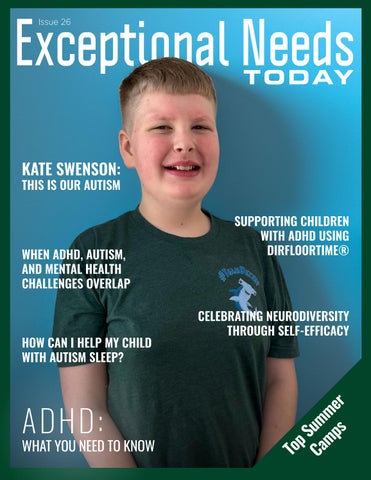
We are thrilled to feature Cooper on this month's cover, having followed his growth on social media over the years. Kate’s article, “This Is Our Autism. Bursts of Color and Beauty, Wonder and Chaos," examines the complexities of raising a teenager with severe nonverbal autism, highlighting both the challenges and the rewards. People relate to Kate—and she brings love and strength to the table.
Building a supportive network for families dealing with special needs is crucial. Such a network offers understanding, encouragement, and practical assistance to families as they navigate the complexities of disability.
Equally important is reaching the wider community that may not be as familiar with disabilities. By fostering greater awareness and acceptance among those outside the special needs community, we can promote inclusion and understanding. Educating the broader public ensures families are met with compassion and support, rather than misunderstanding or judgment.
Do you get frustrated when someone makes light of a diagnosis? Too often I overhear strangers lightheartedly joke that they “must have ADHD” because they were a little impulsive, forgetful, or distracted one day. Attributing ordinary lapses to attention-deficit/hyperactivity disorder (ADHD) only trivializes this complex neurodevelopmental disorder that affects millions of people worldwide. Clichéd comments can diminish its value.
In this special Bonus Issue, we present 26 articles with six dedicated to examining various aspects of ADHD. We are pleased to feature diverse viewpoints, including Ronette Parker's piece, "When ADHD, Autism, and Mental Health Challenges Overlap." In her article, she discusses how neurodivergent individuals often face greater mental health challenges—not because they are flawed, but because societal expectations can be overwhelming. We also share the voice of ADHD expert Cindy Palmer in “Girls and Women with ADHD: Misread, Mislabeled, and Misunderstood” where she shares three personal stories for the benefit of all women who may recognize themselves, or someone they love, within them. In her piece, “My Experience Growing up with ADHD,” Dr. Claudia Rose Addeo, PhD, provides us with a look back at her childhood and admits she is still learning different methods to help with her daily routines and enhance growth. We are also thrilled to feature Maude Le Roux, OTR/L, SIPT, ADHD-RSP’s article “Supporting Children with ADHD: The DIRFloortime® Model in Practice.” Take a look as she explains the value of DIRFloortime® as it allows professionals to identify where development is fragile and to intervene in ways that strengthen foundations rather than simply managing symptoms. I’m thrilled the ADHD community has come together to offer a differing lens.
As always, we appreciate our contributors, advertisers, and subscribers who continuously support and play a vital role in our award-winning magazine. Let's keep collaborating and connecting to foster awareness, acceptance, and inclusion.
Whether it’s from birth or from a later date, some kids just don’t.
They don’t meet milestones on time. They don’t follow the “norm.” They don’t do what every other kid is seemingly doing.
My son Cooper is that way. Today, he is 15 years old. He is a teenager. Yet, in so many ways, he is not. His world is filled with Elmo and Barney, holding mom’s hand, and dreams of riding the Amtrak train through the Rocky Mountains. Often, I don’t even think of him as an age. He is just himself. Uniquely made.
Some people call him a free spirit. Some call him stubborn, even challenging or difficult. Autistic, disabled, severe,
delayed, special needs…these words are all thrown in. It’s hard sometimes. I won’t lie about that.
His diagnosis at age three didn’t come as a surprise. I knew something was different about him from the second he was born. That may sound unbelievable. But I did. I knew in my heart. As time went on, he wasn’t talking or playing or attempting to engage with the world. They suspected autism. Knowing the diagnosis was coming didn’t make it any easier though. It still took my breath away when I heard the words said out loud about my son.
Severe, nonverbal autism with language impairment. It felt like such a big label to put on such a little boy. Everything seemed to change in an instant and yet absolutely nothing changed at the same time.
I honestly felt relief when he received the diagnosis. My
relief was not because it was autism, but because we had an answer. I truly believed that, once we got the label, we could start helping him. Autism doesn’t work like that. At least it didn’t for us. Helping him took years of trial and error, waiting lists, insurance denials, and refusing to give up.
Parenting a child with a disability isn’t for the faint of heart. It takes bravery and courage and honesty with oneself. It takes an unbelievable amount of patience and refusal to give up. It takes a resilience that many of us didn’t know we had until it was put to the test.
I often think to myself…autism is the easy part. It’s navigating the world for him that’s hard. I feel that even greater now that he’s a teenager.
I will tell you…the world is kind to precocious and even naughty toddlers learning about the world. The world is not so kind when that precocious and even naughty person is five feet six inches tall. Often, there is misunderstanding, confusion, and even a little fear.
It’s important to know that autism grows up. One day my son will be 20, 30, and 40. And while I don’t have a crystal ball to see the future, I imagine that much of his diagnosis will be the same. He will still need help navigating this world.
There are so many things that I want the world to know about autism. My dream is that I can soften his edges while educating the world about the mysteries of autism.
I used to think the most challenging years were ages four to eight. I still can’t believe we survived some days. But these teenage years. Boy, are they different. The stakes feel higher. The intensity is dialed up.
My son is not choosing to be difficult. He isn’t choosing to struggle or make life harder to navigate.
He just sees the world differently. It is a world that doesn’t make sense to him and one that doesn’t seem to want to understand him either.
My son is doing his best. I can say that with certainty. When we are standing in line at the grocery store or sitting in a waiting room for far too long, he is doing his best.
When he makes noise or gets frustrated, he is doing his best.
When he is telling you what he needs, but you aren’t listening in the right ways, he is doing his best.
Every day we practice the skills that so many people take for granted. Communicating, navigating the world, waiting, sitting, listening, and even walking.
We just got back from our evening walk. It was a challenge to say the least. But the progress he has made over the years is equally unbelievable.
Cooper walked the majority of the way in the melting snow alongside the road. He laughed as his rain boots sunk into the mud. Every so often he would stop and pick up a handful of snow or a pile of rocks and drop them through his hands, seemingly studying each stone with precision.
He moved at the pace of a snail, taking it all in. It was frustrating. I joke that we often walk backwards and sideways but rarely forwards. He prefers the road to the sidewalk. The ditch to the path. Sitting to walking. Running to sitting. Yes, it’s confusing.
Numerous times he refused to walk any further and needed an incentive from me to get him moving again.
My son has never met a milestone “on time.” Not one.
He has never done what the rest of the world does. And he has always had to work twice as hard to navigate a world that does not make sense to him.
But he did gasp when he noticed our shadows. He put his hand to my arm, threw his head back and laughed a deep belly laugh at our images on the ground. And for a brief second, I saw us at 70 and 43, walking arm-in-arm, gasping at shadows.
Midway through he turned my cheek to show me a squirrel that I would have missed. And he pointed out a nest in a tree. He hooted like an owl, too. And when I told him about the bears still sleeping in the woods, he bent over, growled, and moved like a bear. It was amazing and wonderful all at once.
This is our autism. Bursts of color and beauty and wonder and chaos.
Steps forward and backward. Waiting and wondering. Giving up and trying again.
Raising a teenager with severe nonverbal autism is harder than I could have ever imagined; but boy is it amazing, too.
Stepping off the beaten path has allowed me to see the things that most of the world misses. I’ve been forced to slow down. I’ve learned to be grateful for what I have and I’ve learned to believe in things I cannot see. I get to see who is good and who is bad. He has also taught me what is worth fighting for and what should be let go.
I didn’t get here overnight. It’s been years. I often say that it took time for us to settle into his diagnosis. To step off the path of typical and pave our own way.
It’s lonely sometimes. And yet, I thank the stars that this boy was given to me.
I don’t know if we will ever get back to the typical path. The one that everyone else seems to walk. I long for it some days. A life of ease sounds so different than the mysterious one I am walking.
And yet I’m thankful for the shadows, the breaks, the gasps, the growls, and this boy.
Parents, I see you. I am out here too, walking the path less traveled. Please know that you are not alone. There are so many of us out here. And we can do this. Together.
Kate Swenson, the Founder of Finding Cooper's Voice and the nonprofit, The More Than Project, is a mother to four kids, a wife, and a proud Minnesotan. She writes and creates videos regularly about her life as a mother and an autism advocate for Facebook, Instagram, and her website, Finding Cooper's Voice. Her book, Forever Boy, A Mother's Memoir of Autism and Finding Joy, a national bestseller, highlights the transformation that she went through after her son's diagnosis. Her second book, Autism Out Loud, was an instant New York Times Bestseller and highlights life alongside autism. Her mission is simple. Help parents see the joy in the secret world of autism.
�� www.findingcoopersvoice.com
Girls and Women with ADHD:
Misread, Mislabeled, and Misunderstood
By Cindy Palmer
Since my girls were young, I have shared a simple mantra with them, one I believe can change how we engage with every human we meet. It is this: Everyone has a story.
And if we knew that story, we would respond differently. With more understanding, more compassion, more support, and with far less judgement. I’m here to share three stories that will benefit from a deeper look. These are stories I live within every day, both personally and professionally. I share them with care, for anyone who may recognize themselves, or someone they love, in them.
All three share one thing in common: unaddressed attention-deficit/hyperactivity disorder (ADHD).
• The story of the quiet teenage girl
• The story of her (not so quiet) middle-aged mom
• The collective story of the remarkable college students I encounter every day
To honor the personal nature of these stories, I have blurred identifying details. What remains are the patterns, the recurring themes that reveal how ADHD shows up, and too often stays hidden, in plain sight.
ADHD is not a character flaw. It is a neurological difference whose expression shifts across development, life stage, and context.
The Quiet Teenage Girl
She works so hard. Her teachers love her (or don’t notice her at all). She seeks perfection in school and sports and nearly achieves it, through earnest dedication and hours upon hours of effort. Her body and brain begin failing her as she becomes riddled with anxiety. She grows bitter as she seems to be working harder than everyone else. She comes home daily from school utterly exhausted and a little bit (or quite a bit!) “mean,” as if her filter has completely disappeared.
She feels life in a big way. An empath, she takes in the world around her; its joys, its pains, its tiniest details and feels them
in her body. She might notice the death of a bug and ask, “How would you like it if someone stomped on your head?” Critique and conflict hit her the same way; intensely. She can react with a force that blindsides those closest to her.
and impulsive behaviors, leaving more internalized presentations overlooked. Girls often experience inattentive symptoms—difficulty initiating tasks, chronic disorganization, mental fatigue, emotional intensity, and internal restlessness—that are quieter and frequently misinterpreted as anxiety or depression.
As Laurie Peterson, Executive Director of Diagnostic Learning Services, explains: “Many high school and college-aged girls diagnosed with ADHD for the first time were the students teachers loved: quiet, compliant, and never in trouble, so their struggles went unnoticed. What was missed was the effort it took to stay afloat. When academic demands increase and structure decreases,
they become overwhelmed. Overlooking these signs, even unintentionally, delays support and skill development that could prevent years of stress and self-doubt.”
The Not-So-Quiet Middle-Aged Mom
Her emotions flare quickly and intensely. The mood swings are extreme, leaving her and her family unsure which version of her will show up that day. Anger can strike like a storm, leaving her without a moment’s buffer to choose how she will respond. After the storm hits, she is flooded with shame. Everyday parenting challenges (you know the ones, like the flippant angry teen) can set her nervous system on fire. Her spouse tiptoes around her to avoid setting off another eruption, and the distance grows.
She moves through life with relentless energy. Exercise isn’t a choice. Without it, she is restless, confined, trapped in her body. And her focus? Without that first burst of movement, there is none to be found. But hey, she is super fun! She is always up for creative endeavors yet grows tired of being the “engine” in her social circles.
She has a loose relationship with time. It tends to slip away, unnoticed. She’s often late, not because she doesn’t care or think others' time is important, but because the hours vanish before she realizes they are gone. Tasks she can’t start may sit untouched for hours, but in the last moments of her workday, she erupts into productivity, often exceeding the time she has planned. She knows she needs that lastminute rush to get things done, and she does it with a focused intensity that is unmatched. But the price is high; she is totally exhausted.
She gets lost in details while hyper focusing on one thing while missing others, such as important meetings, deadlines, or opportunities. Motivation ebbs and flows in sharp waves, and she leans on small comforts, like sweets, routines, or bursts of activity, to reignite her drive. Boredom isn’t just dull; it feels physical, like a painful vibration pulsing through her.
At age 50 she diagnosed herself with ADHD-Combined Type. Finally, she understands she is not just rude, careless, or flippantly late, messages that had run deep within her story of self. The questions she once asked herself, wondering why she hadn’t been the mother, spouse, or professional she wanted to be, begin to make more sense. It’s a reframe that brings relief, clarity, and a new lens for living and relating, both to herself and the people she loves.
Reframe: What research helps us see
For many women, ADHD is identified decades later—often after a child’s diagnosis or during perimenopause, when
hormonal shifts wreak havoc. The journal of European Psychiatry agrees: “Considering the interplay between estrogen and dopamine levels with ADHD symptoms, it is plausible that hormonal fluctuations in perimenopause could exacerbate existing ADHD symptoms or could even lead to a diagnosis of previously unrecognized ADHD.”
What once felt manageable suddenly isn’t. Symptoms intensify: emotional reactivity, time blindness, overwhelm, and cognitive fatigue rise sharply. This period does not create ADHD, but it often unveils it, stripping away the compensatory strategies that once held everything together. Mood swings, shame, and self-blame are frequently framed as emotional instability or burnout rather than biological change. While ADHD does not explain everything, it provides essential context—reframing long-held narratives of failure and opening the door to more self-compassion, healthier relationships, and sustainable support.
The College Student
Before college, this student was successful. They graduated from high school with a 3.5 GPA and an IQ that was off the charts. With a 504 plan, parents deeply involved in their academic life, and a carefully structured day that quietly held them together, their diagnosis of ADHD-Inattentive Type seemed manageable. Their medication was taken daily, provided right next to their orange juice every morning (thanks mom!). Tutors were hired when classes got hard. Their schedule was packed from morning to night, with school bells, sports practices, and strict limits on phones and gaming. Free time was scarce and predictable. Schoolwork fit into the narrow window that remained.
Off to college…
At first college was incredible. Orientation was great. They loved it there! Classes started, and suddenly there was SO MUCH TIME! Their tightly structured days were replaced with scattered classes and wide-open hours. Assignments weren’t due for weeks. There was reading, sure, but nothing to turn in. Everything felt flexible and fun.
And the invitations never stopped. A knock on the door. Want to play Fortnite? Go to the gym? Go out? They stayed up late, often past 2 a.m. gaming with friends. With only one class in their major this term, the rest were GUR’s (general university requirements) in huge lecture halls, impersonal and disengaging. Their anthropology class had more than a hundred students and they met at 8 a.m. Attendance wasn’t required. Lectures were recorded. They told themself they’d watch them later.
Later never came.
Two weeks in, they realized they had their first big exam in two days. How had that happened? They tried to catch up. They crammed lectures, opened the reading for the first time…250 pages! They skimmed. They summarized. They even used AI to condense what they couldn’t get through and felt momentarily impressed with how much work they just cranked out.
The test crushed them. The questions didn’t look like the lectures. Maybe the answers were in the reading? Their first college test score: 35%. They had never failed anything before. When their parents called, they told them everything was fine. Classes were boring, but they were doing okay. Not really a lie—things were going to get better. They were going to do more. They didn’t want to worry them.
Diagnosed with ADHD-Hyperactive Type at seven, they chose not to register with the disability office in college. This was a fresh start, and maybe they wouldn’t need accommodations. If they needed them, did they really belong here? They wanted to do it on their own.
Their ADHD medication use became sporadic. In high school, it had simply appeared each morning. Now they
reserved it for when they really needed to focus. Eventually, they ran out. When they asked their mom to call the doctor, she was told her child was now an adult and would need to do it themselves. The baton was passed. The student meant to call. They just didn’t. They had never done it before and didn’t know how to start.
They had grown up swimming in support without realizing it. Now the entire pool was gone. As Dr. Eric Endlich, psychologist and founder of Top College Consultants, explains: “Many students don’t realize all the scaffolding their parents and teachers provided in high school until it disappears in college. Without that support, they can quickly get overwhelmed.”
Without structure, accountability, or strategies for independence in place, their ADHD began to show up differently. They felt embarrassed. Ashamed. Unsure if they belonged here after all. Their ADHD was no longer held in place by structure and support. As it shifted with age and circumstance, its impact in this new environment became harder to hide and harder to manage.
What was happening to them? They were smart. They had earned their place here. Hadn’t they?
Reframe: What research helps us see
This student’s ADHD was understood and supported in high school through structure, medication, external accountability, and close parental involvement. College removes those scaffolds all at once. Wide open schedules, delayed deadlines, large lecture courses, and constant social access dramatically increase executive functioning demands. Symptoms shift in this environment—time slips away, motivation collapses without urgency, and parentalbacked systems that once ensured medication and access to accommodations quietly disintegrate.
As a longitudinal study published in the Journal of Attention Disorders notes: “Individuals with higher levels of ADHD symptomatology at the start of their academic program
show poorer long-term academic success.”
What is often misread as laziness, poor work ethic, or lack of commitment is in reality, ADHD interacting with a new context that requires skills and supports not yet in place.
Everything changes: If and when we understand the story.
What do these three stories teach us?
ADHD is manageable when it is recognized and supported. When it isn’t, it is misread, mislabeled, and misunderstood— and the story doesn’t just remain incomplete. It becomes a harmful one, shaping how people see themselves and narrowing the choices they believe they have to succeed.
These are not stories of failure, laziness, or lack of effort. They are stories of brains navigating environments that are not built with them in mind. ADHD is not a character flaw. It is a neurological difference whose expression shifts across development, life stage, and context.
When we slow down enough to understand the story beneath the behavior, our response changes. Judgment gives way to curiosity. Assumptions soften into compassion. Support replaces shame. And with that shift, lives expandnot because people try harder, but because they are finally met with strategies, structures, and understanding tailored to their stage of life and the environment they are in.
Everyone has a story. And everything changes when we take the time to understand it.
References:
Data and Statistics on ADHD. https://www.cdc.gov/adhd/data/index. htmlstudy.
Endlich. E. The College Transition: Advice for Neurodivergent Students, with Eric Endlich | EDB 343. Different Brains. https://differentbrains.org/ the-college-transition-advice-for-neurodivergent-students-with-ericendlich-edb-343/
Smári et al. Perimenopausal symptoms in women with and without ADHD: A population-based cohort. European Psychiatry. https://pmc.ncbi.nlm. nih.gov/articles/PMC12538516/#r5
Cindy Palmer is the Founder of Threshold Coaches, where she supports students and families navigating the transition to college, with a focus on executive functioning and ADHD. Her work is informed by more than 25 years in education and mental health, including roles as a high school biology teacher, a licensed therapist, and the founder and owner of a tutoring company specializing in supporting neurodivergent students in STEM classes, a role that ultimately led to the creation of Threshold Coaches. Over the past decade, Cindy has trained and mentored tutors and coaches in researchbased learning strategies and neurodiversity-affirming practices, with a particular focus on students with ADHD. Her professional perspective is enriched by lived experience, supporting one of her daughters through a late ADHD diagnosis in her teen years and navigating her own diagnosis in midlife. These experiences have deepened her understanding of how ADHD can remain hidden, shift across life stages, and become most apparent during periods of transition. As a business owner, Cindy also recognizes ADHD as a strength. The creativity, curiosity, and willingness to take meaningful risks that come with her own ADHD played a central role in founding and growing of Threshold Coaches. Cindy is the proud mom of two emerging adults, both immersed in the unfolding of the college process. When she’s not immersed in Threshold Coaches, she can be found running or hiking, attempting to capture the perfect photo, or enjoying a really good meal, as long as someone else cooks it. �� thresholdcoaches.com
May I Join? The Benefits of Sibling Involvement Among Children
with Disabilities
By Rose Adams, OTD, OTR/L
The joy of siblings. Do you have siblings or know someone who does? Can you think of a time when you noticed their interaction (both good and not so good)? If so, you might say that there is a connection between siblings like no other. Siblings fight, make-up, and are connected in a special way – sometimes by biology and other times through spending meaningful time together. Other family members such as cousins or childhood friends might share similar sibling-like connections.
I grew up in a large family of six siblings, yes six. It was a busy household. Some of us developed close bonds with some siblings while others developed closer bonds with others. These bonds shifted over time and between siblings. For example, in elementary school I remember developing a
closer relationship with my sister who was about two years younger. As time shifted, so did our sibling connections. Can you relate?
In this piece, I’d like to highlight the benefits and joy that exist when we keep siblings involved while working with children with disabilities.
As a private practice occupational therapist, I have found that one way to experience this joy is through time. For example, when providing services in the home, we might organically have more “together time” with parents, siblings, and the children with whom we work. Sometimes, there might be a sibling or other sibling-like family member who essentially hangs out in the background. I love the “hang-out” moments; I encourage it. However, depending
on the situation, parents or caregivers might ask the sibling to not join us because it’s my time with the child that I’m working with. I have found that promoting family-centered care by involving siblings makes a more positive difference than when working with the child alone. Collaboration and family involvement are key components when operating from this model of care (Kokorelias et al., 2019).
I have found that promoting familycentered care by involving siblings makes a more positive difference than when working with the child alone.
In moments when the primary caregivers or parents are not available, the caregiver present becomes a part of the session. However, the siblings or sibling-like family members are usually not a part of the experience. There is value when we consider the siblings of the children with disabilities in our interventions or interactions (Krueger & Otty, 2024). After all, they are a vital part of the process (Kokorelias et al., 2019). Let’s break this down with a fun acronym of J-O-I-N. If you know me, you know that I love a good acronym, so let’s dive in.
J- Join. Allow siblings to join in on the fun. Recently while working with a client at home, their older sibling often popped in and out of our session. The sibling did not say anything. My attempts to connect with him seem to go unnoticed but I know that he was watching and listening. At times, he would look at me briefly and check out the activities we were working on. Other times, he’d come by to give his sibling a hug then would leave. One day, I prepared an interactive craft activity that would involve sharing materials, talking steps through, and working together. I asked the parent if the sibling could join me this time. The parent agreed and it was an amazing session. I watched as my client and their sibling navigated problem solving, sharing ideas and materials, and more. Moreover, they provided me with insight into the window of their unique sibling relationship. It was beautiful. The next time I saw my client, I received the gift of a hand-painted drawing from the sibling. I received this gift as the joy of letting him join. Can
you think of other ways to let siblings join in on the fun (or challenges) when working with children with disabilities?
O-Opportunity. Allowing siblings to join in on the fun provides them with an opportunity to spend unique time with their siblings, thus strengthening their sibling-bond (Krueger & Otty, 2024). It also provides us with a window of opportunity into their sibling world. It gives us insight into how they interact, communicate, and even navigate challenges that may arise. As an occupational therapy practitioner, this is a unique window to peek through as we support families with navigating these complex relationships. Siblings of children with disabilities might often feel overlooked when the focus is shifted to the child who requires more specialized or individualized support (Parirak et al., 2024). We can help bridge the gap by providing siblings with opportunities to participate in sessions, thus strengthening their interactions with one another (Krueger & Otty, 2024).
I-Inclusion. Include siblings whenever possible. Inclusion might look different for every child and their family. When operating from a family-centered lens, we begin to think of ways to collaborate with family members (including siblings). This enables us to see how we can naturally include siblings in our interventions or work without taking away from the child’s therapeutic experience. Including siblings might enhance rather than hinder the therapeutic journey. Sibling interactions are said to help improve social skills, strengthen their emotional bonds and more (Kokorelias et al., 2019; Krueger & Otty, 2024; Parirak et al., 2024). Can you think of other benefits that may be found in sibling-inclusion?
N-Navigate. Navigate the nuances together. It’s important to present the sibling with a choice of being included (Adams, 2022). Even if that means being in the same room or space until they feel ready or choosing not to participate altogether. Depending on what you’re working on, sometimes having a sibling present may appear as a distraction. How can we use this distraction as an
opportunity to promote positive sibling interaction? One example is to present roles or tasks that the sibling can do with (not for) the child. For example, if you’re playing an interactive game with a ball, the sibling might show the child how to roll, through modeling and take turns passing the ball among each other. Lastly, as the practitioner, teacher, parent, or the person working with the child, should collaboratively decide if it’s an opportune time or moment for inclusion. Many factors might impact moments of inclusion. Examples might include age, interests, time of day, or how the child is feeling or responding to having the sibling present (Parirak et al., 2024). As there are many benefits to having siblings join, certain factors might affect the outcome. Nevertheless, remember that the child always has a say (Adams, 2022). If today is not a sibling-join kind of day, honor that request however it is communicated.
Take-Home Message
Sibling relationships are both complex and unique. However, there are many benefits to including and involving siblings when working with children with disabilities. Working with the family to discover how, when, and in what ways to include siblings while working with children is key. Stay open to promoting family-centered care through sibling involvement whenever possible. You too might experience the joy of siblings!
References:
Adams, R. (2022, July). Giving kids a voice: Promoting early self-advocacy among children with disabilities. Exceptional Needs Today, 9, 18-21. https://issuu.com/exceptionalneedstoday/docs/ent_issue_9
Kokorelias, K.M., Gignac, M.A.M., Naglie, G., & Cameron, J.I. (2019). Towards a universal model of family centered care: a scoping review. BMC Health Serv Res 19, 564. https://doi.org/10.1186/s12913-019-4394-5
Krueger, G., & Otty, R. (2024). Sibling involvement: Highlighting the influential role of siblings in supporting children with autism spectrum disorder. The Open Journal of Occupational Therapy, 12(2), 1-6. https:// doi.org/10.15453/2168-6408.2083
Parirak, A. M., Kristinawati, W., & Adiyanti, M. G. (2024). Social interaction between siblings in families who have children with autism spectrum disorder. Bisma The Journal of Counseling, 8(2), 114-120. https://doi. org/10.23887/bisma.v8i2.85105
Rose Adams, OTD, OTR/L is an occupational therapy practitioner with a clinical focus in pediatrics. She works with children and families of children on the autism spectrum, multiple disabilities, and other neurodiverse needs. Dr. Adams has worked in schools, private practice settings, and community-based programs. She is the executive director at Changing Lives Occupational Therapy, P.C., where she provides occupational therapy services, summer camps and enrichment programs, professional development trainings, mentorship, and parent support workshops. Dr. Adams is a graduate of Boston University’s online Post Professional Occupational Therapy Doctorate (PP-OTD) program and currently serves as an academic mentor. Her doctoral project focused on using song-based interventions to support young children with autism and related disabilities participate in school-based occupations. Dr. Adams is also a continuing education course instructor at Aspire OT. When she is not working, she enjoys writing, baking, singing, and sharing time exploring the outdoors with her school-aged twin boys.
Autism Advocacy Interrupted is more than a book it’s a wake-up call for anyone who cares about the autism community.
In today’s advocacy landscape, families often face a storm of competing voices: infighting, ego-driven agendas, and fragmented messages that do little to meet real needs. Jeanetta Bryant, both a mother and seasoned advocate, has lived through the confusion, frustration, and heartbreak this division causes. With unflinching honesty and compassion, she lifts the veil on the hidden fractures in the movement, introducing four distinct advocate types Revolutionists, Trailblazers, Mavericks, and Disruptors.
Through these portraits, Bryant invites readers to examine who they follow, why their message matters, and whether the noise is helping or hurting the very people we claim to serve. She challenges us to trade division for unity, volume for vision, and personal agendas for purpose.
This is not a call to choose sides it’s a rallying cry to rebuild the foundation of autism advocacy so that dignity, wellbeing, and future opportunity for those on the spectrum come first.
If you’re ready to reflect, engage, and make a difference, Autism Advocacy Interrupted will give you the insight, courage, and clarity to be part of lasting change.
IEPs Should Begin With Strengths, Not Deficits
Across the country, families and educators gather around Individualized Education Program (IEP) tables with a shared purpose: to build a plan that supports a student’s learning, growth, and future. Yet, too often, the first words spoken—and the first lines written— focus on what a child struggles with rather than what they bring to their learning. The mindset that shapes an IEP begins long before the goals are typed. And that mindset has the power to either open doors or quietly close them.
I truly believe, no matter the district, state, or school system, IEPs become more powerful when they begin with a student’s strengths. When teams embrace an asset-based approach, they shift the narrative from “What’s wrong?” to “What’s possible?” They recognize abilities, build confidence, and design supports that truly help students thrive. It is a shift that honors the whole child and elevates the purpose of special education itself.
What Is An IEP?
An IEP is a legal document created under IDEA-2004, the federal law requiring public schools to provide Free
Appropriate Public Education at no cost to families. After a child’s parents consent to an evaluation, a team of educators, service providers, and caregivers collaborate to identify the student’s needs, draft goals, and design accommodations and services. The intent is deeply human: to create a document that supports access, learning, and progress.
But intent alone doesn’t guarantee impact. The language we use matters. It shapes expectations, influences interactions, and affects the student’s sense of themselves. Deficit-based language can unintentionally lower expectations and frame a child through limitations. Asset-based language, on the other hand, grounds the plan in potential and possibility.
Consider these examples:
Deficit-oriented reading goal: “David struggles with decoding multisyllabic words and will reduce his decoding errors to fewer than five per passage.”
Asset-oriented version: “Building on David’s strengths in identifying word patterns, he will accurately decode multisyllabic words with at least 90% accuracy across three grade-level passages.”
Both goals address the same skill. Only one communicates belief in David’s ability to grow.
The same contrast appears in executive functioning goals:
Deficit-oriented: “Mily fails to stay organized and this results in missing assignments.”
Asset-oriented: “Building on Mily’s preference for checklists and visual systems, she will use a weekly organizer to submit at least 90% of assignments on time.”
Here again, the difference is subtle but significant. The asset-based goal focuses on what motivates Mily, not on what she lacks. It frames the strategy—not the student—as the primary challenge.
These examples show how the tone of an IEP can build a child up or wear them down. And the language we choose reflects the beliefs we carry. When we focus on deficits, we unintentionally narrow the student’s horizon. When we center strengths, we widen it.
Research from positive psychology, strengths-based education, and person-centered planning consistently supports what families and expert practitioners already know: Students are more engaged, more confident, and more successful when their strengths are recognized and used intentionally. They demonstrate greater self-advocacy, stronger partnerships with adults, and better long-term academic and functional outcomes.
While large-scale controlled studies comparing deficit-based and strengths-based IEPs are still emerging, the conceptual and experiential evidence is clear: Students thrive when teams believe in their potential.
Strengths-based IEPs do not ignore challenges. They contextualize them. They reflect the reality that no child is defined solely by their disability. They honor interests, talents, preferences, and emerging abilities—elements that are too often overshadowed by lists of deficits and concerns.
An asset-based approach encourages teams to ask different questions:
• What motivates this student?
• What sparks their curiosity
What talents or skills can we build from?
• How can these strengths guide instruction and supports?
• What helps this student feel confident and successful?
When teams start with these questions, the IEP becomes more than a compliance document. It becomes a roadmap rooted in hope, possibility, and student-centered learning.
And perhaps most importantly, it reinforces a simple and powerful truth: The child is not the one who needs fixing. The system, supports, and mindsets do.
If we want students to develop self-advocacy, resilience, and independence, we must model what it looks like to believe in them. We must write IEPs that reflect who they are—not just what they struggle with. We must create plans that empower, not limit.
Every child deserves to be seen for their strengths. Every child deserves an IEP that recognizes their potential. And every IEP team, no matter where they are, can take this step—one that transforms not only the document, but the student who stands at the center of it.
Deficit-based language can unintentionally lower expectations and frame a child through limitations. Asset-based language, on the other hand, grounds the plan in potential and possibility.
Priya Pasumarthy MS, is the author of Our Little Promise (2022) and Halloween at Luke's (2019) and is a health care provider. She holds a Master of Science degree in Marine Biology and lives with her family in the Bay Area of California. She loves adventures; so far, her favorites include bungee jumping in New Zealand and hiking the Hverfjall Volcano in Iceland. Her hobbies include cooking, shopping, reading, writing, watching films, and horseback riding.
The Power of the Pause: How Awareness Supports Adults with ADHD
By Diane Garzon, BS
Most people are doing the best they can with the tools they have. When emotions run high or reactions feel bigger than expected, those responses often come from a place of protection rather than intention. Understanding that context can change how we relate to ourselves and open the door to real change.
Many adults receive an attention-deficit/hyperactivity disorder (ADHD) diagnosis later in life, often after years of feeling emotionally overwhelmed, misunderstood, or stuck in patterns they couldn’t quite explain. Before they had language for ADHD, they did what humans do best; they adapted. They learned ways to cope with intense emotions, anxiety, and internal pressure in order to function, connect, and survive. These coping strategies weren’t flaws or failures; they were intelligent responses to living in a world that didn’t yet make sense of how their brain worked.
Over time, however, some of these protective patterns can create problems. Reacting quickly, shutting down, people-pleasing, or pushing through emotional overload may have helped in the past, but it can strain relationships, increase anxiety, and quietly erode trust with ourselves, and with others. For many late-diagnosed individuals, the turning point isn’t learning more strategies, it’s becoming consciously aware of the patterns they’ve been repeating
without realizing why. Awareness creates choice, and with that choice, change becomes possible.
As awareness grows, many neurodivergent individuals notice patterns in real time such as the familiar rush of emotions, the urgency to respond, or the feeling that something must be fixed immediately. This is often the very moment when change feels hardest. Knowing what’s happening doesn’t automatically make it easier to slow down, especially for people with ADHD, whose emotional experiences can feel intense and fast-moving. This is where the power of the pause becomes essential.
The Power of the Pause
Pausing doesn’t mean shutting down or avoiding difficult conversations. It means creating enough space to prevent emotional flooding from taking over. For individuals with ADHD, pausing can be especially challenging because emotional intensity often comes with a strong sense of urgency. The nervous system is activated, thoughts gain traction, and the body signals that immediate action is required. In these moments, even well-intentioned responses can unintentionally cause harm. It’s important to note it is not because of a lack of care, but because the brain is overwhelmed.
Awareness doesn’t just help individuals regulate internally; it also creates accountability within relationships. When we become conscious of our patterns, we’re better able to name what’s happening instead of reacting to it. This matters because accountability isn’t about blame; it’s about recognizing impact. For individuals with ADHD, especially those diagnosed later in life, understanding emotional triggers and stress responses helps reduce unintentional harm and increases emotional safety in relationships.
Emotional safety grows when individuals feel less guarded against reactivity, and more confident that difficult moments can be navigated with care. Pausing, naming needs, and setting boundaries allow conversations to slow down before escalation occurs. Statements like, “I’m feeling overwhelmed and need a few minutes before continuing,” or “I want to talk about this, but I need to regulate first,” signal responsibility rather than avoidance.
Understanding our needs in moments of intensity is a critical part of healthier communication. When individuals can identify what they need, whether that’s space, clarity, reassurance, or time, they’re better able to express themselves without escalating conflict. This understanding supports more meaningful conversations and helps relationships feel safer and more connected. These moments of accountability help repair trust and create space for more honest, productive communication. This shift often reduces defensiveness and increases a sense of shared responsibility, allowing conversations to feel safer, more grounded, and less driven by emotional urgency.
For many late-diagnosed individuals, accountability has historically been tangled with shame or the feeling of having “messed up” without knowing why. Awareness untangles that knot. When patterns are understood as learned responses, rather than personal failures, accountability becomes safer and more accessible. It becomes possible to take responsibility while also offering ourselves compassion, which is essential for sustainable change.
From personal experience, learning to pause has been a meaningful shift. Instead of pushing through conversations while emotionally flooded, allowing myself to step away has helped reduce reactivity and regret. Sometimes that pause looks like going for a short walk, taking a few minutes
alone, or naming the need for space before continuing the conversation. In those moments, pausing creates safety rather than distance. Over time, these pauses have supported clearer communication, improved regulation, and more opportunities for repair.
Pausing isn’t about getting it right every time. It’s about building awareness that supports healthier relationships and choosing progress over perfection.
Summing Up
Rather than erasing old patterns or responding perfectly in every moment, the goal of pausing is to understand our patterns and meet them with curiosity instead of shame. Each pause, or each moment of awareness, offers an opportunity to choose differently and reduce harm, support regulation, and repair when needed. These small shifts help rebuild trust in oneself and strengthen the relationships that matter most. Growth happens gradually, and progress, not perfection, is what creates lasting change. Awareness doesn’t change everything at once, but it changes what’s possible.
For individuals with ADHD, especially those diagnosed later in life, understanding emotional triggers and stress responses helps reduce unintentional harm and increases emotional safety in relationships.
Diane Garzon, BS is a Family Partner and ADHD advocate who collaborates with individuals and families navigating emotional and behavioral health challenges. With a background in mental health outreach and lived experience with late-diagnosed ADHD, she focuses on helping people recognize unhelpful coping patterns, strengthen regulation, and rebuild trust in themselves and their relationships. LINKEDIN linkedin.com/in/diane-garzon-80305226
THE FRIENDSHIP & DATING DUO Friendship When It Matters Most: Why Reliability Is the Real Measure of Connection
By Jeremy and Ilana Hamburgh
For many parents and professionals, when we talk about “friendship skills,” the conversation tends to focus on the visible parts of social life. Conversation starters. Shared interests. Going out for lunch. Making plans.
Those things matter… a lot.
But sometimes, a moment arrives that clarifies what friendship is really about in a way no curriculum or checklist ever could. That moment came for me late on a recent Thursday night.
Two Stories, One Realization
I’m part of a friendly poker group that meets every couple of weeks for dinner and cards. It’s one of my “tribes.” That night, one of my poker buddies shared something devastating: He had been defrauded online for $150,000.
Given my background as a former prosecutor and financial crimes litigator, I spent time with him talking through what likely happened, what steps to take next, and what to realistically expect. It was a tough conversation to have. Anyone who has supported someone through fraud knows how heavy those moments can be. There is shock, shame, and confusion all tangled together.
When I got home that night, Ilana and I figured we’d use that story in our next Social Life 360 program Community Call as an opportunity to talk about online safety.
Then my phone buzzed.
It was a text from my friend, Spencer.
Spencer and I originally met through a Facebook group years ago. Over time, he’s become one of my closest friends. That night, he texted to say he wasn’t feeling well. His throat hurt. Then he said he couldn’t swallow.
I texted back, “Do you want me to take you to the emergency room?”
I expected him to say no – it was midnight already.
Instead, he said yes.
So, I told Ilana not to stay up for me, I got out of bed, got dressed, drove to his house, took him to the emergency room, waited with him, went to the pharmacy to pick up his medication, drove him home, and finally crawled back into bed in the middle of the night.
Lying there, exhausted, I realized something very clearly: All our work at My Best Social Life and in the Social Life 360 program is about moments like this. This is what social connection is really about.
Friendship Isn’t Just About Fun. It’s About Reliability
When parents come to us worried about their autistic or neurodivergent adult loved one’s social life, the concerns often sound like this:
“They don’t get invited out.”
“They don’t have people to hang out with.”
“They spend most of their time alone.”
And those concerns are very real.
But the deeper fear underneath them is rarely about brunch plans or game nights. It’s about safety. It’s about loneliness. It’s about whether someone will be there when things are hard.
We talk a lot about friendship as shared activities. Going out to eat. Playing video games. Seeing a movie. Having meaningful conversations.
All of that matters.
But the deepest form of friendship reveals itself when things aren’t convenient. When it’s late. When it’s uncomfortable. When someone says, “I need you.”
Being able to show up like that, or knowing someone would show up for you, creates a sense of safety and belonging that nothing else can replace.
For autistic and neurodivergent adults in particular, this kind of reliability can be life changing. Many have experienced years of rejection, misunderstanding, or relationships that felt one sided. Knowing that a connection is sturdy feels incredible.
That’s real friendship.
Emergency-Level Friendship Is Built in Ordinary Moments
It’s important to say this clearly: Spencer didn’t text me at midnight because I’m heroic. I’m not.
He texted me because we had already built a strong friendship over time.
We check in on each other. We spend time together. Our kids spend time together. Sometimes, honestly, he texts me a little too often – but that’s part of the relationship, too. There’s consistency in the effort we put in together.
And that’s important because you don’t build an “emergencylevel” friendship during an emergency. You build it during the ordinary moments. The texts that say, “Hope you’re doing okay.” The regular lunches. The shared experiences.
For many autistic and neurodiverse adults, consistency is not just helpful, it’s essential. It creates predictability. It reduces social anxiety. It allows trust to grow slowly and authentically.
This is also where well-meaning advice can go wrong.
“Just put yourself out there.”
“Just wait for the right person.”
“Friendships should happen naturally.”
For autistic adults who process social information differently, relationships rarely “just happen.” They are built deliberately, through repeated experiences of planning and following through.
Why Loneliness Increases Vulnerability
There’s another reason this kind of connection matters deeply, especially for autistic and neurodiverse adults: Loneliness increases vulnerability.
When someone feels isolated, they are more susceptible to unhealthy relationships, manipulation, and scams. They may tolerate poor treatment because any connection feels better than none. They may trust too quickly because they’re craving closeness.
We saw this in my poker buddy’s story. And we see it all the time in our work.
A deep, real friendship is not just about happiness; it can also be about protection.
Strong friendships can create a buffer. They give a person the opportunity to get a reality check from someone other than their family. It allows them to ask, “Does this seem right to you?”
For parents, this is one of the most important long-term goals they share with us.
The Real Goal of Social Skills Work
Yes, social coaching involves learning how to start conversations, ask questions, show interest, and navigate group dynamics.
Those skills matter. But they are not the end goal.
The real goal is building a life where someone is not alone. A life where they feel known, embraced, and wanted. Where, if they ever need to say, “I need you,” they have someone who will answer.
And equally important, a life where they can be that person for someone else, too. That sense of mutuality is powerful.
What Parents and Professionals Can Do Differently
So, what does this mean in practice?
First, it means reframing what “success” looks like socially. One reliable friend is often more meaningful than 10 online acquaintances.
Second, it means prioritizing consistency over intensity. Weekly or bi-weekly touchpoints can matter more than going to a big event once in a while.
Third, it means supporting autistic and neurodivergent adults in identifying people who could grow into deeper connections.
And finally, it means recognizing that building this kind of life takes time. There is no shortcut to trust.
The Questions That Matter Most
I often come back to two questions, for both clients and families:
Do you already have people in your life who could grow into this kind of connection?
And if you don’t yet, what steps are you willing to take, and what effort are you willing to put into finding and growing those relationships?
Those are not easy questions. But they are questions we’d be thrilled to work on together with you and your family.
Because friendship is not reserved for the socially gifted. It’s built by people who keep showing up consistently, over time. With the right support, structure, and encouragement, it’s possible to build a life where no one has to face the hard moments alone
Jeremy and Ilana Hamburgh are friendship and dating coaches who empower autistic and neurodivergent adults to find community, form friendships, start dating, and build meaningful relationships. With Ilana's 16 years of experience as a special education teacher in New York City and Jeremy's 15 years as a social coach, their clients benefit from their depth of knowledge and an unparalleled sense of compassion. Their cutting-edge program, Social Life 360, teaches clients how to meet new people in new places with more confidence by decoding social situations for their clients in an innovative way: They break down the complexities of social and dating strategies into formulas, diagrams, checklists, and step-by-step processes that are more intuitive for people with neurodivergent minds.
The Social Life 360 program also provides its clients with a warm, inclusive, and vibrant online community of other clients and graduates from all across the United States, and different corners of the world, so clients feel embraced on their social journey from day one.
Learn more and take their free training at MyBestSocialLife.com.
Parents can schedule a complimentary family Strategy Session here
Autistic and neurodivergent adults can schedule a complimentary family Strategy Session here
Unbreakable Love for My Child with Autism
By Stephanie Orlando
This article is written for every parent who has ever cried quietly after a long day, for every caregiver who has ever felt invisible, and for every child on the spectrum whose brilliance lights up the world in their own unique way. It is about love that refuses to break, resilience that refuses to fade, and hope that refuses to die. Autism is not a detour from the journey—it is a different path entirely, filled with new lessons and unexpected beauty.
I’m a mother raising a child on the autism spectrum, and I’m also a woman who has weathered storms—a former foster youth, a cancer survivor, and a survivor of domestic violence. Of all the chapters in my life, none has shaped me more than learning how to love, protect, and advocate for my son, Oliver. This isn’t a manual as much as it is a
map—one mother’s path through uncertainty, fear, and the everyday miracles hidden in plain sight.
There are seasons when I move like the Energizer Bunny— go, go, go until I crash. Between managing Oliver’s needs, pitching a patent-pending idea, writing a book, starting a new job, and keeping our home running—laundry, dishes, bills, appointments—I feel stretched thin. I’m also trying to be present for friends and family, invest in my marriage, nurture my faith, and keep up with self-care at least once a day. Some days I slow down and eat modestly, giving my body a chance to rest. Then, when I can, I begin again.
Sometimes everyday life becomes a maze of triggers. In stores, my son panics if it’s too loud, if the lights flicker, if I say no. I’ve learned to prime him for what’s coming: we talk
through what the store will look like, what we’re buying, and what we’re not. We set expectations. Small strategies like these become lifelines, and when they work, the quiet victory feels huge.
There have been hard, frightening days—the kind you don’t post about until you can breathe again. Times when a “no” to a toy turned into hitting in the car or grabbing the steering wheel. Chaos in a heartbeat. Times at home when anger exploded into throwing things, doors slammed, and the night ended with us in the emergency room so he could be kept safe and we could all reset. I want to say this clearly: my son is a good kid. He is kind, funny, smart, and deeply loving. But he also needs help, support, and tools that match his nervous system. We have a team of doctors and staff helping him and us, and I am grateful for every person on that team.
Medication has been part of our journey. What works is personal and changes over time, so I can only speak to our experience. Guanfacine has helped with agitation and impulsiveness for Oliver—particularly the kind of fast, hot anger that can tip into violence. We learned the hard way that timing matters; on a day he took his dose at 3:00 p.m., the calm we needed didn’t reach the late-afternoon window, and a 5:00 p.m. meltdown followed. Adjusting the afternoon timing helps us bridge that gap. None of this is a cure; it’s part of a larger net of therapy, structure, regulation tools, sleep, nutrition, and grace for all of us.
What most people don’t see is the invisible labor: de-escalation scripts, safety plans, sensory breaks, transition warnings, and the way we reorganize a day around one tiny hinge moment that could swing open to calm or to chaos. I’ve become a student of patterns—what happens before the storm, which words soothe, which textures and sounds ground him, when to hold a boundary and when to offer a bridge.
And then there are the everyday victories that refill my soul. Oliver learning to swim is one of them. He practiced for years, inch by inch, breath by breath, pushing through fear until something finally clicked—and suddenly my boy was a fish. Watching him glide through the water, light and free, I remembered: progress is not a straight line; it’s a spiral. We visit the same lessons again and again, but each time at a higher level.
Community matters. We lean on family and friends, even when I don’t have the words to explain. Some days I just need someone to sit with me in the quiet, to remind me I’m not failing, that I’m doing the hardest and most sacred work a parent can do. Marriage in this season means tag-teaming, apologizing quickly, protecting the soft center of us, and choosing each other even when we’re bone-tired. Faith means I pray in the laundry room and find God in the deep end of the pool.
Selfcare is not bubble baths and candles for me; it’s 10 breaths in the car before I walk back inside. It’s eating something nourishing when my appetite has been punched flat by stress. It’s a 20-minute walk, a journal page, a text to someone who gets it, a boundary that saves the rest of the day. I call these my “one-thing” practices—one thing that keeps me human, one thing that reminds me I am more than a crisis manager.
If I could ask the world for three things, they would be:
1. Believe parents when we say we need help. We aren’t exaggerating; we’re surviving.
2. See the child behind the behavior. Regulation is a skill, not a switch.
3. Offer dignity first—space, patience, and practical support beat judgment every time.
Raising a child on the spectrum has taught me to measure success differently. Did we repair after the rupture? Did we practice a skill, even if it didn’t stick today? Did we laugh, even once? Did we rest when we could have pushed? These are wins. Unbreakable love is not loud; it’s steady. It adapts and learns. It carries hope forward—even on the days we feel like we have nothing left to give.
If you’re walking a similar path, I see you. Your love is not invisible, your exhaustion is not a failure, and your persistence is a kind of brilliance the world rarely celebrates. Keep going. Keep resting. Keep asking for help. There is beauty here, not in spite of the hard, but braided right through it.
Author’s note: This essay is adapted from a larger manuscript-in-progress. I share our experience to offer solidarity, reduce stigma around crisis care, and remind other parents that you are not alone. I’m cheering for you.
Stephanie Orlando is a Los Angeles–based photographer, writer, caregiver, and mother. She has a passion for capturing life’s moments, sharing stories, and celebrating everyday kindness. When she’s not behind the camera or pen, she enjoys family time, thrift shopping, and sipping iced coffee. INSTAGRAM @Agirlcalledsteph
ADVICE FROM MESHELL
The Impact of Representation: Why Special Needs Kids Need to See Themselves in Books and Media
By Meshell Baylor, MHS
"When children see themselves reflected in the world around them, they learn that they belong in it.”
Representation is more than visibility—it is validation. For children and adults with exceptional needs, seeing characters who share their challenges, abilities, or communication styles can shape identity, confidence, and emotional well-being. My own understanding of autism began long before I ever heard the term used in real life. It began with a movie. As a child, I watched the 1986 film The Boy Who Could Fly. The story follows Eric Gibb, a nonverbal autistic boy cared for by his struggling uncle. Eric spoke little, yet the film spoke volumes. His actions, sensitivities, and quiet intelligence provided an early portrayal of autism for many children, including myself.
Two years later, Rain Man (1988) pushed autism into mainstream conversation. These films were far from perfect, but they were important. They made disability visible at a time when it was rarely discussed openly. They also showed that individuals with disabilities deserve depth, dignity, and meaningful roles in storytelling. Current data shows we still have far to go. According to the University of California, Los Angeles (UCLA) Hollywood Diversity Report (2023): Only 7.1% of theatrical film actors and 4.7% of streaming film actors identify as having a disability—despite 26% of the U.S. population identifying as disabled. This underrepresentation has real consequences. Children look to media to understand who they can be. When they never see someone like themselves represented, it sends an unspoken message about belonging.
When Characters Become Mirrors
Some stories have helped fill this gap. Finding Nemo introduced two characters shaped by disability: Dory, who experiences short-term memory loss, and Nemo, who was born with a smaller fin. These characters were not defined by their challenges but informed by them. They were brave, loving, and central to the story. For many children, that matters more than we realize.
Representation really hit home when I learned how my sons found themselves in fictional heroes. My son Christoper has always loved the X-Men. One day, he shared an interpretation that changed how I viewed the characters forever. “X-Men aren’t mutants. They’re special—like me. Born with gifts.” When I asked which character he connected with most, he chose Nightcrawler. “He can instantly escape to other places. I like to think I’m like that. When things bother me, I can escape to a happy place.”
That moment reminded me how deeply children internalize the stories they consume. Nightcrawler wasn’t just a superhero. He was a way for my son to understand himself. My son Christopher, even as an adult, still finds empowerment in fantasy worlds. The idea of a school by Professor X for “gifted” children makes him feel included and understood. These fictional spaces validate his sense of being special and unique in a world that can be harsh and confusing. Stories become identity anchors. They offer
belonging when the world becomes overwhelming and give children looking from the outside the chance to see themselves on the big screen or in the books being the leader. There are many ways to inspire your child to see they too can be empowered by these characters. Here are some tips to help kids see themselves in media.
Children look to media to understand who they can be. When they never see someone like themselves represented, it sends an unspoken message about belonging.
1. Start with relatable characters
Choose books, shows, or movies with protagonists who have disabilities, neurodivergence, or special talents. Examples:
• Ellen Outside the Lines by A.J. Sass (autistic protagonist)
• Finding Nemo (physical disability and memory challenges)
• The Reason I Jump by Naoki Higashida (insight into autism)
2. Discuss what they see
After reading or watching, ask questions:
• “Which character reminds you of yourself?”
• “What challenges does the character face that you’ve faced?”
• “What strengths does the character show that you share?”
These conversations can help children internalize the value of seeing someone like them.
3. Highlight strengths, not just differences
Focus on abilities, talents, and problem-solving skills rather than only challenges. Help kids understand that differences make people unique and valuable.
4. Include peer and family discussions
Encourage siblings, classmates, or friends to join in. Discussing diversity in abilities fosters empathy and normalizes differences.
5. Create storytelling opportunities
Invite children to write or draw stories where the protagonist shares their abilities, challenges, or unique perspectives. This allows them to see themselves as authors of their own narratives.
When children see themselves in books, shows, and films, they learn a profound truth: “Someone like me exists, and someone like me matters.” Media can open doors. It can teach acceptance. And it can empower children, like my sons, to see their own gifts.
References:
UCLA Hollywood Diversity Report (2023): Disability representation data. The Boy Who Could Fly (1986). Rain Man (1988). Finding Nemo (2003).
10 Great Movies to Watch with Your Special Needs Children. https:// twominuteparenting.com/10-movies-for-children-with-special-needs/
Meshell Baylor, MHS, is a mother of four children—two of whom are on the autism spectrum. She serves her community as a social worker and advocate in the Los Angeles area. She has a Bachelor’s degree in human services from Springfield College and a Master of Science degree in human and social services. Meshell continues volunteering and giving within her local area while serving the special needs community.
�� Center for Autism and Developmental Disabilities
AJENNIFER'S JAM Crocheting My Way to Emotional Regulation
By Jennifer McAvoy, MEd
tangle of yarn follows me. I insist this project is going to look less like algae and more like actual crochet. Everything I have been making looks like bubbling algae covering the surface of a dank swamp. I watch crochet tutorials, mirror the steps demonstrated, and it turns to algae. The problem I have with crocheting is much like the problem I experience in everyday situations--I cannot regulate my tension. I struggle to take the small steps necessary to regulate and therefore resort to taking broad sweeping measures that throw off the whole process. In crochet this means I create mysteries from the black lagoon. In life it means I struggle to regulate my emotions and fail to proactively diminish the likelihood of meltdowns.
To regulate the amount of tension on a strand of yarn is necessary to make neat and orderly crochet stitches. The yarn must be weaved through the fingers in such a way that it flows freely, but with enough tension to still create well-formed stitches. I can do this for a row or two, and then things start to go awry. I start to get into the crochet groove and my pace quickens. Excited by my lightning crochet skills I dig into this new accelerated pace, a natural crochet master I tell myself. As the yarn crisscrosses between my fingers and rapidly finds its home stitched into my creation, my monitoring of the yarn tension begins to fail. My creation quickly disintegrates into a chaotic tangle, a far cry from the glamourous project I envisioned.
Creating Just the Right Amount of Tension
This process of becoming overly confident, and consequently less aware, happens in daily life as well. There are areas of my life in which I do not pay attention, self-assured that the mundane does not deserve my brain power. As a result of this blind faith in my abilities, I stumble through everyday situations without noticing their impact on my emotional regulation, or tension. I fail to make the small adjustments that protect my homeostasis and my whole system disintegrates into meltdown. Navigating on
autopilot means that I never notice the “check engine” light when it comes on.
The tricky part about yarn tension in crochet is that it must be just the right amount. Too much and the stitches will be so tightly bound that adding additional stitches will be next to impossible. Too little tension and the stitches lose their shape, the project never comes together but ends in a tangle of yarn. However, given the right amount of tension, the crafter can create works of art.
If I overburden or overstress myself, it is just like crochet with too much yarn tension. It is impossible to continue with the process, the stitches become unworkable. Bound so tightly I cannot add on any additional load; the project is halted. In contrast, without any tension, or stress, I fall into a lack of routine and boredom. My lack of structure eventually wears away at my well-being and halts my forward momentum, just as the slack yarn fails to come together into a finished project. It is a “Goldilocks problem”, one in which I am constantly searching for the “just right” amount, and type, of stress.
The first step in finding the right balance, for myself, has been in enhancing my self-awareness and self-monitoring. In order to preserve my well-being, I need to be aware of when my emotional balance is in jeopardy. I need to take note of those stressors that throw me into a tailspin. A prime example is overburdening myself socially. If I take on too many social obligations, I often find myself needing excessive amounts of alone time to recover, throwing me off balance. If I limit my social exchanges and interweave ample alone time, I can maintain the critical homeostasis I seek.
The type of stress is critical as well. As I sit to compose these words, I realize I am actively choosing to do so to create the right type of stress. Having fallen out of routine due to illness, I have not been actively engaging the left side of my brain. I have done some crafty projects to pass the time, so plenty of creative endeavors. But critical thinking, analysis,
and writing have fallen off this past week. My brain craves balanced stimulation, right and left brain. The type of stress I take on must have this same balance between right and left brain. Choosing to write this column, ahead of deadline, is an option I have to create the balance of stress that works best for me. Crafting a routine that balances the type of stress, in the right amounts, I believe is crucial to successful emotional regulation.
Self-monitoring means I am learning to take note when the “check engine” light comes on. I acknowledge this as the time to pull off the road and find a mechanic. This is when I slow things down and try to assess what has thrown the
system off balance. Have I overburdened myself and what did that entail? Has the balance in type of stress not been what I need? This is the time to fill in the gaps and work to meet needs. That will not look the same for everyone and will be in constant flux. Today, for me, it was writing this article. I needed to adjust the tension.
Final Thought
Tension is key, in life and crochet. Although there is far more to successful emotional regulation, the yarn has not revealed that to me so far. One stitch at a time, I will get there. I may not be a crochet master yet.
Jennifer McAvoy, MEd, earned a Master’s Degree in Education from Arizona State University. She has also obtained a graduate-level certificate in Positive Behavior Support from Northern Arizona University. She has spent more than 20 years working to support individuals with unique needs. She has worked as a classroom teacher, behavioral consultant, and clinical liaison. Currently, Jennifer works to assist in the oversight of behavior treatment planning in her home state.
"Dear
Dr.
Bernard,
Thank you for changing my life.”
The words above were written by one my former students at the Berklee Institute for Accessible Arts Education in a card she gave to me after she performed in her final spring recital. A longtime participant in our Arts Education Programs, this young person had just graduated from high school and was headed to another state to attend college, where she would major in Vocal Performance. I have held onto this card for nearly 10 years. I keep it on my desk. I look at the card often, as it is a tangible reminder of the incredible value of arts education for all individuals, including people with disabilities. As this young person so beautifully and eloquently puts it, arts education changes people’s lives.
Making arts education accessible for everyone; no matter how they learn best, no matter what skills they may possess, no matter what supports they may need, no matter what experiences they may bring, has been the laser focus of my professional life for more than two decades. In 2007, I founded the Berklee Institute for Accessible Arts Education, an organization that is dedicated to increasing opportunities for people with disabilities in all aspects of visual and performing arts education. We do this through three main areas of work: (1) Arts Education Programs for people with disabilities of all ages; (2) Graduate Programs in Accessible Music Education; and (3) Professional Development offerings and resources for the field.
In all these areas, I have witnessed time and again the many
For people with disabilities, the opportunity for creativity in the arts stands in stark contrast to the strict procedures and formal processes of much of their daily lives.
ways that arts education changes people’s lives. It might be an individual with a disability or their family member who tells me about the ways one of our programs helped them to grow as a person. It could be one of our graduate students who reports on their new thinking about accessible arts education. It could be an arts educator who writes a moving testimonial about the ways incorporating what they have learned in one of our professional development programs into their teaching practice has opened up new possibilities for them and their students.
In this article, I will highlight three of the many ways that arts education is valuable to people with disabilities: (1) Arts education ignites creativity; (2) arts education highlights assets; and (3) arts education creates community.
EXCEPTIONAL EDUCATION
Arts Education Ignites Creativity
Studying the arts helps us to develop our capacity to create. We learn new skills and processes. We learn how to practice. We learn how to revise. We gain experience in all phases of the creative process. We are encouraged to experiment, to try something new, to think differently, and to imagine possibilities that we may never have seen before (Greene, 1997, 1995). For people with disabilities, the opportunity for creativity in the arts stands in stark contrast to the strict procedures and formal processes of much of their daily lives in and outside of school. Whether it’s the prescribed steps to complete a math problem or the task analysis for getting ready in the morning, structured, fixed procedures often dominate their experience. This is not to say that arts education is entirely without structure or procedures. They are an important part of arts education, and they are necessary for safe, effective, meaningful teaching and learning. But what is unique in arts education settings is that the goal is to nurture students’ creativity – to help them to realize their unique artistic vision.
Arts Education Highlights Assets
All too often, people with disabilities are viewed by others through a deficit-based lens: in terms of what they cannot do or what is challenging for them. While this lens impacts all aspects of the daily lives of people with disabilities, it can be particularly distressing in an educational context. I have lost track of the number of times I have heard well-meaning people say something like, “That person will never be able to…” when speaking about a person with a disability. Every time I hear those words, it feels like a punch in the stomach. I can’t imagine what it would feel like to hear those words spoken about me.
Arts education is an asset-based setting that highlights what students can do, as well as the unique perspectives, skills, and experiences they bring to the learning environment. The arts classroom is a place where people’s unique strengths and contributions are celebrated and valued. In the arts, everyone can – learn, create, and grow. In arts learning contexts, every person is an artist, and every person possesses powerful artistic and personal assets.
Arts Education Creates Community
In arts education spaces, everyone belongs. All individuals contribute to the group artmaking endeavor, whether it is a performance, a mural, a project, or an exhibit. People who learn together in the arts develop connections and become a community. Sometimes it can be challenging for individuals with disabilities to make social connections. Arts classrooms and programs offer meaningful chances for connection and community.
Conclusion
I am still in touch with the young person whose card remains on my desk today. She completed her undergraduate degree in Vocal Performance and is now studying to be a music educator. I have no doubt that, someday soon, she will change the lives of her students (those with and those without disabilities) through the arts education she will provide. I can’t wait to hear the stories she will share.
References:
Greene, M. (1995). Releasing the imagination: Essays on education, the arts, and social change. San Francisco: Jossey-Bass.
Greene, M. (1977). Toward wide-awakeness: An argument for the arts and humanities in education. The Humanities and the Curriculum 79(1), 119-125.
Dr. Rhoda Bernard, EdD is the Founding Managing Director of the Berklee Institute for Accessible Arts Education and the Assistant Chair of the Music Education Department at Berklee College of Music. She is the leading international expert on accessible arts education. Her book, Accessible Arts Education: Principles, Habits, and Strategies to Unleash Every Student’s Creativity and Learning, was published in September 2025 by Solution Tree Press. �� college.berklee.edu/BIAAE LINKEDIN linkedin.com/in/rhoda-bernard-075a6710b/
WHIZKID GAMES
What it is
Whizkid Games is a research-based mobile app that helps Level 2–3 autistic children build everyday independence. It was developed over 15 years with more than 150 designers, researchers, carers, parents and autistic children. The original suite of 16 games won Overall Best Design at the Premier’s Design Awards and has been used by 1.3+ million families.
Why it’s different
Whizkid Games is defining a new category of special needs apps, one that combines exceptional design and production values with genuine scientific rigor. It is the only autism app being built, from inception, to map explicitly to the DSM-5 autism diagnostic criteria (A1–A3, B1–B4). Children experience fun, autism-specific games, while parents and therapists gain clear, actionable insights into progressive growth across social and behavioral domains.
Core areas covered
• Coping with change
• Understanding and moderating emotions
• Social/behavioral skills and non-verbal gestures
• Making eye contact
• Getting dressed / independent living skills
• Communicating pain and asking for help
• Hygiene and toileting
• Online safety
• Schedules, and purposeful navigation
Current version
• Category: Educational Apps for Kids and Parents
• Title: Whizkid Games – Educational Games
• iOS rating: 5
• iOS: iOS Link
• Android: Android Link
• Universal Link: Universal Link
• Developer site: https://www.autismgames.com.au
• Product site: https://whizkidgames.com/
The app now includes free, must-have games that help children in the areas they need most, such as coping with change, transactions, matching emotions, non-verbal gestures, grouping objects, purposeful navigation and making eye contact. A further 18 games are being phased in over the coming months, plus new titles based on parent/teacher input including schedules, online safety, communicating pain, basic nutrition, asking for help, hygiene, and toileting.
Install your free copy now! ADVERTISEMENT
SAFETY GOALS WITH NICOLE
REDUCING THE RISK OF ABUSE WITH CHILDREN WITH DISABILITY
Body Autonomy as Self-Advocacy: Why Teaching Safety Gives Individuals with ADHD Their Voice Back
By Nicole Moehring
For individuals with attention-deficit/hyperactivity disorder (ADHD), teaching body autonomy is not simply about learning rules for safety. At its core, it is about the ability to recognize internal signals, trust them, and speak up without fear, shame, or urgency. Of all the benefits body autonomy education provides, its most profound impact is the development of self-advocacy, a skill many individuals with ADHD are unintentionally taught to suppress.
From an early age, individuals with ADHD are often corrected more than they are affirmed. They are told to sit still, wait their turn, stop interrupting, comply, behave, and adapt. Over time, these messages, though often wellintentioned, can quietly teach a dangerous lesson: “Your instincts are inconvenient, and your needs come second.” Body autonomy education directly challenges this narrative and replaces it with something transformative: “You are allowed to listen to yourself.”
The Cost of Silencing ADHD Voices
Many individuals with ADHD struggle not because they lack awareness, but because they have learned to override it. Impulsivity, emotional intensity, and a strong desire for approval can create patterns of quick compliance: saying “yes” before thinking, agreeing to things that feel wrong, or freezing in moments where discomfort arises. When this is paired with years of being told to “Just do what you’re told,” self-advocacy can feel unsafe or even wrong.
This is where vulnerability increases. Not because individuals with ADHD are incapable, but because they are often conditioned to doubt their own perceptions.
Teaching body autonomy interrupts this cycle. It teaches that discomfort is not disobedience. Hesitation is not failure. Saying “no” is not disrespect.
Body Autonomy Teaches Permission
One of the most profound shifts that occurs when individuals with ADHD are taught body autonomy is the realization that they have permission. Permission to pause. Permission to ask questions. Permission to change their mind. Permission to say no, even to adults, authority figures, peers, or loved ones.
For someone with ADHD, this permission can be revolutionary. It slows the impulse to please and replaces it with self-checking: “How does this feel? Do I want this? Is this safe for me?” These internal questions are the foundation of self-advocacy.
When taught consistently and respectfully, body autonomy education helps individuals understand that advocating for themselves does not require confrontation. It can be as simple as using their voice, their body language, or asking for help.
Rebuilding Trust in Internal Signals
ADHD brains process emotional, physical, and social input with increased sensitivity and responsiveness. Yet many individuals learn to distrust these signals because they are labeled as “too much” or “overreacting.”
Learning to recognize bodily cues, tightness, discomfort,
anxiety, and confusion becomes a form of self-protection. Individuals with ADHD begin to understand that their body often knows something is wrong before their mind can articulate it. This awareness strengthens self-advocacy by validating internal experiences instead of dismissing them.
From Compliance to Confidence
Traditional safety education often focuses on rules: don’t do this, don’t go there, don’t talk to strangers. For individuals with ADHD, rules alone are not enough. What changes outcomes is confidence: the courage to speak up, to stop what feels wrong, and to ask for help without carrying shame.
Body autonomy education fosters this confidence by reinforcing one essential truth: you are the expert on your own body. When individuals internalize this message, self-advocacy becomes less frightening and more natural. They no longer feel the need to explain or justify their boundaries. They learn that their comfort matters simply because it is theirs.
A Lifelong Impact
The self-advocacy skills gained through body autonomy education do not end in childhood. They carry into adolescence, adulthood, relationships, workplaces, medical settings, and communities. Individuals with ADHD who are taught to trust themselves are better equipped to navigate consent, peer pressure, power dynamics, and emotional vulnerability.
Perhaps most importantly, they learn their voice is not a problem to manage, it is a strength to honor.
Conclusion
Teaching body autonomy to individuals with ADHD is, at its heart, an act of restoration. It restores trust in oneself. It restores voice. It restores the right to pause, to speak, and to choose.
When we teach body autonomy through the lens of selfadvocacy, we do more than prevent harm; we empower individuals with ADHD to live with confidence, dignity, and agency. And in doing so, we give them something many have been missing all along: the unwavering belief that their voice matters.
Nicole Moehring is a devoted mother, international award-winning author, and nationally recognized disability advocate. Her work is not theoretical; it was born from lived experience and unimaginable pain.
Nicole’s journey into advocacy began after both of her children were victims of sexual abuse and assault. Her daughter, who is neurotypical, was believed, protected, and supported through the systems meant to provide justice and healing. Her son, who has autism and Fragile X syndrome, was not afforded the same compassion or protection. Instead, Nicole watched as bias, disbelief, and systemic failure denied him the dignity, safety, and resources he deserved. In fighting for his recovery, she encountered barriers at every turn, revealing a painful truth about how society treats individuals with disabilities.
Out of that injustice, Nicole chose action.
Alongside her daughter Maci, she co-founded Voices of Change 2018 (VOC18), a disability-led national nonprofit currently piloting its groundbreaking programs in Ohio. VOC18 is dedicated to preventing abuse before it occurs by educating, empowering, and protecting individuals with disabilities. Grounded in lived experience and strengthened through partnerships with law enforcement, medical professionals, mental health experts, and community organizations, VOC18 is helping build a national framework for prevention, accountability, and change.
Nicole is also the author of Evan’s Voice and Evan Says, using storytelling as a powerful tool for truth, healing, education, and systemic reform. Through her advocacy, writing, and leadership, Nicole is changing how the world sees and safeguards individuals with disabilities, ensuring their voices are not only heard, but believed, protected, and empowered.
�� voicesofchange2018.org
Follow VOC18 on Facebook, Instagram, LinkedIn, and Pinterest: Voices of Change2018
My Experience Growing Up with ADHD
By Dr. Claudia Rose Addeo, PhD
Assomeone who has spent nearly three decades navigating the game of life with an attention-deficit/hyperactivity disorder (ADHD) diagnosis, I can tell you first-hand that there is no one-size-fits-all image or remedy. Although I’m currently an award-winning author, certified teacher, and literacy specialist with a PhD, I can tell you that experiencing a mainstream education system as someone who received special education services was anything but easy.
Ironically, when I tell anyone that I have ADHD I’m always met with the same cliché responses: “Oh me too! I also can’t focus” or “I think I have that as well, I can’t sit still” or my personal favorite “I don’t believe in that, everyone has something.” I wish ADHD were that simple, but for anyone who has ADHD, has a loved one with ADHD, or works with those who have ADHD, you know there are so many more layers to this definition. However, the million-dollar question then becomes: What exactly is ADHD?
What is ADHD?
According to recent research, ADHD is a neurodevelopmental disorder, characterized by persistent core symptoms of inattention, hyperactivity, and impulsivity. An ADHD diagnosis is known to impair multiple avenues of functioning that include but are not limited to social, cognitive, academic, and behavioral aspects. It should also be noted that ADHD has three subtypes: inattentive ADHD (previously known as ADD), hyperactiveimpulsive ADHD, and combined type ADHD.
Research has shown that inattentive ADHD symptoms usually present as: not paying close attention to tasks, missing minor details, rushing through tasks, appearing to not listen when spoken to, difficulty with organization, the inability to complete a task, losing belongings, being forgetful, and often avoiding tasks that take sustained mental effort. In contrast, hyperactive ADHD symptoms
often include: fidgeting, feeling like an “internal motor” is always going, being unable to sit for extended periods of time, climbing on things, being loud/impulsive, blurting out answers, talking excessively or out of turn, having trouble waiting their turn, as well as interrupting or intruding on others. Therefore, in referencing the first paragraph of this article, it’s safe to say that ADHD is so much more than just “having a hard time focusing” or “not being able to sit still”, don’t you think?
Furthermore, as a result of having ADHD, organizational skills are very often a reoccurring area of difficulty. Some areas of organization that are typically challenging for those with ADHD include planning, organizing actions, and memory/materials management. These organizational obstacles are noticeable in an academic setting but are also prevalent as those with ADHD reach adulthood. Such challenges can result in forgetting deadlines, misplacing materials, keeping messy spaces (lockers, backpacks, desks, workspaces, etc.) and failing to finish assignments. This is why it is so important to learn, utilize, and maintain use of helpful executive functioning skills.
Deficits in executive functioning are known to play a huge part in the challenges that children face with ADHD. Executive functioning allows individuals to regulate their
behavior, thoughts and emotions, and therefore their ability to demonstrate self-control. Prior research studies have even shown that executive functioning can predict academic achievement and social functioning among children with ADHD. Research has also found that deficits in working memory are linked to symptoms of ADHD. Working memory is the ability to maintain, control, and manipulate (complete) goal-relevant information. Working memory is responsible for skills such as reasoning, planning, problemsolving, and goal-directed behavior.
My Learning Experiences
I will admit that to this very day, I am still learning, as well as trying different methods, to help my daily life routines, as well as enhance my personal and professional growth. However, like anything that has multiple layers to it, I have found that organizational strategies require a trial-and-error period. For example, I am often forgetful with appointments and deadlines, so I usually write these notifications in my agenda pad and in my phone calendar. I will manually write down any appointment/work deadline I have in my agenda with pen and paper because this strategy helps commit information to my working memory.
Research has stated that writing requires dynamic, recursive interaction between implementing information, the use of linguistics, encoding, transcription, and editing, all of which entails the need for writers to utilize their working memory resources. In other words, there is a research-based relationship between writing and working memory.
The reason I also jot down information on my phone is to have the option to set timed notifications (i.e., being reminded the day before that I have a doctor’s appointment the following day at 3:00 p.m.). Moreover, if I’m out of the house and do not have my agenda pad with me, I still have an organizational reference tool on my phone that I can access to know my overall schedule.
However, like everything in life, there’s another side to this. At one point, I thought it would be a great idea to take things a step further and write my notifications in my work planner
and on a desk calendar I had purchased. I then realized that having four different calendars to update on a daily basis was not feasible or realistic for my daily functioning, hence the term, trial-and-error. The lesson that I learned: there’s a two-calendar max for me. Although this is a specific example of a tool I picked up to help with my inattentive ADHD, I would like to make note that there is no cookie-cutter remedy to overcome any ADHD symptoms. Two people can have the same diagnosis but may require completely different strategies to benefit their daily functioning.
I think one takeaway we can all agree on after looking at what research has shown us about ADHD is being able to recognize that it is so much more than just “not being able to focus” or “not being able to sit still” so please, for my fellow neurodiverse readers who also have ADHD, give yourself some grace.
Lastly, for those of you who also have ADHD or a loved one with ADHD, I must reiterate that it is okay to still be figuring out what triggers you and what tools work best for you; I am too! I always say, I’m a lifelong learner, but together, as a community, along with implementing trial-and-error, I promise that things can get better, and I am living proof!
References:
Cole, A. M., Chan, E. S. M., Gaye, F., Harmon, S. L., & Kofler, M. J. (2024). The role of working memory and organizational skills in academic functioning for children with attention-deficit/hyperactivity disorder. Neuropsychology, 38(6), 487–500. https://doi.org/10.1037/neu0000960
Dovis, S., Van der Oord, S., Wiers, R. W., & Prins, P. J. M. (2013). What part of working memory is not working in ADHD? Short-term memory, the central executive and effects of reinforcement. Journal of Abnormal Child Psychology, 41(6), 901–917. https://doi.org/10.1007/s10802-013-9729-9
Li, J., Hui, B. K. H., Zheng, Q., & Shum, K. K. (2025). Emotional and social impairments in primary school students with different attention-deficit/ hyperactivity disorder presentations: A latent profile analysis. Journal of Educational Psychology, 18. https://doi.org/10.1037/edu0000991
Magnus W, Anilkumar AC, Shaban K. Attention Deficit Hyperactivity Disorder. [Updated 2023 Aug 8]. In: StatPearls [Internet]. Treasure Island (FL): StatPearls Publishing; 2025 Jan-. Available from: https://www.ncbi. nlm.nih.gov/books/NBK441838/
Miller, M., & Hinshaw, S. P. (2010). Does childhood executive function predict adolescent functional outcomes in girls with ADHD? Journal of Abnormal Child Psychology, 38(3), 315–326. https://doi.org/10.1007/ s10802-009-9369-2
In addition to being an award-winning writer, children’s book author, and educational speaker, Dr. Claudia Rose Addeo is dual-certified in elementary and literacy education. Being a neurodiverse learner herself, Dr. Addeo spends much of her time advocating for those in the neurodiverse community. Dr. Addeo was the recipient of the 2024 prestigious John Beach Award for Outstanding Achievement in the Ph.D. Literacy Program at St. John’s University. After spending 5 years teaching students in the classroom, grades K-8, Dr. Addeo has now accepted a position at St. John’s University as a professor in the literacy graduate programs in the School of Education. Dr. Addeo continues to work as an author, researcher, professional speaker, and neurodiverse advocate.
Parents, Institutionalized Ableism, and the “Fight” for Inclusive Education
By Dr. Priya Lalvani, PhD
We conclude that, in the field of public education, the doctrine of “separate but equal” has no place. Separate educational facilities are inherently unequal (Chief Justice Earl Warren, 1954).
OnMay 17, 1954, in the landmark Brown v. Board of Education case, the U.S. Supreme Court ruled that segregation by race in public schools is unconstitutional. Delivering the unanimous opinion of the Court, Chief Justice Earl Warren declared separate educational facilities to be inherently unequal, thereby ending an era of state-sanctioned racially based segregation in schools. For another group of students however — those with disabilities — the “separate but equal” doctrine has persisted. Today, large numbers of students with disabilities
in the U.S. are educated in “self-contained” classrooms or schools — separate spaces that restrict their access to nondisabled peers and the general education curriculum.
Based on U.S. Department of Education data, 33% of K-12 students receiving special education services nationwide spend either a significant portion of their school day or their entire school day in these separate educational environments. Placement patterns vary vastly by state; in New Jersey, for example, that number is 54.8%, the highest among all states. Many parents resist the educational segregation of their children with disabilities and instead request placement in general education classrooms. To be clear, not all parents prefer this; in fact, some specifically request their children’s placement in separate classrooms
or private schools designated for disabled students. There are multiple reasons for this, not the least among them being that many parents are explicitly advised by educators, mental health professionals or pediatricians that a “smaller” learning environment is what their children need.
An increasing global push toward inclusive education is grounded in a recognition that students with disabilities thrive when educated in this way.
Cultural discourses, too, echo the notion that it is only in these separate spaces that specialized instructional methods can be applied to teach children who need extensive support. Some parents who may have initially desired inclusive education for their children become disillusioned when it is not implemented in a meaningful way and they subsequently turn to private special education schools. Whatever their reasoning, the parents’ actions are not in question here; I believe their decisions are difficult and often made in the context of misinformation or a system that may have failed their children.
Instead, the focus of my research for the past 15 years has been on the experiences of parents who specifically seek placement for their children with disabilities in general education environments. Many in this group spend vast amounts of time learning about special education laws and strategies for advocacy. Some resort to hiring professional advocates, retaining attorneys, or relocating residences. Hearing their stories, one might imagine that they are expecting something unrealistic for their children or demanding services outside the scope of what public schools can reasonably provide. They are not.
Under the Individuals with Disabilities Education Act (IDEA) — the federal law protecting the educational rights of students with disabilities — school districts must first consider providing support and services within general education settings for all disabled students and make efforts to educate them alongside their nondisabled peers. Yet so many parents perceive themselves to be “fighting” for their children’s right to be educated in this way. This is their collective story.
Samantha and Mark’s story
Samantha and Mark live in central New Jersey with their eight-year-old daughter, Livia, and one-year-old son, Jesse. Samantha is a Latina woman, and Mark as a Caucasian man. Livia was born with a rare genetic condition associated with developmental delays and is legally blind. She receives special education services infused into the general education setting for half of her school day — a result of years of relentless advocacy by her parents.
Samantha and Mark were first introduced to an inclusive education model when Livia was two years old and attended Ben Samuels Children’s Center — a fully inclusive daycare and preschool program run out of Montclair State University in New Jersey. They assumed that Livia would continue being educated among her full community of peers. However, when Livia was ready to enter preschool, their school district recommended placement in a school for the blind a 40-minute bus ride each way from their home. Samantha and Mark resisted this recommendation. After all, they reasoned, Livia had thrived at Ben Samuels and was entitled to receive specialized services within her neighborhood school. The district’s response was that a separate environment was her only option. Samantha and Mark continued to advocate for general education placement because, as Samantha states, “In her life, she's going to be around sighted people, and she needs to learn to live among all people.” Unable to reach an agreement with the district, they sold their house and moved to another town where they had heard an inclusive preschool program was possible.
In her new home district, Livia attended an inclusive preschool program three days per week with infused services from speech and occupational therapists, and specialists from the Commission for the Blind. Everything was going well. However, for kindergarten, the child study team (CST) recommended placement in a school for disabled children, using the same problematic arguments professionals in the previous district had made. “I said to them, you can’t say that inclusive education wouldn’t work in kindergarten if you haven’t tried it,” recalls Mark. Once again, they found themselves embroiled in a conflict with their school district over the issue of Livia’s placement. This time they enlisted the help of a professional advocate and eventually retained an attorney to file a lawsuit. Today, Livia attends a general education classroom for half of the school day.
Samantha and Mark’s story may seem extreme, but it echoes the experiences of many other parents who similarly tried to get their school districts to provide their children with an inclusive education.
What is inclusive education?
There is no formal definition of inclusive education. The term refers to an educational model where students with disabilities learn alongside nondisabled students in general education environments, with the provision of support and specialized services. In this model, regardless of the nature or severity of the disability, students are not isolated or clustered with other disabled students. Instead, interventions are infused within general education settings and teachers create environments in which all students can learn, communicate, and interact through the use of specialized equipment, access technologies, or adaptations to curricular content and instructional methods.
An increasing global push toward inclusive education is grounded in a recognition that students with disabilities thrive when educated in this way. In 2016, Dr. Thomas Hehir — former Director of the United States Department of Education’s special education programs — prepared a report synthesizing two decades of research on the outcomes of this educational model. The report concluded that, overall, students with disabilities educated inclusively demonstrated better academic performance than those with similar needs for support taught in separate settings. They also demonstrated greater gains in social, interpersonal, and communication development, and were better prepared for post-secondary education and employment. Additionally, the report indicated, nondisabled students may accrue benefits — both academic and social-emotional — from being in inclusive educational environments.
The federal IDEA safeguards disabled students’ right to an education in the “least restrictive environment” (LRE). This term refers to a continuum of various physical spaces where students with disabilities may be educated, ranging from least restrictive (the general education classroom) to most restrictive (separate facilities designated solely for disabled students). Although the law permits the placement of disabled students in any of these settings, it explicitly mandates that, to the maximum extent appropriate, disabled students should be educated alongside nondisabled students. As per IDEA, removal of students from general educational environments should occur only if their needs cannot be met there even with the use of supplementary aids and services which include things like adaptive tools, consultation or direct instruction from special educators, modifications to the curriculum, assistive technology, or social and behavioral support. In short, school districts must first consider education in general education classrooms with full support for any student with a disability.
However, all too often, this is not how the process plays out.
Ana’s Story
Ana is a Hispanic woman who works at an organization providing support to families of disabled children. When her daughter Yolanda, who has Down syndrome, was of preschool age, Ana was simply informed by the case manager that she would be placed in a school for children with disabilities. This decision was made even though inclusive education had never been tried; Yolanda had
never entered a general education classroom or spent time with her preschool peers. Ana recognized this to be out of compliance with the special education law. “The case manager said the out-of-district placement will suit her best due to her diagnosis,” recalled Ana, “but I knew that was not right, and I wanted her to be in her community where she belongs.” Ana advocated for Yolanda to be educated inclusively, to no avail. After two years of relentless advocacy, she enlisted the services of IncludeNJ — a nonprofit organization in New Jersey (NJ) providing support to families who seek inclusive education. With their help, Yolanda was eventually placed in a general education classroom for a portion of her school day. For Ana, this is not an ideal resolution but a first step toward her goal.
The Gatekeepers of Inclusion
Like Yolanda, many children with disabilities begin preschool in a fully segregated environment before any attempt has been made to support them in general education classrooms. I recently conducted a study with Dr. Eileen Osieja on the experiences of parents of children with intellectual or developmental disabilities who had requested inclusive education. In this study, every participant reported that, at least on one occasion, a CST professional had identified a separate educational environment as the “best” or “only” option for their child.
Per IDEA, when a student with a disability is removed from the general education environment, the school district must provide justification, i.e., an explanation of strategies already attempted or reasons why it would not be possible to support the student in a general education setting even with the use of supplementary aids and services. Students’ disability diagnoses, IQ scores, academic or communication abilities, or the level of support they require are not considered criteria for placement decisions and therefore cannot be used as justifications for their removal from general education classrooms. Yet, this study found, each of these factors was used as the basis for decisions to place students in segregated environments.
Part of the problem is special education continues to operate under the assumption that the most effective way to deliver individualized support for students with “severe” disabilities is by clustering them in a separate setting. Many educators genuinely believe this is better for students with certain disabilities. Common misconceptions about inclusive education and misinterpretations of the law can lead to vast discrepancies in placement between states, or even between school districts within the same state. Unbelievable as it may seem, in NJ it is possible for one public school to refuse to educate a student inclusively based on its assessment that it cannot be accomplished,
while another public school is able to implement inclusive education in a meaningful way for that same student.
Jehan’s Story
Some years ago, at a conference hosted by New Jersey Coalition for Inclusive Education (NJCIE), I was approached by Jehan, a management consultant who was born in India and now lives in a New Jersey suburb with his wife, Pia, and two daughters. He had come to the conference to learn more about inclusive education. Their younger daughter, Malika, who has Down syndrome, had attended an inclusive preschool, however, for kindergarten, their district’s child study team recommended a self-contained classroom. “We spent many years fighting that decision,” Jehan told me, “I traveled to conferences, attended many workshops, and read all that I possibly could about inclusive education.”
Gaining knowledge empowered Jehan and Pia to advocate for inclusive education. However, they were informed that the academic work and expectations of behavior in a general education classroom would be beyond their daughter’s capacity. As a concession, Malika was allowed to join her general education peers for lunch and non-academic classes. This was not an acceptable solution for her parents. “She would sit by herself at lunch, not with classmates,” recalls Jehan, “because, if you don’t know them as peers during the day, how can you mingle with them during lunch?” Jehan and Pia escalated their advocacy. They hired an independent education consultant, invited technical support, and enlisted the help of a professional advocate. But their daughter remained in a separate classroom.
When Malika was in 4th grade, Jehan and Pia became aware that inclusive education was being successfully implemented in another public school about 25 miles from their home. They retained an attorney and reached an agreement with their home district to send Malaika to this other school where she would be educated inclusively. It was a dream come true for them. Says Jehan, “I believe there should be no segregation in society.” His beliefs about inclusive education are far from ideological; in fact, they are based in practical reasoning. As he explains, “If a child, till high school, has not been in an inclusive setting, how can they suddenly transition to a college setting or a job environment? How can they learn to be in society? Inclusive education is preparation for everything that will happen after they finish school.”
Today, Malika is being educated in a general education setting with full support in all subjects. She is making friends and particularly enjoys her science class. The academic work is adapted or modified by a special education teacher so that it is meaningful for her. Of course, this
begs the question of why the same strategies couldn’t be implemented at her own neighborhood school. One might also ask, why would any school district be willing to pay for a student to attend public school in another district, instead of investing that same capital in professional development, access to technologies, and resources which would ultimately benefit a wider range of its students? Contrary to what some people believe, inclusivity is not costly. The price of segregation, however — both economical and psychological — is very high.
Family Advocacy in Special Education
Family advocacy in special education is not a new phenomenon. Historically, family members of children with disabilities played a key role in the emergence of special education in the U.S. Beginning in the mid-20th century, they worked alongside disability rights activists to demand their children’s right to a public education. Their collective lobbying culminated in the passage of the Education for All Handicapped Children Act of 1975 — the predecessor of IDEA — which established public education as an entitlement for all children with disabilities
Today, 50 years since this legislative victory safeguarding
disabled children’s educational rights, parents continue to feel the need to advocate for their children with disabilities. Inclusive education decisions are largely driven by parent advocacy. Many parents describe this as a “battle” and perceive themselves to be in a state of constant vigilance and resistance to the educational segregation of their children.
Jehan and Pia were successful in their quest for inclusive education for their daughter. But can all parents be expected to engage in this level of advocacy? The process requires sophisticated understanding of the special education system and law. It also requires time, stamina, access to informational resources and, often, monetary funds. These are not available to all families in equal measure. Additionally, the cultural values of some families may conflict with expectations of advocacy, and some parents may be reluctant to question the decisions of professionals. Each of these factors can create an uneven playing field and contribute to the disproportionate placement of students from socioeconomically or culturally marginalized families in segregated environments.
Clara’s Story
Clara is an African American woman and proud mom to
her two sons, Jacob, age 12, and Gabriel, age nine, both of whom have disabilities. Jacob has spent much of his schooling in self-contained environments and Gabriel, who is autistic, has, since preschool, been in highly segregated spaces known as “ABA classrooms.” ABA (Applied Behavior Analysis) is a controversial method commonly used with (but not limited to) autistic children. Based on the principles of behaviorism, it generally involves the delivery of tangible rewards or negative consequences to “modify” an individual’s behavior or reduce traits considered maladaptive. The practice has remained popular despite mounting criticism by many educators, disability rights groups, and members of the adult autistic community who argue that its procedures are not only dehumanizing and based in problematic premises, but inconsistent with an understanding of how young children learn through play and exploration of interests. Equally concerning is that ABA methods are often delivered in segregated spaces; in schools, the term “ABA classroom” usually refers to a separate classroom attended by students who are either autistic or require high levels of support.
“When Gabriel was entering preschool, we were just told he will go into an ABA program. Period. I was unaware at the time that a general education classroom was even an option for him,” said Clara. The school district has an inclusive preschool program; however, it was not considered for Gabriel, who was placed in a classroom comprising a total of three children.
Over time, Clara and her husband, Joseph, grew increasingly concerned about the lack of opportunities for Gabriel to interact with nondisabled children. “I felt it was very limiting for him to be in a classroom with just two other children with disabilities all day,” says Clara, adding: “there was a holiday party, but it was separate. They did a field trip, but it was separate from everyone else.” She requested opportunities for Gabriel to be in a general education setting for part of the day. “Their response was: No, he’s going to be overwhelmed,” recalls Clara, “they said he needed a smaller, more intimate setting to be able to focus, and this would be beneficial to him academically. That’s how they sold me on it. I trusted the professionals, so I went along with it.”
As time went by, Clara noted that another student in the ABA classroom was moved into a general education classroom, but her son remained where he was. “I didn’t understand why some other kids were in inclusive education but not my kid,” she stated, “What was the difference?” What Clara may not have realized is that, often, the difference is not in children’s abilities but in the level of privilege held by the parents who advocate. She faced challenges in the struggle
for inclusive education, as she did not have the means to hire advocates or lawyers and felt uneasy about being in conflict with the school district.
Today, Gabriel remains in the ABA classroom, segregated from his nondisabled peers for the entirety of his school days.
Clara’s account of how special education professionals had emphasized the supposed bells and whistles of separate classrooms is alarming. This is echoed in the narratives of multiple other parents in my research studies who were similarly informed that in a general education classroom, their children with disabilities would be unable to “keep up,” whereas in a separate classroom, their children would “belong” or “fit in” with other disabled children. Segregated educational environments were packaged by special education professionals in appealing ways, and parents were systematically steered to view these as desirable.
Parents who have access to alternative information can challenge the problematic nature of these assumptions. Some end up relocating to another school district, as Samantha and Mark did. Relocating is not uncommon among this group of parents; in the past decade, I’ve spoken to several who said they moved residence solely for reasons related to special education placement. However, no story is more compelling than that of Kala, a South-Asian mother of a seven-year-old boy dually diagnosed with autism and Down syndrome, whose family relocated no less than four times, desperately seeking inclusion.
Kala’s Story
“We were unable to afford the cost of an attorney,” says Kala, “and since we were renting our apartment, we thought it was better to move to a district where there was a better
chance at inclusion.” But wherever they went, they got the same pitch — their son would be best served in a separate special education classroom.
The ABA methods being used in the classrooms being recommended struck Kala as highly problematic. “I felt they demanded compliance rather than genuine interaction,” she said, “so I started reading about ABA versus other approaches and realized I had a lot of unlearning to do as a mother.” She and her husband advocated for inclusive education in four school districts across four states. They amassed information, wrote countless emails, and composed statements citing research in support of their request.
Kala describes the process as one that left her emotionally drained and took a heavy toll on her mental health and family life. Yet, she kept advocating. “Inclusive education is non-negotiable. It is everything. It is his civil right,” she explains, adding, “Are we preparing him for life in a segregated town? How can I prepare my child for the real world by putting him in a segregated classroom? If you want to learn to swim, you don’t sit outside the pool and wave. You’ve got to jump in the pool.”
Although Kala does not regret her decisions, she does regret the lost opportunity to just be a mom. “That’s the part I’m most guilty about,” says Kala, “I want to give my time and energy to my child. But I have spent hours and years just writing emails, researching, doing all the things that a parent should not be doing. We moved from place to place to place. We don’t belong anywhere. We have become nomads at this point.”
Kala’s story is remarkable, not only because her family relocated four times in search of inclusive education but also because of the extent to which she and her husband engaged in efforts to justify their request for inclusive education for their son. However, as per IDEA, a justification is required only for the removal of students from general education environments; school districts bear the burden of providing a rationale whenever a student is not being educated alongside their nondisabled peers. No justification is required for a decision to educate a disabled student in a general education setting, since that is considered the default placement. Yet, in my studies, numerous parents reported being informed that their children would be considered candidates for inclusive education only if they
demonstrated the ability to behave, learn, or communicate in certain ways. It’s as if the children were expected to earn their way into general education classrooms.
Which Way Forward?
These parents’ collective story of institutional roadblocks to inclusive education is a clarion call for systemic change. Continued federal protections under IDEA for students with disabilities are imperative; without these, our most vulnerable students would be placed at risk.
We also need to nurture inclusive mindsets among educators and provide explicit training in inclusive practices. Through teacher education we can equip teachers with strategies for making learning accessible for all students through the infusion of technology aids, universally designed pedagogy, or curricular adaptations. Preparing educators in this way can reduce the burden of advocacy for parents, create communities of belongingness in schools, and reduce the disproportionate placement of our most vulnerable students in the most segregated settings.
For any of this to happen, however, a radical mind shift is required. Instead of conceptualizing inclusive education as an option, we need to move toward a model where inclusivity in schools is understood as a fundamental right; where the question is not whether a student can learn alongside their full community of peers, but rather, how we can support them to do so.
Author’s notes
1. This article uses both identity-first and person-first language with regard to disability.
2. All names of parents and children are pseudonyms.
3. The term “parent” refers to parents and caregivers.
References:
U. S. Department of Education. (2023). 44th annual report to Congress on the implementation of the Individuals with Disabilities Education Act, 2022. https://sites.ed.gov/idea/files/44th-arc-for-idea.pdf
Hehir, T., Grindal, T., Freeman, B.A., Lamoreau, R., Borquaye, Y., & Burke, S.M. (2016). A summary of the evidence on inclusive education. ABT Associates.
Lalvani, P., & Osieja, E. (2024). Battle Fatigue: Parents, Institutionalized Ableism, and the “Fight” for Inclusive Education. Research and Practice for Persons with Severe Disabilities, 50(1), 19–35. https://doi. org/10.1177/15407969241259365
Dr. Priya Lalvani is a professor of inclusive education and disability studies at Montclair State University. She holds a PhD in Developmental Psychology. Her research is published widely in scholarly journals and textbooks. She is the coauthor of Undoing Ableism: Teaching About Disability in K-12 Classrooms and the editor of Constructing the (M)other: Narratives of Disability, Motherhood, and the Politics of Normal.
When ADHD, Autism, and Mental Health Challenges Overlap
By Ronette Parker
There is a moment many parents of neurodivergent children recognize instantly: the moment you realize the labels which are meant to help you understand your child no longer explain what you are seeing.
ADHD. Autism. Anxiety. Depression. Trauma. Each diagnosis arrives with its own checklist, treatment plan, and wellmeaning advice. But when they overlap and tangle together inside one developing nervous system, the lines blur. The behaviors don’t fit neatly. The supports don’t always work as promised. The parent is left holding a child whose pain feels bigger than any single diagnosis can name.
This is the space many families live in: not confusion, but complexity.
Neurodivergence is not a straight line
Attention-deficit/hyperactivity disorder (ADHD) and autism are often discussed as separate identities, each with their own strengths and challenges. In reality, they frequently coexist. Add mental health challenges—especially anxiety, depression, or trauma—and the nervous system becomes overloaded in ways that are easy to misread.
A child who melts down may be seen as defiant rather than dysregulated. A teen who withdraws may be labeled unmotivated rather than overwhelmed. Impulsivity may mask despair. Shutdown may be mistaken for compliance.
What looks like “behavior” is often communication from a nervous system that has exceeded its capacity to cope.
Mental health struggles are not a failure of neurodivergence
One of the most harmful myths parents encounter is the idea that mental health challenges are separate from neurodivergence—or worse, caused by poor parenting or lack of discipline.
In truth, neurodivergent children are more vulnerable to mental health struggles not because they are broken, but because the world often demands more than their nervous systems can give.
They are corrected more frequently. They are misunderstood more often. They spend years masking, accommodating, and enduring environments that are not built for them.
Over time, that chronic stress can turn inward. Anxiety becomes constant. Depression creeps in quietly. Trauma can form not from a single event, but from repeated experiences of being overwhelmed, unheard, or unsafe.
Mental health challenges in neurodivergent children are not a sign that supports have failed entirely, but they are a signal that the right supports may not yet be in place.
Why traditional approaches often fall short
When challenges overlap, siloed solutions stop working. Medication alone may help with attention but not with emotional regulation. Behavior plans may increase compliance but escalate anxiety. Therapy that ignores sensory needs may miss the root of distress.
Families are often pushed from provider to provider, retelling the same story while their child continues to struggle in the spaces between specialties.
What is needed instead is an integrated approach—one that sees the child as a whole nervous system, not a list of diagnoses.
What actually helps: a relationship-first lens
Across classrooms, clinics, and homes, one truth holds steady: regulation comes before expectation.
Children who feel emotionally safe can access skills. Children who feel seen can tolerate frustration. Children who trust the adults around them are more willing to try again after failure.
For families navigating overlapping diagnoses, progress often comes not from doing more, but from doing differently.
Supporting the parent matters, too
Parents in this space are often exhausted, hyper-vigilant, and quietly grieving the simplicity they were promised by early interventions and neat diagnoses. Support for neurodivergent children must include support for their caregivers.
There is hope—but it looks different than we were told.
Hope in this journey is not found in quick fixes or perfect outcomes. It lives in small moments of connection.
Complex kids don’t need simpler expectations. They need deeper understanding.
Ronette Parker is a special education teacher and educational leader with over 25 years of experience supporting neurodivergent children and families. She brings a trauma-informed, relationship-first lens to her work as both a professional and a parent. INSTAGRAM @whimsywondermrsparker
ZOOZ Fitness: Creating Inclusive Fitness Solutions for People of All Abilities
By Ron Sandison, M Div
“A staggering 81% of individuals with disabilities report feeling unwelcome in traditional gyms and fitness settings and 60% of adults with mobility disabilities report no aerobic activity, significantly increasing their risk for chronic health conditions like heart disease and diabetes.”
- Jake Weiner, the founder of ZOOZ Fitness
Asa former college track and cross-country runner with autism, I was excited to interview Jake Weiner, the Founder of ZOOZ Fitness, a gym dedicated to empowering people with developmental and physical disabilities to thrive—physically, mentally, and socially.
Jake saw a critical gap in the fitness industry: accessible, welcoming fitness spaces for individuals with disabilities and he created ZOOZ Fitness to fill that gap. ZOOZ Fitness is a thriving community serving 600 athletes across Woodland Hills and the greater Los Angeles area.
From childhood Jake was actively involved in the martial arts of Judo and several other sports, so movement was always a big part his life. Jake shares: “I began to work with people with disabilities in high school and college with youth programs and teaching them life skills to be independent. While studying psychology and marketing in college, I was exposed to buddy programs and had a passion to empower people with developmental disabilities and autism.”
Ten years ago, while working in public and private schools with students with developmental disabilities, Jake
had a life-changing experience as he realized that these individuals were lacking in body movement and not participating in exercise. He was surprised that the other school staff were not passionate about helping with their physical health. Jake started helping these individuals to learn movement and to exercise and live a healthy lifestyle. These early life experiences and his passion for people with disabilities prepared Jake to found ZOOZ Fitness in 2014 using movement to develop social skills and improve physical and mental health.
Any Movement Is Positive Movement
ZOOZ’s Fitness motto is “Any Movement is Positive Movement.” In Hebrew, ZOOZ is a verb that means “to move.” Jake loves the word ZOOZ because it’s bold, easy to say, and looks cool as his logo.
Movement is transforming the lives of people with developmental disabilities: “I find with the people I train that anything is possible when given an opportunity and my team and I empower these athletes to move their bodies and this produces confidence and self-esteem and makes fitness a lifestyle,” says Jake.
Physical activity has not been easy for many of Jake’s clients who have different disabilities. A challenge some of Jake’s athletes experience is that exercise does not elicit a lot of excitement and can require motivation. This creates an uphill battle on how to motivate them to see the importance of movement.
The second challenge is many of his clients have low muscle tone and proprioception; a lack of understanding of their body. Jake states: “Understanding where your body is in space and movement is a challenge for people with developmental disabilities. These athletes’ brains see their body but are unable to respond with the proper movement patterns. Our team uses different techniques to overcome this challenge like cue markers to identify for them where their body is and how to properly move their limbs. Our trainers model the movements with the goal to remove any obstacles that hinder them from living healthy by movement and exercise.”
ZOOZ Fitness’ most important purpose is to create social connections and belonging: “Each person deep down craves social connections, and this looks different for everybody. We accomplish this by creating a community around let’s work hard together, we may not enjoy every workout, but we love seeing our friends in the gym and this motivates us.”
ZOOZ Fitness has a large lobby where the athletes arrive early to enjoy time with their friends. Jake finds for his
clients that friends, the excitement of the gym, and a positive environment relieve their anxiety and pressure to exercise.
Jake offers insight into the benefits movement has on our mental and physical health: “Movement is medicine and releases the happy chemicals in the body. By moving we get stronger and our posture improves. Exercise enhances mental health by presenting a challenge and when we overcome that challenge, whether weights, repetitions, or intensity, we feel confident by achieving our goals. When we exercise, we feel better, stand taller, and we want to interact more with people. Research demonstrates that exercise makes us feel better and when you add the component of community it’s amplified.”
ZOOZ Fitness is impacting many people’s lives. An inspiring story is a young adult who attended Jake’s Wednesday class for many years whose mom emailed Jake: “We are going to Disney Land on Wednesday for my son’s birthday so he will miss your class.”
Jake emailed her back: “No problem, I would also miss class for Disney Land.”
The next morning the mom again emailed: “We decided not to go on Wednesday to Disney Land because my son would rather go to your fitness class and be with his friends.”
Another athlete with physical challenges with training just finished her first 5K. Jake loves seeing movement change his clients’ lives.
Jake’s advice to parents who desire for their child to become involved in exercise is: “I tell families to try physical activities or do something that is movement related and makes their child happy. I am a terrible salesperson. I tell families if ZOOZ is not your cup of tea just find some way to encourage your child to move their body; there are countless forms of movement. Create opportunities for movement by being in nature.”
There are many exercises you can implement to increase movement in your child. According to Jake, the first step is finding exercises that promote positive movement: “Begin easy taking walks in nature while enjoying the sun and
with a family member or friend to provide companionship. Swimming is great and bike riding because they work the whole body and are low-impact, easy on the joints. Try to do these exercises every day for at least 30 minutes, raising the heart rate and have a routine. More advanced exercises require skills and form and training from a fitness coach.”
Jake and his team created an inviting and fun gym space by receiving feedback from their athletes, asking them: “What can we do to improve? Does this gym work well for you? Is this place accessible?”
ZOOZ Fitness has athletes of every age group. Some are in wheelchairs or have mobility challenges, development disabilities, or autism. By asking the athletes questions, ZOOZ can provide accommodations. With an open floor model gym, ZOOZ can move equipment to meet the client’s unique needs. Clients’ training is functional in nature, and they learn how to move their bodies in space and improve fine motor skills.
ZOOZ’s human resources hires employees who have a background in fitness and experience working with people with disabilities. The employees are certified trainers, and
many have a family member or friend with a disability. Employees undertake an intensive three-week training course which includes learning to use the gym equipment and implement the movement programs from experts with fitness and disability degrees. Jake encourages adults with disabilities who feel awkward to try exercising as “every person feels awkward at some point in life but, until you practice and keep at it, you won’t improve. Find an environment that is welcoming and a coach who is understanding of you. We don’t start off good at things; it takes time so be patient. Find a community and people who can motivate you.”
STAYING FIT & HEALTHY
Inclusion for Jake is providing accessible space to everyone and a sense of belonging. He says: “Every person has a challenge, a disability or an injury. We make our gym look like a typical gym so that everyone feels welcome. Our goal is that you learn to do exercise for yourself and take the skills you’ve learned to help train others and that it becomes a lifestyle.”
ZOOZ Fitness: �� zoozfitness.com
@zoozfitness YOUTUBE @zooztubefitness577
Jake Weiner holds a bachelor’s degree in psychology and marketing from the University of Arizona and is certified as a personal trainer and inclusive fitness trainer by the American College of Sports Medicine (ACSM) and the National Center on Health, Physical Activity, and Disability (NCHPAD). He is also CPR/AED certified and holds a Certified Black Belt Instructor rank in Judo. ZOOZ Fitness was born from Jake's commitment to creating inclusive and adaptive fitness solutions for individuals of all abilities, aiming to break down barriers to physical activity and promote a healthier, more active lifestyle for everyone.
Ron Sandison, M Div, works full-time in the medical field and is a Professor of Theology at Destiny School of Ministry. He is an advisory board member of the Autism Society Faith Initiative of Autism Society of America, the Art of Autism, and the Els Center of Excellence. Ron has a Master of Divinity from Oral Roberts University and is the author of A Parent’s Guide to Autism: Practical Advice. Biblical Wisdom published by Siloam, and Thought, Choice, Action. He has memorized over 15,000 Scriptures, including 22 complete books of the New Testament. Ron speaks at over 70 events a year, including 20-plus education conferences. Ron and his wife, Kristen, reside in Rochester Hills, MI, with their daughter, Makayla. �� spectruminclusion.com
@SpectrumRonSandison ✉ sandison456@hotmail.com
BRIDGING THE GAP: Supporting
Young People with SEND in Their
Transition to
Adulthood
By Nicole Sherwood
The journey from childhood to adulthood is significant for all young people and it can be especially challenging for those with Special Educational Needs and Disabilities (SEND).
It’s important for all young people to think about what they want their adult life to look like, whether that involves higher education, employment, or living independently. For people with a range of needs and disabilities, this is no different.
The transition from school to adult life can be both exciting and overwhelming, which is why thoughtful preparation and support are essential to help young people navigate changes and embrace new opportunities. With the right support, these transitions can be more positive, meaningful and empowering.
From navigating career pathways to fostering independence through activities and conversations, let’s take a look at how educators can successfully support all young people in their transition to adulthood.
Why is early planning essential for young people with SEND?
Preparing children for the future is crucial, especially for children with SEND who may find change and transitions overwhelming or intense. Early planning is particularly im-
portant for those with complex needs as it helps create a clear pathway and ensures that support is in place well in advance.
Just as early intervention is important for diagnosing and supporting children and young people with SEND, early preparation for future stages of adulthood is equally vital. It enables professionals, families and young people themselves to work together, set realistic goals and ensure that the right resources and opportunities are available when they are needed most.
Children and young people with SEND need to receive the right support and guidance at the earliest opportunity to prepare them for adult life. Early planning is key to helping children and young people with SEND stay healthy, build meaningful relationships, and reach their full potential.
Whether its families, educators or caregivers, there needs to be a coordinated approach to transition to adulthood and it’s important to ensure appropriate action is taken.
How can educators support a successful transition?
Ways educators can support a successful transition to adulthood, include:
• Starting conversations early
• Collaborating with families and professionals
• Offering accessible resources
• Encouraging students to set goals
• Using role play and rehearsal activities
Starting conversations early
It’s never too early to explore paths for the future and ensure that children and young people are aware of the opportunities available to them. It’s important to prepare young people with SEND for life beyond the classroom by having conversations about what they can expect.
Preparing early and starting conversations about adulthood, careers and independence, as soon as possible helps children and young people with SEND gain the skills, confidence, and awareness they will need to direct their own futures.
It’s important for educators to encourage students to ask questions, whether it’s about college, work, money or daily life, to help them feel better prepared and empowered. Through these conversations, children and young people with SEND can begin to feel less intimidated by the idea of adulthood and approach it with greater curiosity and readiness.
Collaborating with families and other professionals
Bringing together children’s and adult services, along with the wider support system, to work collaboratively is essential to ensure young people with SEND receive consistent, joined-up support as they move into adulthood.
By collaborating with families and professionals, teachers can ensure all students receive tailored support that reflects not only their individual needs, but also their aspirations as they grow into adulthood.
Working with families provides opportunities to share insights, coordinate support, and create consistency. When provided with the right opportunities, preparation and support, young people with SEND are often fully capable of progressing into employment and paid work.
The adults who support young people with SEND, from parents and teachers to SEND casework officers, need to be aware of the choices available to students with SEND and the best pathways to access these opportunities. Understanding these options can help young people gain financial independence, build friendships, and improve their physical and mental health.
Offering accessible resources
It’s important to be inclusive of all learners and their complex needs, which means offering accessible resources and opportunities to prepare for adulthood. Providing accessible resources is essential for ensuring that young people with SEND can fully engage with planning for the future.
Offering information in a range of formats such as visual guides, simplified texts, audio support, or step-by-step demonstrations enables every student to understand, participate, and feel confident as they plan for what comes next.
Accessible resources remove barriers for students with SEND while promoting independence and empowering young people to explore their options at their own pace. By making information clear, adaptable, and inclusive, educators and families can ensure every young person is equipped to make informed choices about their journey into adulthood.
Teachers can provide information in formats that meet students' communication and learning needs and arrange workplace visits to demonstrate what different jobs look like in real life. This can help them make informed decisions about the support students’ needs, workplace expectations, and environments.
SKILLS FOR LIFE
Encouraging students to set goals
The future looks different for every student, and every child should be encouraged to take the career path that is right for them. To ensure every student can thrive and reach their full potential, it’s important to identify their individual aspirations and needs as well as determine what they are looking for.
Setting simple, realistic goals can help students realize what they want and how to achieve their goals. This can also help them become more independent as they shape their own future. For students who don’t know what they want to do or how to achieve their goals, focus on what they can do and build from their interests and talents.
By breaking their skills into manageable and achievable steps, young people can ensure they are able to focus on what they can do and build on their strengths. Strengthbased planning can ensure that children and young people with SEND achieve their goals as they transition to adulthood and think about their future.
Using role play and rehearsal activities
As students move into adulthood, they encounter new situations, responsibilities and conversations that they may not have experienced before. Exploring future work opportunities, developing independent living skills, and participating in the community are all essential steps in helping students navigate the transition to adulthood confidently.
Children with SEND may struggle with understanding social cues, managing unfamiliar situations, or communicating their needs confidently.
To prepare young people with SEND for life beyond the classroom, teachers can create opportunities for them to practice real-life scenarios and the types of interactions they are likely to face as adults.
There are plenty of ways for children and young people to get an insight into adulthood, such as practicing job interviews and transition to college scenarios, as well as rehearsing social interactions. Students can also practice
greetings and introductions, making phone calls to book appointments, and even paying for things.
Teachers can also help students navigate the real world by understanding workplace expectations and following rules and routines. Students can roleplay household tasks, practice how to respond to feedback, and act out scenarios like arriving late, asking for a break or requesting clarification. This can prepare students for adulthood by encouraging them to gradually build their independence and overcome challenges before they encounter them on their own.
Nicole Sherwood is the Content Writer for specialist education recruitment agency Spencer Clarke Group based in the heart of the North West, UK. Operating nationwide, they help schools to find experienced teaching and support staff on a daily, temporary, temp-perm or permanent basis.
In 2025, Spencer Clarke Group was awarded Best Public/Third Sector Recruitment Agency and Best Temporary Recruitment Agency at the Recruiter Awards. In 2025, Spencer Clarke Group also won Best Company of the Year Award (up to 100 employees) at the REC Awards.
�� spencerclarkegroup.co.uk
Nature Notes
“Risky Play:” Why the Risk is Worth it
By Karilyn Rollo, OTD
Amy Wagenfeld, PhD, OTR/L, SCEM, FAOTA, is delighted to turn her Nature Notes column over this issue to Karilyn Rollo, a colleague and nature lover.
According to psychologist Peter Gray the author of Risky Play: Why Children Love and Need It, risky play is crucial for childhood development. Children are biologically driven to seek challenges, risks, and adventure through play; their primary occupation (activity).
Ironically, well-intentioned caregiver efforts to minimize or eliminate risk to keep children safe may leave them more vulnerable when facing challenging, real-world situations. Overprotection is common amongst children with exceptional needs. They are often shielded from risk more than their typical developing peers due to increased caregiver fear of struggle or injury. However, removing opportunities for risky play may inadvertently increase children’s fear, anxiety, and dependence, while limiting their ability to build resilience and confidence.
Don’t get me wrong, because risky play is not a synonym for danger. Current literature emphasizes that developmentally appropriate risky play is essential to physical and mental health. Risky play is thrilling, exciting, and challenging and involves risk, whether real or perceived, struggle or physical injury. Often taking place outdoors, where nature offers a sensory rich environment, risky play may include heights, speed, tools, rough and tumble play, elements such as fire or water, or even the chance of getting lost. For children with exceptional needs, there is a dearth of opportunity to engage in risky play because the physical environment often does not support it.
My father believes he was the poster child for risky play. When he reminisces about his childhood in the 70s, he recalls rowdy games in the front yard, wrestling with his siblings, playing boot hockey in the street, and long bike rides across town in search of the next adventure. Each day, as the sun began to set, he would make his trek home exhausted, with
a few bumps and bruises as proof of a day well spent. He has endless stories of wonder, imagination, and adventure. He credits much of who he is today to his unstructured and unsupervised childhood experiences–to risky play.
Although I was fortunate to have a childhood like my father’s, full of excitement and imagination, my play was noticeably more structured than his. I participated in a variety of organized sports, after school activities, and my outdoor play often came with rules, boundaries, and adult oversight. While I still enjoyed moments of freedom and creativity, my opportunities for risky play were fewer and far between due to progressing structured activities and supervision.
Today, children’s play is more protected than ever. Playgrounds are padded, recess has been stripped from many educational programs, afterschool activities are structured, and rough and tumble play is discouraged. Many adults fear the outcomes of risky play, often exaggerating the severity of struggle and physical injury. Research finds that injuries related to risky play are often minor such as bumps, bruises, or scrapes and require minimal assistance or medical treatment.
When a child takes a risk and fails, they learn resilience, adaptive thinking, and may have a bruise as proof. But when a child succeeds, they feel empowered, and they grow into a better version of themselves. Creating opportunities for risky play prompts children to take incremental risks at their desired pace, allowing them to recognize and evaluate a challenge, then decide their course of action. Children need freedom to learn and develop. Unstructured, self-directed risky play fosters a child’s natural curiosity and development.
Risky play is a biologically appropriate, developmentally essential part of childhood that often requires parents or caregivers to take a step back and simply observe. Parents and caregivers are well-advised to avoid statements such as, “be careful” or “don’t do that,” and adopt a balanced approach, one that supports natural learning by allowing children to explore, while maintaining a watchful presence without constant interference. It takes practice, but the risk is worth it.
Benefits of risky play:
• Risk assessment skill building
• Planning and problem solving
• Creative thinking
• Tolerance of uncertainty
• Improved judgement
• Adaptability to challenging real-world situations
• Autonomy
Children deserve the opportunity to climb a little higher, run a little faster, and test their own limits with gentle guidance only when necessary.
• Spatial awareness
• Balance and coordination
• Fine and gross motor skills
• Emotional regulation
• Social skills and conflict resolution
• Improved sense of self and confidence
• Better understanding of one’s capabilities, physically and mentally
• Empowerment
A few risky play opportunities for children with special needs include:
• Large loose parts play with no set purpose: materials such as tarps, and other building materials
• Obstacle courses that accommodate wheeled mobility devices
• Some parks and natural areas rent all-terrain wheelchairs to explore rugged areas. See https:// msports.org/ for an example
• Ramped play features that bring children to unexpected heights
• Splash parks with switch operated water activation features
• Wheelchair friendly zip lines
• Adapted bike rides
• Cooperative cause and effect play
Unlike previous generations, today’s children experience increased structure and supervision, limiting their opportunities for risky play. Yet the benefits of risky play are worth the risk. Children deserve the opportunity to climb a little higher, run a little faster, and test their own limits with gentle guidance only when necessary. Children deserve to play. Allowing a space for risky play creates opportunities for crucial learning and development. And in the words of occupational therapist Anita Bundy and colleagues, a mentality that focuses on what “children can do rather than what they should not do” is optimal.
References:
Beaulieu, E., & Beno, S. (2024). Outdoor risky play. Canadian Paediatric Society. https://cps.ca/en/documents/position/outdoor-risky-play
Brussoni, M., Gibbons, R., Gray, C., Ishikawa, T., Sandseter, E. B. H., Bienenstock, A., Chabot, G., Fuselli, P., Herrington, S., Janssen, I., Pickett, W., Power, M., Stanger, N., Sampson, M., & Tremblay, M. S. (2015). What is the Relationship between Risky Outdoor Play and Health in Children? A Systematic Review. International
Bundy, A.C.; Wyver, S.; Beetham, K.S.; Ragen, J.; Naughton, G.; Tranter, P.; Norman, R.; Villeneuve, M.; Spencer, G.; Honey, A.; et al. (2015). The Sydney playground project-levelling the playing field: A cluster trial of a primary school-based intervention aiming to promote manageable risk-taking in children with disability. BMC Public Health 15, 1125.
Cox, & P. E. Owens (Eds.), Fostering the inclusion of youth in the public realm: Design processes, practices, and policies for the creation of youthinclusive public outdoor environments (pp. 39–51). Routledge.
Gray, P. (2020). Risky play: Why children love and need it. In S. Loebach, A. Little, A.
Gray, P. (2013). Free to learn: Why unleashing the instinct to play will make our children happier, more self-reliant, and better students for life. Basic Books.
Kids That Go (2023). Supervised risky and adventurous play. Kids That Go. https://kidsthatgo.com/supervised-risky-and-adventurous-play/ Images by Amy Wagenfeld, PhD, OTR/L, SCEM, FAOTA, Audry K of UpSplash, and Christian ter Maat on Upsplash.
Karilyn Rollo, OTD completed her Doctor of Occupational Therapy through Creighton University and will be pursing nature-based occupational therapy. Her Doctoral Capstone Experience centered around the therapeutic benefits of nature and advocating for nature-based therapy. Growing up in Northern Minnesota, Karilyn experienced the therapeutic benefits of nature from a young age. She feels called to share personal experiences and evidence-based practice to assist others in doing the same. In her free time, Karilyn can be found fly fishing, reading a good book, or hiking with her Australian Cattle Dog, Siggy, named after late author and environmental activist, Sigurd F. Olson.
EXPLORING PERSONAL POWER Celebrating Neurodiversity Through Self-Efficacy
By Yasmine White, MT-BC, VMT
The journey toward self-esteem, self-awareness, and self-determination is rooted in personal power. Your child has the tools for ultimate expression of that power: Self-efficacy.
What Is Self-Efficacy?
Self-efficacy is an individual's belief in their own ability to successfully perform tasks, manage situations, and achieve desired outcomes. This is one of the highest forms of selfpurpose and fulfillment.
Moving beyond "awareness" to change
For many years, the conversation around neurodivergence— including autism, attention-deficit/hyperactivity disorder (ADHD), and socioemotional differences—focused heavily on "awareness." But, in reality, awareness is only a starting point for a larger journey. To truly celebrate neurodivergence is to move into a space of self-growth, and to embrace the complete assumption of competence.
When we assume competence, we stop defining neurodivergent individuals by what they cannot do. Instead, we begin with the belief that every person has a boundless capacity for innate growth and self-expression, rooted from within. This shift in perspective is the spark that ignites a child’s ability to advocate for themselves and ultimately be motivated to reach outside themselves towards their own goals.
Unpacking self-efficacy
In our first column in Issue 25 of Exceptional Needs Today, we defined personal power as the agency to make choices
and navigate the world on one's own terms. Self-Efficacy, however, is how that agency looks in action. For a child, self-efficacy might look like their ability to succeed at specific tasks or bounce back from a difficult situation in the form of resilience. This includes their belief in the ability to succeed at specific tasks, as well as their persistence and motivation when facing challenges. Someone with high self-efficacy tackles difficult problems, sets clear goals, manages stress, and bounces back from setbacks because they trust their capacity to handle the situation, even if they lack the skill yet.
So, you may think this is too complicated or difficult for a child or for a child with a specific set of challenges. It begins with believing that in their smallest opportunities at choice, skill-building and self-confidence, these building blocks lead to them taking their first steps into this critical and amazing space of personal power.
Building blocks:
• Offer choices whenever possible
• Listen to their perspective and validate
• Support and validate expression of emotions even when they may be difficult ones
• Set goals together whenever possible
It may look like a child saying, "I get nervous when it's loud," or "I need extra time for this puzzle.” For a young adult, it might mean asking a manager for written instructions instead of verbal ones during a job interview. For a nonspeaking teen, it may mean communicating their next steps in what they want to do through their assistive device.
Self-awareness
is the first step to self-efficacy
You cannot advocate for what you do not understand. This is why self-awareness is the first step toward self-efficacy. Helping a child recognize and feel confident in their internal states, emotions, sensory experiences, and learning preferences is the first step.
Many neurodivergent children learn early on that their reactions or "negative" emotions aren't accepted, leading them to bury these feelings. But emotions don't disappear; they fester. By asking your child how they feel and suggesting different emotions they might be experiencing, you provide them with the vocabulary for their own internal world.
When a child can say, "I feel frustrated because this chair is too hard," they have moved from a "behavior" (like a meltdown) to an "advocacy" (a request for change), to then becoming a part of their own growth and change, which leads to self-efficacy.
Empowering the child within
In our Voices Music Therapy™ (VMT) sessions, we use music as an open, non-threatening bridge to these complex social
and emotional skills. We create safe spaces where "the art of choice" is the primary curriculum. Voices Music Therapy serves as the vehicle for a larger, perspectiveshifting curriculum which engages our clients to build critical life skills.
When a neurodivergent individual discovers their voice, it transforms the family dynamic and deepens connections.
Through techniques such as emotion or topic discussion and interactive songs, we help students discuss and practice the exact skills they need to navigate the world. We might role-play a scenario where a student tells a peer they need space, or we might use a song to practice turn-taking and active listening.
Music allows individuals to "practice" their personal power in a way that feels like play but builds lasting neurological pathways for independence. We have seen non-speaking individuals use assistive devices to make an important choice for the first time—that is a profound moment and a starting path towards self-efficacy.
Ways To Foster Self-Efficacy This March
As we celebrate Neurodiversity Celebration Week, here are five practical tools you can use to help your child or student
claim their voice:
1. Prioritize choice in small moments: Let your child make daily decisions—what to wear, what to eat, or which book to read. These small "wins" build the confidence necessary for larger life decisions.
2. Validate the "hard" feelings: When your child is struggling, validate their experience. You could say: "I see you are feeling overwhelmed right now. It’s okay to feel that way.” This teaches them that their feelings are valid data points they can use to ask for help.
3. Notice and verbalize successes: Specifically point out when they successfully communicate a need. "I love how you told me you needed a break before you got too upset. That was great self-advocacy!"
4. Use visual tools for goal-setting: Abstract ideas like "independence" can be hard to grasp. Use visual charts, timelines, or "choice boards" to help children see their goals and the steps needed to reach them.
5. Practice the ask: Roleplay simple requests. Help them practice saying, "Can you please repeat that?" or "I am really good at puzzles, can I help with this one?"
The Ripple Effect: A World That Listens
Personal power does not exist in isolation. When a neurodivergent individual discovers their voice, it transforms the family dynamic and deepens connections. In schools and workplaces, self-efficacy leads to increased opportunities and a more inclusive environment for everyone.
Neurodiversity Celebration Week is a reminder that “different” does not translate to "less." Our goal at Voices Together is to create a world where every person is seen, validated, and has an equal opportunity to live a selffulfilled life, irrespective of diagnosis.
This March, I challenge you to look beyond the labels, assume competence, and listen attentively to the communication that happens without words. When we create space for neurodivergent individuals to believe in themselves, we don't just celebrate their existence—we pave the path for their future.
Jasmine White, MT-BC, VMT is the CEO & Founder of Voices Together, as well as an author and songwriter with over 30 years of experience in the field of music therapy. Yasmine developed the Voices Music Therapy™ (VMT) model that the organization uses to serve thousands of people across North Carolina each year. A thought leader in the world of autism and music therapy, Yasmine is moving Voices Together forward to deliver a technology-enabled music therapy platform to reach individuals across the country. Voices Together is an organization that deploys new ways of thinking, learning, and advocacy for neurodivergent individuals to experience everyday life in new ways. Their proprietary Voices Music Therapy™ (VMT) model starts from within to open up new pathways for empowerment and growth and has helped more than 10,000 individuals to communicate more freely and integrate those skills into their personal lives, jobs, and beyond. Founded in 2007, Voices Together also provides mental health, substance use, and learning disability support throughout the Southeastern United States. �� voicestogether.org LINKEDIN linkedin.com/in/yasmine-white-3229796/
KATE MAKES IT GREAT! How Can I Help My Child with Autism Sleep?
By Kate C. Wilde
Iam sure that there are many readers who are longing for at least one good night’s sleep this year!
A regular eight-hour sleep is often elusive for those of us who care for, and parent exceptional children or adults. It can seem impossible given the demands and the struggles of balancing a regulated life for our unique loved one. I get it! When you yourself are chronically sleep deprived, it alters your brain chemistry and many things seem impossible. I am here to offer hope that it is possible to turn this around and get consistent sleep.
Andrew from Kansas asks:
“My son is nearly 10; he has epilepsy and a heart condition, as well as ADHD and autism. I am concerned that he is getting too big to sleep in our bed. We let him sleep in our bed, (my wife and I) because it was easier. Especially when we were worried that he would have a seizure in the night, and we would not know about it. Although his seizures are mostly under control, we have no idea what steps to take to get him into his own room. We feel that he would not want to and are worried that the stress of it may increase his seizure activity. Any advice?
Thanks for your question, Andrew. I can understand why you may be worried that his seizure activity would increase. I have helped many families who have a loved one with autism and epilepsy start to sleep in their own room. The trick to this is to do it at a pace that he can digest, so that no sudden surprises happen and his nervous system stays as regulated as possible. You can do that in the following ways:
1. Tell him exactly what is going to happen, the overview, and each step as you do it. For example:
• The overview would be: “We are creating a new room for you, and you are going to get to sleep in it by yourself. The first night you will do that will be in three weeks on May 1st.”
• One step would be: “We are going to decorate a room just for you. Let’s choose a bed you like, pick out sheets, and put your favorite things in the room. This week we are going to pick out the bed, and it is going to be delivered.”
I would absolutely recommend you let him know each detail no matter what his level of verbal communication is. Remember, if your child has unreliable speech, or has yet to say a word, that does not mean they cannot understand what is being said to them, just that they have difficulty forming words. Letting him know exactly what is happening in detail, through all the steps will take away the element of surprise. This will help in keeping his nervous system regulated so he does not get too stressed.
2. Give him time to process each step. Telling him about each step before it happens is very important. Telling him you are going to make a room for him before the furniture arrives will give him some time to process the news. For example, counting down the days until the bed comes will be very useful, five days until it arrives, four days, three days, etc. Or having a visual calendar where you cross of the days until let’s say “the bed” arrives, will help him mentally prepare
for it. The more time we have to process a change the easier the change is.
Some families might not want to tell their fully verbal loved one about moving into their own room because they do not want to hear all the protests that might arise about why he does not want the bed or the room. This may happen; it is part of the process. You could say, “It is okay for you not to want it. We just want you to know what is happening.” I recommend that you do not try to convince him to change his mind. Allow him to share his resistance with you as this protest is often our loved one’s way of processing their anxiousness with upcoming change. You are going to go slowly and the more he knows that you will tell him the truth and there will be no surprises, the more he will settle into the inevitable. The key here is to remember that you do not have to convince him to like it or want it. Just stay strong in your conviction that it is going to happen. This way you remain a rock of safety and consistency for him.
3. Give him a role in the process. This could be him telling you what color sheets he wants, picking out the wallpaper or paint, putting his toys and things into the room, or pointing to something in an interiors magazine. Whatever he can do, include him and his thoughts.
You can do this! I am excited for you all. It is a great gift to give your son the independence of his own room and the ability to sleep by himself. This will come in handy as he grows into a teenager and helps you and your wife have your own private space.
Belinda from the Manchester asks:
“My daughter is 22. She is dependent on my help for self-help skills, like dressing and getting ready for bed. She has autism and is non-speaking. She has her own room and will sleep through the night once she is asleep. The challenge is that she does not get tired until after 11pm. I want her to go to bed earlier so that
I can go to sleep earlier, but how do I do that? The main problem is that she wants me to stroke her hair until she falls asleep.”
This is a fantastic question. Believe it or not, putting yourself to sleep is something that you learn. It is a skill, like spelling. It is one that can be taught or, better said, we want to give her the opportunity to find a way to put herself to sleep. Right now, her way is you! She needs you to go to sleep. It is the feeling of you stroking her hair that puts her to sleep, so she needs you to sleep. Change that, and you will be able to go to sleep earlier, even if she is awake. I know that sounds easier said than done. Below are some steps that will help:
1. Leave the room before your daughter goes to sleep
• You can do this in stages. You can still stroke her hair as part of her bedtime routine, just not until she is asleep. Firstly, stroke her hair until she is nearly asleep, drifting off but not fully asleep, and then leave. Then, once this has happened for a couple of days, stroke hair until she just before she is about to drift off (when she is slightly more awake).
• Then once that has happened for a couple of days, let her know that you will stroke her hair for five minutes, and then you will say goodnight and leave. Ensure you do leave after five minutes.
The key here is to be consistent with this even if she protests.
2. Give her another way to soothe herself to sleep.
• You can teach her to stroke her own hair. Lots of people twiddle their hair to soothe themselves, so you could model this during the day.
• If she likes to watch things, you can give her a toy that spins or a toy that is mesmerizing to watch as she falls asleep. If she likes to feel things, give her a fidget toy or a soft blanket to touch.
The idea is to give her something soothing that does not include you to help her fall asleep.
3. Some supportive thoughts to hold as you do this:
• You are allowed to be asleep when she is awake.
• You are not being mean to her, you are still going to stroke her hair, just not until 11pm.
• She can learn to put herself to sleep.
• Learning to put herself to sleep is an important skill that will help her throughout her life.
• You deserve a good night’s sleep.
For those of you who have other sleeping questions, in my book, Autistic Logistics: A Parent's Guide to Tackling Bedtime, Toilet Training, Meltdowns, Hitting, and Other Everyday Challenges (2nd Edition), I have an entire chapter dedicated to all aspects of helping our loved ones, no matter their age, sleep through the night by themselves in their own rooms.
Kate C. Wilde has spent the past 30 years working with children and adults on the autism spectrum and their families, as well as with therapists, educators, and schools. She is the author of the acclaimed books Autism Abracadabra: Seven Magic Ingredients to Help Develop Your Child's Interactive Attention Span, Autistic Logistics: A Parent's Guide to Tackling Bedtime, Toilet Training, Tantrums, Hitting, and Other Everyday Challenges, and The Autism Language Launcher: A Parent's Guide to Helping Your Child Turn Sounds and Words into Simple Conversations, and is renowned for the well-attended courses she teaches throughout the U.S., Europe, and Asia. Her YouTube autism quick-tip videos, delivered with her trademark infectious enthusiasm, have garnered a worldwide following. �� www.katecwilde.com �� www.safetoconnectapproach.com
Supporting Children with ADHD: The DIRFloortime®
Model in Practice
By Maude Le Roux, OTR/L, SIPT, ADHD-RSP
Over the past several decades, the field of developmental, educational, and mental health intervention has shifted away from narrowly defined, symptom-focused models toward approaches that recognize children as whole, relational, and developing beings. Within this evolution, the DIRFloortime® Model (Developmental, Individual-Differences, Relationship-Based), conceptualized by the late child psychiatrist Dr. Stanley Greenspan, has emerged as one of the most influential frameworks for understanding emotional, social, and regulatory development.
Rather than asking “What behavior needs to be fixed?” the DIRFloortime® Model asks: “How is this child developing emotionally, how do they uniquely experience the world, and how can relationships be used to support growth?” This shift is particularly relevant when working with children diagnosed with attention-deficit/hyperactivity disorder (ADHD), whose challenges are often misunderstood as purely behavioral or motivational.
This article is written for professionals working in clinical, educational, and therapeutic contexts. It outlines the origins and principles of the DIRFloortime® Model, explores its relevance for children with ADHD, and presents a school- and clinic-based case study of a 10-year-old child progressing through the Functional Emotional Developmental Capacities (FEDCs).
Origins of the DIRFloortime® Model
The DIRFloortime® Model was developed in the late 1980s and 1990s by Dr. Stanley Greenspan in collaboration with Dr. Serena Wieder. Dr. Greenspan’s work as a clinician, researcher, and author was driven by dissatisfaction with fragmented models that separated cognition, emotion, sensory processing, and behavior. Through extensive clinical observation, he identified predictable stages of emotional development that underpin learning, relationships, self-regulation, and mental health. DIR integrates three inseparable dimensions:
• Developmental (D): Understanding where a child is functioning across emotional-developmental capacities rather than relying solely on chronological age or diagnosis.
• Individual Differences (I): Appreciating each child’s unique sensory processing, motor planning, language, visual-spatial, and regulatory profile.
• Relationship-Based (R): Recognizing emotionally attuned relationships as the primary drivers of development. Importantly, DIR is not a manualized intervention or a single technique. It is a comprehensive clinical framework that informs assessment,
intervention planning, caregiver coaching, and interdisciplinary collaboration across settings, including homes, schools, and therapy environments.
Reframing ADHD Through A DIR Lens
ADHD is typically defined by difficulties with attention, impulsivity, and hyperactivity.
While diagnostically useful, these descriptors often fail to capture the underlying developmental and regulatory challenges experienced by the child. From a DIRFloortime® perspective, ADHD is frequently understood as a regulation-based developmental vulnerability involving:
• Underdeveloped self-regulation and shared attention
• Sensory modulation differences (over- or under-responsivity)
• Reduced frustration tolerance
• Vulnerabilities in executive functioning rooted in earlier FEDCs
• Difficulty sustaining co-regulation within relationships, particularly under stress
When viewed through this lens, ADHD behaviors are not willful or oppositional; they are signals of developmental strain. DIRFloortime® allows professionals to identify where development is fragile and to intervene in ways that strengthen foundations rather than simply managing symptoms.
The Functional Emotional Developmental Capacities (FEDCs)
Dr. Greenspan identified six core FEDCs, later expanded to nine, which describe the building blocks of emotional and relational development. These capacities are cumulative— each one depends on the integrity of the previous stages.
Although children with ADHD may be chronologically older, they often demonstrate uneven development across the FEDCs, particularly under conditions of stress, demand, or sensory overload. Let’s look at a case study example:
Andrew (Age 10)
Background: Andrew is a 10-year-old learner attending a mainstream primary school. He has a formal diagnosis of ADHD (combined presentation). He was referred for occupational therapy due to emotional outbursts in the classroom, difficulty sustaining attention, frequent conflict with peers, and increasing school refusal. Cognitively, Andrew performs within the average to above-average range and demonstrates strong verbal reasoning skills.
The following case illustration demonstrates how DIRinformed assessment and intervention support Andrew across school and clinical contexts, organized by FEDCs.
FEDC 1: Regulation and Shared Attention
This capacity refers to the ability to remain regulated while attending to the world and sharing attention with others. In the classroom, Andrew struggles to remain seated, becomes overwhelmed by noise, and disengages during transitions. In therapy sessions, his attention fluctuates depending on sensory load and emotional demand.
DIRFloortime®-Informed Intervention:
• Sensory regulation strategies embedded into the school day (movement breaks, proprioceptive input, predictable routines)
• Adult co-regulation through calm voice, reduced verbal load, and supportive pacing
• Environmental modifications rather than increased behavioral demands
• Sensory modulation and discrimination treatment in the sensory gym driven by principles of neural plasticity
Strengthening FEDC 1 allows attention to emerge as a developmental outcome rather than a forced expectation.
FEDC 2: Engagement and Relating
This pertains to the capacity to form emotionally meaningful relationships, while expanding joint attention for longer periods of time. Andrew seeks connection but becomes defensive or disruptive when overwhelmed. Peer relationships are inconsistent, often deteriorating during unstructured school times.
DIRFloortime®-Informed Intervention:
• Building relationships through shared interests in both therapy and classroom settings
• Supporting teachers and caregivers to prioritize emotional connection during moments of dysregulation (Connection before Correction!)
• Explicit repair following relational ruptures
• For children with ADHD, engagement is often fragile, though highly responsive to cues of emotional safety
FEDC 3: Two-Way Purposeful Communication
Operating within this capacity requires reciprocal, intentional interaction, constructed around circles of purposeful communication. Although verbally fluent, Andrew struggles with emotional reciprocity, particularly during conflict. Communication often becomes one-sided or impulsive leading to escalating anxiety and sympathetic overarousal.
DIRFloortime®-Informed Intervention:
• Play- and activity-based interactions requiring turntaking, pacing and waiting
• Slowing interaction pace to support processing
• Coaching adults to respond to emotional intent rather than behavior alone
• Focusing on rhythm, praxis and timing in the sensory gym becomes neurophysiological support in achieving decreased impulsivity and frustration
FEDC 4: Shared Social Problem-Solving
The nervous system now develops emerging ability to engage in longer chains of interaction and collaborative problem-solving through the practice of visualization, representational play, imaginative thinking, and perspective taking. Group work and peer negotiation are particularly challenging. Andrew becomes rigid or emotionally reactive when plans change.
DIRFloortime®-Informed Intervention:
• Scaffolding problem-solving without removing challenge (knowing when to “push” and when to retreat – I refer to it as “the dance”)
• Supporting emotional expression during difficult situations while supporting goal persistence and sustained attention
• Gradual exposure to flexible thinking within relational safety, using available working memory to figure out alternative plans, keeping the anticipated goal in mind
• Continued exposure to sensory discrimination, praxis
and bilateral integration in the sensory gym maintains support of achieving interhemispheric organization
FEDC 5: Emotional Ideas and Symbolic Thinking
The potential for dysregulation re-emerges when Andrew engages in activities where symbols support his emotional ideas and imagination combines visualization and verbal expression to express his emotions.
Andrew demonstrates strong imaginative capacity. Play themes often center around control, danger, or failure—reflecting internal stress and anxiety regarding disappointing himself and others if he cannot meet performance expectations.
DIRFloortime®-Informed Intervention:
• Therapeutic play to explore emotional themes symbolically; using fantasy to support safety and containment during exploration
• Narrative development to increase emotional coherence
• Linking emotional experiences to fantasy characters, objects that would represent emotional ideas, ownership, and self-determination to “see it through”
• Continued finer integration regarding crossing the midline across all systems, including vision and auditory systems support the body to receive the emotional input without needing to feel out of control, albeit still somewhat anxious
FEDC 6: Emotional Thinking and Reflection
At this stage of development, Andrew is integrating the ability to connect emotions, ideas, and actions logically.
When regulated, Andrew shows insight and reflective capacity. Under stress, this capacity collapses.
DIRFloortime® recognizes that emotional reasoning cannot be accessed without adequate regulation and relational safety. Intervention therefore strengthens earlier FEDCs rather than relying on verbal reasoning alone.
Professional reflection: my journey with DIR
I was introduced to the DIR Model in the late 1990s, at a time when behavioral compliance-based approaches dominated work with neurodivergent children. DIRFloortime® immediately resonated with my clinical observations and values, as it honored emotional development, sensory individuality, and relationships as central to growth. Over more than two decades, DIRFloortime® has shaped my clinical practice, teaching, supervision, and program development across international contexts. In 2024, I was honored to receive the ICDL Champion Award, recognizing sustained contributions to the advancement of DIRinformed practice.
DIR is not simply a model I apply; it is the framework through which I observe, interpret, and support development.
Conclusion
The DIRFloortime® Model offers a developmentally grounded, neuro-affirming framework for understanding and supporting children with ADHD. By focusing on foundational emotional capacities, individual differences, and the power of relationships, DIRFloortime® moves beyond symptom management toward meaningful, sustainable developmental progress. For professionals working in educational and clinical settings, DIRFloortime® provides both a map and a mindset; one that restores development where it has been disrupted and honors the complexity of each child.
Suggested Readings & Resources:
Greenspan, S. I., & Wieder, S. (1998). The Child with Special Needs. Perseus Publishing.
Greenspan, S. I. (2006). Engaging Autism. Da Capo Press.
ICDL (Interdisciplinary Council on Development and Learning). DIR® and DIRFloortime® resources and professional training. (Icdl.com)
Maude Le Roux Academy – Professional training, webinars, and resources on DIR, neurodevelopment, trauma, and relational practice. (maudeleroux.com)
Maude Le Roux YouTube Channel – Educational content for professionals and caregivers exploring DIR, sensory integration, and emotional development.
Maude Le Roux, OTR/L, SIPT, ADHD-RS is a DIR Champion and Expert Training Leader. She is a global trainer in multiple methodologies and a mentor to therapists from multidisciplinary teams. Maude opened her practice, A Total Approach, in Glen Mills, PA, USA in 2001. Maude started her training career in 2007 and opened her online academy in 2019. She has designed the Developmental Pathways Model (DPM), which she applies to her own unique assessment and intervention protocol for major diagnosis such as dyspraxia, ADHD and executive functions, autism, reading and writing disorders, and trauma and attachment. Maude served nine years on the Board of Directors for ATTACh and currently serves on their Advisory Board. She also serves on the Advisory Board for LSWorks (Neuralign program). She is a co-author of two books and more recently wrote a chapter on Trauma and the Body in Healing Connections which launched in September 2024. Maude received an award for “Continued Child Advocacy” through the ATTACh organization in September 2024. She also received the Champion Award through ICDL in November 2024. Maude has a “whole child” approach to care and intervention and equipping the child, while empowering the parent is at the core of who she is as a clinician and trainer.
LIFE WITH ASPERGERS Managing Asperger’s Syndrome with a Heart Condition
By Julie Day
Ifbeing autistic and partially deaf wasn't enough, I was born with a hole in the heart, otherwise known as congenital heart disease. We were told that it would get smaller over the years. I was monitored annually at a hospital, where I had an electrocardiogram and an echocardiogram.
The hole made me physically slower than everyone else. I couldn't walk too fast or I would get a stitch in my side. I couldn't walk too far without getting too breathless. I certainly couldn't run that far.
This experience inspired my book Susie and the Jiggling Jumper, book three of The Rainbow School series.
My school days
When we played rounders at primary (elementary) school, if I hit the ball far, I could only run to the second base before I could go any further. I remember one time where we had a race in the playing field at the back of the school. I made the mistake of going in front at the start, so ended up losing my puff halfway round and came last. What I should have done was to run slow at the start, pace myself and then do a spurt at the end. I believe that's what athletes do.
In secondary school I hated P.E. (physical education). I was one of the last to be picked in team sports. I was never chosen for netball. I remember one sports day very clearly. It was held at a local sports ground to the school. The class were walking to there but because of my heart, I couldn't
and was permitted to get a bus with a couple of others. We got the bus to the grounds but got off at the wrong stop and had to walk around it to find the correct entrance to get to our school. We ended up missing the start of the races. I did walk to school and back home for a while but even that made me breathless as the roads go up.
Then in 2018 I was told I had a leaky heart valve, and the hole had got slightly larger. It shouldn't be a problem, and they would keep an eye on them. It soon came obvious to me that there was a problem. I recall one day when my mum and I went shopping. We had reached our local area where we had to get a second bus to get to the area we wanted to go. We had missed one bus and seeing there was a lot of traffic that had to go round the one-way system to get to the bus stop we needed, we decided to walk fast.
When we got to the last bit and saw the bus, we walked faster. By the time I had got on the bus, I was panting and had to sit down. My throat hurt and my heart pounded fast. I was so out of breath that it took me a few minutes to be able to breathe properly again. We didn't do that again.
My heart consultant then moved to another hospital associated with the one I went to. We managed to get there, even though it was further away and we had to use more public transport.
At that time my kidneys were being monitored as their function rate was down. I thought if a part of my body would go wrong with me, it would be them. I was wrong.
A new diagnosis
Then came 2020. I've written my full story in my memoir Endocarditis My Journey but here's the short version. I began to lose weight at the start of the year. As we all lose a few pounds after going back to a normal diet I didn't think much of it. Until week after week I lost more and more. I had a blood test, but it all came back normal. I began to get muscle pains in my back which came and went. I got tired more. In August the muscle pain got so bad that it made me wince with pain as I breathed in and out. I phoned my doctor.
I had a chest x-ray but do not know what the result of that was as I wasn't told at the time. I was also told to have a blood test but it being during the Covid-19 pandemic, I had to travel to have it done and at the time I didn't like travelling after having a blood test, so I left it. All my appointments were via phone, including my heart one. I didn't even think about telling him what I was going through at the time. In October my doctor phoned me to tell me I had to have the blood test. After explaining my situation, I booked it for the following week. I had it on the Monday and on the Thursday, I got a phone call to say my doctor wanted to see me as the test had come back abnormal. It showed I had raised antibodies, high inflammation and along with my weight loss it concerned her. I was referred to my local hospital.
I saw one consultant and had more blood tests and scans. It all came back normal for them. I was referred to another department and had more tests and scans. Still no idea. By the end of that year, I had lost two stone in weight.
In January 2021, in between my mum being very ill and recovering, I had a phone appointment with my consultant. I had to have another scan and blood test. Because of my mum's poor mobility, she couldn't come with me as usual, and I ended up going with my friend. I had the test in the morning of 3 February and got the results that same afternoon. I will never forget my consultant's words. She said that I had a bug in the blood, it was life threatening and I had to go into hospital. I admitted myself the next day into the observation area. I was told that the problem was my heart and the bug had got there via both the hole in the heart and then the leaky heart valve. Double unlucky. When it had reached the valve, it infected it making it wider, so the bug
julieaday.co.uk
was able to spread around my body. I ended up in hospital nearly eight weeks, over three hospitals. It was in the second hospital that I was diagnosed with endocarditis and because the infection had damaged the valve so much it needed to be replaced, hence I had to have open heart surgery.
I had the surgery on 2 March 2021. At the same time, they closed the hole in the heart. So, for the first in my 50 years, I could say I didn't have a hole in the heart.
A brighter future
I came home on 31 March 2021. I was changed both inside and out. I believe that no longer having a hole in the heart made me a stronger person. For since then I've had to cope with my mum and her dementia, then subsequent illnesses and passing, plus lots of insects coming into the house. Once upon a time when I saw an insect I wouldn't stay in the same room and call my mum to get rid of it. Now it's just me and I have to do it myself.
So, something good did come out of having endocarditis.
So, how did I get the bug? I did ask my consultant and she said they're not sure but the bacteria that caused it lives in the mouth and the gut. My thoughts are that at a dental appointment I had in December 2019, when I was having my teeth cleaned, there was one moment when I had to swallow the saliva in the mouth.
It's possible that the saliva had the bacteria in it and when I swallowed, it then went down into my body. We can't be sure.
So, here are my tips if your child has a heart condition like me.
1. When I was a child, I was given a yellow card by my heart consultant to take to the dentist. This explained to the dentist why I needed antibiotic cover when I had to have any intrusive treatment. I have another card now about endocarditis.
2. If you do have such a card, then do remember to take it with you to the dentist. Explain why you have it.
Even though I had a card, I had no idea why I had to have the cover, until after I had the surgery and decided to read it.
Julie Day lives in South East London, UK. She writes magical realism fiction for adults and children, and her children's books feature autistic characters. She has also published her memoir Endocarditis – My Journey' About Coping With This Rare Serious Infection And Its Recovery. She also writes short stories in anthologies and fillers for magazines. She blogs about her life with Asperger’s and her memoir.
julieaday.blogspot.com
@juliednomo
Wellcome Collection Can Inspire Other Museums to be More Accessible
By Miriam Edelman, MPA, MSSW
From the moment visitors walk into The Collection, they may notice the museum is different in wonderful ways. The Collection is very welcoming and accepting of people with many disabilities.
The Wellcome Collection (known as The Collection), “a free museum exploring health and human experience,” recently won the first accessibility award for its inclusive practices regarding individuals with disabilities. The museum can be a model for other museums and entities on how to be more welcoming to and accommodating of people with physical, intellectual, and developmental disabilities.
The Collection is a part of Wellcome, a science and healthrelated foundation, and opened in London, United Kingdom, in 2007. The Collection’s Galleries are currently open most days each week. Visitors learn about science, medicine, life, and art in The Collection’s “Being Human” permanent exhibit. Temporary exhibitions have featured sign language/ the right to communicate (“1880 THAT: Christine Sun Kim and Thomas Mader”) and self-published communications
about disabilities (“Zines Forever! DIY Publishing and Disability Justice”).
Rachel Minott, Head of Access, Diversity & Inclusion (AD&I), Wellcome Collection, says: “Wellcome Collection believes that everyone's experience of health matters. Our creative programme explores diverse experiences of health and presents complex ideas in accessible ways. Across the organization, we strive to ensure that our visitors’ experience of Wellcome Collection is affirming, accessible, and inclusive. An ongoing process of understanding needs and improving the visitor experience extends to both museum visits and online engagement with Wellcome Collection and is supported by everyone across the museum.”
Accessibility, which relates to designing environments and services that a large variety of people can use, is at the heart of The Collection’s operations. The Collection’s “inclusive design” reduces “barriers to access” and ensures full engagement of people of all abilities. Like many other museum websites, The Collection's site helps users plan visits. However, unlike some museum websites, The Collections’ exhibit websites have accessibility information, including a multi-faceted visual story.
It is striking that, despite its medical focus, The Collection employs the social, rather than the medical, model of disabilities. According to the social model, disability is a restriction created by society. The model calls for changing society. In contrast, the medical model considers disability as an individual’s defect that should be cured or corrected. The person, not the society, is expected to change.
In 2019, The New York Times featured The Collection in its article, entitled “Is This the World’s Most Accessible Museum?” Those without disabilities might not notice the innovations, but a museum in London is winning plaudits for its design and content.” The piece described some of the museum’s accessibility features. For example, one of The Collection’s benches is located off-center in front of
a video. Its location provides a perfect view for people in wheelchairs, who usually have an imperfect view because benches are typically placed directly in front of videos.
At the annual Museum + Heritage Awards (Awards) in 2025, The Collection received the inaugural Visitor Accessibility Award “for [p]utting accessibility at the heart of Wellcome Collection.” Viewed as major honors in the United Kingdom, the Awards highlight best practices and innovation. Judges said The Collection is “a leading light in disability discourse in museums and is pushing the boundaries of what excellent, accessible exhibitions look like.”
Accessibility
From the moment visitors walk into The Collection, they may notice the museum is different in wonderful ways. The Collection is very welcoming and accepting of people with many disabilities. Accessibility resources are placed in easily noticeable locations. Soon after entering The Collection, people see and can borrow sensory items from a cart. In addition, the Visual Story, a Sensory Map, a Large Print Guide, and sometimes sensory items are in a clearly labelled accessibility area at exhibit entrances.
The Collection’s accessibility and sensory items are available without request. People can access items immediately, rather than potentially waiting for an employee responsible for accessory items to return. The ready availability of these resources means visitors will not miss out on helpful objects just because they do not know about them. Additionally, the easy access to items prevents potentially awkward conversations. Visitors, especially people who come to The Collection for the first time, can see the items and borrow what they want, without having to ask if they are available.
The Collection tries to be accessible to people with all types of disabilities. Visitors who are blind or Deaf, autistic individuals, and people with other disabilities are welcome to bring their service animals to The Collection. The Information Point is happy to provide a bowl of water for their animals. The Collection’s “Lights Up” events have brighter and more even lighting,
The Collection is easy to visit for people who have mobility impairments and/or physical disabilities. Conveniently located near public transportation, The Collection also has a limited amount of parking for Blue Badge holders. Blue Badges permit individuals with disabilities to park nearer to businesses and other locations. The Collection also features “step-free access,” accessible toilets on every floor, and an “[a]ssistive study room.”
The Collection is accessible to people who are hard of
Visitors reading in a Zines Forever! DIY Publications and Disability Justice exhibit
hearing/Deaf and blind. It provides materials in multiple formats, including large print, subtitles for audiovisual exhibits, transcripts, and British Sign Language recordings. Braille and touchable replicas of objects are located in the “Being Human” exhibit. The Collection’s YouTube channel includes a BSL (British Sign Language) tour of Being Human.
The Collection also specifically helps neurodivergent people. It hosts “Relaxed Openings,” which may include additional staff, fewer visitors, sensory equipment, cushions and mats, and a “chill-out space” with low lighting. Neurodivergent individuals can benefit from The Collection’s sensory items, visual stories, and sensory maps. Like social stories, visual stories are designed to assist autistic people. Visual Stories sometimes include sections about Video Visual Story, an Introduction to Wellcome Collection, an introduction to a certain exhibit, “What is in the exhibition,” “Sensory Information,” what is in certain rooms, “Accessibility in the exhibition,” and more.
The Collection’s universal design helps everyone, not just people with disabilities. For example, families with babies and young kids in strollers can benefit from The Collection’s elevators.
Collaboration with and uplifting people with disabilities
Part of the reason The Collection is so accessible is due to its ongoing collaboration with people with disabilities. The
Collection lives the disability community’s motto “Nothing about us without us.”
The Collection collaborates through consulting with, testing exhibits with, and conducting focus groups of people with disabilities. As The New York Times reported, The Collection consulted with people with different disabilities when designing “Being Human.” Lady-Marie Dawson-Malcolm, who uses a wheelchair, tested the exhibit’s display cases to ensure they were suitable for wheelchairs. She said, “What we need is ease of access.” She added, “You don’t want to turn up, take one look at a display that’s too high and say, ‘It’s not for me.’” In addition, The Collection has collaborated with focus groups and charities, such as Include and Ambitious About Autism, to improve these beneficial guides.
The Collection also publishes stories about health and life. The stories are in a variety of formats, including articles, pictures with captions, webcomics, and more. Its website’s page, entitled “Propose a story,” says The Collection would especially like to hear “from contributors from ethnically minoritised communities, and disabled, d/Deaf and neurodivergent storytellers because we are committed to publishing stories that represent the wide diversity of experiences with health.”
The voices of people with disabilities are crucial. Unfortunately, often, clinicians communicate with the caregiver of the patient with disabilities rather than the patient. According to a study, one doctor said, “A lot of times, the caregivers are able to give us a lot more
A woman holding headphones in front of sensory items cart.
Accessibility area near exhibit
information without communicating with the patient directly. So that’s how we get the information that we need: from the caregivers.”
The Collection compensates people for their written contributions. This compensation is essential, as some individuals with disabilities may provide disability-related content for free.
Sharing best practices
The Collection also tries to be a role model. It shares materials at workshops and seminars. Minott said The Collection works with other organizations “to improve best practice in access diversity and inclusion.”
Final thoughts
The Collection can serve as an inspiration for other museums and institutions, including religious establishments, legislative bodies, and transportation systems. All types of entities can learn from The Collection and collaborate with people with disabilities and organizations to be more inclusive and accessible.
References:
“1880 THAT: Christine Sun Kim and Thomas Mader.” Wellcome Collection, n.d. https://wellcomecollection.org/exhibitions/1880-that. Accessed 30 October 2025.
“1880 THAT visual story.” Wellcome Collection, n.d. https:// wellcomecollection.org/exhibitions/1880-that/visual-stories. Accessed 30 October 2025.
“A free museum and library exploring health and human experience.” Wellcome Collection, n.d. https://wellcomecollection.org/. Accessed 30 October 2025.
“Accessibility.” Wellcome Collection, n.d. https://wellcomecollection.org/ visit-us/accessibility. Accessed 30 October 2025.
“Accessibility vs. Accommodation.” University of Wisconsin-Green Bay, n.d. https://www.uwgb.edu/accessibility/resources/accessibility-vsaccommodation/. Accessed 30 October 2025.
“Apply for a Blue Badge – Disability Parking Permit Guide 2025.” [GOV] explained, n.d. https://govexplained.co.uk/health-and-nhs/blue-badgeand-mobility/apply-for-blue-badge-uk/. Accessed 30 October 2025.
“BSL led tour of Being Human exhibition with performance artist Chisato Minamimura.” YouTube, 2023. https://www.youtube.com/
watch?v=SCuTIz69VRk&t=15s. Accessed 30 October 2025.
E-mail from Wellcome Collection, 2025. “Exhibitions.” Wellcome Collection, n.d. https://wellcomecollection.org/ exhibitions. Accessed 30 October 2025.
Lagu, T, et al. “‘I Am Not The Doctor For You’: Physicians’ Attitudes About Caring For People With Disabilities.” Health Affairs, 2022. https://www. healthaffairs.org/doi/10.1377/hlthaff.2022.00475. Accessed 30 October 2025.
“Lights Up on In Plain Sight.” Wellcome Collection, n.d. https:// wellcomecollection.org/events/lights-up. Accessed 30 October 2025.
Marshall, A. “Is This the World’s Most Accessible Museum?: Those without disabilities might not notice the innovations, but a museum in London is winning plaudits for its design and content.” The New York Times, 2019. https://www.nytimes.com/2019/09/06/arts/design/disabled-accesswellcome-collection.html. Accessed 30 October 2025.
“Medical and Social Models of Disability.” University of California, San Francisco: Office of Developmental Primary Care, n.d. https://odpc. ucsf.edu/clinical/patient-centered-care/medical-and-social-models-ofdisability. Accessed 30 October 2025.
“’Nothing about us, Without Us.’” United Nations, 2004. https://www. un.org/esa/socdev/enable/iddp2004.htm. Accessed 30 October 2025.
“Please Read the Information Below Before Searching For An Adi Accredited Member Organization That Serves Your Area To Look For An Assistance Dog.” Assistance Dogs International, n.d. https:// assistancedogsinternational.org/main/looking-for-an-assistance-dog /. Accessed 30 October 2025.
“Propose a story.” Wellcome Collection, n.d. https://wellcomecollection. org/get-involved/propose-a-story. Accessed 30 October 2025.
“Relaxed Opening of 1880 THAT.” Disability Arts alliance, n.d. https:// disabilityarts.online/events/relaxed-opening-of-1880-that-2/. Accessed 30 October 2025.
Robertson, Donne, et al. “Wellcome Collection Strategic Direction for Access, Diversity & Inclusion.” Wellcome Collection, 2018. https:// wellcomecollection.cdn.prismic.io/wellcomecollection%2F716868713370-4336-8a55-55c67bc218ff_2018-08-15+wellcome+collection+access+d iversity+inclusion+strategy+.pdf. Accessed 30 October 2025.
Tobik, Amy. “Social Stories for Autistic Children – The Ultimate Guide.” Autism Parenting Magazine, 2025. https://www.autismparentingmagazine. com/social-stories-for-autistic-children/. Accessed 30 October 2025.
“Wellcome Collection wins the first ever Visitor Accessibility Award at Museum + Heritage Awards 2025.” Wellcome Collection, 2025. https:// wellcomecollection.org/visitor-accessibility-award-museum-heritageawards-2025-press-release. Accessed 30 October 2025.
“Zines Forever! DIY Publishing and Disability Justice.” Wellcome Collection, n.d. https://wellcomecollection.org/exhibitions/zines-foreverdiy-publishing-and-disability-justice. Accessed 30 October 2025.
Miriam Edelman, MPA, MSSW, is a Washington, D.C.-based policy professional. Her experience includes policy work for both the Senate and the House of Representatives. Miriam’s undergraduate degree is from Barnard College, Columbia University, with majors in political science and urban studies and a concentration in history. She has a master’s in public administration from Cornell University, where she was inducted into Pi Alpha, the national honorary society for public administration, and was awarded the Cornell-wide Distinguished Leadership Award. She also has a Master of Science in social work (focusing on policy) from Columbia University. She is a commissioner on the DC Commission on Persons with Disabilities. Miriam aims to continue her career in public service. She is especially interested in democracy, civic education, District of Columbia autonomy, diversity, health policy, women’s issues, and disabilities.
�� www.linkedin.com/in/miriamgedelman
REFLECTIONS
REFLECTIONS Rohan
By Gary Shulman, MS Ed
When in my younger Brooklyn days
At a children’s museum I did flourish
Working 10 years in that fantasy land
Puerile minds I would try to nourish
So lucky I was to engage and teach I tried my best to succeed I didn’t want to hinder joy
Such work takes a special breed
Inclusion of children with disabilities Was one of my daily tasks
Sensitizing visitors to diversity In life sometimes we wear different masks
One teenage boy named Rohan
Would often choose to spend the day
Quietly crafting creative gems
In his own uniquely special way
You see Rohan who came from a Caribbean Isle
Was subdued and stoically calm
His lilting words came infrequently
But each word well-chosen like a psalm
He would never fuss nor complain at all
He’d rarely be unfocused nor fidget
Rohan was born supremely unique
Each finger having only one small digit
Gary Shulman, MS, Ed has spent a lifetime supporting vulnerable families and children. He began his career working with children with and without disabilities in an inclusive Head Start program in Brooklyn, NY. He then transitioned to becoming the Special Needs and Early Childhood Coordinator for the Brooklyn Children's Museum for 10 years. His passion for advocacy grew as he worked more and more with parents of children with disabilities. For over 24 years, he has advocated for the needs of these parents as the Social Services and Training Director for Resources for Children with Special Needs, Inc. in NYC. During the last years of his working life, Mr. Shulman served as a private Special Needs Consultant, conducting hundreds of training sessions throughout NYC and beyond to help parents and professionals find and access the services and systems required to facilitate maximizing the potential of their children with disabilities. Now retired in Arlington, VA, but still supporting vulnerable families, serving as an Advisory Commissioner for the Arlington Partnership for Children, Youth and Families. Gary continues his workshop presentations virtually and now also enjoys sharing the poetry that he passionately writes with the goal of leaving this world a better place one word at a time.
✉ shulman.gary@yahoo.com
Life-Long Supports to Live Independently When There are Special Needs
By Ryan F. Platt, MBA, ChFC, ChSNC, CFBS
Long-term support is at the heart of Special Needs Planning. It is all about ensuring your loved one has what they need to live as independent of a life as possible. In order to do that, we must understand the key aspects of long-term supports: a place to live, the need for daily or weekly help, and the funding resources necessary to provide for those long-term supports.
A place to live
For many individuals with a disability and their families, a place to live can be at the top of list of “things to figure out,” especially when Mom and Dad die or are no longer able to be the primary caregiver. It is common to find seven out of every 10 adults with a disability live with their aging parents, meaning at some point an alternative other than the family home must be discussed and decided. One of the issues that stands in the way is the affordability of housing for individuals with an intellectual/development disability (IDD). For many of these individuals, they live on a small monthly check called SSI, which annualized out does not even reach $10,000 of annual income. This level of income is small enough for these individuals to be priced out of every rental housing market in the United States.
Support and resources
Long-term support and services are also of the utmost importance to help an individual with IDD live in the community instead of a costly institution. Medicaid is the largest funder of these types of services, and it is the home and community-based services (HCBS) that are essential in order to receive support in the community. Unfortunately,
these HCBS are provided through each individual state, and the states are not required to fund them. This design has caused waitlists across the country to accumulate an approximate 500,000 individuals and can be eight to 10 years long as demand for these services continues to build.
Resources to help pay for a lifetime of support can certainly come from some government benefits, but as noted above, the amount can be lower than expected and the wait time long. To have enough resources, it is critical families start early in understanding the structure of Special Needs Planning and the system that will need to be navigated to provide the best life for their loved ones.
Planning for the future of an individual with an IDD can never start too early. A family must build a structure that will allow for qualification for necessary government benefits including the proper legal, financial, and tax positioning. A family must also have an understanding of the government benefit rules in order to apply at the right time with the correct information because not all benefits will be immediate. This means we must plan for them before they are needed, even before a family may truly know if their loved one will need benefits at all.
Final thought
Special Needs Planning is a life-long journey of setting a direction, making adjustments as your loved one matures, and being flexible due to changes in tax rules, the legal and economic landscape, and the ever-shifting sands of government benefits.
Summer Camps and Programs for Exceptional Young People
Exceptional Needs Today has rounded up some of the top inclusive summer camps and summer programs during 2026 for children and young adults. Be sure to look for updates in our Directory of Resources and Services located on the Exceptional Needs Today website.
Since 1962, Shepherds Camp has been offering full care, overnight co-ed camps to teens and adults with developmental disabilities. They offer camp year-round options with eleven weeks of summer camp, and 25 weeks throughout spring and fall. They also have specialized 1:1 sessions for campers requiring individualized care. Don't wait a whole year to get back to camp, choose from their camp sessions year-round!
This program takes groups of neurodiverse young adults all over the world to experience new cultures, develop independence, and have fun while practicing social, emotional, and executive functioning skills. There are four two-week tours upcoming this summer, a monthly Northeast Travel Club, as well as weekly Social Sunday get togethers in South Florida. The organization is also excited to announce that its Independent Living Center is coming in the Fall of 2026. Camp On Tour is committed to providing personalized support and maintaining a 5:1 ratio, with staff who have extensive experience working with neurodiverse populations.
Special Friends Camps are faith-based camps serving adults with intellectual disabilities. Each camp runs for five day and four nights and offers unique indoor and outdoor activities creating a fun, engaging, and inclusive environment for differently abled adults while offering respite for their caretakers. With over 30 years of memories under their belt, Special Friends Camp invites you to try new things, make lifelong friends, and grow closer to God.
Autism Advocacy Interrupted is more than a book it’s a wake-up call for anyone who cares about the autism community.
In today’s advocacy landscape, families often face a storm of competing voices: infighting, ego-driven agendas, and fragmented messages that do little to meet real needs. Jeanetta Bryant, both a mother and seasoned advocate, has lived through the confusion, frustration, and heartbreak this division causes. With unflinching honesty and compassion, she lifts the veil on the hidden fractures in the movement, introducing four distinct advocate types Revolutionists, Trailblazers, Mavericks, and Disruptors.
Through these portraits, Bryant invites readers to examine who they follow, why their message matters, and whether the noise is helping or hurting the very people we claim to serve. She challenges us to trade division for unity, volume for vision, and personal agendas for purpose.
This is not a call to choose sides it’s a rallying cry to rebuild the foundation of autism advocacy so that dignity, wellbeing, and future opportunity for those on the spectrum come first.
If you’re ready to reflect, engage, and make a difference, Autism Advocacy Interrupted will give you the insight, courage, and clarity to be part of lasting change.