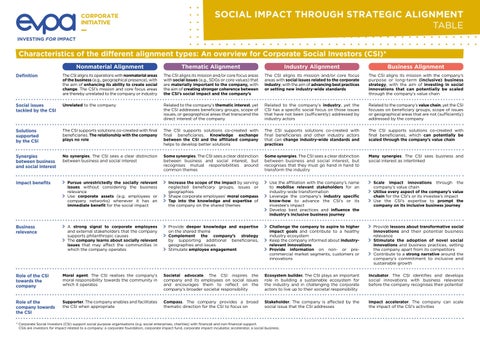
SOCIAL IMPACT THROUGH STRATEGIC ALIGNMENT TABLE Characteristics of the different alignment types: An overview for Corporate Social Investors (CSI)* Nonmaterial Alignment
Thematic Alignment
Industry Alignment
Business Alignment
Definition
The CSI aligns its operations with nonmaterial areas of the business (e.g., geographical presence), with the aim of enhancing its ability to create social change. The CSI’s mission and core focus areas are thereby unrelated to the company or industry
The CSI aligns its mission and/or core focus areas with social issues (e.g., SDGs or core values) that are materially important to the company, with the aim of creating stronger coherence between the CSI’s social impact and the company’s
The CSI aligns its mission and/or core focus areas with social issues related to the corporate industry, with the aim of advancing best practices or setting new industry-wide standards
The CSI aligns its mission with the company’s purpose or long-term (inclusive) business strategy, with the aim of investing in social innovations that can potentially be scaled through the company’s value chain
Social issues tackled by the CSI
Unrelated to the company
Related to the company’s thematic interest, yet the CSI addresses beneficiary groups, scope of issues, or geographical areas that transcend the direct interest of the company
Related to the company’s industry, yet the CSI has a specific social focus on those issues that have not been (sufficiently) addressed by industry actors
Related to the company’s value chain, yet the CSI focuses on beneficiary groups, scope of issues or geographical areas that are not (sufficiently) addressed by the company
Solutions supported by the CSI
The CSI supports solutions co-created with final beneficiaries. The relationship with the company plays no role
The CSI supports solutions co-created with final beneficiaries. Knowledge exchange between the CSI and the affiliated company helps to develop better solutions
The CSI supports solutions co-created with final beneficiaries and other industry actors that can change industry-wide standards and practices
The CSI supports solutions co-created with final beneficiaries, which can potentially be scaled through the company’s value chain
Synergies between business and social interest
No synergies. The CSI sees a clear distinction between business and social interest
Some synergies. The CSI sees a clear distinction between business and social interest, but recognises mutual responsibilities around common themes
Some synergies. The CSI sees a clear distinction between business and social interest, but recognises that they must go hand in hand to transform the industry
Many synergies. The CSI sees business and social interest as interlinked
Impact benefits
Pursue unrestrictedly the socially relevant issues without considering the business relevance Use corporate assets (e.g. employees or company networks) whenever it has an immediate benefit for the social impact
Increase the scope of the impact by serving neglected beneficiary groups, issues or geographies Shape corporate employees’ moral compass Tap into the knowledge and expertise of the company on the shared themes
Use the affiliation with the company’s name to mobilise relevant stakeholders for an industry-wide transformation Leverage the company’s industry specific know-how to advance the CSI’s or its investee’s impact Develop best practices and influence the industry’s inclusive business journey
Scale impact innovations through the company’s value chain Utilise every aspect of the company’s value chain for the CSI’s or its investee’s impact Use the CSI’s expertise to prompt the company on its inclusive business journey
Business relevance
A strong signal to corporate employees and external stakeholders that the company supports philanthropic causes The company learns about socially relevant issues that may affect the communities in which the company operates
Provide deeper knowledge and expertise on the shared theme Complement the company’s strategy by supporting additional beneficiaries, geographies and issues Stimulate employee engagement
Challenge the company to aspire to higher impact goals and contribute to a healthy industry ecosystem Keep the company informed about industryrelevant innovations Provide information on non- or precommercial market segments, customers or innovations
Provide lessons about transformative social innovations and their potential business relevance Stimulate the adoption of novel social innovations and business practices, setting the company apart from its competitors Contribute to a strong narrative around the company’s commitment to inclusive and sustainable growth
Role of the CSI towards the company
Moral agent. The CSI realises the company’s moral responsibility towards the community in which it operates
Societal advocate. The CSI inspires the company and its employees on social issues and encourages them to reflect on the company’s broader societal responsibility
Ecosystem builder. The CSI plays an important role in building a sustainable ecosystem for the industry and in challenging the corporate actors to live up to their societal responsibility
Incubator. The CSI identifies and develops social innovations with business relevance before the company recognises their potential
Role of the company towards the CSI
Supporter. The company enables and facilitates the CSI when appropriate
Compass. The company provides a broad thematic direction for the CSI to focus on
Stakeholder. The company is affected by the social issue that the CSI addresses
Impact accelerator. The company can scale the impact of the CSI’s activities
* Corporate Social Investors (CSI) support social purpose organisations (e.g. social enterprises, charities) with financial and non-financial support. CSIs are investors for impact related to a company: a corporate foundation, corporate impact fund, corporate impact incubator, accelerator, a social business.