Snapshot:
Released 14 November 2025

Released 14 November 2025
• This release includes 2024 preliminary data, 2023 preliminary revised data and 2022 revised data. Data from 2021 and prior is considered final.
• For data from 2013 onwards, Causes of Death data is presented by the year the death was registered.
• Care should be taken in comparing 2024 data to:
- Previous years, as some data has been subject to quality improvement processes.
- Pre-2006 data, as this data was not subject to the revision process.
What does the data tell us?
• Number of deaths by suicide in Australia
• Rates of suicide in Australia
• Common risk factors associated with suicide in Australia
How can the data be broken down?
• Sex (male and female)
• Age groups
• Aboriginal and Torres Strait Islander status
• States and Territories
• Remoteness
• Country of birth
• Occupation
• Socio-economic indexes
• In 2024, there were 3,307 deaths by suicide with an age-standardised rate of 11.8 per 100,000.
• There were 2,529 male deaths with an agestandardised rate of 18.3 per 100,000.
• There were 778 female deaths with an agestandardised rate of 5.5 per 100,000.
• The crude suicide rate was 12.2 per 100,000.
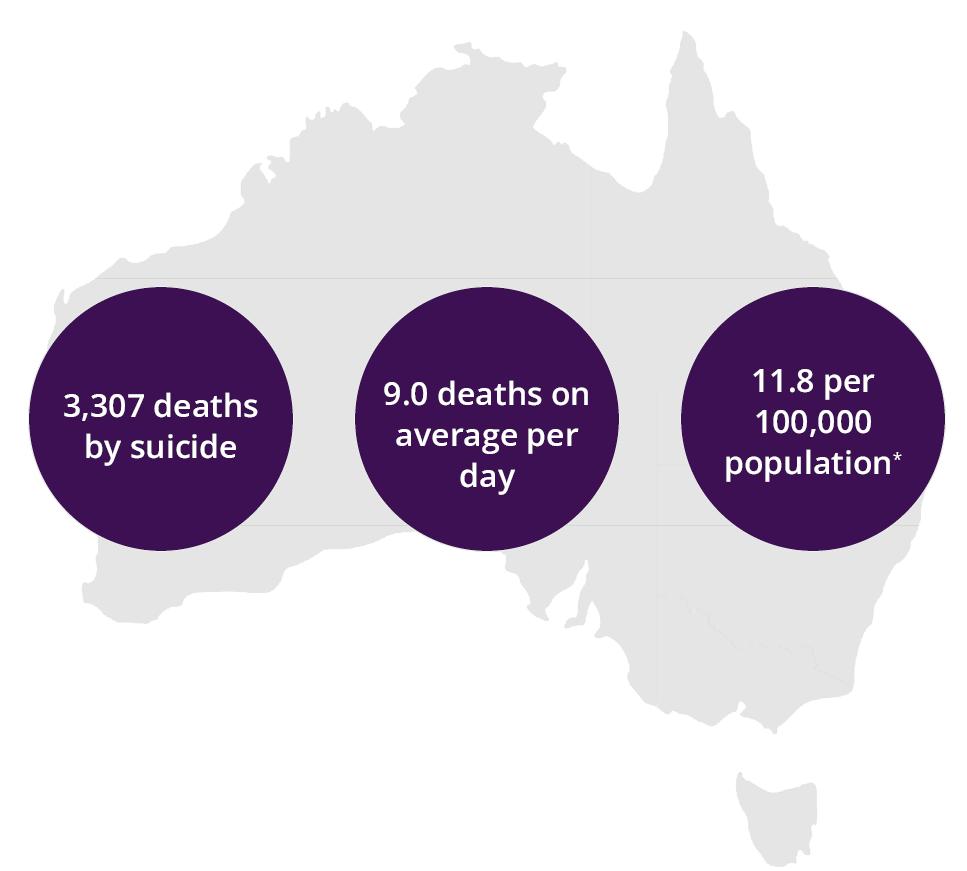
*Age-standardised rate per 100,000.
Females (2024) Note:
Males (2024)
Note: Data for 2021 and prior are final. 2022 data have been subject to revision; 2023 data are preliminary revised; and 2024 data are preliminary.
Males Females
In 2024:
• 306 Aboriginal and Torres Strait Islander people died by suicide. Using data from six jurisdictions (NSW, Vic, Qld, WA, SA and NT):
• Aboriginal and Torres Strait Islander people had an age-standardised suicide rate of 33.9 per 100,000.
• Aboriginal and Torres Strait Islander men (55.1 per 100,000) had a higher agestandardised suicide rate compared to women (13.3 per 100,000).
Note: Due to improvements in identifying Aboriginal and Torres Strait Islander deaths in NSW (2022) and Vic (2023), breaks are added into the time series. Comparisons over time should be made with caution.
Note: Suicide rates are compiled from the jurisdictions of NSW, Vic, Qld, WA, SA and NT.
Males Females Persons

In 2024, across five jurisdictions (not including Victoria):
• Aboriginal and Torres Strait Islander people had a suicide rate almost three times higher than non-Indigenous people.
• The age-standardised suicide rate was 33.7 per 100,000 (compared to 11.3 per 100,000 for non-Indigenous people).
• The median age of suicide death was 34.3 years (compared to 48.3 years for non-Indigenous people).
Note: Due to improvements in identifying Aboriginal and Torres Strait Islander deaths in NSW (2022) and Vic (2023), breaks are added into the time series. Comparisons over time should be made with caution.
Note: Suicide rates are compiled from the jurisdictions of NSW, Qld, WA, SA and NT.
Aboriginal and Torres Strait Islander people Non-Indigenous people
• Three-quarters (74.9%) of people who died by suicide had a usual residence in New South Wales (935), Queensland (790) or Victoria (755).
• Northern Territory recorded the highest suicide rate (19.3 per 100,000).
• The Australian Capital Territory recorded the lowest suicide rate (7.6 per 100,000).
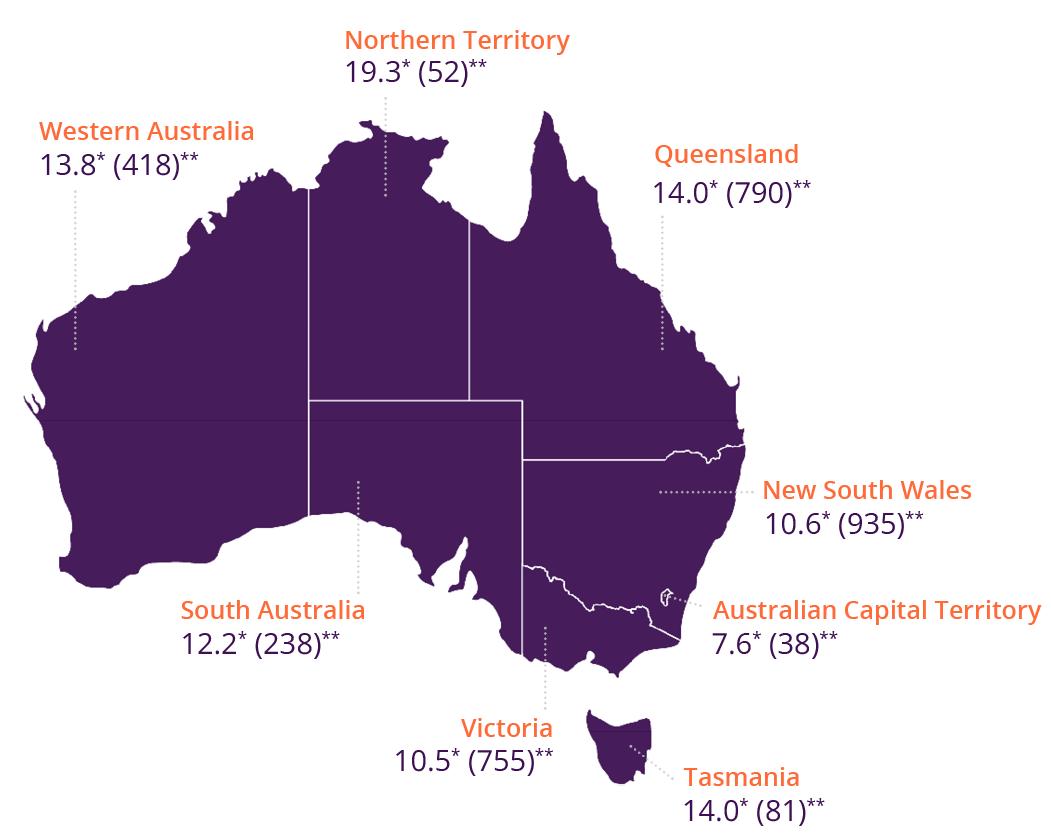
*Age-standardised rate per 100,000. **Number of deaths. Note: 2024 data are preliminary.
Note: Suicide rates are by usual place of residence. Data for 2020 and 2021 are final. 2022 data have been subject
• In the period 2020-2024, the suicide rate in remote and very remote Australia was between 20.5 and 24.6 deaths per 100,000 people. This is consistently higher than suicide rates in both regional areas and major cities.
• In 2024, the suicide rate for males living in remote and very remote Australia (39.8 per 100,000) was more than double the rate for males living in major cities (15.2 per 100,000).
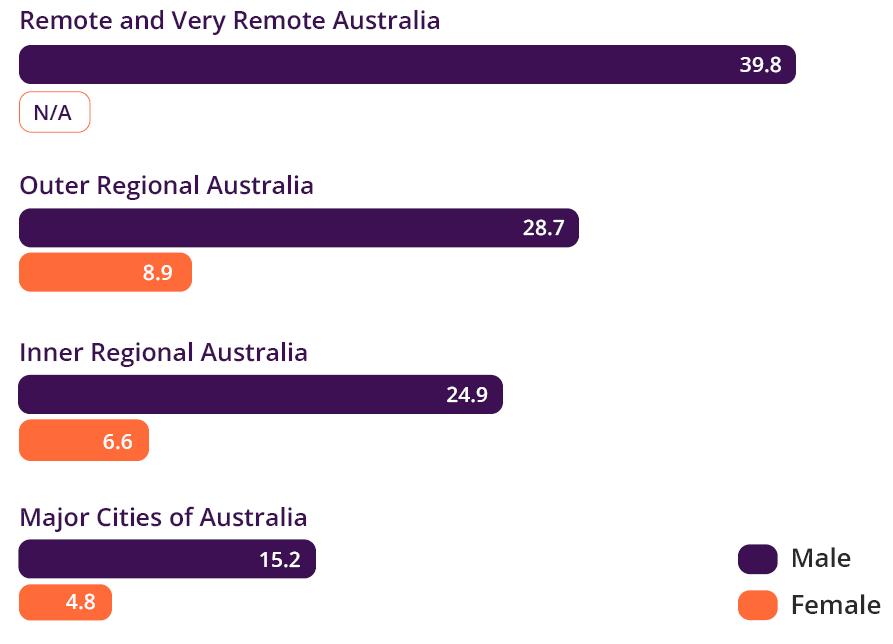
Note: Age-standardised suicide rates are for 2024; ‘Major Cities in Australia’ in this data excludes Darwin and Hobart.
• In 2024, people who died by suicide had an average of four factors mentioned.
• The types of risk factors experienced can vary across a person’s life.
• Mood disorders (including depression) were the most common risk factor overall.
• Limitation of activities due to illness and disability is the most common risk factor for those aged 85 years and over.
Most commonly reported risk factors across all ages in 2024:
• Mood disorders (including depression) (34.8%)
• Suicide ideation (shared thoughts with others) (30.5%)
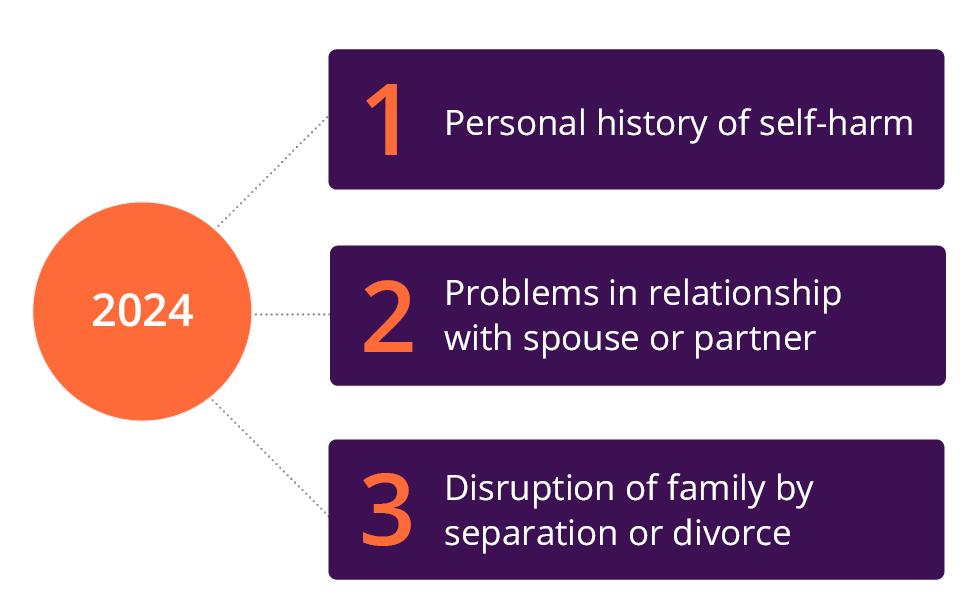
• Problems in spousal relationship circumstances (25.0%)
• Anxiety and stress related disorders (20.5%)
• Personal history of self-harm (20.4%).
• Psychosocial risk factors are social processes and social structures that can interact with a person’s thoughts, behaviour or health.
• In 2024, 66.7% of males and 66.8% of females had at least one psychosocial risk factor reported.
• The psychosocial risk factors associated with suicide were largely age dependent and differed throughout the lifespan.
People from culturally and linguistically diverse backgrounds may have unique experiences in relation to mental health concerns and suicide, including cultural and family views, and how health services are accessed.
For the five-year period 2020 to 2024:
• People who were born in Australia had an age-standardised rate of 14.6 deaths per 100,000 people.
• People who were born overseas had an age-standardised rate of 8.3 deaths per 100,000 people.
• People born in Northern Ireland, Wales, Malta, Kenya, New Zealand, Hungary and Scotland had a higher suicide rate than those born in Australia.
Occupation coding has been completed for the first time for deaths registered in 2023 and 2024.
In 2023 and 2024*:
• For males who died by suicide, technicians and trades workers was the most common occupation group (27.6% of suicides in males).
• For females who died by suicide, professionals was the most common occupation group (21.8% of suicides in females).
Technicians and Trades Workers
Machinery Operators and Drivers Labourers Professionals
Community and Personal Service Workers Managers
Clerical and Administrative Workers
*Does not account for underlying differences in the number of males and females employed in each of the major occupation groups. Deaths data coded to the Occupation Standard Classification for Australia (OSCA) is considered experimental and may be subject to improvements and revisions over time. This table includes preliminary revised data for 2023 and preliminary data for 2024.
Males
Females
Note: The number of deaths are compiled for 2023 and 2024. 2023 data are preliminary revised; and 2024 data are preliminary. Occupations listed on the death registration that are unable to be coded at any level are assigned a supplementary code.
Number of suicides
• The suicide rate for people with the lowest level of socio-economic advantage (Quintile 1) was 2.5 times higher than people with the highest advantage (Quintile 5).
• For both males and females, suicide rates increase as relative socio-economic disadvantage increases.
Note: Rates are for 2024; 2024 data are preliminary.
more, contact and follow Mindframe:


mindframe@health.nsw.gov.au
mindframe.org.au
@MindframeMedia.bsky.social
@MindframeMedia