Australian Bureau of Statistics, Causes of Death, 2024
National suicide data summary
Released 14 November 2025
National suicide data summary
Released 14 November 2025
• This summary was prepared by Everymind using the Australian Bureau of Statistics (ABS) Causes of Death data, released 14 November 2025.
• When exploring suicide data, it is important to remember that behind the numbers are individuals, families and communities impacted by suicide in Australia. By combining the knowledge in this data with other Australian data sets and the wisdom of those with lived and living experience, we will increase opportunities to reduce suicide and its impacts.
• Media and others communicating publicly about this data are reminded to be responsible and accurate. Resources to support reporting and other communication are available at mindframe.org.au/suicide and mindframe.org.au/our-wordsmatter-guidelines-for-language-use
• A full summary of data can be found on the Life in Mind portal at lifeinmind.org.au/abs-causes-of-death-2024
• The Australian Bureau of Statistics advises that care should be taken in comparing 2024 data with:
- Previous years, as some data has been subject to quality improvement processes and some cases are yet to be resolved
- Pre-2006 data, as this data was not subject to the revision process.
• For data from 2013 onwards, Causes of Death data is presented by the year the death was registered.
• Due to the relatively small population size in some states and territories, even one or two deaths can have a significant impact on state-specific age-standardised suicide rates. Therefore, comparisons across Australia must be done with caution
This release includes 2024 preliminary data, 2023 preliminary revised data and 2022 revised data. Data for 2014 to 2021 are considered final.
Throughout this summary, rates are used to describe patterns and trends in the data. Alongside the number of suicide deaths, they help us to better understand and compare suicidal behaviours in different groups and over time.
Crude rates
A crude rate is the number of deaths divided by the population times 100,000.
Age-specific rates
Age-specific rates are used to measure how many deaths occurred in a specific age group.
Age-standardised rates
Crude rates do not account for population differences, such as proportions of people of different ages (‘age structures’), when comparing different groups.
This is calculated by dividing the number of suicide deaths in a particular age group by the total number of people in the specific age group.
Age-standardised rates use a formula to calculate a rate that reflects a ‘standard’ age structure of the population. This is useful to be able to make fairer comparisons between groups or populations over time.
It is best to use age-standardised rates when comparing populations with different age groups, for example, male and female if possible.
12.2 per 100,000
The crude rate may give a more accurate rate of suicide in a single year. However, age-standardised rates should be used for comparing data between groups or over time where possible.
Note: Rates are age-standardised per 100,000. The crude rate for 2024 is 12.2 per 100,000. *Average deaths per day were calculated by Everymind and we recommend using with caution.
Note: 2022 data have been subject to revision; 2023 data are preliminary revised; and 2024 data are preliminary.
In 2024:
• Over three-quarters (76.5%) of people who died by suicide were male.
• Males had an age-standardised suicide rate of 18.3 per 100,000.
• Females had an age-standardised suicide rate of 5.5 per 100,000.
• 82.6% of people who died by suicide were aged under 65.
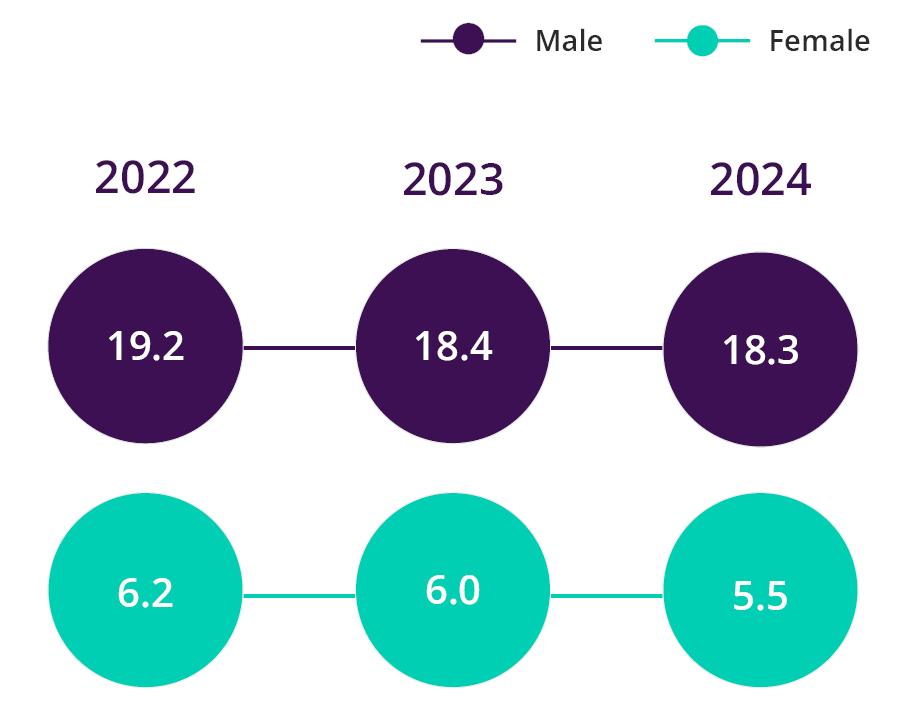
*Age-standardised rate per 100,000.
Note: 2022 data have been subject to revision; 2023 data are preliminary revised; and 2024 data are preliminary.
Note: 2024 data are preliminary.
Males (2024)
Females (2024)
In 2024:
• Suicide was the 11th leading cause of death for males.
• Males aged 85+ years had the highest age-specific suicide rate (31.2 per 100,000) and accounted for 2.9% of suicides of males.
• Males aged 40-44 years accounted for the largest proportion of male deaths due to suicide (10.5%).
Note: 2023 data are preliminary revised; 2024 data are preliminary.
In 2024:
• Suicide was the 27th leading cause of death for females.
• Females aged 25-29 years had the highest age-specific suicide rate (9.8 per 100,000) and accounted for the largest proportion of female suicide deaths (12.3%).
Note: 2023 data are preliminary revised; 2024 data are preliminary.
Note: Data for 2021 and prior are final. 2022 data have been subject to revision; 2023 data are preliminary revised; and 2024 data are preliminary.
Across all of Australia, in 2024:
• 306 Aboriginal and Torres Strait Islander people died by suicide.
• The median age of death was 34.8 years.
Using data from six jurisdictions (New South Wales, Victoria, Queensland, Western Australia, South Australia and Northern Territory):
• Aboriginal and Torres Strait Islander people had an age-standardised suicide rate of 33.9 per 100,000.
• Aboriginal and Torres Strait Islander men (55.1 per 100,000) had a higher age-standardised suicide rate compared to women (13.3 per 100,000).
Note: Due to improvements in identifying Aboriginal and Torres Strait Islander deaths in NSW (2022) and Vic (2023), breaks are added into the time series. Comparisons over time should be made with caution.
Note: Suicide rates are compiled from the jurisdictions of NSW, Vic, Qld, WA, SA and NT.
In 2024, across five jurisdictions (not including Victoria):
• Aboriginal and Torres Strait Islander people had a suicide rate almost three times higher than nonIndigenous people.
• The age-standardised suicide rate for Aboriginal and Torres Strait Islander people was 33.7 per 100,000 compared to 11.3 per 100,000 for nonIndigenous people.
Note: Due to improvements in identifying Aboriginal and Torres Strait Islander deaths in NSW (2022) and Vic (2023), breaks are added into the time series. Comparisons over time should be made with caution.
Note: Suicide rates are compiled from the jurisdictions of NSW, Qld, WA, SA and NT.
Aboriginal and Torres Strait Islander people Non-Indigenous people
• Three-quarters (75%) of people who died by suicide had a usual residence in New South Wales (935), Queensland (790) or Victoria (755).
• Northern Territory recorded the highest agestandardised suicide rate (19.3 per 100,000).
• The Australian Capital Territory recorded the lowest age-standardised suicide rate (7.6 per 100,000).
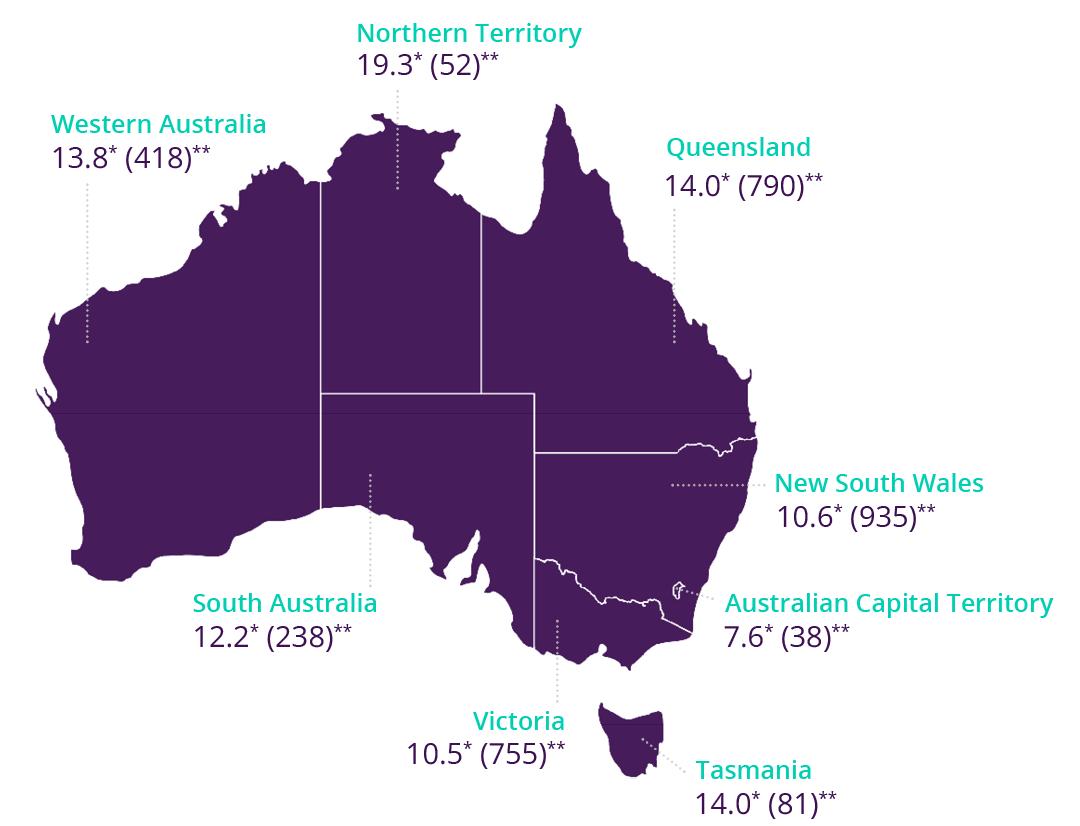
*Age-standardised rate per 100,000 population
** Number of deaths
Data sourced from the Australian Bureau of Statistics. Intentional self-harm deaths (Suicide) in Australia. 2024 data released in 2025.
• In all states and territories, age-standardised suicide rates were lower in capital cities than in the rest of the state or territory.
Note: Suicide rates are by usual place of residence. Data for 2020 and 2021 are final. 2022 data have been subject to revision; 2023 data are preliminary revised; and 2024 data are preliminary.
• Across a five-year period (2020-2024), major cities had the lowest suicide rate across all years.
• Though 2024 suicide data is considered preliminary, suicide rates for males and persons living in remote and very remote Australia are the highest in the five-year time-series.
• In 2024, the suicide rate for males living in remote and very remote Australia (39.8 per 100,000) was more than double the rate for males living in major cities (15.2 per 100,000).
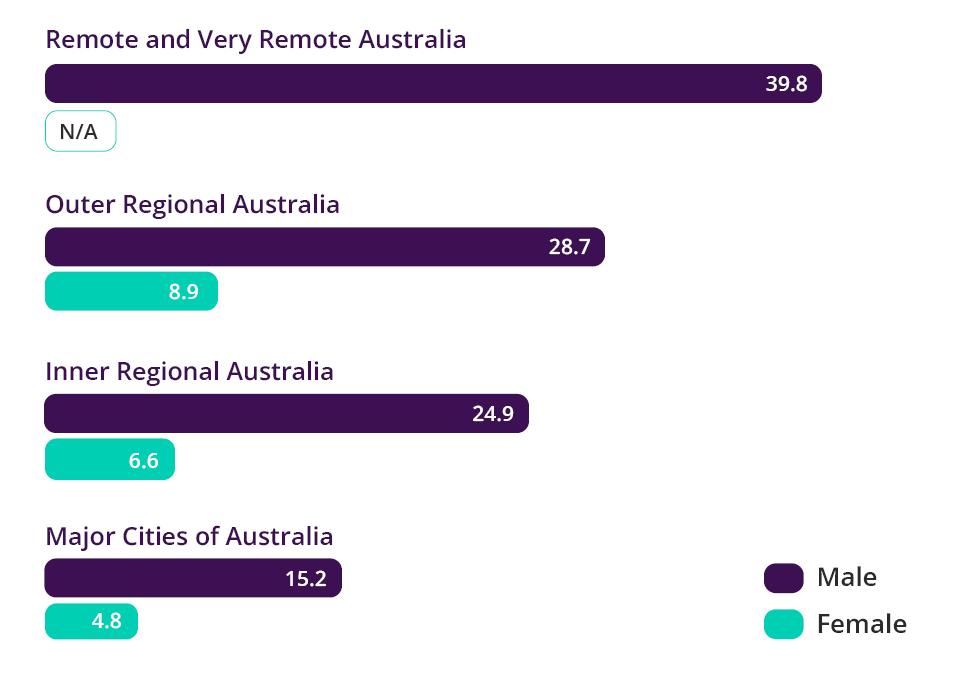
Note: Age-standardised suicide rates are for 2024; In this data, ‘Major Cities in Australia’ in this data excludes Darwin and Hobart.
• Suicide among children (aged 0-14) is an extremely sensitive issue and rare occurrence, with considerably fewer deaths than any other age group.
• There were 17 deaths by suicide among young people aged 0-14 years with an agespecific rate of 0.4 per 100,000.
• There were 5 deaths among boys in this age group at an age-specific rate of 0.2 per 100,000.
• There were 12 deaths among girls in this age group at an age-specific rate of 0.5 per
100,000.
Note: 2014-2021 data are final. 2022 data have been subject to revision; 2023 data are preliminary revised; and 2024 data are preliminary.
Note: Data for 2021 and prior are final. 2022 data have been subject to revision; 2023 data are preliminary revised; and 2024 data are preliminary.
Note: Data for 2021 and prior are final. 2022 data have been subject to revision; 2023 data are preliminary revised; and 2024 data are preliminary.
Note: Data for 2021 and prior are final. 2022 data have been subject to revision; 2023 data are preliminary revised; and 2024 data are preliminary.
Note: Data for 2021 and prior are final. 2022 data have been subject to revision; 2023 data are preliminary revised; and 2024 data are preliminary.
Note: Data for 2021 and prior are final. 2022 data have been subject to revision; 2023 data are preliminary revised; and 2024 data are preliminary.
Note: Data for 2021 and prior are final. 2022 data have been subject to revision; 2023 data are preliminary revised; and 2024 data are preliminary.
Note: Data for 2021 and prior are final. 2022 data have been subject to revision; 2023 data are preliminary revised; and 2024 data are preliminary.
Note: Data for 2021 and prior are final. 2022 data have been subject to revision; 2023 data are preliminary revised; and 2024 data are preliminary.
Note: Data for 2021 and prior are final. 2022 data have been subject to revision; 2023 data are preliminary revised; and 2024 data are preliminary.
Note: Data for 2021 and prior are final. 2022 data have been subject to revision; 2023 data are preliminary revised; and 2024 data are preliminary.
Note: Data for 2021 and prior are final. 2022 data have been subject to revision; 2023 data are preliminary revised; and 2024 data are preliminary.
Note: Data for 2021 and prior are final. 2022 data have been subject to revision; 2023 data are preliminary revised; and 2024 data are preliminary.
Note: Data for 2021 and prior are final. 2022 data have been subject to revision; 2023 data are preliminary revised; and 2024 data are preliminary.
Note: 2008 data for females 80-84 years old is not available for publication. Data for 2021 and prior are final. 2022 data have been subject to revision; 2023 data are preliminary revised; and 2024 data are preliminary.
Note: Data for 2021 and prior are final. 2022 data have been subject to revision; 2023 data are preliminary revised; and 2024 data are preliminary.
• In 2024, 79.7% of people who died by suicide had at least one risk factor reported, with an average of four factors mentioned.
• The types of risk factors experienced by a person can vary across their life. Mood disorders (including depression) were the most common risk factor overall, and in those aged between 25 and 84 years. Limitations of activities due to illness and disability continues to be the most common risk factor for those aged 85 years and over.
Most commonly reported risk factors across all ages in 2024:
• Mood disorders (including depression) (34.8%)
• Suicide ideation (shared thoughts with others) (30.5%)
• Problems in spousal relationship circumstances (25.0%)
• Anxiety and stress related disorders (20.5%)
• Personal history of self-harm (20.4%).
• Psychosocial risk factors are social processes and social structures that can interact with a person’s thoughts, behaviour or health.
• In 2024, 66.7% of males and 66.8% of females had at least one psychosocial risk factor reported.
• Psychosocial risk factors associated with suicide were largely age dependent and differed throughout the lifespan.
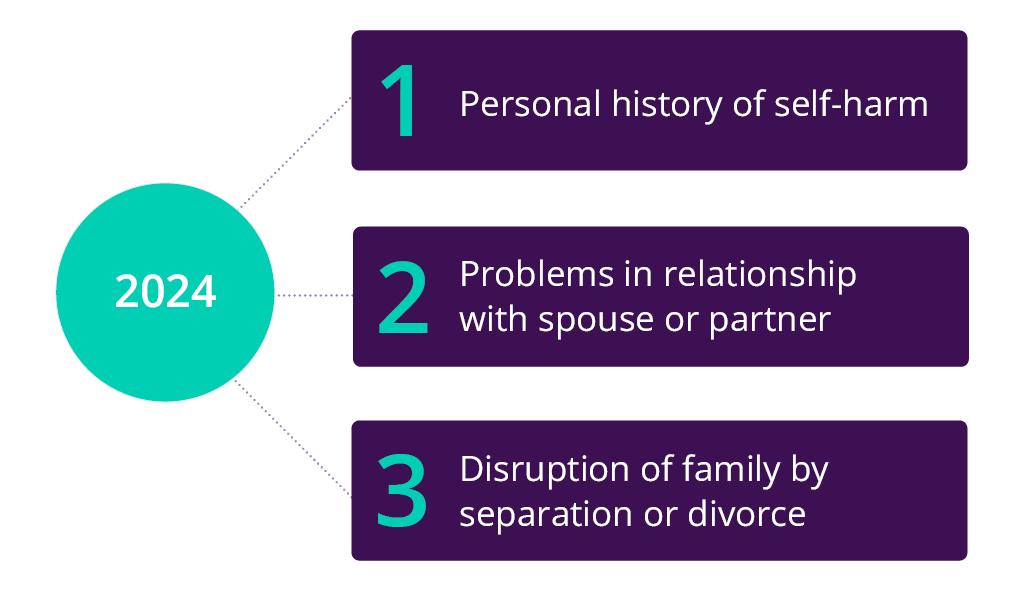
*Refers to proportion of suicides with one or more associated psychosocial factors.
*Refers to proportion of suicides with one or more associated psychosocial factors.
*Refers to proportion of suicides with one or more associated psychosocial factors.
*Refers to proportion of suicides with one or more associated psychosocial factors.
*Refers to proportion of suicides with one or more associated psychosocial factors.
*Refers to proportion of suicides with one or more associated psychosocial factors.
Over 27% of Australia’s population live in regional and remote areas, where suicide rates are higher than Australia’s major cities.
Factors contributing to elevated suicide rates in regional and remote Australia are multifaceted and may be influenced by social, economic, health and environmental conditions specific to these regions.
For those who died by suicide in the five-year period 2020-2024:
• People living in major cities were more likely to have a specific mental health condition mentioned than those who lived in regional or remote Australia. Increased remoteness correlated with lower likelihood of a specific mental health condition being mentioned.
• Alcohol and other drug use was most commonly mentioned as a risk factor for those living in remote and very remote Australia. For example, acute alcohol use and intoxication was mentioned in 34.4% of suicides; and acute psychoactive substance use and intoxication mentioned in 31.6% of suicides.
• Problems related to employment and the social environment (including social exclusion and rejection) were more common in major cities and inner regional areas.
• People from culturally and linguistically diverse backgrounds may have unique experiences in relation to mental health concerns and suicide, including cultural and family views and how health services are accessed.
• Death registrations do not directly collect information on whether a person was part of a multicultural community. Data items from the death registration, which can provide some indication of cultural and linguistic diversity, are country of birth and years of residence in Australia.
• While these two variables do not provide complete information on suicide for people of culturally and linguistically diverse backgrounds, they do provide some additional insights into suicide in Australia.
For the five-year period 2020 - 2024:
• People who were born in Australia had an age-standardised rate of 14.6 deaths per 100,000 people.
• People who were born overseas had an age-standardised rate of 8.3 deaths per 100,000 people.
• People born in Northern Ireland, Wales, Malta, Kenya, New Zealand, Hungary and Scotland had a higher suicide rate than those born in Australia.
Occupation coding has been completed for the first time for deaths registered in 2023 and 2024.
In 2023 and 2024*:
• For males who died by suicide, technicians and trades workers was the most common occupation group (27.6% of suicides in males).
• For females who died by suicide, professionals was the most common occupation group (21.8% of suicides in females).
Note: The number of deaths are compiled for 2023 and 2024. 2023 data are preliminary revised; and 2024 data are preliminary. Occupations listed on the death registration that were unable to be coded at any level were assigned a supplementary code.
Number of suicides
*Does not account for underlying differences in the number of males and females employed in each of the major occupation groups. Deaths data coded to the Occupation Standard Classification for Australia (OSCA) is considered experimental and may be subject to improvements and revisions over time. This table includes preliminary revised data for 2023 and preliminary data for 2024.
The below table ranks the top three sub-major groups for deaths by suicide, by sex across 2023 - 2024 (excluding supplementary codes).
*Deaths data coded to the Occupation Standard Classification for Australia (OSCA) is considered experimental and may be subject to improvements and revisions over time. This table includes preliminary revised data for 2023 and preliminary data for 2024.
• The suicide rate for people with the lowest level of socio-economic advantage (Quintile 1) was 2.5 times higher than people with the highest advantage (Quintile 5).
• For both males and females, suicide rates increase as relative socio-economic disadvantage increases.
Note: Rates are for 2024; 2024 data are preliminary.
This summary is based on data derived from the Australian Bureau of Statistics’ Causes of Death release on Intentional selfharm.
abs.gov.au/statistics/health/causes-death
This data will also form part of the Australian Institute of Health and Welfare’s Suicide and Self-harm Monitoring System and should be taken in context with other data sources.
aihw.gov.au/suicide-self-harm-monitoring
Life in Mind is a knowledge exchange portal providing translated evidence, policy, data and resources in suicide prevention, and host of the National communications charter (the Charter).
Life in Mind provides sector leadership through collaboration and engagement, and facilitates access to current evidencebased suicide prevention resources, services, research and policy through an easily accessible digital portal.


lifeinmind.org.au