
Everest Construction Explores Advanced Materials In Construction
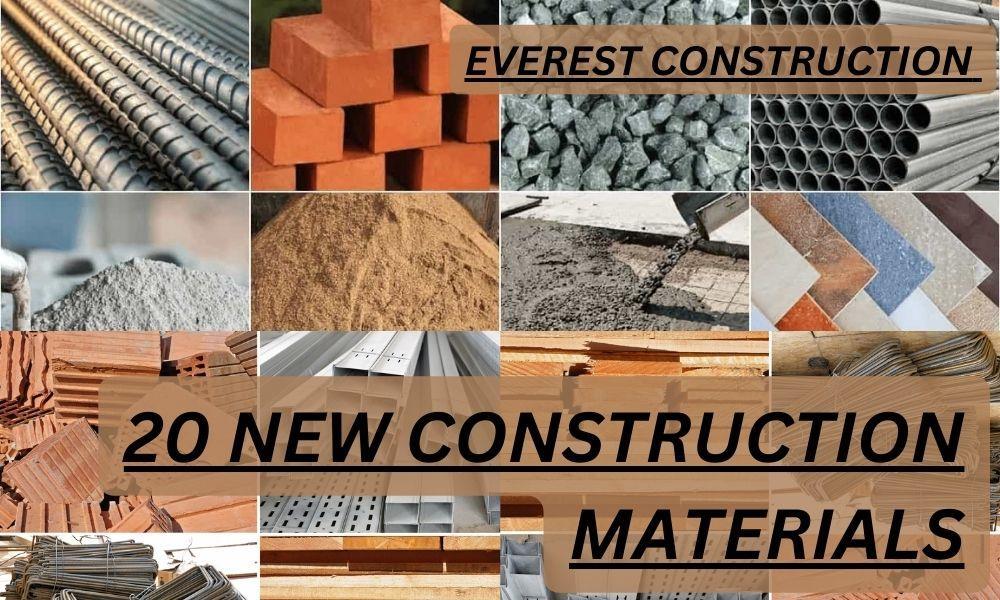
20 NEW CONSTRUCTION MATERIALS
Over the centuries, there has been a series of continuous innovations in the construction industry. EVEREST CONSTRUCTION examines how technological advances have affected the region, from durable concrete used in ancient structures to steel used in bridges and skyscrapers. Some materials have evolved, while others are new introductions to the industry. The need to meet housing demands, respond to disasters, and manage rising construction costs has driven the development of new innovative solutions. This article will discuss some emerging innovative construction materials.
1. Indication Panel
Illusion panels are a form of cladding made from stable aluminum foam that creates solid and lightweight panels that resemble a metal sponge. Allusion panels have distinctive features such as soundproofing, durability, fire resistance, and ease of installation. They are used for wall panels, facades, ceilings, floors, signage, and lighting fixtures. They have virtually unlimited applications in construction and architecture.
2. Transparent Wood
Transparent wood is a revolutionary building material that is a great alternative to glass and plastic. It has the same strength as wood and is very light. It is made by compressing and treating thin strips of wood. In the treatment process, the lignin is replaced with polymers to make the wood transparent. Favorable properties of transparent wood include its low density, low thermal conductivity, and high optical transmittance compared to glass. Optical transmission reduces the need for artificial light, thereby reducing power consumption.
3. Hydro Ceramic
Hydroceramic is a new technology for building walls and allows the walls to respond to outside temperatures. These smart walls are made of clay panels and water capsules that absorb water to cool a building. Hydro ceramic wall acts as a cooling device by reducing temperature and increasing humidity. As outdoor heat increases, trapped water can evaporate and expel cool air into the building. These walls can reduce the room temperature by up to 5 degrees Celsius. It increases humidity by 15% in hot, dry climates, making the premises more livable. Clay and hydrogel are cheap, making these buildings a low-cost option.
4. Pigmented Concrete
Pigmented concrete is made by mixing dry powder or liquid concrete during the mixing stage. We get most of these pigments from iron oxide or dyes. Traditionally, concrete is grey, but pigmented concrete produces warm shades of yellow, brown, red, green, and blue and their color derivatives. Pigmented concrete is not affected by abrasion, and the colors do not fade when exposed to heat and light. This type of concrete is used for floors, facades, and other decorative applications.
5. Bamboo Reinforced Concrete
Steel-reinforced concrete is one of the most common building materials in construction. However, bamboo is an alternative material used for reinforcement. Bamboo has been used in construction for many years due to its excellent tensile properties. Bamboo is superior to wood and, in some cases, structural steel. Most architects with a sustainability mindset adopt bamboo in construction. However, bamboo also has some disadvantages if left untreated. It can swell with water and rot. In modern construction, bamboo is not used in its natural tubular state. Plant fibers are extracted and combined with natural resins to create a highly versatile material with a strong structural matrix.
6. Pollution absorbing bricks
Sustainability in construction is one of the factors of significant concern. Increasing population density and pollution bring serious challenges that motivate the industry to develop sustainable solutions. Pollutionabsorbing bricks filter air from outside and transport it to the interiors of structures. These bricks are porous concrete blocks designed to direct airflow into the system. These bricks are cheaper than mechanical
filtration technologies. They use less energy and require no skilled labor to construct the system.
7. Self-Healing Concrete
It is a new type of concrete that mimics the healing of the human body after a wound. It achieves this by secreting certain materials into the concrete. This concrete is made by adding fibers or capsules containing adhesive fluid to the concrete mix. After rupture, the capsules or fibers rupture and release fluid, after which the concrete cures. However, this technology is still in the research stage. This automatic healing of concrete will increase the lifespan of the concrete and reduce repair costs. If the cracks spread and reach the reinforcement, it causes corrosion. However, this self-healing concrete prevents this from happening.
8. Aerographite
Aerographite is a material made from a network of tiny hollow carbon tubes. Aerographite is strong and bendable and absorbs light rays. Aerographite is stable at room temperature and can withstand a lot of vibration without damage. It is also a good conductor
of electricity. One can compress aerographite to occupy 95% of its normal area and stretch it back to standard form without any damage. Tension only strengthens the material. Aerographene is primarily used in construction to make purification systems, aviation materials, and satellites.
9. Cigarette Butt Bricks
According to a study, the annual consumption of cigarettes in Australia alone is 25 to 30 billion. Of these, 7 billion cigarettes are lying in the garbage. However, we can incorporate cigarette butts into brick production, which can drastically reduce the wastage caused by these butts. Adding butts to bricks during production also reduces the energy spent by 58%. Bricks with these additional properties are lightweight and have good insulation properties. The insulation properties reduce heating and cooling costs in the dwelling. Some researchers say that cigarette butts reduce the suitability of bricks for load-bearing walls. However, we can reduce the concentration to match the requirements.
10. Light-Emitting Cement
Concrete can absorb and radiate light, providing superior functionality and versatility concerning energy efficiency. Light-producing cement has many possible uses. We can use it in parking lots, swimming pools, and road safety signs. We produce this cement by altering the microstructure of the cement to absorb solar energy and subsequently emit light in the dark. Currently, the color of cement-producing light is blue and green, and contractors can adjust the intensity of light to meet requirements.
11. Hollow Clay Bricks
Bricks have been an integral part of construction since ancient times. However, hollow clay bricks are the new buzz in construction. They are perforated and lined with specially insulating material. They are lightweight, eco-friendly, and have low water absorption. They also have a better aesthetic outlook than traditional bricks. Since these bricks are light in weight, they help in faster construction and quick completion of the project. These have good compressive strength and can be used in partition walls.
12. 3D Graphene
Graphene is a unique nanomaterial with distinctive thermal, electrical, and optical properties. 3D graphene has 5% the density of steel yet is ten times stronger than steel. Graphene has long been of interest to scientists but has yielded little results in producing its standard 2D form. The introduction of 3D printing compressed small pieces of graphene under high pressure and heat and created cylinder-like structures that could withstand substantial loads. Graphene can support skyscrapers up to 98,000 feet tall.
13. Nanoparticles
Nanotechnology in construction focuses on using nanoparticles to create solid structural materials. Nanoparticles also reduce the use of natural materials because they create stronger materials that take up less space. They are a fast and safe way to start construction projects. Examples of nanoparticles in concrete include nano-silica, nano-titanium, carbon nanotubes, and graphene oxide. We can add these ingredients to cement to improve the flexural, tensile, and compressive strength of concrete. These materials enhance the performance of structures and their overall lifespan. Carbon nanotubes in concrete have
self-cleaning properties that make it easy to monitor the health of the structure.
14. Woolen Bricks
Manufacturers make wool bricks by mixing wool with the clay used in brick production. This is a step towards sustainable construction as wool bricks are a zerocarbon product. They manufacture bricks in brick kilns that release poisonous smoke with high concentrations of carbon. Traditional brick manufacturing has a serious impact on the environment. However, wool bricks combine wool, clay, and natural polymers, and these bricks are sustainable and use naturally available materials. They are also stronger than traditional bricks.
15. Concrete of Mars
Concrete is important in building structures on Earth. However, Martian concrete could be of great help in building structures on Mars. Water is a primary component used for construction on land. However, there are tons of sulfur on Mars that cover 17% of the planet's total surface area. Martian concrete is made by heating sulfur to 240 degrees Celsius and mixing it with
Martian soil. This concrete reaches a compressive strength of up to 50 MPa when compressed before curing to reduce the formation of voids. One of the advantages of Martian concrete is that it sets fast and is easy to use repeatedly.
16. Artificial Spider Silk
Spider silk is one of nature's interesting materials. It is possible to stretch it for a long time before it breaks. Cambridge researchers developed a material that mimics the strength and energy capacity of spider silk. Artificial spider silk is made from a material called hydrogel, which is 98% water. Hydrogels contain silica and cellulose fibers that form stronger fibers when water evaporates. It is possible to make artificial spider silk at room temperature, making it easier to produce on a large scale. Artificial spider silk is 340 times more durable than concrete and can create acoustic building tiles.
17. Generating Glass
Energy use inbuilt spaces is a major concern as buildings contribute 40% of global carbon emissions. This gave rise to the idea of glass that generates
electricity. Solar and wind systems have been in use for a long time but now, converting windows to solar panels has become a reality. This gave rise to the idea of glass that generates electricity. Galvanic glass is like regular glass, but it can deflect invisible light wavelengths and convert them into energy. This glass reduces electricity costs, reduces pollution, and enhances the architectural appeal of the structure.
18. Carbon Fiber Balsa
Due to its strength and lightweight, people have been using balsa wood in construction for centuries. However, balsa wood is expensive and has natural variations that can hinder the achievement of exact requirements. Mixing carbon fiber resins with balsa wood creates an engineered composite that is lighter in weight and easier to achieve a specific stiffness.
19. Microbial Cellulose
Microbial cellulose is a sustainable building material developed from renewable sources and is a mixture of yeast, microorganisms, and bacteria that is used to create layered structures. Several bacterial species produce bacterial cellulose used in the manufacture of
microbial cellulose. This forms a structural membrane that we can use to create units such as signage and building facades. Microbial cellulose is biodegradable and thus does not contribute to pollution. It is also easy and cheap to produce, providing a good foundation for mass production and sustainable construction.
20. Biochar
Biochar is a substance that resembles charcoal and is formed by decomposing organic matter at high temperatures without oxygen. Manufacturers add additives to the soil to improve water absorption and retain moisture in the biochar. Biochar is a good construction material that reduces most of the greenhouse emissions from concrete and plastics. Converting total organic waste in landfills to biochar would reduce global methane emissions by 11%. Adding biochar to bricks reduces the amount of cement used in concrete and the overall carbon dioxide produced during concrete manufacturing. Biochar is also used with plastics to make bricks and reduce the global amount of plastic waste.
Summary
Everlast Construction emphasizes how new materials impact construction processes, providing improved structural safety and energy efficiency. These new building materials also comply with sustainable standards and specifications.
Traditional materials will either disappear from the construction landscape altogether or evolve into new, cost-effective, and environmentally friendly methods. The use of new materials reduces manufacturing costs without compromising quality. Understanding new building materials trends in the industry helps Everest Construction stay on track and contribute to environmental protection.