OPINION & COMMENT
TRUST our advertisers
WE DO!
22 - 28 May 2014 / Costa Blanca South
EWN
59
Colorado’s enduring links to mother-ship Spain
Consider This
removed the Dominican, Franciscan and Jesuit priests from Mexico. The brotherhood of ‘Penitentes’ assumed the critical role in keeping the Hispanic traditions alive in those remote areas without clergy. Many theorise that there is a connection between the still existent Penitentes of the San Luis Valley and the 16th century Penitentes of Spain. For example, there are many similarities in the Christmas season processions throughout the valley and those performed in Sevilla and Granada. Perhaps the most curious tie of the valley’s direct relationship to Spain has been a recent medical discovery. Doctors at some of the area’s medical schools have documented disproportionate levels of breast cancer within the women of the valley. The genetic mutation that has caused this particular type of virulent breast cancer had previously been found only in Jewish women with a European Mediterranean lineage. Yet all these new patients were Hispanic Catholics of the San Luis Valley. These ontological hard facts have raised some interesting overtures. It is well known that during the Middle Ages, the Jews of Spain were expelled or were forced to convert (becoming ‘conversos’). These exiles went as far as the New World and it is not hard to imagine that many ventured up the Rio Grande to the northernmost outpost of the San Luis Valley. Rumours of secret Spanish Jewry have floated around the valley for years. Locals have long noted that the original Spanish conquistador to the valley, Juan de Onate (1598), had ‘converso’ relatives and documented conversos in his expedition. Furthermore, the valley is home to some local customs such as sweeping the dust to the centre of the room, covering mirrors while mourning a loved one and the Friday night lighting of candles, all tied to ancient Jewish customs. To be sure, it is not uncommon to see examples of colonial Spanish architecture or hear Spanish being spoken while visiting the American South-West. Yet one would be hard-pressed to find a more direct link between the New World to mother-ship Spain than the evidence found in the San Luis Valley of Colorado, USA. These links with the past have proven to be a successful formula for sustained Spanish life in the valley. That, in and of itself, is a very Spanish attribute.
Wikipedia_Evillbunny
T
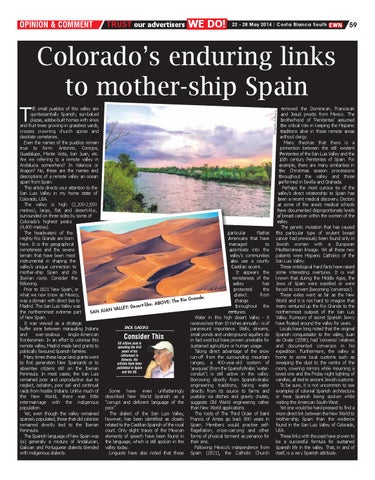
HE small pueblos of this valley are quintessentially Spanish; sun-baked plazas, adobe-built homes with vines and fruit trees growing in grassless yards, crosses crowning church spires and desolate cemeteries. Even the names of the pueblos remain true to form: Antonito, Conejos, Guadalupe, Monte Vista, San Juan, etc. Are we referring to a remote valley in Andalucia somewhere? In Valencia or Aragon? No, these are the names and descriptions of a remote valley an ocean apart from Spain. This article directs your attention to the San Luis Valley in my home state of Colorado, USA. The valley is high (2,200-2,500 metres), large, flat and desert-like, surrounded on three sides by some of Colorado’s highest peaks (4,400 metres). The headwaters of the mighty Rio Grande are born here. It is the geographical remoteness and the severe terrain that have been most instrumental in shaping the valley’s unique connection to mother-ship Spain and its Iberian roots. Consider the following. Prior to 1821 ‘New Spain’, or what we now know as Mexico, was a domain with direct ties to : The Rio e. ABOVE k li tr e s Madrid. The San Luis Valley was e :D N VALLEY the northernmost extreme part SAN JUA of New Spain. It was viewed as a strategic JACK GAIONI buffer zone between marauding Indians and over-zealous Anglo-American frontiersmen. In an effort to colonise this US citizen Jack is remote valley, Madrid made land grants to spending the first years of his politically favoured Spanish families. retirement in Many times these large land grants went Almeria. His to first generation New Spaniards or to articles have been published in Spain absentee citizens still on the Iberian and the US. Peninsula. In most cases, the San Luis remained poor and unproductive due to neglect, isolation, poor soil and continual raids from hostile Indians. Unlike much of Some have even unflatteringly the New World, there was little described New World Spanish as a intermarriage with the indigenous “corrupt and deficient language of the population. poor.” Yet, even though the valley remained The dialect of the San Luis Valley, sparsely populated, those that did colonise however, has been identified as closely remained directly tied to the Iberian related to the Castilian Spanish of the royal Peninsula. court. Only slight traces of the Mexican The Spanish language of New Spain was elements of speech have been found in (is) generally a mixture of Andalucian, the language, which is still spoken in the Galician and Portuguese dialects blended valley today. with indigenous dialects. Linguists have also noted that those
particular Native Americans that have managed to assimilate into the valley’s communities also use a courtly Castilian accent. It appears the remoteness of the valley has protected the dialect from Grande. change throughout the centuries. Water in this high desert Valley - it receives less than 10 inches annually - is of paramount importance. Wells, streams, small ponds and underground aquifers do in fact exist but have proven unreliable for sustained agriculture or human usage. Taking direct advantage of the snow run-off from the surrounding mountain ranges, a 400-year-old system of ‘acequias’ (from the Spanish/Arabic ‘waterconduit’) is still active in the valley. Borrowing directly from Spanish-Arabic engineering traditions, taking water directly from its source to farms and pueblos via ditches and gravity chutes, suggests Old World engineering rather than New World applications. The roots of The Third Order of Saint Francis of Amiss go back 800 years in Spain. Members would practise selfflagellation, cross-carrying and other forms of physical torment as penance for their sins. Following Mexico’s independence from Spain (1821), the Catholic Church