OPINION & COMMENT
TRUST our advertisers
WE DO!
22 - 28 May 2014 / Costa Blanca South
EWN
49
Orwell’s bitter-sweet Spanish experiences had a great effect Bruce Walbran Historically Speaking! Bruce - a former UK career linguist - has studied national history and culture for years. A Spanish resident for two decades, he lives in Alfaz del Pi, near Benidorm.
A
S far as 20th century writers go, George Orwell is easily one of the most influential. This is mainly due to his determination to take on social injustices. To do this he realised he had to fully immerse himself in the lives and lifestyles of those who were being unjustly treated. In his late 20s, he spent months living on the roads and in doss-houses to better acquaint himself with the lot of the poor and the dispossessed, recounting his experiences in ‘Down and out in Paris and London’. In the industrial north he lodged with mining families and factory workers in order to graphically document the squalor in which the working classes lived during the 1930s.
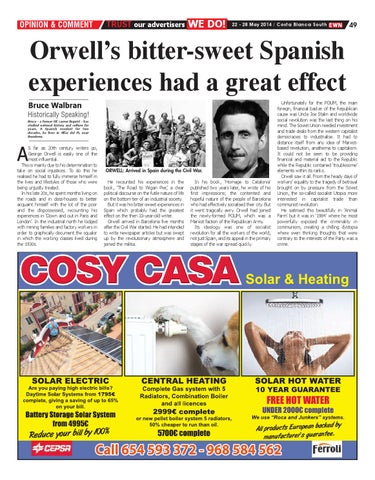
ORWELL: Arrived in Spain during the Civil War. He recounted his experiences in the book, ‘The Road to Wigan Pier,’ a clear political discourse on the futile nature of life on the bottom tier of an industrial society. But it was his bitter-sweet experiences in Spain which probably had the greatest effect on the then 33-year-old writer. Orwell arrived in Barcelona five months after the Civil War started. He had intended to write newspaper articles but was swept up by the revolutionary atmosphere and joined the militia.
In his book, ‘Homage to Catalonia’ published two years later, he wrote of his first impressions; the contented and hopeful nature of the people of Barcelona who had effectively socialised their city. But it went tragically awry. Orwell had joined the newly-formed POUM, which was a Marxist faction of the Republican Army. Its ideology was one of socialist revolution for all the workers of the world, not just Spain, and its appeal in the primary stages of the war spread quickly.
Unfortunately for the POUM, the main foreign, financial backer of the Republican cause was Uncle Joe Stalin and worldwide social revolution was the last thing on his mind. The Soviet Union needed investment and trade deals from the western capitalist democracies to industrialise. It had to distance itself from any idea of Marxistbased revolution, anathema to capitalism. It could not be seen to be providing financial and material aid to the Republic while the Republic contained ‘troublesome’ elements within its ranks. Orwell saw it all. From the heady days of workers’ equality to the tragedy of betrayal brought on by pressure from the Soviet Union, the so-called socialist Utopia more interested in capitalist trade than communist revolution. He satirised this beautifully in ‘Animal Farm’ but it was in ‘1984’ where he most powerfully exposed the criminality in communism, creating a chilling dystopia where even thinking thoughts that were contrary to the interests of the Party was a crime.