COMPILED ANSWERS
a. Based on the chapter “Develop Reading Materials”, what are the most important elements that material developers should take into account in selecting and presenting the reading materials? Mention and explain at least three elements.
-Variety of reading materials: Considering student´s needs, reading abilities, reader´s interest, background knowledge, relevance, authenticity of materials, developing interest to read, teacher must design reading activities to generate confidence, interest, and pleasure.
- Familiar topics: Reading materials developers should decide upon the topics which the reader feels familiar and comfortable, activating the background knowledge, presenting the materials in a way that help students build up the required background knowledge.
-Materials relevant to the age: Materials should be both interesting and motivating to the age, if the text is heavily loaded with new structural and offers to much information, it would be too difficult for the reader to read.

-Selection and use of vocabulary: Vocabulary is one of the most important components of language. (Ur, 2009). The selection of appropriate vocabulary to present the content in a way that is adjusted to the language knowledge and ability of the reader.
-The content of the texts is also important as it needs to be suitable, exploitable and readable. Exploitable text = text to develop reader’s competence in the language.
-Vocabulary vs. grammar. Vocabulary needs to have a balance with grammar so that there is not much on a single one of them.
-Selection of vocabulary is also based on 2 aspects:
Linguistic factors (Frequency, Range, Coverage and Defining Power)
Better more language registers than frequencies in a single register. Inclusion/ prioritization of vocabulary from easiest or common to hardest or rare.
Repetitions of words is good for their acquisition (Thornbury, 2022)
Celce-Murcia and Larsen-Freeman (1999) - Language recycling
b. Based on the chapter “Some Guidelines for Developing Listening Materials”
explain the following listening performances and give at least 2 examples for each type:
INTENSIVE LISTENING
Focuses on elements such as phonology, syntax and lexis, sounds, words and grammatical, as well as pragmatic units. Intensive listening involves learning pronunciation, vocabulary, grammar, and discourse. Rost (2011)
EXAMPLES
Fragments collaborative reading
The teacher gives the students a fragment of a text with some grammatical errors in it. Each student is given a different text. They need to read their fragment aloud to their partners so that they can identify what is the error. Here, grammar knowledge would be evaluated besides just the listening ability.
Phonemes isolation
For this activity, the teacher shows the students the symbol of a phoneme as well as its pronunciation, then reproduces several audios of the length of a sentence so that students can say where the phoneme was in the sentence. The teacher can play the audio as many times as necessary according to the level of the students. This activity improves listening, writing and phonetic knowledge in the students.
SELECTIVE LISTENING
Rost (2011) Considers selective learning as listening with a planned purpose in mind. It is more based on the discourse used in speeches, media broadcast, stories, and anecdotes.
EXAMPLES
Inquiring call
In this activity, students have to gather some missing details to fill out a table or some blank spaces the teacher gives to them. For example, the missing information could be the birth date, age, hobbies, etc. and so the students have to ask their partners that information in turns and annotate it in the table or any other organizer the teacher
gave them initially. This helps them of course to improve their listening but also to use the language in context (pragmatics).
Who said what
In this activity, students are given some utterances that they need to match with a name from one of the performers present in the audio. To make the activity easier or difficult, the teacher could put the literal fragment said in the audio or, for more advanced students, the teacher could put a paraphrased fragment that maintains the original idea but that has different words for increased challenge.
INTERACTIVE LISTENING
Refers to conversational interactions between listeners and speakers. The listener receives the message and provides the speaker with feedback. Collaborative conversation is considered vital for interactive listening, (Rost 2011), conversations improve interactions among learners
EXAMPLES Debates
Debates are quite a strong tool for learners to improve their communication as well as their dialectic and convincing abilities. It also allows them to enhance their work under pressure and improvisation dexterities. In this activity, students are given time to work on their arguments to refute those of their counterparts and be prepared before-hand. This is specially useful as it maximizes students’ engagement and talking time.
Role plays
Role plays are excellent ways to play real-life scenarios within the classroom, as these scenarios can be diverse and varied so, for example, there may be settings such as restaurants, airports, beauty salons among many many others that allow for students to expand their lexic and be forced to use the language according to the situation and find new terms such as synonyms when necessary to convey their message clearly.
EXTENSIVE LISTENING
(Rost, 2011) refers to extensive listening as meaning focused listening activities for an extended period of time, learners are expected to reach full comprehension during extensive listening.
EXAMPLES
Quiz time!!
For this activity the teacher plays a long audio, preferably one that includes video so students are not easily bored. The teacher plays the audio as many times as students request or only twice with more advanced learners. Continuedly, the teacher proceeds to do the test with the students that includes several questions whose answers could be at any part of the audio/ video. The teacher could use Quizizz, Kahoot or any other interactive platform.
Summary composition
One excellent activity for students to work on their listening as well as their writing abilities is to do a summary of what they heard. The teacher can ask them to do just a general summary or to do a summary focused on a set of particular aspects or that answers certain guiding questions, depending on the approach the teacher would like to follow for the activity.
RESPONSIVE LISTENING
Is a classroom’s listening activity used to elicit immediate response. As a result, the goal of this activity is the listener´s response.
EXAMPLES
Tell me what happened
The teacher plays an audio for the students that describes an event or talks about a topic lengthy such as a news reporting or documentary. Then, the teacher asks open questions to the student such as “in your own words, tell me what happened in the audio/ video”, “how was the overall attitude of [x] character in regards to [x] situation?”, “what would you do if you experienced a similar situation?”, etc. This allows to evaluate students’ comprehension and speaking ability at the same time.
Fastball Q&As
The teacher starts the round by asking a question to one student about the listening. Then, as soon as that student answers the question, him or herself asks a question to
another student, then that student answers the question and asks a new one to a new student and so on and forth. The teacher at the beginning of the activity needs to explain the dynamic clearly to prevent possible subsequent mistakes or activity delayers. To make the activity more engaging, the teacher may gamify the activity by telling the students that they get points with every right question they get and they lose points when the opposite occurs.
AUTONOMOUS LISTENING
Refers to independent and self-directed listening in which the teacher plays no role. Acquisition in real context is considered autonomous listening, learners have the responsibility for the type of learning
EXAMPLES
Free opinion
This activity is aimed at giving the students more freedom so the teacher as usual plays an audio file or video and when it is finished, he just asks the students what they thought about it and if they would like to add more information over the topic handled in it. The teacher still checks students’ speech but in a more “uncovered” setting a free playground for creating output safely, without feeling judged.
Casual chatting
Casual activities are an excellent way for the teacher to remove the restraint in his/ her students and sorrow they may feel when speaking in front of the class. This exercise
could be done at any moment of the class and consists of the teacher simply asking some questions to the students about their lives so basically triggering implicitly output from them. As the conversation flows, the teacher can ask a different student a question related to what the former student said, ensuring in this way that students are paying active attention to the speeches of their partners and respond appropriately with their own points of view and experiences.
Accuracy: Use the necessary vocabulary, correct grammar, precision without doubts in speaking, expression confidence.
Fluency: (Mc Carthy 2010) observes that key notions are speed, smoothness of delivery and automaticy (the ability to retrieve units of speech instantaneously) and adds. fluency undoubtedly involves a degree of automaticity and the ability quickly to retrieve ready made chunks of language.
Complexity: Is defined by Ellis (2003) as the extent to which the language is produced in performing a task. Learners may vary, for example in the range of sophistication of vocabulary, phrases, and structures, they use to carry out a speaking activity.
- According to the readings, there is a time and place for correction buy the wrong time is when learners are initially gaining confidence in speaking English in class. When
C. Based on the chapter “Materials to Develop Speaking Skill” explain the notions of accuracy, fluency, and complexity, and mention what kind of activities a teacher can apply in class for learners who are not confident in speaking.
learners are more confident, teachers will aim for complexity, the complexity may come from the design of the activity. Example: A further way to encourage complexity is task repetition, complex vocabulary, more idiomatic speech.
- Materials for learners who are not confident in speaking: Practice pre-task phase, prior practice of the items, learners may work out what they are going to say and investigate word´s meaning and expressions, prepare oral or written summary to perform the task in front of the class, slowly practice interaction and participation.
For non-confident learners, the teacher needs to propose activities adequate to the level of them. This is, activities that allow them to feel “safe” when speaking, not judged as mentioned previously plus give them time to think and prepare their answers and do pertinent corrections, so that students don’t feel overwhelmed or demotivated when trying to speak.
Taking this into account, fluency is meant more for beginners whilst complexity is meant for more advanced learners. Task repetition is mentioned to be beneficial according to Goh (2007, p. 36). Finally, accuracy checking should be done after the production made by the student.
D. Based on the chapter “Materials for teaching Writing”, explain what kind of authentic materials should we use for teaching writing in the language class.
- Writing as a skill (Harmer, 2006), therefore choosing, and employing suitable materials for teaching, writing effectively and efficiently is one of the most critical lifelong skills that language teachers need to be aware of.
Personal writing: Diaries, shopping lists, recipes.
Public writing: enquiry, complaint, request letters, form filling.
Creative writing: poems, stories, drama, songs, autobiography.
Social writing: letters, notes of condolence, notes of thanks, congratulations, instructions, e-mails.
Public writing: Taking notes from lectures, summaries, reviews, essays, bibliographies.
Study writing: agendas, reports, reviews, public notices, advertisements.
Institutional writing: emails, posters, instructions, speech, applications CV, specifications notes.
Printed materials: taped conversations, short stories, poems, functional text such as notices, road signs, directions, instructions, descriptions, warnings, expository texts, newspapers, restaurant menu, travel guides, tourist information, brochures, articles.
They also may be divided in 3 groups:
Audio:
o Television programming (commercials, interactive talk shows, quiz shows, cartoons, news and weather forecast reports)
o Radio programming (interviews, radio advertisements, and interactive talk shows)
o Taped conversations (meetings including one-sided telephone conversations, novels, short stories, poems)
o Functional writing texts (advertisements, news articles, interview schedules, weather forecast reports, minutes, short stories, plays, novels and poems).
Visual: (photographs, wordless road signs paintings and drawings, pictures from magazines children’s artwork, and wordless picture books)
o Functional writing texts (notices, road signs, directions, instructions, descriptions, warnings, expository texts, X-ray reports, and time tables)
Printed: (newspapers, restaurant menus, minutes of a meeting, directories, diaries, travel guides and tourist information brochures, greeting cards, billboards, letters, posters, and bus schedules).
o Functional materials (newspaper articles, obituaries, menus, bus schedules, directories, and travel guides).
Other materials include the horoscope, TV and radio news bulletins, picture writing: literacy through art, games & apps and writing, computer and writing, etc. Basically, any real-life material can be useful when properly adapted and modified by the teacher to his/ her specific students’ needs and interests.
OBJECTIVES
- To define and exemplify the best practices and materials creation methods when it comes to teach and improve in the students all four communicate abilities (reading, listening, speaking, writing).
- To design materials that offer learners opportunities to integrate all the language skills in an authentic and non authentic manner and become competent students plus feel motivated to English learning.
- To create materials in the form of analog worksheets that allow students participation, listening and reading comprehension through analysis and practice of communicative approach.
Teacher’s Name
ANALOG WORKSHEETS
1. GREETINGS & GIVING PERSONAL INFORMATION
Esteban Sánchez Álvarez
Topic Greetings and giving personal information OBJECTIVE
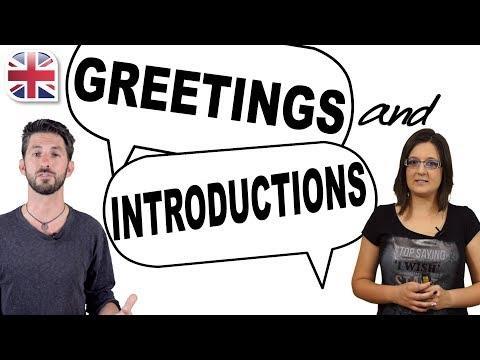
To introduce myself to others properly, and respond appropriately to questions about myself when necessary in both formal and informal scenarios.
Warm-up (one activity that last between 5 to 10 minutes)
● The teacher starts the class off by playing the “2 lies 1 truth” game with the students for them to share in the chat 2 aspects which are not true about them and 1 that is actually correct about their lives When the students send their 3 sentences, the teacher then proceeds to ask the other students which statement they think is true. When everyone is done guessing, the teacher then asks the student to uncover the right answer.
Presentation and Practice (two activities with several exercises)
● The next part involves the teacher showing the students a video with some useful expressions for describing themselves such as “my name is”, “I’m [x] years old”, “my favorite hobbies are”, etc. Then, the teacher plays 3 audios of 2 people getting to know each other and then asks them to write what they heard according to some words the teacher gives them in advance to fill the information for (age, occupation, level of studies, etc) so the students have to write for example “she works in a lawyers buffet” for the word “occupation” and so on with the other words.
Video
• Now that the students understood the dynamic of the activity, the teacher passes them some words similar to the previous exercise but this time they need to find the information correspondent to the words about their partners. For example, the teacher gives them a series of 10 words and they have to look for the information of those 10 words by doing a type of interview and then writing full sentences with the information retrieved. After this, each students shares the answers to the 10 questions to the rest of the class for everyone to get to know better the others.
Chart to be used for the audios:
Information to gather
Your response Audio
Age Name
Hobbies
Occupation
Country of origin/ Nationality
Chart to be used for the partner’s interview:
Name of your interviewed partner

Information to gather
Your response
Age Name
Hobbies
Occupation
Country of origin/ Nationality
Audios Meeting-and-greeti ng-be.mp3 Getting-to-know-s omeone-Ex2.mp3 Getting-to-know-s omeone-Ex3.mp3
#1 Audio #2
Audio #3
Production/evaluations (one activity with several exercises)
● For this production phase, the teacher separates the students in 2 groups, 1 group is formal and the other 1 is informal. Based on the group each student was assigned to, they need to prepare a dialogue with their partner (work in pairs) and present it to the whole class. The teacher gives them some time to prepare their dialogue and clarifies any doubts the students may have during the process.
● Once students are done, the teacher proceeds to give the required feedback to ensure they learn from them but they are not interrupted while speaking which could make them lose confidence over what they are presenting.
References
Oxford Online English. (November 17th, 2017). English Greetings and Introductions
- Spoken English. [Video]. YouTube. https://bit.ly/3O6UU4K
Linguahouse (2020). Lesson plans for English teachers | Meeting and greeting
[Audio]. https://bit.ly/3nQNp7s
Linguahouse (2011). Lesson plans for English teachers | Getting to know someone
[Audio] https://bit.ly/42SXjUI
Linguahouse (2011). Lesson for learners | Getting to know someone.
https://bit.ly/3VXfZk6
Teacher’s Name
Topic
2. DESCRIBING PEOPLE
Esteban Sánchez Álvarez
Describing people
OBJECTIVE
To describe personality traits and physical appearance of my family, friends or known people in general, making use of proper structures and expressions.
Warm-up (one activity that last between 5 to 10 minutes)

● To warm up the session, the teacher may present pictures of people (cartoons if working with kids) and may ask them for some characteristics such as ”what is this color?” by pointing to a specific part of the image or “what is the expression of this character?”. The teacher can use a wide range of aspects such as colors, moods, sizes, textures, etc. to do questions based on and use more simple or more complex questions depending on the level of the students.
Next is a good idea of which images the teacher should show that should be preferably of character mosaics with different appearances and face expressions for better contrast, such as the following one:
Presentation and Practice (two activities with several exercises)
● For this presentation phase, the teacher shows the students some definitions and next to them some words with some letters missing. The idea is for the students to complete the missing words. For greater gamification and if working with kids, the teacher may do this activity as a hangman one.
An example of this would be:
Word
T_
_g_
Meaning
_ of great or more than average height, especially(withreferencetoanobject)relative to width.
unpleasant or repulsive, especially in appearance.
● After this, the student needs to formulate a sentence that includes the discovered word. For example, if the student finds the word “tall”, he/ she needs to do a written sentence with it and send it to the teacher for form and content checking.
Production/evaluations (one activity with several exercises)
● In this final phase, the teacher takes out a bag with different adjectives flashcards in it. Then, asks the students to pass to the front of the classroom and take out a card, then read the word, say the definition out loud and say a famous celebrity or cartoon character that has the same characteristic than the one shown on the card. The teacher then looks for the image online and shows it to the students reaffirming once again the qualities of the adjective shown on the card.
References
● Hartman, G. (2020). Building character: How a cast of characters can help you learn a language. [Image]. Duolingo blog. https://bit.ly/3O217Pt
_
_
3. EXPRESSING ABILITY AND INABILITY
Teacher’s Name Jenny Liseth Quiroga Rincón Topic Expressing ability and inability
OBJECTIVE
Identify the actions expressing ability and inability in the corresponding context and practice communicative approach.
Warm-up (one activity that last between 5 to 10 minutes)
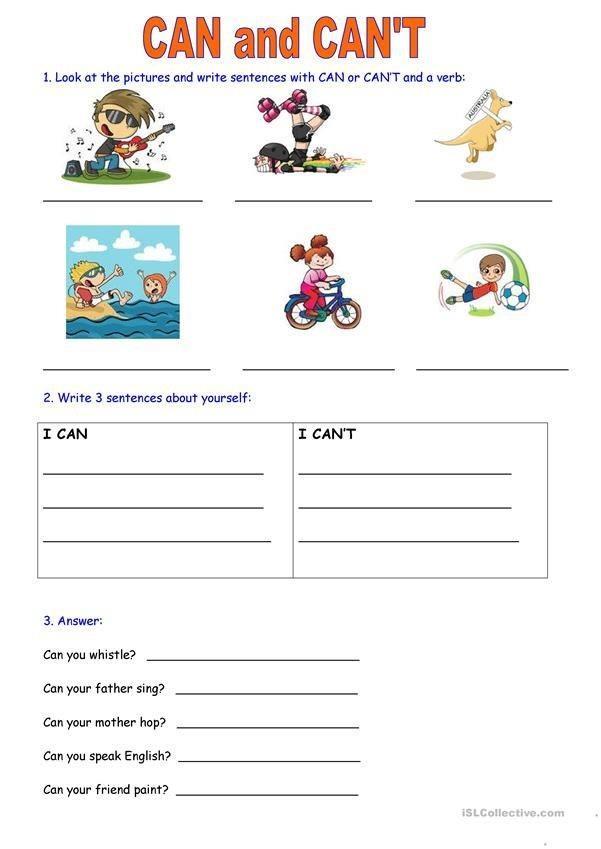
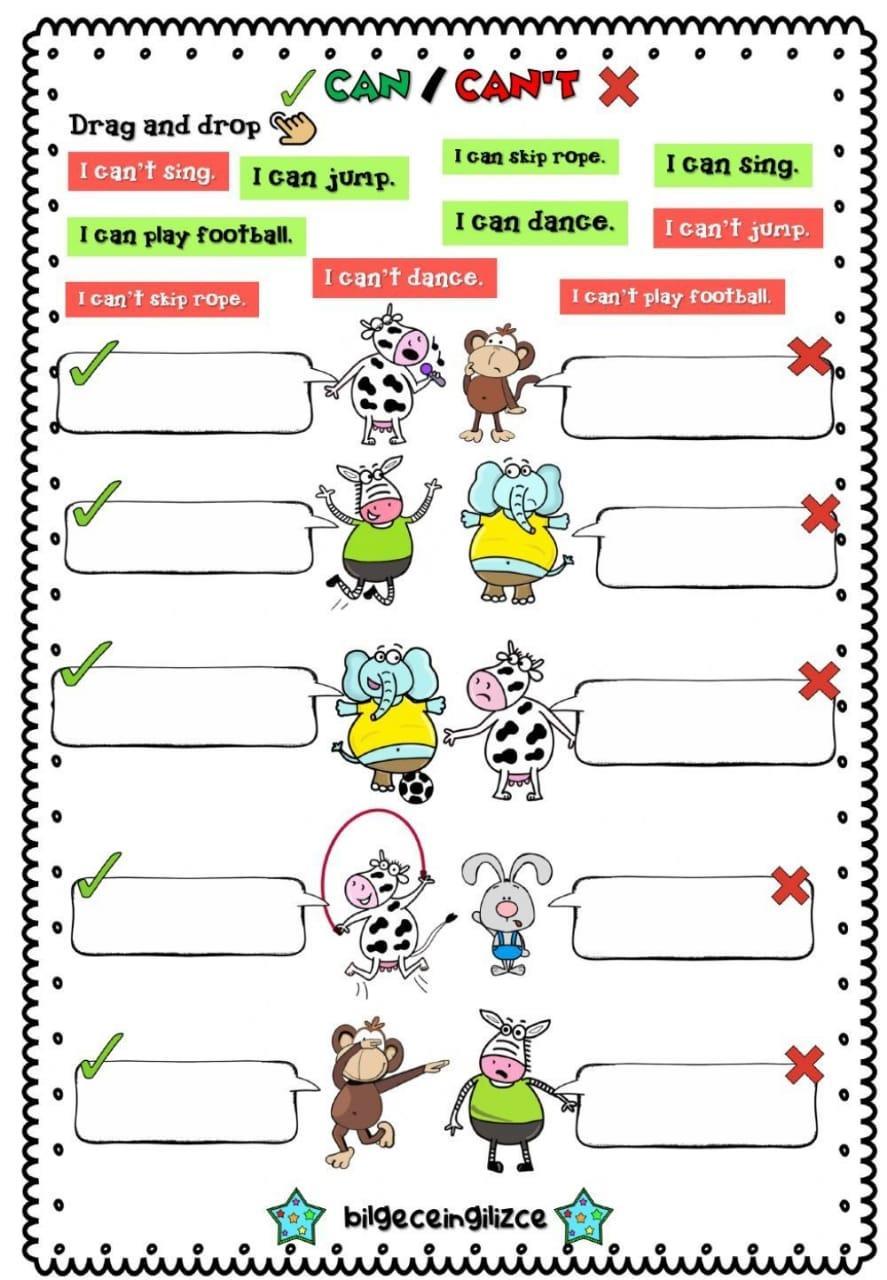
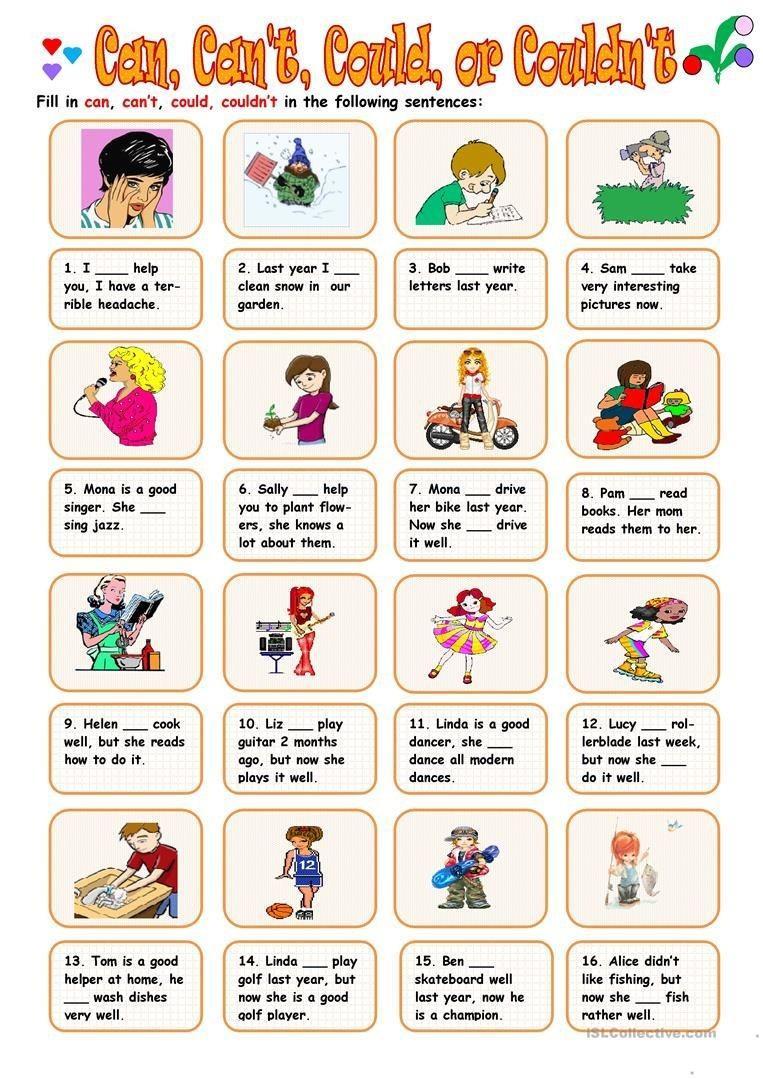
● The teacher explain the modals for ability to do something, we use can, be able to, and could for past ability, examples: Peter can play football, she is able to run quickly, and the inability using negative form. Students listen the video:
https://youtu.be/JhlOspIJvsw
Presentation and Practice (two activities with several exercises)
● Students will practice reading and writing in the following guides:
●
Production/evaluations (one activity with several exercises)
● Studets will practice a dialogue, first students watch the video and write what they listen (write the dialogues) and after they will practice each dialogue in real context.
https://youtu.be/crjHiXytV_I
References
• Pinterest images for teaching
https://help.pinterest.com/es/article/save-pins-with-the-pinterest-browserbutton
• Pinterest images for teaching
https://pin.it/3pzq2V2
• Community of ESL/EFL teachers
https://es.islcollective.com/
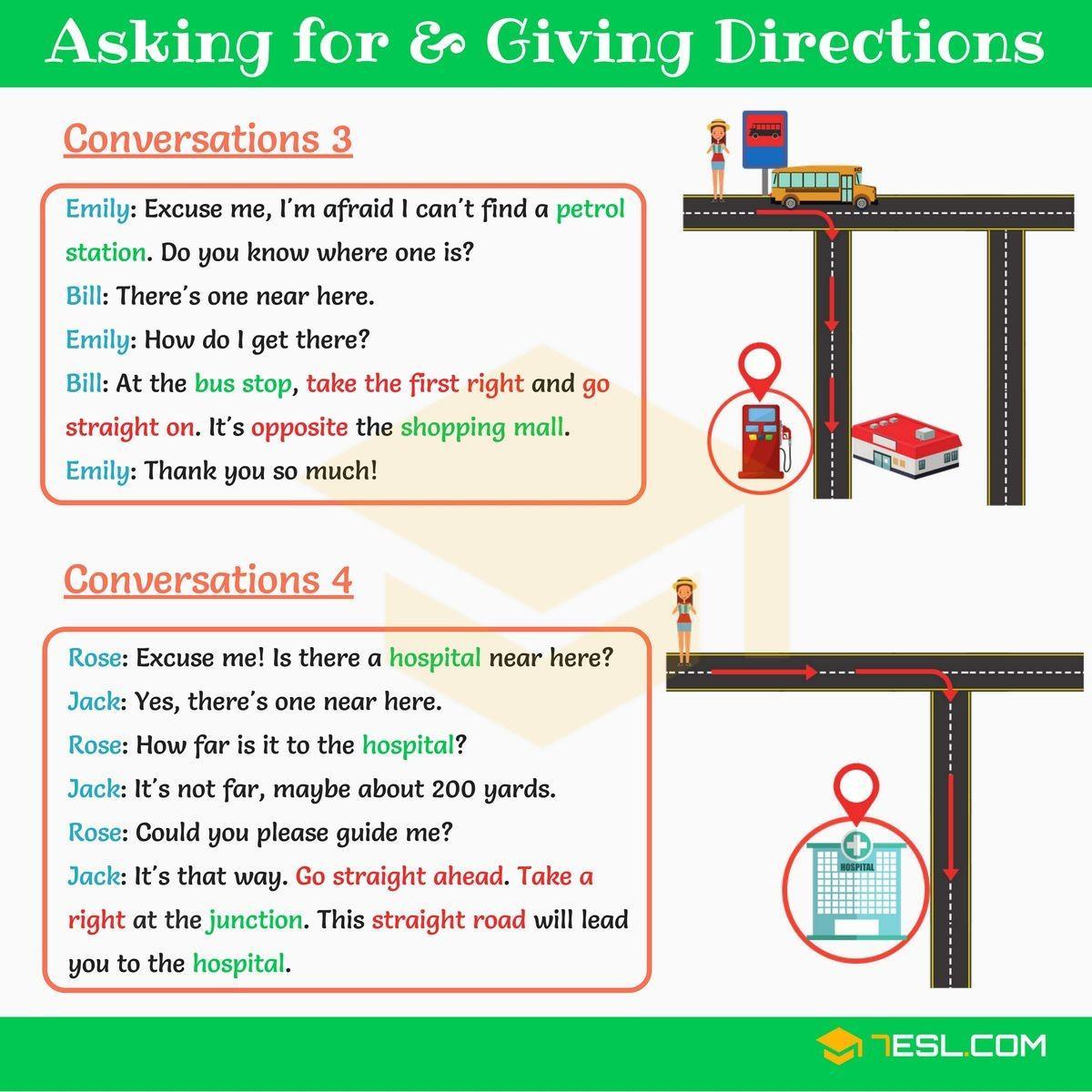
4. ASKING FOR AND GIVING DIRECTIONS WORKSHEET
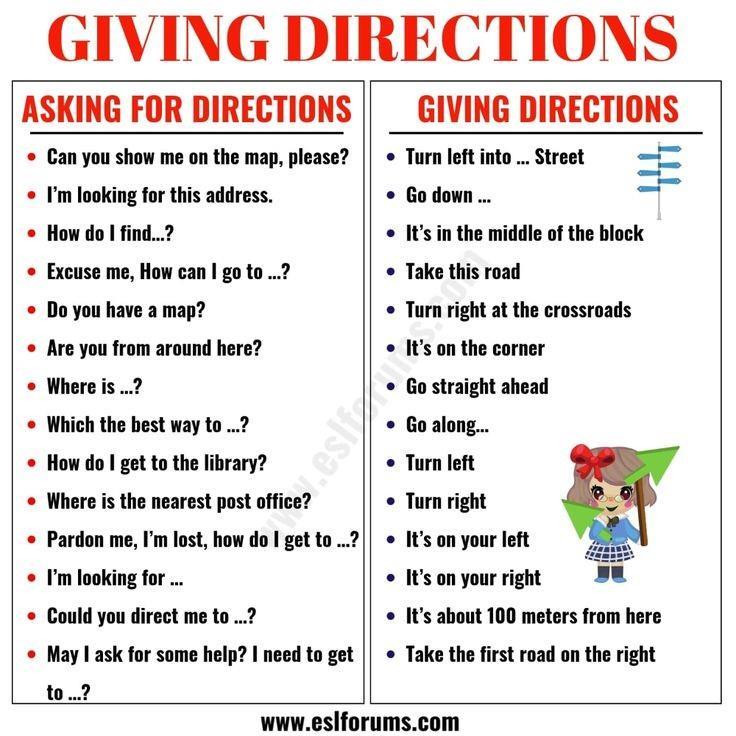
Teacher’s Name Jenny Liseth Quiroga Rincón Topic
Asking for and Giving directions.
OBJECTIVE
Practice and dramatize dialogues asking for and giving directions.
Warm-up (one activity that last between 5 to 10 minutes)
Teacher will read the poster information and students will repit each sentence, after teacher will ask them the meaning in Spanish of each sentence.
Presentation and Practice (two activities with several exercises)
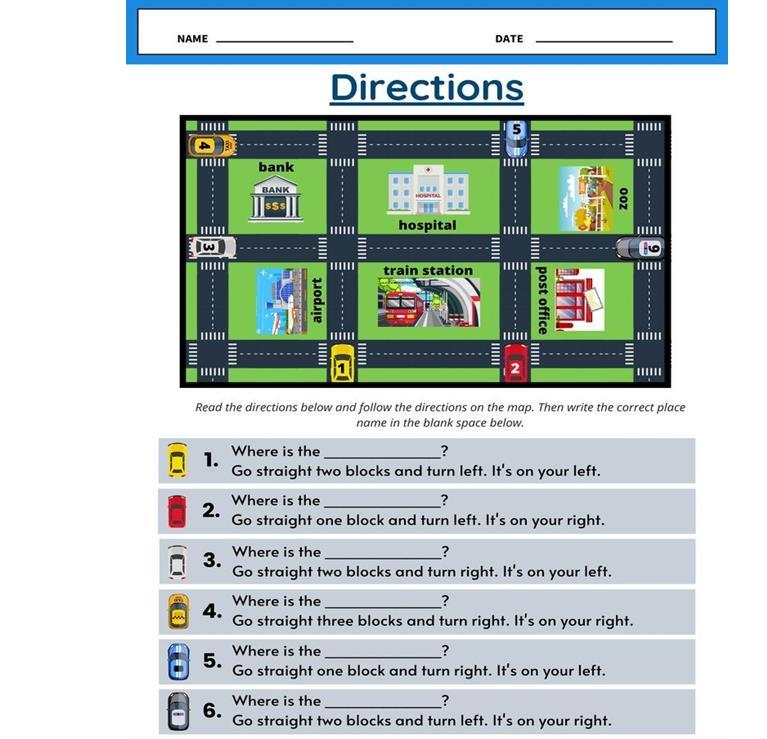
● Students will practice reading and writing:
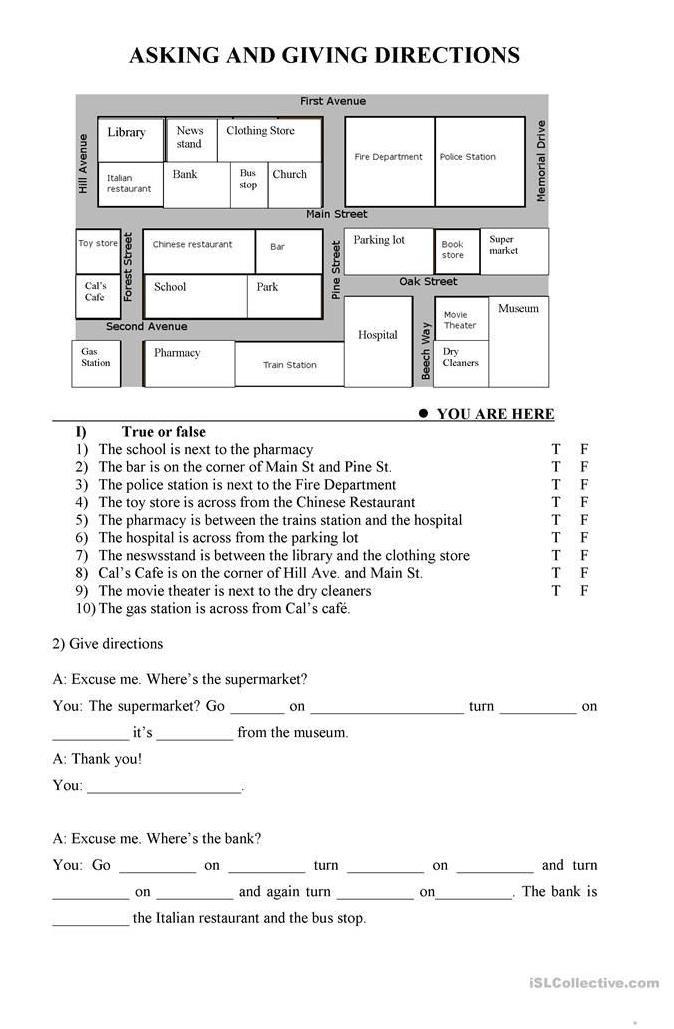
Production/evaluations (one activity with several exercises)
Teacher will read each conversation and students will practice the conversations with the partner and then teacher will ask the group some questions to evaluate learning:
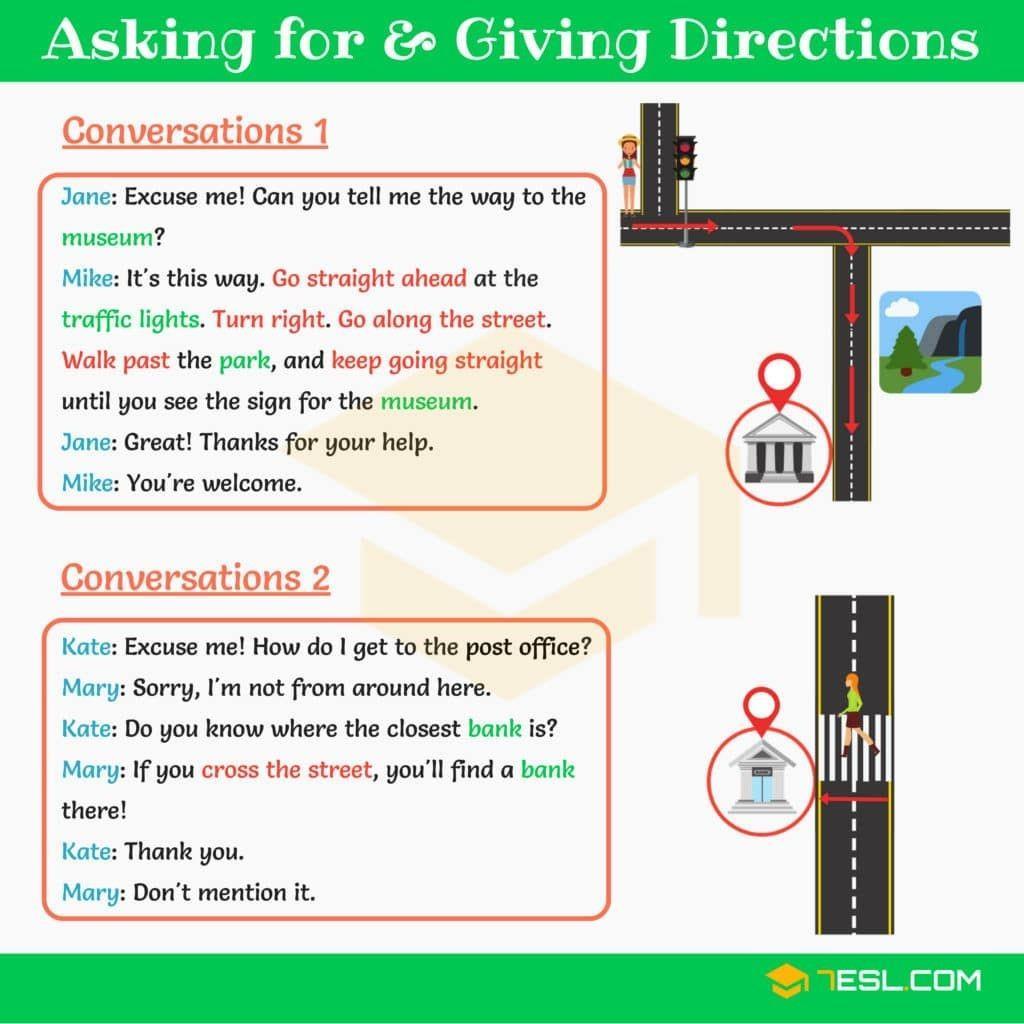
Some questions:
-Where is the museum?
-How I can go to the bank?
● ●
Activity 2. Listen the video: and answer the following questions:
https://youtu.be/Agajl4B1i28
-Where is the pharmacy?
-Where is the police station?
-Where is the bank?
-Where is the supermarket?
References
• Pinterest images for teaching
https://help.pinterest.com/es/article/save-pins-with-the-pinterest-browser-button
• Pinterest images for teaching
https://pin.it/3pzq2V2
• Community of ESL/EFL teachers
https://es.islcollective.com/
6. EXPRESSING REGRETS WORKSHEET
Teacher’s Name Esteban Sánchez Álvarez
Topic Expressing regrets OBJECTIVE
To express regrets and remorse over past events, using the proper auxiliar and modal verbs.
Warm-up (one activity that last between 5 to 10 minutes)
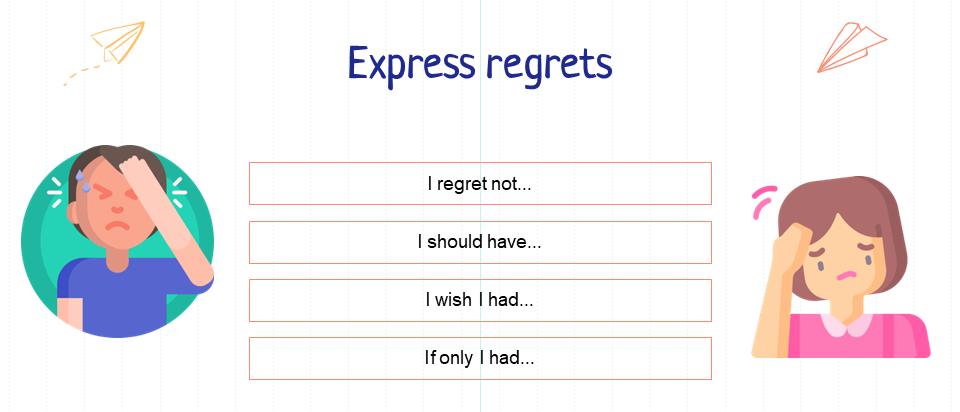
● The teacher starts the class off by showing the students some expressions for expressing regrets and gives some examples for the students to understand how the expressions are used (language in use). The teacher confirms the topic is clear by asking the students if they have any questions.
● The next image is the one that the teacher would show to the students:
Presentation and Practice (two activities with several exercises)
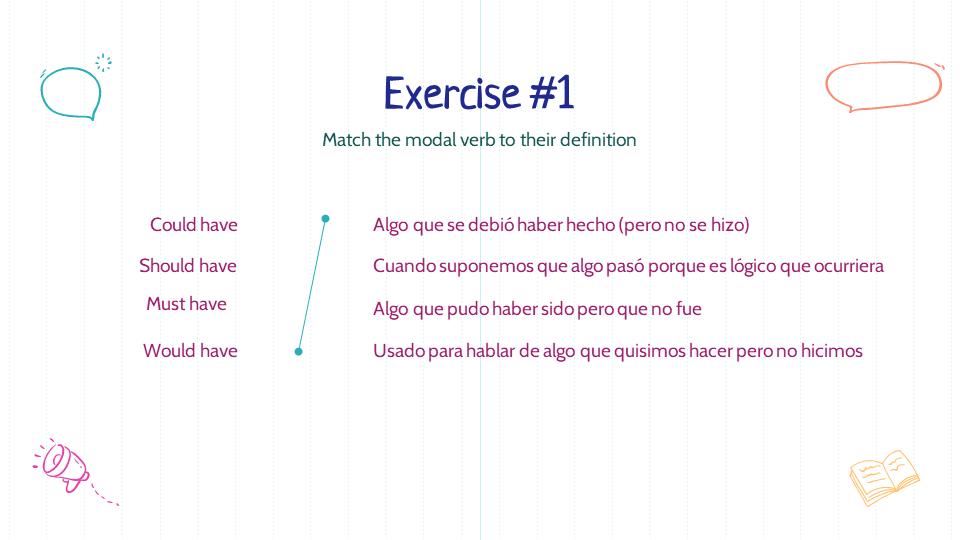
● Once the students have understood how the structures work, he/ she does an activity in which there are the main 4 modal verbs for the regrets (could have/ should have/ must have/ would have) and students have to match them to the right meaning as shown next:
● Then, after the students match the modal verbs to the right meaning, the teacher assigns evenly the modal verbs to the students (i.e. 2 students do could have, 2 do should have and so on) for them to make 2 written sentences with each and then socialize them to the group and the teacher provide the corresponding feedback.
Production/evaluations (one activity with several exercises)
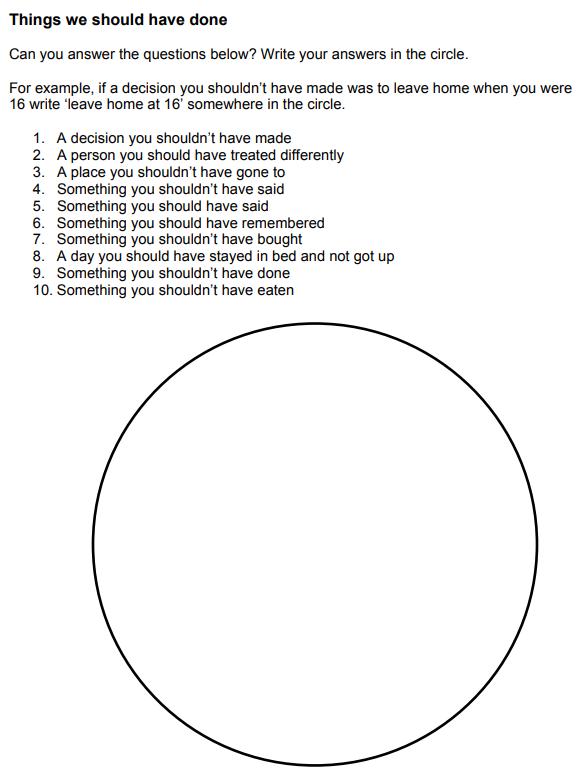
● For this production phase, the teacher shows the students 10 sentences that correspond to different regret scenarios. Then, the students need to write a partial response within a white circle. The partial response could be, for example, ‘leave home at 16’ for the decision that the student shouldn’t have made of leaving home when he/ she was 16.
● After all students write the response within the circle, the teacher asks one by one of the students in turns to try to guess which original statement from the list the answer in the circle corresponds. The students need to support their answers with arguments for lengthening their speaking time. Also, the students have to try to complete the full sentence that the other student did.
● The activity overview is shown next:
References
British Council. (2006). Things we should have done. https://bit.ly/3pE7qyi
REFERENCES
Mukundan, J., Zarifi, A., & Rezvani Kalajahi, S. (2016). Developing Reading Materials for Esl Learners. In M. Azarnoosh, M. Zeraatpishe, A. Faravani & H. Kargozari, Issues in Materials Development (4th ed., pp. 65-73). Rotterdam.
https://bibliotecavirtual.unad.edu.co/login?url=http://search.ebscohost.com/login.aspx?di
rect=true&db=nlebk&AN=1204864&lang=es&site=edslive&scope=site&ebv=EB&ppid=pp_65
Mukundan, J., Zarifi, A., & Rezvani Kalajahi, S. (2016). Material for Teaching Writing. In M. Azarnoosh,M.Zeraatpishe,A.Faravani&H.Kargozari,IssuesinMaterialsDevelopment (4th ed., pp. 93-108). Rotterdam.
https://bibliotecavirtual.unad.edu.co/login?url=http://search.ebscohost.com/login.aspx?di
rect=true&db=nlebk&AN=1204864&lang=es&site=edslive&scope=site&ebv=EB&ppid=pp_93
Mukundan,J.,Zarifi,A.,&RezvaniKalajahi,S.(2016).SomeGuidelinesForDevelopingListening Materials. In M. Azarnoosh, M. Zeraatpishe, A. Faravani & H. Kargozari, Issues in MaterialsDevelopment(4thed.,pp.75-81).Rotterdam.
https://bibliotecavirtual.unad.edu.co/login?url=http://search.ebscohost.com/login.aspx?di
rect=true&db=nlebk&AN=1204864&lang=es&site=edslive&scope=site&ebv=EB&ppid=pp_75
Timmis, I. (2016). Materials to Develop Speaking Skill. In M. Azarnoosh, M. Zeraatpishe, A. Faravani&H.Kargozari,IssuesinMaterialsDevelopment(4thed.,pp.83-92).Rotterdam. https://bibliotecavirtual.unad.edu.co/login?url=http://search.ebscohost.com/login.aspx?di rect=true&db=nlebk&AN=1204864&lang=es&site=edslive&scope=site&ebv=EB&ppid=pp_83