Carbon dioxide removal and sequestration in Canada: The role of biochar in removing contaminants By Eric Meliton
W
hile often discussed interchangeably, reducing greenhouse gas (GHG) emissions and removing carbon dioxide from the atmosphere (CDR) are distinct processes. Emissions reduction focuses on preventing GHGs from entering the atmosphere. CDR methods aim to extract and permanently sequester existing atmospheric carbon dioxide, often leveraging natural processes like photosynthesis. Biochar production involves pyrolyzing organic waste in a low-oxygen environment, stabilizing carbon that would otherwise decompose and release methane, so it can contribute to both processes. It converts plant matter into a stable product, providing a sustainable pathway for carbon removal and sequestration, while at the same time helping to prevent the release of methane that would have otherwise been produced by the plant matter decomposing in a landfill. Industries, such as agriculture, mining, and construction, are finding innovative ways to integrate biochar into their operations, lowering cost, improving performance and/or further driving down their carbon footprints. In agriculture, biochar enhances soil health and fertility while suppressing nitrous oxide emissions. In mining, biochar helps stabilize tailings, preventing the release of heavy metals and acidic runoff while mitigating emissions associated with traditional remediation processes. Even the construction sector is exploring biochar-infused concrete to lower the embodied carbon of building materials, offering a more sustainable alternative to conventional aggregates.
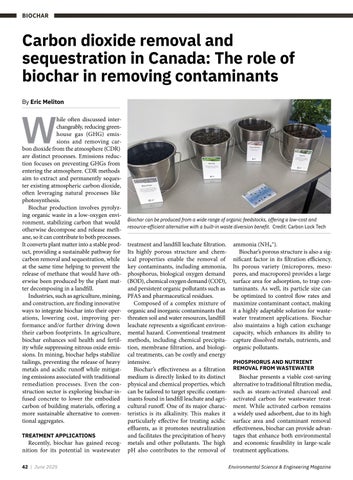
Biochar can be produced from a wide range of organic feedstocks, offering a low-cost and resource-efficient alternative with a built-in waste diversion benefit. Credit: Carbon Lock Tech
treatment and landfill leachate filtration. Its highly porous structure and chemical properties enable the removal of key contaminants, including ammonia, phosphorus, biological oxygen demand (BOD), chemical oxygen demand (COD), and persistent organic pollutants such as PFAS and pharmaceutical residues. Composed of a complex mixture of organic and inorganic contaminants that threaten soil and water resources, landfill leachate represents a significant environmental hazard. Conventional treatment methods, including chemical precipitation, membrane filtration, and biological treatments, can be costly and energy intensive. Biochar’s effectiveness as a filtration medium is directly linked to its distinct physical and chemical properties, which can be tailored to target specific contaminants found in landfill leachate and agricultural runoff. One of its major characteristics is its alkalinity. This makes it particularly effective for treating acidic effluents, as it promotes neutralization and facilitates the precipitation of heavy TREATMENT APPLICATIONS Recently, biochar has gained recog- metals and other pollutants. The high nition for its potential in wastewater pH also contributes to the removal of 42 | June 2025
ammonia (NH₄+). Biochar’s porous structure is also a significant factor in its filtration efficiency. Its porous variety (micropores, mesopores, and macropores) provides a large surface area for adsorption, to trap contaminants. As well, its particle size can be optimized to control flow rates and maximize contaminant contact, making it a highly adaptable solution for wastewater treatment applications. Biochar also maintains a high cation exchange capacity, which enhances its ability to capture dissolved metals, nutrients, and organic pollutants. PHOSPHORUS AND NUTRIENT REMOVAL FROM WASTEWATER
Biochar presents a viable cost-saving alternative to traditional filtration media, such as steam-activated charcoal and activated carbon for wastewater treatment. While activated carbon remains a widely used adsorbent, due to its high surface area and contaminant removal effectiveness, biochar can provide advantages that enhance both environmental and economic feasibility in large-scale treatment applications. Environmental Science & Engineering Magazine