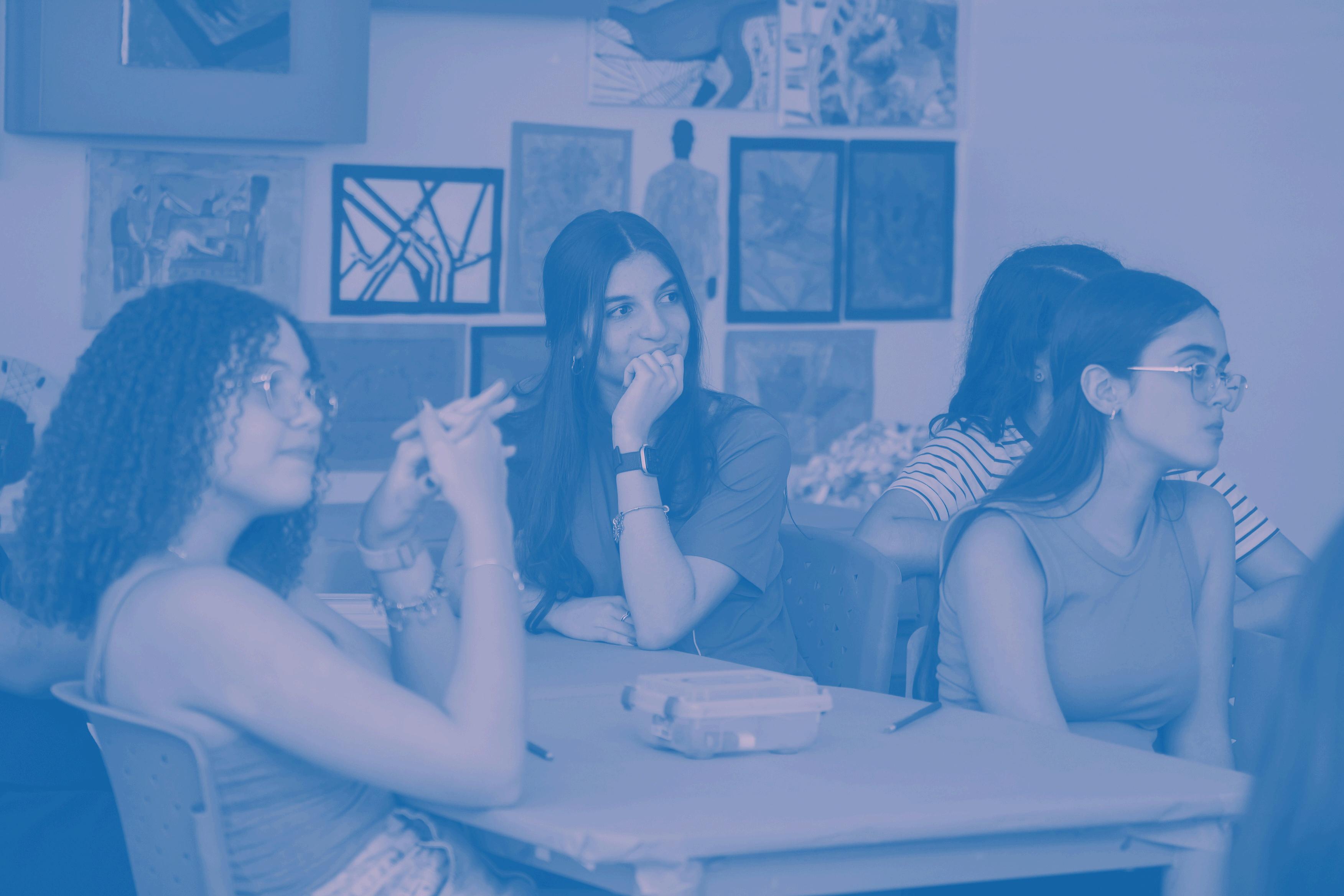
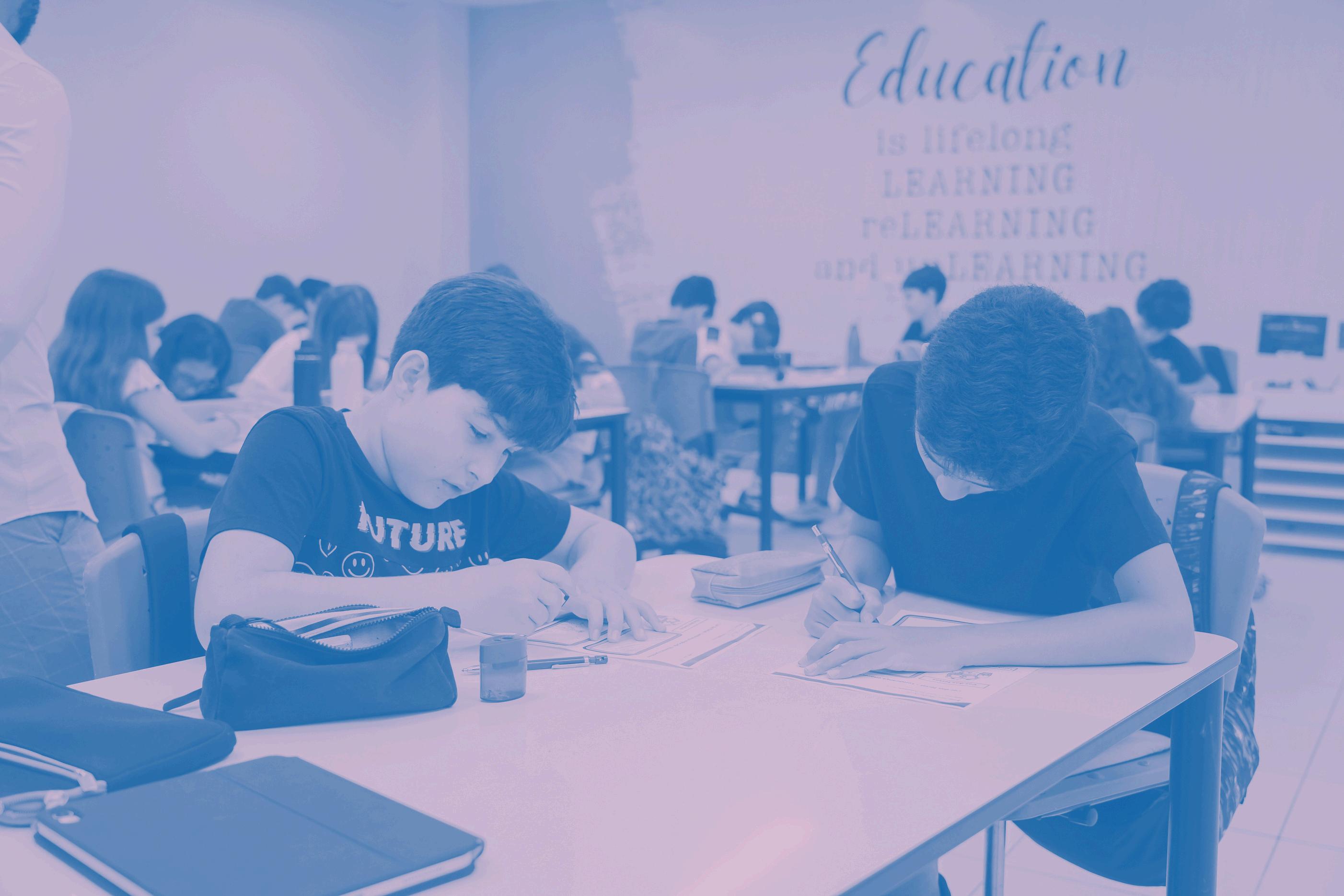
offers an academically rigorous, challenging, inclusive, global education designed to develop happy and thoughtful human beings who positively impact the world we live in. The school's program is designed to nurture the dispositions of lifelong learners who collaborate to co-create, embrace an entrepreneurial mindset, understand the meaning of living sustainably, and are globally and digitally fluent. Learners apply habits of mind to their daily actions, use the language of thinking to communicate, and understand the elements of design thinking to problem solve and innovate. Learning is facilitated and assessed through relevant, project-based experiences. Upon graduation, learners will be prepared for their university of choice in Brazil, or elsewhere around the world.
Based on our National Curriculum (Base Nacional Comum Curricular - BNCC) and International Curriculum and Programs (NGSS, NCSS, Fieldwork Education, Illustrative Mathematics, Readers' and Writer's Workshop), learnings expectations in the Middle School are organized according to the following areas of knowledge:
English Language Arts
Develop greater independence in analysis, argumentation, research, and collaboration.
Portuguese Language
Discover language as a tool for expression, empathy, and transformation.
Mathematics
Build foundational skills in algebra, geometry, and statistics.
Natural Sciences
Understand human societies through history, geography, and civics.
Social Sciences
Explore fundamental concepts in physics, chemistry, biology, and earth sciences
E N G L I S H L A N G U A G E
Curriculum Snapshot
Aligned with the Common Core (ELA), this course emphasizes critical reading, effective writing, oral communication, and language use across genres and media.
G U A G E A
At Escola Concept, every Grade 7 learner engages in reading, writing, speaking, listening, and language study through the Understand → Explore → Materialize model, ensuring learning is structured, applied, and meaningful.
Course Overview
Grade 7 learners ask: How do perspectives shape understanding? How do texts connect people across cultures? They analyze complex texts, write across genres, and use language as a tool for identity, argument, and connection.
Learning Structure
I S H L A N
Understand: Explore essential questions through immersive reading.
L
Explore: Analyze text structure, language, and author’s purpose.
Materialize: Apply learning through writing projects, presentations, and debates.
Content Areas
E N G
Reading literature and informational texts.
Writing (argumentative, narrative, informative).
Oral communication and presentation.
Writing (narratives, expository, argumentative)
Vocabulary development and grammar
Speaking and listening skills
Grammar, syntax, vocabulary in context.
Competencies
Reading comprehension and analysis. Clear written communication across genres. Effective oral presentation and listening.
Grammar and vocabulary precision.
Assessment and Student Work
Textual analysis essays, argumentative writing, and narratives.
Multimedia presentations and debates.
Grammar and vocabulary applied in authentic contexts.
Portfolio of revised and published work.
Curriculum Alignment Snapshot
CCSS.ELA-Literacy.RL.7.1–7.6; RI.7.1–7.6 (Reading Comprehension & Textual Evaluation)
CCSS.ELA-Literacy.W.7.1–7.3 (Writing)
CCSS.ELA-Literacy.SL.7.1–7.4 (Oral Communication)
CCSS.ELA-Literacy.L.7.1–7.6 (Grammar)
Scan the QR code to access the complete document for the English Language Arts Curriculum. Or click here.
P O R T U G U E S E L A N G U A G E
Curriculum Snapshot
Based on BNCC, the course fosters critical reading, authorial writing, active listening, and ethical oral expression, emphasizing diversity, discourse analysis, and digital literacies.
At Escola Concept, every Grade 7 learner develops linguistic, discursive, and critical competencies through the Understand → Explore → Materialize model.
Course Overview
Learners strengthen autonomy in language use, practice critical reading of media and cultural texts, and produce both creative and argumentative writing, with responsible digital authorship.
Learning Structure
Each lesson follows Escola Concept’s three-phase model:
Understand: Guided reading and discussions.
Explore: Text analysis, experimentation with genres and registers.
Materialize: Creation of written, oral, and digital multimodal texts.
Content Areas
Reading literary, journalistic, and digital texts.
Writing narratives, reviews, argumentative texts.
Oral participation in debates and presentations.
Linguistic analysis: cohesion, coherence, variation, style.
Multiletramentos and culture digital.
Competencies
Critical reading and interpretation.
Authorship and textual production.
Ethical and effective oral communication.
Linguistic awareness and stylistic reflection.
Creative and responsible digital participation.
Assessment and Student Work
Essays, reviews, and narrative writing.
Oral debates, podcasts, and class presentations.
Grammar and cohesion exercises in context.
Digital productions: blogs, videos, or multimodal projects.
Curriculum Alignment Snapshot
BNCC: EF67LP01 a EF67LP05 (Compreensão e Interpretação)
BNCC: EF67LP06 a EF67LP10 (Produção Textual e Escrita)
BNCC: EF67LP12 a EF67LP14 (Oralidade e Interação)
BNCC: EF67LP15 a EF67LP19 (Análise Linguística)
BNCC: EF67LP11; EF67LP20 (Multiletramentos e Cultura Digital)
Curriculum Snapshot
Grounded in Illustrative Mathematics (IM) and BNCC, students expand proportional reasoning, rational number fluency, algebra, geometry, and probability.
At Escola Concept, every Grade 7 learner develops reasoning and problemsolving through the Understand → Explore → Materialize model.
Course Overview
Learners strengthen problem-solving and mathematical discourse, connecting math to everyday contexts and building readiness for formal algebra and geometry in Grade 8.
Learning Structure
Understand: Concepts introduced with contextual problems.
Explore: Engage with representations and collaborate on strategies.
Materialize: Apply reasoning in projects, justify solutions, communicate findings.
Content Areas
Rational numbers and operations. Ratios, proportions, percentages, and scale. Algebraic expressions, equations, inequalities. Geometry: angles, area, volume, transformations. Statistics and probability.
Competencies
Proportional reasoning.
Algebraic fluency.
Rational number operations.
Geometric problem solving.
Data interpretation and probabilistic reasoning.
Assessment and Student Work
Problem sets, collaborative math tasks, and projects. Graphs, models, and geometric drawings.
Statistical analysis and probability experiments.
Real-world math applications (budgeting, scale models).
Curriculum Alignment Snapshot
BNCC EF07MA06, EF07MA07 (Mathematical Problem Solving)
BNCC EF07MA01, EF07MA02 (Numbers and Operations)
BNCC EF07MA04, EF07MA05 (Ratios)
BNCC EF07MA03 (Expressions & Equations)
BNCC EF07MA08, EF07MA09 (Geometry & Measurements)
BNCC EF07MA10, EF07MA11 (Statistics & Probability)
N A T U R A L S C I E N C E S
Curriculum Snapshot
Aligned with BNCC and NGSS, the course integrates biology, chemistry, physics, and earth sciences, emphasizing scientific inquiry, experimentation, and sustainability.
At Escola Concept, every Grade 7 learner develops observation, experimentation, and critical thinking skills through the Understand → Explore → Materialize model.
Course Overview
Learners explore matter and energy, ecosystems, earth processes, and human health. Emphasis is on experimentation, systems thinking, and real-world applications.
Learning Structure
Understand: Guided exploration of principles and theories.
Explore: Conduct experiments, analyze data, problem-solve.
Materialize: Apply science in projects, case studies, investigations.
Content Areas
Matter and transformations: thermodynamics, simple machines.
Earth & space: atmosphere, tectonics, climate change.
Life sciences: ecosystems, biodiversity, adaptations. Human health and environment: pollution, conservation, public health.
Competencies
Inquiry and scientific investigation.
Critical thinking and systems analysis.
Collaboration and communication.
Ethical and responsible application of science.
Assessment and Student Work
Lab reports and experiments.
Case studies on sustainability or health.
Group projects modeling ecosystems or energy flows.
Scientific presentations and arguments supported by evidence.
Curriculum Alignment Snapshot
BNCC EF07CI02, EF07CI03 (Scientific Inquiry & Investigation)
BNCC EF07CI05, EF07CI08 (Ecology and Earth Science)
BNCC EF07CI09, EF07CI11 (Scientific Knowledge)
Scan the QR code to access the complete document for the Natural Sciences Curriculum. Or click here.
S O C I A L S C I E N C E S
Curriculum Snapshot
Rooted in BNCC and NCSS, this course examines history, geography, civics, economics, and cultural studies, emphasizing historical inquiry and civic engagement.
At Escola Concept, every learner investigates history, geography, civics, and economics through the Understand → Explore → Materialize model.
Course Overview
Learners trace developments from medieval societies to modern history, exploring geography, governance, rights, economics, and cultural exchanges. Focus is on connecting historical processes to present-day challenges.
Learning Structure
Understand: Introduce key historical, geographic, and civic concepts.
Explore: Analyze sources, debate, research, and participate in case studies.
Materialize: Apply learning in projects, simulations, and civic engagement tasks.
Content Areas
History: Medieval societies, colonialism, Renaissance, nation-states.
Geography: Regions, trade, environment, population.
Civics: Governance, justice, citizenship.
Economics: Market systems, trade, sustainability
Culture: Identities, diversity, intercultural exchanges
Competencies
Historical analysis and interpretation.
Geographic reasoning and spatial literacy.
Civic understanding and responsibility.
Economic literacy and sustainability.
Cultural awareness and global perspective.
Assessment and Student Work
Historical essays, timelines, and maps.
Debates, mock trials, and simulations.
Research-based projects on societies or economies. Civic engagement initiatives tied to local/global issues.
Curriculum Alignment Snapshot
BNCC EF07HI01–EF07HI08 (History)
NCSS Themes I & II (Culture & Time, Continuity and Change)
BNCC EF07GE01–EF07GE08 (Geography)
NCSS Theme III (People, Places & Environments)
BNCC EF07EF01–EF07EF04 (Civics)
NCSS Theme X (Civic Ideals & Practices)
BNCC EF07CI01–EF07CI04 (Economics)
NCSS Theme VII (Production, Distribution & Consumption)
BNCC EF07HI05, EF07HI06 (Culture)
NCSS ThemesI & IX (Culture & Global Connections)
Scan the QR code to access the complete document for the Social Sciences Curriculum. Or click here.