L O W E R S C H O O L
offers an academically rigorous, challenging, inclusive, global education designed to develop happy and thoughtful human beings who positively impact the world we live in. The school's program is designed to nurture the dispositions of lifelong learners who collaborate to co-create, embrace an entrepreneurial mindset, understand the meaning of living sustainably, and are globally and digitally fluent. Learners apply habits of mind to their daily actions, use the language of thinking to communicate, and understand the elements of design thinking to problem solve and innovate. Learning is facilitated and assessed through relevant, project-based experiences. Upon graduation, learners will be prepared for their university of choice in Brazil, or elsewhere around the world.

educação rigorosa, desafiadora, inclusiva e global, projetada para desenvolver seres humanos felizes e reflexivos, que impactem positivamente o mundo em que vivemos. O programa é desenhado para nutrir disposições de aprendizes ao longo da vida, que colaborem para cocriar, abracem uma mentalidade empreendedora, entendam o significado de viver de forma sustentável e se tornem fluentes global e digitalmente.
Os estudantes aplicam hábitos mentais em suas ações diárias, usam a linguagem do pensamento para se comunicar e entendem os elementos do design thinking para resolver problemas e inovar. A aprendizagem é facilitada e avaliada por meio de experiências relevantes e baseadas em projetos. Ao se formar, os alunos estarão preparados para a universidade de sua escolha no Brasil ou em qualquer lugar do mundo.

Expectativas Fundamentais de Aprendizagem por ano escolar
Based on our National Curriculum (Base Nacional Comum Curricular - BNCC and International Curriculum and Programs (Fieldwork Education, Illustrative Mathematics, Readers' and Writer's Workshop), learnings expectations in the Lower School are organized according to the following areas of knowledge:
Com base no Currículo Nacional (Base Nacional Comum Curricular - BNCC e nos Currículos e Programas Internacionais (Educação de Campo, Matemática Ilustrativa, Oficina de Leitores e Escritores), as expectativas de aprendizagem no Ensino Fundamental Anos Iniciais são organizadas de acordo com as seguintes áreas do conhecimento:
Língua Inglesa
English Language Portuguese Language
Língua Portuguesa
Mathematics
Matemática
Artistic Design
Design Artístico
Social Sciences (History and Geography)
Ciências Sociais (História e Geografia)
Natural Sciences
Ciências Naturais
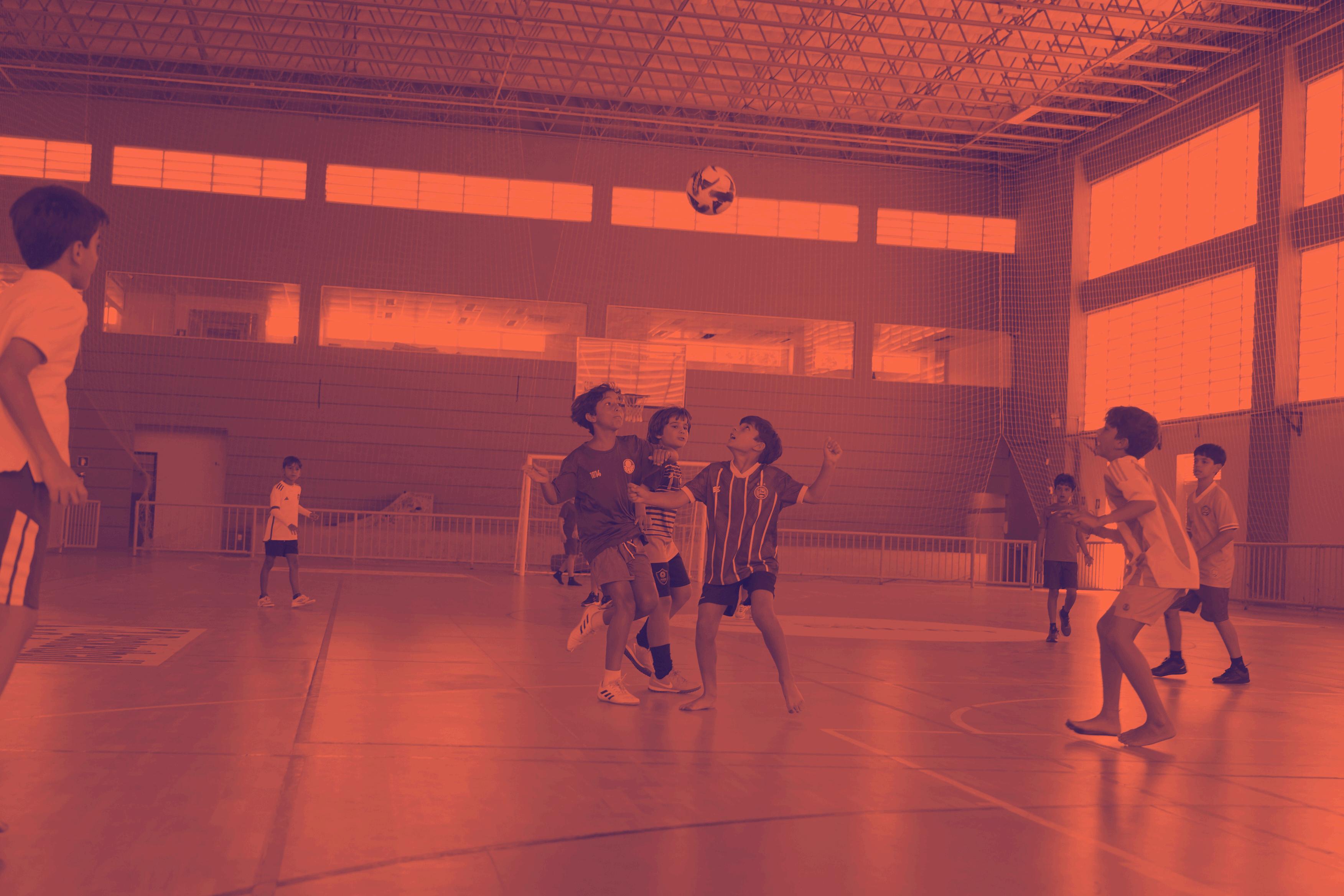
Body and Movement
Corpo e Movimento
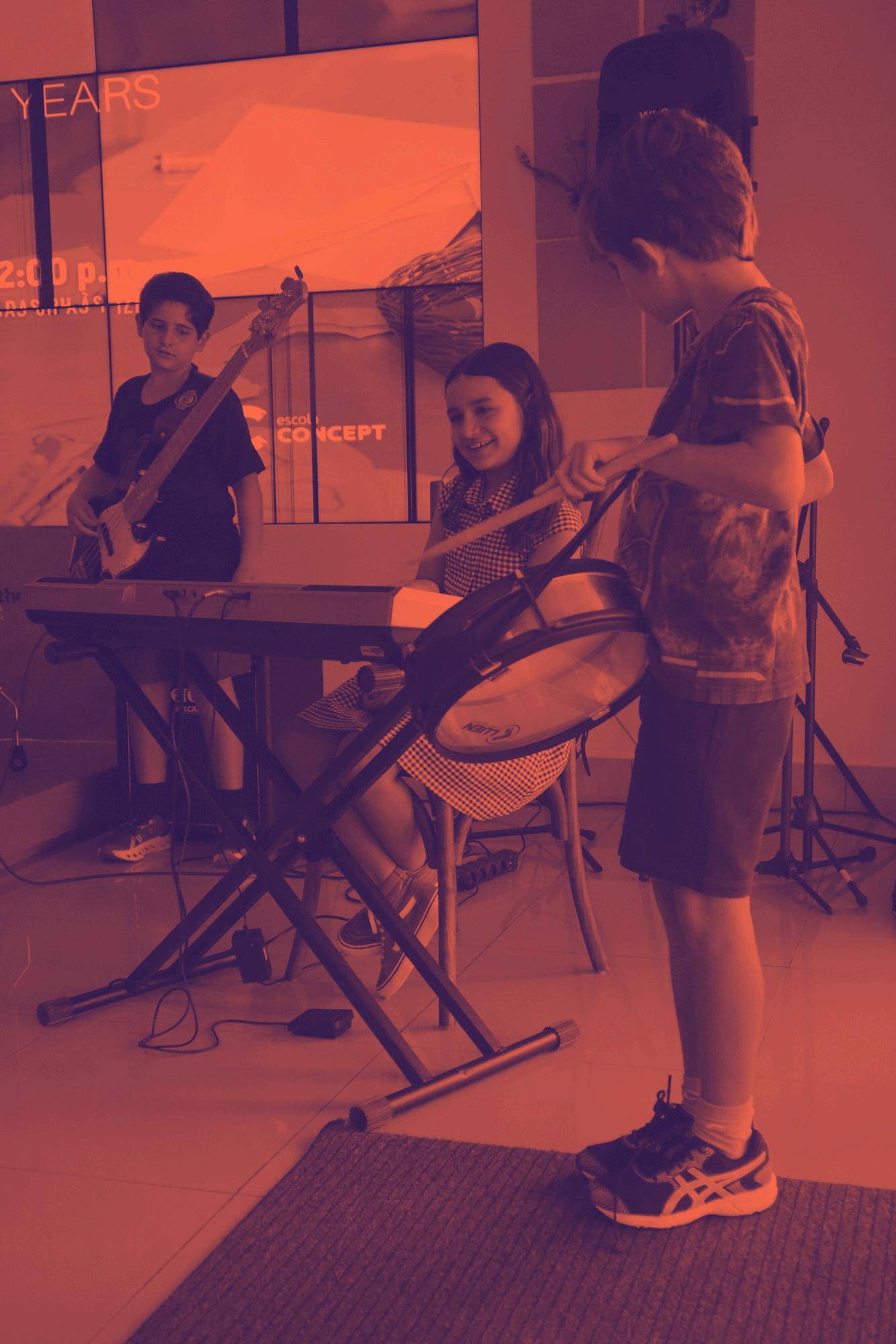
Sound and Exploration
Som e Exploração
To write opinion pieces that provide reason and support opinion.
To use words like "because," "therefore," and "for example" to connect their opinions and reasons.
To write informative texts and use facts, definitions, and details to clearly explain and examine a topic.
To use words like "because," "therefore," and "for example" to connect their opinions and reasons.
To write narratives, create a situation, introduce a narrator or characters, and organize events in a natural order.
To use words like "first," "next," and "finally" to show the order of events.
To participate in research and writing projects by exploring a topic and producing a report.
To learn the role of nouns, pronouns, verbs, adjectives, and adverbs in sentences.
To form and use simple verb tenses.
To learn and use correct subject-verb agreements.
To write simple,compound and complex sentences.
To capitalize appropriate words in titles.
To use conventional spelling for high-frequency and studied words.
To use spelling patterns in writing words.
To use word choice for effect.
To determine or clarify the meaning of unknown words.
To determine or clarify the meaning of unknown words which are formed by adding affix.
To tell the difference between literal and nonliteral meanings of words.
To recognize differences in words that show feelings or certainty.
To engage in discussions by asking and responding to questions, clarifying ideas, and linking comments to others’ remarks.
To engage in discussions by asking and responding to questions, clarifying ideas, and linking comments to others’ ideas and expressing their own ideas.
To identify the main ideas and supporting details from a text or information shared in different formats, including visually, quantitatively, and orally.
To ask and answer questions about what a speaker says, adding details and explanations
To recite rhymes, quadras, quadrinhas and tongue twisters, with appropriate intonation and observing the rhymes.
To express ideas with clarity, being concerned about being understood by the interlocutor and using the word with an audible tone of voice, good articulation and adequate rhythm.
To respect the turns of speech, selecting and using forms of address appropriate to the situation and position of the interlocutor.
To retell orally, with and without image support, literary texts.
To understand the different purposes of reading.
To read considering reading strategies (selection, anticipation, inference, verification).
To recognize reading and writing as elements of communication and social insertion.
To read and understand, with autonomy, personal letters and diaries, expressing feelings and opinions, among other genres in the field of everyday life.
To read and understand, with autonomy, letters addressed to print or digital media vehicles (reader and complaint letters to newspapers, magazines) and news, among other genres of the journalistic field.
To read/listen to and understand, with autonomy, reports of observations and research in information sources.
To use the worked score.
To understand and make use of dialogue in written texts.
To correctly use the spelling rules worked.
To make use of the grammatical concepts worked in texts.
To read and write words with regular contextual correspondences between graphemes and phonemes –c/qu; g/gu; r/rr; y/n; o (and not u) and e (and not i) in an unstressed syllable at the end of a word – and with nasality marks (tilde, m, n).
To read and write correctly words with syllables CV, V, CVC, CCV, VC, VV, CVV, identifying that there are vowels in all syllables.
To read and write correctly words with the digraphs lh, nh, ch.
To use a graphic accent (acute or circumflex) in stressed monosyllables ending in a, e, o and in oxytone words ending in a, e, o, followed or not by s.

To read, write and compare natural numbers up to the order of thousands.
Identify characteristics of the decimal number system, using the composition and decomposition of natural numbers up to four orders (9.999).
To build and use basic facts of addition and multiplication.
To use the rules of adding odd and even numbers to check answers.
To use written methods (algorithm) to add and subtract three-digit numbers.
To solve and elaborate word problems involving addition, subtraction, multiplication, and division.
To multiply by 10 and 100.
To simplify and add fractions with the same denominator
To round to the nearest 1000.
To identify regularities in ordered sequences of natural numbers resulting from successive additions or subtractions by the same number.
To use trial and error to solve problems.
To create and extend sequences following single-step rules.
To classify and compare flat shapes (triangle, square, rectangle, trapezoid, and rectangle) in relation to their sides and vertices.
To describe characteristics of some solid shapes (prisms, pyramids, cylinders, cones).
To choose the unit of measurement and the most appropriate instrument for measurements of length, time, and capacity.
To estimate, measure, and compare lengths.
To estimate and measure capacity and mass.
To read and register measurements and time intervals by reading clocks (analog and digital).
To identify monetary values and show equal amounts in different combinations.
To identify, in random familiar events, all possible outcomes, estimating those that have greater or lesser chances of occurrence.
To solve problems in which data are presented in double entry tables, graphs of bars or columns.
To find the mode and median for a set of data.
To order events by how impossible, certain or more or less likely they are.

To Compare events in time, having as a reference anteriority, posteriority and simultaneity;
To recognize some similarities and differences, economic and cultural, of everyday dimension, existing in their school group and in their locality;
To recognize some social, economic and cultural continuities and transformations in the daily experiences of families, schools and the community, over time, in the same living space;
To establish a relationship between the present and the past;
To identify some historical documents and sources of information discerning some of their functions.
To recognize, in the local landscape and in the place where they are inserted, the different manifestations of nature and the appropriation and transformation of it by the action of its collectivity, of its social group;
To know and compare the presence of nature, expressed in the local landscape, with the manifestations of nature present in other landscapes;
To recognize similarities and differences in the ways that different social groups appropriate nature and transform it, identifying its determinations in work relationships, in everyday habits, in ways of expressing themselves and in leisure;
To know and begin to use written and imagery sources of information using, for that purpose, some basic procedures;
To know how to use observation and description in the direct or indirect reading of the landscape, especially through illustrations and oral language;
To recognize the spatial references of location, orientation and distance in their daily lives in order to move independently and represent the places where they live and interact;
To recognize the importance of a responsible attitude of care for the environment in which they live, avoiding waste and realizing the care that must be taken in the preservation and maintenance of nature.
To produce different sounds from the vibration of different objects and identify variables that influence this phenomenon.
To discuss habits necessary for the maintenance of hearing and visual health considering the environmental conditions in terms of sound and light.
To identify characteristics about the way of life (what they eat, how they reproduce, how they move, etc.) of the most common animals in the nearby environment.
To describe and communicate the changes that occur since birth in animals from different terrestrial or aquatic environments, including man.
To compare some animals and organize groups based on common external characteristics (presence of feathers, fur, scales, beak, claws, antennae, paws, etc.).
To identify characteristics of the Earth (such as its spherical shape, presence of water, soil, etc.), based on observation, manipulation and comparison of different forms of representation of the planet (maps, globes, photographs, etc.).
To observe, identify and record the daily periods (day and/or night) when the Sun, other stars, Moon and planets are visible in the sky.
To compare different soil samples around the school based on characteristics such as color, texture, smell, particle size, permeability, etc.
To identify the different uses of the soil (planting and extraction of materials, among other possibilities), recognizing the importance of the soil for agriculture and for life.
B O D Y A N D M O V E M E N T