L O W E R S C H O O L
offers an academically rigorous, challenging, inclusive, global education designed to develop happy and thoughtful human beings who positively impact the world we live in. The school's program is designed to nurture the dispositions of lifelong learners who collaborate to co-create, embrace an entrepreneurial mindset, understand the meaning of living sustainably, and are globally and digitally fluent. Learners apply habits of mind to their daily actions, use the language of thinking to communicate, and understand the elements of design thinking to problem solve and innovate. Learning is facilitated and assessed through relevant, project-based experiences. Upon graduation, learners will be prepared for their university of choice in Brazil, or elsewhere around the world.
educação rigorosa, desafiadora, inclusiva e global, projetada para desenvolver seres humanos felizes e reflexivos, que impactem positivamente o mundo em que vivemos. O programa é desenhado para nutrir disposições de aprendizes ao longo da vida, que colaborem para cocriar, abracem uma mentalidade empreendedora, entendam o significado de viver de forma sustentável e se tornem fluentes global e digitalmente.
Os estudantes aplicam hábitos mentais em suas ações diárias, usam a linguagem do pensamento para se comunicar e entendem os elementos do design thinking para resolver problemas e inovar. A aprendizagem é facilitada e avaliada por meio de experiências relevantes e baseadas em projetos. Ao se formar, os alunos estarão preparados para a universidade de sua escolha no Brasil ou em qualquer lugar do mundo.
Expectativas Fundamentais de Aprendizagem por ano escolar
Based on our National Curriculum (Base Nacional Comum Curricular - BNCC and International Curriculum and Programs (Fieldwork Education, Illustrative Mathematics, Readers' and Writer's Workshop), learnings expectations in the Lower School are organized according to the following areas of knowledge:
Com base no Currículo Nacional (Base Nacional Comum Curricular - BNCC e nos Currículos e Programas Internacionais (Educação de Campo, Matemática Ilustrativa, Oficina de Leitores e Escritores), as expectativas de aprendizagem no Ensino Fundamental Anos Iniciais são organizadas de acordo com as seguintes áreas do conhecimento:
Língua Inglesa
English Language Portuguese Language
Língua Portuguesa
Mathematics
Matemática
Artistic Design
Design Artístico
Social Sciences (History and Geography)
Ciências Sociais (História e Geografia)
Natural Sciences
Ciências Naturais
Body and Movement
Corpo e Movimento
Sound and Exploration
Som e Exploração
To explore and recount stories from different cultures, identify the main lessons, and understand values.
To explore how characters react to major events and challenges.
To explore the structure of a story.
To compare and contrast different versions of the same story.
To ask and answer questions to demonstrate their understanding of key details in a story.
To identify the main purpose to answer, explain, or describe the main purpose of a text.
To describe how reasons support points the author makes in a text.
To compare and contrast the most important points by two texts.
To apply phonics skills by decoding words, recognizing vowel patterns, breaking words into syllables, and reading irregular words.
To read with sufficient accuracy and fluency to support comprehension.
To write opinion pieces where they state their opinion, give reasons, use words like "because" and "and" to connect ideas, and end with a conclusion.
To write texts that introduce a topic, explain it with facts, and end with a conclusion.
To write stories that describe events, show feelings and thoughts, use words to show the order, and end with a conclusion.
To participate in research and writing projects by exploring a topic and producing a report.
To learn and use irregular plural nouns.
To learn and use the past tense of irregular verbs.
To create simple and compound sentences.
To use apostrophes to make contractions.
To use spelling patterns to spell new words.
To learn the meaning of new words by adding known prefixes to familiar words.
To use a known root word to figure out the meaning of a new word.
To identify how words are used in real life.
To engage in collaborative conversations by following discussion rules and sharing ideas respectfully.
To ask questions to clarify understanding during conversations.
To recount or describe important details or ideas from a story read aloud, or other media.
To ask and answer questions to gather information or clarify understanding.
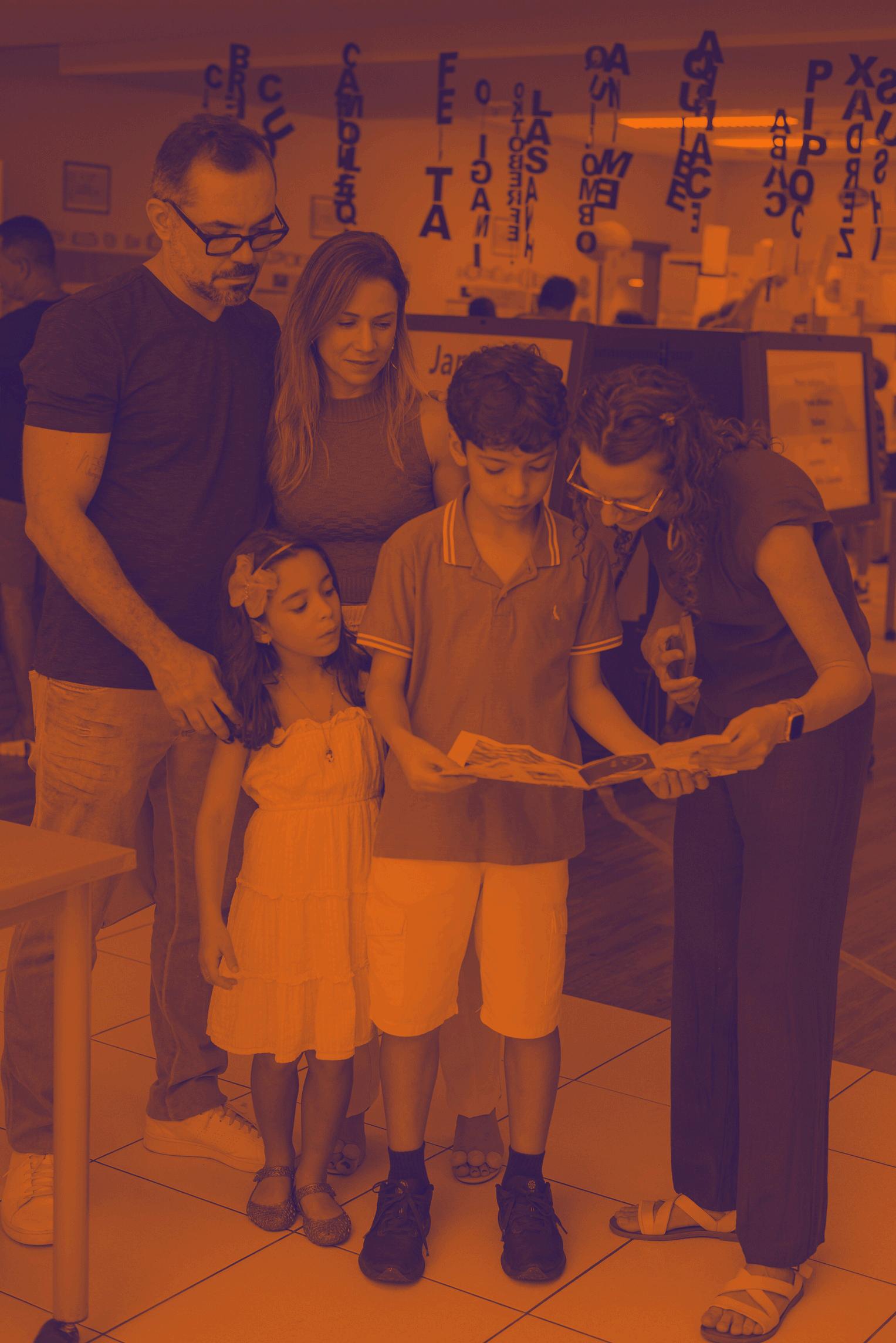
To recite rhymes, comics, tongue-twisters, among other texts.
To plan and produce interviews, curiosities, among other texts that can be oral.
To express yourself clearly, worrying about being understood by the interlocutor.
To listen carefully to statements by educators and colleagues.
To retell orally, with and without image support, literary texts read by you and/or by the educator.
To understand the different purposes of reading.
To search, select and read, with the mediation of the educator (shared reading), texts that circulate in printed or digital media, according to the needs and interests.
To read considering reading strategies (selection, anticipation, inference, verification).
To recognize writing as an element of communication and social insertion.
To recognize the role of texts used to present information collected in research activities (surveys, small interviews, records of experiments).
To explore, with the mediation of the educator, informative texts from different digital research environments, knowing their possibilities.
To read and understand, with a certain autonomy, literary texts of different genres, developing a taste for reading.
To write, spontaneously or by dictation, words and phrases alphabetically – using letters/graphemes that represent phonemes.
To read new words accurately in decoding, in the case of frequently used words, read globally, by memorization.
To make correct use of uppercase and lowercase letters.
To correctly use the spelling rules worked.
To make use of the grammatical concepts worked in texts.
To segment words into syllables and remove and replace initial, medial or final syllables to create new words.
To read and write words with regular direct correspondences between letters and phonemes (f, v, t, d, p, b) and regular contextual correspondences (c and q; e and o, in unstressed position at the end of a word).
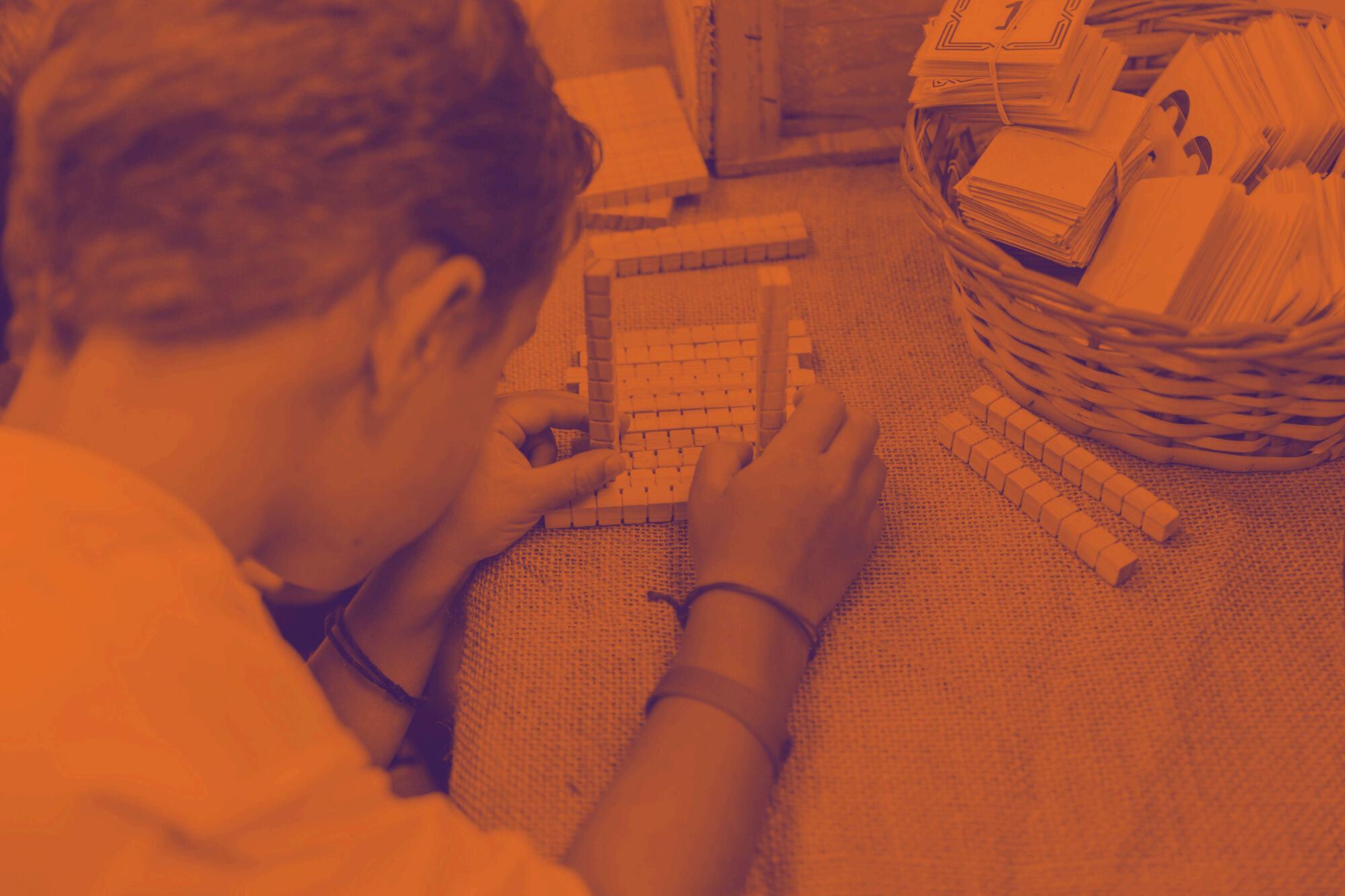
To compare and order natural numbers (up to the order of hundreds - 999) by understanding the features of the decimal numbering system (positional value and the role of zero).
To compose and to decompose natural numbers up to three orders (hundreds), with the support of manipulative material, through different additions.
To build the basic facts of addition and subtraction and to use them in mental or written calculations.
To solve and elaborate problems of addition and subtraction, involving numbers of up to three orders (hundreds).
To solve and to elaborate multiplication problems (by 2, 3, 4, and 5) with the idea of repeated addition as a strategy and form of personal register, using or not using the images and/or manipulable material.
To identify equivalent fractions and decimals.
To round to the nearest 100.
To build sequences of natural numbers in ascending or descending order.
To describe a pattern (or regularity) of repetitive and recursive sequences, through words, symbols or drawings.
To describe missing elements in repetitive sequences and in recursive sequences of natural numbers, objects, or pictures.
To create and extend sequences following single-step rules.
To sketch routes to be followed or blueprints of familiar environments, signalizing entrances, exits, and some reference points.
To recognize, name, and compare spacial geometric shapes (cube, rectangular prism, pyramid, cone, cylinder, and sphere), relating them to objects in the physical world.
To recognize, compare, and name flat figures (circle, square, rectangle, and triangle).
To estimate, measure and compare the length of a room and the length of a polygon.
To estimate, measure and compare capacity and mass.
To indicate the length of time intervals between two dates.
To compare the capacity of different containers.
To read and compare research information presented through double entry tables and graphs of single columns or bars.
To sort and classify objects using more than one criterion.
To construct and interpret simple pictograms, tally charts, bar graphs, and tables.
To classify random everyday events as "unlikely," " very likely," "unlikely," and "impossible."
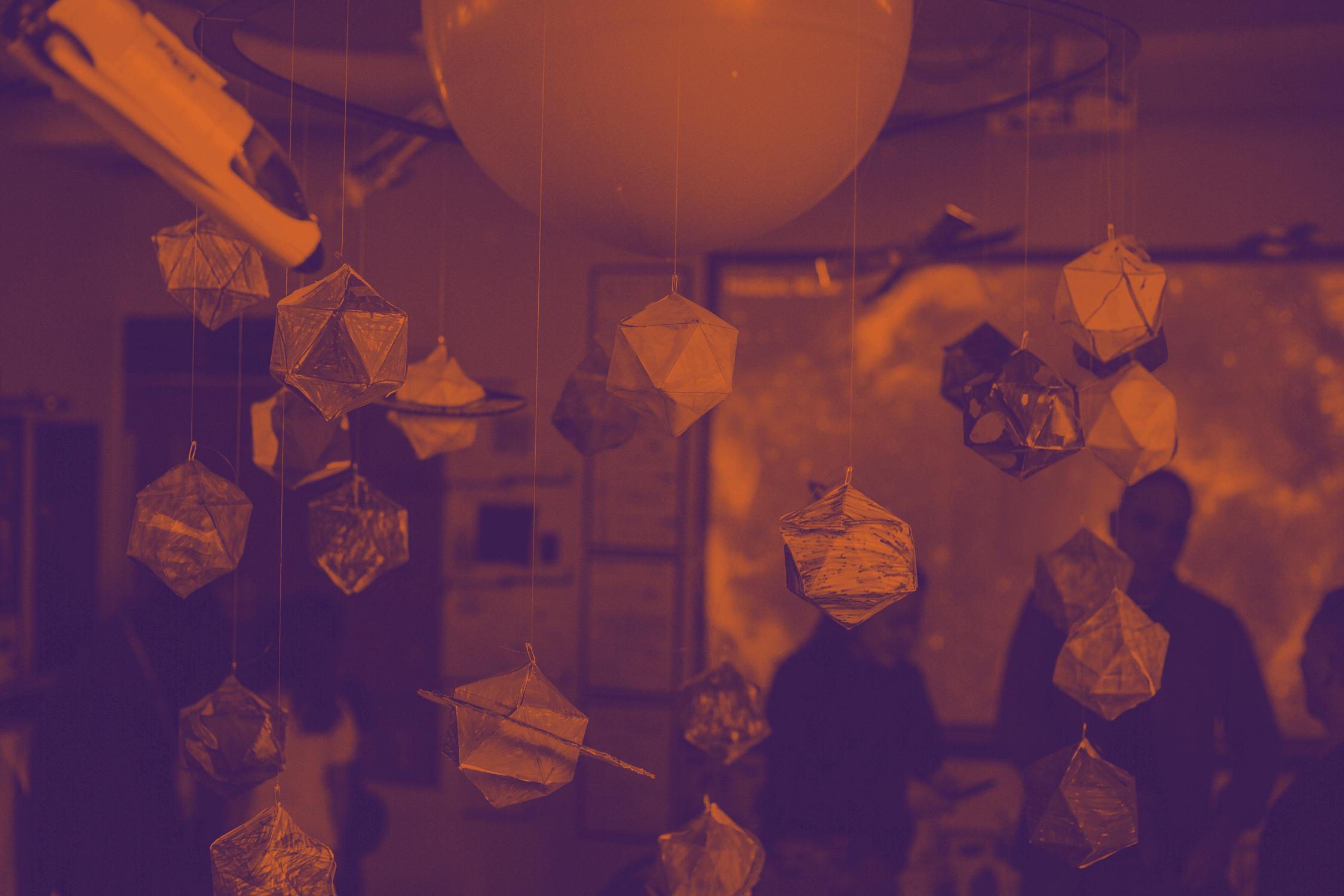
To recognize spaces of sociability and identify the reasons that approximate and separate people into different social or kinship groups.
To identify and describe practices and social roles that people exercise in different communities.
To select everyday situations that refer to the perception of change, belonging, and memory.
To select and understand the meaning of personal objects and documents such as sources of memories and stories in the personal, family, school, and community spheres.
To select and understand the function of personal objects and documents and Groups .
To identify and organize, temporally, facts of everyday life, using notions related to time (before, during, at the same time, and after).
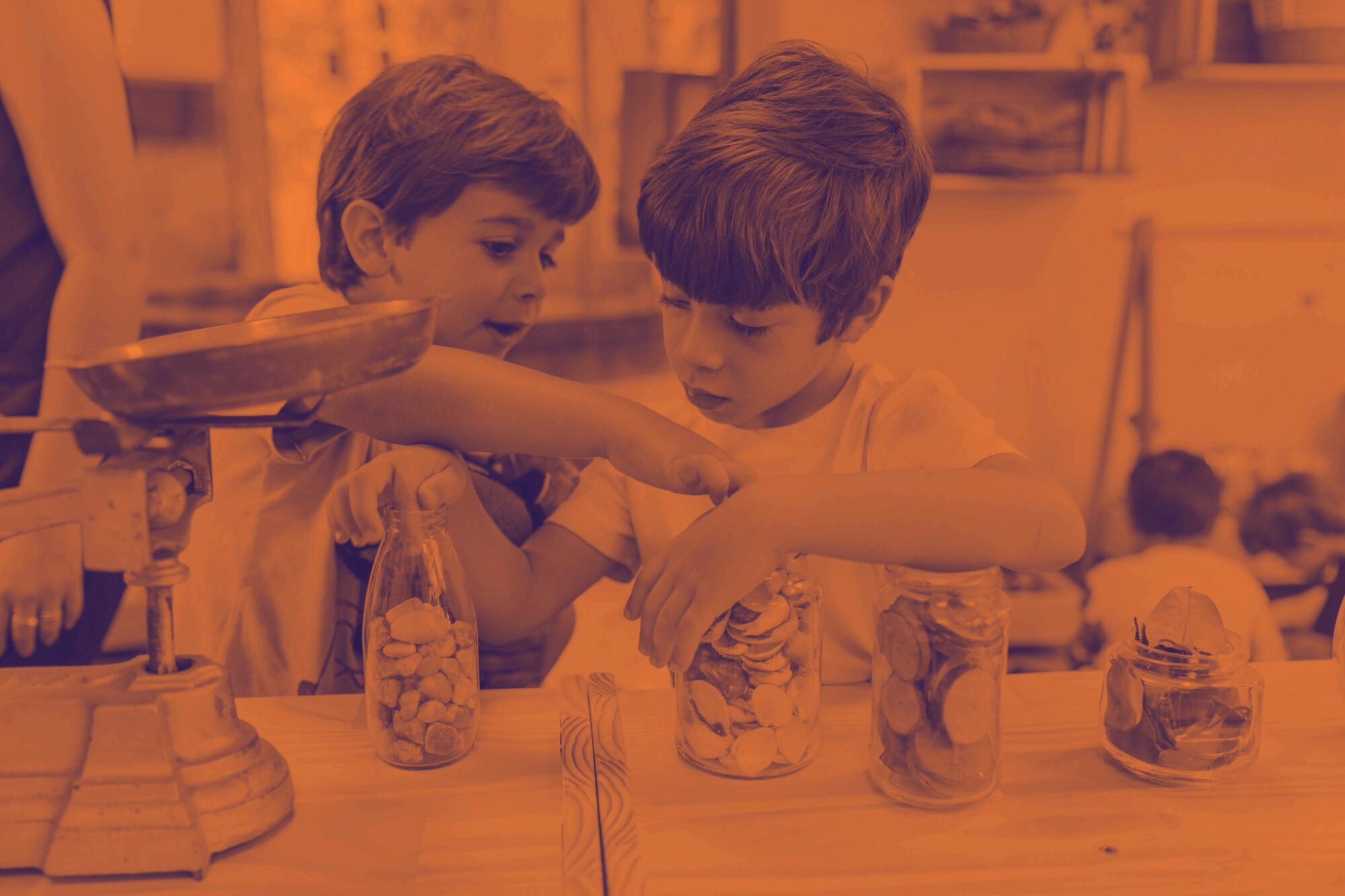
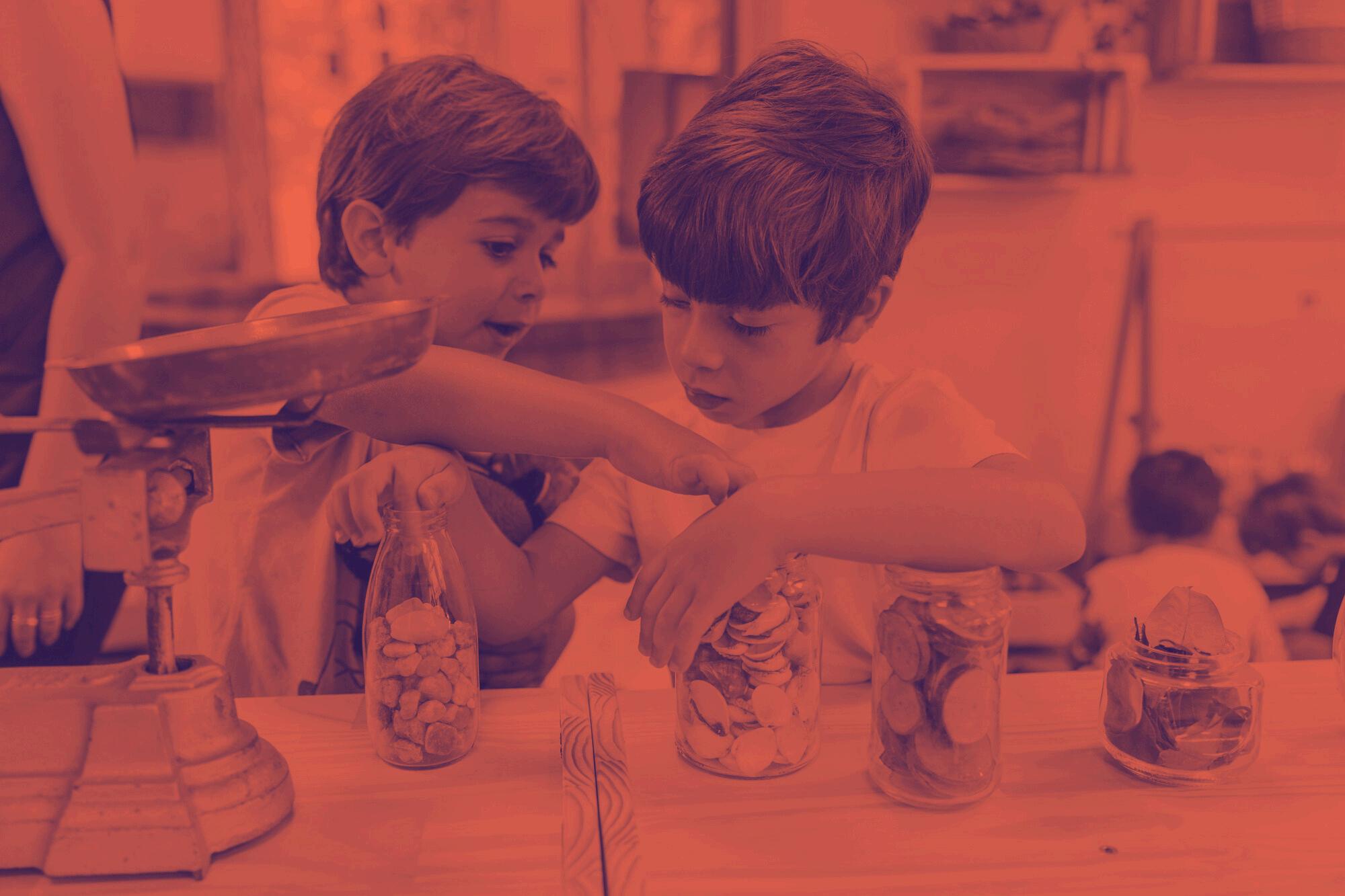
Identify what materials (metals, wood, glass, etc.) that the everyday life objects are made of, how these objects are used and with which materials they were made of in the past.
Propose the use of different materials for the construction of everyday objects, considering some of their properties (flexibility, strength, transparency, etc.).
Describe characteristics of plants and animals that are part of their daily lives and are related to the environment in which they live.
Investigate the importance of water and light for the maintenance of plant life in general.
Identify as the main parts of a plant (root, stem, leaves, flower, and fruits) and their functions, and analyze the relationships between plants, the environment, and the other living beings.
Describe the positions of the Sun in different times of the day and associate it with the size of the shadow projected.
Compare the effect of different solar radiation (heating and reflection) on different surface types (water, sand, soil, dark, light and metallic surfaces, etc.)
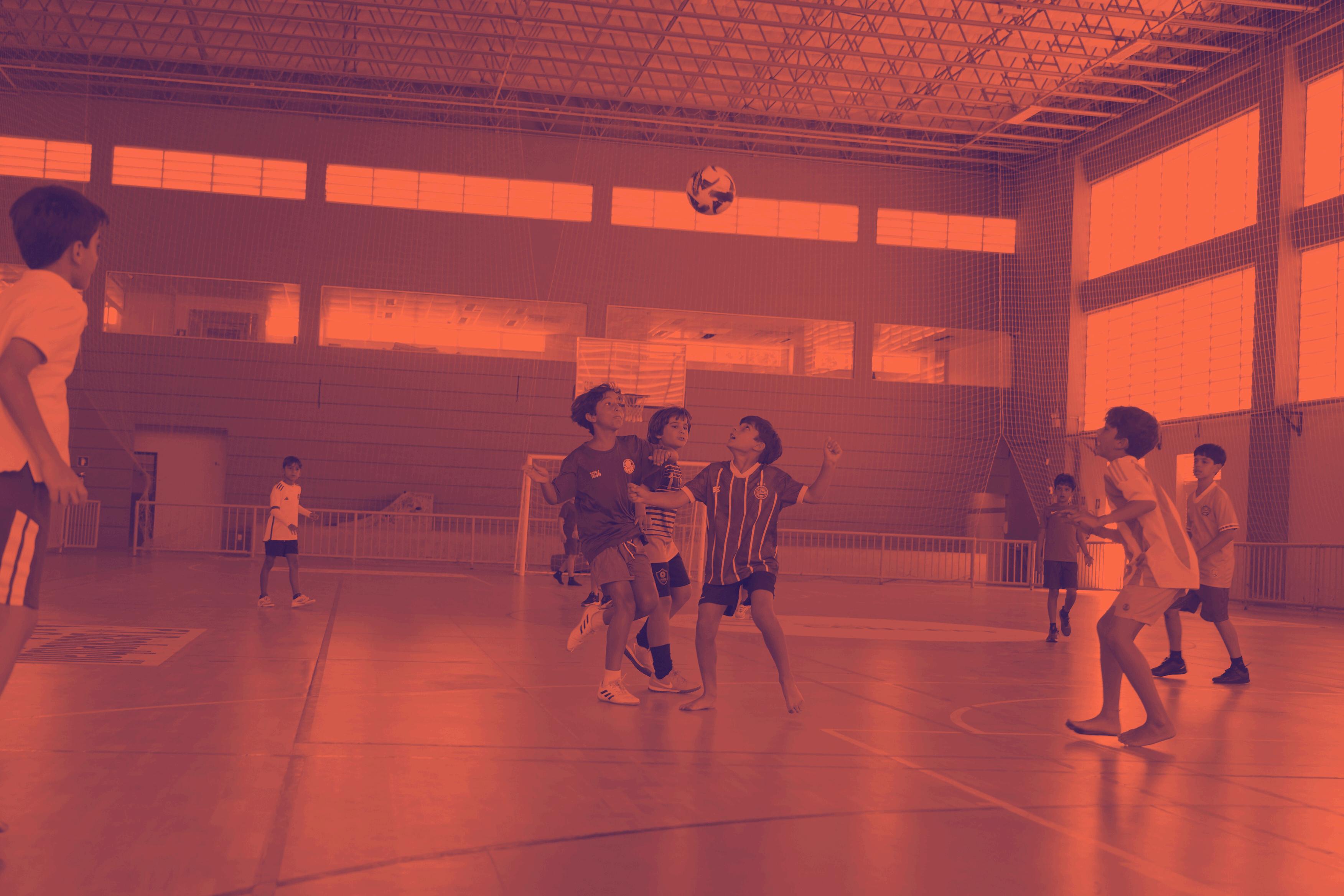
B O D Y A N D M O V E M E N T
S O U N D E X P L O R A T I O N
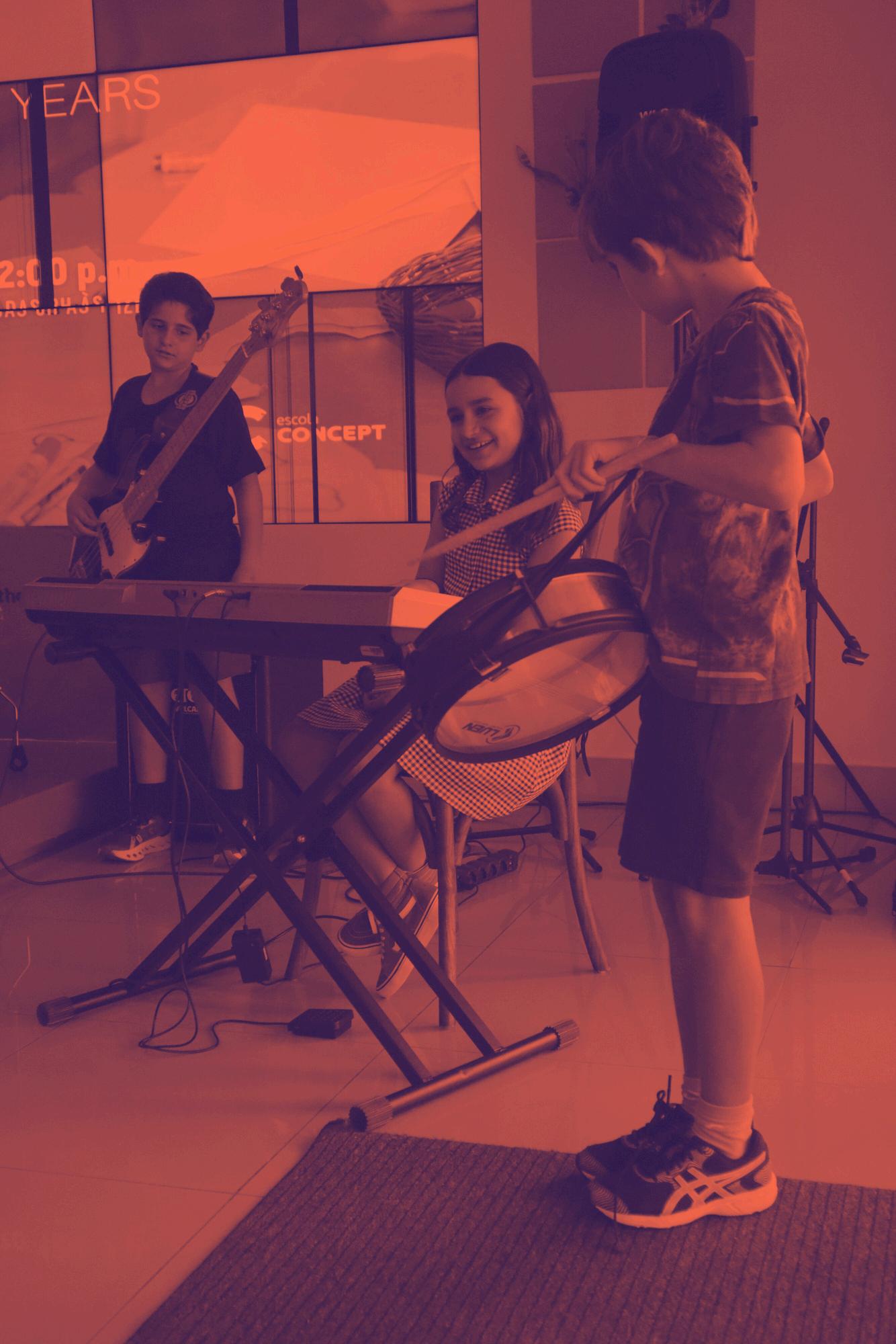
To identify and critically appreciate different forms and genres of musical expression, recognizing and analyzing the uses and functions of music in different contexts of circulation, especially those of everyday life.
To experience and appreciate different forms of dance manifestations present in different contexts, cultivating perception, imagination, the ability to symbolize and body repertoire.
To understand and explore the constitutive elements of music (pitch, intensity, timbre, melody, rhythm, etc.), through games, games, songs and various practices of composition/creation, performance and musical appreciation.
To explore different sound sources, such as those existing in the body itself (clapping, voice, body percussion), in nature and in everyday objects, recognizing the constitutive elements of music and the characteristics of various musical instruments.
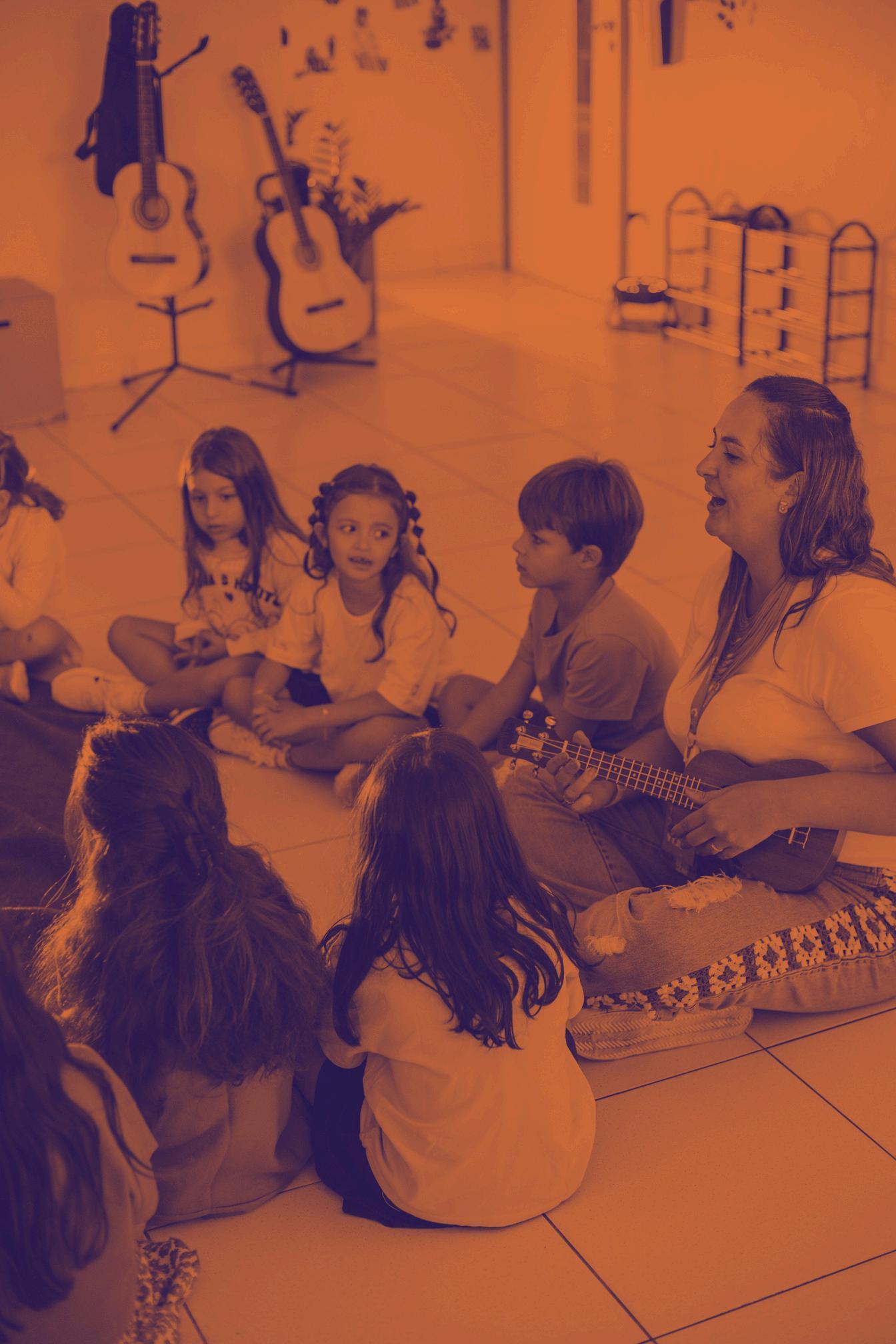
To explore different forms of unconventional musical recording (graphic representation of sounds, creative scores, etc.), as well as audio and audiovisual recording procedures and techniques, and recognize conventional musical notation.
To experiment with improvisations, compositions and storytelling, among others, using voices, body sounds and/or conventional or unconventional musical instruments, individually, collectively and collaboratively.
To create and improvise danced movements individually, collectively and collaboratively, considering the structural, dynamic and expressive aspects of the movement's constitutive elements, based on dance codes.
To discuss, with respect and without prejudice, personal and collective experiences in dance at school, as a source for the construction of their own vocabularies and repertoires.
A R T I S T I C D E S I G N
To identify and appreciate different forms of traditional and contemporary visual arts, cultivating perception, imagination, the ability to symbolize and the imagery repertoire.
To explore and recognize constitutive elements of the visual arts (point, line, shape, color, space, movement, etc.).
To recognize and experiment, in thematic projects, the procedural relationships between different artistic languages.
To experience creating visual arts individually, collectively and collaboratively, exploring different spaces in the school and community.
To dialogue about your creation and those of your colleagues, to reach plural meanings.
To characterize and experiment with toys, games, dances, songs and stories from different aesthetic and cultural matrices.
To recognize and analyze the influence of different aesthetic and cultural matrices of the visual arts in the artistic manifestations of local, regional and national cultures.
To experiment with different forms of artistic expression (drawing, painting, collage, comics, folding, sculpture, modeling, installation, video, photography, etc.), making sustainable use of conventional and unconventional materials, instruments, resources and techniques.
To know and value the cultural, material and immaterial heritage of different cultures, especially the Brazilian one, including its indigenous, African and European matrices, from different times, favoring the construction of vocabulary and repertoire related to different artistic languages.
To explore different technologies and digital resources (multimedia, animations, electronic games, audio and video recordings, photography, software, etc.) in artistic creation processes.
To recognize some categories of the visual arts system (museums, galleries, institutions, artists, artisans, curators, etc.).