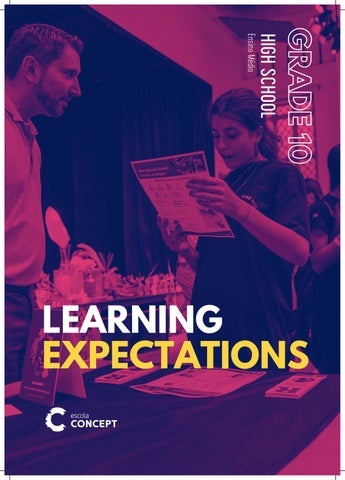
LEARNING EXPECTATIONS GRADE 10
Ensino Médio

Finding Muchness by Kobi


2026 Theme of the Year
Our mission

Escola Concept
offers an academically rigorous, challenging, inclusive, global education designed to develop happy and thoughtful human beings who positively impact the world we live in. The school's program is designed to nurture the dispositions of lifelong learners who collaborate to co-create, embrace an entrepreneurial mindset, understand the meaning of living sustainably, and are globally and digitally fluent. Learners apply habits of mind to their daily actions, use the language of thinking to communicate, and understand the elements of design thinking to problem solve and innovate. Learning is facilitated and assessed through relevant, project-based experiences. Upon graduation, learners will be prepared for their university of choice in Brazil, or elsewhere around the world.
A ESCOLA CONCEPT OFERECE
educação rigorosa, desafiadora, inclusiva e global, projetada para desenvolver seres humanos felizes e reflexivos, que impactem positivamente o mundo em que vivemos. O programa é desenhado para nutrir disposições de aprendizes ao longo da vida, que colaborem para cocriar, abracem uma mentalidade empreendedora, entendam o significado de viver de forma sustentável e se tornem fluentes global e digitalmente.
Os estudantes aplicam hábitos mentais em suas ações diárias, usam a linguagem do pensamento para se comunicar e entendem os elementos do design thinking para resolver problemas e inovar. A aprendizagem é facilitada e avaliada por meio de experiências relevantes e baseadas em projetos. Ao se formar, os alunos estarão preparados para a universidade de sua escolha no Brasil ou em qualquer lugar do mundo.
Nossa missão
FOUNDATIONAL LEARNING PER GRADE LEVEL EXPECTATIONS
Expectativas Fundamentais de Aprendizagem por ano escolar
The standards and benchmarks that guide instruction derive from both the national curriculum mandated by the Ministry of Education, besides international references such as Illustrative Mathematics, Fieldwork Education, U.S. Common Core, AP Curriculum (College Board) NGSS, and NCSS. The main core areas of knowledge are divided into the following:
Os padrões e referências que norteiam o ensino derivam tanto do currículo nacional exigido pelo Ministério da Educação quanto de referências internacionais como Matemática Ilustrativa, Educação de Trabalho de Campo, U.S. Common Core, Currículo AP (College Board), NGSS e NCSS. As principais áreas de conhecimento são divididas em:
English Language
Interpret complex texts and rhetorical structures while developing voice, research skills, and critical perspectives through literary and informational reading and writing.
Portuguese Language
Aprofunde-se na leitura, interpretação e produção de textos argumentativos, análise linguística e discussões sobre diversidade textual, discursos sociais e temas contemporâneos.
Mathematics
Explore quadratic, exponential, and rational functions, trigonometry, statistics, and probability through analysis and modeling of real-world problems.
Social Sciences (History and Geography)
Analyze geopolitical tensions, social inequalities, and global governance by connecting historical processes and geographical patterns to contemporary challenges.
FOUNDATIONAL LEARNING PER GRADE LEVEL EXPECTATIONS
Expectativas Fundamentais de Aprendizagem por ano escolar
Natural Sciences
Study electricity, energy transformation, periodic table, chemical reactions, evolution, genetics, and ecosystem dynamics using inquiry and lab-based learning.
Career & College Counseling Guide
The WAKE College & Career Counseling Manual offers a structured framework for post-secondary planning. Using the WAKE model—Wonder, Act, Know, Execute—it guides learners in self-discovery, academic growth, and career exploration, ensuring a confident and purposeful transition beyond high school.
AP - Advanced Placement
College-level courses and exams offered in high school that allow students to demonstrate mastery of subjects, earn college credit, and strengthen university applications.
ENGLISH LANGUAGE Arts
ENGLISH LANGUAGE ARTS
Curriculum Snapshot
Aligned with the Common Core State Standards (ELA), AP Capstone™ (AP Seminar), and AP English Language & Composition, Grade 10 English Language Arts ensures rigor, continuity, and international comparability.
At Escola Concept, every Grade 10 learner engages in advanced literacy, research, and argumentation. Our model – Understand → Explore → Materialize – ensures learning is structured, applied, and meaningful
Course Overview
The Grade 10 English Language and Literacy course with AP Seminar engages learners in critical inquiry, argumentation, and advanced literacy practices.
Essential questions frame the course:
How do the choices we make—and those we don’t—shape who we become?
How do authors and thinkers represent voice, choice, power, and complexity?
Students analyze fiction, nonfiction, and real-world problems, while building narrative, argumentative, and informative writing skills. AP Seminar introduces the QUEST framework (Question, Understand, Evaluate, Synthesize, Team/Transform), guiding learners to research complex issues, evaluate perspectives, and develop evidence-based arguments.
Learning Structure
Each lesson follows Escola Concept’s three-phase model:
Understand: Introduce central concepts and essential questions.
Explore: Engage in text analysis, research, and writing tasks.
Materialize: Demonstrate learning through essays, presentations, and real-world applications
Content Areas
Literary & Rhetorical Analysis:
How authors construct meaning through structure, tone, and argumentation in fiction, nonfiction, and multimedia texts.
Writing Across Genres:
Narrative, argumentative, and explanatory writing, plus research-based writing through AP Seminar.
Research & Inquiry (AP Seminar):
Independent and team investigations into global and local issues, synthesizing sources, and defending arguments.
Oral Communication & Presentation:
Academic discussions, debates, and formal AP Seminar presentations (Team Multimedia Presentation, Individual Multimedia Presentation).
Grammar, Style, and Vocabulary:
Refining grammar usage and developing advanced academic and rhetorical vocabulary
Competencies
By the end of Grade 10, learners will be able to:
Analyze and interpret complex texts and arguments.
Write across genres with clarity, evidence, and style.
Conduct individual and team-based research.
Present and defend perspectives with clarity and evidence.
Apply grammar, syntax, and vocabulary effectively in academic contexts
Assessment and Student Work
Learners demonstrate progress through:
Analytical essays, research-based writing, and narrative projects. AP Seminar performance tasks (Team Multimedia Presentation, Individual Multimedia Presentation, Written Argument).
Socratic seminars, structured debates, and collaborative research projects.
Portfolios documenting inquiry, synthesis, and reflection.
Scan the QR code to access the complete document for the English LanguageArtsCurriculum.Orclickhere.
PORTUGUESE LANGUAGE
LÍNGUA PORTUGUESA
Curriculum Snapshot
Aligned with the Base Nacional Comum Curricular (BNCC) – Ensino Médio, Grade 10 Língua Portuguesa ensures rigor, continuity, and alignment with national benchmarks.
At Escola Concept, every Grade 10 learner develops critical reading, authorship, and active participation in social and academic discourses. Our model –
Compreender → Explorar → Materializar – ensures learning is structured, applied, and meaningful
Course Overview
The Grade 10 Língua Portuguesa course focuses on building students’ discursive identity while deepening critical understanding of language in its multiple social functions.
Students engage with literary, journalistic, academic, and digital texts, broadening their expressive, argumentative, and analytical repertoire. They learn to see language as a tool for individual and collective expression, civic participation, and social transformation.
Throughout the year, learners will:
Analyze texts through aesthetic, ethical, cultural, and critical lenses. Produce oral, written, and multimodal texts with clarity, intention, and autonomy.
Engage critically with media and social discourses.
Understand the role of language in constructing self and society. Participate in collaborative projects with communicative and social purpose.
Use digital tools ethically, creatively, and responsibly
Learning Structure
Each lesson follows Escola Concept’s three-phase model:
Understand: Guided study of texts, concepts, and contexts.
Explore: Critical analysis, debate, investigation, and experimentation with language.
Materialize: Production of authorial texts, collaborative projects, and public presentations
Content Areas
Leitura e Interpretação:
Critical study of literary, journalistic, academic, and media texts; analysis of ideology, communication, and cultural identity.
Produção Textual:
Essays, argumentative texts, chronicles, poems, reviews, and multimodal projects; drafting, revising, and adapting to genre and purpose.
Comunicação Oral:
Debates, assemblies, forums, conversations, and podcasts; development of active listening and oral argumentation.
Análise Linguística:
Reflection on language choices, syntax, style, and their effects; language, identity, and power.
Multiletramentos e Cultura Digital:
Creation of videos, podcasts, infographics, and campaigns integrating text, sound, and image; ethical and responsible digital participation
Competencies
By the end of Grade 10, learners will be able to:
Read and interpret texts critically across genres and media.
Write with authorship, structure, and argumentative clarity.
Express themselves orally with empathy and critical engagement.
Curate and analyze digital information with responsibility.
Produce multimodal content with creativity and ethical awareness. Participate actively in public debates and discursive practices.
Assessment and Student Work
Learners demonstrate mastery through:
Critical reading analyses and interpretive essays.
Argumentative and creative writing portfolios.
Debates, podcasts, and oral presentations.
Multimodal digital projects (infographics, campaigns, videos).
Collaborative projects with civic and communicative purpose
MATHEMATICS
MATHEMATICS
Curriculum Snapshot
Aligned with the Base Nacional Comum Curricular (BNCC), Illustrative Mathematics (IM), and the Common Core State Standards (CCSS), Grade 10 Mathematics ensures rigor, continuity, and international comparability.
At Escola Concept, every Grade 10 learner develops analytical reasoning, geometric proof, algebraic fluency, and probabilistic thinking. Our model –Understand → Explore → Materialize – ensures learning is structured, applied, and meaningful
Course Overview
Grade 10 Mathematics emphasizes the development of geometric reasoning, proof, and spatial understanding. Students deepen their ability to analyze twoand three-dimensional figures, use coordinate geometry, and apply trigonometry to real-world problems. They also advance in algebraic modeling, data analysis, and probability.
The course builds connections between geometry, algebra, and measurement, strengthening mathematical argumentation, precise definitions, and multiple representations. Learners are encouraged to use mathematics as both a logical system and a tool for interpreting the world
Learning Structure
Each lesson follows Escola Concept’s three-phase model:
Understand: Introduction of mathematical concepts and problems through real-world contexts.
Explore: Practice with multiple representations (graphs, tables, equations, and models), collaborative problem-solving, and guided reasoning.
Materialize: Application through modeling tasks, real-world investigations, statistical projects, and performance assessments
Content Areas
Constructions and Transformations:
Explore}congruence}using}geometric}constructions}and}transformationsb
Proof and Triangle Theorems:
Develop}deductive}reasoning}through}geometric}proofs}of}triangle}and}angle propertiesb
Coordinate Geometry:
Solve}problems}using}algebra}in}the}coordinate}planeg}classify}polygons}and}analyze relationshipsb
Similarity and Right Triangles:
Apply}similarity}and}trigonometric}ratios}to}solve}right}triangle}problemsb
Circles, Area, and Volume:
Study}circle}properties]}arc}length]}and}calculate}volumes}of}3D}figuresb
Applications of Geometry:
Model}realrworld}scenarios}using}geometric}principlesb
Algebra and Polynomials:
Work}with}quadratic}functions]}polynomials]}and}factoringb
Data and Probability:
Analyze}statistical}data}and}calculate}compound}probabilities
Competencies
By the end of Grade 10, learners will be able to:
Prove geometric relationships using deductive reasoning.
Visualize and manipulate two- and three-dimensional figures.
Apply algebraic tools in geometric and functional contexts.
Solve real-world problems using trigonometric ratios.
Analyze data sets and interpret probabilistic models.
Communicate mathematical reasoning using precise definitions and representations
Assessment and Student Work
Student progress is documented through:
Formal geometric proofs and written justifications. Problem sets in algebra, geometry, and trigonometry. Modeling tasks applied to design, architecture, and nature. Collaborative projects, debates, and conceptual discussions. Portfolios that document growth in reasoning, problem-solving, and communication
SOCIAL SCIENCES
SOCIAL SCIENCES
Curriculum Snapshot
Aligned with the Base Nacional Comum Curricular (BNCC) and the National Council for the Social Studies (NCSS), Grade 10 Social Sciences ensures rigor, continuity, and international comparability.
At Escola Concept, every Grade 10 learner deepens their understanding of civilizations, governance, economies, and cultures through historical, geographical, civic, and economic inquiry. Our model – Understand → Explore → Materialize – ensures learning is structured, applied, and meaningful
Course Overview
The Grade 10 Social Sciences course provides learners with a deeper understanding of historical transformations, political structures, economic systems, and cultural exchanges from early civilizations through the end of the Middle Ages.
Students analyze the Renaissance, Reformation, and Age of Exploration, connecting past developments to the emergence of modern states and global systems. The course emphasizes critical thinking, comparative perspectives, and civic engagement, encouraging learners to evaluate sources, construct arguments, and reflect on the role of governance, citizenship, and human rights in shaping societies.
Learning Structure
Each lesson follows Escola Concept’s three-phase model:
Understand: Introduction of historical and political concepts through guided inquiry.
Explore: Research, case study analysis, and structured discussions. Materialize: Application through projects, debates, and policy-based problem-solving tasks.
Content Areas
History:
Early civilizations, medieval societies, cultural heritage, colonialism, indigenous cultures, and the development of nation-states.
Geography:
Human and physical geography, trade networks, settlement patterns, environmental changes, and migration.
Civics:
Governance models, democracy, human rights, justice systems, and citizenship.
Economics:
Early trade systems, market economies, global commerce, and economic disparities.
Cultural Studies:
Identity, traditions, social norms, migrations, cultural movements, and the role of media
Competencies
By the end of Grade 10, learners will be able to:
Compare political, social, and economic systems across civilizations.
Use geographic tools to analyze human-environment interactions and trade.
Evaluate governance systems, civic ideals, and justice institutions.
Analyze the causes and effects of global trade, colonialism, and economic inequality.
Interpret how migration, religion, and culture shaped identity and societies
Assessment and Student Work
Learners demonstrate mastery through:
Research projects and analytical essays using primary and secondary sources.
Civic engagement simulations and structured debates.
Case study analyses of historical transformations and global issues.
Portfolios documenting inquiry, critical reasoning, and collaborative projects.
NATURAL SCIENCES
NATURAL SCIENCES
Curriculum Snapshot
Aligned with the Base Nacional Comum Curricular (BNCC) and the Next Generation Science Standards (NGSS), Grade 10 Natural Sciences ensures rigor, continuity, and international comparability.
At Escola Concept, every Grade 10 learner explores physics, chemistry, biology, and earth sciences. Our model – Understand → Explore → Materialize –ensures learning is structured, applied, and meaningful
Course Overview
The Grade 10 Natural Sciences course provides an in-depth exploration of scientific disciplines, developing students’ capacity for inquiry, experimentation, and critical analysis.
Students study kinematics, Newton’s laws, thermodynamics, electromagnetism, chemical bonding, equilibrium, stoichiometry, atomic structure, biodiversity, metabolism, genetics, and environmental sustainability. The course emphasizes scientific research skills, interdisciplinary thinking, and ethical awareness, preparing learners to connect scientific knowledge to global and environmental challenges
Learning Structure
Each lesson follows Escola Concept’s three-phase model:
Understand: Introduction of scientific concepts and theories through guided exploration.
Explore: Laboratory investigations, collaborative problem-solving, and case studies.
Materialize: Application through research projects, presentations, and scientific investigations.
Content Areas
Physics:
Kinematics, Newton’s laws, energy conservation, thermodynamics, waves, electromagnetism, and electric fields.
Chemistry:
Atomic structure, bonding, stoichiometry, equilibrium, and chemical reactions.
Biology:
Biodiversity, immunity, metabolism, genetics, inheritance, pathogens, and ecosystems.
Earth & Environmental Science:
Biogeochemical cycles, climate change, resource sustainability, and astronomy.
Scientific Communication:
Research reporting, collaboration, and interdisciplinary problem-solving.
Competencies
By the end of Grade 10, learners will be able to:
Design and conduct independent scientific investigations.
Analyze data and construct evidence-based explanations.
Model chemical and physical processes, connecting them to environmental contexts.
Explain genetic inheritance, biodiversity, and ecosystem dynamics.
Evaluate human impacts on climate and sustainability.
Communicate scientific findings clearly and collaborate effectively
Assessment and Student Work
Student progress is documented through:
Laboratory experiments and scientific reports.
Research projects on sustainability, health, and technology.
Multimedia presentations and debates on scientific issues.
Portfolios documenting inquiry, analysis, and reflections.
Participation in collaborative investigations and public communication of findings.
CAREER & COLLEGE PREPARATION
CAREER & COLLEGE PREP
The WAKE College & Career Counseling Manual
is a roadmap to help learners, families, and educators navigate post-secondary planning with confidence. Guided by the WAKE framework—Wonder, Act, Know, Execute—it empowers learners to explore their aspirations, build the skills and knowledge needed for success, and take ownership of their future. More than a guide, it is a living document designed to support self-discovery, academic growth, and career exploration, ensuring a purposeful and well-prepared transition beyond high school.
ACT: Taking Action & Refining Interests
Introduce internships, college visits, and practical career exploration activities, focusing on transforming ideas into action.
Begin taking honors-level & AP courses where applicable. Identify academic strengths & areas for improvement. Establish a testing strategy (PSAT, SAT/ACT planning).
Evaluate future AP course options based on personal interests & college goals.
Available Resources
Naviance – Academic & career planning tool for learners.
WAKE Academic Roadmap – Guides learners on key milestones per grade.
College Fairs & University Visits – Opportunities to explore global institutions.
Counselor Meetings & Workshops – Personalized guidance at each stage.
ADVANCED PLACEMENTAP
ADVANCED PLACEMENT
Advanced Placement (AP) courses are college-level classes offered in High School that allow you to explore subjects in greater depth, challenge yourself academically, and potentially earn college credit. APs are recognized by universities around the world and help you stand out in applications for college, internships, and other opportunities.These classes are an opportunity to develop critical thinking, time management, and independent study skills — all while discovering what truly inspires you.
Advanced Placement in Grade 10
In Grade 10, students take AP World History and AP English Language and Composition as part of their core. While taking the official AP exam is optional, all students will be learning the comprehensive AP course.
Also, in Grade 10 all students have the “voice and choice” in their course of study and will enroll in one “AP Honors Course” chosen from the following:
• Comparative Government and Politics
• Human Geography
• Literature and Composition
• Biology
• Calculus
• Statistics
• Microeconomics
• Art & Design
What is Advanced Placement? Available Resources