Get a tailored analysis of your workloads and a clear roadmap for when and how to start—with minimal business disruption. IBM’s AI-powered Business Maturity Index assessment reveals how prepared your organization is for Oracle Cloud adoption. Ready to optimize and innovate? Schedule a consultation and take the first step towards transforming your Oracle applications in the cloud.
Schedule now
Power SAP Hybrid Integration with Red Hat OpenShift Red Hat for SAP.
CHIEF REVENUE OFFICER David Southwick david.southwick@WellesleyGlobal.com
CHIEF EVENTS OFFICER Lisa Riley lisa.riley@wellesleyglobal.com
COVER PHOTO Jay Watson
PHOTOGRAPHY shutterstock.com
THE DISCIPLINE ERA OF ERP
Enterprise transformation is no longer constrained by access to technology; it is constrained by the quality of the systems enterprises build with it. Cloud ERP, AI, and automation are now baseline capabilities. What separates outcomes is whether organizations have the architectural coherence, data integrity, and operating discipline required to run them under real conditions.
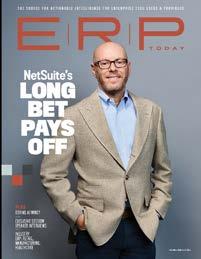
This issue examines that distinction from multiple angles. Our cover story features an exclusive conversation with NetSuite founder and CTO Evan Goldberg, whose early commitment to a unified data model is proving structurally significant as AI moves into core financial and operational workflows. As vendors compete on intelligence features, Goldberg argues that architecture—not algorithms—determines whether those capabilities can perform reliably at scale. In practice, unified data, real-time visibility, and financial confidence are not enhancements; they are prerequisites for AI to function inside enterprise systems.
That lens extends across the issue. We analyze why data integrity is emerging as the central ERP mandate, how cloud operating models are redefining productivity economics, and what must be in place before automation delivers measurable value. We also examine the evolving delivery landscape, from blended partner ecosystems to secure-by-design cloud programs and Zero Trust architectures that reflect the operational realities of modern ERP environments.
Our executive toolbox and feature coverage look ahead to the next phase of enterprise operations, including agent-driven workflows, increasingly autonomous decision environments, and new integration models for manufacturing and supply chain execution. The common thread is structural alignment: Organizations gaining traction are designing coherence across data, architecture, and execution rather than optimizing each layer in isolation.
Many readers will encounter this issue during our annual event in Las Vegas, where enterprise and technology leaders are comparing implementation realities rather than product claims. These conversations matter because they surface execution truths—tradeoffs, constraints, and recovery strategies—that rarely appear in formal case studies. While much of the discussion centers on the SAP ecosystem, the underlying challenges span the entire ERP market. Enterprises running Oracle, NetSuite, Microsoft, and other platforms are confronting the same architectural pressures and governance demands. ERP Today’s role is to analyze those shared inflection points across vendors, industries, and operating models.
If you are reading this issue with your own transformation priorities in mind, you will find it a practical companion as you move forward. The technologies may be complex, but progress ultimately comes down to deciding where to focus and executing with discipline.
—Tarsilla Moura, Chief Editor
EXECUTIVE TOOLBOX
Practitioner-led analysis designed to equip ERP leaders with frameworks, perspectives, and tools for navigating architectural change, technology innovation, and market complexity.
WHY IT MATTERS
As ERP environments become more interconnected and mission-critical, leadership decisions increasingly span strategy, security, automation, and ecosystem direction. This section bridges high-level thinking with operational execution, grounded in how ERP programs actually succeed or fail.
WHAT READERS GAIN
Clear insight into how peers are approaching transformation, how the market is evolving, and what it takes to execute effectively at scale.
Cloud ERP Market Growth Expected
Accelerating digital transformation drives growth.
BY CHRIS VAVRA
The global cloud ERP market is poised for substantial expansion, with Verified Market Reports projecting its expansion to $128.3 billion by 2033. The surge reflects enterprises’ intensifying focus on scalability, real-time data access, and operational efficiency as cloud-based platforms become the dominant deployment model for mission-critical business systems.
For technology executives navigating digital transformation initiatives, cloud ERP adoption delivers measurable productivity
gains that fundamentally alter operational workflows.
Organizations implementing cloud ERP report 66% improvement in operational efficiency driven by automated workflows and real-time data access, with 78% productivity gains and 91% inventory optimization. Manufacturing companies using cloud-based ERP systems have reduced inventory levels by 38% while increasing production efficiency by 18% within the first year of deployment.
The financial impact proves equally compelling,
with average ROI reaching 52%, meaning every dollar invested returns $1.52 in value, and payback periods averaging 2.5 years. Omega Industries demonstrated cloud ERP’s resilience during a cyberattack that caused a three-week outage, with their cloud-based system ensuring uninterrupted billing and vendor payments when on-site infrastructure failed. Current data shows 70.4% of ERP deployments now operate in the cloud as of 2024, up from 69.8% the previous year, signaling steady migration from legacy systems.
However, transformation challenges persist beyond technology implementation. Data migration remains one of the most underestimated risks, with inconsistent master data, inaccurate records, and legacy data structures multiplying complexity during cutover. Organizations must prioritize comprehensive testing as underestimat-
ing this phase creates poor quality post-go-live experiences.
Technology executives evaluating cloud ERP providers should prioritize realtime access across multiple locations, industry-specific capabilities and clean core principles that minimize custom code while leveraging modular extensions. The clean core approach ensures upgradability and flexibility as vendors deliver continuous innovation. Integration of AI-driven technologies enables automation of tedious tasks and improved supply chain operations, while proliferation of IoT devices creates more sophisticated data management capabilities within ERP systems.
Cloud ERP Transformation Changes Operations
Japan’s cloud ERP market is poised for substantial expansion, with projections indicating a CAGR of 20.1% through 2032, driven by government-backed digital transformation initiatives and AI-enabled solutions. Leading vendors such as Oracle, SAP, and Microsoft are accelerating cloud ERP deployments across manufacturing and retail sectors, which represent the primary adoption drivers in the Japanese market.
For technology executives managing ERP environments in Japan, recent vendor developments signal fundamental shifts in platform strategy and implementation approaches. In October 2025, SEKISUI Chemical, Fujitsu, and SAP Japan announced the modernization of SEKISUI’s
global management platform via SAP S/4HANA Cloud, unifying accounting, sales and purchasing operations for group companies worldwide.
In November 2025, Fujitsu launched the Japan Edition of SAP Pioneer Cloud for Insurance, a localized cloudbased ERP platform tailored specifically for Japanese insurance operations with market-specific compliance features. This development highlights the importance of localization for Japanese enterprises, where regulatory requirements and business practices often necessitate customization beyond standard global ERP configurations.
Major vendor investments highlight the market’s
Cloud ERP adoption delivers measurable productivity gains that fundamentally alter operational workflows.
strategic importance. For example, Oracle Japan announced plans in August 2025 to invest more than $8 billion over the next decade to enhance cloud computing and AI infrastructure. Mid2025 partnerships including the SAP and NTT Data alliance, alongside Oracle’s AI-powered supply chain module launch specifically for Japan, accelerated cloud ERP migration and digital transformation momentum.
Government support provides critical acceleration for adoption. Japan’s “Vision
for a Digital Garden City Nation” program allocates approximately $660 million in grants to local governments promoting digitalization, while subsidies for SMEs adopting cloud and IT tools, combined with tax incentives for digital investments, encourage ERP implementation. These initiatives help businesses streamline operations, improve efficiency, and maintain competitiveness amid rapid technological evolution.
What ERP Executives
Should
Emphasize
When evaluating cloud ERP providers, technology executives should prioritize platforms offering industry-specific functionality tailored to Japanese regulatory and business requirements. Integration of IoT capabilities has emerged as essential: In March 2025, Epicor Software Corporation introduced Epicor Kinetic 2025, featuring advanced IoT integration for real-time monitoring and predictive maintenance in manufacturing environments. Right now, 65% of Japanese enterprises are actively exploring AI integration within their ERP systems, signaling a significant shift toward intelligent automation, particularly in manufacturing, automotive and electronics sectors.
Best practices for cloud ERP integration emphasize phased migration strategies that minimize disruption to ongoing operations. Organizations should establish clear data governance frameworks before migration, particularly for financial consolidation and
WHAT THIS MEANS FOR ERP INSIDERS
• Customization debt undermines cloud migration ROI. Organizations achieving 66% operational efficiency improvements and 52% average ROI rely on modular extensions minimizing custom code while leveraging cloud-native capabilities, with clean core principles ensuring upgradability and flexibility. Enterprise architects must see extension strategies separating standard ERP capabilities from custom innovations through side-by-side approaches, as comprehensive testing during data migration remains underestimated.
• Government-subsidized digital transformation programs accelerate market democratization. Japan’s $660 million “Digital Garden City Nation” grants and SME cloud adoption subsidies expand addressable markets beyond large enterprises, with 20.1% CAGR through 2032 driven by manufacturing and retail sectors requiring industry-specific functionality and regulatory compliance. This validates how ERP vendors must balance standardized global platform development against country-specific customization demands.
• IoT integration and AI-driven automation transform ERP into decision intelligence platforms. With 65% of Japanese enterprises exploring AI integration and cloud ERP enabling 78% productivity gains plus 91% inventory optimization through real-time monitoring and predictive maintenance capabilities, vendors embedding machine learning and advanced analytics create sophisticated data management frameworks. Transformation leaders must prioritize phased migration strategies with clear data governance before cutover.
master data management. Manufacturing and retail sectors leverage cloud technologies to enhance supply chain management, inventory control and customer relationship management with SMEs adopting cloud ERP systems to access enterpriselevel functionalities at lower costs.
However, significant barriers persist. High implementation costs and
deployment complexity deter smaller companies from investing in these systems, while a shortage of skilled IT professionals, largely due to Japan’s aging population, limits adoption pace. Resistance to change in traditional industries relying on legacy software slows modernization of business processes, restricting accessibility and integration speed across the market.
Rethinking the ERP Partner Model
As ERP programs become more complex, enterprises are redesigning how delivery responsibility is shared across partners.
BY TARSILLA MOURA
Enterprise ERP programs are typically delivered through one of two partner models: large global systems integrators (GSIs) or staffing-based providers. Each approach offers distinct advantages and limitations, particularly at the high end of the market where Tier 1 ERP initiatives involve significant organizational risk, multiyear timelines, and extensive stakeholder scrutiny.
GSIs are generally selected for their scale, domain expertise, geographic reach, and ability to mobilize large
teams across functional and technical workstreams. Staffing firms, by contrast, are often used to fill discrete skills gaps quickly or to augment internal teams. In practice, some enterprise buyers report that neither model consistently addresses all delivery needs on its own, especially as programs evolve through scope changes, acquisitions, leadership turnover, or shifts in platform strategy.
This gap has contributed to the growing use of smaller specialist consultancies—of-
ten described as boutique ERP firms—in roles that sit between full program ownership and transactional staff augmentation.
GSI and Staffing Tradeoff
Large integrators typically operate with pyramidshaped delivery teams, blending senior architects and program leaders with more junior consultants. This structure supports scalability and cost management, but it can create variability in experience levels on complex programs if not
tightly governed by the client. Many GSIs mitigate this through centers of excellence, standardized methodologies, and contractual controls, though outcomes vary depending on execution.
Staffing firms, on the other hand, offer speed and flexibility, enabling enterprises to source individual specialists without committing to large managed services agreements. However, because these models usually emphasize individual placement rather than collective
delivery responsibility, enterprises may retain more coordination and accountability internally.
As a result, fulfillment needs increasingly reflect a blend of deep product and industry expertise combined with flexibility around changing scope, M&A activity, and internal resource churn— preferably without triggering another procurement cycle. For multi-year ERP transformations, particularly those
Enterprise ERP delivery is moving away from single-provider models toward blended partner ecosystems.
involving platforms such as SAP S/4HANA or Oracle Cloud ERP, buyers are therefore more likely to combine these approaches than rely exclusively on one.
What Defines a Boutique ERP Firm
Boutique ERP consultancies typically operate with smaller, more senior teams and narrower service scopes. These firms position themselves around platform expertise across ERP, CRM, HCM, and project management office (PMO) disciplines. Engagements may range from project-based consulting to contract and contract-to-hire models.
Unlike GSIs, boutiques generally do not aim to own entire global rollouts. Their value proposition centers on targeted involvement: leading specific workstreams,
addressing skills gaps, or supporting periods of elevated risk such as upgrades, carve-outs, or post-merger integrations. This approach can allow enterprises to introduce specialized expertise without restructuring existing partner arrangements or restarting procurement from scratch.
That said, boutique models carry their own constraints. Limited bench depth, reliance on key individuals, and reduced global coverage can present challenges for highly standardized or geographically dispersed programs.
From Primary Implementer to Reinforcement Role
One area where boutique firms are increasingly visible is in mid-program stabilization or recovery efforts. Enterprises facing schedule pressure, governance breakdowns, or rising technical debt and scope complexity sometimes introduce a secondary partner to reinforce specific modules, data and integration workstreams, or expert PMO functions. In this “reinforcement”
Reinforcement partners are emerging as a risk control mechanism, not a replacement strategy
role, the boutique firm does not replace the incumbent GSI or internal team but supplements it with focused expertise. For some organizations, this is a lower-risk alternative to terminating
WHAT THIS MEANS FOR ERP INSIDERS
• ERP delivery is increasingly moving from singleprovider models toward architected partner ecosystems. Rather than expecting one integrator or staffing provider to cover all phases, skills, and risks, enterprises are beginning to assign differentiated roles across partners based on scale, specialization, and criticality. This mirrors how ERP landscapes themselves are designed: modular, interoperable, and adaptive over time.
• Accountability in ERP programs is also becoming more granular . Reinforcement-style engagements suggest that enterprises are no longer evaluating partners solely on end-to-end ownership, but on their ability to assume clear responsibility for specific outcomes—such as governance, data, integrations, or recovery—within a broader delivery construct. This challenges both GSIs and staffing firms to clarify where they truly differentiate and how their delivery models coexist with specialist, complementary providers.
• Risk management in ERP transformations is being reframed . Instead of relying primarily on disruptive mid-program partner changes when delivery falters, some enterprises are using targeted reinforcement as a control mechanism. For the ERP ecosystem, this elevates the importance of collaboration norms, operating model design, and contractual flexibility, as success depends less on replacing partners and more on orchestrating them effectively.
a primary integrator, particularly when contractual, political, or organizational factors make a full transition impractical. It is also worth noting that GSIs themselves may offer recovery and assurance services, and that the effectiveness of any reinforcement approach depends heavily on role clarity, decision rights, and collaboration mechanisms across partners. Taken together, the growing use of reinforce -
ment partners reflects a broader evolution in enterprise ERP delivery. As programs become longer-lived, more cloudcentric, and more exposed to organizational change, enterprises are adapting by blending scale, flexibility, and specialization across multiple providers. Rather than signaling the decline of GSIs or staffing firms, this trend points to a rebalancing of roles within increasingly complex delivery ecosystems.
RISE with SAP Security
Security risk is increasingly shaped by timing, data, and assurance.
BY ADAM PITMAN
Security takes on increased importance as RISE with SAP customers bring SAP S/4HANA Cloud Private Edition systems into production. SAPinsider benchmark data shows migrations accelerating ahead of 2027, with 30% of organizations now fully live. Migration is no longer a future-state discussion, but a present operational condition with real exposure.
That shift is uneven. Smaller organizations are further along, while larger enterprises remain concen -
trated in planning and exploration, shaped by longer decision cycles and more complex landscapes. Yet security risk does not scale neatly with organizational readiness. It emerges as systems, data, and access move into live use.
Technology expectations are also changing. Generative AI now influences ERP decisions for more than 40% of organizations, increasing data sensitivity and amplifying the downstream impact of access, configuration, and integration choices.
As adoption accelerates, security is shaped by how programs execute, how data moves, and how controls are validated in practice. Understanding when risk surfaces, where it concentrates, and how it is proven becomes central to whether SAP Cloud ERP Private delivers stability—or introduces new forms of uncertainty.
Timing Risk
In RISE with SAP programs, security risk is shaped by timing. Programs move rapidly from planning into execution, where architectural choices, delivery timelines, and scope solidify early. Once migration begins, flexibility narrows and the cost of late change rises sharply.
Many organizations still approach the transition as a lift-and-shift exercise. Custom code, configuration assumptions, data conditions, and access models are carried forward with the expectation they can be addressed later. Under cloud operating models, that delay becomes a liability. During migration, parallel workstreams accelerate change across finance, supply chain, and extensions, overwhelming governance models designed for slower delivery. When inherited risk surfaces at that stage, remediation forces redesign, retesting, or delay—turning security into a source of disruption rather than control.
Secure-by-design approaches address this problem by shifting security insight earlier and embedding it into execution. Early assessment surfaces inherited risk while architectural
decisions remain adjustable. During migration, security validation moves into development and transport workflows, allowing issues to be corrected before they advance toward cutover. After go-live, continuous monitoring replaces episodic review, keeping pace as change accelerates rather than stabilizes.
Onapsis Assess, Control, and Defend capabilities align security with planning, migration, and run, treating security as execution infrastructure rather than downstream audit. By integrating assessment, in-flight validation, and runtime monitoring, security supports delivery discipline instead of slowing it—reducing the potential for late-stage surprises.
Data Risk
RISE with SAP changes where risk resides. As SAP environments become cloud-based, distributed, and integration-driven—often extended through SAP Business Technology Platform—traditional security assumptions no longer hold. In these architectures, data does not remain inside a single transactional system. Financial, operational, and manufacturing data intersects with personal, regulated, and intellectual property information, then flows into analytics platforms, APIs, non-production systems, and SAP Business Technology Platform applications. Each integration expands the effective perimeter, weakening controls designed for contained landscapes.
This shift exposes the
limits of role-based access control. Static roles grant broad permissions that fail to reflect changing business context, project boundaries, or data sensitivity. As identity models and access paths multiply, over-privileged access becomes harder to detect and unwind. At the same time, RISE with SAP’s managed operating model adds complexity to how customers gain visibility into access activity.
Zero Trust principles address this gap by changing how access decisions are made. Trust is no longer assumed based on network location or role assignment. Instead, access is continuously evaluated based on who is requesting data, what data is involved, and the
Security risk is shaped by timing, data, and assurance.
context of the request. In SAP Cloud environments, that logic only works when security is anchored to the data itself rather than the system hosting it.
Reinforcing Zero Trust in SAP landscapes requires a data-centric approach. That means access decisions are driven by the data being requested and the context of the request. Sensitive fields are protected in real time through segregation, masking, or encryption while preserving referential integrity. Controls follow data
across systems and integrations, with access evaluated at runtime.
This is the model implemented by NextLabs’ Zero Trust Data-Centric Security for SAP. It applies attributebased access control and dynamic authorization across SAP S/4HANA Cloud Private Edition, SAP Business Technology Platform, and connected systems, enforcing policy at the data layer and evaluating access continuously so security aligns with how SAP environments now operate.
Assurance
Risk
RISE with SAP changes how security is implemented and proven. Under SAP’s Shared Responsibility Model, SAP secures the underlying infrastructure, while customers remain accountable for application security, data protection, integrations, and custom code. Assurance therefore becomes a customer obligation rather than a vendor guarantee.
Organizations cannot independently initiate penetration tests against SAP S/4HANA Cloud Private Edition landscapes without coordination. Unapproved testing risks disrupting shared infrastructure or violating service-level agreements, limiting how security teams can validate controls in live environments.
This creates a distinct assurance challenge. Controls may be designed and deployed, but confidence depends on evidence. Penetration testing must operate within strict boundaries defined by SAP Enterprise Cloud Services, including formal approval, defined
WHAT THIS MEANS FOR ERP INSIDERS
• Late security insight disrupts delivery. Security risk in RISE with SAP programs is often introduced by when issues surface, not by what controls exist. Migration compresses decision windows and increases parallel change, leaving little room to absorb late findings. Programs that surface inherited risk early preserve execution flexibility and avoid costly redesign under delivery pressure.
Data movement reshapes access risk. SAP S/4HANA Cloud Private Edition shifts risk toward how data moves across systems, integrations, and platforms. As information flows beyond core transactions, static access models struggle to reflect changing context and sensitivity. Security models anchored to data rather than systems are better suited to distributed, integration-driven SAP environments.
• Intent without proof creates blind spots. Good security design is not enough in RISE with SAP. Shared responsibility and platform controls mean organizations must demonstrate that protections work as intended. Assurance depends on structured validation within defined boundaries, turning security from an assumed state into something that can be verified and trusted in production.
scope, approved testing windows, and constraints on techniques. The issue is not whether to test, but how to validate security without introducing operational risk.
The solution pattern is governed assurance. Effective penetration testing aligns with SAP rules of engagement, focuses on customer-managed layers, and prioritizes business impact. Testing becomes a controlled validation exercise, surfacing exploitable weaknesses and guiding remediation without destabilizing production systems.
Layer Seven Security has championed this model. As a certified SAP partner, the firm conducts penetration testing specifically within SAP S/4HANA Cloud Private Edition constraints, operating inside SAP approval processes. Its testing emphasizes controlled scope, business-impact prioritization, and remediation-ready reporting, supported by automated audits through its Cybersecurity Extension for SAP. The emphasis is on producing evidence that security controls function safely and effectively in production.
Operational Manufacturing Excellence
Manufacturers that develop longlasting relationships by integrating services achieve excellence.
BY CHRIS VAVRA
Syspro and SugarCRM announced a go-to-market partnership giving manufacturers and distributors precision selling capabilities. Sugar for Syspro is designed to help businesses navigate sales environments characterized by complex product catalogs and distribution channels, long buying cycles and deep customer relationships.
This is part of a larger initiative to improve manufacturing through strategic integration that is seamless and efficient.
Matthew Gordon-Box, SVP of product management for Syspro, addressed some of the challenges and opportunities when it comes to strategic integration and operational excellence.
Q: How does Syspro’s Versori-powered iPaaS strategy for standardized, reusable integrations reduce implementation timelines and total cost of ownership compared to traditional custom integration?
MGB: Manufacturers have spent years paying the price for brittle, one-off integra -
tions that take months to build and then become expensive to maintain every time something changes. Syspro’s partnership with Versori is designed to remove that burden by delivering an AI-driven, agentic integration platform and a rapidly expanding library of reusable connectors.
Over the initial phase, Syspro is launching 25 prebuilt, production-ready integrations across key industrial systems, including
Manufacturers have spent years paying the price for brittle, one-off integrations.
logistics, eCommerce, CRM, HCM, and PLM, accessible through a new Syspro Marketplace launching later this year. This will give customers a more plug-and-play experience, with the ability to trial integrations before deployment.
Just as importantly, Versori brings dramatic efficiency to bespoke integra -
tion work. With AI tooling, Syspro and its partners can now deliver custom integrations in days rather than months, reducing implementation timelines, lowering total cost of ownership, and enabling manufacturers to go to market faster with connected shop-floor and front-office environments.
Q: How does the convergence between back-office ERP and front-office CRM capabilities transform how manufacturers manage customer relationships?
MGB: In complex, longcycle manufacturing sales environments, customer relationships depend on one thing above all: alignment between what is promised commercially and what can be delivered operationally.
Sugar for Syspro addresses this by fully integrating SugarCRM with Syspro ERP to unify product, customer,
order, and service data. The result is a single connected system of record across revenue and operations, designed to bring deeper operational context into the sales process. This convergence transforms how manufacturers manage customer relationships by enabling more precision selling, guiding sales teams toward the right actions, strengthening loyalty, supporting repeat business, and ensuring commitments are grounded in industrial reality rather than disconnected pipeline activity.
Q: How does the integration between Syspro’s product configurator and SugarCRM enable sales teams to create accurate quotations, generate configured bills of materials, and transition custom orders into shopfloor production with full traceability?
MGB: Highly configured manufacturing environ -
ments place enormous pressure on the sales-toproduction handoff. Disconnected systems create risk such as misaligned quotations, inaccurate commitments and loss of traceability as orders move into execution.
Sugar for Syspro is built to address this challenge by unifying product and customer intelligence with operational context. Sales teams gain clearer guidance during complex quoting and long-cycle opportunities, while operations benefit from stronger continuity of data as orders transition into fulfillment. This is where ERP-CRM integration delivers its highest value: Synchronizing customer-facing processes with production
ERP-CRM integration turns revenue promises into operationally grounded reality.
realities, reducing friction, and supporting long-term account growth in industries defined by complexity.
Q: Can you elaborate on specific shop-floor scenarios where integrated ERP-CRM visibility eliminated manual data entry errors, reduced status reporting time, and improved cross-functional collaboration?
MGB: One of the most common breakdowns in manufacturing organizations is the manual effort required to keep sales, customer service and production aligned.
Sugar for Syspro helps
eliminate that friction by creating a single connected system of record across operations and revenue functions. When ERP and CRM share the same operational and customer context, organizations reduce duplication, improve accuracy and accelerate cross-functional collaboration. The result is less time spent reconciling information and more time focused on execution, responsiveness and customer confidence.
Q: What KPIs should manufacturers track to measure the success of their integrated shop-floor-toCRM implementation?
MGB: To measure the success of an integrated shop-floor-to-CRM implementation, manufacturers should focus on three categories of impact:
Operational performance like improvements in ontime delivery, order cycle time, and fewer late-stage disruptions
Customer experience, so faster inquiry response, improved quote-to-order execution, and more consistent delivery commitments
Adoption and integration efficiency through reduced manual rekeying and stronger alignment among sales, service, and operations.
Because Sugar for Syspro is designed for rapid golive and accelerated business impact, these metrics provide the clearest view of time-to-value and sustained customer benefit.
Q: How will Syspro’s global marketplace ensure upgrade stability and interoperability for
WHAT THIS MEANS FOR ERP INSIDERS
• AI-driven iPaaS architectures reduce integration technical debt. Syspro’s Versori partnership and marketplace model eliminate brittle, one-off custom integrations that require months to build and become expensive to maintain, enabling manufacturers to trial integrations before deployment. AI tooling reduces bespoke integration work from months to days, lowering TCO and accelerating connected shop-floor and front-office implementation timelines.
• Revenue intelligence convergence between ERP and CRM redefines system boundaries . Sugar for Syspro’s bidirectional data synchronization creates single connected systems of record that enable precision selling grounded in industrial reality rather than disconnected pipeline activity. That transforms customer relationship management by ensuring commercial promises align with operational delivery capabilities during complex, long-cycle manufacturing sales processes.
• Single connected systems of record eliminate cross-functional friction. Sugar for Syspro’s integrated ERP-CRM architecture addresses manual effort breakdowns by sharing operational and customer context across revenue functions, reducing duplication, improving accuracy, and accelerating collaboration. Transformation leaders must prioritize bidirectional data synchronization as foundational architecture, restructuring how organizations measure crossfunctional alignment.
manufacturers adding shop-floor data collection, IoT sensors, or quality control modules to their existing Syspro-Sugar environment?
MGB: Manufacturers want the freedom to extend their ERP environments but not at the cost of becoming their own systems integrator. That’s why Syspro’s ecosystem strategy is being accelerated through Versori and the launch of the Syspro Marketplace,
which will provide customers with a plug-and-play way to access pre-built, validated integrations, with the ability to trial solutions before deployment.
As Syspro’s global marketplace evolves in 2026, this governed approach will simplify how manufacturers add new capabilities while reducing integration bottlenecks and ensuring every component works together as one connected ecosystem.
Manufacturers Scale with AI Workforce
Salesforce’s Agentforce Manufacturing targets operational autonomy as manufacturers look to scale without adding
headcount.
BY CHRIS VAVRA
Salesforce has introduced Agentforce Manufacturing, a suite of prebuilt, role-based AI agent templates aimed at helping manufacturers scale operations without expanding headcount. The product is designed to make enterprise systems more autonomous at a time when AI is increasingly seen as essential to manufacturing competitiveness. Agentforce Manufacturing was a major focus at Salesforce’s 2026 Manufacturing Summit in
Chicago on January 14, as manufacturers look to what the future holds.
According to Achyut Jajoo, Salesforce’s SVP and general manager, AI agents are arriving at a critical moment for the industry. He says manufacturers are facing “a critical breaking point at the intersection of volatile markets, fractured supply chains, and a massive labor gap,” adding that 80% of leaders now view AI as essential for growth. That urgency, he
notes, is driven in part by the fact that “70% of our industry is still held back by manual data entry.” Rather than being another incremental upgrade, Jajoo says AI agents “enable manufacturers to tap digital labor to scale operations without scaling their headcount.”
Those pressures have been building for years and are now forcing many companies to pursue automation and autonomy in parallel. Jajoo says this is driving
change across both frontand back-office operations.
“This means manufacturers can do things like deliver differentiated customer experiences, respond faster to market and supply chain shifts, speed up development time, and more,” he explains, adding that these outcomes can be accomplished today “in a way that simply wasn’t possible when teams were buried in administrative [work]load.”
Jajoo describes Agentforce Manufacturing as being able to provide solutions that are prebuilt and role-based. The AI agent templates are modular in nature and can help optimize operations, support sales teams, and enhance service functions.
“Agentforce leverages industry-specific data, workflows, and policies to deliver contextually aware digital labor that assists employees and customers with everything from routine inquiries to complex operations,” Jajoo says. That way, “Human teams are free to focus on the jobs only they can do.”
In practice, those customizable AI agents can work alongside manufacturing teams to monitor demand fluctuations, streamline inventory, uncover real-time sales opportunities, optimize incentive programs, minimize asset downtime, and reduce technician administrative workloads. Jajoo says this represents an evolution beyond traditional manufacturing automation, which has long focused on bringing disparate data systems out of their silos and into a single
source of truth.
From there, companies can take the data and provide information that better informs workers in their day-to-day tasks. Agentforce builds on that foundation by using accumulated operational data to drive continuous, longterm improvement.
Jajoo points to service operations as one example of how this shift plays out. “We’re moving to a world where AI agents autonomously manage the entire lifecycle by identifying issues via 24/7 monitoring of IoT data, matching the right technician to the job, and
Manufacturers are facing volatile markets, fractured supply chains, and a massive labor gap.
handling the logistics parts without human intervention,” he says. “This shifts service from a cost center to a profitable, data-driven growth engine that guarantees uptime for manufacturers’ customers.”
Agentic Enterprises Transform Office Operations
Agentforce Manufacturing deploys AI agents that can autonomously handle tasks across demand monitoring, inventory management, sales optimization, and asset maintenance.
“Generic AI isn’t enough to drive the efficiency, productivity, and ROI gains manufacturers need,” Jajoo says. “They need a true com-
mercial operating platform that understands the specific nuances of the industry, whether they’re an industrial chemical producer or a distribution-centric OEM.”
The broader concept, he says, is the rise of the “agentic enterprise.” While still emerging as a new way to operate, this model is becoming increasingly important for manufacturers that want to move “from a reactive business model to a proactive and predictive one.” Adopting this mindset is critical for companies to thrive in this new age.
“An agentic manufacturer uses AI to monitor deviations in build plans against actual sales in real-time,” Jajoo says. “If there’s a gap, the agent doesn’t just flag it. It can automatically adjust inventory replenishment or schedule stakeholder meetings to realign production.”
Agents can also operate in predictive and preventive ways by identifying underperforming incentive programs or revenue leakages that may not be immediately visible to human teams, Jajoo adds. The shift is to go from reacting to problems after they appear to anticipating and addressing them as they emerge.
Shifting Toward a New Future
Companies adopting this approach are moving past proofof-concept projects toward day-to-day operational impact. Jajoo cites examples where AI agents reduced manual order processing times from 24 hours to less than one hour and cut case resolution times by 40%, even as overall workload increased by 15%.
WHAT THIS MEANS FOR ERP INSIDERS
• AI agents are shifting ERP from transactional systems to autonomous decision engines. Salesforce’s Agentforce Manufacturing demonstrates how prebuilt, role-based AI agents can eliminate the 70% manual data entry burden that constrains manufacturers, signaling that ERP vendors must now embed autonomous operational intelligence as core platform capability rather than optional add-on. This transformation requires enterprise architects and system integrators to prioritize governance frameworks, transparent decision chains and human-approval workflows as primary architectural components.
• Agentic enterprise models are changing toward dynamic, self-optimizing processes. Manufacturing implementations now deploy AI agents that autonomously monitor demand deviations, adjust inventory replenishment, and schedule stakeholder meetings without human intervention. This operational shift demands that transformation leaders architect ERP platforms where collaboration occurs through automated alerts, workflow-driven approvals, and connected engineering change orders rather than email chains and manual reviews, fundamentally altering change management responsibilities and implementation methodologies.
• Cloud-native AI capabilities are accelerating vendor consolidation. Salesforce’s industry-specific agent templates demonstrate how cloud platforms enable rapid AI deployment by integrating live data from ERP and IoT systems, as well as external sources. This creates strategic tension for ERP product strategy: Vendors must concentrate innovation exclusively on cloud environments to support autonomous agents, while modular architectures enable manufacturers to swap specialized services through standard interfaces, requiring partners to establish governance design.
He says the pace of innovation will continue to accelerate as systems improve through real-world use cases and operational learning. Even when individual deployments appear narrow—such as automating warranty claims or searching inventory in real
time during sales calls—the cumulative impact can be significant.
“Our [Agentforce Manufacturing] customers are proving that the agentic enterprise isn’t a future goal. It’s the new standard for manufacturing excellence,” Jajoo concludes.
Where the biggest names in enterprise tech tell you what they really think, Live!
Deep, reported analysis of the forces and trends shaping ERP systems across industries, regulatory domains, and technology platforms.
WHY IT MATTERS
ERP systems do not evolve in isolation. Architects and integrators across tax, energy, healthcare, manufacturing, regulation, and automation are now directly influencing how ERP platforms are designed, governed, and deployed.
WHAT READERS GAIN
Context, clarity, and foresight to understand not just what is changing, but why it matters and how ERP strategies must adapt.
NetSuite’s
UNIFIED ERP BET PAYS OFF
As enterprise software races to bolt on AI, Oracle NetSuite is betting that architecture—not algorithms—will decide who wins.
BY TARSILLA MOURA, WITH REPORTING BY ROBERT HOLLAND AND PHOTOS BY JAY WATSON
When Evan Goldberg started NetSuite, he was not trying to modernize enterprise software. He was trying to survive running a business with five disconnected systems and five conflicting answers to basic questions. Sales said one thing. Finance said another. Support had its own take on the customer, and e-commerce told a different story.
“I could never get the truth,” Goldberg recalls during an exclusive interview with ERP Today. “I had five different customer lists and five different sales reports. Board meetings would turn into arguments about whose spreadsheet was right.”
That frustration became the founding logic of NetSuite: one system, one data model, and one source of truth. It may sound obvious now, but in the late 1990s, it was hard to imagine. ERP systems were expensive, on-premises, and built for static organizations that fit neatly into a single industry box. NetSuite bet on something else entirely— that companies would become more fluid, more hybrid, and more difficult to categorize, and ERP systems would need to reflect that reality.
That conviction carried NetSuite through the dot-com boom, the cloud wars, and Oracle’s 2016 acquisition. Nearly three decades after founding NetSuite, it now defines how the company is bringing AI and autonomous finance into the mainstream, without asking customers to gamble their businesses on opaque automation. As vendors race to attach generative AI to their portfolios, the real dividing line is not model quality or interface design, but data architecture. Systems built around fragmentation struggle to operationalize AI safely at scale. Systems built around unification suddenly look prescient.
Goldberg sees this moment less as a pivot and more as a reckoning.
The Collapse of Industry Boundaries
Ask Goldberg what most enterprise software still gets wrong, and he does not start with cloud, AI, or features. He starts with the way vendors still think about industries.
“The old categories of businesses are blurring and don’t really apply anymore,” he says. “A company might manufacture a product, sell it direct-toconsumer, offer subscriptions around it, and run a digital service on top. What are they? A manufacturer? A software company? A services business?”
That line of questioning shaped NetSuite’s design philosophy from the beginning. Rather than locking customers into rigid vertical silos, NetSuite built deep best practices across many industries while insisting that every module share the same underlying data and logic. Customers could adopt what they needed, ignore what they did not, and evolve their business model without rebuilding their core systems.
Internally, NetSuite calls the payoff from this cohesion “Suiteness.” Goldberg defines it as the exponential value created when finance, people, projects, commerce, and customers all live in the same system and update each other in real time.
“When all your information about your people is coming directly from what they’re actually doing, when project costs pull labor and expenses automatically, you get the clearest possible picture of the business,” he explains. “It’s not a copy or transcription. It’s the direct information.”
This matters because hybrid business models are no longer experimental. Analysts at firms such as Gartner and IDC consistently note that manu-
AI IS HUNGRY FOR CONSISTENT, UNIFIED DATA THAT REFLECTS THE ENTIRE BUSINESS.
facturers are layering subscription services onto physical products, retailers are becoming logistics providers, and software companies are moving into payments, finance, and services. ERP systems designed for a single operating model usually break under that pressure.
What Oracle Made Possible
When Oracle acquired NetSuite for $9.3 billion in 2016, critics worried that the original cloud ERP pioneer would lose its independence and veloc-
ity. Goldberg argues the opposite. Oracle removed constraints that NetSuite could not realistically overcome alone.
“We’ve been able to scale much more rapidly than we would have as an independent company,” he says. “International expansion, cloud operations, and product acceleration all changed overnight.”
Oracle’s global footprint allowed NetSuite to enter new countries faster, with local compliance and support that would have taken years to build independently. Oracle Cloud Infrastructure (OCI)
FINANCIAL AUTONOMY MATTERS ONLY IF FINANCE TEAMS TRUST THE NUMBERS EVERY DAY.
PHOTO: GAMMA NINE PHOTOGRAPHY
gave NetSuite a chance to co-design at scale rather than operate as just another SaaS tenant. NetSuite became an early large-scale customer and close collaborator for OCI’s next generation cloud, stress-testing it with real-world ERP workloads.
“We could have gone to AWS like everyone else,” Goldberg says. “Instead, we worked directly with the OCI team early on. That was a mutual win.”
Product development accelerated as well. NetSuite Analytics Warehouse, built on Oracle Autonomous AI Lakehouse and Oracle Analytics Cloud, brought enterprise-grade analytics into the midmarket. NetSuite Enterprise Performance Management (EPM) drew on Oracle Fusion EPM and adapted for fast-growing companies that need sophisticated planning without enterprise overhead.
Crucially, NetSuite did not abandon its original roadmap. Oracle supplied infrastructure, components, and scale, while NetSuite kept its focus.
Why Unified Data Beats Composable Hype
Composable architecture and best-of-breed stacks dominate today’s ERP marketing. Integration platforms promise flexibility, and APIs promise freedom. Goldberg does not dismiss those tools, but he draws a hard line between integration and unification.
“Moving data between systems is not the same as having one system,” he says. “You still end up with incompatibilities that are very hard to bridge.”
This distinction becomes critical with AI. Large language models can smooth over gaps, but they cannot eliminate semantic mismatches between independently designed systems. Different definitions of customers, revenue, or costs create ambiguity that AI must guess its way through.
NetSuite’s customers repeatedly cite the same benefit: a single source of truth. It eliminates internal debates before they start.
“If two people are logging into NetSuite and looking at the same report, the argument disappears,” Goldberg says. “It’s hard to fight the numbers on the screen when they’re grounded in the same transactions.”
From an AI perspective, this architecture is decisive. NetSuite runs on one unified data model and one set of business rules spanning finance, CRM,
e-commerce, projects, and HR. That breadth and depth of consistent data is what AI systems need to reason across functions instead of generating isolated insights.
“AI is hungry for data,” he adds. “Consistent and unified data that covers the full business. That’s the fuel.”
AI Without Blind Automation
Goldberg is candid about where customers draw the line today. Few finance leaders want a fully autonomous system closing their books without oversight. What they do want is relief from daily manual work and unpleasant surprises.
“They want a continuous close,” he says. “Not a scramble at the end of the quarter, but financials that are accurate every day.”
NetSuite’s approach to autonomous finance reflects that caution. AI-driven exception management identifies anomalous transactions, explains why they look unusual, and suggests corrections. Humans stay in control. Over time, as confidence builds, customers can allow the system to correct low-risk issues automatically and review summaries afterward.
“It’s a journey of increasing autonomy,” Goldberg explains. “AI doesn’t replace finance experts. It clears the urgent, low-value work that keeps them from doing the strategic work.”
The same philosophy applies to development. NetSuite SuiteCloud Developer Assistant uses AI to help write code and workflows, but experts still review and own the results. Productivity rises without surrendering accountability. This humanin-control model aligns with emerging regulatory expectations around AI governance and explainability, particularly in finance.
Volatility Demands Visibility
Macroeconomic shocks have not changed why companies adopt NetSuite, but they have sharpened the urgency. When tariffs shift, supply chains fracture, or demand swings, leaders need immediate visibility into costs, cash, and exposure.
“Seeing the impact in days instead of quarters is critical,” Goldberg says. “That requires real-time dashboards grounded in the same data.”
NetSuite OneWorld has become central as companies diversify suppliers and expand geographically to manage risk. What looks like global expansion often turns out to be a resilience strategy. Multiple subsidiaries, currencies, and regulatory regimes are then managed in one system.
Interestingly, NetSuite sees pressure to modernize in both boom and downturn cycles. High growth breaks starter systems as transaction volumes rise, geographies multiply, and manual workarounds collapse under scale. Downturns expose a different set of weaknesses: limited visibility into costs, slow financial close cycles, and an inability to model change quickly enough to respond. In both cases, companies risk seeing that the operating model has outgrown their systems.
That moment often coincides with a shift in how the business makes money. Manufacturers add subscriptions and services to stabilize revenue. Product companies look for recurring income and closer customer relationships. What begins as a tactical response to growth or volatility becomes a structural change in the business itself. NetSuite’s “anything-as-a-service” framing reflects that reality. The company does not treat subscriptions as a software-only concern, but as a cross-industry pattern that touches finance, revenue recognition, customer support, and long-term forecasting. The system is built to track those relationships in one place, regardless of whether the underlying product is digital, physical, or a mix of both.
“We didn’t call it SaaS metrics,” Goldberg notes. “We called it subscription metrics because this isn’t just software companies anymore.”
Compliance Without Customization Debt
Regulation continues to tighten, from GDPR to state-level privacy laws and looming AI rules. Goldberg calls compliance “non-negotiable,” but warns that poorly designed compliance can crush productivity.
NetSuite’s answer rests on two pillars. First, heavy investment in security, privacy, and regulatory engineering, which is an area where Oracle’s heritage in government and regulated industries matters. Second, the discipline of delivering compliance centrally through the service model.
“We do two major releases a year and many minor ones,” he says. “Your customizations work the morning after just like they did the night before.”
This approach directly addresses one of ERP’s oldest failure modes: customization debt that traps customers on outdated versions. By protecting extensions through upgrades, NetSuite absorbs regulatory change without forcing rebuilds.
Talking to the System, Sharpening Focus
Goldberg believes user expectations have crossed a point of no return. Ever since generative AI entered the mainstream, people now expect to converse with systems, not navigate them.
“ChatGPT created a discontinuity in expectations,” he says. “Now people expect to talk in natural language and get coherent answers.”
NetSuite’s vision, taking shape with NetSuite Next, is a conversational interface layered over traditional dashboards and spreadsheets. It is the next iteration of its platform and a new wave of AI-first ERP that will be available to customers globally this year. Conversation becomes the entry point, but the underlying mechanism does not go away. Visual tools remain essential for detail and validation, while different roles keep different interfaces: Developers will still want terse commands, and accountants will not abandon spreadsheets.
NetSuite does not see conversation as a replacement for traditional interfaces, but as a new front door. In Goldberg’s view, conversation will be the fastest path to insight for many users. They will increasingly start by asking questions about revenue, cash, or performance in plain language, then move seamlessly into dashboards, reports, and spreadsheets when precision matters. Visual tools still anchor validation and decision-making, and they are not going away. Developers will continue to favor fast, command-driven workflows. Finance teams will hold onto spreadsheets. What does changes is the starting point: less navigation, more dialogue, and faster access to answers without sacrificing rigor.
For all the technology shifts, Goldberg returns repeatedly to focus. He has watched companies fail not from lack of ideas, but from lack of discipline. “The number one determinant of success is focus,” he says. “Three bullet points, not nine.” That focus
THE REAL DIVIDE IN AI ISN’T THE MODEL, BUT WHETHER THE DATA WAS EVER DESIGNED TO WORK TOGETHER.
explains NetSuite’s consistency. It did not chase trends. It built depth slowly, solving the same problem from more angles over time.
Goldberg studied AI in graduate school in 1990, long before it was practical. He sees today’s AI wave as potentially more consequential than the internet. But his ambition remains grounded.
“How do computers help people achieve their dreams faster?” he asks. “How do they take drudg-
ery off the plate and let leaders actually see and steer their business?”
If NetSuite’s next decade resembles its last, it will not be because it out-marketed competitors on AI slogans. It will be because the same architectural decision made in the very beginning— one system, one source of truth—turned out to be the safest foundation for intelligent, autonomous enterprise software.
Value Unlocked Cloud Transformation
A four-step guide for turning a one-time cloud migration into a platform for sustained value.
BY TARSILLA MOURA
Modern cloud ERP platforms are designed for continuous innovation, yet many transformations still behave like one-time migrations. Systems go live on schedule, users log in, and operations resume, but expected gains in cost efficiency, agility, and innovation often fail to fully materialize.
This gap between platform potential and realized value is more common than many organizations might expect. Research from the IBM Institute for Business Value (IBV) shows only 29% of organizations that move to the cloud to reduce IT costs achieve their intended business outcomes.
The issue is rarely the decision to move to the cloud, but how that decision is executed. Too many programs still treat cloud as a destination rather
than a new operating model, replicating on-premises behaviors in a SaaS environment that was designed to work differently. Without deliberate choices around sequencing, standardization, delivery discipline, and post-go-live optimization, cloud transformations inherit the very risks they were meant to eliminate.
The following structured, four-step guide offers a practical way to address those risks.
Step 1: Assess What to Move and When
Before deciding which applications to move to the cloud, organizations need an unvarnished view of their current state. That is the intent behind maturity-based assessments such as IBM’s Business Maturity Index (BMI), which evaluates cloud readiness across peo -
ple, process, data, and technology.
Crucially, this type of assessment does not start with the question, “Can we migrate?” Instead, it asks, “Should we migrate this now, and what value will it unlock?” For example, for organizations looking to move to Oracle Fusion Cloud Applications, IBM analyzes Oracle and non-Oracle landscapes, using proprietary tooling and benchmarks from the IBM IBV, to understand how applications are actually used, where manual work persists, and where technical and process debt will undermine cloud outcomes if left unresolved.
The analysis traces value streams across functions such as finance, HR, and supply chain, identifying bottlenecks, control gaps, and inefficiencies that often remain invisible in traditional system inventories. The output is not simply a maturity score, but a
sequenced roadmap that aligns transformation waves with business impact and organizational readiness.
For example, HR may be prioritized for early modernization while finance or supply chain follows later, depending on data quality, regulatory exposure, and change capacity. Coexistence between on-premises and cloud applications is explicitly planned for, rather than treated as an exception or workaround. Each phase is linked to a business case that clarifies where quick wins exist and where longer-term investment is required.
In cloud transformations informed by IBM research and delivery experience, this kind of assessment-led sequencing has been associated with significantly faster time-to-value—up to three times faster in some cases—by focusing early effort on business domains where readiness and impact align, rather than attempting broad, low-return migrations.
For large enterprises that cannot realistically transition everything at once, this sequencing is often the difference between momentum and stagnation.
Step 2: Design via Standardization, Not Customization
Even with a strong roadmap, many cloud programs stumble at the design stage by reshaping modern SaaS applications to fit legacy operating models. Customizations proliferate, process variation persists, and the cloud core becomes brittle almost as soon as it goes live.
Design frameworks such as IBM’s CARE (Cloud Augmented Resilient Enterprise) platform are intended to counter this pattern by starting from industry best practices rather than a blank page. CARE provides a preconfigured environment of end-to-end processes, key performance indicators (KPIs), embedded controls, and localizations. In the Oracle example, IBM maps to Oracle Fusion Applications capabilities and aligns closely with Oracle’s design philosophy around standardization and continuous innovation.
Standardization is no longer optional if organizations want to benefit fully from cloud ERP.
In practical terms, this means finance, HR, or supply chain models are not invented from scratch. Level 4 processes—where
detailed configuration decisions and implementation complexity concentrate—are already defined, along with role-based dashboards and business controls benchmarked on cost, cycle time, quality, and efficiency. Fitment workshops are structured to challenge exceptions by asking why a standard process does not work, rather than defaulting to customization.
That discipline has measurable impact. IBM’s IBV reports organizations adopting industry-aligned cloud processes achieve up to 70% process harmonization, reducing customization, simplifying controls, and lowering the cost of ongoing upgrades.
Step 3: Deploy Faster Without Adding Risk
Strong design alone is not enough if delivery is slow, inconsistent, or overly manual. Many cloud ERP delivery teams still approach migration, integration, testing, and training as bespoke projects, increasing cost and risk with each iteration.
Asset-based delivery approaches such as IBM RapidMove aim to standardize these workstreams through reusable accelerators and task automation. IBM’s IBV data indicates that programs using standardized delivery patterns have achieved up to a 55% reduction in implementation risk, particularly by reducing late-stage defects and rework.
In practical terms, that risk reduction shows up in how core workstreams are executed. Data migration assets enforce proven patterns when moving large onpremises systems, reducing downtime and cutover risk. Prebuilt integration blueprints and automated test packs shorten delivery cycles while lowering the likelihood that defects surface late, when they are most costly to fix.
Standardized documentation and training assets support faster onboarding and smoother stabilization after go-live. The objective is not speed for its own sake, but consistency. By applying patterns refined across many cloud
implementations, programs benefit from accumulated lessons rather than relearning them at each step.
Step 4: Manage Go-Live as the Starting Point
Many organizations treat go-live as the finish line. In reality, it can often the point at which value erosion begins. Process drift, staff turnover, and missed updates gradually reintroduce inefficiencies and risks, while the platform stops evolving alongside the business.
A fourth step focused on ongoing management and optimization is therefore critical. Managed services anchored in frameworks such as CARE extend beyond day-to-day support and assess whether processes and controls remain fit for purpose and where improvement opportunities are being missed.
Periodic reassessments, often powered by the same maturity tools used at the outset, can surface compliance gaps, manual work, and inefficiencies that have emerged since the original transformation. In environments where this continuous optimization loop is applied, IBM reports up to 20% annual productivity gains and as much as a 50% reduction in order-to-cash incidents, as process drift and manual effort are systematically addressed. These gains are not abstract. Ongoing
assessments translate directly into targeted actions such as re-standardizing processes, deploying new workflows, tightening controls, or resequencing rollouts for additional regions or business units.
Over time, this closed-loop model enables organizations to generate additional value and returns from their cloud investment. Reported outcomes include reductions in incidents, measurable productivity gains, and improved return on investment (ROI) as cloud usage is continually refined rather than allowed to stagnate.
The result is a living operating model in which cloud platforms, data management, and process discipline reinforce one another continuously.
From Migration to Operation
Taken together, these four steps can form a practical playbook for companies looking to realize the full intent of cloud ERP. Assessing maturity with a fact-based roadmap, designing around best practices, deploying through standardized delivery patterns, and managing for continuous optimization is crucial.
WHAT THIS MEANS FOR ERP INSIDERS
• Outcomes are being determined earlier in the lifecycle. Enterprises that invest in upfront assessments and sequencing are better positioned to avoid replicating legacy complexity in the cloud. Fact-based roadmaps tied to business value
are emerging as a prerequisite for largescale ERP transformation success.
• Standardization is the price of admission for cloud ERP. The tension between legacy customization and fit-tostandard design remains
one of the biggest determinants of success. Organizations that resist standardization pay for it later through upgrade friction, rising costs, and limited operational flexibility.
• Value realization does not end at go-live. Cloud
ERP programs that treat optimization, governance, and adoption as ongoing disciplines are more likely to accumulate returns over time. Continuous measurement and targeted improvement are becoming as important as the initial implementation itself.
REAL-TIME REQUIREMENTS FOR ACCURATE TAX CALCULATIONS
Sovos’ playbook for future proofing the tax tech stack.
BY TARSILLA MOURA
Inside many enterprises, e-invoicing is still treated as the defining challenge of indirect tax compliance. In reality, it is only the most visible symptom of a much deeper architectural shift. As governments move toward continuous transaction controls, real-time reporting, Standard Audit File for Tax (SAF-T) mandates, and tighter Value Added Tax (VAT) enforcement, the question is no longer whether finance teams can meet the next e-invoicing deadline, but whether their indirect tax stack is built to survive what comes next.
That question is becoming unavoidable. Tax authorities are gaining real-time visibility into enterprise transactions, enforcement windows are shrinking, and regulatory change is accelerating across regions. In this environment, compliance failures do not surface months later in audits; they surface immediately in the form of blocked invoices, delayed payments, or an inability to operate legally in key markets.
Rather than treating indirect tax as a series of country-level projects or one-off compliance fixes, Sovos steps back and asks what kind of architecture can absorb continuous regulatory change without constant rework. This article offers a practical playbook for designing an indirect tax stack that can hold up under sustained pressure across geographies, mandates, and ERP transformation cycles.
Tax Calculation Remains a Core Risk
There is a reason e-invoicing dominates compliance conversations. Mandates are rolling out across Europe, Latin America, Asia, and Africa, often with fixed deadlines and strict enforcement. In many jurisdictions, invoices must now pass through gov-
ernment platforms or regulated networks before they are legally valid. Miss a deadline, submit the wrong format, or fail a validation check, and invoices may be rejected outright, delaying payment or preventing goods from shipping.
But treating e-invoicing as synonymous with indirect tax compliance is a common but critical misconception; e-invoicing governs how transaction documents are issued and transmitted. It does not, by itself, address how tax is calculated, reported, audited, stored, or analyzed across jurisdictions.
Modern enterprises must also manage tax determination engines that calculate VAT, GST, and sales tax correctly across increasingly complex transaction scenarios. They must support periodic filings alongside real-time reporting, comply with SAF-T and similar audit file requirements where mandated, retain documents in legally compliant archives for years, and maintain visibility into liabilities and exposure as they expand into new markets.
Architectures that treat e-invoicing as a standalone project tend to fragment over time. One system handles document submission, another calculates tax, a third manages filings, and reporting is often stitched together from spreadsheets or data extracts. Each additional component adds integration work, handoffs between teams, and ambiguity around ownership when something goes wrong.
Some approaches to indirect tax focus on generating and submitting compliant electronic documents and statutory reports inside ERP systems. Other approaches are designed around the full tax lifecycle, combining determination, reporting, archiving, and analytics alongside e-invoicing. The difference is not simply about functional breadth; it reflects a deeper choice between assembling compliance from multiple components or running it as a single, continuously managed capability.
For organizations planning beyond the next mandate, that architectural distinction matters more than any individual tool or feature comparison.
New Reality for Meeting Regulatory Requirements
Designing an indirect tax stack that is flexible enough to adapt as regulations shift requires designing for where regulators are going, not where they have been.
Across regions, the global direction is consistent:
• In Europe, the VAT in the Digital Age (ViDA) initiative is pushing countries toward near-real-time digital reporting and mandatory e-invoicing, with several governments setting phased implementation dates extending through 2030.
• In Latin America, where continuous transaction controls first emerged, authorities continue to expand coverage, tighten integration requirements, and reduce tolerance for exceptions.
• In Asia, e-invoicing is increasingly used both to support finance automation and to deepen tax oversight, with new mandates appearing quickly.
• In Africa, governments are moving away from cash-register-based regimes toward more sophisticated, transactionlevel controls.
Across these regions, the trend is the same: more frequent reporting, more standardized data, and no time for manual processes or after-the-fact corrections. Compliance architectures that rely on partial coverage, manual workarounds, or delayed reconciliation are increasingly misaligned with regulatory reality.
A durable indirect tax stack assumes that this trajectory will continue. It is built on the expectation that mandates will continue to proliferate, enforcement to tighten, and timelines to compress.
Coverage Gaps as Architecture Problems
A future-ready indirect tax stack must consider coverage required for end-toend compliance in the countries where the business operates, and even more importantly where it plans to operate.
Coverage gaps are where indirect tax architectures can begin to fracture. Many commonly used ERP-centric approaches do not offer out-of-the-box paths to compliance in some countries. In those markets, enterprises are forced to layer on additional local solutions simply to meet baseline requirements.
Even where some level of support exists, coverage is frequently partial. Achieving full compliance can require stitching together multiple third-party
tools, each with its own integrations, update cycles, and operational dependencies. The broader lesson is that incomplete geographic coverage is not just a functional inconvenience, but an architectural liability. Each uncovered market adds another exception to govern, another integration to maintain, and another point where compliance can fail under regulatory change.
Over time, these exceptions accumulate, eroding consistency and increasing the operational burden of maintaining tax compliance. Future-proof designs start with an honest geographic map: where the organization operates today, where it plans to operate over the next five years, and whether the target architecture delivers the same compliance baseline everywhere—or bakes in exceptions from the start.
Scope Must Span Full Tax Lifecycle
To ensure there is a consistent compliance baseline everywhere, tax, finance, GRC, and IT teams must look at scope together: who owns indirect tax end-toend, and how that responsibility is enforced across systems and time.
In many organizations, scope gaps do not appear on day one. They emerge gradually as new requirements are layered onto an architecture that was never designed to manage the full lifecycle as a single flow. Determination logic lives in one system, document submission in another, filings and archiving in others, and analytics somewhere else entirely. Each piece may work in isolation but
COMPLIANCE
FAILURES NOW SURFACE IMMEDIATELY, NOT MONTHS LATER IN AUDITS.
keeping them aligned as rules change becomes an ongoing coordination problem.
This fragmentation has practical and much broader consequences. Regulatory changes often affect multiple parts of the lifecycle at once: how tax is calculated, what data must appear on invoices, how transactions are reported, and how long records must be retained. When those responsibilities are split across tools and teams, changes are harder to implement consistently, testing cycles stretch, and accountability becomes unclear when something breaks.
ERP-centric approaches that focus primarily on document generation and submission tend to push the rest of the lifecycle outward, requiring additional tools or modules to fill the gaps. Over time, this shifts indirect tax from a managed capability into a distributed set of dependencies that must be governed continuously.
Platforms that treat indirect tax as a lifecycle, rather than a sequence of tasks, address this problem directly. Centralizing responsibility for determination, reporting, archiving, and oversight, even if those capabilities sit alongside the ERP system rather than inside it, reduces the number of handoffs involved when mandates change. The result is not less accountability, but a transparent and auditable trail of steps and actions in the indirect tax process.
Timing is Critical in Indirect Tax
Timing failures in indirect tax rarely show up as missed project deadlines. They surface as an inability to respond when rules change faster than systems can be updated.
In practice, this is where many architectures begin to strain. Regulatory changes often require coordinated updates across determination logic, invoice content, reporting formats, and validation rules, sometimes with little notice. Architectures built around static configurations and long change cycles struggle to absorb these updates without disruption.
When compliance is tightly bound to slow or rigid change processes, even small regulatory adjustments can trigger a disproportionately large effort. Testing cycles expand, data transports backup behind unrelated ERP changes, and ex ceptions are handled manually while fixes work their way through formal re lease schedules. Over time, this creates a growing gap between what the law re quires and what the system can reliably
This is why leading organizations are shifting their focus from project timelines to change velocity. The criti cal question is no longer “Are we live?” but “How quickly can we adapt when requirements change?” Compliance capabilities that can be updated inde pendently, validated continuously, and deployed without waiting for major ERP releases are far better suited to regula tory environments defined by frequent, incremental change.
but that the least expensive-looking option at the outset of an ERP program can often carry high long-term cost once change, integration, and risk are fully understood. Because tax architectures
A future-ready indirect tax stack treats time-to-comply as an operational capability. It is designed to absorb regulatory updates in days or weeks, not months, regardless of where the broader ERP roadmap happens to be.
Architecture that Adapts to Change
The way an indirect tax stack is designed has a direct impact on how much effort and cost are required every time regulations change.
License fees are visible and easy to compare. The more significant costs of indirect tax compliance often sit elsewhere. Custom development work for each changing jurisdiction, systems integration dependencies, third-party licenses and integrations, and ongoing update efforts all have a cost associated with them as regulations evolve. Delays in compliance can then introduce the risks of fines and penalties, disrupted invoicing, poor customer experiences, and/or delayed market entry.
Sovos’ platform, maintained by dedicated regulatory teams, offers more predictable costs over time. For ERP leaders, the key point is not that specialist platforms are always cheaper,
THE REAL DIVIDE IS BETWEEN THOSE THAT ABSORB CHANGE AND THOSE DISRUPTED BY IT.
are often built to solve a specific problem, a short-term or siloed approach to tax can lead to greater costs later.
Serious design exercises model total cost over time, including the cost of reacting late to mandates and the operational burden of managing fragmented compliance landscapes.
A single compliance layer that spans ERP systems, connects to tax authorities wherever the business operates, and is updated centrally provides a level of consistency that fragmented approaches struggle to achieve. That layer could be delivered by a single vendor, a managed ecosystem of regional providers, or a
custom solution for large enterprises. What matters is intentional design that accounts for what is unknown about regulatory requirements and meets the context of the environment the solution will serve. Indirect tax stacks that emerge accidentally from a series of local projects rarely hold up under sustained regulatory pressure.
Designing for an Unknown Future
Indirect tax is no longer a peripheral compliance function that can be addressed through a series of local projects. It has become a structural constraint on how ERP systems operate, how quickly businesses can adapt, and where they can legally grow. Architectures that were sufficient for periodic reporting and post-facto enforcement are no longer fit for environments defined by continuous controls and real-time oversight.
Today, the dividing line is not between organizations that comply and those that do not, but between those that can absorb regulatory change as a routine operational event and those that experience it as repeated disruption. Stacks built on exceptions and manual coordination will continue to absorb disproportionate cost, risk, and leadership attention as mandates evolve.
The alternative is to treat indirect tax as a first-class architectural capability that is designed for consistent coverage, full lifecycle scope, and rapid change. Whether that capability is delivered through a specialist platform like Sovos, an ERP-centric framework, or a carefully governed hybrid model matters less than whether it is intentionally designed to evolve.
The enterprises that get this right will not just stay compliant. They will preserve the freedom to scale, enter new markets, and modernize ERP landscapes without regulatory friction becoming the limiting factor. That resilience will build competitive advantage by increasingly separating organizations that sustain a trajectory of growth from those constrained and stalled by operations.
AGENTIC AI REDEFINES MANUFACTURING
BY CHRIS VAVRA
MANUFACTURING IS EXPERIENCING THE MOST SIGNIFICANT
ARCHITECTURAL ERP SHIFT SINCE
CLOUD
ADOPTION.
Manufacturing technology executives are witnessing the most significant architectural shift in ERP since cloud adoption, as agentic AI and composable systems transform ERP from transactional backends into autonomous decision engines that execute production planning, supply chain coordination, and maintenance scheduling without human intervention.
Procurement managers at organizations deploying these capabilities no longer cut purchase orders manually. Instead, they audit decisions made by AI agents that identify potential supply delays, contact suppliers for updated delivery estimates, adjust production schedules, and notify stakeholders. Plant managers supervise software agents rather than production lines, reviewing inventory cost reductions and efficiency gains from real-time replanning that enables same-day production adjustments.
Early adopters implementing AIdriven predictive maintenance report double-digit reductions in unplanned downtime, with agents automatically staging parts and scheduling interventions during low-impact windows. The manufacturing ERP market, which reached $23 billion in 2025 and represents 32% of total ERP spending, is growing at 8% compound annual growth rate driven by Industry 4.0 and Internet of Things integration that ena -
bles these autonomous capabilities.
However, only 14% of agentic AI pilots reportedly succeed. Organizations achieving production scale emphasize governance frameworks as the primary differentiator rather than algorithm sophistication. Technology executives evaluating providers should prioritize platforms demonstrating embedded governance capabilities, not bolt-on features.
ERP Vendor Roadmaps
Epicor’s announcement scheduling final on-premises releases exemplifies the industry’s cloud consolidation. The vendor is concentrating all future innovations exclusively on Epicor Cloud, which runs more than 20,000 businesses globally. For manufacturing customers, this means evaluating multi-year migration timelines as vendors eliminate infrastructure-based deployment options.
Integration Standards and Real-Time Intelligence Define Competitive Advantage
SPS Commerce’s launch of AI-enabled fulfillment capabilities demonstrates how standards-based integration enables agentic supply chains. The platform’s automated PDF-to-digital order conversion and direct SAP S/4HANA integration eliminate manual processing bottlenecks that delay omnichannel fulfillment.
The company’s founding membership in the Commerce Operations Foundation supporting Order Network
eXchange establishes industry-wide interoperability requirements. Manufacturing organizations should prioritize vendors demonstrating standards compliance, as proprietary implementations risk obsolescence when ecosystem participation determines competitive advantage.
Architectures Redefine Manufacturing IT
Composable architectures are replacing monolithic deployments as manufacturing IT leaders deploy modular, API-driven services without destabilizing core financial systems. Organizations swap demand-planning engines, add headless manufacturing execution system capabilities or integrate carbonreporting modules through standard interfaces every few months rather than waiting years for major vendor releases.
Real-time intelligence embedded directly into ERP workflows shifts systems from recording transactions to preventing disruptions. Modern platforms deliver AI-driven recommendations inside purchasing screens, with demand forecasts continuously learning from sales patterns and external signals. Automated anomaly detection flags late supplier shipments, unusual costs, and margin erosion, which enables manufacturing leaders to compress planning cycles.
The sustainability ledger now tracks carbon footprints, waste, and resource usage with the same rigor as revenue. Manufacturing ERP platforms automat-
TECH EXECUTIVES SHOULD PRIORITIZE PLATFORMS DEMONSTRATING EMBEDDED GOVERNANCE CAPABILITIES.
ically link operational events to environmental positions while maintaining audit trails, directly impacting supply chain decisions, pricing, and capital access as carbon taxes shape margins.
Technology executives implementing these capabilities should establish integration standards as first-class strategic assets, invest in upskilling teams for policy design roles, and embed governance frameworks as core workstreams equal to data migration. Organizations treating agentic systems as governance extensions rather than human replacements avoid the 86% failure rate plaguing implementations lacking transparent decision frameworks.
WHAT THIS MEANS FOR ERP INSIDERS
• Governance frameworks now determine agentic AI scalability more than algorithms. Manufacturing implementations succeeding at production scale emphasize transparent decision chains, logged actions, and human-approval workflows as primary differentiators rather than model sophistication. ERP vendors must embed governance as core platform capability, while system integrators should establish implementation methodologies treating governance design as a workstream equal in
rigor to data migration, with success metrics emphasizing audit trail completeness and exception handling accuracy alongside traditional operational KPIs like throughput improvement.
• Standards-based integration architectures enable competitive advantage. SPS Commerce’s founding role in Order Network eXchange and similar industry standards demonstrate how ecosystem participation through interoperability
determines market position as agentic workflows require seamless data exchange across trading partners. Enterprise architects must prioritize API-first methodologies and treat integration contracts as strategic assets, balancing vendor roadmap alignment against standards compliance at organizations.
• Cloud consolidation forces migration while composable architectures fragment vendor lock-in simultaneously. Epicor’s on-premises sunset
timeline exemplifies how some of the biggest ERP vendors are concentrating innovation exclusively on cloud platforms, compelling customer migration toward environments where AI capabilities deploy rapidly. However, modular architectures enable manufacturers to swap specialized services through standard interfaces without destabilizing financial cores, creating strategic tension as vendor consolidation meets architectural fragmentation.
AI LAWS IN ASIA
EMERGING AI RULES IN ASIA ARE RAISING NEW QUESTIONS FOR ERP SYSTEMS.
BY ADAM PITMAN
AI regulation is taking shape across Asia. Governments are moving from voluntary guidance on usage toward binding rules that govern how AI is deployed in production environments.
These rules intersect with ERP use cases in uneven and often indirect ways. In markets such as China, South Korea, and Vietnam, implemented AI laws regulate functions, including AI-generated content, high-impact decision support, and governance controls. Elsewhere in markets like India, Thailand, and Malaysia, draft or proposed rules point in a similar direction, though scope, timing, and enforcement remain unsettled.
While questions regarding whether vendors or users own compliance remain, legislation to date shows the importance of alignment between legal teams and system practitioners. That relationship appears set to influence ERP design and architecture decisions, as well as AI implementation choices. What is automated or AI-generated today creates workflow dependencies that may fall within new regulatory scopes tomorrow.
Convergence in Intent, Divergence in Execution
strong compliance-based regimes. In China, AI rules combine algorithm governance, content labeling, and data legitimacy requirements, establishing a high bar for systems that generate or rely on AI outputs.
Other markets adopted risk-based approaches that focus more on potential impact. In South Korea and Vietnam, obligations concentrate on “high-impact” use cases, particularly AI-based or -influenced decisions tied to employment, finance, or public interest.
A third group is still in flux. India, Thailand, and Malaysia have proposed or draft frameworks that signal future obligations, but leave scope, enforcement, and responsibility boundaries unsettled. By contrast, Japan and Singapore continue to rely largely on voluntary or sector-specific guidance, limiting direct ERP impact for now.
AS AI ENTERS ERP SYSTEMS, GOVERNANCE BECOMES A
DESIGN REQUIREMENT.
Labeling AI Output: Early Regulatory Signal
Labeling requirements for AI-generated content are one of the earliest and most concrete regulatory obligations emerging in Asia. These rules are narrowly framed, focusing on identifying AI-generated outputs, and their scope varies by jurisdiction and use case.
AI regulation is converging around a shared concern: how automated systems affect people, money, and regulated business activity. The way those concerns are translated into law, however, varies sharply by market, creating a fragmented compliance landscape.
Some jurisdictions are pursuing
China has introduced the most explicit regime, requiring visible indicators and embedded metadata for certain AIgenerated content. Labeling obligations also exist in Kazakhstan and Uzbekistan, though enforcement and practical application are still evolving.
Elsewhere, labeling remains more of a regulatory direction. Draft IT Rules
in India propose visible labels for AIgenerated content, while South Korea has introduced transparency and notification obligations for certain AI uses, with additional guidance forthcoming.
ERP systems are not the target of labeling rules. But labeling may apply to ERP workflows when AI-generated output moves from internal processes to formal records or communications.
Identification and traceability have become key principles for regulators who are mandated to reinforce existing labor, tax, or finance laws.
High-Impact Decisions
Reshape Finance, HR Modules
Risk-based rules governing high-impact decisions represent the clearest point where regulation begins to engage with enterprise workflows. These frameworks focus on decisions affecting employment, lending, and financial control.
South Korea’s AI framework defines high-impact uses by sector, including employment assessments and loan decisions. Requirements emphasize human oversight, explainability, and documentation.
Elsewhere, regulation is less direct. China does not use a dedicated highimpact framework, but algorithm governance and cybersecurity rules can still reach decision-support systems that materially influence regulated activities. Taiwan’s AI Basic Act signals a similar direction, establishing principles and anticipating risk classification, with specific obligations dependent on forthcoming sector guidance.
ERP systems are not the focus of these rules. Attention, where mandated, centers on workflows where AI influences outcomes for regulated activities. When AI-supported recommendations shape decision-making, those workflows may attract scrutiny under risk-based frameworks designed to reinforce existing governance obligations.
Documentation, Explainability, Audit Trails
Documentation and explainability are increasingly treated as design assumptions. Where AI influences regulated de-
cisions, organizations may be expected to explain outcomes, show where human judgment intervened, and reconstruct decision paths if challenged.
In ERP environments, this shifts attention to workflow design. AI-supported recommendations that affect finance, HR, or compliance activities may require built-in decision logs, review points, and evidence of human intervention. These requirements are not universal, but when they apply, they shape workflow construction.
WHAT THIS MEANS FOR ERP INSIDERS
• ERP risk emerges from use, not deployment. AI regulation across Asia is not triggered by installing new ERP features, but by how those features are used over time. As AI shifts from optional assistance to embedded workflow logic, ordinary configuration choices can quietly convert internal processes into regulated decision pathways.
AI laws in Asia are aligning on intent but diverging in execution, timelines, and scope. This rewards ERP environments designed for modular governance—where AI capabilities, controls, and documentation can be adjusted locally—over globally standardized implementations that assume uniform regulatory treatment.
• Governance maturity will outpace legal certainty. Clear legal boundaries around AI responsibility remain elusive, particularly between vendors and users. Organizations that wait for definitive rules risk retrofitting controls too late. Those that treat explainability, traceability, and oversight as design principles gain resilience as regulation hardens unevenly.
Early examples of this regulatory interest can be seen in South Korea’s highimpact AI rules and Vietnam’s emerging conformity requirements. Taiwan’s AI Basic Act points in a similar direction through principle-based obligations that will be defined by sector regulators. Among emerging control areas, this intersects most directly with ERP because these systems serve as systems of record. AI-supported outputs can flow directly into financial close, compliance reporting, and operational execution. In markets with documentation and explainability requirements, organizations will need to ensure they can justify how AI-influenced decisions are logged, reviewed, and governed at design time.
ERP Governance for Uneven AI Regulation
While AI regulation is developing unevenly across Asia, the direction of travel is becoming clearer. Rules increasingly focus on how AI is used in production, how it shapes regulated decisions, and whether organizations can explain its effects. In that context, preparation means understanding where ERP design choices may create future regulatory exposure.
Several practical questions can help frame an initial assessment:
• Does the ERP generate AI content that must be identified or traced?
• Does AI influence decisions tied to rights, money, or employment?
• Can outcomes be explained and documented for audit?
• Who owns compliance when AI is embedded—vendor, customer, or both?
• Can governance adapt as rules diverge across jurisdictions?
Early guidance suggests organizations benefit from auditing where AI is embedded across ERP modules, clarifying governance frameworks, and engaging vendors early to align on documentation, update cycles, and responsibility boundaries.
These steps do not eliminate uncertainty. They do, however, reduce the risk that routine ERP workflows accumulate AI dependencies that fall into regulatory scope later.
COUNTRIES WITH AI LAWS IMPLEMENTED
COUNTRY
CHINA
JAPAN
TAIWAN
KAZAKHSTAN
UZBEKISTAN
SOUTH KOREA
VIETNAM
LEGISLATION
Interim Measures for the Management of Generative Artificial Intelligence Services Measures for Labeling Artificial Intelligence-Generated Content
Amended Cybersecurity Law (AI governance provisions)
Act on Promotion of Research and Development and Utilization of AI-Related Technologies (AI Promotion Act)
Artificial Intelligence Basic Act (AI Fundamental Act)
Law on Artificial Intelligence (Law No. 230-VIII)
Amendments to the Law on Informatization (AI provisions)
Framework Act on Artificial Intelligence Development and Establishment of Trust Foundation
Law on Artificial Intelligence (Law No. 134/2025)
COUNTRIES REVIEWING AI LAWS
COUNTRY
INDONESIA
MALAYSIA
THAILAND
INDIA
BANGLADESH
PHILIPPINES
PAKISTAN
UNITED ARAB EMIRATES
SAUDI ARABIA
SRI LANKA
LEGISLATION
Presidential Regulation on AI Roadmap; Ministerial Regulation on AI-Generated Content Labeling
AI Governance Bill
Draft AI Law (Draft Principles of the Artificial Intelligence Law)
Draft IT Rules 2025 (IT Intermediary Guidelines amendments)
India AI Governance Guidelines (non-binding)
Draft National AI Policy 2026–2030
Senate Bill No. 25 (AI Regulation Act)
House Bill No. 7396 (AI Development Authority)
AI Bill of Rights
Deepfake Regulation Act
Regulation of Artificial Intelligence Act 2024
AI regulatory frameworks (modular approach)
Draft Global AI Hub Law
National AI Strategy
Planning to implement Implemented
IMPLEMENTED
August 15, 2023
September 1, 2025
January 2026
September 1, 2025
January 14, 2026
January 18, 2026
January 21, 2026
January 22, 2026
March 1, 2026
IMPLEMENTED
Expected early 2026
Cabinet presentation expected June 2026
Draft expected 2026
Notification pending
Published November 2025
Timeline unclear
Timeline unclear
Timeline unclear
Timeline unclear
Timeline unclear
Timeline unclear
Ongoing
Timeline unclear
Timeline unclear
Discussing
Healthcare ERP Epic’s March into
Epic’s healthcare-native ERP is emerging as a longterm platform play, reshaping how health systems think about ERP, AI, and application strategy.
BY TARSILLA MOURA
Epic’s healthcare-native ERP may prove to be either a true market disruptor or a longterm strategic bet that will gradually force health systems to rethink their application stacks. Signals from recent Epic user conferences and HIMSS25 suggest the latter—a slow, deliberate push toward a natively integrated ERP that complements Epic’s expanding AI roadmap and
seeks to bring more of a health system’s operational backbone into the Epic ecosystem.
Healthcare-Native ERP
At this year’s Epic User Group Meeting (UGM), Epic briefed customers on progress toward a native, healthcarefocused ERP designed to work seamlessly with the Epic electronic health record (EHR). The goal reportedly is to reduce reliance
on external ERP integrations by offering an operational platform that shares the same data model as the core clinical system.
According to recent analysis, the functional roadmap spans three domains:
• Workforce management—time and attendance, credentialing, staffing and scheduling, payroll, HR
• Supply chain/materials management— inventory, procurement, vendor and
contract management, product catalog
• Financials—general ledger, cost accounting, budgeting, accounts payable Epic’s own executives reinforce this is being built “as healthcarefocused from
Epic’s ERP is a strategic option, not a near-term replacement.
the ground up,” in contrast to industryagnostic ERPs that are adapted into healthcare. Seth Howard, Epic’s EVP of R&D, has said customers “have expressed a need for an ERP solution that’s integrated with their EHR,” and that a natively integrated ERP can, for example, predict supply needs based on upcoming surgeries and case backlogs or use EHR data to analyze staffing metrics like overtime and forecast future needs.
Timelines remain cautious, as 2027 is the earliest many in the market expect Epic’s ERP to be robust enough to meaningfully support healthsystem operations, with full depth across all domains taking longer. Epic has already released and piloted individual components such as a staff scheduling tool (Teamwork), but it has “not disclosed the names of these initial customers or provided a timeline for a fullscale rollout.”
One Platform vs. Best-of-Breed
Today, most Epic customers combine Epic’s EHR/financials with a separate ERP from Oracle, Workday, or Infor, and frequently add Strata or similar platforms for advanced cost accounting, budgeting, and performance analytics. Experts summarize the current bestofbreed model this way:
• Pros include deep functionality in finance, supply chain, and HCM, plus enhanced cost accounting and margin insight from tools like Strata
• Cons include multiple vendor contracts, complex EHR-ERP-analytics integrations, higher IT overhead and data latency.
In contrast, Epic’s native ERP model promises reduced interfaces and tighter alignment between clinical, financial, and workforce data, with a shared data model across care delivery and operations and fewer moving parts for IT teams to maintain. The potential
The real bet in healthcare isn’t ERP—it’s data and AI unification.
advantages experts flag include fewer interfaces (and lower IT burden) and a smoother enduser experience for Epicfirst organizations; the downsides include immature modules, functional depth that may lag Oracle/Workday/ Infor in core finance and supply chain, and gaps in advanced cost accounting that still require tools like Strata.
Epic’s own staff reportedly will implement and support the ERP, which may appeal to health systems that prefer a single primary vendor relationship.
AI as Gravitational Pull
The ERP work is unfolding alongside Epic’s broader AI strategy, which HealthLeaders in September 2025 described as a “grand AI gamble” to build a connected health universe tethered by hundreds of AIinfused tools and services. At Epic’s 2025 UGM, CEO Judy Faulkner touted hundreds of AI features already available and hundreds more in the pipeline, positioning Epic as the gravitational center for health systems that want integrated AI across clinical and operational workflows.
Key AI components include:
• Emmie, a MyChart bot that helps
patients with scheduling, navigation, and education
• Art, a copilot to assist clinicians with admin tasks, data retrieval, and summarization
• Penny, a revenuecycle copilot for billing and financial operations.
Epic also highlighted an ambient AI tool developed with Microsoft, embedded into the EHR to counter a crowded market of thirdparty ambient documentation vendors and encourage health systems to consolidate on Epic’s own solution. In interviews around HIMSS25, Howard said Epic has “woven AI into the foundational capabilities” of its platform, is building an agentic platform with around 125 generative AI features in development, and is using models like OpenAI’s via an infrastructure that can support multiple LLM providers.
Taken together, the ERP roadmap and AI agenda reinforce Epic’s pitch that being “in the Epic orbit” guarantees access to the latest integrated capabilities— from clinical agents to staffing forecasts to supplychain predictions—while raising questions about how open that universe will be to nonEpic systems.
WHAT THIS MEANS FOR ERP INSIDERS
• Epic’s ERP move is a strategic option, not an immediate replacement . With meaningful breadth not expected before 2027, Epic’s ERP is unlikely to displace Oracle, Workday, or Infor in the short term, especially for finance and supply chain leaders who rely on mature capabilities and established analytics ecosystems. ERP programs in Epic shops should treat
it as a longterm scenario to model in roadmaps and requests for proposals, not as a nearterm answer to current gaps.
• The real differentiator is data and AI unification, not ERP labels Epic’s pitch hinges on combining EHR, ERP, and AI copilots around a shared data model and operational platform. For ERP leaders, the key question is less
“Epic vs Oracle/Workday/ Infor” and more how tightly clinical, workforce, and financial data need to be coupled to support nextgeneration planning, costing, and automation.
• Ecosystem openness and vendor concentration risk need explicit governance. Epic’s growing AI and ERP footprint may deliver real simplification for
Epicfirst organizations, but it also increases dependency on a single vendor and raises fresh interoperability questions for adjacent systems. Boards and CIOs should pair any Epic consolidation strategy with clear exit and integration plans, ongoing participation in national interoperability frameworks, and a deliberate stance on where bestofbreed still matters.
WHY BORING AI WINS IN ERP
REAL VALUE EMERGES WHEN AI IS EMBEDDED IN ERP AND CROSS-SYSTEM WORKFLOWS,
UNLOCKING AUTOMATION AND COORDINATION THAT SURFACE-LEVEL TOOLS CANNOT DELIVER.
BY MARK TALBOT DIRECTOR OF ARCHITECTURE AND AI AT APPIAN
Ask someone what the AI revolution looks like, and they will probably mention chatbots, copilots, or something from a Super Bowl ad.
The truth is, the AI that is transforming industries is far less glamorous. It is not built to entertain or impress; it is built to work. Quietly, reliably, and at scale.
I call it “boring AI,” and I am here to champion it.
While most of the attention is focused on the flashiest use cases or largest models, the organizations seeing real returns are the ones embedding AI into the places that matter most: in the back-end processes, administrative workflows, and crosssystem complexities.
In other words, the places where work actually happens.
Flashy AI Fails, Boring AI Delivers
There is a widening gap between AI’s potential and its performance. An August 2025 study from MIT found that 95% of generative AI pilots fail to deliver measurable ROI. Dig deeper into the data, and it becomes clear the root of this failure is not a technology problem. It is a design and deployment problem.
THE ENTERPRISE AI THAT WORKS BEST IS RARELY THE MOST VISIBLE.
The research described a “Gen AI Divide,” representing the 5% that embed AI into complex, high-value processes versus the 95% that bolt generic AI tools onto low stakes use cases and get low returns. Most companies prioritize visibility over impact when deploying AI, such as in sales, marketing, or chat interfaces, neglecting back-end processes and procedures where efficiency and risk reduction actually show up on the balance sheet.
Perhaps most damningly, the study also reported a sharp discrepancy between employee and executive opinions. While executives often describe internal AI tools as “very successful,” employees when asked report zero usage. AI looks impressive in demos and steering committees, but it does not get efficiently integrated into daily work.
The gap is also visible in how companies talk about AI publicly versus privately. According to September 2025 reporting from the Financial Times, enthusiasm for AI is high and nearly universal. In regulatory filings, however, the tone is
more cautious. Cybersecurity risks, legal exposure, reliability concerns, and fears of failed implementation dominate.
That is another clue as to why there is such a lack of clarity around where AI should be applied. As one analyst quoted in the article put it, many AI investments today are driven less by a clearly defined business purpose and more by “fear of missing out.”
Operational impact beats hype every time.
AI Works Best When Embedded
AI delivers real value when it is embedded in core systems and multi-system workflows. ERP applicability is the clearest example.
For decades, ERP systems have been missioncritical for running finance, supply chain, and various operations, yet notoriously rigid. Generic AI tools struggle because they lack long-term context, proper customization, and reliable integration with existing data models and controls.
Embedded, process-centric AI flips this dynamic. It adds automation and coordination capabilities that unlock value that has been trapped inside ERP systems for years.
This is where AI quietly solves problems that once felt impossible: reconciling data across ERP and CRM, coordinating workflows across inventory and procurement, auto-generating financial insights from scattered data sources, or orchestrating case resolution across multiple platforms.
It is not glamorous. It is not a demo. But it is transformative.
Doing Regular Work with Superhuman Efficiency
In the rush to chase flashy AI breakthroughs, it is easy to overlook the everyday wins that actually move the needle. Most organizations do not need more AI experiments; they need AI that gets to work, reliably solving real problems and improving routine processes to free up capacity.
Many of the most effective enterprise AI use cases today are highly specific and operational. Take Acclaim Autism, a behavioral healthcare provider specializing in Applied Behavior Analysis (ABA) therapy for children with autism. Like many healthcare providers, Acclaim Autism faced a common challenge: Clinicians were overwhelmed by paperwork, buried in administrative work. Scheduling, documentation, billing, and follow-ups were manual and consumed time better spent with patients.
By using a private AI solution to automate the extraction of essential patient information, including date of birth, diagnosis codes, and provider details, these workflows now run quietly in the background. The results are anything but boring: Patient intake waitlist times were reduced by over 80% to less than 30 days.
Wins like this happen because AI is improving the operational systems like the ERPs, scheduling tools, and billing and inventory platforms staff rely on every day. It is AI embedded directly in the work.
Why Boring Builds Trust
When it comes to AI governance, no news is good news. If a customer is denied a loan without explanation, or a regulator finds discriminatory patterns, it is front-page news and a reputational crisis. If AI systems are governed properly with auditable models, human oversight, consistent data use, no one hears about it.
This shows up clearly in corporate disclosures. Companies are increasingly explicit about AI-related risks: cybersecurity threats, legal exposure, regulatory uncertainty, and the danger of relying on systems that do not behave predictably. Finance leaders in particular are wary of tools that promise productivity but introduce control gaps.
In the Acclaim Autism behavioral healthcare example, documentation accuracy and compliance are non-negotiable. Every note must be logged correctly. Every session must be tracked. Every claim
must meet strict regulatory standards.
There are no headlines when this works, and that is the point. The absence of drama means AI systems are working safely, risk is managed, compliance is maintained, and both customers and regulators are confident.
• Enterprise AI succeeds when it is embedded inside core workflows Tools that require users to step outside ERP systems, duplicate data, or bypass established controls struggle to gain adoption, regardless of technical sophistication. The most durable AI value comes from automation that quietly accelerates
BORING AI SUCCEEDS WHEN IT DISAPPEARS INTO EVERYDAY WORK.
Low-code platforms give organizations the structure and transparency to make AI governance as boring as it should be. With built-in audit trails, human review, and data controls, organizations are not scrambling to retrofit governance after deployment. It is embedded from day one.
Real Promise of AI: Freedom from Boring Stuff
AI is not here to replace work. It is here to liberate us from the most frustrating parts of it: the repetitive tasks, coordination chaos, and gaps between systems that slow everything down.
That is how the numbers will add up. Companies are investing heavily in AI, and the only way to justify that investment is by embedding it where it delivers repeatable, measurable value. That means thinking beyond the surface, starting with processes, and, yes, celebrating boring AI.
Boring AI is serious AI. It succeeds when it disappears into the workflow, and it fails when it asks us to change how we work. It is backed by actionable data, and it delivers real value.
WHAT THIS MEANS FOR ERP INSIDERS
finance, supply chain, and operational processes without changing the nature of the work.
• ERP competitiveness is increasingly shaped by integration depth and process orchestration. As experimentation gives way to operational scrutiny, platforms and ecosystems that can coordinate AI across ERP, CRM, and
adjacent systems, with governance built in, will separate themselves from those offering isolated experiences. Architecture, not novelty, is becoming the decisive factor.
• The clearest returns from AI are in unglamorous improvements. Faster closes that reduce friction, fewer exceptions
that end manual effort, stronger compliance that mitigates risk, and lower operational variability that opens capacity may not generate headlines, but they define measurable success. In ERP environments, the AI initiatives that matter most are the ones that fade into the background because they consistently work.
CULTIVATING TRANSFORMATION IN MANUFACTURING TWIN
A GARDENING METAPHOR REVEALS HOW MANUFACTURERS CAN ALIGN DIGITAL AND SUSTAINABILITY CHANGE WITHOUT COMPETING PROGRAMS.
BY JUERGEN L. SOMMER APPIAN
Mid-sized manufacturers must execute Twin Transformation, which is a simultaneous digital and sustainable change across business models, value chains, and operations.
SAP S/4HANA migration, together with Digital Manufacturing and Sustainability Footprint Management, is critical, but only one element. This article applies three (of the seven) Sustainable Gardener principles to help leadership teams navigate this complexity and create integrated value rather than pursuing competing initiatives.
Twin Transformation: More Than an SAP Upgrade
Twin Transformation means that companies are changing the way they create value in two dimensions simultaneously: digitally and sustainably. It affects value chains, supply networks, workforce models, customer relationships, and environmental impact, not just ERP systems.
For many manufacturers, this typically includes three SAP pillars: S/4HANA as digital core, Digital Manufacturing connecting plants and machines, and Sustainability Footprint Management as backbone for carbon and ESG reporting. Simultaneously, boards expect progress on Business AI, supply chain resilience,
circularity, and energy optimization while customers demand product footprints, regulators and investors require ESG data, talent remains scarce, and energy costs hit margins.
The usual response —separate programs for SAP, sustainability, and supply chains—consumes scarce resources and misses synergies. A few principles borrowed from gardening can help integrate these efforts.
Before applying the Sustainable Gardener Principles, we split the Twin Transformation journey in three major steps.
The three Phases of the Twin Transformation journey
Phase 1: Understand the Landscape. Beyond IT assessment lies understanding the entire ecosystem: Where is carbon embedded in value chains? Which suppliers carry risks? Which plants consume disproportionate energy? From an SAP perspective, this means mapping not only ECC or S/4HANA and custom code, but also MES systems, spreadsheets, and point solutions, asking where master data, energy data, and quality data actually reside. It is what gardeners call “soil analysis” (Bodenanalyse).
Phase 2: Make Strategic Choices. If choosing S/4HANA deployment models (on-premises, private cloud, RISE),
decide how far to go with Digital Manufacturing on shop floors, and when to introduce Sustainability Footprint Management for carbon data. Simultaneously allocate limited budget, expert time, and change capacity across SAP migration, AI pilots, supply chain redesign, workforce development, and production decarbonization. The key question: Where do investments create value for both, digital and sustainable transformation, along the value chain?
Phase 3: Sustain Value. After go-lives comes the hard part: sustaining value. On the SAP side, this means turning data from S/4HANA, Digital Manufacturing, and Sustainability Footprint Management into a handful of KPIs that operations, finance, and sustainability teams actually use. Without ongoing cultivation (kontinuierliche Pflege), behavioral change and capability building, even well-designed systems underdeliver.
Now apply three of the Sustainable Gardener principles to these phases.
PRINCIPLE 1: Strategic Planning & Local Adaptation —Right Plant, Right Place
Gardeners know Mediterranean herbs freeze below a certain temperature during winter times, regardless of care invested. Success comes from “right plant, right place” (die richtige Pflanze am richtigen Ort), matching what is cultivated to actual conditions.
The Twin Transformation equivalent: Business AI initiatives fail when basic digitalization is missing and systems are disconnected, data incomplete or teams lacking skills to interpret dashboards. A manufacturer discovered 60 percent of product carbon footprint came from purchased components, not own operations. Strategy shifted from internal efficiency to supplier engagement. Technically, this meant extending S/4HANA and Sustainability Footprint Management to capture supplier data linked to material masters instead of focusing only on plant energy.
Another company wanting AI-driven
quality management discovered its workforce lacked basic data literacy. They had S/4HANA quality notifications and Digital Manufacturing data collection, but people didn’t trust dashboards. The first step was not more AI model but building confidence in existing SAPbased analytics.
This principle does not reject best practices; it insists on understanding the soil before copying others’ approaches.
PRINCIPLE 2: Sustainable Irrigation —Water Where It Matters
Amateur gardeners spray water everywhere; most of it evaporates. Professional gardeners use drip irrigation (Tröpfchenbewässerung) and water flows exactly where needed.
In Twin Transformation, resources are scarce: SAP and AI budgets, expert time, plant manager attention. This common pattern scatters resources—SAP budgets are separate from sustainability investments, workforce programs are disconnected from circular skills, supply chain projects ignoring new ERP data.
Sustainable irrigation means seeking compound value: one investment, several benefits.
A manufacturer implemented digital quality management capturing defect data systematically. Using S/4HANA Quality Management integrated with Digital Manufacturing, they collected defects at operation and machine level.
One investment reduced scrap and rework (cost savings), lowered material and energy use per good part (sustainability), cut customer complaints (revenue protection), and delivered quality KPIs for ESG reporting. Resources flowed where benefits multiplied.
The same logic guided workforce development. Instead of separate training for SAP, AI, and sustainability, they built integrated learning around real optimization projects. Production planners learned data literacy through precise efficiency and waste-reduction use cases.
In supply chain transformation they avoided three separate initiatives. A single supplier collaboration platform integrated with SAP S/4HANA Sourcing and Procurement (purchasing) and Sustainability Footprint Management provided both operational transparency and Scope 3 emissions data. One project, several outcomes.
They also practiced strategic pruning. Nice-to-have SAP features were postponed, unused sustainability software is canceled and unused reports getting retired. Freed resources can be redirected to high-impact areas where digital and sustainable transformation reinforce each other.
PRINCIPLE 3:
Soil Care—Building the Organizational Foundation
Plant health depends on invisible soil life. Healthy soil (gesunder Boden) contains billions of organisms creating growth conditions. Dead soil (toter Boden) cannot support thriving gardens, regardless of fertilizer.
TWIN TRANSFORMATION FAILS WHEN DIGITAL, SUSTAINABILITY, AND SUPPLY CHAIN COMPETE INSTEAD OF REINFORCING ONE ANOTHER.
Organizations easily invest in visible elements, new ERP systems, AI platforms, and sustainability tools. These are seeds and fertilizer. But they fail without healthy organizational soil: trust between functions, psychological safety for experimentation, basic data literacy, shared purpose.
Dead organizational soil: IT, operations, sustainability and procurement work in silos. People avoid admitting problems. Workforce lacks data-driven
AUTONOMOUS AI TRANSFORMS ENERGY
AUTONOMOUS OPERATIONS INTEGRATE AI TO MAKE COMPLEX DECISIONS, LEADING TO ERP SYSTEM IMPROVEMENTS.
BY CHRIS VAVRA
The oil and gas and chemical industries are experiencing a fundamental shift in ERP strategy as autonomous operations and composable architectures move from pilot programs to mainstream deployment, driven by compressed commodity prices and mounting regulatory complexity.
Autonomous Operations: From Alerts to Action
The most consequential trend reshaping ERP across both sectors is the transition of AI from simple alerts to embedded autonomous operations making multistep decisions within core business workflows. Rather than limiting AI to dashboards, 2026 systems are now executing complex decisions that previously required human judgment.
Instead of alerting a procurement manager to low inventory, modern autonomous operations analyze sales forecasts, check real-time supplier pricing, evaluate demand seasonality, and draft optimal purchase orders for approval. In manufacturing, AI agents conduct predictive maintenance by analyzing historical failure patterns, equipment vibration signatures, and operational conditions to automatically stage replacement parts and schedule maintenance during low-production windows. This eliminates unplanned downtime that historically costs manufacturers 5% to 10% of output.
The financial impact is substantial. The manufacturing ERP market reached $23 billion in 2025, growing at 8% annually and driven by autonomous operations capabilities. For oil and gas operators, predictive maintenance integrated into ERP reduces capital expenditure on emergency repairs, extends asset lifecycle, and
ENERGY
ARE NO
COMPANIES
LONGER TREATING ERP AS OPTIONAL MODERNIZATION.
improves production uptime. Chemical manufacturers report 15% to 20% improvements in production efficiency from autonomous batch optimization. However, success requires three critical elements many organizations lack:
• Clean, continuously validated data
• Strong model governance preventing algorithmic bias
• Human oversight mechanisms for high-stakes decisions.
Organizations deploying autonomous AI without these governance structures are experiencing operational disruptions, prompting implementation caution before broader rollout.
SYSTEMS ARE EXECUTING COMPLEX DECISIONS THAT PREVIOUSLY REQUIRED HUMAN JUDGMENT.
• Monolithic ERP vendors face existential architectural disruption Composable architecture fundamentally threatens the consolidation-based value proposition. This is forcing urgent pivot toward APIfirst microservices and ecosystem partnerships. Vendors clinging to monolithic strategies risk market share erosion, as sophisticated enterprises assemble best-of-breed solutions
A transformative architectural shift is occurring: the movement from monolithic, all-in-one suites toward composable architectures that assemble modular, API-driven microservices without destabilizing core financial systems.
Enterprise software strategy centered on consolidation by replacing fragmented legacy systems with a single comprehensive platform. Composable ERP inverts this logic. Organizations maintain a stable financial core while deploying specialized best-of-breed applications for demand planning, manufacturing execution systems, carbon reporting, or supplier collaboration.
For oil and gas operators managing complex global supply chains with volatile commodity prices and regulatory complexity across multiple jurisdictions, composable architecture enables rapid deployment of domain-specific innovation without the implementation burden of full ERP replacement.
Financially, composable ERP transitions from “capital investment followed by years of payback” to continuous incremental value capture. Organizations optimize spending by purchasing only
required functionality and achieve faster time-to-value for individual components. Composable architectures have transitioned from aspirational to mainstream in January 2026, with sophisticated enterprises building integrated ecosystems combining specialized platforms while maintaining ERP as a stable core.
Digital Product Passports: Compliance as Competitive Advantage
The EU’s mandate for Digital Product Passports (DPPs) for chemical products, with progressive rollout through 2030, is creating significant integration requirements for chemical companies’ ERP systems. Organizations successfully integrating DPPs into ERP workflows gain compliance automation, real-time sustainability data for faster decisionmaking, and transparent lifecycle data as a market differentiator.
With Brent crude at five-year lows for 2026, energy companies are no longer treating ERP as optional modernization. Operational cost reduction strategies are accelerating ERP adoption and AI deployment as table-stakes survival mechanisms in an environment of commodity price volatility, trade policy uncertainty, and escalating environmental regulation.
WHAT THIS MEANS FOR ERP INSIDERS
through integration rather than vendor lock-in, permanently fragmenting the enterprise software landscape.
• AI governance becomes the binding constraint on ERP value realization Autonomous operations reveal that functional breadth matters less than data architecture quality. These include master data management, validation frameworks, and algorithmic governance.
ERP vendors and implementation partners lacking robust data governance methodologies will struggle to capture AI-driven growth, shifting competitive advantage from transaction processing depth to analytics foundation strength.
• Vertical specialization accelerates as generic platforms lose relevance Purpose-built solutions for chemicals, energy, and process
manufacturing are capturing market share from horizontal ERP suites unable to address regulatory complexity and operational nuance. This signals opportunity for nimble vertical specialists and risk for generalist vendors, fundamentally restructuring partner ecosystems toward industry-specific implementation expertise rather than platformagnostic system integration.
ON THE ROAD
Firsthand editorial coverage from the conferences, user groups, and industry forums where ERP planning and execution is debated and shaped.
WHY IT MATTERS
Events surface early signals—roadmaps, customer sentiment, and ecosystem shifts—well before they appear in formal announcements. This section provides the analytical interpretation needed to distinguish lasting direction from momentary noise.
WHAT READERS GAIN
A concise, informed view of what was announced, what actually matters, and what deserves attention next.
Demystifying SAP Business Suite, SAP Cloud ERP
BY TARSILLA MOURA
SAP ERP transformation deadlines are looming, cloud options are multiplying, and AI is moving faster than most organizations can realistically adapt. Many SAP customers are facing the challenge to not only modernize, but to also make the right choices without getting lost in acronyms, timelines, and vendor noise.
A conversation with SAP Transformation Leader Anurag Barua shows clarity, not urgency, is what sets apart successful SAP transformations. Maintenance deadlines shouldn’t be the reason behind an ERP system transformation.
That sweet spot between innovative ambition and operational reality is where Anurag Barua, Transformation Leader at SAP, thrives. With nearly three decades in the SAP ecosystem and more than 20 years speaking at SAPinsider events, Barua has seen every wave of SAP transformation from ECC rollouts to today’s cloud-first, AI-embedded business suite. In this conversation with SAPinsider, he cuts through the confusion around SAP Business Suite, explains when RISE with SAP or GROW with SAP are appli-
cable for optimal value, and lays out what a structured move to SAP Cloud ERP looks like when done right.
Q: Can you say more about your background and what you are presenting at SAPinsider Las Vegas 2026?
AB: This is my 21st year speaking at SAPinsider, which still amazes me. I’ve
tal. My role today is centered on helping customers succeed with SAP, whether that’s large-scale transformation or more targeted initiatives.
At SAPinsider 2026, I’m presenting five sessions, including a pre-conference workshop focused on demystifying cloud transformation. My other sessions cover SAP Business AI, AI/Joule, SAP Business Suite, and a deep dive into SAP Cloud ERP. These topics are relevant regardless of where an organization is in its SAP journey, which is why I’m so excited about this year’s agenda.
spent close to 28 years in the SAP ecosystem in many roles—as an SAP customer, with system integrators, and with SAP itself, where I’ve been for about 13 years in to-
Q: Many business leaders feel overwhelmed by terms like ECC, S/4HANA, and line-of-business applications. How do you explain SAP Business Suite in simple terms?
AB: I always tell people to forget the acronyms for a moment and focus on the
idea of SAP Business Suite as the digital backbone of the enterprise. It’s the central nervous system that runs your core operations—finance, supply chain, HR, manufacturing—using cloud-based applications, a unified data layer, and deeply embedded AI. At the heart of that suite is SAP Cloud ERP, which many still know as SAP S/4HANA. Whether it’s deployed as a private or public cloud, it remains the functional core. Around it sits SAP Business Technology Platform, which provides integration, extension, analytics, and security. When you put all of that together, SAP Business Suite becomes an intelligent, integrated environment rather than a collection of disconnected systems.
Q: Which business processes typically drive the initial business case for SAP Business Suite, and why?
AB: Finance is usually the strongest catalyst, followed closely by supply chain.
From a finance perspective, everything starts with capital, including free cash flow, liquidity, regulatory compliance, and financial transparency. SAP Business Suite enables real-time visibility into KPIs, faster closes, fewer reconciliation errors, and stronger controls, all of which directly impact the top and bottom lines.
Supply chain is next because that’s where inefficiencies become painfully visible. Inventory optimization, working capital reduction, and end-to-end visibility from procurement to delivery all translate into tangible savings. We’ve also learned hard lessons from recent global disruptions, and how disconnected systems and limited visibility simply don’t scale in times of crisis.
For existing SAP ECC customers, there’s also the very real pressure of ECC maintenance timelines. While I always caution against letting deadlines alone drive transformation, the urgency is real, and organizations need to act with intention rather than defaulting to lift-andshift approaches.
Q: When customers consider SAP Cloud ERP, how do you help them choose between RISE with SAP and GROW with SAP?
AB: RISE and GROW are best thought of as transformation paths rather than products. RISE with SAP is typically a strong fit for mid-to-large organizations, especially exist-
ing SAP ECC customers, that require customization flexibility and are moving to SAP Cloud ERP Private. These customers often want to preserve certain processes while modernizing infrastructure and operations.
GROW with SAP, on the other hand, is usually a better fit for small to mid-sized enterprises that are often new to SAP ERP. It focuses on SAP Cloud ERP Public, which is a true SaaS offering, with standardized, out-ofthe-box processes, minimal configuration, and rapid deployment. It’s ideal for organ-
A clean core isn’t optional, it’s what makes cloud ERP sustainable.
izations that prioritize speed, predictability, and lower total cost of ownership.
While the approaches differ, both RISE and GROW leverage a shared integrated toolchain that accelerates adoption and supports longterm success within SAP Business Suite.
Q: Can you share customer examples that illustrate the impact of RISE and GROW?
AB: Nestlé is a great use case example of RISE with SAP in action. With its global scale, massive product portfolio, complex routes to market, and evolving digital commerce strategy, Nestlé needed a future-ready IT foundation. Through RISE, it has been able to automate processes
at scale, increase agility, and support innovation across its global operations.
For GROW with SAP, Pitney Bowes offers a compelling story. As it modernized its European operations, it replaced aging on-premises ERP with SAP Cloud ERP Public. The results included 100% touchless order fulfillment, dramatic reductions in case closures and cost centers, and a more standardized, scalable operating model. This example actually shows that GROW can support global ambitions, not just smaller footprints.
Q: What does a truly structured move to SAP Cloud ERP look like in practice?
AB: A successful move always starts with disciplined planning. That means discovery, fit-to-standard analysis (as opposed to the traditional fit-gap), data health assessments, and clear definition of the cloud operating model. From there, customers establish a validated technical foundation, followed by iterative realization through configuration, testing, and
change management.
Governance is critical throughout. Every successful program I’ve seen has a strong steering committee, a well-defined RACI model, and committed business and IT resources. Agile delivery, frequent show-and-tell sessions, and disciplined release management all help maintain momentum and trust.
And finally, everything comes back to clean core. Organizations need to resist unnecessary customizations and extensions and treat clean core as a strategic objective, not a technical constraint. That mindset is what ultimately enables continuous innovation in the cloud.
This Q&A offers SAP leaders a clear, experience-driven view of how to think about SAP Business Suite, Cloud ERP, and transformation strategy in 2026. Attendees can hear Anurag Barua expand on these insights with practical frameworks and real-world examples during his sessions at SAPinsider Las Vegas 2026, where strategy meets execution at scale.
The Power BI Crash That Sparked a Data Revolution
Daniel
Garrett, Data & Analytics Manager at Dodge Industrial,
on how the company built a single version of truth.
BY RADHIKA OJHA
The data landscape of Dodge Industrial, like many manufacturers, was traditionally a mix of legacy stability and silent fragmentation. SAP BW—a black-box setup 20 years old that few internal staff understood—hummed along in the background while business users, desperate for agility, turned to Power BI to fill the gaps. The result was a shadow data warehouse built on shaky ground.
The breaking point came when a business user, attempting to model massive datasets entirely in Power BI, inadvertently brought down the entire Dodge tenant. This moment of silence was the catalyst for Daniel Garrett, then part of a newly formed dedicated IT team, to lead a radical transformation at the company.
Moving under the IT umbrella and partnering with Protiviti, Garrett’s team did not just patch the leak—they
re-architected the flow. By adopting SAP Datasphere alongside their migration to SAP S/4HANA, Dodge replaced fragile workarounds with a Bronze-Silver-Gold governance model that finally balanced speed and security. SAPinsider sat down with Garrett to discuss how Dodge turned a spaghetti architecture into a unified truth.
Q: Modernizing a data strategy simultaneously with an SAP S/4HANA migration is a massive undertaking. Why did Dodge decide to tackle both at once rather than stabilizing the ERP first? How did Datasphere specifically simplify the complexity of that transition?
DG: We knew our legacy BW system wouldn’t be compatible with SAP S/4HANA without a significant move to BW/4HANA—another system we didn’t know or understand. More impor-
tantly, SAP S/4HANA is a structural change that fundamentally alters the data. Since we had to retool our connections and reporting anyway to accommodate these changes, it made sense to do it all at once.
Datasphere simplified this by giving us our first authentic cloud data warehouse that wasn’t a black box. It allowed us to use modern
SAP Datasphere gave us our first true cloud data warehouse that wasn’t a black box.
skills like SQL, which my team was already strong in, rather than hunting for niche BW expertise. It gave us a comfortable, transparent way to model the new SAP
S/4HANA data structures immediately.
Q: A standout part of your session in the SAPinsider Las Vegas event is the integration of non-SAP sources like Snowflake, Salesforce, and MS SQL Server. In a world where many strive for a unified data fabric, what was the most significant hurdle you faced when trying to stitch these disparate platforms into a bi-directional flow with SAP?
DG: The biggest hurdle was the hidden technical complexity of connecting those external sources. While SAP Datasphere is excellent at connecting to SAP S/4HANA, the non-SAP connections often require significant backend heavy lifting.
For example, connecting to SQL Server or Snowflake isn’t just a matter of clicking a button in the UI. It involves
setting up a Data Provisioning Agent and a Cloud Connector, which requires command-line configuration on a separate server. There is no pretty user interface for that part. We relied heavily on our partner, Protiviti, to navigate those infrastructure barriers. We also had to find a middleware solution—ultimately landing on MuleSoft—because we needed a tool flexible enough to handle APIs without requiring a massive engineering team to manage it.
Q: Can you share the learning curve your team experienced when moving from legacy BW pipelines to the more agile, native ELT functionalities in SAP S/4HANA and Datasphere?
DG: The shift was a relief because it brought us back to principles we knew, like SQL modeling. However, the move to an Extract, Load, Transform (ELT) approach required a change in mindset. In the old world, we were used to fragile stored procedures and moving data from a staging table to a final table. In Datasphere, we had to
get comfortable with the idea of virtualization—dumping data into a table and then building views on views on views to transform it without physically moving it again. We structured this using a Bronze, Silver, Gold methodology. Bronze is raw data; Silver handles the facts, dimensions, and cleaning; and Gold is the composite model ready for reporting. Once the team realized we just had to get the data into Datasphere and could model it virtually from there, it became much faster than the old waterfall development cycles.
Q: Many organizations claim to have a single version of the truth, but governance often falls by the wayside in favor of speed. How has Dodge balanced the need for increased delivery agility with the strict governance required to keep that data landscape stable and scalable?
The biggest hurdle was the hidden technical complexity of connecting external sources.
DG: We had to make a controversial decision to rein in the business users. Previously, we empowered operationally savvy users to build their own reports from scratch, which resulted in chaos—two people would walk into a meeting with two different numbers for Orders because they used different logic.
Now, we use a centralized IT model for the heavy lifting. My team manages the complex modeling and logic in the Silver layer. If we change a logic definition there, it cascades down to every report instantly, ensuring consistency. We still give business users access, but we do so by handing them curated exploration models, or the Gold layer. They can play with the data, build ad-hoc reports, and analyze freely, but they are playing in a sandbox where the data definitions are already fixed and governed.
Q: Looking back at the choices made during this journey, what is the one thing you know now that you wish you had known at the start of the project? What advice would you give to a peer who is currently staring down a similar siloed data landscape?
DG: My advice is to perform more pre-work than you think you need. You must talk to the business early to understand what they are doing with their data today—not just what the system documentation says. We had several fire drills right before go-live because we discovered siloed processes we didn’t know existed.
Also, don’t separate the projects. I strongly encourage peers to do the data migration alongside the SAP S/4HANA implementation. You are going to pull skeletons out of the closet anyway; you might as well deal with them when you have the resources and experts on hand to fix the architecture properly.
SAP Security Has the Board’s Attention —Now What?
The challenge of turning security risk into executive decisions is coming into focus.
BY ADAM PITMAN
SAP security has reached the boardroom. What it still struggles to do is shape decisions.
That gap defines the work Asha Vartak has navigated for years at the intersection of SAP security, enterprise risk, and business decisionmaking. Now Director of Cyber Security and Risk Management at Bayer, she has worked across security and risk roles in global SAP environments where technical accuracy does not guarantee executive action.
In this interview, Vartak reflects on why awareness alone has not closed that gap. Executives are willing to engage on cyber risk, particularly in SAP landscapes that underpin finance, supply chains, and regulated operations. Yet those conversations often stall when risks are not translated into business impact and prioritization.
She is expanding on that challenge at the SAPinsider Summit in Las Vegas, where she is presenting a case study on reframing SAP security from reactive protection into a business-level risk and
value discussion. The pattern she describes is familiar: Boards rarely dismiss cyber risk, but they act on what they can clearly understand.
Visibility vs. Action
SAP security is no longer invisible to the business. The shift from “IT security” to “cybersecurity” has opened doors that once stayed firmly closed.
Vartak traces that change through the evolution of the function itself. Early in her career, security conversations were buried in infrastructure and networking discussions, removed from business priorities. Over time, the language changed—from IT security to information security, then to information risk management, and back to cybersecurity—each step making the topic more legible to nontechnical stakeholders. As she puts it, the change in terminology mattered because it changed who was willing to listen.
“When I was doing IT security at that time, no business wanted to talk to you,”
she said. “Today, the word cybersecurity itself has a lot of awareness to it. At least the business is willing to open the doors.”
That increased visibility, however, has not solved the harder problem. Business leaders may now engage with cyber discussions, but they still struggle to act on them when risks are framed in technical terms rather than business consequences.
Vartak sees this play out across industries, where security concerns are raised in technically correct terms, but without the business context needed to influence decisions. The issue is not denial. It is relevance.
“At the end, they just want to know: how does it impact my business?”
Vartak sees SAP adding another layer of complexity. For years, cybersecurity and SAP programs evolved in parallel, rarely intersecting in mean-
ingful ways. Security was something applied to SAP, not something discussed as part of SAP’s value proposition. She argues that separation is now starting to erode, driven largely by practitioners who see security as inseparable from system reliability, data protection, and business continuity.
“SAP was always so segregated from cybersecurity,” she said. “That is changing now. In the last two years, I really see things changing.”
The result is a partial transition. SAP security has reached the boardroom, but it often arrives without the translation needed to influence prioritization. Awareness has improved. Decision-making has not always followed.
That gap—between being heard and being acted upon—sets the stage for the pressures now accelerating the conversation even further.
Urgency Without Clarity
If SAP security has become harder to ignore, AI has made it harder to defer. Vartak describes AI as the dominant force shaping risk conversations heading into 2026—not because organizations understand it, but because they can no longer avoid it.
Boards and executives recognize that AI introduces both opportunity and risk. What they lack is a clear operating model for how to respond. In her conversations with peers and business leaders, Vartak sees confidence replaced by hesitation.
“They know it’s coming, they know we have to do something,” she said. “But nobody really knows how.”
That uncertainty matters. Decisions about AI and security are often shaped by limited exposure rather than established practice, producing uneven approaches across organizations. Vartak does not frame this as failure. She treats it as reality.
Rather than replacing judgment, she sees AI as a way to improve how risk is assessed and communicated. In particular, she points to its potential to shift discussions away from generic compliance language and toward clearer business impact.
“We could leverage those capabilities to really do a more business-focused risk assessment,” she said, “to directly show what impact it can have on the business.”
AI does not arrive in isolation. Vartak situates it alongside new regulations and geopolitical shifts that are already reshaping how global companies operate. Regula-
tory awareness, she notes, varies widely depending on geography and footprint. Organizations with deep exposure to Europe or crossborder data flows tend to feel the pressure sooner, while others encounter it later—often abruptly.
What ties these forces together is prioritization. Global businesses face overlapping demands, limited attention, and competing objectives. In that environment, security leaders cannot assume risk will speak for itself.
“At the end of the day, it’s about prioritization,” she said. “They have a million other things besides this.”
The Translation Gap
As SAP security reaches executive decision-making, the challenge shifts from awareness to prioritization. Vartak sees this gap appear even when organizations have invested heavily in cybersecurity. Technical expertise remains essential, but it is rarely sufficient on its own. When security discussions stay rooted in technical detail, business leaders struggle to act.
“We put someone with a very technical mindset in front of the business,” she said. “They’re talking in very technical ways of protecting, and the business doesn’t really understand what they are saying.”
The problem is not lack of interest. Executives already accept that cyber risk matters. What they need is context that allows them to prioritize.
“At the end, they just want to know: how does it impact my business?”
When that translation does not happen, security discussions tend to default to compliance framing. Vartak treats that as a warning sign.
“If you have nothing valid to say, they always end up saying it’s a compliance risk.”
Her own response to that limitation was practical. Early in her career, she realized that technical depth alone was no longer enough to influence decisions. Rather than specializing further, she stepped into corporate risk management, where security was discussed alongside broader enterprise risks, planning cycles, and sustainability concerns.
That exposure reshaped how she worked. She began treating business learning as deliberate effort—preparing before conversations,
spending time with finance, marketing, and operational leaders, and using informal lunches and coffee chats to understand what actually mattered to the business. Those experiences form an implicit playbook:
• Step outside pure IT roles to understand enterprise risk.
• Learn the business deliberately through preparation and exposure.
• Translate risks early, knowing board messages are compressed.
• Avoid defaulting to compliance when impact is unclear.
For Vartak, these are not soft skills or communication tricks. They are execution requirements. Without business fluency, even wellunderstood SAP risks struggle to compete for attention in organizations balancing countless priorities.
WHAT THIS MEANS FOR ERP INSIDERS
• Visibility doesn’t equal influence. SAP security now reaches executive discussions, but that access alone changes little. Influence depends on whether risks are framed in ways that survive prioritization alongside revenue, operations, and growth initiatives.
• Risk raises urgency, not clarity. AI and regulatory reform accelerate decisions and compress timelines. Without disciplined translation into business impact, they add pressure without clarifying what leaders should act on first.
• Business fluency is a security capability. Business understanding increasingly determines whether security work matters. Technical excellence is assumed; judgment and context decide whether it influences decisions.
What Is Redefining Mid-Market ERP
Acumatica’s 2026 Summit signaled a shift toward predictive ERP built on vertical models and partner-driven adoption.
BY CHRIS VAVRA
At Acumatica Summit 2026 in Seattle, the company used its keynote and executive discussions to frame a broader shift underway in mid-market ERP: the convergence of real-time business modeling, industry-specific intelligence, and a partnerled growth strategy designed to scale adoption without forcing customers into heavyweight transformations.
CEO John Case positioned Acumatica’s “digital replica” vision as the technical foundation of that shift.
Rather than treating ERP as a system of record optimized for historical reporting, the company is pushing toward a continuously updated digital model of the business— one that connects people, processes, assets, and transactions across front- and back-office operations to support faster, predictive decision-making.
“We’re at a real inflection point,” Case said during the summit’s keynote. “The potential of tomorrow is ready to transform into impact today.” The implication is not that ERP systems need more
data, but that mid-market organizations need fewer blind spots between operational activity and decision-making.
Turning to Predictive Business Models
The digital replica concept is Acumatica’s response to a long-standing ERP limitation: fragmented data that forces leaders to rely on lagging indicators and batch reports. By creating a unified digital representation of operations, the platform aims to move ERP value upstream, from documenting what happened to modeling what is likely to happen next.
President and COO Sanket
Akerkar framed this as a shift from retrospective insight to forward-looking intelligence.
“Having the digital data helps customers understand what happened and why it happened,” he said. “You’re not limited by the past. You have the power to predict what happens next.”
With a digital replica, organizations are no longer constrained by static reports. They can analyze why outcomes occurred and simu-
late future scenarios before decisions are made. This approach is particularly relevant for industries such as manufacturing, distribution, and construction, where operational complexity, distributed assets, and tight margins amplify the cost of delayed insight. In those environments, predictive visibility can directly affect inventory levels, project timelines, and cash flow.
Vertical Depth over Generic Intelligence
A consistent theme across the Summit was Acumatica’s insistence that predictive ERP cannot be delivered through generic AI features alone. Instead, the company is betting on pre-configured, industry-specific digital models that reflect how work is actually performed in specific verticals.
Case emphasized the importance of modularity, noting that customers should be able to adopt only
the capabilities they need rather than deploying broad, generic modules. The intent is to reduce implementation overhead while embedding intelligence directly into operational workflows, accelerating time to value.
This strategy also shapes how Acumatica approaches ecosystem integration. Recent acquisitions and partnerships—such as CoreChain for B2B payments and AvidXchange for partner relationship management— extend the digital replica beyond internal ERP processes into supplier and customer networks. For mid-market organizations managing increasingly complex ecosystems, this reduces latency between operational events and financial impact.
Partner-Led Growth
If the digital replica defines Acumatica’s product direction, its partner strategy defines how that vision reaches customers.
Case expressed that partners—not the vendor—are the primary mechanism for customer education, upscaling, and adoption of advanced capabilities. “We help them move forward,” he said. “Partners think about data cleanliness anyway. AI was a bigger opportunity. Every company has AI on the brain now.”
The company’s consumption-based pricing model, tied to transaction volume rather than seat counts, reinforces this approach. As customer operations grow, partners are positioned to guide expansion into automation, analytics, and predictive capabilities rather than limiting engagement to initial implementation.
Akerkar acknowledged, however, that most customers still use only a small fraction of available platform functionality. “Businesses have gone up and down over the last year,” he said. “They’re often consumption-
based, and we can model to their needs and provide what they need.”
That gap between platform potential and actual usage represents both an opportunity and a challenge, which Acumatica is addressing through deeper partner enablement and more targeted customer education.
AI Adoption Without the Hype
Despite the industry-wide emphasis on AI, Acumatica’s leadership was notably cautious about positioning AI as a standalone differentiator. Case stressed that successful adoption depends on customers identifying concrete workflow problems AI can solve, rather than adopting technology for its own sake.
To address this, Acumatica is embedding AI capabilities within vertical workflows instead of offering generic tools that require customers to build and train their own models. For mid-market
organizations without data science teams, this distinction can determine whether AI accelerates decisionmaking or introduces new layers of complexity.
The company is also exploring ways to improve product discoverability through telemetry, using behavioral data to surface relevant features and deliver contextual education in smaller, targeted increments. This reflects a broader shift away from formal training programs toward in-product guidance aligned with how users actually work.
Mid-Market ERP Strategy Taking Shape
The Summit discussions also surfaced ongoing friction around cloud ERP economics. While Acumatica is heavily SaaS-oriented, customers still struggle to compare total cost of ownership against traditional on-premises models. Con-
WHAT THIS MEANS FOR ERP INSIDERS
• Mid-market ERP is moving upstream from recording activity to informing decisions
Acumatica’s digital replica vision reflects a broader industry move away from batch reporting and retrospective insight. As operational complexity increases, ERP platforms that can model outcomes in near real
time—using industryaware data structures— will increasingly shape how mid-market organizations make decisions.
• Vertical process intelligence is becoming a competitive requirement. Generic AI tools are giving way to embedded, industryspecific intelligence
delivered through preconfigured workflows. ERP vendors that rely on horizontal platforms and customizationheavy implementations risk falling behind as customers demand faster time to value and lower implementation friction.
• Partner enablement now determines whether platform strategies scale. Acumatica’s
sumption-based pricing adds flexibility, but it also requires better forecasting and education to prevent cost surprises.
Acumatica’s response is to lean further into partnerled optimization, relying on channel organizations to help customers align usage patterns with business outcomes. This reinforces the central role partners play— not just in implementation, but in long-term value realization.
Taken together, the Summit messaging points to a coherent strategy: combine industry-specific digital business models with a partner ecosystem capable of scaling adoption, education, and optimization. The bet is that mid-market ERP success will hinge less on feature breadth and more on how effectively platforms deliver contextual intelligence through partners who understand industry nuance.
emphasis on partnerled growth highlights a structural reality of the mid-market: Vendors cannot drive adoption, education, and expansion alone. The ability to train, equip, and align partners around vertical use cases and consumption economics is becoming as important as product innovation itself.
CUSTOMER SPOTLIGHT
In-depth examinations of real-world ERP system implementations through customer use cases, partner insights, and applied case studies.
WHY IT MATTERS
ERP value is proven in execution. These stories unpack how platforms and architectures from major ERP providers and partners perform under real operational, regulatory, and scale constraints.
WHAT READERS GAIN
Actionable insights into what works, what needs reworking, and how ERP investments translate into measurable outcomes and return on investment.
Seamless Commerce Starts Where Legacy Retail Ends
Why KPMG and SAP say retailers must flip the traditional product-first model and modernize ERP to deliver truly unified customer experiences.
BY RADHIKA OJHA
The distinction between online and offline has disappeared for the average retail consumer. They expect a singular experience, whether they are scrolling on a phone or walking through a sliding door. However, for the teams working on the backend in this industry, the reality can often amount to a fragmented mess of legacy systems that struggle to deliver on the promise of a seamless experience.
According to a KPMG ebook published earlier this year, bridging this gap requires a fundamental inversion of the traditional retail business model.
People over Product
The ebook notes that historically, retail operations have been linear. They have included sourcing a product, choosing
a channel, and pushing the product to the consumer. However, this model has become obsolete in the era of seamless commerce, and successful transformation requires inverting the pyramid by placing the consumer at the top, followed downwards by the product and channel.
This shift demands more than just new code; it requires customer-aligned leadership. As Puneet Mansukhani, Global Head of Retail Digital and Technology Transformation, KPMG International, notes, “The seamless integration of data is the essential ingredient that allows retailers to make effective, customer-centric decisions.”
The Technical Challenge
Still, the human desire for a seamless experience can often be thwarted by
technology challenges. Many retailers continue to rely on fragmented, onpremise ERPs stitched together from dozens of disparate software solutions. This can result in data silos where inventory doesn’t know what e-commerce is doing.
This is where the shift to SAP Cloud ERP for Retail becomes critical. Unlike legacy systems, it is designed to operate as a cloud-based ERP built on common data structures, according to the ebook. This architecture allows for: Moving beyond batch processing to see live inventory levels and demand forecasts
The ability to pivot quickly, such as managing pop-up trends or automating assortment management based on realtime sales information
Managing complex variables like seasons, collections, and styles for vertical retailers on a single platform, rather than disparate systems
Methodology for Complexity
Technology, however, is rarely the sole point of failure in a transformation. To enable success, KPMG firms advocate for a functional transformational methodology that goes beyond IT implementation.
KPMG professionals identify six integrated design layers that should work in concert to reach that strategic North Star. They include:
1. Functional Process
2. People
3. Service Delivery Model
4. Technology
5. Performance Insights and Data
6. Governance
By treating people and governance on par with technology, retailers can avoid the common trap of installing a modern tool into an outdated organizational culture.
The stakes for modernization are financial and immediate. Histori -
cally—based on KPMG research—retailers have spent 1%–3% of revenue on technology. According to the KPMG ebook, staying competitive in the seamless commerce landscape of the future may require increasing that investment to 4%–8%.
For retail leaders, the message is clear: The technology to deliver a seamless human experience is available. One of the biggest challenges for retailers is having the organizational discipline to deploy it effectively.
Seamless integration of data is essential for retailers to make effective, customercentric decisions.
WHAT THIS MEANS FOR ERP INSIDERS
• Seamless commerce begins with ending the use of disparate ERP systems. For years, retailers have operated on fragmented, on-premise ERPs. This legacy approach can create data silos. Retailers today should move to a cloud-based foundation, such as SAP Cloud ERP, that uses common data structures across the entire organization. This unifies heterogeneous data, empowering employees with real-time information to respond to trends immediately rather than waiting for batch processing. It enables automated assortment management that
leverages seasonal trends to drive sales instantly.
• Vertical integration is essential for retailers in the fashion industry.
Fashion retailers face unique complexities such as managing multiple seasons, collections, and rapid style changes, which generalist ERPs can often fail to address efficiently. SAP’s specific Fashion and Vertical Business solution is a game-changer for this sector. The solution leverages embedded AI, analytics, and process automation to manage every aspect of a fashion organization from a single platform. This provides the
real-time data necessary for flexible purchasing and demand-supply matching, leading to optimized inventory and improved visibility across the entire value chain.
• Choosing people over product should be the new operating model. Implementing SAP for Retail requires a fundamental inversion of the traditional retail operating model, which has historically centered on products and channels. However, to succeed with a SAP Cloud ERP infrastructure, retailers should put consumers first. This requires customeraligned leadership
and a workforce that is empowered by data, rather than restricted by it. The transformation methodology should include equal focus on people, governance and technology to help ensure the organization is ready to use the new tools. Choosing the right implementation advisor that can help your organization transform for the future is a vital piece of the puzzle. KPMG professionals act as trusted advisors who take a multidisciplinary approach and are known for their deep experience of the global retail industry. KPMG firms can deliver transformation projects
Growing Out of Entry-Level ERP
How
Microsoft is expanding cloud ERP from mid-market finance into asset-centric, service-driven operations.
BY TARSILLA MOURA
Microsoft’s ERP strategy is increasingly defined not by a single product, but by how its platforms scale across market segments and operating models.
At one end, Business Central anchors Microsoft’s push into the small- and mid-market, replacing accounting tools and spreadsheets with a cloud ERP that connects finance, sales, inventory, projects, and light manufacturing to the broader Microsoft ecosystem. At the other, Dynamics 365 is being extended to support more complex, asset-centric and service-based models such as rental, where ERP shifts from passive recordkeeping to active orchestration.
Taken together, these moves point to a consistent design pattern: ERP as a connected platform that raises baseline expectations at the low end of the market, while evolving into a “system of action” for more operationally intensive businesses.
Business Central, Rising Bar for Mid-Market ERP
Business Central sits at the center of Microsoft’s effort to modernize ERP adoption among organizations that historically relied on basic general ledger systems or disconnected point tools. Delivered as SaaS and tightly integrated with Microsoft 365, Power Platform, and Azure, it exposes smaller firms to workflows, analytics, and extensibility patterns that were once reserved for larger enterprises.
A lean core plus a deep partner ecosystem scale better than one-sizefits-all.
That matters because it effectively raises the definition of “minimum viable ERP.” Mid-market buyers increasingly evaluate Business Central not only against competitors such as NetSuite on functional scope, but on how seamlessly it connects into productivity tools, lowcode automation, and data services they already use. As those organizations grow, familiarity with Microsoft’s licensing, identity, and integration model also reduces friction when expanding into
other Dynamics 365 workloads.
Microsoft’s introduction of Copilot capabilities into Business Central reinforces this shift. While lighter than the tooling available in enterprise Dynamics applications, assisted order creation, invoice handling, and exception management inside core workflows signal that AI-assisted ERP is becoming an expectation rather than a premium add-on— even for lean finance and operations teams.
Rental a Proving Ground for Agentic ERP
At the other end of the spectrum, Microsoft is using rental as a test case for what it calls agentic business applications. In asset-as-a-service models—spanning equipment, automotive, medical devices, and renewable energy—ERP must coordinate availability, maintenance, pricing, billing, and utilization across fragmented systems. Rental operations often expose
the limits of traditional ERP designs, where operational telemetry and financial signals remain loosely connected.
Microsoft’s rental roadmap, with capabilities planned for release in late 2026, aims to make rental a first-class ERP lifecycle inside Dynamics 365 rather than a side system. Quoting and reservations, contract and pricing management, inspection orchestration, and usage-based billing are being designed to share a common data backbone with finance, supply chain, and field service. The objective is to reduce idle assets, improve planning accuracy, and tie margin, cash flow, and uptime back to operational reality.
These capabilities are built to be composable across the Dynamics 365 stack and extensible through partners and independent software vendors (ISVs). Core rental workflows handle the horizontal lifecycle, while the ecosystem is expected to deliver vertical nuance—
What links Business Central and the rental roadmap is Microsoft’s partnerfirst operating model. In the mid-market, value-added resellers and ISVs verticalize Business Central with industry templates, regulatory content, and repeatable IP. In rental and other asset-centric domains, partners are positioned to extend Dynamics 365 with specialized functionality and optimization services.
In both cases, Microsoft keeps the ERP core relatively lean while relying on its ecosystem to push depth and differentiation closer to customer use cases. The result is an ERP strategy that scales horizontally across markets while allowing vertical innovation to emerge without fragmenting the underlying platform.
WHAT THIS MEANS FOR ERP INSIDERS
• Mid-market ERP expectations are converging upward. Business Central shows how capabilities once associated with enterprise suites— workflow automation, analytics, and AI-assisted processes—are becoming standard even for smaller organizations, reshaping competitive dynamics. Mid-market ERP vendors must now deliver integrated intelligence, automation, and extensibility from day one rather than positioning them as future upgrades.
• Service- and asset-centric models are redefining ERP design priorities. Microsoft’s rental roadmap highlights how utilization, uptime, and lifecycle economics are becoming first-class ERP concerns, pushing platforms toward tighter integration between operations and finance. ERP platforms that cannot natively connect asset operations to financial outcomes will struggle to support the economics of asa-service business models as they scale.
• Ecosystem depth is now a strategic differentiator. Across both Business Central and Dynamics 365, Microsoft’s partner-led model positions the ERP platform as a stable backbone while specialization happens at the ecosystem layer. Vendors that fail to enable partners to build repeatable, industry-specific value on top of a stable core risk being outpaced by platforms that scale through ecosystems rather than product breadth alone.
AI Wins Hinge on Data Readiness
As AI agents move into production, data infrastructure—not models—determines scale, control, and ROI.
BY ADAM PITMAN
Data has expanded its Connect AI platform with native Model Context Protocol (MCP) connectivity inside Microsoft Copilot Studio and Microsoft Agent 365. While not all organizations have adopted MCPs, they are emerging as a standard. Many enterprises now use Microsoft 365 Copilot to query and update ERP, CRM, and service platforms directly, far beyond its original role as a productivity assistant.
As this usage grows, existing integration infrastructure struggles to bridge fragmented SaaS and ERP data. MCP thus becomes a prerequisite for enterprisewide production use. CData Connect AI gives teams building agents in Microsoft environments the foundational infrastructure needed to operationalize AI at scale.
The integration lets Microsoft-built AI agents act on live data across more than 350 enterprise systems, including NetSuite, Salesforce, SAP, Snowflake, and ServiceNow.
Connectivity, Context, and Control
Enterprise AI agents fail for predictable reasons. They cannot reliably access systems of record; they lack usable context about the data they retrieve, or they operate outside established security and governance boundaries. Each limitation is manageable in isolation. Together, they prevent agents from moving beyond pilots into production.
This is the gap CData Connect AI is designed to address inside Microsoft’s agent ecosystem. The platform presents a MCP layer that allows agents built in Copilot Studio and Agent 365 to interact with enterprise systems in a consistent, governed way.
Connect AI provides a single MCP platform that exposes every API end -
point and version across enterprise applications through one maintained toolset. This allows agents to operate across platforms. Multisource queries run through a unified interface that manages schema translation, protocol differences, pagination, and query optimization.
Context, meanwhile, determines whether an AI agent retrieves data or understands it. Connect AI provides that understanding by exposing schemas, metadata, entity relationships, and business logic directly from source systems. Agents can read, edit, and track changes in files alongside structured data, treating both as first-class inputs.
As AI agents move into production, governance becomes an operational requirement. An identity-first model, implemented through Connect AI, preserves source system permissions as agents operate, allowing existing RBAC, OAuth, and SSO policies to flow through
Operational AI requires live data, context, and preserved controls.
unchanged. AI-specific controls limit agent actions, with full auditability.
Amit Sharma, CEO of CData, said, “We’re eliminating the three barriers that have prevented enterprises from deploying truly intelligent agents at scale.” He explained that Connect AI “doesn’t just connect to data sources—it teaches AI agents the schemas, relationships, and business logic native to each system, enabling sophisticated multisource analysis that was previously impossible”.
What Separates Useful Agents
AI agents derive their value from the data they can access and understand.
As agents move closer to systems of record, that dependency becomes struc-
tural. Productivity gains give way to operational impact, and tolerance for stale data, partial context, or opaque access controls disappears.
Sabin Nair, group product manager at Microsoft, described the impact of Microsoft’s integration with CData’s Connect AI as “empowering,” noting that customers could build agents in Copilot Studio that connect seamlessly to hundreds of enterprise data sources, while allowing IT teams to retain full visibility and control through Agent 365’s governance.
The growing emphasis on standards governing how agents interact with enterprise systems reflects a deeper structural change.
As conversational interfaces become execution layers, integration becomes core infrastructure. The long-term implication is a reordering of enterprise software, where access to live data and usable context matters as much as control.
WHAT THIS MEANS FOR ERP INSIDERS
• ERP access is shifting from screens to agents. That change turns conversational tools into operational entry points, where latency, permissions, and data integrity directly affect business outcomes. Integration and governance become prerequisites for scale. The market implication is that ERP architectures designed primarily for human interaction will increasingly limit AI-driven automation unless they are reoriented around agent-safe access patterns.
• Integration quality now determines AI value. As agents move into production, usefulness depends less on model sophistication and more on whether enterprise systems are connected, contextualized, and governed at scale. This shifts AI investment conversations away from model selection and toward integration maturity, security inheritance, and policy enforcement as core success factors.
• Standards now matter more than tools Scalable platforms will be defined by open, consistent standards for data access and control rather than proprietary connectors or bespoke integrations. For ERP leaders, MCP-style connectivity becomes foundational infrastructure— similar to APIs or identity— determining which AI initiatives can move beyond pilots and which stall under operational risk.
As healthcare shifts to subscription and recurring models, revenue recognition is becoming an ERP-wide capability, not a back-office task.
Healthcare Revenue Meets ERP Reality
BY RADHIKA OJHA
The transition from legacy transactional models to complex subscription-based models requires a vital reimagining of the balance sheet for enterprise healthcare providers. Additionally, in an era where digital platforms, care management solutions, and recurring access to clinical intelligence drive the bottom line, the old manual revenue recognition process is slow and poses a compliance risk.
Recently, CloudPaths partnered with a global leader in healthcare information services to navigate this exact transformation. With a revenue stream exceeding $600 million and a portfolio expanded through ag -
gressive acquisitions, the client faced a fragmented landscape. Challenges are:
• Disparate technology stacks
• Inconsistent accounting practices
• A legacy revenue module that could not keep pace with modern standards like ASC 606 and IFRS 15.
Consolidation over Chaos
However, the primary trigger for the project was a strategic need to harmonize multiple subsidiaries under a unified operational umbrella. These organizations were often running on different order management systems, CRMs, and software stacks, leading to significant manual overhead.
Vijay Tripathi, VP of CloudPaths’ SuitePaths practice, highlighted the operational friction this fragmentation caused: “Multiple small different divisions operating on their own order management systems were leading to a lot of inefficiencies because everybody was doing their own order management.”
He added that this led to multiple resources, different billing types, and different invoice formats. “The need was to consolidate to lead to better efficiencies and standardization,” Tripathi explained.
This is when the organization opted to implement NetSuite Advanced Revenue Management (ARM) through its NetSuite implementation partner, CloudPaths, to move from a reactive, manual posture to a proactive, system-driven capability. The logic behind choosing NetSuite ARM also included the fact that it would enable the company to manage multi-year contracts without the previous errors of breaking orders into yearly chunks.
A Strategic Pivot
Still, the implementation was not merely a technical, “flip of the switch,” as Tripathi noted. It required in -
tense coordination across five distinct groups: Order Management, Sales, Billing, Accounting, and Financial Planning & Analysis (FP&A). This alignment ensured that revenue logic was embedded directly into the system, standardizing terms and pricing to reduce downstream rework.
Krishan Sharma, NetSuite Practice
Lead at CloudPaths, explained the broader impact of the implementation and CloudPaths’ partnership on management confidence. “A good consultant brings product and industry experience that gives a lot of confidence to the management that they have the right team and the right systems in place,” he said. “Now, as soon as discussions about acquiring a new business come up, they are not challenged to the same extent as before.”
Measuring the Impact
The results of this transformation are evident in the organization’s newfound ability to scale without linear increases in headcount. Key improvements include:
• Order Processing Efficiency: By phasing out legacy systems, the team now seamlessly handles over 120 orders monthly from that source alone as they migrate fully to the NetSuite framework.
• Rapid Integration: During the peak transition months of November and December 2025, the system successfully absorbed approximately $20 million in or • der volume from merged entities.
Operational Velocity: The company has achieved an increase in financial close speed and a reduction in manual journal entries, allowing the accounting team to shift from data entry to strategic analysis.
• Audit Readiness: The system now provides a clear audit trail for ASC 606 compliance, which is essential for companies operating in highly regulated healthcare environments.
WHAT THIS MEANS FOR ERP INSIDERS
• NetSuite ARM functions most effectively as an enterprise capability rather than a financial tool. Revenue recognition starts at the sales quote, not the invoice. According to Tripathi and Sharma, the success of this healthcare project hinged on standardizing terms and billing schedules across sales and operations early in the cycle. They also noted that if an organization’s Quote-to-Cash process is broken upstream, ARM will only highlight the errors more quickly, not fix them, something ERP leaders must keep in mind as they embark on their own NetSuite transformation projects.
• NetSuite can serve as the architectural foundation for an organization’s M&A playbook. For companies growing through acquisitions like the healthcare company with which CloudPaths partnered, ARM should be a plugand-play module. Therefore, by designing generic, rules-based revenue templates rather than hard-coding unique scenarios for every entity, organizations can integrate new subsidiaries into group reporting in weeks rather than months.
Revenue recognition now starts at the quote, not the invoice.
And that is not all. Tripathi concluded that as the roadmap extends into 2028, the foundation is now in place for even more advanced capabilities, including SuiteBilling for automated upselling and AI-driven forecasting.
• Post–go-live evolution must be carefully planned. Implementation is just the beginning. The global healthcare landscape requires a system that evolves with new tax engines and storefront consolidations. To achieve this goal, organizations must ensure their ARM framework is flexible enough to handle what Tripathi termed as future “downsells, upsells, and cancellations” without requiring a total system overhaul.
How ERP Drives Nonprofit Impact
As nonprofits face rising costs and donor complexity, modern ERP platforms are emerging as the foundation for agility, accountability, and AI-driven impact.
BY ADAM PITMAN
Nonprofits face mounting operational pressures. Many find rising costs and complex donor requirements, combined with siloed data and fragmented systems, limit the impact of their work across mission-critical programs.
According to a Unit4 and IDC study titled Mission Impact Through Unified Insight: Modernizing the Nonprofit Enterprise, most organizations plan to adopt AI to meet these challenges. Still, success often depends on a modern ERP platform, which serves as a foundation for automation, unified reporting, and operational integration.
crisis environments where speed and accountability are inseparable. Expansion into new geographies, complex donor requirements, and volatile operating conditions strained teams. Legacy processes limited visibility, slowed reporting, and increased risk as the organization scaled across dozens of active programs.
Operational
complexity can limit impact as much as funding.
Unit4 helps nonprofits address these challenges across diverse operational contexts. Evidence from case studies shows how organizations have leveraged the platform to drive efficiency, enhance transparency, and maximize mission impact.
Scaling Humanitarian Response with Speed, Control
Take the example of Norwegian Refugee Council (NRC), a humanitarian, nongovernmental organization, operates in
Unit4 provided a unified cloud ERP environment that connected finance, procurement, payroll, and project management. Standardized configurations could be replicated efficiently, allowing new country offices to go live quickly. Real-time access to financial and project data supported rapid decision-making while maintaining donorspecific controls.
The impact was structural. NRC gained the ability to mobilize operations within 24 hours without sacrificing governance. Manual processes declined, reporting became more reliable, and financial oversight improved across hundreds of active projects. Most importantly, operational complexity no longer constrained response capacity, allowing staff to focus on delivering aid rather than managing systems.
Modernizing Operations to Support Life-Saving Care
Elizabeth Glaser Pediatric AIDS Foundation (EGPAF), a leader in the fight against pediatric HIV and AIDS infections, operates in a healthcare environment where operational inefficiency affects patient outcomes. Fragmented systems limited visibility across programs, pulling time and resources away from care delivery as the organization managed operations across multiple countries with complex funding structures.
Unit4 ERPx unified financial management, projects, and planning into a single, cloud-based platform. Integrated financial planning and analysis provided real-time insight into funding, programs, and performance across geographies. AI-enabled capabilities improved efficiency, allowing leadership to make faster, better-informed decisions with a global view.
The results extended beyond operational improvement. EGPAF gained visibility across 12 countries, reduced administrative friction, and redirected resources back to frontline programs. Modernized ERP and planning capa -
bilities strengthened decision-making, supporting the delivery of pediatric HIV prevention and care where it matters most.
Modern ERPs Underscore Nonprofit Impact
Across these examples, ERP modernization addressed a common constraint. Fragmented operational data limited visibility, slowed decisions, and constrained the practical use of automation and analytics. Unifying finance, projects, and people data created the consistency required to support AI-driven initiatives.
Meanwhile, the operational gains were concrete. Organizations improved realtime visibility, strengthened governance, and reduced manual work while meeting donor requirements. With integrated data and standardized processes in place, leaders were better positioned to apply AI to forecasting, resource allocation, and program oversight.
Finally, ERP should be treated as mission-critical infrastructure for nonprofit organizations. These platforms create the foundation required to adopt AI, improve planning, and redirect resources where they deliver the greatest impact.
WHAT THIS MEANS FOR ERP INSIDERS
• Unified operations amplify mission impact. ERP modernization connects finance, projects, HR, and grants across global networks, giving leaders a single view of resources and performance. Nonprofits with complex, multi-location operations can achieve similar impact by consolidating systems, enabling dynamic resource allocation, real-time insights, and data-driven decision-making across programs.
• Agile systems enable rapid response. The NRC leveraged cloud-based ERP to deploy operations in new countries while maintaining governance and donor compliance. Humanitarian organizations facing volatile conditions can replicate this model by standardizing processes, integrating financial and project data, and building operational structures that combine speed with accountability.
• Modernized platforms turn insight into action. EGPAF used Unit4 ERPx to unify financial management, planning, and project data, enabling leadership to make faster, informed decisions. Nonprofits delivering critical services can achieve similar outcomes by modernizing systems, integrating AI-enabled analytics, and translating operational visibility into improved program delivery.
Retail ERP Goes Agentic
At
NRF 2026, SAP, Microsoft, and Workday showed how retail ERP is evolving into an agent-driven operating layer spanning planning, labor, and commerce.
BY TARSILLA MOURA
Retail cloud heavyweights are turning AI into a frontline operating system for commerce, with SAP, Microsoft, and Workday each using National Retail Federation’s NRF 2026 event to pitch endtoend, agent-driven retail stacks that connect planning, operations, and customer engagement. Together, the three launches show retail AI shifting from isolated pilots to embedded “commerce anywhere” infrastructure spanning merchandising, promotions, scheduling, fulfillment, and agentic storefronts.
SAP: AI-Embedded Retail Operating System
SAP on January 8 positioned its retail portfolio as a closed-loop, AI-enhanced “retail operating system” that ties planning, execution, and engagement together. SAP Business Data Cloud’s Retail Intelligence solution, launching in the first half of 2026, reportedly harmonizes real-time data from sales, inventory,
customers, and suppliers, using AIgenerated simulations for demand and inventory planning to improve forecasts, cut manual planning, lower stock costs, and support omnichannel experiences that drive loyalty.
On the operations side, SAP is rolling out AI-assisted assortment management so planners can create, adjust, or retire assortments through natural language using the Joule copilot, which should ease bottlenecks on expert merchandisers. Integration of SAP Omnichannel Promotion Pricing with SAP S/4HANA Cloud Public Edition for retail and fashion enables advanced promotions such as bonus buys to be applied consistently in store and online. SAP is also deep -
Retail AI is moving from pilots to protocoldriven execution.
ening merchandising, segmentation, and manufacturing features for fashion wholesalers and manufacturers, and adding an Order Reliability Agent in SAP Order Management Services (planned for Q2 2026) to proactively flag and resolve order issues.
In customer engagement, SAP is introducing a storefront Model Context Protocol (MCP) server as part of SAP Commerce Cloud to make storefronts intelligible to AI assistants, enabling “agentic commerce” where products, pricing, inventory, and promotions are exposed to AI-powered shopping journeys, including on platforms like ChatGPT. The goal is a channel-less commerce experience where human and AI touchpoints share the same context.
Microsoft: Commerce
Anywhere via Agentic Protocols
Also on January 8, Microsoft framed “Retail Frontier Firms” as those rearchitecting operations around agentic AI, with Dynamics 365 and its MCP at the core. MCP provides AI agents with a shared, enterprise-grade view of products, inventory, pricing, policies, and customer intent, while Agent Communication Protocol (ACP) lets agents across merchandising, supply chain, store operations, and service collaborate end to end. Payment and transaction protocols extend this to checkout and settlement, supporting trusted transactions across stores, digital channels, and conversational interfaces.
The new Dynamics 365 Commerce
MCP Server (preview expected in February 2026) will expose core retail logic— catalog, pricing, promotions, inventory, carts, orders, and fulfillment—as MCPenabled capabilities so agents can securely “discover, decide, and execute” workflows across digital, physical, and conversational channels. Microsoft points to embedded agents such as the Supplier Communications Agent and retail-specific agents like Catalog Enrichment and Personalized Shopping, custom agents built with Copilot Studio, and partner-built agents from firms like Amicis, Evenica, Argano, Sunrise, and Visionet as three practical entry paths into agentic commerce.
This approach is aimed at dissolving channel boundaries so AI agents
can orchestrate journeys from social discovery to mobile checkout, in-store pickup, curbside fulfillment, and voice reordering. Agents are expected to continuously optimize inventory, pricing, promotions, and supply chain decisions behind the scenes while humans set strategy and guardrails.
Workday: AI for Frontline Operations
Workday’s January 8 announcement emphasized AI for frontline workforce management in retail and hospitality, backed by a customer base of more than 1,800 companies in those sectors. By unifying HR and finance on one platform, Workday aims to give operators a real-time view of schedules, labor costs,
and staffing gaps across locations and to replace manual processes with a single experience that reduces time spent on spreadsheets and schedule fixes.
Demand forecasting in Workday Scheduling and Labor Optimization uses AI alongside historical sales, traffic, and staffing data to build more accurate schedules; early customers report up to a 67% reduction in time needed to create or update weekly schedules. The Workday Frontline Agent, expected in spring 2026, will reportedly handle lastminute shift swaps and hour limits, with early adopters seeing up to a 90% reduction in manager time spent on staffing changes. Workday research cited in the release notes that 56% of organizations report higher-than-normal frontline turnover, with nearly half expecting it to rise, sharpening the focus on retention and scheduling quality.
On hiring, Workday is integrating Paradox’s conversational tools—Workday Paradox Candidate Experience Agent and Paradox Conversational ATS—to accelerate frontline recruitment. Cus -
tomers like 7Eleven and Ace Hardware are using these agents to automate up to 90% of hiring tasks; some have seen conversion rates above 70% and timeto-hire fall to about 3.5 days, with Ace Hardware reporting an 86% “conversation” rate after automating scheduling and screening.
WHAT THIS MEANS FOR ERP INSIDERS
The next retail stack is built for agents, not just applications.
• AI-first retail stacks are converging on agentic, protocol-based operating models. SAP’s Retail Intelligence and Order Reliability Agent, Microsoft’s MCP/ACP stack and Commerce MCP Server, and Workday’s agents for scheduling and hiring all point to a future where retail ERP and commerce platforms are wired for continuous, AI-driven decision-making across planning, execution, and experience. This raises expectations that core retail systems must
expose business logic and data to agents via standardized protocols while keeping governance and compliance intact.
• Frontline labor and merchandising decisions are prime AI orchestration surfaces. SAP’s Jouledriven assortment management, Microsoft’s MCP-connected merchandising and supply agents, and Workday’s demand forecasting and Frontline Agent illustrate how AI is being aimed squarely at SKU-level decisions and shift-level
scheduling rather than just analytics dashboards. For enterprise architects and transformation leads, this implies architectures where retail ERP, workforce management, and commerce services are designed to support agent workflows in real time without fragmenting data or control.
• Retailers and partners will compete on how quickly they operationalize agentic capabilities. Microsoft’s three-step adoption model (embedded,
custom, partner agents), SAP’s embedded AI in suite-wide processes, and Workday’s packaged AI for scheduling and hiring show vendors trying to lower the barrier to entry while still promoting deeper operating-model change. The opportunity for system integrators and software vendors is in assembling retail-specific blueprints that bring these agentic components together into workable “commerce anywhere” patterns for segments like grocery, fashion, QSR, and big-box retail.
Our Global Events and Summits create community networking, engagement and education.