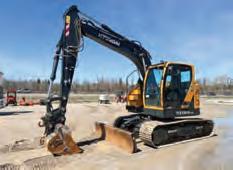
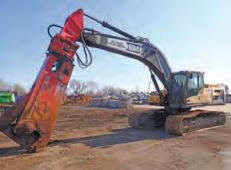
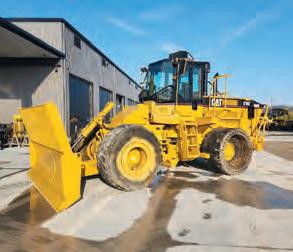
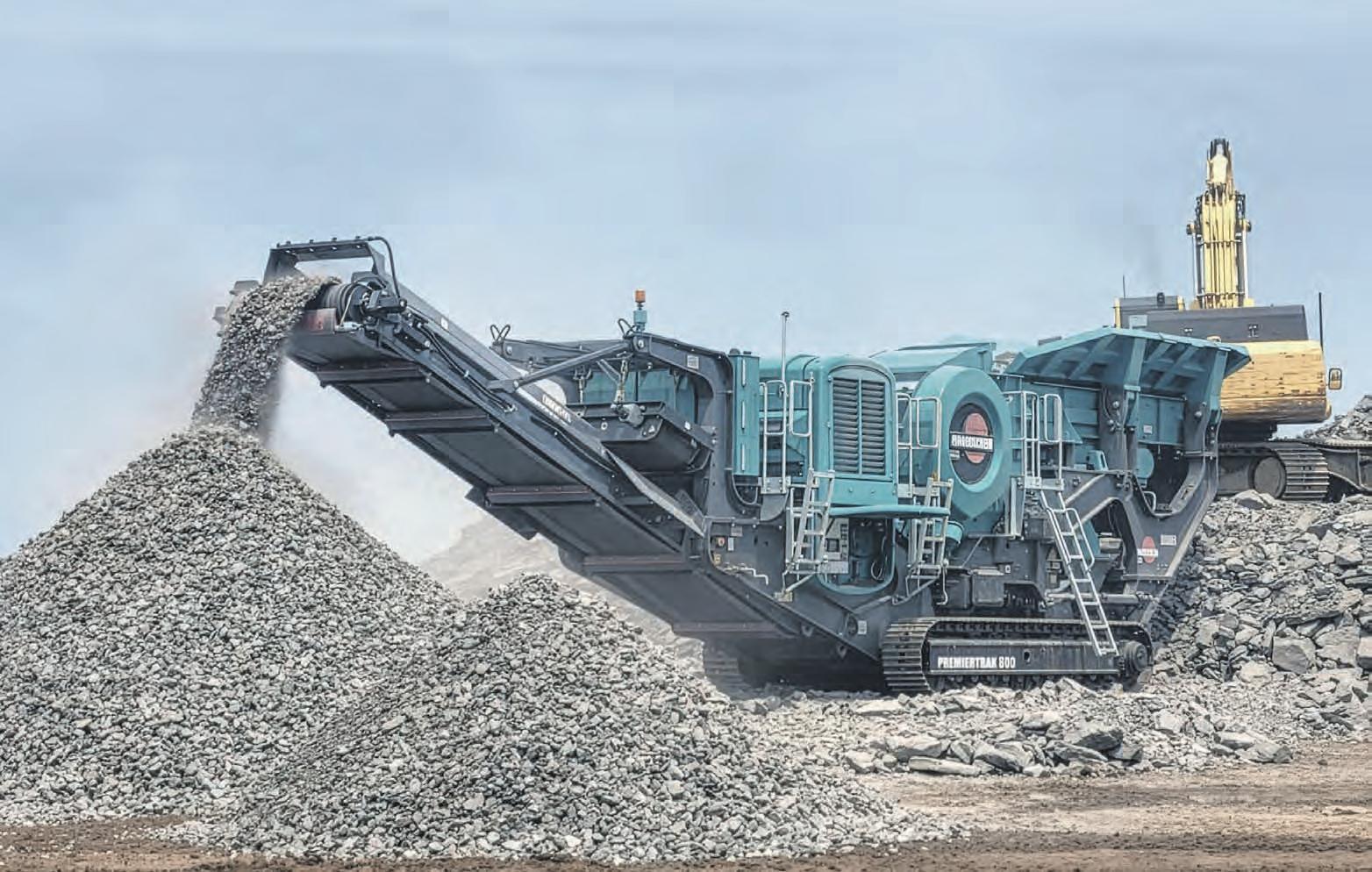
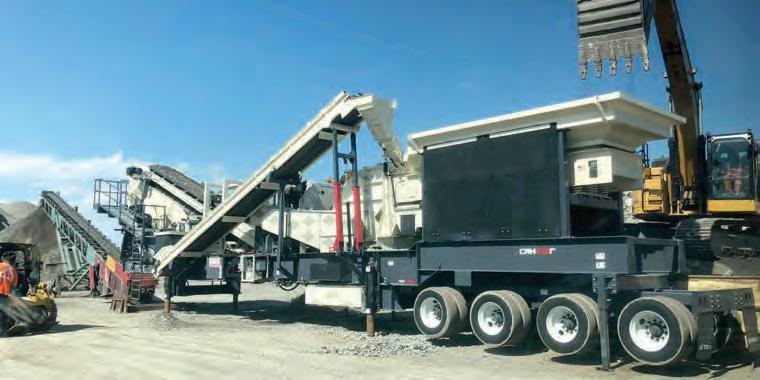
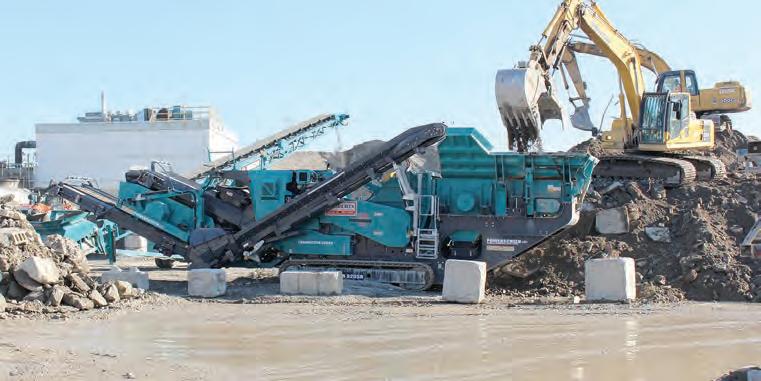
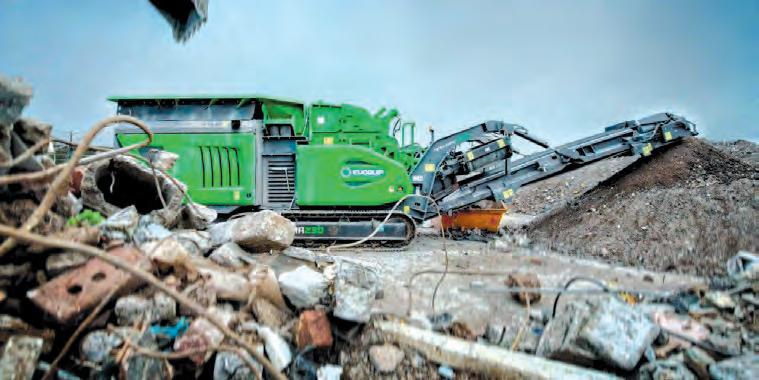
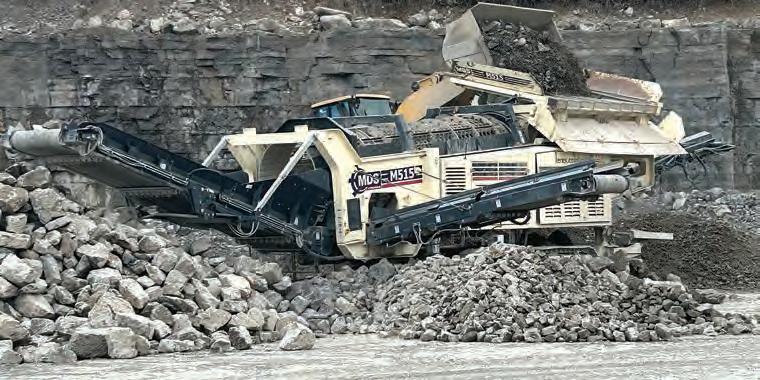
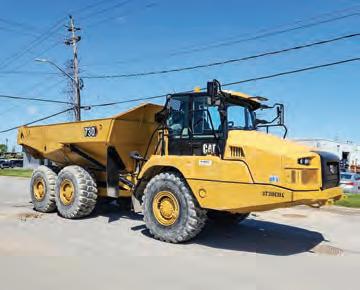
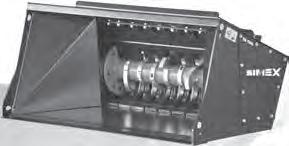
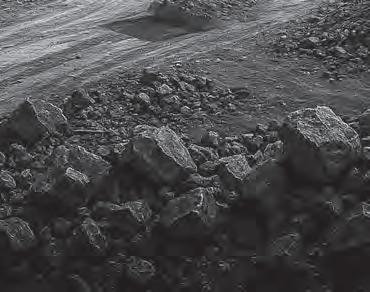
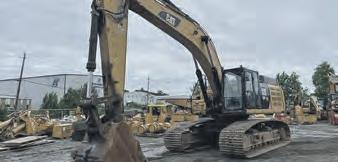
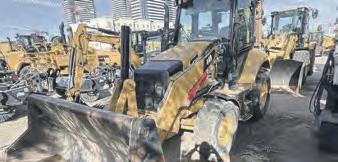
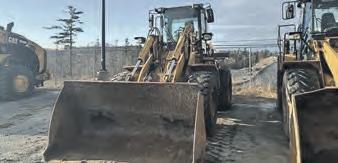
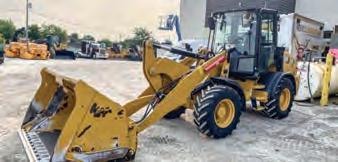
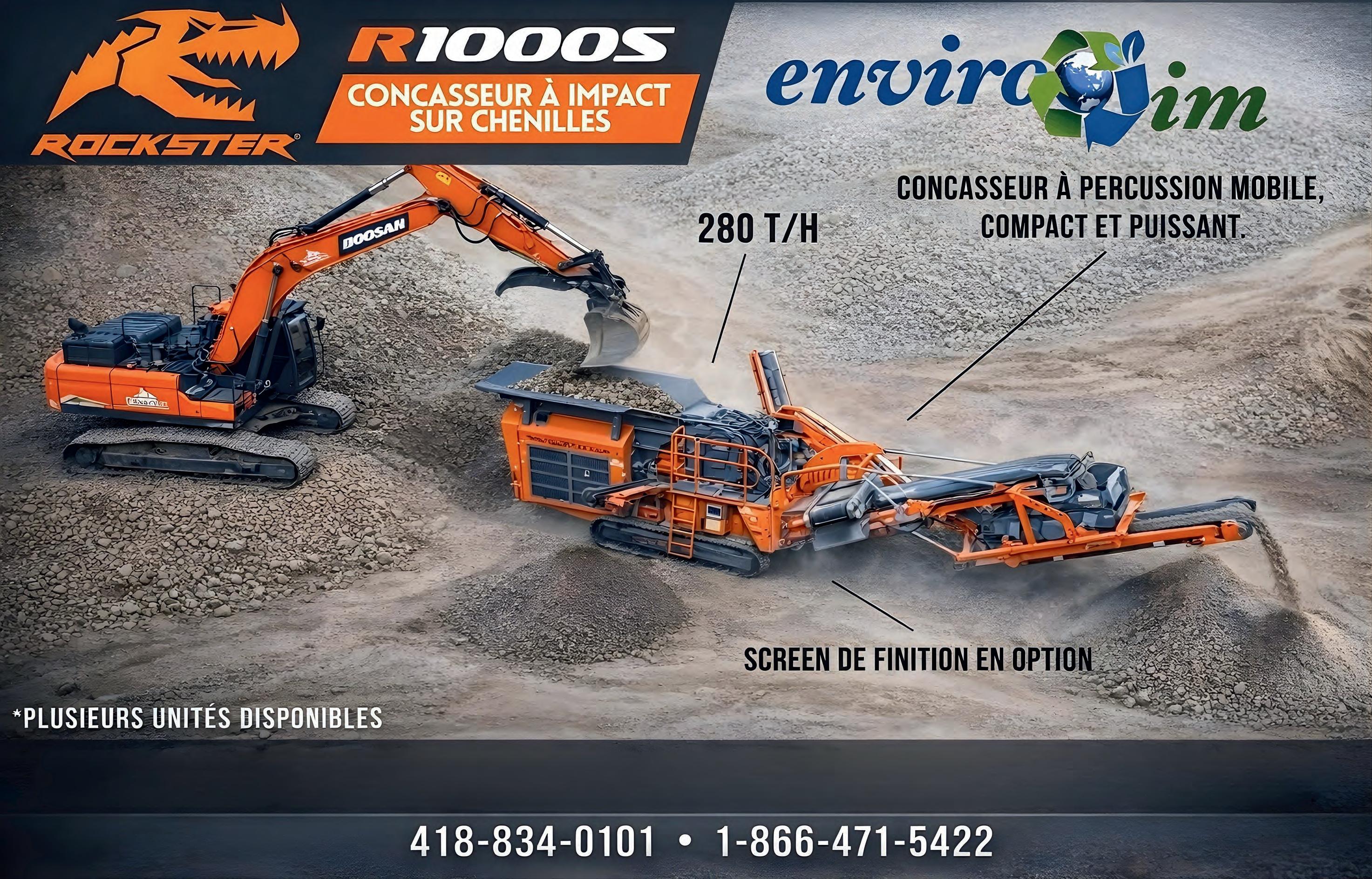
Designed for large and medium scale operators in quarrying, demolition, recycling & mining applications. 9.3m3 hopper, 47”x 32” crusher.
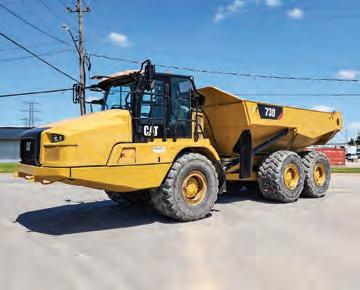
6’x16’ 2-deck screen, 450 hp T4F Scania Diesel, 150 kW generator, 48”x18’ vibrating grizzly feeder with 6’ stepped 2-deck grizzly. Great value for processing shot rock as well as concrete and asphalt recycle materials!
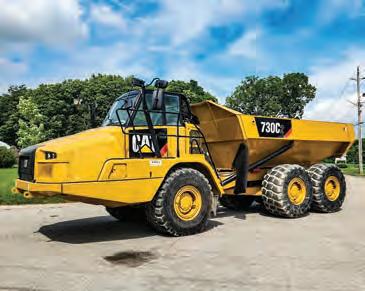
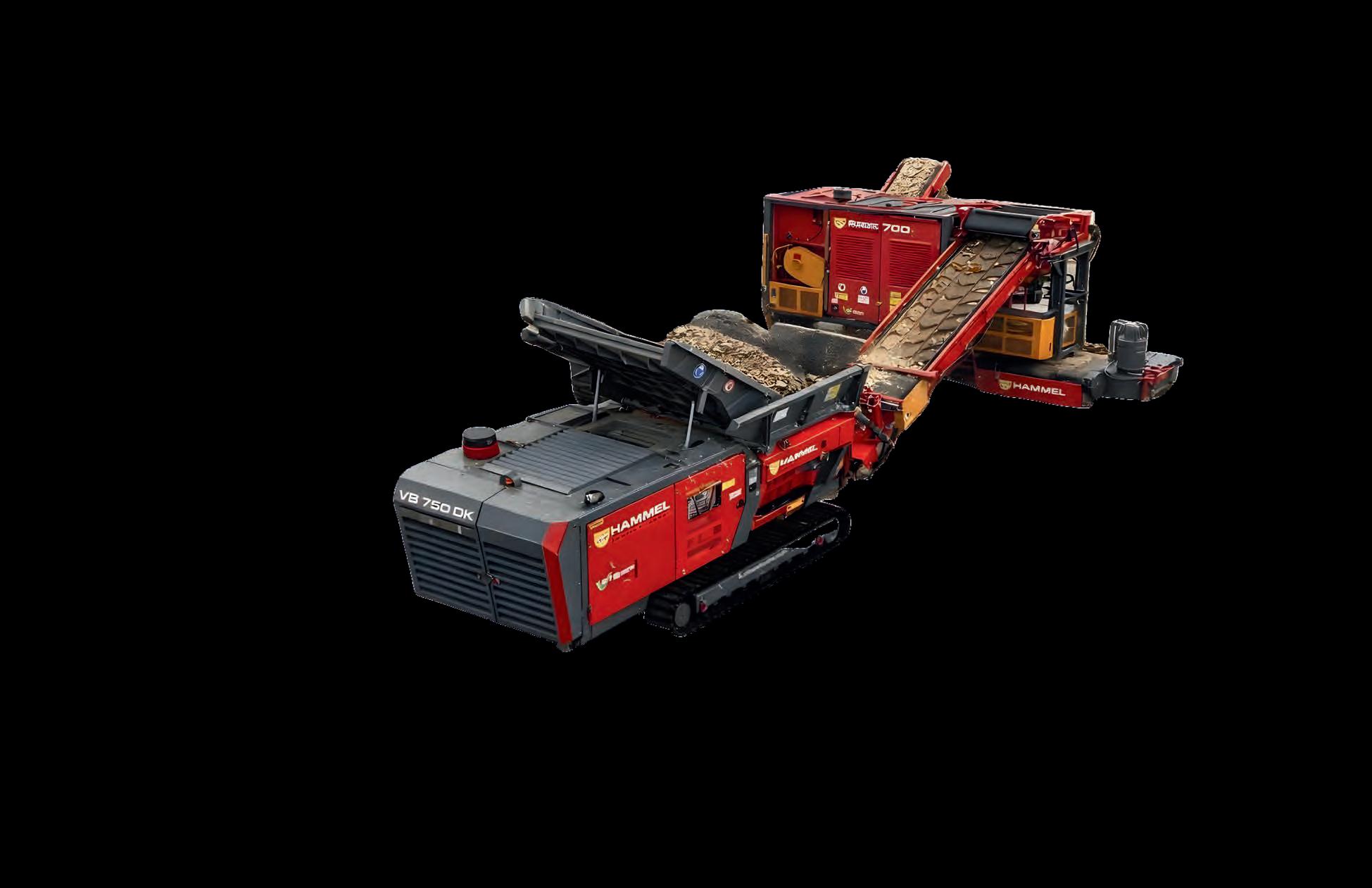
Double deck 11’ x 5’ screen, bolt in cartridge grizzly, highly fuel efficient direct drive system. Excellent reduction and high consistency of product shape in recycling, demolition and quarry applications.
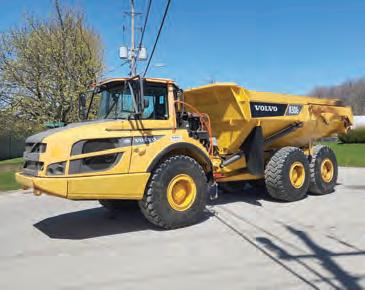
3.4yd3 hopper capacity, integrated pre-screen for fines removal, 34”x24” crusher inlet, hydraulic overload protection, 36” conveyor, diesel power. Great for Construction & Demolition, Asphalt Recycling, Quarrying or Contract Crushing.
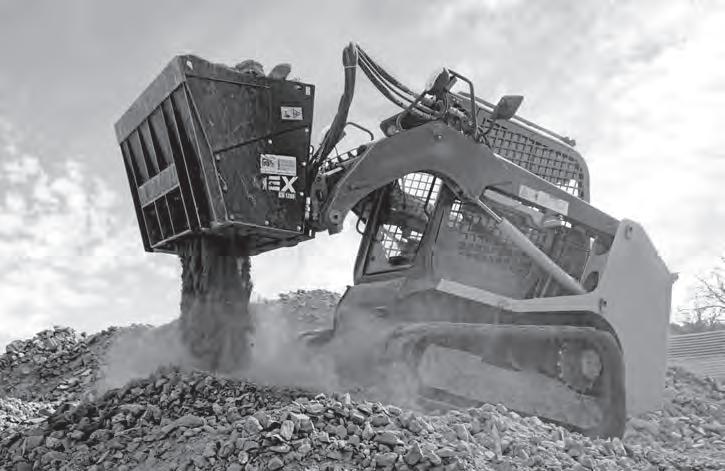
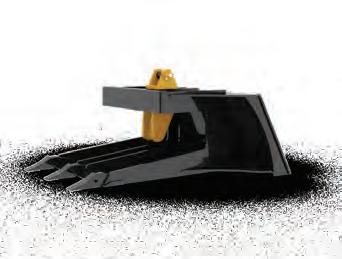
Ideal for creating RipRap and recovering rocks up to 800mm (32”) that are mixed with clay and other sticky materials. The updated model has been redesigned to include new features that will improve transportation, access, and stockpile heights.
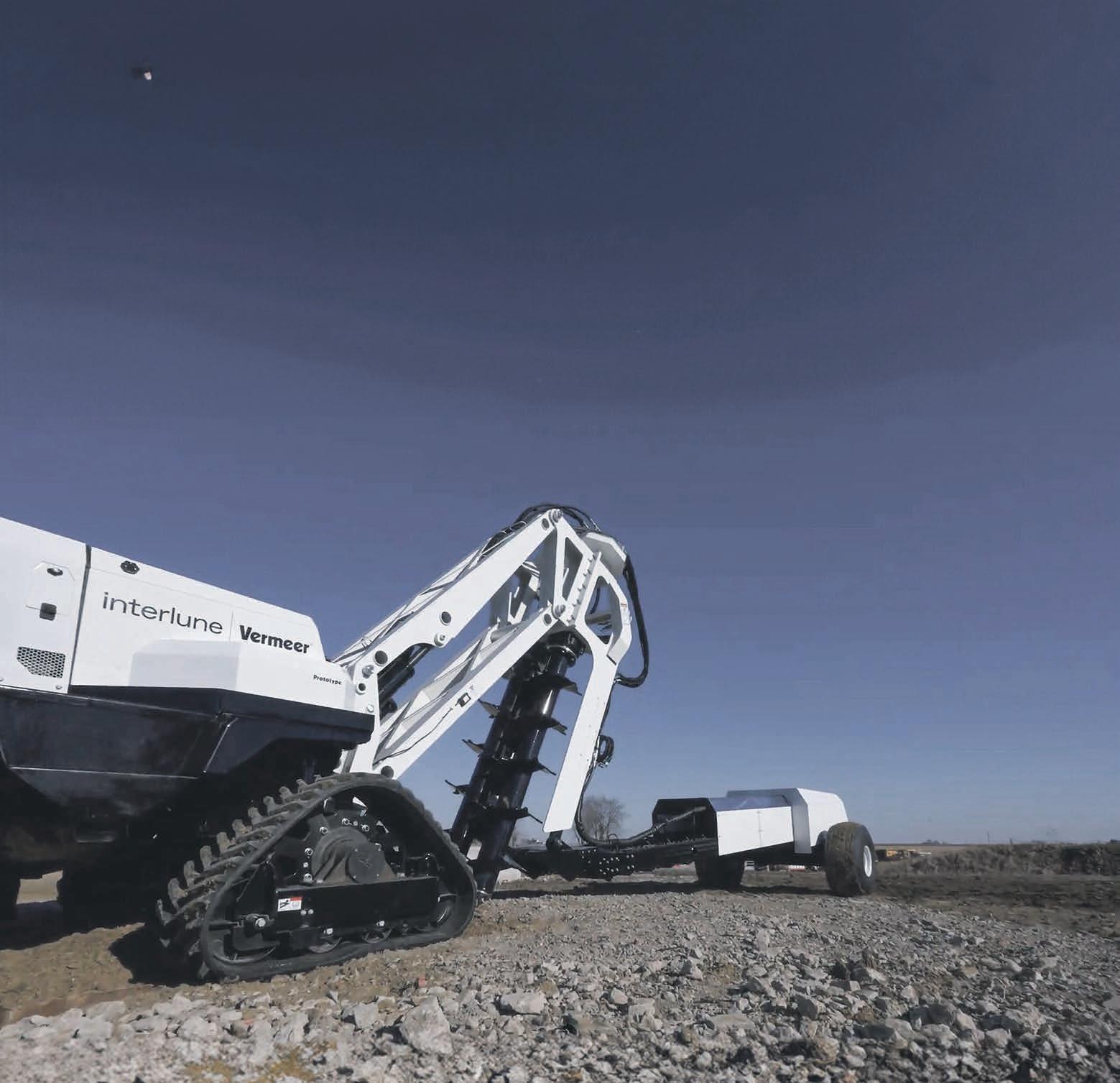
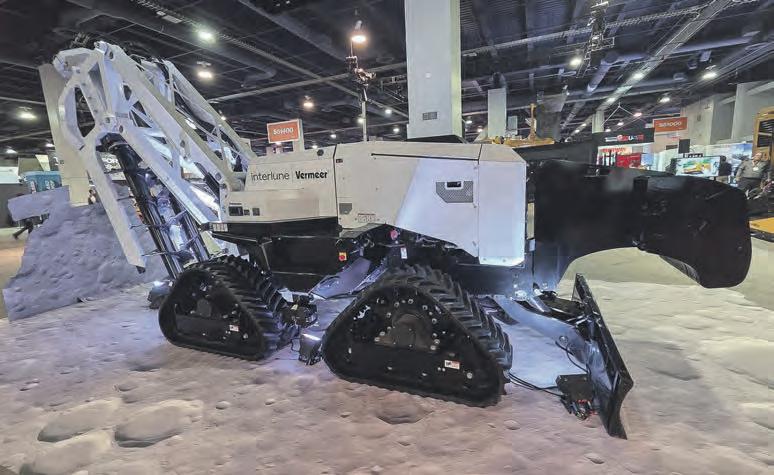
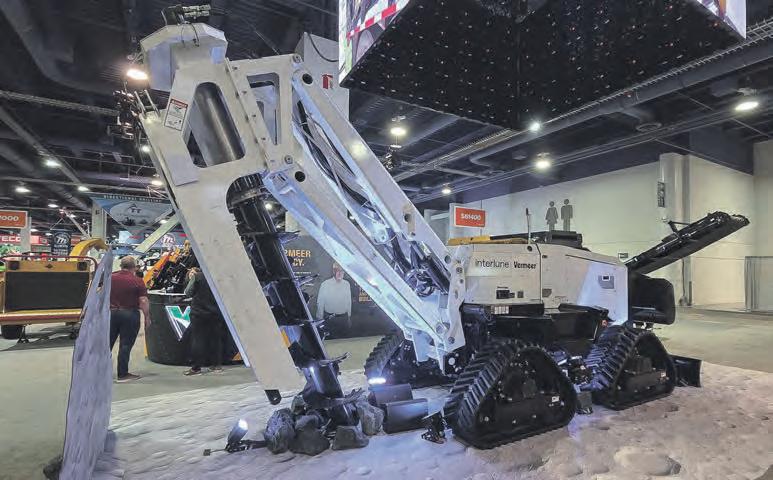
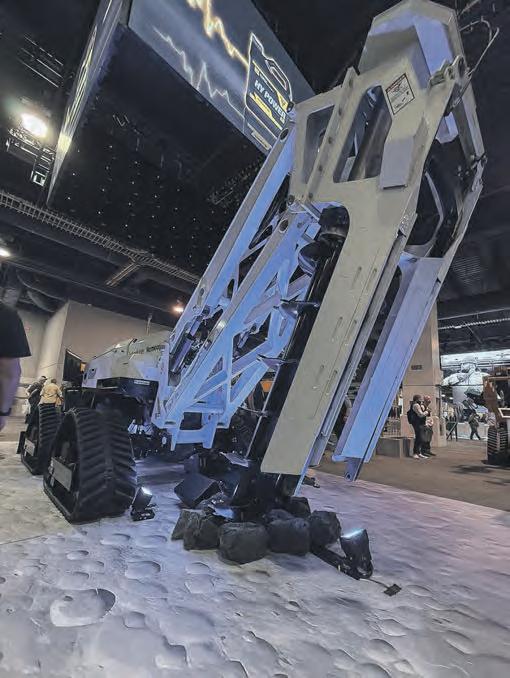
ZERO GRAVITY EXCAVATION
Vermeer has developed an excavation process that could complete the first large-scale lunar resource extraction
Alberta’s government is helping truck drivers navigate both physical and regulatory barriers with its new Canadian Trucking Regulations Hub.
The new digital tool helps truckers navigate regulatory and operational differences across Canada’s provinces and territories.
Via the Canadian Trucking Regulations Hub, truckers can plan their routes accurately so they can avoid low bridges and prevent costly infrastructure damage. It provides clear, accessible information with links to provincial permit information and safety code standards to navigate interprovincial trips.
Instead of searching through multiple sources, the hub brings everything together in one place.
“Alberta is proud to lead the development of this made-inAlberta solution that supports
truckers. By bringing key information together in one place, we are making it easier to navigate rules across jurisdictions, saving drivers time and helping industry operate more effectively,” said Devin Dreeshen, the province’s Minister of Transportation and Economic Corridors.
Alberta worked closely with federal, provincial and territorial partners to develop and refine the tool, with all jurisdictions participating and contributing to data validation. Each province and territory will now be responsible for maintaining and validating its own data, ensuring information remains accurate and up to date.
Responsibility for longterm management of the hub is expected to transition to the Canadian Council of Motor Transport Administrators later this year.
By spearheading the new
tool, Alberta is positioning itself as a coordinator where national alignment has lagged. A made-in-Alberta tool designed to function nationally suggests a recognition that freight doesn’t stop at provincial borders — even if the rules do.
If the hub delivers on its promise, it could help eliminate a major inefficiency: time lost to interpretation. Dispatchers will no longer need to cross-reference different sources and drivers can rely on facts rather than outdated knowledge or word-of-mouth.
For the heavy equipment industry, moving machinery is one of the biggest logistical challenges. Whether it’s a massive mining shovel or a fleet of excavators, every move requires permit checks, route approvals, navigating bridge and weight restrictions and possible escorts. The hub's impact will be less
downtime between jobs, tighter project scheduling and less transport mistakes. The same benefits apply to moving natural resources or materials required by jobsites. Alberta deserves credit for identifying a real problem and taking a practical step to provide an answer. For an industry that keeps Canada moving, reducing uncertainty is no small win.
No Limits
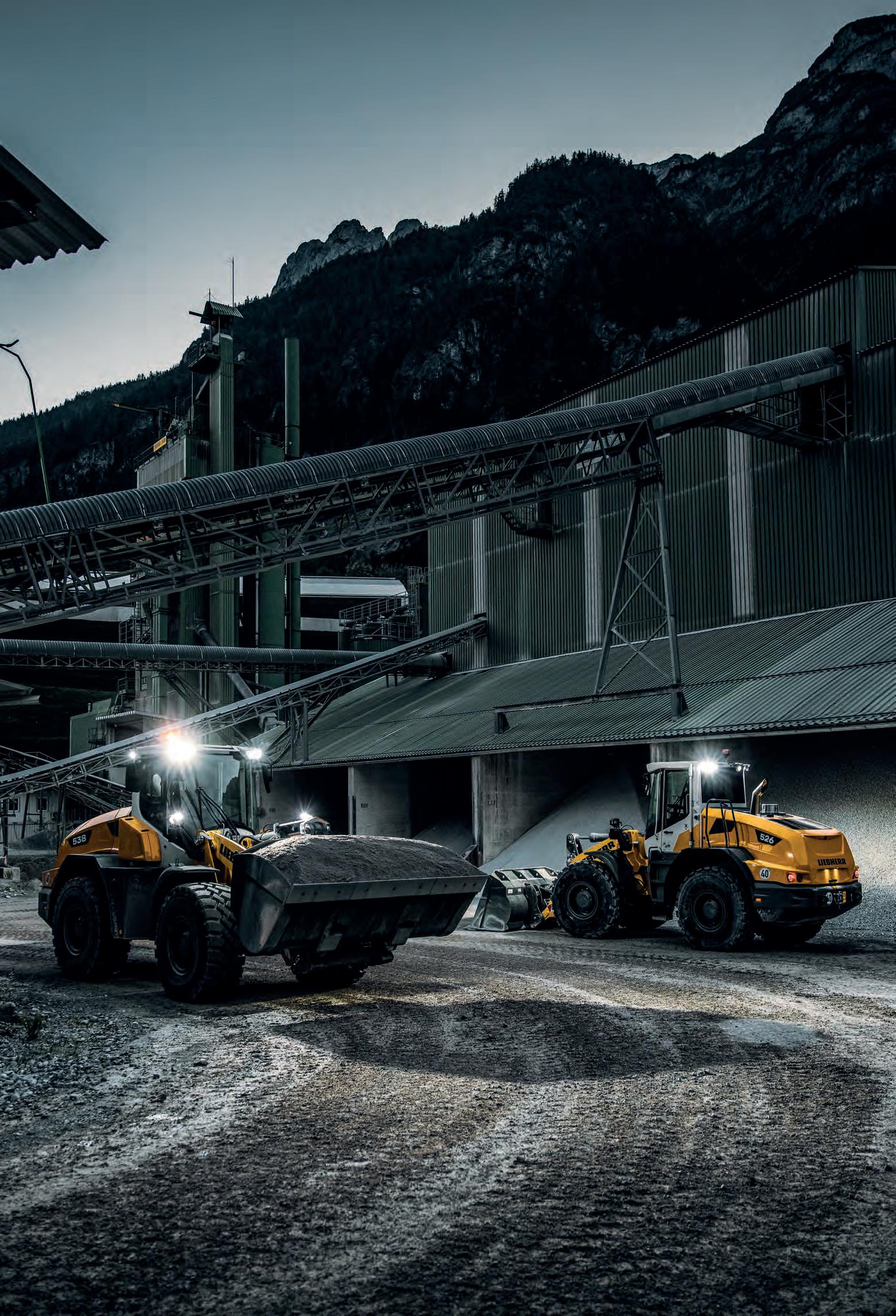
Medium-size, top class: the L 526, L 538 and L 546 wheel loaders score top marks across all performance parameters. With the new, optimised Z-bar linkage, Liebherr has opened up unlimited application possibilities aligned to even better productivity. Generation 8 is bigger, tougher and more powerful than its predecessors – but with consistently low fuel consumption. www.liebherr.com
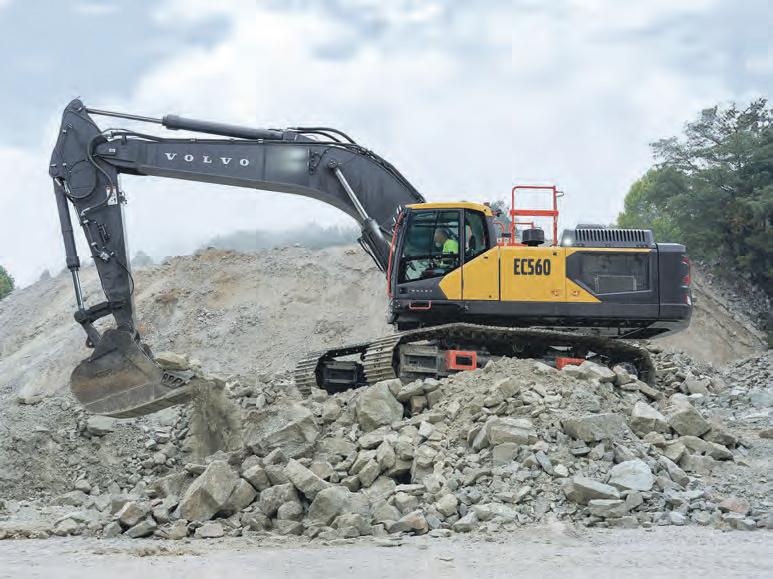
Volvo CE offers a rare preview of its third largest crawler excavator
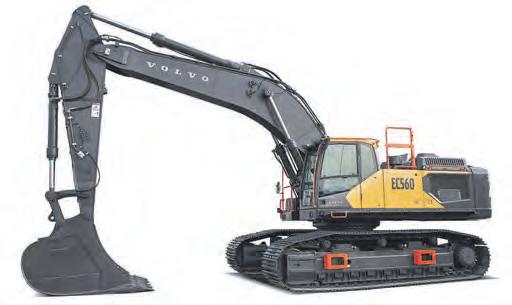
At ConExpo, Volvo Construction Equipment offered attendees a rare preview of its soon-to-be-released 56-tonne excavator.
The all-new EC560 model can take on the biggest bucket in its size class to deliver industry-leading productivity. The excavator will feature a massive 4.6 cubic-metre bucket and deliver 3 per cent more digging force, 10 per cent more swing torque and a heavier counterweight.
The new machine is expected to become commercially available in early 2027, and will become the third largest excavator in the lineup, behind the 95tonne EC950F and 75-tonne EC750E.
“This model is a direct response to customer demand for a machine that offers the size and strength for heavy production work along with the finesse, fuel efficiency and comfort of our next-gen platform,” said Sejong Ko, Product Manager — Large Excavators at Volvo CE.
“It’s a great example of how we’re growing this series to meet every challenge our customers face.”
Designed for the most demanding tasks in construction, quarry and aggregates, the 56-ton crawler excavator joins Volvo CE’s modernized excavator series, bridging the gap between existing size classes to offer customers a new level of productivity.
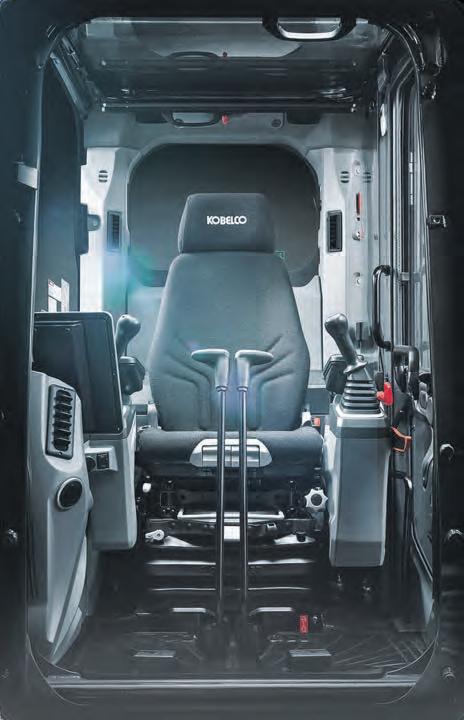
The EC560 excavator combines the operator-centric design of the new generation — including a completely reimagined cab and Human Machine Interface (HMI) — with the durability required for mass excavation and material transport.
The new electro-hydraulic system can significantly reduce fuel consumption by regulating engine speed and hydraulic flow rate based on the task at hand.
The intelligent technology is able to match the amount of energy required to complete the task at hand, leading to improved fuel efficiency and lower operating costs.
"Volvo CE’s newest excavators offer up optimized electro-hydraulics that provide market-leading cycle time and production potential,” Ko said.
The enhanced main control valve (MCV) uses electronic sensors to monitor the operator's movements. This information is processed by the excavator’s on-board computer, which processes the information to send commands to the MCV. The result is smooth and precise movement of the excavator's boom, bucket and other hydraulic components, allowing for more accurate digging and loading.
For improved maintenance, Volvo Ce has synchronized engine oil,
hydraulic oil and fuel filter changes at 1,000 hours. As well, grouped filters can be easily accessed via the machine platform, while DEF/ UREA filling in completed from ground level.
HVAC filters can also be replaced from inside the cab for a much easier and straightforward process.
“While full details will be released closer to its launch, the EC560 excavator targets top-tier performance in its weight class,” Ko said.
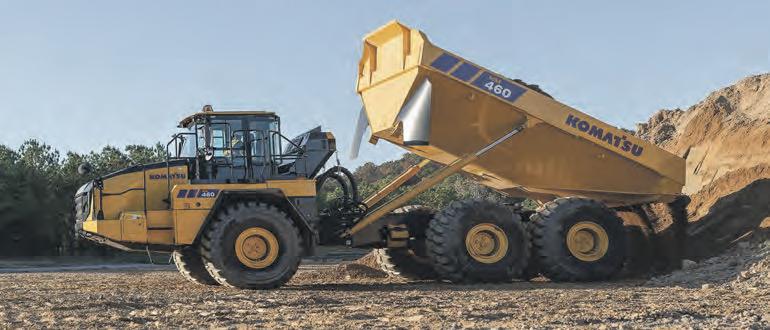
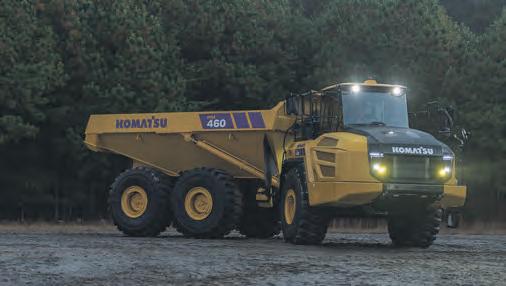
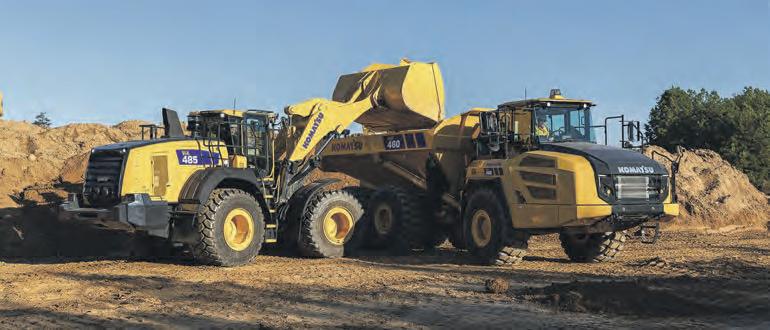
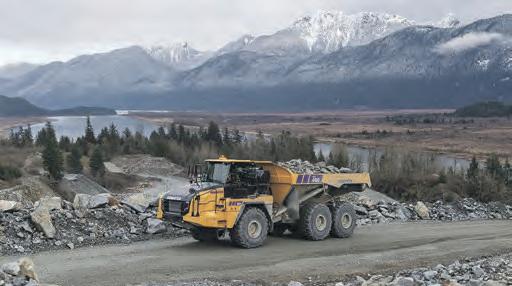
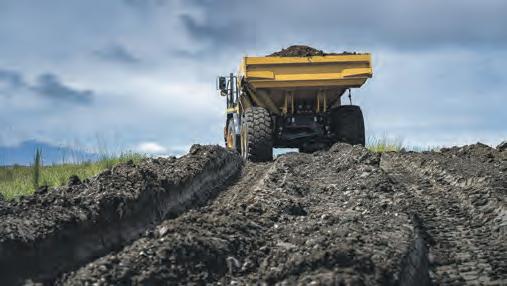
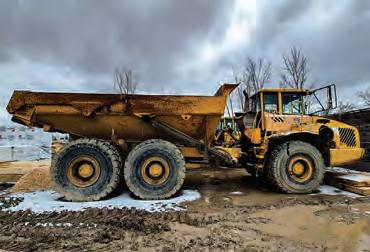
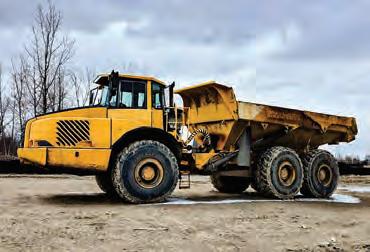
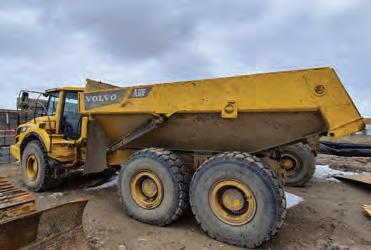
To help contractors move more material with greater consistency across challenging ground conditions, Komatsu has developed the next-generation HM460-6 articulated haul truck.
With a higher-rated payload and improved fuel efficiency compared to its predecessor, the HM400-5, the truck is designed to deliver a lower cost per ton while maintaining stable, predictable operation throughout the haul cycle.
“In engineering the HM4606, the focus is on delivering confident performance in real-world conditions where traction, torque and control make the difference — with extra payload,” said Bruce Boebel, Director, Products and Service for Komatsu.
The new articulated truck is designed around a new high-output powertrain, an
advanced traction control system and a redesigned operator environment, which reflects direct customer input.
“Contractors are always looking to increase productivity, efficiency and safety while reducing costs,” said Chris Stocco, Director, Product Management at SMS Equipment. “For our customers, moving more material with greater consistency across the variable terrain often seen on our Canadian worksites is top-of-mind — and this is where the Komatsu HM460-6 shines.”
To ensure the HM4606 met those benchmarks, SMS Equipment partnered with Komatsu and several customers to bring the first articulated trucks to Canada in a field follow.
“So far, operators are very impressed with the power and
performance of the truck," Stocco said. “We’re excited to roll the truck out across the country beginning this spring so customers can realize the productivity, efficiency and safety benefits across their operations.”
Thanks to a new, lighter-weight main frame, the truck’s rated payload capacity increases by 2.1 tons to 46.3 tons, which allows operators to haul more material in each cycle — further driving added productivity. This has positive impacts across the truck’s total cost of ownership and the hourly cost of moving material.
DBA127 engine
At the core of the HM460-6 is the new Komatsu DBA127 engine equipped with a twostage turbocharger system. The engine delivers 518 hp
at 1,700 rpm, providing increased torque at lower engine speeds to support strong acceleration, improved hill-climb capability and efficient power delivery under load. It also eliminates the complexity of an exhaust gas recirculation (EGR) system through a simplified design.
The engine’s two-stage turbocharger system is designed to deliver efficient boost across a wide operating range. An electronically controlled bypass valve helps manage boost pressure, contributing to durability and smooth engine response. The engine meets Tier 4 Final and Stage V emissions standards and is designed with extended maintenance intervals to help reduce downtime.
Paired with a new ninespeed Komatsu transmission and intelligent gear control,
the powertrain is designed to balance performance and fuel efficiency across a wide range of conditions.
“The HM460-6 combines a high-performing engine with a very efficient transmission to boost speed, fuel economy and travel performance,” Stocco said. “We’re expecting fuel efficiency improvements up to 22 per cent and fuel consumption down by about 12 per cent compared to the HM400-5.”
Traction control
This new HM460-6 also features the Komatsu Traction Control System, paired with cross-axle differential locks, to help maintain traction on soft, uneven or muddy ground.
“Together, these offer more control across a range of conditions, including high terrain, variable surfaces or soft ground,” Stocco said. “This helps operators maintain consistent productivity in challenging conditions, while reducing delays from lost traction and minimizing unnecessary tire wear.”
Combined with a hydro-pneumatic suspension system engineered to balance ride comfort and stability, the HM460-6 is designed for reliable hauling across tough terrain.
Traction performance is a central focus of the HM460-6’s design. The Komatsu Traction Control System continuously monitors wheel speed and slip, automatically applying brake force to individual wheels when traction loss is detected.
This system works in conjunction with an inter-axle differential lock and a manually activated cross-axle differential lock, providing operators with multiple layers of traction assistance based on ground conditions. These systems help reduce tire spin to extend tire life, limit material spillage and support steady travel on grades or soft surfaces.
New cab
The HM460-6 articulated truck features a redesigned cab focused on visibility, ergonomics and operator comfort. A four-pillar cab design increases glass area by 16 per cent and reduces blind spots by 43 per cent helping to improve awareness during loading, hauling and dumping.
Control layouts were revised to group high-use functions within easy reach, while a high-resolution 20-cm machine monitor, paired with a 25-cm sub-monitor, provides access to payload data, machine information and rearview camera feeds.
Standard operator-assist features include cruise control and automatic retard speed control to help maintain consistent downhill speeds and hill start assist, which prevent rollback on steep grades. A rollover prevention system monitors vehicle speed and rear frame angle, providing alerts and limiting machine functions when thresholds are approached. As well, new brake inspection guidance helps operators assess brake status. Maintenance access is also simplified in the HM460-6 design. A powered tilting engine hood, ground-level service points and extended service intervals are intended to help reduce downtime and simplify routine inspections and scheduled maintenance.
“Extended service intervals will improve uptime and, because the engine doesn’t include the exhaust gas recirculation system, certain service components, like the crankcase ventilation filter, are eliminated,” Stocco said.
The truck is equipped with telematics data monitoring technology that enables fleet managers to access machine health and operating data, helping to improve utilization and planning and supporting proactive maintenance.
Raimondi’s Terex Tower Cranes
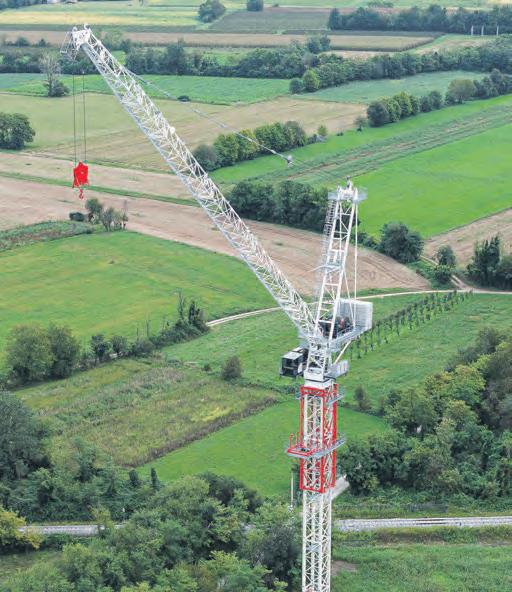
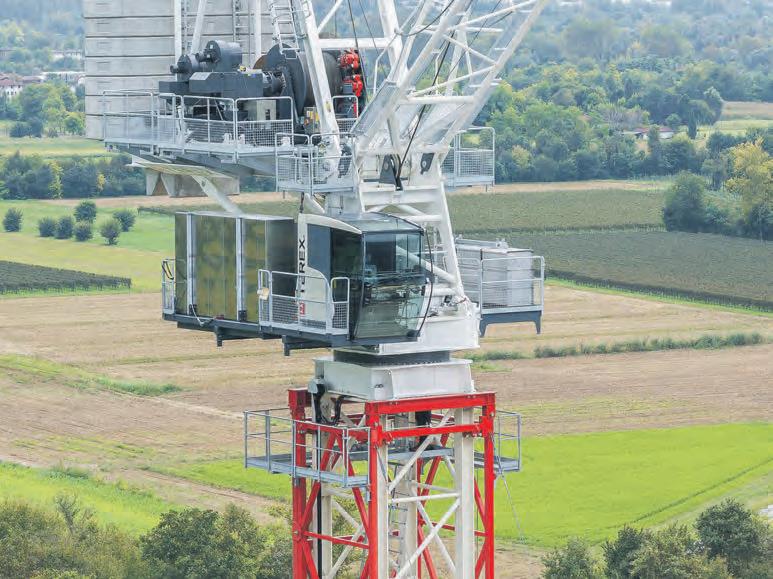
Terex Tower Cranes, now part of Raimondi, is expanding its luffing jib crane lineup with the new next generation CTL 712-45 crane.
Introduced at ConExpo, the new crane is designed to enhance performance, control and efficiency on high-rise and large-scale projects.
Combining strength, speed and reliability, the high performing crane meets the demand of complex and ambitious construction projects.
“Engineered to deliver precise, responsive load handling across the entire operating cycle, the CTL 712-45 integrates advanced control technologies that enhance efficiency while prioritizing safety and operational accuracy,” said Francesco Aiello, General Manager, Terex Tower Cranes.
“The model reflects the company’s continued focus on intelligent design and performance-driven innovation.”
Featuring a 70-metrelong jib and a tip load of 5.8 tonnes, the CTL 712-45 is equipped with a 134 kW hoist winch and it can lift at a maximum speed of 226 metres per minute in single fall.
“This latest addition to our portfolio creates significant global opportunities, building on the proven success of the CTL 702-32,” said Lee Maynard, Global Sales Director, Terex Tower Cranes.
The crane can be erected on an HD23 mast, reaching a 63.4 metre tower height in standard configuration and allowing up to a 131.2 metre height under hook at maximum radius. The freestanding height capabilities provide added versatility for dense urban jobsite and high-rise developments.
Fully electric, the luffing jib delivers quiet, energy-ef-
ficient operations, reduces environmental impact and minimizes urban noise, making it the optimal solution for sustainable construction sites.
The CTL 712-45 is designed for full lifecycle efficiency, with optimized control systems and significantly improved technical advantages.
Streamlined procedures include standardized pins and bolts, reduced tooling requirements and smart assisted assembly solutions. This standardization allows for quicker assembly and dismantling to reduce valuable onsite time.
Conceptualized and designed with erection crews, technicians and operators in mind, the CTL 712-45 optimizes connector usage, reducing the number of cables and connections to manage and simplify maintenance activities. As well, primary assembly is completed at ground level, further boosting safety and ease of installation.
With safety remaining a top priority, enhanced enclosures and integrated handrail protection minimize the risk of falling objects and provide a high level of protection for personnel during operation, maintenance and assembly or disassembly phases.
Precision is further reinforced through the T-Line auto-levelling system, which maintains consistent load height during jib luffing to enable accurate load placement. T-Torque inverter technology provides smooth, operator-adjustable slewing with optimised torque control.
Together, these systems allow operators to fine-tune crane movements across a wide range of complex lifting applications.
At a recent customer event held at the Terex Cranes’ test-
ing facility, the CTL 712-45 received positive feedback, particularly for its streamlined erection process and ease of maintenance.
“The new S-Pace cabin was also highly praised for its operator-focused design. One customer described the crane as 10 to 15 years ahead of its time, feedback that strongly validates our engineering direction and commitment to delivering forward-thinking solutions to the market,” Maynard said.
ASV and Yanmar unify under the Yanmar brand
Yanmar has announced its ASV and Yanmar Compact Equipment CTL portfolios will merge under the Yanmar brand.
At ConExpo, the company introduced its One Yanmar initiative, which will see compact track loaders branded under the Yanmar name in North America, while maintaining the option of the ASV Posi-Track undercarriage.
“It's not a slogan, it brings clarity to our lineup. It strengthens the consistency of our brand, and it reinforces how we go to market as a unified equipment portfolio,” said Anna Sgro, President of Yanmar Compact Equipment North America.
The integrated compact equipment portfolio will offer two distinct undercarriage technologies from a single manufacturer: the ASV Posi-Track system or steel-embedded track systems.
Posi-Track is engineered for exceptional traction and performance on soft, wet, slippery, rough or hilly terrain, while the steel-em-
bedded track systems is designed for durability and performance in construction and hard-surface environments.
As part of Yanmar’s strategy, compact track loaders incorporating ASV technology will transition to Yanmar Red, creating a unified product identity.
The dual-platform strategy allows Yanmar to deliver application-specific performance while maintaining a unified product portfolio.
“This is a cyclical industry. We all know that the question is not how we chase the peaks. The question is, how we build a business that wins every cycle, every day, with our customer all the time?” Sgro said. “To compete consistently at the level that we do, we must align our portfolio, our manufacturing footprint and our go to market strategy.”
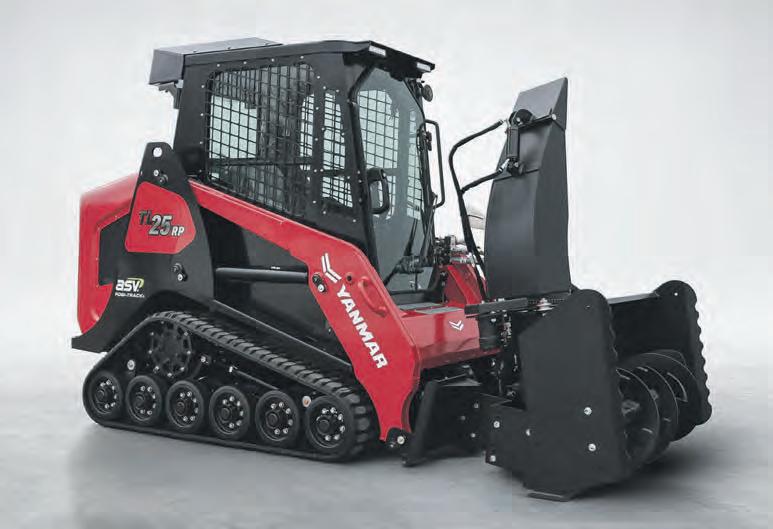
At ConExpo, Yanmar previewed two CTLs under the One Yanmar initiative: the 23-hp TL25RP and 54-hp TL50RP. The two new machines incorporate ASV Posi-Track technology with a fully suspended torsion-axle
undercarriage engineered to improve stability, digging performance and material retention when operating on soft or uneven terrain.
The full CTL lineup will span small- to large-frame platforms and cover a wide range of horsepower classes and applications, including construction, land management, landscaping, utilities and agriculture.
“Within the portfolio, we now deliver one of the most versatile CTL lineups in the world, not just North America,” Sgro said.
In 2019, Yanmar Holdings has announced the acquisition of the Minnesota-based ASV Holdings. By acquiring ASV, Yanmar completed its lineup of compact equipment.
Since the acquisition, Yanmar has invested more than $32 million in automation, innovation and manufacturing at its Grand Rapids, Minnesota, facility, where Yanmar and ASV compact track loaders are manufactured.
Over the next five years, Yanmar plans to invest an additional $30 million to
further expand CTL engineering capability and production capacity.
Dynapac North America and Bluelight Machines collaborate on autonomy
Dynapac North America and Bluelight Machines partnered at ConExpo to demonstrate the capabilities of autonomous compaction.
Bluelight Machines’ autonomous technology was demonstrated on a 2-metre, 11-ton Dynapac CA2500D seismic soil roller during the trade show.
Attendees were able to see firsthand how Bluelight’s autonomy platform integrates seamlessly with Dynapac compaction equipment in a real-world jobsite environment.
“Contractors are under intense pressure from workforce shortages, tighter project timelines and rising utilization demands,” said Dick Zhang, President of Bluelight Machines and software co-developer. “By combining Bluelight’s goto-market-ready autonomy platform with Dynapac’s proven compaction equipment, we’re delivering a practical, scalable solution that is already performing on active jobsites today.”
Bluelight Machines’ Auto-
pilot autonomy platform is currently deployed on active jobsites across the United States and internationally, with about 75 per cent of installations operating in compaction applications.
The company offers retrofit kit options for compaction equipment and haul trucks that delivers a setup time of less than three hours.
The system was created using data from real machines on real jobsites. To date, Bluelight Autopilot has been proven on more than 100 machines rolling more than 500 million square feet with zero injuries reported.
Bluelight Autopilot also enables machine owners to control their equipment from anywhere using any
mobile or desktop device.
“Having Bluelight autonomy available for Dynapac rollers is a major step forward for our customers,” said Jennifer Bishop, Director – Product Marketing and Customer Experience, Dynapac North America. “By combining Bluelight’s autonomy platform with Dynapac’s Seismic technology, contractors gain a fully integrated, market-ready autonomous compaction solution that delivers exceptional precision, consistency and performance. Backed by our Dynalink telematics platform we’re seeing engaged contractors improve utilization on soil rollers and realize efficiency gains and increased production.”
“This represents the longterm commitment to CTL engineering and manufacturing in North America, and it's backed by capital investment,” Sgro said.
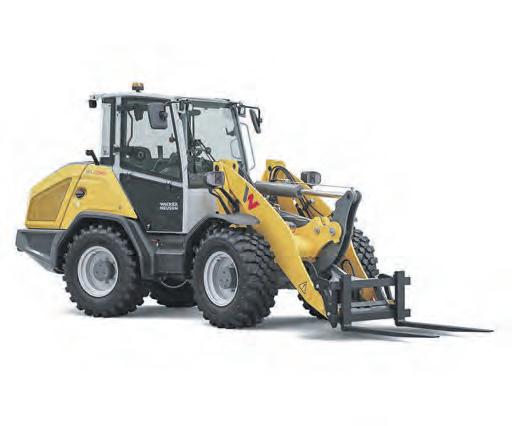
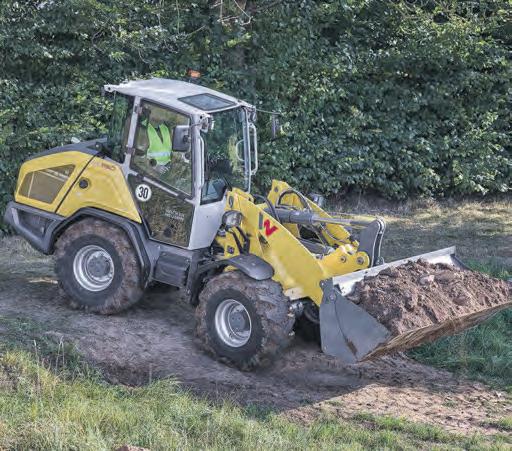
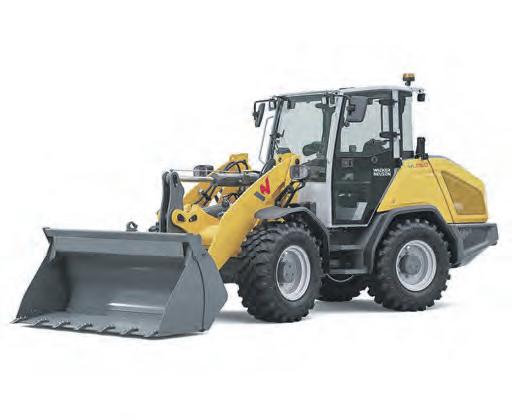
Wacker Neuson is expanding its wheel loader line up with three new models.
The new WL750, WL950 and WL1150 models combine a compact design, powerful kinematics and optimized visibility with an ergonomic operator station and uniform operating logic.
The three loaders join the WL250 that Wacker Neuson introduced in 2025.
“As the construction industry continues to face tight schedules, rising costs, a shortage of skilled workers and growing safety requirements, Wacker Neuson is answering the call with three highly productive, well-designed solutions,” said Gert Reichetseder, Wacker Neuson Americas President & CEO. “With input from dealers and customers throughout the development process, Wacker Neuson consistently exceeds expectations by focusing on
operator experience, reliability, serviceability and rental fleet usage.”
The WL750, WL950 and WL1150 use bucket capacity in their nomenclature for easy identification: 0.75, 0.95 and 1.15 cubic metres for the WL750, WL950 and WL1150, respectively.
Their size and versatility make them ideal alternatives to skid steer models.
“With the modular design of its new wheel loader platform, Wacker Neuson has standardized many parts and components,” said Wacker Neuson Commercial Product manager Jay Quatro.
“This improves spare parts availability, simplifies maintenance and repair and ensures uniform operation across different models.
Operators can easily switch between machines without lengthy training periods – a significant added value for contractors who work on
projects of varying size and complexity, as well as rental dealers.”
To improved safety and comfort, Wacker Neuson has enhanced the cab of the new loaders to include a wider access point, which makes frequent entering and exiting easier. As well, an ergonomically designed interior configuration and intuitive controls support fatigue-free operation. As well, the panoramic front and rear windshields provide an optimal all-round view of the working environment and ergonomically arranged control elements make it easier to focus on the task at hand. This increases safety on confined construction sites and provides improved control, especially when working near people, buildings and material.
Combining hydraulic power, modern hydraulic quick-change systems and
a wide range of attachments, the WL750, WL950 and WL1150 go beyond material transport. The machines serve as versatile tool carriers, handling a multitude of construction, landscaping and municipal tasks yearround. Their kinematics ensure high lifting and breakout forces, as well as precise guidance of a multitude of
attachments, including, pallet forks, snow blowers and pushers, rakes and mowers.
To improve overall stability and extended service life, the loaders feature a robust centre joint that connects the front and rear carriages at two points. High wear-resistant hydraulic hoses are routed through the central joint for optimal protection,
significantly reducing abrasion risk and minimizing the need for hose replacement. Powered by Rehlko KDI liquid cooled engines, Wacker Neuson’s new loader series feature low fuel consumption, long maintenance intervals and a high resale value to help keep total operating costs low over the machine's service life.
Case Construction Equipment’s roster of electrified equipment is growing with the addition of the TL100EV mini track loader.
The stand-on machine is ideal for job sites where low noise and zero emissions are critical, from indoor demolition to work near schools or hospitals.
With a rated operating capacity of 454 kg, the TL100EV
performs like its diesel counterpart, the Case TL100 mini track loader.
The electrified mini track loader is ideal for contractors, landscapers, grounds maintenance teams, municipal work, indoor demolition and DIY renters as it improves efficiency and safety on job sites requiring reduced noise levels. With zero emissions, it can also run indoors without the challenges of managing exhaust.
“We’re putting a lot of focus on the alternative fuel aspect. It’s not just for green scores, but more for noise pollution. It’s being able to work on a site where you can’t take a diesel machine,” said Ryan Anderson, CNH Product Manager.
The TL100EV is equipped with 25 kWh of battery capacity and operates with two 11-hp motors for the ground drive and one 33-hp motor for the hydraulics to provide more torque and performance than a similarly sized diesel model, even during challenging multi-function tasks.
A radial linkage loader arm improves digging performance and cuts down on maintenance, while a 2.2metre hinge pin height gives plenty of clearance for loading trailers.
The TL100EV is compatible with more than 40 industry-standard attachments using a CII coupler. A 106-cm wide track option provides maximum stability while a 91-cm narrow track option
allows access through entryways and tight spaces. For more leverage in tight spaces, the stand-on loader can be equipped with 18-cmwide tracks give maximum leverage in tight spaces, while a 25-cm-wide tracks option offer more flotation and less ground pressure for total stability. Non-marring tracks are also available as a factory option. Crews can work more efficiently using a modern operator display panel that provides electro-hydraulic control customization, quick attachment selection, multiple work modes and a boom float. As well, boom lights and a rear strobe enhance visibility and improve jobsite safety and awareness.
The TL100EV’s total runtime clocks in at up to seven hours when fully charged, depending on the work performed. Charging is handled with an onboard J1772 Type 1 automotive-style charger. An optional offboard DC fast charger is available for applications needing faster charging times. Onboard charging takes approximately five to eight hours, while offboard charging takes 90 minutes to six hours.
JCB introduces single-arm compact CTL
JCB has introduced two new compact machines designed to be jobsite workhorses.
For rental companies and residential contractors, the most important machine on the yard is often the one that does almost everything. At The ARA Show, JCB introduced the 250T compact track loader and the 25Z mini excavator designed around that reality.
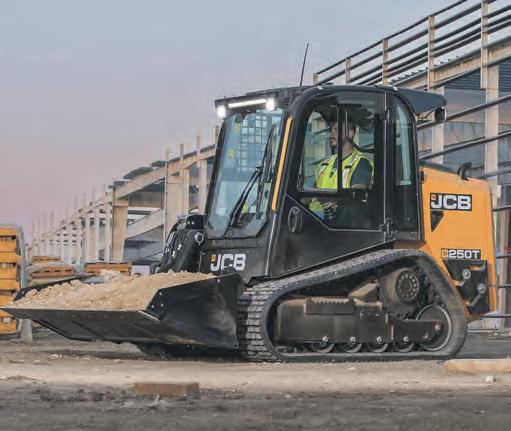
With the 250T compact track loader, JCB brings its single-arm boom design to the most in-demand skid steer size class.
Built for rental fleets and residential jobsites, the 250T delivers the power, lift capacity and compact manoeuvrability this segment requires. It delivers strong
grading and material-handling performance with a towable design.
“The 250T is built around how customers actually work,” said Lee Tice, Senior Product Manager – Compact Equipment for JCB. “Rental houses need a machine that appeals to the widest range of users, and contractors need something that is easy to move between jobsites, easy to operate and capable of handling demanding applications. This machine delivers that balance while bringing our side-door entry and 270-degree visibility into the most popular compact track loader class.”
Strong lift capacity meets practical transportability in the 250T. A 74-hp engine
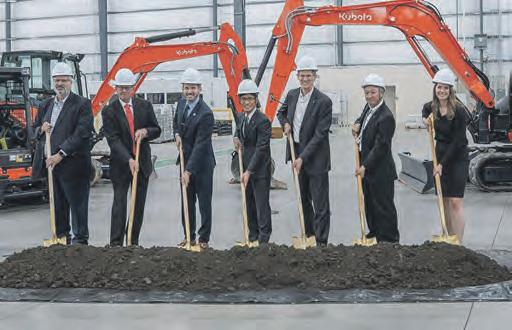
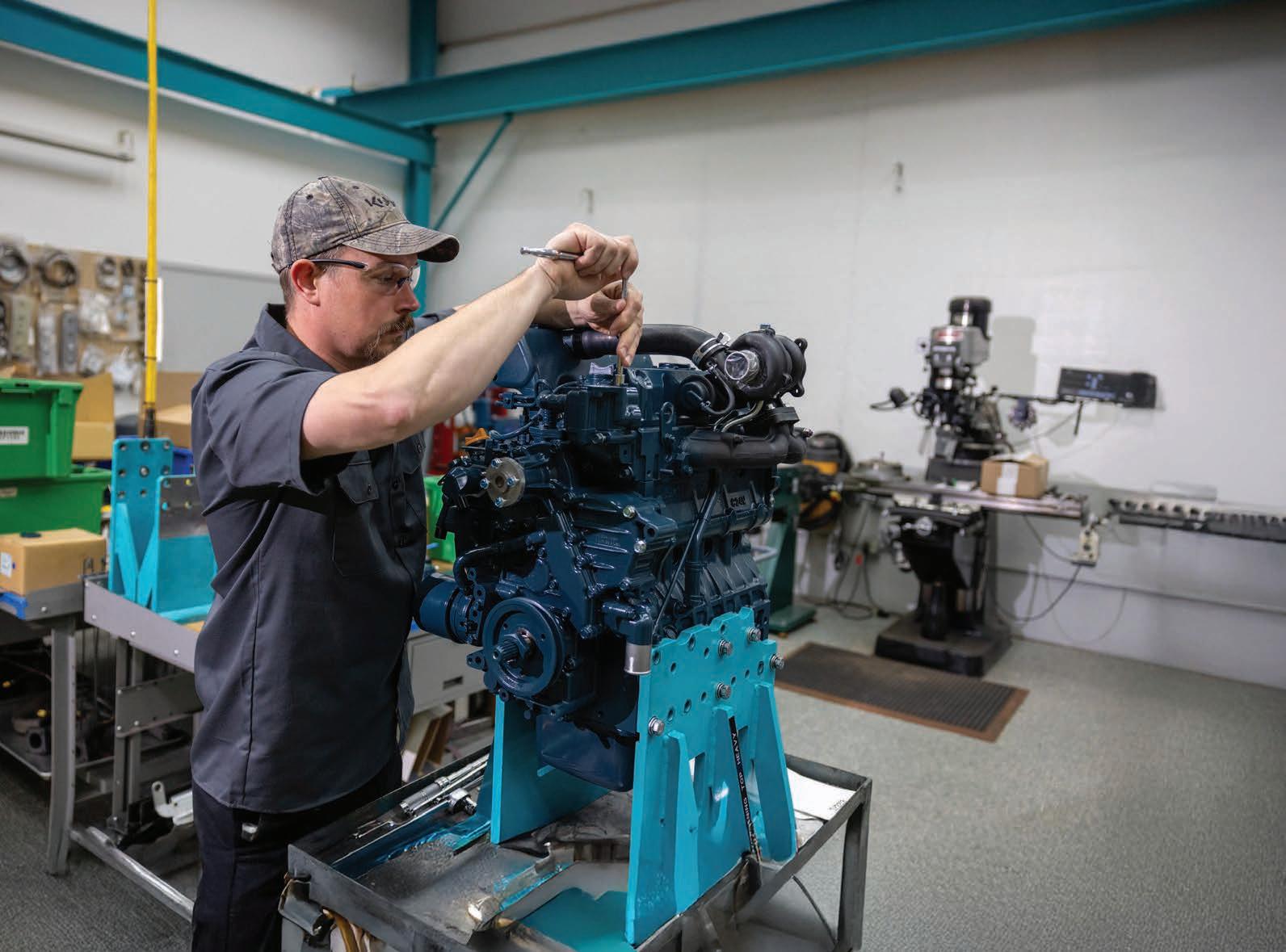
Kubota is opening a new construction equipment test centre in Kansas
Kubota North America is expanding its research and development capabilities for compact construction equipment, thanks to the groundbreaking of a new test centre in Salina, Kansas.
The $30 million development will reinforce Kubota’s commitment to designing, engineering and validating compact construction equipment in North America.
The 57,000 square-foot testing centre will support Kubota’s construction equipment line-up by accelerating development cycles and improving local field-validated performance.
“This investment reflects Kubota’s confidence in the North American construction market and our commitment to engineering machines that are built for the realities of North American jobsites,” said Brian Arnold, General Manager of Kubota’s North America Manufacturing Unit.
“Bringing expanded testing and validation capabilities to the U.S. strengthens our supply chain, accelerates development and ensures we deliver high performing compact equipment our customers can count on, supported by a strong dealer network focused on service, parts availability and keeping customers productive on the job.”
powers the machine to a rated operating capacity of 1,102-kg, delivering the muscle needed for loading trucks, handling palletized materials and tackling demanding site work.
The 250T has an operating weight of 4,477 kg, allowing it to be towed behind a 3/4-ton pickup truck without requiring a CDL. Crews can move from job to job without waiting on specialized transport, keeping schedules tight and downtime low.
As well, 40-cm wide tracks and a ground bearing pressure of less than 5 psi provide
stability and traction while helping protect prepared or finished surfaces.
The compact footprint supports manoeuvrability in tight spaces, while standard and high-flow hydraulic options give operators the flexibility to run a wide range of attachments.
With the unique JCB single-arm boom design, the 250T offers side-door entry and 270-degree visibility from the operator’s seat.
“Our single-arm boom is about more than a different look,” Tice said. “It allows operators to enter and exit
through a side door instead of climbing over a front attachment, which helps minimize one of the most common causes of skid steer
class matters for the crews who operate these machines every day.”
In 2021, Kubota created its Construction Equipment Research and Development North America (CERDNA) to bring engineering, testing and validation activities closer to its North American customers. The additional investment by Kubota North America represents the next phase in their growing construction equipment business.
The building design enables rigorous performance, durability and reliability testing under controlled, repeatable conditions that replicate real-world construction applications. This enables Kubota construction equipment to meet the performance, durability and uptime expectations of professional operators and fleet customers across North America.
“This expansion is a clear statement of Kubota’s long-term commitment to investing in America and growing our compact construction business here,” said Todd Stucke, President of Kubota North America.
“Kansas has been a strong partner, and the Salina facility will play a critical role as we continue to expand our construction equipment portfolio and support customers across North America.”
injuries. Bringing that level of visibility and safety into this size
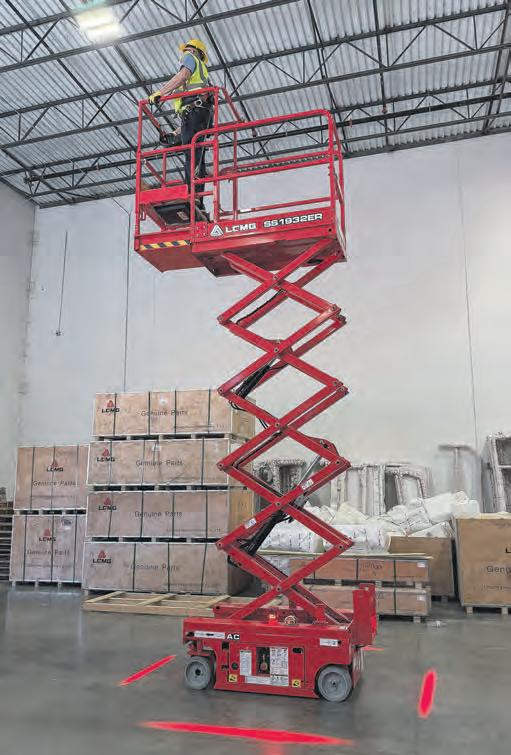
The new SS1532ER and SS1932ER micro scissor lifts from LGMG North America bring compact design and rental-focused ROI to tight jobsites.
Both electric lifts are engineered for applications where access, weight and productivity are critical, particularly in fast-growing construction sectors such as data centres, chip fac -
tories, battery plants and healthcare facilities.
Rental-first focus
Designed for rental-first utilization, the micro scissors are built to deliver reliable jobsite performance, with high uptime and utilization across repeat rental cycles.
“Over the past decade, micro scissor lifts have gained traction across the
rental market as contractors increasingly work in tighter, more congested overhead environments. In North America, this expansion has been driven in part by the rapid expansion of data infrastructure projects,” said Mark Elton, Director of Product Management at LGMG North America.
The SS1532ER and SS1932ER feature an 81-cm
width and a 1.5-metre overall length. The machines only differ in their working heights and weights. The SS1932ER has a maximum platform height of 5.5 metres (indoor) and 4.5 metres (outdoor), and a weighs 1,300 kg. The SS1532ER offers a maximum platform height of 4.5 metres and weighs 1,040 kg.
Their low stowed heights — 2 metres for the SS1932ER and 1.9 metres for the SS1532ER — allow operators to pass through standard doorways without folding guardrails. They feature a 226kg capacity platform rated for up to two occupants.
Their permanent magnet synchronous lift motor provides smooth motion to improve control with higher efficiency, meaning more working time between charges.
The new lifts also stand out for the number of features included as standard, beyond what is typically offered on similar models.
Both machines come equipped standard with perimeter lighting to provide a visual cue in busy or low-light environments. A
standard integrated step deck provides additional reach for overhead work.
To support indoor work, the micro lifts include a standard leak containment system designed to capture hydraulic drips, helping control leaks on jobsites.
As on all LGMG slab scissors, a keyed brake release switch comes standard to easily disengage the brakes if the machine needs to be
winched or pushed.
“We’ve been receiving an extremely positive response to our new micro scissor lifts from customers. They consistently highlight the machines’ lightweight design, manoeuvrability and reliable performance in tight jobsites,” Elton said. “This translates into higher utilization, increased productivity and better ROI for rental fleets.”
A legacy forged in heavy iron
Hub Equipment celebrates 80 years in heavy equipment sales and rental
When T.H. Stevenson noticed construction equipment sitting idle in the postwar boom, he saw more than inefficiency, he saw opportunity.
Eight decades later, that observation still defines how Hub Equipment operates.
As Canadian soldiers began to return from Europe following the Second World War, construction surged.
The return of about one million veterans sparked a housing boom for a country with a population of only 11 million people. As building boomed, Stevenson, a contractor at the time, noticed that construction equipment would often sit idle.
He decided to turn that observation into a business opportunity and founded Hub Equipment in Moncton, New Brunswick, in 1946.
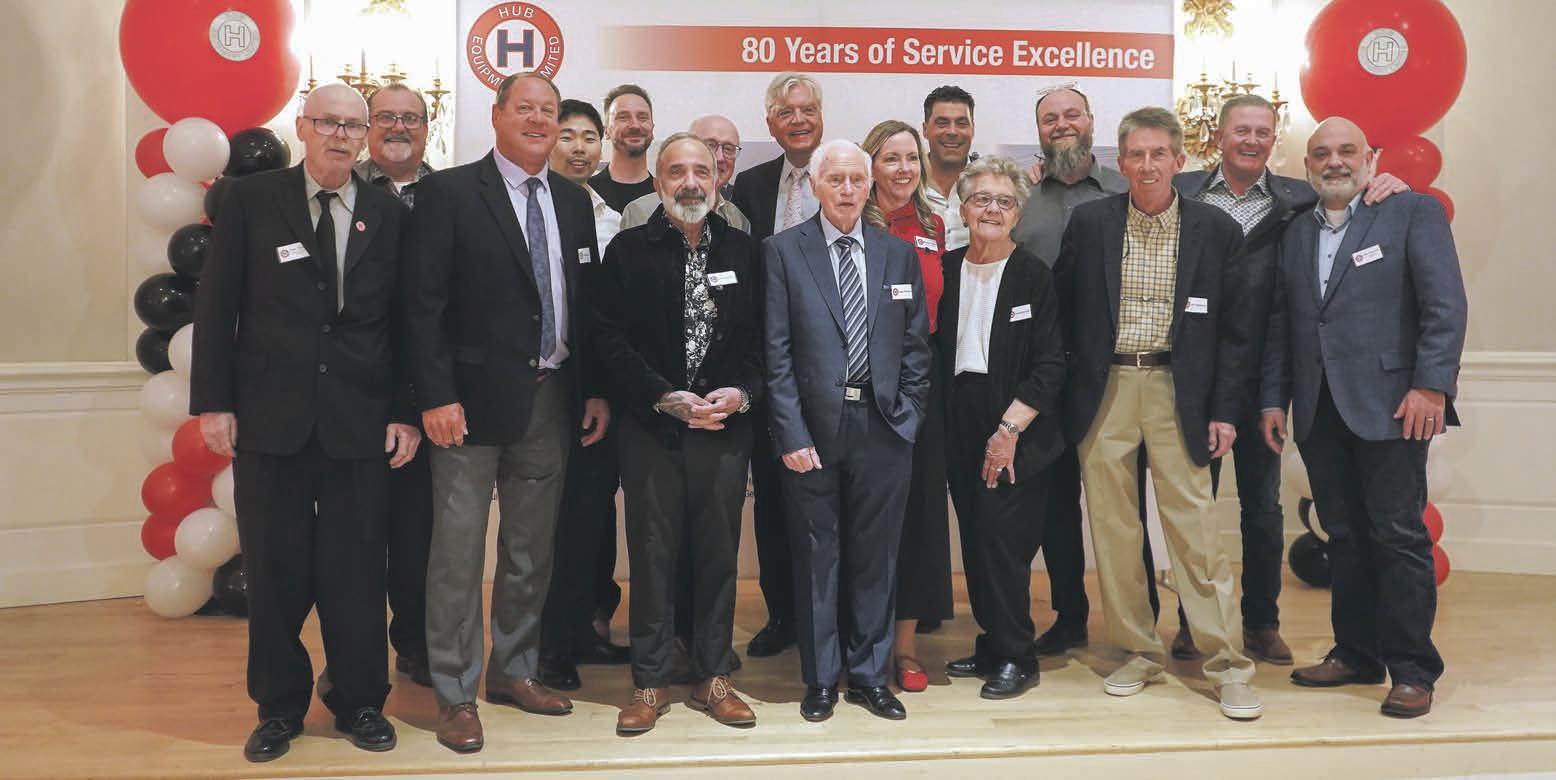
This year, Hub Equipment — named after Moncton, known as the Hub of the Maritimes — is celebrating 80 years of selling and renting heavy equipment to Canada’s contractors.
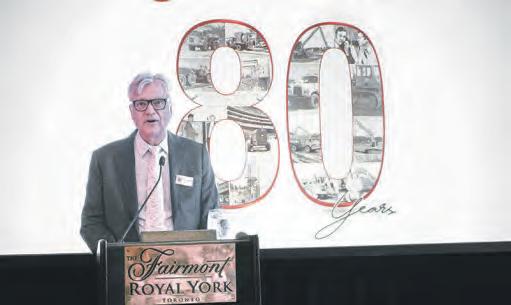
To commemorate the milestone, Hub Equipment hosted an 80th anniversary celebration at the Fairmont Royal York in Toronto in April.
“Few Canadian equipment rental companies survive 80 years, and even fewer continue to grow and prosper across generations,” said Tom Stevenson, President of Hub and grandson of T.H. Stevenson. “Hub’s longevity is a testament to the dedication of our team, the loyalty of our customers and the values that have guided us from the very beginning in 1946.”
When construction of the Saint Lawrence Seaway began in the 1950s, T.H. Stevenson’s son, Verne, moved Hub Equipment to Brockville and Cornwall, Ontario, to serve the massive construction undertaking. The company eventually migrated to Toronto in 1957 and would expand to focus on buying and selling used equipment, as well as the growing rental industry.
Verne Stevenson led the company for
48 years, building a legacy of integrity and respect in the construction world.
“He was especially known for his honesty and his deep knowledge of used equipment, often closing a sale with nothing more than a phone call or a handshake,” said Tom Stevenson, who has led Hub Equipment since 2001. “And throughout his tenure at Hub, Verne consistently sought the opinions of our team, who were instrumental in making Hub successful, and the only reason we’re really here tonight.”
Tom Stevenson said succession planning became one of the most important responsibilities in ensuring the company’s continued long-term success.
“For Hub, it was essential to find a strategic partner who shared and practiced our values, offered meaningful growth opportunities, provided long-term security for our employees and respected the history that shaped this company,” he said.
In 2023, Tom Stevenson found that partner, and 100 per cent of Hub Equipment was sold to Cooper Equipment Rentals. The two companies aligned on several shared values, including looking after customers, building strong relationships and delivering on commitments.
“It’s the same value system, the same mindset. It’s the same belief that you take care of your customers, and you build strong relationships,” said Brian Spilak, CEO of Cooper Equipment Rentals. “When we brought Hub into the Cooper family a few years ago, we knew we were taking stewardship of a name that actually meant something in this marketplace.”
The same year Cooper acquired Hub, it also opened a new location in Moncton, New Brunswick, the Hub of the Maritimes.
“I love the full-circle symmetry of that,” said Darryl Cooper, President of Cooper Equipment Rentals.
As a testament to the strength of its
brand, Hub is the only company among Cooper’s 19 acquisitions that didn’t transition immediately to the Cooper brand.
“That’s intentional. We knew that it meant something in this marketplace and we wanted to honour that legacy,” Spilak said.
Doug Dougherty, Executive Chair of Cooper Equipment Rentals, said he understands how difficult it is to find the right buyer when selling a legacy business. He grew up in his own family’s business, Ray-Gordon Equipment, where he served as president for 15 years. In 1996, Ray-Gordon Equipment was acquired nearly 60 years after its inception.
“Our Cooper team feels honoured to have been chosen as the partner to steward the Hub business through the last few years towards this important milestone,” Dougherty said. “The history is long, the legacy is strong and the pride in what has been achieved will live on.”
Cooper Equipment Rentals was founded by Darryl Cooper’s father, Gord, in 1972. Like Hub’s legacy, Gord started his company based on respect and a goal of building long-term relationships.
While both companies worked in the same markets, they enjoyed a competitive coexistence. In the ’90s, Cooper and Hub were even neighbours on Markham Road in Toronto.
“Our dads, Verne Stevenson and Gord Cooper, were very different people, but they shared many of the same values: respect for tradition, craftsmanship and quality; respect for integrity, fair business and win-win outcomes; and respect for people, as evident in the tenure of longterm Hub and Cooper employees,” Darryl Cooper said.
Today, Hub Equipment operates alongside Cooper’s heavy rents divisions in Brampton and Edmonton.
“Our promise is to stay true to the values laid down by Verne and Gord: putting customers and people first,” Darryl Cooper said.
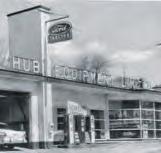
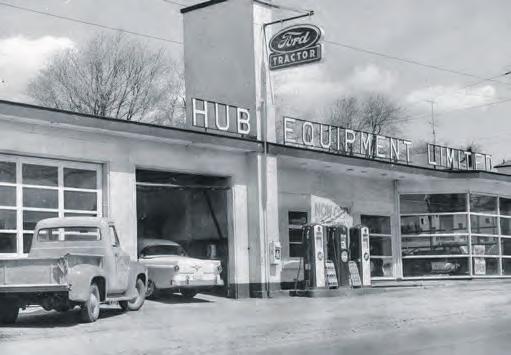
Hub Equipment's location in Cornwall, Ontario in the 1950s.
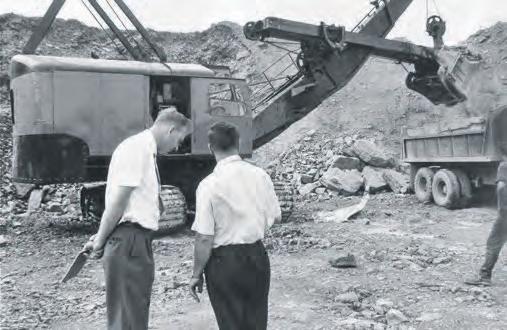
Verne Stevenson visits a jobsite in 1956.
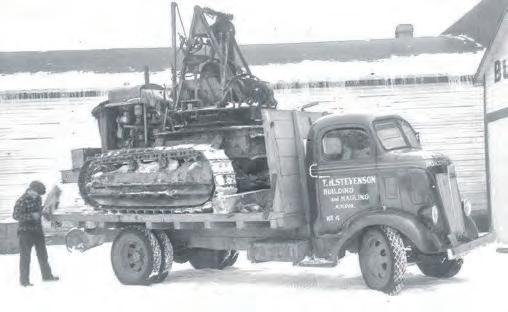
T.H. Stevenson Building and Hauling in Thunder Bay, Ontario in 1930.
Tom Stevenson, President of Hub Equipment, speaks at the company's 80th anniversary celebration.
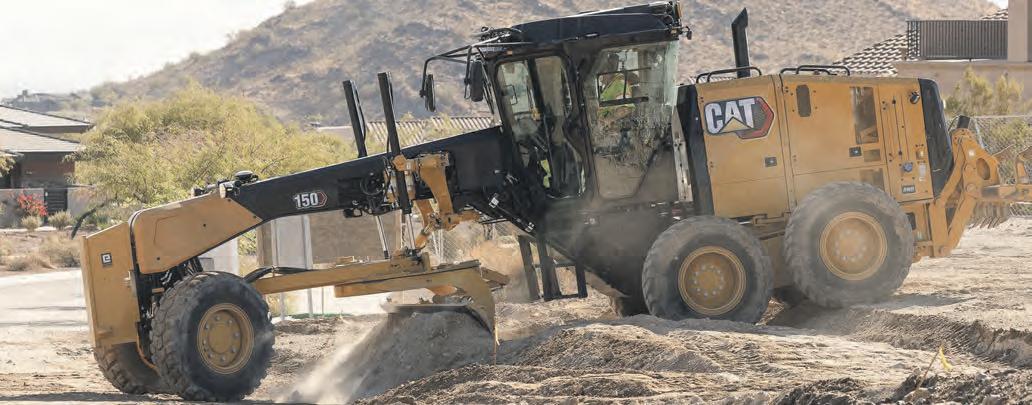
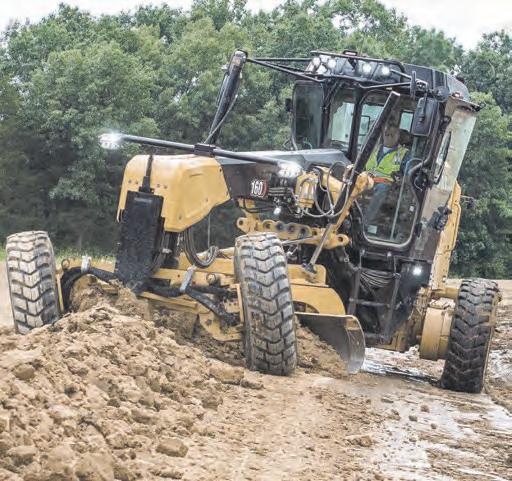
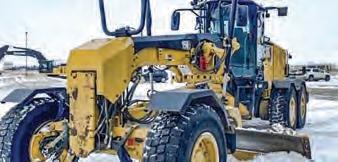
Caterpillar has announced that its 150 and 160 motor graders are shifting to the Next Generation platform.
The next gen redesign delivers smarter controls, improved efficiency and enhanced operator comfort.
Both models now feature Caterpillar’s easy-to-use joystick steering controls: optional on the Cat 150 and fitted as standard to the Cat 160.
Joysticks place transmission, gear shifting and machine-direction control on the left, while the right handles drawbar, circle and moldboard functions as well as throttle control and the manual differential lock and unlock.
“Hours of ergonomic research shows how joystick
controls reduce hand and arm movements for the operator, when compared to the usual level and steering configuration,” said Eric Kohout, Caterpillar Senior Product Consultant for Motor Graders.
“Reducing operator fatigue is key to maintaining and improving productivity. So, transferring control into two, three-axis joysticks completely redefines operator comfort.”
Both new next gen models deliver exacting control through nine forward and six reverse gears, with a new offering of a finish gear that allows the operator to achieve precise grading results.
The finish gear is used for the final stage of the grading process, and ensures the
ground is uniform and even, delivering the specified slope and elevation requirements for the most demanding construction projects.
The 150 sports a 3.6-metre moldboard as standard, with a standard 4.3 metre moldboard on the 160. Both graders are upgradeable to 4.3 metres and 4.9 metres, respectively.
“The Next Generation platform is all about efficiency, productivity and operator comfort. These new models achieve those objectives in many ways,” Kohout said.
“From a practical perspective, the new models maintain the dimensions of those they replace with a C9.3 engine providing strong, consistent power to the ground.”
Another new feature for the
next gen graders is the fully redesigned cab, which was introduced on the 120 and 140 models. Larger windows improve visibility all around the cab, with particular focus on the moldboard and tires.
Cat has also improved HVAC and seat adjustment options.
To further improve visibility, the optional integrated rear vision, front vision, 360-degree cameras
and Caterpillar’s People Detection system feed into the cab’s 25-cm touchscreen. The same screen also controls optional technologies, such as Cat Grade. Both models allow easy upgrades to attachments, ensuring they hit grade faster.
“It’s exciting to see the Next Generation features arriving with the 150 and 160,” Kohout said. “Caterpillar motor grad-
ers have long been revered for their ‘grade any terrain’ capability and impressive jobsite productivity. The new platform serves only to make that offering more robust still.”
The Cat 150 with joystick option will launch in Europe in the second half of 2026, followed by the full launch for all configurations and regions.
United Rentals launches Artificial Intelligence equipment agent
United Rentals has developed a new Equipment Agent, a first-of-its-kind Artificial Intelligence-powered equipment recommendation solution.
The digital assistant helps United Rentals customers discover, compare and select the right equipment for their projects by delivering intelligent equipment rental guidance online.
“The Equipment Agent connects United Rentals’ equipment expertise with our customers' needs,” said Tony Leopold, Senior Vice President and Chief Tech-
nology and Strategy Officer at United Rentals. “It replaces traditional searching and filtering with an intuitive, agentic chat experience. Customers using the Equipment Agent are seeing a 70 per cent improvement in finding the right equipment for their projects.”
The Equipment Agent provides personalized recommendations based on project requirements. Through a conversational interface, customers can describe their job needs in plain language and receive tailored equipment suggestions in seconds, while
also comparing equipment types and reviewing key specifications such as capacity, reach, terrain limitations and required accessories. By simplifying equipment discovery and providing expert guidance early in the planning process, Equipment Agent will help customers make faster, more confident rental decisions.
The solution connects users to detailed product pages on unitedrentals.com, streamlining the path from research to reservation. Built using real customer questions and refined through extensive testing by United Rentals sales and equipment experts, Equipment Agent reflects decades of fleet knowledge and practical jobsite expertise.
Equipment Agent supports United Rentals’ broader innovation strategy, which focuses on combining digital tools, connected equipment and data insights to help customers plan, operate more efficiently and keep projects moving. By applying AI to the equipment discovery process, United Rentals is simplifying how customers identify the right solutions and accelerating the path from project planning to equipment on site.
The Equipment Agent also expands how United Rentals delivers its equipment expertise to customers. By connecting users to insights drawn from the company’s extensive fleet, services and jobsite experience, United Rentals is making it easier to access the guidance and resources needed to plan and execute work with confidence.
Here on earth, gravity is an overlooked, yet a tremendously important, factor in excavation.
So, when Vermeer CEO Jason Andringa (who previously worked for NASA’s Jet Propulsion Laboratory) was approached to figure out how to excavate in a low gravity environment, he eagerly accepted the challenge.
need more nuclear weapons. And that's not good, right?”
Helium-3, a non-radioactive isotope of helium, is also a byproduct of the sun.
Solar winds have scattered the isotope through the solar system, but Earth’s atmosphere deflects most of the particles.
“But on the moon, where there is no atmosphere, it embeds into the soil, into
latest prototype, which was proven in on-Earth testing, was displayed at Vermeer’s ConExpo booth in March.
“We've looked at over 100 different concepts, 100 different ways to go,” Keeley said. “We picked out the ones that looked like they had the best shot, and we built out some test capability to evaluate these concepts at a small scale that could give
The prototype is both diesel-powered and hydraulic, which are both functions that won’t work on the moon. However, the cutting style has proven effective.
“Our role in this is we want to be good at what we're good at, and that's moving dirt,” Keeley said.
Excavation is the first in a four-step proprietary system to harvest natural resources
Built to Dig In. Built to Last.
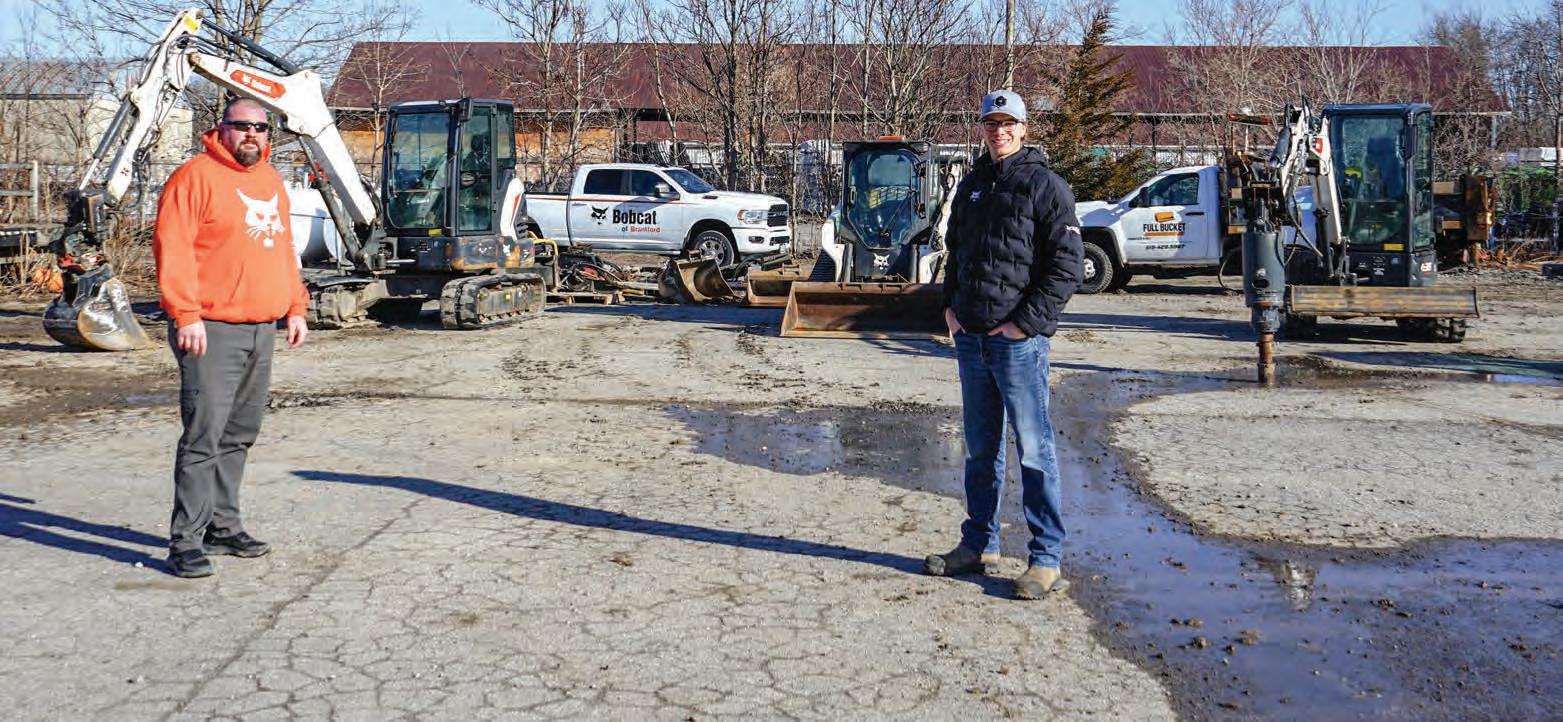
Ten years in, Gary Harp has built Full Bucket Contracting on one principle, do it all, and do it right.
Serving Brant, Haldimand and Norfolk, the company handles everything from septic systems, sewer and watermains hooks ups for new homes, excavating, grading, retaining walls, interlocking, hauling, foundations, and concrete work. Positioned between large contractors and smaller operators, Harp has carved out a niche that keeps work consistent year-round.
“We’re right in that middle ground,” he says. “Big enough to handle full projects, but small enough to take on jobs others pass on.”
“You can’t put all your eggs in one basket in this industry,” he explains. “Everything we do ties together. If you understand how water moves, grading, drainage, it all connects. That’s what makes the difference.”
Bobcat of Brantford 519-752-7900 bobcatofbrantford.com
GREY BRUCE
Bobcat of Grey Bruce 519-372-9100 bobcatoftc.com
PARRY SOUND
Bobcat of Parry Sound Ltd. 705-342-1717 bobcatofparrysound.com
TORONTO WEST
Bobcat of Toronto 416-679-4172 oakenequipment.ca
with his first Bobcat, a T180 compact track loader, to installing helical pile foundations through his other company, Postech Screw Piles and Full Bucket Contracting, Harp’s business has evolved, but Bobcat of Brantford has been there from the start.
“They’ve always treated me right,” he says. “When you’re down, they know what that costs you, and they work to get you back up and running.”
Today, his fleet includes a Bobcat T66 compact track loader, E35 and E60 compact excavators, backed by a full range of attachments to handle everything from final grading to demolition and septic installs.
“It really comes down to service and relationships,” Harp says. “They’ve been solid from my day one. Luke Scholten, sales specialist, has been taking care of me for the past two years. He is eager, learning the ropes and I have to say I am a harder client than most, and he has been great with me.”
Comfort. Capability. No Compromise.
From soil conditioning and augering to breaking
CASSELMAN
Bobcat of Ottawa Valley 613-764-2033 bobcatov.com
HAMILTON
Bobcat of Hamilton 905-643-3177 bobcatofhamilton.com
PETERBOROUGH
Bobcat of Peterborough 705-748-9119 bobcatofpeterborough.com
THUNDER BAY Equipment World Inc. 807-623-9561 bobcat-tbay.com
CORNWALL
Bobcat of Ottawa Valley 613-932-2034 bobcatov.com
KITCHENER
Bobcat of Tri-Cities Ltd. 1-866-214-3939 bobcatoftc.com
STRATFORD
Bobcat of Stratford 519-393-6040 bobcatofstratford.ca
SAULT STE. MARIE
Bobcat of Sault Ste. Marie 705-949-7379 bobcat-ssm.com
concrete and site cleanup, Bobcat machines are central to daily operations, helping the crew work faster and reduce labour.
“The attachments make a huge difference. The hydra tilt swing for example, was a deciding factor on one of our purchases,” he says. “Bobcat has the right tool for every job.”
Operator comfort is another advantage. “Bobcat does a really good job with the creature comforts,” Harp notes. “The cab layout, touchscreen controls, seat warmers, Bluetooth, it makes a long day a lot easier on the operator. That matters.”
Steady Growth. Solid Ground.
As the business continues to expand, Harp remains focused on quality work and long-term relationships.
“It’s about doing the job right and building trust,” he says. “That’s what keeps people coming back.”
And with Bobcat in the lineup, that foundation isn’t changing anytime soon.
“As long as they keep backing us up, we’ll keep running Bobcat.”
COURTICE
Bobcat of Durham East Ltd. 905-404-9990 bobcatofdurhameast.com
(L to R), Gary Harp, owner of Full Bucket Contracting and Luke Scholten, sales specialist for Bobcat of Brantford, at yard in Simcoe, Ontario.
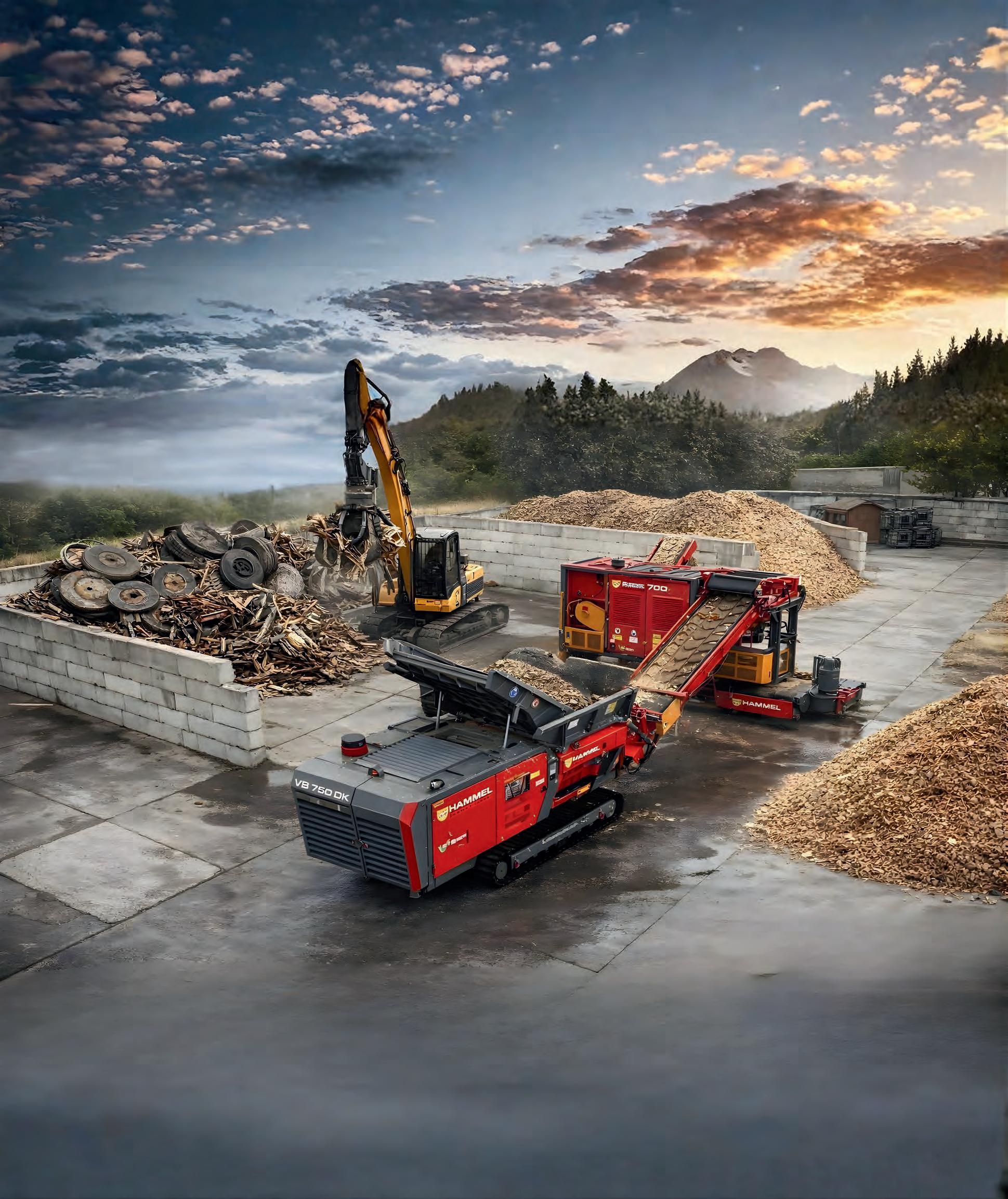
Mobile, compact, and Mobile, compact, and powerful HAMMER CRUSHER. powerful HAMMER CRUSHER.
DEMOLITION & WASTE
Raising the bar in demolition
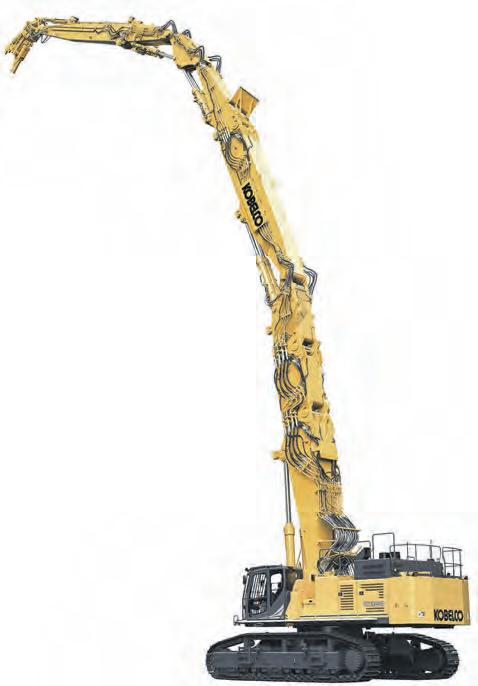
Volvo Construction Equipment introduces the EC950, its largest high reach excavator
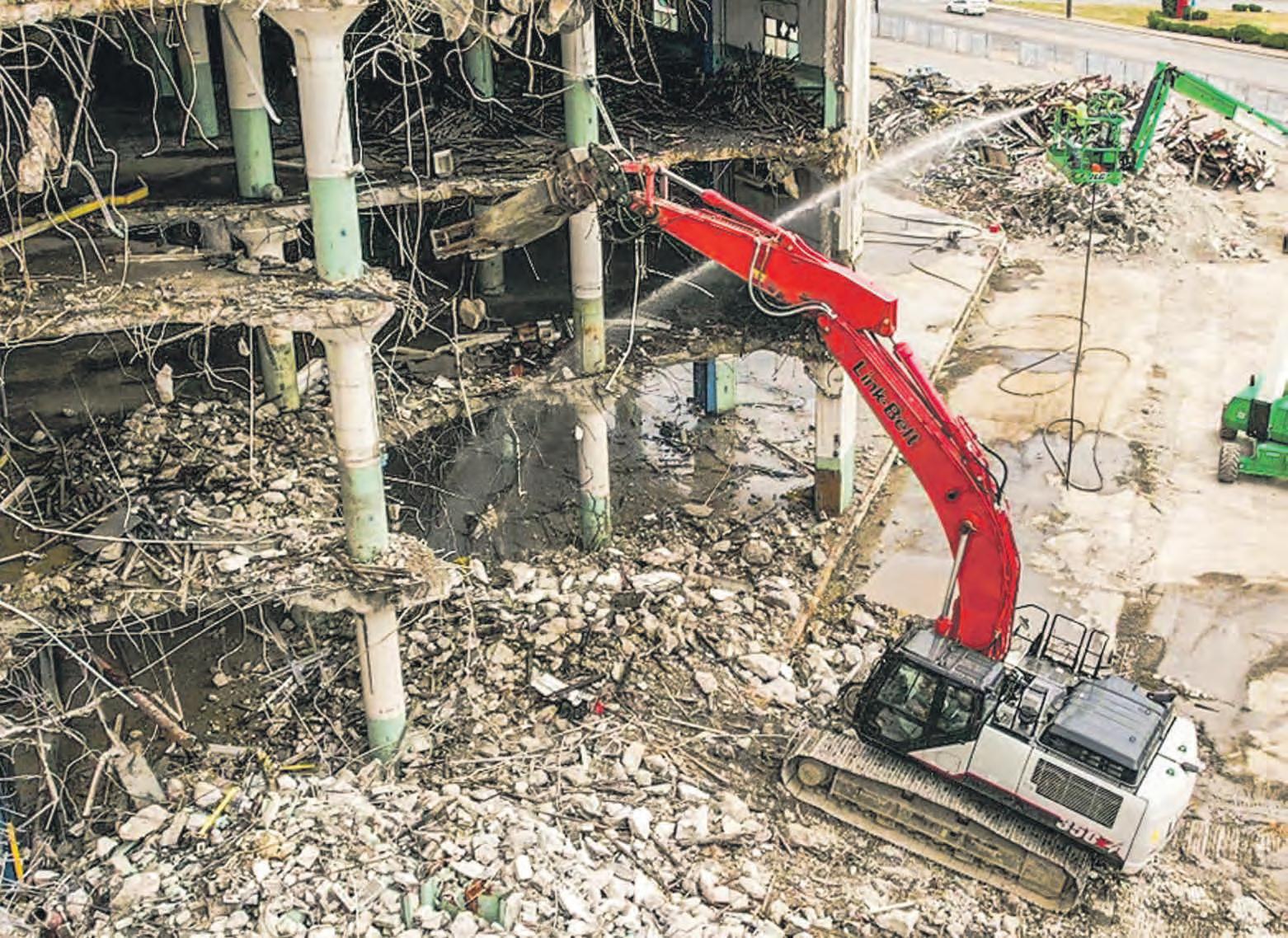
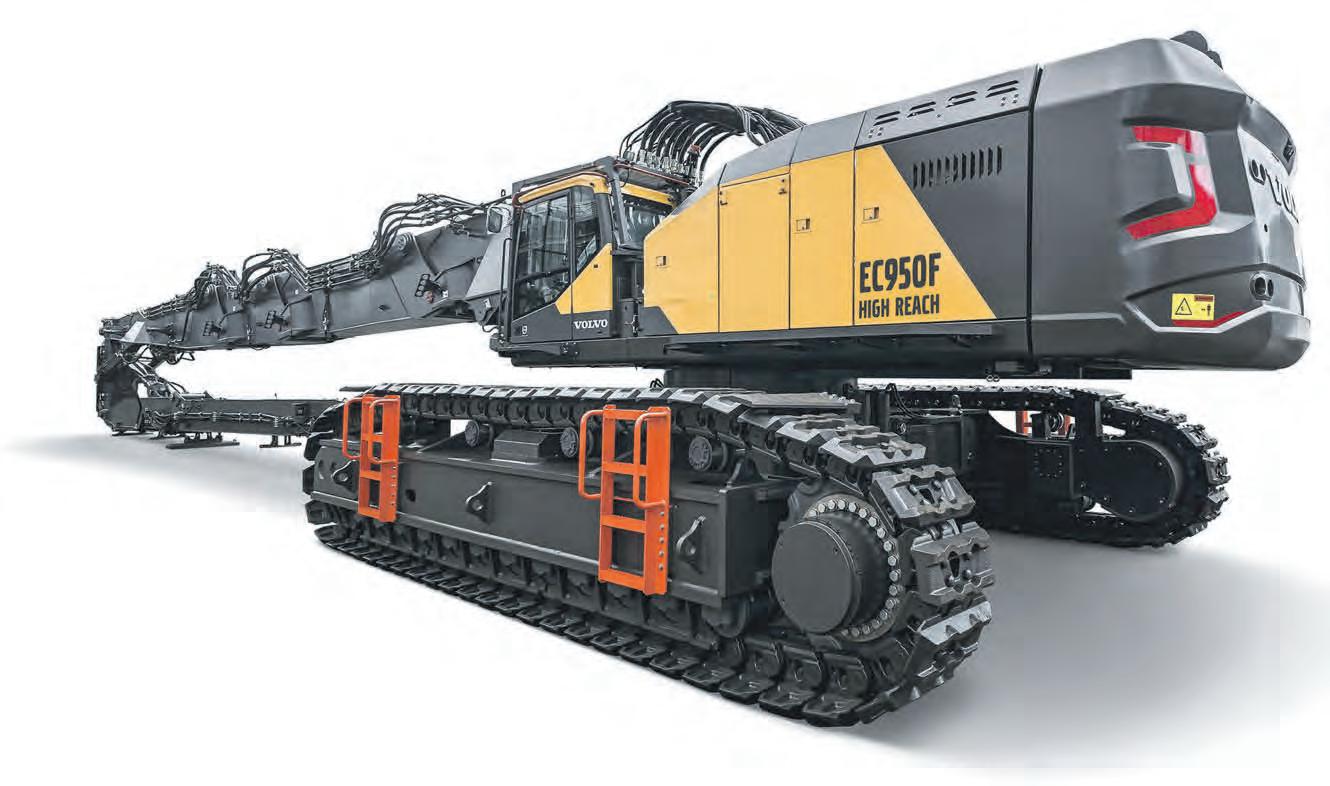
Volvo Construction Equipment has significantly elevated its high reach excavator lineup with the introduction of the EC950 High Reach — the largest high-reach excavator in the OEM's portfolio.
The new 180,000-kg demolition excavator joins the EC400 High Reach (47,800 kg), EC500 High Reach (61,300 kg) and EC750 High Reach (103,028 kg) machines.
As the demolition industry shifts toward high-reach dismantling for multi-story
projects, purpose-built excavators offer a safer and more controlled solution.
The EC950 High Reach combines a modular multi-configuration design with stability, advanced demolition tech and advanced safety features to deliver powerful, reliable and efficient performance on the tallest and constrained jobsites.
The new high reach machine was developed by Volvo engineers in collaboration
with Volvo-authorized partners.
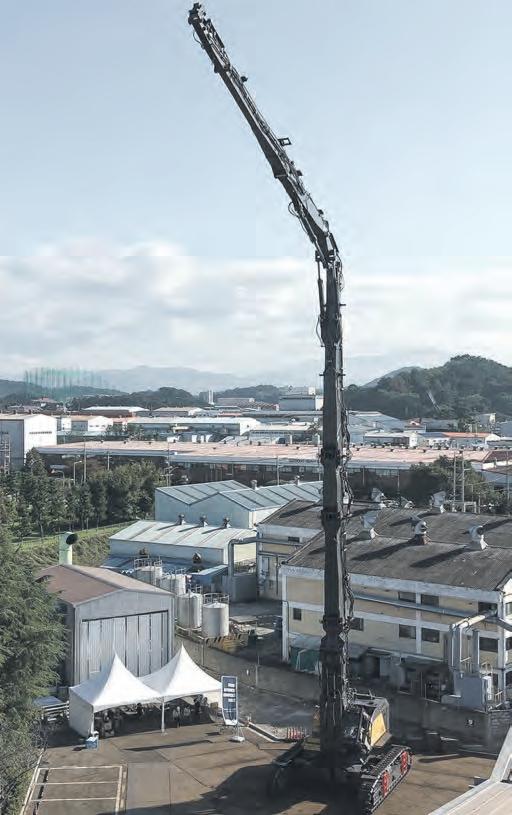
“The EC950 High Reach is the latest special application solution from Volvo. It has an operating weight of over 400,000 pounds and maximum height of 161 feet while working with a 7,500-pound tool,” said Tony den Hoed, Director of Strategic Demolition Accounts for Volvo Construction Equipment North America.
“It combines size, strength and intelligent design to enable customers to achieve outstanding results on the largest and most challenging demolition projects.”
Modular design
A key concern for demolition companies operating machines in the EC950 class is transportation.
Volvo considered every element of the EC950 High Reach’s design — including weight, height and length — to ensure that it remains within standard transportation dimensions.
Central to this is the modular multi-configuration boom and arm concept, which allows for simple assembly and disassembly. Volvo also included a hydraulic removable counterweight, detachable side tracks, modular boom and arm sections and hinged walkways for easier transportation.
The modular design of the undercarriage includes hook-on track units to reduce the transport weight of the separate parts of the
machine. With a maximum transport height of 3.6 metres, hook-on-type modular joints and hydraulic cylinder-type pins, the machine can be quickly configured on-site to suit specific job requirements. Not only does the flexible machine design reduce the cost and complexity of transportation, but it also enables demolition contractors to use the same excavator across multiple applications with a variety of pin heights and allowed tool weights, helping to minimize initial investment and maximize return.
Strong and stable
Built to meet Volvo Ultra High Reach (UHR) stability criteria, the EC950 High Reach remains stable even when operating with heavy attachments and extended reach. The Volvo undercarriage, plus a purpose-built upper frame with boom adapter and larger boom and cylinder pins, provides the strength and durability required for high-stress demolition environments. This is combined with a specially developed ring gear able to withstand the enormous forces a machine of this size creates.
Advanced demolition features
The EC950 High Reach is equipped with a comprehensive suite of demolition-specific features designed to improve operator comfort, enhance visibility and increase jobsite safety. A tilting cab with up to
30-degrees of tilt provides excellent upward visibility, while the removable 38.1tonne counterweight and new undercarriage design support safer handling of heavy loads. As well, r eal-time safety monitoring is delivered through the Volvo total moment indicator (TMI), providing operators with continuous feedback to help prevent tipping or overloading and ensuring safer, more efficient demolition operations.
Volvo Smart View cameras with optional obstacle detection enhance safety for operators and site teams.
The hi gh reach machine’s high-visibility cab is fitted with P5A certified polycarbonate windows and a frame-mounted falling object guard (FOG), helping to protect operators from falling debris. Additional features like undercover protection, full track guards, a slew ring cover and boom and bucket cylinder protectors further safeguard critical machine components.
CareTrack standard telematics and ActiveCare Direct advanced telematics provide real-time machine health data and predictive maintenance alerts to keep fleets productive and protected.
Inside the spacious, lownoise cab, all machine interfaces — including joysticks, keypad and LCD monitor — are ergonomically positioned for intuitive and efficient operation. Easy cab access is provided via a
wide door opening, while hydraulic dampening mounts and sound-absorbing lining reduce shock, vibration and noise levels.
A fully adjustable ergonomic seat with independently moving joystick console allows operators to tailor the cab to their preferred working position, supporting comfort, safety and productivity over long shifts. Whatever the weather, an integrated heating and air conditioning system distributes pressurized, filtered air through multiple vents to maintain a comfortable working environment.
The EC950 High Reach also supports cleaner, safer worksites with an integrated dust suppression system.
In response to the increasing scrutiny and regulation demolition operations face around dust creation, the EC950 High Reach comes complete with an integrated dust suppression and cleaning system. Dual water spray nozzles effectively control airborne dust, while a high-pressure washer helps keep components clean during operation. The result is a cleaner working environment for those in the cab, on the jobsite and in the surrounding community.
The system is also designed to keep key components clean, helping to improve machine longevity and reduce maintenance requirements.
The EC950 High Reach excavator is currently available in North America.
Allu combines concrete screening and crushing in one bucket
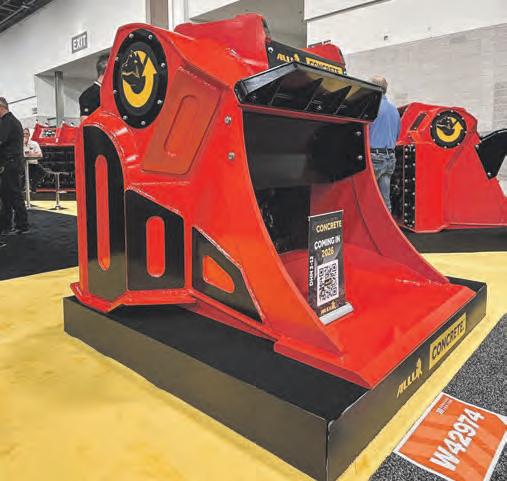
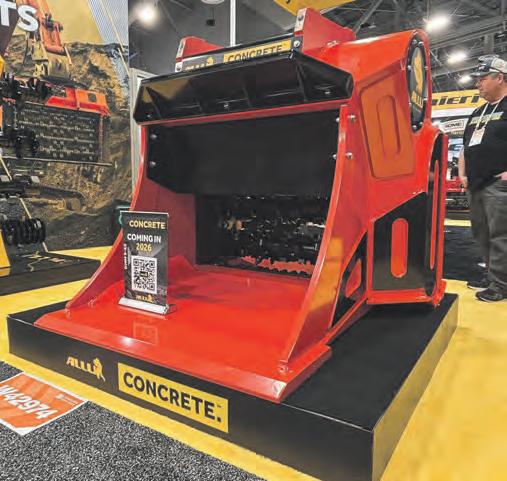
Allu plans to introduce a new bucket to help demolition and recycling contractors process concrete and bric k rubble on tight jobsites.
At ConExpo, Allu offered a sneak peek at its screening and concrete bucket for rebar-contaminated demolition rubble. The new excavator-mounted attachment is designed to crush demolition rubble on-site, including material with rebar that typically causes slowdowns and rejections.
“Contractors don’t need another machine to manage on a crowded jobsite; they need a practical way to turn rubble into usable materi -
al with the excavator they already have,” said Antti Rautamies, Research and Development Project Manager at Allu.
“This bucket is built for the real world: fines-heavy material streams, tight spaces and reinforced concrete that doesn’t arrive clean.”
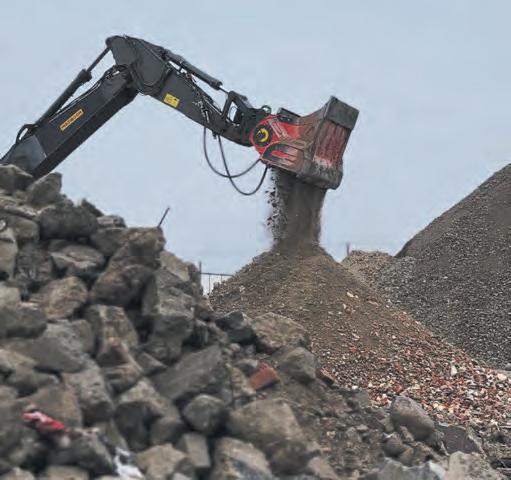
The Allu Concrete Bucket is designed for excavators in the 25-to-45-ton class and crushes demolition rubble such as concrete, bricks and asphalt (RAP). It targets jobsites where bringing in a separate mobile crusher is inefficient, or not possible, helping contractors process material right where it’s generated.
The bucket can also be used to increase a mobile crusher’s capacity by pre-crushing and feeding with the same attachment at demolition or recycling sites.
Handles rebar
Steel in the feed is one of the fastest ways to ruin productivity. The Allu Concrete Bucket is designed to handle steel and rebar embedded in the material, helping keep the job moving and reducing stop-and-clear time that can halt production on demolition work.
“Crushing concrete, which also can include rebar, gives a huge opportunity to do
quick recycling of material without bringing in bigger equipment to a demolition site,” said Allu CEO Peter Grönholm.
As well, the bucket features a changeable counter blade setup that supports output sizes up to 50 mm and up to 100 mm. This allows crews to aim for the right balance of fragment size and productivity without changing the whole flow of the job.
The bucket is designed for a processing capability of up to 100 tonnes per hour with high fines content and a maximum feed size of 30 cm.
Allu designed the bucket to ensure wear part chan -
ges are straightforward. The bucket includes a heavy-duty frame structure with a 40 mm cutting edge and 30 mm side cutters, which are designed to withstand breakout forces of excavators up to 45 tons.
The crushing drums and blades are still under the final research and development work, but Allu said many successful tests have been conducted in real-life surroundings, utilizing multiple innovative drum and blade configurations.
A counter blade structure forms the crushing chamber, and the bucket uses two alternative rotating directions to support a continuously
effective crushing operation while screening fines quickly through the bucket.
The bucket will require hydraulic flow of 190 to 315 litres per minute and 80 to 134 hp typical operating power.
Fuel consumption with a 40-ton excavator equipped with the bucket is noted at about 30 litres per hour.
The Allu Concrete Bucket is still under final testing and the first model for 25-to40-ton excavators will be available in the market in 2026.
"The idea is, when we get more experience, we plan to widen the range,” Grönholm said.
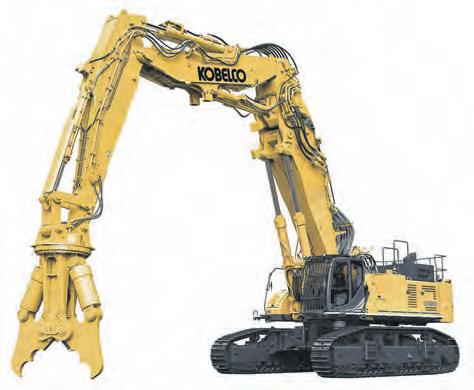
Built for demolition: Kobelco’s giant SK1300DLC-11
Kobelco’s massive new 137-tonne SK1300DLC-11 purpose-built demolition excavator can reach heights of 37 metres.
Powered by a 512-hp engine, the SK1300DLC-11 is available with a wide range of boom and arm combinations and is purpose built for building demolition.
With variable front configurations, the machine has a maximum reach of 36.9 metres.
Although the SK1300DLC-11 weighs 137-tonnes, it can be disassembled for easy transport. The minimum transport weight of the base machine without the counterweight is 60,781-kg with no single component weight exceeding 18 tonnes.
The machine comes with a separate demo digging front, three-piece high reach and four-piece high reach multi-configuration front attachment.
The high reach attachment comes with transport and storage stands, water spray system, electronic on-board lubrication system, quick hitch piping, boom and arm safety valves, a two-piece removable layered counterweight, removable track system with remote trans-lifter, energy saving eco-mode, in-cab hydraulic pressure release, combination rotation and nibbler breaker
with proportional hand controls, case drain line and filter, reversable fan and a unlimited power boost mode for separate boom attachments.
Kobelco comfort
The -11 series cab is equipped with enhanced ergonomics and safety features with ample space and visibility. The operator’s pilot levers move horizontally without arching of the wrist, while also providing shorter lever strokes to deliver a swifter, more precise movement.
Built for demolition, the sound suppressed 30-degree tilting cab comes with an emergency lowering system. As well, the -11 machine features a 270-degree camera system with switchable rear-under view camera or high reach attachment view, rear view mirrors, LED work lights, rear swing flashers, demolition Level II FOPS guard and bar type front guard, P5A safety glass, falling object deflector, cab interference prevention system, stability tip-over warning and public address speaker system for on the ground handsfree communication.
Multiple air conditioning and heater vents are directed towards the operator to maximize comfort, while a jog dial integrates multiple functions into a single user interface with
the large 25-cm colour monitor.
The menu screen facilitates reading of valuable information including work mode, maintenance intervals and fuel consumption. The cab is also equipped with an FM/AM, aux input, Bluetooth, hands-free telephone radio, smartphone holder, USB charger and a 12V power outlet.
The 512 hp Isuzu 6WG1 engine meets current Tier 4 Final
and Stage V emission requirements. The engine features a 15.7-litre, in-line 6-cylinder design, known for its power and reliability in demanding applications.
The engine is commonly used in various heavy-duty trucks, construction and other industrial equipment. Kobelco currently uses the 6WG1 engine in its SK850LC-11 excavator.
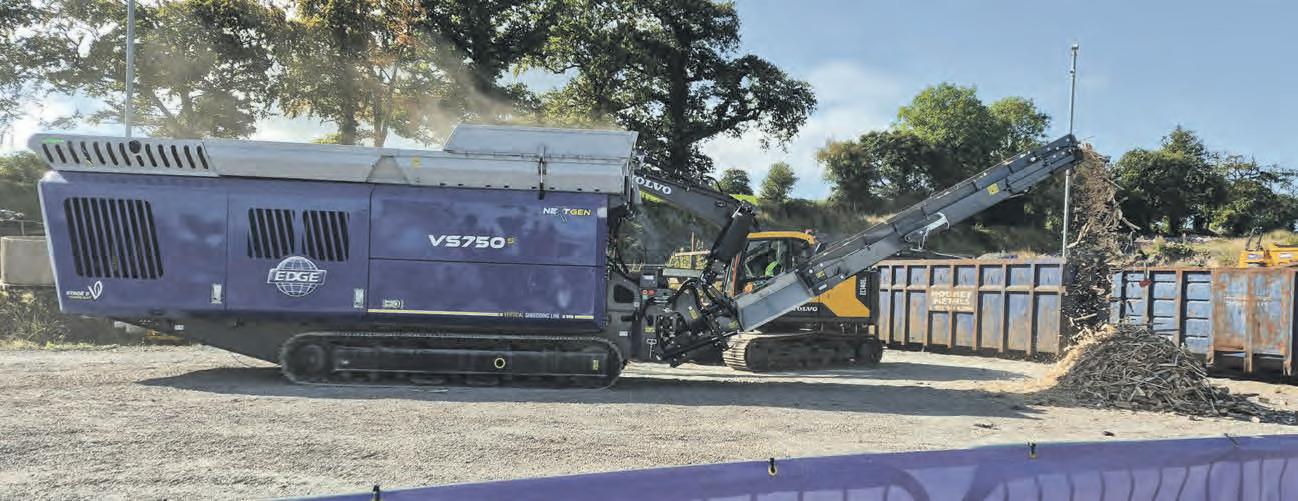
Edge Innovate supercharges shredding with new high-torque VS750s
Edge Innovate’s new VS750s shredder represents a significant advancement in slo w-speed, high-torque shredding technology.
Making its public debut at ConExpo, the VS750s is purpose-built for largescale recycling and waste processing applications. The shredder is engineered to process high volumes of difficult waste streams while maintaining control, efficiency and durability.
“The VS750s, in particular, demonstrates our ability to engineer truly high-capacity solutions, combining enormous scale, power and intelligent control in one machine. These products reflect exactly what Edge Innovate stands for — robust engineering, practical innovation and equipment that gives our customers a real operational edge,” said Darragh Cullen, Managing Director of Edge Innovate.
Weighing 43.6 tonnes, the VS750s is one of the largest and most powerful shred -
ders in the Edge Innovate range, clearly reflecting its high-capacity design and production capability.
The machine is powered by the 755-hp Caterpillar C13 Tier 4 Final engine, delivering the torque and resilience required to sustain demanding, high-throughput operations in demanding environments.
At the core of the VS750s is a heavy-duty twin-shaft shredding chamber designed to deliver high torque at low operating speeds.
This configuration enables the efficient processing of materials such as municipal solid waste, construction and demolition waste, green waste, industrial waste, wood and biomass, while
producing a consistent output size suitable for downstream processing.
As well, intelligent load management continuously regulates shaft speed and torque to protect the drivetrain, reduce wear and maximize uptime, even when processing highly variable material streams.
To meet varying oper -
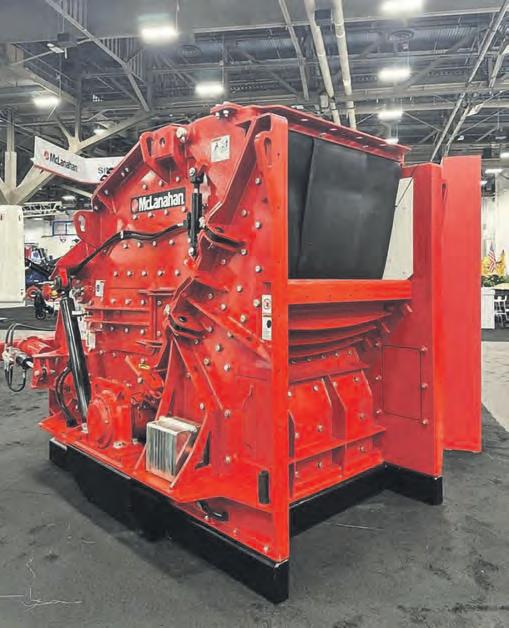
McLanahan debuts new impact crusher for recycling
McLanahan Corporation has launched its newest recycling crusher, the Renew Impact Crusher.
The new crusher is designed for the construction and demolition recycling of asphalt, concrete, rub -
ble and more. It can also be used in virgin aggregate crushing applications. The Renew Impact Crusher helps
to complete McLanahan’s range of solutions for C&D recycling.
“McLanahan’s new Renew Impact Crusher represents a major step forward in productivity and cost efficiency for recycling and aggregate operations,” said Nick Ford, Director of Sales – Aggregate Crushing and Screening.
“Through our experience and listening to our customers’ needs, we are excited to introduce the Renew Impact Crusher. The goal for this impactor was to provide a crusher that is easy to maintain, provides reliability, lowers cost per ton and is simple to operate.”
The Renew Impact Crusher has a feed opening of 91 cm by 1.3 metres that is designed to process 60-cm feed material with ease, producing a wide range of output sizes from 15 cm down to 2 cm, depending on application requirements.
It features a 1.2-metre by 1.3-metre heavy-duty fourbar rotor with a unique and maintenance-friendly hammer retaining system. The crusher utilizes robust hammers with a protruding leading edge to keep the gradation and production consistent as they wear.
As well, the hammer profile allows for less core waste by increasing hammer exposure, extending wear life. The crusher chamber has been engineered with optimized geometry to allow the material to be evenly distributed in both the upper and lower chambers,
ational and sustainability requirements, the VS750s shredder is available in both direct drive and electric hybrid power source configurations, offering customers greater flexibility, improved fuel efficiency and reduced emissions.
To reduce downtime and lower the total cost of ownership, Edge designed
the VS750s with excellent component access and a one-point service area for simplified maintenance. Operator-friendly controls and a strong emphasis on safety further enhance ease of operation, making the VS750s shreddar an ideal solution for high-volume waste and recycling facilities.
lowing for balanced wear, increased production and better gradation. Strategic access points and inspection doors around the machine allow for ease of maintenance and reduced downtime for component replacement.
The Renew Impact Crusher allows for skidded or portable plant options. The portable plant option is compact and mobile, making it easier to transport from site to site without having to completely disassemble.
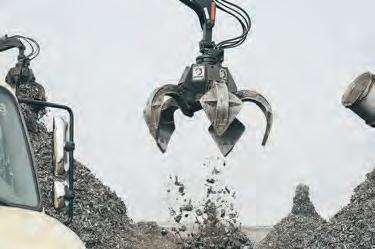
Caterpillar debuts faster, more efficient grapples
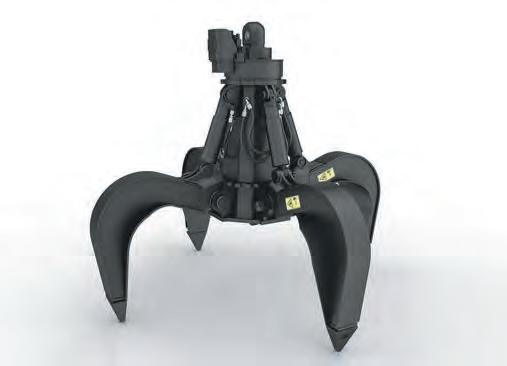
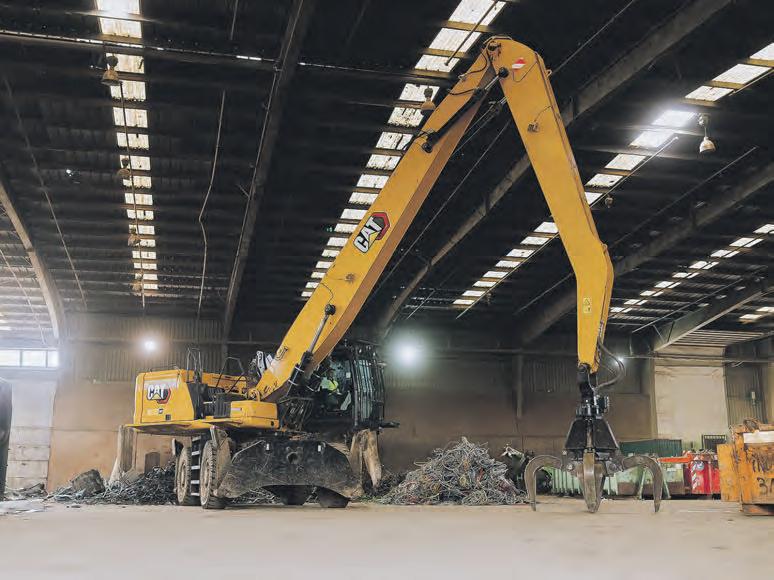
The new Cat GSV420 and GSV425 grapples feature faster cycle times and increased capabilities compared to previous designs, allowing customers to move more material in a day.
Lighter weight and more efficient, the new Cat GSV models increase overall grapple productivity, while reducing maintenance costs.
With two 4-tine sizes available, the new GSV vertical cylinder models match 20-ton to 40-ton material handlers and 14-ton to 31ton excavators.
“Based on extensive customer feedback, we targeted performance characteristics, efficiency and versatility for these new GSV models.
These semi-open tine options meet a wide range of customer needs,” said Chad Bixby, Senior Sales Manager for Caterpillar.
“These models offer increased hydraulic flow capacity and cast parts replace welds to improve durability and reduce weight.”
A refined tine curvature improves overall grapple fill factor by 140 to 200 per cent, while a new rotation system is matched with up to 160 per cent higher flow capacity, compared to the previous model.
Lighter, force-distributing cast pieces help to prolong grapple life. Featuring abrasion-resistant upper and lower grapple housing stops, the new design prevents cylinders from overextending and helps avoid unnecessary hinge-point wear.
Cast tine tips are easy to replace and high-grade steel construction for inner tines and tips help to prolong service life.
The new semi-open tine models are ideal for applications involving larger steel scrap, pipes and beams. Compared to the previous design, the grapples deliver more usage time before the first service interval to help decrease maintenance time. Ground-level grease points increase maintenance efficiency and help to improve safety.
Easier to access hydraulics
simplifies system maintenance and rerouting of integral hydraulics decreases tension on hoses and eliminates interference with materials.
Severe duty thumb-buckets
As well as grapples, Cat has introduced the new Cat SD thumb-bucket, which combines the proven Cat SD and Cat Pro Series thumb into one tool.
The severe duty Cat buckets are designed for low- to high-abrasion applications with low- to medium-impact, such as brush and land clearing, rock and boulder handling, concrete and secondary and primary demolition applications.
Pin-on and pin-grabber compatible, the new thumb-bucket features enhanced weight, capacity and clamping power to deliver superior performance. A departure from previous designs, when the thumb is not required, it can be quickly removed, increasing bucket versatility.
Hose and cylinder mounting on the thumb’s back side with internal hose routing inherently helps to protect these components.
For added durability and reliability, the thumb is integrated into the bucket’s structure.
The SD thumb-bucket has planned commercial availability of early to mid-2027 for North American customers.
S buckets
Caterpillar has also launched a new line of S and HC-S compatible buckets to cover S and HC-S 60, 70 and 80 couplers, plus tilt rotate system (TRS) attachments equipped with S or HC-S bottom couplers.
The broad portfolio covers both general duty (GD) and severe duty (SD) buckets for Cat 313 to 340 excavators equipped with S interface couplers.
The new buckets provide durable performance in a wide array of applications, including dirt, rock, sand and gravel, demolition debris and concrete peeling.
The S interface buckets are based off the proven performance of Cat Pin-on buckets, delivering optimal excavator performance while delivering the durability and reliability customers expect. Straight side plates deliver optimal performance in a range of materials from dirt to rock, package with Advansys ground engaging tool (GET) side cutters or side bar protectors, depending on bucket design, to enhance durability and performance.
DRILLING & FOUNDATIONS
Higher performance, deeper depths
Liebherr unveils its latest generation of the LB 35.1 drilling rig with new engine and lattice boom extension
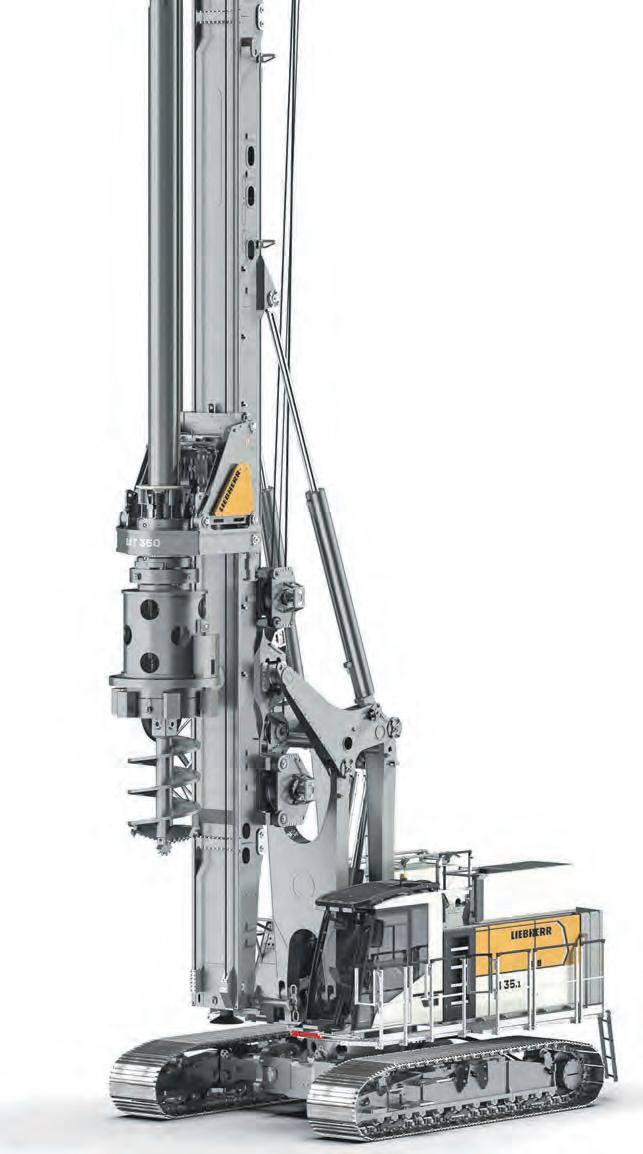
At ConExpo, Liebherr introduced the latest generation of the LB 35 drilling rig.
The LB35.1 is equipped with a new lattice boom extension, enabling greater drilling depths for the compact machine. The more powerful engine ensures even greater operational efficiency and makes the exhibit a flexible machine for deep foundation applications.
The LB series tackles applications such as Kelly drilling, continuous flight auger drilling or double rotary drilling.
For applications using full or partial displacement equipment, the maximum drilling depth has been extended to 37.5 metres, thanks to the new lattice boom extension. This equals an increase of 6 metres. For contractors, this allows the compact LB 35.1 to be deployed, even for large pile depths. The lattice boom extension can be easily retrofitted to any LB 35.1 and LB 45.1.
The new model is also fitted with a more powerful 603 hp diesel engine and delivers torque of 255,934 foot pounds. The maximum line pull of the winches is 300 kilonewtons.
Due to elastic mounting, noise
emissions are considerably reduced. Thanks to the parallel kinematics, the machine has a large working area, which enables short working cycles.
The leader top is designed for different drilling axes and is suitable for all applications. Both the leader and the counterweights are modularly designed making the machine particularly user-friendly and flexible to use. The LB 35.1 can be transported in one piece with a folded leader, which results in reduced set-up work and enables the machine to be moved quickly between jobsites.
Automation systems
Drilling tasks of the LB 35.1 can be automated using a variety of innovative assistance systems, increasing efficiency as certain work steps are completely taken over by the machine’s control system. This includes the drilling assistant to automate the concreting process during continuous flight auger drilling, slack rope monitoring to prevent undesired loosening of the rope with the help of the winch control and automatic leader alignment to align the leader to the previously set inclination angle.
The new overload protection for the Kelly winch ensures the locked Kelly bar automatically stops the crowd winch if the maximum permissible load of the Kelly winch is exceeded. The rope length measurement of the auxiliary winch measures the length of the unwound rope, which is helpful when inserting reinforcement cages, for example.
Locking of the Kelly bar’s telescopic sections is made significantly easier due to the Kelly visualization system in the LB 35.1. Thanks to the real time display of the Kelly bar’s locking recesses on the cab monitor, the operator is informed about the actual distance to the next locking recess. As well, colour indications inform when the bar can be locked, and false positioning of the Kelly bar during the shake-off process is indicated through a warning signal.
In the drill rig’s new cab, Liebherr focused on ergonomics and operating comfort. This is achieved with an orthopedic operator’s seat, individually adjustable monitors and a cool box for food. The new refuelling position of the machine is easily accessible from the crawlers, also increases convenience on the jobsite.
More muscle, less hassle: Liebherr’s HS 8100.2
The latest generation of the HS 8100 duty cycle crawler crane delivers more power and is easier to use
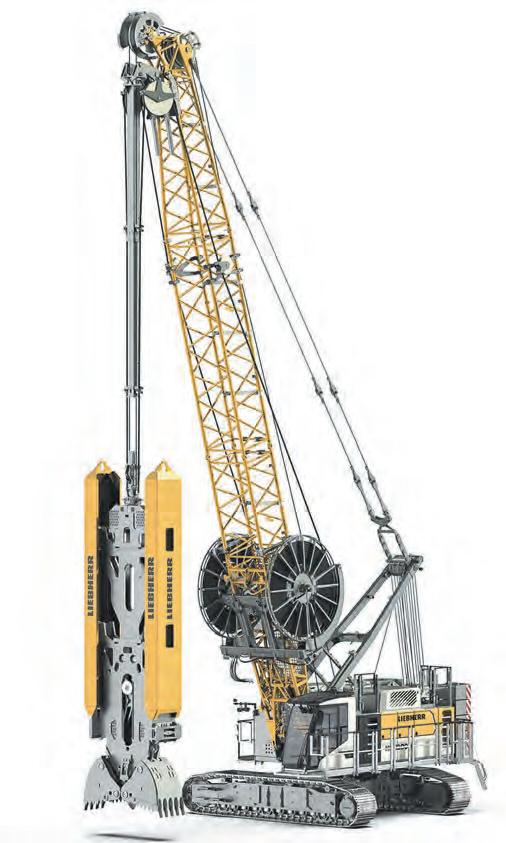
At ConExpo, Liebherr debuted the latest generation of the HS 8100 duty cycle crawler crane, which is engineered to deliver a strong operating performance while ensuring the crane is easy to use and maintain.
The HS 8100.2 exhibited at ConExpo featured a maximum load capacity of 100 tonnes and is capable of handling various applications in deep foundation work with heavy slurry wall grabs and draglines or for dynamic soil compaction.
Liebherr equipped the HS 8100.2 with 15 per cent more engine power compared to its predecessor. As well, the maximum winch line pull of 2 x 66,319 foot-pounds has been increased by 9 per cent.
The increase in power is reflected in the strong performance. The duty cycle crawler crane can now be used with heavier mechanical and hydraulic slurry wall grabs. In dragline operation, the increased engine power results in
better digging force and, in dynamic soil compaction, the drop weight can be raised again more quickly to deliver higher productivity. Thanks to the newly designed rope lock on the winches, the rope can be quickly and easily changed.
The booms of the HS 8070.1, HS 8100.1 and HS 8100.2 dual power are compatible with the new model and are flexibly interchangeable for existing Liebherr customers.
User focused
When designing the HS 8100.2, Liebherr attached significant importance to making the model particularly user and service-friendly and to ensure the best possible safety.
The walkway concept was adopted from the latest models in the HS series and applied to the crane exhibited at ConExpo.
Railings and platforms now remain on the uppercarriage during transport, just like the access ladder for service
work on the roof, which has been elegantly integrated into the uppercarriage. Thanks to the compact width of 3.5 metres and a weight of 60 tonnes, the uppercarriage and the undercarriage can be transported in one piece to ensure quick set-up and availability on the jobsite.
As an option, the crawler side frames can be easily removed using a self-loading system.
The repositioned tank neck is easily accessible via the platforms on the uppercarriage. As well, it is no longer necessary to climb onto the roof of the duty cycle crawler crane to carry out this work.
For all main drives of the HS 8100.2, the operator has fill level indicators on the operator’s monitor, which helps to simplify servicing of the machine. For work in low-light conditions, the operator can illuminate access to the cab of the HS 8100.2 using a remote control to enter safely.
The top 4 accessories to enhance an earth drill’s versatility
By Joe Haynes, President, Little Beaver Inc.
An earth drill is already a familiar tool on many jobsites, but with the right access ories, it can help contractors break into new applications. From horizontal boring to foundation repair and anchoring, a simple kit or attachment
offer two types of horizontal boring kits: one for dry drilling and one for wet drilling. Dry auger kits are designed for shorter underground boring, around 1.5 metres, and are best suited for projects like boring under sidewalks. Larger projects, like boring under streets or driveways, require a different solution: wet drilling kits. These kits in
repair will find that a bucket auger or bell tool opens the door to these types of applications. These tools perform home and light commercial building projects, such as drilling holes for concrete piers. Bucket augers work well in soft soils and reduce side friction to allow for drilling deeper holes. Bell tools are used after the hole is drilled
Mobile home anchors make securing mobile homes fast and easy. While traditional methods involve using an expensive and slow pipe thread machine, an earth drill with an anchoring attachment reduces project times by several hours. Some manufacturers’ earth drills install each anchor in less than a couple of minutes and can complete an attachment to anchor the brands’ earth drills compat
Registration opens for CFACON26
Registration is now open for the cast-in-place concrete industry’s largest convention.
The 2026 Concrete Foundations Convention (CFACON26) takes place July 21 to 23, in Milwaukee, Wisconsin.
Hosted by the Concrete Foundations Association, CFACON26 unites commercial and residential foundation contractors, designers, manufacturers and suppliers from across North America.
Held at the Brookfield Conference Center, the conference includes three days of education sessions, networking, awards gala, social events and industry trade exhibitions.
Attendees will engage directly with industry leaders and contribute to sessions designed to strengthen individual and company growth.
For the educational sessions, attendees will gain insights on cold weather
concrete, emerging cement blends, 3D printed housing and more. As well, expert panels will address business and succession planning, brand protection and technical developments. Beyond education, the convention offers an exhibit hall that will showcase new products and industry solutions.
Early-bird registration is available through June 1. After that, regular registration is open until July 15. Visit the CFA website to register.
The Concrete Foundations Association (CFA) aims to support the cast-in-place contractor as the voice and recognized authority for the residential concrete industry.
As an international nonprofit trade association with a diverse membership spread throughout the United States and Canada, CFA maintains a network that helps those with needs or questions seek advice and professional experience.
Trimble and Vermeer partner on remote control pile drivers
The Trimble Groundworks machine control system is now compatible with Vermeer’s PD10R and PD25R remote control pile drivers.
The system represents a significant step forward in machine automation, improving productivity in solar farm construction.
With the addition of the Trimble technology, the Vermeer PD10R or PD25R pile driver moves automatically to the precise location of a pile according to the project plan, and optimizes the steps needed to drive the pile to the accurate depth with minimal operator inputs on a remote control.
“With the boom in energy
requirements around the world, many energy companies are looking to solar to help them meet both economic and emissions goals," said Ed Savage, Lead Product Manager at Vermeer. “Leveraging Trimble machine control technology with Vermeer pile driving technology has the capability to change the way solar farms are built. Now, driving piles requires minimal operator inputs and can increase the speed and accuracy of solar farm construction.”
The system allows one operator to complete the task of driving piles, which would usually require two or three people to complete.
The Trimble Ground -
works machine control system can also increase the speed of pile driving by reducing the time it takes to navigate a machine to the right location. It also minimizes operator fatigue by allowing the operator to concentrate on the piling rather than machine operation.
Cloud-based reporting
Alongside leveraging machine control for pile driving, project managers can use Trimble WorksManager cloud-based software as a central hub for real-time reporting of production and quality data. With data available in the cloud, project managers can troubleshoot
operations, monitor overall project progress in real time and ensure an optimized and stable piling rate.
“The combination of machine control and remote control pile drivers represents the next step on the road to autonomy and has the potential to vastly improve worker safety, productivity, speed and accuracy on solar projects,” said Elwyn McLachlan, Vice President of Civil Solutions at Trimble.
“Together, Vermeer and Trimble are changing how projects are completed and can improve the process of solar farm construction for the benefit of our customers and of our planet.”
Junttan kit successfully reduces piling noise by up to 50 per cent
In 2025, Junttan created a patented noise-reduction solution for pile driving rig hammers designed to support community-conscious piling operations.
The Junttan Noise Silencer Kit is designed to significantly minimize noise levels. The kit includes a silenced drive cap housing, airborne noise silencer and silenced drive cap. By utilizing advanced materials and engineering, it delivers a substantial noise reduction — far beyond existing solutions.
The kit is currently available for Junttan SHK and HHKS hammers with 800 mm diameter drive cap housing.
A key advantage of this solution is its retrofit compatibility. The system can be installed on all Junttan SHK and HHK hammers, allowing both new and existing drill rigs to benefit from reduced sound emissions. This provides a practical, cost-effective upgrade path without replacing existing equipment. By enabling lower sound levels, contractors can ex-
pand operational flexibility and confidently pursue projects with clearly defined environmental parameters.
The system is already helping contractors operate in environments where noise limitations would otherwise restrict working hours or prevent project execution altogether.
Since its launch, the Junttan Noise Silencer Kit has gained traction with foundation contractors in northern Europe, where urban projects and strict environmental frameworks
require new solutions.
The field trials conducted by Junttan customers confirm that noise perceived by the human ear can be reduced by up to 50 per cent.
For example, Aarsleff Ground Engineering, based in the United Kingdom, recently shared their results from installing the Junttan Noise Silencer Kit on a live project. The contractors opted for the kit after residents raised concerns regarding site sound levels.
To test the effective noise reduction, the company
added the noise silencing kit to a Junttan PMx22 pile driver equipped with a 5-tonne Shark hammer. They also operated the same setup without the silencer.
To ensure reliable data, Aarsleff measured the noise generated over a 10-hour working period.
The results showed a consistent reduction across all measured distances. From a 5-metre distance, noise was reduced form 100 dB to 93 dB; from 10-metres noise dropped from 94.7 dB to 87.6 dB; and at 15 metres,
noise fell to 82.6 dB form 89.9 dB.
As Aarsleff noted, the decibel scale is logarithmic — meaning that every 10 dB reduction is perceived as roughly halving the sound level to the human ear. A 7 dB reduction delivers a clearly noticeable improvement in real working conditions.
For Aarsleff, the outcome supports their commitment to being a responsible neighbour while maintaining efficient project delivery.
Expansion of Bauer’s Aresing facility is underway
One of Bauer Maschinen's largest investment projects in recent years is taking shape in Aresing, Germany.
Construction is underway on a new production and logistics facility, optimizing the company’s logistics processes and creating opportunities for further growth. The total investment is in the mid double-digit million-euro range.
The central element of the expansion is a production and logistics facility measuring about 22,000 square metres. The new building is complemented by a new open storage area south of the finishing facility.
"With the expansion of our plant in Aresing, we are making a targeted investment in the future viability of our company," said Bauer's Managing Director Wulf Flos. "We are creating more efficient processes, pooling expertise at a single location and thus strengthening our competitiveness in the long term. This project is a clear commitment to Aresing and to our employees."
When complete, the new facility will house modern, clearly structured areas, including:
· Material management, the largest area in the new building in terms of floor space, with automatic small parts warehouse, pallet warehouse, warehouse for bulky parts, goods receiving and order picking for production.
· Production for the pre-assembly of steel and hydraulic components, electronics assembly and training areas for electronics technicians.
· Quality assurance: test rooms, restricted storage and offices for goods receipt and complaint processing.
· Shipping and packaging areas for components.
To the east of the new building, an additional outdoor storage and shipping area with a gantry crane will be constructed.
As well, Bauer is building a new modern training and customer centre. A new employee parking lot will also be built, as the existing lot will have to make way for the new building. An additional open space will be created for storing, loading and shipping large equipment.
Construction began at the end of January 2026. First, the new open storage area and employee parking lot will be completed to replace the area that will be built over in the future.
The Bauer Umwelt division of Bauer Resources GmbH has been commissioned to carry out the necessary earthworks. This includes the removal of farmland adjacent to the existing factory, where the new open storage area will be built, as well as the area east of the site where the new facility is planned.
A total of around 200,000 cubic metres of earth will be excavated and removed between February and June. This equals a daily removal volume of around 2,000 to 2,500 cubic metres, up to 180 truckloads on peak days. The material will be used for local construction projects and to fill gravel pits.
Construction of the facility is expected to begin this summer. Detailed planning for the interior work is already underway in the relevant departments at Bauer Maschinen. Completion of the entire project is scheduled for the second half of 2027, exactly 25 years after Bauer purchased the property in Aresing.
The expansion will allow elements of Bauer’s operations to be bundled in a targeted manner. Various departments from across the company will move to Aresing.
The central warehouse directly on site will make processes more efficient.
Material flows will be shortened, coordination will be simplified and interfaces will be reduced. This will allow the company's planned growth to be reflected in a sustainable
and structured manner.
Ecological aspects also play an important role in the project. Photovoltaic systems are
planned for parts of the roofs.
An electricity storage facility will be used to compensate for peaks in consumption.
With over 60 years of combined sales and service experience in the foundation, drilling and piling industry, multiple branches across Eastern Canada and top tier lines of equipment, excellence is written in our DNA. No matter the problem, timeline or budget, we make our customers’ goals our goals. Unrelenting commitment to excellence makes Selix Equipment the obvious choice for your foundation solutions. Contact us today so we can begin our commitment.
Bauer is also planning to incorporate heat pumps and geothermal energy to heat the facility.
NEW HIRES & APPOINTMENTS IN THE HEAVY EQUIPMENT INDUSTRY
GRYB International announces four new executive appointments
GRYB International has announced several new appointments to its executive leadership team.
Effective April 1, Jason McNeil has been appointed Chief Commercial Officer (CCO). Previously Vice President of Material Handling, McNeil will lead GRYB International’s global commercial strategy, driving sales performance, business development and market expansion across all brands and OEM partnerships.
“I am honoured to take on the role of Chief Commercial Officer at such an important stage in GRYB International’s growth,” McNeil said. “By aligning our commercial efforts across markets and partners, we will strengthen strategic relationships and unlock new opportunities for sustainable global growth.”
Jesse Roy will transition from Chief Customer Officer and Vice President of OEM to Chief Experience Officer (CXO), a new executive role reflecting GRYB International’s commitment to making customer experience a core driver of competitive advantage.
As CXO, Roy will lead the integration of brand, communications, OEM partnerships, distribution strategy and cross-functional processes to ensure a consistent, high-performing experience across all customer touchpoints and markets.
“Customer experience has historically been treated as something that happens between transactions rather than a system that drives them,” Roy said. “By creating a consistent experience across every OEM and distribution re -
Oscar
OTR Engineered Solutions (OTR) has announced the appointment of Oscar Torres as President and Chief Executive Officer, effective January 5. Torres brings more than 25 years of executive leadership experience in private equity–backed organizations, with deep expertise in the aerospace aftermarket. He spent most of his career at Kellstrom Aerospace, a global distributor and technical services provider, where he advanced through senior leadership roles including Chief Financial Officer, Chief Operating Officer and Chief Executive Officer.
During his tenure at Kellstrom, Torres led initiatives that strengthened operational performance and drove sustainable growth for the company and its business partners. He played a key role in multiple strategic acquisitions and divestitures and helped position the company as a leading global supply-chain solutions provider serving
lationship, we can turn customer experience into one of GRYB’s strongest competitive advantages.”
Luc D’Amours has been appointed Chief Operating Officer (COO), moving from his previous role as Executive Vice President.
In this role, he will lead operational performance across GRYB International’s manufacturing divisions, with a focus on improving efficiency, quality and on-time delivery while strengthening alignment between production capacity and commercial commitments.
“Operational excellence is not a program, it’s the standard we hold ourselves to every day,” D’Amours said. “By strengthening our systems and execution discipline across all sites, we ensure our operations consistently meet the ex-
pectations of our customers and partners.”
As well, Jean-Claude Perrault will assume an expanded role as Vice President of Product Strategy and Innovation, overseeing product development planning and innovation pipeline management while aligning engineering priorities with evolving market and OEM requirements.
“These leadership appointments reflect a deliberate shift toward greater integration across our commercial, operational, and innovation functions,” said Remi Beaudoin, CEO of GRYB International. “By aligning how we go to market, how we operate and how we innovate, we are positioning GRYB to deliver greater value to our partners and accelerate our growth globally.”
Loftness Specialized Equipment announces new COO
Loftness Specialized Equipment has appointed Shannon McC omas as Chief Operating Officer (COO).
In this role, McComas will oversee day-to-day operations, drive strategic growth initiatives and continue strengthening the company’s commitment to customer satisfaction. He will work closely with executive leadership to advance the company’s long-term strategic plan and support continued innovation across Loftness’ diverse product lines.
“Shannon is a proven leader that has a deep understanding of sales and operations with a track record of success,” said Josh South, CEO of Loftness. “His expanded role as COO reflects the confidence we have in his ability to guide the company into its next phase of growth, and we are excited to promote him into this key leadership position.”
Since joining Loftness in 2024, McComas most recently served as Vice President of Sales & Marketing, where he played a pivotal role
in strengthening dealer relationships, expanding market presence and leading the company through a period of considerable growth. This leadership has been instrumental in positioning Loftness for continued success across its agricultural and vegetation management equipment lines.
“Loftness has built an outstanding reputation for quality, innovation and customer support,” McComas said. “I look forward to continuing to work closely with our dealers and cus-
and Chief Executive Officer of OTR
airlines, OEMs, MROs and aircraft lessors worldwide.
“Oscar’s proven leadership, collaborative approach and deep industry knowledge make him exceptionally well suited to lead OTR into its next phase of growth,” said Hector Ramirez, Interim President of OTR.
“We are excited to welcome him and are confident in the value he will bring to our customers, partners and stakeholders.”
Torres is a Certified Public Accountant and holds a Bachelor of Accounting from Florida International University and an MBA from the University of Miami.
OTR Engineered Solutions is a market-leading global enterprise specializing in off-the-road tire, wheel and track solutions for original equipment manufacturers (OEMs) and aftermarkets. Known for being an innovator in multiple off-the-road applications,
OTR differentiates itself by providing value-added services such as warehousing, tire mounting and sequencing, among other things. The firm has long established strategic partnerships with OEMs covering construction, landscaping, powersports, agriculture, forestry, mining, material handling and specialty vehicle markets.
tomers while strengthening our operational capabilities to support long-term growth.”
With his extensive experience in sales leadership, business development and enterprise operations, McComas brings a balanced perspective that integrates market demand with operational execution. His continued oversight of sales and marketing ensures alignment between customer needs, product innovation and production capabilities.
Skyjack appoints Bryce Hallam as Territory Sales Manager
Linamar Corporation’s Skyjack division has appointed Bryce Hallam as Territory Sales Manager covering Arkansas, Kansas, Missouri and Oklahoma.
Hallam brings nearly 15 years of experience in the construction and equipment space, driving national accounts and nurturing strategic client relationships.
“I’m thrilled to join Skyjack as Territory Sales Manager and continue to serve customers across Arkansas, Kansas, Missouri and Oklahoma,” Hallam said. “After making excellent connections alongside the Skyjack team at ConExpo, I
look forward to continuing strong relationships with our partners and driving continued growth in the region. Skyjack has built a strong reputation for quality and customer support, and I
look forward to contributing to that legacy.”
For more than a decade, Hallam has been working with customers in the region, bringing established relationships and rapport to his role at Skyjack. Hallam most recently served as a National Account Manager with Husqvarna Construction Products.