6
News
Tuesday, June 8, 2010
Indian court convicts 7 in Bhopal gas tragedy BHOPAL, India – An Indian court Monday convicted seven former senior employees of Union Carbide’s Indian subsidiary of “death by negligence” for their roles in the Bhopal gas tragedy that left an estimated 15,000 people dead more than a quarter century ago in the world’s worst industrial disaster. The former employees, many of them in their 70s, were sentenced to two years in prison and ordered to pay fines of 100,000 rupees ($2,175) apiece. All seven were released on bail shortly after the verdict. The subsidiary, Union Carbide India Ltd., no longer exists but was convicted of the same charge and ordered to pay a fine of rupees 500,000 ($10,870). India’s Central Bureau of Investigation, the country’s top investigative agency, has said the plant had not been following proper safety procedures before the disaster. Large groups of survivors and relatives, along with rights activists, gathered in the city and chanted slogans saying the verdict was too little, too late. Early on Dec. 3, 1984, a pesticide plant run by Union Carbide leaked about 40 tons of deadly methyl isocyanate gas into the air in the city of Bhopal in central India, quickly killing about 4,000 people. The lingering effects of the poison raised the death toll to about 15,000 over the next few years, according to government estimates. Local activists insist the real numbers are almost twice that, and say the company and government have failed to clean up toxic chemicals at the plant, which closed after the accident. The verdicts, which were in a local court and are likely to be appealed, came as the case crawled through India’s notoriously slow and ineffective judicial system. The Central Bureau of Investigation had originally accused 12 defendants: eight senior Indian company officials; Warren Anderson, the head of Union Carbide Corp. at the time of the gas leak; the company itself and two subsidiary companies.
Stampede From page 1 “There were supposed to be only 8,000 tickets — they were all free,” he told AFP. Police said it was not immediately clear who had distributed the tickets and FIFA said that it was nothing to do with them. “Contrary to some media reports, FIFA had nothing to do with the ticketing of this game,” its said. While a number of FIFA officials were present at the game, all refused to talk to the media and there was no customary post-match press conference. Rich Mkhondo, spokesman for the Local Organising Commit-
Seven of the eight Indian company officials were convicted Monday. The other one has since died. Anderson and Union Carbide have never appeared in court proceedings. Union Carbide was bought by Dow Chemical Co. in 2001. Dow says the legal case was resolved in 1989 when Union Carbide settled with the Indian government for $470 million, and that all responsibility for the factory now rests with the government of the state of Madhya Pradesh, which now owns the site. Last July, the same court in Bhopal had issued a warrant for Anderson’s arrest and also ordered the Indian government to press Washington for the American’s extradition. The judge did not explain why Anderson or the American chemical company were not tried in absentia. Anderson was briefly detained immediately after the disaster, but he quickly left the country and now lives in New York. It was not immediately clear if the Indian government had begun to process the Bhopal court’s request. Extradition proceedings are usually mired in a complex tangle of legal paperwork and can take years to process. Investigators say the accident occurred when water entered a sealed tank containing the highly reactive gas, causing pressure in the tank to rise too high. Union Carbide Corp., an American chemical company, said the accident was an act of sabotage by a disgruntled employee who was never identified. It has denied the disaster was the result of lax safety standards or faulty plant design, as claimed by some activists. The Central Bureau of Investigation said the plant had not been following proper safety procedures. tee, also tried to brush off the episode and instead said the only concern remained over traffic. “Our only concern is that people should park their cars at home and not clog up the streets around the stadiums,” he told Talk Radio 702. The episode served as a sharp reminder of the challenges facing the tournament which begins on Friday when the hosts play Mexico and evoked ugly memories in South Africa. Forty-three people were killed in 2001 when ticketless fans tried to barge their way into the Soweto derby at Ellis Park, a stadium in Johannesburg which is one of the 10 venues for the monthlong tournament.
AFP PHOTO/RAVEENDRAN/FILES
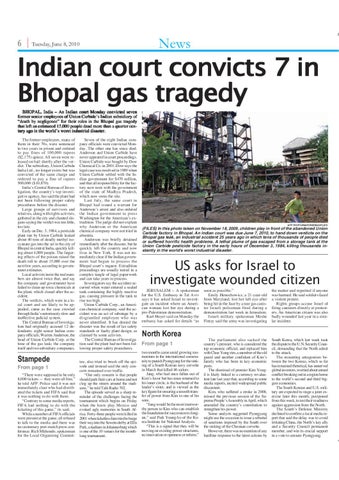
(FILES) In this photo taken on November 18, 2009, children play in front of the abandoned Union Carbide factory in Bhopal. An Indian court was due June 7, 2010, to hand down verdicts on the Bhopal gas leak, an industrial accident 25 years ago in which tens of thousands of people died or suffered horrific health problems. A lethal plume of gas escaped from a storage tank at the Union Carbide pesticide factory in the early hours of December 3, 1984, killing thousands instantly in the world’s worst industrial disaster.
US asks for Israel to investigate wounded citizen JERUSALEM – A spokesman for the U.S. Embassy in Tel Aviv says it has asked Israel to investigate an incident where an American woman lost her eye during a pro-Palestinian demonstration. Kurt Hoyer said on Monday the embassy has asked for details “as
soon as possible.” Emily Henochowicz, a 21-year-old from Maryland, lost her left eye after being hit in the face by a tear gas canister Israeli policeman fired during a demonstration last week in Jerusalem. Israeli military spokesman Moshe Fintzy said the army was investigating
the matter and regretted if anyone was harmed. He said soldiers faced a violent protest. Rights groups accuse Israel of firing canisters directly at protesters. An American citizen was also badly wounded last year in a similar incident.
The parliament also sacked the country’s premier, who is considered the top economic official, and replaced him with Choe Yong-rim, a member of the old guard and another confidant of Kim’s family who has been in key economic posts. The dismissal of premier Kim Yongil is likely linked to a currency revaluation late last year that, according to some media reports, incited widespread public discontent. Kim, who suffered a stroke in 2008, missed the previous session of the Supreme People’s Assembly in April, which amended the country’s constitution to strengthen his power. Some analysts suggested Pyongyang might use the occasion to issue a rebuttal of sanctions imposed by the South over the sinking of the Cheonan corvette. However, there was no mention of any hardline response to the latest actions by
South Korea, which last week took the dispute to the U.N. Security Council, demanding that the North admit to the attack. The mounting antagonism between the two Koreas, which so far has remained rhetorical, has unnerved global investors, worried about armed conflict breaking out in a region home to the world’s second and third biggest economies. The South Korean and U.S. military are expected to stage a joint exercise later this month, postponed from this week, to test their readiness against aggression from the North. The South’s Defense Ministry declined to confirm a local media report that said the delay was to avoid irritating China, the North’s key ally and a Security Council permanent member, and win its crucial support in a vote to censure Pyongyang.
North Korea From page 1 two months came amid growing momentum in the international community to punish Pyongyang for the sinking of a South Korean navy corvette in March that killed 46 sailors. Jang, who had once fallen out of Kim’s favor but has since returned to his inner circle, is the husband of the leader’s sister, and is viewed as the key figure for ensuring a smooth transfer of power from Kim to one of his sons. “Jang would be the most trustworthy person to Kim who can establish the foundation for succession to Jongun,” said Park Young-ho of the Korea Institute for National Analysis. “This is a signal that they will be moving on existing power structures, no innovation or openness or reform.”