omega center for sustainable living
Where Nature Meets
Know-How
As climate challenges grow, so does the need for real solutions that restore our planet and our communities. At Omega Institute for Holistic Studies, we believe that regenerating the environment begins with reimagining our relationship to it.
On the grounds of our Hudson Valley campus in Rhinebeck, New York, the Omega Center for Sustainable Living (OCSL) brings this vision to life. Home to the Eco Machine™—a natural water reclamation system that treats wastewater without chemicals—the OCSL illustrates how we can meet human needs while honoring our interdependence with the earth. Through regenerative design, education, and community engagement, the OCSL empowers people to take meaningful action. Its reach extends from our campus to the global stage, with active participation in United Nations climate conferences.
The Future of Water
In 2009, Omega faced a challenge: Our aging septic system needed replacing. But instead of installing a standard system, we saw an opportunity—to reimagine water not as waste, but as a precious resource.
We envisioned a new kind of water reclamation system that would be chemical-free, consume minimal energy, and offer powerful educational opportunities. Working with environmental thought leaders, we chose to build an Eco Machine™— a natural system that mimics wetlands to clean water without chemicals.
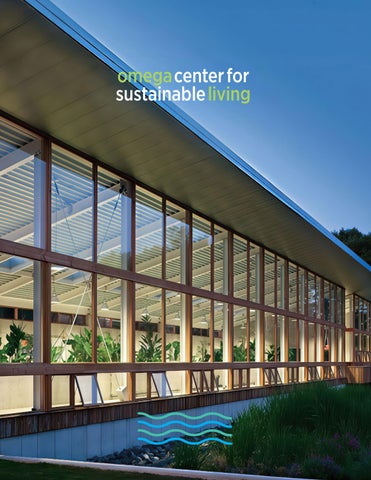
To house it, we created the Omega Center for Sustainable Living (OCSL), the first building in the world to achieve both LEED® Platinum certification and meet the rigorous standards of the Living Building Challenge™. It generates its own power and runs with a zero-carbon footprint—surpassing our low-energy goal.
LEARN MORE
eOmega.org/climate-initiative
Today, the OCSL is more than a building. It’s a living classroom where people of all ages explore sustainable living, witness green innovation in action, and reconnect with the natural world.

Water is life’s matter and matrix, mother and medium. There is no life without water.
—ALBERT
SZENT-GYÖRGYI, Nobel Prize for Medicine, 1937
Nature’s Genius at Work: How a Closed Hydrological Loop Turns Waste Into Wonder

1.
WOOD RAINSCREEN RAIN GARDENS
PHOTOVOLTAIC COLLECTORS GREEN ROOF
SOLID SETTLEMENT TANKS
The Eco Machine™ treats all the water from Omega’s campus, including water used in toilets, showers, the kitchen, the Café, etc. Wastewater is collected in decentralized tanks located throughout campus and then flows to a central collection tank.
2. EQUALIZATION TANKS
After solids are separated, wastewater flows into equalization tanks. These large tanks allow surges in water use to be evenly released into the Eco Machine™ over the course of the day.
3. ANOXIC/ANAEROBIC TANKS
Naturally occurring microbial organisms begin to reclaim the water in the absence of oxygen.
4. CONSTRUCTED WETLANDS
The water is dispersed under the gravel horizontally through of wetlands. The plants, including and bulrushes, through the gravel, they host bacteria organic matter, nitrogen, phosphorus, pathogens from
CONSTRUCTED WETLANDS AERATED LAGOONS
PHOTOVOLTAIC COLLECTORS

CONSTRUCTED dispersed gravel and travels through a series
The roots of including cattails extend gravel, where bacteria reducing nutrients, phosphorus, and from the water.
5. AERATED LAGOONS
In the aerated lagoons, the water is injected with air and runs through a series of open tanks where it is scrubbed and cleaned by plants, and microorganisms further reducing the nutrient loading of the wastewater.
6.
RECIRCULATING SAND FILTER
Before being reintroduced to the environment, the water is sent through a recirculating sand filter where sand and microorganisms provide a final “polishing”. At this point, the water meets advanced wastewater standards.
7. DISPERSAL FIELDS
The processed water is safely reintroduced to the environment via two large dispersal fields under the parking lot, thereby recharging the aquifer and completing the hydrological loop.
Visit the OCSL
We welcome everyone—students, teachers, activists, and curious minds—to explore natural water reclamation, green building, and sustainable living. Come take a free tour of the Omega Center for Sustainable Living (OCSL).
We also offer customized educational tours and classes for grades K–12. Whether you’re looking for an introduction to ecological literacy or a deeper dive into regenerative design, we can tailor the experience to suit your group’s needs.
The OCSL classroom is also available as a meeting space on a limited basis.
To inquire about tours, educational programs, or meeting space availability, please contact: OCSL@eOmega.org
VISIT US
eOmega.org/visit-the-ocsl