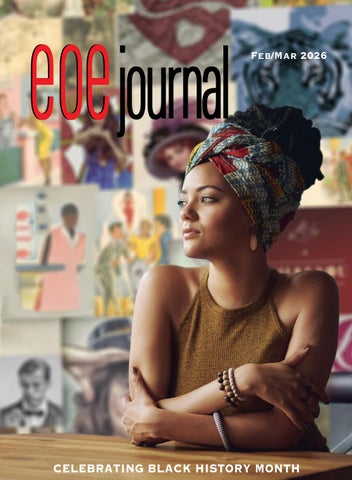
EOEJournal FEB/MAR 2026

Page 1


Weset aside months for the underrepresented: Black History Month, Pride Month, Asian Pacific American Heritage Month, Hispanic Heritage Month, LGBTQ+ Pride Month, and others, because for way too long, so many important voices just weren't heard. Traditional history often sticks to the same limited viewpoint, completely skipping over the many people who made massive contributions to art, science, culture, and so much more. These dedicated months shine a light on those overlooked stories and show that they're not merely extras or footnotes, they're central to understanding how we all got here.

These months also open the door for people to actually learn and talk about things they might never encounter otherwise. It's a chance to ask questions, push back against stereotypes, and dig into perspectives that don't always make it into everyday media or conversation.

For the communities being honored, there's real value in having their achievements and struggles publicly acknowledged instead of brushed aside. And for everyone else, it's a low-pressure way to listen, learn, and broaden your understanding that you might not already know everything.

Highlighting different identities builds empathy and reinforces the idea that society functions better when people actually feel valued and seen. Honestly, it's less about marking dates on a calendar and more about working toward a culture where everyone's experiences and contributions actually matter.

The eoejournal is published bimonthly by EOEJournal, Inc. The ownership and management of EOEJ fully and actively support equal opportunity for and advancement of all people without regard to race, color, religion, gender, national origin, sex, pregnancy, citizenship, ancestry, veteran status, marital status, physical disability, mental disability, medical condition, age, gender identity, and sexual orientation or any other characteristic protected by state or federal law.

Advertising and Editorial mailing address:

7000 N. 16th Street Suite 120-315 Phoenix, AZ 85020

Phone: 602-604-9133

A passion for INCLUSION AND EMPOWERMENT

At UCLA Health, it takes people from all backgrounds and varied perspectives to make our world-renowned care possible. That’s why we foster a culture where all are welcome, valued, and inspired to be their authentic selves. We’re proud to be one of U.S. News & World Report’s top hospitals in the country.

If you’d like to contribute to a world-class health provider within a setting that inspires and empowers great achievements, explore our openings in:

• Nursing

• Allied Health

• Research

• Nutrition

• Administrative/Clerical/Float Pool

• Managerial/Executive

• Hospital & Facilities Support

• IT

To learn more and apply online, visit us at UCLAHealthCareers.org

Predicting How AI Will Affect the Future of Nursing

Can you imagine patients being greeted by a bot figure asking, “Good Morning, How can you rate your pain level today on a scale from 1-10?” While we aren’t there any time soon, the healthcare industry is undergoing constant evolution, and one of the most notable recent advancements is the incorporation of artificial intelligence (AI) into nursing and patient care. Given the rapid integration of AI into our lives, it’s hard to predict where it’s headed. Just as 20th-century science fiction failed to anticipate the impact of the internet, data, and social media on our lives, AI’s influence on leisure and professional domains remains unpredictable. Many nurses ponder how AI will impact their careers and if the demand for humans in healthcare will paraglide as AI is incorporated into healthcare. While we can speculate about the future of AI in nursing care and how AI is changing the healthcare landscape, we dedicated this blog to evaluate and assess the foreseeable relationship between new technologies and nursing.

How Artificial Technology Works

Artificial intelligence (AI) technology’s functioning involves emulating human cognitive processes using computer systems. These systems are engineered to execute tasks that traditionally necessitate human intelligence, such as visual perception, speech recognition, decision-making, and language translation. AI technologies rely on sophisticated algorithms and extensive datasets to learn from and make predictions or decisions. To understand, AI technologies are as great as they are trained; they work as well as the data they are being fed.

Changing the Role of Nurses with AI

“Tasks for technology, care is for caregivers” is the new motto used by facilities in healthcare staffing. Nurses are likely to see changes in their daily routines as AI becomes an integral part of healthcare delivery. For example, AI-powered tools can automate administrative tasks such as documentation and scheduling, allowing nurses to allocate more time to direct patient care.

AI’s Impact on Patient Care

The integration of AI in hospitals and facilities is expected to improve patient outcomes and safety. AI-powered patient

Our compassionate care nurtures lasting connections

Redeemer Health provides compassionate care across every stage of life.

Rooted in the tradition of the Sisters of the Redeemer, our mission to Care, Comfort, and Heal can only be achieved through our dedicated, compassionate employees. Each of us is the product of our experiences and here you will find a place that welcomes you, celebrates your success, and challenges you to do your very best.

monitoring systems can analyze data from various sources, such as electronic health records and wearable sensors, to identify potential complications and alert nurses to changes in vital signs. This technology can potentially enhance patient safety and enable nurses to intervene promptly in case of adverse events. Even more so, AI can assist in clinical decision-making by providing evidence-based insights. Well-trained AI models can analyze patient data and provide valuable insights, leading to earlier detection of health issues, more accurate diagnosis, and more personalized care plans.

What will Remain the Same

considerations. The critical-thinking skills and clinical judgment of nurses are irreplaceable. Even as technologies will advance, we can’t rely on healthcare to become robotic and utterly dependent on technologies altogether. We need attentive human beings with a caring heart to see, hear, and make intuitive judgments on each situation separately.

The Future of Nursing with AI

As AI continues to advance, nurses will need to adapt to new technologies.

While AI is sure to transform nursing, certain aspects of the profession will remain unchanged. The compassionate and empathetic nature of nursing can never be replaced by robots, never. Nurses play a vital role in providing emotional support and building trust with patients, and this human touch will continue to be the foundation of nursing care.

The

Downsides of an AI-dominated Healthcare

With all due respect to new technology, AI has its limitations in understanding complex ethical and empathetic

As AI continues to advance, nurses will need to adapt to new technologies and acquire the necessary skills to effectively work with the new tools that will come into use. However, for those nurses worrying about the future of their profession, let’s recognize that while AI can enhance certain aspects of nursing, it will complement rather than replace the expertise and compassion of nurses.

We’re All About People

No matter where technology is going, take our word that White Glove will do everything to maintain our personal touch, fantastic communication, and individualized approach. We’re simplifying the process and making your job search speedy, swift, and easy, but you’ve got the back of our great team of awesome humans doing everything to help you succeed.

MaineHealth team members care for each other as much as they care for our communities. Every day, we help and support one another in our life-changing work. And with a focus on continuing education and training, MaineHealth is helping people grow their careers to become the best version of themselves.

MaineHealth team members care for each other as much as they care for our communities. Every day, we help and support one another in our life-changing work. And with a focus on continuing education and training, MaineHealth is helping people grow their careers to become the best version of themselves.

Do you share our calling?

For a complete listing of MaineHealth locations and current openings visit www.careersatmainehealth.org/

Do you share our calling? Learn more about joining the most dedicated and collaborative team in health care. For a complete listing of MaineHealth locations and current openings visit careersatmainehealth.org

Future Healthcare Jobs in Demand: Healthcare Trends to Watch

Technological innovation touches every industry, and healthcare is no exception. No matter what your job is in healthcare, you’ll need some digital savvy. And if science and technology are your passion, heath care offers a wide variety of career possibilities.

Digital Healthcare & Tech

Digital care is a growing trend in medicine, transforming the ways medical care is delivered. Telemedicine has been around for a while, but the COVID-19 pandemic has fast-tracked adoption of remote care. It’s expected to grow even further, especially as overall demand for healthcare — and home-based care — increases. That’s leading to a demand for safe, secure digital platforms for delivering medical care (add Waterloo’s Health Informatics option to your Health Sciences or Public Health degree).

Video consultations are one form of telemedicine, but there are others. Wearable technology can help collect informa -

tion during those virtual consultations, or monitor a patient’s chronic condition — diabetes, or heart disease — and feed data to medical providers. Physiotherapists or kinesiologists might help patients recover through virtual reality games. And devices that track digital biomarkers through hand and eye movements may help diagnose Alzheimer’s.

Artificial intelligence, or machine learning, relies on large quantities of data, and healthcare definitely has that. AI can be used to improve disease detection and to prioritize patients for screening, and it plays a part in personalized medicine, among many other things. Researchers have even built virtual people to test medications. Biostatisticians use big data to determine health risks and evaluate treatments.

Of course, medical technology is always improving and changing, too. Medical physicists oversee radiation treatment plans and equipment in hospitals and clinics, or research new medical applications of physics (for example, with magnetic

TRENDS continued on page 9

As the leading healthcare provider and largest employer in a 10-county area, Unity Health and its more than 2,300 associates work to provide high-quality compassionate care. Unity Health is recognized as a top diverse workforce.

fields, lasers, or x-rays). Biomedical engineers use knowledge of the body’s mechanics to develop medical technology — artificial organs, or brain-computer interface programs, for example. Waterloo’s Science and Financial Management program prepares grads to see new inventions through to successful product launch and beyond.

An Aging Population

There are more seniors than there are children under the age of 14 in Canada. Why? Well, there are a few reasons.

First, after World War II there was a “baby boom,” a sudden rise in the number of babies born. This boom lasted for 20 years until 1965, so there are 8.2 million Canadians who are — or soon will be — seniors. It is estimated that as of 2023, there were about 7.6 million people aged 65 and older in Canada. About one in four Canadians will be 65 years of age or older by 2043

aging population — and seniors have specialized needs. They draw more heavily than other populations on family medicine, internal medicine, psychology services, and optometry and ophthalmology. Today’s seniors invest in activities that improve their quality of life, such as recreational programming As the population continues to age, more workers will be needed in long-term care and more resources made available to seniors who want to age in place — that is, continue to live at home while receiving medical supervision and care.

You can specialize in the study of healthcare for seniors. Geriatricians specialize in medical care for seniors, and gerontologists research the biological, social, and cultural aspects of aging and the elderly. Waterloo’s School of Public Health Sciences also offers an Aging Studies option

Human-Centred Healthcare

People are living longer, too. Life expectancy in Canada is one of the best in the world because we live in a safe, prosperous country and have good healthcare. In fact, the fastest growing segment of the population is people over 100! At the same time, people aren’t having as many children, so Canada’s population has more older people.

As the “boomer” generation ages out of the workforce, most industries will see vacancy rates increase. Healthcare has the additional factor of increased demand to care for that

Because Every Child Deserves a Childhood

Astor serves children and families in New

State’s Mid-Hudson Valley region and the Bronx. Astor Services is committed to supporting families to ensure each child has a healthy and happy childhood. Currently hiring social workers, mental health counselors,

and more.

Digital medicine may be expanding, but at its core, healthcare is for humans, by humans. AI and digital tools can help free up healthcare practitioners’ time, giving them more minutes to spend per patient. Incorporating user experience design in healthcare settings is an emerging trend, too — making processes and products safer and more user friendly both for patients and practitioners.

Green healthcare is another facet of human-centred care, with doctors prescribing nature walks (and even national park passes!) and hospitals introducing gardens and locally grown

food. If a people-centred approach appeals to you, public health is all about community outreach and keeping everybody healthy, including preventative care, equity and access to care, and communications.

Skills for a Career in Healthcare

Most careers in healthcare will require specific hard skills: specialized training, or an advanced degree. Waterloo’s Centre for Career Development has dedicated advisors who support students all the way through the graduate program application process.

But soft skills are the secret sauce to any standout career. And as the job market changes, they’re also the skills that will allow you to make smooth transitions to a new career.

Anyone working in healthcare will need these soft skills:

• Empathy . Healthcare professionals regularly deal with people from a wide range of backgrounds and cultures — and they’re often worried, under stress, or in pain. An empathetic caregiver makes all the difference in difficult situations. Even if you don’t have a patient-facing role, whether you’re in data management or device development, you’ll need to be able to think and feel your way inside a patient’s experience to do your best work.

• Communication skills . Clear communication is critical to excellent healthcare work, whether you’re talking with a patient, family members, or coworkers, or noting information for medical records. Active listening is part of communicating, too — visibly paying attention, letting a speaker finish, and asking follow-up questions to ensure you’ve understood correctly.

• Interpersonal skills . Almost any healthcare job you can think of involves teamwork, often with colleagues from other professions and fields. Empathy and communication skills are keystones to great interpersonal skills. Emotional intelligence, self-awareness, respect for others, and an ability to manage conflict are other building blocks.

• Analytical thinking . Analyzing research, assessing symptoms, processing raw data, examining processes for weak points, evaluating quality of care, designing and testing new ways of doing things — any of these analytical tasks might be part of your career in healthcare.

Healthcare Careers of the Future

Doctors and registered nurses will be in high demand well into the future. But there are dozens of other careers to consider — some of which you might not know about yet! Here are some degrees to explore, listed with a handful of possible job titles for graduates.

Anthropology

• Medical anthropologist

• Social researcherpolicy Biological and Medical Physics

• Lab technologist

• Medical imaging technologist

• Research associate Biochemistry

• Formulation scientist

• Research technician

Biology

• Dietitian

• Genetic counsellor

• Microbiologist Biomedical Sciences

• Cardiovascular perfusionist

• Cytotechnologist

• Dentist

• Physician

• Surgeon Biomedical Engineering

• Brain-computer interface designer

• Product develop- ment specialist Biostatistics

• Biostatistician

• Epidemiologist

• Statistical programmer Science and Financial Management

• Life sciences industry accounting

• Biotech accounting

• Research monitoring and assessment

PHMC is a nonprofit public

institute that creates and sustains healthier communities. PHMC uses best practices and evidence-based guidelines to improve community health through direct service, partnership, innovation, policy, research, technical assistance and a prepared workforce. PHMC has served the region since 1972.

Article provided by uwaterloo.ca

SHRM Research Underscores

VETERANS' VALUE IN THE WORKFORCE

Highlighting Urgent Need for Better Hiring Strategies

“Completing the Mission” report offers actionable insights to bridge the gap between veteran talent and civilian job opportunities.

ALEXANDRIA, Va. — SHRM , the trusted authority on all things work, and the SHRM Foundation , released its latest research report, Completing the Mission: Best Practices for Recruiting and Hiring Veterans, aimed at helping organizations more effectively attract, hire, and retain veteran talent. Each year, approximately 200,000 U.S. service members transition to civilian life, bringing with them invaluable skills. However, many organizations face challenges in translating these military skills into civilian roles.

Supported by USAA, this report, part of the SHRM Foundation’s Untapped Talent programs and Military Community at Work (MCAW) initiative, sheds light on the obstacles HR professionals encounter in veteran hiring and provides actionable strategies to help organizations overcome these challenges.

“Veterans bring not just a wealth of skills, but stories of resilience, leadership, and service that enrich the civilian workforce in profound ways,” said Wendi Safstrom, President of the SHRM Foundation. “Our report highlights the critical need for employers to support them as they navigate their new environments and careers. By offering thoughtful strategies, we’re helping organizations create workplaces where veterans can thrive, feel valued, and continue to make a meaningful impact beyond their military service.”

Key Findings from the Report:

Veteran Work Ethic & Skills:

• 98% of HR professionals agreed veterans can thrive in both team-based and individual settings.

98% of HR professionals agreed veterans can thrive in both team-based and individual settings.

• Most HR professionals said that veterans outperform civilian employees in key areas such as work ethic (68%), teamwork (61%), and leadership (58%).

Challenges in Translating Skills:

• 23% of HR professionals reported that difficulty aligning veterans’ skills with civilian job requirements is a major challenge their organization faces when recruiting and hiring veterans.

• Only 2% of HR professionals reported using military skills translation tools to help, despite the availability of these tools and despite the research finding these tools can be effective in helping to bridge this gap.

Formal Hiring Programs Make a Difference:

• Organizations with formal veteran recruiting/hiring programs are significantly more effective at hiring veterans.

• 65% of HR professionals from companies with formal programs agree or strongly agree their organization is effective at hiring veterans, compared to only 42% of those with informal programs and 21% of those without a program.

“At USAA, nearly 25% of our employees are either veterans or military spouses,” said Corie Pauling, Executive Director of Talent Diversity at USAA. “We’ve seen so many of these colleagues prove to be incredible leaders, work well under pressure and are extremely adaptable. We hope this research will further advocacy and inspire business leaders to not just consider the military community for job opportunities but also create programs focused on veteran hiring.”

Business Case for Hiring Veterans: Veterans possess highly sought-after skills, making them valuable assets in a wide range of industries. The SHRM Foundation’s report shows veterans often outperform civilian employees in areas such as teamwork, leadership, and work ethic, and organizations with veteran recruitment programs are significantly more effective at leveraging this talent pool.

Actionable Insights: The report offers practical steps for HR professionals to strengthen their veteran hiring initiatives. These include leveraging military skills translation tools, developing formal recruitment programs, and creating supportive hiring practices that help veterans transition successfully into civilian roles.

Call to Action: The SHRM Foundation urges HR professionals, business leaders, and hiring managers to utilize this research

The Boise VA Medical Center proudly serves veterans in the Boise, Idaho area, in its main medical center, and in five community-based outpatient clinics.

www.va.gov/boise-health-care/work-with-us/ to view and apply for current open positions.

Here in the First National family (First National Bank Texas, First Convenience Bank, First Heroes National Bank, First Community Mortgage and First Community Services), we are fiercely proud of our past and excited about our bright future. Independently owned, with more than 300 locations in Texas, Arizona, Arkansas and New Mexico, we offer growth and advancement in a fun and fast-paced environment. Our company provides and educational atmosphere, enabling employees to achieve their highest career potential. We are pleased you have considered advancing your career with us.

WHY CHOOSE US?

Here in the First Nationalfamily (First National Bank Texas, First Convenience Ba nk, First Heroes NationalBank, First Community Mo rtgage and First Community Servi ces), we are fiercely proud of our past and excited about our bright future. Independently owned, with more than 300 locations in Texas, Arizona,Arkansas and New Mexico, we offer growth and advancement ina fun andfast-pacedenvironment. Our company provides an educational atmosphere, enabling employees to achieve their highest career potential. We are pleased you have considered advancing your career with us.

No matter what your specialty is, chances are there is a position for you with the First National family. Positions range from front-line sales to customer service, clerical, support services and managerial positions. Our account holders are very diverse, and we are proud to accommodate them with a diverse workforce that includes bilingual employees.

Choosing a Career in Local Government

Make a positive impact in the communities where you work and live - discover why the local government profession is the career for you!

Making a Difference at the Local Level

A career in local government is an excellent option for those who have a passion for public service. Public service is often about what you give rather than what you receive, and putting the collective good before the needs of individuals.

Managing the services that affect the health, safety, and welfare of all citizens in a community can be complex and challenging. Whether it’s resolving a significant issue for the community or answering a simple question for a resident who did not know where to turn, public service offers professional satisfaction from delivering both large and small results.

Local government career professionals may not come from a common background. However, they all are highly motivated and dedicated to their profession and the people they serve. They tackle the day-to-day issues that have an impact on most of the people in the world. They ensure the provision of vital community services, such as emergency services, water, wastewater, refuse collection, building development, housing services, social services, financial stewardship of tax dollars,

98% of HR professionals agreed veterans can thrive in both teambased and individual settings.

The City of Manassas, VA, located just 30 miles southwest of Washington DC, has a rhythm of life with a refreshing cadence all its own It is at once authentic, diverse, eclectic, creative and inviting. Manassas is a relaxing respite from high-stress city life. Come for the friendly, forward-thinking lifestyle.

The heartbeat of this city is a welcoming one.

With its ease of access by car and public transportation, and its highly skilled workforce, Manassas has attracted an increasingly diverse residential and commercial mix. The City of Manassas offers an incredible benefits package and we encourage you to visit our website, review our current job opportunities and apply online.

We hope you will consider the City of Manassas as your employer of choice!

and general administration services, to citizens and taxpayers, while maintaining the profession's high ethical standards in a continually changing environment. Today, more than ever, a local government professional must be able to think through solutions and work with others toward a common objective.

Finding Your Role in Local Government

Local government service is inherently meaningful because our work is related to building and improving communities. Police officers, fire fighters, paramedics and building inspectors keep us safe. Engineers and public works staff build and re-build the physical infrastructure. City and county planners help envision and shape future City growth. Recreation, arts & culture and library professionals enhance community life. City and county management takes the aspirations of residents and the policy goals of the elected governing board and puts those aspirations and goals into action.

Public agencies need employees with all kinds of talents, skills and occupational interests. Below are samples of positions (and salary data) offered by an average small- to midsized city or county:

Getting started in local government.

There is no required path to a career in local government – no tests that you must pass or certification that you must earn.

Traditional bachelor‘s degrees obtained by local government professionals include majors such as political science, public affairs, communication, economics, accounting, engineering, human resource management, criminal justice, public safety management, civic leadership, education, sustainable management and policy.

Public agencies need employees with all kinds of talents, skills and occupational interests.

An advanced degree in these fields will increase your competitiveness if you are seeking local government management positions. A master‘s degree in public administration or public policy is recommended but not required. Some of the coursework that would prepare you for this field includes public finance, microeconomics, statistics, planning, conflict resolution, organizational behavior, and program evaluation. Outside of the classroom, all leadership and public speaking experiences will aid in your quest to be a local government leader.

ieee.taleo.net/careersection/2/jobsearch.ftl

Celebrating Black History Month: Understanding Why

proudly identify as African American and Black, and acknowledge that some people still refer to me as Colored— yes, in 2020s the word “Colored” is still in existence. While I choose to proclaim my cultural distinction proudly, it is hard to miss the obvious outward confirmation of my racial identity. We remain in a world where what is presumed obvious has sometimes been misinterpreted. Does my skin color define what being Black is? Unfortunately, some people wrestle with what they have heard or think being Black can mean. How misfortunate those people are; they miss the beauty, talent, friendship and love of someone like me simply because I look different than them.

How often do we look at the exterior of a book or only read the introduction and determine it is not worth reading? We judge a building by its exterior or less-than-green lawn when, unbeknownst to the viewer, the real work occurs on the inside and eventually becomes evident on the outside. We calculate

a person’s value by what we see: what they wear, what they have, where they come from or where they live. The truth is, we all make assumptions about others that are far from the truth of who they really are. It happens to African Americans and everyone else.

Designating a month to celebrate the full measure of African American contributions to a world that spent centuries denying their existence allows for their great history to be honored and remembered. The Black History Celebration reminds African Americans of our strength, endurance and unwavering faith, and reconnects us to the heroes of our past. It is also a time of hope: we hope to dispel the negative biases that are associated with being Black in America.

The story of Black History Month begins in 1915, half a century after the Thirteenth Amendment abolished slavery in the United States. That September, the Harvard-trained historian Carter G. Woodson and the prominent minister Jesse E.

MAKE AN IMPACT

Moorlandfounded the Association for the Study of Negro Life and History (ASNLH), an organization dedicated to researching and promoting achievements by Black Americans and other peoples of African descent. “Negro History Week” was first celebrated in 1926 during the second week of February. The week coincided with the birthdays of for mer President Abraham Lincoln and civil rights leader Frederick Douglass.

Black educators and students at Kent State University in Portage County, Ohio, proposed the idea of Black History Month in 1969, and first celebrated it in 1970. College campuses across the country celebrated Black History Month throughout the early 1970s before it was officially recognized. President Gerald Ford officially recognized Black History Month in 1976, calling upon the public to “seize the opportunity to honor the too-often neglected accomplishments of Black Americans in every area of endeavor throughout our history.”

The why behind the celebration is important. Future generations must be aware of the valuable and lasting contributions of African Americans to our world’s success, even when they went unrecognized for their work during their lifetime. Isn’t it hard to imagine that anyone’s ability to blossom could be forbidden by another human being because of their skin color, or that a useful invention could be praised but not the creator of the invention, if their skin was not the preferred color?

I identify with a group of proud people who have and will continue to be a part of the fiber of our country. I identify with people who will remain hopeful of change and are committed to being the change we want to see. I identify with people who share the history of our Blackness with our children and grandchildren, along with a stern reminder that they too are responsible for sharing our history with the next generation.

If you would like to know and understand more about Black History Month and why the celebration is important, visit the National Museum of African American History and Culture in Washington, D.C. or The Black Heritage Museum in Arlington, Va. You can also click on one of the links below.

Black History: Facts, People & Month | HISTORY

African Americans | History, Facts, & Culture | Britannica

I am proud of our progress as a nation and keenly aware of the need for more work and conversations, if we want to see Dr. King’s dream become a reality.

Let our efforts be the fuel behind change in our nation. Let us ensure that our nation is “A nation where we are not judged by the color of our skin but by the content of our character.”

I hope you will celebrate with me during this set-aside time to remember that it will not end on February 29, because every day is a day to honor the work of African Americans.

to better understand the veteran talent pool and implement proven strategies to enhance their recruitment efforts. By doing so, organizations can tap into a resilient and highperforming workforce, ultimately driving organizational success.

About the SHRM Foundation

SHRM Foundation empowers Human Resources as a force for social good. As the nonprofit arm of SHRM, the world’s largest HR profes sional society, the Foundation believes that HR holds a unique position to lead change in the face of complex challenges within the world of work. The organization mobilizes and equips HR to ensure the prosperity and thriving of talent and workplaces. The Foundation works by widening pathways to work for more skills-first candidates and more kinds of talent; tackling societal challenges, with a current focus on workplace mental health and wellness; and strengthening the HR field with even more diversity, growth, and readiness to address these needs. SHRM Foundation works with SHRM, courageous partners, and bold investors to generate awareness, action, and impact to build a world of work that works for all. Discover more at SHRMFoundation.org.

About SHRM

SHRM is a member-driven catalyst for creating better workplaces where people and businesses thrive together. As the trusted authority on all things work, SHRM is the foremost expert, researcher, advocate, and thought leader on issues and innovations impacting today’s evolving workplaces. With nearly 340,000 members in 180 countries, SHRM touches the lives of more than 362 million workers and their families globally. Discover more SHRM.org

About USAA

Founded in 1922 by a group of military officers, USAA is among the leading providers of insurance, banking, and retirement solutions, and serves more than 13.5 million members of the U.S. military, veterans who have honorable served and their families. Headquartered in San Antonio, USAA has offices in eight U.S. cities and three overseas locations and employs more than 37,000 people worldwide. Each year, the company contributes to national and local nonprofits in support of military families and communities where employees live and work. For more information about USAA, follow us on Facebook or X (@usaa), or visit usaa.com

At Segal, our mission is to provide trusted advice that improves lives. How? With expert teams delivering innovative solutions that help organizations provide health and financial peace of mind to their people. Our differences make us stronger

We’re one of the largest independent human resources and employee benefits consulting firms today. We’re team-oriented with deeply held values, proud to be making a difference in the lives of so many.

Become a part of something bigger

Segal is actively recruiting top talent. See our job openings on LinkedIn And visit us at segalco.com/about-us/careers to learn how you can become a part of our team. segalco.com

Come join our team of almost 2,000 collaborative, purposedriven professionals who are creating the clean energy system of the future. Together, we can lead the transition to a carbon-free, economically vibrant New York through customer partnerships, innovative energy solutions and the responsible supply of affordable, clean and reliable electricity. Think big, do good and help create a clean energy future!

At the New York Power Authority (NYPA), we work for the greater good and a stronger, sustainable New York.

Which Degree is Right for Me... Engineering or Engineering Technology?

Students with the goal of becoming engineers often choose majors in either Engineering or Engineering Technology. Engineers and engineering technologists are creative problem-solvers who shape the world through innovation and design. From towering bridges and smart buildings to advanced machines and energy systems, they transform ideas into practical solutions.

Whether it’s constructing a home, developing medical facilities or building sophisticated robotics, their work directly addresses the challenges of everyday life.

While these degrees are closely related, these fields have different focus areas. Each area of study uses different skill sets, academic approaches and leads to distinct career opportunities.

Explore how Purdue University Northwest’s Engineering and Engineering Technology degree paths differ and how you can decide which path is best for you!

ENGINEERING VS ENGINEERING TECHNOLOGY

• demonstrated their skills in Field Surveying events

• developed technology for projects like the Mars Rover Challenge and university hackathons.

• These projects give students real-world experience in design, teamwork and innovation.

Engineers may also pursue the Professional Engineer (PE) license. Although not all engineers pursue it, the PE license is especially valuable in areas like civil engineering or consulting. Licensure enhances professional credibility, allows engineers to take legal responsibility for public projects and can expand leadership and career opportunities.

Engineering graduates often focus on the design, analysis and improvement of systems, while engineering technology graduates focus on the application, operation, testing and maintenance of those systems. Both roles are essential to making technology work in the real world.

Engineering

A bachelor’s degree in engineering combines advanced mathematics, science and design. As an engineering student, you will use calculus, physics and problem-solving skills to design, develop, analyze and improve systems and structures. Engineers tackle complex problems by creating, improving and enhancing technologies while also leading the design, development and analysis of projects.

At PNW, engineering students apply what they learn through labs and national competitions. Student teams have:

• designed and raced vehicles in competitions such as SAE Formula, Shell Eco-marathon, and the ev GrandPrix electric vehicle challenge

• built award-winning entries for the Steel Bridge and Concrete Canoe competitions

Engineering Technology

A bachelor’s degree in engineering technology is handson, focusing on the construction of solutions using a range of technical tools. Engineering technologists bring designs to life, using a variety of tools, software, hardware, algebra and applied calculus.

In the classroom, PNW’s engineering technology courses emphasize the practical application of engineering principles with hands-on labs that have industry-standard equipment. Engineering Technology students design, build, and compete with projects like Hydrabikes, SAE Baja cars and robotics competitions.

An engineering technology degree focuses on applying, testing and maintaining technology in real-world settings, such as manufacturing or construction sites. Students learn to test systems, solve problems and keep processes running smoothly

Which degree is right for me?

Both Engineering and Engineering Technology lead to great careers. The best choice depends on how you like to learn and work.

Engineering

You enjoy math and science and like solving big and complex problems. Engineers design, innovate, analyze and improve systems.

Engineering Technology

You like learning by doing and working with tools, equipment and software. ET focuses on building, testing, maintaining, and improving systems.

Join a Global Leader in Flavors & Fragrances Be Challenged. Be Rewarded. Be Part of a Great Experience!

Takasago is a major global leader and producer of flavors and fragrances providing innovative solutions in flavors, fragrances, aroma ingredients, and fine chemicals.

For over 100 years, Takasago has invested heavily in research and development to remain at the forefront of innovation in flavors and fragrances. We are committed to sustainability, focusing on natural and environmentally friendly ingredients. Takasago’s corporate culture is shaped by its core values of innovation, customer focus, sustainability, and respect for diversity. The company promotes a collaborative, inclusive environment where employees are encouraged to think creatively while maintaining high ethical standards.

Join Our Growing Team

Takasago is actively seeking motivated individuals to join us in the exciting world of flavors, fragrances, and fine chemicals. Whether you're just starting your career or seeking a leadership role, we have opportunities for you.

Open positions include:

Material Handlers • Compounders • Lab Technicians • Flavor Technologists • Flavorists • Account Managers • Manager roles

Explore Opportunities and Apply Today!

Click the link below to view all the exciting open positions and stay updated with new opportunities: Takasago Career Center

Connect with Takasago and Experience the Difference!

The Phoenix Union High School District is searching for the best-qualified applicants in all fields , but particularly in mathematics , science , special education , and ELD (English Language Development) .

Come join one of the most progressive portfolio districts in the country. Fill out an application on our website at phoenixunion.org or contact us at (602)764-1101.

The Phoenix Union High School District is an Equal Opportunity Employer.

Turn static files into dynamic content formats.

Create a flipbook
EOEJournal FEB/MAR 2026 by EOE JOURNAL - Issuu