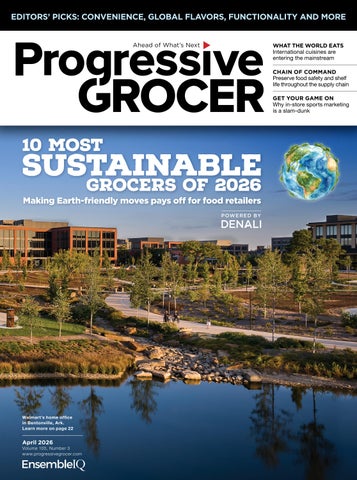
EDITORS’ PICKS: CONVENIENCE, GLOBAL FLAVORS, FUNCTIONALITY AND MORE WHAT THE WORLD EATS International cuisines are entering the mainstream CHAIN OF COMMAND Preserve food safety and shelf life throughout the supply chain GET YOUR GAME ON Why in-store sports marketing is a slam-dunk
10 MOST
SUSTAINABLE GROCERS OF 2026
Making Earth-friendly moves pays off for food retailers POWERED BY
Walmart’s home offi ce in Bentonville, Ark. Learn more on page 22
April 2026
Volume 105, Number 3 www.progressivegrocer.com
June 2–4, 2026
Palmer House Hilton Hotel | Chicago
Retail Media in Grocery is Entering Its Most Critical Phase. Are You Ready For What’s Next? Retail media has moved beyond experimentation. Now it’s about scale, incrementality and organizational alignment. Retail Media Summit brings together retail leaders, CPG brands, agencies and solution providers to tackle today’s measurement, activation and monetization challenges, and secure competitive advantage for the future. It’s also an opportunity to explore the growing influence of in-store media, AI-driven commerce and scalable performance frameworks.
READER OFFER As a valued Progressive Grocer reader, get 10% off your ticket. Use code: PGREADER_RMS2026
Register Now at p2piretailmediasummit.com
BROUGHT TO YOU BY
Contents Volume 105 Issue 3
04.26
14 COVER STORY
10 Most Sustainable Grocers of 2026 Retailers prove that making Earth-friendly moves pays off.
24 CATEGORY REVIEW
34 FEATURE
52 PERIMETER
A World of Eating
Progressive Grocer Names the Best New Products of 2026
Pharmacy Evolution
The flavors of international cuisines are permeating the mainstream.
This year’s Editors’ Picks tap into convenience, global flavors, functional nutrition and more.
Responding to consumer needs and aided by technology, the department’s influence now encompasses the entire store. 54 TECHNOLOGY
Strengthening Links in the Cold Chain
Real-time tracking of conditions beyond the store is essential to preserving food safety and shelf life. 56 FEATURE
How and Why Sports Sponsorships Show Up in Stores
These activations boost community presence, drive brand loyalty and inspire bigger baskets.
Departments 4 EDITOR’S NOTE
An Insider’s View of Natural Products Expo West 6 IN-STORE EVENTS CALENDAR
June 2026
8 NIELSEN’S SHELF STOPPERS
10 MINTEL
Frozen Foods
Prepared Cakes and Pies
58 Why Medically Tailored 11 ALL’S WELLNESS
Meals Make Sense
58 AHEAD OF WHAT’S NEXT
Current and Future Fish PROGRESSIVE GROCER April 2026
3
EDITOR’S NOTE By Emily Crowe
An Insider’s View of Natural Products Expo West
I
A NUMBER OF TRENDS EMERGED FROM THIS YE AR’S E VENT. almost hate to admit this, but at the beginning of March, I attended my very first Natural Products Expo West event. Sure, I’ve been to food shows before, but I imagine you won’t be surprised to hear that this one blew me away. This year’s 45th anniversary event, held March 3-6 in Anaheim, Calif., hosted more than 60,000 attendees and more than 3,000 exhibitors. With three floors of food products ranging from better-for-you candy to packaged ramen meals and beyond, innovation was front and center. Here are a few trends that stood out among the crowded field, along with a bevy of items that grocers should be paying attention to.
www.ensembleiq.com BRAND MANAGEMENT SENIOR VICE PRESIDENT, GROUP BRAND DIRECTOR Eric Savitch esavitch@ensembleiq.com VICE PRESIDENT OF CONTENT Lisa Johnston ljohnston@ensembleiq.com EDITORIAL EDITOR-IN-CHIEF Emily Crowe ecrowe@ensembleiq.com MANAGING EDITOR Bridget Goldschmidt bgoldschmidt@ensembleiq.com SENIOR DIGITAL EDITOR Marian Zboraj mzboraj@ensembleiq.com SENIOR EDITOR Julia Tabisz jtabisz@ensembleiq.com ASSOCIATE EDITOR Samantha Schober sschober@ensembleiq.com CONTRIBUTING EDITORS Jim Dudlicek, Mike Duff, Jenny McTaggart and Barbara Sax ADVERTISING SALES & BUSINESS
Tapping Into Culture
Gut health-focused products were a major champion at this year’s Expo West. Nancy’s Probiotic Foods displayed European-style cultured butter made with organic milk from pasture-raised cows, and Stonyfield Organic exhibited its Probiotic Yogurt that promises billions of live microorganisms with each serving. Nature’s Garden, meanwhile, put forth its Probiotics Yoggies snacks, which consist of “real fruit bites coated in creamy yogurt” and boast 2 billion probiotic cultures plus 3 grams of fiber. Also on the snack side, newcomer Krack’d Snacks shared its better-for-you candy bars that include prebiotic fiber, in addition to being low-carb and keto diet-friendly.
Beverages With Benefits
The Expo West show floor was awash with drinks that offer a little something extra. TRIP Mindful Blend, for example, is a lightly sparkling canned drink with added magnesium and lion’s mane mushrooms to promote calm and relaxation. Juni Sparkling Tea, meanwhile, includes adaptogens and nootropics that the company says help elevate overall wellness. Elmhurst’s new Clean Protein beverage boasts 27 grams of plant-based protein per container, with just 190 calories. On the newcomer side, tru cinnamon offers water infused with premium Ceylon cinnamon that offers such benefits as good cholesterol support, brain function improvement, and blood sugar and inflammation reduction.
Pure Protein
Unsurprisingly, protein was quite literally everywhere at the event. Organic Valley’s Protein Plus Milk made a splash, promising 50% more protein and 50% less sugar than regular milk. FUEL10K granola, from Premier Foods Group, delivers about 10 grams of protein per serving, and Kodiak creatively displayed its protein-packed Overnight Oats, Oatmeal, Power Cakes pancake mix, Chewy Granola Bars, and frozen breakfast items like French toast sticks and waffles. Additionally, Silver Hills Bakery showed off its Smooth & Sprouted Protein Bread filled with plant-based protein, while KIND Snacks displayed its Protein Max snack bars with 15 grams of protein. On the other end of the spectrum, Wilde Snacks, known for its high-protein chips made from chicken breast, egg whites and bone broth, shared its new crackers made from the same ingredients. Emily Crowe Editor-in-Chief ecrowe@ensembleiq.com
4 progressivegrocer.com
8550 W. Bryn Mawr Ave. Ste. 225, Chicago, IL 60631 Phone: 773-992-4450 Fax: 773-992-4455
ASSOCIATE PUBLISHER, REGIONAL SALES MANAGER Tammy Rokowski (INTERNATIONAL, SOUTHWEST, MI) 248-514-9500 trokowski@ensembleiq.com REGIONAL SALES MANAGER Theresa Kossack (MIDWEST, GA, FL) 214-226-6468 tkossack@ensembleiq.com SENIOR ACCOUNT EXECUTIVE Johanna Lupardus (CT, DE, MA, ME, RI, SC, TN, NH, VT, MD, VA, KY) 330-990-4635 jlupardus@ensembleiq.com PROJECT MANAGEMENT/PRODUCTION/ART PRINT DESIGNER Catalina Carrasco cgonzalezcarrasco@ensembleiq.com ADVERTISING/PRODUCTION MANAGER Maria del Mar Rubio mrubio@ensembleiq.com SENIOR DIRECTOR OF MARKETING Nicola Tidbury ntidbury@ensembleiq.com SUBSCRIPTION SERVICES LIST RENTAL mbriganti@anteriad.com SUBSCRIPTION QUESTIONS contact@progressivegrocer.com
CORPORATE OFFICERS CHIEF EXECUTIVE OFFICER Jennifer Litterick CHIEF FINANCIAL OFFICER Jane Volland CHIEF OPERATING OFFICER Derek Estey CHIEF PEOPLE OFFICER Ann Jadown
PROGRESSIVE GROCER (ISSN 0033-0787, USPS 920-600) is published monthly, except for July/August and November/December, which are double issues, by EnsembleIQ, 8550 W. Bryn Mawr Ave. Ste. 225, Chicago, IL 60631. Single copy price $18.20, except selected special issues. Foreign single copy price $21.80, except selected special issues. Subscription: $134 a year; $246 for a two year supscription; Canada/Mexico $182 for a one year supscription; $249.90 for a two year supscription (Canada Post Publications Mail Agreement No. 40031729. Foreign $182 a one year supscription; $249.90 for a two year supscription (call for air mail rates). Digital Subscription: $78 one year supscription; $144 two year supscription. Periodicals postage paid at Chicago, IL 60631 and additional mailing offices. Printed in USA. POSTMASTER: Send all address changes to brand, 8550 W. Bryn Mawr Ave. Ste. 225, Chicago, IL 60631. Copyright ©2024 EnsembleIQ All rights reserved, including the rights to reproduce in whole or in part. All letters to the editors of this magazine will be treated as having been submitted for publication. The magazine reserves the right to edit and abridge them. The publication is available in microform from University Microfilms International, 300 North Zeeb Road, Ann Arbor, MI 48106. The contents of this publication may not be reproduced in whole or in part without the consent of the publisher. The publisher is not responsible for product claims and representations.
IN-STORE EVENTS
Calendar S
06.26
M
LGBTQIA Pride Month Men’s Health Month National Camping Month National Country Cooking Month
T
W
National Fresh Fruit and Vegetable Month National Rose Month National Safety Month Turkey Lovers Month
T
F
S
1
2
3
4
5
6
7
8
9
10
11
12
13
14
15
16
17
18
19
20
21
22
23
24
25
26
27
28
29
30
National Barefoot Day. Offer product advice for those who want tempting tootsies – but remind them to wear shoes in your store(s).
World Food Safety Day. Check that your systems to keep food fresh and edible are running well.
World Blood Donor Day. Invite customers and associates alike to take part in a drive organized by your company.
Father’s Day. Help kids and spouses celebrate their paterfamilias with discounted treats and beverages.
Wimbledon – the only Grand Slam tennis event to take place on grass – begins.
National Best Friends Day. What better activity for bosom buddies than to buy groceries together?
National Prune Day. This often overlooked dried fruit is packed with fiber, potassium and antioxidants.
B Kinder Day. Ask your younger shoppers to write essays or draw pictures showing how people can treat others with compassion.
National Guy Day. The fellas deserve their own day, too – even those not named Guy.
6 progressivegrocer.com
National I Love My Dentist Day. Treat these often undervalued professionals to a special discount and provide tips for shoppers looking to boost their oral health.
Donald Duck Day. The ever-popular Disney character’s favorite foods are said to be hot dogs, blueberry pie and cheese.
National Fudge Day. Encourage shoppers to make their own.
International Olympic Day. The Summer Games don’t start until 2028, but spark interest early with an in-store magazine article on how readers can eat like Olympians.
National Meteor Watch Day. Folks are definitely going to need snacks and beverages while they’re scanning the heavens.
World Bicycle Day. Spotlight those of your associates who pedal to work on a regular basis.
National Egg Roll Day. Whether from takeout restaurants or the frozen aisle, these Asian-inspired appetizers appeal to eaters of all ages.
Global Garbage Man Day. Now is the time to pay homage to your waste disposal partners, regardless of gender.
National Day of Joy. Remind customers to visit specially marked end caps featuring items that will be sure to inspire happiness.
Global Running Day. What’s best to eat for people engaged in this activity? Get your nutritionist and other health experts to weigh in.
King Kamehameha Day. For this commemoration of the first ruler of Hawaii, spotlight the unique culinary history of the 50th state.
Wear BLUE Day. This observance was created to raise awareness of men’s health issues.
Please Take My Children to Work Day. Associates bringing in kids who are usually cared for by a stay-at-home parent can teach the youngsters about the grocery biz.
National Veggie Burger Day. Ask customers on social media how they dress theirs up to make the perfect meatless meal.
National Jerky Day. Highlight this dried meat snack’s high protein content as a way to interest health-conscious consumers.
Dragon Boat Festival. This venerable Chinese holiday is traditionally associated with zongzi, a sweet-andsavory dumpling.
National Beautician Day. Encourage shoppers to unleash their own inner stylists with your range of personal care products.
World Pest Day. Make sure your store(s) are free of any unwanted critters.
World Softball Day. Consider sponsoring a local team that will proudly wear your company logo on their jerseys.
Summer Solstice. Enjoy the longest day of the year!
Decide to Be Married Day. This is the time to tout your peerless floral arrangements for weddings.
EMPANADAS REIMAGINED Real Latin flavor!
© 2026 GOYA FOODS INC.
Discover the full line of authentic and convenient GOYA® Frozen Empanadas. Available in both traditional and baked, our empanadas satisfy a craving your customers can’t resist. Crafted with high-quality ingredients, they’re ready to serve in minutes – a delicious and convenient choice for any menu.
Contact your GOYA representative or email salesinfo@goya.com | Trade.goya.com
FRONT END
Shelf Stoppers
Average Unit Price
Frozen Foods Dollar Sales
% Change Year Ago
Unit Sales
%% Change Year Ago
Prepared Foods
$25,412,901,966
-0.2%
5,411,667,679
-1.0%
Desserts
$16,897,912,395
3.0%
3,414,505,690
1.1%
Seafood
$6,681,880,689
1.3%
657,095,427
-2.4%
Fully Cooked Meat
$6,567,927,507
4.5%
771,827,374
1.6%
Pizza
$6,561,532,304
-2.0%
1,290,112,051
-2.1%
Total Category
$77,573,715,076
3.9%
3,261,356,483
1.5%
Category
$5.06
for all frozen food items, up 1.5% compared with a year ago
$4.70
for prepared foods, up 0.7% compared with a year ago
Source: NIQ, Total U.S. (all outlets combined) during the 52 weeks ending Feb. 21, 2026
Index by Age and Presence of Children
$4.95
Prepared Foods
Desserts
Seafood
Fully Cooked Meat
Pizza
Age < 6
106
86
96
141
115
Age 6-17
128
115
106
153
142
Age < 6 & 6-17
129
110
112
194
147
No Children
90
97
98
75
84
Source: CAM Household Demographics
for desserts, up 1.9% compared with a year ago
$10.17
for seafood, up 3.8% compared with a year ago
Value Per Occasion What is the value per occasion for frozen pizza versus the year-ago period per generation?
$8.51
for fully cooked meat, up 2.8% compared with a year ago
Greatest Generation
Boomer
Gen X
Gen Y/Gen Z
$7.78
$8.21
$9.01
$9.06
up 2.7% compared with a year ago
down 0.5% compared with a year ago
down 1.0% compared with a year ago
down 2.3% compared with a year ago
Source: NIQ, Total U.S. (all outlets combined) during the 52 weeks ending Jan. 24, 2026
8 progressivegrocer.com
$5.09
for pizza, up 0.0% compared with a year ago Source: NIQ, Total U.S. (all outlets combined) during the 52 weeks ending Feb. 21, 2026
HAVE YOUR CAKE, AND EAT IT TOO. Explore (and taste!) functional ingredient trends across dairy, deli, and bakery. IDDBA 2026 inspires discovery, collaboration, and fresh thinking across dairy, deli, bakery, and foodservice. 4TH ANNUAL CAKE’D COMPETITION
MAKE YOUR PLANS!
Watch talented cake decorators compete LIVE to create the most impressive cake using a list of mystery ingredients. A panel of judges will crown one champion.
MINTEL CATEGORY INSIGHTS
Global New Products Database
Prepared Cakes and Pies What You Need to Know Pre-made sweet baked goods blend convenience and indulgence, outshining homemade options in factors like time savings and flexibility. Ready-made treats provide a practical solution to everyday life – delivering consistency, variety and affordability. Consumers continue to depend on them as adaptable go-to items across occasions. Engaging innovation requires striking the balance between fun and functionality. Meeting essential needs, like extended shelf life, convenient packaging and easy preparation, is just as crucial as delivering a gratifying experience through unique flavors, indulgent textures and creative formats. The prepared cake and pie market is projected to grow from $15.2 billion in 2025 to $15.8 billion by 2029, fueled by demand for convenience and snacking. However, growth is tempered by health concerns. Shelf-stable products lead the category, while frozen and refrigerated baked goods represent smaller segments of the market.
FOR MORE INFORMATION, VISIT WWW.MINTEL.COM OR CALL 800-932-0400
What Consumers Want and Why
Opportunities
Pre-made baked goods fit seamlessly into Gen Z and Millennial lifestyles. With a growing snacking culture, a love for little treats, more limited kitchen space and a preference for convenience, ready-made options are reliable, offering a simple way to satisfy cravings and effortlessly elevate social gatherings.
Suggest preparation methods that enhance indulgence and create memorable moments. Prepared baked goods face challenges with freshness perceptions, so demonstrating simple techniques like microwaving for a warm, melty texture or crisping in an air fryer can help create new and more indulgent experiences. These methods can improve freshness perceptions and prove value, offering a more affordable way to enjoy warm, delicious desserts outside of foodservice.
Pre-made baked goods are seen as indulgent, making it tough to position them as an everyday choice – and that’s OK. While they may not fit into daily routines, there are ways to encourage more frequent consumption. New packaging sizes, snackable formats or betterfor-you ingredient reformulations can enhance flexibility across occasions. Even on tight budgets, consumers explore new flavors, seeing them as an affordable way to experiment. Seasonal and limited-time-only (LTO) flavors are particularly appealing, offering a more justifiable one-time treat without breaking the bank. Pairing promotions with LTOs could be key in attracting consumers during tough times.
Solidify presence in snacking repertoires by offering mini versions and portion-controlled packs to enhance convenience, versatility and suitability across occasions. Also, tailor assortment to snacking occasions by daypart. Innovation doesn’t always require an overhaul. Sometimes, small changes, like adjusting size, collaborating with brands within the same category or drawing inspiration from other areas, can strike the perfect balance of fresh yet familiar. In challenging times, consumers tend to be more reluctant to try entirely new products. However, when something new is thoughtfully paired with something they already know and love, it becomes far more justifiable.
10 progressivegrocer.com
ALL’S WELLNESS
By Molly Hembree, MS, RD, LD
Why Medically Tailored Meals Make Sense
S
SUPERMARKETS CAN HELP CONSUMERS WITH HEALTH CONDITIONS MAKE BET TER NUTRITIONAL CHOICES. hoppers remain confused about what foods are best to meet their individual needs and preferences for health. Although working with health professionals such as registered dietitians can help translate nutrition evidence into practical food suggestions and cut through the noise of “what to eat” and “what not to eat,” consumers may still be overwhelmed. Solutions for these consumers, especially if they require modified diets based on a health condition, may be best met within the grocery store via unique meal offerings. The unfortunate rise in chronic health conditions, paired with the desire to eat more simply, means that the need for medically tailored meals (MTMs), or therapeutic, nutritious and curated meals, is more appropriate than ever. Research from The Friedman School of Nutrition Science and Policy at Tufts University estimates that MTM programs could help prevent 1.6 million hospitalizations and save insurers a net amount of $13.6 billion per year. To determine what MTMs are most meaningful to the majority of shoppers, it’s wise to look first at what primary health concerns among adults can be managed with diet and lifestyle. The Centers for Disease Control (CDC) reports that interventions aimed at preventing or managing conditions like heart disease, stroke, cancer, diabetes, obesity and chronic kidney disease can have major health and economic benefits. In fact, these issues, along with other complex physical and mental health conditions, represent “90% of the nation’s $4.9 trillion in annual health care expenditures,” according to the CDC.
For example, in 2023, The Kroger Co. began collaborating with MTM delivery company Performance Kitchen to provide MTMs alongside “pre-existing Kroger Health services such as virtual appointments with registered dietitians and access to healthy groceries, for a holistic approach to improving nutrition security and patient outcomes.”
Medically tailored meals are a powerful way to help your customers navigate dietary restrictions on their health journeys while maintaining your grocery retailer as a trusted epicenter of the shopping experience.
Meals by Design
Key components for designing appropriate MTMs usually involve a set of health themes. These include a reduction in excess sodium, limitations on added sugar, elevated amounts of soluble and insoluble fiber, higher protein, keeping saturated fat at a minimum, and/or controlling portion size. Coincidentally, these health attributes are not only responsible for supporting the betterment of chronic health conditions, but also are a way to eat defensively to avoid the onset of these issues in otherwise healthy people. Often, these health features come to life by highlighting better-for-you foods within the meals, such as fruits, vegetables, whole grains, healthy fats, lean proteins and dairy products. In addition to nutrition, the format and recipe development for MTMs takes into consideration things like shelf stability, ease of preparation, and taste. Often, MTMs are offered as a fully prepared heat-and-eat meal, making it easy for consumers who may have limitations regarding their cooking ability or access. These meals can be delivered directly to consumers’ homes or made available through a grocery retailer as an intermediary.
Measuring the Health Effects
Gauge the effectiveness of MTMs with the expertise of your registered dietitians and pharmacists through pre- and post-monitoring of blood sugar, blood pressure, cholesterol and other lab work. Particularly if customers might be willing to enter a controlled study, these lab values can be more reliable to represent the accuracy of MTM interventions for health. It may be worth partnering with MTM distributors or vendors to see if this or a similar type of analysis can be pursued. MTMs are a powerful way to help your customers navigate dietary restrictions on their health journeys while maintaining your grocery retailer as a trusted epicenter of the shopping experience. Connect with health professionals like registered dietitians within your organization and seek out strong partnerships with MTM manufacturers to see how this service can be made available to your shoppers.
Molly Hembree, MS, RD, LD, is a registered dietitian for Kroger Health. PROGRESSIVE GROCER April 2026
11
ADVERTORIAL
Better Oil, Better Food, Better Margins: Get All with Smarter Oil Management How are you managing oil in the foodservice areas of your store? It is a question all grocery retailers must address since effective oil management is critical to operational efficiency, food quality, and cost control, and directly impacts the success of the entire foodservice program. Progressive Grocer asked Brandon Brill, Vice President of Sales & Marketing for Oil Solutions Group, Inc.® — a company that has been helping foodservice customers tackle frying oil challenges for more than 15 years — to share how Masterfil® filtration systems help grocery retailers simplify oil management and improve performance across their foodservice operations. Progressive Grocer: Foodservice has become such an important component of grocery retailing today. Why should stores consider changing the way they’re handling the oil they use? Brandon Brill: In our company, we are constantly looking at our
COGS (cost of goods sold) to ensure we are competitive in the market without compromising our quality. Grocery stores, with their small margins, must do the exact same thing to survive. With the continued growth of deli-fried chicken in grocery stores right now store managers find themselves competing not only with other grocers, but also the neighborhood QSRs. In order to stay competitive, stores have to look at the food costs and especially cooking oil. Utilizing our best-in-class oil management products allows them to save thousands of dollars per fryer without compromising the product. PG: What challenges do stores face when it comes
traditional filters, which haven’t changed in generations. They’re reusable for 7 days — you just scrape the crumbs off the top, so there’s no need to continually handle daily filters. That delivers a multitude of benefits for grocery retailers:
• Extended Oil Life. Masterfil is a 0.5micron filter media vs 60+ micron for daily paper filters. Better filter media equals longer oil life. • Reduced Oil Waste. Each daily paper filter soaks upwards of 20 ounces of oil — perfectly good oil that goes in the trash when you use daily filters. The Masterfil 7-day filter eliminates that waste because you can leave it in for a week before having to change it. • Labor Savings. Removing and replacing the daily filter, along with extra time spent in cleaning, drying and handling, can take 30 minutes or more. Masterfil transforms that 30-minute task into a 2-minute one. The bottom line is that Masterfil filters make the filtering process easier, and that means it will happen more frequently, resulting in better finished product and longer lasting oil no matter the size of your operation. PG: Does Masterfil require a specific filtration machine? Or can it work with a store’s existing equipment? BB: Masterfil filters come in 80+ sizes, so there is a filter to fit
any mechanical filtration application — everything from built-in filter units to portable filter machines. OSG also manufactures the Armadillo® filter machine, the industry’s finest portable filter machine that is engineered to be modular and virtually eliminate service calls.
to managing oil? BB: The biggest challenge with managing oil is almost always in
REAL SAVINGS FROM REAL GROCERS
the filtration process. It’s not always an easy task, it’s typically a dirty task, and if not done correctly, it can be a costly task. Fortunately, our team at Oil Solutions Group has immense experience in a wide variety of situations. We understand the pains that the deli team could be going through and we utilize our knowledge to optimize the process. Our Masterfil product reduces the exposure to risks, and our SOP support shows the staff how to maximize the practice for positive bottom-line impact.
Operators who have switched to Masterfil filters report business-changing savings across their operations:
PG: How can OSG’s Masterfil filter help stores overcome these challenges? BB: Masterfil filters work in a completely different way than
8 STORE MIDWEST GROCER Total NET savings of $105,000+ across brand — $13,000+ per store • Extended oil life in chicken fryers from 3 to 7 days • Extended oil life in remaining fryers from 5 to 14 days 100+ STORE EAST COAST GROCERY CHAIN 7,000 pounds of oil per store saved by changing filter media from paper to Masterfil® 1100+ MID-ATLANTIC GROCERY CHAIN Total NET savings of $4,700,000+ across brand • 25 jugs of oil saved per store, annually • 120 hours of labor reduced per store, annually
COVER STORY
POWERED BY
10 Most Sustainable Grocers of 2026
10 MOST
SUSTAINABLE GROCERS RE TAILERS PROVE THAT MAKING E ARTH-FRIENDLY MOVES PAYS OFF. By PG Editorial Staff
I
t’s that time of year again when Progressive Grocer’s team of editors puts their heads together to identify the U.S. food retailers that have gone above and beyond to help create a more sustainable ecosystem for themselves, their associates, their shoppers and the grocery industry as a whole. Sustainability today comes in many different forms, and these grocers have adopted technology, programs and initiatives that run the gamut of what’s possible in today’s increasingly Earth-friendly business environment. Not only that, but many of them are actively working to improve and maintain the health and well-being of their associates and nearby communities. As we learned this year, technology has indeed become a critical factor in grocers’ ability to make sustainability moves at scale. AI applications are taking the guesswork out of waste reduction, while energy-efficient building
14 progressivegrocer.com
infrastructure and refrigeration systems are actively cutting down on consumption and costs. All of this is to say that sustainability, in recent years, has evolved from nice to have to table stakes, both in terms of driving profitability and satisfying changing consumer demands. PG’s 2026 Consumer Expenditures Study found that many shoppers continue to care about overall sustainability practices – so much so that 62% are willing to pay more to shop in a store that undertakes sustainability practices. Additionally, two in five consumers among Gen Z and Millennials say that they would switch to a more sustainable store. These are notable commitments at a time when shoppers remain highly price-conscious. Read on to learn more about how PG’s 2026 class of the 10 Most Sustainable Grocers (presented in alphabetical order) is proving that eco-friendly commitments are well worth the investment.
COVER STORY
10 Most Sustainable Grocers of 2026
Costco Wholesale Corp.
grocery outlet
F C
ostco Wholesale Corp. made significant progress on its sustainability goals this year. According to Costco’s 2025 “Sustainability Report,” operational emissions dropped 7.2% versus the prior year. The Issaquah, Wash.-based retailer now sources 28% of its global electricity from clean energy and has staked out a target of cutting Scope 1 and 2 emissions by 39% by 2030 against its 2020 baseline. The supply chain corner of the ledger got significant attention as well. Costco launched its STEP Program – standing for Scope 3 Supplier Targets, Transition Agriculture, Energy Solutions and Packaging Solutions – working directly with buying teams to chip away at indirect emissions. Scope 3 emissions intensity fell 13.5%, waste diversion hit a new record of 82.8%, global water intensity dropped 4.4%, and Kirkland Signature packaging shed 1.5 million pounds of plastic. The company is also piloting regenerative agriculture investments with partners and collaborating with the Seafood Task Force and the Equitable Food Initiative to push responsible sourcing deeper into its merchandise mix. Becoming more bee-friendly was another priority. In December of last year, Costco updated its pollinator health policy, pushing suppliers of fruits, vegetables and live goods to move away from nitroguanidine neonicotinoids, glyphosate and organophosphate pesticides, and toward integrated pest management and regenerative agriculture approaches. These efforts boosted Costco’s score on Friends of the Earth’s Bee-Friendly Retailer Scorecard by a full letter grade, from a C to a B+. Additionally, while a number of retailers cut their diversity, equity and inclusion (DEI) initiatives in the wake of President Trump’s executive orders targeting such programs, Costco held fast. At its January annual meeting, 98% of shareholders voted down a proposal from a conservative think tank, the National Center for Public Policy Research, seeking a risk assessment of the company’s DEI practices. The board unanimously urged shareholders to reject the motion, arguing that diversity benefits product development, sustainability efforts and member satisfaction.
16 progressivegrocer.com
or a retailer like Grocery Outlet, sustainability is embedded in the way that it does business This past July, the Emeryville, Calif.-based discount food retailer, whose business model maintains a laser focus on quality food access, local ownership and sustainability, laid out its progress to date in its most recent “Impact Report,” covering fi scal year 2024. A key impact area highlighted in the report was that of food waste. Thanks to a sourcing model that supports food waste reduction by focusing on excess inventory and offering surplus food to its customers, the company contributed to avoiding more than 762 million pounds of food waste in 2024.
Additionally, Grocery Outlet’s regional fulfi llment centers donated an estimated 3.3 million pounds of groceries to food banks and charitable organizations that year, a more than 60% increase over the estimated 2 million pounds donated in 2023. (Speaking of donations, the retailer said in January 2026 that it had raised funds to provide 2 million meals to food-insecure people through its holiday campaign with Feeding America.) Further, the company achieved a 73% increase in the number of its stores using more efficient CO2 refrigeration; it revealed last year that 100% of its locations now use an energy management system and timed heating and lighting controls, while 63% of its third-party carrier partners are SmartWay certified. At the time of the report’s release, Grocery Outlet President and CEO Jason Potter noted: “I am excited to guide our company forward in service of our mission. My goal is to create greater value for all our stakeholders and strengthen our unique business model — one that blends national buying power and extreme value with the entrepreneurial spirit of our independent operators. Together, we will continue to build a brighter, more sustainable future.”
POWERED BY
Hy-Vee
H
y-Vee spent 2025 building a robust sustainability framework. The employee-owned grocer organizes its environmental commitments across four pillars: store construction and design, product sourcing and packaging, waste reduction, and energy conservation. West Des Moines, Iowa-based Hy-Vee saw progress on each of these fronts during the year. Waste diversion was one of the more significant areas of emphasis, with Hy-Vee revealing that it will continue to expand composting and recycling programs across its store base, with the goal of keeping more material out of landfi lls. Food waste remains a key target, with recent investments in better inventory tracking and markdown systems reducing spoilage at the store level and keeping still-edible food out of the trash can. Hy-Vee’s distribution centers have earned TRUE Zero Waste certification as well, with retail locations collectively diverting between 15 million and 20 million pounds of food waste every year. Hy-Vee also reported that its stores are now designed with energy efficiency baked in from the ground up. The company’s latest builds feature enhanced insulation, solar panels, skylights with daylight-sending LED dimmers, and EV-charging stations at fueling locations. Additionally, Hy-Vee will prioritize equipment that uses more climate-friendly refrigerants to curb emissions tied to cooling systems. Reducing single-use plastics also remains a goalpost, with to-go containers swapped out for recyclable alternatives as the company continues to seek packaging solutions that work for both customers and the environment. Ocean health, a longtime pillar of the chain’s environmental identity, factors into its product selection as well. Through a partnership with FishWise, Hy-Vee publishes the names of every fishing vessel supplying its private label tuna items, an exercise in transparency that, according to the company, no other U.S. retailer does. Additionally, Hy-Vee and Alliant Energy marked the completion of the Hy-Vee Chariton Solar Field, in Iowa, a project capable of generating enough electricity to power 360 homes annually. The two companies are also piloting a fleet of 30 electric refrigerated trailers for perishable deliveries, replacing diesel cooling systems with electric units that run quieter and carry a smaller carbon footprint.
Natural Grocers by Vitamin Cottage
N
atural Grocers is dedicated to building a healthier, more sustainable future for its customers, associates and the communities it serves. The Lakewood, Colo.-based retailer empowers wellness nationwide through its differentiated, evidence-based nutrition education program. The company’s in-store Nutritional Health Coaches offer free one-on-one coaching, nutrition education classes, recipe demos, and personalized shopping support for customers and associates. In fiscal year 2025, the company invested more than $7 million in nutrition education services, underscoring its belief that accessible, research-backed nutrition guidance can meaningfully support individual and community well-being. Natural Grocers also continues to prioritize vendors and farming partners committed to soil health, biodiversity and ecological stewardship. The company exceeded its $100,000 goal during last year’s Organic Month fundraiser campaign that supports Rodale Institute, the nonprofit dedicated to growing the regenerative organic agricultural movement. Through proceeds from limited-edition reusable-bag sales and customer donations, the campaign raised a total of $113,220. These funds directly support farmer-training programs, helping cultivate the next generation of regenerative organic farmers. Additionally, the food retailer shines a spotlight on farmers like those in its “Meet Your Farmer” video series. The series gives a voice to farmers and ranchers who are changing the way food is produced, to ensure a livable, healthy tomorrow. Viewers meet organic growers, grass-roots farmers and regenerative ranchers who are dedicated to the land, their animals, their communities and the planet. Last year, Natural Grocers also raised the bar for household cleaning products with expanded product standards that reflect the newest research. Its latest updates reflect growing scientific understanding of the impact that certain common ingredients can have on indoor air quality, ecosystems and overall well-being. With this update, the retailer’s list of prohibited ingredients in household cleaning products now includes more than 100 items. In addition to previously excluded substances, the new standards ban formaldehyde donors, phthalates, parabens, ethanolamines, glycol ethers and quaternary ammonium compounds. PROGRESSIVE GROCER April 2026
17
Navigating Complexity with Structure and Discipline
h t r o N e h t t e r k r o f a t l M o t Bui e t u o R n a c Ameri
e ted valu a r g e t In n xecutio chain e eam) tr (ValueS
ligned Retail a del ing mo operat
ecades uilt on d erican B Am label f North o Private d e t ing a operat e t integr r o p p u s nc system experie into the
Learn about ValueStream at:
thomaslargesinger.com
THE TLS FOOTPRINT: SCALING CPG SUCCESS ACROSS NORTH AMERICA
ADVERTORIAL
In 1912, TLS opened in Toronto
PG: What does this mean for grocery retailers?
great products with the right
tionally consistent and easy to work with. Our approach
as a food brokerage to connect markets. More than a century
later, this fourth generation-led company — North America’s
leading full-service CPG solutions provider — is expanding its U.S. footprint, bringing its
full spectrum of value chain solutions to all 50 states.
Progressive Grocer asked TLS President and CEO David Singer why the company is the ideal partner for CPG businesses trying to navigate the route to market to compete in the complex world of CPG.
Progressive Grocer: CPG brands have many options
when choosing a logistics partner. What does TLS offer that others do not?
David Singer: Most providers cover one slice of the
value chain. TLS operates across it. We import, store, and take title of product, then manage the end-to-
end workflow, from orders coming in (EDI or manual), to fulfillment, and invoicing, so the operating model is consistent and accountable. Our ValueStream
approach connects the operational backbone (warehousing, logistics, customer service, invoicing, A/R,
deductions) with reporting and business intelligence so our clients aren’t managing myriad vendors. We
do this in a transparent and scalable model, designed for CPG realities, not generic freight movement.
PG: With so many service providers, why does ValueStream’s integrated model matter more than ever? DS: Specialists can be excellent, but fragmentation
is expensive. Every handoff creates a gap: different
systems, different incentives, different definitions of
success. ValueStream consolidates the operational
spine of the business — order processing, EDI, customer service, invoicing, warehousing, logistics, collections,
deductions and reporting — into one integrated workflow. That reduces friction, improves accountability,
and enables faster decisions because reporting and visibility aren’t delayed by vendor coordination. In today’s environment, that operational clarity is a competitive advantage.
DS: Our retailer partners benefit when suppliers are operais built around reliable fulfillment and disciplined order-
to-cash execution, supported by advanced systems and clear reporting. When the operating backbone is strong, retailers have fewer preventable issues and friction
points, fewer handoffs, cleaner processes, and better
visibility. That supports better on-shelf availability and smoother execution across the retail relationship. For
shoppers, that translates into having the right products
in the right place at the right time, supported by a supply chain that can keep up with demand.
PG: How is TLS supporting retailers as private label strategies become more sophisticated?
DS: As private label evolves, execution expectations rise, especially around speed, consistency, and operational
reliability. TLS supports private label through dedicated private label brokerage capabilities, supplier/retailer
innovation sessions and launch support. We understand private label’s nuances, as we have been part of this
ecosystem since its inception. Efficiencies must be re-
alized at all points in the supply chain to ensure we can deliver the quality and value our retail partner brands
expect. Private label brands require tight coordination
across planning, supply, onboarding processes and performance monitoring. Our broader model is designed to
connect those dots so private label strategies can scale. PG: From your vantage point, what mistakes do CPG companies make when expanding into the U.S.?
DS: The most common mistake is treating expansion as a commercial event instead of an operating sys-
tem challenge. Brands focus on distribution targets, but underestimate the operational backbone required to
sustain performance — things like EDI readiness, order
management, inventory flow, and a clean order-to-cash
process with reporting visibility. Another mistake is building a fragmented provider network too early — separate partners for logistics, finance workflows, reporting, and
trade mechanics —then trying to “stitch it together” later. Our experience is that scalability comes from integra-
tion and discipline, which is why we built ValueStream to connect the core workflows from the beginning.
COVER STORY
10 Most Sustainable Grocers of 2026
PCC Community Markets
Publix Super Markets
P
ublix Super Markets is committed to being a responsible citizen in its communities, especially when it comes to water-based initiatives. For example, the Lakeland, Fla.-based grocer has devoted itself to wetland restoration projects. The grocer’s monetary support of the National Audubon Society and the National Park Foundation (NPF) helped restore more than 1,300 acres of wetlands in the Florida Everglades. As a result, an estimated 173 million gallons of water are restored to these areas annually. Healthy wetlands help absorb stormwater surges, reduce flooding in nearby communities and recharge the underground aquifers that supply drinking water to millions of people.
C
ooperation and partnerships continued to be a cornerstone of Seattle-based PCC Community Markets’ work in 2025. In response to the food insecurity crisis experienced in Washington state because of the government shutdown late last year and other long-standing factors, PCC established a $50,000 seed fund with a call to action for co-ops and industry partners to join. Including a $50,000 match from the BECU Foundation – a fellow co-op – PCC was able to raise nearly $600,000 in cash and donated goods, supporting 100-plus hunger relief agencies and community organizations across Snohomish, Pierce and King counties. PCC also raised more than $716,000 for Growing for Good, a program designed to support the stream of fresh produce from small farms in the Puget Sound region to local hunger relief agencies. In addition to increasing food access, PCC is well known for its adoption of sustainable building practices: Several of its stores have achieved LEED Gold and Platinum certifications, as well as Living Building Challenge Petal certifications. The recently completed Rainier Tower project in Seattle – which consists of a hybrid small-format store and office space – advanced this legacy by making use of sustainable materials, energy-efficient equipment and low-impact refrigeration. PCC was able to reduce greenhouse-gas emissions from refrigerants last year through, among other things, the use of leak detection equipment. The co-op also reported that it cut waste in all categories, including cardboard and trash, and is improving its compost and recycling efforts. Related to supply chain standards, PCC kept busy last year organizing meetings with farmers, tribal leaders, policy officials and producers on ways to support regenerative agriculture. Currently, the co-op’s stores carry more than 600 Fair Trade products and 5,000-plus Non-GMO Project Verified offerings, along with items from more than 700 local producers.
20 progressivegrocer.com
Publix has also supported coral restoration efforts in the Florida Keys by installing a coral field nursery consisting of 25 coral trees. This effort is made possible through Good Together environmental campaign donations made by customers and associates at its Florida stores. Built by support associates in Lakeland, coral trees were transported to the Florida Keys, where military veterans from FORCE BLUE and local scientists anchored the trees to the ocean floor within the Publix Coral Nursery. The team then attached small fragments of coral to the trees, which grow into larger corals that can later be transplanted to existing coral reefs to help rehabilitate the coral population. Additionally, Publix recently marked a donation milestone to Sustainable Fisheries Partnership (SFP), a nonprofit that protects ocean systems, rebuilds fish populations and supports commercial fishers. Since 2011, Publix has donated $1 million to SFP. The food retailer’s most recent donations totaled more than $350,000 and included support efforts to reduce the unintended catch of ocean wildlife in the seafood sourcing supply chain. Unintended catch, or bycatch, occurs when commercial fishers accidentally catch nontarget species while fishing, which is a contributor to population decline in endangered, threatened and protected species. Affected populations include whales, sharks, dolphins, turtles and seabirds. By providing funding for high-tech gear and training, Publix also helps commercial seafood suppliers minimize their impact on ocean ecosystems.
POWERED BY
Schnuck Markets
Sprouts Farmers Market
F
I
resh food has been the impetus behind many of Schnuck Markets’ most recent sustainability moves. Late last year, the St. Louisbased food retailer expanded a farm-to-store delivery concept through its partnership with produce logistics and marketing platform Foodshed.io, boosting the number and types of hyper-local suppliers from which it sources some of its produce. A pilot program began in fall 2024 with one farm supplying various Schnucks locations across the St. Louis metro area. Following the pilot’s success, Schnucks widened the program in 2025 to include additional farmers and more store locations. “This program is a natural next step in our mission to strengthen our local food economy and provide our customers with the freshest possible products,” said Michael Tipton, Schnucks’ VP of produce and floral. “By working with hyper-local farms located just miles from our stores, we’re able to reduce transportation time and deliver produce to our shelves just hours after it’s been harvested from the fields.” This past September, Schnucks deployed Logile’s Fresh Item Management Solutions to modernize its fresh food operations, thereby adopting a data-driven and automated approach that eliminates guesswork and also helps the grocer add more sustainability to its operations. More accurate production scheduling reduces overproduction and helps minimize shrinkage, while tracking the breakdown of raw items into sellable cuts and accounting for trimming loss and bone removal enhance overall inventory control. Further, Schnucks has included Picadeli salad bars in a number of its store remodels. The food technology company’s modular in-store salad bar concept is packed with seasonal, local and climate-friendly foods, and uses AI to parse through data on sales and inventory levels to optimize assortment and restocking needs, thereby reducing potential food waste.
n a recent example of Sprouts Farmers Market’s wide-ranging sustainability efforts, the organic and natural food retailer and global technology provider Schneider Electric signed a landmark tax credit transfer in collaboration with U.S. Bank and Longroad Energy. The agreement advances the Sun Pond Solar + Battery Energy Storage System (BESS) project, in Maricopa County, Ariz., Phoenix-based Sprouts’ home base. Sprouts’ investment has helped set up a 111 MWdc solar and 85 MWac / 340 MWh storage project, which is expected to power around 19,000 homes annually and avoid 145,000 metric tons of CO2 emissions each year. Over its lifetime, Sun Pond will contribute more than $30 million in revenue for Arizona schools and communities via long-term leases and tax remittances. Construction on the project is complete, and commercial operations have begun. “This work is anchored in Sprouts’ purpose of helping people live and eat better,” said Brandon Lombardi, the company’s chief legal and sustainability officer, in March of this year. “By supporting new renewable-energy projects, we’re taking tangible steps to care for our planet, people and local communities.” Additionally, this past December, the food retailer became only the second company to score in the A range on advocacy group Friends of the Earth’s (FOE) Bee-Friendly Retailer Scorecard, joining one of PG’s other Most Sustainable Grocers this year, Whole Foods Market. Sprouts unveiled a new commitment to pollinator health last year that aims to reduce use of toxic pesticides in the company’s supply chain and build on its sales of organics. FOE’s annual scorecard evaluates 25 of the country’s top grocery retailers on their commitments and progress toward reducing pesticides linked to the decline of bees, biodiversity, and soil and human health. Sprouts is also a signatory of the U.S. Food Waste Pact, a national voluntary agreement that uses the “Target, Measure, Act” framework to reduce food waste across the supply chain. PROGRESSIVE GROCER April 2026
21
COVER STORY
POWERED BY
10 Most Sustainable Grocers of 2026
Walmart
Whole Foods Market
W
W
Walmart’s commitment to sustainability even extends to its new Bentonville, Ark., home office, which includes buildings constructed from mass timber – the largest application of its kind in the United States, the company boasts – and designed to achieve LEED Platinum standards with such features as dynamic glass that reduces energy use. Additionally, half the campus is green space, with 750,000-plus native plants, including 5,000 planted trees. Further, with 7 miles of walking and biking paths, 1,000-plus bike-parking spots, a rentable bike fleet and 300 EV-charging stations, earth-conscious transportation is a snap for employees.
This past July, the Austin, Texas-based chain joined forces with regenerative farming nonprofit Mad Agriculture on what the two organizations are calling a “biodiversity highway.” Together, they aim to convert stretches of marginal cropland into interconnected corridors of native habitat, starting with roughly 1,000 acres in Wisconsin’s Lowery Creek Watershed. To get the project funded, Whole Foods pledged up to $500,000 in matching contributions, drawing in nine industry partners, including Applegate, OLIPOP and New Belgium Brewing, to collectively hit a $1 million target. “Teaming up with Mad Agriculture represents a meaningful step forward in our commitment to improving ecosystem health and fostering climate resilience,” said Jason Buechel, VP of Amazon’s Worldwide Grocery Stores and Whole Foods Market CEO. “This initiative is about rethinking how we care for the land and support the people who grow our food.” In December, a second major deal landed, with Whole Foods revealing that it will be the fi rst grocer anywhere to deploy Mill Commercial, an AI-driven on-site food-recycling system developed by Mill Industries with backing from Amazon’s Climate Pledge Fund. The technology grinds and dehydrates produce scraps in the back of the house, shrinking waste volumes by up to 80% and converting the output into chicken feed for Whole Foods’ private label egg suppliers. Rollout is slated for 2027, a major step toward the specialty retailer’s goal of halving food waste across its operations by 2030. Whole Foods also established a new Seafood Code of Conduct that strives to keep operations ethical and transparent while offering protections for fishers and vessel crews throughout its supply chain network.
almart has long used its scale and massive purchasing power to champion a range of eco-friendly endeavors. In just one instance of the big-box retailer’s many moves in this space, it worked with Avery Dennison last year to advance the use of RFID technology in the meat, bakery and deli categories, an undertaking that Julie Vargas, VP and general manager of enterprise intelligent labels growth at Avery Dennison, told PG this past February was “a fi rst of its kind in the industry.” Vargas added: “Walmart associates can track inventory faster and more accurately, making sure products stay stocked and ready when customers want them. This innovation is a landmark example of how retailers can incorporate innovation without changing their operations or merchandising requirements to deliver smarter, faster and more sustainable operations.” Among the retailer’s other recent sustainability actions is its partnership with CPG giant Kellanova and sustainable agriculture solutions provider Indigo Ag to introduce a new program enabling Arkansas rice farmers to receive a fi nancial premium for every pound of rice produced using regenerative methods. According to Walmart, its previous work with Indigo Ag has already helped rice farmers supplying the retailer’s Great Value private brand reduce emissions by more than 37,000 metric tons of CO2 e, conserve 11 billion-plus gallons of water and return more than $900,000 into their farms.
22 progressivegrocer.com
hole Foods Market channeled its energy into a slew of environmental commitments in 2025, launching initiatives to boost regenerative farming efforts, food waste reduction and ecosystem restoration on a scale that the grocer hadn’t previously attempted.
STAY AHEAD IN PRIVATE LABEL Get the latest news, trends, and insights to drive innovative private brand programs
SIGN UP FOR THE NEWSLETTER
CATEGORY REVIEW
IN PARTNERSHIP WITH
Global Foods
A World of Eating THE FL AVORS OF INTERNATIONAL CUISINES ARE PERME ATING THE MAINSTRE AM.
A By Bridget Goldschmidt
s consumers seek novel flavors, brands and retailers are stepping up by offering them the world – in the form of products inspired by various international cuisines. But what are the factors influencing this shift toward global foods? “At a high level, global-inspired foods are outperforming many center store and frozen category averages, with growth fueled by a mix of demographic, behavioral and structural factors,” notes Sally Lyons Wyatt, global EVP and chief advisor, consumer goods and foodservice insights at Chicago-based market research firm Circana. “Younger, more diverse consumers are a primary driver. Gen Z and Millennials over-index on global flavors and are more willing to experiment across cuisines, particularly in frozen and prepared foods. At the same time, the continued growth of Hispanic and Asian populations in the U.S. is increasing baseline familiarity and driving repeat demand, not just trial.” Wyatt adds: “We are also seeing lasting impact from pandemic-era behaviors. What began as at-home experimentation has evolved into a more permanent shift, with consumers seeking
24 progressivegrocer.com
Asian-inspired finger foods from SUMM! can be used across all dayparts.
restaurant-inspired global flavors at home, but with convenience, value and consistency. Frozen meals, simmer sauces and ready-to-use components are benefiting disproportionately.” The types of products that tend to do best, she observes, are those that “combine flavor adventure with convenience, portion control, and often better-for-you cues such as protein, vegetables and less processing.”
Seeking the ‘Sensory Payoff ’
As for the flavors that are generating the most excitement among consumers, Wyatt says: “Consumers gravitate toward cuisines that deliver a clear sensory payoff, whether that is chili heat, fermented tang, layered sauces or sweet-heat combinations. This shows
Key Takeaways U.S. consumers are increasingly seeking bold, globally inspired flavors that deliver both intensity and authenticity. Snacks, condiments and frozen meals are among the most popular global food entry points for mainstream consumers. The category is still in its infancy in the United States, with several years of significant growth expected.
CATEGORY REVIEW
Global Foods
IN PARTNERSHIP WITH
up strongly in growing interest in Mexican, Latin American, Southeast Asian, Korean, and, increasingly, Caribbean and African flavor profiles.” “U.S. consumers are increasingly seeking bold, globally inspired flavors that deliver both intensity and authenticity, from spice-forward profiles like Korean barbecue and chili lime to savory, umami-rich tastes like garlic parmesan, miso and teriyaki,” notes Tyler Averett, category manager at Naperville, Ill.-based distributor KeHE. “The demand also extends beyond flavor to entirely Asian salty snacks, like those manufactured by Calbee, are new formats and ingredients rooted in traditional cuiincreasingly sparking consumer interest in the United States. sines. Ingredients like chamoy, chimichurri, fish sauce and jollof are gaining mainstream traction, signaling popular single-serve and smaller-format pack sizes, drives impulse sustained consumer curiosity.” purchases, making them an ideal entry point for discovery. This is According to Kurt Burmeister, SVP of national sales reinforced by consumer sentiment, with many shoppers viewing and importing at KLT Global, a distributor of premium snacks, particularly frozen options, as an approachable way to brands, and its parent company, Warren, Mich.-based experiment with new flavors and cuisines, helping pave the way for Lipari Foods: “U.S. consumers are most interested in broader adoption across the store.” global foods that deliver authenticity, convenience and “In the age of TikTok and social media, snacks are often the first discovery. They want bold, differentiated flavors, but point of discovery,” says Alice Chen, CEO of Buena Park, Calif.they also want products they can understand, prepare based 99 Ranch Market, a chain of Asian grocery stores. “Viral videasily and incorporate into everyday meals.” He goes eos frequently feature unique international snacks, which on to identify particular interest in “U.S. consumers are quickly sparks curiosity and trial, especially among “Mediterranean, Indian and Asian most interested in younger consumers. We’ve seen products like Buldak products that allow consumers to spicy noodles, Japanese DIY candy kits, freeze-dried ‘travel through food’ without having to global foods that fruit snacks and unique Asian chip flavors gain attention fully learn a new cuisine from scratch.” deliver authenticity, online and drive people into stores looking to try them “At the same time, adoption convenience and for themselves. We are also seeing strong demand for accelerates when those flavors are discovery. They want bold and spicy flavor profiles, particularly among Gen Z delivered in familiar formats,” Wyatt consumers who are eager to explore new tastes. Items points out. “Bowls, frozen meals, bold, differentiated such as mala (Sichuan peppercorn) flavored snacks, chili sauces, snacks and handheld items flavors, but they crisp peanuts, spicy seaweed snacks, and extra-spicy lower the barrier to entry compared also want products instant noodles have been gaining traction.” to more traditional preparations that they can understand, require culinary confidence. Frozen As interest rises, international snack makers are seeoptions, shelf-stable sauces and ing their chance to make their mark in America. prepare easily and snackable items play an outsized “As the category leader in Asian salty snacks, Calbee incorporate into role here, particularly among younger is uniquely positioned through its authentic Japanese everyday meals.” consumers.” heritage,” asserts Melanie Plaz, VP marketing and R&D at Fairfield, Calif.-based Calbee America Inc. —Kurt Burmeister, KLT Global “Products like Calbee Shrimp Chips, which generations Snack Time Speaking of snacks in particular, many brands are foof Japanese consumers have grown up with, have been enjoyed cusing on such items as a way of introducing consumacross Asia for over 60 years, introducing consumers to a distinctly ers to new tastes. Japanese snacking experience. Takoyaki Ball brings the flavor of “Snacks play a critical role in accelerating the adopJapan’s iconic street food into a crunchy, poppable format, while tion of global flavors in the U.S., offering consumers a our Asian Style Chips expand that global exploration by translating low-cost, low-commitment way to explore new cuisines bold flavors like Thai curry, Chinese hot pot and Korean barbecue and ingredients,” affirms Averett. “At KeHE, we see into a familiar chip experience.” snacks frequently leading the way in innovation, given Plaz adds: “We’re continuing to build on that momentum with that they typically have shorter development cycles, new innovations: We are just launching Roasted Miso & Garlic enabling brands to bring emerging trends to market Potato Chips, which leverage growing interest in ingredients like faster than other categories.” miso, and Takoyaki Ball Kimchi Cheese, inspired by one of Japan’s He continues: “Their accessibility, especially in most popular takoyaki toppings.”
26 progressivegrocer.com
Authenticity Versus Assimilation HOW RETAILERS AND BRANDS CAN PREVENT INTERNATIONAL CUISINES FROM BEING “WATERED DOWN” By Bridget Goldschmidt
T
he potential is there: Once a cuisine’s flavors attain widespread popularity, they start showing up everywhere, often in modified forms – i.e., less spicy – to make them more acceptable to the broadest swath of consumers. To many advocates for these cuisines, however, this type of progression comes at the expense of authenticity. Just as much Chinese- or Mexican-inspired fare in the United States is barely recognizable to the people who live in those countries, emerging global cuisines could face the same fate. What can retailers and brands do about it? Progressive Grocer asked some keen industry observers to weigh in on the topic. Sally Lyons Wyatt, global EVP and chief advisor, consumer goods and foodservice insights, Circana: As cuisines scale, there is a risk of flattening flavor, oversimplifying stories or diluting cultural meaning. The brands and retailers that navigate this successfully tend to take a balanced approach. They create an accessible entry point without
losing authenticity, offering approachable SKUs alongside more traditional or bolder expressions. This allows for trial while maintaining credibility with culturally connected consumers. Precision also plays an important role. Calling out specific regions, techniques or ingredients signals respect and helps preserve authenticity as products scale. Finally, involving cultural voices matters. Brands that collaborate with chefs, creators or founders rooted in the cuisine tend to maintain trust as they grow, and consumers recognize that. Tyler Averett, category manager, KeHE: As with any trend, eventually mainstream adoption will happen among consumers and traditional CPGs. Consumers, particularly younger generations, are increasingly seeking real ingredients, cultural representation and products that stay true to those origins without rebranding for mass appeal. At KeHE, we see the most successful brands maintaining authenticity while introducing approachable formats or entry points that encourage trial without compromising integrity. For retailers, the challenge, and opportunity, is in thoughtful curation – balancing products that serve core ethnic communities with those that introduce global flavors to a broader audience. ... By combining deep category expertise with intentional assortment curation, KeHE enables retailers to introduce global foods in a way that balances discovery with credibility. Ultimately, this approach helps retailers build trust with
core consumers while inviting new shoppers to explore with confidence. Kurt Burmeister, SVP of national sales and importing at KLT Global and Lipari Foods: As any cuisine grows in popularity, there can be a tendency to simplify it too much or adapt it in ways that strip away the qualities that made it appealing in the first place. The best long-term strategy is to respect the origin of the food, be transparent about what it is and avoid presenting a heavily modified version as if it were fully authentic. The right way to introduce these foods is through education, context and honest positioning. Brands and retailers should explain flavor profiles, usage occasions and cultural roots in a way that feels inviting rather than intimidating. At the same time, authenticity has to remain central. That means working with trusted producers, preserving core flavor integrity and avoiding the temptation to over-Americanize products just for broader acceptance. There is room in the market for both authentic products and approachable entry points, but the distinction matters. Consumers from those cultures deserve to see their foods represented accurately and respectfully, while new consumers deserve an easy, welcoming path into the category. The strongest brands are able to do both. Read more online at www.progressivegrocer.com.
Based in Lagos, Nigeria, Kókárí Coconuts makes unique snacks with simple, familiar ingedients.
Emerging snack flavors aren’t all from Asia, however. “We grow and process our coconuts in Nigeria, using simple, familiar ingredients to create snacks that feel both new and approachable,” explains Ebun Feludu, founder and CEO of Lagosbased Kókárí Coconuts. “Our products carry the texture, flavor and integrity of where they come from while still fitting naturally into everyday snacking occasions.” “In sweets and snacks, the best-performing products tend to pair recognizable bases with globally inspired twists, like a mango [and] chili flavor,” says Daniel Mohnshine, VP demand creation strategy and innovation at The Hershey Co., in Pennsylvania, and Feludu’s mentor. “These snacks perform best when they are anchored to clear occasions like on-the-go, sharing or permissible indulgence.” When it comes to placement strategy, Mohnshine advises: “The most effective approach is to integrate globally inspired snacks into
core shopping journeys, rather than isolating them. In-store, that means merchandising alongside familiar categories, supported by secondary placements or seasonal features that encourage trial.” What’s most crucial, however, is for a globally flavored snack to retain its authenticity even as it moves into the mainstream. For such an item, “its differentness is both its challenge and its appeal,” cautions Evan Gettinger, principal at CBX, a New York-based brand strategy and design agency that has worked with Kókárí. “Since snacking in the U.S. is often associated with both comfort and indulgence, it’s important that the product clearly and familiarly fit into an existing usage occasion while providing a variant that brings enhancement to that moment.”
Be Prepared
Meanwhile, SUMM! Asian finger foods are carried in the refrigerated deli case – a deliberate decision, according to Jason Longden, CEO of Richmond, British Columbia-based Fine Choice Foods, owner of the brand, whose name means “heart” in Cantonese. PROGRESSIVE GROCER April 2026
27
CATEGORY REVIEW
Global Foods As Longden notes: “[T]hat positioning is a statement about the product, not just a merchandising decision. Being in deli means we’re competing on quality against the best prepared foods a retailer carries, and we have to earn that placement every day. Our products are built around traditional recipes and locally sourced produce wherever possible, because the integrity of the flavor depends on the integrity of the ingredients. A Thai Basil Chicken Spring Roll or a Sesame Ginger Chicken Gyoza that tastes the way it’s supposed to taste is the only marketing we ultimately need.” He also finds the term “appetizer” too limiting for the brand’s product portfolio. The lineup “is … deliberately range-building — from Cantonese-style spring rolls to gyoza to lumpia and, most recently, our BBQ Pork Tia Lupita Foods offers a line of authentic but accessible sauces inspired by Mexican flavors. Bao Buns — because we believe Asian foods belong across all meal occasions and dayparts, not just as an appetizer or a side,” Longden explains. “That versatility is something retail partners have authority in that cuisine. And tell the story behind responded to, and it reflects how our consumers are actually using the food with specificity and respect. The difference these products.” between a product someone tries once and a product Those hoping to draw customers to unfamiliar global offerings that earns a permanent spot on the weekly list is almost need to broaden their reach, he adds. always whether the brand made the consumer feel “For brands and retailers something beyond just fed.” “What we’re seeing is this shift looking to accelerate trial in any emerging global cuisine, from ‘exploration’ to what I’d call Not-so-Secret Sauce and More the playbook is consistent: Beyond the ever-popular snacking occa‘everyday global.’ People don’t Get out of the ethnic aisle and sion, a number of companies are bringing want a special-occasion product, global flavors to other sections of the superinto the high-traffic deli and they want something they can prepared foods space where market, including the condiment aisle. discovery happens,” Longden “Sky Valley isn’t here for safe, wause on a regular basis that just counsels. “Invest in digital retered-down ‘global flavor,’” asserts Caroline makes their food taste better tail media — help consumers Creasey, brand manager for the Danville, without a second thought.” find us. Partner with creators Va.-based sauce, dressing and condiment who have genuine cultural maker. “We’re here for the kind that hits —Hector Saldivar, Tia Lupita Foods hard and keeps things interesting. Our plant-based, gluten-free sauces are built with real ingredients and bold inspiration from cuisines around the world, reimagined with zero restraint. From the herby heat of Green Sriracha to the sweet-heat swagger of Mango Habanero, we don’t settle for expected. We remix. Pour it on pizza. Drizzle it on dumplings. Drench whatever’s on your plate. Around here, flavor doesn’t follow rules, and neither do you.” To help it stand out even more on the shelf, Sky Valley recently updated its look and feel “with color-drenched packaging and bold food photography that makes flavor impossible to ignore,” Creasey notes.
Mexican brand La Costeña suggests that retailers merchandise its products as meal solutions and enhancers, not as niche items.
28 progressivegrocer.com
IN PARTNERSHIP WITH
Middle Eastern/Mediterranean is one of the fastest-growing global food platforms in the United States, according to dip, sauce and soup maker MEZETE.
displays, digital content and sampling to drive immediate trial.” Another option for intrepid eaters is Middle Eastern food. “Middle Eastern/Mediterranean is one of the fastest-growing global food platforms in U.S. retail, outpacing conventional food growth, with hummus already a $1 billion-plus category and adjacent Mediterranean retail segments also growing ahead of the market,” notes Mark Pataky, international general manager at Amman, Jordan-based MEZETE, a maker of dips, sauces and soups. “Sampling will be key for both brands and retailers so consumers can experience the full range of products,” Pataky adds. “Consumers don’t know where to find and purchase Middle Eastern foods in their retailers. Trend-forward retailers who are carving out international sets in their stores and creating destination sets will be able to capture these incremental food purchases. Most retailers have a Hispanic and Asian set, but the retailers who are creating Mediterranean/Middle Eastern sets will be able to attract premium shoppers who are willing to spend more.”
“What we’re seeing is this shift from ‘exploration’ to what I’d call ‘everyday global,’” observes Hector Saldivar, founder and CEO of Tiburon, Calif.-based Tia Lupita Foods. “People don’t want a special-occasion product, they want something they can use on a regular basis that just makes their food taste better without a second thought. … We’re not trying to educate consumers on Mexican Frozen Fare cuisine, because they’re already familiar with it. What we’re bringing Deep Brands, maker of Deep Indian Kitchen, a leading is real Mexican flavor into formats they already use, like barbecue frozen Indian brand in the United States, is building on sauce, hot sauce and dips. It’s authentic, but it’s also accessible. that success with the launch this month of Tem Toa, a That combination is what we see resonating right now.” new premium authentic frozen Thai brand. On the subject of attracting customers to such products, “Like Deep Indian Kitchen, Tem Toa combines a digiSaldivar advises: “A big unlock is cross-merchandising. When tally native approach and modern, experiential branding you place a Mexican-inspired barbecue sauce in the grilling set or with chef-driven, made-from-scratch quality for an a creamy hot sauce next to prepared foods, you’re immediately underserved yet popular global cuisine,” says Kiernan showing the shopper how it fits into their routine. That’s where you Laughlin, general manager of Union, N.J.-based Deep see lift. The other piece is clarity on the shelf. You have to commuBrands. “Tem Toa [makes] it easy for people to enjoy a nicate usage fast — ‘glaze, marinade, dip, drizzle.’ If a shopper has bold, balanced and authentic flavor experience at home to think too hard about how to use your product, you lose them.” in minutes.” At La Costeña, a Mexican brand offering authentic, high-quality Although it’s one of the most popular restaurant ingredients like jalapeño peppers, salsas and beans, it’s about givcuisines, “making Thai authentically is difficult and ing shoppers vibrant flavor options for their home-cooked dishes. time-consuming” for consumers, Laughlin admits. “Retailers can drive engagement by merchandising La Costeña “That mix of popularity, complexity and white space products as meal solutions and enhancers rather than niche items,” creates a perfect opportunity for brands to bring Thai suggests Edgar R. Vargas, director cuisine into homes in an accessible way.” of growth and brand development at Deep Brands also helps retailers position its “Sampling will be key Laredo, Texas-based Vilore Foods, frozen products for maximum success. for both brands and which imports, distributes and markets “Dedicated custom marketing and merchanLa Costeña and other leading Hispanic retailers so consumers dising is critical for premium global flavors, brands from Mexico. “In-store, this can experience the full because both the No. 1 purchase driver and purincludes cross-merchandising La Costeña chase barrier is awareness,” Laughlin notes. “Our range of products.” products with proteins, snacks and readyinsights team has conducted many proprietary —Mark Pataky, MEZETE to-eat items, supported by recipe-driven global flavors research studies, including shopper PROGRESSIVE GROCER April 2026
29
CATEGORY REVIEW
Global Foods
IN PARTNERSHIP WITH
Deep Brands, maker of a leading frozen Indian brand, is now expanding into Thai cuisine with Tem Toa.
decision trees, planogram optimizations, drivers and barriers, and even category naming. We’ve also partnered with several retailers to put these insights into action in stores with tailored planograms; signage at shelf calling out ‘Indian’ or ‘International Flavors,’ for example; and themed promotions around seasonal events like Diwali.”
Where’s Next?
Since, as Pataky, points out, “Global foods is still in its infancy stage in the U.S., and we anticipate several years of tremendous growth,” where do industry observers think this growth will come from? Circana’s Wyatt points to the following: African cuisines, (specifically West and East African): Flavors like peri peri, berbere and suya align with consumer interest in heat, spice and grilled profiles, yet remain underrepresented at retail, creating significant white space. Caribbean and Afro-Caribbean flavors: Jerk, island spice blends and tropical heat profiles are gaining traction as consumers seek escapism and bolder flavor experiences. Regional Indian and Southeast Asian cuisines: Consumers are moving beyond generic “Indian” or “Thai” toward more regional expressions, particularly in sauce-forward formats that make trial easier. “We’re seeing early momentum in more regional and nuanced flavor profiles such as Sichuan-inspired snacks and Eastern Mediterranean seasonings like za’atar,” KeHE’s Averett says, adding: “The key to driving trial is making these flavors approachable through familiar formats, clear flavor cues and strong storytelling that educates consumers without overwhelming them. Social media is a strong tool for enticing consumers, and strategic
“Today’s sauce lovers are exploring beyond the expected, embracing influences from Korean, Middle Eastern, Mediterranean and globally inspired cuisines that bring depth, heat and complexity to everyday meals.” —Caroline Creasey, Sky Valley
30 progressivegrocer.com
merchandising, such as cross-category placement and sampling where possible, can further encourage discovery.” “I believe several cuisines are especially well positioned for further breakout growth in the U.S., including regional Asian cuisines, Middle Eastern flavors, African cuisines and more nuanced Latin regional offerings beyond what has traditionally been mainstreamed,” KLT Global’s Burmeister notes. “Consumers are becoming more educated and more adventurous, and that opens the door for cuisines with distinctive flavor profiles, strong culinary traditions and versatile everyday applications.” “Filipino cuisine in particular has seen extraordinary momentum … driven by a large and culturally proud Filipino American community and a wave of creator content that has reached well beyond that community to a genuinely broad audience,” Fine Choice’s Longden asserts. “It’s a cuisine with deeply compelling flavor stories and formats that map naturally onto the snacking and entertaining occasions that drive deli appetizer sales.” What’s more, “Southeast Asian cuisines more broadly — Indonesian, Malaysian, Vietnamese beyond the pho moment — represent the next wave of restaurant-driven consumer education turning into retail demand,” he predicts. “The TikTok food content around these cuisines has been building steadily, which historically precedes retail pull-through by 18 to 24 months.” “Global flavor isn’t a passing trend, it’s table stakes,” Sky Valley’s Creasey insists. “Today’s sauce lovers are exploring beyond the expected, embracing influences from Korean, Middle Eastern, Mediterranean and globally inspired cuisines that bring depth, heat and complexity to everyday meals.” The unexpected will certainly include international mashups. “I think it’s less about one cuisine and more about how cuisines are coming together,” Tia Lupita’s Saldivar observes. “Fusion is a big driver we see. Mexican with Korean, Japanese, Southeast Asian flavors. That’s where we are seeing a lot of excitement, because it feels new but still approachable. Korean food took off when it became tacos; sushi became approachable and convenient when it became a sushi burrito. … At the same time, there’s a shift toward more specificity. Consumers are moving beyond broad labels and getting interested in regional dishes and ingredients. For brands and retailers, the playbook is pretty clear: Lead with flavor, make the use case obvious and reduce the risk to try. That could be through sampling, sharper merchandising or tighter on-pack messaging. If it tastes great and fits into how people already eat, you’re going to win.”
THE NEXT ERA OF GROCERY IS BEING BUILT IN CHARLOTTE
Join the "Agents of Change"
GroceryTech 2026 is an intimate forum where grocery and CPG executives align technology with shopper intent to drive unified commerce and scalable transformation. Featuring:
Ann Dozier CIO
Tim Lowe CEO
Jim Clendenen CIO
Scott Kessler CIO
Praveen Madhavankutty CIO
Experience Better Operate Smarter. Grow Faster. SECURE YOUR EXECUTIVE PASS TODAY
MAY 12–14, 2026 | CHARLOTTE, NC grocerytechevent.com
Global Foods Are Reshaping the Perimeter—And Retailers Need a Smarter Way to Scale By Kurt Burmeister, SVP of National Sales & Importing, Lipari Foods | KLT Global Global foods are no longer a specialty segment—they are a primary driver of traffic, relevance and basket growth across the perimeter. For retailers, the challenge is not whether to invest, but how to execute in a way that is scalable, localized and operationally efficient. From the rise of plant-based diets to increased demand for Halal and Kosher options, shoppers are placing a premium on products that align with their lifestyles and identities. At the same time, interest in global cuisines—from Mediterranean and Middle Eastern to Asian and Indian— continues to accelerate, fueled by travel, social media and a growing appetite for discovery. FROM INGREDIENTS TO EXPERIENCES Across bakery, deli, cheese and specialty grocery, global influence is driving premiumization, trade-up behavior and larger basket sizes. Shoppers are no longer just buying ingredients—they are building experiences. For retailers, this presents a clear opportunity—but also a challenge. Executing a global foods strategy requires more than expanding the assortment. It demands supply chain agility, localized merchandising, cultural relevance and the ability to consistently deliver fresh, highquality products at scale. TURNING COMPLEXITY INTO ADVANTAGE KLT Global partners with retailers to turn this complexity into a competitive advantage. By combining a curated global assortment with a fully integrated supply chain, KLT Global enables retailers to expand into international and specialty foods—without adding operational friction. From Halal, Kosher and plantbased to authentic international brands and fresh perimeter solutions, KLT Global delivers the products today’s shoppers expect—supported by the infrastructure to execute consistently at store level. KLT Global brings a multi-channel approach in depth and differentiation
through bakery, deli, cheese and specialty grocery. This includes artisan breads, cakes, tortes, filled muffins and pastries; globally sourced and domestically produced cheeses in formats ranging from hand-cut and wrapped, slices and shreds to bulk and party trays; and a wide range of international specialties. Complementing this are our own manufactured products such as jarred fruits, salsas, vegetables, jellies and jams— giving retailers flexibility to build a truly unique assortment. What further distinguishes KLT Global is its ability to integrate every element of execution into a single, cohesive platform. Retail partners benefit from: • A differentiated assortment that drives traffic, trade-up, and category growth • Flexible, high-frequency distribution delivering freshness and minimized inventory risk • Localized strategies built around trade area demographics and shopper insights • Private label and exclusive product development that improves margins and builds loyalty • Cross-merchandising and bundled solutions that increase basket size and transaction value • Direct supplier engagement and global sourcing expertise. KLT Global also connects retailers to the broader global food ecosystem through access to premier international trade shows, including SIAL (Paris), Anuga (Germany), Gulfood (Dubai), Thaifex (Thailand), PLMA (Amsterdam) and SIAL China.
We work alongside our retail partners on these global “treasure hunts”— identifying emerging trends, discovering unique products and engaging directly with suppliers, often complemented by curated factory tours that bring the full supply chain to life. EXECUTION AT THE SHELF KLT Global supports retailers with a comprehensive marketing and merchandising engine designed to turn shopper interest into purchase. This includes strategic in-store displays, digital, cross and secondary merchandising opportunities and social campaigns, sampling programs, bundled meal solutions and storytelling that drive discovery and awareness—all leading to incremental basket growth. The result: global products don’t just reach the shelf—they resonate with the shopper and move consistently. As global demand continues to accelerate, retailers that win will be those who can scale quickly, localize effectively and execute flawlessly—while also creating meaningful shopper connections and maximizing basket size. KLT Global Foods provides the platform to do all four—helping retailers turn global foods into a consistent, profitable growth engine.
To learn more, visit kltglobal.com
ADVERTORIAL
FEATURE
2026 Editors’ Picks
Progressive Grocer Names the Best New Products of 2026 THIS YE AR’S EDITORS’ PICKS TAP INTO CONVENIENCE, GLOBAL FL AVORS, FUNCTIONAL NUTRITION AND MORE. By PG Editorial Staff
T
he 22nd annual installment of Progressive Grocer’s Editors’ Picks highlights a new class of innovative products and cutting-edge trends that are proving the fact that the CPG and food retail industries are at the top of their respective games. This year brought a dynamic shift in which innovation is increasingly defined by high-quality ingredients and modern lifestyle needs. From pour-and-bake cupcake batters and single-serve frozen meals to stick-pack hydration and two brands of easy-open coconuts, companies are removing the traditional friction from home preparation and catering to busy families and health-conscious individuals who demand more from their products. Functional nutrition also emerged as a major trend in this year’s Editors’ Picks, including beverages fortified with adaptogens, nootropics and high-quality protein; children’s yogurt drinks with zero added sugar; and cold-brew lattes that leverage the natural nutrients of pistachios. This trend also extends to the pantry, with ancient grains like einkorn and regenerative oils making a strong comeback as shoppers prioritize gut health and cognitive resilience. Further, the 2026 picks include a major focus on global flavors and sustainable practices. PG editors saw an array of sweetmeets-heat combinations, as well as globally inspired salad kits and street-food classics like momo dumplings and ropa vieja. Parallel to this flavor exploration is a deepening commitment to environmental responsibility, with brands increasingly adopting compostable materials, 100% carbon-neutral manufacturing and even refill systems to reduce carbon footprints. Without further ado, here are the 2026 Editors’ Picks, along with their suggested retail prices and packaging sizes.
Athenos Crumbled Tajín Feta Cheese
Amy’s Kitchen Personal Pizza $5.99 per 5.6-ounce package For a restaurant-quality experience straight out of the freezer, consumers can turn to Amy’s Kitchen Personal Pizzas in Cheese, Margherita and Veggie Combo varieties. Each vegetarian pizza is made with certified-organic ingredients and real cheese, and contains no artificial preservatives, colors or flavors. The personal-size format fits into today’s eating habits, whether it’s a quick lunch, a solo dinner or a flexible mealtime at home. The pizzas debuted exclusively at Target, and Amy’s is planning to expand distribution in the near future.
Amy’s Kitchen Spaghetti Italiano Bowl $5.99 per 9.5-ounce package In the spirit of making comfort food with ingredients that consumers can trust, Amy’s Kitchen developed its Spaghetti Italiano Bowl with certified-organic ingredients, including tender spaghetti, veggie “meatballs,” and a rich, tomato-based sauce inspired by familiar flavors. This vegan-friendly dish is made without artificial preservatives, colors or flavors – a standout in the frozen section, where heavily processed foods occupy the most space. The product debuted exclusively at Target, and Amy’s plans to support its broader launch with digital and social content.
$5.99 per 5-ounce package This innovative fusion brings together two beloved flavors – creamy, tangy Athenos feta cheese from Emmi Roth and the bold chili-and-lime seasoning Tajín. Designed for versatility, it can elevate everyday dishes like tacos, salads, grain bowls and avocado toast, tapping directly into consumers’ appetite for globally inspired, flavor-forward foods. The brands’ marketing and activation efforts have focused on discovery through recipe inspiration, social content and retail merchandising.
34 progressivegrocer.com
AUTUMNCRISP Grapes Sun World has precision-engineered a grape that redefines what consumers can expect from fresh produce. AUTUMNCRISP grapes deliver a crisp, audible snap followed by a juicy burst and naturally floral sweetness — a distinctive sensory profile that elevates them from a commodity fruit to a memorable premium product. While the grapes are grown across 17 countries and six continents, they deliver unmatched consistency — an attribute that helped the product achieve the produce industry’s first billion-dollar grape milestone.
Bertolli Dress & Drizz $7.99 per 15.5-ounce bottle Bertolli’s Dress & Drizz is designed to provide mess-free drizzling of this well-known, high-quality olive oil. The bottle’s silhouette shape features textured sides for an easy one-hand grip, while a pointed cap enables precise pouring. Made from recycled plastic, the Dress & Drizz bottle is an eco-friendly option, and the olive oil is Non-GMO Project Verified. Since its launch last year, Dress & Drizz has driven incremental volume in the olive oil category. Look for additional point-of-sale activations and a social media campaign in the future.
Big Tree Farms Original Naughty Bali BBQ Sauce $8.99 per 14.25-ounce bottle In a world full of barbecue sauces, Big Tree Farms Original Naughty Bali BBQ Sauce stands out on several fronts. It delivers a deep, savory umami flavor, thanks to its unusual ingredients: naturally fermented organic coconut aminos, organic coconut blossom nectar and organic coconut sugar. Additionally, the sauce is powered by 7 Pot Brain Strain pepper – known as a super-hot chili in the culinary world and valued for its layered, fruit-forward character. Big Tree Farms sources nearly half of the sauce’s ingredients from its own regenerative supply chain. PROGRESSIVE GROCER April 2026
35
BioGreenChoice Disposable Birchwood Cutlery Set
Bob’s Red Mill Cinnamon Swirl Coffee Cake Mix
$3.48 per 24-count package TrueChoicePack Corp.’s BioGreenChoice Disposable Birchwood Cutlery offers a sturdy, splinter‐resistant alternative to traditional disposable cutlery. Made from smooth, natural birchwood, the cutlery balances natural materials with dependable performance, addressing a common gap in the disposable cutlery segment. Engineered for durability and comfort to perform well across a variety of foods without bending or breaking easily, the three‐pack, 24‐ count configuration of spoons, forks and knives provides a complete cutlery solution in one purchase, reducing the need for multiple SKUs.
$6.89 per 18.5-ounce package Novice home bakers will appreciate Bob’s Red Mill Cinnamon Swirl Coffee Cake Mix, an easy-to-make cake mix crafted with high-quality ingredients and customizable for those who want to incorporate nuts, fruits or other add-ins. This new item – the latest in the brand’s Signature Blends Baking Mixes line – features a custom blend of four Bob’s Red Mill premium flours. Its U.S.-made, BPA-free packaging is just the icing on the cake!
Born Simple Better Bowls $3.99-$4.99 per 11-ounce package Born Simple Better Bowls incorporate real white-meat chicken via the brand’s sous vide cooking process. This allows consumers to enjoy a protein-packed, nutritious and convenient meal without compromising on quality. Flavors include Ultimate Mac + Cheese, Chipotle Chicken and Thai Style Chicken. Each microwaveable bowl contains at least 20 grams of protein. The new line is supported through a 360-degree marketing mix incorporating public relations, influencer relations, social media and retail activation.
Bolthouse Fresh Carrot Shakers 97 cents per 2.5-ounce individual bag; $4.99 per 5-pack This snacking innovation from Bolthouse Fresh Foods features a bag with a dual-chamber design that has separate spaces for carrots and seasonings. Consumers simply pull apart and shake, creating a fun experience with bold flavor profiles to choose from: Zesty Ranch, Spicy Chili Lime and Dill Pickle. Bolthouse developed shopper marketing tools to communicate the novel shake-and-snack experience. Retailers have reported both new shopper engagement and complimentary purchasing from existing carrot buyers, contributing to overall category lift.
Brioche Gourmet Butter Croissant Rolls $3.99 per 4-pack These imported French pastry buns from family-owned French bakery La Fournée Dorée combine the fl aky, buttery texture of a croissant with the convenience of a burger bun. Pre-sliced and ready to use, the buns feature a crisp exterior and a soft, airy inside that’s perfect for gourmet burgers, upscale breakfast sandwiches or toasted sweet treats. Manufactured in France, the product is made with carefully selected ingredients to ensure quality and taste, and the eye-catching spiral-shaped buns are visually distinctive and memorable, making them an innovative addition to the bakery aisle.
Bunnie Cakes Ready to Bake Cupcake Batter $6.49 per 14.4-ounce package Bunnie Cakes Ready to Bake Cupcake Batter, which is being billed as the first refrigerated cupcake batter on the market, provides a pour-and-bake format that removes mixing, measuring and cleanup while delivering consistent, warm-from-the-oven results in just minutes. The batter is plant-based and free from refined sugars and artificial colors, as well as the top eight allergens (except wheat). Its launch has been supported by a focused strategy centered on education, differentiation and ease of use.
36 progressivegrocer.com
A Berry Special Introduction... Cooked In
FRESH LARD NO SEED OILS
www.porkkinggood.com
Deep Indian Kitchen Momo Dumplings
$7.49 per 7.8-ounce package Deep Indian Kitchen’s Momo Dumplings bring the feeling of Indian streetstyle food straight to consumers’ kitchens. Each dumpling is filled with authentic flavors like Butter Chicken, Chicken Tikka Masala, Chicken Curry and Veggie Masala – all made with freshly ground spices and sauces cooked from scratch. Additionally, each bag comes with a palate-balancing coriander chutney packet. The Deep Indian Kitchen brand has been growing its presence in the U.S. frozen aisle, and the company is supporting this launch with public relations, social media and digital marketing.
Del Real Ropa Vieja
$10.98 per 15-ounce package Del Real Foods’ Ropa Vieja delivers an authentic Cuban-style recipe that’s ready in under three minutes. Slow-cooked, shredded 100% USDA Choice beef is seasoned with traditional spices and paired with sautéed peppers and onions, creating a homemade-style meal perfect for busy families. This refrigerated product, which is produced via a proprietary hot-packing process, offers an attractive alternative to frozen meals. It also provides versatility, as it can be eaten alone or used as a base for tacos, bowls and more.
Dietitian Dishes Egg Roll in a Bowl
$8.99 per 11.5-ounce package Egg Roll in a Bowl is one of the most popular entrées in Hy-Vee’s innovative Dietitian’s Dishes line. These frozen heat-and-eat meals were developed by a team of registered dietitians and culinary experts to support specific dietary needs. In this case, Egg Roll in a Bowl is considered both diabetesand heart-friendly. Made with pork, vegetables and brown rice, the Asianinspired dish contains less than 700 milligrams of sodium and less than 6 grams of fat per serving, with 13 grams of protein and 4 grams of dietary fiber.
PROGRESSIVE GROCER April 2026
37
Divina Strawberry Jalapeño Spread $6.49 per 9-ounce jar Consumers looking for more adventurous flavors during snack time will appreciate this spread, which pairs ripe Greek strawberries with jalapeño pepper to deliver a nuanced “sweet meets heat” experience. The dairy- and gluten-free, non-GMO, and vegan product can be used during breakfast and also as a cheese pairing, a glaze, a sandwich spread or even a pastry ingredient. Its launch during last year’s holiday season was supported by seasonal tie-ins. Retail activation emphasized cross-merchandising with deli, bakery and the cheese section – encouraging trial beyond the jam aisle.
Fave Strawberry Lemonade $8.99 per 2.75-ounce box of 10 0.27-ounce sticks According to Fave, its Strawberry Lemonade is the first USDA Certified Organic, non-GMO, “clean label” powdered drink mix in a category dominated by high-sugar mixes that contain artificial colors and sweeteners. Fave was designed for broader household use, as its stick-pack format supports modern hydration habits, whether for lunchboxes, on-the-go refreshment or everyday family use. The company is supporting the launch through a multi-channel sales strategy designed to build consumer awareness, accelerate trial and ensure strong retail performance.
Fever-Tree Pineapple Ginger Beer $5.99 per 6.8-fluid-ounce bottle Fever-Tree Pineapple Ginger Beer is crafted using naturally sourced ingredients from around the world, including a signature triple-ginger blend that features aromatic Nigerian ginger, spicy Cochin ginger from India, and fresh green ginger. These ginger flavors are layered with tropical pineapple to create a more approachable taste, and then finished with a touch of Mexican Tahiti lime. The beverage can be mixed with rum or other liquor, enjoyed in a non-alcoholic format or even on its own.
FatBoy Ice Cream Sandwich Pops $5.99 per package of four 3.5-fluid-ounce bars Shoppers can now treat themselves to FatBoy’s rich ice cream sandwiches in a format designed for modern snacking. The pops – featuring 100% real ice cream that stays true to the brand’s “Bigger. Creamier. Better.” promise – are served on a stick, making a traditionally messy, sit-down dessert easier to enjoy anywhere. Nostalgic flavors include Birthday Cake and Mint Cookie. To support the launch, FatBoy invested in its first-ever national advertising campaign. The treats ranked among the top 25 new frozen novelty launches of 2025, according to the company.
Fever-Tree Classic Mojito Mix $8.99 per 25.36-fluid-ounce bottle Fever-Tree Classic Mojito Mix was designed to simplify the process of making a mojito, while offering premium ingredients. It features sun-ripened Tahiti limes sourced from select regions in Mexico, and botanical essence from fresh spearmint grown in the lush El Bourouj region of Morocco. The launch was supported through a combination of seasonal marketing and national distribution to drive awareness and trial. Fever-Tree plans to leverage its strategic U.S. partnership with Molson Coors to further expand distribution.
Food Club Air Fryer Seasonings $5.99 per shaker-top bottle in various sizes Topco Associates has introduced an innovative addition to its current spice and seasoning assortment with a line of spice blends specially formulated for air fryer use. They enhance both crunch and flavor, without the need for excess oil. The line consists of five flavors: Steak & Chops, Spicy Wings, Chicken BBQ, Pizza, and Fries & Potatoes. Each seasoning comes in a unique shaker-top bottle that allows the shopper to see the spices within.
38 progressivegrocer.com
Food Club Fully Cooked Bone-In Chicken Wings $12.99 per 32-ounce package Topco Associates offers an own-brand solution for breaded chicken needs at a competitive price point in eye-catching packaging. Sold under the Food Club brand, the fully cooked bone-in chicken wings come in three flavors – Asian-Style Zing, Honey BBQ and Buffalo Style – and offer a hearty 15-16 grams of protein per serving. The wings are easily prepared in 10 minutes using an air fryer. The packaging displays vibrant and eye-catching graphics of the product inside, along with large callouts for attributes targeting consumer trends.
Food Club Hot Honey Cheese Shreds $2.49 per 6-ounce package Topco Associates is leading the shredded cheese category with restaurant-inspired trending innovation not offered in national brands. Food Club Hot Honey Cheese Shreds provide a unique sweet-andspicy flavor that gives shoppers an additional option in the shredded cheese segment. According to Topco, this item generated excitement for consumer trial in a frequently purchased category and continues to drive trial through recipes and promotion.
Fresh Fizz Organic Sodas
Fresh Express Chopped Salad Kits $4.59 per 11.5-ounce bag Fresh Express Chopped Salad Kits bring restaurant-quality convenience to busy consumers. This new line includes a variety of globally inspired flavor combinations, including Farmhouse Ranch, Mediterranean Herb, Asian-inspired Orange Sesame, and Mexicaninspired Creamy Goddess. Each package comes with fresh greens that are thoroughly washed, along with dressings and ready-to-eat toppings like pre-cut vegetables. Fresh Express’ special Keep Crisp bags extend shelf life naturally, without the use of preservatives. The brand has promoted consumer awareness through social media campaigns and influencer partnerships.
$2.99-$3.49 per 12-fluid-ounce can Fresh Fizz is rethinking the soda category by using truly natural ingredients like fresh herbs, juices and spices for flavor, with natural sweeteners such as honey, maple syrup and dates. In fact, its ingredient list is so simple that all of the ingredients are printed on the front of the can. The company’s recently reformulated Tart Cherry soda has been used as a “sleepy time mocktail” by customers, thanks to the calming properties of tart cherry juice. Fresh Fizz has produced demos, digital marketing and promotions to drive trial.
GOODLES Cups
Frieda’s Sillies Pop-Top Party Coconuts
$2.29 per 2.2-ounce cup GOODLES Cups take ready-to-heat, single-serve noodles to a whole new level. Each microwavable cup packs 10 to 11 grams of protein, 5 to 6 grams of fiber, and 10 nutrients from plants, earning this product the Clean Label Purity Award. The line comes in two varieties: Cheddy Mac with cheddar, and Shella Good with white cheddar. Meanwhile, its packaging is made from premium BPA- and PFAS-free materials and includes a re-attachable lid. GOODLES prepared for the launch with a social campaign and an early-access fan club.
$5.99 per coconut Whoever said you can’t have fun with coconuts? Frieda’s Branded Produce is hoping to make this commodity less intimidating for consumers with Sillies Pop-Top Party Coconuts. The product integrates into retailers’ existing produce sets, creating a visually driven, experience-oriented fruit selection that piques shoppers’ curiosity. Frieda’s uses eye-catching packaging with clear messaging to help consumers see how coconuts can fit into everyday use. The company plans to extend the Sillies brand to include adjacent produce items.
40 progressivegrocer.com
THE BEST o f B OT H
BREADS
BUTTERY BRIOCHE FLAVOR MEETS DELICATE CROISSANT LAYERS IN ONE VERSATILE BUN.
Discover the Brioche Croissant Roll from Brioche Gourmet Contact KLT Global at info@kltglobal.com or 877.302.5710 to learn more about adding Brioche Gourmet to your stores
Gotham Greens Dips
Graza Frizzle
$6.99 per 7-ounce tub Unlike most dips on the market, dairyfree Gotham Greens Dips are powered by plants and anchored by a creamy cashew base. Five flavors are available: Spinach Artichoke, Green Goddess (made with basil), Mediterranean-inspired Tzatziki, Buffalo (with cayenne pepper hot sauce) and Queso (made with plant-based nutritional yeast that imparts a cheesy flavor). Gotham Greens, already known for its fresh produce grown in greenhouses year-round, supported the launch through paid media, shopper marketing and more, and also gained exposure through its partnership with Sesame Workshop.
$14 per 25.3-ounce squeeze bottle; $7 per 5-ounce spray can; $33 per 2-liter jug Graza, a cult-favorite olive oil brand, is pushing the category forward with Frizzle – a blend of high-quality olive pomace oil and extra-virgin olive oil that can be used for high-heat cooking. Unlike conventional cooking oils, it’s refined without chemicals, additives or solvents. Available in a squeeze bottle for stovetop cooking and a 5-ounce spray for roasting and grilling, as well as a 2-liter jug, Frizzle has a smoke point of up to 490°F. Available at Whole Foods Market stores, the product is being supported through various marketing channels.
Hint Water Summer Classics Variety Pack
Hormel Black Label Frank’s RedHot Flavored Bacon
$15.99 per case of 12 16-fluid-ounce bottles Hint Water was cool for the summer with a limited-edition Summer Classics Variety pack that the brand introduced last year. Each flavored water was inspired by a classic frozen treat to promote hydration: Options included Orange Vanilla Swirl, Cherry Berry Burst, Lemon Zest Freeze and Citrus Raspberry Twist. Hint Water features real fruit essences and contains zero sugar or other sweeteners, and zero calories. The company plans to continue leveraging seasonally relevant limited-edition flavor innovations to drive excitement and trial within the flavored still-water category.
This product innovation combines Hormel Foods’ premium thick-cut Black Label Bacon with the iconic heat and tang of Frank’s RedHot sauce, tapping into a “smoke and spice” trend that resonates with Millennials and others who enjoy bold flavor combinations. It can be used beyond breakfast in burgers, wraps, mac and cheese, and even as a stand-alone snack. Hormel took advantage of social engagement to get consumers excited about the launch: Its #OnEverythingChallenge encouraged fans to share creative ways to use the bacon.
Huel Daily Greens Ready-to-Drink
Jovial Foods Organic Einkorn Pancake & Waffle Mix
$6.98 per 12-ounce package
$2.99 per 12-fluid-ounce can This drink was designed to deliver powerful, functional nutrition in a refreshing on-the-go format. Each lightly carbonated beverage packs a blend of 42 essential vitamins, minerals and superfoods, plus adaptogens, which are meant to support gut health, immune function and more. Even better, it contains only 25 calories and 1 gram of sugar per serving. Varieties include Apple, Cucumber & Mint; Peach & Hibiscus; and Blueberry, Lemon & Thyme. Huel Daily Greens Ready-toDrink has a “light, approachable flavor” that gives it broader appeal, according to Huel.
42 progressivegrocer.com
$8.49 per 16-ounce package This product brings one of the world’s oldest grains, einkorn, into the modern breakfast routine. Einkorn provides a naturally nutrient-rich foundation, and the regenerative organic einkorn flour in this mix features more digestible gluten proteins. Crafted with just five clean ingredients and containing no added starches, gums or additives, the mix delivers fluffy pancakes and crisp waffles, according to Jovial Foods. The product, which launched nationally at key natural grocers last year, received an Expo West NEXTY 2025 Editor’s Choice Award.
Karviva Energy Juices
Kidfresh White Meat Chicken Sticks & Potato Tots
$3.79 per 12-fluidounce bottle Karviva Energy Juices deliver 80 milligrams of natural caffeine from green coffee beans, balanced with ginseng, sesame-derived electrolytes, antioxidants and prebiotic fiber. Dr. Angela Zeng developed the holistic beverages to provide steady energy, hydration and focus without the crash common in conventional energy drinks. They are low in sugar and contain no artificial caffeine, colors or preservatives. In 2025, the product line was named a finalist in the Best Energy Beverage category of the World Beverage Innovation Awards. Karviva has activated digital-first marketing to further support the launch.
$5.99 per 6-ounce package The latest frozen meal from Kidfresh will likely make both kids and their parents happy, as it presents as a typical kids’ meal but contains some serious nutrition. Each single-serve combo meal features antibiotic-free white-meat chicken with “hidden” cauliflower and potato-and-cauliflower-blended tots, providing a half-cup serving of vegetables. It also incorporates whole grains while avoiding preservatives and bioengineered ingredients. The product’s launch, which follows two other meals in Kidfresh’s Easy Combo Meal platform, was supported through integrated marketing, PR and retail activation.
KIND Healthy Grain Energy $4.99 per 5-count package of 1.4-ounce bars KIND Healthy Grain Energy meets consumers’ desire for sustained energy from whole grains and real fruits while providing a good source of fiber. The bars contain 100% whole grains in a combination of five super grains – amaranth, millet, quinoa, buckwheat and oats. KIND Healthy Grain Energy bars also offer a good source of fiber, since each bar contains 19-21 grams of whole grains and is made with real, whole fruit. The bars also feature KIND’s updated logo and packaging redesign.
Kiolbassa Smoked Meats Grass Fed Premium Grillers $17.78 per 46-ounce package Made with 100% grass-fed and -finished Angus beef raised in the U.S.A. and chopped in small batches, Kiolbassa Premium Grillers are skinless, bun-sized links with rich, robust flavor; clean-label integrity; and no fillers, artificial ingredients, added hormones or antibiotics. With 8 grams of protein per link, Premium Grillers meet two key customer needs – a format that’s not too thick for a bun, and a product made entirely from beef – attributes that enable more households to enjoy a premium sausage experience without compromise. PROGRESSIVE GROCER April 2026
43
Know & Love Pecans Praline $9.99 per 9-ounce bag The Winn-Dixie Company’s whole premium pecans coated in a rich, sweet praline glaze deliver a modern all-natural twist on a classic Southern-inspired flavor. The use of high-quality pecans provides a satisfying crunch and depth of flavor that elevates the product beyond everyday snacking. Versatile and convenient, these praline pecans are equally suited for enjoying straight from the bag, baking into recipes or adding an elevated touch to charcuterie boards — bringing homemade-style quality to multiple occasions.
Lunchskins Home Compostable Gallon Food Storage Bag $7.99 per 50-count package Lunchskins Home Compostable Gallon Food Storage Bags offer sustainability, durability and thoughtful design innovation in a category that has historically forced consumers to choose between function and environmental responsibility. Made from home-compostable, plant-based materials, the bags provide a plastic-free alternative that performs as well as, or better than, traditional gallon bags. A standout feature is an easy-open, easy-close zipper, engineered for consistent alignment and reliable sealing, with extra room above the zipper for better grip. The bags are also freezer-safe and leak-resistant.
Mad Genius Snack Lab Mashups $6.47 per 14-ounce or 9-ounce packs FoodStory Brands’ Mad Genius Snack Lab brand has brought flavor-fueled mashups to the frozen food aisle with a lineup that infuses classic handheld foods with globally inspired flavors. The brand introduced hand-rolled quesadillas, empanadas and snack rolls in global and Latin-inspired profiles such as Korean BBQ and Bacon Mac & Cheese, designed to appeal to adventurous eaters seeking indulgent, shareable snacks. The restaurant-quality products come in easy, no-stress air-fryer-ready formats, making it easy to indulge without the restaurant price tag.
Mama Mancini’s Cheese Stuffed Chicken Meatballs $7.99 per 16-ounce package Mama Mancini’s Cheese Stuffed Chicken Meatballs answer the demand for convenient, high-quality protein with fully cooked meatballs stuffed with a blend of mozzarella, ricotta, pecorino romano and parmesan cheese, and then simmered in a classic Italian-style tomato sauce. Made with lean 100% white meat chicken and offering 14 grams of protein per serving, the product balances indulgence with better-for-you ingredients without sacrificing taste or texture. The result is a versatile solution for weeknight dinners or entertaining that redefines what consumers can expect from chicken-based comfort food.
Marianne’s Harvest Organic Beef Tallow $17.99 per 11-ounce jar Beef tallow is one of the fastest-growing subsegments across the shortening category, reflecting consumer demand for cleaner, trusted cooking fats — yet quality options remain scarce. Marianne’s Harvest Organic Beef Tallow, sourced exclusively from U.S. ranches, is setting a new standard as the first USDA Organic and 100% grass-fed, U.S.-sourced beef tallow. Slow-rendered in small batches to preserve its clean flavor and nutritional integrity, the product delivers restaurant-quality results with an up to 400°F smoke point. The item also helps support responsible cattle raising.
Melissa’s EZ Open Coconut $4.99 per coconut Melissa’s Produce has introduced an easy-open system with packaging that clearly communicates the benefit of a product that eliminates the need for tools to open a coconut and helps invite trial in the coconut category. The opening experience has translated seamlessly to social media, where the product has generated more than 100 million video views since its launch. The combination of bold packaging and viral visibility is elevating whole coconuts from a niche, high-friction item to a product that feels modern, accessible and worth sharing.
44 progressivegrocer.com
Nature’s Premium Yogurt Pearls
Nothing But The Truth Mixed Berry Overnight Oats & Chia
$5.99 per 9.2-ounce package Nature’s Premium Yogurt Pearls from CitraPac deliver an impressive combination of nutrition, innovation and enjoyment in a frozen novelty format. The bitesize pearls are made with protein-rich Greek-style yogurt and are packaged in portion-controlled, single-serve cups. Each serving delivers 12 grams of protein. The product is enabled by proprietary cryogenic freezing technology, which preserves texture and quality while allowing storage at standard freezer temperatures. The launch was supported by an integrated, retail-first go-to-market strategy designed to drive trial, awareness and repeat purchase.
$6.99 per 8.8-ounce package of five 1.76-ounce pouches The exclusive Hy-Vee brand Nothing But The Truth was created by dietitians to meet clean-label standards. One of the most popular items in the line is Mixed Berry Overnight Oats & Chia, an organic, plant-based breakfast offering that serves as a strong source of fiber, iron and heart-healthy fats. Each box contains five single-serving pouches with pre-measured and pre-mixed ingredients. Preparation is easy: Consumers simply add liquid to a single pouch and let it sit overnight before enjoying it the next day.
OH SNAP! Chil-lime Bites $1.79-$1.89 per 3.5-ounce pack A new pickle snacking chip from the original creator of the brineless pickle in a pouch, OH SNAP! Chil-lime Bites pair crisp pickles with an in-demand flavor that packs a hint of chili heat balanced by the fresh zestiness of a bright lime finish. The product is the newest addition to a lineup that already includes Dilly Bites, Hottie Bites and Sassy Bites, two of which (Dilly Bites and Hottie Bites) rank among the top-selling refrigerated grab-and-go snacks nationally.
PROGRESSIVE GROCER April 2026
45
Oolie Yellow Curry Dip $6.99 per 8-ounce tub Oolie’s Yellow Curry Dip redefines dairy-free dips with an egg-based formula that yields a creamy, rich texture without the use of dairy or fillers. The dip features a blend of curry spices, coconut cream and sweet currants for a flavor that appeals to both adventurous eaters and everyday snackers. The product is also high in protein, thanks to its free-range egg base, offering clean nutrition through simple ingredients. The dip is supported with sampling programs and social media.
Pork King Good Strawberry Shortcake Pork Rinds $3.99 per 3-ounce bag Pork King Good has transformed the traditional pork rind category with the introduction of Strawberry Shortcakeflavored pork rinds, a firstof-its-kind new sweet snack option in a space dominated by savory and spicy profiles. With just 1 gram of sugar and 1 gram of carbs per serving, the product offers better-for-you credentials without sacrificing taste, making it a standout option for keto-leaning, low-carb and balanced-lifestyle shoppers. The pork rinds are also gluten-free and paleo-friendly, contain no MSG, and have only 90 calories per serving.
Pulmuone Potato Crusted Mozza on a Stick
Popnuts $5.99 per 5-ounce bag FOODMatch, an award-winning producer and importer of Mediterranean specialty ingredients, recently entered the U.S. snacking category with the debut of Popnuts. This air-baked snack features peanuts coated in 100% non-GMO corn, offering a light, satisfying crunch. It currently comes in two flavors: Original (traditional salty) and Chili. Retailers have extended placement into deli, cheese, charcuterie and specialty gifting, according to FOODMatch. Display-ready cases and a ready-to-go floor shipper have reduced labor and enabled fast, flexible merchandising in high-traffic areas.
Prestige Piña Colada Sorbet $3.99 per 16-ounce tub The Winn-Dixie Company’s Prestige Piña Colada Sorbet delivers a “vacation-in-a-pint” experience, blending bright pineapple notes with smooth coconut rum flavor for a refreshing, destination-inspired indulgence. Crafted as a dairy-free sorbet, it offers rich, satisfying taste without compromise, appealing to health-conscious consumers seeking a lighter take on premium frozen treats. With its gourmet flavor profile and high-end sensory appeal at an approachable price point, Prestige Piña Colada Sorbet has added excitement and novelty to the frozen aisle.
$6.99 per 9.5-ounce 3-count bag Pulmuone Potato Crusted Mozza on a Stick delivers a true street-food experience in a frozen format without compromise on taste or texture. The company’s Korean heritage and culinary expertise lend authenticity to the product, which features a crispy potato-coated exterior that delivers satisfying crunch, paired with a warm, gooey mozzarella center for melt-in-the-mouth indulgence. Ready in minutes, this snack or meal solution captures authentic Korean street-food flavors and textures while offering unmatched convenience for today’s busy consumers.
Pur Pain 100% Organic Take-and-Bake Breads $3.99-$5.99 per loaf (various sizes) Rooted in regenerative farming, Pur Pain is a Belgian supplier of organic, non-GMO artisan breads and rolls crafted in a 100% carbon-neutral bakery. Suitable for bakery, deli or perimeter displays, the products ship frozen and have a 28-day ambient shelf life. Pur Pain makes use of a 40-year-old sourdough culture in many of its items. Each retailer participating in the Pur Pain program receives a full 12-month calendar with aggressive digital and print promotions. Pur Pain is imported by KLT Global, a division of Lipari Foods.
46 progressivegrocer.com
SE Grocers Place and Bake Cookie Dough $3.79 per 16-ounce package In a category dominated by national brands, SE Grocers Place and Bake Cookie Dough delivers a high-quality private label option that combines convenience, value and indulgence. The dough, available in classic Chocolate Chip and Sugar varieties, is pre-portioned for easy, mess-free baking, allowing consumers to quickly prepare perfectly sized cookies every time. In addition to its use in baking, the product is safe to eat raw, offering added flexibility for snacking straight from the package, and making it a versatile, family-friendly option that fits multiple occasions.
Sol-ti MindBoost+ SuperShot $3.49 per 2-ounce shot SUPERBOOST’s Sol-ti MindBoost+ SuperShot contains organic nootropics, ocean minerals and ceremonial-grade matcha (green tea powder) in a formula designed to deliver calm focus, smooth energy and hydrating vitality. Each shot contains a combination of organic matcha caffeine with a 1.5:1 ratio of L-theanine for theta-wave clarity, and clinically relevant extracts of lion’s mane, bacopa, rhodiola, cordyceps and ashwagandha for longer-tail cognitive resilience. Unrefined Baja Gold sea salt electrolytes round out taste and trace-mineral balance. Every shot is USDA Certified Organic and packaged in recyclable glass to safeguard the nutrients.
siggi’s Protein Packs $1.99 per 4.5-ounce pouch In a protein-snacking category dominated by bars, shakes and powders, products often require messy advanced preparation. Siggi’s Protein Packs of reduced-fat Icelandic-style yogurt, packaged in a convenient portable pouch format and designed for onthe-go snacking, offer a fresh alternative. Available in Strawberry Açai and Blueberry Pomegranate flavors, the product is made with real fruit, has 11 grams of protein and roughly 110 calories per serving, and is free of artificial sweeteners and colors.
Stonyfield Organic Zero Grams Added Sugar Lowfat Yogurt Drinks $5.99 per 6-count pack of 3.1-ounce bottles Created for children, Stonyfield Organic Zero Grams Added Sugar Lowfat Yogurt Drinks are organic, contain 14 essential nutrients, and are made with USDA Certified Organic pasture-raised milk and real fruit, yet contain 0 grams added sugar per serving and no artificial sweeteners or flavors. Available in such kid-approved flavors as Mango Apple and Cherry Apple, the beverages offer a nutritious on-the-go option for lunchboxes, after-school snacks or a breakfast addition. PROGRESSIVE GROCER April 2026
47
Táche Pistachio Milk Latte $5.29 per 11-fluid-ounce carton Táche Pistachio Milk Latte has brought fresh energy to the mature ready-to-drink coffee segment with a beverage that pairs the natural richness and aroma of pistachios with 100% arabica cold brew. The result is a product that delivers harmonious balance and clean flavor without added oils or fillers, and that expands flavor variety beyond typical vanilla and mocha category offerings. Additionally, each 11-ounce package contains just 11 grams of total sugar, or 1 gram per ounce — less than one-third the sugar of leading ready-to-drink lattes.
Tippy Toes Smoothie Melts $1.59 per 0.21-ounce bag Tippy Toes Smoothie Melts, offered by Topco Associates, are freeze-dried fruit snacks designed for toddlers and crawlers. These convenient, quick-dissolving bites are tailored for self-feeding, making them a safe, easy-tomunch snack for little ones developing their jaw muscles. Available in two flavors – Banana Strawberry and Banana Mango Passion Fruit – the product is USDA Certifed Organic and contains no artificial colors, flavors or preservatives. Further, according to Topco, the item has expanded own-brand offerings in the toddler snack segment.
TruMoo Protein Whole Chocolate Milk $4.39 per 48-ounce carton; $5.49 per 64-ounce carton TruMoo Protein unites function and flavor to deliver high-quality dairy protein with a real chocolate milk taste. With 13 grams of protein per serving, the product provides a meaningful nutritional benefit while maintaining the smooth, rich chocolate milk taste that consumers already associate with TruMoo, expanding the brand’s appeal beyond fitness-focused consumers to a wider range of shoppers — everyone from active adults to busy families. Made with real dairy, the product contains no high-fructose corn syrup and no added sugar, and is lactose-free.
48 progressivegrocer.com
Terra Delyssa Organic Extra Virgin Olive Oil Refill Pouch $8.99 per 25.5-fluidounce package With this innovation that has already proved successful in the European market, U.S. consumers can now refill their glass olive oil bottles. The pouch, which debuted at The Fresh Market in January, uses 96% less packaging weight and cuts carbon emissions by 60%, according to CHO America. Sealed and completely opaque, it preserves the freshness of Terra Delyssa Organic Olive Oil by protecting it from light and air. The launch has been supported through in-store marketing activations, with a strong promotional program to come.
Truly Indian Tikka Masala Vegan Naan $6.99 per 10.6-ounce package Truly Indian’s first-of-its-kind vegan, non-GMO, certified low-glycemic frozen naan offers restaurant-quality authenticity without the dairy traditionally found in the Indian flatbread. The product meets growing demand for culturally rooted plant-based options while filling a gap in the frozen bakery aisle for global flavors made with clean, recognizable ingredients. Further, in a category dominated by neutral flatbreads, the bold tikka masala flavor offers a totally new entry point for adventurous home cooks and brings excitement to the frozen bread section.
VeggiPasta Organic Red Lentil Penne $3.99 per 8-ounce package AGT Foods’ VeggiPasta Organic Red Lentil Penne, a gluten-free premium pasta made from 100% organic red lentils, features the taste and texture of traditional wheat pasta, with all of the benefits of certified-organic foods. The company partners with more than 10,000 North American farmers and uses a patented heat-and-moisture process to craft high-quality, wholesome pasta that’s kid-friendly, valuepriced and driving incremental sales by attracting new gluten-free consumers to the pasta aisle.
Vive Organic Energy Platform $3.99 per 2-ounce shot The Vive Organic Energy Platform delivers clean, plant-based energy through research-backed wellness shots made with nature’s most powerful ingredients. Each shot combines organic roots and fruits, functional mushrooms, adaptogens, nootropics, and B vitamins to support energy without the crash or jitters common to other energy drinks. Three distinct offerings – Energy Extra Strength, Energy + Focus, and Energy + Immunity – are crafted to deliver balanced, effective energy while supporting focus and immune health, allowing consumers to choose the right solution based on their specific needs.
Woodstock Organic Blueberry Banana Water $2.49 per 11.2-ounce can Made simply from organic bananas and organic blueberries, this bold beverage delivers natural electrolytes, antioxidants from vitamin A, and five essential vitamins and minerals – with 0 grams of added sugar and no emulsifiers, stabilizers, artificial colors, flavors or preservatives. A line extension of Woodstock’s first-to-market Original Banana Water, the beverage offers an additional option for customers who want plant-based, nutrient-dense hydration, and further develops this emerging segment for long-term industry impact.
Woodridge Snacks Vacuum Fried Veggies with Sticky Rice Chips $3.99-$4.49 per 1.05-ounce bag Woodridge Snacks’ line of vacuum-fried vegetables with sticky rice chips delivers a truly unique snacking experience inspired by global cuisines and culinary traditions. Unlike conventional fried snacks, these one-of-a-kind products are made with real, non-GMO vegetables that are vacuum-fried at lower temperatures and pressure. This process reduces oil absorption while better preserving natural color, flavor and nutrients for a lighter, higher-quality snack. Each variety delivers a distinctive, craveable taste experience that sets the products apart from conventional vegetable-based snacks.
Yasso Spoonables $5.49 per 14-ounce tub Yasso Spoonables are giving consumers a new way to dig in with a category-defining ice cream-like experience that delivers on both taste and nutrition. Yasso’s creamy Greek yogurt offers a texture that mirrors traditional ice cream instead of the chalky or icy consistency typically found in many other better-for-you desserts. Available in five flavors, the product line offers up to 19 grams of protein and approximately 400 calories per container, with no artificial colors, flavors or sugar alcohols.
Yaza Baba Ghanouj $5.99 per 8-ounce tub Many baba ghanouj products rely on thickeners, stabilizers and highly processed fillers to create consistency and extend shelf life, often at the expense of authentic flavor and texture. Yaza Baba Ghanouj takes a different approach to the classic eggplant-based dip by using real, whole ingredients and traditional preparation methods. Fire-roasted eggplant provides a naturally creamy yet rustic foundation, balanced with tahini, fresh lemon juice, garlic and extra-virgin olive oil. The result is a clean, bold and smoky dip that tastes freshly made rather than manufactured.
50 progressivegrocer.com
youtheory Total Body Turmeric $26.99 per 30-capsule bottle Youtheory Total Body Turmeric formula is designed with clean ingredients for effective absorption and simple daily use. Longvida Optimized Curcumin, a patented delivery system clinically shown to deliver 65 times better absorption in a single capsule, is designed to protect curcumin through digestion and support a healthy inflammation response, cognitive function and overall vitality. Ginger extract rounds out the formula with added antioxidant and digestive support. A single 400-milligram capsule delivers the functional equivalent of more than 2,250 milligrams of standard turmeric extract.
PERIMETER
Pharmacy
Pharmacy Evolution RESPONDING TO CONSUMER NEEDS AND AIDED BY TECHNOLOGY, THE DEPARTMENT’S INFLUENCE NOW ENCOMPASSES THE ENTIRE STORE.
P By Mike Duff
Walmart has launched the Better Care Services platform to make wellness easier for its customers.
harmacy operations in the grocery medication, lifestyle and nutrition,” Guisinger says. “As channel are evolving with consumer with any emerging area, the focus is on supporting patients appropriately while managing operational conneeds and technology in ways that can siderations and challenges. More broadly, pharmacy benefit the whole store and reinforce its remains a core component of how grocers serve their position as a community resource. communities. Pharmacists are among the most accesAccording to Scott Benedict, founder sible health care providers. While the grocery pharmacy and CEO of Bentonville, Ark.-based model continues to evolve, pharmacy remains a key consultancy Benedict Enterprises, who component of the grocery offering, supporting both has held various buying and managecustomer health and long-term customer loyalty.” ment positions at Walmart, pharmacy at Although they get a lot of attention, GLP-1s aren’t a grocery and throughout food retailing has become more advanced long-term obesity solution by themselves, and grocery and, potentially, beneficial. stores are in an ideal position to support consumers on “From a strategic standpoint, pharmacy has evolved far beyond their weight loss journeys, notes Athena Rae Roesler, simply being another department within a store,” he says. “For director of public health at the Milken Institute, a think many grocery and mass retailers today, pharmacy functions as a tank based in Santa Monica, Calif. powerful trip driver that brings customers into the store on a re“Without adherence, nutrition support and curring basis. Prescription refills create predictable traffic patterns, whole-person care, [GLP-1s] will not deliver optimal and once shoppers are in the store, that visit often expands into value or improved health outcomes, and that is where purchases across grocery, health and wellness, beauty, and other pharmacies become critical as community-integrated everyday essentials. In that sense, the value of pharmacy often care hubs,” Roesler says. “People can speak with a extends well beyond the direct revenue or margin it generates.” pharmacist about side effect manageFor his part, Scott ment or be screened for related health Guisinger, VP of pharma- “What differentiates grocers is the ability to connect pharmacy with food, nutrition concerns, then immediately translate cy at Schenectady, N.Y.that guidance into purchasing probased Northeast Shared and everyday shopping habits, supporting Services, which serves tein-rich, nourishing foods.” a more holistic approach to health.” Price Chopper/Market —Scott Guisinger, Northeast Shared Services 32 Supermarkets and Technology’s Role Tops Markets as part of Northeast Grocery, and chairman of the Technology plays an important role in supporting the National Association of Specialty Pharmacy, says that the evolution evolution of grocery store pharmacies. of pharmacy at grocery is toward a more integrated health-and“Tools that improve workflow efficiency, along with wellness offering overall. digital capabilities that enhance convenience and “What differentiates grocers is the ability to connect pharmacy therapy adherence, are helping pharmacists spend with food, nutrition and everyday shopping habits, supporting a more time with patients while maintaining operational more holistic approach to health,” he notes. “Operationally, that’s balance,” Guisinger says. “Pharmacy also contributes led to closer alignment between pharmacy, OTC [over the counter] meaningfully to overall store performance by driving and wellness-related categories, along with an expanded focus on traffic and strengthening customer loyalty. Grocery immunizations and other patient-facing clinical services.” pharmacy patients tend to be highly engaged and visit Even though it’s a particular class of product, prescription drugs more frequently, which has a positive impact across are affected by consumer trends, with prescription weight loss the store. From a broader wellness perspective, medications a case in point. pharmacy serves as a natural anchor, with growing “We are seeing strong consumer interest in newer therapies, alignment to nutrition, supplements and chronic conincluding GLP-1s, which is fostering increased engagement dition support.” with pharmacy teams and reinforcing the connection between Food retailers are using technology to support
52 progressivegrocer.com
pharmacy and wellness operations. Early this year, for way that marries prescription example, Bentonville, Ark.-based Walmart launched services with broader wellness the Better Care Services digital destination to connect elements that consumers consumers with providers, prescription services and nucan access at grocery stores. trition resources, and to mitigate factors that can keep The company offers its Flex people from seeking medical care, including cost and Card as a prepaid debit card convenience. The Better Care Services platform hosts for consumers attached to Walmart’s Nutrition Hub, an opt-in, AI-driven service managed care organizations, NationsBenefits offers a Flex Card for that delivers personalized food and recipe recommenincluding Medicare Advantage Medicare and Medicaid members. dations to support healthier, budget-friendly choices. and Medicaid. Then its Basket “Whether it’s the care you access, the food you buy Analyzer Service, a proprietary or the products you rely on, our goal is to make wellfintech solution, validates approved health-related products at the ness easier,” Ralph Clare, Walmart’s EVP, health and point of sale for Medicare and Medicaid members so that they can wellness, noted at the time of the Better Care Services shop at retailers, pharmacies or groceries in their communities, launch. using the flex card for OTC drugs and food. In providing an update on Better Care Services, Michael Parker, co-CEO of NationsBenefits, observes: a Walmart representative says that, since launching “Technology is transforming the grocery pharmacy from a transthe online destination, “we’ve been actional counter into a clinical hub by “Technology is reshaping the encouraged by how customers are removing the friction between pharmacy engaging with the experience. What and nutritional intervention. Utilizing the customer experience through we’re hearing consistently is that cus- tools like digital prescription NationsBenefits Flex Card and Basket tomers are looking for simpler, more Analyzer Service, the platform enables management, refill reminders connected experiences, especially real-time, item-level validation at the point of and integrated savings programs sale, allowing members to pay for prewhen moving from a health question that make it easier for patients to care, and then taking action. One scriptions, OTC and groceries in a single, key learning is that access to care is seamless transaction. This infrastructure is to stay engaged in their care.” only part of the equation. Customers enhanced by a sophisticated engagement —John Zevzavadjian, RxSense also need clarity and support along layer where data-driven gap closure and rethe way. That’s shaped how we continue to evolve wards such as ‘reward pulses’ for healthy purchases are deposited Better Care Services, with a focus on reducing friction directly back onto the member’s Flex Card. To ensure these choicand connecting virtual care, pharmacy services and es help drive clinical outcomes, members can receive personalized everyday health needs in a way that’s easy to act on.” nutrition guidance from registered dietitians who align grocery and According to John Zevzavadjian, president of enterOTC shopping with specific disease states and comorbidities.” prise solutions at RxSense, a Boston-based health care technology company that provides prescription drug Making Pharmacy Affordable pricing transparency and pharmacy benefits manageGrocers have traditionally worked to provide affordable goods ment software, technology can support both stores and services, often offering discounts that help make eating a less and consumers. expensive proposition. “Modern platforms, including solutions from In pharmacy, one way that grocers are lowering prices is by RxSense, are helping grocers better manage reimworking with companies such as Visory Health, a tech platform that bursement, improve pricing transparency and deliver provides prescription discounts through a card and an app. savings to consumers while running more efficient Alexandra Robertson, SVP of growth at Estero, Fla.-based Visory businesses,” Zevzavadjian observes. “At the same time, Health, explains that the company partners with major retail grotechnology is reshaping the cuscers to make prescriptions more affordable. tomer experience through tools “Running a Visory Health card is quick and like digital prescription manstraightforward from day one, freeing staff to focus agement, refill reminders and on the customer in front of them,” Robertson says. integrated savings programs “Those customers benefit just as seamlessly: no that make it easier for patients to coupons, no complicated sign-up process – just stay engaged in their care.” one card that covers the entire family, including NationsBenefits, a Plantation, pets, and delivers up to 80% off thousands of Fla.-based health care fintech medications, ensuring that customers don’t have and benefits platform, supto choose between their health care needs and ports pharmacy operations in a their grocery budget. This not only enhances the customer experience, but also drives foot traffic to RxSense solutions help the pharmacy.” retailers run more efficient pharmacy businesses. PROGRESSIVE GROCER April 2026
53
TECHNOLOGY
Cold-Chain Management
Strengthening Links in the Cold Chain RE AL-TIME TR ACKING OF CONDITIONS BE YOND THE STORE IS ESSENTIAL TO PRESERVING FOOD SAFE T Y AND SHELF LIFE.
D By Jim Dudlicek
riving cold-chain efficiencies that combat food waste is on-brand for Wiliot’s intelligence platform continuously captures grocery retailers. data on environmental conditions in the supply chain. “We care deeply about feeding families, not landfills,” says Mike and assess operations in terms of cooling methods and Roberts, VP of produce operations effectiveness ... gives us a unique vantage point.” at Springdale, Ark.-based indepenThe ability of retailers to effectively manage their cold dent regional grocery chain Harps chain depends on a host of factors, Aronson explains: Food Stores. “Who’s responsible for trucking, how far are the trucks That’s why Harps and other moving, what time of year is it, how many distribution retailers are partnering with industry suppliers on solutions that centers are being managed, how many suppliers are reduce shrink, improve product consistency, streamline product they sourcing from.” fulfillment and maintain regulatory compliance. With higher prices at the grocery store and online With the continued expansion and household acceptance of fulfillment on the rise, consumer expectations are inonline grocery, the cold chain plays an increasingly critical role in creasing accordingly, Aronson maintaining food safety and shopper trust. “Finding ways to ensure consistency notes. “The demand for fresh, Innovations in temperature technology, senand freshness has never been more combined with third-party sors, packaging, back-of-house layouts and important, and relying on legacy shopping, makes consistenpredictive maintenance are all becoming cy increasingly important. key differentiators for grocery operators. systems may not be enough.” Delivering that consistency —Matthew Aronson, Verdant Technologies can be a challenge,” he says. All of the Variables “Finding ways to ensure consistency and freshness In a move toward enhancing its brand promise, Harps is moving has never been more important, and relying on legacy forward with its adoption of HarvestHold Fresh, a post-harvest systems may not be enough.” solution from Centennial, Colo.-based ag tech company Verdant Technologies. Fully embracing the solution follows a successful pilot with Castroville, Calif.-based grower partner Ocean Mist Farms Real-Time Visibility that delivered measurable gains in broccoli quality across the iceAccording to Giampaolo Marino, chief strategy and less broccoli supply chain. growth officer at San Jose, Calif.-based wireless power “We saw better-looking broccoli and higher sell-through in solution provider Energous, the biggest challenge is stores,” Roberts notes. “This is exactly the kind of innovation we visibility. look for.” “Grocery retailers are managing highly perishable Verdant is working with retailers and growers more often to products across complex environments, from distrishore up the cold chain. “We bution centers to store shelves to last-mile do a lot of education with delivery, but much of the cold chain is still growers and retailers to point monitored through point-in-time checks to the root cause of qualrather than continuous data,” Marino says. ity issues,” says Matthew “Teams are forced into reactive deciAronson, Verdant’s chief revsion-making instead of preventing issues in enue officer. “All of the work the moment.” we’ve done to gather data Marino calls Energous’ ambient IoT (Internet of Things) a “more continuous, TMX Transform uses proactive approach” to cold-chain monitorsimulation modeling to ing. “Our technology supports battery-free test scenarios for last-mile sensing that continuously monitors temdelivery and other cold-chain perature across critical points in the cold applications.
54 progressivegrocer.com
chain,” he explains. “That continuous visibility is what turns monitoring into action.” Teams can intervene earlier by correcting storage conditions, moving product faster, or isolating at-risk inventory before quality or safety is compromised, Marino says. “At the center of this is our e-Sense sensor tag, combined with PowerBridge transmitters and the e-Compass cloud platform. It harvests energy over the air from PowerBridge transmitters, eliminating the need for batteries or wired infrastructure.” Wiliot, a supply chain intelligence platform based in Israel with U.S. offices in Arkansas, California, New York and Texas, also offers an ambient IoT system. “IoT Pixels continuously capture data on location, movement and environmental conditions. That data flows into Wiliot’s Physical AI platform, where it is aggregated, contextualized and analyzed to create a live, item-level view of inventory across the entire network,” explains Wiliot VP Amir Khoshniyati. “Through a centralized dashboard, retailers can monitor product flow, freshness conditions, dwell time and handling events in near real time.”
Wiliot’s IoT system enables real-time temperature monitoring.
Energous’ wireless solution enhances visibility along the cold chain.
integrating warehouse, transportation and inventory data, they can make faster decisions, protect product quality and adapt more effectively when supply conditions change,” she notes. Hardis’ cloud-based appointment-scheduling solution is designed to fully digitize carrier slot booking at distribution centers. “Retailers gain a shared view of inbound and outbound activity, along with tools for capacity management, document sharing and performance tracking,” Muñoz says. Australian supply chain consultant TMX Transform uses simulation modeling to test scenarios before capital is deployed, explains Nick de Klerk, TMX’s Boston-based senior director. “We also focus heavily on execution, including multi-temperature facility design, yard operations and last-mile delivery, where many cold-chain failures actually occur,” he says. According to de Klerk, the biggest opportunity to reduce shrink isn’t in the store – it’s upstream in the network. “It’s really about managing time and temperature across the entire journey, not just reacting to spoilage at the end,” he points out. Erin Mitchell, COO of yard operations provider YMX Logistics, with headquarters in Henderson, Nev., and Kenosha, Wis., says that yard operations are a part of the cold chain that often receives less attention. “A trailer sits longer than planned. A move is missed during a shift change. A plug-in is not checked. Each event may seem minor, but in temperature-sensitive environments, those minutes matter,” Mitchell observes. Delays can lead to temperature exposure, missed store deliveries, detention charges or compliance problems. Some retailers and food shippers are adopting yard operating systems to align operations and technology into one integrated operating model, Mitchell explains. “This level of structure reduces variability at the point where product is most exposed,” she says. “Standardizing yard procedures gives leadership better visibility into what is happening at each location. It also makes it easier to identify problems early, before they affect product quality or store service.”
Being Proactive
Energy costs are putting pressure on the cold chain, Staying Cool says Tatiana Muñoz, director of U.S. sales and business What advice do suppliers have for retailers looking to up their colddevelopment for New York-based Hardis Supply Chain. chain game? “When global events push oil or natural gas prices “Don’t lose sight of the importance of maintaining the cold chain higher, the cost of operating temperature-controlled fafrom their DCs to their stores,” Verdant’s Aronson says. “Come at it cilities and transportation rises quickly,” Muñoz asserts. in a collaborative way. Stay curious and invite new solutions.” Additionally, regulatory expectations Hardis’ Muñoz recommends around traceability and food safety contintaking “a holistic view of the cold “By integrating warehouse, ue to increase, requiring precise records chain” and “investing in systems transportation and inventory of product conditions and movements that provide real-time visibility into data, [retailers] can make faster throughout the supply chain. “That requires inventory, product traceability and decisions, protect product quality environmental conditions.” strong operational discipline and systems that provide real-time visibility,” she says. Energous’ Marino advises, “The and adapt more effectively when Muñoz advises retailers to treat coldmost important step is catchsupply conditions change.” chain operations as a connected process ing temperature deviations early —Tatiana Muñoz, Hardis Supply Chain rather than a series of isolated steps. “By enough to act.” PROGRESSIVE GROCER April 2026
55
FEATURE
In-Store Marketing
How and Why Sports Sponsorships Show Up in Stores THESE ACTIVATIONS BOOST COMMUNIT Y PRESENCE, DRIVE BR AND LOYALT Y AND INSPIRE BIGGER BASKE TS.
C
By the Path to Purchase Institute
PG manufacturers and retailers make huge investments in sports sponsorships to boost brand recognition through placements at stadiums and commercials running during games. It’s a tactic that builds goodwill with fans who come to associate the companies with the teams they love. But the benefits of those deals aren’t limited to activations outside the store. Sponsorships at grocery stores allow both retailers and brands to boost community presence and drive brand loyalty, and inspire shoppers to fill baskets with everything they need to enjoy a game at home. Brands bring their sponsorships inside the store to translate them into sales. While brands can get by with displays that use generic “Big Game” messaging during the Super Bowl season, official sponsorships often earn their displays more significant secondary placements and can enable other sales-boosting shopper marketing tactics, including loyalty program offers, cause campaigns and sweepstakes. In recent research from the Path to Purchase Institute, approximately 70% of the brand and agency marketers surveyed say that retailer-specific brand programs or national programs with a retailer component deliver the best results for both revenue impact and ROI, more so than retailer-agnostic programs. Other recent research from P2PI has revealed that loyalty program offers (cited by 47%) and in-store displays and signage (cited by 42%) help shoppers decide what to buy when shopping. These in-store activations often connect the physical with digital experiences from the brand and/or retailer.
Retailer and Brand Team-Ups Beyond seasonal baseball, football and March Madness sponsorship opportunities, 2026 will offer (or has offered) additional activation opportunities related to
Jewel-Osco teamed up with fellow Chicago Bears partners on a football season promo.
56 progressivegrocer.com
Meijer recently offered limited-edition Detroit Lions-themed Kellogg’s Frosted Flakes and Rice Krispies cereal boxes.
the Winter Olympics and the FIFA World Cup. And while brands and retailers can gain value from their own sponsorships, there are also opportunities for collaboration. For example, Albertsons Cos.’ Jewel-Osco banner emphasized its Chicago ties at the beginning of the football season by teaming up with fellow Chicago Bears sponsors Procter & Gamble, PepsiCo, Keurig Dr Pepper, Mars Inc.’s Snickers, and Palermo Villa’s Connie’s Pizza. Endcap displays, frame signs, cooler clings and aisle violators touted “savings from our exclusive Chicago Bears partners.” PepsiCo’s sponsorship was spotlighted on bilingual banners, while pallet displays plugged a sweepstakes from Keurig Dr Pepper that awarded a branded 1985 Bears locker. Brand sponsorships also provide perfect opportunities for account-specific promotions. P2PI spotted displays at a Kroger in St. Clair Shores, Mich., during college football season that plugged an exclusive overlay of a “Hometown Touchdowns” sweepstakes activating the brand’s National Collegiate Athletic Association (NCAA) sponsorship. The displays plugged both the national promotion, which awarded a meet-and-greet with an unspecified “football legend,” and the Kroger-specific prize of “jerseys for life” in the form of annual Fanatics promo codes. QR codes linked to the campaign website, where shoppers entered by inputting codes from qualifying SKUs.
Community Relations
Sports sponsorships are also a way for brands and retailers to build goodwill through charitable programs, touting their efforts with displays that can also boost sales. During NFL season, P2PI spotted pallet displays at a Meijer store in Chesterfield Township, Mich., stocking exclusive, limited-edition packaging of Kellogg’s Frosted Flakes and Rice Krispies that activated the manufacturer’s sponsorship of the Detroit Lions. Shoppers could upload a receipt from a Frosted Flakes purchase through the end of 2025 to trigger a $3 donation (capped at $500,000) to fund sports programs at five Detroit-area middle schools.
Today’s Retail Is Complex. We Help You Win It. Join the Path to Purchase Institute (P2PI) and connect with the insights, tools and people driving smarter brand growth.
One Membership. Limitless Opportunities.
The edge in retail and commerce today comes from access — and this is where you get it.
Direct access to brand and retail leaders
Visibility across our trusted B2B media network
Invitations to member-only roundtables & events
Exclusive trend reports & shopper research
"The return that you get, the knowledge that you get and the partnerships that you drive from being a member of P2PI are invaluable." Dan Sabanosh, Director of Shopper Marketing P2PI Member Since 2017
Start your membership conversation. Visit P2PI.com/membership Let’s talk: joinnow@p2pi.com
Trust Progressive Grocer? You're in the right network. P2PI, part of EnsembleIQ’s powerful portfolio of B2B brands, delivers exclusive access to the same level of market intelligence.
AHEAD OF WHAT’S NEXT By Bridget Goldschmidt
Current and Future Fish
F
TRENDS WERE ON FULL DISPL AY AT THE RECENT SE AFOOD E XPO NORTH AMERICA. or all things fish-related, what better place to go than Seafood Expo North America (SENA), the annual trade show held in Boston? As I traversed the aisles at the event’s most recent iteration last month, I was able to plug into many of the exciting trends occurring in this crucial category.
Tinned Fish Gets a Glow-Up
One such trend is tinned fish, which has come a long way since the days when canned tuna was new. Now offering gourmet products boasting upscale packaging, the segment has been on an “outrageous” upward trajectory, according to Athena Davis, marketing manager at the Wilmington, N.C.-based Aquaculture Stewardship Council (ASC) North America, which has been partnering with several brands in this space, including Cole Seafood and Minnow. Davis also affirmed that consumers are open to other types of tinned seafood beyond tuna, salmon and smoked trout, as evidenced by the pending rollout of such products as Finesterra’s organic mussels from Portugal. In fact, for National Seafood Month in October, expect ASC to shine the spotlight on tinned products certified by the organization. Meanwhile, on the retailer front, ASC is working with New Seasons Market and Erewhon on campaigns highlighting the grocers’ responsibly farmed seafood offerings as it enters the fifth year of its North American marketing campaign.
Caviar Wishes
Speaking of gourmet tinned product, caviar was well represented at the expo. Long thought to be well out of the price range of everyday folks, the item is currently surging in popularity, thanks to social media-fueled interest from younger consumers. Jeff Gernand, director of national sales branded product at Monroe, Wash.-based Echo Falls Seafoods, noted that demand for the delicacy is up 20% over last year. To meet this caviar-curious but often cash-strapped demographic where they are, Echo Falls offers salmon caviar, a less expensive alternative at $10.99 per tin, in Traditional and Wasabi varieties. Although he admitted that caviar is “an acquired taste,” Gernand advised those new to fish roe to use the product sparingly, as a garnish to a meal rather than its main focus: “Less is better.”
Top left: Caviar is surging in popularity among younger consumers. Top right: Kelp is already being used in a range of products, even chocolate. Left: Aquamar’s Risotto Cakes with Shrimp offer innovation.
inventive formats, among them Crispy Scallop Bites; Salmon Wellington with Cheddar, Lime and Spinach; and Risotto Cakes with Shrimp, the last of which was a finalist in SENA’s Seafood Excellence Awards.
Kelp is Coming
What’s on the seafood horizon? Jason Lessard, executive director of Anchorage-based Alaska Mariculture Alliance, is betting that it will be kelp. While chocolate infused with kelp and cayenne pepper was sampled at the Alaska Mariculture booth, Lessard explained that the sea vegetable is gaining traction as a versatile ingredient, due in no small part to its reputation as a nutritional powerhouse rich in iron, iodine, fiber and various vitamins. Although kelp has already shown up in salsas, ice cream, chocolate milk, pudding and salad dressings – not to mention its use in toothpastes, fertilizers, pet food and more – most consumers remain oblivious to its many applications. That could change soon as awareness builds. Perhaps, in the next few years, we’ll all be tucking into kelp salads. Watch this space.
Different Species and Formats
As noted above with tinned seafood, the opportunity exists to get consumers interested in varieties beyond perennially popular species like salmon and shrimp. One company aiming to do that is Rancho Cucamonga, Calif.-based Aquamar, which officially unveiled an updated brand identity and an expanded product portfolio at the expo. New items from the company include PanSeared Pacific Cod in Basil Pesto, Spiced Chile Lime and Lemon Butter flavors. The product line is designed to streamline preparation while delivering restaurant-quality flavor at home. Aquamar also excels at
58 progressivegrocer.com
Bridget Goldschmidt Managing Editor bgoldschmidt@ensembleiq.com
Celebrating Grocery's Purpose-Driven Pioneers
Progressive Grocer is accepting nominations for the 2026 Impact Awards, which honor companies in the grocery industry whose contributions go well beyond the bottom line.
Shine the Spotlight on Your Company’s Outstanding ESG Moves PROGRESSIVEGROCER.COM
NOMINATE BY MAY 18, 2026
RE POWE
I e: ALD ep Div
Bala
ri nce s P
Plan ce and
D BY
et
UNTY at N’S BO OCEA re about wh afood se Learn mo tes Alaska tia differen MEAT t health- and S T’ LE rs n attrac Beef ca cious shoppe ns eco-co EY DO ng GS TH eti E THIN rages are me THOS nal beve Functio ra of needs a pletho
E Holiday
ntertain
&S Spring Guide:
ing
umme r
Edition e ep D iv
d BACON BIG ON this favorite foo Promote yparts da across FETY OD SA AL FO OPTIM tech-enabled, s ion h Win wit s-based solut standard Y PAY NABILIT to SUSTAI MAKE the best ways t Find ou I through ESG boost RO
rD Retaile
e: Walm
a
race s rt Emb
Adapti
ve Reta
il
PO WE
& DELI BAKERYTION ent INNOVAcers can reinv How gro y departments ke se the EAN for CL OF E gies CULTUR right strate the Deploy stores sparkling NS THE SIG READ vises on ad ions Expert ul solut impactf
PL
st A nn G’s 91 US! P
ual Re p
ort /The
P
In Syn G 10 0:
RE D BY
c ITION y PROPOS VALUE case for qualit Make the um meats mi with pre IRY BY DA elevate T GH DO RI , novelty can Nutrition category stalwart Y NABILIT SUSTAI X is IN A BOen packaging How gre the moment meeting
L NEWA iption AL RE ANNU your subscr confirm
and Sands left: Ed Sands, From Deering ts, Marke Nancy ’s Food of of Tom Wojtowicz, g Co. with Jon win Bre Short’s
ry 2024 mb er 2 Februa r.co m 103 , Nu e oce Vo lum sivegr rog res ww w.p
G IN DE
PE ND
EN TS
LOCAL HEROES
OU TS
IN TA ND
din g u tsta n u ely P G ’s O ts are u niq s n ee d en d en In d ep ed into th e nities u n m tu r co m of th ei 2024 March103, Numb er 3
Vol um e sivegr oce rog res ww w.p
r.co m
ER N SU M TH 75 CO DY S STU ITU RE
Shop sMOST BLE r e t f 0 i 1 h S A IN A D EXPE N
S U S T ER S G R OC
g sformin r is tran io flation pper behav How in sh o
riendly t eco-f excel a panies m o c g gin These messa s and action
2024
ww
April mb er 4 Nu e 103 , m Vol um oce r.co res sivegr w.p rog
R E AS O N S WHY
wed s a rene cery ha st Gro ess cc su Northea il ta y for re strateg
PRINT & DIGITAL
To receive Progressive Grocer
SUBSCRIBE TODAY! Visit:
progressivegrocer.com and click the SUBSCRIBE button
, Ro From left ent presid ly M Friend sons John Per t Groc Northeas ine Br and Bla en presid er/ Chopp
M
1 Vol um e s rog res
ww w.p