6E–74
4JA1/4JH1 ENGINE DRIVEABILITY AND EMISSIONS
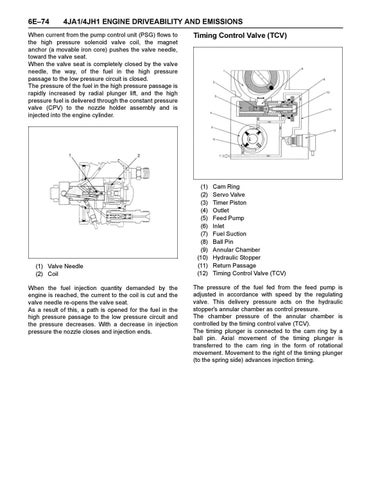
When current from the pump control unit (PSG) flows to the high pressure solenoid valve coil, the magnet anchor (a movable iron core) pushes the valve needle, toward the valve seat. When the valve seat is completely closed by the valve needle, the way, of the fuel in the high pressure passage to the low pressure circuit is closed. The pressure of the fuel in the high pressure passage is rapidly increased by radial plunger lift, and the high pressure fuel is delivered through the constant pressure valve (CPV) to the nozzle holder assembly and is injected into the engine cylinder.
(1) Valve Needle (2) Coil When the fuel injection quantity demanded by the engine is reached, the current to the coil is cut and the valve needle re-opens the valve seat. As a result of this, a path is opened for the fuel in the high pressure passage to the low pressure circuit and the pressure decreases. With a decrease in injection pressure the nozzle closes and injection ends.
Timing Control Valve (TCV)
(1) (2) (3) (4) (5) (6) (7) (8) (9) (10) (11) (12)
Cam Ring Servo Valve Timer Piston Outlet Feed Pump Inlet Fuel Suction Ball Pin Annular Chamber Hydraulic Stopper Return Passage Timing Control Valve (TCV)
The pressure of the fuel fed from the feed pump is adjusted in accordance with speed by the regulating valve. This delivery pressure acts on the hydraulic stopper's annular chamber as control pressure. The chamber pressure of the annular chamber is controlled by the timing control valve (TCV). The timing plunger is connected to the cam ring by a ball pin. Axial movement of the timing plunger is transferred to the cam ring in the form of rotational movement. Movement to the right of the timing plunger (to the spring side) advances injection timing.