Guided by the Engineering Profession Act, we license registrants who are qualified and competent, assisting them to fulfill their obligations to practice engineering in the best interests of the public.
Vision:
A safe and sustainable Nova Scotia protected by accessible, progressive, and trusted regulation of the engineering profession.
Deceased Members
We have been advised the following registrants passed away this year.
Our thoughts are with their families and friends.
Addis, Anthony T.
Archibald, Joel A.
Bell, Adam C.
Bell, Alan V.
Bell, George K.
Black, Eric C.
Bogutyn, Andrzej (Andre)
Bruce A. Allen
Burke, Douglas N.
Camp, William T.
Chisholm, Kevin L.
Christian, Ronald D.
Collier, John A.
Cooper, Steven B.
Copp, David A.
Cunningham, Barclay J.
Cyrus, J. Pemberton
Driscoll, P. Joseph
Duffney, L. Jeremiah
Dumaresq, D. Marc
Easton, Anthony J.
Edwards, Michael P.
Egar, David L.
Ferguson, P. Skit
Forte, E. Gino
Fry, Robert W.
Gillis, Simon J.
Grieves, Peter J.
Guntur, Jagadeeswar
Hackett, Thomas C.
Hancock, Herbert A.
Harmer, Daniel S.
Haverstock, W. Gregory
Healey, Eldon J.
Heffler, David E.
Hodgson, Gary L.
Jones, Hugh W.
King, Hubert W.
Kwan, George H. H.
Laing, Donald G.
Langley, Graham N.
Lee, Donald E.
Lee, Robert
Legge, W. Richard
Leonard, Walter F.
Lewandowski, Stanistaw L.
Lynch, Brian J.
MacDonald, George W.
MacDougall, Maurice L.
MacKenzie, Donald B.
MacKinnon, Bernard M.
MacLean, John M.
Mallett, John Garth
Mason, Donald L.
Mason, Frank G.
Militzer, Julio
Morash, Murray R.
Nicholson, Roy M.
Penney, Brian K.
Penwell, J. Clarence
Phillips, Vivian F.
Radchuck, Robert P.
Randall, David K.
Rhodes, Edward
Rodriguez, Jorge A.
Rohland, Terry A.
Rowe, Paul E.
Shaw, Gary A.
Small, Leonard F.
Smith, George H.
Strasser, John A.
Tam, Ted K-Y.
Theophilus, Gnanamuthu
Theriault, Robert A.
Tyner, Clifford R.
Von Kursell, Andrew H. Wadhwa, Jaspal S.
Wax, Herbert L.
Yuill, Suther A.
Yurkiw, Peter
Zimmerman, William B.
Message from the President
Sue Molloy, Ph.D., P.Eng., FCAE President, Engineers Nova Scotia
As we see our population here in Nova Scotia grow, we see a corresponding growth at Engineers Nova Scotia. Our theme for 2025 is Engineers Open Doors and it is no accident that our ambition to unlock opportunities for our registrants includes finding ways to ensure that all our members registrants find support and community in our organisation.
One highlight of our year on Council was our full day workshop on Equity, Diversity, Inclusion and Accessibility. The company TNG out of Toronto lead us in an open and honest discussion about our responsibilities and opportunities as engineers. This was a great example of the importance of having elected voices that represent the breadth of our membership. The conversation had some intense moments; we did not unanimously agree on every topic, but afterward we landed on agreement to a policy that we believe will make our association stronger and offers our CEO and staff guidelines for determining where best to direct our resources.
On Council, our work primarily consists of reviewing the progress toward our strategic goals and providing our CEO feedback and advice when appropriate. We review budgets and big decisions that are developed by the incredibly hardworking committees of Council. The committees that report to Council are Finance and Audit, Complaints, Discipline, the Board of Examiners, the Nominating Committee and the Scrutineers Committee. These committees are critical to the operation of Engineers Nova Scotia and provide oversight of operations, transparency and allow our organisation to benefit from the extensive and impressive experience of our membership. We value
the work of these volunteers and the dedication and diligence of every committee member is evident in every report to Council.
One of my goals this year was to bring a type of structure to our meetings that would enable everyone to meet their fiduciary duty, to participate and to have opinions at Council. We have tried new ways of running meetings based on guidance from TNG and I have been delighted to see how everyone has welcomed these experiments with grace and patience. We start and finish our meetings on time, everyone speaks, and we usually get to every agenda item!
On Council we also get to attend events such as the Professional Development Conference, the Engineering Excellence Gala, the Spotlight On Local Innovation and regional meetings. In my role as President this year, I was invited to give speeches at several undergraduate engineering banquets. These were a personal highlight as I got to tell stories about my experiences and encourage our future engineers to find their place in our profession. I even encouraged a few to take risks and not stress about paying student loans back quickly …don’t tell their parents!
The experience of being President this year was wonderful. I am so grateful to CEO Pal Mann, P.Eng., for making it easy and to COO Kris Dove, P.Eng., for being on top of the details. We started a new tradition of going for lunch a week or so before the council meeting and it is easy to forget how important these softer moments are as we work towards building strong governance and accountability in our work.
As many of our long-serving volunteers contemplate retirement,we are seeing a significant reduction in the number of people available to volunteer on Council and on our committees. If you’re not sure if you could contribute to our work, reach out to me, Pal or any of our Council members and we would be happy to help you learn more.
Thank you for trusting me with this role. Best wishes to Jennie Rand, P.Eng. as she takes the baton and I look forward to many more years of volunteering with Engineers Nova Scotia.
This year, Engineers Nova Scotia embraces the theme “Engineers Open Doors”—a reflection of our commitment to unlocking opportunities for our registrants, our partners, and our province. In a rapidly changing world, our work as a regulator is not just about upholding standards; it is about helping engineers by providing the practice guidance and professional development opportunities that allow them to thrive, innovate, and lead. The story of this year is one of transformation, collaboration, and progress.
Strategic Planning and Organizational Excellence
We are now in the third year of our five-year strategic plan, and the momentum is unmistakable. Our Council and staff have worked together to monitor our strategic effort. The organisation has grown, with new roles in professional sustainment, communications, and professional practice and administration, and a renewed focus on supporting our staff through a modern performance measurement system.
We have completed a comprehensive office needs analysis which will guide our decisions on our accommodation needs for the next 10-15 years. Our solution will consider more than bricks and mortar—it is about creating a modern space where collaboration and innovation can flourish internally, and with our partners. A new space will allow us to strengthen our support to registrants and those they work with, reflective of how engineering and engineering regulation is evolving in Nova Scotia.
Opening Doors: CBA and RAAD
Competency-Based Assessment (CBA)
One of the most significant milestones this year has been the full implementation of Competency-Based Assessment (CBA) for all new applicants. This marks a shift from traditional time-based experience requirements to a system that recognises and validates a broader range of engineering competencies.
CBA is opening doors in several ways:
For Students: Presentations at universities and career fairs have encouraged students to register as new members showing that the profession is accessible and welcoming to emerging talent. Working with Dalhousie University’s Cooperative Education Program, we are examining ways to assess student performance against the CBA competencies.
For Emerging Professionals: Working with member companies, we provide information sessions to engineers-in-training on the road to licensure as part of the member companies' efforts to develop their engineers-in-training. These sessions provide practice information on the CBA process and allow engineers-in-training to ask Registration and Professional Sustainment staff questions related to registration and networking issues.
For Internationally Educated Engineers: CBA provides a fairer, more transparent pathway for internationally educated engineers, recognising diverse experiences and skills regardless of where they were gained.
For Military Engineers: By proposing a joint effort to map military engineering training experience to the CBA model, we are looking at ways to enable Canadian Armed Forces engineers to pursue professional licensure
acknowledging several competencies gained through service. This supports veterans and active service members and sets an example for those working in engineering roles in the federal government to pursue licensure.
For Volunteer Assessors: The expansion of our assessor cohort creates opportunities for experienced engineers to mentor and guide the next generation, as well as improve their analytical and comparative skills.
CBA is not just a regulatory change—it ’s a door-opener for diverse talent, supporting career mobility, inclusion, and recognition of real-world skills.
Registration Administration Application and Database (RAAD)
The RAAD project is our initiative to modernise our registration system and registrant services, replacing our existing bespoke system which is now reaching end of service. The new iMIS® system, used by many sibling engineering regulators, will enable online applications, annual renewals, and automated workflows, making it easier and faster for engineers to obtain and maintain registration. Enhanced dashboards and reporting will allow staff to track progress, identify trends, and respond quickly to emerging needs.
RAAD is about accessibility and efficiency. It supports single sign-on and improved record-keeping. The phased implementation has involved staff from all departments, fostering a culture of collaboration and continuous improvement.
Together, CBA and RAAD are transforming the applicant and registrant experience—removing barriers, enabling growth, and opening doors to a more efficient, transparent, and user-friendly regulatory system and environment.
Supporting Professional Growth and Inclusion
Our work this year has focused on making the profession more accessible and inclusive:
Zone Restructure Initiative: Over the next few months, we will share our plans to move to a new Zone structure anchored on university cities and towns, that we believe will make it easier for registrants to engage locally, access mentorship, and participate in professional development.
Atlantic Learning Management Platform: We continue to populate the regional continuing professional development (CPD) platform with active courses which will support registrants in fulfilling annual CPD requirements. We share this platform with engineers in NB, PEI, and NL, as well as NS’s geoscientists, with several other smaller engineering regulators considering joining. All partners are adding courses to the platform that are accessible to everyone regardless of province of registration.
EDI and Mentorship: Partnering with Techsploration, ISANS, NS’s universities, the Atlantic Science Links, Youth Science Canada and other STEM groups, we assist them in opening doors for the next generation of Nova Scotians to support diversity and inclusion in engineering.
Professional Development: Monthly webinars, career fairs, and networking events have attracted hundreds of participants, helping engineers build skills and connect with opportunities. We have seen a rejuvenation in attendance which enables a healthy, supportive engineering community.
Public Outreach: Campaigns like “Verify Before You Hire” and high-impact video messaging have raised public awareness and trust in the profession. Spearheading this pan-Canadian campaign, we have provided tools
and advice that has spread this message across the nation and has opened the doors for the public, the construction industry, and municipalities to reach out to regulators to confirm those they wish to hire are indeed licensed engineers in good standing.
Regulatory Excellence and National Harmonisation
Engineers Nova Scotia continues to play a leading role in regulatory innovation and national harmonisation:
Legislative Review and Bill 36: Our engagement with the Nova Scotia government on Bill 36, Free Trade and Mobility within Canada Act, has focused on ensuring that regulatory changes support interprovincial mobility while maintaining high standards of public protection. We have worked closely with other regulators to address barriers and facilitate the movement of engineers across jurisdictions. After our environmental scan of regulatory best practices across several professions, we are finalizing our approach to asking the Government to reopen and modernize the Engineering Profession Act.
Regulation of Engineering: Engineers Nova Scotia has contributed to national discussions on the definition of engineering practice, the 48-month experience requirement, and the development of mutual recognition agreements. Our collaboration with Engineers Canada and regional partners has strengthened mobility, modernised governance, and enhanced public protection.
Continuing Professional Development (CPD)
Harmonization: We are working with other regulators to harmonise CPD requirements across Canada, making it easier for engineers to fulfill CPD requirements between provinces and territories.
Regional Collaboration: We continue to collaborate with sibling regulators within Nova Scotia and across
Atlantic Canada to build community and maximise synergies. Bi-annual meetings with Nova Scotia’s Geoscientists, Foresters, Land Surveyors, Interior Designers, Architects, Land Planners, and Technologists, reflect our commitment to inclusivity, and inter-regulator cooperation.
Operational Excellence
Behind the scenes, our finance and audit teams have ensured corporate and financial compliance and transparency, confirming we have the appropriate checks and balances in oversight of our financial operations.
Building improvements and workplace safety initiatives have created a better working environment for staff and registrants. Enhanced occupational health and safety documentation, internal process validation, and staff training have strengthened our commitment to safety and wellbeing.
Conclusion: Engineers Open Doors
This year, Engineers Nova Scotia has embraced the theme “Engineers Open Doors.” Through the successful implementation of CBA and RAAD, our work with other regulators, and our commitment to inclusion and professional growth, we are transforming how we regulate our profession—making it more accessible, inclusive, and responsive to the needs of Nova Scotia’s communities.
Our registrants, volunteers, and staff have worked together to unlock new opportunities, strengthen public trust, and build a more resilient and prosperous Nova Scotia. As CEO & Registrar, I thank you for your dedication and invite your ongoing feedback as we continue to open doors for our profession and our province.
Engineers Nova Scotia has 9546 registrants in all categories (excluding students and exam candidates).
We had an increase of 446 registrants year over year 16% 1024 of 6207 Professional Engineers are women 24% 377 of 1570 Engineers in Training are women
Application trends
Applicants who do not hold degrees from CEAB accredited programs and are not from a country that has a reciprocal mobility agreement with Canada will have their academic and experience qualifications assessed by the Board of Examiners.
Assessment Application Numbers, 2022-2025
Board of Examiners
The Board’s normal workload includes assessing academic and experience qualifications of internationally educated applicants, assessing the experience of Engineers-inTraining (EITs) without an assigned mentor, and assessing Post Grad Degree experience of EITs.
Board of Examiners Activity, By The Numbers Stats from August 2024 to August 2025
Board Academic Assessments Completed:
Complaints & Discipline
The Complaints Committee met with increased frequency over the past fiscal year to investigate five new and six existing complaints. To facilitate their investigations, the Complaints Committee sought assistance from the provincial government on interpreting legislative requirements, engaged an expert to review a complaint, and conducted multiple interviews. During the course of the year, the Complaints Committee dismissed two complaints and resolved another. One complainant requested a review of the treatment of the complaint by the Complaints Committee. This review ultimately determined that the complaint had been properly treated by the Complaints Committee.
Not all potential complaints progress to becoming formal complaints. At times staff devote considerable time to conversations with potential complainants, describing the complaints process and potential outcomes, and assessing the information provided to determine whether a complaint falls under Engineers Nova Scotia’s jurisdiction. Examples of issues considered outside the jurisdiction of Engineers Nova Scotia include business contracts, payments and communication challenges.
Compliance with, and enforcement of, the Engineering Profession Act and By-Laws is an important area of focus. Staff continue to work with individuals, human resources professionals and companies to ensure that only professional engineers licensed in Nova Scotia are practicing engineering and using the title of engineer, the P.Eng. designation, and other protected terms. This work often results in those who are practicing without a license reinstating or registering with Engineers Nova Scotia, or updates to job titles or websites.
Most recently, staff have focused on job titles for engineers-in-training. While not licensed as a professional engineer, registered engineers-in-training may use the qualifier “Engineer-in-Training” and the designation “EIT” in their job titles in Nova Scotia (e.g., Project Engineer-in-Training, Industrial EIT).
More information about the use of engineering titles can be found on our website at engineersnovascotia. ca/professional-practice/titleuse/.
In May 2025, Engineers Nova Scotia was alerted to a case of unauthorized engineering practice and the fraudulent use of an engineer’s stamp, which involved a Mr. James Williams, a supposed professional engineer based in California who claimed to engage professional engineers across Canada to provide freelance engineering services via message boards such as Fiverr and Upwork. Findings suggest that Mr. Williams may have engaged in similar actions in multiple provinces and countries. Engineers Nova Scotia immediately initiated legal and regulatory actions, which included issuing a cease-and-desist letter, coordinating with law enforcement, and notifying sibling regulators and relevant interest holders. Measures were also taken to mitigate public risk and ensure proper authentication of the affected project. This case reinforces the advantage of an encrypted digital signature, as available through Notarius, which confirms the identity and professional standing of the engineer when used.
Verification of an individual or company’s registration with Engineers Nova Scotia can be conducted at engineersnovascotia.ca/member-directory/.
Any person who has a concern about the work of a registrant (Professional Engineer or Engineer-in-Training) of Engineers Nova Scotia may raise this concern with Engineers Nova Scotia.
Professional Development
Learning Management Platform (LMP) Launch
In February 2025, Engineers Nova Scotia launched its new LMP, providing registrants with on-demand access to professional development (PD) across all four CPD categories: Ethical Practice, Regulatory Learning, Technical Learning, and Communication and Leadership. The LMP offers registrants greater accessibility, flexibility, and alignment with regulatory requirements.
In seven months (February–August 2025), the LMP delivered 16 online courses, engaging more than 560 registrants and resulting in 422 course completions.
Engineers Nova Scotia’s monthly PD webinar series
Engineers Nova Scotia’s monthly PD webinar series span all four CPD categories – Ethical Learning, Regulatory Learning, Technical Learning, and Communications & Leadership Learning – ensuring that registrants have accessible opportunities to fulfill the PD requirements established by the regulatory framework.
Student Outreach
University presentations introduced students to the pathway to licensure, helping them understand the licensure process, the role of the regulator, and the steps to becoming professional engineers.
University student attendance at pathway to licensure presentations
Engineers Nova Scotia and its committees delivered 15 in-person events from August, 2024 to August, 2025. These events attracted a combined 2,119 participants.
Communications and Information Technology
As part of Engineers Nova Scotia’s IT modernization efforts, we have successfully digitized our financial system, enhancing transparency and operational efficiency. We are also actively refining our new registrant database through the RAAD initiative, aligning with our Strategic Plan’s goals for organizational excellence, public trust, and cybersecurity resilience.
Our quarterly online magazine The Engineer and our annual International Women in Engineering Day publications continued to align with our Strategic Plan’s goals for fostering registrant pride and increasing registrant awareness of equity, diversity, inclusivity and accessibility, by telling stories of immigrants’ journeys to practicing engineering in Nova Scotia, womens’ paths to entering what has been traditionally a male-dominated industry, and highlighting the projects of professional engineers around the province.
Our e-newsletter, social media channels, and social media ad buys continued to grow, increasing fraud awareness with the Verify Before You Hire campaign, growing publication readership, driving registration to committee and organizational events, and aligning with our Strategic Plan’s goals for stronger public awareness of the value of the engineering profession. Phase 2 of the campaign will be discussed later this year.
Digital Publication Impressions:
65,008
Average Publication Read Time in Minutes: 4.09
Fraud Awareness
Ad Campaign Impressions on Meta and LinkedIn : 17,115
Social Media
Engineers Nova Scotia’s three largest social media channels are LinkedIn, Facebook, and Instagram. They are used to inform registrants of engineering news, foster pride in engineering among registrants, share resources, increase public awareness, and drive event registration.
Social Media Post & Profile Impressions by Channel
*In 2024, LinkedIn removed Engineers Nova Scotia’s older, larger account, instructing us to use a business account instead.
Volunteers
As a self-regulating professional organization, Engineers Nova Scotia could not operate without the dedicated effort of its volunteers. We thank each and every one of you for your work over the past year.
Adam A. Donaldson, P.Eng.
Adel Merabet, P.Eng.
Alain Asafor Chi, P.Eng.
Alan D. Ehrenholz, P.Eng.
Alana C. MacLellan-Bonnell, P.Eng.
Alanna K. West, P.Eng.
Alexander J. de Sousa, P.Eng.
Alexandra M. R. MacDonald, EIT
Amir Mohammad Aali, P.Eng.
Amit K. Malik, P.Eng.
Amy Darrach, P.Eng.
Amy H. Price, P.Eng.
Andrew H. Thalheimer, P.Eng.
Andrew J. Polegato, P.Eng.
Anne-Marie H. Belliveau, P.Eng.
Audrey E. Hiscock, P.Eng.
B. Christian Boudreau, P.Eng.
Benjamin J. Breen, P.Eng.
Blair F. Forbrigger, P.Eng.
Brianna M. O'Malley, EIT
Brittany A. MacDonald-MacAulay, P.Eng.
Browren J. Allard, P.Eng.
Camelia Salem, P.Eng.
Ceilidh A. M. Bray, P.Eng.
Christine L. Bonnell-Eisnor, P.Eng.
Christopher E. Davis, P.Eng.
Christopher I. Moffitt, P.Eng.
Christopher J. Henningsen, P.Eng.
Christopher L. Feetham, P.Eng.
Christopher R.P. Shortall, P.Eng.
Christopher S. Zinck, P.Eng.
Clifton J. Johnston, P.Eng.
Colin F.L. Dickson, P.Eng.
Colleen C. Rodgerson, P.Eng.
Congying (Helen) Xia, P.Eng.
Craig B. Lake, P.Eng.
Craig W. Arthur, P.Eng.
Crysta R. R. Cumming, P.Eng.
Crystal L. Sutton, P.Eng.
D. Oliver Browning, P.Eng.
Dalton H. Killorn, EIT
Darcy A. Fuller, P.Eng.
Darrell B. Marsh, P.Eng.
Darrell D. Thompson, P.Eng.
Darrin F. McLean, P.Eng.
David E. Cochrane, P.Eng.
David S. Haley, P.Eng.
Dean P. Forgeron, P.Eng.
Debra L. McLellan, P.Eng.
Denis M. Pellichero, P.Eng.
Denise L. Pothier, P.Eng.
Denise M. Trim, P.Eng.
Dennis A. Fowler, P.Eng.
Donald V. Ross, P.Eng.
Edward A. Farquhar, P.Eng.
Eileen E. McEwen, P.Eng.
Emma L. H. Fudge, P.Eng.
Erin M. McMenemy, P.Eng.
Faith N. Mauka, EIT
Fatou Secka, P.Eng.
Frank D. Comeau, P.Eng.
Genanne Beck, P.Eng.
George T. Goad, P.Eng.
Georgeta Bauer, P.Eng.
Giselle Hage, P.Eng.
Graeme J. Koivu, EIT
H. James Simmons, P.Eng.
Hamed Soleimani Motlagh, P.Eng.
Hana Elnaggar, Student
Hannah G. H. LeBlanc, P.Eng.
Harry A. Daemen, P.Eng.
Holly N. Sampson, P.Eng.
Huu Nghia Nguyen, P.Eng.
Ian M. Squires, P.Eng.
J. Conrad LeLievre, P.Eng.
J. Pemberton Cyrus, P.Eng.
Jade C. E. Farr, EIT
James Fletcher, P.Eng.
James D. MacQueen, P.Eng.
James E. Hannam, P.Eng.
James L. Brown, P.Eng.
James O. Beck, P.Eng.
Jeffrey P. Heyman, P.Eng.
Jeffrey R. Knapp, P.Eng.
Jennie L. Rand, P.Eng.
Jillian D. MacMillan, P.Eng.
John D. Eisnor, P.Eng.
John D. Flewelling, P.Eng.
John T. Blake, P.Eng.
Julia M Sarty, EIT
Kaluwa D. Dharmawansa, P.Eng.
Katherine M. MacLeod, P.Eng.
Kayleigh H. Brown, P.Eng.
Kayleigh M. Landers, P.Eng.
Keith W. H. Boddy, P.Eng.
Kelsey D. F. Green, P.Eng.
Kevin K. Bezanson, P.Eng.
Krista E. Phillips, P.Eng.
Kulvinder S. Dhillon, P.Eng.
Kwonjoo Lee, P.Eng.
Lawrence M. Murphy, P.Eng.
Leslie A. Bateman, P.Eng.
Liane N. Sandula, P.Eng.
Linda M. Lefler, P.Eng.
Lisa D. Stout, P.Eng.
M. Daniel MacDonald, P.Eng.
Mae L. Seto, P.Eng.
Maen M. Artimy, P.Eng.
Makayla D. Rozsa-Grover, P.Eng.
Malcolm D. Palamarek, P.Eng.
Mano Sundar, P.Eng.
Marius J. Lengkeek, P.Eng.
Mark A. Dellapinna, P.Eng.
Martha L. Myers, P.Eng.
Martin S. Tango, P.Eng.
Mary Anne Tanner, P.Eng.
Matthew A. Glynn, P.Eng.
Meghan G. Swanburg, P.Eng.
Michael O. Barton, P.Eng.
Michael R. MacDonald, P.Eng.
Michelle A. Adams, P.Eng.
Mohammad Ashari Ghomi, P.Eng.
Muhammad Usman Asad, P.Eng.
Nancy S. Sutherland, P.Eng.
Neil A. Fraser, P.Eng.
Nigel Dilan Watson, P.Eng.
Patricia L. Duncan, P.Eng.
Patricia T. Roe, P.Eng.
Payton G. Lockhart, P.Eng.
Peter M. Murray, P.Eng.
Philip A. Zinck, P.Eng.
R. Larry Rosborough, P.Eng.
Rachel A. Scurlock, P.Eng.
Richard M. Grant, P.Eng.
Rob C. Jamieson, P.Eng.
Robert Joseph MacDonald, P.Eng.
Ronald A. Hiltz, P.Eng.
Ronald G. Marks, P.Eng.
Rosalind C. Dickinson, P.Eng.
Sarah L. F. Devereaux, P.Eng.
Scott R. R. Nauss, P.Eng.
Selvana Hagh Gooei, P.Eng.
Skylar Riggan, P.Eng.
Stephan L. MacLellan, P.Eng.
Steven W. DeBelie, P.Eng.
Sue F. Molloy, P.Eng.
Tapan A. Katwala, P.Eng.
Teo Milos, Student
Thomas O. Simmons, EIT
Tracy L. Mossman, P.Eng.
Vivek S. Tomar, P.Eng.
Wayne H. MacDonald, P.Eng.
Zachary L. B. Norris, P.Eng.
Zulfiqar Ali, P.Eng.
2024 Annual Business Meeting Minutes
The 2024 Annual Business Meeting (ABM) was a hybrid event, with in-person attendees and a virtual broadcast via Zoom, from Kenneth C. Rowe Hall at Pier 21, Halifax, Nova Scotia on October 17, 2024.
1.0 CALL TO ORDER
Engineers Nova Scotia President and Chair, Adam Donaldson, P.Eng., called the meeting to order at 10:30 am. The Chair acknowledged that meeting was being held on the ancestral and unceded territory of the Mi’kmaq.
Following the land acknowledgement, the CEO, Pal Mann, P.Eng., provided details and instructions regarding the conduct of the hybrid business meeting.
The CEO noted that all meeting documents were posted on the Engineers Nova Scotia website one week prior to the ABM, and that they are also available through the resources section of the virtual meeting portal for those online.
The Chair confirmed quorum, with 59 in-person registrants in attendance at the start of the meeting, and 16 registrants virtually attending. The Chair welcomed members and guests, including virtual attendees, from our sibling regulators from across Canada.
The Chair then introduced the members of Council and ex-Officio members, and he commended the continued dedication of the Past-Presidents who were in attendance and asked them to rise and be acknowledged.
Attendees were also notified that a Parliamentarian was joining the meeting virtually, to assist with any procedural rules of order during the meeting.
2.0 ADOPTION OF AGENDA
The meeting agenda was made available on screen and included in the Annual Report package. No changes were proposed by those attending the meeting.
Moved by Wayne McCullough, P.Eng., and Seconded by Bob MacDonald, P.Eng., that the 2024 ABM Agenda be adopted as presented. Carried.
3.0 MOMENT OF SILENCE
A moment of silence was held for members who passed away in the last year. These members are listed on page 12 of the 2024 Annual Report.
4.0 ADOPTION OF THE 2023 ABM MINUTES
There was one administrative update offered and accepted, and no corrections proposed to the 2023 ABM Minutes. As there were no corrections proposed, the 2023 ABM Minutes were approved without a Motion being required.
5.0 BUSINESS ARISING FROM THE 2023 MINUTES
There was no business arising from the 2023 ABM Minutes.
6.0 ANNUAL REPORTS AND INTRODUCTION OF CHAIRS
The Chair summarized his President’s Report, found on page 7 of the Annual Report package.
President’s Report
• Council Activities & Collaboration
o Council and the CEO focused on building collaborative relationships with other regulatory bodies in Nova Scotia.
o Efforts were made to strengthen partnerships with higher education institutions to support the sustainability of the engineering profession.
• CPD Program Modernization
o The Continuing Professional Development (CPD) program is being updated to align with standards across Atlantic Canada and other Canadian jurisdictions.
• Systems & Infrastructure Updates
o Modernization of the registrant database, website, and volunteer coordination systems was underway.
o Transition to a Competency Based Assessment (CBA) model for experience reviews was in progress.
• Strategic Planning & Funding
o Ongoing planning to assess operational needs in communications, volunteer support, staffing, and infrastructure.
o Strategic funding from affinity revenue and investments is being allocated for major projects and regulatory reserves.
• Acknowledgements
o President Adam expressed gratitude to volunteers, the CEO, staff, and Council members for their contributions during this period of transition and modernization.
o Special thanks were given to Past-President Denise Pothier, P.Eng., and Vice-President Sue Molloy, P.Eng., for their executive leadership and insights.
• Council Transition
o President Adam welcomed incoming Council members and acknowledged the personal support he received from family, friends, and colleagues during his tenure.
• Closing Remarks
o The Chair invited questions from registrants attending in person and virtually.
o No questions were asked.
Chief Executive Officer’s
Report
CEO Pal Mann summarized the CEO’s Report, found on page 8 of the Annual Report package
• Context and Opening Remarks.
Nova Scotia faced significant challenges in 2025:
o Economic pressures from inflation
o Ongoing housing issues
o Demands of a growing population
o Despite these challenges, engineers remained committed to innovative, responsive, and responsible practice
• Report Highlights
o Completed year two of the 2022–2027 Strategic Plan
o Advanced tools to respond to a rapidly changing regulatory environment
o Increased organizational capability and capacity: Fiscal management
Volunteer management
Professional development
Staff growth from 16 to 19
o Finalized implementation plan for Competency-Based Assessment (CBA); pre-pilot underway
o Signed a Memorandum of Understanding (MOU) with other provinces and territories on Continuing Professional Development (CPD)
o Completed an environmental scan and legislative risk assessment
o Finalized a Professional Sustainment Plan
o Reported registrant growth across all categories (except students and exam candidates)
o Supported Engineers Canada working groups and committees
o Signed on to pan-Canadian initiatives, including the National Statement of Collaboration
o Engaged Tech-Markets Inc. to:
. Identify requirements for modernizing the registrant administration system
. Select a vendor
o Recreated the Request for Proposals (RFP) to assess long-term accommodation needs
• 2025 Priorities
o Finalize Atlantic Regulators CPD Requirements
o Continue initiatives to:
Improve registrant engagement
Increase volunteer capacity
• Closing Remarks
o The CEO thanked staff, volunteers, registrants, and partners for their contributions and ongoing commitment to the engineering profession
o No questions were asked
2023-2024 AUDIT REPORT AND OPERATIONAL BUDGET REPORT
Jeff Knapp, P.Eng., Chair of the Finance and Audit Committee (Chair of FAC) referred to the audited financial reports found on page 59 of the Annual Report and posted on the association’s website. The Chair of FAC acknowledged that the firm Grant Thornton conducted the audit in August 2024.
Highlights of the 2023-24 Audited Financial Statements Presentation.
• Fiscal year operating expenses were approximately $2.7 million, and operating and other revenues were over $2.7 million.
• We enjoyed a surplus of $355,000 as a result of rising interest rates within our investment port portfolio and increasing registration numbers.
• We experienced an unrealized investment loss of approximately $14,000 and a 54.7% gain in
market to book value since inception on an equity investment․ portfolio of approximately $422,800.
• Reserves for other strategic initiatives remain unchanged from 2023.
• The Committee notes that good progress continues to be made on the recommended changes made in 2019-2020 around financial controls and reporting, financial governance policies, and improving financial transparency.
The Chair of FAC concluded by acknowledging the efforts of the Association’s staff and thanked the CEO, the Treasurer (Kris Dove, P.Eng.), and the Senior Accountant (Grace Castillo) for providing the information needed to help the Finance and Audit Committee fulfill their mandate. He concluded his remarks by sincerely thanking all members of the Finance and Audit Committee for their hard work and devotion to the transparency and betterment of the Association.
There were no questions regarding the audited financial statements.
Highlights of the 2024-25 Budget Presentation
The Chair of FAC provided an overview of the 20242025 budget. Key points are included below:
Revenues
• Member dues and corporate fees are increased by 3%, slightly less than the annual average Nova Scotia CPI for the previous year.
• Affinity growth is forecast to be 10% in 2024-2025 based on the increasing registrant base, inflationary impacts on the dollar amounts of policies underwritten, and the sharing formula for new policies.
• 2024 ABM revenues and expenses are expected to remain near 2023 levels.
Expenses
• Significant changes include the continued expansion of our Professional Sustainment and Communication activities, harmonization of our Professional Development program with other Atlantic region associations, expansion of zone governance activities, introduction of electronic funds transfer, automated invoicing, expanding our marketing and branding materials and organizational awareness, ABM with increased costs for celebration of the profession and professional development activities, and cyber security initiatives.
• Increase in salary expenses of $287,000 for costof-living allowances and performance incentives based on merit.
• Changes to the staff complement, including:
o A Professional Practice Assistant/Coordinator to support the COO and Professional Practice Officer.
o A temporary Special Projects Officer from October 2024-July 2025.
• A potential draw-down of $320,000 from the reserves for:
o Work on the Registrant Administration Application and Database system,
o Competency-Based Assessment implementation,
o Legislative review, and
o Development of a business case to update and improve 1355 Barrington Street.
Overall, the budget for 2024-2025 is conservative, showing a small operating surplus of approximately $16,000. This surplus includes non-operating revenues of just over $412,600, sourced mainly from affinity revenue, interest earned on fixed income investments and dividend income earned on equity investments.
There were questions relating to budgets for the Complaints Committee and National Engineering Month. However, there were no other questions on the 2024-2025 Budget
The Chair acknowledged that the reports of the President, CEO, and Chair of FAC have been presented to, and discussed with, the membership.
7.0 COMMITTEE AND ZONE REPORTS
The Chair noted that Committee Reports, as well as Zone Reports, are included in the Annual Report Package, starting on page 27. There were no questions on the Committee and Zone Reports.
The Chair thanked all the Committee volunteers and Zone Representatives for their continued dedication to self-regulation.
8.0 AFFILIATE REPORTS
Greetings from Engineers Canada
The President of Engineers Canada, Michael Wrinch, P.Eng., provided recorded greetings.
Engineers Canada Director’s Report
Crysta Cumming, P.Eng., the Engineers Canada Director from Nova Scotia, provided her report, found on page 13 of the Annual Report Package.
The Director provided an overview of highlights of some recent initiatives by Engineers Canada, including:
• Consultations with regulators across the country as part of Engineers Canada’s National Collaboration and Harmonization Task Force, to identify opportunities to work together to support the future of engineering.
• Delivering best practices and National Position Statements, developed through national collaboration, such as guidelines for reconciliation in engineering, information and resources on the national 30 by 30 goal, resources to help support workplace leaves, and position statements related
to coastal, ocean and subsurface engineering, achieving net zero emissions by 2050, software engineering, national and international labour mobility and other interesting topics.
• The engineerhere.ca resource for internationally educated engineering graduates.
There were no questions.
9.0 ENGINEERS NOVA SCOTIA SCHOLARSHIPS
The 2024 Scholarship for Children of Engineers Nova Scotia recipients are:
• Ava Van Zutphen, child of Vincent Van Zutphen,
• Havelie VanHelden, child of Holly VanHelden
• Isaac Morse, child of Eric Morse,
• Kailey O’Brien, child of Gregory O’Brien
• Liam Johnston, child of Clifton Johnston
• Owen Heukshorst, child of Kristen Heukshorst
• Rory MacGregor, child of William MacGregor
• Ron Wainshtein, child of Ilia Wainshtein
The Chair congratulated the scholarship recipients and wished them the best of luck in their future studies.
10.0 ELECTION OF 2024-2025 COUNCIL
The Chair thanked the outgoing members of Council for their support over this past two years and acknowledged the time and dedication that they have given to their association.
The outgoing Council members, who were asked to stand to be recognized, and had their pictures shown on screen, include:
Outgoing Past-President: Denise Pothier, P.Eng.
Outgoing Councillors: Allison Mackie, P.Eng. Leon MacLellan, P.Eng. Roxanne Tate, P.Eng. Laura White, P.Eng.
Outgoing Ex Officio: John Newhook, P.Eng.
The Chair then called upon Kris Dove, P.Eng., to present the Scrutineers’ Report. The Scrutineers’ Committee reviewed the 2024 Council Election results and attested the results were accurate.
On behalf of Council and the membership, the Chair expressed appreciation to all the candidates who showed their commitment to self-regulation by offering their names in the Council elections. He also expressed thanks to all those who supported the Council Election process.
The Chair then asked that the newly elected members of Council to stand and be recognized:
For President: Sue Molloy, P.Eng.
For Vice-President: Jennie Rand, P.Eng.
For Councillors Resident in Halifax: Kayleigh Rainer Brown, P.Eng., and Andrew Thalheimer, P.Eng.
For Councillors Resident Outside Halifax: Wayne MacDonald, P.Eng., and Malcolm Palamarek, P.Eng.
The Chair extended a warm welcome to the new members of Council.
Installation of the President
The Chair then introduced incoming President Sue Molloy, P.Eng., and asked outgoing Past-President Denise Pothier, P.Eng. to present the Past-President and President’s medals.
Past-President Adam then passed the Chair of the ABM over to newly elected President Sue for the remainder of the meeting.
President Sue thanked Past President Adam for his many contributions over the past year.
11.0 PRESIDENT’S REMARKS (2024-2025 FOCUS)
The Chair thanked the membership for their trust in her serving as President. She acknowledged a long legacy of service in Engineers Nova Scotia and confirmed the gravity of regulating the engineering profession and safeguarding the public.
The Chair noted that the changing climate is putting new demands on engineers, and that now, more than ever, ensuring that engineers are qualified, responsible, and ethical is critical.
The Chair recognized the outstanding efforts and contributions of the current and outgoing Council members, Past-President Adam, Past-President Denise, Engineers Canada Director Crysta, the CEO and Engineers Nova Scotia staff, and the many volunteers that support the work and goals of Council.
12.0 OTHER BUSINESS
No Other Business was identified.
13.0 ADJOURNMENT
On a Motion by Kelsey Green, P.Eng., and Seconded by Denise Trim, P.Eng., it was resolved to adjourn the 2024 ABM at 11:15 am. Carried
ENGINEERS NOVA SCOTIA
2023-2024 Budget
2023-2024 Budget
2023-2024 Budget
2023-2024 Budget
2023-2024 Budget
BUDGET 2025 - 2026
Endorsed by FAC: 2 July 2025 Approved by Council: 10 July 2025
Engineers Nova Scotia
July 31, 2025
Independent Auditor’s Report
To the Members of Engineers Nova Scotia
Opinion
T +1 902 421 1734 F +1 902 420 1068
We have audited the financial statements of Engineers Nova Scotia (the “Association”), which comprise the statement of financial position as at July 31, 2025, and the statements of operations, changes in members’ equity and cash flows for the year then ended, and notes to the financial statements, including a summary of significant accounting policies.
In our opinion, the accompanying financial statements present fairly, in all material respects, the financial position of Engineers Nova Scotia as at July 31, 2025, and the results of its operations and its cash flows for the year then ended in accordance with Canadian accounting standards for not-for-profit organizations.
Basis for opinion
We conducted our audit in accordance with Canadian generally accepted auditing standards. Our responsibilities under those standards are further described in the Auditor's Responsibilities for the Audit of the Financial Statements section of our report. We are independent of the Association in accordance with the ethical requirements that are relevant to our audit of the financial statements in Canada, and we have fulfilled our other ethical responsibilities in accordance with these requirements. We believe that the audit evidence we have obtained is sufficient and appropriate to provide a basis for our opinion.
Responsibilities of management and those charged with governance for the financial statements
Management is responsible for the preparation and fair presentation of these financial statements in accordance with Canadian accounting standards for not-for-profit organizations, and for such internal control as management determines is necessary to enable the preparation of financial statements that are free from material misstatement, whether due to fraud or error.
In preparing the financial statements, management is responsible for assessing the Association’s ability to continue as a going concern, disclosing, as applicable, matters related to a going concern and using the going concern basis of accounting unless management either intends to liquidate the Association or to cease operations, or has no realistic alternative to do so.
Those charged with governance are responsible for overseeing the Association’s financial reporting process.
Auditor’s responsibilities for the audit of the financial statements
Our objectives are to obtain reasonable assurance about whether the financial statements as a whole are free from material misstatement, whether due to fraud or error, and to issue an auditor’s report that includes our opinion. Reasonable assurance is a high level of assurance, but is not a guarantee that an audit conducted in accordance with Canadian generally accepted auditing standards will always detect a material misstatement when it exists. Misstatements can arise from fraud or error and are considered material if, individually or in the aggregate, they could reasonably be expected to influence the economic decisions of users taken on the basis of these financial statements.
As part of an audit in accordance with Canadian generally accepted auditing standards, we exercise professional judgment and maintain professional skepticism throughout the audit. We also:
Identify and assess the risks of material misstatement of the financial statements, whether due to fraud or error, design and perform audit procedures responsive to those risks, and obtain audit evidence that is sufficient and appropriate to provide a basis for our opinion. The risk of not detecting a material misstatement resulting from fraud is higher than for one resulting from error, as fraud may involve collusion, forgery, intentional omissions, misrepresentations, or the override of internal control.
Obtain an understanding of internal control relevant to the audit in order to design audit procedures that are appropriate in the circumstances, but not for the purpose of expressing an opinion on the effectiveness of the Association’s internal control.
Evaluate the appropriateness of accounting policies used and the reasonableness of accounting estimates and related disclosures made by management.
Conclude on the appropriateness of management's use of the going concern basis of accounting and, based on the audit evidence obtained, whether a material uncertainty exists related to events or conditions that may cast significant doubt on the Association’s ability to continue as a going concern. If we conclude that a material uncertainty exists, we are required to draw attention in our auditor's report to the related disclosures in the financial statements or, if such disclosures are inadequate, to modify our opinion. Our conclusions are based on the audit evidence obtained up to the date of our auditor's report. However, future events or conditions may cause the Association to cease to continue as a going concern.
Evaluate the overall presentation, structure and content of the financial statements, including the disclosures, and whether the financial statements represent the underlying transactions and events in a manner that achieves fair presentation.
We communicate with those charged with governance regarding, among other matters, the planned scope and timing of the audit and significant audit findings, including any significant deficiencies in internal control that we identify during our audit.
Halifax, Canada
Chartered Professional Accountants September 24, 2025
Engineers Nova Scotia Statement of Operations
Year ended July 31, 2025
See accompanying notes to the financial statements.
Engineers Nova Scotia Statement of Cash Flows
Year ended July 31 2025 2024
Increase (decrease) in cash and cash equivalents
Operating (Deficiency) excess of revenue over expenses $ (110,283) $
Change in non-cash operating working capital (Note 3)
Investing
Purchase of investments, net of disposals (115,987) (590,237) Purchase of capital assets (17,915) (56,336) (133,902) (646,573) Net decrease in cash and cash equivalents (85,338) (118,986)
and cash equivalents
(Note 3) $ 2,631,187 $ 2,716,525
See accompanying notes to the financial statements.
Engineers Nova Scotia
Notes to the Financial Statements
July 31, 2025
1. Nature of operations
Engineers Nova Scotia (the “Association”) is incorporated under the laws of the Province of Nova Scotia to administer the Nova Scotia Engineering Profession Act.
The Association is a not-for-profit organization and is exempt from income tax under the Income Tax Act.
2. Summary of significant accounting policies
Basis of accounting
These financial statements have been prepared in accordance with Canadian accounting standards for not-for-profit organizations (“ASNPO”) and include the following significant accounting policies.
Fund accounting
The Association uses fund accounting and, accordingly, resources are classified for accounting purposes into funds based on specific activities or objectives. This method recognizes the limitations and restrictions placed on the use of resources available to the Association by classifying all transactions according to their nature. The following funds are being utilized:
Operational fund
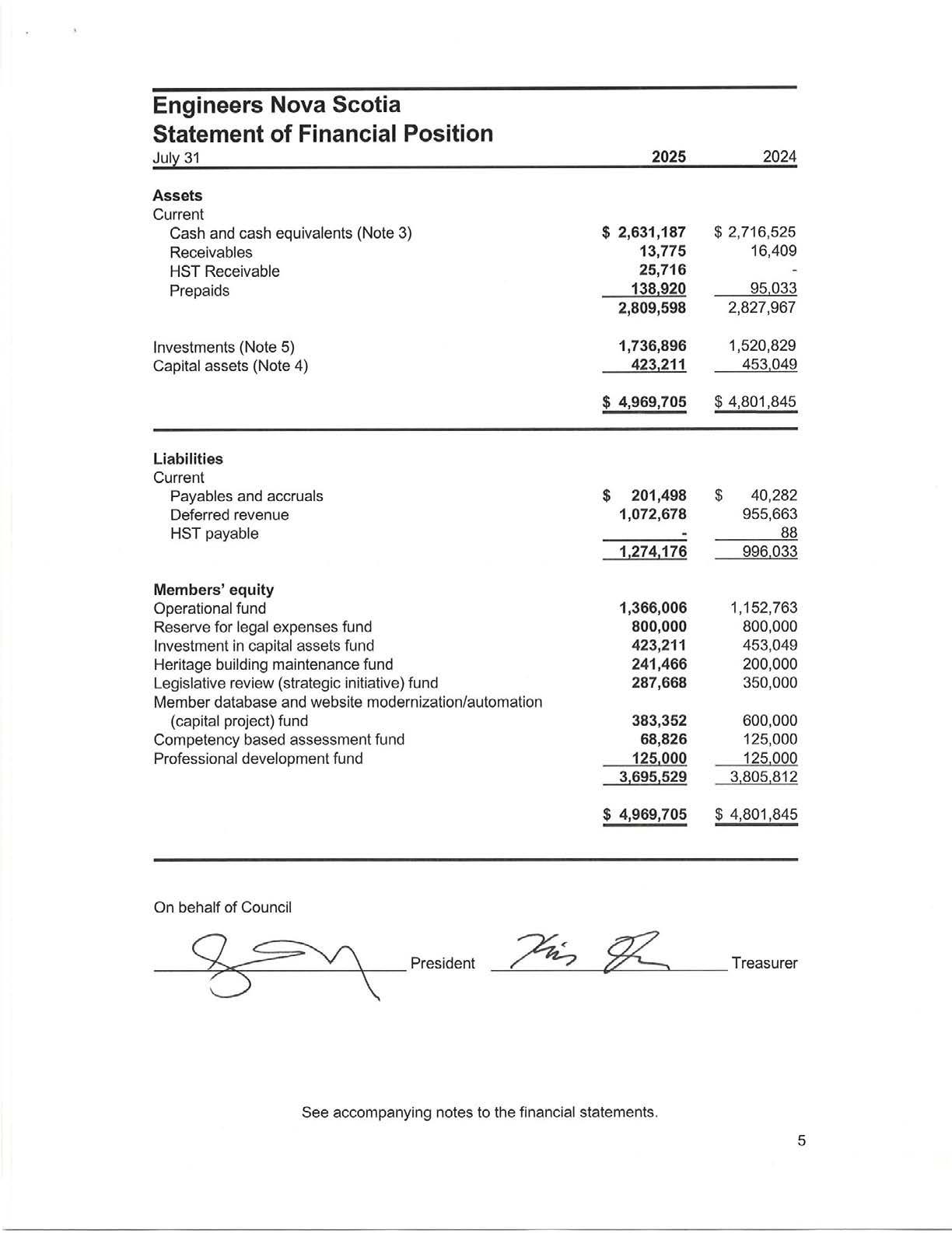
The operational fund is the accumulation of unspent and unallocated revenue that is available to meet the day-to-day operational costs of the Association. During the year Council approved transfers of $100,000 to the Heritage building maintenance fund and $100,000 to the Member database and website modernization/automation (capital project) fund.
Reserve for legal expenses fund
The reserve for legal expenses fund has been established as an internally restricted fund for enforcement of the Engineering Profession Act.
Investment in capital assets fund
The investment in capital assets fund is the equity used to fund the capital assets of the Association.
Heritage building maintenance fund
The Heritage building maintenance fund has been established as an internally restricted fund for infrastructure improvements, study options for relocation of the Association’s office space and crisis contingencies other than routine operations and maintenance. During the year, Council approved a transfer of $58,534 to the Operational fund to cover building maintenance expenditures.
Legislative review (strategic initiative) fund
The legislative review (strategic initiative) fund has been established as an internally restricted fund for modernization of the Act and Bylaws. During the year Council approved a transfer of $62,332 to the Operational fund to cover costs associated with modernization of the Act and Bylaws.
Member database and website modernization/automation (capital project) fund
The member database and website modernization/automation (capital project) fund has been established as an internally restricted fund for a new registrant database and member management system. During the year Council approved a transfer of $316,648 to the Operational fund to cover costs associated with database and website modernization.
Engineers Nova Scotia
Notes
to the Financial Statements
July 31, 2025
2. Summary of significant accounting policies (continued)
Fund accounting (continued)
Competency based assessment fund
The competency based assessment fund has been established as an internally restricted fund for modernization of the assessment framework. During the year Council approved a transfer of $56,174 to the Operational fund to cover costs associated with modernization of the assessment framework.
Professional development fund
The professional development fund has been established as an internally restricted fund for the enhancement of the professional development initiatives.
Funded strategic initiatives
Expenses incurred relating to funded strategic initiatives relate to special projects that have been approved by Council. These expenditures are outside the normal operating budget, and are funded through accumulated members’ equity.
Revenue recognition
The Association follows the deferral method of accounting for contributions. Restricted contributions are recognized as revenue in the year in which the related expenses are incurred. Unspent restricted contributions are deferred until the funds are spent on their designated purpose. Unrestricted contributions are recognized as revenue when received or receivable if the amount can be reasonably estimated and collection is reasonably assured.
Association dues are billed on a calendar year basis and recognized in revenue over a 12-month period. Association dues relating to the period subsequent to year end are recorded as deferred revenues.
Revenue on investments is recognized as it is earned and collection is reasonably assured. Gains or losses on the sale of investments are recognized as investment income in the year of disposal.
Affinity income is recognized when earned and measurement and collection are reasonably assured.
Other income, including miscellaneous revenue, professional engineers’ stamps, annual meeting and publication committee is recognized as it is earned.
Cash and cash equivalents
Cash and cash equivalents include cash on hand, balances with banks and term deposits with maturity dates within one year.
Capital assets
Capital assets are recorded at cost. Rates and bases of depreciation applied to write-off the cost of property and equipment over their estimated useful lives are as follows:
Building 5%, declining balance
Computer equipment and software 30%, declining balance
Equipment 20%, declining balance
Website and database 30%, declining balance
When a capital asset no longer has any long-term service potential to the Association, the excess of its net carrying amount over any residual value is recognized as an expense in the statement of operations. Any write-downs recognized are not reversed.
Engineers Nova Scotia Notes to the Financial Statements
July 31, 2025
2. Summary of significant accounting policies (continued)
Cloud computing arrangements
The Association follows the simplification approach to account for expenditures in a cloud computing arrangement (other than tangible elements). Under this approach, expenditures are treated as the supply of services and expensed as incurred.
Investments
Investments are carried at quoted market value. All investments are measured at fair market value with changes in fair value recognized in net income in the period in which they arise.
Use of estimates
Management reviews the carrying amounts of items in the financial statements at each statement of financial position date to assess the need for revision or any possibility of impairment. Many items in the preparation of these financial statements require management’s best estimate. Management determines these estimates based on assumptions that reflect the most probable set of economic conditions and planned courses of action. These estimates are reviewed periodically and adjustments are made to net income as appropriate in the year they become known. Items subject to significant management estimates include the useful lives of capital assets.
Financial instruments
The Association considers any contract creating a financial asset, liability or equity instrument as a financial instrument, except in limited circumstances. The Association accounts for the following as financial instruments:
Cash and cash equivalents
Receivables
Payables and accruals
Investments
A financial asset or liability is recognized when the Association becomes party to contractual provisions of the instrument.
The Association initially measures its financial assets and financial liabilities at fair value.
The Association subsequently measures its financial assets and financial liabilities at amortized cost, except for investments, which are measured at fair value. All changes in fair value of the Association’s investments are recorded in the statement of operations. The Association removes financial liabilities, or a portion of, when the obligation is discharged, cancelled or expires.
Financial assets measured at cost are tested for impairment when there are indicators of impairment. Previously recognized impairment losses are reversed to the extent of the improvement provided the asset is not carried at an amount, at the date of the reversal, greater than the amount that would have been the carrying amount had no impairment loss been recognized previously. The amounts of any write-downs or reversals are recognized in net income.
Unless otherwise noted, it is management’s opinion that the Association is not exposed to significant credit, interest, currency, or liquidity risks arising from these financial instruments, except for investments. The Association is exposed to interest risk in relation to its investments.
Engineers Nova Scotia Notes to the Financial Statements
July 31, 2025
2. Summary of significant accounting policies (continued)
Financial instruments (continued)
Interest rate risk is the risk that the fair value or future cash flows of a financial instrument will fluctuate because of changes in market interest rates. Investments are managed by professional investment managers in accordance with the Association’s Investment Policy developed and monitored by management, which mitigates exposure to these risks.
3.
Engineers Nova Scotia
Notes to the Financial Statements
July 31, 2025
6. Operating (Unaudited)
7. Engineering practice (Unaudited)
Engineers Nova Scotia
Notes to the Financial Statements
July 31, 2025
8. Communications (Unaudited)
9. Engineers Canada (Unaudited)
10. Comparative figures
Certain comparative figures have been adjusted from these previously presented to conform to the presentation of the 2025 financial statements.
Follow us on social media
Stay up-to-date on Nova Scotia news and networking events
Find out about your colleagues’ engineering achievements