Creative Director | Designer: Sabrina Tongren www.in8-design.com
Contributing Editors: Alia Sims
Christy Tarallo
Contributing Writers: David Caraviello
Brett Hillesheim
Christy Tarallo
Contributing Photographer: Jennifer Stalcup
Accounting Services Manager: Melisa Beauchamp
Advertising Sales Manager: ACEC Georgia 229 Peachtree Street NE Suite 1800 Atlanta, GA 30303 brett.hillesheim@acecga.org (404) 665-3539
Send change of address to: ACEC Georgia 229 Peachtree Street NE, Suite 1800 Atlanta, GA 30303 or email editor@engineeringGA.com Facebook.com/EngineeringGA @Engineering_GA www.EngineeringGA.com
Engineering Georgia 2025 is published bi-monthly by the American Council of Engineering Companies of Georgia (ACEC Georgia) and its partner associations ASCE, ASHE, GEF, GSPE, ITE, ITS, SAME, SEAOG, SMPS and WTS. All rights reserved. Reproduction in whole or part without permission is prohibited.
In8 Design, ACEC Georgia, and its partner associations ASCE, ASHE, GEF, GSPE, ITE, ITS, SAME, SEAOG, SMPS and WTS, as well as their representatives, employees and agents, are held harmless from any claim, demand, liability or action on account of, or in any way arising out of, the client’s advertising, products and services, or its participation in Engineering Georgia.
EDITORIAL BOARD
CECILIA ARANGO Thomas & Hutton/SMPS Atlanta
STACEY CHAPMAN CIT, Croft Architecture and Engineering
STEPHANIE DAMMEN-MORRELL Hussey Gay Bell
ANDREW FARMER PE, Gresham Smith / GEF
LIGIA FLORIM PE, Cobb County DOT / WTS Atlanta
CATHERINE JOHNSON AECOM / NSBE
JEFF MILHEIZLER Uzun + Case / SEAOG
CHRISTY JEON Ph.D, PE, Atkins / ITE Georgia
JOHN PIERSON PE, Georgia Tech Research Institute / ASCE Georgia
RANDAL RIEBEL PE, Delta Air Lines / GSPE
CODY ROGERS, PE / ASCE Georgia
CANDANCE SCALE / SAME
KATHERINE SCHNELL Kimley-Horn
THOMAS TRUE PE, LS, Maser Consulting
SASHA UGI Keck & Wood
BILL WELLS ITS Georgia
KYLE WILCOX PE, Heath & Lineback/ASHE Georgia
IIf you’ve spent any time under the Gold Dome, you know that the pace of the legislative session doesn’t leave much time for small stuff. Funding priorities, tax policy, economic development issues and long-term infrastructure strategy –these are the kinds of issues that consume much of the legislature’s attention. The conversations are big — and the stakes are even bigger.
While Washington, DC may be gridlocked by hyper partisanship, thin majorities, and seemingly never ending campaigns, we in Georgia are fortunate that, for the most part, the members of the Georgia General Assembly on both sides of the aisle are trying to support policies that will build a better Georgia that works for the people who live here and will continue to attract new economic development opportunities and the new residents that come with it.
But all those new residents and the Georgians who are already here need somewhere to call home. In this issue, we take a look at the housing shortage and what communities across our state are doing to address housing supply, affordability, zoning challenges, and the need for creative redevelopment. Whether it’s adaptive reuse, changes to infrastructure capacity planning, or designing ways to make higherdensity development feasible and sustainable, engineers are central to the solutions. Housing is a big problem, but solving big problems is what engineers do.
Engineers also design parks, trails and greenspace. Parks and recreational facilities are not luxuries; they are infrastructure that connect communities, improve our health and improve our quality of life. This year’s introduction of a new Parks and Recreational Facilities subcategory within the Engineering Excellence Awards reflects the importance of parks and the creativity, coordination, and long-term planning that go into them.
Our Political Pulse update outlines the historic levels of transportation investment made by Governor Brian Kemp and the Georgia General Assembly. Billions directed toward desperately needed express lane expansion in Henry County, limited access improvements to Highway 316, as well as investments in general aviation airports, rural bridges and local maintenance & improvement grants. These investments will improve mobility, economic competitiveness, and quality of life for decades.
Engineering is what turns policy into pavement, plans into places, and investment into impact. It’s what ensures that growth is managed thoughtfully and communities remain competitive, livable, and resilient.
As always, thank you for the work you do to design the infrastructure that creates and sustains all the places we live, work, play and raise our families. And we’re proud to tell that story.
Michael L. "Sully" Sullivan President / CEO, ACEC Georgia Publisher, Engineering Georgia
NEWS BRIEFS
ATLANTA RECEIVES HISTORIC $75 MILLION IN NEW MARKETS TAX CREDITS
Good news for companies struggling to hire talent – analysts at Invest Atlanta announced that its subsidiary, Atlanta Emerging Markets, Inc. (AEMI), has received a $75 million New Markets Tax Credit (NMTC) allocation from the U.S. Department of the Treasury’s CDFI Fund. The award represents AEMI’s largest allocation to date and ranks as the second-highest received in Georgia during this funding cycle.
The allocation will be used to provide gap financing for transformative development projects across Atlanta, helping attract private investment into historically underserved communities. Eligible projects may include affordable housing, small business expansion, and community-serving facilities that support job creation and neighborhood revitalization. The funding strengthens AEMI’s ability to support mission-driven organizations and developments of $5 million or more, while leveraging additional tools such as Tax Allocation District financing. Since 2022, AEMI investments have reached more than 85,000 Atlanta residents, reinforcing its role in advancing equitable economic growth and community infrastructure.
DEAN SEARCH BEGINS FOR GEORGIA TECH’S COLLEGE OF ENGINEERING
Georgia Tech has launched a national search for the next Dean and Southern Company Chair of the College of Engineering, one of the nation’s top-ranked engineering programs. Home to eight schools and more than 21,000 students, the College plays a central role in advancing research, interdisciplinary collaboration, and engineering solutions to major societal challenges.
Provost and Executive Vice President for Academic Affairs Raheem Beyah has convened a search committee to guide the process, chaired by Vivek Sarkar, Dean of the College of Computing. Georgia Tech has retained executive search firm WittKieffer to support the national recruitment effort. The committee will host a series of town hall sessions beginning Jan. 20 to gather input from faculty, staff, and students as the Institute seeks a visionary leader to strengthen the College’s global impact, expand access, and build on recent investments across its engineering programs.
CHEROKEE AREA TRANSIT SERVICE (CATS) BREAKS GROUND ON NEW HQ
Cherokee County leaders and community members marked the groundbreaking of a new headquarters for Cherokee Area Transit Service (CATS), along with the announcement of a $1 million state funding infusion to support the project. The new facility will be located at the corner of Pinecrest Road and Univeter Road, replacing the agency’s current shared space that has served operations since 2009.
CATS provides essential public transit for county residents, including rides to medical appointments, shopping, and services for clients of the Cherokee County Senior Center and Empower Cherokee. In 2025, the system delivered more than 36,000 trips, supported by a fleet of 26 buses, including propane-powered vehicles. The new headquarters is expected to improve day-to-day operations and accommodate future growth.
Construction was awarded to Place Services, Inc. under a $5.1 million contract funded primarily through Federal Transit Administration dollars, with local matching funds supplemented by the ATL’s $1 million contribution. The total project cost is estimated at $6.7 million and includes a 7,000-square-foot building designed to resemble a historic train station, along with expanded bus parking, fueling infrastructure, training space, and secure facilities to support long-term transit needs.
RIVIAN ANNOUNCES TOP SPONSORSHIP OF GEORGIA SCIENCE & ENGINEERING FAIR
Rivian announced a new sponsorship partnership with the Georgia Science and Engineering Fair (GSEF), the state’s highest-level STEM competition for students in grades 6–12. The 78th annual fair will be held March 26–28, 2026 at the University of Georgia, with top winners advancing to the Regeneron International Science & Engineering Fair.
Rivian will sponsor the 2026–2028 fairs with an initial investment of $25,000 and will introduce the Rivian Innovation Award in 2026 to recognize a standout student project aligned with the company’s focus on transformative technologies.The sponsorship reflects Rivian’s growing footprint in Georgia, including plans for a major manufacturing facility at Stanton Springs North near Social Circle and a new East Coast Headquarters in Midtown Atlanta. Rivian’s continued investment underscores its commitment to supporting STEM education and building the future workforce for advanced mobility and innovation. N
MARTA BOARD OF DIRECTORS
WELCOMES NEW MEMBERS, ELECTS LEADERSHIP
The Metropolitan Atlanta Rapid Transit Authority (MARTA) Board of Directors welcomed new members and elected its leadership team for 2026. New board members include Sarah Galica and Devon Hudson (DeKalb County), Ryan Loke (Governor’s appointee), and Elizabeth Bolton-Harris (Fulton County), along with Shayna Pollock (DeKalb County), who was appointed last spring. Jennifer Ide will remain Chair of the MARTA Board, with Katie Powers serving as Immediate Past Chair. Other officers include Vice Chair Al Pond, Secretary Valencia Williamson, and Treasurer Shayna Pollock, with Rod Frierson continuing as acting treasurer until April 1 while Pollock is on family leave.MARTA’s policy-setting board includes 13 voting members representing Clayton, DeKalb, and Fulton counties, the City of Atlanta, and a Governor’s appointee, along with two ex-officio members from GDOT and the State Road and Tollway Authority. The board meets monthly to guide system priorities, address regional transit challenges, and support MARTA’s continued expansion and innovation.
TRUE NORTH 400 SECURES $2 MILLION GRANT TO ADVANCE TRANSFORMATIVE CONNECTIVITY PLANS ALONG SR 400 CORRIDOR
True North 400, the community improvement district serving the SR 400 corridor in North Fulton County, has secured a $2 million grant to advance conceptual design and preliminary engineering for firstand last-mile connectivity to the future Express Lane Transit (ELT) system. The funding will accelerate planning for multimodal access to proposed ELT station areas, supporting safer and more convenient connections for transit users.
The investment comes as the SR 400 corridor prepares for significant mobility upgrades, including GDOT’s $4 billion SR 400 Express Lanes project and MARTA’s concurrent development of ELT. With stations planned in the highway median, improving access is critical to supporting ridership, surrounding communities, and nearby employment centers. Building on a 2024 Station Area Planning Study completed with MARTA, the project will develop detailed conceptual plans, refined cost estimates, and preliminary engineering. The effort is expected to strengthen first- and last-mile connections, support future transit-oriented development, and enhance regional mobility and economic competitiveness across North Fulton and the greater metro area.
DEKALB COUNTY COMMISSION VOTES TO DEFER CREATING DATA CENTER REGULATIONS
DeKalb County Commissioners again deferred a vote on an ordinance that would establish land-use regulations for data centers, including standards for building size, density, and permitted activity. The next public hearing is scheduled for May 12, following the conclusion of the Georgia General Assembly session. Several commissioners indicated they want to see how state lawmakers address proposed legislation that could impose a one-year moratorium on new data center development. Commissioner Ted Terry expressed skepticism that the legislature will take significant action this year, suggesting local governments may need to move forward with their own policies.
VIETNAM NOW PORT OF SAVANNAH’S FASTEST GROWING TRADE PARTNER
Vietnam has become the Port of Savannah’s fastest-growing trade partner, fueled by expanded manufacturing and logistics investment. Over the past five years, Savannah’s container trade with Vietnam has increased 38 percent, reaching 379,000 TEUs in fiscal year 2025, supported by steady two-way flows of exports such as forest products, food, and cotton, and imports including apparel, furniture, electronics, and machinery. Georgia Ports Authority currently offers nine direct ocean carrier services between Savannah and Vietnam, and recent developments such as the Gemini Maersk–Hapag-Lloyd service making Savannah its first U.S. East Coast port of call from Haiphong further strengthen connectivity. Vietnam’s growing role in global production, including more than $23 billion in Samsung investments, continues to reinforce its importance as a key trade market for Savannah.
KENNESAW STATE TEAM INNOVATES STRONGER 3D-PRINTED STRUCTURES THROUGH ADVANCED SIMULATIONS
Researchers at Kennesaw State University are demonstrating how adjustments to 3D printing build settings can dramatically improve the strength and reliability of printed components. The study found that optimizing internal structures can make a part nearly three times stronger, supporting safer and more efficient designs for industrial use. Led by Aaron Adams, Assistant Chair in the Department of Engineering Technology, mechatronics engineering student Eric Miller is examining how internal features affect performance in high-stakes applications such as nuclear energy. Working through KSU’s START Lab, the team is exploring advanced lattice structures and internal channels that allow materials to expand more effectively, improving both efficiency and safety in next-generation additive manufacturing.
APPALACHIAN REGIONAL PORT ACHIEVES RECORD NOVEMBER
The Appalachian Regional Port (ARP) recorded its busiest November on record, moving 3,876 containers, a nearly 35 percent increase over the same month last year. The inland terminal continues to expand its role as a key logistics hub, providing daily rail service with direct CSX connections between Northwest Georgia and the Port of Savannah while reducing highway congestion and emissions through Metro Atlanta. Through the first five months of fiscal 2026, ARP has processed 20,030 containers, up 20 percent year over year, after handling more than 46,000 containers in fiscal 2025. Georgia Ports Authority is also advancing its inland network with the Blue Ridge Connector under construction near Gainesville, expected to open in spring 2026, alongside the existing Savannah-to-Rocky Mount rail service through the Carolina Connector terminal in North Carolina. A
ON THE MOVE
ATHENA ENGINEERING
announced the addition of Felix Karakaya, PE as a Senior Engineer. Karakaya brings more than 10 years of experience in roadway and drainage design, with expertise in geometric design, 3D modeling, and cost estimating. He has delivered large-scale highway projects from concept through detailed design and construction support. His addition strengthens Athena’s growing transportation capabilities and expanding engineering team.
Eric Duff joined
ATKINSRÉALIS
in November 2025 as Senior Project Director following his retirement from the Georgia Department of Transportation after 31 years of service, including 10 years as State Environmental Administrator. During his tenure at GDOT, Duff modernized the agency’s environmental program through major initiatives such as launching the Interagency Office of Environmental Quality, establishing Local Coordination Procedures, and developing a programmatic Section 106 agreement. He also advanced air quality analysis and introduced Joint Coordination Procedures aligning environmental reviews under six major laws. Duff led the development of two Bat Programmatic Agreements that strengthened ESA compliance, reduced project delays, and earned GDOT the 2024 FHWA Environmental Excellence Award, as well as AASHTO’s 2025 Alfred E. Johnson Award for environmental management excellence.
AULICK ENGINEERING
announces Mindy Sanders, PE as Georgia Engineering Discipline Manager, based in Atlanta. Sanders brings more than 25 years of transportation industry experience, with expertise spanning project management, roadway design, and hydraulics and hydrology. Her background also includes comprehensive program management from planning through construction, providing both consultant and client-side perspective. In her new role, she will help strengthen Aulick’s expanding transportation capabilities across Georgia and the Southeast.
CHA is happy to announce the addition of Derrick D. Cameron, PMP as a Senior Project Manager for Transportation – Highway & Rail, based in the firm’s Atlanta office. Cameron brings nearly 40 years of engineering and project management experience, including work with the Georgia Department of Transportation leading large-scale transportation initiatives. In his role, he will support CHA’s delivery of complex highway, bridge, and rail projects while strengthening client relationships across the region. Cameron earned a Bachelor of Arts from the Florida Institute of Technology and is a certified Project Management Professional.
CROY is happy to announce the promotion of Lauren Kowalski to Marketing Director. Since joining the firm in April 2024 as Marketing Manager, she has played a key role in advancing Croy’s marketing and communications efforts. In her new position, Kowalski will lead the marketing team and oversee strategies to expand the firm’s presence across the Southeast. She holds a bachelor’s degree in Marketing from the University of Kentucky and a Digital Marketing certification from the University of Georgia’s Terry College of Business. Kowalski is based at Croy’s headquarters in Marietta, Georgia.
Croy is also excited to announce that Jason Gaines, AICP, Director of Planning, was named the 2025 Mableton Citizen of the Year by the Cobb Chamber of Commerce. The award was presented during the South Cobb Area Council’s luncheon and recognizes his leadership and community contributions in the City of Mableton, including his role as Chairman of the Mableton Development Authority. Gaines is a 20-year veteran in planning and economic development and leads Croy’s planning efforts while supporting community revitalization initiatives. He holds degrees in urban and regional planning from Miami University and Georgia Tech and serves on several regional boards focused on growth and development.
EUA promotes Adam Karabenli to Atlanta Operations Leader. Karabenli brings 11 years of experience as a licensed professional and lead structural engineer. In his new role, he will support continued growth in the Atlanta market while fostering strong, collaborative relationships with owners, contractors, and design partners. His detail-oriented leadership strengthens EUA’s presence and service to clients across the region.
GRESHAM SMITH
names Jeremy Busby, PE Georgia State Transportation Leader, overseeing the firm’s transportation strategy and operations across the state. In this role, Busby will focus on strengthening client relationships, expanding service offerings, and driving growth and innovation throughout Georgia’s transportation market. Since joining the firm in 2014, he has helped build one of Gresham Smith’s largest program management teams and played a key role in establishing the Midtown Atlanta office, now home to more than 100 professionals. Busby began his career at the Georgia Department of Transportation and holds a civil engineering degree from the University of Alabama at Birmingham and an MBA from Georgia State University.
KECK & WOOD promotes Rob Jacquette, PE, MBA, PTOE to Chief Executive Officer, bringing more than 20 years of engineering and leadership experience to the firm’s top role. Jacquette has served
Felix Karakaya
Eric Duff
Mindy Sanders
Adam Karabenli
Jeremy Busby
Rob Jacquette
Lauren Kowalski
Jason Gaines
KW as Chief Operations Officer, Practice Leader, Market Leader, and Board Member, and earned his MBA from Auburn University’s Harbert College of Business in 2024. He will lead the firm’s externalfacing operations and overall company development as Keck & Wood continues its growth across the Southeast.
Keith Costely, PE will continue as President of Keck & Wood, following 26 years of service and advancement within the company. In this role, Costely will focus on internal operations, strategic projects, and maintaining the firm’s strong commitment to client service. Together, the expanded leadership structure supports KW’s long-term strategic plan and continued investment in people and growth.
LUSTER NATIONAL,
INC. promotes Chris Lancaster to Senior Right of Way (ROW) Project Manager. Lancaster brings more than 19 years of experience in real estate negotiation, site selection, property management, and program oversight. He is a key member of the GDOT MMIP Program Management Consultant team, working closely with the firm’s prime consultant partner. In his expanded role, Lancaster will coordinate and direct ROW pre-acquisition, acquisition, and post-acquisition services delivered through GDOT’s consultant and delivery teams.
Luster National, Inc. announces Dr. Vijayeta Malla as a Senior Scheduler (Project Controls), bringing more than 17 years of experience in project controls, integrated planning, scheduling, and strategic project management. In her role, she supports major infrastructure initiatives through risk management, PMIS solutions, and governance frameworks, helping strengthen project delivery and predictability. Dr. Malla is a certified PMP, Lean Six Sigma Black Belt, and SAFe Agilist, with expertise in advanced scheduling, BIM integration, and performance reporting. She is also an active thought leader in the industry through AACE and PMI, contributing as a speaker, panelist, and subject matter expert at national conferences and professional forums.
DEWBERRY is pleased to announce Mike Holt, PE, PTOE as an Associate Vice President and Department Manager within its Georgia transportation practice. In this role, Holt will support the growth of Dewberry’s transportation team by securing large-scale contracts, overseeing strategic expansion, and strengthening client relationships. He brings extensive experience working with state and local agencies, including the Georgia Department of Transportation and municipalities across the Southeast. Holt’s expertise includes traffic engineering, designbuild coordination, project management, quality control, business development, and staff leadership.
GARVER is pleased to announce that Nathan Currier, PE, SE has been promoted to East Regional Bridge Team Lead, expanding his leadership responsibilities across Georgia and the Carolinas. In this role, Currier will oversee regional bridge engineering initiatives and support the delivery of innovative, dependable infrastructure solutions.
Suchi Mukherjee, PE has also joined Garver’s bridge team as a Senior Engineer, bringing 15 years of structural engineering experience. She will serve in a senior technical role supporting bridge design and inspection efforts throughout Georgia and the Carolinas, with a background spanning both bridge engineering and vertical construction. Mukherjee is a graduate of the Colorado School of Mines.
Garver also welcomes Shayan Seyfimakrani, EI, with three years of bridge engineering experience and familiarity with GDOT bridge design from his previous role in the GDOT Bridge Office. A graduate of the University of Tennessee with a Bachelor of Science in Civil Engineering, Seyfimakrani strengthens Garver’s local bridge team and supports the development of GDOT bridge plans across the region.
KENNESAW STATE UNIVERSITY’S SOUTHERN POLYTECHNIC COLLEGE OF ENGINEERING AND ENGINEERING TECHNOLOGY'S
Lawrence Whitman, Dean, was installed as the inaugural Dale and Ann Heatherington Endowed Chair of Engineering and Engineering Technology. The endowed chair is the highest honor the university can bestow upon a faculty member and recognizes Whitman’s leadership and commitment to advancing STEM education and research at KSU. The position was established through a $2 million gift from longtime university benefactor Ann Heatherington in memory of her late husband, Dale Heatherington, a 1969 Southern Tech graduate. Kennesaw State also introduced the newly named Heatherington Engineering Lab Building, a nearly 35,000-square-foot facility supporting hands-on learning and collaboration.
NEEL-SCHAFFER announced the addition of Tara Chrisco as Senior Manager, Talent and Organizational Development, a newly created role supporting the firm’s employee growth and development efforts. Chrisco brings three decades of experience in human resources, employee coaching, and organizational effectiveness. In her position, she will lead development programs across Neel-Schaffer and its affiliated firms, Maptech and True North. Her work will focus on strengthening talent strategy, building learning pathways, supporting teams through change, and enhancing collaboration and engagement across the firm’s nine-state footprint. N
Keith Costely
Mike Holt
Nathan Currier
Suchi Mukherjee
Shayan Seyfimakrani
Lawrence Whitman
Tara Chrisco
THOMAS & HUTTON is excited to announce a planned leadership transition as the firm enters its 80th year in business and sixth generation of leadership.
Jason Chambless, PE assumed the role of President, overseeing day-to-day operations and execution of firmwide strategy across offices and service lines. Chambless joined Thomas & Hutton in 2003 and previously led coastal civil and site development teams with a focus on collaboration and operational consistency.
Trent Thompson, PE was named Chief Operations Officer, leading firmwide operations, resource optimization, and quality assurance. With Thomas & Hutton since 2001, Thompson brings extensive infrastructure experience and is focused on strengthening delivery consistency and operational excellence across the firm’s markets.
Kevin Shoemake, PE now serves as Chief Growth Officer, in addition to his role as Vice President of Inland Civil/Site Development. Shoemake is responsible for Thomas & Hutton’s overall growth strategy, including organic growth, market diversification, mergers and acquisitions, and geographic expansion.
Lisa Muzekari, PE was promoted to Vice President of Infrastructure, overseeing the firm’s Water Resources, Environmental, Structural, and Transportation departments across its southeastern footprint. She brings more than 30 years of experience in publicsector infrastructure and multi-state team leadership.
Chris Magaldi, PE was promoted to Vice President of Coastal Civil/Site Development, overseeing Civil and Survey departments along the southeastern coast, including offices in Georgia, South Carolina, and Florida. With more than 27 years of experience, Magaldi plays a key role in shaping many of the coastal projects that define the firm’s regional presence.
Sam McCachern continues to serve as Chief Executive Officer, maintaining overall client stewardship and civic leadership while supporting the next generation of firm leadership.
Ben Jones transitioned from Chief Operations Officer to Executive Vice President and Vice Chairman of the Board, where he will focus on long-term planning and supporting the structured transfer of institutional knowledge.
VHB is pleased to announce that Michelle Erste has joined as a Marketing Lead in the firm’s Atlanta office. Returning to the AEC industry after seven years, Erste will lead local and federal pursuits, support marketing strategy, and collaborate with technical teams to advance key initiatives. Her experience both within and beyond the industry brings a valuable perspective that will help strengthen VHB’s presence in the Atlanta market and across the region. A
SEE YOUR AD IN OUR NEXT ISSUE!
WHY advertise?
Engineering Georgia is an award-winning magazine that provides you with a unique opportunity to build your brand, promote your services to 10,000+ readers and grow your business. It is a magazine that is designed to provide you with the ROI you should expect for your advertising dollars and will feature content that is laser focused on furthering your business development goals. Advertise in Engineering Georgia and get results!
EMAIL ADVERTISING@ACECGA.ORG TO RESERVE YOUR SPACE IN THE NEXT ISSUE OF ENGINEERING GEORGIA. SPACE IS LIMITED!
Jason Chambless
Ben Jones
Michelle Erste
Trent Thompson
Kevin Shoemake
Lisa Muzekari
Chris Magaldi
Sam McCachern
TOP FIVE 5
Five Resources for Building Resilience and Avoiding Burnout in 2026
In a year where demands on professionals continue to rise, resilience isn’t just a personal goal — it’s a leadership skill. These five research-backed books, tools, and programs offer practical strategies for managing stress, sustaining energy, and thriving long-term.
BURNOUT: THE SECRET TO UNLOCKING THE STRESS CYCLE
by
Emily Nagoski & Amelia Nagoski
This bestselling book explains the science of stress and why completing the “stress cycle” matters more than simply reducing workload. It’s one of the most widely recommended modern resources on preventing burnout. Why it works: Grounded in physiology and psychology, it provides realistic tools for recovery, not just productivity.
THE HAPPINESS ADVANTAGE
by Shawn Achor
Based on research from positive psychology, Achor’s work shows how happiness fuels success — not the other way around. The book is especially relevant for professionals navigating high-pressure environments. Why it works: Offers evidence-based practices that improve motivation, optimism, and performance.
THE MAYO CLINIC — BURNOUT AND WELLNESS GUIDANCE
Mayo Clinic provides one of the most credible and accessible collections of resources on burnout symptoms, prevention, and work-life well-being. Why it works: Clinically grounded insights that help individuals recognize burnout early and respond effectively.
THE AMERICAN PSYCHOLOGICAL ASSOCIATION (APA) — STRESS MANAGEMENT RESOURCES
The APA’s public education resources include practical, research-supported guidance on stress, resilience, workplace mental health, and coping strategies. Why it works: Trusted, science-based information from the leading professional organization in psychology.
RESILIENT: HOW TO GROW AN UNSHAKABLE CORE OF CALM, STRENGTH, AND HAPPINESS
by Rick Hanson
Neuroscientist Rick Hanson translates brain research into daily habits that build lasting resilience. His work is frequently cited in the fields of mindfulness and mental strength. Why it works: Focuses on rewiring the brain for calm and stability through repeatable practices.
POLITICAL PULSE
Fueling the Future: Georgia Doubles Down on Transportation Investment
GGeorgia is keeping its foot on the gas pedal with another round of billions of dollars in transportation funding. In January, Governor Kemp announced a proposed package of freight and logistics infrastructure funding of $2.35 billion, bringing his administration’s total and proposed investment in transportation infrastructure since Fiscal Year 2024 to more than $4 billion.
The Governor’s cash infusion into Georgia’s asphalt and cement veins is one of the largest cash-funded transportation investment programs in the country. Even with better-than-average scores across numerous metrics of Georgia’s infrastructure, Kemp’s administration sees the need for continued investment to address the state’s existing shortcomings and to future-proof its infrastructure as a non-negotiable priority.
With this investment, even as the Governor wraps up his last year in office, it’s easy to see why Georgia is often viewed as a national model for infrastructure investment.
CHRISTY TARALLO
In 2025, in the amended fiscal year 25 budget, the administration allocated approximately $500 million for freight and logistics projects, $265 million for local transportation plans, and $46.4 million for the Georgia Transportation Infrastructure Bank, which serves as the state’s loan and grant arm for local transit projects.
The previous year, the Governor allocated $1.5 billion to various programs in the amended fiscal year 2024 budget. He doubled the state funding for city and county local transportation by investing $250 million into the Local Maintenance and Improvements Grants program (LMIG); increased GDOT’s capital construction program by 58% with an injection of $593 million; invested $50 million into capital maintenance, increasing GDOT’s resurfacing fund by 32%; dog-eared $98 million for airport aid; and devoted $500 million to the freight program to fund 18 projects.
This year, the Governor took a bit of a different approach by naming specific projects he wanted to direct funding towards. Of those projects, much to the delight of everyone across the East Coast, he has proposed to dedicate the lion’s share of the $2.35 billion to Henry County. An eye-popping $1.8 billion has been dedicated to express lane expansion in one of the worst bottlenecks in the state. Currently, the reversible express lane system works well—if you have a predictable schedule and commute north in the morning and south in the afternoon. However, many commuters don’t have that luxury, and Mr. Kemp wants to fix that by expanding the express lane system to have continuous service both directions, which GDOT estimates will increase motorist capacity by up to 70% on those Peach Pass lanes.
And for those fans of the University to the east of Atlanta, the Governor’s project list includes an influx of $200 million for Georgia Highway 316 to continue improvements for intersections, overpasses, and other innovative solutions that will finalize the transformation of that highway into a true expressway between Gwinnett County and Athens.
Investment in rural Georgia in an effort to support economic development is crucial. After all, with the housing and density limitations of Georgia’s urban areas, businesses seeking to expand or move to Georgia are eyeing affordable land with housing prospects to home their employees. However, the congestion in urban areas is a significant factor in the decision to invest for those companies, even if they are eyeing locations like Social Circle or Ellabell, Georgia.
INRIX, which publishes the Global Traffic Scorecard, found that the average Atlanta resident loses 75 hours a year in traffic congestion, at a cost of $1,381 per driver annually. The typical American loses roughly 49 hours to traffic congestion, meaning Atlanta drivers lose 26 more hours each year than the average American. What’s more, in 2025 INRIX ranked Atlanta the 7th most congested metropolitan area in the United Stated and ranked it the 16th most congested in the world. The 17th worst in 2025? Rome, Italy. INRIX further found that last year, the peak speed during Atlanta rush hour is 29 mph, while the “last mile speed” into the downtown area during the morning commute is only 14 mph.
During his Eggs & Issues address to the Georgia Chamber of Commerce, Governor Kemp stated that traffic relief is paramount. Congestion “issues are also undermining our economic development prospects, with business leaders questioning whether their workers will want to live and commute in that environment. When it comes to traffic congestion, we can’t let our competitors have the upper hand.”
SINCE FISCAL YEAR 2024 TO MORE THAN $4 BILLION.
Additional funding in the amount of $100 million will be dedicated to rural bridge repair and replacement, while another $250 million will go towards LMIG, with no local match required. Over the last two years, the Governor’s administration has allocated $515 million toward the grant program. If the General Assembly adopts his proposal, this new cash injection would bring total LMIG funding without a local match since FY 2024 to $765 million.
I think that’s a sentiment we can all appreciate.
While the Governor leaves the state with billions in logistics infrastructure, it’s crucial that the next administration address and continue to invest in projects with significant returns on investment for metro areas. Projects like “The Stitch” in downtown and midtown Atlanta, offer not only greenspaces, parks, and revitalized areas, but also have the potential to provide low-cost transportation solutions with a return on investment equaling roughly $8.6 billion over two decades.
What Kemp’s administration has made clear with these generational investments is that mobility drives economic growth. Without continued, significant dedication of resources into the state’s most frequented corridors and at-risk roads and bridges, the state’s business environment risks losing its competitive edge as the population grows. With this administration’s tenure coming to a close, the next Governor’s challenge will be to continue those improvements and sustain Georgia’s economic advantage.
OUT & ABOUT
The Practical Design Partners (PDP) team gathered together late Fall at Battle and Brew to enjoy some friendly board game competitions.
GHD team participated in the 2026 King Holiday Observance Kick-Off Empowerment Fair.
Engineers at the Capitol Day Sponsors pose on the House floor. Representative Holt Persinger, Sean Coleman with Kimley-Horn, Heath Bryant with Colonial Pipeline, and Speaker Jon Burns.
ACEC Georgia members pose with House members. From left to right: ACEC Georgia Director of Government Affairs, Christy Tarallo; Representative Holt Persinger; Heath Bryant, Colonial Pipeline; Sean Coleman, Kimley-Horn; Representative Brad Thomas, PE; Representative Houston Gaines.
Jason Woods, Senior Survey Technician, and Katarina Crumpler, Jr. Design Engineer, at EMC Engineering Services, Inc. (EMC), placed in their respected categories in the 2026 Surveying and Mapping Society of Georgia’s (SAMSOG) Annual Plat Competition. The EMC team accepted the awards at the 2026 Technical Seminar in Duluth, GA.
PDP’s final community service project of 2025 was in support of Snax Sax, an organization that collects non-perishable food items to deliver to local at-risk children who may not have a stable food source outside of school hours.
The Executive Committee of the Surveying & Mapping Society of Georgia (SAMSOG) at the SAMSOG Board & General Membership Meeting on January 15, 2026. From left to right: Steven Hooks – Immediate Past President, Byron Freeman – National Director, Paul Cannon – Vice President and Education Chairman, Mitch Paulk – President 20252026, Ginger Jones – Executive Director, Dean Olson - Secretary/Treasurer
ACEC Georgia’s Young Professionals Network gather at Tucker Brewing Company for their January 2026
Young Professionals Off The Clock.
GHD and partners from Oyamacor, R2T, D. James Consultants, and Georgia Power attended the 2026 MLK, Jr. Beloved Community Awards
Axis Infrastructure celebrates its 10-year anniversary! To commemorate the anniversary, Axis will host a year-long celebration.
GEORGIA NUMBERS by the
11.2
MILLION
Georgia’s estimated population in 2024, continuing to drive strong housing demand across metro areas and fast-growing suburbs.
$331,800
MEDIAN VALUE
of an owner-occupied home in Georgia, reflecting the state’s rising housing costs over the past five years.
$1,300+
PER MONTH Median gross rent in Georgia, highlighting increasing affordability pressures for renters statewide.
1 IN 3
HOUSEHOLDS
Share of Georgia households considered “cost-burdened,” meaning they spend more than 30% of income on housing (HUD definition).
~90,000
UNITS Estimated housing shortfall in metro Atlanta alone, as supply continues to lag behind growth and household formation.
FROM HIGH RISES TO TINY HOMES
Search For Innovative Housing Solutions Reaches Far and Wide
IIt was a well-intentioned project with a noble goal, and it all seemed simple enough—build a complex of tiny houses in Savannah to help homeless military veterans get off the streets. A construction battalion at nearby Fort Stewart figured it could build the homes on base, bring them over on flatbed trucks, and place them down on foundations. All that was left was determining who would cut the ribbon for the grand opening.
Not quite. What seemed a straightforward effort soon became entangled in Savannah’s building codes and land use regulations, for which tiny homes were a new and foreign concept. There were floodplain issues, accessibility questions, problems with how utilities would be run, installed and maintained. The entire saga took years, and illustrated the challenges that architects and engineers can face when trying to find innovative housing solutions for today’s affordable housing crisis.
DAVID CARAVIELLO
IT TOOK MOVING HEAVEN AND EARTH TO MAKE IT HAPPEN.
“It took moving heaven and earth to make it happen,” recalled Laura Lane McKinnon, now director of development and housing initiatives at East Savannah United, and executive director of Housing Savannah at the time. “It was literally six or seven years in the making. It took millions of dollars to get through all the red tape and regulations and zoning restrictions.”
The first tiny home community approved for development in Georgia, The Cove at Dundee opened in 2019 and has since expanded to include 48 units. The trim white tiny homes off Dundee Street are fully furnished, and the community includes laundry facilities and a medical clinic. In a state with a median home price of $365,000, it’s one outof-the-box idea in a realm of possibilities that also includes adaptive reuse of office and industrial buildings, accessory dwelling units, modular homes, and other innovative means of putting a roof over someone’s head.
“There’s a search truly on the development side, but I think a lot of it is being driven by individuals who are trying come up with their own way to make it happen,” said Scott Munson, principal at Thomas & Hutton Engineering, which was deeply involved in The Cove at Dundee project. “You see the use of shipping containers being converted into tiny homes, school buses being converted into homes. And then there’s the general construction out of typical materials that people are using to build smaller places, sometimes to fit on a rented piece of land.” N
The concept is nothing new—the whole idea of adaptive reuse in the United States goes back to at least the 1960s, “when artists in New York were literally changing warehouses into open loft spaces,” said Jason Garza, architecture department head at Stratus. Reuse of vacant commercial buildings, revision of zoning codes, and infilling with structures such as ADUs were all key themes in Retrofitting Suburbia, the influential 2009 book that Georgia Tech professor and new urbanist Ellen Dunham-Jones co-wrote with June Williamson.
But it’s in the current moment, in the aftermath of a Covid-19 pandemic that fundamentally altered work habits and continues to send ripples throughout the U.S. office sector, when the movement is perhaps most relevant. Atlanta’s office vacancy rate was 24.2 percent in the final quarter of 2025, according to the commercial real estate firm Colliers, and even higher among older buildings—30.9 percent for Class B office properties downtown, for example, and 29.1 percent among Class B in Buckhead.
That’s still an improvement from the dark days of early 2021, when Atlanta saw its largest amount of office space ever vacated in a single quarter. But lower-class spaces continue to struggle to find tenants, particularly in suburban markets, opening possibilities for adaptive reuse that likely would not have been there before.
“For me, the exciting thing is what opportunities are available, not only for how we as humans interact with that environment, but in the buildings themselves. That’s led me down the office conversion trajectory that I and our company as a whole have been on the past five or six years since Covid,” said Scott Fleming, principal at Cooper Carry, which has been involved in a number of office-to-residential conversions.
OFFICE TO RESIDENTIAL, INDUSTRIAL TO RESIDENTIAL, TINY HOMES, ADUS, 3-D
PRINTED
HOMES AND MORE.
“We were doing a lot of these even before Covid, but it just didn’t have the buzz it does now. Since the downturn, a lot of personal clients have been looking around and wondering—how do they pivot? And so a lot of people in the office world started looking at residential, and my journey has followed where my clients have taken me.”
He’s not alone. The owners of some office buildings are trying to squeeze out whatever value they can, while affordable housing advocates roll out new and different ways to help residents realize the American dream. Office to residential, industrial to residential, tiny homes, ADUs, 3-D printed homes and more—those and other housing solutions have never been more topof-mind, in a movement that’s evident from a veterans’ tiny home village in Savannah to the towers of downtown Atlanta. N
AGE, EARTH AND LIGHT
The problem was the glue.
The former office building dated from the 1960s, and Fleming and his team at Cooper Carry were evaluating it for potential conversion to residential use. That meant poring over systems and materials, looking for the type of risks that would have to be addressed before the structure could be turned into apartments. Given the age of the building, asbestos was a constant concern—which seemed alleviated somewhat when Fleming learned the drywall had been screwed in place.
“We were thinking, ‘It’s probably going to be OK,’” Fleming recalled. “And then we started demoing the building, and you know what? They had glued the drywall in place before they screwed it.”
And the glue used in that era almost certainly included asbestos, which meant abatement was in order. “It’s understanding what the risks could be, and developing the right contingencies,” Fleming added. “An intelligent, experienced team knows to look for those things. But even when you have that team, you’re still going to find things. Whoever would have guessed that those guys would have gone in, glued the drywall together, and then screwed it on top?”
As more and more office buildings face potential conversion in Atlanta and elsewhere, such findings can become routine. Nationally, over 149 million total square feet of office space have been proposed for conversion, according to a 2025 report by the market research firm Yardi Matrix. San Francisco, with one of the nation’s highest office vacancy rates at 28.4 percent, is among the cities that has incentivized adaptive reuse through the implementation of tax waivers and elimination of some fees.
Atlanta as of early 2025 had the nation’s sixth-largest office-to-apartment conversion pipeline, according to researchers at the website RentCafe.com, with 2,239 residential units planned at that time. While the ongoing conversion of 2 Peachtree St.—the 44-story former office tower that was Atlanta’s tallest building when it
WHOEVER WOULD HAVE GUESSED THAT THOSE GUYS WOULD HAVE GONE IN, GLUED THE DRYWALL TOGETHER, AND THEN SCREWED IT ON TOP?
opened in 1966—continues to garner attention, only 6 percent of the metro area’s office inventory (14.2 million square feet) is deemed suitable for future office-to-residential conversions, according to RentCafe.com.
“The conversation process really begins with evaluating whether or not the building is truly an asset,” said Kelly Roberts, principal and managing director of the Atlanta structures group at Walter P Moore. “Usually when you’re dealing with these types of projects, you are replacing all of the MEP (mechanical, electrical and plumbing) systems, but keeping the structure. So we have to go through a lot of checks to make sure that they’re not going to sink so much money into rehabbing the structure bringing it up to code that it makes the project nonviable.”
Engineers like Roberts often begin by searching for any existing drawings—which there probably won’t be, if the building is beyond a certain age. Buildings from the 1960s and’70s, she added, also weren’t designed to handle seismic loads, which has to be taken into account today because metro Atlanta is considered a moderately seismic region. The region was last jostled in May of 2025 by a magnitude 4.1 tremor that originated in the mountains just over the Tennessee border.
“There are a decent amount of pretty tall, steel-framed buildings in the 20-, 30-, 40-story range that were not detailed for seismic. Those buildings are going to move quite a bit in a in a seismic event, and they may not have even been designed for the wind drifts that we would design for now,” Roberts said. “Those things have to be kind of known at the beginning, because you need to understand how much change you’re making to this building. With the change of occupancy, you’re going to trigger probably needing to get that building up to current code.”
Zoning ordinances can “100 percent just be a no-go” when it comes to potential office-to-residential conversions, Fleming said, although some cities in the wake of the post-Covid office collapse are easing up on regulations to try and foster more adaptive reuse. The systems within the building need to be reevaluated, given that offices tend to use more elevators and have more MEP spaces than residential structures require. And then there’s the actual reconfiguring of the interior, from places where people work to homes where they’d want to live. N
Modern office buildings tend to measure 45 feet from outer windows to core, given that they’re designed to have open spaces wrapping around a center of elevators and stairs. But purpose-built residential buildings tend to be slimmer, because designers want windows in as many areas as possible. The challenge becomes crafting a residence out of a former office building with a deep floor plate, where some areas away from the exterior windows might get little to no natural light at all.
“We have to put up partitions. We have to put up walls, if nothing else. So how do you get all that light into the middle of the building?” Garza asked. “You want to make it a nice living environment. You have buildings with light wells in them, but in retrofitting an existing skyscraper that was just for office use or otherwise, you just don’t have that ability. So making it a nice living space is really, I think, one of the critical things we face.”
THE PURPOSE BUILT MODEL
The challenges are very different on the heavily residential east side of Savannah, where there’s little if any available office or industrial space to convert. There, the question becomes how to find innovative housing solutions in neighborhoods like East Savannah, Benjamin Van Clark, Twickenham and Victory Manor—where homes and families have been ensconced for generations, but have also suffered from depression or disinvestment.
The answer is not a rebuild or a renovation, but a “revitalization effort,” said McKinnon of East Savannah United, the organization behind the project. ESU follows the Purpose Built Communities model that transformed Atlanta’s East Lake, a neighborhood once saddled with unemployment and crime that’s now known for its rising home values and high school graduation rates.
“We have started to obtain vacant homes and parcels within that footprint so, we can renovate them and either rent or sell them at affordable rates or a variety of rates,” McKinnon said. “I’m really emphasizing that mixed income piece—we don’t believe in concentration of poverty, just like we don’t think it’s helpful to concentrate wealth. The most vibrant and healthy communities are always those that are truly mixed, both financially, ethnically, age-wise and professionally. So that’s really what we’re trying to encourage.” N
THE MOST VIBRANT AND HEALTHY COMMUNITIES ARE ALWAYS THOSE THAT ARE TRULY MIXED, BOTH FINANCIALLY, ETHNICALLY, AGE-WISE AND PROFESSIONALLY.
Mixed-income housing is a key pillar of Purpose Built Communities, along with economic vitality, community wellbeing and cradle-to-college education. Along those lines, ESU’s most significant current project is its Early Childhood Learning Center, which Thomas & Hutton is helping to develop. The walls of the structure are up, McKinnon said, and the facility is already accepting applicants for it 144 childcare spots. The center will serve children aged six weeks to 4 years, with fundraising ongoing to help parents pay tuition.
From a housing perspective, McKinnon is encouraging ESU to consider adding ADUs to the parcels it acquires, rather than simply build single-family homes. “Accessory dwelling units are really quite flexible in that you can have adult children coming home after college and getting their
footing, or you can have aging parents, or you can have a sibling or a friend who has a disability and needs a little bit of extra help,” she said.
“It can also be utilized for an income-producing property to help subsidize or pay the mortgage on the main residence. So they’re very, very flexible, and it’s a way to more fully utilize the infrastructure that we already have. Instead of sprawling outward, we can thicken up on the in-town properties that are more convenient to jobs and amenities, and are where folks already want to be.”
ESU also has a rotational capital fund that lends to smaller-scale developers at a rate better than they’d get at the bank, so they can undertake projects that would remain affordable to residents. “It’s very challenging for the smallscale, incremental developers. That’s part of why you see
MIXED-INCOME HOUSING
IS A KEY PILLAR OF PURPOSE
only these very large-scale projects where it’s 200 or 300 units—that’s the only thing that can pencil,” McKinnon said. “That’s the only thing that mathematically works to get the financing. That’s also why you see things skew towards luxury, because that’s the margin that has to be made in order to get the financing.”
Less than two miles away at The Cove at Dundee, affordability has also long been top-of-mind. The tiny homes are roughly 12 feet wide, Munson said, with a mini-kitchen (no stove or dishwasher), a stand-up shower of the type you’d find in a camper, and a day bed that serves as a sitting area during the day and as a bed at night. Thanks to donations from area retailers, they also have a television hooked to a satellite dish. More than 165 veterans have taken shelter in the community, according to the Chatham Savannah Authority for the Homeless.
But what about the building code issues? The floodplain problems? All the zoning ordinances that didn’t make accommodations for tiny homes? How were all of those unforeseen hurdles ultimately navigated to provide such a worthwhile place for homeless vets?
“I think the project was recognized as something that was trying to be put together to meet special needs, and therefore exceptions were made on a on a project-by-project basis,” Munson recalled. “I don’t think that any regulations per se were changed—there were just exceptions that were made because it was a needed concept, and everybody was on board to try to make it work.” N
THAT’S ALSO WHY YOU SEE THINGS SKEW TOWARDS LUXURY, BECAUSE THAT’S THE MARGIN THAT HAS TO BE MADE IN ORDER TO GET THE FINANCING.
VERY MUCH OF A PLACE
A thriving location with shops, restaurants, office spaces and apartments, Ponce City Market has long been hailed as a shining example of adaptive reuse in Atlanta. Built in 1925 as the Southeast hub for Sears, Roebuck and Co., the edifice was purchased in 2010 by the investment firm Jamestown, which revitalized it using many original elements to maintain its character. It’s been a hit since the first tenant, Dancing Goats Coffee Shop, opened its doors in the summer of 2012.
It’s also one of many adaptive reuse success stories. Before he arrived at Stratus, Garza was involved in the conversion of the Dallas Mercantile Bank Building, a 40-story structure built in 1943, from offices to residences. At Cooper Carry, Fleming has worked on a number of conversions in the Washington, D.C., area—including The Foundry, a former government office building that’s now a 520-unit apartment complex, and the Bell Tower at Stanton Park, in which residences were crafted out of a former historic church. An arched stained-glass window in the kitchen, anyone? N
“You could go down the street to a newly-built apartment building, and it looks the same as the one that’s built in the Northeast, that’s built in the Southeast, that’s built out in Texas. It’s the same building, right?” Fleming said. “But you come into these old buildings often built to very specific regional requirements, and you convert them to a different use, and you have something very much of a place. You create this uniqueness to it. It’s not replicated in any other residential unit, in any other place. It’s the kind of thing that could have only happened there in that spot.”
In Savannah, the 110-year-old former Romana Riley Elementary School was incorporated into Romana Riley Lofts, a 57-unit development reserved for residents 55 and over on limited incomes.
“That building sat dormant for decades, and was very much an eyesore and sort of a dead space,” McKinnon said. “It’s been made useful and vibrant, and has allowed folks to move from homes that they can no longer physically or financially maintain into this beautiful building that’s still in in the center of their neighborhood.”
In Texas, a company called ICON is 3-D printing homes out of concrete—though Georgia’s humid climate might make that tough to pull off here, Fleming said. And then there are the tiny homes at The Cove at Dundee, which exemplify the barriers that can be faced by innovative housing solutions, and the degree of collaboration often required to overcome them. Perhaps more so than the building themselves, it’s the teamwork—between developers, municipalities, engineers, architects, nonprofits and more—that’s most important to the success of adaptive reuse projects and other innovative housing ventures.
“The details matter, right? And then the concept, it blossoms,” said Lamar Mercer, principal and civil department manager at Thomas & Hutton. “Having to work through putting all the pieces of the puzzle together, that’s really when it comes to be. Everybody has an idea, and it seems so simple on paper. But it takes all the players coming together as one, as a united team, to make such a worthwhile project happen.” A
YOU CREATE THIS UNIQUENESS TO IT. IT’S NOT REPLICATED IN ANY OTHER RESIDENTIAL UNIT, IN ANY OTHER PLACE. IT’S THE KIND OF THING THAT COULD HAVE ONLY HAPPENED THERE IN THAT SPOT.
DESIGNING COMMUNITY
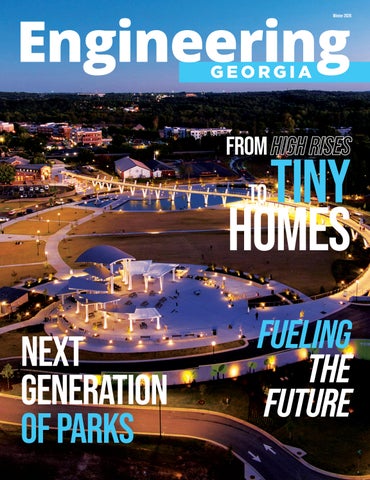
Engineering Georgia’s Next Generation of Parks
AAcross Georgia, parks and trails are much more than scenic amenities — they are engines of community health, equity, and resilience that connect people to nature, to each other, and to the places they call home. Well-designed recreational spaces improve physical and mental wellbeing, facilitate social cohesion, and enhance environmental quality by filtering air, reducing heat islands, and providing safe places for movement and play. Nationally, nearly 90 % of adults acknowledge that parks and recreation are an important government service, and local outdoor spaces are closely tied to increased physical activity and reduced stress.
In Georgia, parks and trails are equally vital. From mountain river corridors to coastal wetlands and urban greenways, outdoor recreational infrastructure creates healthier communities, sustains tourism, supports local economies, and invites people of all ages and backgrounds to experience the state’s natural landscape. Living within walking distance of quality green spaces has been linked to improved health outcomes and stronger community connections, while outdoor recreation contributes billions to Georgia’s economy and employs hundreds of thousands of people.
For the first time, the Parks and Recreational Facilities subcategory has been introduced within the Special Projects division of the 2026 Engineering Excellence Awards, recognizing that engineering for community outdoor spaces demands the same innovation, collaboration, and technical excellence as any major infrastructure project. In this issue, we highlight six award-winning park projects, from river corridors and trail connections to city centers and urban green infrastructure, each demonstrating how thoughtful engineering improves communities across the state. N
BRETT HILLESHEIM
CHATTAHOOCHEE RIVER CAMP & PADDLE TRAIL
A River Reclaimed for the People
For years, Atlantans had few safe ways to camp or paddle along the Chattahoochee River, particularly downstream from the National Recreation Area. Residents consistently said that camping opportunities and safe river access were missing from their communities. The Chattahoochee River Camp & Paddle Trail was born from that call — a 48-mile outdoor experience designed to reconnect people with Georgia’s most iconic river through a continuous route of paddling and overnight camping.
Completed in April 2025, Phase I introduced four riverside park sites and two ADA-accessible kayak launches, transforming the region’s ability to engage with the river safely, inclusively, and sustainably. What once required improvised access points or long drives now exists as a thoughtfully designed network of campsites, trails, comfort stations, and launch facilities woven carefully into riparian landscapes.
Pond served as consulting landscape architects, civil engineers, and environmental scientists, translating community feedback into a buildable reality. Their work navigated multi-jurisdictional permitting, stormwater design, stream buffer protections, and ADA compliance within sensitive river corridors. The result is infrastructure that feels peaceful and intentional, tent pads and trails tucked into woodland edges, comfort stations carefully sited, septic and well systems placed through soil testing to minimize ecological disturbance. N
The ADA-accessible kayak launches represent a milestone in equitable recreation. Custom-engineered gangway anchoring systems were designed to withstand fluctuating river levels and seasonal flooding while maintaining ADA-compliant slopes. Lightweight aluminum framing reduces corrosion and maintenance demands, and non-slip composite decking provides year-round safety without chemical treatments that could leach into the river. Hinged and telescoping connections allow the structures to adapt to changing water elevations — engineering precision in service of inclusion.
Ecological restoration is equally central to the project’s identity. Over 10 acres of invasive vegetation were removed and replanted with native species, demonstrating how engineering design can actively restore riverine ecology rather than merely coexist with it. Interpretive signage and habitat improvements deepen the experience, encouraging a shared conservation attitude among visitors.
The complexity behind the scenes was substantial: floodprone riverbanks, variable soils, groundwater challenges, and construction access limitations required adaptive solutions and phased implementation. Yet the project was delivered close to schedule and within its $4 million budget, reinforcing that technical rigor and ecological stewardship need not be competing priorities.
Pond created more than a trail; the Camp & Paddle Trail is a reintroduction of residents to their river, a means of accessibility to outdoor recreation, and an example of engineering as a tool for conservation. It strengthens regional tourism, supports local businesses, and enhances metro Atlanta’s identity as a place where natural systems and community life are deeply intertwined. N
GLOBAL GATEWAY CONNECTOR BRIDGE & TRAIL
A Barrier Removed.
A City Reconnected.
For decades, Camp Creek Parkway was more than a busy arterial; it was a barrier. Carrying more than 26,000 vehicles daily to Hartsfield-Jackson Atlanta International Airport, the four-lane corridor separated downtown College Park and its MARTA station from the Georgia International Convention Center, the ATL SkyTrain, and the broader regional trail network. There was no safe, ADAcompliant crossing. For residents, students, and visitors, the road represented risk rather than opportunity.
Stratus and STV ensured that the Global Gateway Connector Bridge & Trail changed that reality.
Spanning 200 feet across Camp Creek Parkway, the bridge delivers a fully accessible multimodal connection where none previously existed. Its 80-foot intersecting steel arches, a rare structural configuration in U.S. pedestrian bridges, do more than carry a deck; they signal arrival. By linking downtown College Park, MARTA, the Georgia International Convention Center, the Phoenix Trail, and airport-adjacent destinations, the project simultaneously strengthens mobility, equity, and civic identity.
The engineering behind the landmark is as deliberate as its visual presence. The intersecting arches, fabricated from ¾-inch steel plates, required precision modeling, advanced 3D coordination, and careful oversight during fabrication. Unlike conventional baskethandle arches, the ribs function as independent structural elements that cross at midspan — a complexity that demanded both analytical rigor and fabrication ingenuity.
Erection of the arches required five cranes working in concert during a single weekend closure of Camp Creek Parkway — a feat of logistical choreography over one of metro Atlanta’s busiest corridors. Fabrication challenges were addressed through direct inspections of prefabricated steel components and through shop assembly and LIDAR scanning to validate geometry before delivery. When Hurricane Helene threatened critical weld operations, crews accelerated work to complete full jointpenetration welds just hours before the storm’s outer bands arrived.
Accessibility was not an afterthought. A mechanically stabilized earth (MSE) ramp system addressed a 40-foot elevation change while minimizing environmental disturbance. The result is a seamless trail extension that supports residents, convention visitors, airport employees, and travelers alike.
The impact that Stratus and STV engineered reaches beyond structural innovation. The bridge provides a safe, ADA-compliant route, encourages active transportation, reduces short vehicle trips, and connects people to jobs and transit. At night, its illuminated arches create a new visual identity for College Park — a civic landmark visible to millions arriving at the world’s busiest airport. N
SUWANEE TOWN CENTER ON MAIN AND DELAY NATURE PARK
A Front Door Built for the Future
Suwanee has long understood the power of public space. As the city grew, so did the desire for a defining civic landscape, a “front door” that could serve as a gathering place and connective tissue for downtown life.
The result is a 25-acre civic park that unites recreation and infrastructure into a cohesive whole. Completed in 2024, Town Center on Main and DeLay Nature Park blends landmark engineering with communitycentered design. A sweeping pedestrian bridge, stretching more than 1,000 feet, serves as both functional infrastructure and a symbolic gesture, connecting key areas of downtown while reinforcing Suwanee’s identity.
But the bridge is only part of the story.
The project integrates accessible pathways and ADA-compliant ramps to ensure inclusivity across its trails and paths. An existing pedestrian underpass beneath an active railroad was incorporated into a seamless grade-separated circulation network, eliminating dangerous crossings while strengthening connectivity. Realigned roadways, safe rail interfaces, and thoughtful grading strategies transformed previously fragmented spaces into a unified civic core.
CPL, serving as the lead designer, provided landscape architecture, architecture, structural, civil, and electrical engineering services. Their multidisciplinary approach balanced aesthetics with resilience, innovation, and practicality — particularly critical as the project endured an 18-month COVID-related suspension and escalating material costs. Through adaptive value engineering, the team preserved signature elements, including the pedestrian bridge and major public spaces, while staying within the original $26 million budget.
Environmental stewardship was woven into every decision. Mature trees were preserved wherever possible, with careful grading and root protection strategies guiding construction. Stormwater systems were designed to work with the site’s natural topography, using strategically placed catch basins and drainage modifications to manage runoff responsibly. Durable, lowmaintenance materials ensure the park’s long-term resilience; a civic investment designed to last decades.
The amenities themselves reflect layered intention: Playtown Suwanee playground, sand volleyball courts, trails, water features, a veterans’ memorial, and a reading grotto adjacent to the library. Flexible open spaces accommodate festivals, art installations, and evolving programming, reinforcing the park’s role as both a daily destination and a longterm economic catalyst.
Perhaps most significant is how the project was shaped. Public forums, surveys, and youth engagement informed the design from the outset, embedding community voice into engineering decisions. Even during construction, phased scheduling and transparent communication minimized
L. SCOTT STELL PARK IMPROVEMENTS
Rebuilding a Community Court by Court
In unincorporated Chatham County, L. Scott Stell Park had long served as a hub for recreation, but years of heavy use had worn its courts down and left them outdated. The revitalization effort led by CHA transformed the facility into a modern, resilient outdoor complex designed for long-term community use.
Four tennis courts, ten pickleball courts, and four basketball courts were reconstructed and reoriented following an in-house solar incident study to reduce glare and improve player safety. Each court complex is now sheltered beneath open-air steel “airnasiums” that provide shade, ventilation, lighting, and circulation fans while preserving the outdoor experience.
Poor subgrade soils required full-depth reclamation and Portland cement stabilization of the parking lot and court foundations, a sustainable solution that minimized material waste and eliminated the need for extensive undercutting. The $4.9 million project was delivered on schedule and within budget, restoring the park as a durable, inclusive, and vibrant recreational anchor for the Savannah community. N
CHATTAHOOCHEE RIVERLANDS TRAIL PHASE 1
A Framework for Connection
Opened in 2024, Phase 1 of the Chattahoochee RiverLands Trail establishes unprecedented public access to the Chattahoochee River south of I-285 in Cobb County. As the first constructed segment of the planned 100-mile greenway, the project sets the tone for how infrastructure can balance mobility, ecology, and community experience.
Designed by Gresham Smith in partnership with Cobb County and The Trust for Public Land, the 1.3mile segment includes paved and unpaved multi-use trails, an elevated boardwalk spanning wetlands, and an “education nook” overlooking the river corridor. The alignment carefully responds to floodplain conditions while minimizing disturbance and incorporating native plantings and resilient materials.
More than a trail, the project demonstrates how transportation engineering and landscape architecture can work in concert to create equitable, sustainable infrastructure that reconnects people with nature while supporting regional mobility. N
GREEN INFRASTRUCTURE DESIGN CHALLENGE –CHASTAIN PARK
Engineering the Invisible
At Chastain Park, one of Atlanta’s most visited public spaces, aging stormwater infrastructure had begun to fail, creating water-quality and runoff concerns within the Nancy Creek watershed. As part of the City of Atlanta’s Green Infrastructure Design Challenge, R2T led the design of innovative stormwater solutions that transform drainage into a visible public amenity.
The $1.46 million project introduced a bioretention pond, upgraded drainage infrastructure, tree wells, and naturalized systems that increase infiltration, reduce downstream flooding, and improve water quality. Located near the Chastain Park Amphitheater, the design required careful coordination to avoid disruption to public events while engaging community stakeholders throughout the process.
Today, what was once hidden infrastructure now serves both environmental protection and park enhancement, demonstrating that stormwater engineering can reduce the burden on aging systems while improving aesthetics, pedestrian safety, and long-term watershed health. N
ENGINEERING SPACES THAT SHAPE COMMUNITIES
Taken together, these six projects reflect something larger than individual park improvements. They represent a shift in how we define infrastructure. Parks, trails, bridges, and green stormwater systems are no longer secondary amenities; they are essential civic systems that influence public health, economic vitality, environmental resilience, and social connection.
Across Georgia, engineers are working at the intersection of ecology and equity, recreation and resilience, movement and memory. Whether spanning a major arterial to reconnect a downtown district, restoring river access that had long been out of reach, stabilizing failing soils beneath beloved courts, or transforming stormwater management into a public amenity, each project demonstrates that technical excellence and community impact are not separate pursuits — they are inseparable.
Designing parks today requires structural ingenuity, hydrologic modeling, accessibility expertise, materials science, stakeholder engagement, and long-term operational foresight. It demands the same rigor as highways, bridges, or treatment plants — and often, even more nuance.
These projects remind us that engineering is not only about solving problems, but it is also about shaping the environments where life unfolds. It is about building spaces where children learn to ride bikes, where families gather under shaded courts, where residents paddle rivers once thought inaccessible, and where communities find both refuge and opportunity.
Georgia’s parks are not simply landscapes. They are living infrastructure, and the engineers behind them are helping design a stronger, healthier, more connected future for the state. A
DARREN MICKLER
PELS Boards Executive Director
www.sos.ga.gov
2025 NCEES ANNUAL MEETING RECAP: KEY HIGHLIGHTS AND OUTCOMES
The 2025 Annual Meeting of the National Council of Examiners for Engineering and Surveying (NCEES) took place August 19–22 at the Sheraton New Orleans Hotel in Louisiana, bordering the historic French Quarter. Georgia’s delegation included five board members— Chairman Taylor Wright, Bill Womack, Trent Turk, Jim Mattison, and Julie Busbee—along with staff members Executive Director Darren Mickler, Deputy Director Eric Lacefield, and Inspector Kenneth Austin. This meeting was the first for new NCEES CEO Davey McDowell, who succeeds retired CEO David Cox and brings years of experience as Deputy CEO.
PROFESSIONAL DEVELOPMENT AND NETWORKING
The event opened with professional development hours for engineers and surveyors, plus a Member Board Administrators (MBA) training session. Attendees enjoyed a kickoff party at Mardi Gras World, featuring parade artifacts and previews, followed by a buffet at River City Venues.
BUSINESS SESSIONS AND LEADERSHIP CHANGES
Wednesday’s business meeting included professional forums for engineers, surveyors, and MBAs. Samuel Wilson, DBA, P.E. (District of Columbia), was elected 2025–26 President-Elect and will serve as President in 2026–27. Discussions included the potential addition of an MBA representative to the Board of Directors (referred for further study) and a possible title change from Member Board Administrator to Member Board Executive for greater clarity.
ADDRESSING AI AND UNLICENSED PRACTICE
Thursday’s sessions focused on significant issues, notably the use of artificial intelligence in engineering and surveying deliverables and the risks posed by unlicensed individuals offering services online, often through platforms like Fiverr. The MBA committee will continue to monitor these developments.
COMMITTEE HIGHLIGHTS AND POLICY UPDATES
• Finances: Proposed budget changes reduce designated reserves, increasing funding for the NCEES Foundation.
• Licensure: New position statement on experience records for licensure applicants; clarified references and verifications; new rubric for categorizing experience.
• Examination Policy: Amendments to exam development processes, including a requirement that 50% of committee members have exam development experience.
• Member Board Administrators: Proposal to add “home rule” to Continuing Professional Competency (CPC) requirements, supporting multi-jurisdictional licensees.
• Legislative Guidelines: Revisions to Model Law and Rules, including recognition of the ETAC/ABET pathway to licensure.
• Bylaws: Comprehensive review and proposed amendments following legal counsel’s input.
LOOKING AHEAD
The meeting concluded with the installation of the 2025–26 Board of Directors and remarks from President-Elect Elizabeth Beckett Johnston, P.E., outlining her vision for the coming year. For complete details, see the 2025 NCEES Action Items and Conference Reports.
ANITA ATKINSON, P.E., F.ASCE
Patterson & Dewar Engineers, Inc.
ASCE Georgia President www.ascega.org
Congratulations to Ehsanul Kabir for being named the Outstanding Young Civil Engineer in the Public Sector. Congratulations to Lauren Kilgore on being named Outstanding Younger Member in Community Activities. Both received their awards at the MRLC.
UPCOMING: Be on the lookout for ASCE GA Section award nomination information in the coming months. It is easier than ever to nominate a deserving candidate!
TUDENTS AT THE MULTI-REGION LEADERSHIP CONFERENCE IN JACKSONVILLE, FL.
JANUARY 2026 YOUNGER MEMBER GROUP MEETING
LINDSEY DUNNAHOO AECOM
ASHE Georgia President www.georgia.ashe.pro
RECAP OF TRANSPORTATION SUMMIT HAPPY HOUR:
We had a great time at The Foundry before this year’s Transportation Summit! Thank you to everyone who came out!
RECAP OF HOLIDAY SOCIAL:
We held our annual holiday social on December 10th. We were able to donate plenty of toys to Toys for Tots. Thank you to all who came out and donated!
President’s Award: James Nguyen (Peachtree Corners)
Volunteer of the Year: Joe Chevrier (ADS) Members of the Year: Jean Yu (HNTB) Sponsor of the Year: Heath & Lineback
RECAP OF DECEMBER LUNCHEON:
The December luncheon was held at Maggiano’s in Buckhead on December 12th. We had an excellent panel discussion from DeKalb Cities Public Works. It was a great conversation accompanied by a chance to network and enjoy some fantastic food. Thank you to all who came out!
The Georgia Section of ITE (GAITE) closed out the year on a high note with two signature events: Traffic Bowl on November 21 and our Annual End-of-Year Meeting on December 4. We are proud to continue celebrating our recognition as the 2025 ITE Outstanding Section Award recipient.
RECOGNITIONS
2025 Traffic Bowl Champions
Georgia Institute of Technology: Elijah Andrews, Sam Whitaker, and Nico Dinglasa Roundabout of the Year Award
GDOT and City of Atlanta for the I-20 Eastbound Exit Ramp Roundabout at Maynard Terrace Idea Sharing Award
Sarah Nastasi, PE for the GAITE Safety Committee Innovation in Transportation Award
GDOT’s Day One Deployment District Agency Achievement Award
Midtown Alliance
Marsha Anderson Young Member of the Year
Raul Viera, PE
John D. Edwards Jr. Individual Achievement Award
Kamari Duvvuri, PE, RSP1
Karl Bevins Distinguished Service Award
Alan Davis, PE, PTOE
Transportation Professional of the Year Award
Jannine Miller
Awards of Special Recognition
Ron Knezevich, PE, RSP1; Ulrich Sounkoua, PE; MC Martin; and PeachTEA Podcast Production Team
2026 BOARD OF DIRECTORS
Congratulations to our newly-elected 2026 Board of Directors: Scott Mohler, Past President Representative (Non-voting); Christy Jeon, Past President; Challa Bonja, At Large Board Member (2nd Year); Bing Zhang, President; Bill Ruhsam, Vice President; Elizabeth Shin, Secretary/Treasurer; Sam Harris, Representative to Southern District (1st year); Tom Udell, Representative to Southern District (2nd year)
UPCOMING EVENTS
ANDREW FARMER, PE
Gresham Smith
GEF Secretary
andrew.farmer@greshamsmith.com www.gefinc.org
THE GEORGIA ENGINEERING FOUNDATION (GEF) WOULD LIKE TO THANK OUR PROFESSIONAL SOCIETY MEMBERS, ENGINEERING FIRM BENEFACTORS, AND INDIVIDUAL ENDOWMENT PARTNERS FOR THEIR CONTINUED SUPPORT OF GEF’S MISSION TO AWARD SCHOLARSHIPS TO DESERVING STUDENTS IN 2026.
The GEF Board and volunteers has been busy interviewing around 120 students to award 50 plus scholarships based on academic achievements, participation in the industry through student organizations, internships and co-ops, and financial need.
Scholarship winners will be presented their awards in person at their schools in Spring of 2026.
GEF is always looking for volunteers and donors to help carry out our mission. Volunteering provides a great opportunity to give back to the future generation of engineering in Georgia and to stay involved with your Georgia based alma maters.
GEF’s professionally conducted scholarship program allows our members and benefactors to define specific scholarship criteria and efficiently deliver financial aid to the next generation of engineers in Georgia. GEF’s all volunteer team enables us to connect to a larger pool of deserving candidates for scholarship consideration while at the same time allowing our member associations and benefactors to be free from the administrative time and costs associated with independently running their own scholarship program.
NOW MORE THAN EVER, IT IS CRITICAL TO INVEST IN THE NEXT GENERATION OF ENGINEERS IN GEORGIA.
As a donor, you can be assured that GEF will award your scholarship based on the benefactor’s goals, student merit, and with a strong consideration of each scholar’s financial need. If you are interested in setting up a scholarship or endowment, or if you are interested in volunteering with GEF, please reach out to us at President@gefinc.org
The Georgia Engineering Foundation is a 100% volunteer 501(3)c organization made up of a wide range of organizations and societies that have joined together to implement a common scholarship program and promote STEM for the benefit of students from Georgia.
AUSTIN DUEHR, PE
GSPE President www.gspe.org
GEORGIA SOCIETY OF PROFESSIONAL ENGINEERS CONGRATULATES THE 2026 WINNERS OF THE PRESTIGIOUS GEORGIA ENGINEER OF THE YEAR AWARDS.
The GSPE Engineer of the Year Awards is an annual program organized by the Georgia Society of Professional Engineers (GSPE) to celebrate exceptional engineers who have made significant contributions to both the engineering profession and their local communities in Georgia. This prestigious awards program features multiple categories to recognize engineers at different career stages and across a variety of engineering disciplines.
ABOUT GSPE
The Georgia Society of Professional Engineers (GSPE) is a statewide professional organization dedicated to supporting and advancing the engineering profession in Georgia. Through monthly meetings and programs held across the state, GSPE provides opportunities for continuing education, professional development, and connection among engineering professionals. GSPE is proud to celebrate excellence in engineering and to recognize the individuals whose leadership and service strengthen communities across Georgia. Engineers are invited to learn more about GSPE’s programs, events, and membership opportunities at www.gspe.org.
WILLIAM WOMACK, PE
Lifetime Achievement Award Winner
GUOMING LIN, PHD, P.E., F.ASCE Engineer of the Year
ROBERT H. BARNES, P.E., P.G., M.ASCE Construction
CAMERON COATES, PHD, P.E. Education
SUZANNE COOLER, P.E., M.ASCE Government
SULEMAN RANA, MS, P.E. Industry
CHRISTOPHER BRAZELL, PE, PLS Private Practice
IAN HARRISON, P.E. Young Engineer
ABRIANA NYANTE, S.M. ASCE
Engineering Student of the Year
ANASTASIA MORRIS
Engineering Technology Student of the Year
LAUREN KILGORE
Engineering Organization Volunteer of the Year
COLEMAN COMPANY, INC
Mid-Size Engineering Employer
KIMLEY-HORN
Large Engineering Employer
CHATHAM COUNTY, DEPARTMENT OF ENGINEERING Public Sector Employer
MATT GLASSER, PE
Arcadis
ITS Georgia President president@itsga.org www.itsga.org
JOIN ITS GEORGIA AT THE ITS SOUTHEAST SUMMIT IN MARCH
Join us in Charlotte, North Carolina, for the 2026 ITS Southeast Summit, taking place from March 22–25. This premier event will bring together over 1,000 transportation and intelligent transportation systems (ITS) professionals from across the Southeastern United States and beyond. Immerse yourself in a dynamic environment where you can discover the latest industry trends, explore innovative technologies, and expand your professional network.
• Unparalleled Learning: Participate in interactive workshops, technical sessions, and panel discussions featuring thought leaders and industry experts.
• Cutting-Edge Solutions: Explore an expansive exhibit hall showcasing the latest ITS products, services, and advances transforming transportation.
• Networking Opportunities: Connect with peers, public and private sector leaders, and technology innovators from across the region and nation.
• Professional Development: Gain valuable insights and earn professional development hours (PDHs) through accredited sessions.
• Regional Collaboration: Experience unique opportunities to collaborate and share best practices with professionals from multiple Southeastern states.
The 2026 Southeast Summit is a collaborative effort by ITS Georgia, ITS Tennessee, ITS Carolinas, Gulf Region ITS, and ITS Floridacombining our annual meetings into a single, exceptional event. Each year, the Southeast Summit continues to grow, drawing participants from a broad range of disciplines and geographic areas well beyond the Southeast.
Visit seitssummit.com for more information on registration, technical agenda, and sponsorship opportunities.
ITS GEORGIA VOLUNTEER OPPORTUNITIES
ITS Georgia is always in need of volunteers to support the activities and goals of the organization. Volunteering with ITS Georgia is a great way to meet colleagues from across the public and private sectors, make an impact on others outside your typical workplace, and have a bit of fun outside of work. ITS Georgia thrives on the dedication of volunteers, serving as a gateway to becoming a Director or Officer. If you are eager to contribute, please reach out to me at president@itsga.org or visit our website at itsga.org for opportunities!
ITS GEORGIA GETS AN UPDATE FROM THE CURIOSITY LAB
On January 28th, engineering professionals from across the region gathered at Peachtree Corners Curiosity Lab for a highly anticipated skills training event, “Your Voice, Your Influence: Lead with Confidence.” The afternoon workshop, led by renowned leadership coach Skot Waldron, was both engaging and transformative. Attendees enjoyed a lively lunch before diving into hands-on exercises and insightful discussions anchored in Waldron’s expertise in communication psychology and brand strategy. His reputation for blending humor with practicality shone through, making each session not only informative but also memorable.
The workshop equipped participants with actionable tools to recognize and harness their unique leadership voices, foster trust within teams, and overcome self-preservation habits that sometimes hinder collaboration. Through Waldron’s guidance, attendees learned to apply the five leadership voices, identify their foundational leadership styles, and build trust using the four C’s: Character, Chemistry, Competency, and Credibility. The event kicked off the new year on a high note, empowering engineering leaders to lead with greater confidence and authenticity - skills that will resonate throughout their careers and project teams.
CHRIS LYTLE
Uzun & Case Engineers, LLC
SEAOG President
www.seaog.org
EVENT RECAP
In December, SEAOG members gathered at Wild Heaven Brewery and Fox Bros Bar-B-Q for a recap of the 2025 NCSEA Summit. This presented a great opportunity for members to reconnect, reflect on the year, and look ahead to upcoming events. Summit recap discussions focused on:
- ACI 318-25 and SE3 Updates
- Sustainability Updates
- Risk & Liability Updates
UPCOMING EVENTS
Please plan on attending our upcoming events. Organization events are a great opportunity to meet with fellow engineers and learn more about industry topics. See the SEAOG website (seaog.org) for additional information.
APRIL 21-24 – AISC’S NASCC CONFERENCE IN ATLANTA
Tuesday, April 21: SEAOG Evening Social Event Wednesday, April 22 - Friday, April 24: AISC Conference
Discounted Rate for SEAOG Members Designated Meeting Space During Event
MAY 21
Bi-Annual SEAOG Structural Engineering Excellence (SEE) Award Ceremony These awards recognize and celebrate individual achievements and projects that demonstrate exceptional innovation, creativity, and constructability.
IRIS ORTIZ
WTS Atlanta President iortiz@hntb.com www.wtsinternational.org/atlanta
HAPPY NEW YEAR!
As I reflect on 2025, WTS Atlanta had an amazing and busy year. Our committees spent many hours every month planning and executing great events for our members and the greater transportation community in Metro Atlanta.
On November 7, we hosted the Annual Scholarships and Award Luncheon on November 7, with Dr. Malika Reed Wilkins, now Executive Director and CEO of WTS International and a WTS Atlanta past president, as keynote speaker. The event brought 350 transportation industry professionals and friends together to honor the accomplishments of local industry leaders, but more importantly, to award scholarships to young women pursuing careers in transportation.
One highlight of the event was presenting the video “She is Why” to kick-off the 2026 WTS Atlanta Scholarship Fundraising efforts, with the goal of increasing the scholarships value in 2026 to $30,000. The video is a testimony of the power of the WTS Atlanta scholarships and our efforts to support the mission and vision of the organization. WTS Atlanta has awarded $100,000 in scholarship since 2020. At the luncheon, we raised almost $15,000 (including the silent auction) … we’re halfway to our goal! Please scan the QR code to help us continue our mission to advancing women’s careers in transportation and achieve our fundraising goal.
A LOOK BACK
Atlanta Airport
A view of the terminal and Eastern building circa 1940.