















NATIONAL VOLUNTEER WEEK
APRIL 19–25, 2026

APRIL 19–25, 2026
In honour of National Volunteer Week, PEO recognizes and thanks our volunteers who serve in chapters and chapter-sponsored programs, as well as on Council, committees and their subcommittees, the Government Liaison Program, external boards and advisory groups. Your commitment and contributions make a lasting impact.
Volunteer Service RECOGNITION
Meet the professionals who contribute their time and expertise to PEO’s statutory committees.
By Leslie Sinclair
These nine committees carry out the essential work that keeps the profession accountable, competent and trusted.
By Leslie Sinclair
By Sharon Aschaiek



Managing editor
Nicole Axworthy
Senior graphic designer
Cindy Reichle
Senior writer
Leslie Sinclair
Contributors
Sharon Aschaiek
Jane Mustac, P.Eng.
Engineering Dimensions (ISSN 0227-5147) is published quarterly by Professional Engineers Ontario and distributed to all PEO licence holders.
Engineering Dimensions publishes articles on regulatory business and professional topics of interest to the professional engineer. The magazine’s content does not necessarily reflect the opinion or policy of PEO Council, nor does PEO assume any responsibility for unsolicited manuscripts and art. All material is copyright. Permission to reprint editorial copy or graphics should be requested from the editor.
Approximately $5 from each membership fee is allocated to Engineering Dimensions and is non-deductible.
Canada Publications Mail Product Sales Agreement No. 40063309. Printed in Canada by Wellington Printworks Inc.
ADVERTISING SALES
Finally Content
Vice president, media sales
Laura Maurice
laura.maurice@finallycontent.com 647-394-5567
CONNECT WITH US Online: engineeringdimensions.ca Email: editor@peo.on.ca
TO UPDATE YOUR SUBSCRIPTION
All licence holders and engineering interns registered with Professional Engineers Ontario receive Engineering Dimensions in print or digital form. Subscription preferences can be updated in the PEO portal at secure.peo.on.ca. Other subscription requests can be made to editor@peo.on.ca.
EXECUTIVE STAFF
CEO/registrar
Jennifer Quaglietta, P.Eng., MBA, ICD.D
Vice president, regulatory operations and deputy registrar
Vacant
Vice president, policy and governance and chief legal officer
Dan Abrahams, LLB
Vice president, corporate operations and digital transformation
Arun Dixit, P.Eng.
PEO COUNCIL Officers
President
Fred Saghezchi, MASc, P.Eng., FEC president@peo.on.ca
Past president and Council chair
Gregory P. Wowchuk, P.Eng., FEC
President-elect
Leila Notash, PhD, P.Eng., FEC
Vice president (elected)
Sardar Asif Khan, PhD, MBA, P.Eng., FEC, PMP
Vice president (appointed) Randy Walker, P.Eng., FEC
Executive Members
Shahandeh Hannah Ehtemam, P.Eng.
Lorne Cutler, MBA, P.Eng.
Councillors
Councillors-at-large
Sean Decloux, MEng, MBA, P.Eng., PMP
Paula R. Klink, PhD, P.Eng., FEC
Randy Walker, P.Eng., FEC
Eastern Region councillors
Chantal Chiddle, P.Eng., FEC
Susan Jingmiao Shi, MEng, P.Eng.
East Central Region councillors Shahandeh Hannah Ehtemam, P.Eng.
Nanda Layos Lwin, P.Eng., FEC
Northern Region councillors Ahmed Elshaer, PhD, P.Eng. Luc Roberge, P.Eng., FEC
Western Region councillors Vicki Hilborn, MASc, P.Eng. Susan MacFarlane, MSc, PhD, P.Eng.
West Central Region councillors Pappur Shankar, P.Eng., FEC Ravinder Panesar, P.Eng., FEC
Lieutenant governor-in-council appointees
Cosimo Casale, P.Eng. Lorne Cutler, MBA, P.Eng. Andrew Dryland, C.E.T. Lorraine Fraser, PhD, MBA, MEng, P.Eng., FEC
Paul Mandel, MBA, CPA, CA
Shelly Markel, JD, MBA, ICD.D Andrew Naassan, P.Eng. Rachel Prudhomme, BEng, MSc, P.Eng., BPHE Scott Schelske, P.Eng., FEC Uditha Senaratne, P.Eng., FEC Sherlock Sung, BASc
Engineers Canada Directors
Arjan Arenja, MBA, P.Eng., ICD.D Christopher Chahine, P.Eng., PMP Nick Colucci, MBA, P.Eng., FEC Tim Kirkby, P.Eng., FEC Marisa Sterling, P.Eng., FEC
www.peo.on.ca
The office of Professional Engineers Ontario in the City of Toronto is situated on the traditional territory of many nations, including the Mississaugas of the Credit, the Anishnabeg, the Chippewa, the Haudenosaunee and the Wendat peoples.

In engineering self-regulation, statutory committee members play a vital yet often unseen role. Serving on committees established under the Professional Engineers Act to help fulfill specific regulatory and governance functions, these individuals are critical to helping PEO achieve its mandate and uphold the standards that keep the profession strong and trusted.
This month, during National Volunteer Week, we’re celebrating the invaluable contributions of these professionals. Volunteering on a committee offers tremendous personal and professional growth. In “Putting the ‘Self’ in Self-Regulation” (p. 18), senior writer Leslie Sinclair speaks with three professional engineers about how these opportunities allow them to develop leadership skills, collaborate with peers and gain insight into the evolving challenges of the profession. The committee members describe it as a rewarding way to give back to a community that has supported them throughout their careers.
In “Inside PEO’s Statutory Committees” (p. 21), Sinclair also explains what PEO’s nine statutory committees do, from reviewing complaints about licence holders to conducting hearings de novo for applicants who were denied a licence. Through these functions, the committees ensure decisions are thorough, consistent and aligned with the public interest. Their work sets precedents and reinforces the integrity and credibility of the profession.
In this issue, we also highlight the transformative efforts of an engineering firm that is changing its workplace culture to enable women engineers to build lasting careers (“Where Are All the Women?,” p. 36). The conversation is shifting from getting women licensed to creating workplaces they want to stay in. As contributing writer Sharon Aschaiek shares, this firm understands that a supportive culture drives retention and ultimately strengthens the profession, aligning with PEO’s vision of a more inclusive, diverse and resilient engineering community.
Be sure to flip over to page 10 for a look at our new Chapter Matters section, where we highlight chapter events and initiatives that are advancing PEO’s public-protection mandate and supporting the regulator’s work in provinces across the country.
On a final note, the results of PEO’s recent Council elections can be found on page 12. Members of the 2026–2027 term take office this month at PEO’s hybrid annual general meeting. More details on the event can be found on page 16. I encourage you to attend, but we’ll also bring you all the details of the business meeting and new Council in the next issue of Engineering Dimensions e






Nicole Axworthy MANAGING EDITOR












PEO’s statutory committee members are the silent superheroes of our selfregulated profession. Their time and expertise strengthen the very framework that ensures public safety and maintains the integrity of the profession.
To protect the public, PEO investigates all complaints about unlicensed individuals or companies, and unprofessional, inadequate or incompetent engineers. If you have concerns about the work of an engineer, fill out a Complaint Form found on PEO’s website and email it to complaints@peo.on.ca. If you suspect a person or company is practising engineering without a licence, contact PEO’s enforcement hotline at 800-339-3716, ext. 1444, or by email at enforcement@peo.on.ca












Three years ago, I became the CEO and registrar of Professional Engineers Ontario (PEO), a self-regulator with statutory authority over the practice of engineering and 90,000 licensed engineering professionals. Lately, with the benefit of that experience, I have found myself reflecting deeply about relevance.
My previous experience included two decades in healthcare. Our health-care system lives and breathes complexity, urgency and public accountability. Regulation felt different. Incremental. Steadier. Anchored in tradition. Many regulatory bodies in Canada have existed for decades, some for more than a century, and at least one, the Law Society of Ontario, for more than two centuries. Their processes were built carefully, deliberately, often in response to past failures or hard-earned lessons.
There is something to honour in that history. But there is also something we must confront.
Across the country, I’ve met regulators of various professions who are rethinking their models, redesigning their processes, overhauling their legislation in partnership with government and challenging long-held assumptions. One inescapable if uncomfortable truth emerges: If regulators do not evolve, we risk losing both public confidence and professional relevance.
Regulators are often misunderstood. Too frequently, we are perceived as punitive, bureaucratic or barriers to innovation rather than stewards of trust. And while perception is not always reality, it often signals something important. In the next era of leadership, adaptability will not be optional. It will be the measure of our relevance.
THE MOMENT SYSTEMS CHANGED
The lens through which I view regulation was shaped by my experience in healthcare. Across roles spanning the pharmaceutical sector, agency, consulting, government, clinical and insurance set-
tings, I led quality improvement initiatives that brought clinicians and administrators together from both an operational and system-level perspective to improve patient outcomes, reduce harm and redesign long-standing processes.
One moment stands out.
When I was working at the Ministry of Health and Long-Term Care, I had the privilege of being part of the team that advanced the Excellent Care for All Act. The act fundamentally shifted the healthcare system’s orientation. It moved from a funding model focused primarily on physicians to one that placed the patient at the centre of decision-making. This was not a small adjustment. It required challenging long-standing norms about who holds authority in the system and redefining accountability around the experience and outcomes of patients themselves. It also meant asking leaders, clinicians and organizations to look beyond professional hierarchies and see the system through the eyes of the people it serves. Quality, transparency and accountability were no longer aspirational. Instead, they were embedded into the system’s architecture.
When the legislation passed unanimously in the Ontario legislature, it crystallized something for me: Systems can change when clarity of purpose meets courage.
Healthcare moved toward patient-centred care because it had to. The public demanded it. The data demanded it. The professionals delivering care demanded it.
Today, I believe regulation is at a similar inflection point.
Interestingly, while exploring whether this thinking existed elsewhere, I came across emerging work from the Organisation for Economic Co-operation and Development on human-centred public administrative services. The global conversation is beginning. But many regulators are not yet aware that this shift is underway or that it has been happening in other sectors for some time.
That realization strengthened my conviction.
It was time to articulate a philosophy for regulation that draws on what we know about quality improvement, system design and public trust.
continued on p. 8
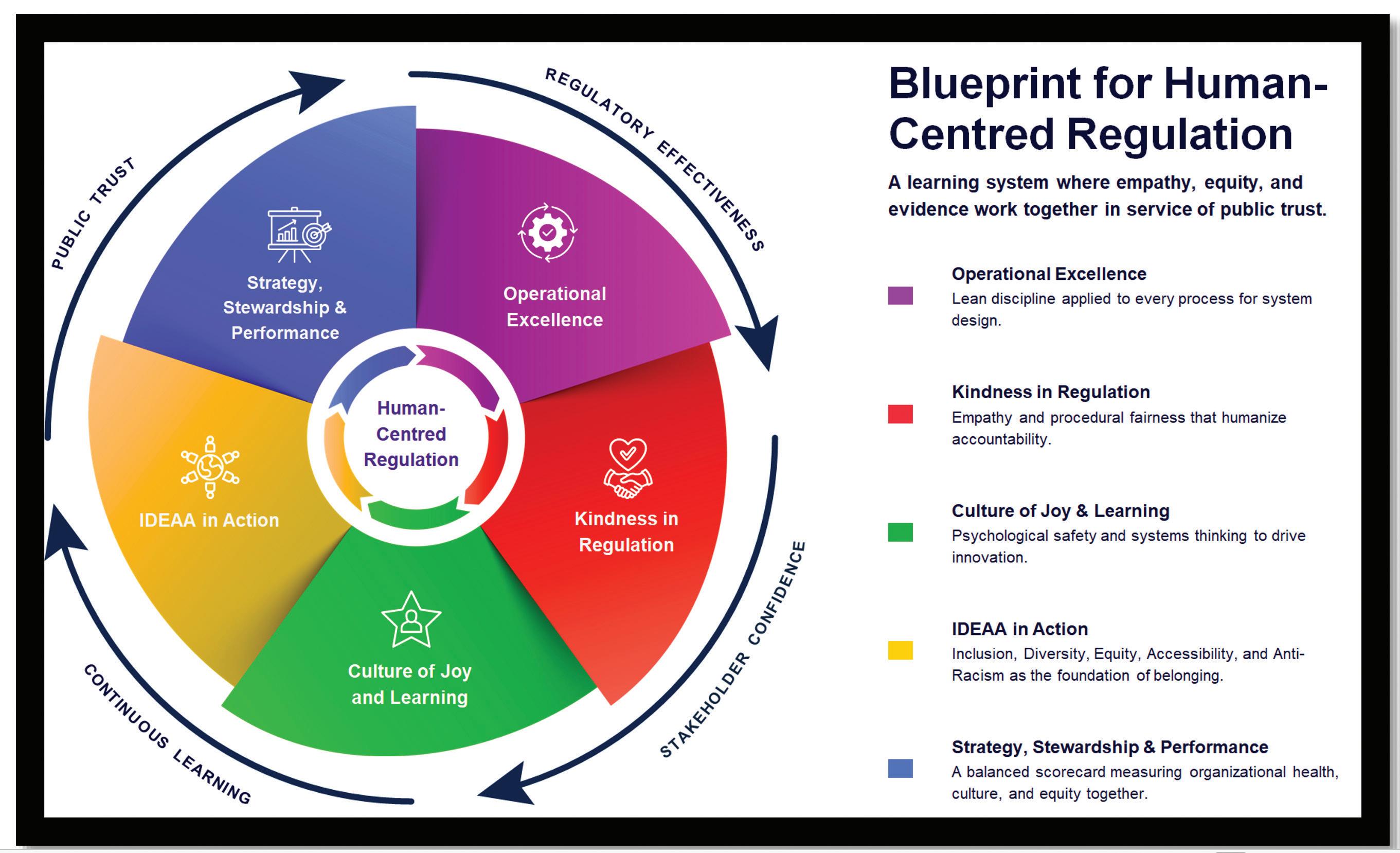
Human-centred regulation is a philosophy that repositions regulators from rule enforcers to system designers: institutions that intentionally design processes, culture and decisions around fairness, trust and public value.
It does not abandon compliance. It elevates it.
To operationalize this philosophy, I have developed a Blueprint for Human-Centred Regulation. The blueprint involves five interlocking pillars that function like gears in motion or sections of an orchestra working in harmony. Each pillar matters on its own. Together, they create momentum.
The five pillars are:
• Operational Excellence;
• Kindness in Regulation;
• Culture of Joy and Learning;
• Inclusion, Diversity, Equity, Accessibility and Anti-Racism (IDEAA) in Action; and
• Strategy, Stewardship and Performance.
Let me briefly explore each.
1. Operational Excellence
Operational Excellence is the engine.
Most regulators have legacy systems that include licensing processes, complaint investigations, discipline proceedings and other regulatory tools that have evolved over decades. Many of these processes, as well as the committees and engagement methods that support them, were designed to
ensure fairness, transparency, impartiality and objectivity. Those principles remain non-negotiable.
But the world around us has changed.
Mobility is now a critical success factor for our country. Professionals move across provinces and internationally. Workforce shortages are real. Public expectations around speed and transparency are higher than ever.
We can no longer take years to investigate a complaint. We cannot spend many months issuing a licence when risk does not justify the delay.
Operational Excellence does not mean cutting corners. It means applying quality improvement principles and maximizing value in a system. We need to determine where waste hides, where duplication exists, where technology can help and where unnecessary handoffs create delay.
Operational Excellence means honouring due process while embracing efficiency as an ethical obligation.
In this context, I am proud of our work at PEO, one of the province’s oldest and largest professional self-regulators. Over the past few years, our licensing process has undergone significant redesign. We have modernized our systems. We have introduced dashboards and improved service standards. Our aim is not to “move faster” for the sake of optics, but to reduce unnecessary anxiety for applicants by ensuring decisions are rendered fairly and without delay.
Transformation is hard. Change is continuous. But legacy, or the limited presence of natural competition for regulators, cannot become an excuse for stagnation.
2. Kindness in Regulation
Kindness in Regulation is not softness. It is strength delivered with dignity. Kindness is a topic I have considered throughout my career. It resonates for regulators as much as health-care providers.
People do not automatically think of regulators as being kind. We must enforce standards. We must investigate complaints. We must, at times, discipline members of the profession. Regulators are organizations that lack competition and can at times become stagnant or bureaucratic.
But how we do this matters.
Tone matters. Responsiveness matters. Procedural fairness matters. Clarity matters.
Kindness in Regulation is about ensuring that even when we communicate difficult decisions, we do so with respect and humanity. Kindness is about trauma-informed approaches. It is about writing letters that are clear rather than intimidating. It is about ensuring processes feel fair, not just legally defensible. It is about empathy and considering how we might respond if we were on the receiving end of unfavourable information from an organization that enables our livelihood.
Kindness strengthens trust. It does not weaken accountability.
3. Culture of Joy and Learning
Regulation cannot evolve if its people are disengaged.
A Culture of Joy and Learning recognizes that psychological safety, curiosity and purpose are not “soft” concepts. In fact, they are performance enablers.
The next generation of leadership will have to serve in environments where staff can question processes without fear, propose improvements without retribution and reflect openly on mistakes.
In healthcare, we learned that safety culture directly impacts patient outcomes. In regulation, culture directly impacts public trust.
The “how” matters just as much as the “why.”
If we demand compliance internally while preaching transparency externally, we create dissonance. If we expect innovation without creating space for learning, we create frustration.
4. Inclusion, Diversity, Equity, Accessibility and Anti-Racism (IDEAA) in Action
IDEAA in Action requires us to examine whether our systems create unintended barriers.
Are our standards equitable? Are our processes accessible? Does the profession we regulate reflect the community it serves? Barriers are not always visible. They can appear in application processes that assume prior knowledge of the system, in standards written without considering different career pathways or in timelines that unintentionally disadvantage internationally trained professionals. IDEAA in Action asks us to pause and question whether our systems open doors or quietly keep them closed.
Equity is not an abstract concept. It lives in application forms, exam requirements, credential recognition pathways, committee composition and decision-making frameworks.
Designing for equity means asking whether policies built decades ago continue to serve today’s society.
If mobility is a national priority, then access matters. If public trust is our mandate, then representation matters.
5. Strategy, Stewardship and Performance
Finally, Strategy, Stewardship and Performance ensures all other pillars are measurable and visible.
Transparency is a cornerstone of trust. Governors must have clear sightlines into operational performance, cultural health, risk prioritization and equity outcomes.
Balanced scorecards, like those advanced by Kaplan and Norton, provide a governance health check. They move organizations beyond narrow compliance metrics toward a holistic understanding of performance.
Strategy in regulation is not about lengthy documents. It is about clarity of purpose and disciplined prioritization.
Stewardship requires us to allocate finite resources to the risks that matter most.
The most uncomfortable truth regulators must confront is relevance.
If licensed professionals do not see value in their licence, the social contract weakens. If the public does not see regulators as credible stewards of trust, confidence erodes. Once lost, this trust can be extremely difficult to regain.
Human-centred regulation is not a branding exercise. It is a leadership imperative.
We must demonstrate value, to the profession and to the public.
Operational Excellence reduces unnecessary delay. Kindness strengthens dignity. Culture fuels innovation. IDEAA ensures fairness. Strategy and stewardship create transparency.
Together, they reposition regulators from reactive enforcers to intentional system designers.
Transformation is hard. It requires us to honour the past while redesigning for the future. It demands that we examine processes that have existed for generations. It asks leaders to balance tradition with courage. But if we do not evolve, others will design the system for us.
In healthcare, patient-centred care became the organizing principle of reform. In regulation, human-centred design could become ours.
In the next era of leadership, adaptability will define relevance.
Regulation must be precise, but it must also be purposeful. Precision with purpose. e
Jennifer Quaglietta, P.Eng., MBA, ICD.D CEO/REGISTRAR

PEO’s Brampton Chapter has been actively engaging its members through a variety of professional, technical and community events. In 2025, the chapter organized several events to raise awareness about PEO and support members in fulfilling their continuing professional development requirements. These included tours of engineering facilities, such as Megalab, Toronto Pearson’s Co-Generation Plant and Toyota Manufacturing, as well as a webinar on the pathway to licensure. In total, these events attracted 120 attendees.
The chapter also hosted three certificate presentation ceremonies, during which 66 newly licensed engineers were presented with their P.Eng. certificates. The events were attended by key local figures, including City Councillor Rod Power and MPP Monica Ciriello, and featured messages from Transportation Minister Prabmeet Singh Sarkaria and MPP Amarjot Sandhu.

PEO’s Lake Ontario Chapter recently held its 2026 Annual General Meeting and licence presentation ceremony, marking a night of celebration and professional growth. Congratulations to the 26 new professional engineers who were recognized at this event, a significant milestone in their careers.

PEO’s Kingston Chapter has made strides in raising awareness about professional regulation by integrating licensure education into its programming and outreach. Along with its annual general meeting and ongoing volunteer recognition initiatives, the chapter has prioritized direct engagement with licensure applicants and students.
One of the chapter’s standout events, the “Learn About Licensing” session, provided an opportunity for professional engineers, engineering interns, students and internationally trained engineering graduates to engage in an open discussion on the licensure pathway. Experienced P.Eng. volunteers shared practical guidance on competency requirements, documentation, ethical obligations and the PEAK program, helping demystify the application process and reinforce the standards associated with the P.Eng. designation.
The chapter has also engaged Queen’s University engineering communities through collaborative initiatives that emphasize professionalism, accountability and the responsibilities that accompany engineering practice. These efforts help instill regulatory awareness early in an engineer’s career.
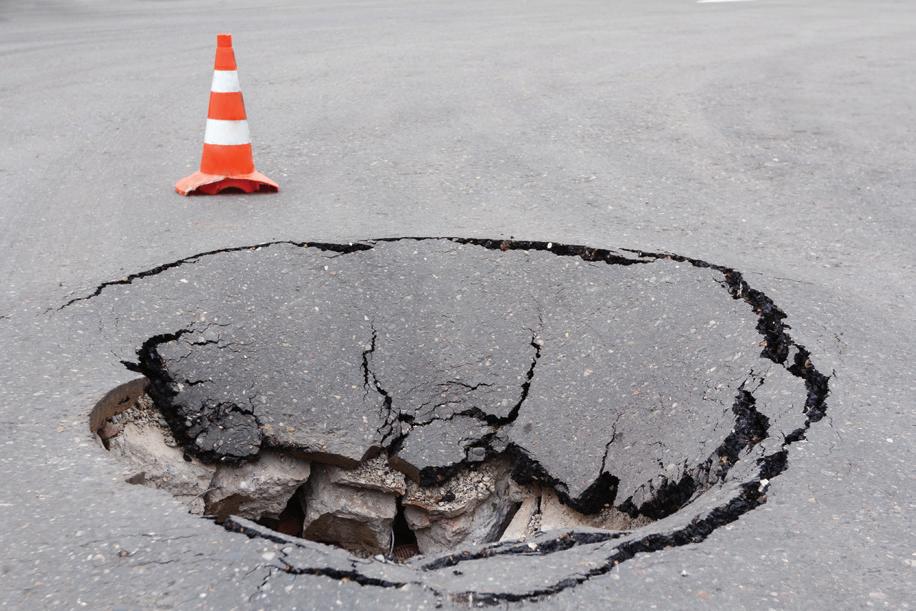
PEO’s Scarborough Chapter hosted its fourth technical seminar in a hybrid format. The seminar, which focused on the causes of sinkhole formation on roadways and potential solutions, advanced the chapter’s goal to enhance members’ professional development through technical education.
The seminar explored real-world case studies from Ontario highways and urban settings, discussing common geotechnical failure mechanisms and the importance of proactive detection and sound engineering judgment to prevent costly disruptions and safety hazards. It highlighted evidence-based decision-making, quality assurance and the responsible use of emerging technologies such as ground penetrating radar for early risk identification and infrastructure assessment.
The seminar attracted professional engineers, engineering interns, internationally trained professionals, students, and stakeholders from the Ontario Ministry of Transportation and the broader civil and geotechnical engineering community.


Technical seminars and other learning opportunities hosted by PEO chapters could count toward your PEAK continuing professional development hours if the content is relevant to your engineering practice. For more information, visit www.peo.on.ca/licenceholders/mandatory-cpd
Chapter Matters features regulatory-focused events and initiatives led by PEO’s 36 chapters to highlight how chapters are advancing PEO’s public-protection mandate and supporting the regulator’s work in communities across the province. Submissions can be up to 250 words and should include an overview, regulatory relevance, summary of key stakeholders/participants and the key outcomes. Send submissions to chapters@peo.on.ca with Chapter Matters in the subject line. All submissions are subject to editorial review.

Licence holders and engineering interns are invited to participate in PEO chapters events. Find more information about your local chapter at www.peo.on.ca/chapters.
PEO Council, which includes new President Leila Notash, begins its new term on April 25.
By Nicole Axworthy
PEO Council for the 2026–2027 term will take office at PEO’s 2026 Annual General Meeting (AGM) on April 25 in Ottawa, ON. Leila Notash, PhD, P.Eng., FEC, will be the new president, and three new councillors will also take office following a month-long election period. This year, 10.4 per cent of eligible licence holders voted during the election cycle.
The election results, which were announced in late February, revealed that Sardar Asif Khan, PhD, MBA, P.Eng., FEC, captured the role of president-elect and will automatically transition to the presidency for the 2027–2028 Council term at PEO’s 2027 AGM. Khan served as vice president (elected) during the 2025–2026 term. He has also served on the Windsor-Essex Chapter board since 2006, including as chair, and as vice chair of the Government Liaison Committee.
vice chair. Other new councillors elected to Council for the 2026–2027 term include East Central Region Councillor Tom Granat, MBA, P.Eng., P.E., and Tim Kirkby, BEng, P.Eng., C.E.T., FEC.
At the new Council’s first meeting on April 25, councillors will be appointed to the position of vice president (appointed) and to the Executive Committee, along with positions on Council’s four governance committees. The full 2026–2027 Council will be featured in the Summer 2026 issue of Engineering Dimensions.

Stephanie Holko, MBA, P.Eng., ICD.D, was elected to the role of vice president. Holko previously served on the Ontario Society of Professional Engineers board of directors, including as chair, past chair and Randy Walker, P.Eng., FEC
Darla Campbell, P.Eng.,
VICE PRESIDENT
Stephanie Holko, MBA, P.Eng., ICD.D.
Faizul Mohee, PhD, P.Eng, PMP
COUNCILLOR-AT-LARGE
Shahandeh Hannah Ehtemam, P.Eng., PMP
Bilal Sherazi, P.Eng., FEC
Ranjit Singh Gill, P.Eng., PTOE, PMP
EASTERN REGION
Tim Kirkby, BEng, P.Eng., C.E.T., FEC 51.5 per cent
Chantal Chiddle, P.Eng, FEC 48.5 per cent
EAST CENTRAL REGION
Tom Granat, MBA, P.Eng., P.E. 35.2 per cent
Alexander Dow, P.Eng. 24.4 per cent
Lin (Victor) Lan, MEng, P.Eng., FEC 23.8 per cent
Nabil Ghariani, M.Ed., P.Eng., MSCE 16.6 per cent
WESTERN REGION
Vicki Hilborn, MASc, P.Eng. 55.4 per cent
Haris Ahmadzai, P.Eng., FEC 44.6 per cent
WEST CENTRAL REGION
Pappur Shankar, P.Eng., FEC acclaimed
NORTHERN REGION
Ahmed Elshaer, PhD, P.Eng. acclaimed
PEO’s new Engineering Student Advisory Group aims to bring student perspectives to the regulatory table.
By Leslie Sinclair
The selection process for PEO’s new Engineering Student Advisory Group (ESAG) is well underway following a month-long application period.
The ESAG is being created to obtain a better understanding of the needs and aspirations of students enrolled in engineering programs, particu larly as they move toward graduation and, possibly, licensure as professional engineers. Students who are chosen to participate as ESAG members will be encouraged to share their insights on PEO initiatives that strengthen engagement and participation of students in PEO activities and governance; strate gies to enhance awareness of licensure, the value of professional engineering and pathways to becoming a professional engineer; and barriers to participation in the engineering profession.
“Students are a key stakeholder group that we want to be able to consult with on a variety of issues, so we have a clear understanding of their perspective,” says David Smith, PEO’s external relations director.
ESAG members will be tasked with responsibili ties such as reviewing and commenting on draft documents, assisting with research initiatives and providing feedback on recommendations and engagement initiatives like surveys, focus groups and webinars. ESAG members will be asked to commit to a two-year term and attend approximately four to six meetings annually.

Promotion of this volunteer opportunity began in February and included direct outreach to engineering programs across Ontario through targeted social media posts, communication with participants in PEO’s Student Mentorship Program, on-site presentations to students and collaboration with key stakeholder groups, including the Engineering Student Societies’ Council of Ontario.
In 2024, PEO began incorporating advisory groups into its outreach efforts to increase engagement with key stakeholders. The ESAG complements PEO’s two other advisory groups: the Strategic Stakeholder Advisory Group and the Employer Advisory Group. These groups reinforce PEO’s commitment to bolstering the credibility of policy recommendations to Council and its committees by expanding targeted engagement with core stakeholder groups.
Last fall, PEO completed its first public confidence study, which engaged key audiences, including the general public, municipalities and employers of engineers, and engineering students. The study found that beyond regular communication and engagement from PEO, students are looking for clear value messaging, more transparency in the licensure process and a greater emphasis on inclusion and career development.
While student perception of PEO did not factor into the regulator’s rationale for convening the ESAG, Smith explains, it does point to a strong need to engage students in what PEO is doing.
“The ESAG will help to fill that void,” he says.
For more information about PEO’s stakeholder engagement efforts, visit www.peo.on.ca/about-peo/stakeholder-engagement.
The redeveloped program will strengthen accountability and alignment with PEO’s regulatory mandate.
By Leslie Sinclair
As part of a broader initiative to modernize its approach to government relations, PEO is moving its Government Liaison Program (GLP) in a new direction. Developed with government relations consultant Wellington Advocacy, the revised program forms a key component of a more relevant and robust government relations strategy.
In November, PEO Council stood down the existing Government Liaison Committee—which oversaw GLP activities—and approved Wellington’s recommendation to reform the program to strengthen accountability and reporting requirements for participants.
“The new approach reflects Council’s direction to modernize the organization’s government relations in response to shifts in Ontario’s political and policy landscape,” explains David Smith, PEO’s director of external relations.
The move follows a comprehensive audit of the GLP by Wellington to evaluate how the program supports PEO’s regulatory mandate and how its structure aligns with Ontario’s current public policy and stakeholder relations environment. Under the new model, all engagements between GLP representatives and public office holders will be centralized and coordinated to ensure consistent messaging, allow PEO to track outcomes across the province and provide an opportunity to address any concerns that may arise.
“The updated structure is intended to strengthen the impact of volunteer engagement by providing clearer messaging, stronger coordination and better insight into government priorities,” Smith adds.
PEO staff and Wellington are now working together to enact this new centralized approach to the GLP. Over the course of this year, Wellington will begin preparing and rolling out new processes and documents that will guide the reimagined program, including standardized approval and reporting processes, an updated GLP manual and improved training and tailored messaging.
Earlier this year, PEO hosted a town hall meeting to guide GLP volunteers through Council’s decision, present the findings of Wellington’s review and explain how representatives can continue to contribute to the updated program.
Created in 2005, the GLP uses PEO’s province-wide chapter volunteers to help ensure PEO maintains productive relationships with government while clearly communicating its role and responsibilities as Ontario’s engineering regulator.
For more information about PEO’s GLP, visit www.peo.on.ca/about-peo/government-liaisonprogram-glp.
The Association of Professional Engineers and Geoscientists of Alberta is preparing to transition to the Professional Governance Act in early 2027.
By Leslie Sinclair
The landscape of professional regulation in Alberta is entering a new era with the introduction of the Professional Governance Act (PGA), a piece of legislation that will reshape how the Association of Professional Engineers and Geoscientists of Alberta (APEGA) governs its members. The act, which is expected to come into force in June, establishes common guidelines for governance, accountability, professional practice and conduct for 21 non-health professions across the province.
The PGA consolidates nine acts, including the Engineering and Geoscience Professions Act, and 28 supporting regulations under one umbrella act. For APEGA, preparing for the transition is a top priority this year as it expects to be part of a group of regulatory organizations
that moves under the PGA in early 2027. As part of this transition, it has been updating its information technology systems to align with the act’s requirements, including changes to processes and terminology. The updated terminology will also be reflected in APEGA’s practice standards, bulletins and guidelines to support the shift.
“We are in ongoing discussions with the Government of Alberta about our specific regulations related to the incoming legislation,” says APEGA Registrar and CEO Paul Wynnyk, FCAE, P.Eng., ICD.D.
Once APEGA’s regulation is confirmed, it will finalize work on its bylaws, documents and procedures to ensure alignment with the PGA, including work related to its Memorandum of Understanding with the Association of Science and Engineering Technology Professionals of Alberta to simplify oversight of professional technologists under a single regulatory framework (see sidebar below).
Registrants will have the opportunity to review the new bylaws, code of ethics and conduct and practice standards and guidelines prior to adoption by APEGA Council, but the timing has not yet been finalized. The association is currently focused on the “must-haves for Day 1 compliance” with the new act; however, a body of work will still need to be completed after transition.
“This has been a positive process that will continue right up to implementation and beyond,” says Wynnyk, explaining that APEGA is collaborating with the Government of Alberta to address ongoing priorities and clarify questions registrants may have.
APEGA is providing updates on its progress to registrants as it becomes available, including at a recent virtual province-wide town hall with APEGA Council President Terri Steeves, P.Eng., and members of the executive leadership group. Earlier this year, APEGA surveyed registrants on multiple topics, including implementing the PGA. Feedback may be used to help shape APEGA’s recommendations to the provincial government.
While the PGA represents a major shift for Alberta, it is part of a broader trend across Canada. British Columbia implemented its own PGA in 2021, establishing a consolidated regulatory framework for professionals in that province’s natural and built environment (see “Engineers and Geoscientists BC Begins Entity Regulation,” Engineering Dimensions, March/April 2021, p. 12). The act applies to Engineers and Geoscientists BC and other regulators overseeing forestry, agrology, biology and applied science. A new oversight body, the Office of the Superintendent of Professional Governance, was also created to oversee these professional regulatory bodies under the PGA.
The PGA sets out Engineers and Geoscientists BC’s mandate and governing authority, along with the obligations and standards that all registrants must meet. Supporting regulations further define and detail those requirements.
To simplify the oversight of professional technologists under a single regulatory framework, APEGA and the Association of Science and Engineering Technology Professionals of Alberta (ASET) signed a Memorandum of Understanding to transfer regulation of professional technologists (P.Tech.(Eng.) and P.Tech.(Geo.)) from ASET to APEGA. Under the agreement, the professional technologists will come under APEGA’s sole regulatory oversight once both organizations transfer to the new Professional Governance Act in early 2027.
Those with the professional technologist designation will be merged into a single designation alongside APEGA’s professional licensees while retaining their current scopes and rights to independent practice. The organizations said the change aims to simplify oversight, reduce duplication and better serve Alberta’s workforce and public interest.
“Being recognized by the Foundation lifted financial stress and inspired me to keep challenging myself, now I’m pursuing a PhD in Electrical and Computer Engineering.”

Toronto Metropolitan University Undergraduate Scholarship Recipient & Gold Medalist
Invest in the next generation of engineers. Every donation to the Ontario Professional Engineers Foundation for Education funds scholarships that transform students’ lives.
www.engineersfoundation.ca

In-person location: Rogers Centre, 55 Colonel By Drive, Ottawa, Ontario K1N 9J2
Virtual location: Webcast information will be posted on peo.on.ca

As noted in section 17 of By-Law No. 1, the PEO AGM is held for the following purposes:
• To lay before licence holders the reports of the Council and committees of the association;
• To inform licence holders of matters relating to the affairs of the association; and
• To ascertain the views of the licence holders present at the meeting on matters relating to the affairs of the association.
The AGM will be held using a hybrid meeting format. This means proceedings will be conducted via live webcast with some in-person participation. P.Eng. licence holders will have the opportunity to ask questions live (in person or virtually) during the meeting, submit questions online during the meeting and provide submissions in advance, as discussed below.
In-person space is limited. All wishing to attend the meeting must pre-register online at https://fs10.formsite.com/f6zI98/ burkiy8pvz/index. To register with voting status, P.Eng. licence holders must register using their name, email address and licence number that is registered with PEO. If you have not provided an email address to PEO, please ensure you do so through the PEO online portal at secure.peo.on.ca/ebusiness
P.Eng. licence holders can make submissions on matters of importance to the work of PEO. To make a submission, please use the template in the Guide for Member Submissions at https://www.peo.on.ca/about-peo/annualgeneral-meetings/2026-agm. Submissions must be received by Saturday, April 11, 2026, at 11:59 p.m. EDT. Submissions received after this time will not be considered at the AGM. Once received, submissions will be posted on the PEO website.
Friday, April 24, 2026, at 9 a.m. EDT.
Julianna Arcese, P.Eng., is an active chapter volunteer who is dedicated to supporting the engineering community. seminars, workshops and an annual 30 by 30 speaker series to help women build their sense of agency and advance in the profession.
As an experienced civil engineer who contributes to municipal transportation projects, Julianna Arcese, P.Eng., understands the importance of big-picture thinking. But that skill is one she also applies to her community engagement work to help foster a strong and inclusive engineering profession in Ontario. Arcese regularly carves out time to volunteer for efforts to educate her peers, encourage more youth to consider engineering, and especially, empower women to rise in the profession.
“Being a female engineer, and with there being a minority of females in engineering, I want to show representation,” says Arcese, a senior project engineer with Guelph-based consulting firm J.L. Richards & Associates.
The Waterloo resident is actively involved in PEO’s Grand River Chapter. For the last four years, she has volunteered for its Events Committee, which organizes activities to help engineers stay current on best practices in the profession and discover new innovations that affect their work. Currently the chair, she has helped plan and execute tours of sites such as the concrete pipe plant of Rinker Materials, a top player in southern Ontario’s infrastructure supply chain; Evolv1, Canada’s first zero-carbon building; and the head office of the Credit Valley Conservation Authority, which has Canada’s first Canadian Standards Association–compliant smart blue roof for capturing and reusing rainwater.
“As I build my network in the community, it’s important to me to share information with engineers that can support their professional development,” says Arcese, who earned her bachelor of engineering science degree at Western University in 2013.
Arcese’s involvement with the chapter began in 2017, the year she became licensed. She first joined its 30 by 30 Committee, which focuses on promoting diversity, equity and inclusion in the engineering profession. Its purpose aligns with Engineers Canada’s formal goal to raise the percentage of newly licensed engineers in the country who are women to 30 per cent by 2030. As she was highly involved in Western’s Women in Engineering group, including serving as its president, she was keen to continue this advocacy. In her four years on that committee, Arcese spoke about her experiences in the profession to engineering students at local universities. She was also involved in organizing

“It’s about finding your voice and your confidence so you can bring forth your ideas,” says Arcese in describing the objective of some of the professional development offerings she helped organize for female engineers.
Having worked entirely at engineering consultancies, Arcese sought to connect with other such practitioners. In 2017, she joined the Association of Consulting Engineering Companies–Ontario (ACEC-Ontario), an advocacy group representing about 140 engineering consulting companies. Participating in its Grand River Chapter, she got involved with and eventually became chair of its Young Professionals Group, for which she planned educational and social events for other new engineers and spoke about consulting engineering to university students. In 2022, she joined ACEC-Ontario’s Future Leaders Network, which offers networking and learning opportunities for young engineers at member firms.
Last year, Arcese joined ACEC-Ontario’s Women’s Network, a networking and leadership-building group that is particularly focused on addressing the attrition of women in the industry. The group runs workshops and webinars on topics such as self-advocacy in the workplace and annual breakfast meetups across Ontario for networking. Last year, Arcese hosted two of these meetups in Guelph, the last of which was to mark National STEM/STEAM Day on November 8. She sees her contributions to this group as enabling female consulting engineers to share strategies and insights to excel.
“Being an engineer in consulting isn’t something that’s spoken about much at school, so we learn a lot from each other,” Arcese says.
As Arcese continues to progress as an engineer, she is keen to lift as she climbs by sharing her professional wisdom with local youths. To that end, in 2021 she joined the speakers’ bureau of the Business & Education Partnership of Waterloo Region, a charity that runs programs for grades 7 to 12 students to explore diverse career options. Arcese speaks to these students at their schools and in online events about her professional journey and the rewards of her work.
“I like being able to inspire members of the younger generation to consider engineering,” she says. “I want to offer support and let them know, ‘You can do this.’” e




Engineering is a profession rooted in public safety, where every decision can directly impact society’s well-being. For many engineers, volunteering with their professional regulator is a natural extension of that responsibility, a way to protect the public beyond the office or job site.
This perspective helps explain why so many are willing to contribute their time and expertise to PEO’s statutory committees. Each year, more than 900 engineers, engineering interns and non-engineers lend their time to PEO through Council, committees, taskforces and 36 local chapters. Among them, 206 serve on nine statutory committees, directly supporting the regulator’s public-protection mandate under the Professional Engineers Act (PEA). These committee members assist with complaints, discipline and licensure processes, ensuring decisions are fair, balanced and informed. By bringing their expertise and diverse perspectives to the table, they help strengthen the profession’s systems and maintain public trust, all while finding deep personal fulfillment in giving back to their profession.
“I think most of my colleagues who are engineers would say they’re very dedicated to the profession, and that’s why we volunteer,” says James Lee, PhD, P.Eng., chair of the Academic Requirements Committee
(ARC). The ARC reviews the academic qualifications of applicants holding engineering degrees that aren’t accredited by the Canadian Engineering Accreditation Board (CEAB), such as international applicants, who applied for licensure before May 15, 2023. This work helps ensure applicants who are given a licence to practise engineering meet the profession’s academic requirements.
This year, Lee, a University of Saskatchewan geology professor, will be inducted as an Officer of the Order of Honour, PEO’s highest volunteer recognition program. His service began in 1999, when a mentor introduced him to the work of the ARC.
“I didn’t know anything about the ARC, and really the only thing I knew about PEO was that it gave me my licence,” Lee reminisces. But the prospect of assessing international applicants’ academic credentials piqued his interest, and he applied to join.
Over more than two decades, Lee served as chair and vice chair of the ARC, overseeing rigorous reviews across numerous engineering disciplines.



By LESLIE SINCLAIR
He also chaired multiple ARC subcommittees and contributed to the Discipline and Legislation committees. Beyond statutory committees, he served six years on Council as a lieutenant governor appointee, contributed to the Licensing Process Task Force and volunteered with the Kingston Chapter for 16 years.
“Trying to recognize foreign qualifications to effectively help immigrants get a start in Canadian society felt like a good thing to do,” he says, highlighting how his work supports the entry of a diverse pool of applicants to the profession and directly supports PEO’s mandate.
In 2023, when PEO updated its licensing process, including the way academic requirements are assessed, to comply with new requirements under the Fair Access to Regulated Professions and Compulsory Trades Act, the work of the ARC changed dramatically. Previously, the ARC evaluated non-CEAB-accredited degrees individually on a case-by-case basis. Now, all applicants are assessed against the same standardized metrics. The ARC’s current mission is completing the less than 100 remaining applications submitted prior to May 15, 2023.
“The ARC is a committee of extremely dedicated and long-serving volunteers who are committed to making society a better place,” Lee says, hopeful that there may be emerging opportunities for PEO to continue to call upon his expertise.
Lee, who also serves on the CEAB through Engineers Canada, sums up his motivation plainly: “It’s about enhancing the profession of engineering and ultimately making society better.”
“I’ve always been proud to be a professional engineer, and I want to make sure the profession continues to be well respected,” says Warren Turnbull, P.Eng., FEC, whose tenure as chair of the Discipline Committee (DIC) ended in December. The DIC hears and determines allegations of professional misconduct or incompetence against licence holders—a crucial safeguard for public trust in engineering. “That’s what motivates me, to try to make sure the public has good feelings about professional engineers and the work we do,” he says.
Turnbull, inducted as an Officer of the Order of Honour in 2023, has demonstrated decades of service at both chapter and provincial levels. He began volunteering with the North Bay Chapter in the late
1970s and later with the Oakville Chapter, serving as chapter executive and chair. From 2015 to 2021, he was a West Central Region councillor on PEO Council, contributing to multiple committees and leading the Government Liaison Committee.
The time DIC members invest in their duties varies, but some cases demand extraordinary commitment. A recent Nipigon River Bridge hearing, stemming from the 2016 failure of the bridge just 42 days after opening, stretched 31 days of deliberation as of the time of writing and will continue in May. While this hearing was exceptionally long, most hearings last two to three days. “We try not to overburden any individual,” Turnbull says. DIC members typically sit on one to three panels per year, hearing people’s stories, weighing evidence, making decisions and determining appropriate discipline.
For Turnbull, service on PEO committees is about more than the workload. Before the pandemic, in-person meetings offered a valuable sense of community. “It was like-minded people getting together and doing things together, and we had some social aspect to it as well,” he explains. As virtual meetings continue to be utilized across committees, he notes that the social benefit and collaborative approach are still felt online.
Volunteering for PEO has also been a source of professional growth. “It was quite beneficial,” Turnbull says, reflecting on training in areas such as equity, diversity and inclusion and learning to contribute effectively as part of a team.
For Geoff Pond, PhD, P.Eng., chair of the Registration Committee (REC), the motivation to volunteer is partly rooted in his role as an academic. An associate professor at the Royal Military College of Canada and assistant adjunct professor in the Smith School of Business at Queen’s University, Pond teaches both engineering and business classes. “This is, in part, my job,” Pond says, noting that his volunteer work fulfills a professional obligation as a university faculty member.
The REC is tasked with conducting hearings between the registrar and applicants or licence holders who received a notice of proposal to refuse, suspend or revoke a licence or certificate of authorization. Under the PEA, anyone receiving a notice of proposal has 30 days to request a hearing with the REC to challenge the decision.
Pond, who received a five-year volunteer service award pin in 2024, first joined the REC after seeing an advertisement for the committee. He has held various roles on the REC before becoming chair and is also a member of the DIC. “I go where the work is intriguing,” he says, describing what keeps him contributing to PEO.
“I go where the work is intriguing,” Geoff Pond says, describing what keeps him contributing to PEO.
Pond is particularly proud of the REC’s consideration to post hearing decisions on CanLii, an online database of Canadian court, tribunal, legislative and regulatory decisions. Once implemented, applicants challenging a registrar’s refusal to issue a licence can review similar cases and use precedents to prepare for their hearing. Building consensus for a change like this takes time, Pond notes.
“I find that work really rewarding,” he says, “knowing we’re improving the manner by which we operate to make a more balanced field between the registrar and the other stakeholder—the applicant.”
REC hearings normally span about four days and demand extensive preparation from committee members, who must have a strong grasp of the PEA, the Statutory Powers Procedures Act and the Evidence Act Materials are typically provided just 24 to 72 hours in advance, ensuring both parties have a fair opportunity to submit documentation while preventing premature conclusions.
“Some hearings are contentious, and I find them exhausting,” Pond says. “You can’t miss a beat. Sentence by sentence, you’ve got to stay alert. It’s seven hours a day, switched on all day long, and day after day after day for the length of the hearing.”
Yet, the people make the work rewarding: “It’s a great learning opportunity for me, and lovely people to work with. I mean, why would a person not want to do that?” Chairing semi-judicial hearings pushes him outside his comfort zone, expanding his knowledge beyond the narrow academic focus of his career. “This is a whole new area for me that six years ago, I knew absolutely nothing about,” he says.
Whether reviewing academic credentials, presiding over disciplinary hearings or offering the opportunity for a hearing de novo, volunteers like Lee, Turnbull and Pond play a vital role in safeguarding the public and advancing the profession. Their service is a reminder that the strength of engineering lies not only in technical expertise, but in the commitment of those who give their time to uphold its standards.
“It’s a way of giving back,” says Lee. e


These nine committees, established under the Professional Engineers Act, carry out the essential work that keeps the profession accountable, competent and trusted. By Leslie Sinclair
EVERY TIME a bridge holds steady under traffic, a building withstands a storm or a city’s water supply flows without fail, the public sees the results of engineering. Behind the scenes, however, the trust we place in engineers is upheld by a framework few notice: PEO’s nine statutory committees established under the Professional Engineers Act. From assessing licensure applicants to reviewing complaints and enforcing professional conduct, these committees carry distinct responsibilities to ensure the profession meets the expectations of safety, competence and integrity Ontarians rely on every day.
Mostly composed of volunteers, the committees operate with quiet authority. Together, they form the backbone of PEO’s mandate to serve and pro-
tect the public interest. Here’s a closer look at what each committee does to shape the profession and safeguard the public.
The ARC reviews and assesses the academic qualifications of applicants who are referred to it by the registrar. It can also refer applications to the Experience Requirements Committee to assess how an applicant’s experience may be considered when assigning technical exams. The ARC may also review information from the Canadian Engineering Accreditation Board, Canadian Engineering Qualifications Board and other relevant bodies, and make recommendations to PEO regarding academic assessments upon request from the registrar. After the licensing process was updated in May 2023, the committee’s work has centred on assessing applications that are still in the pipeline under the previous system. It also continues to assess limited licence applications when referred by the registrar.
Each year, Council must appoint a CESC composed of the penultimate past president, who acts as chair; the immediate past president; the current president; and two or more other members. One of CESC’s functions is to seek interest from people to stand for election to PEO Council for the roles of president-elect, vice president and councillorat-large. Another key function is to receive and respond to complaints about the elections process. “We have a chief elections officer who tries to mitigate and solve any election issues that might come up,” explains Meg Feres, PEO’s manager of Council operations. However, if the solution provided by the chief elections officer proves unsatisfactory, “they’re within their rights to file a complaint with the CESC.”
The COC investigates complaints of misconduct or negligence against people who are practising engineering without a licence as well as complaints against licence holders, certificate of authorization holders and engineering interns. Complaints can originate from anywhere, including the public, another engineer, government agencies or ministries, or even from PEO itself. The COC is tasked with deciding what to do with a complaint. Following their investigation, the committee can close the matter, make recommendations or refer it (in whole or in part) to the Discipline Committee. “[The COC is] a safety mechanism to ensure the cases that do go to discipline are ones that should be going to discipline,” explains Mike Rusek, PEO’s director of regulatory compliance. The COC ensures these matters meet a two-fold test: they represent a risk to the public and involve allegations that are supported by evidence.
Once a decision has been made by the COC, a complainant may apply to the CRC to have the treatment of their complaint reviewed. Rather than review the merits of the case, the CRC acts independently of the COC and considers whether the process was fair. “Her job is to make sure we’re always functioning fairly,” explains Nedra Brown, PEO’s director of tribunals and legal counsel. “There’s a principle of fairness in law, and there are technical and legal criteria related to it that must be met—she makes sure we meet that in the complaints process.” Following the CRC’s case assessment, a report is provided to Council and, in some cases, the attorney general of Ontario.
“To protect the public, not everybody can call themselves a ‘consulting engineer,’” says José Vera, P.Eng., PEO’s director of licensing. This protected title helps promote recognition of engineers in independent practice and is issued by PEO. The role of the CEDC is to make recommendations to Council concerning applications for the designation and redesignation as a consulting engineer and applications from certificate of authorization holders for permission to use the title.
The DIC is the one committee everybody knows about, says Brown, since getting in trouble with your regulator could mean losing your licence. The DIC hears allegations of professional misconduct or incompetence against PEO licence holders. Its jurisdiction is triggered
by a decision of the COC, Council or the Executive Committee to refer a matter to DIC. The committee also hears applications by licence holders who apply for licences or certificates of authorization after a prior revocation and suspension. The committee can impose different kinds of penalties, such as requiring a licence holder to take and pass additional education or exams or that their work be supervised by another professional engineer.
Like the ARC, the ERC was relied upon heavily under PEO’s previous licensing process, explains Vera. Its role is to assess applicant experience to determine if experience requirements have been met and to recommend to the ARC how experience can be considered in lieu of academics.
The FMC deals with fee disputes between licence and certificate of authorization holders and their clients. It’s one of PEO’s least-used committees, in part because the parties must agree to a mediation. In 2018, when Ontario’s Construction Act came into effect, it established adjudication procedures for construction contract disputes. “We’ve had two cases in the last five years at fees mediation. Both parties have to agree to the process,” explains Brown.
Under the PEA, the registrar can issue a notice of proposal to refuse, suspend or revoke a licence or certificate of authorization. Anyone receiving a notice of proposal has 30 days to request a hearing with the REC. Brown explains that an REC is not an appeal, but a hearing de novo, where the applicant must prove they meet the requirements for licensing. “More than half are successful,” Brown says. For information about PEO’s committees, visit www.peo.on.ca/about-peo/committees-and-taskforces. e
In the matter of a hearing under the Professional Engineers Act, R.S.O. 1990, c. P.28; and in the matter of a complaint regarding the conduct of JOHN AQUINO, P.ENG., a member of the Association of Professional Engineers of Ontario.
1. This matter was heard by a Panel of the Discipline Committee of Professional Engineers Ontario (“PEO”) on November 24, 2025, electronically by way of videoconference pursuant to the Rules of Procedure of the Discipline Committee of the Association of Professional Engineers of Ontario, the Professional Engineers Act, and the Statutory Powers Procedure Act. All participants in the proceeding attended via videoconference, including counsel for PEO, Leah Price and Justin Gattesco and John Aquino (“Mr. Aquino”). Mr. Aquino was not represented at the proceeding.
2. The Panel was provided with a Notice of Hearing dated September 30, 2025, including a Statement of Allegations dated June 11, 2025.
3. PEO alleges in paragraph 12 of the Statement of Allegation that Mr. Aquino is guilty of professional misconduct for engaging in conduct relevant to the practice of professional engineering that would reasonably be regarded as disgraceful, dishonourable, or unprofessional under section 72(2)(j) of Regulation 941 of the Act.
4. Counsel for PEO advised the Panel that agreement had been reached on the facts and introduced an Agreed Statement of Facts (“ASF”) with attached Schedules A and B, dated September 25, 2025, signed by Mr. Aquino and countersigned by Counsel to PEO on October 16, 2025. The relevant parts of the ASF are as follows:
1. At all material times, Aquino was a professional engineer licenced pursuant to the Act. Aquino was first licenced in 1996. He has not previously been referred to the Discipline Committee.
2. Aquino was the president of two familyowned construction companies that worked on large-scale construction projects. The two companies were Bond-
field Construction Company Limited (“BCCL”) and 1033803 Ontario Inc. o/a Forma-Con Construction (“Forma-Con”) a concrete forming business. BCCL and Forma-Con were a part of the Bondfield Group of Companies (“BGC”).
3. On or about April 3, 2019, the Ontario Superior Court of Justice (“OSCJ”) granted BCCL’s application under the Companies’ Creditor Arrangement Act (“CCAA”), a statute that allows insolvent corporations owing their creditors more than $5 million to restructure their businesses and financial affairs. The court appointed Ernst & Young Inc. (“EY”) as Monitor of BCCL.
4. Forma-Con commenced bankruptcy proceedings, and, on or about December 19, 2019, KSV Restructuring Inc. (“KSV”) was appointed as the Trustee in bankruptcy of Forma-Con.
5. The Monitor and the Trustee discovered that BCCL and Forma-Con had illegitimately paid out tens of millions of dollars in a false invoicing scheme, over a number of years prior to the CCAA proceedings (the “False Invoicing Scheme”). The False Invoicing Scheme involved purported suppliers who delivered invoices to BCCL and Forma-Con, seeking payment for services or materials allegedly supplied on various projects. In fact, no such services or materials were ever provided. The invoices were approved and paid out by BCCL and Forma-Con under the supervision of Aquino.
6. The Monitor determined that the False Invoicing Scheme involved a set of transactions by which $21,806,693 was removed from BCCL through false invoices. The Trustee concluded that Forma-Con had paid out $11,366,890. Aquino benefited from the False Invoicing Scheme, since his holding corporation, 2304288 Ontario Inc. (“230”) received approximately $5,829,939 from the BCCL suppliers. 230 in turn paid out over $5,000,000 to Aquino personally. Aquino admits that no value had been provided by any of the suppliers identified by the Monitor and Trustee for any of the alleged services or materials underlying the false invoices.
7. Applications were brought by the Monitor and the Trustee under the Bankruptcy and Insolvency Act (“BIA”), seeking declarations that the transfers were void, and seeing orders requiring Aquino and the other respondents in the applications to repay the amounts improperly transferred.
8. Justice Dietrich of the Ontario Superior Court of Justice rendered a decision on March 19, 2021, and found, among other things:
[190] I find that the badges of fraud in this case establish John Aquino’s intent to defraud, defeat or delay creditors.
[192] It is reasonable to infer that John Aquino took these actions to avoid BCCL’s and Forma-Con’s obligations and defeat their creditors. Neither he nor any of the other Respondents has given evidence of an alternative explanation.
[197] The totality of the evidence demonstrates a pattern of an intent by John Aquino, on behalf of each of BCCL and Forma-Con to defraud, defeat or delay the creditors of BCCL and Forma-Con. The badges of fraud permit an inference of intent and evidence a presumption of intent that is not rebutted by the evidence that current liabilities were being paid in the ordinary course of business during the Bondfield review period and the Forma-Con review period.
9. The Court granted the BIA applications. Mr. Aquino was held jointly and severally liable alongside the other respondents to pay to the Monitor the amount of $21,807,693 in respect of the BCCL application, and $11,366,890 in respect of the Forma-Con application.
10. An appeal to the Court of Appeal was dismissed. A further appeal to the Supreme Court of Canada was also dismissed. The Supreme Court of Canada, in its decision of October 11, 2024, stated (among other things):
“Mr. Aquino, as the directing mind of Bondfield and Forma-Con, intended to defraud, defeat, or delay creditors of Bondfield and Forma-Con through the false invoicing scheme. In conducting the false invoicing scheme, he acted in his assigned sector of corporate responsibility of engaging with suppliers and overseeing the provision of services and materials. His intent should therefore be attributed or imputed to Bondfield and Forma-Con under s. 96(1)(b)(ii)(B) of the BIA.”
“Consequently, I would affirm the application judge’s order regarding the appellants’ liability for the transfers at under value.”
11. By reason of the aforesaid, the parties agree that Aquino is guilty of professional misconduct as he engaged in: a. conduct relevant to the practice of professional engineering that would reasonably be regarded as disgraceful, dishonourable, or unprofessional, amounting to professional misconduct as defined by section 72(2)(j) of Regulation 941.
5. Mr. Aquino admitted the allegations set out in paragraphs 11 and 12 of the Statement of Allegations and reproduced in paragraph 13 of the ASF. The Panel conducted a plea inquiry and is satisfied that Mr. Aquino’s admissions are voluntary, informed and unequivocal.
6. The Panel finds that Mr. Aquino committed professional misconduct in violation of section 72(2)(j) of Regulation 941. The Panel makes this finding on the basis of the admission of Mr. Aquino, the information contained within the Agreed Statement of Facts and the decisions of the courts that provide ample support for this conclusion.
7. Counsel for PEO advised the Panel that a Joint Submission as to Penalty had been agreed upon. The Joint Submission as to Penalty provides as follows:
a. Pursuant to section 28(4)(a) of the Act, Mr. Aquino’s licence shall be revoked.
b. Pursuant to s. 28(4)(i) and 28(5) of the Act, the findings and order of the Discipline Committee shall be published, with reference to names; and
c. There shall be no order with respect to costs.
8. Counsel for PEO submitted that Mr. Aquino’s conduct falls at the most serious end of the spectrum of disgraceful, dishonourable, and unprofessional conduct under s. 72(2)(j) of Regulation 941. The misconduct, counsel noted, involved a sustained false invoicing scheme operated over several years through which more than $33 million was illegitimately removed from Bondfield Construction and Forma-Con. The Monitor and Trustee determined that the transactions were entirely without value, and multiple courts—including the Ontario Superior Court of Justice and the Supreme Court of Canada—found that Mr. Aquino intended to defraud, defeat, or delay the creditors of both companies.
9. Counsel emphasized that Mr. Aquino personally benefitted from the scheme, receiving over $5 million through his holding corporation and ultimately to himself. In counsel’s submission, this conduct represented a profound breach of trust wholly incompatible with the expectations of integrity that attach to a professional engineer.
10. Counsel identified several aggravating factors that, in PEO’s view, elevate the gravity of the misconduct. These included the extraordinary scale of the financial wrongdoing, the prolonged period over which it occurred, the central role played by Mr. Aquino in supervising and approving the false invoices, and the judicial findings that he acted with clear fraudulent intent. The pattern of deliberate dishonest and personal enrichment strikes at the heart of public confidence in the profession.
11. While acknowledging that Mr. Aquino had been licensed since 1996 and had no prior discipline history, Counsel for PEO characterized the mitigating factors as limited. Counsel noted that Mr. Aquino’s agreement to the Agreed Statement of Facts and his participation in a joint submission avoided the need for a contested hearing. However, in the counsel’s submission, these mitigating considerations cannot meaningfully offset the severity of the proven misconduct.
12. Counsel submitted that the penalty sought through the joint submission is consistent with PEO discipline jurisprudence. Counsel referred the Panel to Association of Professional Engineers of Ontario v. Brasseur, 2016 (“Brasseur”), where a member who caused his company to submit fabricated subcontractor quotations to a municipality received a five-month suspension, a fine, and publication, even though the fraudulent amount was minimal. Counsel contrasted that case with the present matter, noting that the scale and personal involvement were vastly greater.
13. Counsel also relied on Association of Professional Engineers of Ontario vs. Kalaycioglu, where the member’s involvement in a multi-million-dollar international investment fraud and misuse of engineering credentials resulted in revocation. Counsel further pointed to the recent decision in Association of Professional Engineers of Ontario vs. Marouf, 2023 ONAPE 2, in which the panel found that a senior utility executive’s fabrication of invoices and misappropriation of approximately $446,000 constituted disgraceful, dishonourable, and unprofessional conduct.
14. Counsel additionally referred the Panel to Bradley v. Ontario College of Teachers, 2021 ONSC 2303, in which the Divisional Court held that the “public interest” test for joint submissions, set out by the Supreme Court of Canada in R. v. Anthony-Cook, 2016 SCC 43, applies
to professional regulatory bodies. Counsel emphasized that the Panel must accept a joint submission unless doing so would bring the administration of justice into disrepute or otherwise be contrary to the public interest. In the counsel’s submissions, the jointly proposed penalty—revocation, publication with names, and no costs—falls comfortably within the range of reasonable outcomes for misconduct of this magnitude and is necessary to protect the public, maintain confidence in the profession, and denounce conduct fundamentally incompatible with the responsibilities of a professional engineer.
15. In determining whether to accept the joint submission on penalty, the Panel was guided by the principles established by the Supreme Court of Canada in R. v. Anthony-Cook, 2016 SCC 43 and as applied to professional disciplinary proceedings by the Divisional Court in Bradley v. Ontario College of Teachers, 2021 ONSC 2303. These authorities make clear that joint submissions play an essential role in the proper functioning of both the justice system and professional regulation. A Panel must accept a jointly proposed penalty unless doing so would bring the administration of justice into disrepute or would otherwise be contrary to the public interest.
16. The threshold for rejecting a joint submission is intentionally high. A joint proposal cannot be rejected simply because the tribunal might, on its own assessment, have arrived at a somewhat different or more finely calibrated penalty. It must be accepted unless it is so outside the appropriate range that a reasonable, informed member of the public would see its acceptance as a breakdown in the discipline system.
17. The misconduct in this case is exceptionally serious. Over a period of years, Mr. Aquino supervised and approved false invoices through which BCCL and Forma-Con paid out more than $33M for goods and services that were never provided. He personally benefitted by more than $5M through payments routed from suppliers to his holding company and then to him. The Ontario Superior Court of Justice expressly found that Mr. Aquino intended to defraud, defeat or delay the creditors of BCCL and Forma-Con, and the Supreme Court of Canada affirmed that finding, characterizing him as the “directing mind” who implemented a false invoicing scheme to the detriment of creditors.
18. This was not an isolated lapse of judgement or technical breach. It was a sustained pattern of intentional financial dishonesty by a senior professional in a position of trust, resulting in large-scale financial harm and court-ordered repayment obligations.
19. The Panel accepts PEO’s submission that such conduct represents a profound breach of trust is fundamentally incompatible with continued entitlement to practise professional engineering.
20. The Panel considered the aggravating and mitigating circumstances reflected in the Agreed Statement of Facts. The scale of the misconduct, the prolonged period over which it occurred, the judicial findings of fraudulent intent, and the substantial personal benefit obtained all weigh heavily in aggravation. While Mr. Aquino’s lengthy discipline-free career and his cooperation with PEO in resolving the proceedings are factors in mitigation, they do not meaningfully diminish the seriousness of the misconduct or alter the Panel’s assessment of the appropriate regulatory response. The Panel found that the mitigating factors are outweighed by the gravity of the conduct, the magnitude of the financial harm, and the strong public-protection and denunciation interests at stake.
c. Consistency with PEO penalty jurisprudence
21. The Panel also considered consistency with PEO’s prior disciplinary jurisprudence. In Brasseur, a member caused his company to submit fabricated subcontractor quotations in an attempt to defraud a municipality of approximately $22,512.00, of which only $873.65 was actually paid. The company, not the member, was convicted criminally. On a joint submission, the panel ordered a 5-month suspension, a fine, a reprimand and publication with names, expressly describing fraud involving public funds as serious but taking into account the small amount and collateral consequences to the member and company.
22. In contrast, in Kalaycioglu, the member was convicted in the United States of multiple counts of wire fraud and conspiracy tied to a highyield investment scheme. The court ordered him to pay more than US$6.7M in restitution and sentenced him to 27 years in prison. He had used his engineering credentials to lend credibility to the scheme. The panel found his conduct disgraceful, dishonourable and unprofessional and ordered revocation, with immediate effect, and publication with names, for public protection reasons.
23. The Panel noted that Mr. Aquino’s conduct is comparable in seriousness to that in Kalaycioglu, given the scale of the fraudulent scheme, his central involvement, the personal financial gain, and the explicit judicial findings of fraudulent intent.
24. The panel also noted the recent liability decision in Marouf, which underscores PEO’s consistent view that significant financial dishonesty by a professional engineer constitutes disgraceful, dishonourable, and unprofessional conduct warranting the most serious regulatory consequences. In this context, revocation aligns with the upper end of the penalty spectrum for egregious financial misconduct within the profession and cannot credibly be seen as excessive.
d. Public-interest analysis under Anthony-Cook/Bradley
25. The Panel finds that the proposed penalty of revocation and publication with names is not “unhinged” from the circumstances of the offence and the offender. On the contrary, it aligns with the gravity of the misconduct and with the revocation ordered in Kalaycioglu for large-scale financial fraud.
26. A reasonable, informed member of the public or of the profession, aware of all the circumstances and the importance of certainty in resolution discussions, would not review revocation as signalling a breakdown in the discipline system. They would reasonably expect that a professional engineer who has orchestrated and personally profited from a massive fraudulent scheme, as found by multiple courts, should no longer be entitled to practise.
27. In light of these considerations, the panel concluded that the agreed-upon penalty is well within the range of reasonable outcomes for misconduct of this magnitude. Accepting the joint submission advances, rather than undermines, the public interest by protecting the public, maintaining confidence in the integrity of the profession, and delivering an appropriately strong message of deterrence and denunciation.
28. Accordingly, the Panel accepts the Joint Submission as to Penalty in its entirety and orders:
a. Revocation of Mr. Aquino’s licence;
b. Publication of the Panel’s findings and order, with reference to names; and
c. No order with respect to costs.
Glenn Richardson signed this Decision and Reasons for the decision as Chair of this Discipline Panel and on behalf of the members of the Discipline panel: John Tyrrell, P.Eng., and Ayodele Akenroye, LL.B., Ph.D.
In the matter of a hearing under the Professional Engineers Act, R.S.O. 1990, c. P.28; and in the matter of a complaint regarding the conduct of REZA HAYATI, a former member of the Association of Professional Engineers of Ontario, and SUNRISE CONSTRADE CORP., a former holder of a Certificate of Authorization.
1. The Panel of the Discipline Committee (the “Panel”) of the Professional Engineers of Ontario (“PEO”) convened a hearing remotely via Zoom on January 12 and 13, 2026 to consider the conduct of Reza Hayati (“Mr. Hayti”) and Sunrise Constrade Corp. (“Constrade”) as described more particularly below.
2. As neither Mr. Hayati nor Constrade were present at the commencement of the hearing, the panel recessed the hearing for 30 minutes to allow time for them to appear. The Panel Chair asked PEO staff to contact Mr. Hayati during the recess to inform him that the hearing had begun.
3. When the hearing reconvened, Mr. Hayati was not in attendance and had not responded to PEO’s attempts to reach him during the break. Counsel for PEO described the multiple attempts made to provide Mr. Hayati with the Notice of Hearing and information about the hearing generally. These efforts were documented in affidavits marked as Exhibits 2, 3, 4 and 7.
4. Although Mr. Hayati initially communicated with the PEO investigator in early 2024 following the PEO’s receipt of a complaint, he had not been in communication with anyone at PEO since May 13, 2024. On October 28, 2025, the Tribunal sent the Notice of Hearing to Mr. Hayati and Constrade to two separate emails found in PEO’s records. When one of the emails bounced back as undeliverable, a process server attempted to serve the Notice of Hearing at the personal and business addresses found in PEO’s records. The process server was advised that Mr. Hayati and Constrade were no longer residents or tenants at these addresses.
5. Several other attempts were made to contact Mr. Hayati and Constrade, including by email, telephone, regular mail and through Mr. Hayati’s LinkedIn account. Mr. Hayati did not respond to any of these communications.
6. After considering the evidence and the service requirements under section 43 of the Professional Engineers Act, R.S.O. 1990, c. P.28 (the “Act”), the panel was satisfied that Mr. Hayati and Constrade received adequate notice of the hearing. The hearing proceeded in their absence.
7. Although Mr. Hayati is described as a professional engineer in the style of cause, his licence was cancelled for non-payment of licence fees on June 27, 2025. Constrade’s Certificate of Authorization was cancelled on February 13, 2025.
8. Section 22.1(1) of the Act describes the jurisdiction of the Panel to decide misconduct of a former member as follows:
22.1 (1) A member who resigns or a holder of a …. certificate of authorization that is cancelled or revoked continues to be subject to the jurisdiction of the Association in respect of any professional misconduct or incompetence referable to the time when the person was a member or holder.
9. As set out below, the alleged professional misconduct took place in or about 2023, when Mr. Hayati was a PEO member and Constrade held a Certificate of Authorization. Accordingly, the Panel had jurisdiction to hear and decide this matter.
10. In the Statement of Allegations, it was alleged that Mr. Hayati and Constrade engaged in professional misconduct within the meaning of the Act and Ontario Regulation 941 (“Reg. 941”). The allegations related to the preparation and issuance of a stormwater management (“SWM”) report for a residential property in the Township of King (the “Constrade SWM Report”). It was alleged that the Constrade SWM Report was extensively copied from a Functional Servicing and Stormwater Management (“FSSM”) report prepared by another engineering firm (SCS) for a different project, municipality, and conservation authority (the “SCS Report”). As a result, the SWM Constrade Report submitted by Mr. Hayati and Constrade did not pertain to the residential property in the Township of King (“the Township”).
11. The Statement of Allegations states that Mr. Hayati and Constrade engaged in professional misconduct in that Mr. Hayati:
a. plagiarized the SCS Report almost in its entirety;
b. used the information and analysis contained in the SCS Report for an entirely different location;
c. adopted and used SCS’s intellectual property improperly and without consent;
d. created an inaccurate and unreliable SWM report;
e. made recommendations that were inappropriate for the property at issue;
f. provided the Constrade SWM Report that was not properly signed or sealed; and,
g. misrepresented an individual Christian Chane as an engineer in training (EIT).
12. It was therefore alleged that Mr. Hayati and Constrade were guilty of professional misconduct as follows:
a. Negligence, amounting to professional misconduct as defined by sections 72(1) and 72(2)(a) of Regulation 941;
b. Failure to make reasonable provisions for the safeguarding of the life, health or property of persons who may be affected by the work for which the practitioner was responsible, amounting to professional misconduct as defined by section 72(2)(b) of Regulation 941;
c. Failure to make responsible provision for complying with applicable statutes, regulations, standards, codes, by-laws and rules in connection with work being undertaken by the practitioner, amounting to professional misconduct as defined by section 72(2)(d) of Regulation 941;
d. Failure to sign, date or seal an engineering document, or failure to do one or more of them, in contravention of section 53 as defined by section 72(2)(e), and;
e. Conduct relevant to the practice of professional engineering that would reasonably be regarded as disgraceful, dishonorable and unprofessional, amounting to professional misconduct as defined by section 72(2)(j) of Regulation 941.
13. Because neither Mr. Hayati nor Constrade appeared at the hearing, they were deemed to deny the allegations set out in the Statement of Allegations.
14. PEO bore the onus of proving the professional misconduct set out in the Allegations. The standard of proof applied by the Panel was a “balance of probabilities”, meaning that it is more likely than not that a fact or allegation was established. The Panel was required to determine if the allegations were supported by clear, cogent and convincing evidence.
15. PEO relied on written documents (Exhibits 8 through 12) and the evidence of three witnesses who had reviewed the Constrade SWM Report: the planner from the Township of King who received the Constrade SWM Report; an engineer who conducted a peer review of the Constrade SWM Report for the Township; and, an engineer from the firm that authored the SCS report that was allegedly copied by Mr. Hayati and Constrade. The PEO investigator who reviewed the complaint and attempted to obtain information from Mr. Hayati also testified.
16. In or about May 3, 2023, SK, a homeowner of a single-family dwelling in the Township of King (the “SK Home”) applied to the Township for a zoning certificate naming an architect, EJ, OAA (the “Architect”) as the authorized agent. Mr. Hayati and Constrade were retained to prepare a SWM report for the SK Home.
17. Mr. Hayati and Constrade issued a report (the Constrade SWM Report) dated June 2023 (neither signed nor sealed) which was apparently prepared by Mr. Hayati and someone identified as “Christian Chane”.
18. Mr. Gaspare Ritacca, a Registered Professional Planner and a member of the Canadian Institute of Planners, testified that he was the Manager of Planning and Development for the Township of King. He received the Application for Zoning Certificate dated May 3, 2023 that was submitted by the Architect for the SK Home. As part of the Zoning Application, the Architect subsequently submitted the Constrade SWM Report to the Township of King on September 16, 2023.
19. Mr. Ritacca testified that a stormwater management report was part of the zoning and building permit process for a proposed single-family dwelling. He explained that such a report addressed site grading, drainage, stormwater management, and water and sanitary servicing, and it formed part of the building permit submission.
20. As part of their normal practice, the Township of King arranged for an outside peer review of the Constrade SWM Report by R.J Burnside & Associates Limited. Mr. Ruben Arteaga, P.Eng. was assigned to conduct that review.
21. Mr. Arteaga, P.Eng. testified at the hearing and was qualified as a participant expert in municipal servicing and stormwater management. Mr. Arteaga described his peer review of the Constrade SWM Report. He explained that the proposed development of the SK Home was for the demolition of an existing dwelling and the construction of a new single-family residence. He said that a stormwater management analysis was commonly required in the Township of King because the lots were large and the surfaces were impermeable.
22. Mr. Arteaga’s initial observation about the Constrade SWM Report was that the length and complexity of the report was surprising: the report exceeded 100 pages, whereas a stormwater management submission for a single-family dwelling would typically be
approximately 10 pages in length. Mr. Arteaga stated the length of the report did not seem appropriate for the size of a singlefamily dwelling.
23. Upon a detailed review of the Constrade SWM Report, Mr. Arteaga identified numerous inconsistencies and discrepancies within the report. He testified that the report contained references to street names, storm sewer infrastructure, and servicing elements that did not exist at or near the subject property in the Township of King. He further testified that the report referenced storm sewer sizes and underground infrastructure that were not applicable to the site.
24. Mr. Arteaga explained that the Constrade SWM Report proposed large underground storage tanks and a jellyfish filtration unit. He explained that these systems were grossly oversized for a singlefamily residential development and are typically associated with large-scale developments. Such systems require ongoing maintenance and would be impractical and unnecessarily costly for a single homeowner.
25. At some point in his review of the Constrade SWM Report, Mr. Arteaga recognized some street names for streets located in Newmarket. He had seen these names in a 2022 report that he previously reviewed for stormwater management report prepared by SCS Consulting Group Ltd. (“SCS”) for a townhouse development in the Town of Newmarket (“SCS Report”).
26. The SCS Report related to a materially different development consisting of approximately 70 townhouse units within the Lake Simcoe watershed, subject to different municipal and conservation authority requirements than those applicable to the Township of King.
27. Mr. Arteaga noted that the Constrade SWM Report contained identical formatting, wording, tables, figures, calculations, and assumptions as were in the SCS Report. He testified that even specific numerical values, including storage volumes, were the same. He testified that, in his professional opinion, it would be implausible for such values to be identical given the significant differences in site size, development type, and regulatory context.
28. As a result of these findings, Mr. Arteaga discontinued further technical review and prepared a technical memorandum dated October 3, 2023. The memorandum advised the Township of King that the analysis contained in the Constrade SWM Report was not applicable to the subject site and that the deficiencies were fundamental in nature. Mr. Arteaga recommended that the Township obtain a proper SWM report specifically for this site.
29. Mr. Ritacca testified that the Township of King required the owner of the SK Home to submit a SWM report from a different engineering firm that was signed and sealed by that firm. The zoning certificate was ultimately issued on April 8, 2024.
30. In addition to reporting their concerns about the Constrade SWM Report to the Township of King, R.J. Burnside & Associates Ltd. sent the report to SCS. Stephen Schaefer P.Eng. testified about SCS’s review of the Constrade SWM Report.
31. Mr. Schaefer was qualified as a participant expert in municipal servicing and stormwater management engineering. He testified that SCS prepared the SCS report on June 16, 2022 in respect to a residential townhouse development consisting of approximately 70 units located in the Town of Newmarket. He testified that this development was of medium complexity and subject to Lake Simcoe Region Conservation Authority requirements.
32. Mr. Schaefer said that the SCS Report addressed both external municipal servicing capacity and internal site grading and stormwater management. He explained that such reports require site-specific analysis, modelling, and professional judgment tailored to the development type, size, and regulatory framework.
33. Mr. Schaefer and his team conducted a detailed, line-by-line comparison of the Constrade SWM Report and the SCS Report. He testified that this comparison revealed extensive verbatim copying of text, calculations, tables, figures, and formatting. Some examples he provided were as follows:
a. The Constrade SWM Report contained identical numerical values and calculations to those in the SCS Report, despite the projects differing significantly in size, density, and location. In his opinion, such identical results would not reasonably occur if independent engineering analysis had been conducted.
b. The Constrade SWM Report contained references to conservation authority requirements, including Lake Simcoe Region Conservation Authority guidelines, that were not applicable to the subject property in the Township of King.
c. The Constrade SWM Report referenced infrastructure elements, drawings, and appendices that were irrelevant to a single-family residential development.
d. The Constrade SWM Report included drawings, figures, and proprietary content originating from SCS materials,
including formatting elements and identifying features associated with SCS’s work product. He testified that portions of the report included names of SCS engineers and references to infrastructure that did not exist at the Township of King site. e. The Constrade SWM Report proposed underground storage chambers and a “jellyfish” filtration system. Such systems were wholly inappropriate for a singlefamily dwelling and would ordinarily be used for large developments requiring centralized stormwater management and ongoing maintenance.
34. Mr. Schaefer also pointed out some typographical errors in the SCS Report that were duplicated in the Constrade SWM Report. For example, where the original report wrote town of Newmarket rather than Town of Newmarket, the Constrade SWM Report wrote town of King.
35. Mr. Schaefer concluded that, in his professional opinion, the Constrade SWM Report demonstrated a lack of site-specific analysis and a failure to exercise professional judgment. Mr. Schaefer testified that in his opinion applied engineering analysis from a different project, municipality, and regulatory context constituted negligence and posed a risk to the integrity of municipal decision-making.
36. In response to questions from the Panel, Mr. Schaefer opined that the deficiencies identified in the Constrade SWM Report could not be attributed to coincidence or common engineering practice. He testified that the extent and nature of the similarities were consistent only with direct copying.
37. The SCS Report was publicly available on the Town of Newmarket’s website as part of a planning application. While the report was publicly accessible, Mr. Schaefer asserted that it remained the intellectual property of SCS and was not authorized for reuse on unrelated projects.
38. Finally, Mr. Schaefer opined that, had the Constrade SWM Report been relied upon without peer review, it could have resulted in inappropriate stormwater infrastructure requirements being imposed or approved for the subject property.
39. Mr. Schaefer prepared and submitted a formal complaint to the PEO after his team completed
their review. The complaint included copies of both reports and highlighted the copied sections to illustrate the extent of the similarities.
40. Arjang Tavassoli, a professional engineer employed in the Regulatory Compliance Department of PEO (the “Investigator”) was assigned carriage of the complaint on January 25, 2024. That same day, the Investigator contacted Mr. Hayati by email, providing notice of the investigation and enclosing materials received from Mr. Schaefer.
41. When Mr. Hayati did not respond to the Investigator’s January 25th email, the Investigator sent a follow-up email on February 15, 2024. On February 23, 2024, Mr. Hayati responded requesting an extension of time “for a few days,” citing “a serious health issue” for his inability to respond sooner. The Investigator granted an extension until March 15, 2024.
42. Mr. Hayati did not respond to the complaint by March 15, 2024 and the Investigator wrote to him on March 21, 2024 asking for a response. The Investigator followed up again on April 2, 2024.
43. Mr. Hayati emailed the Investigator April 2, 2024 indicating that he was dealing with “a medical situation” affecting his ability to respond and “once I have received confirmation from my lawyer, I will promptly forward the response to you without further delay.”
44. On April 11, 2024, Mr. Hayati advised the Investigator that his lawyer was in court and he had not heard back from him. Mr. Hayati promised to send his response to the Investigator by the following Monday, but did not do so.
45. The Investigator emailed Mr. Hayati on April 18 and 26, 2024, but did not receive a response. On May 10, 2024, the Investigator wrote to Mr. Hayati summarizing the history of correspondence and outstanding requests. On the same date, Mr. Hayati contacted him by telephone. The Investigator testified that he returned the call and arranged a further conversation for May 13, 2024.
46. The Investigator and Mr. Hayati spoke over the phone on May 13, 2024 and the Investigator testified that Mr. Hayati stated that he would provide a response to the complaint by the end of that week, specifically by May 17, 2024. The Investigator agreed to send a list of questions to Mr. Hayati, which he did later that day.
47. Mr. Hayati did not provide a response by May 17, 2024 and there were no further substantive communications from Mr. Hayati thereafter. The Investigator attempted to contact Mr. Hayati again on June 16, 2025, but the telephone numbers that had previously been functional were no longer in service.
48. The Investigator testified that Mr. Hayati never provided details about the nature of the medical issue and did not provide any medical documentation. Also, Mr. Hayati did not identify his counsel by name or state that he was formally represented. No lawyer or law firm contacted PEO on behalf of Mr. Hayati.
49. In addition to his attempts to engage Mr. Hayati, the Investigator attempted to contact “Christian Chane”, who was identified in the Constrade SWM Report as an EIT. The Investigator’s correspondence sent to Mr. Chane was returned as undeliverable. PEO had no record of Mr. Chane ever being enrolled in the EIT program.
50. The Panel found that Mr. Hayati and Constrade committed professional misconduct as set out in the Statement of Allegations having regard to the evidence, onus and standard of proof.
Plagiarism and Misuse of Intellectual Property
51. The Panel reviewed and compared the Constrade SWM Report and the SCS Report and found that the Constrade SWM Report, which was submitted after the SCS Report was published, clearly copied the SCS Report with the exception of changing a few names and places. This analysis was confirmed by PEO’s three experienced witnesses.
52. In copying the SCS Report, Mr. Hayati and Constrade engaged in plagiarism and adopted and used SCS’s work product as if it were their own. This was a deceptive and highly unethical practice.
53. The Panel accepted the expert evidence of Mr. Arteaga and Mr. Schaefer that the similarities between the two reports could not be reasonably explained by coincidence, reliance on common standards or use of generic templates. Rather, the evidence supported the conclusion that the Constrade SWM Report was not the product of independent professional judgment but instead was derived almost entirely from another engineering firm’s proprietary work.
54. Furthermore, in the process of copying the SCS Report, Mr. Hayati and Constrade reproduced the identical style of SCS’s engineering reports; for example, copies formatting (i.e. an identical index), logos, footings (i.e. three dots and an arrow), and customized bullet points (i.e. a dot and a short arrow). Mr. Schaefer testified that in his opinion this was a clear breach of SCS’s intellectual property.
55. The Panel further found that the Constrade SWM Report was inappropriate, inaccurate, and unreliable for the development it purported to address, namely the SK Home. The evidence established that the report proposed stormwater management measures and servicing infrastructure that were grossly disproportionate to a single-family residential dwelling and were designed for a materially different type of development.
56. The Panel accepted the unchallenged expert evidence that the Constrade SWM Report contained recommendations that could not reasonably be relied upon for municipal review or approval, including oversized infrastructure, references to inapplicable streets and services, and regulatory requirements that did not apply to the Township of King.
57. The Panel found that the preparation and submission of such a report demonstrated negligence within the meaning of Regulation 941. A professional engineer is expected to exercise reasonable care, skill, and judgment appropriate to the nature of the project. The evidence established that the Constrade SWM Report fell well below that standard and did not reflect any meaningful consideration of the actual site conditions or development proposal.
58. The Panel found that the Constrade SWM report was issued without the required signature and seal of a professional engineer. The requirement to sign and seal engineering documents is a fundamental regulatory obligation and serves as a public assurance that a qualified professional has taken responsibility for the work.
59. The absence of a signature and seal is not a technical oversight. In the circumstances of this case, it reinforced the Panel’s finding that Mr. Hayati did not properly assume professional responsibility for the work issued under Constrade’s Certificate of Authorization. This omission constituted a further breach of the Act and Regulation 941 and supported a finding of professional misconduct.
60. The Panel found that the Constrade SWM Report identified an individual as an EIT when, in fact, that individual was never enrolled in PEO’s Engineering Intern Program. The Panel finds that this representation was misleading and inconsistent with the obligation owed by members and certificate holders to regulators, municipalities, and the public.
61. Misrepresenting an individual’s professional status undermines confidence in the regulatory system and in the profession’s commitment to transparency and accountability. The Panel found that this conduct further supported the allegations of professional misconduct.
62. The Panel concluded that the evidence established on a balance of probabilities that Mr. Hayati and Constrade engaged in professional misconduct as alleged in the Statement of Allegations. The misconduct in this case went to the core values of the profession, including integrity, honesty, accountability, and the obligation to protect the public. The conduct represented a serious departure from the standards expected of professional engineers and Certificate of Authorization holders in Ontario.
63. PEO Counsel submitted that given the Panel’s findings of professional misconduct, the appropriate disposition was revocation of Mr. Hayati’s licence and revocation of Constrade’s Certificate of Authorization, together with an order for costs. Counsel emphasized that the purpose of penalty under the Act is protective and regulatory. Sanctions for professional misconduct are intended to safeguard the public, uphold professional standards, and maintain confidence in the self-regulation of the engineering profession.
64. In support of their proposed penalty, PEO Counsel relied on the Discipline Committee decisions in PEO v. Cugliari, PEO v. Marouf, and PEO v. Riggs. Counsel submitted that these cases established that revocation is an appropriate outcome where misconduct reflects a fundamental breach of professional integrity and trust. Counsel emphasized that Cugliari confirms that public trust is central to the practice of professional engineering and that revocation serves an important protective function by ensuring that any future application for licensure must be considered by the Discipline Committee under section 37 of the Act. Counsel submitted that this level of scrutiny is necessary where the misconduct demonstrates serious disregard for professional obligations.
65. Counsel further submitted that Marouf and Riggs support the proposition that a Member’s failure to attend a hearing or meaningfully engage in the investigative process is a relevant consideration in determining penalty. Counsel argued that nonparticipation deprived the Panel of mitigating evidence, including evidence of insight, remediation, or rehabilitation. Prior Discipline Committee decisions treated such circumstances as aggravating in the penalty analysis.
66. The Panel accepted the submissions of PEO Counsel respecting the appropriate penalty. The Panel carefully reviewed the nature and seriousness of the misconduct, the impact of the conduct on the public interest, the need for proportionality, and if the penalties and costs were consistent with those imposed in similar cases decided by the Panels of the Discipline Committee.
67. The Panel found that revocation was an appropriate sanction given the seriousness of the misconduct. Although there was no evidence that the homeowner or Township of King were harmed by the submission of the Constrade SWM Report to the Township, had the deficiencies not been identified through peer review, the submission of a plagiarized and inappropriate engineering report created a real risk that the municipal decisions could have been made on the basis of unsound engineering analysis. Such conduct undermined public confidence in the profession and in the selfregulatory mandate of PEO.
68. The Panel also noted that stormwater management and functional servicing are matters that directly affect property, infrastructure, and public safety. Municipal authorities are entitled to rely on engineering reports as accurate, competent, and prepared in good faith.
69. With respect to Costs, under section 28(4)(j) of the Act, the Panel has jurisdiction to fix the costs to be awarded. The Panel would have preferred to have a Bill of Costs from PEO Counsel, but in reviewing the work done in this investigation and the hearing, and the costs ordered in similar matters before the Discipline Committee, an order for costs in the amount of $10,000 was found to be reasonable and proportionate. The profession should not bear the costs of this matter. The Panel ordered that costs would be ordered jointly and severally against Mr. Hayati and Constrade.
Albert Sweetnam signed this Decision and Reasons as Chair of, and on behalf of, the members of the Discipline Panel: Corrine Dimnik, P.Eng., Member; and Daniel Boyer, Public Member
In the matter of a complaint regarding the actions and conduct of a holder of a certificate of authorization (“Firm A”) of the Association of Professional Engineers of Ontario.
1. The complaint concerned the actions and conduct of Firm A in issuing an engineering opinion letter that was not prepared by a practitioner and thereby permitting, counselling or assisting a person who is not a practitioner to engage in the practice of professional engineering. The letter, prepared in relation to an insurance claim for a flood-damaged property in Bracebridge, Ontario, was not sealed and/or signed by a licensed practitioner.
2. In or about April 2023, significant rainfall events occurred in the Town of Bracebridge (“Town”). According to a homeowner in the Town, flooding caused damage to their property’s basement and garage floor slab.
3. The homeowner filed a claim with their insurance company to recover the cost of the property damage. The insurance company retained a forensic engineering firm to investigate to determine if alleged damage was indeed caused by flooding. Based on a report by the forensic engineering firm, the insurance company denied the homeowner’s claim.
4. In or about July 2023, the homeowner retained Firm A, which would later become the subject of PEO’s investigation in this matter, to inspect the property and comment on the cause of the garage floor slab settlement. Firm A issued a letter signed by an individual who was not a professional engineer in the province of Ontario (“Firm A Letter”). Firm A Letter included:
• “It is our opinion that the adequately installed foundation perimeter weeping tile system could not maintain the amount of water infiltration to the system, resulting in the foundation wall backfill being submerged well above anticipated levels of the weepers causing the granite screening foundation backfill to migrate and causing the settlements along the foundation wall adjacent to the garage slab.”
5. After receiving a copy of the Firm A Letter from the insurance company, the forensic engineering firm noted that Firm A provided no evidence in support of its conclusions and the Firm A Letter was neither authored nor sealed by a professional engineer.
6. The complaint raised issues concerning the actions and conduct of Firm A, including allowing an unlicensed person to issue a letter with an engineering opinion on a technical matter for an insurance claim, on the Firm A letterhead, without the seal and signature of a professional engineer. There was no evidence that work was reviewed and supervised by a professional engineer,
or in the alternative, the reviewing professional engineer failed to apply their seal and signature to the Firm A Letter before it was submitted to the client.
7. Firm A Letter appeared to be a deliberate attempt to pass off a non-expert opinion as that of a qualified person in order to obtain a favourable outcome for their client; namely, to persuade the insurance company to pay for damages for the homeowner’s claim when the claim had already been denied on the basis that earth movement is not a covered peril under the policy.
8. The Complaints Committee (“Committee”) received a response to the complaint from Firm A, which included an explanation relating to Firm A’s knowledge and actions taken once it was made aware of the unsealed, unsigned Letter.
9. The Committee considered the complaint on May 9, August 20, and December 10, 2024, March 25, 2025, and July 22, 2025.
10. The Committee expressed concern with Firm A’s lack of acknowledgment and understanding of PEO guidelines and requirements, including the requirement to seal reports that are prepared for the public. The Committee was further concerned by the apparent lack of a policy or procedure for reviewing work prepared by unlicensed staff, including technical opinions of Firm A. The explanation provided by Firm A that staff were told about projects they should avoid was not supported by any documents or written policies.
11. The Committee considered whether a referral to the Discipline Committee was warranted in all the circumstances and whether it was in the interest of the public and the profession to proceed with the matter. The Committee decided that if the issues raised in the
complaint were addressed through certain proactive remedial efforts on the part of Firm A, as well as publication of a summary of this matter, the public-interest issues raised by the complaint would be addressed.
12. The Committee decided that Firm A should be given the opportunity to provide a voluntary undertaking that would include:
a. Firm A will create a policy and provide a copy for Committee review in relation to responding to requests for services (proposals, quotations and retainer agree ments) and determining if the service is related to engineering (noting that lab services are not necessarily engineering).
b. Firm A will train employees and provide training records for Committee review that all proposals and quotations must be reviewed by a principal engineer to assure the scope of work is correct and consistent with best practice and standards under the Professional Engineers Act (“Act”). Firm A agrees to create a documentation log and/or recordkeeping process for tasks staff are qualified for and services they are permitted to provide.
c. Firm A will agree to sign an undertaking to specify that in preparing reports and letters with an opinion that involves engineering, all such documents must be reviewed by an engineer with authority, competence and required experience to conduct such reviews.
d. Firm A would create a Quality Management System (“QMS”) and provide a copy for Committee review, including defined acceptable practices (standards of practice), defined skills of acceptable practitioners, roles and responsibilities within the firm, a methodology to periodically review or audit their practice to ensure compliance with their standard, a method to identify failures mistakes and incidents of non-compliance, a method to investigate incidents of non-compliance and corrective actions.
e. Firm A would identify a training program and schedule for training all employees on their QMS and provide a copy for Committee review.
f. Firm A would agree that a summary of this matter and the Voluntary Undertaking would be published in PEO’s official publication (the “Gazette”), with reference to names.
Firm A voluntarily agreed to undertake all the actions listed above with the exception of publication with names and subsequently provided all requested documentation and completed all required actions as outlined above.
The Committee accepted that the contents of the voluntary undertaking would be published in PEO’s official publication, but since Firm A complied with the Committee’s requests, their name would not be included in the publication.
The voluntary undertaking described above was accepted by the Committee as a dispositive measure, and pursuant to its powers under section 24(2)(c) of the Act, the Committee decided that this matter would not be referred to the Discipline Committee.
The association has received with regret notification of the deaths of the following licence holders (as of February 2026).
ADAMS, John David Vessot Hanover, ON
AL TOBAGI, Ihab Mississauga, ON
ALLEN, Walter Paul Perth, ON
BAHRA, Devinder Singh Brampton, ON
BALINS, Juris Kristaps Mississauga, ON
BALL, Gordon Richard Ottawa, ON
BRADLEY, Ralph Kenneth Guelph, ON
BROSE, Verner Kenneth Orleans, ON
CARR, Alan Carlisle Stratford, ON
CHAN, Can Wing Scarborough, ON
CROXALL, James Ernest Timmins, ON
CZILLI, James Christopher Albuquerque, NM
DEJ, Georg Toronto, ON
DRYSDALE, Roderick Harold Surrey, BC
EDGAR, Robert Alexander Alfred, ON
FALK, Mats Anders Elmira, ON
FARKAS, Steven Lynchburg, VA
FRIEDMAN, Bernard Selig Toronto, ON
FUNG, Chung Siu Mississauga, ON
GRACE, Bernard Joseph Ottawa, ON
GRAIF, Irving Pointe-Claire, QC
GRAYHURST, Michael Sean Matthew Toronto, ON
GRUJIC, Darko Ottawa, ON
HA-HAU, Sze Kei Kanata, ON
HARTMAN, David Martin Toronto, ON
HUANG, John Hsiao-Sung Scarborough, ON
ITURREGUI, Lynn Marie Aultman Lively, ON
KALIS, Milan Josef Etobicoke, ON KANHAI, Todd Marcus Garson, ON
KENNEDY, William W. Ottawa, ON
KITCHENER, Leonard Charles Copper Cliff, ON
KONDRATAS, Harry Merijus Toronto, ON
KRILIC-ANDAN, Milena Toronto, ON
LABARGE, George Allan Chatham, ON
LAMB, Herschel Andrew Lee Creek, BC
LEUNG, Thomas Hong-Yuen Kemptville, ON
MAH, Yong Moon Owen Sound, ON
MAMOURIAN, Madat Youssef Mississauga, ON
MARSLAND, Ronald John Ottawa, ON
MARTINI, Orlando Virginio Toronto, ON
MCCAUGHERN, Robert Wilson Ottawa, ON
MCGERRIGLE, James Robert Georgetown, ON MCMANUS, James Alexander London, ON
MERTES, Bernerd Paul Mississauga, ON MONUS, Bruce David North York, ON
MORRIS, William Harley Ian Mississauga, ON
NAISMITH, W. John L. Renfrew, ON NG, Oliver King-Tai Windsor, ON
OCHRYM, George Alexander Toronto, ON
OPALINSKI, Aleksander Etobicoke, ON
PARTINGTON, John Philip Kleinburg, ON
PESTALUKY, Myron Peter Toronto, ON
PETEPIECE, David John Williamstown, ON
PICCININ-CRAIG, Donna Josephine Toronto, ON
PORTER, Leonard Frank Trowbridge, UK
REMPEL, Ralph Dean Littleton, CO
RIDGLEY, William Russell Hamilton, ON
ROGERS, David Page Pembroke, ON
ROSSER, Harold Gordon Burlington, ON SADER, Donald Brockville, ON
SAUNDERS, Ian Christopher Beaven Sarnia, ON
SEMMLER, Arthur Robert Peterborough, ON
SHEFFRIN, Geoffrey Brampton, ON
SHERWIN, Walter Ross Hampton, ON
SMALL, James Edward Essex, ON
SOUDACK, Sigmund Toronto, ON
SPANGLER, Raymond Orville Sudbury, ON
SPIERS, Terrence George St. George, ON
STANLICK, Ronald Raymond Trenton, ON
STEFANOVIC, Michael Toronto, ON
STEWART, Gordon Donald Norman Napanee, ON
STRONG, Garnet Lewis Ottawa, ON
SYED, Moinuddin Apple Valley, CA
TANGJERD, Gary Allan London, ON
UNDERWOOD, Thomas David Oakville, ON
VILLARROEL PICARDO, David German Nepean, ON
WHIMSTER, Robert Bryan London, ON
WILSON, Scott Douglas Tiverton, ON
ZAKALUZNY, Roman Calgary, AB
ZUKOTYNSKI, Stefan North York, ON
It’s a decades-old, profession-wide question that demands answers. One engineering firm is taking deliberate steps to bridge the gender gap, starting within its own walls.
By Sharon Aschaiek
the pathway to becoming a licensed professional engineer in Ontario is now much smoother for women who work at Siemens Canada. In 2024, the company introduced the Engineering Development Program, a structured pathway of guidance and resources to allow the efficient pursuit of a P.Eng. designation. Managers assign tasks that allow employees to develop relevant work experience required for licensure, while a dedicated validator can attest to their engineering expertise. They are also matched with a senior engineer who provides mentorship, and, if needed, they can access financial support to pay for licensing application fees. The program is open to all aspiring professional engineers, but it aims to enable the pursuit of licensure by more women.
“We believe in inclusion and belonging. We want to nurture and support women in the organization who want to become engineers,” says Siemens Canada’s director of higher education and sustainability, Natalia Malafeeva, P.Eng., who initiated the program.
As Malafeeva notes, advancing opportunities for women in engineering is vital to its ability to continue to innovate and compete, especially given that Siemens Canada is one of the country’s largest technology consultancies and engineering employers. Across units at the organization, she says, it is well understood that inclusive workforces are more co-operative and creative—essential ingredients for operating in a sustainable, impactful way. Ensuring more diversity, and particularly gender balance, among its engineering teams optimizes how the company designs, develops and implements technological services for its clients in battery manufacturing, food and beverage, pharmaceutical and other major industries.
“Fostering an environment where all employees can thrive isn’t just about fairness. It’s also very much a strategic imperative that drives our success. Diverse teams bring diverse perspectives, and that leads to better innovation and problem-solving,” says Faisal Kazi, Siemens Canada president and CEO. “We believe in equal opportunity for all, and that means actively working to remove barriers and create pathways for everyone, including female talent. We want to ensure every individual can contribute their unique skills and ideas to our company purpose.”
This proactive approach to gender equity in engineering matters in a context where women continue to be significantly underrepresented in the profession. According to PEO’s most recent data, of the province’s approximately 90,000 licensed practitioners, about 15 per cent are women. This figure roughly aligns with the national picture, with Engineers Canada reporting that in 2024, women comprised about 16 per cent of engineers in the country. These gaps are shaped by the persistent gender divide among graduates of engineering programs: the most recent data from Engineers Canada found that among the 17,000 graduates who had earned an accredited engineering degree in 2022, only 23 per cent were women.
Research suggests that for women navigating the road to licensure, a supportive workplace culture could be the deciding factor in reaching the finish line. According to a comprehensive gender audit PEO initiated in 2021 to better understand the obstacles women
face during the licensing process, women are more likely than their men counterparts to report challenges with the experience requirement, leading them to delay licensure or consider giving up on it altogether. Specifically, women applicants reported having less access to engineering validators and mentors at their workplaces to guide them through the process. As well, they indicated experiencing gender bias in hiring decisions and job assignments, which impeded their ability to build their technical skills.
Like many of the women who participated in PEO’s gender audit, Malafeeva says she kept questioning whether her work experience would pass muster for licensure. After completing a mechanical engineering degree in Moscow and moving to Canada, she took on roles in energy management consulting before joining Siemens Canada in 2012. At Siemens, Malafeeva says she benefitted from the support of a variety of mentors, including a manager who actively championed her journey by providing sufficient opportunities to develop her skills. In March 2025, Malafeeva realized her goal of earning her P.Eng., becoming the fourth engineer in her family.
“Having this support gave me the confidence in my ability to perform in my career,” Malafeeva says. “They gave me a safe environment in which to make mistakes, learn and grow.”
Getting more women licensed has long been a goal for engineering regulators across Canada. But the conversation is now shifting from getting more women in the door to creating workplaces they want to stay in. Keen to uplift other aspiring and junior female engineers at Siemens Canada, Malafeeva began organizing informal career-development gatherings with other women engineers in 2021. She recently formalized these efforts into the company’s first Women in Engineering community. Its approximately two dozen members meet monthly online or in person to network and share learning resources. The group has launched a 12-month internal marketing campaign for 2026 that will spotlight women engineers at the company. It is also focused on delivering a webinar for employees on pursuing an engineering licence with PEO, building a robust pool of in-house P.Eng. validators and better tracking engineering licensure among female engineers.
“The initiative is guided by a core team of six women, working closely with our business excellence team, who collectively help coordinate
Research suggests that for women navigating the road to licensure, a supportive workplace culture could be the deciding factor in reaching the finish line.
activities,” Malafeeva says. “The community is creating a stronger sense of belonging while advancing key career development metrics for women engineers across Siemens Canada.”
More broadly, Siemens Canada annually celebrates International Women in Engineering Day in June, which last year featured a panel discussion on empowering women in STEM that included as a speaker PEO CEO/Registrar Jennifer Quaglietta, P.Eng., MBA, ICD.D. The company is also actively involved in community outreach to support women in the profession: it is a major sponsor of the Society of Women Engineers Toronto and provides annual scholarships to women in engineering and computer science at the University of Waterloo. Bolstering representation of women in the profession directly connects to Siemens Canada’s strategic priorities, says CEO Kazi. “When we proactively attract, retain and support female engineers, we tap into a wider talent pool, which is crucial in today’s competitive landscape,” Kazi says. “A more inclusive environment where our engineers, including female engineers, feel fully supported and valued leads to higher engagement and retention. They are more motivated, more productive and more likely to contribute their best work.”
As Siemens Canada works to create opportunities for women engineers to thrive in the workplace, PEO plays an equally important role in fostering a more inclusive profession through its own regulatory work. For nearly a decade, PEO has been actively supporting Engineers Canada’s 30 by 30 goal, which seeks to raise the percentage of newly licensed women engineers in Canada to 30 per cent by 2030. Since completing an audit of its licensing process, PEO has focused on finding ways to support women in getting licensed and staying in the profession.
In 2022, PEO introduced its Anti-Racism & Equity Code, in which countering discrimination against women is embedded as a key principle. Last year, PEO offered a series of optional webinars for its volunteers to learn more about the role they play in enhancing a culture of belonging. Meanwhile, many chapters have committees focused on supporting women P.Engs and run seminars to help women navigate and advance in the profession. Currently, the regulator is collecting detailed demographic data on its applicants and licence holders to support evidence-based decision-making about gender equity measures.
Much of PEO’s momentum towards advancing gender parity has evolved under the leadership of CEO/Registrar Quaglietta, whose appointment in January 2023 as the organization’s first female
CEO/registrar was a key milestone for the 104-yearold organization. Under her tenure, almost 6000 women have become licensed, a growth rate significantly faster than at any time in PEO’s history.
“It’s a marathon to embed EDI into every aspect of our regulatory role,” Quaglietta says. “That means identifying and removing systemic barriers, promoting fairness in licensing and discipline, and ensuring our practices reflect the diversity of the public we serve.”
Quaglietta also walks the talk in the community, most recently participating in Toronto Metropolitan University’s Women in Engineering Conference in February to mark International Day of Women and Girls in Science, which had as its theme this year “Synergizing AI, Social Science, STEM and Finance: Building Inclusive Futures for Women and Girls.” As the keynote speaker, she shared her career journey as an engineer and the importance of mentoring young women entering the profession.
As we look to the future, the efforts of Siemens Canada and PEO signal a broader cultural shift within the profession. By continuing to evolve policies and implement practices that support women engineers at every stage, both organizations are helping to redefine what a successful career in engineering looks like. The work being done today to improve licensure access, advocate for career advancement and create more supportive workplaces lays the groundwork for a profession where women are empowered to lead. Both PEO and individual firms have an ongoing responsibility to ensure this momentum continues.
“We’re committed to fostering a profession where all individuals can see a place for themselves and thrive,” Quaglietta says. “The call to action for employers is to provide more supportive guidance to women in your organizations [and] to look at your processes and programs to ensure women are given equal access to P.Eng. supervisors and mentorship so they can accumulate professional experience.” e
The following events may have an in-person and/or online component. See individual websites for details.

Crafting Engineering Strategy: How Thoughtful Decisions Solve Complex Problems, by Will Larson, 2025: This practical guide to navigating technical and organizational complexities is for senior engineers, engineering leaders, architects and collaborators. Author Will Larson presents a repeatable process for building effective, actionable strategies from diagnosis through rollout.
Technical Writing: A Practical Guide for Engineers, Scientists, and Nontechnical Professionals, Phillip A. Laplante and Chris Laplante, 2025: Written in a conversational style citing real-world examples, this book empowers readers to produce technical materials, including books, articles, reports and other media.
APRIL 29–MAY 1
Toronto | 9th Annual First Nations
Major Projects Coalition Conference https://fnmpc.ca/conference/
MAY 23–26
Calgary | CCWESTT Beyond Boundaries: Collaborating for Collective Action https://conference.ccwestt.org/en/
MAY 28
Virtual | Chemicals of Emerging Concern in Water and Their Impacts on the Ecosystem & Human Health https://members.ospe.on.ca/event/ chemicals-of-emerging-concern-inwater-and-their-impacts-on-theecosystem-human-health/
MAY 30
Kitchener | PEO Western Region
Technical Symposium
https://www.peo.on.ca/chapters/ windsoressex/events/peo-westernregion-technical-symposium-0
This series delves into tech research and innovation, exploring how today’s challenges are being confronted. Through interviews with industry experts, the podcast explore topics such as sustainability, automotive, digital twins, 6G, and more.


https://open.spotify.com/ show/7B12zMd8Z4cqWNgswbNCl5
ASCE Plot Points
Produced by the American Society of Civil Engineers, Plot Points aims to tell the story of civil engineering. The podcast shares stories of exceptional civil engineering leaders and delves into contemporary engineering topics, sometimes with a news focus.
https://open.spotify.com/ show/62xibwsvBKxFieLJIIAWBB

Disneyland and the Rise of Automation: How Technology
Created the Happiest Place on Earth, Roland Betancourt, 2026: When Disneyland opened in 1955, its engineers transformed postwar industrial and military technologies into entertainment systems. This book examines how magnetic tape, programmable logic controllers and assembly-line methods powered legendary attractions like Space Mountain.
JUNE 7
London | Engineering Project Workflow Management Training https://www.eventbrite.ca/e/ engineering-project-workflow-manage ment-1-day-training-in-london-tickets1975740938332?aff=ebdssbdestsearch
JUNE 29–30
Ottawa | International Conference on Construction Management and Civil Engineering Applications https://apste. net/conf/index php?id=100632293
JULY 6–7
Burlington | International Conference on Mining Safety Technology and Engineering Innovations https://issersociety.com/conf/index. php?id=100754820
This six-episode docuseries dives deep into disruptive engineering projects that could reshape the planet, including hyperloops, mega-wind farms, solar-powered cars, electric planes and deepsea turbines.
https://www.crave.ca/en/series/ engineering-tomorrow-58730

When professional responsibilities aren’t clearly understood, decisions stall, tensions rise and engineers may feel pressured to take on responsibilities beyond their control. These situations are more common than they should be—and entirely avoidable.
By Jane Mustac, P.Eng.
Over the past several years, PEO has reviewed practice advisory inquiries concerning engineers’ interactions with the local authority having jurisdiction (AHJ), an official or organization responsible for enforcing applicable codes and regulations. While the individual circumstances vary, the same issues arise repeatedly:
• Distinguishing between general review and inspection;
• Appropriate use of the professional engineer’s seal; and
• Requests from an AHJ that may extend beyond the professional engineer’s defined scope of engagement.
For example, a building official asks an engineer providing general review to “inspect” newly installed framing before approving the next construction stage. The request pressures the engineer to take on responsibilities outside their scope. The issue stems from confusion between “general review” and “inspection” that clear guidance and shared terminology can help prevent.
To avoid confusion, engineers should clarify that general review involves assessing whether the work is being carried out in general conformity with the plans and specifications, while inspection refers to detailed, hands-on verification of construction work. Using these precise terms in correspondence helps ensure each party understands the engineer’s role and scope.
These challenges are not caused by gaps in rules or standards; rather, they stem from uncertainty about how existing guidance should be applied in real, multi-party situations where responsibilities overlap.
What is typically needed in these situations is not new regulation, but clearer shared interpretation of guidance that already exists.
PEO will be focusing on tools that support consistent interpretation and practical application of existing guidance. This approach emphasizes:
• Clarity over complexity;
• Practical examples over abstract principles; and
• Collaboration over confrontation.
To strengthen clarity at the intersection of engineering and regulatory oversight, PEO is exploring several resources:
1. Scenario-based FAQs
Realistic, recurring situations explained through practical examples. Each scenario will clarify how existing guidance is interpreted in practice and where professional responsibility begins and ends.
2. Practice clarification notes
Short, plain-language explanations of key concepts such as general review and professional responsibility to reinforce consistent interpretation.
3. Communication and language support
Examples of clear, professional language helps engineers respond constructively to requests while maintaining respectful and effective working relationships with AHJs and other authorities.
This approach will support greater predictability in professional roles and responsibilities, improved efficiency through clearer expectations and stronger collaboration grounded in mutual respect for distinct mandates.
This initiative does not change the authority or responsibilities of AHJs. Rather, it reinforces the distinction between:
• Regulatory oversight, which is the mandate of AHJs; and
• Professional judgment, which is exercised by licensed engineers within their scope of practice.
Clear recognition of these distinct roles supports collaboration and helps ensure regulatory objectives and professional obligations work together effectively.
PEO values its ongoing relationship with AHJs and recognizes the critical role building officials and regulators play in protecting the public. By improving clarity around professional practice and interpretation of guidance, we aim to support consistent expectations and stronger collaboration across the built environment. e
PEO invites engineers, AHJs and building officials to share examples where professional responsibilities were unclear or where recurring issues arise at the intersection of engineering practice and regulatory oversight. Please email examples or case studies to engagement@peo.on.ca with “Practice Feedback” in the subject line. Input will be reviewed in aggregate to identify common themes and inform future educational or interpretive resources.
Decisions of the 575th and 576th meetings of Council on February 20 and March 27, 2026
By Nicole Axworthy
At its March meeting, Council directed the Governance and Nominations Committee (GNC) and PEO staff to assess the recommendations proposed by Watson Board Advisors in their 2026 Council evaluation report and submit a recommended action plan to Council for the 2026–2027 Council term.
This evaluation report marks the first year under the multi-year Council Evaluation Framework approved by Council in 2025. This structured, evidence-informed evaluation process aims to strengthen governance effectiveness and reinforce PEO’s role as a regulator.
The first-year evaluation surveyed councillors to solicit feedback to support continuous improvement. The objective was to identify Council strengths, areas for enhancement and opportunities to further strengthen governance practices. The inaugural report identified five themes and associated recommendations for Council consideration. The five themes are:
1. Effectiveness continues to improve as Council leverages the commitment, skills and experience of councillors and management;
2. PEO’s regulatory mandate is broadly understood, but there is some role confusion among a subset of councillors;
3. There are continued opportunities to strengthen the distinction between governance and management;
4. Council size is creating practical barriers to effective governance; and
5. Enhancing Council’s culture would enable more effective governance.
At its February meeting, Council accepted proposed changes to indicators reported in PEO’s Corporate Strategic Scorecard. Introduced in 2024, the scorecard reports on 12 indicators connected to PEO’s regulatory operations, policy, finance and strategy and organizational culture functions. It supports governance oversight of operations by reporting on organizational health. The changes include:
• Removing the Updated Standards and Guidelines and 30 by 30 Licensure Rate indicators; and
• Adding the Licensed Practice Complaint Resolution Time within Target and the Unlicensed Practice Enforcement Resolution Time with Target (Reduced Risk Cases) indicators. The former indicator measures the activities from the date a complaint is filed to the date the signed decision is dispatched, and the latter measures the activities to investigate, review, seek compliance if appropriate and conclude a reduced risk unlicensed practice enforcement case.
At its February meeting, Council approved the revised Guide for Member Submissions at the Annual General Meeting, as presented at the meeting. The guide supports licence holders in preparing submissions for consideration at the annual general meeting. It was last updated in February 2024 and has remained largely unchanged.
At its February meeting, Council approved the Nomination Process for Appointments to Engineers Canada Committees, as presented at the meeting.
The motion noted that in recent years, the nomination and appointment process for PEO licence holders to Engineers Canada (EC) committees, including the Canadian Engineering Accreditation Board and the Canadian Engineering Qualifications Board, has been inconsistent. To ensure transparency, fairness and clarity, the standardized process was developed to maintain Council oversight, respect EC’s authority for final appointments and align with sections 6.9.3 and 6.10.3 of EC’s Board Policy Manual. It also provides equal opportunity for all qualified PEO licence holders to be considered for EC committee appointments.
At its February meeting, Council nominated Tim Kirkby, P.Eng., as a PEO director to the EC board of directors for a three-year term, effective as of the 2026 EC annual meeting of members (AMM) on May 23. Kirkby was first appointed as a director on the EC board in May 2023.
At its February meeting, Council directed the CEO/registrar to undertake an evaluation of the chapter bylaws and present recommendations to Council no later than the October 2026 Council meeting.
Section 7 of Bylaw No. 1 provides that each chapter may pass bylaws governing its operations and the conduct of its affairs, including provi-
sions for amendment, and that such bylaws and any amendments must be filed with the CEO/registrar. Currently, each chapter maintains its own bylaws. While templates have been introduced to promote consistency in format, substantive differences remain. In recent years, the Regional Councillors Committee (RCC) worked collaboratively with chapters to develop a Chapter Manual that establishes standard rules and procedures governing chapter operations. At its January 2026 meeting, the RCC decided to bring this matter forward to Council to seek direction regarding a formal evaluation of chapter bylaws.
At its March meeting, Council considered policy options for a revised continuing professional development (CPD) program. Stakeholder engagement shows that licence holders generally view the current Practice Evaluation and Knowledge (PEAK) program as effective. The proposed framework remains largely unchanged, with targeted refinements to simplify requirements, maintain flexibility and reduce administrative burden. Some proposed changes include:
• Changing the program name from the PEAK program to the CPD program;
• Making the practice declaration an ongoing licensing requirement to be reported outside the CPD program;
• Replacing the Professional Practice Questionnaire with a Professional Development Self-Assessment that supports licence holders in identifying learning goals for the year;
• Assigning all non-exempt licence holders the same number of CPD hours each year; and
• Replacing the current two-step reporting cycle with one annual reporting deadline for all elements, including the Professional Practice Module, and maintaining the current requirement for any required CPD hours to be completed within a single year.
A policy proposal seeking direction for regulatory amendments will be brought forward to Council in June for final review and approval. At its June meeting, Council will also be asked to review and approve the national CPD framework.
At its March meeting, Council approved the draft audited financial statements for the year ended
December 31, 2025, and the draft annual audit results by Deloitte and authorized the Council chair and president-elect to sign the audited financial statements on Council’s behalf. With Council’s approval, the audited financial statements will be presented to licence holders at PEO’s 2026 AGM on April 25 and published in Engineering Dimensions (see p. 44) and on PEO’s website, as required by legislation and By-Law No. 1.
Additionally, Council approved a motion to recommend to licence holders at the AGM that Deloitte LLP be appointed as PEO’s auditor for 2026 and hold office until the next AGM.
At its March meeting, Council approved the statutory committee competencies and attributes profile and the committee appointments and reappointments process, as presented at the meeting.
This initiative was briefly described to Council in December 2025. The goal is to introduce structured, competency-based and transparent recruitment and evaluation process for statutory committees to ensure they continue to perform their roles effectively. Staff completed consultations with all statutory committee chairs and staff leads; the competencies and attributes profile and related processes reflect these consultations. The attributes profile defines the competencies required for service on each statutory committee. The focus is on ensuring committeespecific expertise as well as applicable attributes required for committee members to carry out their responsibilities effectively, contribute to sound and fair decision-making and foster a respectful and inclusive environment. Meanwhile, the appointment and evaluation process, which includes term limits, terms of reference and a code of conduct, introduces greater transparency, fairness and defensibility into Council appointments and reappointments.
The Professional Engineers Act and Regulation 941 require Council to establish certain committees and appoint their members to perform core functions of PEO’s mandate. The current statutory committees include the Academic Requirements Committee, Experience Requirements Committee, Registration Committee, Complaints Committee, Discipline Committee, Consulting Engineer Designation Committee and Central Election and Search Committee.
At its March meeting, Council endorsed establishing a CompetencyBased Nomination and Remuneration Framework for PEO councillors, as presented at the meeting.
In 2022, Council tasked the GNC with researching and setting direction on a framework for Council remuneration. Since that time, Council has taken several steps to advance this work. Significantly, in February 2025, Council passed a motion endorsing the development of a councillor remuneration structure, a skills- and competency-based nomination model and clearly defined role expectations for councillors.
In November 2024, a survey was conducted with councillors and licence holders by an independent third-party consultant. A majority of the 3598 respondents showed support for remuneration, specifically
remuneration that is predicated on a skills and competency framework based on what Council needs to be effective.
With Council’s endorsement, financial analysis will be done by the Audit and Finance Committee (AFC) and further governance policy work will proceed through the GNC.
At its March meeting, Council directed PEO’s member representative at the 2026 EC AMM to vote “in favour” regarding the approval of the 2028 per capita assessment fee increase.
At its December 8, 2025, meeting, the EC board agreed to recommend to its provincial and territorial member regulators that the 2028 fee be at $12 per registrant. EC has asked its members to consult with their respective Councils to obtain voting instructions on this matter prior to the AMM. At its meeting of March 18, PEO’s AFC discussed the information provided by EC. Of the three voting options—in favour, against and abstain—the AFC agreed to make a recommendation to Council that it direct PEO’s member representative (i.e., the president or their delegate) to vote “in favour” at the EC AMM.
At its March meeting, Council agreed to re-nominate Nick Colucci, P.Eng., to serve an additional
one-year term from 2028 to 2029 as an EC director, conditional on being chosen as president-elect at the May 2026 EC board meeting. Additionally, Council agreed to re-nominate Arjan Arenja, P.Eng., and Marisa Sterling, P.Eng., to each serve a further two-year term from 2027 to 2029 as EC directors, conditional on one of them being chosen as president-elect at the May 2026 EC board meeting.
Council is responsible for nominating directors from Ontario to serve on the EC board, subject to formal appointment by the member regulators at EC’s AMM. EC board members serve staggered terms. The EC board chooses the EC president, who also serves as the board chair. This motion addresses the requests to extend the terms of Arenja, Sterling and Colucci as Ontario directors on the board of EC to enable each of them to seek election as president-elect.
At its March meeting, Council directed PEO’s member representative at the 2026 EC AMM to vote “in favour” regarding reductions to the EC board size to reflect a “one regulator, one seat” model, phased in over three years. Additionally, Council directed PEO’s member representative to vote “in favour” regarding the inclusion of independent directors selected by an EC nominating committee.
As part of its 2025–2029 Strategic Plan, EC conducted a governance review. A third-party consultant, Cosgrove & Co., was engaged to conduct the review, and based on consultations to date, there is broad support for a smaller board that is competency-based. EC’s board is currently comprised of 23 directors. e
PEO is collecting voluntary demographic information from our licence holders and applicants to better understand our community and advance equity, diversity and inclusion.
SHARE YOUR INFORMATION TODAY:
Log in to the PEO portal at secure.peo.on.ca, go to the Profile tab and click on Demographic Data Collection.
By sharing your demographic data, you help PEO:
• Identify barriers and disparities that might exist
• Track progress toward a more inclusive profession
• Inform initiatives that better support licence holders and applicants
All responses are voluntary, secure and reported in summary form only. Sharing will not affect licensure or regulatory decisions.
Make a small effort today for a more equitable tomorrow.
Opinion
We have audited the accompanying financial statements of the Association of Professional Engineers of Ontario (“PEO”) which comprise the Statement of financial position at December 31, 2025, and the statements of operations and changes in net assets, and cash flows for the year then ended, and notes to the financial statements, including a summary of significant accounting policies (collectively referred to as the “financial statements”).
In our opinion, the accompanying financial statements present fairly, in all material respects, the financial position of PEO as at December 31, 2025, and the results of its operations and its cash flows for the year then ended in accordance with Canadian accounting standards for not-for-profit organizations.
Basis for Opinion
We conducted our audit in accordance with Canadian generally accepted auditing standards (“Canadian GAAS”). Our responsibilities under those standards are further described in the Auditor’s Responsibilities for the Audit of the Financial Statements section of our report. We are independent of PEO in accordance with the ethical requirements that are relevant to our audit of the financial statements in Canada, and we have fulfilled our other ethical responsibilities in accordance with these requirements. We believe that the audit evidence we have obtained is sufficient and appropriate to provide a basis for our audit opinion.
Responsibilities of Management and those Charged with Governance for the Financial Statements
Management is responsible for the preparation and fair presentation of the financial statements in accordance with Canadian accounting standards for not-for-profit organizations, and for such internal control as management determines is necessary to enable the preparation of financial statements that are free from material misstatement, whether due to fraud or error.
In preparing the financial statements, management is responsible for assessing PEO’s ability to continue as a going concern, disclosing, as applicable, matters related to going concern and using the going concern basis of accounting unless management either intends to liquidate PEO or to cease operations, or has no realistic alternative but to do so. Those charged with governance are responsible for overseeing PEO’s financial reporting process.
Auditor’s Responsibilities for the Audit of the Financial Statements
Our objectives are to obtain reasonable assurance about whether the financial statements as a whole are free from material misstatement, whether due to fraud or error, and to issue an auditor’s report that includes our opinion. Reasonable assurance is a high level of assurance, but is not a guarantee that an audit conducted in accordance with Canadian GAAS will always detect a material misstatement when it exists. Misstatements can arise from fraud or error and are considered material if, individually or in the aggregate, they could reasonably be expected to influence the economic decisions of users taken on the basis of these financial statements.
As part of an audit in accordance with Canadian GAAS, we exercise professional judgment and maintain professional skepticism throughout the audit. We also:
• Identify and assess the risks of material misstatement of the financial statements, whether due to fraud or error, design and perform audit procedures responsive to those risks, and obtain audit evidence that is sufficient and appropriate to provide a basis for our opinion. The risk of not detecting a material misstatement resulting from fraud is higher than for one resulting from error, as fraud may involve collusion, forgery, intentional omissions, misrepresentations, or the override of internal control.
• Obtain an understanding of internal control relevant to the audit in order to design audit procedures that are appropriate in the circumstances, but not for the purpose of expressing an opinion on the effectiveness of PEO’s internal control.
• Evaluate the appropriateness of accounting policies used and the reasonableness of accounting estimates and related disclosures made by management.
• Conclude on the appropriateness of management’s use of the going concern basis of accounting and, based on the audit evidence obtained, whether a material uncertainty exists related to events or conditions that may cast significant doubt on PEO’s ability to continue as a going concern. If we conclude that a material uncertainty exists, we are required to draw attention in our auditor’s report to the related disclosures in the financial statements or, if such disclosures are inadequate, to modify our opinion. Our conclusions are based on the audit evidence obtained up to the date of our auditor’s report. However, future events or conditions may cause PEO to cease to continue as a going concern.
• Evaluate the overall presentation, structure and content of the financial statements, including the disclosures, and whether the financial statements represent the underlying transactions and events in a manner that achieves fair presentation.
We communicate with those charged with governance regarding, among other matters, the planned scope and timing of the audit and significant audit findings, including any significant deficiencies in internal control that we identify during our audit.

Chartered Professional Accountants Licensed Public Accountants
STATEMENT OF OPERATIONS AND CHANGES IN NET ASSETS, YEAR ENDED DECEMBER 31, 2025
2025 $
P.Eng. revenue
Application, registration, examination and other fees
Building operations (Note 4)
Investment income
Affinity program (Note 5)
Chapters revenues
Advertising income
EXPENSES
Staff salaries and benefits/retiree and future benefits
Purchased services
Computers and telephone
Building operations (Note 4)
Legal (corporate, prosecution and tribunal)
Chapters expenses (Note 11)
Occupancy costs (Note 4)
Contract staff
Engineers Canada
Transaction fees
Consultants
Council expenses
Amortization
Professional development
Volunteer expenses
Postage and courier
Insurance
Staff expenses
Recognition, grants and awards
Office supplies
Printing Advertising
Excess of revenue over expenses before the undernoted
Council discretionary and strategic plan projects (Note 8)
Excess of revenue over expenses
Remeasurement and other items (Note 6)
Net assets, beginning of year
Net assets, end of year
The accompanying notes are an integral part of the financial statements. 2024 $ (Reclassified) 20,555,107 9,132,582 2,497,490 2,562,263 2,079,977 193,025 43,194 37,063,638 17,581,409 2,831,359 1,765,863 2,043,736 1,292,836 1,124,034 932,920 799,457 809,208 767,264 657,234 474,687 469,312 261,982 232,494 98,262 128,238 84,873 99,277 84,175 56,439 42,572 32,637,631 4,426,007 3,133,686 1,292,321 3,630,335 39,705,754 44,628,410
20,961,375 10,240,396 2,552,755 2,535,800 2,338,992 211,959 67,114 38,908,391
19,834,166 3,516,559 2,222,043 2,064,748 1,586,034 1,333,776 1,022,885 837,247 799,424 778,752 569,848 546,745 502,534 264,394 189,283 148,767 123,246 98,925 90,110 50,089 49,807 47,996 36,677,378 2,231,013 1,321,064 909,949 1,971,477 44,628,410 47,509,836
Assets
Current assets
Cash Accounts receivable
Prepaid expenses and deposits
Other assets
Marketable securities
Capital assets (Note 3)
Liabilities
Current liabilities
Accounts payable and accrued liabilities (Note 13)
Fees in advance and deposits
Long-term liabilities
Employee future benefits (Note 6)
Commitments and contingencies (Notes 10 and 14)
Net assets (Note 7) 2025 $ 5,164,249 1,159,274 722,865 32,774 7,079,162 37,393,983 24,780,048 69,253,193 2,782,903 12,819,454 15,602,357 6,141,000 21,743,357 47,509,836 69,253,193
STATEMENT OF FINANCIAL POSITION, AS AT DECEMBER 31, 2025 2024 $ 5,476,019 644,398 716,168 11,873 6,848,458 35,151,617 25,961,883 67,961,958 2,840,552 12,064,496 14,905,048 8,428,500 23,333,548 44,628,410 67,961,958
The accompanying notes are an integral part of the financial statements. Approved by Council.
STATEMENT OF CASH FLOWS, YEAR ENDED DECEMBER 31, 2025
Operating activities
Excess of revenue over expenses
Add (deduct) items not affecting cash
Amortization
Amortization—other assets
Employee future benefits expensed
Change in unrealized gains on marketable securities
Gains on disposal of marketable securities
Change in non-cash working capital items (Note 9)
Financing activities
Repayment of mortgage
Contributions to employee future benefit plans
Investing activities
Net change in marketable securities
Additions to capital assets
Additions to other assets
Decrease in cash Cash, beginning of year Cash, end of year 2024 $ 1,292,321 1,303,406 24,623 1,235,035 (757,121) (455,372) 2,642,892 325,775 2,968,667 (362,904) (1,237,300) (1,600,204) (4,826,951) (51,886) (4,878,837) (3,510,374) 8,986,393 5,476,019 2025 $ 909,949 1,333,730 9,571 910,900 (978,810) (267,341) 1,917,998 175,736 2,093,735 — (1,226,923) (1,226,923) (996,215) (151,895) (30,472) (1,178,582) (311,770) 5,476,019 5,164,249
The accompanying notes are an integral part of the financial statements.
December 31, 2025
The Association of Professional Engineers of Ontario (“PEO” or the “Association”) was incorporated by an Act of the Legislature of the Province of Ontario. Its principal activities include regulating the practice of professional engineering, and establishing and maintaining standards of knowledge, skill, and ethics among its members in order to protect the public interest. As a not-for-profit professional membership organization, it is exempt from tax under section 149(1) of the Income Tax Act
These financial statements have been prepared in accordance with Canadian accounting standards for not-for-profit organizations and reflect the following accounting policies:
(a) Financial instruments
PEO initially recognizes financial instruments at fair value and subsequently measures them at each reporting date, as follows:
Asset/liability
Cash and marketable securities
Accounts receivable
Accounts payable and accrued liabilities
Measurement
Fair value
Amortized cost
Amortized cost
Financial assets measured at amortized cost are assessed at each reporting date for indications of impairment. If such impairment exists, the financial asset shall be written down and the resulting impairment loss shall be recognized in the statement of operations and changes in net assets for the period. Transaction costs are expensed as incurred.
(b) Revenue recognition
Licence fee revenue, excluding the portion related to the Building Fund, is recognized as revenue on a monthly basis over the licence period. Building Fund revenue is recognized as revenue at the commencement of the licence period. Affinity program revenue is recognized when received. Other revenues are recognized when the related services are provided.
(c) Donated services
The Association receives substantial donated services from its membership through participation on council and committees and as chapter executives. Donations of services are not recorded in the financial statements of the Association.
(d)
The cost of PEO’s defined benefit pension plans is determined periodically by independent actuaries using the projected benefit method prorated on service. PEO uses the most recently completed actuarial valuation prepared on the going concern basis for funding purposes for measuring its defined benefit pension plan obligations. A funding
valuation is prepared in accordance with pension legislation and regulations, generally to determine required cash contributions to the plan.
The cost of PEO’s non-pension defined benefit plan is determined periodically by independent actuaries. PEO uses the most recent accounting actuarial valuation for measuring its non-pension defined benefit plan obligations. The valuation is based on the projected benefit method prorated on service.
For all defined benefit plans, PEO recognizes:
(i) The defined benefit obligation, net of the fair value of any plan assets, adjusted for any valuation allowance in the statement of changes in net assets;
(ii) The cost of the plan for the year.
(e) Capital assets
Capital assets are recorded at cost. Amortization is calculated on straight-line basis at the following annual rates:
The Association’s investment in capital assets is included as part of net assets in the Statement of financial position.
(f) Use of estimates
The preparation of financial statements in conformity with Canadian accounting standards for not for-profit organizations requires management to make estimates and assumptions that affect the reported amounts of assets and liabilities and disclosure of contingent assets and liabilities at the date of the financial statements and the reported amounts of revenue and expenses during the reporting period. Actual results could differ from those estimates. Accounts requiring significant estimates and assumptions include capital assets, accrued liabilities, and employee future benefits.
Building Building improvements—PEO Building improvements— common area
Building improvements—non recoverable Land Furniture, fixtures and equipment
Audio visual equipment
PEO’s mandatory Practice Evaluation and Knowledge (PEAK) program is designed to help licence holders maintain their professional knowledge, skills and competence as engineers and is in keeping with PEO’s regulatory, public protection mandate as set out in the Professional Engineers Act
Licence holders must comply with the annual program unless they are automatically exempt (those enrolled in PEO fee remission, like retirees). N PEAK obligations could lead to an administrative suspension. For more details, visit
Accumulated amortization $ (6,525,834) (6,454,143) (6,882,700) (593,282) (1,252,325) (1,079,886) (22,788,169)

PEO maintains accounting records for the property located at 40 Sheppard Avenue West, Toronto, ON as a stand-alone operation for internal purposes. The results of the operation of the building, prior to the elimination of recoveries and expenses related to PEO, are as follows:
Revenue
Operating cost recoverable—tenants
Rental
Parking
Miscellaneous
Operating cost recoverable—PEO
Recoverable expenses
Property taxes
Utilities
Amortization
Security
Repairs and maintenance
Janitorial
Payroll
Property management and advisory fees
Insurance
Administration
Road and ground
Other expenses
Amortization of building
Amortization of tenant inducements
Other non-recoverable expenses
Amortization of deferred costs
Interest expense on note and loan payable
2025 $ 1,442,056 860,187 141,150 109,362 2,552,755 930,660 3,483,415
Excess of revenue over expenses 2024 $ 1,390,419 848,098 151,350 107,623 2,497,490 893,292 3,390,782 454,986 457,428 368,148
For purposes of the Statement of operations and changes in net assets, the operating costs recoverable from PEO of $930,660 ($893,292 in 2024) have been eliminated. The portion of costs allocated to PEO is reallocated from Building operations and is included in Occupancy costs in the Statement of operations and changes in net assets.
Building revenue per above Eliminated PEO portion
Building expenses per above Eliminated PEO portion
$ 3,483,415 (930,660) 2,552,755 2,995,408 (930,660) 2,064,748
$ 3,390,782 (893,292) 2,497,490 2,937,028 (893,292) 2,043,736
In 2023, PEO entered into an insurance affinity agreement with Engineers Canada (EC). Like other provincial and territorial engineering regulators, PEO is a member association of EC. EC has negotiated a national home and automobile insurance affinity program with TD Insurance Meloche Monnex (TD). Under this agreement, TD provides EC with a share of insurance revenues it derives from professional engineers. EC in turn pays PEO for providing TD with an exclusive opportunity to offer home and automobile insurance to PEO members. These monies are the payment from EC to PEO under this agreement.
The Association’s pension plans, and post-retirement benefits plan covering participating employees (full-time and retirees) are defined benefit plans as defined in Section 3462 of the CPA Canada Handbook and accounted for as per Section 3463. The pension plans provide pension benefits based on length of service and final average earnings. The post retirement benefits plan provides hospitalization, extended health care and dental benefits to retired employees. Participation in the pension plans and benefits plan (for post retirement benefits) has been closed to all new employees as of May 1, 2006. All employees joining after this date have the option of participating in a self-directed or group RRSP (registered retirement savings plan). During the year, the Association recorded $608,866 ($502,165 in 2024) in employer contributions to the self-directed and group RRSP.
The funded status of the Association’s pension plans and post-retirement benefit plan using actuarial assumptions as of December 31, 2025, was as follows:
(52,034,400) 45,893,400 (6,141,000)
The funded status of the Association’s pension plans and post-retirement benefit plan using actuarial assumptions as of December 31, 2024, was as follows:
benefit obligation
assets at fair value
Funded status—plan surplus (deficit)
(8,725,900) Total $ (50,914,600) 42,486,100 (8,428,500)
PEO measures its defined benefit obligations and the fair value of plan assets related to the basic and supplemental pension plans for accounting purposes as at December 31 each year based on the most recently completed actuarial valuation for funding purposes. The most recently completed actuarial valuation of the pension plans for funding purposes was as of January 1, 2025, with the liabilities projected forward to December 31, 2025. PEO measures its obligations related to its other non-pension benefit plan using an actuarial valuation for accounting purposes. The most recent actuarial valuation for accounting purposes for the non-pension benefit plan is as of December 31, 2024, with the liabilities projected forward to December 31, 2025.
Remeasurements and other items resulting from these valuations are reported directly in net assets in the Statement of financial position and are reported separately as a change in net assets in the Statement of operations and changes in net assets.
The net assets of the Association are restricted to be used at the discretion of Council and includes the Association’s investment in capital assets of $24,780,048 ($25,961,883 in 2024).
The Council discretionary reserve is an internal allocation from the operating reserve used at the discretion of Council to fund expenses related to special and strategic plan projects approved by Council. These figures include $NIL ($716,907 in 2024) for salaries and benefits costs of full-time staff for time spent on these projects. Expenses from the discretionary reserve were incurred on the following projects:
Council discretionary projects
Governance related matters
HR information system and other initiatives
Organizational transformation and other initiatives
Anti-racism working group
Councillor training
Strategic plan projects
Optimize organizational performance
Improve licensing processes
Refresh vision
Implement
Accounts receivable
Prepaid expenses and deposits
Accounts payable and accrued liabilities
Fees in advance and deposits
The Association has obligations under non-cancelable operating leases and agreements for various service agreements. The payments to the expiry of the leases and agreements are as follows:
During the year, the Association paid expenses totaling $1,333,776 ($1,124,034 in 2024) for its 36 chapters and also incurred additional costs of $918,111 ($618,008 in 2024) related to chapters operations including staff salaries and benefits, and for various support activities. These amounts have been included in the various operating expenses reported in the Statement of operations and changes in net assets.
Interest rate risk
PEO is exposed to interest rate risk, which is the risk that the fair values or future cash flows associated with its investments will fluctuate as a result of changes in market interest rates. Management addresses this risk through the use of an investment manager to monitor and manage investments.
PEO’s objective is to have sufficient liquidity to meet its liabilities when due. PEO monitors its cash balances and cash flows generated from operations to meet its requirements. As at December 31, 2025, the most significant current financial liabilities are accounts payable and accrued liabilities.
Currency risk is the risk that the fair value or future cash flows of a financial instrument will fluctuate due to changes in foreign exchange rates. PEO’s international and US equity pooled fund investments are denominated in foreign currencies, the value of which could fluctuate in part due to changes in foreign exchange rates.
Accounts payables and accrued liabilities includes $241,919 ($64,757 in 2024), with respect to government remittances payable at year end.
PEO has been named in litigation matters, the outcome of which is undeterminable and accordingly, no provision has been provided for any potential liability in these financial statements. Should any loss result from these claims, which is not covered by insurance, such loss would be charged to operations in the year of resolution or earlier if the loss is likely and determinable.
Certain of the previous year’s comparative figures have been reclassified to conform with current presentation.
For the year ended December 31, 2025
For the year ended December 31, 2025, Professional Engineers Ontario (PEO) generated a net excess of revenues over expenses of $0.9 million, compared to $1.3 million in 2024. This decrease is due to a $2.2 million growth of total expenses, including Council discretionary and strategy plan projects from the previous year, offset by a $1.8 million growth in total revenues from the previous year. Spending on Council discretionary and strategic plan projects was $1.3 million in 2025, compared to $3.1 million in 2024. The 2025 Council discretionary and strategic plan project expenses consist of spending on several projects, such as various human resources, governance, regulatory and organizational transformation-related initiatives; and initiatives under the Council approved 2023–2025 Strategic Plan, such as optimizing organizational performance, improving licensing processes, governance improvements and other initiatives.
Total revenue for 2025 was $38.9 million, compared to $37.1 million in 2024, reflecting an increase of $1.8 million, or 5 per cent, from the prior year. This increase was primarily driven by:
• Higher application, registration, exam and other fees ($10.2 million in 2025 versus $9.1 million in 2024, which is an increase of $1.1 million, or 12 per cent), mainly due to higher exam volume, higher licensing volume and higher enforcement revenue;
• Higher P.Eng. revenue ($21.0 million in 2025 versus $20.6 million in 2024, which is an increase of $0.4 million or 2 per cent); and
• Higher Affinity program revenue ($2.3 million in 2025 versus $2.1 million in 2024), which is an increase of $0.3 million or 12 per cent), mainly due to increased program participation.
Total expenses in 2025 before spending on Council discretionary and strategic plan projects were $36.7 million versus $32.6 million in 2024. This represents an increase of $4.0 million, or 12 per cent, in comparison to the prior year spend. This increase is primarily due to:
• Higher staff salaries and benefits ($19.8 million in 2025 versus $17.6 million in 2024). The increase of $2.2 million is due to several factors, including the filling of critical and previously vacant positions, inflationary pressures on health and dental benefits, salary merit increases for staff and additional FTEs approved by Council to support PEO’s regulatory mandate;
• Higher costs for purchased services ($3.5 million in 2025 versus $2.8 million in 2024). The $0.7 million increase in costs in 2025 is largely due to higher costs for the setting and marking of professional practice and technical exams;
• Increase in computer and telephone costs ($2.2 million in 2025 versus $1.8 million in 2024). The $0.4 million increase is largely due to inflationary pressures on service contracts for hardware and software, and hardware and software itself necessary to maintain PEO’s operations and security posture;
• Higher costs for legal expenses ($1.6 million in 2025 versus $1.3 million in 2024). The $0.3 million increase in costs in 2025 is largely due to a higher volume of regulatory investigation, enforcement and prosecution activity; and
• Higher spend on chapters ($1.3 million in 2025 versus $1.1 million in 2024). The increase of $0.2 million is due to an increase in various chapter-related activities and events.
Council discretionary and strategic plan project spending decreased in 2025 by $1.8 million ($1.3 million in 2025 versus $3.1 million in 2024, a decrease of 58 per cent) primarily as a result of concluding a number of planned initiatives under the Council approved 2023–2025 Strategic Plan.
The building generated $3.5 million in revenue, including PEO’s share of recoverable expenses. Total recoverable expenses were $2.5 million and other expenses totaled $0.5 million, thereby creating an excess of $0.5 million, which is the same as prior year.
Total capital expenditures for 2025 amounted to $0.2 million, an increase of $0.1 million from 2024. Key investments included building common area elements and mechanical replacements, HVAC motor replacements and audio/visual equipment.
In 2025, PEO successfully advanced several Council initiatives and strategic plan projects while maintaining prudent financial management. The association continues to uphold its regulatory mandate in the public interest and retains a reasonable reserve to support ongoing strategic initiatives and future commitments. e

PEO’s mandatory Practice Evaluation and Knowledge (PEAK) program is designed to help licence holders maintain their professional knowledge, skills and competence as engineers and is in keeping with PEO’s regulatory, public protection mandate as set out in the Professional Engineers Act.
Licence holders must comply with the annual program unless they are automatically exempt (those enrolled in PEO fee remission, like retirees). Not complying with PEAK obligations could lead to an administrative licence suspension. For more details, visit www.peopeak.ca