














A FOUNDATION FOR THE FUTURE

PAGE 3 ABOUT PEO AND GOVERNANCE
PAGE 4 PRESIDENT’S MESSAGE
PAGE 5 CEO/REGISTRAR’S MESSAGE
PAGE 6 2025 REGISTER AND PROTECTING THE PUBLIC

PAGE 9 2025 HIGHLIGHTS
PAGE 20 ABBREVIATED FINANCIALS
PAGE 22 VOLUNTEERS
PAGE 23 HONOURS









PEO regulates the practice of professional engineering and governs those individuals and organizations that it licenses under the authority of the Professional Engineers Act to serve and protect the public interest.
Leading regulation. Inspiring excellence. Thriving communities.
Regulate the practice of professional engineering in Ontario to safeguard life, health, property, economic interests, the public welfare and the environment.
Accountability
Integrity
Professionalism
Respect
Teamwork
PEO’s core values are intended to inform the behaviour of our licence holders, staff and volunteer leaders in their everyday activities and interactions.
REGULATING THE ENGINEERING PROFESSION TO SERVE AND PROTECT THE PUBLIC
Established on June 14, 1922, PEO is the licensing and regulating body for professional engineering in the province. PEO operates under the authority of the Professional Engineers Act (PEA) to serve and protect the public interest by setting and upholding high academic, experience and professional practice standards for the engineering profession. Individuals licensed by PEO are the only people permitted by law to undertake and assume responsibility for engineering work in Ontario.
PEO Council is our board of directors. It is accountable to the public through the Ministry of the Attorney General to uphold PEO’s statutory duty to regulate the practice of engineering and govern the engineering profession in the public interest. Council is comprised of elected professional engineers and councillors appointed by the Lieutenant Governor in Council. Council provides high-level strategic direction and control to ensure PEO is fulfilling its mandate. Under the act, Council appoints a CEO/ registrar who in turn is responsible for overseeing staff to administer the organization and carry out its functions at an operational level. Click here to meet the 2025–2026 PEO Council.


By Gregory P. Wowchuk, P.Eng., FEC Council Chair and Past President
As my Council term concludes, I must acknowledge the evolution of PEO since I first served on Council in 1997. Much of what I wanted to see done got done; some has not yet been done, and many issues I hadn’t even thought of got addressed. Having served two terms as Council chair, rather than the customary one term, I encountered many significant challenges.
It is a testament to what can be accomplished by dedicated Council, committee and chapter volunteers, along with a talented and professional administration. Our hundreds of volunteers make PEO better. One unresolved issue, however, is what “self-regulation” really means. I believe it demands active engagement with our 91,000 members, who comprise this profession. Sadly, too few step forward to serve on Council, and merely 10.5 per cent vote in our elections, enabling skeptics to suggest rigid, top-down, corporate governance is more appropriate.
PEO was born in 1922 as a self-regulating and selfgoverning profession, a regulatory model quite unique around the world. We are not a government department, nor are we a corporate juggernaut. We licensed engineers are this profession. It is in our own self-interest to uphold the highest standards of performance and public protection.
Because of our obligation of excellence, integrity and defence of the public interest, many evolutionary changes at PEO—particularly in the last few years—have occurred, including clearer distinction between policymaking and administrative functions.
Our CEO/registrar, Jennifer Quaglietta, P.Eng., MBA, ICD.D, has assembled a superb team. Key performance indicators now measure our progress, and they’re getting better all the time. This year, PEO was named one of the Toronto area’s Top 100 employers.
Our Council now has 29 members, and our governance committees (Governance and Nominating, Audit and Finance, Regulatory Policy and Legislation, and Human Resources and Compensation) have been active, monitoring our progress and developing policy.
The 2026–2030 Strategic Plan was passed by Council last June. PEO’s “vision statement,” initiated by 2023–2024 President Roydon Fraser, PhD, P.Eng., FEC, unfortunately was not completed by the end of his term. It was intended to guide future strategic plans and structural initiatives of the organization. Council, however, directed staff to review the four vision statements, and subsequently the best one prevailed.
Council has approached the Ministry of the Attorney General to amend the Professional Engineers Act and Regulation 941, addressing changes necessitated by the Fair Access to Regulated Professions and Compulsory Trades Act. Specifically, EIT 2.0 and the timing of the National Professional Practice Examination (NPPE) are being addressed. EIT will guide graduates on the path— but not the sole path—to full licensure. Applicants may write the NPPE before applying for their licence. The four-year experience requirement is being halved, with greater emphasis on competency-based assessment.
PEO’s compulsory professional development program, known as PEAK, now includes enforcement. Council directed the CEO/registrar to begin contacting noncompliers directly and, ultimately, proceed with suspensions; however, about one-tenth of PEO’s membership is not participating. The Regulatory Policy and Legislation Committee is reviewing PEAK and recommending improvements to Council.
Council also reviewed how our volunteers and membership perform their work. Volunteers now have a clear communications policy—increasingly important in the social-media age, where information is disseminated widely and rapidly. The president/chair and the CEO/ registrar are the official spokespersons for PEO. The Council Manual, Chapter Procedure Manual and the councillor-training protocol have been revised, ensuring consistency in activities and messaging. PEO’s AntiWorkplace Violence, Harassment and Discrimination Policy has been updated.
Practising engineers are now subject to a fitness-topractise protocol, which favours assisting and redirecting practitioners who have limitations, rather than relying on the discipline process.
Recognizing that many members of Council sacrifice paid work hours to serve, and acknowledging the difficulty in recruiting candidates, Council is revisiting the idea of either paid service or a modest honorarium for members.
This has been an active year, and I am honoured to have had the privilege of chairing Council. I thank our countless volunteers, who work only to make this profession better. I also acknowledge the professionalism of our 150 employees and the challenges faced by our CEO/registrar and leadership team. I am not going away, but it’s now time to welcome our new president, Leila Notash, PhD, P.Eng., FEC. She will face many challenges in the coming year, but I believe she is well prepared to address them. Good luck to her and to the new Council.

By Jennifer Quaglietta, P.Eng., MBA, ICD.D CEO/Registrar
As we close the chapter on 2025 and our 2023–2025 Strategic Plan, I am both proud of and inspired by the significant strides we made as a regulator. This year was a pivotal one in our history. We now pause to reflect on the opportunities we seized, celebrate the milestones we reached (or even surpassed) and embrace the solid foundation we have built for PEO’s future.
Under our strategic plan’s three guiding pillars of operational effectiveness, organizational alignment and governance renewal, we elevated our capabilities and reinforced our commitment to protecting the public interest. These pillars have been guiding our journey of transformation since 2019 to become a modern and trusted leader in professional self-regulation.
As evidenced throughout this report, our strategic plan led to significant changes that have reshaped our approach to regulation. A key element of our progress was the modernization of several areas of our regulatory framework. In 2025 alone, with the advice and assistance of staff, our board, Council, made or resolved to proceed with several important amendments to Regulation 941. These regulation changes, together with operational enhancements, will serve to align our work with evolving legislative requirements and regulatory best practices.
Notably, we have improved and streamlined various aspects of our application assessment timelines and processes, including providing more flexibility to complete the National Professional Practice Examination right after graduation. These updates allow us to comply with new requirements of the Fair Access to Regulated Professions and Compulsory Trades Act (FARPACTA), making the profession more clearly accessible for many qualified applicants. By reducing barriers and enhancing the efficiency of our systems, we are now better equipped to support a diverse pool of applicants. The process is more inclusive and more equitable.
In addition to FARPACTA-driven changes to licensure, we have also made changes to support the effectiveness of our board. Parts of the Director Accountability Framework approved in 2024 are now incorporated in Regulation 941. These serve to strengthen governance and promote high standards for councillor conduct.
We have also proposed legislative changes that will allow us to establish an updated Engineering Intern (EIT) program, reduce the required engineering work experience for licensure from 48 months to 24, and introduce new obligations for licence holders to respond and co-operate with PEO during investigations.
In addition, we have begun laying the legislative groundwork for the creation of a Fitness to Practise program. This will address licence holders’ ability to perform their professional duties competently and safely when they are dealing with significant physical or mental health conditions. Various amendments are pending government approval and will come into force once enacted.
Alongside these regulatory updates, we deepened our commitment to human-centred regulation. This approach places people at the core of our processes, ensuring we are efficient, empathetic and responsive to the needs of those we regulate.
Equally important has been the work we have done to strengthen our internal culture, which is foundational to our success. In late 2025, we were named one of Greater Toronto’s Top 100 Employers, a recognition of the supportive and dynamic workplace we have cultivated. This accolade demonstrates the pride, commitment and sense of belonging our staff bring to their work every day. It also reflects our commitment to nurturing an environment that fosters innovation and inclusivity.
As part of this cultural shift, and building on visioning work initiated in 2023, Council has approved a new vision statement that reflects our evolving role in the profession and the broader community: “Leading regulation. Inspiring excellence. Thriving communities.” This updated vision will guide us in the years ahead. It will keep us focused on our mandate while ensuring we stay agile, forward-thinking and responsive to the needs of those we serve.
It is clear we have made tremendous strides, but we know our work is far from complete. Like its precursor, our 2026–2030 Strategic Plan marks a significant new milestone in our journey, a reflection of the collective leadership, collaboration and dedication that has propelled us forward. We are more resilient, more agile and better equipped for the future than ever before.
As of December 31, 2025, PEO’s register included:
w
Total P.Eng. licences: 91,456 (men 77,876) (women 13,298) (non-binary 17) (prefer not to disclose/ unknown 265)
Consulting engineer designations: 777 (men 731) (women 45) (prefer not to disclose/ unknown 1)
Engineering interns: 6933 (men 5459) (women 1444) (non-binary 2) (prefer not to disclose/ unknown 28)
Limited licences: 403 (men 343) (women 59) (prefer not to disclose/ unknown 1)
Temporary licences: 85 (men 577) (women 8)
Building design specialist: 155 (men 143) (women 11) (prefer not to disclose/ unknown 1)
Certificates of authorization: 6403
Temporary certificates of authorization: 25
PEO is committed to equitable practices and processes. In accordance with section 14 of the Ontario Human Rights Code, in 2022 we began collecting and reporting gender information, including non-binary identities, to understand the gender representation of our applicants and to identify potential barriers or opportunities for improvement in our licensing processes.
PEO’s mandate, as described in the Professional Engineers Act (PEA), is to ensure the public is protected and individuals and companies providing engineering services uphold a strict code of professional ethics and conduct.
Over 2025, PEO protected and served the public by:
LICENSING: Ensuring all licensed professional engineers are qualified—and by licensing all who qualify
New licence and certificate of authorization holders in 2025:
New P.Eng. licence holders: 5638 (men 4513) (women 1076) (non-binary 4) (prefer not to disclose/unknown 45)
New Canadian mobility P.Eng. licence holders: 1284
New certificate of authorization holders: 598
DISCIPLINE: Disciplining licence holders and certificate of authorization holders found guilty of professional misconduct or incompetence
2025 Discipline Committee stats:
UNLICENSED PRACTICE: Taking action against unlicensed individuals who illegally describe themselves as engineers. Similarly, PEO can prosecute companies or entities who illegally provide engineering services to the public
2025 Unlicensed Practice Files:
Unlicensed Practice Prosecutions:


The Unlicensed Practice Enforcement (UPE) team investigates allegations of illegal practice and title violations and leads the prosecution and litigation of these matters before the courts. In 2025, the team continued to rely more heavily on in-house counsel, rather than external law firms, for its litigation and prosecutions. We also refined our investigative processes and timelines to help ensure that evidence is gathered, and proceedings initiated, within the two-year limitation period set out by the PEA. These improvements have produced measurable results: by September, the median case duration had fallen to 58 days a 50 per cent reduction compared to 2023.
A notable enforcement outcome last year was a contempt of court finding against ‘repeat offender’ Benabdallah Chouchaoui, resulting in a 14-day jail term—an uncommon outcome in civil contempt proceedings. The court also ordered Chouchaoui to reimburse PEO’s legal costs of over $71,000.
On the prevention side, the team produced a digital brochure providing guidance on detecting unlicensed practice, including fraudulent or stolen engineering seals. The brochure was distributed to Ontario building officials, and we continue to deliver presentations to municipal staff involved in issuing building permits. Our aim is to educate frontline officials on unlicensed practice and fraudulent seals, establish strong information-sharing among our partners and stakeholders, and to work together to protect the public from harm due to illegal engineering.
COMPLAINTS: Investigating all complaints brought to PEO about unprofessional, inadequate or incompetent conduct of licence and certificate of authorization holders
2025 Complaints Committee stats:
Complaints filed: 124 Complaints disposed of by the Committee: 93
Complaints and Investigations
Referred to Discipline Committee: 10
Not referred to Discipline Committee and no other action taken: 64
Not referred to Discipline Committee and other action taken: 19
The Complaints and Investigations team provides investigative and administrative support to the Complaints Committee (COC), which determines whether complaints against PEO licence holders should be referred to the Discipline Committee, resolved through another mechanism or dismissed.
Our ongoing process improvements continued to reduce case cycle times in 2025. The average number of days to investigate a complaint, prepare the file for COC consideration and complete post-decision processing fell to 634 days—down from 751 in 2024.
By complaint type, unprofessional conduct allegations represent the largest share of active investigations (52%) followed by complaints related to technical competence and negligence (21%) and fee or contract disputes (10%)
Our processes were scrutinized as part of a comprehensive “lean review” of our regulatory operations completed in 2025. A number of improvement opportunities were identified and adjustments made, helping to reduce processing times (as noted above). Further enhancements are expected for 2026, including changes to make the complaints intake process easier for users and more responsive to PEO’s needs as a public regulator. We have also begun increasing our ability to identify and track new and continuing trends related to engineering competence and professional malpractice. We added a dedicated complaints analyst who is responsible for analyzing current and historic data to spot issues that could be mitigated through education, practice supports, guidelines and bulletins before they result in actual public harm.
PERFORMANCE GUIDELINES/STANDARDS: Preparing performance guidelines as benchmarks for quality of service in the engineering profession; and preparing performance standards in regulation
New practice guidelines/standards in 2025:
EGBC Practice Advisory: Use of Artificial Intelligence (AI) in Professional Practice (adopted from Engineers & Geoscientists BC in 2025)
Click here for full regulatory stats.
This past year, as detailed in this annual report, concludes the final year of our 2023–2025 Strategic Plan. We not only met but often outperformed our strategic goals. We strengthened our systems and processes, deepened our relationships with government and partners and continued to modernize our regulatory approach. Our staff has been the foundation of this progress, bolstered by the steady leadership of Council and the support of our stakeholders.
Together, we have built a stronger, more agile organization, including:
Improving licensing processes
• Delivered on regulatory requirements: We met or exceeded all FARPCTA requirements and targets; and new labour mobility rules in the Protect Ontario Through Free Trade Within Canada Act
• Implemented continuing professional development (CPD): We launched and began enforcing a mandatory CPD program for licence holders.
• Embedded equity, diversity and inclusion (EDI): EDI principles are now a key part of our culture and operations.
Optimizing organizational performance
• Established a policy development framework: The new framework guides the creation and evaluation of regulatory policies.
• Advanced digital transformation: We modernized our digital infrastructure to enhance efficiency, security and datadriven decision-making.
• Enhanced staff performance and development: A refreshed performance management process now aligns SMART goals with organizational priorities and individual growth.
• Created a dedicated Customer Service team: The team provides responsive support to licence holders and applicants.








Implementing governance improvement plan
• Strengthened Council orientation: A comprehensive onboarding process prepares councillors for their governance roles.
• Launched enterprise risk management (ERM): Our ERM framework enables monitoring and management of organizational risks.
• Introduced a Council Evaluation Framework: Regular assessments during the governance cycle ensures effectiveness and continuous improvement.
• Defined PEO’s long-term vision: We developed a vision statement that reaffirms our mandate and positions PEO for leadership and relevance in the coming decades.
PEO’s new strategic plan comes into effect in January 2026.
The plan’s strategic priorities (effective and relevant regulation, governance advancement and organizational excellence) reaffi rms our duty to serve the public with integrity, accountability and transparency.
This new plan continues the important work detailed in our 2023 – 2025 plan. It represents a renewed sense of purpose and a commitment to continuously improving engineering regulation in Ontario. It also reaffi rms our purpose and promise to the public we serve: to uphold the highest standards of professional self-regulation and of the engineering profession itself.
PEO is accountable to government and the public as we work to deliver our change vision. The following pages summarize our efforts and activities towards achieving our strategic goals in 2025.








New Canadian P.Eng. mobility application provides decisions on a P.Eng. licence in 10 business days


In December, PEO launched a new application process that makes it easier for engineers licensed in other Canadian jurisdictions to practise in Ontario. Under our new Canadian P.Eng. Mobility Application process, applicants who submit a complete application will receive a decision on a full P.Eng. licence within 10 business days of submission. The new process replaces the former “P.Eng. transfers application” and offers a faster pathway to a full P.Eng. licence in Ontario.






These improvements align with Ontario’s new Deemed Certification legislation, which creates a straightforward pathway for workers certified by an outof-province regulatory authority. It anticipates that regulators will issue a temporary six-month “deemed certified” licence within 10 business days, followed by a full registration decision within six months. We will exceed these expectations by delivering decisions on a full P.Eng. licence within 10 business days for mobility applicants, provided an application is complete.

Last year was the third year for PEO’s updated licence application process that makes applying for an engineering licence more efficient, transparent and fair for all applicants. The updated process ensures our compliance with amendments to the FARPACTA.










Introduced in 2023, the updated licensing process requires applicants to demonstrate academic qualifications and experience requirements (through a competency-based assessment (CBA) before applying.

Applicants must also pass the National Professional Practice Exam—an online exam covering ethics, professional practice, engineering law and professional liability.





Last year, we further streamlined our application process by allowing prospective applicants to write the NPPE before applying for licensure. The change has introduced enhanced flexibility; applicants can book the NPPE at their convenience once their academic eligibility is confirmed.
This not only supports applicant success but also enables PEO to process applications within 90 days, significantly streamlining the overall licensure journey.


We met or exceeded all FARPACTA requirements and targets: As of October 1, PEO is exceeding compliance for both the 10-day application review and the 90-day registration decision requirements.
To support applicants, last year we overhauled our licensing pages on the PEO website. Our new PEO Licence Hub features a redesigned look and feel, improved navigability and plain language to help guide prospective applicants on our licensing processes.
OFC adjusts PEO risk rating to moderately low
The Office of the Fairness Commissioner (OFC) profiled PEO as an example of a high-volume regulator adopting more flexible, applicant-focused processes. The OFC specifically highlighted our parallel processing—allowing applicants to progress on academic and work experience requirements at the same time—together with the added NPPE flexibility. The OFC also adjusted our risk rating from moderate-high to moderately low. It is a welcome acknowledgment of the diligence and care with which we approach our regulatory responsibilities.
PEO continues to process licence applications of those who applied before the updated process took effect, ensuring these applicants benefit as much as possible from the revised approach.
Since we transitioned to the FARPACTA-compliant licensing process, our legacy process inventory has been reduced by 63 per cent, or from approximately 34,000 to 12,770, as of December 31, 2025.
Last year, we made digital licence certificates available to all licence holders via the PEO portal. The new digital certificate complements a licence holder’s existing printed version by providing more flexibility in sharing credentials. The digital certificates allow licence holders to:
Share their verified licence through email, text or social platforms;
Add their licence to a digital resume, portfolio or personal website; and
Let anyone verify their licence with a single click or scan.
PEO’s continuing professional development (CPD) program is a mandatory requirement for licence holders. Pursuant to section 51.2 of Regulation 941 under the Professional Engineers Act, eligible professional engineers and limited licence holders must complete the CPD program each year to maintain their licence. The mandatory CPD program is administered through the PEAK program
Last year, about 71,700 licence holders were required to complete the PEAK program. Ninetyfour per cent of licence holders started the program, with 91 per cent completing the first two PEAK requirements (Practice Evaluation and Professional Practice Module). Of these, 68 per cent all PEAK requirements, including fulfilling and reporting their assigned CPD hours, in 2025.
On November 10, PEO suspended 21 licence holders for failing to complete the first two PEAK elements. These individuals were part of a suspension pilot program of a randomly selected group of 100 licence holders who had not completed the first two elements. Following a significant communications effort (including email, letter mail and a series of automated telephone reminders), 80 per cent of licence holders in the pilot group complied with their legal obligation to fulfill the relevant PEAK requirements.

This pilot helped us test and refine the end-toend suspensions process. We will soon increase our capability to administer suspensions where required. We will also continue to support licence holders who need help to comply with PEAK.
Development will soon begin on the next phase of the mandatory CPD project: building our capability to audit and verify year-end reports of CPD hours completed by licence holders.

Last year we developed a new Professional Practice Module for the 2026 PEAK program. The module, called Foundations of Inclusive Engineering, highlights PEO’s ongoing journey to ensure fair and inclusive processes. It also shows engineers how to build an inclusive engineering profession. Two explainer videos are featured in the module about fostering inclusion and PEO’s ARE Code
Over 2025, PEO completed a major, three-year modernization of our digital infrastructure to enhance efficiency, security and data-driven decision-making. This included aligning cybersecurity practices with internationally recognized standards, improving application architecture and data quality, and expanding our organizational data and analytics capabilities to generate actionable insights. This digital transformation supported the delivery of the 2023–2025 Strategic Plan and operational deliverables by leveraging technology as a key enabler.
PEO’s digital transformation journey included significant improvements in licence holder, applicant and staff experience with respect to data management, cybersecurity and technology use. These efforts streamlined operational processes and mitigated cyberthreats, as they continue to increase and evolve. Staff also enhanced user experience and system stability by implementing a new PEAK platform and enhancing our systems to support our new Canadian P.Eng. Mobility Application and updated P.Eng. licensure processes.
Highlights of our 2025 digital transformation initiatives include:
Advancing cybersecurity to align with best practice standards and frameworks;
Increasing reporting capabilities through more robust data and analytics capabilities;
Conducted a cyber learning training module and mock crisis tabletop exercise with the Audit and Finance Committee, with all Council invited to attend; and
Enabling improved EDI awareness about PEO’s licence holders through the optional reporting of demographic information by licence holders.
Compared to organizations of similar size and function, our employee engagement level is impressive indeed. Our 2025 survey results show 93.2 per cent of staff are engaged or almost engaged. Additionally, 86 per cent recognized PEO as a collaborative work environment, 90 per cent felt the organization supports an inclusive culture, and 94 per cent said they trust their manager. Finally, 85 per cent of staff felt the organization provides adequate learning and development resources.
In December, we were recognized as one of Greater Toronto’s Top Employers for 2026.
Part of Canada’s Top 100 Employers project, the competition evaluates workplaces across eight criteria, including workplace culture, benefits, performance management and training. It also considers factors such as mental health supports, safety and inclusion.
For our nearly 150 employees, the honour affirms our work experience. We have purposefully created a workplace where employees feel connected, empowered and supported. The result is an environment where colleagues greet one another warmly, collaborate openly and contribute ideas confidently.

In the fall, PEO completed its first confidence study to measure stakeholder awareness, perceptions and confidence in our regulatory effectiveness. The study engaged the public, engineering employers, municipal representatives and students. Data on a range of topics was collected via surveys, in-depth interviews and focus groups. The results will shape strategies, plans and programs, including a new communication strategy, a legislative review and External Relations initiatives.
Key insights:
1. PEO is under the radar. It is trusted but not wellknown. Employers and municipal representatives have more informed confidence in us than the public.
2. PEO is known for setting standards and licensing. Its other functions are lesser known.
3. Employers, municipalities and students want to see us show up more visibly and collaboratively to shape the profession’s future.
In October, PEO introduced its first Plain Language Style Guide. This internal resource is designed to help staff apply plain language principles in their communication with stakeholders. These principles help make communication clear, concise and easy for a reader to understand and use.

PEO’s dedicated customer service team handled 22,247 queries in 2025. Most questions were resolved on the first contact: 98 per cent for technical issues, 99 per cent for PEAK inquiries and 75 per cent for licensing queries. Additionally, the user satisfaction rate of 7.3/10 (from a survey of 781 customers) attests to the quality of service provided to our licence holders and applicants.

Last year, PEO initiated a pilot customer service training program. There are new tools to capture and integrate inquiry feedback and new processes to monitor peak demand periods and distribute resources more effectively.
In June, Council mandated a comprehensive review of our CPD program. Our External Relations and Policy teams consulted with 110 stakeholders via 17 targeted sessions. Those consulted included our Strategic Stakeholder Advisory and Employer Advisory groups, chapter leaders, engineering organizations, engineering students, academia, certificate of authorization holders, PEO staff and government. In addition, licence holders were surveyed, generating over 1500 responses. These consultations showed that most respondents were largely supportive of our current CPD program, including:
Support for all practising engineers completing CPD;
A preference for a risk-based approach to determining CPD hours;
Support for the mandatory Professional Practice Module; and
Agreement that compliance and enforcement must be thoughtfully carried out.
Input received from the consultations was analyzed, and a policy proposal was presented to Council in early 2026.



We are also coordinating efforts to develop a harmonized CPD program framework that delivers a minimum standard across Canada and allows flexibility for individual engineering regulators. This initiative stems from an agreement by the CEOs from our fellow Canadian engineering regulators and also reflects the broader 2024 Engineers Canada commitment to greater national harmonization in various areas of our regulatory work. Staff have consulted all provincial and territorial engineering regulators and the National Practice Officials Group to determine their views on a harmonized CPD approach. All feedback will be consolidated with related research from our Policy team. Recommendations have been developed for presentation to the Engineers Canada CEO Group in early 2026.


Council endorsed the creation of a modernized Engineering Intern (EIT) program, marking a significant step in enhancing support for engineering graduates on the path to licensure.
Council’s decision follows months of research, development and consultation. Stakeholders, including focus groups, an online survey and consultation with our Strategic Stakeholder Advisory Group (SSAG), expressed strong support for the program’s direction, particularly its ethical framework and publicinterest focus. This extensive consultation will help shape an EIT program that reflects the needs and expectations of the engineering community. Overall feedback on the program’s vision and components was positive, and thoughtful input from the SSAG led to further refinements that were incorporated into the EIT 2.0 proposal.
In 2025, PEO launched the Employer Advisory Group (EAG) to obtain insights on key regulatory policy initiatives from the perspective of engineering employers to help ensure they consider stakeholder viewpoints. Its mandate includes acting as a sounding board for PEO policies, sharing employer perspectives, identifying engineering HR trends and flagging employment issues. The group may comment on regulatory matters such as licensing and registration, professional practice and general regulatory issues, including CPD.
Currently, there are nine EAG volunteers, serving a two-year term. They represent a broad cross-section of engineering employers, from transit authorities, to municipalities, to mining and technology companies.
In November, Council stood down the Government Liaison Committee with thanks and adopted the recommendation from Wellington Advocacy’s audit of the Government Liaison Program (GLP) to centralize and reform the program. The goal is to increase program accountability and standardize reporting requirements for participants.
A more centralized and strategic approach to GLP engagements will preserve volunteers’ role in government relations. However, it will also require greater accountability by, and oversight for, those who seek to contribute to the work of PEO by participating in discussions with MPPs.
PEO will work with Wellington to implement the new GLP approach, which includes engaging and training GLP representatives, revising the GLP manual and incorporating standardized post-meeting reports for GLP representatives following engagements with politicians.

The Pre-licensing Outreach team engages stakeholders on our licensure process and related programs, including targeted outreach with engineering employers, chapter executives, universities, newcomer agencies, licence applicants and student organizations.


Over 2025, the team participated in nearly 100 events, highlighted by the annual PEO-Student Conference, held at the University of Guelph in September. The conference introduced students to our role and regulatory mandate as well as the benefits of obtaining a licence. PEO’s CEO/registrar opened the conference, speaking on the value of a P.Eng., essential skills for engineers and the importance of exploring diverse career paths. This annual event reflects the longstanding relationship between PEO and the Engineering Student Societies’ Council of Ontario. The conference theme, “A Community of Support: Growing your Professional Network,” emphasized building lasting relationships as students transition to professional practice.



• Women in Science and Engineering conference (University of Toronto chapter)


• Siemens Canada International Women in Engineering Day panel

In 2025, PEO’s CEO/registrar, Jennifer Quaglietta, P.Eng., MBA, ICD.D, provided remarks, sat on expert panels and/or moderated at over 20 events. She addressed audiences that included women engineers, elementary and university students, chapter members, business leaders and many others. Notable events included:
• Canadian Network of Agencies for Regulation roundtable on tariffs
• GE Healthcare STEAM Camp for girls



• Westinghouse Electric Corporation/North American Young Generation in Nuclear panel

On November 26, 2025, PEO CEO/Registrar Jennifer Quaglietta testified before the House of Commons’ Standing Committee on the Status of Women


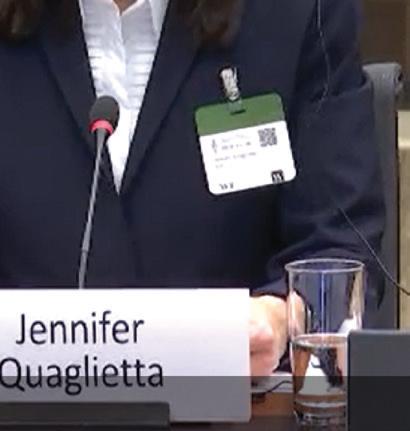










As the first woman to hold the dual role of chief executive officer and registrar of the largest professional engineering regulator in Canada, I recognize that we have a responsibility to promote a profession that reflects the diversity of the public it serves.

Creating pathways that welcome everyone into engineering is essential to building a profession that is innovative, resilient and trusted by society.”
Jennifer Quaglietta, P.Eng., MBA, ICD.D Professional Engineers Ontario CEO/Registrar








In September, Council approved a new PEO vision statement: Leading regulation. Inspiring excellence. Thriving communities. The new vision replaces the former statement: The trusted leader in professional self-regulation
The decision to adopt a new vision statement fulfills a specific 2023–2025 Strategic Plan goal to update how we express our commitment to protecting the public. Vision statement development was informed by significant stakeholder engagement, including consultations with more than 2000 members, as well as a dedicated working group led by PEO’s former president and chair, Roydon Fraser, PhD, P.Eng., FEC.
In February, Council adopted recommendations in the Council Evaluation Framework Report by Watson Board Advisors and directed staff to develop an action plan for implementing the recommendations starting with the 2025–2026 Council term. The framework’s purpose is to:
• Support Council reflection on how well it has focused on strategic and meaningful work;
• Support Council focus on its role as a regulator and its responsibility to serve the public;
• Provide an early warning about potential governance challenges;
• Identify the support required to allow councillors to use their time and expertise effectively; and
• Reduce the likelihood of external interference.
The framework outlines a multi-year plan that includes an annual Council evaluation, meeting evaluations and a graduated approach to introducing councillor feedback.
Regularly assessing our governance practices and performance using an evidence-based framework will help identify areas to enhance governance performance and thereby improve our regulatory effectiveness.
PEO developed a comprehensive onboarding process to welcome new councillors and effectively orient them to their Council roles. The training covers our mandate and expectations around their responsibilities, including on Council and governance committees.
The onboarding also includes providing introductory packages, such as the Governance Manual; and posting councillors’ biographies on our website. Orientation for the 2025–2026 term was held in May.
In addition, we introduced a mandatory orientation course for candidates seeking election to PEO Council. The course includes an overview of PEO’s regulatory role and the legislative framework that defines it; a section on how Council works with the CEO/registrar to deliver on the organization’s mandate; and a final module on a councillor’s role and responsibilities.
In 2025, the updated PEO Risk Register was reviewed by the Audit and Finance Committee and Council. It provides a high-level summary of the strategic risks to the organization and is reviewed annually. The review reflected progress made since the previous reporting period, including reassessing risk ratings and implementing enhanced controls. The register also identified emerging risks over the past year and highlighted any risks that have decreased in severity due to effective mitigation strategies.
The Risk Register is part of PEO’s risk management framework to help identify, assess and treat uncertainty that could affect the outcomes of an organization’s objectives. Systematically addressing and reporting on risks improves overall performance. Leading regulation. Inspiring excellence. Thriving communities.






February
Council adopts recommendations in the Council Evaluation Framework Report by Watson Board Advisors.
Council directs staff to review By-Law No. 1 and propose changes that align with Council’s decisions regarding the role/responsibilities of the chair as Council’s chosen representative.
April



Council approves to update Bylaw No. 1 and the PEO Governance Manual to clarify the roles of the chair and the president.
PEO hosts hybrid 2025 AGM
2024–2025 Council term begins


June

Council Approves 2026–2030 Strategic Plan
Council formally endorses establishing the Engineering Intern (EIT) 2.0 program
CPD program review: Council directed staff to consult relevant stakeholders to ensure comprehensive input into the re-evaluation of the CPD program
September


Council adopts Engineers and Geoscientists British Columbia’s Use of Artificial Intelligence (AI) in Professional Practice practice advisory as guidance for PEO licence holders

Council approves new PEO vision statement: Leading regulation. Inspiring excellence. Thriving communities.
Council approves changes Regulation 941 making explicit a licence holder’s obligation to respond to and co-operate with PEO
Council approves recommendations outlined in the Review of PEO Guidelines: Key Findings and Recommendations report
November



Council approves reducing time-based experience requirement
Council approved PEO’s 2026 budgets
Council endorses establishing a Fitness to Practise program to address practitioner incapacity and public protection
Council stands down the Government Liaison Committee with thanks and adopts Wellington Advocacy’s recommendation to centralize and reform the program to increase accountability and reporting


Membership Demographic Data Survey
Guided by the priorities of our Anti-Racism and Equity (ARE) Code, we began collecting demographic data on a voluntary basis from licence holders and applicants in July. As of November, we had collected data from 5396 licence holders via PEO’s online portal. Results will help us obtain an accurate picture of our applicants and licence holders, identify systemic barriers that might exist and address these barriers where feasible.
EDI WEBPAGE
In April, PEO established a dedicated EDI subsection on our website. This subsection features resources such as the ARE Code, Indigenous and Community Engagement Report, EDI Action Plan and Gender Audit Executive Summary.
EDI TRAINING
We delivered a comprehensive series of internal and external training sessions to deepen awareness and strengthen competency across key EDI themes. In line with our ARE Code Principle 2 (continuously improving to achieve equity and foster inclusivity in all our regulatory processes), last year staff delivered four sessions on “Understanding & Reducing Bias in Experience Requirements Committee (ERC) Interviews” to 70 ERC members. A chapter presentation centred on building a culture of belonging. Internally, two monthly training sessions explored microaggressions, racism and discrimination. Leadership training emphasized psychological safety and mental health, equipping our executive leadership team to cultivate inclusive and supportive environments. We further advanced this work at our Volunteer Symposium, delivering a workshop on creating a culture of belonging and engaging participants in conversations about fostering safe spaces for the next generation of engineers, allyship and inclusive leadership practices.
RECONCILIATION
PEO advanced Indigenous reconciliation efforts through a collaboration with Warrior Engineering, an Indigenous-owned engineering consulting firm, which completed a review of our Anti-Workplace Violence, Harassment and Discrimination Policy.
1. CANADIAN
2. INDIAN (INDIA)
3. ENGLISH
4. CHINESE
5. IRANIAN
1. ENGLISH
2. FRENCH
3. ARABIC
4. FARSI
5. SPANISH
*Based on a voluntary demographic survey of over 7500 licence holders
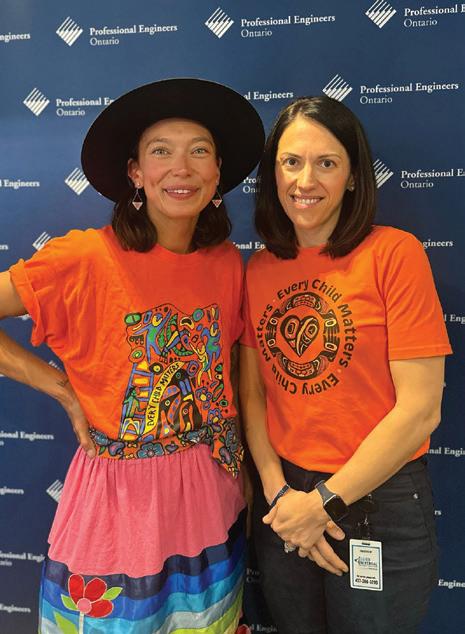
On National Day for Truth and Reconciliation, we welcomed Anishinaabe storyteller and filmmaker Sarain Fox, who shared her personal connection to NDTR, the historical context of why we wear orange shirts and the importance of Indigenous voices in every space.
STATEMENT
P.Eng. revenue
Application, registration, examination and other fees
Building operations (Note 4)
Investment income
Affinity program (Note 5)
Chapters revenues
Advertising income
EXPENSES
Staff salaries and benefits/retiree and future benefits
Purchased services
Computers and telephone
Building operations (Note 4)
Legal (corporate, prosecution and tribunal)
Chapters expenses (Note 11)
Occupancy costs (Note 4)
Contract staff
Engineers Canada
Transaction fees
Consultants
Council expenses
Amortization
Professional development
Volunteer expenses
Postage and courier
Insurance
Staff expenses
Recognition, grants and awards
Office supplies
Printing
Advertising
Excess of revenue over expenses before the undernoted
Council discretionary and strategic plan projects (Note 8)
Excess of revenue over expenses
Remeasurement and other items (Note 6)
Net assets, beginning of year
Net assets, end of year
The accompanying notes are an integral part of the financial statements.
84,175 56,439 42,572 32,637,631 4,426,007 3,133,686 1,292,321 3,630,335 39,705,754 44,628,410
The above information is an abbreviated version of PEO’s 2025 financial statements. The full report appears in the Spring 2026 issue of Engineering Dimensions and on PEO’s website.
STATEMENT OF FINANCIAL POSITION, AS AT DECEMBER 31, 2025
expenses and deposits
Marketable securities
Capital assets (Note 3)
Liabilities
Current liabilities
Accounts payable and accrued liabilities (Note 13)
Fees in advance and deposits
Long-term liabilities
Employee future benefits (Note 6)
Commitments and contingencies (Notes 10 and 14)
Net assets (Note 7)
The accompanying notes are an integral part of the financial statements. Approved by Council. engineeringdimensions.ca FINANCIAL STATEMENTS
STATEMENT OF CASH FLOWS, YEAR ENDED DECEMBER 31, 2025
Operating activities
Excess of revenue over expenses
Add (deduct) items not affecting cash
Amortization
Amortization—other assets
Employee future benefits expensed
Change in unrealized gains on marketable securities
Gains on disposal of marketable securities
Change in non-cash working capital items (Note 9)
Financing activities
Repayment of mortgage
Contributions to employee future benefit plans
Investing activities
Net change in marketable securities
Additions to capital assets
Additions to other assets
Decrease in cash Cash, beginning of year Cash, end of year
The accompanying notes are an integral part of the financial statements.
$ 909,949 1,333,730 9,571 910,900 (978,810) (267,341) 1,917,998 175,736 2,093,735 — (1,226,923) (1,226,923) (996,215) (151,895) (30,472) (1,178,582) (311,770) 5,476,019 5,164,249
$ 1,292,321 1,303,406 24,623 1,235,035 (757,121) (455,372) 2,642,892 325,775 2,968,667 (362,904) (1,237,300) (1,600,204) (4,826,951) (51,886) (4,878,837) (3,510,374) 8,986,393 5,476,019
In 2025, more than 900 professional engineers, engineering interns and others volunteered their time to work on behalf of PEO. This includes those who served on Council, committees and their subcommittees, task forces, the Government Liaison Program, and as PEO chapter leaders and volunteers. It also includes those who represented PEO on external boards and advisory groups and volunteered for chapter-sponsored programs.
PEO recognizes and thanks all those who have served the profession in a wide variety of activities and events throughout the year. Click here to meet PEO’s 2025 volunteers.
PEO held its second Volunteer Symposium at the Hilton Mississauga/Meadowvale Hotel in September. We welcomed almost 200 people for a full day of volunteer recognition and breakout sessions focusing on government relations and regulation, the discipline tribunal process and public protection, and creating safe spaces for the next generation of engineers. Featuring a keynote speech from mental health expert Calissa Ngozi, the symposium was an opportunity to invest in our volunteers and connect them with our regulatory priorities.
Celebrating its 65th anniversary in 2025 and comprising more than 600 volunteers across five regions and 36 chapters, PEO’s chapter network serves as the regulator’s local presence throughout Ontario. Chapters bring PEO closer to the engineering community and the public we serve. In 2025, chapter volunteers promoted STEM education and careers at local schools, organized licence presentation ceremonies, hosted technical seminars and social events, provided forums for members to exchange knowledge and ideas and offered numerous professional development and networking activities.
In 2025, senior staff attended 13 chapter events, including technical seminars hosted by Kingsway, Lambton and Grand River chapters; the SimcoeMuskoka and Peterborough chapters’ annual general meetings; licence presentation ceremonies hosted by our Windsor-Essex, Sudbury, Upper Canada, HamiltonBurlington, London and Algoma chapters; and a trichapter licence presentation ceremony hosted by three of our West Central Region chapters.
Under our Chapters Event Engagement Model, senior staff regularly attend chapter events across Ontario. Staff have committed to attending events at all 36 chapters, with each region receiving two visits per year and each chapter receiving a visit at least once every three years, to facilitate information sharing, collaboration and twoway dialogue.
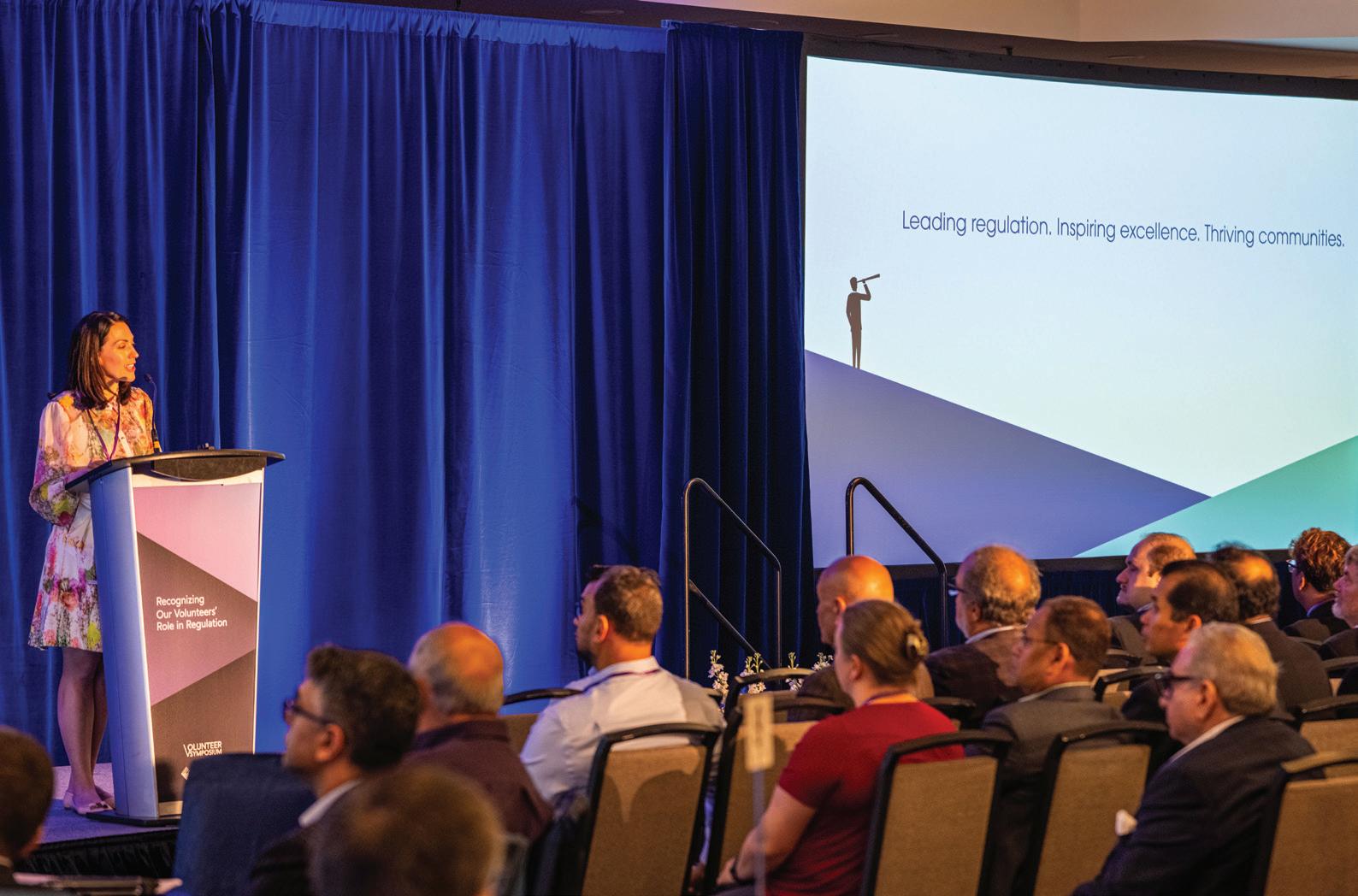

CEO/Registrar Jennifer Quaglietta announces our new vision statement at the PEO Volunteer Symposium.
ORDER OF HONOUR
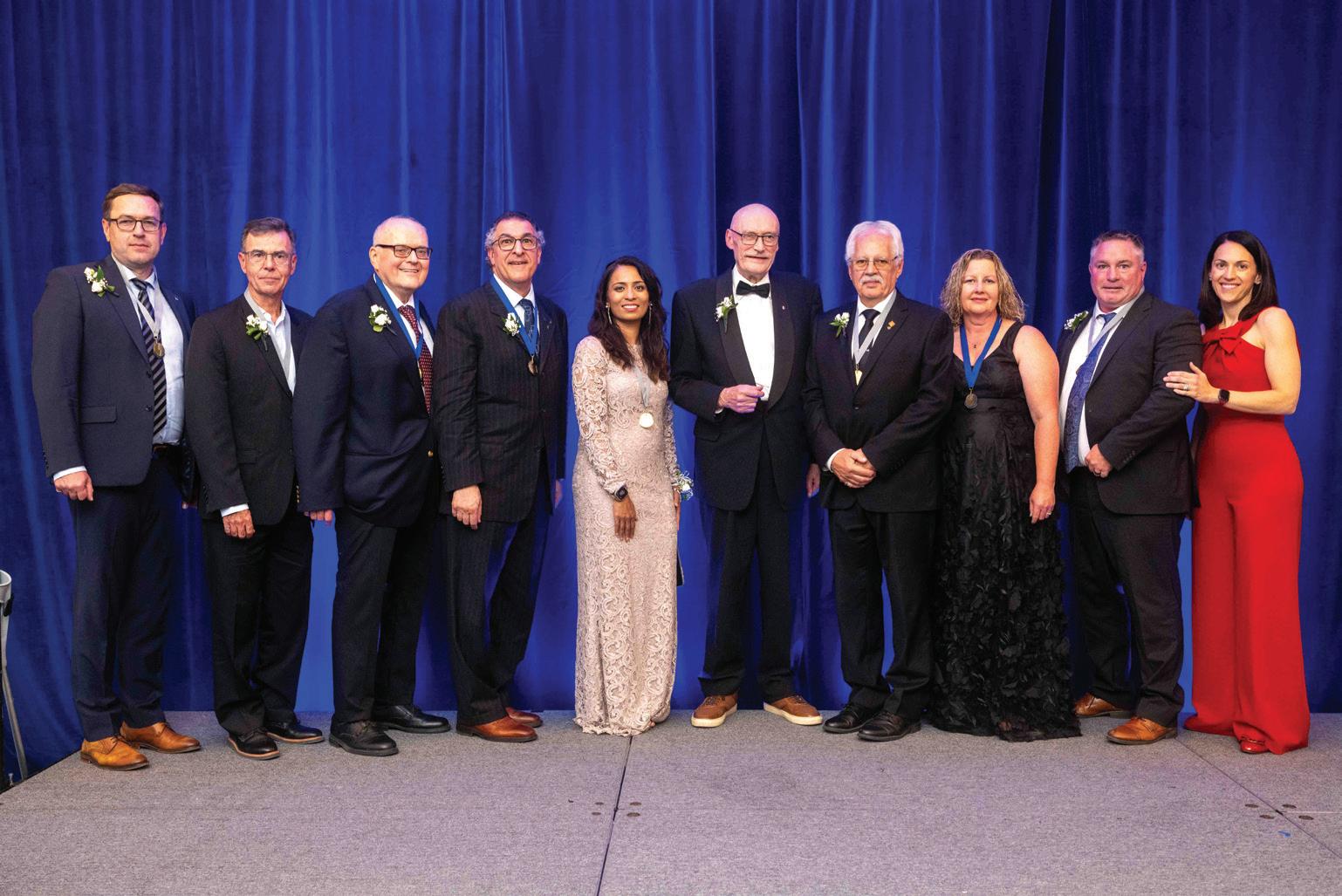
The Order of Honour recognizes PEO volunteers, including professional engineers and others, who have made valuable contributions to the engineering profession. In 2025, nine individuals were inducted into the Order in the Honourary Member, Member and Officer categories during a dinner and ceremony on September 26.
Honourary member:
Leonard Ray Barton, BSc, MBA, PhD, SMIEEE
Officer:
James Chisholm, P.Eng., M.Eng., FEC
Pat F. Scanga, P.Eng., FEC
Angela Scott, P.Eng., FEC
Member:
Mark Haynes, P.Eng., FEC
Artemy Kirnichansky, P.Eng., FEC, MSc
Mehwish Obaid, P.Eng., FEC, PMP, PMP-ACP
Richard Pinder, P.Eng., MASc, FEC
Steven F. Stang, P.Eng., FEC

Nine recipients were inducted into PEO’s Order of Honour. From left to right:
Artemy Kirnichansky, Mark Haynes, James Chisholm, Pat F. Scanga, Mehwish Obaid, Leonard Ray Barton, Steven F. Stang, Angela Scott, and Richard Pinder, with Jennifer Quaglietta.