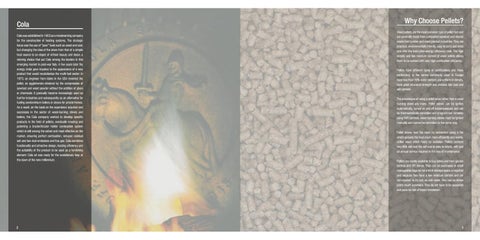
Cola Cola was established in 1963 as a metalworking company for the construction of heating systems. The strategic focus was the use of "poor" fuels such as wood and coal, but changing the idea of the stove from that of a simple heat source to an object of refined beauty and decor, a winning choice that put Cola among the leaders in this emerging market in post-war Italy. A few years later the energy crisis gave impetus to the appearance of a new product that would revolutionise the multi-fuel sector: in 1973, an engineer from Idaho in the USA invented the pellet, an agglomerate obtained by the compression of sawdust and wood powder without the addition of glues or chemicals. It gradually became increasingly used as fuel for industries and subsequently as an alternative for fueling condominium boilers or stoves for private homes. As a result, on the basis on the experience acquired and successes in the sector of wood-burning stoves and boilers, the Cola company worked to develop specific products in the field of pellets, eventually creating and patenting a brazier/brazier holder combustion system which is still among the safest and most effective on the market, ensuring perfect combustion, reduced residual ash and low dust emissions and flue gas. Cola combines functionality and attractive design, heating efficiency and the suitability of the product to be used as a furnishing element. Cola srl was ready for the evolutionary leap at the dawn of the new millennium.
2
Why Choose Pellets? Wood pellets are the most common type of pellet fuel and are generally made from compacted sawdust and related waste from lumber and wood product industries. They are practical, environmentally friendly, easy to carry and store and offer the best price-energy efficiency ratio. The high density and low moisture content of wood pellets allows them to be burned with very high combustion efficiency. Pellets have different types of certifications and those conforming to the norms commonly used in Europe have less than 10% water content, are uniform in density, have good structural strength and produce low dust and ash content. The advantages of using a pellet stove rather than a wood burning stove are many. Pellet stoves can be ignited automatically, turned on and off instantaneously and can be thermostatically controlled and programmed remotely using WiFi controls; wood burning stoves must be ignited manually and cannot be controlled in the same way. Pellet stoves heat the room by convection using a fan which spreads the heat much more efficiently and evenly, unlike wood which heats by radiation. Pellets produce very little ash and the ash pan is easy to empty, with just an annual service required in the way of maintenance. Pellets are readily available to buy online and from garden centres and DIY stores. They can be purchased in small manageable bags so not a lot of storage space is required and because they have a low moisture content and are not required to dry out, as with wood, they can be stores pretty much anywhere. They do not have to be seasoned and pose no risk of insect infestation.
3