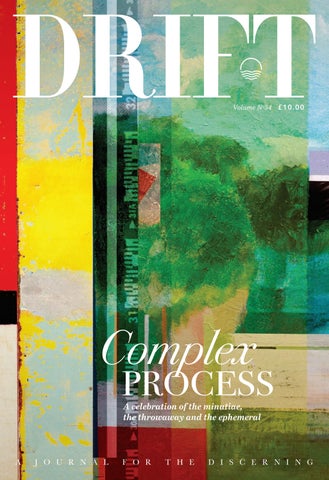
DRIFT 54

Page 1


A celebration of the minutiae, the throwaway and the ephemeral

Serenity, Croyde

A JOURNAL FOR THE DISCERNING

/drift/ noun

1. the act of driving something along

2. the flow or the velocity of the current of a river or ocean stream

verb

1. to become driven or carried along, as by a current of water, wind, or air

2. to move or float smoothly and effortlessly

We invite you to continue your lifestyle voyage online. Find inspiring stories and uncover more luxury content on nstagram driftcornwall oin our e clusi e e-journal community at drift-cornwall co uk to recei e recipes, re iews and insider knowledge of some of Cornwall s most-lo ed lu ury destinations

A JOURNAL FOR THE DISCERNING driftjournal co uk driftjournaluk

On the cover

Gas Station Collage (detail) by Phil Miller, as featured from page . philmillerphotography.com

Head of Client Management

Des Glover des.glover@levenmediagroup.co.uk

Partnership Executives

Shannon Witter shannon.witter@levenmediagroup.co.uk

Elly urnard elly.burnard@levenmediagroup.co.uk

Chairman & Founder ndy orster andy.forster@levenmediagroup.co.uk

CEO en Pratchett ben.pratchett@levenmediagroup.co.uk

PROUD TO BE PART OF

DRIFT is published by: Engine House Media LTD

Holbrook, The Moors, Porthleven, Cornwall TR J

www.enginehousemedia.co.uk

www.levenmediagroup.co.uk

ISSN 2632-9891

© All rights reserved. Material may not be re-produced without the permission of Engine House Media Ltd. While DRIFT will take every care to help readers with reports on properties and features, neither Engine House Media Ltd nor its contributors can accept any liability for reader dissatisfaction arising from editorial features, editorial or advertising featured in these pages. Engine House Media Ltd strongly advises viewing any property prior to purchasing or considerations over any financial decisions. Engine House Media reserves the right to accept or reject any article or material supplied for publication or to edit such material prior to publication. Engine House Media Ltd cannot take responsibility for loss or damage of supplied materials. The opinions expressed or advice given in the publication are the views of the individual authors and do not necessarily represent the views or policies of

Editor

Hannah Tapping hannah.tapping@levenmediagroup.co.uk

Assistant Editor

Jamie Crocker jamie.crocker@levenmediagroup.co.uk

Creative Designer

Spencer Hawes spencer.hawes@levenmediagroup.co.uk

Finance & HR Manager

Charlotte Forster charlotte.forster@levenmediagroup.co.uk

Credit Control

Tracy Dart tracy.dart@levenmediagroup.co.uk

Engine House Media Ltd. It is suggested that further advice is taken over any actions resulting from reading any part of this magazine.

Engine House Media Ltd is a multi-platform media business with a passion for everything Cornish. Visit www.enginehousemedia. co.uk to find out more. Our mission is to create RE D W TCH E PERIE CE media opportunities marrying together consumers with the fabulous businesses across Cornwall. Our publishing and marketing teams are specialists in creating print and online communications, devised to achieve a range of marketing objectives. With over 20 years of marketing, brand management and magazine experience we develop e ective communications that deliver your message in a credible and creative way. We operate across all media channels, including: print, online and video.

TEAM

Foreword

There is a rebellion in noticing. In pausing mid-journey to trace the edge of a path, to watch how the way wind presses patterns into long grass, or to notice how sunlight fractures across a window at dusk. These are the details we are conditioned to pass by too small, too fleeting, too ordinary. nd yet, it is here, in the overlooked corners of landscape and nature, that something begins. In this volume, we turn toward the peripheral and the passing. We ask what happens when we elevate the overlooked, when we let the throwaway linger just a moment longer. Inspiration, it seems, is not always found in vast horizons but in the act of looking closer, and so we turn toward the edges. To gather the ephemeral is to resist disappearance. It is an act of curiosity and presence and in tracing these delicate imprints, we discover new ways of seeing and of moving through the world. Photographer and artist Phil iller demonstrates this in his work which is very much a

commentary on everyday life. Greg Ramsden’s new body of work , focuses on the push and pull of our tidal estuaries, their wonder teaching us to pay attention to subtle shifts in the world. Hedgelayer Paul Lamb’s book , shows that such attentiveness and a more considered way of life are possible. It asks that we look closely at what lies before us and consider how it might be nurtured in a better way. Seth and Poppy from Do Good Things , explore a model in which creativity and cultivation sit alongside one another, each supporting a broader vision, while at a new exhibition , Garry abian iller’s photographs act as a dialogue with our own landscape, o ering an opportunity to consider the possibilities that such images can shed light onto our own existence. This volume of DRIFT Journal is an invitation to look beyond the frame, to notice what sits just outside the obvious, and to find, in the margins, a richer way of seeing.

Our contributors

We have an exceptional and loyal team here at Leven Media Group but as a fast growth business we’re always interested in talking to outstanding individuals. If you’re a superstar of extraordinary talent then we would love to hear from you. Proudly

Call us on 01326 574842 or email enquiries@enginehousemedia.co.uk

Visit driftjournal.co.uk to read more about our writers.

Providing life changing opportunities for young people across the UK www.diveprojectcornwall.co.uk

Hannah Tapping
Martin Holman
Mercedes Smith
Jamie Crocker

Lime Trees St Columb Major

£625,000 guide

Situated in a tranquil conservation area alongside the gentle flow of the River Menalhyl, Lime Trees is an architecturally striking detached residence that was completed in 2020.

This exceptional home combines contemporary design with an enviable natural setting, offering a unique opportunity to enjoy modern living within beautiful surroundings.

The welcoming entrance hallway, filled with natural light and defined by a glass-balustrade staircase, sets the tone for the interiors. The ground floor includes a versatile double bedroom with en-suite shower room, a spacious utility with access to the garage and a convenient cloakroom. The main living areas shine, with a generous lounge opening onto a decked terrace and gardens. Two further bedrooms, including a superb en-suite principal suite, are served by a stylish family bathroom.

Upstairs, an expansive open-plan lounge and dining area enjoys countryside views through a floor-toceiling glazed gable and Juliet balcony. A sleek kitchen with quartz worktops and breakfast bar completes the space, while landscaped gardens and a large garage enhance the home.

01841 532555

sales@jackie-stanley.co.uk

Jackie-stanley.co.uk

1 North Quay | Padstow | Cornwall | PL28 8AF

THE STABLE LOFT | ST COLUMB | OIEO £650,000

A BEAUTIFULLY EXECUTED DETACHED STONE BARN CONVERSION, ORIGINALLY CONVERTED IN 2008 AND THOUGHTFULLY RENOVATED TO CREATE AN EXCEPTIONAL PRIVATE HOME RATHER THAN SIMPLY A HOLIDAY RETREAT. THE STABLE LOFT OFFERS A RARE BALANCE OF AUTHENTIC CHARACTER AND CONTEMPORARY LIVING, SET WITHIN A PRIVATE PLOT EXTENDING TO JUST SHY OF HALF AN ACRE IN A PEACEFUL RURAL SETTING.

SANDCOT | HAYLE | GUIDE PRICE £800,000

SET IN AN EXCEPTIONAL POSITION ABOVE GWITHIAN, SANDCOT IS A DISTINCTIVE STONE CONVERSION OFFERING AN ENVIABLE BLEND OF HISTORIC CHARACTER AND MODERN LIVING. THE PROPERTY WAS CAREFULLY REBUILT FROM THE ORIGINAL STONE BUILDING AND LATER EXTENDED TO CREATE ADDITIONAL SPACE FOR MODERN FAMILY LIFE.

SET WITHIN ONE OF CAMBORNE’S MOST ESTABLISHED RESIDENTIAL ROADS, 31 PENDARVES ROAD IS AN ATTRACTIVE AND CHARACTERFUL HOME OFFERING GENEROUS, WELL-BALANCED ACCOMMODATION, PRESENTED IN EXCELLENT DECORATIVE ORDER THROUGHOUT. THE PROPERTY COMBINES TRADITIONAL CHARM WITH THE PRACTICALITIES AND PROPORTIONS SO OFTEN SOUGHT BY MODERN FAMILY BUYERS.

31 PENDARVES ROAD | CAMBORNE | OIEO £500,000 A STRIKING AND ARCHITECTURALLY DESIGNED DETACHED HOME SET WITHIN A PEACEFUL RURAL HAMLET, THE OLD DAIRY IS A DISTINCTIVE CONTEMPORARY RESIDENCE OFFERING AN EXCEPTIONAL COMBINATION OF STYLISH MODERN LIVING, HIGH-QUALITY FINISHES AND THE EXCITING OPPORTUNITY FOR FURTHER BESPOKE COMPLETION. THE OLD DAIRY | ROSENANNON | GUIDE PRICE £550,000

An artistic celebration of the minutiae, the throwaway and the ephemeral

Greg Ramsden’s new paintings explore the mesmerising push and pull of tidal estuaries

How design-led furniture is shaped by craft and sustainability

An island hotel that encourages a feeling of being a world away

Practical, client-led representation

A

Certified organic skincare rooted in

The Oyster Perpetual Rolex Deepsea is engineered to shine into the ocean depths 69 DO GOOD THINGS

Growing food, telling stories, rethinking life from the soil up

Courtesy of Philleigh Way cookery school comes this humble sardine supper

“Creating a settled state of being from which pictures have been seen, imagined, made visible.” 93

New work from sculptor Richard Holliday reflects a journey from historical architectural roots to stylisation and abstraction 102 LAUNCH INTO ACTION

A luxury modern cruiser with a heritage pedigree

ComplexPROCESS

An artistic celebration of the minutiae, the throwaway and the ephemeral.

Phil Miller’s photography is a commentary on everyday life. With a background in film and television, Miller has in recent years moved into oil painting. Self-taught, his painting practice began through the creation of backgrounds for photographic collage work. As his painting developed, his photography shifted towards landscapes, which in turn began to influence his oil paintings, resulting in geometric scenes that often feature wooded environments.

Based in Whitstable, Kent, Miller has also spent significant time in Devon, where his elderly parents live. Regular ourneys between Whitstable and Devon along the became a key influence on his work, particularly the landscapes and service stations encountered along the route.

photographing transient life within the service station, which became the canvas for the final artwork. The piece now hangs in the hall of the sout-westbound entrance.

Miller has also completed a commissioned collage artwork for Canterbury City Council, created for the South Quay Shed on Whitstable Harbour. Inspired by the visual symmetry between a local craft group that meets weekly in the shed and the fishermen working in the harbour, the work draws parallels between the needles used by the group and the masts of the fishing boats, as well as between the act of mending nets and the rhythm of crochet.”

In 2025, Miller created a collage for Fleet Services on the M3, drawing on photographs taken during frequent visits. He also spent two days on site

Miller is currently working on a new series of paintings, with a view to exhibiting later this year, while also undertaking commercial projects that combine his multidisciplinary creative practice.

philmillerphotography.com

TOP Welcome Break, Fleet Collage
ABOVE Painting. The Clearing
Gas Station Collage
ABOVE
Petrol Station A303
TOP
Whistable Harbour Collage
TOP Spring, Static
ABOVE Water Park.
still from feature film Scouting Book for Boys

Mary Mabbutt Solo Exhibition

Mary Mabbutt Solo Exhibition

4th to 28th April 2026

4th to 28th April 2026

Mary’s paintings are inspired by colour, space and form in the everyday. This collection begins with the classic still life convention of flowers in a pot, before the artist’s focus moves outwards to take in views of her art studio and work table, all bathed in the warm light of summer. Other works are drawn from Mary’s sewing room and kitchen, reflecting the domestic objects and spaces that are central to daily life.

Mary’s paintings are inspired by colour, space and form in the everyday. This collection begins with the classic still life convention of flowers in a pot, before the artist’s focus moves outwards to take in views of her art studio and work table, all bathed in the warm light of summer. Other works are drawn from Mary’s sewing room and kitchen, reflecting the domestic objects and spaces that are central to daily life.

Take a 3D tour of the Gallery via our website CONTEMPORARYGALLERY

Take a 3D tour of the Gallery via our website

CONTEMPORARYGALLERY

The Parade, Polzeath, Cornwall, PL27 6SR 01208 869301 | art@wwcg.co.uk | www.wwcg.co.uk

The Parade, Polzeath, Cornwall, PL27 6SR 01208 869301 | art@wwcg.co.uk | www.wwcg.co.uk

@WhitewaterPolz

@WhitewaterPolz

Emotional UNDERCURRENT

WORDS BY MERCEDES SMITH

GGreg Ramsden’s new paintings explore the mesmerising push and pull of our tidal estuaries.

reg Ramsden recently celebrated being elected to the Royal Society of Marine Artists. It is an honour he has earned through two decades of painting the marine environment and the communities and working histories that surround it. “The RSMA is built around artists who live with the sea, not just those who paint it,” he says, “so becoming a member feels like a homecoming. It tells me that the long path I have walked, with regard to my passion for painting life on the coast, has been seen and is valued by my peers.” Greg is an award-winning artist who makes work inspired by coastal landscapes, from his home in South Devon to the Eastern Seaboard of North America, and even out on the ocean. In 2025 he won the Guild of Ships Painting Award and took up the prize of an Artist Residency on the ft Lugger and eco sailing vessel Grayhound on its journey from the UK to France last summer. A selection of the resulting works has been exhibited at Mall Galleries, London.

Throughout April and May of this year, Greg presents a new collection at Tonic Gallery in Salcombe, which explores the beauty of Devon and Cornwall’s tidal estuaries.

“Estuaries have a very particular presence,” says Greg. “I am inspired by both their history and their quiet drama. These are flooded areas, once valleys between steep mountains, now filled with tidal waters. You can feel the ancient landscape beneath the surface, that sense of place that has been reshaped but not erased.

Estuaries are places where the sea, land and light are always in motion and nothing is fixed. Tides pull, the water rises and falls, and the atmosphere changes minute to minute. Estuaries are a threshold between certainty and uncertainty, between solidity and fluidity. That tension is what fuels my work.”

Inspired by locations including the Camel estuary in Cornwall; and the Kingsbridge and Dart estuaries in Devon, these paintings capture the shadowy shapes and refracted light of the coastal landscape as the ocean

ABOVE Estuary, Evening

CREATE

moves inland up the river, and back out on a retreating tide, in a palette of colours and soft brush marks that capture the haze of sunlight on seawater.

It is a radiant and deeply calming collection of works. “Estuaries are peaceful in a way that the open coast is not,” says Greg. “There are no breaking waves, just a rise and fall that feels more like breathing than an elemental force. Estuaries have a sonic calmness, often ust of birdsong, the lapping of water against the bank, and the quiet shift of the river. That soundscape sets the emotional tone of my paintings long before the visual details do.” These tidal places, Greg tells me, mirror his own working process of quiet, settled drawing on the coastline, before the image is transformed and endlessly revisited. “In those first plein air sketches my eye is never looking for the whole scene,” he says. “It is looking for the structure beneath it, the

rhythms and the lines that hold the landscape together, the weight of the sky, the pull of the tide line, the geometry of the coast.” Greg makes these sketches quickly with graphite or charcoal in a small sketchbook, “making marks before my mind has time to interfere – a gesture for the land, a suggestion of movement, the silhouette of a cli or light sparkling on the water. My sketches are about finding the pulse of a place. Once I’ve caught that, larger drawings will emerge, and from then the work progresses naturally into paint.”

The wonder of estuaries, he says, is that they teach us to pay attention to subtle shifts in the world, and the way patterns return again and again. “Estuaries, like all landscapes, alter dramatically throughout the day and throughout the year,” he says, “as the angle of the sun changes and the hours turn. A misty landscape on an April morning might be flat

Water, Rock

CREATE

and shadowless on a hot July afternoon. The same is true of colours. They shift completely between the UK coast and the American seaboard, or out at sea on the Grayhound, but the greatest influence is not geography it is the seasons. On the English coast my palette changes constantly: early spring brings soft pastel tones, a kind of tentative brightness, but in summer there is that gold shimmering morning light that feels almost weightless. Winter is the opposite; it is muted, monochrome, the world reduced to essentials. America’s Atlantic coast has its own clarity; it has a harder light and sharper contrast, but when I’m sailing, the colours don’t ust change, they behave di erently. t sea, the light is unfiltered. There’s nothing to interrupt it. It comes at you clean and absolute. The horizon becomes a sharp blade and colours separate, rather than blend. The open ocean reflects the only sky, so the whole world becomes a single, shifting field

of tone. When I am painting, at sea, on the coast, or at the mouth of a river, I am always trying to capture what is already dissolving, a moment that refuses to stay still.”

For this exhibition, the Dart estuary has proved particularly inspirational, “because it is the stretch of water I know most intimately, from Totnes Weir down through Tuckenhay’s Bow Creek, across to Stoke Gabriel and along the foreshore at Dittisham and out to sea past Dartmouth. It is the estuary I live closest to, the one I walk in every season and in every kind of weather, and I think that repeated, lived-in familiarity has shaped my work more deeply than any other place. What draws me back are the many di erent worlds the Dart holds within a single tide. Some days the water is a mirror, and on other days it is a sheet of pewter. Its transitions are beautiful, from the place where the river meets the bank, to

info@thirtystories.co.uk

the tidal zone where the seaweed begins and ends and the rocks emerge as the water level drops. Everything shifts gradually. Those soft edges and slow changes are exactly the qualities I try to put into my paintings.”

Greg describes his work and his career to me as, “a long conversation with the coast”, one that has been influenced by his life in the South West and the artists whose work he has learned from and continues to admire.

“Several important artists have significantly shaped the way I think about the coastal landscape,” says Greg. “The ones I admire most are those who work with mood and the emotional temperature of a moment. Peter Lanyon’s paintings of the Cornish coast feel like lived experiences. He painted from within the landscape, gliding, climbing, and sensing the air and the pull of the land. Joan Eardley’s Catterline paintings have taught me that honesty and atmosphere matters,

and Richard Diebenkorn’s Ocean Park series showed me how a landscape can be pared down to rhythm and colour without losing its sense of place. Edward Hopper’s work demonstrates how light can carry narrative, how stillness can hold tension, and photographer Hiroshi Sugimoto’s seascapes are pure meditation, defined in a single horizon line and infinite variations of light. What connects all these artists is their ability to reveal the hidden frequencies and the emotional undercurrent beneath what the eye sees. That’s what I am always searching for and trying to capture in my work.”

See the Estuaries collection from 3rd April to 21st May 2026 at Tonic Gallery, 7-9 Union Street, Salcombe, Devon TQ8 8BZ and at tonicgallery.co.uk.

gregramsden.co.uk

DesignINTEGRITY with

How design-led furniture is shaped by craft and sustainability.

For more than two decades, Uneeka has built its reputation on a cleareyed approach to design and making.

The independent Cornish company curates furniture with a strong point of view, favouring considered design and responsible production over short-lived trends. As the business has grown, it has kept its supplier relationships direct and personal, working with trusted partners in the UK and overseas who share its commitment to integrity and sustainability.

That commitment was reinforced recently when director Jodi Skelton travelled to Jaipur to spend time with one of Uneeka’s newest workshop partners. As Jodi explains,

Working directly with these craftsmen allows us to maintain the human touch in every design while ensuring ethical practices and sustainable choices remain central to our work. Our Jaipur partners have a story shaped by generations of making, it’s great to work with another family business.”

n the factory floor, among sawdust and hand tools, the emphasis was not on volume but on process. The two brothers who founded the workshop grew up in a family dealing in antiques and finely made reproductions. In 2009, they established their own venture, determined to apply the same respect for traditional craft to original designs. From modest beginnings,

the business expanded steadily, grounded in hands-on production and enduring relationships with clients worldwide.

Today, around 250 skilled artisans work under one roof, carrying out every stage of manufacture in-house. This integrated model allows close oversight of materials, quality control and working conditions, while limiting waste and prioritising durability. Many of the team have been there for more than a decade, ensuring continuity of skill as techniques evolve to suit contemporary interiors. The facility is Sedex registered and subject to regular social audits, with fair pay and safe conditions central to its operation.

Material choice is equally deliberate. The workshop uses only legally sourced timber, with full traceability and FSC certification, and provides order-specific EUDR documentation where required.

This year, mango wood has taken centre stage across Uneeka’s collections. A dense hardwood with warm tones and distinctive grain, it offers strength comparable to oak and responds well to detailed finishing. As a by-product of fruit farming, it also makes pragmatic environmental sense.

The results are evident in pieces such as an etched two-door mango wood cabinet, a cylindrical-base round dining table and a three-drawer chest topped with marble. Alongside these collections, Uneeka collaborates with UK manufacturers, including Paulus & Brown, to create bespoke upholstered seating, supported by an inhouse design service that guides projects from initial concept through to installation. The outcome is furniture shaped by human skill and informed choices, intended for long use rather than swift replacement.

uneeka.com

Exhibition at the Salthouse Gallery, St Ives - Saturday 24th April to Friday 1st May.

An eclectic collection of form and technique exploring myriad of subject matter. Opening Saturday 24th April.

Richard is also represented by Thompsons of Alderburgh and Seymour Place London, Whitewater Gallery in Polzeath, Penwith Gallery in St Ives, The Old Pumping Station Garden Gallery near St Keverne and Gallery TR1 in Truro, now establishing itself showcasing work from established and emerging talent managed by the artists.

Contact richardonholliday@hotmail.com

Photographer: Nick Wapshot

The enduring CALL

An island hotel that encourages a feeling of being a world away.

Twenty-eight miles beyond mainland Cornwall, the Isles of Scilly form an outpost that feels sagaciously removed from the daily rush of the United Kingdom. The archipelago, unwilling to advertise its presence too much, lies low in the Atlantic, a scatter of islands and rocky outcrops surrounded by water that often carries a colour more usually associated with warmer latitudes. Boats crisscross the sound between islands bouyed up by the lilt of the waves, while seabirds wheel overhead, and the Gulf Stream moderates the climate so effectively that subtropical plants grow in the shelter of old stone walls. It is a landscape that draws the curious, where visitors quickly discover something familiar and yet peculiarly unfamiliar, a foreign land inhabited by friends.

heathland and its shoreline folding into beaches of pale sand. Life here adopts a pace determined largely by the tide and the weather. There are farms and a handful of small businesses maintained by a real community. For visitors, the appeal is simple: space to walk, clear water for swimming in under skies that remain primordially dark once the sun drops below the horizon.

Among the inhabited islands, St Martin’s maintains a unique character. It lies towards the eastern edge of the group, long and narrow, its spine rising to low

Set above the shore on the island’s western side stands Karma St Martin’s, the island’s only hotel, an establishment that has developed into one of the Isles of Scilly’s most comfortable places to stay. The property occupies a slope above Tean Sound, facing the neighbouring island of Tean and the wider Atlantic beyond. A group of granite buildings arranged along terraces form the heart of the hotel, their lines softened by gardens and salt-tolerant planting. From the outside, it has the appearance of a traditional island property that has grown organically over time rather than being parachuted in overnight.

Heading out to explore

Karma St Martin's

ABOVE Temptation on a plate

Thirty guest rooms are spread throughout the buildings, each arranged to make the most of the view. Windows open towards the sea and most rooms include terraces or balconies that allow guests to sit outside when the weather allows, which it frequently does thanks to the warming influence of the Gulf Stream. The interiors draw lightly on the colours of the surrounding landscape: pale woods and simple fabrics which don't distract the eye, allowing the view to take centre stage. Nothing about the design is demanding beyond its requirements.

Guests can arrive at Karma St Martin’s in several ways. Many travel by fixedwing aircraft or helicopter from the mainland, landing on nearby St Mary’s before continuing by boat. Others choose the slower but more romantic crossing aboard the passenger ferry from Penzance. However the journey is made, the final stage often involves a small inter-island boat ride, luggage stacked neatly beside the skipper while passengers watch the water shift between shades of turquoise and green. By the time the boat pulls into Higher Town quay on St Martin’s, most travellers have already begun to settle into island pace.

The hotel’s position makes it easy to reach the island’s network of paths. These tracks follow old field boundaries and low ridges, connecting beaches, farms and small outposts of human settlement. Walkers can circle the island in a few hours, though many choose to stretch the journey across a day, stopping to watch seals resting on offshore rocks or to study the view across the archipelago. On clear days the

neighbouring islands appear as layered silhouettes, each separated by channels where boats chug between communities.

Lowertown Beach, only a short walk from the hotel, offers one of the island’s most striking stretches of sand. At low tide the water retreats to reveal long shallows and rippled sandbars, creating a wide expanse ideal for swimming or simply wandering. Families often spend entire afternoons here, while others carry picnics prepared by the hotel kitchen and settle among the dunes. The sea is clear enough to invite snorkelling and kayaking, both of which the hotel can arrange for guests interested in exploring the surrounding coves.

Island life has always been shaped by the sea, and that influence extends naturally to the hotel’s dining room. The Sir Cloudesley Shovell restaurant has held two AA Rosettes since 2018, a recognition that reflects the kitchen’s commitment to seasonal ingredients and fine dining. Fishing boats working around the islands land crab, lobster and scallops throughout the year, and much of this catch appears on the menu within hours of arriving ashore. The cooking style pays homage to the ingredients, allowing the freshness of the produce to dictate the way.

A typical evening might begin with handpicked crab paired with garden herbs, followed by grilled lobster or locally caught fish served alongside island-grown vegetables. The kitchen also sources produce from mainland Cornwall and St Martin’s growers, whose small fields yield herbs, salads and occasional fruit. Desserts often take advantage of

hedgerow berries in late summer and autumn, while the wine list ranges from familiar European regions to bottles chosen to complement seafood.

Lunch is relaxed. Guests might return from a morning swim to find the terrace tables set for light meals and fresh bread, or collect hampers prepared for a day spent exploring the island’s more distant beaches. Afternoon tea remains a popular ritual, particularly when the sun drops behind the terrace and the view across Tean Sound takes on a softer light.

Karma St Martin’s has also built a reputation as a welcoming place for travellers accompanied by dogs. The Isles of Scilly are well suited to animals as the paths are plentiful and beaches are rarely crowded. The hotel accommodates pets in designated rooms and public areas, allowing owners to explore the island without the complication of leaving their companions behind.

While many guests are content to remain on St Martin’s, the wider archipelago encourages exploration. Regular boats connect the inhabited islands, making it possible to spend a day visiting Tresco, Bryher or St Agnes before returning in time for dinner. Tresco is known for its Abbey Garden, where plants from across the world thrive in the mild climate. Bryher presents a contrast, its western side facing the full force of Atlantic weather while the eastern shore remains sheltered. Each island offers a slightly different character, yet all share the same sense of distance from mainland pressures.

Seasonality shapes life here. Spring arrives early, coaxed by the mild climate, and fields of narcissi begin to flower while much of Britain still waits for the first signs of growth. Coastal habitats fill with seabirds returning to breeding sites, and the water begins to warm enough for the first determined swimmers. Walk Scilly, an annual festival held across the islands, brings visitors eager to learn about local wildlife and geology from experienced guides.

Summer delivers longer days and the warmest sea temperatures of the year. Boats become busier as visitors move between islands, and the beaches take on the bright clarity often associated with mediterranean waters. Even then, the Isles of Scilly rarely feel crowded. The limited number of accommodation beds across the archipelago naturally controls the pace of tourism, ensuring that wide stretches of coast remain unoccupied for much of the day.

Autumn offers a mellow mood as the heather darkens across the hinterland and migratory birds arrive in large numbers, attracting enthusiasts from across Europe. The water retains warmth long after the mainland has cooled, encouraging lateseason swims. The annual Taste of Scilly festival highlights local produce and brings chefs, growers and fishermen together in a series of events that celebrate the islands’ food culture.

Early October introduces another dimension to the calendar. Karma St Martin’s hosts a jazz gathering centred

ABOVE Encounter wildlife on a seaborne adventure

on performances by pianist Ben Waters and visiting musicians. Evenings in the hotel’s dining room or adjacent spaces fill with energetic boogie-woogie and blues, drawing audiences from afar. Around the same time, the archipelago participates in Dark Skies Week, when astronomers and enthusiasts gather for observations and talks organised through the COSMOS Community Observatory on St Martin’s. With minimal light pollution, the night sky here offers a rare opportunity to see the Milky Way clearly arching overhead.

Such events bring an element of vitality and exuberance to the closing months of the year, yet the hotel retains its essential character. Sta ng often includes people who have spent many seasons on the islands, and their familiarity with local life gives the service a sense of embedded confidence. isitors are quickly acquainted with where to watch the sunset, which path leads to a hidden cove, or how the tides affect the day’s swimming.

What draws people back to Karma St Martin’s repeatedly is a sense of residing abroad for a while, but without the hassle of having to pass through airports and customs checks. Days tend to organise themselves around simple activities: a walk along the coast, lunch outdoors, a boat trip to a neighbouring island, then dinner as the sky darkens over Tean Sound.

As dusk descends, the hotel’s lights flicker into life, mirrored in the sea that still holds the sunset’s last glow. Boats ease back to their moorings, and the island grows quiet, save for the gentle pull of the tide. Guests, returning from a day of exploration, linger on the terrace, sharing a final drink as the first stars appear. n that suspended moment, the distance from the mainland feels more than physical as Karma St Martin’s transforms into a place that exists beyond time and context, rare and unbound. karmaresortdestinations.com/karmast-martins/

Litigation WITH CLARITY

Practical, client-led representation across complex civil litigation.

In a legal mar et where many rms still o erate according to inherited atterns, tutt ssociates has chosen a narrower, more e acting ath. he ractice deals e clusively with civil dis utes. rom the outset, its lawyers have focused on contentious matters, building de th through re etition and e erience rather than dilution across multi le de artments.

entral to the rm s a roach is the idea that every client can sha e how their case is handled. ervice level agreements are agreed u on at the outset and reflect individual references. ome clients o t for email u dates only others want scheduled calls, instant messaging or contact outside conventional o ce hours. ees can be ed to stages or de ned ieces of wor , and clients may choose a light or high level service de ending on the nancial or emotional weight of the dis ute. he intention is ractical clients decide how much involvement they want, from handing matters over entirely to see ing advice while retaining control of the groundwor .

isa aywood, owner and manager, trained in ornwall from a rentice to associate and has wor ed solely in dis utes. he e lains the demands of the res onsibility lainly dis utes lawyer is a challenging role. t is very im ortant that clients feel su orted and that you have their bac . hey need to now you will ght for the outcome they need, but also that you will let them vent and discuss the hard issues.

he is direct about the ris s. ecause litigation is not something to underta e lightly it is e tremely emotionally draining, time consuming and often ris y and costly too. lients are therefore e t rmly in charge. e ma e sure our clients are always in the driving seat, now what is ha ening and why and have full autonomy over decision ma ing.

ommunication is treated as a disci line. dvice is delivered in lain nglish, with reasons given and strategy e lained. he rm s reference is for brevity and accuracy clients are told what the lawyers thin , not resented with evasive summaries.

isa is oined by onsultant ee tutt, formerly ead of itigation at a large regional rm, who brings more than two decades of e erience in dis utes, including acting in cases which have sha ed the law. e is also an accredited mediator. ogether they handle a huge breadth of dis utes, concerning ro erty, inheritance, insolvency and business.

or clients facing arguments over homes, livelihoods or signi cant sums, technical com etence is assumed. hat often decides the instruction is trust. tutt ssociates has been built largely on recommendations, a sign that in dis utes, credibility comes from trust and relationshi s as much as from ositive outcomes.

stuttassociates.co.uk

TOP LEFT isa aywood
RIGHT
© Mike Searle
Photography

ELEVATION Coastal

Set above Charlestown and St Austell Bay, 22 Sea Road in Carlyon Bay has been comprehensively refurbished to deliver generous, carefully detailed accommodation arranged for modern living. A broad entrance hall introduces the house, leading to a firstfloor sitting room where full-height picture windows and a Juliet balcony frame wide views across the water

The ground floor centres on an open-plan kitchen, dining and living area finished with large-format tiles and sliding gla ed doors opening onto a decked balcony. The bespoke kitchen features a granite island, Rangemaster cooker, Quooker tap, AEG appliances and a wall of larder storage. Four double bedrooms include a substantial principal suite with fitted cherry wood wardrobes and a large en suite. Two further bedrooms open to the garden, while a self-contained double-bedroomed annex provides independent accommodation.

22 SEA ROAD Guide price: £2.5M

JACKIE STANLEY 01841 532555

sales@jackie-stanley.co.uk

jackie-stanley.co.uk

REACH Atlantic

Converted barns above the tlantic coast o er e ible omes it ro en lettin income.

Raddons and Wharrastone stand within the small coastal hamlet of St Gennys on Cornwall’s north coast, where former agricultural buildings have been reworked into two distinctive homes that benefit from wide Atlantic views. Developed from a traditional barn complex in the 1980s and subsequently refurbished, the properties balance exposed structural timbers and vaulted ceilings with practical modern fittings.

Each house centres on a bright open-plan kitchen and sitting rooms arranged to face the countryside and sea. Large windows draw in light while wood-burning stoves anchor the living spaces in cooler months. Granite worktops, integrated appliances and dedicated utility rooms underline the considered specification.

Bedrooms and bathrooms across the pair provide comfortable accommodation suited to permanent occupation, shared family use or continued holiday letting, for which there is an established record and residential consent. Lawns surround the buildings, and a paddock extends the grounds while the South West Coast Path lies moments away.

RADDONS & WHARRASTONE

Guide price: £800,000

JACKSON-STOPS 01872 261160

cornwall@jackson-stops.co.uk

jackson-stops.co.uk

Past and PRESENCE future

A year of hedgelaying reveals more than just craft and skill.

Hedgelaying begins with a billhook, a simple tool that cuts into the living material. The fibres part, the stem is bent and a living boundary is crafted into shape. It is akin to an act of reverence that carries with it many of the attributes of a medieval pilgrimage –an itinerant lifestyle, cold hands, damp cu s and the faint smell of smoke from winter fires clinging to clothes. For Paul Lamb, though, author of Of Thorn and Briar, this is retention and argument made manifest rather than just pure homage. What he is perpetuating is a rural skill that is reasserting its relevance in a world that has, up until recently, advocated the grubbing up of our ancient natural heritage in the name of maximum yield.

When he answers the telephone, he is standing beside his wagon on the Gower Peninsula, where he now lives and works. The land behind him falls away towards the sea; on clear days, he can see across the water to North Devon. A year ago, such a view would have seemed unlikely. If someone had told him he would write a book, meet the woman who would become his partner and leave the West Country for South Wales, he would not have believed a word of it.

“You never know,” he says, but there is still surprise in his voice.

Paul’s route to this point has not been linear. orn in Essex, he left for ew ealand at four when his parents emigrated. His childhood there was spent outside: fishing, swimming in rivers and roaming.

SUSTAIN

t fifteen, he returned to Essex and found himself at odds with a built-up landscape that felt constricting. As soon as he could, he bought an old van and headed west. The countryside he found in the West Country was di erent from that of his childhood, yet recognisable in spirit: people shaped by the natural environment, by the needs of their livestock and by the seasons.

Hedgelaying o ered him a way in. The craft, which involves partially cutting and bending living stems to create a thick, stock-proof barrier, is at once practical and beautiful. A well-laid hedge keeps cattle and sheep where they belong; it also provides dense habitat for nesting birds and small mammals. For Paul, the appeal was never purely ecological. It was the sense of continuity, of doing work that would have been understood by the old boys who once held court in village pubs, men who may not have had formal qualifications but possessed hard won knowledge of land and weather.

In his book, that knowledge is described as “old wisdom”: methods honed over generations because they worked and because ‘progress’ had yet to cull their way of life. Hedgerows have long been part of Britain’s agricultural landscape. From early earth banks and ditches marking boundaries to the proliferation of hedges during and after the parliamentary Enclosure Acts, they have shaped the patchwork seen from an aircraft window. The motives behind enclosure were often

harsh, tied to profit and the displacement of rural labour. Yet the resulting network of hedgerows created linear woodland habitats in a country with comparatively little tree cover.

Paul is wary of romanticising the past. He knows that rural life was hard and that modern agriculture has had to respond to economic pressure and a growing population. He understands why large fields and heavy machinery became the norm in what has been termed the “great acceleration” of post-war farming. What he argues for is not a return to a time before the Common Agricultural Policy reaped its subsidised rape of the land, but a measure of balance: maintain the hedgerows that remain; restore those that can be restored; recognise that a hedge between two twenty acre fields is not a quaint indulgence but a lifeline for wildlife.

That position places him in the thick of contemporary debate. He hears from those who object to the resultant ‘waste’ being burnt after a restoration ob because of carbon emissions; from others who insist that chipping and spreading wood is preferable. He has seen tree surgeons arrive in fuel-hungry vehicles to process material that might otherwise have warmed him for weeks. “You do what you can,” he says. For him, laying a hedge is a small, tangible act of agrarian restoration. It is not a grand solution but a little movement in the right direction that contributes to a tipping point in the future.

ABOVE
The preserver of hedgerows with the accoutrements of his craft bill hook, axe and converted horsebox

ABOVE well laid hedge acts not only as a field boundary, but as a dense habitat for nesting birds and small mammals

The book itself emerged almost by accident. Encouraged by his daughters, Paul began posting photographs of his work on Instagram. The images of freshly laid hedges, stakes aligned and binders tight, attracted a following that now numbers well into six figures. One day, a message arrived from a writer – Lara Maiklem –who had found in his posts an echo of her own childhood memories of a hedgelayer on her family’s farm. She passed his details to her literary agent. A proposal followed; meetings in London; then a contract and a request to deliver a manuscript within months.

He wrote as he worked: in bursts of concentration. Wet days were spent in the wagon with the stove lit, wood crackling in the grate, accompanying the tapping at a keyboard. Fine days were for the hedge. The two modes fed each other. As he describes it, writing became a form of mindfulness akin to laying: attention narrowed to the task, the mind occupied with the angle of a cut or the cadence of a sentence. When the hardback appeared, readers responded not only to the craft but to the rhythms of an outdoor life entrenched in the seasons and weather. There is a sense that you are getting the real McCoy with Paul, the antithesis of the polished and marketed

fake that we witness every day in the form of television commercials or billboard ads.

That appetite extends beyond the page. Paul runs courses in hedgelaying, and the participants are not only farmers or smallholders. Estate agents, solicitors and corporate professionals arrive, pull on gloves and take up a billhook. Many will never lay another hedge, yet they leave with a section completed and a photograph to prove it. He suspects that what they seek is less a new skill than a di erent kind of attention: a physically active day measured in cuts and stakes rather than emails. Hopefully, one they will evangelise about later.

His own life has altered since the book’s publication. Based now on the Gower, he works from land divided by old banks and hedgerows, some of which he has restored himself. The domestic detail matters. He can step inside for tea; he can look up from his work and see the coast and, perhaps most importantly, the woman he loves. He speaks candidly about feeling fortunate, about recognising in midlife the value of moments once taken for granted.

There is steel in him, too. He does not pretend that the countryside is unchanging or that it belongs to one group. He has

watched house prices rise and villages shift in the personality that they o er up to the world to inspect; he has seen hawthorn ripped out and replaced with tidy laurel. He resists drawing battle lines, yet he is clear that some practices endure for a reason. The hedge laid well will thicken; the hedge flailed annually into a rifted line will fail. The di erence is not the longing for a halcyon paradise but for something that functions holistically with the world.

As debates about rewilding, regenerative farming and temperate rainforest gather pace, Paul occupies a pragmatic middle ground. He accepts that Britain’s landscapes have been shaped by human management for millennia, from Bronze Age clearances to medieval field systems. He also accepts that biodiversity has su ered in recent decades. His answer is to acknowledge that food production and habitat need not be mutually exclusive.

satisfaction in a line of stakes marching true along a bank. The prose is direct, occasionally wry, attentive to detail, with a steadiness and assurance that mirrors Paul’s craft.

In the end, the argument circles back to that first cut. stem is partially severed and bent, not destroyed, but redirected for the common good. The hedge slowly thickens, transforming into both refuge and metaphorical guide, one that challenges current thinking that monetary gain (and the vacuous happiness it promises) should be the prime motivator for our actions. There is a message here if we care to look and be prepared to change.

Paul’s year, captured in clear-eyed prose, shows that such attentiveness and a more considered way of life are possible. It asks only that we look closely at what lies before us and consider how it might be nurtured in a better way.

In Of Thorn and Briar, the narrative of a year’s work becomes a meditation on belonging. It is not sentimental. There are accounts of cold rain driven across hills, of hands numbed and boots sodden. There is tea, lots of tea, drunk from enamel mugs and the glow of a stove at dusk. There is

Of Thorn & Briar: A Year with the West Country Hedgelayer by Paul Lamb (Simon & Schuster £20, 304pp). The paperback version is published at the end of March.

westcountry_hedgelayer

OF BEAUTY The science

Founded in Cornwall, Inlight Beauty creates certified organic skincare rooted in the principles of slow beauty, where nature, science and craftsmanship meet. ach product is handmade in small batches using carefully selected botanical ingredients, chosen for their purity, potency and ability to support the skin’s natural balance.

patented formulation technique known as The Bio-lipophilic Matrix®, designed to deliver essential vitamins, antioxidants and fatty acids that modern life often strips away.

At the heart of every formulation is a blend of organic, cold-pressed plant oils that closely mirror the skin’s natural sebum. This synergy allows nutrients to be absorbed more effectively, helping to restore hydration, resilience and vitality. Central to the brand’s approach is a

nlight’s products invite a slower, more mindful approach to skincare, transforming everyday routines into restorative rituals that nourish both skin and senses.

nlight is offering DRIFT Journal readers off single full-si ed products using the code D FT . Supreme collection is not included in this discount.

inlightbeauty.co.uk

Model uses the superfood mask

SUSTAIN

ESSENTIAL TRIO COLLECTION – £139

A complete cleanse, tone and moisturise skincare routine

FACIAL CLEANSER – £52

A dual action balm to deeply cleanse and nourish

SUPERFOOD MASK – £46

An exfoliating detox mask with anti-aging properties

FACE OIL – £57

A light, intensely nourishing, daily moisturiser

NIGHT BALM – £69

A nutrient-rich replenishing night balm

MASK – £44

A pampering and nourishing exfoliation mask

CHOCOLATE

Bringing light THE DEEP to

The Oyster Perpetual Rolex Deepsea is engineered to shine into the ocean depths.

Alongstanding model in Rolex’s dive-watch line-up, the Oyster Perpetual Rolex Deepsea divers’ watch is presented in 18 ct yellow gold and sports a 60-minute graduated Cerachrom bezel insert in blue ceramic as well as a blue lacquer dial bearing the name ‘DEEPSEA’ in powdered yellow.

This version also incorporates a technical innovation: the high-performance compression ring within the Ringlock system is crafted from ceramic. A marvel of precision engineering, this Cerachrom ring is the result of a pioneering manufacturing process. Coloured blue and embellished with a circular satin finish and inscriptions that are engraved then gilded, this component also marks a new way of integrating ceramic into a watch case: the compression-resistance and anti-deformation properties of this high-tech material contribute to the waterproofness of the watch. In the underwater depths, being able to

read the time with absolute certainty is a matter of survival. Great attention has been paid to the legibility of the Rolex Deepsea which includes a dial with a pared-back design and incorporates the Chromalight display. The simple forms of the hour markers and the hands, are filled or coated with a luminescent material emitting a long-lasting blue glow for up to two times longer than traditional phosphorescent materials. On the bezel, the triangular ‘zero’ marker of the graduation is visible in the dark thanks to an embedded capsule containing the same luminescent material.

The olex Deepsea also benefits from the Ringlock system, a patented case architecture developed by Rolex. This system comprises three superposed elements: a thick, slightly domed sapphire crystal with an anti-reflective coating, a high-performance compression ring, which withstands the water pressure, and a case back in RLX titanium.

BIJOUX

The waterproof Oyster case provides optimal protection for the movement it houses, and is also equipped with the helium escape valve, patented in 1967. This safety valve works to protect Rolex divers’ watches created for great depths by allowing excess pressure built up inside the watch case to escape during a diver’s decompression

phase in a hyperbaric chamber – a process inherent to saturation diving – without compromising the waterproofness of the watch. To explore the watch in person, visit one of Michael Spiers’ showrooms in Truro, Plymouth, Exeter or Taunton.

michaelspiers.co.uk

Do good THINGS

Growing food, telling stories, rethinking life from the soil up.

The rst thing eth and o y did when they achieved what they had been wor ing towards for years was admit, rather aw wardly, that they did not en oy it.

fter a decade building a lm roduction com any, after the long shoots, the itching, the scramble for the right clients and the right briefs, they arrived at a ro ect that, on a er, tic ed every bo . t was the ind of commission they had once described as the goal. hen it came, it felt curiously hollow.

hey had s ent years honing their craft in ondon, wor ing across the brand landsca e, sha ing narratives for com anies with money to s end and stories to tell. he andemic boom in lm wor only accelerated their ascent. y any conventional measure, they were succeeding. et the satisfaction they had antici ated never uite materialised. nstead, there was a growing discomfort that their creativity was being de loyed in the service of systems they did not entirely believe in.

ost ovid fragility shar ened that discomfort. ood shortages, disru ted su ly chains, the dawning realisation of how de endent daily life had become on long and brittle networ s all of it forced a rec oning. hey found themselves as ing not what the ne t ob might be, but how they might reclaim some sovereignty over the fundamentals food, energy, shelter and community.

hey did not torch their old life in a single dramatic gesture as arbara and om did in he ood ife. nstead, they edged away from it, having the foresight not to shut u sho but to realign their lm ro ects in a gradual and ragmatic way. ith that resolved between the two of them they went loo ing for land.

he search too them rst to the ighlands, where eth s family had relocated. or one winter they lived in rdmurchan, accessible by ferry and ringed by sea and s y. he remoteness was bracing and the community generous, but the isolation was total. oth were in their early thirties.

TOP LEFT iew from the bedroom window
TOP RIGHT he year old cottage
ABOVE he beginnings of the mar et garden in the to eld
TOP LEFT
re aring rewood for winter
ABOVE anding the mar et garden with community volunteers
TOP RIGHT unch from the garden with community volunteers

hey still wanted connection to the wider world, to friends, to culture, to a sense that they hadn t inflicted a obinson rusoe e istence u on themselves.

ales came ne t, but nothing uite fell into lace, with 11 otential ro erties sli ing from their gras . hen, almost by accident, they found eight acres in evon. he urchase, sur risingly, was straightforward. t was also very affordable, which, with hindsight, should have started the ealing of alarm bells. nce ensconced, they realised that they really would have their wor cut out to realise not ust their dream but to install rudimentary facilities that the rest of us ta e for granted. t rst, they tried to do everything. he early months were lled with the blur of bees, the hon of geese and the cluc of chic ens, of raised beds and renovations to a seventeenth century cottage that did not yet have reliable drin ing water. hey set out to build a version of self su ciency ins ired by the 1 s revivalists and the bac to the land manuals of gures such as ohn eymour. hey absorbed lessons from ermaculture forums and merican homesteading channels. hey a roached the land with an almost religious li e eal. he result was e haustion.

hey were roud of the meals they roduced entirely from their own efforts. itting down to eat food they had grown and reared themselves carried a articular charge. et that ride was tem ered by burnout. y late summer, eth found himself loo ing forward to winter sim ly for the romise of rest. he life they had constructed in ursuit of sustainability had ironically become unsustainable.

he realisation was sobering and insightful, and over a slow and honest conversation one evening, they admitted and concluded that humans have never thrived in isolation. he ideal of total self su ciency, however seductive, ignored something fundamental interde endence. n attem ting to o t out of one system, they had recreated another form of isolation, swa ing urban anonymity for rural self containment.

ot ones to abandon ho e and relin uish their shared dream, they realised that the way forward lay in community. eth enrolled on a regenerative agriculture course at the ricot entre in south evon, a not for ro t farm offering training to local residents. here, he encountered a dee er understanding of the food system and its role in climate change. e also encountered eo le growers, land wor ers, neighbours with decades of local nowledge. ven when their ractices differed, their e erience was invaluable.

hey began volunteering at a community garden. hey attended wor sho s, signed u for wor days and listened more than they s o e. lowly, the farm ceased to be a rivate ro ect and became art of a networ . hey grew more food, but life felt easier as tools were shared and advice ta en on board and ut into ractice.

or eth, whose forebears had long since traded rural livelihoods for the ull of the city, wor ing the land carries a sense of rediscovery rather than return. e s ea s of reclaiming nowledge lost through urban migration and industrialisation. et he is wary of romanticising the move. he countryside, he argues, has often felt closed

to newcomers, articularly those from cities or from different bac grounds. f land is to lay a role in addressing environmental and social crises, access must broaden, and those who have wor ed the land for generations must not be e cluded by city migrants with big ideals. t has to be a two way street where education and acce tance lay their art if anything is to change for the good.

o ood hings is the name they gave their ro ect. t is an instruction rather than a descri tion. hey are careful to oint out that good is sub ective. or them, it currently means regeneration, inde endence from what they regard as a damaged food system, and a commitment to community. or someone else, it may mean something different. he em hasis is on action.

hey are not na ve about the structural challenges. mall scale growers o erate within olicy framewor s that have historically favoured large agricultural businesses, so that grants such as the ustainable arming ncentive have only recently become more accessible to smaller holdings. ithout su ortive olicy, it is di cult for community led farms to com ete without overwor and under ayment. here is, eth notes, a strain of martyrdom within organic growing an assum tion that devotion to the cause re uires ersonal sacri ce.

heir res onse has been to diversify. he farm yields vegetables, but it also yields stories. his is where their bac ground in lm has not been discarded, ust redirected. hey now wor rimarily with clients in farming, sustainability and nature led living, a lying the same narrative s ill to sub ects that align with

their own ractice. he authenticity of living the life they document strengthens the wor whilst also su lying a revenue stream that aligns with their ethos.

n nstagram, where o ood hings has built a substantial following, they o erate within the constraints of short form video. here is a candid ac nowledgement that sometimes the hoo must come rst. f a slightly arresting cli secures 1 seconds of attention, that window can then be used to lea to a discussion on soil health or seasonal eating. hey are already lanning something that has more de th and moves beyond the com ressed format to e lore the com le ities of regenerative agriculture and rural life.

he bloom of their online resentation, young family, roductive land, meals assembled from the garden, can attract idealisation. hey try to counter that by discussing the trade offs. efore evon, they lived on a narrowboat, stri ing and re tting it themselves with little rior e erience. hree winters were s ent heating with a stove, relying on solar anels and managing litres of water every fortnight. hat e erience re ared them for the realities of land based life the constant negotiation with weather, the need to antici ate storms at three in the morning, the acce tance of mud and rain.

hey are clear that they were fortunate. hen they arrived at the farm, there was at least a roof and electricity. thers start with less. hey do not resent their ath as universally re licable. nstead, they encourage alternatives community gardens, allotments, community su orted

TOP LEFT earning how to ee bees
TOP RIGHT reshly harvested harlotte otatoes
ABOVE he rst totally self su cient meal goose reared and butchered on the farm with arsni s, otatoes, greens, herbs, onions and garlic harvested from the garden

agriculture schemes and volunteering. Access to land, they argue, does not require ownership. Nor does community require a formal commune. It may be as simple as renting in a village and participating, o ering skills and receiving something back in return.

Seasonality has become central to their practice. Eating entirely according to what the land produces recalibrates appetite. Tomatoes are anticipated for months, not purchased year-round. Winter is treated as a period of retreat and maintenance rather than relentless productivity. They speak of rest in terms of the physical, creative and social as well as the need to align energy with daylight.

Energy independence is on the horizon. Plans are being drawn up for ground-mounted solar and potentially microhydro from a stream. The immediate aim is to reduce electricity bills to zero; full o grid living remains a longer term ambition, requiring investment in batteries and insulation, but the plans are afoot.

If there is a thread running through Do Good Things, it is not withdrawal but participation and inclusion. They’ve arrived, made mistakes, recalibrated, and begun to engage. The rebellion, if it can be called that, lies not in slogans or protests but in planting seeds, sharing surplus, and inviting others to consider where their own food comes from.

Looking ahead, the ob ectives are both modest and expansive. They intend to formalise a harvest box scheme for their local area, which will probably entail refining their growing methods. They also want to reach wider audiences with stories that challenge the assumption that food simply appears on supermarket shelves.

For all the resonance of its storytelling, Seth and Poppy are clear-eyed about the practicalities. The narratives shared under the banner of Do Good Farm are not what sustain the land itself. In truth, very little of the work currently undertaken turns a meaningful profit. The farm, as he describes it, is a container for several interlinked enterprises, each with its own purpose and tra ectory. The long term intention is that the produce arm will, in time, wash its own face, covering costs and paying fair wages to growers, but it is designed to operate on a not for profit basis rather than as a revenue engine. Storytelling, meanwhile, is viewed as a separate strand: a means of earning an income that allows the wider pro ect to continue. It is an important distinction. For both Seth and Poppy, the goal is not to suggest that small farms must amass tens of thousands of followers to survive, but to explore a model in which creativity and cultivation sit alongside one another, each supporting a broader vision of what a modern farm can be.

dogoodthings_farm

Bold on FLAVOUR

Courtesy of Philleigh Way cookery school comes this humble sardine supper.

One billion people worldwide rely on fish and seafood as their main source of protein, while . billion get at least of their animal protein from fish. et sustainability matters, and careful management of stocks is essential. This recipe o ers a conscious choice a quick, a ordable dish using tinned sardines.

Cornwall has long fished for pilchards small silver fish now commonly called sardines , once salted in barrels for export from coastal cellars. Today, small boats encircle shoals using ring nets, and the Cornish fishery is arine Stewardship Council accredited. Sardines are rich in omega and protein, and tinned fish provides the same nutrition as fresh, with a long shelf life.

Tinned sardine & tomato pici pasta

SERVES: 2

INGREDIENTS:

g semolina flour

ml warm water OR Pici pasta or any string pasta tin of Cornish sardines or an MS certi ed tinned oil sh

METHOD

Weigh g of semolina flour and tip it into a bowl, add a pinch of salt and a drizzle of olive oil, then pour in ml of warm water. ou can use shop bought dried linguine or spaghetti if desired.

Combine the ingredients and then begin to knead until pliable and soft like Play Doh. Wrap and put into the fridge for at least minutes.

Without adding any extra flour, roll the dough out into a cm thick round. ext, cut the dough into inch thick strips.

To make the Pici:

Roll out each strip, one at a time, on a clean work surface to resemble thick spaghetti. The pasta needs enough grip to roll, so don’t add any flour, or you won’t be able to roll it out. Place each piece of rolled out pici on a tray or separate area dusted with flour or semolina to stop them sticking.

Handful of cherry tomatoes pinch of chilli flakes

cloves of garlic tsp dried oregano tbsp red wine vinegar resh basil

Pangrattato optional

Heat a saucepan or high sided frying pan. Then, with a little veg rapeseed oil, put the cherry tomatoes in. ou’re looking to blister and burn them Don’t be shy. While they are frying, finely chop the garlic.

When the tomatoes are nicely charred and beginning to break, turn the heat down, drizzle a little olive and add the garlic. Season.

dd the tinned sardines, oregano and vinegar. Gently simmer for minutes. Season with black pepper and the chilli flakes. The sardines will provide enough saltiness.

oil your pasta until al dente, then add that to the “sauce” with a little pasta water. Cook and incorporate.

Serve with torn basil leaves and pangrattato. Enjoy!

philleighway.co.uk

An ongoing

ACT OF LOVE

“Our life has been shaped by the making of the garden. It has become the most meaningful place in our world. Creating a settled state of being from which pictures have been seen, imagined, made visible.”
(Garry Fabian Miller, 2025)

Internationally exhibited and represented in Edinburgh by Ingleby Gallery, Garry Fabian Miller is widely recognised for his sustained exploration of light, colour and duration and his work has expanded the language of contemporary photography over four decades.

A new exhibition at Kestle Barton will feature Fabian Miller’s camera-less photographs, focusing on works made directly from and about the artist’s garden made with his partner Naomi on the edge of Dartmoor — a landscape he describes as “15 acres of meadows, orchards, ponds and woodland”. The photographs emerge from daily engagement with this environment and form what he calls “a deeply personal response to a place”. Over time, “the heart of the garden has quietly integrated further into the wild places, the meadows, into the woods”.

PREVIOUS

Colour Seed 2

2020 (edition 1 of 3)

Light, water, Lambda c-type print.

Framed size: 126cm x 95.25cm

Working without a camera, Fabian Miller places plants and translucent materials directly onto lightsensitive photographic paper. “Pictures were made directly from the plants and trees,” he explains. “I make pictures directly with a beam of light onto sensitive photographic paper. I intervene between the light and the paper in a darkroom to enable a range of di erent images to exist. The objective is to make visible the felt, or invisible, and the photographic process that I have used enables that to happen.

I am interested in extreme experiences of all the light in the world and hardly any light in the world and in these places something significant can happen. So hopefully the pictures make the viewer think about these kinds of things, think about themselves, where they are and what matters. It should be fun.

Life ought to be that,” in a film interview for Dovecot Studies.

INSET

Garry Fabian Miller Portrait

TOP
Studio Interior
© Sam Fabian Miller - Courtesy Kestle Barton
ABOVE Garden
© Sam Fabian Miller - Courtesy Kestle Barton
ABOVE Young Ash Spring 2011 Plant, light, unique dye destruction print.
Framed size: 45.6 x 37.9 cm
ABOVE Garden
© Sam Fabian Miller - Courtesy Kestle Barton
ABOVE
Bramble Cross (i), 2011
Plant, light, unique dye destruction print.
44.5 x 38.5 cm (framed)

ABOVE

Bluebell, 2011
Flower, light, unique dye destruction print.
Framed size: 44 x 38 cm

ABOVE

July 16th 2011

Foxglove
Flower, light, unique dye destruction print.
Framed size: 44 x 38 cm

CREATE

At Kestle Barton, art and land are similarly intertwined. The gardens and surrounding fields are cultivated as part of the gallery’s programme, shaping how artworks are encountered. Fabian Miller’s practice extends beyond the darkroom — including Three Acres of Colour, an ongoing project on a farm in Wiltshire where dye plants are grown as fields of chromatic intensity, and collaborations with Dovecot Studios and Dash + Miller/Bristol Weaving Mill translating photographic imagery into tapestry.

the exhibition, with an essay by the artist. The opening will include a conversation between Garry Fabian Miller and Richard Ovenden, Bodley’s Librarian at the Bodleian Libraries, Oxford. In bringing these photographs into dialogue with our own landscape, the exhibition o ers an opportunity to consider the possibilities that such images can shed light onto our own existence.

Garry Fabian Miller –Our Garden. Growing. Making. Living. shows at Kestle Barton, Manaccan from 28th March to 14th June 2026.

The exhibition at Kestle Barton is accompanied by a new publication, Our Garden, bringing together images of the garden alongside selected works from

garryfabianmiller.com garryfabianmiller kestlebarton.co.uk

ABOVE

Delphinium, i-viii Summer, 1990 Flower, light, unique dye destruction print. Framed size: 28.5 x 28.5 cm (each piece)

INSET

Our Garden. Growing. Making. Living –

Garry Fabian Miller

From spiersBRIARS to

New work from sculptor Richard Holliday re ects a ourney rom istorical arc itectural roots to stylisation and abstraction.

Looking ahead to a new solo exhibition at the Salthouse Gallery in St Ives, I spoke to Richard Holliday about how, after more than a decade working in historical architecture, this practice has defined his art

“The structure and ornamentation of ancient buildings has to be precise and stylistically correct. In the era that I learned my craft there was a strict series checks and balances from the workshop to the wall, via foremen, site agents, architects and clients. There was no leeway regarding quality and this disciplined way of learning a craft demanded a high level of skill. Due to the nature of the work, which included

various styles from the distinct orders of classical and gothic architecture mixed with contemporary structures, was often making forms similar to what had gone before. While this was restrictive at times, this aspect of my early working life allowed me to develop all the hand skills necessary to produce anything from my imagination.

Leaving such a disciplined way of working, ichard moved into the world of public art, designing original and unique pieces: While your own work comes down to one’s ability to imagine and innovate, time is needed to develop away from simply replacing something that already existed as a function or ornament of an existing edifice. Moving

ABOVE Lizard

Old Lanwarnick Cottages

Escape • Unwind • Reconnect.

Nestled in the Cornish countryside, Old Lanwarnick o ers luxury self-catering cottages within 34 acres of peaceful private grounds.

Blending historic charm with modern comfort, it’s a tranquil retreat surrounded by nature, friendly alpacas and woodland walks — with beautiful beaches just 15 minutes away.

to the present day, stylistic and technical processes developed through Richard’s long career as a stonemason, reveal a new body of work that is artistically diverse and acts as a visual narrative of a career in stone.

“It takes time and risk to re-develop your own agency within this discipline,” Richard tells me. “Where one might think that such skills developed over time for a specific purpose would be restricting and in the early days that may have been true now they have simply become a series of well-disciplined automatic skills that can be adapted to the imagination. The secret is not to allow established techniques to stall and more importantly not allow them to stunt your imagination. There are many situations where a particular technique or texture for example would

be inappropriate for formal work but would be a defining characteristic of a contemporary piece.”

As a craftsman in my era, your personality was secondary to what you produced. The only route to earn respect was by way of the quality of work that came off your banker’, which did mean that priority of focus was clear and incentive easy. To a certain extent, that was still valid when I moved into the public art space with its big budgets, strict deadlines and oyal openings. ven after two decades of very successfully producing his own work for galleries and intimate landscapes Richard remains humble: “I have yet come to grips with the everchanging moods and trends of the artworld. Luckily, I have my stone and my tools as pragmatists and an anchor.” ABOVE

As well as producing studio pieces, Richard works with architects and interior designers in order to integrate work into landscapes or interiors as well as running courses for those wanting to brush up their stone carving techniques. Late June into July (dates to be confirmed , fellow sculptors will be able to book for two or three days at a time to concentrate upon a particular issue they might have with a certain technique or to further develop and refine basic tool skills. Anyone interested, can find out more about these courses when ’m in attendance at the Salthouse Gallery during the exhibition or at The ld umping Station Gallery during the Cornwall Open Studio period.”

Richard Holliday’s solo show, From spires to Briars will be at The Salthouse Gallery,

St ves from Saturday th April to Friday st May . The show will be invigilated by ichard from am until pm, for its duration. In place of an opening night, a social Sunday’ will be held from am to pm on th April, where visitors are invited to view the work in a relaxed environment, with an opportunity for conversation with the artist.

Richard Holliday’s work can also be viewed at Whitewater Gallery, Polzeath; Thompsons Gallery in Alderburgh and Seymour Place, London; Gallery TR1, Truro and the Old Pumping Station, St Keverne TR12 6PX. For further information contact: richardonholliday@hotmail.com

richard-holliday.co.uk

Launch ACTION into

A luxury modern cruiser with a heritage pedigree.

Cockwells Modern & Classic Boatbuilding is based in Mylor Creek Boatyard near Falmouth in Cornwall, at the westerly edge of the UK. Builders of bespoke superyacht tenders and motor launches to customers’ precise requirements and their own exacting standards, they are also the proud creators of the Duchy Motor Launches brand, a prestigious semi-production launch with a range of ft to ft.

In 2020, Cockwells acquired the assets of Hardy Marine and continue to build its world-class seafaring motor yachts to their original specifications as well as to reimagined designs. Cockwells has recently become

part of the Pendennis Group, employing a team of more than skilled staff. Their environmentally-friendly headquarters at Mylor Creek Boatyard, and the acquisition of The Southwest Shipyard at Ponsharden, has enabled them to build more of their larger vessels and also offer clients a range of boatyard services.

Cockwells’ all-new Duchy 25 made her global debut at last year’s Southampton nternational Boat Show. Taking her place as the dynamic little sister of the company’s acclaimed range of Duchy Motor Launches, the new Duchy 25 fuses style, sophistication and versatility. She may be smaller and lighter than other Duchys, with a slightly shorter and shallower

© Cockwells

hull, but she features a spacious open-air cockpit with plenty of room for up to six guests to experience dreamy days afloat on rivers, estuaries or coastal seas.

Weighing in at just 2.5 tonnes, the Duchy 25 can be easily towed by road trailer to a variety of cruising destinations, whether to meander along the iver Thames, cruise across the French Riviera or traverse the Italian lakes. Duchy Motor Launches are sought-after, semiproduction vessels that combine polished styling, traditional craftsmanship and relaxed handling along with up-to-date build techniques and innovative technology.

Dave Cockwell. “You can also select from traditional petrol or electric engines to match your preferred style of boating. Whether you require a petrol outboard for longer, coastal journeys and punching through the waves, or prefer an electric engine to cruise quietly down rivers with emission-free propulsion and a minimal wake, the choice is entirely yours.”

All Duchy models can be customised to create a cruising environment that is unique to each owner in the knowledge that all optional extras have been carefully considered to meet every individual taste.

“In the case of the Duchy 25, to meet an increasing demand for flexible outboard engines, you can choose between 40hp and 200hp to suit your personal requirements for speed and performance,” explains Founder and Sales Technical Director,

An outboard engine also provides even more space in the ample cockpit for guests to relax and take in 360-degree views, whether dining together, comfortably seated on waterproof upholstery around a removable varnished table, or socialising, while reclining on a luxurious day bed. The fully-adjustable helm and companion seats with convenient footrests are perfectly situated for maximum visibility, whilst a front windscreen shields them from direct spray. An additional spray hood and full cover may also be attached to provide extra protection from the elements.

A cushion infill effortlessly transforms the cockpit into an additional berth to complement the elegant seating that

© Cockwells
© Cockwells
© Cockwells
© Cockwells

converts into a double V berth for two in the cabin below – just perfect for extended weekend trips. The cabin also includes a well-equipped galley, complete with induction hob, sink and plenty of cupboard space so that tasty meals can be prepared on board using bespoke Duchy crockery and glassware, as your aperitif cools in the on-board refrigerator. A tailored toolbox drawer fitted with essential equipment provides all you might need for nautical living.

The enclosed heads compartment features an electric toilet, handheld hot shower,

sink and storage, and decks are laid with durable and easily-maintained synthetic teak. The outboard is flanked by two bathing platforms, with the back seat folding forwards to allow easy egress for all. Low side decks and stainless-steel grab handles and railings enhance safety during manoeuvres. The helm console features a 9” touchscreen Raymarine display, which enables all internal systems to be controlled using a digital switching system that is coded in-house.

cockwells cockwells.co.uk

© Cockwells

Turn static files into dynamic content formats.

Create a flipbook