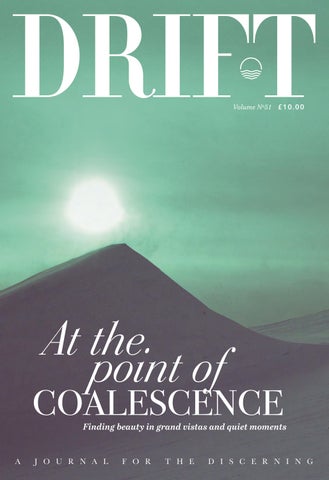
DRIFT--51

Page 1


Finding beauty in grand vistas and quiet moments

PRESENCE. ENHANCED SPECIFICATION.

Blending signature Porsche performance with refined design and everyday versatility, the Cayenne Black Edition delivers a fresh expression of the iconic SUV. Available in both V6 and E-Hybrid variants, the Black Edition features 21-inch Spyder Design wheels, a black-tinted Panoramic Roof System, and high-gloss black accents that demand attention. With more equipment as standard, the temptation is higher than ever.

A JOURNAL FOR THE DISCERNING

Drift /drift/ noun

1. the act of driving something along

2. the flow or the velocity of the current of a river or ocean stream

verb

1. to become driven or carried along, as by a current of water, wind, or air

2. to move or float smoothly and effortlessly

We invite you to continue your lifestyle voyage online. Find inspiring stories and uncover more luxury content on Instagram @driftcornwall. Join our exclusive e-journal community at drift-cornwall.co.uk to receive recipes, reviews and insider knowledge of some of Cornwall’s most-loved luxury destinations.

driftjournal.co.uk

driftjournaluk

A JOURNAL FOR THE DISCERNING

On the cover

Sunshine Village, Canada captured by photographer David Wren, from page 14. davidwren.co.uk

Head of Client Management

Des Glover – 07535 585613

des.glover@levenmediagroup.co.uk

Partnership Executive

Elly Burnard – 01326 574842 elly.burnard@levenmediagroup.co.uk

CEO

Ben Pratchett – 01326 574842

ben.pratchett@levenmediagroup.co.uk

Chairman & Founder

Andy Forster – 07711 160590 andy.forster@levenmediagroup.co.uk

PROUD TO BE PART OF

DRIFT is published by:

Engine House Media LTD

Holbrook, The Moors, Porthleven, Cornwall TR13 9JX

www.enginehousemedia.co.uk

www.levenmediagroup.co.uk

ISSN 2632-9891

© All rights reserved. Material may not be re-produced without the permission of Engine House Media Ltd. While DRIFT will take every care to help readers with reports on properties and features, neither Engine House Media Ltd nor its contributors can accept any liability for reader dissatisfaction arising from editorial features, editorial or advertising featured in these pages. Engine House Media Ltd strongly advises viewing any property prior to purchasing or considerations over any financial decisions. Engine House Media reserves the right to accept or reject any article or material supplied for publication or to edit such material prior to publication. Engine House Media Ltd cannot take responsibility for loss or damage of supplied materials. The opinions expressed or advice given in the publication are the views of the individual authors and do not necessarily represent the views or policies of

Editor

Hannah Tapping

hannah.tapping@levenmediagroup.co.uk

Creative Designers

Spencer Hawes

Jamie Crocker

Finance & HR Manager

Charlotte Forster

charlotte.forster@levenmediagroup.co.uk

Credit Control

Tracy Dart – 01326 574842

tracy.dart@levenmediagroup.co.uk

Engine House Media Ltd. It is suggested that further advice is taken over any actions resulting from reading any part of this magazine.

Engine House Media Ltd is a multi-platform media business with a passion for everything Cornish. Visit www.enginehousemedia. co.uk to find out more. Our mission is to create READ-WATCHEXPERIENCE media opportunities marrying together consumers with the fabulous businesses across Cornwall. Our publishing and marketing teams are specialists in creating print and online communications, devised to achieve a range of marketing objectives. With over 20 years of marketing, brand management and magazine experience we develop effective communications that deliver your message in a credible and creative way. We operate across all media channels, including: print, online and video.

TEAM

Foreword

Coalescence is felt all around us, particularly in the way humans and landscapes move toward harmony, even when their paths begin apart. It is a gradual drawing together of elements, the meeting point between instinct and intention, where human creativity softens into alignment with the natural world. Coalescence asks us to look closely at the subtle ways elements inform one another: how a shoreline shapes a sculptor’s hand, how a shifting season guides a grower’s decisions, how observation becomes collaboration. It is in these convergences that meaning gathers. David Wren’s photography (14) centres on human connection and storytelling, his camera opening doors to fascinating conversations and helping him to see the beauty the world has to offer. Artist Sonia Shomalzadeh (27) is also inspired by the outdoors, using the beach as her canvas. Her life-size sea creatures drawn intricately on the sand reflect something of a ritual, her creations becoming an

offering to the sea as the tide rolls in, removing all trace. From this place of coming together, we move toward circularity and its impact on sustainability. Stratum Marquetry (38) creates its own path recycling all manner of matter in a modern iteration of an ancient craft. Here, materials are used and valued for the journeys they take and the cycles they complete. Circular production has also become an ethical commitment for Mounts Bay Distillery (65), which is redefining Cornish spirit-making with a slower, more elemental approach. In these looping exchanges, craft becomes conversation and design becomes stewardship. With design in mind, Studio Far West (77) continues this narrative, creating beautifully crafted multi-layered and elegant interiors that capture not only the spirit of a place but also the story of its inhabitants. All such connections shape a more thoughtful and regenerative way of living, which we invite you to experience over the coming pages.

Our contributors

We have an exceptional and loyal team here at Leven Media Group but as a fast-growth business we’re always interested in talking to outstanding individuals. If you’re a superstar of extraordinary talent then we would love to hear from you.

Call us on 01326 574842 or email enquiries@enginehousemedia.co.uk Visit driftjournal.co.uk to read more about our writers.

Providing life changing opportunities for young people across the UK www.diveprojectcornwall.co.uk

Hannah Tapping
Martin Holman
Mercedes Smith
Jamie Crocker

Eastholme, Trevone

This substantial four-bedroom detached residence has been totally remodelled, transformed, and extended, creating an architecturally striking home of contemporary elegance with cutting edge technology.

Eastholme occupies a prime village-centre location, offering generous, highspecification accommodation within effortless walking distance of the beach, dramatic cliffside walks, and an array of local amenities. Adjoining the main residence yet enjoying its own independent entrance, the annexe provides an exceptional one bedroom self-contained living space, ideal for guests, extended family or holiday let accommodation.

Set within thoughtfully designed south west facing grounds with creative landscaping, app-controlled outdoor lighting and an EV ready driveway, Eastholme features lowmaintenance cement board cladding, sleek aluminium windows and doors and a solar PV array, ensuring both durability and high thermal efficiency achieving an EPC rating of B.

£1,395,000 GUIDE 01841 532555 sales@jackie-stanley.co.uk Jackie-stanley.co.uk

1 North Quay | Padstow | Cornwall | PL28 8AF

TREDENHAM VEAN

BEAUTIFULLY RESTORED 19TH-CENTURY COTTAGE IN CORNWALL WITH STUNNING ORANGERY, SELF-CONTAINED ANNEX, AND OVER TWO ACRES OF IDYLLIC RIVERSIDE GARDENS.

PLOT 6, MYLOR WOODLANDS

A BEAUTIFULLY DESIGNED BRANDNEW FOUR-BEDROOM DETACHED HOME WITH CLASSIC CORNISH EXTERNAL ARCHITECTURE AND CLASSIC COUNTRY INTERIOR DESIGN.

TREGIDDRIS FARM

A CHARMING GRADE II LISTED FARMHOUSE WITH FAR-REACHING RURAL VIEWS, A SEPARATE ANNEXE, WORKSHOP AND ARTIST’S STUDIO, SET WITHIN APPROXIMATELY 2 ACRES OF BEAUTIFUL GROUNDS.

AN EXQUISITE MODERN HOME SET WITHIN SERENE COUNTRYSIDE, OFFERING INSPIRING SPACES, SEAMLESS INDOOR-OUTDOOR LIVING, AND A LIFESTYLE DEFINED BY ELEGANCE, CALM, AND CORNISH BEAUTY.

AN EXCITING OPPORTUNITY TO RENOVATE A PROPERTY SET WITHIN A VERY GENEROUS PLOT, SITUATED IN THE HIGHLY SOUGHT AFTER LOCATION OF COVERACK’S FRONT LINE.

A THOUGHTFULLY DESIGNED 3 DOUBLE BEDROOM HOME PROVIDING GENEROUS LIVING SPACE IN A QUIET CORNISH HAMLET WITH EXCEPTIONAL FAR REACHING RURAL VIEWS.

A STRIKING CONTEMPORARY HOME WHERE LIGHT, SPACE, AND THOUGHTFUL DESIGN COME TOGETHER FOR EXCEPTIONAL FAMILY LIVING IN THE HEART OF TRURO.

ELEGANT VILLAGE LIVING IN A CONVERTED HISTORIC CHAPEL WITH STYLE, SPACE, AND CHARACTER.

It is something David Wren, a photographer and filmmaker based in Cornwall, has been doing all his life

Art inspired by the natural environment comes to Cornish shores

Transforming reclaimed materials into customisable luxury surfaces for contemporary interiors

Award-winning chef, Paul Welburn selects three recipes that showcase his artistry

An interior design studio where architecture

The new Aya Collection from Michael Spiers is at once beautiful, colourful and divine 77 THE SPIRIT OF PLACE

Pushing the design narrative to create interiors that speak of soul and spaces 87 G RAND SERENITY

Escape the everyday and experience the magic of an enchanted place on the hill

F INDING SANCTUARY

Sophie Velzian’s My Helford Sketchbook feels both deeply personal and celebratory of place

105 O BJECTS OF DESIRE

Introducing Whitewater Contemporary’s Winter Sculpture Collections 112 T IME TO REFLECT

One of the UK’s few wood-fired distilleries, Mounts Bay Distillery is redefining Cornish spirit making

A look back over a year in luxury horology from Patek Philippe 117 T AKING INSPIRATION

How Cornwall’s landscape is shaping a new generation of literature

EPICURE

We’re absolutely thrilled to have won the DRIFT Journal Epicure award. ChefCulture has always been about celebrating the people and stories behind incredible food and championing our suppliers and what they do. This award means so much to our whole team and really shows that our focus on the quality of every step from booking an event, through to the delivery of excellent food and service is really worth it.

CREATE

We would like to thank DRIFT Journal for recognising our mission, and to everyone who has supported our efforts!

ChefCulture chefculture.uk

ABODE

To be recognised by a journal that so beautifully reflects and elevates creativity, culture and craftsmanship in the South West and beyond, all the way into London’s vibrant scene is deeply meaningful. DRIFT has always stood for more than just aesthetics. It champions stories that matter, honours visionaries who move with intention, and captures the soul of the creative industries with grace and authenticity. This award feels like a beautiful alignment. To be part of this year’s celebration among such inspiring talents is a moment I won’t forget. Thank you to the DRIFT team and everyone who continues to support this journey.

Sophie Capron sophiecapron.co.uk

We’re absolutely delighted to have won the DRIFT Journal Abode award – it truly is an honour to be recognised for the hard work and commitment that goes into everything we do at Now Kitchens. It was a beautiful evening with a wonderful atmosphere created by so many talented local businesses.

We’re so grateful for the recognition and for such an inspiring, thoughtfully curated evening.

Now Kitchens now-kitchens.co.uk

RETREAT

SUSTAIN

I still can’t quite believe I was nominated for two awards at the very first Cornwall Living and DRIFT Journal Awards, let alone actually winning the DRIFT Journal Sustain award. What made the evening so powerful for me was the sense of shared vision in the room. It wasn’t just about collecting trophies, it was about bringing together people and businesses who care deeply about impact, creativity and the future of our region. I’m excited to keep redefining and challenging what luxury means in a conscious world, through authenticity, sustainability and feeling, and I’m proud to have been there from the beginning.

Stevie McCrindle seamoorcornwall.co.uk

INSPIRE

We’re incredibly proud to have been recognised by DRIFT Journal, winning in the Retreat category. This award is a testament to the dedication of our family and team, and to the wonderful guests who return to Wooda year after year.

The ceremony was a fantastic celebration of Cornish excellence. Being surrounded by so many inspiring businesses made the achievement feel even more special.

Wooda wooda.co.uk

What can I say… it was a huge honour to receive the DRIFT Journal Inspiration award and to be shortlisted for the Cornwall Living Activities and Adventures award as well. Thank you so much for such a fabulous evening. It was wonderful to see so many Cornish businesses represented, some of whom we are connected with from a funding perspective, which makes winning such an award feel even more special and appreciated. A fantastic night – thank you again and congratulations to everyone involved in organising such a brilliant event!

Children’s Sailing Trust childrenssailingtrust.org.uk

Only CONNECT

WORDS BY JAMIE CROCKER
DIt is something David Wren, a photographer and filmmaker based in Cornwall, has been doing all his life.

avid Wren’s photography has always centred around authentic human connection and storytelling. Whether it’s personal projects or commissions for household names, his camera has long been an open door to fascinating conversations with brilliant people, in all sorts of places. The stories he’s heard from the amazing people he’s met over the years could fill a book, and it’s those stories and the people telling them that sustain his love for the craft. It’s the reason he takes a camera with him everywhere: “You never know who you might meet and what kind of images are waiting just around the corner.”

He's had a lot of hobbies and passions over the years, something many of us can relate to. He’s been drumming for 20 years, skateboarding for even longer and has enjoyed a whole plethora of other outdoor pursuits along the way. These passions have afforded him access to some incredible subcultures, bringing the camera along for the ride to document athleticism, artistry, dedication and real human emotion along the way. It’s that same level of care, energy and intention that he brings to all of his

commissioned work. He’s photographed cycling races through the Alps on the back of a motorbike, skied down glaciers with a camera in hand, shot multiple commissions in the studio and on location all over the UK and Europe, yet still finds just as much excitement and freedom of expression when taking pictures at the beach with his mates: “It’s a well-worn cliché, but the camera really feels like an extension of me and it’s how I interact with the world around me. Seeing something beautiful, lifting the camera to my eye, focus, click. It’s second nature and it’s magical.”

He also sees photography as a way to connect more deeply with his Christian faith. It helps him to see the beauty the world has to offer in both the grand vistas and quiet moments, capturing and remembering those scenes with a photograph just feels natural. It also gives him a sense of purpose, being able to use creative skills to help build people up and create meaningful work. “Photography is far more than just a hobby or a job; it’s my vocation, my contribution and my calling.”

davidwren.co

ABOVE
Torben Traaseth, Baleal, Portugal
TOP
Justin Brisson, Sunshine Village, Canada
Col du Galibier
TOP Sariel and Kirk, Skate Life Project ABOVE Adam, Skate Life Project
ABOVE
Chris Pulman, Portsmouth
ABOVE
Jack Corpes, Surrey Hills
TOP
Jess Clark, Emosson Dam, Switzerland
ABOVE
Ida Magnusson, La Vallée Blanche, Chamonix
TOP Lifeguards, Harlyn Bay
ABOVE
Henry Crew, Record Breaking Motorcycle Adventurer

Enjoyment through innovation. LUXURY Bespoke

Galeon Yachts is a family-owned manufacturer of luxury yachts founded in 1982. With Tony Castro as principal designer and with vessels built across two impressive production facilities, they all feature cutting-edge design.

Through the GTO, Flybridge, Hardtop and Skydeck ranges, Galeon Yachts keeps four unique selling points at its core. Innovation is embodied by thoughtful design that enhances every moment onboard. Think unique beach modes that expand the living space, drop-down balconies and sliding doors that connect you to the sea and flexible seating, sun beds and electric flybridge covers to make life aboard effortless.

In order to achieve a truly individual vessel, Galeon Yachts are eminently customisable, with multiple furniture finishes and fabric options and premium galley, bathroom and paint selections. Beyond the aesthetics, the craftsmanship is enviable. The company boasts over 1,400 skilled craftsmen and 40 years of expertise, which, combined with rigorous quality assurance and world-class production in Gdansk, Poland, maintain the highest quality standards. In partnership with Argo Yachting, which offers exceptional support across the UK, Germany, Portugal and the Balearics, owners can be assured of independent inspections and sea trials as well as a full handover, servicing, parts and retrofit solutions. And with five years of servicing and warranty on every new Galeon Yacht purchased through Argo Yachting buyers can enjoy complete confidence.

sales@argogaleon.com argoyachting.com

FEATURED YACHT

Galeon 620 FLY

An offering THE SEA to

RArt inspired by the natural environment comes to Cornish shores.

aised on the coast, Sonia Shomalzadeh spends as much time as possible outdoors in nature. “The sea is in my blood. My whole family shares a deep love of the ocean. I was born on the south coast and spent my childhood camping in Dorset. My dad said I wanted to be in the water all the time and my mum grew up swimming in Mauritius, so now we go in the sea together whenever we can,” explains Sonia. Moving to Cornwall to study, inspired her passion for marine life: “I’ve always been aware of plastic pollution, then I read a shocking statistic saying there are 46,000 pieces of plastic in every square mile of the ocean. That’s why it’s so important to me to raise awareness of the human impact on wildlife. I use research to highlight the beauty of vulnerable species so that more people are drawn to supporting them.”

tail at ground level, but I don’t really know how it looks until I climb the cliff above it for a better view. I focus on the curves: it’s very intuitive.”

Using the beach as a canvas allows Sonia to create work on a vast scale: “I wanted to create art resembling the most threatened marine species, showing their beauty and vulnerability, so I chose the animals most endangered by the human impact of pollution in our waters.” To create a lifesized blue whale, Sonia paces the 30-metre length in the sand to mark out the size and then works abstractly with her hands and feet. “I can roughly see the proportions of a

During her residency at Watergate Bay Hotel earlier this year, Sonia found some much-needed focus time. By immersing herself in the environment, Sonia was able to take creative inspiration from watching the waves and tides. Sketching out her work on paper and canvas, she would then transfer the drawings on to the sand at low tide. “I love the marks I can create in the sand and the freedom I get from art that leaves no trace; it feels like a ritual, an offering to the sea. Although, there can be a mix of emotions when I see my drawings wash away. Sometimes drawing these pieces gives me a deep sense of sadness, because I know many marine species are literally disappearing and that is part of the message I’m trying to convey.

Sonia’s work has wildlife conservation at its heart: “Art has the ability to connect with people and create a lasting impact, which can lead to powerful change. Our habits need to change so we can live more sustainably and in harmony with our natural environment.”

soniashomalzadeh.art watergatebay.co.uk

© Tim
Laing
© Tim Laing
© Tom Skinner
©
Tim
Laing

info@thirtystories.co.uk www.thirtystories.co.uk

© Tim Laing
© Tom Skinner
© Tom Skinner
© Tom Skinner

BeyondCABINETRY just

Transforming reclaimed materials into customisable luxury surfaces for contemporary interiors – Stratum Marquetry creates its own path.

Dan and Ravi have spent the past few years perfecting something most people associate with Victorian sewing boxes and National Trust properties. Marquetry, that delicate art of inlaid wood veneer, has been reimagined by this Cornwall-based duo into a robust, contemporary surface treatment that bears little resemblance to its historical predecessor. Where traditional marquetry involves painstakingly glueing hundreds of individual pieces of fragile veneer to form decorative patterns or designs, Stratum Marquetry has developed a process that produces something far more durable and infinitely more versatile.

The difference lies in their approach. Rather than working with thin veneers vulnerable to scratching and wear, they create deep composite surfaces where materials are bonded throughout the structure. The result is a surface that can withstand daily use in flooring, worktops, and hightraffic commercial environments whilst maintaining its visual impact.

PREVIOUS

Art work surface detail. Various timbers, plastics, resin board, flooring lino and CDs

Their recent commission for the Royal Albert Memorial Museum in Exeter demonstrates how this modern iteration of an ancient craft can integrate into contemporary spaces. The museum required welcome units and a mobile fundraising pod, and shortlisted three businesses through the Craft Council. When asked why they should be chosen over competitors with more extensive institutional portfolios, Dan’s response was straightforward: they had something unique to offer. The museum’s technical team was particularly interested in sustainability, so Stratum Marquetry proposed incorporating materials from the museum’s own stores – oak and mahogany from decommissioned exhibition units, clear acrylic from temporary Covidera installations – into the marquetry patterns themselves.

This approach to material sourcing defines their practice. Every piece of marquetry is made from reclaimed or recycled materials In one of the corners of their workshop,

INSET

Bespoke kitchen with marquetry door and draw pulls, and dining table with a full overlay marquetry pattern

triangular offcuts of birch plywood, from a local workshop that supplies local stores, scraps with no commercial value to the original manufacturer, lay ready for repurposing. “That pile up there represents a behaviour change around material value,” says Ravi, gesturing to stacks of triangular offcuts awaiting transformation. It’s a pointed observation about an industry where waste has long been accepted as inevitable.

Whilst they acknowledge that mixing different materials creates a product that cannot be conventionally recycled, they operate a take-back scheme. Any surface that becomes damaged or unwanted can be returned, reprocessed into smaller fragments, and cast into new composite panels. “Put it in the post and you can be rest assured it’s saved. It might be saved for a long time before it turns into something else, but it’s not in the bin.”

The technical process remains closely guarded, but its advantages are evident. Where traditional marquetry requires clamping procedures, their method produces a surface in which each element is bonded throughout its depth before assembly. Different materials within the same surface, some harder than oak, some softer, create a composite that distributes strength rather than concentrating it in certain areas.

Helen, the project manager at the Royal Albert Memorial Museum, raised questions about durability during their initial Zoom interview. Dan reassured her by explaining that the same surface specification is used in their flooring. The finish applied to any piece is suitable for its environment – a hard barrier for high-use areas, with carefully considered edge treatments; nothing is left unprotected. When she revisited the point during an on-site visit, he emphasised that, unlike veneer marquetry, where delicacy

is inherent, their work is embedded deeply within the structure. The museum’s benches and reception areas would endure no more stress than a domestic kitchen worktop and considerably less than a commercial floor.

Pattern possibilities are genuinely limitless. Working with a brand’s colour palette or incorporating specific materials from a client’s own waste stream allows for personalisation that extends far beyond choosing between oak and walnut. One potential project involves a conference table for a sunglasses manufacturer, incorporating all the plastic offcuts generated during frame production. It’s precisely the kind of commission that appeals to them, a functional piece of furniture that tells a material story whilst serving a practical purpose.

Their website now frames the business not as furniture makers who do marquetry, but as specialists in modern marquetry who are also master furniture builders. The distinction matters. Someone searching for a bespoke kitchen will find hundreds of capable makers. Someone searching for a way to incorporate reclaimed materials into a customised surface treatment will find considerably fewer options, if any. “This is where we come in,” says Ravi. “We’re not closing the loop in the traditional sense, but we are creating a loop that keeps material in use.”

The shift towards commercial and institutional clients represents a deliberate strategy. Private residential work continues, but projects like the Royal Albert Memorial Museum offer visibility that domestic kitchens cannot match. Two hundred thousand visitors annually will encounter those welcome units, each one featuring marquetry made from the museum’s own decommissioned materials. The form will

ABOVE

Bespoke table with a hexagonal cascade pattern

Flooring with various patterns

TOP LEFT
Bespoke lamp with marquetry detail within interior and exterior faces
TOP RIGHT

ABOVE LEFT

Bespoke bench – sapele top with a hexagonal cascade pattern

TOP

Fully customisable herringbone flooring with signature marquetry patterns

ABOVE RIGHT

Bespoke kitchen with marquetry dispersed throughout

be functional rather than ostentatious. Dan envisions a corner accent, as though someone has spilt paint down one side, with a small plaque explaining the material provenance and process. It provides personality without overwhelming the furniture’s primary purpose.

For those seeking something considered, something that makes a statement about craft and environmental responsibility, Stratum Marquetry offers an approach that the more commercial furniture makers cannot replicate. The market for this level of customisation exists among people who recognise that the objects in their homes and workplaces can embody values as well as function. The Royal Albert Memorial Museum project will be particularly valuable as a case study in institutional collaboration, showing how a cultural organisation can integrate sustainability into its physical infrastructure whilst supporting regional craft businesses. It’s the kind of work that generates further opportunities through visibility alone.

The surfaces they produce occupy an unusual position in the contemporary design landscape. Too robust to be dismissed as decorative, too distinctive to be merely functional, they represent a synthesis of environmental responsibility and visual impact that conventional furniture making struggles to achieve. Someone purchasing engineered oak flooring through Stratum Marquetry receives the same technical product they would from any supplier, installed in the same manner, finished to the same standard. But that floor contains an element of personalisation and material rescue that transforms it from a specification choice into something with genuine narrative value. The narrative matters increasingly to both private clients and commercial organisations. Being able

to say that a conference table incorporates waste from the company’s own production line, or that a museum’s visitor facilities use materials from its own stores, adds meaning that extends beyond the object’s immediate function.

Years of development have given Dan and Ravi confidence in their process. They have never seen a piece blow itself apart through expansion and contraction, never had material delaminate under normal use. The technical challenges have been resolved through iteration and observation rather than theoretical calculation. “It’s very much a doing process,” says Ravi. They keep a logbook documenting research and development, partly for practical reference, partly to track their progression from experimental beginnings to established technique.

What emerges from conversation with them is not evangelism about sustainability or craft, but practical consideration of how materials move through economic systems and where intervention creates value. They have identified a gap between waste generation and waste disposal, and positioned themselves to capture materials at that point. Their marquetry combines beauty and purpose, achieving the perfect balance, especially when its environmental credentials are considered.

The process scales from accent details on furniture to entire floors without compromising either durability or customisation. That versatility, combined with their commitment to material rescue and their mastery of a technique, positions them as specialists in a category they are actively defining.

stratummarquetry.co.uk

Flavours OF FERN

Award-winning chef, Paul Welburn selects three recipes that showcase his culinary artistry as he takes the reins at a new restaurant in Nanstallon.

WORDS

SERVES: 4

INGREDIENTS:

100g of chicken thigh

500ml of chicken stock

Vegetable oil, for frying

For the Bechamel:

10g of unsalted butter

50g of plain flour

25g of Parmesan

15g of anchovies, chopped

1 garlic clove, crushed

10g of parsley, chopped

Salt

METHOD

Caesar salad croquettes

For the Caesar dressing:

1 egg, soft boiled

1 tbsp of white wine vinegar

1 ½ tbsp of Dijon mustard

1 anchovy

50ml of olive oil

75g of Parmesan, finely grated

Worcestershire sauce, to taste lemon juice

For the croquette filling, pour the chicken stock into a small saucepan and season with salt. Add the chicken thighs, bring to a simmer and poach for 12–14 minutes, until the chicken is just cooked. Leave to cool in the liquid. Once cool, remove the chicken and chop into small pieces. Reserve the stock for the béchamel.

Make a roux with the butter and flour, stirring all the time and gradually add the stock until a thick béchamel is achieved. Add the Parmesan, anchovies and garlic, then transfer to a blender and blitz until smooth. Fold through the parsley and chopped chicken and season to taste with salt. Transfer the mix to a tray and place in the fridge until set and firm. When the mixture is set, divide into 12 balls and retain in the fridge.

To make the Caesar dressing, blend the egg, vinegar and the mustard until smooth. Add the anchovy, then slowly add the olive oil in a steady stream while whisking, as if you were making a mayonnaise. Once emulsified add the finely grated Parmesan, Worcestershire sauce and adjust the consistency with a touch

To coat the Croquettes:

Plain flour

Eggs

Breadcrumbs

To plate:

200g romaine lettuce, leaves only

200g of spinach

Parmesan, shavings

Sea fennel (optional)

of warm water and lemon juice. The dressing should be a little loose.

Prepare three bowls for crumbing: one with flour, one with egg wash and one with breadcrumbs. Roll the croquettes through each bowl, ensuring that the croquettes are completely covered in the breadcrumbs. Store in a tray of breadcrumbs until needed.

Bring a large pan of lightly salted water to the boil and blanch the romaine lettuce and spinach for 2 minutes. Drain well and squeeze out any excess water before transferring to a blender. Blitz until smooth and pass through a fine sieve. Chill in a bowl over ice until needed.

Preheat the vegetable oil in a deep saucepan or deep fryer to 180°C. Once the oil is up to temperature, fry the croquettes for 2–3 minutes, until golden

To serve, swirl the lettuce purée around the bottom of the plate, add three croquettes per portion and a dot of Caesar dressing. Garnish with lettuce leaves, shaved Parmesan, sea fennel (optional) and anchovies.

BBQ picanha, celeriac, smoked leeks and salsa verde

SERVES: 4: 1 HOUR 15 MINUTES, PLUS 1 HOUR BRINING TIME

INGREDIENTS:

1Kg Picanha steak (or rump steak works just as well)

18 baby leaks to serve

For the Brine:

1 litre water

150g of salt

100ml of beer

2 sprigs of thyme

10g of smoked paprika

20g of peppercorns

5 garlic cloves

For the Salsa Verde:

Light olive oil, or rapeseed oil

50g of parsley

50g of mint

50g of basil

25g of capers

25g of cornichons

2 anchovy fillets

½ garlic clove, minced

½ tbsp of Dijon mustard

Salt

Lemon juice

For the Celariac purée:

200g of celeriac, peeled and diced

25g of butter

100ml of milk

100ml of double cream

For the Spice Rub:

10g of ground black pepper

20g of English mustard

10g of smoked salt

10g of smoked paprika

10g of sugar

For the Glaze:

100ml of beef stock, reduced to 50ml

250ml of porter

10ml of soy sauce

50g of malt extract

50g of yeast extract

For the Dressing:

100ml of olive oil

3g of salt

20g of shallots, brunoise

25ml of white wine vinegar

5g of Dijon mustard

5g of English mustard

½ tsp ground black pepper

METHOD

To begin, place the brine ingredients in a pan and heat until the salt has dissolved. Leave to cool. Meanwhile, finely chop and combine all the ingredients for the salsa verde in a blender, adding a glug of oil. Blitz to a loose dressing consistency, adding more oil if necessary. Season with lemon juice, salt and pepper and leave to sit for two hours before serving

Once the brine has cooled, add the beef, ensuring it is fully submerged. For the beef, I use picanha steak, also known as the rump cap, but a rump steak works in the same way. Leave to brine for an hour. To make the celeriac purée, add the butter to a pan and place over a medium heat. Add the celeriac and sweat gently in the butter. Before it starts to colour, cover with the milk and cream and simmer until tender. Drain the celeriac, reserving the cooking liquid, and then blend until smooth, adding a splash of the cooking liquid if needed to form a smooth purée. Season with salt to taste.

Remove the beef from the brine and rinse under cold water. Pat dry with kitchen paper and cut into 3cm thick slices. Preheat a barbecue or chargrill pan until very hot. Combine the rub ingredients in a bowl and rub over each steak as a seasoning. Drizzle over a little oil, rubbing it into the meat to mingle with the spice rub. Once the barbecue

or griddle pan is smoking hot, add the picanha steaks and colour on both sides. Meanwhile, heat all the ingredients for the glaze in a pan, stirring until combined. Brush the steaks with the glaze as they cook, being careful not to let it burn.

Remove the roots from 18 baby leeks, wash well and place in a bowl. Char the leeks on the barbecue or griddle pan with the beef until blackened on the outside, then remove and allow to cool slightly. Remove the steaks from the heat once they reach 52°C when tested with a temperature probe and leave in a warm place to rest

Make the dressing by whisking the ingredients together in a bowl until emulsified. Drizzle over the leek roots and set aside.

Once cool enough to handle, peel and discard the outer blackened layer of the leeks. Warm the leeks in a butter-and-water emulsion (equal parts butter and water brought to the boil and seasoned) for few minutes. Once rested, the steaks should read 56-57°C on a temperature probe. Glaze once more, then carve into slices. Season with salt.

To serve, add a spoonful of celeriac purée to each plate. Place slices of beef on top, dress with the leeks and sprinkle over some puffed barley (optional). Spoon over the salsa verde and finish with the dressed leek roots.

Carrot trifle

SERVES: 6

INGREDIENTS:

For the Carrot Cake:

250g wholemeal flour

1 tsp bicarbonate of soda

½ tsp ground nutmeg

½ tsp salt

½ tsp ground ginger

2 tsp cinnamon

300g carrot, grated

350g soft brown sugar

3 eggs

55g crème fraîche

160g sunflower oil

For the Tonka Custard:

250g whole milk

250g cream

5g tonka beans, crushed (1 vanilla pod as an alternative)

75g caster sugar

125g egg yolk

1 x No2 cream whipper gas charger

For the Carrot Sorbet:

300ml carrot juice

50g glucose

50g caster sugar

2g agar agar

For the Candid Walnuts:

100g walnuts

100g water

100g caster sugar

Pinch of smoked Maldon sea salt

For the Grape Gel:

500 g red grapes (keep a few back to slice for garnish)

5g agar agar

Reserved red grapes, sliced into thin discs

METHOD

For the Carrot Cake:

Preheat the oven to 160°C. In a KitchenAid (or equivalent with a paddle attachment), cream the eggs and sugar until soft and pale. Add the oil and the crème fraîche and beat together. In a separate bowl, combine the remaining dry ingredients and grated carrot until all mixed and coated, then add to the creamed sugar mixture, using the paddle attachment to incorporate. Line a Le Creuset terrine mould (or similar sized loaf tin) with parchment paper and pour in the mix. Tap the tin to flatten. Bake for 40 minutes or until golden and the cake feels springy to the touch. You can also insert a skewer to check if it comes out clean. Remove from the oven and allow to stand for 10-15 minutes, then remove and allow to completely cool on a cooling rack. Place in the fridge for 2 hours to firm up, then cut into 2cm slices. Take a 60mm ring cutter and cut a ring from each piece. Store in an airtight container until required.

For the Custard:

In a medium sauce pan, bring the milk and cream to the boil then add the crushed tonka beans (vanilla pod cut and scraped if using instead). Remove from the heat, cover with cling film and allow to infuse overnight. After the mix is infused, pass the tonka beans using a fine sieve and place into a new sauce pan and add the sugar. Bring to a boil then, with a whisk, pour over the egg yolks. Turn the heat down and gently cook the custard until it reaches 80°C, stirring with a spatula all the time. Once the custard has reached 80°C and has visibly thickened, which can take 5–10 minutes, pour the custard into a bowl and cover with cling film. Press down over the cling film so it’s touching the surface to avoid a skin forming. Chill in the fridge for 1-2 hours or until fully cooled, then place the chilled

custard in a cream whipper canister and charge with the cream whipper gas charge. Shake well and store in the fridge until required.

For the Sorbet:

In a sauce pan, add all the ingredients and bring all to a boil to activate the agar agar. Place into an ice cream machine and churn before transferring to a container and leaving in the freezer until required.

For the Walnuts:

In a sauce pan add the water and sugar and bring to the boil. Add the walnuts and bring back to the boil. Reduce until sticky then remove from heat add the salt. Stir the mixture and as the caramel cools it will crystalise and coat the nuts. Once it has crystalised, turn onto a tray and allow to cool fully at room temperature, this may take an hour or so. Once cooled, chop roughly into a crumble.

For the Grape Gel:

Blend the red grapes in a liquidiser and pass through a fine sieve to extract the juice. Measure 400ml of the grape juice, place into a medium sauce pan, add the agar agar and bring to the boil to activate. Once boiled, pour the mixture into tray and allow to set in the fridge for an hour. Once set, chop up the set jelly, place into a liquidiser and blend to a smooth gel. Before serving, combine the sliced red grapes with the grape gel.

To Serve:

On a serving plate, add a disc of carrot cake. Top with a good spoon of the grapes in grape gel and pat down. Add a sprinkling of candied walnuts followed by a good scoop of carrot sorbet. Encase the dish with the aerated tonka custard and a dusting of carrot powder. Serve immediately.

The inside STORY

WORDS BY HANNAH TAPPING
TAn interior design studio where architecture leads and artistry follows. For Thirty Stories, every room begins with its own narrative.

he pairing behind Thirty Stories – Frankie Pritchard and Indie Robinson – has somewhat reimagined the South West’s interior design narrative, bringing an unpredictability that transcends functionality. “We feel that interiors shouldn’t feel boxed in by trends. We believe in design that allows properties to truly stand out in a competitive market,” they explain.

Thirty Stories’ approach is rooted in personality and character: “We love sourcing antiques and unique pieces that can either take centre stage with bold, eclectic flair or gently complement a contemporary, minimal aesthetic. Antiques shouldn’t be considered old-fashioned, rather an opportunity to introduce depth and texture into modern living spaces and to begin a conversation between old and new.”

Frankie and Indie’s work is not defined by a particular style, instead they blend genres – Mediterranean, industrial, Art Deco, rustic, eclectic – to create layered, nuanced interiors that feel alive and personal. Each timeless design takes its cues from the client’s brief and the period and personality of the house, resulting in spaces that are unmistakably Thirty Stories: in essence, never off-the-shelf.

Bespoke products by local makers and commissioned artwork, are central to the Thirty Stories ethos: “Every project we touch carries a sense of place and personality, whether it’s a sun-drenched Cornish retreat or a city apartment abroad. We’re set up to work wherever our clients are, bringing the same creativity and attention to detail to every corner of the country and beyond.” What results are designs that tell the story

Indie Robinson and Frankie Pritchard

of a home and those who dwell in it. These are always distinctive and considered and sometimes, completely unexpected. In conversation with Frankie and Indie, I was curious to learn more about the process behind the plot.

“Although it’s never too late to get us involved,” explains Frankie, “we would always advise bringing us on board as early as possible. If you’re thinking of phoning an architect, then you also need to be phoning us. We like to design cohesively, considering everything at once, in order to ensure a flow from inside to out. Especially if it’s a large project, it’s always good to involve us early on so we can work closely with the architect and the relevant trades to ensure no stone is left unturned before work gets underway.”

Frankie and Indie work with clients as closely or as independently as is required, but the common thread is that they always view the design as a whole. It’s this approach that minimises impact should things need altering and by delving into every detail, it removes a level of stress from the client. The duo’s expertise spans the full interior design gamut; specialist kitchen and bathroom designs, lighting design, internal and external layouts, technical specification, project management and finishes. “Think of every decision that needs to be made finishwise when building a house,” continues

Indie, “and that is what we do and how we will organise and plan. We are involved from start to finish in renovations and builds and heavily contribute to decision, making and management of each project. On our last project we were picking things as small as guttering colours!”

Project management, particularly in a renovation or build, is an often invisible yet essential process that goes on behind the scenes of any Thirty Stories project: “We pride ourselves on dealing with and juggling a host of things that the client never sees. In doing so, we remove all of the stress and unnecessary decision, making which saves on both time and money. True interior design should go hand in hand with project management in order to create something truly special and exclusive.”

While being detailoriented, Frankie and Indie also like to think of themselves as disruptors, unafraid to challenge the traditional interior design landscape and bold enough to break a design ‘rule’ or two. “Asymmetry and imperfection, clashing fabrics, clashing colours, mixing metals, acquiring something unusual and using it within the design… all of these approaches actually create balance, steering away from a design that feels too contrived,” adds Frankie. “We quite often have a gut feeling about a design or room; even when shopping for bespoke pieces, we get a feel

INSET

Antique finds add intriguing layers of detail

for what will look good in each project and space. Antiques and commissioned pieces can take projects to different and unexpected outcomes. We love the creative process of finding these items and have learned that not everything has to be certain or planned from the beginning.”

For Thirty Stories, each property is individual in terms of inspiration and the feeling they get from it to begin with. The same goes for client inspiration, meaning every project has a different starting point which leads the pair on different paths every time. “We never replicate designs, although our work process is tried and tested, resulting in homes that feel layered, interesting, homely, lived in and unique.“

And in terms of a renaissance in interior design, what does the future hold for Thirty

Stories? “As much as we love a contemporary build, and minimalist style definitely has its place, we believe that craftsmanship and intricate detailing within the bones of the building should be brought back into modern architecture and building; much as it was during the Arts and Crafts movement, which aimed to restore the value of craftsmanship and revive traditional skills in the modern era. We can definitely already see a shift in this direction, but would love to see more.”

A Thirty Stories project will always stand the test of time. Simply put, this is a studio where designs are done well, intended to last long beyond fashions and fads that inevitably date and fade. A Thirty Stories home is designed as just that – a home. And, as the saying goes… that is where the heart is.

thirtystories.co.uk

COMMAND Coastal

Elegant period home with sweeping sea views above Porthcothan Bay.

Enjoying a prime clifftop position above the golden sands of Porthcothan Bay, Pilots is a distinguished coastal residence offering uninterrupted ocean views and direct access to the South West Coast Path. This elegant detached property, set within approximately 0.35 acres, combines period character with light-filled, generously proportioned living spaces designed to frame the sea beyond. The main rooms, including the living room, study and conservatory, capture the ever-changing light across the bay, while five bedrooms provide flexible accommodation for family and guests.

Mature gardens and terraces extend towards the water, creating inviting areas for outdoor dining and relaxation. With two detached garages, ample parking and proximity to Padstow’s celebrated restaurants, Pilots presents an uncommon opportunity to own a coastal home of enduring appeal in one of Cornwall’s most desirable settings.

PILOTS

Guide price: £2.75M

JACKIE STANLEY 01841 532555

sales@jackie-stanley.co.uk

jackie-stanley.co.uk

PLACE Period

Elegant riverside home near Cornwall’s north coast beaches.

Mill Cottage in Menadarva combines 19th-century character with modern refinement. Once two miners’ cottages, it now forms a four-bedroom home set within over two acres of private riverside gardens along the Red River. The property includes a selfcontained annexe and a striking David Salisbury orangery completed in 2023. Italian marble floors with underfloor heating flow through the kitchen and orangery, while beamed ceilings and log burners add warmth to the reception rooms.

Outside, landscaped grounds feature a leat, woodland walks, and meadows bordered by farmland, creating an enviable sense of seclusion. A triple garage with an EV charging point and a south-facing deck complete the picture. Close to the South West Coast Path and the beaches of Godrevy and Gwithian, Mill Cottage offers an exceptional opportunity to own a thoughtfully restored Cornish home in a beautiful, private setting.

MILL COTTAGE Guide price: £1.2M

JACKSON-STOPS 01872 261160

cornwall@jackson-stops.co.uk

jackson-stops.co.uk

LiftingSPIRITS the

WORDS BY HANNAH TAPPING

One of the UK’s few wood-fired distilleries, Mounts Bay Distillery is redefining Cornish spirit making with a slower, more elemental approach.

The first thing you notice at Mounts Bay Distillery is the smell. It rolls out of the doorway before you even see the stills. A warm mixture of wood smoke, juniper, molasses, mingled with the salt on the sea air. Something elemental is happening here, something deliberate, something that refuses to be hurried.

There’s been an expansion since I first visited the distillery two years ago, with new, larger wood-fired copper stills finding home in a converted shipping container. They sit like sculptures, tall vessels with curved chests and long necks, linked by pipework and a soot-darkened hearth. Mounts Bay Distillery is one of only a few in the UK to run woodfired stills and owners Lisa and Ben talk with a quiet unboastful pride. For them, wood firing was a decision based on both flavour and practicality.

“It makes a better product when you wood fire,” explains Ben. “Cooking with flames gives a Maillard reaction. It’s this reaction that makes bread taste toasty and coffee taste dark and robust. It is not a scorched taste, but more a fuller flavour. When you use a wood fire to make rum, you get those same lovely caramel tones and chocolatey smells.”

“In practical terms,” Ben continues, “wood was the natural choice. We use offcuts from local tree surgeons. It’s not the kind of wood you burn in a wood burner, but it works perfectly for this.” The environmental logic is also simple; using wood is considered carbon neutral. Burning wood releases what the tree took in while it lived, so while it’s not negative, it is neutral. Behind the stills, there is a water system, planned as with all things here, with intention.

INSET

Lisa and Ben

Craftmongers

QUENCH

A tank catches rainwater, a pump moves hot water from the condenser to a holding tank, then into the fermenter. “We try not to waste anything and rainwater actually makes a better rum as it contains less chlorine and fewer chemicals,” adds Ben.

As we step up into the container, Ben lifts the lid on an open fermenter. The surface twitches and bubbles as if alive. “Rum wash is an open ferment; it just bubbles away and, once ready, we pump it to the big still.”

A heady smell from another still hangs in the air; this time it’s juniper and coriander: “These kind of robust spices can steep for longer, but I need to pick a kilo of samphire later to add in to this ready for distilling tomorrow. The samphire is lighter so is added last minute. Some distillers vapour-infuse, but we prefer to drop it into the actual still with the other flavours for a more full-bodied taste.”

high-proof alcohol initially holds essential oils from botanicals; however, when diluted with water, these oils become insoluble and form a micro-emulsion, resulting in the cloudy appearance. Louching is a positive indicator of a spirit’s high botanical content.

We head into the bottling area where Ben dips a glass into a fresh vat of white rum. “This is from Friday,” he says. It’s bright and sharp, with aromas of sugar and heat. Before the ageing process begins, the rum is put ‘on chips’ for a month; meaning it’s basically steeped with a giant woodchip tea bag. “We always try to make our processes circular and so Jack’s Kombucha takes the chips once soaked to make spiced rum kombucha, as does Shoals Brewery, for their Christmas porter!”

“I’ll start a batch of gin on a Friday and leave it until Tuesday. The liquid will look muddy at first, but once we run it through the still it will clear during the distillation process and then it’s left to stand for a month. As we use a lot of botanicals you can get some louching but we don’t mind that; it’s an indicator of a high botanic content, which improves flavour and balance.” For the uninitiated, louching is the phenomenon where a clear spirit such as gin turns cloudy, opaque or milky when water or a mixer is added. This occurs because the

He holds up another glass, this one deeper in colour than the first, tapped from a row of oak casks. “This rum has been in the cask for a year and is currently sitting at 64% proof. There’s no additional flavour added, it all comes from the fermentation process.” I learn that rum ageing is complex, involving extraction of compounds from the barrel wood, oxidation from air ingress and the formation of new flavour molecules (esters) through chemical reactions. Lactic acid bacteria (LAB) produce acids, including lactic acid, during the fermentation phase, often in a spontaneous or wild fermentation environment. These acids then react with

QUENCH

the alcohol to form esters, during the distillation or the initial rest period. “All this mixes with the alcohol and brings out some really cool flavours,” adds Ben.

The casks themselves have a history of their own, being ex-whisky casks from a Speyside cooperage. “Their first use is for bourbon, the second for whisky, and then our rum is the third. As well as adding flavour from the wood, the barrels are also subtractive and so allow the spirit to breathe, meaning the bad flavours leave allowing the good ones to develop. You get banana, then chocolate, then the molasses comes through as the maturation process continues. The longer you leave it the better,” explains Ben. Unafraid to experiment with flavours, he next introduces me to a special batch made for nearby Stones Reef bar and restaurant. Currently sitting at 41% proof this honeycomb and Cornish sea-salt vodka is dangerously delicious.

labelling to distilling. There’s also a small, but gloriously charming, bottle shop open to customers every Friday, stocked with a full selection of spirits to sample alongside personally curated, elegant glassware.

For such carefully crafted spirits, only the most beautiful bottles will do. Illustrator Jago Silver’s design adorns the Keynvor bottles, a honey spiced rum balanced with salty seaweed umami tones. Ebba gin, which gets its crisp citrus notes from Cornish seaberries, sea aster and locally foraged samphire comes in an exquisite ceramic bottle, designed especially for Mounts Bay Distillery. Rum Dhu now comes in Gold, Black Spiced and Pure White form and the accompanying tasting notes read like pirate tales from days gone by. Fitting that a spirit with a seafaring history should be distilled on the coast.

With the two new stills, production at the distillery is better able to keep up with demand. “For the same amount of rum, it used to take four days, now it takes one. And not only does it save time, the spirit tastes better.” There’s also been growth elsewhere in the company this year, with new team member, Chris, heading up sales and marketing and Simon helping on Fridays with everything from bottling and

I love it here, not least because Lisa and Ben’s passion is so infectious. While it’s a working distillery, a space filled with heat and steam, it also holds stories that cling to the rafters like smoke. The spirits made here carry the imprint of the place; wood, sea air, craft, human hands that do not rush and, as the fires under the stills keep burning, so spirits lift.

mountsbaydistillery.com

KALEIDOSCOPECapturing the

The new Aya Collection from Michael Spiers is at once beautiful, colourful and divine. Showcasing six gemstones that inspire a fresh take on vintage design, these pieces are designed for mixing, styling and layering. Fuse playfulness with bold, striking gemstones and wear them with pride.

michaelspiers.co.uk

BIJOUX

AYA 18CT YELLOW GOLD WHITE QUARTZ RING – £1,250
AYA 18CT YELLOW GOLD SKY BLUE TOPAZ PENDANT – £1,195
AYA 18CT YELLOW GOLD GREEN AMETHYST EARRINGS – £1,395
AYA 18CT YELLOW GOLD CITRINE PENDANT – £1,195
AYA 18CT YELLOW GOLD AMETHYST EARRINGS – £1,395
AYA 18CT YELLOW GOLD GARNET RING – £1,250

THE SURGE OF HER ENERGY by Sophie Velzian Studio: Yesnaby, The Fairway, Mawnan Smith, Cornwall TR11 SLR 07791 618065 | sophie.velzian@hotmail.com | sophievelzian | www.sophie.velzian.co.uk Studio visits by appointment

The spirit OF A PLACE

WORDS BY HANNAH TAPPING
APushing the design narrative to create interiors that speak of soul and spaces.

mutual passion for the everchanging surrounding natural landscape of the UK’s westernmost county saw Jennie Trethewy and Hollie Milne found Studio Far West. Jennie established her career in London, working for United Designers and Fox Linton Associates. During this time, she designed for exclusive hotel groups including The Waldorf Hilton, Aldwych, The Caledonian Hotel, Edinburgh and the Dorchester Collection’s Coworth Park Spa. Hollie began her design career working on project management and interior design for the family construction company, delivering high-end residential developments as well as full refurbishments, establishing a valuable network of local skilled trades and crafts. Their combined skills and talent have seen them work across various sectors including private residences, hospitality, commercial and residential developments delivering bespoke interior design and architecture packages.

discover how their backgrounds translate to the designs they deliver today.

Your work is known for its bespoke character. Could you walk me through how a project typically begins and how you translate a client’s needs and a building’s personality into a coherent design narrative?

In conversation with Jennie and Hollie, I was eager to discuss their approach and

We begin each project with a complimentary face-to-face meeting with the client on site, which allows us to gain insight into the scope of work and garner initial thoughts and ideas from the client. The ability to collaborate on each project, elevating and challenging the brief to strike the right balance between function, form and style is what makes our partnership so successful. Working together, we build an in-depth design brief that reflects the client’s personality and lifestyle resulting in the creation of beautifully crafted multi-layered elegant interiors. For us, designing interiors is telling the story of a person and place. INSET

Hollie Milne (left) and Jennie Trethewy (right)

ABOVE Taking a detailed approach

ABOVE Colour is a common thread

Process appears central to your practice. Can you describe how this evolves from concept to completion and how you ensure every detail reflects a sense of place?

Each project is unique, but a common starting ground would be its genius loci Translated from the Latin, it means the “spirit of a place” and is often where we start the conceptual design. It refers to the unique atmosphere, character, or emotional quality that a specific location naturally possesses. Whether the narrative is one of location, or the heritage of a building, picking up on these cues or features and turning them into a readable interior is always key within our spaces, ensuring they feel harmonious and connected to their surroundings. Concept for us starts with the big idea which is then skilfully curated into hard finishes, FF&E (furniture, fixtures and equipment), all technically drawn for contractors in an installable interior design package. This process may take weeks and months of selections, meetings and amendments to get to the perfect finished outcome.

How would you describe the aesthetic values that underpin Studio Far West’s identity?

The most common thread through all our projects is colour; we use this in a multidimensional way, often creating bespoke palettes for each room. Location also plays a large part. We see a lot of the Cornish coastal cliché rolled out with interior design in the South West and it is true that some clients want this, but we believe that as designers we

should be challenging ourselves to come up with unexpected points of reference within our designs. So, when referencing location whether geographically or culturally we really try to push each project to realise its unique identity and full potential so that it stands alone as a one-off piece of work.

How do your creative partnerships shape the outcome of your projects?

We are extremely proud of our directory of makers and artists and the working relationships we have cultivated throughout the years. Supporting the Cornish economy and talent is part of our company ethos and we delight in bringing one-off pieces to our interiors for a truly unique design. Works of art, such as paintings and sculptures, can often inspire the colour palettes and design concepts used in interior spaces.

Many of your projects involve working within the fabric of listed or heritage buildings. What draws you to these kinds of spaces and what are the key challenges and opportunities they present?

Maximising the renovation of listed buildings as an interior designer is all about striking a balance between preserving heritage with modern functionality. The first step is to understand the heritage framework of the building. We research the building’s grade and listing details, identifying significant architectural features that must be preserved. In our

The 440 Fly. A dynamic silhouette with sporty accents. Discover versatility at everycorner. Sink intothe comfort of a 6-seater wraparound sofa. Host from the wet bar and stern-facing grill. Create transformative outside spaces for sunbathing, diving and fishing. This is truly aflybridge overflowing withinnovation.

Nowavailablewith5 yearwarranty and5years servicing*

The 440 Fly. A dynamic silhouette with sporty accents. Discover versatility at everycorner. Sink intothe comfort of a 6-seater wraparound sofa. Host from the wet bar and stern-facing grill. Create transformative outside spaces for sunbathing, diving and fishing. This is truly aflybridge overflowing withinnovation.

Nowavailablewith5 yearwarranty and5years servicing*

To find out more, contact us on +44(0)1489 885656 or emailsales@argogaleon.com argogaleon.com

*Terms and conditionsapply

To find out more, contact us on +44 (0)1489 885656 or email sales@argogaleon com argogaleon com

*Terms and conditionsapply

view, a successful renovation begins with curiosity and so we conduct extensive research into the history and location of a project, identifying any previous alterations that may have been made over the years. Our established connections with local heritage consultants help achieve a seamless journey through the listed building approval process for our clients. Bringing them into the process early, and establishing a dialogue where the design intentions are shared from the outset, demonstrates our approach of treating such buildings with respect.

I can imagine that balancing preservation with contemporary living expectations isn’t easy. How do you approach reconfiguring historic interiors to meet modern needs without losing their soul?

sea views and taking advantage of the high ceilings.

One of our current projects is a generous Victorian townhouse with expansive estuary views. Whilst grand in scale and proportion, the property had narrow halls, closed rooms and two existing extensions that didn’t flow well or provide the necessary functions for modern-day living. We worked up several layout options for this property and the client opted for our wild-card. We made a significant impact by re-locating the kitchen from the darker, rear of the house, to the front of the property, achieving optimum

We opened up between the two main ground floor rooms to create a statement kitchen, dining room and replicated an arched opening with plaster corbels to match the adjacent entrance hall detailing. When removing walls in heritage properties we always advise to retain original cornices or nibs to show where they once stood and it is always our intention to highlight original period details, restoring and showcasing decorative plaster mouldings or stonework. We work with local craftspeople and traditional trades to celebrate these features and use clever lighting to highlight them. We also focused on visual connections, opening up the narrow hallway through to the dining room with glazed internal doors, maintaining separation but enhancing light through the spaces.

When modern elements are introduced, we tend to make them clearly distinct yet harmonious, so the old and new remain legible. Every design choice should feel contextually rooted, yet forward-looking. Renovating a heritage property isn’t about freezing it in time, it is about continuing its story. The most beautiful results happen when you let the old and new coexist, each enhancing the other.

Bespoke joinery is also a highly valued element within our designs. Well thought out storage can completely transform how you use a home, particularly for clients with young families where we need to strike a balance between a lived-in home that can also feel calm and uncluttered. We love to design the joinery ourselves and have an established network of craftsmen who can bring our vision to life using natural materials, often locally sourced.

Particularly in our heritage properties, with their quirky corners and uneven walls, we work up our design layouts to include builtin storage solutions, joinery in alcoves whilst furniture-style cabinetry keeps spaces practical and elegant.

Craftsmanship is clearly integral to your work. Could you share an example of a recent project where a particular material, maker or detail became a defining element.

When Studio Far West were first appointed to work on an iconic hotel in Cornwall, one of the key areas we were asked to concept design was the restaurant with panoramic Atlantic Ocean views. Lighting was a key element which needed addressing and we wanted to bring an organic sculptural element to our design proposal to replace the rather regular repetitive nature of the existing pendant drum lights.

Drawing inspiration from local Cornish Rock Samphire we got to work studying the natural form of the stems and thinking about how this could be interpreted and translated into a sculptural installation incorporating decorative lighting.  Coincidentally we had recently come across the stunning work of a local steam bending woodworker. We brainstormed the concept together sharing our initial Rock Samphire imagery and developed hand sketches to design a fixture that had both an impressive scale, yet a delicacy of proportion.  Our ideas were enhanced to include a fluted core from which the individual stems were fixed, enabling each pendant to have a unique form. This strategy gave us a central fixing point to work with the existing ceiling light positions and gave flexibility of sizing allowing different shape pendants throughout the space.

As interior architects, you occupy a space between design and architecture. How does this dual perspective inform how you think about structure, light and spatial flow?

Interior design does tend to focus on the more aesthetic, functional and experiential aspects of interior spaces. We both have degrees in Interior Architecture and very much have this in mind when designing spaces. We have the knowledge and understanding of buildings and

ABOVE

Bespoke bunkbed design wardrobe joinery and book store, Mavericks Wave, St Agnes

what is structurally possible, opening up existing spaces, extending new ones and pushing design boundaries while staying aligned with planning constraints. We can approach full renovation projects from the outset, configuring and planning layouts to ensure the interior space flows in a way that best matches the client’s lifestyle. We will often come up with two to three completely different interpretations of the space, challenging what is possible, finally settling on a hybrid of all the ideas culminating in a very considered design.

As part of our tender design package, we offer lighting and electrical plans, enabling contractors to accurately price before the job commences on site. Once the floor plans are set, we locate switches and sockets to suit furniture placement, and advise on lighting circuits to create different lighting moods, from the more practical and functional spotlight setting, to the low ambient lighting created from decorative wall and table lamps.

Looking ahead, how do you see Studio Far West evolving… whether in the types of projects you take on, the collaborations you foster, or the stories you hope your spaces will tell?

Our passion really lies in collaborating with clients, whether that’s a private residential or commercial space, and our core value is the same; pushing design narratives and the potential to create truly one-off spaces that can be enjoyed for years to come. We hope to continue working on our industry relationships to grow our already strong network to be able to provide our clients with a seamless bespoke service.

We have a very exciting private residential project starting, which involves a home spa and swimming pool. Drawing on Jennie’s background, we can’t wait to bring our skills to bear on this one… watch this space!

studiofarwest.co.uk

Grand SERENITY

WORDS BY HANNAH TAPPING

Escape the everyday and experience the magic of an enchanted place on the hill; where timeless opulence blends seamlessly with modern touches for a luxurious and unforgettable stay.

From the moment you turn into the driveway and catch your first glimpse of Boringdon Hall’s grand façade, you can sense that something special awaits. The historic stonework, sweeping lawns and manicured gardens set the tone for a magical stay in the heart of Devon.

Boringdon Hall is a place with many stories to tell and there is an unmistakable sense of history within this 16thcentury manor. Its rich history spans royalty and rebellion dating back to 956 AD. Once owned by Henry VIII’s court, it later passed to the Parker family, who remodelled it into an Elizabethan masterpiece. In 1587, John Parker celebrated the completion of Boringdon Manor with a grand banquet honouring Sir Francis Drake’s victorious raid on Cádiz, attended by notable guests including Sir Walter Raleigh and Sir Richard Grenville.

Stepping through the flagstone halls, it’s impossible not to pause in the Great Hall, taking in the glittering chandeliers and high ceilings, as light streams through the leaded windows. The great mantel above the fireplace depicts the coat of arms of King James I, bearing the date 1640 and ornamented with figures of peace and plenty.

Boringdon Hall’s fourposter rooms also carry a slice of history and a story of their own. The Francis Room honours Sir Francis Drake, while the Elizabeth Room recalls Queen Elizabeth I’s stay in 1588. The Catherine Room is named after Lady Catherine Parker, married to John Parker (the first Baron Boringdon), and it was here in this very room that the fireplace caused the first fire that ravaged Boringdon Hall in the 1700s. Today, all of these exquisite rooms immerse guests in history with antique furniture, stone fireplaces and rich tactile furnishings, evoking a sense

ABOVE Luxury abounds in Boringdon Hall’s Wellness Suites

Based in south Cornwall, Philleigh Way offers both a cookery school and unique culinary experiences. Its farmhouse cookery style is inspired by recipes handed down over generations, fantastic local produce and experience gained working in some of Cornwall’s top kitchens in Cornwall and around the globe.

of grandeur. In 1549 Thomas Wriothesley sold the manor to Henry Grey the Duke of Suffolk and father of the fated Lady Jane Grey, who became Queen of England for only nine days in 1553. In her honour, the Lady Jane Suite delights with pastel tones, a crystal chandelier over a freestanding bath and a cosy window seat overlooking the grounds.

However, it’s not just these rooms that stand out. Across its 55 rooms and suites, Boringdon Hall always offers a blend of heritage and bespoke elegance. Courtyard Rooms are sophistication personified with spacious layouts, garden views and dog-friendly touches, for a restorative stay. For a more modern aesthetic, the Wellness Rooms and Suites focus on natural textures, creating a serene cocoon designed for relaxation and wellbeing, with direct access to the Gaia Spa.

It is the considered touches across all of the rooms that ensure each stay at Boringdon Hall feels luxurious and welcoming.

Boringdon Hall feels perfectly removed from the everyday, tucked away in the rolling Devon hills. Its elevated position overlooks sweeping countryside, offering a sense of peace and privacy, while still being only 20 minutes from Plymouth. Outside, guests are welcome to wander the landscaped gardens, pause for a drink on the lawn, or simply soak up the tranquillity. At the adults-only Gaia Spa, the stunning Devon landscape can be enjoyed from the warmth of the hydrotherapy pools or while reclining on the spa terrace. Inside, centuriesold stone walls and latticed windows frame views of picturesque scenes, whether from the bar in the Great Hall, the comfort of your room, or even while soaking in a long, luxurious bath.

The Saltram Suite combines historic charm with modern comfort, including a super-king bed and garden-facing bath and, for the ultimate indulgence, the Executive and Royal Suites feature private terraces, heated hot tubs and multi-level layouts. In the Royal Suite, the outdoor hot tub is sheltered in the manor’s original turret, ideal for stargazing with champagne in hand.

Boringdon Hall is home to two exceptional restaurants. Overlooking the Great Hall is the intimate and elegantly romantic MICHELIN-starred and 4 AA Rosette restaurant Àclèaf. Menus are expertly curated by Head Chef Scott Paton, celebrating the flavours of Devon, where each inventive dish is a testament to his creativity and innovation and

ABOVE Michelin-starred dining at Àclèaf

ICON

guests are invited to embark on a culinary journey. To further elevate the evening, an expertly selected wine flight complements every course.

Just off the Great Hall, the 2 AA Rosette Mayflower Brasserie is a warm and welcoming space, blending contemporary style with the historic character of the manor. The menu celebrates local, seasonal produce, with beautifully crafted dishes perfect for everything from a relaxed lunch to a celebratory dinner. At Boringdon Hall, every moment is something to savour. Try a cocktail from master mixologists or take a moment to indulge in a luxury afternoon tea, served in the grand setting of the Great Hall or the ambient space of the Mayflower Brasserie.

where guests can escape the pressures of everyday life and indulge in bespoke wellness journeys designed to restore balance to the mind, body and soul. Gaia Spa is continuously recognised as a destination spa in the South West and is a haven for guests seeking a moment of tranquillity.

Nourishment doesn’t simply appear in its culinary form here. The awardwinning Gaia Spa (named for the ancient Greek goddess of the Earth) reflects the holistic philosophy that health and wellness come from nature. Exclusively for adults, Gaia Spa prides itself on offering a truly immersive experience,

In the spa, light radiates through floor-to-ceiling windows around the indoor pool, whilst a hydrotherapy pool allows guests to swim seamlessly from inside to out, taking in the surrounding countryside vistas. Guests can unwind in the crystal salt steam room, Finnish sauna, herbal sauna, laconium, experience showers, outdoor hot tubs, treatment rooms and deep relaxation room. This is an exceptional spa experience that nurtures guests’ wellbeing in every way, from therapeutic treatments to holistic rituals. All of the treatments use Gaia Skincare products, developed in-house from the finest natural ingredients. Guests staying at Boringdon Hall have full access to Gaia Spa and the state-of-the-art gym, with 10% off spa treatments.

If you love to mix relaxation with a little adventure, then Boringdon Hall is also perfectly placed for days of discovery. Nature lovers can lose themselves in the wild beauty of Dartmoor National Park, where heather-covered hills, ancient tors, and rushing rivers never fail to inspire. For gentler days, explore peaceful woodland trails at Plymbridge, the heritage charm of Saltram, or the dramatic coastal paths at Wembury and Noss Mayo.

The historic city of Plymouth is just a short drive away, with plenty to explore, from the historic Mayflower Steps to Plymouth Sound. For a showstopping evening, guests can catch world-class performances at Theatre Royal Plymouth, one of the UK’s leading regional theatres. For outdoor enthusiasts, there’s plenty to try: a round of golf at Boringdon Park Golf Club, horse riding, clay pigeon shooting, or even seeing the countryside from above on a hot-air balloon or helicopter tour. Whatever your pace, unforgettable experiences are never far.

Boringdon Hall is also brimming with character and hides many surprises – you must seek out the Secret Bar. A bookshelf hides a concealed door and, if you pull the right book, you’ll find your way into a cosy, intimate space tucked away from the outside world. It’s this kind of character that makes Boringdon a special place for celebrations, from magical weddings and sophisticated corporate functions to seasonal events.

Boringdon Hall feels like stepping into a storybook right in the Devon countryside. It’s the kind of place where you can relax, indulge and truly switch off. It’s grand, yes, but it’s also warm and inviting, where guests are treated like old friends, as the team take pride in the little details that make a stay feel personal and thoughtful.

Boringdon Hall is a five-star hotel with both heart and history. Add that to its deep connection with Devon, and you have an authenticity that’s hard to find elsewhere.

boringdonhall.co.uk ABOVE Arriving in style

SANCTUARY Finding

Sophie Velzian’s My Helford Sketchbook feels both deeply personal and celebratory of place.

It captures moments in time and space, ameliorating her frame of mind, “The deep green reflections gather at this end of the beach, wrapped around the rock slabs that skirt the bay. I am bathed in the greens –calming, rejuvenating. I have the place to myself, I rejoice.”

Art is a healing power, and for Sophie it has been especially true this year. After a sudden detoriation in her mother’s health from vascular dementia which brought a profound change to the family, Sophie sought sanctuary in her art and sketchbook as she navigated the challenging change in circumstances.

The verdant beauty of the Helford River exerts a constant pull. Soft, moody light filtering through the trees and the enigmatic character of its creeks create an atmosphere that feels both calming and deeply connective. Swimming beneath the Monterey pines as they cast emerald shadows across the water offers a sense of deep restoration, while time spent along the shoreline becomes a genuine escape from the wider world. The journey to

PREVIOUS

A surge of energy – gouache on paper, 20cm x 14cm

these quiet coves, crossing open fields and descending ancient woodland paths, plays as important a role in the creative process as the painting that follows. This relatively undiscovered corner of Cornwall remains treasured by those who appreciate its unspoilt views, a sentiment Sophie shares wholeheartedly. The painting Frenchman’s Creek Dusk captures that connection, its brooding palette and distinctive headland frequently resonating with others who hold the Helford close to their hearts.

My Helford Sketchbook evolved quite organically. At first, Sophie worked largely from memory and photographs, but midway through the project, she decided to fully commit to plein air painting. At the time, she was partway through the yearlong Professional Landscape Painters mentoring programme at the Newlyn School of Art, where she was encouraged to embrace working directly from life. During this period, several weeks were spent exploring Harris, Lewis, Skye, and Loch Fyne in Scotland, travelling mostly by motorhome. Seeking a medium that was portable and relatively mess-free,

INSET In the studio

CREATE

she turned to gouache, which proved ideal and began keeping a dedicated Scotland sketchbook, painting every day from remote lay-bys and beaches. The views and shifting light were breathtaking, even amid the June rain, and she became completely absorbed in both the medium and the process. Painting outdoors felt deeply energising; she loved how elements like sand or grass would sometimes mix into the paint, becoming part of the texture itself.

On returning home, Sophie continued her plein air practice. Daily walks with her dog and regular swims became integral to a creative rhythm, with the same places appearing throughout the book. Favourite spots along the Helford River – Grebe Beach, Bar Beach and Scott’s Quay – draw her back time and again. Though familiar, they are never the same twice; each visit reveals new light, colour or atmosphere, while the distinctive silhouettes of the Grebe trees and Scott’s Quay headlands offer a reassuring continuity.

Painting often sparks instinctive moments of inspiration: a glint of light, a particular colour, a fleeting mood. Those instincts now guide both the visual work and the written reflections. On the walk home, Sophie often speaks her thoughts aloud, finding the words to capture the essence of the moment so that, once in the studio, the writing can flow naturally.

Working outdoors has become central to Sophie’s artistic practice. Painting en plein air allows a deeper absorption of each location — noticing ephemeral changes such as a passing cloud or a glint of sunlight on the water — and finding ways to capture the exact feeling of the moment. While working on Bar Beach recently, a sudden burst of sunlight illuminated a single frond of seaweed in

the shallows, transforming it into a vivid coral glow. The effect felt like an actor stepping into a spotlight, a moment that later inspired Seaweed in the Shallows. Back in the studio, experiences like these are distilled into short written passages that accompany the paintings, offering glimpses into the stories behind each scene.

The studio practice operates quite differently. Original gouache studies provide reference points, yet new pieces are given space to develop their own rhythm and direction, guided by the behaviour of the oil paint. Recent work has leaned further into abstraction, moving beyond direct representation so that each canvas stands on its own, defined by its particular energy and identity.

Colour remains at the core of Sophie’s approach. Bold tones often play a role, but equal attention is given to the nuanced shades found in skies and shadows. The unexpected hues that surface within neutral palettes are a constant source of fascination. The Orange Buoy is a clear example, showing how depth and form can emerge through restraint and the delicate interplay of muted colours.

She regards My Helford Sketchbook as central to her practice. Her intention is now to produce an edition each year, reflecting whatever she has captured over the months. Rooted in her home, daily life, and personal rituals, the sketchbook remains the heartbeat of her work. Alongside these studies, she continues to develop larger paintings, while also taking her sketchbook to “guest” locations that fascinate her. Plans include a return to Scotland and a trip to Orkney, where her husband’s family and the Velzian name originate.

ABOVE Spreads from the sketchbook

ABOVE
Dark curves, ebbing tide – gouache on paper, 14cm x 20cm
TOP
Resolute – oil on canvas, 50cm x 60cm

Sophie’s sketchbooks capture freshness and immediacy, with gouache proving the ideal medium for capturing the fast changing conditions. By contrast, the large canvases, executed in oil, evolve slowly, built up in layers that create a sense of history within the paint. Oil pigments offer the depth, colour and richness that Sophie loves, and the process often begins with loose applications before marks are refined using palette knives, squeegees, brayers and brushes.

A lifelong passion for painting and drawing made art college an inevitable next step after school. Four years of Fine Art at the Slade School of Art in London followed, a period that broadened artistic horizons beyond painting into photography and sculpture. Phyllida Barlow, one of the era’s most remarkable tutors, provided invaluable encouragement and helped nurture a young artist’s confidence.

Breaking into galleries in the mid-1990s proved difficult, especially in a pre-socialmedia landscape. Engagement with the early Internet opened an unexpected door into web design and user experience, leading eventually to a fifteen-year career at Microsoft. The skillset built during that time now underpins an efficient and professional approach to self-employment in the arts.

Those years also cultivated a deep appreciation of place – quiet corners, stillness and immersion in the natural world. After so long spent in front of a computer, most days are now devoted to being outdoors and away from crowds. The emotional experience of a landscape is as essential as its visual qualities. Peace, joy, calm, awe and excitement frequently arise when surrounded by nature, and conveying

that emotional resonance to the viewer is central to the work. The paintings aim to create positivity, offer a sense of escape and encourage a more attentive appreciation of nature’s moments.

Studio routines shift with the demands of each project. Work tends to be quick in pace but layered in structure, building a sense of time into every surface. Books and other artists provide constant inspiration – favourites include Joan Eardley, Andrew Gifford, Barbara Rae, the Impressionists and Turner. Recent discoveries of Canadian and Australian Impressionism have sparked interest in how colour palettes shift in new climates.

Even on days without a brush in hand, time in the studio is never wasted: framing, photographing finished pieces and keeping on top of the administrative side of an artist’s life all play their part, often with a laptop close by.

The hope is that the work uplifts and inspires – celebrating the healing power of art, the beauty of Cornwall, the value of being outdoors and the importance of slowing down to live fully in the moment. Colour and the joy of painting sit at the heart of every piece. Looking ahead, plans include developing larger works from this book, travelling again to Scotland and Orkney, and publishing a first Scotland sketchbook in early 2026.

Sophie exhibits with the Summerhouse Gallery in Marazion and will have a solo show next autumn which will be based on a new sketchbook and paintings collection.

sophievelzian.co.uk sophievelzian

Objects of DESIRE

WORDS BY MERCEDES SMITH

Introducing Whitewater Contemporary’s Winter Sculpture Collections.

In Cornwall, sculpture on a grand scale is everywhere. From the wonders of Tremenheere Sculpture Gardens in Penzance, to Tim Shaw’s iconic Drummer on Truro’s Lemon Street, to the ghostly form of King Arthur at Tintagel, public works of sculpture tell Cornwall’s story of myth, fact and fine art history. But what of collectable sculpture? Browse Cornwall’s art galleries and you will see a great deal of painting and pottery, but less perhaps in the way of contemporary sculpture. What is here, though, brings with it a long and illustrious history. The groundbreaking sculptures of St Ives School artists Barbara Hepworth, Naum Gabo, Peter Lanyon and others, still influence Cornish art. They worked with stone, metal, wire, perspex and wood, making semi-figurative

and abstract sculptures in response to Cornwall’s coastal environment, from the curve of its headlands to the movement of water, air and light.

That thread can be seen in the work of today’s makers, both in their use of materials, and their choice of subject. “Most art lovers appreciate sculpture,” says Gallery Director Nick Wapshott of Polzeath’s Whitewater Contemporary. “It’s true that painting is usually foremost in people’s minds when they visit an art gallery, but a really great painting makes a wonderful backdrop to a sculptural work, and vice versa.” Displaying art well means giving some thought to contrast and balance, and the same is true in any home as much as it is in an art gallery. What sculpture brings to a room is unique.

Hawkes - Copper Vessel

Holliday - Fish

ABOVE LEFT
Chris Buck - Honore De Balzac
ABOVE RIGHT
Chris Buck - Ipso Facto
TOP LEFT
Richard Holliday - The Conversation
TOP RIGHT
Richard Holliday - Something Within

CREATE

It fills space, adds height, casts light or shadow, and looks different from every angle, and the materials used are so varied that the options are endless, from wood and stone to clay and bronze.

This winter, Whitewater Contemporary presents a month-long exhibition by artist Richard Holliday who, after a long career as a sculptor of public artworks, now focuses on making beautiful studio pieces. Richard began his career in the 1980s as a stonemason for large-scale architectural projects. His work can be seen in the structural and ornamental stonemasonry at Westminster Abbey, King’s College Chapel and Ely Cathedral, and as his career progressed, he made his name as a sculptor of public and private commissions. Now based in West Cornwall, Richard works with Cornish greenstone, Ancaster limestone, Portland stone, English alabaster and marble, creating stylised works inspired by birds, fish, standing stones and other natural subjects. These are quiet, minimalist pieces in a sense, yet totally commanding in their solidity and refinement. They are sculptures that sit perfectly in any welldesigned space, from a modern Cornish

beach house to a Georgian town house or walled garden, and his craftsmanship, as you would expect, is second to none.

The exhibition centres around three large outdoor works which show Richard’s considerable understanding of form and technical skill. The collection also includes smaller works, including the beautiful Standing Stone, sculpted from Cornish Greenstone, and the marble work Oculus, which leans firmly into pure abstraction. The sculpture Resting Bird, perhaps, best represents Richard’s ability to blend figuration with elegant abstraction. Its force of presence contrasts with its seemingly weightless balance of line and curve, making it a masterclass in art and geometry.

Whitewater’s wider collections also reflect Cornish art traditions, from landscape to mid-century inspired works. They include sculptures by highly respected artist Chris Buck, whose distinctive pieces are influenced by the work of the St Ives Modernists. Each is sand cast in bronze before being textured, patinated, polished and mounted on slate. His elongated and curved metal forms pair polished surfaces

INSET

Richard Holliday - Oculus

TOP LEFT
CJ Crooks - Splash
Simon Hawkes - Copper Vessel 2
TOP LEFT
CJ Crooks - Spray

Princess MotorYacht Sales

Princess MotorYacht Sales

+44 (0)1489 557755 sales@princess.co.uk www.princess.co.uk

+44 (0)1489 557755 sales@princess.co.uk www.princess.co.uk

We care about every detail, because you careabout every detail.

We care about every detail, because you careabout every detail.

with the deep green of the patina, which emphasises the sweeping lines of their shape. Collectors have long admired Chris’s work for the way it captures the colours and shapes of the Cornish landscape, and for its links to Cornish abstraction.

Nick and fellow Director Suki Wapshott have also brought emerging sculptors to the gallery, the most recent being metalworker Simon Hawkes. Simon uses the critically endangered heritage craft of ‘raising’, an ancient metalsmithing technique, to make sculptural forms and vessels. In vivid blues, greens, greys and bronzes, Simon’s collections are inspired by landscapes of slate and samphire, ocean pools, and the silt and sand of the tidal waterline.

Taking us deeper into the ocean are Sara Ross’s sculptures of clams, mussels, oysters and sea urchins, in porcelain, stoneware and cold cast bronze. Sara spent many years working as a sculptor in the film industry. Now a full-time artist, she uses experimental glazes and slips, as well as metal oxides, organic matter and crushed natural minerals to detail the elaborate colours and textures of her subjects.

and mounted on marble, but has the liquid feel of its subject, with the same light reflecting qualities and sense of movement. Crooks began his career as an underwater photographer at the Shark Lab biological field station in the Bahamas, making images that highlight the precious nature of our oceans. Later, as joint founder of ethical gold brand Pascale James, he began making jewellery inspired by nature’s shapes and patterns, before a diagnosis of early sight loss caused him to experiment with artworks on a larger scale. The resulting sculptures show his mastery of metals and his passion for the environment.

Artists like Richard and CJ and others, bring real meaning to sculpture through their personal stories, and through their craftsmanship. “Sculpture as an art form is incredibly diverse,” says Nick. “At Whitewater we are blessed with high ceilings and flexible exhibition spaces that allow us to show small and large-scale sculpture alongside great paintings, so our collectors can engage with varied and beautiful works of art.”

The sea, of course, is a huge inspiration to many of Whitewater’s artists, including goldsmith and sculptor CJ Crooks. His beautiful Water Series is cast in bronze

See Richard Holliday Featured Artist from 13th December 2025 to 10th January 2026 alongside other collections at Whitewater Contemporary, The Parade, Polzeath, PL27 6SR and online.

wwcg.co.uk

Richard Holliday - Fledgeling

Time to REFLECT

A look back over a year in horology from Patek Philippe.

One thing I often mention to my clients during the discovery process is that when one approaches Patek Philippe as a manufacturer, there is a subtle but powerful shift that is inevitable. That is, to begin viewing it as a journey of discovery; as one would look at a work of art rather than a functional tool that tells the time.

What makes Patek Philippe special is that every timepiece is a masterpiece in its own right, each one with its own personality and story to tell. Just by looking into one of our store windows, the viewer can immediately see that each timepiece is unique. Not only the sizes and shapes are all different, but also the finishes on dials, lugs and bezels, the colours, the style of the hands as well as the numbers

displaying the time, the straps and style of buckles. When admiring the collection, one can clearly perceive creative freedom and a brave spirit of watchmaking.

The Stern family at Patek Philippe seem to be able to take what they love about life and the world around us and transfigure that into timepieces to be treasured and passed on to the next generation. It is a big responsibility to represent a family business. Or in fact, two family businesses – Michael Spiers and Patek Philippe. Our job as advisors becomes an emotional journey where both clients and sales team meet and become part of something unique.

michaelspiers.co.uk

Giordano Chirieleison

ABOVE
Explore the Patek Philippe collection at Michael Spiers in Truro

PATEK PHILIPPE CUBITUS

REF 7128/1G-001

As the latest in the family to join the collection last year, the Cubitus seems to captivate ‘casual-chic’ spirit effortlessly, with its square shape and rounded corners. Sophistication is the sentiment, with a touch of retro. Slightly smaller than its big brother in stainless steel launched at 45mm, the reference 7128/1G is available in a 40mm case made of 18k white gold or rose gold. It’s one of those watches that when it’s on the wrist simply works. Another example of how the minimalism behind simple shapes and clean lines can create everlasting beauty.

£65,600

PATEK PHILIPPE GRAND COMPLICATIONS

REF 6159G-001

A triumph of intricacy and depth in this reference where the dial, made of sapphire crystal with grey metallisation, literally makes us dream. The Grand Complication Perpetual calendar with retrograde date hand, automatically recognises the months with 30, 31 days and 28 days, including the leap year cycles. This is one of the highest levels of complications achieved in watchmaking.

£100,920

PATEK PHILIPPE COMPLICATIONS

REF 4946R-001

The annual calendar complication is one of the most loved for the practicality offered by a date, day and month display that requires only one correction per year at the end of February. In this reference, the dial is the true protagonist, where the warm shade of rose gold interacts with the textured brown dial reminiscent of raw shantung silk fabrics. This is a good example of a timepiece that is very popular with both gents and ladies.

£47,440

INSPIRATION

PATEK PHILIPPE CALATRAVA REF 6196P-001

The sophisticated contrast between the reflection of the platinum case and the rose-gilt dial wonderfully complements the nostalgic and quintessential look of this timepiece. The iconic Calatrava collection, where form follows function and where the beauty of simplicity truly blooms, is a perfect watch to start familiarising with Patek Philippe craftsmanship and a very popular choice for both new clients or seasoned collectors.

£40,370

PATEK PHILIPPE COMPLICATIONS

CALATRAVA PILOT TRAVEL TIME

REF 5524G-010

A refreshing revisitation of the Pilot Travel Time reference in white gold with dial in vintage-style ivory lacquered, combined with a khaki green strap in composite material. The perfect companion for a modern traveller. Two centre hour hands allow the wearer to tell the time in two different time zones.

£52,180

TakingINSPIRATION

YHow Cornwall’s landscape is shaping a new generation of literature.

ou could say that Daphne du Maurier is responsible for my desire to write books set in Cornwall. I read Rebecca when I was a landlocked twelve-year-old with an overactive imagination and I’ve been dreaming of Manderley ever since.

Jamaica Inn, Frenchman’s Creek… the beauty and the ruggedness of du Maurier’s landscape were catnip to a day-dreaming teen such as myself. Though I have lived all over the country, Cornwall is the first place that has stuck. Maybe it’s because of my Cornish husband, or my adoration of Daphne Du Maurier, but moving here felt like coming home. My children have grown up here, my family are here and, if there is a geographical equivalent of a soulmate, Cornwall is it.

of mysteries set here and why. Cornwall provides a rich source of inspiration for art, films and literature and it has led to a wealth of creativity. There are book festivals, film festivals and galleries aplenty. But why?

I am among good company when it comes to writers who live in Cornwall or who set their books against this backdrop, but I am particularly interested in the popularity

To me, location should always be a conscious decision for any writer. I love it when the setting has a significant role in the book and isn’t just an afterthought. There are many great stories that could be set in Hull or Halifax, Derby or Dover, and we would be none the wiser if the location changed overnight. However, I like to think of the location as an arena in which the story unfolds, bringing both limitations and opportunities due to its unique setting. When it comes to Cornwall, those locations are often wild, windswept and ready to be cut off in bad weather - LJ Ross’s The Cove and Alice Feeney’s Daisy Darker have both had characters cut off by high tides. The remote areas of Cornwall and the limited

PREVIOUS Cornwall’s Tin Coast INSET Jo Jakeman

© Ollie Grove

ABOVE Taking inspiration from the coast

numbers in the police force mean you could be waiting a while for help. And don’t get me started on patchy mobile-phone signals, fast-changing weather, and a rich history of folk tales and superstitions – all of which are gifts to a writer, especially a crime writer who wants to keep their protagonist isolated for as long as possible.

Cornwall is, at times, remote and rugged, at other times picturesque and quaint. There is a rich seam of settings and stories in this county that make it easy to set books here. There is no end of inspiration because it’s difficult to ignore the landscape. I take every opportunity to get out and about, exploring the coastal paths and coves. A writer’s mind often sees the accident waiting to happen before they see a pretty spot to swim. Being aware of tidal times means being aware of how they can catch people off guard. To have knowledge of the mines and engine houses that cast a lattice of underground tunnels is to know how easy it would be to get lost in one.

that people have sympathetically renovated and turned into homes. But even then, there’s an awareness of the dangers the landscape can offer.

There is also such natural beauty that I find myself marvelling at the way the setting sun illuminates the water, and in awe of the quiet strength of the wild ponies on Bodmin Moor. I pay more attention to each falling leaf and bird in flight than I ever have. I have taken numerous photographs of the sea on a sunny day, telling anyone passing that we could well be in the Mediterranean. I am in awe of the beauty of Cornwall and can’t help but be inspired by it – knowing I want to get its beauty on the page, yet accepting I’ll never do it justice.

My most recent novel, The Vanishing Act, was inspired by the numerous engine houses littering the countryside around here. They speak to a different time, when life was harder, when communities were forged in sweat. Yet there is something almost romantic about the ruins. I love seeing ones

Many authors unravel difficult plot points, develop characters, and solve mysteries while walking the creeks and coasts of Cornwall, but it’s rare that I consciously think of my novels when walking. I try to be present and immerse myself in the moment, simply getting out in nature to press the reset button. There’s something refreshing about swimming in the sea here and I’m not just talking about the temperature. I don’t know whether it’s the rush of endorphins from the cold water or the act of overcoming those voices that are telling me to get back in the car,

but I always feel invigorated and powerful after a dip in the ocean and ready to get back to work. Indulging in a post-swim hot chocolate can lead to me overhearing a phrase I want to use, or a mannerism that reminds me of one of my characters so I’m never ‘off-duty’. Sometimes, the very act of not puzzling out aspects of my book means they solve themselves when I’m not pushing for answers. My subconscious is a stubborn beast at times.

I can’t say that I’ll never set a book elsewhere, but for now, each idea I’m working on has roots in Cornwall. There are authors who travel to far-flung lands

to immerse themselves in the culture, but I still have so much to explore and learn about Cornwall. When there is such a richness of stories and people on your doorstep, why go elsewhere? If there is a better place than Cornwall to spend your time daydreaming, then I haven’t found it. I never tire of writing or reading about Cornwall and, thankfully, I don’t have to.

The Vanishing Act by Jo Jakeman (Constable, £21.99) is available from all good bookstores.

jojakemanwrites jojakeman.com

ABOVE

Taking a dip in the ocean

Bespoke furniture and luxury interiors handmade in Cornwall – from unique, one-off designs to entire room transformations to tailored joinery packages.

Harnessing 35 years of experience, Rozen’s highly skilled team of crafters are dedicated to the finest standards. Making everything from freestanding kitchen units to bespoke dining tables to beautiful bedroom furniture and more, our craftsmen pour precision, care and artistry into every job. B E S P O K E F U R N I T U R E M A K E R S FROM COASTAL

Turn static files into dynamic content formats.

Create a flipbook
Issuu converts static files into: digital portfolios, online yearbooks, online catalogs, digital photo albums and more. Sign up and create your flipbook.