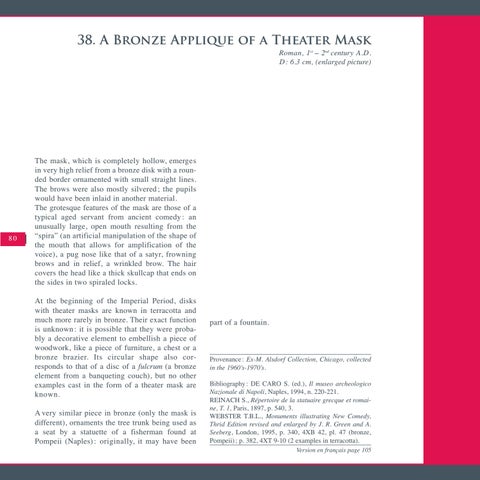
38. A Bronze Applique of a Theater Mask Roman, 1s t – 2nd century A.D. D: 6.3 cm, (enlarged picture)
80
The mask, which is completely hollow, emerges in very high relief from a bronze disk with a rounded border ornamented with small straight lines. The brows were also mostly silvered ; the pupils would have been inlaid in another material. The grotesque features of the mask are those of a typical aged servant from ancient comedy : an unusually large, open mouth resulting from the “spira” (an artificial manipulation of the shape of the mouth that allows for amplification of the voice), a pug nose like that of a satyr, frowning brows and in relief, a wrinkled brow. The hair covers the head like a thick skullcap that ends on the sides in two spiraled locks. At the beginning of the Imperial Period, disks with theater masks are known in terracotta and much more rarely in bronze. Their exact function is unknown : it is possible that they were probably a decorative element to embellish a piece of woodwork, like a piece of furniture, a chest or a bronze brazier. Its circular shape also corresponds to that of a disc of a fulcrum (a bronze element from a banqueting couch), but no other examples cast in the form of a theater mask are known. A very similar piece in bronze (only the mask is different), ornaments the tree trunk being used as a seat by a statuette of a fisherman found at Pompeii (Naples) : originally, it may have been
part of a fountain.
Provenance : Ex-M. Alsdorf Collection, Chicago, collected in the 1960’s-1970’s. Bibliography : DE CARO S. (ed.), Il museo archeologico Nazionale di Napoli, Naples, 1994, n. 220-221. REINACH S., Répertoire de la statuaire grecque et romaine, T. 1, Paris, 1897, p. 540, 3. WEBSTER T.B.L., Monuments illustrating New Comedy, Thrid Edition revised and enlarged by J. R. Green and A. Seeberg, London, 1995, p. 340, 4XB 42, pl. 47 (bronze, Pompeii) ; p. 382, 4XT 9-10 (2 examples in terracotta). Version en français page 105