Four days into this year’s student government election season, an anonymous Instagram account emerged, calling for students to vote “no confidence” in the Emory Student Government Association (SGA) presidential election. The account published a paragraph alleging wrongdoing by several candidates, including SGA Vice President of Student Experience Ameer Alnasser (25Ox, 27C), Kenan Bajraktarevic (25Ox, 27C) and College Council President Vlad Senenko (25C). Alnasser and Senenko are the only two candidates running for SGA president this year. Bajraktarevic is running on a joint ticket with Senenko to become SGA vice president.
The post accused Alnasser of “repeatedly posting antisemitic and untrue statements about Jewish students on his personal Instagram.” Additionally, the account claimed that Bajraktarevic and Senenko “repeatedly ignored SGA rules and regulations for their own personal benefit.” In a later post, the account shared parts of a complaint filed by three then-Emory students in April 2025 against Senenko.
The complaint alleges that Senenko violated Title II, Article 1, Section E of the SGA Code and Article VI of the College Council Constitution. According to the complaint, Senenko improperly appointed three College Council legislators, who would serve as representatives to the SGA. The College
By Irene John and CynthIa BaI Asst. News Editor & Contributing Writer
Following U.S. President Donald Trump’s appointment of Robert F. Kennedy, Jr. to the position of U.S. Secretary of Health and Human Services (HHS) a year ago, Kennedy announced changes at the Centers for Disease Control and Prevention (CDC), including leadership changes, employee layoffs and new vaccine guidelines. These actions have drawn widespread criticism from both CDC employees and public health officials.
In an open letter to The New York Times published on Sept. 1, 2025, nine former CDC leaders said Kennedy was “endangering” the nation’s health by citing “flawed research” to justify new policies.
Kennedy was officially sworn in on Feb. 13, 2025, following a close 52-48 Senate vote. Ahead of his confirmation, a small group of protesters gathered outside the CDC headquarters near Emory University on Feb. 4, 2025, to voice their concerns about Kennedy’s nomination.
At various other protests, demon-
Council is a division of the SGA, which represents the Emory College of Arts and Sciences.
These allegations come four months after Emory University reinstated the SGA and College Council. Emory suspended the SGA and College Council for actions “potentially constituting discriminatory harassment” on April 14, 2025, resulting in a six-month pause in normal operations.
Constitutional Council Chief Justice Alexcia Boothe (24Ox, 26C) said in an email to The Emory Wheel that the council is finalizing its review of the complaint and expects to publish its ruling in “the near future,” but was unable to provide the Wheel a specific date.
Senenko allegedly violates SGA Code with appointments
College Council Speaker of the Legislature Elijah Robuck (26C) shared the complete complaint with the Wheel on Feb. 15, prior to when the anonymous Instagram account publicized the allegations. According to Robuck, the almost year-old complaint is relevant now because he was concerned about the negative effect Senenko could have on the SGA if elected president.
In the April 2025 document, former Chief Justice of the Constitutional Council Pavel Ramirez Cammarata (25C), former BBA Legislator Ibrahim Jouja (22Ox, 25B) and former Club Sports Council President Jayden Davis (25B) alleged that Senenko unconstitu-
strators, including former CDC workers, continued to express their dissatisfaction with both Kennedy and the Trump administration. At one protest following a round of CDC firings on April 1, 2025, there were 150 protesters.
Barbara Marston (94M), a former CDC employee and founder of the CDC Alumni and Friends organization, called out Kennedy for making negative “judgment statements” about CDC employees.
“He’s making all these judgment statements about CDC, but not having spoken to or worked with the people that work there, and obviously that’s damaging,” Marston said.
Since the announcement of Kennedy’s appointment, Marston said she was doubtful about both his views on public health and his qualifications to effectively lead the HHS.
“We were concerned from the getgo when he was appointed because prior to his appointment, he had very clearly expressed views that are not in line with what I consider, what most scientific people consider, to be the best science,” Marston said.
The Kaiser Family Foundation (KFF) published a poll in February
tionally appointed representatives to serve in Emory’s student government.
Robuck previously worked for Davis as his SGA presidential campaign manager in 2024, and submitted an unsuccessful complaint seeking to have Abigail Dubinski (25B) removed from the election process. Dubinski later won the 2024 SGA presidential election.
According to the SGA Code, College Council must send permanent representatives to the SGA to serve in the SGA’s legislature. The complaint alleged that when Senenko sent three representatives — Janice Lee (27C), Sophie Kalmin (26C) and Seth Weinfield (27C) — to the SGA, he did not follow proper procedure.
“President Senenko appointed students to serve as College Council Divisional Representatives in the SGA Legislature who were not elected to those roles by the student body,” the complaint states. “Janice Lee, Sophie Kalmin, and Seth Weinfield were appointed while duly elected College Council Legislators were available to serve.”
The complaint’s authors argued that Senenko should have appointed Teodoro Taylor (27C), Sahra Omar (27C) and Sushmita Rajan (26C) to SGA instead, since the student body elected them last March.
Complaint alleges Senenko disregarded College Council Constitution with nominations
See CLAIMS, Page 2
2026, showing that new changes to the CDC have decreased trust in the agency to 53%.
Marston also expressed concern over sudden layoffs, which she said have damaged CDC’s morale.
According to an October article from Government Executive, the CDC has laid off about 4,300 employees since Kennedy assumed office.
“Nobody wants to work in a position where you’re being badmouthed by your boss,” Marston said.
Because of the federal agency’s proximity to Emory, faculty at the Rollins School of Public Health have historically worked alongside CDC employees through joint faculty appointments and research initiatives. As a result, Emory community members expressed their views on Kennedy’s changes at the agency.
Stephen Patrick, a neonatologist at Children’s Healthcare of Atlanta and a Rollins professor in the department of health policy and management, said Kennedy’s rhetoric has contributed to increased vaccine skepticism among parents.
Kennedy faced criticism from Emory community members for promoting anti-vaccination conspiracy
Community members honor ICE victims at vigil
By Inaara LaLanI Contributing Writer
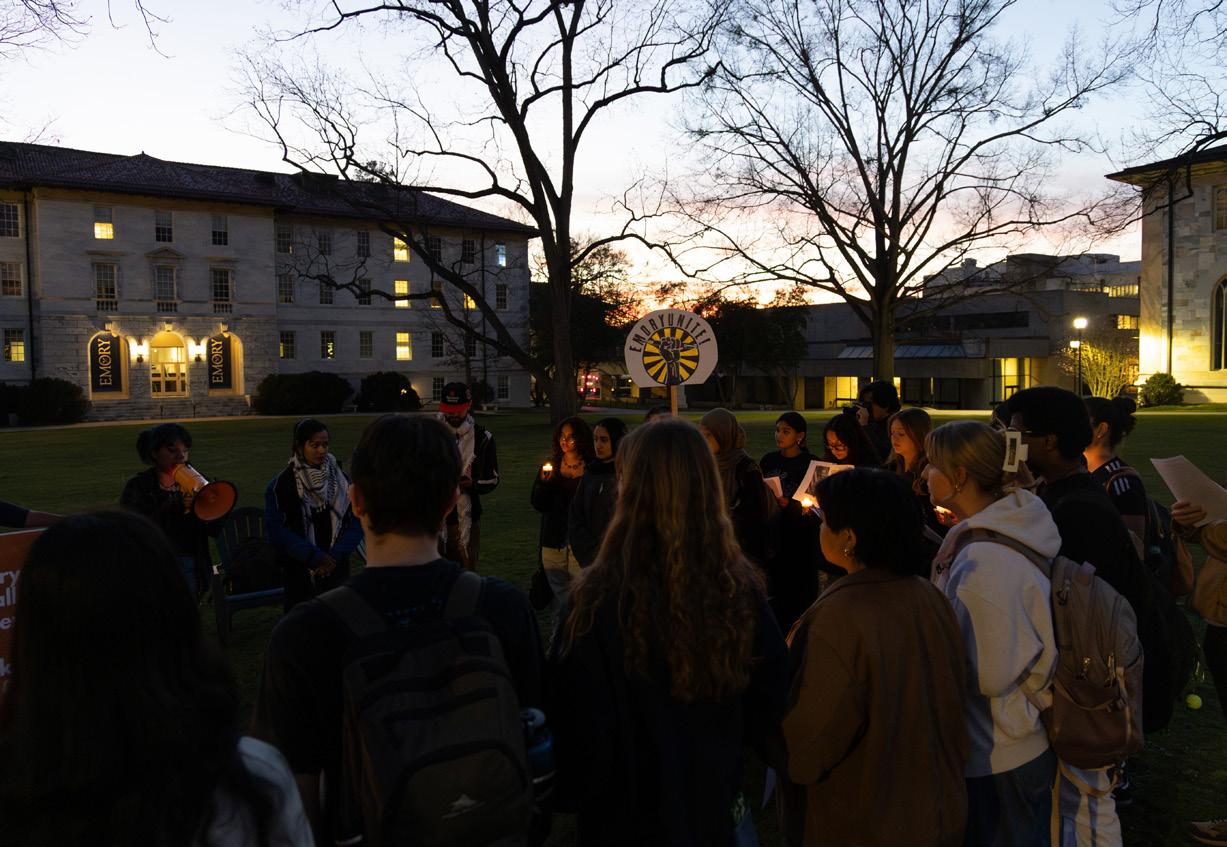
With the actions of Immigration and Customs Enforcement (ICE) officials facing national scrutiny, around 30 Emory University community members gathered on the Quadrangle on Feb. 16 at 6:30 p.m for a vigil to mourn the individuals who ICE has deported and killed. Sunrise Emory and EmoryUnite!, the University’s graduate student workers union, publicized the event on Instagram.
Since U.S. President Donald Trump assumed office in 2025, he has sought to increase deportations. In response to ICE’s actions, thousands of demonstrators across the United States, including at Emory,
theories as well as allegations of misinformation when he said there was a link between Tylenol usage and autism in September 2025. Patrick said that since Kennedy has assumed office, views are influencing the general population’s conceptions of vaccines.
“Before, misinformation was coming from fringe groups and so we would have conversations … countering various conspiracy theories,” Patrick said. “Now it’s just different, because the voice is coming from the head of the Department of Health and Human Services.”
Assistant Professor of Biology Chris Rodgers also expressed his concern with Kennedy’s perspectives on vaccinations. He said these views have influenced how the CDC allocates its research funding.
“There’s more funding for projects to seek out any potential negative effects of vaccines and there’s been less funding of projects, including here at Emory, to do things like support trans health or even to understand more about the health of people who happen to be LGBT or even women,” Rodgers said.
Alexis Smith (28G), a Ph.D. candidate at the Department of Behavioral,
held walkouts and protests against the new immigration policies over the last month.
On Jan. 21, Emory Students for Socialism (SFS) held a campuswide walkout with about 70 attendees. Emory SFS, EmoryUnite! and Sunrise Emory organized another protest on Jan. 30 to condemn the ICE’s killings of Alex Pretti and Renee Good. The second protest was among the largest in recent Emory history, with around 300 attendees attending the demonstration.
Anayancy Ramos (28G), who is a Deferred Action for Childhood Arrivals recipient and leader of the international student working group, helped organize the previous protests for EmoryUnite!. She began the
POLITICS, Page 2
Social, and Health Education Sciences at Rollins, criticized the CDC for website changes that removed certain public health-related data.
“I remember when they started scrapping data from the CDC website, and we were frantically downloading things and people were going and backdating the website,” Smith said.
Researchers across the country have expressed concern over the CDC removing data from their archives. A KFF report shows that the Trump administration has removed detailed racial and ethnic data from government websites, including the CDC. The CDC also removed online information and replaced it with content that included claims linking vaccines and autism.
Patrick expressed his concern that the CDC is no longer a reliable source of public health information.
“I’ve always looked to CDC for guidance in many different places and what I see today is that that’s not a voice that I can trust,” Patrick said.
— Contact Irene John and Cynthia Bai at irene.john@emory.edu and cynthia.bai@emory.edu
EmErson Farrar/nEws Editor Emory University students gather on University Quadrangle.
Claims against SGA candidates emerge
Continued from Page 1
The complainants made a separate allegation that Seneko violated Article VI of the College Council Constitution, which states the president may appoint temporary — not permanent — legislators so the body has enough individuals to reach a quorum, which would allow them to vote on bills.
Robuck said that while it was appropriate for Senenko to appoint temporary legislators to reach quorum, an election for a speaker should have immediately taken place. According to Robuck, the speaker should have then nominated their own set of candidates for the legislature to vote on.
“Even when we did elect a speaker, that speaker was not given an opportunity to look over those nominations,” Robuck said. “The reason that this differentiation exists, obviously, is for separation of powers. Because, hypothetically speaking, if the President was allowed to appoint a majority of the seats in the College Council legislature, there would be no checks and balances.”
Senenko wrote that the nomination process from last April followed the body’s “longstanding” practice.
“The lack of filled seats last year put my administration in the position of having to make a series of appointments for the organization to even function,” Senenko wrote. “The selection process at the beginning and throughout my term has been conducted in good faith, with all considerations for a fair selection of candidates and within the provisions of the governing documents.”
According to Senenko, the College Council legislature voted on all of the nominations he presented. He added that the body serves as the constitu-
tional “check” on the College Council president, as the body must confirm nominations.
“If nominations were delayed until after the Speaker election, College Council would likely need to rely on a temporary membership to conduct the Speaker vote, then repeat the process to establish the full body, which would cause redundancy and inconsistency in membership and voting authority,” Senenko wrote. “That is an imperfection of governing documents [College Council] is fixing right now through our substantial transitions and procedural revisions that we are voting on currently.”
Robuck said College Council is currently considering a bill that would change how College Council legislators are nominated.
Bajraktarevic described the claims against Senenko as “unsubstantiated” and encouraged students to wait for the Constitutional Council’s opinion before deciding who to vote for.
“Vlad has acted legally, ethically, and in the best interest of the students,”
Bajraktarevic wrote. “Vlad and I are dedicated to being transparent about this; we encourage voters watching this developing situation to await a decision from the Constitutional Council.”
Bajraktarevic said he was confused about the anonymous account’s allegation against him, pointing out that he was not mentioned in the complaint against Senenko. He added that when he was Oxford Student Government Association (OxSGA) president, he held the OxSGA bylaws in “the highest regard.” He also said he is unaware of any misconduct while he served.
“Throughout my entire tenure as Oxford SGA President, I encouraged all members to work by the Oxford SGA’s
bylaws,” Bajraktarevic wrote. “I tried to create an environment where all SGA members are encouraged to bring up violations of SGA rules.”
Alnasser denies accusations of antisemitism
Alnasser said he “personally disputed” the anonymous Instagram’s allegation that he has posted “antisemitic” statements on his personal Instagram.
In a written statement to the Wheel, SGA Executive Vice President Zoe Grotjan (24Ox, 26B) wrote that she believes that the Constitutional Council’s decision will “constitute the correct decision in this case.” Grotjan wrote that she was initially surprised to see the anonymous Instagram posts.
“I implore every student to do their own research and pick a candidate they believe will be a good fit for the role, or at least decent, based on their own beliefs and opinions,” Grotjan wrote.
SGA President Tyler Martinez (26C) wrote that he had limited contact with Alnasser prior to his presidency and he was unsure of the legitimacy of the claims made by the anonymous Instagram account.
However, Martinez added that he was “shocked” to see the complaint published on the Instagram account and said that voters should take their time to evaluate each candidate carefully.
“As the sitting SGA President, I would be remiss to not acknowledge the harm that such allegations and information during a campaign season can cause on candidates,” Martinez wrote.
— Contact Jack Rutherford jack.rutherford@emory.edu
Student organizations commemorate Good, Pretti
EmErson Farrar/dEputy photo Editor Emory University community members remember victims of Immigration and Customs Enforcement officials.
Continued from Page 1
vigil by acknowledging ICE’s detention and killing of 32 victims. Ramos encouraged the crowd to “refuse to let their deaths be the end of the story.”
Tasfia Jahangir (23PH, 29G), EmoryUnite! co-chair and SFS organizer, referenced the Jan. 21 walkout during the vigil, emphasizing the bravery of student activism. She noted that these students were a “part of that history” and emphasized that similar coordinated actions are necessary to make a greater impact on national politics.
“When people develop strategies and tactics and when people build structures that way, they can sustain these efforts,” Jahangir said. “They can sustain escalation, and that is how hope is channeled into organization.”
Sunrise Emory President and Co-Founder Ava Trachtenberg (28C) said that she thought the vigil was important due to ICE’s increasing
presence in Georgia.
“Processing these things and seeing ICE expand its presence in Atlanta and feeling really scared and alone, and it’s important that we talk about these things together and that we process them in community,” Trachtenberg said.
Ramos asserted that these fears have intensified due to Flock Safety’s system, which can record and process license plate data.
Flock denied the existence of a partnership with ICE in a Jan. 6 statement and said that any access to Flock data by ICE would need to be granted by the customer and “comply with applicable law.”
Assistant Vice President of University Communications Laura Diamond confirmed that Flock cameras exist on Emory’s campus for crime investigations, but did not disclose whether the University has shared data with ICE.
Jahangir also asserted that Emory should be more transparent about its policies concerning data-sharing agreements with law enforcement and ICE.
“We have no information, no transparency,” Jahangir said.
Sheth stated that, given the University’s lack of transparency, students should find more active ways to resist.
“It is a part of a particular system right now that is preying on people’s need to hurt other people,” Sheth said. “So the way you push back is what we’re doing right now, get together, talk and have empathy.”
— Contact Inaara Lalani at inaara.lalani@emory.edu
Student Government Association presidential candidates
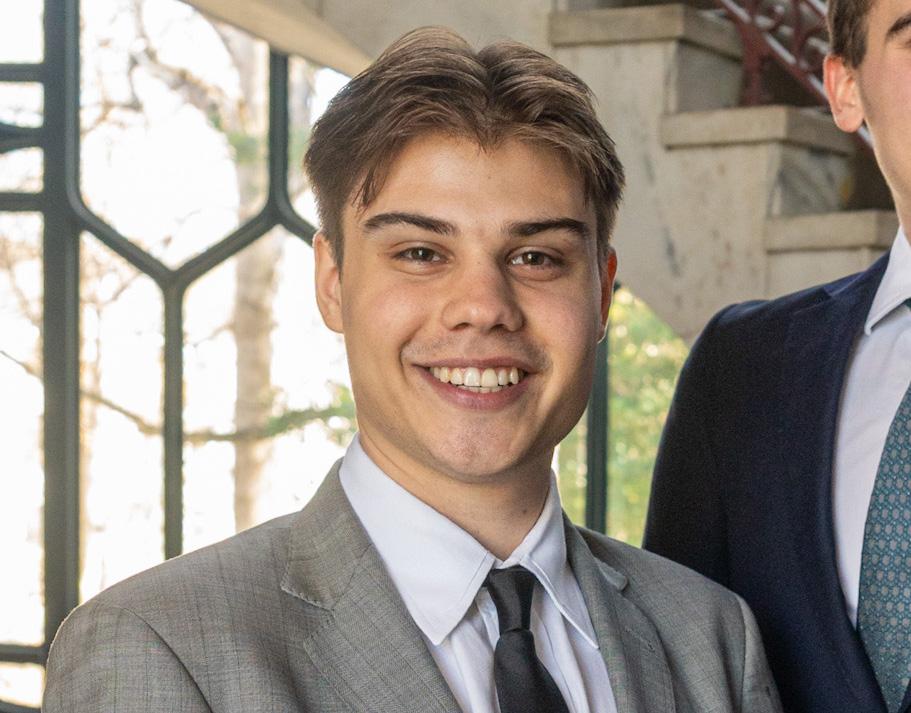
Vlad Senenko Emory University’s College Council President Vlad Senenko (27C) and former Oxford College Student Government Association (OxSGA) President Kenan Bajraktarevic (25Ox, 27C) are running for Student Government Association (SGA) president and vice president.
Senenko and Bajraktarevic hope to introduce a student petitioning mechanism, which they hope will allow students to directly respond to SGA actions. The pair aims to reform current club funding protocols by launching an internal audit and “operational overhaul” of SGA’s distribution of the Student Activity Fee (SAF).
The candidates aim to simplify the club chartering process by clarifying charter protocols and implementing a standardized chartering
timeline. They intend to create a student employment office to centralize and advertise campus employment opportunities and establish an SGA “Emergency Bridge Grant” for students facing short-term financial crises.
Senenko and Bajraktarevic will advocate to reinstate the Atlanta campus’s orientation leader program, which the University discontinued in December 2025.
Regarding campus safety, Senenko and Bajraktarevic proposed establishing a permanent emergency ad-hoc committee to manage an “Urgent Campus Updates” GroupMe for all Emory students. The pair also plans to establish a campus-wide protocol for student interaction with federal agents and immigration legal clinics, in addition to providing Know Your Rights training and nonpartisan voter engagement advocacy during the 2026 midterm elections.
Senenko and Bajraktarevic aim to establish a permanent student mental health committee to conduct regular mental health surveys. They also plan to incorporate sexual assault prevention training as a requirement for SGA membership. The candidates hope to strengthen LGBTQ+ mental health resources and increase sustainability efforts on campus.
Ameer Alnasser
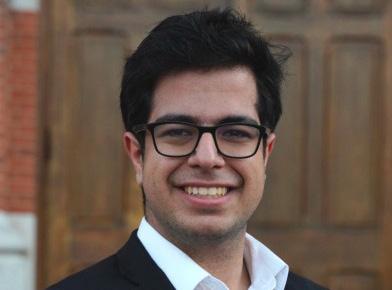
Ameer Alnasser (25Ox, 27C), current SGA vice president of student experience and a former University Senate student body representative, is running for SGA president.
Alnasser hopes to improve campus accessibility by reinstating 24-hour access to the Robert W. Woodruff Library, introducing 24-hour dining options and expanding SafeRide routes to include off-campus housing. He intends to restructure absence policies to permit three excused absences for classes that meet more than twice a week, increase weekend access to the Cannon Chapel and extend the George W. Woodruff Physical Education Center hours. Additionally, Alnasser hopes to extend airport shuttle programs and create a vice president of transportation role in
Maryam Ahmed
Maryam Ahmed (27B), a BBA Council junior representative, is running for BBA Council president. Ahmed plans to prioritize student well-being by hosting “Destresser Events” with Counseling and Psychological Services. She also intends to introduce optional peer resource training for club executive officers.
To strengthen club organization, Ahmed hopes to establish a structured feedback survey system between club leadership and BBA Council to improve the chartering and funding processes. Additionally, Ahmed wishes to host BBA Council-led workshops for freshmen and Oxford continuees to outline recruitment timelines and application expectations.
Finally, Ahmed hopes to establish a vice president of Oxford alumni role in the BBA Council to serve as a liaison to Oxford leadership. She also intends to expand support for nontraditional career pathways by hosting panels featuring students and alumni in nontraditional fields and by facilitating more open conversations about recruitment timelines and alternative careers.
Oliver Li
Oliver Li (28B), current BBA Council vice president of clubs, is running for BBA Council president.
Li wants to strengthen community engagement by launching a “Week of Service,” including a collaborative Master of Business Administration and BBA Day of Service. He hopes to organize cohort-specific service initiatives to serve the Atlanta community.
Li plans to release a summary of the BBA Council’s budget to improve student transparency regarding SAF allocation to clubs. He aims to strengthen the Oxford-Goizueta relationship by organizing a semesterly showcase at Oxford with recruitment information.
Finally, Li proposes hosting a “Business Confessions” event where students can anonymously submit their concerns for faculty to address in a live discussion. He aims to allocate a portion of the annual budget to a “Student Choice Fund,” allowing students to suggest and vote on select initiatives. Li maintains that students should be surveyed on where the business school should allocate its investment areas each semester.
If you or someone you know experienced sexual assault, you can access Emory’s Department of Title IX at 404-727-0541 and the Office of Respect’s hotline 24/7 at (404) 727-1514. You can reach the RAINN National Sexual Assault hotline 24/7 at (800) 656-4673. You can reach the Atlanta Grady Rape Crisis Center crisis hotline 24/7 at (404) 616-4861 and the Decatur Day League Sexual Assault Care and Prevention crisis hotline 24/7 at (404) 377-1428.
Alumni Memorial University Center, Room 401 630 Means Drive, Atlanta, GA, 30322 Business (404) 727-6178
Editors-in-Chief Ellie Fivas and Spencer Friedland ellie.fivas@emory.edu spencer.friedland@emory.edu
Founded in 1919, The Emory Wheel is the financially and editorially independent, student-run newspaper of Emory University in Atlanta. The Wheel is a member publication of Media Council, Emory’s organization of student publications. The Wheel reserves the rights to all content as it appears in these pages, and permission to reproduce material must be granted by the editor-in-chief.
The statements and opinions expressed in the Wheel are those of the authors and do not necessarily reflect those of the Wheel Editorial Board or of Emory University, its faculty, staff or administration. The Wheel is also available online at www.emorywheel.com. Wednesday,
SGA to address student concerns.
To strengthen belonging, Alnasser aims to host an intercultural potluck each semester. He intends to reform funding for student organizations by providing financial training for club treasurers and reducing wait times for Student Governance Services. Alnasser aims to reduce the cost of performance spaces for student-led groups and allocate $5,000 from the SGA Contingency Fund to establish a social change fund to support student-led initiatives that advance the Emory community and local neighborhood.
Alnasser plans to reform Emory Greek life by offering more on-campus housing options for Greek organizations, such as the National PanHellenic Council sororities and fraternities, and appointing a student liaison between SGA and the Office of Sorority and Fraternity Life.
Additionally, he hopes to improve communication by restructuring campus-wide emails, starting internal and external SGA newsletters and maintaining SGA Fridays to hear concerns from the student body. In his platform, Alnasser pledged to prioritize transparency by avoiding political favors and to establish a President’s Initiative Fund, using his $2,500 presidential stipend to support new campus organizations.
BBA Council presidential candidates
Kieran Rafferty Kieran Rafferty (25Ox, 27B), BBA Council’s SGA representative and former OxSGA executive vice president, is running for BBA Council president.
Rafferty wants to improve the transition to the business school for students by strengthening pre-BBA mentorship, orientation support and advising for dual-degree and early matriculation students. He aims to expand nontraditional career programming by hosting industry-specific panels. Rafferty also intends to make the Club Fair more accessible. In addition, he also hopes to offer more support to students from underrepresented backgrounds by holding diversity recruitment events to navigate the recruiting process.
Rafferty also intends to strengthen the Oxford-Goizueta pipeline by improving crosscampus networking, collaborating with BBA academic advisors and increasing early access to recruitment information. To strengthen Keeping Emory Goizueta Social (KEGS) events, he intends to work alongside Emory student organizations, allowing them to co-host and co-fund events.
Sunny Tian BBA Council Junior Representative Sunny Tian (25Ox, 27B) is running for BBA Council president.
Tian plans to expand career-pathway support for non-investment banking and consulting roles by strengthening alumni networks and improving recruiting resources across industries. She hopes to establish an exchange student mentorship program that pairs current BBA students with exchange students to ease the transition into the business school. Tian also intends to improve Oxford pre-BBA support by expanding advising and course access. To increase transparency, Tian hopes to create a feedback form for students to share their concerns with BBA Council, publish monthly Instagram posts with the council’s responses to student feedback and establish a centralized communication hub with all council updates on SharePoint.
Finally, Tian hopes to promote well-being by improving access to mental health resources, creating professor-student engagement events and planning fitness group-based activities for BBA students.
College Council candidates
Braden Newsome
College Council Vice President Braden Newsome (25Ox, 27C) is running for College Council president.
Some of Newsome’s plans include establishing direct communication between the council and students by creating “Legislative Coffee Hours.” He also wants to expand the “Dining at the DCT” program to include Kaldi’s Coffee at the Depot and Cox Hall. His platform included plans to create student-run leadership focus groups, which will meet with College Council leadership to offer feedback on initiatives and to enforce constituent engagement requirements for legislators. Moreover, Newsome said he plans to make a biweekly “College Council Initiative Newsletter” and “Student Policy Submission Portal” for students to submit ideas directly to the council.
Newsome’s campaign also features a program called “Beyond the Syllabus,” an initiative that funds informal dinners and workshops to build faculty-student connections. Furthermore, his platform includes changing the club funding system by establishing student-led “Funding Reform Focus Groups,” which will meet to discuss solutions that make navigating club funding easier. He hopes to streamline club treasurers’ jobs by providing recorded training sessions and finance office hours. Newsome also hopes to expand academic and mental health resource availability by increasing the number of counselors and decreasing appointment wait times.
Aidan O'Sullivan
Speaker of the OxSGA Senate and President of Oxford Young Democrats Aidan O’Sullivan (26Ox) is running for College Council vice president.
Some of his campaign goals include increasing College Council transparency by creating weekly meeting posts and videos on council updates. His platform also proposes to create a GroupMe where the Office of Communications will post council updates and hold weekly office hours. Additionally, he wants to provide underclassmen with more opportunities to connect with alumni and upperclassmen by expanding the Student Involvement in Professional Success (SIPS) program.
He also discussed his ideas for communicating student government actions to students as inspired by OxSGA’s “This Week at SGA.” He also wants to create weekly office hours between College Council leaders and students. Furthermore, O’Sullivan’s platform calls for increased pre-professional mentorship. He hopes to improve study abroad advising by creating a student feedback survey. O’Sullivan plans to achieve his platform’s goals through measures including increasing the council’s social media presence, advocating for more pre-professional advisors, and establishing a student committee to identify the root causes of Emory’s recent leadership turnovers. His platform also emphasizes plans to promote and protect students’ academic freedom on campus.
The Emory Wheel Opinion
This Black History Month, fight to remember
The light is out.
In October 2025, an Editorial Board member visited the Martin Luther King Jr. National Historical Park in Atlanta, where the civil rights leader’s crypt is housed.
The site houses an eternal flame — a symbolic fire that represents the ongoing effort to realize King’s dream of justice and equality. The flame was dark after a vandal had stomped it out earlier that month. The vandalism proved emblematic: While one criminal extinguished the flame, U.S. President Donald Trump’s administration works to extinguish King’s legacy.
This Black History Month unfolds as the Trump administration systematically purges Black history from American institutions. On the eve of the United States’ centennial observance of Black History Month and the Declaration of Independence’s quarter millennium, the federal government erases the history this month was created to preserve — hiding the truth of slavery, eliminating MLK observances and pressuring universities to shut down Diversity, Equity and Inclusion (DEI) programs.
The question is not whether this rewriting will continue, but whether we will act to stop it. Nationwide, institutions have weaponized bureaucracy to sanitize American history under the guise of a DEI purge, removing anything that challenges white supremacist mythology.
The Defense Intelligence Agency paused all MLK Day programming. Trump removed King’s bust from the Oval Office and directed a comprehensive review of the Smithsonian for its “woke” ideology— a euphemism for accurate accounts of American atrocities. The National Park Service ordered staff to remove the “scourged back” photograph of an enslaved person from its exhib -
it panel at Fort Pulaski National Monument for depicting “negative” history.
This pattern of rewriting reveals a coordinated campaign: replace uncomfortable historical truths with distorted histories that celebrate American exceptionalism while ignoring slavery, genocide and systemic racism.
The Trump administration’s changes are not preserving history; they are a deliberate rewriting to control the national memory.
As Bernice King (90MDiv, 90JD) warned last month: “As we confront the killing of good, we must also confront the killing of truth.”
The government is not just attacking Black history — it is attacking the idea that truth matters in a democracy.
When a government decides which pasts are acceptable to remember and which are to be forgotten, it controls how Americans understand power.
Trump celebrates sanitized versions of dead heroes like Harriet Tubman while ignoring the brutal systems of slavery and racism they fought against.
Without that history, Americans cannot recognize the same structures of racial oppression operating today — or know how to dismantle them. Cyclical histories of oppression are meaningful precisely because they can prevent us from repeating our mistakes.
The current governmental assault on truth extends beyond monuments and museums to universities, where administrators face a choice between defending diversity programs or surrendering to federal pressure. Institutional cowardice has reached our campus, too.
Despite having “reaped the benefits” of DEI initiatives, Emory University’s Interim President Leah Ward Sears (80L) announced in
September that the University would discontinue all DEI offices and programs, citing federal pressure. Emory administrators quietly changed the Black Student Alliance House name to Uhuru House this summer. Their calculation was transparent: “Black Student Alliance” is unambiguously Black — it names race, community and the reason the space exists. Administrators chose a Swahili word that obscures rather than embraces Black history because anti-DEI pressure has framed Black student organizing, and Black history itself, as divisive ideology rather than documented American fact.
This centennial Black History Month demands we choose between passive commemoration and active preservation.
We must move beyond performative gestures, such as Instagram posts with MLK quotes and one-time donations that disappear by March,
and continue to fight the demonization of Black history education by voting in the Atlanta Public Schools Board elections, through which students can support candidates advocating for Black history education at the local level.
Students can also support nationwide organizations such as Learning for Justice and the Zinn Education Project, which provide free curricula to teachers.
We must also support the work of Black journalists as they risk their lives to report on these injustices. We can do so by supporting organizations such as the National Association of Black Journalists, which stood in solidarity with Don Lemon and Georgia Fort following their arrests, and the National Newspaper Publishers Association, a trade association of over 200 Black newspapers, that works to combat racism.
We must show up in our own University community to highlight the importance of Black student spaces as administrators move away from DEI policies. For instance, students should join together in community and attend the month-long programming from the Emory National Association for the Advancement of Colored People, the Emory Black Student Union, and the Belonging and Community Justice Community Centers.
Emory is also home to leading Black theorists whose work directly confronts the lasting impacts of this history.
We encourage students to critically engage with Associate Professor of African American Studies Calvin Warren’s special topics course on Critical Black Thought, Samuel Candler Dobbs Professor of Religion and African American Studies Dianne Stewart’s research on African diaspora spiritual rituals and Goodrich C. White Professor of African American Studies and History Walter Rucker’s histories of Black resistance.
As the U.S. Department of Education attempts to omit Black history from curricula, students must continue to take responsibility for their own education.
While Black History Month began as a week, its expansion reflects an American history that we cannot contain.
Beyond this engagement, it is imperative to continue these efforts beyond February and continue to advocate for one another in our daily lives.
Understand that anti-racism is not simply a monthly observance as its spirit endures. We must write history through our actions rather than passively witnessing it.
The eternal flame may have briefly gone out in Atlanta, but the fight it represents continues.
eLLie Fivas
EdiTor-in-ChiEf
MaDeLine shapiro ExECuTivE EdiTor
Catherine gooDMan ManaGinG EdiTor
WiLL peCk ManaGinG EdiTor
JaCk rUtherForD ManaGinG EdiTor
LaUren Yee ManaGinG EdiTor
Amelia Bush A&L Editor
Siya Kumar News Editor Jacob Muscolino News Editor
The above editorial represents the majority opinion of The Emory Wheel’s Editorial Board. The Editorial Board is composed of Editorial Board Editor Carly Aikens, Editorial Board Assistant Editor Mira Krichavsky, Shreya Aithal, Wayne Liang, Eliana Liporace, Pierce McDade, Niki Rajani, Robyn Scott, Meiya Weeks and Crystal Zhang.
Tiany Guo/a ssT illusTraTion EdiTor
Wednesday, Feburary 18, 2026
From denial to empowerment: How I manage my mental health
BY JoshUa gLazer
assisTanT opinion EdiTor
Content Warning: This article contains references to suicide.
As a first-year, long nights of studying, packed schedules and difficult assignments are my norm. Compounded by procrastination, saving enough social battery to hang out with friends and sacrificing sleep to doomscroll, I often find it hard to balance my bustling life.
This chaotic life I live is unsustainable and should not be the expectation for Emory University students. We need to take a step back from the inferno and recognize that mental health, not securing a perfect internship or impressing a crush, should be our number one priority. Taking this step requires us to understand the various dimensions of our mental well-being and to seek help before stress and anxiety overcome us.
Poor mental health has become far too normal for Americans, especially among young people. In a Johns Hopkins University (Md.) survey conducted in Spring 2025, researchers found that 15% of individuals aged 18 to 29 reported experiencing a mental health crisis in the past year, a jump from pre-pandemic levels. Gaps in the availability and utilization of proper mental health resources by those in need are likely due to a lack of knowledge, trust or accessibility. There is no doubt: Mental health is a crisis among college-aged students, and it is one we are actively ignoring. Improving mental health is a battle that will require changes in nationwide institutions and societal norms, but the battle we can solve today is the conflict within ourselves.
Growing up, I used to deny my poor mental health. Soundness of mind felt unimportant — it sounded too psychological, not measurable or tangible. I thought that if I were feeling down or upset, I could go on a walk and shrug it off. As I grew older, my misunderstanding regarding my own mental health became clearer when I talked with friends about emotions, stress, love or anger.
Some of my friends tried to explain why they needed accommodations for exams, while others mentioned that they had regular therapy sessions to improve their well-being. Yet, I remained confused. At the time, I did not understand what poor mental health actually looked like, causing my friends to question my lack of empathy on the subject.
In middle and high school, I would sit bored in health classes listening to lectures about rising suicide rates and oxidative stress. In my naivety, I disregarded suggestions and solutions that teachers presented to my classes to improve my mental health. In moments of heightened stress — like studying for an important test or applying to college — I dismissed my poor mental state as natural and unavoidable, even though I could have taken steps to feel better. Over the years, it became clear that any effort to combat poor mental health must begin by recognizing a simple truth: People are anything but ordinary. Differences in our physical, mental and intellectual characteristics should not separate us, but they do shape how we experience and approach mental health. Our backgrounds, our upbringings, and, most importantly, our access to proper resources all shape
how we understand our own well-being.
Because of these factors, there is no single solution to mental health. Instead, there are many paths someone can take to recognize and improve their mental health. For me, my path has been writing.
My journey as a writer was not easy. I grew up hating English classes and anything to do with writing — ironic in hindsight, as my life now revolves around writing. Since my junior year of high school, I have fallen in love with writing, which has helped me express my emotions, frustrations and thoughts by putting pen to paper. After a long and stressful day, there is nothing that can help me more than putting on a chill playlist and writing until I cannot stay awake anymore.
Freewriting is how I have come to understand my mental health — managing pressure, emotions and who I am. This journey was challenging and took years, but the fight was well worth it. The risks of poor mental health — which can also degrade other facets of well-being, like physical and social health — are simply too great for the price to pay.
During my time at Emory, there have already been moments when I have realized that my mental health is slipping. Since I have taken time to learn what helps me stay balanced during hard moments, I was able to reverse course before it became too late.
I share my story as a testament to what understanding how mental health can look and to encourage others to give seeking help a chance. If you are reading this right now and are struggling emotionally, overcome with stress or concerned for your well-being, do not wait to vent to a friend or call a parent.
There are professionals on campus who can help at any hour on any day, and students can schedule confidential well-being check-ins for free. Do not be afraid to contact these offices — they are there for you. At a high-achieving university like Emory, the pressure to succeed will cause stress, but those pressures should never outweigh your ability to grow and thrive.
Emory students can change the negative stigmas around mental health by speaking up, checking in on one another, finding strategies that work to improve their daily lives and taking the time to reflect on their well-being.
Neglecting mental health eventually catches up to all of us, so we must act early before small struggles become insurmountable. Sharing my personal story is not easy, but I do it because I know there is someone out there in a similar situation to the one I once experienced who needs to hear it.
To anyone who needs to hear this message, know that you are seen, you are loved and you deserve support as you seek help. Let us fight this fight together. Let us get back on our feet, stand shoulder to shoulder and thrive in the time we have left here at Emory.
If you or someone you know is having thoughts of self-harm or suicide, you can call Student Intervention Services at (404) 430-1120 or reach Emory’s Counseling and Psychological Services at (404) 727-7450 or https://counseling. emory.edu/. You can reach the Georgia Suicide Prevention Lifeline 24/7 at (800) 273-TALK (8255) and the Suicide and Crisis Lifeline 24/7 at 988.
— Contact Joshua Glazer at joshua.glazer@emory.edu
Don’t let Trump take away your patriotism
BY JosseLYn st. CLair sTaff WriTEr
In late January, as I stood in the Los Angeles International Airport waiting to board the plane that would rescue me from the United States, I was unwavering in my decision to leave the country.
I saw my semester abroad in Germany as a pause from the political turmoil engulfing the United States, where news of Immigration and Customs Enforcement (ICE) officers killing protesters and U.S. President Donald Trump’s devastating political decisions infested my daily life.
My time in Germany, I thought, would be a reprieve from this chaos, a test run of my dream of living in a progressive utopia abroad and a way to push the dismantlement of U.S. democracy to an afterthought. Five thousand miles away, I thought I would bask in ignorant bliss. But I was wrong — in Berlin, American politics has played a larger role in my life than ever before.
Having studied German for five years, I was looking forward to using my German in conversation with native Berliners about the city’s most delicious food spots and the DJ lineups of the weekend.
Instead, Berliners have pummeled me with question after question about each new destructive policy Trump has spewed forth. I leave our exchanges feeling drained.
Before moving to Germany, I could barely contain my excitement at the thought of riding on Berlin’s worldclass train system, but the U-Bahn’s news screen flashed to a report of an ICE officer killing nurse Alex Pretti during my first ride.
I collapsed into tears. With each Stolperstein — small plaques on the stoops in front of apartments dedicated to Jewish residents the Nazis murdered — that I trip over, I fear that the U.S. government will drag my neighbors back home to the same fate that overwhelms me.
Adolf Hitler’s Gestapo once terrorized the streets that I now walk down, and I am paranoid at the fascistic parallels I see in Trump’s ICE as it rips families from their homes and deports them to prisons this administration plagues with torture and death
Five thousand miles away, I am in agony at the thought of how Trump is enabling the brutal destruction of my home country. I am debilitated by the fact that there is little I can do about it.
In Berlin, I go about my day in a city that is conscious of this violence within the United States, but Berliners
boil their critiques of our nation’s current state down to an eyeroll when they watch coverage of ICE raids on the evening news.
Despite agreeing with their critiques, I am disappointed by their reactions. I can understand how Berliners are able to hold American issues at a greater distance than I am, yet I am still frustrated by the way they view the erosion of rights within the United States as dispositional and as though Americans can do nothing to change it.
When I speak with Berliners, I do not nod along with their critiques of America — instead, I find myself becoming defensive about the United States.
I am suddenly boiling with a foreign feeling of patriotism, a pride that is not directed at the government, but at the strength of the American people who stand against it.
I receive texts from my friends at Emory University about campus protests against ICE’s brutality, their efforts showing solidarity with the people affected by ICE’s actions.
I see photos on Instagram of a high school classmate speaking in front of the Oregon State Capitol about her pride in being the daughter of immigrants and the importance of her community to our state.
And, I hear stories from my fellow Americans in Berlin about the general strike of school and work on Jan. 30, which began in Minnesota and spread to the rest of the country as thousands took to the streets in protest of ICE’s killings in Minneapolis.
I am suddenly boiling with a foreign feeling of patriotism, a pride that is not directed at the government, but at the strength of the American people who stand against it.
I am proud of this resistance and for all that my fellow Americans are doing to protect their neighbors and fight against Trump’s terror. Some of my German acquaintances have raised their eyebrows at my patriotism, as if I am somehow excusing the actions of Trump and ICE.
I am left with a twinge of shame, as though it is wrong to look fondly upon my peers in the United States in any sense.
Perhaps this comes from completely conflating a state with its people,
which I recognize that I, even as an American, am guilty of.
In the past, I had caved to believing the stereotype that Americans are unintelligent and thought this lack of intelligence would let the Trump administration blindly lead Americans to the slaughterhouse of our country’s undoing.
Five thousand miles away, I thought I would bask in ignorant bliss. But I was wrong.
Now, I recognize the brilliance of the American people as I watch my fellow countrymen stand up to this dictatorship, and I hope that everyone — both inside and outside of the United States — will look at their actions with respect.
Instead of remaining in the country I viewed as tearing itself apart, I assumed that I could emigrate to Germany and chase my dreams across the Atlantic.
But now, as I entangle myself in a complicated bureaucracy and dodge a pressure to assimilate into a culture that conflicts with my identity, I realize that I am searching for the German version of the American dream. Yet, this ideal does not exist — immigrants working to make a better life for themselves in the United States are the very patchwork of our nation, enriching our culture with theirs. Now, I see that what I sought in Germany was what I refused to fight for back home.
In hindsight, my wish to flee the United States was an insult to all of the hard work that Americans labor through to keep the dream of our country alive, and I urge the Emory community not to take the easy way out.
Be patriotic — not out of blind ignorance, but out of pride — and speak fondly of U.S. resistance to this authoritarianism.
Allow yourself to believe in the American dream and in all the vibrant communities and vital institutions that the country is fighting to protect from Trump’s destruction. Criticism from Americans may help us cripple this regime, but hope is what we will use to rebuild our country. Love the United States — not for what it is, but for all that you can fight for it to become.
— Contact Josselyn St. Clair at jmstcla@emory.edu
ElliE fivas/EdiTor-in-ChiEf
This Valentine’s Day, Opinion staff appreciates the small moments
BY opinion staFF
Last year, the Opinion staff of The Emory Wheel compiled a section-wide collection of short stories, personal anecdotes and reflections on the power of love. Since then, we have continued to hone the power of words and share our opinions through writing. This Valentine’s Day, we wanted to continue to express our appreciation for love and share short stories close to our hearts.
Madeline Shapiro, Executive Editor
Neon glow sticks, shiny wood floors and a math teacher turned DJ — these are a few of the hallmarks I remember from middle school dances. Although the gym may not have been the most optimal setting for a party, my friends and I would let loose.
We laughed. We schemed. We spun each other in endless circles on the dance floor until we fell to the ground, smiling.
These dances — and my earliest friends — taught me the joys and love of true sisterhood. Whenever I feel lost or confused, I seek my middle school dance floor again.
Ethan Jacobs, Opinion Editor
I love sharing movies with others: Everyone has their own catalogue of favorites, and sparks fly when lists of films intersect. Most of all, I love how someone’s favorite movies tell their stories.
In recommending “Rocky” (1976), my mom gave me a taste of her relationship with my grandfather, whom I never met. I love “My Cousin Vinny” (1992), my dad’s favorite, because he embodies Vinny’s relentless spirit.
My girlfriend’s favorite movie, “Jab We Met” (2007), follows a talkative protagonist who charms even the most unlikely people.
When I share a movie I love with another person, I invite them into my world, and accepting their invitations lets me step into theirs. Studying abroad, I miss this ritual — sitting next to loved ones and sharing parts of ourselves without words.
Cayden Xia, Opinion Editor
Too many people are afraid of the normal, boring lifestyle. On social media, I see alpha gym bros selling courses on how to escape the 9-to-5 matrix or influencers describing their exciting jobs that involve traveling to extravagant events.
However, I love my ordinary everyday routine. The point is that it is monotonous. Packing my lunch, going to the lab and ending the day watching a TV show gives structure to my life. It keeps me grounded and reminds me of my pursuit of my dream career.
If I sought adventure every day, then adventure would lose its meaning. So, I love you, boring everyday life.
Joshua Glazer, Assistant Opinion Editor
I stare at the page, wondering what to write. How do I describe love? I just cannot seem to articulate an answer that I’m satisfied with.
Maybe that’s it — it is far too complicated to name. I must accept that I do not fully understand love yet.
But I am trying my best, and that’s all that matters. I try to lead my life with empathy, keep an open mind and love myself and those around me.
And, I hope to God that maybe someday, I will find that indescribable love I’ve been chasing.
Crystal Zhang, Assistant Opinion Editor
Despite renting a one-bed, onebath studio apartment off campus, I have found myself with an unexpected roommate.
From late-night political rants online to driving her to my local Waffle House for the first time, I am constantly reminded of how our friendship transcends barriers.
The internet is definitely a scary place, but being a fandom-engrossed teenager provided me with the greatest support system I could have asked for.
Remember that love is everywhere, especially in our increasingly interconnected world.
Sabrina Tomei, Contributing Writer
Now that my days are jam-packed, I have started to schedule time to just close my eyes. My calendar rules my life, dictating my every waking hour. In a time when everything is planned days in advance, I have gained a new appreciation for spontaneity.
stand what it means to have a family. I feel, more strongly than ever, that I am cultivating not just fleeting connections, but my own definition of family. Family holds you upright while you cry yourself raw. Family is the squeeze of a hand in quiet moments and a ray of warm sunshine on a cold winter’s day.
Family is womanhood and falling in love and screaming feral, loaded rage under endless stars. It is a quiet miracle.
It is the realest thing I know. It is what I have found right here.
Jordan
Abdo,
Contributing Writer
Love is fantasizing your whole life and dancing alone in your basement. It is creating the feeling you have dreamed of, the situation being totally in your control. The body movements have no flow — they are just jump -
Tucked in the corner of my room lives a little black spider, comfortably settled in her silken web.
Although my Charlotte will not save me from being turned into bacon, she does protect me from pesky mosquitoes — a service I greatly appreciate.
While my arachnophobic visitors express strong objections to my eightlegged tenant, I have grown fiercely protective of her.
My spider friend reminds me that even the overlooked and misunderstood have a role to play, and that a little love and appreciation can go a long way.
Kristen Seo, DEI Editor
Last month, I reunited with my best friend after nearly three years. We met through a K-Pop Twitter group chat during the COVID-19 Pandemic, and despite our 1,200-mile distance, we have supported each other throughout the most significant milestones of our youth, such as our college application journeys.
Whether it is a familiar face asking to get coffee or an impromptu game of frisbee on a sunny day, spontaneity reminds me to not take everything too seriously and to embrace the freedom of having no set plan.
To live — and to love — is to embrace the unplanned and enjoy the unforeseen little things.
To
live — and to love — is to embrace the unplanned and enjoy the unforeseen little things. If I sought adventure every day, then adventure would lose its meaning. So, I love you, boring everyday life.
Olivia Stanley, Staff Writer
The older I get, the more I under-
ing, heaving breaths and exaggerated facial expressions. I dream of my best self and my ideal situation, envisioning the spotlight on me. Maybe it is a crush, an Olympic gold medal or something spontaneous that comes to mind.
In a world so big, I feel unimportant. But, in love, I find my purpose, my hopes and a rare moment in which the focus finally lands on me.
Hope
Habia,
Contributing Writer
I love spending money. From a wealth of experience, I can confirm that gratuitous purchases induce a sense of enlightenment comparable to reaching Nirvana. Call me a capitalist, but there is something remarkably empowering about choosing to treat yourself even when your bank account says “No.”
Courage is about testing the limits of our comfort and surrendering ourselves to the grace of the universe in saying, “Yes, I probably should
not be spending this money, but, rest assured, there will be more.” Indeed, spending is — at its core — a spiritual act of faith in a secure, abundant love.
Catherine Goodman, Managing Editor
When I was growing up, breakfast was a non-negotiable. For just 30 minutes in the morning, my siblings and I would sit shoulder to shoulder as my mom crafted some new elaborate recipe.
Although creative, she is not the greatest chef, so my siblings and I would often slip our food to the dog when our mom turned her head. Despite the unflattering reality of our ritual, this practice endowed me with a deep love for breakfast time.
I treasure the quiet solace of the morning when the day has not yet truly begun.
Although my apartment table feels decidedly empty without the quarreling of my brother and sister, I return to the warmth of these memories each time I offer my German shepherd a bit of scrambled egg.
I treasure the quiet solace of the morning when the day has not yet truly begun.
Sara Garg, Contributing Writer
Cancer biologist, crisis volunteer, data scientist and poet — my identity seems disjointed. At nine years old, in my first poem, I wondered, “What would rocks say?” Today, I ask, “What death will face my cells when I treat them with a drug? What gives this suicidal person the hope to choose to try to live? What confounding variable can this nonprofit explore through community collaboration?”
I would never have learned to seek out these hidden stories if I were never a poet. I only found myself when I fell in love with stories, when I tied them to my very marrow and sinew.
Evelyn Zhang, Contributing Writer
Maybe love is a sudden, quiet refraction of vision, a recalibration of my apparatus. I have always thought posed portraits are boring, horrendous and predictable.
I ask myself: Why surrender a space we reserve for the exhilarating kinetism of the stream or the chaos of the perfectly-landed sunny-side-up egg for a picture of someone sitting?
I now realize my camera has become a gallery of my loved one’s quiet postures, captured without debate or deliberation. My lens once demanded the thrum and tumble of a world that refused to sit still — until it became preoccupied with stillness.
From middle school dances and shared movie nights to sunrise breakfasts and fandom-found families, our Opinion writers have found love in life’s most mundane — yet most profound — moments. This Valentine’s Day, we celebrate the unexpected connections and heartfelt memories that have shaped who we are. We consider these tales of love, in all its forms, among the most meaningful stories we can tell.
The Emory Wheel Arts Life
Staff Picks: Art that reminds us love is real— once again
By Arts & Life stAff
From films to songs to books, art has a way of uniting the masses by capturing even the most elusive emotions, including love. So, for those in or out of love, the Arts & Life section has something for you. This Valentine’s Day, we continue our tradition: celebrating the holiday the only way we know how — with art.
Foreword by Amelia Bush
‘Dear Soulmate’ by Laufey (2022)
I am an independent person: I embrace solo dinner trips, I take pleasure in solitary Lullwater walks and I relish in the unaccompanied solace of the cinema. Although I adore my relationships, there is a quiet thrill in being by oneself, fully unaccounted for and free from liability. Regardless of this reality, I am still a dreamer.
If soulmates are real, I find myself thinking about mine quite often — rhetorically ask ing about them as if the universe might respond. In “Dear Soulmate,” Laufey speaks to my unanswered questions over a soft melody, optimistically asking, “Do you live in New York City? / Or a couple towns away” or “Do you have green eyes / Or are they brown like mine?”
The simple act of wondering about your destined life partner is shockingly vulnerable and relatable. Laufey blends these earnest feelings with yearning through a symphony of strings that builds in intensity through the chorus only to unexpectedly diminish, mirroring the staggered cravings that one harbors when pondering their unknown better half. With closure ungiven, Laufey dissolves the song bittersweetly, singing, “Dear soulmate / One day I’ll give this song to you / Dear soulmate / I can’t wait to fall in love with you.”
Perhaps I will someday exchange my independence for the comfort of a hand to hold or a shoulder to lean on. Until then, I will search faces in crowds and smile at strangers at parties for a glimpse of my future love.
— Mia Hamon, Assistant Arts & Life Editor
‘A Case of You’ by Joni Mitchell (1971)
“A Case of You” by Joni Mitchell is full of contradictions — but isn’t love, too? When bolstered by love, we find strength while uncovering new forms of vulnerability. When sheltered by love, we find incomparable joy even as the ghost of mortality closely resides. When guided by love, we chart new paths with each winding turn demanding sacrifice.
Mitchell captures these contradictions with casual brilliance. After all, “A Case of You” — one of the most romantic songs of the 20th century — begins with Mitchell singing, “Just before our love got lost you said / ‘I am as constant as a northern star.’” The first-person narrator dismisses this notion with soft disappointment, her tone being recognizable to anyone who has loved someone so profusely, known someone so deeply, that even their most dramatic confessions skip by like stones on the water.
However, Mitchell does not remain tethered to incongruities. She also captures one of romance’s only constants: that to be loved is to be changed. “Oh, you are in my blood like holy wine / You taste so bitter and so sweet / Oh, I could drink a case of you, darling / And I would
still be on my feet,” she sings. For those who believe love must be grand, intoxicating and ever-lasting to be worthwhile, “A Case of You” provides a dose of realism with a taste of true folk-rock beauty.
— Catherine Goodman, Managing Editor
‘Baby!’ by Dijon (2025)
I do not have a wife yet, and, to the surprise of many, I am not a father either. Despite this, when listening to the title track from Dijon’s latest album, “Baby” (2025), I almost fully understand the experience of marriage and fatherhood. The song’s sparse and somewhat industrial R&B tone makes way for the storytelling that “Baby!” encapsulates. Dijon utilizes the song’s production when recounting meeting his wife, falling in love with her and eventually having their first child, whom they named Baby.
On the surface, Dijon’s lyrics seem too simple to evoke such deep feelings. In the opening verse, he describes his first date with his nowwife: “Had a laugh with your mother, went on our first date / I said ‘I’m glad you came.’ / She said ‘I feel the same’ / So how about that now, Baby.” He follows the verse with the chorus’ simple refrain, singing, “What a beautiful thing.”
While the lyrics remain plain, Dijon’s tender, wistful delivery feels so true to life that the listener cannot help but become overwhelmed by the love and joy Dijon expresses. Somehow, Dijon makes a romantic prospect’s reciprocation feel nothing short of magical.
child, I can only hope that falling in love and building a family is as transformational and beautiful as Dijon describes it to be.
— Alex Gerson, Deputy Editor
‘Hiroshima Mon Amour’
Directed by Alain Resnais (1959)
While revisiting French director Alain Resnais’ work, “Muriel, or The Time of Return” (1963) and “Last Year at Marienbad” (1961), I rewatched “Hiroshima Mon Amour.” The film opens with two lovers embracing one another — the opening line in French — “Tu n’as rien vu à Hiroshima. Rien,” which translates to “You saw nothing in Hiroshima. Nothing.”
After, the film continues with a montage, displaying the effects of the Atomic bombings of Hiroshima and Nagasaki. Resnais includes images of scarred bodies, twisted metal from buildings and images suspended in time — setting the scene to show a city utterly devastated by its past.
As “Hiroshima Mon Amour”
and love persists amid chaos and even during the worst moments of human nature. The vulnerability from love is nonetheless central to understanding ourselves and the feelings we voluntarily subdue.
— Clement Lee, Senior Editor
‘10 Things I Hate About You’ Directed by Gil Junger (1999)
Love can be overwhelming and love can be underwhelming, but can love ever just be whelming? In “10 Things I Hate About You,” Kat Stratford (Julia Stiles) is the so-called “shrew” of Padua High School and deemed “psycho” and “crazy” by her classmates for her defensive attitude toward the complicated subject that is love. For Kat, genuine connection feels elusive in a world where discerning the line between love and performance is as difficult as finding insurance to cover PMS.
Based on William Shakespeare’s “The Taming of the Shrew” (1590s), the rebellious Patrick Verona (Heath Ledger) seeks to seduce Kat for his own financial gain. Despite his bad boy archetype, Patrick reveals himself to be quite sensitive and emotionally intelligent. Patrick and Kat find solace in one another by embracing their quirks and passions. Director Gil Junger’s film defies
Shakespeare’s original play by portraying love as not a game of “taming,” but a vulnerable journey of self-acceptance that requires a leap of faith.
he pounds a low G note, and with the opening lyric, “I had a thought, dear, however scary.” When I hear this soft entrance, I sink into the sheets, surrendering to wherever the melody takes me. As the opening riff expands, my inner conscience drifts somewhere far away, to waterfalls, vibrant sunsets and steady rain.
Memories flood back as I recall family trips and late nights laughing with friends. I see the faces of departed loved ones — I wave to my friend Keira, who smiles back — they left us far too soon. In the search for some better version of myself, the lyric interrupts: “In some sad way, I already know.” The voice speaks to me, reminding me that to love is to grieve. I shed a tear. The post-chorus hums like a tide, rising and falling. When it recedes, I am at peace.
The 1960s counterculture argued that peace — the indescribable state of reconciliation and bliss — is love. But peace is fragile and short-lived, and love is eternal.
The song ends, the bass fades into silence. Unlike Hozier’s “Like Real People Do” and everlasting love, life does not last forever. We cannot pause or rewind life.
At the end of the day, we are here briefly and then we are gone, so we pay attention. We love, even when it is hardest. We hold onto each other tightly — for as long as God lets us. And if this is all we have, Hozier reminds us, “We should just kiss like real people do.” Because one day, all that remains is an echo, and, if you blink, you will miss it.
— Joshua Glazer, Assistant Opinion Editor
‘Cobra’ by Geese (2025)
Dijon’s story of falling in love with his wife feels even more ethereal as the song and their relationship build toward the birth of their first child. He begins the verse by describing the trip to the hospital, accompanied by the same minimal production and soft vocals. But at the moment Dijon’s child is born, the music builds to a euphoric and cathartic swell as his vocals layer and become louder with intensity. He sings, “‘Here comes your baby!’ (Baby) / Well that’s a beautiful thing / Said I’m with it now, Baby / What a beautiful thing / I said ‘what about Baby– / That’s a pretty good name.’”
While I do not yet have a wife and
unfolds, we see a 24-hour affair between an unnamed Japanese architect and an unnamed French actress in post-World War II Japan. The film explores how the war traumatized both characters. The architect witnessed collective physical suffering, while the actress bears emotional trauma from having a forbidden romance with a Nazi soldier and consequently being punished as an accused collaborator. Yet, despite their pasts, the ill-fated love between the two lingers, and they grow vulnerable, reopening the scars they were hoping to suppress.
Instead of meditating on love as a transformative experience, “Hiroshima Mon Amour” provides a more nuanced view of it. For a brief moment, love can transcend the memories of loss, time and tragedy, yet they remain intertwined. “Hiroshima Mon Amour” serves as a reminder that our need for human connection
However, the film reminds us that love is messy and, at times, utterly chaotic. From Kat’s drunken house party performance to being physically thrust into the colorful chaos of paintball to the eventual uncovering of Patrick’s original corrupt motivations, Junger describes love, at times, as painful. Kat discovers that love and hate sometimes feel the same. It is possible to love someone one moment and detest them the next, as Kat expresses in her iconic “I hate the way…” monologue. In the end, the two lovebirds finally accept their love as complicated, but surprisingly truthful. For this Valentine’s Day, ruminate in all your romantic feelings with Junger’s 1999 romantic comedy classic — I think you will find that love is anything but whelming.
— Jacob Muscolino, News Editor
‘Like Real People Do’ by Hozier (2014)
Hozier’s symphonic narrative in “Like Real People Do” beckons a journey of discovery. The song begins as
Who would have thought that the rock band Geese, with a discography genre conventionally associated with aggression and violence, were underrated romantics? Though the band is typically known for raucous, lively performances, their latest album, “Getting Killed” (2025), offers a surprising shift in tone. “Cobra,” a mellow, laid-back ballad, contrasts with the previous track on the record, “Trinidad,” in which the bulk of the song consists of lead singer Cameron Winter screaming, “There’s a bomb in my car.”
“Cobra” unfolds from the perspective of a lover enchanting another, like a snake charmer would to a cobra. But beneath its smooth exterior lies tender devotion, most striking in what may be the track’s most sentimental line: “Baby, let me wash your feet forever.”
The unconventional intimacy of the line adds to the lover’s humility — to wash one’s feet is to kneel before them. The determination to wash a rough, non-picturesque part of the body demonstrates a new level of affection and commitment in the relationship. After all, washing someone’s feet is not an everyday act. By anchoring “Cobra” in this strange, poignant metaphor, Geese turns the song into a plea for a steadfast eternity with their love.
— Evangeline Park, Music & Live Art Desk
‘I’ve Seen It’ by Olivia Dean (2025)
Love is frustratingly hard to define. Olivia Dean’s “I’ve Seen It” does not See FIND, Page 9
Sa Sha EmmErich / DEputy illuStration EDitor
‘Wuthering Heights’ is not your mother’s Brontë
By eLLie fivAs
E D itor - in - c hi E f
Content Warning: This article contains references to abuse. This article also contains spoilers.
Literary viewers, be warned: Emerald Fennell’s adaptation of Emily Brontë’s iconic Gothic novel does not serve the book’s devoted fans. Fennell departs dramatically from the 1847 text, cutting the protagonists’ children, many key themes and character arcs. More striking, Fennell presents a reimagined twisted romance between Catherine Earnshaw (Margot Robbie) and Heathcliff (Jacob Elordi), who, in the novel, curse each other more often than they kiss. While disloyal to Brontë’s masterpiece, its outrageous humor, outstanding cinematography and maddening chemistry make for Fennell’s own masterpiece.
“Wuthering Heights” is perverted and delightfully deviant, leaving the viewer squirming in their seats and wiping their tears at the end. With graphic metaphors and careful costuming, Fennell tries to reinterpret “the greatest love story of all time.” However, she instead offers only a non-traditional take on the novel, featuring manic infatuation, revenge and intense sexuality.
The film’s opening lures the audience into a sense of safety with the classic forbidden-love trope that unravels between the privileged young Catherine (Charlotte Mellington) and the orphaned young Heathcliff (Owen Cooper).
Unlike Brontë, who implies that Heathcliff is a person of color, Fennell instead leans into the socioeconomic divide between the starcrossed lovers.
The director’s decision to cast Elordi over an actor who could have portrayed the racial tension ignores a crucial aspect of the original work. However, Elordi successfully embodies other aspects of the character, including his unfettered rage and unhealthy obsession with Catherine.
The film soon jumps to young adulthood as Edgar Linton (Shazad Latif) and his ward, Isabella Linton (Alison Oliver), move into the neighboring manor, Thrushcross Grange. Catherine waits for the occupants to call on her, plotting to marry the wealthy Edgar to secure her future. To both her sorrow and relief, Edgar proposes.
At Wuthering Heights, Catherine sprawls on the floor, bemoaning her betrothal and confessing her love for Heathcliff to her servant Nelly Dean (Hong Chau). Unbeknownst to Catherine, Heathcliff overhears part of her admission, in which she notes that she could never marry him, and he departs from Wuthering Heights.
When Catherine begins her life at Thrushcross Grange, Fennell pivots from the soft romantic vibe of the early scenes, turning toward bizarre set designs and ostentatious costuming. Between Catherine poking her fingers in a gelatin-encased fish, Isabella’s true-to-life dollhouse and a room painted to exactly match her skin tone — moles and all — the film’s tone solidifies Fennell’s strength in curating a surrealist and feverish aesthetic.
Catherine dives into a glamorous lifestyle at Edgar’s manor, leaving her father and the memory of Heathcliff behind. Propelled by Catherine’s sexual awakening and coming-of-age arc, her indulgence permeates the screen, sickly sweet and chilling all at once.
Catherine dons garish eyeshadow and pulls her luscious locks into crazy contortions as her discontent simmers; however, Robbie’s forlorn manner cannot right a fault in the film. Fennell calls upon tantalizing imagery — like the wet slime of a slug scaling the window or bare hands slapping sticky dough — instead of investing in the psychological unraveling of her protagonists. During these prolonged shots, one forgets the alleged love between Catherine and Heathcliff: In its place, only the greatest lust story of all time prevails.
After five years, Heathcliff returns to Catherine in a phenomenal scene in the gardens. Overjoyed with her lover’s return, Catherine rushes down through the fog, turning in circles in pursuit of Heathcliff. As she spins, Elordi’s broad frame appears, a satisfying return for the main antihero. Through this memorable scene, Fennell reminds the audience why her off-script “Wuthering Heights” works — she distills the book to its most basic, most resonant features.
From there, the prudish should look away, as Catherine and Heathcliff embark on a true sexcapade, climbing on top of one another in carriages, in the middle of the moors and even at Mr. Earnshaw’s funeral. Elordi and Robbie’s impressive sexual energy propels the plot forward. Fennell tastefully leaves most body parts for the imagination, instead opting for coy sexual metaphors, like Heathcliff dragging his tongue down the skin wall in Catherine’s bedroom. But Edgar eventually discovers their rendezvouses and orders the two to stop seeing each other. Heathcliff, seeking revenge, elopes with Isabella. Maddened by Catherine’s vengeful silence, Heathcliff rots in Wuthering Heights, keeping the collared Isabella chained up. Whether Heathcliff truly abuses Isabella remains unclear. When Nelly visits and finds her tied to the fireplace, Isabella sticks her tongue out, pants and winks. Fennell
Charli xcx crafts refreshing, stunning soundtrack album
By MiA HAMon
a SS t a rt S & l if E E D itor
Ginna nEbriG / Staff illuStrator
makes the most puzzling choice when Isabella chooses to stay in her dog collar scenes later. Rather than rightfully portraying her as a victim of sexual abuse and manipulation, Fennell presents Isabella as an active participant in Heathcliff’s deviance. Fennell mistakenly crowds her film with characters that indulge in sin, ignoring the consequences of Isabella’s abuse and framing Heathcliff’s actions as significant to her character arc, replaying a trite tale of subjecting fictional women to horrendous acts.
Across the moors, Catherine rots in her bed, pregnant with Edgar’s child, missing Heathcliff and wondering why he has not written. The audience knows that he has sent many letters — but Nelly intercepts them all.
In this lapse of communication, Heathcliff and Catherine come unglued. Robbie and Elordi shine in these performances, embodying lovesickness and genuine madness with precision. However, despite the actors’ strong portrayals, it is difficult to understand how this undying love emerged — it was not in the back of the carriage, that is for sure.
The film wraps with Catherine’s heartbreaking death due to sepsis, interspersed with Heathcliff’s galloping horse and scenes from their childhood. While touching, without a convincing love story, it seems that Heathcliff rushes in order to have a roll in the hay one last time, not to tenderly bid Catherine farewell.
Fennell’s final tableaus in “Wuthering Heights” were artful, leaving the audience with Heathcliff lying nearly on top of Catherine’s limp body. Moments before, she laid in pure white sheets stained with crimson — which resemble a vagina if you’re watching astutely— as a continuation of Fennell’s heavy-handed sexual metaphors. Fennell’s commentary on erotic expression and obsession is well done, but her comparisons are almost suffocating. The film itself is an intricate and beautiful work, certainly Fennell’s best. I just wish it had not been “Wuthering Heights.”
If you or someone you know is experiencing abuse or domestic violence, you can reach Emory’s Counseling and Psychological Services at (404) 727-7450 or https:// counseling.emory.edu/ and intimate partner violence resources at https:// womenscenter.emory.edu/resources/ violence.html. You can call the Emory Police Department at (404) 727-6111. You can reach Georgia’s domestic violence statewide hotline 24/7 at (800) 334-2836.
— Contact Ellie Fivas at ellie.fivas@emory.edu
Powerful and piercing, Charli xcx is nothing if not unapologetically herself. She stands unmoving amidst waves of oscillating, undefined artists, remaining true to her style and specific sophistication. Since signing a record deal in 2010, the British singer-songwriter’s authenticity has not wavered — it has only solidified. Now, on her seventh studio album, “Wuthering Heights,” Charli poignantly describes love in its triumph, failures and cruelty. Following the surreal and unfaltering success of “BRAT” (2024), Charli blends gothic romanticism with her iconic industrial pop style in her album crafted for Emerald Fennell’s sultry adaptation of Emily Brontë’s novel, “Wuthering Heights” (1847). The album opens with “House featuring John Cale,” in which Cale speaks a haunting monologue over broken, ominous strings. Jarring and unusual, the spoken word cryptically opens the album, successfully hooking the listener’s curiosity. However, the speech stretches nearly half of the song, passing the threshold of intrigue and moving towards monotony. As the monologue fades, the strings swell into a sharp crescendo, and Charli mysteriously repeats, “I think I’m gonna die in this house.”
The song reaches its peak in both production and volume as the control falls away, swaying gracefully into the chaos of unconformity. The lyrics, production and eerie tone pull the listener into a fictional world of imprisonment and captivity. At first, “House” feels almost too chilling for a love story. However, this track works as an overture, setting the scene for the volatile, complex relationship between the protagonists of the film, Catherine Earnshaw (Margot Robbie) and Heathcliff (Jacob Elordi).
“Wall of Sound” carries the same haunting atmosphere, but the strings remain flat and slurred rather than choppy and staggered. Charli sings, “’Cause every time I try / Talking myself backwards / Away from my desires / Something inside stops me, oh.” The narrator yearns for love, but struggles to accept it. As the track progresses, the narrator foreshadows the brokenness of their ensuing relationship while begging for their partner’s reassurance. “Tell me that you love me / Tell me that you need me / You’re what keeps me breathing / Keeps my heart beating,” Charli sings. Following the lead track, “Wall of Sound” maintains the horror-like tone as the listener is gradually guided into the rest of the album. While strong, the track’s placement feels disjointed and poorly timed, as it interrupts the narrative flow between the previous and following tracks.
In “Dying for You,” the album’s earlier sorrow erupts into rapid beats and sweeping strings. The narrator steps fully into the thrill of love and everlasting desire. With painful paradoxes, Charli reflects how loving is often excruciating in the other’s absence. The narrator reframes their suffering through the lens of newfound love, finding the pain to be worthwhile.
“All the pain and torture that I went through / All makes sense to me now, I was dying for you,” Charli sings. The shocking shift in tone properly indulges the listener into the fantasy of the “Wuthering Heights” film, providing context through a varying
and danceworthy pop song. Charli gives the listener a glimpse of magnificence and optimism that shifts the album’s tone from dejection to bliss, blending into the euphoric listening experience of “Always Everywhere.” But the track’s sweetness is not innocent — it introduces the obsessive, toxic dependency at the core of Heathcliff and Catherine’s relationship. “I can’t escape the storm you gave me / Constant lightning in my veins,” Charli sings. Much like “Always Everywhere,” “Chains of Love” depicts the dependent nature of Catherine and Heathcliff’s love as tiresome and laborious but overwhelmingly powerful. The song begins in a mechanically monotone manner, then transforms into an ascending chorus. Charli sings, “The chains of love are cruel / I shouldn’t feel like a prisoner / My face is turning blue / Can’t breathe without you here.” The lovers imprison each other, unable to live peacefully. As the first single, “Chains of Love” successfully encapsulates the album’s themes of passion, toxicity and devotion through stark beats and breathtaking vocals. The track’s lyrics provide stunning imagery while its production offers an overwhelming and immersive atmosphere.In “Altars,” Charli dully reiterates this point by singing, “One is not the loneliest number / Won’t keep puttin’ all my faith in you.” At this point in the album, the relationship has curdled into something rougher. Although one can understand the purpose of motifs and recurring themes, the album’s repetition leaves the listener feeling slightly bored rather than passionately inspired.
The album’s strength is undeniable, however, the timing and broken narration of some tracks deplete its cohesion. “Wall of Sound” and “My Reminder” fall short of the specific anecdotal storytelling that Charli appears to be attempting — the lyrics often fall flat, not because of their inherently bad nature, but because of their disjointed sequence.
The final track, “Funny Mouth,” mirrors a breakup song. The narrator wrestles with their relationship, which seems to be coming to an end. Despite the pain that this relationship presents, the narrator still pleads with themself and their partner, begging for the two to be “alright.” As Charli sings, “Everyone sleeps / Everyone wakes up (Wakes up) / Everyone dreams / And everyone breaks up (Breaks up),” the narrator bargains with their grief, and the listener understands its permanence. Although strong, this song does not sufficiently conclude the album. The track leaves the listener wishing for more, preventing them from reckoning with the narrator’s devastation. Perhaps, though, that is the point: Charli intentionally leaves the listener yearning for something they cannot quite name and reflecting the tortured longing that defines the “Wuthering Heights” film. The production, lyricism and instrumentation across the album are magnificent. Charli stepped out of “BRAT” with the same messy confidence that defined the era and into a world of storytelling and anecdotal realism. The project is harsh but gentle, authentic but exploratory — and with “Wuthering Heights,” Charli has never been more herself.
— Contact Mia
Find romance, devotion in our favorite creative works
Continued from Page 7
pin down love — it illuminates it. In a soft, genuine reflection, Dean points out the unexpected places where love quietly lives: “I’ve seen it after school and in the park / Sat right across me on the tube.” By personifying love, she makes it easier to understand. Love may be something you do, say or feel, but at its core, it simply just is.
“Catches your eye, you blink and then it’s gone,” Dean writes, focusing not only on the fairy-tale idea of love but the quality that makes it real: its ephemerality.
In “I’ve Seen It,” love is something noticed, rather than created. To feel love, you have to be open to seeing it around you and becoming a part of it. When Dean writes, “It makes me cry to think that I am able / To give it back the way it gives to me,” I understand that I am a part of love’s circular nature. It moves quietly through us, asking only to be noticed, carried and shared.
I like to understand something fully before believing in it, but love refuses to be mastered. “I’ve Seen It” never uses the word love. By refusing to define “it,” Dean broadens our understanding of it, suggesting that love does not require certainty or permanence to be real. There is no need to chase it down or prove it exists — it is enough to quietly sit across from the feeling.
On this track, Dean loosens my grip on love, yet draws me closer to it. To feel love is to pay attention, to recognize it and to be grateful that, even for a moment, we’ve seen it.
— Sasha Emmerich, Deputy Illustration Editor
‘Pride & Prejudice’ Directed by Joe Wright (2005)
From its classic banter and gorgeous score to the iconic hand flex scene, “Pride & Prejudice” is the quintessential Regency romance. Just hearing the opening notes of “Dawn” (2005) from the soundtrack is enough to bring me back to the warm and weightless feeling of sitting snuggled up on my best friend’s couch and giddily watching Elizabeth Bennet (Keira Knightley) and Mr. Darcy (Matthew Macfadyen) fall in love for the first time.
The film follows the quick-wit-
IN GOOD TASTE WITH FIONA
ted Elizabeth and the brooding Mr. Darcy as they slowly unravel their initial prejudices and fall into something far more tender than either of them expected. The sweeping shots of the English countryside, rainsoaked confessions and instantly memorable dialogue make the film an undeniable joy to watch. Yet the magic of “Pride and Prejudice” lies not only in its central romance, but in its ability to capture love in all its forms. Few scenes are as heartwarming as Mr. Bennet’s emotional blessing of Elizabeth’s marriage or her sister Jane Bennet (Rosamund Pike) and Elizabeth’s wholehearted celebrations of each other’s happiness. If you are searching for something soft and romantic this Valentine’s Day week — or simply want a good historical drama to tide you over until the second half of “Br idgerton” (2020–) drops — grab a bowl of popcorn and press play. I promise: It will bewitch you.
— Katie Weaver, Contributing Writer
‘Atlanta Millionaires Club’ by Faye Webster (2019)
Anyone who truly knows me knows I love an abrasive love song. From the heartfelt, rough-aroundthe-edges atmosphere of Charli xcx’s album “how i’m feeling now” (2020) to the slick, metallic songs of affirmation of SOPHIE’s record “OIL OF EVERY PEARL’S UN-INSIDES” (2018), I gravitate toward tracks that both tug on my heartstrings and permit me to thrash around under pulsing lights. However, with her delicate, warbling vocals and simplistic, heartfelt lyrics, Faye Webster is a frequent exception to my sonically harsh rule, especially on her album “Atlanta Millionaires Club.”
I am a firm believer that real love feels complicated. The tenderness of soft-spoken “Atlanta Millionaires Club” encapsulates the kind of nervous vulnerability that comes with deep connection. On “Right Side of My Neck,” Webster expresses her longing for a freshly absent partner, and contemplates a connection that seems lopsided: “You looked back at me once / But I looked back two times,” Webster sings. Her gentle yearning feels genuine and deeply relatable on this track and throughout the record.
With “Jonny,” Webster contemplates the inner turmoil her lover has wrought upon her as she confesses her undeniable love: “What you’re making me think about? / This wasn’t ‘posed to be a love song / But I guess it is now,” she sings, before expanding on her conflictedness on the spoken-word “Jonny (Reprise).” And toeing the line between love and bitterness on “Come to Atlanta,” Webster employs an entreating tone and raw lyrics to craft a track that touches on the beautiful instability of young insatiable love. “Why won’t you come here to visit? / Why do you only speak of it?” Webster sings, expressing her frustration with the unrequited love she finds herself in.
Relationships are not all pretty, and with the ups and downs Webster describes throughout the record, these imperfections are just as beautiful, and just as necessary, as the most tender parts of a love story. I like to listen to my love songs in the club, but I will always save “Atlanta Millionaires Club” for long, winding sunset drives.
— Hunter Buchheit, Arts & Life Editor
‘Iron Lung’ Directed by Markiplier (2026)
Two hours of watching an interstellar convict inexorably lose his mind while trapped at the bottom of an ocean of blood might not be most people’s first association with love. But when I think of Mark “Markiplier” Fischbach and his labor of love, the cosmic horror movie “Iron Lung,” I can only think of love and passion for creating art.
Fischbach first played David Szymanski’s “Iron Lung” (2022) video game in May 2022. In a 45-minute gameplay video, he quickly became captivated by the game’s eerie subversion of the horror genre. There are no explicit graphics or cheap jump scares — just pure, heavy dread. The claustrophobic submarine the player is stuck inside does not even have windows; the only way to glimpse what lurks beyond its walls is through an X-ray camera. Without a conventional monster or murderer to fear, the player is left with only one enemy — the unknown.
Having just completed the long-form project “In Space with Markiplier” on YouTube and itching
to try his hand at something bigger, Fischbach was in communication with Szymanski within a few months of playing his game. Fischbach, his wife Amy Nelson and Szymanski spearheaded the three-year-long endeavor with nothing but sheer passion and love for the craft. Fischbach directed, co-wrote, produced, distributed and starred in “Iron Lung,” delving into all the creative aspects required, including lenses, sound design and professional editing software. This demonstrates the extent of Fischbach’s motivation to make the film: to learn and create.
He and his small crew spent the extra time navigating the difficulties of production themselves, fueled not by the prospect of money or praise, but of making something incredible. This is how movie-making — and all art-making — should be.
In an age where it feels like content is churned out just for the sake of it, Fischbach and his team represent a fresh reminder that there is still real, raw love to be shared via artistic creation. For me, this Valentine’s Day, blood , sweat and tears are my chocolates and flowers.
— Saba Faisal, Deputy Illustration Editor
‘THE LITTLE THINGS’ by Kelsea Ballerini (2022)
During the Valentine’s Day season, it is easy to get swept up in grand gestures — bouquets of roses and heart-shaped boxes of chocolates clutched by an oversized teddy bear. However, Kelsea Ballerini’s “THE LITTLE THINGS” reminds listeners to appreciate exactly what the title promises: the small daily romantic gestures that often matter most. This song never fails to put a pep in my step and start my day off on the right note, both musically and emotionally. It also, while cliché, reminds me to appreciate and love — the word of the season — what I already have.
Ballerini tells listeners to “Save your money on the roses, baby / Just leave a daisy on the dashboard,” capturing the track’s message. Like the singer invokes, a daisy is simple and ordinary, but that is exactly why it feels more meaningful than an extravagant bouquet of roses. Throughout the song, Ballerini continues to highlight the everyday gestures that mean more to her than
flashy displays.
“It’s when we’re in a crowded room, put your hand on my back,” she sings. Ballerini constantly reiterates how it is the mundane daily actions, the small gestures and the little moments, that truly embody love — something I hope to keep in mind this Valentine’s Day season.
— Alyson Harvey, Contributing Writer
“Veer-Zaara” Directed by Yash Chopra (2004)
Everyone dreams of a perfect love story — one filled with flowery meadows and music drifting through the wind.
That is certainly how Veer Pratap Singh (Shah Rukh Khan) dreams of his love, Zaara Hayaat Khan (Preity Zinta), from the confines of an isolated jail cell, where he spends 20 years holding onto her memory. Her imaginary presence keeps him disconnected from the present, while giving him hope for the future as he yearns for what once was and what could have been.
The iconic and heart-touching Bollywood film “Veer-Zaara,” directed by Yash Chopra, follows the story of its two titular characters. Veer is a squadron leader in the Indian Air Force and Zaara is the daughter of a prominent Pakistani politician. When the two fall in love, their romance is immediately shadowed by familial circumstances and political tensions between the two countries that prevent the realization of their union.
What unfolds is a bittersweet story of longing and separation — a reflection on what it means to relinquish comfort in the name of unconditional love. “Veer-Zaara” is not only a romance, but also an exploration of sacrifice and of how socially constructed barriers can taint something as pure as love. Yet, despite the forces against them, the film relays one enduring truth: Love knows no bounds. It transcends the restraints placed by politics, religion and patriarchy, while embracing love as liberation from a society that fosters division.By the time the credits roll, the audience is left reeling — tears streaming down their faces, warmth in their hearts and a deeper appreciation for love itself.
— Samara Goyal, Contributing Writer
PopUp Bagels in Atlanta makes successful case for simplicity
By fionA ferguson c ontributin G W rit E r
On my morning run, I was startled seeing a long line of people blocking my path through the Atlanta Beltline. This unavoidable queue stretched past four storefronts, and onto the walking path itself. A steady stream of customers, camera crews and news anchors gathered for opening-day coverage of PopUp Bagels. Even at a runner’s pace, I could not miss this gathering of energetic visitors ready to enter the new bagel store’s front door.
Four days later, on Feb. 10, when the weather finally warmed and the initial madness cooled, I made my way back to PopUp Bagels, located just off Krog Street in Atlanta’s Old Fourth Ward neighborhood. The bright blue storefront stands out against the Beltline’s industrial backdrop, beck-
oning passersby with the promise of baked goods — a promise that may lead prospective shoppers away from Emerald City Bagels, an Atlanta staple just a few steps away. Inside, PopUp Bagels feels carefully designed for social media stardom. A collage wall of celebrities eating bagels anchors one side of the store and a large mirror invites customers to take selfies while staff members greet each patron with an enthusiastic welcome reminiscent of Chick-fil-A — an unexpected jolt of energy at 8:15 a.m., but undeniably memorable.
PopUp Bagels began in Westport, Conn., in 2020, when home baker Adam Goldberg turned a pandemic hobby into a local phenomenon. Buoyed by word-of-mouth, COVID-19 Pandemic-era sourdough trends and social media visibility, PopUp Bagels now boasts over 20 locations, with no
sign of slowing down. As opposed to your typical bagel joint, PopUp Bagels serves bagels, and bagels alone. Its bread-first philosophy is a point of pride, with “Bagels. Not Sandwiches.” printed across the front window. Do not even think about asking for a bacon, egg and cheese — the store offers only five bagel flavors, with limited and rotating cream cheese and butter toppings. PopUp Bagels serves its staple whole and untoasted, encouraging customers to tear them by hand and dip them into their chosen spread. Gimmicky? Yes. Enjoyable? Definitely. I am a simple girl who enjoys bread unadorned, and PopUp Bagels’ simple offerings piqued my interest. I walked into the heavenly-smelling bakery, through the enthusiastic welcome, and ordered three bagels and a schmear for $14. Orders come in quantities of three, six or 12, so next
time I will bring two friends, or maybe some Tupperware. Now, I may make some enemies with this position, but I am not a fan of cream cheese. I know. I understand how this damages my credibility in reviewing this particular establishment. To compensate, I ordered the Buffalo butter alongside a plain, sesame and everything bagel. I ripped and dipped the bagels immediately outside the store to capitalize on their freshness. The exterior of the bagels has a golden, lightly blistered crust that gives way to a chewy, moist interior. Steam escaped as I tore each of them open. Generously coated, the sesame and everything bagels were flavorful and delicious, while the plain held its own without embellishment — arguably the best test of quality. The Buffalo butter, slightly firm from refrigeration, melted into each bagel’s warm crevices. The butter
was salty, slightly spicy and evocative of the wings I devoured on Super Bowl Sunday.
I might make even more enemies with this statement: Consider this my formal departure from Atlanta’s other bagel counters. I bid Emerald City Bagels adieu, Brooklyn Bagel bye-bye and B-Side b-gone! I might not be from New York City, but I know a good bagel when I eat one, and PopUp Bagels scores leagues above any other bagel shop I have visited in Atlanta. While I would not wait the two hours that some customers did on opening day, I will be back to PopUp Bagels, perhaps with friends next time, to see what rotating butter makes its appearance next. After all, who needs a bacon, egg and cheese anyway?
– Contact Fiona Ferguson at fiona.ferguson@emory.edu
Signs and ‘old sad songs’: Confront grief with these 4 compelling tracks
By CAtHerine goodMAn m ana G in G E D itor
A year ago this week, I met grief for the first time. On Feb. 12, 2025, my maternal grandmother lost her brief battle with cancer. Even now, 371 days later, I am still in grief’s company: It sleeps by my side, it occupies an empty seat at my table, it lurks in the corner of every crowded room. Every so often, I jolt awake from a dream and think to call her. It is this instinct that propels me, without warning, into the recurring depths of my sorrow. When I find myself drowning in despair, I always turn to music to keep me afloat. Dede did not consume much art, but she always read Cat’s Collection. In one of our final moments together, I read aloud my article on One Direction, pausing between each entry to play her the tracks. Her favorite was “If I Could Fly” (2015), reaffirming her great taste in music. In all fairness, I have not found myself listening to much One Direction this week. “If you ever feel alone, don’t” from “Don’t Forget Where You Belong” (2013) might be solid advice, but it is not exactly helpful. Unlike romantic heartbreak, a multifaceted experience ripe with relatable scenes, grief is a singular emotion: Intimate, elusive and volatile. Grief is not easy to grasp, especially in the short time allocated to a song. Nonetheless, these four tracks have proved comforting on my darkest days.
‘Cardinal’ by Kacey Musgraves (2024)
An unexpected consequence of my grief has been a growing sense of religious envy. I do not practice any religion, and as such, I do not have any scripture to fall upon, no promise of peace. I know no heaven in
which I might encounter Dede again. In the absence of that consolation, I have turned to searching for signs that, no matter the distance between life and death, she is watching over me. One of my most treasured signs has been a family of cardinals in my apartment complex. I am not naive enough to think that my grandmother has recruited all her friends and distant relatives to watch me unload my groceries, but even such a silly thought always brings me solace. On “Cardinal,” Kacey Musgraves captures that exact superstition. The track begins with a layered electric guitar sequence, crafting an eerie atmosphere in which the afterlife lingers just beyond the horizon. The song carries a supernatural energy, inviting spirits into each line. “I saw a sign or an omen / On the branches in the morning / It was right after I / Lost a friend without warning,” Musgraves sings. Despite recounting a loss, the production offers an optimistic edge as swift drumming accompanies Musgraves’ search for answers. “Cardinal / Are you telling me I’m on somebody’s mind? / Don’t leave me behind,” she croons in the chorus. On the bridge, Musgraves crafts an incantation — or better yet, performs a séance. The production chills and an acoustic guitar dances beneath Musgraves’ breathy voice. “Are you just watching and waiting for spring? / Or do you have some kind of magic to bring? (Pretty bird),” she repeats three times. Although Musgraves never receives an answer, this track provides me with all the confirmation I need.
‘Soon You’ll Get Better (Feat. The Chicks)’ by Taylor Swift (2019)
Although Taylor Swift is primarily
4. Napoleon’s légion
5. Gregorian or Vedic follower
6. Philaharmonic performance
7. Lose its potency
8. Mideast leaders
9. Video game heroine Croft
10. ___ in the blank
11. Ginger ___
12. In medias ___ 13. Trauma ctrs. 18. Adderall target, for short 21. Monochrome cookie
23. Life’s work
24. Split in two 25. Bible part?
26. Minor accident
27. Invalidates, as a marriage
28. Part of the plot
30. Timely question
31. Rooster’s mate
33. Singer Redding
34. Annapolis sch.
35. Black goo
37. Actress Hagen
40. Loses it
41. Netflix competitor
42. Certain barons’ tool
46. Something owed
48. Make, as baskets
49. Photo tint
50. Lyric poetry muse
51. ___ all (shocking memoir tagline)
52. Noggin
53. Strong impulse
54. Fall faller
55. “___ we forget”
56. Biblical possessive
57. ___ polloi
58. Numbered hwy.
known for her breakup anthems, the singer-songwriter has some truly devastating tracks about loss. From the haunting “epiphany” (2020) to the heartbreaking “Bigger Than The Whole Sky” (2022), Swift does not shy away from grief. Of all her meditations on the subject, I find none more compelling than “Soon You’ll Get Better (feat. The Chicks),” which wallows not in the aftermath but in the anticipation of death. Swift’s mom, Andrea Swift, was first diagnosed with cancer in 2015, then again in 2019. On “Soon You’ll Get Better,” Swift confronts the fearful reality of her mother’s disease. As she speaks of doctor’s office lighting and kind nurses, her voice strains — constricted by forthcoming tears. “Holy orange bottles, each night, I pray to you / Desperate people find faith, so now I pray to Jesus too,” she sings, drawing on familiar imagery to illustrate the cruelty of loss. In a rare occurrence, the prolific songwriter appears lost for words in the chorus. With The Chicks lifting her breathless voice, Swift merely repeats, “Ooh-ah / Soon, you’ll get better / Ooh-ah / Soon, you’ll get better.” On the bridge, she moves from tentative hope to utter desperation. “And I hate to make this all about me / But who am I supposed to talk to? / What am I supposed to do / If there’s no you?” she implores. With “Soon You’ll Get Better,” Swift offers a glimpse into her life beyond the glitz and glamour, reminding her listeners that grief, like death, is the great equalizer.
‘Sign of the Times’ by Harry Styles (2017)
When my Dede was first diagnosed with cancer, I spent a long time wondering how best to approach my impending grief. In a perhaps morbid manner, I meticulously collected the
remaining bits of my smart, sassy grandmother. I recorded a phone call so I could hear her voice on particularly rough days. I began journaling to preserve our memories, even though I am a historically terrible diarist. I have this gnawing fear that, if I somehow become a famous writer, people will look back on my journals with horror. For example, a serious entry from April 2025 reads, “today has been both good and bad.” That’s it. While my diary has proved, unsurprisingly, not the most fruitful well of knowledge about my grandmother, my writing for The Emory Wheel has, surprisingly. When I glance back at my past work, I can hear her laughter, her praise, her criticism from days past. In particular, I can hear her unexpected infatuation with “Sign of The Times” by Harry Styles. I will not belabor the elements of this track as I have already done — see my autumn edition for more details. However, since this is a music column on grief, I must highlight the track’s overwhelming, emotional tenor. For his postOne Direction debut, Styles chose to release a ferocious soft-rock ballad recounting the brief moments shared between a mother and her newborn baby just before she passes away. Through this scene, Styles demonstrates a keen awareness of mortality even through often obfuscatory lyricism. “Just stop your crying, it’s a sign of the times / Welcome to the final show / I hope you’re wearing your best clothes,” he sings. The track swells with wisdom and sorrow, culminating in the anguished refrain: “We got to, we got to run / We got to, we got to run away.”
‘Loretta’s Song’ by Noah Cyrus (2022)
Grappling with growing up —
aches, pains and anxieties included — is the dominant theme of “The Hardest Part,” Noah Cyrus’ debut album. When Cyrus first released the folk-pop record in 2022, I was immediately enthralled by her sultry voice on striking ballads and the intimacy of her imagery. Across 10 songs, Cyrus confronts addiction, mental illness and mortality with searing intensity.
When I first listened to the album at 18 years old, I skipped “Loretta’s Song” — an evocative ode to Cyrus’s late grandmother. At the time, I had no use for the grief-laden composition. But now four years later, I do.
At the beginning of “Loretta’s Song,” fingers just barely graze the strings of an acoustic guitar. Cyrus soon enters, singing from Loretta’s perspective. “When I’m gone, don’t cry for me / I’ve waited so long, now I’m free / So when I’m gone, don’t cry for me,” she advises.
The song unravels like a hymn as Cyrus eulogizes her grandmother, worshiping her devotion and wisdom.I find comforting parallels in the imagined advice of Cyrus’s grandmother. Dede, like Loretta, it seems, shook the spotlight off like a dog on a rainy day. In life and in death, she never sought attention or praise.
She loved her family, golden raisins and her daily walks. She faced every battle with grace and bravery. She would chuckle reading this very column, wondering why I am still so full of sorrow.
Like Loretta, she would advise “Don’t you sing those old sad songs / They’re keeping you from movin’ on / No, don’t be singin’ those old sad songs.” Dede would say, “Do not sing those old, sad songs” — she was a stickler for good grammar.
– Contact Catherine Goodman at catherine.goodman@emory.edu
Wuthering Heights
By etHAn ALtsHuL Crossword Desk
Tennis team playing ‘until the last point’ in spring season
Continued from Back Page
Because the spring season focuses more on team performance compared to the fall, Kantrovitz said the team needs to mentally reset and support one another, even after a tough individual match.
“In the spring, you have to realize that you’re playing for something larger than yourself,” Kantrovitz said. “If I go out and lose a match in the spring, and my team is still playing, I’ll immediately just forget about that and do everything I can off the court to try to cheer them on.”
The Eagles face a competitive schedule this year that includes eight teams ranked in the top 25. Berman said that when the team faces tough opponents, players go in with a strong mindset that emphasizes working hard throughout the entire match.
“All of us have a mindset of ‘It’s never over until the last point,’” Berman said. “We’re gonna make it as difficult as possible for the person across the net to beat us.”
Similarly, Kantrovitz said the team
can fall back on both their preparation and their supportive teammates to give them confidence going into these difficult matchups.
“Everyone goes in with trust in their abilities because we practice very hard,” Kantrovitz said. “[We] trust that we’ll apply that in the matches, and then also that we’ll all be cheering for each other on and off the court during the matches so you’re never playing out there by yourself.”
As the Eagles continue their spring season, they will face Tennessee Wesleyan University on Feb. 21 and Sewanee: The University of the South (Tenn.) on Feb. 22. Antanavicius said she is excited to see everyone shine in a competitive setting and believes the Eagles have a chance to win the national championship this year.
“We get to compete together and also celebrate together,” Antanavicius said. “I’m really excited because we’re such a strong team this year.”
— Contact Laura Jablonover at laura.jablonover@emory.edu
Alexandra Loucopoulos balances scoring, mentorship for young Eagles
By AliyAh Aftin
Contributing Writer
From the moment junior guard Alexandra Loucopoulos steps on the court, her presence is impossible to ignore. The junior guard has emerged as one of the most influential players for the Emory University women’s basketball team because of her scoring ability, defensive intensity and capacity to control the game’s tempo.
Loucopoulos grew up in a basketball family, with her father playing collegiate basketball at Rutgers University (N.J.). Although Loucopoulos was always surrounded by basketball, she said it was not her first choice.
“I did used to hate going to basketball practice when I was younger,” Loucopoulos said. “I preferred dance, but my dad made me stick with it, and then I ended up loving it.”
By fourth grade, Loucopoulos fully committed to the sport, quickly developing a leadership style characterized by her communication and energy. Loucopoulos said she likes to lead by example, saying her confidence stems from the mindset her mom instilled in her.
“I was always a loud kid and a loud person, so I always found myself bringing my voice to the court,” Loucopoulos said. “Whether it’s physical presence or finding a way to exert my energy and give it my all while on the court.”
Freshman guard Tatum Olson said that when she joined the team this year, Loucopoulos stood out to her immediately, not just because she is a talented player but also because she is someone she could consistently rely on. Olson said having Loucopoulos by her side at extra workouts and after losses was “the best possible situation” for her as a
freshman.
“Immediately, I noticed how warm and welcoming she was,” Olson said. “Her energy, it makes you feel included right away. … If I ever had a question during practice, I would go to her with it, or if she saw I was struggling, she was the first person to pick me up.”
On the court, Loucopoulos is a force to be reckoned with. She plays fast and aggressive, pressuring defenders and constantly communicating to her teammates on the court.
“She is the loudest one on the court,” Olson said. “There’s just an energy shift, and she [plays] a vital role to the team.”
After earning All-University Athletic Association First Team honors last year, Loucopoulos has continued her strong production this season, averaging 11.4 points and 3.3 rebounds per game while shooting 37% from three-point range through 20 games.
Loucopoulos’s growth this season has been as much mental as physical.
Assistant coach Alex Berman said that during Loucopoulos’ sophomore year, she was still figuring out how and where she could impact games. Now, as an upperclassman, Berman said Loucopoulos carries herself with confidence that allows her to come into a game and take over when the team needs it most.
“Our game against Case Western [Reserve University (Ohio)], that was really the game where, for her, you got to see that takeover mentality come out,” Berman said. “She had been frustrated with some of her play in the previous few weeks, and in that game dropped a career-high 30 points. She had almost all of our points in the first quarter, and she just came out on fire.”
Loucopoulos has had to play through a herniated disc since her freshman year, an injury that also kept her sidelined for five weeks just before the start of this season. Still, Loucopoulos did not treat the injury as an excuse and instead shifted her leadership presence from on the court to staying vocal and supporting teammates from the bench.
“It obviously took a mental toll because I had great expectations coming in, and it dragged my mentality away from what my goals were,” Loucopoulos said. “This really made me step into the leadership role outside of being just a player, because I couldn’t be on the court with my teammates to be a leader.”
This season, Loucopoulos said she has worked on building team camaraderie, and explained that trust off the court translates directly into how the team plays. Leadership for her has meant focusing less on individual performance and more on making sure everyone is on the same page, especially with six freshmen joining the squad this year.
“Winning takes the whole team,” Loucopoulos said. “I just always try to tap in with our freshmen and remind them when they’re doing a good job or even just being there for them.”
Loucopoulos’s teammates describe her as someone who carries the same outgoing energy off the court as she does on the court, and as a friend who always makes those around her feel included.
“Alexandra just has a loud voice, has a loud laugh,” Berman said. “You can just tell that she’s somebody that enjoys the game of basketball, is incredibly competitive, but also knows when it’s okay to step away from that.”
As the season enters the final stretch and Loucopoulos progresses through her college career, she said she hopes to maintain the relationships she has built with her teammates even after she graduates.
“I always try to focus on staying close to my teammates,” Loucopoulos
said. “Because the bonds you make with someone on your team are so special and you go through so much together with these girls, so just really keeping that connection.”
— Contact Aliyah Aftin at aliyah.aftin@emory.edu
EmErson Farrar/a sst. Photo Editor
Junior guard Alexandra Loucopoulos dribbles around a defender on Feb. 15 during a game against New York University.
CourtEsy oF Emily K antrovitz
Freshman Holyn Karp high-fives a teammate during a match.
The Emory Wheel
Sports
Men’s swim and dive captures 27th UAA title, women’s finishes second
By Alex WAryn Staff Writer
The Emory University men’s swim and dive team continued its conference reign, capturing its 27th consecutive University Athletic Association (UAA) Championship title on Feb. 14. Meanwhile, the women’s team finished second behind New York University (NYU), bringing its 26-year title streak to a close in a tightly contested meet.
The men’s team totaled 1,753.5 points across four days, defeating NYU by 127.5 points to secure their firstplace spot. The women’s team earned 1,885 points across the competition but were defeated by a 15-point margin, the closest in women’s championship history.
Men’s team extends 27-year championship streak
The Eagles entered the meet with high expectations and a determination
to uphold their legacy. Senior swimmer and co-captain Patrick Horton said any other result would fall below the team’s expectations.
“We were going into this meet … with a 26-year win streak at UAAs,” Horton said. “Anything short of that we’d be pretty upset about.”
That mindset translated into results, as the men’s team recorded two individual event titles and 12 AllUAA finishes, four of those coming in the final six events. The diving squad wasted no time making their mark, as sophomore diver Solly Berkenwald swept both event titles, opening the meet with a 589.20-point performance in the 3-meter dive on the first day of competition before claiming the 1-meter title two days later. Freshman diver Thomas Stone added two AllUAA finishes, placing third in both diving events in his conference debut.
In the pool, the Eagles recorded multiple podium finishes across distance and stroke events. Sophomore
swimmer Ben Pritchard was the top individual performer on day two, placing fourth in the 500-yard freestyle with a time of 4:28.32. Graduate swimmer Crow Thorsen earned the first of five All-UAA finishes on the third day by placing third in the 400-yard individual medley, while senior swimmer Henri Bonnault added a runner-up finish in the 100-yard breaststroke.
Thorsen said success begins with cultivating the right championship environment, which starts with bringing the energy and being invested in the team’s performance. He said a big part of the team’s success comes from their collective spirit, and that having teammates cheer for each other right outside the water is “everything.”
“It’s really hard to be nervous when you’re invested and you fully immerse yourself in the meet,” Thorsen said. “The more I cheer and the more focused I am on my teammates’ races, then the less nervous I am and the faster I swim.”
On the final day of the meet, Pritchard earned All-UAA honors with his third-place finish in the 1650yard freestyle, while junior swimmer McKee Thorsen recorded the team’s best swim of the day with a second-place showing in the 200-yard butterfly.
Looking ahead, Crow Thorsen expressed confidence in the team’s trajectory as they head into the NCAA championship meet. He said their work throughout the season has put them in a strong position and he is eager to see their preparation translate in the competition.
“All the ingredients are there,” Thorsen said. “I have full confidence in our team, and I’m excited to see every-
Baseball season kicks off with high hopes, fresh talent
By MAyA VrAtAninA Contributing Writer
After returning to the NCAA regionals for the first time since 2017, the Emory University baseball team is entering the 2026 season with high expectations, building on their 13th consecutive winning season. This year will be the Eagles’ second under head coach Bobby Perez, who has been with the program since 2008 as an assistant coach. The combination of returning contributors, emerging freshman talent and strong team chemistry has positioned the Eagles for another step forward.
The Eagles finished their 2025 season with a 28-16 overall record and a 12-8 conference record, tying for second place in the University Athletic Association (UAA). The team posted an impressive .303 team batting average, placing them third in the conference.
Much of that success was driven by several standout individual performances, as the 2025 team advanced to postseason play before falling to the University of Lynchburg (Va.) 6-5 in a tightly contested regional round game. Junior infielder Aidan Conley earned All-America Fourth Team honors and All-UAA First Team honors after starting in all 44 games and achieving a .383 batting average. He also led the team in hits, runs scored, home runs and total bases, while driving in 45 runs and stealing 10 bases.
A talented senior class drove last year’s success, which included four All-UAA players who have now graduated. Since over a quarter of this year’s team is composed of freshmen, sopho-
more pitcher Reed Edwards said he expects some newcomers to take on meaningful roles early in the season.
“There’s a bunch of freshmen that are going to have to step up and are going to have major roles,” Edwards said. “They’re ready to take that challenge on, and they’ve done a great job embracing it so far.”
Conley believes the additional depth from the freshman class could be a strength of the team. He said he is excited to have the young players play an important part for the Eagles early this season, hoping that play time will help the team build confidence down the stretch.
“Getting on a roll early and getting our feet wet,” Conley said. “Getting some freshmen some playing time early, because they’re going to be playing a big role in what we’re doing this year.”
Freshman pitcher Owen Stone said the supportive team culture has helped him and other incoming players transition into Emory.
“We know that if anyone’s making a mistake, the whole team’s going to pick us up,” Stone said. “That in turn helps us play better every day.”
Edwards said that, to help newcomers adjust to the routine of playing in college, he has tried to replicate the mentorship older members of the team provided during his freshman year.
“I’m there to settle them, make sure that they’re comfortable with what they’re doing and still feeling good about how things are going,” Edwards said. “I was in that exact same role last year so I’m trying to mimic how I was treated last year and put that towards them.”
Similarly, Conley said he has tried to step up as an upperclassman to help mentor his younger teammates, and added that this year’s senior class has done a great job leading by example.
“I feel like I’ve taken more of a leadership role this year, and the seniors have done a great job of taking a good leadership role and showing the guys the ropes,” Conley said. “We have a strong upper class right now, and they’ve been great to the young guys.”
The Eagle’s team culture is not shaped by the players alone. As the Eagles head into this season, Edwards said the coaching staff’s approach to practices has helped cultivate confidence and accountability across the roster while still giving them space to have fun.
“The coaches make practice an environment where we’re there to get stuff done, get work done, but at the same time allow us to have fun with it,” Edwards said. “They let us have fun while we’re out there because if we’re not having fun out there, then there’s no point being out there.”
With expectations rising after last year’s success, the Eagles have set clear goals for the season ahead. Conley said the team is aiming to advance further in both conference and national competition.
“We want to get to the Super Regionals, and we want to win the UAA,” Conley said. “We are good enough to win a national championship. Any team can do it any year. That’s how it goes in baseball.”
— Contact Maya Vratanina at maya.vratanina@emory.edu
one continue to swim faster and let everyone’s hard work shine through.”
Women’s team relies on unity and resilience in a closely contested finish
On the women’s side, the Eagles took home six event titles and 23 AllUAA finishes throughout the competition. Sophomore swimmer Allison Greeneway earned the team’s first event title by winning the 200-yard individual medley on the second day of competition.
On day three, junior swimmer Katie Cohen defended her title in the 100-yard breaststroke while senior swimmer Penny Celtnieks claimed the 100-yard backstroke title. The quartet of Cohen, Celtnieks, Greeneway and senior swimmer Ava Kennedy also won the 200-yard medley relay. On the diving side, graduate diver Ariana Khan gave a silver medal performance in the 1-meter event, finishing with a score of 465.15 points. On the final day, Cohen took home the 200-yard breaststroke title for the third consecutive year.
As the team entered the final relay, the Eagles held a one-point lead over NYU. The meet ultimately came down to the final race, where NYU secured the championship, putting an end to Emory’s 26-year conference title streak. Sophomore swimmer Maddy Lu said that while the outcome was difficult in the moment, the experience ultimately brought the team together.
“It was honestly really stressful, but it really bonded us as a team and it made us so much stronger because we all faced this loss,” Lu said. “I wouldn’t even say it was a tough loss. It was
honestly a step forward because we all bonded together stronger.”
Celtnieks acknowledged that the conference landscape has shifted in recent years, making the meet harder to win each season. However, she said she still tries to appreciate competing in the meet, especially as a senior.
“It used to be a meet that was really easy to win and with more time passing, it’s become more and more difficult,” Celtnieks said. “You appreciate it a lot more looking back. In the beginning, it’s just a whirlwind, but once you get there and get to spend time, it’s much easier to just enjoy.”
Head coach John Howell noted that the UAA meet represents both a championship opportunity and an important stepping stone as the team prepares for the intensity of the nationals meet.
“We always look at this as a kind of dry run going into NCAAs,” Howell said. “It gives us an opportunity to really, as a group, step up and be challenged. It’s good training to have to go through a three-day or four-day championship format and have to manage that.”
Similarly, Lu said the team recognizes the opportunity the UAA meet provides for them to sharpen their skills, but that they still have their sights set on nationals.
“This wasn’t our end goal,” Lu said. “We were going to train through this meet and prepare for nationals to perform at that meet at our best. And the fact that we all put in so much effort and tried our best at this meet really brought us all together.”
— Contact Alex Waryn at alex.waryn@emory.edu
Women’s tennis opens spring season strong after successful fall
By lAurA JABlonoVer Contributing Writer
After reaching the NCAA Final Four last year, the Emory University women’s tennis team is gearing up for another successful season in 2026.
The team had a strong fall season, posting an impressive 34-22 singles record and a 21-8 doubles record. Senior Izzy Antanavicius had a strong stretch, with an 8-2 singles record in addition to claiming the Intercollegiate Tennis Association (ITA) South Regional Championships singles title. Additionally, the doubles duo of seniors Iris Berman and Emily Kantrovitz showed out with a 7-2 record and became ITA regional doubles champions.
The Eagles have already earned two wins in the spring season against Young Harris College (Ga.) on Feb. 7 and Berry College (Ga.) on Feb. 8. Against Berry, Kantrovitz and Berman won their doubles match 6-0, Antanavicius and freshman Holyn Karp won their match 6-2 and junior Yanire Marte and sophomore Rachel Hernandez defeated their opponents 6-0. Additionally, freshmen Audrey Pogue and Jessy Chen made their mark by sweeping their singles opponents.
As the spring season continues to ramp up, Berman said the fall season helped the team set the tone for the spring season by creating a supportive culture and fostering individual improvement.
“Even though the fall is more individual-based, it’s still a good feeling to
be able to go out in the tournaments and have each other’s backs and cheer for each other,” Berman said. “That really helped set the tone and helped the freshmen transition into the team and us become really close.”
According to Kantrovitz, upperclassmen play a crucial role in setting a positive example for the freshman class. As freshmen adjust to the team, Kantrovitz said the upperclassmen do their best to make the environment feel welcoming and supportive for the new class.
“It’s partly guiding by example in practices and matches and in the weight room, just setting the tone of the work ethic,” Kantrovitz said, “But then of course outside of tennis, kind of showing them around, helping them with anything.”
The team will face tough opponents this year and know they need to continue to approach high-pressure tournaments with a strong mindset. Berman said the competition means Eagles will not only work hard in their own matches, but will cheer on their teammates even after their games are over.
“The biggest high-pressure environments are the most fun in a way because you can be the loudest and the most competitive version of yourself,” Berman said. “Altogether, it’s just bringing a collective competitiveness and knowing that we have each other’s backs in those high-pressure situations.”
CourtEsy oF PEnny CEltniEK s
The men’s swim and dive team celebrates on the podium after claiming their 27th consecutive UAA title.