The Emory Wheel

By Malk el-aBTah Social Editor
As the number of college students receiving accommodations rises nationwide, testing accommodations have become an increasingly central part of academic life at Emory University. The increase in accommodations at the University mirrors a larger nationwide trend across other elite institutions.
Department of Accessibility Services (DAS) Director and Americans with Disabilities Act (ADA) Compliance Officer Rashad Morgan wrote in an email to The Emory Wheel that more than 1,200 Emory students used testing accommodations, including extended time and low-distraction environments, during the 2024-25 academic year, representing approximately 7.91% of the student body.
Additionally, during the 2024-25 academic year, DAS registered 1,865 students for accommodations across all nine Emory schools. Morgan wrote that DAS expects that number to exceed 1,900 by the end of spring 2026.
Students seeking accommodations
By Tori Mooney SGA Desk
During its March 30 legislative session, the 59th Emory University Student Government Association (SGA) addressed funding cuts, budgeting and financial accounts in preparation for the 2026-27 academic year. SGA Vice President of Finance
Grant Lichtman (26B) delivered his second financial report on the organization’s 2025-26 spending and revenue, and SGA members discussed the impact of University-level funding cuts, including to the printing stipend and to Belonging and Community Justice (BCJ) initiatives.
Lichtman delivered his first financial report in November 2025,
must register with DAS by submitting a Student Registration Form and documentation describing the history of their disability and its impact on their learning, classroom engagement and other university-related activities.
After a DAS staff member reviews these applications, an accommodation specialist meets with students to discuss their experiences and determine appropriate support.
Morgan discussed how the University bases accommodations on specific student needs.
“All accommodations are individualized to address each student’s documented barriers and may vary from student to student,” Morgan wrote.
For some students, like Avery McAdams (28C), the process of obtaining accommodations begins before they arrive on campus.
“I had to have a meeting with someone at Emory to go over my report and then to see what type of accommodations that I would want, the need and that would help me the best,” McAdams said.
Abigail Cushman (28C) began using testing accommodations in her junior year of high school, which gave her
which publicized the balances of SGA’s accounts for the first time in recent years. According to the SGA Constitution, the organization’s papers are public record.
SGA’s Contingency Account funds University-wide programs and events through a SGA supplemental funding process or with SGA legislative approval. SGA carries the funds from the Contingency Account from one administration to the next. In the spring 2026 semester, the account received $562,940.59 in revenue from the Student Activity Fee (SAF), a mandatory, semesterly fee that all Emory students pay to support SGA and student groups.
The report states that SGA expects to distribute slightly more SAF fund-
a foundation for navigating Emory’s system.
“Coming into college, it was kind of just a matter of transferring that information from my high school to college,” Cushman said.
After approval, students are required to take additional steps to ensure that faculty are implementing accommodations in each class. This includes sending an accommodationsn accommodations report to new classes at the start of every semester, according to McAdams.
“At first it was a little bit hard to navigate, but after you get the hang of it, it actually gets really easy,” McAdams said. “Some teachers have some things where you have to go and talk to them and tell them more about your accommodations, so that it’s more tailored to that specific class.”
Cushman noted that for some students, access remains a key issue in navigating the accommodations process.
"It’s definitely frustrating for a lot of people that, for example, can’t afford to get a professional,” Cushman said.
Reflecting on her experience in high school, Cushman said that stu-
ing than it collects this year, but is prepared for these costs, in part because of the money available in SGA’s longterm financial accounts and because SGA reclaims student organizations’ unspent SAF fees yearly.
According to the March 30 report, the Contingency Account had a current balance of $456,309.12. SGA’s major spring 2026 initiatives include funding for SGA Friday events, spring break shuttles, the Health Access Machine and monthly rounds of supplemental funding to clubs.
SGA also passed the 2026-27 budget for Executive Agencies (EAs) during the March 30 legislative session. Emory’s EAs include the
dents must have a greater sense of responsibility and independence when advocating for their accommodations in college.
“I had the letter, I had the report, but I still didn’t get the accommodation where I could go and take a test in a separate space because they just said that’s not how their class operated.”
“When you’re coming to college, you have to do it a lot more for yourself,” Cushman said. “You have to do the research and be like, ‘Okay, [these are] the steps to get it.’” McAdams said that challenges persist even after DAS approves accommodations, as they can vary across classes and professors.
“I had the accommodations,” McAdams said. “I had the letter, I had the report, but I still didn’t get the
students
accommodation where I could go and take a test in a separate space because they just said that’s not how their class operated.”
Beyond logistical challenges, McAdams pointed out that accommodations are often misunderstood, with some students viewing them as an unfair advantage.
“Sometimes when I tell people that I have accommodations, they’re like, ‘It’s so unfair that you get extra time,’” McAdams said. “I don’t think saying it’s unfair is necessarily true, but more just leveling out the playing fields instead of giving people an advantage.”
For McAdams, receiving accommodations has reshaped her sense of belonging on campus, giving her more assurance in her abilities.
“It gives me more confidence that I fit in, because maybe I’m not stupid and I’m not like I don’t belong here,” McAdams said. “I just needed some sort of accommodations, and now that I have it, it makes me feel like I can actually do it.”
— Contact Malk El-Abtah at malk.elabtah@emory.edu
chaos at Atlanta airport amid DHS shutdown
By lucy BenjaMin Politics Desk
Long security lines and flight disruptions at Hartsfield-Jackson Atlanta International Airport turned a federal political funding fight into a national travel problem as a partial shutdown of the U.S. Department of Homeland Security (DHS) beginning on Feb. 14 left Transportation Security Administration (TSA) staff unpaid. More than 400 TSA officers have resigned during the shutdown, and Hartsfield-Jackson is among the airports hardest hit by TSA staffing shortages. The partial government shutdown,
specifically affecting DHS, is driven by a standoff between Democrats and Republicans in Congress over immigration policy and funding. Professor of Political Science Jeffrey Staton shared that Democrats in Congress opposed Immigration and Customs Enforcement (ICE) practices backed by U.S. President Donald Trump’s administration. Democrats are refusing to approve funding until Republicans negotiate specific DHS policies, including agents removing their face masks, using body cameras and following the same use-of-force rules as local
See PROFESSORS, Page 3
By alySon harvey Contributing Writer
As part of its themed housing options, Emory University plans to introduce a new selection, the Peace House, beginning in fall 2026. Located at 20 Eagle Row, Founding Director of Emory’s Center for Peacebuilding and Conflict Transformation (PACT) Paul Wolpe designed the new house to be a space for students to discuss ideological differences, participate in challenging conversations and practice their mediation and conflict skills.
Wolpe organized the initiative as part of the new PACT program, which he helped found. Wolpe said he created the center to help undergraduate students develop the skills required to engage in difficult conversations in their lives.
The Peace House will serve as a space for collaboration between Emory and organizations like The Carter Center and The King Center to organize different programs and events focused on discussing issues of importance amid ideological differences, according to Wolpe. The project began when Wolpe met with Senior Director of Residence,
Sorority and Fraternity Life
Scott Rausch, who men tioned that there was an available building on Eagle Row for a theme house.
“Together, we came up with this idea of cre ating Peace House as a student resi dence, as a place that could cen ter activity around prac ticing civic dialogue, around issues of peace build ing,” Wolpe said.
Students inter ested in the new ini tiative applied to the Peace House in a supple mental application to the normal Emory Housing form. w
“We’re looking for creative stu dents because one of the things is Peace House is just being born,”

Wolpe said. “Everybody who wants to be part of Peace House will have an opportunity to help shape it and think about what it can do and
Tony Torres (29C), who plans to live in the Peace House next year, said the concept interested him because of the increasing political polarization in the United
“Maybe they don't have the same beliefs as you, but it kind of helps you see them as a person, and not as like another opponent,” Torres
Torres added that living together forces people of all viewpoints to collaborate and converse with one
another.
“When you’re not living with somebody, you don’t really have the same respect for them as if you were living with them,” Torres said, “Having that in Peace House is really important for actually respecting each other and actually coming to negotiating things and solving problems, and not just getting mad at each other and making the divide worse.”
Prisha Ranjan (29C) similarly said she plans to live in the Peace House to engage in constructive dialogue amid rapid polarization.
“People have so many different values,” Ranjan said. “I like the idea of coming to common ground rather than coming to a consensus.”
Ranjan shared her excitement for living at the Peace House and believes it will be a unique experience at Emory.
“It’s good for meeting new people and then facilitating interesting conversations,” Ranjan said. “I feel like it was a nice community space, and one that might be different than something I'd see in another hall.”
— Contact Alyson Harvey at alyson.harvey@emory.edu
By SaMara Goyal Polls Desk
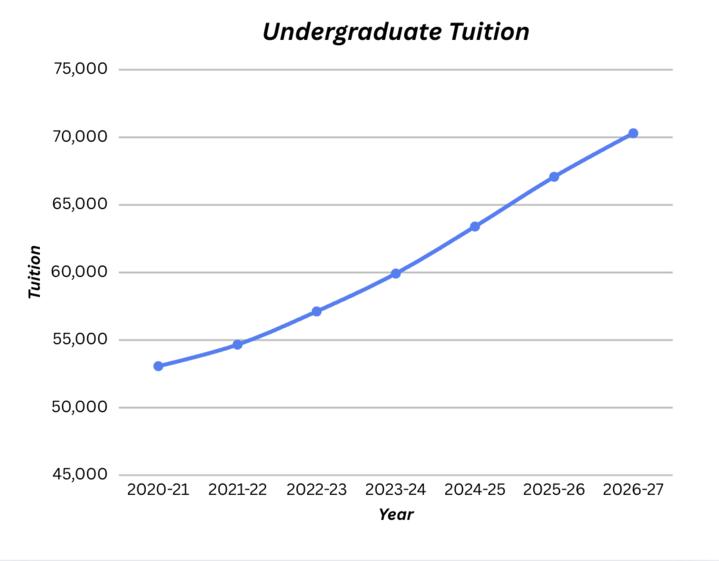
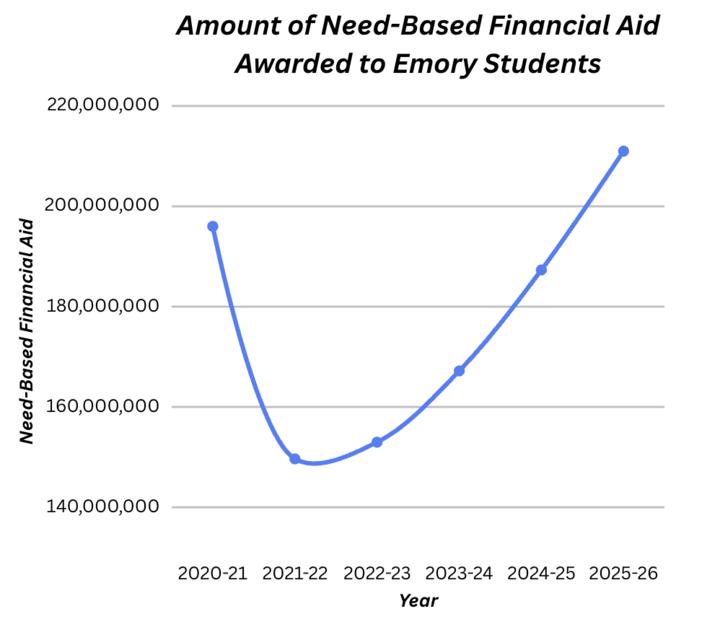
Since 2020, Emory University has increased its tuition by over 30% from $53,070 in 2020 to $70,300 in 2026. Tuition rate increases have made students increasingly reliant on student loans, as need-based financial aid has failed to keep pace. Even with rising tuition, the percentage of Emory undergraduates who receive financial aid has decreased from 68% in 2020 to 52% in 2025.
In September 2025, Interim University President Leah Ward Sears (80L) announced that Emory would expand the Emory Advantage program to provide free tuition for undergraduates whose families earn $200,000 or less, starting in fall 2026.
Grey Whalen (29C) expressed support for the Emory Advantage Plus program, but noted flaws regarding its criteria.
“I’m really glad that it's tuitionfree for students under 200K a year,” Whalen said. “However, I know that 200K doesn’t necessarily mean income. It also includes assets and things like that.”
Whalen added that the program’s conditions can still prevent some students from receiving aid, which she believes is “troubling.”
Since 2020, Emory has increased its tuition by $17,230, a 32.5% increase. In 2020, Emory’s tuition was $53,070, and the total cost of attendance, including tuition, fees and room and board was $69,440. In the 2026-27 academic year, tuition will be $70,300, with total costs equaling $93,128.
Jaelyn Dudley (27C), who receives financial aid through the U.S. Department of Veterans Affairs, has seen the impact that tuition increases have on his peers.
“Tuition increase has no immediate effect upon me, but I know a lot of people who are already struggling financially, just with the current financial aid program,” Dudley said.
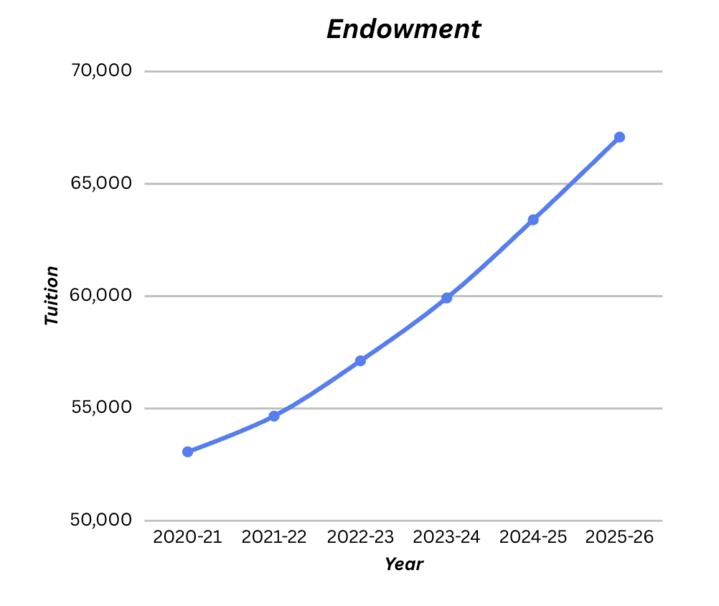
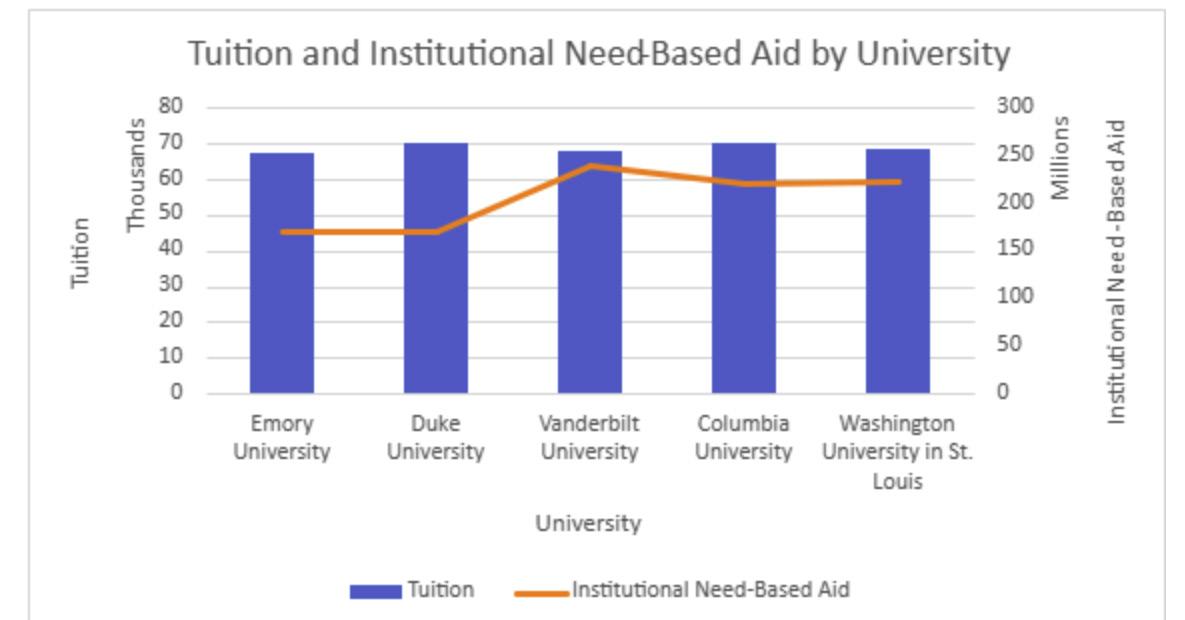
Emory’s total amount of needbased scholarships and grants has also increased 7.7% since 2020. In 2020, Emory awarded $196 million in needbased aid, which grew to $211 million in 2025. Over the past five years, Emory has covered approximately 91% of all awarded need-based scholarships and grants, with funding mainly sourced from the University’s $11 billion endowment donated by alumni and other sponsors.
In 2022, Emory replaced all need-based loans in student finan-

cial aid packages with institutional grants and scholarships through the Emory Advantage program. Former University President and current University Chancellor Gregory Fenves wrote that he hoped the expansion would allow students to graduate with less debt. In a recent statement, Emory stated undergraduate federal loans have decreased by 67% since they replaced need-based loans.
U.S. News & World Report ranked Emory No. 13 among U.S. colleges with the largest endowments, the highest of all institutions in Georgia. The endowment consists of over 2,400 individual funds, which donors establish for different purposes, such as scholarships, research and health care. The University invests each fund’s principal and uses approximately 5% of its earnings toward the donor’s intent.
According to the New York Times, Emory ranks No. 149 in the percentage of incoming undergraduates who receive the Federal Pell Grant, which is a form of need-based financial aid from the federal government that does not have to be repaid. In the 202526 year, Emory’s Pell Share was 18%, having decreased 5% since 2011, when it was 23%.
Another form of need-based financial aid is offered through the QuestBridge organization, which provides a full scholarship to highachieving students from low-income backgrounds. QuestBridge recipient Landon Diaz (28C) highlighted that the program covered most of his costs at Emory, but believes that financial aid coverage can be confusing for study abroad programs.
“Since I’m QuestBridge, it covers everything for me,” Diaz said. “I’m really fortunate for that. There’s study abroad opportunities that financial aid is kind of tricky about, but that's still like, you don't need to go study abroad.”
Rachael Ipaye (28C), who is a QuestBridge Finalist, said she expe-
rienced delays receiving financial aid, noting flaws in the University’s transparency about scholarships and refunds. Ipaye shared her experience with the system, explaining that the University reduced her institutional grants when she received an external scholarship, leaving her with the same amount of aid as before.
“It’s kind of unfair in a sense, especially if you don’t have work study, you’re low income, and you're out here in another state on your own,” Ipaye said.
In 2022, an antitrust lawsuit filed by five former college students claimed that 16 elite universities had been artificially inflating the net cost of attendance for students receiving financial aid. Emory was listed in the suit and settled for $18.5 million in 2024.
Since 2022, Emory has faced two more antitrust lawsuits. A Boston University student and Cornell University (N.Y.) alumnus filed a lawsuit in 2024 accusing 39 private institutions, including Emory, of inflating tuition prices for students from divorced families. Two undergraduate students and two graduates of U.S. colleges filed another lawsuit in 2025, claiming that the Early Decision admissions process reduced competition for wealthier students because fewer lower-income students applied Early Decision I due to the binding clause.
While tuition increases continue to outpace financial aid each year, Sears wrote that Emory aims to uphold its commitment to removing financial barriers to education through further expansion of aid.
Dudley highlighted that financial aid challenges may cause students to experience excess pressure.
“People are already stressed enough with just regular college, without any financial burdens,” Dudley said.
— Contact Samara Goyal at samara.goyal@emory.edu
Continued from Page 1
police during enforcement operations. Most TSA workers, who worked for more than six weeks without pay, received some back pay on March 30.
Staton said that immigration policy is “notoriously difficult to reform because of its multiple dimensions and constantly changing coalitions.”
Funding stalemates give Democrats leverage to push on how ICE carries out enforcement, according to Staton.
“If you get immigration policy injected into another kind of debate between the two sides of Congress and the president, you’re just injecting this thing that is impossible to get movement on,” Staton said. “Nobody on either side wants the TSA agents not to be paid and for the airports to look like this, but the Democrats
picked a good issue to put into the mix.”
According to Atlanta Mayor Andre Dickens, the federal government sent ICE agents to manage security lines at Hartsfield-Jackson Atlanta International Airport on March 23.
Dickens said the DHS involvement was “unprecedented in the 100-year history of the airport.”
Atlanta immigration attorney and Adjunct Professor at Emory University School of Law Charles Kuck believes ICE officers cannot perform TSA’s duties, such as screening passengers. According to Kuck, the presence of ICE agents has caused “extraordinary emotional distress” even for individuals who have no risk of being detained by ICE.
“They can’t screen passengers, so they can’t do the most important function of TSA,” Kuck said.

courtESy oF WikimEdia commonS uSicEgov
Federal government deploys Immigration and Customs Enforcement to airports, following delays and cancellations.

The Emory Wheel
Volume 107, Issue 6 © 2026 The Emory Wheel
Alumni Memorial University Center, Room 401 630 Means Drive, Atlanta, GA, 30322 Business (404) 727-6178
Editors-in-Chief Jack Rutherford and Lauren Yee editorinchief@emorywheel.com
Founded in 1919, The Emory Wheel is the financially and editorially independent, student-run newspaper of Emory University in Atlanta. The Wheel is a member publication of Media Council, Emory’s organization of student publications. The Wheel reserves the rights to all content as it appears in these pages, and permission to reproduce material must be granted by the editor-in-chief.
The statements and opinions expressed in the Wheel are those of the authors and do not necessarily reflect those of the Wheel Editorial Board or of Emory University, its faculty, staff or administration.
The Wheel is also available online at www.emorywheel.com.
“Presumptively, they can walk around and intimidate people and look for human trafficking.”
Kuck added that the deployment of ICE agents into the airports is not a response to staffing shortages.
“They’re not actually doing TSA’s job and reports have indicated a lot of TSA agents are really upset that they’re there because ICE is being paid. TSA is not,” Kuck said.
Staton said the decision to place ICE officials in airports highlights the administration’s continued emphasis on immigration enforcement.
“It was doubling down on their approach to immigration enforcement to create fear of removal, and fear from removal, for people who were thinking about entering the country or staying in the country past the time they are allowed to,” Staton said.
The shutdown also prompted a response from Delta Air Lines, which suspended special airport services for members of Congress as disruptions worsened. Delta Air Lines Chief Executive Officer Edward Bastian called it “inexcusable” that TSA officers were still working without pay and said the company was “outraged” by the situation.
For Emory students, the effects have been personal. Jeanette Hydukovich (28C) said both winter storms in the Midwest and airport delays disrupted her spring break travel.

“I had delays, both going home to Wisconsin and also coming back to Atlanta for spring break,” Hydukovich said.
After repeated cancellations, she spent the night at Chicago Midway International Airport before reaching Minneapolis the next morning. Hydukovich said the lack of information made the experience more stressful. She also noted that the sharp increases in ticket prices intensified the uncertainty, with a oneway ticket costing at least $1,500.
“You didn’t really know why,” Hydukovich said. “That also meant you didn’t know when it was going to get resolved at all, so then you were just kind of stuck.”
Ivan Endelman (26C) said his flights were repeatedly canceled and delayed. However, Endelman did not blame the TSA officers themselves.
“The TSA agents are doing their best under a very difficult situation, and my experience with them was positive,” Endelman said. “At the end of the day, they’re just trying to do their job to the best of their ability, and it’s not their fault.”
Endelman added that while missing a few classes was manageable for him, the delays appeared especially difficult for travelers on a time crunch.
“I definitely noticed that a lot of other people at the airport were very stressed out,” Endelman said. “I can imagine that when it comes to people with responsibilities at work or important events that they need to make, this was really a frustrating point.”
— Contact Lucy Benjamin at lucy.benjamin@emory.edu
Lichtman, Martinez discuss potential increase of SAF
Continued from Page 1
Student Programming Council (SPC), Belonging and Community Council (BCC), Club Sports, TableTalk, Emory Entrepreneurship & Venture Management, Media Council and Outdoor Emory. SGA allocated a total of $1,255,000 to EAs, compared to $1,096,000 during the budgeting process for the 2025-26 academic year.
BCC President Lyla Velez (26B, 26C) said BCC requested more funding for the 2025-26 year due to University-level funding cuts from Belonging and Community Justice (BCJ).
“BCJ, who normally has the Signature Event Grant Fund, did not get approved for next year to distribute that funding,” Velez said. “Events like Diwali, Noche, By Night from [Vietnamese Student Association], all of those events will no longer have funding through BCJ and would necessarily cease to exist.”
Lichtman said SGA plans to fund BCJ directly to support the continuation of Signature Events. He added that SGA would allocate this money separately from the EA budgeting process.
SGA President Tyler Martinez (26C) stated that SGA is engaging in discussions with BCJ to coordinate their plans for the funding initiative.
“We have the capacity to do it,” Martinez said. “It’s just about making sure that SGA and BCJ are in alignment of what we would require from student organizations, taking feedback from what we hear from other students about their experience at Signature Events and what they would like to incorporate.”
SGA passed a bill on Jan. 26 to fund the 2026 Mosaic Graduation Ceremony, an event honoring culture and belonging at Emory. BCJ hosted the inaugural ceremony in 2025, but according to Martinez, they will not be able to continue due to funding
cuts.
Martinez also added that Campus Life will no longer be able to subsidize the $5 semesterly printing stipend for each student, as they have in previous years. Currently, SGA allocates $24,000 per year to the printing stipend. According to Lichtman, if SGA were to fully fund the $5 stipend without Campus Life, the amount would be $85,300 per year.
He said the 60th SGA will have to deliberate on how much to contribute to this initiative.
“That’s going to be a discussion that happens internally with the VP of finance to make sure that we can actually sustain that,” Martinez said.
“Also working with EmoryCard to ensure that every student actually receives that stipend, because I do know that a lot of students are saying they aren’t receiving their $5 a semester.”
In a Feb. 22 interview with The Emory Wheel, Lichtman discussed SGA’s plan to increase the SAF, following University-level funding cuts. Lichtman confirmed that while SGA still plans to increase the SAF, they are still determining the exact amount.
“Now we have a better picture going forward of what the main funding changes are on campus, especially with what the administration is going to fund next year and what we’re expected to fund,” Lichtman said.
Reflecting upon the financial report and the 59th SGA’s initiatives, Martinez highlighted the need to consider changes to the SAF.
“It’s lovely to see how many things we were able to fund, and the financial report does create room for reflection about how SGA uses the Student Activity Fee, provides transparency around that, but also leaves room for questions about Emory in the future,” Martinez said.
Martinez stressed the importance of dialogue between SGA and the stu-
dent body when deciding on funding changes.
“When students hear, ‘raise the Student Activity Fee,’ they’re already like, ‘Our tuition is raising every year, why are you raising this too?’” Martinez said. “It’s going to take that level of communication with our community, between members of the 59th SGA as well as the 60th SGA.” Lichtman said he is optimistic about SGA’s financial future, stating that he expects there to be sufficient funds to support its upcoming initiatives.
“We’re in a pretty good financial picture going forward, mainly because of the rollover that we’re expecting to get from the EAs and [Divisional Councils],” Lichtman said. He added that he expects SGA to receive about $7,000 in unspent funds from EAs and Divisional Councils at the end of the year.
Martinez urged students to use SGA supplemental funding as a resource in light of recent funding cuts, emphasizing SGA’s commitment to financially supporting the student body.
“It’s been quite a discussion this year about how ‘effective’ SGA has been, but [Lichtman’s] financial transparency reports have proven that, contrary to popular belief, SGA has been setting aside money for several initiatives,” Martinez said.
As SGA prepares to transition to the 60th administration, Lichtman expressed his hopes for continued transparency with the student body.
“I just hope they’re as transparent as we were this year. I know a lot of this information is usually kept very private when it doesn’t have to be,” Lichtman said.
“It’s important that future SGAs are still transparent and students know that they can involve themselves in financial decisions.”
— Contact Tori Mooney at tori.mooney@emory.edu
The number of private, four-year universities and colleges with over 10% of their student body classified as disabled has quadrupled between 2011 and 2022. Emory University reflects that shift.
Registration with Emory’s Department of Accessibility Services (DAS) stands at an estimated 12.3%, or 1,865 students across Emory’s nine schools in the 2024-2025 academic year. Nationally, much of that growth stems from rising diagnoses of mental health conditions and attention deficit disorders. For students who spent years undiagnosed and ignored, that validation is long overdue.
Expanded legal definitions of disability under the Americans with Disabilities Act Amendments Act and a generational decline in student well-being have all legitimately expanded the population of students who qualify for support.
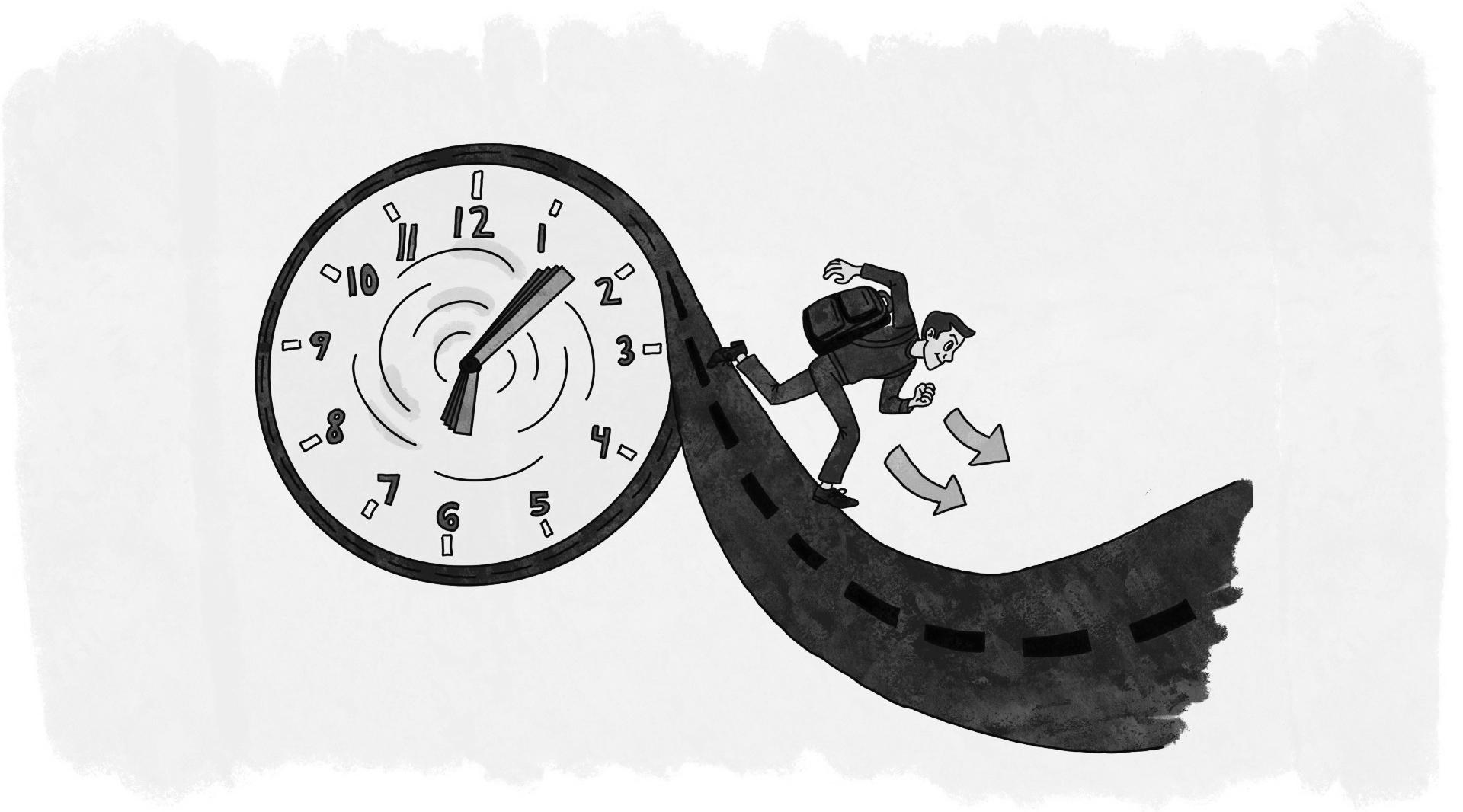
Even so, when students receiving accommodations begin to make up a significant share of the classroom, the issue is no longer individual, but structural. As disability accommodations surge at Emory, the University must stop relying on individual fixes and instead redesign its instruction to move away from high-pressure, timebased testing toward forms of evaluation that prioritize learning over speed.
We applaud universities that validate students with invisible disabilities, a reality that academia has historically been keen to ignore. As such, we do not seek to argue the fallibility of services that determine whether a student may receive accommodations, but instead, we must search for a solution that balances equity and accountability.
At present, individual accommodations serve as little more than a BandAid for a far more systemic bleed.
In design, academic accommodations allow students with disabilities to participate on equal footing with their peers, rather than a leg
up. Research suggests that some who receive new learning disability diagnoses at elite colleges lack longterm evidence of academic impairment prior to college. This raises the question of whether some may be manufacturing accommodations in order to stay ahead of the curve.
One common accommodation, extended test time, addresses performance in the exam room without touching on the instruction preceding it. Disorders like attention deficit hyperactivity disorder (ADHD) affect executive function throughout the learning process, making it harder to concentrate during lectures, retain information and organize coursework. Even still, the accommodation only takes place during the moment of assessment.
When universities construct academic environments so punishing that neurotypical students feel they cannot survive without extended time, the problem is not the student seeking relief. The problem is instead built into the way that institutions measure intelligence under a metric of speed.
At Emory, a structural contradiction at the center of its accessibility framework intensifies that pressure. Student Health Services does not diagnose or treat students whose sole diagnosis is ADHD-related disorders, instead referring them to
When students receiving accomodations begin to make up a significant share of the classroom, the issue is no longer individual, but structural.
outside providers who charge for a basic evaluation, effectively creating a pay-to-play system. Students with financial resources can secure documentation and accommodations, while those without them must compete against their peers
operating by a different rulebook.
Grading structures further compound this imbalance. Many professors choose to curve exams at their discretion or are required to, depending on their department guidelines.
Universities often offer curves as a means of balancing the grade distribution of student performance. In the case of Emory’s Goizueta Business School, the recommended curve only allows 15-20% of students to achieve a letter grade of A in their Bachelor of Business Administration core classes. Goizueta’s rationale for its grade distribution is to reflect “an equitable policy that underscores the rigor of the program,” but this dynamic distorts the purpose of education.
Exams at Emory are structured like most collegiate-level assessments, with the goal to test one’s ability to think under pressure and apply knowledge gained in class. However, when students bypass benchmarks through the use of undue accommodations, they treat learning as a secondary gain.
When success is made finite, the University incentivizes a dog-eat-dog
culture of loopholes, shortcuts and elbowing classmates out of the way for a ticket into the extra-time exam.
Advocates argue the focus should move elsewhere. In response to concerns about an “accommodation nation,” the Association on Higher Education and Disability states that “rather than questioning whether too many students qualify, the focus should be on designing assessments that are inclusive for all learners.”
When those with accommodations occupy a significant portion of learners, it signifies that traditional assessment is no longer effective. In order to evolve alongside shifting educational needs, professors must move away from punitive testing styles that reward students for speed rather than certainty, instead evaluating pupils in a way that inspires learning for the sake of knowledge.
Some professors at Emory have started to take steps in the right direction, bringing student experience to the forefront of their classroom.
Assistant Teaching Professor of Neuroscience and Behavioral Biology Megan Massa practices “studentcentered, feedback-driven critical pedagogy” in developing “studentdriven course design.” Massa allows students in some courses to set their own learning goals and design their own projects to assess their progress. This model, referred to as “ungrading,” gives students greater agency over their learning while easing the pressure of punitive timelines, narrowing the conditions under which students must demonstrate their learning. While ease of access to accommodations does mirror Emory’s commitment to an “inclusive pedagogy,” if abused, it does not reflect our University’s promise to push its students to be critical thinkers. Education is a right that is becoming increasingly privileged, and we should recognize the opportunity for change rather than welcoming stagnancy.
The above editorial represents the majority opinion of The Emory Wheel’s Editorial Board. The Editorial Board is composed of Carly Aikens, Shreya Aithal, Editorial Board Editor
Eliana Liporace, Pierce McDade, Niki Rajani, Meiya Weeks and Opinion Editor Crystal Zhang.
Volume 107 | Number 6
ameLia BUsh managing Editor
ethan JacoBs managing Editor siya kUmar managing Editor
JacoB mUscoLino managing Editor
chLoe nam managing Editor LaUren yee Editor-in-chiEf
Irene John News Editor
Eileen Zhu News Editor
Mira Krichavsky Editorial Editor
Joshua Glazer Opinion Editor
Crystal Zhang Opinion Editor
Mia Hamon A&L Editor
Clara Hilsman A&L Editor
Hunter Buchheit Features Editor
Sophie Bergman Sports Editor
Sonia Liew Sports Editor
Will Peck Senior Editor
Sasha Emmerich Image Editor
Sage Buchris Photo Editor
Jack Sutton Deputy Photo Editor
Emerson Farrar Deputy Photo Editor
Saba Faisal Deputy Illus. Editor
Tiany Guo Deputy Illus. Editor

By crystaL Zhang opinion Editor
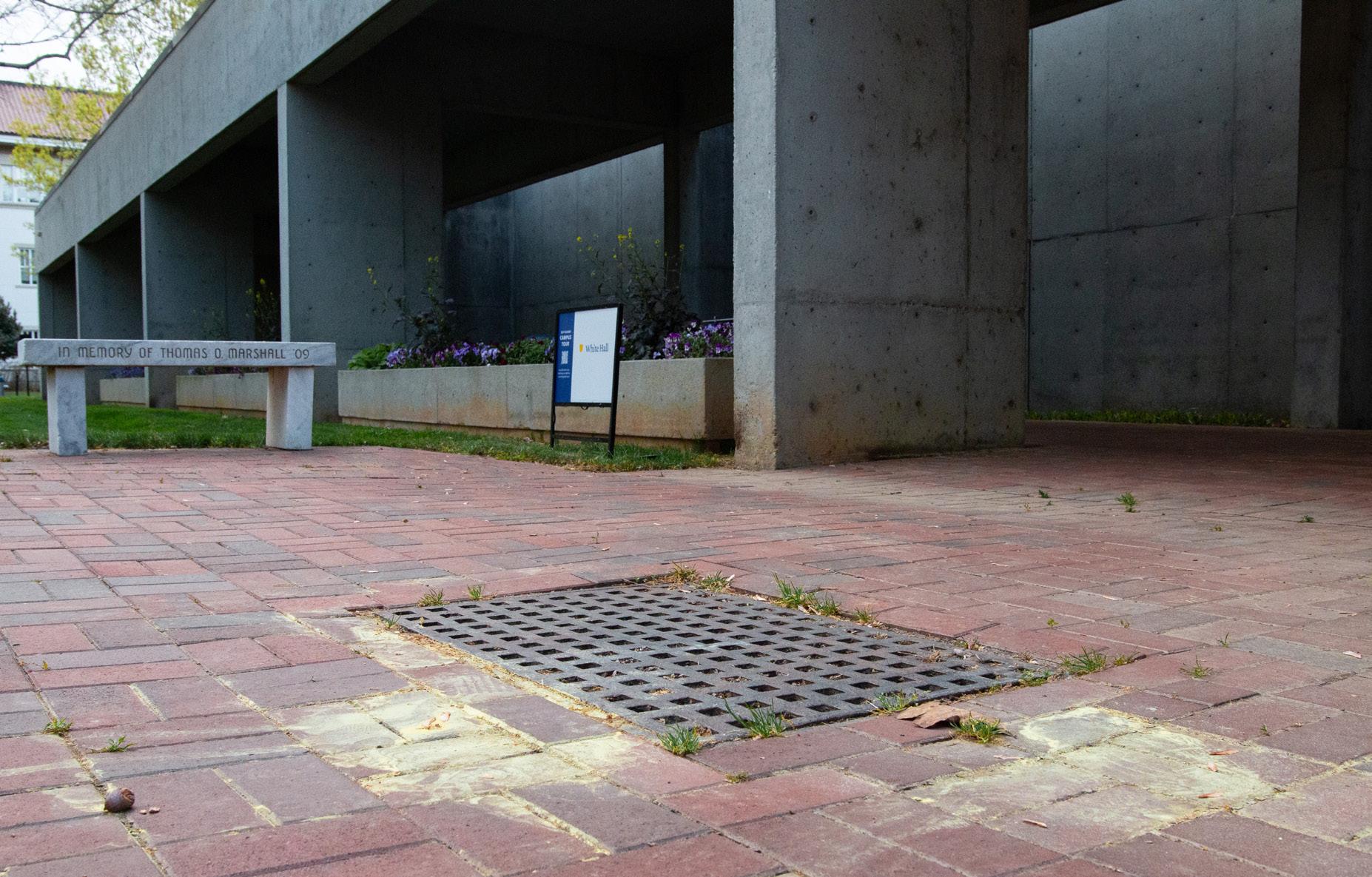
Each spring, just as the weather starts warming up, Emory University students confront an immensely irritating issue — literally. Seemingly overnight, sidewalks, cars and benches are coated in a thick film of yellowgreen dust.
While walking across campus, the air itself can look hazy. As someone with pollen allergies, I spend each spring in Georgia with watery eyes and a congested nose. Pollen should not be treated as just another seasonal nuisance — it is a recurring and worsening public health challenge.
Atlanta and Emory must address Georgia’s extreme pollen seasons by implementing both large-scale urban planning and sustainability changes and short-term services to improve students’ and residents’ quality of life.
Atlanta has been suffering from these pollinated assaults for years, and they are becoming increasingly severe. Last year, Atlanta’s pollen count, a measure of the number of pollen grains per cubic meter of air over 24 hours, exceeded 14,800 grains per cubic meter on March 29, an all-time high in the nation’s history.
This year, on March 23, Atlanta’s pollen count reached over 6,500 grains per cubic meter, over four times the threshold for a classification of extremely high. Levels in the city have remained above this threshold for the past week.
In addition to rising pollen counts, more people than ever are suffering from pollen allergies. Over one in four U.S. adults has a diagnosed seasonal allergy with symptoms ranging from disturbed sleep patterns to difficulty breathing.
At Emory, where students must balance classes, labs, jobs, extracurriculars and more, these symptoms can significantly hamper their ability to focus and learn. During midterms and finals, especially, allergies negatively affect exam performance.
If Emory wants to promote student wellness and academic success, it must ensure its environment is free of allergens by cleaning existing pollen and mindfully planting to reduce future pollen production.
The burden pollen allergies place on communities is also not evenly distributed. People without housing, air filtration or easy access to medication to reduce pollen exposure and symptoms are likely to suffer more from high pollen levels.
In a city like Atlanta, where there are clear disparities in who has access
to housing and healthcare, pollen is an environmental hazard that worsens inequality. As a healthcare leader in both Atlanta and Georgia, Emory has a responsibility to promote health access and equity by addressing recurring pollen exposure.
Atlanta and Emory can alleviate some of the city’s issues with high pollen counts through smarter urban planning. While urban tree cover is important for shade and environmental quality, many cities like Atlanta plant large numbers of wind-pollinated tree species such as oaks and pines.
These species release significant amounts of airborne pollen and are among the primary contributors to Atlanta’s high pollen density. Similarly, while Emory’s campus and the surrounding area are beautiful and heavily treed, many of the commonly planted species, like sweetgums, drop seedlings that can continue to release pollen on the ground.
Pollen should not be treated as just another seasonal nuisance — it is a recurring and worsening public health challenge.
When designing public spaces, landscapers must consider how their choices can worsen an already significant health burden. Beauty should not be the only factor considered in green space planning — it is important to consider both the number and types of trees planted.
For the best results, Atlanta and Emory leaders should invest in urban resilience by planting a more diverse range of native trees, especially insectpollinated and low-pollen species, such as magnolias and dogwoods, to make our environments both beautiful and sustainably inhabitable.
While implementing these longterm, larger-scale changes, Atlanta and Emory should also introduce lower-cost and short-term interventions to improve student and resident quality of life now. For instance, Emory’s Student Health Services can provide free over-the-counter allergy medications at the Emory Student Center or at the health access vending machine on the first floor of the Alumni Memorial University Center, which already provides complimentary Advil and Tylenol.
Administration can also ensure that indoor common areas and res-
idence halls have adequate air filtration during peak pollen times. Additionally, both Emory and Atlanta should carry out more routine outdoor cleanings to reduce pollen accumulation in heavily trafficked areas.
None of these changes would solve the problem entirely, but they would signal that our institutions recognize pollen season as a real issue and make daily life healthier and less miserable.
However, to truly address the root causes of the pollen issue, our institutions need to put more effort into addressing climate change. Research has shown that rising temperatures and carbon dioxide levels are contributing to earlier, longer and more intense pollen seasons.
Less predictable rainfall also allows pollen to accumulate and persist for longer periods. Therefore, treating pollen as an isolated nuisance ignores the fact that it is also a symptom of a broader environmental crisis that cities and institutions are already failing to address.
While the Emory Climate Research Initiative is doing important work to improve sustainability, both the University and our local governments must do more to introduce policies that support large-scale reductions in greenhouse gas emissions.
This includes pushing businesses to adopt environmentally friendly practices, such as switching to renewable energy sources instead of fossil fuels and investing more in sustainable services such as public transport.
Atlanta’s extreme pollen is a visible and worsening environmental health problem, and treating it as anything less will only make it harder to manage in the future. For people like me with pollen allergies, there are countless ways we can protect ourselves from the pollen attacks.
Students can monitor Atlanta’s daily pollen counts using The Weather Channel, wear masks on severe days, use air purifiers and take over-the-counter antihistamines when necessary. However, we should not have to rely on individual efforts to get through each spring season.
Both Atlanta and Emory leaders must take more meaningful steps to address the pollen issue, not just for the sake of their residents’ noses, but for the future of our community and the planet.
— Contact Crystal Zhang at crzhan@emory.edu
By JorDan aBDo Staff WritEr
When I was an early teenager, I always walked up to groups of people and felt comfortable starting conversations. I loved crowds. I enjoyed the noise and social energy of being surrounded by people. I never worried about what others thought of me, and I loved to speak up and introduce myself.
Now, however, walking into a lecture hall even a minute late — with the chance that people might glance up for a second when I open the door — is enough to make my heart race. I overthink before I get to a party. Starting a conversation with someone I know feels forced rather than exciting.
It feels weird to miss a version of yourself that was so effortlessly you. Nothing bad happened, nor was there a particular moment of sudden change. Instead, my social anxiety slowly escalated as time went on, beginning in high school.
I find myself caring so much about others watching, judging or noticing me when I used not to notice at all. We often dismiss social anxiety that develops later in life, but it deserves recognition.
to please everyone.
I once felt free running through the fields with my friends, was excited to go to soccer practice and looked forward to the next day of school, but these days, I worry more about tackling my schedule than enjoying life’s little moments.
I partially blame my overuse of social media for my feelings of comparison and loathing. I often find myself scrolling for hours on TikTok and Instagram, measuring myself up to another person or reading hateful and disrespectful comments about someone online.
Near-constant social media use negatively affects mental health, and spending more than three hours on your phone causes a higher risk for mental health disorders.
When I am scrolling, and I see my friends at other universities and at Emory going out, I experience two different feelings, one of loneliness and another of contentment that I do not have to face my anxiety of being around other people.

This constant conflict only intensifies the social anxiety that so many students struggle with, demonstrating that social anxiety is a serious issue that deserves greater recognition, attention and self-reflection.
It is okay to accept that social anxiety is real and it is nothing to be ashamed of. It is normal to see a difference between your younger, more social self and now. We change, and so do our expectations and surroundings — so stop comparing yourself in shame with the version of you from 10 years ago. When I denied my social anxiety, I was only hurting myself and further diminishing my overall well-being.
It is hard to even admit to others that I have social anxiety. It is something I am ashamed of. When people ask me, “Why weren’t you there?” or say, “It was fun, you should’ve been there,” I make excuses. I lie and say there was an inconvenience, I was too tired or that I had a lot of work that day.
The truth is that being nervous in social situations is too embarrassing to confess. Anything feels better than admitting that walking into a room full of people or introducing myself to strangers is my worst nightmare. Many assume that social anxiety is an exaggeration of the simple nerves that come along with putting yourself in social situations. When it looks like I am avoiding groups, I rarely feel understood — even my friends often overlook my anxiety.
This form of chronic anxiety does not just affect my social life — it also weakens my confidence. Anxiety makes me question my abilities, identity and sense of self. When I was younger, I was innocent to the hardships of reality.
However, growing up, I faced changing environments, new pressures, higher expectations and experiences that have shaped who I am today.
Now, my grades define my success, my appearance overtakes my mind and my parents expect nothing but amazing things from me. It feels like nothing I do will ever be enough
As an Emory student who deals with immense social anxiety, I have taken advantage of Counseling and Psychosocial Services (CAPS).
CAPS is a free service for Emory students, providing counseling sessions with a therapist of your preference. Students can schedule meetings on their own time, both online and in-person.
Most importantly, Emory informs no one, including family, of these sessions. All students should take advantage of CAPS before graduating, especially because therapy can get expensive.
It is okay to accept that social anxiety is real and it is nothing to be ashamed of.
Do not force yourself to go out in uncomfortable situations. Emory students should do what makes them happy and what they are comfortable with. If being with one person, a couple of people, or no people makes you feel like your best self, then do that. The world is already so chaotic. It is important to put your well-being first and make time for yourself. When I am feeling down, I remind myself that I have lived through experiences that stunned my younger self. Confidence looks different at various stages in life, and so does strength.
Maybe strength is different than walking into a room of strangers without fear. Maybe it is just showing up even when your heart is racing. The fact alone that you have made it to this point — that you are here at Emory — is a huge accomplishment that you should be proud of.
— Contact Jordan
By kenan BaJraktarevic contriButing WritEr
Shortly after the United States, alongside Israel, launched major attacks in late February against the Islamic Republic of Iran, the Pentagon submitted an additional request for $200 billion in additional spending.
On March 29, U.S. officials announced preparations for military ground operations in Iran.
This war has now escalated to the largest-scale conflict in the Middle East since the Iraq War of 2003, and it coincides with geopolitical tensions that analysts increasingly worry will exacerbate risks for an expanded war between the United States and other global powers. U.S. President Donald Trump campaigned on a promise to end wars, but right now, he is deploying thousands more troops, planes and military infrastructure to the Middle East.
Military conscription, which the White House press secretary refused to rule out, is not off the table for Americans. As a student at Emory University, I have observed little open dialogue about this conflict even though the implications for our generation are dire. The absence of these debates reflects our generation’s desensitization to war, which threatens our ability to respond critically to the realities of armed conflict.
I grew up with the promise of global peace, yet over 240,000 people around the world have died due to conflictrelated violence in 2025. More than 500,000 soldiers and civilians have perished in the Russia-Ukraine war, with total casualties approaching 2 million.
Many other conflicts, such as the civil wars in Sudan, Myanmar and
Yemen, get little to no discussion at all. Our lack of sustained attention to these issues is directly related to our desensitization to the urgency and human cost of war.
Growing up, my teachers sterilized conflict by contextualizing events in historical frameworks rather than discussing current or future challenges. As an international studies major, I have taken classes in which I have observed professors and students purposefully avoid covering current conflicts.
By neglecting these hard conversations or lectures, we separate international conflict from our immediate concerns at home. That detachment fosters the belief that these crises are not relevant to our livelihoods, limiting our willingness to engage with them.
Desensitization and exposure to violent media online also exacerbate disengagement with conflict. Frequently witnessing death and trauma can lead to reduced empathy for victims, dulling emotional responses that often catalyze political engagement and policy shifts.
Our lack of sustained attention to these issues is directly related to our desensitization to the urgency and human cost of war.
Likewise, the algorithms of social media contribute to further detachment by repeated exposure and rapid consumption without reflection. This desensitization is critical to recognize,
as it causes us to normalize and accept pro-war rhetoric and policy.
In its first 100 days, the second Trump administration renamed the Department of Defense to the Department of War, a move symbolizing an embrace of militarism over diplomacy. Government social media accounts, including Trump’s posts on Truth Social, have displayed our country’s military capabilities in grandiose showcases of aircraft carriers and military personnel, coinciding with eyecatching names for military operations like “Operation Midnight Hammer,” “Operation Absolute Resolve” and, most recently, “Operation Epic Fury.”
In parallel, the U.S. Mint redesigned the dime, removing the olive branch that symbolized peace and keeping only the bundle of arrows that represents war. The Trump administration has unilaterally reoriented the world stage by intervening in the politics of Latin America, risking the integrity of the North Atlantic Treaty Organization over annexing Greenland and starting another war in the Middle East.
Although 67% of Americans feel that American national defense is strong enough or stronger than it needs to be, the Pentagon has demanded more war spending, the U.S. Army expanded its recruitment pools and Congress has made draft registration automatic.
Adopting increasingly violent rhetoric and policy, in conjunction with public disengagement, primes the public to tolerate extreme pro-war policies despite their potential consequences.
Now is the time to ask ourselves if the conflicts the United States is involved in truly serve our interests and values. Whether such a dangerous conflict would begin now or in the future, the consequences would nonetheless be devastating to our gen-
eration as we enter the workforce. Past U.S. generations have relied on a set of virtues to establish democracies, protect freedom and end conflicts.
Now is the time to ask ourselves if the conflicts the United States is involved in truly serve our interests and values.
If our generation still aligns with this values-based approach, then we must ensure that our government’s actions reflect it. With the world’s largest defense budget, one of the most powerful global currencies and the highest government spending, the United States has the means to do so.
As the 2026 midterm elections draw near, including those in Georgia, the
ballot box will determine the future of our nation’s place in the world. I encourage Emory students to stay informed, begin discussions of our foreign policy, and keep these concerns in mind when we vote.
This century will continue to test us with the reality of war, but we have the opportunity to curb it. It starts with getting past desensitization — we must bring conversations to the classroom, approach our cognitive biases and stay civically engaged.
It is time for us to confront the world we are in. Many of us will become leaders in different industries, and some may even enter politics. It is important to understand that the world we shape cannot be one where we contribute to more suffering. It is time to retrieve our humanity and save ourselves in the process.
— Contact Kenan Bajraktarevic at kbajrak@emory.edu

By DooLino Campus Overlord
Dear Doolino,
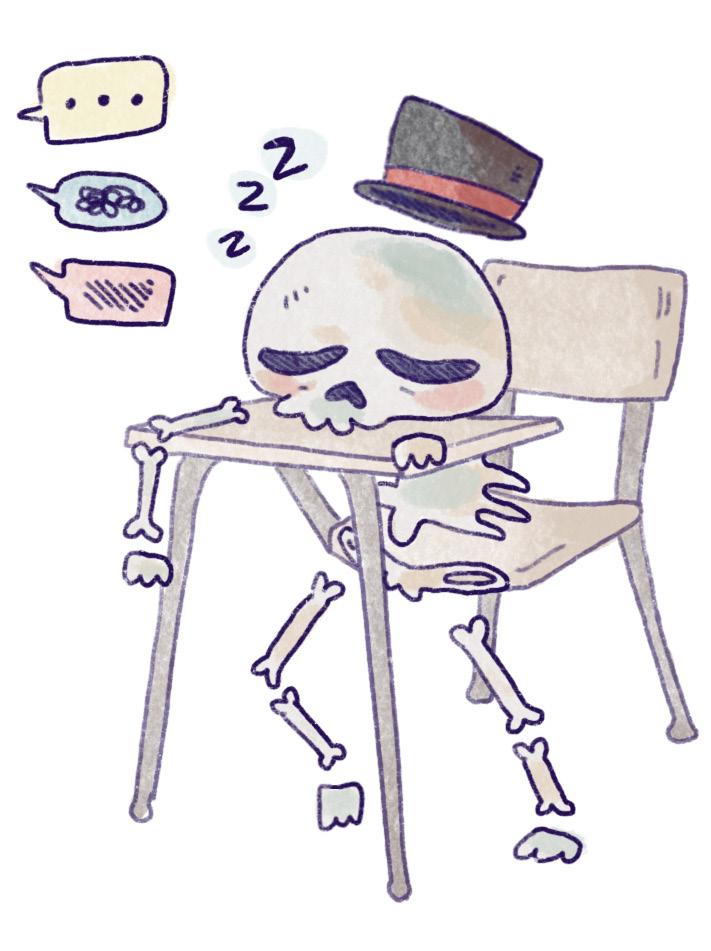
My professor is the most boring lecturer I have ever met in my life. I fall asleep in his class every single day. My exam is coming up, and I have not learned anything.
What should I do?
Sincerely,
Snoozy Suzie
Dear Snoozy Suzie,
Let me guess. He is tenured. The slog of an incredibly boring class with a professor two steps away from a retirement home is an experience that every college student must go through. Rest assured that you are not alone, Susie.
In fact, almost every academic department has at least one professor who is a little too comparable to the unintelligible, offscreen adults with the swampy, underwater voices in Charlie Brown cartoons. Why, Emory University students should form a support group for students with narcolepsy-inducing educators!
Unfortunately, your professor is likely here to stay, so I would toss aside any ideas of walkouts, schoolwide protests or angry emails to the administration. Walkouts and protests require responsibility, and con-
sidering you cannot even commit to staying awake for a class period, I fear I do not trust you to commit to organizing such a large event. As far as angry emails go, I am afraid your pleas would have the same effect on the administration as your professor seems to have on you — that is to say, they would ignore you and fall asleep. Instead, you should find ways to wake yourself up.
There are a few options here. Before I regale you with them, I would like to provide you with a disclaimer. None of the advice I plan on giving you consists of using artificial intelligence (AI) to find the answers to your professor’s exam. That is not to say that I am against cheating. On the contrary, as the Lord of Misrule, I delight in a little rule-breaking when the occasion tickles my fancy.
However, using AI to get away with shenaniganery is not only immensely harmful to the environment, which you incompetent mortal beings have already done irreparable damage to, but simply lazy and boring. I did not think you humans could get any stupider than you already are, but then you replaced your goopy brains with oft-faulty motherboards. Break the rules, but do it in an entertaining fashion. Your professor might be melting your brain, but do not melt it further on your own.
Anyway, let us suppose that you would like to actually pay attention in class and, as the youths love to say, lock in for your exam. In order to
get your professor’s monotone thrumming through your thick skull, you will have to get creative. One solution to this problem could simply be to upgrade your professor’s wardrobe. Each day, bring your professor a new article of clothing. Think bedazzled sunglasses or neon yellow scarves.
Your professor is likely to acquiesce to the fashion of the young, desperate to feel relevant again. Before you know it, he will show up to class bedecked in your swagalicious contributions, a veritable rainbow. Someone so colorfully and unconventionally dressed would be absolutely impossible to look away from.
However, there is a chance that your professor will take offense and refuse your offerings. Perhaps he has been attached to his style since the Stone Age and simply insists on stay-
ing exactly as he is. Perhaps he attaches emotional significance to his clothing and yearns for a relationship gone wrong through the means of wearing the same grey polos and khaki pants every single day. That is alright, my friend, for this brings me to my second strategy for making your professor’s lectures seem more interesting: Lie to yourself.
Now, usually, I prefer lying to others, as manipulating beings of a weaker mind than myself brings me such an incomparable rush. However, sometimes gaslighting ourselves is the only thing that makes certain tortures bearable. So make up a tragic backstory for your professor!
Maybe he is a bland and uninspiring class speaker by day, but a thrilling superhero soaring through the city of Atlanta and fighting unspeakable supervillains by night. Maybe he is having a love affair with your econometrics professor.
Maybe he is not a professor at all, but a con artist who has made his way into Emory for the love of the game, and he purposefully makes his lectures boring so nobody listens and realizes that he is talking absolute nonsense.
Tell yourself that, by listening to your professor, you will expose a terrible crime and bring your professor’s department to justice. If you treat your boring class like a game, it will certainly feel less like you are crawling slowly through a trough of molasses.
The last solution I will provide you
is a collaborative one. Form an alliance with others in your class. If it is a large lecture class, as boring college classes often are, you could become an unstoppable army of over 100 jaded and fatigued students. Yes, paying attention is hard, but what if you split up who was paying attention? If each of you commits to writing down just one sentence, together, you will probably have taken notes on a decent portion of the class content.
After you scribble your singular sentence, you can drift off to drowsytown, snoozing with the cozy knowledge that your cavalry of classmates has your back. Then, you and your classmates will be able to study together for your upcoming exam, forging friendships that will last a lifetime, as trauma-bonded relationships often do.
I believe that you will prevail, Snoozy Susie. Unlike our friend with the situationship from a few weeks ago, your problem is based in practicality, not emotion. So, ask for help. Join forces with friends. Chug an energy drink. If all else goes wrong, just drop the class.
However, that should be a last-case scenario. If you truly use your brain to overcome this issue, you might find that you learn something from this class after all — just not what you expected. Lock in, and always remember: Doolino knows best.
By Hunter BucHHeit F eatures e ditor
In elementary school, anything seems possible — be it performing like a pop superstar or filming a movie like an award-winning director. For Nicholas Benning (26C), what started as making silly music videos for his original songs in fourth grade soon turned into something bigger: creating his first short film. Benning and his friend shot the production on an iPad, dressing his friend’s younger sister in a zebra costume and using iMovie to edit. This first project pushed Benning into the craft of filmmaking, manifesting years later in his upcoming student-created series, “Written Together.”
In high school, Benning began learning about videography, working on the stage crew for his school’s theater and creating a short film for the visual and performing arts program he participated in. But Benning’s love for film did not stop there. As he transitioned to Emory University, Benning continued his exploration by majoring in film and media, later adding a concentration in film and media management, a collaborative program between the Department of Film and Media and the Goizueta Business School. Ultimately, the program helped Benning see a future in the industry.
“Entering this film and business program and having more experiences working in film in college, I started to realize, this is what I really want to pursue,” Benning said.
During his first year at Emory, Benning worked on the crew of a student-created web series, “Reality Check” (2023-2025), serving as a camera operator. After the creators of the show graduated, Benning wanted to follow in their footsteps and continue honing his craft by developing his own series. He wanted to produce one for his honors thesis, but after the program rejected him, he pivoted, channeling his motivation into another project.
Without the stress of a strict thesis sched-
ule, Benning began brainstorming ideas for his project on his own timeline, exploring different avenues before ultimately finding inspiration in an unlikely yet unique part of his high school experience — a notebook.
“My friends and I, our senior year, we had this notebook that we all drew in and wrote things in and added pictures to, and then we’d pass it around to other people that we knew in our grade,” Benning said.
“My friends and I, our senior year, we had this notebook that we all drew in and wrote things in and added pictures to, and then we’d pass it around to other people that we knew in our grade”
—Nicholas Benning (26C)
The journal passed through the hands of peers outside Benning’s friend group, becoming a “time capsule” of their entire class’s senior year experience. People added their own photos and drawings, an act that inspired Benning, showing him how something so sentimental could touch the lives of strangers.
As he conceptualized how to create this notebook-inspired story, Benning reached out to his friend Shadeh Okoudjou (26C) to assist him with scriptwriting. Benning met Okoudjou while they both worked as sophomore advisors, and the pair grew closer while collaborating on their WMRE radio show, “Freaky Tuesday,” in which they explore space and time through various forms of stories.
After Benning pitched his idea for a series, Okoudjou agreed to join him in writing it — they had always wanted to do a project together.
For Okoudjou, engaging in personal artistic endeavors amid a stressful academic
atmosphere helped her find fulfill ment outside her studies. In fact, “Written Together” even motivat ed Okoudjou to explore producing her own creative works through vlogging.
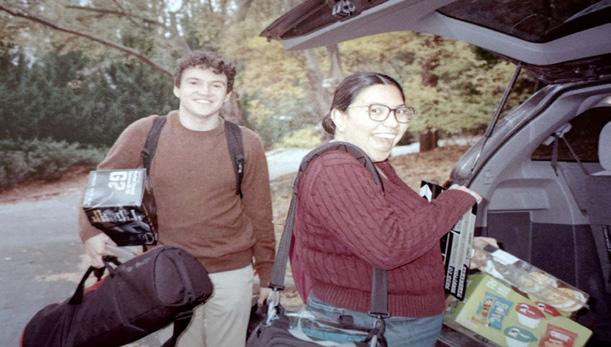
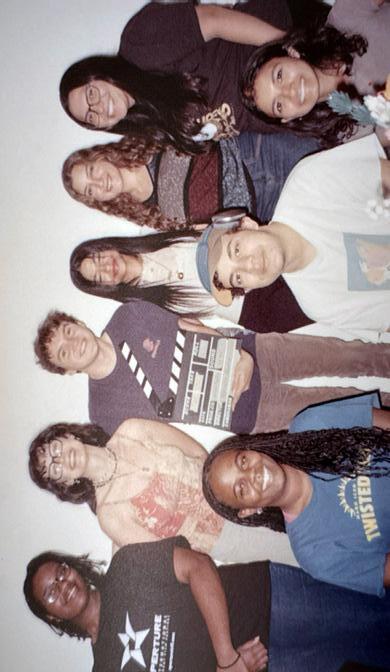
Last summer, the pair began crafting the story arc. Originally, they planned to produce eight to 10 epi sodes, however, they cut the script down to six for feasibility purposes. In early August 2025, the pair com pleted writing “Written Together,” which uses Benning’s notebook to bring the characters in each episode together, encouraging emotional honesty. During scripting, the series became an anthology, in which each of the six episodes contains its own story with broad ties between each.
“We realized that there was very much a tie of themes between the episodes, which really was this idea of community forming between strang ers, or the book kind of changing these people’s relationships to one another,” Benning said.
As the co-writer, co-producer
“This was all people just doing something that they were passionate about, and that really came through”


—Harison Rudnick (27C)
and director of “Written Together,” Benning harnessed his studies at Emory to fulfill his many roles. During his time in college, Benning took time to explore the ins and outs of everything film, from studying how Hollywood represents Greek and Roman history to learning cinematography and lighting.
“Being in the [film and media] department, you study a lot of different things,” Benning said. “It was a lot of film history, film theory, production, and I’ve been able to take from all of them and apply it to my own filmmaking.”
For his production, Benning knew he wanted to work with the people who he had collaborated with previously and admired throughout his college experience, which led him to ask his friend Nidhi Muthaya (26C) to join as well.
Muthaya, an environmental science major, had not done any advanced film work — that is, until she met Benning.
“The only film experience I had prior to university was in elementary school when I used to make iMovies with my friends,” said Muthaya. “But then I came to Emory, and freshman year Nicholas convinced me to take

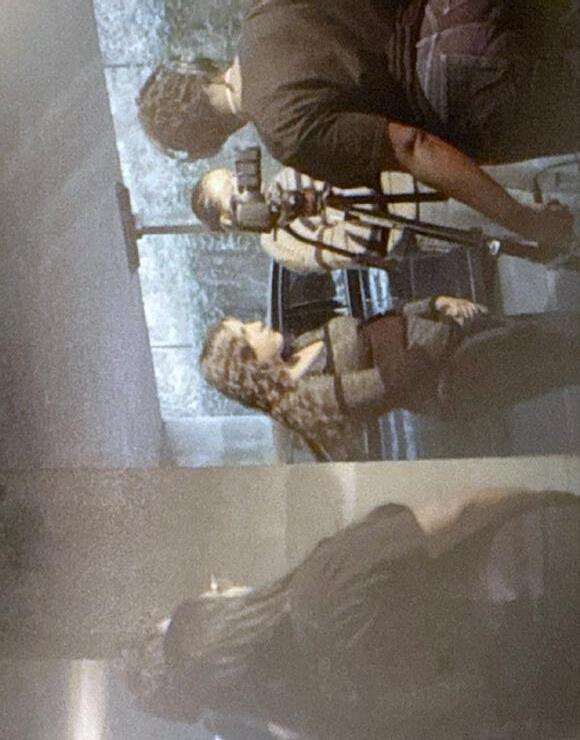
team, which handled costumes and set planning. She also advised when to film each scene and how to schedule production.
As filming started and Benning began posting about “Written Together” on social media, interest in the project grew.
“People who I hadn’t even reached out to yet saw the post, saw who was working on it and either reached out just from interest or because they knew somebody on the crew and were just excited to come join,” Benning said.
Harison Rudnick (27C), a double major in film and media studies and English and creative writing, became involved with “Written Together” through the project’s social media presence. After learning about the series on Instagram, Rudnick, who has been acting since they were four, sent in their resume and joined the cast a week later.
Rudnick was a main cast member in one episode of the series and appeared briefly in a second. While filming, Rudnick traveled an hour off campus to shoot a scene at a crew member’s house, spending roughly seven hours on set and eating pizza as a group. To Rudnick, that moment encapsulated the camaraderie on set.
“This was all people just doing something that they were passionate about, and that really came through,” Rudnick said.
For Rudnick, the current president of Emory’s Ad Hoc Productions, a student-led theater organization, projects such as “Written Together” demonstrate the importance of
think should be more explored,” Rudnick said.
Writing around 25 characters into the series, Benning had to develop an accommodating schedule for all the student actors and crew. Now, with filming concluded, the series is in post-production and editing, which involves sound design and color grading.
As the post-production of “Written Together” wraps up in the next month, Benning hopes to screen the series at local Atlanta theaters, with a Goodrich C. White Hall showing planned later in April.
While Benning is proud of the series itself and looks forward to its future screenings, his main takeaway from the experience is the relationships he formed along the way. Creating “Written Together” and seeing it through to its upcoming premiere influenced Benning to expand his view of the film industry and where he may find a place within it, as he learned he enjoys both production and management.
“This series and doing something of this scale has really opened my mind to being willing to see wherever I end up in the film industry,” Benning said.
As for the production itself, Benning would consider telling the stories of “Written Together” on a larger scale, even if the notebook that inspired it has, in its poetic irony, disappeared.
“[The notebook’s] since been lost, but that’s okay,” Benning said. “It was for the experience of it.”
— Contact Hunter Buchheit at hunter.buchheit@emory.edu
By sHreyA AitHAl
e ditorial B oard M e MB er
This article contains spoilers.
Pointe shoes, razor blades and generational feuds are, perhaps, the most unexpected elements to be combined in a thriller film. However, “Pretty Lethal,” directed by Vicky Jewson, manages to combine these diverging components in a way that makes sense while captivating the audience through every twist — and turn.
The star-studded cast, including Maddie Ziegler, Avantika Vandanapu, Lana Condor and Uma Thurman, took Amazon Prime by storm with the film’s release on March 25. The story follows five American ballerinas and their dance teacher as they travel to Budapest for a dance competition. However, after their bus breaks down, the ballerinas become stranded at the mysterious Teremok Inn. Before long, their stay turns fatal when their dance teacher, Miss Thorna (Lydia Leonard), is shot by Pasha (Tamás Szabó Sipos) after rejecting his romantic passes. Pasha is the sleazy son of a wealthy man, Lothar Marcovic (Michael Culkin), and becomes one of the film’s primary villains. As Devora Kasimer (Thurman), the inn’s owner, corners Pasha for causing a ruckus, she brings Pasha’s conflicted nature to light. As he is forced to confront his mistake — killing someone — he struggles between relying on his father’s power and fearing the consequences of his actions — a fight that will define the audience’s quest for truth as they attempt to piece together the reason behind the strange happenings. As the girls panic after losing their teacher, Bones (Ziegler) flees, only to
be caught by one of the hotel’s many brutish men who serve Devora. A gory series of altercations between the ballerinas and the hotel staff follows, as the ballerinas attempt to avoid certain death. Yet, the girls find strength in movement, precision and creativity, as each dancer knocks each man down with deadly grace using razor-bladed pointe shoes and powerful fan kicks. Filmed in the dimly lit, ominous basement set, the camera work immerses the viewer in the ballerina’s perspective. Abruptly switching from one captor to the next, the cinematography highlights the sheer manpower the girls must overcome, reinforcing their situation’s intensity.
The white costumes quickly become covered in blood, a sight that juxtaposes their supposed innocence, being young dancers, with the violent situation. The costuming emphasizes the situational incongruity alongside the dancers’ budding strength, as they become resilient in the face of bloodshed and begin fighting for their freedom. Despite their strength, the battles are not smooth, as they frequently get caught by the men chasing them. Bones becomes separated from the rest of the group and is later tortured, and a henchman corners Princess (Condor). Yet in each circumstance, the girls prevail, emphasizing perseverance over perfection. While the girls slowly navigate the building, searching for a way out, Devora and Pasha face off, and Devora explains that, while she once danced, her father’s debt ultimately cost her career. As the conflict between the pair worsens, Devora demands an audience with Marcovic, finally revealing that she was one of his victims as a loan shark, taking her leg in exchange for
her father’s debt. While Devora’s collection of ballet-related pictures and costumes displayed throughout the hotel hints at her connection to the art, the reveal remains dramatic and unexpected, as Devora tells her secret not to Pasha or Marcovic himself, but to one of the captured ballerinas with whom she identified. While the film portrays Devora as a villain, her character arc allows viewers to sympathize with her suffering and stand by her rage, making her final reckoning with Marcovic an enticing end. As the girls near a chance to escape, Devora, now clad in her ballet costume, catches them. However, Devora looks to the young women and sees passionate and disciplined dancers — characteristics she once had. Realizing that holding the ballerinas captive would perpetuate the same cycle of injustice she suffered from, she allows them to leave, turning instead to confront the man who cost her her dream: Marcovic. The dancers then speed away from the inn, united and ready to return to their competition and normal lives.
While their escape provided relief, the means of which lay in the hands of their captor and made it unsatisfying, as the method reduced their strength to the mercy of a perpetrator of violence, no matter how strong Devora’s redemption arc may have been. In comparing the two major conflicts of the film, the ballerinas’ escape was handled messily, avoiding a satisfying escape, while Devora’s storyline was strong and beautifully conveyed. Despite its stumbles, the film’s premise deserves its due appreciation. Dance-centered movies often use the sport as a backdrop for romantic storylines, but that is not

the case here. “Pretty Lethal” showcases dance’s power in a refreshing and empowering way, especially as, in the final scene, Bones and Princess perform a duet in their bloodstained tutus. Although the ballerinas can be perceived as frail and easy to subdue, each one demonstrates her ability to rise above stereotypes and prove these perceptions wrong, an idea that Chloe (Millicent Simmonds), a deaf dancer, emphasized. Despite being initially overlooked by Devora, who assumes she is not a threat because of her disability, she becomes an integral asset to the team when she saves the girls from a servant captor. However, “Pretty Lethal” falters in its execution. With abrupt cuts, such as from Bones punching and stabbing one of the henchmen to her suddenly
fan-kicking him, the choppiness made scenes awkward rather than empowering. Additionally, the girls oddly performed their routine to “Dance of the Sugar Plum Fairy” (1892) while fighting hordes of men, overshadowing the themes of teamwork otherwise present in the film. Similarly, as Devora kidnaps and sends her Doktor (Gábor Nagypál) to torture Bones, the young dancer screaming that she is a prima ballerina is cringeworthy, overshadowing the pain and resilience the dancers experience. Although the dancers of “Pretty Lethal” were not always principal dancer material, their fatal footwork came together to create a unique piece of art.
— Contact Shreya Aithal at shreya.aithal@emory.edu
‘The Best of Both Worlds’: Celebrate two decades of ‘Hannah Montana’ with these 4 songs
By AmeliA BusH
M ana G in G e ditor
Sparkly skinny scarves, endless layering and absurdly low-rise jeans defined the early 2000s style, and nothing encapsulates the era more than the early Disney Channel’s “Hannah Montana” (2006-2011).
Not only did the show produce one of today’s biggest pop stars, Miley Cyrus, but it spanned four seasons across five years, even getting its own movie, “Hannah Montana: The Movie” (2009), featuring a performance by my favorite, Taylor Swift. The show follows Miley Stewart (Cyrus), a teenage girl who lives a double life: part-time high schooler, part-time pop star. On March 24, the show celebrated its 20th anniversary, making it as old as I am. To commemorate this momentous occasion — dare I say, one of the most important of the year — I chose to revisit four “Hannah Montana” tracks that depict the show’s fun-loving and joyful energy.
‘The Best of Both Worlds’ (2006)
No track summarizes the series’s plot like “The Best of Both Worlds.” In the theme song, Cyrus revels in duality, the ultimate thesis of the show: “You get the best of both worlds / Chill it out, take it slow / Then you rock out the show.” With “The Best of Both Worlds,” Cyrus pokes fun at the show’s oddities, singing, “Without the shades and the hair, you can go anywhere,” referencing her blonde wig that, in theory,
conceals her identity while on stage. While simple and silly, “The Best of Both Worlds” encapsulates the show’s themes and plot — having fun as a celebrity while experiencing life as a teenager, making it the perfect entry point into Hannah Montana’s discography.
‘You’ll Always Find Your Way Back Home’ (2009)
Although my current favorite “airplane film” is “Crazy Rich Asians” (2018), growing up, it was “Hannah Montana: The Movie.” From the iconic opening makeover scene to Cyrus fighting over shoes with Tyra Banks, the film characterized my childhood ideas about what it meant to be a teen. Whether seeing it at age 10 or 20, the movie musical remains endlessly enjoyable. In the film, Hannah Montana’s fame begins to overwhelm Miley’s personal life, leading her father, Robby Ray Stewart (Billy Ray Cyrus), to try to ground her in reality by bringing her back to her Southern roots — Tennessee. On “You’ll Always Find Your Way Back Home,” the film resolves as Miley accepts herself entirely — Southern belle and all. Both confronting her emotions and describing them, Cyrus sings, “But when the lights go down, it’s the ending of the show (Ending of the show) / And you’re feeling like you got nowhere to go / Don’t you know.”
While some lines ring of cliché, such as “Back home, where the real you is the superstar,” the lyrics mirror the show’s teenage language and are consistent with a 17-year-old Cyrus.
The upbeat tone contrasts with the messaging, creating engaging tension that stops the listener in their tracks. When confronting endings and embracing new beginnings, one thing remains certain: “You can change your hair and you can change your clothes / You can change your mind, that’s just the way it goes / You can say ‘Goodbye,’ and you can say ‘Hello’ / But you’ll always find your way back home.”
‘He Could Be the One’ (2009)
Perhaps you recognize “He Could Be the One” from the TikTok sound, or maybe you are a true fan and know it from the show — either way, one thing is undeniable: The track experiments with sound in an animated way.
On “He Could Be the One,” Hannah Montana describes her love for the guy she is infatuated with. “Smooth talking, so rocking / He’s got everything that a girl’s wanting / Guitar cutie, he plays it groovy,” she sings, adding heavy instrumentals between each phrase that help underscore each word’s importance and energy.
The song comes amid the fallout of a love triangle, and, while dating a boy her father disapproves of (Jake Ryan (Cody Linley)), Miley uses this track to convince her dad of the relationship’s earnestness.
The lyrics are at times repetitive, but Cyrus varies her vocals in a way that each similar line sounds new and refreshing.
Her use of alliteration and

repeated sentence structure helps to create a cohesive track that, while similar, is not boring. “He Could Be the One” celebrates teenage love in its entirety — the butterflies, the uncertainty, the newness — singing, “He’s lightning, sparks are flying / Everywhere I go, he’s always on my mind.”
‘The Climb’ (2009)
Although most of the show’s popular tracks came from the series itself, one of the most influential songs from the franchise originated from the film — “The Climb.” Exhausted by her double life and aware of the strain it puts on her relationships, Miley utilizes this musical moment to reflect on her past choices and future decisions. While she begins the performance at a fair dressed as Hannah Montana, she eventually accepts her mistakes and imperfect self by revealing her true identity to the crowd. It is just Miley, the microphone and a piano that build into vivacious instrumentals that energize the audience.
While most “Hannah Montana”
tracks are catchy and danceable, “The Climb” succeeds in its subdued rawness. “There’s always gonna be another mountain / I’m always gonna wanna make it move / Always gonna be an uphill battle / Sometimes I’m gonna have to lose,” Cyrus sings, intimate and real, providing thematic variety to the tracklist.
In the outro, Cyrus’s vocal range and country-esque tone shine as she sings, “Keep on moving / Keep climbing / Keep the faith, baby / It’s all about, it’s all about the climb.” Her voice shakes ever so slightly, humanizing Miley and Hannah Montana at the same time.
We are defined by how we react to challenges, how we persevere, an idea that Cyrus sings with assuredness: “But these are the moments that / I’m gonna remember most, yeah / Just gotta keep going.”
“The Climb” is Cyrus’s magnum opus. A more poetic, realistic interpretation of the adage, “It’s about the journey, not the destination,” no “Hannah Montana” track is quite as genuine and relatable as this one.
— Contact Amelia Bush at amelia.bush@emory.edu
By miA HAmon
a rts & l i F e e ditor
Heartbreak is, at times, inconsolable — an inner part of your soul shatters, sounding a bodily alarm that often culminates in red eyes and a lumpy throat. While this brutal emotion can be isolating, British singer-songwriter RAYE understands the experience in its entirety, speaking to its grief on her second studio album, “THIS MUSIC MAY CONTAIN HOPE.” Released March 27, the 17-track record emphasizes soulful vocals, raw lyrics and cinematic instrumentation that find optimism in sadness through heartfelt lyrics that encourage growth. While fighting to dispel her anguish, RAYE provides a how-to guide for easing romantic sorrow by blending painfully honest lyrics and laughable lines, offering the listener comfort and solace in the most devastating times. The project’s grandness speaks to love’s sizable feelings and, therefore, the void left in its absence. In an industry that often confines artists to rigid genre boundaries — when their music does not fit in one category — RAYE breaks free, crafting a sound that transcends classification while capturing the search for life after love. While the record may be about getting over love’s hardships, RAYE manages to remain grateful and positive — even, at times, loving. The album begins with “Intro: Girl Under The Grey Cloud.,” in which RAYE allows herself to “set the scene” with a spoken word monologue which mirrors that of a fairy tale, establishing the cinematic nature of storytelling presented throughout the album. Throughout the brief track, RAYE speaks softly yet quickly about her experiences of hardship in the face of romantic abandonment, a perfect setup for the record. RAYE states, “This night in November would prove to be the catalyst, a culmination, the perfect recipe / For the girl under the grey cloud must finally make way for the rain.” As RAYE concedes, so does the thunder, rain and ebbing strings — thematically resonating each lyric by imitating every
word. As the monologue and story ends, a piano trickles, welcoming the second track, “I Will Overcome.” With spoken words acting as a backdrop to RAYE’s vocals, she sings, “I mean, who wants to bе in Paris drunk and alone? / Where thе phantom of a past love lingers.” Despite the background noise, she must and will rise above her sadness. As the lyrics wash over the listener in a cleansing manner by utilizing manifestation through repetition, RAYE dares to believe that she, too, will conquer her sorrow. The final chorus stretches to fill gaps of RAYE’s emotional disbelief that she can control her sadness, as RAYE chillingly sings, with profound intensity, “I will overcome, oh, oh, oh.” On “Click Clack Symphony.,” featuring Hans Zimmer, RAYE approaches heartache with distraction. As she sings, “I eat, sleep, scroll, and work, but there has to be more than just merely existing,” RAYE explains that exposure can, at times, be the best form of therapy. Singing, “I call my girls and said, ‘SOS, pick a dress/ Pick a time and an address / For we are going out tonight,’” RAYE is decisive in understanding her solution — diverting her attention to control her heartbreak. As the track progresses, the sound of clicking heels on wooden floors remains consistent, reinforcing and elevating the lyrical imagery RAYE crafts, adding to the album’s picturesque nature. RAYE, once again, utilizes spoken word on the outro: “And there she danced under the weight of her clouds / But for the first time in a long time / She believed that one day, she would again feel the sun.” While comforting and cohesive, the recurring spoken segments can be distracting, lacking the musicality listeners have come to expect from RAYE. With her shaky voice and rhetorical statements, on “I Know You’re Hurting.,” RAYE opens herself up to the listener. The verses’ subtlety in instrumentation and vocals mirrors a calm, or rather, heartbroken energy. The chorus, however, juxtaposes the verses’ subdued sound with vocals rising in both intensity and volume as RAYE
bitterly belts, “But I, I know you’re hurting (Ah-ah-ah) / And deep down there something’s burning (Ah-ah-ah, deep down there something’s burning).” The lyrics are ubiquitous, speaking to past lovers who cannot admit their failures and therefore cannot confront their heartache. Much like “I Know You’re Hurting.,” “Nightingale Lane.” is intense, film-like and uncontrollable, with emotions carrying the track where instrumentals occasionally falter. With this track, RAYE leans into storytelling, reminiscing on a lover that she parted with on “Nightingale Lane,” singing, “On a street in the South London suburbs / Where my first love kissed me goodbye.” While some say time heals most wounds, RAYE abandons this notion, bitter and sorrowful when encountering the familiar street, singing, “But
when I drive (When I drive) down this road (Down this, oof) / I reminisce (Lose my mind), I drive slow / I’ve let him go now (I, I, I), just see a ghost town.” Embracing her sadness, RAYE stuns with raw vocals as the production ascends in the chorus, then falls back into the simplicity of the verses, with the instrumentation diminishing and the vocals softening. In a stark shift from heartbreak, “WHERE IS MY HUSBAND!,” (2025) exemplifies moving on as RAYE gets existential about finding her life partner. RAYE sings, “Baby (Woo-hoo), where the hell is my husband? (Woo-hoo) / What is takin’ him so long to find me? (Woo-hoo).” In this upbeat and bright track, RAYE concedes to her heartbreak while questioning if soulmates exist. She both fantasizes about large diamond rings to flaunt and remains
exhausted from the search for a man. The bass and horns uniquely transform the track through their varied instrumentation. As the album’s first single, reaching No. 13 on the Billboard Hot 100, this track highlights the standard — but not the tone — of the record. The vocals, instrumentation and cinematic musicality of “THIS ALBUM MAY CONTAIN HOPE.” undoubtedly changed the trajectory of RAYE’s musical career. With candid lyrics that speak to love’s intimacy and fragility, RAYE encapsulates the universality of heartache. In a magnificent display of musicality, this album leaves the listener feeling uplifted, supported — and, yes, even hopeful.
— Contact Mia Hamon at mia.hamon@emory.edu
By FionA Ferguson
c ontri B utin G W riter
I once ran into Atlanta-based singer-songwriter Faye Webster at The Little Tart Bakeshop.
She was doing exactly what I was: sitting inside with a pastry, enjoying the soft, unhurried atmosphere of the Grant Park, Ga., shop.
According to the barista, Webster frequents the bakeshop quite often, perhaps speaking to its quality — if only I caught a glimpse of her order.
As both a home and Kaldi’s Coffee baker, I can confidently attest to the quality of Little Tart’s pastries, which combine creativity with technical precision.
On a recent trip to the bakery, I picked up a blood orange-glazed scone, a tahini benne cookie, a chocolate and regular laminated croissant and a gluten-free chocolate chip cookie — among the prettiest of the bakery case’s offerings.
None of the pastries were underwhelming,in fact, they all stood out as fantastic renditions of treats I know well.
Little Tart leans into what they call “French-ish” baking, blending classics with flavor that transcends tradition. Their rotating menu makes it difficult to settle into a routine
order, which intentionally pushes customers out of their comfort zone.
I have been a few times recently, but after seeing the raspberry hibiscus morning bun, honey butter toast and housemade Nutella-filled kouign-amann on their Instagram, I am sure I will be back soon.
Following a year of selling at Atlanta farmers markets in 2010, Ohio native Sarah O’Brien opened Little Tart’s first brick-and-mortar store in the Grant Park neighborhood in 2011, later opening a second location at Krog Street Market in 2014 and a third in Summerhill, Ga., in 2019.
I first tried the bakeshop a few years ago, picking up a bostock — brioche soaked in syrup and baked with frangipane and slivered almonds.
It was one of those bites that makes you stop mid-conversation. From that point on, I understood what everyone had been talking about, and I could taste the return trips.
If you are not a morning person, or even an afternoon person, the bakeshop still provides options for you: “Little Tart After Dark” is when the bakery extends its hours each Thursday through Sunday night and serves a limited menu of small plates and inventive cocktails.
I visited during a recent spring
equinox party, where I ordered a lemony chicken schnitzel sandwich and a creamy kiwi coconut cocktail eccentrically called “It’s Not Easy Being Green.”
“After Dark” offers playful, original takes on classic combinations, but never in an overdone way.
During the party, I ordered the shareable tinned fish plate for the table — sourdough, pickled vegetables, herbs, butter, mustard and your choice of tin.
It may not be for everyone due to its elevated nature and eclectic ingredients, but paired with their bread, it simply works.
Mirroring the picturesque beauty of their perfect pastries, the space matters just as much as the food. Paper chains and flowers hang overhead, matching the bright colors of the spritzes and cocktails that adorn the tables. In the corner of the bakery, an Inciardi print vending machine sits inconspicuously, ready to dispense mini-prints of butter and candle holders that suit the shop’s aesthetic. For four quarters, I fittingly received a print of a tin of fish.
For their 10th anniversary, O’Brien shared a heartfelt thank you on Little Tart’s social media, recounting the story of American chef Anthony Bourdain visiting the shop within
its first year: “In a wonderful twist of fate that I will cherish for the rest of my life, my future husband bought the very hungover Bourdain a croissant and insisted he try it. He wasn’t planning on eating anything. And that’s how Anthony Bourdain came to pronounce my croissant ‘very good’ on national TV.”
Even if Webster and Bourdain
sightings sound improbable, once you have been, it makes sense. Stand in front of the pastry case, pick something up and sit down. Do not worry about choosing just one option — the bakery always welcomes your return.
– Contact Fiona Ferguson at fiona.ferguson@emory.edu

By Alex gerson s enior s ta FF W riter
If this year’s Academy Awards produced a singular image of defeat, it was not a scorned actor slapping a comedian or a sore loser walking out in defeat, but Timothée Chalamet — smiling tightly, clapping as he lost to Michael B. Jordan for Best Actor in a Leading Role. To add insult to injury, many of the ceremony’s jokes, from the host to winners alike, targeted Chalamet after his disparaging comments about opera and ballet went viral. His repeated losses and role as the ceremony’s punching bag led some to question whether Hollywood had turned on one of its brightest young stars, or whether Chalamet’s carefully cultivated image was beginning to curdle under the strain of overexposure.
Let me be clear: In the end, none of this matters.
This moment will register as little more than a blip in the long arc of a career that is almost certainly going to be lengthy and decorated, and any sentiment otherwise is an overreaction. Chalamet’s recent backlash is less an indictment of him as a celebrity and more so a reflection of how quickly the internet can turn on a public figure.
This is not to say that Chalamet performed a perfect Oscar campaign, but no actor promoted their work harder this season than Chalamet.
From an appearance on “The Tonight Show Starring Jimmy Fallon” (2014) to a verse with rapper EsDeeKid, Chalamet’s presence bordered on inescapable.
But Chalamet was not just active in the spotlight — he also acted as a relentless provocateur in his efforts to promote his latest film, “Marty Supreme” (2025).
Chalamet fully leaned into his character’s persona, a relentless
Shower affection (on)
“Sports Car” Singer Tate
Fraction of a min.
Trounce 18. Ceremonial beginning to 63 Across... or how to make sense of three downs in this crossword 20. Not fill the Chipotle bowl, say
striver obsessed with greatness at any cost, an action that potentially tired Oscar voters of the actor. The promotional campaign blurred the line between actor and role, leaving viewers wondering whether the self-obsessed Marty Mauser reflected Chalamet’s true personality.
From satirical YouTube videos where Chalamet appears as a crazed, self-obsessed star to flying a bright orange blimp all over Los Angeles, Chalamet’s outward bravado was as aggressive as it was unconventional.
Still, focusing too much on the Oscar loss misses the larger point of Chalamet’s last few months in the spotlight. Chalamet’s campaign for “Marty Supreme” is, in the long run of his career, more important than any Oscar. Despite starring in highly successful box-office hits like “Wonka” (2023) and “Dune: Part Two” (2024), Chalamet had yet to demonstrate that he alone could open an original film on a global scale.
In an industry increasingly dominated by franchises and familiar, pre-existing intellectual property, opening an original movie to financial success matters far more than any gold statue.
Winning an Academy Award would not have given Chalamet the same social and financial capital in Hollywood as opening “Marty Supreme” did, which grossed over $170 million worldwide.
However, after “Marty Supreme” successfully debuted in theaters, Chalamet did not do himself any favors. In a widely circulated conversation with actor Matthew McConaughey, Chalamet attempted to articulate his views on film as a commercial art form, drawing an ill-considered comparison to ballet and opera.
“I don’t want to be working in ballet, or opera, or things where it’s like, ‘Hey, keep this thing alive, even
3. Ornamental case
4. Site with a Symptom Checker
5. Global currency org.
6. ___-fi
7. “It’s cold!”
8. Daytona 500 org.
9. Meyers of late-night TV
10. :)
11. Buzzing
12. Muhammad’s birthplace
16. Figure skater Nathan
19. English teacher’s break down?
21. Vivacious
24. Got closer
25. Running shoe brand
26. Resident
28. Some theaters
29. Water under the drawbridge
30. Contented cat’s sound
32. *Uranium ore
34. “The Matrix” hero
36. Grabbed a chair
37. Exam for future docs
38. A big fan of
39. Noticed
42. Summon, with “for”
45. Disney deer
47. Biological pouches
49. Pooch
51. Halt
52. All 14 Leos
53. Bothered
54. Good thing to make
56. Designer Calvin
58. Fastidious
60. Long (for)
61. *High-lofted golf stroke
62. Little jumps
64. Footwear chain
65. Boxer Muhammad
66. ___-man (sycophant)
though it’s like, no one cares about this anymore,’” Chalamet said. “All respect to all the ballet and opera people out there.”
Chalamet’s comments — rightfully so — drew plenty of criticism from the artistic communities as well as viewers, who believed him to be out of touch.
While Chalamet’s comments were dismissive of these groups, this situation is also wildly overblown. Chalamet discussed film as a commercial art form, noting that filmmaking is more financially viable than ballet and opera. That is not to diminish their value. Rather, it is a bluntly worded point Chalamet made to compare their cultural relevance to the pressures of his industry. Regardless, the controversy arrived too late to matter as Chalamet’s comments went viral after Oscar voting closed, rendering the backlash irrelevant to the outcome.
The churn of celebrity discourse is relentless, and Chalamet’s next moves position him to rewrite this narrative.
His next movie, “Dune: Part Three,” released its trailer just days after the Oscars — an action that generated conversation about his potential Oscar nominations for the next year. After that, Chalamet is set to reunite with film director James Mangold, with whom Chalamet worked on “A Complete Unknown” (2024), for a motocross movie at Paramount Pictures — another high-profile project that will give the young actor continued commercial relevance.
The next few years will be actionpacked for Chalamet, and when we look back on this year, we will realize that his unsuccessful Oscar campaign was, simply put, not a big deal.
– Contact Alex Gerson at alex.gerson@emory.edu

By etHAn AltsHul Crossword Editor
Aptly-named Brooklyn NBA team DOWN


By SportS Staff
The 2026 NCAA Division I men’s basketball championship game will take place on April 6 at Lucas Oil Stadium in Indianapolis. After weeks centered around carefully crafting the perfect bracket, grieving or celebrating unexpected upsets and spending late nights following teams of interest, the crowning of the next men’s March Madness champion is almost here. The Emory Wheel staff has weighed in with their predictions on who will secure the title in this much-debated tournament.
Sophie Bergman, Sports Editor
In my version of a perfect world, the University of Wisconsin-Madison Badgers would have cruised through March, defeated the Duke University (N.C) Blue Devils in the championship game and finally exacted their longawaited revenge on Duke. Carried by college basketball’s “best backcourt,” consisting of junior guard John Blackwell and senior guard Nick Boyd, the Badgers were positioned to take the cake. Unfortunately, that is not how it played out this year. The No. 12 High Point University Panthers humiliatingly eliminated the Badgers in the first round, earning Wisconsin the new nickname “Low Point University.” This is not the first time the Badgers have disappointed their fans, and it probably will not be the last. Nothing could change my love for Bucky, and I am so proud of the team this season. All that to say, I guess I am going with the University of Arizona this year. They were able to eliminate the University of Arkansas’ Darius Acuff Jr., arguably the best guard in this year’s tournament. Arizona has what it takes to bring home the title. With Duke now eliminated, I just hope the champion is any team other than the University of Michigan, for personal reasons – Wisconsin loyalty.
Sonia Liew, Sports Editor
Arizona. Why does everyone pick Duke? Every year, people convince themselves this is Duke’s year, yet every year the Blue Devils find a way to sell the bag in the most dramatized fashion. I am not falling for the hype of the big name. Ever since the Purdue Boilermakers and Zach Edey broke my entire bracket in 2023 after falling embarrassingly short in the first round, I have been locked in, no longer trusting these highly favored teams.
University of Arizona head basketball coach Tommy Lloyd and the Arizona Wildcats entered the tournament as one of the most well-rounded
teams, led by Big 12 Conference Player of the Year Jaden Bradley. His thrilling buzzer-beater against Iowa State University in the Big 12 men’s basketball tournament was the cherry on top that established him as one of the most clutch players in the league. Duke’s Cameron Boozer is really no match for Arizona’s “old-school bully” style of play with relentless physicality and a dominant presence in the paint.
And if Duke is not the answer, Michigan surely is not either. Michigan fans have probably been working overtime trying to sell the Wolverines as the “smartest” pick, when really they are just trying to convince themselves that they made the right choice. After the success of my Super Bowl prediction, I am confident that Brayden Burries and the Wildcats will be the ones dancing their way to a national championship in Indianapolis.
Tvisha Jindal,
Contributing Writer
As a student at Emory University, I enter March Madness with absolutely no institutional loyalties. As someone who does not watch college basketball, I also enter as something far more dangerous: a shameless bandwagoner.
But every year, it is tradition to sit down for a few hours, do my homework and fill out my single bracket. I do it with the confidence of someone who has never once watched a regular season game but has, at various points, been sent an Instagram reel from my younger brother about a buzzer-beater.
My decision-making process is rigorous. I consider team colors, mascots and the number of high-quality TikTok edits I have seen of a school.
You can run through seeding charts, past matchup history and recent form all you want, and briefly I do. But that is why this time of year is special. In March, it does not really matter.
This year, my process has led me to one undeniable conclusion: the No.
2-overall Arizona Wildcats are winning the national championship.
Do I know their starting five? No.
Do I know their path to the Final Four? I do not know what region they are in.
Do I feel deeply, spiritually convinced I am correct? Absolutely.
My ESPN bracket still has 1480 points up for grabs, so you tell me — is your process really better than mine?
Wildcats all the way.
Gabby Sanders, Staff Writer
There is nothing more exhilarating than the three weeks a year I tune into college basketball. Honestly, I do not enjoy following college basketball throughout the season because there are just too many games to keep track of. As a result, I bother my dad and
watch sports analysts to make the perfect bracket in 48 hours.
I know people are really confident about Duke winning it all, but I am not buying into it. It feels like the same thing every year — people see the name and assume they must be the best. However, the last time Duke appeared in the championship game was in 2015, when they defeated Wisconsin.
To be fair, I am not saying Duke, Michigan or the University of Connecticut are not great teams — they absolutely are, and any of them could make a run. But I am sticking with Arizona to win it all. Sometimes you just have to trust your gut, and my gut says I am winning this bracket.
Chloe Nam, Managing Editor
If I am being completely honest, basketball is one of my least favorite sports. My last real basketball memory is Ben Simmons going from Philly’s No. 1 draft pick to possibly the worst player ever associated with the 76ers. Then I had to sell his jersey — it was a miracle someone even bought it — so you can’t really blame me. Despite all that, there is something about March Madness that just compels me to tune in, and this year, I bet it all on the Blue Devils.
Arizona this, Michigan that. Duke University was the favorite — for the second year in a row — for good reason. To start, Cameron Boozer exists. The freshman forward has been a powerhouse since high school, where he won just about every possible championship, and was looking to continue that success in the collegiate world. Add in a father who won a title with Duke in 2001 and it was only right that Boozer continued the family legacy. That is what I thought, until Duke fumbled a 19-point lead against UConn and I watched my bracket crash and burn. It is safe to say I am staying far away from any more bets this season. Everyone said Duke would choke, and lo and behold, they did. This time, I will stick with the safe option — Arizona.
Michigan Wolverines
Pranav Addanki, Contributing Writer
I subscribe to the mentality that defense wins championships, and Michigan’s versatility on that side of the floor is unmatched.
7-foot-3 center Aday Mara is the best defensive player in the Big 10 Conference and thrives in head coach Dusty May’s drop coverage that often challenges big men on the perimeter. Additionally, Michigan employs a stable of lengthy forwards who can keep up with quicker guards, keep-
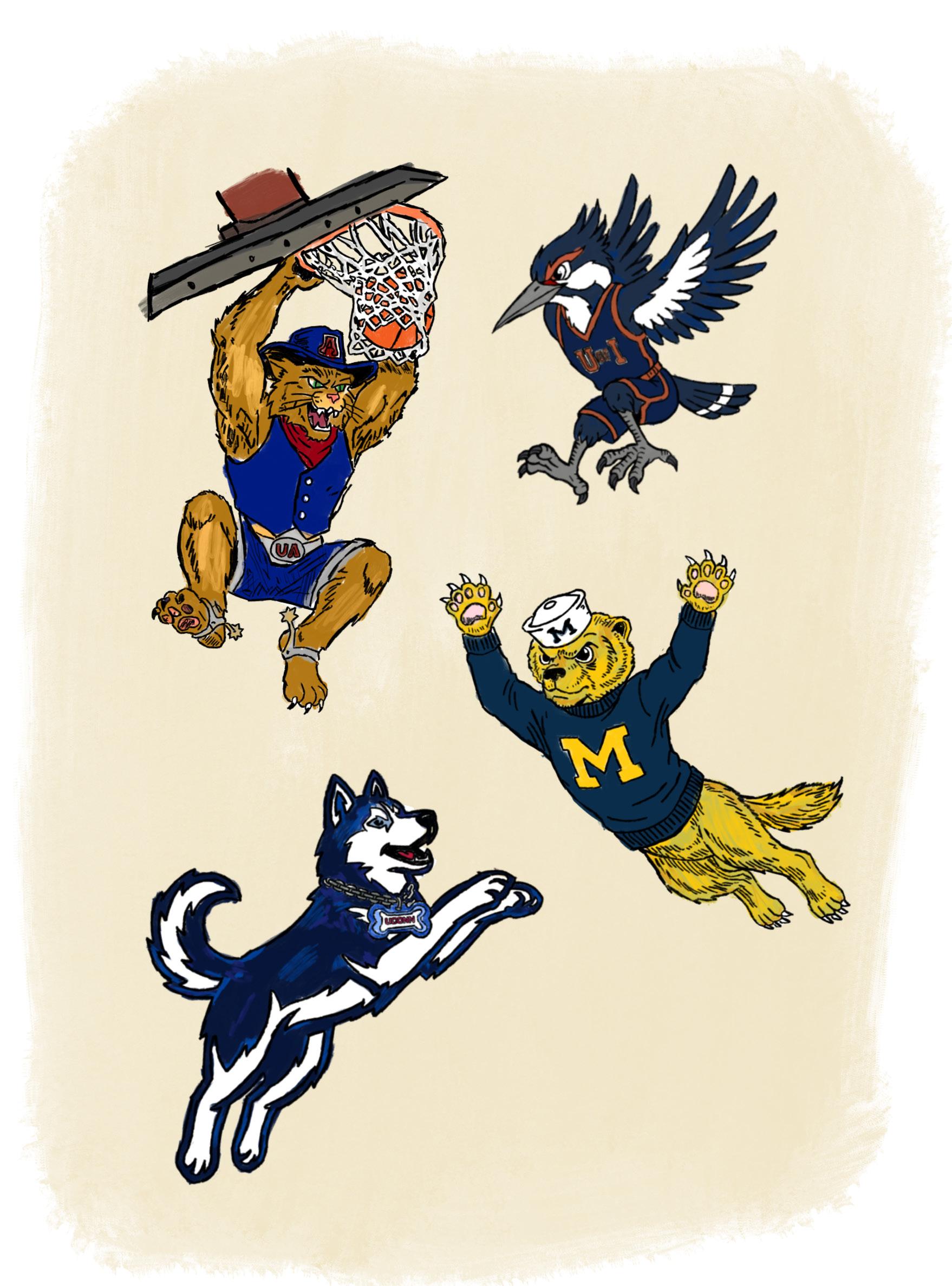
ing the defense highly switchable. The Wolverines’ tenacity has led them to force the longest average distance of two-point shots and subsequently rank third in field goal percentage allowed.
During playoff clutch time, the floor shrinks, and half-court offense is what wins the game. Michigan will undoubtedly get stops on one end, and its offense is nothing to sneeze at. Even though the University of Alabama led at halftime during their Sweet 16 game, May adjusted by bringing in smaller guards off the bench to boost their 3-point shooting. They ended up going 48% from three and won by a safe margin of 13 points. Now, after blowing out the University of Tennessee on March 29, they may be the scariest team left in the Final Four.
Also, and more importantly, I never skip a Jordan Poole Michigan edit to “Bad at Love” (2017) by Halsey. I am riding with the Wolverines to go the distance.
Barden Bellas
Jacob Muscolino, Managing Editor
March Madness is a time for friends and family to gather around the television screen and tune in to support their favorite college teams. But perhaps no college and its team has left a greater impression on me and the world at large than the Barden
University Bellas. In a world where a film like “Pitch Perfect” (2012) exists, how can any college team matter more than this tour de force of Barden’s most talented female singers?
Aca-scuse me? College basketball, step aside. Would the Duke University Blue Devils really win in a “Riff-Off”? I doubt a University of Florida Gator could ever perform Anna Kendrick’s iconic “Cups” (2012) solo. And there is absolutely no way a University of Michigan Wolverine could match pitch to Miley Cyrus’ “Party in the U.S.A.” (2009) on a school bus.
The time has come again to make our March Madness selections, and I attempt to argue to my college-sportsfanatic friends every year that no basketball team will ever surpass the cultural significance and victory that is the existence of the Barden Bellas. Some, and by some I mean mostly myself, consider a cappella to require athleticism equivalent to basketball, so I find it fair to pit the Bellas against any Division I college basketball team.
This March, do not let yourself get hung up on building the perfect bracket. Just turn on “Pitch Perfect” and allow yourself to be enamored by the intense and entertaining world of collegiate a cappella. You might just find yourself belting “Since U Been Gone” (2004), crushing on a Treblemaker or joining the competitive world of a cappella.
Continued from Back Page
on the golf course,” Fernandes said. “It’s the same structure and the same routine that she does.”
Beyond her adept swings on the course, Fernandes said Li is a “silent leader” for the team. Over time, Fernandes said the trust Li has in her teammates has allowed her to grow assertive and more willing to take risks.
With the arrival of new freshmen, Li has especially embraced a leadership role and has focused on building relationships with the younger ath-
letes. Aside from the usual teammate advice, Li said she helps the freshmen through other small actions, like giving them rides. On the course, Li said she enjoys helping her teammates work with mistakes and learn from them for the future.
“Whenever there’s somebody struggling with anything, I can [help with] solving the problem,” Li said. “I pitch some ways to solve the problem for them as my way to support them.”
Sophomore Covi Yan said one of Li’s best attributes is her constant vocal support for her teammates. Yan said this leadership extends espe -
cially to the team’s new members who depend on Li as a shoulder to lean on and as their cheerleader.
“She definitely is one to tell you or vocalize her support, or that you can always rely on her,” Yan said. “It’s very reassuring, especially for maybe the younger [players] or the underclassmen.”
Yan said that on the field, Li’s strength is her meticulous approach to competing. Yan said she observed that Li focuses on the process of events and rarely the outcome.
“She’s very detail-oriented, so she has a very meticulous way of solving
problems both on and off the course,” Yan said.
As both a player and person, Li has played a key role in building a sense of camaraderie and spirit among the team. Fernandes called Li a “light” to the Emory women’s golf community.
“She’s such a special athlete, she’s a dream as a coach to be able to work with,” Fernandez said. “She’s really made a huge impact of just smiles and positivity all the time, so you can’t say enough about a player like that.”
For Li, golf is not just a hobby — it is a community that she is a passionate contributor to. She said a tradition on
the team is to have the players send each other “hearts” as a sign of their support for one another. While golf can often seem isolated and individual, Li ushers in a team spirit. From playing golf with her dad as a child to competing at the collegiate level, golf and the people it has brought her are at the center of Li’s heart.
“When we play a tournament, we always have each other, we always support each other and we trust each other a lot,” Li said.
— Contact Jacob Muscolino at jake.muscolino@emory.edu
By alex Waryn Senior Staff Writer
The Emory University men’s and women’s swim and dive teams concluded their seasons at the 2026 NCAA Division III Swimming and Diving Championships on March 21 in Indianapolis.
The women’s team finished second with 433.5 points, placing 83.5 points behind the New York University (NYU) Violets. On the men’s side, the Eagles placed fifth with 275 points across four days of competition, finishing 24 points behind Kenyon College (Ohio) to round out the top five.
Women’s team claims titles, records in runner-up NCAA finish
The Eagles carried their momentum from the regular season onto the national stage, delivering a consistent four-day performance that included two national titles, two program records, and a combined 30 AllAmerican finishes, with 19 being First Team and 11 Second Team.
The team rounded out day one on a strong note, securing five All-America honors. Graduate swimmer Sammi Thiele was a top contributor to Emory’s tally, taking bronze in the 200-yard individual medley. Sophomore swimmer Allison Greeneway finished close behind in sixth. To top off the night, the 400-yard medley relay team of senior swimmer Penny Celtnieks, junior swimmer Katie Cohen, Greeneway and Thiele earned silver, bringing the Eagles to 92.5 points to stand in third place.
Despite not originally expecting to participate in relays, Thiele said her mindset during the group race was centered on two main points.
“One, just being so grateful that I had the opportunity to compete on that relay, and two, going into it knowing that I had the three other girls on that relay fully supporting me, fully believing in me,” Thiele said.
By day two, the team had moved up from third to second place overall and received five podium finishes and four Second Team All-America finishes. Graduate diver Ariana Khan finished fourth in the 1-meter springboard diving event and sophomore diver Maya

individual medley to earn First Team All-America recognition. Sophomore swimmer Ben Pritchard also had a standout solo performance, finishing sixth in the 500-yard freestyle on day one and earning All-America honors in the 1,650-yard freestyle with a fourth-place finish (15:29.06) on the final night.
After finishing 10th in the 1,650yard freestyle as a freshman, Pritchard showed clear growth in his second NCAA appearance. Pritchard reflected on his individual performance, noting the difference that a year of experience made in his second NCAA appearance.
“As a freshman, the scene is really intense,” Pritchard said. “You don’t exactly know what to expect. This year, knowing more what to expect helped me out a lot.”
finishing seventh in the 200-yard freestyle.
The Eagles kicked up the heat on day three, snagging their first national championship of the competition.
The 200-yard medley relay team of Celtnieks, Cohen, Greeneway and graduate swimmer Ava Kennedy won with a time of 1:39.75. Kennedy’s 21.85 freestyle split on the anchor leg helped the Eagles surge past Kenyon for the win. Individually, Celtnieks and Cohen earned national runner-up finishes in the 100-yard backstroke and 100-yard breaststroke, respectively, with Cohen breaking a 15-year-old program record with a time of 1:01.26.
On the final day, junior swimmer Emma Lunn added a second national title in the 200-yard backstroke with a time of 1:58.83. Cohen continued her standout meet with a second program record in the 200-yard breaststroke, finishing as national runner-up with a time of 2:11.80. Sophomore swimmer Caitlin Crysel placed eighth in the 100-yard freestyle and helped the 400-yard freestyle relay make a seventh-place finish.
Crysel said that while competing in multiple events is a difficult feat, her teammates’ support helped her performance stay consistent.
“I really just fed off the energy of my teammates,” Crysel said. “There were a lot of people there to support me. That was one of the benefits, like we had a big team that went to NCAAs, so I felt fortunate that I was able to be with Emory, and that type of energy just really got me through each session.”
The Eagles remained in close contention with NYU throughout the competition, ultimately finishing behind the Violets. Crysel said the team approached the meet with a shared goal of improving on last season’s NCAA Championship results, and overall, finished satisfied with their performance.
“Last year we got fifth, and we were just really excited to improve on that,” Crysel said. “We all came together and decided that that was a goal we wanted to achieve, and we were happy with how we finished. That was one of our best meets of the season, for sure.”
Thiele said the meet ultimately showed how deeply rooted the team’s success was in their collective effort
rather than individual performances alone.
“It showed us that it’s something bigger than just your own swim,” Thiele said. “We’re all working towards a common goal of trying to win or stay in that top position and it wasn’t just one person doing that, it was all of us.”
Men’s team extends topfive streak behind balanced performances
The men’s swim and dive team extended its streak of top-five finishes at the NCAA Championships to 25 consecutive years, recording 12 First Team All-America performances and 13 Second Team All-America finishes across the meet.
Early in the meet, Emory found success in individual and relay events. On day one, the Eagles recorded a third-place finish in the 400-yard medley relay from the group of junior swimmer McKee Thorsen, junior swimmer Hayden Tupper, sophomore swimmer Zachary Spicer and senior swimmer Henri Bonnault. Graduate swimmer Crow Thorsen continued the momentum on day two, finishing in eighth place in the 400-yard
The Eagles also saw significant contributions from the diving squad, which added valuable points throughout the meet to support the team’s overall finish. Sophomore diver Solly Berkenwald placed eighth in the 3-meter springboard diving event on night one and 11th in the 1-meter springboard diving event on day three, earning Second Team AllAmerica honors.
Despite placing lower than he had hoped, Tupper said the team maintained a strong mindset throughout the meet, even though their final standing fell short of expectations.
“We kept a good mindset during the meet,” Tupper said. “I know that our placement was a bit lower than the past few years, so some people were a little bit disappointed in the end result, but overall, … we still finished out the meet strong, even if it is fifth place.”
Pritchard said the team set high goals heading into the championship but ultimately viewed the meet as both a strong effort and an opportunity for growth.
“We wanted to be definitely in that top three,” Pritchard said. “We’re all proud of each other. … I’d say collectively, we know there’s probably a lot more in us and we’re capable of a lot more, and so looking forward, we’re going to take this as a learning experience.”
— Contact Alex Waryn at alex.waryn@emory.edu
‘A light on the team’: Zimo Li builds community, brings victory to women’s golf

By JacoB MuScolino Managing Editor
To some people, golf can be seen as a dull sport, something more commonly played as background noise than as entertainment. These people would likely doubt that an elementary schooler could possibly find enjoyment in this common American pastime. These people have not met Zimo Li.
At eight years old, Li learned to golf alongside her father. His casual wish for a golfing companion sparked her passion for the sport and made her realize she could be successful in it. Now, as a sophomore on the Emory University women’s golf team, Li’s swing on the course is impossible to ignore.
Over the last decade, Li’s interest in golf transformed from a hobby to a serious endeavor, and she has become a force to be reckoned with on the collegiate stage. In February,
Li tied for first at the Space Coast Classic in Melbourne, Fla., competing against a field of Division I athletes.
Most recently, she took home a second-place finish at the Jekyll Island Collegiate. Li’s successes are not only individual — she is part of a team that took home the 2025 NCAA Division III Women’s Golf Championship last spring and is ranked as the No .1 Division III women’s golf team for the 2026 season.
Li’s interest in golf was piqued after she consistently found herself victorious in her pursuits on the course. The blissful feeling of triumph spurred her initial motivation to continue playing golf.
“The main thing that brought up my interest is the feeling of playing good, and the feeling of winning tournaments, to be completely honest,” Li said. “I played decent, so we were looking into if it’s possible for me to do college golf.”
Head coach Liz Fernandes began
recruiting Li as a high school junior after watching her play at a tournament in Massachusetts, where she said Li’s swing stood out for its “perfection.” Fernandes said the combination of Li’s technical skills and her interest in continuing to improve made her a prime candidate for the team.
“The skills that she had already built were very pristine and made it look like it was going to be a very easy transition for her to college, and as we went into that summer before her freshman year, she asked all the right questions,” Fernandes said.
Li said this commitment to her craft shapes the mindset she applies in her rounds. As a player, Li brings a calm demeanor to the course and focuses on perfecting her “process” for success.
“She is very much a perfectionist when it comes to her routine and sticking to it, no matter if she’s in practice mode or she’s in play mode
See CALM, Page 11