HOW ARE PUBLIC SCHOOLS DIFFERENT FROM HOMESCHOOLING
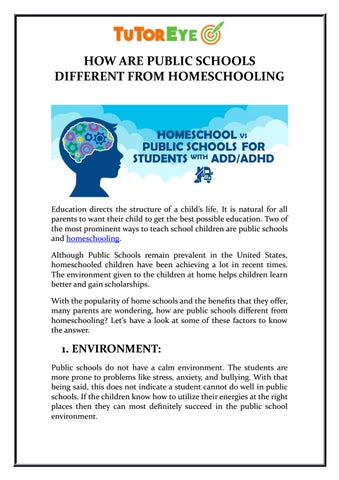
Education directs the structure of a child’s life. It is natural for all parents to want their child to get the best possible education. Two of the most prominent ways to teach school children are public schools and homeschooling. Although Public Schools remain prevalent in the United States, homeschooled children have been achieving a lot in recent times. The environment given to the children at home helps children learn better and gain scholarships. With the popularity of home schools and the benefits that they offer, many parents are wondering, how are public schools different from homeschooling? Let’s have a look at some of these factors to know the answer.
1. ENVIRONMENT: Public schools do not have a calm environment. The students are more prone to problems like stress, anxiety, and bullying. With that being said, this does not indicate a student cannot do well in public schools. If the children know how to utilize their energies at the right places then they can most definitely succeed in the public school environment.
In contrast to this, home schools have a calm environment. The chances of children learning and striving to increase in a safe and peaceful place like that of home. There is no peer pressure and the child has the freedom to learn and be just according to choice.
2. CURRICULUM: Learning in public schools takes place by forming relationships. The curriculum of public schools is based on the standards set by the states. Teaching and learning take place to meet those standards. An in-depth study of multiple concepts is required to be completed in a short time period. Children who are homeschooled can be exposed to a curriculum that is tailor-made to suit their interests. Based on their natural curiosity and learning abilities, parents can design the structure of the curriculum. The main difference is that the public school curriculum tries to connect multiple ideas hoping that children will gain maximum knowledge. However, the home-based curriculum focuses on teaching lesser ideas in a profound manner. Deciding which option is the best for their child depends on the parents.
3. TEACHERS: Public schools have qualified, professional and certified teachers. They are assigned to handle a class of roughly 25-30 students on a regular basis. They are in charge of providing guidance, support, and education to students. However, these teachers try their best but giving personal attention to students becomes difficult for them. In the home-based schooling scenario, mostly the parents take the role of teachers, advisor, administrators, counselor, etc. Some parents also choose to hire online tutors for this type of schooling. Platforms like Tutor Eye provide highly qualified and professional teachers who teach with a personalized teaching approach. These tutors collaborate with parents to teach the special needs of the students by giving them extra attention.
4. TESTS:
Regular exams and tests are held by public schools to evaluate the performance of kids. The tests are conducted based on the standards set by the state. Children prepare for these tests and they get evaluated with a grading system. In home-based schooling, parents are required to be aware of the national or state standards to take tests of their child. It is the responsibility of the parents to make sure that the child takes these tests regularly.
CONCLUSION: Public schooling and homeschooling have their own distinct features, pros, and cons. If one option offers a directed and a controlled environment then the other offers a plethora of new and improved ideas for the development of your child. Parents must know what is best for their child to choose the most suitable option. This choice must be based on the interests and learning ability of the child. If the best interest of the child is considered then the learning will definitely get accelerated.
To know more details visit TutorEye.com