◼ Todd McCracken, P.Geo. .............. BBA E&C Inc.
◼ Peter McIntyre, P.Geo. BBA E&C Inc.
◼ Jaco Steyn, P.Eng............................ BBA E&C Inc.
McFarlane Lake Mining Limited
NI 43-101
Technical Report and MRE Update for the Juby Gold Project
Date and Signature Page
This technical report is effective as of the 7th day of October, 2025.
Original signed and sealed on file
Todd McCracken, P.Geo. BBA E&C Inc.
Original signed and sealed on file
Peter McIntyre, P.Geo. BBA E&C Inc.
Original signed and sealed on file
Jaco Steyn, P.Eng. BBA E&C Inc.
Original signed and sealed on file
November 21, 2025
Date
November 21, 2025
Date
November 21, 2025
Date
144 Pine Street Unit 501
Sudbury, ON P3C 1X3
T +1 705.265.1119
F +1 450.464.0901
BBAconsultants.com
CERTIFICATE OF QUALIFIED PERSON
Todd McCracken, P.Geo.
This certificate applies to the NI 43-101 Technical Report titled “NI 43-101 Technical Report and Mineral Resource Estimate Update for the Juby Gold Project, Northeastern Ontario, Canada” (the “Technical Report”), prepared for McFarlane Lake Mining Limited, dated November 21st , 2025, with an effective date of October 7th , 2025.
I, Todd McCracken, P.Geo., as a co-author of the Technical Report, do hereby certify that:
1. I am a Senior Geologist and Director of Mining and Geology with the consulting firm BBA E&C Inc., located at 144 Pine St., Suite 501, Sudbury, Ontario.
2. I am a graduate from University of Waterloo, Ontario, in 1992, with a bachelor’s degree in Honors Applied Earth Sciences. I have practised my profession continuously since my graduation
3. I am a member in good standing of Association of Professional Geoscientists of Ontario (PGO No. 0631)
4. My relevant experience includes over 30 years in exploration, operations and consulting, including resource estimation of Archean gold deposits
5. I have read the definition of “qualified person” set out in the NI 43-101 – Standards of Disclosure for Mineral Projects (“NI 43-101”) and certify that, by reason of my education, affiliation with a professional association, and past relevant work experience, I fulfill the requirements to be a qualified person for the purposes of NI 43-101
6. I am independent of the issuer applying all the tests in Section 1.5 of NI 43-101.
7. I am responsible for Chapters 14 to 24 of the Technical Report. I am also co-author for the relevant portions of Chapters 1, 2, 3, 25, 26 and 27 of the Technical Report.
8. I have visited the Juby Property that is the subject of this Technical Report, from July 28 to 29, 2025 as part of this current mandate.
9. I have had no prior involvement with the property that is the subject of the Technical Report.
10. I have read NI 43-101, and the sections of the Technical Report for which I am responsible have been prepared following its rules and regulations.
11. As at the effective date of the Technical Report, to the best of my knowledge, information and belief, the sections of the Technical Report for which I am responsible contain all scientific and technical information that is required to be disclosed to make the portions of the Technical Report for which I am responsible not misleading
Signed and sealed this 21st day of November, 2025.
Signed and sealed on file
Todd McCracken, P.Geo.
144 Pine Street Unit 501
Sudbury, ON P3C 1X3
T +1 705.265.1119
F +1 450.464.0901
BBAconsultants.com
CERTIFICATE OF QUALIFIED PERSON
Peter McIntyre, P.Geo.
This certificate applies to the NI 43-101 Technical Report titled “NI 43-101 Technical Report and Mineral Resource Estimate Update for the Juby Gold Project, Northeastern Ontario, Canada” (the “Technical Report”), prepared for McFarlane Lake Mining Limited, dated November 21st , 2025, with an effective date of October 7th , 2025.
I, Peter McIntyre, P.Geo., as a co-author of the Technical Report, do hereby certify that:
1. I am a Senior Geologist with the consulting firm BBA E&C Inc., located at 144 Pine St., Suite 501, Sudbury, Ontario.
2. I am a graduate of Saint Mary’s University, with a Bachelor of Science in Geology in 2004.
3. I am a member in good standing of the Association of Professional Geoscientists of Ontario (PGO No. 2217),
4. My relevant experience of over 20 years of experience in exploration and consulting, including working on Archean shear-hosted, and Mesothermal gold deposits
5. I have read the definition of “qualified person” set out in the NI 43-101 – Standards of Disclosure for Mineral Projects (“NI 43-101”) and certify that, by reason of my education, affiliation with a professional association, and past relevant work experience, I fulfill the requirements to be a qualified person for the purposes of NI 43-101.
6. I am independent of the issuer applying all the tests in Section 1.5 of NI 43-101.
7. I am responsible for Chapters 3 through 12 of the Technical Report. I am also co-author for the relevant portions of Chapters 1, 2, 3, 25, 26 and 27 of the Technical Report.
8. I have visited the Juby Property that is the subject of this Technical Report, on July 28th and 29th as part of this current mandate.
9. I have had no prior involvement with the property that is the subject of the Technical Report
10. I have read NI 43-101, and the sections of the Technical Report for which I am responsible have been prepared following its rules and regulations.
11. As at the effective date of the Technical Report, to the best of my knowledge, information and belief, the sections of the Technical Report for which I am responsible contain all scientific and technical information that is required to be disclosed to make the portions of the Technical Report for which I am responsible not misleading.
Signed and sealed this 21st day of November, 2025.
Signed and sealed on file
Peter McIntyre, P.Geo.
20 Carlson Court Suite 100
Toronto, ON M9W 6L2
T +1 416.585.2115
F +1 416.585.9683
BBAconsultants.com
CERTIFICATE OF QUALIFIED PERSON
Jaco Steyn, P.Eng.
This certificate applies to the NI 43 101 Technical Report titled “NI 43-101 Technical Report and Mineral Resource Estimate Update for the Juby Gold Project, Northeastern Ontario, Canada” (the “Technical Report”), prepared for McFarlane Lake Mining Limited, dated November 21st , 2025, with an effective date of October 7th, 2025.
I, Jaco Steyn, P.Eng., as a co-author of the Technical Report, do hereby certify that:
1. I am a principal process engineer and department manager with the consulting firm BBA E&C Inc., located at 20 Carlson Court, Suite 100, Toronto, Ontario.
2. I am a graduate from the University of Pretoria, Gauteng, South Africa, with a bachelor’s degree in Chemical Engineering. I have practiced my profession continuously since my graduation.
3. I am a member in good standing of Professional Engineers Ontario (PEO No. 100503657).
4. My relevant experience includes over 20 years in mineral processing and extractive metallurgy, including process development, testwork management and data interpretation, and process engineering design of gold processing projects.
5. I have read the definition of “qualified person” set out in the NI 43-101 – Standards of Disclosure for Mineral Projects (“NI 43-101”) and certify that, by reason of my education, affiliation with a professional association, and past relevant work experience, I fulfill the requirements to be a qualified person for the purposes of NI 43-101
6. I am independent of the issuer applying all the tests in Section 1.5 of NI 43-101.
7. I am responsible for Chapter 13 of the Technical Report. I am also co-author for the relevant portions of Chapters 1, 2, 3, 25, 26 and 27 of the Technical Report.
8. I have not visited the Juby Property that is the subject of this Technical Report, as it was not required for the purpose of this mandate
9. I have had no prior involvement with the property that is the subject of the Technical Report
10. I have read NI 43-101, and the sections of the Technical Report for which I am responsible have been prepared following its rules and regulations.
11. As at the effective date of the Technical Report, to the best of my knowledge, information and belief, the sections of the Technical Report for which I am responsible contain all scientific and technical information that is required to be disclosed to make the portions of the Technical Report for which I am responsible not misleading
Signed and sealed this 21st day of November, 2025.
Signed and sealed on file
Jaco Steyn, P.Eng
TABLE OF CONTENTS
6.2.6
McFarlane Lake Mining Limited
NI 43-101
Technical Report and MRE Update for the Juby Gold Project
LIST OF TABLES
Table 1-1: Juby Deposit mineral resource summary and in-situ contained gold.............................1-5
Table 6-1: Historical Mineral Resource Estimates summary 6-15
Figure 23-1: Juby Project and adjacent properties 23-1
McFarlane Lake Mining Limited
NI 43-101
Technical Report and MRE Update for the Juby Gold Project
Abbreviation
$ or CAD
List of Abbreviations and Units of Measurement
Description
Canadian dollar (examples of use: CAD2.5M / $2.5M)
% percent
°C degrees Celsius
°F degrees Fahrenheit
µm micron
3D three dimensional
Ag silver
ALS ALS Canada Ltd.
Aris Mining Aris Mining Corporation
As arsenic
Au gold
B boron
BBA E&C
BBA Engineering
BDZ Big Dome Zone
Caldas Gold Caldas Gold Corp.
CaO lime
CIM Canadian Institute of Mining, Metallurgy and Petroleum
CLLF Cadillac-Larder Lake Fault
cm centimetre
cm2 square centimetre
cm3 cubic centimetre
CN cyanide
CO2 carbone dioxide
CRM certified reference material
CSE Canadian Stock Exchange
Cu copper
CV coefficient of variation
DDH diamond drill hole
DEM distinct element-based method
EM electromagnetic et al. et alla (and others)
ft feet (12 inches)
ft2 square feet
ft3 cubic feet
g gram
McFarlane Lake Mining Limited
NI 43-101
Technical Report and MRE Update for the Juby Gold Project
Abbreviation
Description
G&A General and Administration
g/t grams per (metric) tonne
Geovector
Geovector Management Inc.
GLZ Golden Lake Zone
Goldeye Goldeye Explorations Limited
GPS Global Positioning System
ha Hectare
HCLZ Hydro Creek-LaCarte Zone
HG high-grade zone
HLS heavy liquid separation
ID2 inverse distance square
IP induced polarization
JJV Juby JV Property
JMZ Juby Main Zone
K2O potassium oxide
kg kilogram
kg/t kilograms per tonne
km kilometres
km2 square kilometer
kWh/t kilowatt hour per tonne
LLD lower limit of detection
m metre
m2 square metre
m3 cubic metre
Ma mega annum (million years)
McFarlane McFarlane Lake Mining Corp.
MCMC multi-cell mining claim
MENDM Ministry of Energy, Northern Development and Mines
mesh US Mesh
MLAS Mining Land Administration System
mm millimetre
mm2 square millimetre
mm3 cubic millimetre
Mo molybdenum
Moz Million troy ounces
MRE
Mineral Resource Estimate
Mt Million metric tonne
McFarlane Lake Mining Limited
NI 43-101
Technical Report and MRE Update for the Juby Gold Project
Abbreviation
Na2O
Description
sodium oxide
NaCN sodium cyanide
NAD 83 North American Datum of 1983
NI 43-101
National Instrument 43 101 Standards of Disclosure for Mineral Projects
NN nearest neighbour
No. number
NQ Drill core size (4.8 cm in diameter)
NSR net smelter return
NTS National Topographic System
OK ordinary kriging
OP optimized pit
OREAS Ore Research & Exportation Pty Ltd. Assay Standards
oz ounce
P80 80% passing - product size
Pb lead
ppb parts per billion
ppm parts per million
QA/QC quality assurance / quality control
QP qualified person
RC Reverse circulation drilling
RTDZ Rideout-Tyrrell Deformation Zone
RPEEE Reasonable Prospects of Eventual Economic Extraction
RQD rock quality designation
S sulphur
SARC South American Resources Corp.
Sb antimony
SCMC single cell mining claim
SG specific gravity
SGS SGS Geological Services
Std standard S.U.
t tonne (1,000 kg) (metric ton)
Te tellurium
Temex Temex Resources Corp.
TSZ Tyrrell Shear Zone
UG underground
USD United States dollar (example of use: USD2.5M)
UTM Universal Transverse Mercator
McFarlane Lake Mining Limited
NI 43-101
Technical Report and MRE Update for the Juby Gold Project
Abbreviation
Description
VLF-EM very low frequency electromagnetic
W tungsten
Zn zinc
McFarlane Lake Mining Limited
NI 43-101
Technical Report and MRE Update for the Juby Gold Project
Summary
1.1 Property Description and Location
The Juby Property is located in Ontario, Canada, spanning Tyrrell, Leonard, and McMurchy Townships. It covers approximately 5,287.57 hectares, consisting of 308 unpatented mining claims and five mining leases. All claims are active and primarily registered to McFarlane Lake Mining Limited, with some joint venture interests. The property’s central coordinates are UTM NAD83 Zone 17: 498,900m E and 5,273,250m N.
Ownership of the Juby Property has changed hands multiple times since its initial staking by the Juby Group. It was acquired by Getty Mines Ltd., Pamour Porcupine Mines Limited, Royal Oak Inc., and Inmet Mining Corporation before Temex Resources Corp. took ownership in 2002. Subsequent transactions involved Lake Shore Gold Corp., Tahoe Resources Inc., Pan American Silver Corp., South American Resources Corp., Caldas Gold Corp., and finally Aris Mining Corporation. In 2025, McFarlane Lake Mining Limited acquired a 100% interest from Aris Mining. The property is subject to several net smelter return (“NSR”) royalties, with details and buyback provisions.
The Juby Property comprises 308 cell claims, including 33 encumbered claims, requiring annual assessment work totaling CAD 92,200 to maintain good standing. Five mining leases also exist, with expiry dates ranging from 2025 to 2031. All claims and leases are currently in good standing.
Exploration activities on the property are regulated under the Ontario Mining Act, with graduated requirements for exploration plans and permits depending on the impact level. Some activities do not require permits, while others necessitate notification and consultation with surface rights owners and Aboriginal communities. As of the Report’s effective date, there are no current exploration permits, and no significant environmental liabilities are reported. The property is free of historical ownership or royalty liabilities except as noted, and the qualified persons (“QPs”) are unaware of any other agreements or risks affecting exploration work.
1.2 Access, Climate, Local Resources and Physiography
Access to the property is straightforward, with routes available via Highway 560 and secondary gravel roads such as Indian Lake Road and Spear Lake Road. The area benefits from a network of old logging roads, making most parts accessible by four-wheel trucks and ATVs throughout the year.
The climate is continental, featuring cold winters and warm summers. While seasonal changes affect certain exploration activities like geological mapping being limited in winter and diamond
McFarlane Lake Mining Limited
NI 43-101
Technical Report and MRE Update for the Juby Gold Project
drilling being preferable when water bodies are frozen the overall climate does not pose significant challenges to mining operations.
Local infrastructure is robust, with nearby cities like Sudbury, Timmins, and Kirkland Lake providing equipment and skilled personnel to support mining activities. The project area is well-served by a high-voltage powerline, abundant water resources, and all-weather gravel roads. The gently rolling terrain, with elevations around 370 metres above sea level, is mostly covered by secondgrowth forest due to past logging. Although clear-cutting has occurred in recent years and outcrop density is low due to substantial overburden, there are ample suitable locations for constructing mineral processing facilities.
1.3 History
Prospectors first arrived in the Shining Tree area during the Gowganda silver rush in 1906-1910. In the early 1930s, gold was discovered in the northern part of Tyrrell Township. During the 1932 to 1996 period, numerous companies completed surface exploration programs of mapping, prospecting, and ground geophysics, with limited drilling. No work was undertaken on portions of the Project area between 1984 and 1996 because the Temagami Land Caution, a moratorium on mineral exploration, was in effect. The most significant work completed between 1994 to 2021 related to diamond drilling.
1.4 Geology Setting and Mineralization
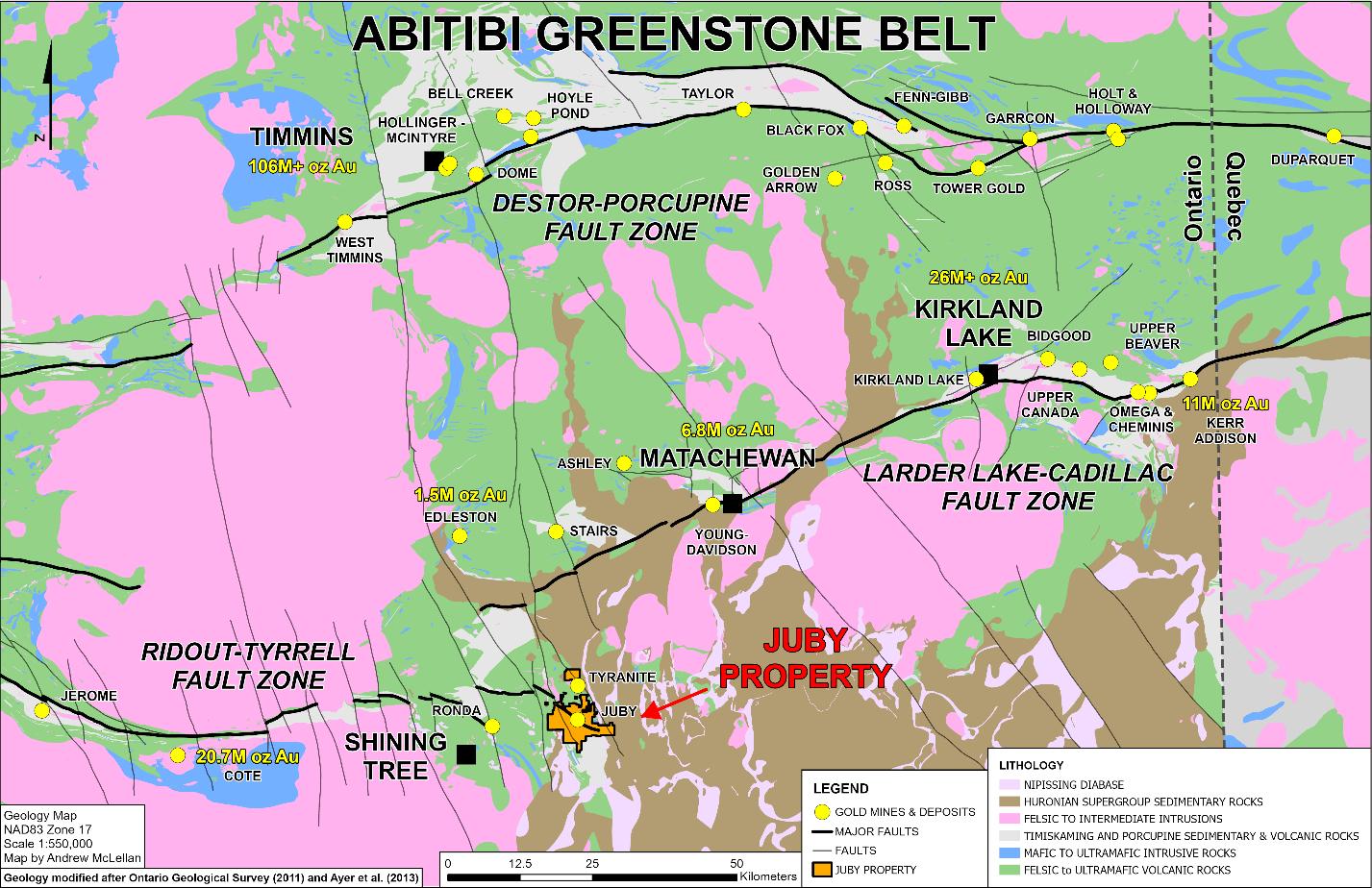
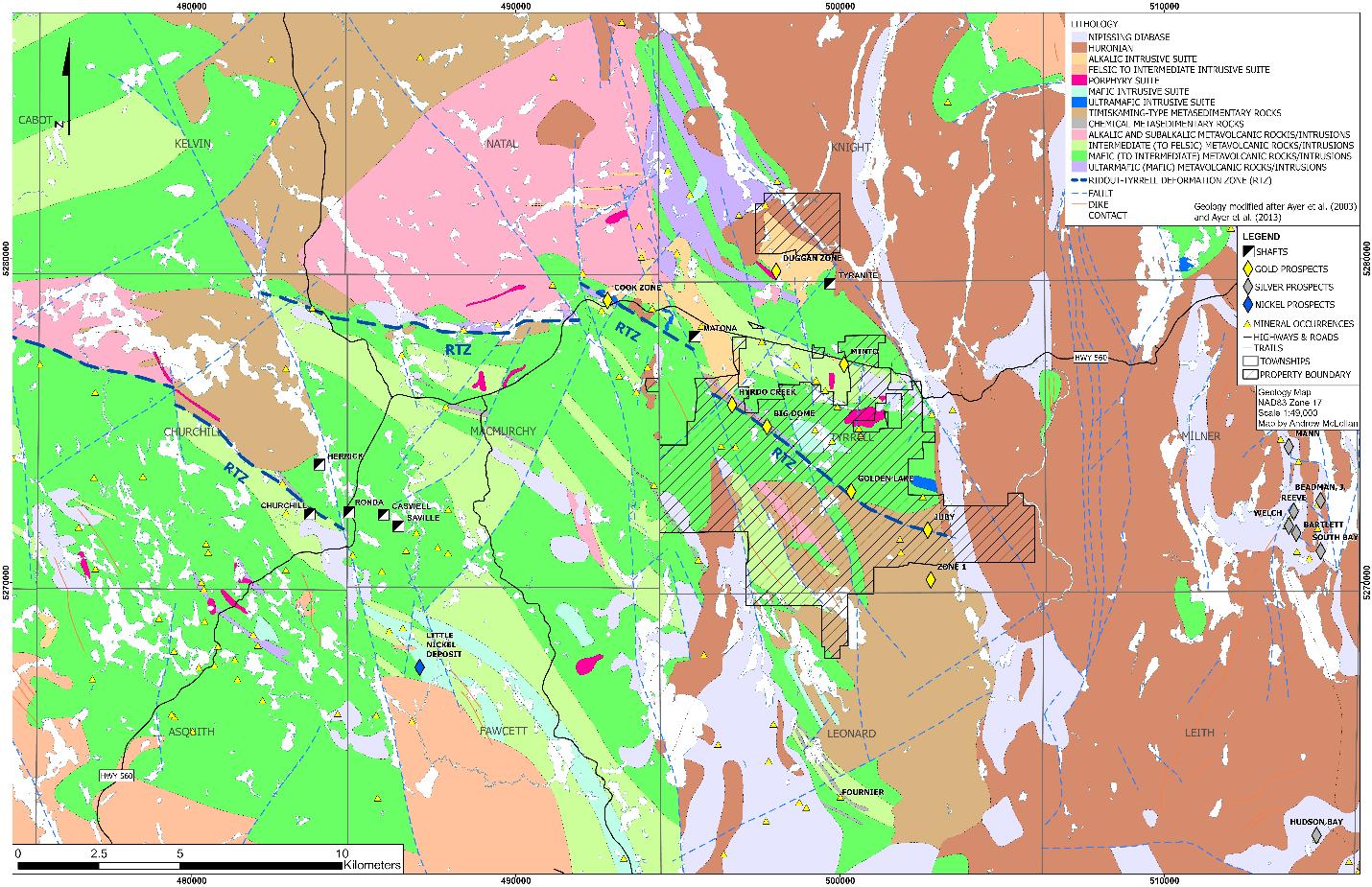
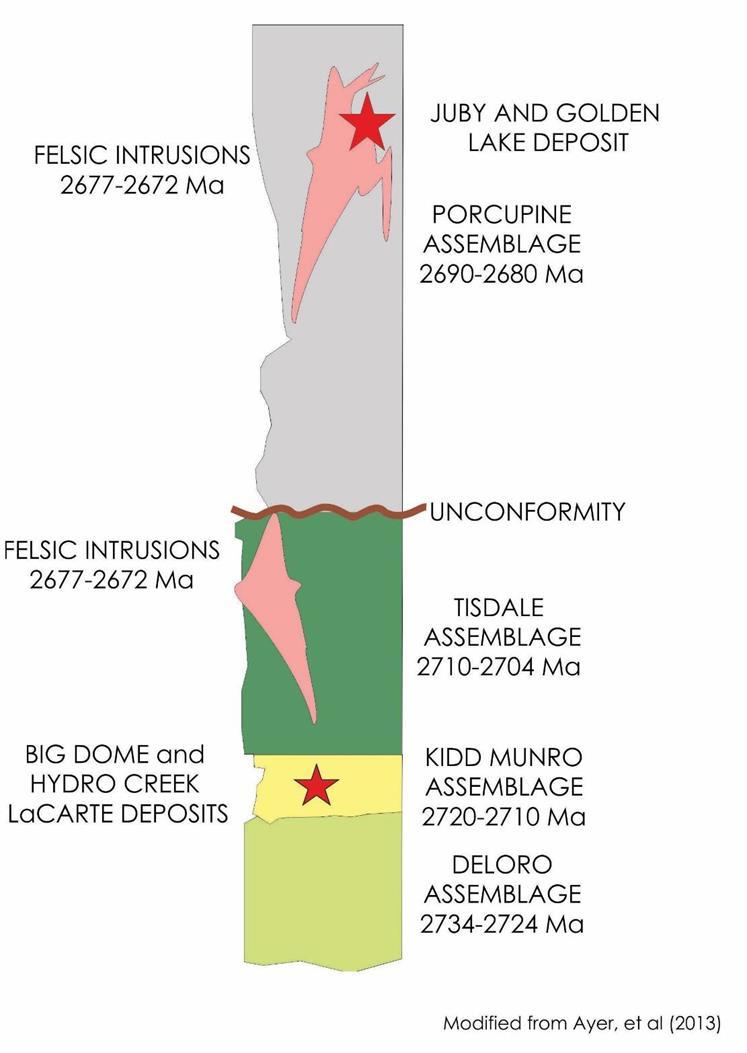
The Shining Tree area, located south of the main Abitibi greenstone belt, features Archean volcanic and sedimentary rocks intruded by major batholiths and overlain by Huronian sediments. Recent geochronological studies have correlated its stratigraphy with the broader Abitibi belt, identifying volcanic rocks as part of the Kidd-Munro assemblage (2720–2710 Ma) and sedimentary rocks of the Indian Lake Group like the older Porcupine assemblage (2690–2680 Ma), rather than the Timiskaming assemblage. The region is structurally influenced by the Rideout-Tyrrell Deformation Zone and the Tyrrell Shear Zone. Despite historically small gold deposits, the area possesses favorable geological features comparable to renowned gold districts like Matachewan, Kirkland Lake, and Timmins.
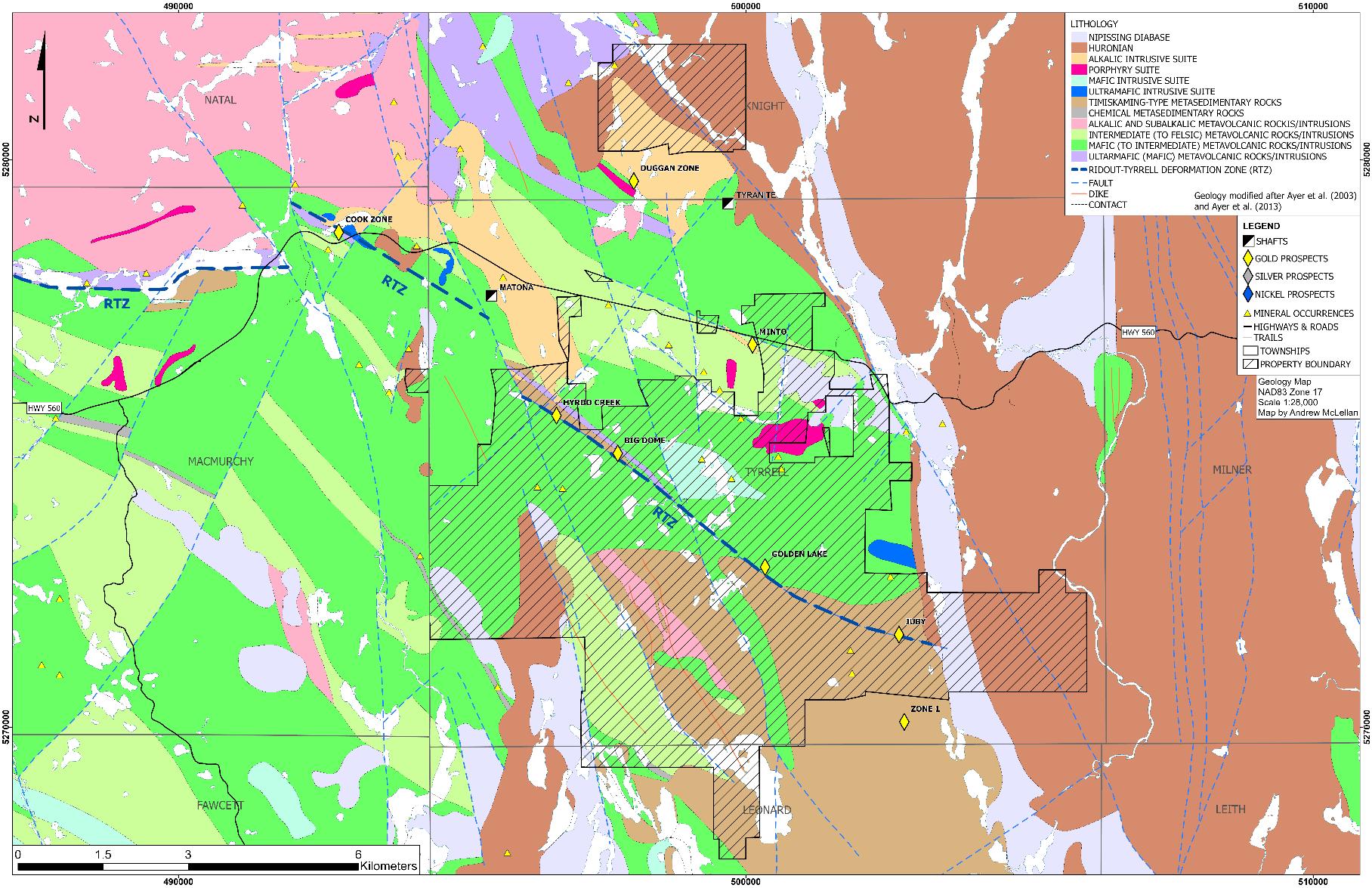
The project area is characterized by Archean ultramafic, mafic, and intermediate volcanic rocks, along with Porcupine assemblage sediments and numerous quartz-feldspar porphyritic dykes. The west-northwest trending Tyrrell Shear Zone (“TSZ”), interpreted as part of the Cadillac Larder Lake Fault system, traverses the property and hosts all known gold zones. Proterozoic sediments of the Gowganda Formation and Nipissing Gabbro overlie or intrude these Archean rocks, while Matachewan-age diabase dykes also occur throughout. The southern part of the property
McFarlane Lake Mining Limited
NI 43-101
Technical Report and MRE Update for the Juby Gold Project
features Porcupine assemblage sediments, and the northern part contains Kidd-Munro assemblage mafic to ultramafic flows with distinctive geological textures. Overall, the TSZ is the main structural feature, separating altered rock units and controlling the distribution of gold mineralization across the project.
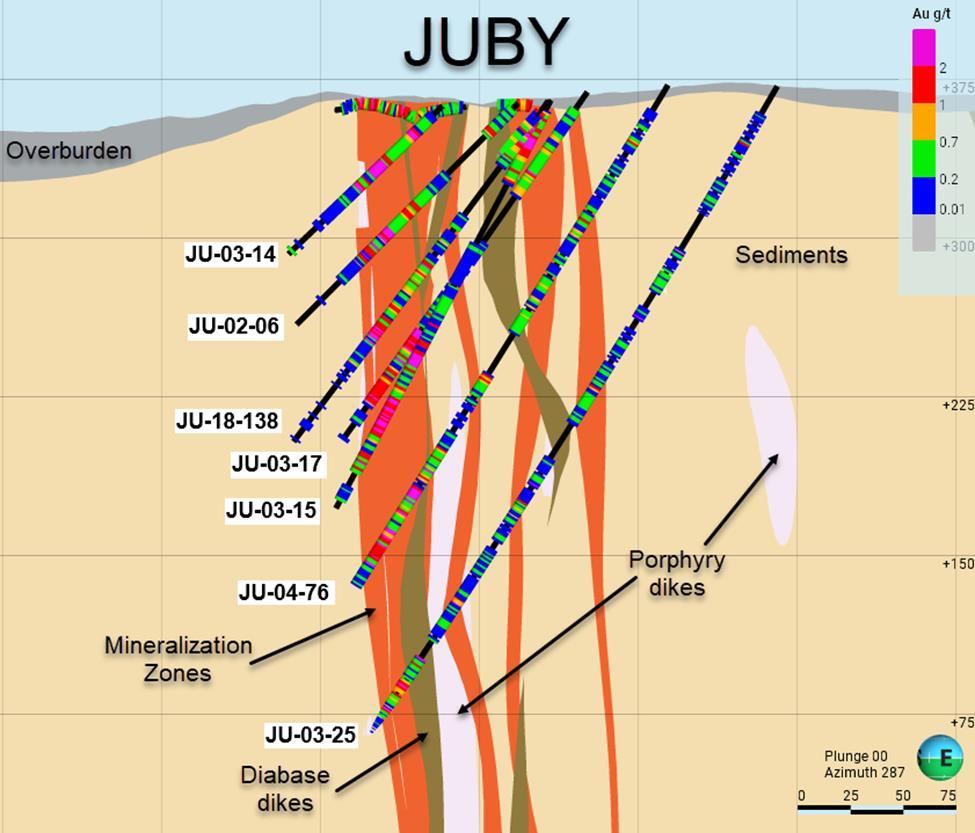
Gold mineralization in the project area is primarily controlled by the TSZ, which exhibits varying structural attitudes and influences the distribution of deposits such as Juby Main Zone (“JMZ”), Golden Lake Zone (“GLZ”), Big Dome Zone (“BDZ”), and Hydro Creek-LaCarte Zone (“HCLZ”). The mineralization style ranges from narrow, high-grade quartz-carbonate-pyrite veins within broad zones of alteration in JMZ and GLZ, to multiple lenses of higher-grade veins in BDZ and HCLZ, with gold grades generally correlating with the intensity of alteration and pyrite content. Host rocks include altered sediments, mafic to ultramafic volcanics, and feldspar porphyritic dykes, with structural features and alteration intensity playing key roles in gold concentration. The geological setting and mineralization styles show similarities to major gold camps, like Kirkland Lake and Timmins, but also display unique characteristics across different deposits within the property.
1.5 Deposit Type
Gold mineralization on the Property is structurally controlled and exhibits similar geological, structural, and metallogenic characteristics to other Archean Greenstone-hosted quartzcarbonate vein (lode) deposits. These deposits are also known as mesothermal, orogenic, lode gold, shear-zone-related quartz-carbonate or gold-only deposits (Dubé and Gosselin, 2007).
Archean Greenstone-hosted quartz-carbonate vein (lode) deposits are a significant source of gold mined in the Superior and Slave provinces of the Canadian Shield. Dubé and Gosselin (2007) published an overview of greenstone-hosted gold deposits in Canada. These deposits are typically quartz-carbonate vein-hosted and are distributed along crustal-scale fault zones that mark convergent margins between major lithological boundaries, such as those between volcano-plutonic and sedimentary domains.
1.6 Exploration
McFarlane has not conducted any exploration on the property.
1.7 Drilling
McFarlane has not conducted any diamond drilling on the Property since the date of this Report
A total of 405 surface diamond drill holes, totalling 116,570 m, have been carried out over the Project by various operators since 1995 to 2021.
McFarlane Lake Mining Limited
NI 43-101
Technical Report and MRE Update for the Juby Gold Project
1.8 Sample Preparation, Analysis and Security
All drilling information presented in this Report is historical in nature. McFarlane has not carried out any sample collection or analysis on the Juby Project since their acquisition of the Property as of the date of this Report.
Sample preparation and analysis completed by previous operators followed industry best practices at the time of collection. All preparation and analysis were completed at accredited laboratories.
1.9 Data Validation
Data validation on the project includes a site inspection by the QPs, drill collar checks, review of drill logs and assay certificates.
1.10 Mineral Processing and Metallurgical Testing
Metallurgical testing, conducted in two phases by Temex Resources Corp. and Tahoe Canada with SGS Canada Ltd., revealed that gold in the samples is predominantly fine-grained, mostly locked within pyrite or non-opaque minerals, and requires fine grinding for effective recovery. Both gravity concentration and cyanidation tests showed that gold is evenly distributed in the fine fraction (-150 mesh), with little coarse free gold present. The best recoveries up to 94% were achieved at very fine grind sizes (25–35 microns), though samples with higher sulphide content had lower recoveries due to gold locked in pyrite. Gravity recovery ranged from 11% to 27%, and Bond ball mill grindability tests classified the samples as “hard,” with work indexes between 19.1 and 19.9 kWh/t.
1.11 Resource Estimation
The Mineral Resource Estimate (“MRE”) of the Juby Deposit follows the Canadian Institute of Mining, Metallurgy and Petroleum Estimation of Mineral Resources and Mineral Reserves Best Practice Guidelines (CIM, 2019). The QP completed a resource estimation with an effective date of September 29, 2025. The resource estimation was conducted using Datamine Studio RM™ version 2.1.125.0.
Table 1-1 shows a summary of the mineral resource and contained gold ounces constrained within optimized pit (“OP”) shells, and underground (“UG”) stopes. The mineral resource is constrained within an open pit design for in-pit resources, and underground mining shapes for underground
McFarlane Lake Mining Limited
NI 43-101
Technical Report and MRE Update for the Juby Gold Project
resources, which meet the Reasonable Prospects of Eventual Economic Extraction (“RPEEE”) parameters.
The cut-off grade of 0.25 g/t Au was used for pit-constrained resources, and 1.85 g/t Au for underground constrained resources.
Table 1-1:
There is no other relevant data or information available that is necessary to make the technical report understandable and not misleading. The QPs are not aware of any known mining, processing, metallurgical, environmental, infrastructure, economic, permitting, legal, title, taxation, socio-political, or marketing issues, or any other relevant factors not reported in this technical report, that could materially affect the current MRE.
1.12 Recommendations
Additional exploration in two phases is recommended to advance the project. Phase 1 program is designed to expand and upgrade the mineral resource and to initiate environmental baseline studies and is estimated at $4 million to complete. Phase 2 program is designed to upgrade the mineral resource and collect data to support engineering studies. The estimated budget to complete Phase 2 is $10.7 million.
Juby Deposit mineral resource summary and in-situ contained gold
McFarlane Lake Mining Limited
NI 43-101
Technical Report and MRE Update for the Juby Gold Project
Introduction
BBA E&C Inc. ("BBA") has been retained by McFarlane Lake Mining Limited ("McFarlane" or the "Company") to lead and perform an independent Mineral Resource Estimate ("MRE") and technical report on the Juby Gold Project (the “Project” or the "Property"). This report, titled “NI 43-101 Technical Report and Mineral Resource Estimate Update for the Juby Gold Project, Northeastern Ontario, Canada” (the "Report"), was commissioned by McFarlane.
The Property currently comprises the Juby Main Zone (“JMZ”), Golden Lake Zone (“GLZ”), Hydro Creek-LaCarte Zone (“HCLZ”) and Big Dome Zone (“BDZ”) deposits (the “Deposits”). The MRE’s have been completed on all deposits.
The Property is an advanced exploration-stage gold project, located approximately 15 km westsouthwest ofthe town of Gowganda and 100 km south-southeast of the Timmins gold camp, within the Shining Tree area in the southern part of the Abitibi greenstone belt. The reporting of the MRE complies with all disclosure requirements for Mineral Resources set out in the NI 43-101 Standards of Disclosure for Mineral Projects. The classification of the updated MRE is consistent with current Canadian Institute of Mining, Metallurgy and Petroleum (“CIM”) Definition Standards – For Mineral Resources and Mineral Reserves (2014).
2.1 Ownership
On July 7, 2025, McFarlane Lake Mining announced the signing of a definitive asset purchase agreement for the sale of Aris Mining Juby Gold Project and related interests in Ontario, Canada.
2.2 Basis of Technical Report
This Report presents the results of an MRE for the Juby Gold Project. McFarlane mandated engineering consulting group BBA to lead and complete the MRE.
As of the date of this Report, McFarlane Lake Mining Limited is a Canadian mineral exploration company trading on the Canadian Stock Exchange (“CSE”) under the trading symbol “MLM”, with its head office located at:
15 Kincora Court Sudbury, Ont., Canada
P3E 2B9
McFarlane Lake Mining Limited
NI 43-101
Technical Report and MRE Update for the Juby Gold Project
This Report was prepared by qualified persons ("QPs") in accordance with National Instrument 43-101 Standards of Disclosure for Mineral Projects (“NI 43-101”) and the Canadian Institute of Mining, Metallurgy and Petroleum (CIM, 2014) Definition Standards for Mineral Resources and Reserves.
2.3 Report Responsibility
The following individuals (i.e., qualified persons, in accordance with NI 43-101), by virtue of their education, experience, and professional association, are considered experts and are members in good standing of their appropriate professional institutions.
◼ Todd McCracken, P.Geo.
◼ Peter McIntyre, P.Geo.
◼ Jaco Steyn, P.Eng.
BBA E&C Inc.
BBA E&C Inc
BBA E&C Inc.
The preceding QP’s have contributed to the writing of this Report and have provided QP certificates, included at the beginning of this Report. The information contained in the certificates outlines the sections in this Report for which the QP is responsible.
2.4 Effective Dates and Declaration
This technical report is in support of the Company's press release dated October 7, 2025, titled “Technical Report and MRE Update for the Juby Gold Project”. The Effective Date of this Report is October 7, 2025.
2.5 Sources of Information
This Report is based in part on internal company reports, maps, published government reports, company letters and memoranda, and public information, as listed in Chapter 27 (References). Sections from reports authored by other consultants may have been directly quoted or summarized in this Report and are so indicated, where appropriate.
The QPs have no known reason to believe that any of the information used to prepare this Report and evaluate the Mineral Resources presented herein is invalid or contains misrepresentations. The QPs have sourced the information for this Report from the collection of documents listed in Chapter 27 (References).
McFarlane Lake Mining Limited
NI 43-101
Technical Report and MRE Update for the Juby Gold Project
2.6 Site Visit
Information, conclusions, and recommendations contained within this Report are based on field observations as well as published and unpublished data (Chapter 27 - References) available to the QPs at the time of preparing this Report.
The following list describes the QPs visit to the Project site, including the date and general objective of the visit:
◼ Mr. Todd McCracken, P.Geo., and Peter McIntyre, P.Geo., visited the Property from July 28 to 29, 2025. The purpose of this visit was to examine the Project setting and outcrops, review drill collar sites, channel sample sites. Inspection of the geology, drill core, and historical logging, and sampling procedures used on site
2.7 Currency, Units of Measure, and Calculations
Unless otherwise specified or noted, the units used in this Report are metric. Every effort has been made to clearly display the appropriate units being used throughout this Report.
Currency is in United States Dollars (“USD”), unless otherwise stated
This Report may include technical information that required subsequent calculations to derive subtotals, totals, and weighted averages. Such calculations inherently involve a degree of rounding and consequently introduce a margin of error. Where these occur, the QPs consider them immaterial.
McFarlane Lake Mining Limited
NI 43-101
Technical Report and MRE Update for the Juby Gold Project
3. Reliance on Other Experts
The qualified persons have reviewed and analyzed data and reports provided by McFarlane, together with publicly available data, drawing its own conclusions augmented by direct field examination.
The QPs who prepared this Report relied on information provided by experts who are not QPs. The QPs believe that it is reasonable to rely on these experts, based on the assumption that the experts have the necessary education, professional designations, and relevant experience on matters relevant to the technical report.
For the purpose of this Report, specifically Section 4.2 (Mineral Disposition), Mr. Peter McIntyre, QP has relied on Mr. Brad Boland, CFO, McFarlane Lake Mining. While the title documents were reviewed for this Report, this Report does not constitute, nor is it intended to represent a legal, or any other opinion as to title.
The QPs have assumed and relied on the fact that all the information and existing technical documents, listed in Chapter 27 (References) of this Report, are accurate and complete in all material aspects. While QPs reviewed all the available documents, the QPs cannot guarantee its accuracy and completeness. The QPs reserve the right, but will not be obligated, to revise the Report and conclusions if additional information becomes known subsequent to the date of this Report.
McFarlane Lake Mining Limited
NI 43-101
Technical Report and MRE Update for the Juby Gold Project
4. Property Description and Location
4.1 Location
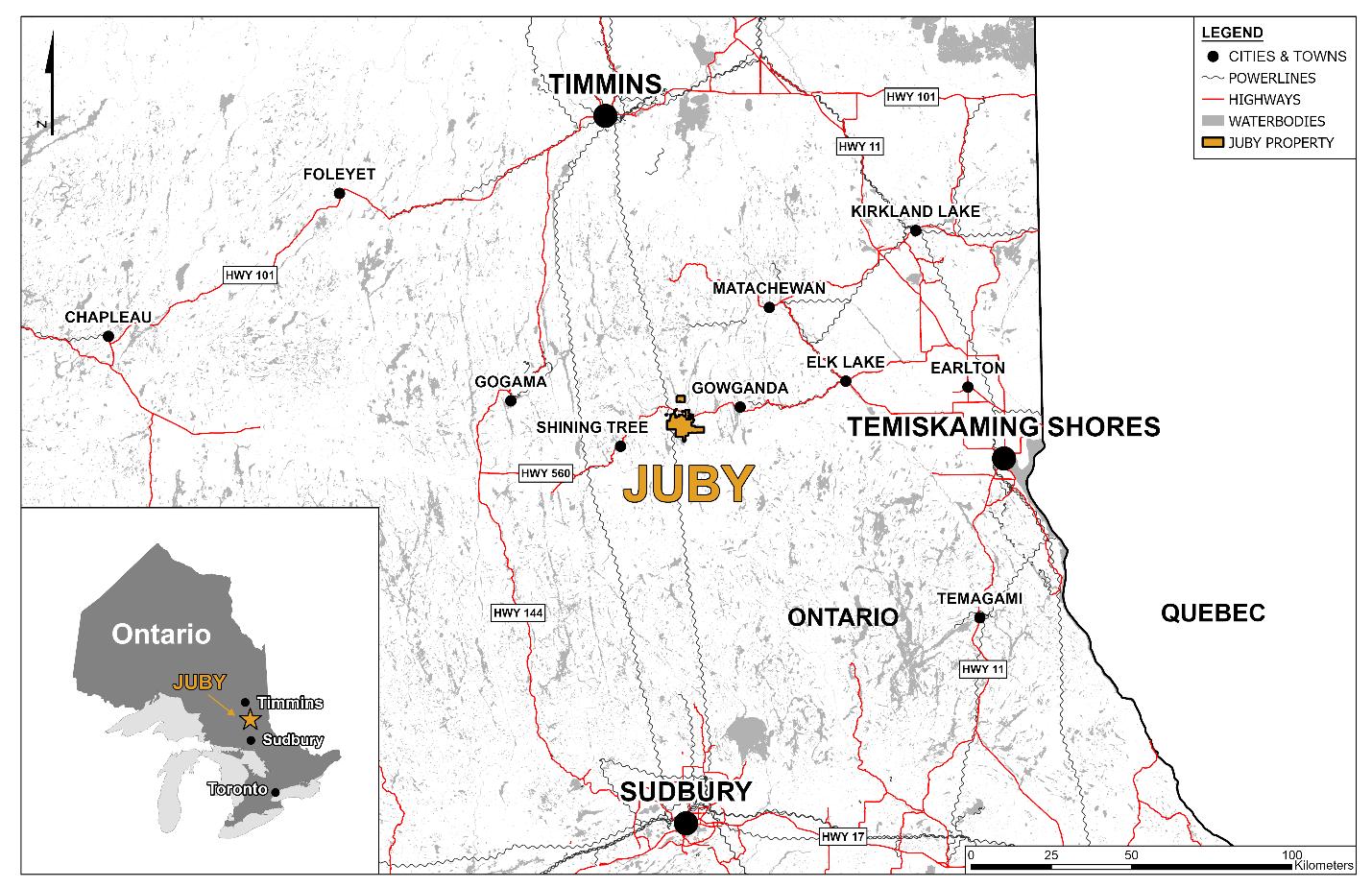
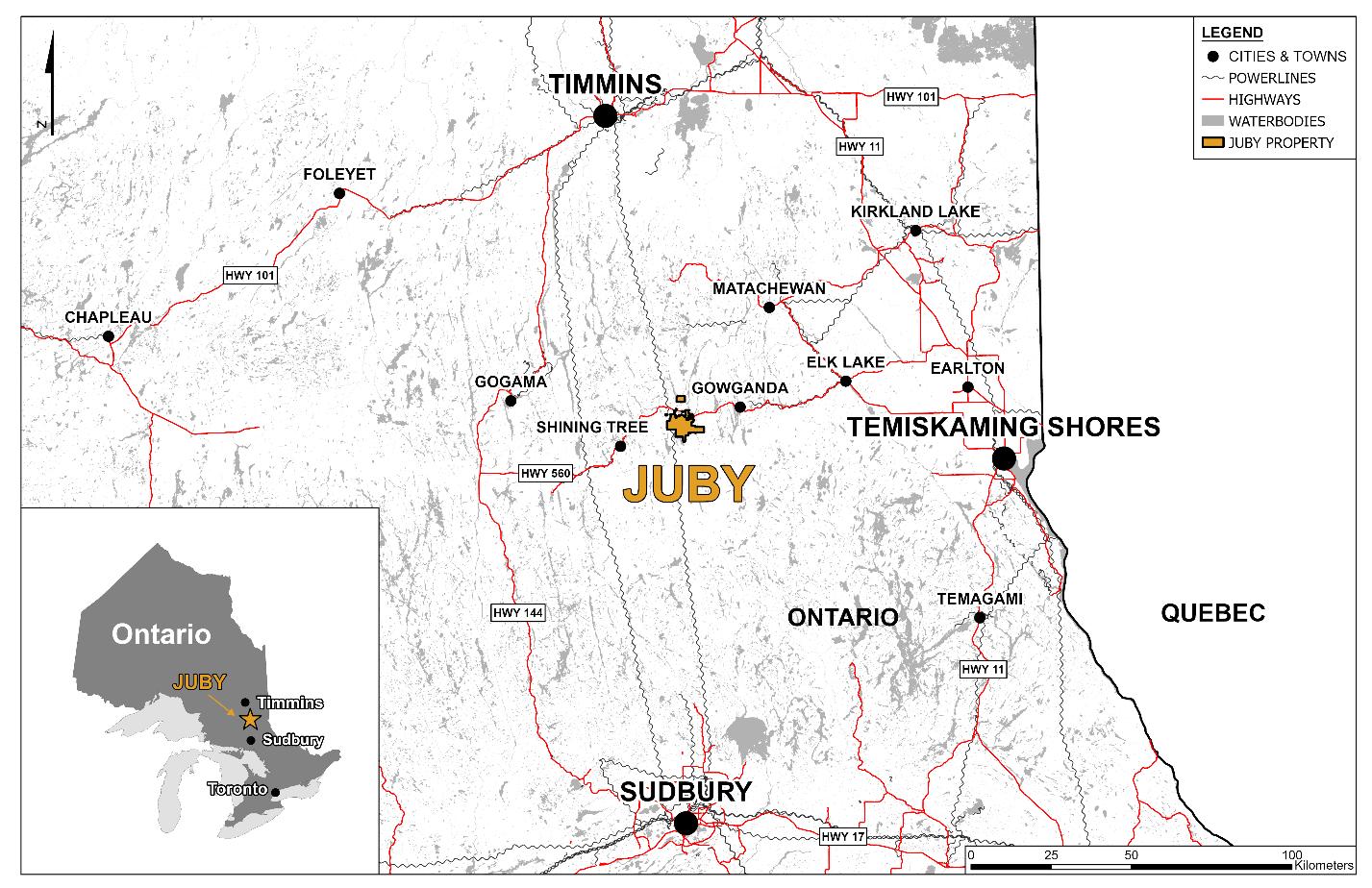
The Juby Property (the “Property”) is in Ontario, Canada, within portions of Tyrrell, Leonard and McMurchy Townships, approximately 15 km west-southwest of Gowganda and 100 km southsoutheast of the City of Timmins. The central part of the property is approximately located at UTM North American Datum (“NAD”) 83 Zone 17 coordinates 498,900m E and 5,273,250m N (Figure 4-1)
Figure 4-1: Location of the Juby Gold Project
4.2 Mineral Tenure
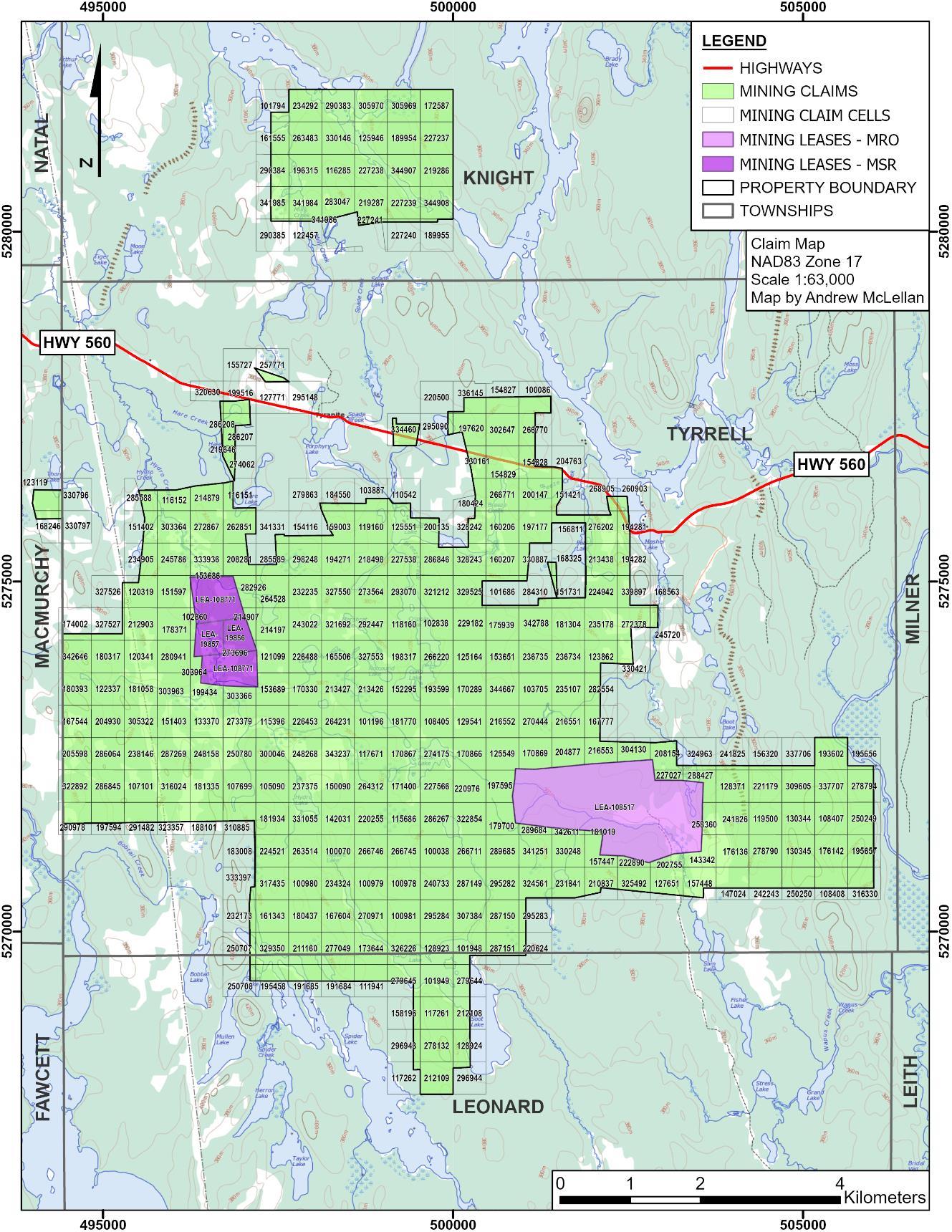
The Project consists of 308 unpatented mining claims(4,886.74 hectares)and five mining leases (400.83 hectares), covering a total of 5,287.57 hectares, or 52.88 km2 (Figure 4-2). All the claims are active and 100% registered to McFarlane Lake Mining Limited. The mining claims and leases are listed in Appendix A. Thirty (30) unpatented mining claims within the JV-Knight are 25% owned by McFarlane Lake Mining Limited for a total of (479.4 hectares).
McFarlane Lake Mining Limited
NI 43-101
Technical Report and MRE Update for the Juby Gold Project
Figure 4-2: Property location and mineral claims of the Juby Property
McFarlane Lake Mining Limited
NI 43-101
Technical Report and MRE Update for the Juby
4.3 Property Description, Ownership and Royalty
The Juby Lease Property (Lease 108517) originated as a series of mineral claims held by a group of prospectors known as the Juby Group. The Property was optioned to Getty Mines Ltd. in 1974 and later sold to Pamour Porcupine Mines Limited in 1980. Ownership subsequently transferred to Royal Oak Inc. in 1996 and then to Inmet Mining Corporation in 1999.
In July 2002, Temex Resources Corp. (“Temex”) acquired the Property from Inmet Mining Corporation for CAD 250,000 and 100,000 Temex shares. The acquisition included both the Juby Lease Property and Inmet’s joint venture interest in the Juby JV Property (“JJV”) with Goldeye Explorations Limited (“Goldeye”). A 2% net smelter return (“NSR”) royalty in favour of the Juby Group remained applicable, including an annual advance royalty payment of CAD 10,667, with the underlying NSR agreement expiring on December 1, 2020.
In 2012, Temex entered into an option agreement to earn a 100% interest in the Golden Lake Property, consisting of twelve unpatented claims held by local prospectors. To complete the option, Temex made cash payments totalling CAD 500,000, issued 500,000 common shares, and carried out work programs valued at CAD 750,000 over a three-year period. The vendors retained a 2% NSR royalty, of which 1% could have been purchased by Temex within eight years for CAD 1.5 million, in two increments of 0.5% for CAD 750,000 each; however, Temex did not exercise this buy-down option. In the same year, on November 23, 2012, Temex purchased Goldeye’s 40% interest in forty unpatented Juby JV claims and a 100% interest in an additional 169 unpatented claims. Consideration for the acquisition comprised CAD 500,000 and five million Temex shares. Certain of the 169 claims were subject to underlying NSR royalties ranging from 2.0% to 2.5%, with buy-down provisions ranging from 1.0% to 1.5%. Together, these claims are referred to as the Juby Unpatented Claims.
On September 18, 2015, Lake Shore Gold Corp. announced the acquisition of all outstanding shares of Temex Resources Corp., thereby gaining ownership of the Juby Project. The transaction involved the issuance of 0.105 Lake Shore Gold shares for each Temex share. Subsequently, on April 1, 2016, Tahoe Resources Inc. acquired Lake Shore Gold Corp. through a share exchange of 0.1467 Tahoe shares for each Lake Shore Gold share. On February 22, 2019, Pan American Silver Corp. acquired Tahoe Resources Inc., issuing 0.2403 Pan American shares for each Tahoe share, with an alternative cash consideration of CAD 3.40 per share available to shareholders electing to receive cash.
On June 20, 2020, South American Resources Corp. (“SARC”) purchased from Lake Shore Gold Corp. (a wholly owned subsidiary of Pan American Silver Corp.) a 100% interest in the Juby Project and a 25% joint-venture interest in certain adjacent Knight claims. The total consideration comprised USD 9.5 million in cash for the Juby Acquisition and USD 0.5 million for the Knight JV
McFarlane Lake Mining Limited
NI 43-101
Technical Report and MRE Update for the Juby Gold Project
Acquisition. Both payments were funded by Caldas Gold Corp. (“Caldas Gold”), which concurrently completed a non-brokered private placement of seven million common shares with its principal shareholder, Gran Colombia Gold Corp., at a price of CAD 2.00 per share, generating gross proceeds of CAD 14 million.
On July 2, 2020, Caldas Gold completed the acquisition of SARC through a three-cornered amalgamation with its wholly-owned subsidiary, 1241868 B.C. Ltd. Under the terms of the agreement, Caldas Gold issued twenty million common shares to SARC shareholders and assumed all outstanding SARC obligations related to the Juby Project and adjoining claims. Approximately 87% of these shares were subject to a voluntary two-year lock-up, and no insiders of Caldas Gold or its parent, Gran Colombia Gold Corp., received any portion of the consideration. Following completion of the transaction, Gran Colombia Gold Corp. held a 57.5% equity interest in Caldas Gold.
In conjunction with the 2020 acquisitions, SARC executed two royalty agreements granting perpetual NSR royalties on all Juby claims. Under the first agreement, 0643990 B.C. Ltd. was granted an NSR ranging from 0.35% to 1.0%, as described in Schedule A of the 064 Royalty Agreement. Under the second agreement, 1248464 B.C. Ltd. received an identical NSR ranging from 0.35% to 1.0%, as set out in Schedule A of the 124 Royalty Agreement
In 2021, Caldas Gold Corp. renamed itself to Aris Mining Corporation (“Aris Mining”).
in 2025, McFarlane entered into a definitive purchase agreement with Aris Mining to acquire a 100% interest in the Juby Gold Project. Under the terms of the agreement, Aris Mining will receive total consideration of USD 22 million, comprising USD 10 million in cash payable on closing, and the balance in common shares of McFarlane.
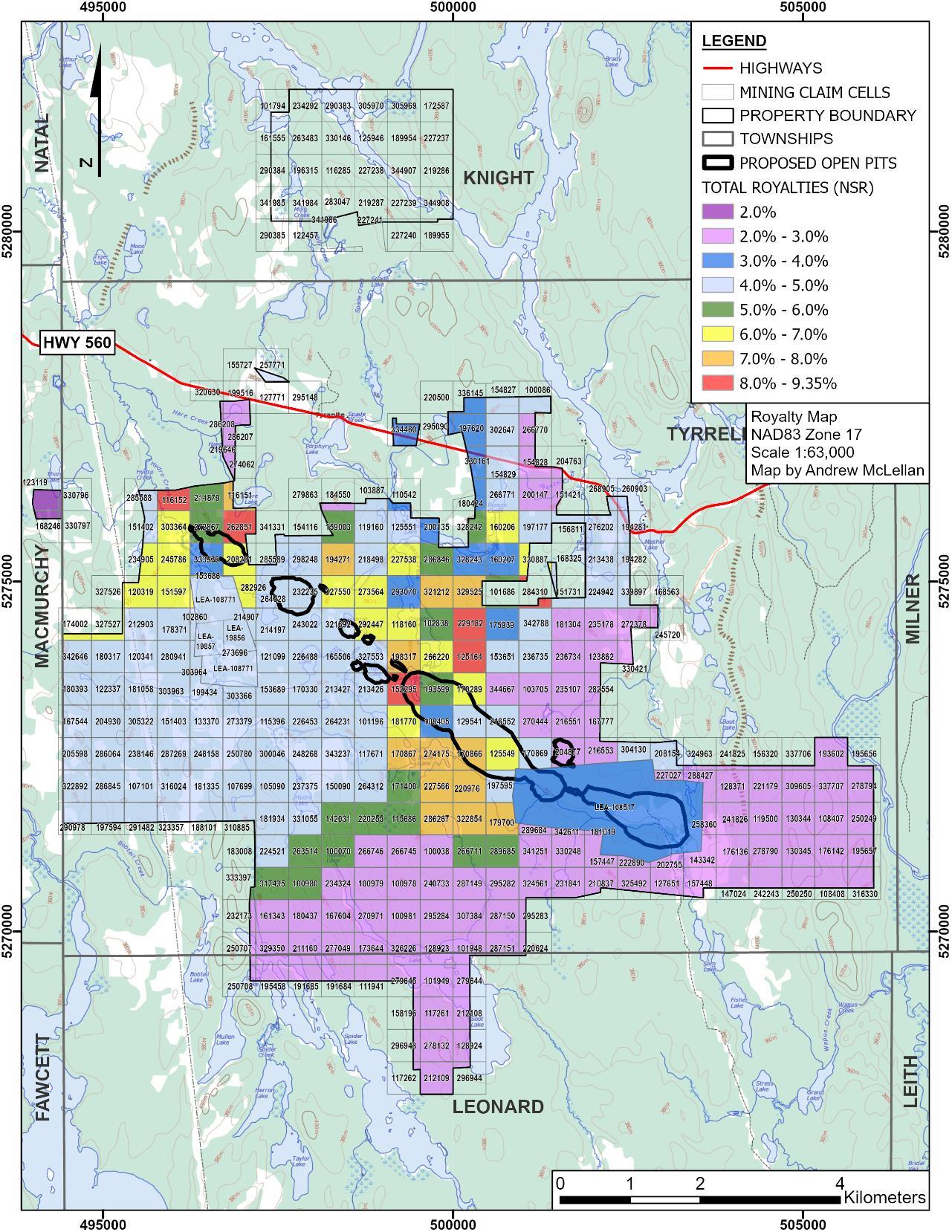
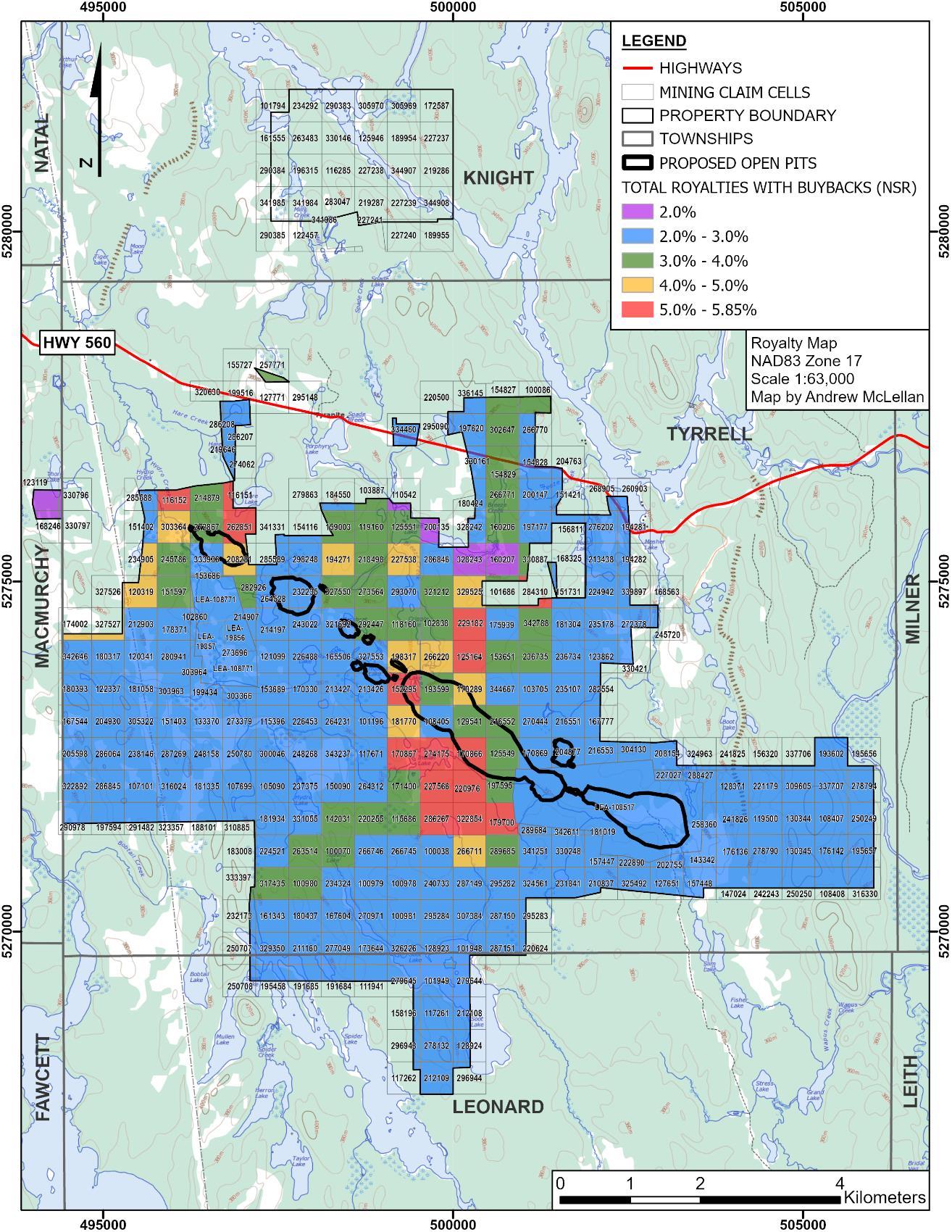
The current royalties on the Juby Project can be seen in Figure 4-3, and the royalites after an initiation of the buyback can be seen in Figure 4-4.
McFarlane Lake Mining Limited
NI 43-101
Technical Report and MRE Update for the Juby Gold Project
Figure 4-3: Juby Project total royalty
McFarlane Lake Mining Limited
NI 43-101
Technical Report and MRE Update for the Juby Gold Project
Figure 4-4: Juby Project royalty with buyback
McFarlane Lake Mining Limited
NI 43-101
Technical Report and MRE Update for the Juby Gold Project
Except for the areas indicated above, all other areas of the Property are free of NSR commitments. There are no historical ownership or royalty liabilities attached to the Property. The Authors are not aware of any other underlying agreements relevant to the Property.
4.4 Property Claim Status
The Property was initially staked prior to 2018 under Ontario’s ground-based claim staking process. On April 10, 2018, Ontario converted all active, unpatented claims (legacy claims) to a cell-based provincial grid which is assessable using an online mining claim registration system known as the Mining Land Administration System (“MLAS”).
All active, unpatented claims (legacy claims) were converted from their legally defined location by claim posts on the ground or by township survey to a cell-based provincial grid. The provincial grid is built on the latitude- and longitude-based National Topographic System (“NTS”) and is made up of more than 5.2 million cells, each measuring 15 seconds latitude by 22.5 seconds longitude and ranging in size from 17.7 ha in the north to 24 ha in the south. Cells in the Property area are approximately 22 ha in size. Each cell has a unique identifier based on the cell’s position in the grid.
Ontario mining claims are now legally defined by their cell position on the grid and UTM coordinate location in the online MLAS Map Viewer. Legacy claims were not cancelled but continue as one or more cell claims or boundary claims that resulted from conversion.
As defined in the Mining Act, a cell claim is a mining claim that relates to all the land included in one or more cells on the provincial grid that is open for mining claim registration. A cell claim is created as a new registration after April 10, 2018, or at conversion where there are one or more legacy claims in a cell, and all are held by the same holder. In this case, if there is more than one legacy claim in a cell, those claims will merge into one cell claim. A cell claim created from conversion can be a minimum of one cell (single cell mining claim or “SCMC”) though it can be amalgamated to form a multi-cell mining claim (“MCMC”), up to a maximum of 25 cells.
As defined in the Mining Act, a boundary claim is created at conversion when there are multiple legacy claims within a cell that cannot merge into a cell claim. There are two circumstances where mining claims will not merge into a cell claim:
◼ When the legacy claims are held by different holders;
◼ When the legacy claims are held by the same person who chooses to keep them separate by making an election through the Claim Boundary Report process.
McFarlane Lake Mining Limited
NI 43-101
Technical Report and MRE Update for the Juby Gold Project
Unpatented mining claims include no surface rights; however, a right to acquire the surface rights for development purposes exists through the Ontario Mining Act. The Mining Act also provides legal access to the land for the purpose of exploration.
Mining claims are generally subject to the following Crown reservations:
◼ The surface rights over a width of no more than 120 m from the high-water mark where a mining claim includes land covered with water or bordering on water;
◼ Where a highway or road constructed or maintained by the Ministry of Transportation crosses a mining claim, the surface rights over a width of no more than 90 m, measured from the outside limits of the right of way of the highway or road along both sides of the highway or road;
◼ Sand and gravel reserved;
◼ Peat reserved.
Certain mining claims also:
◼ Are mineral rights only, or part mineral rights only, where all or part of the surface rights within the claim are held by a third party;
◼ Exclude hydro right of ways;
◼ Exclude withdrawn areas.
Given the nature of Ontario’s MLAS cell-based map staking system, certain cell claims overlap areas which are withdrawn from mineral exploration and development. Such cell claims are referred to as encumbered claims. Features that are an encumbrance on a cell claim include:
◼ Land that is part of an Aboriginal reserve;
◼ Provincial Park or a conservation reserve;
◼ Mining leases except for surface rights only leases;
◼ Freehold patents except those for surface rights only;
◼ Licences of occupation;
◼ Designated protected area in a community-based land use plan under the Far North Act;
◼ Land withdrawn under the Mining Act from prospecting, registration of mining claim, sale or lease for the following reasons:
- Land included in a proposed Aboriginal land claim settlement;
- Land intended to be added to an Aboriginal reserve;
- Land part of a provincial park, conservation reserve or forest reserve created under Ontario’s Living Legacy Land Use Strategy;
McFarlane Lake Mining Limited
NI 43-101
Technical Report and MRE Update for the Juby Gold Project
- Land that meets the criteria for a site of Aboriginal Cultural Significance;
- Land designated as an area of provisional protection under the Far North Act.
Where a cell or boundary claim overlaps a withdrawn area, the claim holder is only entitled to work on the claim area outside the withdrawn area.
Annual assessment work requirements per mining claim, to be filed on or before the claim due date (anniversary date), are:
◼ Single-cell claim: CAD400 (unless a cell was encumbered at conversion);
◼ Multi-cell claim: CAD400 per cell (unless a cell was encumbered at conversion);
◼ Boundary claim: CAD200.
If a cell is encumbered at conversion, the assessment work requirement for a cell claim in that cell will be CAD200. This special rule applies only if the conversion process results in a claim holder having a cell claim in an encumbered cell. If that cell claim forfeits, the cell will be open for claim registration, subject to the encumbrance but any new cell claim registered for that cell will have the assessment work requirements set at the standard cell claim amount of CAD400.
The unpatented mining claims listed in Appendix A detail the current MLAS designated encumbered/unencumbered cell classification and annual assessment work costs for the Property. As of the effective date of this report, the Juby property is comprised of 308 cell claims consisting of 122 boundary cell mining claims, and 186 single-cell mining claims, of which 33 are encumbered. A total amount of CAD 92,200 of assessment work is required to keep the claims in good standing each year. The anniversary dates that will require submission of assessment work to keep the claims in good standing range from September 23, 2027 to December 20, 2030
4.5 Current Property Status
The Project consists of 308 unpatented mining claims that cover 4,886.74 hectares, or 12,075.40 acres (Appendix A). The anniversary dates that will require submission of assessment work to keep the claims in good standing range from September 23, 2027 to December 20, 2030.
The property also contains five mining leases that cover 400.83 hectares, or 4.01 km2 (Appendix A). The expiry dates that will require renewal of the leases range from October 31, 2025 to December 31, 2031. At the time of writing, all the claims and leases are currently in good standing.
4.6 Underlying Agreements
The QP is not aware of any underlying agreements relevant to the Project.
McFarlane Lake Mining Limited
NI 43-101
Technical Report and MRE Update for the Juby Gold Project
4.7 Permits and Authorization
The Ontario Mining Act regulations require exploration plans and permits, with graduated requirements for early exploration activities of low-to-moderate impact undertaken on mining claims, mining leases and licences of occupation. Exploration plans and permits are not required on patented mining claims.
The QP is unaware of any other significant factors and risks that may affect access, title, or the right, or ability to perform the exploration work recommended for the Property.
4.7.1 Exploration Plans and Permits Required under the Ontario Mining Act
The Ontario Mining Act regulations require exploration plans and permits, with graduated requirements for early exploration activities of low-to-moderate impact undertaken on mining claims, mining leases and licences of occupation. Exploration plans and permits are not required on patented mining claims as such work listed under Exploration Plan and Exploration Permit below may be completed, provided proper consultations (if applicable) are completed.
There are a number of exploration activities that do not require a plan or permit and may be conducted while waiting for a plan or permit is effective. These may include the following:
◼ Prospecting activities such as grab/hand sampling, geochemical/soil sampling, geological mapping;
◼ Stripping/pitting/trenching below thresholds for permits;
◼ Transient geophysical surveys such as radiometric, magnetic;
◼ Other baseline data acquisition such as taking photos, measuring water quality, etc.
Exploration Plan
Those proposing to undertake minimal to low impact exploration plan activities (early exploration proponents) must submit an exploration plan. Early exploration activities requiring an exploration plan include:
◼ Geophysical activity requiring a power generator;
◼ Line cutting, where the width of the line is 1.5 m or less;
◼ Mechanized drilling for the purposes of obtaining rock or mineral samples, where the weight of the drill is 150 kg or less;
◼ Mechanized surface stripping (overburden removal), where the total combined surface area stripped is less than 100 m2 within a 200 m radius;
McFarlane Lake Mining Limited
NI 43-101
Technical Report and MRE Update for the Juby Gold Project
◼ Pitting and trenching (of rock), where the total volume of rock is between 1 m3 and 3 m3 within a 200 m radius.
To undertake the above early exploration activities, an exploration plan must be submitted, and any surface rights owners must be notified. Aboriginal communities potentially affected by the exploration plan activities will be notified by the Ministry of Energy, Northern Development and Mines (“MENDM”) and have an opportunity to provide feedback before the proposed activities can be carried out.
Exploration Permit
Those proposing to undertake moderate impact exploration permit activities (early exploration proponents) must apply for an exploration permit. Early exploration activities that require an exploration permit include:
◼ Line cutting, where the width of the line is more than 1.5 m;
◼ Mechanized drilling, for the purpose of obtaining rock or mineral samples, where the weight of the drill is greater than 150 kg;
◼ Mechanized surface stripping (overburden removal), where the total combined surface area stripped is greater than 100 m2 and up to advanced exploration thresholds, within a 200 mradius;
◼ Pitting and trenching (rock), where the total volume of rock is greater than 3 m3 and up to advanced exploration thresholds, within a 200 m radius.
The above activities will only be allowed to take place once the permit has been approved by the MENDM. Surface rights owners must be notified when applying for a permit. Aboriginal communities potentially affected by the exploration permit activities will be consulted and have an opportunity to provide comments and feedback before a decision is made on the permit.
4.7.2 Current Exploration Permits
There are no current Exploration Permits on the property.
4.8 Environmental Considerations
McFarlane has advised the QP that there are no outstanding or pending adverse environmental issues attached to the Property. No mining or other potentially disruptive work has been carried out on the property beyond that described in this report.
As far as the QP is aware, the environmental liabilities related to the Project, if any, are negligible.
McFarlane Lake Mining Limited
NI 43-101
Technical Report and MRE Update for the Juby Gold Project
Accessibility, Climate, Local Resources, Infrastructure, and Physiography
5.1 Accessibility
The Juby Gold Project is located within northeastern Ontario, approximately 15 km west-southwest of Gowganda and 100 km south-southeast of the City of Timmins, within Tyrrell, Leonard and McMurchy Townships. Access to the property is readily gained by travelling west along Highway 560 for approximately 20 km from the town of Gowganda, then south along the Indian Lake Road, a secondary gravel road. The eastern portion of the property hosting the is readily accessed by travelling south from Highway 560 along the Spear Lake Road. An extensive series of old gravel logging roads provide access to the remaining portions of the property via four- wheel trucks and ATVs. Access to the property is available year-round, if required.
5.2 Climate
The climate of the Project area is continental in nature, with cold winters (-10 to -35 ºC) and warm summers (+10 to +35 ºC). Seasonal variations affect exploration to some extent; for example, geological mapping cannot be done in the winter, but diamond drilling is best done in the winter when water bodies and swamps are frozen. Overall, the climate would not significantly hamper mining operations.
5.3 Local Resources and Infrastructure
The cities of Sudbury, Timmins and Kirkland Lake are relatively close to the Project (Figure 5-1); these all have the necessary equipment and trained personnel to support exploration and mining activities. The Project has very good access to all infrastructure required for mining. A high-voltage powerline passes within the boundaries of the Project. Water is abundant in the region and the Project contains several all-weather gravel roads. Suitable locations for constructing mineral processing facilities are abundant on the Project.
McFarlane Lake Mining Limited
NI 43-101
Technical Report and MRE Update for the Juby Gold Project
5.4 Physiography
The Project has a gently rolling topography with maximum relief of approximately 15 m. Elevation is typically in the order of 370 m above sea level. In general, the Project is dominated by forest. The Project has been logged in the past, so the present forest is second growth, a mixture of jack pine, spruce, birch, and poplar trees. Portions of the Project have been subjected to clear-cut logging within the past fifteen years. Much of the Project is covered by significant (>2 m) overburden, and outcrop density is low.
Figure 5-1: Regional map
McFarlane Lake Mining Limited
NI 43-101
Technical Report and MRE Update for the Juby Gold Project
History
6.1 Introduction
Prospectors first arrived in the Shining Tree area during the Gowganda silver rush in 1906-1910. Prospectors were dropped off by Ontario Northland Railway at Latchford and from there they canoed up the Montreal River into this area. Gold was discovered in 1911, approximately 20 kilometres southwest of the current Project and in the early 1930s gold was discovered in the northern part of Tyrrell Township, with the most significant discovery being the Tyranite deposit which produced approximately one tonne of gold between 1939 and 1942. During the 1932 to 1996 period, numerous companies completed surface exploration programs of mapping, prospecting, and ground geophysics, with limited drilling. No work was undertaken on portions of the Project area between 1984 and 1996 because the Temagami Land Caution, a moratorium on mineral exploration, was in effect. The most significant work completed during the 1994 to 2014 period was related to diamond drilling on the Juby, Golden Lake, Big Dome and Hydro CreekLaCarte deposits.
6.2
6.2.1
Diamond Drilling Programs
Goldeye Exploration (1998 – 2011): BDZ Deposit
During 1998, Goldeye completed surface exploration of line cutting, ground induced polarization (“IP”) and magnetics surveys, trenching and mapping on the BDZ deposit. The most significant work was the completion of 63 diamond drill holes (“DDH”), totaling 21,519 metres, which is summarized in the following text.
During 1998, eight DDH (G98-06 to G98-13), totaling 1,905 metres, were completed on the eastern edge of the BDZ deposit. This drilling tested the Tyrrell Shear Zone and one of the better intersections was 2.4 g/t Au over 3.7 metres in G98-12.
From 1999–2008, a total of 19 DDH. totaling 6,703 metres. were drilled on the central and eastern portion of the BDZ deposit (G00-07, G00-14 to 17; G05-22 to 23; G06-24 to 29; G07-06 and G07-30 to 31; G08-32 to 33). The best two intersections were 130.0 g/t Au over 3.4 metres in G05-22 and 23.0 g/t Au over 7.7 metres in G05-23.
During 2009-2010, a total of 26 DDH, totaling 9,970 metres (G09-35 to 44; G10-45 to 60), were completed. This drilling tested the depth and continuity of an iron formation in the western part of the BDZ deposit. Two of the better intersections were 1.9 g/t Au over 27.4 metres in G09-42 and 8.4 g/t Au over 3.0 metres in G10-54.
McFarlane Lake Mining Limited
NI 43-101
Technical Report and MRE Update for the Juby Gold Project
During 2011-12, a total of 10 DDH (G11-61 to 68; G12-69 to 70), totaling 2,941 metres, were completed to evaluate and extend the known mineralization and the new Hanging Wall Breccia Zone. Two of the better intersections were 33.2 g/t Au over 1.0 metre in G11-68 and 12.3 g/t Au over 0.42 metres in G12-70.
Haddington Resources completed surface exploration that consisted of IP and magnetic surveys, geological mapping, soil geochemistry and prospecting. The most significant work was the completion of 32 DDH, totaling 7,162 metres (HC-01 to 23; HC-05 to 08; GE-17, and GE-24 to 26; B27). One of the better intersections was 2.03 g/t Au over 39.40 metres, which included 4.28 g/t Au over 12.10 metres in HC-23.
Goldeye completed surface exploration that consisted of IP and magnetic surveys, geological mapping, soil geochemistry and prospecting during this period over the HCLZ Deposit. The most significant work was the completion of 51 DDH, totaling 10,892 metres, which is summarized in the following text.
During 1998, six DDH (G98-01 to 3; OR-1 to 5), totaling 2,172 metres, were completed. The better intersections included 1.2 g/t over 5.4 metres in OR-3 and 2.1 g/t Au over 16.0 metres in G98-02.
During 1999 – 2007, a total of 32 DDH (H03-01 to 13; H04-14 to 28; H05-29 to 30 and H06-31 to 32), totaling 5,154 metres, were completed. The better intersections included 2.30 g/t Au over 23.60 metres in H03-05; 2.5 g/t over 2.8 metres in H03-12; 2.6 g/t Au over 10.5 metres in H04-17 and 2.1 g/t Au over 8.4 metres in H05-29.
In the 2009-2011 period, a total of 13 DDH (H09-33 to 36; H10-37 to 41 and H11-42 to 43), totaling 3,566 metres, were completed. The better intersections included 2.47 g/t Au over 30.95 metres in H09-33 and 1.82 g/t Au over 29.4 metres in H09-34.
6.2.4 Inmet Resources (1999 - 2000): JMZ Deposit
In 1999, Inmet drilled 25 holes for a total of 8,160 m in three programs from December 1999 to July 2000 on the Juby deposit. Inmet conducted a preliminary resource calculation, concluding that a low-grade resource of 34 Mt @ 1.0 g/t Au existed, with a higher-grade core of 2.19 Mt @ 4.65 g/t Au. Inmet stated “These resource calculations are far from mineable reserves”. This resource estimate is not in accordance with the categories set out in National Instrument 43-101. A qualified person has not done sufficient work to classify the historical estimate as current mineral resources
McFarlane Lake Mining Limited
NI 43-101
Technical Report and MRE Update for the Juby Gold Project
or mineral reserves; and the issuer is not treating the historical estimate as current mineral resources or mineral reserves
All previous drilling campaigns and surface exploration by other companies was compiled into a database by Temex. In addition, all the geological, geophysical, assay and geochemical data from the Golden Lake and former Goldeye properties was added to the Temex database over the period of 2006 to 2013. The main focus of exploration since 2002 has been diamond drilling to expand the mineral resources on the Project.
During the 2002 -2013 period Temex completed the following exploration work on the Project:
◼ Re-cutting the Inmet grid and adding intermediate lines at 50 m spacing;
◼ Cutting ground grids at 100 m line spacing;
◼ Ground magnetic and IP surveys over the ground grids;
◼ Surveying of all the Inmet and Temex drill collars;
◼ Trenching with channel sampling and mapping;
◼ Bedrock mapping and prospecting over the cut grids;
◼ Structural studies of drill core, bedrock trenches and field outcrops;
◼ Seven drilling programs consisting of 140 NQ drill holes, totaling 34,223 metres, were completed on the JMZ during the 2002 to 2011 period;
◼ Two drilling programs consisting of 31 NQ drill holes, totaling 9,518 metres, were completed on the Golden Lake unpatented claims during the 2012-2013 period;
◼ Re-logging approximately 27,524 metres of NQ core in 106 historic drill holes and infill sampling of 120 historic drill holes, for a total of 2,727 samples on the Hydro Creek-LaCarte and Goldeye deposits during 2013.
6.2.6 Lake Shore (2017 – 2018): JMZ and GLZ Deposits;
Lake Shore, a wholly owned subsidiary of Tahoe Resources, completed the following exploration work during the 2017-2018 period:
◼ Bedrock mapping, prospecting in 2017 and one NQ drill hole, totaling 300 metres, on the 826 Zone in 2018. The 826 Zone is approximately 1,000 metres south of the main Tyrrell shear zone that hosts all the currently known mineral resources.
◼ One drilling program in 2018, consisting of 17 NQ drill holes, totaling 6,006 metres. Two drill holes totaling 453 metres were drilled on the JMZ deposit for metallurgical purposes. 13 drill
McFarlane Lake Mining Limited
NI 43-101
Technical Report and MRE Update for the Juby Gold Project
holes, totaling 4,899 metres, were drilled on the GLZ Lake deposit and extended the deposit an additional 750 metres to the west. Two drill holes, totaling 654 metres, were drilled on the previously known portion of the GLZ deposit for metallurgical purposes.
6.3 Exploration History
6.3.1 Juby Lease (LEA-108517)
The earliest recorded work on the present Juby was by B. Garvey (Graham, 1932), who conducted trenching 350 m northeast of the main zone in 1931 (Daniels et al., 2005). This area was re-staked as the Welsh-Ragan (also called the Welsh Mac) Property by G. Welsh in 1934; Welsh discovered what is now considered to be the eastern part of the Main Zone. The Property was optioned to the Provincial Development Syndicate (Welsh-Ragan and Welsh-Mac companies), who undertook trenching, and then to Teck-Hughes, who drilled 17 holes (1 to 14, 2A, 4A and 12A) on the Property in 1938. Holes 1 to 12 were drilled on the Property, and holes 13 and 14 were drilled to the northeast, on the Garvey showing. Holes on the main zone were drilled at an azimuth of 022°, at dips varying from 32 to 60°. Logs from only the first 10 holes were present in the assessment records, but the total length of core drilled is said to be 1,911 m (Gagnon, 2000). Hollinger Consolidated Gold Mines subsequently optioned the Property and conducted a magnetic survey and probably check assaying (not well documented). Hollinger is said to have drilled a number of holes on the Property, but there is no record of this drilling available. Siscoe Gold Mines resampled all trenches on the Welsh-Ragan Property in 1945. Also in 1945, Matachewan Consolidated Gold Mines trenched a “30-foot zone of silicified altered and mineralized arkosic sediments” immediately west of the Welsh-Ragan Property; this is presumably what is now called the Anglehart showing in the western part of the JMZ deposit.
In 1968, electromagnetic and magnetic surveys were conducted over ground that now forms leases L-345168 and L-345169 by A. Decker and M. Juby. During the 1968–1972 period, electromagnetic and magnetic surveys were conducted over claims L-318348 and L-318351, which form part of the present Project, by E. Anglehart, A. Decker and M. Juby. Getty Mines Limited optioned a property position similar to the present Project from the Juby Group, and in 1974 conducted geological mapping and minor soil surveying, as well as induced polarization and magnetic surveys. In 1975 Getty drilled 12 holes, for a total of 1,412 m, on the Property. These holes tested the main zone and other targets on the Property, and were mostly drilled to the south. In 1984, Pamour Porcupine Mines Ltd drilled 10 short holes on the Property, for a total of 611 m. The holes tested the Anglehart showing and two areas north of the JMZ deposit.
No work was undertaken between 1984 and 1996 because the Temagami Land Caution, a moratorium on mineral exploration, was in effect.
McFarlane Lake Mining Limited
NI 43-101
Technical Report and MRE Update for the Juby Gold Project
In 1996, Royal Oak Mines Inc. stripped a portion of the JMZ deposit in the northern part of mining lease L-318348, and collected 107 samples for gold analysis. The best result was 0.221 oz/ton Au. Royal Oak conducted an orientation soil survey over the JMZ deposit and used information gained from that survey to design a soil survey over nearby claims.
In 1999, Inmet constructed a grid on the JMZ deposit, with lines spaced at 100 m and oriented at 016°. JVX Ltd. then performed a Combo Spectral IP/Resistivity and magnetic survey on the Property. Based on the geophysical response and ideas developed on adjacent ground to the west, JVX proposed thirteen drill holes to follow up this survey. Inmet conducted mechanical stripping and trench resampling in 2000. Based on the geophysical survey and geological interpretation exercises, Inmet drilled 25 holes, for a total of 8,160 m, in three programs from December, 1999 to July 2000. Inmet conducted a preliminary resource calculation, concluding that a low-grade resource of 34 Mt @ 1.0 g/t Au existed (Gagnon, 2000), with a higher grade core of 2.19 Mt @ 4.65 g/t Au. Inmet stated “These resource calculations are far from mineable reserves”. This resource estimate is not in accordance with the categories set out in National Instrument 43-101. The Inmet exploration program demonstrated the occurrence of widespread mineralization in the JMZ deposit and was responsible for Temex becoming interested in the Property. The information gained from the Inmet program laid the foundation for the exploration programs undertaken by Temex during the 2002-2013 period.
Temex Resources Corp. (“Temex”) purchased the JMZ Leases from Inmet Mining Corporation in July, 2002. Temex compiled gold assays from all previous drilling campaigns into a database. During the summer and fall of 2002 Temex drilled JU-02-01 to JU-02-10, totaling 1,792 metres. During the 2003 summer field season Temex re-cut the Inmet grid, added intermediate lines at a 50-m line spacing and completed ground magnetic and IP surveying over these grid lines (Sexton et al, 2003). Additional trenching, mapping and channel sampling was completed on the Juby deposit during 2003-2004 (Pettigrew, 2004). For the 2003 to 2013 period, Temex completed 136 NQ-sized surface DDH, totalling 41,273 metres, in seven drill campaigns over and adjacent to the JMZ deposit. Bedrock trenching, channel sampling, mapping, prospecting, grid cutting and soil sampling were also completed in the areas north and south of the Juby deposit trend and across the Golden Lake property during the 2003 to 2013 period (Pettigrew, 2004; Hann, 2008; Kettles, 2012; Harvey and Kettles, 2012; Kettles 2013a; Kettles 2013b).
6.3.2 Juby Unpatented Claims
In 1945, Matachewan Consolidated Gold mines completed trenching and sampling on an Aubearing quartz vein in silicified altered felsic metavolcanics south of the Juby deposit. The quartz vein samples were reported as two 4-foot sections with Au values of $7.00 (CAD) per ton.
McFarlane Lake Mining Limited
NI 43-101
Technical Report and MRE Update for the Juby Gold Project
During the 1968-1971 period, Timiskaming Nickel completed airborne magnetic and electromagnetic surveys, ground follow-up, mapping and drilling. Four drill holes (O-1 to O-4) were completed in the Porphyry Lake area in 1968, 19908 (hole O-4). No samples or assays were noted.
In 1975, Monpre Iron Mines held ground south and west of the Juby deposit. One drill hole (75-1) was completed and intersected agglomerate, rhyolite, conglomerate and diabase. The two samples taken returned trace Au (Willars, 1975a, b, c).
No work was undertaken between 1984 and 1996 because the Temagami Land Caution, a moratorium on mineral exploration, was in effect.
In 1996, Goldeye staked the western and northern portion of the current Property, and performed grid cutting and ground magnetometer and IP surveys in 1998, which outlined several chargeability anomalies recommended for follow-up work. A limited soil survey was completed over the grid in 1999, which outlined several Au in soil anomalies, some coincident with IP anomalies.
In 2002, Temex acquired a joint venture interest in partnership with Goldeye; subsequent work included reconnaissance prospecting, mapping, line-cutting, geophysical surveying and diamond drilling. The drilling discovered the B Zone over a strike length of 400 m in the mafic volcanic rocks, 500 metres northwest of and parallel to the JMZ deposit trend.
In 2004, Temex completed 2,115 metres of drilling in 12 NQ DDH which extended the JMZ deposit 400 metres to the west with drill hole JU 04-57. This drilling program confirmed the B Zone mineralization at depth with an intersection of 6.76 g/t Au over 1.15 m in JU 04-59 (Pettigrew, 2004). A zone parallel to the B Zone, called the B Zone North, was intersected 100 m to the north of the B Zone in drill hole JU 04-64, which intersected 6.96 g/t Au over 0.92 m within a 29.50 m interval grading 0.89 g/t Au.
During 2007-2008, Temex and Goldeye completed 4,025 m of spectral IP/Resistivity surveys covering part of the northern portion of the Property. The IP targets identified were drill tested with a program of 17 drill holes totaling 3,185 metres. Drilling extended the JMZ deposit another 50 m to the west, and to a vertical depth of 180 m. The B Zone was extended 300 m to the west in drill hole JU-08-96 with an intersection of 0.78 g/t Au over 1.65 m. The B Zone North was extended 200 m to the east in drill hole JU-07-91 which intersected 1.03 g/t Au over 3.00 m, including 7.41 g/t Au over 0.20 m.
During 2010-2011, Temex and Goldeye completed a program of line cutting, magnetometer and IP surveys, geochemical sampling surveys, prospecting and rock sampling, detailed structural mapping, and diamond drilling. Thirty-eight (38) IP/Resistivity anomalies were outlined on the grids north of the JMZ deposit and an additional 25 anomalies were outlined on the grids south of the Juby deposit. Seven major Au in soil anomalies were noted, the best on the grids south of the JMZ
McFarlane Lake Mining Limited
NI 43-101
Technical Report and MRE Update for the Juby Gold Project
deposit, with values up to 1,747 ppb Au. Follow-up prospecting and rock sampling discovered the 826 Zone, with bedrock grab samples ranging from 0.59 g/t Au to 8.26 g/t Au. This newly discovered zone was outlined over 250 m trending at 330 degrees and 50 m across strike. A diamond drilling program on the northern grid consisted of nine holes, totaling 1,941 metres, and tested IP, previous drilling, Au in rock and soil anomalies. Drilling on the south grid area consisted of drill hole JJV1106, which intersected 14.75 metres of 0.54 g/t Au. Drill hole JJV11-09, on the west extension of the JMZ, returned 1.02 g/t Au over 35.0 m and 1.00 g/t over 22.82 m. Hole JJV11-08 was drilled northwest of the JMZ and returned 2.04 g/t Au over 10.55 m and 1.73 g/t Au over 2.7 m.
In 2012 Temex and Goldeye completed a program of drilling, mapping, soil sampling, and prospecting. Two holes totaling 448.2 m were completed, with the best intersections returned being from JJV12-11 with 1.09 g/t Au over 7.98 metres and narrow intervals of up to 5.38 g/t Au over 0.5 m. Soil sampling, mapping, prospecting and follow-up rock sampling returned assays of up to 1.99 g/t Au in mafic volcanic rocks on the north portion of the Property. An area of elevated gold values was outlined immediately west of the JMZ boundary, where five closely-spaced samples of mineralized quartz-feldspar porphyry and altered and sheared sediments assayed from 0.49 g/t Au to 0.83 g/t Au.
In November 2012, Temex purchased the remaining 40% of the JMZ Property from Goldeye.
During 2013, Temex continued work on the 826 Zone (Kettles, 2012; 2013, Harvey and Kettles, 2012; Kettles, 2013a and 2013b; Kettles, 2014). Gold mineralization in this zone is hosted by coarsegrained arenite and conglomerate that are cross cut at a low angle by a quartz-feldspar porphyry sill. The best gold mineralization occurs with 2 to 5% disseminated pyrite, quartz veins and stringers and moderate-to-strong silica and sericite alteration. One exploration drill hole (JU13-137) tested the 826 Zone at an azimuth and dip of 016° / -50° to a depth of 251 metres. This drill hole intersected the following four mineralized intervals of altered and mineralized quartz-feldspar porphyry,arenite and conglomerate:
◼ 1.96 g/t Au over 8.80 metres from 4.20 to 13.00 metres depth, including 4.68 g/t Au over 2.05 metres;
◼ 1.43 g/t over 8.00 metres from 150.00 to 158.00 metres;
◼ 0.77 g/t Au over 6.50 metres from 198.50 to 205.00 metres depth, including 1.31 g/t Au over 2.60metres;
◼ 1.07 g/t over 2.09 metres from 233.00 to 235.09 metres.
In addition, prospecting along the 330-degree trend of the 826 Zone was completed over a distance of 1,500 metres. A total of 41 grab samples were taken, of which 15 returned anomalous gold values that ranged from >0.25 to a high of 3.33 g/t Au.
McFarlane Lake Mining Limited
NI 43-101
Technical Report and MRE Update for the Juby Gold Project
6.3.3 Golden Lake Area
The GLZ deposit covers one main historic showing, the LaFrance occurrence, and several other lesser-known gold occurrences. The LaFrance occurrence, occurring on present day claim 1221622, was first noted in the 1930’s. LaFrance and Sorbel owned the claims covering the occurrence in 1932 (Graham, 1932). Most of the historical work on this Property is documented by Carter (1977). He indicates that the La France showing was examined “...by D. K. Burke in 1936” and the results “showed $0.40 gold over 0.6 m (2 feet) and $3.20 over 3.6 m (12 feet).” Carter (1977) goes on to state that “...the main showing was again examined by J. W. McBean, Resident Geologist in 1945 and was said to consist of a quartz vein 10 cm (4 inches) wide and exposed for 14 m (45 feet), enclosed in silicified and sheared arkosic wall-rock. Its strike is S30E, and the dip is 80° south. He reported free gold in fractures in the quartz, and pyrite and chalcopyrite in specks in the vein. No assay data were provided.”
The ground covering the LaFrance occurrence was explored by LaFrance Gold Mines Ltd. in 1945 and 1946 (McCannell, 1976). They performed prospecting, extensive trenching and 5,000 feet of diamond drilling. Work carried out was centered on two parallel zones, approximately 200 m apart, which consisted of gold-mineralized silicified and sulphidized schistose zones with narrow quartz stringers and veinlets. The southwest zone was extensively trenched for a strike length of approximately 300 m. Host rocks were noted as silicified arkose at the south end of the main zone and a silicified and altered andesitic lava at the north end. The northeasterly zone is in a rhyolitic formation of volcanic origin. Ten (10) holes were drilled in the diamond drilling program carried out by LaFrance Gold Mines Limited in 1946, for a total of 5,000 feet. No drill plan or core logs are available, but it was reported that very little of the core was split and assayed for gold. McCannell (1976) took three-character samples from the core remaining, in November 1975, and the assay returns showed gold contents of 0.01, 0.03 and 0.04 ounces per ton. The first sample represented a quartz calcite vein, the second silicified volcanic tuff and the third was split core showing quartz veining in a mineralized volcanic tuff.
LaFrance Gold Mines Ltd. completed three short DDH, for a total footage of 105 feet, for assessment work purposes in 1958 (McCannell, 1976). These holes were drilled under trenches in the two main showings, but the logs do not show any assay results.
In 1968, an airborne magnetic and electro-magnetic survey was performed over the GLZ deposit by Timiskaming Nickel (Prior,1968). In 1971, Timiskaming Nickel picked up ground east of the GLZ deposit. The claim group was called the Owl Lake claims, and the company performed line cutting and mapping (O’Flaherty, 1971). Nothing of economic interest was noted.
Monpre Iron Mines held claims in 1975 over the south portion of the GLZ deposit and southwest of the GLZ deposit. They performed a ground magnetometer survey (Willars, 1975a) that outlined a northwest trending diabase dyke, and a possible east trending shear-sulphidized contact. Further
McFarlane Lake Mining Limited
NI 43-101
Technical Report and MRE Update for the Juby Gold Project
work included mapping (Willars, 1975b) and the completion of one drill hole (DH 75-1) immediately south of the GLZ deposit. The mapping outlined mafic volcanic rocks and Timiskaming sediments and drill hole 75-1 intersected agglomerate, rhyolite, conglomerate and diabase. The two samples taken returned trace gold (Willars, 1975c).
LaFrance Exploration acquired the same property over the LaFrance occurrence in the 1970’s and performed exploration work in 1976 and 1977. In 1976 a mapping and sampling program was performed over the claim group (McCannell, 1976). They took a total of 48 channel samples from various locations both in the trenches and from exposures of bedrock. Gold values ranged from 0.01 ounces per ton to 0.82 ounces per ton. The higher values were from narrow quartz veins and stringers but values in the range of 0.05 ounces per ton were obtained from channel samples across silicified and mineralized arkose and volcanic rocks showing no quartz veining or veinlets. It was proposed that most of the Property had not been fully explored, and that it was a potential large tonnage low grade gold prospect. Follow-up diamond drilling was recommended.
No work was undertaken between 1984 and 1996 because the Temagami Land Caution, a moratorium on mineral exploration, was in effect (Harron and Beecham 2003).
After the land caution, Alex Clark staked several claims in 1996 that were north and south of the GLZ deposit (Clark, 1996). He completed a small magnetometer survey which outlined a magnetic high trending westward from the Juby Lease (LEA-108517). Further work in 1998 consisted of mapping (Lucko,1998a and 1998b). Drilling, blasting, trenching and trench sampling was completed in 2003 (Clark, 2003). The drill holes were 2 feet by 3 feet plugger holes, and the trenches were 2 m long. The best assays returned were from sample TA3, which returned 681 ppb gold from trench B, and sample TA8, which returned 228 ppb gold from trench C. Further trenching was carried out in 2004 (Clark, 2004). Five samples were taken on a trench with the highest value of 0.13 g/t Au. Five additional samples were taken from another trench with the best value returned was 0.03 g/t gold.
In 1996, Goldeye Exploration staked a large property essentially surrounding the GLZ deposit to the north, west and south. In the fall of 1998 Goldeye completed line cutting and a ground magnetometer survey and IP was run on selected lines (Mihelcic 1998). Several weak-to-strong chargeability anomalies were detected and recommended for ground follow-up work (Beecham 2000).
In the fall of 1999, Goldeye carried out a limited B-horizon soil survey over the grid which detected several gold anomalies, some of which appeared to occur over multiple lines and some which subsequently coincided with IP chargeability anomalies (Beecham 2000).
In 1998, Shining Tree Resources completed an exploration program on four claim groups, one of which was the present GLZ deposit. This program consisted of outcrop trenching and trench
McFarlane Lake Mining Limited
NI 43-101
Technical Report and MRE Update for the Juby Gold Project
sampling, reverse circulation (“RC”) drilling and sampling, and eight drill holes totaling 1,574.6 metres. Results from the drilling include 0.979 g/t Au over 67.5 metres, 2.102 g/t Au over 9.5 metres, 0.746 g/t Au over 14.7 metres, 1.706 g/t Au over 6.0 metres, 1.949 g/t Au over 19.37 metres, 1.016 g/t Au over 22.5 metres, and 1.027 g/t Au over 31.09 metres. (Walker, 1998)
In 2003, a program of overburden stripping and mapping was completed over the eastern portion of the GLZ deposit (Walker, 2003)
A program of stripping and sampling was completed in 2003 on claims 1221621 and 1221622 of the central group, and low gold values were reported, and continued prospecting, stripping and sampling was recommended (Robinson, 2003).
In 2006, David Burda completed work in an attempt to locate the historic Shinell gold showing on the western portion of the Golden Lake deposit, but was unable to locate this showing (Burda, 2006).
In 2008, a diamond drilling program of 62.2 metres in drill hole IL-07-01 was completed on the eastern portion of the GLZ deposit. A wide intersection of 1.05 g/t Au over 21.64 metres was reported, and follow-up drilling was recommended (Walker, 2008).
In July 2009, a ground Magnetometer and very low frequency electromagnetic (“VLF-EM”) survey was completed over portions of the GLZ deposit. Results were interpreted to be diabase dykes and variations in magnetic mafic flows (Ploeger, 2009a and 2009b).
In October 2010, a soil sampling program was completed over the eastern portion of the GLZ deposit by Creso Resources. Two samples returned elevated values of 27 and 14 ppb Au (Walker, 2010).
In 2011, a High-Resolution Magnetic Gradient, XDS VLF-EM and Radiometric Airborne Survey was flown for Creso Exploration Inc., which covered the entire Golden Lake deposit and surrounding area (Le Noan, 2011).
In January 2012, Temex acquired the option to earn a 100% interest in the Golden Lake property. During 2012 – 2013 Temex completed 31 DDH, totaling 9,518 metres, on the Golden Lake property. Twenty-eight of these drill holes, totaling 8,736 metres, were drilled in the area of the LaFrance showing. This drilling was successful in defining the GLZ deposit and extending the strike length of the mineralization in the Tyrrell Shear Zone for an additional 1,000 metres to the northwest of the known extent of the JMZ deposit. The 2013 updated JMZ deposit resource estimate incorporated the results of the GLZ deposit drilling programs which resulted in (Campbell et al., 2013:
◼ Indicated resource is 1,041,300 ounces gold grading 1.28 g/t at 0.40 g/t cut-off
◼ Inferred resource is 2,174,200 ounces gold grading 0.91 g/t at 0.40 g/t cut-off
McFarlane Lake Mining Limited
NI 43-101
Technical Report and MRE Update for the Juby Gold Project
A qualified person has not done sufficient work to classify the historical estimate as current mineral resources or mineral reserves; and the issuer is not treating the historical estimate as current mineral resources or mineral reserves.
The 2018 Drill program conducted by Lake Shore was comprised of 18 DDH, totaling 6,306 m of NQ core. Of these, 15 holes were drilled on the GLZ. Thirteen (13) holes extended the GLZ deposit along strike 750 m to the NW, with two additional holes within the GLZ for metallurgical purposes. Two holes were drilled on the JMZ for metallurgical purposes. One hole was drilled on the 826 Zone. Drilling was conducted by Norex Drilling of Timmins, Ontario. Analytic services were performed by ALS in Timmins, Ontario and SGS in Cochrane, Ontario.
Aris’s 2021 drill program comprised of 26 DDH and 10,708 metres of NQ core. Four holes tested internal higher-grade zones within the GLZ, and 22 holes tested strike and depth extensions of the GLZ and the BDZ along 1.4 km of underexplored strike length of the TSZ between the GLZ and BDZ. Two drills and the required personnel were provided by RJLL Drilling of Rouyn-Noranda, Québec. Geovector Management provided the geological and geotechnical logging personnel and analytical services were performed by ALS in Sudbury.
6.3.4 Big Dome Area
The following summary was taken from Beecham, 1994; Beecham, 2000; Beecham, 2002; Beecham, 2005; Beecham, 2006; Beecham, 2007; Beecham, 2011; von Guttenberg, 2007; Harron and Beecham, 2003; Leblanc, 2009 and Winter, 2012.
During 1975-1976, Getty Mines explored six claims in Cigar Lake area as follow-up to an airborne electromagnetic (“EM”) survey with geological mapping, soil geochemistry, ground magnetics and Turam EM.
No work was undertaken between 1973 and 1996 because the Temagami Land Caution, a moratorium on mineral exploration, was in effect.
During 1990-1991, BHP-Utah Mines Ltd. completed airborne EM and magnetics with extensive ground IP and magnetics, prospecting and geological mapping.
During 1998, Goldeye completed IP and magnetic surveys and eight DDH (G98-06 to G98-13), totaling 1,905 metres, on the eastern edge of the BDZ deposit. This drilling tested the Tyrrell Shea Zone and one of the better intersections was 2.4 g/t Au over 3.7 metres in G98-12.
From 1999–2008, Goldeye completed IP and magnetic surveys covering the BDZ deposit and extending south to include the area between Fox Head, Athena Cond Lakes and Hydro Lakes. Detailed surface and drill hole IP also covered areas of the Tyrrell Shear Zone. A total of 19 DDH, totaling 6,703 metres were drilled on the central and eastern portion of the BDZ deposit (G00-07,
McFarlane Lake Mining Limited
NI 43-101
Technical Report and MRE Update for the Juby Gold Project
G00-14 to 17; G05-22 to 23; G06-24 to 29; G07-06 and G07-30 to 31; G08-32 to 33). Extensive trenching (2002-2005) was completed in the Big Dome, Cigar Lake, Cond Lake, Cripple Lake and on the Mid-Tyrrell gold showings. The best two intersections were 130.0 g/t Au over 3.4 metres in G05-22 and 23.0 g/t Au over 7.7 metres in G05-23. Additional trenching was also completed well north of the Tyrrell Shear Zone on the west side of Cripple Lake on the Clinton option.
In 2009-2010, Goldeye completed twenty-six drill holes, totaling 9,970 metres (G09-35 to 44; G1045 to 60), on the BDZ deposit. This drilling tested the depth and continuity of an iron formation to the west of high-grade intersections on the southeastern side and eastern portion of the deposit. Two of the better intersections were 1.9 g/t Au over 27 metres in G09-42 and 8.4 g/t Au over 3.0 metres in G10-54.
In 2011-12, Goldeye drilled 10 holes (G11-61 to 68; G12-69 to 70), totaling 2941 metres, to evaluate and extend the known mineralization and the new Hanging Wall Breccia Zone in the Big Dome deposit. Two of the better intersections were 33.2 g/t Au over 1.0 metre in G11-68 and 12.3 g/t Au over 0.42 metres in G12-70.
In November 2012, Temex purchased the Goldeye property.
During the summer and fall of 2013, Temex conducted an exploration program over the newly acquired Goldeye claims. This work consisted of regional prospecting and rock sampling, soil sampling, structural mapping and evaluation of historic trenches near the HCLZ and BDZ deposit. The most significant results from the 129 prospecting samples collected were 1.51 g/t Au from a sample of altered feldspar porphyry one kilometre west of the GLZ deposit and 14.09 g/t Au from a sample of altered mafic intrusive one kilometre east of the BDZ deposit. A total of 1,091 soil samples were collected on north-south oriented lines that were spaced 200 to 300 metres apart. Fifty-two samples returned values of 14 to 86 ppb in areas south and southwest of the BDZ and HCLZ deposits.
In 2021, Aris Gold Corp completed drilling designed drill test of the area between the BDZ and the GLZ, with 26 holes totalling 10,709 metres of drilling. Drilling tested the depth and continuity of the mineralized horizons within the BDZ
6.3.5 Hydro Creek-LaCarte Area
The following summary was taken from Beecham, 1994; Beecham, 2000; Beecham, 2002; Beecham, 2005; Beecham, 2006; Beecham, 2007; von Guttenberg, 2007; Beecham, 2011; Harron and Beecham, 2003; Leblanc, 2009 and Winter, 2012.
During the 1930’s various un-named prospectors completed pitting and trenching on the Poloni/Byberg leases and the northwest portion of the current HCLZ deposit.
McFarlane Lake Mining Limited
NI 43-101
Technical Report and MRE Update for the Juby Gold Project
No work was undertaken between 1973 and 1996 because the Temagami Land Caution, a moratorium on mineral exploration, was in effect.
During 1990-1994, prospectors A. LaCarte and A. MacCallum completed extensive power stripping, some pitting and three shallow DDH, totaling 110 metres, on the HCLZ deposit.
In 1994, Blaine Webster completed OPAP sponsored IP, VLF, EM and Magnetic surveys on claims east of HCLZ deposit.
Haddington Resources held an option on both the HCLZ and BDZ deposits, in addition to the rest of the Goldeye Property from 1994-1996. The work completed consisted of IP and magnetic surveys, geological mapping, soil geochemistry, prospecting and 32 drill holes, totaling 7,162 metres (HC-01 to 23; HC-05 to 08; GE-17, and GE-24 to 26; B-27), on the HCLZ deposit and adjacent Goldeye claims to east. This drilling tested the Tyrrell Shear Zone and one of the better intersections was 2.03 g/t Au over 39.40 metres, which included 4.28 g/t Au over 12.10 metres in HC-23.
During 1998, Goldeye drilled three DDH (G98-01, 2 and 3), totaling 1,095 metres, that tested the Tyrrell Shear Zone immediately east of HCLZ deposit with an additional two holes (G98-04 and 5) totaling 181 metres in the area south of Hare Lake.
During 1998, Orogrande Explorations drilled three DDH on the HCLZ deposit (OR-1 to 3, totaling 1,077 metres) and two drill holes (OR-4 and 5, totaling 70 metres) on the Goldpit claim north of the Hydro Creek-LaCarte deposit. The better intersections included 1.2 g/t over 5.4 metres in OR-3 and 2.1 g/t Au over 16.0 metres in G98-02.
During 1999 – 2007 Goldeye completed IP surveys covering most of the HCLZ deposit and the area southwest of Hare Lake. Additional work included detailed surface surveying, down hole IP along the Tyrrell Shear Zone, detailed prospecting following up the IP anomalies, trenching, stripping and sampling on the HCLZ deposit and adjacent Goldeye claims to the east, which led to the discovery of the North LaCarte gold zone. Channel sampling on the North LaCarte Zone returned 5.79 g/t Au over 17 metres. A total of thirty-two drill holes (H03-01 to 13; H04-14 to 28; H05-29 to 30 and H06-31 to 32), totaling 5,154 metres, were also completed to continue to test the Tyrrell Shear Zone. The better intersections included 2.30 g/t Au over 23.60 metres in H03-05; 2.5 g/t over 2.8 metres in H03-12; 2.6 g/t Au over 10.5 metres in H04-17 and 2.1 g/t Au over 8.4 metres in H05-29.
During the 2009-2011 period, Goldeye completed a total of 13 drill holes (H09-33 to 36; H10-37 to 41 and H11-42 to 43), totaling 3,566 metres, as continued test of the Tyrrell Shear Zone. The better intersections included 2.47 g/t Au over 30.95 metres in H09-33 and 1.82 g/t Au over 29.4 metres in H09-34.
In November 2012, Temex purchased the Goldeye property.
McFarlane Lake Mining Limited
NI 43-101
Technical Report and MRE Update for the Juby Gold Project
During the summer and fall of 2013, Temex conducted an exploration program over the newly acquired Goldeye claims. This work consisted of regional prospecting and rock sampling, soil sampling, structural mapping and evaluation of historic trenches near the HCLZ and BDZ deposits. The most significant results from the 129 prospecting samples collected were 1.51 g/t Au from a sample of altered feldspar porphyry one kilometre west of the GLZ deposit and 14.09 g/t Au from a sample of altered mafic intrusive one kilometre east of the Big Dome deposit. A total of 1,091 soil samples were collected on north-south oriented lines that were spaced 200 to 300 metres apart. Fifty-two samples returned values of 14 to 86 ppb in areas south and southwest of the BDZ and HCLZ deposits.
6.3.6 Byberg Leases (LEA- 19856, 19857 and 108771)
The following summary of the Byberg area was taken from Hunt, 1981 and Stephens, et.al, 2011. The area was first mapped by A.R. Graham of the Ontario Department of Mines in 1931.
During the 1935 to 1938 period, the Erie Canadian Mines Ltd. and the Poloni Group conducted prospecting and dug shallow (<1-m) trenches into bedrock. The best result was 11.7 g/t over 1.37 metres in a bedrock trench.
During the 1979 to 1987 period, the following work was undertaken by Dome Exploration in an area not covered by the Temagami Land Caution:
◼ Line cutting, ground magnetic and IP surveys;
◼ Mapping and prospecting;
◼ Drilling in 1981 totaled 1,736 metres in 18 drill holes, with the best result being 14.5 g/t over 3.40 metres in dacitic porphyry dyke;
◼ Drilling in 1983 totaled 657 metres in seven drill holes, with the best result being 5.46 g/t over 0.33 metres in a dacitic porphyry dyke;
◼ Drilling in 1986 totaled 622 metres in four drill holes, with the best result being 10.60 g/t over 0.60 metres in quartz vein hosted in mafic volcanics;
◼ Drilling in 1987 totaled 1,207 metres in seven drill holes, with the best result being 11.30 g/t over 5.20 metres in quartz vein hosted in a dacitic porphyry dyke.
No significant work has been completed on the Byberg Leases during the 1987 and 2020 period.
6.4 Work done by McFarlane Lake Mining
No work has been completed by McFarlane Lake at the time of writing
McFarlane Lake Mining Limited
NI 43-101
Technical Report and MRE Update for the Juby Gold Project
6.5 Historical Mineral Resource Estimates
Between 2004 and 2020, several MRE’s were completed on the Property, including for the JMZ and GLZ Zone deposits for Temex Resources and Caldas Gold Corp. Although the MRE’s were, at the time, prepared and disclosed in compliance with all disclosure requirements for mineral resources or reserves set out in the NI 43-101 Standards of Disclosure for Mineral Projects, and the classification of the MRE’s as Indicated and Inferred MREs were consistent with CIM Definition Standards - For Mineral Resources and Mineral Reserves at the time.
The QP has not done sufficient work to classify the previous MRE’s as current MRE’s and McFarlane is not treating the previous MREs as current mineral resources. The historical MRE’s are summarized below. The historical MRE’s are superseded by the MRE for the JMZ, GLZ, BDZ and HCLZ deposits reported in Section 14 of this report.
6.5.1 Historical Mineral Resource Estimates
A summary if the historic MRE’s is found in Table 6-1
Table 6-1: Historical Mineral Resource Estimates summary
6.6 Historical Mining
No historical mining has occurred on the Property
McFarlane Lake Mining Limited
NI 43-101
Technical Report and MRE Update for the Juby Gold Project
Geological Setting and Mineralization
7.1 Regional Geology
The Project occurs within the Shining Tree area, a region of Archean volcanic and sedimentary rocks (Carter, 1972; Carter, 1977; Carter, 1989; Figure 7-1) that occurs south of the main part of the Abitibi greenstone belt. Volcano-sedimentary rocks of the Shining Tree area (Figure 7-2) are intruded in the northwest by the Kenogamissi Batholith, intruded to the southwest by the RamseyAlgoma granitoid complex, and are unconformably overlain to the east by sediments of the Huronian Supergroup. Recent geochronological work has enabled the Archean stratigraphy of the Shining Tree area to be correlated with that of the rest of the Abitibi greenstone belt. In the Project area, Archean volcanic rocks consist of tholeiitic mafic, komatiitic ultramafic and calcalkaline intermediate to felsic rocks with associated volcaniclastic, epiclastic and chemical sedimentary rocks. These volcanic rocks are part of the 2720-2710 Ma Kidd-Munro assemblage (Ayer et al., 2002a; Ayer et al. 2002b; Ayer et al., 2005; Ayer et al., 2013). The Indian Lake Group sediments were considered to belong to the Timiskaming assemblage as these sandstones and conglomerate rocks were similar in appearance to the Timiskaming assemblage rocks in the Timmins and Kirkland Lake areas (Johns, 1999; Ayer et al., 2002). However, recent age dating (Ayer et al. 2002; and Ayer et al, 2013) of the Indian Lake Group sedimentary rocks on the Project and in the Shining Tree area has returned age determinations of 2690-2680 Ma, which means that these rocks are at least 10 million years older than the 2676-2670 Ma Timiskaming assemblage rocks of the Timmins and Kirkland Lake areas. Therefore, the sedimentary rocks and felsic-to-intermediate intrusions of the Indian Lake Group are most similar to the 2690-2680 Ma Porcupine assemblage. In addition, a first order regional scale structure called the Rideout-Tyrrell Deformation Zone (“RTDZ”) has been interpreted to extend through the Shining Tree area (Ayer et al, 2013). Portions of the Tyrrell Shear Zone (“TSZ”) on the Property may be a second order structure related to the more regional RTDZ.
Although the gold deposits and occurrences discovered have been historically small, the Shining Tree area has a number of positive geological features which compare very favourably with other gold districts; in particular, the Matachewan, Kirkland Lake and Timmins gold districts (Ayer et al., 2013). These features include:
◼ Presence of komatiitic and variolitic metavolcanic rocks, Porcupine Assemblage conglomerate and unconformities;
◼ The RTDZ, which is a probable first order structure with gold mineralization and abundant carbonate alteration;
◼ The TSZ, which may be a second order structure related to the regional structure;
◼ Felsic to intermediate porphyries;
◼ Alkali volcanic rocks;
◼ Numerous gold prospects.
McFarlane Lake Mining Limited
NI 43-101
Technical Report and MRE Update for the Juby Gold Project
Figure 7-1: Regional geology of the Juby Property (modified from Ayer et al. (2011) and Ayer et al. (2013)
McFarlane Lake Mining Limited
NI 43-101
Technical Report and MRE Update for the Juby Gold Project
Figure 7-2: Shining tree area geology
McFarlane Lake Mining Limited
NI 43-101
Technical Report and MRE Update for the Juby Gold Project
7.2 Property Geology
The most recent geological map of the Project (von Guttenberg, 2007; Ayer et al., 2013) shows the area underlain by Archean ultramafic, mafic and lesser intermediate volcanic rocks as well as Porcupine assemblage sediments. Numerous Archean age quartz-feldspar porphyritic dykes occur on the project. The west-northwest trending TSZ occurs across the length of the project and is interpreted to be part of the Cadillac Larder Lake Fault system. These rocks and structural features are all overlain/intruded to the east by Proterozoic sediments of the Gowganda Formation and the Nipissing Gabbro (Figure 7-1). Numerous Archean age quartz-feldspar porphyritic dykes and Matachewan age diabase dykes occur on the Project. The TSZ occurs over the entire length of the Project and separates steeply dipping, altered (carbonatized, silicified, sericitized and albitized)
Porcupine assemblage sediments consist of argillites, siltstones, wackes, arenites and conglomerates, the latter with minor amounts of jasperoid clasts (Temiskaming equivalent) and is observed in the southern portion of the property. The Kidd-Munro assemblage consists of mafic to ultramafic flows, with locally well-preserved spinifex textures, interflow sediments, flow top breccias, graphitic-sulphidic argillite and locally well-developed oxide and silicate iron formation and is observed in the northern portion of the Property.
All Archean supracrustal rocks are cut by the north to northwest trending Matachewan diabase dyke swarm and Proterozoic sediments of the Gowganda Formation unconformably overlie all Archean rock units (Campbell et al., 2020).
Themainstructural featureon the Projectis theTSZ, which may beasecond order splay or subsidiary break off the regional RTZ (Figure 7-3) The TSZ hosts all the known gold zones on the Project, which from east to west consist of the Juby (“JMZ”), Golden Lake (“GLZ”), Big Dome (“BDZ”) and Hydro Creek-LaCarte (“HCLZ”)
McFarlane Lake Mining Limited
NI 43-101
Technical Report and MRE Update for the Juby Gold Project
Figure 7-3: Geology of the Juby Project property (modified from Ayer et al. (2003) and Ayer et al. (2013)
McFarlane Lake Mining Limited
NI 43-101
Technical Report and MRE Update for the Juby Gold Project
7.2.1 JMZ Deposit Geology
The JMZ deposit is developed with a sequence of moderate to steeply northeast dipping sediments of the Porcupine (Figure 7-4). The JMZ consists of a sheared and folded package of strongly altered and mineralized siltstone, argillite, arkose, matrix supported conglomerate and feldspar +/- quartz porphyry dykes. North to northwest striking diabase dykes of the Matachewan swarm crosscut the sediments and porphyry dykes and comprise about 15% of the deposit.
Figure 7-4: JMZ Deposit typical cross section
McFarlane Lake Mining Limited
NI 43-101
Technical Report and MRE Update for the Juby Gold Project
7.2.2 GLZ Deposit Geology
The GLZ deposit is within the Porcupine assemblage sediments that have a moderate to steeply southwest dipping, northwest striking contact with the underlying older Kidd-Munro assemblage to the north. The TSZ occurs in the sediments near this contact and is the main control on gold mineralization (Figure 7-5).
The mineralization consists of a sheared and folded package of strongly altered and mineralized siltstone, argillite, wacke, arkose, and matrix supported conglomerate with lesser feldspar +/quartz porphyry dykes. North to northwest striking unmineralized diabase/gabbro dykes of the Matachewan swarm crosscut all units and comprise about 10% of the deposit.
McFarlane Lake Mining Limited
NI 43-101
Technical Report and MRE Update for the Juby Gold Project
Figure 7-5: Juby area stratigraphic column
McFarlane Lake Mining Limited
NI 43-101
Technical Report and MRE Update for the Juby Gold Project
7.2.3 BDZ Deposit Geology
The BDZ deposit is within the Kidd-Munro assemblage and occurs at the moderate to steeply southwest dipping contact with mafic flows to the southwest and komatiitic flows to the northeast. The deposit consists of a sheared and folded package of strongly altered and mineralized siltstone, graphitic-sulphidic argillite, arkose, minor matrix supported conglomerate, a narrow horizon of oxide and silicate iron formation, feldspar ± quartz porphyry dykes and green carbonate altered komatiite and mafic volcanic rocks. North to northwest striking diabase dykes of the Matachewan swarm crosscut the sediments, porphyry dykes and mafic to ultramafic flows and comprise about 40% of the deposit.
7.2.4 HCLZ Deposit Geology
The HCLZ deposit is within the Kidd-Munro assemblage and occurs at the moderate to steeply southwest dipping contact with mafic flows to the southwest and komatiitic flows to the northeast (Figure 7-6). The deposit consists of a sheared and folded package of strongly altered and mineralized siltstone, graphitic-sulphidic argillite, arkose, minor matrix supported conglomerate, feldspar +/- quartz porphyry dykes and green carbonate altered komatiite and mafic volcanic rocks (Figure 7-6). A 10- to 50-metre wide diabase dyke of the Matachewan swarm occupies the structural hanging wall of the mineralized zone and follows the overall strike and dip of the deposit. The Hare Lake Intrusion crosscuts the komatiitic flows of the structural footwall and has been intersected by drill holes over widths of 8 to 75 metres at vertical depths of 325 to 350 metres in the central portion of the deposit. The intrusion consists of a diorite-monzonite-granodiorite (Figure 7-1) suite of rocks that have been referred to as trachyte by previous workers (Beecham, 2002). In addition to the hanging wall diabase dyke there are north to northwest striking diabase dykes which crosscut the sediments, porphyry dykes and mafic to ultramafic flows. Overall diabase dykes comprise about 25% of the deposit.
McFarlane Lake Mining Limited
NI 43-101
Technical Report and MRE Update for the Juby Gold Project
7.3 Mineralization
Mineralization on the Project occurs predominantly along the TSZ, which strikes at 285 to 295° and has steep north to vertical dips in the area of the JMZ deposit. The structural attitude of the TSZ changes in the GLZ deposit with a strike of 310 to 320° and moderate to steep southwest dips. This change in structural attitude continues for another 5 kilometres and extends through the BDZ and HCLZ deposits (Table 7-1). The clockwise rotation of structure between the JMZ and GLZ deposits is a manifestation of a regional monocline with a sub-vertical axis and northeast-southwest striking axial plane surface (Kruse, 2012).
The geology, alteration and gold mineralization of the TSZ is similar to that of the Kirkland Lake and Timmins gold camps. The mineralization in these gold camps is generally associated with high-
Figure 7-6: HCLZ typical cross section
McFarlane Lake Mining Limited
NI 43-101
Technical Report and MRE Update for the Juby Gold Project
grade, narrow veins; whereas, the style of gold mineralization is different on some areas of the Property. Within the JMZ and GLZ deposits the gold mineralization is associated with narrow quartzcarbonate-pyrite veins hosted within wide zones (i.e., 20 to 330 metres) of ankerite-albite-silicasericite alteration and variable amounts of fine-grained, disseminated pyrite. The gold mineralization at the BDZ and HCLZ deposits consists of multiple lenses containing narrow (i.e., <5 m), higher grade (i.e., 16.85 g/t over 1 m in H03-01 and 11.35 g/t over 1.35 m in H03-04) quartzcarbonate-pyrite veins hosted within narrower to wide zones (i.e., 5 to 50 metres) of ankerite-albitesilica-sericite alteration and variable amounts of fine-grained, disseminated pyrite. The gold mineralization at the BDZ and HCLZ deposits appears to increase in grade with increasing finegrained, disseminated pyrite content, unlike the JMZ and GLZ deposits.
Where observed in outcrop and drill holes by the QPs, the JMZ and GLZ deposits contain bleached sediments varying from argillite to fine-grained conglomerate. A difference between these two zones is the moderately to intensely altered mafic to ultramafic rocks of the GLZ deposit that are locally very well mineralized. Within these zones, the sediments and mafic to ultramafic rocks are cut by abundant feldspar porphyritic dykes up to 2 m across, and by variably oriented quartz, carbonate and quartz-carbonate veins, typically less than 5 cm across. Locally, ≤2 m wide, laminated quartz-ankerite-pyrite veins and extensional quartz-chalcopyrite veins up to 3 cm wide occur. Alteration consists of weak to intense ankerite-albite-silica-sericite, which overprints all rock types and is most intense within the core areas of each zone and less intense in the halo areas of each zone. Variable amounts of fine-grained pyrite are disseminated in and immediately adjacent to the veins, along with trace disseminated chalcopyrite. Feldspar and quartz porphyritic dykes are <1 to 25 metres wide, proximal to the gold mineralization and are weak to strongly altered, mineralized and cut by quartz veins. The diabase dykes are up to 20 m wide, more widely distributed than the porphyry dykes and are unaltered and generally devoid of veining. The feldspar porphyritic dykes, mafic to ultramafic rocks and sediments are intensely sheared within the core areas and less sheared in the halo areas that form the structural hanging wall and footwall to the well mineralized core zones. Gold mineralization in the JMZ and GLZ deposits occurs predominantly within the moderate to intense alteration. Within the alteration, mineralization is typically proximal to the quartz-ankerite-pyrite veins and the quartz-chalcopyrite veins. Gold mineralization is very fine-grained and typically is not visible in hand sample. Gold grade is broadly correlative with intensity of alteration and sulphide (pyrite) content. The better grade sections are characterized by zones of multiple, narrow quartz-carbonate-pyrite veins and/or brecciation of the host rock. These sections are narrow (i.e., <5 metres) in the Juby deposit and wider (i.e., 5-10 metres) in the Golden Lake deposit.
The geological setting of gold mineralization within the BDZ and HCLZ deposits is different from the JMZ and GLZ deposits. In particular, the JMZ and GLZ deposits are dominantly hosted by a wide sediment package of the Porcupine Assemblage that is crosscut by 5-10% feldspar +/- quart porphyry dykes. The sediments are in structural contact with the older Kidd‐Munro Assemblage
McFarlane Lake Mining Limited
NI 43-101
Technical Report and MRE Update for the Juby Gold Project
mafic-ultramafic volcanics. The TSZ occurs dominantly in the sediments near this contact and is the primary control on the gold mineralization. Whereas the BDZ and HCLZ deposits are hosted within a package of sheared and folded mafic-ultramafic volcanic, siliciclastic sediments, chemical sediments and porphyritic dykes of the Kidd‐Munro assemblage. The narrow sequence of mineralized feldspar +/- quartz porphyry dykes and sediment package that hosts these deposits has mafic volcanic rocks in the structural hanging wall and green carbonate altered mafic to ultramafic rocks in the structural footwall. In addition, diorite-monzonite-granodiorite-trachyte dykes and sills of the Hare Lake Intrusion are present in the BDZ and HCLZ deposits (Beecham, 2002). The Hare Lake trachyte was intersected by drill holes over widths of 8 to 75 metres at vertical depths of 325 to 350 metres. Over these intervals there is gold mineralization associated with strongly developed red hematite – carbonate alteration and narrow (<5 cm) quartz veining. The most notable drill intersection was in HC-22 (Beecham, 2002) with 0.31 g/t Au over 60.50 metres at a depth of 451.00 to 511.50 metres. Within this wide intersection were two narrow intersections of 2.09 g/t over 1.50 metres (452.50-454.00 metres) and 2.60 g/t over 1.50 metres (508.50-510.00 metres). In addition, there are better developed, narrow (i.e., <2 m), high-grade intervals of quartzcarbonate-pyrite veins.
7.4 Structure
Deformation in the Abitibi Greenstone Belt has a long and protracted history. Depending on the worker, up to eight generations of deformation have been described in the Abitibi Greenstone Belt along with a number of major tectonic- thermal and plutonic events. The resulting complex deformation history is intimately associated with gold mineralization. Deformation in the Shining Tree area is generally poorly understood relative to the Timmins or Kirkland Lake camps. However, the association between gold mineralization and major structural ‘breaks’ such as the RTDZ The RTDZ has been interpreted to extend through the Shining Tree area, and portions of the TSZ on the Property may be a second order structure related to the more regional RTDZ.
The following deformation sequence and summary is based on observed structures at the projectscale and previous mapping on the Project (Pettigrew, 2004; Kruse, 2010; Kruse 2012; Kruse, 2013; Campbell et al., 2013) and in the Shining Tree area (Johns, 2003; Carter, 1989):
D? – Field evidence for very early, pre-Timiskaming deformation on the Project is restricted to foliations and folds preserved within conglomeritic clasts of the Porcupine assemblage rocks.
De – Archean crustal rifting, volcanism and sedimentation. The observation that TSZ juxtaposes siliciclastic sediments of the Porcupine assemblage against volcanic and ultramafic rocks of the Kidd-Munro assemblage (Oliver et al., 1999), without apparent large-scale displacement, suggests that this lithotectonic boundary was inherited. Regionally, Poulsen (2010) argues that the large-
McFarlane Lake Mining Limited
NI 43-101
Technical Report and MRE Update for the Juby Gold Project
scale regional ‘breaks’ in the Abitibi Greenstone belt, such as the Porcupine-Destor and CadillacLarder Lake Faults, have an early extensional origin.
D1 – Regional north-south contraction resulting in steepening of bedding and primary volcanic layering to a sub- vertical orientation. D1 resulted in the development of a weak, but pervasive, spaced, fracture cleavage both north and south of the TSZ. Additionally, intrusion of porphyritic sills/dykes (both feldspar+/- quartz and hornblende-bearing varieties) may have begun as early as D1, but no definitive timing relationships were observed.
D2 – Characterized by cryptic, possible sinistral–transcurrent displacement on and adjacent to the TSZ. Some quartz veins locally exhibit tension-gash geometry or jogs consistent with emplacement in sinistral non-coaxial shear. These quartz veins are also commonly overprinted by a later cleavage and modified by dextral shearing.
D3 – Strong, high-level strain fabrics, cleavages and shear bands related to dextral-transpressive displacement on the TSZ, observed directly in all the mineralized zones are a product of D3 deformation. D3 is characterized by dextral re-activation and intensification of the S1 cleavage and development of S2a and S2b as northwest and northeast striking shear bands, respectively. S2a shear bands generally have dextral displacement, but apparent sinistral kink fold bands were also observed. S2b shear bands are generally sinistral, antithetic to the overall shear. The association of a strong dextral shear fabric with synchronous shear bands is consistent with development of these fabrics in an overall dextral transpressive zone (Williams and Price, 1990).
D4 – Late brittle northwest-southeast striking faults dissect the entire Shining Tree area (Johns and Amelin, 1999) and have been interpreted on the Project by Temex Geologists (Pettigrew, 2004).
The two most prominent of the northwest- southeast striking faults on the Project are the Hydro Creek Fault, which occurs 0.5 kilometres west of the HCLZ deposit and dextrally offsets the TSZ about 1.5 kilometres; and the Indian Lake Fault, which occurs 1.0 kilometre west of the GLZ deposit and dextrally offsets the TSZ about 1.0 kilometre.
Regional Breaks - Regional “breaks” such as the Cadillac-Larder Lake Fault (“CLLF”) are very important gold-bearing “breaks” in the Abitibi Greenstone belt. The first-order similarities in structural style, alteration assemblages, and mineralization stylesuggestthat theTSZ may be asplay or subsidiary break associated with another regional “break” system, the RTDZ, which has been interpreted to extend through the Shining Tree area (Ayer et al., 2013). In addition, the interpreted dextral-transpressive D3 deformation history is consistent with the regional displacement history of other major breaks, such as the CLLF.
Wilkinson et al. (1999) noted that kinematic indicators along the CLLF vary from sinistral on northeast-southwest trending segments of the fault to dextral on southeast-northwest striking segments. The interpretation of this pattern is evidence for an overall north-south shortening
McFarlane Lake Mining Limited
NI 43-101
Technical Report and MRE Update for the Juby Gold Project
regime, in which the CLLF is a localized high-strain zone. In this model, overall coaxial shortening is partitioned locally into non-coaxial sinistral or dextral shear, depending on the orientation of the fault segment relative to the shortening direction. The hypothesis that the southeast-northwest trending TSZ has a component of dextral-transpressive deformation is consistent with this model.
Gold Mineralization - Evidence for six generations of deformation were observed on the Project or inferred from regional data. However, only D1 to D3 significantly affect the geometry of rocks on the Project. D3 dextral - transpressive shear is the dominant control on fabrics in the mineralized zones. The temporal timing of gold mineralization, relative to the structural evolution shows that a spatial relationship exists between gold and:
i. porphyritic intrusions;
ii. quartz veins;
iii. sericite/ankerite alteration;
iv. pyrite; and
v. S2, S2a and S2b fabrics.
Structural Zones - The Project has been divided into four structural domains (Table 7:1) based on bedding orientation variations from the JMZ deposit in the east to the HCLZ deposit in the northwest, which define a sigmoidal pattern. Bedding has a variability of 20-40° between domains. The S1,2 cleavage, however, appears to be relatively consistent across domains, with a variability of 15-20°. S2 does not appear to have an axial planar relationship with folding at the BDZ and HCLZ deposits. Therefore, folds appear to be early (D1 or D2) and are transected by the later D3 cleavage(s) related to movement on the TSZ.
7.4.1 JMZ Structure (Kruse, 2010)
Surface mapping was undertaken at stripped outcrops across the JMZ to evaluate the structural evolution of the TSZ and controls on Au mineralization. Fabrics within the TSZ are characteristic of dextral-transpressive shear at high crustal levels (i.e., upper-greenschist facies or higher). The main deformation recorded in the Juby deposit is likely related to the regional D3 event. However, it is also likely that the TSZ has an early, pre-D3 history which is largely overprinted by the later dextraltranspressive shear.
Evidence for early sinistral displacement (D2) comes from quartz veins which exhibit sigmoidal geometry, consistent with sinistral displacement. In addition, quartz veins are commonly overprinted by D3 fabrics. The relative magnitude/importance of D2 deformation is uncertain, however.
McFarlane Lake Mining Limited
NI 43-101
Technical Report and MRE Update for the Juby Gold Project
D3 kinematic indicators include sigmoidal clasts, S/C fabrics, C/C’ fabrics and tension gashes. The main D3 shear fabric is S2. S2 in turn is the reactivated 110°-280° striking S1 cleavage, commonly overprinted/warped by northwest or northeast striking dextral S2a and sinistral S2b shear bands. Mutual cross-cutting relationships between the various D3 fabrics are consistent with a syn-tectonic origin. D3 fabrics (S2, S2a, S2b) generally intersect about a sub-vertical axis, leading to the development of penetrative sub-vertical intersection lineations. Bedding (S0) varies in strike from ~110°–340° defining metre-scale sigmoidal monoclines. These monoclines are likely caused by deflection of bedding and S1/S2 with larger-scale, northwest striking S2a shearbands.
Microstructures in the JMZ deposit are generally dominated by D3 structures. S/C fabrics and tiling of clasts are consistent with dextral D3 shear. Late pressure fringes around pyrite do not give a uniform sense of shear, suggesting that the kinematic axes of this late deformation do not correlate withthekinematic axesofD3. Penetrative S2, S2A and S2b fabrics are defined by sericite. Quartz veins are consistently deformed and are cut by the S2 sericite cleavage. Carbonate veins generally cross-cut quartz veins.
Previous mapping indicates metre-scale dextral offset of some of the regional northwest-southeast striking diabase dykes of the Matachewan swarm. This displacement, along with observed deformation fabrics on the margin of some of the dykes, indicated that at least a portion of D3 dextral displacement post-dated emplacement of the diabase dykes.
Regional mapping (Johns, 2003; Carter, 1989) does not indicate a large magnitude strike-slip displacement across the TSZ. The observation that the TSZ juxtaposes siliciclastic sediments of the Porcupine assemblage against volcanic and ultramafic rocks of the Kidd-Munro assemblage (Oliver et al., 1999), without apparent large-scale, strike-slip displacement, suggests that this lithotectonic boundary was inherited from the early rifting event. This is consistent with the regional interpretation of other gold-bearing “breaks” in the Abitibi Greenstone belt (Poulsen, 2010, Setterfield et al., 1995). No conclusive offset marker was observed with which to quantify movement on the Tyrrell Fault, but based on the regional map pattern, length of the lineament, and fabric intensity, the total strike-slip displacement is likely less than one km and could be significantly less.
Sericite/ankerite alteration is closely associated with S2 structures and at least some quartz veins. Earlier quartz veins and the porphyritic intrusions appear to pre-date D3, suggesting that Aumineralization may have aprotracted history, beginning during D2 or earlier.
The main deformation fabrics observed in the JMZ deposit are D3 (S2, S2a and S2b) and related structures associated with dextral-transpressive displacement on the TSZ. The association between dextral displacement on re-activated S1 cleavage (S2) with mutually cross-cutting S2a (i.e., northwest-striking, generally dextral displacement) and S2b (i.e., northeast-striking generally sinistral
McFarlane Lake Mining Limited
NI 43-101
Technical Report and MRE Update for the Juby Gold Project
displacement) is consistent with an overall dextral shear with a component of flattening across the shear plane (William and Price, 1990).
7.4.2 GLZ Deposit Structure (Kruse, 2012)
The primary control on mineralization at the GLZ deposit is the TSZ which is nucleated at the steeply southwest‐dipping contact between the porcupine assemblage sediments in the hanging‐wall and Kidd‐Munro assemblage volcanic rocks in the footwall. The secondary control on mineralization is provided by zones of enhanced D3 cleavage, localized in and around the margins of quartz-feldspar dykes, hornblende porphyritic dykes, quartz vein swarms and siliceous or coarser‐grained sedimentbeds that provided competency contrasts during deformation.
The GLZ Lake deposit represents a separate structural domain relative to the JMZ deposit. Bedding at the GLZ deposit has an average orientation of 153°/73°. This represents a 45–55° clockwise rotation relative to bedding at the JMZ deposit. The axis of rotation appears to be sub‐vertical, consistent with the overall transpressional tectonic regime of the Shining Tree area. This clockwise rotation of structure is a manifestation of a regional monocline, with a sub‐vertical axis and northeast-southwest striking axial surface. The monocline re‐orients D3 and earlier fabrics, which suggest that it must be a D4 or later structure. The symmetry relationship between the sigmoidal, late diabase dykes and the D4 monocline, suggests that the monocline may also post‐date dyke emplacement.
7.4.3 BDZ and HCLZ Deposits Structure (Kruse, 2013)
The BDZ and HCLZ deposits represent a separate structural domain relative to the JMZ and GLZ deposits. Bedding orientation variations from the Juby deposit in the east to the HCLZ deposit in the northwest define a sigmoidal pattern. The S1,2 cleavage which commonly controls the orientation of Au-mineralization, is less variable in orientation. In the BDZ deposit, a large-scale F1 fold is present. This fold locally re-orients bedding to a northeast- southwest strike, which is orthogonal to the overall trend of the belt.
Deformation in the BDZ and HCLZ deposits is more ductile than the deformation at the JMZ and GLZ deposits. Geometry at BDZ and HCLZ deposits is controlled by ductile tight-to-isoclinal folding. Locally, penetrative isoclinal folding of bedding has produced a transposition foliation (ST) as well. This ductile-style of deformation differs from the high-level, brittle-ductile shear band development which characterizes the JMZ and GLZ deposits to the southeast. Given that the horizontal distance between these structural domains is 7.5 km, it is possible that the BDZ and HCLZ deposits were deformed at deeper crustal levels. The role of competency contrasts in controlling mineralization is the same within the BDZ and HCLZ deposits as it is in the JMZ and GLZ deposits.
McFarlane Lake Mining Limited
NI 43-101
Technical Report and MRE Update for the Juby Gold Project
Juby 503300E / 5271300N
/ 5272200
Big Dome 498200E / 5274600N
Table 7-1: Gold deposit structural attitudes.
/ 5272200N
/ 5273000N
/ 5275000N
to 295 / 70N to 90
to
/ 50S to 90
to 320 / 50S to 80S
Hydro Creek –LaCarte 497000E / 5275200N 496500E / 5275600N 310 to 320 / 50S to 80S
Average of 20 with a maximum of 80
of 50 with a maximum of
of
with
average, with maximum of
Multiple lenses; average of 10 to 50 across 300 average, with maximum of 500
Multiple lenses; average of 5 to 20 across
average, with maximum of 600
McFarlane Lake Mining Limited
NI 43-101
Technical Report and MRE Update for the Juby Gold Project
Deposit Types
Gold mineralization on the Property is structurally controlled and exhibits similar geological, structural, and metallogenic characteristics to other Archean Greenstone-hosted quartzcarbonate vein (lode) deposits. These deposits are also known as mesothermal, orogenic, lode gold, shear-zone-related quartz-carbonate or gold-only deposits (Dubé and Gosselin, 2007).
Archean Greenstone-hosted quartz-carbonate vein (lode) deposits are a significant source of gold mined in the Superior and Slave provinces of the Canadian Shield. Dubé and Gosselin (2007) published an overview of greenstone hosted gold deposits in Canada. These deposits are typically quartz-carbonate vein hosted and are distributed along crustal-scale fault zones that mark convergent margins between major lithological boundaries such as those between volcanoplutonic and sedimentary domains.
The following description of Greenstone-hosted quartz–carbonate vein deposits is extracted from Dubé and Gosselin (2007).
Greenstone-hosted quartz-carbonate vein deposits are structurally controlled, complex epigenetic deposits that are hosted in deformed and metamorphosed terranes. They consist of simple to complex networks of gold-bearing, laminated quartz-carbonate fault-fill veins in moderately to steeply dipping, compressional brittle-ductile shear zones and faults, with locally associated extensional veins and hydrothermal breccias. They are dominantly hosted by mafic metamorphic rocks of greenschist to locally lower amphibolite facies and formed at intermediate depths (5-10 km). Greenstone-hosted quartz-carbonate vein deposits are typically associated with iron-carbonate alteration. The relative timing of mineralization is synto late-deformation and typically post-peak greenschist-facies or syn-peak amphibolite facies metamorphism.
Gold is mainly confined to the quartz-carbonate vein networks but may also be present in significant amounts within iron-rich sulphidized wall rock. Greenstone-hosted quartzcarbonate vein deposits are distributed along major compressional to transpressional crustalscale fault zones in deformed greenstone terranes of all ages, but are more abundant and significant, in terms of total gold content, in Archean terranes. However, a significant number of world-class deposits (>100 t Au) are also found in Proterozoic and Paleozoic terranes.
The main gangue minerals in greenstone-hosted quartz-carbonate vein deposits are quartz and carbonate (calcite, dolomite, ankerite, and siderite), with variable amounts of white micas, chlorite, tourmaline, and sometimes scheelite. The sulphide minerals typically constitute less than 5 to 10% of the volume of the orebodies. The main ore minerals are native gold with, in decreasing amounts, pyrite, pyrrhotite, and chalcopyrite and occur without any significant vertical mineral zoning. Arsenopyrite commonly represents the main sulphide in
McFarlane Lake Mining Limited
NI 43-101
Technical Report and MRE Update for the Juby Gold Project
amphibolite-facies rocks and in deposits hosted by clastic sediments. Trace amounts of molybdenite and tellurides are also present in some deposits.
This type of gold deposit is characterized by moderately to steeply dipping, laminated faultfill quartz-carbonate veins in brittle-ductile shear zones and faults, with or without fringing shallow-dipping extensional veins and breccias. Quartz vein textures vary according to the nature of the host structure (extensional vs. compressional). Extensional veins typically display quartz and carbonate fibres at a high angle to the vein walls and with multiple stages of mineral growth, whereas the laminated veins are composed of massive, fine-grained quartz. When present in laminated veins, fibres are subparallel to the vein walls.
Individual vein thickness varies from a few centimetres up to 5 metres, and their length varies from 10 up to 1000 m. The vertical extent of the orebodies is commonly greater than 1 km and reaches 2.5 km in a few cases.
The gold-bearing shear zones and faults associated with this deposit type are mainly compressional and they commonly display a complex geometry with anastomosing and/or conjugate arrays. The laminated quartz-carbonate veins typically infill the central part of, and are subparallel to slightly oblique to, the host structures. The shallow-dipping extensional veins are either confined within shear zones, in which case they are relatively small and sigmoidal in shape, or they extend outside the shear zone and are planar and laterally much more extensive.
Stockworks and hydrothermal breccias may represent the main mineralization styles when developed in competent units such as the granophyric facies of differentiated gabbroic sills, especially when developed at shallower crustal levels. Ore-grade mineralization also occurs as disseminated sulphides in altered (carbonatized) rocks along vein selvages. Due to the complexity of the geological and structural setting and the influence of strength anisotropy and competency contrasts, the geometry of vein networks varies from simple (e.g. Silidor deposit), to fairly complex with multiple orientations of anastomosing and/or conjugate sets of veins, breccias, stockworks, and associated structures. Layer anisotropy induced by stiff differentiated gabbroic sills within a matrix of softer rocks, or, alternatively, by the presence of soft mafic dykes within a highly competent felsic intrusive host, could control the orientation and slip directions in shear zones developed within the sills; consequently, it may have a major impact on the distribution and geometry of the associated quartz-carbonate vein network. As a consequence, the geometry of the veins in settings with large competence contrasts will be strongly controlled by the orientation of the hosting bodies and less by external stress. The anisotropy of the stiff layer and its orientation may induce an internal strain different from the regional one and may strongly influence the success of predicting the geometry of the goldbearing vein network being targeted in an exploration program.
McFarlane Lake Mining Limited
NI 43-101
Technical Report and MRE Update for the Juby Gold Project
The veins in greenstone-hosted quartz-carbonate vein deposits are hosted by a wide variety of host rock types; mafic and ultramafic volcanic rocks and competent iron-rich differentiated tholeiitic gabbroic sills and granitoid intrusions are common hosts. However, there are commonly district-specific lithological associations acting as chemical and/or structural traps for the mineralizing fluids as illustrated by tholeiitic basalts and flow contacts within the Tisdale Assemblage in Timmins. A large number of deposits in the Archean Yilgarn craton are hosted by gabbroic (“dolerite”) sills and dykes as illustrated by the Golden Mile dolerite sill in Kalgoorlie, whereas in the Superior Province, many deposits are associated with porphyry stocks and dykes. Some deposits are also hosted by and/or along the margins of intrusive complexes (e.g. Perron-Beaufort/North Pascalis deposit hosted by the Bourlamaque batholith in Val d’Or. Other deposits are hosted by clastic sedimentary rocks (e.g. Pamour, Timmins).
The metallic geochemical signature of greenstone-hosted quartz-carbonate vein orebodies is Au, Ag, As, W, B, Sb, Te, and Mo, typically with background or only slightly anomalous concentrations of base metals (Cu, Pb, and Zn). The Au/Ag ratio typically varies from 5 to 10. Contrary to epithermal deposits, there is no vertical metal zoning. Palladium may be locally present.
At a district scale, greenstone-hosted quartz-carbonate vein deposits are associated with large-scale carbonate alteration commonly distributed along major fault zones and associated subsidiary structures. At a deposit scale, the nature, distribution, and intensity of the wall-rock alteration is controlled mainly by the composition and competence of the host rocks and their metamorphic grade.
Typically, the proximal alteration haloes are zoned and characterized – in rocks at greenschist facies – by iron-carbonatization and sericitization, with sulphidation of the immediate vein selvages (mainly pyrite, less commonly arsenopyrite).
Altered rocks show enrichments in CO2, K2O, and S, and leaching of Na2O. Further away from the vein, the alteration is characterized by various amounts of chlorite and calcite, and locally magnetite. The dimensions of the alteration haloes vary with the composition of the host rocks and may envelope entire deposits hosted by mafic and ultramafic rocks. Pervasive chromium- or vanadium-rich green micas (fuchsite and roscoelite) and ankerite with zones of quartz-carbonate stockworks are common in sheared ultramafic rocks. Common hydrothermal alteration assemblages that are associated with gold mineralization in amphibolite-facies rocks include biotite, amphibole, pyrite, pyrrhotite, and arsenopyrite, and, at higher grades, biotite/phlogopite, diopside, garnet, pyrrhotite and/or arsenopyrite, with variable proportions of feldspar, calcite, and clinozoisite. The variations in alteration styles have been interpreted as a direct reflection of the depth of formation of the deposits.
McFarlane Lake Mining Limited
NI 43-101
Technical Report and MRE Update for the Juby Gold Project
The alteration mineralogy of the deposits hosted by amphibolite-facies rocks, in particular the presence of diopside, biotite, K-feldspar, garnet, staurolite, andalusite, and actinolite, suggests that they share analogies with gold skarns, especially when they (1) are hosted by sedimentary or mafic volcanic rocks, (2) contain a calc-silicate alteration assemblage related to gold mineralization with an Au-As-Bi-Te metallic signature, and (3) are associated with granodioritediorite intrusions. Canadian examples of deposits hosted in amphibolite-facies rocks include the replacement-style Madsen deposit in Red Lake and the quartz-tourmaline vein and replacementstyle Eau Claire deposit in the James Bay area. There is a distinct class of mesothermal gold deposits associated with monzonitic to syenitic intrusions and formed from large magmatic hydrothermal (i.e. porphyry) systems. A number of the deposits which occur along the CadillacLarder Lake or Porcupine-Destor breaks (or splays off the breaks) are proximal to alkalic stocks and/or dykes. Such deposits are almost invariably within or close to sediments of the Porcupine and Timiskaming assemblages, and ankerite and albite are key alteration minerals. These deposits have pyrite in the percent levels, elevated Cu and tend to be of relatively low grade but of significant tonnages. Their ore zones have significant thicknesses and are amenable to bulk mining. The style of gold mineralization within the JMZ and GLZ deposits would fit into this class. The style of gold mineralization within the BDZ and HCLZ deposits appears to be more similar to the higher-grade, narrow quartz vein gold mineralization in the Kirkland Lake and Timmins gold camps that is hosted in sheared and folded mafic-ultramafic volcanic, siliciclastic sediments, chemical sediments and porphyritic dykes.
McFarlane Lake Mining Limited
NI 43-101
Technical Report and MRE Update for the Juby Gold Project
Exploration
All work carried out on the Property is considered historical in nature and is summarized in Chapter 6. McFarlane has not completed any exploration work on the Property at the time of writing.
McFarlane Lake Mining Limited
NI 43-101
Technical Report and MRE Update for the Juby Gold Project
Drilling
All drilling information presented in this Report is historical in nature. McFarlane did not carry out any drilling on the Property since their acquisition as of the date of this Report.
10.1 Historical Drilling
Atotalof405surfacediamonddrillholes(“DDH”),totalling116,570m,havebeencarriedoutovertheProject by various operators since 1995 (Table 10-1).
McFarlane Lake Mining Limited
NI 43-101
Technical Report and MRE Update for the Juby Gold Project
Table 10-1: Summary of historical drilling on the Juby Project
McFarlane Lake Mining Limited
NI 43-101
Technical Report and MRE Update for the Juby Gold Project
In 2018, Lake Shore Gold completed 18 diamond drillholes, totalling 6,306 m, in the following areas:
◼ GLZ: 15 NQ holes, totaling 5,553 m, were drilled, extending the GLZ mineralization 750 m to the west, with two holes being drilled for metallurgical purposes;
◼ JMZ: Two holes, totalling 453 m, were drilled on the JMZ for metallurgical purposes;
◼ One drillhole, totalling 300 m, was drilled on the 826 Zone, which lies approximately 1,000 m south of and parallel to the Tyrrell Shear Zone
Most of the drilling completed on the GLZ (GL-18-30 to GL-18-44) was reported to be successful in intersecting gold mineralization that established the continuity of the mineralization within the previously-defined extent of the GLZ. The most significant intersection was reported to occur in GL-18-44, which intersected 10.01 g/t Au over 38.40 m. Additional intersections were reported from GL-18-43 which intersected 2.01 g/t over 22.00 m (Campbell et al. 2020).
The significate intersections previously noted are listed in Table 10-2
Table 10-2: Significant historical drill intersections for the Juby Project
McFarlane Lake Mining Limited
NI 43-101
Technical Report and MRE Update for the Juby Gold Project
In 2021, Aris Gold Corp completed a drilling program on the property targeting mainly the area between Big Dome and Golden Lake. Their program consisted of 26 DDH for a total of 10,709 m. Four drillholes (GL21-45 to GL21-48) were reported to be successful in intersecting higher-grade gold mineralization that established the continuity of the mineralization within the previouslydefined extent of the GLZ. The most significant intersection was reported to occur in GL21-47, which intersected 7.51 g/t Au over 7.25 m (Sexton et al. 2022)
Figure 10-1 shows the Property’s entire drillhole locations by each operator throughout the years. Figure 10-2 shows the same drillholes by year they were drilled. Total number of DDH on the Property is 405, for a total of 116,570 m.
NI 43-101
Technical Report and MRE Update for the Juby Gold Project
McFarlane Lake Mining Limited
Figure 10-1: Drill collar location by company
McFarlane Lake Mining Limited
NI 43-101
Technical Report and MRE Update for the Juby Gold Project
Figure 10-2: Drill collar location by year
McFarlane Lake Mining Limited
NI 43-101
Technical Report and MRE Update for the Juby Gold Project
10.2 Qualified Person’s Opinion
The QP is of the opinion that the drilling and logging procedures and protocols employed by the previous operators meet acceptable industry standards at the time and are sufficient to support geological and Mineral Resource modelling.
McFarlane Lake Mining Limited
NI 43-101
Technical Report and MRE Update for the Juby Gold Project
Sample Preparation, Analyses, and Security
All drilling information presented in this Report is historical in nature. McFarlane did not carry out any sample collection on the Juby Project since their acquisition of the Property as of the date of this Report. Therefore, this section describes the sample preparation, analysis and security protocols of the historical drill campaigns where the information was available.
11.1 Historic Sample Preparation
Sample preparation, analyses, and security for the Property prior to acquisition by McFarlane is described in previous NI 43-101 technical reports on the Project (Campbell et al , 2014 and Campbell et al., 2020), and in previous assessment files (Sexton et al., 2022).
The sample preparation methods for the most recent drilling programs are summarized from the various company drill reports.
11.1.1 Lake Shore Gold Corp – 2018
During the 2018 surface diamond drilling campaigns, drill contractors secured core boxes at the drill sites and transported them to the core logging facilities. Upon arrival, Tahoe personnel who operated the drill program opened the boxes, verified the accuracy of metre markers, and affixed metal tags indicating the hole number, box number, and meterage.
A geologist prepared a preliminary “quick log,” after which the core was racked for further processing. Detailed geological logging was then conducted using custom Drill Logger software developed within Geovia GEMS. These logs captured comprehensive information on lithology, structure, alteration, and mineralization.
Sampling intervals were selected and marked by the geologist. Sample tags were inserted, rock quality designation (“RQD”) measurements were taken, and photographs of the core were captured. The completed log was printed, reviewed, and edited as necessary.
A trained and supervised technician then carried out the sampling. Sample intervals were marked directly on the core and recorded in the drill log. The core was split using a diamond saw, with one half placed in a plastic sample bag and the other half returned to the core box. Triplicate, sequentially-numbered sample tags were used: one tag was placed in the sample bag, one stapled into the core box at the end of the sample interval, and the third retained in the sample book for archival purposes. After sampling, core boxes were either racked or cross-piled for future reference.
McFarlane Lake Mining Limited
NI 43-101
Technical Report and MRE Update for the Juby Gold Project
Drill core sampling was the primary method used. Sample intervals were determined and marked by a geologist, ranging from 0.1 to 1.6 metres in length.
Samples were bagged and sent to either ALS Canada Ltd. (“ALS”) in Timmins, ON, or SGS Canada Inc. (“SGS”) in Cochrane, ON for assay. At both labs, samples were crushed, split, and pulverized to 85% passing 75 microns. ALS pulps were forwarded to assay labs in Rouyn-Noranda, QC or North Vancouver, BC, while SGS pulps were sent to their Don Mills, ON facility.
Most ALS samples were assayed using the ‘Au-AA24’ method, a 50-g fire assay. SGS samples were typically analyzed using the ‘GE_FAA515’ method, also a 50-g fire assay. High-grade samples were re-assayed using gravimetric techniques. Two samples exceeding 100 g/t were further analyzed using metallic screening via ALS procedures Au-SCR24B, Au-AA26, and Au-GRA22. A limited number of samples were submitted for multi-element and/or whole rock analysis.
In addition to the internal QA/QC protocols of ALS and SGS, Tahoe implemented its own quality control measures. For every batch of 40 samples, one blank, one coarse duplicate, and one gold standard were inserted representing 7.5% of all samples submitted for assay.
11.1.2 Aris Gold Corp – 2021
During the 2021 drill campaign, NQ-sized drill core was placed into core boxes and transported by pickup truck to Aris’ Gowganda core logging facility. At the facility, geotechnical and geological logging was conducted by Geovector staff.
Core was checked and affixed metal tags indicating the hole number, box number, and meterage. Geotechnical logging completed included measuring core recovery and rock quality designation, measuring magnetic susceptibility, and photographing all core boxes. Geological logging captured detailed observations on lithology, alteration, mineralization, structural features, and vein characteristics.
In zones with potential gold mineralization, the core was reassembled to ensure proper orientation before sample intervals were marked. Sample intervals were selected and measured by a geologist, with widths ranging from 0.5 m to a maximum of 1.5 m. Where feasible, geological boundaries were respected during sampling. Sample tags were inserted at the beginning of each interval using sequentially numbered triplicate tags provided by ALS: one tag was placed in the sample bag, one stapled into the core box at the start of the interval, and the third retained in the sample book for reference.
Core samples were cut in half by trained technicians using a diamond saw. The bottom half remained in the core box, while the top half was placed in a sample bag along with the corresponding tag. Sample bags were sealed with zip ties, grouped into rice bags, and further
McFarlane Lake Mining Limited
NI 43-101
Technical Report and MRE Update for the Juby Gold Project
secured before being palletized. These pallets were shipped via Manitoulin Transport to ALS Geochemistry’s laboratory in Sudbury, ON. Fully sampled core boxes were stored in racks outside the Gowganda facility, while partially-sampled or unsampled boxes were cross-piled on pallets for future reference.
At ALS Sudbury, samples were crushed to 70% passing <2 mm, and a 250 g split was riffle-split and pulverized to >85% passing 75 microns (Prep-31). Resulting pulps were sent to ALS laboratories in Vancouver, BC; Val d’Or, QC; or Galway, Ireland for fire assay.
Gold analysis was performed using a 30-g fire assay with atomic absorption spectroscopy (AUAA23), which has a detection range of 0.005–10 ppm. Samples returning values >10 ppm were reassayed using a 30-g fire assay with gravimetric finish (Au-GRA21), with a detection range of 0.05–10,000 ppm.
Geovector staff inserted certified reference materials (standards and blanks) at a rate of one per ten samples, representing 10% of all samples submitted to ALS. ALS also conducted its own internal QA/QC procedures, including insertion of certified standards, blanks, and pulp duplicates.
Pulps and rejects from the 2021 drill program were returned from ALS and stored at the Gowganda core logging facility. Pulps were organized and stored inside the school building, while rejects were stored in a seacan located in the facility yard.
11.2 Historical Quality Assurance/Quality Control (“QA/QC”) Program
McFarlane was given data and information from the latest (2021) DDH campaign. The QP was able to validate between the laboratory certificates and the database about 62% of the 2021 assays (3,824 of 6,214 assays). Below is the summary of the QA/QC procedures and results carried out by the previous operator, Aris Gold.
11.2.1 Blanks
Barren coarse material (“a blank”) is submitted with samples for crushing and pulverizing to test for possible contamination in the laboratory assay procedure. One of every 20 samples (5%) was a blank. They have an expected Au value of less than 0.005 ppm, which is the detection limit. A total of 324 blanks were inserted during the 2021 drilling campaign.
The failure threshold for blanks was set at 0.05 ppm, 10x the detection limit. A value of 0.0025 ppm, half the detection limit, is used for all assay results below the detection limit. For the entire program, one blank failed, which means a passing rate of 99.7% (1 out of 324 ) which is considered excellent.
McFarlane Lake Mining Limited
NI 43-101
Technical Report and MRE Update for the Juby Gold Project
11-1: DDH blank assay results for the 2021 campaign
11.2.2 Control Standards
Certified reference materials (“CRM”) are submitted with samples for assay as control standards to identify any possible assay problems with specific batches or long-term biases in the overall dataset. Two different CRMs were used by Aris during the 2021 drill campaign, chosen to represent the spread of expected gold values on the Juby project. These CRMS were OREAS-231 and OREAS-238 from OREAS in Australia. Insertion rate was one every 20 samples (5%). Results are shown in Table 11-1.
Figure
McFarlane Lake Mining Limited
NI 43-101
Technical Report and MRE Update for the Juby Gold Project
Table 11-1: Summary of Control Standard results from the 2021drill program
Control charts of the results for analyses of the CRMs are displayed in Figure 11-2 and Figure 11-3. The majority (98.8%) of samples tested within +/- 3 Standard Deviations from the expected values. Results for CRM analyses are within the expected range of values.
McFarlane Lake Mining Limited
NI 43-101
Technical Report and MRE Update for the Juby Gold Project
Figure 11-2: CRM results (Oreas-231) from the 2021 drill program
McFarlane Lake Mining Limited
NI 43-101
Technical Report and MRE Update for the Juby Gold Project
11.2.3 Qualified Person’s Opinion
It is the QP’s opinion that the sample preparation, security, and QA/QC program in place during the previous operators’ programs from 1995 to 2021, met the acceptable industry standards of the time. The latest 2021 program by Aris Gold also meets industry standards, with the QA/QC results also being independently validated by the QP.
It is the QP’s opinion that the sample preparation, analysis, and security are suitable to be used for the purpose of this Technical Report.
Figure 11-3: CRM results (Oreas-238) from the 2021 drill program
McFarlane Lake Mining Limited
NI 43-101
Technical Report and MRE Update for the Juby Gold Project
Data Verification
All drilling information presented in this Report is historical in nature. McFarlane did not carry out any drilling on the Juby Project since their acquisition of the Property as of the date of this Report. For the purpose of this Report, the QP performed a basic verification on the entire project database. All data was provided by McFarlane in UTM NAD 83 Zone 17 coordinates.
The Project database contains 405 surface DDH totaling 116,570 m in length, completed by nine operators from 1995 to 2021. Much of the data presented in this Technical Report has been compiled from assessment reports retrieved from Ontario’s publicly available reports, various publications, news releases and technical reports.
12.1 Site Investigation
Mr. Todd McCracken, P.Geo, and Peter McIntyre, P.Geo, both QP’s for this chapter, conducted a visit to the Property from July 28 to July 29, 2025. The Qualified Persons examined the property and reviewed historical drill core housed at the core shack of the previous operator. They also observed the project area, inspected exposed outcrops and channel samples, and verified the locations of drill collars.
12.2 Sample Preparation, Analytical, QA/QC and Security Procedures
Lake Shore Gold Corp (2018), and Aris Gold Corp. (2021) procedures are described in Chapters 10 and 11 of this report. The site visit allowed confirmation that Lake Shores’, and Aris Golds’ procedures were adequately applied.
The QP’s reviewed several sections of mineralized core while visiting the Project. All core boxes were labelled and properly stored. Sample tags were present in the boxes and it was possible to validate sample numbers, the insertion of QA/QC samples, and confirm the presence of mineralization in witness half-core samples from the mineralized zones (Error! Reference source not found.Figure 12-1).
Figure 12-1 displays the condition of the core boxes and sampled core, including box labels, run markers, tag placement. In general, the boxes, tag and core are in good condition.
McFarlane Lake Mining Limited
NI 43-101
Technical Report and MRE Update for the Juby Gold Project
12-1: Core review during the site visit showing the label of the core box; half-core samples and samples’ tags; half-core mineralized intervals
12.3 Historical Drillhole Database
The QPs validated the digital database, which was compiled from .CSV files provided to the client upon acquisition. The provided database was reviewed by QP’s. Downhole Survey and collar data were verified, and the databases 2021 assay results were checked against original certificates for gold, where possible. No discrepancies were found between the company’s database and the original assay certificates.
12.3.1 Drill Collar Validation
During the site visit, the QP’s performed a drillhole collar validation of 17 surface drillhole collars (Error! Reference source not found.Figure 12-2). The QP’s collected the collar locations using a Garmin GPSMAP® 60Cx, and Garmin GPSMAP® 67i handheld GPS unit. The accepted error for these GPS units is typically +/-5 m range. Due to rehabilitation, age of drilling, and overgrowth, drillhole markers were not always identifiable in the field. Seventeen (17) drillholes were found during the site visit and recorded by GPS to verify against the provided database. The results of these drillhole validations can be seen in Table 12-1. Four collars inspected had deltas greater than 5 m. A complete differential GPS survey should be completed across the entire project to further validate the collars.
Figure
McFarlane Lake Mining Limited
NI 43-101
Technical Report and MRE Update for the Juby Gold Project
Figure 12-2: Drill collar review during the 2025 site visit
Table 12-1: Drill collar validation
McFarlane Lake Mining Limited
NI 43-101
Technical Report and MRE Update for the Juby Gold Project
12.3.2 Downhole Survey
Downhole survey data for the drilling programs were checked for discrepancies. Consistency of the whole downhole survey table was checked by the QP with automatic check of large variation of dip or azimuth in Excel.
12.3.3 Assays
McFarlane provided BBA with the assay certificates for all holes drilled by Aris Gold Corp (2021) on the Project, in a PDF format. The assay results for the 2021 drillholes (drilled since the publication of the 2020 NI 43-101 technical report) were verified. The assays recorded in the database were compared to the original certificates from the laboratories and no significant discrepancies were detected.
All assays entered as zeros (0) were converted to half the detection limit and were not considered to be errors in the data.
12.4 Qualified Person’s Opinion
It is the QP’s opinion that the database has been adequately validated and is suitable for the purpose of this Technical Report
McFarlane Lake Mining Limited
NI 43-101
Technical Report and MRE Update for the Juby Gold Project
Mineral Processing and Metallurgical Testing
In 2012-2013, metallurgical testwork was carried out on the project by Temex Resources Corp. on four samples from the Juby deposit (Tajadod, J. and Lang, J., 2013) and in 2018-2019 by Tahoe Canada on two samples from the Juby deposit and two samples from the Golden Lake deposit (DiLauro, P. and Brown, J., 2019).
13.1 Temex Metallurgical Testwork, 2013
SGS Canada Ltd. conducted preliminary metallurgical testing on gold samples from the JMZ deposit (Tajadod and Lang, 2013) Samples comprised of coarse (1/4”) assay reject material from 2010 drill holes were selected to represent the deposit's range of widths and grade. After confirmation against approved sample lists, the complete sample reject was shipped to SGS in Lakefield, Ontario for sample preparation, gravity concentration, and cyanidation tests.
Based on Temex’s instructions, SGS extracted a representative split of the coarse reject from each of the Core, Halo, and Porphyry zone samples. The sub-composite samples consisted of the following:
◼ Sub-composite 1: Sediments (Indian Lake Metasediment) from the previously-modeled Core and Halo Zones intersected in drill hole JU10-105.
◼ Sub-composite 2: Sediments (Indian Lake Metasediment) from the previously-modeled Core and Halo Zones intersected in drill hole JU10-115.
◼ Sub-composite 3: Quartz–feldspar porphyry (Intrusive Suite) from the previously-modeled Porphyry Zone intersected in drill holes JU10-117 and JU10-119.
The three sub-composite samples consist of the reject portion (i.e., >2 mm) of drill core samples that had been sent for gold assay by Temex. The sample preparation at the SGS facility for each sub-composite sample involved the following:
1. The length weighted amount of each reject sample interval was selected and added to the sub-composite.
2. The sub-composite was blended and homogenized.
3. Each sub-composite was stage-crushed to minus 10 mesh.
4. The material required from each sub-composite for the master composite was split. The ratio of this material used for the master composite was 71.40%, 17.10% and 11.40% for subcomposite samples 1, 2 and 3, respectively.
McFarlane Lake Mining Limited
NI 43-101
Technical Report and MRE Update for the Juby Gold Project
5. The material for each composite sample was blended, homogenized and split into 1-kg and 10-kg test charges for cyanidation and gravity tests. An additional 1-kg charge was designated for material characterization of the sub-composite and composite samples.
13.1.1 Material Characterization
Gold assays of the composites were measured using the screen metallics method at a 105-micron screening. The +150 mesh fraction showed lower grades than the -150 mesh fraction, indicating a lack of coarse free gold and that most of the gold is finely and evenly distributed in the -150 mesh fraction.
13.1.2 Gravity Separation
The composite samples were treated by gravity separation at a target grind of 80% passing 150 microns, recovering 7% to 16% of the gold in the Mosley concentrate. The Mosley concentrate represents 0.3% to 0.4% of the mass. The gold concentrate grade ranged from 136 g/t to 505 g/t.
13.1.3 Cyanidation Tests on Whole Ore
Whole ore leach tests were performed at target grind sizes ranging from 80% passing 35 microns to 150 microns. Gold leach recovery increased as grind fineness increased, with the best recovery results observed at 80% passing 35 microns (Table 13-1). Initial four-hour gold leach kinetics were fast, and extending the leach period beyond 24 hours did not yield further improvements. Cyanide consumption rates varied from 0.33 kg/t to 1.65 kg/t, considered low to moderate. Lime consumption ranged from 0.81 kg/t to 1.30 kg/t, considered low
Table 13-1: Gold recovery at 80% passing 35 microns
McFarlane Lake Mining Limited
NI 43-101
Technical Report and MRE Update for the Juby Gold Project
13.1.4 Summary of Metallurgical Testing
Gold is mostly finely distributed in the -105 micron size fraction with a lack of coarse free gold in all of the composite samples.
Gold leach recovery results were best at 80% passing 35 microns, achieving recovery percentages between 85% for the master composite and 90.5% for sub-composite 3 from the Porphyry Zone
The sediments from the Core and Halo Zones had recoveries that ranged from 87% to 88.5%.
Lime consumption is low (0.81-1.32 kg/t) and cyanide consumption is low to moderate (0.331.65 kg/t).
Process conditions need to be optimized through a systematic metallurgical study to determine design parameters for optimal recovery.
13.2 Tahoe Metallurgical Testwork, 2019
Preliminary metallurgical testing of gold samples from the Project was carried out by SGS Canada Ltd. for Tahoe on four composite samples. The composite samples each comprised approximately 18 m of ½ cut NQ drill core (drilled by Tahoe in June-July 2018), weighing between 40 and 43 kg each. The SGS head grades ranged from 0.94 g/t Au to 3.15 g/t Au. Two samples targeted higher grade material (above 2.0 g/t), one each from the JMZ and GLZ deposits. Two samples targeted lower grade mineralization, one each from the JMZ deposit and the “Sediments of the GLZ deposit. The test work included:
1. Sample preparation and characterization;
2. Grindability;
3. Gravity separation;
4. Gravity tailings cyanidation
13.2.1
Material Characterization
Screened metallic analysis on the composite samples resulted in > 96% of the gold distribution reporting in the minus 150 mesh fraction, indicating that there is a lack of coarse free gold fraction.
13.2.2
Grindability
Bond ball mill grindability testing shows metric work indexes ranging from 19.1 kWh/t to 19.9 kWh/t, which places the samples in the “hard” range of SGS’s database.
McFarlane Lake Mining Limited
NI 43-101
Technical Report and MRE Update for the Juby Gold Project
13.2.3 Gravity and Cyanide Recovery
Gold recovery to gravity concentrate for the four composite samples ranged from 11% to 27%. Based on these results, SGS recommended incorporating a gravity circuit into the processing flowsheet. Gravity tailings cyanidation was conducted at particle sizes of minus 100 μm, 75 μm, 50 μm, and 25 μm. A consistent increase in gold recovery was observed across all four samples, with increasing grinding fineness. The gold recovery range for each grind size was:
◼ 100 μm = 70%-81%
◼ 75 μm = 75%-85%
◼ 50 μm = 79%-89%
◼ 25 μm = 87%-94%
The higher grade GLZ deposit sample which has the highest sulphide content of all samples, had the lowest gold recovery, indicating a higher percentage of gold locked in pyrite. The GLZ deposit sediment sample had the highest gravity recovery (27.2%) of any of the samples, and gold recovery at 88.4% at 75 μm.
Cyanide (“NaCN”) consumptions were low and ranged from 0.12 kg/t to 0.56 kg/t and lime (“CaO”) consumptions ranged from 0.77 kg/t to 1.51 kg/t.
Process conditions need to be optimized through a systematic metallurgical study to determine design parameters for optimal recovery.
McFarlane Lake Mining Limited
NI 43-101
Technical Report and MRE Update for the Juby Gold Project
Golden Lake Sediments
Table 13-2: Results from gravity tailings cyanidation
McFarlane Lake Mining Limited
NI 43-101
Technical Report and MRE Update for the Juby Gold Project
13.3 Mineralogical and Characterization Studies
In 1998, Goldeye submitted coarse rejects from the HCLZ and BDZ deposits to Lakefield for gold mineralogical and characterization analysis. Separate reports were prepared for each mineralized zone: the HCLZ deposit was documented by Krstic and McKay (1998), while the BDZ deposit was covered by Grammatikopoulos et al. (1998).
In early 2018, Tahoe provided three composite samples consisting of ¼ cut NQ drill core sourced from the Juby, Golden Lake Main, and Golden Lake Sediment zones to SGS Minerals Services (Lakefield) for gold mineralogical and characterization studies. These samples originated from historical Temex drill core, as referenced in Grammatikopoulos and Downing (2018).
13.3.1 Goldeye Mineralogy and Characterization Studies
A 500-gram split of each submitted sample was stage-crushed to nominal passing 48 mesh (~ 300 μm) and subjected to heavy liquid separation at SG 3.1 g/cm3. The mode of occurrence of native gold in the sink and float samples were summarized in terms of different categories:
1. Locked in pyrite
2. Locked in non-opaque minerals
3. Adhered to pyrite
4. Adhered to non-opaque minerals
5. Adhered digenite (Big Dome only)
6. Grain boundary and/or fracture controlled (Hydro Creek only)
7. Liberated
The area distribution of gold (%) by mode of occurrence was estimated based on the total gold surface area observed and weight percent distribution of these fractions in each sample.
Gold in the HCLZ deposit samples is very fine grained (≤ 15 μm) and the percentage of gold locked in pyrite and non-opaque minerals in the feldspar-quartz crystal tuff ranged from 41.4% to 88.8%, and in the brecciated and silicified felsic rock samples from 18.4% to 97.7%.
Gold in the BDZ deposit samples is very fine grained (≤ 20 μm) and the percentage of gold locked in pyrite and non-opaque minerals in the lean iron formation sample had 77.93%, and the exhalite sample had only 4.71% locked gold. The exhalite sample contained some coarser gold (up to 78 x 30 μm) in the sink fraction, which was categorized as liberated and/or exposed/attached to non-opaque minerals.
McFarlane Lake Mining Limited
NI 43-101
Technical Report and MRE Update for the Juby Gold Project
13.3.2 Tahoe Mineralogy and Characterization Studies
Each of the three composite samples was crushed to -10 mesh, and a portion was riffled for mineralogical analysis. This subsample was further crushed to a P80 of 106 μm and subjected to heavy liquid separation (“HLS”) to assess gold content and overall mineralogical characteristics. In the JMZ deposit, gold grains measured between 0.6 and 27.2 μm, with an average size of 2.9 μm. Within the sample, 10.1% of gold was liberated, 7.2% was exposed, and 82.8% was locked.
In the GLZ deposit core zone sample gold grains ranged in size from 0.6 to 34.2 μm (average 2.9 μm). The gold in the sample included 2.4% liberated, 63.2% exposed and 34.3% locked.
In the GLZ deposit Sediment sample gold grains ranged in size from 0.6 to 18.3 μm (average 2.8 μm). The gold in the sample included 0.6% liberated, 87.8% exposed and 11.7% locked.
Mineralogical analyses indicate that gold minerals are primarily composed of native gold, with minor occurrences of electrum and petzite. The gold is predominantly encapsulated within or attached to pyrite, and less frequently associated with silicate or carbonate minerals. Efficient recovery of pyrite is expected to result in high gold yields. A significant proportion of the gold particles are extremely fine, measuring less than 10 μm in diameter, necessitating fine grinding to effectively expose or liberate these grains. Fine-grained gold particles contained within pyrite exhibit refractory behaviour.
Process conditions need to be optimized through a systematic metallurgical study to determine design parameters for optimal recovery.
McFarlane Lake Mining Limited
NI 43-101
Technical Report and MRE Update for the Juby Gold Project
Mineral Resource Estimates
A Mineral Resource Estimate (“MRE”) of the Juby Deposit following the Canadian Institute of Mining, Metallurgy and Petroleum Estimation of Mineral Resources and Mineral Reserves Best Practice Guidelines (CIM, 2019). The QP completed a resource estimation with an effective date of September 29, 2025 The resource estimation was conducted using Datamine Studio RM™ version 2.1.125.0
Table 14-1 shows a summary of the mineral resource and contained gold ounces constrained within optimized pit (“OP”) shells, and underground (“UG”) stopes. The mineral resource is constrained within an open pit design for in-pit resources, and underground mining shapes for underground resources, which meet the Reasonable Prospects of Eventual Economic Extraction (“RPEEE”) parameters. The open pit and underground shapes were generated using Deswik software (2023.2.998).
The cut-off grade of 0.25 g/t Au was used for pit-constrained resources, and 1.85 g/t Au for underground constrained resources.
Table 14-1: Juby Deposit mineral resource summary and in-situ contained gold
14.1 Database
The drillhole database was validated before proceeding to the resource estimation phase, and the validation steps are detailed in Chapter 12.
McFarlane maintains all drillhole data in an Excel database.
Header, survey, assay, lithology, and specific gravity information were saved as individual tables within the database. A CSV format copy of the database was provided to the QP on July 16, 2025.
Unsampled, non-assayed material was assigned to half the lower limit of detection (“LLD”) of 0.005 g/t Au
The QP believes that the database is appropriate for the purposes of Mineral Resource estimation and the sample density allows a reliable estimate of the tonnage and grade of the mineralization
McFarlane Lake Mining Limited
NI 43-101
Technical Report and MRE Update for the Juby Gold Project
in accordance with the level of confidence established by the Mineral Resource categories as defined in the CIM Guide
14.2 Topography Data
Base topography was at a resolution of 5 metres, topographic and infrastructure geospatial data such as transportation (roads, rail, etc.), hydro lines and stations, rivers/waterways, etc., was downloaded from the government datalines.
14.3 Specific Gravity
The Juby database contains a total of 593 specific gravity (“SG”) measurements. The MRE used a total of 582 SG measurements after outlier removal. A threshold of greater than or equal to 2.35 and less than or equal to 2.95 was used to filter potential outliers. Domains 1, 3, 7, 11, 1315, and 901 used SG measurements based on logged lithology, while the mineralized gold Domains 100 to 600 used the SG of the lithological domain they occurred within. Overburden was assigned a general value of 2.00 as no SG readings exist in the database.
The following procedure was used to determine the average SG for each of the mineral domains:
◼ Sample selected for SG measurement;
◼ The Drillhole ID, row number, From, To and rock type were entered into a spreadsheet;
◼ The sample was weighed dry on the scale;
◼ The sample was then weighed, submerged and saturated in tap water at a constant 22 °C;
◼ The specific gravity is determined using the following equation:
���� =����/(���� ����)∗����
Wd = Dry weight, Ws = Submerged weight, CF = Correction factor for water temperature
Table 14-2 summarizes the results of the SG measurements by domain.
McFarlane Lake Mining Limited
NI 43-101
Technical Report and MRE Update for the Juby Gold Project
14.4 Geological Interpretation
Three-dimensional (“3D”) wireframe models of mineralization were developed in Leapfrog Geo™ version 2025.1 (Leapfrog) under the supervision of the QP. The wireframes were based on the geological interpretation of the logged lithology and individual mineralized domains were defined based on contiguous grade intervals greater than or equal to 0.20 g/t Au Additional high-grade domains were sub domained within the lower grade domains based on contiguous grade intervals greater than or equal to 1.00 g/t Au.
The 13 geological domains used at Juby are summarized in Table 14-3. The domain naming convention is used consistently throughout this disclosure.
McFarlane Lake Mining Limited
NI 43-101
Technical Report and MRE Update for the Juby Gold Project
Table 14-3: Juby Deposit geological domains
The wireframe solids were imported from Leapfrog into Datamine Studio RM™ version 2.1.125.0 (Datamine) in AutoCAD format. The solids were validated within Datamine. The modelling is broken down into seven separate geological groups of domains based on lithology. 82 distinct individual mineralized veins were built across six sub-project areas.
Table 14-4 summarizes the wireframe solids and associated volumes by domain. Figure 14-1 illustrates the entire Juby geological model and Figure 14-2 illustrates the mineralized geological model used for the MRE. The model was clipped to an approximate 500 m buffer to the mineralized gold domains (100 to 600) to reduce block model file sizes.
Table 14-4: Juby Deposit wireframe volume to block model volume summary
McFarlane Lake Mining Limited
NI 43-101
Technical Report and MRE Update for the Juby Gold Project
Figure 14-1: 3D view - Full Juby geological model, excluding overlying overburden
Figure 14-2: Plan view - Juby mineralized domains
McFarlane Lake Mining Limited
NI 43-101
Technical Report and MRE Update for the Juby Gold Project
14.5 Exploratory Data Analysis
14.5.1
Assays
The six mineralized domains included in the MRE were sampled for a total of 17,379 gold assay samples. Total drillhole meterage within domains 100 to 600 is 17,946 m.
The assay intervals within each mineral domain were captured using the Leapfrog evaluated column routine to flag the intercept into a new table in the database. These intervals were reviewed to ensure all the proper assay intervals were captured and no duplication or splitting of intervals occurred.
Table 14-5 summarizes the basic “raw” statistics for the assayed and non-assayed intervals for each of the mineralized domains on the Deposit
Table 14-5: Juby Deposit drillhole basic “raw” statistics by domain
McFarlane Lake Mining Limited
NI 43-101
Technical Report and MRE Update for the Juby Gold Project
*HG denotes the higher grade 1.00 g/t domain modeled within the broad 0.2 g/t domain.
14.5.2 Grade Capping
The raw gold assays data was grouped into six datasets for capping analysis, where each group included the combined assay data for the low-grade and high-grade populations
Each grouped dataset was examined to assess the amount of metal that is bias from high-grade assays. A combination of reviewing decile analysis tables (Parrish,1997), histograms, Q-Q, and cumulative frequency plots were used to assist in determining if grade capping was required. The global top-cut analysis tool within the Snowden Supervisor™ version 9.0.3.0 software (Snowden Supervisor) was used in the capping process.
A review of the 3D spatial distribution of the capped samples was completed to determine if the samples were spatially close and if there was potential of a higher-grade sub-domain. This was not observed in any of the domains on the deposit.
This analysis concluded grade capping was required Table 14-6 summarizes the capping applied to each domain by the QP. Figure 14-3 and Figure 14-4 show the decile analysis and global topcut analysis of the mineralized Domain 300 as an example
Table 14-6: Juby Deposit grade capping summary
McFarlane Lake Mining Limited
NI 43-101
Technical Report and MRE Update for the Juby Gold Project
using Snowden Supervisor
Figure 14-3: Parrish decile analysis for mineralized gold at Golden Lake (Domain 300)
Figure 14-4: Global topcut analysis for mineralized gold at Golden Lake (Domain 300)
McFarlane Lake Mining Limited
NI 43-101
Technical Report and MRE Update for the Juby Gold Project
14.5.3 Compositing
Compositing of all the capped assay data within each domain was completed on downhole intervals honouring the interpretation of the geological solids. Statistics indicate that a majority of the samples were collected at 1.00-m intervals. Composites were generated at a 1.00-m best-fit option, allowing all the material to be used in the compositing process. Datamine’s backstitch option distributed the “tails” of the composite equally across all the composites in the hole to ensure all the sample material was used in the estimate. Table 14-7 summarizes the statistics for the drillholes after capping and compositing.
Table 14-7: Juby Deposit drillhole composited statistics by domain
McFarlane Lake Mining Limited
NI 43-101
Technical Report and MRE Update for the Juby Gold Project
14.5.4 Spatial Analysis
Variograms for gold were created to assign kriging weights during the estimation process dimensions for each mineralized domain
The variography for Juby was determined using Snowden Supervisor software. Variography was completed on Domains 100 to 400, with high grade domains removed so as to not bias the variography towards higher density of samples. Domains 500 and 600 did not have enough sample points to perform variography, and were assigned 400 and 300 variography domains, respectively, as the mineralized trends were similar.
Downhole variograms were used to determine the nugget effect, and then a spherical pairwise variogram was used to determine spatial continuity in the mineralized domains.
Table 14-8 summarizes the results of the variogram models for gold. Figure 14-5 shows an example of the variography for Domain 300.
Table 14-8: Variogram parameters
McFarlane Lake Mining Limited
NI 43-101
Technical Report and MRE Update for the Juby Gold Project
Figure 14-5: Variography for Golden Lake (Domain 300) using Snowden Supervisor
14.6 Resource Block Model
14.6.1
Parent Model
A block model was established in Datamine for the Juby Deposit. The model was rotated around the Z Axis by 32 degrees in the clockwise direction
A parent block model size of 20 m x 10 m x 5 m was selected to accommodate both open-pit and underground mining scenarios. The block model was sub-celled on a 5 m x 2.5 m x 0.625 m pattern, allowing the parent block to be split in each direction to more accurately fill the volume of the wireframes and, therefore, more accurately estimating the tonnes in the mineral resource. Mineral resource estimation was completed on the parent blocks and the grades assigned to the subblocks. Table 14-9 summarizes the details of the parent block model.
Table 14-9: Block model parameters
McFarlane Lake Mining Limited
NI 43-101
Technical Report and MRE Update for the Juby Gold Project
14.6.2 Estimate Parameters
The mineralized zones 100 to 600, and the low-grade host unit 901 domain were estimated. The remaining domains (1, 3, 7, 11, 1315, 20) were assigned a waste value of half the lower limit of detection.
The interpolations of the domains were completed using the estimation methods Ordinary Kriging (“OK”), Inverse Distance squared (“ID2”), and Nearest Neighbour (“NN”). The estimations were designed for multiple passes, with the exception of Domain 901, where only a single pass was completed. In each estimation pass, a minimum and maximum number of samples were required, as well as a maximum number of samples from a drillhole in order to satisfy the estimation criteria. All estimation passes used the capped and composited dataset for the appropriate domain being estimated. The third search pass was wide to fill blocks between drillholes at depth where mineralization would be expected. The OK methodology is the method used to report the mineral estimate statement.
An anisotropic search ellipsoid was used for the estimation for each domain. A hard boundary was used; only the samples within the domain wireframe were used in the estimation. The result is that the search ellipsoid will not locate samples outside the domain wireframe.
Table 14-10 summarizes the search ellipsoids and rotations and Table 14-11 summarizes the interpolation criteria.
Table 14-10: Search ellipsoids and rotations
*Note: Rotation angles are in the clockwise direction.
McFarlane Lake Mining Limited
NI 43-101
Technical Report and MRE Update for the Juby Gold Project
Table 14-11: Interpolation parameters
McFarlane Lake Mining Limited
NI 43-101
Technical Report and MRE Update for the Juby Gold Project
14.7 Resource Classification
Several factors are considered in the definition of a resource classification:
◼ NI 43-101 requirements;
◼ Canadian Institute of Mining, Metallurgy and Petroleum Estimation of Mineral Resource and Mineral Reserve Best Practice Guidelines (CIM, 2019);
◼ Author’s experience with gold deposits;
◼ Understanding of the geology of the deposit;
◼ Spatial continuity based on the assays within the drillholes;
◼ Drillhole spacing, number of holes used, data quality and the estimation runs required to estimate the grades in a bloc.
An initial classification was done based off the search pass, average distance to drilling and number of samples used to inform a block, then a wireframe was created considering these criteria to capture the mineral resource classified as Indicated. Figure 14-6 shows the blocks classified as Indicated and Inferred along section. All remaining blocks outside of these classifications were unclassified. No material in the block model was classified as Measured.
Figure 14-6: Blocks classified - Indicated (Yellow) and Inferred (Teal) in cross-section view at JMZ
McFarlane Lake Mining Limited
NI 43-101
Technical Report and MRE Update for the Juby Gold Project
Figure 14-7 and Figure 14-8 display the distribution of Indicated and Inferred resource material at Hydro Creek / Big Dome and Golden Lake / Juby, respectively.
Figure 14-7: Mineral Resource classification Hydro Creek / Big Dome
McFarlane Lake Mining Limited
NI 43-101
Technical Report and MRE Update for the Juby Gold Project
14-8: Mineral Resource classification Golden Lake / Juby
No environmental, permitting, legal, title, taxation, socio-economic, marketing, or other relevant issues that may affect the estimate of mineral resources are known to the QP. Mineral reserves can be estimated only on the basis of an economic evaluation that is used in a preliminary Feasibility Study or a Feasibility Study of a mineral project; thus, no reserves have been estimated. As per NI 43-101, mineral resources that are not mineral reserves do not have to demonstrate economic viability.
14.8 Mineral Resource Tabulation
The resource reported is effective as of September 29, 2025, and has been tabulated in terms of a pit-constrained cut-off value of 0.25 g/t Au and stopes-constrained underground cut-off value of 1.85 g/t Au
Table 14-12 summarizes the parameters used to develop the Juby Deposit OP and UG constraints for a reasonable prospect of economic extraction. Figure 14-9 shows the OP and UG constraints shapes in longsection view.
Figure
McFarlane Lake Mining Limited
NI 43-101
Technical Report and MRE Update for the Juby Gold Project
Figure 14-9: Longsection view looking North-Northeast of open pit and underground constraining shapes
McFarlane Lake Mining Limited
NI 43-101
Technical Report and MRE Update for the Juby Gold Project
Table 14-12: Juby open pit and underground cut-off grade and design input parameters
The OP and UG mineral resource and in-situ contained gold for the Juby Deposit are summarized in Table 14-13.
McFarlane Lake Mining Limited
NI 43-101
Technical Report and MRE Update for the Juby Gold Project
Table 14-13: Juby Deposit mineral resource summary and in-situ contained gold
A Mineral Resource was prepared in accordance with NI 43-101 and the CIM Definition Standards (2019). Mineral Resources that are not Mineral Reserves do not have demonstrated economic viability. This estimate of Mineral Resources may be materially affected by environmental, permitting, legal, title, taxation, sociopolitical, marketing, or other relevant issues.
The distribution of gold grades within the resource model helps drive the pit shells and MSO shapes (Figure 14-10 and Figure 14-11). There are indications that higher grade material is available within the pit shell which would benefit potential future operations
McFarlane Lake Mining Limited
NI 43-101
Technical Report and MRE Update for the Juby Gold Project
Figure 14-10: Gold grade distribution relative to the pit shells
Figure 14-11: Gold grades >2.0 g/t relative to the pit shells
McFarlane Lake Mining Limited
NI 43-101
Technical Report and MRE Update for the Juby Gold Project
14.9 Model Validation
The Juby Deposit block model was validated by three methods:
◼ Visual comparison of colour-coded block model grades with composite grades on section;
◼ Comparison of the global mean block grades for OK, ID2, and NN by domain versus composite mean grades by domain;
◼ Swath plots.
14.9.1 Visual Validation
The visual comparisons of ordinary kriging block model grades and composite drillholes show a reasonable correlation between the values (Figure 14-12 and Figure 14-13). No significant discrepancies were apparent from the sections reviewed, yet grade smoothing was apparent in some of the lower elevations, and wireframe extents due to the distance between drill samples being broader in these regions.
Figure 14-12: Surface plan showing the optimized pit shells for the Juby Deposit
McFarlane Lake Mining Limited
NI 43-101
Technical Report and MRE Update for the Juby Gold Project
14.9.2 Global Statistics
The global drillhole composite and block model statistics grouped by domain for the OK model were compared to the global ID2, and NN models. Table 14-14 shows the comparison of the capped and composited mean grades with the global estimates for the three estimation method calculations within the estimated domains (100, 200, 300, 400, 500, 600). Several optimization tests were conducted. It was determined the differences in estimated grades to the composite grades were related to data density and/or drillhole spacing, with some individual mineralized domains showing heavier clusters of drilling, particularly in HCLZ and GLZ (Domains 100 and 300, respectively). Comparisons were made post assigning blocks with missing or uninterpolated grade values to half the LLD of 0.005 g/t Au
Figure 14-13: Juby Deposit visual validation through cross-section A-A’
McFarlane Lake Mining Limited
NI 43-101
Technical Report and MRE Update for the Juby Gold Project
Table 14-14: Juby Deposit global composite to block model statistics comparison by domain
HCLZ (100)
Series
McFarlane Lake Mining Limited
NI 43-101
Technical Report and MRE Update for the Juby Gold Project
Big Dome (200) Series
McFarlane Lake Mining Limited
NI 43-101
Technical Report and MRE Update for the Juby Gold Project
GLZ (300) Series
McFarlane Lake Mining Limited
NI 43-101
Technical Report and MRE Update for the Juby Gold Project
JMZ (400) Series
McFarlane Lake Mining Limited
NI 43-101
Technical Report and MRE Update for the Juby Gold Project
McFarlane Lake Mining Limited
NI 43-101
Technical Report and MRE Update for the Juby Gold Project
McFarlane Lake Mining Limited
NI 43-101
Technical Report and MRE Update for the Juby Gold Project
14.9.3 Swath Plots
Figure 14-14 and Figure 14-15 display the comparison between the drillhole composites grades and the OK, ID2 and NN estimates in a swath plot format for individual mineralized Zones 404 and 405 within Domain 400, as an example. Comparisons were made using all blocks greater than 0.0001 g/t Au and prior to assigning blocks with missing or uninterpolated grade values to half the LLD of 0.005 g/t Au
As expected, there is a strong degree of grade smoothing with the OK methodology.
Figure 14-14: Juby Deposit swath plot - Easting (X) Zone 404 and 405 within the JMZ – 100-m Slice
Figure 14-15: Juby Deposit swath plot - Northing (Y) Zone 404 and 405 within the JMZ – 100-m Slice
McFarlane Lake Mining Limited
NI 43-101
Technical Report and MRE Update for the Juby Gold Project
14.10 Previous Estimates
A comparison between the historic Mineral Resource Statement with an effective date of July 14, 2020 (Campbell et al., 2020) and the current 2025 Mineral Resource Statement disclosed in this report are outlined in Table 14-15 The 2025 Mineral Resource Statement shows an overall increase in tonnage and contained metal with a drop in Grade. The main reasons for these changes are due to the following:
◼ 379 drillholes used in the historical 2020 MRE versus 405 drillholes used in the current 2025 MRE
◼ A re-interpretation of the geology and mineralized trends, increasing the mineralized domains from 10 to 82 mineralized domains and adding two additional regional zones (Zones 500 and 600)
◼ SG values in mineralized domains were assigned based off the host lithology, previous estimate utilized blanket SG values based off modeled zones.
◼ Inverse distance squared methodology in the historic 2020 MRE versus ordinary kriging method in the current 2025 MRE.
◼ Different metal pricing, smelter terms and pit shell parameters (mining, process, and G&A costs).
McFarlane Lake Mining Limited
NI 43-101
Technical Report and MRE Update for the Juby Gold Project
Classification Constraints
Table 14-15: Comparison with historic Mineral Resource statement
McFarlane Lake Mining Limited
NI 43-101
Technical Report and MRE Update for the Juby Gold Project
14.11 Sensitivity Study
To assess the robustness of the mineral resource model and the UG and pit-constrained reporting to changes in commodity pricing, a gold price sensitivity study was undertaken. The evaluation examined multiple revenue factors (RF) derived from the base case gold price scenario used in this MRE statement, applying incremental increases and decreases to determine the effect on the constraining shapes and resource tonnage and grade. This analysis provides insight into the sensitivity of the project to fluctuations in the gold price and supports the selection of the base case economic assumptions. An increase in the gold price has the potential impact of increasing the available tonnage within the mining shapes, yet does not significantly impact the grade of this material. The sensitivity analysis can be seen in Table 14-16 and Figure 14-16 and Figure 14-17, separated by the same classification outlined in Section 14.7
Table 14-16: Revenue Factor sensitivity analysis by classification based off variable gold prices
McFarlane Lake Mining Limited
NI 43-101
Technical Report and MRE Update for the Juby Gold Project
14-16: Revenue Factor sensitivity analysis Indicated Minerals Resources based off variable gold prices
Figure
McFarlane Lake Mining Limited
NI 43-101
Technical Report and MRE Update for the Juby Gold Project
14-17: Revenue Factor sensitivity analysis Inferred Minerals Resources based off variable gold prices
Figure
McFarlane Lake Mining Limited
NI 43-101
Technical Report and MRE Update for the Juby Gold Project
Mineral Reserve Estimate
There are no mineral reserve estimates stated on this Project. This section does not apply to the Technical Report.
McFarlane Lake Mining Limited
NI 43-101
Technical Report and MRE Update for the Juby Gold Project
Mining Methods
This section does not apply to the Technical Report.
McFarlane Lake Mining Limited
NI 43-101
Technical Report and MRE Update for the Juby Gold Project
Recovery Methods
This section does not apply to the Technical Report.
McFarlane Lake Mining Limited
NI 43-101
Technical Report and MRE Update for the Juby Gold Project
Project Infrastructure
This section does not apply to the Technical Report.
McFarlane Lake Mining Limited
NI 43-101
Technical Report and MRE Update for the Juby Gold Project
Market Studies and Contracts
This section does not apply to the Technical Report.
McFarlane Lake Mining Limited
NI 43-101
Technical Report and MRE Update for the Juby Gold Project
Environmental Studies, Permitting and Social or Community Impact
This section does not apply to the Technical Report.
McFarlane Lake Mining Limited
NI 43-101
Technical Report and MRE Update for the Juby Gold Project
Capital and Operating Costs
This section does not apply to the Technical Report.
McFarlane Lake Mining Limited
NI 43-101
Technical Report and MRE Update for the Juby Gold Project
Economic Analysis
This section does not apply to the Technical Report.
McFarlane Lake Mining Limited
NI 43-101
Technical Report and MRE Update for the Juby Gold Project
Adjacent Properties
The Juby property lies in an area of exploration and historical development. Most recently, in 2023 iMetals Resources Inc. discovered a new gold zone south of the Juby property on their Gowganda West property, where they intersected 0.85 g/t Au over 48.50 m (Figure 23-1; Zelligan, 2023). From 2020 to 2022, Orecap Invent Corp. (formally known as Orefinders) drilled 15,604 metres on their Knight property, located contiguously to the north (Figure 23-1; Benn, 2021d; Schwartzmann, 2022). Orecap’s best intersection was 11.50 g/t Au over 5.25 m from their past producing Tyranite Mine target (Benn, 2021b). Lastly, directly to the west of the property is Golden Harp Resources Inc. Shining Tree property, which hosts the ductile deformation-associated Cook Zone (Figure 23-1; Ayer et al, 2013). The best intersection from the 2011 drilling at the Cook Zone was 1.45 g/t Au over 62.5 m (Kleinboeck, 2012).
Figure 23-1: Juby Project and adjacent properties
McFarlane Lake Mining Limited
NI 43-101
Technical Report and MRE Update for the Juby Gold Project
23.1 Gowganda West Property – iMetals Resources Inc.
iMetals Resources Inc.’s Gowganda West property has similar geology to the Juby property and includes the south extension of the prospective Archean aged Indian Lake Group clastic metasediments, which hosts the Juby deposit and iMetals Zone 1 and the recently discovered New Zone.
Zone 1
Zone 1 is located approximately 1.5 km south of the Juby deposit and is hosted in Indian Lake Group metasediments (Figure 23-1). The zone consists of low-grade gold associated with disseminated pyrite and silica, hematite, sericite, chlorite, and minor fuchsite alteration (Gamble, 2020). The zone also includes quartz, calcite, and ankerite stringers and veinlets (Gamble, 2020). The drill results listed below are from a technical report completed in 2020 for iMetal Resources Inc. (Gamble, 2020).
Notable drill intersections from the Zone 1 2019 drill program include:
◼ 0.37 g/t Au over 29.4 m (IMGW-19-01);
◼ 0.32 g/t Au over 30.25 m (IMGW-19-04);
◼ 2.95 g/t Au over 2.5 m (IMGW-19-01).
New Zone
The New Zone is located 350 m west of Zone 1. The zone is hosted in a coarse-grained to bouldersized conglomerate and is associated with pyrite and silica alteration (Zelligan, 2023). The drill result below is from iMetals news release dated June 6, 2023 (Zelligan, 2023).
Significant drill intersection from the 2023 drill program at the New Zone:
◼ 0.85 g/t Au over 48.5 m (IMGW-23-04).
23.2 Knight Property – Orecap Invest Corp.
Orecap Invest Corp.’s Knight property has similar geology to the Juby property and hosts the past producing Tyranite Mine, Duggan Zone, Porphyry Lake target, and the high-grade Minto breccia pipe.
Tyranite Mine
From 1939 to 1941, the Tyranite Mine produced 31,352 oz Au and 4,860 oz Ag from 223,810 tons of ore (Carter, 1977). Recent drilling by Orecap in 2020-2022 demonstrated that gold mineralization
McFarlane Lake Mining Limited
NI 43-101
Technical Report and MRE Update for the Juby Gold Project
is developed over 460 m vertically and 1,200 m along strike (Ayer et al., 2013). The Tyranite zone consists of a north-trending carbonatized and pyritized shear, striking 160-180 degrees and dipping 73 degrees to the west (Carter, 1977). Quartz veins can host ore grades, but the majority of the significant gold values are from the pyritized and sheared mafic and ultramafic rocks (Ayer et al., 2013). The drill results listed below are from Orefinders news releases dated November 5, 2020, January 29, 2021, and February 11, 2021 (Benn, 2020; Benn, 2021a; Benn 2021b).
Significant drill intersections from the 2020-2022 drill program include:
◼ 11.5 g/t Au over 5.25 m (TYR20-005);
◼ 4.18 g/t Au over 14.3 m (TYR20-001);
◼ 15.6 g/t Au over 3.6 m (TYR20-004).
Duggan Zone
The Duggan Zone is hosted in a north-trending structure, similarly to the historical Tyranite Mine (Carter, 1977). The previous property owners confirmed historical work and expanded the mineral zone’s strike extension to 700 m and to a depth of 410 m (Ayer et al., 2013). The zone is hosted in a mineralized monzonite and diorite (Millie Creek pluton) with calcite, hematite, and silica alteration (Ayer et al., 2013). The historical drill results listed below are from Orecap’s website (www.orecap.ca) and the 2020-2022 drill program results are from Orefinders news release dated May 10, 2021 (Benn, 2021c).
Notable drill intersections from the 2020-2022 drill program include:
◼ 4.82 g/t Au over 5.1 m (DGN21-004);
◼ 2.66 g/t Au over 3.6 m (DGN21-004)
Porphyry Lake Target
The Porphyry Lake target consists of two mineralized sheared porphyry systems. The shears are 10 to 30 m wide with silica and carbonate alteration (Carter, 1977). The historical drill results listed below are from Orecap’s website (www.orecap.ca).
Notable historical drill intersections include:
◼ 1.88 g/t Au over 20.7 m (PL-3);
McFarlane Lake Mining Limited
NI 43-101
Technical Report and MRE Update for the Juby Gold Project
◼ 1.34 g/t Au over 21.3 m (PL-04-02)
Minto Breccia Pipe
The Minto Breccia Pipe is potentially located on the same north-south fault as Tyranite Mine, located 2.5 km to the north (Figure 23-1; Ayer et al., 2013). Gold mineralization occurs in a pipelike breccia body, plunging steeply to the south-southeast, and is associated with the quartzcarbonate-sulphide matrix and veining (Ayer et al., 2013). In 1984, Duncan Gold Resources completed a historical estimate that included approximately 225,000 tonnes at 6.8 g/t Au, and in 1988 a 5,400-tonne bulk sample was taken from the upper part of the mineralized zone (Ayer et al., 2013). The historical drill results listed below are from Orecap’s website (www.orecap.ca).
23.3 Shining Tree Property - Golden Harp Resources Inc.
Golden Harp Resources Inc. Shining Tree property has similar geology to the Juby property and hosts the Cook Zone and other gold occurrences.
Cook Zone
The Cook Zone is associated with ductile deformation along the possible northwest extension of the Tyrrell fault zone which hosts Hydro Creek, Big Dome, Golden Lake, and Juby deposits (Ayer et al., 2013). Similarly to these deposits, gold mineralization is associated with thin high-grade quartz-carbonate-sulphide veins within a broader lower grade alteration zone consisting of carbonate, sericite, and chlorite alteration and disseminated pyrite (Ayer et al., 2013). The Cook Zone has been delineated to the depth of 450 m along a northwest plunge (Ayer et al., 2013). The drill results below are from a technical report completed in 2012 for Mineral Mountain (Kleinboeck, 2012).
Significant drill intersections from the 2011 drill program include:
◼ 1.45 g/t Au over 62.5 m (GH11-48);
◼ 0.65 g/t Au over 133 m (GH 11-49);
◼ 1.00 g/t Au over 67.5 m (GH11-53).
McFarlane Lake Mining Limited
NI 43-101
Technical Report and MRE Update for the Juby Gold Project
24. Other Relevant Data and Information
All relevant data and information regarding the Project have been disclosed under the relevant sections of this report.
McFarlane Lake Mining Limited
NI 43-101
Technical Report and MRE Update for the Juby Gold Project
25. Conclusions
BBA E&C Inc. were contracted by McFarlane Lake Mining to complete a MRE for several gold deposits of the Project located near Gowganda, Ontario, Canada, and to prepare a technical report written in support of the current MRE’s. The reporting of the MRE’s comply with all disclosure requirements for Mineral Resources set out in the NI 43-101 Standards of Disclosure for Mineral Projects (2016). The classification of the MRE’s is consistent with current CIM Definition StandardsFor Mineral Resources and Mineral Reserves (2014).
McFarlane Lake Mining Limited is a Canadian mineral exploration company trading on the Canadian Stock Exchange (“CSE”) under the trading symbol “MLM “.
This technical report will be used by McFarlane in fulfillment of their continuing disclosure requirements under Canadian securities laws, including National Instrument 43-101 – Standards of Disclosure for Mineral Projects. The technical report is written in support of updated resource estimates for several gold deposits on the Project released by McFarlane on October 7th , 2025.
25.1 Mineral Resource Estimates
Updated MRE’s have been completed for the JMZ, GLZ, HCLZ and BDZ Deposits. Completion of the current updated MRE’s for the Deposits involved the assessment of a drill hole database, which included all data for surface drilling completed through to 2021, as wellas updated 3D gradecontrolled wireframe models, and available written reports.
Ordinary Kriging, and Inverse Distance Squared restricted to mineralized domains was used to Interpolate gold grades (g/t Au) into the block model.
In order to complete MRE’s for the Deposits, a database comprising a series of comma delimited spreadsheets containing drill hole information was provided by McFarlane. The database included diamond drill hole location information (NAD83 / UTM Zone 17), survey data, assay data, lithology data and specific gravity data. The data was then imported into Leapfrog Geo to generate geological and mineral domains. For statistical analysis, block modelling and resource estimation the data was imported into Datamine Studio RM and Datamine Supervisor
The database was checked for typographical errors in drill hole locations, down hole surveys, lithology, assay values and supporting information on source of assay values. Overlaps and gapping in survey, lithology and assay values in intervals were checked. Minor errors have been noted and corrected during the validation process but have no material impact on the 2025 MRE’s. The database is of sufficient quality to be used for the currentMRE’s.
McFarlane Lake Mining Limited
NI 43-101
Technical Report and MRE Update for the Juby Gold Project
Using a gold price of USD2,500/oz and a cut-off grade of 0.25 g/t in the open pit and 1.85 g/t for underground; the combined open pit underground indicated mineral resource is 31.7 Mt at 0.98 g/t Au and the combined open pit underground inferred mineral resource is 109.5 Mt at 0.89 g/t Au
The reader is cautioned that the results from the pit optimization and mineable stope optimization are used solely for the purpose of testing the “reasonable prospects for economic extraction” by an open pit and or underground do not represent an attempt to estimate mineral reserves. There are no mineral reserves on the Property. The results are used as a guide to assist in the preparation of a mineral resource statement and to select an appropriate resource reporting cut-off grade.
There is no other relevant data or information available that is necessary to make the technical report understandable and not misleading. The Authors are not aware of any known mining, processing, metallurgical, environmental, infrastructure, economic, permitting, legal, title, taxation, socio-political, or marketing issues, or any other relevant factors not reported in this technical report, that could materially affect the current MRE.
25.2 Metallurgical Testwork
Metallurgical testwork was conducted in two phases: by Temex Resources Corp. (2012–2013) and Tahoe Canada (2018–2019), carried out by SGS Canada Ltd.
Gold assays were conducted with the screen metallics method at 105-micron screening. The +150 mesh fraction had lower grades than the -150 mesh, suggesting little coarse free gold and that most gold is fine and evenly distributed in the -150 mesh. Mineralogical studies showed gold is predominantly very fine-grained and often locked within pyrite or non-opaque minerals, requiring fine grinding for effective liberation. The gold minerals are mainly native gold, with minor electrum and petzite.
Temex’s tests involved gravity concentration and cyanidation on samples from various zones, revealing that gold is mostly finely distributed and not present as coarse free gold. The best gold recovery (up to 90.1%) was achieved at a fine grind (80% passing 35 microns), with low to moderate cyanide and lime consumption.
Tahoe’s tests confirmed similar findings, with most gold reporting to the fine fraction and recoveries improving with finer grinding. Gravity recovery ranged from 11% to 27%, and overall gold recovery reached up to 94% at the finest grind (25 microns), though samples with higher sulphide content had lower recoveries due to gold locked in pyrite. Bond ball mill grindability testing shows metric work indexes ranging from 19.1 kWh/t to 19.9 kWh/t, which places the samples in the “hard” range of SGS’s database.
McFarlane Lake Mining Limited
NI 43-101
Technical Report and MRE Update for the Juby Gold Project
25.3 Risk and Opportunities
The following risks and opportunities were identified that could affect the future economic outcome of the Project. The following does not include external risks that apply to all exploration and development projects (e.g., changes in metal prices, exchange rates, availability of investment capital, change in government regulations, etc.).
There is no other relevant data or information available that is necessary to make the technical report understandable and not misleading. To the Authors’ knowledge, there are no additional risks or uncertainties that could reasonably be expected to affect the reliability or confidence in the exploration information or mineral resource estimate.
25.3.1 Risks
Mineral Resource Estimate
The mineralized structures (mineralized domains) in all zones are relatively well understood. However, all mineralization zones might be of slightly variable shapes from what have been modeled. A different interpretation from the current mineralization models may adversely affect the current Mineral Resource Estimates. Continued drilling may help define, with more precision, the shapes ofthe zones and confirm the geological and grade continuities of all mineralized zones.
25.3.2
Opportunities
Mineral Resource Estimate
There is an opportunity on all deposits to extend known mineralization at depth, on strike and elsewhere on the Property.
McFarlane Lake Mining Limited
NI 43-101
Technical Report and MRE Update for the Juby Gold Project
Recommendations
QP recommends further exploration expenditures. Two distinct exploration programs are planned; Phase 2 will be contingent upon the outcomes of Phase 1 and may be revised as necessary based on Phase 1 results.
26.1 Phase 1 – Project Delineation
The Phase 1 program is designed to expand and upgrade the mineral resource and to initiate environmental baseline studies. The estimated budget to complete Phase 1 is $4 million and is summarized in Table 26-1
Table 26-1: Phase 1 exploration budget
26.2 Phase 2 – Project Engineering Support
The Phase 2 program is designed to upgrade the mineral resource and collect data to support engineering studies. The estimated budget to complete Phase 2 is $10.7 million and is summarized in Table 26-2.
Table 26-2: Phase 2 exploration budget
McFarlane Lake Mining Limited
NI 43-101
Technical Report and MRE Update for the Juby Gold Project
26.3 Other Recommendations
The following recommendations are proposed to assist in moving the Project forward:
◼ For future drilling programs, collect specific gravity measurements for the various rock types and alteration styles. Approximately 4% to 5% of the database should have a specific gravity measurement. This will allow for a more accurate calculation of the tonnage in future mineral resource estimates.
◼ All future drilling programs should collect basic geotechnical data to support future geotechnical studies.
◼ Conduct a differential GPS survey to locate and confirm diamond drill collar locations.
McFarlane Lake Mining Limited
NI 43-101
Technical Report and MRE Update for the Juby Gold Project
References
Armitage, A. and Campbell, J. 2010. Technical Report on the Revised Resource for the Juby Mesothermal Gold Project, Tyrrell Township, Shining Tree Area, Ontario for Temex Resources Corp. Technical Report, Temex Resources (available at www.sedar.com), 29 p.
Armitage, A., Campbell, J., and Sexton, A. 2012. Technical Report on the Updated Resource for the Juby Mesothermal Gold Project, Tyrrell Township, Shining Tree Area, Ontario for Temex Resources Corp. Technical Report, Temex Resources (available at www.sedar.com), 40 p.
Ayer, J.A., Ketchum, J.W.F. and Trowell, N.F. 2002a. New geochronological and neodymium isotope results from the Abitibi greenstone belt, with emphasis on timing and the tectonic implications of Neoarchean sedimentation and volcanism; Ontario Geological Survey, Summary of Field Work and Other Activities, 2002, Open File Report 6100, p. 5-1 to 5-16.
Ayer, J.A., Amelin, Y., Corfu, F., Ketchum, J.W.F., Kwok, K. and Trowell, N.F. 2002b. Evolution of the southern Abitibi greenstone belt based on U-Pb geochronology: Autochthonous volcanic construction followed by plutonism, regional deformation and sedimentation: Precambrian Research, v. 115, p. 63-95.
Ayer, J.A., Trowell, N.F., Josey, S., Nevills, M. and Valade, L., 2003. Geological compilation of the Matachewan area, Abitibi greenstone belt; Ontario Geological Survey, Preliminary Map P.3527, scale 1:100 000.
Ayer, J.A., Thurston, P.C., Bateman, R., Dubé, B., Gibson, H.L., Hamilton, M.A., Hathway, B., Hocker, S.M.,Houle, M.G., Hudak, G., Ispolatov, V.O., Lafrance, B., Lesher, C.M., MacDonald, P.J., Peloquin, A.S., Piercey, S.J., Reed, L.E. and Thompson, P.H. 2005. Overview of results from the Greenstone Architecture Project: Discover Abitibi Initiative; Ontario Geological Survey, Open File Report 6154, 146p.
Ayer, J.A. and Chartrand, J.E. 2011. Geological compilation of the Abitibi greenstone belt; Ontario Geological Survey, Miscellaneous Release Data 282.
Ayer, J.A., Barrett, T.J., Creaser, R.A., Hamilton, M.A., Lafrance, B. and Stott, G.M. 2013. Section 1: Shining Tree and Gowganda Archean gold study and northern Cobalt Embayment Proterozoic vein study; report in Results from the Shining Tree, Chester Township and Matachewan Gold Projects and the Northern Cobalt Embayment polymetallic Vein Project, Ontario Geological Survey, Miscellaneous Release – Data 294, 177p.
Beecham, A.W., 1994. Review and Compilation, Geology and Mineral Deposits, Knight, MacMurchy and Tyrrell Townships, Shining Tree Gold Area, District of Sudbury and Timiskaming, Ontario, NTS 41-P-10, 11, October 1994.
McFarlane Lake Mining Limited
NI 43-101
Technical Report and MRE Update for the Juby Gold Project
Beecham, A.W. 2000. North Juby Claims, ‘Royal Oak’ JV Geochemistry and Geology, Tyrrell- Knight Gold Area, Southeast Tyrrell Township, District of Timiskaming, Northeastern Ontario. Goldeye Exploration Ltd. Company Report.
Beecham, A.W., 2002. LaCarte, Hydro Creek Option, a report for Goldeye Explorations Ltd., TyrrellKnight Gold Area, Larder Lake Mining Division District of Timiskaming, Northeastern Ontario, NTS: 41P/11.
Beecham, A.W., 2005. Trenching, Sampling and Detailed Mapping, LaCarte Option (Hydro Creek) and Goldeye Cigar Lake Claims, Tyrrell Township, Larder Lake Mining Division, Northeastern Ontario, NTS 41P/11.
Beecham, A.W., 2006. Report on the 2005-2006 Diamond Drilling at Hydro Creek, Cigar Lake Areas, Tyrrell Township, Larder Lake Mining Division Northeastern Ontario, NTS 41P/11.
Beecham A.W., 2007. May to July 2005 Trenching, Sampling & Detailed Mapping, Goldeye-Tyrrell Claims, Clinton Option, and Hydro Creek Option Tyrrell Township, Larder Lake Mining Division, (District of Timiskaming) Northeastern Ontario NTS 41P/11.
Beecham, A.W., 2011. Report on the Tyrrell Township Property for Goldeye Explorations Ltd., TyrrellKnight Gold Area, Larder Lake Mining Division, Districts of Timiskaming and Sudbury, Northeastern Ontario, NTS: 41P/10, 41P/11.
Benn, K., 2020. Orefinders Announces 14.3m of 4.18g/t Gold to Extend Tyranite at Depth, Discovers New Gold Mineralization Style: Orefinders Resources Inc. November 5, 2020, www.sedar.com, 3 p.
Benn, K., 2021a. Orefinders Intersects 15.6g/t Gold over 3.6 Metres on its Knight Project: Orefinders Resources Inc. January 29, 2021, www.sedar.com, 2 p.
Benn, K., 2021b. Orefinders Intersects 11.5g/t Gold over 5.25 Metres including 23.2g/t Gold over 2 Metres on its Knight Project: Orefinders Resources Inc. February 11, 2021, www.sedar.com, 2 p.
Benn, K., 2021c. Orefinders Completes Knight Gold Project Drilling and Reports Partial Results from the Duggan Zone; 27% of All Assays still Pending: Orefinders Resources Inc. May 10, 2021, www.sedar.com, 3 p.
Benn, K., 2021d. Orefinders Announces 5,000 Metre Phase 2 Drilling Program at its Knight Gold Project: Orefinders Resources Inc. September 22, 2021, www.sedar.com.
Burda, D. 2006. Report on the Burda Claim, L1191963, Tyrrell Township, Shining Tree Area, Ontario. Campbell, J., Sexton, A., and Studd, D. 2013. Updated Resource Estimate for the Juby Gold Project, Tyrrell Township, Shining Tree Area, Ontario. Technical Report, Temex Resources (available at www.sedar.com), 67 p.
McFarlane Lake Mining Limited
NI 43-101
Technical Report and MRE Update for the Juby Gold Project
Campbell, J., Sexton, A., and Studd, D. 2013. Updated Resource Estimate for the Juby Gold Project, Tyrrell Township, Shining Tree Area, Ontario. Technical Report, Temex Resources (available at www.sedar.com), 67 p.
Campbell, J., Sexton, A., and Studd, D. 2014. Updated Mineral Resource Estimate for the Juby Gold Project, Tyrrell Township, Shining Tree Area, Ontario. Technical Report, Temex Resources (available at www.sedar.com), 149 p.
Campbell, J., Sexton, A., Studd, D. and Armitage, A. 2020. Updated Mineral Resource Estimate for the Juby Gold Project. Tyrrell Township, Shining Tree, Ontario. Technical Report, Caldas Gold Corp.
Carter, M.W., 1972. Geology of Tyrrell Township, District of Timiskaming, Ontario Department of Mines, Preliminary Map P.766, Scale: 1:15 840.
Carter, M.W., 1977. Geology of MacMurchy and Tyrrell Townships, District of Sudbury and Timiskaming, Ontario Division of Mines, Report 152, incl. Map 2365, Scale: 1:31:680 or 1 inch to ½mile.
Carter, M.W. 1989. Geology of the Shining Tree area, District of Sudbury and Timiskaming, Ministry of Northern Development and Mines, Ontario Geological Survey Report 240. includes Map 2510 (1:50,000)
CIM, 2010. CIM Definition Standards for Mineral Resources and Mineral Reserves. (http://web.cim.org/UserFiles/File/CIM_DEFINITON_STANDARDS_Nov_2010.pdf; accessed 14/02/2014).
CIM, 2014 – CIM Definition Standards for Mineral Resources and Mineral Reserves May 19, 2014.
CIM, 2019. Canadian Institute of Mining, Metallurgy and Petroleum Estimation of Mineral Resource and Mineral Reserve Best Practice Guidelines.
Clark, A.H., 1996. Report On a Magnetic Survey covering the Guppy Claim (1221668), Tyrrell Township, Larder Lake Mining Division, Ontario. Afri file 41P10SW0025.
Clark, A.H., 2003. Report On Drilling and Blasting, Sampling and Assays of Mining Claims 1221664, 1221666, 1221667, 1221668, and 12221669 in Tyrrell Township, District of Temiskaming, Larder Lake Mining Division, Ontario. Afri file 41P10NW2018.
Clark, A.H., 2004. Report on Physical Work done on claims 1221668, 1221664 and 1221667; Located in Tyrrell Township, Larder Lake Mining Division, Ontario. Afri file 41P10SW2023.
Daniels, H. A., Sexton, A., Campbell, J. and Setterfield, T. 2004. Mineral Resource Report on the Juby Mesothermal Gold Project, Tyrrell Township, Shining Tree Area, Ontario for Temex Resources Corp. Technical Report, Temex Resources (available at www.sedar.com), 43 p.
McFarlane Lake Mining Limited
NI 43-101
Technical Report and MRE Update for the Juby Gold Project
Daniels, H. A., Sexton, A., Campbell, J. and Setterfield, T. 2005. Mineral Resource Report on the Juby Mesothermal Gold Project, Tyrrell Township, Shining Tree Area, Ontario for Temex Resources Corp. Technical Report, Temex Resources (available at www.sedar.com), 46 p.
DiLauro, P. and Brown, J., 2019. An investigation into gold extraction for the Juby project. Project 17077-01 – Final Report, March 15, 2019. Report by SGS Canada Inc. prepared for Tahoe Canada.
Dubé, B. and Gosselin, P. 2007. Greenstone-hosted quartz-carbonate vein deposits. In Goodfellow, W.D., ed. Mineral Deposits of Canada: A Synthesis of Major Deposit-Types, District Metallogeny, the Evolution of Geological Provinces, and Exploration Methods. Geological Association of Canada, Mineral Deposits Division, Special Publication No. 5, pp.49-73.
Gagnon, M. 2000. Summary report of the 1999-2000 exploration work on the Juby Property, Ontario. Inmet Mining Corporation, Exploration Division, Company Report.
Gamble, D., 2020. Diamond Drill Exploration Program Jan-Feb 2019 Gowganda West Gold Project Diamond Drill Logs and Assay Results Tyrrell Township – Larder Lake Mining Division: Unpublished Report to iMetal Resources Inc., 196 p.
Graham, A.R. 1932. Tyrrell-Knight Area, District of Timiskaming and Sudbury, Ontario. Ontario Department of Mines Annual Report. XLI Pt II & Map No. 41b, (1:47,520).
Grammatikopoulos, T., Irwin, B. and Krstic, S., 1998. Gold characterization and mineralogical examination of two composite samples submitted by Goldeye Exploration Ltd. Project LRL: 8901-159 – LIMS:OCT3402.R98, November 05, 1998. Report by Lakefield Research Mineralogical Services prepared for Goldeye Exploration Ltd.
Grammatikopoulos, T. and Downing, S., 2018 An investigation by high-definition mineralogy into gold and mineralogical characteristics of three composite samples from the Juby gold project, Ontario. Project CALR-16566- 002 – MI5051-MAR18 – Final Report, July 5, 2018. Report by SGS Canada Inc. prepared for Tahoe Canada.
Hann, C.D. 2008. Report on the Temex Resources Corp. – Goldeye Explorations Ltd. Juby JV Property, Fall 2007 – Winter 2008 Exploration Program, Gowganda, Ontario, Larder Lake Mining Division, Ontario. Temex Resources Corp. Company Report.
Harron, G.A. and Beecham, A.W., 2003. Qualifying Report on Tyrrell Township Property Tyrrell Township, Larder Lake M.D., Ontario, for Goldeye Explorations Limited.
Harvey, P. and Kettles, K., 2012. Report on the Temex Resources Corp. Golden Lake Property 2012 Exploration Program, Gowganda, Ontario, Larder Lake Mining Division, Ontario.
Hunt, D.S., 1981. Diamond Drilling Program – Project 139, Tyrrell Township, Ontario. 11pp.
McFarlane Lake Mining Limited
NI 43-101
Technical Report and MRE Update for the Juby Gold Project
Johns, G.W. and Amelin, Y., 1999. Reappraisal of the Geology of the Shining Tree Area (East Part), Districts of Sudbury and Timiskaming; in Summary of Field Work and Other Activities 1999, Ontario Geological Survey, Miscellaneous Paper 169, p. 43-50.
Kettles, K., 2012. Report on the Temex Resources Corp. – Goldeye Explorations Limited, Juby JV Property, 2010- 2011 Exploration Program, Gowganda, Ontario, Larder Lake Mining Division, Ontario, 33 p.
Kettles, K., 2013a. Report on the Temex Resources Corp. Golden Lake Property, Fall and Winter 2012-2013 Exploration Program, Gowganda, Ontario, Larder Lake Mining Division, Ontario, 37 p.
Kettles, K., 2013b. Report on the Temex Resources Corp. Juby Gold Project, 2012-2013 Exploration Program, Gowganda, Ontario, Larder Lake Mining Division, Ontario, 35 p.
Kettles, K., 2014. Report on the Temex Resources Corp. – Juby Gold Project, 2013 Exploration Program, Gowganda, Ontario, Larder Lake Mining Division, Ontario, 41 p.
Kleinboeck, Joerg., 2012. 2011 Phase 4 Diamond Drilling Program: Block A Property – Cook Zone, Macmurchy Township, Larder Lake Mining Division, Ontario, Canada: Unpublished Report to Mineral Mountain Resources, 1477 p.
Krstic, S. and McKay, N.A., 1998 Mineralogical investigation of gold occurrence and association in four drill core samples, the Shining Tree prospect, Tyrell Township, Ontario, Project LRL: 9800994 – LIMS: APR3404.R98, June 02, 1998. Report by Lakefield Research Mineralogical Services prepared for Goldeye Exploration Ltd.
Kruse, S., 2010. Mapping and Structural Analysis – Juby Zone and Juby JV properties, Gowganda, Ontario; unpublished report for Temex Resources Corp., 65p.
Kruse, S., 2012. Mapping and Structural Analysis – Golden Lake and Juby JV properties, Gowganda, Ontario; unpublished report for Temex Resources Corp., 39p.
Kruse, S., 2013. Mapping and Structural Analysis – Hydro Creek and Big Dome Prospects, Gowganda, Ontario; unpublished report for Temex Resources Corp., 33p.
Leblanc, G., 2009. Diamond Drilling of Goldeye Cigar Lake Claims and LaCarte Option (Hydro Creek), Tyrrell Township, Larder Lake Mining Division, Northeastern Ontario, 39 p.
Le Noan, C., 2011. Report on the 2010 Fixed Wing High Resolution Magnetic Gradient, XDS VLF-EM and Radiometric Airborne Survey, Shining Tree Project, for Creso Exploration Inc. MENDM file 2.49472_10
McFarlane Lake Mining Limited
NI 43-101
Technical Report and MRE Update for the Juby Gold Project
Lucko, W.M., 1998a. Report on the Geological Survey of mining Claim L1221667, Larder Lake Mining Division 80, Tyrrell Township (M-0253). Afri file 41P10SW2004.
Lucko, W.M., 1998b. Report on the Geological Survey of mining Claim L1221669, Larder Lake Mining Division 80, Tyrrell Township (M-0253). Afri file 41P10SW2004.
McCannell, J.D., 1976. La France Explorations Ltd., Tyrrell Township, District of Timiskaming, On Assessment Report, Afri file 41P10SW0014.
Mihelcic, J. 1998. Logistical and Interpretive Report on Spectral IP/Resistivity and Magnetometer Surveys Conducted on the Goldeye/Royal Oak/Tyrrell Lands JV GRT Property Tyrrell Township Northern Ontario. JVX Ltd. reference number 9870
O’Flaherty, K.F., 1971. Timiskaming Nickel, Owl Lake Claim Group, Tyrrell Township, District of Temiskaming, Ontario. Afri file 41P10SW0022.
Oliver, H.S., Johns, G.W., Thurston, P.C., Hughes, DJ. and HaIl, R.P., 1999. Preliminary geochemistry of metavolcanic rocks of the Shining Tree area, Abitibi Subprovince, Ontario; in Summary of Field Work and Other Activities 1998; Ontario Geological Survey, Miscellaneous Paper 169, p. 51-58.
Parrish, I.S.,1997. Geologist's Gordian knot; to cut or not to cut, Mining Engineering 49(4): 45-49.
Pettigrew, N.T. 2004. Report on the Temex Resource Corp. – Goldeye Explorations Limited, Juby JV Property, Fall 2003-Winter 2004 Exploration Program, Gowganda, Ontario, Larder Lake Mining Division, Ontario. Temex Resources Corp. Company Report.
Ploeger C. J. 2009a. David Burda, Magnetometer and VLF EM Surveys Over the Tyrrell-1 Grid, Tyrrell Township, Ontario.
Ploeger C. J. 2009b. David Burda, Magnetometer and VLF EM Surveys Over the Tyrrell-2 Grid, Tyrrell Township, Ontario.
Poulsen, H.K. 2010. Gold Lines. Newfoundland and Labrador Chapter - Canadian Institute of Mining, Metallurgy and Petroleum, Mineral Resources Review, Abstract.
Prior, J.W. 1968. Huntec Ltd. Company report on Airborne Magnetic and EM Survey performed for Timiskaming Nickel Ltd. Afri file 41P14NE0035.
Robinson, D. 2003. Report on Mapping of Recent Stripping, Claim 1221622, Tyrrell Township, Larder Lake Mining Division, Northeastern Ontario, for Strike Minerals Inc.
Schwartzmann, A., 2022. Orefinders Provides Corporate Update, Completion of Drilling on Knight, Drilling on McGarry Ongoing: Orefinders Resources Inc. March 10, 2022, www.sedar.com
McFarlane Lake Mining Limited
NI 43-101
Technical Report and MRE Update for the Juby Gold Project
Setterfield, T.N., Hodder, R.W., Gibson, H.L., and Watkins, J.J. 1995. The McDougall-Despina Fault Set, Noranda, Quebec: Evidence for Fault-Controlled Volcanism and Hydrothermal Fluid Flow. Exploration and Mining Journal. v. 4, no. 4, pp. 381-393.
Sexton, A., Setterfield, T. and Campbell, J. 2003. Report on the Juby Mesothermal Gold Project, Tyrrell Township, Shining Tree Area, Ontario for Temex Resources Corp. Technical Report, Temex Resources (available at www.sedar.com), 33 p.
Sexton, A., Findley, A., Sagriff, T., Studd, D., Campbell, J., & Stokes, I., 2022. Assessment Report on the 2018 and 2021 Diamond Drilling of the Juby Property, Tyrrell Township, Shining Tree Area, Ontario. Aris Gold Corporation Assessment Report, October 14, 2022.
Stephens, J. and Sawatzky, M. 2012. Final Report, Silver Eagle Mines Inc., Historical Summary and 2011 Work Report, Tyrrell Township, Ontario, NTS 41P11.Silver Eagle Mines Inc. Company Report. 55 pages.
Tajadod, J. and Lang, J. 2013. Metallurgical Testing of the Juby Gold Deposit, Project CAVM-5026401, Final Report, February 13, 2013. Report by SGS Canada Inc. prepared on behalf of Temex Resources Corp., 94p.
Von Gutteenberg, R. 2007. Technical Report on the Tyrrell Gold Property, northern Ontario; unpublished report for Goldeye Exploration Limited. 102 p.
Walker, J.S. 1998. Report on the Geology and Exploration Activities of the Shining Tree Properties, Tyrrell Township, Ontario, for 706119 Alberta Ltd.
Walker, J.S. 2003. Report on Overburden Stripping, Geological Mapping and Claim Line ReCutting, Indian Lake Project, Tyrrell Township, Larder Lake Mining District, Northeastern Ontario, for Shining Tree Resources, Calgary, Alberta.
Walker, J.S. 2008. Report on Diamond Drilling, Indian Lake Project, Tyrrell Township, Larder Lake Mining District, Northeastern Ontario, for Shining Tree Resources, Calgary, Alberta.
Walker,J.S. 2010. Report onSoilGeochemicalSampling,Indian Lake Project, TyrrellTownship, Larder Lake Mining District, Northeastern Ontario for Creso Resources Inc., Montreal Quebec.
Wilkson, L., Cruden, A.R. and Krough, T.E. 1999. Timing and kinetics of Post-Timiskaming deformation within the Larder Lake – Cadillac deformation zone, southwest Abitibi greenstone belt, Ontario, Canada. Canadian Journal of Earth Sciences, v. 36, pp. 627-647.
Willars, J.G., 1975a. Report on a Geomagnetic Survey, for Montpre Iron Mines Ltd., Tyrrell Township, ON., Afrifile 41P10SW0019.
Willars, J.G., 1975b. Report on a Geology Survey for Montpre Iron Mines Ltd., Tyrrell Township, ON., Afri file 41P10SW0017.
McFarlane Lake Mining Limited
NI 43-101
Technical Report and MRE Update for the Juby Gold Project
Willars, J.G., 1975c. Report N. 15, Diamond Drilling, Tyrrell Township, Montpre Iron Mines Ltd., ON., Afri file 41P10SW0824.
Williams, P.F. and Price, G.P., 1990. Origin of kinkbands and shear-band cleavages in shear zones: an experimental study. Journal of Structural Geology. v. 12, pp. 145-164.
Winter, L.D.S., 2012. Technical Report on the Tyrrell Gold Project, Gowganda Area, Northeastern Ontario, for Goldeye Explorations Limited, (available at www.sedar.com), 60 p.
Zelligan, S., 2023. iMETAL Makes New Gold Discovery at Gowganda West: iMetal Resources Inc. News Release June 6, 2023, www.sedar.com, 8 p.
McFarlane Lake Mining Limited
NI 43-101
Technical Report and MRE Update for the Juby Gold Project