Wind Ensemble & Symphonic Band Program

Page 1


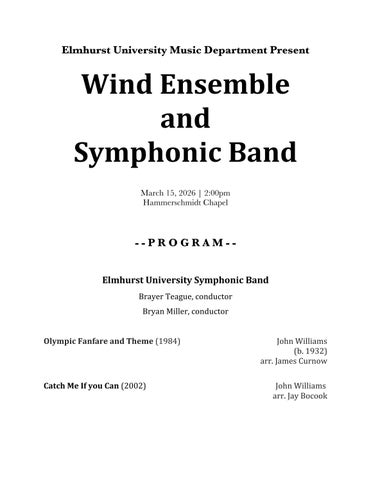
Elmhurst University Music Department Present

Wind Ensemble and Symphonic Band

March 15, 2026 | 2:00pm

Hammerschmidt Chapel

- - P R O G R A M - -

Elmhurst University Symphonic Band

Brayer Teague, conductor

Bryan Miller, conductor

Olympic Fanfare and Theme (1984)

Catch Me If you Can (2002)

John Williams (b. 1932) arr. James Curnow

John Williams arr. Jay Bocook

Hymn To The Fallen (1998)

The Cowboys (1972)

John Williams arr. Paul Lavender

John Williams arr. James Curnow

Elmhurst University Wind Ensemble

Adam Kehl, conductor

[fuse] (2015)

From the Delta (1945)

I. Work Song

II. Spiritual

III. Dance

Symphony No. 4 “West Point” (1952)

I. Epitaphs

II. Marches

Nick Omiccioli (b. 1982)

William Grant Still (1895-1978)

Morton Gould (1913-1996)

Piccolo

ELMHURST UNIVERSITY SYMPHONIC BAND

Heather Johnson

Flute

Savannah Dickeson

Jennifer Jeffrey

Katie Kabaker

Ellen Kircher

Kristin Miceli

Victoria Palomino

Claudia Rejowski

Aliah Robles

Olivia Simmons

Benjamin Steger

Dorothy Stelzik

Maya Talavera

Christina Vermeulen

Oboe / English Horn

Destiny Dudish-Poulsen

Sabrina Zeidler-Michaelson

Victoria Zibell

Bassoon

Heather Forster Jensen

Aaron Nisius

Clarinet

Gina Carter

Denise Glynn

Steven Goldman

Kim Hempel

Mikaela Jackson

Melissa Lehmann

Rebecca Lichucki

Mauricio Martinez

Sandy Mattison

Mya Robles

Lisa Steele

Bass Clarinet

Justin Peng

Alto Saxophone

Karabeth Footman

Dan Kesselring

Vinicius Carneiro Montevecchi

Tenor Saxophone

Dave Andrusyk

Baritone Saxophone

Eric Sanders

Trumpet

Scott Ashley

Eric Barbier

Keith Bertrand

Mackenzie Costa

Justin Czarnowski

Bob Dickinson

Joe Miceli

Luke Miller

Glenn Morimoto

Emmie Pawlak

Cliff Phillips

Laurie Pieler-DiCola

Yaneli Solorio

Brian Surina

Horn

Luke Fahey

Marcia Garza

Joan Moore

Brad Rathe

Chris Waden

Trombone

Michael Cumberland

Vanessa Gronke

Edward Hempel

Michael Lane

Nathan Lane

Brandon Lane-Jarot

Veronica Lane-Jarot

Brianna Maciel

Drew Pekkarinen

Euphonium

Paul Eakley

Anthony Tamo

Tuba

Edward Susmilch

Mike Vaschur

Percussion

Shane Dickinson

Matthew Gille

Mike Gille

Jeff Maginity

Mike Paroline

Tyler Wolf

Lauren Yim

ELMHURST UNIVERSITY WIND ENSEMBLE

Piccolo

Mikayla Kelty

Flute

Bianca Cima (piccolo)

Noah Davis (piccolo)

Kaitlyn Griffith

Eliana Kiltz *

Camryn Nowak-Brown

Oboe

Erin LaMorte

Disha Virdi* (English horn)

Bassoon

Nick Agliata

Tobie Schroeder

Clarinet

Audrey Dunwoody (Eb clarinet)

Eliza Martinez

Faith Negele

Christopher Tejeda

Joe Valenti (Eb clarinet)

Cristian Zavala*

Bass Clarinet

Zoe Offenbecher

Alto Saxophone

Sophia Frasca

Lissette Hernandez* (soprano)

Cadence Leucht

Bri Wurpts

Tenor Saxophone

Trevor Dunham

Baritone Saxophone

Emma Leucht

Trumpet

Ryan Katz

Berkley Murphy

Charlie Rossi*

Aldre Delos Santos

Jacob Trzeciak

Amanda Youngren

Horn

Hannah Hadraba*

Christina Morris

Hayden Rutherford

Momo Seko

Trombone

Daniel Catt

Damir Facsko*

Nathanial Gibson

Patrick Nacorda

Ariana Venecia

Euphonium

Milton Nonato*

Maximus Joseph Siergiej

Tuba

Luke Hollis

David Johansson*

Percussion

Anthony Cox*

Nicole Gagnon

Julian Klimczyk

Tristen Schaefer

Ian Stenzel

* denotes principal

Elmhurst University Music Department

Chair: Dr. James Hile

Administrative Assistant: Trish Thoren

Administrative Assistant: Heather Meyer

Elmhurst University Applied Wind and Percussion Faculty

Flute: Professor Dr. Mariana Gariazzo

Oboe: Professor Julie Popplewell

Bassoon: Professor Andrew Marlin

Clarinet: Professor Andrea DiOrio

Saxophone: Professor Matthew Beck

Trumpet: Professor Christopher O’Hara

French Horn: Professor Alex Love

Trombone: Professor Thomas Stark Euphonium/Tuba: Josh Wirt

Percussion: Professor Michael Kozakis

Elmhurst University Concert Band Staff

Director of Bands/Wind Ensemble

Dr. Adam Kehl

Directors of Symphonic Band Bryan Miller

Brayer Teague

Director of Varsity Band

Dr. Rachel Maxwell

Band Manager: Lissette Hernandez

Band Staff: Hannah Hadraba, Charlie Rossi, Faith Negele, Aldres Delos Santos, Trevor Dunham, Daniel Catt, Cristian Zavala, Yaneli Solorio

Program and Poster Design: Heather Meyer

Recording: Mr. John Towner and Student Recording Service

PROGRAM NOTES

Symphonic Band

This afternoon’s program celebrates the "Dean of American Film Composers," John Williams. While he is globally recognized for his five Academy Awards and iconic scores for Star Wars and Indiana Jones, Williams’ roots are deeply embedded in the American wind and brass tradition. These selections, presented in masterful arrangements for wind ensemble, highlight his ability to weave complex symphonic textures with a distinctively American populist spirit

Olympic Fanfare and Theme (1984)

Commissioned for the Games of the XXIII Olympiad in Los Angeles, this work has become the definitive musical identity of the Olympic movement. Williams sought to capture the "spiritual and emotional" weight of the games rather than just the athletic spectacle. The piece opens with inspiration from the "Leo Arnaud" bugle call (familiar to ABC viewers), which Williams seamlessly integrates into his own soaring, heroic theme. James Curnow’s arrangement preserves the brilliant brass fanfares and driving percussion that evoke the nobility and competitive fire of the world’s greatest athletes.

Catch Me If You Can (2002)

Departing from his trademark "heroic" style, Williams’ score for Steven Spielberg’s 1960sset caper is a sophisticated nod to "Progressive Jazz." This arrangement features Matthew Beck on alto saxophone and Michael Kozakis on vibraphone, capturing the cool, rhythmic fingerprints of the era. The music mirrors the film's protagonist a brilliant young con artist using saxophone and vibraphone to create a sense of sleek, constant motion and cat-and-mouse playfulness. It is a testament to Williams’ versatility as a composer capable of shifting from Wagnerian grandeur to intimate, rhythmic jazz.

Hymn to the Fallen (1998)

Written for the film Saving Private Ryan, this work serves as a solemn, wordless tribute to the soldiers who fell during the D-Day invasion of Normandy. Unlike a traditional film "theme" meant to underscore action, Williams intended this to be played over the credits as a standalone memorial. The piece is characterized by its steady, funeral-march percussion and a simple, poignant melody that builds to a powerful, cathartic climax. Paul Lavender’s transcription brings the warmth of the woodwinds and the somber strength of the brass to the forefront, offering a moment of profound reflection.

The Cowboys (1972)

Long before Star Wars, Williams was already a master of the Western genre. The Cowboys remains one of his most vibrant concert overtures. The music captures the rugged

landscape of the American West and the energy of a cattle drive. It features rhythmic vitality, wide-interval leaps in the brass, and a spirited "hoedown" quality that echoes the influence of Aaron Copland. This James Curnow arrangement provides a tour-de-force finale, demanding technical precision and exuberant energy from every section of the ensemble.

Wind Ensemble

Nick Omiccioli (b.1982) is composer, electric guitarist, and educator. Nick has been described as a “rising star” [The Kansas City Star] and a composer with “powerful ideas” that “expresses them confidently” [The Straits Times]. His music has been described as “ominous and enthralling” [The Latest Brighton] and displaying “a depth and density of sound” [KCMetropolis]. Nick’s music encompasses a diverse range of styles across multiple genres that originated from his experiences playing electric guitar in rock, metal, and jazz groups and early aspirations of wanting to be a graphic novel illustrator. Nick’s music has been performed in Canada, Mexico, the United Kingdom, Italy, Austria, Lithuania, Poland, Sweden, Singapore, Thailand, China, Taiwan, New Zealand, and throughout the United States. He has composed for some of the leading ensembles of today such as the Singapore Symphony Orchestra, Nu Deco Ensemble, Alarm Will Sound, The Berkeley Symphony, l’Orchestre de la francophonie, the Jasper String Quartet, the Aspen Contemporary Ensemble, le Nouvel Ensemble Moderne, Ensemble Paramirabo, and Third Angle Ensemble. He holds degrees from the University of Missouri-Kansas City (DMA, MM) and Heidelberg University (BM). His music is currently self-published and is distributed by Composers Edition (UK), Trev-co Varner Music (USA), and E.C. Schirmer Music Company (USA). Nick currently teaches guitar and is a coach for Rock Workshop at the Madison Music Foundry in Madison, Wisconsin. He has previously taught at Yong Siew Toh Conservatory of Music at the National University of Singapore, University of Missouri-Kansas City where he was a Preparing Future Faculty Fellow, and at the University of Central Missouri.

[fuse] was originally composed in 2014 for chamber orchestra on a commission for Mizzou International Composers Festival for Alarm Will Sound. Originating from a 16-bar blues form played by the clarinets, [fuse] is influenced by several pop music genres, including rock, heavy metal, funk, and disco. These styles are brought to life through the drum set, which gives the piece its singular character. [fuse] is also a virtuosic workout for the clarinets, with fast interlocking figures functioning as a backbone for the entire piece. The work was begun while in residency at Copland House, Cortlandt Manor, New York, as a recipient of the Copland House Residency Award, and transcribed for wind ensemble in 2015.

Long known as the "Dean of African-American Classical Composers," as well as one of America's foremost composers, William Grant Still has had the distinction of becoming a

legend in his own lifetime. On May 11, 1895, he was born in Woodville (Wilkinson County) Mississippi, to parents who were teachers and musicians. They were of Negro, Indian, Spanish, Irish and Scotch bloods. When William was only a few months old, his father died and his mother took him to Little Rock, Arkansas, where she taught English in the high school. There his musical education began--with violin lessons from a private teacher, and with later inspiration from the Red Seal operatic recordings bought for him by his stepfather.

In Wilberforce University, he took courses leading to a B.S. degree, but spent most of his time conducting the band, learning to play the various instruments involved and making his initial attempts to compose and to orchestrate. His subsequent studies at the Oberlin Conservatory of Music were financed at first by a legacy from his father, and later by a scholarship established just for him by the faculty.

At the end of his college years, he entered the world of commercial (popular) music, playing in orchestras and orchestrating, working in particular with the violin, cello and oboe. His employers included W. C. Handy, Don Voorhees, Sophie Tucker, Paul Whiteman, Willard Robison and Artie Shaw, and for several years he arranged and conducted the Deep River Hour over CBS and WOR.

In the Twenties, Still made his first appearances as a serious composer in New York, and began a valued friendship with Dr. Howard Hanson of Rochester. Extended Guggenheim and Rosenwald Fellowships were given to him, as well as important commissions from the Columbia Broadcasting System, the New York Worlds Fair 1939-40, Paul Whiteman, the League of Composers, the Cleveland Orchestra, the Southern Conference Educational Fund and the American Accordionists Association. In 1944, he won the Jubilee prize of the Cincinnati Symphony Orchestra for the best Overture to celebrate its Jubilee season, with a work called Festive Overture. In 1953, a Freedoms Foundation Award came to him for his To You, America! which honored West Points Sesquicentennial Celebration. In 1961, he received the prize offered by the U. S. Committee for the U. N., the N.F.M.C. and the Aeolian Music Foundation for his orchestral work, The Peaceful Land, cited as the best musical composition honoring the United Nations.

Dr. Still's service to the cause of brotherhood is evidenced by his many firsts in the musical realm: Still was the first Afro-American in the United States to have a symphony performed by a major symphony orchestra. He was the first to conduct a major symphony orchestra in the United States, when in 1936, he directed the Los Angeles Philharmonic Orchestra in his compositions at the Hollywood Bowl. He was the first Afro-American to conduct a major symphony orchestra in the Deep South in 1955, when he directed the New Orleans Philharmonic at Southern University. He was the first of his race to conduct a White radio orchestra in New York City. He was the first to have an opera produced by a major company in the United States, when in 1949, his Troubled Island was done at the City Center of Music and Drama in New York City. He was the first to have an opera televised over a national network. With these firsts, Still was a pioneer, but, in a larger sense, he pioneered because he was able to create music capable of interesting the greatest conductors of the day: truly serious music, but with a definite American flavor.

Still wrote over 150 compositions (well over 200 if his lost early works could be counted), including operas, ballets, symphonies, chamber works, and arrangements of folk themes, especially Negro spirituals, plus instrumental, choral and solo vocal works.

Still's first work for band was an arrangement of Old California, which was performed by the Goldman Band many times in the early 1940s. In response to Goldman's request for original music for band and a commission from the Leeds Music Corporation, Still composed From the Delta in 1945. Its three movements (Work Song; Spiritual; Dance) were meant to capture the essence of what life was like on the Mississippi Delta. Work Song illustrates a chain gang singing their way through days of hard labor. Spiritual is a more somber movement, meant to convey the pain felt by African Americans living in slavery. The final movement, Dance is the liveliest of the three movements and paints a portrait of friends coming together to celebrate one another despite their daily hardships.

In his dissertation on concert band music by African-American composers, Myron Moss states that of From the Delta:

Still has done what his compositional philosophy would suggest, [presenting] music whose melody is its main attraction and whose expressive folk style is its main source of interest. As a nationalistic composer, Still [put] folk music in an appropriate art-music frame, and [this] piece fills a niche in a band repertoire which already [included] nationalistic pieces evoking Great Britain, France, and America.

Morton Gould was an American pianist, composer, conductor, and arranger. Gould was recognized early as a child prodigy with abilities in improvisation and composition. His first composition was published at age six. Gould studied at the Institute of Musical Art, although his most important teachers were Abby Whiteside and Vincent Jones.

During the Depression, Gould, while a teenager, worked in New York City playing piano in movie theaters, as well as with vaudeville acts. When Radio City Music Hall opened, Gould was hired as the staff pianist. By 1935, he was conducting and arranging orchestral programs for New York's WOR radio station, where he reached a national audience via the Mutual Broadcasting System, combining popular programming with classical music.

As a conductor, Gould led all the major American orchestras as well as those of Canada, Mexico, Europe, Japan, and Australia. With his orchestra, he recorded music of many classical standards, including Gershwin's Rhapsody in Blue on which he also played the piano. He won a Grammy Award in 1966 for his recording of Charles Ives' First Symphony, with the Chicago Symphony Orchestra. In 1986, he was president of ASCAP, a position he held until 1994. In 1986 he was elected to the American Academy and Institute of Arts and Letters.

Incorporating new styles into his repertoire as they emerged, Gould incorporated wildly disparate elements, including a rapping narrator and a singing fire department into commissions for the Pittsburgh Youth Symphony.

In 1994, Gould received the Kennedy Center Honor in recognition of lifetime contributions to American culture, and in 1995, Gould was awarded the Pulitzer Prize for Stringmusic. In 2005, he was honored with the Grammy Lifetime Achievement Award.

Gould's fourth symphony was composed for the West Point Sesquicentennial Celebration, marking 150 years of progress at the United States Military Academy. One of the first landmark symphonies composed specifically for wind band, Gould's Symphony No. 4 is a two-movement masterwork, displaying Gould’s traditional and modern techniques, especially his mastery of chaning instrumental color and long form thematic development.

The composer writes:

The first movement, Epitaphs, is both lyrical and dramatic. The quiet and melodic opening statement of the main theme leads directly into a broad and noble exposition of one of the motifs, becoming a passacaglia [a musical form based on continuous variations over a ground bass] based on a martial theme first stated by the tuba. After a series of variations which grow in intensity, the opening lyricism, combined with the passacaglia motif and an allusion to Taps, makes a quiet but dissonant closing to the first movement.

The second and final movement is lusty and gay in character. The texture is a stylization of marching tunes that parades past in an array of embellishments and rhythmic variants. At one point there is a simulation of a fife and drum corps which, incidentally, was the instrumentation of the original West Point Band. After a brief transformed restatement of the themes in the first movement, the work finishes in a virtuoso coda of martial fanfares and flourishes.”

Today’s Featured Guest Artists

Matthew Beck is a Chicago based multi-instrumentalist and educator. He has performed in Bulgaria, Croatia, Germany, Serbia, and throughout the United States. Specializing in classical saxophone, Beck has played with the Fort Wayne Philharmonic, the Elmhurst Symphony Orchestra, and the Chicago Symphony Orchestra. He has appeared in theater productions with such renown companies as Chicago Shakespeare Theater, Drury Lane Theater, The Marriott Theatre, and Music Theater Works. Active in Chicago’s jazz scene, he has performed with bands such as The Heisenberg Uncertainty Players, and the Blueshift Big Band. As a studio musician he can be heard on Kendor Music, TMZ and Cartoon Network.

Beck currently serves as Adjunct Professor of Saxophone at Elmhurst University, and also Adjunct Professor of Clarinet and Saxophone at Aurora University. In 2018 he received the Masters of Music degree in Saxophone Performance from Roosevelt University’s Chicago College of Performing Arts where he made his Chicago Symphony Center debut as a winner of the CCPA Concerto Competition. He also holds the first Bachelors Degree in Music Performance from Elmhurst University where he was a five time winner of the Elmhurst Philharmonic Concerto Competition. Matthew has played in masterclasses with Frederick Hemke and Nikita Zimin. His primary teachers include J. Michael Weiss-Holmes, Roger Birkeland, and Mark Colby on saxophone, Jennie Oh Brown on flute, and Gail Crosson on clarinet. Matthew is a member of the Chicago Federation of Musicians and the North American Saxophone Alliance.

Michael Kozakis is an active percussionist and educator in the Chicago area. As a performer, Michael has played with many different groups, including the Chicago Symphony, Lyric Opera Orchestra, Milwaukee Symphony, Grant Park Symphony, St. Paul Chamber Orchestra, Chicago Chamber Musicians, Ars Viva, Chicago Philharmonic, Joffrey Ballet, Illinois Philharmonic, Elgin Symphony, Chicago Sinfonietta, and MusicNOW. He has played in the studio for many national TV/radio commercials and accompanied wellknown personalities such as Ben Folds, John Williams, The Who, Sting, Andrea Bocelli, Paquito D'Rivera, Don Byron, Yo-Yo Ma, Il Divo, and Johnny Mathis. Michael held two oneyear positions as a full-time percussionist with the Chicago Symphony Orchestra from 2005 to 2007.

As an educator, Michael is a certified K-12 teacher in Illinois and enjoys teaching all levels of students from Junior High through College. Michael serves on the percussion faculty of the DePaul University School of Music, Carthage College, Elmhurst University and also coaches private students and drum lines at two local high schools near his home in the NW Chicago suburbs. Michael is often giving master classes and adjudicating at local high schools, youth orchestras, and Days of Percussion.

As a concerto soloist, Michael has soloed on marimba with the Chicago Symphony Orchestra and Rockford Symphony Orchestra. He has also done concertos on timpani with the DePaul University and Carthage College Wind Ensembles.

Michael received his bachelor's degree from the Eastman School of Music with a double major in music education and performance and a master’s degree in performance from DePaul University School of Music.

Michael is an artist endorser for Zildjian Cymbals, Pearl/Adams Percussion, Innovative Percussion, and Black Swamp Percussion.

About the Conductors

Dr. Adam Kehl serves as Director of Bands, Associate Professor of Music at Elmhurst University (Elmhurst, IL) where he conducts the Elmhurst Wind Ensemble, teaches conducting and other music education courses, and provides leadership for all facets the universities band program. Previously, Dr. Kehl served as Associate Director of Bands at the University of Hawai’i at Manoa, and as Director of Bands at Elon University in Elon, NC. Originally from the Pacific Northwest, Dr. Kehl holds Bachelor of Music degrees in Music Education and Percussion Performance from the University of Oregon, a Master of Music in conducting from the University of New Mexico, and a Doctor of Musical Arts in conducting from the University of South Carolina. He previously served as a high school band director in the public schools of California and is highly active as a clinician, adjudicator, and guest conductor for concert and marching bands around the United States.

Dr. Kehl maintains an active research agenda, primarily focusing on the creation of historically accurate critical editions, for the purpose of modern performance, of wind music from the French Revolution. Four of his editions from composers Gossec, Catel and Hyacinthe Jadin are published and available from Maxime’s Music Publishing, with additional editions scheduled in the coming years. He also frequently presents sessions at conferences on conducting gesture development, score study, and student leadership development. Dr. Kehl has completed three musical tours abroad, including tours in China and Italy, and served as an Associate Producer on the USC Wind Ensemble’s critically acclaimed “Bernstein: The Transcriptions for Wind Band” for Naxos Records.

He is an advocate for new music, media integration, creative programming and inter-arts collaboration, and is actively involved in bringing new works to life through commissioning and conducting premieres, including works by Donald Grantham, Kevin Walczyk, Shuying Li, David Clay Mettens, Carter Pann, Adrienne Albert, Todd Coleman, Ted King-Smith, David Kirkland Garner, Nick Omiccioli, Aaron Perrine, and Tyler Ono, and has worked with such guests artists as Dr. David Constantine, Dr. Nave Graham, famed Hawaiian singers Willie K and Henry Kapono, Lynn and John Beck, the Elon Dance Department, and Elon University President Dr. Leo Lambert.

A career music educator, Bryan Miller served as Chair for Chicagoland’s national awardwinning Leyden High Schools’ Music Department from 1994-2024. Thousands of music students enjoyed successes under his leadership. Additional affiliations have included Elmhurst University, VanderCook College, North Central College, Northern Illinois University, the Naperville Youth Symphony Orchestra, and serving on NAfME's National Council of Music Program Leaders.

Also a career military musician, for 25 years Lieutenant Colonel Miller has enjoyed the honor of serving our nation as the Commander and Conductor of the 566th Air Force Band, the Air National Guard Band of the Midwest, a prestigious Medal of Arts recipient

organization. Mission highlights include leading two Southwest Asia and Africa deployments, performances at Mount Rushmore, Rockefeller Center Plaza, Independence Hall, for Apollo Astronauts, the Tuskegee Airmen, funeral memorial honors for President Ronald Reagan, and serving as Liaison Officer for COVID-19 Operations.

He is the founder and artistic director of both the acclaimed Chicagoland Educators Orchestra and the Band of the Midwest, which he annually conducts for the Midwest Clinic’s Concert Band and Orchestra New Music Sessions. Guest conducting engagements include the United States Air Force Band, Wheaton Municipal Band, the Chicago Youth Symphony Orchestra (of which he is an alumnus), numerous university and community bands, and most of our ILMEA Districts.

An accomplished and versatile trumpet artist, he performed under Maestro Daniel Barenboim with the Chicago Symphony Orchestra and Lyric Opera brass sections for the Arnold Jacobs memorial tribute concert at Chicago Symphony Center. His brass quintet was a Fischoff National Chamber Music Competition semi-finalist. He is a NIU Jazz Ensemble alumnus and founding member of Chicagoland’s renown Pete Ellman Big Band.

Brayer Teague is the retired Chairperson for Fine Arts at Downers Grove (IL) North High School, where he taught music for 30 years. A Top-10 Finalist for the National GRAMMY Music Educator Award (2016), he was recognized five times by the Marquis “Who’s Who in American Teaching” and named a Golden Apple Scholar finalist. Teague, a National Board Certified Teacher, received the Chicagoland Outstanding Music Educator Award (2008), and was honored by the Illinois Music Education Association with the Distinguished Service Award (2022). He was named recipient of the John P. Paynter Lifetime Achievement Award for excellence in Music Education (2023), and currently serves on the faculty of Elmhurst University as an Adjunct Professor of Music.

Teague holds music degrees from Northwestern University and the University of Michigan. He taught for three years in Highland Park, Illinois before serving the music faculty of Downers Grove North High School for thirty years (1993-2023). He completed additional graduate work in Educational Leadership at North Central College in Naperville, Illinois, and continued his exploration of the arts through coursework at various colleges in photography, jewelry/metalwork, and ceramics. Teague has published educational materials for Microsoft Inc., co-authored a curriculum guide for the Illinois State Board of Education, and presented at national and international conferences.

Throughout his career Teague has been an advocate for expanding musical experiences beyond the walls of traditional classrooms. In addition to a bi-annual music and cultural exchange he coordinated with the Musikschule of Bietigheim-Bissingen, Germany, Teague led twenty-five student music tours to Austria, Canada, Czechia, England, France, Ireland, Italy and a host of cities in the United States.

Teague is a member of the Illinois Music Education Association, serving as the organization’s President from 2017-2019.

Upcoming Elmhurst University Bands Events

Featured Performance at Chicagoland Invitational Concert Band Festival (Wind Ensemble)

April 11, 2026, 3:30pm John Hersey High School (Arlington Heights, IL)

Performance in Orchestra Hall at Symphony Center (Wind Ensemble)

April 18, 2026, 1-3pm

May Concert (Wind Ensemble & Symphonic Band)

Sunday, May 3, 2026, 2:00pm

Featuring: Leah Dextor, mezzo soprano, on Williams Bolcom’s Cabaret Songs for mezzo soprano and chamber winds, Elmhurst University Board of Trustees President Wes Becton narrating Aaron Copland’s Lincoln Portrait, as well as music from Ives, Sousa, Chambers, Copley, Reed, Fillmore and more.

We hope to see you again at an upcoming Elmhurst University Bands Event!

TO DONATE TO THE ELMHURST UNIVERSITY BANDS SCAN THE FOLLOWING QR CODE YOUR SUPPORT IS GREATLY APPRECIATED!

Turn static files into dynamic content formats.

Create a flipbook