ARGENTINA: THE LAND OF MESSY Suttle Economics Notes #222
•
The Fernandez government inherited a bad situation in 2019, but has made it worse
•
An FX crisis looms. Net reserves are negative, and the parallel ARS is at a 50% discount
•
IMF and Chinese support might provide a bridge to a new government
•
Restoring long-term investment appetite will be hard amid very fickle politics Chart 1
Argentina: consumer prices % Dec/Dec (2023 is Jun/Jun) 120 110 100 90 80 70 60 50 40 30 20 10 0 -10 98 00 02 04 06 08 10 12 14 16 18 20 22
Chart 2
Argentine Peso ARS per USD 600 500
Official rate Dollar Blue
400 300 200 100 0 2017 2018 2019 2020 2021 2022 2023
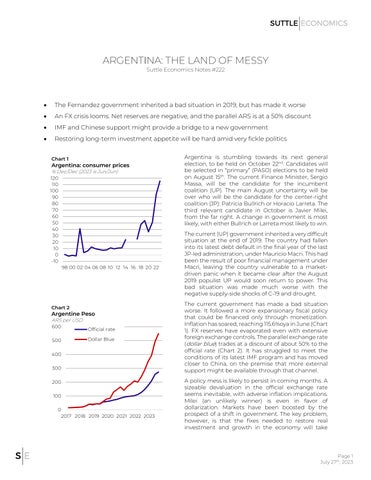
Argentina is stumbling towards its next general election, to be held on October 22nd. Candidates will be selected in “primary” (PASO) elections to be held on August 15th. The current Finance Minister, Sergio Massa, will be the candidate for the incumbent coalition (UP). The main August uncertainty will be over who will be the candidate for the center-right coalition (JP): Patricia Bullrich or Horacio Larreta. The third relevant candidate in October is Javier Milei, from the far right. A change in government is most likely, with either Bullrich or Larreta most likely to win. The current (UP) government inherited a very difficult situation at the end of 2019. The country had fallen into its latest debt default in the final year of the last JP-led administration, under Mauricio Macri. This had been the result of poor financial management under Macri, leaving the country vulnerable to a marketdriven panic when it became clear after the August 2019 populist UP would soon return to power. This bad situation was made much worse with the negative supply-side shocks of C-19 and drought. The current government has made a bad situation worse. It followed a more expansionary fiscal policy that could be financed only through monetization. Inflation has soared, reaching 115.6%oya in June (Chart 1). FX reserves have evaporated even with extensive foreign exchange controls. The parallel exchange rate (dollar blue) trades at a discount of about 50% to the official rate (Chart 2). It has struggled to meet the conditions of its latest IMF program and has moved closer to China, on the premise that more external support might be available through that channel. A policy mess is likely to persist in coming months. A sizeable devaluation in the official exchange rate seems inevitable, with adverse inflation implications. Milei (an unlikely winner) is even in favor of dollarization. Markets have been boosted by the prospect of a shift in government. The key problem, however, is that the fixes needed to restore real investment and growth in the economy will take
Page 1 July 27th, 2023