Tidal Exchange, Winter 2025

Page 1


Tidal Exchange

MUD BROTHER

After 43 years at the helm of Elkhorn Slough Foundation, Mark Silberstein is transitioning out of the leadership role

Ross Robertson, Communications Director

I sat down with Mark for an extended interview as he steps out of the Executive Directorship and transitions to a new role with the Foundation as an advisor for special projects. Mark plans to work with ESF’s Board of Directors to recruit his successor and looks forward to cheering on the next generation of leadership.

In these vignettes, Mark reflects on more than four decades of wonder, curiosity, and conservation at Elkhorn Slough. He has so many stories of the people he has interacted with over the years and their wide-ranging influence on this place—this is just a small sample.

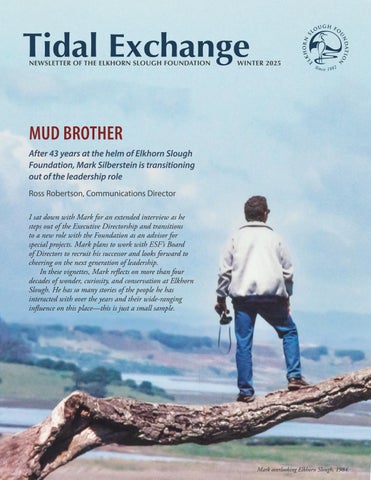
Mark overlooking Elkhorn Slough, 1984.

Elkhorn Slough Foundation

board of directors

Hon. Susan Matcham

President

Tara Trautsch

Vice President

David Warner

Treasurer

Becky Suarez

Secretary

Gary Bloom

Christine Cavanaugh-Simmons

Judith Connor

Terry Eckhardt

Emmett Linder

Mi Ra Park

Anne Secker

Laura Solorio, MD

Cynthia Vernon

Bruce Welden

Mark Silberstein

Executive Director

The mission of the Elkhorn Slough Foundation is to conserve and restore Elkhorn Slough and its watershed.

We see Elkhorn Slough and its watershed protected forever— a working landscape where people, farming, industry, and nature thrive together. As one of California’s last great coastal wetlands, Elkhorn Slough will remain a wellspring of life and a source of inspiration for generations to come.

PO Box 267, Moss Landing California 95039 (831) 728-5939 elkhornslough.org

Tidal Exchange

Ross Robertson, Editor

Lisa Zaretsky, Photo Editor

Family Empowerment Team at North Monterey County Unified School District. RESERVE UPDATE

New Eyes

The saying “change is the only constant” rings true around the Reserve this year. As seasons change and we welcome new staff members, shifting our priorities from one project to the next, we also find time occasionally to sit back, enjoy the view, and remember just how incredible this watershed really is.

A moment like this came one Saturday in September, when we celebrated Latino Conservation Week and California Biodiversity Day with festivities at the Reserve. While hikers set off on the trails to practice species identification, a group of young adults got competitive collecting gumplant seeds, to see who could fill their cup the fastest. By the end of the day, we had collected over 400,000 seeds, far surpassing expectations.

Dozens of local families attended, many of them for the first time. Watching their kids running around learning about wildlife, looking for birds, and exploring the Visitor Center was energizing. What could’ve been just another Saturday became an unexpected opportunity to connect and share the beauty of this landscape with our local community. We love seeing this place through others’ eyes—the eyes of children enamored with a plant they’ve never seen before, the eyes of parents realizing it’s the perfect place to bring their families on the weekend.

We hope that coming to the Reserve helps visitors see the nature they walk past every day with fresh perspectives, as well. It’s easy to become so familiar with ordinary things that we stop really noticing them, but there’s always something to celebrate if you look closely enough. This winter, I hope you find a moment to look at your familiar landscapes with new eyes, and notice all over again the inspiration that surrounds us. n

2025 Elkhorn Slough Foundation

PARTNERS PROTECTING ELKHORN SLOUGH

tide flats

The first time I visited Elkhorn Slough, I was a sophomore at San Jose State. That was 1968.

Back then, cruising the stacks in the library was like our version of cruising the web. I was interested in marine biology because I loved surfing and the ocean. There wasn’t much literature on marine science, but I found the volumes of Britain’s Challenger expedition, a famous oceanographic voyage from the 1870s. I’ll never forget just sitting in the science library marveling at these exquisite lithographic plates of all the bizarre, beautiful organisms they had pulled up from the deep sea.

I sat in on an invertebrate zoology course taught by my advisor, Pauline McMaster, and she introduced us to the work of George and Nettie MacGinitie, who mucked around in Elkhorn Slough in the 1920s. He was a graduate student at Hopkins Marine Station in Pacific Grove, and his thesis was the first scientific paper written about a California estuary (Ecological Aspects of Elkhorn Slough, 1927). From his work in the slough, MacGinitie and his professor W. K. Fisher described Urechis, the legendary fat innkeeper worm. George and his wife Nettie kept these animals in aquaria in bent glass tubes (mimicking their U-shaped burrows) to observe them—how they behaved, how they fed, and all the little commensal animals that lived with the innkeepers in their tube . . . a little crab, a little fish, a clam.

So when Pauline took the class on a field trip to Elkhorn Slough and we went out to the tide flats to see this cornucopia of strange creatures I’d read about, I was fascinated. Then, as the tide started rising, she took us over to the newly-opened Moss Landing Marine Labs. I walked in the back door of this old, converted cannery building and was immediately drawn down the hall to a lab where a man with a long beard was sitting in front of a Coulter counter* playing the five-string banjo. I thought to myself, this has got to be the place—and I wound up spending many exciting years at the Labs.

*electronic device that counts particles suspended in seawater

Mudflats (by Kiliii Yuyan). Insets: Mark with Moss Landing Marine Labs, 1975 (top). Playing banjo with the Slough Stompers, 1979 (bottom).

marvelous parade

I had the good fortune to spend a few summers at Hopkins Marine Station. For me, it was like coming to Mecca. Don Abbott taught this legendary invertebrate zoology course there, and it’s hard to describe how transformative it was. Every morning we’d be up at 5 a.m. for the low tides to collect samples, and then spend the entire day, sometimes till midnight, studying these animals, systematically going through all the phyla. He was such an engaging lecturer, so knowledgeable and thoughtful. I revered this guy.

Once, I asked him this totally naive question: “When you step back and think about all the animals you’ve watched and studied over the years, what do you

think about?” He paused for a second and said, “It’s like watching the most marvelous parade you can imagine.”

I still think about this. Evolution has to happen in a place, right? There’s just this marvelous gift of life on planet Earth. As a zoologist, I think about these remarkable creatures and the amazing adaptations they display: they all have to occur someplace on the surface of the earth, in the ocean, or in the atmosphere.

If you’re interested in that—if you want to keep witnessing that marvelous parade—then you’ve got to take care of the places these plants and animals and microbes and fungi depend on. Our own survival depends on this web of life.

Don Abbott describing the evolution of the Crustacea, Hopkins Marine Station, 1975 (by Mark Silberstein).

Clockwise from top left: Mark hosting the California Coastal Commission on the Elkhorn Slough Safari, including Executive Director Peter Douglas and Commissioners Lou Calcagno, Tammy Grove, and Sara Wan. Professor John Pearse, Urechis in hand, on the Elkhorn tideflats with Mark and Jane Silberstein. Diane Porter Cooley, one of Elkhorn Slough’s greatest champions, once called Mark “the Moses of the Mudflats.” Wheelchair-accessible trail at Kirby Park, 1991 (by Mary Warshaw). Mark with Diane Porter Cooley’s roommate from Stanford, Supreme Court Justice Sandra Day O’Connor, in 2013.

MUD BROTHER

What’s Mud Got To Do With It? workshop,

“Research Coordinator Andrew DeVogelaere and I walked the perimeter of the south marsh a couple decades after it was restored to tidal action,” Mark remembers. “A few miles in, we found this bowling ball at the edge of the marsh. Nothing to do but roll a couple of sets.”

With famed oceanographer Sylvia Earle at ESF’s 30th Anniversary, 2012 (by Paul Zaretsky).
1996.

look at the land

In the early days at Moss Landing Marine Labs, most of us were focused on the ocean. We were on the shore looking out. A lot of the guys were surfers; we loved the ocean and the adventure. But a professor named Roy Gordon from the San Francisco State Geography Department shifted that for me.

Roy taught a class at the Labs called “Human Ecology and Geography of Monterey Bay.” He grew up in North Monterey County and he’d roamed all over this place. He was really tall. Shock of black hair. He had like a seven-league stride. It was hard for his students to keep up with him.

One day out on the trail, Roy turned us around. He said, “Okay, the ocean is fascinating. Now take a look at this.” He took us down the Salinas Valley, up over Gloria Road toward the Pinnacles. Up and over the Gabilan Range. He took us up the coast to Sand Hill Bluff. We looked at ancient archaeological middens. We looked at farms. We looked at historical aerial photos.

“Look at the land.” Every culture that moves through an area leaves its imprint on the landscape, he explained. His own scholarship included the history of fire use by early peoples, like the Ohlone. So he brought this new perspective to us. “You can find evidence of past cultural uses that shaped the landscapes we see today, and some of these human activities extend back in time almost 10,000 years.”

For a bunch of us, this made quite an impact. It led us to start thinking about Elkhorn Slough in a different way. We had been focused on the tideflats, the marshes, the waterways, and all of a sudden we started turning our attention to the whole watershed.

Mark skippers a boat tour of the slough with ESF board members. Inset: Mark with professor Roy Gordon.

cosmic center

I sometimes refer to Elkhorn Slough as “the Cosmic Center of the Universe.” It’s always a little tongue-in-cheek, because part of marketing is to call attention to whatever makes anything special, and we often have to get increasingly specific. “The largest of the small mountains in the chain,” or “the smallest salamander in the state.” I’ve looked at lots of land trust marketing and there always has to be a superlative. So we landed on saying that Elkhorn Slough is “the largest coastal wetland south of San Francisco Bay.” Still, it’s hard to surpass the Cosmic Center!

If you imagine drawing a circle that contains 100,000 acres, and placing it anywhere up and down the coast, it would be hard to encompass more species of plants and animals than you can right here. To start with, the Monterey Submarine Canyon is confluent with the mouth of Elkhorn Slough. You can go from rocky, chaparral-covered hills above the slough through grasslands and tide flats, farms and sand dunes, salt marshes and beaches, and right out to the deep sea in a short distance. Biologically, it really is an extraordinarily rich place.

My wife Jane has a microscope in her home office. She’s been teaching a class on plankton at Cabrillo College for several years, and she’s always taking samples with a fine mesh net out in the bay or in the slough, where all these marvelous microscopic plants and animals are floating in the water column. Every week, I’ll hear Jane say, “Mark, come here, check this out!” And when I go into her office, she’s always got some bizarre thing under the microscope. It is a continual reminder to me of how intricate, beautiful, and important places like Elkhorn Slough and Monterey Bay are. These are the wellsprings of life.

a window

For me, Elkhorn Slough was always a convenient window on the natural world. You can use this place as a microcosm to view how planet Earth works! You can see how humans interface with the landscape. You can witness the cycles of the seasons here, dramatically. During the migration, as the birds are coming through, as sharks and fishes move in and out of the slough, as the pickleweed goes from green to red to brown. The cycles of the hills going from brown to green in the winter. It connects us to the world, and to each other. I hope that Elkhorn Slough will continue to be a window on the natural world—a window that is ever wider, for more people to enjoy and to care for.

Pickleweed (by Irene Reti).

people and place

Everything circles back to place. I feel privileged and lucky to have been able to focus my attention on a place like this for as long as I have.

When Ruby Peterson died, I wasn’t prepared. She was one of our first volunteers. All of a sudden, it occurred to me that you can’t be cavalier about this work. This is serious business. People who volunteer their time are investing their energy, their passion, and their love in this place. At that moment, it became clear to me how places can become imbued with deeper meaning.

Subsequently, a lot of people who invested their time and energy and love in this place have passed on. This just deepens my connections here. It’s one of the things that has continued to motivate me: to think not just about the ecology and the marvelous evolutionary parade, but about what places like this mean to the community. It is people who made all this happen. For an enterprise like this to be sustainable, you need a community. At the end of the day, that’s probably the most important work that we do. n

Elkhorn Slough (by Huve Rivas). Inset: Volunteer Ruby Peterson.

Season of Change

After a long and distinguished career as Executive Director of Elkhorn Slough Foundation, our good friend Mark is transitioning out of the leadership role to that of advisor for special projects.

What brought Mark to the slough 43 years ago? It all started with mud. As a young man, Mark studied the invertebrates that live in the glorious mud of the slough. Mark was drawn to Elkhorn Slough’s unique ecosystem at a time when scientific research was exciting, but little protection was in place. Threats of development, climate change, and habitat loss were growing. Conservation of the slough became his passion.

As members of the Elkhorn Slough Foundation Board of Directors, we see the impacts of Mark’s leadership. We walk the paths of the slough and see how this beautiful area has been protected. We look at the

hills and see the parcels of land ESF has purchased and rehabilitated. We note the expertise and enthusiasm of Foundation and Reserve employees, and the confidence and trust of long-term donors. We recognize the unique partnerships between ESF and other nonprofit foundations, land trusts, and public agencies that Mark has nurtured. Mark’s passion for the slough is contagious, and his sense of humor makes us laugh. He has easily convinced us that Elkhorn Slough is nothing less than the Cosmic Center of the Universe.

Mark, on behalf of the Board of Directors, we are grateful for your hard work and dedication over the years. At this time of transition, we continue to rely on your advice and counsel as we move forward—and we look forward to seeing you out on the trails, on the water, and in the mud! n

Mark and his wife Jane raised their twins Josh and Ian overlooking Elkhorn Slough.
SLOUGH VIEW

Elkhorn Slough Foundation

Post Office Box 267

Moss Landing, CA 95039-9988

We’re honored to participate in Monterey County Gives, an annual year-end fundraiser hosted by the Community Foundation for Monterey County, MC Weekly, the Monterey Peninsula Foundation, and others. Between November 13 and December 31, a portion of every donation made through MC Gives! will be matched, increasing your impact. None of ESF’s work—from preserving threatened ecosystems and restoring natural areas for wildlife to connecting people and nature in the heart of Monterey Bay—would happen without the support of our community. Whether you’re a new member or wish to leverage your year-end gift with matching funds from our partners, please support our MC Gives! campaign today. montereycountygives.com/elkhorn

California quail (by Jacqueline Deely).

Turn static files into dynamic content formats.

Create a flipbook
Issuu converts static files into: digital portfolios, online yearbooks, online catalogs, digital photo albums and more. Sign up and create your flipbook.
Tidal Exchange, Winter 2025 by Elkhorn Slough Foundation - Issuu