Began with an idea flowing elsewhere in the region
Page 22
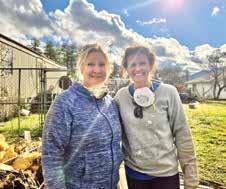
Courtney and Paul Dailey
Elizabethton couple help restore homes
Page 6
Elizabethton
Public Library
Makes life better with more than books
Page 12
A PRODUCT OF THE ELIZABETHTON STAR
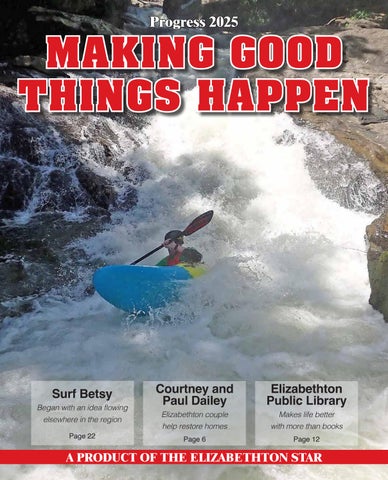
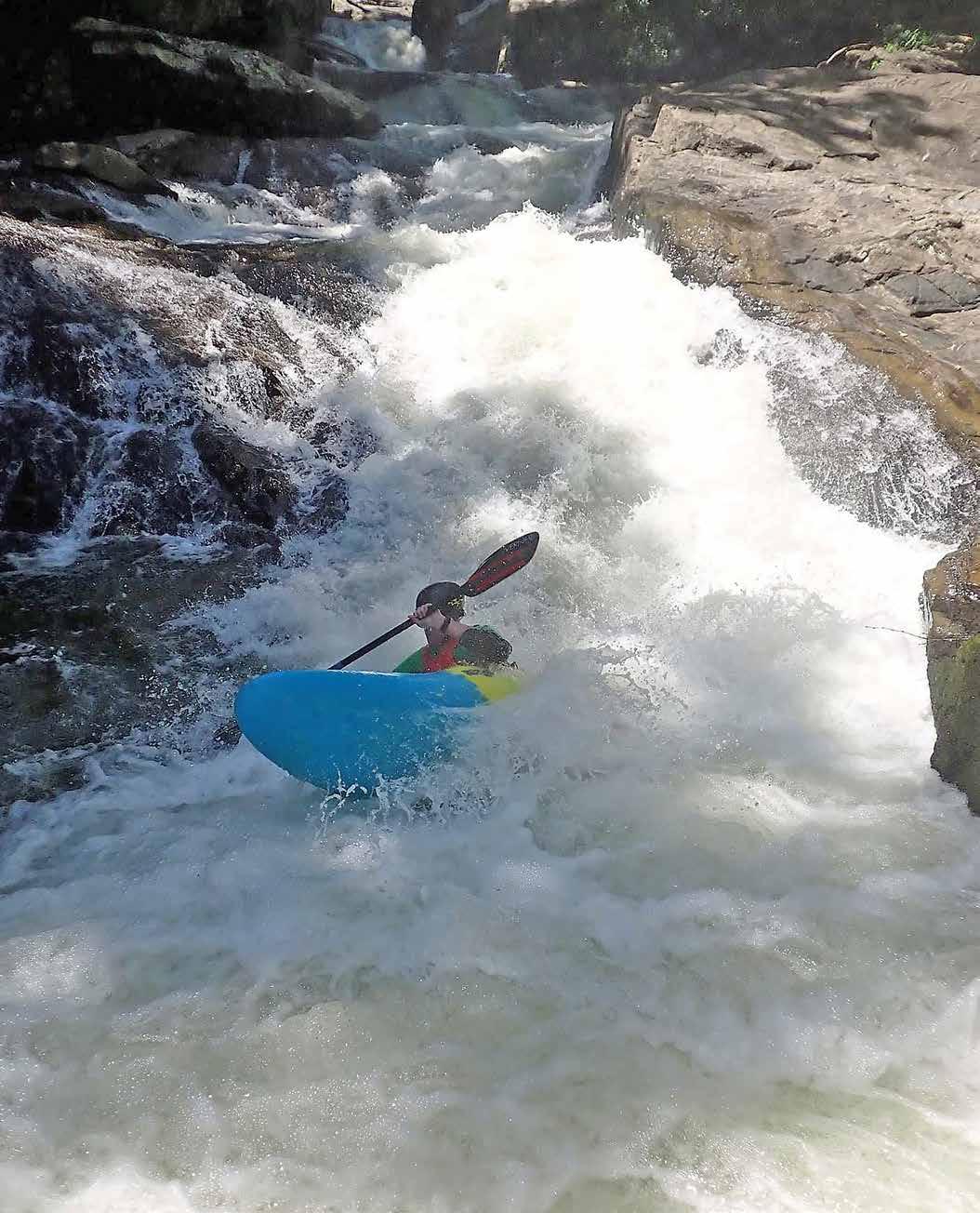
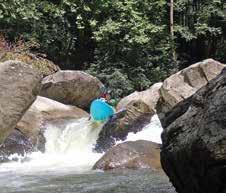
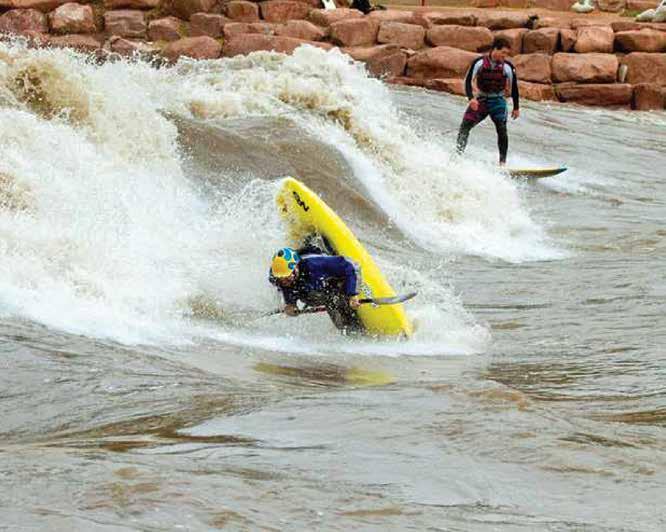
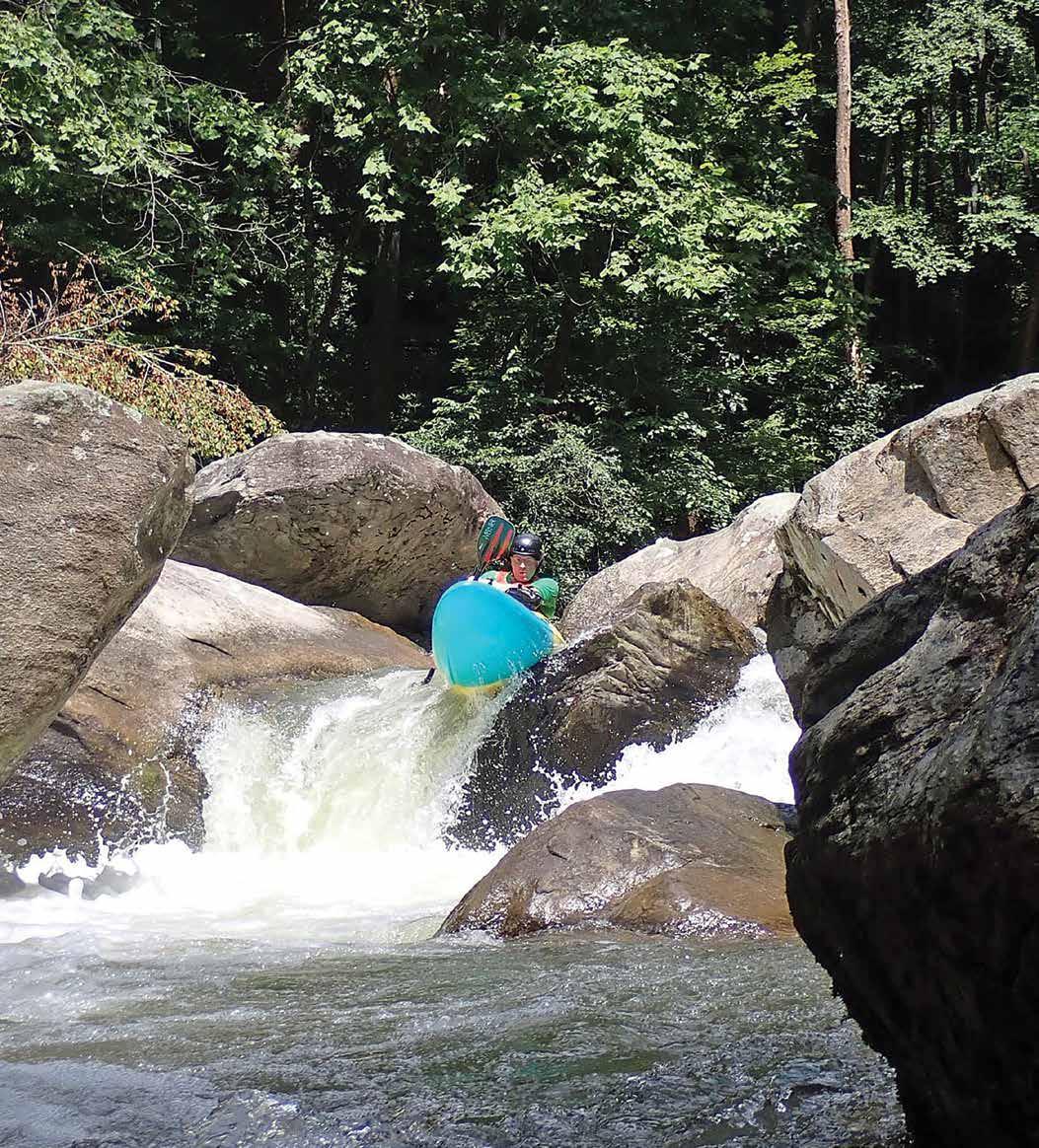
Photo Courtesy of Tyler Colson Wesley Bradley, who has served on the Surf Betsy Advisory Board since its inception, is an avid kayaker. Tyler Colson not only enjoys kayaking but is an avid photographer who enjoys capturing the excitement of tackling whitewater. When we were looking for the right image to highlight the stories about Surf Betsy, this one from Bradley’s Facebook page caught our attention. Captured by Colson in August 2024, it shows Bradley running a section at Green River Narrows in Blue Ridge, NC. When we reached out, Bradley said, “Little did we know that would be the last time we would ever run that river in that form. It has been radically changed in its geology since the Helene flood.”
Strong backs, endless
prayers and
willing hearts — Elizabethton couple lean on their faith to help restore homes for hurricane victims
By Lynn Richardson
In the days following Hurricane Helene’s assault on Carter County, devastation was everywhere. So many families were affected, either sustaining severe damage, losing many of their possessions, or, in many cases, losing everything.
Neighbors rallied to try and help one another, not really knowing what to do, but knowing they had to do something.
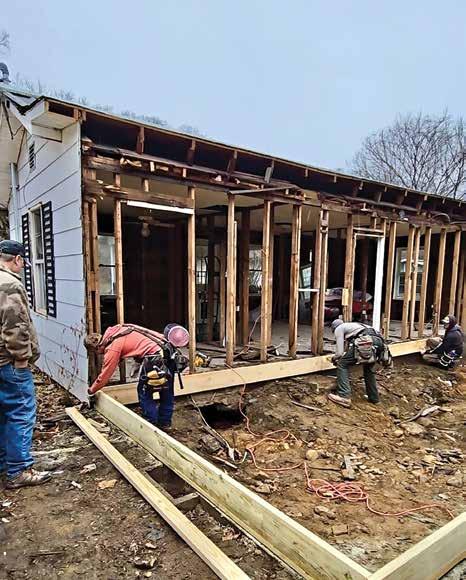
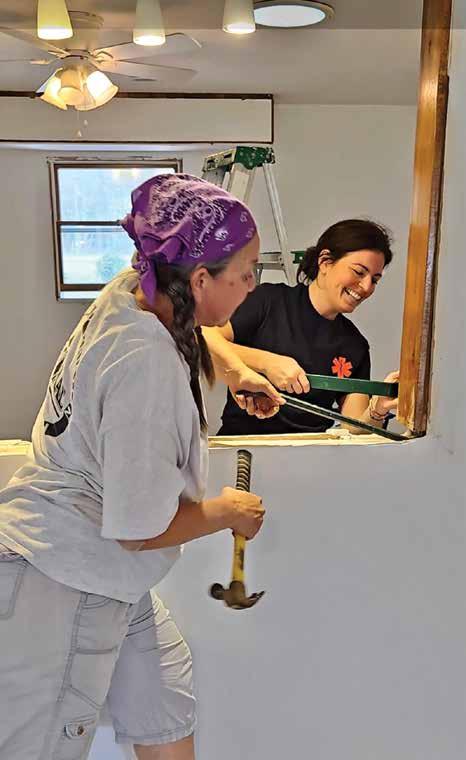
ISuch was the case with Courtney and Paul Dailey, who have been tirelessly working to help repair and replace homes in the Hampton area that were severely damaged.
They first began at Jerry Poole’s home on Spring Street. A family friend, Poole, like many others in the area, had lost his home and the majority of his belongings in a matter of minutes, Courtney Dailey explained.
“He had no flood insurance or means to rebuild,” she said. “We were heartbroken for him. That first night after we saw his house on September 30, we went home in tearful prayer for our friend.”
“My husband led us in prayer that night before bed. ‘Dear Lord,’ he prayed, ‘we don’t know how we’re going to do it, but we have to build back Jerry’s house. We need help. We want to get him back in his house by Christmas.’”
The very next morning, after Paul’s prayer, Courtney and Paul took their children and headed down to Spring Street. Paul’s background in doing home flips and building new construction spec homes would come in handy.
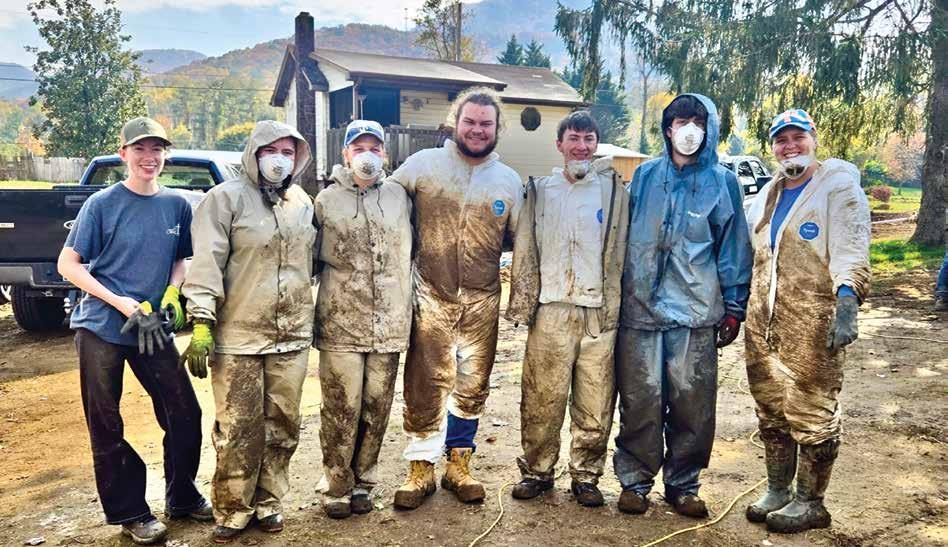
“We spent the day mucking out Jerry’s house, pressure washing, and teaming up with dozens of other volunteers, strangers, to even rip out the drywall and insulation,” Courtney said. “All day, whether we needed tools or a ladder or bottled water or more manpower, God sent the exact item we needed — right on time.”
Almost in disbelief, Courtney cried all the way home that night, praying and thanking God for His help. Shortly after arriving home, and still covered in mud and drywall, she made a video hoping to draw in more volunteers and donated building materials.
“Never in my wildest dreams could I have predicted what God would do next,” she said. The video went viral, getting close to five million views, and Courtney’s inbox filled up with thousands of messages from believers all over the world, wanting to help rebuild Jerry’s house.
“It was the answer to our prayer,” she said. “Someone from Georgia committed to buying Jerry’s appliances. A lady from Maryland sent his bathroom vanity. Someone else in California sent his flooring. A family from Georgia pledged to donate all of the insulation and drywall and install it. The kitchen cabinets and countertops came from Virginia. Someone from Jerry’s church offered their professional painting crew. Someone else from Jerry’s church donated all of the electrical work. And on and on it went.”
Courtney recalls one of several amazing events that took place during that project. “About a week into the renovation, we had a framing crew donate their efforts for a few days to put walls back in place. One of the guys came to me saying ‘we need 98 more 2x4s.’”
“I stepped out into the front yard and scrolled through my phone, brainstorming who I could call. Just as I dialed a construction contact, I looked up and a truck was backing into the driveway with 100 2x4s in his truck bed.
Taken aback, Courtney asked, ‘Are these for us?’
‘Yep,’ he replied.
‘How?’ she asked.
‘I don’t know,’ he said. ‘All I know is that a local hardware store just donated them from funds through an out-of-state donor.’”
“Like I said,” Courtney added, “we don’t do much of anything. God always has a plan bigger than what we can ask or think.”
Thanks to that donation and the gifts of workers and materials that flowed in, the Daileys and all of the volunteers who came to help made rapid progress on Jerry’s house. That gave the couple time to look around at the homes of other families on the street and “our hearts ached for them,” Courtney said.
“A volunteer from Florida gave us the idea to let churches take on each home until they were turnkey,” she said. “We called it ‘adopting a family,’ and local churches were quick to jump on board.”
The idea caught on. Central Community Christian Church took on two homes; Poplar Ridge Christian Church took on one home; Meades Branch Freewill Baptist
Photo Contributed
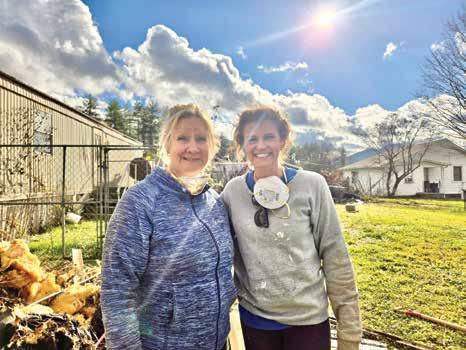
A volunteer from Iowa, Joni Graybow (left), stands with Courtney Dailey, taking time for a quick photo.
Photo Contibuted
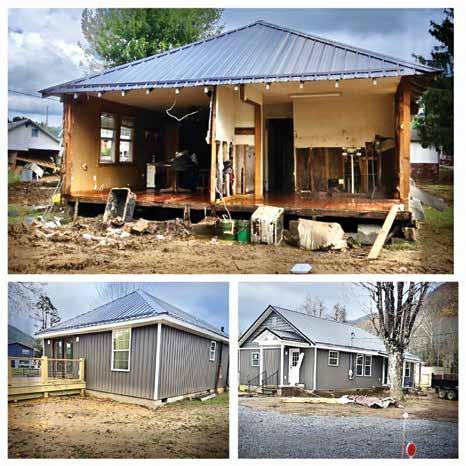
The home of Jerry Poole on Spring Street in Hampton, before and after.
One of the homes still under construction in the Valley Forge area. It is scheduled for completion in three to four weeks.
Church in Louisa, Kentucky, took on three complete rebuilds; Red Stone Church of Elizabethton and Johnson City took on two homes; The Fort took on one home; and Calvary Baptist and Tri-Cities Baptist each took on a home.
When a church committed to adopting these families, they stayed with them through the entire process, Courtney said, from lining up contractors to helping some of them get campers or vehicles or even Christmas gifts for their children.
“It was beautiful, watching God unify the different denominations to shine His light in a hurting community,” she said. “On any given day, Spring Street was buzzing with activity from crews and building supplies and even volunteers unloading meals from their vehicles to feed everyone.”
Many of the families, including Jerry, were back in their homes by Christmas — a “miraculous” three months after the flood.
“When a family moved back into their home, we had them make an Amazon wishlist to post on my Facebook page,” Courtney said. “People from all over the world would send every household or clothing item they needed to get back in their homes. It was truly amazing.”
With Spring Street restoration moving toward completion, the Daileys are now moving on to River Road and into the Valley Forge area.
“In the Valley Forge area, our church is now working on several homes, coming alongside Curtis and Desie Gentry, who have been working tirelessly in this area since day one,” Courtney said. “We have a crew putting four homes back together, having completed another one last week, and our hope is to do a complete rebuild for another family this spring.”
To be able to continue their work, the Daileys have a fund set up through their church at: https://jesusiscentral.churchcenter.com/giving
“But we don’t ask for donations,” she said. “Ever. God is still sending us everything we need.”
“Someone asked me a few weeks ago, ‘Well, what will you do when the money runs out?’ And I simply shrugged and said, ‘Well, I guess that means God is done because this isn’t our project. It’s His.’”
Photo Contributed
Photo Contributed
A group of volunteers from “all over” takes a break from their work on a muck-out crew.
“God always has a plan bigger than what we can ask or think.”
— Courtney Dailey
A
Two volunteers work on drywall at the Jeff Largent home on Spring Street.
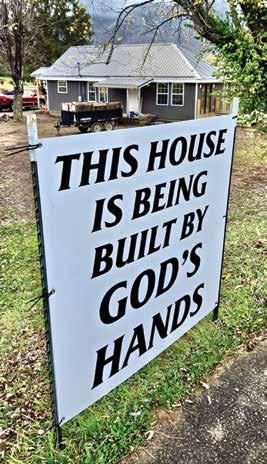
sign given to Jerry Poole by a church friend hangs in front of his home.
Downtown business district flourishing under Bean, Main Street Elizabethton
TBy Ivan Sanders
The Elizabethton downtown business district at one time was a thriving center for residents to come with their families to shop the many name-brand stores and grab a bite to eat from one of the local diners as traffic flowed down both sides of West Elk Avenue.
Like many other towns where malls began to draw away the brand-name box stores, the downtown area was left with mom-and-pop stores, with only a handful of the more popular stores remaining in business to serve the public.
The downtown district was in need of a boost, and in 2019, a program named Main Street began to bring fresh ideas to revitalize those businesses that continued to operate and wished to be a part of the program.
Under the leadership of its new director, Courtney Bean, and a board of local business owners, Main Street started to make great things happen that have con-
tinued until the present day, with many new projects bringing regional recognition to the downtown area.
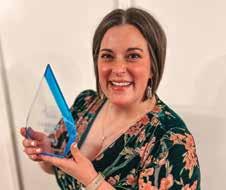
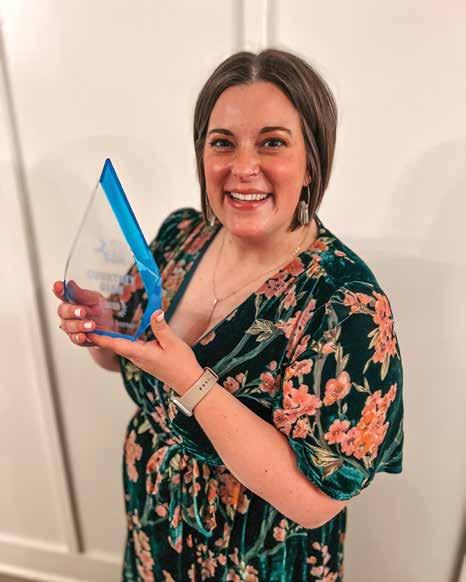
Bean was recently honored by The Business Journal of Tri-Cities TN/VA as a 40 Under 40 recipient for 2025. A press release stated that, as the Main Street Director since the program launched, Bean has brought a creative flair, strong drive, and stellar social media marketing skills to help Elizabethton become a choice destination for the region.
Under her leadership, the downtown district has seen its vacancy rate drop from 16% to 10% throughout the district.
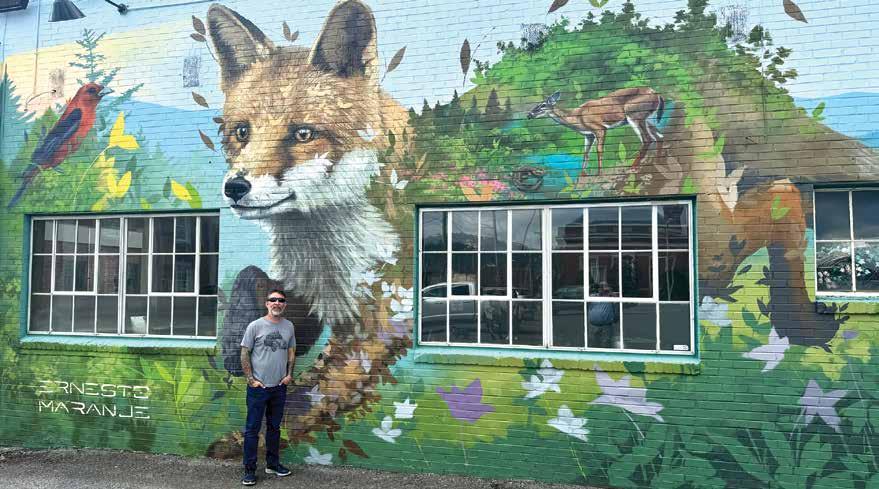
Main Street has also partnered with the City of Elizabethton to bring four public art projects to the downtown area, which include Tracks of the Wild by Ernesto Maranje, History in the Making Community Mural by Caitlin Maupin, a new postcard mural which will be coming soon, as well as a Breezeway Art Project, which is com-
Photo Contributed
Courtney Bean, Main Street Elizabethton director, was recognized as The Business Journal of Tri-Cities TN/VA 40 Under 40 recipient for 2025.
Photo by Ivan Sanders
Artist Ernesto Maranje with his completed mural, Tracks of the Wild.
ing in the near future.
In an effort to beautify the downtown district, Bean and Main Street have brought in professional landscaping to help with the 20 downtown planters and three flower beds.
First Friday was introduced to the downtown as business owners stay open later than normal on the first Friday of the month during the summer months to offer their wares, while live music is also enjoyed by those visiting. Food trucks are on hand to offer those visiting the opportunity to provide their dinner for the evening.
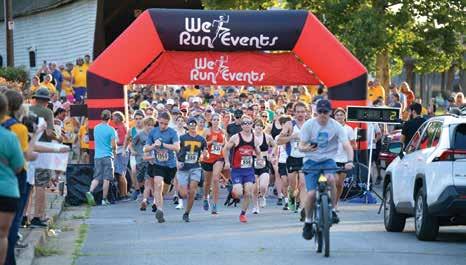
With the sport of running being increasingly popular, Bean led the charge to organize the Firefly 5K, bringing participants to Elizabethton from throughout the region and beyond as runners follow a course that takes them through the city.
Bean has also relied on partnerships that Main Street has made with community agencies and organizations to elevate and grow the downtown as a local hub and tourism destination.
Those partners include the Elizabethton/Carter County Chamber of Commerce, Carter County Tourism, Northeast TN Tourism, Meet the Mountains Outdoors Festival, and the City of Elizabethton.
And of course, Bean isn’t finished as she continues to search out the opportunity to apply for grant money, which will allow for other projects to be completed in the downtown business district to make things even better for the residents and visitors who continue to visit the county seat of Carter County.
Photo by Ivan Sanders
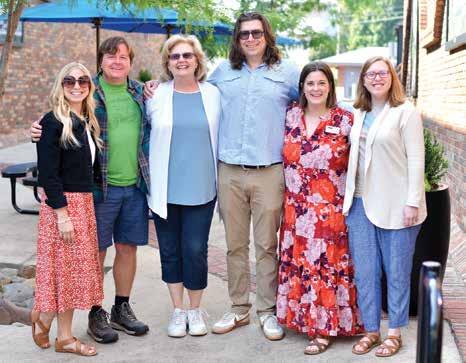
Main Street Elizabethton Director Courtney Bean, along with Main Street board members, at the dedication of a new breezeway in downtown Elizabethton.
Photo by Ivan Sanders
The Firefly 5K is one of the many events that Main Street Elizabethton Director Courtney Bean has added to help bring visitors to the downtown business district regionally.
The
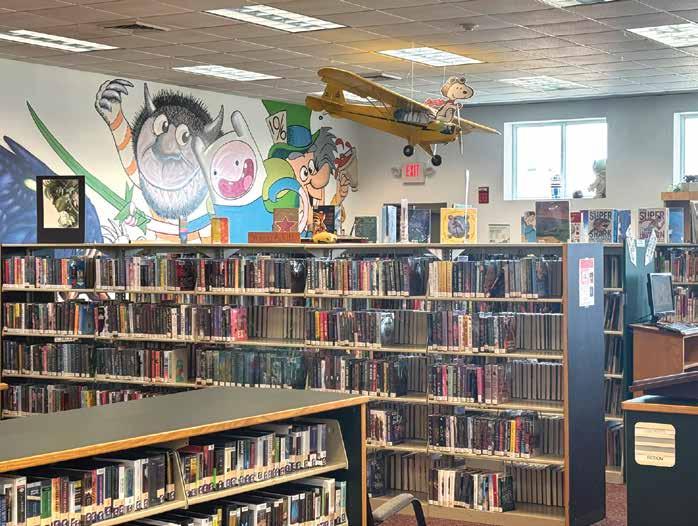
environment for children to explore what it has to offer.
MAKING GOOD THINGS HAPPEN
Elizabethton-Carter
County Public Library
makes life better with more than books
WBy Ivan Sanders
When one thinks of a library, the mind goes immediately to a place where books can be checked out — from fiction to autobiographies.
However, one doesn’t always see the opportunities that the local library can offer in making their community a better place.
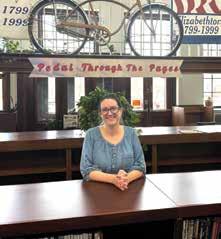
Elizabethton-Carter County Public Library Director Bernadette Weese would be the first one to tell anyone that the offerings provided by the library reach much farther than what may be written on the pages of a book.
Weese admitted that the biggest thing that the library has is all the community partnerships that have been established.
The library partners with the Elizabethton Senior Center, the Carter County Health Department, and the University of Tennessee Extension Office, as well as the Drug Prevention Coalition and Jeremiah School, just to name a few.
During Valentine’s Day, the library assisted with the Valentine’s fundraiser breakfast at the Senior Center due to the services offered by the center being vital to the community.
The teen library offers programs such as movie night, where teens can come to a safe place and enjoy spending time with other teens.
Recently, a crafting session was offered for teens to come and work on cross-stitch, crocheting, or any other crafts, allowing the teens to just be themselves while relaxing, reconnecting, and recharging.
Parenting classes that are courtapproved are another resource that helps make the community stronger. These classes are offered on the second Wednesday of every month.
On the fourth Wednesday of the month, the library has partnered with the Mommy and Me Recovery House,
Star Photo/Ivan Sanders
library provides a relaxing
Star Photo/Ivan Sanders
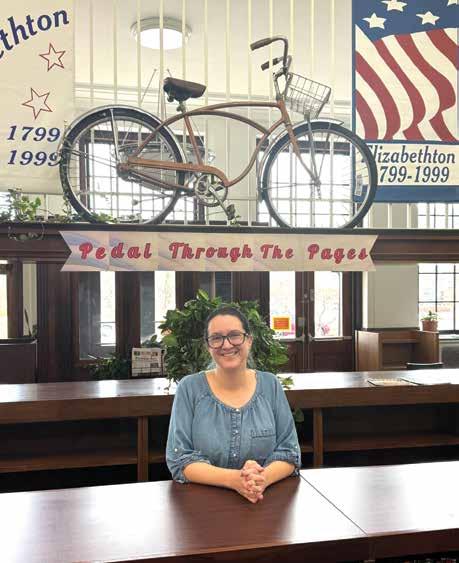
Elizabethton-Carter County Public Library Director Bernadette Weese said the partnerships the library has established are the biggest part of the puzzle that makes the library great for the community.
Drug Prevention Coalition, and Jeremiah School in sponsoring a family dinner book club.
The Jeremiah School is a school for those on the autism spectrum, which allows these individuals to meet so they can get the skills and knowledge to interact with everyone, using their interests such as cooking and crafting.
Participants get food, books, and activities to take home, so they can learn to communicate with their children.
Utilizing grants to provide training on the 13 public access computers, the library has the means to teach computer classes ranging from basic computers and coding to even making Christmas cards.
The public can also come in and utilize the computers without even having a library card.
Those using the computers will have full access to the internet, and with programs available to help the community write resumes, seek jobs, and even offer free public Wi-Fi where outside devices can be used anywhere in the library.
It’s just the tip of the iceberg on what one can find at the public library. With over 60,000 pieces of reading material along with all the services offered, one can easily see how the library makes things better for children and adults where these libraries exist.
PREPARE TO LEAD & SERVE.
Star Photo/Ivan Sanders
Although books are what most associate with a library, there is so much more that the community needs to take advantage of.
MAKING GOOD THINGS HAPPEN
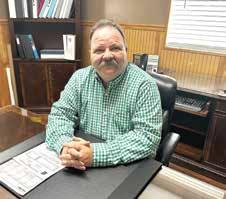
Elizabethton Parks and Recreation Director David Nanney:
Digging out and digging in
WBy Lynn Richardson
When Hurricane Helene came crashing into Elizabethton, there was no time to think about what damage the city’s parks and recreation facilities would incur, said Elizabethton Parks and Recreation Director David Nanney.
“When that floodwater came bursting through our city and county, the first thing on our minds was the people,” Nanney said. “The people who were devastated, without water, power, and many basic needs — some with no home to go back to — they were our first priority.”
Nanney, his staff, and community members quickly set up a donation and distribution center at the Mill Street Recreation Center — the Parks and Recreation’s headquarters at the time.
“We worked many hours a day for the first two weeks operating the first hub, accepting donations of water, canned foods, toiletries, cleaning supplies, baby food, diapers, flashlights, propane heaters, cook stoves, blankets, and seeing that those donations got to the locations where they were needed most.”
Then, after a tough two weeks, the operation of the distribution center was moved to Bristol Motor Speedway.
David Nanney Elizabethton Parks and Recreation Director
“At that point, we turned our attention to our flood-damaged parks,” Nanney said.
He found the procedure of assessing the damage “far from easy.”
“The process certainly had its obstacles,” Nanney said. “We first began to gather data for insurance claims — a long and tedious process. We worked slowly and deliberately on every step of this process to ensure that we had covered everything possible.”
Then, once all of the insurance filings were complete, they began the FEMA process.
“Record keeping for FEMA is an extremely detailed and tedious process,” Nanney said.
“We have collected a lot of data, including many pictures, in the hope of being able to be reimbursed for damage caused by the flooding. We are working carefully so that we don’t make mistakes. It’s our goal to maximize what we can recoup so that we can reinvest back in our park system.”
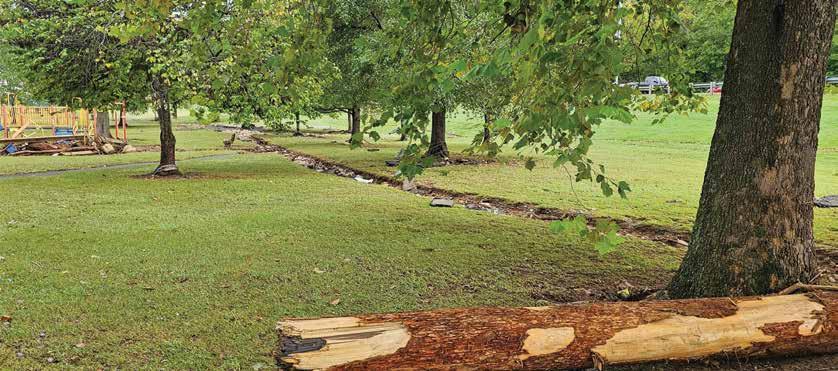
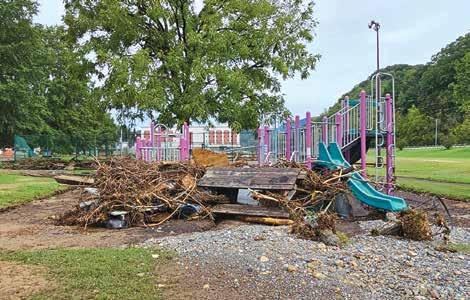
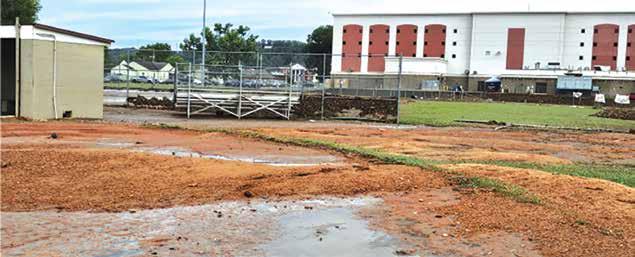
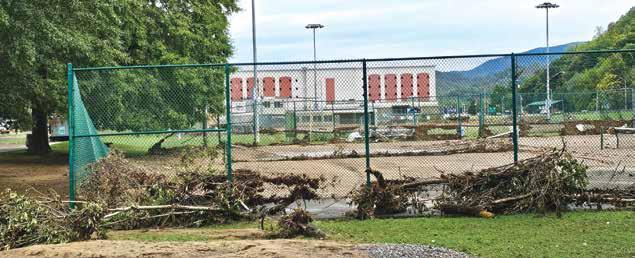
Elizabethton’s Cat Island Park was the hardest hit, with the majority of the park’s features a total loss. “We lost all three pavilions, all playground equipment, picnic tables, benches, walking paths, and a good amount of fencing throughout the park,” Nanney said.
“The Parks and Recreation staff is working to remove all the damaged debris and fill the holes left behind when the water ripped through the park. We plan to clear everything from the tennis courts to the flood wall by the river and sow it in grass for now. Once we have eliminated any hazards from the park, we will open the Linear Trail from the park to Eastside again.”
Parks and Rec is approaching the recovery in stages. Phase One of restoring Cat Island Park is reestablishing the softball fields, which is a joint effort with Parks and Recreation, Boyd Sports, and the Elizabethton-Carter County Baseball and Softball Association. Work began on January 27.
“This project will restore and enhance the Cat Island softball fields, ensuring that athletes and families can continue to enjoy the fields this season and for years to come,” Nanney said. “This endeavor is a testament to the dedication of the local community, as well as to the support of several generous partners. We are very thankful for the following businesses for their invaluable support: Lowe’s of Elizabethton, Big John’s Closeouts, Farm Supply, Stowers Equipment, Hilton Recycling, Ingles, and Bojangles. These local partners have helped us ensure that the renovation can move forward smoothly and efficiently. Our
Photo Contributed
Photo Contributed
goal is to have the fields up and running in time for the youth softball season.”
Phase Two will be the continued work of removing damaged materials and debris from Cat Island Park. Once that is completed, the Parks and Recreation Department can look ahead to ways to not only restore but improve the popular park.
That leads to Phase Three.
“We have requested and received a proposal for a Master Plan from McGill and Associates. This plan will result in meetings with city staff reviewing and refining the proposed scope of services. At this time, we will confirm project goals and deliverables and reach a consensus on a project schedule,” Nanney explained.
Based on input from city staff, site characteristics, and general park program, McGill facilitated a one-day Design Charrette with the public to gather input. That meeting was held at the Tetrick Center in the Pine Room on Friday, February 14.
“Based on this input, McGill will develop Conceptual Plans for the renovation of the park with the primary goal of a completed vision for the park,” Nanney added. “The Conceptual Plan will provide a layout including existing facilities to remain as well as the location of proposed facilities and amenities.”
The added expense to restore and improve Cat Island requires additional funding, and Nanney says he is grateful for the $100,000 from Carter County to assist with that project.
“That funding came from a $1,000,000 donation to Carter County for Helene flood damage by the Boyd Foundation,” Nanney said. “Our staff has also contacted TDEC’s Office of Outdoor Recreation about grant fund-
Photo Contributed
Photo Contributed
ing for this project. We are very pleased to pursue these grants. We see this as a very positive development, and we are reviewing our options with the LPRF and the LWCF grants. We have submitted a letter of intent to apply for these grants. The letter of intent does not bind the city in any way but places us in the pool to apply for grant funding.”
If awarded the funding needed, Nanney says he believes the City will be in the position to “possibly turn the negative situation in our park system into a very positive outcome in the park improvements we will propose.”
As the storm raged, City of Elizabethton residents also held their collective breaths, fearing the possible loss of the town’s historic covered bridge. The floodwaters did reach Covered Bridge Park, Nanney said, but fortunately did not do serious damage at that park.
“We had a layer of mud over much of the concrete sidewalks,” Nanney said. “We also lost a few trees during the storm and debris brought in by the floodwaters. We have since cleaned up the damage and debris.”
“Covered Bridge Park is still a very important priority, and we are still working on it as well,” he added, saying he is looking ahead to a better-than-ever version of the popular park.
“McGill & Associates has been work-
ing and will continue to work on a Master Plan for this park. We hope to have a plan to present soon, but we have been forced to refocus on some of our priorities due to the Helene flooding and damage at Cat Island and Edwards Island.”
In the midst of all the recovery efforts, the Parks and Recreation Department was already in the process of relocating to their new headquarters in the former Franklin Fitness Center building at 1509 W. Elk Ave., making the Tetrick Community Center the new home of Elizabethton Parks and Recreation staff offices. “We
are so proud to be in our new home,” Nanney said. “We had completely outgrown our former location. We are excited for the opportunities that we see in the Tetrick Center.” Those opportunities include offering the community an indoor walking track, a 220-foot loop, where about 24 laps equal 1 mile, open to the public during normal business hours, 8 a.m. - 5 p.m. Monday-Friday.
Meeting space is also available in the Pine Room, and reservations are now being accepted.
“We are in the process of painting and
renovating areas in the lower level,” Nanney added. “Look for more information in the coming months about community events, fitness classes, and other educational classes that we will be announcing soon.”
Looking farther ahead, Nanney also announced a larger plan for an addition to the building that would house two basketball courts, along with other amenities. The project’s timeline is 3-5 years.
For more details, follow Elizabethton Parks and Recreation on Facebook or visit the website at elizabethton.org, or call 423547-6441.
Photo Contributed
By Buzz Trexler
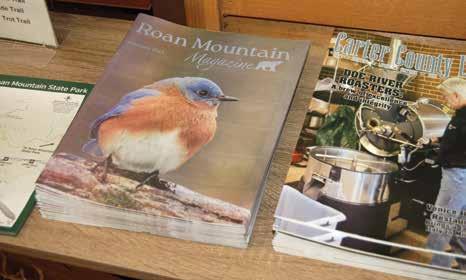
In the waning months of the summer of 2024, word began to spread on social media that a new publication highlighting life in Roan Mountain was in the works.
I Magazine offers slice of life in Roan Mountain
As fall emerged, the sunflower-bedecked cover of Roan Mountain Magazine, Volume 1, Issue 1, could be found at various distribution points in and around the village in September. Inside, readers found an introductory column describing the goals, plans, and what could be expected in that and future editions; a “Business Spotlight,” featuring The Appalachian Station at 19E and H&H Whiteway Grill; the requisite guide to fall colors; and an amusing look at odd sayings, expressions, and more in a piece titled “Say What?”
That was not the extent of the content, and if it’s whetted your appetite, the publisher, Amy Campbell Clark, has been forward-thinking enough to create a website, roanmountainmagazine.com, where you can find digital versions of that and other editions.
As any publisher or editor will tell you, getting the first edition of a publication out the door and on the street is filled with planning, hard work, anticipation, relief, and even a certain amount of joy when one holds a copy in your hands. Then comes the realization that you have to do it again.
For Clark, the second edition — slated for October — was the most challenging, thanks to Hurricane Helene. “I ended up having to skip publishing that month, which wasn’t optimal so soon out of the gate, but our advertisers and the community understood,” she said.
The magazine is currently an allvolunteer production with a dedicated team, Clark said, “though I hope to build our advertiser base to the point where we can pay writers and photographers for their submissions.”
However, she admits to struggling with selling advertising, but not because businesses are uninterested in the product. “I’m a writer, and you know we creative types don’t exactly thrive on rejection,” she said, “but luckily, Roan Mountain businesses have been incredibly supportive.”
In early February, as she was publishing the fifth edition, Clark took time out to answer a series of questions by email, including one about staffing, making it clear, “I may gently steer this thing, but it’s a team effort. A community effort.”
She’s appreciative of each one, sharing details about their work. Among her current contributors:
• Editorial assistant Diana Stockton, who writes a short story each month, but also “takes on other writing as needed,
helps with proofreading, and is a wealth of local knowledge. In addition to being a friend and cheerleader!”
• Staff photographer Faith Lynn, who “captures beautiful nature scenes plus great flora and fauna shots as well. When I need a local image, she either has it already or will go shoot it.”
under “Taste of the Roan.”
Clark likely knows that in the publishing world there is a saying: “Content is king.”
• Noah Blair, who writes features and “The Last Word” column, “a slice-of-life piece on pretty much whatever he’s compelled to share.” Blair also has been writing “The Grace Place,” a column focusing on Christianity, while Clark looks for someone to permanently take on that task.
• Jon Strydom, owner of 2nd Amendment Arts, a local Roan Mountain gunsmith, writes “Gun Talk,” sharing his expertise on firearms. “In a community where hunting is a favorite pastime and there are guns in most households, his knowledge is greatly appreciated,” Clark said.
“I’m talking with Cloudland High School staff about a variety of ways we can get the kids involved, such as writing about community history for a section called ‘Remember When’ and several other possibilities, hopefully, to include internships,” she said.
“I also want to add that we are always interested in articles, photos, and ideas from Roan Mountain residents,” she said. “This is a community magazine, and we welcome their input and participation.”
• Ranger Marcianne O’Day, of Roan Mountain State Park, writes “News from the Roan” with updates about the park and “information about all things wild.”
“Lastly, but certainly not least, I would really like to encourage everyone to please thank our advertisers for supporting the magazine, and also, let our contributors know when you enjoy their articles or photos,” Clark said. “It’s not always easy to put your creations, whether it’s words or pictures, out there for the world to see. Let them know when you enjoy it — make someone’s day!”
Clark said readers also submit photos and articles for publication, including recipes that are published
The magazine can be found at over 50 locations in and around Roan Mountain. “We’re still fine-tuning our distribution list, though, and plan to increase that number in the coming months,” she said.
Buzz Trexler/Star Correspondent
Publisher Amy Campbell Clark said Roan Mountain Magazine can be found at over 50 locations in and around Roan Mountain, including this location at Roan Mountain State Park Visitors Center.
MAKING GOOD THINGS HAPPEN
Staff, volunteers improving Roan Mountain State Park
BBy Buzz Trexler
Before the remnants of Hurricane Helene roared into the region in late September 2024, Roan Mountain State Park staff and volunteers were busily remodeling cabins and making other improvements.
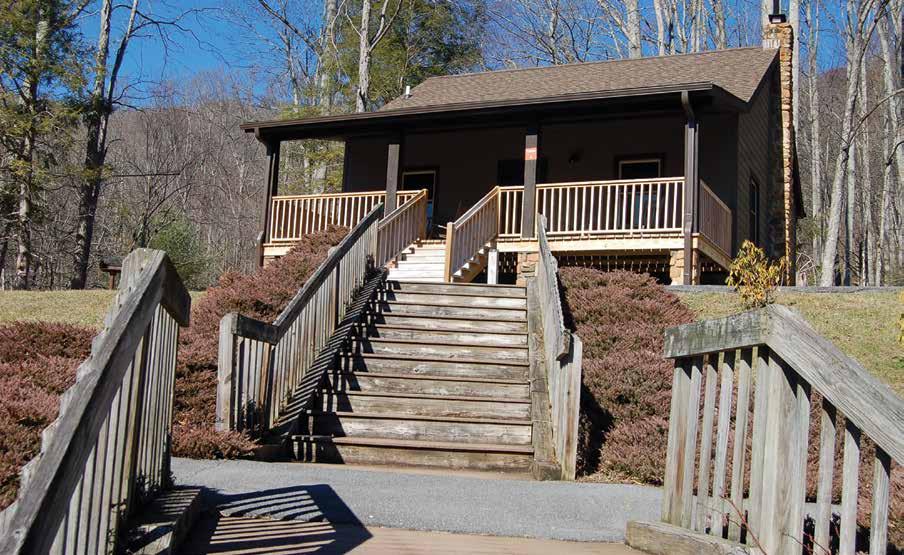
Nineteen cabins — Cabins 10 through 30 — underwent improvements in 2024, including remodeled kitchens and bathrooms, new living room furniture, lighting, windows, porches, and fresh coats of paint.
“We have plans to paint the porches of Cabins 1-9 this year since those new
porches have had a year to be seasoned and dried out,” Park Manager Monica Johnson said by email recently. “We also have plans to install new dark-sky-friendly pathway lighting for Cabins 21-30.”
Improvements at the park have not been limited to remodeling the cabins, a project underway for over three years.
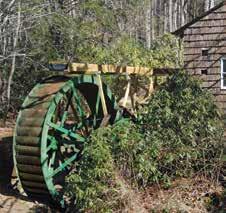
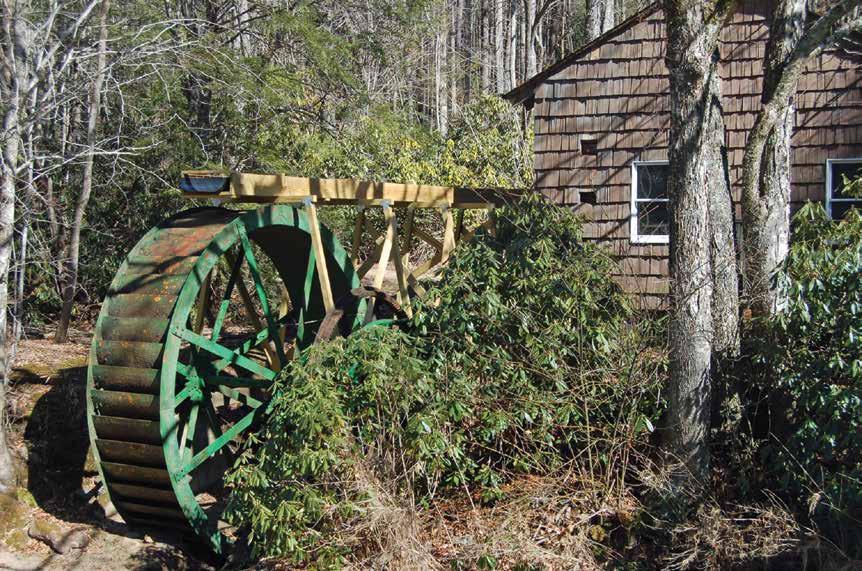
“We have a new flume at the visitor center for the water wheel,” she said, adding that the porch at Miller Farmstead has been painted, the barn loft has been cleared and repaired, and the entire property has been relandscaped with na-
tive plants. AmeriCorps volunteers built a trail, and a new display wall and snake habitat display were opened.
Even the community Nativity scene has been repainted.
Johnson said workers will be installing a water bottle/bike repair station in the campground this year, a project that is expected to be completed in May.
Also this year, a color-blind viewing station will be installed at the Chestnut Ridge Overlook platform. “This will allow visitors who are color blind to see the wonderful colors of autumn,” she said, adding the park will be offering an all-terrain wheelchair — by reservation — for those with mobility issues this summer.
Johnson said, like other areas in the region, the park sustained damage from the remnants of Hurricane Helene, leaving the staff with a lot of clean-up work in the river and debris remaining throughout the park.
Several bridges were destroyed by floodwaters, impacting the park’s trail system. “Currently, we have half of our trails closed due to bridge outages and a massive amount of trees down,” she said. While it’s unknown when those trails will
be reopened, five of the 11 park trails are now open.
“The campground road leading up to the upper campsites was hit really hard and is not expected to be fixed until May at the earliest,” she said. “We also have the roadway leading to Shelter 2 that was impacted by the storm and will need a new section of road replaced before we can get that area back open to the public.”
Since Helene hit, volunteers logged at least 3,758 hours by the end of 2024, including 200 hours of river and trail cleanup.
“My staff and I are working every day to get the park back to its pristine self, and we’ve been supported all the way by volunteers from our community, from across the state, and well beyond,” she said, adding a “huge thank-you” to volunteers. “The park and its staff cannot thank you enough for your efforts.”
The 2,006-acre park is located near the Tennessee-North Carolina border in Carter County and was established to preserve Roan Mountain, a 6,285-foot peak known for its annual blooming of a 600-acre carpet of Catawba rhododendron.
Buzz Trexler/Star Correspondent
A new flume for the water wheel at the Roan Mountain Visitors Center was constructed after being damaged by a fallen tree last spring.
Buzz Trexler/Star Correspondent
Nineteen cabins at Roan Mountain State Park underwent improvements in 2024, including remodeled kitchens and bathrooms, new living room furniture, lighting, windows, porches, and fresh coats of paint. Cabin 3 is among those whose new porches are expected to get a coat of pain this year.
flowing elsewhere in the region
WWhen the Elizabethton City Council voted to accept a non-matching $20,000 Brownfield Redevelopment Area Grant (BRAG) in November 2024, it seemed like a routine action to an observer.
Then, at January’s regular meeting, Council members passed a resolution authorizing the mayor to sign a $100,000 non-matching BRAG contract from the Tennessee Department of Environment and Conservation (TDEC) to conduct environmental site assessments on a 23-acre parcel at the end of Cherokee Park Drive owned by the city.
A dilapidated building on the property along the Watauga River was once a water treatment facility for the American Bemberg Corp. rayon plant. In 2009, the Tennessee Wildlife Resource Agency (TWRA) purchased the property to possibly develop a state-run fish hatchery. The idea dried up — reportedly due to lack of funding — prompting the state to donate it back to the city in May 2023.
City Manager Daniel Estes sees the grants and property transfer as part of a series of “fortuitous” events.
Parks and Recreation Director David Nanney views them as divine orchestration.
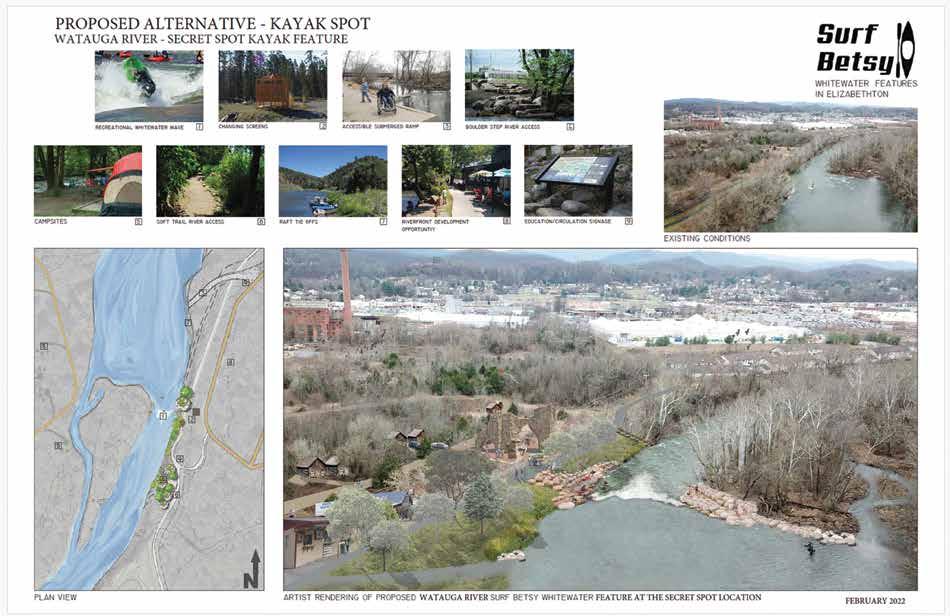
The reason: Before there was such a thing as a TDEC brownfield redevelopment grant, the “Preferred Alternative” site for the whitewater recreation project known as “Surf Betsy” was found to be near the 23-acre site — perhaps near enough to be considered the same site.
By Buzz Trexler
THE BIG IDEA
It’s been over seven years since a crowd of enthusiasts, curious citizens, and public officials crowded into the Bonnie Kate Theater to learn more about creating a whitewater sports park in Elizabethton.
While such in-river attractions have been around for more than 40 years — one of the oldest being the Durango Whitewater Park in Durango, Colo. — the concept of creating one locally was birthed out of the loosely organized “Elizabethton IDEAS Group,” described on its Facebook page as a group of like-minded citizens of Elizabethton and Carter County who “want to see our town and county thrive.” The group sponsored the Feb. 17, 2018, information-sharing meeting at the theater.
“It was a large crowd. It was full,” Nanney said, add-
ing that with members of the City Council and the city manager in attendance, “that’s when it kind of got the ball rolling as far as exploring what could happen.”
Past media reports suggest the idea flowed along without any official movement other than the Parks and Recreation Department collaborating with a group of whitewater sports enthusiasts dubbed the “Surf Betsy Task Force.”
While not quite a watershed month, September 2019 saw a lot of developments.
The City Council during its regular meeting that month formed the Surf Betsy Advisory Board, following a Parks and Recreation Board’s recommendation. Appointed to the board were whitewater sports enthusiasts Wesley Bradley, Metin Eryasa, and Bill Schooley, joined by Councilmen Kim Birchfield and Wes Frazier, all of whom are on the board today.
Just days later, a group that included several city leaders journeyed to Nantahala Outdoor Center (NOC) in Bryson City, N.C. There, they went on a three-hour rafting trip and took part in a question-and-answers session with representatives of NOC, which has been around for more than 50 years. Nanney said the NOC “is a different concept, because they do more rafting and it’s a controlled environment.”
In 2020, the Parks and Recreation Department composed a 10-year master plan with a list of nine facilities projects, one of which was proceeding with Surf Betsy and
SOURCE: Elizabethton Parks and Recreation Department
aggressively marketing it as a new regional attraction. The master plan touted the positive economic impact of tourism in Carter County, particularly the generation of state and local tax revenue.
In July 2021, the City Council approved a $38,083.88 contract with RiverRestoration of Carbondale, Colo., to move forward with studies on the project.
EXPLORING THE SITES
In June 2022, RiverRestoration submitted a 60-page report on alternatives and locations for the proposed park. Each location was given a score of 1 to 5 on 30 different areas, including such site aspects as its proximity to a commercial zone, overall environmental cost, drift-boat fishing use, facilities capacity, floodplain management, commercial rafting use, and whitewater kayaking use. A score of 1 indicated it would be a more challenging site to develop; 2, challenging; 3, acceptable; 4, satisfactory; and 5, most satisfactory.
The proposed sites included:
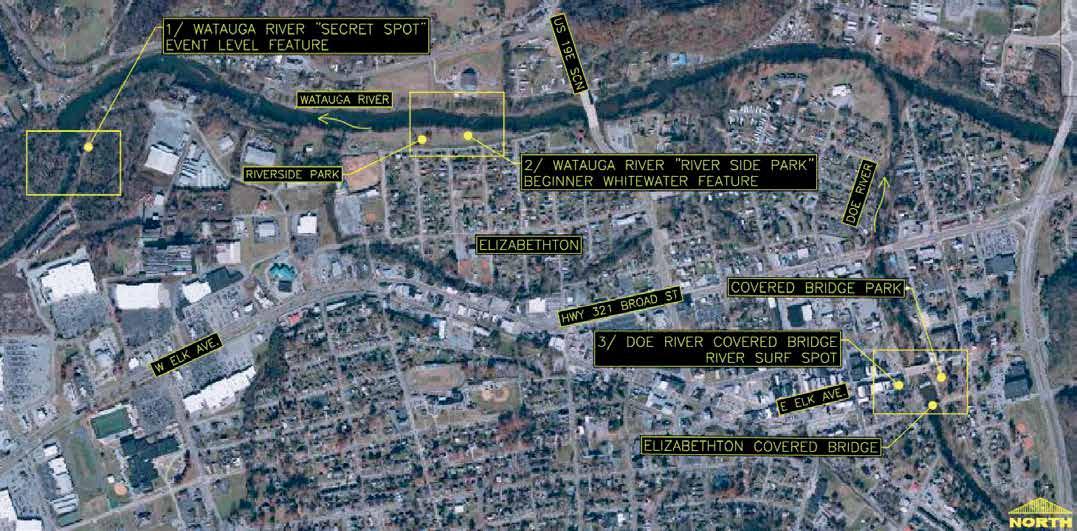
Covered Bridge River Surf Spot, which had an overall score of 90. The study said existing facilities and access are already in place, but the site would likely have more mechanical and structural expenses. However, care of water during construction on the Doe River would be the easiest and least costly as it could be timed seasonally with low flows. The site would likely require one construction window of six months and cost $3,659,407.
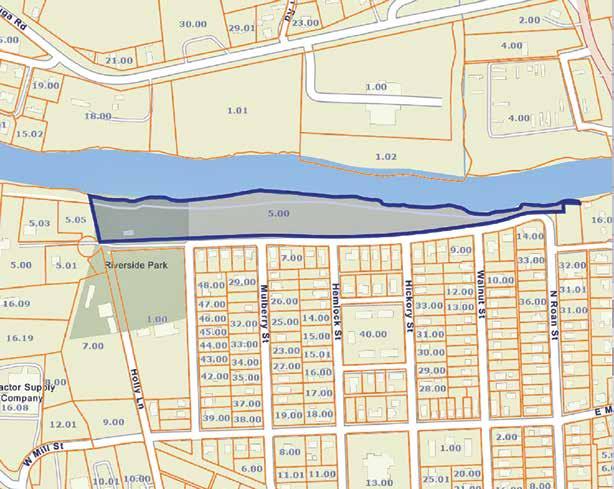
Riverside Park on Watauga River is a 6.73-acre site with
an overall score of 95. RiverRestoration noted the site has existing parking and facilities, so the costs could be focused on creating whitewater features. However, the whitewater features are anticipated to be more constrained by the floodplain and the whitewater experience is expected to be reduced to intermediate/beginner level due to the constraints. The study said it would likely require two annual construction windows of four months during the low-water season and cost $2,034,489.
The “Secret Spot” on Watauga River had an overall score of 100. While it would need more site development than the other two — including parking areas and facilities — those could be phased in later, the study said. The site would also be the most challenging location to control the river during construction. This site would likely require two annual construction windows of four months during the low-water season and cost $3,012,398.
‘FORTUITOUS,’ OR ‘DIVINE’
“What’s funny is it’s — what’s the phrase, fortuitous? — it was an interesting coincident in alignment of different places to try to move us in a particular direction,” Estes said, reflecting on the trajectory of the events that brought the city to this point.
“The Secret Spot is the preferred of the three. It just happens to be adjacent to the property where the TWRA was going to build a fish hatchery, which was property the city had sold them to do that project some time ago. But then that project fell by the wayside,” he said, adding that in the
interim someone set a fire in the building and TWRA was struggling with what to do with the property.
“We had a conversation and said, ‘Well, we’d like to take it back if we could.’ But it took a little time for that to come through,” Estes said. “But those pieces really fall together. Because if you’re gonna build, the location you really want to have has riverfront acreage adjacent because folks may want to view it and watch — it’s going to be a spectator sport. But also, if you’re going to put in and take out, you want to have up- and downstream of it to some degree.
“Well, we’re not gonna go on the other side of the river,” Estes said. “It’s all private property, so we’re lucky enough to pick this property back up.”
Estes suggests there’s another part where the stars seemed to align: After the city reacquired the 23-acre site adjacent to The Secret Spot, the Brownfield Redevelopment Area Grant becomes available for the first time. The grant is in three phases: identification, investigation, and mitigation.
“We’re going to go apply for the mitigation grant from them to get state money in to help us remediate the issues,” Estes said. “But it needs to be on publicly owned property. So, if we hadn’t gotten the land...”
“Boy, it looks like we planned all that way, but things fell in our direction, yeah,” he said.
“It looks like the Providence of God, is what it looks like it,” Nanney said. “That’s the way I look at it.”
This vision of Surf Betsy was on display Feb. 17, 2018, during an informational meeting at the Bonnie Kate Theater.
‘NOT SPLASH COUNTRY’
For people who are not whitewater sports enthusiasts — such as kayakers, rafters, or paddleboarders — the term “whitewater park” may evoke images of a popular Pigeon Forge theme park.
“Here’s the challenge for some: if you say it’s a ‘whitewater park,’” said Estes. “It’s not Splash Country in Dollywood. It’s difficult to articulate what it clearly means unless you use a lot of words.
“It’s building water features into the riverbed that create waves that are exciting, or interesting, or challenging for kayakers to use in the river,” he said.
When it was first presented at the Bonnie Kate, supporters presented an initial concept on a foam display board that is still on hand at the Parks and Recreation Department.
It’s difficult to find a recent comprehensive list of such parks in the U.S., but a 2016 feature in Paddling Magazine gave a “best estimate” of about 60. The closest one to Elizabethton is the U.S. National Whitewater Center in Charlotte, N.C., but that is about to change.
About four miles outside of Asheville, N.C., the Town of Woodfin is in the first phase of an estimated $4.8 million world-class river park “perfect for a broad range of kayakers and surfers with intermediate to advanced skill,” according to the town’s parks and greenways website. The Taylor’s Wave project is named for Taylor Hunt, an expert paddler who died in a 2015 whitewater accident in Ecuador.
According to an Asheville Citizen-Times report, officials feared the in-stream construction that began in July 2024 was lost to the damage wrought by Hurricane Helene. However, once the flood waters receded, officials said they were “cautiously optimistic” the project would continue to move forward.
Construction of Taylor’s Wave is financed through bonds
issued by the Town of Woodfin, as well as donations from Friends of the Woodfin Greenway and Blueway, Buncombe County Tourism Development Authority’s Tourism Product Development Fund, and private donors.
In June 2022, the city of Roanoke announced plans to build an in-river kayak park in the Roanoke River, the first in Virginia. On Dec. 30, 2024, the city awarded a $5.6 million contract with Environmental Quality Resources (EQR) to construct the park. According to the Roanoke Outside Foundation, construction is set to begin this spring, with a completion date in late 2026.
WHY THE SLOW FLOW…
Estes and Nanney acknowledge there are people who say the Elizabethton project is taking too long.
“Our intention is to do our due diligence, because we don’t have the revenue sitting aside, we don’t have money set aside to go do this project,” Estes said. “And even if we did, we think it’s a valuable use of taxpayers’ money to do the investigative portions to make sure what we have as a vision has a plan that’s viable, that we can execute.”
Once that due diligence is done, Estes said, the next step is finding a way to fund the project, and to do that the city needs something like a business plan when submitting grant applications.
“We can say we’ve already done the preliminary design. We pick the preferential site, we can go back to them and say, ‘Can you dust off your numbers for current and give us some preliminary updated cost estimates?’ And here’s what the return would be as far as a draw to our community,” he said. “This is the impact for outdoor recreation and tourism. That’s how you’re going to go to folks on like the outdoor recreation side of TDEC and make a pitch.”
Clay Guerry, recreation specialist with Tennessee Valley
BRISTOL, JOHNSON CITY & KINGSPORT
MONDAY-FRIDAY 8 AM-8 PM
GREENEVILLE
MONDAY-FRIDAY 8 AM-5 PM
JOHNSON CITY
SATURDAY 8 AM-5 PM SUNDAY 1 PM-5 PM
AFTER-HOURS VIRTUAL CARE WITH THE HURT! APP FAST, FREE & AVAILABLE 24/7/356
SCAN TO DOWNLOAD
Authority, said while the agency does not have grants or other funding available for projects like Surf Betsy, the agency can provide technical support to help guide the project through the permitting process.
“TVA has supported public access projects on the Watauga River to expand recreation in the area,” he said. “We have also worked with the University of Tennessee on the RiverLine project, which connects outdoor recreation along the Tennessee River.”
AND ALONG CAME HELENE
As summer was giving way to fall in 2024, city officials and the Surf Betsy Advisory Board received a long-awaited economic impact report from Southwick Associates. Soon afterward, on Sept. 28, the city was among the areas devastated by Hurricane Helene.
In its wake, Elizabethton was left with the destruction of infrastructure and city parks — especially Cat Island and Edwards Island, but also other Parks and Recreation properties. The city is working to restore the parks to pre-flood level, or better, and it’s where Nanney and others have been devoting significant time and effort, especially with Cat Island, which sees a lot of use during the baseball season.
“Frankly, all the other things we had on our wish list, or to-do list, got pushed to the side until we can manage that,” the city manager said.
“We’ve been trying to get them up and running for their season,” Nanney said of the Cat Island ballfields.
But that does not mean Surf Betsy is out of sight.
“It’s just like any project,” Nanney said. “It takes more time than what you could conceivably think, even before it gets to the point of construction.”
Surf Betsy remains a priority, Nanney said, “but it’s not the No. 1 priority.”
THE WAVE OF SURF BETSY
The Star conducted interviews and filed an open records request for documents related to the Surf Betsy project. Here is a brief look at what we were told and uncovered:
What is Surf Betsy?
Surf Betsy is the name given to a proposed development — often called a “whitewater park” — that would attract whitewater recreation enthusiasts and offer various levels of whitewater challenges and event-oriented opportunities. From all accounts, the project originated at least eight years ago with the Elizabethton IDEAS Group, an informal community advocacy group. The City Council formally appointed the Surf Betsy Advisory Board in September 2019.
Why Would the City Want It?
Two rivers — the Doe and Watauga — offer a rich environment for such a park, and the city already has public land along those two rivers. Outdoor recreation is a relatively untapped revenue source as a significant public and private revenue stream. Elizabethton and Carter County have a limited inventory of flat acreage and infrastructure assets to attract manufacturers. Developing Surf Betsy and marketing that attraction with other outdoor recreation assets — such as The Tweetsie Trail, Watauga Lake, Hampton Watershed Mountain Bike Trail, and The Appalachian Trail — could create significant revenue.
Where Are the Proposed Sites?
There are three sites, and each would offer different levels of challenge for enthusiasts, as well as development prospects for amenities.
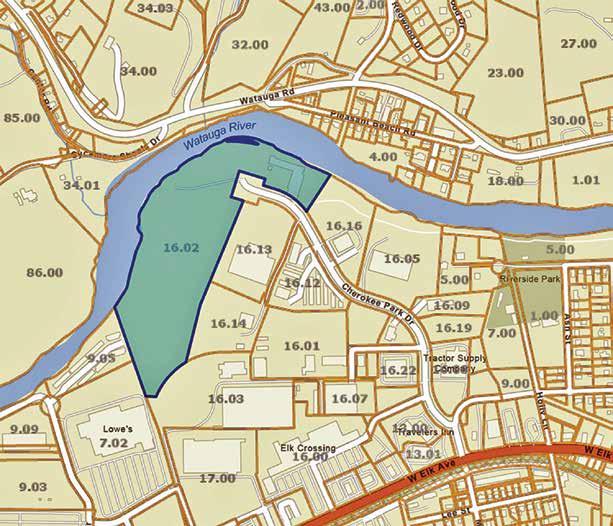
“The Secret Spot” is like an island in the Watauga River, and the development would likely include the 23-acre brownfield site on Cherokee Park Drive that was once eyed as a state fish hatchery site.
Riverside Park is a nearly 7-acre strip of land along the Watauga River on West Riverside Drive.
River Surf Spot, a site near the Covered Bridge on the Doe River.
What Is the Cost?
In June 2022, River Restoration gave the following preliminary estimates: “The Secret Spot,” $3,012,398; Riverside Park, $2,034,489; and Covered Bridge River Surf Spot, $3,659,407.
How Would It Be Funded?
A funding strategy has not yet been developed, but an online search shows some communities have issued bonds to help finance similar projects, while the city of Roanoke is constructing a $5.6 million whitewater park using funds from the American Rescue Plan Act.
Where Would the Revenue Come From?
RiverRestoration cites different revenue-generation models, but most offer indirect revenue, such as receiving fees from concessionaires, permits, and leases. Other revenue is ancillary, such as state and local sales tax revenue from participant and spectator spending.
SOURCE: Comptroller of the Treasury/Division of Property Assessments
The shaded area on this parcel map (Parcel 5.00) shows the property that RiverRestoration has identified as a prospective Surf Betsy site. The parcel is adjacent to Riverside Park and private properties along Riverside Drive.
SOURCE: Comptroller of the Treasury/Division of Property Assessments
The shaded area on this parcel map (Parcel 16.02) shows the property that is currently the focus of a brownfield redevelopment grant and could be developed as Surf Betsy’s “The Secret Spot.” Adjacent to the property are Lowes (Parcel 7.02), Valley Forge Wholesale (Parcel 16.13), Riverview Townhomes Region 2 (Parcel 9.05), Carter County Recycling Center (Parcel 16.14), and Bemberg Industrial Center (Parcel 16.03). To the far right on the same side of Watauga River is Parcel 5.00, the Riverside Park site.
‘Conservative’ study sets Surf Betsy’s economic impact at
nearly $2M annually
By Buzz Trexler
On Sept. 18, 2024, Surf Betsy Advisory Board member Wesley Bradley posted on a social media account dedicated to the whitewater project: “It’s been 5 years since this field study trip, and we now have a local economic impact study to show for the effort.”
OTen days later, Sept. 28, the city was chest-deep in a state of emergency wrought by the remnants of Hurricane Helene, and a planned Sept. 20 meeting The Elizabethton Star had scheduled with city officials to discuss the study was canceled.
Surf Betsy would have to wait.
In response to an open records request from The Star, the city provided a copy of the study — conducted by Southwick Associates of Fernandina Beach, Fla. — along
with other documents related to Surf Betsy. The report estimates an in-river whitewater park proposed for sites on the Watauga River would bring in $1.968 million
in “total output” to the state’s economy. The economic impact would expand beyond the city limits, according to the Southwick study, thus the numbers were calculated statewide.
“After considering multiple factors influencing the decision to visit the proposed whitewater park, preliminary annual visitation for whitewater kayaking is estimated at 7,300 days, with over 6,900 days for spectating, totaling more than 14,200 visits each year,” the study stated.
“To the extent that additional activities will occur at the proposed site besides whitewater and spectating, such as special events plus participation and spending by youth under 18 years old, these estimates are considered conservative,” the study said.
SOURCE: RiverRestoration
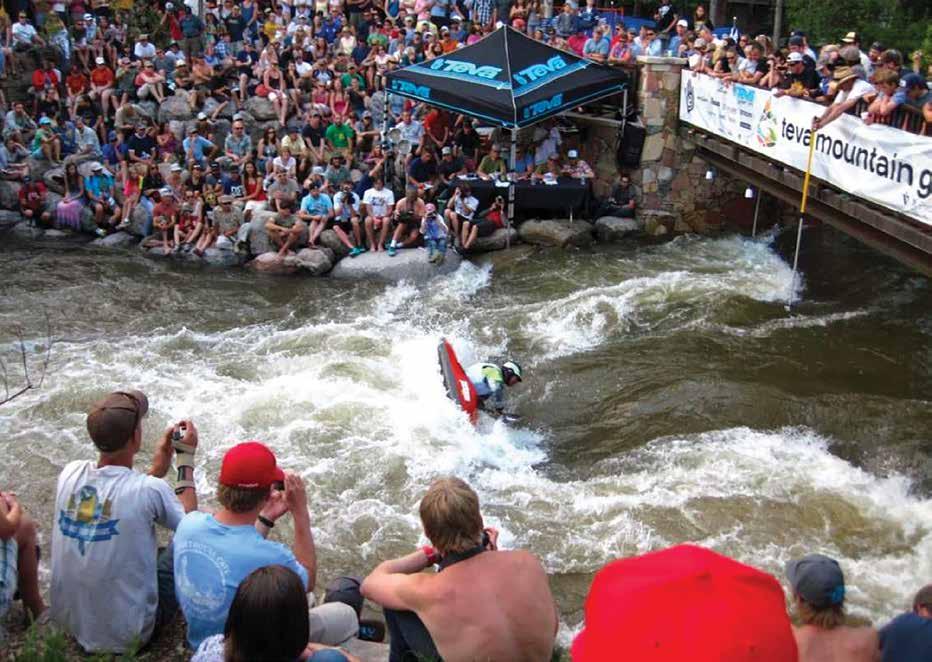
Spectators watch a whitewater enthusiast in a kayak move through a “Rodeo Hole” designed by RiverRestoration at a park in Vail, Colo.
The study estimates the statewide impact on annual retail spending at $1,491,000; salaries and wages, $709,000; contribution to gross domestic product regionally, $1,127,000; federal taxes, $128,000; and state and local taxes, $163,000.
The study also set the number of full-time and part-time jobs added statewide as a result of the park at 13,900 workers. “These are not just the employees directly serving recreators or manufacturing their goods but also include employees of industries that support and supply directly impacted businesses,” the study said, with salaries and wages totaling $709,000.
Surf Betsy Advisory Board Chairman William E. “Bill” Schooley said this is the second economic impact study done on the project, the first being conducted by East Tennessee State University’s College of Business. Schooley said he did not believe the ETSU study went deep enough, and neither did City Manager Daniel Estes.
“We appreciated that, and it was informative, but it really didn’t go to the depth that we really wanted it to,” Estes said. “It was good and it kind of whetted the appetite.”
“Then we came back and said, ‘OK. Let’s take in one of the future phases that RiverRestoration had — a component of it being the economic impact — let’s just peel that out and have a firm go and do that work,’” Estes said, referring to the Carbondale, Colo., company the city contracted with for the Surf Betsy project in July 2021. In November 2023, the City Council approved a $40,320 amendment to the contract for the Southwick study.
As with the ETSU Business School effort, Schooley believes the Southwick study falls short. While the firm took a more objective approach, Schooley said, it is a “very conservative estimate.”
“I don’t think it really gets to the heart of the matter, and it was underwhelming when we finally got it,”
PHASES OF SURF BETSY
Schooley said. “We paid money for it, and I don’t think it was money very well spent.”
“I think it’s too conservative, and what I was hoping they would do would be — and this is an entirely different approach — to study one of the other comparable parks that exist somewhere else in the country,” he said. “There’s over 20 of them in Colorado. But you don’t have to go very far, really, to uncover a similar type of installation.”
Schooley said a better way to do it would be to look at the data that comes from one of the existing parks and then make a sophisticated analysis of how much of it would be applicable to Elizabethton and Surf Betsy.
Metin Eryasa, an advisory board member often credited with birthing the idea, said he was glad the Southwick study was conservative in its estimates. “Because even with their conservative numbers, it’s a good thing,” he said.
Here is a brief look at the five phases of project exploration/development used by RiverRestoration, the Carbondale, Colo., firm the city has contracted with for the Surf Betsy project.
Phase I: Opportunities, Constraints, and Site Review
Identify and select the Surf Betsy site, or sites, and explore the constraints and opportunities concerning development alternatives.
Phase II: Design and Alternative Development
Identify the issues and limitations of the site, or sites; select a “Preferred Alternative” among the various development alternatives given the sites; finalize the feasibility of the Preferred Alternative; conduct an economic impact study; develop a cost-benefit analysis; and develop a funding strategy.
Phase III: Design, Permitting, and Final Design
Permitting and final design of the Preferred Alternative. Construction may be phased according to budgets and timing of funding awards and ongoing fundraising efforts.
Phase IV: Prepare Construction Documents for Bid
Develop construction drawings, specifications, and quantities for bid tabulation and assist in developing a bid package.
Phase V: Project Implementation
Monitor construction, permit compliance, plans and specification compliance, and other tasks necessary to the project’s implementation.
SOURCE: RiverRestoration, Elizabethton Whitewater Park Phase II – Scope of Services; Jan. 9, 2023
Wesley Bradley, also an advisory board member who has worked with Schooley since the project’s inception, also believes the study falls short.
“We think it’s kind of low-ball numbers from other things that’s comparable, like the Nantahala Outdoor Center,” Bradley said, referring to the Bryson City, N.C., whitewater venue that supporters and city officials visited in 2019. “They gave us much larger numbers when we were down there,” he said, adding that the Southwick study gave the city a starting point, but there is “plenty of room to grow.”
Other cities in the region have whitewater recreation projects already under way.
There is the $4.8 million Taylor’s Wave project in Woodfin, N.C., a small town of about 8,000 people just outside of Asheville on the French Broad River. The first phase of the project had been completed when the remnants of Hurricane Helene roared through, and city officials feared the work that had progressed “may be gone,” according to a report in the Asheville CitizenTimes. Once the waters receded, though, there was cautious optimism, and a Dec. 3, 2024, update on the city’s website said the “outlook for the project is still solid.”
On Dec. 30, 2024, the city of Roanoke, Va., awarded a $5.6 million contract to Environmental Quality Resources (EQR) to construct the state’s first in-river kayak park. According to the Roanoke Outside Foundation, construction is set to begin this spring, with a completion date in late 2026.
SOURCE: RiverRestoration
Photo Courtesy of Tyler Colson Wesley Bradley, a member of the Surf Betsy Advisory Board, paddles through an opening at Green River Narrows in Blue Ridge, NC, just weeks before the remnants of Hurricane Helene roared through the region.
Carter County Living A magazine dedicated to our community