3
Dreams Can Come True... Focus on Grammar
be going to
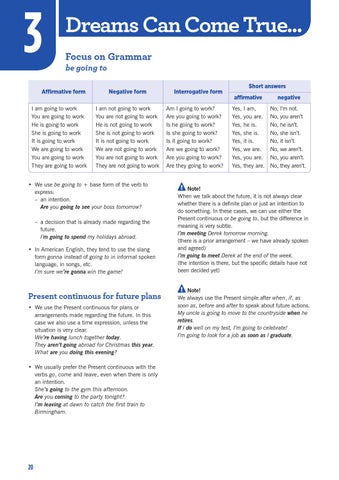
Affirmative form I am going to work You are going to work He is going to work She is going to work It is going to work We are going to work You are going to work They are going to work
Negative form I am not going to work You are not going to work He is not going to work She is not going to work It is not going to work We are not going to work You are not going to work They are not going to work
• We use be going to + base form of the verb to express: – an intention. Are you going to see your boss tomorrow? – a decision that is already made regarding the future. I’m going to spend my holidays abroad. • In American English, they tend to use the slang form gonna instead of going to in informal spoken language, in songs, etc. I’m sure we’re gonna win the game!
Present continuous for future plans • We use the Present continuous for plans or arrangements made regarding the future. In this case we also use a time expression, unless the situation is very clear. We’re having lunch together today. They aren’t going abroad for Christmas this year. What are you doing this evening? • We usually prefer the Present continuous with the verbs go, come and leave, even when there is only an intention. She’s going to the gym this afternoon. Are you coming to the party tonight? I’m leaving at dawn to catch the first train to Birmingham.
20
Interrogative form Am I going to work? Are you going to work? Is he going to work? Is she going to work? Is it going to work? Are we going to work? Are you going to work? Are they going to work?
Short answers affirmative Yes, Yes, Yes, Yes, Yes, Yes, Yes, Yes,
I am, you are. he is. she is. it is. we are. you are. they are.
negative No, I’m not. No, you aren’t No, he isn’t. No, she isn’t. No, it isn’t. No, we aren’t. No, you aren’t. No, they aren’t.
! Note! When we talk about the future, it is not always clear whether there is a definite plan or just an intention to do something. In these cases, we can use either the Present continuous or be going to, but the difference in meaning is very subtle. I’m meeting Derek tomorrow morning. (there is a prior arrangement – we have already spoken and agreed) I’m going to meet Derek at the end of the week. (the intention is there, but the specific details have not been decided yet) ! Note! We always use the Present simple after when, if, as soon as, before and after to speak about future actions. My uncle is going to move to the countryside when he retires. If I do well on my test, I’m going to celebrate! I’m going to look for a job as soon as I graduate.